3 English and 3 math
Here are 6 random questions to try. Takers earning below 75% are unlikely to receive an offer. You have 1 minute 48 seconds per question on the real exam.
Question 1 of 6
2026 Practice Test D English, question 10Passage Excerpt from “How We Made the First Flight”
Excerpt from “How We Made the First Flight”
by Orville Wright
In 1903 brothers Wilbur and Orville Wright conducted experiments related to flying machines. These experiments would eventually lead to air travel becoming a reliable form of transportation.
During the night of December 16, 1903, a strong cold wind blew from the north. When we arose on the morning of the 17th, the puddles of water, which had been standing about camp since the recent rains, were covered with ice. The wind had a velocity of 10 to 12 meters per second (22 to 27 miles an hour). We thought it would die down before long, and so remained indoors the early part of the morning. But when ten o’clock arrived, and the wind was as brisk as ever, we decided that we had better get the machine out and attempt a flight. We hung out the signal for the men of the Life Saving Station.1 We thought that by facing the flyer into a strong wind, there ought to be no trouble in launching it from the level ground about camp. We realized the difficulties of flying in so high a wind, but estimated that the added dangers in flight would be partly compensated for by the slower speed in landing.
Final Preparations
We laid the track on a smooth stretch of ground about one hundred feet north of the new building. The biting cold wind made work difficult, and we had to warm up frequently in our living room, where we had a good fire in an improvised stove made of a large carbide2 can. By the time all was ready, J. T. Daniels, W. S. Dough and A. D. Etheridge, members of the Kill Devil3 Life Saving Station; W. C. Brinkley of Manteo, and Johnny Moore, a boy from Nags Head,4 had arrived.
We had a “Richard” hand anemometer with which we measured the velocity of the wind. Measurements made just before starting the first flight showed velocities of 11 to 12 meters per second, or 24 to 27 miles per hour. . . .
Audacity—and Calculation
Wilbur having used his turn in the unsuccessful attempt on the 14th, the right to the first trial now belonged to me. After running the motor a few minutes to heat it up, I released the wire that held the machine to the track, and the machine started forward in the wind. Wilbur ran at the side of the machine, holding the wing to balance it on the track. Unlike the start on the 14th, made in a calm, the machine, facing a 27-mile wind, started very slowly. Wilbur was able to stay with it till it lifted from the track after a forty-foot run. One of the Life Saving men snapped the camera for us, taking a picture just as the machine had reached the end of the track and had risen to a height of about two feet. The slow forward speed of the machine over the ground is clearly shown in the picture by Wilbur’s attitude. He stayed along beside the machine without any effort.
Flight
The course of the flight up and down was exceedingly erratic, partly due to the irregularity of the air, and partly to lack of experience in handling this machine. The control of the front rudder was difficult on account of its being balanced too near the center. This gave it a tendency to turn itself when started; so that it turned too far on one side and then too far on the other. As a result the machine would rise suddenly to about ten feet, and then as suddenly dart for the ground. A sudden dart when a little over a hundred feet from the end of the track, or a little over 120 feet from the point at which it rose into the air, ended the flight. As the velocity of the wind was over 35 feet per second and the speed of the machine over the ground against this wind ten feet per second, the speed of the machine relative to the air was over 45 feet per second, and the length of the flight was equivalent to a flight of 540 feet made in calm air. This flight lasted only 12 seconds, but it was nevertheless the first in the history of the world in which a machine carrying a man had raised itself by its own power into the air in full flight, had sailed forward without reduction of speed and had finally landed at a point as high as that from which it started.
From “How We Made the First Flight” by Orville Wright—Public Domain/Federal Aviation Administration
1Life Saving Station: one of the rescue stations along the Atlantic coastline that provided assistance to mariners in distress
2carbide: a very hard material composed of carbon and other heavy metals
3Kill Devil: the town of Kill Devil Hills in eastern North Carolina
4Nags Head: a town in eastern North Carolina
Question
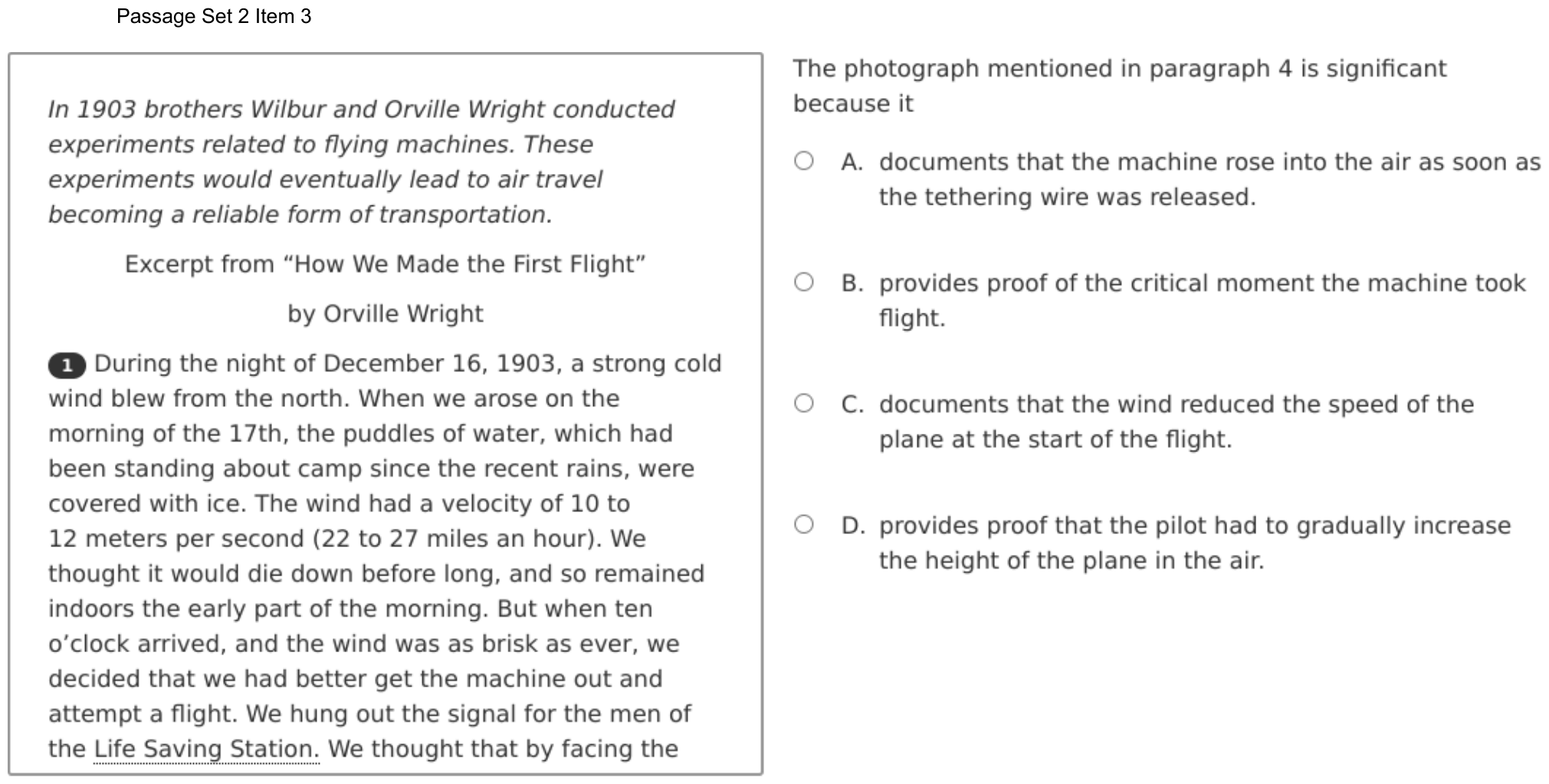
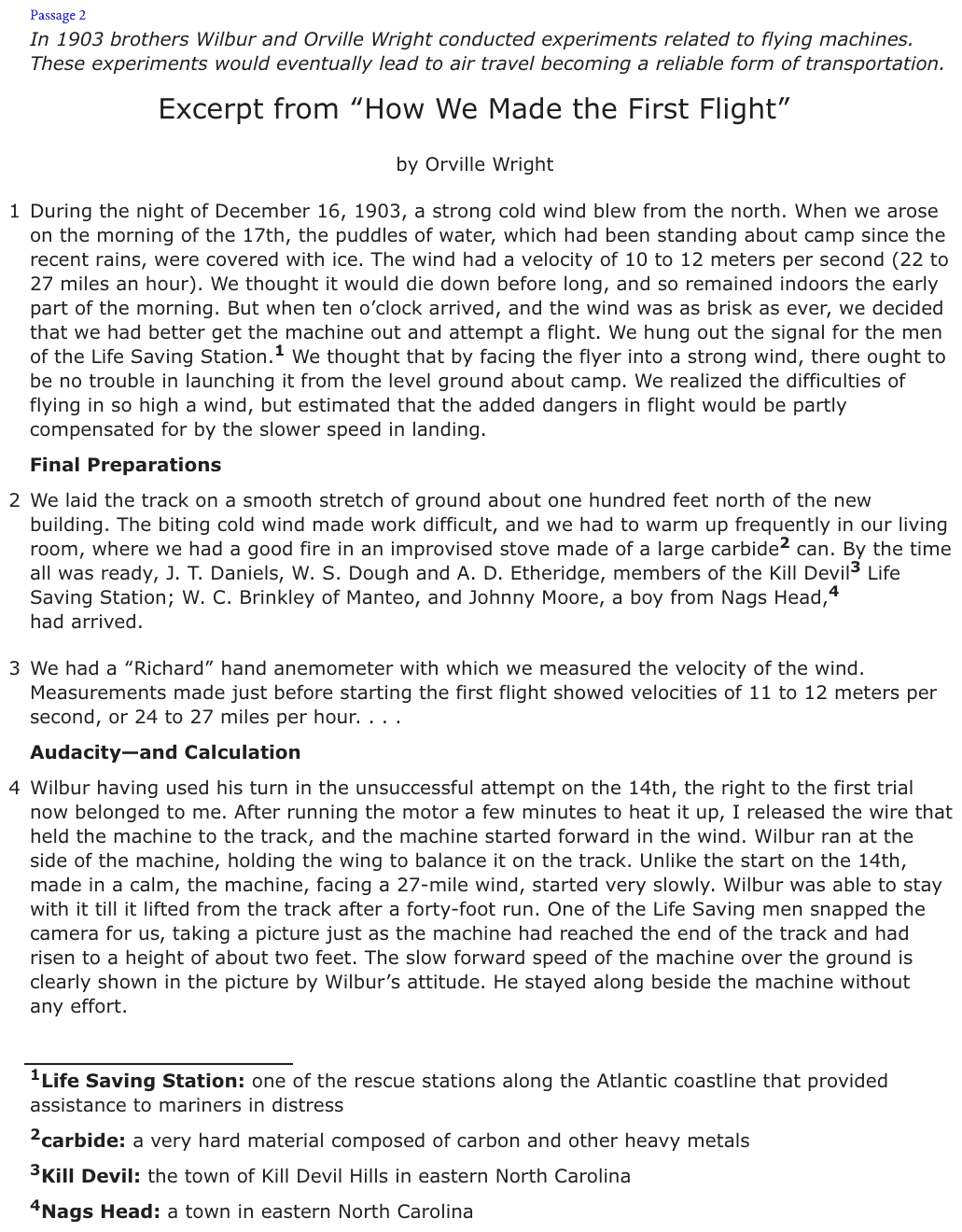
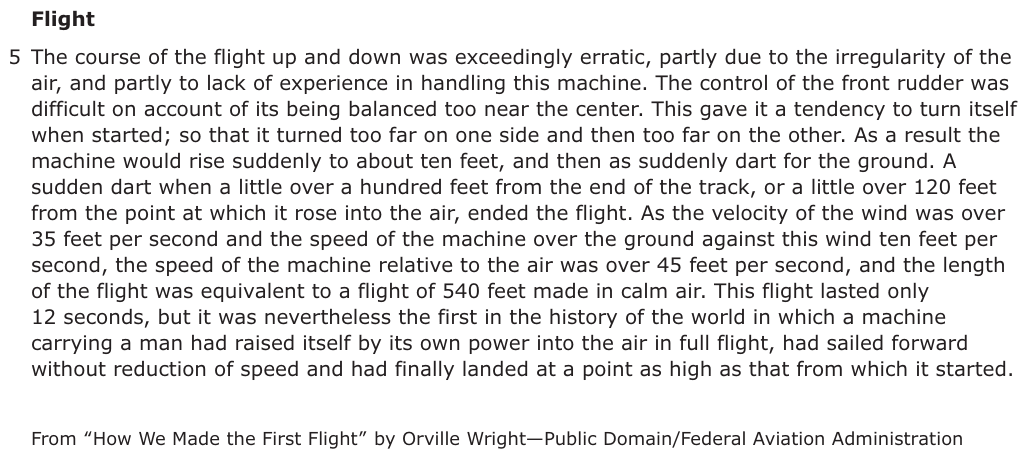
The photograph mentioned in paragraph 4 is significant because it
- Adocuments that the machine rose into the air as soon as the tethering wire was released.
- Bprovides proof of the critical moment the machine took flight.
- Cdocuments that the wind reduced the speed of the plane at the start of the flight.
- Dprovides proof that the pilot had to gradually increase the height of the plane in the air.
Show the answer
Correct answer: B
The question asks why the photograph mentioned in paragraph 4 is significant.
A. Incorrect. According to paragraph 4, the photograph was not taken immediately after the tethering wire was released but rather after an intervening period during which “Wilbur ran at the side of the machine, holding the wing to balance it on the track.” The picture was not taken until “the machine had reached the end of the track,” which occurred after a “forty-foot run” (paragraph 4).
B. CORRECT. The photograph mentioned in paragraph 4 is significant because it provides proof that the machine did, in fact, take flight: “One of the Life Saving men snapped the camera for us, taking a picture just as the machine had reached the end of the track and had risen to a height of about two feet. The slow forward speed of the machine over the ground is clearly shown in the picture by Wilbur’s attitude. He stayed along beside the machine without any effort.”
C. Incorrect. The photograph mentioned in paragraph 4 is described as showing the plane moving forward through the air at a height of two feet, but while the effect of the wind may be visible, it is not why the photo is significant. Instead, the photograph provides proof that the plane is, in fact, moving through the air (“One of the Life Saving men snapped the camera for us, taking a picture just as the machine had reached the end of the track and had risen to a height of about two feet. The slow forward speed of the machine over the ground is clearly shown in the picture by Wilbur’s attitude”).
D. Incorrect. Although the plane is shown at a height of two feet in the photograph mentioned in paragraph 4, the picture documents only one moment of the plane’s flight and does not provide proof that the pilot had to gradually increase the height of the plane in the air.
Question analysis
This question on Orville Wright’s account of the first airplane flight asks why the photograph mentioned in paragraph 4, taken by one of the Life Saving men, is significant. The photograph itself is not printed with the excerpt, so students must work from Orville’s description of the moment it was taken. Several choices describe the machine’s movement, so each must be checked against that description.
- Grade level
- Grade 8 reading and task
- Compared with grade 7
- Above grade 7 Grade 7 readers often explain why a detail matters. This photograph is not printed, so students must picture it from Orville’s description, which uses “attitude” in an old sense meaning posture, and then judge why the picture mattered.
- Estimated difficulty
- Hard: combines ideas, needs a plan, and has more than one tempting wrong answer.
- Thinking it demands
- Depth of knowledge 2, skills and concepts · mainly analyze
- What makes it hard
- Reading between the lines moderate
- The right answer is reworded moderate
- Hard words minor
- Evidence
- Answered from one paragraph or stanza
- Reading level
- Passage: about grade 7, 816 words; question and choices: about grade 7, 68 words.
- Students, last 30 days
- Not enough answers yet to show (it takes 10).
Why it is hard, traps and wrong answers (shows the answer)
Why it is hard
The photograph is not printed, so students work from three sentences of description, and the last two tell what Orville thinks the picture shows: the machine’s slow speed, visible in Wilbur’s easy pace. That stated detail is the strongest lure. The question asks for significance instead, which the excerpt leaves unstated; students must link the moment captured, the machine just off the track at the end of its run, to paragraph 5’s closing claim that this was the first such flight in history.
Reading between the lines moderate Working it out
Orville never says why the picture matters; students must notice it was taken “just as the machine had reached the end of the track and had risen to a height of about two feet,” the instant of lift-off. (Graesser, Singer & Trabasso, 1994; Kintsch, 1998)
The right answer is reworded moderate Choosing the answer
The key’s “critical moment the machine took flight” appears nowhere, while the wrong choices echo the paragraph’s released wire, the slow speed Orville says the picture shows, and the “height of about two feet.” (Freedle & Kostin, 1993; Kirsch & Mosenthal, 1990)
Hard words minor Understanding the question
Orville says the slow speed shows “by Wilbur’s attitude,” using attitude in an old sense, Wilbur’s posture as he keeps pace, which students must decode to follow the description of the picture. (Perfetti, 2007; Freedle & Kostin, 1993)
Strategy: Reread the three sentences about the picture in paragraph 4, note when it was taken and what Orville says it shows, then weigh which choice explains why such a picture would matter.
Traps
- True but not the answer: A choice says something accurate about the text that does not answer this question.
- Twists what the text says: Uses the text's topic and ideas but changes what it says: who did it, how much, when, or why.
- Reads too much in: A reasonable-sounding conclusion that goes further than the text allows.
The wrong answers, classified
A Twists what the text says (King et al., 2004)
Collapses the release of the wire and the lift-off into one moment, skipping Wilbur’s run beside the machine; it rose only after a forty-foot run, when the picture was taken.
C True but not the answer (King et al., 2004; Embretson & Wetzel, 1987)
Takes Orville’s own remark that the picture shows “the slow forward speed of the machine” as its significance, but that is a detail in the picture, not why a picture of this moment matters.
D Reads too much in (Graesser, Singer & Trabasso, 1994)
Treats the two-foot height as one step in a steady climb, though a single picture catches one instant and paragraph 5 describes sudden rises to ten feet and darts toward the ground.
Working it out, step by step
Figure out what the question asks
This asks why the photograph in paragraph 4 matters. The photograph is not printed with the excerpt. You have to picture it from Orville’s words. Find when it was taken. Then ask why a picture of that moment would be important.
Read the description of the photograph
Paragraph 4 says “One of the Life Saving men snapped the camera for us, taking a picture just as the machine had reached the end of the track and had risen to a height of about two feet.” The next sentences say “The slow forward speed of the machine over the ground is clearly shown in the picture by Wilbur’s attitude. He stayed along beside the machine without any effort.”
Work out what the picture shows
The machine had just left the track and was two feet in the air. So the picture caught the moment it lifted off. Here “attitude” means the way Wilbur held his body. He kept up with the machine easily, so it was moving slowly. Paragraph 5 says this flight was “the first in the history of the world” of its kind. A photo of that lift-off is proof that it really happened.
Check each choice
- A does not fit. The machine did not rise at once. It lifted “after a forty-foot run.”
- B fits. The picture caught the moment the machine first took flight.
- C does not fit. The picture does show the slow speed. But that is a detail in the photo, not why the photo matters.
- D does not fit. One picture shows one moment. It cannot show a steady climb. In fact, paragraph 5 says the machine rose and dropped suddenly.
Watch out: C is tempting because Orville himself says the slow speed is “clearly shown in the picture.” But the question asks why the picture is significant, which means important.
Choose the answer
The photo captured the very moment the first flight began. So the answer is B, “provides proof of the critical moment the machine took flight.”
Why this answer and not the closest wrong one
C is the closest wrong choice. Orville does say the picture shows the machine’s slow speed. But slow speed is not what makes this photo special. It was taken just as the machine “had risen to a height of about two feet” at the end of the track. That is proof of the first moment of flight, as B says.
More questions like this
The original DOE question
The passage “Excerpt from “How We Made the First Flight”” as printed (pages 13–14)
Question 2 of 6
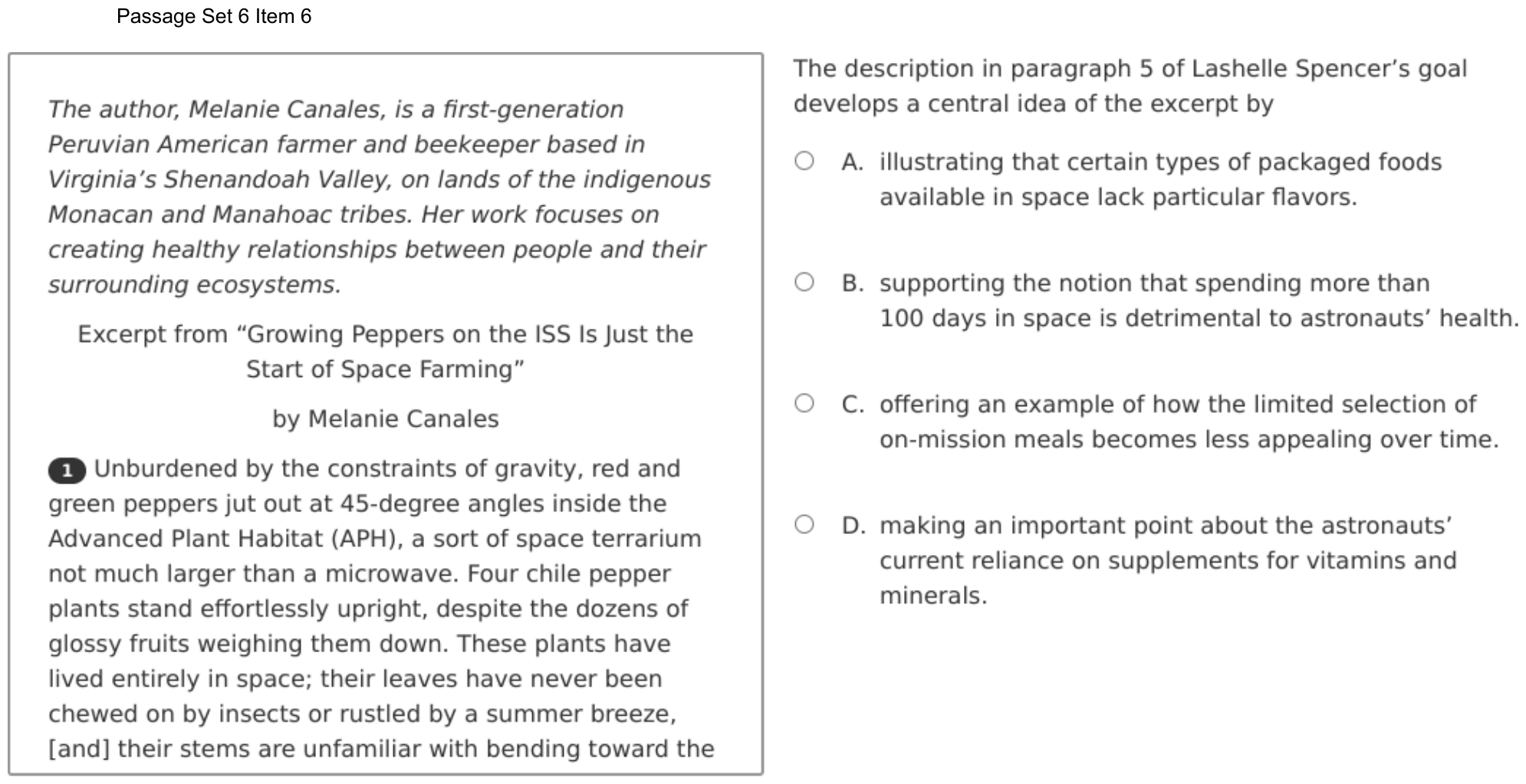
2026 Practice Test C English, question 39Passage Excerpt from “Growing Peppers on the ISS Is Just the Start of Space Farming”
Excerpt from “Growing Peppers on the ISS Is Just the Start of Space Farming”
by Melanie Canales
The author, Melanie Canales, is a first-generation Peruvian American farmer and beekeeper based in Virginia’s Shenandoah Valley, on lands of the indigenous Monacan and Manahoac tribes. Her work focuses on creating healthy relationships between people and their surrounding ecosystems.
Unburdened by the constraints of gravity, red and green peppers jut out at 45-degree angles inside the Advanced Plant Habitat (APH), a sort of space terrarium not much larger than a microwave. Four chile pepper plants stand effortlessly upright, despite the dozens of glossy fruits weighing them down. These plants have lived entirely in space; their leaves have never been chewed on by insects or rustled by a summer breeze, [and] their stems are unfamiliar with bending toward the sun’s arc across the sky. Scissors glint under the tank’s white and blue lights as astronaut Mark Vande Hei and his team snip the stems of those that are ready for harvest. The peppers whirl around their heads until the astronauts catch them and tape them against a board to photograph.
Back on Earth, the Plant Habitat-04 team of engineers and plant scientists are observing and conferring with the astronauts. Of the 26 peppers in this batch, only the 14 finest will stay on the International Space Station [ISS] for consumption. The rest will be wrapped in foil, sealed in a Ziploc bag, then frozen at a brisk −80 degrees, until they can come roaring back to Earth in the next cargo capsule to be studied later. Now, after a 137-day growth cycle, the astronauts remove the plants from the module and trash them. Project Plant Habitat-04 is complete. It’s taco night on the ISS.
Since 2014, NASA1 has experimented with growing lettuces, brassicas,2 and zinnias3 in space, an endeavor that relies on highly specialized technology over 50 years in the making. [Fall 2021’s] two successful pepper harvests . . . will provide data on the nutritional and psychological benefits of growing vegetables on-craft, as well as a crop’s ability to reliably produce long-term in microgravity. While controlled environmental agriculture is not new, the APH experiment represents an evolution in specialized growth habitats. It doesn’t aim to re-create Earth’s conditions, but to perfect each isolated variable of plant growth in the clinical environment of a spaceship.
“The Advanced Plant Habitat is the most complex plant growth system on orbit today,” says Lashelle Spencer, a plant scientist at NASA’s Kennedy Space Center. Its more than 180 sensors control and monitor temperature, humidity, and carbon dioxide. The astronauts can adjust the color and intensity of the light, and how much moisture the plants’ roots are getting. It waters itself.
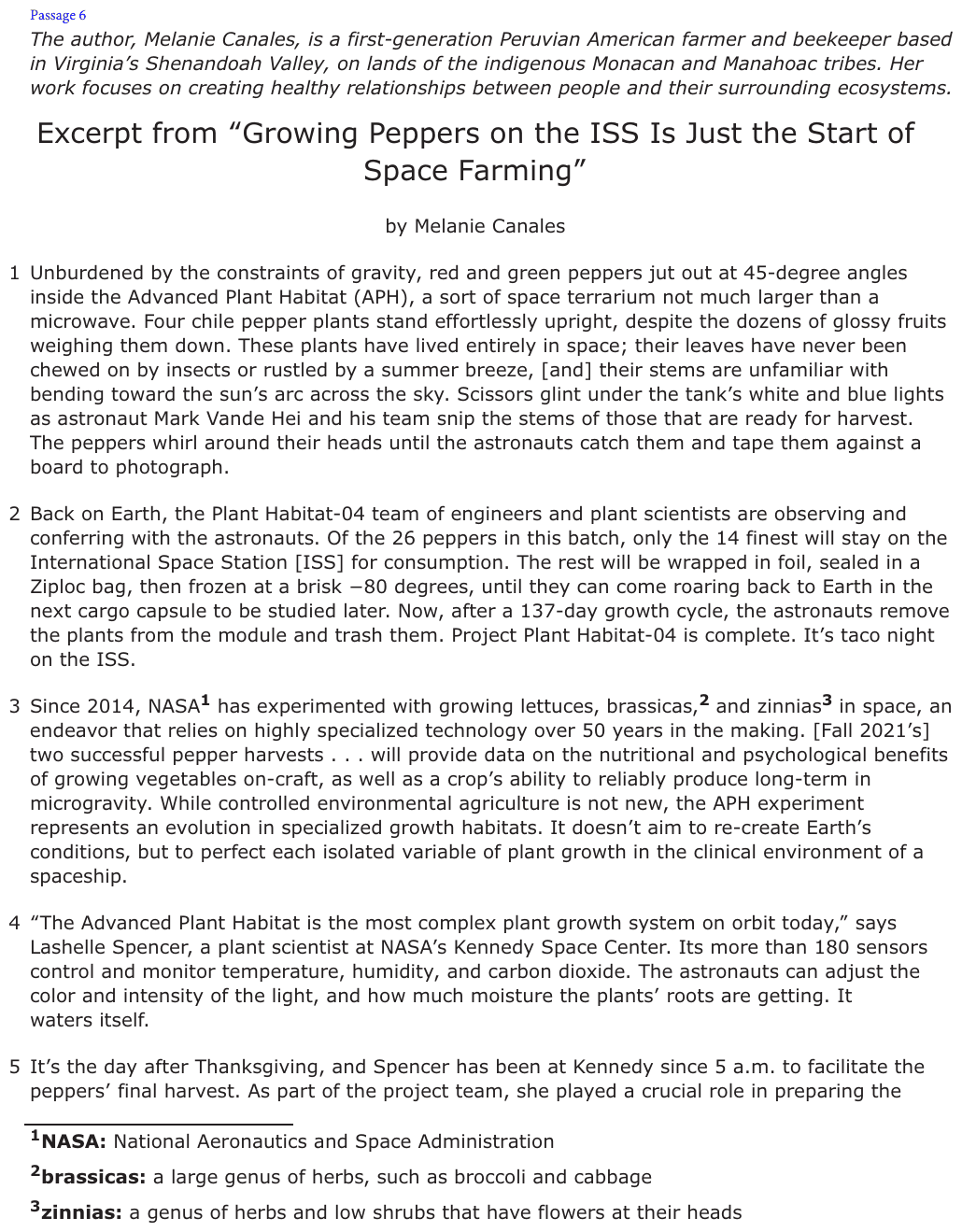
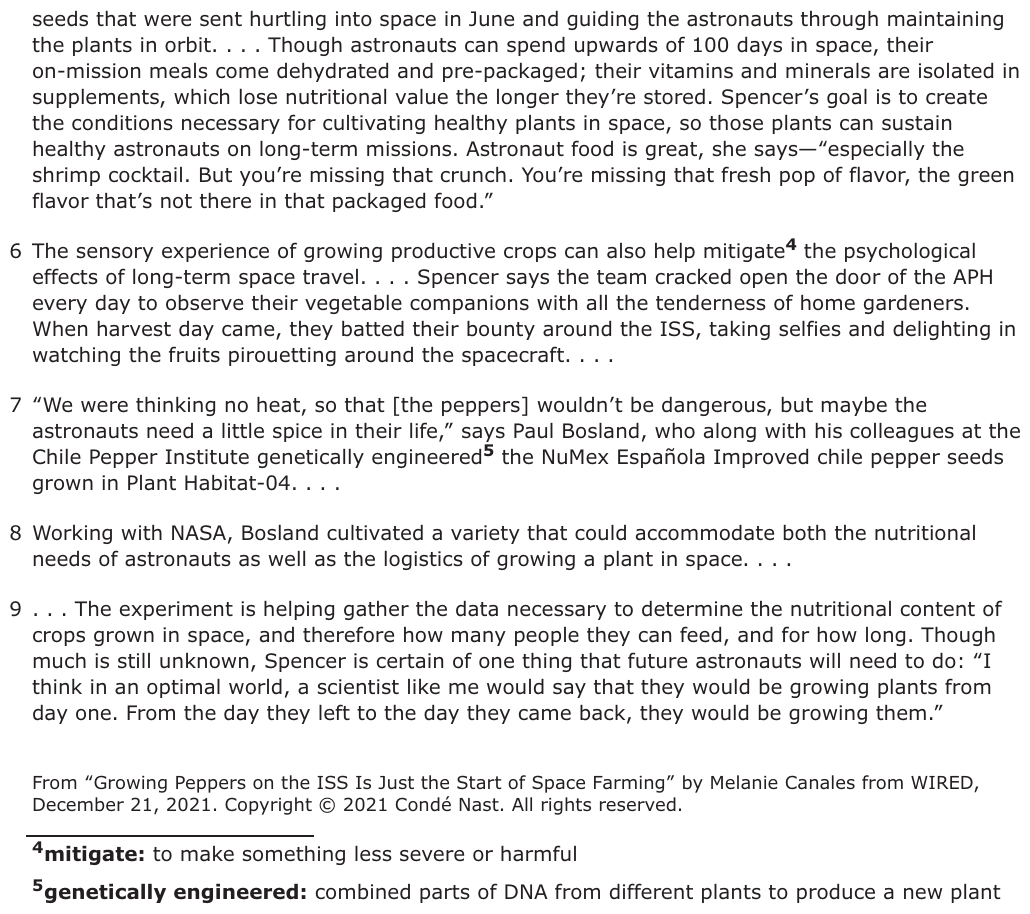
It’s the day after Thanksgiving, and Spencer has been at Kennedy since 5 a.m. to facilitate the peppers’ final harvest. As part of the project team, she played a crucial role in preparing the seeds that were sent hurtling into space in June and guiding the astronauts through maintaining the plants in orbit. . . . Though astronauts can spend upwards of 100 days in space, their on-mission meals come dehydrated and pre-packaged; their vitamins and minerals are isolated in supplements, which lose nutritional value the longer they’re stored. Spencer’s goal is to create the conditions necessary for cultivating healthy plants in space, so those plants can sustain healthy astronauts on long-term missions. Astronaut food is great, she says—“especially the shrimp cocktail. But you’re missing that crunch. You’re missing that fresh pop of flavor, the green flavor that’s not there in that packaged food.”
The sensory experience of growing productive crops can also help mitigate4 the psychological effects of long-term space travel. . . . Spencer says the team cracked open the door of the APH every day to observe their vegetable companions with all the tenderness of home gardeners. When harvest day came, they batted their bounty around the ISS, taking selfies and delighting in watching the fruits pirouetting around the spacecraft. . . .
“We were thinking no heat, so that [the peppers] wouldn’t be dangerous, but maybe the astronauts need a little spice in their life,” says Paul Bosland, who along with his colleagues at the Chile Pepper Institute genetically engineered5 the NuMex Española Improved chile pepper seeds grown in Plant Habitat-04. . . .
Working with NASA, Bosland cultivated a variety that could accommodate both the nutritional needs of astronauts as well as the logistics of growing a plant in space. . . .
. . . The experiment is helping gather the data necessary to determine the nutritional content of crops grown in space, and therefore how many people they can feed, and for how long. Though much is still unknown, Spencer is certain of one thing that future astronauts will need to do: “I think in an optimal world, a scientist like me would say that they would be growing plants from day one. From the day they left to the day they came back, they would be growing them.”
From “Growing Peppers on the ISS Is Just the Start of Space Farming” by Melanie Canales from WIRED, December 21, 2021. Copyright © 2021 Condé Nast. All rights reserved.
1NASA: National Aeronautics and Space Administration
2brassicas: a large genus of herbs, such as broccoli and cabbage
3zinnias: a genus of herbs and low shrubs that have flowers at their heads
4mitigate: to make something less severe or harmful
5genetically engineered: combined parts of DNA from different plants to produce a new plant
Question
The description in paragraph 5 of Lashelle Spencer’s goal develops a central idea of the excerpt by
- Aillustrating that certain types of packaged foods available in space lack particular flavors.
- Bsupporting the notion that spending more than 100 days in space is detrimental to astronauts’ health.
- Coffering an example of how the limited selection of on-mission meals becomes less appealing over time.
- Dmaking an important point about the astronauts’ current reliance on supplements for vitamins and minerals.
Show the answer
Correct answer: D
The question asks how the description of Lashelle Spencer’s goal in paragraph 5 develops a central idea of the excerpt.
A. Incorrect. Although Spencer mentions how astronauts miss certain eating experiences like the “fresh pop” and “green flavor” not found in packaged and dehydrated food, a central idea of the excerpt is that there is a need to provide fresh, healthy foods for long missions, not that food flavor should be improved.
B. Incorrect. While the excerpt focuses on how spending more than 100 days in space affects nutrition, it does not discuss specific ways in which spending long periods of time in space is detrimental to the health of astronauts.
C. Incorrect. Although paragraph 5 states that astronauts “can spend upwards of 100 days in space,” the excerpt does not develop a central idea that existing meals in space become less appealing over time.
D. CORRECT. The paragraph explains that astronauts currently rely on supplements for vitamins and minerals, which lose their nutritional value over time. Spencer’s goal for growing plants in space is to “sustain healthy astronauts,” supporting a central idea that astronauts need more nutritionally valuable food to sustain them while in space for long periods of time.
Question analysis
Lashelle Spencer’s goal for growing plants in space is described in paragraph 5 of the WIRED excerpt, and this central-idea question asks how that description develops a central idea of the whole excerpt. Students must connect a single sentence about a scientist’s aim to the article’s larger point, and every choice draws on details from that same paragraph.
- Grade level
- Grade 8 reading and task
- Compared with grade 7
- Above grade 7 Grade 7 students trace how a central idea develops, usually through a plainly stated example. Here the goal’s connection to the central idea runs through the sentences around it, and the choices are abstract restatements, which asks more than typical grade 7 work.
- Estimated difficulty
- Hard: combines ideas, needs a plan, and has more than one tempting wrong answer.
- Thinking it demands
- Depth of knowledge 3, strategic thinking · mainly analyze
- What makes it hard
- Reading between the lines moderate
- Every choice must be checked moderate
- How, not what minor
- Evidence in several places minor
- Evidence
- Answered from several paragraphs or stanzas
- Reading level
- Passage: about grade 10, 890 words; question and choices: about grade 12, 75 words.
- Students, last 30 days
- Not enough answers yet to show (it takes 10).
Why it is hard, traps and wrong answers (shows the answer)
Why it is hard
Every choice draws on paragraph 5, and none mentions growing plants, which leaves students looking for the goal without finding it. The flavor quotation that follows the goal is the most memorable detail and the easiest wrong pick. The key works only through context: the goal answers the problem the previous sentence sets out, crews depending on supplements that weaken in storage, which is why it serves the article’s case for fresh food on long missions.
Reading between the lines moderate Working it out
Spencer’s goal names healthy plants and healthy astronauts but no supplements; its link to the key runs through the sentence before it, where vitamins sit in supplements that “lose nutritional value the longer they’re stored.” (Graesser, Singer & Trabasso, 1994; Kintsch, 1998)
Every choice must be checked moderate Choosing the answer
No choice restates the goal of growing plants itself, so none can be matched at a glance; each must be tested for whether it ties the goal to the excerpt’s concern with nutrition on long missions. (Embretson & Wetzel, 1987)
How, not what minor Working it out
The question asks how the description develops a central idea, its role in the article, so knowing what Spencer wants is only the first step toward the answer. (Anderson & Krathwohl, 2001)
Evidence in several places minor Working it out
The central idea must come from the whole excerpt: paragraph 3’s “nutritional and psychological benefits,” paragraph 8’s “nutritional needs of astronauts” and paragraph 9’s “nutritional content of crops.” (Kirsch & Mosenthal, 1990; Gorin & Embretson, 2006)
Strategy: State a central idea of the whole excerpt in your own words, reread Spencer’s goal with the sentences around it in paragraph 5, and pick the option that connects the goal to that central idea.
Traps
- Too narrow: A single detail offered as the central idea or a summary, or a summary that keeps minor details and leaves out an essential part.
- Twists what the text says: Uses the text's topic and ideas but changes what it says: who did it, how much, when, or why.
- Reads too much in: A reasonable-sounding conclusion that goes further than the text allows.
The wrong answers, classified
A Too narrow (King et al., 2004)
Settles on the most quotable detail nearby, the “fresh pop of flavor” missing from packaged food, a side remark about taste rather than the nutritional need behind her goal.
B Reads too much in (Graesser, Singer & Trabasso, 1994)
Stretches “upwards of 100 days in space” and “healthy astronauts” into a claim that long missions damage health, though the excerpt describes only food and supplements that lose value.
C Twists what the text says (King et al., 2004)
Blends supplements that lose value “the longer they’re stored” with the missing crunch into meals that grow less appealing over time, an idea paragraph 5 never states.
Working it out, step by step
Figure out what the question asks
A central idea is a main point the whole article keeps coming back to. This question asks how Spencer’s goal, in paragraph 5, helps build one of those main points. So first, find the goal. Then connect it to the big idea.
Find the goal and the sentence before
Paragraph 5 says: “Spencer’s goal is to create the conditions necessary for cultivating healthy plants in space, so those plants can sustain healthy astronauts on long-term missions.” Cultivating means growing. The sentence just before it shows why she has this goal. Astronauts’ “vitamins and minerals are isolated in supplements, which lose nutritional value the longer they’re stored.”
Connect the goal to the big idea
Today astronauts get vitamins from pills, called supplements. Those pills lose their health value as they sit. Spencer wants fresh plants grown in space to keep astronauts healthy instead. So her goal points to a problem: relying on weak pills. The article returns to food and health again and again. Paragraph 8 mentions “the nutritional needs of astronauts.” Nutritional means having to do with healthy food.
Check each choice
- A is wrong. The “fresh pop of flavor” line comes after the goal. It is about taste, a side point.
- B is wrong. The article never says long trips in space harm astronauts’ health.
- C is wrong. It is the stored supplements that lose value over time, not meals that get less tasty.
- D is right. The goal answers a problem: astronauts depend on supplements that weaken in storage. That ties to the article’s idea that astronauts need healthy fresh food on long trips.
Watch out: Spencer’s flavor quote is the most memorable line nearby, so A pulls hard. But her goal is about health, not taste.
Choose the answer
Spencer wants healthy plants because pills are not enough. So the answer is D, “making an important point about the astronauts’ current reliance on supplements for vitamins and minerals.” Reliance means depending on something.
Why this answer and not the closest wrong one
A is the closest wrong answer. Spencer really does miss the crunch and flavor of fresh food. But her goal is to “sustain healthy astronauts,” which is about health. Health is the big idea the article keeps returning to. D connects the goal to that idea through the supplements that lose value.
More questions like this
The original DOE question
The passage “Excerpt from “Growing Peppers on the ISS Is Just the Start of Space Farming”” as printed (pages 50–51)
Question 3 of 6
2024 Test B English, question 20Passage Excerpt from “How Exercise Could Help You Learn a New Language”
Excerpt from “How Exercise Could Help You Learn a New Language”
by Gretchen Reynolds
Many scientists suspect that exercise alters the biology of the brain in ways that make it more malleable and receptive to new information, a process that scientists refer to as plasticity.
But many questions have remained unanswered about movement and learning, including whether exercise is most beneficial before, during or after instruction and how much and what types of exercise might be best.
So for a new study, which was published recently in PLOS One, researchers in China and Italy decided to home in on language learning and the adult brain.
Language learning is interesting. As young children, almost all of us picked up our first language easily. We didn’t have to be formally taught; we simply absorbed words and concepts.
But by early adulthood, the brain generally begins to lose some of its innate language capability. It displays less plasticity in areas of the brain related to language. As a result, for most of us, it becomes harder to learn a second language after childhood.
To see what effects exercise might have on this process, the researchers first recruited 40 college-age Chinese men and women who were trying to learn English. The students had some facility with this second language but were far from proficient.
The researchers then divided the students into two groups. Those in one group would continue to learn English as they had before, primarily while seated in rote vocabulary-memorization sessions.
The others would supplement these sessions with exercise.
Specifically, the students would ride exercise bikes at a gentle pace (about 60 percent of their maximum aerobic capacity) beginning 20 minutes before the start of the lessons and continuing throughout the 15 minutes or so of instruction.
Both groups learned their new vocabulary by watching words projected onto large screens, together with comparable pictures, such as “apple” and a Red Delicious. They were shown 40 words per session, with the sequence repeated several times.
Afterward, the students all rested briefly and then completed a vocabulary quiz, using computer keys to note as quickly as possible whether a word was with its correct picture. They also responded to sentences using the new words, marking whether the sentences were accurate or, in the case of “The apple is a dentist,” nonsensical. Most linguists1 feel that understanding sentences shows greater mastery of a new language than does simple vocabulary improvement.
The students completed eight vocabulary sessions over the course of two months.
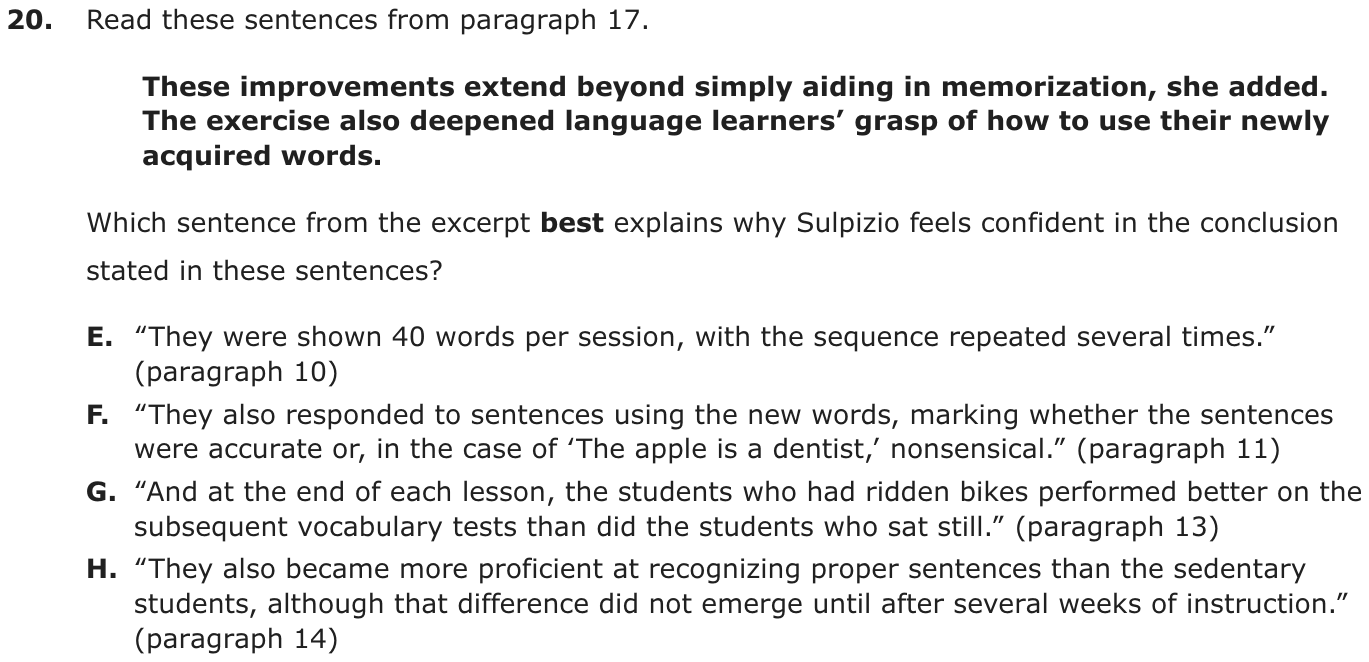
And at the end of each lesson, the students who had ridden bikes performed better on the subsequent vocabulary tests than did the students who sat still.
They also became more proficient at recognizing proper sentences than the sedentary students, although that difference did not emerge until after several weeks of instruction.
Perhaps most interesting, the gains in vocabulary and comprehension lingered longest for the cyclists. When the researchers asked the students to return to the lab for a final round of testing a month after the lessons—without practicing in the meantime—the cyclists remembered words and understood them in sentences more accurately than did the students who had not moved.
“The results suggest that physical activity during learning improves that learning,” says Simone Sulpizio, a professor of psychology and linguistics at the University Vita-Salute San Raffaele in Milan, Italy, and a study co-author.
These improvements extend beyond simply aiding in memorization, she added. The exercise also deepened language learners’ grasp of how to use their newly acquired words.
This study involved college students performing relatively light exercise, though, and cannot tell us whether other people completing other types of exercise would achieve the same results.
It also offers no clues about what is occurring inside the brain that might be contributing to the benefits of the exercise. But many past studies have shown that exercise prompts the release of multiple neurochemicals in the brain that increase the number of new brain cells and the connections between neurons, Dr. Sulpizio says. These effects improve the brain’s plasticity and augment the ability to learn.
From a real-world standpoint, the study’s implications might seem at first to be impractical. Few classrooms are equipped with stationary bicycles. But specialized equipment is probably unnecessary, Dr. Sulpizio says.
“We are not suggesting that schools or teachers buy lots of bicycles,” she says. “A simpler take-home message may be that instruction should be flanked by physical activity.”
From “How Exercise Could Help You Learn a New Language” by Gretchen Reynolds from THE NEW YORK TIMES, August 16, 2017. Copyright © 2017 The New York Times Company.
1linguists: scientists who study language
Question
Read these sentences from paragraph 17.
These improvements extend beyond simply aiding in memorization, she added. The exercise also deepened language learners’ grasp of how to use their newly acquired words.
Which sentence from the excerpt best explains why Sulpizio feels confident in the conclusion stated in these sentences?
- A“They were shown 40 words per session, with the sequence repeated several times.” (paragraph 10)
- B“They also responded to sentences using the new words, marking whether the sentences were accurate or, in the case of ‘The apple is a dentist,’ nonsensical.” (paragraph 11)
- C“And at the end of each lesson, the students who had ridden bikes performed better on the subsequent vocabulary tests than did the students who sat still.” (paragraph 13)
- D“They also became more proficient at recognizing proper sentences than the sedentary students, although that difference did not emerge until after several weeks of instruction.” (paragraph 14)
Show the answer
Correct answer: D
The question asks which sentence from the excerpt best supports Sulpizio’s assertion in paragraph 17 that exercise went beyond helping with memorization to deepen the language learners’ ability to use new vocabulary.
A. Incorrect. This sentence merely describes what the language-learning sessions were like, without making any claims about how the exercise affected the subjects’ understanding of how to use new words.
B. Incorrect. While this sentence does address the fact that learners were required to think about how the new words should be used rather than just memorizing the words, it does not discuss results such as how the exercise affected their ability to do this.
C. Incorrect. This sentence establishes only that exercise helped with the memorization of new words, not that exercise deepened learners’ grasp of how to use the new words.
D. CORRECT. The fact that learners who exercised were better at identifying when the new words were used correctly in sentences directly supports Sulpizio’s assertion that the exercise deepened their grasp of how to use the new words.
Question analysis
This textual evidence question quotes Simone Sulpizio’s conclusion that exercise did more than help learners memorize new English words. Students choose the sentence from the article that best explains why she can be confident of it. All four choices come from the article’s account of the study, so students must match evidence to the exact claim rather than to its general topic.
- Grade level
- Grade 8 reading and task
- Compared with grade 7
- Above grade 7 Grade 7 evidence questions usually match a quotation to a stated claim. This claim has two parts, gains beyond memorizing and a better grasp of usage, and two quotations touch it closely, a sharper test than typical grade 7 work.
- Estimated difficulty
- Hard: combines ideas, needs a plan, and has more than one tempting wrong answer.
- Thinking it demands
- Depth of knowledge 3, strategic thinking · mainly evaluate
- What makes it hard
- A very close wrong answer major
- Reading between the lines moderate
- Evidence in several places minor
- Evidence
- Answered from several paragraphs or stanzas
- Reading level
- Passage: about grade 11, 764 words; question and choices: about grade 11, 142 words.
- Students, last 30 days
- Not enough answers yet to show (it takes 10).
Why it is hard, traps and wrong answers (shows the answer)
Why it is hard
Sulpizio’s claim has two parts, gains beyond memorizing and a better grasp of using words, and two of the quotations each touch one part. The vocabulary result is real evidence that exercise helped, but of the very memorizing she says the gains went beyond, and the sentence-task description mentions using words but reports no result. Only a result about sentences proves the claim, so the question rewards asking of each line what it shows, not what it is about.
A very close wrong answer major Choosing the answer
The vocabulary-test result in paragraph 13 and the sentence result in paragraph 14 are worded alike, cyclists outperforming students who sat still; only the skill measured, memorizing words or using them, separates them. (Embretson & Wetzel, 1987; Gorin & Embretson, 2006; Ascalon et al., 2007)
Reading between the lines moderate Working it out
Students must map the claim’s two halves onto the study’s two measures: vocabulary tests show memorization, and recognizing proper sentences shows the “grasp of how to use” new words. (Graesser, Singer & Trabasso, 1994; Kintsch, 1998)
Evidence in several places minor Working it out
The four quotations come from paragraphs 10, 11, 13 and 14, and each must be weighed against a claim made later, in paragraph 17. (Kirsch & Mosenthal, 1990; Gorin & Embretson, 2006)
Strategy: Pin down what the quoted claim says the exercise achieved, then test each sentence by asking whether it reports a result that proves that specific achievement.
Traps
- Supports only part of the claim: In a question about evidence: a line that backs one half of the claim but not the other, or a related point rather than the claim itself.
- True but not the answer: A choice says something accurate about the text that does not answer this question.
The wrong answers, classified
A True but not the answer (King et al., 2004; Embretson & Wetzel, 1987)
Picks a sentence about how the lessons were run, 40 words repeated several times, accurate but silent on what the exercise did for the learners.
B Supports only part of the claim (King et al., 2004; Thissen, Steinberg & Fitzpatrick, 1989)
Matches the claim’s focus on using words to the sentence-judging task, but this line only describes the task and reports no result showing that exercise helped.
C Supports only part of the claim (King et al., 2004; Thissen, Steinberg & Fitzpatrick, 1989)
Picks a real finding in favor of the cyclists, but better vocabulary-test scores show only the memorizing that Sulpizio says the gains went beyond.
Working it out, step by step
Figure out what the question asks
Sulpizio says the exercise did more than help students memorize words. It “deepened language learners’ grasp of how to use their newly acquired words.” A grasp is an understanding. You need the sentence that best proves this claim. Proof should be a result, not just a description.
Break the claim into two parts
- Part 1: the gains went “beyond simply aiding in memorization.” Memorization is learning words by heart.
- Part 2: the cyclists got better at using the words.
So the proof must show the bike riders did better with words in sentences. A test that only checks memory won’t prove it.
Check each choice
- A (paragraph 10) tells how many words were shown. It gives no result.
- B (paragraph 11) describes the sentence task. But it doesn’t say who did better.
- C (paragraph 13) is a result. But it is about “vocabulary tests,” which check memory. That is the part she says the gains went beyond.
- D (paragraph 14) says the cyclists “became more proficient at recognizing proper sentences than the sedentary students.” Proficient means skilled. Sedentary means sitting still. That is a result about using words.
Pick the answer
Watch out: C is very tempting. It shows that exercise helped. But it proves the wrong kind of help. Only one choice shows the cyclists did better at using words in sentences. So the answer is D.
Why this answer and not the closest wrong one
C is the closest wrong answer. Both C and D say the bike riders beat the students who sat still. The difference is the skill that was tested. C’s vocabulary tests show memory. D’s sentence test shows the learners knew how to use the words, which is exactly Sulpizio’s claim.
More questions like this
The original DOE question
The passage “Excerpt from “How Exercise Could Help You Learn a New Language”” as printed (pages 171–172)
Question 4 of 6
2024 Test B Math, question 28Question
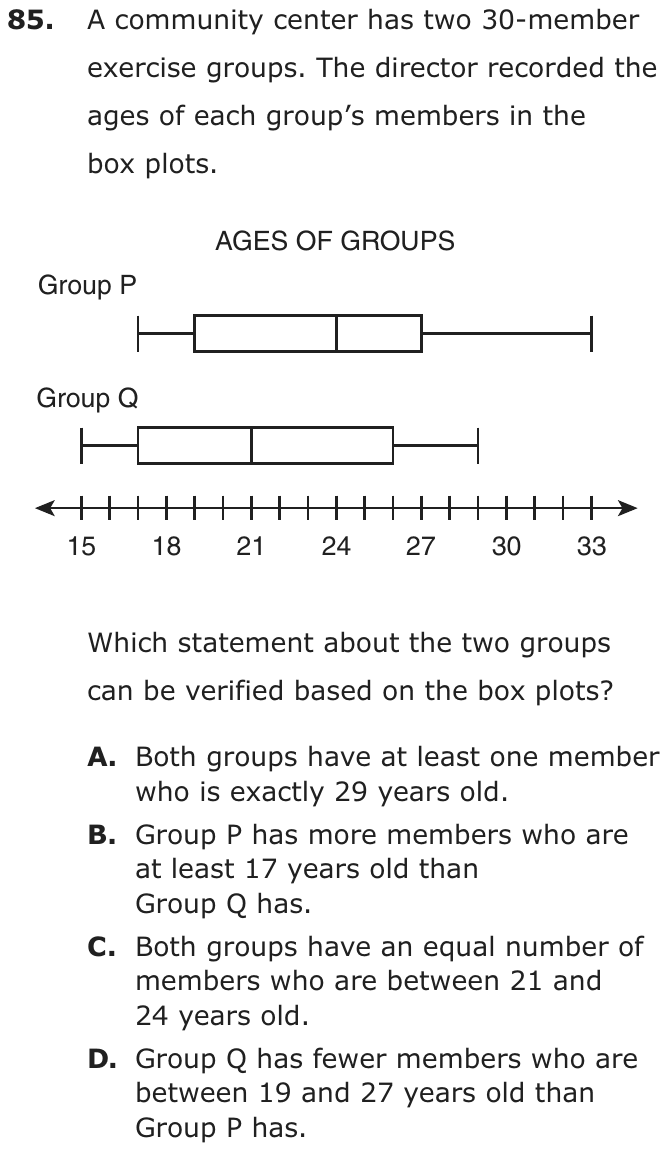
A community center has two 30-member exercise groups. The director recorded the ages of each group’s members in the box plots.
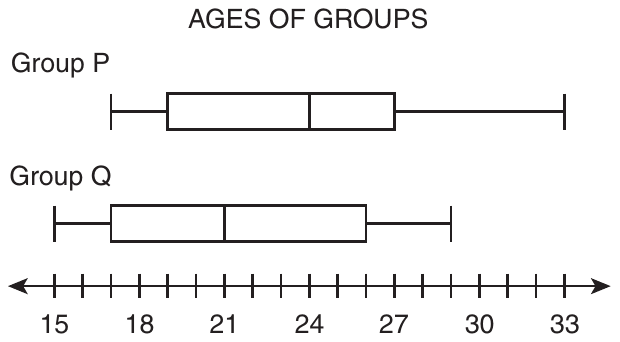
Which statement about the two groups can be verified based on the box plots?
- ABoth groups have at least one member who is exactly 29 years old.
- BGroup P has more members who are at least 17 years old than Group Q has.
- CBoth groups have an equal number of members who are between 21 and 24 years old.
- DGroup Q has fewer members who are between 19 and 27 years old than Group P has.
Show the answer
Correct answer: B
Groups P and Q have an equal number of members. All the members of Group P are 17 or older, but only about of the members of Group Q are 17 or older.
Question analysis
Box plots show the ages of the members of two 30-member exercise groups at a community center, Group P and Group Q. Students decide which statement comparing the groups can be verified from the plots alone. The challenge is knowing what a box plot guarantees about individual ages and counts, and what it leaves unknown.
- NYS standards
- Grade level
- Grade 7 content, by NYS standard
- Compared with grade 7
- Above grade 7 Grade 7 students read box plots and compare medians and spreads. Deciding which claims two box plots can prove, from what the five key values guarantee about counts, is a harder reasoning task than typical grade 7 work.
- Estimated difficulty
- Hard: combines ideas, needs a plan, and has more than one tempting wrong answer.
- Thinking it demands
- Depth of knowledge 3, strategic thinking · mainly evaluate
- What makes it hard
- Every choice must be checked major
- Something you must already know moderate
- Reading a figure, table or graph moderate
- Solution
- 3 steps
- Reading level
- Question and choices: about grade 5, 91 words.
- Students, last 30 days
- Not enough answers yet to show (it takes 10).
Why it is hard, traps and wrong answers (shows the answer)
Why it is hard
This is a question about evidence: the right statement is the only one the box plots guarantee, while the others may or may not be true. Students who treat the plots as pictures of every member, assuming ages fill each whisker or spread evenly through each box, find support for claims that cannot be checked. Asking what must hold for any 30 ages with these summaries separates the verifiable claim from the merely plausible ones.
Every choice must be checked major Choosing the answer
Three of the statements are not false but unverifiable, so each must be tested against what the five-number summaries guarantee, and none can be dismissed at a glance. (Embretson & Wetzel, 1987)
Something you must already know moderate Working it out
Students must know that the minimum and maximum are actual ages, that each quarter of a plot holds about a quarter of the 30 members, and that a whisker shows nothing in between. (Anderson & Krathwohl, 2001)
Reading a figure, table or graph moderate Understanding the question
The scale is labeled only every 3 years, so values such as 17, 19, 26 and 29 have to be read from unlabeled ticks on two separate plots. (Lesh, Post & Behr, 1987; Kirsch & Mosenthal, 1990)
Strategy: List each group's minimum, first quartile, median, third quartile and maximum, then test every statement against only what those five values guarantee about the 30 ages.
Traps
- Misunderstands the concept: A wrong belief about a concept: that percents can be added, that area grows like length, that averages can be averaged, that a bigger denominator means a bigger fraction.
- Numbers taken from the question: Combines the numbers in the question without a model of the situation, or is simply a number that appears in the question.
The wrong answers, classified
A Misunderstands the concept (Smith, diSessa & Roschelle, 1993; De Bock et al., 1998; Ni & Zhou, 2005)
Sees that Group Q's maximum is exactly 29 and that 29 also lies in Group P's upper whisker, assuming someone in Group P is that age.
C Numbers taken from the question (Hegarty, Mayer & Monk, 1995)
Matches the two medians, 21 and 24, and assumes the stretch between them holds the same number of members in both groups.
D Misunderstands the concept (Smith, diSessa & Roschelle, 1993; De Bock et al., 1998; Ni & Zhou, 2005)
Knows Group P's box from 19 to 27 holds half its members, then assumes ages spread evenly so Group Q has fewer there, which its plot cannot show.
Worked solution, step by step
Formulas used
- Members in each part of a box plot
- n is the number of members in a group, here 30. A box plot splits the data into four parts at the minimum, Q1, the median, Q3 and the maximum. Each part holds about one fourth of the data. It does not show how the ages spread out inside a part.
Read the two box plots
A box plot shows five numbers. The minimum is the youngest age, and the maximum is the oldest. Q1 is the left edge of the box, and Q3 is the right edge. The median is the line inside the box.
Group Min Q1 Median Q3 Max P 17 19 24 27 33 Q 15 17 21 26 29 Each group has 30 members.
Know what can be verified
To verify a statement means to know for sure that it is true. A box plot shows only five numbers, not every age. The minimum and maximum are real ages of real members. The other ages are hidden inside the box and whiskers.
Check choice B
In Group P, the youngest member is 17. So all 30 members are at least 17. In Group Q, the youngest member is 15, and 15 is under 17. So at most 29 members of Group Q are at least 17.
Group P has 30 such members, and Group Q has 29 or fewer. So choice B is true for sure.
Rule out choices A and C
A: Group Q’s oldest member is 29, so Group Q has a 29-year-old. But in Group P, 29 is inside the right whisker. A whisker does not show single ages. Watch out: 29 is in Group P’s range, but maybe no one in Group P is exactly 29.
C: The plots do not show how many members are between 21 and 24 in either group.
Rule out choice D and answer
Group P’s box, from 19 to 27, is two of its four parts.
So about 15 members of Group P are between 19 and 27. But 19 and 27 fall in the middle of Group Q’s parts, and ages inside a part can bunch up in any way. Group Q could have more or fewer. Watch out: D assumes the ages are spread out evenly, and a box plot never tells you that.
So the answer is B.
Check your answer
Choice B uses only the two minimums, which are real ages. Group P’s youngest member is 17, and Group Q’s is 15. That alone proves it. Each other choice needs ages inside a box or whisker, which a box plot does not show.
More questions like this
The original DOE question
Question 5 of 6
2026 Practice Test C Math, question 18Question
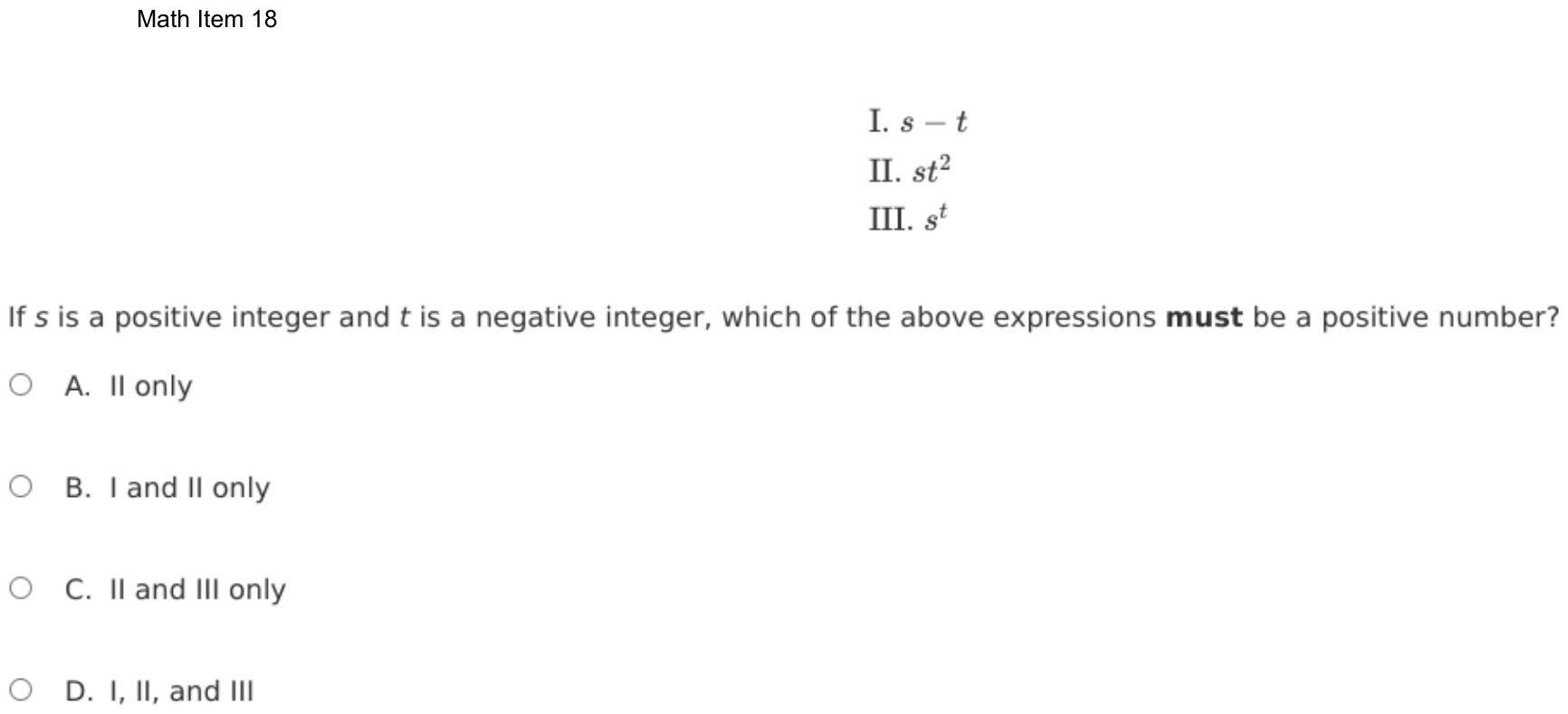
I.
II.
III.
If s is a positive integer and t is a negative integer, which of the above expressions must be a positive number?
- AII only
- BI and II only
- CII and III only
- DI, II, and III
Show the answer
Correct answer: D
Each of the three expressions must be considered:
Expression I: , where s is a positive integer and t is a negative integer:
Subtracting a negative integer is the equivalent of adding a positive integer, so is equivalent to finding the value of , which must result in a positive number.
Expression II: , where s is a positive integer and t is a negative integer:
Squaring a negative integer results in a positive integer, so is equivalent to finding the value of , which must result in a positive number.
Expression III: , where s is a positive integer and t is a negative integer:
A negative exponent results in the reciprocal of the same exponential expression, so is equivalent to finding the value of , which must result in a positive number.
Therefore, Expressions I, II, and III must all result in a positive number.
Question analysis
Three expressions, s − t, s times t squared, and s to the power t, are listed, and students decide which must be positive when s is a positive integer and t is a negative integer. It tests sign rules for subtraction and multiplication and the meaning of a negative exponent. Each expression has to be judged for every possible pair, not just one example.
- NYS standards
- Grade level
- Grade 8 content, by NYS standard
- Compared with grade 7
- Above grade 7 Grade 7 students learn sign rules for subtracting and multiplying signed numbers. Here they reason about letters rather than numbers, decide what must always hold, and handle a negative exponent, a grade 8 idea.
- Estimated difficulty
- Hard: combines ideas, needs a plan, and has more than one tempting wrong answer.
- Thinking it demands
- Depth of knowledge 2, skills and concepts · mainly analyze
- What makes it hard
- Variables instead of numbers moderate
- Something you must already know moderate
- Every choice must be checked minor
- Solution
- 3 steps
- Reading level
- Question and choices: about grade 5, 42 words.
- Corrected from the DOE handbook
- Two steps of the explanation that treated t as a positive number were corrected.
- A punctuation error in the explanation was corrected.
- Students, last 30 days
- Not enough answers yet to show (it takes 10).
Why it is hard, traps and wrong answers (shows the answer)
Why it is hard
The three expressions test three different sign facts: subtracting a negative, squaring a negative, and raising to a negative power. The last is the trap, since a negative exponent seems to promise a negative result when it really gives a fraction, and that belief alone leads to a listed choice. Trying s = 2 and t = −3 gives 5, 18 and 1/8, all positive, and the rules show why no other pair can change that.
Variables instead of numbers moderate Understanding the question
No values are given for s and t, only their signs, and must means each expression has to be positive for every such pair, not just for one example. (Koedinger & Nathan, 2004; Enright, Morley & Sheehan, 2002)
Something you must already know moderate Working it out
Expression III needs the meaning of a negative exponent, s to the power t equals 1 over s to the power −t, a grade 8 rule the question does not state. (Anderson & Krathwohl, 2001)
Every choice must be checked minor Choosing the answer
Each of the three expressions is judged on its own and the choices combine the verdicts, so one wrong judgment anywhere points to a wrong combination. (Embretson & Wetzel, 1987)
Strategy: Try a pair such as s = 2 and t = −3 in each expression, then explain why its sign could or could not change for any other positive s and negative t.
Traps
- Misunderstands the concept: A wrong belief about a concept: that percents can be added, that area grows like length, that averages can be averaged, that a bigger denominator means a bigger fraction.
- Negatives and direction: Arithmetic with negative numbers, the order of a subtraction, or direction on a number line. (Moving a term across the equals sign without changing its sign is a faulty procedure.)
The wrong answers, classified
A Misunderstands the concept (Smith, diSessa & Roschelle, 1993; De Bock et al., 1998; Ni & Zhou, 2005)
Trusts only the squared expression, believing that subtracting t must make s smaller and that a negative exponent makes a negative number.
B Misunderstands the concept (Smith, diSessa & Roschelle, 1993; De Bock et al., 1998; Ni & Zhou, 2005)
Handles the subtraction and the square correctly but believes a negative exponent makes the result negative, though s to the power t is a positive fraction such as 1/8.
C Negatives and direction (Brown & Burton, 1978)
Reads s − t as taking a number away from s, so thinks it could be negative, missing that subtracting the negative t adds to s.
What was corrected from the DOE handbook, and why
- Explanation: The question makes t the negative integer, but two steps of the DOE’s explanation write the negative integer as −t, as if t were positive. For Expression I it says “s − (−t) is equivalent to finding the value of s + t, which must result in a positive number”: s − (−t) is not Expression I, and with the question’s t, s + t need not be positive (s = 1 and t = −2 give −1). For Expression III it says “s^(−t) is equivalent to finding the value of 1/s^t”, about s^(−t) rather than Expression III. The site now says that s − t is equivalent to s + (−t), and that s^t is equivalent to 1/s^(−t). Since t is negative, −t is a positive integer, so s + (−t) is the sum of two positive integers and 1/s^(−t) is the reciprocal of a positive integer: both positive, and the answer, I, II and III, is unchanged. The step for Expression II, s(−t)² = st², is true for any t and is unchanged.
- Explanation: The DOE’s explanation introduces Expression III as “s^t. where s is a positive integer and t is a negative integer”, with a period where Expressions I and II (and the 2022–23 guide, which first printed this explanation) have a comma. The site has the comma.
Worked solution, step by step
Formulas used
- Subtracting a number
- s and t are integers, and −t is the opposite of t. Subtracting a number is the same as adding its opposite. When t is negative, −t is positive. So subtracting t adds a positive amount.
- A negative exponent
- s is the base and t is the exponent. When t is negative, −t is positive. So a negative exponent means 1 over the base to a positive exponent. For example, 2 to the power −3 is 1 over 2³, which is 1/8.
Sort out the question
An integer is a whole number or its opposite, such as −2, 0 or 5. Here s is a positive integer, like 1, 2 or 3. And t is a negative integer, like −1, −2 or −3. Must means always. An expression counts only if it is positive for every such pair.
Try one pair of numbers
Try s = 2 and t = −3 in each expression:
- I:
- II:
- III:
All three are positive this time. Now see why that always happens.
Explain expression I
Use the rule for subtracting:
t is negative, so its opposite, −t, is positive. So s − t is a positive plus a positive. That is always positive.
Watch out: subtracting does not always make a number smaller. Subtracting a negative makes it bigger. Missing this leads to choice C.
Explain expression II
means t × t. A negative times a negative is positive, so is always positive. Then is a positive times a positive. That is always positive too.
Explain expression III
Use the rule for a negative exponent:
−t is a positive integer, so is a positive integer. So is 1 over a positive number. That is a positive fraction.
Watch out: a negative exponent does not make the answer negative. It makes a fraction. Thinking it does leads to choice B, I and II only.
Choose the answer
Each of the three expressions is positive for every positive s and negative t. None of them can ever be zero or negative.
So the answer is D, I, II, and III.
Check your answer
Try the values closest to 0: s = 1 and t = −1. I gives . II gives . III gives . All three are still positive.
More questions like this
The original DOE question
Question 6 of 6
2026 Practice Test D Math, question 36Question
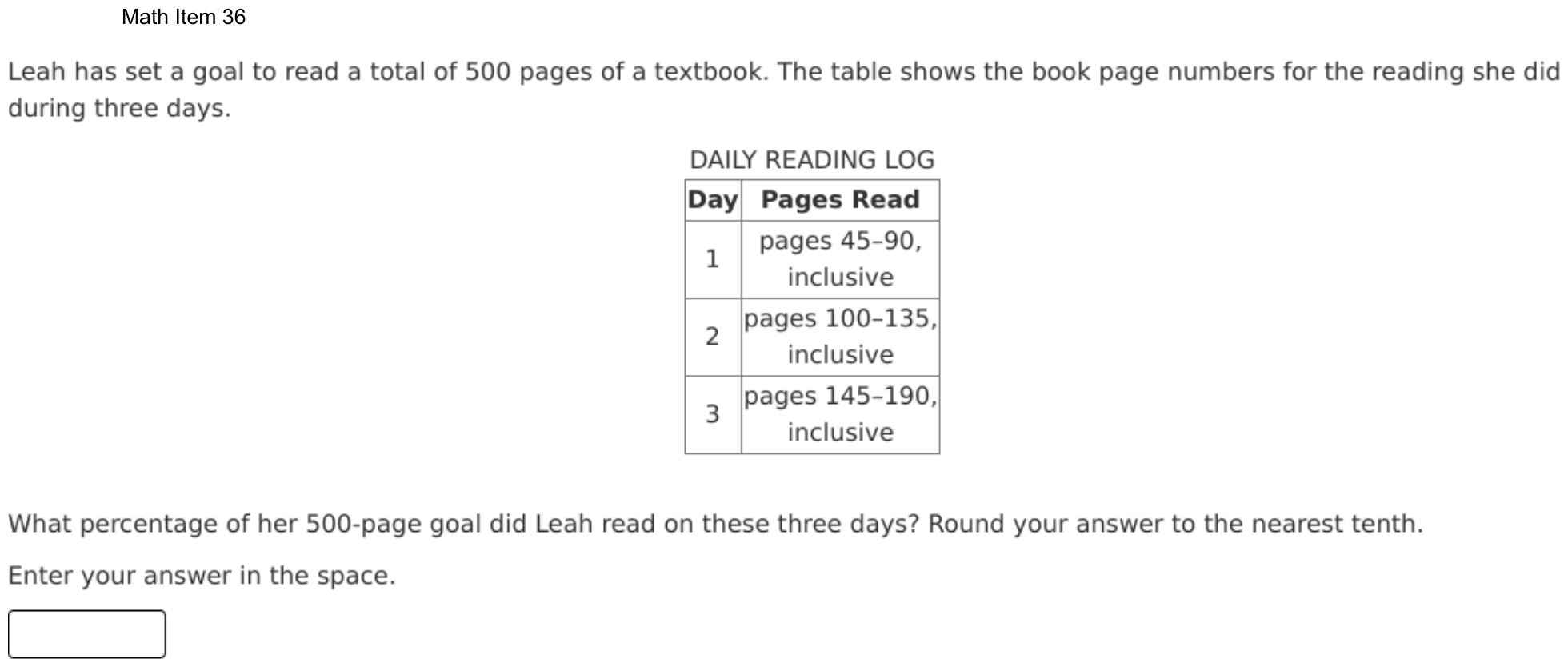
Leah has set a goal to read a total of 500 pages of a textbook. The table shows the book page numbers for the reading she did during three days.
DAILY READING LOG
| Day | Pages Read |
|---|---|
| 1 | pages 45–90, inclusive |
| 2 | pages 100–135, inclusive |
| 3 | pages 145–190, inclusive |
What percentage of her 500-page goal did Leah read on these three days? Round your answer to the nearest tenth.
Enter your answer in the space.
Fill-in question: work out the answer and type it as a number.
Show the answer
Correct answer: 25.6%
First, determine the number of pages read each day. Since the pages per assignment are inclusive, subtract the first page from the last page assigned and then add 1 to determine the pages read for each day.
Day 1: pages
Day 2: pages
Day 3: pages
Leah read a total of 128 pages, since .
To determine the percent, express 128 pages out of 500 pages as a fraction.
Question analysis
Leah's daily reading log lists three ranges of textbook pages, each marked inclusive, and her goal is 500 pages. This percent question asks what percentage of the goal she read over the three days, rounded to the nearest tenth and typed in. Counting the pages in each inclusive range correctly is the tricky step before the percent.
- Grade level
- Grade 7 content, by NYS standard
- Compared with grade 7
- Above grade 7 Finding what percent one number is of another is grade 6 and 7 work. This adds three inclusive page ranges to count, which takes more care than subtracting, then a rounding step, all typed with no choices to check against.
- Estimated difficulty
- Hard: combines ideas, needs a plan, and has more than one tempting wrong answer.
- Thinking it demands
- Depth of knowledge 2, skills and concepts · mainly apply
- What makes it hard
- Something you must already know moderate
- Many steps moderate
- An answer in an unexpected form minor
- Solution
- 4 steps
- Reading level
- Question and choices: about grade 3, 66 words.
- Students, last 30 days
- Not enough answers yet to show (it takes 10).
Why it is hard, traps and wrong answers (shows the answer)
Why it is hard
Counting pages in a range is the whole difficulty; the percent at the end is routine once the total is right. Subtracting first from last feels natural, and here it even rewards the student with a round 25%, so nothing looks wrong. Checking the rule on a tiny range, pages 1 to 3, which is 3 pages and not 2, fixes the count, and the instruction to round to the nearest tenth hints that the answer is not a whole number.
Something you must already know moderate Working it out
Every row says inclusive, but nothing says that pages 45 to 90 hold 90 − 45 + 1 = 46 pages; subtracting alone loses one page on each of the three days. (Anderson & Krathwohl, 2001)
Many steps moderate Working it out
Three page counts, a sum, a division by 500 and a change to a percent come in sequence, and a one-page error in each count carries through to the end. (Daniel & Embretson, 2010; Enright, Morley & Sheehan, 2002)
An answer in an unexpected form minor Choosing the answer
The answer is typed with no choices, and the miscounted total, 125 pages, gives a tidy 25% that looks more finished than the right value with its tenth. (Enright, Morley & Sheehan, 2002)
Strategy: Count each day's pages carefully, testing your method on a short range such as pages 1–3, add the three days, divide by 500, and write the result as a percent to the nearest tenth.
Traps
- Counting the ends: Inclusive or exclusive ends, fence posts, consecutive numbers: an answer that is one too many or too few, or an endpoint drawn open where it belongs closed (or the reverse).
- Stops one step early: A choice is a number from partway through the solution.
- Misreads the question: Misses or misreads a condition or a word in the question: "at least", "each", "remaining", "not".
The wrong answers, classified
25 Counting the ends (Brown & Burton, 1978)
Subtracts the first page from the last for each day, 45 + 35 + 45 = 125 pages, forgetting that an inclusive range counts both end pages, so 125 ÷ 500 = 25%.
0.256 Stops one step early (King et al., 2004; Gierl et al., 2017)
Counts the 128 pages and divides by 500 correctly, then enters the decimal 0.256, one step short of multiplying by 100 to make a percent.
26 Misreads the question (Hegarty, Mayer & Monk, 1995)
Finds 25.6% correctly but rounds it to the nearest whole percent, overlooking the instruction to round to the nearest tenth.
Worked solution, step by step
Formulas used
- Counting pages in an inclusive range
- Inclusive means the first and last pages are both read. Subtracting counts the steps from the first page to the last. That misses one page, so add 1. Test it: pages 1 to 3 are 3 pages, and 3 − 1 + 1 = 3.
- Percent of a total
- The part is the amount you have, here the pages read. The whole is the amount you compare with, here the 500-page goal. Dividing gives a decimal. Multiplying by 100 turns it into a percent, a number out of 100.
Sort out the question
Leah’s goal is 500 pages. The log shows three days:
- Day 1: pages 45 to 90
- Day 2: pages 100 to 135
- Day 3: pages 145 to 190
Each range is inclusive. You need the percent of 500 pages she read, rounded to the nearest tenth.
Count the pages each day
Use the rule for an inclusive range: last page minus first page, plus 1.
Watch out: subtracting alone gives 45, 35 and 45 pages. That is 125 pages, which is exactly 25%. A round answer like that can hide the mistake.
Add the three days
Add the pages from all three days to get her total:
Leah read 128 pages in all. This is the part you compare with the goal.
Change to a percent
Divide the pages read by the goal, then multiply by 100:
Leah read 25.6% of her goal. That already ends in tenths, so no rounding is needed.
Watch out: 0.256 is a decimal, not a percent. And 26 rounds to a whole number, not to the nearest tenth.
Enter the answer
The box has no % sign, but the question asks for a percentage, so the number in the box is the percent. Type it with its decimal point. Typing 25.6% also counts on this site. So you would enter 25.6.
Check your answer
Estimate. 10% of 500 pages is 50 pages. 128 pages is a bit more than 2 × 50 = 100, so the answer is between 20% and 30%. Then check exactly: pages. It matches.
More questions like this
The original DOE question