3 English and 3 math
Here are 6 random questions to try. Takers earning below 75% are unlikely to receive an offer. You have 1 minute 48 seconds per question on the real exam.
Question 1 of 6
2026 Practice Test B English, question 37Passage Letter from Brooklyn
Letter from Brooklyn
by Jacob Scheier
I can already see how this will end.
How I will grow tired of the bridge’s
steep incline, and the absent-minded tourists
wandering into the bicycle path.
The weather will turn cold.
But that all happens later.
For now it is the early edge of fall,
leaves green still while the air narrows,
is slightly crisp, almost grazing
the hair of my arm like a passing stranger,
as though the air has been forced into intimacy
by the brevity of daylight.
But when it starts darkening at 4,
this closeness, I know, will be a felt distance,
like someone drawing your attention
to their lack of intimacy.
These days I am still walking at a cathedral pace
beneath the branches bending across avenues,
brownstones like rows of lived-in chapels,
like a pop-up picture book I could have had as a child,
but didn’t. How Brooklyn makes me nostalgic
for the moment I am walking inside of.
These late afternoons filled
with a loneliness that makes me feel
distinctly myself, and an awareness
of how rare that is.
“Letter from Brooklyn” from LETTER FROM BROOKLYN: POEMS by Jacob Scheier, published by ECW Press. Copyright © 2013 by Jacob Scheier All rights reserved.
brevity: briefness
cathedral: meditative
chapels: private places of prayer or worship
nostalgic: yearning for the past
Question
Which lines support the idea that a change in the weather will lessen the speaker’s appreciation for the city?
- A“as though the air has been forced into intimacy / by the brevity of daylight.” (lines 11–12)
- B“But when it starts darkening at 4, / this closeness, I know, will be a felt distance,” (lines 13–14)
- C“like someone drawing your attention / to their lack of intimacy.” (lines 15–16)
- D“These days I am still walking . . . / beneath the branches bending across avenues,” (lines 17–18)
Show the answer
Correct answer: B
The question asks which lines from the poem support the idea that a change in the weather will lessen the speaker’s appreciation for the city.
A. Incorrect. These lines focus on the positive way the air feels to the speaker during “the early edge of fall” (line 7). They suggest that the speaker appreciates this experience currently, while being aware that the feeling might not last.
B. CORRECT. In these lines, the speaker describes the shift in the “closeness” of the air as the weather changes and “it starts darkening at 4.” The speaker clearly indicates that the positive emotions surrounding this closeness, with “leaves green still” and the air “slightly crisp” (lines 8–9), will soon be “a felt distance,” suggesting that the turn in the weather will make the city less appealing.
C. Incorrect. Although these lines compare the darkening, changing weather to a person revealing a “lack of intimacy,” that specific comparison does not focus on a diminishing appreciation for the city.
D. Incorrect. These lines describe the “cathedral pace” (line 17) at which the speaker walks, emphasizing a meditative or thoughtful experience. Such a description suggests the speaker still appreciates the city, not that the speaker’s appreciation will lessen.
Question analysis
This evidence question asks which lines from “Letter from Brooklyn” support the idea that a change in the weather will lessen the speaker's appreciation for the city. All four choices come from the middle of the poem, where the speaker describes the feel of the early-fall air through figurative comparisons, so students must read each pair of lines closely for both parts of the idea.
- Grade level
- Grade 8 reading and task
- Compared with grade 7
- Above grade 7 Choosing lines that support an idea is standard grade 7 evidence work. Here the idea is carried by figurative comparisons about the air, and the four choices sit within a few lines of one another, so separating them takes closer reading than is typical.
- Estimated difficulty
- Hard: combines ideas, needs a plan, and has more than one tempting wrong answer.
- Thinking it demands
- Depth of knowledge 2, skills and concepts · mainly evaluate
- What makes it hard
- A very close wrong answer moderate
- Figurative or literary language moderate
- Reading between the lines minor
- Evidence
- Answered from one sentence or line
- Reading level
- Passage: 217 words (a poem; reading level not measured); question and choices: about grade 6, 74 words.
- Students, last 30 days
- Not enough answers yet to show (it takes 10).
Why it is hard, traps and wrong answers (shows the answer)
Why it is hard
All four choices come from lines 11–18, and three speak of closeness, distance or intimacy, so the vocabulary of the claim is everywhere. The idea has two parts, a change in the weather and a weaker feeling for the city, and only one pair of lines holds both. The strongest pull is the second half of the same sentence, which puts the loss of intimacy most vividly but leaves the darkening behind in the lines before.
A very close wrong answer moderate Choosing the answer
Lines 13–14 and 15–16 are one sentence split in two: the first half names the darkening at 4 and the coming distance, the second only describes what that distance feels like. (Embretson & Wetzel, 1987; Gorin & Embretson, 2006; Ascalon et al., 2007)
Figurative or literary language moderate Understanding the question
The weaker feeling for the city is never stated; it comes through images, the air’s “closeness” turning into “a felt distance,” like a person pointing out their “lack of intimacy.” (Graesser, Singer & Trabasso, 1994; Kintsch, 1998)
Reading between the lines minor Working it out
Students must accept “when it starts darkening at 4” as the change in the weather the stem names, since the lines speak of daylight, not of cold or rain. (Graesser, Singer & Trabasso, 1994; Kintsch, 1998)
Strategy: Split the idea into its two parts, a change in the weather and a weaker feeling for the city, and choose the lines that hold both on their own, without help from the lines around them.
Traps
- Supports only part of the claim: In a question about evidence: a line that backs one half of the claim but not the other, or a related point rather than the claim itself.
The wrong answers, classified
A Supports only part of the claim (King et al., 2004; Thissen, Steinberg & Fitzpatrick, 1989)
Takes “the brevity of daylight” as the coming change, but these lines say the short days force the air “into intimacy,” a closeness the speaker enjoys now.
C Supports only part of the claim (King et al., 2004; Thissen, Steinberg & Fitzpatrick, 1989)
Chooses the vivid “lack of intimacy,” which does show the feeling weakening, but these lines only finish the simile and never mention the darkening that causes it.
D Supports only part of the claim (King et al., 2004; Thissen, Steinberg & Fitzpatrick, 1989)
Hears a coming change in “still walking,” but the lines show the speaker enjoying a slow walk under the branches now and say nothing of the weather turning.
Working it out, step by step
Figure out what the question asks
This is an evidence question. The idea has two parts. First, the weather will change. Second, the speaker will enjoy the city less. You need the lines that hold both parts by themselves.
Read the lines around the choices
Lines 9–12 describe the early-fall air now. It is “almost grazing / the hair of my arm like a passing stranger.” Grazing here means lightly touching. The speaker says the air feels close, like “intimacy.” Intimacy means a warm, close feeling between people. Lines 13–16 then look ahead to shorter days.
Find both parts in lines 13–14
Lines 13–14 say: “But when it starts darkening at 4, / this closeness, I know, will be a felt distance”. Darkening at 4 means the sun setting at 4 o’clock, as days get shorter. That is the change in the weather. “This closeness” is the warm feeling the speaker has now. It will turn into distance. So the good feeling will fade.
Check each choice
- A is wrong. Lines 11–12 describe the closeness the speaker enjoys now. Nothing has faded yet.
- B is right. It names the change, the early dark, and the loss, closeness turning into “a felt distance.”
- C is wrong. Lines 15–16 finish the comparison: the distance feels like a person pointing out their “lack of intimacy.” But these lines never mention the weather.
- D is wrong. Lines 17–18 show the speaker enjoying a slow walk now. They say nothing about the weather turning.
Watch out: C is tempting because “lack of intimacy” sounds like a lost feeling. But the change in weather is back in lines 13–14.
Choose the answer
Only one pair of lines holds both the change and the fading feeling. So the answer is B, lines 13–14, which begin “But when it starts darkening at 4”.
Why this answer and not the closest wrong one
C is the closest wrong answer, because it shows the good feeling slipping away. But lines 15–16 only describe what that distance feels like. They don’t say what causes it. Lines 13–14 give both parts: the early dark and the fading closeness.
More questions like this
The original DOE question
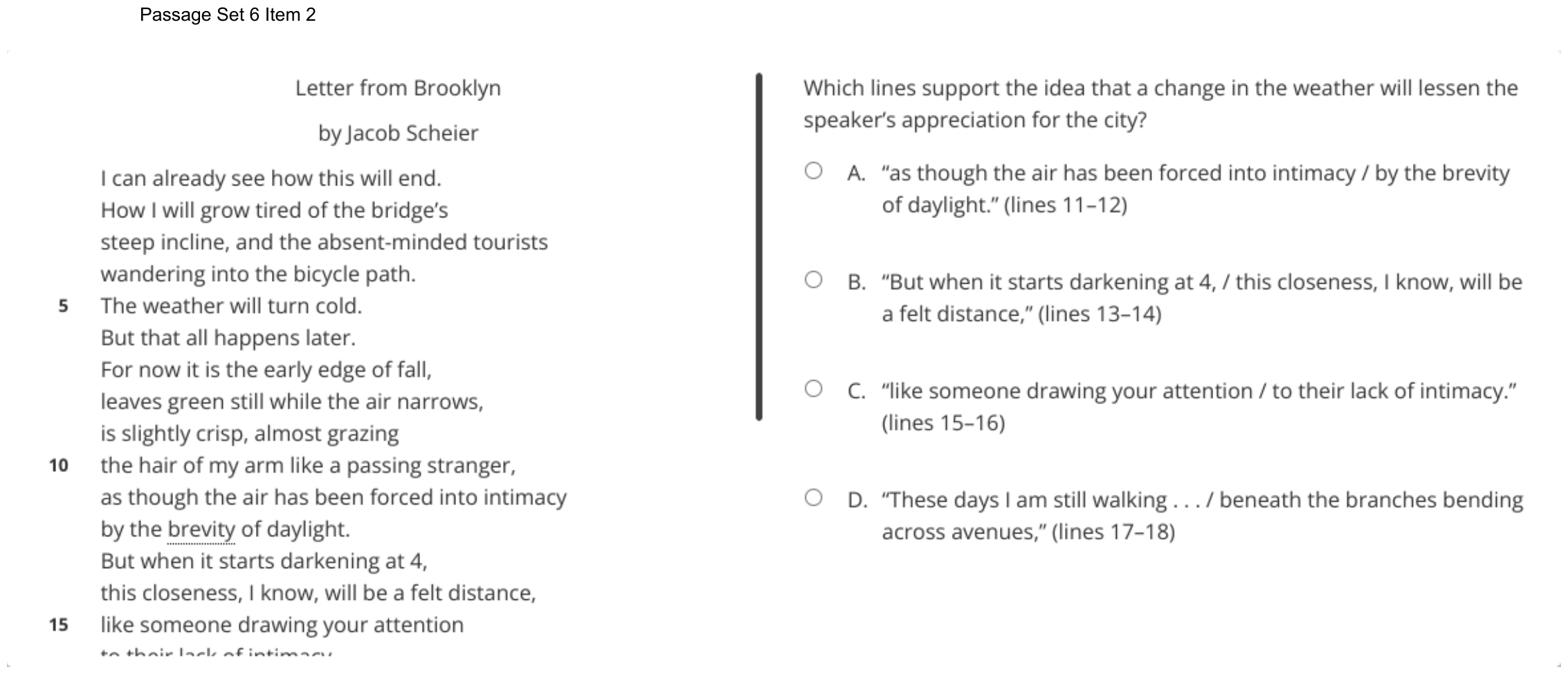
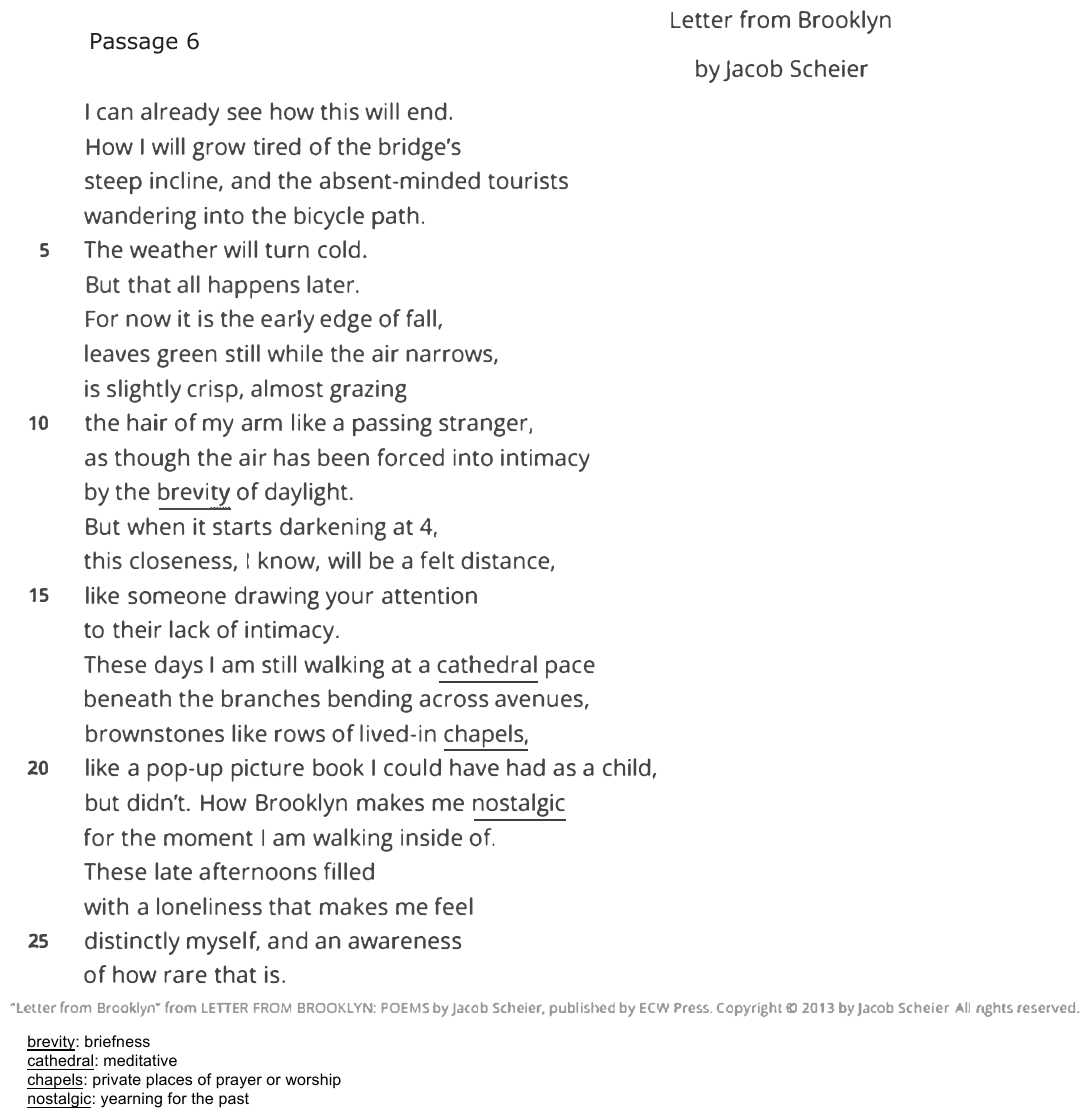
The passage “Letter from Brooklyn” as printed (page 50)
Question 2 of 6
2018 Test A English, question 22Passage Champion of the Channel
Champion of the Channel
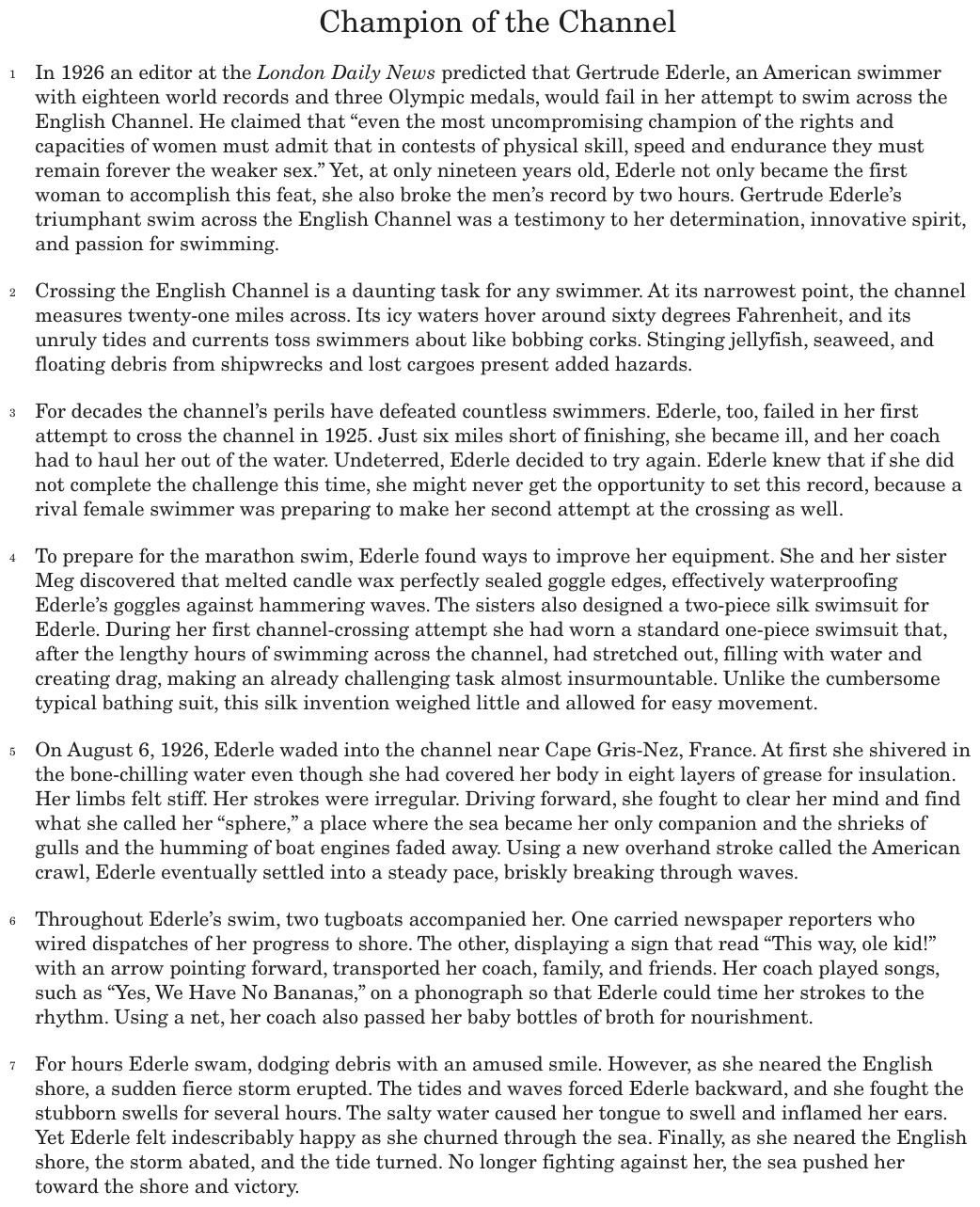
In 1926 an editor at the London Daily News predicted that Gertrude Ederle, an American swimmer with eighteen world records and three Olympic medals, would fail in her attempt to swim across the English Channel. He claimed that “even the most uncompromising champion of the rights and capacities of women must admit that in contests of physical skill, speed and endurance they must remain forever the weaker sex.” Yet, at only nineteen years old, Ederle not only became the first woman to accomplish this feat, she also broke the men’s record by two hours. Gertrude Ederle’s triumphant swim across the English Channel was a testimony to her determination, innovative spirit, and passion for swimming.
Crossing the English Channel is a daunting task for any swimmer. At its narrowest point, the channel measures twenty-one miles across. Its icy waters hover around sixty degrees Fahrenheit, and its unruly tides and currents toss swimmers about like bobbing corks. Stinging jellyfish, seaweed, and floating debris from shipwrecks and lost cargoes present added hazards.
For decades the channel’s perils have defeated countless swimmers. Ederle, too, failed in her first attempt to cross the channel in 1925. Just six miles short of finishing, she became ill, and her coach had to haul her out of the water. Undeterred, Ederle decided to try again. Ederle knew that if she did not complete the challenge this time, she might never get the opportunity to set this record, because a rival female swimmer was preparing to make her second attempt at the crossing as well.
To prepare for the marathon swim, Ederle found ways to improve her equipment. She and her sister Meg discovered that melted candle wax perfectly sealed goggle edges, effectively waterproofing Ederle’s goggles against hammering waves. The sisters also designed a two-piece silk swimsuit for Ederle. During her first channel-crossing attempt she had worn a standard one-piece swimsuit that, after the lengthy hours of swimming across the channel, had stretched out, filling with water and creating drag, making an already challenging task almost insurmountable. Unlike the cumbersome typical bathing suit, this silk invention weighed little and allowed for easy movement.
On August 6, 1926, Ederle waded into the channel near Cape Gris-Nez, France. At first she shivered in the bone-chilling water even though she had covered her body in eight layers of grease for insulation. Her limbs felt stiff. Her strokes were irregular. Driving forward, she fought to clear her mind and find what she called her “sphere,” a place where the sea became her only companion and the shrieks of gulls and the humming of boat engines faded away. Using a new overhand stroke called the American crawl, Ederle eventually settled into a steady pace, briskly breaking through waves.
Throughout Ederle’s swim, two tugboats accompanied her. One carried newspaper reporters who wired dispatches of her progress to shore. The other, displaying a sign that read “This way, ole kid!” with an arrow pointing forward, transported her coach, family, and friends. Her coach played songs, such as “Yes, We Have No Bananas,” on a phonograph so that Ederle could time her strokes to the rhythm. Using a net, her coach also passed her baby bottles of broth for nourishment.
For hours Ederle swam, dodging debris with an amused smile. However, as she neared the English shore, a sudden fierce storm erupted. The tides and waves forced Ederle backward, and she fought the stubborn swells for several hours. The salty water caused her tongue to swell and inflamed her ears. Yet Ederle felt indescribably happy as she churned through the sea. Finally, as she neared the English shore, the storm abated, and the tide turned. No longer fighting against her, the sea pushed her toward the shore and victory.
After fourteen hours and thirty-one minutes, Ederle, on wobbly legs, stepped onto the English shore. The waiting crowd roared, honked their automobile horns, blasted their tugboat whistles, and set off flares that flashed in the sky. Ederle had swum into history.
When Ederle returned to New York, she received a parade, where thousands of people shouted “Trudy!” Not only were everyday American citizens proud of Ederle, but she also inspired them to be more active. Over the next few years, more than 60,000 people credited her with motivating them to earn their American Red Cross swimming certificates. Gertrude Ederle’s accomplishment proved to the world that with determination and passion, it was possible for a person to achieve his or her goals.
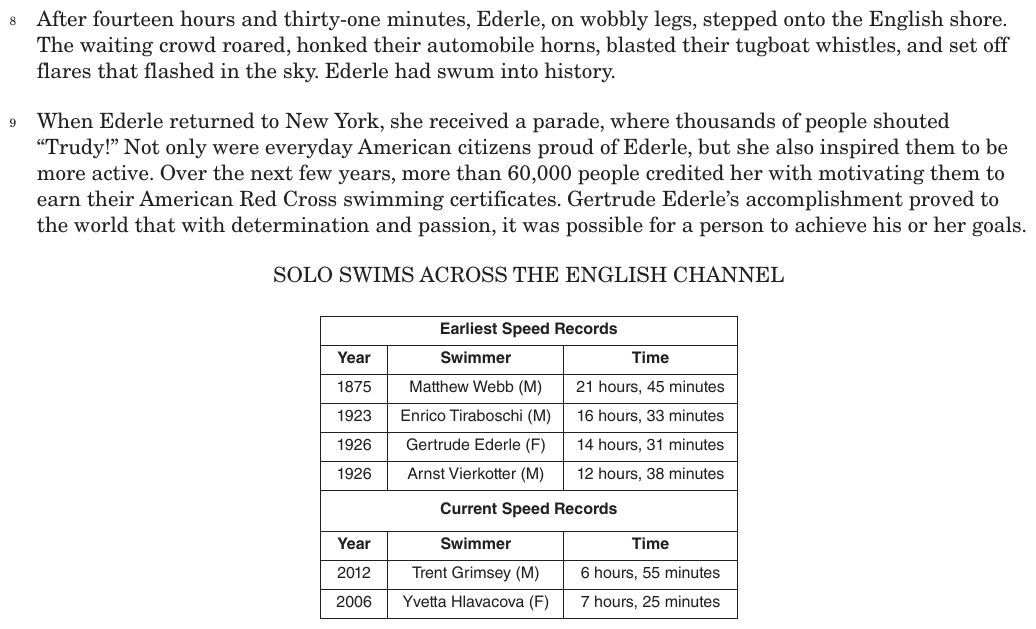
SOLO SWIMS ACROSS THE ENGLISH CHANNEL
|
Earliest Speed Records |
||
| Year | Swimmer | Time |
| 1875 | Matthew Webb (M) | 21 hours, 45 minutes |
| 1923 | Enrico Tiraboschi (M) | 16 hours, 33 minutes |
| 1926 | Gertrude Ederle (F) | 14 hours, 31 minutes |
| 1926 | Arnst Vierkotter (M) | 12 hours, 38 minutes |
| Current Speed Records | ||
| Year | Swimmer | Time |
| 2012 | Trent Grimsey (M) | 6 hours, 55 minutes |
| 2006 | Yvetta Hlavacova (F) | 7 hours, 25 minutes |
Question
Paragraph 7 contributes to the development of the central idea of the passage by
- Aillustrating that Ederle’s physical strength and mental fortitude allowed her to stay focused on her goal.
- Bconveying that Ederle pushed herself to the edge of her physical capabilities in order to complete the swim.
- Chighlighting the impact the severe weather had on Ederle’s emotions during her swim.
- Demphasizing the surge of emotions Ederle felt as she came closer to achieving a personal goal.
Show the answer
Correct answer: D
The answer is (D)
The question asks for an explanation of how paragraph 7 contributes to the development of a central idea of the passage. Paragraph 7 is mainly about Ederle’s physical and emotional state as she pushed through a difficult portion of her swim and realized her goal was in sight. A central idea of the passage is that Ederle’s passion and determination allowed her to accomplish her goal of being the first woman to cross the English Channel.
Option D is correct because it emphasizes her passion by referring to the overwhelming emotions Ederle felt as she progressed during her swim, despite the unfavorable conditions (paragraph 7: “For hours Ederle swam, dodging debris with an amused smile” and “Yet Ederle felt indescribably happy as she churned through the sea.”).
Option A is incorrect because, although Ederle needed physical strength and mental fortitude to complete the swim, the paragraph contributes to a central idea because it highlights her emotion as she swam, not her physical strength or mental fortitude.
Option B is incorrect because the paragraph focuses on Ederle’s emotional response to the challenging circumstances and not the idea that Ederle was at the “edge of her physical capabilities.”
Option C is incorrect because Ederle’s feelings of happiness and amusement were caused by her anticipation and excitement as she approached achieving her goal, not by the severe weather.
Question analysis
This reading question asks how the paragraph about the storm near the end of Gertrude Ederle's English Channel swim contributes to the passage's central idea. Students must decide what the paragraph mainly does and connect it to the larger point, while every choice sounds like a fair description of a hard swim.
- Grade level
- Grade 8 reading and task
- Compared with grade 7
- Above grade 7 Explaining how one paragraph develops a central idea is a grade 7 standard, but here several choices sound true of a hard swim through a storm, and the student must see what the paragraph is mainly about, beyond typical grade 7 work.
- Estimated difficulty
- Hard: combines ideas, needs a plan, and has more than one tempting wrong answer.
- Thinking it demands
- Depth of knowledge 3, strategic thinking · mainly analyze
- What makes it hard
- A very close wrong answer major
- Evidence in several places moderate
- How, not what moderate
- Evidence
- Answered from several paragraphs or stanzas
- Reading level
- Passage: about grade 9, 790 words; question and choices: about grade 11, 76 words.
- Students, last 30 days
- Not enough answers yet to show (it takes 10).
Why it is hard, traps and wrong answers (shows the answer)
Why it is hard
Paragraph 7 is crowded with hardship, a storm, a swollen tongue and inflamed ears, so the obvious reading is that it shows toughness. The author's pointed “Yet Ederle felt indescribably happy” turns it toward emotion, which ties it to the passion named in the thesis. Several choices are fair about the swim in general, and this is one of the closer calls on the test, since strength is also on display.
A very close wrong answer major Choosing the answer
The right choice and the strength-and-fortitude one both describe Ederle's inner state as she nears her goal, and only whether paragraph 7 stresses her feelings or her toughness separates them, since she does fight “the stubborn swells for several hours”. (Embretson & Wetzel, 1987; Gorin & Embretson, 2006; Ascalon et al., 2007)
Evidence in several places moderate Working it out
The central idea, her “determination, innovative spirit, and passion for swimming”, is stated in paragraph 1, six paragraphs before the storm it must be connected to. (Kirsch & Mosenthal, 1990; Gorin & Embretson, 2006)
How, not what moderate Working it out
The question asks how paragraph 7 develops the central idea, so the student must weigh what its details stress, the “amused smile” and “indescribably happy”, not just what happens. (Anderson & Krathwohl, 2001)
Strategy: Mark the words in paragraph 7 that describe how Ederle felt and what she endured, decide which the author stresses, then connect that to the passage's stated central idea.
Traps
- True but not the answer: A choice says something accurate about the text that does not answer this question.
- Too broad or too strong: A choice overstates, generalizes, or uses absolute words the text does not support.
The wrong answers, classified
A True but not the answer (King et al., 2004; Embretson & Wetzel, 1987)
Credits strength and mental fortitude, which the hours against the swells partly show, but the paragraph's turn on “Yet” stresses her joy, not her toughness.
B Too broad or too strong (King et al., 2004)
Inflates the swollen tongue and inflamed ears into reaching “the edge of her physical capabilities”, an extreme the paragraph never claims.
C Twists what the text says (King et al., 2004)
Sees both the storm and her feelings but makes the weather the cause of her emotions, when she felt happy in spite of it.
Working it out, step by step
Figure out what the question asks
You need to explain how paragraph 7 helps build the central idea, the main point of the passage. So first find the central idea. Then see what paragraph 7 stresses.
Find the central idea
The last sentence of paragraph 1 says: “Gertrude Ederle’s triumphant swim across the English Channel was a testimony to her determination, innovative spirit, and passion for swimming.” A testimony here means proof. Passion means a strong love for something.
See what happens in paragraph 7
A fierce storm pushes Ederle backward. She fights “the stubborn swells for several hours.” Swells are big, rolling waves. Salt water makes her tongue swell and her ears sore. Then the storm ends, and the sea pushes her “toward the shore and victory.”
Notice what the author stresses
Look at the feeling words. She swims “dodging debris with an amused smile.” In the middle of the pain, the author writes: “Yet Ederle felt indescribably happy as she churned through the sea.” Indescribably means too much to put into words. The word “Yet” shows a surprise. She felt joy in spite of the pain. That shows her passion for swimming.
Check each choice
- D: a “surge of emotions” as she came closer to her goal. A surge is a sudden rush. This matches the smile and the happiness.
- A: strength and “mental fortitude,” or toughness. She was tough, but the paragraph stresses her joy.
- B: the paragraph never says she reached “the edge of her physical capabilities.”
- C says the storm caused her feelings. She was happy in spite of the storm, not because of it.
Watch out: A is tempting because she fought for hours. But the “Yet” sentence turns to how she felt.
Pick the answer
Paragraph 7 builds the passage’s idea of her passion by showing her feelings. So the answer is D.
Why this answer and not the closest wrong one
A is the closest wrong answer, because she does fight “the stubborn swells for several hours.” But the paragraph’s key words are about feeling: “amused smile” and “indescribably happy.” Those link to her “passion for swimming” in paragraph 1. D names those emotions.
More questions like this
The original DOE question
The passage “Champion of the Channel” as printed (pages 56–57)
Question 3 of 6
2024 Test B English, question 22Passage Excerpt from “How Exercise Could Help You Learn a New Language”
Excerpt from “How Exercise Could Help You Learn a New Language”
by Gretchen Reynolds
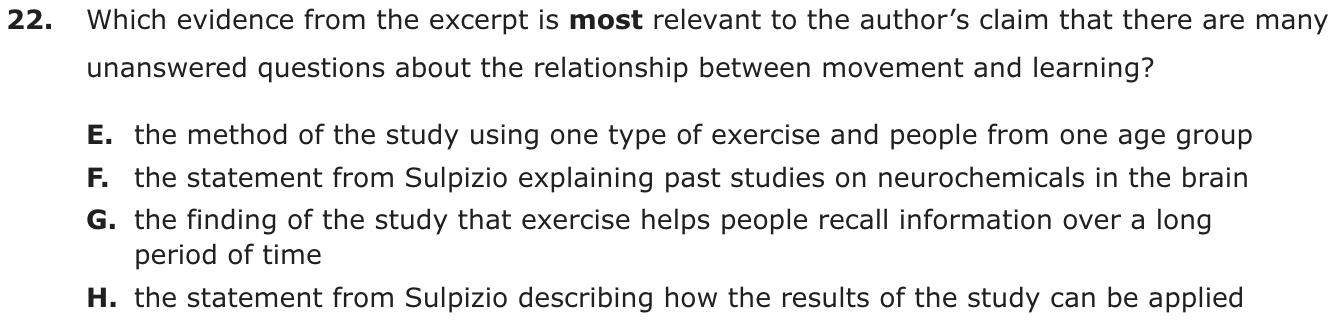
Many scientists suspect that exercise alters the biology of the brain in ways that make it more malleable and receptive to new information, a process that scientists refer to as plasticity.
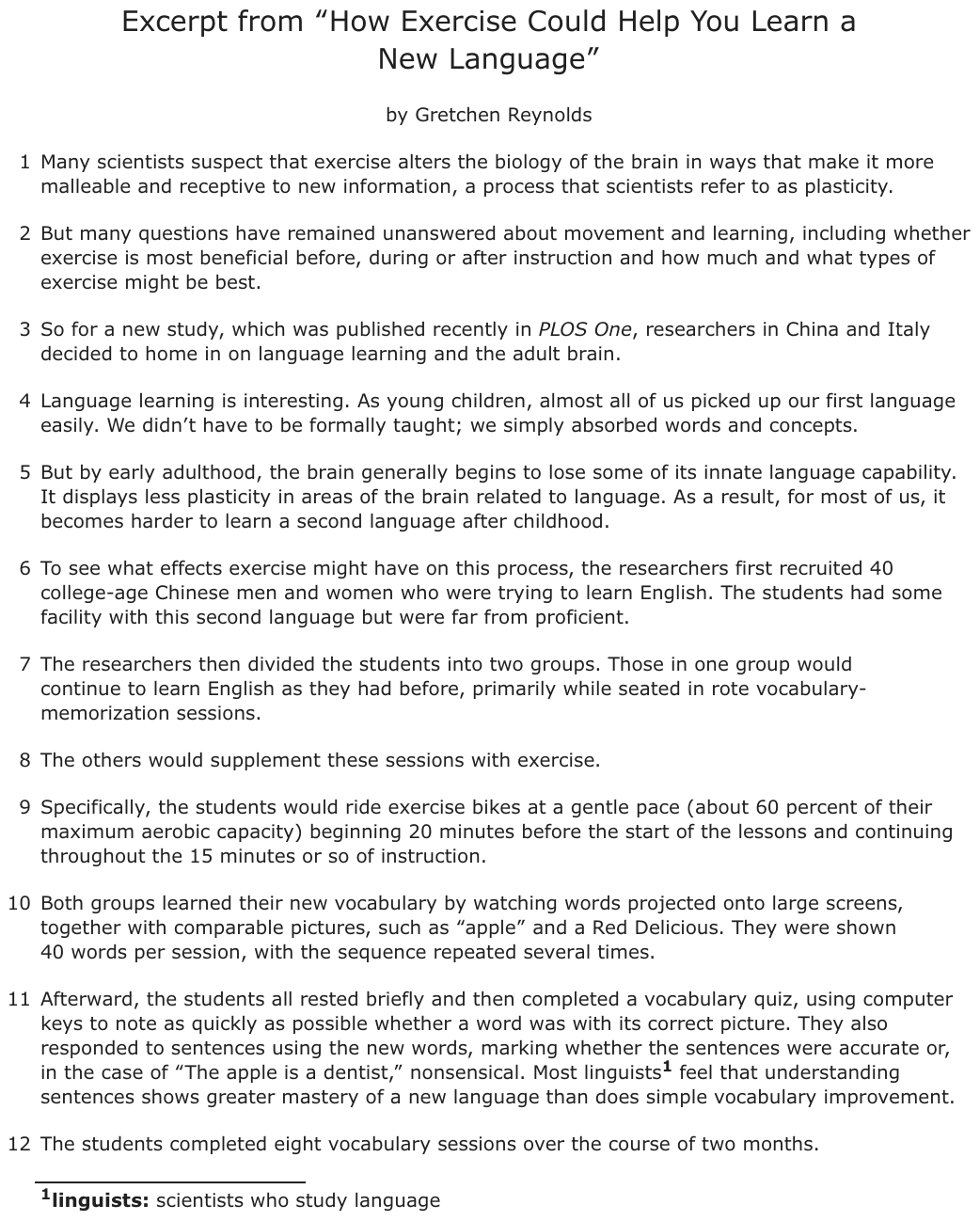
But many questions have remained unanswered about movement and learning, including whether exercise is most beneficial before, during or after instruction and how much and what types of exercise might be best.
So for a new study, which was published recently in PLOS One, researchers in China and Italy decided to home in on language learning and the adult brain.
Language learning is interesting. As young children, almost all of us picked up our first language easily. We didn’t have to be formally taught; we simply absorbed words and concepts.
But by early adulthood, the brain generally begins to lose some of its innate language capability. It displays less plasticity in areas of the brain related to language. As a result, for most of us, it becomes harder to learn a second language after childhood.
To see what effects exercise might have on this process, the researchers first recruited 40 college-age Chinese men and women who were trying to learn English. The students had some facility with this second language but were far from proficient.
The researchers then divided the students into two groups. Those in one group would continue to learn English as they had before, primarily while seated in rote vocabulary-memorization sessions.
The others would supplement these sessions with exercise.
Specifically, the students would ride exercise bikes at a gentle pace (about 60 percent of their maximum aerobic capacity) beginning 20 minutes before the start of the lessons and continuing throughout the 15 minutes or so of instruction.
Both groups learned their new vocabulary by watching words projected onto large screens, together with comparable pictures, such as “apple” and a Red Delicious. They were shown 40 words per session, with the sequence repeated several times.
Afterward, the students all rested briefly and then completed a vocabulary quiz, using computer keys to note as quickly as possible whether a word was with its correct picture. They also responded to sentences using the new words, marking whether the sentences were accurate or, in the case of “The apple is a dentist,” nonsensical. Most linguists1 feel that understanding sentences shows greater mastery of a new language than does simple vocabulary improvement.
The students completed eight vocabulary sessions over the course of two months.
And at the end of each lesson, the students who had ridden bikes performed better on the subsequent vocabulary tests than did the students who sat still.
They also became more proficient at recognizing proper sentences than the sedentary students, although that difference did not emerge until after several weeks of instruction.
Perhaps most interesting, the gains in vocabulary and comprehension lingered longest for the cyclists. When the researchers asked the students to return to the lab for a final round of testing a month after the lessons—without practicing in the meantime—the cyclists remembered words and understood them in sentences more accurately than did the students who had not moved.
“The results suggest that physical activity during learning improves that learning,” says Simone Sulpizio, a professor of psychology and linguistics at the University Vita-Salute San Raffaele in Milan, Italy, and a study co-author.
These improvements extend beyond simply aiding in memorization, she added. The exercise also deepened language learners’ grasp of how to use their newly acquired words.
This study involved college students performing relatively light exercise, though, and cannot tell us whether other people completing other types of exercise would achieve the same results.
It also offers no clues about what is occurring inside the brain that might be contributing to the benefits of the exercise. But many past studies have shown that exercise prompts the release of multiple neurochemicals in the brain that increase the number of new brain cells and the connections between neurons, Dr. Sulpizio says. These effects improve the brain’s plasticity and augment the ability to learn.
From a real-world standpoint, the study’s implications might seem at first to be impractical. Few classrooms are equipped with stationary bicycles. But specialized equipment is probably unnecessary, Dr. Sulpizio says.
“We are not suggesting that schools or teachers buy lots of bicycles,” she says. “A simpler take-home message may be that instruction should be flanked by physical activity.”
From “How Exercise Could Help You Learn a New Language” by Gretchen Reynolds from THE NEW YORK TIMES, August 16, 2017. Copyright © 2017 The New York Times Company.
1linguists: scientists who study language
Question
Which evidence from the excerpt is most relevant to the author’s claim that there are many unanswered questions about the relationship between movement and learning?
- Athe method of the study using one type of exercise and people from one age group
- Bthe statement from Sulpizio explaining past studies on neurochemicals in the brain
- Cthe finding of the study that exercise helps people recall information over a long period of time
- Dthe statement from Sulpizio describing how the results of the study can be applied
Show the answer
Correct answer: A
The question asks which evidence from the excerpt is most relevant to the author’s claim that there are many unanswered questions about the relationship between movement and learning.
A. CORRECT. While the study revealed that the college students who used exercise bikes did better in their language learning, paragraph 18 indicates that we cannot know “whether other people completing other types of exercise would achieve the same results,” suggesting that there are many unknowns about the relationship between movement and learning.
B. Incorrect. Rather than supporting the claim that there are many unanswered questions about the relationship between movement and learning, this statement offers a possible explanation as to why exercise might improve learning.
C. Incorrect. The finding that exercise helps people retain their language learning longer (paragraph 15) adds to our understanding of the relationship between movement and learning rather than supporting the claim that there are still many unanswered questions.
D. Incorrect. Sulpizio’s statement that the study suggests that “ ‘instruction should be flanked by physical activity’ ” (paragraph 21) does not in any way address the issue of unanswered questions about movement and learning.
Question analysis
This evidence question asks which part of the exercise and language-learning article is most relevant to the author’s early claim that many questions about movement and learning remain unanswered. The choices describe parts of the article in general terms rather than quoting them, so students must locate each one and judge how it bears on that claim.
- Grade level
- Grade 8 reading and task
- Compared with grade 7
- Above grade 7 Grade 7 students trace claims and judge whether evidence is relevant. Here the claim appears early, the evidence is described in summary rather than quoted, and students must see an indirect link across the article, which demands more than usual.
- Estimated difficulty
- Hard: combines ideas, needs a plan, and has more than one tempting wrong answer.
- Thinking it demands
- Depth of knowledge 3, strategic thinking · mainly evaluate
- What makes it hard
- Reading between the lines moderate
- Evidence in several places moderate
- Evidence
- Answered from several paragraphs or stanzas
- Reading level
- Passage: about grade 11, 764 words; question and choices: about grade 11, 84 words.
- Students, last 30 days
- Not enough answers yet to show (it takes 10).
Why it is hard, traps and wrong answers (shows the answer)
Why it is hard
The choices describe evidence instead of quoting it, so each must first be located and then weighed against a claim made near the start of the article. The trap is the neurochemical statement: its paragraph begins by admitting what the study cannot show, but the statement itself offers an answer from past research. The key is easy to undervalue because it sounds like a plain description of the method, until it is linked to paragraph 18’s account of what the study cannot tell us.
Reading between the lines moderate Working it out
The right choice names a method, not a question; students must see that one light exercise tried on college students leaves open paragraph 2’s “what types of exercise might be best,” as paragraph 18 says. (Graesser, Singer & Trabasso, 1994; Kintsch, 1998)
Evidence in several places moderate Working it out
The claim sits in paragraph 2, and the choices are short labels that must be traced to paragraphs 15, 18, 19 and 21 before any of them can be judged. (Kirsch & Mosenthal, 1990; Gorin & Embretson, 2006)
Strategy: Reread the claim in paragraph 2, then find where each choice’s material appears in the article and ask how directly it bears on that claim.
Traps
- True but not the answer: A choice says something accurate about the text that does not answer this question.
- Supports only part of the claim: In a question about evidence: a line that backs one half of the claim but not the other, or a related point rather than the claim itself.
The wrong answers, classified
B Supports only part of the claim (King et al., 2004; Thissen, Steinberg & Fitzpatrick, 1989)
Comes from paragraph 19, which opens with something the study cannot explain, but Sulpizio’s point about neurochemicals offers an answer from past research, not an open question.
C True but not the answer (King et al., 2004; Embretson & Wetzel, 1987)
Reads the claim as being about how movement and learning are related and picks a key finding, but lasting recall answers a question rather than showing one remains open.
D True but not the answer (King et al., 2004; Embretson & Wetzel, 1987)
Remembers Sulpizio’s practical advice to flank lessons with activity, a real statement that applies the findings and says nothing about what is still unknown.
Working it out, step by step
Figure out what the question asks
The author claims there are many unanswered questions about movement and learning. You need the evidence that best supports that claim. Evidence is the facts that back up a point. So look for something that shows a question is still open, not something that answers one.
Find the claim
Paragraph 2 says “many questions have remained unanswered about movement and learning.” It names some. One is whether exercise helps most “before, during or after instruction.” Another is “how much and what types of exercise might be best.” Instruction means teaching.
Find what the study left open
The study used one kind of exercise, light biking. It also used one age group, college students. Paragraph 18 says the study “cannot tell us whether other people completing other types of exercise would achieve the same results.” So the question of “what types of exercise” work best is still open. That is what choice A describes.
Check the other choices
- B: in paragraph 19, Sulpizio says past studies show exercise releases “neurochemicals,” or brain chemicals, that help learning. That offers an answer, not an open question.
- C: the finding in paragraph 15, that cyclists remembered words longer, answers a question.
- D: Sulpizio’s advice in paragraph 21 says how to use the results. It says nothing about what is still unknown.
Watch out: Paragraph 19 begins with something the study can’t explain, so B is tempting. But Sulpizio’s statement itself gives an explanation.
Pick the answer
Only the study’s narrow method shows that big questions remain. So the answer is A.
Why this answer and not the closest wrong one
B is the closest wrong answer, because its paragraph starts by admitting the study “offers no clues” about the brain. But Sulpizio then fills that gap with what past studies found. A points to what is truly still unknown: whether other people and other kinds of exercise would get the same results.
More questions like this
The original DOE question
The passage “Excerpt from “How Exercise Could Help You Learn a New Language”” as printed (pages 171–172)
Question 4 of 6
2024 Test B Math, question 28Question
A community center has two 30-member exercise groups. The director recorded the ages of each group’s members in the box plots.
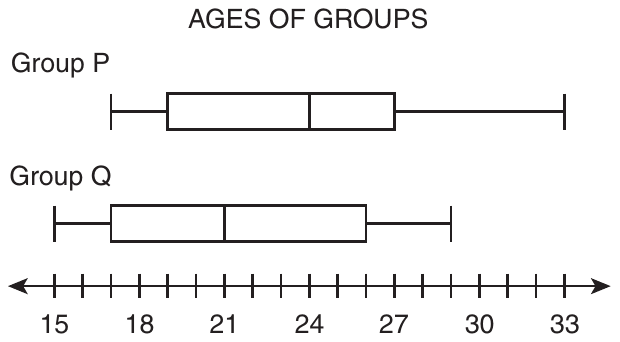
Which statement about the two groups can be verified based on the box plots?
- ABoth groups have at least one member who is exactly 29 years old.
- BGroup P has more members who are at least 17 years old than Group Q has.
- CBoth groups have an equal number of members who are between 21 and 24 years old.
- DGroup Q has fewer members who are between 19 and 27 years old than Group P has.
Show the answer
Correct answer: B
Groups P and Q have an equal number of members. All the members of Group P are 17 or older, but only about of the members of Group Q are 17 or older.
Question analysis
Box plots show the ages of the members of two 30-member exercise groups at a community center, Group P and Group Q. Students decide which statement comparing the groups can be verified from the plots alone. The challenge is knowing what a box plot guarantees about individual ages and counts, and what it leaves unknown.
- NYS standards
- Grade level
- Grade 7 content, by NYS standard
- Compared with grade 7
- Above grade 7 Grade 7 students read box plots and compare medians and spreads. Deciding which claims two box plots can prove, from what the five key values guarantee about counts, is a harder reasoning task than typical grade 7 work.
- Estimated difficulty
- Hard: combines ideas, needs a plan, and has more than one tempting wrong answer.
- Thinking it demands
- Depth of knowledge 3, strategic thinking · mainly evaluate
- What makes it hard
- Every choice must be checked major
- Something you must already know moderate
- Reading a figure, table or graph moderate
- Solution
- 3 steps
- Reading level
- Question and choices: about grade 5, 91 words.
- Students, last 30 days
- Not enough answers yet to show (it takes 10).
Why it is hard, traps and wrong answers (shows the answer)
Why it is hard
This is a question about evidence: the right statement is the only one the box plots guarantee, while the others may or may not be true. Students who treat the plots as pictures of every member, assuming ages fill each whisker or spread evenly through each box, find support for claims that cannot be checked. Asking what must hold for any 30 ages with these summaries separates the verifiable claim from the merely plausible ones.
Every choice must be checked major Choosing the answer
Three of the statements are not false but unverifiable, so each must be tested against what the five-number summaries guarantee, and none can be dismissed at a glance. (Embretson & Wetzel, 1987)
Something you must already know moderate Working it out
Students must know that the minimum and maximum are actual ages, that each quarter of a plot holds about a quarter of the 30 members, and that a whisker shows nothing in between. (Anderson & Krathwohl, 2001)
Reading a figure, table or graph moderate Understanding the question
The scale is labeled only every 3 years, so values such as 17, 19, 26 and 29 have to be read from unlabeled ticks on two separate plots. (Lesh, Post & Behr, 1987; Kirsch & Mosenthal, 1990)
Strategy: List each group's minimum, first quartile, median, third quartile and maximum, then test every statement against only what those five values guarantee about the 30 ages.
Traps
- Misunderstands the concept: A wrong belief about a concept: that percents can be added, that area grows like length, that averages can be averaged, that a bigger denominator means a bigger fraction.
- Numbers taken from the question: Combines the numbers in the question without a model of the situation, or is simply a number that appears in the question.
The wrong answers, classified
A Misunderstands the concept (Smith, diSessa & Roschelle, 1993; De Bock et al., 1998; Ni & Zhou, 2005)
Sees that Group Q's maximum is exactly 29 and that 29 also lies in Group P's upper whisker, assuming someone in Group P is that age.
C Numbers taken from the question (Hegarty, Mayer & Monk, 1995)
Matches the two medians, 21 and 24, and assumes the stretch between them holds the same number of members in both groups.
D Misunderstands the concept (Smith, diSessa & Roschelle, 1993; De Bock et al., 1998; Ni & Zhou, 2005)
Knows Group P's box from 19 to 27 holds half its members, then assumes ages spread evenly so Group Q has fewer there, which its plot cannot show.
Worked solution, step by step
Formulas used
- Members in each part of a box plot
- n is the number of members in a group, here 30. A box plot splits the data into four parts at the minimum, Q1, the median, Q3 and the maximum. Each part holds about one fourth of the data. It does not show how the ages spread out inside a part.
Read the two box plots
A box plot shows five numbers. The minimum is the youngest age, and the maximum is the oldest. Q1 is the left edge of the box, and Q3 is the right edge. The median is the line inside the box.
Group Min Q1 Median Q3 Max P 17 19 24 27 33 Q 15 17 21 26 29 Each group has 30 members.
Know what can be verified
To verify a statement means to know for sure that it is true. A box plot shows only five numbers, not every age. The minimum and maximum are real ages of real members. The other ages are hidden inside the box and whiskers.
Check choice B
In Group P, the youngest member is 17. So all 30 members are at least 17. In Group Q, the youngest member is 15, and 15 is under 17. So at most 29 members of Group Q are at least 17.
Group P has 30 such members, and Group Q has 29 or fewer. So choice B is true for sure.
Rule out choices A and C
A: Group Q’s oldest member is 29, so Group Q has a 29-year-old. But in Group P, 29 is inside the right whisker. A whisker does not show single ages. Watch out: 29 is in Group P’s range, but maybe no one in Group P is exactly 29.
C: The plots do not show how many members are between 21 and 24 in either group.
Rule out choice D and answer
Group P’s box, from 19 to 27, is two of its four parts.
So about 15 members of Group P are between 19 and 27. But 19 and 27 fall in the middle of Group Q’s parts, and ages inside a part can bunch up in any way. Group Q could have more or fewer. Watch out: D assumes the ages are spread out evenly, and a box plot never tells you that.
So the answer is B.
Check your answer
Choice B uses only the two minimums, which are real ages. Group P’s youngest member is 17, and Group Q’s is 15. That alone proves it. Each other choice needs ages inside a box or whisker, which a box plot does not show.
More questions like this
The original DOE question
Question 5 of 6
2024 Test B Math, question 41Question
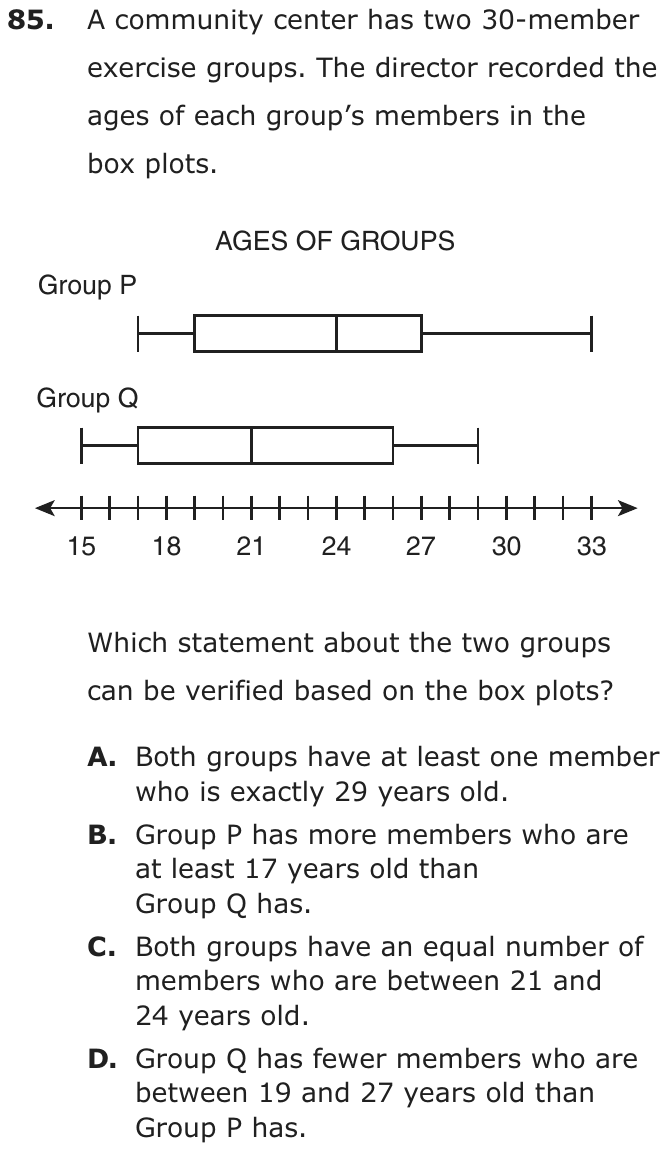
A bag contains 2 green, 4 blue, and 3 yellow disks. Alana selects 4 disks from the bag at random, one at a time, without replacing them. What is the probability that she selects all 4 blue disks?
- A
- B
- C
- D
Show the answer
Correct answer: B
If Alana picks 4 blue disks in a row, the number of blue disks and the total number of disks will both decrease by 1 after each selection.
For the first selection, there are 4 blue disks out of 9 total disks, so the probability of selecting the first blue disk is .
The probabilities of selecting blue for the next three selections are , , and .
Question analysis
A bag holds green, blue and yellow disks, and Alana draws four of them one at a time without putting any back. Students find the probability that all four disks are blue. It tests the probability of dependent events, and the difficulty is keeping track of how the bag changes after each draw.
- NYS standards
- Grade level
- Grade 7 content, by NYS standard
- Compared with grade 7
- Above grade 7 Grade 7 compound probability is usually found with lists or tree diagrams for two stages. Four dependent draws, each changing the counts, are too many to list and need the multiplication rule, which grade 7 does not formally teach.
- Estimated difficulty
- Hard: combines ideas, needs a plan, and has more than one tempting wrong answer.
- Thinking it demands
- Depth of knowledge 2, skills and concepts · mainly apply
- What makes it hard
- Something you must already know moderate
- Error-prone arithmetic moderate
- Solution
- 3 steps
- Reading level
- Question and choices: about grade 5, 37 words.
- Students, last 30 days
- Not enough answers yet to show (it takes 10).
Why it is hard, traps and wrong answers (shows the answer)
Why it is hard
Students who know the multiplication rule for successive draws still have two adjustments to make on every draw, and each wrong choice skips at least one of them. Leaving the bag at 9 disks, or putting each disk back, both produce fractions over 6,561 that look as exact as the right one. Writing the four fractions in a row before multiplying, and cancelling as you go, keeps the arithmetic small.
Something you must already know moderate Working it out
The rule for successive draws without replacement is assumed: each draw's chance is multiplied in, with both the blue count and the total lowered by one. (Anderson & Krathwohl, 2001)
Error-prone arithmetic moderate Working it out
The product 4/9 × 3/8 × 2/7 × 1/6 = 24/3,024 has to be reduced to 1/126, and two wrong choices hide behind 9 to the fourth power, 6,561. (Brown & Burton, 1978; Junker & Sijtsma, 2001)
Strategy: Write the chance of blue for each of the four draws in turn, lowering both the blue count and the total by one each time, and multiply.
Traps
- Without replacement: In a second pick there is one fewer item, which changes the probability.
- Wrong operation: Adds instead of multiplying, divides the wrong way round, turns a ratio or rate upside down, or undoes a step in the wrong direction (subtracts what should be added back).
The wrong answers, classified
A Without replacement (Fischbein & Schnarch, 1997)
Lowers the blue count on each draw but keeps all 9 disks in the bag, 4 × 3 × 2 × 1 over 9 × 9 × 9 × 9, which is 24/6,561 = 8/2,187.
C Without replacement (Fischbein & Schnarch, 1997)
Uses 4/9 for every draw, (4/9) to the fourth power = 256/6,561, as if each disk were put back before the next draw.
D Wrong operation (Hegarty, Mayer & Monk, 1995; King et al., 2004)
Adds the first draw's 4/9 four times, or multiplies it by 4, instead of multiplying the draws' chances, and misses that a probability cannot exceed 1.
Worked solution, step by step
Formulas used
- Probability
- P is the probability, the chance that something happens. It is a number from 0 to 1. The top counts the results you want. The bottom counts all the results that can happen. It works when every result is equally likely.
- Chance of events in a row
- A and B are two events that happen one after the other. P(A) is the chance of the first. P(B after A) is the chance of the second, counting only what is left after the first. You multiply because the second must also happen inside the share of times the first did.
Sort out the question
The bag holds 2 green, 4 blue and 3 yellow disks. That is 9 disks in all. Alana takes 4 disks, one at a time.
“Without replacing them” means a disk she takes does not go back in the bag. You need the chance that all 4 disks are blue.
Find the chance for each pick
For all 4 to be blue, each pick must be blue. After each blue pick, one blue disk is gone. One disk is gone from the total, too. So the top and the bottom each go down by 1.
Pick Blue disks left Disks left Chance of blue 1st 4 9 2nd 3 8 3rd 2 7 4th 1 6 Multiply the four chances
All four picks must go right, one after another. Use the rule for events in a row and multiply.
Simplify the fraction
Divide the top and the bottom by 24. That keeps the value the same.
Watch out: Using for every pick gives , choice C. That is right only if each disk goes back in. Keeping 9 on the bottom each time gives , choice A. Choice D is more than 1, and no chance can be more than 1.
So the answer is B, .
Check your answer
Cancel before you multiply. On top, cancels the 8 on the bottom. That leaves . Divide the top and bottom by 3 to get again.
More questions like this
The original DOE question
Question 6 of 6
2018 Test B Math, question 42Question
There are 1,000 cubic centimeters in 1 liter, and 1,000 cubic millimeters in 1 milliliter. How many cubic millimeters are there in 1,000 cubic centimeters?
- A1,000
- B10,000
- C100,000
- D1,000,000
Show the answer
Correct answer: D
If 1 L = 1,000 cu cm, then 1 L = 1,000 mL. Set up a proportion, letting = the amount of cubic millimeters in 1,000 cubic centimeters.
Solve for : 1,000,000 cubic millimeters are in 1,000 cubic centimeters.
Question analysis
The question gives two metric facts, cubic centimeters per liter and cubic millimeters per milliliter, and asks how many cubic millimeters are in 1,000 cubic centimeters. It tests chaining unit conversions with volume units. The hard part is that the two facts do not connect without a link the question leaves out.
- NYS standards
- 6.RP.3d converting measurement units
- Grade level
- Grade 6 content, by NYS standard
- Compared with grade 7
- Above grade 7 Grade 6 and 7 students convert units with one given factor. This needs three linked conversions, one using a fact the question does not state, and involves cubic units, which most grade 7 students find unfamiliar.
- Estimated difficulty
- Hard: combines ideas, needs a plan, and has more than one tempting wrong answer.
- Thinking it demands
- Depth of knowledge 2, skills and concepts · mainly apply
- What makes it hard
- Something you must already know moderate
- Many steps moderate
- Solution
- 3 steps
- Reading level
- Question and choices: about grade 13, 20 words.
- Corrected from the DOE handbook
- The units in the explanation’s proportion were corrected.
- Students, last 30 days
- Not enough answers yet to show (it takes 10).
Why it is hard, traps and wrong answers (shows the answer)
Why it is hard
The question gives two conversion facts that do not connect until the student supplies the link between liters and milliliters. Students who instead reach for 1 centimeter = 10 millimeters often scale a volume like a length or an area and land short by a factor of 10 or 100. Writing the unit at every step, so the units cancel, keeps both factors of 1,000 in view.
Something you must already know moderate Working it out
The chain needs 1 liter = 1,000 milliliters, which the stem never states, yet it is the only link between its two conversion facts. (Anderson & Krathwohl, 2001)
Many steps moderate Working it out
Three conversions in a row, cubic centimeters to liters, liters to milliliters and milliliters to cubic millimeters, multiply out to 1,000 × 1,000. (Daniel & Embretson, 2010; Enright, Morley & Sheehan, 2002)
Strategy: Build a chain from cubic centimeters to liters, liters to milliliters, and milliliters to cubic millimeters, writing the units at every step so they cancel.
Traps
- Units or scale: The answer is wanted in other units, or a rate or scale must be converted first.
- Stops one step early: A choice is a number from partway through the solution.
The wrong answers, classified
A Stops one step early (King et al., 2004; Gierl et al., 2017)
Converts 1,000 cubic centimeters to 1 liter, or 1,000 milliliters, and stops before the last step from milliliters to cubic millimeters.
B Units or scale (King et al., 2004)
Uses the length factor 1 cm = 10 mm for cubic units, multiplying 1,000 by 10 instead of by 10 × 10 × 10.
C Units or scale (King et al., 2004)
Squares the length factor, treating 1 cubic centimeter as 100 cubic millimeters, which is right for area but not for volume.
What was corrected from the DOE handbook, and why
- Explanation: The handbook’s proportion is 1,000 cu mm / 1 L = x cu mm / 1,000 cu mm. But 1,000 cubic millimeters make 1 milliliter, not 1 liter, and the second denominator should be the 1,000 mL that equal 1,000 cubic centimeters. The site uses 1,000 cu mm / 1 mL = x cu mm / 1,000 mL, which gives x = 1,000,000 cubic millimeters.
Worked solution, step by step
Formulas used
- Volume of a cube
- V is the volume, the space inside the cube. s is the length of one side. A cube has the same length, width and height, so you multiply the side by itself three times.
Sort out what you know
You are told two facts. 1 liter (L) is 1,000 cubic centimeters (cu cm). 1 milliliter (mL) is 1,000 cubic millimeters (cu mm). You need the number of cu mm in 1,000 cu cm.
One fact is missing. 1 liter is 1,000 milliliters. The word milli means one thousandth.
Change cubic centimeters to liters
The first fact says 1,000 cu cm is exactly 1 liter. So the amount in the question is 1 liter of space.
Change liters to milliliters
One liter is 1,000 milliliters. So 1,000 cu cm is the same as 1,000 mL.
Watch out: you are not done yet. The question asks for cubic millimeters. Stopping at 1,000 gives choice A.
Change milliliters to cubic millimeters
Each milliliter is 1,000 cu mm. There are 1,000 milliliters, so multiply.
So 1,000 cu cm is 1,000,000 cu mm. The answer is D, 1,000,000.
Check your answer
Use the cube formula. A cube 1 cm on each side is 10 mm on each side. Its volume is cu mm. So 1,000 cu cm is cu mm. Using only one 10 gives choice B. Using two 10s gives choice C.
More questions like this
The original DOE question