3 English and 3 math
Here are 6 random questions to try. Takers earning below 75% are unlikely to receive an offer. You have 1 minute 48 seconds per question on the real exam.
Question 1 of 6
2026 Practice Test B English, question 44Passage The End of an Era
The End of an Era
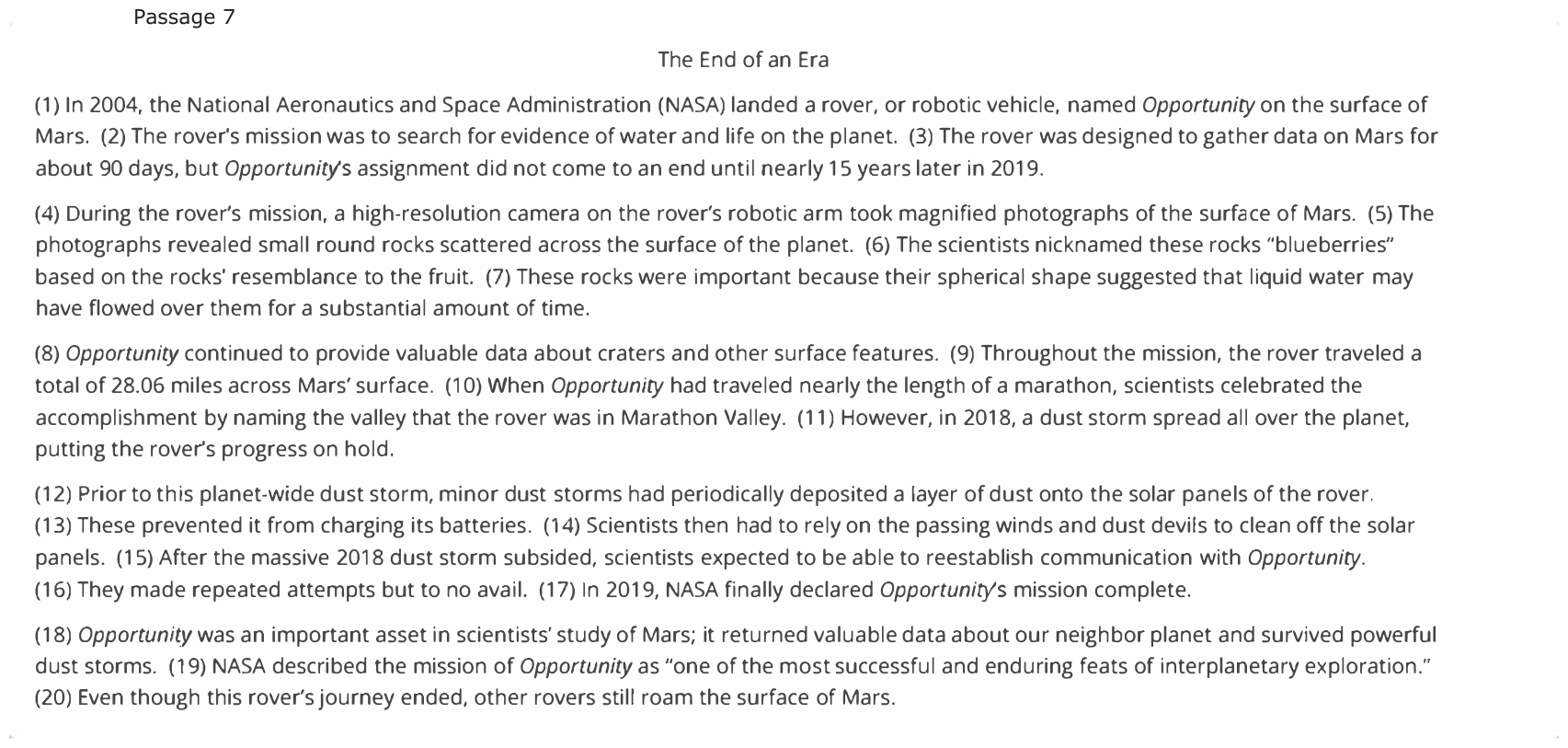
(1) In 2004, the National Aeronautics and Space Administration (NASA) landed a rover, or robotic vehicle, named Opportunity on the surface of Mars. (2) The rover’s mission was to search for evidence of water and life on the planet. (3) The rover was designed to gather data on Mars for about 90 days, but Opportunity’s assignment did not come to an end until nearly 15 years later in 2019.
(4) During the rover’s mission, a high-resolution camera on the rover’s robotic arm took magnified photographs of the surface of Mars. (5) The photographs revealed small round rocks scattered across the surface of the planet. (6) The scientists nicknamed these rocks “blueberries” based on the rocks’ resemblance to the fruit. (7) These rocks were important because their spherical shape suggested that liquid water may have flowed over them for a substantial amount of time.
(8) Opportunity continued to provide valuable data about craters and other surface features. (9) Throughout the mission, the rover traveled a total of 28.06 miles across Mars’ surface. (10) When Opportunity had traveled nearly the length of a marathon, scientists celebrated the accomplishment by naming the valley that the rover was in Marathon Valley. (11) However, in 2018, a dust storm spread all over the planet, putting the rover’s progress on hold.
(12) Prior to this planet-wide dust storm, minor dust storms had periodically deposited a layer of dust onto the solar panels of the rover. (13) These prevented it from charging its batteries. (14) Scientists then had to rely on the passing winds and dust devils to clean off the solar panels. (15) After the massive 2018 dust storm subsided, scientists expected to be able to reestablish communication with Opportunity. (16) They made repeated attempts but to no avail. (17) In 2019, NASA finally declared Opportunity’s mission complete.
(18) Opportunity was an important asset in scientists’ study of Mars; it returned valuable data about our neighbor planet and survived powerful dust storms. (19) NASA described the mission of Opportunity as “one of the most successful and enduring feats of interplanetary exploration.” (20) Even though this rover’s journey ended, other rovers still roam the surface of Mars.
Question
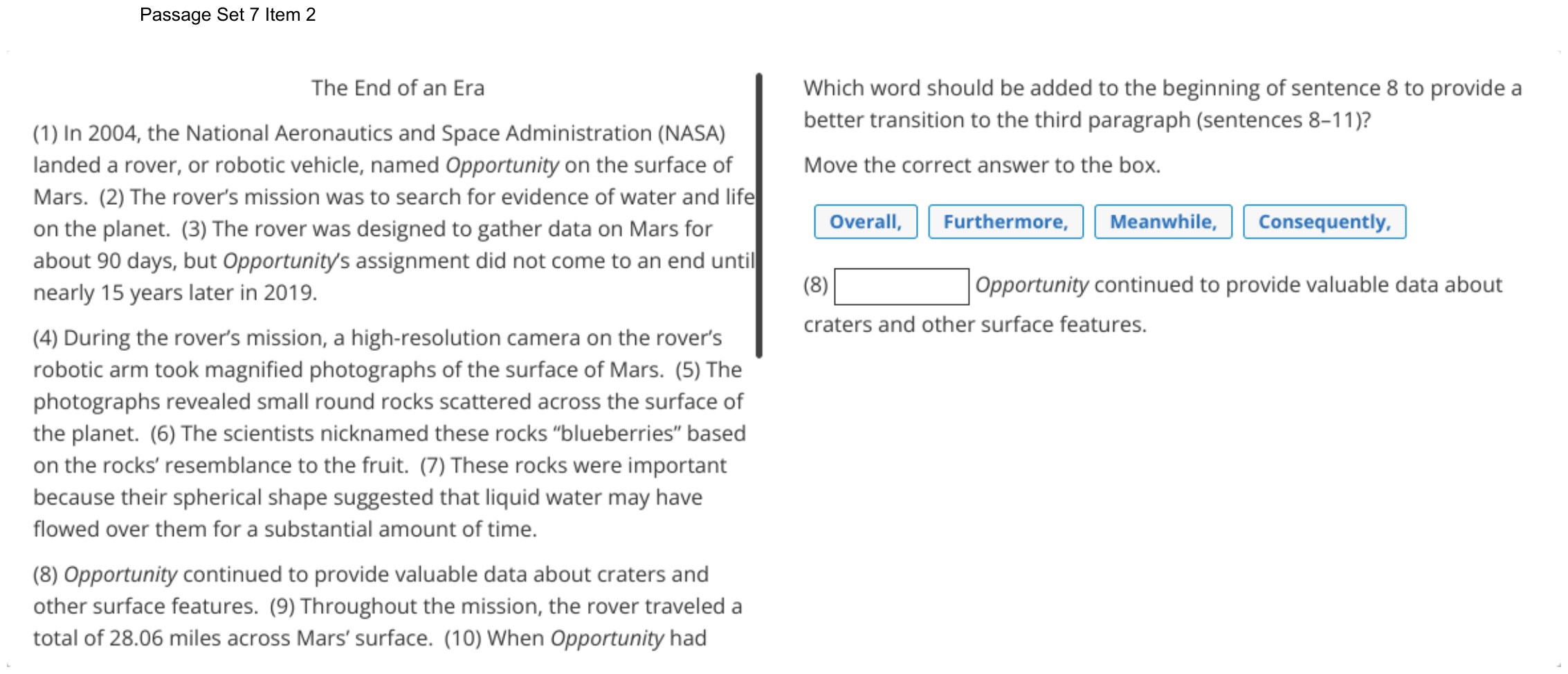
Which word should be added to the beginning of sentence 8 to provide a better transition to the third paragraph (sentences 8–11)?
Move the correct answer to the box.
(8) ____ Opportunity continued to provide valuable data about craters and other surface features.
On the test you drag one of the tiles into the box; here, choose it.
- AOverall,
- BFurthermore,
- CMeanwhile,
- DConsequently,
Show the answer
Correct answer: C
The question asks for the word that should be added to the beginning of sentence 8 to provide a better transition to the third paragraph (sentences 8–11).
“Overall,” is incorrect and should not be added. While sentence 8 is a more general statement than sentence 7, the word “Overall” would imply that all of the third paragraph features general information about the Opportunity rover. Instead, paragraphs 2 and 3 both describe specific accomplishments of the Opportunity rover (the discovery of possible water on Mars and the distance the rover traveled), so these paragraphs require a word between them that does not transition from the specific to the general.
“Furthermore,” is incorrect and should not be added. The word “Furthermore” would suggest that the author is making an argument in paragraph 2 that is further developed by the statement in sentence 8 and the rest of paragraph 3. Because this is not the case, the word “Furthermore” is not a suitable transition from one paragraph to the next.
“Meanwhile,” is correct and should be added. The word “Meanwhile” is an appropriate transition to add to the beginning of sentence 8, since the actions of the Opportunity rover in paragraph 2 (taking photographs) and in paragraph 3 (traveling long distances) happened at the same time and both served critical functions to the overall mission.
“Consequently,” is incorrect and should not be added. The word “Consequently” would create a cause-and-effect relationship that does not exist between the paragraphs. The passage gives no indication that the rover’s actions in the third paragraph (traveling a far distance) resulted from the actions in the second paragraph (taking photographs).
Question analysis
In this transition question, sentence 8 opens the third paragraph of the Opportunity rover passage with a blank, and on the test students move one of four word tiles into the box. The paragraph before ends with the “blueberries,” small round rocks that hinted at water, so students must decide how the rover's further work relates to that discovery.
- NYS standards
- 7W2d transitions in informative writing
- Grade level
- Grade 7 reading and task
- Compared with grade 7
- Above grade 7 Choosing a transition is regular grade 7 writing work, but this one links two paragraphs, and two of the four words fit the sentence's grammar and sound natural, so the choice turns on exactly how the paragraphs relate.
- Estimated difficulty
- Hard: combines ideas, needs a plan, and has more than one tempting wrong answer.
- Thinking it demands
- Depth of knowledge 2, skills and concepts · mainly evaluate
- What makes it hard
- A very close wrong answer moderate
- How sentences fit together moderate
- Reading between the lines minor
- Evidence
- Answered from several paragraphs or stanzas
- Reading level
- Passage: about grade 11, 337 words; question and choices: about grade 9, 43 words.
- Students, last 30 days
- Not enough answers yet to show (it takes 10).
Why it is hard, traps and wrong answers (shows the answer)
Why it is hard
Two tiles sound natural in the blank, and the one most students reach for first is an all-purpose adding word. The key goes a step further: it marks the rover’s work in paragraph 3 as happening alongside the photographs of paragraph 2, a relationship the word “continued” supports. Students who test each tile against how the paragraphs relate, rather than against the sound of the sentence, also rule out a summing-up word and a cause word.
A very close wrong answer moderate Choosing the answer
“Furthermore” and “Meanwhile” both let paragraph 3 add to paragraph 2; only “Meanwhile” also says the rover’s further work went on during the same mission, as “continued” implies. (Embretson & Wetzel, 1987; Gorin & Embretson, 2006; Ascalon et al., 2007)
How sentences fit together moderate Working it out
The tile must link the “blueberries” of paragraph 2 to the craters and miles of paragraph 3, so students must decide how two paragraphs relate, not just two sentences. (Halliday & Hasan, 1976)
Reading between the lines minor Working it out
The timing is never stated; it comes from “During the rover’s mission” in sentence 4 and “continued” in sentence 8, which place both kinds of work in the same years. (Graesser, Singer & Trabasso, 1994; Kintsch, 1998)
Strategy: State in your own words how what the rover did in paragraph 2 relates to what it did in paragraph 3, then test the relationship each tile signals against that.
Traps
- Wrong transition: A connecting word or phrase that signals the wrong relationship, such as contrast where the idea continues.
The wrong answers, classified
A Wrong transition (Halliday & Hasan, 1976)
Treats sentence 8 as a summing up because it is broader than sentence 7, though paragraph 3 goes on to give new specifics such as the 28.06 miles.
B Wrong transition (Halliday & Hasan, 1976)
Adds paragraph 3 as one more achievement, which sounds natural, but “Furthermore” signals a point being built up, not two kinds of work carried on during one mission.
D Wrong transition (Halliday & Hasan, 1976)
Hears “continued” as a result of the blueberry discovery and adds a cause-and-effect link, though nothing says the rover’s later work followed from its photographs.
Working it out, step by step
Figure out what the question asks
On the test, you move one word tile into the box at the start of sentence 8. The word is a transition, a word that shows how two ideas connect. Some transitions add an idea, some show a result, some sum up, and some show time. You need the one that links paragraph 2 to paragraph 3.
Compare the two paragraphs
Paragraph 2 begins “During the rover’s mission.” It tells how the camera found the round rocks called “blueberries.” Paragraph 3 begins “Opportunity continued to provide valuable data about craters and other surface features.” Craters are bowl-shaped holes in the ground. So paragraph 3 tells about other work the rover kept doing in those same years.
Test each transition
- Overall sums things up. But paragraph 3 gives new facts, like the 28.06 miles.
- Furthermore adds one more reason to an argument, as in Dogs are loyal. Furthermore, they are fun. But paragraph 2 isn’t arguing a point. It tells what the rover did.
- Meanwhile means during that same time. It links things that go on together.
- Consequently means as a result. But the photos didn’t cause the rover’s later work.
See why “Meanwhile” fits
While the camera was finding blueberries, the rover was also studying craters and driving many miles. The word “continued” in sentence 8 shows that the work kept going. “Meanwhile” tells the reader these jobs happened during the same mission.
Watch out: “Furthermore” sounds natural in the blank, so many students choose B. But it only says here is one more point. It doesn’t show two kinds of work going on at the same time.
Choose the answer
With the tile in place, sentence 8 reads: Meanwhile, Opportunity continued to provide valuable data about craters and other surface features. So the answer is C: move the tile “Meanwhile,” into the box.
Why this answer and not the closest wrong one
B, “Furthermore,” is the closest wrong answer, because it also adds information. But it treats paragraph 2 as one point in an argument. The passage just tells what the rover did. “Meanwhile” links the two paragraphs in time, and it matches the word “continued.”
More questions like this
The original DOE question
The passage “The End of an Era” as printed (page 60)
Question 2 of 6
2024 Test A English, question 24Passage At Dusk
At Dusk
by Natasha Trethewey
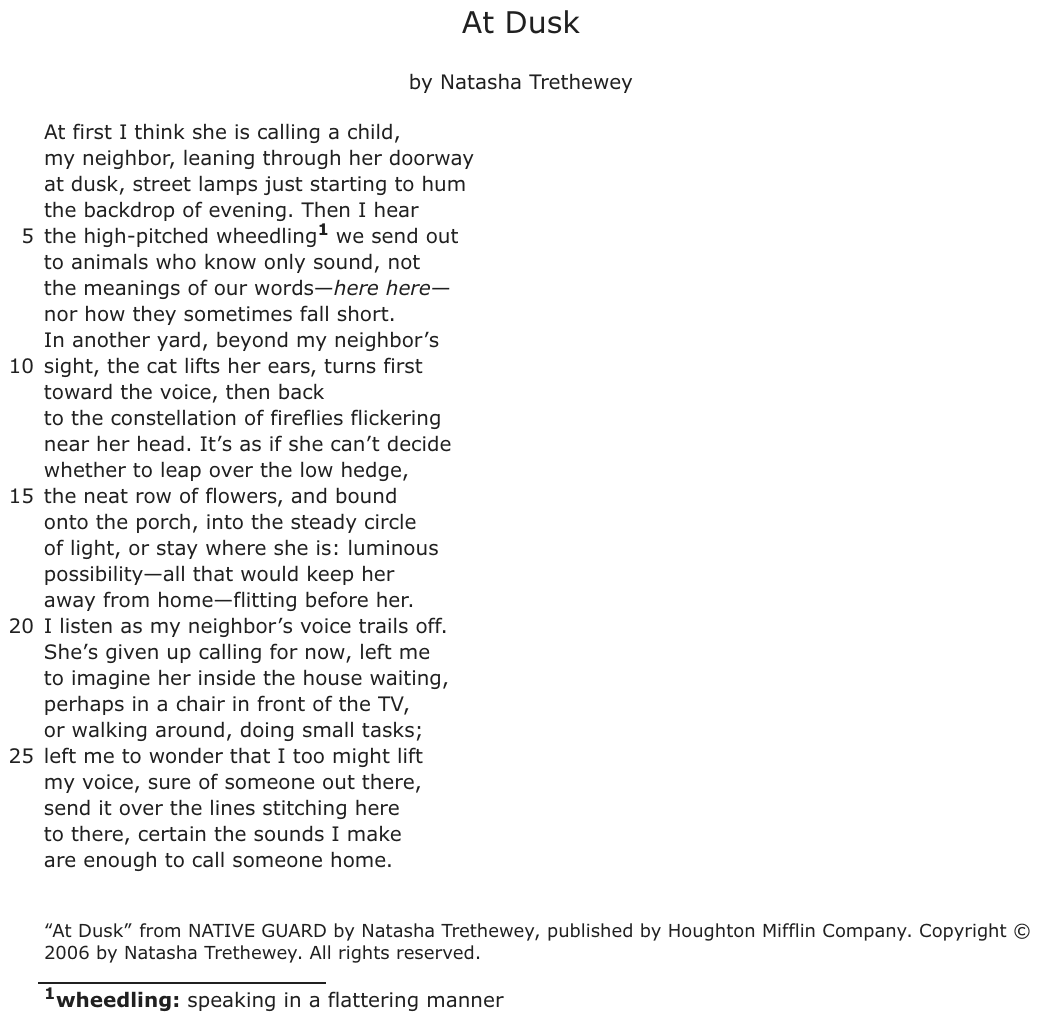
At first I think she is calling a child,
my neighbor, leaning through her doorway
at dusk, street lamps just starting to hum
the backdrop of evening. Then I hear
the high-pitched wheedling1 we send out
to animals who know only sound, not
the meanings of our words—here here—
nor how they sometimes fall short.
In another yard, beyond my neighbor’s
sight, the cat lifts her ears, turns first
toward the voice, then back
to the constellation of fireflies flickering
near her head. It’s as if she can’t decide
whether to leap over the low hedge,
the neat row of flowers, and bound
onto the porch, into the steady circle
of light, or stay where she is: luminous
possibility—all that would keep her
away from home—flitting before her.
I listen as my neighbor’s voice trails off.
She’s given up calling for now, left me
to imagine her inside the house waiting,
perhaps in a chair in front of the TV,
or walking around, doing small tasks;
left me to wonder that I too might lift
my voice, sure of someone out there,
send it over the lines stitching here
to there, certain the sounds I make
are enough to call someone home.
“At Dusk” from NATIVE GUARD by Natasha Trethewey, published by Houghton Mifflin Company. Copyright © 2006 by Natasha Trethewey. All rights reserved.
1wheedling: speaking in a flattering manner
Question
How does the setting affect the events of the poem?
- AIt enables the speaker to regularly overhear the neighbor calling for her cat at dusk.
- BIt allows the speaker to observe the neighbor quietly without interacting with her.
- CIt shows how living in close proximity helps the speaker feel connected to the neighbor.
- DIt shows how feeling isolated causes the speaker to imagine interactions with the neighbor.
Show the answer
Correct answer: B
The question asks how the setting affects the events discussed in the poem.
A. Incorrect. In line 2, the speaker refers to the woman calling for her cat as “my neighbor,” which clearly suggests that the speaker lives next door to the woman. However, although the two live next door to each other, line 1 suggests that perhaps the speaker does not regularly overhear the neighbor because the speaker initially thinks that the neighbor is “calling a child” and only later realizes the neighbor is calling to a cat. Although the setting places the speaker and the neighbor in close proximity, the poem does not indicate the frequency or regularity with which the speaker overhears the neighbor.
B. CORRECT. In the first four lines, the speaker observes the actions of the neighbor as the neighbor leans out to call for the cat at dusk. Despite the speaker’s observation of the neighbor, there is no indication that the neighbor notices the speaker. The reader can conclude that because of the time of day and the speaker being in the house next door, the speaker can observe the neighbor without being observed by her or having to interact with her.
C. Incorrect. The setting of the poem is a neighborhood at nightfall, as indicated by “at dusk” in line 3, the reference to “another yard” in line 9, and the flickering fireflies in line 12. However, while the speaker is close enough to the neighbor to overhear her calling to the cat, there is no indication that the speaker feels connected to the neighbor. Instead, the speaker expresses curiosity about the neighbor after the neighbor goes inside, and the speaker is “left . . . / to imagine her inside the house waiting” (lines 21–22). The fact the speaker initially thought that the neighbor was calling a child indicates that the speaker is not familiar with the neighbor and her habits, and there is no indication that the speaker feels connected to the neighbor.
D. Incorrect. In lines 22–24, the speaker imagines what the neighbor may be doing while the neighbor is waiting inside for the cat to return, but the speaker is imagining the neighbor’s solitary experience after the neighbor has momentarily “given up” on calling to the cat (line 21). The speaker does not imagine personally interacting with the neighbor but rather briefly imagines what the neighbor is doing at home while the cat is away.
Question analysis
This reading question asks how the setting of At Dusk, a neighborhood at nightfall where a woman leans from her doorway to call her cat, affects the events of the poem. Because so little happens, students must infer the setting's role from small details, and several choices sound reasonable without being supported by the poem.
- Grade level
- Grade 8 reading and task
- Compared with grade 7
- Above grade 7 Grade 7 students analyze how setting shapes events, usually in a story with a clear plot. This poem has almost no action, so the student must reason from a handful of details about place and time, which is harder than typical grade 7 work.
- Estimated difficulty
- Hard: combines ideas, needs a plan, and has more than one tempting wrong answer.
- Thinking it demands
- Depth of knowledge 3, strategic thinking · mainly analyze
- What makes it hard
- A very close wrong answer major
- Reading between the lines moderate
- Evidence
- Answered from the whole text
- Reading level
- Passage: 236 words (a poem; reading level not measured); question and choices: about grade 8, 67 words.
- Students, last 30 days
- Not enough answers yet to show (it takes 10).
Why it is hard, traps and wrong answers (shows the answer)
Why it is hard
Little happens in this poem, so the setting's role must be built from small details: a neighbor at her doorway at dusk, a cat in another yard, a speaker who hears and watches but never speaks. The strongest wrong answer is right about overhearing and wrong only in claiming it happens regularly, which the speaker's first mistaken guess argues against. The other choices supply a feeling of closeness or of isolation that the poem never states.
A very close wrong answer major Choosing the answer
The overhearing choice describes what the setting allows almost as well as the right one and fails on a single word, “regularly,” since the poem records one evening and the speaker first mistakes the call. (Embretson & Wetzel, 1987; Gorin & Embretson, 2006; Ascalon et al., 2007)
Reading between the lines moderate Working it out
The setting's effect is never stated; it has to be inferred from the speaker hearing and watching from nearby while the neighbor, “leaning through her doorway,” never seems to notice anyone. (Graesser, Singer & Trabasso, 1994; Kintsch, 1998)
Strategy: Picture the scene from the speaker's position, then check each choice word by word against the poem and reject any that claims something the poem never states.
Traps
- Too broad or too strong: A choice overstates, generalizes, or uses absolute words the text does not support.
- Reads too much in: A reasonable-sounding conclusion that goes further than the text allows.
- Twists what the text says: Uses the text's topic and ideas but changes what it says: who did it, how much, when, or why.
The wrong answers, classified
A Too broad or too strong (King et al., 2004)
Rightly sees that living next door lets the speaker overhear the call, but “regularly” is unsupported, and the first guess about a child suggests the call is unfamiliar.
C Reads too much in (Graesser, Singer & Trabasso, 1994)
Connects living close by with the poem's interest in connection and the speaker's “I too,” but the speaker never claims to feel close to the neighbor.
D Twists what the text says (King et al., 2004)
Notices the speaker picturing the neighbor indoors and calls it imagined interaction, but the speaker pictures her alone, waiting or doing small tasks, and never mentions feeling isolated.
Working it out, step by step
Figure out what the question asks
The setting is where and when a story or poem takes place. You need to see how the setting shapes what happens in the poem.
Picture the setting
It is “dusk” (line 3), the dim time just after sunset. The neighbor is “leaning through her doorway” (line 2). The cat is “In another yard” (line 9). The speaker is close enough to hear and watch it all. But the speaker never speaks to the neighbor. Nothing shows the neighbor notices the speaker.
Work out the effect
Living next door puts the speaker close by. In the fading light, the speaker can watch quietly. So the speaker sees the neighbor and the cat without joining in. The whole poem is what the speaker sees, hears and imagines from there.
Check each choice
- A is wrong. The word “regularly” is the problem. The poem shows one evening.
- B is right. The speaker watches from nearby and never talks with the neighbor.
- C is wrong. The speaker never says they feel close to the neighbor.
- D is wrong. The poem never says the speaker feels lonely. The speaker pictures the neighbor alone inside, not the two of them talking.
Watch out: A is almost right, since living nearby does let the speaker overhear. One word makes it wrong.
Choose the answer
The setting lets the speaker watch quietly from close by. So the answer is B.
Why this answer and not the closest wrong one
A is the closest wrong answer. Living next door does let the speaker hear the call. But nothing says it happens often. The poem tells about one evening. At first the speaker even thinks a child is being called. B fits what the poem shows: the speaker watches without ever talking to the neighbor.
More questions like this
The original DOE question

The passage “At Dusk” as printed (page 48)
Question 3 of 6
2026 Practice Test B English, question 33Passage Using Fire to Keep a Prairie Healthy
Using Fire to Keep a Prairie Healthy
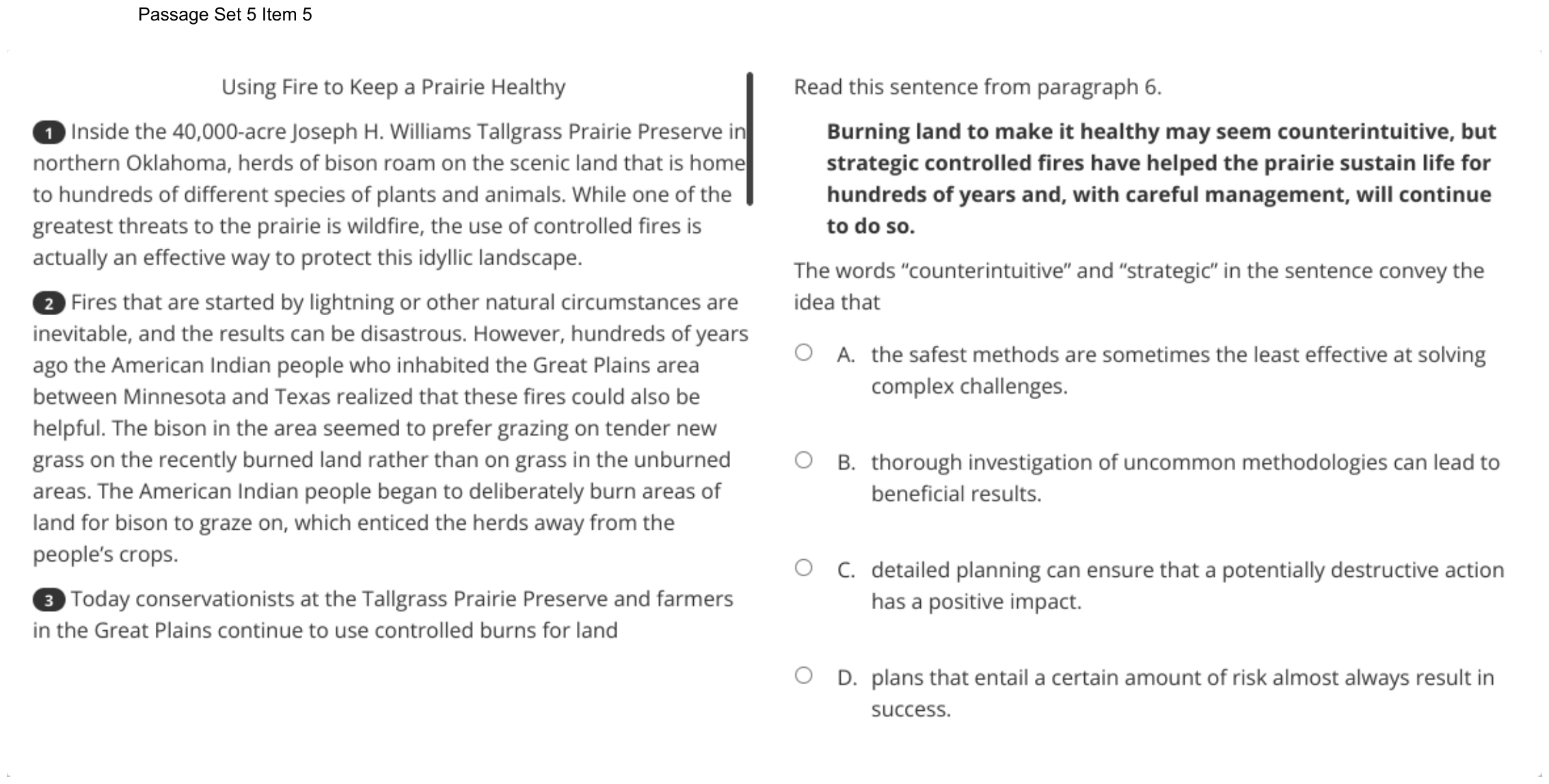
Inside the 40,000-acre Joseph H. Williams Tallgrass Prairie Preserve in northern Oklahoma, herds of bison roam on the scenic land that is home to hundreds of different species of plants and animals. While one of the greatest threats to the prairie is wildfire, the use of controlled fires is actually an effective way to protect this idyllic landscape.
Fires that are started by lightning or other natural circumstances are inevitable, and the results can be disastrous. However, hundreds of years ago the American Indian people who inhabited the Great Plains area between Minnesota and Texas realized that these fires could also be helpful. The bison in the area seemed to prefer grazing on tender new grass on the recently burned land rather than on grass in the unburned areas. The American Indian people began to deliberately burn areas of land for bison to graze on, which enticed the herds away from the people’s crops.
Today conservationists at the Tallgrass Prairie Preserve and farmers in the Great Plains continue to use controlled burns for land management. Intentionally burning a portion of land can dramatically improve the quality of the vegetation that regrows there. The fires burn away weedy undergrowth and help limit the overcrowding of shrubs and trees in the burn area, creating less competition for water and nutrients. Additionally, the process of burning excess plant matter adds nitrogen, an essential element for plant growth, to the soil.
One common target of controlled burns at the preserve and the surrounding area is the invasive red cedar tree. A single red cedar tree can consume up to 40 gallons of water per day, taking this vital resource away from other plant life. These tall trees also cast shade that prevents sunlight from reaching the plants beneath them. The fast-growing red cedar trees tend to crowd out prairie grasses, the primary food source for wild and domestic animals that make the prairie their home. An imbalance in one component of the prairie’s ecosystem affects the entire web of life. Controlled burns help maintain this ecosystem’s delicate balance.
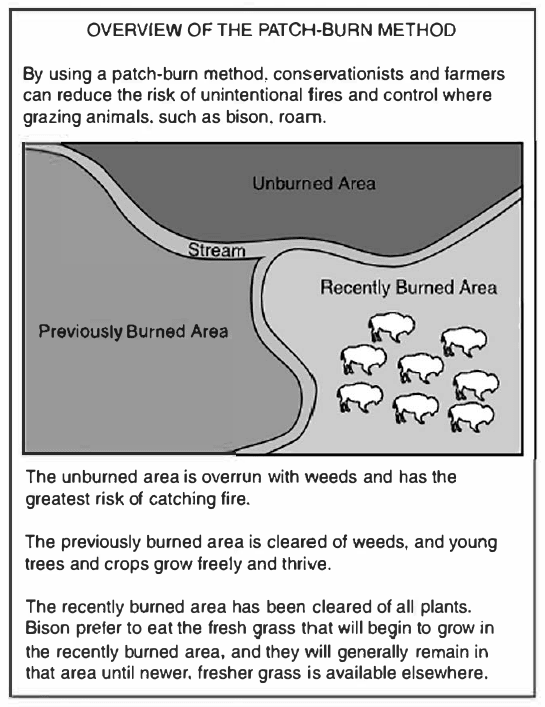
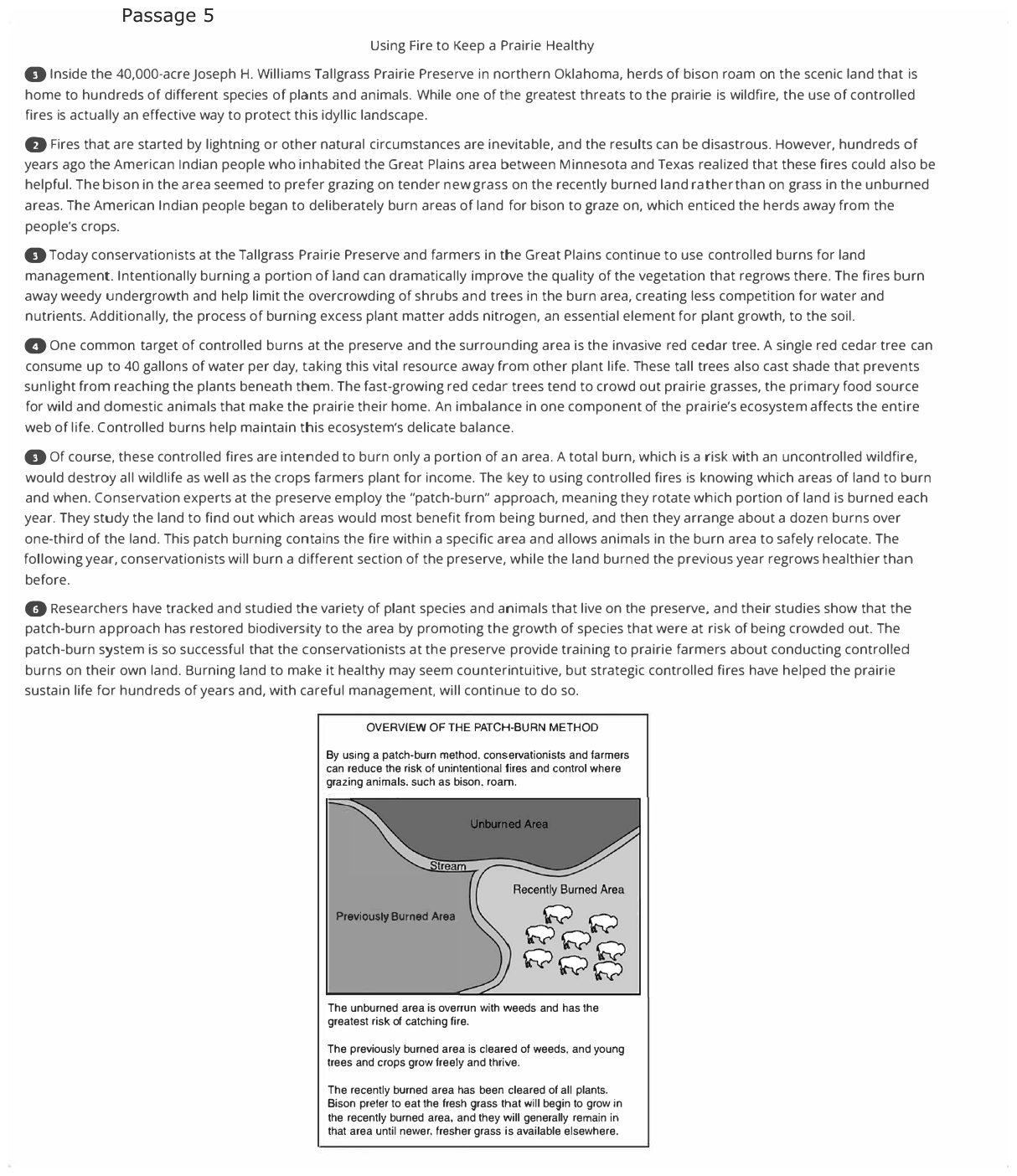
Of course, these controlled fires are intended to burn only a portion of an area. A total burn, which is a risk with an uncontrolled wildfire, would destroy all wildlife as well as the crops farmers plant for income. The key to using controlled fires is knowing which areas of land to burn and when. Conservation experts at the preserve employ the “patch-burn” approach, meaning they rotate which portion of land is burned each year. They study the land to find out which areas would most benefit from being burned, and then they arrange about a dozen burns over one-third of the land. This patch burning contains the fire within a specific area and allows animals in the burn area to safely relocate. The following year, conservationists will burn a different section of the preserve, while the land burned the previous year regrows healthier than before.
Researchers have tracked and studied the variety of plant species and animals that live on the preserve, and their studies show that the patch-burn approach has restored biodiversity to the area by promoting the growth of species that were at risk of being crowded out. The patch-burn system is so successful that the conservationists at the preserve provide training to prairie farmers about conducting controlled burns on their own land. Burning land to make it healthy may seem counterintuitive, but strategic controlled fires have helped the prairie sustain life for hundreds of years and, with careful management, will continue to do so.
Question
Read this sentence from paragraph 6.
Burning land to make it healthy may seem counterintuitive, but strategic controlled fires have helped the prairie sustain life for hundreds of years and, with careful management, will continue to do so.
The words “counterintuitive” and “strategic” in the sentence convey the idea that
- Athe safest methods are sometimes the least effective at solving complex challenges.
- Bthorough investigation of uncommon methodologies can lead to beneficial results.
- Cdetailed planning can ensure that a potentially destructive action has a positive impact.
- Dplans that entail a certain amount of risk almost always result in success.
Show the answer
Correct answer: C
The question asks which idea the words “counterintuitive” and “strategic” convey in the last sentence in paragraph 6 in the passage.
A. Incorrect. Though the author states in paragraph 6 that conservationists have used safe and “strategic” methods, those methods have not been ineffective, since “the patch-burn system is so successful that the conservationists at the preserve provide training to prairie farmers about conducting controlled burns on their own land” (paragraph 6). Therefore, the words “counterintuitive” and “strategic” in the last sentence of paragraph 6 do not convey the idea that the safest methods are sometimes the least effective at solving complex challenges.
B. Incorrect. Although the author points out in paragraph 6 that researchers’ studies have shown “that the patch-burn approach has restored biodiversity to the area by promoting the growth of species that were at risk of being crowded out,” the author does not suggest that the methodologies conservationists used to conduct the patch burns are uncommon, since the methods were used by “the American Indian people [who] began to deliberately burn areas of land for bison to graze on” (paragraph 2). Therefore, the words “counterintuitive” and “strategic” in the last sentence of paragraph 6 do not convey the idea that thorough investigation of uncommon methodologies can lead to beneficial results.
C. CORRECT. In paragraph 1, the author states that “one of the greatest threats to the prairie is wildfire,” so the idea of conducting controlled burns suggests risk and runs “counter,” or contrary, to people’s common expectations, or “intuition,” about the dangers of fires. Thus, the words “counterintuitive” and “strategic” in the last sentence of paragraph 6 convey the idea that detailed planning can ensure that a potentially destructive action has a positive impact.
D. Incorrect. The author states in paragraph 6 that “the patch-burn system is so successful that the conservationists at the preserve provide training to prairie farmers.” This statement supports the idea of the action being “strategic” in order to achieve success. However, the statement does not suggest that because the process is “counterintuitive,” or unexpected, it involves a certain amount of risk to achieve that success. Therefore, the words “counterintuitive” and “strategic” in the last sentence of paragraph 6 do not convey the idea that plans that entail a certain amount of risk almost always result in success.
Question analysis
This vocabulary question takes the last sentence of the prairie article, which says burning land to make it healthy may seem counterintuitive, and asks what the words “counterintuitive” and “strategic” convey together. Students need the meaning of a hard word built from a prefix, then must match the pair to a general statement, and the choices are worded abstractly.
- Grade level
- Grade 8 reading and task
- Compared with grade 7
- Above grade 7 A typical grade 7 vocabulary question asks what one word means in context. This one pairs a hard word, “counterintuitive,” with “strategic” and asks for the idea they express together, with four abstract general statements to weigh.
- Estimated difficulty
- Hard: combines ideas, needs a plan, and has more than one tempting wrong answer.
- Thinking it demands
- Depth of knowledge 2, skills and concepts · mainly understand
- What makes it hard
- A very close wrong answer moderate
- Hard words moderate
- Combines ideas minor
- Evidence
- Answered from one sentence or line
- Reading level
- Passage: about grade 11, 598 words; question and choices: about grade 11, 97 words.
- Students, last 30 days
- Not enough answers yet to show (it takes 10).
Why it is hard, traps and wrong answers (shows the answer)
Why it is hard
Students first need the meaning of “counterintuitive,” then must see what it says here: that burning land to heal it seems backward because fire destroys. “Strategic” supplies the other half, careful planning. The most tempting wrong answer gets the planning right but misreads the first word as “uncommon,” and others turn the pair into a rule about risk or a warning about safe methods. The question rewards translating each word before reading the abstract choices.
A very close wrong answer moderate Choosing the answer
The choice about “thorough investigation of uncommon methodologies” follows the key’s pattern, planning that leads to a good result, and differs only in calling the method uncommon instead of potentially destructive. (Embretson & Wetzel, 1987; Gorin & Embretson, 2006; Ascalon et al., 2007)
Hard words moderate Understanding the question
“Counterintuitive,” contrary to what one would expect, is an uncommon word, and the choices add “methodologies” and “entail,” so the options are as hard to read as the sentence. (Perfetti, 2007; Freedle & Kostin, 1993)
Combines ideas minor Working it out
The two words point different ways, one to burning that seems harmful and one to careful planning, and the answer must join both into a single general statement. (Embretson, 1998; Daniel & Embretson, 2010)
Strategy: Break “counterintuitive” into its parts, counter and intuitive, decide what each of the two words says about burning land, then find the statement that joins both meanings without adding claims of its own.
Traps
- Half right: One half of a two-part choice is right and the other is not.
- Too broad or too strong: A choice overstates, generalizes, or uses absolute words the text does not support.
- Twists what the text says: Uses the text's topic and ideas but changes what it says: who did it, how much, when, or why.
The wrong answers, classified
A Twists what the text says (King et al., 2004)
Reads “counterintuitive” as a hint that the safe choice fails, but the sentence praises carefully managed fire and never says safer methods are less effective.
B Half right (King et al., 2004; Thissen, Steinberg & Fitzpatrick, 1989)
Matches “strategic” to thorough investigation, since the experts “study the land,” but takes “counterintuitive” to mean uncommon, though the passage traces burning back hundreds of years.
D Too broad or too strong (King et al., 2004)
Hears risk in “counterintuitive” and success in “strategic” but turns them into a rule that risky plans “almost always” succeed, far more than one sentence about the prairie claims.
Working it out, step by step
Figure out what the question asks
This question asks about two words in the last sentence: “counterintuitive” and “strategic.” You need the idea the two words give together. So first figure out what each word means here.
Break down “counterintuitive”
Counter means against. Intuitive means what you would naturally expect. So counterintuitive means the opposite of what you would expect. The sentence says “Burning land to make it healthy may seem counterintuitive.” Fire usually destroys things. So burning land to help it seems backward. Paragraph 1 even calls wildfire “one of the greatest threats to the prairie.”
Figure out “strategic”
Strategic means carefully planned to reach a goal. Paragraph 5 shows that planning. The experts “study the land to find out which areas would most benefit from being burned.” Then they burn only part of the land each year. Put the two words together. Fire seems harmful, but careful planning makes it helpful.
Check each choice
- A is wrong. The sentence doesn’t say safe methods fail. It praises a method that works.
- B is wrong. It treats counterintuitive as if it meant uncommon. But burning isn’t new. Paragraph 2 says people did it “hundreds of years ago.”
- C is right. Strategic matches detailed planning. Counterintuitive matches an action that could destroy, fire, which turns out to help.
- D is wrong. “Almost always” is far too strong. The sentence is about prairie fires, not all risky plans.
Watch out: B gets strategic right, since the experts study the land. But counterintuitive doesn’t mean uncommon. It means against what you would expect.
Choose the answer
Fire seems destructive, but a careful plan makes it helpful. So the answer is C: “detailed planning can ensure that a potentially destructive action has a positive impact.”
Why this answer and not the closest wrong one
B is the closest wrong answer, because its first part, careful study, fits strategic. But its second part calls the method uncommon, and people have burned the prairie for hundreds of years. C fits both words: careful planning, and an action that seems harmful but helps.
More questions like this
The original DOE question
The passage “Using Fire to Keep a Prairie Healthy” as printed (page 41)
Question 4 of 6
2026 Practice Test C Math, question 18Question
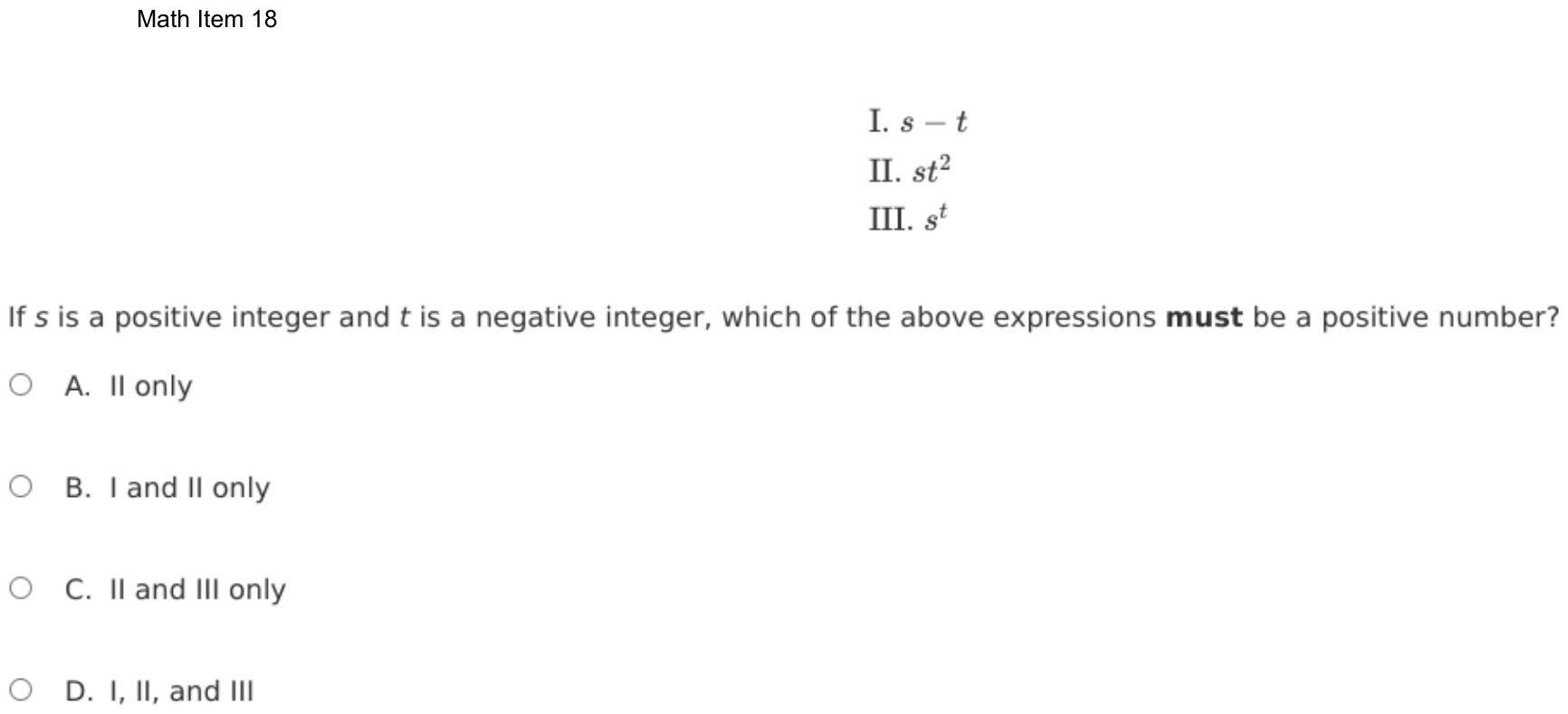
I.
II.
III.
If s is a positive integer and t is a negative integer, which of the above expressions must be a positive number?
- AII only
- BI and II only
- CII and III only
- DI, II, and III
Show the answer
Correct answer: D
Each of the three expressions must be considered:
Expression I: , where s is a positive integer and t is a negative integer:
Subtracting a negative integer is the equivalent of adding a positive integer, so is equivalent to finding the value of , which must result in a positive number.
Expression II: , where s is a positive integer and t is a negative integer:
Squaring a negative integer results in a positive integer, so is equivalent to finding the value of , which must result in a positive number.
Expression III: , where s is a positive integer and t is a negative integer:
A negative exponent results in the reciprocal of the same exponential expression, so is equivalent to finding the value of , which must result in a positive number.
Therefore, Expressions I, II, and III must all result in a positive number.
Question analysis
Three expressions, s − t, s times t squared, and s to the power t, are listed, and students decide which must be positive when s is a positive integer and t is a negative integer. It tests sign rules for subtraction and multiplication and the meaning of a negative exponent. Each expression has to be judged for every possible pair, not just one example.
- NYS standards
- Grade level
- Grade 8 content, by NYS standard
- Compared with grade 7
- Above grade 7 Grade 7 students learn sign rules for subtracting and multiplying signed numbers. Here they reason about letters rather than numbers, decide what must always hold, and handle a negative exponent, a grade 8 idea.
- Estimated difficulty
- Hard: combines ideas, needs a plan, and has more than one tempting wrong answer.
- Thinking it demands
- Depth of knowledge 2, skills and concepts · mainly analyze
- What makes it hard
- Variables instead of numbers moderate
- Something you must already know moderate
- Every choice must be checked minor
- Solution
- 3 steps
- Reading level
- Question and choices: about grade 5, 42 words.
- Corrected from the DOE handbook
- Two steps of the explanation that treated t as a positive number were corrected.
- A punctuation error in the explanation was corrected.
- Students, last 30 days
- Not enough answers yet to show (it takes 10).
Why it is hard, traps and wrong answers (shows the answer)
Why it is hard
The three expressions test three different sign facts: subtracting a negative, squaring a negative, and raising to a negative power. The last is the trap, since a negative exponent seems to promise a negative result when it really gives a fraction, and that belief alone leads to a listed choice. Trying s = 2 and t = −3 gives 5, 18 and 1/8, all positive, and the rules show why no other pair can change that.
Variables instead of numbers moderate Understanding the question
No values are given for s and t, only their signs, and must means each expression has to be positive for every such pair, not just for one example. (Koedinger & Nathan, 2004; Enright, Morley & Sheehan, 2002)
Something you must already know moderate Working it out
Expression III needs the meaning of a negative exponent, s to the power t equals 1 over s to the power −t, a grade 8 rule the question does not state. (Anderson & Krathwohl, 2001)
Every choice must be checked minor Choosing the answer
Each of the three expressions is judged on its own and the choices combine the verdicts, so one wrong judgment anywhere points to a wrong combination. (Embretson & Wetzel, 1987)
Strategy: Try a pair such as s = 2 and t = −3 in each expression, then explain why its sign could or could not change for any other positive s and negative t.
Traps
- Misunderstands the concept: A wrong belief about a concept: that percents can be added, that area grows like length, that averages can be averaged, that a bigger denominator means a bigger fraction.
- Negatives and direction: Arithmetic with negative numbers, the order of a subtraction, or direction on a number line. (Moving a term across the equals sign without changing its sign is a faulty procedure.)
The wrong answers, classified
A Misunderstands the concept (Smith, diSessa & Roschelle, 1993; De Bock et al., 1998; Ni & Zhou, 2005)
Trusts only the squared expression, believing that subtracting t must make s smaller and that a negative exponent makes a negative number.
B Misunderstands the concept (Smith, diSessa & Roschelle, 1993; De Bock et al., 1998; Ni & Zhou, 2005)
Handles the subtraction and the square correctly but believes a negative exponent makes the result negative, though s to the power t is a positive fraction such as 1/8.
C Negatives and direction (Brown & Burton, 1978)
Reads s − t as taking a number away from s, so thinks it could be negative, missing that subtracting the negative t adds to s.
What was corrected from the DOE handbook, and why
- Explanation: The question makes t the negative integer, but two steps of the DOE’s explanation write the negative integer as −t, as if t were positive. For Expression I it says “s − (−t) is equivalent to finding the value of s + t, which must result in a positive number”: s − (−t) is not Expression I, and with the question’s t, s + t need not be positive (s = 1 and t = −2 give −1). For Expression III it says “s^(−t) is equivalent to finding the value of 1/s^t”, about s^(−t) rather than Expression III. The site now says that s − t is equivalent to s + (−t), and that s^t is equivalent to 1/s^(−t). Since t is negative, −t is a positive integer, so s + (−t) is the sum of two positive integers and 1/s^(−t) is the reciprocal of a positive integer: both positive, and the answer, I, II and III, is unchanged. The step for Expression II, s(−t)² = st², is true for any t and is unchanged.
- Explanation: The DOE’s explanation introduces Expression III as “s^t. where s is a positive integer and t is a negative integer”, with a period where Expressions I and II (and the 2022–23 guide, which first printed this explanation) have a comma. The site has the comma.
Worked solution, step by step
Formulas used
- Subtracting a number
- s and t are integers, and −t is the opposite of t. Subtracting a number is the same as adding its opposite. When t is negative, −t is positive. So subtracting t adds a positive amount.
- A negative exponent
- s is the base and t is the exponent. When t is negative, −t is positive. So a negative exponent means 1 over the base to a positive exponent. For example, 2 to the power −3 is 1 over 2³, which is 1/8.
Sort out the question
An integer is a whole number or its opposite, such as −2, 0 or 5. Here s is a positive integer, like 1, 2 or 3. And t is a negative integer, like −1, −2 or −3. Must means always. An expression counts only if it is positive for every such pair.
Try one pair of numbers
Try s = 2 and t = −3 in each expression:
- I:
- II:
- III:
All three are positive this time. Now see why that always happens.
Explain expression I
Use the rule for subtracting:
t is negative, so its opposite, −t, is positive. So s − t is a positive plus a positive. That is always positive.
Watch out: subtracting does not always make a number smaller. Subtracting a negative makes it bigger. Missing this leads to choice C.
Explain expression II
means t × t. A negative times a negative is positive, so is always positive. Then is a positive times a positive. That is always positive too.
Explain expression III
Use the rule for a negative exponent:
−t is a positive integer, so is a positive integer. So is 1 over a positive number. That is a positive fraction.
Watch out: a negative exponent does not make the answer negative. It makes a fraction. Thinking it does leads to choice B, I and II only.
Choose the answer
Each of the three expressions is positive for every positive s and negative t. None of them can ever be zero or negative.
So the answer is D, I, II, and III.
Check your answer
Try the values closest to 0: s = 1 and t = −1. I gives . II gives . III gives . All three are still positive.
More questions like this
The original DOE question
Question 5 of 6
2018 Test A Math, question 40Question
In the set of consecutive integers from 12 to 30, inclusive, there are four integers that are multiples of both 2 and 3. How many integers in this set are multiples of neither 2 nor 3?
- A5
- B6
- C13
- D15
Show the answer
Correct answer: B
The question asks for integers from 12 to 30 that are not divisible by 2 or 3. The set of consecutive integers is
{12, 13, 14, 15, 16, 17, 18, 19, 20, 21, 22, 23, 24, 25, 26, 27, 28, 29, 30}
Since all even numbers are divisible by 2, eliminate all even numbers, leaving the odd numbers in the set:
{13, 15, 17, 19, 21, 23, 25, 27, 29}
Eliminate those integers that are multiples of 3 (15, 21, and 27). The remaining integers are:
{13, 17, 19, 23, 25, 29}
Therefore, there are 6 numbers in the set that are multiples of neither 2 nor 3.
Question analysis
This number properties question takes the integers from 12 to 30, inclusive, and asks how many are multiples of neither 2 nor 3. Students must count the whole set, remove multiples of 2 and of 3 without removing any number twice, and count what remains. Inclusive endpoints and the overlap make it easy to miscount.
- NYS standards
- 6.NS.4 common factors and multiples
- Grade level
- Grade 6 content, by NYS standard
- Compared with grade 7
- Above grade 7 Multiples are sixth-grade content, but grade 7 problems rarely ask students to count a set under two overlapping conditions. The inclusive range and the numbers that are multiples of both make this longer and trickier than usual.
- Estimated difficulty
- Hard: combines ideas, needs a plan, and has more than one tempting wrong answer.
- Thinking it demands
- Depth of knowledge 2, skills and concepts · mainly apply
- What makes it hard
- Much to keep track of moderate
- A very close wrong answer moderate
- Solution
- 3 steps
- Reading level
- Question and choices: about grade 9, 30 words.
- Students, last 30 days
- Not enough answers yet to show (it takes 10).
Why it is hard, traps and wrong answers (shows the answer)
Why it is hard
The question gives the overlap, four multiples of both 2 and 3, which invites a subtraction method with three places to go wrong: the count of the set, the overlap, and the final complement. Each of those errors has its own choice. Listing the 19 numbers and crossing out evens and then odd multiples of 3 is slower to describe but faster and safer to do.
Much to keep track of moderate Working it out
Each of the 19 integers must be checked against two conditions, and the four multiples of 6 meet both, so they must be removed once, not twice. (Sweller, 1988; Carpenter, Just & Shell, 1990)
A very close wrong answer moderate Choosing the answer
The choices 5 and 6 differ by one, the result of counting 30 − 12 = 18 integers instead of 19, so only counting the inclusive set exactly separates them. (Embretson & Wetzel, 1987; Gorin & Embretson, 2006; Ascalon et al., 2007)
Strategy: Cross out every even number first, then cross out the odd multiples of 3 that remain, and count the survivors; listing all nineteen numbers is quick enough.
Traps
- Answers a different question: A choice is right for another quantity: the other unknown, the rest instead of the part, the part instead of the whole.
- Counting the ends: Inclusive or exclusive ends, fence posts, consecutive numbers: an answer that is one too many or too few, or an endpoint drawn open where it belongs closed (or the reverse).
The wrong answers, classified
A Counting the ends (Brown & Burton, 1978)
Counts 30 − 12 = 18 integers instead of 19, then subtracts the 13 multiples of 2 or 3 and gets 5.
C Answers a different question (King et al., 2004; Hegarty, Mayer & Monk, 1995)
Counts the integers that are multiples of 2 or 3, the 13 to be crossed out, and gives that count instead of the 6 left over.
D Misreads the question (Hegarty, Mayer & Monk, 1995)
Subtracts only the four multiples of both 2 and 3 from the 19 integers, reading "neither 2 nor 3" as "not both 2 and 3".
Worked solution, step by step
Formulas used
- Counting whole numbers in a list
- a is the first number and b is the last. n is how many whole numbers there are, counting both ends. You add 1 because subtracting counts the gaps, and there is one more number than gaps.
Sort out the question
The set is every integer (whole number) from 12 to 30. “Inclusive” means 12 and 30 are both in.
A multiple of 2 is an even number. A multiple of 3 is a number in the 3 times table. You need the numbers that are neither: not even, and not in the 3 times table.
Count the numbers in the set
There are 19 integers. Watch out: 30 − 12 = 18 forgets one end. That slip leads to choice A, 5.
Cross out the even numbers
Every even number is a multiple of 2, so remove them all. The odd numbers are left:
13, 15, 17, 19, 21, 23, 25, 27, 29
That is 9 numbers.
Cross out the multiples of 3
Check each odd number for 3. A quick test: add its digits. If the sum is in the 3 times table, so is the number. That removes 15, 21 and 27. These are left:
13, 17, 19, 23, 25, 29
Watch out: only 12, 18, 24 and 30 are multiples of both. Removing just those gives 19 − 4 = 15, choice D. “Neither” means you remove every multiple of 2 and every multiple of 3.
Count what is left
Six numbers are left. Watch out: 13 is how many you crossed out, choice C. The question asks for the ones left. So the answer is B, 6.
Check your answer
Count another way. Of the 19 numbers, 10 are even. Of the 9 odd ones, 3 are multiples of 3. So 10 + 3 = 13 are crossed out, and 19 − 13 = 6 are left. Same answer.
More questions like this
The original DOE question
Question 6 of 6
2026 Practice Test C Math, question 10Question
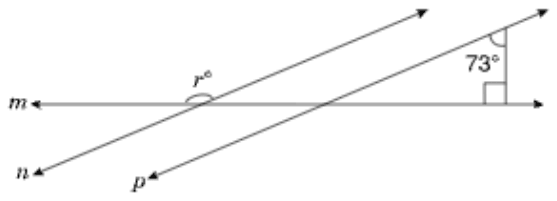
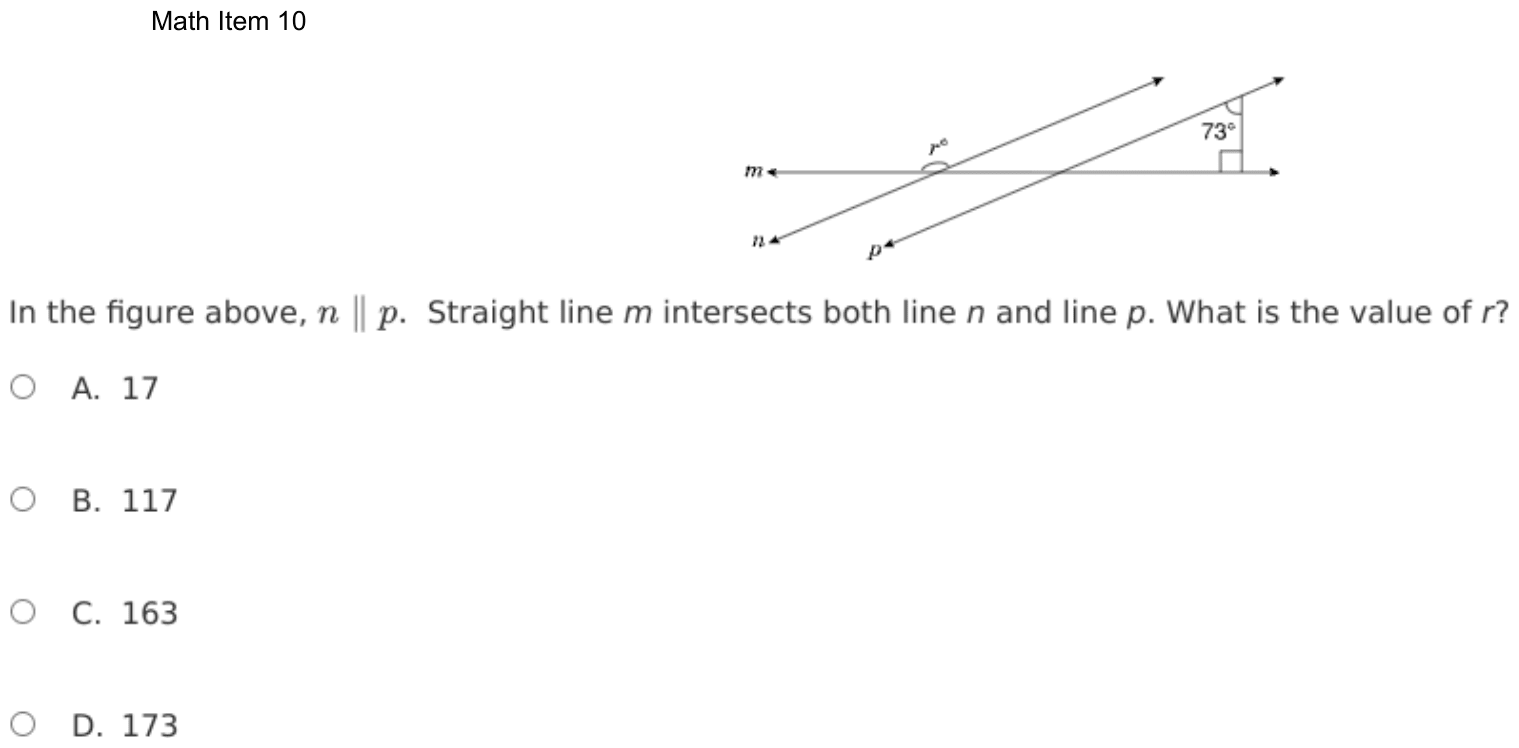
In the figure above, . Straight line m intersects both line n and line p. What is the value of r?
- A17
- B117
- C163
- D173
Show the answer
Correct answer: C
The triangle formed by line p, line m, and the line segment connecting the two contains a 73° angle, a right angle (90°), and a missing angle measuring x°. The sum of the interior angles of a triangle is 180°, so begin by finding the value of x:
Line m is a straight line, so it has a measure of 180°. The 17° angle from the triangle and the adjacent angle outside the triangle are supplementary, so they have a sum of 180°. Let s represent the measure of the adjacent angle outside the triangle. The value of s can be determined by subtracting:
Given that n and p are parallel lines and that they have been cut by a transversal, line m, then corresponding angles are congruent. Angles r and s are corresponding angles, so the value of r is congruent to the value of s, which is 163°.
Question analysis
Two parallel lines, n and p, cross a straight line m, and a segment drawn at a right angle to m forms a small triangle with lines m and p, where a 73° angle is marked. Students find the angle r at line n. It combines a triangle's angle sum, a straight angle and parallel lines, and the angle wanted sits away from the marked ones.
- NYS standards
- Grade level
- Grade 8 content, by NYS standard
- Compared with grade 7
- Above grade 7 Grade 7 angle problems use supplementary, vertical and adjacent angles. This one also needs the angle sum of a triangle and the angles formed by parallel lines and a transversal, grade 8 facts, chained across a busy figure.
- Estimated difficulty
- Hard: combines ideas, needs a plan, and has more than one tempting wrong answer.
- Thinking it demands
- Depth of knowledge 2, skills and concepts · mainly apply
- What makes it hard
- Reading a figure, table or graph moderate
- Combines ideas moderate
- Something you must already know minor
- Solution
- 3 steps
- Reading level
- Question and choices: about grade 3, 21 words.
- Students, last 30 days
- Not enough answers yet to show (it takes 10).
Why it is hard, traps and wrong answers (shows the answer)
Why it is hard
Each fact needs only a subtraction, but the student has to plan a route from the 73° angle at line p over to r at line n. The first number the route gives, the triangle's 17° angle, is listed, and it is the acute partner of r rather than r itself. The figure helps here: r is drawn plainly obtuse, and 163 is also 90 + 73, the triangle's exterior angle, which confirms it.
Reading a figure, table or graph moderate Understanding the question
The 73° sits between line p and the vertical segment, not between p and m, and r is the obtuse angle above m on the left of line n, far from every marked angle. (Lesh, Post & Behr, 1987; Kirsch & Mosenthal, 1990)
Combines ideas moderate Working it out
Three facts chain together: the triangle's angles sum to 180°, the angles along straight line m sum to 180°, and corresponding angles at the parallel lines n and p are equal. (Embretson, 1998; Daniel & Embretson, 2010)
Something you must already know minor Working it out
The angle pairs formed by a line crossing two parallel lines are a grade 8 topic, and the question uses them without naming them. (Anderson & Krathwohl, 2001)
Strategy: Find the third angle of the right triangle, use the straight line m to get the angle beside it, then carry that angle over to line n using the parallel lines.
Traps
- Stops one step early: A choice is a number from partway through the solution.
- An arithmetic slip: The right method with a plausible arithmetic error: a digit, a place value or a times-table fact.
The wrong answers, classified
A Stops one step early (King et al., 2004; Gierl et al., 2017)
Finds the triangle's third angle, 180 − 90 − 73 = 17, and stops, though r is the obtuse angle next to the 17° angle, not that angle itself.
B Little reason to choose it (Haladyna & Downing, 1993; Rodriguez, 2005)
No angle fact in the figure gives 117; even 180 − 73 is 107, so this choice mostly catches guesses at an obtuse angle.
D An arithmetic slip (Junker & Sijtsma, 2001)
Finds the 17° angle and subtracts it from 180 but borrows without reducing the 8, so 180 − 17 comes out as 173.
Worked solution, step by step
Formulas used
- Angles of a triangle
- a, b and c are the three angles inside any triangle. They always add up to 180°. If you know two of them, subtract their sum from 180° to find the third.
- Angles on a straight line
- a and b are two angles side by side on a straight line. Together they make a half turn, which is 180°. Use it to find the angle next to one you already know.
- Corresponding angles
- The symbol ∥ means is parallel to. When line m crosses two parallel lines, it makes the same angles at each crossing. Angles in the same position at the two crossings are called corresponding angles. They are equal.
Sort out the question
Lines n and p are parallel, and line m crosses both. Near line p, a straight-up segment meets line m. The small square shows a right angle, 90°. Line p, line m and that segment make a small triangle. Its top angle is 73°.
You need r, the wide angle where line n crosses line m.
Find the triangle’s third angle
The third angle is where line p crosses line m. Call it x. Use the triangle rule:
So that angle is 17°.
Watch out: this is not r. Stopping here gives choice A, 17.
Use the straight line m
The 17° angle sits above line m, on the right of line p. Beside it, on the left of line p, is a wide angle. Call it s. The two angles fill the straight line m, so they add to 180°:
So s is 163°.
Watch out: borrow carefully. 180 − 17 is 163, not 173, choice D.
Carry the angle to line n
Angle s is above line m and to the left of line p. Angle r is above line m and to the left of line n. They are in the same position, so they are corresponding angles. Since n and p are parallel:
So the answer is C, 163.
Check your answer
Look at the figure. Angle r is wider than a right angle, so it must be more than 90°. That rules out 17. Also, the narrow angle beside r, on the right of line n, matches the 17° angle at line p. And , as it should on a straight line.
More questions like this
The original DOE question