3 English and 3 math
Here are 6 random questions to try. Takers earning below 75% are unlikely to receive an offer. You have 1 minute 48 seconds per question on the real exam.
Question 1 of 6
2026 Practice Test C English, question 41Passage Excerpt from “Growing Peppers on the ISS Is Just the Start of Space Farming”
Excerpt from “Growing Peppers on the ISS Is Just the Start of Space Farming”
by Melanie Canales
The author, Melanie Canales, is a first-generation Peruvian American farmer and beekeeper based in Virginia’s Shenandoah Valley, on lands of the indigenous Monacan and Manahoac tribes. Her work focuses on creating healthy relationships between people and their surrounding ecosystems.
Unburdened by the constraints of gravity, red and green peppers jut out at 45-degree angles inside the Advanced Plant Habitat (APH), a sort of space terrarium not much larger than a microwave. Four chile pepper plants stand effortlessly upright, despite the dozens of glossy fruits weighing them down. These plants have lived entirely in space; their leaves have never been chewed on by insects or rustled by a summer breeze, [and] their stems are unfamiliar with bending toward the sun’s arc across the sky. Scissors glint under the tank’s white and blue lights as astronaut Mark Vande Hei and his team snip the stems of those that are ready for harvest. The peppers whirl around their heads until the astronauts catch them and tape them against a board to photograph.
Back on Earth, the Plant Habitat-04 team of engineers and plant scientists are observing and conferring with the astronauts. Of the 26 peppers in this batch, only the 14 finest will stay on the International Space Station [ISS] for consumption. The rest will be wrapped in foil, sealed in a Ziploc bag, then frozen at a brisk −80 degrees, until they can come roaring back to Earth in the next cargo capsule to be studied later. Now, after a 137-day growth cycle, the astronauts remove the plants from the module and trash them. Project Plant Habitat-04 is complete. It’s taco night on the ISS.
Since 2014, NASA1 has experimented with growing lettuces, brassicas,2 and zinnias3 in space, an endeavor that relies on highly specialized technology over 50 years in the making. [Fall 2021’s] two successful pepper harvests . . . will provide data on the nutritional and psychological benefits of growing vegetables on-craft, as well as a crop’s ability to reliably produce long-term in microgravity. While controlled environmental agriculture is not new, the APH experiment represents an evolution in specialized growth habitats. It doesn’t aim to re-create Earth’s conditions, but to perfect each isolated variable of plant growth in the clinical environment of a spaceship.
“The Advanced Plant Habitat is the most complex plant growth system on orbit today,” says Lashelle Spencer, a plant scientist at NASA’s Kennedy Space Center. Its more than 180 sensors control and monitor temperature, humidity, and carbon dioxide. The astronauts can adjust the color and intensity of the light, and how much moisture the plants’ roots are getting. It waters itself.
It’s the day after Thanksgiving, and Spencer has been at Kennedy since 5 a.m. to facilitate the peppers’ final harvest. As part of the project team, she played a crucial role in preparing the seeds that were sent hurtling into space in June and guiding the astronauts through maintaining the plants in orbit. . . . Though astronauts can spend upwards of 100 days in space, their on-mission meals come dehydrated and pre-packaged; their vitamins and minerals are isolated in supplements, which lose nutritional value the longer they’re stored. Spencer’s goal is to create the conditions necessary for cultivating healthy plants in space, so those plants can sustain healthy astronauts on long-term missions. Astronaut food is great, she says—“especially the shrimp cocktail. But you’re missing that crunch. You’re missing that fresh pop of flavor, the green flavor that’s not there in that packaged food.”
The sensory experience of growing productive crops can also help mitigate4 the psychological effects of long-term space travel. . . . Spencer says the team cracked open the door of the APH every day to observe their vegetable companions with all the tenderness of home gardeners. When harvest day came, they batted their bounty around the ISS, taking selfies and delighting in watching the fruits pirouetting around the spacecraft. . . .
“We were thinking no heat, so that [the peppers] wouldn’t be dangerous, but maybe the astronauts need a little spice in their life,” says Paul Bosland, who along with his colleagues at the Chile Pepper Institute genetically engineered5 the NuMex Española Improved chile pepper seeds grown in Plant Habitat-04. . . .
Working with NASA, Bosland cultivated a variety that could accommodate both the nutritional needs of astronauts as well as the logistics of growing a plant in space. . . .
. . . The experiment is helping gather the data necessary to determine the nutritional content of crops grown in space, and therefore how many people they can feed, and for how long. Though much is still unknown, Spencer is certain of one thing that future astronauts will need to do: “I think in an optimal world, a scientist like me would say that they would be growing plants from day one. From the day they left to the day they came back, they would be growing them.”
From “Growing Peppers on the ISS Is Just the Start of Space Farming” by Melanie Canales from WIRED, December 21, 2021. Copyright © 2021 Condé Nast. All rights reserved.
1NASA: National Aeronautics and Space Administration
2brassicas: a large genus of herbs, such as broccoli and cabbage
3zinnias: a genus of herbs and low shrubs that have flowers at their heads
4mitigate: to make something less severe or harmful
5genetically engineered: combined parts of DNA from different plants to produce a new plant
Question
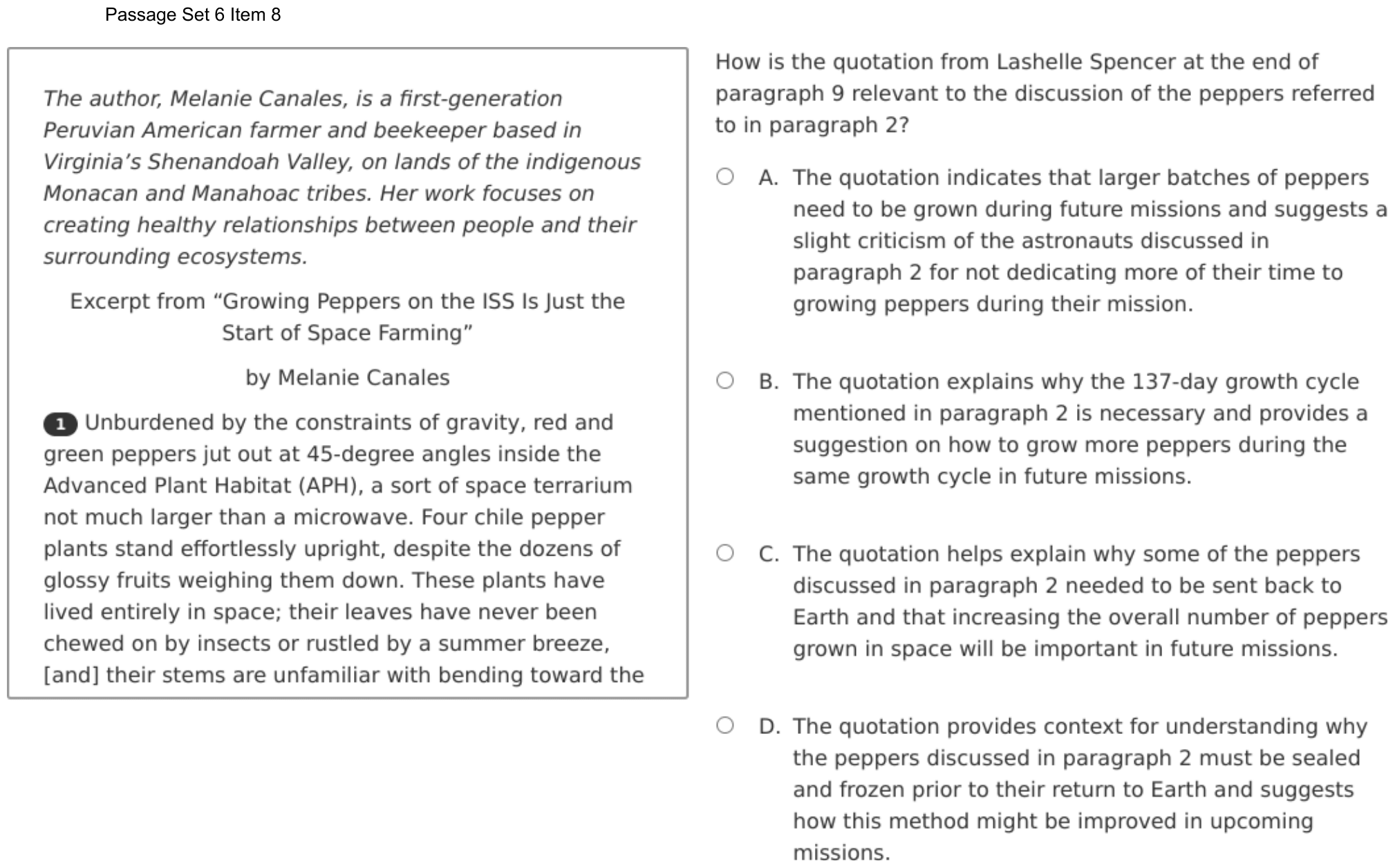
How is the quotation from Lashelle Spencer at the end of paragraph 9 relevant to the discussion of the peppers referred to in paragraph 2?
- AThe quotation indicates that larger batches of peppers need to be grown during future missions and suggests a slight criticism of the astronauts discussed in paragraph 2 for not dedicating more of their time to growing peppers during their mission.
- BThe quotation explains why the 137-day growth cycle mentioned in paragraph 2 is necessary and provides a suggestion on how to grow more peppers during the same growth cycle in future missions.
- CThe quotation helps explain why some of the peppers discussed in paragraph 2 needed to be sent back to Earth and that increasing the overall number of peppers grown in space will be important in future missions.
- DThe quotation provides context for understanding why the peppers discussed in paragraph 2 must be sealed and frozen prior to their return to Earth and suggests how this method might be improved in upcoming missions.
Show the answer
Correct answer: C
The question asks how the quotation from Lashelle Spencer at the end of paragraph 9 is relevant to the discussion of the peppers referred to in paragraph 2.
A. Incorrect. The quotation from Spencer in paragraph 9 suggests that astronauts should spend more time on growing larger and more continuous batches of peppers during long missions, but it does not criticize astronauts for discarding plants and ending the experiment after the 137-day growth cycle.
B. Incorrect. While the quotation from Spencer in paragraph 9 stresses the value of spending more time growing plants in space, it does not provide specific details about the 137-day growth cycle or offer specific methods for producing more peppers within the same time frame.
C. CORRECT. The quotation from Spencer in paragraph 9 is relevant to the discussion of the peppers on the ISS in paragraph 2 because it emphasizes the importance of expanding plant-growing efforts on future space missions. Spencer suggests that rather than ending the experiment after the 137-day growth cycle, astronauts could continually replant and replenish their food supply from the beginning to the end of a long mission.
D. Incorrect. Although the quotation from Spencer in paragraph 9 conveys the importance of dedicating more time to growing plants in space, it does not explain why the peppers were sealed and frozen, nor does it suggest how this method for preserving them might be improved.
Question analysis
This question asks how Lashelle Spencer’s quotation at the end of the space-farming excerpt, her view of what future astronauts will need to do, relates to the account in paragraph 2 of how the pepper harvest was handled. Students must connect the article’s ending to its opening, and every choice is a long two-part statement whose halves have to be checked separately.
- Grade level
- Grade 8 reading and task
- Compared with grade 7
- Above grade 7 Grade 7 readers explain how parts of a text relate, usually neighboring ones. This item links the last paragraph to the second, and its four choices run about forty words each in two parts, so it asks more than typical grade 7 work.
- Estimated difficulty
- Hard: combines ideas, needs a plan, and has more than one tempting wrong answer.
- Thinking it demands
- Depth of knowledge 3, strategic thinking · mainly analyze
- What makes it hard
- Reading between the lines moderate
- A very close wrong answer moderate
- A lot to read moderate
- Evidence in several places minor
- Evidence
- Answered from several paragraphs or stanzas
- Reading level
- Passage: about grade 10, 890 words; question and choices: about grade 16, 163 words.
- Students, last 30 days
- Not enough answers yet to show (it takes 10).
Why it is hard, traps and wrong answers (shows the answer)
Why it is hard
Each choice has one half that sounds connected to the quotation, so students must test both halves of all four. The criticism choice is the hardest to reject, since it correctly hears a call for more growing and only then misreads Spencer’s tone. The key itself is not airtight: its first half leans on the sentence before the quotation, about gathering nutrition data, so the answer is best confirmed by ruling out the others.
Reading between the lines moderate Working it out
Spencer’s quotation never mentions paragraph 2; the link is that plants grown “from day one” to “the day they came back” contrast with one 137-day batch harvested and thrown away. (Graesser, Singer & Trabasso, 1994; Kintsch, 1998)
A very close wrong answer moderate Choosing the answer
The criticism choice shares the key’s call for more growing on future missions and differs in its other half, a slight criticism of the crew that Spencer’s hopeful “in an optimal world” never makes. (Embretson & Wetzel, 1987; Gorin & Embretson, 2006; Ascalon et al., 2007)
A lot to read moderate Understanding the question
The four choices run 32 to 40 words, and each joins two claims with “and,” so eight separate statements must be checked against the quotation and paragraph 2. (Kintsch, 1998; Gorin & Embretson, 2006; Freedle & Kostin, 1993)
Evidence in several places minor Working it out
The two parts to connect are the excerpt’s second paragraph and its last sentence, with six paragraphs on the habitat, Spencer and Bosland in between. (Kirsch & Mosenthal, 1990; Gorin & Embretson, 2006)
Strategy: Put Spencer’s closing quotation into your own words and recall how the pepper project ended in paragraph 2, then weigh both halves of every choice and keep the one the quotation and its paragraph best support.
Traps
- Half right: One half of a two-part choice is right and the other is not.
- Twists what the text says: Uses the text's topic and ideas but changes what it says: who did it, how much, when, or why.
The wrong answers, classified
A Half right (King et al., 2004; Thissen, Steinberg & Fitzpatrick, 1989)
Rightly hears a call for larger, continuous harvests in “from day one,” then adds a criticism of the crew, though Spencer describes an ideal and blames no one.
B Twists what the text says (King et al., 2004)
Connects the quotation to the 137-day cycle because both concern time, but Spencer neither explains why the cycle lasted that long nor suggests packing more peppers into it.
D Twists what the text says (King et al., 2004)
Ties the quotation to the foil, sealing and freezing in paragraph 2 and to improving that method, though Spencer’s improvement is growing plants all mission long, not storing peppers.
Working it out, step by step
Figure out what the question asks
This question links the end of the article to its beginning. Spencer speaks at the end of paragraph 9. Paragraph 2 tells what happened to the peppers. You need the choice that best explains how her words connect to those peppers. Each choice has two parts, and both must be true.
Recall the peppers in paragraph 2
Paragraph 2 says only “the 14 finest” peppers stay on the ISS to eat. The rest are frozen and sent “back to Earth in the next cargo capsule to be studied later.” Then, “after a 137-day growth cycle, the astronauts remove the plants from the module and trash them.” So the crew grew one batch, ate some, sent some home and threw the plants away.
Read the end of paragraph 9
Just before Spencer speaks, paragraph 9 says: “The experiment is helping gather the data necessary to determine the nutritional content of crops grown in space, and therefore how many people they can feed, and for how long.” Then Spencer says that in “an optimal world,” meaning the best possible world, astronauts “would be growing plants from day one.” She adds: “From the day they left to the day they came back, they would be growing them.”
Connect the two parts
The peppers sent home are studied. That gives the data paragraph 9 describes: how healthy space crops are and how many people they can feed. Spencer’s plan needs that data. You must know what a crop can feed before you plan meals for a whole trip. Her words also point to the future. Instead of one batch that ends in the trash, crews would grow plants all trip long. That means many more peppers.
Check each choice
- A is wrong. Spencer wants more growing, but she doesn’t criticize the crew. “In an optimal world” describes a hope, not a complaint.
- B is wrong. She never says why the cycle took 137 days. She doesn’t suggest squeezing more peppers into it, either.
- C is right. The returned peppers give the data, and growing “from day one” means more peppers in the future.
- D is wrong. She says nothing about freezing the peppers or a better way to store them.
Watch out: A gets the first half right. The criticism in its second half is what makes it wrong.
Choose the answer
Her words explain why some peppers went home to be studied and why more growing matters next time. So the answer is C, “The quotation helps explain why some of the peppers discussed in paragraph 2 needed to be sent back to Earth and that increasing the overall number of peppers grown in space will be important in future missions.”
Why this answer and not the closest wrong one
A is the closest wrong answer. Like C, it hears Spencer calling for more plants on future trips. But A also says she criticizes the astronauts. She doesn’t. She calmly describes a perfect world. C keeps the right half and adds a link the paragraph supports: the peppers sent home give the data.
More questions like this
The original DOE question
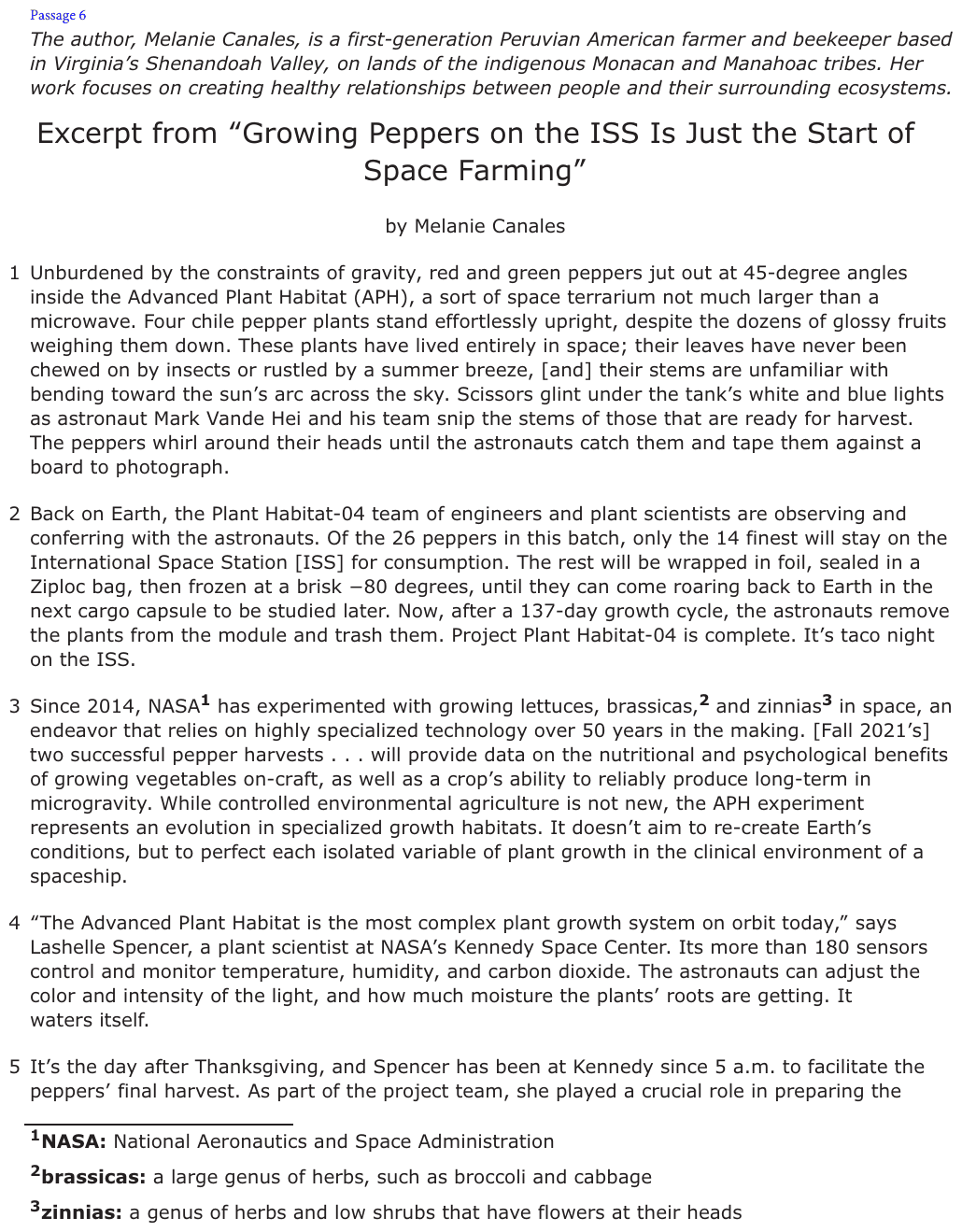
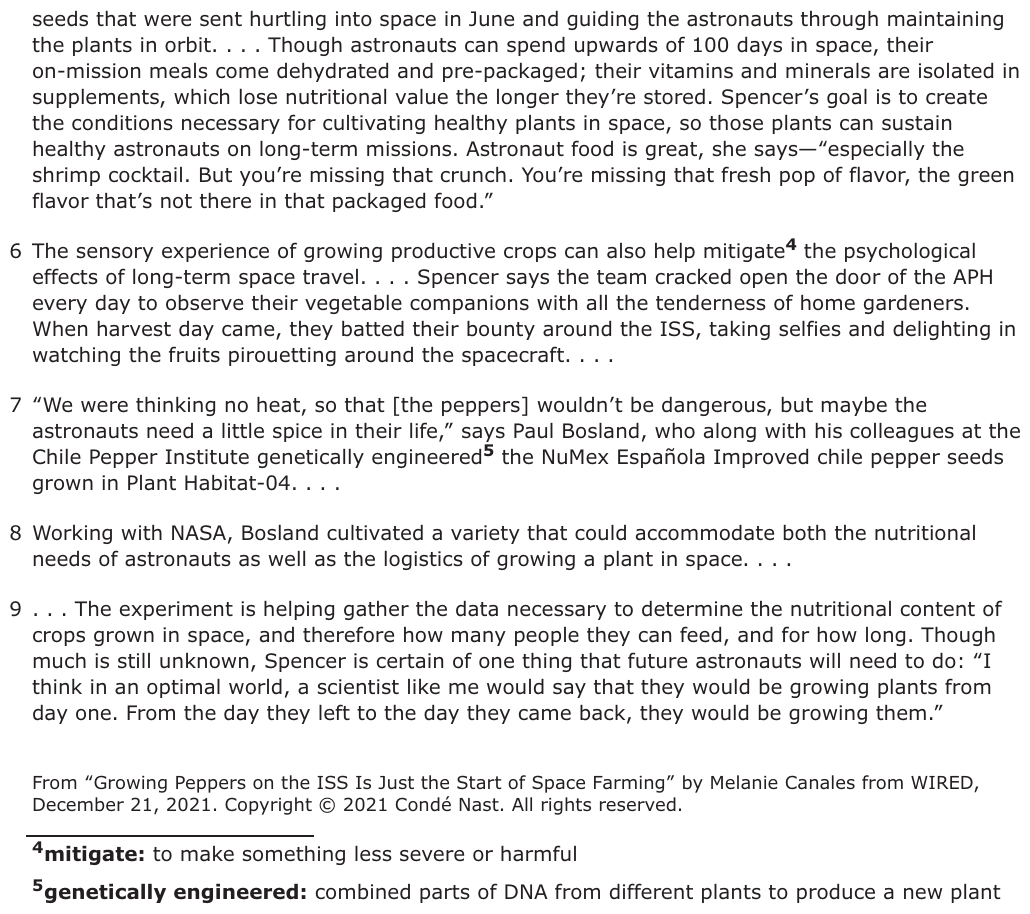
The passage “Excerpt from “Growing Peppers on the ISS Is Just the Start of Space Farming”” as printed (pages 50–51)
Question 2 of 6
2024 Test B English, question 40Passage Invention of the Telegraph
Samuel Morse, an American inventor, is credited with creating the electronic telegraph, a communication device that allows users to send messages using a system of short and long pulses that represent letters, numbers, and punctuation. In 1843 the United States Congress passed the Telegraph Bill, which provided Morse with the funds to build an electric telegraph system.
Invention of the Telegraph
Earlier Signal Systems
Long before Samuel F. B. Morse electrically transmitted his famous message “What hath God wrought?” from Washington to Baltimore on May 24, 1844, there were signaling systems that enabled people to communicate over distances. Most were visual or “semaphore” systems using flags or lights. In the eighteenth century, such systems used an observer who would decipher a signal from a high tower on a distant hill and then send it on to the next station. The young American republic wanted just such a system along its entire Atlantic coast and offered a prize of $30,000 for a workable proposal. The framers of this legislation had no way of knowing that when they used the word “telegraph” to refer to this visual semaphore system, they would be offered an entirely new and revolutionary means of communication—electricity.
The Growth of an Idea
The idea of using electricity to communicate over distance is said to have occurred to Morse during a conversation aboard ship when he was returning from Europe in 1832. Michael Faraday’s recently invented electromagnet was much discussed by the ship’s passengers, and when Morse came to understand how it worked, he speculated that it might be possible to send a coded message over a wire. While a student at Yale College years before, he had written his parents a letter about how interesting he found the lectures on electricity. Despite what he had learned at Yale, Morse found when he began to develop his idea that he had little real understanding of the nature of electricity, and after sporadic attempts to work with batteries, magnets, and wires, he finally turned for help to a colleague at the University of the City of New York, Leonard D. Gale.
Gale was a professor of chemistry and familiar with the electrical work of Princeton’s Joseph Henry, a true pioneer in the new field. Well before Morse had his shipboard idea about a telegraph, Henry rang a bell at a distance by opening and closing an electric circuit. In 1831, he had published an article, of which Morse was unaware, that contained details suggesting the idea of an electric telegraph. Gale’s help and his knowledge of this article proved crucial to Morse’s telegraph system because Gale not only pointed out flaws in the system but showed Morse how he could regularly boost the strength of a signal and overcome the distance problems he had encountered by using a relay system Henry had invented. Henry’s experiments, Gale’s assistance, and, soon after, hiring the young technician Alfred Vail were keys to Morse’s success.
Obstacles and Opportunities
By December 1837, Morse had enough confidence in his new system to apply for the federal government’s appropriation, and during the next year he conducted demonstrations of his telegraph both in New York and Washington.
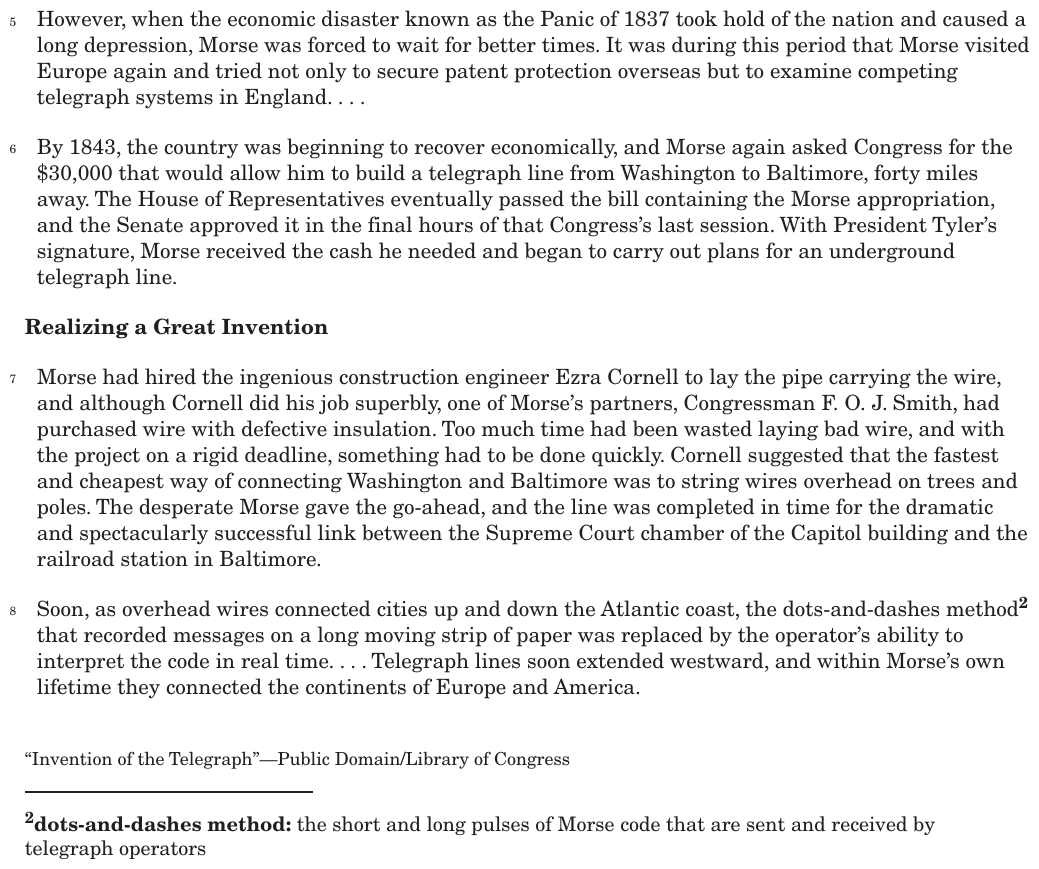
However, when the economic disaster known as the Panic of 1837 took hold of the nation and caused a long depression, Morse was forced to wait for better times. It was during this period that Morse visited Europe again and tried not only to secure patent protection overseas but to examine competing telegraph systems in England. . . .
By 1843, the country was beginning to recover economically, and Morse again asked Congress for the $30,000 that would allow him to build a telegraph line from Washington to Baltimore, forty miles away. The House of Representatives eventually passed the bill containing the Morse appropriation, and the Senate approved it in the final hours of that Congress’s last session. With President Tyler’s signature, Morse received the cash he needed and began to carry out plans for an underground telegraph line.
Realizing a Great Invention
Morse had hired the ingenious construction engineer Ezra Cornell to lay the pipe carrying the wire, and although Cornell did his job superbly, one of Morse’s partners, Congressman F. O. J. Smith, had purchased wire with defective insulation. Too much time had been wasted laying bad wire, and with the project on a rigid deadline, something had to be done quickly. Cornell suggested that the fastest and cheapest way of connecting Washington and Baltimore was to string wires overhead on trees and poles. The desperate Morse gave the go-ahead, and the line was completed in time for the dramatic and spectacularly successful link between the Supreme Court chamber of the Capitol building and the railroad station in Baltimore.
Soon, as overhead wires connected cities up and down the Atlantic coast, the dots-and-dashes method that recorded messages on a long moving strip of paper was replaced by the operator’s ability to interpret the code in real time. . . . Telegraph lines soon extended westward, and within Morse’s own lifetime they connected the continents of Europe and America.
“Invention of the Telegraph”—Public Domain/Library of Congress
legislation: Telegraph Bill
dots-and-dashes method: the short and long pulses of Morse code that are sent and received by telegraph operators
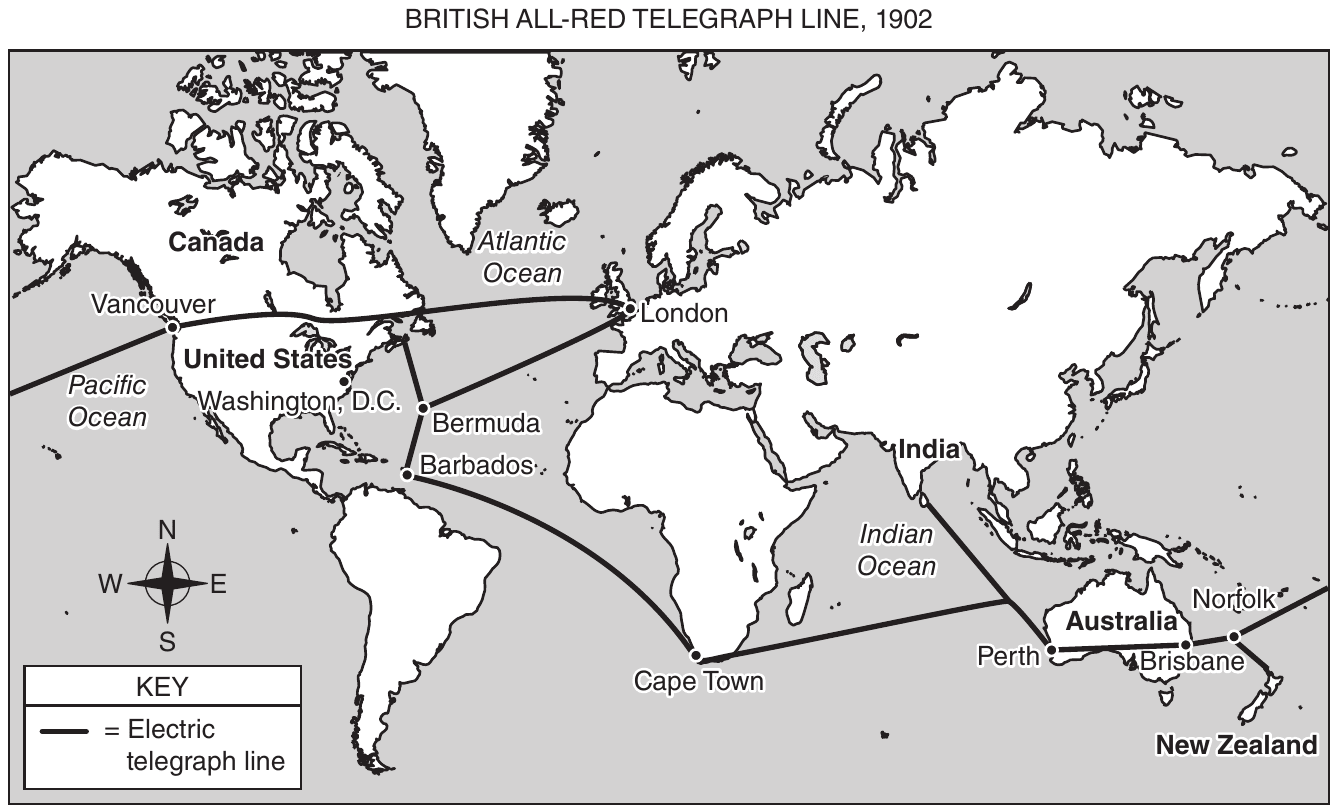
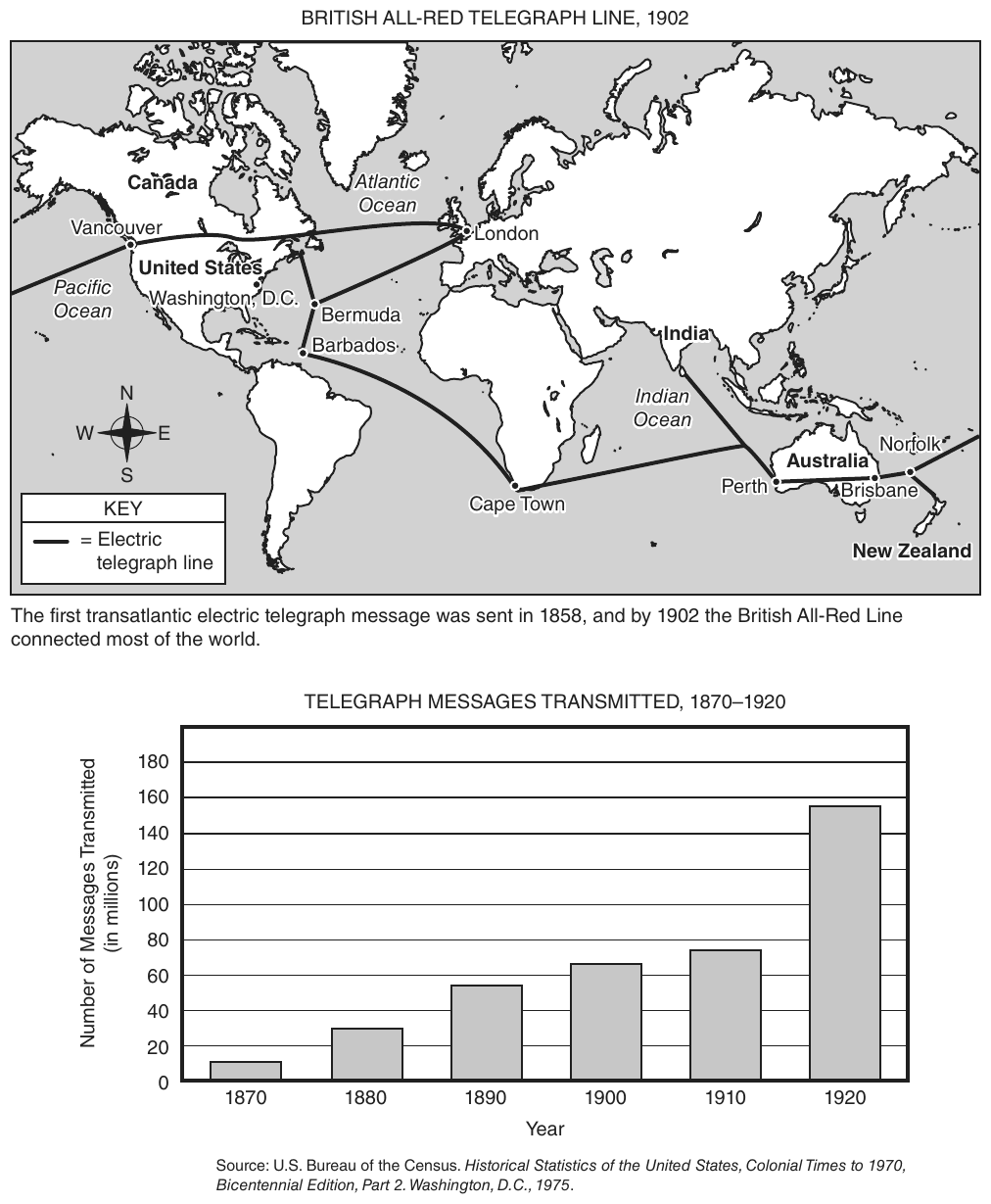
The first transatlantic electric telegraph message was sent in 1858, and by 1902 the British All-Red Line connected most of the world.
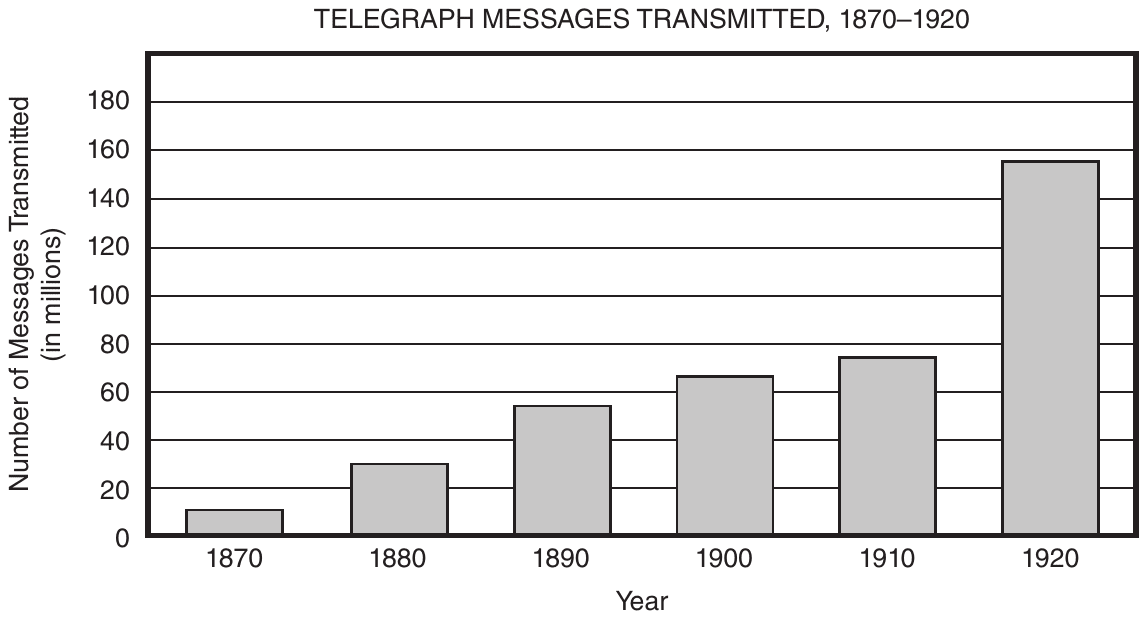
Source: U.S. Bureau of the Census. Historical Statistics of the United States, Colonial Times to 1970, Bicentennial Edition, Part 2. Washington, D.C., 1975.
Question
How does the map provide additional support for a central idea of the passage?
- Aby demonstrating that Morse’s telegraph system greatly exceeded the limitations of previous long-distance communication systems
- Bby indicating that Morse was lacking foresight by seeking a patent only in North America
- Cby proving that Gale’s advice helped Morse extend the telegraph’s range much farther than first thought possible
- Dby showing that the Morse telegraph had a surprisingly immense influence across the world
Show the answer
Correct answer: A
The question asks how the map provides additional support for a central idea of the passage.
A. CORRECT. The map shows the telegraph line crossing continents in 1902, just forty-four years after the first transatlantic message was sent in 1858. This is a much greater distance than the first line Morse built between “the Supreme Court chamber of the Capitol building and the railroad station in Baltimore” (paragraph 7).
B. Incorrect. The map shows the distance the line covers; it does not indicate Morse’s lack of foresight in seeking patents only in North America.
C. Incorrect. While Gale’s advice was crucial to Morse’s success, the map shows the physical line stretching across continents many years later, after their initial work.
D. Incorrect. While it can be inferred that the telegraph had influence across the world, the amount of influence cannot be determined.
Question analysis
This question pairs “Invention of the Telegraph” with a map of the British All-Red Telegraph Line in 1902 and asks how the map adds support for a central idea of the passage. Students must read a world map with a key and a caption, connect what it shows to the story of Samuel Morse’s invention, and sort through four claims about the map that vary in how far they go.
- Grade level
- Grade 8 reading and task
- Compared with grade 7
- Above grade 7 Linking a graphic to a text is familiar grade 7 work. Here students must pin down a central idea of the passage and work out how a 1902 world map, made decades after Morse’s first line, bears on it, a step beyond typical demand.
- Estimated difficulty
- Hard: combines ideas, needs a plan, and has more than one tempting wrong answer.
- Thinking it demands
- Depth of knowledge 3, strategic thinking · mainly analyze
- What makes it hard
- A very close wrong answer major
- Evidence in several places moderate
- Reading a figure, table or graph moderate
- Evidence
- Answered from the whole text
- Reading level
- Passage: about grade 11, 910 words; question and choices: about grade 11, 75 words.
- Corrected from the DOE handbook
- An inaccurate detail in the explanation was corrected.
- Students, last 30 days
- Not enough answers yet to show (it takes 10).
Why it is hard, traps and wrong answers (shows the answer)
Why it is hard
Lines on a map can prove how far the telegraph reached, and the question turns on how much more than that each choice claims. The key depends on a link back to paragraph 1, where a message went only as far as the next hilltop tower, read many minutes before the map. The influence choice skips that link and states the map’s message in bigger terms, so students who do not ask what a map of routes can show are drawn to it.
A very close wrong answer major Choosing the answer
The influence choice, a telegraph with “a surprisingly immense influence across the world,” sounds like a fair reading of lines circling the globe; it differs from the key in claiming impact and surprise rather than reach beyond earlier systems. (Embretson & Wetzel, 1987; Gorin & Embretson, 2006; Ascalon et al., 2007)
Evidence in several places moderate Working it out
The earlier systems the key measures against are in paragraph 1, towers on distant hills passing flag and light signals from station to station, far from the map at the end of the passage. (Kirsch & Mosenthal, 1990; Gorin & Embretson, 2006)
Reading a figure, table or graph moderate Understanding the question
The map shows a 1902 British line from London to Canada and Vancouver, south through Bermuda and Barbados to Cape Town, and on to India, Australia and New Zealand, with Washington left unconnected. (Lesh, Post & Behr, 1987; Kirsch & Mosenthal, 1990)
Strategy: Look at what the map and its caption actually show, sum up a central idea of the passage in your own words, and keep only a choice that both of them back up.
Traps
- Too broad or too strong: A choice overstates, generalizes, or uses absolute words the text does not support.
- Reads too much in: A reasonable-sounding conclusion that goes further than the text allows.
The wrong answers, classified
B Twists what the text says (King et al., 2004)
Reads the unconnected Washington dot as a patenting mistake of Morse’s, though a map of lines shows nothing about patents and paragraph 5 has him seeking protection overseas.
C Reads too much in (Graesser, Singer & Trabasso, 1994)
Remembers that Gale’s relay advice solved Morse’s “distance problems,” but a 1902 map that names no inventors cannot prove what that advice made possible decades earlier.
D Too broad or too strong (King et al., 2004)
Turns the map’s reach into a claim about impact, though routes on a map show where messages could travel, not how much the world changed or that anyone was surprised.
What was corrected from the DOE handbook, and why
- Explanation: The handbook says the 1902 line came “forty-four years after the first message was sent in 1858.” The first telegraph message was Morse’s in 1844 (paragraph 1); 1858 is the year of the first transatlantic message, as the map’s caption says. The site now says “the first transatlantic message.”
Working it out, step by step
Figure out what the question asks
This question asks how a graphic adds to the passage. You need two things. First, what does the map really show? Second, which central idea, a main point the whole passage builds, does it back up?
Read the map and its caption
This map is a picture of one British network of telegraph wires, as it stood in 1902. In its key, a thick black line stands for an electric telegraph line. From London, a line crosses the Atlantic Ocean and Canada to Vancouver. Other lines reach Bermuda, Barbados, Cape Town, India, Australia and New Zealand. According to the caption, by 1902 this network “connected most of the world.”
Recall the older ways of signaling
Next, compare that with paragraph 1. Before electricity, people signaled with flags or lights. An observer would “decipher a signal from a high tower on a distant hill and then send it on to the next station.” So a message could only jump as far as a person could see. Even Morse’s first line, in paragraph 6, reached Baltimore, just “forty miles away.”
Connect the map to that idea
The caption says the first message across the Atlantic was sent in 1858. Only 44 years later, in 1902, lines crossed several oceans and linked much of the globe. Paragraph 8 adds that telegraph lines “connected the continents of Europe and America” before Morse died. So the map supports a central idea: electric telegraph lines went far beyond the reach of older signal systems.
Check each choice
- A fits. Lines that span oceans go far past the limits of hilltop towers.
- B does not fit. A map of lines shows nothing about patents. Also, paragraph 5 says Morse sought patent protection in Europe, too.
- C does not fit. The map names no inventors, so it cannot prove what Gale’s advice did decades before.
- D does not fit. The map shows where lines went, not how much they changed the world, and nothing on it shows surprise.
Choose the answer
The map shows telegraph lines reaching around the globe, far past what flags and towers could do. So the answer is A.
Why this answer and not the closest wrong one
D is the closest trap, because lines around the world seem to prove a huge effect. But a map of routes shows only how far messages could travel. It cannot measure influence, and it cannot show that anyone was surprised. A sticks to what a map of lines can prove: the telegraph reached much farther than earlier systems.
More questions like this
The original DOE question
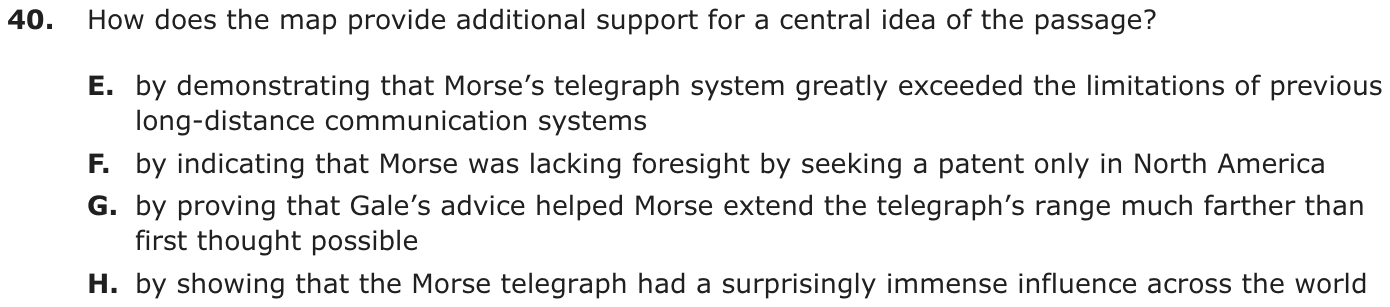
The passage “Invention of the Telegraph” as printed (pages 146–148)
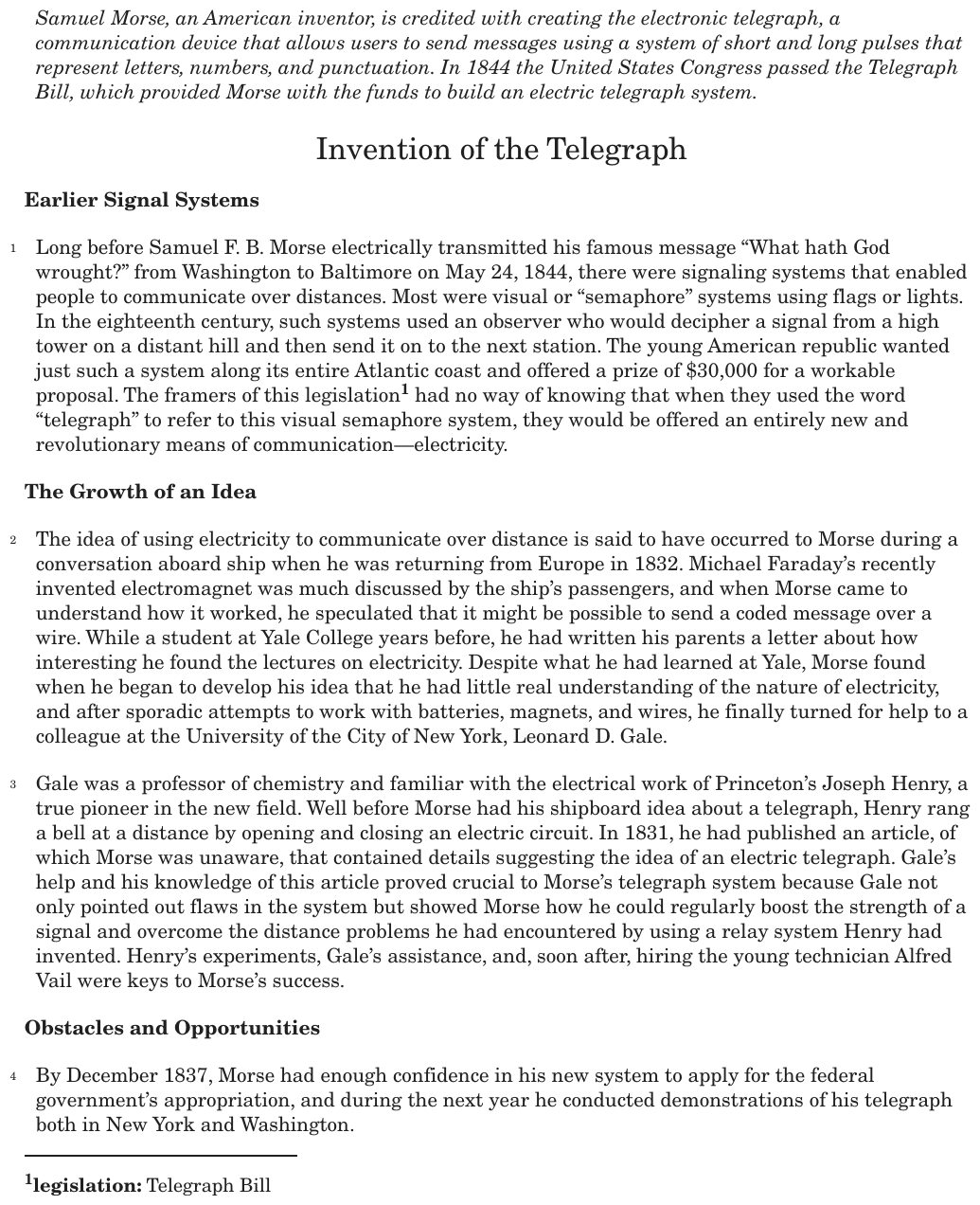
Question 3 of 6
2024 Test A English, question 38Passage 5 Reasons Physical Books Might Be Better Than E-Books
5 Reasons Physical Books Might Be Better Than E-Books
by Shaunacy Ferro
Though e-book1 readers have become a more common sight around town, traditional books still have their evangelists.2 According to The New York Times, e-book sales have been falling in 2015. Print definitely isn’t dead. In fact, according to some research, it may actually be a better choice for some readers. While scientists are still trying to tease out exactly how digital reading affects us differently, here are five ways e-books might be inferior to their dead-tree cousins.
E-books can reduce reading comprehension.
In a study of middle schoolers, West Chester University researchers found that students who read on iPads3 had lower reading comprehension than when they read traditional printed books. They discovered that the kids sometimes skipped text in favor of interactive features in the e-books, suggesting that certain multimedia in children’s e-books can be detrimental to the practice of reading itself. However, the researchers noted that some interactive features in e-books are designed to enhance comprehension, and that those might be more helpful than game-type interactive graphics.
Young kids can get distracted by e-books.
Similar results were found by a small study by the Joan Ganz Cooney Center that consisted of 32 kids reading e-books and print books with their parents. It found that “enhanced” e-books might be distracting. Kids who read enhanced e-books—ones with interactive, multimedia experiences—were more engaged with them physically, but in the end they remembered fewer narrative details than those who read print books or basic e-books.
You remember less about a book’s timeline.
Another study of adults also found that e-books can be hard to absorb. The researchers asked 25 people to read a 28-page story on a Kindle4 and 25 to read the story in paperback, then asked the readers to put 14 events from the story in chronological order. Those who read the story on a Kindle performed worse on the chronology test than the book readers, though they performed about the same as print readers in other tests. Earlier research by the same scholars, from Stavanger University in Norway, found that Norwegian 10th graders also remembered more about texts if they read them in print rather than on a computer screen.
They’re not great as textbooks.
While e-book textbooks are often cheaper (and easier to carry) than traditional door-stop5 textbooks, college students often don’t prefer them. In some surveys of college kids, the majority of students have reported preferring print books. However, a 2012 study from the UK’s National Literacy Trust of kids ages 8 to 16 found that more than 50 percent of children reported preferring screen reading.
They’re tiring.
Staring at a lit screen can be tiring for the eyes and the brain. A 2005 study from Sweden found that reading digitally required a higher cognitive workload than reading on paper. Furthermore, staring at LED6 screens at night can disrupt sleep patterns. A 2014 Harvard study found that people who used e-readers with LED screens at night slept worse and were more tired the next day. So, if you’re going to go for an e-book, go for one without the backlight.
The take-away message? If you’re really trying to absorb material, you might want to go for a physical book. And if you’re going to be up all night studying, turn off the backlight.
However, all this may not mean that reading on a Kindle is really going to melt your brain. For instance, reading an e-book on a computer is a much different experience than reading on a Kindle, which is specifically designed for consuming books. So, too, is playing with an interactive e-book on an iPad, compared to using a simpler e-book device that only presents the text, with no opportunities to click away into digital distractions.
And some studies have found that part of the difference between the way people absorb information from e-books versus paper might be due to approaching e-books differently—in one test, participants didn’t regulate their study time with digital books like they did with paper texts, leading to worse performances. It’s possible that our expectations of e-book reading—as well as the different designs of the digital reading experience on a computer or iPad or Kindle—might affect how we approach the text and how much effort we put into studying them. As generations of e-book readers evolve, and people become more accustomed to the idea of sitting down with a digital textbook, these factors could change—for better or for worse.
“5 Reasons Physical Books Might Be Better Than E-Books” by Shaunacy Ferro from MENTAL FLOSS, October 2, 2015. Copyright © 2015 Mental Floss, Inc.
1e-book: an electronic book, a publication made available digitally for reading on a computer or other device
2evangelists: advocates or supporters
3iPads: tablet computers
4Kindle: device for reading e-books
5door-stop: a reference to the idea that some textbooks are large and heavy enough to hold a door open
6LED: Light-emitting diode; LEDs are often used as a backlight for electronic devices such as smart phones and tablets.
Question
How does paragraph 7 fit into the overall structure of the passage?
- AIt indicates where the author changes the purpose of the writing.
- BIt introduces the author’s opinion on the issue.
- CIt signals a shift in the position of the author.
- DIt begins the author’s commentary on the preceding information.
Show the answer
Correct answer: D
The question asks for an explanation of the role of paragraph 7 in the overall structure of the passage.
A. Incorrect. The purpose of paragraphs 2–6 is to present reasons physical books might be better than e-books, and paragraph 7 offers summarizing “take-away” advice based on those reasons. As a result, it may seem as though the author’s purpose for writing the entire passage has shifted. However, the author’s advice in paragraph 7, that readers who want to learn from reading “might want to go for a physical book,” makes it clear that paragraph 7, like paragraphs 2–6, continues to serve the same purpose for the passage that the writer expresses in paragraph 1: to inform readers that printed books “may actually be a better choice for some readers” than e-books.
B. Incorrect. In paragraph 7, the author does offer the advice that readers who want to absorb material “might want to go for a physical book” rather than an e-book. Even though the author makes the statement favoring physical books for those who want to learn from their reading, the author is not sharing a personal opinion. Instead, the author offers the advice as a summary of the information presented in paragraphs 2–6, which explore various studies about the advantages of physical books over e-books. Furthermore, the idea that physical books are sometimes a better option is not introduced for the first time in paragraph 7. Instead, it is introduced early in the passage, when the author states in paragraph 1 that physical books “may actually be a better choice for some readers.”
C. Incorrect. Paragraph 7 presents a clear shift in style and content from paragraphs 2–6. Paragraphs 2–6 are each preceded by a heading stating a reason physical books might be a better choice than e-books, and each paragraph provides research evidence. Paragraph 7 shifts to stating a “take-away message”—the author’s advice—which is based on the reasons in paragraphs 2–6. Paragraph 7’s different style and content do not, however, signal a change in the author’s position. Instead, the author’s advice in paragraph 7 (“if you’re really trying to absorb material, you might want to go for a physical book”) actually reinforces the position first introduced in paragraph 1 that physical books “may actually be a better choice for some readers.”
D. CORRECT. The author uses paragraphs 2–6 to present “five ways e-books might be inferior” (paragraph 1) to physical books. Each of paragraphs 2–6 presents one reason for the inferiority of e-books, based on a scientific study. Paragraph 7 indicates a shift because it describes neither a reason e-books might be inferior nor a scientific study. Instead, it presents personal commentary: the “take-away,” or conclusion, the author draws from the studies and evidence presented in paragraphs 2–6. That commentary consists of the author’s own practical advice to readers who want to retain information that they read (“you might want to go for a physical book”) and to those who are “going to be up all night studying” (“turn off the backlight”).
Question analysis
This text-structure question asks how paragraph 7, a two-sentence paragraph that follows the five research sections, fits into the overall structure of an article arguing that printed books might be better than e-books. Students must compare it with the opening claim and the paragraphs around it, and the four choices use similar abstract wording about the author's purpose, opinion and position.
- Grade level
- Grade 8 reading and task
- Compared with grade 7
- Above grade 7 Grade 7 students analyze how sections contribute to a text, but here all four choices are abstract statements about the author's purpose and position, and telling them apart means tracking the argument from the first paragraph to the last.
- Estimated difficulty
- Hard: combines ideas, needs a plan, and has more than one tempting wrong answer.
- Thinking it demands
- Depth of knowledge 3, strategic thinking · mainly analyze
- What makes it hard
- A very close wrong answer major
- How, not what moderate
- Evidence in several places minor
- Evidence
- Answered from the whole text
- Reading level
- Passage: about grade 10, 829 words; question and choices: about grade 8, 49 words.
- Students, last 30 days
- Not enough answers yet to show (it takes 10).
Why it is hard, traps and wrong answers (shows the answer)
Why it is hard
All four choices are abstract claims about the author's purpose and position, so none can be checked against a single sentence. Paragraph 7 does feel like a turn, from studies to advice, which makes the choices about a changed purpose or position tempting, but the advice repeats the view the first paragraph set out. The real hedge comes one paragraph later, and the closest call is whether paragraph 7 introduces a view or comments on evidence already given.
A very close wrong answer major Choosing the answer
The right choice and the one saying paragraph 7 introduces the author's opinion both find the author's own voice there; they part on whether that view is new, and paragraph 1 already said print “may actually be a better choice”. (Embretson & Wetzel, 1987; Gorin & Embretson, 2006; Ascalon et al., 2007)
How, not what moderate Working it out
The question asks what paragraph 7 does in the article, a short take-away after five research sections, so its advice about physical books and backlights matters only for its role. (Anderson & Krathwohl, 2001)
Evidence in several places minor Working it out
Judging the claims of a shift or a change needs both ends of the article, the stance of paragraph 1 and the “However” that opens paragraph 8. (Kirsch & Mosenthal, 1990; Gorin & Embretson, 2006)
Strategy: Compare what paragraph 7 does with what paragraphs 1–6 do: where was the author's view first stated, and what is new in paragraph 7? Then match that role to a choice.
Traps
- Wrong part of the text: A choice is true of another paragraph, stanza or speaker than the one asked about.
- Wrong purpose or structure: Names a purpose, structure or effect that the part does not serve, or describes what a part says when the question asks what it does.
The wrong answers, classified
A Wrong purpose or structure (Anderson & Krathwohl, 2001)
Notices the move from research findings to practical advice and calls it a new purpose, but the advice serves the aim stated in paragraph 1, showing print may be better.
B Wrong part of the text (Kirsch & Mosenthal, 1990)
Rightly hears the author's own voice in the take-away, but introducing that view is what paragraph 1 does; paragraph 7 restates it as advice drawn from the studies.
C Wrong part of the text (Kirsch & Mosenthal, 1990)
Places the article's hedge too early: the author softens the stance only in paragraph 8, “all this may not mean”, while paragraph 7's advice keeps the same position.
Working it out, step by step
Know what the question asks
This asks about the structure of the passage, which means how its parts fit together. You need to name the job paragraph 7 does compared with the paragraphs around it.
Map the passage first
Paragraph 1 states the author’s view: print “may actually be a better choice for some readers.” Paragraphs 2 through 6 each sit under a bold heading. Each one reports research on one way e-books might be worse than print.
Read paragraph 7
It begins, “The take-away message?” A take-away is the lesson you carry away. Then the author advises, “If you’re really trying to absorb material, you might want to go for a physical book.” The author also says to “turn off the backlight” when studying late. Both tips come from the studies just before. So paragraph 7 is the author commenting on that evidence.
Check each choice
- D fits: it “begins the author’s commentary on the preceding information,” and preceding means coming before.
- A is wrong because the purpose doesn’t change, since the advice still shows print may be better.
- B is wrong because the author’s opinion first appears in paragraph 1, not paragraph 7.
- C is wrong because the author softens the view only later, in paragraph 8, with “all this may not mean.”
Watch out: B is tempting because paragraph 7 really is the author’s own voice. But it is not the first time you hear it.
Choose the answer
Paragraph 7 turns the research in the five sections into advice, which is commentary on what came before. So the answer is D.
Why this answer and not the closest wrong one
B comes closest, since paragraph 7 really is the author speaking. But the author’s view already appeared in paragraph 1. Paragraph 7 doesn’t introduce it. It sums up the research before it and turns that research into advice. That is commentary on the preceding information, as D says.
More questions like this
The original DOE question
The passage “5 Reasons Physical Books Might Be Better Than E-Books” as printed (pages 58–59)
Question 4 of 6
2024 Test B Math, question 44Question
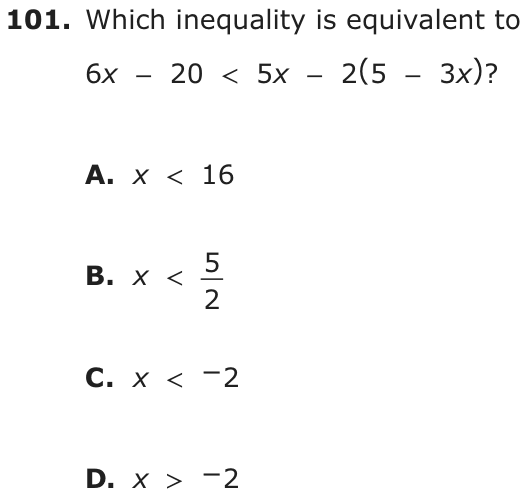
Which inequality is equivalent to ?
- A
- B
- C
- D
Show the answer
Correct answer: D
Distribute the coefficient −2 on the right-hand side:
Subtract from both sides:
Add 10 to both sides:
Divide both sides by 5:
This is equivalent to
Question analysis
Students choose the simplest equivalent form of a linear inequality that has x on both sides and a negative number multiplied into parentheses. It tests distributing, combining like terms and solving inequalities. Sign errors in the distribution, and reading the direction of the final inequality, are where most mistakes happen.
- NYS standards
- Grade level
- Grade 8 content, by NYS standard
- Compared with grade 7
- Above grade 7 Grade 7 inequalities have the form px + q < r. This one has x on both sides and a negative factor to distribute across a subtraction, steps that belong to grade 8 equation work, so it is harder than typical grade 7 practice.
- Estimated difficulty
- Hard: combines ideas, needs a plan, and has more than one tempting wrong answer.
- Thinking it demands
- Depth of knowledge 1, recall and reproduction · mainly apply
- What makes it hard
- Error-prone arithmetic moderate
- A very close wrong answer moderate
- Many steps minor
- Solution
- 4 steps
- Reading level
- Question and choices: about grade 16+, 10 words.
- Students, last 30 days
- Not enough answers yet to show (it takes 10).
Why it is hard, traps and wrong answers (shows the answer)
Why it is hard
Every move is standard algebra, but the inequality is built so that small slips change the answer completely. The −2 has to reach both terms in the parentheses, and once the boundary −2 is found its direction still has to be read correctly, since the variable ends up on the right as −2 < x. Rewriting that as x > −2, or substituting x = 0 into the original, catches the trap.
Error-prone arithmetic moderate Working it out
Distributing −2 over (5 − 3x) gives −10 + 6x, two sign decisions in one move, and the x terms then sit on both sides of the inequality. (Brown & Burton, 1978; Junker & Sijtsma, 2001)
A very close wrong answer moderate Choosing the answer
x < −2 and x > −2 share the boundary and differ only in direction, which depends on reading −2 < x correctly or flipping the sign when dividing by a negative. (Embretson & Wetzel, 1987; Gorin & Embretson, 2006; Ascalon et al., 2007)
Many steps minor Working it out
Four moves follow one another, distributing, collecting 5x + 6x, moving the x terms and dividing by 5, and a slip at any of them changes the result. (Daniel & Embretson, 2010; Enright, Morley & Sheehan, 2002)
Strategy: Distribute the −2 to both terms in the parentheses, combine the x terms on the right, then gather the x terms on the side that keeps their coefficient positive.
Traps
- Order of operations: Working left to right, or distributing a minus sign wrongly, gives a choice.
- Negatives and direction: Arithmetic with negative numbers, the order of a subtraction, or direction on a number line. (Moving a term across the equals sign without changing its sign is a faulty procedure.)
- A faulty procedure: A systematic but wrong procedure: adding fractions straight across, applying an exponent to each term of a sum, dropping a sign when moving a term.
The wrong answers, classified
A A faulty procedure (Brown & Burton, 1978; Tatsuoka, 1983)
Treats 5 − 3x as 2, combining a number with an x term, so the right side becomes 5x − 4 and the solution x < 16.
B Order of operations (Brown & Burton, 1978)
Multiplies the −2 by the 5 but not by the −3x, writing 5x − 10 − 3x, which leads to 4x < 10 and x < 5/2.
C Negatives and direction (Brown & Burton, 1978)
Finds the boundary −2 but points the inequality the wrong way, by misreading −2 < x or by not flipping the sign after dividing by −5.
Worked solution, step by step
Formulas used
- Distributive property
- a is the number outside the parentheses. b and c are the terms inside. Multiply a by each one. A minus sign inside counts as a negative term, so 5 − 3x is 5 + (−3x). A negative times a negative is positive.
- Keeping an inequality true
- a and b are the two sides, and c is any number. Adding or subtracting the same number on both sides keeps the inequality true. Dividing both sides by a positive number also keeps it true. Only multiplying or dividing by a negative number flips the sign.
Sort out the question
An inequality compares two sides with a sign like <, which means is less than. To solve it, you get x alone on one side.
You need the short inequality that has the same answers as the long one.
Distribute the −2
Multiply −2 by both terms inside the parentheses, 5 and −3x.
A negative times a negative is positive, so the second part is +6x. Watch out: If the −2 multiplies only the 5, you end up with , choice B.
Combine the x terms
The right side is now 5x − 10 + 6x. Put the x terms together: 5x + 6x = 11x.
Gather the x terms on one side
Subtract 6x from both sides. That leaves the x terms on the right, where they stay positive.
Get x by itself
Add 10 to both sides. Then divide both sides by 5.
You divided by a positive 5, so the sign does not flip.
Read it with x first
says −2 is less than x. That is the same as saying x is greater than −2, just as 3 < 5 means 5 > 3.
Watch out: , choice C, has the same number but points the wrong way.
So the answer is D, .
Check your answer
Test x = 0, which is greater than −2. The left side is . The right side is . And −20 < −10 is true. Now test x = −3. The left side is −38 and the right side is −43. That is false, as it should be.
More questions like this
The original DOE question
Question 5 of 6
2024 Test B Math, question 17Question
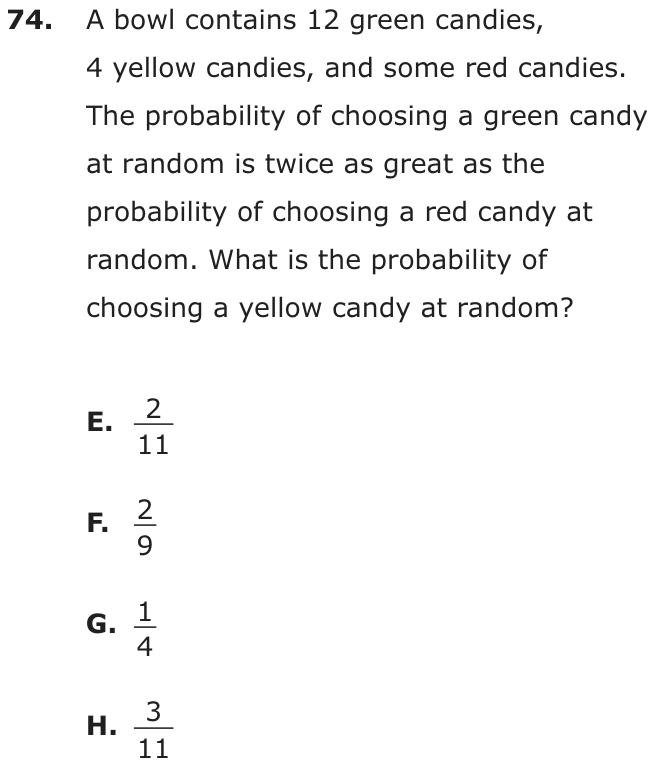
A bowl contains 12 green candies, 4 yellow candies, and some red candies. The probability of choosing a green candy at random is twice as great as the probability of choosing a red candy at random. What is the probability of choosing a yellow candy at random?
- A
- B
- C
- D
Show the answer
Correct answer: A
The probability of choosing a green candy is twice as great as the probability of choosing a red candy. There are 12 green candies. Let r = the number of red candies.
So there are 6 red candies. 12 green candies + 4 yellow candies + 6 red candies = 22 total candies.
There are 4 yellow candies out of a total of 22 candies. So the probability of choosing a yellow candy is
.
Question analysis
A probability question about a bowl of 12 green candies, 4 yellow candies and an unknown number of red ones. A green candy is twice as likely to be picked as a red one, and students find the chance of picking a yellow candy. The missing red count has to be worked out before any probability can be found.
- Grade level
- Grade 6 content, by NYS standard
- Compared with grade 7
- Above grade 7 Simple probability is grade 6 content in New York, and grade 7 problems usually give every count. Working backward from a comparison of two probabilities to a missing count, then forward to a third probability, is more than typical grade 7 work.
- Estimated difficulty
- Hard: combines ideas, needs a plan, and has more than one tempting wrong answer.
- Thinking it demands
- Depth of knowledge 2, skills and concepts · mainly apply
- What makes it hard
- Turning words into math moderate
- Combines ideas moderate
- Solution
- 3 steps
- Reading level
- Question and choices: about grade 7, 49 words.
- Students, last 30 days
- Not enough answers yet to show (it takes 10).
Why it is hard, traps and wrong answers (shows the answer)
Why it is hard
The question withholds the red count, and everything depends on recovering it from the comparison of probabilities. Students who cannot make that step tend to leave red out altogether, while those who find 6 red candies can still slip at the end by using the wrong total or the wrong color. Writing all three counts and the total of 22 before forming any fraction prevents both endings.
Turning words into math moderate Understanding the question
“Twice as great as the probability of choosing a red candy” must become 12 = 2 × the red count, which works only because both probabilities share one total. (Hegarty, Mayer & Monk, 1995; Koedinger & Nathan, 2004)
Combines ideas moderate Working it out
An unknown count has to be found from a ratio before any probability can be written, joining proportional reasoning with probability as a part over the total. (Embretson, 1998; Daniel & Embretson, 2010)
Strategy: Turn twice as likely into a statement about numbers of candies to find the red count, add all three colors for the total, then put the yellow count over that total and simplify.
Traps
- Answers a different question: A choice is right for another quantity: the other unknown, the rest instead of the part, the part instead of the whole.
- Numbers taken from the question: Combines the numbers in the question without a model of the situation, or is simply a number that appears in the question.
The wrong answers, classified
B Misunderstands the concept (Smith, diSessa & Roschelle, 1993; De Bock et al., 1998; Ni & Zhou, 2005)
Finds the 6 red candies but compares the 4 yellow with the 18 green and red ones, 4/18, a part-to-part ratio instead of part to whole.
C Numbers taken from the question (Hegarty, Mayer & Monk, 1995)
Leaves out the red candies, whose number is not given, and divides the 4 yellow by the 16 green and yellow candies.
D Answers a different question (King et al., 2004; Hegarty, Mayer & Monk, 1995)
Finds the 6 red candies and the total of 22 correctly but gives the chance of red, 6/22 = 3/11, instead of yellow.
Worked solution, step by step
Formulas used
- Probability
- P is the probability, the chance that something happens. The top is how many candies are the kind you want. The bottom is how many candies there are in all. Each candy is just as likely to be picked, so this fraction gives the chance.
Sort out what you know
The bowl has 12 green candies, 4 yellow candies and some red candies. You are not told how many are red. Let r be the number of red candies.
The chance of picking green is twice the chance of picking red. You need the probability (the chance) of picking yellow.
Compare green and red
Write each chance with the probability formula.
Green and red have the same bottom number, the total number of candies. So if the chance of green is twice the chance of red, there are twice as many green candies as red ones.
Find the red candies and the total
There are 6 red candies. Now add up all the candies.
There are 22 candies in all. Watch out: do not leave out the red candies just because their number was not given. Using 16 as the total gives 1/4, choice C.
Find the chance of yellow
There are 4 yellow candies out of 22.
Divide the top and the bottom by 2 to simplify. Watch out: the question asks for yellow, not red. 6/22 = 3/11 is the chance of red, choice D. The bottom must be all 22 candies. Using 18 gives 2/9, choice B.
So the answer is A, .
Check your answer
Check the clue. The chance of green is , and the chance of red is . Twelve is twice 6, so green is twice as likely. Also, the three chances add up to 1: .
More questions like this
The original DOE question
Question 6 of 6
2026 Practice Test D Math, question 35Question
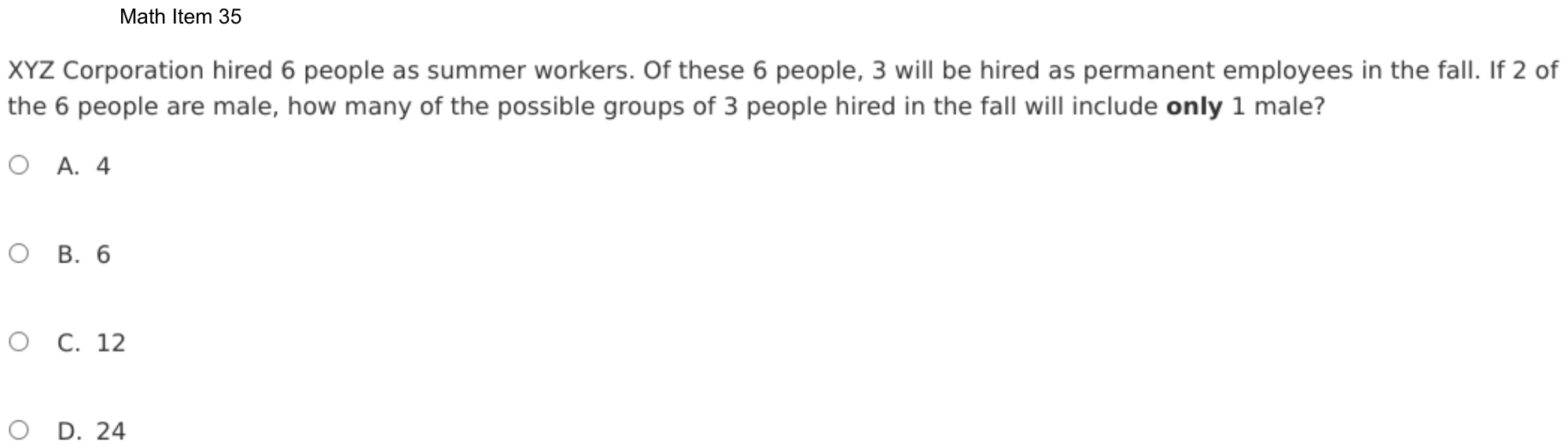
XYZ Corporation hired 6 people as summer workers. Of these 6 people, 3 will be hired as permanent employees in the fall. If 2 of the 6 people are male, how many of the possible groups of 3 people hired in the fall will include only 1 male?
- A4
- B6
- C12
- D24
Show the answer
Correct answer: C
An organized list can be used to determine the number of groups of 3 people that include only 1 male.
Let the letters A, B, C, and D represent the females, and let the numbers 1 and 2 represent the males.
Then, create a list of all possible combinations of 3 people with only 1 male.
AB1, AB2, AC1, AC2, AD1, AD2
BC1, BC2, BD1, BD2
CD1, CD2
There are 12 possible groups with only 1 male.
Question analysis
A company hired 6 summer workers, 2 of them male, and will keep 3 as permanent employees in the fall. This counting question asks how many possible groups of 3 include only 1 male. Students count combinations where order does not matter, and the bold word only, with two kinds of workers to combine, makes careful listing essential.
- NYS standards
- 7.SP.8b sample spaces for compound events
- Grade level
- Grade 7 content, by NYS standard
- Compared with grade 7
- Above grade 7 Grade 7 students list outcomes with organized lists and tree diagrams, usually ordered ones. Counting unordered groups of three under an "only one" condition, built from two kinds of people, goes beyond that typical work.
- Estimated difficulty
- Hard: combines ideas, needs a plan, and has more than one tempting wrong answer.
- Thinking it demands
- Depth of knowledge 2, skills and concepts · mainly apply
- What makes it hard
- Combines ideas moderate
- Something you must already know minor
- Turning words into math minor
- Solution
- 3 steps
- Reading level
- Question and choices: about grade 7, 41 words.
- Students, last 30 days
- Not enough answers yet to show (it takes 10).
Why it is hard, traps and wrong answers (shows the answer)
Why it is hard
The question hides a two-stage count in a hiring story. Students tend to get one stage right and forget the other: they count the pairs of women and stop, or they count ordered picks and so find every group twice. Naming the women A to D and the men 1 and 2, then listing the pairs of women alphabetically with each man attached, makes every group visible and checkable.
Combines ideas moderate Working it out
Two counts are joined: the 6 ways to pick 2 of the 4 women, then the 2 ways to pick the man, and the total is their product. (Embretson, 1998; Daniel & Embretson, 2010)
Something you must already know minor Working it out
Students must already know that a group is the same whichever order its members are named, so picking one woman and then another repeats the reverse pick. (Anderson & Krathwohl, 2001)
Turning words into math minor Understanding the question
The bold word only means exactly one man, so the other two places in each group of 3 must go to two of the 4 women, a step the stem leaves unsaid. (Hegarty, Mayer & Monk, 1995; Koedinger & Nathan, 2004)
Strategy: Name the women A to D and the men 1 and 2, list every pair of women without repeats, then attach each man to each pair and count the groups.
Traps
- Stops one step early: A choice is a number from partway through the solution.
- Overlapping groups: Things in two groups at once are counted twice, or not subtracted.
The wrong answers, classified
A Numbers taken from the question (Hegarty, Mayer & Monk, 1995)
Multiplies the 2 men by the 2 places left for women, 2 × 2 = 4, using numbers from the question without listing a single group.
B Stops one step early (King et al., 2004; Gierl et al., 2017)
Counts the 6 pairs of women correctly but stops before pairing each one with either of the 2 men, which doubles the count.
D Overlapping groups (King et al., 2004)
Counts ordered picks of the two women, 4 × 3 = 12 instead of 6, so each group appears twice, then doubles for the men to reach 24.
Worked solution, step by step
Formulas used
- Counting with two choices
- Each way of picking the man can go with each way of picking the two women. So you multiply the two counts. It is like outfits: 2 shirts with 6 pairs of pants make 12 outfits.
Sort out the question
Six people work for the summer. Two are male, so the other 4 are female. Three will be hired in the fall.
You need the number of groups of 3 with only 1 male. That means exactly 1 man and 2 women. In a group, order does not matter. Ann, Bea and Carl is the same group as Carl, Ann and Bea.
Give each person a name
Call the women A, B, C and D. Call the men 1 and 2. Every group you want has 2 letters and 1 number, like AB1.
List the pairs of women
List each pair once. Start with A, then pair B only with letters after it, and so on:
- AB, AC, AD
- BC, BD
- CD
That is 6 pairs. BA is not new, since it is the same pair as AB.
Watch out: counting the order gives pairs, each one twice. Then doubling for the men gives 24, choice D.
Add a man to each pair
Each pair of women can go with man 1 or man 2. Use the counting rule:
Watch out: stopping at the 6 pairs of women leaves out the men. That gives 6, choice B.
So the answer is C, 12.
Check your answer
Write out every group. With man 1: AB1, AC1, AD1, BC1, BD1, CD1. With man 2: AB2, AC2, AD2, BC2, BD2, CD2. Each list has 6 groups, and . No group repeats, and each has just one man.
More questions like this
The original DOE question