3 English and 3 math
Here are 6 random questions to try. Takers earning below 75% are unlikely to receive an offer. You have 1 minute 48 seconds per question on the real exam.
Question 1 of 6
2024 Test B English, question 48Passage Snowy Mountains
Snowy Mountains
by John Gould Fletcher
Higher and still more high,
Palaces made for cloud,
Above the dingy city-roofs
Blue-white like angels with broad wings,
Pillars of the sky at rest
The mountains from the great plateau
Uprise.
But the world heeds them not;
They have been here now for too long a time.
The world makes war on them,
Tunnels their granite cliffs,
Splits down their shining sides,
Plasters their cliffs with soap-advertisements,
Destroys the lonely fragments of their peace.
Vaster and still more vast,
Peak after peak, pile after pile,
Wilderness still untamed,
To which the future is as was the past,
Barrier spread by Gods,
Sunning their shining foreheads,
Barrier broken down by those who do not need
The joy of time-resisting storm-worn stone,
The mountains swing along
The south horizon of the sky;
Welcoming with wide floors of blue-green ice
The mists that dance and drive before the sun.
“Snowy Mountains” by John Gould Fletcher—Public Domain
Question
How do the details in the third stanza (lines 15–26) most contribute to the development of a theme of the poem?
- Aby reflecting nature’s capacity to resist change
- Bby showing that nature is capable of influencing human will
- Cby exposing how a lack of awareness leads to nature’s ruin
- Dby explaining why people must respect nature
Show the answer
Correct answer: A
The question asks how the details in the third stanza most contribute to the development of a theme of the poem.
A. CORRECT. In the third stanza, phrases such as “Wilderness still untamed” (line 17), “time-resisting storm-worn stone” (line 22), and “The mountains swing along” (line 23) convey the message that in spite of the destruction described in the second stanza, the mountains manage to maintain their wild magnificence.
B. Incorrect. While the phrase “Barrier broken down” (line 21) conveys the idea that people can have some effect on the natural landscape, it does not convey how nature affects people.
C. Incorrect. The phrase “those who do not need” (line 21) implies a choice to damage nature and not a lack of awareness or understanding.
D. Incorrect. The third stanza is not a call to humanity to respect the mountains but a description of the untamed, welcoming mountains and the joy they provide for those who appreciate them.
Question analysis
Students trace how the details of the third and final stanza of “Snowy Mountains,” lines 15–26, most contribute to developing a theme of the poem. Because the stanza is a single sentence that runs from line 15 to the poem’s last word, students must keep its whole movement in mind before deciding what it adds.
- Grade level
- Grade 8 reading and task
- Compared with grade 7
- Above grade 7 Grade 7 theme questions usually rest on a few clear details. Here students must hold a twelve-line stanza of inverted, piled-up phrases in mind and pick among four reasonable lessons about nature, a heavier load closer to grade 8.
- Estimated difficulty
- Hard: combines ideas, needs a plan, and has more than one tempting wrong answer.
- Thinking it demands
- Depth of knowledge 3, strategic thinking · mainly analyze
- What makes it hard
- Complex sentences moderate
- Figurative or literary language moderate
- Evidence in several places moderate
- Evidence
- Answered from one paragraph or stanza
- Reading level
- Passage: 161 words (a poem; reading level not measured); question and choices: about grade 7, 55 words.
- Students, last 30 days
- Not enough answers yet to show (it takes 10).
Why it is hard, traps and wrong answers (shows the answer)
Why it is hard
The final stanza holds both endurance and damage, and the stem’s “most” asks which of the two its details build. Students who fix on the broken barrier choose ruin, a reading the second stanza seems to confirm, while those who tally the stanza’s details find untamed wilderness, time-resisting stone and mountains swinging at ease. Because the stanza is one long, inverted sentence, that tally is slow, which is what makes the question hard.
Complex sentences moderate Understanding the question
Lines 15–26 are one sentence in which phrase after phrase, from “Vaster and still more vast” to “storm-worn stone,” comes before its subject, “The mountains,” in line 23. (Abedi & Lord, 2001; Freedle & Kostin, 1993; Messick, 1989)
Figurative or literary language moderate Understanding the question
The message of endurance is carried by personification: the peaks have “shining foreheads,” are “spread by Gods,” and “swing along” the horizon welcoming the mists. (Graesser, Singer & Trabasso, 1994; Kintsch, 1998)
Evidence in several places moderate Working it out
The theme has to be assembled from details scattered over twelve lines, “Wilderness still untamed,” “the future is as was the past,” “time-resisting,” and weighed against the single line of damage. (Kirsch & Mosenthal, 1990; Gorin & Embretson, 2006)
Strategy: Read lines 15–26 as one long sentence, find its main subject and verb, and sum up its message in a phrase; then check each choice against the whole stanza, not a single line.
Traps
- Too narrow: A single detail offered as the central idea or a summary, or a summary that keeps minor details and leaves out an essential part.
- Outside knowledge: A choice is plausible in the real world but not supported by this text.
- Reversed relationship: Cause and effect, or the order of events, turned around.
The wrong answers, classified
B Reversed relationship (King et al., 2004)
Turns the influence around: in this stanza people break down the barrier while the peaks endure, and nothing shows the mountains shaping what people want.
C Too narrow (King et al., 2004)
Builds on line 21’s “Barrier broken down,” the stanza’s one line of damage, and lets it stand for twelve lines that mostly celebrate the mountains as wild and lasting.
D Outside knowledge (King et al., 2004; Recht & Leslie, 1988)
States the lesson a nature poem is expected to teach, that people must respect nature, but the stanza describes the mountains and never tells readers what to do.
Working it out, step by step
Figure out what the question asks
This asks about theme, the big message of the poem. You need to see what the details of the third stanza, lines 15 to 26, add to that message. The word “most” matters. Pick the idea that most of the details support, not just one line.
Gather the details in lines 15 to 26
The peaks grow “Vaster and still more vast” (line 15). They are a “Wilderness still untamed” (line 17). For them, the future is “as was the past” (line 18). Their stone is “time-resisting” (line 22). In the last four lines, “The mountains swing along” the sky and welcome the mists. Only line 21 shows damage: the barrier is “broken down.”
Find what the details share
Untamed means still wild, not controlled by people. If the future is the same as the past, the mountains are not changing. Time-resisting means they hold out against the years. And at the end of the stanza, they are still moving along at ease. Nearly every detail shows the same thing. The mountains last and stay wild, which is nature’s power to resist change.
Check each choice
- A fits. Wild, unchanging, time-resisting mountains show nature holding out against change.
- B does not fit. It turns things around. In this stanza, people affect the mountains. Nothing shows the mountains changing what people want.
- C does not fit. Line 21 shows damage, but it is one line out of twelve. The stanza does not end in ruin either: the mountains still swing along and welcome the mists.
- D does not fit. These lines paint a picture of the peaks. They give readers no orders and no reasons to behave a certain way.
Choose the answer
Most of the third stanza shows mountains that stay wild and lasting. So the answer is A.
Why this answer and not the closest wrong one
C is the closest trap, because line 21 does show the barrier “broken down,” and the second stanza is full of harm. But this question is about the third stanza, and it asks what the details most add. Most of the other lines there show mountains that are vast, wild and lasting. That builds A, not ruin.
More questions like this
The original DOE question
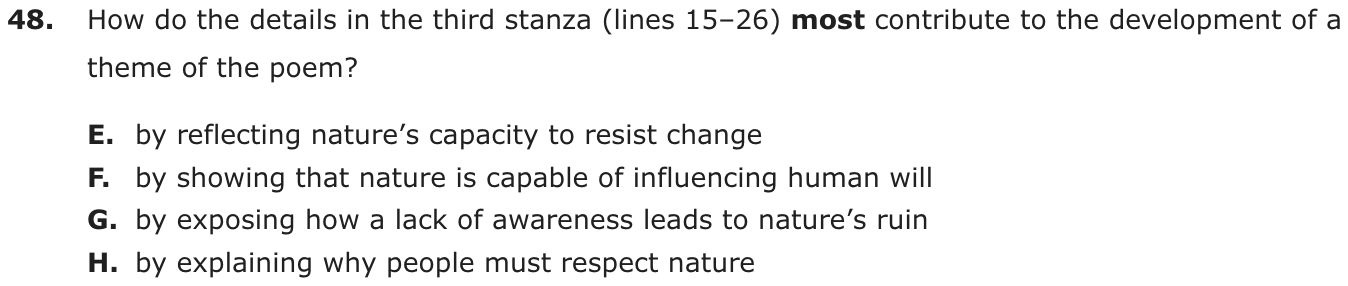
The passage “Snowy Mountains” as printed (page 142)
Question 2 of 6
2024 Test A English, question 55Passage Excerpt from “It’s Time to Stop Thinking That All Non-Native Species Are Evil”
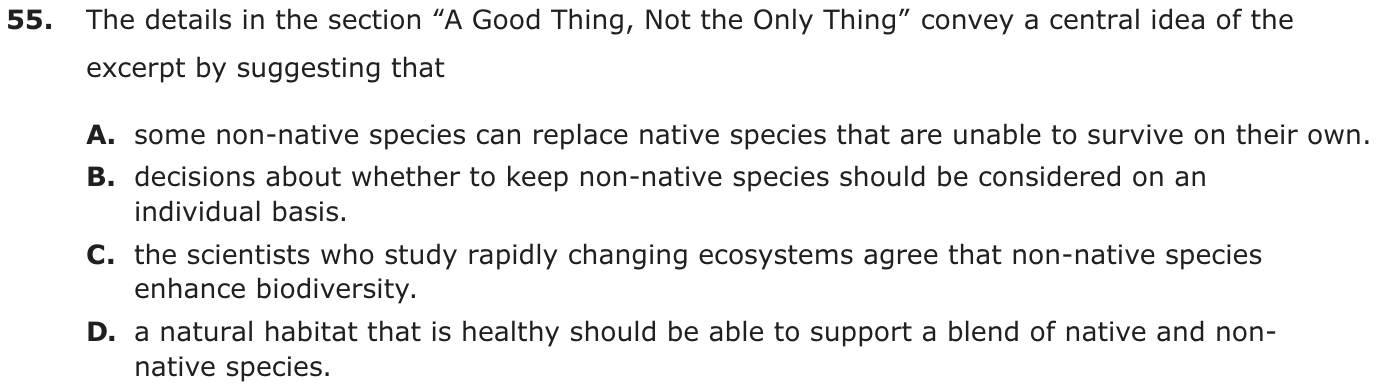
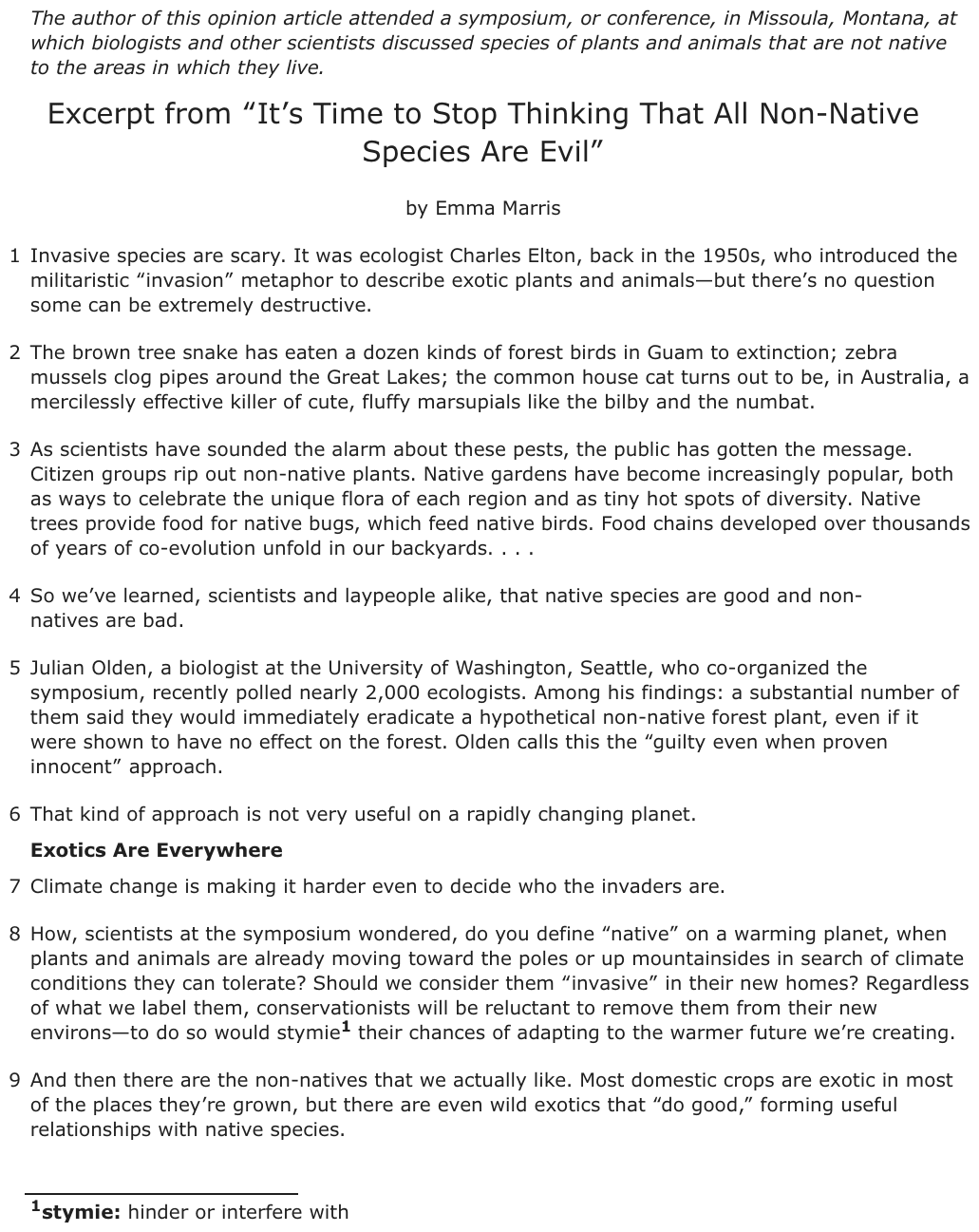
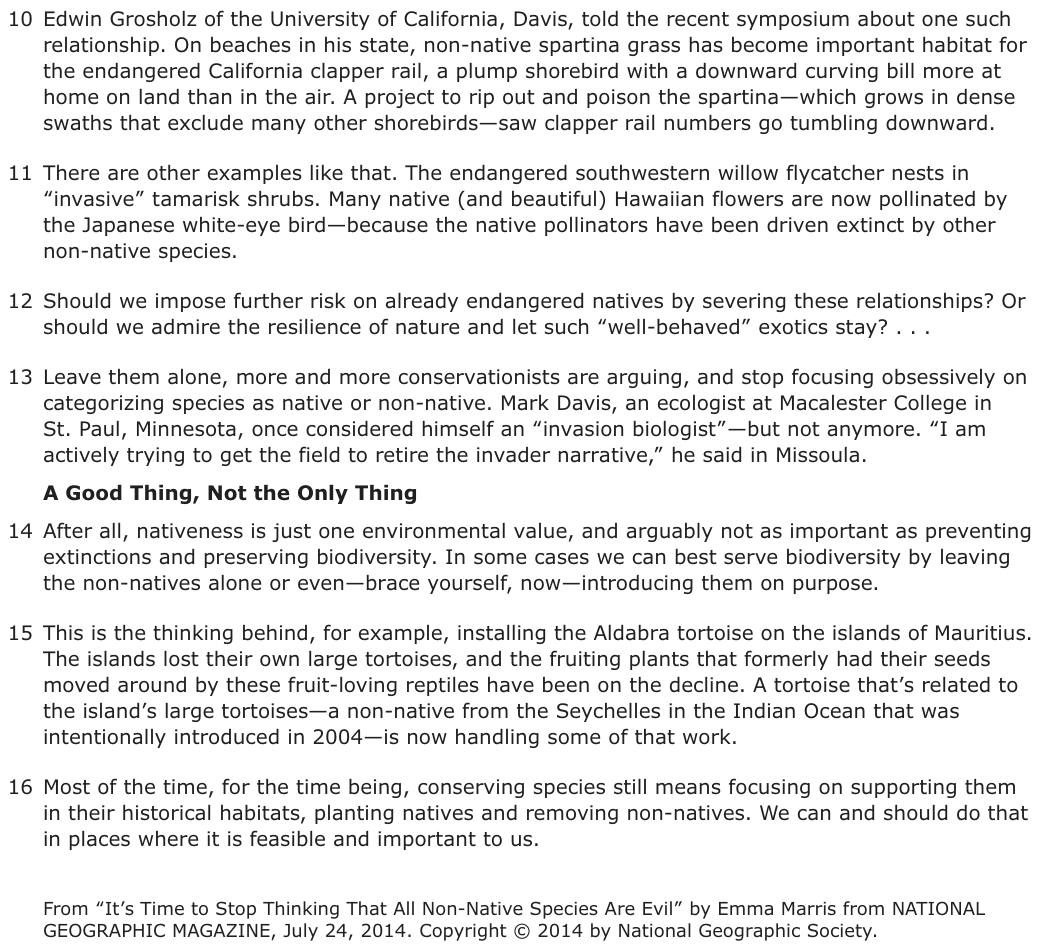
Excerpt from “It’s Time to Stop Thinking That All Non-Native Species Are Evil”
by Emma Marris
The author of this opinion article attended a symposium, or conference, in Missoula, Montana, at which biologists and other scientists discussed species of plants and animals that are not native to the areas in which they live.
Invasive species are scary. It was ecologist Charles Elton, back in the 1950s, who introduced the militaristic “invasion” metaphor to describe exotic plants and animals—but there’s no question some can be extremely destructive.
The brown tree snake has eaten a dozen kinds of forest birds in Guam to extinction; zebra mussels clog pipes around the Great Lakes; the common house cat turns out to be, in Australia, a mercilessly effective killer of cute, fluffy marsupials like the bilby and the numbat.
As scientists have sounded the alarm about these pests, the public has gotten the message. Citizen groups rip out non-native plants. Native gardens have become increasingly popular, both as ways to celebrate the unique flora of each region and as tiny hot spots of diversity. Native trees provide food for native bugs, which feed native birds. Food chains developed over thousands of years of co-evolution unfold in our backyards. . . .
So we’ve learned, scientists and laypeople alike, that native species are good and non-natives are bad.
Julian Olden, a biologist at the University of Washington, Seattle, who co-organized the symposium, recently polled nearly 2,000 ecologists. Among his findings: a substantial number of them said they would immediately eradicate a hypothetical non-native forest plant, even if it were shown to have no effect on the forest. Olden calls this the “guilty even when proven innocent” approach.
That kind of approach is not very useful on a rapidly changing planet.
Exotics Are Everywhere
Climate change is making it harder even to decide who the invaders are.
How, scientists at the symposium wondered, do you define “native” on a warming planet, when plants and animals are already moving toward the poles or up mountainsides in search of climate conditions they can tolerate? Should we consider them “invasive” in their new homes? Regardless of what we label them, conservationists will be reluctant to remove them from their new environs—to do so would stymie1 their chances of adapting to the warmer future we’re creating.
And then there are the non-natives that we actually like. Most domestic crops are exotic in most of the places they’re grown, but there are even wild exotics that “do good,” forming useful relationships with native species.
Edwin Grosholz of the University of California, Davis, told the recent symposium about one such relationship. On beaches in his state, non-native spartina grass has become important habitat for the endangered California clapper rail, a plump shorebird with a downward curving bill more at home on land than in the air. A project to rip out and poison the spartina—which grows in dense swaths that exclude many other shorebirds—saw clapper rail numbers go tumbling downward.
There are other examples like that. The endangered southwestern willow flycatcher nests in “invasive” tamarisk shrubs. Many native (and beautiful) Hawaiian flowers are now pollinated by the Japanese white-eye bird—because the native pollinators have been driven extinct by other non-native species.
Should we impose further risk on already endangered natives by severing these relationships? Or should we admire the resilience of nature and let such “well-behaved” exotics stay? . . .
Leave them alone, more and more conservationists are arguing, and stop focusing obsessively on categorizing species as native or non-native. Mark Davis, an ecologist at Macalester College in St. Paul, Minnesota, once considered himself an “invasion biologist”—but not anymore. “I am actively trying to get the field to retire the invader narrative,” he said in Missoula.
A Good Thing, Not the Only Thing
After all, nativeness is just one environmental value, and arguably not as important as preventing extinctions and preserving biodiversity. In some cases we can best serve biodiversity by leaving the non-natives alone or even—brace yourself, now—introducing them on purpose.
This is the thinking behind, for example, installing the Aldabra tortoise on the islands of Mauritius. The islands lost their own large tortoises, and the fruiting plants that formerly had their seeds moved around by these fruit-loving reptiles have been on the decline. A tortoise that’s related to the island’s large tortoises—a non-native from the Seychelles in the Indian Ocean that was intentionally introduced in 2004—is now handling some of that work.
Most of the time, for the time being, conserving species still means focusing on supporting them in their historical habitats, planting natives and removing non-natives. We can and should do that in places where it is feasible and important to us.
From “It’s Time to Stop Thinking That All Non-Native Species Are Evil” by Emma Marris from NATIONAL GEOGRAPHIC MAGAZINE, July 24, 2014. Copyright © 2014 by National Geographic Society.
1stymie: hinder or interfere with
Question
The details in the section “A Good Thing, Not the Only Thing” convey a central idea of the excerpt by suggesting that
- Asome non-native species can replace native species that are unable to survive on their own.
- Bdecisions about whether to keep non-native species should be considered on an individual basis.
- Cthe scientists who study rapidly changing ecosystems agree that non-native species enhance biodiversity.
- Da natural habitat that is healthy should be able to support a blend of native and non-native species.
Show the answer
Correct answer: B
The question asks how the details in the section “A Good Thing, Not the Only Thing” convey a central idea of the excerpt.
A. Incorrect. While paragraph 15 does discuss introducing non-native Aldabra tortoises to replace native tortoises that no longer exist, the real point of this section is to show that non-native species can sometimes help support native species that still exist but are struggling. In this case, the Aldabra tortoises are now moving seeds around for the fruiting plants on the islands where the tortoises have been introduced.
B. CORRECT. This section discusses situations in which non-native species should be kept (as in the example of the Aldabra tortoises in paragraph 15) but also asserts that “most of the time . . . conserving species still means focusing on supporting them in their historical habitats, planting natives and removing non-natives” (paragraph 16). This section makes the point that the issue of non-natives needs to be considered on a case-by-case basis.
C. Incorrect. This section does not claim that non-native species always or even usually enhance biodiversity; rather, it states that “in some cases we can best serve biodiversity by leaving the non-natives alone or even—brace yourself, now—introducing them on purpose” (paragraph 14), later adding that “most of the time . . . conserving species still means focusing on supporting them in their historical habitats, planting natives and removing non-natives” (paragraph 16).
D. Incorrect. While the section happens to give a good example of a habitat that supports both native and non-native species (the islands of Mauritius), it never suggests that being able to do so is a defining characteristic of healthy habitats.
Question analysis
This central-idea question asks how the details in the final section of an article on non-native species, titled “A Good Thing, Not the Only Thing,” convey a central idea of the excerpt. Students must sum up the section as a whole, including its example of a tortoise brought to the islands of Mauritius, and match it to the article's larger argument.
- Grade level
- Grade 8 reading and task
- Compared with grade 7
- Above grade 7 Explaining how a section conveys a central idea is grade 7 work, but this section mixes an argument, an example and a closing paragraph, and the choices differ in how far they generalize from it, which demands more than typical.
- Estimated difficulty
- Hard: combines ideas, needs a plan, and has more than one tempting wrong answer.
- Thinking it demands
- Depth of knowledge 3, strategic thinking · mainly understand
- What makes it hard
- The right answer is reworded moderate
- Evidence in several places moderate
- Evidence
- Answered from several paragraphs or stanzas
- Reading level
- Passage: about grade 11, 815 words; question and choices: about grade 11, 82 words.
- Students, last 30 days
- Not enough answers yet to show (it takes 10).
Why it is hard, traps and wrong answers (shows the answer)
Why it is hard
The section's most memorable content is an example, the Aldabra tortoise doing the work of the islands' lost tortoises, and a choice built on it is the strongest pull. The central idea sits instead in the qualifiers at the start and end of the section: some cases favor non-natives, most still call for removing them. Students who summarize all three paragraphs in a sentence, including the last, arrive at the case-by-case reading.
The right answer is reworded moderate Choosing the answer
The right choice's “on an individual basis” appears nowhere in the section, while the wrong choices echo it: a non-native standing in for natives, “biodiversity”, natives alongside non-natives. (Freedle & Kostin, 1993; Kirsch & Mosenthal, 1990)
Evidence in several places moderate Working it out
The case-by-case idea comes only from joining paragraph 14's “In some cases” to paragraph 16's “Most of the time” and “where it is feasible and important to us”. (Kirsch & Mosenthal, 1990; Gorin & Embretson, 2006)
Strategy: Sum up the section's three paragraphs in one sentence of your own, including its example and its final paragraph, then compare that sentence with each choice.
Traps
- Too narrow: A single detail offered as the central idea or a summary, or a summary that keeps minor details and leaves out an essential part.
- Too broad or too strong: A choice overstates, generalizes, or uses absolute words the text does not support.
- Reads too much in: A reasonable-sounding conclusion that goes further than the text allows.
The wrong answers, classified
A Too narrow (King et al., 2004)
Builds on the Aldabra tortoise standing in for Mauritius's lost tortoises, a single example, and misses the closing point that most conservation still means removing non-natives.
C Too broad or too strong (King et al., 2004)
Turns “In some cases” into a consensus that non-natives enhance biodiversity, though the section limits the claim and the article shows ecologists divided over it.
D Reads too much in (Graesser, Singer & Trabasso, 1994)
Draws a rule about healthy habitats from the Mauritius example, though the section never defines a healthy habitat or says it should hold a mix of species.
Working it out, step by step
Know what the question asks
A section is a part of an article under its own heading. This one runs from paragraph 14 to paragraph 16. You need to sum up the whole section, including its last paragraph. Then match that summary to a central idea.
Read paragraph 14
It says that “in some cases” we help nature most “by leaving the non-natives alone.” We might even bring them in “on purpose.” The words “in some cases” are the key. They mean sometimes, not always.
Read the example and the ending
Paragraph 15 gives an example. A non-native tortoise was brought to Mauritius to spread the seeds of fruiting plants. Then paragraph 16 says that “most of the time,” saving species still means “planting natives and removing non-natives.” We should do that “where it is feasible and important to us.” Feasible means possible.
Put the section together
Sometimes it is best to keep a non-native species. Most of the time it is best to remove it. So each case has to be judged on its own. That is what “on an individual basis” means.
Check each choice
- B fits: deciding case by case matches both “in some cases” and “most of the time.”
- A is wrong because the tortoise is one example, and the section ends by saying removal is still the usual choice.
- C is wrong because the section never says scientists agree, and “in some cases” is far from always.
- D is wrong because the section never says what a healthy habitat should hold.
Watch out: A is built on the section’s most memorable detail. But the main idea comes from the words that limit the claim.
Choose the answer
The section says to keep non-natives in some cases and remove them in others. So the answer is B.
Why this answer and not the closest wrong one
A comes closest, because the Aldabra tortoise really does take over work the lost tortoises once did. But that is one case. The section ends by saying that most of the time we still remove non-natives. B covers both sides: some cases call for keeping them, and others call for removing them.
More questions like this
The original DOE question
The passage “Excerpt from “It’s Time to Stop Thinking That All Non-Native Species Are Evil”” as printed (pages 68–70)
Question 3 of 6
2024 Test A English, question 8Passage The Free College Debate
The Free College Debate
(1) A college degree has become an essential tool in an increasingly competitive job market. (2) Yet the price of higher education, at both private and public universities, continues to rise. (3) Helping students cover the cost of attending college is an important issue.
(4) Many people agree that a college education should be a financially realistic option for those who aspire to obtain a degree. (5) For example, in 2017, the New York State legislature passed a bill creating a program to cover the tuition costs for nearly one million students. (6) The state of Tennessee also has a program that offers all students scholarships and mentoring services if they attend one of the state’s community colleges. (7) Proponents generally believe that these programs are a step in the right direction for making college affordable for students who would have had to take out loans or who would have decided not to pursue higher education at all.
(8) On the other hand, some people oppose bills like the ones in New York and Tennessee because they believe “free” college programs are unsustainable. (9) In order to implement these types of programs, a state pays the college on behalf of the students using funds from the state’s budget, which primarily comes from state taxes. (10) As more students choose to attend college, more funds will be needed to cover the costs. (11) Additionally, many students do not finish college within four years because they switch majors or because they have to work. (12) Critics believe that these circumstances will inevitably lead to an increase in taxes, a decline in the quality of the education offered by the schools, or both. (13) They think narrower college-affordability efforts that target the students who need the most support, such as first-generation college students, may be more effective and viable solutions.
(14) Faculty and students at higher-education institutions can work to keep costs down. (15) In light of increased access to computers, mobile devices, and the Internet, there are more opportunities for students to take courses online, thus reducing the need for and cost of maintaining physical classrooms. (16) Additionally, colleges should account for experience by allowing students to demonstrate their knowledge in order to avoid having to pay to sit through classes on subjects they have already mastered. (17) Similarly, college-bound high school students need to be prepared for college-level work so that they do not have to spend money on remedial classes.
(18) The solutions to the problems associated with rising college costs are not simple. (19) Passing legislation that boosts college affordability will take time, input from experts with different ideas, and careful planning.
Question
Which phrase should be added before sentence 14 to best transition to the ideas in the fourth paragraph (sentences 14–17)?
- ABecause college affordability is a complicated issue,
- BWith so many opinions about how to make college affordable,
- CUntil college becomes more affordable,
- DAlthough some college affordability programs have been successful,
Show the answer
Correct answer: C
The question asks which phrase should be added before sentence 14 to best transition to the ideas in the fourth paragraph (sentences 14–17).
A. Incorrect. Sentence 13 summarizes the viewpoint of opponents, who believe that targeted approaches to funding education “may be more effective and viable solutions,” and sentence 14 serves to introduce how “faculty and students at higher-education institutions can work to keep costs down.” Affordability is “a complicated issue,” but the use of the word “Because” suggests that the ideas that follow in sentences 14–17 will explain a cause-and-effect relationship. However, sentences 14–17 discuss ways faculty and students should work together to keep the cost of college down while waiting for a long-term solution to the problem, not a causal relationship.
B. Incorrect. Sentences 4–13 provide information about the viewpoint of proponents, who believe that “a college education should be a financially realistic option for those who aspire to obtain a degree” (sentence 4), and opponents, who believe free college programs are “unsustainable” (sentence 8). Although the phrase in this option mentions “opinions,” it indicates that the fourth paragraph will discuss why the number of opinions makes affordability a debatable issue. Instead, the fourth paragraph discusses ways faculty and students can help keep costs down until a solution is reached.
C. CORRECT. Sentence 13 summarizes the viewpoint of opponents, who believe that targeted approaches to funding education “may be more effective and viable solutions,” while proponents “generally believe that these [government] programs are a step in the right direction for making college affordable” (sentence 7). However, sentences 14–17 offer three possible solutions that could alleviate the problem in the meantime. Therefore, the phrase in this option should be added before sentence 14 to best transition to the ideas in the fourth paragraph because it suggests that until the issue of affordability is resolved, alternatives are available to help make a college education more affordable.
D. Incorrect. This phrase mentions “college affordability,” a topic discussed in the fourth paragraph. However, the ideas introduced in the phrase do not logically lead into the ideas discussed in sentences 14–17, because the phrase mentions “programs [that] have been successful,” whereas the paragraph states that “faculty and students at higher-education institutions can work to keep costs down” (sentence 14) and that colleges “should account for experience by allowing students to demonstrate their knowledge in order to avoid having to pay to sit through classes on subjects they have already mastered” (sentence 16). Use of the words “can” and “should” in these sentences indicates that the actions or programs mentioned in the paragraph have not been completed.
Question analysis
This revising question asks which introductory phrase should begin the fourth paragraph of a passage on college affordability, linking the debate over state tuition programs to the cost-saving ideas that follow. All four phrases sound natural, so students must work out the relationship between the paragraphs and choose the phrase that signals it accurately.
- NYS standards
- 7W2d transitions in informative writing
- Grade level
- Grade 8 reading and task
- Compared with grade 7
- Above grade 7 Grade 7 transition work usually links two sentences with a word such as however. Here the choices are whole phrases that set up an entire paragraph, and judging them needs a grasp of the full argument, which asks more than typical grade 7 work.
- Estimated difficulty
- Hard: combines ideas, needs a plan, and has more than one tempting wrong answer.
- Thinking it demands
- Depth of knowledge 3, strategic thinking · mainly evaluate
- What makes it hard
- How sentences fit together major
- Reading between the lines moderate
- Every choice must be checked minor
- Evidence
- Answered from several paragraphs or stanzas
- Reading level
- Passage: about grade 12, 427 words; question and choices: about grade 10, 48 words.
- Students, last 30 days
- Not enough answers yet to show (it takes 10).
Why it is hard, traps and wrong answers (shows the answer)
Why it is hard
Every phrase sounds like a reasonable bridge, and the right one can even seem odd at first, since cutting costs is itself a way to make college affordable. The key is seeing paragraph 4 as what campuses can do while the debate over state programs goes on, a reading the passage confirms only at its end. Students who link back to the many opinions, or accept a causal “Because,” have found real ideas from the passage but not the relationship between these two paragraphs.
How sentences fit together major Working it out
The phrase must link paragraph 3's case against state programs to paragraph 4's steps that “can work to keep costs down,” steps that make sense only as help in the meantime. (Halliday & Hasan, 1976)
Reading between the lines moderate Working it out
Nothing says paragraph 4's ideas are stopgaps; that has to be inferred from sentences 18 and 19, which say the solutions “are not simple” and “will take time.” (Graesser, Singer & Trabasso, 1994; Kintsch, 1998)
Every choice must be checked minor Choosing the answer
All four phrases are grammatical and about affordability, so each must be read into sentence 14 and judged by the relationship its first word signals. (Embretson & Wetzel, 1987)
Strategy: Sum up paragraphs 3 and 4 in a few words each, decide how the second relates to the first, then test the relationship each phrase's opening word signals.
Traps
- Wrong transition: A connecting word or phrase that signals the wrong relationship, such as contrast where the idea continues.
The wrong answers, classified
A Wrong transition (Halliday & Hasan, 1976)
Agrees that affordability is complicated, as sentence 18 says, but “Because” makes the complexity the reason faculty and students can cut costs, a cause the paragraph never gives.
B Wrong transition (Halliday & Hasan, 1976)
Rightly looks back to the clashing views of paragraphs 2 and 3, but offers the disagreement as the ground for the steps instead of marking them as help until a solution arrives.
D Wrong transition (Halliday & Hasan, 1976)
Hears “Although” as a natural turn to a new idea, but the passage never says any program has succeeded, and paragraph 4 does not set its steps against such programs.
Working it out, step by step
Figure out what the question asks
You need a phrase to start sentence 14. It should work as a transition: a word or phrase that shows how two ideas connect. Words like “because,” “although” and “until” each show a different link. So first work out how paragraph 4 connects to what came before.
Compare paragraphs 3 and 4
Paragraph 3 ends with the critics’ view of state programs. People still disagree, so there is no fix everyone accepts yet. Paragraph 4 then says “Faculty and students at higher-education institutions can work to keep costs down.” Faculty means teachers. The paragraph lists ways to do it: online classes, skipping classes you’ve mastered, and getting ready in high school.
Use the ending as a clue
Sentences 18 and 19 say the solutions “are not simple” and “will take time.” So a big fix is still far off. That makes paragraph 4’s ideas things to do in the meantime, while people wait. The phrase “Until college becomes more affordable” says exactly that.
Check each choice
- A is wrong. “Because” shows a cause. The issue being complicated is not the reason teachers can cut costs.
- B is wrong. It makes the many opinions the reason for the steps. The passage never links them that way.
- C is right. “Until” shows these are steps to take while waiting for a bigger fix.
- D is wrong. The passage never says any program has been successful.
Watch out: B looks back at the many opinions, which really are in the passage. But it doesn’t show how paragraph 4 relates to paragraph 3.
Choose the answer
Sentence 14 would read: Until college becomes more affordable, faculty and students at higher-education institutions can work to keep costs down. So the answer is C.
Why this answer and not the closest wrong one
B is the closest wrong answer, because the passage does share many opinions. But “With so many opinions” makes the opinions sound like the reason for the cost-cutting steps. They are not. C shows the steps are help for now, while the bigger problem waits to be solved.
More questions like this
The original DOE question
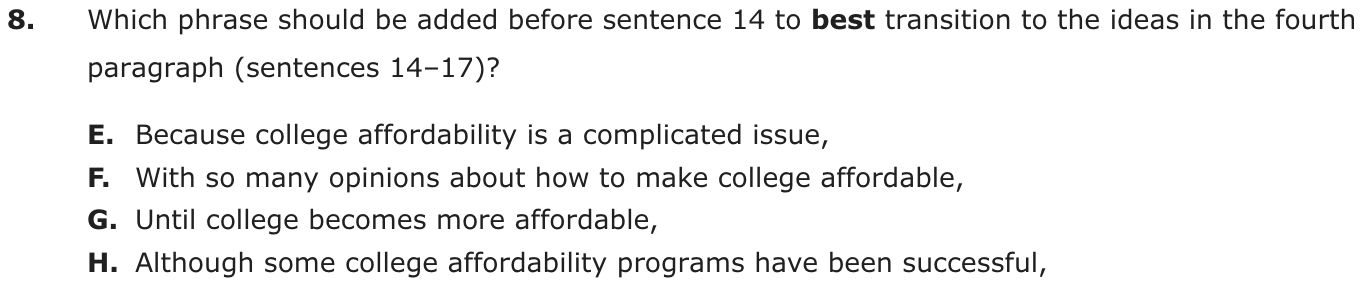
The passage “The Free College Debate” as printed (page 38)
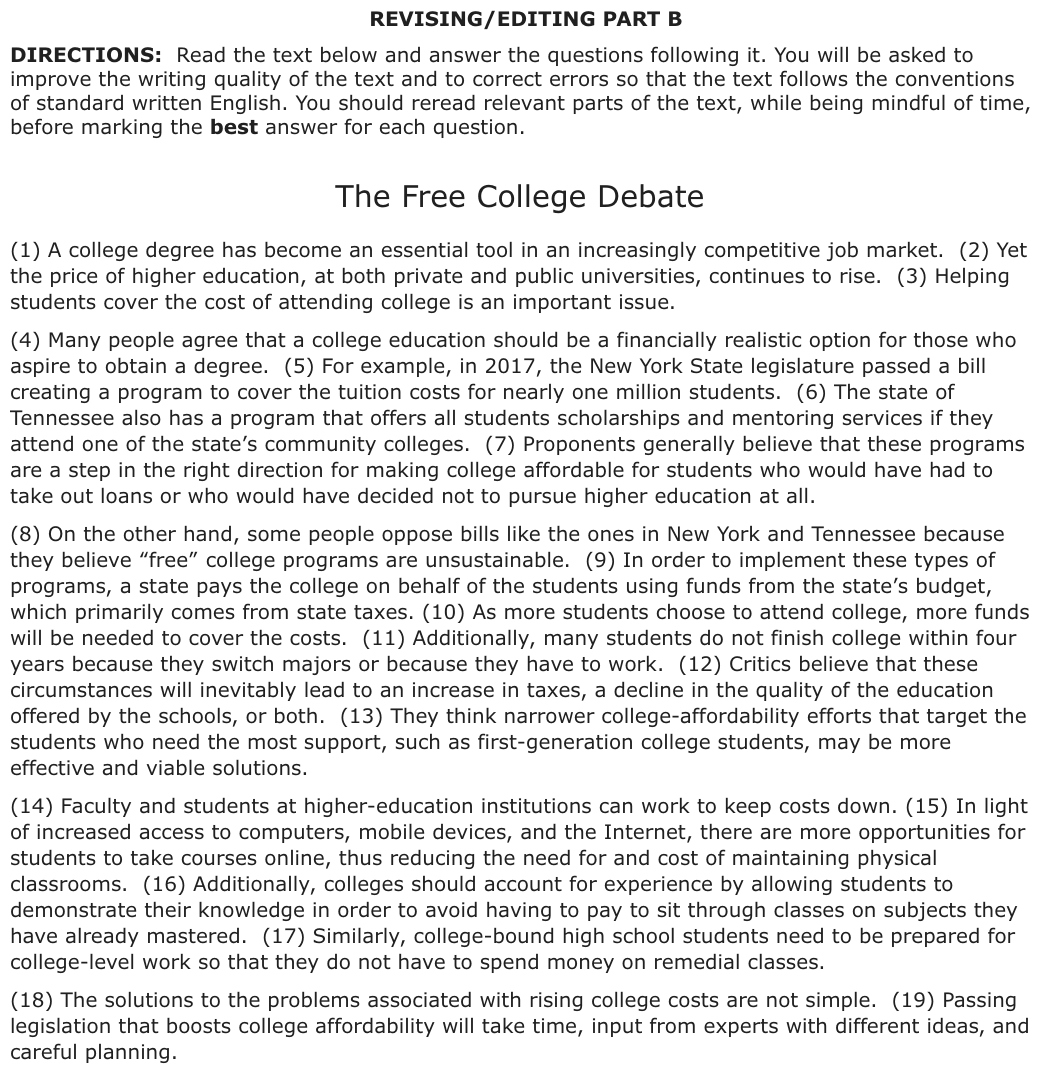
Question 4 of 6
2024 Test A Math, question 16Question
A truck rental company charges a one-time fee of $40 plus $1 per mile driven. Dalia rented a truck and used a coupon for 20% off the total rental cost. After the coupon was applied, she spent a total of $60. How many miles did she drive?
- A8
- B20
- C32
- D35
Show the answer
Correct answer: D
Let m equal the miles driven during Dalia’s rental. The total cost, c, can be expressed as an equation.
Dalia spent a total of $60, which included a 20% off coupon. Find the cost before the coupon by dividing the final cost ($60) by the percentage paid (80%):
Use $75 as the total cost to find m.
Dalia drove 35 miles.
Question analysis
A multistep word problem about a truck rental that costs a $40 fee plus $1 per mile, with a 20% off coupon applied to the total. Given that Dalia paid $60 after the coupon, students find how many miles she drove. Undoing the discount correctly before removing the fixed fee is the hard part.
- Grade level
- Grade 7 content, by NYS standard
- Compared with grade 7
- Above grade 7 Grade 7 students solve two-step equations and work with discounts, usually separately. This combines them and makes students undo a 20% discount starting from the price paid, a reversal many grade 7 students have not practised.
- Estimated difficulty
- Hard: combines ideas, needs a plan, and has more than one tempting wrong answer.
- Thinking it demands
- Depth of knowledge 2, skills and concepts · mainly apply
- What makes it hard
- Turning words into math moderate
- Combines ideas moderate
- A very close wrong answer moderate
- Solution
- 3 steps
- Reading level
- Question and choices: about grade 5, 43 words.
- Students, last 30 days
- Not enough answers yet to show (it takes 10).
Why it is hard, traps and wrong answers (shows the answer)
Why it is hard
Two ordinary skills, undoing a discount and solving a two-step equation, are stacked, and the first runs in reverse. The natural way to undo 20% off is to add 20% back, which gives $72 instead of $75 and a choice three miles from the answer. Students who check by applying the coupon to the full cost of 40 + 35 = 75 dollars see at once that 80% of it is 60.
Turning words into math moderate Understanding the question
The sentence "After the coupon was applied, she spent a total of $60" makes 60 the price after 20% off, so it is 80% of the full cost, 40 + m. (Hegarty, Mayer & Monk, 1995; Koedinger & Nathan, 2004)
Combines ideas moderate Working it out
A percent discount has to be undone before the fee-plus-mileage equation can be solved: 60 ÷ 0.8 = 75, then 75 − 40 = 35 miles. (Embretson, 1998; Daniel & Embretson, 2010)
A very close wrong answer moderate Choosing the answer
The choices 32 and 35 are three miles apart, too close to tell apart by estimate; only dividing 60 by 0.8, rather than adding 20% of 60, separates them. (Embretson & Wetzel, 1987; Gorin & Embretson, 2006; Ascalon et al., 2007)
Strategy: Since $60 is 80% of the full cost, divide 60 by 0.80 to find the cost before the coupon, then subtract the $40 fee to get the miles.
Traps
- Percent of the wrong amount: Finding the whole from a part, or a percent change measured from the wrong starting amount.
- Misreads the question: Misses or misreads a condition or a word in the question: "at least", "each", "remaining", "not".
The wrong answers, classified
A Wrong operation (Hegarty, Mayer & Monk, 1995; King et al., 2004)
Takes 20% off the $60 again, 60 × 0.8 = 48, instead of undoing the discount, then subtracts the $40 fee to get 8 miles.
B Misreads the question (Hegarty, Mayer & Monk, 1995)
Ignores the coupon and treats the $60 as the full cost, so it subtracts the $40 fee and gets 20 miles.
C Percent of the wrong amount (Parker & Leinhardt, 1995)
Undoes the coupon by adding 20% of $60 to get $72, though the 20% was taken of the larger pre-coupon cost, then subtracts the $40 fee.
Worked solution, step by step
Formulas used
- Rental cost
- c is the full cost in dollars, before any coupon. 40 is the one-time fee, paid once no matter how far you drive. m is the number of miles, and each mile costs 1 dollar.
- Price after a discount
- The full cost is the price before the discount. p is the percent taken off. You pay what is left: 100% minus p%. For 20% off you pay 80%, so you multiply by 0.80.
Sort out the question
The truck costs a $40 fee, plus $1 for each mile. Dalia’s coupon took 20% off the total. After the coupon, she paid $60. You need how many miles she drove. The $60 is the price after the discount, not the full cost.
Write what she paid
20% off means she paid what was left of the full cost.
As a decimal, 80% is 0.80.
Undo the discount
To undo times 0.80, divide by 0.80. Move the decimal point one place in both numbers to make it easier.
The full cost was $75. Watch out: the 20% was taken off the full cost, not off $60. Adding 20% of $60 gives $72 and leads to 32 miles, choice C. Taking 20% off $60 again leads to 8 miles, choice A.
Find the miles
She drove 35 miles. Watch out: do not skip the coupon. Using $60 as the full cost gives 20 miles, choice B. So the answer is D, 35.
Check your answer
Go forward. 35 miles cost $35. Add the $40 fee to get $75. The coupon takes off 20% of $75, which is dollars. Then . That is exactly what she paid.
More questions like this
The original DOE question
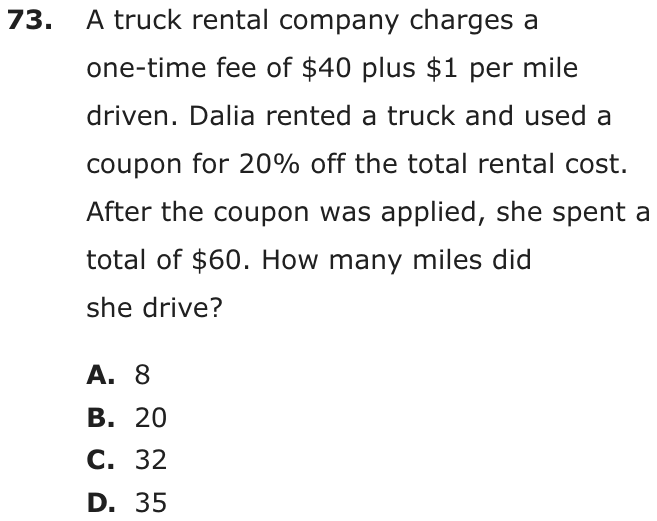
Question 5 of 6
2018 Test A Math, question 48Question
In the infinitely repeating decimal above, 7 is the first digit in the repeating pattern. What is the 391st digit?
- A0
- B3
- C6
- D7
Show the answer
Correct answer: D
There are 6 digits in the repeating decimal (769230), so 7 would be the first, seventh, thirteenth digit and so on.
To find the 391st digit, divide 391 by 6.
391 ÷ 6 = 65 R1
Since the remainder is 1, that means the 391st digit is the same as the 1st digit, which is 7.
Question analysis
This repeating decimal question shows the six-digit repeating pattern of 10/13 and asks for the 391st digit after the decimal point. Students must use the length of the repeating block and division with a remainder to find the position within the cycle. Matching the remainder to the right digit is where students slip.
- Grade level
- Grade 7 content, by NYS standard
- Compared with grade 7
- Above grade 7 Seventh graders learn that fractions have repeating decimals. Using the length of the repeating block and a remainder to find a digit hundreds of places away is a pattern-reasoning step beyond typical seventh-grade classwork.
- Estimated difficulty
- Hard: combines ideas, needs a plan, and has more than one tempting wrong answer.
- Thinking it demands
- Depth of knowledge 2, skills and concepts · mainly apply
- What makes it hard
- No obvious method moderate
- Solution
- 2 steps
- Reading level
- Question and choices: about grade 8, 20 words.
- Students, last 30 days
- Not enough answers yet to show (it takes 10).
Why it is hard, traps and wrong answers (shows the answer)
Why it is hard
Once the cycle length is used, the arithmetic is a single division, 391 ÷ 6 = 65 remainder 1. The difficulty is turning the remainder into a position: remainder 1 is the first digit of a new block, not the last digit of the previous one or the second of the new one. Checking the rule on small positions, the 1st and 7th digits are both 7, removes the doubt.
No obvious method moderate Working it out
Nothing in the stem mentions division; students must see that the six-digit block 769230 repeats, so position 391 depends only on the remainder of 391 divided by 6. (Schoenfeld, 1985)
Strategy: Divide 391 by the length of the repeating block and look only at the remainder; a remainder of r points to the r-th digit of the block.
Traps
- Counting the ends: Inclusive or exclusive ends, fence posts, consecutive numbers: an answer that is one too many or too few, or an endpoint drawn open where it belongs closed (or the reverse).
The wrong answers, classified
A Counting the ends (Brown & Burton, 1978)
Sees that 65 blocks fill 390 places and lands on the 390th digit, the 0 that ends a block, one place short.
B A faulty procedure (Brown & Burton, 1978; Tatsuoka, 1983)
Uses the quotient 65 instead of the remainder, takes its last digit 5, and reads the fifth digit of 769230, which is 3.
C Counting the ends (Brown & Burton, 1978)
Treats the remainder 1 as one step past the block's first digit, moving from 7 to the second digit, 6.
Worked solution, step by step
Formulas used
- Division with a remainder
- n is the number you divide. d is what you divide by. q is the quotient, the number of whole groups. r is the remainder, what is left over. Here it tells how many full blocks of digits fit, and where you land after them.
Sort out what you know
The bar over 769230 means those six digits repeat forever: 769230769230 and so on. The 7 is digit number 1. You need digit number 391.
Spot the pattern
The block 769230 has 6 digits, so the pattern starts over every 6 digits. Digit 1 is 7, and so are digits 7, 13, 19 and so on. Each full block ends with a 0, at digits 6, 12, 18 and so on.
Divide 391 by 6
Find how many full blocks fit into 391 digits, and what is left:
So 65 full blocks use up 6 × 65 = 390 digits. The remainder is 1. That means digit 391 is the 1st digit of the next block.
Read the digit
The 1st digit of the block is 7. Watch out: digit 390 is the last digit of a full block, which is 0. That is choice A. Digit 391 is one step past it, so it starts a new block.
So the answer is D, 7.
Check your answer
Test the idea on a small number. Digit 7: 7 = 6 × 1 + 1, so the remainder is 1 and the digit should be 7. Write it out: 7692307. The 7th digit is indeed 7. The rule works.
More questions like this
The original DOE question
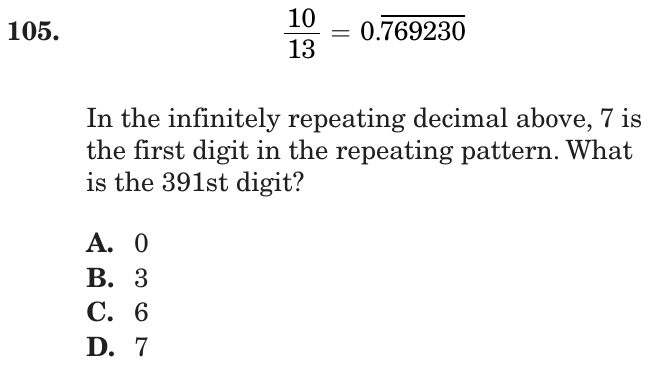
Question 6 of 6
2024 Test B Math, question 44Question
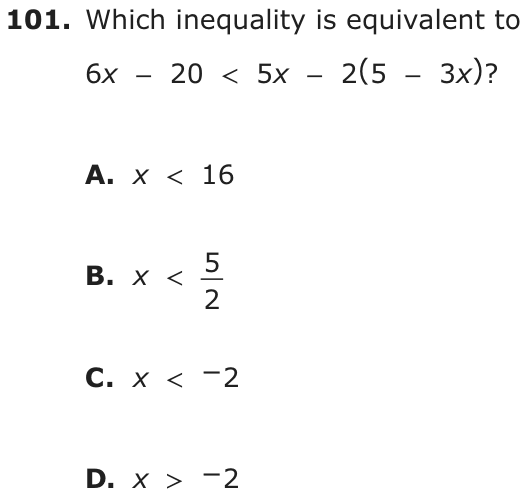
Which inequality is equivalent to ?
- A
- B
- C
- D
Show the answer
Correct answer: D
Distribute the coefficient −2 on the right-hand side:
Subtract from both sides:
Add 10 to both sides:
Divide both sides by 5:
This is equivalent to
Question analysis
Students choose the simplest equivalent form of a linear inequality that has x on both sides and a negative number multiplied into parentheses. It tests distributing, combining like terms and solving inequalities. Sign errors in the distribution, and reading the direction of the final inequality, are where most mistakes happen.
- NYS standards
- Grade level
- Grade 8 content, by NYS standard
- Compared with grade 7
- Above grade 7 Grade 7 inequalities have the form px + q < r. This one has x on both sides and a negative factor to distribute across a subtraction, steps that belong to grade 8 equation work, so it is harder than typical grade 7 practice.
- Estimated difficulty
- Hard: combines ideas, needs a plan, and has more than one tempting wrong answer.
- Thinking it demands
- Depth of knowledge 1, recall and reproduction · mainly apply
- What makes it hard
- Error-prone arithmetic moderate
- A very close wrong answer moderate
- Many steps minor
- Solution
- 4 steps
- Reading level
- Question and choices: about grade 16+, 10 words.
- Students, last 30 days
- Not enough answers yet to show (it takes 10).
Why it is hard, traps and wrong answers (shows the answer)
Why it is hard
Every move is standard algebra, but the inequality is built so that small slips change the answer completely. The −2 has to reach both terms in the parentheses, and once the boundary −2 is found its direction still has to be read correctly, since the variable ends up on the right as −2 < x. Rewriting that as x > −2, or substituting x = 0 into the original, catches the trap.
Error-prone arithmetic moderate Working it out
Distributing −2 over (5 − 3x) gives −10 + 6x, two sign decisions in one move, and the x terms then sit on both sides of the inequality. (Brown & Burton, 1978; Junker & Sijtsma, 2001)
A very close wrong answer moderate Choosing the answer
x < −2 and x > −2 share the boundary and differ only in direction, which depends on reading −2 < x correctly or flipping the sign when dividing by a negative. (Embretson & Wetzel, 1987; Gorin & Embretson, 2006; Ascalon et al., 2007)
Many steps minor Working it out
Four moves follow one another, distributing, collecting 5x + 6x, moving the x terms and dividing by 5, and a slip at any of them changes the result. (Daniel & Embretson, 2010; Enright, Morley & Sheehan, 2002)
Strategy: Distribute the −2 to both terms in the parentheses, combine the x terms on the right, then gather the x terms on the side that keeps their coefficient positive.
Traps
- Order of operations: Working left to right, or distributing a minus sign wrongly, gives a choice.
- Negatives and direction: Arithmetic with negative numbers, the order of a subtraction, or direction on a number line. (Moving a term across the equals sign without changing its sign is a faulty procedure.)
- A faulty procedure: A systematic but wrong procedure: adding fractions straight across, applying an exponent to each term of a sum, dropping a sign when moving a term.
The wrong answers, classified
A A faulty procedure (Brown & Burton, 1978; Tatsuoka, 1983)
Treats 5 − 3x as 2, combining a number with an x term, so the right side becomes 5x − 4 and the solution x < 16.
B Order of operations (Brown & Burton, 1978)
Multiplies the −2 by the 5 but not by the −3x, writing 5x − 10 − 3x, which leads to 4x < 10 and x < 5/2.
C Negatives and direction (Brown & Burton, 1978)
Finds the boundary −2 but points the inequality the wrong way, by misreading −2 < x or by not flipping the sign after dividing by −5.
Worked solution, step by step
Formulas used
- Distributive property
- a is the number outside the parentheses. b and c are the terms inside. Multiply a by each one. A minus sign inside counts as a negative term, so 5 − 3x is 5 + (−3x). A negative times a negative is positive.
- Keeping an inequality true
- a and b are the two sides, and c is any number. Adding or subtracting the same number on both sides keeps the inequality true. Dividing both sides by a positive number also keeps it true. Only multiplying or dividing by a negative number flips the sign.
Sort out the question
An inequality compares two sides with a sign like <, which means is less than. To solve it, you get x alone on one side.
You need the short inequality that has the same answers as the long one.
Distribute the −2
Multiply −2 by both terms inside the parentheses, 5 and −3x.
A negative times a negative is positive, so the second part is +6x. Watch out: If the −2 multiplies only the 5, you end up with , choice B.
Combine the x terms
The right side is now 5x − 10 + 6x. Put the x terms together: 5x + 6x = 11x.
Gather the x terms on one side
Subtract 6x from both sides. That leaves the x terms on the right, where they stay positive.
Get x by itself
Add 10 to both sides. Then divide both sides by 5.
You divided by a positive 5, so the sign does not flip.
Read it with x first
says −2 is less than x. That is the same as saying x is greater than −2, just as 3 < 5 means 5 > 3.
Watch out: , choice C, has the same number but points the wrong way.
So the answer is D, .
Check your answer
Test x = 0, which is greater than −2. The left side is . The right side is . And −20 < −10 is true. Now test x = −3. The left side is −38 and the right side is −43. That is false, as it should be.
More questions like this
The original DOE question