3 English and 3 math
Here are 6 random questions to try. Takers earning below 75% are unlikely to receive an offer. You have 1 minute 48 seconds per question on the real exam.
Question 1 of 6
2026 Practice Test D English, question 8Passage Excerpt from “How We Made the First Flight”
Excerpt from “How We Made the First Flight”
by Orville Wright
In 1903 brothers Wilbur and Orville Wright conducted experiments related to flying machines. These experiments would eventually lead to air travel becoming a reliable form of transportation.
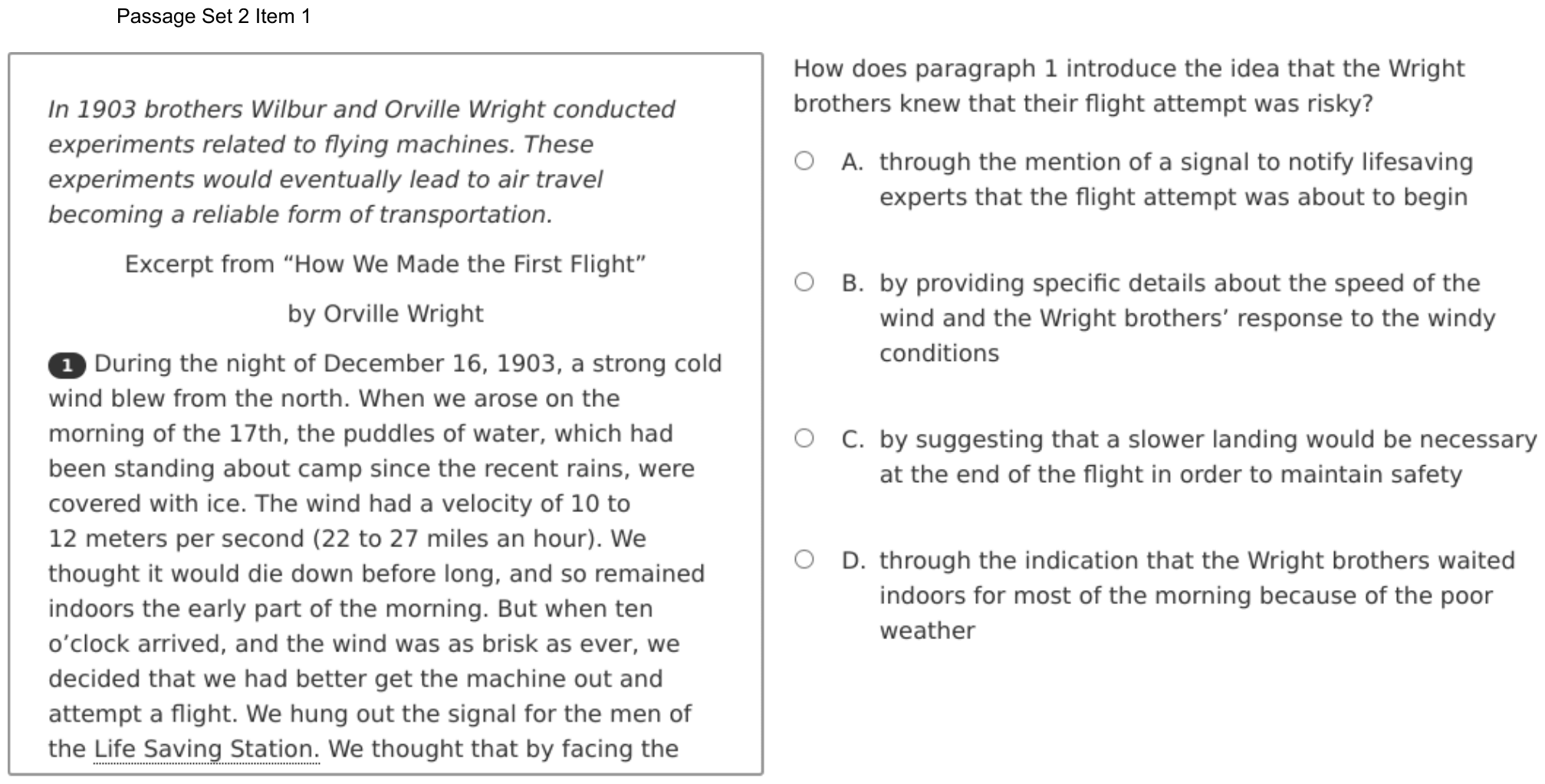
During the night of December 16, 1903, a strong cold wind blew from the north. When we arose on the morning of the 17th, the puddles of water, which had been standing about camp since the recent rains, were covered with ice. The wind had a velocity of 10 to 12 meters per second (22 to 27 miles an hour). We thought it would die down before long, and so remained indoors the early part of the morning. But when ten o’clock arrived, and the wind was as brisk as ever, we decided that we had better get the machine out and attempt a flight. We hung out the signal for the men of the Life Saving Station.1 We thought that by facing the flyer into a strong wind, there ought to be no trouble in launching it from the level ground about camp. We realized the difficulties of flying in so high a wind, but estimated that the added dangers in flight would be partly compensated for by the slower speed in landing.
Final Preparations
We laid the track on a smooth stretch of ground about one hundred feet north of the new building. The biting cold wind made work difficult, and we had to warm up frequently in our living room, where we had a good fire in an improvised stove made of a large carbide2 can. By the time all was ready, J. T. Daniels, W. S. Dough and A. D. Etheridge, members of the Kill Devil3 Life Saving Station; W. C. Brinkley of Manteo, and Johnny Moore, a boy from Nags Head,4 had arrived.
We had a “Richard” hand anemometer with which we measured the velocity of the wind. Measurements made just before starting the first flight showed velocities of 11 to 12 meters per second, or 24 to 27 miles per hour. . . .
Audacity—and Calculation
Wilbur having used his turn in the unsuccessful attempt on the 14th, the right to the first trial now belonged to me. After running the motor a few minutes to heat it up, I released the wire that held the machine to the track, and the machine started forward in the wind. Wilbur ran at the side of the machine, holding the wing to balance it on the track. Unlike the start on the 14th, made in a calm, the machine, facing a 27-mile wind, started very slowly. Wilbur was able to stay with it till it lifted from the track after a forty-foot run. One of the Life Saving men snapped the camera for us, taking a picture just as the machine had reached the end of the track and had risen to a height of about two feet. The slow forward speed of the machine over the ground is clearly shown in the picture by Wilbur’s attitude. He stayed along beside the machine without any effort.
Flight
The course of the flight up and down was exceedingly erratic, partly due to the irregularity of the air, and partly to lack of experience in handling this machine. The control of the front rudder was difficult on account of its being balanced too near the center. This gave it a tendency to turn itself when started; so that it turned too far on one side and then too far on the other. As a result the machine would rise suddenly to about ten feet, and then as suddenly dart for the ground. A sudden dart when a little over a hundred feet from the end of the track, or a little over 120 feet from the point at which it rose into the air, ended the flight. As the velocity of the wind was over 35 feet per second and the speed of the machine over the ground against this wind ten feet per second, the speed of the machine relative to the air was over 45 feet per second, and the length of the flight was equivalent to a flight of 540 feet made in calm air. This flight lasted only 12 seconds, but it was nevertheless the first in the history of the world in which a machine carrying a man had raised itself by its own power into the air in full flight, had sailed forward without reduction of speed and had finally landed at a point as high as that from which it started.
From “How We Made the First Flight” by Orville Wright—Public Domain/Federal Aviation Administration
1Life Saving Station: one of the rescue stations along the Atlantic coastline that provided assistance to mariners in distress
2carbide: a very hard material composed of carbon and other heavy metals
3Kill Devil: the town of Kill Devil Hills in eastern North Carolina
4Nags Head: a town in eastern North Carolina
Question
How does paragraph 1 introduce the idea that the Wright brothers knew that their flight attempt was risky?
- Athrough the mention of a signal to notify lifesaving experts that the flight attempt was about to begin
- Bby providing specific details about the speed of the wind and the Wright brothers’ response to the windy conditions
- Cby suggesting that a slower landing would be necessary at the end of the flight in order to maintain safety
- Dthrough the indication that the Wright brothers waited indoors for most of the morning because of the poor weather
Show the answer
Correct answer: A
The question asks how paragraph 1 introduces the idea that the Wright brothers knew that their flight attempt was risky.
A. CORRECT. Paragraph 1 describes the Wright brothers hanging out “the signal” to notify the lifesaving crew to stand by as they attempted flight; the need for lifesaving experts to be available in case of an accident introduces the idea that the attempted flight might crash.
B. Incorrect. The specifics on the speed of the wind by themselves do not emphasize the danger of the flight. While the brothers admitted that the strong wind posed certain risks, they also noted that the windy conditions might make landing safer (“estimated that the added dangers in flight would be partly compensated for by the slower speed in landing” [paragraph 1]).
C. Incorrect. A slower landing was expected as a result of the windy conditions, but it was not part of a plan to increase the safety of the flight.
D. Incorrect. While the Wright brothers’ initial decision to wait to see whether the wind would die down does suggest they were concerned about the safety of the flight, the explanation of their decision to proceed with the flight shows that they expected one benefit from the poor weather: “the slower speed in landing” (paragraph 1).
Question analysis
This question on Orville Wright’s account “How We Made the First Flight” asks how the opening paragraph, which describes a cold, windy December morning at the brothers’ camp, introduces the idea that the Wright brothers knew their flight attempt was risky. Students must judge which of four details from the paragraph does that work, and the paragraph mentions both dangers and reasons for confidence.
- Grade level
- Grade 8 reading and task
- Compared with grade 7
- Above grade 7 Finding how a paragraph introduces an idea is grade 7 work, but this paragraph is long and old-fashioned, every choice points to something it mentions, and students must decide which detail most clearly signals that the brothers saw a risk.
- Estimated difficulty
- Hard: combines ideas, needs a plan, and has more than one tempting wrong answer.
- Thinking it demands
- Depth of knowledge 3, strategic thinking · mainly evaluate
- What makes it hard
- Reading between the lines moderate
- Every choice must be checked moderate
- Complex sentences minor
- Evidence
- Answered from one paragraph or stanza
- Reading level
- Passage: about grade 7, 816 words; question and choices: about grade 10, 93 words.
- Students, last 30 days
- Not enough answers yet to show (it takes 10).
Why it is hard, traps and wrong answers (shows the answer)
Why it is hard
Paragraph 1 states the danger outright only in its last sentence, and that sentence then weighs it against a gentler landing, so the choice built on the brothers’ response to the wind is the strongest pull. The key rests on a quieter detail whose meaning comes from a footnote: men from a rescue station were signaled before the attempt. Students must decide which detail shows the brothers preparing for trouble, not just noticing the weather, and that test is narrower than most expect.
Reading between the lines moderate Working it out
The key never says danger: students must connect “the signal for the men of the Life Saving Station” to footnote 1, rescue stations for “mariners in distress,” and see that summoning rescuers means expecting trouble. (Graesser, Singer & Trabasso, 1994; Kintsch, 1998)
Every choice must be checked moderate Choosing the answer
All four details come from paragraph 1, and its plainest admission of danger, “We realized the difficulties of flying in so high a wind,” sits inside a wrong choice, so each detail must be weighed for what it shows. (Embretson & Wetzel, 1987)
Complex sentences minor Understanding the question
The paragraph’s last sentence sets danger against benefit, “the added dangers in flight would be partly compensated for by the slower speed in landing,” and students must untangle it to see the brothers playing the risk down. (Abedi & Lord, 2001; Freedle & Kostin, 1993; Messick, 1989)
Strategy: Locate each of the four details in paragraph 1, reread the sentence it sits in, and ask what that detail on its own reveals about what the brothers feared could go wrong.
Traps
- Supports only part of the claim: In a question about evidence: a line that backs one half of the claim but not the other, or a related point rather than the claim itself.
- Twists what the text says: Uses the text's topic and ideas but changes what it says: who did it, how much, when, or why.
The wrong answers, classified
B Supports only part of the claim (King et al., 2004; Thissen, Steinberg & Fitzpatrick, 1989)
Seizes on the wind speeds and “We realized the difficulties of flying in so high a wind,” but the response the paragraph describes is a calculation that a slower landing would offset the danger.
C Twists what the text says (King et al., 2004)
Turns the slower landing, a side effect of facing a strong wind, into a safety step the brothers needed, when the paragraph counts it as a partial offset to the added danger.
D Reads too much in (Graesser, Singer & Trabasso, 1994)
Reads the wait for calmer air as fear and stretches “the early part of the morning” into most of it, though at ten o’clock they decided to fly in the same brisk wind.
Working it out, step by step
Figure out what the question asks
This asks how paragraph 1 first shows that the Wright brothers knew their flight was risky. Risky means it could end badly. All four choices name details from paragraph 1. Your job is to find the detail that shows them getting ready for trouble.
Find the signal in paragraph 1
Paragraph 1 says “We hung out the signal for the men of the Life Saving Station.” The small number 1 after “Station” points to footnote 1 at the end of the excerpt. Read it. A Life Saving Station was “one of the rescue stations along the Atlantic coastline that provided assistance to mariners in distress.” Mariners are sailors. Distress means danger or trouble.
Work out what the signal means
The brothers called rescue workers before they tried to fly. People call rescuers only when someone might get hurt. So the signal shows the brothers knew the flight could go wrong. They wanted help close by in case of a crash.
Check each choice
- A fits. Signaling rescuers shows the brothers planned for trouble.
- B does not fit. The wind speeds are only numbers. The brothers’ response was to fly anyway, thinking “there ought to be no trouble in launching.”
- C does not fit. The slower landing was a side effect of the wind. They counted it as a plus, not as a safety step they needed.
- D does not fit. They stayed inside only “the early part of the morning,” hoping the wind would die down. Then they went out in the same wind.
Watch out: B is tempting because the paragraph says “We realized the difficulties of flying in so high a wind.” But that same sentence weighs those dangers against a slower landing. It plays the risk down.
Choose the answer
The call to the rescue station is the detail that shows the brothers preparing for danger. So the answer is A, “through the mention of a signal to notify lifesaving experts that the flight attempt was about to begin.”
Why this answer and not the closest wrong one
B is the closest wrong choice. The paragraph does admit the wind made flying harder. But the brothers then argue the danger down: a slower landing would partly make up for it. A shows them acting on the risk. They called in rescuers before they flew. You only do that if you think something could go wrong.
More questions like this
The original DOE question
The passage “Excerpt from “How We Made the First Flight”” as printed (pages 13–14)
Question 2 of 6
2026 Practice Test D English, question 5Passage A Memory Revolution
A Memory Revolution
A high school senior logs on to a computer at the library to double-check the application due date listed on a college admissions website. Nearby, a librarian helps a group of biology students use a database to search for recent studies about mammals. In the past few decades, the Internet has become an integral component of daily life for many people. The seemingly limitless power of search engines made the Internet search extremely common, and today people increasingly rely on the Internet’s vast accumulation of sources to access all types of information. Scientists are beginning to examine how this reliance is modifying the strategies people use to store and prioritize information in their mind.
A Dependable and Valuable Asset
Psychologist Benjamin Storm from the University of California, Santa Cruz, and researchers Sean Stone and Aaron Benjamin devised an experiment to study students’ tendency to depend on the Internet for facts. To begin, the scientists divided sixty participants into multiple groups, including an “Internet” group and a “memory” group, and placed them in front of computers. The Internet group was required to use the search engine Google to answer eight challenging trivia questions. In contrast, participants in the memory group were permitted to use only their personal knowledge to answer the questions. In the second round, the researchers administered notably easier questions. This time, they allowed each group the option of using Google as they answered. Their results showed that 83 percent of the Internet group continued to consult Google in the second round, while only 63 percent of the memory group chose to do so.
People’s growing inclination to rely on the Internet in order to retrieve information, particularly facts and figures, is called cognitive offloading. Canadian researcher Evan F. Risko and British researcher Sam Gilbert, who have written extensively about the topic, say a similar process has been taking place for centuries. In the past, people used resources like encyclopedias to assist their memories; however, today the Internet, serving as a vast extended memory, allows people to digitally access and retrieve much larger volumes of information. Consequently, people’s minds are free for other cognitive feats, such as connecting data, learning new information, or solving problems.
Filing Information Away
The use of the Internet also appears to be modifying the strategies people use to store information in their mind. Researchers Betsy Sparrow from Columbia University, Jenny Liu from the University of Wisconsin-Madison, and Daniel Wegner from Harvard University conducted several studies to discover how people efficiently manage their information intake.
To begin, the researchers examined how people evaluate which information deserves their effort to remember. For this experiment, participants read forty trivia facts, such as “An ostrich’s eye is bigger than its brain,” and typed the statements into a computer file. Half the participants had been previously told the file would be saved, while half believed it would be erased. Next, the participants wrote down every fact they could recall. Those who believed the information would be erased and no longer available could recall 40 percent more facts than those who thought the information would be saved.
In another experiment, the same researchers tested the ability of study participants to remember where to access information. For this trial, participants read and typed trivia statements, which they saved in folders with generic names such as “Facts” and “Items.” After spending ten minutes writing down all the facts they could recall from memory, participants were asked which folder contained a particular fact based on a keyword. For example, “Which folder has the fact about ostriches?” Overall, participants recalled the information’s location more often than the content itself, correctly identifying 49 percent of the folders for specific facts while remembering only 23 percent of the actual trivia. The researchers concluded that our memory is adapting to the Internet age by prioritizing where to locate information even when the specific details are forgotten. According to Sparrow, the Internet has become an important form of transactive memory, an external source of the recollections and associative networks that constitute memory.
As the Internet’s resources continue to expand our “external” memory, some question whether the process may cause people to depend too heavily on technology. However, Steven Pinker, a professor of psychology at Harvard University, says, “Knowledge is increasing exponentially; human brainpower and waking hours are not. Fortunately, the Internet and information technologies are helping us manage, search and retrieve our collective intellectual output at different scales, from Twitter and previews to e-books and online encyclopedias. Far from making us stupid, these technologies are the only things that will keep us smart.”
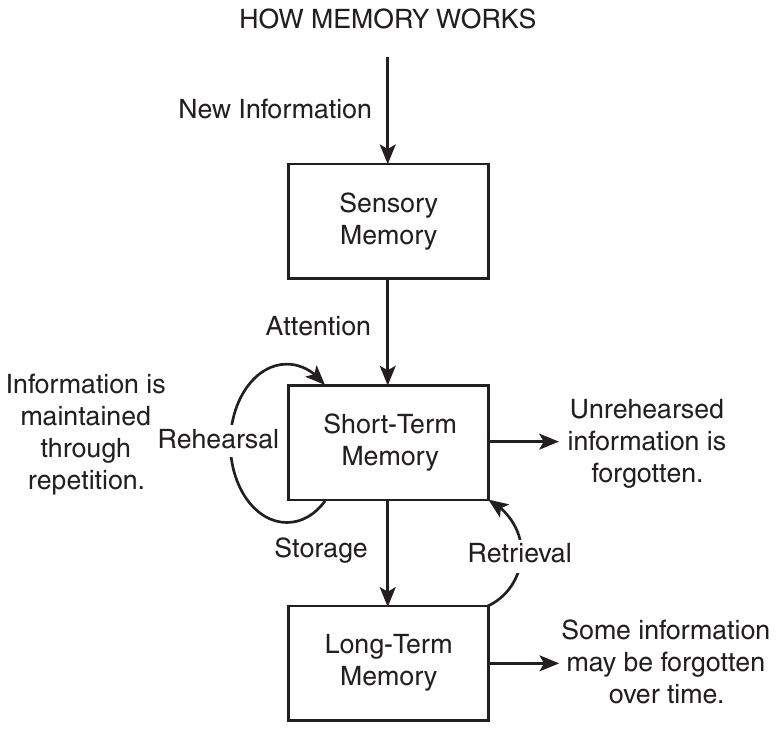
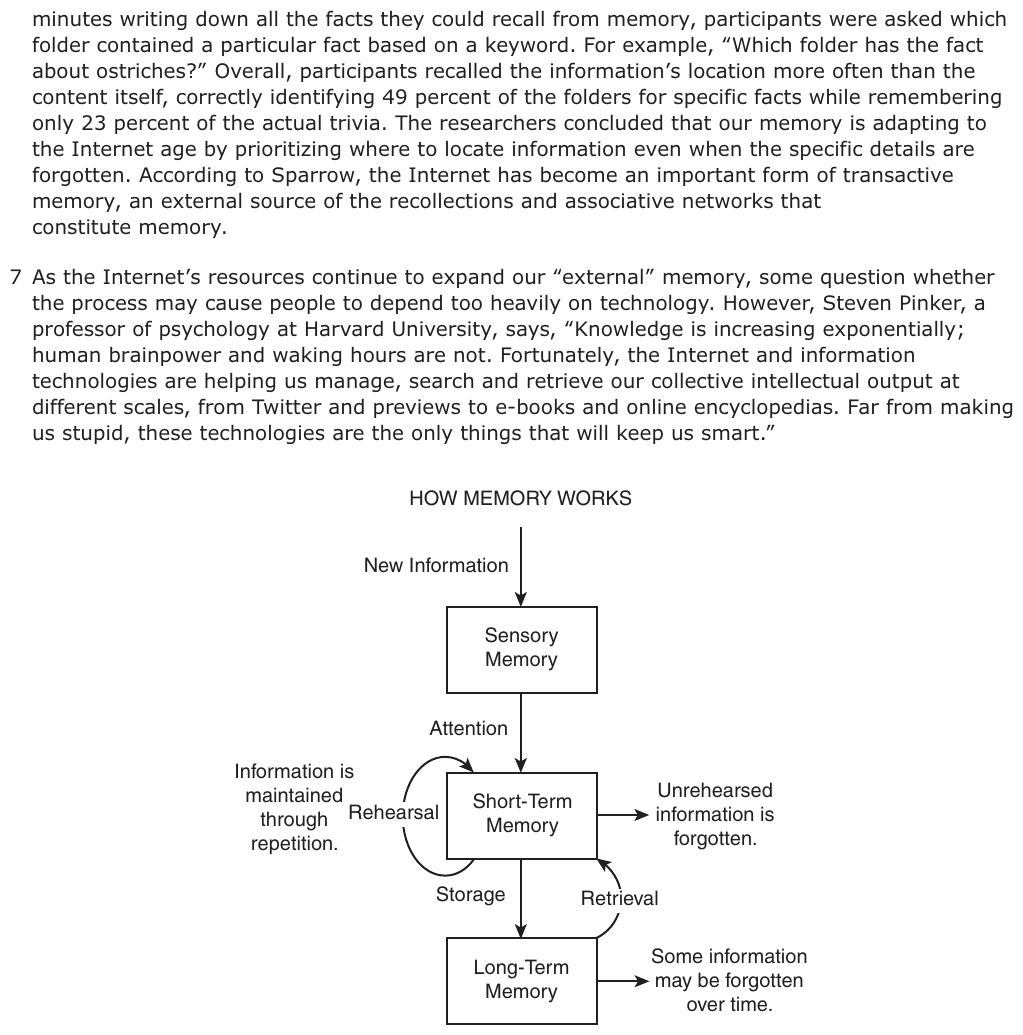
Question
How does the diagram provide additional support for the topic presented in the passage?
- AIt reveals why human brains must adapt to obtaining information from the Internet as opposed to other sources.
- BIt indicates how people can use the Internet to help improve their long-term recollection of information.
- CIt shows how study participants’ brains distinguished between important and unimportant details.
- DIt depicts the idea that repetition and rehearsal are necessary to recall information when tools such as search engines are unavailable.
Show the answer
Correct answer: D
The question asks how the diagram provides additional support for the topic presented in the passage.
A. Incorrect. While the diagram indicates that the human brain has the ability to maintain different types of memory, the diagram does not show the need for the brain to adapt to obtaining information from the Internet rather than from other sources.
B. Incorrect. The diagram enhances the reader’s understanding of how long-term memories are formed, but it does not provide details about how the Internet can be used to improve long-term recollection of information.
C. Incorrect. The diagram provides an understanding of how details that are important to people can become stored because of an effort made to recall them. However, the diagram does not show how people decide which information is important and which is not.
D. CORRECT. The diagram depicts the connections that the human brain maintains between the different forms of memory. It also illustrates the idea that repetition and rehearsal are important steps in creating memories, as unrehearsed information will be forgotten. This supports the passage by highlighting the idea that access to search engines and other tools leads people to skip rehearsal and repetition steps that create memories, because people know that the information is readily accessible.
Question analysis
This question pairs “A Memory Revolution” with its flow diagram, “How Memory Works,” which follows new information from sensory memory through short-term and long-term memory, and asks how the diagram supports the topic of the passage. Students must read the diagram’s boxes, arrows and notes and relate them to an article about the Internet that never refers to the diagram, so the connection has to be worked out.
- Grade level
- Grade 8 reading and task
- Compared with grade 7
- Above grade 7 Grade 7 students regularly connect a diagram to a text. This flow diagram of memory never mentions the Internet, so students must build the bridge to the article’s studies themselves, and every choice claims something the diagram alone cannot show.
- Estimated difficulty
- Hard: combines ideas, needs a plan, and has more than one tempting wrong answer.
- Thinking it demands
- Depth of knowledge 3, strategic thinking · mainly analyze
- What makes it hard
- Combines ideas moderate
- Reading a figure, table or graph moderate
- Every choice must be checked minor
- Evidence
- Answered from the whole text
- Reading level
- Passage: about grade 14, 763 words; question and choices: about grade 12, 81 words.
- Students, last 30 days
- Not enough answers yet to show (it takes 10).
Why it is hard, traps and wrong answers (shows the answer)
Why it is hard
The diagram is a general model of memory, and every choice, even the right one, goes beyond it by bringing in the Internet, search engines or the study participants. The way through is to ask which choice rests on something the diagram really shows, and only one names its rehearsal loop and the forgetting of unrehearsed information. The strongest pull uses the diagram’s long-term memory and retrieval but claims the Internet improves recollection, the opposite of what paragraph 5’s experiment found.
Combines ideas moderate Working it out
The diagram never mentions the Internet and the article never mentions the diagram, so students must join its rehearsal loop to paragraph 5’s finding that people who expected the facts to be saved remembered fewer. (Embretson, 1998; Daniel & Embretson, 2010)
Reading a figure, table or graph moderate Understanding the question
Students must follow the arrows from “Attention” into short-term memory and find the “Rehearsal” loop beside “Information is maintained through repetition,” with “Unrehearsed information is forgotten” on the other side. (Lesh, Post & Behr, 1987; Kirsch & Mosenthal, 1990)
Every choice must be checked minor Choosing the answer
Three choices tie the diagram to the Internet, adaptation or the study participants, and even the key mentions search engines, so each claim must be held against the boxes and arrows actually drawn. (Embretson & Wetzel, 1987)
Strategy: Trace the diagram’s arrows from new information to long-term memory and say what each label shows, then ask which choice links that process to the studies without crediting the diagram with ideas it never shows.
Traps
- Reads too much in: A reasonable-sounding conclusion that goes further than the text allows.
- Wrong part of the text: A choice is true of another paragraph, stanza or speaker than the one asked about.
- Twists what the text says: Uses the text's topic and ideas but changes what it says: who did it, how much, when, or why.
The wrong answers, classified
A Reads too much in (Graesser, Singer & Trabasso, 1994)
Credits the diagram with the article’s claim that memory is “adapting to the Internet age” and adds a “must,” though its boxes and arrows show memory in general and never mention the Internet.
B Twists what the text says (King et al., 2004)
Joins the diagram’s long-term memory and retrieval arrow to the Internet as outside memory, though paragraph 5 found that people who expected the facts to be saved recalled fewer of them.
C Wrong part of the text (Kirsch & Mosenthal, 1990)
Reads the “Attention” arrow and the forgotten unrehearsed information as a picture of paragraph 5’s experiment, though the diagram shows no participants and nothing about judging what is important.
Working it out, step by step
Figure out what the question asks
This asks how the diagram supports the article. The diagram is the flow chart called “HOW MEMORY WORKS” at the end of the passage. It never mentions the Internet. So you must find what it shows, then link that to the article.
Follow the arrows in the diagram
Start at the top. An arrow labeled “New Information” goes into the box “Sensory Memory.” The “Attention” arrow leads to “Short-Term Memory.” From there, two things can happen. On the left, a loop labeled “Rehearsal” sits beside the note “Information is maintained through repetition.” On the right, a note says “Unrehearsed information is forgotten.” A “Storage” arrow leads down to “Long-Term Memory,” and a “Retrieval” arrow leads back up.
Explain what the diagram means
To rehearse information is to repeat it, the way you practice lines for a play. To maintain something is to keep it. So the diagram says that information you repeat stays with you. Information you don’t repeat is lost. Repeating takes effort.
Link the diagram to the passage
Paragraph 5 describes people who typed forty facts. Some thought the file would be saved. Others thought it would be erased. Those who thought it would be erased “could recall 40 percent more facts.” They knew they could not look the facts up later. So they made the effort to remember. The diagram shows that effort: rehearsal. When search engines are at hand, people may skip it.
Check each choice
- A does not fit. The diagram never mentions the Internet. It does not say brains must adapt.
- B does not fit. The diagram shows nothing about using the Internet. Paragraph 5 even found that people remembered less when they expected the facts to be saved.
- C does not fit. The diagram shows memory in general. It shows no study participants and no sorting of important facts.
- D fits. The “Rehearsal” loop shows that repeating information keeps it. Without a tool to look things up, that repeating is what lets you recall.
Watch out: B is tempting because the diagram has “Long-Term Memory” and “Retrieval,” and the article calls the Internet an outside memory. But the diagram is about the brain, not the Internet.
Choose the answer
The diagram shows rehearsal keeping information and unrehearsed information being forgotten. That explains why people who can’t look facts up must work to remember them. So the answer is D, “It depicts the idea that repetition and rehearsal are necessary to recall information when tools such as search engines are unavailable.”
Why this answer and not the closest wrong one
B is the closest wrong choice. It uses the diagram’s “Long-Term Memory” and “Retrieval” labels. But the diagram never shows the Internet improving recall. The passage says the opposite: expecting the facts to be saved made people remember fewer. D rests on what the diagram really shows, the “Rehearsal” loop and the note “Unrehearsed information is forgotten.”
More questions like this
The original DOE question
The passage “A Memory Revolution” as printed (pages 3–4)
Question 3 of 6
2026 Practice Test B English, question 17Passage Excerpt from In Search of the Unknown
Excerpt from In Search of the Unknown
by Robert W. Chambers
It was at that time the policy of the trustees and officers of the Zoological Gardens neither to employ collectors nor to send out expeditions in search of specimens. The society decided to depend upon voluntary contributions, and I was always busy, part of the day, in dictating answers to correspondents who wrote offering their services as hunters of big game, collectors of all sorts of fauna, trappers, snarers, and also to those who offered specimens for sale, usually at exorbitant rates.
To the proprietors of . . . mangy lynxes, moth-eaten coyotes, and dancing bears I returned courteous but uncompromising refusals—of course, first submitting all such letters, together with my replies, to Professor Farrago.
One day towards the end of May, however, just as I was leaving Bronx Park to return to town, Professor Lesard, of the reptilian department, called out to me that Professor Farrago wanted to see me a moment; so I . . . retraced my steps to the temporary, wooden building occupied by Professor Farrago, general superintendent of the Zoological Gardens. The professor, who was sitting at his desk before a pile of letters and replies submitted for approval by me, pushed his glasses down and looked over them at me with a whimsical smile that suggested amusement, impatience, annoyance, and perhaps a faint trace of apology.
“Now, here’s a letter,” he said, with a deliberate gesture towards a sheet of paper impaled on a file—“a letter that I suppose you remember.” He disengaged the sheet of paper and handed it to me.
“Oh yes,” I replied, with a shrug; “of course the man is mistaken—or—”
“Or what?” demanded Professor Farrago, tranquilly, wiping his glasses.
“—Or a liar,” I replied.
After a silence he leaned back in his chair and bade me read the letter to him again, and I did so with a contemptuous tolerance for the writer, who must have been either a very innocent victim or a very stupid swindler. I said as much to Professor Farrago, but, to my surprise, he appeared to waver.
“I suppose,” he said, with his near-sighted, embarrassed smile, “that nine hundred and ninety-nine men in a thousand would throw that letter aside and condemn the writer as a liar or a fool?”
“In my opinion,” said I, “he’s one or the other.”
“He isn’t—in mine,” said the professor, placidly.
“What!” I exclaimed. “Here is a man living all alone on a strip of rock and sand between the wilderness and the sea, who wants you to send somebody to take charge of a bird that doesn’t exist!”
“How do you know,” asked Professor Farrago, “that the bird in question does not exist?”
“It is generally accepted,” I replied, sarcastically, “that the great auk has been extinct for years. Therefore I may be pardoned for doubting that our correspondent possesses a pair of them alive.”
“Oh, you young fellows,” said the professor, smiling wearily, “you embark on a theory for destinations that don’t exist.”
He leaned back in his chair, his amused eyes searching space for the imagery that made him smile.
“Like swimming squirrels, you navigate with the help of Heaven and a stiff breeze, but you never land where you hope to—do you?”
Rather red in the face, I said: “Don’t you believe the great auk to be extinct?”
“Audubon saw the great auk.”
“Who has seen a single specimen since?”
“Nobody—except our correspondent here,” he replied, laughing.
I laughed, too, considering the interview at an end, but the professor went on, coolly:
“Whatever it is that our correspondent has—and I am daring to believe that it is the great auk itself—I want you to secure it for the society.”
When my astonishment subsided my first conscious sentiment was one of pity. Clearly, Professor Farrago was on the verge of dotage—ah, what a loss to the world!
I believe now that Professor Farrago perfectly interpreted my thoughts, but he betrayed neither resentment nor impatience. I drew a chair up beside his desk—there was nothing to do but to obey, and this fool’s errand was none of my conceiving.
Together we made out a list of articles necessary for me and itemized the expenses I might incur, and I set a date for my return, allowing no margin for a successful termination to the expedition.
“Never mind that,” said the professor. “What I want you to do is to get those birds here safely. Now, how many men will you take?”
“None,” I replied, bluntly; “it’s a useless expense, unless there is something to bring back. If there is I’ll wire you, you may be sure.”
“Very well,” said Professor Farrago, good-humoredly, “you shall have all the assistance you may require. Can you leave to-night?”
The old gentleman was certainly prompt. I nodded, half-sulkily, aware of his amusement.
“So,” I said, picking up my hat, “I am to start north to find a place called Black Harbor, where there is a man named Halyard who possesses, among other household utensils, two extinct great auks—”
We were both laughing by this time. I asked him why on earth he credited the assertion of a man he had never before heard of.
“I suppose,” he replied, with the same half-apologetic, half-humorous smile, “it is instinct. I feel, somehow, that this man Halyard has got an auk—perhaps two. I can’t get away from the idea that we are on the eve of acquiring the rarest of living creatures. It’s odd for a scientist to talk as I do; doubtless you’re shocked—admit it, now!”
But I was not shocked; on the contrary, I was conscious that the same strange hope that Professor Farrago cherished was beginning, in spite of me, to stir my pulses, too.
“If he has—” I began, then stopped.
The professor and I looked hard at each other in silence.
“Go on,” he said, encouragingly.
But I had nothing more to say, for the prospect of beholding with my own eyes a living specimen of the great auk produced a series of conflicting emotions within me which rendered speech profanely superfluous.
From IN SEARCH OF THE UNKNOWN by Robert W. Chambers—Public Domain
Audubon: John James Audubon, an ornithologist and artist who created scientific illustrations of birds
dotage: a loss of reasoning brought about by old age
Question
The professor’s observations in paragraphs 15–17 create tension in the excerpt by causing the narrator to feel
- Aflustered by the professor’s criticism of his logic.
- Bannoyed by the professor’s sarcasm about his inexperience.
- Cconfused by the professor’s lack of respect for his opinion.
- Dfrustrated by the professor’s lack of interest in his theory.
Show the answer
Correct answer: A
The question asks how the professor’s observations in paragraphs 15–17 create tension in the excerpt.
A. CORRECT. The professor criticizes “ ‘you young fellows’ ” (paragraph 15), suggesting that the ideas of young scientists like the narrator are unsupported (“ ‘like swimming squirrels’ ” [paragraph 17]) and inaccurate (“ ‘but you never land where you hope to—do you?’ ” [paragraph 17] and “ ‘you embark on a theory for destinations that don’t exist’ ” [paragraph 15]). The narrator then becomes “red in the face” (paragraph 18), indicating that the narrator is upset by the professor’s criticism, and asks the professor about the great auk in an attempt to defend himself.
B. Incorrect. While the narrator does experience a negative reaction to the professor’s words, the professor is being genuine, not sarcastic. In fact, the sarcasm comes from the narrator in paragraph 14 (“ ‘It is generally accepted,’ I replied, sarcastically, ‘that the great auk has been extinct for years. Therefore I may be pardoned for doubting that our correspondent possesses a pair of them alive’ ”), not from the professor.
C. Incorrect. The professor’s observations cause the narrator to blush with embarrassment (“rather red in the face” [paragraph 18]), but the narrator understands the point that the professor is making about the narrator’s acceptance of the idea that great auks do not exist. The narrator recognizes that the professor is criticizing his youthful ideas, not his opinion.
D. Incorrect. The professor shows amusement with the narrator’s perspective. The narrator is embarrassed and upset by the professor’s words, but the narrator does not display frustration with the professor’s lack of interest in a commonly held view of the existence of a certain species of bird.
Question analysis
In this question on In Search of the Unknown, Professor Farrago makes remarks about “you young fellows,” comparing them to swimming squirrels that never land where they hope. Students must decide how these remarks in paragraphs 15–17 make the narrator feel and so create tension. The comparison is odd and old-fashioned, and the four choices name similar negative feelings with different causes.
- Grade level
- Grade 8 reading and task
- Compared with grade 7
- Above grade 7 Grade 7 students infer feelings from a character’s reactions, usually from plainly stated emotions. Here the cause is a puzzling figurative jab about “swimming squirrels,” the reaction is shown only through a physical sign, and the choices offer four close negative feelings.
- Estimated difficulty
- Hard: combines ideas, needs a plan, and has more than one tempting wrong answer.
- Thinking it demands
- Depth of knowledge 2, skills and concepts · mainly analyze
- What makes it hard
- Figurative or literary language major
- A very close wrong answer moderate
- Reading between the lines moderate
- Evidence
- Answered from several paragraphs or stanzas
- Reading level
- Passage: about grade 9, 1066 words; question and choices: about grade 9, 52 words.
- Students, last 30 days
- Not enough answers yet to show (it takes 10).
Why it is hard, traps and wrong answers (shows the answer)
Why it is hard
The professor’s two images are odd, and students must decode them as a comment on how the narrator reasons before they can say why he blushes. Every choice names an unpleasant feeling, so the decision rests on its cause. “You young fellows” makes sarcasm about inexperience the natural guess, but the sarcasm in this scene is the narrator’s own, and the professor smiles “wearily” and speaks in earnest. The narrator’s pointed reply shows he followed the criticism, not that it confused him.
Figurative or literary language major Understanding the question
The criticism comes in images: young men who “embark on a theory for destinations that don’t exist” and who, like swimming squirrels, “never land where you hope to,” a picture of reasoning that goes astray. (Graesser, Singer & Trabasso, 1994; Kintsch, 1998)
A very close wrong answer moderate Choosing the answer
The choice about annoyance at sarcasm and the right one both name a bad reaction to the professor’s remarks; they part on the cause, sincere criticism of his logic or mockery of his youth. (Embretson & Wetzel, 1987; Gorin & Embretson, 2006; Ascalon et al., 2007)
Reading between the lines moderate Working it out
The narrator never names his feeling; it shows only in “Rather red in the face” and in the defensive question that follows about whether the great auk is extinct. (Graesser, Singer & Trabasso, 1994; Kintsch, 1998)
Strategy: Paraphrase what the professor says about “you young fellows” in paragraphs 15–17, find how the narrator reacts in paragraph 18, and choose the feeling and the cause that both fit.
Traps
- Wrong tone or attitude: Misjudges the tone, attitude or point of view, such as reading admiration as criticism, or taking a character's or subject's feelings for the author's.
- Twists what the text says: Uses the text's topic and ideas but changes what it says: who did it, how much, when, or why.
- Word match: Repeats striking words or phrases from the text, so it looks supported, but its meaning does not fit the question.
The wrong answers, classified
B Wrong tone or attitude (Graesser, Singer & Trabasso, 1994)
Hears mockery in “Oh, you young fellows,” but the professor is sincere; the sarcasm belongs to the narrator, who “sarcastically” insists in paragraph 14 that the great auk is extinct.
C Twists what the text says (King et al., 2004)
Takes the blush in paragraph 18 as confusion, though the narrator answers at once with a pointed question, which shows he understood the professor’s point well enough to push back.
D Word match (Freedle & Kostin, 1993)
Is drawn by “theory” in paragraph 15 and calls the professor uninterested, though he engages the narrator’s view closely enough to answer it with two vivid images.
Working it out, step by step
Figure out what the question asks
This asks how the professor’s words in paragraphs 15–17 make the narrator feel. Tension is a feeling of strain between characters. Each choice names a feeling and a cause. Both parts must be right.
Read what the professor says
In paragraph 15 he says, “Oh, you young fellows,” and “you embark on a theory for destinations that don’t exist.” To embark means to set out on a trip. He means young men set out with an idea toward places that are not there. Their reasoning leads them to wrong answers. In paragraph 17 he adds, “Like swimming squirrels, you navigate with the help of Heaven and a stiff breeze, but you never land where you hope to—do you?”
Understand the picture
A swimming squirrel can’t really steer. It drifts with luck and the wind. The professor is saying the narrator’s thinking drifts the same way and misses the truth. That is a criticism of his logic, or reasoning. In paragraph 18, the narrator is “Rather red in the face.” He is flustered, which means embarrassed and upset.
Check each choice
- A fits. He turns red after the professor criticizes his reasoning.
- B does not fit. Sarcasm is saying the opposite of what you mean in order to mock. The professor means what he says. The sarcastic one is the narrator, in paragraph 14.
- C does not fit. He is not confused. He fires back a sharp question right away.
- D does not fit. The professor answers the narrator’s idea closely, so he is interested in it.
Watch out: B is tempting because “you young fellows” points to the narrator’s youth. But the professor is sincere, not sarcastic.
Choose the answer
The professor says the narrator’s reasoning goes astray, and the narrator turns red. So the answer is A, “flustered by the professor’s criticism of his logic.”
Why this answer and not the closest wrong one
B is the closest wrong choice. Both A and B say the narrator feels bad. But B blames sarcasm. Paragraph 14 says the narrator “replied, sarcastically,” so the sarcasm is his own. The professor means his words seriously. A names the real cause: criticism of the narrator’s thinking.
More questions like this
The original DOE question
The passage “Excerpt from In Search of the Unknown” as printed (page 21)
Question 4 of 6
2018 Test B Math, question 44Question
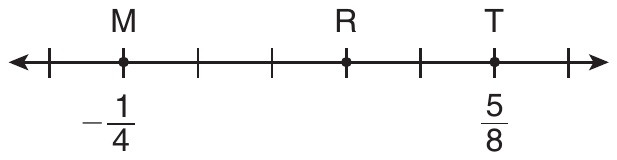
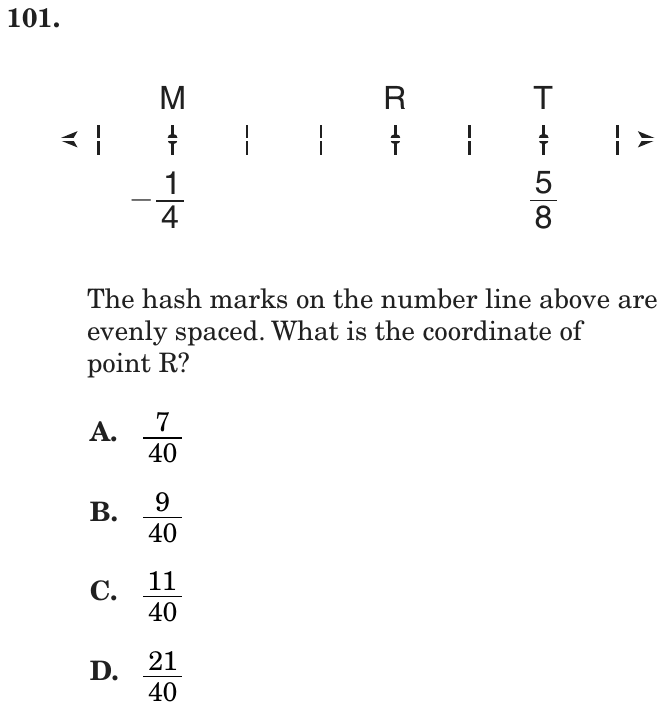
The hash marks on the number line above are evenly spaced. What is the coordinate of point ?
- A
- B
- C
- D
Show the answer
Correct answer: C
There are 5 sections between M and T. To find the length of one of these sections, find the distance between M and T and divide by 5:
R is 3 sections away from M, so add:
R is located at .
Question analysis
Students find the fraction at point R on a number line with evenly spaced hash marks, where M is at −1/4 and T is at 5/8. It tests fraction arithmetic with negative numbers. Working out the size of one gap and counting gaps from M to R takes several careful steps.
- NYS standards
- Grade level
- Grade 7 content, by NYS standard
- Compared with grade 7
- Above grade 7 Grade 7 students place fractions and negatives on number lines, but here they must subtract a negative fraction, divide by five, and then add back. Four fraction steps with unlike denominators make it harder than typical classwork.
- Estimated difficulty
- Hard: combines ideas, needs a plan, and has more than one tempting wrong answer.
- Thinking it demands
- Depth of knowledge 2, skills and concepts · mainly apply
- What makes it hard
- Error-prone arithmetic major
- Reading a figure, table or graph moderate
- Solution
- 4 steps
- Reading level
- Question and choices: about grade 6, 22 words.
- Students, last 30 days
- Not enough answers yet to show (it takes 10).
Why it is hard, traps and wrong answers (shows the answer)
Why it is hard
Fractions, a negative starting point and a count of spaces all have to come out right together. Students lose points by counting tick marks instead of spaces, by subtracting −1/4 as if it were positive, or by measuring R from 0 instead of from M. Converting both labels to fortieths first, −10/40 and 25/40, makes each gap a whole number of fortieths.
Error-prone arithmetic major Working it out
The gap length needs 5/8 − (−1/4) = 7/8, then 7/8 ÷ 5 = 7/40, then −10/40 + 21/40: negatives and three different denominators meet in one problem. (Brown & Burton, 1978; Junker & Sijtsma, 2001)
Reading a figure, table or graph moderate Understanding the question
The hash marks have to be counted as spaces: five from M to T, with R three spaces past M, while the unlabeled marks outside M and T play no part. (Lesh, Post & Behr, 1987; Kirsch & Mosenthal, 1990)
Strategy: Find the distance from M to T by subtracting their coordinates, divide it by the number of equal gaps, then step from M toward T by the right number of gaps.
Traps
- Stops one step early: A choice is a number from partway through the solution.
- Negatives and direction: Arithmetic with negative numbers, the order of a subtraction, or direction on a number line. (Moving a term across the equals sign without changing its sign is a faulty procedure.)
The wrong answers, classified
A Stops one step early (King et al., 2004; Gierl et al., 2017)
Finds the length of one gap, 7/8 ÷ 5 = 7/40, and gives it as R's coordinate without stepping from M.
B Negatives and direction (Brown & Burton, 1978)
Subtracts as 5/8 − 1/4 = 3/8 instead of adding, gets gaps of 3/40, and counts three gaps from 0.
D Stops one step early (King et al., 2004; Gierl et al., 2017)
Multiplies the 7/40 gap by 3 to get the distance from M to R, then forgets to add it to M's −1/4.
Worked solution, step by step
Formulas used
- Distance on a number line
- The right number is the point farther to the right on the number line. The left number is the other point. Subtracting tells how many units apart they are. Taking the left from the right keeps the answer positive.
- Dividing a fraction by a whole number
- a over b is the fraction, and c is the whole number you divide by. Splitting a fraction into c equal parts makes each part c times smaller. So you multiply the bottom number, b, by c.
Read the number line
M is at and T is at . The hash marks are evenly spaced, so every space is the same length. Count the spaces. From M to T there are 5 spaces. From M to R there are 3 spaces. You need the number at point R.
Find the distance from M to T
Use the distance formula. First write in eighths, as .
Taking away a negative is the same as adding. M and T are apart.
Find the length of one space
The 5 spaces are equal, so divide by 5.
Each space is long.
Watch out: this is the length of one space, not where R is. Stopping here gives choice A.
Step from M to R
R is 3 spaces to the right of M.
Now add that to M. Write as .
Watch out: is how far R is from M, not where R is. Choosing it gives choice D.
Give the answer
Point R is at , a little to the right of 0. So the answer is C, .
Check your answer
Go backward from T instead. T is 2 spaces past R, and . So R is at . Both ways give the same point.
More questions like this
The original DOE question
Question 5 of 6
2026 Practice Test C Math, question 18Question
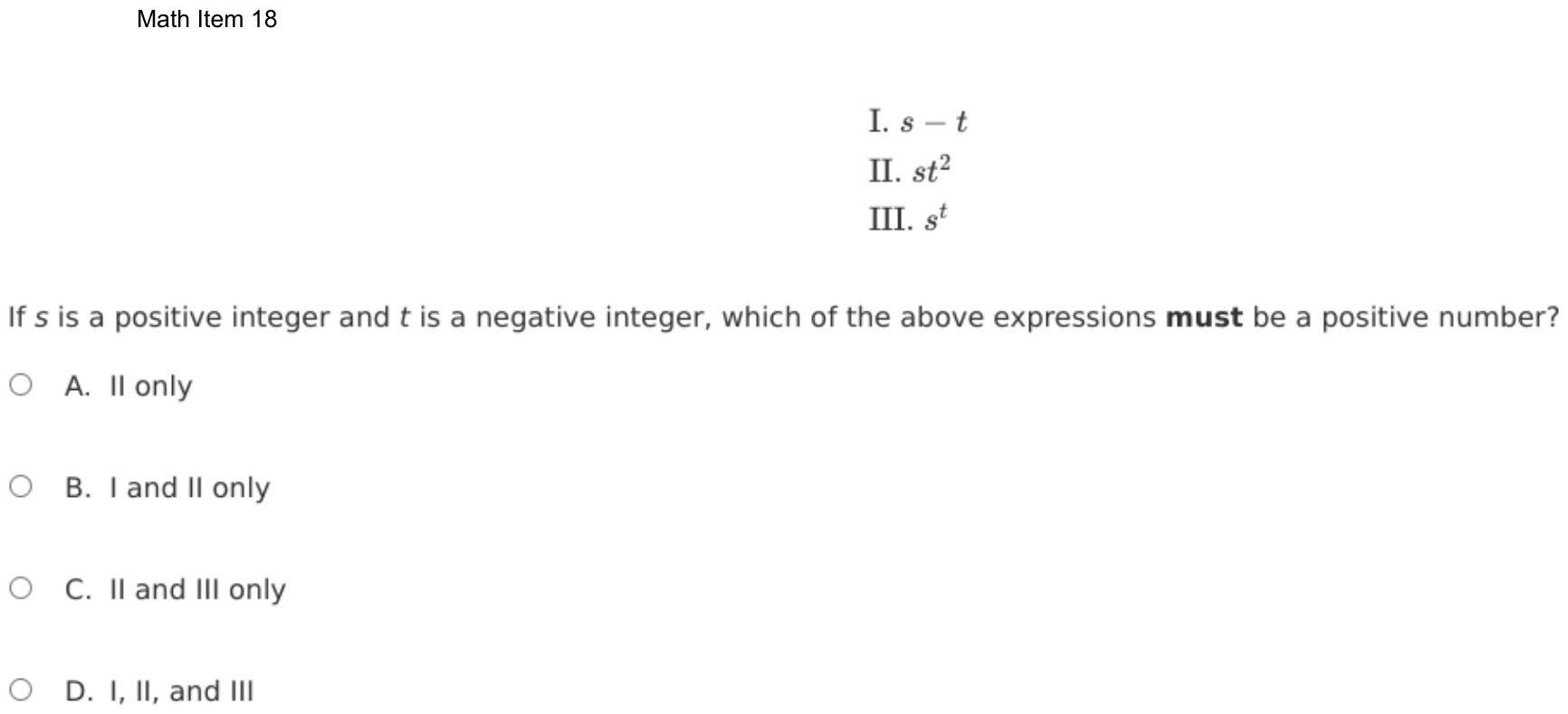
I.
II.
III.
If s is a positive integer and t is a negative integer, which of the above expressions must be a positive number?
- AII only
- BI and II only
- CII and III only
- DI, II, and III
Show the answer
Correct answer: D
Each of the three expressions must be considered:
Expression I: , where s is a positive integer and t is a negative integer:
Subtracting a negative integer is the equivalent of adding a positive integer, so is equivalent to finding the value of , which must result in a positive number.
Expression II: , where s is a positive integer and t is a negative integer:
Squaring a negative integer results in a positive integer, so is equivalent to finding the value of , which must result in a positive number.
Expression III: , where s is a positive integer and t is a negative integer:
A negative exponent results in the reciprocal of the same exponential expression, so is equivalent to finding the value of , which must result in a positive number.
Therefore, Expressions I, II, and III must all result in a positive number.
Question analysis
Three expressions, s − t, s times t squared, and s to the power t, are listed, and students decide which must be positive when s is a positive integer and t is a negative integer. It tests sign rules for subtraction and multiplication and the meaning of a negative exponent. Each expression has to be judged for every possible pair, not just one example.
- NYS standards
- Grade level
- Grade 8 content, by NYS standard
- Compared with grade 7
- Above grade 7 Grade 7 students learn sign rules for subtracting and multiplying signed numbers. Here they reason about letters rather than numbers, decide what must always hold, and handle a negative exponent, a grade 8 idea.
- Estimated difficulty
- Hard: combines ideas, needs a plan, and has more than one tempting wrong answer.
- Thinking it demands
- Depth of knowledge 2, skills and concepts · mainly analyze
- What makes it hard
- Variables instead of numbers moderate
- Something you must already know moderate
- Every choice must be checked minor
- Solution
- 3 steps
- Reading level
- Question and choices: about grade 5, 42 words.
- Corrected from the DOE handbook
- Two steps of the explanation that treated t as a positive number were corrected.
- A punctuation error in the explanation was corrected.
- Students, last 30 days
- Not enough answers yet to show (it takes 10).
Why it is hard, traps and wrong answers (shows the answer)
Why it is hard
The three expressions test three different sign facts: subtracting a negative, squaring a negative, and raising to a negative power. The last is the trap, since a negative exponent seems to promise a negative result when it really gives a fraction, and that belief alone leads to a listed choice. Trying s = 2 and t = −3 gives 5, 18 and 1/8, all positive, and the rules show why no other pair can change that.
Variables instead of numbers moderate Understanding the question
No values are given for s and t, only their signs, and must means each expression has to be positive for every such pair, not just for one example. (Koedinger & Nathan, 2004; Enright, Morley & Sheehan, 2002)
Something you must already know moderate Working it out
Expression III needs the meaning of a negative exponent, s to the power t equals 1 over s to the power −t, a grade 8 rule the question does not state. (Anderson & Krathwohl, 2001)
Every choice must be checked minor Choosing the answer
Each of the three expressions is judged on its own and the choices combine the verdicts, so one wrong judgment anywhere points to a wrong combination. (Embretson & Wetzel, 1987)
Strategy: Try a pair such as s = 2 and t = −3 in each expression, then explain why its sign could or could not change for any other positive s and negative t.
Traps
- Misunderstands the concept: A wrong belief about a concept: that percents can be added, that area grows like length, that averages can be averaged, that a bigger denominator means a bigger fraction.
- Negatives and direction: Arithmetic with negative numbers, the order of a subtraction, or direction on a number line. (Moving a term across the equals sign without changing its sign is a faulty procedure.)
The wrong answers, classified
A Misunderstands the concept (Smith, diSessa & Roschelle, 1993; De Bock et al., 1998; Ni & Zhou, 2005)
Trusts only the squared expression, believing that subtracting t must make s smaller and that a negative exponent makes a negative number.
B Misunderstands the concept (Smith, diSessa & Roschelle, 1993; De Bock et al., 1998; Ni & Zhou, 2005)
Handles the subtraction and the square correctly but believes a negative exponent makes the result negative, though s to the power t is a positive fraction such as 1/8.
C Negatives and direction (Brown & Burton, 1978)
Reads s − t as taking a number away from s, so thinks it could be negative, missing that subtracting the negative t adds to s.
What was corrected from the DOE handbook, and why
- Explanation: The question makes t the negative integer, but two steps of the DOE’s explanation write the negative integer as −t, as if t were positive. For Expression I it says “s − (−t) is equivalent to finding the value of s + t, which must result in a positive number”: s − (−t) is not Expression I, and with the question’s t, s + t need not be positive (s = 1 and t = −2 give −1). For Expression III it says “s^(−t) is equivalent to finding the value of 1/s^t”, about s^(−t) rather than Expression III. The site now says that s − t is equivalent to s + (−t), and that s^t is equivalent to 1/s^(−t). Since t is negative, −t is a positive integer, so s + (−t) is the sum of two positive integers and 1/s^(−t) is the reciprocal of a positive integer: both positive, and the answer, I, II and III, is unchanged. The step for Expression II, s(−t)² = st², is true for any t and is unchanged.
- Explanation: The DOE’s explanation introduces Expression III as “s^t. where s is a positive integer and t is a negative integer”, with a period where Expressions I and II (and the 2022–23 guide, which first printed this explanation) have a comma. The site has the comma.
Worked solution, step by step
Formulas used
- Subtracting a number
- s and t are integers, and −t is the opposite of t. Subtracting a number is the same as adding its opposite. When t is negative, −t is positive. So subtracting t adds a positive amount.
- A negative exponent
- s is the base and t is the exponent. When t is negative, −t is positive. So a negative exponent means 1 over the base to a positive exponent. For example, 2 to the power −3 is 1 over 2³, which is 1/8.
Sort out the question
An integer is a whole number or its opposite, such as −2, 0 or 5. Here s is a positive integer, like 1, 2 or 3. And t is a negative integer, like −1, −2 or −3. Must means always. An expression counts only if it is positive for every such pair.
Try one pair of numbers
Try s = 2 and t = −3 in each expression:
- I:
- II:
- III:
All three are positive this time. Now see why that always happens.
Explain expression I
Use the rule for subtracting:
t is negative, so its opposite, −t, is positive. So s − t is a positive plus a positive. That is always positive.
Watch out: subtracting does not always make a number smaller. Subtracting a negative makes it bigger. Missing this leads to choice C.
Explain expression II
means t × t. A negative times a negative is positive, so is always positive. Then is a positive times a positive. That is always positive too.
Explain expression III
Use the rule for a negative exponent:
−t is a positive integer, so is a positive integer. So is 1 over a positive number. That is a positive fraction.
Watch out: a negative exponent does not make the answer negative. It makes a fraction. Thinking it does leads to choice B, I and II only.
Choose the answer
Each of the three expressions is positive for every positive s and negative t. None of them can ever be zero or negative.
So the answer is D, I, II, and III.
Check your answer
Try the values closest to 0: s = 1 and t = −1. I gives . II gives . III gives . All three are still positive.
More questions like this
The original DOE question
Question 6 of 6
2026 Practice Test C Math, question 10Question
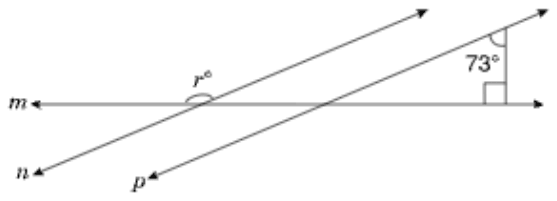
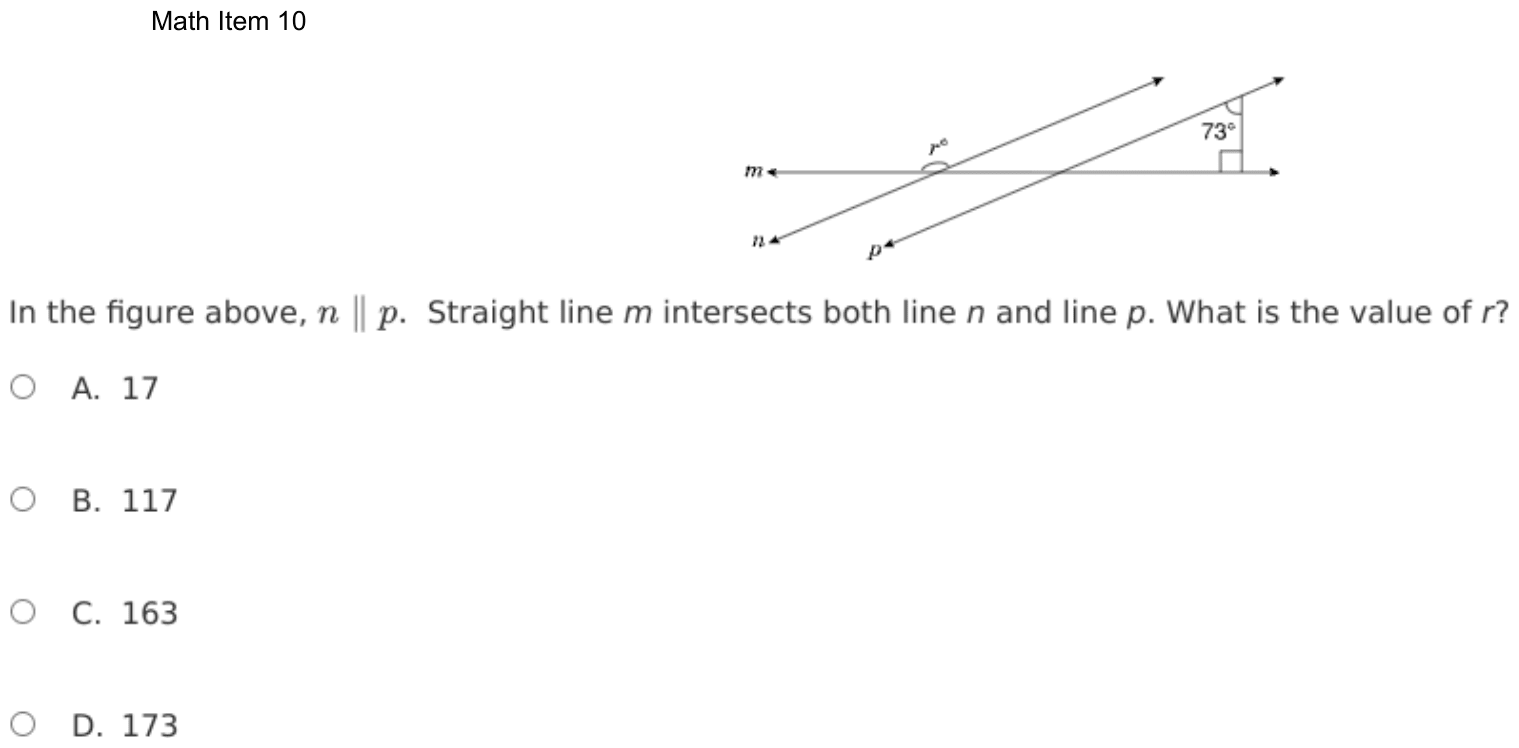
In the figure above, . Straight line m intersects both line n and line p. What is the value of r?
- A17
- B117
- C163
- D173
Show the answer
Correct answer: C
The triangle formed by line p, line m, and the line segment connecting the two contains a 73° angle, a right angle (90°), and a missing angle measuring x°. The sum of the interior angles of a triangle is 180°, so begin by finding the value of x:
Line m is a straight line, so it has a measure of 180°. The 17° angle from the triangle and the adjacent angle outside the triangle are supplementary, so they have a sum of 180°. Let s represent the measure of the adjacent angle outside the triangle. The value of s can be determined by subtracting:
Given that n and p are parallel lines and that they have been cut by a transversal, line m, then corresponding angles are congruent. Angles r and s are corresponding angles, so the value of r is congruent to the value of s, which is 163°.
Question analysis
Two parallel lines, n and p, cross a straight line m, and a segment drawn at a right angle to m forms a small triangle with lines m and p, where a 73° angle is marked. Students find the angle r at line n. It combines a triangle's angle sum, a straight angle and parallel lines, and the angle wanted sits away from the marked ones.
- NYS standards
- Grade level
- Grade 8 content, by NYS standard
- Compared with grade 7
- Above grade 7 Grade 7 angle problems use supplementary, vertical and adjacent angles. This one also needs the angle sum of a triangle and the angles formed by parallel lines and a transversal, grade 8 facts, chained across a busy figure.
- Estimated difficulty
- Hard: combines ideas, needs a plan, and has more than one tempting wrong answer.
- Thinking it demands
- Depth of knowledge 2, skills and concepts · mainly apply
- What makes it hard
- Reading a figure, table or graph moderate
- Combines ideas moderate
- Something you must already know minor
- Solution
- 3 steps
- Reading level
- Question and choices: about grade 3, 21 words.
- Students, last 30 days
- Not enough answers yet to show (it takes 10).
Why it is hard, traps and wrong answers (shows the answer)
Why it is hard
Each fact needs only a subtraction, but the student has to plan a route from the 73° angle at line p over to r at line n. The first number the route gives, the triangle's 17° angle, is listed, and it is the acute partner of r rather than r itself. The figure helps here: r is drawn plainly obtuse, and 163 is also 90 + 73, the triangle's exterior angle, which confirms it.
Reading a figure, table or graph moderate Understanding the question
The 73° sits between line p and the vertical segment, not between p and m, and r is the obtuse angle above m on the left of line n, far from every marked angle. (Lesh, Post & Behr, 1987; Kirsch & Mosenthal, 1990)
Combines ideas moderate Working it out
Three facts chain together: the triangle's angles sum to 180°, the angles along straight line m sum to 180°, and corresponding angles at the parallel lines n and p are equal. (Embretson, 1998; Daniel & Embretson, 2010)
Something you must already know minor Working it out
The angle pairs formed by a line crossing two parallel lines are a grade 8 topic, and the question uses them without naming them. (Anderson & Krathwohl, 2001)
Strategy: Find the third angle of the right triangle, use the straight line m to get the angle beside it, then carry that angle over to line n using the parallel lines.
Traps
- Stops one step early: A choice is a number from partway through the solution.
- An arithmetic slip: The right method with a plausible arithmetic error: a digit, a place value or a times-table fact.
The wrong answers, classified
A Stops one step early (King et al., 2004; Gierl et al., 2017)
Finds the triangle's third angle, 180 − 90 − 73 = 17, and stops, though r is the obtuse angle next to the 17° angle, not that angle itself.
B Little reason to choose it (Haladyna & Downing, 1993; Rodriguez, 2005)
No angle fact in the figure gives 117; even 180 − 73 is 107, so this choice mostly catches guesses at an obtuse angle.
D An arithmetic slip (Junker & Sijtsma, 2001)
Finds the 17° angle and subtracts it from 180 but borrows without reducing the 8, so 180 − 17 comes out as 173.
Worked solution, step by step
Formulas used
- Angles of a triangle
- a, b and c are the three angles inside any triangle. They always add up to 180°. If you know two of them, subtract their sum from 180° to find the third.
- Angles on a straight line
- a and b are two angles side by side on a straight line. Together they make a half turn, which is 180°. Use it to find the angle next to one you already know.
- Corresponding angles
- The symbol ∥ means is parallel to. When line m crosses two parallel lines, it makes the same angles at each crossing. Angles in the same position at the two crossings are called corresponding angles. They are equal.
Sort out the question
Lines n and p are parallel, and line m crosses both. Near line p, a straight-up segment meets line m. The small square shows a right angle, 90°. Line p, line m and that segment make a small triangle. Its top angle is 73°.
You need r, the wide angle where line n crosses line m.
Find the triangle’s third angle
The third angle is where line p crosses line m. Call it x. Use the triangle rule:
So that angle is 17°.
Watch out: this is not r. Stopping here gives choice A, 17.
Use the straight line m
The 17° angle sits above line m, on the right of line p. Beside it, on the left of line p, is a wide angle. Call it s. The two angles fill the straight line m, so they add to 180°:
So s is 163°.
Watch out: borrow carefully. 180 − 17 is 163, not 173, choice D.
Carry the angle to line n
Angle s is above line m and to the left of line p. Angle r is above line m and to the left of line n. They are in the same position, so they are corresponding angles. Since n and p are parallel:
So the answer is C, 163.
Check your answer
Look at the figure. Angle r is wider than a right angle, so it must be more than 90°. That rules out 17. Also, the narrow angle beside r, on the right of line n, matches the 17° angle at line p. And , as it should on a straight line.
More questions like this
The original DOE question