3 English and 3 math
Here are 6 random questions to try. Takers earning below 75% are unlikely to receive an offer. You have 1 minute 48 seconds per question on the real exam.
Question 1 of 6
2024 Test A English, question 8Passage The Free College Debate
The Free College Debate
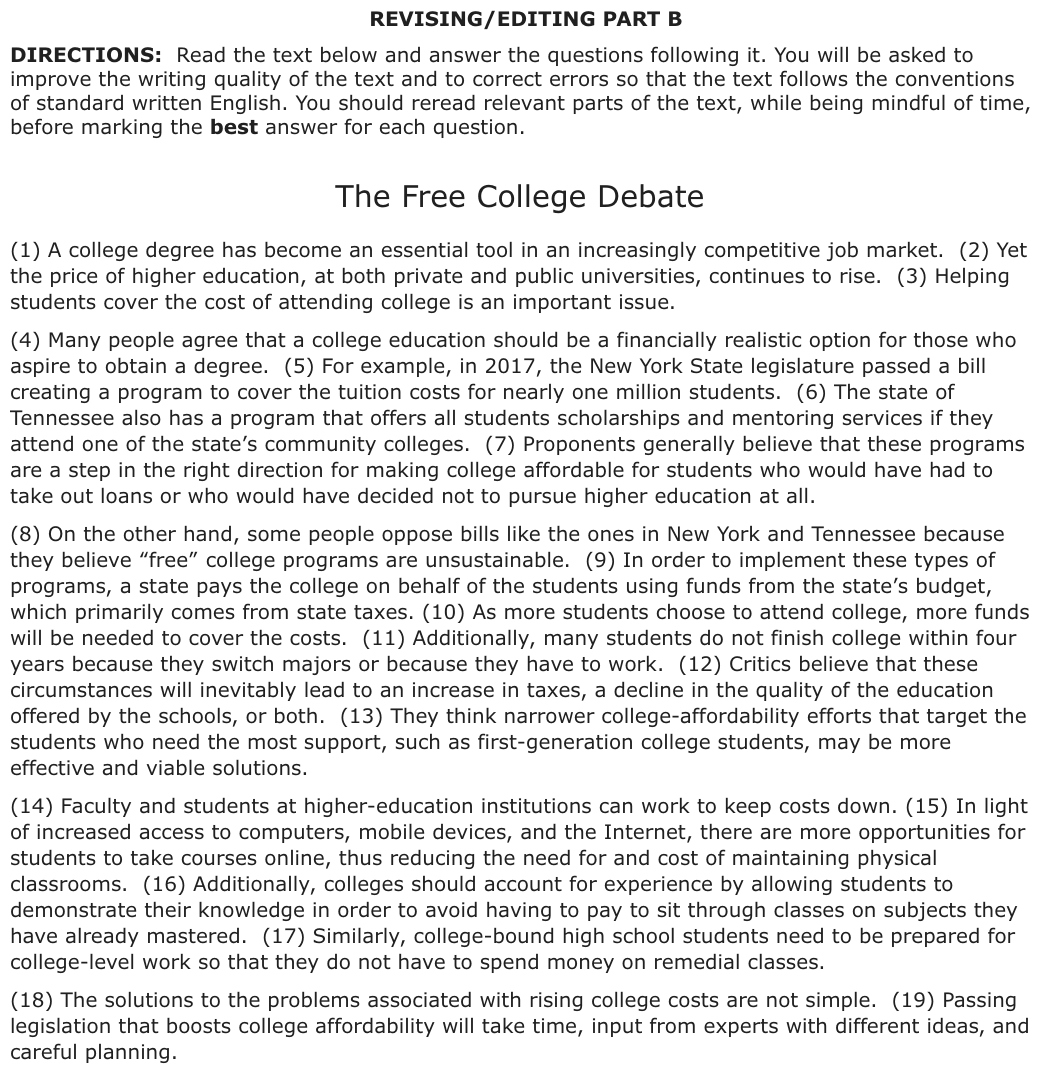
(1) A college degree has become an essential tool in an increasingly competitive job market. (2) Yet the price of higher education, at both private and public universities, continues to rise. (3) Helping students cover the cost of attending college is an important issue.
(4) Many people agree that a college education should be a financially realistic option for those who aspire to obtain a degree. (5) For example, in 2017, the New York State legislature passed a bill creating a program to cover the tuition costs for nearly one million students. (6) The state of Tennessee also has a program that offers all students scholarships and mentoring services if they attend one of the state’s community colleges. (7) Proponents generally believe that these programs are a step in the right direction for making college affordable for students who would have had to take out loans or who would have decided not to pursue higher education at all.
(8) On the other hand, some people oppose bills like the ones in New York and Tennessee because they believe “free” college programs are unsustainable. (9) In order to implement these types of programs, a state pays the college on behalf of the students using funds from the state’s budget, which primarily comes from state taxes. (10) As more students choose to attend college, more funds will be needed to cover the costs. (11) Additionally, many students do not finish college within four years because they switch majors or because they have to work. (12) Critics believe that these circumstances will inevitably lead to an increase in taxes, a decline in the quality of the education offered by the schools, or both. (13) They think narrower college-affordability efforts that target the students who need the most support, such as first-generation college students, may be more effective and viable solutions.
(14) Faculty and students at higher-education institutions can work to keep costs down. (15) In light of increased access to computers, mobile devices, and the Internet, there are more opportunities for students to take courses online, thus reducing the need for and cost of maintaining physical classrooms. (16) Additionally, colleges should account for experience by allowing students to demonstrate their knowledge in order to avoid having to pay to sit through classes on subjects they have already mastered. (17) Similarly, college-bound high school students need to be prepared for college-level work so that they do not have to spend money on remedial classes.
(18) The solutions to the problems associated with rising college costs are not simple. (19) Passing legislation that boosts college affordability will take time, input from experts with different ideas, and careful planning.
Question
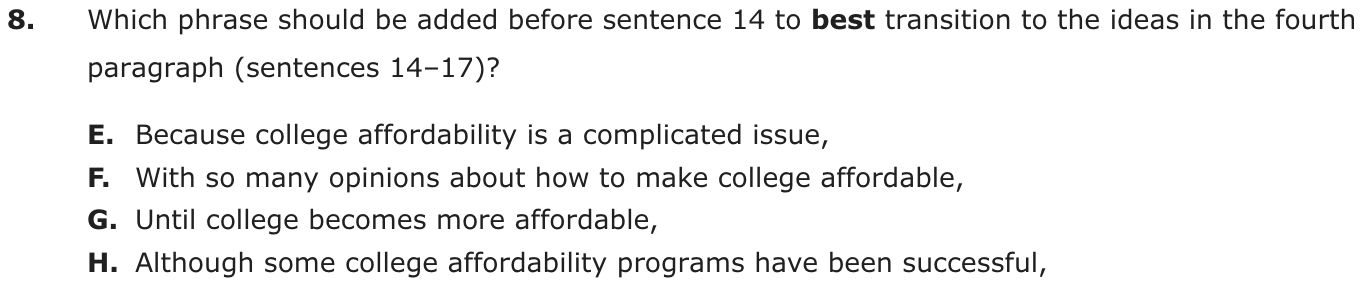
Which phrase should be added before sentence 14 to best transition to the ideas in the fourth paragraph (sentences 14–17)?
- ABecause college affordability is a complicated issue,
- BWith so many opinions about how to make college affordable,
- CUntil college becomes more affordable,
- DAlthough some college affordability programs have been successful,
Show the answer
Correct answer: C
The question asks which phrase should be added before sentence 14 to best transition to the ideas in the fourth paragraph (sentences 14–17).
A. Incorrect. Sentence 13 summarizes the viewpoint of opponents, who believe that targeted approaches to funding education “may be more effective and viable solutions,” and sentence 14 serves to introduce how “faculty and students at higher-education institutions can work to keep costs down.” Affordability is “a complicated issue,” but the use of the word “Because” suggests that the ideas that follow in sentences 14–17 will explain a cause-and-effect relationship. However, sentences 14–17 discuss ways faculty and students should work together to keep the cost of college down while waiting for a long-term solution to the problem, not a causal relationship.
B. Incorrect. Sentences 4–13 provide information about the viewpoint of proponents, who believe that “a college education should be a financially realistic option for those who aspire to obtain a degree” (sentence 4), and opponents, who believe free college programs are “unsustainable” (sentence 8). Although the phrase in this option mentions “opinions,” it indicates that the fourth paragraph will discuss why the number of opinions makes affordability a debatable issue. Instead, the fourth paragraph discusses ways faculty and students can help keep costs down until a solution is reached.
C. CORRECT. Sentence 13 summarizes the viewpoint of opponents, who believe that targeted approaches to funding education “may be more effective and viable solutions,” while proponents “generally believe that these [government] programs are a step in the right direction for making college affordable” (sentence 7). However, sentences 14–17 offer three possible solutions that could alleviate the problem in the meantime. Therefore, the phrase in this option should be added before sentence 14 to best transition to the ideas in the fourth paragraph because it suggests that until the issue of affordability is resolved, alternatives are available to help make a college education more affordable.
D. Incorrect. This phrase mentions “college affordability,” a topic discussed in the fourth paragraph. However, the ideas introduced in the phrase do not logically lead into the ideas discussed in sentences 14–17, because the phrase mentions “programs [that] have been successful,” whereas the paragraph states that “faculty and students at higher-education institutions can work to keep costs down” (sentence 14) and that colleges “should account for experience by allowing students to demonstrate their knowledge in order to avoid having to pay to sit through classes on subjects they have already mastered” (sentence 16). Use of the words “can” and “should” in these sentences indicates that the actions or programs mentioned in the paragraph have not been completed.
Question analysis
This revising question asks which introductory phrase should begin the fourth paragraph of a passage on college affordability, linking the debate over state tuition programs to the cost-saving ideas that follow. All four phrases sound natural, so students must work out the relationship between the paragraphs and choose the phrase that signals it accurately.
- NYS standards
- 7W2d transitions in informative writing
- Grade level
- Grade 8 reading and task
- Compared with grade 7
- Above grade 7 Grade 7 transition work usually links two sentences with a word such as however. Here the choices are whole phrases that set up an entire paragraph, and judging them needs a grasp of the full argument, which asks more than typical grade 7 work.
- Estimated difficulty
- Hard: combines ideas, needs a plan, and has more than one tempting wrong answer.
- Thinking it demands
- Depth of knowledge 3, strategic thinking · mainly evaluate
- What makes it hard
- How sentences fit together major
- Reading between the lines moderate
- Every choice must be checked minor
- Evidence
- Answered from several paragraphs or stanzas
- Reading level
- Passage: about grade 12, 427 words; question and choices: about grade 10, 48 words.
- Students, last 30 days
- Not enough answers yet to show (it takes 10).
Why it is hard, traps and wrong answers (shows the answer)
Why it is hard
Every phrase sounds like a reasonable bridge, and the right one can even seem odd at first, since cutting costs is itself a way to make college affordable. The key is seeing paragraph 4 as what campuses can do while the debate over state programs goes on, a reading the passage confirms only at its end. Students who link back to the many opinions, or accept a causal “Because,” have found real ideas from the passage but not the relationship between these two paragraphs.
How sentences fit together major Working it out
The phrase must link paragraph 3's case against state programs to paragraph 4's steps that “can work to keep costs down,” steps that make sense only as help in the meantime. (Halliday & Hasan, 1976)
Reading between the lines moderate Working it out
Nothing says paragraph 4's ideas are stopgaps; that has to be inferred from sentences 18 and 19, which say the solutions “are not simple” and “will take time.” (Graesser, Singer & Trabasso, 1994; Kintsch, 1998)
Every choice must be checked minor Choosing the answer
All four phrases are grammatical and about affordability, so each must be read into sentence 14 and judged by the relationship its first word signals. (Embretson & Wetzel, 1987)
Strategy: Sum up paragraphs 3 and 4 in a few words each, decide how the second relates to the first, then test the relationship each phrase's opening word signals.
Traps
- Wrong transition: A connecting word or phrase that signals the wrong relationship, such as contrast where the idea continues.
The wrong answers, classified
A Wrong transition (Halliday & Hasan, 1976)
Agrees that affordability is complicated, as sentence 18 says, but “Because” makes the complexity the reason faculty and students can cut costs, a cause the paragraph never gives.
B Wrong transition (Halliday & Hasan, 1976)
Rightly looks back to the clashing views of paragraphs 2 and 3, but offers the disagreement as the ground for the steps instead of marking them as help until a solution arrives.
D Wrong transition (Halliday & Hasan, 1976)
Hears “Although” as a natural turn to a new idea, but the passage never says any program has succeeded, and paragraph 4 does not set its steps against such programs.
Working it out, step by step
Figure out what the question asks
You need a phrase to start sentence 14. It should work as a transition: a word or phrase that shows how two ideas connect. Words like “because,” “although” and “until” each show a different link. So first work out how paragraph 4 connects to what came before.
Compare paragraphs 3 and 4
Paragraph 3 ends with the critics’ view of state programs. People still disagree, so there is no fix everyone accepts yet. Paragraph 4 then says “Faculty and students at higher-education institutions can work to keep costs down.” Faculty means teachers. The paragraph lists ways to do it: online classes, skipping classes you’ve mastered, and getting ready in high school.
Use the ending as a clue
Sentences 18 and 19 say the solutions “are not simple” and “will take time.” So a big fix is still far off. That makes paragraph 4’s ideas things to do in the meantime, while people wait. The phrase “Until college becomes more affordable” says exactly that.
Check each choice
- A is wrong. “Because” shows a cause. The issue being complicated is not the reason teachers can cut costs.
- B is wrong. It makes the many opinions the reason for the steps. The passage never links them that way.
- C is right. “Until” shows these are steps to take while waiting for a bigger fix.
- D is wrong. The passage never says any program has been successful.
Watch out: B looks back at the many opinions, which really are in the passage. But it doesn’t show how paragraph 4 relates to paragraph 3.
Choose the answer
Sentence 14 would read: Until college becomes more affordable, faculty and students at higher-education institutions can work to keep costs down. So the answer is C.
Why this answer and not the closest wrong one
B is the closest wrong answer, because the passage does share many opinions. But “With so many opinions” makes the opinions sound like the reason for the cost-cutting steps. They are not. C shows the steps are help for now, while the bigger problem waits to be solved.
More questions like this
The original DOE question
The passage “The Free College Debate” as printed (page 38)
Question 2 of 6
2026 Practice Test A English, question 17Passage Excerpt from A Voice in the Wilderness
Excerpt from A Voice in the Wilderness
by Grace Livingston Hill
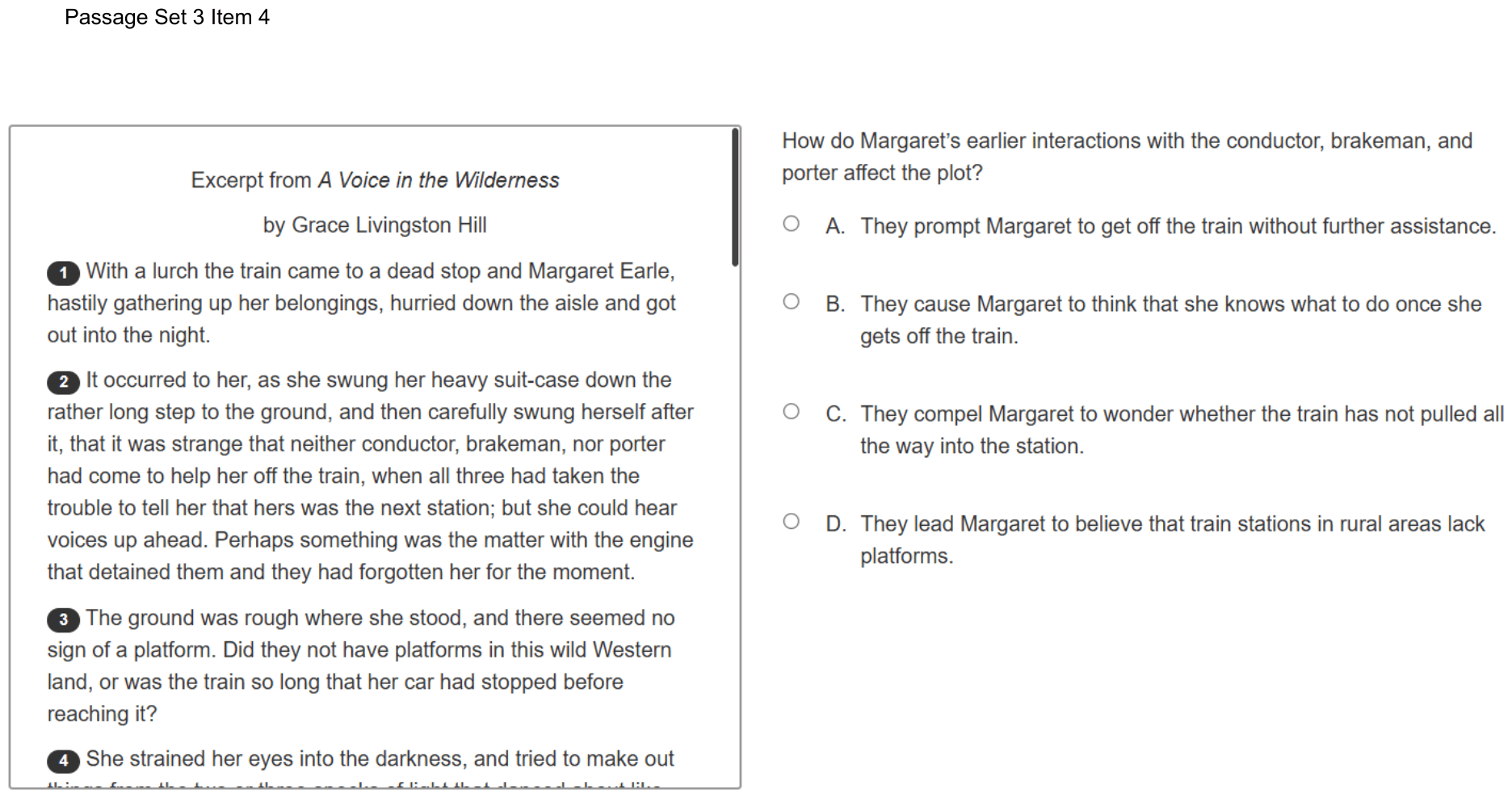
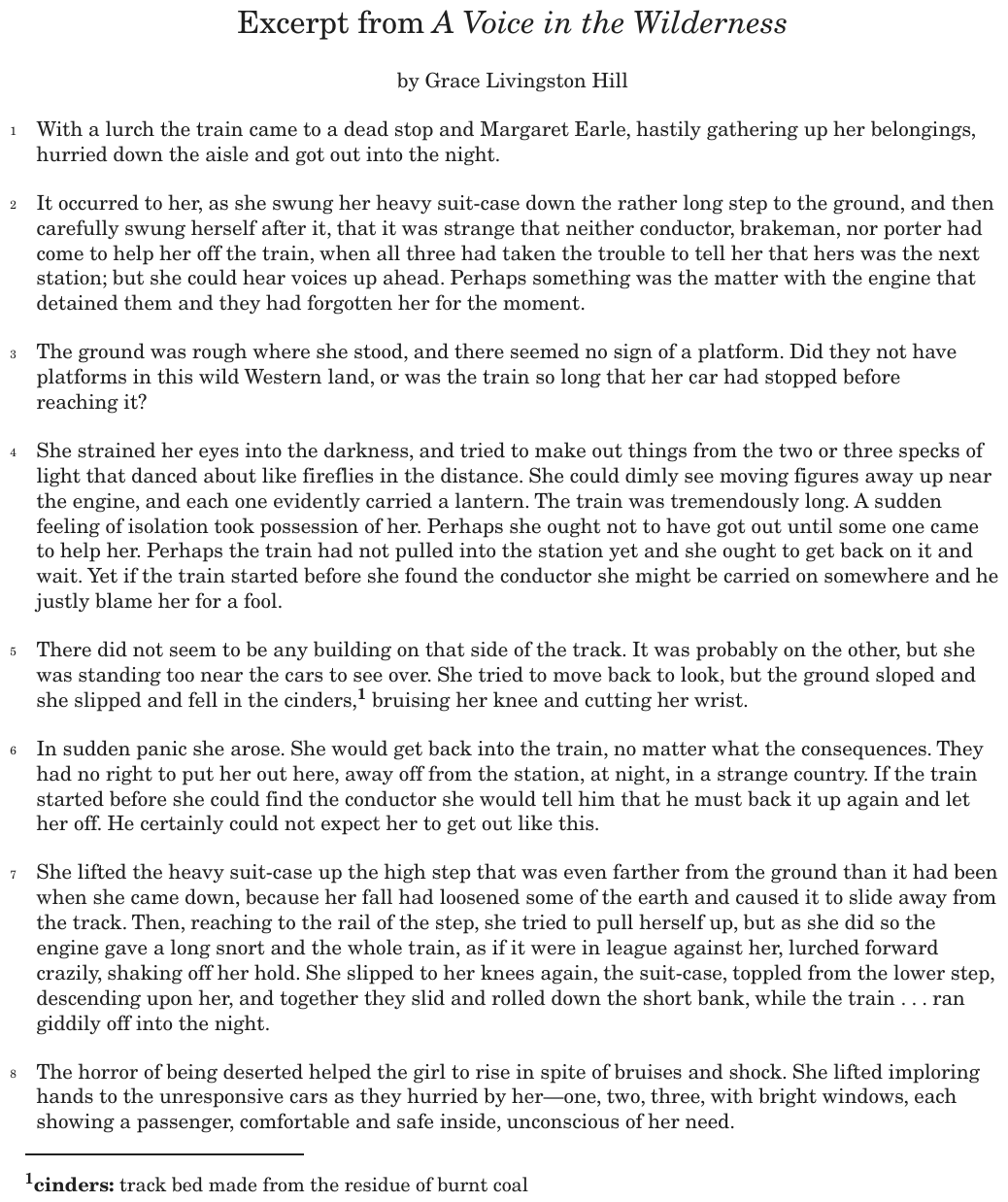
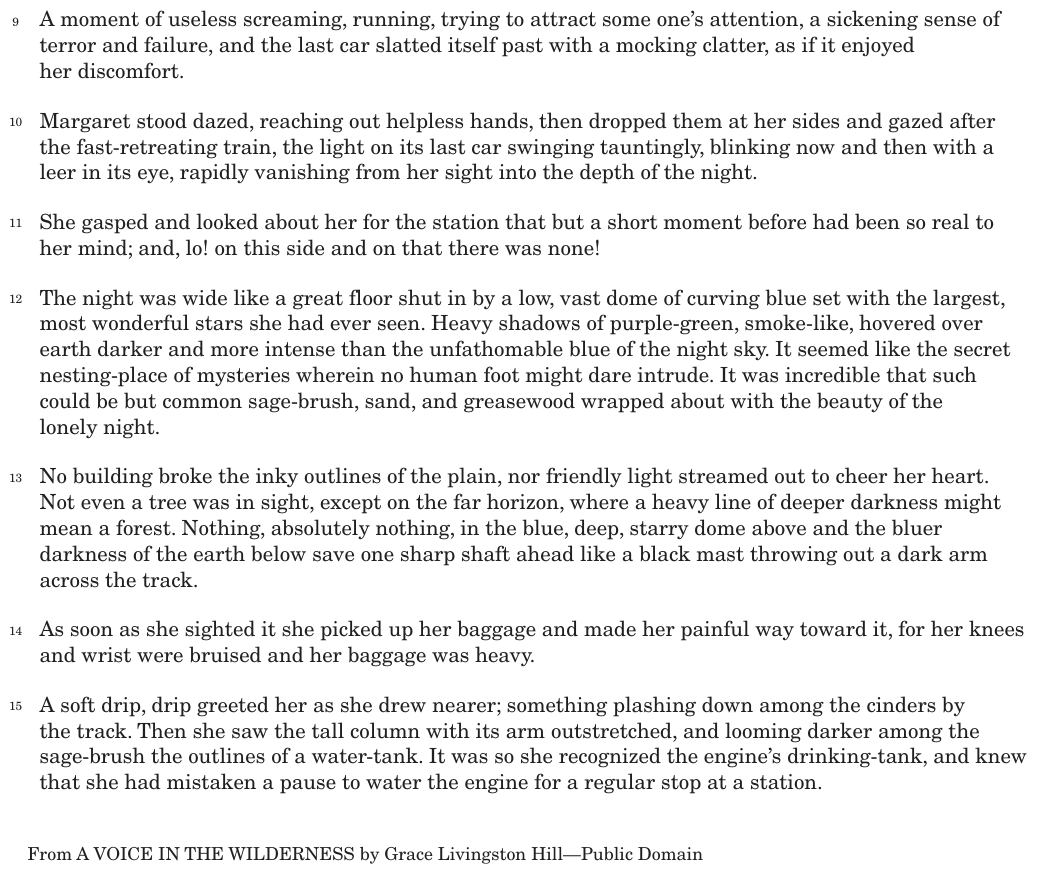
With a lurch the train came to a dead stop and Margaret Earle, hastily gathering up her belongings, hurried down the aisle and got out into the night.
It occurred to her, as she swung her heavy suit-case down the rather long step to the ground, and then carefully swung herself after it, that it was strange that neither conductor, brakeman, nor porter had come to help her off the train, when all three had taken the trouble to tell her that hers was the next station; but she could hear voices up ahead. Perhaps something was the matter with the engine that detained them and they had forgotten her for the moment.
The ground was rough where she stood, and there seemed no sign of a platform. Did they not have platforms in this wild Western land, or was the train so long that her car had stopped before reaching it?
She strained her eyes into the darkness, and tried to make out things from the two or three specks of light that danced about like fireflies in the distance. She could dimly see moving figures away up near the engine, and each one evidently carried a lantern. The train was tremendously long. A sudden feeling of isolation took possession of her. Perhaps she ought not to have got out until some one came to help her. Perhaps the train had not pulled into the station yet and she ought to get back on it and wait. Yet if the train started before she found the conductor she might be carried on somewhere and he justly blame her for a fool.
There did not seem to be any building on that side of the track. It was probably on the other, but she was standing too near the cars to see over. She tried to move back to look, but the ground sloped and she slipped and fell in the cinders, bruising her knee and cutting her wrist.
In sudden panic she arose. She would get back into the train, no matter what the consequences. They had no right to put her out here, away off from the station, at night, in a strange country. If the train started before she could find the conductor she would tell him that he must back it up again and let her off. He certainly could not expect her to get out like this.
She lifted the heavy suit-case up the high step that was even farther from the ground than it had been when she came down, because her fall had loosened some of the earth and caused it to slide away from the track. Then, reaching to the rail of the step, she tried to pull herself up, but as she did so the engine gave a long snort and the whole train, as if it were in league against her, lurched forward crazily, shaking off her hold. She slipped to her knees again, the suit-case, toppled from the lower step, descending upon her, and together they slid and rolled down the short bank, while the train . . . ran giddily off into the night.
The horror of being deserted helped the girl to rise in spite of bruises and shock. She lifted imploring hands to the unresponsive cars as they hurried by her—one, two, three, with bright windows, each showing a passenger, comfortable and safe inside, unconscious of her need.
A moment of useless screaming, running, trying to attract some one’s attention, a sickening sense of terror and failure, and the last car slatted itself past with a mocking clatter, as if it enjoyed her discomfort.
Margaret stood dazed, reaching out helpless hands, then dropped them at her sides and gazed after the fast-retreating train, the light on its last car swinging tauntingly, blinking now and then with a leer in its eye, rapidly vanishing from her sight into the depth of the night.
She gasped and looked about her for the station that but a short moment before had been so real to her mind; and, lo! on this side and on that there was none!
The night was wide like a great floor shut in by a low, vast dome of curving blue set with the largest, most wonderful stars she had ever seen. Heavy shadows of purple-green, smoke-like, hovered over earth darker and more intense than the unfathomable blue of the night sky. It seemed like the secret nesting-place of mysteries wherein no human foot might dare intrude. It was incredible that such could be but common sage-brush, sand, and greasewood wrapped about with the beauty of the lonely night.
No building broke the inky outlines of the plain, nor friendly light streamed out to cheer her heart. Not even a tree was in sight, except on the far horizon, where a heavy line of deeper darkness might mean a forest. Nothing, absolutely nothing, in the blue, deep, starry dome above and the bluer darkness of the earth below save one sharp shaft ahead like a black mast throwing out a dark arm across the track.
As soon as she sighted it she picked up her baggage and made her painful way toward it, for her knees and wrist were bruised and her baggage was heavy.
A soft drip, drip greeted her as she drew nearer; something plashing down among the cinders by the track. Then she saw the tall column with its arm outstretched, and looming darker among the sage-brush the outlines of a water-tank. It was so she recognized the engine’s drinking-tank, and knew that she had mistaken a pause to water the engine for a regular stop at a station.
cinders: track bed made from the residue of burnt coal
From A VOICE IN THE WILDERNESS by Grace Livingston Hill—Public Domain
Question
How do Margaret’s earlier interactions with the conductor, brakeman, and porter affect the plot?
- AThey prompt Margaret to get off the train without further assistance.
- BThey cause Margaret to think that she knows what to do once she gets off the train.
- CThey compel Margaret to wonder whether the train has not pulled all the way into the station.
- DThey lead Margaret to believe that train stations in rural areas lack platforms.
Show the answer
Correct answer: A
The question asks how Margaret’s earlier interactions with the conductor, brakeman, and porter affect the plot.
A. CORRECT. Because the conductor, brakeman, and porter have all “taken the trouble to tell her that hers was the next station” (paragraph 2), Margaret assumes that the next time the train stops, she will have reached her station. This assumption causes Margaret to get off the train at the next stop without waiting for help or confirmation, but the stop turns out to be just “a pause to water the engine” (paragraph 15). This mistaken assumption creates the main problem that Margaret confronts in the passage.
B. Incorrect. Although Margaret’s earlier interactions with the three railroad employees cause her to think that she knows when to get off the train, it is clear from paragraph 4 that Margaret is deeply confused and does not know what to do once she has exited the train car. She muses uneasily, “Perhaps she ought not to have got out until some one came to help her. Perhaps the train had not pulled into the station yet and she ought to get back on it and wait” (paragraph 4).
C. Incorrect. Margaret wonders in paragraph 3 whether the train is “so long that her car had stopped before reaching [the station]” and speculates in paragraph 4 that “the train had not pulled into the station yet.” These thoughts reflect her assumption (based on her interactions with the three railroad employees) that the next stop is her station. However, Margaret’s speculation that the train has not fully pulled into the station does not significantly affect the plot.
D. Incorrect. Margaret wonders in paragraph 3 whether they “have platforms in this wild Western land” and is expecting to see a platform because her interactions with the three railroad employees have led her to believe that she has reached a station. However, it is unclear whether Margaret really believes that rural stations all lack platforms, and her speculation on this point is not further developed in the passage and does not affect the plot.
Question analysis
This plot question on A Voice in the Wilderness asks how Margaret’s earlier dealings with the conductor, brakeman and porter, mentioned only in passing in paragraph 2, affect what happens to her. Students must connect that brief remark to later events in the excerpt. Several choices describe things that do happen, so students must judge which one those conversations truly cause.
- Grade level
- Grade 8 reading and task
- Compared with grade 7
- Above grade 7 Grade 7 plot questions ask how story elements affect one another, usually through an event and its result. Here the cause is a clause inside a long sentence of century-old prose, and students must trace its effect across the excerpt rather than within one paragraph.
- Estimated difficulty
- Hard: combines ideas, needs a plan, and has more than one tempting wrong answer.
- Thinking it demands
- Depth of knowledge 3, strategic thinking · mainly analyze
- What makes it hard
- Evidence in several places moderate
- Reading between the lines moderate
- Complex sentences minor
- Evidence
- Answered from the whole text
- Reading level
- Passage: about grade 8, 981 words; question and choices: about grade 7, 72 words.
- Students, last 30 days
- Not enough answers yet to show (it takes 10).
Why it is hard, traps and wrong answers (shows the answer)
Why it is hard
The talks with the trainmen are mentioned once, in the middle of a long sentence, and the question asks students to see them as the start of the whole plot. Several choices describe thoughts Margaret really has right after she steps down, which makes them feel connected, but those thoughts change nothing. The point goes to students who trace cause to consequence: told her stop was next, she gets off alone at a water tank.
Evidence in several places moderate Working it out
The cause sits in paragraph 2, where all three men had told her “hers was the next station,” and the effect shows only in paragraph 15, when the stop proves to be a water tank. (Kirsch & Mosenthal, 1990; Gorin & Embretson, 2006)
Reading between the lines moderate Working it out
The excerpt never says the men’s words made her step off; students must infer that their assurance is why she left the train at the first stop without waiting for anyone. (Graesser, Singer & Trabasso, 1994; Kintsch, 1998)
Complex sentences minor Understanding the question
The interactions appear in a 66-word sentence in paragraph 2, tucked into a “when” clause after a run of commas, so they read as a passing detail rather than a cause. (Abedi & Lord, 2001; Freedle & Kostin, 1993; Messick, 1989)
Strategy: Reread paragraph 2 to find what the three men told Margaret, then trace how that information shapes the events that follow, and choose the effect that matters most to the plot.
Traps
- True but not the answer: A choice says something accurate about the text that does not answer this question.
- Twists what the text says: Uses the text's topic and ideas but changes what it says: who did it, how much, when, or why.
- Reads too much in: A reasonable-sounding conclusion that goes further than the text allows.
The wrong answers, classified
B Twists what the text says (King et al., 2004)
Rightly links the men’s words to her confidence about when to get off, but stretches it to knowing what to do afterward, when paragraph 4 shows her at a loss.
C True but not the answer (King et al., 2004; Embretson & Wetzel, 1987)
Names a real result of the men’s words, her guess in paragraphs 3 and 4 that the train has not yet reached the station, but that passing worry changes nothing in the plot.
D Reads too much in (Graesser, Singer & Trabasso, 1994)
Turns her puzzled question about platforms in “this wild Western land” into a firm belief about rural stations, an idea the excerpt never develops.
Working it out, step by step
Figure out what the question asks
This asks how something from earlier affects the plot. The plot is the chain of events in a story. What did the three train workers tell Margaret, and what did that cause?
Find what the workers told her
Paragraph 2 says it was strange that “neither conductor, brakeman, nor porter had come to help her off the train, when all three had taken the trouble to tell her that hers was the next station.” A conductor, a brakeman and a porter are all people who work on a train.
Trace what happened because of it
Three workers told her that her stop was next. So when the train stopped, she was sure she had arrived. She got off alone, without waiting for anyone to help. But in paragraph 15 she learns it was only “a pause to water the engine.” Their words set off the whole problem: she is left alone in the dark.
Check each choice
- A fits. Their words led her to get off by herself.
- B does not fit. They told her when to get off, not what to do next. In paragraph 4 she is lost: “Perhaps she ought not to have got out until some one came to help her.”
- C does not fit. She does wonder this, but the thought changes nothing in the story.
- D does not fit. She only asks a question about platforms. She never decides anything about country stations.
Choose the answer
The workers’ words made Margaret step off the train on her own at the wrong stop. So the answer is A.
Why this answer and not the closest wrong one
C is the closest wrong choice. The workers’ words do make her guess that the train has not reached the station yet. But that guess goes nowhere. What changes the story is that she gets off alone at a stop that is not a station. That is A.
More questions like this
The original DOE question
The passage “Excerpt from A Voice in the Wilderness” as printed (pages 128–129)
Question 3 of 6
2026 Practice Test A English, question 37Passage Massachusetts: Lowell National Historical Park
Massachusetts: Lowell National Historical Park
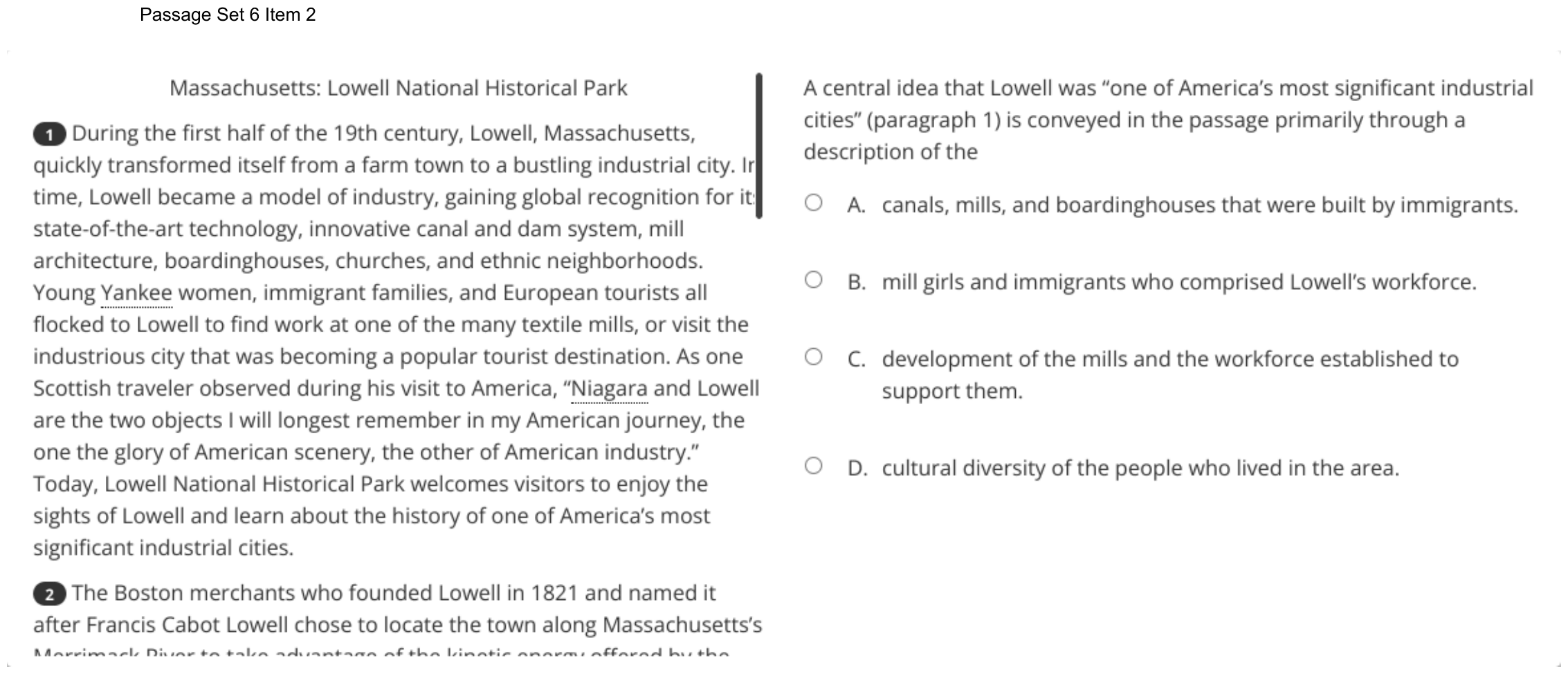
During the first half of the 19th century, Lowell, Massachusetts, quickly transformed itself from a farm town to a bustling industrial city. In time, Lowell became a model of industry, gaining global recognition for its state-of-the-art technology, innovative canal and dam system, mill architecture, boardinghouses, churches, and ethnic neighborhoods. Young Yankee women, immigrant families, and European tourists all flocked to Lowell to find work at one of the many textile mills, or visit the industrious city that was becoming a popular tourist destination. As one Scottish traveler observed during his visit to America, “Niagara and Lowell are the two objects I will longest remember in my American journey, the one the glory of American scenery, the other of American industry.” Today, Lowell National Historical Park welcomes visitors to enjoy the sights of Lowell and learn about the history of one of America’s most significant industrial cities.
The Boston merchants who founded Lowell in 1821 and named it after Francis Cabot Lowell chose to locate the town along Massachusetts’s Merrimack River to take advantage of the kinetic energy offered by the Pawtucket waterfalls. Over six miles of canals powered the waterwheels of Lowell’s mills, whose massive five- and six-story brick buildings dominated the city’s landscape. . . . The most recognized of these buildings are the Lowell Manufacturing Company chartered in 1821, the Suffolk or Wannalancit Mill completed around the 1880s, the Boott Mill Company established in 1835, and the Boott Mill Boardinghouse that opened in 1838. By the 1850s, 40 textile mills employing over 10,000 workers stretched for about a mile along the river. . . .
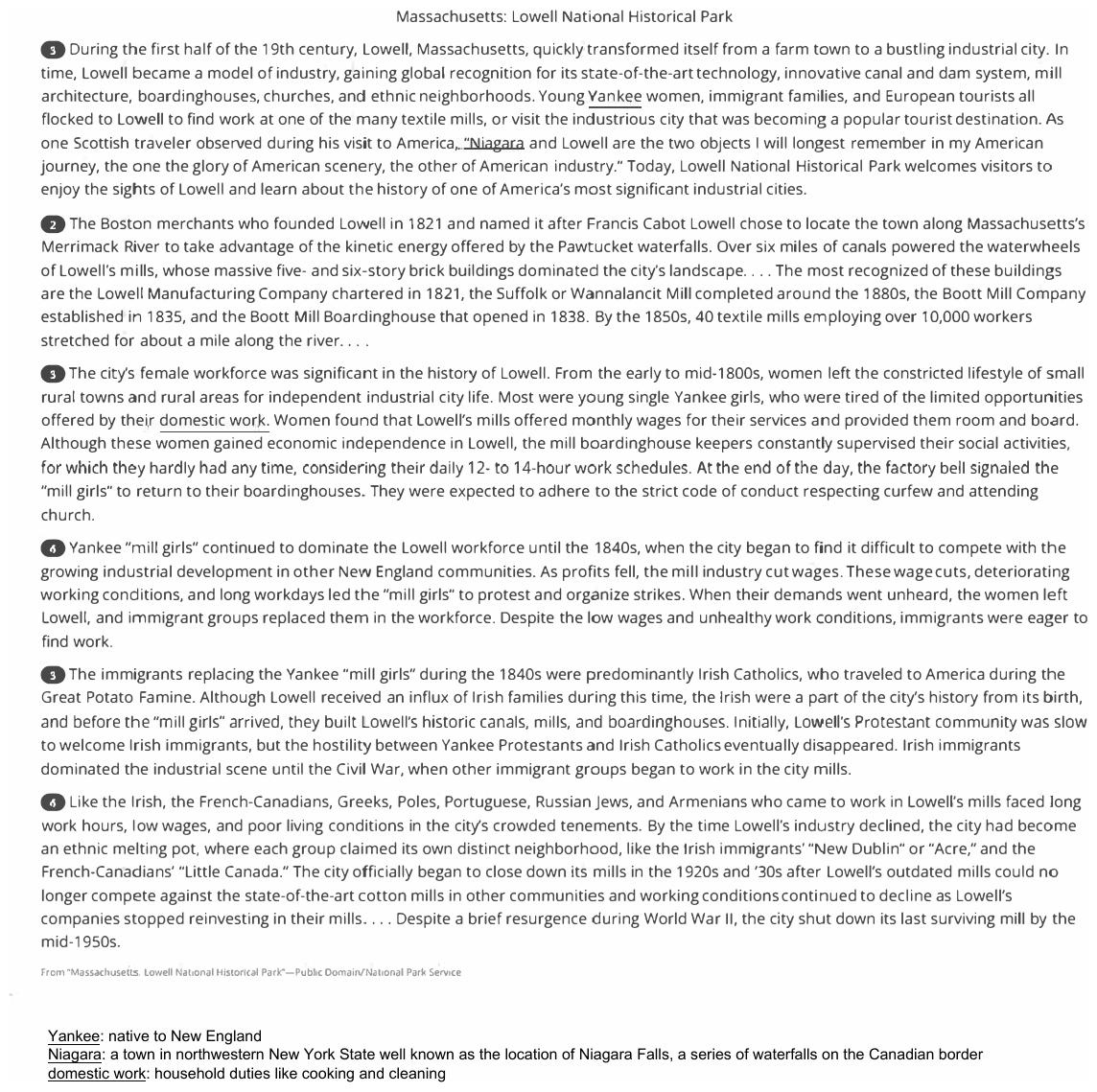
The city’s female workforce was significant in the history of Lowell. From the early to mid-1800s, women left the constricted lifestyle of small rural towns and rural areas for independent industrial city life. Most were young single Yankee girls, who were tired of the limited opportunities offered by their domestic work. Women found that Lowell’s mills offered monthly wages for their services and provided them room and board. Although these women gained economic independence in Lowell, the mill boardinghouse keepers constantly supervised their social activities, for which they hardly had any time, considering their daily 12- to 14-hour work schedules. At the end of the day, the factory bell signaled the “mill girls” to return to their boardinghouses. They were expected to adhere to the strict code of conduct respecting curfew and attending church.
Yankee “mill girls” continued to dominate the Lowell workforce until the 1840s, when the city began to find it difficult to compete with the growing industrial development in other New England communities. As profits fell, the mill industry cut wages. These wage cuts, deteriorating working conditions, and long workdays led the “mill girls” to protest and organize strikes. When their demands went unheard, the women left Lowell, and immigrant groups replaced them in the workforce. Despite the low wages and unhealthy work conditions, immigrants were eager to find work.
The immigrants replacing the Yankee “mill girls” during the 1840s were predominantly Irish Catholics, who traveled to America during the Great Potato Famine. Although Lowell received an influx of Irish families during this time, the Irish were a part of the city’s history from its birth, and before the “mill girls” arrived, they built Lowell’s historic canals, mills, and boardinghouses. Initially, Lowell’s Protestant community was slow to welcome Irish immigrants, but the hostility between Yankee Protestants and Irish Catholics eventually disappeared. Irish immigrants dominated the industrial scene until the Civil War, when other immigrant groups began to work in the city mills.
Like the Irish, the French-Canadians, Greeks, Poles, Portuguese, Russian Jews, and Armenians who came to work in Lowell’s mills faced long work hours, low wages, and poor living conditions in the city’s crowded tenements. By the time Lowell’s industry declined, the city had become an ethnic melting pot, where each group claimed its own distinct neighborhood, like the Irish immigrants’ “New Dublin” or “Acre,” and the French-Canadians’ “Little Canada.” The city officially began to close down its mills in the 1920s and ’30s after Lowell’s outdated mills could no longer compete against the state-of-the-art cotton mills in other communities and working conditions continued to decline as Lowell’s companies stopped reinvesting in their mills. . . . Despite a brief resurgence during World War II, the city shut down its last surviving mill by the mid-1950s.
From “Massachusetts: Lowell National Historical Park”—Public Domain/National Park Service
Yankee: native to New England
Niagara: a town in northwestern New York State well known as the location of Niagara Falls, a series of waterfalls on the Canadian border
domestic work: household duties like cooking and cleaning
Question
A central idea that Lowell was “one of America’s most significant industrial cities” (paragraph 1) is conveyed in the passage primarily through a description of the
- Acanals, mills, and boardinghouses that were built by immigrants.
- Bmill girls and immigrants who comprised Lowell’s workforce.
- Cdevelopment of the mills and the workforce established to support them.
- Dcultural diversity of the people who lived in the area.
Show the answer
Correct answer: C
The question asks which description conveys the central idea that Lowell was “one of America’s most significant industrial cities” (paragraph 1).
A. Incorrect. While the passage does state that the city’s canals, mills, and boardinghouses were built by early immigrants from Ireland, these details do not contribute to the development of the overall idea that Lowell was a significant industrial city.
B. Incorrect. The details about the women and immigrants who worked in the mills are important to the passage, but these details alone do not show that Lowell was a significant industrial city.
C. CORRECT. The details throughout the passage about the development of the mills and the people who worked in them convey the significance of Lowell in early American industry. Paragraph 2 shares details about the businesses that started in the 1800s and contributed to the development of industry in the region (“The most recognized of these buildings are the Lowell Manufacturing Company chartered in 1821, the Suffolk or Wannalancit Mill completed around the 1880s, the Boott Mill Company established in 1835, and the Boott Mill Boardinghouse that opened in 1838”). Then paragraphs 3–6 provide specific details about the people who worked in the mills at different points in time.
D. Incorrect. Although the passage references Lowell’s culturally diverse community (“Young Yankee women, immigrant families, and European tourists all flocked to Lowell to find work at one of the many textile mills” [paragraph 1]), these groups alone are not what marked Lowell as a significant industrial city.
Question analysis
This central idea question asks which kind of description in an article about the Massachusetts mill city of Lowell does most to show that it was one of America's most significant industrial cities. Students need a map of all six paragraphs, because every choice names something the passage really describes, and the question turns on which description does the main work.
- Grade level
- Grade 8 reading and task
- Compared with grade 7
- Above grade 7 Grade 7 students trace how a central idea is developed, usually through a few supporting details. Here the strands to weigh run through six dense paragraphs of dates, mills and worker groups, and the stem is long and passive, so it asks more than typical.
- Estimated difficulty
- Hard: combines ideas, needs a plan, and has more than one tempting wrong answer.
- Thinking it demands
- Depth of knowledge 3, strategic thinking · mainly analyze
- What makes it hard
- A very close wrong answer major
- Evidence in several places moderate
- A lot to read minor
- Complex sentences minor
- Evidence
- Answered from the whole text
- Reading level
- Passage: about grade 15, 764 words; question and choices: about grade 10, 63 words.
- Corrected from the DOE handbook
- A grammatical error in the explanation was corrected.
- An inaccurate detail in the explanation was corrected.
- Students, last 30 days
- Not enough answers yet to show (it takes 10).
Why it is hard, traps and wrong answers (shows the answer)
Why it is hard
Every choice names something the passage really describes, so truth rules nothing out; the question turns on which description carries the claim that Lowell mattered as an industrial city. Because four of the six paragraphs follow the workers, the workforce alone looks like the passage's main thread, and students who forget paragraph 2's mills take the half for the whole. Diversity and the immigrant builders are real themes too, but neither says anything about Lowell's industrial standing.
A very close wrong answer major Choosing the answer
The workforce choice is the key with one half removed: both describe the people who worked the mills, but only the key also names the development of the mills, which paragraph 2 builds with dates and numbers. (Embretson & Wetzel, 1987; Gorin & Embretson, 2006; Ascalon et al., 2007)
Evidence in several places moderate Working it out
The industrial picture is built in two stages, the canals and mills of paragraph 2 and the successive workforces of paragraphs 3 to 6, so each choice must be measured against the whole passage. (Kirsch & Mosenthal, 1990; Gorin & Embretson, 2006)
A lot to read minor Understanding the question
Six paragraphs pack in mill names, dates from 1821 to the 1950s and a string of worker groups, from Yankee mill girls to Irish, French-Canadian and Greek immigrants. (Kintsch, 1998; Gorin & Embretson, 2006; Freedle & Kostin, 1993)
Complex sentences minor Understanding the question
The stem is a long passive sentence that quotes paragraph 1 inside it and holds the real question, “primarily through a description of the,” until its last words. (Abedi & Lord, 2001; Freedle & Kostin, 1993; Messick, 1989)
Strategy: Note in a phrase what each of the six paragraphs is about, then test each choice against the stem's claim: would that description make a reader see Lowell as a major industrial city?
Traps
- Too narrow: A single detail offered as the central idea or a summary, or a summary that keeps minor details and leaves out an essential part.
- True but not the answer: A choice says something accurate about the text that does not answer this question.
The wrong answers, classified
A Too narrow (King et al., 2004)
Seizes on paragraph 5's clause that Irish workers built the canals, mills and boardinghouses, one fact about construction rather than the account of mills and workers that shows Lowell's importance.
B Too narrow (King et al., 2004)
Sees that paragraphs 3 to 6 follow the mill girls and the immigrants who replaced them, but leaves out the mills themselves, the heart of paragraph 2's industrial picture.
D True but not the answer (King et al., 2004; Embretson & Wetzel, 1987)
Recalls paragraph 6's “ethnic melting pot” and paragraph 1's “ethnic neighborhoods,” which are real, but the city's diversity says nothing about its standing as an industrial city.
What was corrected from the DOE handbook, and why
- Explanation: The handbook’s explanation of Option B says “The details about the women and immigrants who worked in the mills is important to the passage.” The subject is “details,” so the site now says “are important.”
- Explanation: The handbook’s explanation of Option C says paragraph 2 describes “the businesses that started in the early 1800s,” but the sentence it then quotes includes “the Suffolk or Wannalancit Mill completed around the 1880s,” late in the century. The site now says “the businesses that started in the 1800s.”
Working it out, step by step
Figure out what the question asks
This is a central idea question. A central idea is a main point that the whole passage builds. The point here is that Lowell was “one of America’s most significant industrial cities.” Significant means important. You need the description that does the most to show this.
Map the six paragraphs
- Paragraph 1: Lowell grows from a farm town into a famous industrial city.
- Paragraph 2: The mills: canals, huge brick buildings, mills started across the 1800s, and by the 1850s, “40 textile mills employing over 10,000 workers.”
- Paragraphs 3 and 4: The Yankee “mill girls” who worked in the mills.
- Paragraphs 5 and 6: The Irish and other immigrants who took their place.
See how the picture is built
The passage shows Lowell’s importance in two parts. First it describes the mills: how they were built and how big they grew. Then it follows the workers who ran them, group after group. Together, the mills and the workforce show a major industrial city. Workforce means all the people who do the work. Either part alone tells only half the story.
Check each choice
- A is wrong. Paragraph 5 does say the Irish built the canals, mills and boardinghouses. But that is one fact in one sentence, not the main description.
- B is wrong. The mill girls and immigrants fill paragraphs 3 to 6. But this choice leaves out the mills themselves, the heart of paragraph 2.
- C is right. It covers both parts: how the mills grew and the workers who kept them running.
- D is wrong. Lowell did become an “ethnic melting pot.” But a mix of cultures doesn’t show that a city was an industrial leader.
Watch out: Four of the six paragraphs are about workers, so B looks like the main thread. It is only half of it.
Choose the answer
The central idea is carried by the growth of the mills plus the workforce gathered to run them. So the answer is C.
Why this answer and not the closest wrong one
B is the closest wrong answer. It matches the second half of C, the people who worked in the mills. But it drops the mills, with their six miles of canals and, by the 1850s, 40 mills. Workers alone don’t make a city an industrial giant. C keeps both halves, so it fits the whole passage.
More questions like this
The original DOE question
The passage “Massachusetts: Lowell National Historical Park” as printed (page 50)
Question 4 of 6
2018 Test A Math, question 54Question
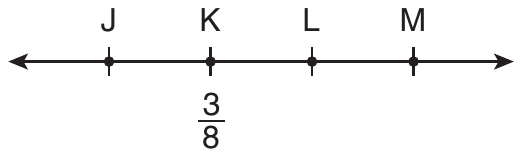
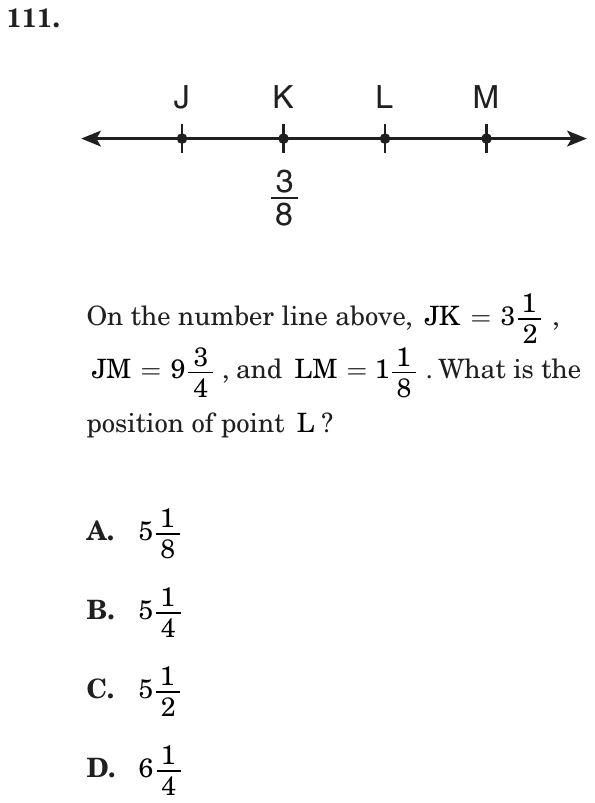
On the number line above, , , and . What is the position of point ?
- A
- B
- C
- D
Show the answer
Correct answer: C
First, use to find the location of :
Now, use to find the location of :
Finally, use to find the location of :
Question analysis
This number line question gives the lengths JK, JM and LM as mixed numbers and asks for the position of point L. Students must chain three distance steps, moving left from K to J, right to M and back to L, with fractions in eighths and a negative position. Losing track of where K sits is the main danger.
- Grade level
- Grade 7 content, by NYS standard
- Compared with grade 7
- Above grade 7 Grade 7 students add and subtract rational numbers and find distances on a number line one at a time. This item chains three such steps with mixed numbers and a negative position, more than typical grade 7 work demands.
- Estimated difficulty
- Among the hardest on the SHSAT: a non-obvious approach, heavy reading, or a well-hidden trap.
- Thinking it demands
- Depth of knowledge 2, skills and concepts · mainly apply
- What makes it hard
- A very close wrong answer major
- Error-prone arithmetic moderate
- Reading a figure, table or graph moderate
- Many steps minor
- Solution
- 4 steps
- Reading level
- Question and choices: about grade 9, 20 words.
- Students, last 30 days
- Not enough answers yet to show (it takes 10).
Why it is hard, traps and wrong answers (shows the answer)
Why it is hard
Every number is a mixed fraction, one position is negative, and the figure's even spacing hides how long KL really is. The distance route, KL = 9 3/4 − 3 1/2 − 1 1/8, avoids the negative entirely but ends one step short of a position unless K's 3/8 is added back. That last step is the one most students skip, which is why the question sits at the top of the scale.
A very close wrong answer major Choosing the answer
The choices 5 1/8, 5 1/4 and 5 1/2 lie within 3/8 of one another, so no estimate separates them; only exact eighths and adding K's 3/8 pick out the right one. (Embretson & Wetzel, 1987; Gorin & Embretson, 2006; Ascalon et al., 2007)
Error-prone arithmetic moderate Working it out
Every step mixes halves, quarters and eighths, and placing J means 3/8 − 3 1/2 = −3 1/8, a subtraction that crosses zero. (Brown & Burton, 1978; Junker & Sijtsma, 2001)
Reading a figure, table or graph moderate Understanding the question
Only K is labeled, and the points are drawn evenly spaced although KL is over four times LM, so the picture gives no help with sizes. (Lesh, Post & Behr, 1987; Kirsch & Mosenthal, 1990)
Many steps minor Working it out
Three linked moves, K to J, J to M and M back to L, each depend on the last, so an early slip carries through. (Daniel & Embretson, 2010; Enright, Morley & Sheehan, 2002)
Strategy: Start from K's labeled position, subtract JK to place J, add JM to place M, then subtract LM, keeping every fraction in eighths.
Traps
- Answers a different question: A choice is right for another quantity: the other unknown, the rest instead of the part, the part instead of the whole.
- Stops one step early: A choice is a number from partway through the solution.
The wrong answers, classified
A Stops one step early (King et al., 2004; Gierl et al., 2017)
Finds KL = 9 3/4 − 3 1/2 − 1 1/8 = 5 1/8 and stops one step short, never adding K's position of 3/8.
B An arithmetic slip (Junker & Sijtsma, 2001)
Rewrites 9 3/4 as 9 4/8 instead of 9 6/8, so M lands at 6 3/8 and L at 6 3/8 − 1 1/8 = 5 1/4.
D Answers a different question (King et al., 2004; Hegarty, Mayer & Monk, 1995)
Finds KM = 9 3/4 − 3 1/2 = 6 1/4, the distance from K to M, and gives it without moving back 1 1/8 to L.
Worked solution, step by step
Formulas used
- Distance on a number line
- d is the distance between two points. b is the point on the right and a is the point on the left. Subtracting left from right always gives a positive distance. It works even when a is negative.
- Equal fractions
- a is the top number (numerator) and b is the bottom number (denominator). Multiplying both by the same number k gives an equal fraction. It is like cutting each piece into k smaller pieces. Use it to give fractions the same bottom before you add or subtract.
Sort out what you know
Only K has a value: . JK means the distance from J to K. You know JK = , JM = and LM = .
You need the position of L, the number where L sits. The points are drawn evenly spaced, but the distances are not equal. So use the numbers, not the picture.
Write the fractions in eighths
The fractions use halves, fourths and eighths. Give them all a bottom of 8:
Watch out: is , not . That slip leads to choice B.
Find the distance from K to M
JM is JK and KM put together. So take JK away from JM:
KM is , or . Watch out: this is a distance, not where L sits. Choice D stops here.
Find the distance from K to L
KM is KL and LM put together. So take LM away:
KL is . Watch out: this is still a distance. Choice A stops here.
Find the position of L
L is to the right of K, and K is at . Add:
So the answer is C, .
Check your answer
Place every point. J is left of K, at . M is right of J, at . L is left of M, at , which is . Same answer.
More questions like this
The original DOE question
Question 5 of 6
2024 Test A Math, question 16Question
A truck rental company charges a one-time fee of $40 plus $1 per mile driven. Dalia rented a truck and used a coupon for 20% off the total rental cost. After the coupon was applied, she spent a total of $60. How many miles did she drive?
- A8
- B20
- C32
- D35
Show the answer
Correct answer: D
Let m equal the miles driven during Dalia’s rental. The total cost, c, can be expressed as an equation.
Dalia spent a total of $60, which included a 20% off coupon. Find the cost before the coupon by dividing the final cost ($60) by the percentage paid (80%):
Use $75 as the total cost to find m.
Dalia drove 35 miles.
Question analysis
A multistep word problem about a truck rental that costs a $40 fee plus $1 per mile, with a 20% off coupon applied to the total. Given that Dalia paid $60 after the coupon, students find how many miles she drove. Undoing the discount correctly before removing the fixed fee is the hard part.
- Grade level
- Grade 7 content, by NYS standard
- Compared with grade 7
- Above grade 7 Grade 7 students solve two-step equations and work with discounts, usually separately. This combines them and makes students undo a 20% discount starting from the price paid, a reversal many grade 7 students have not practised.
- Estimated difficulty
- Hard: combines ideas, needs a plan, and has more than one tempting wrong answer.
- Thinking it demands
- Depth of knowledge 2, skills and concepts · mainly apply
- What makes it hard
- Turning words into math moderate
- Combines ideas moderate
- A very close wrong answer moderate
- Solution
- 3 steps
- Reading level
- Question and choices: about grade 5, 43 words.
- Students, last 30 days
- Not enough answers yet to show (it takes 10).
Why it is hard, traps and wrong answers (shows the answer)
Why it is hard
Two ordinary skills, undoing a discount and solving a two-step equation, are stacked, and the first runs in reverse. The natural way to undo 20% off is to add 20% back, which gives $72 instead of $75 and a choice three miles from the answer. Students who check by applying the coupon to the full cost of 40 + 35 = 75 dollars see at once that 80% of it is 60.
Turning words into math moderate Understanding the question
The sentence "After the coupon was applied, she spent a total of $60" makes 60 the price after 20% off, so it is 80% of the full cost, 40 + m. (Hegarty, Mayer & Monk, 1995; Koedinger & Nathan, 2004)
Combines ideas moderate Working it out
A percent discount has to be undone before the fee-plus-mileage equation can be solved: 60 ÷ 0.8 = 75, then 75 − 40 = 35 miles. (Embretson, 1998; Daniel & Embretson, 2010)
A very close wrong answer moderate Choosing the answer
The choices 32 and 35 are three miles apart, too close to tell apart by estimate; only dividing 60 by 0.8, rather than adding 20% of 60, separates them. (Embretson & Wetzel, 1987; Gorin & Embretson, 2006; Ascalon et al., 2007)
Strategy: Since $60 is 80% of the full cost, divide 60 by 0.80 to find the cost before the coupon, then subtract the $40 fee to get the miles.
Traps
- Percent of the wrong amount: Finding the whole from a part, or a percent change measured from the wrong starting amount.
- Misreads the question: Misses or misreads a condition or a word in the question: "at least", "each", "remaining", "not".
The wrong answers, classified
A Wrong operation (Hegarty, Mayer & Monk, 1995; King et al., 2004)
Takes 20% off the $60 again, 60 × 0.8 = 48, instead of undoing the discount, then subtracts the $40 fee to get 8 miles.
B Misreads the question (Hegarty, Mayer & Monk, 1995)
Ignores the coupon and treats the $60 as the full cost, so it subtracts the $40 fee and gets 20 miles.
C Percent of the wrong amount (Parker & Leinhardt, 1995)
Undoes the coupon by adding 20% of $60 to get $72, though the 20% was taken of the larger pre-coupon cost, then subtracts the $40 fee.
Worked solution, step by step
Formulas used
- Rental cost
- c is the full cost in dollars, before any coupon. 40 is the one-time fee, paid once no matter how far you drive. m is the number of miles, and each mile costs 1 dollar.
- Price after a discount
- The full cost is the price before the discount. p is the percent taken off. You pay what is left: 100% minus p%. For 20% off you pay 80%, so you multiply by 0.80.
Sort out the question
The truck costs a $40 fee, plus $1 for each mile. Dalia’s coupon took 20% off the total. After the coupon, she paid $60. You need how many miles she drove. The $60 is the price after the discount, not the full cost.
Write what she paid
20% off means she paid what was left of the full cost.
As a decimal, 80% is 0.80.
Undo the discount
To undo times 0.80, divide by 0.80. Move the decimal point one place in both numbers to make it easier.
The full cost was $75. Watch out: the 20% was taken off the full cost, not off $60. Adding 20% of $60 gives $72 and leads to 32 miles, choice C. Taking 20% off $60 again leads to 8 miles, choice A.
Find the miles
She drove 35 miles. Watch out: do not skip the coupon. Using $60 as the full cost gives 20 miles, choice B. So the answer is D, 35.
Check your answer
Go forward. 35 miles cost $35. Add the $40 fee to get $75. The coupon takes off 20% of $75, which is dollars. Then . That is exactly what she paid.
More questions like this
The original DOE question
Question 6 of 6
2018 Test A Math, question 5Question
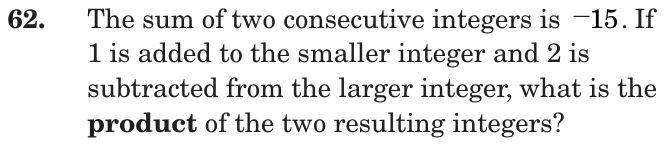
The sum of two consecutive integers is −15. If 1 is added to the smaller integer and 2 is subtracted from the larger integer, what is the product of the two resulting integers?
Grid-in question: work out the answer and enter it as a number.
Show the answer
Correct answer: 63
If x is the smaller consecutive integer, then
is the larger consecutive integer. Use their sum (−15) to find x:
The two consecutive integers are −8 and −7. One is added to the smaller integer:
and 2 is subtracted from the larger integer:
Find the product:
Question analysis
A grid-in problem about two consecutive integers whose sum is −15. Students find the two integers, add 1 to the smaller and subtract 2 from the larger, then multiply the results. Deciding which negative integer is the smaller one, and keeping signs straight through every step, are what make it tricky.
- Grade level
- Grade 7 content, by NYS standard
- Compared with grade 7
- Above grade 7 A typical grade 7 task solves one two-step equation or multiplies signed numbers. This links both: set up a consecutive-integer equation, solve it with negatives, adjust each integer, and multiply, with no choices to check against.
- Estimated difficulty
- Hard: combines ideas, needs a plan, and has more than one tempting wrong answer.
- Thinking it demands
- Depth of knowledge 2, skills and concepts · mainly apply
- What makes it hard
- Error-prone arithmetic moderate
- Turning words into math moderate
- Many steps moderate
- Solution
- 4 steps
- Reading level
- Question and choices: about grade 9, 30 words.
- Students, last 30 days
- Not enough answers yet to show (it takes 10).
Why it is hard, traps and wrong answers (shows the answer)
Why it is hard
Every step is routine, yet the question collects most of the ways students lose points with negatives. The crucial judgment is which of −8 and −7 is the smaller; a student who picks −7 still produces a tidy, wrong product. Gridding the product of the original pair, or giving a negative product, are the other usual losses. Writing each intermediate pair down, rather than holding them in mind, protects against all three.
Error-prone arithmetic moderate Working it out
Every number in play is negative: −8 and −7, then −7 and −9, and a product of two negatives that must come out positive. (Brown & Burton, 1978; Junker & Sijtsma, 2001)
Turning words into math moderate Understanding the question
"1 is added to the smaller integer and 2 is subtracted from the larger" depends on knowing that −8, not −7, is the smaller, since it lies farther below zero. (Hegarty, Mayer & Monk, 1995; Koedinger & Nathan, 2004)
Many steps moderate Working it out
Four linked steps: set up x + (x + 1) = −15, solve for x, adjust each integer, then multiply; an error early in the chain carries through to the product. (Daniel & Embretson, 2010; Enright, Morley & Sheehan, 2002)
Strategy: Halve the sum to see which two integers sit on either side of it, remember that the smaller negative is farther from zero, then adjust each and multiply.
Traps
- Negatives and direction: Arithmetic with negative numbers, the order of a subtraction, or direction on a number line. (Moving a term across the equals sign without changing its sign is a faulty procedure.)
- Misreads the question: Misses or misreads a condition or a word in the question: "at least", "each", "remaining", "not".
The wrong answers, classified
60 Negatives and direction (Brown & Burton, 1978)
Takes −7 as the smaller integer because 7 is less than 8, so adjusts to −7 + 1 = −6 and −8 − 2 = −10, and multiplies to 60.
56 Misreads the question (Hegarty, Mayer & Monk, 1995)
Finds −8 and −7 and multiplies them to get 56, skipping the sentence that adds 1 to one integer and subtracts 2 from the other.
-63 Negatives and direction (Brown & Burton, 1978)
Finds the adjusted integers −7 and −9 correctly but gives their product a negative sign, gridding −63.
Worked solution, step by step
Formulas used
- Consecutive integers
- Integers are whole numbers and their opposites, like −2, −1, 0, 1 and 2. Consecutive integers come one right after another. If n is the smaller one, the next one is n + 1, because each step up the number line adds 1.
- Multiplying two negative numbers
- a and b are positive numbers, so −a and −b are negative. When you multiply two negative numbers, the answer is positive. The two minus signs cancel out.
Sort out the question
Two consecutive integers add up to −15. Integers are whole numbers and their negatives. Consecutive means one comes right after the other, like 4 and 5. You need to do three things:
- Find the two integers.
- Add 1 to the smaller one. Subtract 2 from the larger one.
- Find the product of the two new numbers. The product is the answer when you multiply.
Find the two integers
Call the smaller integer n. Then the larger one is n + 1. Their sum is −15.
Subtract 1 from both sides. Then divide both sides by 2.
So the integers are −8 and −7.
Decide which one is smaller
On a number line, −8 is to the left of −7. Numbers to the left are smaller. So −8 is the smaller integer, and −7 is the larger one. Watch out: 8 is bigger than 7, but −8 is smaller than −7. Mixing them up gives −6 and −10, and the wrong answer 60.
Change each integer
Add 1 to the smaller integer.
Subtract 2 from the larger integer.
The two new numbers are −7 and −9.
Multiply the new numbers
Both numbers are negative, so their product is positive.
Watch out: the answer is not −63, because two negatives make a positive. Also, don’t multiply the first pair, −8 and −7. That gives 56 and skips the changes. So you would grid 63.
Check your answer
Check the pair: , and they are one apart. Half of −15 is −7.5, and −8 and −7 sit on either side of it. Then , and the sign is positive.
More questions like this
The original DOE question