Overlapping groups
Question 1 of 13
2026 Practice Test B Math, question 2Question
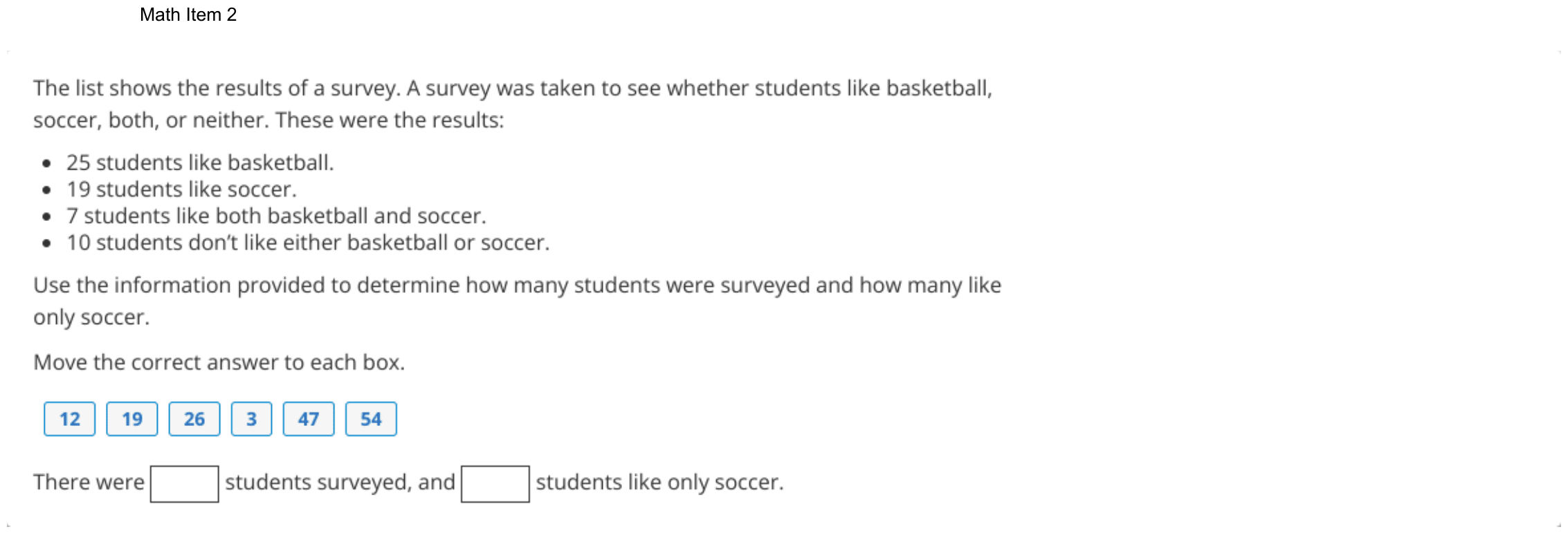
The list shows the results of a survey. A survey was taken to see whether students like basketball, soccer, both, or neither. These were the results:
- 25 students like basketball.
- 19 students like soccer.
- 7 students like both basketball and soccer.
- 10 students don’t like either basketball or soccer.
Use the information provided to determine how many students were surveyed and how many like only soccer.
Move the correct answer to each box.
There were students surveyed, and students like only soccer.
On the test you drag tiles into the boxes; here, choose each box’s tile from its menu. Each tile can be used once. The DOE has not published how answers with several parts are scored; this site counts one right only when every part is right.
Show the answer
Correct answer: blank 1: 47; blank 2: 12
There were 47 students surveyed, and 12 students like only soccer.
To determine how many students were surveyed, start with the total number of students who like basketball and soccer separately and subtract the number of students who were counted twice.
There were 25 students who like basketball, 19 students who like soccer, and 7 students who like both basketball and soccer.
So, the total number of students who like basketball or soccer is .
Then, add the students who don’t like either basketball or soccer: 10 students don’t like either sport.
Total students surveyed:
To determine how many students like only soccer, subtract the number of students who like both basketball and soccer from the total number of students who like soccer.
Students who like only soccer:
Question analysis
This survey problem lists how many students like basketball, soccer, both sports or neither, and students drag number tiles into two boxes: how many were surveyed and how many like only soccer. It is a Venn diagram counting question. Keeping track of the students who like both sports, who appear in two of the listed counts, is the tricky part.
- NYS standards
- 7.SP.8b sample spaces for compound events
- Grade level
- Grade 7 content, by NYS standard
- Compared with grade 7
- At grade 7 Overlapping groups like these are seldom taught on their own in grade 7, though the arithmetic is simple whole-number addition and subtraction. Two results come from the same four facts, and both boxes must be right to score.
- Estimated difficulty
- Moderate: several steps, or a close reading with one strong distractor.
- Thinking it demands
- Depth of knowledge 2, skills and concepts · mainly apply
- What makes it hard
- Much to keep track of moderate
- Turning words into math minor
- Solution
- 4 steps
- Reading level
- Question and choices: about grade 6, 78 words.
- Students, last 30 days
- Not enough answers yet to show (it takes 10).
Why it is hard, traps and wrong answers (shows the answer)
Why it is hard
The arithmetic is light; the work is keeping track of one overlap that touches both answers. Students often remove the 7 for one box and not the other, and the pool holds 54 and 19, the tiles those half-finished methods produce. A sketch of two overlapping circles, with 7 in the middle, 18 and 12 beside it and 10 outside, turns both boxes into reading off the picture.
Much to keep track of moderate Working it out
The 7 students who like both sports sit inside the 25 and inside the 19, so they come out once for the total and again for only soccer, and both boxes must be right to score. (Sweller, 1988; Carpenter, Just & Shell, 1990)
Turning words into math minor Understanding the question
The list never says that the 25 basketball fans already include the 7 who like both sports, and only the word “only” in the question separates the 12 from all 19 soccer fans. (Hegarty, Mayer & Monk, 1995; Koedinger & Nathan, 2004)
Strategy: Sketch two overlapping circles, write the students who like both sports in the middle, fill each outer part by subtraction, then add every region and the students who like neither.
Traps
- Overlapping groups: Things in two groups at once are counted twice, or not subtracted.
- Misreads the question: Misses or misreads a condition or a word in the question: "at least", "each", "remaining", "not".
The wrong answers, classified
FA Overlapping groups (King et al., 2004)
Adds 25 + 19 + 10 = 54 for the total, counting the 7 fans of both sports twice, yet takes them out of the soccer fans correctly to get 12.
EB Misreads the question (Hegarty, Mayer & Monk, 1995)
Removes the overlap correctly to find the 47 surveyed, then fills the second box with all 19 soccer fans, overlooking “only” and the 7 of them who also like basketball.
FB Overlapping groups (King et al., 2004)
Ignores the line about the 7 who like both sports, adding 25 + 19 + 10 = 54 and copying the 19 soccer fans straight from the list.
Worked solution, step by step
Formulas used
- Counting two groups that overlap
- B is the number who like basketball, and S is the number who like soccer. The students who like both are inside B and inside S, so B + S counts them twice. Subtract them once to fix that. Then add the students who like neither sport, since they are in neither group.
- Only one group
- S is everyone who likes soccer, and both is the number who like both sports. Only soccer means the soccer fans who do not also like basketball. Take the both group out of the soccer group to find them.
Sort out the question
The survey gives you four facts:
- 25 students like basketball.
- 19 students like soccer.
- 7 students like both sports.
- 10 students like neither sport.
You need two numbers. The first box is how many students were surveyed in all. The second box is how many like only soccer, which means soccer but not basketball. Each tile can be used once.
See who is counted twice
The 7 students who like both sports are part of the 25 basketball fans. They are also part of the 19 soccer fans. So if you add 25 and 19, those 7 students get counted two times.
A Venn diagram shows this. It is a picture of two circles that overlap. The 7 go in the middle, where the circles share space.
Count who likes at least one sport
Use the overlap rule. Add the two groups, then take away the 7 who were counted twice:
So 37 students like basketball, soccer or both.
Add the students who like neither
The 10 students who like neither sport are not in either group. They were still surveyed, so add them:
So 47 students were surveyed.
Watch out: adding 25 + 19 + 10 = 54 counts the 7 students twice. The tile 54 is waiting for that mistake.
Find who likes only soccer
The 19 soccer fans include the 7 who like basketball too. Take those 7 away:
So 12 students like only soccer.
Watch out: the word only matters. The tile 19 counts every soccer fan, not just the ones who like only soccer.
Fill in both boxes
On the test, you drag the tile 47 into the first box and the tile 12 into the second box. On this site, you choose each tile from its box’s menu.
So the boxes get 47 and 12: there were 47 students surveyed, and 12 students like only soccer.
Check your answer
Split the students into four groups that do not overlap. Only basketball is . Both sports is 7. Only soccer is 12. Neither is 10. Add the four groups: . That matches the first box.
More questions like this
The original DOE question
Question 2 of 13
2026 Practice Test B Math, question 31Question
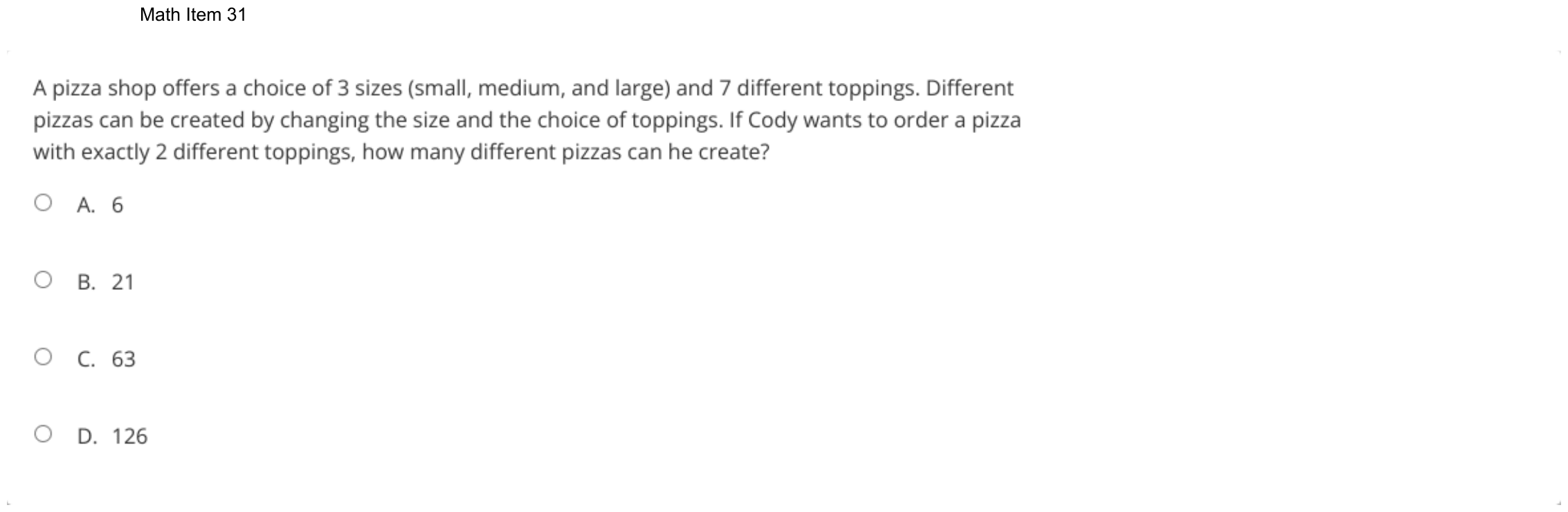
A pizza shop offers a choice of 3 sizes (small, medium, and large) and 7 different toppings. Different pizzas can be created by changing the size and the choice of toppings. If Cody wants to order a pizza with exactly 2 different toppings, how many different pizzas can he create?
- A6
- B21
- C63
- D126
Show the answer
Correct answer: C
Figure out how many different topping pairs are possible. Use 1, 2, 3, 4, 5, 6, 7 to represent the toppings, and create a list of possible pairs:
1,2; 1,3; 1,4; 1,5; 1,6; 1,7
2,3; 2,4; 2,5; 2,6; 2,7
3,4; 3,5; 3,6; 3,7
4,5; 4,6; 4,7
5,6; 5,7
6,7
So there are 21 different topping combinations for one pizza.
Since there are 3 pizza sizes, multiply the total number of combinations by 3 to get the total number of different pizzas Cody can create: .
Question analysis
Cody orders a pizza with exactly 2 of 7 toppings in one of 3 sizes, and students count how many different pizzas he could create. It tests counting combinations, where the order of the toppings does not matter, combined with a second choice. The challenge is to count every possible pizza exactly once.
- NYS standards
- 7.SP.8b sample spaces for compound events
- Grade level
- Grade 7 content, by NYS standard
- Compared with grade 7
- Above grade 7 In grade 7, compound events are usually ordered pairs, such as a coin with a number cube. Here an unordered pair of toppings is chosen from seven and then matched with three sizes, a combination count beyond typical grade 7 work.
- Estimated difficulty
- Hard: combines ideas, needs a plan, and has more than one tempting wrong answer.
- Thinking it demands
- Depth of knowledge 2, skills and concepts · mainly apply
- What makes it hard
- Combines ideas moderate
- Something you must already know minor
- Solution
- 3 steps
- Reading level
- Question and choices: about grade 8, 47 words.
- Students, last 30 days
- Not enough answers yet to show (it takes 10).
Why it is hard, traps and wrong answers (shows the answer)
Why it is hard
The question packs two counts into one sentence, each with its own trap. Order does not matter among the toppings, while the size multiplies every pair, and students tend to remember one of these and forget the other. Listing pairs systematically, each topping matched only with later ones, keeps the first count honest, and the stem’s “changing the size and the choice of toppings” is the reminder that size counts too.
Combines ideas moderate Working it out
Two counts are joined: the unordered pairs of toppings from 7, then the 3 sizes each pair can come in, and a mistake in either count changes the total. (Embretson, 1998; Daniel & Embretson, 2010)
Something you must already know minor Working it out
Students must know that a pizza with mushroom and onion is the same as one with onion and mushroom, so the ordered count 7 × 6 has to be halved. (Anderson & Krathwohl, 2001)
Strategy: Number the toppings 1 to 7, list each pair once by matching every topping only with higher-numbered ones, count the list, then bring in the choice of size.
Traps
- Stops one step early: A choice is a number from partway through the solution.
- Overlapping groups: Things in two groups at once are counted twice, or not subtracted.
The wrong answers, classified
A Numbers taken from the question (Hegarty, Mayer & Monk, 1995)
Multiplies the 3 sizes by the 2 toppings Cody wants, using the number of toppings on the pizza instead of the number of possible pairs.
B Stops one step early (King et al., 2004; Gierl et al., 2017)
Lists or counts the 21 pairs of toppings correctly, then stops without giving each pair its 3 possible sizes.
D Overlapping groups (King et al., 2004)
Counts ordered pairs, 7 × 6 = 42, so each pair of toppings appears twice, and then multiplies by the 3 sizes to reach 126.
Worked solution, step by step
Formulas used
- The counting principle
- m is the number of ways to make one choice, and n is the number of ways to make a second choice. Every first choice can go with every second choice, so you multiply. Here, every pair of toppings can come in every size.
- Pairs when order does not matter
- n is the number of items to choose from. There are n ways to pick a first item and n − 1 ways to pick a different second one. That counts each pair twice, once in each order. Dividing by 2 counts each pair once.
Sort out the question
Each of Cody’s pizzas has one size and exactly 2 different toppings. There are 3 sizes and 7 toppings. Pizzas differ by “changing the size and the choice of toppings.” So a small and a large with the same toppings are two different pizzas. You need to count every pizza once.
List the topping pairs
Order does not matter: onion with peppers is the same pizza as peppers with onion. So number the toppings 1 to 7, and pair each one only with bigger numbers. Then no pair shows up twice.
Topping Pairs with Pairs 1 2, 3, 4, 5, 6, 7 6 2 3, 4, 5, 6, 7 5 3 4, 5, 6, 7 4 4 5, 6, 7 3 5 6, 7 2 6 7 1 There are 21 different pairs of toppings.
Check the pairs with the formula
Use the pairs formula with 7 toppings:
Watch out: 7 × 6 = 42 counts every pair twice, once as 1 then 2 and once as 2 then 1. Keeping 42 leads to , choice D.
Bring in the sizes
Each of the 21 topping pairs can come in any of the 3 sizes. Use the counting principle:
Watch out: stopping at 21 leaves out the sizes, which gives choice B. Choice A, 6, multiplies the 3 sizes by the 2 toppings on one pizza. That does not count pizzas.
Give the answer
There are 21 topping pairs, and each one comes in 3 sizes. Cody can create 63 different pizzas. So the answer is C, 63.
Check your answer
Count one size at a time. A small pizza can have any of the 21 pairs, so there are 21 small pizzas. There are also 21 medium and 21 large ones: . That is more than the 21 pairs but fewer than 126, so it is reasonable.
More questions like this
The original DOE question
Question 3 of 13
2026 Practice Test D Math, question 17Question
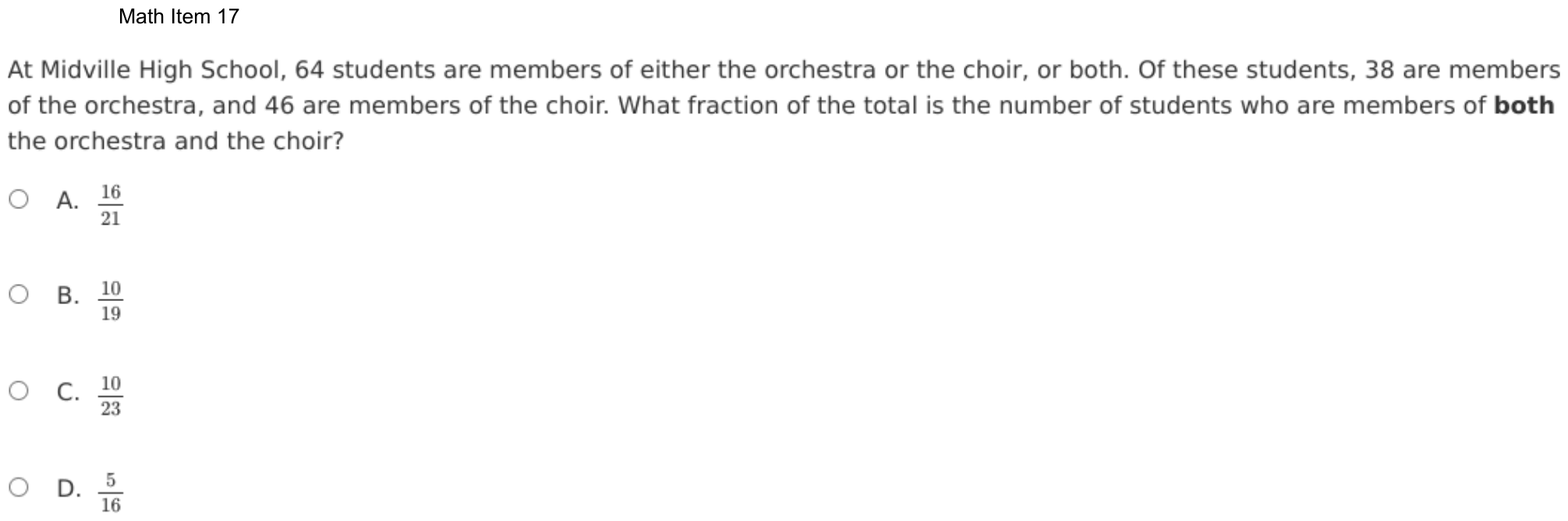
At Midville High School, 64 students are members of either the orchestra or the choir, or both. Of these students, 38 are members of the orchestra, and 46 are members of the choir. What fraction of the total is the number of students who are members of both the orchestra and the choir?
- A
- B
- C
- D
Show the answer
Correct answer: D
First, add the number of students that are members of the orchestra and the number of students that are members of the choir.
Then, subtract to find the number of students that are members of both orchestra and choir.
Then, find the fraction of the 64 students that are members of both orchestra and choir.
Question analysis
At Midville High School, 64 students belong to the orchestra, the choir or both; 38 are in the orchestra and 46 in the choir. Students find what fraction of the 64 belong to both groups. It is a Venn diagram counting question with a fraction, and the students in both groups are included in each membership number.
- Grade level
- Grade 7 content, by NYS standard
- Compared with grade 7
- At grade 7 Overlapping groups are seldom taught directly in grade 7, though the arithmetic is whole-number addition and subtraction. Students must first find the overlap and then choose the right whole for the fraction, two decisions where errors are common.
- Estimated difficulty
- Moderate: several steps, or a close reading with one strong distractor.
- Thinking it demands
- Depth of knowledge 2, skills and concepts · mainly apply
- What makes it hard
- Turning words into math moderate
- No obvious method minor
- An answer in an unexpected form minor
- Solution
- 3 steps
- Reading level
- Question and choices: about grade 5, 54 words.
- Corrected from the DOE handbook
- A misstatement in the explanation’s first step was corrected.
- Students, last 30 days
- Not enough answers yet to show (it takes 10).
Why it is hard, traps and wrong answers (shows the answer)
Why it is hard
The question hides its key number: the students in both groups appear only as the amount by which 38 + 46 overshoots 64. A sketch of two overlapping circles, with 20 in the middle, 18 in orchestra only and 26 in choir only, shows the whole group at once. After that, the remaining risk is the denominator, since the question asks for a fraction of all 64 students, not of one group.
Turning words into math moderate Understanding the question
“Either the orchestra or the choir, or both” means the 64 counts each student once, while 38 + 46 counts the students in both groups twice; the overlap itself is never stated. (Hegarty, Mayer & Monk, 1995; Koedinger & Nathan, 2004)
No obvious method minor Working it out
Nothing names the step that finds the overlap: the excess of 38 + 46 = 84 over 64 is the number in both groups, an idea students must bring themselves. (Schoenfeld, 1985)
An answer in an unexpected form minor Choosing the answer
The fraction 20/64 appears only in lowest terms, so it must be simplified by 4 before it can be matched with a choice. (Enright, Morley & Sheehan, 2002)
Strategy: Add the orchestra and choir counts, subtract the 64 students to find how many were counted twice, then put that number over the total and simplify.
Traps
- Answers a different question: A choice is right for another quantity: the other unknown, the rest instead of the part, the part instead of the whole.
- Overlapping groups: Things in two groups at once are counted twice, or not subtracted.
The wrong answers, classified
A Overlapping groups (King et al., 2004)
Takes 38 + 46 = 84 as the number of students, counting those in both groups twice, and puts the stated 64 over it to get 16/21.
B Answers a different question (King et al., 2004; Hegarty, Mayer & Monk, 1995)
Finds the 20 students in both groups but compares them with the 38 orchestra members instead of all 64 students, so 20/38 = 10/19.
C Answers a different question (King et al., 2004; Hegarty, Mayer & Monk, 1995)
Finds the 20 students in both groups but divides by the 46 choir members, using one group as the whole instead of all 64, so 20/46 = 10/23.
What was corrected from the DOE handbook, and why
- Explanation: The DOE’s explanation begins “First, add the number of students that are members of both orchestra and choir. 38 + 46 = 84.” But 38 is the number of orchestra members and 46 the number of choir members; the number of students in both is what the next step finds (84 − 64 = 20). The site now says “First, add the number of students that are members of the orchestra and the number of students that are members of the choir.”
Worked solution, step by step
Formulas used
- Counting two groups that overlap
- O is the number in the orchestra, and C is the number in the choir. Students in both groups are counted in O and again in C. Subtracting them once makes each student count one time. Here every student is in at least one group, so this gives everyone.
- Fraction of a total
- The part is the group you are asked about. The whole is the full group it comes from. Here the part is the students in both groups, and the whole is all 64 students. Simplify by dividing the top and bottom by the same number.
Sort out the question
There are 64 students in all. Each one is in the orchestra, the choir or both. 38 are in the orchestra, and 46 are in the choir. Some students are in both, but the question does not say how many. You need that number as a fraction of all 64 students.
Add the two groups
Add the number in the orchestra and the number in the choir:
That is more than the 64 students there are. Why? A student in both groups is counted once with the orchestra and once more with the choir.
Find the students in both
The extra amount over 64 is the students who were counted twice:
So 20 students are in both groups. This is the overlap rule turned around: both = O + C − total.
Watch out: 84 is not the number of students. Putting 64 over 84 gives 16/21, choice A.
Write the fraction and simplify
The part is 20 students, and the whole is all 64 students. Both numbers divide by 4:
Watch out: the whole is all 64 students, not one group. Using 38 gives 10/19, choice B. Using 46 gives 10/23, choice C.
So the answer is D, .
Check your answer
Split the 64 students into three groups that do not overlap. Only orchestra: 38 − 20 = 18. Only choir: 46 − 20 = 26. Both: 20. Add them: 18 + 26 + 20 = 64. That matches the total, so 20 is right.
More questions like this
The original DOE question
Question 4 of 13
2026 Practice Test D Math, question 35Question
XYZ Corporation hired 6 people as summer workers. Of these 6 people, 3 will be hired as permanent employees in the fall. If 2 of the 6 people are male, how many of the possible groups of 3 people hired in the fall will include only 1 male?
- A4
- B6
- C12
- D24
Show the answer
Correct answer: C
An organized list can be used to determine the number of groups of 3 people that include only 1 male.
Let the letters A, B, C, and D represent the females, and let the numbers 1 and 2 represent the males.
Then, create a list of all possible combinations of 3 people with only 1 male.
AB1, AB2, AC1, AC2, AD1, AD2
BC1, BC2, BD1, BD2
CD1, CD2
There are 12 possible groups with only 1 male.
Question analysis
A company hired 6 summer workers, 2 of them male, and will keep 3 as permanent employees in the fall. This counting question asks how many possible groups of 3 include only 1 male. Students count combinations where order does not matter, and the bold word only, with two kinds of workers to combine, makes careful listing essential.
- NYS standards
- 7.SP.8b sample spaces for compound events
- Grade level
- Grade 7 content, by NYS standard
- Compared with grade 7
- Above grade 7 Grade 7 students list outcomes with organized lists and tree diagrams, usually ordered ones. Counting unordered groups of three under an "only one" condition, built from two kinds of people, goes beyond that typical work.
- Estimated difficulty
- Hard: combines ideas, needs a plan, and has more than one tempting wrong answer.
- Thinking it demands
- Depth of knowledge 2, skills and concepts · mainly apply
- What makes it hard
- Combines ideas moderate
- Something you must already know minor
- Turning words into math minor
- Solution
- 3 steps
- Reading level
- Question and choices: about grade 7, 41 words.
- Students, last 30 days
- Not enough answers yet to show (it takes 10).
Why it is hard, traps and wrong answers (shows the answer)
Why it is hard
The question hides a two-stage count in a hiring story. Students tend to get one stage right and forget the other: they count the pairs of women and stop, or they count ordered picks and so find every group twice. Naming the women A to D and the men 1 and 2, then listing the pairs of women alphabetically with each man attached, makes every group visible and checkable.
Combines ideas moderate Working it out
Two counts are joined: the 6 ways to pick 2 of the 4 women, then the 2 ways to pick the man, and the total is their product. (Embretson, 1998; Daniel & Embretson, 2010)
Something you must already know minor Working it out
Students must already know that a group is the same whichever order its members are named, so picking one woman and then another repeats the reverse pick. (Anderson & Krathwohl, 2001)
Turning words into math minor Understanding the question
The bold word only means exactly one man, so the other two places in each group of 3 must go to two of the 4 women, a step the stem leaves unsaid. (Hegarty, Mayer & Monk, 1995; Koedinger & Nathan, 2004)
Strategy: Name the women A to D and the men 1 and 2, list every pair of women without repeats, then attach each man to each pair and count the groups.
Traps
- Stops one step early: A choice is a number from partway through the solution.
- Overlapping groups: Things in two groups at once are counted twice, or not subtracted.
The wrong answers, classified
A Numbers taken from the question (Hegarty, Mayer & Monk, 1995)
Multiplies the 2 men by the 2 places left for women, 2 × 2 = 4, using numbers from the question without listing a single group.
B Stops one step early (King et al., 2004; Gierl et al., 2017)
Counts the 6 pairs of women correctly but stops before pairing each one with either of the 2 men, which doubles the count.
D Overlapping groups (King et al., 2004)
Counts ordered picks of the two women, 4 × 3 = 12 instead of 6, so each group appears twice, then doubles for the men to reach 24.
Worked solution, step by step
Formulas used
- Counting with two choices
- Each way of picking the man can go with each way of picking the two women. So you multiply the two counts. It is like outfits: 2 shirts with 6 pairs of pants make 12 outfits.
Sort out the question
Six people work for the summer. Two are male, so the other 4 are female. Three will be hired in the fall.
You need the number of groups of 3 with only 1 male. That means exactly 1 man and 2 women. In a group, order does not matter. Ann, Bea and Carl is the same group as Carl, Ann and Bea.
Give each person a name
Call the women A, B, C and D. Call the men 1 and 2. Every group you want has 2 letters and 1 number, like AB1.
List the pairs of women
List each pair once. Start with A, then pair B only with letters after it, and so on:
- AB, AC, AD
- BC, BD
- CD
That is 6 pairs. BA is not new, since it is the same pair as AB.
Watch out: counting the order gives pairs, each one twice. Then doubling for the men gives 24, choice D.
Add a man to each pair
Each pair of women can go with man 1 or man 2. Use the counting rule:
Watch out: stopping at the 6 pairs of women leaves out the men. That gives 6, choice B.
So the answer is C, 12.
Check your answer
Write out every group. With man 1: AB1, AC1, AD1, BC1, BD1, CD1. With man 2: AB2, AC2, AD2, BC2, BD2, CD2. Each list has 6 groups, and . No group repeats, and each has just one man.
More questions like this
The original DOE question
Question 5 of 13
2024 Test B Math, question 2Question
Two number cubes have sides labeled 1 through 6. Both number cubes are rolled. How many different outcomes will have a sum of 6?
Grid-in question: work out the answer and enter it as a number.
Show the answer
Correct answer: 5
There will be 5 different outcomes with a sum of 6:
Question analysis
A counting grid-in with two number cubes, each numbered 1 to 6, rolled together. Students count how many different outcomes give a sum of 6. The catch is deciding whether a 2 on the first cube with a 4 on the second counts as a different outcome from the reverse.
- NYS standards
- 7.SP.8b sample spaces for compound events
- Grade level
- Grade 7 content, by NYS standard
- Compared with grade 7
- At grade 7 Grade 7 students list sample spaces for two number cubes when finding compound probabilities. This asks for one count from that list, a short task, though as a grid-in it offers no choices to expose an incomplete list.
- Estimated difficulty
- Moderate: several steps, or a close reading with one strong distractor.
- Thinking it demands
- Depth of knowledge 2, skills and concepts · mainly apply
- What makes it hard
- Solution
- 2 steps
- Reading level
- Question and choices: about grade 3, 21 words.
- Students, last 30 days
- Not enough answers yet to show (it takes 10).
Why it is hard, traps and wrong answers (shows the answer)
Why it is hard
The arithmetic is trivial; the question turns on what counts as a different outcome. Treating the cubes as a first and a second settles it: the first cube runs from 1 to 5 and the second is forced each time. Students who think in pairs of numbers rather than in rolls of two cubes undercount, and those who double every pair overcount by one at the double 3 and 3.
Something you must already know moderate Working it out
Nothing in the stem says that a 2 on the first cube with a 4 on the second differs from the reverse; students must already know that two cubes give 36 ordered outcomes. (Anderson & Krathwohl, 2001)
An answer in an unexpected form minor Choosing the answer
As a grid-in it offers no list of counts to compare, so a student who counts unordered pairs gets no sign that ordered outcomes were wanted. (Enright, Morley & Sheehan, 2002)
Strategy: Treat the cubes as a first and a second cube, run the first cube's value from 1 to 6, and for each value check whether the second cube can complete the sum.
Traps
- Misunderstands the concept: A wrong belief about a concept: that percents can be added, that area grows like length, that averages can be averaged, that a bigger denominator means a bigger fraction.
- Overlapping groups: Things in two groups at once are counted twice, or not subtracted.
The wrong answers, classified
3 Misunderstands the concept (Smith, diSessa & Roschelle, 1993; De Bock et al., 1998; Ni & Zhou, 2005)
Counts unordered pairs, 1 and 5, 2 and 4, 3 and 3, treating a 1 on the first cube with a 5 on the second as the same outcome as the reverse.
6 Overlapping groups (King et al., 2004)
Knows order matters and doubles the 3 pairs to 6, but 3 and 3 reads the same both ways, so that outcome is counted twice.
36 Answers a different question (King et al., 2004; Hegarty, Mayer & Monk, 1995)
Grids the total number of outcomes for two cubes, 6 × 6 = 36, instead of only the outcomes whose sum is 6.
Worked solution, step by step
Formulas used
- Counting principle
- a is the number of ways the first cube can land, and b is the number of ways the second cube can land. Multiply them to count every pair. It works because each face of the first cube can go with each face of the second.
Sort out the question
You roll two number cubes. Each one shows 1, 2, 3, 4, 5 or 6. An outcome is one way the two cubes can land. You need the number of outcomes whose sum (the two numbers added) is 6.
The question does not say if order matters. The answer key counts the cubes as a first cube and a second cube. So 1 on the first and 5 on the second is a different outcome from 5 on the first and 1 on the second.
See why order counts
Picture a red cube and a blue cube. Red 1 with blue 5 is not the same roll as red 5 with blue 1. Both can happen, so both count.
This is how all the outcomes of two cubes are counted. Use the counting principle.
Watch out: 36 is every outcome, not just the ones that add up to 6.List the pairs that make 6
Go through the first cube one number at a time. The second cube has to make up the rest of the 6.
First cube Second cube Sum 1 5 6 2 4 6 3 3 6 4 2 6 5 1 6 The first cube cannot show 6. Then the second cube would need 0, and no face shows 0.
Count the outcomes
The table has 5 rows, so there are 5 outcomes. Watch out: counting 1 and 5 as the same as 5 and 1 gives only 3. Watch out: 3 and 3 is one outcome, not two. Doubling 3 pairs to get 6 counts it twice.
So you would grid 5.
Check your answer
Each number from 1 to 5 on the first cube goes with exactly one number on the second cube. A 6 on the first cube goes with nothing. So there are exactly 5 outcomes. The table shows the same pattern: as the first number goes up by 1, the second goes down by 1.
More questions like this
The original DOE question
Question 6 of 13
2023 Test A Math, question 32Question
Mei-Ling is one of 6 members of a committee. If 2 members of that committee are selected to go to a conference, how many of the possible pairs of members would include Mei-Ling?
- A5
- B6
- C10
- D12
Show the answer
Correct answer: A
Call the 6 members A, B, C, D, E, and M (for Mei-Ling). The possible combinations are AB, AC, AD, AE, AM, BC, BD, BE, BM, CD, CE, CM, DE, DM, and EM. Of those pairs, 5 include Mei-Ling.
Question analysis
This counting question describes a six-member committee sending two members to a conference and asks how many of the possible pairs include Mei-Ling. Students count combinations in which order does not matter. The traps are counting a pair twice, pairing Mei-Ling with herself, or multiplying the numbers in the question instead of listing the pairs.
- NYS standards
- 7.SP.8b sample spaces for compound events
- Grade level
- Grade 7 content, by NYS standard
- Compared with grade 7
- At grade 7 Grade 7 students count outcomes with organized lists and tree diagrams. Here the list of pairs is short and a single condition, that one named person belongs to the pair, filters it, which matches routine grade 7 counting work.
- Estimated difficulty
- Straightforward: two steps or one careful reading.
- Thinking it demands
- Depth of knowledge 2, skills and concepts · mainly apply
- What makes it hard
- Turning words into math minor
- Much to keep track of minor
- Solution
- 2 steps
- Reading level
- Question and choices: about grade 8, 31 words.
- Students, last 30 days
- Not enough answers yet to show (it takes 10).
Why it is hard, traps and wrong answers (shows the answer)
Why it is hard
The count is small enough to list, so the question rewards a clear picture of what a pair is: two different people, in no particular order. The tempting errors count Mei-Ling as her own partner, count each pair twice, or multiply the two numbers in the stem. Writing the five pairs out, M with each of A through E, takes seconds and rules out all three.
Turning words into math minor Understanding the question
Pairs that include Mei-Ling are simply Mei-Ling with each of the other 5 members, a count of her possible partners, though the phrase “possible pairs” invites counting all 15 pairs. (Hegarty, Mayer & Monk, 1995; Koedinger & Nathan, 2004)
Much to keep track of minor Working it out
Listing pairs by letter, as the explanation does with A to E and M, means tracking which pairs are already written, so that AM and MA are not both counted. (Sweller, 1988; Carpenter, Just & Shell, 1990)
Strategy: Label the members with letters and list every pair that contains Mei-Ling, remembering that a pair is two different people and that order does not matter.
Traps
- Counting the ends: Inclusive or exclusive ends, fence posts, consecutive numbers: an answer that is one too many or too few, or an endpoint drawn open where it belongs closed (or the reverse).
- Overlapping groups: Things in two groups at once are counted twice, or not subtracted.
- Numbers taken from the question: Combines the numbers in the question without a model of the situation, or is simply a number that appears in the question.
The wrong answers, classified
B Counting the ends (Brown & Burton, 1978)
Counts all 6 committee members as possible partners, forgetting that Mei-Ling cannot be paired with herself, one more than the real count.
C Overlapping groups (King et al., 2004)
Counts ordered pairs, Mei-Ling with a partner and that partner with Mei-Ling, as different, so each of the 5 pairs is counted twice.
D Numbers taken from the question (Hegarty, Mayer & Monk, 1995)
Multiplies the 6 members by the 2 people chosen, 6 × 2 = 12, a product of the stem's numbers that counts no actual pairs.
Worked solution, step by step
Formulas used
- Number of pairs in a group
- n is the number of people in the group. Each person can pair up with the n − 1 others. Multiplying counts every pair twice, once from each partner’s side. So you divide by 2.
Sort out the question
The committee has 6 members, and Mei-Ling is one of them. Two members go to the conference together. That makes a pair. You don’t need every possible pair. You only need the pairs that include Mei-Ling.
Find Mei-Ling’s possible partners
A pair with Mei-Ling is Mei-Ling plus one other member. Call Mei-Ling M, and call the other members A, B, C, D and E. Her pairs are M with A, M with B, M with C, M with D and M with E. That is 5 pairs.
Watch out: she can’t be paired with herself. Counting all 6 members as partners gives 6, choice B.
Don’t count a pair twice
Mei-Ling with A is the same pair as A with Mei-Ling. The same two people go either way. Watch out: counting both orders doubles the count to 10, choice C. Multiplying 6 × 2 = 12 gives choice D, but that does not count any pairs.
Check against all the pairs
Count every pair in the committee.
Each pair has 2 people, so the 15 pairs have 30 name spots. All 6 members get the same share: . So the answer is A, 5.
Check your answer
List all 15 pairs: AB, AC, AD, AE, AM, BC, BD, BE, BM, CD, CE, CM, DE, DM, EM. Now circle the ones with M in them: AM, BM, CM, DM, EM. There are exactly 5.
More questions like this
The original DOE question
Question 7 of 13
2023 Test B Math, question 36Question
The side length of square S is shorter than the side length of square T by 1 centimeter. The area of square S is 9 square centimeters. What is the difference, in square centimeters, between the area of square T and the area of square S?
- A3
- B7
- C8
- D10
Show the answer
Correct answer: B
Let x represent the side length of square T, in centimeters. Then the side length of square S is .
The area of square S is:
So the side length of square T is 4 cm, and the area of square T is 16 sq cm.
The difference between the areas, in square centimeters, is .
Question analysis
Two squares differ in side length by 1 centimeter, and the smaller one has an area of 9 square centimeters. Students find how much greater the larger square's area is. It tests the link between a square's side and its area, and the extra area is easy to miscount when picturing the border that the longer sides add.
- Grade level
- Grade 6 content, by NYS standard
- Compared with grade 7
- Below grade 7 The area of a square and recognizing 9 as a perfect square are grade 6 ideas. This takes three short steps with small whole numbers, lighter than grade 7 work on composite figures, though the first step runs backward from area to side.
- Estimated difficulty
- Straightforward: two steps or one careful reading.
- Thinking it demands
- Depth of knowledge 2, skills and concepts · mainly apply
- What makes it hard
- Many steps minor
- Turning words into math minor
- Solution
- 3 steps
- Reading level
- Question and choices: about grade 6, 44 words.
- Students, last 30 days
- Not enough answers yet to show (it takes 10).
Why it is hard, traps and wrong answers (shows the answer)
Why it is hard
Every number is small, so the work is keeping track of which quantity the question wants: a difference of areas, not a side or a single area. The added area forms an L-shaped strip around square S, and students who picture it as two strips 4 centimeters long count the corner square twice. Finding both areas, 9 and 16, and subtracting avoids reasoning about the strip at all.
Many steps minor Working it out
The work runs from area to side and back: the square root of 9 gives S’s side, adding 1 gives T’s, squaring gives 16, and subtracting gives the difference. (Daniel & Embretson, 2010; Enright, Morley & Sheehan, 2002)
Turning words into math minor Understanding the question
The phrase “shorter than the side length of square T by 1 centimeter” describes S from T’s point of view, so T’s side is S’s side plus 1, not minus 1. (Hegarty, Mayer & Monk, 1995; Koedinger & Nathan, 2004)
Strategy: Find the side of square S from its area, add 1 centimeter to get the side of square T, find that square's area, and subtract the smaller area from the larger.
Traps
- Overlapping groups: Things in two groups at once are counted twice, or not subtracted.
- Answers a different question: A choice is right for another quantity: the other unknown, the rest instead of the part, the part instead of the whole.
- Numbers taken from the question: Combines the numbers in the question without a model of the situation, or is simply a number that appears in the question.
The wrong answers, classified
A Answers a different question (King et al., 2004; Hegarty, Mayer & Monk, 1995)
Finds the side of square S, 3 centimeters, from its area of 9 and gives that length instead of a difference between two areas.
C Overlapping groups (King et al., 2004)
Pictures the added area as two 4-by-1 strips along two sides of square S, 8 in all, counting the 1-by-1 corner where they overlap twice.
D Numbers taken from the question (Hegarty, Mayer & Monk, 1995)
Adds the stem’s two numbers, 9 + 1 = 10, as if a side 1 centimeter longer made the area 1 square centimeter larger, and gives that area.
Worked solution, step by step
Formulas used
- Area of a square
- A is the area, the space inside the square, in square units. s is the length of one side. All four sides of a square are equal, so the area is the side times itself. To go backward from an area, find the number that times itself gives the area.
Sort out the two squares
Square S has an area of 9 square centimeters. Its side is 1 centimeter shorter than the side of square T. You need the area of square T minus the area of square S, in square centimeters.
Find the side of square S
Use the area formula backward. Which number times itself makes 9?
So each side of square S is 3 centimeters. This number is called the square root of 9.
Find the side of square T
Square T’s side is 1 centimeter longer than square S’s side.
Each side of square T is 4 centimeters.
Find the area of square T
Use the area formula with a side of 4 centimeters.
The area of square T is 16 square centimeters.
Subtract the areas
Take the smaller area away from the larger one.
The difference is 7 square centimeters.
Watch out: Picturing the new area as two strips, each 4 by 1, gives 8, choice C. But those strips share a 1-by-1 corner, so it gets counted twice. Also, 3 is a side length, not a difference of areas. That is choice A.
So the answer is B, 7 square centimeters.
Check your answer
Draw square T and mark square S in one corner. The extra space is an L shape. It is a 3-by-1 strip, another 3-by-1 strip and a 1-by-1 corner. That is 3 + 3 + 1 = 7 square centimeters. It matches.
More questions like this
The original DOE question
Question 8 of 13
2023 Test B Math, question 50Question
A student made a list of all possible products of 2 different numbers in the set above. What fraction of the products are odd?
- A
- B
- C
- D
Show the answer
Correct answer: B
First, list the products:
Of the 10 products, 3 are odd. The fraction is .
Question analysis
A student lists every product of two different numbers from the set 3, 4, 5, 6, 7. Students find what fraction of those products are odd. It tests listing outcomes systematically without counting a pair twice, and reasoning about odd and even numbers.
- NYS standards
- Grade level
- Grade 7 content, by NYS standard
- Compared with grade 7
- At grade 7 Organized lists of outcomes are grade 7 work. Here students list the products of pairs from five numbers, without repeating a pair or pairing a number with itself, then count the ones that fit.
- Estimated difficulty
- Moderate: several steps, or a close reading with one strong distractor.
- Thinking it demands
- Depth of knowledge 2, skills and concepts · mainly apply
- What makes it hard
- Much to keep track of moderate
- Something you must already know minor
- Solution
- 3 steps
- Reading level
- Question and choices: about grade 6, 28 words.
- Students, last 30 days
- Not enough answers yet to show (it takes 10).
Why it is hard, traps and wrong answers (shows the answer)
Why it is hard
The count of odd products is easy, since only 3, 5 and 7 can make one; the total is where students go wrong. Counting ordered pairs, 5 × 4 = 20, while listing odd products once mixes two kinds of counting. Writing the 10 pairs in order, 3 with each larger number, then 4, and so on, keeps the total honest.
Much to keep track of moderate Working it out
Listing the products of 2 different numbers from five means tracking 10 pairs, with no pair repeated in reverse order and no number paired with itself. (Sweller, 1988; Carpenter, Just & Shell, 1990)
Something you must already know minor Working it out
The shortcut, that a product is odd only when both factors are odd, cuts the work to counting pairs from 3, 5 and 7, but it must be known. (Anderson & Krathwohl, 2001)
Strategy: List each pair of different numbers once, then find each product, or use the fact that a product is odd only when both factors are odd, and count.
Traps
- Overlapping groups: Things in two groups at once are counted twice, or not subtracted.
- Misunderstands the concept: A wrong belief about a concept: that percents can be added, that area grows like length, that averages can be averaged, that a bigger denominator means a bigger fraction.
- Answers a different question: A choice is right for another quantity: the other unknown, the rest instead of the part, the part instead of the whole.
The wrong answers, classified
A Overlapping groups (King et al., 2004)
Counts ordered pairs for the total, 5 × 4 = 20, so each pair appears twice, but counts the odd products once, 3, giving 3/20.
C Misunderstands the concept (Smith, diSessa & Roschelle, 1993; De Bock et al., 1998; Ni & Zhou, 2005)
Assumes about half of all products are odd, as odd and even numbers come equally often, without listing the products or checking any.
D Answers a different question (King et al., 2004; Hegarty, Mayer & Monk, 1995)
Gives the share of the numbers in the set that are odd, 3 of 5, instead of the share of the products, never forming any products.
Worked solution, step by step
Formulas used
- Fraction of a list
- The top counts the products that are odd. The bottom counts all the products in the list. A product is the answer when you multiply. The fraction tells what share of the list is odd.
- Odd times odd
- An odd number can’t be split into pairs, like 3 or 7. An even number can, like 4. A product is odd only when both numbers are odd. If either number is even, the product is even, because it splits into pairs.
Sort out the question
The set has 3, 4, 5, 6 and 7. The student multiplies 2 different numbers, every possible way. A product is the answer to a multiplication. Each pair counts once, since 3 × 4 and 4 × 3 give the same product. You need the fraction of the products that are odd.
List every pair once
Pair 3 with each bigger number. Then pair 4 with each bigger number, and so on. This way no pair is counted twice.
3 × 4 = 12 3 × 5 = 15 3 × 6 = 18 3 × 7 = 21 4 × 5 = 20 4 × 6 = 24 4 × 7 = 28 5 × 6 = 30 5 × 7 = 35 6 × 7 = 42 There are 10 products.
Count the odd products
The odd products are 15, 21 and 35. That makes 3. They come from the only pairs where both numbers are odd: 3 and 5, 3 and 7, and 5 and 7.
Write the fraction
Use the fraction formula.
Watch out: Counting 4 × 3 as well as 3 × 4 makes 20 pairs. Then , choice A, mixes two ways of counting. And , choice D, is the share of the numbers that are odd, not the products.
So the answer is B, .
Check your answer
Count without listing. Each of the 5 numbers can pair with 4 others, which makes 20. But that counts every pair twice, so there are 20 ÷ 2 = 10 pairs. Only the odd numbers 3, 5 and 7 make odd products, and they form 3 pairs.
More questions like this
The original DOE question
Question 9 of 13
2023 Test B Math, question 53Question
Micha is playing a game with five cards numbered 1 through 5. He will place the cards in a bag and draw one card at random three times, replacing the card each time. To win a prize, he must draw the number 5 all three times. What is the probability he will draw the number 5 all three times?
- A
- B
- C
- D
Show the answer
Correct answer: A
Each time Micha draws a card, the probability of drawing the number 5 is . To find the probability of drawing the number 5 three times, multiply:
Question analysis
Micha draws a card three times from five cards numbered 1 to 5, putting the card back each time, and wins only if he draws a 5 every time. Students find the probability that he wins. It tests the probability of independent events, where the chances for the separate draws have to be combined correctly.
- NYS standards
- Grade level
- Grade 7 content, by NYS standard
- Compared with grade 7
- At grade 7 Finding the probability of a compound event is a grade 7 standard, and repeated draws with replacement are a standard case. Three equal factors make this a short, typical grade 7 task.
- Estimated difficulty
- Straightforward: two steps or one careful reading.
- Thinking it demands
- Depth of knowledge 2, skills and concepts · mainly apply
- What makes it hard
- Solution
- 2 steps
- Reading level
- Question and choices: about grade 3, 59 words.
- Students, last 30 days
- Not enough answers yet to show (it takes 10).
Why it is hard, traps and wrong answers (shows the answer)
Why it is hard
With replacement each draw is the same 1 in 5, so the work is one product, 1/5 × 1/5 × 1/5. The wrong choices mark three ways to mishandle repetition: adding the chances, multiplying 5 by 3 instead of cubing it, and multiplying by 3 for the three draws. A quick sense check helps, since needing three 5s in a row must be far less likely than needing one.
Something you must already know minor Working it out
The rule that the chance of independent events all happening is the product of their chances is assumed, as is that replacing the card keeps each draw at 1/5. (Anderson & Krathwohl, 2001)
Strategy: Find the probability of drawing a 5 on one draw, then, because the card goes back each time, multiply that probability by itself once for each draw.
Traps
- Wrong operation: Adds instead of multiplying, divides the wrong way round, turns a ratio or rate upside down, or undoes a step in the wrong direction (subtracts what should be added back).
- A faulty procedure: A systematic but wrong procedure: adding fractions straight across, applying an exponent to each term of a sum, dropping a sign when moving a term.
- Overlapping groups: Things in two groups at once are counted twice, or not subtracted.
The wrong answers, classified
B Overlapping groups (King et al., 2004)
Finds 1/125 for three 5s, then multiplies by 3 for the three draws, counting the single outcome 5, 5, 5 as if it could happen in three orders.
C A faulty procedure (Brown & Burton, 1978; Tatsuoka, 1983)
Multiplies 5 by 3 instead of raising it to the third power, so the denominator becomes 15 rather than 5 × 5 × 5 = 125.
D Wrong operation (Hegarty, Mayer & Monk, 1995; King et al., 2004)
Adds the three probabilities, 1/5 + 1/5 + 1/5 = 3/5, as if drawing a 5 on any one draw were enough to win.
Worked solution, step by step
Formulas used
- Probability
- P is the probability, the chance something happens. It is a number from 0 to 1. The top counts the results you want. The bottom counts all the results that can happen. It works when every result is equally likely.
- Chance of events in a row
- A, B and C are events, things that might happen, like drawing a 5. When they do not change each other’s chances, the chance that all of them happen is the product of their chances. Putting each card back keeps the draws from changing each other.
Sort out the question
The bag has 5 cards, numbered 1 to 5. Micha draws a card three times. He puts it back each time, so every draw starts with all 5 cards. He wins only if he draws a 5 all three times. You need the probability, or chance, of that.
Find the chance for one draw
One card out of 5 is a 5. Use the probability formula.
Each draw has a 1 in 5 chance of being a 5.
Multiply for three draws
He needs a 5 on the first draw, and the second, and the third. The card goes back each time, so the draws don’t change each other. Use the rule for events in a row.
Give the answer
Watch out: Adding the chances gives , choice D. That would make winning likely, which makes no sense. Multiplying 5 × 3 instead of 5 × 5 × 5 gives , choice C.
So the answer is A, .
Check your answer
Count all the results. Each draw has 5 possible cards, so three draws have 5 × 5 × 5 = 125 possible orders. Only one of them is 5, 5, 5. That gives 1 out of 125. Needing three 5s should also be much less likely than needing one.
More questions like this
The original DOE question
Question 10 of 13
2019 Test B Math, question 47Question
A company wants to study 6 brands of soap by comparing each brand with every other brand. If each comparison costs $2,000, how much will the company spend altogether?
- A$13,000
- B$20,000
- C$30,000
- D$60,000
Show the answer
Correct answer: C
First, find the number of comparisons. Let A, B, C, D, E, and F represent the 6 brands of soap. Then the comparisons are AB, AC, AD, AE, AF, BC, BD, BE, BF, CD, CE, CF, DE, DF, and EF. So, there are 15 comparisons. Multiply to find the total cost:
Question analysis
A company will compare each of 6 soap brands with every other brand, at $2,000 per comparison, and students find the total cost. This counting question tests listing combinations of two and then using the count. With six brands, the list is long enough that a pair is easily missed or counted twice.
- NYS standards
- 7.SP.8b sample spaces for compound events
- Grade level
- Grade 7 content, by NYS standard
- Compared with grade 7
- At grade 7 Grade 7 students count outcomes with organized lists. Counting every pair among six brands is that skill, with the extra demand that each pair be counted once whichever brand comes first, followed by one multiplication.
- Estimated difficulty
- Moderate: several steps, or a close reading with one strong distractor.
- Thinking it demands
- Depth of knowledge 2, skills and concepts · mainly apply
- What makes it hard
- Turning words into math moderate
- Much to keep track of minor
- Solution
- 3 steps
- Reading level
- Question and choices: about grade 9, 27 words.
- Students, last 30 days
- Not enough answers yet to show (it takes 10).
Why it is hard, traps and wrong answers (shows the answer)
Why it is hard
The cost step is trivial, so the question is about counting comparisons. The multiplication 6 × 5 feels natural but counts every pair twice, and a listing that starts one short, with 4 partners for the first brand, gives the count for five brands. Halving 6 × 5, or adding 5 + 4 + 3 + 2 + 1, gives 15 comparisons, and multiplying by $2,000 is the last, easy step.
Turning words into math moderate Understanding the question
“Comparing each brand with every other brand” counts each pair once, since comparing A with B is the same study as comparing B with A, so the count is half of 6 × 5. (Hegarty, Mayer & Monk, 1995; Koedinger & Nathan, 2004)
Much to keep track of minor Working it out
A systematic list, the first brand with 5 others, the second with 4 new ones, and so on, has to be kept going to 5 + 4 + 3 + 2 + 1 without losing a row. (Sweller, 1988; Carpenter, Just & Shell, 1990)
Strategy: Count the pairs systematically: the first brand pairs with each of the other five, the second with each of the four after it, and so on; then multiply by $2,000.
Traps
- Overlapping groups: Things in two groups at once are counted twice, or not subtracted.
- Counting the ends: Inclusive or exclusive ends, fence posts, consecutive numbers: an answer that is one too many or too few, or an endpoint drawn open where it belongs closed (or the reverse).
The wrong answers, classified
A Little reason to choose it (Haladyna & Downing, 1993; Rodriguez, 2005)
No count of comparisons gives $13,000, which would mean six and a half studies; it matches no listing of the brands and mostly catches guesses.
B Counting the ends (Brown & Burton, 1978)
Lists the pairs as 4 + 3 + 2 + 1 = 10, starting one partner short for the first brand, which counts the pairs among five brands instead of six.
D Overlapping groups (King et al., 2004)
Counts 6 × 5 = 30 ordered comparisons, treating a brand against another and the same pair in reverse as two separate studies.
Worked solution, step by step
Formulas used
- Number of pairs in a group
- n is the number of things in the group, here soap brands. Each one can be paired with the n − 1 others. Multiplying counts every pair twice, once from each side, so you divide by 2.
- Total cost
- When every item costs the same, multiply how many items there are by the cost of one. Here every comparison costs the same amount, $2,000.
Sort out the question
There are 6 brands of soap. Each brand is compared with every other brand, one pair at a time. Each comparison costs $2,000. You need the total cost, so first count the comparisons. Comparing brand A with brand B is the same study as comparing B with A. It counts once.
List the pairs in order
Call the brands A, B, C, D, E and F. Pair A with each brand after it. Then do the same for B, and so on. Never pair a brand with one before it, so no pair is counted twice.
Brand New pairs Count A AB, AC, AD, AE, AF 5 B BC, BD, BE, BF 4 C CD, CE, CF 3 D DE, DF 2 E EF 1 Count the comparisons
Add the counts.
There are 15 comparisons. The pairs formula agrees. Each of the 6 brands pairs with 5 others, but that counts each pair twice.
Watch out: counts AB and BA as two comparisons. That leads to $60,000, choice D. Giving brand A only 4 partners counts 10 pairs, which leads to $20,000, choice B.
Find the total cost
Each of the 15 comparisons costs $2,000.
The company will spend $30,000. So the answer is C, $30,000.
Check your answer
Test the counting on a group small enough to picture. With 3 brands, the pairs are AB, AC and BC, which is 3 pairs. The formula gives . It works. Also, , the number of comparisons.
More questions like this
The original DOE question
Question 11 of 13
2018 Test A Math, question 4Question
A survey asked students what pets they have. Based on the results, the following statements are all true.
- 20 students have cats.
- 23 students have dogs.
- 3 students have both dogs and cats.
- 5 students have no dogs or cats.
How many students were surveyed?
Grid-in question: work out the answer and enter it as a number.
Show the answer
Correct answer: 45
Let x = number of students with only cats as pets.
Let y = number of students with only dogs as pets.
Calculate x and y using the given information:
There are 20 students who have cats, and of those 20 students, 3 have both cats and dogs.
Thus,
There are 23 students who have dogs, and of those 23 students, 3 have both cats and dogs.
Thus,
To find the total number of students surveyed, add the number of students who only have cats (x), the number of students who only have dogs (y), the number of students who have both (3), and the number of students who have neither (5):
Question analysis
A grid-in counting question about a survey of students' pets: some have cats, some dogs, some both, and some neither. Students find how many were surveyed by sorting everyone into groups without counting anyone twice. The students who own both pets are the trap in this classic Venn diagram problem.
- NYS standards
- 7.SP.8b sample spaces for compound events
- Grade level
- Grade 7 content, by NYS standard
- Compared with grade 7
- At grade 7 Grade 7 classes organize outcomes in lists and tables, but overlapping groups like these are rarely taught directly. The arithmetic is simple whole-number addition and subtraction; the demand lies in spotting the double count.
- Estimated difficulty
- Moderate: several steps, or a close reading with one strong distractor.
- Thinking it demands
- Depth of knowledge 2, skills and concepts · mainly apply
- What makes it hard
- Turning words into math moderate
- Much to keep track of minor
- An answer in an unexpected form minor
- Solution
- 3 steps
- Reading level
- Question and choices: about grade 3, 41 words.
- Students, last 30 days
- Not enough answers yet to show (it takes 10).
Why it is hard, traps and wrong answers (shows the answer)
Why it is hard
The arithmetic is small; the trap is in the wording. Because each bullet reads like a separate group, students tend to add the numbers as listed and count the students with both pets twice. A Venn diagram with the overlap filled in first solves the problem, and the remaining risk is forgetting that students with no pets were surveyed too.
Turning words into math moderate Understanding the question
The statement "20 students have cats" already includes the 3 who have both pets, and so does "23 students have dogs", which the separate bulleted list hides. (Hegarty, Mayer & Monk, 1995; Koedinger & Nathan, 2004)
Much to keep track of minor Working it out
Four facts, two overlapping groups, their overlap and an outside group of 5 with neither pet, all have to be placed before anything is added. (Sweller, 1988; Carpenter, Just & Shell, 1990)
An answer in an unexpected form minor Choosing the answer
As a grid-in it gives no choices, so a total that counts the 3 twice or leaves out the 5 looks just as finished as the right one. (Enright, Morley & Sheehan, 2002)
Strategy: Draw two overlapping circles: put the both-pets group in the middle, subtract it from each pet total to fill the outer parts, then add every region and the students with neither.
Traps
- Overlapping groups: Things in two groups at once are counted twice, or not subtracted.
The wrong answers, classified
48 Overlapping groups (King et al., 2004)
Adds 20 + 23 + 5 = 48, counting the 3 students with both pets once among the cat owners and again among the dog owners.
40 Answers a different question (King et al., 2004; Hegarty, Mayer & Monk, 1995)
Removes the overlap correctly, 20 + 23 − 3 = 40, but counts only the pet owners, leaving out the 5 surveyed students with no dogs or cats.
51 Numbers taken from the question (Hegarty, Mayer & Monk, 1995)
Adds all four numbers in the list, 20 + 23 + 3 + 5 = 51, treating the both-pets group as an extra group of students.
Worked solution, step by step
Formulas used
- Counting two groups that overlap
- T is the total number of students. C is the number with cats, and D is the number with dogs. B is the number with both pets, and N is the number with neither. Students with both are counted in C and again in D, so you subtract B once. Then add N.
Sort out the four facts
You need the number of students who were surveyed. Here is what you know:
- 20 students have cats.
- 23 students have dogs.
- 3 students have both dogs and cats.
- 5 students have no dogs or cats.
The tricky part: the 3 students with both pets are already inside the 20 and inside the 23.
Split the pet owners into groups
Picture two circles that overlap, one for cats and one for dogs. The overlap holds the 3 students with both pets. Take them out of each pet total to find who has only one kind of pet.
So 17 students have only cats.
So 20 students have only dogs.
Add every group once
Now every student is in exactly one group.
Group Students Only cats 17 Only dogs 20 Both pets 3 Neither pet 5 The formula gives the same total.
Avoid the traps and answer
Watch out: adding counts the 3 students with both pets twice. That gives 48. Watch out: the 5 students with no pets were surveyed too. Leaving them out gives 40. Adding all four numbers in the list gives 51, which is also wrong. So you would grid 45.
Check your answer
Check each fact against your groups. Cat owners: . Dog owners: . Both: 3. Neither: 5. Every fact matches, so 45 students were surveyed.
More questions like this
The original DOE question
Question 12 of 13
2018 Test A Math, question 34Question
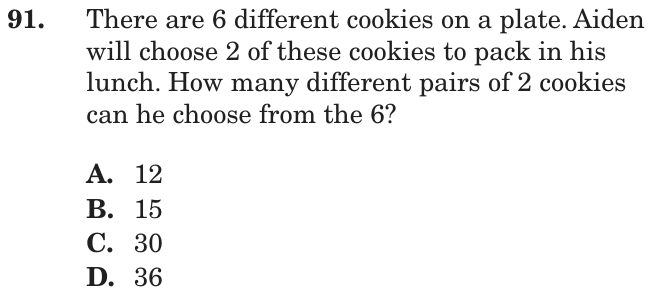
There are 6 different cookies on a plate. Aiden will choose 2 of these cookies to pack in his lunch. How many different pairs of 2 cookies can he choose from the 6?
- A12
- B15
- C30
- D36
Show the answer
Correct answer: B
Create a list of the possible pairs. Let the cookies be named A, B, C, D, E, and F.
AB, AC, AD, AE, AF
BC, BD, BE, BF
CD, CE, CF
DE, DF
EF
There are a total of 15 possible pairs of cookies that Aiden can choose.
Question analysis
This counting question asks how many different pairs of cookies Aiden can choose from six different cookies on a plate. Students must count combinations, where taking the same two cookies in a different order is not a new pair. The challenge is that the order of picking does not matter, so each pair must be counted once.
- NYS standards
- 7.SP.8b sample spaces for compound events
- Grade level
- Grade 7 content, by NYS standard
- Compared with grade 7
- At grade 7 Grade 7 students list the outcomes of compound events with organized lists and tree diagrams. Counting pairs is close to that work, but students must notice that the order of choosing does not matter.
- Estimated difficulty
- Moderate: several steps, or a close reading with one strong distractor.
- Thinking it demands
- Depth of knowledge 2, skills and concepts · mainly apply
- What makes it hard
- Much to keep track of moderate
- Solution
- 2 steps
- Reading level
- Question and choices: about grade 4, 29 words.
- Students, last 30 days
- Not enough answers yet to show (it takes 10).
Why it is hard, traps and wrong answers (shows the answer)
Why it is hard
Students who know the multiplication principle are the most at risk, because it counts each pair twice. The question rewards noticing that a pair has no order, either by listing systematically or by halving 6 × 5. The list of 15 pairs takes under a minute, so there is no time pressure to justify a shortcut.
Much to keep track of moderate Working it out
Listing all pairs by hand means tracking which have been written so none is repeated or skipped, which an organized list such as AB to AF handles. (Sweller, 1988; Carpenter, Just & Shell, 1990)
Strategy: Name the cookies with letters and list the pairs systematically: the first cookie with every later one, then the second with every later one, and so on.
Traps
- Overlapping groups: Things in two groups at once are counted twice, or not subtracted.
- Without replacement: In a second pick there is one fewer item, which changes the probability.
The wrong answers, classified
A Numbers taken from the question (Hegarty, Mayer & Monk, 1995)
Multiplies the 6 cookies by the 2 being chosen, a product of the stem's numbers that does not count any pairs.
C Overlapping groups (King et al., 2004)
Counts ordered picks, 6 choices then 5, so every pair such as AB and BA is counted twice, giving 30 instead of half that.
D Without replacement (Fischbein & Schnarch, 1997)
Uses 6 × 6, as if the first cookie went back on the plate, which counts order and also allows the same cookie twice.
Worked solution, step by step
Formulas used
- Number of pairs
- n is how many things you choose from. Each of the n things can pair with the n − 1 others. That counts every pair twice, once from each side, so you divide by 2.
Sort out the question
There are 6 different cookies. Aiden picks 2 of them. A pair is just two cookies together.
Order does not matter. Picking cookie 1 then cookie 2 gives the same pair as cookie 2 then cookie 1. You need to count the different pairs.
List the pairs in order
Number the cookies 1 to 6. Pair cookie 1 with every cookie after it. Then pair cookie 2 with every cookie after it, and so on. Only pairing with later numbers stops you from listing a pair twice.
Start with Pairs How many 1 1-2, 1-3, 1-4, 1-5, 1-6 5 2 2-3, 2-4, 2-5, 2-6 4 3 3-4, 3-5, 3-6 3 4 4-5, 4-6 2 5 5-6 1 Add up the pairs
Each row has one fewer pair than the row above it. That is because one fewer cookie comes after it. Add the last column of the table:
There are 15 different pairs.
Check with the pairs formula
Put n = 6 into the formula:
Watch out: 6 × 5 = 30 counts each pair twice, once for each order. Stopping there gives choice C. And 6 × 6 = 36, choice D, lets Aiden pick the same cookie twice. So the answer is B, 15.
Check your answer
Think of handshakes. Each of 6 people shakes hands with the 5 others. That looks like 30 handshakes, but each handshake has two people in it, so it was counted twice. 30 ÷ 2 = 15, which matches the list.
More questions like this
The original DOE question
Question 13 of 13
2018 Test B Math, question 37Question
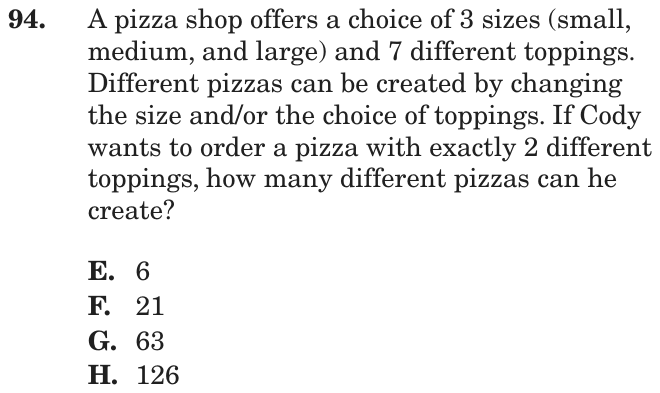
A pizza shop offers a choice of 3 sizes (small, medium, and large) and 7 different toppings. Different pizzas can be created by changing the size and/or the choice of toppings. If Cody wants to order a pizza with exactly 2 different toppings, how many different pizzas can he create?
- A6
- B21
- C63
- D126
Show the answer
Correct answer: C
First, figure out how many different topping pairs are possible. Use 1, 2, 3, 4, 5, 6, 7 to represent the toppings and create a list of possible pairs:
1,2; 1,3; 1,4; 1,5; 1,6; 1,7
2,3; 2,4; 2,5; 2,6; 2,7
3,4; 3,5; 3,6; 3,7
4,5; 4,6; 4,7
5,6; 5,7
6,7
So there are 21 different topping combinations for one pizza. Since there are 3 pizza sizes, multiply the total number of combinations by 3 to get the total number of different pizzas Cody can create:
3 × 21 = 63
Question analysis
A pizza shop offers 3 sizes and 7 toppings, and Cody wants exactly 2 different toppings; students count how many different pizzas he could order. It tests counting combinations, where the order of the toppings does not matter, together with the multiplication principle. The difficulty is counting each topping pair exactly once and including every way the pizzas can differ.
- NYS standards
- 7.SP.8b sample spaces for compound events
- Grade level
- Grade 7 content, by NYS standard
- Compared with grade 7
- Above grade 7 Grade 7 students list outcomes for compound events, usually ordered pairs like a coin and a die. Choosing an unordered pair from seven items and combining it with sizes goes beyond that, and two traps are well placed.
- Estimated difficulty
- Hard: combines ideas, needs a plan, and has more than one tempting wrong answer.
- Thinking it demands
- Depth of knowledge 2, skills and concepts · mainly apply
- What makes it hard
- Combines ideas moderate
- Something you must already know minor
- Solution
- 3 steps
- Reading level
- Question and choices: about grade 8, 48 words.
- Students, last 30 days
- Not enough answers yet to show (it takes 10).
Why it is hard, traps and wrong answers (shows the answer)
Why it is hard
The question hides two separate counts behind one sentence, and both carry traps: order does not matter among toppings, while size multiplies everything. Students who list pairs systematically are safe on the first count but often forget the second, and students who reach for 7 × 6 double the pairs. The phrase "size and/or the choice of toppings" is the cue that sizes count too.
Combines ideas moderate Working it out
Two counting ideas are joined: choosing an unordered pair from 7 toppings, then multiplying by the 3 sizes, and either part can go wrong on its own. (Embretson, 1998; Daniel & Embretson, 2010)
Something you must already know minor Working it out
Students must see that a pair of toppings is the same pizza in either order, so the product 7 × 6 counts every pair twice. (Anderson & Krathwohl, 2001)
Strategy: List the topping pairs systematically (topping 1 with each later topping, then topping 2 with each later one, and so on), count them, then multiply by the number of sizes.
Traps
- Stops one step early: A choice is a number from partway through the solution.
- Overlapping groups: Things in two groups at once are counted twice, or not subtracted.
The wrong answers, classified
A Numbers taken from the question (Hegarty, Mayer & Monk, 1995)
Multiplies the 3 sizes by the 2 toppings, using the number of toppings chosen instead of the number of ways to choose them.
B Stops one step early (King et al., 2004; Gierl et al., 2017)
Counts the 21 topping pairs correctly but stops without multiplying by the 3 sizes each pair can come in.
D Overlapping groups (King et al., 2004)
Counts ordered pairs, 7 × 6 = 42 for each size, so each pair of toppings is counted twice, then multiplies by 3 to get 126.
Worked solution, step by step
Formulas used
- Counting principle
- a is the number of ways to make the first choice. b is the number of ways to make the second choice. Each first choice can go with every second choice, so you multiply to count them all.
- Number of pairs from a group
- n is how many things you can pick from. n times (n − 1) counts a first pick times a second pick. But that counts each pair twice, once in each order. Dividing by 2 fixes that. Use it when order does not matter.
Sort out the question
There are 3 sizes and 7 toppings. Cody picks one size and exactly 2 different toppings. Order does not matter for the toppings. Ham and olives is the same pizza as olives and ham. You need the number of different pizzas.
List the topping pairs
Number the toppings 1 to 7. Pair topping 1 with each later topping. Then pair topping 2 with each later one, and so on.
- 1 with 2, 3, 4, 5, 6 or 7: 6 pairs
- 2 with 3 to 7: 5 pairs
- 3 with 4 to 7: 4 pairs
- Then 3, 2 and 1 more pairs
There are 21 topping pairs.
Check the pairs with the formula
Use the pairs formula with 7 toppings.
This matches the list.
Watch out: counts each pair twice. Forgetting to divide by 2 gives , choice D.
Multiply by the three sizes
Each topping pair can come in any of the 3 sizes. Use the counting principle.
Watch out: stopping at 21 forgets the sizes. That gives choice B.
Give the answer
There are 21 topping pairs and 3 sizes for each. So the answer is C, 63 different pizzas.
Check your answer
Test the pairs idea on a smaller case. With 3 toppings, the pairs are 1 and 2, 1 and 3, and 2 and 3. That is 3 pairs. The formula gives . It works, so 21 pairs and 63 pizzas are right.
More questions like this
The original DOE question