A rule that doesn't sound wrong
Question 1 of 19
2026 Practice Test A English, question 49Question
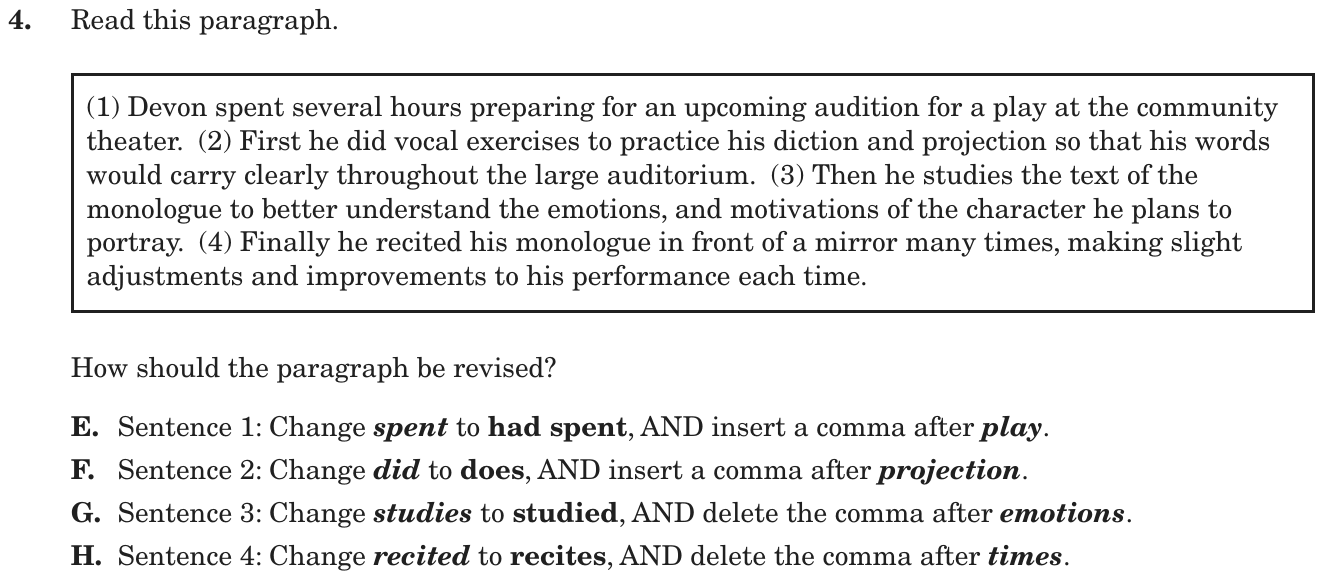
Which pair of revisions is needed to correct the errors in the paragraph?
(1) Yalina, Michael, and Malcolm love making pancakes with their granddad on Saturday mornings. (2) Yalina’s job is to open the box and pour the pancake mix into a bowl, slowly adding water, eggs, melted butter, and blueberries. (3) Michael uses a wooden spoon to vigorously stir the mixture until it is smooth, and Malcolm helps Granddad carefully pour the batter onto a griddle one-fourth cup at a time. (4) Granddad turns each pancake when they start to bubble, while all three siblings get the table ready for a sweet delicious breakfast.
- ASentence 1: Delete the comma after Yalina, AND change their to her.
- BSentence 2: Change is to are, AND delete the comma after bowl.
- CSentence 3: Change it is to they are, AND delete the comma after smooth.
- DSentence 4: Change they start to it starts, AND insert a comma after sweet.
Show the answer
Correct answer: D
The question asks which two revisions are needed to correct the paragraph.
A. Incorrect. The comma is needed after “Yalina” to separate the first and second names in the series of three names (Yalina, Michael, and Malcolm). The possessive determiner “their” is also correct as written because it refers back to “Yalina, Michael, and Malcolm,” a plural group of people.
B. Incorrect. Changing “is” to “are” would introduce an error in subject-verb agreement into the sentence; the singular subject “Yalina’s job” requires the singular verb “is.” The comma after “bowl” is required because it separates the phrase “slowly adding water, eggs, melted butter, and blueberries,” which modifies how Yalina prepares the batter, from the remainder of the sentence.
C. Incorrect. “It is” refers to the singular noun “mixture,” so this singular pronoun and verb form is correct. The comma after “smooth” is necessary because this is a compound sentence where two independent clauses (“Michael uses a wooden spoon to vigorously stir the mixture until it is smooth” and “Malcolm helps Granddad carefully pour the batter onto a griddle one-fourth cup at a time”) are joined using a coordinating conjunction, which requires a comma.
D. CORRECT. The plural pronoun “they” refers incorrectly to a singular antecedent, “each pancake.” The pronoun should be changed to a singular one to match its antecedent. A comma is needed between two adjectives of equal importance that modify the noun “breakfast.” Because “sweet” and “delicious” could be written as “sweet and delicious,” they are of equal importance, and a comma is needed.
Question analysis
This editing question gives a four-sentence paragraph about three siblings making blueberry pancakes with their granddad and asks which pair of revisions corrects its errors. Eight words or commas are underlined, and each choice bundles a pronoun or verb change with a comma change in one sentence, so a choice is right only if both of its edits are needed.
- Grade level
- Grade 7 reading and task
- Compared with grade 7
- At grade 7 Pronoun and verb agreement and comma use are grade 6 and 7 conventions. Checking eight underlined spots across four long sentences, and accepting a pair only when both edits are needed, matches typical grade 7 editing.
- Estimated difficulty
- Moderate: several steps, or a close reading with one strong distractor.
- Thinking it demands
- Depth of knowledge 2, skills and concepts · mainly apply
- What makes it hard
- A rule that doesn't sound wrong moderate
- Every choice must be checked moderate
- Evidence
- Answered from one paragraph or stanza
- Reading level
- Question and choices: about grade 8, 149 words.
- Students, last 30 days
- Not enough answers yet to show (it takes 10).
Why it is hard, traps and wrong answers (shows the answer)
Why it is hard
The errors sit together in the paragraph's last sentence, and neither is heard easily, so students who judge by ear look for problems elsewhere. The strongest pull applies two familiar but wrong rules, no comma before “and” and a plural pronoun for a mixture of several ingredients, to a sentence that is already correct. The question rewards testing each pronoun against its noun and each comma against a rule before reading the pairs.
A rule that doesn't sound wrong moderate Working it out
Both real errors sound natural: “each pancake … when they start to bubble” passes because several pancakes are cooking, and “sweet delicious breakfast” seldom sounds as if it needs a comma between its adjectives. (Connors & Lunsford, 1988)
Every choice must be checked moderate Choosing the answer
Eight underlined spots are paired into four proposed revisions, one pair per sentence, and a pair is right only if both of its edits fix real errors, so every edit has to be tried in place. (Embretson & Wetzel, 1987)
Strategy: Before reading the choices, test each underlined spot yourself: find what each pronoun and verb refers to, and decide whether each comma is needed. Then look for the pair whose two edits both fix real errors.
Traps
- Fixes what isn't broken: Changes a part of the sentence that was already correct, while the real error stays; or, where the question asks which sentence has an error or should go, picks one that is correct and belongs.
- Agreement: A verb that does not agree with its subject, or a pronoun that does not agree with the word it stands for.
- Punctuation: A comma, semicolon, colon, dash or apostrophe used where it does not belong, or missing where it does.
The wrong answers, classified
A Fixes what isn't broken (Connors & Lunsford, 1988)
Deletes the comma after the first of three names in a series and changes “their” to “her,” though the pronoun refers to all three siblings.
B Agreement (Connors & Lunsford, 1988)
Counts two tasks, opening the box and pouring, and wants the plural “are,” though the subject is the singular “job,” and drops the comma before “slowly adding.”
C Punctuation (Connors & Lunsford, 1988)
Applies the rule that a comma never comes before “and,” though this one joins two complete clauses, and makes “it” plural for the ingredients, though it means the mixture.
Working it out, step by step
Figure out what the question asks
Eight spots are underlined. Each choice offers two changes in one sentence. A choice is right only if both of its changes fix real errors. So test each underlined spot yourself first.
Test sentence 1
Commas go between the items in a list of three or more: ham, eggs, and toast. So the comma after “Yalina” is needed. “Their” is plural, and it means all three kids, so it is correct too. Nothing needs fixing here, so A is out.
Test sentence 2
A verb must match its subject, the word the sentence is about. Here the subject is “Yalina’s job,” one job, so “is” is right. Example: My chore is easy, not My chore are easy. The comma after “bowl” is needed too. It shows that “slowly adding water” tells what Yalina does. Without it, the bowl seems to be adding the water. So B is out.
Test sentence 3
“It” means “the mixture,” one thing, so “it is” is correct. The comma after “smooth” comes before “and.” When and joins two complete sentences, put a comma before it. Example: I made the salad, and Dad grilled the fish. Here both halves are complete: Michael stirs, and Malcolm pours. So C is out.
Watch out: Some students learn that a comma never goes before and. That is not true when and joins two complete sentences. Believing it leads to C.
Fix the pronoun in sentence 4
A pronoun must match its noun in number. One thing takes it, and more than one takes they. Here the noun is “each pancake,” one at a time. So “they start” should be “it starts.” Example: Each cookie is done when it turns brown.
Watch out: Many pancakes are on the griddle, so they sounds fine. But each means you are talking about one pancake at a time.
Fix the comma in sentence 4
Two describing words of equal weight need a comma between them. Test: can you put and between them, or swap them? Sweet and delicious breakfast and delicious, sweet breakfast both work. So write sweet, delicious breakfast. Compare three small dogs. You can’t say three and small dogs, so no comma there.
Choose the answer
Both changes in sentence 4 fix real errors. Fixed, it reads: Granddad turns each pancake when it starts to bubble, while all three siblings get the table ready for a sweet, delicious breakfast. So the answer is D.
Why this answer and not the closest wrong one
C is the closest wrong answer. It relies on two wrong ideas: that a comma never comes before and, and that a mix of many ingredients needs they. But the comma joins two complete sentences, and “it” means the one mixture. Only D’s two changes both fix real errors.
More questions like this
The original DOE question
Question 2 of 19
2026 Practice Test A English, question 50Question
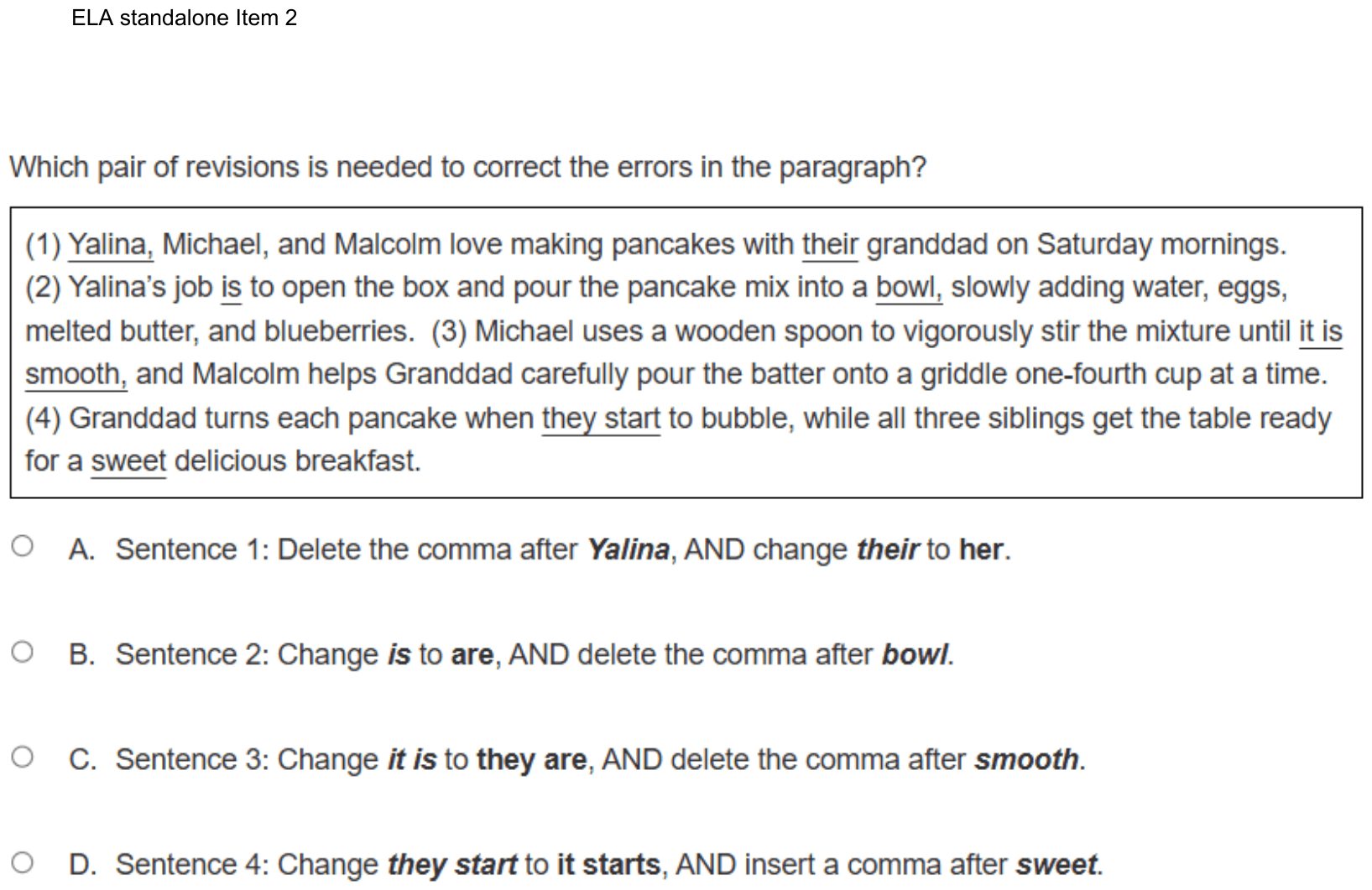
Which sentence in the paragraph contains an error in construction?
(1) The blobfish, a creature that certainly resembles its name, is an unusual fish whose body is mostly composed of pink, gelatinous flesh. (2) Because it has very few muscles and its density is close to that of water, the blobfish spends its life floating slightly above the ocean floor. (3) It must wait patiently for whatever edible matter might float by its mouth. (4) The blobfish’s downturned mouth, slimy skin, and pale coloring caused them to be voted the World’s Ugliest Animal in 2013.
Move the answer to the box. There is only one error in construction.
Contains an error in construction
On the test you drag one of the tiles into the box; here, choose it.
- ASentence 1
- BSentence 2
- CSentence 3
- DSentence 4
Show the answer
Correct answer: D
The question asks for identification of the one sentence in the paragraph that contains an error in construction.
Sentence 1: Construction is correct. The singular pronoun “its” matches the number of the word it refers to, the singular noun “blobfish.” Additionally, the appositive phrase “a creature that certainly resembles its name” is correctly set off by commas to provide an extra, but not essential, detail about the blobfish. The comma separating “pink” and “gelatinous” is correct because these are coordinate adjectives. There are no errors in sentence 1.
Sentence 2: Construction is correct. The singular pronouns “it” and “its” match the number of the word they refer to, the singular noun “blobfish.” Additionally, the structure of the sentence correctly shows that the clause “Because it has very few muscles and its density is close to that of water” explains why “the blobfish” spends its life floating. There are no errors in sentence 2.
Sentence 3: Construction is correct. The “it” and “its” in the sentence refer to “the blobfish” mentioned in the previous sentence. The use of singular pronouns in sentence 3 is consistent with the rest of the paragraph. There are no errors in sentence 3.
Sentence 4: Contains an error in construction. Sentence 4 erroneously uses the plural pronoun “them” to refer to the blobfish, when the singular “it” should have been used. Although sentence 4 starts by correctly referring to the blobfish in the singular (“the blobfish’s”), it erroneously switches to plural usage midway through: “caused them to be voted.” This is an error because the rest of the paragraph refers to the blobfish in the singular. The singular construction of the paragraph starts with “a creature” and “an unusual fish” in sentence 1 and continues throughout sentence 2 (“it has,” “its density,” “the blobfish,” and “its life”), sentence 3 (“It must” and “its mouth”), and the first half of sentence 4 (“the blobfish’s”). Proper construction requires sentence 4 to maintain the paragraph’s consistent use of singular references. To fix the construction error in sentence 4, the plural pronoun “them” should be changed to the singular pronoun “it” (i.e., “The blobfish’s downturned mouth, slimy skin, and pale coloring caused it to be voted the World’s Ugliest Animal in 2013.”).
Question analysis
This editing question gives a four-sentence paragraph describing the blobfish, a pink, jelly-like fish that floats just above the ocean floor, and asks which sentence contains an error in construction. On the test students move a sentence tile into a box; the kind of error is not named, so every sentence, with its commas, describing phrases and pronouns, must be checked.
- NYS standards
- 7L1 grammar and usage conventions
- Grade level
- Grade 7 reading and task
- Compared with grade 7
- At grade 7 The grammar here is taught by grade 6, but the question does not say what kind of error to look for, and the correct sentences carry commas, describing phrases and pronouns of their own, which is typical of grade 7 editing.
- Estimated difficulty
- Moderate: several steps, or a close reading with one strong distractor.
- Thinking it demands
- Depth of knowledge 2, skills and concepts · mainly analyze
- What makes it hard
- A rule that doesn't sound wrong moderate
- Every choice must be checked moderate
- Evidence
- Answered from one paragraph or stanza
- Reading level
- Question and choices: about grade 6, 112 words.
- Corrected from the DOE handbook
- Two grammar terms in the explanation were wrong; both sentences were corrected.
- Students, last 30 days
- Not enough answers yet to show (it takes 10).
Why it is hard, traps and wrong answers (shows the answer)
Why it is hard
The faulty pronoun is camouflaged by the list right before it, which makes a plural sound natural, so students who read by ear pass the last sentence and flag a correct one. The likeliest victim is sentence 2, where “it” comes before the noun it stands for, which some students wrongly believe is not allowed. The question rewards asking, for each pronoun, what noun it stands for and whether the number matches.
A rule that doesn't sound wrong moderate Working it out
“Them” in sentence 4 follows the plural list “downturned mouth, slimy skin, and pale coloring,” so it sounds right, though what was voted ugliest is the singular blobfish. (Connors & Lunsford, 1988)
Every choice must be checked moderate Choosing the answer
The stem names no kind of error, and every sentence has a pronoun or a set-off phrase that could be suspect, from the opening appositive to the “Because it has” clause, so all four must be checked. (Embretson & Wetzel, 1987)
Strategy: Check each sentence in turn: the subject and verb, what every pronoun refers to, and what each describing phrase attaches to, without trusting how smoothly the sentence sounds.
Traps
- Fixes what isn't broken: Changes a part of the sentence that was already correct, while the real error stays; or, where the question asks which sentence has an error or should go, picks one that is correct and belongs.
The wrong answers, classified
A Fixes what isn't broken (Connors & Lunsford, 1988)
Suspects the long interruption “a creature that certainly resembles its name” or the comma in “pink, gelatinous,” though both are correct and the sentence is complete.
B Fixes what isn't broken (Connors & Lunsford, 1988)
Believes a pronoun cannot come before its noun, so flags “Because it has very few muscles,” though “it” correctly looks ahead to “the blobfish” in the main clause.
C Fixes what isn't broken (Connors & Lunsford, 1988)
Assumes “It” must point to the nearest noun, “the ocean floor,” and calls it unclear, though only the blobfish could wait for food to float by.
What was corrected from the DOE handbook, and why
- Explanation: The handbook's explanation of sentence 1 calls “a creature that certainly resembles its name” a clause; it is an appositive phrase, a noun phrase that renames “the blobfish”, and now says so. Its explanation of sentence 2 says the “Because…” clause “modifies the words ‘the blobfish’”; an introductory “because” clause tells why something happens, so it modifies the verb, and the sentence now says it explains why the blobfish spends its life floating. The answer, sentence 4, is unchanged.
Working it out, step by step
Figure out what the question asks
You need the one sentence with an error in construction, a mistake in how the sentence is built. The question doesn’t say what kind of error. So check each sentence’s commas, phrases and pronouns. A pronoun is a word like it or them that stands in for a noun.
Check sentence 1
“A creature that certainly resembles its name” is an extra phrase that renames the blobfish. Commas around an extra phrase are correct: Max, my brother, plays drums. In “pink, gelatinous,” a comma sits between two describing words of equal weight. Gelatinous means jelly-like. You could say pink and gelatinous, so the comma is right.
Check sentences 2 and 3
Sentence 2 starts, “Because it has very few muscles.” This part tells why the blobfish floats. Here “it” comes before “the blobfish.” That is allowed when the noun follows soon after: Because she was tired, Maya went to bed. In sentence 3, “It” can only mean the blobfish. Only the fish could wait for food to float by its mouth. Both sentences are correct.
Watch out: Some students think a pronoun can never come before its noun. That makes sentence 2 look wrong, which leads to B.
Find the error in sentence 4
Sentence 4 says the fish’s features “caused them to be voted the World’s Ugliest Animal in 2013.” What was voted the ugliest animal? The blobfish, one animal. A pronoun must match its noun in number. So it should be it, not them. The rest of the paragraph calls the blobfish it every time.
Watch out: The list just before, “downturned mouth, slimy skin, and pale coloring,” is plural. That makes them sound right. But a mouth, skin and coloring can’t be voted an animal.
Show the fix
Fixed, the sentence reads: The blobfish’s downturned mouth, slimy skin, and pale coloring caused it to be voted the World’s Ugliest Animal in 2013. Now the pronoun matches the one blobfish.
Choose the answer
Sentences 1, 2 and 3 are built correctly. Only sentence 4 has a pronoun that doesn’t match its noun. So the answer is D: move the tile “Sentence 4” into the box labeled “Contains an error in construction.”
Why this answer and not the closest wrong one
Sentence 2 is the closest wrong answer, because “it” comes before the word “blobfish.” That is allowed, since the noun follows right away. In sentence 4, though, “them” is plural but stands for one blobfish. That mismatch is the real error.
More questions like this
The original DOE question
Question 3 of 19
2026 Practice Test B English, question 48Question
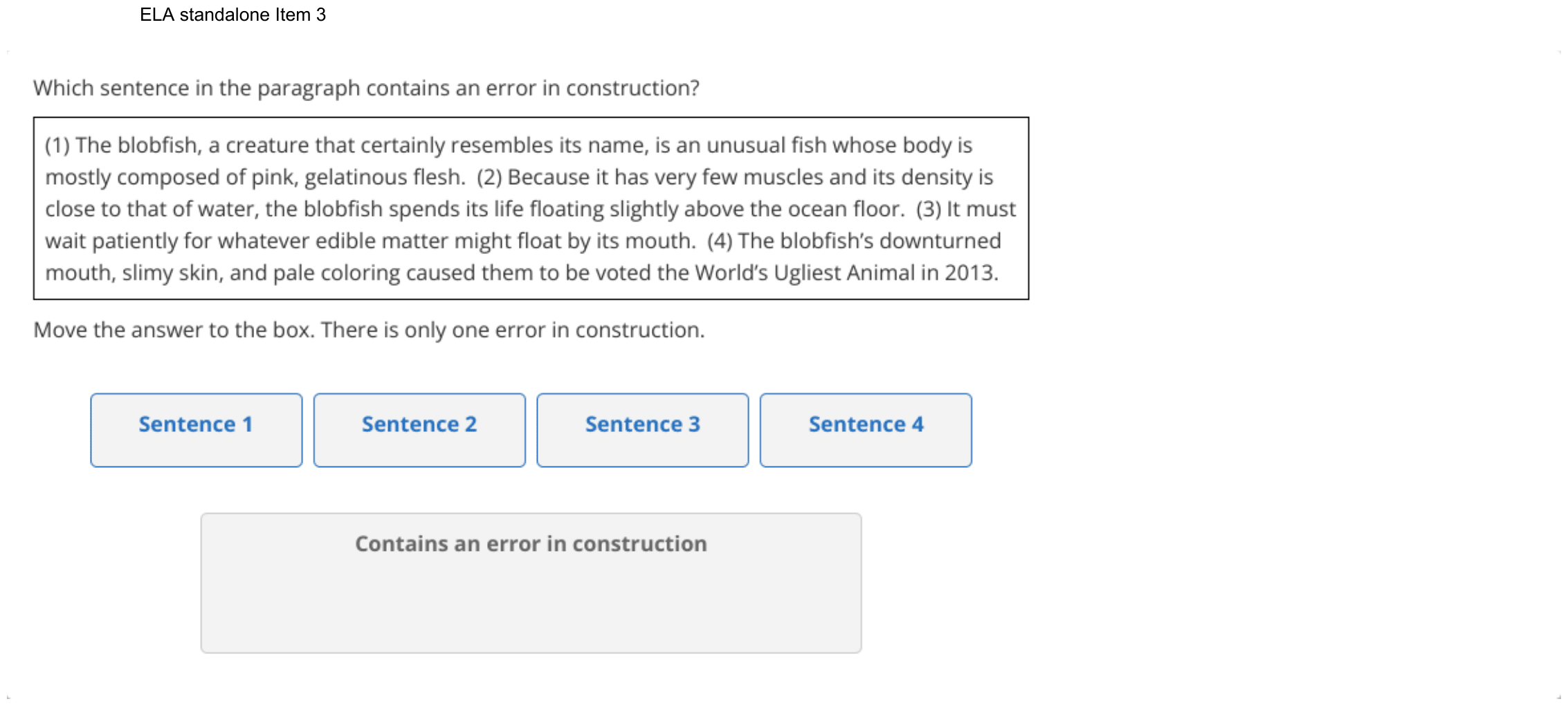
In September 2016 the National Museum of African American History and Culture opened as part of the Smithsonian Institution, the museum is already the Smithsonian’s third most popular site. Experts say that they expect this newest Smithsonian facility to welcome nearly 4 million visitors a year. The museum features more than 30,000 objects, including Muhammad Ali’s boxing gloves and a dress sewn by Rosa Parks. A commemorative copy of the Emancipation Proclamation, written in 1863 during the presidency of Abraham Lincoln, is also on display at the museum.
Which part of the paragraph contains an error in sentence structure?
Select the one error.
On the test you click the words in the text; here, choose them below.
- AInstitution, the
- Byear. The
- Cobjects, including
- DProclamation, written
Show the answer
Correct answer: A
The question asks which part of the paragraph contains an error in sentence structure.
Choice 1: “Institution, the” contains an error in sentence structure. The comma between these two words creates a type of run-on sentence known as a comma splice because both clauses—“In September 2016 the National Museum of African American History and Culture opened as part of the Smithsonian Institution” and “the museum is already the Smithsonian’s third most popular site”—are independent clauses, and must be separated with either a period or semicolon. If a comma is used to join the clauses together, a conjunction such as and would need to be added after the comma [converting the comma splice into a correct compound sentence].
Choice 2: “year. The” is correctly constructed, with independent clauses on both sides of the period (“Experts say that they expect this newest Smithsonian facility to welcome nearly 4 million visitors a year” and “The museum features more than 30,000 objects, including Muhammad Ali’s boxing gloves and a dress sewn by Rosa Parks”).
Choice 3: “objects, including” is correctly constructed. The sentence is correct as written with the nonrestrictive prepositional phrase (“including Muhammad Ali’s boxing gloves and a dress sewn by Rosa Parks”) properly preceded by a comma.
Choice 4: “Proclamation, written” is correctly constructed. The sentence is correct, with the nonrestrictive participial phrase (“written in 1863 during the presidency of Abraham Lincoln”) properly offset by a comma on either side.
Question analysis
This sentence-structure question shows a short paragraph about the 2016 opening of the National Museum of African American History and Culture, with four short phrases underlined. On the test students click the one part that contains an error in sentence structure, and the long names and the commas in the paragraph can make every spot look suspicious.
- Grade level
- Grade 6 reading and task
- Compared with grade 7
- Below grade 7 Finding run-ons and fragments is taught before grade 7, and here students check four short underlined spots in one paragraph for a single error in sentence structure. Long institution names add reading load but no extra grammar.
- Estimated difficulty
- Straightforward: two steps or one careful reading.
- Thinking it demands
- Depth of knowledge 2, skills and concepts · mainly apply
- What makes it hard
- A rule that doesn't sound wrong moderate
- Complex sentences minor
- Every choice must be checked minor
- Evidence
- Answered from one paragraph or stanza
- Reading level
- Question and choices: about grade 10, 107 words.
- Corrected from the DOE handbook
- Two grammar terms in the explanation were corrected.
- Students, last 30 days
- Not enough answers yet to show (it takes 10).
Why it is hard, traps and wrong answers (shows the answer)
Why it is hard
Students no longer have to supply the fix, only find the faulty spot, so the question rests on recognizing a comma splice. The error sits in the first sentence behind a long museum name, while the phrases “including Muhammad Ali’s boxing gloves” and “written in 1863” look more suspicious to anyone unsure about phrases set off by commas. Testing each spot for a full sentence on both sides finds it quickly.
A rule that doesn't sound wrong moderate Working it out
A comma alone joins two full clauses at “Institution, the,” and because the long museum name delays the break, the comma reads as a pause rather than a missing period. (Connors & Lunsford, 1988)
Complex sentences minor Understanding the question
The first clause runs 19 words, most of them the museum’s name, so by the time “the museum is already” arrives it sounds like a continuation, not a new sentence. (Abedi & Lord, 2001; Freedle & Kostin, 1993; Messick, 1989)
Every choice must be checked minor Choosing the answer
Each of the four clickable phrases straddles a comma or a period, so students must check, at every one, whether the words on each side could stand as a sentence. (Embretson & Wetzel, 1987)
Strategy: Find the subject and main verb of each sentence and count how many complete thoughts it holds, then check whether the punctuation at each underlined spot suits what comes on either side.
Traps
- Fixes what isn't broken: Changes a part of the sentence that was already correct, while the real error stays; or, where the question asks which sentence has an error or should go, picks one that is correct and belongs.
The wrong answers, classified
B Fixes what isn't broken (Connors & Lunsford, 1988)
Suspects the break after “year” because two sentences meet there, though a period already separates two complete sentences correctly, each with its own subject and verb.
C Fixes what isn't broken (Connors & Lunsford, 1988)
Believes a phrase opening with “including” after a comma is a fragment, though it correctly attaches examples to “more than 30,000 objects” within a complete sentence.
D Fixes what isn't broken (Connors & Lunsford, 1988)
Thinks “written in 1863” cannot describe the copy without “which was,” though the sentence already has its verb “is” and the participial phrase is correctly set off.
What was corrected from the DOE handbook, and why
- Explanation: The DOE’s explanation of choice 3 calls “including Muhammad Ali’s boxing gloves and a dress sewn by Rosa Parks” a “nonrestrictive appositive phrase.” An appositive renames a noun; this phrase gives examples of the objects, and “including” followed by a noun phrase works as a preposition, so it is a prepositional phrase. The explanation of choice 4 calls “written in 1863 during the presidency of Abraham Lincoln” a “nonrestrictive clause”; it has no subject or finite verb of its own, so it is a participial phrase. The site now says “nonrestrictive prepositional phrase” and “nonrestrictive participial phrase.” Both parts are still correctly constructed, and the answer, “Institution, the,” is unchanged.
Working it out, step by step
Figure out what the question asks
This question asks you to find the one error in sentence structure. Sentence structure is how a sentence is built. On the test, you click the part with the mistake. At each part, ask: could the words on each side stand as a sentence?
Learn the rule: no comma splice
An independent clause is a group of words with a subject and a verb that can stand alone as a sentence. You can’t join two of them with just a comma. That mistake is called a comma splice. Example: I ran home, the rain started. Fix it with a period: I ran home. The rain started. You could also add and after the comma.
Test “Institution, the”
Before the comma: “In September 2016 the National Museum of African American History and Culture opened as part of the Smithsonian Institution.” That is a full sentence. After the comma: “the museum is already the Smithsonian’s third most popular site.” That is a full sentence too. Only a comma joins them, so this is a comma splice. Fix: put a period after Institution and start The museum with a capital.
Check “year. The” and “objects, including”
- “year. The” is correct. A period already separates two full sentences.
- “objects, including” is correct. A preposition is a linking word like with or for, and “including” works like one here. A prepositional phrase is that word plus the words after it. “Including Muhammad Ali’s boxing gloves and a dress sewn by Rosa Parks” is a prepositional phrase. It gives examples of the objects, and a comma correctly attaches it.
Check “Proclamation, written”
“Written in 1863 during the presidency of Abraham Lincoln” is a participial phrase. That is a group of words built on a verb form, here written, with no subject of its own. It tells when the Proclamation was written. Commas correctly set it off, and the sentence keeps its main verb, “is.”
Watch out: Phrases starting with “including” and “written” can’t stand alone, so they may look like errors. But each one is attached to a full sentence. That is correct.
Choose the answer
Only the first part joins two full sentences with just a comma. So the answer is A: “Institution, the” contains the error. On the test, you would click that phrase.
Why this answer and not the closest wrong one
“Objects, including” is the closest wrong answer, because the words after its comma can’t stand alone. But they don’t need to. That phrase only adds examples to a full sentence. At “Institution, the,” both sides are full sentences, so a comma alone is not enough.
More questions like this
The original DOE question
Question 4 of 19
2026 Practice Test B English, question 50Question
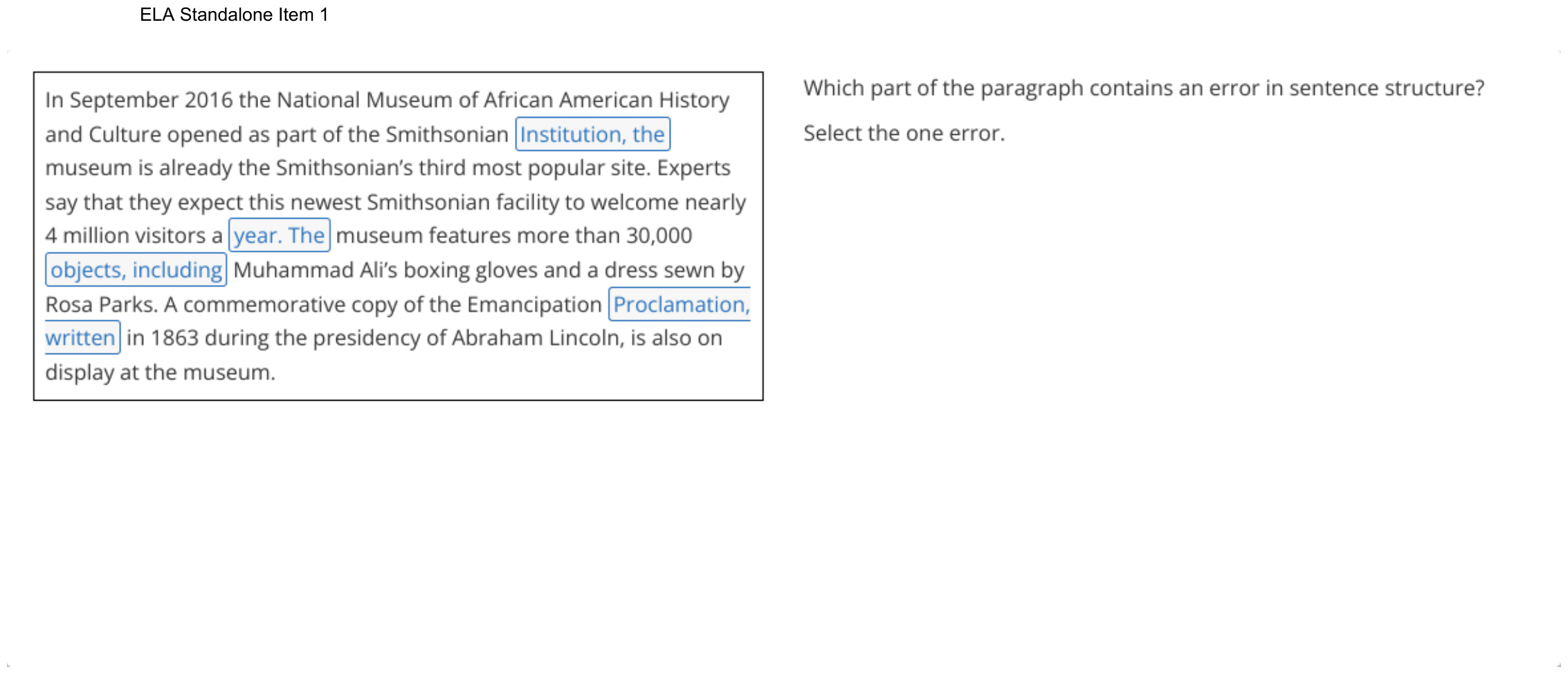
Which sentence in the paragraph contains an error in construction and should be revised?
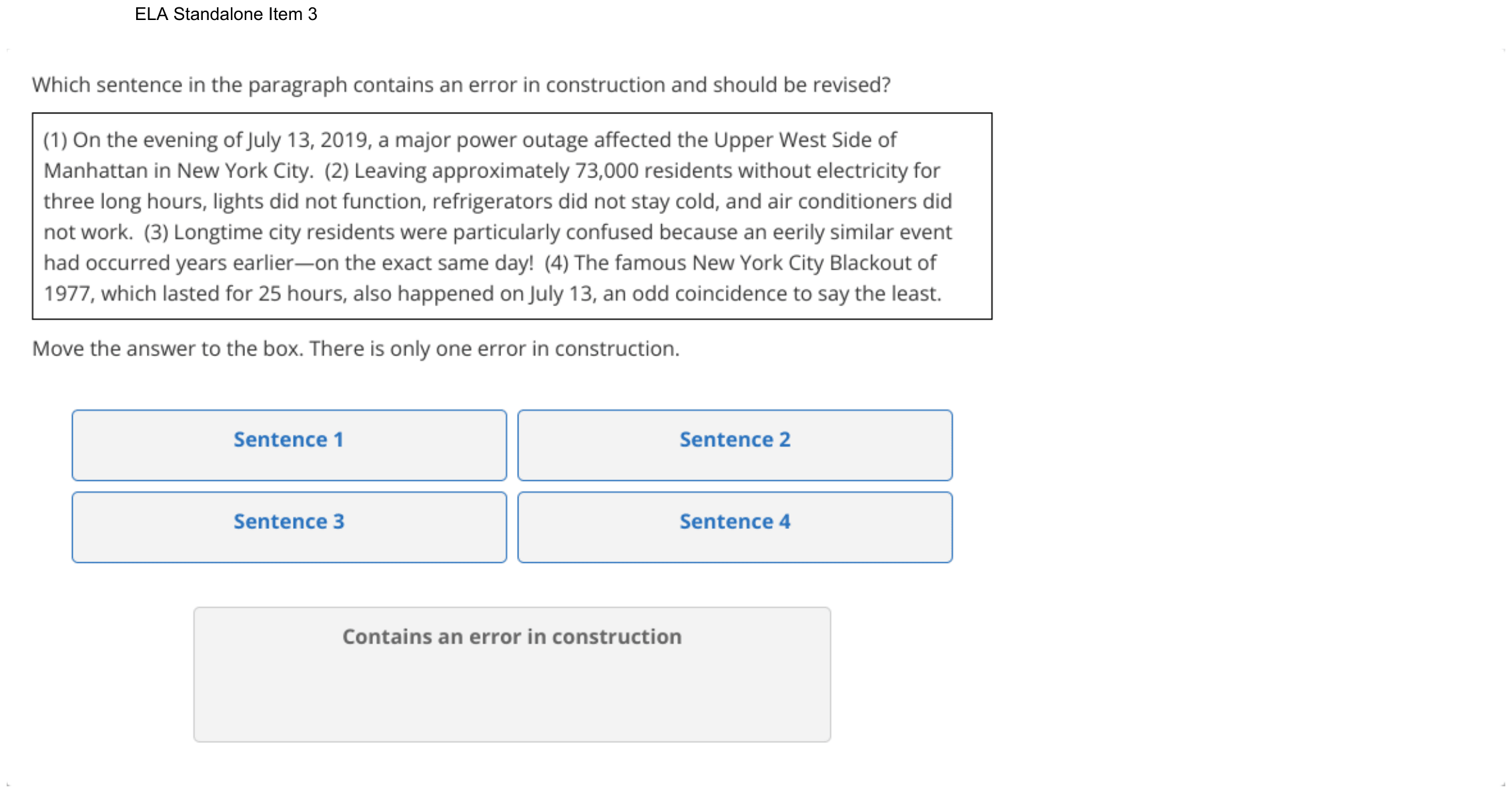
(1) On the evening of July 13, 2019, a major power outage affected the Upper West Side of Manhattan in New York City. (2) Leaving approximately 73,000 residents without electricity for three long hours, lights did not function, refrigerators did not stay cold, and air conditioners did not work. (3) Longtime city residents were particularly confused because an eerily similar event had occurred years earlier—on the exact same day! (4) The famous New York City Blackout of 1977, which lasted for 25 hours, also happened on July 13, an odd coincidence to say the least.
Move the answer to the box. There is only one error in construction.
Contains an error in construction
On the test you drag one of the tiles into the box; here, choose it.
- ASentence 1
- BSentence 2
- CSentence 3
- DSentence 4
Show the answer
Correct answer: B
The question asks which sentence in the paragraph contains an error in construction.
Sentence 1: Construction is correct. An introductory prepositional phrase is correctly punctuated in sentence 1 and describes when the power outage occurred. Similarly, the direct object, “the Upper West Side of Manhattan in New York City,” is presented clearly in terms of what area was “affected” by the power outage.
Sentence 2: Contains an error in construction. In sentence 2, the phrase “Leaving approximately 73,000 residents without electricity for three long hours” is a dangling modifier because it is not clearly modifying any word or words in the sentence. It actually further describes the “power outage” in sentence 1. In clear and correct construction, all modifiers should be in the same sentence as and near the words they describe in order to avoid confusion.
Sentence 3: Construction is correct. A dash is used appropriately in sentence 3 to show a break in thought and to introduce the phrase “on the exact same day.”
Sentence 4: Construction is correct. Two commas are used correctly in sentence 4 to set off the nonessential clause “which lasted for 25 hours” from the rest of the sentence. Similarly, one comma is used to set off the nonessential appositive “an odd coincidence to say the least.” Both of these elements are nonessential to the sentence’s overall meaning and are thus correctly separated from the sentence by the use of commas.
Question analysis
This editing question gives a four-sentence paragraph about the July 13, 2019, blackout on Manhattan's Upper West Side, which fell on the same date as the famous 1977 New York City blackout. On the test students move one sentence tile into a box marked as containing an error in construction, and since the error is not named, every sentence must be checked.
- NYS standards
- 7L1 grammar and usage conventions
- Grade level
- Grade 7 reading and task
- Compared with grade 7
- At grade 7 Finding a sentence with a construction error in a short paragraph is typical grade 7 editing. The question does not name the kind of error, and the paragraph's dash, exclamation point and added phrases all give students something to second-guess.
- Estimated difficulty
- Moderate: several steps, or a close reading with one strong distractor.
- Thinking it demands
- Depth of knowledge 2, skills and concepts · mainly analyze
- What makes it hard
- A rule that doesn't sound wrong moderate
- Every choice must be checked moderate
- Evidence
- Answered from one paragraph or stanza
- Reading level
- Question and choices: about grade 8, 122 words.
- Students, last 30 days
- Not enough answers yet to show (it takes 10).
Why it is hard, traps and wrong answers (shows the answer)
Why it is hard
The dangling phrase is easy to accept because the reader already knows from sentence 1 what left the residents in the dark. Students who do not ask what the opening phrase describes look elsewhere, and sentence 4 is the likeliest victim, since its closing phrase about an odd coincidence seems to hang loose. The question rewards naming the subject of each sentence and checking that every added phrase belongs to it.
A rule that doesn't sound wrong moderate Working it out
The opening phrase of sentence 2, “Leaving approximately 73,000 residents without electricity,” has no word to modify; it sounds acceptable because sentence 1’s power outage supplies the missing subject. (Connors & Lunsford, 1988)
Every choice must be checked moderate Choosing the answer
The error is not named, and three sentences hold features that invite doubt: sentence 1’s date and place names, sentence 3’s dash and exclamation point, sentence 4’s two set-off phrases. (Embretson & Wetzel, 1987)
Strategy: Take the sentences one at a time: name the subject and main verb, ask what each opening or added phrase describes, and check whether each mark of punctuation has a job.
Traps
- Fixes what isn't broken: Changes a part of the sentence that was already correct, while the real error stays; or, where the question asks which sentence has an error or should go, picks one that is correct and belongs.
The wrong answers, classified
A Fixes what isn't broken (Connors & Lunsford, 1988)
Suspects the long opening date or the string of place names, though sentence 1 has a clear subject and verb and its introductory phrase is correctly punctuated.
C Fixes what isn't broken (Connors & Lunsford, 1988)
Treats the dash and the exclamation point as errors because they look informal, though the dash correctly sets off “on the exact same day” and the sentence is complete.
D Fixes what isn't broken (Connors & Lunsford, 1988)
Rightly checks what each phrase describes but decides “an odd coincidence to say the least” dangles, though it correctly sums up the whole clause before it.
Working it out, step by step
Figure out what the question asks
This question asks which sentence is built wrong. On the test, you move one sentence tile into the box. The question doesn’t name the kind of error. So check each sentence. Find its subject, who or what the sentence is about, and its verb.
Learn the rule: no dangling modifier
A modifier is a word or phrase that describes something. An opening phrase must describe the subject right after the comma. If it can’t, it is a dangling modifier. Example: Running to the bus, my backpack fell. The backpack wasn’t running! Fix: Running to the bus, I dropped my backpack.
Test sentence 2
Sentence 2 opens with “Leaving approximately 73,000 residents without electricity for three long hours.” What did the leaving? The power outage did, but the outage is back in sentence 1. After the comma, the subject is “lights.” Lights didn’t leave people without power. So the opening phrase dangles. One fix: The outage left about 73,000 residents without electricity for three long hours. Then a new sentence lists what stopped working.
Check the other sentences
- Sentence 1 is correct. Its opening phrase tells when, and a comma sets it off. Its subject is “a major power outage,” and its verb is “affected.”
- Sentence 3 is correct. The dash sets off “on the exact same day” for effect. The sentence is complete.
- Sentence 4 is correct. Commas set off “which lasted for 25 hours.” The ending, “an odd coincidence to say the least,” sums up the fact before it.
Watch out: Sentence 4 tempts many students, because its ending seems to hang loose. But it names the whole fact before it, the same date. That is allowed.
Choose the answer
Only sentence 2 has an opening phrase with nothing to describe. So the answer is B: move the tile “Sentence 2” into the box labeled “Contains an error in construction.”
Why this answer and not the closest wrong one
Sentence 4 is the closest wrong answer, because “an odd coincidence to say the least” seems loose. But it sums up the whole idea before it, which is correct. In sentence 2, the opening phrase should describe the outage. Yet the word after the comma is “lights.”
More questions like this
The original DOE question
Question 5 of 19
2026 Practice Test B English, question 51Question
How should the paragraph be revised?
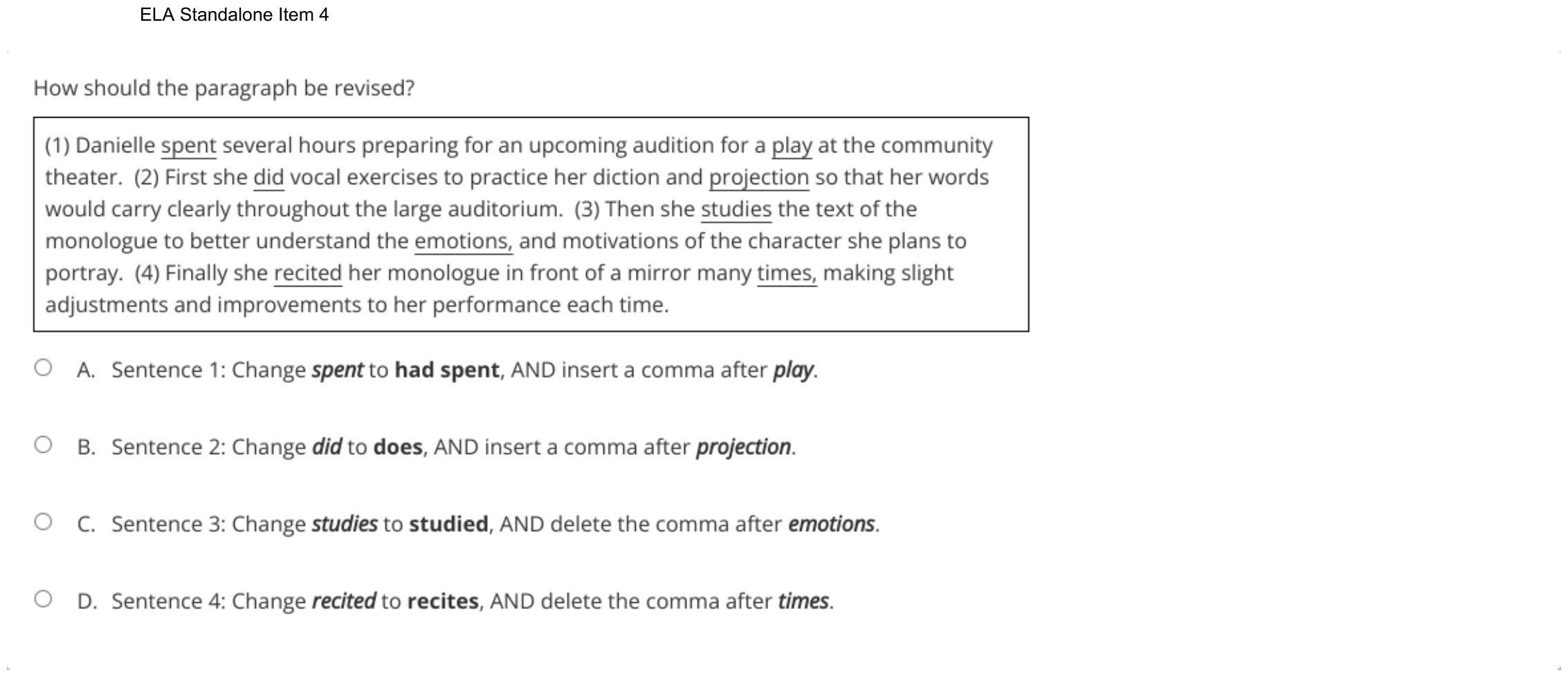
(1) Danielle spent several hours preparing for an upcoming audition for a play at the community theater. (2) First she did vocal exercises to practice her diction and projection so that her words would carry clearly throughout the large auditorium. (3) Then she studies the text of the monologue to better understand the emotions, and motivations of the character she plans to portray. (4) Finally she recited her monologue in front of a mirror many times, making slight adjustments and improvements to her performance each time.
- ASentence 1: Change spent to had spent, AND insert a comma after play.
- BSentence 2: Change did to does, AND insert a comma after projection.
- CSentence 3: Change studies to studied, AND delete the comma after emotions.
- DSentence 4: Change recited to recites, AND delete the comma after times.
Show the answer
Correct answer: C
The question asks how the paragraph should be revised.
A. Incorrect. The revisions in this option introduce new errors. The word “spent” is correct in the simple past tense because it encompasses the actions described throughout the rest of the paragraph, all of which happened during those “several hours.” Additionally, adding a comma after the word “play” would be incorrect because it would unnecessarily separate the prepositional phrase “at the community theater” from the rest of the sentence.
B. Incorrect. The revisions in this option introduce new errors. The word “did” is correct as written in the past tense because the past tense is used throughout the paragraph. There is no comma needed after the word “projection” because “so” is functioning not as a conjunction but rather as part of the conjunction phrase “so that,” which does not take a comma.
C. CORRECT. Changing the word “studies” from the present tense to the past tense “studied” is necessary to match the past tense established in the paragraph (“spent,” “recited”). Additionally, the comma after the word “emotions” needs to be removed because the words “emotions and motivations” are part of a group (series) of two elements, and when there are only two elements in a series, a comma is not used.
D. Incorrect. The revisions in this option introduce new errors. The word “recited” is correct as written in the past tense because the past tense is used throughout the paragraph. Also, removing the comma after “times” is incorrect because the comma is needed in order to separate the modifying phrase “making slight adjustments and improvements to her performance each time” from the main clause.
Question analysis
This grammar and punctuation question gives a four-sentence paragraph about Danielle preparing for an audition at the community theater, with eight spots underlined. Each answer choice pairs a verb change with a comma change in a single sentence, so students must judge verb tense and comma use together and accept a choice only if both of its edits are needed.
- Grade level
- Grade 6 reading and task
- Compared with grade 7
- Below grade 7 Keeping verb tense consistent and using commas correctly are taught before grade 7, and this paragraph is short and plain. Each choice bundles two edits, so a student who spots one real error can confirm the answer with the other.
- Estimated difficulty
- Routine: one familiar step, little to misread.
- Thinking it demands
- Depth of knowledge 1, recall and reproduction · mainly apply
- What makes it hard
- Evidence
- Answered from one paragraph or stanza
- Reading level
- Question and choices: about grade 10, 133 words.
- Students, last 30 days
- Not enough answers yet to show (it takes 10).
Why it is hard, traps and wrong answers (shows the answer)
Why it is hard
The shift to “Then she studies” stands out in a story told in the past tense with “spent,” “did” and “recited,” and finding either half of the right option is enough to choose it. That makes this one of the easiest editing questions. Students who miss it usually trust a half-remembered comma rule, such as a comma before “so,” and stop checking the verb in the same option.
A rule that doesn't sound wrong minor Working it out
Only two nouns, “emotions” and “motivations,” follow “the,” so the comma between them has no job, yet a habit of putting commas before “and” in lists hides it. (Connors & Lunsford, 1988)
Every choice must be checked minor Choosing the answer
The four options each pair a tense change with a comma change, one option per sentence, and an option is right only when both of its edits repair real errors. (Embretson & Wetzel, 1987)
Strategy: Find the tense of the paragraph's first verb, check every underlined verb against it, and then confirm that the comma change in the same choice is needed too.
The wrong answers, classified
A Verb tense or form (Connors & Lunsford, 1988)
Thinks “had spent” is needed because the preparing came before the audition, and accepts a comma after “play” that would cut off “at the community theater.”
B Punctuation (Connors & Lunsford, 1988)
Applies the rule of a comma before “so” joining two clauses, missing that “so that” opens a purpose clause with no comma, and accepts the present-tense “does.”
D Verb tense or form (Connors & Lunsford, 1988)
Notices that the tenses clash but takes the present-tense “studies” as the standard, shifts “recited” to match, and drops the comma that sets off “making slight adjustments.”
Working it out, step by step
Figure out what the question asks
This question asks how to fix the paragraph. Each choice makes two changes in one sentence: a verb change and a comma change. A choice is right only if both changes fix real errors. So check both halves.
Rule 1: keep one tense
Tense is when an action happens: past, present or future. A story should stay in one tense. Example: I woke up and eat breakfast mixes tenses. It should be I woke up and ate breakfast. This paragraph is in the past: “spent,” “did,” “recited.” But sentence 3 says “Then she studies.” That is present tense. It should be “studied.”
Rule 2: no comma between two
When only two things are joined by and, don’t put a comma between them. Example: I like apples and pears. Sentence 3 says “the emotions, and motivations.” There are only two things, so the comma should go. Fixed: the emotions and motivations of the character.
Check each choice
- A is wrong. “Spent” is already correct past tense. A comma after “play” would cut off “at the community theater.”
- B is wrong. “Does” is present tense, so it would create an error. And no comma goes before “so that.”
- C is right. “Studied” fixes the tense, and dropping the comma fixes the pair.
- D is wrong. “Recites” would create an error. The comma after “times” is needed to set off “making slight adjustments and improvements to her performance each time.”
Watch out: B tempts students who remember a comma before “so.” But “so that” tells a purpose, why she practiced, and takes no comma.
Choose the answer
So the answer is C: “Sentence 3: Change studies to studied, AND delete the comma after emotions.”
Why this answer and not the closest wrong one
B is the closest wrong answer, because many students put a comma before “so.” But “so that” explains a purpose, and it takes no comma. Also, B’s change to “does” would break the past tense. Both of C’s changes fix real errors.
More questions like this
The original DOE question
Question 6 of 19
2026 Practice Test D English, question 49Question
Read this sentence.
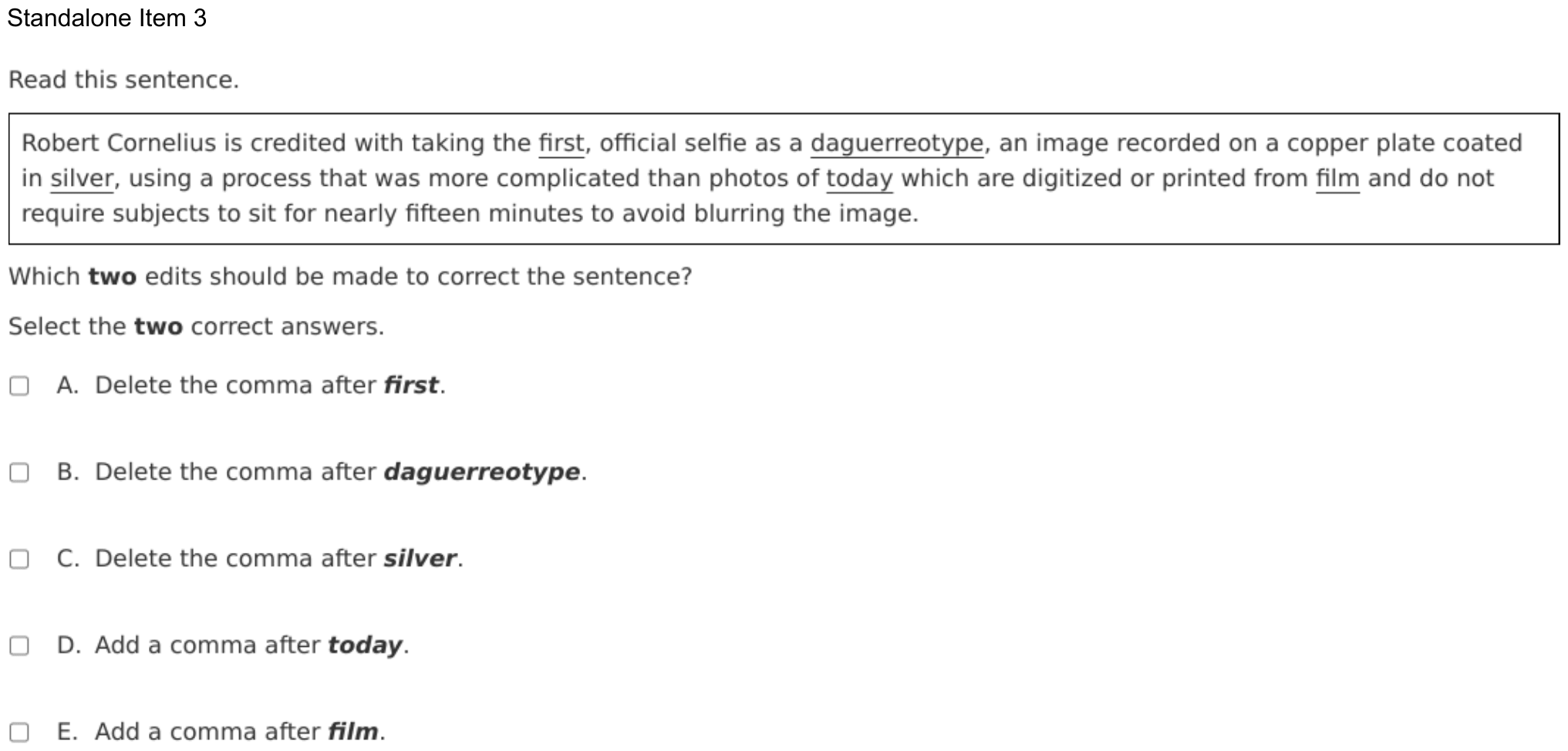
Robert Cornelius is credited with taking the first, official selfie as a daguerreotype, an image recorded on a copper plate coated in silver, using a process that was more complicated than photos of today which are digitized or printed from film and do not require subjects to sit for nearly fifteen minutes to avoid blurring the image.
Which two edits should be made to correct the sentence?
Select the two correct answers.
Choose every answer that is correct, then check. The DOE has not published how answers with several parts are scored; this site counts one right only when every part is right.
- ADelete the comma after first.
- BDelete the comma after daguerreotype.
- CDelete the comma after silver.
- DAdd a comma after today.
- EAdd a comma after film.
Show the answer
Correct answer: A and D
The question asks which two edits should be made to correct the sentence.
A. CORRECT. The comma after “first” must be deleted to correct the sentence. The adjectives “first” and “official” are not coordinate adjectives that independently modify the noun “selfie.” Cornelius did not take the “first selfie” and also the “official selfie.” Rather, he took the first selfie that was considered official. Placing a comma between the words “first” and “official” incorrectly separates two adjectives that work together to describe the selfie.
B. Incorrect. The comma after “daguerreotype” must not be deleted, because it is used correctly to introduce an explanation. The phrase “an image recorded on a copper plate coated in silver” is an appositive—a noun phrase that defines “daguerreotype.”
C. Incorrect. The comma after “silver” is placed correctly, marking the end of the phrase “an image recorded on a copper plate coated in silver” that defines “daguerreotype.” Because the sentence continues to explain the process Robert Cornelius used, the comma after “silver” is needed to end the appositive and separate it from the phrase that follows.
D. CORRECT. A comma is needed after “today” because the following phrase, “which are digitized or printed from film,” is a nonrestrictive clause that gives nonessential information about the “photos of today” preceding it.
E. Incorrect. No comma is needed after “film,” because the words “and do not require subjects to sit” are part of the same relative clause that begins with “which are digitized…”. The conjunction “and” joins two predicates within the same clause. Both actions belong to the same clause and the same subject (which); they are not separate independent clauses that need to be punctuated with a comma.
Question analysis
This punctuation question gives one long sentence about Robert Cornelius, credited with one of the earliest selfies, and the daguerreotype, an image made on a silver-coated copper plate, and asks which two of five comma edits correct it. Five words are underlined, and each needs its own decision about a comma, with credit only when both chosen edits are right.
- NYS standards
- 7L2 capitalization, punctuation, and spelling
- Grade level
- Grade 8 reading and task
- Compared with grade 7
- Above grade 7 The comma rules tested appear in the grade 6 and 7 standards, but the sentence runs 57 words, two of the rules are subtle ones, and both selections must be right, which makes this harder than typical grade 7 editing.
- Estimated difficulty
- Hard: combines ideas, needs a plan, and has more than one tempting wrong answer.
- Thinking it demands
- Depth of knowledge 2, skills and concepts · mainly apply
- What makes it hard
- A rule that doesn't sound wrong major
- Much to keep track of moderate
- Complex sentences moderate
- Evidence
- Answered from one sentence or line
- Reading level
- Question and choices: about grade 7, 100 words.
- Corrected from the DOE handbook
- A grammar term in the explanation was corrected.
- Students, last 30 days
- Not enough answers yet to show (it takes 10).
Why it is hard, traps and wrong answers (shows the answer)
Why it is hard
The sentence is long, two of its five decisions turn on subtle comma rules, and the site counts the answer right only when both edits are right. The comma before “and do not require” is the strongest trap, because a comma before “and” is a habit many students apply without checking whether a new clause begins. The paired commas around “an image recorded on a copper plate coated in silver” are already correct, and deleting either one breaks the pair.
A rule that doesn't sound wrong major Working it out
Both needed edits rest on rules students rarely hear: “first, official” are not coordinate adjectives, so no comma, and “which are digitized” adds nonessential detail about photos of today, so it needs one. (Connors & Lunsford, 1988)
Much to keep track of moderate Working it out
There are five comma decisions in one sentence and both selections must be right to score, so each edit is judged on its own while the rest of the sentence is held in mind. (Sweller, 1988; Carpenter, Just & Shell, 1990)
Complex sentences moderate Understanding the question
The sentence runs 57 words and stacks an appositive, a participial phrase beginning “using a process,” and a relative clause with two verbs, so finding where each phrase starts and ends is itself the task. (Abedi & Lord, 2001; Freedle & Kostin, 1993; Messick, 1989)
Strategy: Take the five underlined words one at a time: name what the phrase after each one does in the sentence, decide whether a comma belongs there, and choose only the two edits you are sure of.
Traps
- Punctuation: A comma, semicolon, colon, dash or apostrophe used where it does not belong, or missing where it does.
The wrong answers, classified
B Punctuation (Connors & Lunsford, 1988)
Deletes the comma that opens the appositive “an image recorded on a copper plate coated in silver,” which defines daguerreotype and must be set off from it.
C Punctuation (Connors & Lunsford, 1988)
Deletes the comma that closes the same appositive, perhaps feeling the sentence has too many commas, though a phrase set off mid-sentence needs a comma on each side.
E Punctuation (Connors & Lunsford, 1988)
Applies the habit of a comma before “and,” though here “and” joins two verbs that share one subject, “which,” inside one clause, not two complete clauses.
A Punctuation (Connors & Lunsford, 1988)
Left out by students who think a comma always separates two adjectives, though “first” describes “official selfie” as a unit, so the adjectives are not coordinate.
D Punctuation (Connors & Lunsford, 1988)
Left out by students who read “photos of today which are digitized” as one essential phrase, missing that the which-clause adds nonessential detail and needs a comma.
What was corrected from the DOE handbook, and why
- Explanation: The DOE’s explanation of Option C says the comma after “silver” “is needed to separate the clauses.” Neither side of that comma is a clause. Before it is the appositive “an image recorded on a copper plate coated in silver,” as the explanations of Options B and C say; after it is the phrase “using a process that was more complicated…,” a participial phrase with no subject of its own. The comma ends the appositive. The site now says the comma “is needed to end the appositive and separate it from the phrase that follows.”
Working it out, step by step
Figure out what the question asks
This asks which two comma edits fix the sentence. Five words are underlined. Decide about each comma one at a time. You must pick both right edits.
Check the comma after first
A comma goes between two describing words only if each one describes the noun on its own. Test it: can you put “and” between them? A long and hard test works, so you write a long, hard test. But the first and official selfie sounds wrong. “First” describes “official selfie” as a unit. So delete the comma after first. That is A.
Check the commas around silver
“An image recorded on a copper plate coated in silver” tells what a daguerreotype is. A phrase that renames the noun just before it is called an appositive. An appositive in the middle of a sentence needs a comma on each side. Example: My dog, a small beagle, loves walks. So keep the commas after daguerreotype and silver. B and C are wrong.
Check the comma after today
A clause is a group of words with its own verb. “Which are digitized or printed from film” is a clause that adds extra facts about photos of today. A “which” clause that adds extra facts gets a comma before it. Example: I read that book, which is very long. So add a comma after today. That is D.
Check the comma after film
The words “and do not require subjects to sit” are part of the same “which” clause. “Which” is the subject of both verbs, “are digitized or printed” and “do not require.” When “and” joins two verbs that share one subject, no comma goes before it. Example: She sings and dances. So E is wrong.
Watch out: Many students put a comma before every “and.” That leads to E. A comma goes before “and” when it joins two full sentences, not two verbs.
Choose the answers
Delete the comma after first, and add a comma after today. So the answers are A and D. Be sure to select both of them.
Why this answer and not the closest wrong one
E is the closest wrong answer, because a comma before “and” is a common habit. But after film, “and” joins two verbs that share one subject, “which.” No new sentence starts there, so no comma belongs. A and D fix the two real errors.
More questions like this
The original DOE question
Question 7 of 19
2025 Practice Test A English, question 55Question
Which revision corrects the error in sentence structure in the paragraph?
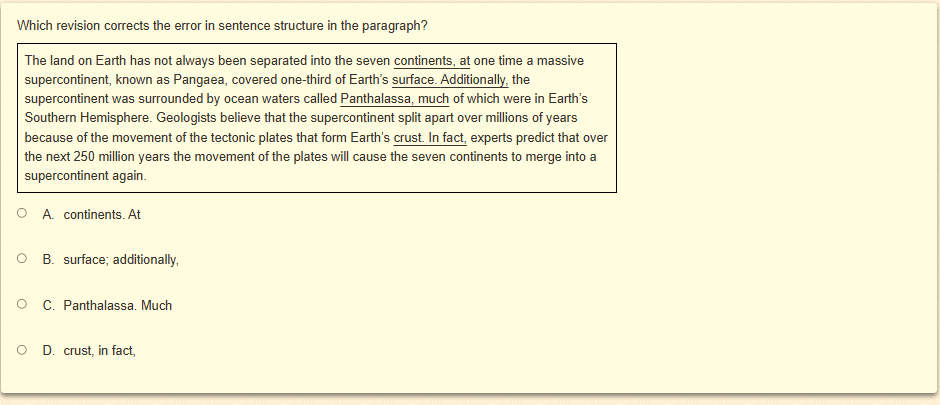
The land on Earth has not always been separated into the seven continents, at one time a massive supercontinent, known as Pangaea, covered one-third of Earth’s surface. Additionally, the supercontinent was surrounded by ocean waters called Panthalassa, much of which were in Earth’s Southern Hemisphere. Geologists believe that the supercontinent split apart over millions of years because of the movement of the tectonic plates that form Earth’s crust. In fact, experts predict that over the next 250 million years the movement of the plates will cause the seven continents to merge into a supercontinent again.
- Acontinents. At
- Bsurface; additionally,
- CPanthalassa. Much
- Dcrust, in fact,
Show the answer
Correct answer: A
The question asks for the revision that corrects the error in sentence structure in the paragraph.
A. CORRECT. The first sentence of the paragraph is a run-on because both clauses—“The land on Earth has not always been separated into the seven continents” and “at one time a massive supercontinent, known as Pangaea, covered one-third of Earth’s surface”—are independent clauses. Independent clauses are complete sentences, and two complete sentences should not be combined with just a comma. The revision is correct because it separates the two sentences by placing a period where it is needed after “continents” and by capitalizing the word “At.”
B. Incorrect. While adding a semicolon after “surface” can be considered a correct way to separate the independent clauses “at one time a massive supercontinent, known as Pangaea, covered one-third of Earth’s surface” and “Additionally, the supercontinent was surrounded by ocean waters called Panthalassa, much of which were in Earth’s Southern Hemisphere,” this change does not address the sentence structure error in the paragraph (the run-on sentence). The use of a period separating the independent clauses (complete sentences) is correct as is.
C. Incorrect. Adding a period after “Panthalassa” would separate the dependent clause “much of which were in Earth’s Southern Hemisphere” from its antecedent: “ocean waters called Panthalassa.” The dependent clause cannot stand on its own, because it shares elements with the main clause. A dependent clause is not a complete sentence and must be joined with an independent clause. The clause beginning with “much of which” is an adjective clause that modifies “ocean waters.” Changing the comma to a period creates a new error (a sentence fragment) and does not address the existing sentence structure error at the beginning of the paragraph (the run-on sentence).
D. Incorrect. Removing the period after “crust” would create a run-on sentence because the period is needed to separate two complete sentences—“Geologists believe that the supercontinent split apart over millions of years because of the movement of the tectonic plates that form Earth’s crust” and “In fact, experts predict that over the next 250 million years the movement of the plates will cause the seven continents to merge into a supercontinent again.” A comma after “crust” would combine these sentences into a run-on, creating a new error in the sentence without fixing the existing sentence structure error (the run-on sentence) at the beginning of the paragraph.
Question analysis
This editing question shows a short paragraph about Pangaea, the supercontinent that once covered a third of Earth’s surface, and the ocean around it, with four underlined spots, and asks which revision corrects the error in sentence structure. Each revision changes only punctuation and capitals at one spot, so the decision rests on how the clauses around each spot fit together.
- Grade level
- Grade 6 reading and task
- Compared with grade 7
- Below grade 7 Fixing run-ons and fragments is taught well before grade 7, and this item tests that basic skill in one short paragraph. The sentences are long, with an appositive and a clause beginning “much of which,” but the grammar involved stays simple.
- Estimated difficulty
- Straightforward: two steps or one careful reading.
- Thinking it demands
- Depth of knowledge 2, skills and concepts · mainly apply
- What makes it hard
- A rule that doesn't sound wrong moderate
- Every choice must be checked minor
- Complex sentences minor
- Evidence
- Answered from one paragraph or stanza
- Reading level
- Question and choices: about grade 9, 114 words.
- Corrected from the DOE handbook
- Two grammar terms in the explanation were corrected.
- Students, last 30 days
- Not enough answers yet to show (it takes 10).
Why it is hard, traps and wrong answers (shows the answer)
Why it is hard
The error is in the first sentence, but it hides behind a comma that sounds like an ordinary pause, while the later spots carry features that look riskier: a transition word, a clause beginning “much of which,” the phrase “in fact.” Students who test each spot for a complete sentence on both sides find the splice at once. Those who look for a revision that merely sounds polished are drawn to the semicolon, which is correct but fixes nothing.
A rule that doesn't sound wrong moderate Working it out
The comma after “continents” joins two complete sentences, and because “at one time” sounds like an introductory phrase continuing the thought, the splice reads as a natural pause. (Connors & Lunsford, 1988)
Every choice must be checked minor Choosing the answer
Each revision changes only punctuation at one underlined spot, and the semicolon one is correct English, so students must ask whether each spot was wrong to begin with, not only whether the change looks right. (Embretson & Wetzel, 1987)
Complex sentences minor Understanding the question
The paragraph’s sentences are long, with the appositive “known as Pangaea” and the clause “much of which were,” whose odd-sounding verb draws suspicion to a spot that is correctly punctuated. (Abedi & Lord, 2001; Freedle & Kostin, 1993; Messick, 1989)
Strategy: At each underlined spot, read the words on both sides and ask whether each side could stand as a sentence, then pick the revision that leaves every sentence correctly joined or separated.
Traps
- Fixes what isn't broken: Changes a part of the sentence that was already correct, while the real error stays; or, where the question asks which sentence has an error or should go, picks one that is correct and belongs.
- Fragment or run-on: Creates or keeps a sentence fragment, a run-on sentence or a comma splice.
The wrong answers, classified
B Fixes what isn't broken (Connors & Lunsford, 1988)
Knows a semicolon can join two clauses before “additionally” and picks that tidy-looking change, though the period it replaces was already correct and the comma splice up front remains.
C Fragment or run-on (Connors & Lunsford, 1988)
Treats the long second sentence as a run-on and splits it after “Panthalassa,” leaving “Much of which were in Earth’s Southern Hemisphere” as a fragment with no main clause.
D Fragment or run-on (Connors & Lunsford, 1988)
Thinks “in fact” belongs inside the sentence before it, set off by commas, which joins two complete sentences with only a comma and creates the error the paragraph already has.
What was corrected from the DOE handbook, and why
- Explanation: The DOE’s explanation of Option C says a period after “Panthalassa” would separate the dependent clause “much of which were in Earth’s Southern Hemisphere” “from its subject: ‘ocean waters called Panthalassa.’” The clause has a subject of its own, “much”; “ocean waters called Panthalassa” is its antecedent, the noun phrase that “which” refers to. The explanation also calls the clause “an adjective for ‘ocean waters’”; a clause is not an adjective but an adjective (relative) clause, which modifies the noun. The site now says “from its antecedent” and “an adjective clause that modifies ‘ocean waters.’” The reasoning and the answer, A, are unchanged.
Working it out, step by step
Learn the rule for joining sentences
An independent clause is a group of words with a subject and a verb that can stand alone as a sentence. Two of them can’t be joined with only a comma. That mistake is a run-on sentence, also called a comma splice. For example: I love soccer, my brother loves chess. Fix it with a period: I love soccer. My brother loves chess.
Test each underlined spot
At each spot, read the words on both sides. Ask: could each side stand alone as a sentence?
- After “continents”: both sides are complete. A comma joins them, so this is an error.
- After “surface”: a period already separates two sentences. That is correct.
- After “Panthalassa”: the words after the comma can’t stand alone. The comma is correct.
- After “crust”: a period already separates two sentences. That is correct.
Look closely at the first sentence
The first part says “The land on Earth has not always been separated into the seven continents.” That is a full sentence. The second part says “at one time a massive supercontinent, known as Pangaea, covered one-third of Earth’s surface.” Its subject is “supercontinent,” and its verb is “covered.” So it is a full sentence too. The words “At one time” start a new sentence.
Show the fix
Change the comma to a period, and capitalize the next word: The land on Earth has not always been separated into the seven continents. At one time a massive supercontinent, known as Pangaea, covered one-third of Earth’s surface. Now each sentence stands on its own. That is the revision continents. At.
Check each choice
- A is right. It splits the run-on into two sentences.
- B is wrong. A semicolon could join those two sentences, but the period there was already correct. It fixes nothing.
- C is wrong. “Much of which were in Earth’s Southern Hemisphere” is a dependent clause, a group of words with a verb that can’t be a sentence by itself. “Which” points back to “ocean waters called Panthalassa,” its antecedent. So the clause must stay attached.
- D is wrong. A comma after “crust” would join two full sentences. That makes a new run-on.
Choose the answer
Only the comma after “continents” joins two complete sentences. So the answer is A, continents. At.
Why this answer and not the closest wrong one
B is the closest wrong choice, because a semicolon can correctly join two sentences. But the spot after “surface” already had a period, which was correct. Changing it does not fix the real error. The comma splice after “continents” would still be there. Only A fixes it.
More questions like this
The original DOE question
Question 8 of 19
2024 Test A English, question 3Question
Which edit should be made to correct the sentence?
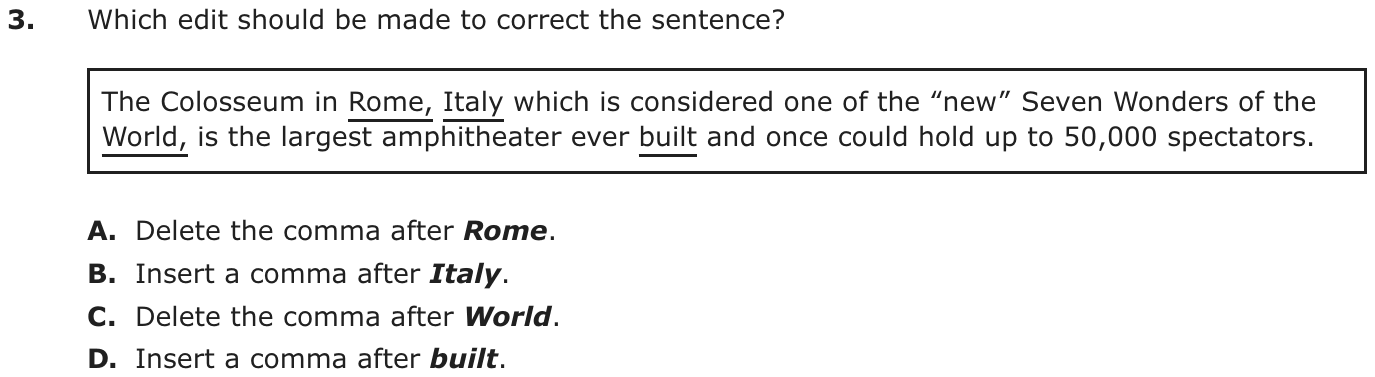
The Colosseum in Rome, Italy which is considered one of the “new” Seven Wonders of the World, is the largest amphitheater ever built and once could hold up to 50,000 spectators.
- ADelete the comma after Rome.
- BInsert a comma after Italy.
- CDelete the comma after World.
- DInsert a comma after built.
Show the answer
Correct answer: B
The question asks for the correction needed for an error in the sentence.
A. Incorrect. When a place name has more than one element, a comma is used to separate the elements for clarity.
B. CORRECT. The sentence needs a comma to set off the clause “which is considered one of the ‘new’ Seven Wonders of the World,” because the clause is not essential to the meaning of the sentence (nonrestrictive clause). This option is correct because it places a comma where it is needed, after “Italy,” to set off the nonrestrictive clause that follows.
C. Incorrect. This edit would remove the comma at the end of the nonrestrictive clause, which should be set off by commas at the beginning and the end.
D. Incorrect. A comma after “built” would separate the predicate “and once could hold up to 50,000 spectators” from the subject of the main clause. The predicates “is the largest amphitheater ever built” and “once could hold up to 50,000 spectators” both relate to the same subject (“The Colosseum in Rome, Italy”), so a comma should not be used to separate the second predicate from that subject.
Question analysis
This editing question gives one long sentence about the Colosseum in Rome and asks which comma edit corrects it. Students must know how commas work with a city and its country, with a descriptive clause beginning with which, and with two verbs that share one subject, because every choice adds or removes a comma.
- NYS standards
- 7L2 capitalization, punctuation, and spelling
- Grade level
- Grade 6 reading and task
- Compared with grade 7
- Below grade 7 Comma rules for place names and for extra information set off in a sentence are taught by grade 6. Here they are tested in one sentence with four marked spots, lighter than typical grade 7 editing of a whole paragraph.
- Estimated difficulty
- Straightforward: two steps or one careful reading.
- Thinking it demands
- Depth of knowledge 1, recall and reproduction · mainly apply
- What makes it hard
- A rule that doesn't sound wrong moderate
- Complex sentences minor
- Evidence
- Answered from one sentence or line
- Reading level
- Question and choices: about grade 6, 59 words.
- Students, last 30 days
- Not enough answers yet to show (it takes 10).
Why it is hard, traps and wrong answers (shows the answer)
Why it is hard
The which-clause has a closing comma after “World” but no opening one, and the sentence still sounds natural, so many students see the lone comma as the mistake instead of noticing its missing partner. Bracketing the extra description first, from “which” to “World,” exposes the gap quickly. The remaining choices fall to two rules students usually know: city and country are separated, and a second verb sharing the subject takes no comma.
A rule that doesn't sound wrong moderate Working it out
“Rome, Italy which is considered” reads smoothly aloud, yet the comma after “Italy” is needed twice over: to close the city-and-country pair and to open the nonessential which-clause. (Connors & Lunsford, 1988)
Complex sentences minor Understanding the question
Thirty-one words hold a two-part place name, a which-clause wedged between subject and verb, and two verbs, “is” and “once could hold,” sharing one subject, so each comma must be judged against that frame. (Abedi & Lord, 2001; Freedle & Kostin, 1993; Messick, 1989)
Strategy: Strip the sentence down to its main subject and verb, then check every marked spot against that core: what is the comma, or the missing comma, doing there?
Traps
- Punctuation: A comma, semicolon, colon, dash or apostrophe used where it does not belong, or missing where it does.
The wrong answers, classified
A Punctuation (Connors & Lunsford, 1988)
Treats “Rome, Italy” as a single name that should not be broken, not knowing that a comma always separates a city from the country that follows it.
C Punctuation (Connors & Lunsford, 1988)
Applies the sound rule against a comma between a subject and its verb to the comma before “is,” missing that it closes the which-clause and must stay.
D Punctuation (Connors & Lunsford, 1988)
Adds a pause before “and once could hold” because the sentence is long, though that second verb shares the subject, the Colosseum, and takes no comma.
Working it out, step by step
Figure out what the question asks
This is a punctuation question. Punctuation means marks like commas and periods. Four spots are underlined, at “Rome,” “Italy,” “World” and “built.” One edit fixes the sentence. Two comma rules decide it.
Learn the rule for extra information
Some groups of words just add an extra fact. If you take them out, the sentence still works. This is called a nonessential clause. A clause is a group of words with its own verb. A nonessential clause needs a comma before it and a comma after it, like a pair of brackets.
Example: Our school, which is very old, has a new gym. Without the middle part: Our school has a new gym.
Find the extra part
The extra part here starts at “which is considered” and ends at “of the World.” It adds a fun fact. Take it out and the sentence still works: The Colosseum in Rome, Italy, is the largest amphitheater ever built.
The comma after “World” closes the extra part. But nothing opens it. A comma is missing after “Italy.”
Learn the rule for places
A comma goes between a city and its country, as in “Rome, Italy.” If the sentence keeps going, put a comma after the country too. Example: She flew from Lima, Peru, to Miami.
So the comma after “Italy” is needed for two reasons. One comma does both jobs.
Check each choice
- A is wrong. The comma after “Rome” splits the city from the country. It must stay.
- B is right. It adds the missing comma that opens the extra part.
- C is wrong. The comma after “World” closes the extra part. Without it, neither end would be marked.
- D is wrong. The Colosseum “is the largest amphitheater” and “once could hold” many people. These are two verbs with one subject. No comma goes before the second verb. Example: Max swam fast and won a medal.
Watch out: C is tempting. A comma between a subject (who or what the sentence is about) and its verb is usually wrong. Here it is fine, because it is the second comma of a pair.
Choose the answer
With a comma after “Italy,” the extra part has a comma at each end. So the answer is B: insert a comma after Italy.
Why this answer and not the closest wrong one
C is the closest wrong answer. It treats the comma before “is” as the mistake. But that comma ends the extra part about the Seven Wonders. Delete it and nothing marks either end. B adds the missing opening comma, so both ends are marked.
More questions like this
The original DOE question
Question 9 of 19
2024 Test A English, question 4Question
Which pair of revisions need to be made in this paragraph?
(1) Both Italian gelato and American ice cream are delightful treats to have on a hot summer day, but many people wonder: what is the difference between the two? (2) To start with, the butterfat content is much higher in ice cream than it is in gelato, making the Italian treat a wiser decision for people looking to make healthier choices. (3) Additionally, the mixing process, which adds less air to the frozen treat, makes gelato denser than ice cream. (4) Finally, gelato is served 10 to 15 degrees warmer than ice cream, which enhances the texture and flavor of the gelato, and allow it to melt more quickly.
- ASentence 1: Delete the colon after wonder AND change is to are.
- BSentence 2: Delete the comma after with AND change it is to they are.
- CSentence 3: Delete the comma after process AND change makes to make.
- DSentence 4: Delete the comma after gelato AND change allow to allows.
Show the answer
Correct answer: D
The question asks for the revisions that are needed to correct errors in the paragraph.
A. Incorrect. The revisions introduce new errors. The colon after “wonder” is needed to set off the question “what is the difference between the two?” from the rest of the sentence. In addition, changing the verb “is” to “are” would be incorrect with the use of the singular noun “difference,” which is the subject of the question.
B. Incorrect. The revisions introduce new errors. The comma following the introductory phrase “To start with” helps with clarity and is needed to separate the phrase from the rest of the sentence. Changing “it is” to “they are” would be incorrect with the use of the singular noun “butterfat content,” which is what the words “it is” refer to in the sentence.
C. Incorrect. The revisions introduce new errors. The comma following “process” is necessary to set off the nonrestrictive clause “which adds less air to the frozen treat” from the rest of the sentence. This clause is considered a nonrestrictive clause because it provides additional, but not essential, information about the mixing process. Changing the verb “makes” to “make” would be incorrect with the use of the singular noun “mixing process,” which is the subject of the sentence.
D. CORRECT. Deleting the comma after “gelato” would include the clause “and allow it to melt more quickly” with the first part of the clause “which enhances the texture and flavor of the gelato.” The word “and” between the two verb phrases (“enhances the texture and flavor of the gelato” and “allow it to melt more quickly”) indicates that the two verb phrases share a subject, “which” (referring to the act of serving gelato 10 to 15 degrees warmer than ice cream). The two ideas should not be separated by a comma within the clause. The entire clause “which enhances the texture and flavor of the gelato and allow it to melt more quickly” should be separated from the main clause only by the comma after “cream” because the entire clause is a nonrestrictive clause. This clause provides additional, but not essential, information about the purpose of serving gelato at a warmer temperature than ice cream. Changing the verb “allow” to “allows” is also necessary to match the use of the singular pronoun “which.”
Question analysis
This editing question gives a four-sentence paragraph comparing Italian gelato with American ice cream and asks which pair of revisions it needs. Students must check subject-verb agreement, what a pronoun refers to and whether each comma or colon belongs, and since every choice bundles two edits in one sentence, a single right-sounding change is not enough.
- Grade level
- Grade 7 reading and task
- Compared with grade 7
- At grade 7 Subject-verb agreement and commas around added clauses are grade 7 conventions. Eight marked spots across four long sentences make this a fuller check than a one-sentence item, but the demand is still typical of grade 7 editing.
- Estimated difficulty
- Moderate: several steps, or a close reading with one strong distractor.
- Thinking it demands
- Depth of knowledge 2, skills and concepts · mainly apply
- What makes it hard
- A rule that doesn't sound wrong moderate
- Every choice must be checked moderate
- Complex sentences minor
- Evidence
- Answered from one paragraph or stanza
- Reading level
- Question and choices: about grade 9, 160 words.
- Students, last 30 days
- Not enough answers yet to show (it takes 10).
Why it is hard, traps and wrong answers (shows the answer)
Why it is hard
The paragraph's only real errors sit at the end of its longest sentence, where a plural noun pair just before the faulty verb hides the mismatch. Students who do not hear “allow” as wrong start doubting correct marks instead, such as the colon before an embedded question or the comma after “To start with.” Every wrong pair also changes a verb or pronoun that already agrees, so reading each edit back into its sentence rules those pairs out.
A rule that doesn't sound wrong moderate Working it out
In sentence 4 the plural pair “texture and flavor” sits just before “and allow,” so the verb sounds right, but it belongs to “which,” the warmer serving, and must match “enhances.” (Connors & Lunsford, 1988)
Every choice must be checked moderate Choosing the answer
Each pair proposes two edits in one sentence, eight in all, and a pair is right only if both of its edits fix real errors, so every edit has to be tried in place. (Embretson & Wetzel, 1987)
Complex sentences minor Understanding the question
Sentence 4 hangs a which-clause with two verbs onto the main clause, and the comma before “and allow” splits that clause's compound predicate in a way few students hear as wrong. (Abedi & Lord, 2001; Freedle & Kostin, 1993; Messick, 1989)
Strategy: Before reading the choices, find each verb's true subject and test every marked comma yourself; then look for the choice whose two edits both fix errors you found.
Traps
- Fixes what isn't broken: Changes a part of the sentence that was already correct, while the real error stays; or, where the question asks which sentence has an error or should go, picks one that is correct and belongs.
- Agreement: A verb that does not agree with its subject, or a pronoun that does not agree with the word it stands for.
- Punctuation: A comma, semicolon, colon, dash or apostrophe used where it does not belong, or missing where it does.
The wrong answers, classified
A Agreement (Connors & Lunsford, 1988)
Hears “the two” as the subject and wants “are,” and distrusts a colon before a question, though “the difference” is singular and the colon is correct.
B Punctuation (Connors & Lunsford, 1988)
Believes a short opener like “To start with” needs no comma and accepts “they are,” though the pronoun stands for the singular “butterfat content.”
C Fixes what isn't broken (Connors & Lunsford, 1988)
Picks edits to a sentence that is already correct, unbalancing the commas around the which-clause and giving the singular “mixing process” a plural verb.
Working it out, step by step
Figure out what the question asks
Each choice offers two changes to one sentence. Both changes must fix real mistakes. If even one change breaks something that was right, the choice is wrong. So test every change in its own sentence.
Learn the rule for two verbs
A verb (an action word) must match its subject (who or what does the action). One thing takes allows. Two or more things take allow.
When one subject does two actions joined by “and,” no comma goes before “and.” Example: The sun warms the air and dries the grass. Both verbs end in s, because one sun does both.
Find the mistakes in sentence 4
Sentence 4 says gelato is served warmer than ice cream, “which enhances the texture and flavor of the gelato, and allow it to melt more quickly.”
“Which” stands for one thing: serving gelato warmer. That one thing does two actions. It “enhances” (improves) the texture and flavor. It also lets the gelato melt faster. So “allow” should be “allows,” to match “enhances.” And the comma before “and” must go.
Check each choice
- A is wrong. The colon (:) after “wonder” correctly leads into the question. And “is” matches “the difference,” which is one thing.
- B is wrong. The comma after “To start with” sets off an opening phrase. And “it is” stands for “the butterfat content,” which is one thing.
- C is wrong. The commas around “which adds less air to the frozen treat” come in a pair. And “makes” matches “the mixing process,” one thing.
- D is right. Both changes fix real mistakes.
Watch out: “The texture and flavor” comes right before “allow.” Those two things make “allow” sound right. But the subject is “which,” not “texture and flavor.”
Choose the answer
The fixed sentence ends: which enhances the texture and flavor of the gelato and allows it to melt more quickly. So the answer is D.
Why this answer and not the closest wrong one
A is the closest wrong answer. “The two” sits near “is,” so “are” can sound right. But the question asks what “the difference” is. A difference is one thing, so “is” is correct. A would add a mistake. In D, both changes fix mistakes that are really there.
More questions like this
The original DOE question
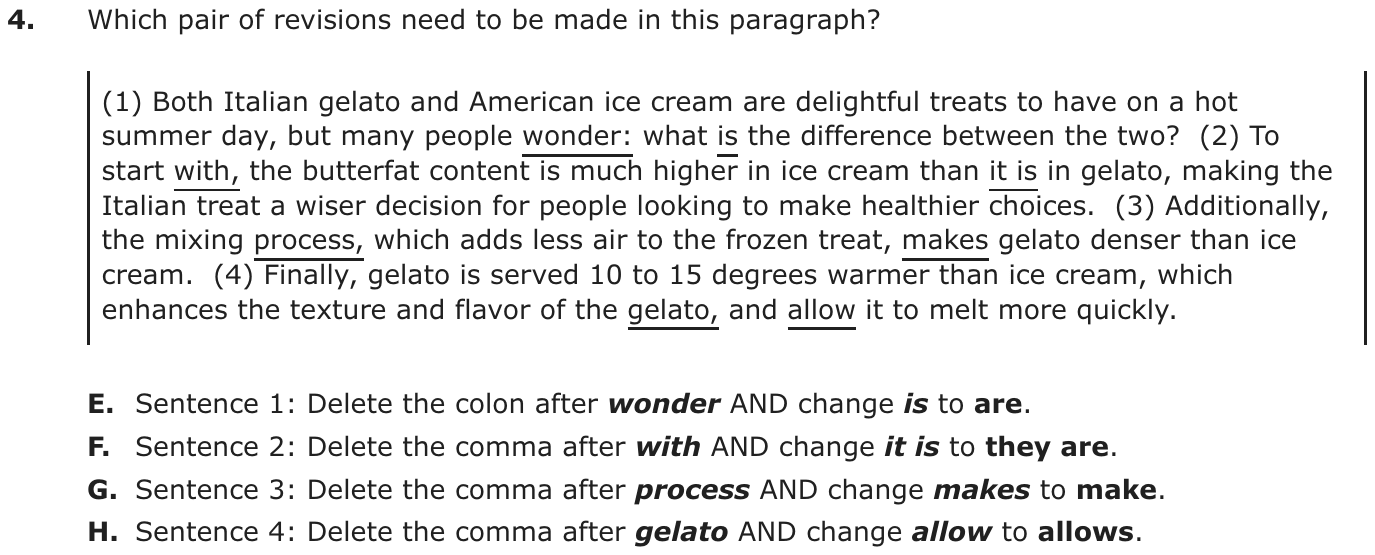
Question 10 of 19
2024 Test B English, question 2Question
Which sentence contains an error in its construction and should be revised?
(1) In 1976, the National Basketball Association (NBA) absorbed several teams of the American Basketball Association (ABA), including the New York Nets, who played in the Long Island area at the time. (2) The owner of the Nets decided to take the team to New Jersey after the team had financial troubles, where the team played for thirty-five seasons. (3) The New Jersey Nets had sixteen playoff appearances, including two appearances in the NBA finals. (4) In 2012, the team changed ownership and returned to New York, where the team now plays under the name the Brooklyn Nets.
- Asentence 1
- Bsentence 2
- Csentence 3
- Dsentence 4
Show the answer
Correct answer: B
The question asks for the identification of the sentence that has an error in its construction and should be revised.
A. Incorrect. There are no errors in the structure of sentence 1. The clause “who played in the Long Island area at the time” correctly modifies the noun “New York Nets.” “Who” is the correct relative pronoun to serve as the subject of the modifying clause because it refers to people rather than objects or things.
B. CORRECT. Sentence 2 contains a structural error. The current placement of the clause “where the team played for thirty-five seasons” suggests that the clause is modifying the term “financial troubles,” which is illogical. The clause “where the team played for thirty-five seasons” should immediately follow the location, “New Jersey.” A revised version of the sentence might read, “After the team had financial troubles, the owner of the Nets decided to take the team to New Jersey, where the team played for thirty-five seasons.”
C. Incorrect. There are no errors in the structure of sentence 3. The phrase “including two appearances in the NBA finals” is a nonrestrictive phrase that provides further detail about the team’s “sixteen playoff appearances.” The phrase is set off by a comma because it is not essential to understanding the meaning of the sentence.
D. Incorrect. There are no errors in the structure of sentence 4. The clause “where the team now plays under the name the Brooklyn Nets” is a nonrestrictive clause that provides further detail about the team after its move back to New York in 2012. The clause is set off by a comma because it is not essential to understanding the meaning of the sentence.
Question analysis
This editing question gives a four-sentence paragraph tracing the Nets basketball team from Long Island to New Jersey and back to Brooklyn, and asks which sentence is built incorrectly. The sentences are long, with commas, parentheses and describing clauses, so students must check what each clause actually describes instead of trusting how smoothly it reads.
- NYS standards
- 7L1 grammar and usage conventions
- Grade level
- Grade 7 reading and task
- Compared with grade 7
- At grade 7 Placing clauses so they describe the right word is a grade 7 grammar standard. The paragraph is short and plain, but the correct sentences also carry commas and describing clauses, which matches a careful grade 7 editing task.
- Estimated difficulty
- Moderate: several steps, or a close reading with one strong distractor.
- Thinking it demands
- Depth of knowledge 2, skills and concepts · mainly analyze
- What makes it hard
- A rule that doesn't sound wrong moderate
- Every choice must be checked minor
- Complex sentences minor
- Evidence
- Answered from one paragraph or stanza
- Reading level
- Question and choices: about grade 7, 108 words.
- Students, last 30 days
- Not enough answers yet to show (it takes 10).
Why it is hard, traps and wrong answers (shows the answer)
Why it is hard
The faulty sentence is easy to understand, because the reader supplies the link between New Jersey and the thirty-five seasons without noticing the clause is in the wrong place. Students who go by sound skip it and suspect a busier sentence instead, most often the first, with its parentheses and a “who” that refers to a team. The question rewards asking, for each describing clause, which word it actually sits beside.
A rule that doesn't sound wrong moderate Working it out
Sentence 2’s “where the team played for thirty-five seasons” follows “financial troubles,” not “New Jersey,” but readers silently attach it to the state, so the misplaced clause does not sound wrong. (Connors & Lunsford, 1988)
Every choice must be checked minor Choosing the answer
The stem names no kind of error, and every sentence carries a describing clause or phrase, from “who played” to “including two appearances” to a second “where” clause, so all four must be tested. (Embretson & Wetzel, 1987)
Complex sentences minor Understanding the question
Sentence 1 runs 31 words with two abbreviations in parentheses and a “who” clause, which makes a correct sentence look like the likeliest home for an error. (Abedi & Lord, 2001; Freedle & Kostin, 1993; Messick, 1989)
Strategy: In each sentence, find every describing clause or phrase and the word just before it. Ask whether the clause can logically describe that word; a mismatch marks the sentence to revise.
Traps
- Fixes what isn't broken: Changes a part of the sentence that was already correct, while the real error stays; or, where the question asks which sentence has an error or should go, picks one that is correct and belongs.
The wrong answers, classified
A Fixes what isn't broken (Connors & Lunsford, 1988)
Believes “who” cannot refer to a team, or distrusts the long sentence with two abbreviations, though “who played in the Long Island area” correctly describes the New York Nets.
C Fixes what isn't broken (Connors & Lunsford, 1988)
Takes “including two appearances in the NBA finals” for a fragment tacked on with a comma, though the phrase correctly adds detail to “sixteen playoff appearances.”
D Fixes what isn't broken (Connors & Lunsford, 1988)
Hears the shift from “returned” to “now plays” as a tense error, though “now” marks the present, and this “where” clause sits right after New York, the place it describes.
Working it out, step by step
Figure out what the question asks
This asks which sentence is built wrong. The facts may all be true. The problem is how the parts of a sentence fit together. The question doesn’t say what kind of error to look for. So you need to test all four sentences.
Learn the rule about describing clauses
A clause is a group of words with a subject and a verb. Some clauses describe a word. They often start with who or where. A describing clause must sit right next to the word it describes. If it lands next to the wrong word, the sentence says something silly. Example: We went to the beach after the storm, where we swam all day. That says we swam in the storm! Fix: After the storm, we went to the beach, where we swam all day.
Test sentence 2
Sentence 2 ends “after the team had financial troubles, where the team played for thirty-five seasons.” The clause starting with “where” sits right after “financial troubles.” So the sentence says the team played inside its money problems. The clause should describe New Jersey, the place. Fix: After the team had financial troubles, the owner of the Nets decided to take the team to New Jersey, where the team played for thirty-five seasons.
Test sentences 1, 3 and 4
- Sentence 1: “who played in the Long Island area at the time” comes right after “the New York Nets.” A team is a group of people, so who works.
- Sentence 3: “including two appearances in the NBA finals” comes right after “sixteen playoff appearances.” It adds a detail about them, so it fits.
- Sentence 4: “where the team now plays” comes right after “New York,” a place. The word “now” makes the present tense right.
Watch out: Sentence 1 looks busy, with two names in parentheses. That makes choice A tempting. But long is not the same as wrong.
Pick the answer
Only sentence 2 puts a describing clause next to the wrong words. So the answer is B, sentence 2.
Why this answer and not the closest wrong one
Sentence 1 is the closest wrong answer, because it is long and uses who for a team. But its clause sits right next to the Nets, the team it describes. In sentence 2, the “where” clause sits next to “financial troubles,” not New Jersey. That is why B is right.
More questions like this
The original DOE question
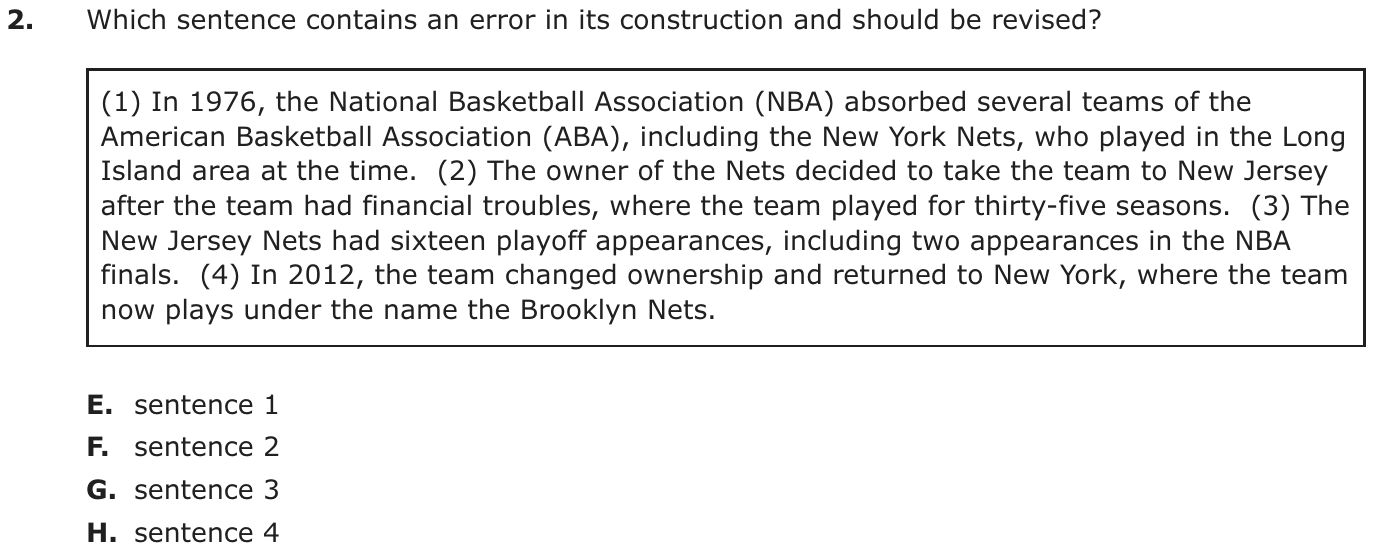
Question 11 of 19
2023 Test A English, question 1Question
Which edit should be made in the sentence?
On May 8, 2018, Boston University student Zach Prescott ran a mile in 4 minutes 43.2 seconds while juggling three lacrosse balls, breaking the 32-year-old world record in joggling a sport that combines jogging and juggling.
- ADelete the comma after 2018.
- BInsert a comma after student.
- CDelete the comma after lacrosse balls.
- DInsert a comma after joggling.
Show the answer
Correct answer: D
The question asks which edit should be made to correct the sentence.
A. Incorrect. This edit incorrectly deletes the comma that is necessary to set off the year in a date from the remainder of the sentence.
B. Incorrect. This edit introduces an unnecessary comma into the sentence by needlessly separating the adjective phrase “Boston University student” from the noun it modifies, “Zach Prescott.”
C. Incorrect. This edit would delete the comma needed to separate the participle phrase “breaking the 32-year-old world record in joggling” and its companion appositive “a sport that combines jogging and juggling” from the rest of the sentence. This complete element is nonessential, which means it requires separation from the rest of the sentence with a comma because its removal would not fundamentally change the meaning of the sentence.
D. CORRECT. The appositive “a sport that combines jogging and juggling” further describes the word “joggling.” An appositive requires separation with a comma because it is nonessential, meaning that its removal would not change the overall meaning of the sentence.
Question analysis
This punctuation question gives one long sentence about a Boston University student who ran a mile while juggling and broke a world record, and asks which comma edit it needs. Students weigh four marked spots, at a date, between a title and a name, and at two places near the end, deciding at each whether a comma belongs.
- NYS standards
- 7L2 capitalization, punctuation, and spelling
- Grade level
- Grade 6 reading and task
- Compared with grade 7
- Below grade 7 Commas with dates and with extra information added to a sentence are grade 6 punctuation rules. This item tests them in a single 36-word sentence with one edit to choose, lighter than grade 7 work on phrases, clauses and modifiers.
- Estimated difficulty
- Straightforward: two steps or one careful reading.
- Thinking it demands
- Depth of knowledge 1, recall and reproduction · mainly apply
- What makes it hard
- A rule that doesn't sound wrong moderate
- Hard words minor
- Complex sentences minor
- Evidence
- Answered from one sentence or line
- Reading level
- Question and choices: about grade 7, 60 words.
- Students, last 30 days
- Not enough answers yet to show (it takes 10).
Why it is hard, traps and wrong answers (shows the answer)
Why it is hard
The one missing comma sits at the end of a long sentence, right after an unfamiliar word, and the sentence still sounds acceptable without it. The strongest pull applies the appositive rule one spot too early, between a descriptive title and the name it introduces, while the other two wrong edits remove commas that the date and the added phrase about the record both need. Bracketing each piece of added information, from where it starts to where it ends, exposes the gap after the sport’s name.
A rule that doesn't sound wrong moderate Working it out
Two quiet rules decide the question: the closing appositive “a sport that combines jogging and juggling” must be set off from “joggling,” while a title placed straight before a name, as in “Boston University student Zach Prescott,” takes no comma. (Connors & Lunsford, 1988)
Hard words minor Understanding the question
“Joggling” is a word few students have met, and without the comma “in joggling a sport” can read like a verb and its object rather than the name of a sport followed by its definition. (Perfetti, 2007; Freedle & Kostin, 1993)
Complex sentences minor Understanding the question
The 36-word sentence strings together a date, a title and name, a “while” phrase, the phrase “breaking the 32-year-old world record” and a closing appositive, so every comma has to be judged against where these parts begin and end. (Abedi & Lord, 2001; Freedle & Kostin, 1993; Messick, 1989)
Strategy: Find the main subject and verb, then take the four underlined spots in order and ask what the words on each side are doing and whether a comma belongs between them.
Traps
- Punctuation: A comma, semicolon, colon, dash or apostrophe used where it does not belong, or missing where it does.
The wrong answers, classified
A Punctuation (Connors & Lunsford, 1988)
Treats the comma after “2018” as extra, not knowing that a full date takes a comma after the year as well as between the day and the year.
B Punctuation (Connors & Lunsford, 1988)
Applies the appositive rule to “student Zach Prescott,” but a title placed directly before a name is not set off, and a lone comma there would cut the title off from the name.
C Punctuation (Connors & Lunsford, 1988)
Deletes the comma before “breaking the 32-year-old world record” as if the phrase belonged to the juggling, though without it the lacrosse balls seem to break the record instead of Prescott.
Working it out, step by step
Figure out what the question asks
This is a punctuation question. Punctuation means marks like commas and periods. The sentence has four underlined spots. Each choice adds or takes away one comma. Only one edit fixes the sentence. To find it, ask what each group of words is doing.
Learn the rule for renaming words
Sometimes a sentence names a thing and then tells you what it is. The words that rename it are called an appositive. An appositive gets a comma to set it off from the rest of the sentence.
Example: My uncle plays the tuba, a big brass horn. The words a big brass horn tell you what a tuba is, so a comma comes before them.
Find where a comma is missing
Look at the end of the sentence: “breaking the 32-year-old world record in joggling a sport that combines jogging and juggling.” Joggling is the name of a sport. The words “a sport that combines jogging and juggling” tell you what joggling is. So they are an appositive. But nothing sets them off from “joggling.” A comma belongs right after “joggling.”
Check each choice
- A is wrong. When more of the sentence follows a full date, the year needs a comma after it too. Example: On June 2, 2020, we moved.
- B is wrong. A title that comes right before a name takes no comma. You write Coach Rivera with no comma. In the same way, “Boston University student” is a title for Zach Prescott.
- C is wrong. The comma before “breaking” sets off the part about the record. Without it, the lacrosse balls seem to break the record, not Zach.
- D is right. It adds the comma that sets off the appositive.
Watch out: B is tempting, because “student” does describe Zach. But a title placed right before a name stays joined to it.
Choose the answer
With the new comma, the end reads: breaking the 32-year-old world record in joggling, a sport that combines jogging and juggling. So the answer is D: insert a comma after joggling.
Why this answer and not the closest wrong one
B is the closest wrong answer. It puts one comma between a title and a name. That comma would cut “Boston University student” off from “Zach Prescott.” D fixes a real gap. It puts a comma before “a sport that combines jogging and juggling,” the words that tell what joggling is.
More questions like this
The original DOE question
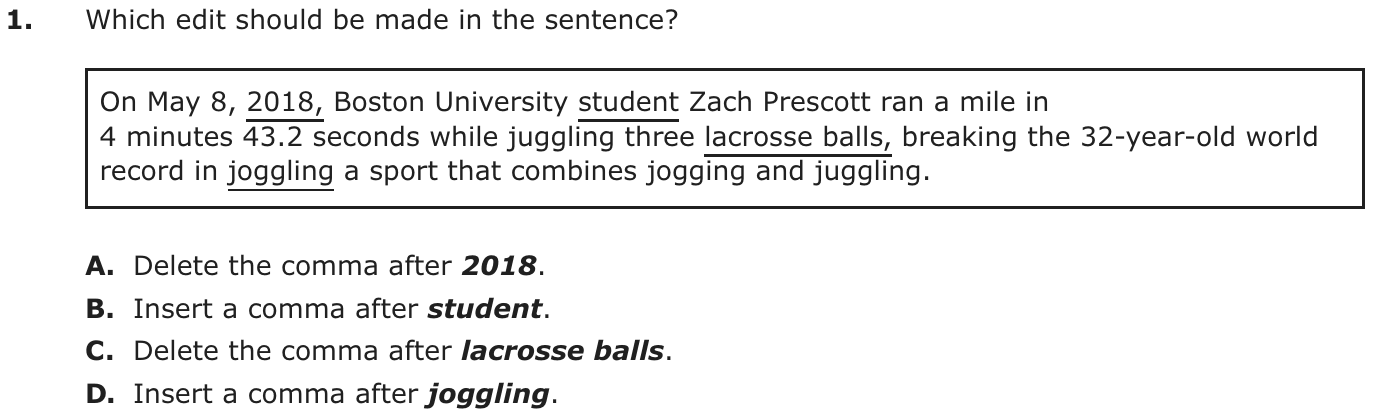
Question 12 of 19
2023 Test A English, question 3Question
How should this sentence be revised?
To promote their club, a bake sale will be sponsored by members of the debate team on Wednesday.
- ATo promote their club, on Wednesday a bake sale will be sponsored by members of the debate team.
- BOn Wednesday, to promote their club, a bake sale will be sponsored by members of the debate team.
- CTo promote their club, members of the debate team will sponsor a bake sale on Wednesday.
- DMembers of the debate team, on Wednesday to promote their club, will sponsor a bake sale.
Show the answer
Correct answer: C
The question asks for the correct revision of the sentence in the box.
A. Incorrect. The revisions do not fix the error that “to promote their club” modifies “a bake sale.”
B. Incorrect. The revisions do not fix the error that “to promote their club” modifies “a bake sale.”
C. CORRECT. The revision is correct because it includes the phrase “to promote their club” clearly modifying “members of the debate team.”
D. Incorrect. While the revision clarifies that “to promote their club” relates to the “members of the debate team,” the rest of the sentence is poorly written because the insertion of “on Wednesday to promote their club” in the middle of the sentence interrupts the main clause, “Members of the debate team will sponsor a bake sale.”
Question analysis
This sentence-structure question gives one sentence about a debate team’s bake sale, planned for Wednesday to promote their club, and asks how it should be revised. The four rewrites shuffle the same three phrases into different orders, so students must check which word each phrase modifies and whether the whole sentence still reads naturally.
- NYS standards
- 7L1 grammar and usage conventions
- Grade level
- Grade 7 reading and task
- Compared with grade 7
- At grade 7 Placing a phrase so that it describes the right word is part of the grade 7 language standards, and this one-sentence item is a classic case. Choosing the rewrite that is both logical and smooth is typical grade 7 editing.
- Estimated difficulty
- Straightforward: two steps or one careful reading.
- Thinking it demands
- Depth of knowledge 2, skills and concepts · mainly evaluate
- What makes it hard
- A rule that doesn't sound wrong moderate
- Complex sentences minor
- Every choice must be checked minor
- A very close wrong answer minor
- Evidence
- Answered from one sentence or line
- Reading level
- Question and choices: about grade 7, 92 words.
- Students, last 30 days
- Not enough answers yet to show (it takes 10).
Why it is hard, traps and wrong answers (shows the answer)
Why it is hard
The sentence makes sense on a first reading, which is exactly why its error slips past students who edit by ear. Asking who is promoting the club exposes it and removes both rewrites that keep the bake sale as the subject, however neatly they are punctuated. What is left is a judgment of style, and the smoother rewrite keeps the subject and verb together instead of interrupting them with two phrases.
A rule that doesn't sound wrong moderate Working it out
“To promote their club” has to describe whatever comes right after its comma, and that is “a bake sale”; the meaning is so plain that few students notice the sale doing the promoting. (Connors & Lunsford, 1988)
Complex sentences minor Understanding the question
The original is passive, “a bake sale will be sponsored by members of the debate team,” which places the people who act after the verb, far from the phrase that should describe them. (Abedi & Lord, 2001; Freedle & Kostin, 1993; Messick, 1989)
Every choice must be checked minor Choosing the answer
Each rewrite rearranges the opening phrase, the time phrase and the main clause, so each has to be read through to see what follows “To promote their club” and whether anything splits a subject from its verb. (Embretson & Wetzel, 1987)
A very close wrong answer minor Choosing the answer
Two rewrites make the team members the subject of “will sponsor” with identical words; they part only on where the two phrases go, at the edges of the sentence or wedged between subject and verb. (Embretson & Wetzel, 1987; Gorin & Embretson, 2006; Ascalon et al., 2007)
Strategy: Ask who is really doing the promoting, then read each rewrite aloud in full, checking which words follow the opening phrase and whether the sentence reads smoothly from start to finish.
Traps
- Misplaced modifier: A describing word or phrase that attaches to the wrong word, or to nothing in the sentence.
The wrong answers, classified
A Misplaced modifier (Connors & Lunsford, 1988)
Moves “on Wednesday” ahead of the bake sale as if the time phrase were the misplaced part, but the sentence stays passive and the sale is still what “To promote their club” describes.
B Misplaced modifier (Connors & Lunsford, 1988)
Is drawn by the tidy commas around both fronted phrases, yet “a bake sale” still comes straight after them, so the sale remains the thing promoting the club.
D Misplaced modifier (Connors & Lunsford, 1988)
Rightly makes “Members of the debate team” the subject but parks “on Wednesday to promote their club” between it and “will sponsor,” a clumsy break the smoother rewrite avoids.
Working it out, step by step
Figure out what the question asks
You need the best way to rewrite the sentence. This is about a modifier. A modifier is a group of words that describes something else in the sentence. Here the opening words, “To promote their club,” are the modifier. Your job is to check what they describe.
Learn the rule for opening phrases
A sentence may start with a describing phrase and a comma. Then the phrase describes whatever comes right after the comma. So the one doing the action should come next.
Wrong: To get good seats, the line was joined early by Ana. A line can’t want good seats.
Right: To get good seats, Ana joined the line early.Find the problem in the sentence
To promote a club means to get people interested in it. In the sentence, the words right after the comma are “a bake sale.” So the sentence seems to say the bake sale is promoting the club. But a bake sale doesn’t have a club. The club belongs to the “members of the debate team.” They should come right after the comma, and they should do the action: they “will sponsor a bake sale.”
Check each choice
- A is wrong. It moves “on Wednesday” forward. But the bake sale is still what the opening phrase describes.
- B is wrong. It puts “On Wednesday,” at the front. The commas look neat, but “a bake sale” still follows “to promote their club.”
- C is right. “Members of the debate team” comes right after the comma. They are the ones promoting their club.
- D is wrong. The members come first. But “on Wednesday to promote their club” is stuck between the subject (who does the action) and the verb (the action word).
Watch out: D is tempting, since the members do the promoting. But its long middle part breaks up the main idea.
Choose the answer
C fixes the modifier and reads smoothly: To promote their club, members of the debate team will sponsor a bake sale on Wednesday. So the answer is C.
Why this answer and not the closest wrong one
D is the closest wrong answer. Like C, it makes the members the ones who promote the club. But D pushes a long phrase between “Members of the debate team” and “will sponsor.” C keeps the subject and the verb side by side, so it is easier to read.
More questions like this
The original DOE question
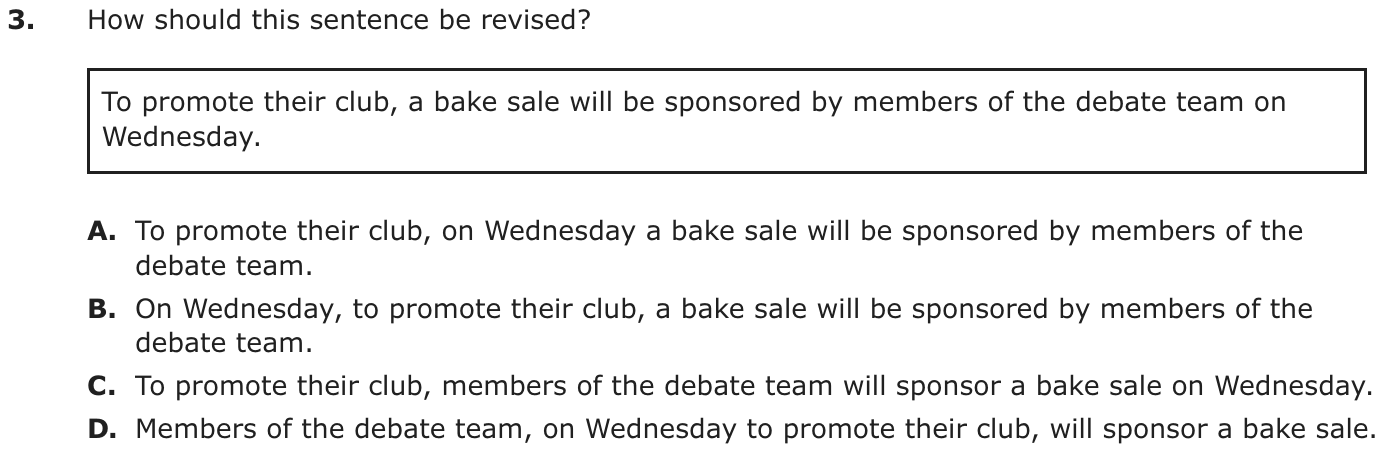
Question 13 of 19
2023 Test B English, question 1Question
Which revision should be made to correct the sentence?
To surprise her dad for his birthday on Friday, Yolanda ordered tempting savory sandwiches from a deli in her neighborhood, prepared his favorite chocolate cake, and invited his best friends over for the evening.
- ADelete the comma after Friday.
- BInsert a comma after tempting.
- CInsert a comma after deli.
- DDelete the comma after neighborhood.
Show the answer
Correct answer: B
The question asks which edit should be made to correct the sentence.
A. Incorrect. A comma is needed to separate the introductory infinitive phrase “to surprise her dad for his birthday on Friday,” which modifies Yolanda’s action, from the remainder of the sentence.
B. CORRECT. A comma is needed between two adjectives of equal importance preceding a noun. In this case, the adjectives “tempting” and “savory” are of equal importance, modifying the noun “sandwiches.” Their equal importance can be determined by inserting the word “and” between them (“tempting and savory sandwiches”).
C. Incorrect. This edit would introduce an error into the sentence by needlessly breaking up the two prepositional phrases “from a deli” and “in her neighborhood” with a comma. No comma is needed when prepositional phrases are joined together in this way to indicate a singular idea. In this sentence, these two phrases work together to show where the sandwiches are from.
D. Incorrect. Deleting this comma would introduce an error into the sentence. A comma is needed to separate the first and second items in the series of three actions Yolanda undertook: “ordered tempting savory sandwiches from a deli in her neighborhood,” “prepared his favorite chocolate cake,” and “invited his best friends over for the evening.”
Question analysis
This punctuation question gives one long sentence about Yolanda’s birthday surprise for her dad, with sandwiches from a neighborhood deli, his favorite chocolate cake and his best friends invited over, and asks which comma revision corrects it. Two choices delete a comma and two insert one, so students must decide what each comma does, or would do, in the sentence.
- NYS standards
- 7L2 capitalization, punctuation, and spelling
- Grade level
- Grade 7 reading and task
- Compared with grade 7
- At grade 7 Comma rules are taught across grades 6 and 7, and one sentence with four marked spots is a typical grade 7 editing task. The sentence reads smoothly as printed, so the needed change has to be found by rule rather than by ear.
- Estimated difficulty
- Straightforward: two steps or one careful reading.
- Thinking it demands
- Depth of knowledge 1, recall and reproduction · mainly apply
- What makes it hard
- A rule that doesn't sound wrong moderate
- Complex sentences minor
- Evidence
- Answered from one sentence or line
- Reading level
- Question and choices: about grade 8, 63 words.
- Students, last 30 days
- Not enough answers yet to show (it takes 10).
Why it is hard, traps and wrong answers (shows the answer)
Why it is hard
Every marked spot but one already follows a rule, and the sentence reads smoothly as printed, so students who edit by ear go hunting for a pause to add or a comma to remove. The strongest pull inserts a comma between “from a deli” and “in her neighborhood,” two phrases that work as one, and another deletes the series comma because it sits right before a verb. Testing the two adjectives with “and” settles the question in seconds.
A rule that doesn't sound wrong moderate Working it out
“Tempting savory sandwiches” sounds complete without a comma, so the error is invisible to the ear; only putting “and” between the two adjectives, or swapping them, shows that they are coordinate and need one. (Connors & Lunsford, 1988)
Complex sentences minor Understanding the question
The 34-word sentence opens with a nine-word infinitive phrase and then lists three actions, the first running ten words to “neighborhood,” so each marked comma must be judged against where these parts begin and end. (Abedi & Lord, 2001; Freedle & Kostin, 1993; Messick, 1989)
Strategy: Take the four marked spots one at a time and name the comma rule that applies there; change only the spot where the sentence breaks a rule, not one that already follows it.
Traps
- Punctuation: A comma, semicolon, colon, dash or apostrophe used where it does not belong, or missing where it does.
The wrong answers, classified
A Punctuation (Connors & Lunsford, 1988)
Treats the comma after “Friday” as an interruption, though the nine-word opening phrase “To surprise her dad for his birthday on Friday” has to be set off from “Yolanda.”
C Punctuation (Connors & Lunsford, 1988)
Treats “in her neighborhood” as extra information to set off, but the phrase identifies the deli and works with “from a deli” as one unit, so no comma goes between them.
D Punctuation (Connors & Lunsford, 1988)
Stretches the rule against separating a subject from its verb to the comma before “prepared,” though that comma ends the first of Yolanda’s three actions in a series.
Working it out, step by step
Figure out what the question asks
This is a punctuation question. The sentence has four underlined spots. Two choices take a comma away, and two add one. Only one change fixes a real mistake. So go spot by spot. Ask what job a comma does there, or would do.
Learn the rule for paired describing words
An adjective is a describing word, like red or soft. Sometimes two adjectives describe the same noun (a naming word) equally. Then a comma goes between them. Here is a test: put and between the two words. If it still sounds right, use a comma.
Example: a long, boring movie. You could say a long and boring movie, so the comma belongs.
Find the spot that breaks the rule
Look at “tempting savory sandwiches.” Tempting means making you want it. Savory means salty or spicy, not sweet. Both words describe the sandwiches. Try the test: tempting and savory sandwiches. That sounds fine. You could even swap them: savory, tempting sandwiches. So a comma is missing. The sentence should say tempting, savory sandwiches.
Check each choice
- A is wrong. The sentence opens with a long phrase: “To surprise her dad for his birthday on Friday.” A comma must separate it from the main part, “Yolanda ordered.” So that comma stays.
- B is right. It adds the missing comma between the two adjectives.
- C is wrong. The words “in her neighborhood” tell which deli. They work as a team with “from a deli,” so no comma goes between them.
- D is wrong. Yolanda does three things: she ordered sandwiches, made a cake and invited friends. The comma after neighborhood ends the first item in that list. It must stay.
Watch out: C is tempting because a pause after deli may sound natural. But a pause is not a rule, and no rule puts a comma there.
Choose the answer
With the fix, Yolanda orders tempting, savory sandwiches, and every other comma stays as it is. So the answer is B: insert a comma after tempting.
Why this answer and not the closest wrong one
C is the closest wrong answer. It adds a comma too, but it splits two phrases that together tell where the deli is. B adds a comma where a rule needs one. The and test proves it: “tempting” and “savory” each describe the sandwiches in the same way.
More questions like this
The original DOE question
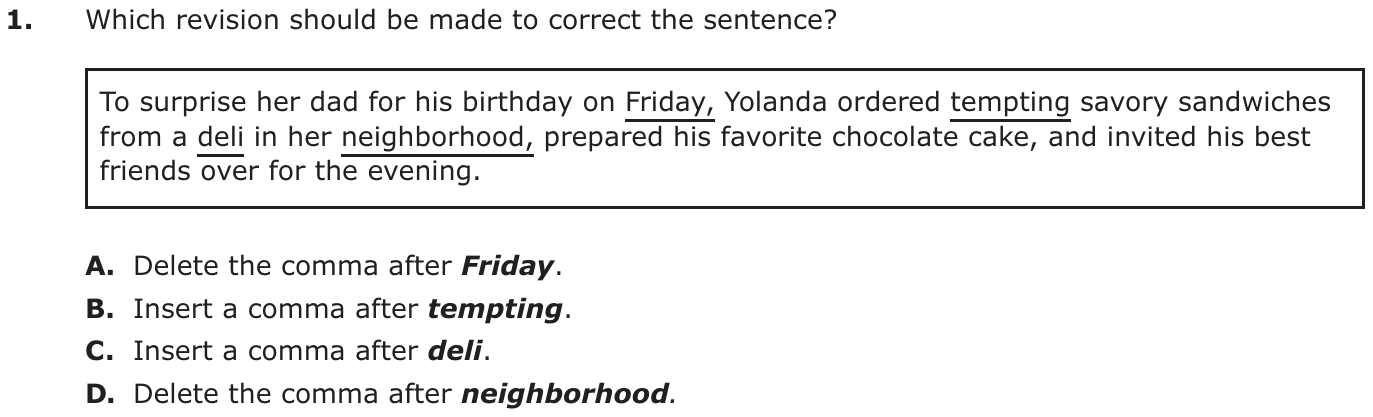
Question 14 of 19
2018 Test A English, question 2Question
Read this paragraph.
(1) When coal was used to heat homes, it frequently left soot stains on the walls. (2) Brothers Cleo and Noah McVicker, who owned a cleaning product company created a doughy substance to help people remove this soot. (3) Over time, as natural gas becomes more common, people had little need for soot cleansers, and the McVickers’ family company struggled to stay in business. (4) Then one day Joe McVicker, Cleo’s son, learned that his sister-in-law had been using the substance for art projects in her classroom, so he remarketed the product as the toy known today as Play-Doh.
Which pair of revisions need to be made in the paragraph?
- A
Sentence 1: Delete the comma after homes.
Sentence 3: Change becomes to became.
- B
Sentence 1: Delete the comma after homes.
Sentence 4: Change remarketed to had remarketed.
- C
Sentence 2: Insert a comma after company.
Sentence 3: Change becomes to became.
- D
Sentence 2: Insert a comma after company.
Sentence 4: Change remarketed to had remarketed.
Show the answer
Correct answer: C
This is the answer (C)
The question asks for the pair of revisions needed to correct the errors in the paragraph, which appear in sentence 2 and sentence 3.
Option C is correct because it is the only choice that revises the errors in both sentence 2 and sentence 3.
In sentence 2 (Option C and Option D), a comma needs to follow the word “company” to set off the phrase “who owned a cleaning product company.” A comma is necessary because the phrase is a nonrestrictive clause: the phrase provides extra information about Cleo and Noah McVicker’s line of work, but the phrase is not necessary in order to understand the meaning of the sentence.
The second error is in sentence 3 (Option A and Option C), which incorrectly shifts the verb into the present tense. The clause “as natural gas becomes more common” should be “as natural gas became more common.”
The comma after the word “homes” in sentence 1 (Option A and Option B) is necessary for separating the subordinate clause “When coal was used to heat homes” from the main clause.
In sentence 4 (Option B and Option D), the word “remarketed” is in the past tense established in the rest of the paragraph and should not change to the past perfect tense “had remarketed.”
Question analysis
This editing question gives a short paragraph about how a soot cleaner became the toy Play-Doh and asks which pair of revisions it needs. Students must check comma use and verb tense, and because each choice pairs two edits, one correct fix can hide a wrong one.
- Grade level
- Grade 6 reading and task
- Compared with grade 7
- At grade 7 Comma rules and verb tense are taught by grade 6, but here the student must judge four separate edits and accept a choice only if both of its edits are needed, which matches grade 7 demand.
- Estimated difficulty
- Moderate: several steps, or a close reading with one strong distractor.
- Thinking it demands
- Depth of knowledge 2, skills and concepts · mainly apply
- What makes it hard
- A rule that doesn't sound wrong moderate
- A very close wrong answer moderate
- Every choice must be checked minor
- Evidence
- Answered from one paragraph or stanza
- Reading level
- Question and choices: about grade 7, 155 words.
- Students, last 30 days
- Not enough answers yet to show (it takes 10).
Why it is hard, traps and wrong answers (shows the answer)
Why it is hard
The paragraph holds two errors of different kinds, an unclosed “who” clause and a slip into present tense, and the other two proposed edits change text that is already correct. Students who catch the tense shift but not the comma are left between two pairs, and many then delete the sound comma after the opening “When” clause. The question rewards finding both errors in the paragraph before reading the pairs.
A rule that doesn't sound wrong moderate Working it out
The “who owned a cleaning product company” clause opens with a comma but never closes, and sentence 2 still reads smoothly aloud, so the missing comma after “company” is easy to miss. (Connors & Lunsford, 1988)
A very close wrong answer moderate Choosing the answer
The right pair and the pair that deletes the comma after “homes” share the “becomes” to “became” fix, so only the comma edit, after “company” or after “homes”, tells them apart. (Embretson & Wetzel, 1987; Gorin & Embretson, 2006; Ascalon et al., 2007)
Every choice must be checked minor Choosing the answer
The four pairs draw on four possible edits in four sentences, so each edit has to be judged on its own and a pair accepted only when both are needed. (Embretson & Wetzel, 1987)
Strategy: Find the errors yourself before looking at the pairs: check whether each comma is needed or missing, and check that each verb's tense fits when its event happened.
Traps
- Punctuation: A comma, semicolon, colon, dash or apostrophe used where it does not belong, or missing where it does.
- Verb tense or form: The wrong tense, an inconsistent shift of tense, or a wrong verb form.
- Fixes what isn't broken: Changes a part of the sentence that was already correct, while the real error stays; or, where the question asks which sentence has an error or should go, picks one that is correct and belongs.
The wrong answers, classified
A Punctuation (Connors & Lunsford, 1988)
Gets the “becomes” to “became” fix but, missing the unclosed “who” clause in sentence 2, deletes the comma that correctly ends the opening clause of sentence 1.
B Fixes what isn't broken (Connors & Lunsford, 1988)
Changes two correct parts, deleting the comma after an opening clause and adding a needless past perfect, while both real errors in sentences 2 and 3 stay.
D Verb tense or form (Connors & Lunsford, 1988)
Adds the needed comma after “company” but thinks the later event needs “had remarketed”, missing the real tense error, the present-tense “becomes” in sentence 3.
Working it out, step by step
Figure out what the question asks
Each choice is a pair of edits. You need the pair where both edits are needed. If even one edit in a pair changes something that was already right, that pair is wrong. The best plan is to find the errors yourself first. Then look for the pair that fixes them.
Check the comma in sentence 2
Sentence 2 says “Brothers Cleo and Noah McVicker, who owned a cleaning product company created a doughy substance.” The part “who owned a cleaning product company” is extra information. The sentence still makes sense without it. Extra information in the middle of a sentence needs a comma on both sides. Example: My aunt, who lives in Ohio, sent me a card. Sentence 2 has the first comma but not the second. So you need to add a comma after “company.”
Check the comma in sentence 1
Sentence 1 starts with “When coal was used to heat homes.” That part is a dependent clause (a group of words with a verb that can’t stand alone as a sentence). When a sentence starts with one, a comma goes after it. Example: When the bell rang, we ran outside. So the comma after “homes” is correct. Deleting it would add an error. That rules out choices A and B.
Check the verb in sentence 3
Verb tense tells when something happens. This paragraph tells a story from the past, so its verbs should stay in the past. Sentence 3 says “as natural gas becomes more common.” The word “becomes” is present tense. But the same sentence uses “had” and “struggled,” which are past tense. So change “becomes” to became.
Check the verb in sentence 4
Sentence 4 says Joe learned about the art projects, so he “remarketed” the product. Remarketed means sold it again in a new way. The form had remarketed is for something that happened before another past event. But Joe remarketed the product after he learned about the art projects. So the plain past “remarketed” is right. No change is needed.
Find the pair that matches
The two needed edits are: add a comma after “company,” and change “becomes” to “became.”
- A fixes the verb but deletes a correct comma.
- B makes two changes that are not needed.
- D adds the comma but changes a verb that was already right.
- C makes exactly the two needed edits.
So the answer is C.
Why this answer and not the closest wrong one
Choice A is the closest wrong answer, because it has the same “becomes” to “became” fix. But A also deletes the comma after “homes,” and that comma belongs after an opening “When” clause. Only C fixes both real errors and changes nothing that was already right.
More questions like this
The original DOE question
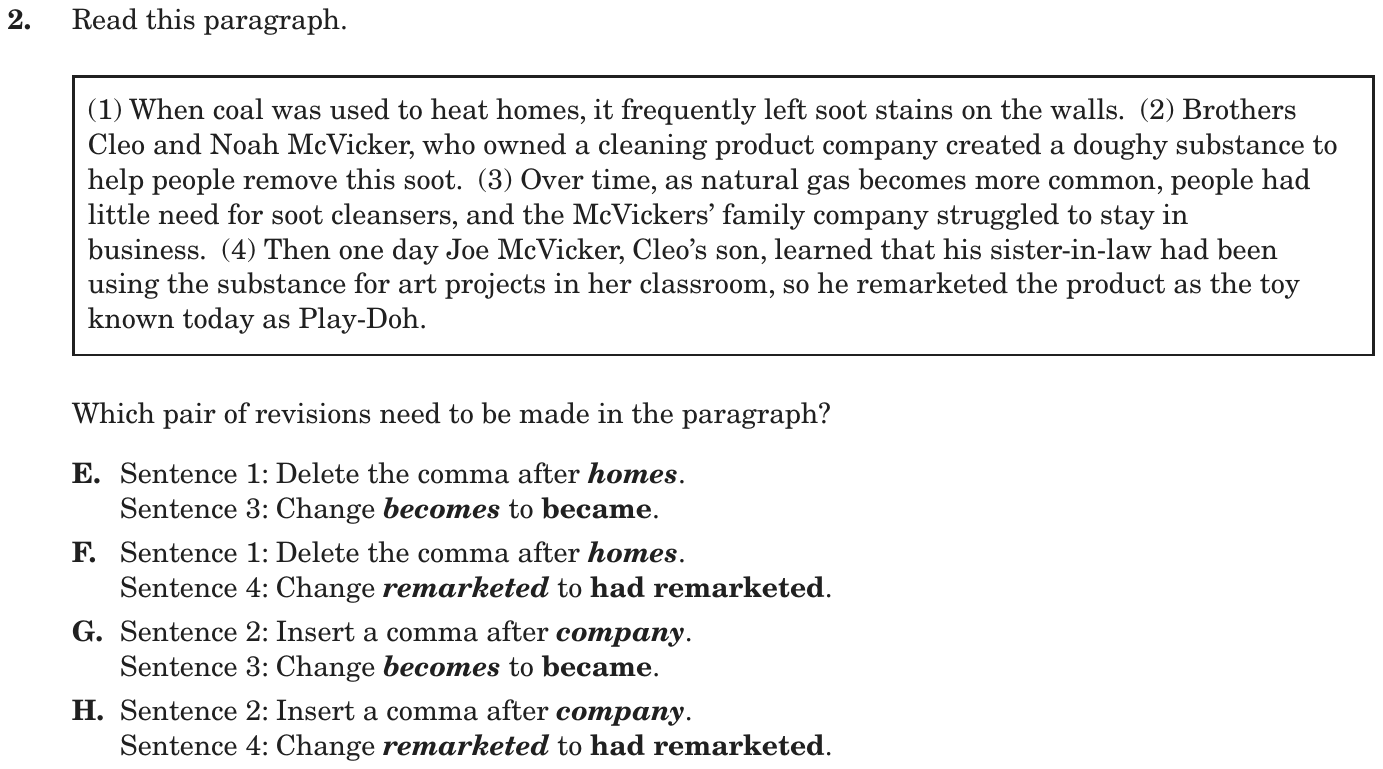
Question 15 of 19
2018 Test A English, question 3Question
Read this paragraph.
(1) Walking dogs, cleaning kennels, hand-feeding newborn kittens, and supporting the pet-adoption process, the animal shelter is looking for volunteers to help with a variety of tasks. (2) Working at the animal shelter is a great way for young people, especially those who aspire to care for and protect animals, to gain valuable work experience. (3) In addition to hands-on training with animal care, volunteers will learn important job skills, such as punctuality, responsibility, and personal initiative. (4) Caring for animals can also help volunteers develop empathy, which is the awareness and understanding of the feelings of others.
Which sentence contains an error in its construction and should be revised?
- Asentence 1
- Bsentence 2
- Csentence 3
- Dsentence 4
Show the answer
Correct answer: A
The answer is (A)
The question asks for the identification of the sentence in the paragraph that has an error in its construction and should be revised.
Option A (sentence 1) is the correct response because sentence 1 contains a structural error. The sentence begins with a list of modifying phrases: “Walking dogs, cleaning kennels, hand-feeding newborn kittens, and supporting the pet-adoption process.” As written, this list modifies the closest noun phrase, “the animal shelter,” which is illogical because the list describes tasks at the animal shelter, not the shelter itself. The list should follow the word “tasks” at the end of the sentence, so that it is closer to the word that it modifies.
Option B, Option C, and Option D are incorrect responses because sentence 2, sentence 3, and sentence 4 do not contain structural errors.
For Option B, the phrase “especially those who aspire to care for and protect animals” in sentence 2 correctly modifies “young people.”
For Option C, the structure of sentence 3 allows the words “In addition to hands-on training with animal care” to correctly modify “volunteers will learn.”
For Option D, the phrase “which is the awareness and understanding of the feelings of others” in sentence 4 correctly modifies the word “empathy.”
Question analysis
This editing question gives a paragraph inviting young people to volunteer at an animal shelter and asks which sentence is built incorrectly and should be revised. The error is in sentence structure, not spelling or punctuation, and every sentence contains long descriptive phrases, so students must check what each phrase actually describes.
- NYS standards
- 7L1 grammar and usage conventions
- Grade level
- Grade 7 reading and task
- Compared with grade 7
- At grade 7 Spotting a misplaced or dangling modifier is the grade 7 grammar skill tested here. The faulty sentence reads smoothly and the correct sentences also hold long modifying phrases, so it matches a careful grade 7 editing task.
- Estimated difficulty
- Moderate: several steps, or a close reading with one strong distractor.
- Thinking it demands
- Depth of knowledge 2, skills and concepts · mainly analyze
- What makes it hard
- A rule that doesn't sound wrong major
- Every choice must be checked moderate
- Complex sentences minor
- Evidence
- Answered from one paragraph or stanza
- Reading level
- Question and choices: about grade 10, 113 words.
- Students, last 30 days
- Not enough answers yet to show (it takes 10).
Why it is hard, traps and wrong answers (shows the answer)
Why it is hard
The faulty sentence is the first one and the smoothest-sounding, because the mind supplies the missing volunteers who walk the dogs. Students who judge by ear pass over it and then flag a correct sentence that merely sounds busy. The question rewards asking, for every opening phrase, which noun it actually attaches to.
A rule that doesn't sound wrong major Working it out
Sentence 1's opening list, “Walking dogs, cleaning kennels, hand-feeding newborn kittens”, grammatically describes “the animal shelter”, an error that sounds natural because readers know volunteers will do those tasks. (Connors & Lunsford, 1988)
Every choice must be checked moderate Choosing the answer
The stem names no kind of error, so all four sentences must be checked, and sentences 2, 3 and 4 each contain a long phrase that could look misplaced. (Embretson & Wetzel, 1987)
Complex sentences minor Understanding the question
Every sentence carries a lengthy modifier, from the interrupting “especially those who aspire to care for and protect animals” to the closing definition of empathy, so the faulty one does not stand out. (Abedi & Lord, 2001; Freedle & Kostin, 1993; Messick, 1989)
Strategy: In each sentence, find every descriptive phrase and ask which noun sits next to it. Any phrase placed beside a noun it cannot logically describe marks the sentence to revise.
The wrong answers, classified
B Fixes what isn't broken (Connors & Lunsford, 1988)
Flags the interruption “especially those who aspire to care for and protect animals” as an error, though it correctly describes “young people” and the sentence is complete.
C Fixes what isn't broken (Connors & Lunsford, 1988)
Suspects the opening phrase “In addition to hands-on training with animal care” dangles like sentence 1's, but it leads straight into “volunteers”, who receive the training.
D Fixes what isn't broken (Connors & Lunsford, 1988)
Picks the “which is the awareness and understanding of the feelings of others” clause as misplaced, though it sits right after “empathy”, the word it defines.
Working it out, step by step
Figure out what the question asks
This asks which sentence is built wrong. The words may be fine, but the parts are in the wrong order or don’t fit together. The question doesn’t say what kind of error to look for. So you need to check all four sentences.
Learn the rule about describing phrases
A modifier is a word or phrase that describes something. It must sit right next to the thing it describes. If it sits next to the wrong word, the sentence says something silly. Example: Barking loudly, the mail carrier ran from the dog. This says the mail carrier was barking! Fix: The mail carrier ran from the dog, which was barking loudly.
Test sentence 1
Sentence 1 begins with a list: “Walking dogs, cleaning kennels, hand-feeding newborn kittens, and supporting the pet-adoption process.” Right after the comma comes “the animal shelter.” So the sentence says the shelter is walking dogs and feeding kittens. A shelter is a place. It can’t do those things. The list really describes the “tasks” at the end of the sentence. One fix moves the list after that word: …volunteers to help with a variety of tasks, such as walking dogs, cleaning kennels…
Test sentences 2, 3, and 4
- Sentence 2: “especially those who aspire to care for and protect animals” comes right after “young people.” It describes them, so it is in the right place. (To aspire means to hope or aim.)
- Sentence 3: “In addition to hands-on training with animal care” leads straight into “volunteers.” The volunteers get the training, so it fits.
- Sentence 4: “which is the awareness and understanding of the feelings of others” comes right after “empathy.” It explains that word, so it fits.
Watch out: Sentence 3 also starts with a phrase and a comma, so choice C can look like sentence 1. Ask who gets the training. The volunteers do.
Pick the answer
Only sentence 1 puts a describing phrase next to the wrong noun. So the answer is A, sentence 1.
Why this answer and not the closest wrong one
Sentence 3 is the closest trap, because it also opens with a phrase and a comma. But the word after its comma is “volunteers,” and the volunteers really do get the training. In sentence 1, the words after the comma are “the animal shelter,” and a shelter can’t walk dogs.
More questions like this
The original DOE question
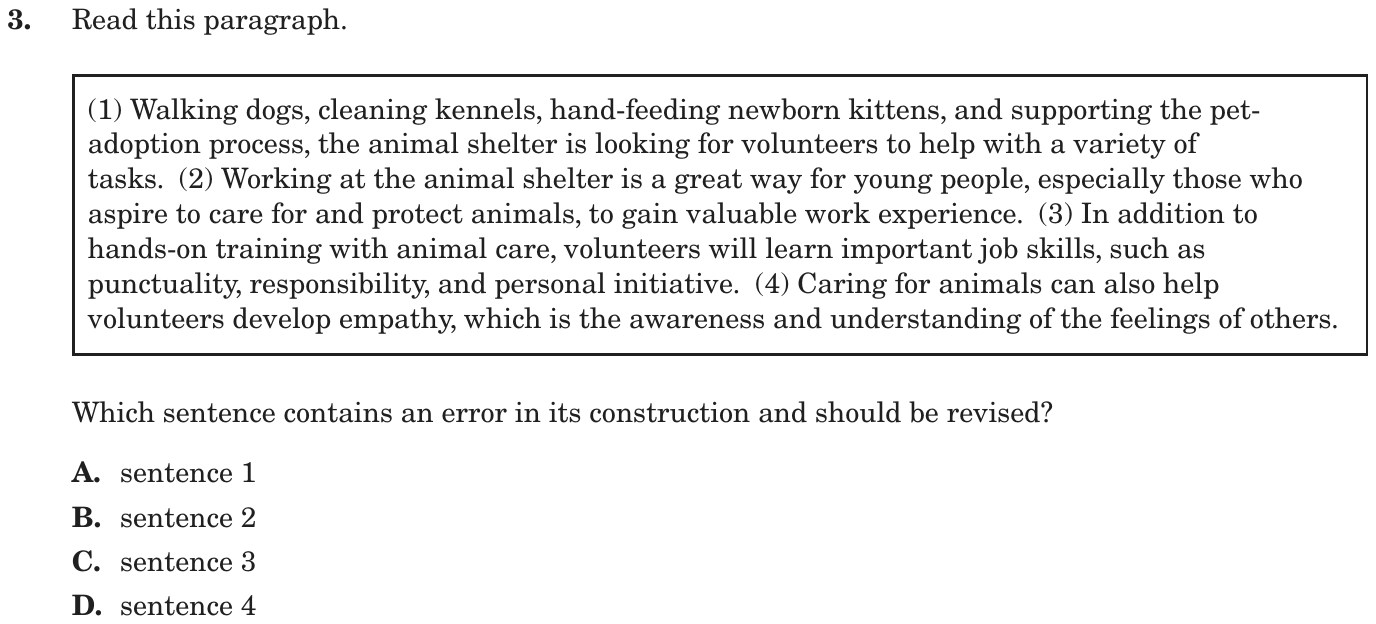
Question 16 of 19
2018 Test B English, question 1Question
Read this sentence.
The Colosseum in Rome, Italy which is considered one of the “new” Seven Wonders of the World, is the largest amphitheater ever built and could hold more than 50,000 spectators.
Which edit should be made to correct the sentence?
- ADelete the comma after Rome.
- BInsert a comma after Italy.
- CDelete the comma after World.
- DInsert a comma after built.
Show the answer
Correct answer: B
The question asks for the correction needed for an error in the sentence. The sentence needs a comma to set off the clause “which is considered one of the ‘new’ Seven Wonders of the World,” because the clause is not essential to the meaning of the sentence (nonrestrictive clause).
Option B is correct because it places a comma where it is needed, after “Italy,” to set off the nonrestrictive clause that follows.
Option A is incorrect because when a name has more than one element, a comma is used to separate the elements for clarity.
Option C is incorrect because it would remove the comma at the end of the nonrestrictive clause, which should be set off by commas at the beginning and the end.
Option D is incorrect because a comma after “built” would separate the phrase “could hold more than 50,000 spectators,” which is part of a compound predicate that uses the subject from the main clause and so needs to stay connected to the rest of the sentence.
Question analysis
This punctuation question gives one long sentence about the Colosseum in Rome and asks which single comma edit makes it correct. Students apply the comma rules for place names and for nonessential clauses. The long subject makes it tricky, because every comma has to be weighed: added, removed or left alone.
- NYS standards
- 7L2 capitalization, punctuation, and spelling
- Grade level
- Grade 6 reading and task
- Compared with grade 7
- Below grade 7 Comma rules for place names and for extra information in mid-sentence are grade 6 punctuation, tested here in one short sentence with a single edit. Grade 7 editing usually moves on to clauses, modifiers and sentence combining.
- Estimated difficulty
- Straightforward: two steps or one careful reading.
- Thinking it demands
- Depth of knowledge 1, recall and reproduction · mainly apply
- What makes it hard
- A rule that doesn't sound wrong moderate
- Complex sentences minor
- Evidence
- Answered from one sentence or line
- Reading level
- Question and choices: about grade 6, 61 words.
- Corrected from the DOE handbook
- A grammar term in the explanation was corrected.
- Students, last 30 days
- Not enough answers yet to show (it takes 10).
Why it is hard, traps and wrong answers (shows the answer)
Why it is hard
Most students who miss this question can find the which-clause but treat its two edges differently: they see the closing comma after “World” as an error and never notice that the opening comma is missing. The question rewards marking where the extra description begins and ends before judging any single comma. Knowing that a city and its country are always separated settles the rest quickly.
A rule that doesn't sound wrong moderate Working it out
The missing comma after “Italy” does two jobs at once, closing the city–country pair and opening the which-clause, and “Rome, Italy which is considered” reads smoothly enough that few students hear the gap. (Connors & Lunsford, 1988)
Complex sentences minor Understanding the question
The sentence packs a place name, a nonessential which-clause and a compound predicate (“is the largest amphitheater ever built and could hold”) into 30 words, so every comma has to be placed within that structure. (Abedi & Lord, 2001; Freedle & Kostin, 1993; Messick, 1989)
Strategy: Mark where the extra description of the Colosseum begins and ends, then ask of each comma whether it separates a city from its country, sets off that description, or splits subject from verb.
The wrong answers, classified
A Punctuation (Connors & Lunsford, 1988)
Treats Rome and Italy as one name that needs no comma between them, not knowing that a comma always separates a city from its state or country.
C Punctuation (Connors & Lunsford, 1988)
Applies the real rule against a comma between subject and verb to the comma after “World,” missing that it closes the which-clause and must stay.
D Punctuation (Connors & Lunsford, 1988)
Adds a comma wherever the long sentence seems to pause, before “and could hold,” though that second verb shares the subject and takes no comma.
What was corrected from the DOE handbook, and why
- Explanation: The handbook calls “could hold more than 50,000 spectators” a dependent clause. It has no subject of its own: it is the second half of a compound predicate (the Colosseum “is the largest amphitheater ever built and could hold…”), which is why no comma goes before it. The site now calls it “part of a compound predicate.”
Working it out, step by step
Figure out what the question asks
This is a punctuation question. Punctuation means marks like commas and periods. The sentence has one comma mistake. You need the one edit that fixes it. Two comma rules decide it.
Learn the rule for extra information
Some groups of words just add an extra fact. The sentence still makes sense without them. Grammar books call this a nonessential clause. Put a comma before it and a comma after it, like a pair of brackets.
Example: My dog, which is brown, likes to swim. Take out the middle part and you still have My dog likes to swim.
Find the extra part in this sentence
Here the extra part starts with “which is considered” and ends with “of the World.” It gives a fun fact about the Colosseum. Without it, the sentence still works: The Colosseum in Rome, Italy, is the largest amphitheater ever built.
There is a comma at the end of the extra part, after “World.” But there is no comma at the start, after “Italy.” That is the mistake.
Learn the rule for places
When you name a city and then its country, put a comma between them. If the sentence keeps going, put another comma after the country. Example: We flew to Paris, France, last May.
So “Rome, Italy” needs a comma after “Italy” too. Here one comma does both jobs.
Check each choice
- A is wrong. The comma between “Rome” and “Italy” must stay. It splits the city from the country.
- B is right. It adds the missing comma at the start of the extra part.
- C is wrong. The comma after “World” closes the extra part, so it must stay.
- D is wrong. “Could hold” shares its subject, “The Colosseum,” with “is.” No comma goes before a second verb like that. Example: Sam ran home and ate lunch.
Watch out: C is tempting. A comma between a subject (who or what the sentence is about) and its verb (the action word) is usually wrong. Here it is fine, because it is the second comma of the pair.
Choose the answer
With the new comma, the extra part has a comma on each side. So the answer is B: insert a comma after Italy.
Why this answer and not the closest wrong one
C is the closest wrong answer. It treats the comma after “World” as a mistake. But that comma ends the extra part. If you delete it, the extra part has no comma at either end. B adds the missing first comma, so both ends are marked.
More questions like this
The original DOE question
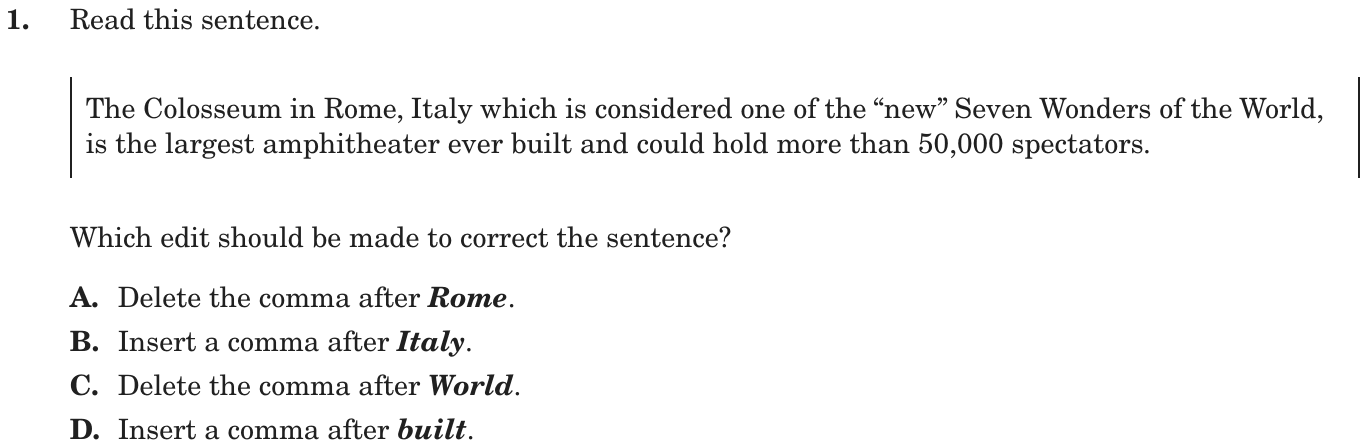
Question 17 of 19
2018 Test B English, question 2Question
Read this paragraph.
In September 2016 the National Museum of African American History and Culture opened as part of the Smithsonian Institution, the museum is already the Smithsonian’s third most popular site. Experts say that they expect this newest Smithsonian facility to welcome nearly 4 million visitors a year. The museum features more than 30,000 objects, including Muhammad Ali’s boxing gloves and a dress sewn by Rosa Parks. A commemorative copy of the Emancipation Proclamation, written in 1863 during the presidency of Abraham Lincoln, is also on display at the museum.
Which revision corrects the error in sentence structure in the paragraph?
- AInstitution, and the
- Byear, and the
- Cobjects, which include
- DProclamation, which was written
Show the answer
Correct answer: A
The question asks for the correction of an error in sentence structure in the paragraph.
The first sentence is a run-on sentence because both clauses—“In September 2016 the National Museum of African American History and Culture opened as part of the Smithsonian Institution” and “the museum is already the Smithsonian’s third most popular site”—are independent clauses, and independent clauses should not be combined without the use of a conjunction and a comma. The revision in Option A adds the word “and” after the comma, which corrects the run-on.
Option B, Option C, Option D are incorrect responses because the corresponding underlined portions in the paragraph are not structural errors. No edits are needed to correct those portions of the text.
Question analysis
This sentence-structure question gives a short paragraph about the opening of the National Museum of African American History and Culture. Students must find which of four spots holds a real error, such as a run-on, a fragment or a misplaced phrase, and pick the revision that fixes it. Long names stretch the sentences, and the spots that need no change can look just as suspicious.
- Grade level
- Grade 6 reading and task
- Compared with grade 7
- Below grade 7 Fixing run-ons and fragments is taught before grade 7, and here students check four short spots in one paragraph for a single structural error. Long institution names add reading load but no extra grammar.
- Estimated difficulty
- Straightforward: two steps or one careful reading.
- Thinking it demands
- Depth of knowledge 2, skills and concepts · mainly apply
- What makes it hard
- A rule that doesn't sound wrong moderate
- Complex sentences minor
- Every choice must be checked minor
- Evidence
- Answered from one paragraph or stanza
- Reading level
- Question and choices: about grade 10, 111 words.
- Corrected from the DOE handbook
- A misdescribed detail in the explanation was corrected.
- Students, last 30 days
- Not enough answers yet to show (it takes 10).
Why it is hard, traps and wrong answers (shows the answer)
Why it is hard
Students who miss this one usually look for the error in the wrong place: the phrases “including Muhammad Ali’s boxing gloves” and “written in 1863” look suspicious, while the real splice hides behind the long museum name. The question rewards checking each spot for a subject and verb on both sides of its punctuation. Two choices offer the same “, and the” fix, so knowing the fix is not enough without finding where it belongs.
A rule that doesn't sound wrong moderate Working it out
The error is a comma splice after “Institution,” where a comma alone joins two complete clauses, and a comma sounds like a natural pause when the sentence is read aloud. (Connors & Lunsford, 1988)
Complex sentences minor Understanding the question
The eight-word museum name stretches the first clause, so by the time “the museum is already” arrives, it reads like a continuation rather than a new subject and verb. (Abedi & Lord, 2001; Freedle & Kostin, 1993; Messick, 1989)
Every choice must be checked minor Choosing the answer
The four underlined spots fall in four different sentences, and each has to be tested for whether a complete sentence sits on both sides of its punctuation. (Embretson & Wetzel, 1987)
Strategy: Check each sentence for a subject and main verb and count its complete thoughts, then decide whether the spot each choice changes actually breaks a rule before picking a fix.
The wrong answers, classified
B Fixes what isn't broken (Connors & Lunsford, 1988)
Recognizes “, and the” as the usual run-on fix but applies it where a period already separates two complete, correctly punctuated sentences.
C Fixes what isn't broken (Connors & Lunsford, 1988)
Believes a phrase opening with “including” after a comma is a fragment, so turns it into a which-clause, though the phrase already attaches correctly to “objects.”
D Fixes what isn't broken (Connors & Lunsford, 1988)
Thinks “written in 1863” cannot describe the copy without “which was,” though the sentence already has its verb “is” and the phrase is correctly set off.
What was corrected from the DOE handbook, and why
- Explanation: The handbook says the correct revision “adds the word ‘and’ before the comma.” In “Institution, and the,” the word “and” comes after the comma, so the site now says “after the comma.”
Working it out, step by step
Figure out what the question asks
This question is about sentence structure, or how a sentence is built. One of the four underlined spots has a mistake. You need the change that fixes it.
Learn the run-on rule
A complete sentence has a subject (who or what it is about) and a verb (the action). It can stand alone. You cannot join two complete sentences with only a comma. That mistake is called a run-on.
Wrong: I was hungry, I ate an apple.
Fixed: I was hungry, and I ate an apple.
A period would also work: I was hungry. I ate an apple.Find the run-on
Look at the first sentence. The words before the comma can stand alone: “In September 2016 the National Museum of African American History and Culture opened as part of the Smithsonian Institution.” So can the words after it: “the museum is already the Smithsonian’s third most popular site.” Only a comma joins them. That is a run-on.
Check each choice
- A is right. “Institution, and the” adds the joining word “and” after the comma. That fixes the run-on.
- B is wrong. A period already splits those two sentences correctly.
- C is wrong. “Including Muhammad Ali’s boxing gloves” already describes the objects. It needs no change.
- D is wrong. “Written in 1863” already describes the copy. The sentence already has its verb, “is.”
Watch out: C and D are not bad sentences. But they change spots that were already correct, and the run-on stays.
Choose the answer
Now the first sentence says the museum opened, and it is already very popular. Those are two complete ideas, joined the right way. So the answer is A: Institution, and the.
Why this answer and not the closest wrong one
D is a tempting choice, because “which was written” also sounds fine. But a change that sounds fine is not a fix. The question asks you to correct the error. Only A changes the first sentence, where the run-on is.
More questions like this
The original DOE question
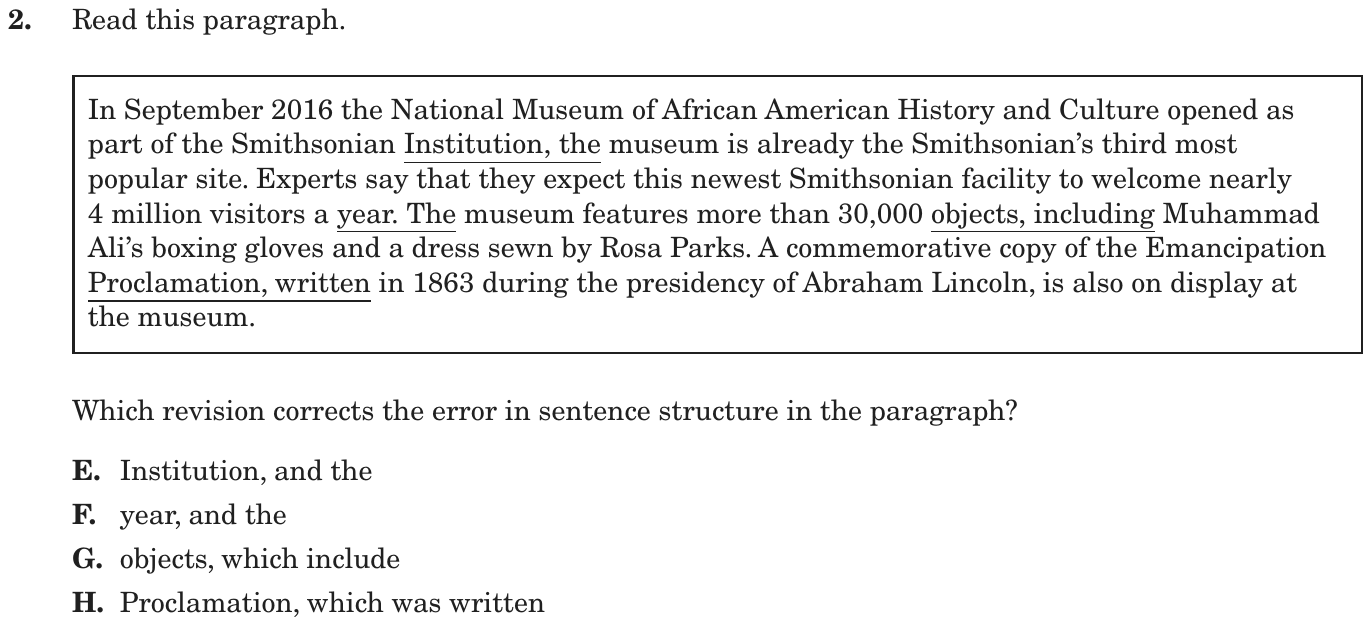
Question 18 of 19
2018 Test B English, question 3Question
Read this sentence.
To promote their club, a bake sale will be sponsored by members of the debate team on Wednesday.
How should the sentence be revised?
- ATo promote their club, on Wednesday a bake sale will be sponsored by members of the debate team.
- BOn Wednesday to promote their club, a bake sale will be sponsored by members of the debate team.
- CTo promote their club, members of the debate team will sponsor a bake sale on Wednesday.
- DMembers of the debate team, on Wednesday to promote their club, will sponsor a bake sale.
Show the answer
Correct answer: C
The question asks for the correct revision of the sentence in the box.
The sentence is incorrect because, as written, the phrase “to promote their club” refers to the closest noun to the phrase, which is “a bake sale,” and that does not match logically.
Option C is correct because the revision has the phrase “to promote their club” clearly modifying “members of the debate team” and adds the idea that the bake sale is on Wednesday to the end of the sentence.
Option A and Option B are incorrect because the revisions do not fix the error that “to promote their club” modifies “a bake sale.”
Option D is incorrect; while the revision clarifies that “to promote their club” relates to the “members of the debate team,” the rest of the sentence is poorly written because the insertion of “on Wednesday to promote their club” in the middle of the sentence interrupts the main clause, “Members of the debate team will sponsor a bake sale.”
Question analysis
This sentence-structure question shows a sentence about a debate team’s bake sale and asks how it should be revised. Students choose the rewrite that places each phrase where it logically belongs. The rewrites move the same phrases into different orders, so students must judge both the logic and how naturally each version reads.
- NYS standards
- 7L1 grammar and usage conventions
- Grade level
- Grade 7 reading and task
- Compared with grade 7
- At grade 7 Placing phrases so they modify the right words is named in the grade 7 language standards, and this one-sentence item is a typical classroom example. Students must also judge whether each rewrite reads smoothly, not just whether it is logical.
- Estimated difficulty
- Straightforward: two steps or one careful reading.
- Thinking it demands
- Depth of knowledge 2, skills and concepts · mainly evaluate
- What makes it hard
- A rule that doesn't sound wrong moderate
- Complex sentences minor
- Every choice must be checked minor
- A very close wrong answer minor
- Evidence
- Answered from one sentence or line
- Reading level
- Question and choices: about grade 6, 95 words.
- Students, last 30 days
- Not enough answers yet to show (it takes 10).
Why it is hard, traps and wrong answers (shows the answer)
Why it is hard
The original sentence is easy to understand, which is exactly why its dangling modifier slips past students who judge by sound. Rewrites that only move “on Wednesday” keep the passive voice and the error, so asking who is doing the promoting rules them out at once. Among the rewrites that put the team members first, the remaining decision is about smoothness: whether a phrase should sit between the subject and its verb.
A rule that doesn't sound wrong moderate Working it out
“To promote their club” has no logical doer in the original, since a bake sale cannot promote anything, but the meaning is so clear that the dangling modifier is hard to hear. (Connors & Lunsford, 1988)
Complex sentences minor Understanding the question
The passive “will be sponsored by members of the debate team” pushes the real actors to the end, which is why the opening phrase lands on “a bake sale.” (Abedi & Lord, 2001; Freedle & Kostin, 1993; Messick, 1989)
Every choice must be checked minor Choosing the answer
All four rewrites shuffle the same three phrases, so each must be read whole to see which noun follows the opening phrase and whether the main clause is interrupted. (Embretson & Wetzel, 1987)
A very close wrong answer minor Choosing the answer
The interrupted rewrite uses the same words as the right one and also makes the team members the subject; only where “on Wednesday to promote their club” sits, between subject and verb, separates them. (Embretson & Wetzel, 1987; Gorin & Embretson, 2006; Ascalon et al., 2007)
Strategy: Ask who is actually promoting the club, then read each rewrite to see which words the to-phrase attaches to and how smoothly the whole sentence reads.
Traps
- Misplaced modifier: A describing word or phrase that attaches to the wrong word, or to nothing in the sentence.
The wrong answers, classified
A Misplaced modifier (Connors & Lunsford, 1988)
Moves “on Wednesday” as if the time phrase were the problem and keeps the passive voice, so “To promote their club” still describes the bake sale.
B Misplaced modifier (Connors & Lunsford, 1988)
Shuffles both phrases to the front without a comma between them, yet “a bake sale” still follows, so the club-promoting phrase still describes the sale.
D Misplaced modifier (Connors & Lunsford, 1988)
Correctly makes “Members of the debate team” the subject but misplaces “on Wednesday to promote their club” between subject and verb, an awkward interruption the best revision avoids.
Working it out, step by step
Figure out what the question asks
This question is about a modifier. A modifier is a group of words that describes something. You need the version where the describing words go with the right noun (a person, place or thing).
Learn the rule for opening phrases
Sometimes a sentence starts with a describing phrase and a comma. That phrase describes whoever comes right after the comma. So the one doing the action must come right after the comma.
Wrong: To win the race, every day was spent training. A day can’t win a race.
Fixed: To win the race, Maya trained every day.Find the problem in the sentence
The sentence starts with “To promote their club.” To promote something means to get people interested in it. Right after the comma comes “a bake sale.” So the sentence says the bake sale is promoting the club. That makes no sense. The people promoting the club are the “members of the debate team.” They should come right after the comma.
Check each choice
- A is wrong. After the comma comes “on Wednesday a bake sale.” The bake sale is still doing the promoting.
- B is wrong. It moves “On Wednesday” to the front, but “a bake sale” still follows the comma.
- C is right. “Members of the debate team” comes right after the comma. They are the ones who “will sponsor a bake sale.”
- D is wrong. It names the members first. But it stuffs “on Wednesday to promote their club” between the subject and its verb. That breaks up the sentence.
Watch out: D also makes the members the ones promoting the club, so it is tempting. But C says the same thing in a smooth, clear order.
Choose the answer
In C, the members promote their club, and “on Wednesday” comes at the end, where it reads smoothly. So the answer is C.
Why this answer and not the closest wrong one
D is the closest wrong answer. Like C, it puts the members of the debate team first. But D splits the subject from its verb with a long phrase: “Members of the debate team, on Wednesday to promote their club, will sponsor.” C keeps the main idea together, so it reads clearly.
More questions like this
The original DOE question
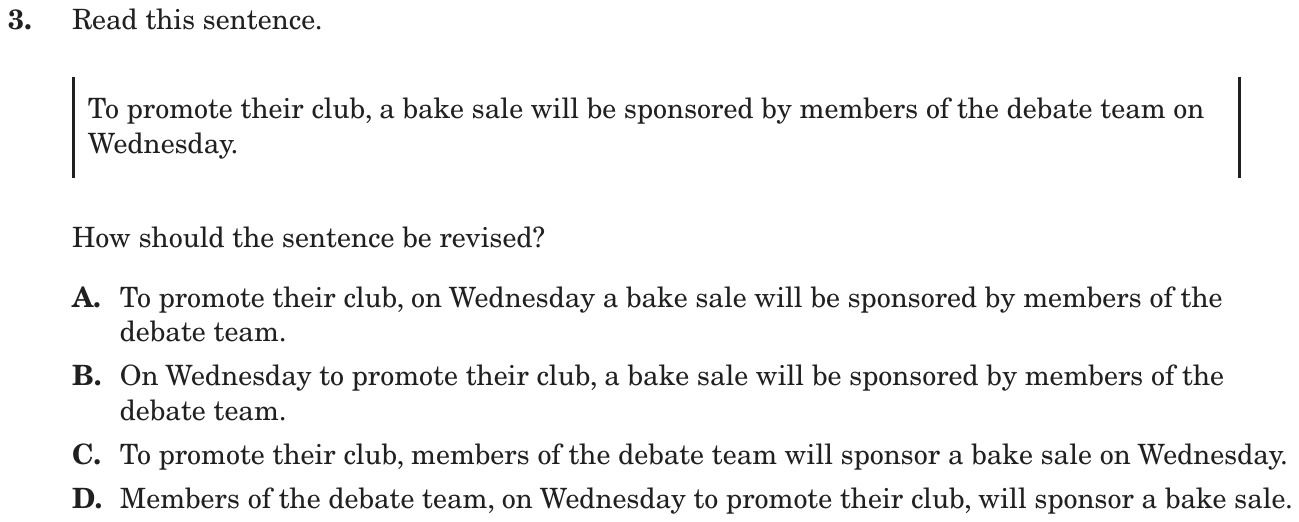
Question 19 of 19
2018 Test B English, question 4Question
Read this paragraph.
(1) Devon spent several hours preparing for an upcoming audition for a play at the community theater. (2) First he did vocal exercises to practice his diction and projection so that his words would carry clearly throughout the large auditorium. (3) Then he studies the text of the monologue to better understand the emotions, and motivations of the character he plans to portray. (4) Finally he recited his monologue in front of a mirror many times, making slight adjustments and improvements to his performance each time.
How should the paragraph be revised?
- ASentence 1: Change spent to had spent, AND insert a comma after play.
- BSentence 2: Change did to does, AND insert a comma after projection.
- CSentence 3: Change studies to studied, AND delete the comma after emotions.
- DSentence 4: Change recited to recites, AND delete the comma after times.
Show the answer
Correct answer: C
The question asks for the necessary revisions to the paragraph. Option C is correct because the errors appear in sentence 3 of the paragraph. The word “studies” is in the present tense, but it should be changed to “studied” to match the past tense established in the paragraph (“spent,” “recited”). Additionally, the comma after the word “emotions” needs to be removed because the words “emotions and motivations” are part of a group (series) of two elements, and when there are only two elements in a series, a comma is not used.
Option A is incorrect because sentence 1 does not need to be revised. The word “spent” is correct in the past tense, and there is no need to insert a comma after the word “play.”
Option B is incorrect because sentence 2 does not need to be revised. The word “did” is correct as written in the past tense, and there is no comma needed after the word “projection” because “so” is not functioning as a conjunction but rather as part of the conjunction phrase “so that,” which does not take a comma.
Option D is incorrect because sentence 4 does not need to be revised. The word “recited” is correct as written in the past tense, and the comma after “times” is needed in order to separate the modifying phrase “making slight adjustments and improvements to his performance each time” from the main clause.
Question analysis
This grammar and punctuation question gives a four-sentence paragraph about Devon preparing for a theater audition. Each answer choice pairs a verb change with a comma change in a single sentence. Students judge verb tense and comma use together, since a choice is right only if both of its edits are needed.
- Grade level
- Grade 6 reading and task
- Compared with grade 7
- Below grade 7 Verb tense consistency and basic comma use are taught before grade 7, and this paragraph is short and plain. Each choice bundles two edits, so a student who finds one real error can confirm the answer with the other.
- Estimated difficulty
- Routine: one familiar step, little to misread.
- Thinking it demands
- Depth of knowledge 1, recall and reproduction · mainly apply
- What makes it hard
- Evidence
- Answered from one paragraph or stanza
- Reading level
- Question and choices: about grade 9, 136 words.
- Students, last 30 days
- Not enough answers yet to show (it takes 10).
Why it is hard, traps and wrong answers (shows the answer)
Why it is hard
The tense error is easy to hear: “Then he studies” breaks a past-tense story told with “spent,” “did” and “recited.” Spotting either half of the correct choice is enough to find it, which is why this is one of the easier editing questions. Students who go wrong are usually drawn by a comma rule they half remember, such as a comma before “so,” and stop checking the verb.
A rule that doesn't sound wrong minor Working it out
The comma in “emotions, and motivations” separates just two items, and many students have learned to put a comma before “and” in any list without counting the items. (Connors & Lunsford, 1988)
Every choice must be checked minor Choosing the answer
Each choice bundles a verb change and a comma change in a different sentence, so all four sentences must be checked, and a choice is right only if both of its edits are needed. (Embretson & Wetzel, 1987)
Strategy: Note the tense of the paragraph’s first verb, check every other verb against it, and only then test whether the comma half of that choice is also needed.
The wrong answers, classified
A Verb tense or form (Connors & Lunsford, 1988)
Thinks “had spent” is needed because the preparing came before the audition, and accepts a comma after “play” that would split “a play at the community theater.”
B Punctuation (Connors & Lunsford, 1988)
Follows the rule of a comma before “so” joining two clauses, missing that “so that” introduces a purpose clause and takes no comma, and accepts the present-tense “does.”
D Verb tense or form (Connors & Lunsford, 1988)
Notices that the tenses clash but takes the present-tense “studies” as the standard, shifts “recited” to match, and drops the comma that sets off “making slight adjustments.”
Working it out, step by step
Figure out what the question asks
Each choice makes two changes to one sentence: a verb change and a comma change. The right choice is the one where both changes fix real errors. If either change is not needed, the choice is wrong.
Check the verb tenses
Tense is the time a verb shows: past, present or future. A paragraph should stay in one tense. Example: Yesterday I walk to school should be Yesterday I walked to school.
This paragraph tells about the past: “spent,” “did,” “recited.” But sentence 3 says “Then he studies the text.” “Studies” is present tense. It should be “studied.”
Check the comma rule for pairs
Use commas in a list of three or more things: apples, pears, and plums. But two things joined by “and” take no comma: apples and pears.
Sentence 3 says “the emotions, and motivations.” That is only two things. So the comma after “emotions” should go.
Check each choice
- A is wrong. “Spent” is already past tense. A comma after “play” would cut off “at the community theater.”
- B is wrong. “Does” would be present tense, which is the mistake, not the fix. And “so that” takes no comma before it.
- C is right. Both changes fix real errors in sentence 3.
- D is wrong. “Recites” would be present tense. The comma after “times” is needed. It sets off the describing words “making slight adjustments.”
Watch out: D notices that the tenses don’t match, but it fixes the wrong verb. Three verbs are past and one is present, so change the present one.
Choose the answer
With both fixes, sentence 3 says he studied the text to understand the emotions and motivations of the character. So the answer is C.
Why this answer and not the closest wrong one
D is tempting because it also spots the tense problem. But it changes “recited,” which was already right, to match the one wrong verb. It also removes a comma that is needed. Both of C’s edits fix real errors, so C is the only choice that works.
More questions like this
The original DOE question