3 English and 3 math
Here are 6 random questions to try. Takers earning below 75% are unlikely to receive an offer. You have 1 minute 48 seconds per question on the real exam.
Question 1 of 6
2024 Test B English, question 48Passage Snowy Mountains
Snowy Mountains
by John Gould Fletcher
Higher and still more high,
Palaces made for cloud,
Above the dingy city-roofs
Blue-white like angels with broad wings,
Pillars of the sky at rest
The mountains from the great plateau
Uprise.
But the world heeds them not;
They have been here now for too long a time.
The world makes war on them,
Tunnels their granite cliffs,
Splits down their shining sides,
Plasters their cliffs with soap-advertisements,
Destroys the lonely fragments of their peace.
Vaster and still more vast,
Peak after peak, pile after pile,
Wilderness still untamed,
To which the future is as was the past,
Barrier spread by Gods,
Sunning their shining foreheads,
Barrier broken down by those who do not need
The joy of time-resisting storm-worn stone,
The mountains swing along
The south horizon of the sky;
Welcoming with wide floors of blue-green ice
The mists that dance and drive before the sun.
“Snowy Mountains” by John Gould Fletcher—Public Domain
Question
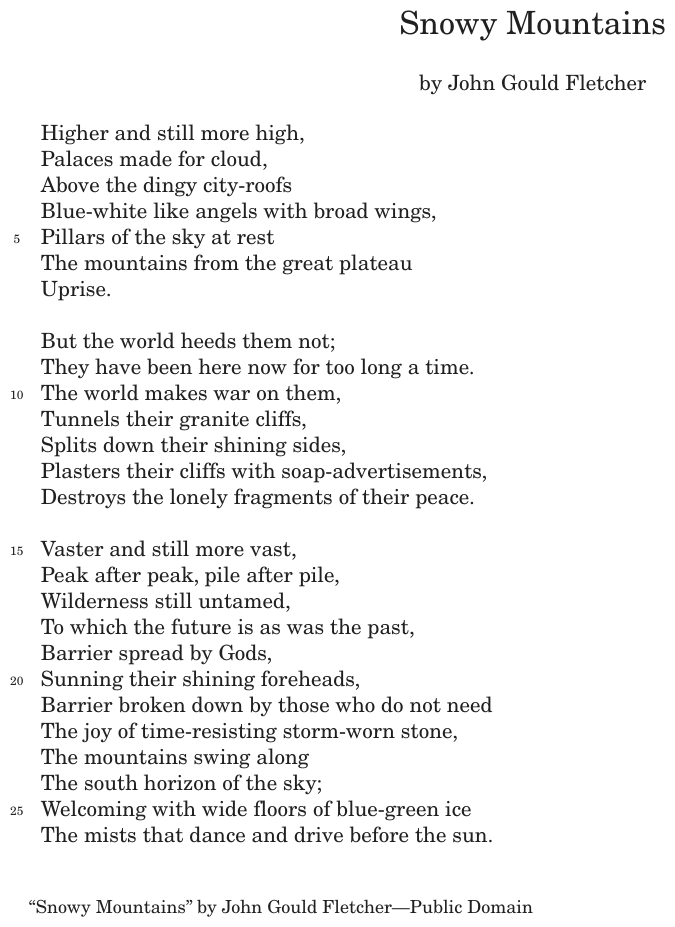
How do the details in the third stanza (lines 15–26) most contribute to the development of a theme of the poem?
- Aby reflecting nature’s capacity to resist change
- Bby showing that nature is capable of influencing human will
- Cby exposing how a lack of awareness leads to nature’s ruin
- Dby explaining why people must respect nature
Show the answer
Correct answer: A
The question asks how the details in the third stanza most contribute to the development of a theme of the poem.
A. CORRECT. In the third stanza, phrases such as “Wilderness still untamed” (line 17), “time-resisting storm-worn stone” (line 22), and “The mountains swing along” (line 23) convey the message that in spite of the destruction described in the second stanza, the mountains manage to maintain their wild magnificence.
B. Incorrect. While the phrase “Barrier broken down” (line 21) conveys the idea that people can have some effect on the natural landscape, it does not convey how nature affects people.
C. Incorrect. The phrase “those who do not need” (line 21) implies a choice to damage nature and not a lack of awareness or understanding.
D. Incorrect. The third stanza is not a call to humanity to respect the mountains but a description of the untamed, welcoming mountains and the joy they provide for those who appreciate them.
Question analysis
Students trace how the details of the third and final stanza of “Snowy Mountains,” lines 15–26, most contribute to developing a theme of the poem. Because the stanza is a single sentence that runs from line 15 to the poem’s last word, students must keep its whole movement in mind before deciding what it adds.
- Grade level
- Grade 8 reading and task
- Compared with grade 7
- Above grade 7 Grade 7 theme questions usually rest on a few clear details. Here students must hold a twelve-line stanza of inverted, piled-up phrases in mind and pick among four reasonable lessons about nature, a heavier load closer to grade 8.
- Estimated difficulty
- Hard: combines ideas, needs a plan, and has more than one tempting wrong answer.
- Thinking it demands
- Depth of knowledge 3, strategic thinking · mainly analyze
- What makes it hard
- Complex sentences moderate
- Figurative or literary language moderate
- Evidence in several places moderate
- Evidence
- Answered from one paragraph or stanza
- Reading level
- Passage: 161 words (a poem; reading level not measured); question and choices: about grade 7, 55 words.
- Students, last 30 days
- Not enough answers yet to show (it takes 10).
Why it is hard, traps and wrong answers (shows the answer)
Why it is hard
The final stanza holds both endurance and damage, and the stem’s “most” asks which of the two its details build. Students who fix on the broken barrier choose ruin, a reading the second stanza seems to confirm, while those who tally the stanza’s details find untamed wilderness, time-resisting stone and mountains swinging at ease. Because the stanza is one long, inverted sentence, that tally is slow, which is what makes the question hard.
Complex sentences moderate Understanding the question
Lines 15–26 are one sentence in which phrase after phrase, from “Vaster and still more vast” to “storm-worn stone,” comes before its subject, “The mountains,” in line 23. (Abedi & Lord, 2001; Freedle & Kostin, 1993; Messick, 1989)
Figurative or literary language moderate Understanding the question
The message of endurance is carried by personification: the peaks have “shining foreheads,” are “spread by Gods,” and “swing along” the horizon welcoming the mists. (Graesser, Singer & Trabasso, 1994; Kintsch, 1998)
Evidence in several places moderate Working it out
The theme has to be assembled from details scattered over twelve lines, “Wilderness still untamed,” “the future is as was the past,” “time-resisting,” and weighed against the single line of damage. (Kirsch & Mosenthal, 1990; Gorin & Embretson, 2006)
Strategy: Read lines 15–26 as one long sentence, find its main subject and verb, and sum up its message in a phrase; then check each choice against the whole stanza, not a single line.
Traps
- Too narrow: A single detail offered as the central idea or a summary, or a summary that keeps minor details and leaves out an essential part.
- Outside knowledge: A choice is plausible in the real world but not supported by this text.
- Reversed relationship: Cause and effect, or the order of events, turned around.
The wrong answers, classified
B Reversed relationship (King et al., 2004)
Turns the influence around: in this stanza people break down the barrier while the peaks endure, and nothing shows the mountains shaping what people want.
C Too narrow (King et al., 2004)
Builds on line 21’s “Barrier broken down,” the stanza’s one line of damage, and lets it stand for twelve lines that mostly celebrate the mountains as wild and lasting.
D Outside knowledge (King et al., 2004; Recht & Leslie, 1988)
States the lesson a nature poem is expected to teach, that people must respect nature, but the stanza describes the mountains and never tells readers what to do.
Working it out, step by step
Figure out what the question asks
This asks about theme, the big message of the poem. You need to see what the details of the third stanza, lines 15 to 26, add to that message. The word “most” matters. Pick the idea that most of the details support, not just one line.
Gather the details in lines 15 to 26
The peaks grow “Vaster and still more vast” (line 15). They are a “Wilderness still untamed” (line 17). For them, the future is “as was the past” (line 18). Their stone is “time-resisting” (line 22). In the last four lines, “The mountains swing along” the sky and welcome the mists. Only line 21 shows damage: the barrier is “broken down.”
Find what the details share
Untamed means still wild, not controlled by people. If the future is the same as the past, the mountains are not changing. Time-resisting means they hold out against the years. And at the end of the stanza, they are still moving along at ease. Nearly every detail shows the same thing. The mountains last and stay wild, which is nature’s power to resist change.
Check each choice
- A fits. Wild, unchanging, time-resisting mountains show nature holding out against change.
- B does not fit. It turns things around. In this stanza, people affect the mountains. Nothing shows the mountains changing what people want.
- C does not fit. Line 21 shows damage, but it is one line out of twelve. The stanza does not end in ruin either: the mountains still swing along and welcome the mists.
- D does not fit. These lines paint a picture of the peaks. They give readers no orders and no reasons to behave a certain way.
Choose the answer
Most of the third stanza shows mountains that stay wild and lasting. So the answer is A.
Why this answer and not the closest wrong one
C is the closest trap, because line 21 does show the barrier “broken down,” and the second stanza is full of harm. But this question is about the third stanza, and it asks what the details most add. Most of the other lines there show mountains that are vast, wild and lasting. That builds A, not ruin.
More questions like this
The original DOE question
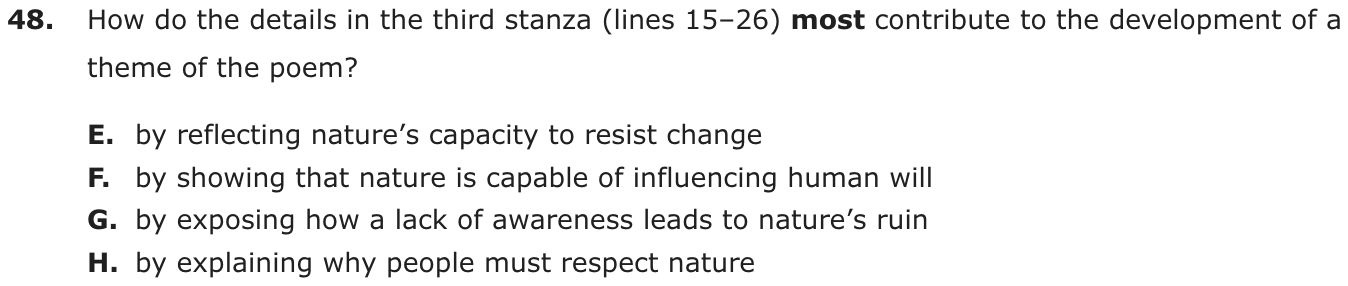
The passage “Snowy Mountains” as printed (page 142)
Question 2 of 6
2026 Practice Test D English, question 17Passage Wolves of the Sea
Wolves of the Sea
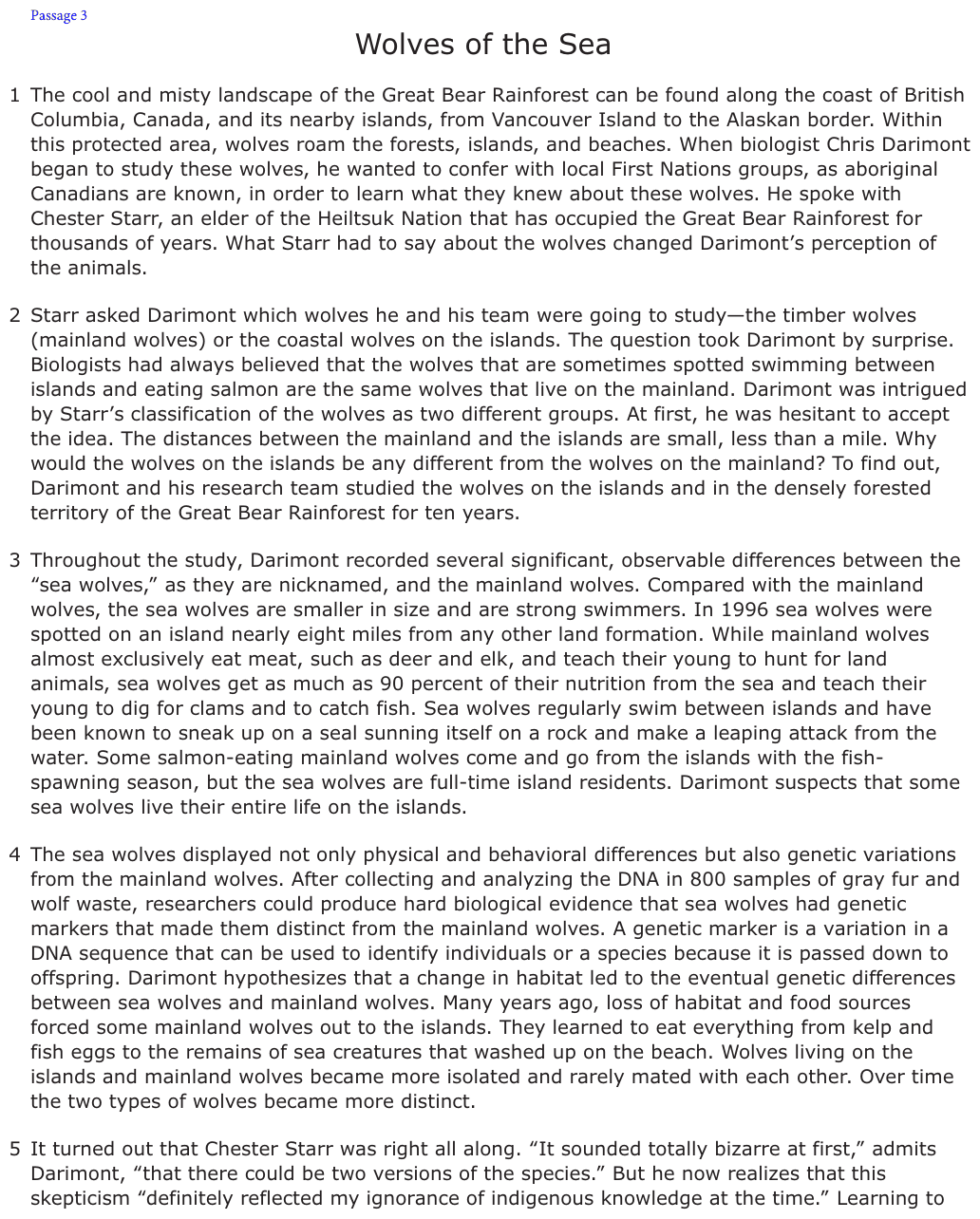
The cool and misty landscape of the Great Bear Rainforest can be found along the coast of British Columbia, Canada, and its nearby islands, from Vancouver Island to the Alaskan border. Within this protected area, wolves roam the forests, islands, and beaches. When biologist Chris Darimont began to study these wolves, he wanted to confer with local First Nations groups, as aboriginal Canadians are known, in order to learn what they knew about these wolves. He spoke with Chester Starr, an elder of the Heiltsuk Nation that has occupied the Great Bear Rainforest for thousands of years. What Starr had to say about the wolves changed Darimont’s perception of the animals.
Starr asked Darimont which wolves he and his team were going to study—the timber wolves (mainland wolves) or the coastal wolves on the islands. The question took Darimont by surprise. Biologists had always believed that the wolves that are sometimes spotted swimming between islands and eating salmon are the same wolves that live on the mainland. Darimont was intrigued by Starr’s classification of the wolves as two different groups. At first, he was hesitant to accept the idea. The distances between the mainland and the islands are small, less than a mile. Why would the wolves on the islands be any different from the wolves on the mainland? To find out, Darimont and his research team studied the wolves on the islands and in the densely forested territory of the Great Bear Rainforest for ten years.
Throughout the study, Darimont recorded several significant, observable differences between the “sea wolves,” as they are nicknamed, and the mainland wolves. Compared with the mainland wolves, the sea wolves are smaller in size and are strong swimmers. In 1996 sea wolves were spotted on an island nearly eight miles from any other land formation. While mainland wolves almost exclusively eat meat, such as deer and elk, and teach their young to hunt for land animals, sea wolves get as much as 90 percent of their nutrition from the sea and teach their young to dig for clams and to catch fish. Sea wolves regularly swim between islands and have been known to sneak up on a seal sunning itself on a rock and make a leaping attack from the water. Some salmon-eating mainland wolves come and go from the islands with the fish-spawning season, but the sea wolves are full-time island residents. Darimont suspects that some sea wolves live their entire life on the islands.
The sea wolves displayed not only physical and behavioral differences but also genetic variations from the mainland wolves. After collecting and analyzing the DNA in 800 samples of gray fur and wolf waste, researchers could produce hard biological evidence that sea wolves had genetic markers that made them distinct from the mainland wolves. A genetic marker is a variation in a DNA sequence that can be used to identify individuals or a species because it is passed down to offspring. Darimont hypothesizes that a change in habitat led to the eventual genetic differences between sea wolves and mainland wolves. Many years ago, loss of habitat and food sources forced some mainland wolves out to the islands. They learned to eat everything from kelp and fish eggs to the remains of sea creatures that washed up on the beach. Wolves living on the islands and mainland wolves became more isolated and rarely mated with each other. Over time the two types of wolves became more distinct.
It turned out that Chester Starr was right all along. “It sounded totally bizarre at first,” admits Darimont, “that there could be two versions of the species.” But he now realizes that this skepticism “definitely reflected my ignorance of indigenous knowledge at the time.” Learning to trust the wisdom of the Heiltsuk people opened Darimont up to knowledge accumulated over millennia and positioned him so that he could gather new scientific evidence about one of British Columbia’s most elusive species, the sea wolf.
Question
Read this sentence from paragraph 4.
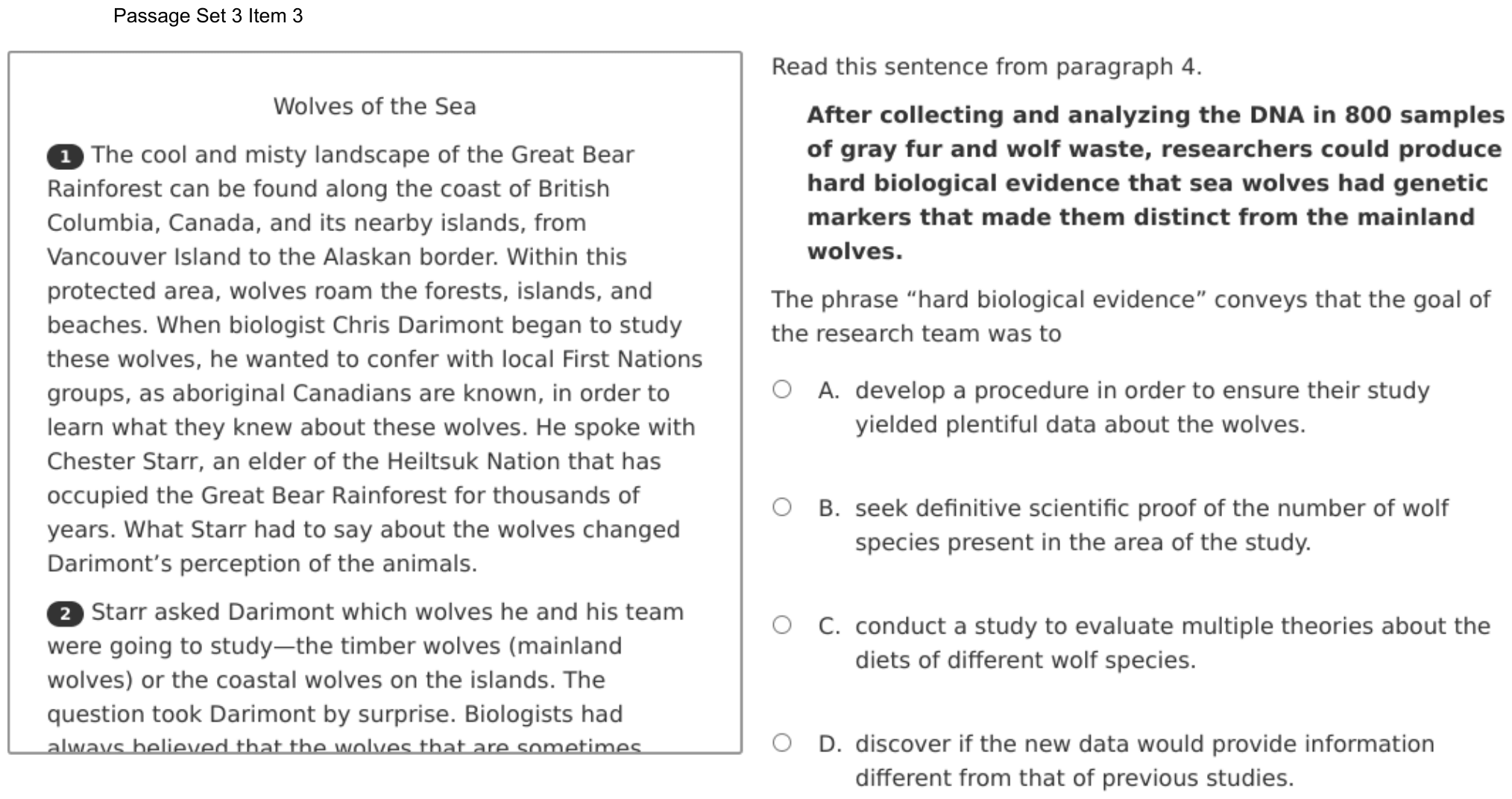
After collecting and analyzing the DNA in 800 samples of gray fur and wolf waste, researchers could produce hard biological evidence that sea wolves had genetic markers that made them distinct from the mainland wolves.
The phrase “hard biological evidence” conveys that the goal of the research team was to
- Adevelop a procedure in order to ensure their study yielded plentiful data about the wolves.
- Bseek definitive scientific proof of the number of wolf species present in the area of the study.
- Cconduct a study to evaluate multiple theories about the diets of different wolf species.
- Ddiscover if the new data would provide information different from that of previous studies.
Show the answer
Correct answer: B
The question asks what the phrase “hard biological evidence” in the sentence from paragraph 4 conveys about the goal of the research team.
A. Incorrect. Although the research team followed a labor-intensive procedure, the phrase “hard biological evidence” refers to the product of their scientific research (the genetic markers revealed within the DNA samples), not the process by which they collected it. Their goal was not to develop a procedure for data collection but to determine precisely how many species of wolf were present in the area.
B. CORRECT. The research team wanted to prove or disprove the theory that two separate groups of wolves were present in the area, an idea that was already supported by the observations of scientists and local indigenous people. The phrase “hard biological evidence” conveys that the scientists wanted to bolster their observations of the wolves with concrete scientific data about the wolves’ biological makeup. The goal of the researchers was to use the data to prove how many species of wolf were present in the area of the study.
C. Incorrect. The research team gathered extensive data during their study (“After collecting and analyzing the DNA in 800 samples of gray fur and wolf waste” [paragraph 4]), and their goal in doing so was to evaluate a single theory about the wolves: that the wolves had evolved into two separate and genetically distinct species. The research team did not conduct the study in order to evaluate multiple theories about the diets of the wolves.
D. Incorrect. The phrase “hard biological evidence” does not suggest that the research team was hoping to discover if the new data would provide information that was different from previous studies. In fact, the goal of the research team was to use the genetic data to supplement their initial sources of information about the wolves and their own observations from the field.
Question analysis
This word-in-context question quotes a sentence from paragraph 4 of “Wolves of the Sea” about DNA taken from 800 samples of gray fur and wolf waste, and asks what the phrase “hard biological evidence” shows about the research team’s goal. Students must work out what the phrase says about the evidence and then turn that into a statement of purpose, choosing among four plausible aims for a study.
- Grade level
- Grade 8 reading and task
- Compared with grade 7
- Above grade 7 Grade 7 students regularly interpret a phrase in context. Here the phrase must be turned into a claim about the team’s purpose, which the passage never states outright, and the four choices are abstract research goals that each sound reasonable.
- Estimated difficulty
- Hard: combines ideas, needs a plan, and has more than one tempting wrong answer.
- Thinking it demands
- Depth of knowledge 2, skills and concepts · mainly understand
- What makes it hard
- Reading between the lines moderate
- Hard words moderate
- Evidence in several places minor
- Evidence
- Answered from several paragraphs or stanzas
- Reading level
- Passage: about grade 10, 662 words; question and choices: about grade 10, 114 words.
- Students, last 30 days
- Not enough answers yet to show (it takes 10).
Why it is hard, traps and wrong answers (shows the answer)
Why it is hard
The question asks for a purpose, but the phrase it quotes describes a result, so students have to reason from the kind of evidence produced to what the team wanted it for. Readers who take “hard” as difficult drift toward a goal about procedure, and those who remember that biologists had long thought the wolves were one group are drawn to a goal of overturning earlier studies. The key’s “number of wolf species” is looser than the passage’s “two versions of the species,” which can make careful readers hesitate.
Reading between the lines moderate Working it out
The passage never states the team’s goal, so students must work back from “hard biological evidence” to the question paragraph 2 set up: whether island and mainland wolves are really two groups. (Graesser, Singer & Trabasso, 1994; Kintsch, 1998)
Hard words moderate Understanding the question
“Hard” here means solid and conclusive, as in hard evidence, not difficult; students who know only the everyday sense connect it to the labor of analyzing 800 samples of fur and waste. (Perfetti, 2007; Freedle & Kostin, 1993)
Evidence in several places minor Working it out
The goal the phrase points to lies two paragraphs back, in Starr’s two-group question and Darimont’s ten-year study “to find out,” not in the sentence the stem quotes. (Kirsch & Mosenthal, 1990; Gorin & Embretson, 2006)
Strategy: Replace “hard” with a word that fits evidence produced by DNA analysis, then ask what the team wanted that kind of evidence for, recalling the question Darimont set out to answer.
Traps
- Dictionary meaning, not meaning here: A common meaning of the word that does not fit its use in this text.
- Reads too much in: A reasonable-sounding conclusion that goes further than the text allows.
- Wrong part of the text: A choice is true of another paragraph, stanza or speaker than the one asked about.
The wrong answers, classified
A Dictionary meaning, not meaning here (Perfetti, 2007)
Reads “hard” as difficult and ties it to the labor of analyzing 800 samples, so takes the goal to be a thorough procedure rather than conclusive proof.
C Wrong part of the text (Kirsch & Mosenthal, 1990)
Brings in the diet differences of paragraph 3, clams, fish and seals, as theories under test, though the DNA work in paragraph 4 asked whether two groups exist.
D Reads too much in (Graesser, Singer & Trabasso, 1994)
Knows that biologists “had always believed” the wolves were one group and assumes the team set out to contradict earlier studies, which the phrase about solid proof does not suggest.
Working it out, step by step
Figure out what the question asks
This asks what a phrase shows about the team’s goal. A goal is what you are trying to get. The phrase names the kind of evidence the team got. Work back from that to what they wanted it for.
Read the sentence with the phrase
In paragraph 4, the team studied “800 samples of gray fur and wolf waste.” Then they “could produce hard biological evidence that sea wolves had genetic markers that made them distinct from the mainland wolves.” A genetic marker is a small difference in the DNA that parents pass to their young. Distinct means clearly different.
Work out what “hard” means
Here “hard” does not mean difficult. Hard evidence is solid proof that is tough to argue with. Biological means it comes from living things and their bodies. So the team wanted firm proof from the wolves’ own bodies.
Connect the proof to the question
What did they want to prove? Go back to paragraph 2. Starr said there were two groups of wolves. Darimont was unsure. “To find out,” his team studied the wolves. The DNA gave a firm answer: the sea wolves really are a separate group. So the goal was solid proof of how many groups of wolves live there.
Check each choice
- A is wrong. It reads “hard” as hard work. The phrase is about how firm the proof is, not about a procedure.
- B is right. Definitive means final and settled. The team wanted settled proof of how many groups of wolves live there. B says “species,” which goes further than the passage. Darimont speaks only of “two versions of the species.”
- C is wrong. Diets come up in paragraph 3. The DNA work tested whether there were two groups.
- D is wrong. The phrase says nothing about earlier studies.
Watch out: D is tempting because biologists “had always believed” the wolves were one group. But “hard” evidence is about firm proof, not about beating old studies.
Choose the answer
“Hard biological evidence” shows the team wanted firm, scientific proof. So the answer is B, “seek definitive scientific proof of the number of wolf species present in the area of the study.”
Why this answer and not the closest wrong one
D is the closest wrong answer. Biologists had thought the wolves were one group, so D can seem to fit. But the phrase “hard biological evidence” is about how firm the proof is. It says nothing about earlier studies. B matches that: the team wanted settled proof of how many groups there were.
More questions like this
The original DOE question
The passage “Wolves of the Sea” as printed (pages 23–24)

Question 3 of 6
2025 Practice Test B English, question 48Passage Letter from Brooklyn
Letter from Brooklyn
by Jacob Scheier
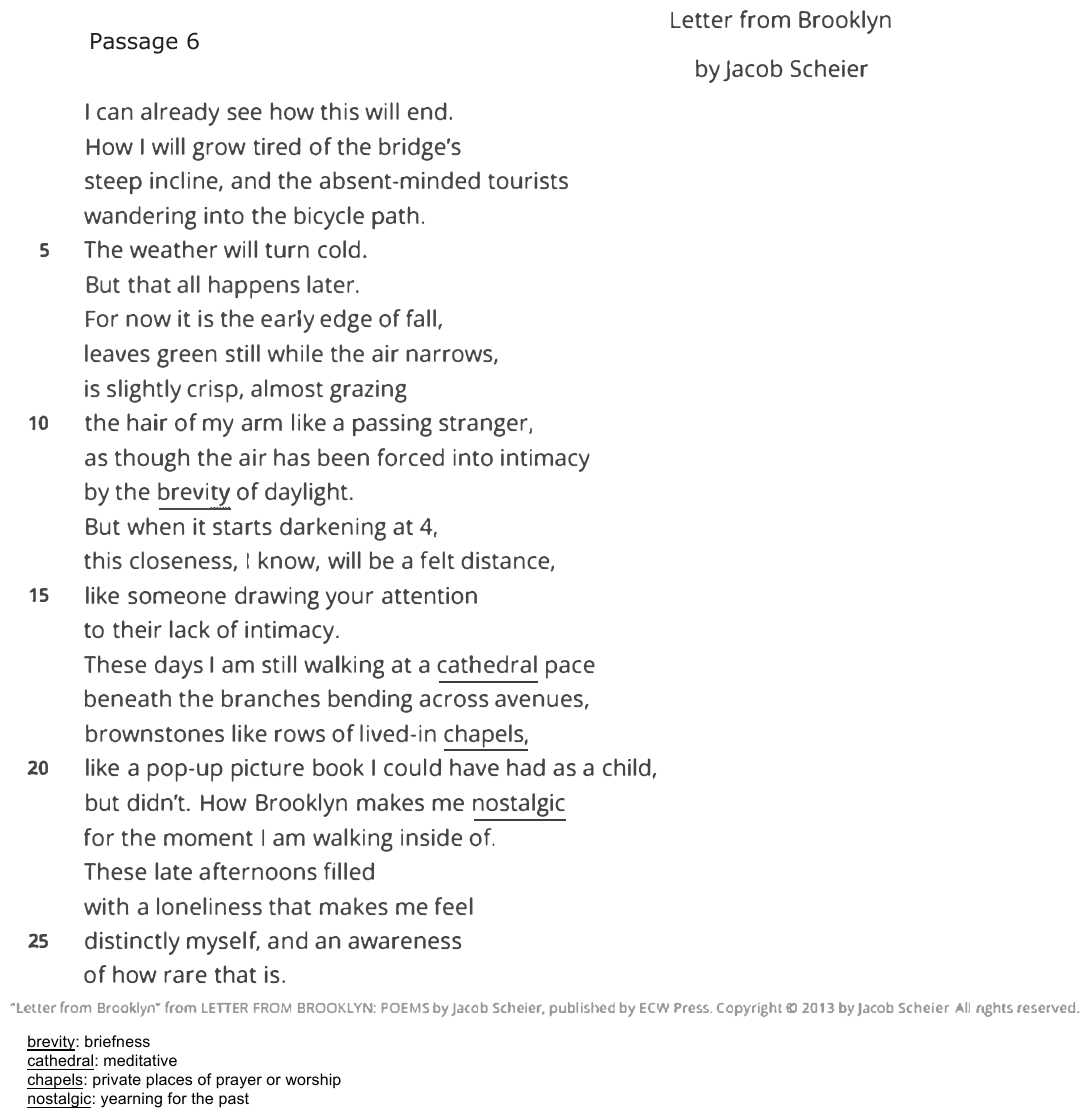
I can already see how this will end.
How I will grow tired of the bridge’s
steep incline, and the absent-minded tourists
wandering into the bicycle path.
The weather will turn cold.
But that all happens later.
For now it is the early edge of fall,
leaves green still while the air narrows,
is slightly crisp, almost grazing
the hair of my arm like a passing stranger,
as though the air has been forced into intimacy
by the brevity of daylight.
But when it starts darkening at 4,
this closeness, I know, will be a felt distance,
like someone drawing your attention
to their lack of intimacy.
These days I am still walking at a cathedral pace
beneath the branches bending across avenues,
brownstones like rows of lived-in chapels,
like a pop-up picture book I could have had as a child,
but didn’t. How Brooklyn makes me nostalgic
for the moment I am walking inside of.
These late afternoons filled
with a loneliness that makes me feel
distinctly myself, and an awareness
of how rare that is.
“Letter from Brooklyn” from LETTER FROM BROOKLYN: POEMS by Jacob Scheier, published by ECW Press. Copyright © 2013 by Jacob Scheier All rights reserved.
brevity: briefness
cathedral: meditative
chapels: private places of prayer or worship
nostalgic: yearning for the past
Question
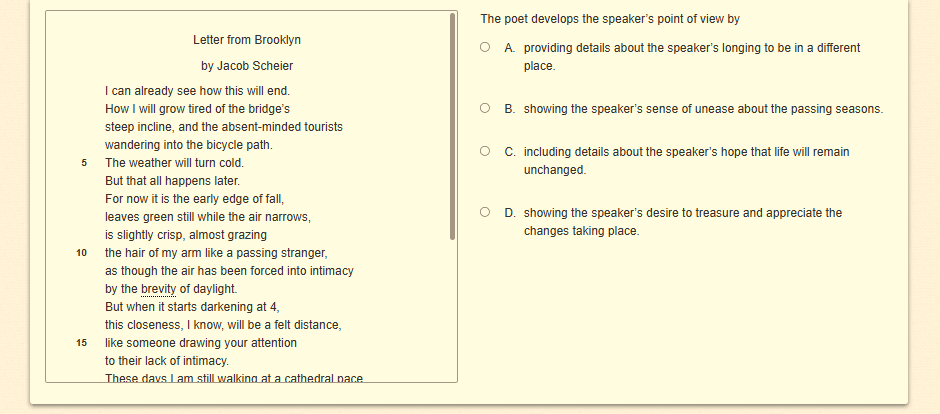
The poet develops the speaker’s point of view by
- Aproviding details about the speaker’s longing to be in a different place.
- Bshowing the speaker’s sense of unease about the passing seasons.
- Cincluding details about the speaker’s hope that life will remain unchanged.
- Dshowing the speaker’s desire to treasure and appreciate the changes taking place.
Show the answer
Correct answer: D
The question asks how the poet develops the speaker’s point of view.
A. Incorrect. The speaker concedes that at some point, Brooklyn will become tiresome (lines 2–4). However, the bulk of the poem reveals the speaker’s appreciation for experiencing Brooklyn, not a desire to be in some other place.
B. Incorrect. Cold weather is inevitable, and the speaker is well aware of this future shift as well as the change in attitude it will bring. Nevertheless, the speaker does not focus on this future but rather embraces the current season, describing it in vivid detail.
C. Incorrect. The speaker is not hopeful that life will remain unchanged. Rather, the speaker accepts and appreciates the seasonal changes that occur.
D. CORRECT. The speaker’s point of view is largely positive and appreciative of the shift in seasons. This point of view is developed by language that shows a close connection between the speaker and the setting. For example, the speaker uses words such as “intimacy” (line 11) and “closeness” (line 14) and the description of the “pop-up picture book” (line 20). Finally, the conclusion emphasizes the point of view: “These late afternoons filled / with a loneliness that makes me feel / distinctly myself, and an awareness / of how rare that is” (lines 23–26).
Question analysis
This point-of-view question asks how the poet develops the speaker’s point of view in “Letter from Brooklyn,” in which the speaker walks through the city at the start of fall knowing that colder, darker days lie ahead. The speaker’s thoughts move between the present and the future, so students must weigh the whole poem, and each choice names a different attitude.
- Grade level
- Grade 8 reading and task
- Compared with grade 7
- Above grade 7 Typical grade 7 point-of-view questions focus on one passage or stanza. This one asks for the speaker’s attitude across a whole poem of shifting moods, and several choices rest on real lines, so judging the overall view takes more than typical grade 7 work.
- Estimated difficulty
- Hard: combines ideas, needs a plan, and has more than one tempting wrong answer.
- Thinking it demands
- Depth of knowledge 3, strategic thinking · mainly analyze
- What makes it hard
- Evidence in several places moderate
- Reading between the lines moderate
- Every choice must be checked minor
- Evidence
- Answered from the whole text
- Reading level
- Passage: 217 words (a poem; reading level not measured); question and choices: about grade 7, 54 words.
- Students, last 30 days
- Not enough answers yet to show (it takes 10).
Why it is hard, traps and wrong answers (shows the answer)
Why it is hard
The poem opens by predicting its own end and returns to the coming dark in lines 13–16, so a reader who weighs those lines heavily finds unease, and the speaker does feel some. But the speaker turns back to the present each time, with “But that all happens later” and “These days I am still walking,” and the closing lines call the moment rare. The point of view is a wish to savor what is passing, and only a choice that fits the whole poem, not its most anxious lines, matches it.
Evidence in several places moderate Working it out
The point of view has to hold from line 1 to line 26 while the poem swings between the future, tiring of the bridge and darkening at 4, and the present walk under the branches. (Kirsch & Mosenthal, 1990; Gorin & Embretson, 2006)
Reading between the lines moderate Working it out
No line names the speaker’s attitude; it has to be drawn from “For now,” the walk “at a cathedral pace,” the nostalgia “for the moment I am walking inside of” and “how rare that is.” (Graesser, Singer & Trabasso, 1994; Kintsch, 1998)
Every choice must be checked minor Choosing the answer
Three wrong choices rest on real lines, tiring of the bridge’s “steep incline,” the “felt distance” of line 14 and the nostalgia of lines 21–22, so each must be weighed against the whole poem. (Embretson & Wetzel, 1987)
Strategy: Sum up in one sentence how the speaker feels about the present walk and about the season ahead, then pick the choice that holds true from the first line to the last.
Traps
- Wrong tone or attitude: Misjudges the tone, attitude or point of view, such as reading admiration as criticism, or taking a character's or subject's feelings for the author's.
- Reads too much in: A reasonable-sounding conclusion that goes further than the text allows.
- Twists what the text says: Uses the text's topic and ideas but changes what it says: who did it, how much, when, or why.
The wrong answers, classified
A Twists what the text says (King et al., 2004)
Turns the forecast that the speaker “will grow tired” of the bridge and the tourists into a present longing to be elsewhere, though the rest of the poem savors Brooklyn’s streets.
B Wrong tone or attitude (Graesser, Singer & Trabasso, 1994)
Fixes on the coming cold and the “felt distance” of lines 13–16, real notes of unease, and takes them for the whole view, though “But that all happens later” sets the future aside.
C Reads too much in (Graesser, Singer & Trabasso, 1994)
Reads nostalgia “for the moment I am walking inside of” as a wish that nothing change, though the speaker opens by accepting “how this will end” and treasures the moment because it passes.
Working it out, step by step
Figure out what the question asks
This asks about point of view: how the speaker, the voice talking in the poem, feels about what is happening. The question is about the whole poem, not a few lines. So follow the speaker’s feelings from line 1 to line 26. The right choice must fit all of it.
Follow the speaker’s thoughts
The poem moves back and forth in time. Lines 1–5 look ahead: “I can already see how this will end.” The speaker will tire of the bridge, and “The weather will turn cold.” Line 6 turns back: “But that all happens later.” Lines 7–12 describe the cool air of early fall. Lines 13–16 look ahead again, to days that get dark at 4 o’clock. Line 17 returns to now: “These days I am still walking at a cathedral pace.”
See how the speaker treats now
The glossary says cathedral means “meditative,” or calm and thoughtful. The speaker walks slowly to take everything in. Brownstones look “like a pop-up picture book.” Lines 21–22 say “How Brooklyn makes me nostalgic / for the moment I am walking inside of.” Nostalgic means “yearning for the past.” Yet the speaker longs for right now. In the last lines, even the loneliness of late afternoon is welcome. It makes the speaker feel “distinctly myself,” and aware “of how rare that is.”
Put the point of view in words
The speaker knows this season will end. That is why each moment matters. The speaker notices the first signs of fall, like the crisp air, and savors them. To treasure something is to value it highly. So the speaker wants to treasure and appreciate the changes happening now.
Check each choice
- A does not fit. Lines 2–4 say the speaker will tire of the bridge someday. But the speaker enjoys Brooklyn now and never wishes to be elsewhere.
- B does not fit. Lines 13–16 show some unease about the dark days ahead. But each time, the speaker turns back to the present.
- C does not fit. The speaker knows from line 1 that this will end, and treasures the moment because it will pass.
- D fits. The speaker savors the early-fall walk while it lasts.
Watch out: B rests on real lines: the closeness the speaker feels now “will be a felt distance” (line 14). But that is one part of the poem, not the whole view.
Choose the answer
The speaker knows the season will change and holds on to each moment of it. So the answer is D, “showing the speaker’s desire to treasure and appreciate the changes taking place.”
Why this answer and not the closest wrong one
B is the closest wrong choice, because lines 13–16 do show unease. But each time the poem looks ahead, the speaker turns back to now: “But that all happens later” and “These days I am still walking.” The poem ends by calling the moment rare. The main feeling is a wish to treasure the present, which is D.
More questions like this
The original DOE question
The passage “Letter from Brooklyn” as printed (page 50)
Question 4 of 6
2024 Test B Math, question 57Question
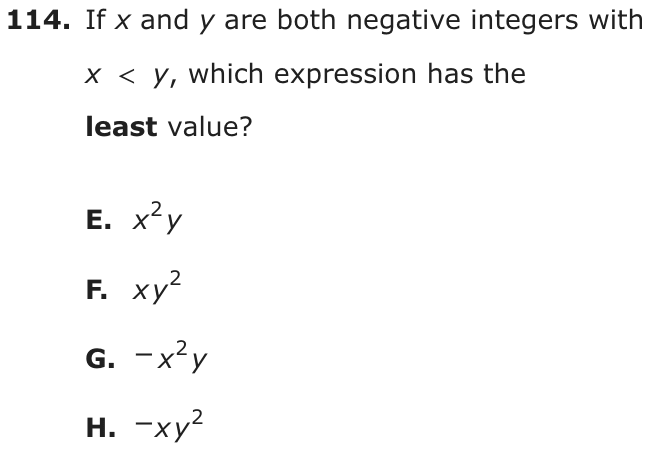
If x and y are both negative integers with , which expression has the least value?
- A
- B
- C
- D
Show the answer
Correct answer: A
Since x and y are both negative integers, both and are positive.
Therefore, both and are negative, and both and are positive.
Because and both x and y are negative, and . So .
Since and x and y are integers, .
So .
Therefore, .
Question analysis
Two negative integers x and y, with x less than y, appear in four expressions built from squares and minus signs. Students find the expression with the least value. It tests multiplying negative numbers and comparing their sizes, and the difficulty is tracking how each minus sign and each square changes both the sign and the size of the result.
- Grade level
- Grade 7 content, by NYS standard
- Compared with grade 7
- Above grade 7 Grade 7 students multiply negative numbers, but this asks them to compare four variable expressions for any pair of negative integers. Deciding how the squares compare when x is less than y goes beyond typical grade 7 sign practice.
- Estimated difficulty
- Hard: combines ideas, needs a plan, and has more than one tempting wrong answer.
- Thinking it demands
- Depth of knowledge 2, skills and concepts · mainly analyze
- What makes it hard
- Variables instead of numbers moderate
- A very close wrong answer moderate
- Every choice must be checked minor
- Solution
- 3 steps
- Reading level
- Question and choices: about grade 8, 20 words.
- Students, last 30 days
- Not enough answers yet to show (it takes 10).
Why it is hard, traps and wrong answers (shows the answer)
Why it is hard
Two facts settle the question: squares of negatives are positive, and the more negative number has the larger square. Students who track the minus signs carelessly think a leading minus makes an expression negative, and students who assume the larger y has the larger square choose the wrong negative expression. Substituting x = −3 and y = −2 gives −18, −12, 18 and 12, which orders all four at once.
Variables instead of numbers moderate Understanding the question
No values are given, only that x and y are negative integers with x < y, so students must reason about signs or invent a pair such as −3 and −2. (Koedinger & Nathan, 2004; Enright, Morley & Sheehan, 2002)
A very close wrong answer moderate Choosing the answer
x²y and xy² use the same letters with the exponent moved; both are negative, and only comparing x² with y² separates them. (Embretson & Wetzel, 1987; Gorin & Embretson, 2006; Ascalon et al., 2007)
Every choice must be checked minor Choosing the answer
All four expressions have to be placed in order, because the minus signs in front of the last two turn those expressions positive. (Embretson & Wetzel, 1987)
Strategy: Pick two negative integers with x less than y, such as −3 and −2, evaluate all four expressions, and confirm the order with a second pair.
Traps
- Negatives and direction: Arithmetic with negative numbers, the order of a subtraction, or direction on a number line. (Moving a term across the equals sign without changing its sign is a faulty procedure.)
- Misunderstands the concept: A wrong belief about a concept: that percents can be added, that area grows like length, that averages can be averaged, that a bigger denominator means a bigger fraction.
The wrong answers, classified
B Misunderstands the concept (Smith, diSessa & Roschelle, 1993; De Bock et al., 1998; Ni & Zhou, 2005)
Knows x²y and xy² are both negative but takes y² as the larger square because y > x, though the more negative x has the bigger square.
C Negatives and direction (Brown & Burton, 1978)
Reads the leading minus as making −x²y negative, missing that y is negative, so −x²y is in fact positive.
D Negatives and direction (Brown & Burton, 1978)
Assumes the leading minus makes −xy² negative, missing that x is negative, so −xy² is in fact positive.
Worked solution, step by step
Formulas used
- Signs in multiplication
- a and b are positive numbers, so −a and −b are negative. A negative times a negative is positive. A negative times a positive is negative. So a product is positive when it has an even number of negative factors.
- Squaring a number
- x is any number. x² (x squared) means x times itself. The square of a number other than 0 is always positive, because two negatives or two positives multiply to a positive.
Sort out the question
x and y are negative integers, such as −3 and −2. Since x < y, x is to the left of y on the number line. So x is more negative, farther from 0.
You need the expression with the least value. That is the most negative one.
Find the sign of each expression
Squares are positive, so and are positive.
- is a positive times a negative, so it is negative.
- is a negative times a positive, so it is negative.
- and are the opposites of these, so they are positive.
So the least value must be A or B. Watch out: The minus sign in front of C and D does not make them negative. It turns a negative into a positive.
Compare A and B with numbers
Try x = −3 and y = −2, since −3 < −2.
Since −18 < −12, A is smaller.
See why it always works
Both expressions contain x × y, which is positive. and . Multiplying the same positive number by the more negative x gives the more negative result.
Watch out: y is bigger than x, but is smaller than : 4 is less than 9. Thinking y² is bigger leads to choice B.
So the answer is A, .
Check your answer
Try another pair, x = −5 and y = −1. Then A is , B is , C is 25 and D is 5. A is still the least.
More questions like this
The original DOE question
Question 5 of 6
2024 Test B Math, question 25Question
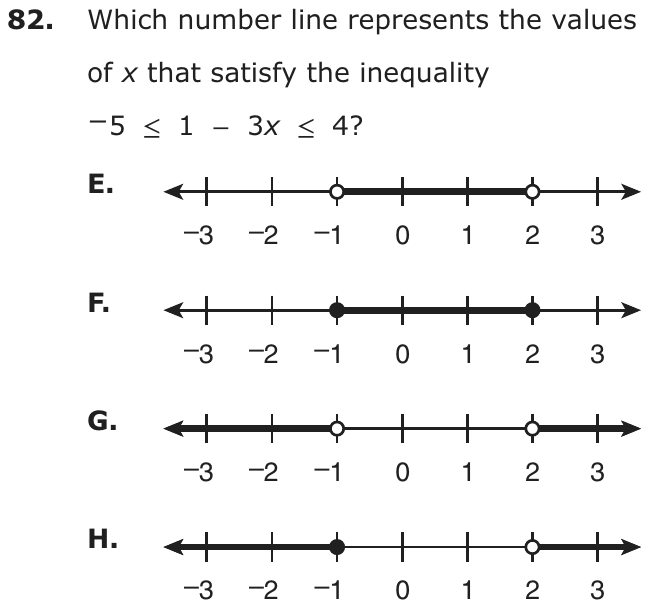
Which number line represents the values of x that satisfy the inequality ?
- A

- B

- C

- D

Show the answer
Correct answer: B
Split the compound inequality into two inequalities.
and
For each inequality, subtract 1 from each side.
and
For each inequality, divide both sides by −3. Note that dividing each side of an inequality by a negative number changes the direction of the inequality.
and
Combining the pieces gives the compound inequality .
The solution is that x is greater than or equal to −1 and less than or equal to 2, so choose the number line with filled circles at −1 and 2, with the filled segment between the circles.
Question analysis
An inequality question: choose the number line that shows the solutions of the compound inequality −5 ≤ 1 − 3x ≤ 4. Students solve an inequality whose x term has a negative coefficient, then match the endpoints, open or closed circles, and shading to one of four graphs.
- Grade level
- Grade 7 content, by NYS standard
- Compared with grade 7
- Above grade 7 Grade 7 students solve and graph two-step inequalities one at a time. This compound inequality needs two solved together and a division by a negative number, which reverses the signs, a step many grade 7 classes only touch on.
- Estimated difficulty
- Hard: combines ideas, needs a plan, and has more than one tempting wrong answer.
- Thinking it demands
- Depth of knowledge 1, recall and reproduction · mainly apply
- What makes it hard
- Error-prone arithmetic moderate
- A very close wrong answer moderate
- Reading a figure, table or graph minor
- Solution
- 4 steps
- Reading level
- Question and choices: about grade 12, 13 words.
- Students, last 30 days
- Not enough answers yet to show (it takes 10).
Why it is hard, traps and wrong answers (shows the answer)
Why it is hard
The question stacks two classic traps: reversing the inequality signs when dividing by −3, and matching filled or open circles to ≤. All four graphs use the endpoints −1 and 2, so finding those numbers proves little; the choice turns on the circles and the direction of the shading. Testing x = 0, x = 3 and the endpoint x = 2 in the original inequality checks both decisions in under a minute.
Error-prone arithmetic moderate Working it out
Dividing all three parts of −6 ≤ −3x ≤ 3 by −3 reverses both signs and the order, giving 2 ≥ x ≥ −1, which must be rewritten as −1 ≤ x ≤ 2. (Brown & Burton, 1978; Junker & Sijtsma, 2001)
A very close wrong answer moderate Choosing the answer
Two graphs share the endpoints −1 and 2 and the shading between them; only the circles, filled for ≤ and open for <, separate them. (Embretson & Wetzel, 1987; Gorin & Embretson, 2006; Ascalon et al., 2007)
Reading a figure, table or graph minor Understanding the question
Each graph must be read for three things at once: the endpoints, the fill of each circle, and whether the shading runs between them or outward. (Lesh, Post & Behr, 1987; Kirsch & Mosenthal, 1990)
Strategy: Subtract 1 from all three parts, divide all three by −3 while reversing both inequality signs, then rewrite the result from smallest to largest before matching circles and shading.
Traps
- Negatives and direction: Arithmetic with negative numbers, the order of a subtraction, or direction on a number line. (Moving a term across the equals sign without changing its sign is a faulty procedure.)
- Counting the ends: Inclusive or exclusive ends, fence posts, consecutive numbers: an answer that is one too many or too few, or an endpoint drawn open where it belongs closed (or the reverse).
The wrong answers, classified
A Counting the ends (Brown & Burton, 1978)
Solves for the right endpoints and shading but draws open circles, as if ≤ excluded −1 and 2 instead of including them.
C Negatives and direction (Brown & Burton, 1978)
Divides by −3 without reversing the signs, so the solutions seem to lie outside −1 and 2; with open circles, this graph shows exactly the values that fail.
D Negatives and direction (Brown & Burton, 1978)
Shades outward as if the signs had not reversed, but mixes the circles, filled at −1 and open at 2, which no single reading of ≤ gives.
Worked solution, step by step
Formulas used
- Subtracting from every part
- a and b are the two sides of an inequality, and c is any number. Subtracting the same number from every part keeps the inequality true. The sign does not change.
- Dividing by a negative number
- a and b are numbers, and c is a positive number, so −c is negative. When you divide both sides by a negative number, the inequality sign flips. For example, 2 is less than 3, but −2 is greater than −3.
Sort out the question
The inequality says that is between −5 and 4. The sign ≤ means less than or equal to. So −5 and 4 themselves are allowed. You need the number line that shows every x that works. To find them, get x alone in the middle.
Subtract 1 from every part
First take away the 1 in the middle. Subtract 1 from all three parts.
Divide by −3 and flip
Now x is multiplied by −3. Divide all three parts by −3. Dividing by a negative number flips each sign.
Watch out: if you forget to flip, x seems to lie outside −1 and 2. That leads to choices C and D, which are shaded outward.Read the result
Turn it around so the smaller number is on the left. It means the same thing.
So x can be any number from −1 to 2. The ends, −1 and 2, are included, because the signs are ≤.
Pick the number line
On a number line, a closed (filled-in) circle means the end number is included. An open circle means it is not. So you need closed circles at −1 and 2, with the part between them shaded. Watch out: choice A has the right shading but open circles, which leave out −1 and 2.
So the answer is B.
Check your answer
Test a few numbers in . For x = 0 you get 1, which is between −5 and 4, and 0 is shaded. For x = 2 you get −5, which is allowed, so the circle at 2 is filled in. For x = 3 you get −8, which is too small, so 3 is not shaded.
More questions like this
The original DOE question
Question 6 of 6
2026 Practice Test C Math, question 35Question
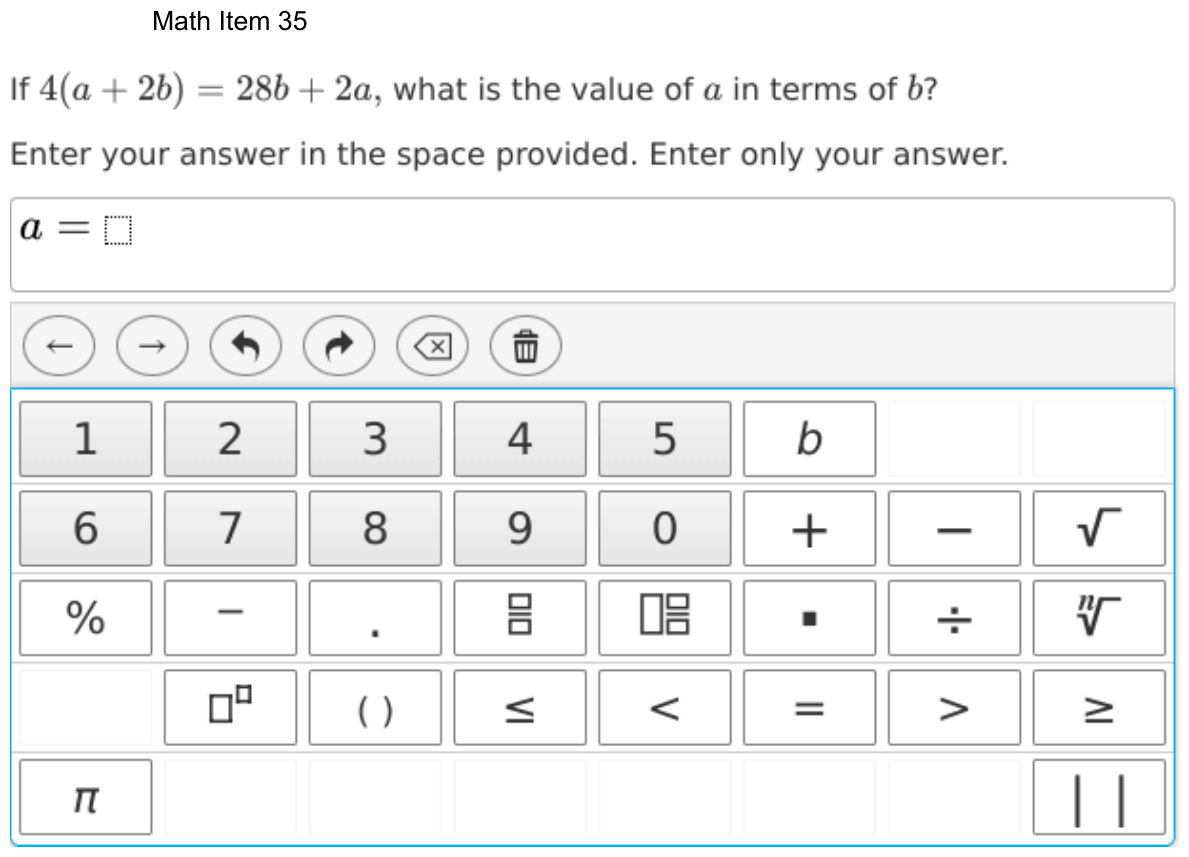
If , what is the value of a in terms of b?
Enter your answer in the space provided. Enter only your answer.
On the test you build the answer on an on-screen keypad; here, type it. Use ^ for a power, sqrt( ) or √ for a root, pi for π, and <= or >= for ≤ and ≥.
Show the answer
Correct answer: a = 10b
To find the value of a in terms of b, solve for a. Begin by distributing 4 on the left side of the equation:
Then, get the a terms on one side and the b terms on the other:
Solve for the value of a in terms of b by combining like terms and then dividing each side by 2:
Question analysis
An algebra question gives an equation with a and b on both sides, one side written as 4 times a sum in parentheses, and students type a in terms of b after a printed "a =". It tests the distributive property and solving linear equations. The answer is typed, so a slip in distributing or moving terms is not caught by any choices.
- NYS standards
- Grade level
- Grade 8 content, by NYS standard
- Compared with grade 7
- Above grade 7 Grade 7 students solve equations like 4(x + 2) = 28 with numbers. This one has letters on both sides, needs the distributive property and like terms, and asks for a in terms of b, which is grade 8 algebra.
- Estimated difficulty
- Hard: combines ideas, needs a plan, and has more than one tempting wrong answer.
- Thinking it demands
- Depth of knowledge 1, recall and reproduction · mainly apply
- What makes it hard
- Variables instead of numbers moderate
- Many steps moderate
- An answer in an unexpected form minor
- Solution
- 3 steps
- Reading level
- Question and choices: about grade 4, 23 words.
- Students, last 30 days
- Not enough answers yet to show (it takes 10).
Why it is hard, traps and wrong answers (shows the answer)
Why it is hard
Every step is routine, yet there are four of them, each with a classic slip, and the typed answer catches none. Multiplying the 4 into only the a, or carrying 8b across without changing its sign, gives another whole multiple of b that looks finished. Testing b = 1, where 4(a + 2) and 28 + 2a must come out equal, confirms an entry quickly.
Variables instead of numbers moderate Understanding the question
Both letters appear on both sides, and the answer must stay a multiple of b, so there is no number to check an entry against unless students invent one. (Koedinger & Nathan, 2004; Enright, Morley & Sheehan, 2002)
Many steps moderate Working it out
Four moves run in a chain, distributing the 4, gathering the a terms, gathering the b terms and dividing by 2, and an error at any one carries into the typed result. (Daniel & Embretson, 2010; Enright, Morley & Sheehan, 2002)
An answer in an unexpected form minor Choosing the answer
The answer is typed after a printed “a =”, with no choices, so 20b, the line before dividing by 2, can be entered without anything on screen questioning it. (Enright, Morley & Sheehan, 2002)
Strategy: Distribute the 4 to both terms in the parentheses, gather the a terms on one side and the b terms on the other, then divide by the coefficient of a.
Traps
- A faulty procedure: A systematic but wrong procedure: adding fractions straight across, applying an exponent to each term of a sum, dropping a sign when moving a term.
- Stops one step early: A choice is a number from partway through the solution.
The wrong answers, classified
13b A faulty procedure (Brown & Burton, 1978; Tatsuoka, 1983)
Multiplies only the a by 4, writing 4a + 2b = 28b + 2a, so 2a = 26b and a = 13b.
18b A faulty procedure (Brown & Burton, 1978; Tatsuoka, 1983)
Distributes correctly but moves 8b to the right without changing its sign, so 2a = 28b + 8b = 36b and a = 18b.
20b Stops one step early (King et al., 2004; Gierl et al., 2017)
Reaches 2a = 20b correctly and enters 20b, stopping before dividing both sides by 2 to get a alone.
Worked solution, step by step
Formulas used
- Distributive property
- k is the number outside the parentheses. x and y are the terms inside. The number outside multiplies every term inside, not just the first one. It works because 4 groups of (x + y) hold 4 x’s and 4 y’s.
- Doing the same thing to both sides
- A and B are the two equal sides of an equation. C is any amount. Taking the same amount from both sides, or dividing both by the same number, keeps them equal, like a balanced scale.
Sort out the question
The equation is . You need a in terms of b. That means a alone on one side, with only b and numbers on the other.
The answer box already shows a =, so you type only what comes after it.
Multiply out the parentheses
Use the distributive property. The 4 multiplies both terms inside:
Watch out: multiplying only the a by 4 gives 4a + 2b. That leads to the wrong answer 13b.
Gather the a terms
Like terms are terms with the same letter, such as 4a and 2a. Put the a terms on the left. Subtract 2a from both sides:
Gather the b terms
Now subtract 8b from both sides:
Watch out: moving 8b without changing its sign gives . That leads to 18b, which is wrong.
Divide both sides by 2
2a means 2 times a. Divide both sides by 2 to get a alone:
Watch out: 20b is equal to 2a, not a. Do not stop there.
Enter it after the printed a =
On the test, the box already shows a =. Press 1, then 0, then the b key. You do not need a times sign. Do not type a = again. On this site, type 10b in the box.
So you would enter 10b, which makes a = 10b.
Check your answer
Pick b = 1, so a = 10. The left side is . The right side is . The sides match, so 10b works.
More questions like this
The original DOE question