3 English and 3 math
Here are 6 random questions to try. Takers earning below 75% are unlikely to receive an offer. You have 1 minute 48 seconds per question on the real exam.
Question 1 of 6
2026 Practice Test A English, question 31Passage Excerpt from “The Spirit of the Herd”
Excerpt from “The Spirit of the Herd”
by Dallas Lore Sharp
In this excerpt, published in 1914, author and professor Dallas Lore Sharp describes a summer cattle roundup in Oregon. The heat and dust had been relentless for three days. The cowboys were exhausted, and the cattle were restless. The ranch boss, Wade, had led the drive to a watering place, only to find it empty.
Along with the wagon had come the fresh horses—one of them being Peroxide Jim, a supple, powerful, clean-limbed buckskin, a horse, I think, that had as fine and intelligent an animal-face as any creature I ever saw. Wade had been saving this horse for emergency work. And why should he not have been saved fresh for just such a need as this? Are there not superior horses as well as superior men—a Peroxide Jim to complement a Wade?
The horse knew the cattle business and knew his rider perfectly; and though there was nothing like sentiment about the boss of the P Ranch riders, his faith in Peroxide Jim was complete. . . .
The desert, where the herd was camped, was one of the highest of a series of tablelands, or benches; it lay as level as a floor, rimmed by sheer rock, from which there was a drop to the bench of sage below. The herd when overtaken by the dusk had been headed for a pass descending to the next lower bench, but was now halted within a mile of the rim rock on the east, where there was a perpendicular fall of about three hundred feet. . . .
In the taut silence of the stirless desert night, with the tension of the herd at the snapping-point, any quick, unwonted sight or sound would stampede them. The sneezing of a horse, the flare of a match, would be enough to send the whole four thousand headlong—blind, frenzied, trampling—till spent and scattered over the plain.
And so, as he rode, Wade began to sing. The rider ahead of him took up the air and passed it on until, above the stepping stir of the hoofs rose the faint voices of the men, and all the herd was bound about by the slow plaintive measures of some old song. It was not to soothe their savage breasts that the riders sang to the cattle, but rather to preempt the dreaded silence, to relieve the tension, and so to prevent the shock of any sudden startling noise.
So they sang and rode and the night wore on to one o’clock, when Wade, coming up on the rim-rock side, felt a cool breeze fan his face, and caught a breath of fresh, moist wind with the taste of water in it.
He checked his horse instantly, listening as the wind swept past him over the cattle. But they must already have smelled it, for they had ceased their milling, the whole herd standing motionless, the indistinct forms close to him in the dark showing their bald faces lifted to drink the sweet wet breath that came over the rim. Then they started on again, but faster, and with a rumbling now from their hoarse throats that tightened Wade’s grip on the reins.
The sound seemed to come out of the earth, a low, rumbling mumble, as dark as the night and as wide as the plain, a thick, inarticulate bellow that stood every rider stiff in his stirrups. . . .
Then the breeze caught the dust and carried it back from the gray-coated, ghostly shapes, and Wade saw that the animals were still moving in a circle. He must keep them going. He touched his horse to ride on with them, when across the black sky flashed a vivid streak of lightning.
There was a snort from the steers, a quick clap of horns and hoofs from far within the herd, a tremor of the plain, a roar, a surging mass—and Wade was riding the flank of a wild stampede. Before him, behind him, beside him, pressing hard upon his horse, galloped the frenzied steers, and beyond them a multitude borne on, and bearing him on, by the heave of the galloping herd.
Wade was riding for his life. He knew it. His horse knew it. He was riding to turn the herd, too, back from the rim, as the horse also knew. The cattle were after water—water-mad—ready to go over the precipice to get it, carrying horse and rider with them. Wade was the only rider between the herd and the rim. It was black as death. He could see nothing in the sage, could scarcely discern the pounding, panting shadows at his side. He knew that he was being borne toward the rim, how fast he could not tell, but he knew by the swish of the brush against his tapaderos and the plunging of the horse that the ground was growing stonier, that they were nearing the rocks.
To outrun the herd was his only chance for life. If he could come up with the leaders he might not only escape, but even stand a chance of heading them off upon the plain and saving the herd. There were cattle still ahead of him; how many, what part of them all, he could not make out in the dark. But the horse knew. The reins hung on his straight neck, where his rider had dropped them, as, yelling and firing over the wild herd, he had given this horse the race to win, to lose.
They were riding the rim. Close on their left bore down the flank of the herd, and on their right, under their very feet, was a precipice, so close that they felt its blackness—its three hundred feet of fall! . . .
. . . Then Wade found himself racing neck and neck with a big white steer, which the horse, with marvelous instinct, seemed to pick out from a bunch, and to cling to, forcing him gradually ahead, till, cutting him free from the bunch entirely, he bore him off into the swishing sage.
The steers coming on close behind followed their leader, and in, after them, swung others. The tide was turning from the rim. More and more were veering, and within a short time the whole herd, bearing off from the cliffs, was pounding over the open plains.
Whose race was it? It was Peroxide Jim’s, according to Wade, for not by word or by touch of hand or knee had the horse been directed in the run. From the flash of the lightning the horse had taken the bit, had covered an indescribably perilous path at top speed, had outrun the herd and turned it from the edge of the rim rock, without a false step or a tremor of fear.
From “The Spirit of the Herd” by Dallas Lore Sharp—Public Domain
tablelands: plateaus, flat areas of land sharply elevated from the surrounding area
tapaderos: leather covers for stirrups
Question
How does paragraph 3 convey the effect of the setting on the cattle drive?
- AIt shows how the growing darkness created challenges for the riders in getting the herd to move.
- BIt describes how the changing elevation contributed to the dangerousness of the environment.
- CIt describes how the desert created an uncomfortable feeling of isolation for the riders and the cattle.
- DIt shows how the steep terrain made it difficult for the cattle to keep moving forward.
Show the answer
Correct answer: B
The question asks how paragraph 3 conveys the effect of the setting on the cattle drive.
A. Incorrect. The riders were not trying to move the herd through the darkness. Instead, the reference to the growing darkness (“overtaken by the dusk”) indicates that the riders had halted the animals for the night because moving the herd across the desert in the darkness would have been much too dangerous because of the sheer drop-off at the edge of the tableland. The riders needed the daylight to navigate the herd safely through the “pass descending to the next lower bench.”
B. CORRECT. Paragraph 3 describes the land where the herd was as being “as level as a floor” but “rimmed by sheer rock, from which there was a drop to the bench of sage below.” The drop was “a perpendicular fall of about three hundred feet”—any animal or person could fall over that edge. It was the change in height, from flat tableland to sheer drop-off, that made the terrain so dangerous.
C. Incorrect. The use of the word “desert” in the first sentence of the paragraph does not highlight the isolation of the setting or indicate that the riders and the herd were uncomfortable being alone. Instead, the word merely establishes the setting where the action occurred: “it lay as level as a floor, rimmed by sheer rock, from which there was a drop to the bench of sage below.”
D. Incorrect. The excerpt does not indicate that the steep terrain made it difficult for the herd to move forward. The herd was not expected to navigate the steep terrain. Instead, the steep terrain presented a danger to the herd that must be avoided. The riders intended to move the herd safely through passes that descended gradually to lower elevations.
Question analysis
This setting question on “The Spirit of the Herd” asks how paragraph 3, which describes the high desert where the herd has stopped for the night, conveys the setting’s effect on the cattle drive. Students must understand unusual landform words, one explained in a footnote, and work out what the land means for the herd. Several choices name a real feature of the scene.
- Grade level
- Grade 8 reading and task
- Compared with grade 7
- Above grade 7 Grade 7 students analyze how setting affects a story, usually from plainly worded description. This paragraph relies on terms such as tablelands, benches and rim rock, and never names the effect, so students must work it out from the description.
- Estimated difficulty
- Hard: combines ideas, needs a plan, and has more than one tempting wrong answer.
- Thinking it demands
- Depth of knowledge 2, skills and concepts · mainly analyze
- What makes it hard
- A very close wrong answer moderate
- Hard words moderate
- Reading between the lines minor
- Evidence
- Answered from one paragraph or stanza
- Reading level
- Passage: about grade 8, 1160 words; question and choices: about grade 9, 76 words.
- Students, last 30 days
- Not enough answers yet to show (it takes 10).
Why it is hard, traps and wrong answers (shows the answer)
Why it is hard
Paragraph 3 reads like a surveyor’s report, flat land ending in a sheer drop, with no word of fear. Students must turn its landforms into a picture and see that a herd camped a mile from a three-hundred-foot fall is in danger. The strongest wrong answer gets the cliff right but makes it a barrier to the drive, and others seize on the dusk or on the loneliness a desert suggests.
A very close wrong answer moderate Choosing the answer
The choice about steep terrain blocking the herd and the right one both rest on the drop at the rim; they differ only in its effect, a hazard to avoid or an obstacle to movement. (Embretson & Wetzel, 1987; Gorin & Embretson, 2006; Ascalon et al., 2007)
Hard words moderate Understanding the question
The paragraph’s landforms, “tablelands, or benches,” “rim rock,” a “pass descending to the next lower bench” and a “perpendicular fall,” must be pictured before the danger is clear. (Perfetti, 2007; Freedle & Kostin, 1993)
Reading between the lines minor Working it out
The paragraph never calls the drop dangerous; students must infer it from “sheer rock” and “about three hundred feet,” a danger that becomes real only when the herd stampedes toward the rim. (Graesser, Singer & Trabasso, 1994; Kintsch, 1998)
Strategy: Make a quick sketch of the land paragraph 3 describes and mark where the herd is halted, then ask what that setting means for the drive and test each choice against it.
Traps
- Twists what the text says: Uses the text's topic and ideas but changes what it says: who did it, how much, when, or why.
- Outside knowledge: A choice is plausible in the real world but not supported by this text.
The wrong answers, classified
A Twists what the text says (King et al., 2004)
Turns “overtaken by the dusk” into a struggle to get the herd moving, though the herd was halted for the night and the paragraph stresses the drop, not darkness.
C Outside knowledge (King et al., 2004; Recht & Leslie, 1988)
Assumes a desert must feel lonely, a common association, though the paragraph uses “desert” only to place the herd on a level plain and says nothing of isolation.
D Twists what the text says (King et al., 2004)
Rightly notices the sheer drop but makes it an obstacle to forward movement, when the herd was headed for a pass and the cliff was a hazard to avoid.
Working it out, step by step
Figure out what the question asks
This asks about setting, the place and time of a story. How does the land in paragraph 3 affect the cattle drive? A cattle drive is a trip where riders move a large herd of cattle across the land.
Read paragraph 3
The herd is camped on high, flat land “rimmed by sheer rock, from which there was a drop to the bench of sage below.” The herd “was now halted within a mile of the rim rock on the east, where there was a perpendicular fall of about three hundred feet.”
Picture the land
The note says tablelands are “flat areas of land sharply elevated from the surrounding area.” A bench is another name for one. Picture giant steps. The herd is on a high step. Its edge is sheer rock, a straight drop. Perpendicular means straight up and down. So the herd has stopped within a mile of a cliff about 300 feet high.
Work out the effect
Elevation is how high the land is. Here the elevation changes suddenly, from flat ground to a steep cliff. A scared herd could run right over the edge. That makes the place dangerous. Later, this danger comes true when the stampede races toward the rim.
Check each choice
- A does not fit. The herd was halted for the night. The riders were not trying to move it.
- B fits. The sudden drop makes the place dangerous.
- C does not fit. The paragraph says nothing about feeling lonely.
- D does not fit. The herd was headed for a pass, an easier way down. The cliff was a danger to avoid.
Choose the answer
The change in height, from flat land to a sheer drop, makes the setting dangerous. So the answer is B.
Why this answer and not the closest wrong one
D is the closest wrong choice, because it also points to the steep drop. But the herd was not trying to climb down the cliff. It was headed for a pass and had stopped for the night. The drop matters because the herd could fall over it. That danger is what B describes.
More questions like this
The original DOE question
The passage “Excerpt from “The Spirit of the Herd”” as printed (page 41)
Question 2 of 6
2024 Test A English, question 34Passage Champion of the Channel
Champion of the Channel
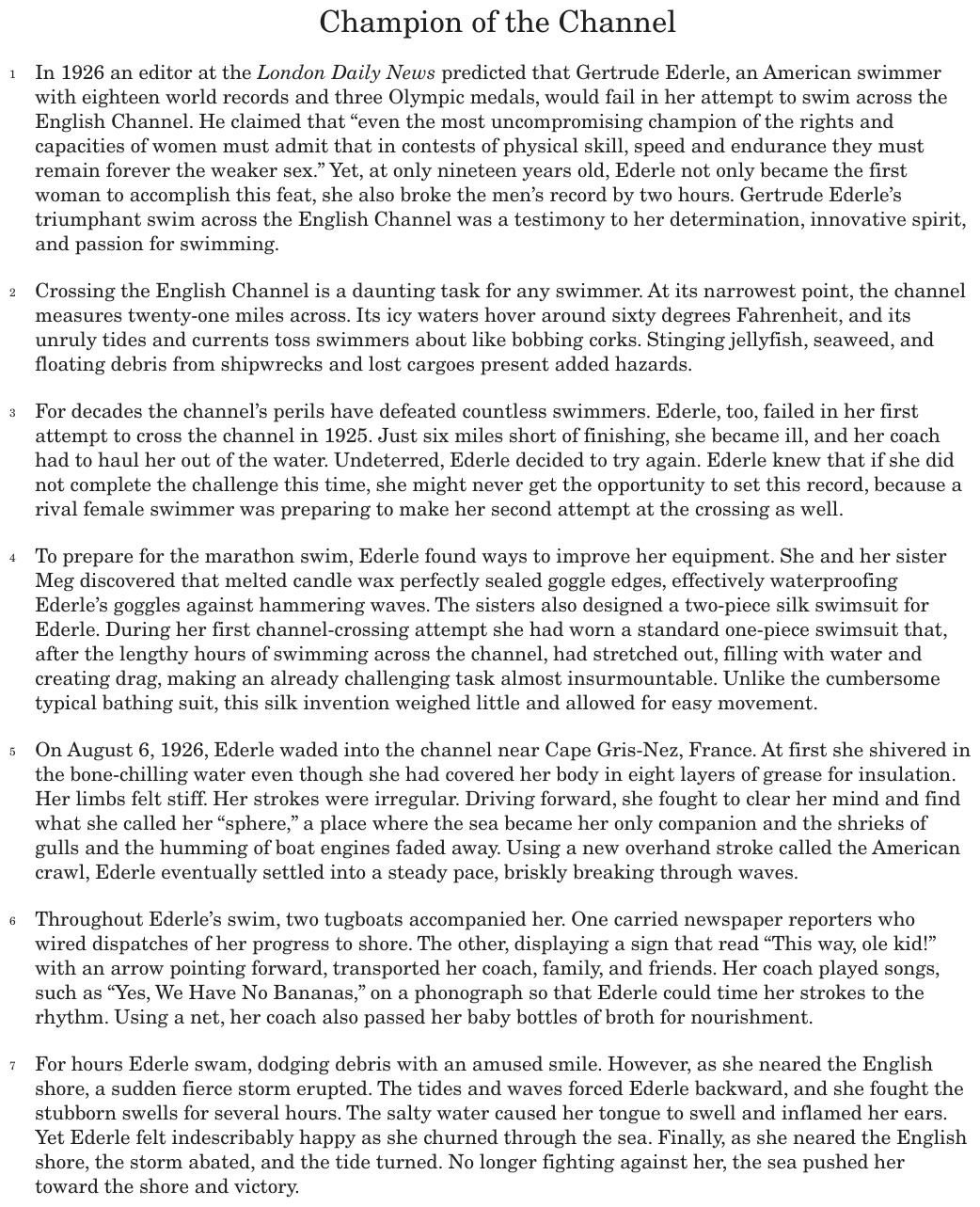
In 1926 an editor at the London Daily News predicted that Gertrude Ederle, an American swimmer with eighteen world records and three Olympic medals, would fail in her attempt to swim across the English Channel. He claimed that “even the most uncompromising champion of the rights and capacities of women must admit that in contests of physical skill, speed and endurance they must remain forever the weaker sex.” Yet, at only nineteen years old, Ederle not only became the first woman to accomplish this feat, she also broke the men’s record by two hours. Gertrude Ederle’s triumphant swim across the English Channel was a testimony to her determination, innovative spirit, and passion for swimming.
Crossing the English Channel is a daunting task for any swimmer. At its narrowest point, the channel measures twenty-one miles across. Its icy waters hover around sixty degrees Fahrenheit, and its unruly tides and currents toss swimmers about like bobbing corks. Stinging jellyfish, seaweed, and floating debris from shipwrecks and lost cargoes present added hazards.
For decades the channel’s perils have defeated countless swimmers. Ederle, too, failed in her first attempt to cross the channel in 1925. Just six miles short of finishing, she became ill, and her coach had to haul her out of the water. Undeterred, Ederle decided to try again. Ederle knew that if she did not complete the challenge this time, she might never get the opportunity to set this record, because a rival female swimmer was preparing to make her second attempt at the crossing as well.
To prepare for the marathon swim, Ederle found ways to improve her equipment. She and her sister Meg discovered that melted candle wax perfectly sealed goggle edges, effectively waterproofing Ederle’s goggles against hammering waves. The sisters also designed a two-piece silk swimsuit for Ederle. During her first channel-crossing attempt she had worn a standard one-piece swimsuit that, after the lengthy hours of swimming across the channel, had stretched out, filling with water and creating drag, making an already challenging task almost insurmountable. Unlike the cumbersome typical bathing suit, this silk invention weighed little and allowed for easy movement.
On August 6, 1926, Ederle waded into the channel near Cape Gris-Nez, France. At first she shivered in the bone-chilling water even though she had covered her body in eight layers of grease for insulation. Her limbs felt stiff. Her strokes were irregular. Driving forward, she fought to clear her mind and find what she called her “sphere,” a place where the sea became her only companion and the shrieks of gulls and the humming of boat engines faded away. Using a new overhand stroke called the American crawl, Ederle eventually settled into a steady pace, briskly breaking through waves.
Throughout Ederle’s swim, two tugboats accompanied her. One carried newspaper reporters who wired dispatches of her progress to shore. The other, displaying a sign that read “This way, ole kid!” with an arrow pointing forward, transported her coach, family, and friends. Her coach played songs, such as “Yes, We Have No Bananas,” on a phonograph so that Ederle could time her strokes to the rhythm. Using a net, her coach also passed her baby bottles of broth for nourishment.
For hours Ederle swam, dodging debris with an amused smile. However, as she neared the English shore, a sudden fierce storm erupted. The tides and waves forced Ederle backward, and she fought the stubborn swells for several hours. The salty water caused her tongue to swell and inflamed her ears. Yet Ederle felt indescribably happy as she churned through the sea. Finally, as she neared the English shore, the storm abated, and the tide turned. No longer fighting against her, the sea pushed her toward the shore and victory.
After fourteen hours and thirty-one minutes, Ederle, on wobbly legs, stepped onto the English shore. The waiting crowd roared, honked their automobile horns, blasted their tugboat whistles, and set off flares that flashed in the sky. Ederle had swum into history.
When Ederle returned to New York, she received a parade, where thousands of people shouted “Trudy!” Not only were everyday American citizens proud of Ederle, but she also inspired them to be more active. Over the next few years, more than 60,000 people credited her with motivating them to earn their American Red Cross swimming certificates. Gertrude Ederle’s accomplishment proved to the world that with determination and passion, it was possible for a person to achieve his or her goals.
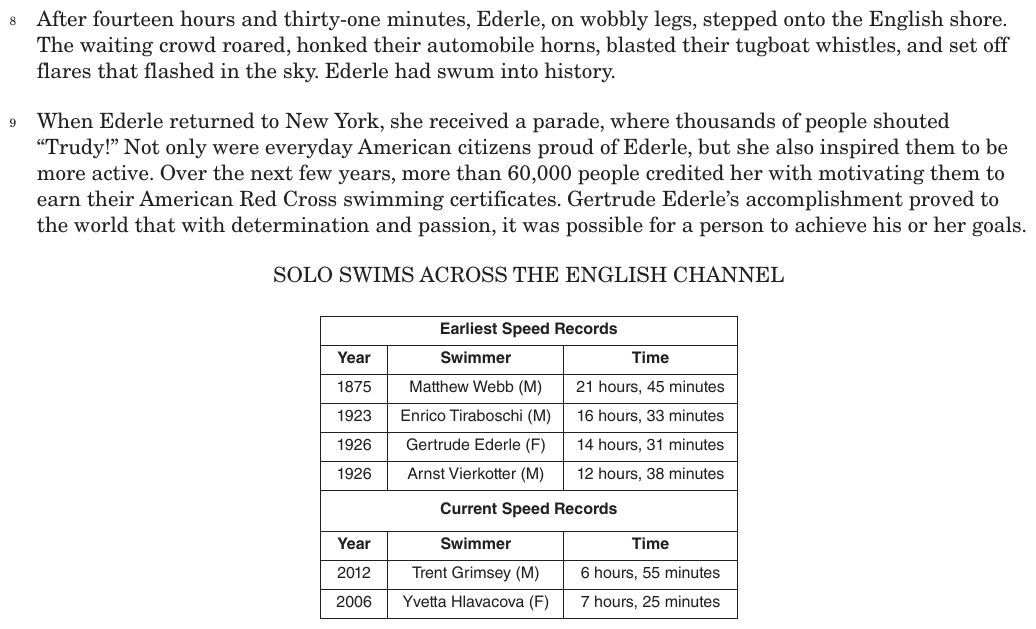
SOLO SWIMS ACROSS THE ENGLISH CHANNEL
|
Earliest Speed Records |
||
| Year | Swimmer | Time |
| 1875 | Matthew Webb (M) | 21 hours, 45 minutes |
| 1923 | Enrico Tiraboschi (M) | 16 hours, 33 minutes |
| 1926 | Gertrude Ederle (F) | 14 hours, 31 minutes |
| 1926 | Arnst Vierkotter (M) | 12 hours, 38 minutes |
| Current Speed Records | ||
| Year | Swimmer | Time |
| 2012 | Trent Grimsey (M) | 6 hours, 55 minutes |
| 2006 | Yvetta Hlavacova (F) | 7 hours, 25 minutes |
Question
The table builds on the information in the passage mainly by
- Aemphasizing that people have continued to swim across the channel and have significantly improved the speed record.
- Bsuggesting that Ederle inspired many women to swim across the channel to attempt to break the current speed record.
- Crevealing that other women competed with Ederle to set a record time for swimming across the English Channel.
- Dproviding a comparison between the earliest channel-swimming records and the current record times.
Show the answer
Correct answer: A
The question asks how the table mainly builds on the information in the passage.
A. CORRECT. The table supports the information in the passage by showing that people have continued to swim the channel and have significantly improved on past records. The information in the table about records set by those who came after Ederle builds on the idea that “Gertrude Ederle’s accomplishment proved to the world that with determination and passion, it was possible for a person to achieve his or her goals” (paragraph 9).
B. Incorrect. Even though paragraph 9 states that Ederle “inspired [everyday American citizens] to be more active” and the table presents the time for the current female record holder, there is no indication in the passage or in the table that the subsequent female record holders were inspired to swim across the channel by Ederle.
C. Incorrect. Although paragraph 3 mentions that Ederle had a female rival and the table includes the speed record of another female swimmer, the passage does not provide information about other female swimmers competing with Ederle to set the channel-swim record.
D. Incorrect. Although paragraph 1 mentions that Ederle “broke the men’s record by two hours” and the table allows for comparisons between the earliest speed records and those of the present day, the passage mentions no channel-swim records set after Ederle’s swim, so it says nothing about current record times. The table allows for comparison, but this aspect of the table does not build on the information presented in the passage.
Question analysis
This question asks how a table of English Channel speed records, from Matthew Webb's 1875 crossing to a 2012 record, builds on the passage about Gertrude Ederle. Students must read times from two eras and decide what the table adds to the text, while the choices mix accurate observations about the table with claims neither source supports.
- Grade level
- Grade 8 reading and task
- Compared with grade 7
- Above grade 7 Relating a table to a passage is within grade 7 standards, but here the student must compare records from two eras, connect them to ideas in the text and choose among closely worded statements, well above typical grade 7 demand.
- Estimated difficulty
- Among the hardest on the SHSAT: a non-obvious approach, heavy reading, or a well-hidden trap.
- Thinking it demands
- Depth of knowledge 3, strategic thinking · mainly analyze
- What makes it hard
- A very close wrong answer major
- Reading a figure, table or graph moderate
- How, not what moderate
- Evidence
- Answered from the whole text
- Reading level
- Passage: about grade 9, 790 words; question and choices: about grade 11, 78 words.
- Corrected from the DOE handbook
- A self-contradictory statement in the explanation was corrected.
- Students, last 30 days
- Not enough answers yet to show (it takes 10).
Why it is hard, traps and wrong answers (shows the answer)
Why it is hard
This is one of the hardest questions on the test because a wrong choice describes the table exactly, in its own words. The passage stops with Ederle's 1926 record, and what the table adds is the rest of the story: swimmers kept crossing, and the record fell to under seven hours. Students who describe what the table contains, rather than what it tells a reader who has finished the passage, lose the point.
A very close wrong answer major Choosing the answer
The comparison choice repeats the table's own headings, “Earliest Speed Records” and “Current Speed Records”, and is literally true; only the stem's “builds on the information in the passage” and “mainly” separate it from the choice about the falling record. (Embretson & Wetzel, 1987; Gorin & Embretson, 2006; Ascalon et al., 2007)
Reading a figure, table or graph moderate Understanding the question
The student must compare times across the table's two sections, from Webb's 21 hours 45 minutes in 1875 and Ederle's 14 hours 31 minutes to Grimsey's 6 hours 55 minutes in 2012. (Lesh, Post & Behr, 1987; Kirsch & Mosenthal, 1990)
How, not what moderate Working it out
The question asks what the table adds to a passage that ends in 1926, so the student must say what its later rows extend, not what its layout holds. (Anderson & Krathwohl, 2001)
Strategy: Read both sections of the table and say what it adds to Ederle's story, then keep only a choice that the table shows and that connects to an idea the passage itself develops.
Traps
- Wrong purpose or structure: Names a purpose, structure or effect that the part does not serve, or describes what a part says when the question asks what it does.
- Reads too much in: A reasonable-sounding conclusion that goes further than the text allows.
- Twists what the text says: Uses the text's topic and ideas but changes what it says: who did it, how much, when, or why.
The wrong answers, classified
B Reads too much in (Graesser, Singer & Trabasso, 1994)
Assumes Ederle inspired many women to chase the record, but the table lists one later woman, Yvetta Hlavacova in 2006, and nothing links her or anyone else to Ederle.
C Twists what the text says (King et al., 2004)
Joins the rival female swimmer of paragraph 3 to Hlavacova's 2006 time, inventing a contest among women in Ederle's day that neither the table nor the passage shows.
D Wrong purpose or structure (Anderson & Krathwohl, 2001)
Describes the table's layout, earliest records beside current ones, which is accurate, but stops at what it contains instead of saying what the comparison adds to Ederle's story.
What was corrected from the DOE handbook, and why
- Explanation: In rejecting choice D, the handbook notes that paragraph 1 says Ederle “broke the men’s record by two hours,” and then says “there is no mention in the passage of past, present, or future channel-swim records.” Paragraph 1 does mention a past record: the one Ederle broke. What the passage never mentions is a record set after hers, which is what the table’s “Current Speed Records” add. The explanation now says the passage mentions no channel-swim records set after Ederle’s swim, so it says nothing about current record times. The reason for rejecting D is otherwise unchanged.
Working it out, step by step
Understand the question
To build on something means to add to it. So this asks what the table adds to what the passage already tells you. Don’t just describe what is in the table. Ask what a reader learns from it after finishing the passage.
Read the table’s two parts
The table has two parts, “Earliest Speed Records” and “Current Speed Records.” These rows matter most:
Year Swimmer Time 1875 Matthew Webb 21 hours, 45 minutes 1926 Gertrude Ederle 14 hours, 31 minutes 2012 Trent Grimsey 6 hours, 55 minutes Compare the times
Ederle swam for 14 hours and 31 minutes. Half of her time would be about 7 hours and 15 minutes. Grimsey’s 2012 time, 6 hours and 55 minutes, is even faster than that. So people kept swimming the channel after 1926, and the record got much faster.
See what the passage leaves out
The passage does mention one record. In paragraph 1, Ederle “broke the men’s record by two hours.” But the passage stops in 1926. It never tells of any record set after her swim. The table adds that later part of the story: swimmers kept crossing, and the record kept falling.
Check each choice
- A fits: people kept crossing and “significantly improved the speed record,” and significantly means by a lot.
- B is wrong because nothing links any later woman to Ederle, and the table lists only one later woman.
- C is wrong because Ederle is the only woman of her time in the table, and Hlavacova swam 80 years later, in 2006.
- D is wrong because it only names what the table holds, not what the comparison adds to Ederle’s story.
Watch out: D uses the table’s own headings, so it sounds right. But the question asks what the table adds, not how it is laid out.
Choose the answer
The table carries the story past 1926 and shows the record falling far below Ederle’s time. So the answer is A.
Why this answer and not the closest wrong one
D comes closest, because the table really does set the earliest and current records side by side. But D stops at describing the table. A says what that comparison shows a reader who has finished the passage: the record kept falling, from Ederle’s 14 hours and 31 minutes to under 7 hours.
More questions like this
The original DOE question
The passage “Champion of the Channel” as printed (pages 56–57)
Question 3 of 6
2026 Practice Test D English, question 26Passage Ode to Fireworks
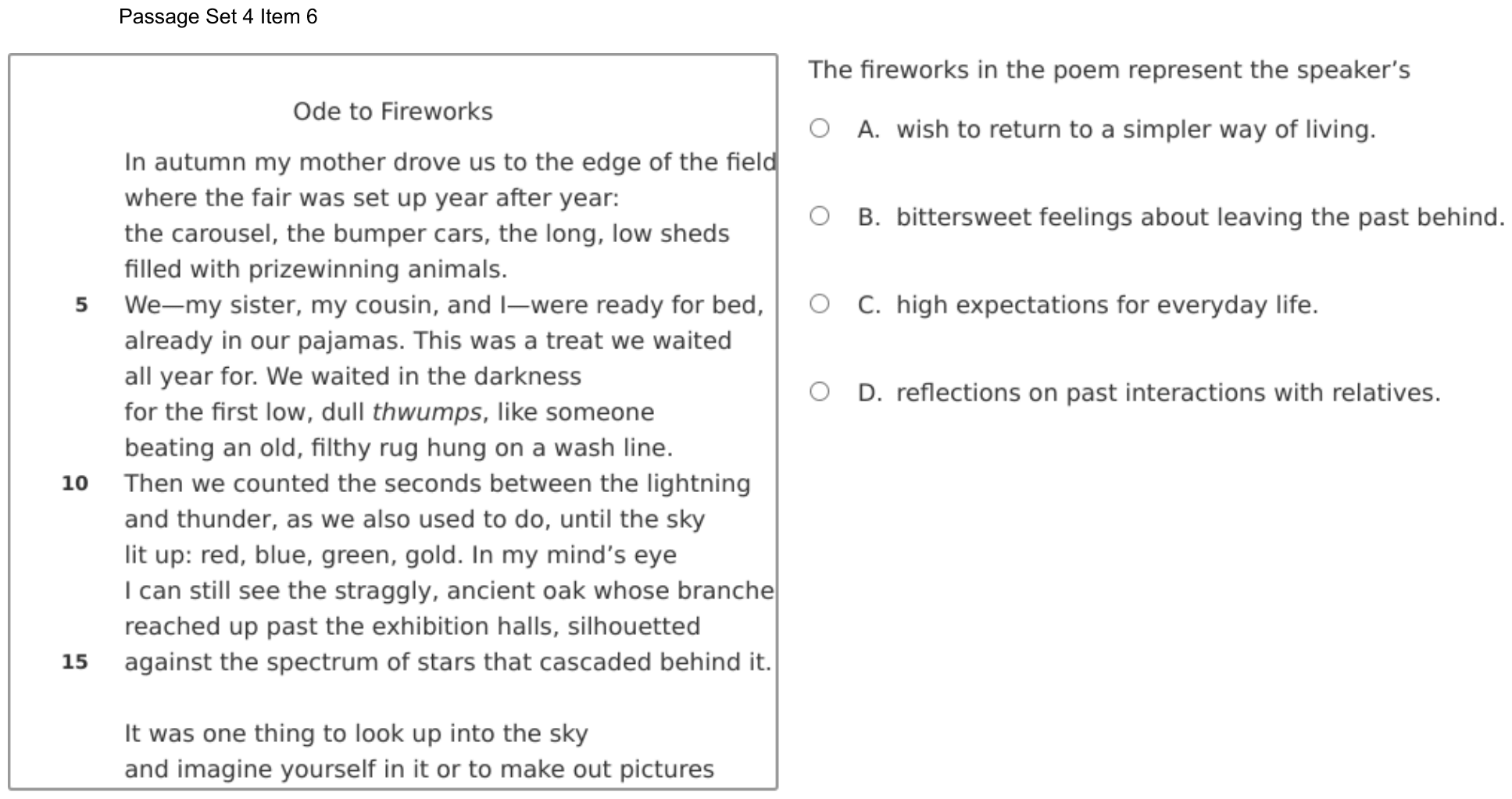
Ode to Fireworks
In autumn my mother drove us to the edge of the field
where the fair was set up year after year:
the carousel, the bumper cars, the long, low sheds
filled with prizewinning animals.
We—my sister, my cousin, and I—were ready for bed,
already in our pajamas. This was a treat we waited
all year for. We waited in the darkness
for the first low, dull thwumps, like someone
beating an old, filthy rug hung on a wash line.
Then we counted the seconds between the lightning
and thunder, as we also used to do, until the sky
lit up: red, blue, green, gold. In my mind’s eye
I can still see the straggly, ancient oak whose branches
reached up past the exhibition halls, silhouetted
against the spectrum of stars that cascaded behind it.
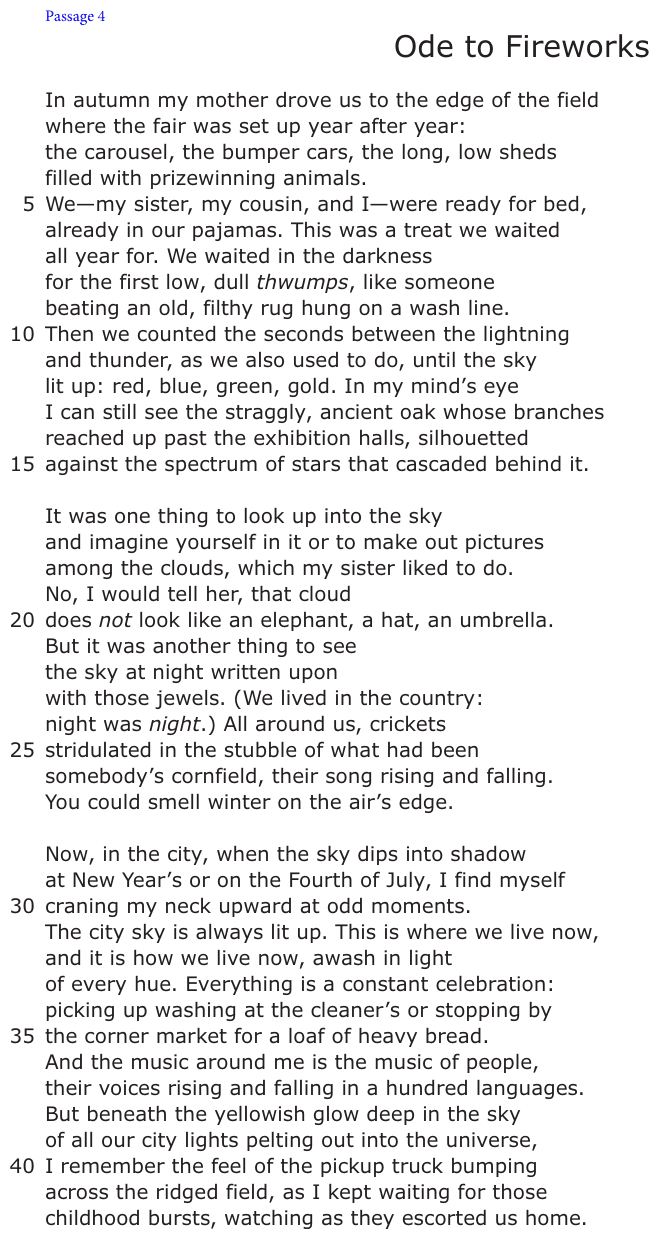
It was one thing to look up into the sky
and imagine yourself in it or to make out pictures
among the clouds, which my sister liked to do.
No, I would tell her, that cloud
does not look like an elephant, a hat, an umbrella.
But it was another thing to see
the sky at night written upon
with those jewels. (We lived in the country:
night was night.) All around us, crickets
stridulated in the stubble of what had been
somebody’s cornfield, their song rising and falling.
You could smell winter on the air’s edge.
Now, in the city, when the sky dips into shadow
at New Year’s or on the Fourth of July, I find myself
craning my neck upward at odd moments.
The city sky is always lit up. This is where we live now,
and it is how we live now, awash in light
of every hue. Everything is a constant celebration:
picking up washing at the cleaner’s or stopping by
the corner market for a loaf of heavy bread.
And the music around me is the music of people,
their voices rising and falling in a hundred languages.
But beneath the yellowish glow deep in the sky
of all our city lights pelting out into the universe,
I remember the feel of the pickup truck bumping
across the ridged field, as I kept waiting for those
childhood bursts, watching as they escorted us home.
Question
The fireworks in the poem represent the speaker’s
- Awish to return to a simpler way of living.
- Bbittersweet feelings about leaving the past behind.
- Chigh expectations for everyday life.
- Dreflections on past interactions with relatives.
Show the answer
Correct answer: B
The question asks what the fireworks in the poem represent about the speaker.
A. Incorrect. While the speaker misses elements of the past, the speaker is also positive about the present, with comparisons to a “constant celebration” (line 33) and descriptions of “the music of people” (line 36). The speaker does not indicate a desire to return to a simpler way of living.
B. CORRECT. The speaker misses the experience of watching the fireworks display with family and friends but understands that time has progressed and that life is now different. The lines “This was a treat we waited / all year for” (lines 6–7) highlight the significance of the memory of waiting for and watching the fireworks. In the speaker’s present, the lines “I remember the feel of the pickup truck bumping / across the ridged field” (lines 40–41) emphasize the key details from the experience that stand out in the speaker’s mind when something in the current environment reminds the speaker of the past.
C. Incorrect. While the speaker does share details about the present and the tone is generally positive, the fireworks do not suggest that the speaker has high expectations for how everyday life should be. The third stanza (lines 28–42) describes the speaker’s daily life in the city, but the speaker does not form expectations from these everyday moments.
D. Incorrect. While the speaker does mention discussing cloud shapes with a family member in lines 19–20, the fireworks serve as a more general reminder of the speaker’s past life. Viewing the bright lights of the city makes the speaker recall memories of the speaker’s past and the feelings of anticipation before the fireworks show.
Question analysis
This question about symbolism asks what the fireworks represent in “Ode to Fireworks,” a 42-line poem in which an adult speaker remembers watching fireworks at a country fair as a child. Students must weigh all three stanzas to decide what the central image stands for, and the choices name abstract feelings and wishes that are close to one another.
- Grade level
- Grade 8 reading and task
- Compared with grade 7
- Above grade 7 Grade 7 students interpret symbols, usually where the text makes their meaning fairly clear. Here they must hold a 42-line poem in mind and choose among four abstract feelings, two of them very close, which goes beyond typical grade 7 work.
- Estimated difficulty
- Hard: combines ideas, needs a plan, and has more than one tempting wrong answer.
- Thinking it demands
- Depth of knowledge 3, strategic thinking · mainly analyze
- What makes it hard
- Figurative or literary language moderate
- A very close wrong answer moderate
- Evidence in several places moderate
- Evidence
- Answered from the whole text
- Reading level
- Passage: 379 words (a poem; reading level not measured); question and choices: about grade 8, 35 words.
- Corrected from the DOE handbook
- The explanation of C misdescribed the third stanza; one sentence was corrected.
- Students, last 30 days
- Not enough answers yet to show (it takes 10).
Why it is hard, traps and wrong answers (shows the answer)
Why it is hard
This symbol question asks students to hold the whole 42-line poem in mind and weigh two feelings at once: the speaker misses the fireworks of childhood but speaks warmly of city life. Readers who notice only the longing choose a wish to go back, and readers who fix on one detail choose the relatives or the city’s “constant celebration.” The key’s “bittersweet” is the one word that holds both halves, which is why it is easy to pass over for a choice that states only one.
Figurative or literary language moderate Understanding the question
The fireworks are never explained; they are “jewels” in stanza 2 and the “childhood bursts” that “escorted us home” in stanza 3, so their meaning as a symbol must be built from images. (Graesser, Singer & Trabasso, 1994; Kintsch, 1998)
A very close wrong answer moderate Choosing the answer
The wish-to-return choice and the key both read the fireworks as feelings about the past; they differ in whether the speaker wants that past back or has accepted leaving it. (Embretson & Wetzel, 1987; Gorin & Embretson, 2006; Ascalon et al., 2007)
Evidence in several places moderate Working it out
The answer needs all three stanzas: the treat “we waited / all year for,” the dark country night, and the city stanza’s “This is where we live now,” which shows acceptance beside longing. (Kirsch & Mosenthal, 1990; Gorin & Embretson, 2006)
Strategy: Note how the speaker describes the fireworks in each stanza and how the speaker feels about the present in the last one, then choose the feeling that fits all three stanzas, not only the first.
Traps
- Reads too much in: A reasonable-sounding conclusion that goes further than the text allows.
- Word match: Repeats striking words or phrases from the text, so it looks supported, but its meaning does not fit the question.
- Too narrow: A single detail offered as the central idea or a summary, or a summary that keeps minor details and leaves out an essential part.
The wrong answers, classified
A Reads too much in (Graesser, Singer & Trabasso, 1994)
Takes the poem’s fond memories of the country as a wish to go back, though the speaker accepts “where we live now” and never asks to return.
C Word match (Freedle & Kostin, 1993)
Links the fireworks to line 33’s “Everything is a constant celebration,” then turns that into high expectations for daily life, which the poem never mentions.
D Too narrow (King et al., 2004)
Fixes on the mother, sister and cousin of the first stanza, real details, but the fireworks stand for a whole period of the speaker’s life, not time with relatives.
What was corrected from the DOE handbook, and why
- Explanation: Rejecting C, the handbook's explanation calls the third stanza (lines 28–42) “the speaker’s imaginings” and “fantasies”. The stanza describes the speaker's real life in the city now: “This is where we live now”, picking up washing at the cleaner's, stopping by the corner market. It now says the stanza describes the speaker's daily life in the city. The answer, B, is unchanged.
Working it out, step by step
Figure out what the question asks
This asks what the fireworks represent, or stand for. A thing in a poem that stands for a bigger idea is called a symbol. Look at the fireworks in all three stanzas. Then see how the speaker feels about the past and the present.
Look at the past
Stanza 1 shows how special the fireworks were: “This was a treat we waited / all year for.” Stanza 2 calls them “jewels.” In stanza 3 the speaker still remembers them: “I remember the feel of the pickup truck bumping / across the ridged field.” So the speaker misses that time.
Look at the present
The speaker also accepts city life: “This is where we live now, / and it is how we live now.” The city is “a constant celebration,” full of “the music of people.” So the speaker is not unhappy now. The speaker misses the past but has moved on. That feeling is bittersweet: happy and sad at the same time.
Check each choice
- A is wrong. The speaker never says they want to go back to the country.
- B is right. The fireworks stand for a loved past the speaker has left behind. The feeling is both warm and sad.
- C is wrong. The “constant celebration” describes city life. Nothing shows high expectations.
- D is wrong. Relatives appear in stanza 1. But the fireworks stand for a whole time of life, not just time with family.
Watch out: A notices only the longing. It misses that the speaker accepts “where we live now.”
Choose the answer
The fireworks hold both the joy of the past and the sadness of leaving it. So the answer is B, “bittersweet feelings about leaving the past behind.”
Why this answer and not the closest wrong one
A is the closest wrong answer. Both A and B are about feelings for the past. But A says the speaker wants to return, and the poem never says that. The speaker calls the city “a constant celebration” and accepts “where we live now.” Missing the past while accepting the present is bittersweet. That is B.
More questions like this
The original DOE question
The passage “Ode to Fireworks” as printed (page 32)
Question 4 of 6
2024 Test B Math, question 14Question
Karen reads at the rate of 60 pages per day. Martina reads 25% more pages per day than Karen. If the two students begin 1,500-page reading assignments on the same day, how many days sooner will Martina complete the assignment than Karen?
- A4
- B5
- C7
- D15
Show the answer
Correct answer: B
First, determine the rate at which Martina reads, in pages per day, using the rate at which Karen reads, 60 pages per day.
Next, determine the number of days it will take each person to complete the 1,500-page reading assignment.
Karen:
Martina:
Finally, determine the difference between the two numbers of days.
So Martina will complete the assignment 5 days sooner than Karen.
Question analysis
A reading-rate word problem: Karen reads 60 pages a day, and Martina reads 25% more pages a day. Both start a 1,500-page assignment on the same day, and students find how many days sooner Martina finishes. It combines a percent increase with rates and times, and asks for a difference in days.
- Grade level
- Grade 7 content, by NYS standard
- Compared with grade 7
- Above grade 7 Grade 7 percent problems usually stop after one increase or decrease. This one turns the percent into a new rate, finds two finishing times and compares them, four steps that go beyond a typical grade 7 task.
- Estimated difficulty
- Hard: combines ideas, needs a plan, and has more than one tempting wrong answer.
- Thinking it demands
- Depth of knowledge 2, skills and concepts · mainly apply
- What makes it hard
- Many steps moderate
- Combines ideas moderate
- Turning words into math minor
- Solution
- 4 steps
- Reading level
- Question and choices: about grade 6, 40 words.
- Students, last 30 days
- Not enough answers yet to show (it takes 10).
Why it is hard, traps and wrong answers (shows the answer)
Why it is hard
Each step is easy on its own; the difficulty is in carrying the chain to the end. Three of the choices are numbers a student meets or makes along the way: the extra pages per day, a quotient of two rates, or a rate built on 25 pages instead of 25%. Writing both finishing times down before subtracting keeps the target, a number of days, in view.
Many steps moderate Working it out
Four operations chain together: 25% of 60, Martina's 75 pages, the two finishing times 1,500 ÷ 60 and 1,500 ÷ 75, and finally their difference. (Daniel & Embretson, 2010; Enright, Morley & Sheehan, 2002)
Combines ideas moderate Working it out
A percent increase in a daily rate has to be turned into a change in days, and 25% more pages a day does not mean 25% fewer days. (Embretson, 1998; Daniel & Embretson, 2010)
Turning words into math minor Understanding the question
“25% more pages per day than Karen” makes Martina's rate 1.25 × 60, and “how many days sooner” asks for a difference of two times, not of two rates. (Hegarty, Mayer & Monk, 1995; Koedinger & Nathan, 2004)
Strategy: Increase 60 by 25% to get Martina's daily pages, divide 1,500 by each girl's daily rate to get her number of days, then subtract the two numbers of days.
Traps
- Stops one step early: A choice is a number from partway through the solution.
- Misunderstands the concept: A wrong belief about a concept: that percents can be added, that area grows like length, that averages can be averaged, that a bigger denominator means a bigger fraction.
- Numbers taken from the question: Combines the numbers in the question without a model of the situation, or is simply a number that appears in the question.
The wrong answers, classified
A Numbers taken from the question (Hegarty, Mayer & Monk, 1995)
Divides Karen's 60 pages a day by Martina's 15 extra pages a day, combining two rates without finding how long either girl takes.
C Misunderstands the concept (Smith, diSessa & Roschelle, 1993; De Bock et al., 1998; Ni & Zhou, 2005)
Adds 25 pages instead of 25%, giving Martina 85 pages a day, so she needs 1,500 ÷ 85 ≈ 17.6, or 18 days, and 25 − 18 = 7.
D Stops one step early (King et al., 2004; Gierl et al., 2017)
Finds that Martina reads 25% of 60 = 15 more pages each day and stops there, giving a number of pages instead of days.
Worked solution, step by step
Formulas used
- Percent increase
- Old is the starting amount, and p is the percent it grows by. First find p percent of the old amount. That is the extra. Then add the extra to the old amount to get the new amount.
- Time from a rate
- Total pages is the whole assignment. Pages per day is how fast someone reads. Dividing tells how many days of reading fit into the whole job.
Sort out what you know
Karen reads 60 pages per day. Martina reads 25% more pages per day than Karen. Each girl must read 1,500 pages. You need how many days sooner Martina finishes. That is the difference between their numbers of days.
Find Martina’s pages per day
25% more means Karen’s 60 pages plus 25% of 60.
Martina reads 75 pages per day. Watch out: 15 is extra pages, not days. Stopping here gives 15, choice D. Adding 25 pages instead of 25% gives 85 pages and leads to 7, choice C.
Find each girl’s number of days
Divide the whole assignment by each girl’s pages per day.
Karen needs 25 days, and Martina needs 20 days.
Subtract the days
“How many days sooner” asks for the difference.
Martina finishes 5 days sooner. Watch out: dividing 60 by 15 mixes two rates and gives 4, choice A.
So the answer is B, 5.
Check your answer
Multiply back. Karen: pages. Martina: pages. Both read all 1,500 pages, and 25 days is 5 days more than 20 days.
More questions like this
The original DOE question
Question 5 of 6
2026 Practice Test D Math, question 36Question
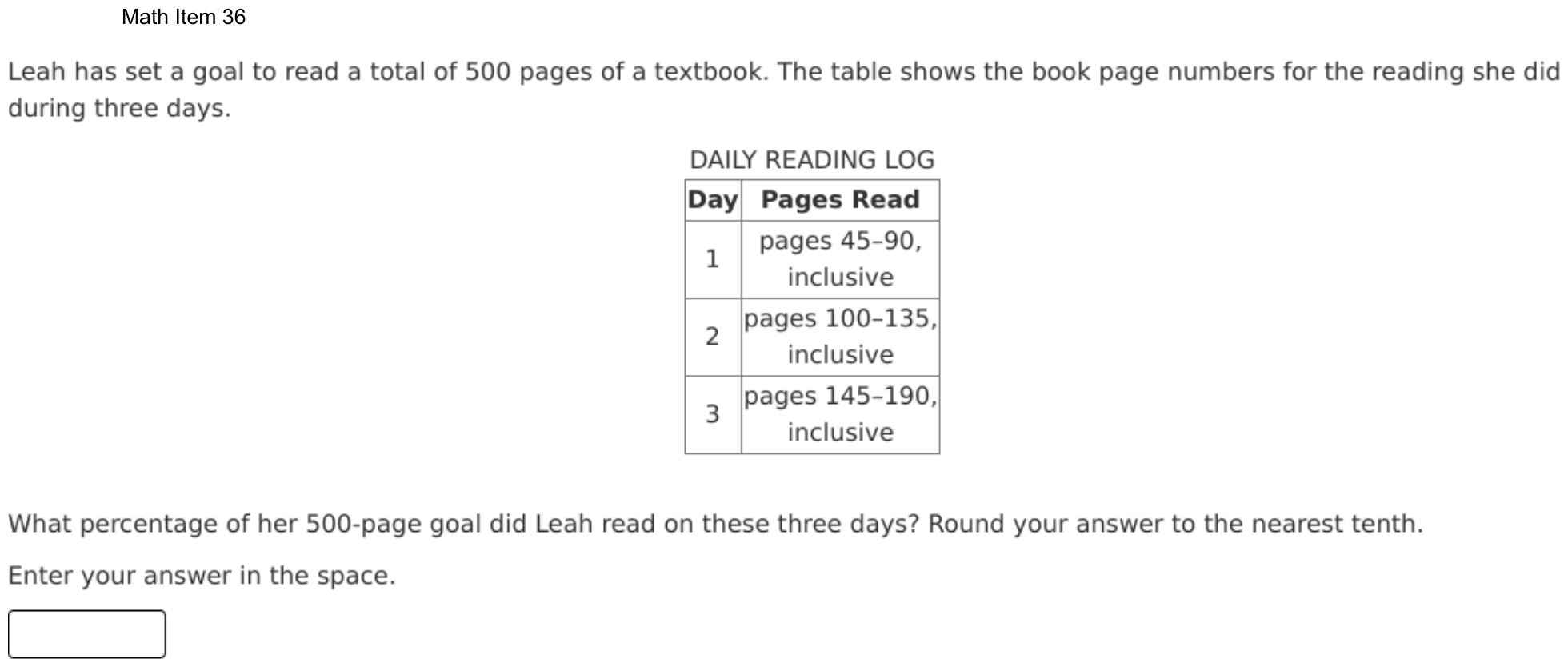
Leah has set a goal to read a total of 500 pages of a textbook. The table shows the book page numbers for the reading she did during three days.
DAILY READING LOG
| Day | Pages Read |
|---|---|
| 1 | pages 45–90, inclusive |
| 2 | pages 100–135, inclusive |
| 3 | pages 145–190, inclusive |
What percentage of her 500-page goal did Leah read on these three days? Round your answer to the nearest tenth.
Enter your answer in the space.
Fill-in question: work out the answer and type it as a number.
Show the answer
Correct answer: 25.6%
First, determine the number of pages read each day. Since the pages per assignment are inclusive, subtract the first page from the last page assigned and then add 1 to determine the pages read for each day.
Day 1: pages
Day 2: pages
Day 3: pages
Leah read a total of 128 pages, since .
To determine the percent, express 128 pages out of 500 pages as a fraction.
Question analysis
Leah's daily reading log lists three ranges of textbook pages, each marked inclusive, and her goal is 500 pages. This percent question asks what percentage of the goal she read over the three days, rounded to the nearest tenth and typed in. Counting the pages in each inclusive range correctly is the tricky step before the percent.
- Grade level
- Grade 7 content, by NYS standard
- Compared with grade 7
- Above grade 7 Finding what percent one number is of another is grade 6 and 7 work. This adds three inclusive page ranges to count, which takes more care than subtracting, then a rounding step, all typed with no choices to check against.
- Estimated difficulty
- Hard: combines ideas, needs a plan, and has more than one tempting wrong answer.
- Thinking it demands
- Depth of knowledge 2, skills and concepts · mainly apply
- What makes it hard
- Something you must already know moderate
- Many steps moderate
- An answer in an unexpected form minor
- Solution
- 4 steps
- Reading level
- Question and choices: about grade 3, 66 words.
- Students, last 30 days
- Not enough answers yet to show (it takes 10).
Why it is hard, traps and wrong answers (shows the answer)
Why it is hard
Counting pages in a range is the whole difficulty; the percent at the end is routine once the total is right. Subtracting first from last feels natural, and here it even rewards the student with a round 25%, so nothing looks wrong. Checking the rule on a tiny range, pages 1 to 3, which is 3 pages and not 2, fixes the count, and the instruction to round to the nearest tenth hints that the answer is not a whole number.
Something you must already know moderate Working it out
Every row says inclusive, but nothing says that pages 45 to 90 hold 90 − 45 + 1 = 46 pages; subtracting alone loses one page on each of the three days. (Anderson & Krathwohl, 2001)
Many steps moderate Working it out
Three page counts, a sum, a division by 500 and a change to a percent come in sequence, and a one-page error in each count carries through to the end. (Daniel & Embretson, 2010; Enright, Morley & Sheehan, 2002)
An answer in an unexpected form minor Choosing the answer
The answer is typed with no choices, and the miscounted total, 125 pages, gives a tidy 25% that looks more finished than the right value with its tenth. (Enright, Morley & Sheehan, 2002)
Strategy: Count each day's pages carefully, testing your method on a short range such as pages 1–3, add the three days, divide by 500, and write the result as a percent to the nearest tenth.
Traps
- Counting the ends: Inclusive or exclusive ends, fence posts, consecutive numbers: an answer that is one too many or too few, or an endpoint drawn open where it belongs closed (or the reverse).
- Stops one step early: A choice is a number from partway through the solution.
- Misreads the question: Misses or misreads a condition or a word in the question: "at least", "each", "remaining", "not".
The wrong answers, classified
25 Counting the ends (Brown & Burton, 1978)
Subtracts the first page from the last for each day, 45 + 35 + 45 = 125 pages, forgetting that an inclusive range counts both end pages, so 125 ÷ 500 = 25%.
0.256 Stops one step early (King et al., 2004; Gierl et al., 2017)
Counts the 128 pages and divides by 500 correctly, then enters the decimal 0.256, one step short of multiplying by 100 to make a percent.
26 Misreads the question (Hegarty, Mayer & Monk, 1995)
Finds 25.6% correctly but rounds it to the nearest whole percent, overlooking the instruction to round to the nearest tenth.
Worked solution, step by step
Formulas used
- Counting pages in an inclusive range
- Inclusive means the first and last pages are both read. Subtracting counts the steps from the first page to the last. That misses one page, so add 1. Test it: pages 1 to 3 are 3 pages, and 3 − 1 + 1 = 3.
- Percent of a total
- The part is the amount you have, here the pages read. The whole is the amount you compare with, here the 500-page goal. Dividing gives a decimal. Multiplying by 100 turns it into a percent, a number out of 100.
Sort out the question
Leah’s goal is 500 pages. The log shows three days:
- Day 1: pages 45 to 90
- Day 2: pages 100 to 135
- Day 3: pages 145 to 190
Each range is inclusive. You need the percent of 500 pages she read, rounded to the nearest tenth.
Count the pages each day
Use the rule for an inclusive range: last page minus first page, plus 1.
Watch out: subtracting alone gives 45, 35 and 45 pages. That is 125 pages, which is exactly 25%. A round answer like that can hide the mistake.
Add the three days
Add the pages from all three days to get her total:
Leah read 128 pages in all. This is the part you compare with the goal.
Change to a percent
Divide the pages read by the goal, then multiply by 100:
Leah read 25.6% of her goal. That already ends in tenths, so no rounding is needed.
Watch out: 0.256 is a decimal, not a percent. And 26 rounds to a whole number, not to the nearest tenth.
Enter the answer
The box has no % sign, but the question asks for a percentage, so the number in the box is the percent. Type it with its decimal point. Typing 25.6% also counts on this site. So you would enter 25.6.
Check your answer
Estimate. 10% of 500 pages is 50 pages. 128 pages is a bit more than 2 × 50 = 100, so the answer is between 20% and 30%. Then check exactly: pages. It matches.
More questions like this
The original DOE question
Question 6 of 6
2024 Test A Math, question 39Question
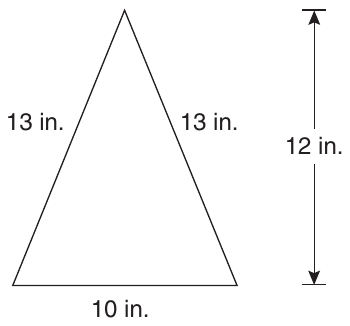
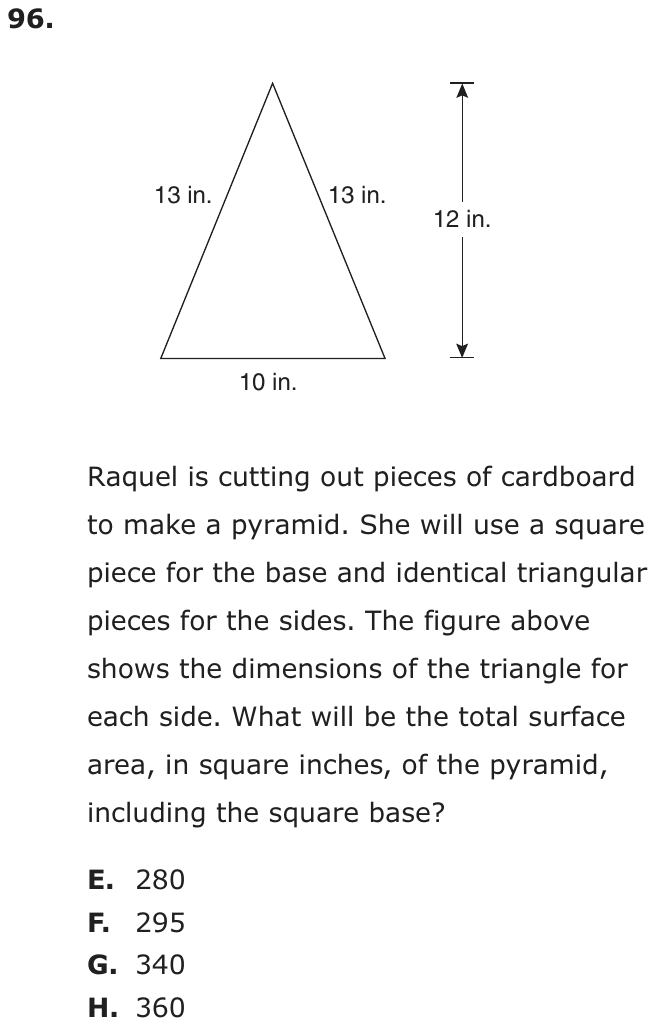
Raquel is cutting out pieces of cardboard to make a pyramid. She will use a square piece for the base and identical triangular pieces for the sides. The figure above shows the dimensions of the triangle for each side. What will be the total surface area, in square inches, of the pyramid, including the square base?
- A280
- B295
- C340
- D360
Show the answer
Correct answer: C
Surface area is found by calculating the area of each side, including the base, and adding them all together.
The base of the pyramid measures 10 inches on each side, so the area of the base is
Each triangular face has a base of 10 inches and a height of 12 inches, so the area of each face is
There are 4 triangular faces (because the square base has 4 edges, each of which will have a triangular face). So the total surface area of the pyramid is the sum of the areas of 4 triangles and 1 square.
So the total surface area is 340 square inches.
Question analysis
This surface area word problem shows one triangular face, with sides of 13 inches, a base of 10 inches and a height of 12 inches, that Raquel will use to build a cardboard pyramid with a square base. Students find the total area of the base and all the triangular sides. Picturing the solid and choosing the right measurements from the figure are the tricky parts.
- Grade level
- Grade 7 content, by NYS standard
- Compared with grade 7
- Above grade 7 Grade 7 students find the surface area of a pyramid from a drawn net or solid. Here only one triangular face is shown, so students must picture the whole pyramid, count its faces, and choose which labeled length belongs in the area formula.
- Estimated difficulty
- Hard: combines ideas, needs a plan, and has more than one tempting wrong answer.
- Thinking it demands
- Depth of knowledge 2, skills and concepts · mainly apply
- What makes it hard
- Reading a figure, table or graph moderate
- Combines ideas moderate
- Something you must already know minor
- Solution
- 4 steps
- Reading level
- Question and choices: about grade 6, 56 words.
- Corrected from the DOE handbook
- A wrong unit in the explanation was corrected.
- Students, last 30 days
- Not enough answers yet to show (it takes 10).
Why it is hard, traps and wrong answers (shows the answer)
Why it is hard
Students have to build the pyramid in their heads from one flat triangle, then choose the right measurement from three labels. The 13-inch sides look like the natural height, and using them gives a listed total; picturing a pyramid with three sloping faces gives another. Sketching the square base with a triangle on each edge, and marking 12 as the height, settles both the face count and the formula.
Reading a figure, table or graph moderate Understanding the question
The figure gives one triangle with three length labels, 13, 13 and 10, and puts its height, 12, on a separate arrow beside it, where it is easy to overlook. (Lesh, Post & Behr, 1987; Kirsch & Mosenthal, 1990)
Combines ideas moderate Working it out
The solid is never drawn: students must see that the square's side equals the triangle's 10-inch base, count four triangles, and add triangle and square areas. (Embretson, 1998; Daniel & Embretson, 2010)
Something you must already know minor Working it out
A triangle's area uses its perpendicular height, not a slanted side, and a pyramid on a square base has four triangular faces; neither fact is given. (Anderson & Krathwohl, 2001)
Strategy: Sketch the pyramid: a square base whose side is the triangle's base, and one triangular face on each side of the square. Find each area with the matching formula, then add them all.
Traps
- Misreads the figure: Reads a value, label or tick spacing in a figure, table or graph wrongly.
- Information you don't need: The question gives numbers or facts that play no part in the answer.
- Misunderstands the concept: A wrong belief about a concept: that percents can be added, that area grows like length, that averages can be averaged, that a bigger denominator means a bigger fraction.
The wrong answers, classified
A Misunderstands the concept (Smith, diSessa & Roschelle, 1993; De Bock et al., 1998; Ni & Zhou, 2005)
Counts only three triangular faces, as if the pyramid had a triangular base, so 3 × 60 + 100 = 280.
B Misunderstands the concept (Smith, diSessa & Roschelle, 1993; De Bock et al., 1998; Ni & Zhou, 2005)
Counts three faces and also uses the 13-inch side as each triangle's height: 3 × 65 + 100 = 295.
D Misreads the figure (Lesh, Post & Behr, 1987; Kirsch & Mosenthal, 1990)
Takes the 13-inch slanted side as each triangle's height instead of the 12-inch arrow beside it, so 4 × 65 + 100 = 360.
What was corrected from the DOE handbook, and why
- Explanation: The handbook ends “So the total surface area is 340 square feet.” The triangle’s dimensions are in inches and the question asks for square inches, so the site now reads “340 square inches.”
Worked solution, step by step
Formulas used
- Area of a triangle
- A is the area. b is the base, the side the triangle sits on. h is the height: the straight-up distance from the base to the top corner, at a right angle to the base. You take half because a triangle is half of a rectangle with the same base and height.
- Area of a square
- A is the area and s is the length of one side. All four sides of a square are equal, so the area is side times side.
- Surface area
- A face is one flat side of a solid shape. The surface area is the total area of the outside. Picture unfolding the solid into flat pieces. Then add up the area of every piece.
Sort out the question
Raquel’s pyramid has a square base. Each side is a triangle like the one in the figure. The triangle’s base is 10 in. Its two slanted sides are 13 in. Its height, the arrow beside it, is 12 in. You need the total surface area, including the square base, in square inches.
Picture the pyramid
Surface area is the total area of all the flat sides, called faces. Each triangle stands on one edge of the square. So each edge of the square is 10 inches, the same as the triangle’s base. A square has 4 edges, so the pyramid has 4 triangles.
Here that is 4 triangles plus 1 square. Watch out: counting only 3 triangles gives 280, choice A.
Find the area of one triangle
Each triangle is 60 square inches. Watch out: the height is 12 in., the straight-up arrow. It is not 13 in., the slanted side. Using 13 gives 65 for each triangle and 360 in all, choice D.
Find the area of the base
The base is a square with sides of 10 inches, the same as each triangle’s base.
The square base is 100 square inches.
Add all five faces
The four triangles and the square together cover 340 square inches.
So the answer is C, 340 square inches.
Check your answer
Each triangle is half of a 10 by 12 rectangle, which has an area of 120. So two triangles make 120, and four make 240. Add the base: . The units fit too: inches times inches gives square inches.
More questions like this
The original DOE question