3 English and 3 math
Here are 6 random questions to try. Takers earning below 75% are unlikely to receive an offer. You have 1 minute 48 seconds per question on the real exam.
Question 1 of 6
2024 Test A English, question 24Passage At Dusk
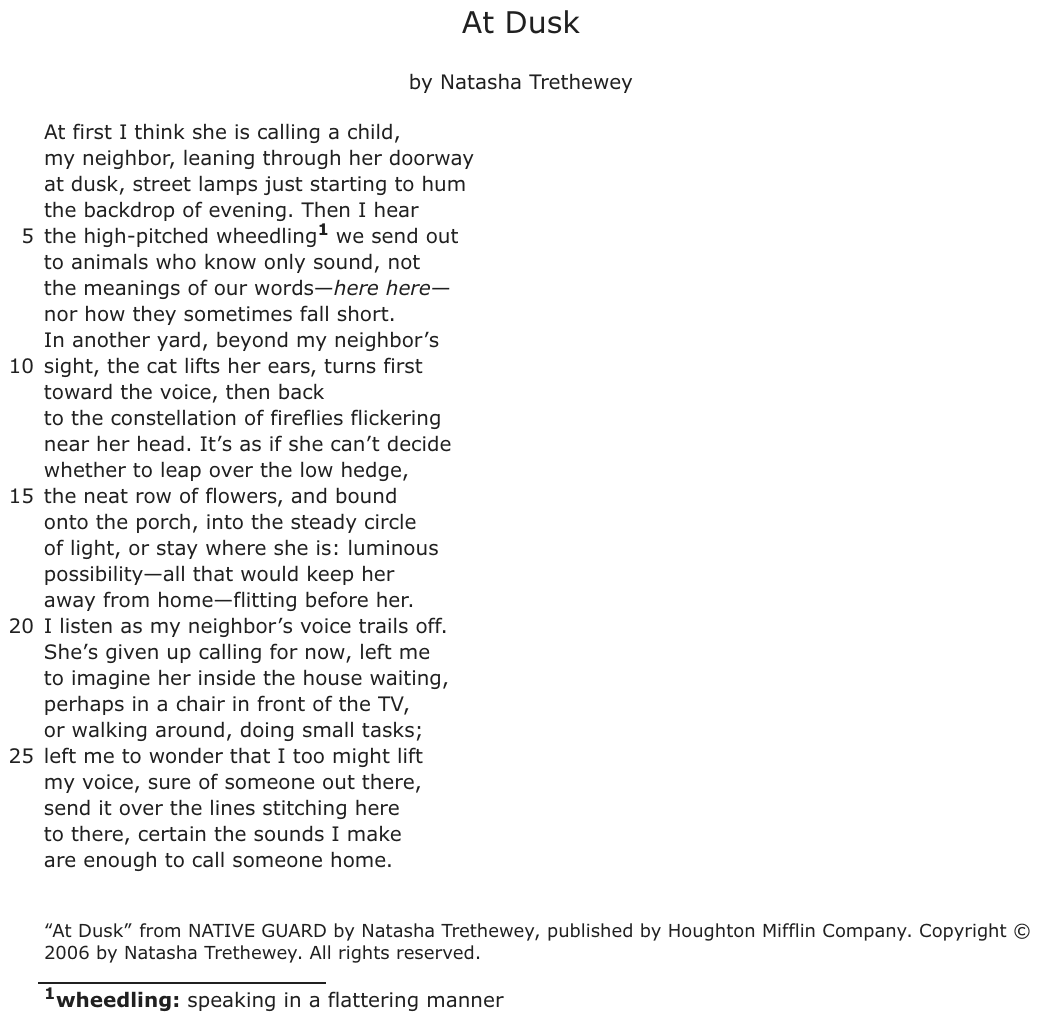
At Dusk
by Natasha Trethewey
At first I think she is calling a child,
my neighbor, leaning through her doorway
at dusk, street lamps just starting to hum
the backdrop of evening. Then I hear
the high-pitched wheedling1 we send out
to animals who know only sound, not
the meanings of our words—here here—
nor how they sometimes fall short.
In another yard, beyond my neighbor’s
sight, the cat lifts her ears, turns first
toward the voice, then back
to the constellation of fireflies flickering
near her head. It’s as if she can’t decide
whether to leap over the low hedge,
the neat row of flowers, and bound
onto the porch, into the steady circle
of light, or stay where she is: luminous
possibility—all that would keep her
away from home—flitting before her.
I listen as my neighbor’s voice trails off.
She’s given up calling for now, left me
to imagine her inside the house waiting,
perhaps in a chair in front of the TV,
or walking around, doing small tasks;
left me to wonder that I too might lift
my voice, sure of someone out there,
send it over the lines stitching here
to there, certain the sounds I make
are enough to call someone home.
“At Dusk” from NATIVE GUARD by Natasha Trethewey, published by Houghton Mifflin Company. Copyright © 2006 by Natasha Trethewey. All rights reserved.
1wheedling: speaking in a flattering manner
Question
How does the setting affect the events of the poem?
- AIt enables the speaker to regularly overhear the neighbor calling for her cat at dusk.
- BIt allows the speaker to observe the neighbor quietly without interacting with her.
- CIt shows how living in close proximity helps the speaker feel connected to the neighbor.
- DIt shows how feeling isolated causes the speaker to imagine interactions with the neighbor.
Show the answer
Correct answer: B
The question asks how the setting affects the events discussed in the poem.
A. Incorrect. In line 2, the speaker refers to the woman calling for her cat as “my neighbor,” which clearly suggests that the speaker lives next door to the woman. However, although the two live next door to each other, line 1 suggests that perhaps the speaker does not regularly overhear the neighbor because the speaker initially thinks that the neighbor is “calling a child” and only later realizes the neighbor is calling to a cat. Although the setting places the speaker and the neighbor in close proximity, the poem does not indicate the frequency or regularity with which the speaker overhears the neighbor.
B. CORRECT. In the first four lines, the speaker observes the actions of the neighbor as the neighbor leans out to call for the cat at dusk. Despite the speaker’s observation of the neighbor, there is no indication that the neighbor notices the speaker. The reader can conclude that because of the time of day and the speaker being in the house next door, the speaker can observe the neighbor without being observed by her or having to interact with her.
C. Incorrect. The setting of the poem is a neighborhood at nightfall, as indicated by “at dusk” in line 3, the reference to “another yard” in line 9, and the flickering fireflies in line 12. However, while the speaker is close enough to the neighbor to overhear her calling to the cat, there is no indication that the speaker feels connected to the neighbor. Instead, the speaker expresses curiosity about the neighbor after the neighbor goes inside, and the speaker is “left . . . / to imagine her inside the house waiting” (lines 21–22). The fact the speaker initially thought that the neighbor was calling a child indicates that the speaker is not familiar with the neighbor and her habits, and there is no indication that the speaker feels connected to the neighbor.
D. Incorrect. In lines 22–24, the speaker imagines what the neighbor may be doing while the neighbor is waiting inside for the cat to return, but the speaker is imagining the neighbor’s solitary experience after the neighbor has momentarily “given up” on calling to the cat (line 21). The speaker does not imagine personally interacting with the neighbor but rather briefly imagines what the neighbor is doing at home while the cat is away.
Question analysis
This reading question asks how the setting of At Dusk, a neighborhood at nightfall where a woman leans from her doorway to call her cat, affects the events of the poem. Because so little happens, students must infer the setting's role from small details, and several choices sound reasonable without being supported by the poem.
- Grade level
- Grade 8 reading and task
- Compared with grade 7
- Above grade 7 Grade 7 students analyze how setting shapes events, usually in a story with a clear plot. This poem has almost no action, so the student must reason from a handful of details about place and time, which is harder than typical grade 7 work.
- Estimated difficulty
- Hard: combines ideas, needs a plan, and has more than one tempting wrong answer.
- Thinking it demands
- Depth of knowledge 3, strategic thinking · mainly analyze
- What makes it hard
- A very close wrong answer major
- Reading between the lines moderate
- Evidence
- Answered from the whole text
- Reading level
- Passage: 236 words (a poem; reading level not measured); question and choices: about grade 8, 67 words.
- Students, last 30 days
- Not enough answers yet to show (it takes 10).
Why it is hard, traps and wrong answers (shows the answer)
Why it is hard
Little happens in this poem, so the setting's role must be built from small details: a neighbor at her doorway at dusk, a cat in another yard, a speaker who hears and watches but never speaks. The strongest wrong answer is right about overhearing and wrong only in claiming it happens regularly, which the speaker's first mistaken guess argues against. The other choices supply a feeling of closeness or of isolation that the poem never states.
A very close wrong answer major Choosing the answer
The overhearing choice describes what the setting allows almost as well as the right one and fails on a single word, “regularly,” since the poem records one evening and the speaker first mistakes the call. (Embretson & Wetzel, 1987; Gorin & Embretson, 2006; Ascalon et al., 2007)
Reading between the lines moderate Working it out
The setting's effect is never stated; it has to be inferred from the speaker hearing and watching from nearby while the neighbor, “leaning through her doorway,” never seems to notice anyone. (Graesser, Singer & Trabasso, 1994; Kintsch, 1998)
Strategy: Picture the scene from the speaker's position, then check each choice word by word against the poem and reject any that claims something the poem never states.
Traps
- Too broad or too strong: A choice overstates, generalizes, or uses absolute words the text does not support.
- Reads too much in: A reasonable-sounding conclusion that goes further than the text allows.
- Twists what the text says: Uses the text's topic and ideas but changes what it says: who did it, how much, when, or why.
The wrong answers, classified
A Too broad or too strong (King et al., 2004)
Rightly sees that living next door lets the speaker overhear the call, but “regularly” is unsupported, and the first guess about a child suggests the call is unfamiliar.
C Reads too much in (Graesser, Singer & Trabasso, 1994)
Connects living close by with the poem's interest in connection and the speaker's “I too,” but the speaker never claims to feel close to the neighbor.
D Twists what the text says (King et al., 2004)
Notices the speaker picturing the neighbor indoors and calls it imagined interaction, but the speaker pictures her alone, waiting or doing small tasks, and never mentions feeling isolated.
Working it out, step by step
Figure out what the question asks
The setting is where and when a story or poem takes place. You need to see how the setting shapes what happens in the poem.
Picture the setting
It is “dusk” (line 3), the dim time just after sunset. The neighbor is “leaning through her doorway” (line 2). The cat is “In another yard” (line 9). The speaker is close enough to hear and watch it all. But the speaker never speaks to the neighbor. Nothing shows the neighbor notices the speaker.
Work out the effect
Living next door puts the speaker close by. In the fading light, the speaker can watch quietly. So the speaker sees the neighbor and the cat without joining in. The whole poem is what the speaker sees, hears and imagines from there.
Check each choice
- A is wrong. The word “regularly” is the problem. The poem shows one evening.
- B is right. The speaker watches from nearby and never talks with the neighbor.
- C is wrong. The speaker never says they feel close to the neighbor.
- D is wrong. The poem never says the speaker feels lonely. The speaker pictures the neighbor alone inside, not the two of them talking.
Watch out: A is almost right, since living nearby does let the speaker overhear. One word makes it wrong.
Choose the answer
The setting lets the speaker watch quietly from close by. So the answer is B.
Why this answer and not the closest wrong one
A is the closest wrong answer. Living next door does let the speaker hear the call. But nothing says it happens often. The poem tells about one evening. At first the speaker even thinks a child is being called. B fits what the poem shows: the speaker watches without ever talking to the neighbor.
More questions like this
The original DOE question

The passage “At Dusk” as printed (page 48)
Question 2 of 6
2026 Practice Test C English, question 24Passage Bird Talk
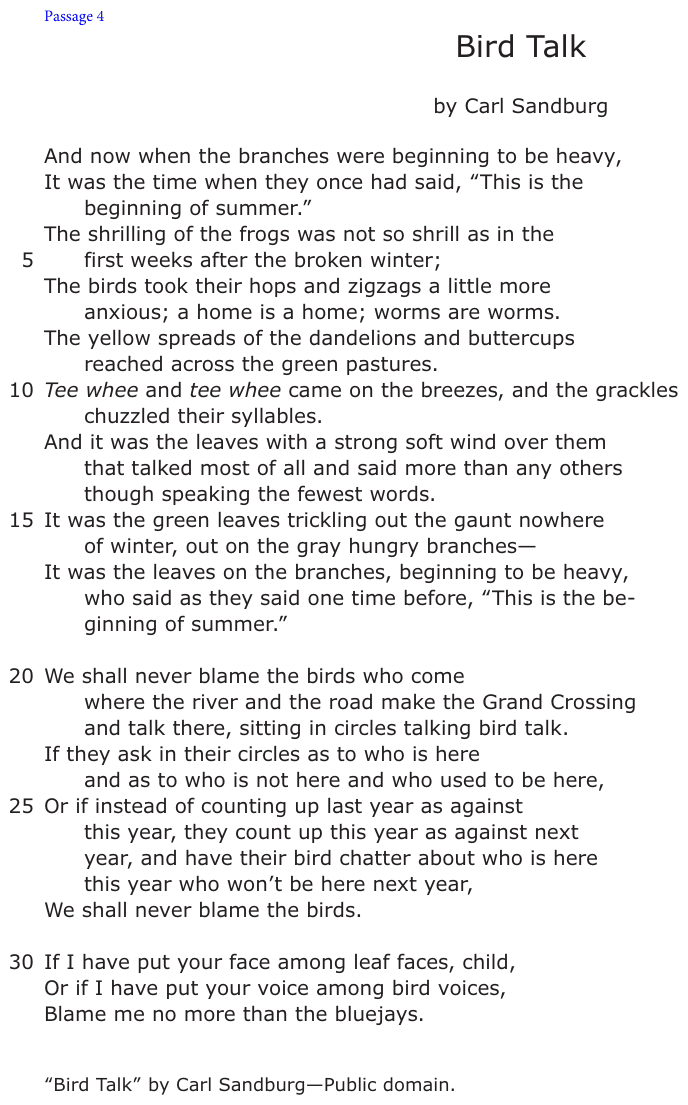
Bird Talk
by Carl Sandburg
And now when the branches were beginning to be heavy,
It was the time when they once had said, “This is the
beginning of summer.”
The shrilling of the frogs was not so shrill as in the
first weeks after the broken winter;
The birds took their hops and zigzags a little more
anxious; a home is a home; worms are worms.
The yellow spreads of the dandelions and buttercups
reached across the green pastures.
Tee whee and tee whee came on the breezes, and the grackles
chuzzled their syllables.
And it was the leaves with a strong soft wind over them
that talked most of all and said more than any others
though speaking the fewest words.
It was the green leaves trickling out the gaunt nowhere
of winter, out on the gray hungry branches—
It was the leaves on the branches, beginning to be heavy,
who said as they said one time before, “This is the be-
ginning of summer.”
We shall never blame the birds who come
where the river and the road make the Grand Crossing
and talk there, sitting in circles talking bird talk.
If they ask in their circles as to who is here
and as to who is not here and who used to be here,
Or if instead of counting up last year as against
this year, they count up this year as against next
year, and have their bird chatter about who is here
this year who won’t be here next year,
We shall never blame the birds.
If I have put your face among leaf faces, child,
Or if I have put your voice among bird voices,
Blame me no more than the bluejays.
“Bird Talk” by Carl Sandburg—Public domain.
Question
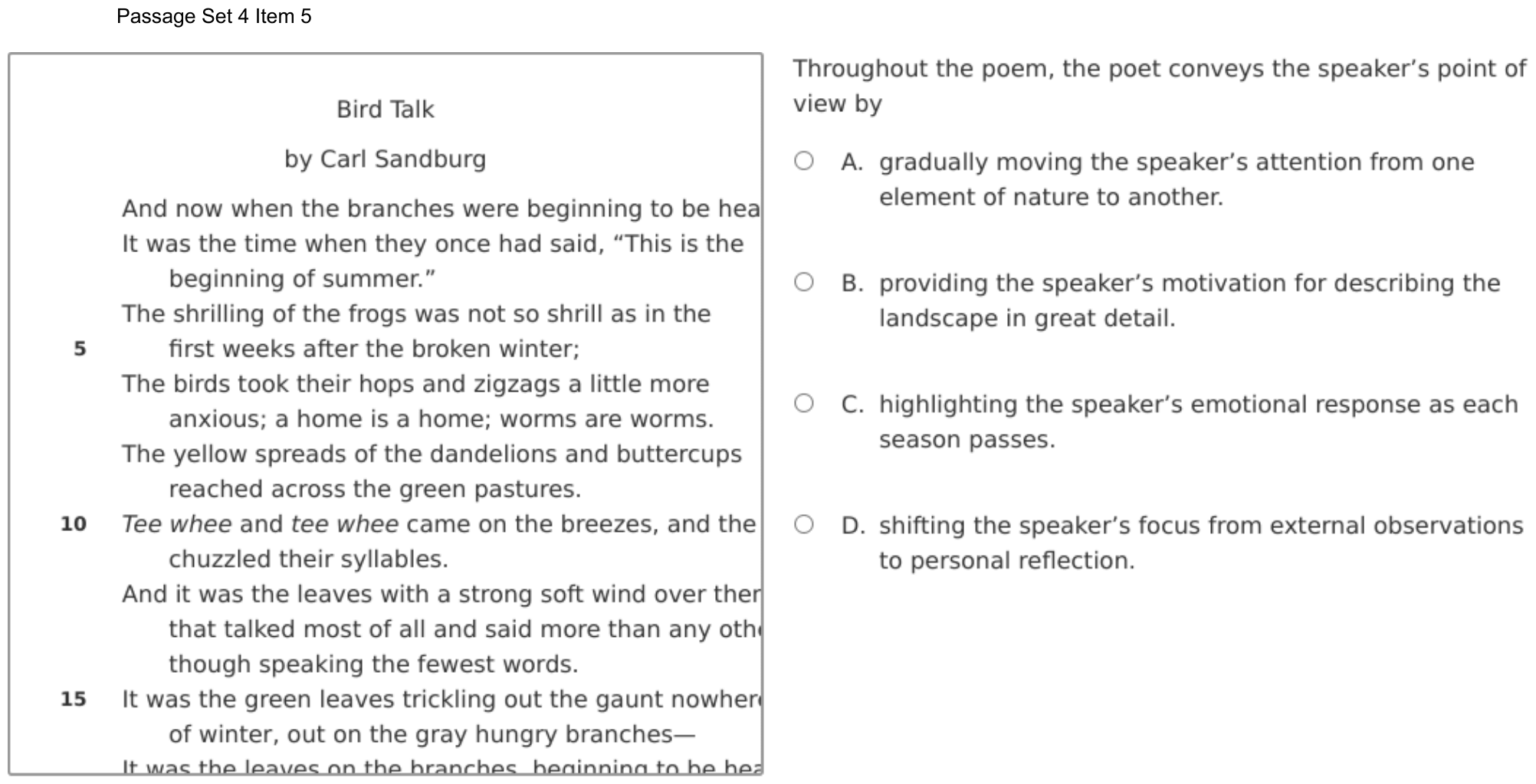
Throughout the poem, the poet conveys the speaker’s point of view by
- Agradually moving the speaker’s attention from one element of nature to another.
- Bproviding the speaker’s motivation for describing the landscape in great detail.
- Chighlighting the speaker’s emotional response as each season passes.
- Dshifting the speaker’s focus from external observations to personal reflection.
Show the answer
Correct answer: D
This question asks for an explanation of how the poet conveys the speaker’s point of view on the natural world and the change of seasons as presented in the poem.
A. Incorrect. Though in the first stanza the speaker describes various elements of nature such as branches, frogs, birds, flowers, and leaves, these elemental shifts are not precisely gradual and occur only in the first stanza. Further, the first stanza, though appreciative of the natural world, is primarily descriptive and does not develop the speaker’s perspective to the degree that other parts of the poem do.
B. Incorrect. While it may be inferred that the speaker describes the landscape to such a degree because it has revealed a seasonal shift, that this is indeed the speaker’s motivation is never explicitly conveyed by the poet.
C. Incorrect. Multiple seasons do not pass in the poem; only the shift to the “ ‘beginning of summer’ ” (line 3) occurs in an endless cycle. Further, the speaker does not reveal an emotional response; it is the responses of nature that the speaker describes.
D. CORRECT. The first stanza is the speaker’s observations of the natural world embracing a new season. In the second stanza, the speaker begins to reflect on how the natural world, as embodied by the birds, calmly accepts seasonal change in its perpetual sameness. The reflection continues in the third stanza, where it is revealed that the speaker has been addressing these observations to a child.
Question analysis
This point-of-view question asks how the poet of “Bird Talk” conveys the speaker’s point of view throughout the poem. Students must keep in mind the long opening description of early summer and the two shorter stanzas after it, and decide which description of the poet’s method holds from the first line to the last.
- Grade level
- Grade 8 reading and task
- Compared with grade 7
- Above grade 7 Grade 7 point-of-view questions often ask what a speaker thinks. This one asks how the poet conveys that view across all three stanzas of a long free-verse poem, and the choices name methods in general terms, closer to grade 8 work.
- Estimated difficulty
- Hard: combines ideas, needs a plan, and has more than one tempting wrong answer.
- Thinking it demands
- Depth of knowledge 3, strategic thinking · mainly analyze
- What makes it hard
- Evidence in several places moderate
- A very close wrong answer moderate
- How, not what moderate
- Figurative or literary language minor
- Evidence
- Answered from the whole text
- Reading level
- Passage: 296 words (a poem; reading level not measured); question and choices: about grade 10, 54 words.
- Students, last 30 days
- Not enough answers yet to show (it takes 10).
Why it is hard, traps and wrong answers (shows the answer)
Why it is hard
The first stanza takes up 19 of the poem’s 32 lines and moves steadily from branches to frogs, birds, flowers and leaves, so a choice that describes it alone feels right. The point of view shows only when the poem turns to “We” and then to “I” addressing a child, and that third stanza is three hard lines. Students must keep the whole poem’s course in mind and choose the method that holds from first line to last.
Evidence in several places moderate Working it out
The answer depends on all three stanzas at once: the long catalog of the season in lines 1–19, the shift to “We shall never blame the birds,” and the closing “If I have put your face … child.” (Kirsch & Mosenthal, 1990; Gorin & Embretson, 2006)
A very close wrong answer moderate Choosing the answer
The choice about moving from one element of nature to another and the key both describe a shift in the speaker’s attention; they differ in what shifts, nature to nature or the outside world to the speaker’s own thoughts. (Embretson & Wetzel, 1987; Gorin & Embretson, 2006; Ascalon et al., 2007)
How, not what moderate Working it out
The stem asks how the poet conveys a point of view, a method, so a choice must describe what the speaker does across the poem, not what the speaker sees. (Anderson & Krathwohl, 2001)
Figurative or literary language minor Understanding the question
The last stanza is cryptic, “Blame me no more than the bluejays,” and students who miss that the speaker is now talking about putting a child into the poem lose the move to reflection. (Graesser, Singer & Trabasso, 1994; Kintsch, 1998)
Strategy: Write one phrase for what the speaker attends to in each stanza, then keep only a choice that describes the whole sequence, not one stanza.
Traps
- Too narrow: A single detail offered as the central idea or a summary, or a summary that keeps minor details and leaves out an essential part.
- Reads too much in: A reasonable-sounding conclusion that goes further than the text allows.
- Twists what the text says: Uses the text's topic and ideas but changes what it says: who did it, how much, when, or why.
The wrong answers, classified
A Too narrow (King et al., 2004)
Describes the first stanza well, its walk from branches to frogs, birds, flowers and leaves, but misses the later turn to “We” and to the speaker’s own “I.”
B Reads too much in (Graesser, Singer & Trabasso, 1994)
Supplies a reason for all the description, perhaps from the closing words to a child, but the speaker never says why the landscape is described, and the reflection is not a motive.
C Twists what the text says (King et al., 2004)
Sees that the poem follows nature through a change of season but makes it many seasons and hands the creatures’ reactions, such as the birds’ anxious hops, to the speaker as feelings.
Working it out, step by step
Figure out what the question asks
This asks about point of view: how the speaker, the voice talking in the poem, sees things. It also asks how the poet shows that view across the whole poem. So look at what the speaker pays attention to in each of the three stanzas. A stanza is a group of lines set apart by a blank line.
Follow the speaker through the stanzas
- Stanza 1, lines 1–19: the speaker describes the world outside. There are branches, frogs, birds, flowers and leaves at the start of summer.
- Stanza 2, lines 20–29: the speaker starts to judge and think. “We shall never blame the birds.”
- Stanza 3, lines 30–32: the speaker says “I” and talks to a child: “If I have put your face among leaf faces, child.”
Name the change in focus
The poem starts with external observations, or things the speaker sees and hears outside. It ends with personal reflection, or the speaker’s own thoughts. In the last stanza, the speaker admits to putting a child’s face and voice into the poem. The speaker asks to be blamed “no more than the bluejays.” Since “We shall never blame the birds,” that means not at all. This move from looking outward to looking inward is how the speaker’s view comes through.
Check each choice
- A does not fit. Moving from branches to frogs to birds happens only in stanza 1. It misses the turn to “We” and “I.”
- B does not fit. The speaker never says why the landscape is described.
- C does not fit. Only one change of season happens, the start of summer. The anxious feelings belong to the birds, not the speaker.
- D fits. The speaker moves from describing nature to thinking about it.
Watch out: A describes stanza 1 very well. But the question says “Throughout the poem,” so the answer must cover all three stanzas.
Choose the answer
The speaker starts by watching nature and ends by thinking aloud to a child. So the answer is D, “shifting the speaker’s focus from external observations to personal reflection.”
Why this answer and not the closest wrong one
A is the closest wrong choice. Stanza 1 really does move from one part of nature to another. But that is only 19 of the 32 lines. In stanzas 2 and 3, the speaker turns to “We” and then “I,” and shares personal thoughts. Only D describes the speaker’s path from the first line to the last.
More questions like this
The original DOE question
The passage “Bird Talk” as printed (page 32)
Question 3 of 6
2024 Test A English, question 34Passage Champion of the Channel
Champion of the Channel
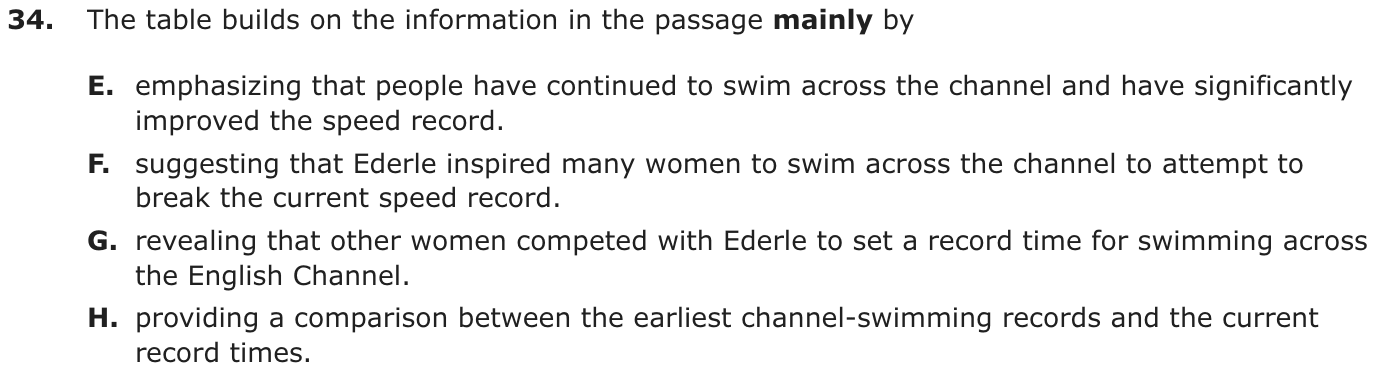
In 1926 an editor at the London Daily News predicted that Gertrude Ederle, an American swimmer with eighteen world records and three Olympic medals, would fail in her attempt to swim across the English Channel. He claimed that “even the most uncompromising champion of the rights and capacities of women must admit that in contests of physical skill, speed and endurance they must remain forever the weaker sex.” Yet, at only nineteen years old, Ederle not only became the first woman to accomplish this feat, she also broke the men’s record by two hours. Gertrude Ederle’s triumphant swim across the English Channel was a testimony to her determination, innovative spirit, and passion for swimming.
Crossing the English Channel is a daunting task for any swimmer. At its narrowest point, the channel measures twenty-one miles across. Its icy waters hover around sixty degrees Fahrenheit, and its unruly tides and currents toss swimmers about like bobbing corks. Stinging jellyfish, seaweed, and floating debris from shipwrecks and lost cargoes present added hazards.
For decades the channel’s perils have defeated countless swimmers. Ederle, too, failed in her first attempt to cross the channel in 1925. Just six miles short of finishing, she became ill, and her coach had to haul her out of the water. Undeterred, Ederle decided to try again. Ederle knew that if she did not complete the challenge this time, she might never get the opportunity to set this record, because a rival female swimmer was preparing to make her second attempt at the crossing as well.
To prepare for the marathon swim, Ederle found ways to improve her equipment. She and her sister Meg discovered that melted candle wax perfectly sealed goggle edges, effectively waterproofing Ederle’s goggles against hammering waves. The sisters also designed a two-piece silk swimsuit for Ederle. During her first channel-crossing attempt she had worn a standard one-piece swimsuit that, after the lengthy hours of swimming across the channel, had stretched out, filling with water and creating drag, making an already challenging task almost insurmountable. Unlike the cumbersome typical bathing suit, this silk invention weighed little and allowed for easy movement.
On August 6, 1926, Ederle waded into the channel near Cape Gris-Nez, France. At first she shivered in the bone-chilling water even though she had covered her body in eight layers of grease for insulation. Her limbs felt stiff. Her strokes were irregular. Driving forward, she fought to clear her mind and find what she called her “sphere,” a place where the sea became her only companion and the shrieks of gulls and the humming of boat engines faded away. Using a new overhand stroke called the American crawl, Ederle eventually settled into a steady pace, briskly breaking through waves.
Throughout Ederle’s swim, two tugboats accompanied her. One carried newspaper reporters who wired dispatches of her progress to shore. The other, displaying a sign that read “This way, ole kid!” with an arrow pointing forward, transported her coach, family, and friends. Her coach played songs, such as “Yes, We Have No Bananas,” on a phonograph so that Ederle could time her strokes to the rhythm. Using a net, her coach also passed her baby bottles of broth for nourishment.
For hours Ederle swam, dodging debris with an amused smile. However, as she neared the English shore, a sudden fierce storm erupted. The tides and waves forced Ederle backward, and she fought the stubborn swells for several hours. The salty water caused her tongue to swell and inflamed her ears. Yet Ederle felt indescribably happy as she churned through the sea. Finally, as she neared the English shore, the storm abated, and the tide turned. No longer fighting against her, the sea pushed her toward the shore and victory.
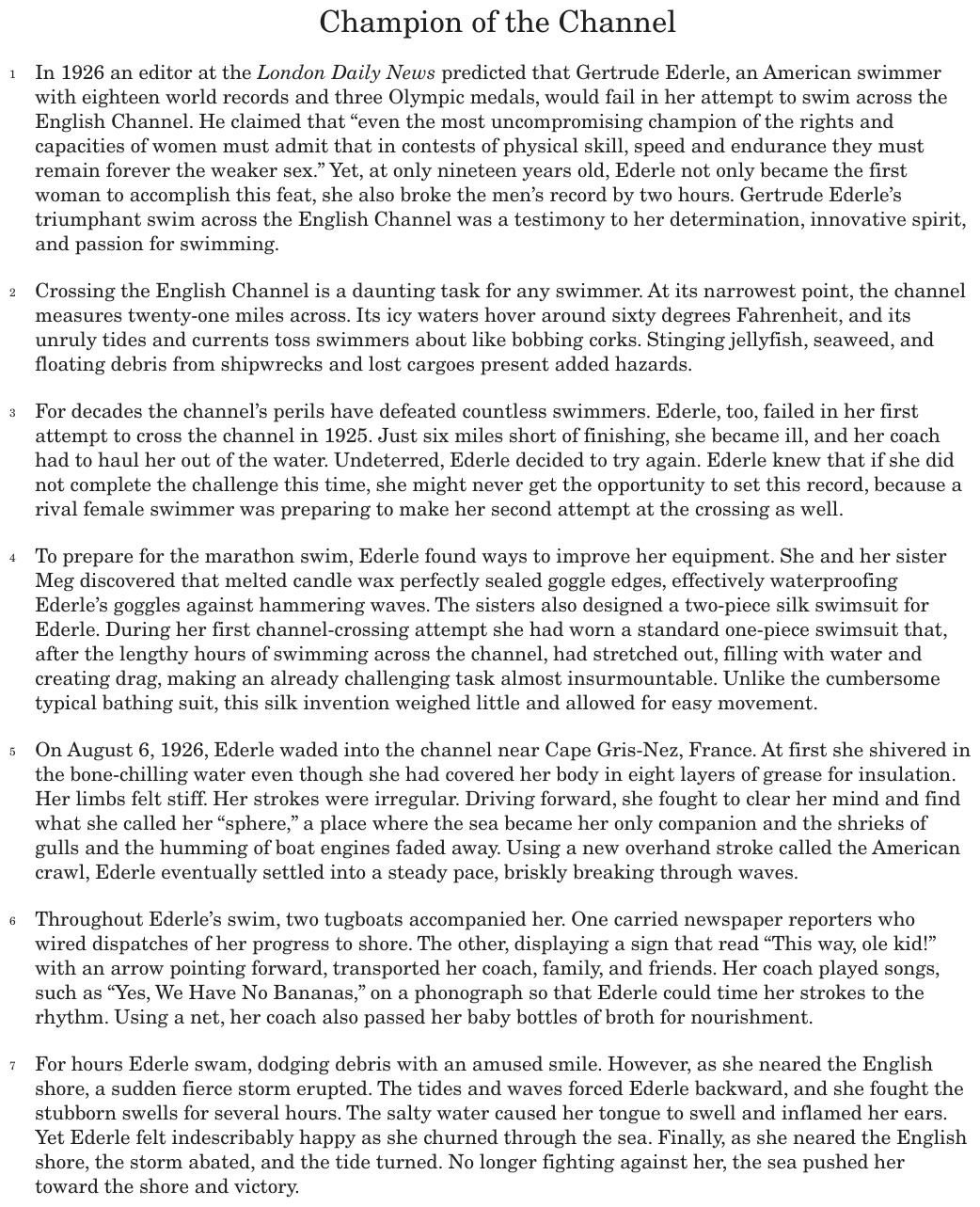
After fourteen hours and thirty-one minutes, Ederle, on wobbly legs, stepped onto the English shore. The waiting crowd roared, honked their automobile horns, blasted their tugboat whistles, and set off flares that flashed in the sky. Ederle had swum into history.
When Ederle returned to New York, she received a parade, where thousands of people shouted “Trudy!” Not only were everyday American citizens proud of Ederle, but she also inspired them to be more active. Over the next few years, more than 60,000 people credited her with motivating them to earn their American Red Cross swimming certificates. Gertrude Ederle’s accomplishment proved to the world that with determination and passion, it was possible for a person to achieve his or her goals.
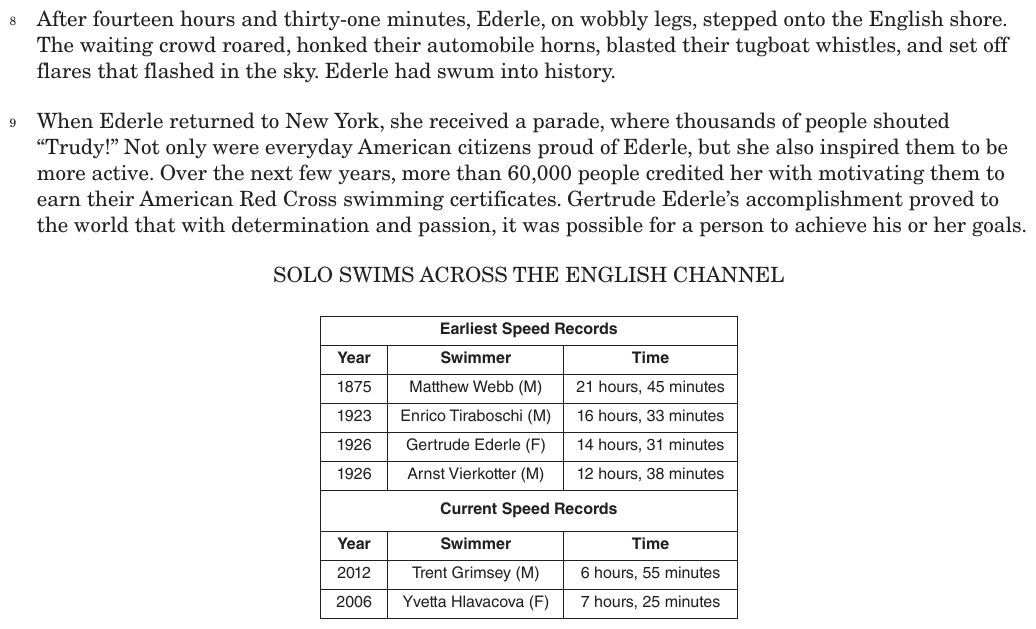
SOLO SWIMS ACROSS THE ENGLISH CHANNEL
|
Earliest Speed Records |
||
| Year | Swimmer | Time |
| 1875 | Matthew Webb (M) | 21 hours, 45 minutes |
| 1923 | Enrico Tiraboschi (M) | 16 hours, 33 minutes |
| 1926 | Gertrude Ederle (F) | 14 hours, 31 minutes |
| 1926 | Arnst Vierkotter (M) | 12 hours, 38 minutes |
| Current Speed Records | ||
| Year | Swimmer | Time |
| 2012 | Trent Grimsey (M) | 6 hours, 55 minutes |
| 2006 | Yvetta Hlavacova (F) | 7 hours, 25 minutes |
Question
The table builds on the information in the passage mainly by
- Aemphasizing that people have continued to swim across the channel and have significantly improved the speed record.
- Bsuggesting that Ederle inspired many women to swim across the channel to attempt to break the current speed record.
- Crevealing that other women competed with Ederle to set a record time for swimming across the English Channel.
- Dproviding a comparison between the earliest channel-swimming records and the current record times.
Show the answer
Correct answer: A
The question asks how the table mainly builds on the information in the passage.
A. CORRECT. The table supports the information in the passage by showing that people have continued to swim the channel and have significantly improved on past records. The information in the table about records set by those who came after Ederle builds on the idea that “Gertrude Ederle’s accomplishment proved to the world that with determination and passion, it was possible for a person to achieve his or her goals” (paragraph 9).
B. Incorrect. Even though paragraph 9 states that Ederle “inspired [everyday American citizens] to be more active” and the table presents the time for the current female record holder, there is no indication in the passage or in the table that the subsequent female record holders were inspired to swim across the channel by Ederle.
C. Incorrect. Although paragraph 3 mentions that Ederle had a female rival and the table includes the speed record of another female swimmer, the passage does not provide information about other female swimmers competing with Ederle to set the channel-swim record.
D. Incorrect. Although paragraph 1 mentions that Ederle “broke the men’s record by two hours” and the table allows for comparisons between the earliest speed records and those of the present day, the passage mentions no channel-swim records set after Ederle’s swim, so it says nothing about current record times. The table allows for comparison, but this aspect of the table does not build on the information presented in the passage.
Question analysis
This question asks how a table of English Channel speed records, from Matthew Webb's 1875 crossing to a 2012 record, builds on the passage about Gertrude Ederle. Students must read times from two eras and decide what the table adds to the text, while the choices mix accurate observations about the table with claims neither source supports.
- Grade level
- Grade 8 reading and task
- Compared with grade 7
- Above grade 7 Relating a table to a passage is within grade 7 standards, but here the student must compare records from two eras, connect them to ideas in the text and choose among closely worded statements, well above typical grade 7 demand.
- Estimated difficulty
- Among the hardest on the SHSAT: a non-obvious approach, heavy reading, or a well-hidden trap.
- Thinking it demands
- Depth of knowledge 3, strategic thinking · mainly analyze
- What makes it hard
- A very close wrong answer major
- Reading a figure, table or graph moderate
- How, not what moderate
- Evidence
- Answered from the whole text
- Reading level
- Passage: about grade 9, 790 words; question and choices: about grade 11, 78 words.
- Corrected from the DOE handbook
- A self-contradictory statement in the explanation was corrected.
- Students, last 30 days
- Not enough answers yet to show (it takes 10).
Why it is hard, traps and wrong answers (shows the answer)
Why it is hard
This is one of the hardest questions on the test because a wrong choice describes the table exactly, in its own words. The passage stops with Ederle's 1926 record, and what the table adds is the rest of the story: swimmers kept crossing, and the record fell to under seven hours. Students who describe what the table contains, rather than what it tells a reader who has finished the passage, lose the point.
A very close wrong answer major Choosing the answer
The comparison choice repeats the table's own headings, “Earliest Speed Records” and “Current Speed Records”, and is literally true; only the stem's “builds on the information in the passage” and “mainly” separate it from the choice about the falling record. (Embretson & Wetzel, 1987; Gorin & Embretson, 2006; Ascalon et al., 2007)
Reading a figure, table or graph moderate Understanding the question
The student must compare times across the table's two sections, from Webb's 21 hours 45 minutes in 1875 and Ederle's 14 hours 31 minutes to Grimsey's 6 hours 55 minutes in 2012. (Lesh, Post & Behr, 1987; Kirsch & Mosenthal, 1990)
How, not what moderate Working it out
The question asks what the table adds to a passage that ends in 1926, so the student must say what its later rows extend, not what its layout holds. (Anderson & Krathwohl, 2001)
Strategy: Read both sections of the table and say what it adds to Ederle's story, then keep only a choice that the table shows and that connects to an idea the passage itself develops.
Traps
- Wrong purpose or structure: Names a purpose, structure or effect that the part does not serve, or describes what a part says when the question asks what it does.
- Reads too much in: A reasonable-sounding conclusion that goes further than the text allows.
- Twists what the text says: Uses the text's topic and ideas but changes what it says: who did it, how much, when, or why.
The wrong answers, classified
B Reads too much in (Graesser, Singer & Trabasso, 1994)
Assumes Ederle inspired many women to chase the record, but the table lists one later woman, Yvetta Hlavacova in 2006, and nothing links her or anyone else to Ederle.
C Twists what the text says (King et al., 2004)
Joins the rival female swimmer of paragraph 3 to Hlavacova's 2006 time, inventing a contest among women in Ederle's day that neither the table nor the passage shows.
D Wrong purpose or structure (Anderson & Krathwohl, 2001)
Describes the table's layout, earliest records beside current ones, which is accurate, but stops at what it contains instead of saying what the comparison adds to Ederle's story.
What was corrected from the DOE handbook, and why
- Explanation: In rejecting choice D, the handbook notes that paragraph 1 says Ederle “broke the men’s record by two hours,” and then says “there is no mention in the passage of past, present, or future channel-swim records.” Paragraph 1 does mention a past record: the one Ederle broke. What the passage never mentions is a record set after hers, which is what the table’s “Current Speed Records” add. The explanation now says the passage mentions no channel-swim records set after Ederle’s swim, so it says nothing about current record times. The reason for rejecting D is otherwise unchanged.
Working it out, step by step
Understand the question
To build on something means to add to it. So this asks what the table adds to what the passage already tells you. Don’t just describe what is in the table. Ask what a reader learns from it after finishing the passage.
Read the table’s two parts
The table has two parts, “Earliest Speed Records” and “Current Speed Records.” These rows matter most:
Year Swimmer Time 1875 Matthew Webb 21 hours, 45 minutes 1926 Gertrude Ederle 14 hours, 31 minutes 2012 Trent Grimsey 6 hours, 55 minutes Compare the times
Ederle swam for 14 hours and 31 minutes. Half of her time would be about 7 hours and 15 minutes. Grimsey’s 2012 time, 6 hours and 55 minutes, is even faster than that. So people kept swimming the channel after 1926, and the record got much faster.
See what the passage leaves out
The passage does mention one record. In paragraph 1, Ederle “broke the men’s record by two hours.” But the passage stops in 1926. It never tells of any record set after her swim. The table adds that later part of the story: swimmers kept crossing, and the record kept falling.
Check each choice
- A fits: people kept crossing and “significantly improved the speed record,” and significantly means by a lot.
- B is wrong because nothing links any later woman to Ederle, and the table lists only one later woman.
- C is wrong because Ederle is the only woman of her time in the table, and Hlavacova swam 80 years later, in 2006.
- D is wrong because it only names what the table holds, not what the comparison adds to Ederle’s story.
Watch out: D uses the table’s own headings, so it sounds right. But the question asks what the table adds, not how it is laid out.
Choose the answer
The table carries the story past 1926 and shows the record falling far below Ederle’s time. So the answer is A.
Why this answer and not the closest wrong one
D comes closest, because the table really does set the earliest and current records side by side. But D stops at describing the table. A says what that comparison shows a reader who has finished the passage: the record kept falling, from Ederle’s 14 hours and 31 minutes to under 7 hours.
More questions like this
The original DOE question
The passage “Champion of the Channel” as printed (pages 56–57)
Question 4 of 6
2018 Test A Math, question 48Question
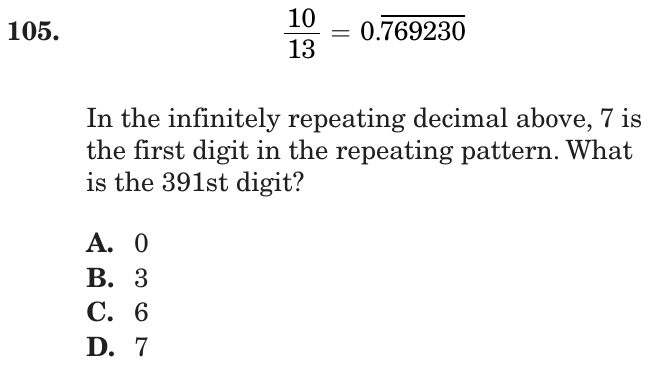
In the infinitely repeating decimal above, 7 is the first digit in the repeating pattern. What is the 391st digit?
- A0
- B3
- C6
- D7
Show the answer
Correct answer: D
There are 6 digits in the repeating decimal (769230), so 7 would be the first, seventh, thirteenth digit and so on.
To find the 391st digit, divide 391 by 6.
391 ÷ 6 = 65 R1
Since the remainder is 1, that means the 391st digit is the same as the 1st digit, which is 7.
Question analysis
This repeating decimal question shows the six-digit repeating pattern of 10/13 and asks for the 391st digit after the decimal point. Students must use the length of the repeating block and division with a remainder to find the position within the cycle. Matching the remainder to the right digit is where students slip.
- Grade level
- Grade 7 content, by NYS standard
- Compared with grade 7
- Above grade 7 Seventh graders learn that fractions have repeating decimals. Using the length of the repeating block and a remainder to find a digit hundreds of places away is a pattern-reasoning step beyond typical seventh-grade classwork.
- Estimated difficulty
- Hard: combines ideas, needs a plan, and has more than one tempting wrong answer.
- Thinking it demands
- Depth of knowledge 2, skills and concepts · mainly apply
- What makes it hard
- No obvious method moderate
- Solution
- 2 steps
- Reading level
- Question and choices: about grade 8, 20 words.
- Students, last 30 days
- Not enough answers yet to show (it takes 10).
Why it is hard, traps and wrong answers (shows the answer)
Why it is hard
Once the cycle length is used, the arithmetic is a single division, 391 ÷ 6 = 65 remainder 1. The difficulty is turning the remainder into a position: remainder 1 is the first digit of a new block, not the last digit of the previous one or the second of the new one. Checking the rule on small positions, the 1st and 7th digits are both 7, removes the doubt.
No obvious method moderate Working it out
Nothing in the stem mentions division; students must see that the six-digit block 769230 repeats, so position 391 depends only on the remainder of 391 divided by 6. (Schoenfeld, 1985)
Strategy: Divide 391 by the length of the repeating block and look only at the remainder; a remainder of r points to the r-th digit of the block.
Traps
- Counting the ends: Inclusive or exclusive ends, fence posts, consecutive numbers: an answer that is one too many or too few, or an endpoint drawn open where it belongs closed (or the reverse).
The wrong answers, classified
A Counting the ends (Brown & Burton, 1978)
Sees that 65 blocks fill 390 places and lands on the 390th digit, the 0 that ends a block, one place short.
B A faulty procedure (Brown & Burton, 1978; Tatsuoka, 1983)
Uses the quotient 65 instead of the remainder, takes its last digit 5, and reads the fifth digit of 769230, which is 3.
C Counting the ends (Brown & Burton, 1978)
Treats the remainder 1 as one step past the block's first digit, moving from 7 to the second digit, 6.
Worked solution, step by step
Formulas used
- Division with a remainder
- n is the number you divide. d is what you divide by. q is the quotient, the number of whole groups. r is the remainder, what is left over. Here it tells how many full blocks of digits fit, and where you land after them.
Sort out what you know
The bar over 769230 means those six digits repeat forever: 769230769230 and so on. The 7 is digit number 1. You need digit number 391.
Spot the pattern
The block 769230 has 6 digits, so the pattern starts over every 6 digits. Digit 1 is 7, and so are digits 7, 13, 19 and so on. Each full block ends with a 0, at digits 6, 12, 18 and so on.
Divide 391 by 6
Find how many full blocks fit into 391 digits, and what is left:
So 65 full blocks use up 6 × 65 = 390 digits. The remainder is 1. That means digit 391 is the 1st digit of the next block.
Read the digit
The 1st digit of the block is 7. Watch out: digit 390 is the last digit of a full block, which is 0. That is choice A. Digit 391 is one step past it, so it starts a new block.
So the answer is D, 7.
Check your answer
Test the idea on a small number. Digit 7: 7 = 6 × 1 + 1, so the remainder is 1 and the digit should be 7. Write it out: 7692307. The 7th digit is indeed 7. The rule works.
More questions like this
The original DOE question
Question 5 of 6
2024 Test A Math, question 5Question
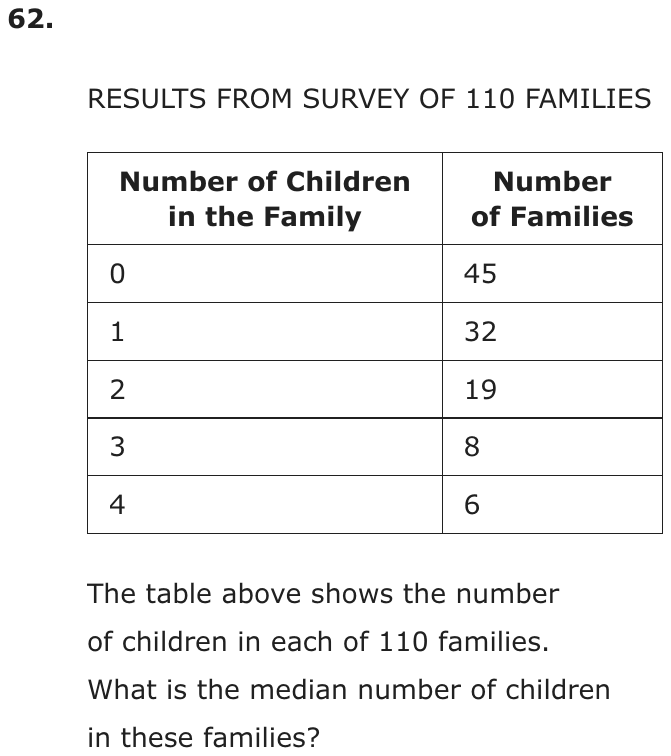
RESULTS FROM SURVEY OF 110 FAMILIES
| Number of Children in the Family | Number of Families |
|---|---|
| 0 | 45 |
| 1 | 32 |
| 2 | 19 |
| 3 | 8 |
| 4 | 6 |
The table above shows the number of children in each of 110 families. What is the median number of children in these families?
Grid-in question: work out the answer and enter it as a number.
Show the answer
Correct answer: 1
Since 110 families were surveyed, the median will have 55 values less than or equal to it, and 55 values greater than or equal to it.
If the values in the table were listed in order, they would look like this:
The first row of the table indicates that 45 families had 0 children.
The second row of the table indicates that 32 families had 1 child.
So 77 families had either 0 children or 1 child, and 45 families had 0 children.
Since 55 is between 45 and 77, the median must be a value in the second row of the table.
So the median is 1.
Question analysis
This statistics grid-in gives a frequency table from a survey of 110 families, showing how many families have each number of children from none to four. Students find the median number of children per family. The table lists counts rather than the 110 data values themselves, so locating the middle value takes a running total of the families.
- Grade level
- Grade 6 content, by NYS standard
- Compared with grade 7
- Above grade 7 Grade 7 median problems usually list a dozen or so values. Here 110 values are hidden in a frequency table, so students must reason about positions with a running count, a less familiar and more error-prone task.
- Estimated difficulty
- Hard: combines ideas, needs a plan, and has more than one tempting wrong answer.
- Thinking it demands
- Depth of knowledge 2, skills and concepts · mainly apply
- What makes it hard
- Reading a figure, table or graph major
- No obvious method moderate
- An answer in an unexpected form minor
- Solution
- 3 steps
- Reading level
- Question and choices: about grade 7, 35 words.
- Students, last 30 days
- Not enough answers yet to show (it takes 10).
Why it is hard, traps and wrong answers (shows the answer)
Why it is hard
Students know a median as the middle of a list, but here the list is never written out. Treating the table's columns as the data gives quick, confident answers, 2 from the middle of the children column or 19 from the middle of the family counts, and neither can be checked against choices. The question rewards counting positions: 45 families have no children, so the 55th and 56th families both fall among the 32 with one child.
Reading a figure, table or graph major Understanding the question
The table hides 110 data values in five rows: the 0 to 4 column lists the possible values, and 45, 32, 19, 8 and 6 say how many families have each. (Lesh, Post & Behr, 1987; Kirsch & Mosenthal, 1990)
No obvious method moderate Working it out
The median of 110 values lies between the 55th and 56th; finding them takes a running count of families, 45 and then 77, a method seldom practiced with tables. (Schoenfeld, 1985)
An answer in an unexpected form minor Choosing the answer
As a grid-in there are no choices to compare, so a student who takes the middle row's 2 has nothing on the page to suggest it is wrong. (Enright, Morley & Sheehan, 2002)
Strategy: With 110 values the median sits between the 55th and 56th; add the family counts row by row until the running total passes 55, and read that row's number of children.
Traps
- Misunderstands the concept: A wrong belief about a concept: that percents can be added, that area grows like length, that averages can be averaged, that a bigger denominator means a bigger fraction.
- Answers a different question: A choice is right for another quantity: the other unknown, the rest instead of the part, the part instead of the whole.
The wrong answers, classified
2 Misunderstands the concept (Smith, diSessa & Roschelle, 1993; De Bock et al., 1998; Ni & Zhou, 2005)
Takes the middle entry of the children column, 0 to 4, ignoring that each number of children belongs to a different number of families.
19 Answers a different question (King et al., 2004; Hegarty, Mayer & Monk, 1995)
Finds the median of the Number of Families column, 6, 8, 19, 32 and 45, a middle family count rather than a number of children.
1.07 Answers a different question (King et al., 2004; Hegarty, Mayer & Monk, 1995)
Computes the mean instead, 118 children among 110 families, about 1.07, a different measure of center from the median asked for.
Worked solution, step by step
Formulas used
- Spot of the median
- The median is the middle value when all the values are put in order. n is how many values there are. This gives the spot of the middle value, with the same number of values before and after it. If it ends in a half, the median is halfway between the two values on either side.
Sort out the table
The table covers 110 families. The left column is a number of children. The right column says how many families have that many children. For example, 45 families have 0 children. You need the median number of children. The median is the middle value when all the values are in order.
Picture the values in order
Think of a list with one number for each family: how many children it has. The list has 45 zeros, then 32 ones, then 19 twos, then 8 threes, then 6 fours. It is already in order, from least to most.
There are 110 values. Watch out: the median is not the middle row, 2. Each row stands for a different number of families.
Find the middle spot
Use the median rule with n = 110.
The middle is halfway between the 55th and 56th values. So you need those two values in the list.
Count down the list
Keep a running total of families, row by row. The zeros fill spots 1 to 45. Now add the 32 families with 1 child.
So the ones fill spots 46 to 77. Spot 55 and spot 56 are both in that range. So both values are 1.
Give the median
The 55th and 56th values are both 1. Halfway between 1 and 1 is 1. So the median is 1 child. Watch out: the median is a number of children, not of families. Gridding 19, from the families column, is wrong. So is the mean, or average, which is about 1.07. So you would grid 1.
Check your answer
Half of 110 is 55. Families with 0 children: 45, which is less than half. So the median is not 0. Families with 0 or 1 child: 77, which is more than half. So the median is not more than 1. It must be 1.
More questions like this
The original DOE question
Question 6 of 6
2024 Test B Math, question 52Question
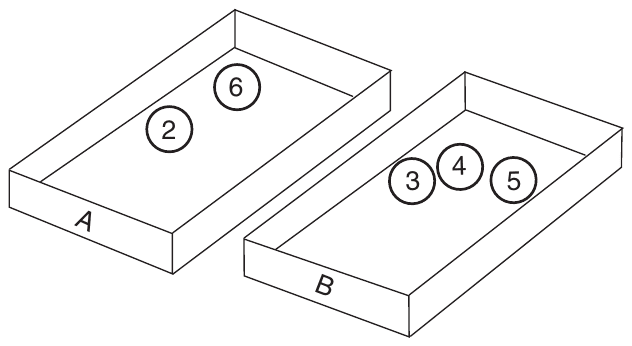
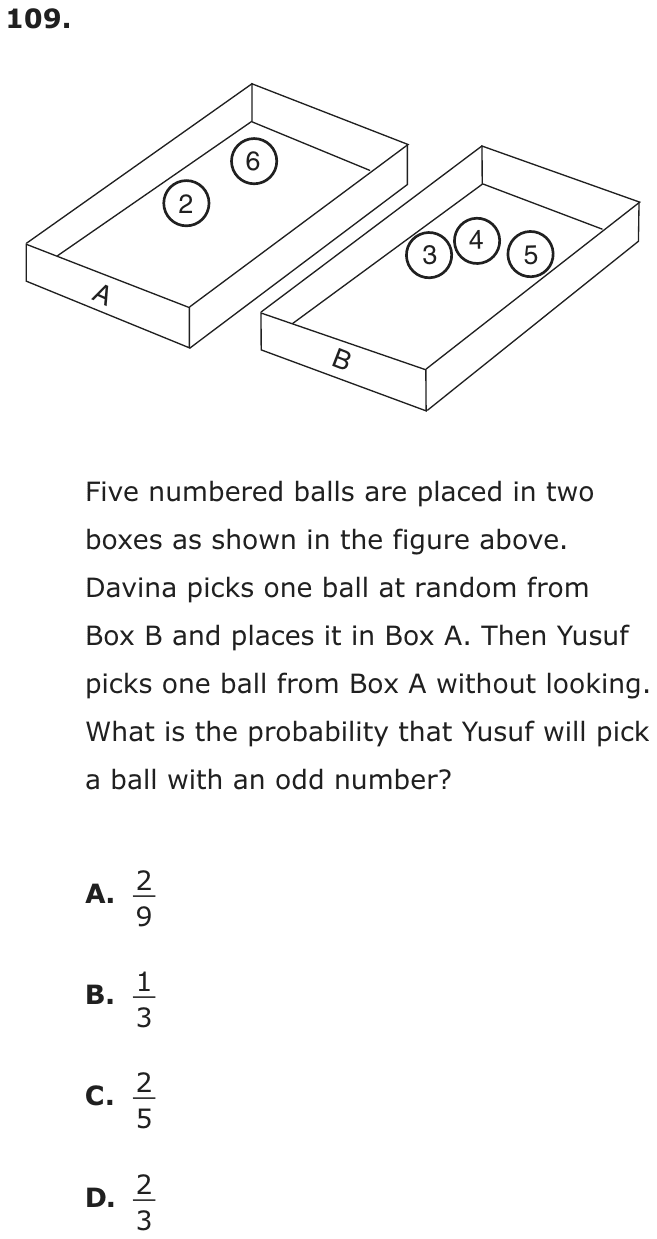
Five numbered balls are placed in two boxes as shown in the figure above. Davina picks one ball at random from Box B and places it in Box A. Then Yusuf picks one ball from Box A without looking. What is the probability that Yusuf will pick a ball with an odd number?
- A
- B
- C
- D
Show the answer
Correct answer: A
The probability of Davina picking an odd-numbered ball from Box B is . If Davina places an odd-numbered ball in Box A, then the probability of Yusuf picking an odd-numbered ball from Box A is . The probability of both of these events happening is the product of the two probabilities.
Question analysis
Two boxes hold five numbered balls, and Davina moves one ball at random from Box B into Box A before Yusuf draws one from Box A. Students find the probability that Yusuf's ball shows an odd number. It tests two-stage probability, and the tricky part is that the second draw depends on which ball was moved.
- NYS standards
- Grade level
- Grade 7 content, by NYS standard
- Compared with grade 7
- Above grade 7 Grade 7 compound probability lists outcomes for independent stages such as coins or spinners. Here the first random move changes what is in the second box, so students must follow two linked stages, a dependence typical grade 7 work does not include.
- Estimated difficulty
- Among the hardest on the SHSAT: a non-obvious approach, heavy reading, or a well-hidden trap.
- Thinking it demands
- Depth of knowledge 3, strategic thinking · mainly analyze
- What makes it hard
- Solution
- 3 steps
- Reading level
- Question and choices: about grade 4, 57 words.
- Students, last 30 days
- Not enough answers yet to show (it takes 10).
Why it is hard, traps and wrong answers (shows the answer)
Why it is hard
Two chance events are hidden in what reads like a question about a single draw. Every listed wrong answer is a reasonable single-stage answer, either one of the two factors on its own or a count of odd balls across both boxes. Listing the nine equally likely pairs, Davina's ball and then Yusuf's, shows that only two of them end with an odd ball and makes the structure visible without any formula.
No obvious method major Working it out
The stem asks one question about Yusuf's draw, but the answer depends on Davina's earlier random pick; the key is that Box A starts with only even balls, so Yusuf can draw odd only by drawing the ball she moved. (Schoenfeld, 1985)
Something you must already know minor Working it out
Multiplying the chances of the two stages, 2/3 for an odd ball moving and 1/3 for Yusuf then drawing it, is a rule students must bring themselves. (Anderson & Krathwohl, 2001)
Reading a figure, table or graph minor Understanding the question
The numbers appear only in the figure, Box A holding 2 and 6 and Box B holding 3, 4 and 5, so the odd balls have to be spotted there. (Lesh, Post & Behr, 1987; Kirsch & Mosenthal, 1990)
Strategy: List every equally likely pair of a ball moved by Davina and a ball picked by Yusuf, and count the pairs that end with an odd ball.
Traps
- Stops one step early: A choice is a number from partway through the solution.
- Numbers taken from the question: Combines the numbers in the question without a model of the situation, or is simply a number that appears in the question.
The wrong answers, classified
B Stops one step early (King et al., 2004; Gierl et al., 2017)
Finds Yusuf's chance of drawing the odd ball once one is in Box A, 1 out of 3, leaving out the chance that Davina moves an odd ball at all.
C Numbers taken from the question (Hegarty, Mayer & Monk, 1995)
Counts the odd balls in the figure, 3 and 5, over all five balls, 2/5, ignoring that Yusuf draws only from Box A.
D Stops one step early (King et al., 2004; Gierl et al., 2017)
Gives the chance that Davina moves an odd ball, 2 out of 3, the first stage only, without multiplying by Yusuf's 1/3 chance of drawing it.
Worked solution, step by step
Formulas used
- Probability
- P is the probability, the chance that something happens. It is a number from 0 to 1. The top counts the results you want. The bottom counts all the results that can happen. It works when every result is equally likely.
- Chance of events in a row
- A and B are two events that happen one after the other. P(A) is the chance of the first. P(B after A) is the chance of the second, counting only what is left after the first. You multiply because the second must also happen inside the share of times the first did.
Read the figure
Box A holds balls numbered 2 and 6. Box B holds balls numbered 3, 4 and 5.
An odd number does not divide evenly by 2. So the only odd balls are 3 and 5, and both start in Box B. Box A starts with no odd balls at all.
Spot the two chance events
Two things happen by chance, one after the other:
- Davina picks one of the 3 balls in Box B and moves it to Box A.
- Then Yusuf picks one of the 3 balls now in Box A.
Yusuf gets an odd ball only if both go right. Davina must move an odd ball. Then Yusuf must pick that very ball.
The question asks only about Yusuf. But his chance depends on Davina’s pick, which comes first.
Find the chance for Davina’s pick
Box B has 3 balls, and 2 of them, the 3 and the 5, are odd.
If she moves the 4 instead, Box A holds only even balls. Then Yusuf can’t get an odd ball at all.
Find the chance for Yusuf’s pick
Say Davina moved an odd ball. Box A now holds 3 balls: the 2, the 6 and that one odd ball.
Watch out: alone is choice B. It forgets that Davina might move the 4.
Multiply the two chances
Both events must happen, so use the rule for events in a row.
Watch out: alone, choice D, stops after Davina’s pick. , choice C, counts 2 odd balls out of all 5. But Yusuf picks only from Box A.
So the answer is A, .
Check your answer
List all 9 equally likely outcomes. Davina can move 3, 4 or 5. Then Yusuf picks one of 3 balls.
| Ball moved | Box A then | Odd picks |
|---|---|---|
| 3 | 2, 6, 3 | 1 |
| 4 | 2, 6, 4 | 0 |
| 5 | 2, 6, 5 | 1 |
That is 2 odd picks out of 9, or .
More questions like this
The original DOE question