3 English and 3 math
Here are 6 random questions to try. Takers earning below 75% are unlikely to receive an offer. You have 1 minute 48 seconds per question on the real exam.
Question 1 of 6
2024 Test B English, question 8Passage Find Time to Volunteer
Find Time to Volunteer
(1) Many people believe that they gain a greater sense of purpose by giving their time to serve others. (2) These are the people who spend their free time volunteering at various places within the community. (3) Those who are served benefit from the work of these volunteers. (4) However, research shows that those who volunteer also receive benefits.
(5) For many students, this proposition may sound impossible. (6) Schoolwork can require hours of study each week. (7) Volunteering at a retirement center or homeless shelter requires both time and energy. (8) Extracurricular activities fill up after-school time. (9) Family obligations and part-time jobs often have to be worked into the schedule, too. (10) However, if students can find time to volunteer, even for a few hours a month, they may find that the benefits outweigh the scheduling difficulties.
(11) To begin with, students who engage in volunteer activities acquire valuable skills and experience, which can help them focus on potential fields of study and career options. (12) Furthermore, when students list volunteer work on college applications, admissions counselors see applicants who care about making their community and college campus a better place.
(13) Volunteerism benefits more than students applying to college. (14) This type of experience is equally important for students moving directly into the workforce after high school. (15) Volunteering demonstrates initiative, dedication, and a strong work ethic, qualities that companies value in a potential employee. (16) In a CareerBuilder study, 60 percent of managers regarded volunteerism as a significant asset when considering applicants.
(17) Students who volunteer undoubtedly make a positive investment in their future, but they also affect their present quality of life. (18) Studies have shown that volunteering is good for both the mind and the body. (19) Volunteering can boost mood levels and reduce anxiety. (20) According to the Mayo Clinic,1 the feeling of doing something meaningful and the appreciation received from that action can reduce stress.
(21) Even the busiest of students can find a way to donate some time to a worthy cause. (22) Though managing different commitments may seem overwhelming at times, students are sure to feel a sense of fulfillment in volunteerism.
1Mayo Clinic: a nonprofit medical organization dedicated to treatment and research
Question
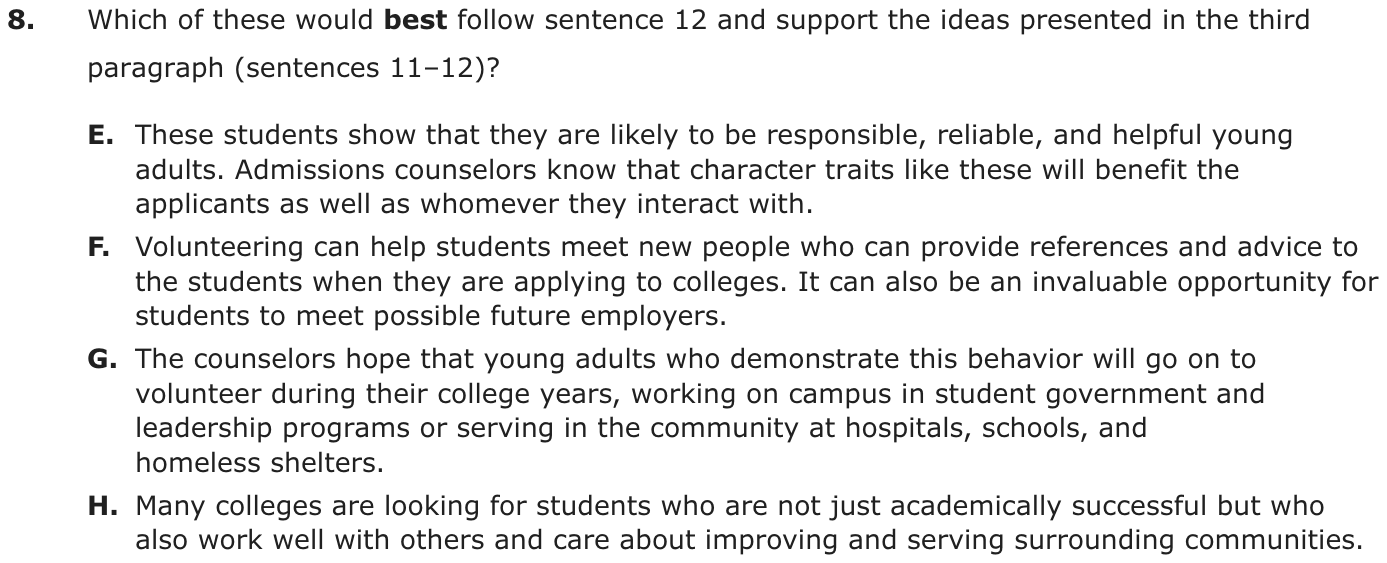
Which of these would best follow sentence 12 and support the ideas presented in the third paragraph (sentences 11–12)?
- AThese students show that they are likely to be responsible, reliable, and helpful young adults. Admissions counselors know that character traits like these will benefit the applicants as well as whomever they interact with.
- BVolunteering can help students meet new people who can provide references and advice to the students when they are applying to colleges. It can also be an invaluable opportunity for students to meet possible future employers.
- CThe counselors hope that young adults who demonstrate this behavior will go on to volunteer during their college years, working on campus in student government and leadership programs or serving in the community at hospitals, schools, and homeless shelters.
- DMany colleges are looking for students who are not just academically successful but who also work well with others and care about improving and serving surrounding communities.
Show the answer
Correct answer: D
The question asks which option would best follow sentence 12 to support the ideas presented in the third paragraph (sentences 11–12).
A. Incorrect. The subject of the main clause in sentence 12 is “admissions counselors.” Although the second sentence in the option mentions “admissions counselors,” it does not support the ideas in the paragraph, because the statement that “admissions counselors know that character traits like these will benefit the applicants” focuses on how students benefit, while sentence 12 focuses on how these traits benefit the community.
B. Incorrect. While sentence 11 discusses the potential academic and professional connections that can be made through volunteering, sentence 12 moves on to the topic of college admissions. Since the sentences in the option revert back to the topic of connections, they do not support and logically follow a sentence about how college admissions counselors view students with volunteering experience.
C. Incorrect. Although the sentence in the option continues on the subject of admissions counselors and follows the idea in sentence 12 that these counselors tend to favor students who “care about making their community and college campus a better place,” the sentence focuses on what students will do while in college rather than on how volunteering helps them get into college. Therefore, the sentence does not best follow sentence 12 and support the ideas presented in the third paragraph.
D. CORRECT. In sentence 12, the author states that college admissions counselors view students who list volunteer work on admissions applications as “applicants who care about making their community and college campus a better place.” The sentence in the option best follows sentence 12 and supports the ideas in the third paragraph because it provides additional details about why admissions counselors look beyond academics when considering students for admissions and the positive qualities assigned to those who have volunteering experience.
Question analysis
This supporting-details question asks which addition would best follow the volunteering essay’s sentence about how college admissions counselors view applicants who list volunteer work. Every option mentions college and sounds reasonable on its own, so students must decide which one develops the paragraph’s point rather than drifting to a related idea.
- NYS standards
- 7W1b supporting claims with evidence
- Grade level
- Grade 8 reading and task
- Compared with grade 7
- Above grade 7 Grade 7 students choose evidence that supports a claim. Here the options are one or two full sentences, all of them about college, and the right fit depends on the precise idea in sentence 12, a finer judgment than usual.
- Estimated difficulty
- Hard: combines ideas, needs a plan, and has more than one tempting wrong answer.
- Thinking it demands
- Depth of knowledge 2, skills and concepts · mainly evaluate
- What makes it hard
- A very close wrong answer major
- How sentences fit together moderate
- A lot to read minor
- Evidence
- Answered from one paragraph or stanza
- Reading level
- Passage: about grade 11, 354 words; question and choices: about grade 13, 153 words.
- Students, last 30 days
- Not enough answers yet to show (it takes 10).
Why it is hard, traps and wrong answers (shows the answer)
Why it is hard
Every option stays on the subject of college, so the work is matching sentence 12’s exact idea: counselors see applicants who care about making their community a better place. The near miss also explains what counselors value, but it swaps caring for the community for a new set of traits and ends on what those traits do for the applicants. Students who restate sentence 12 before reading the options can hear that the right one simply widens it, from community service to what colleges want beyond grades.
A very close wrong answer major Choosing the answer
The right sentence and the two-sentence option about responsible, reliable, helpful students both explain why volunteers impress admissions; only the right one keeps sentence 12’s point, caring about improving communities. (Embretson & Wetzel, 1987; Gorin & Embretson, 2006; Ascalon et al., 2007)
How sentences fit together moderate Working it out
The new sentence must extend sentence 12’s specific idea, what admissions counselors see in volunteers, rather than return to sentence 11’s skills and careers or move on to college life. (Halliday & Hasan, 1976)
A lot to read minor Understanding the question
The options run 27 to 39 words, two of them two sentences long, and all four are about college, so topic alone rules none of them out. (Kintsch, 1998; Gorin & Embretson, 2006; Freedle & Kostin, 1993)
Strategy: Restate sentence 12 in your own words, then ask of each option whether it explains or extends that exact point about what admissions counselors value.
Traps
- Off the point: Adds or keeps something that does not support the paragraph's or the passage's focus, or an introduction or conclusion that misses the main point.
The wrong answers, classified
A Off the point (Halliday & Hasan, 1976)
Follows the admissions counselors from sentence 12 but replaces caring for the community with new traits, responsibility and reliability, and turns to how those traits help the applicants.
B Off the point (Halliday & Hasan, 1976)
Is drawn by “applying to colleges,” but networking for references and future employers is a new benefit that neither sentence 11 nor sentence 12 develops.
C Off the point (Halliday & Hasan, 1976)
Stays with the counselors and picks up “college campus” from sentence 12, but jumps ahead to what students might do in college instead of explaining admission decisions.
Working it out, step by step
Figure out what the question asks
You need the sentence that best follows sentence 12. A good next sentence adds to the same idea. It does not jump to a new point. Example: after Dogs make loyal pets, the sentence They stay by their owners’ side fits. Dogs come in many colors drifts away. So first put sentence 12 in your own words.
Restate sentence 12
Sentence 12 says that “when students list volunteer work on college applications, admissions counselors see applicants who care about making their community and college campus a better place.” Admissions counselors are the people who choose which students get into a college. So the idea is this: colleges like volunteers because volunteers care about their communities.
Check each choice
- D says colleges want students who are “not just academically successful.” That means more than good grades. They also want students who “care about improving and serving surrounding communities.” That explains sentence 12 and builds on it.
- A swaps in new traits: “responsible, reliable, and helpful.” Then it says those traits help the applicants and the people around them. It drops caring for the community.
- B brings in a new benefit: meeting people who can give advice or jobs. Neither sentence 11 nor sentence 12 talks about that.
- C jumps ahead to what students might do in college. It doesn’t explain how volunteering helps them get in.
Pick the answer
Watch out: A is the most tempting. It is about what counselors value, just like the right answer. But it changes the reason they value it. Only D keeps sentence 12’s idea of caring for the community. So the answer is D.
Why this answer and not the closest wrong one
A is the closest wrong answer. Like D, it explains why admissions counselors like volunteers. But A’s reasons are new ones, such as being responsible and reliable. D keeps sentence 12’s exact idea, caring about the community, and adds that colleges want more than good grades. So D supports the paragraph best.
More questions like this
The original DOE question
The passage “Find Time to Volunteer” as printed (page 163)
Question 2 of 6
2025 Practice Test A English, question 9Passage Excerpt from “Scribe Like an Egyptian”
Excerpt from “Scribe Like an Egyptian”
by Hilary Wilson
In ancient Egypt, literacy was the key to success. However, contrary to popular belief, not all Egyptian scribes understood hieroglyphs. Many relied instead on the simpler hieratic script for the multitude of everyday documents generated by the Egyptian bureaucracy.
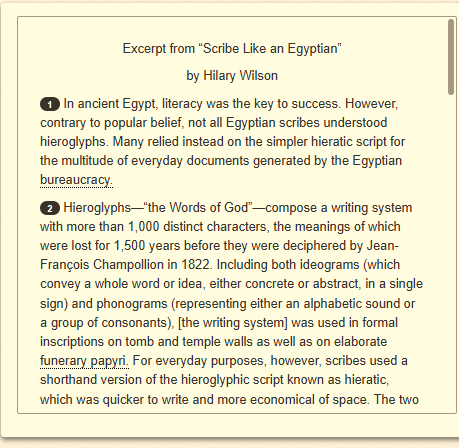
Hieroglyphs—“the Words of God”—compose a writing system with more than 1,000 distinct characters, the meanings of which were lost for 1,500 years before they were deciphered by Jean-François Champollion in 1822. Including both ideograms (which convey a whole word or idea, either concrete or abstract, in a single sign) and phonograms (representing either an alphabetic sound or a group of consonants), [the writing system] was used in formal inscriptions on tomb and temple walls as well as on elaborate funerary papyri. For everyday purposes, however, scribes used a shorthand version of the hieroglyphic script known as hieratic, which was quicker to write and more economical of space. The two writings existed side by side for at least 2,500 years.
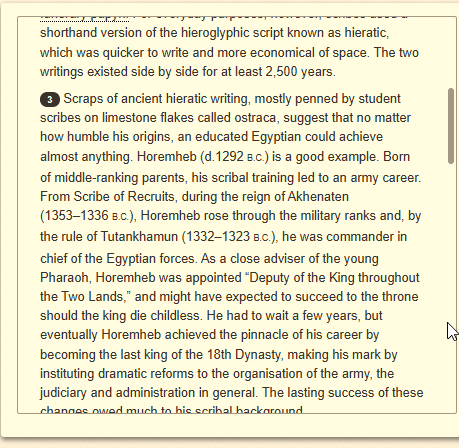
Scraps of ancient hieratic writing, mostly penned by student scribes on limestone flakes called ostraca, suggest that no matter how humble his origins, an educated Egyptian could achieve almost anything. Horemheb (d.1292 B.C.) is a good example. Born of middle-ranking parents, his scribal training led to an army career. From Scribe of Recruits, during the reign of Akhenaten (1353–1336 B.C.), Horemheb rose through the military ranks and, by the rule of Tutankhamun (1332–1323 B.C.), he was commander in chief of the Egyptian forces. As a close adviser of the young Pharaoh, Horemheb was appointed “Deputy of the King throughout the Two Lands,” and might have expected to succeed to the throne should the king die childless. He had to wait a few years, but eventually Horemheb achieved the pinnacle of his career by becoming the last king of the 18th Dynasty, making his mark by instituting dramatic reforms to the organisation of the army, the judiciary and administration in general. The lasting success of these changes owed much to his scribal background. . . .
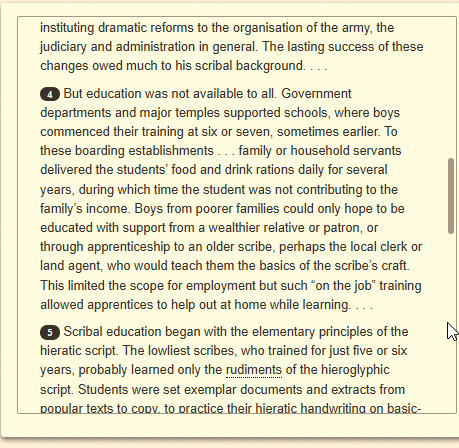
But education was not available to all. Government departments and major temples supported schools, where boys commenced their training at six or seven, sometimes earlier. To these boarding establishments . . . family or household servants delivered the students’ food and drink rations daily for several years, during which time the student was not contributing to the family’s income. Boys from poorer families could only hope to be educated with support from a wealthier relative or patron, or through apprenticeship to an older scribe, perhaps the local clerk or land agent, who would teach them the basics of the scribe’s craft. This limited the scope for employment but such “on the job” training allowed apprentices to help out at home while learning. . . .
Scribal education began with the elementary principles of the hieratic script. The lowliest scribes, who trained for just five or six years, probably learned only the rudiments of the hieroglyphic script. Students were set exemplar documents and extracts from popular texts to copy, to practice their hieratic handwriting on basic-format letters, reports and contracts, while absorbing the good advice contained in the texts. Surviving examples of copy-work sometimes include tutors’ corrections added in red. Some significant Egyptian literary works survive almost exclusively from student copies.
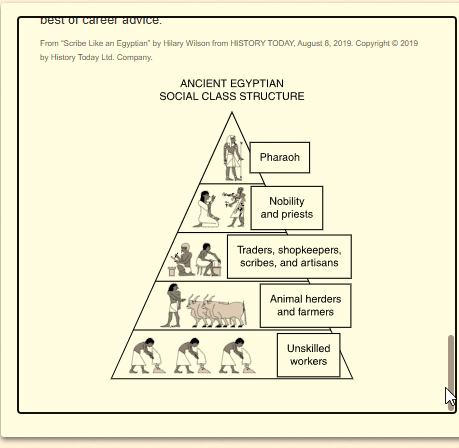
A schoolboy “dictionary” of hieroglyphs with their hieratic equivalents shows that a knowledge of more than 450 signs was required for everyday writing purposes. Lessons in record-keeping and filing and labelling enabled any half-competent scribe to perform that most essential of all scribal functions: the making and updating of lists. For professions such as those of government official, priest or lawyer, a scribe would train for several more years, increasing his vocabulary to perhaps a thousand or more signs. Those with the best handwriting or drawing skills might follow the craft of creating beautifully illustrated copies of funerary texts, commonly called Books of the Dead. Others could become draughtsmen, artists or architects. Doctors compiled their own collections of medication recipes, treatments and associated incantations, many copied from texts found in the House of Life, the temple library. Lawyers had to be familiar with the corpus of civil and religious laws and precedents found in the official records, which were administered by archivists. Egypt’s bureaucratic society depended on the skills of an army of scribes of all ranks from filing clerk to tax assessor. For young Egyptians, “be a scribe” was the best of career advice.
From “Scribe Like an Egyptian” by Hilary Wilson from HISTORY TODAY, August 8, 2019. Copyright © 2019 by History Today Ltd. Company.
bureaucracy: an administrative staff of government officials
funerary papyri: a sheet or scroll of papyrus containing religious images and hieroglyphs meant to help the deceased be reborn in the afterlife
rudiments: basics
schoolboy: slang that refers to materials used during the course of receiving an education
draughtsmen: people who draw plans of machinery or structures
corpus: a collection of writings
Question
Which sentence from the excerpt best supports the idea that there were different levels of education for a scribe?
- A“However, contrary to popular belief, not all Egyptian scribes understood hieroglyphs.” (paragraph 1)
- B“For everyday purposes, however, scribes used a shorthand version of the hieroglyphic script known as hieratic, which was quicker to write and more economical of space.” (paragraph 2)
- C“This limited the scope for employment but such ‘on the job’ training allowed apprentices to help out at home while learning.” (paragraph 4)
- D“For professions such as those of government official, priest or lawyer, a scribe would train for several more years, increasing his vocabulary to perhaps a thousand or more signs.” (paragraph 6)
Show the answer
Correct answer: D
The question asks for a sentence from the excerpt that best supports the idea that different levels of education were available to scribes.
A. Incorrect. The sentence from paragraph 1 provides evidence that Egyptian scribes used two different forms of writing, but it does not address the topic of education or the different levels of education that were available to scribes.
B. Incorrect. The advantages and purposes of hieratic script are described in this sentence from paragraph 2, but this explanation of the advantages and purposes does not suggest that there were different levels of education for scribes.
C. Incorrect. The fact that scribes could learn their trade through apprenticeships as discussed in this sentence from paragraph 4 does provide evidence that another method of learning to be a scribe was possible, but this process was for a limited entry into becoming a scribe, not the continued education scribes would need in order to work in specific areas.
D. CORRECT. By explaining that certain professions required additional years of training, this sentence from paragraph 6 supports the idea that different levels of education existed for scribes.
Question analysis
This evidence question on Hilary Wilson’s “Scribe Like an Egyptian,” a magazine article about how ancient Egyptian scribes learned their trade, asks which quoted sentence best supports the idea that scribes received different levels of education. The four sentences come from paragraphs 1, 2, 4 and 6, and more than one seems to touch on the idea, so close reading of each decides it.
- Grade level
- Grade 8 reading and task
- Compared with grade 7
- Above grade 7 Choosing the sentence that best supports an idea is routine grade 7 evidence work. Here several quotations touch on ways scribes differed, and the article’s dense, technical wording makes those differences harder to sort than usual.
- Estimated difficulty
- Hard: combines ideas, needs a plan, and has more than one tempting wrong answer.
- Thinking it demands
- Depth of knowledge 3, strategic thinking · mainly evaluate
- What makes it hard
- Reading between the lines moderate
- Every choice must be checked moderate
- Hard words minor
- Evidence
- Answered from several paragraphs or stanzas
- Reading level
- Passage: about grade 12, 810 words; question and choices: about grade 13, 110 words.
- Students, last 30 days
- Not enough answers yet to show (it takes 10).
Why it is hard, traps and wrong answers (shows the answer)
Why it is hard
Two of the wrong sentences are not off topic: one says not all scribes understood hieroglyphs, the other that apprenticeship narrowed a scribe’s job prospects, and both imply that scribes differed. The question rewards asking what the idea actually claims, that schooling itself came in stages, and only the sentence about professions that required more years of training says so outright. Students who stop at the first sentence suggesting a difference lose the point.
Reading between the lines moderate Working it out
The right sentence never says “levels”; students must see that training “for several more years” for official, priest or lawyer posts means a higher tier of schooling than the basic course. (Graesser, Singer & Trabasso, 1994; Kintsch, 1998)
Every choice must be checked moderate Choosing the answer
Two other quotations also hint at differences among scribes, paragraph 1’s “not all Egyptian scribes understood hieroglyphs” and paragraph 4’s “limited the scope for employment,” so each must be weighed, not just scanned. (Embretson & Wetzel, 1987)
Hard words minor Understanding the question
Terms such as “hieratic,” “economical of space” and “scope for employment” slow the reading of the quotations, and the shorthand sentence is hard to dismiss until hieratic is understood as a script. (Perfetti, 2007; Freedle & Kostin, 1993)
Strategy: Ask what a sentence would have to say to prove that scribal education came in levels, then test each quotation against that and prefer a direct statement over a hint.
Traps
- Supports only part of the claim: In a question about evidence: a line that backs one half of the claim but not the other, or a related point rather than the claim itself.
- True but not the answer: A choice says something accurate about the text that does not answer this question.
The wrong answers, classified
A Supports only part of the claim (King et al., 2004; Thissen, Steinberg & Fitzpatrick, 1989)
Reads “not all Egyptian scribes understood hieroglyphs” as proof of different levels of schooling, but it reports a difference in knowledge without saying anything about how scribes were taught.
B True but not the answer (King et al., 2004; Embretson & Wetzel, 1987)
Picks the sentence on hieratic as a faster everyday shorthand, which describes how scribes wrote, not how long or how far any of them studied.
C Supports only part of the claim (King et al., 2004; Thissen, Steinberg & Fitzpatrick, 1989)
Sees that on-the-job training “limited the scope for employment” and takes it for a lower level of education, though the sentence contrasts two routes into the trade, not stages of study.
Working it out, step by step
Figure out what the question asks
This asks for the sentence that best supports one idea: scribes could get “different levels of education.” A level is a stage. Some scribes studied for a short time, and others went on to study more. You need a sentence that shows a difference in schooling, not just any difference between scribes.
Find what each level looked like
Paragraphs 5 and 6 describe the training. Paragraph 5 says the lowest scribes studied for only five or six years. They learned just the basics of hieroglyphs. Paragraph 6 says that more than 450 signs were needed for everyday writing. Then choice D adds a higher level: “For professions such as those of government official, priest or lawyer, a scribe would train for several more years, increasing his vocabulary to perhaps a thousand or more signs.”
Work out what choice D means
A profession is a job that needs special training. Choice D says some jobs needed more years of study and more signs, perhaps over a thousand. A basic scribe stopped sooner and knew fewer signs. So schooling came in stages: a basic course, and then more years for the top jobs. That is what the question means by levels of education.
Check each choice
- A does not fit. It says not all scribes understood hieroglyphs. That is a difference in what scribes knew. It says nothing about how they were taught.
- B does not fit. It explains hieratic, a faster shorthand way of writing. That is about writing, not schooling.
- C does not fit. It is about apprentices, who learned on the job from an older scribe. That is a different way into the work, not a higher or lower stage of study.
- D fits. Some jobs needed several more years of training.
Watch out: A is tempting because it shows that scribes were not all alike. But it never mentions school.
Choose the answer
Only one sentence shows some scribes studying for years after the basic course. So the answer is D.
Why this answer and not the closest wrong one
A is the closest wrong choice. It shows that some scribes knew hieroglyphs and others did not. But it doesn’t say why, or how long anyone studied. D says plainly that some jobs needed several more years of training. That is a level of education above the basic one.
More questions like this
The original DOE question
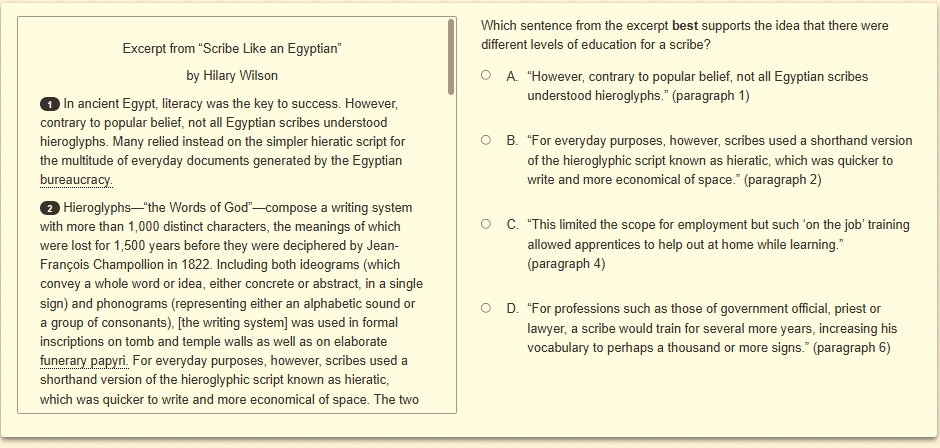
The passage “Excerpt from “Scribe Like an Egyptian”” as shown on the test
Question 3 of 6
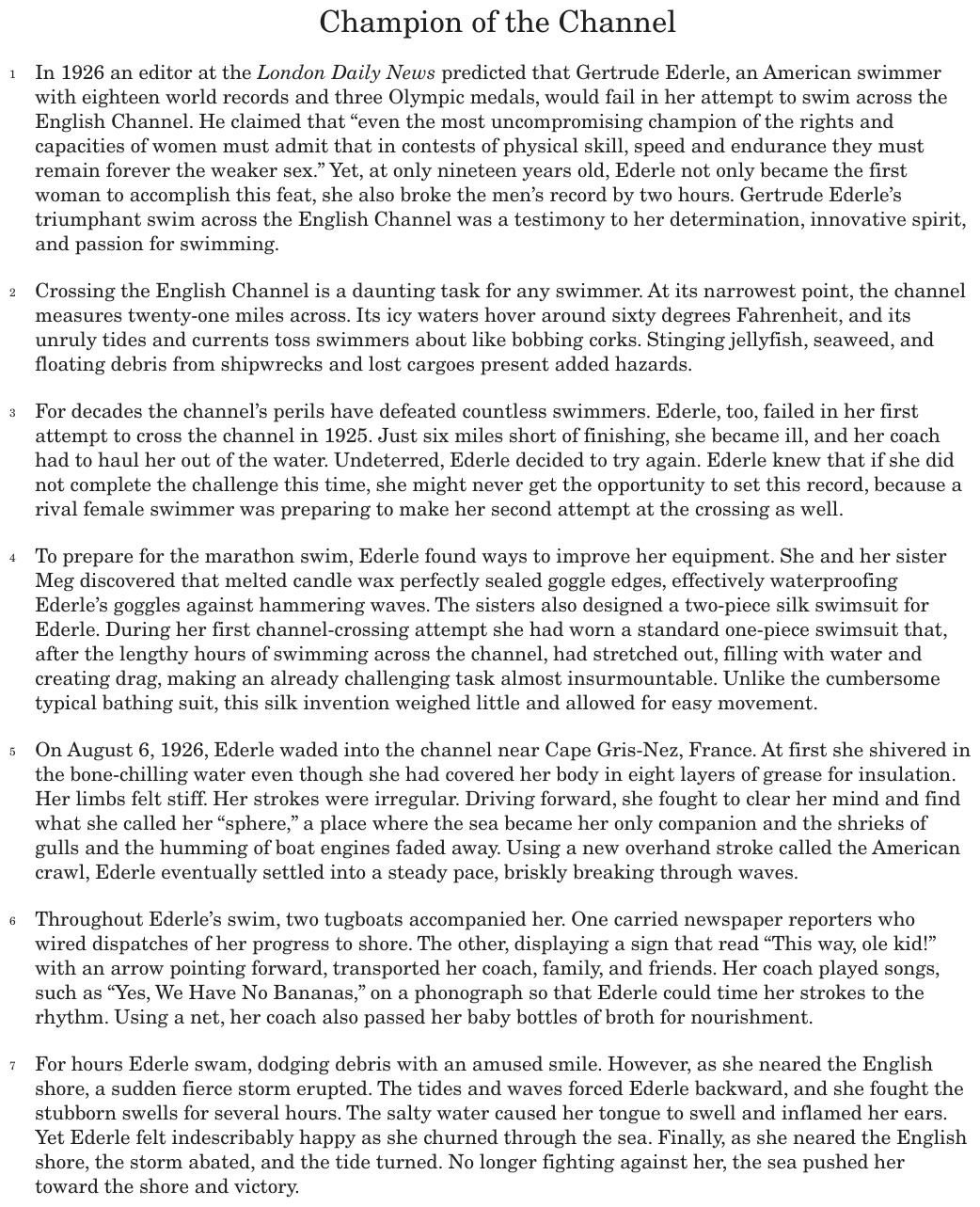
2018 Test A English, question 22Passage Champion of the Channel
Champion of the Channel
In 1926 an editor at the London Daily News predicted that Gertrude Ederle, an American swimmer with eighteen world records and three Olympic medals, would fail in her attempt to swim across the English Channel. He claimed that “even the most uncompromising champion of the rights and capacities of women must admit that in contests of physical skill, speed and endurance they must remain forever the weaker sex.” Yet, at only nineteen years old, Ederle not only became the first woman to accomplish this feat, she also broke the men’s record by two hours. Gertrude Ederle’s triumphant swim across the English Channel was a testimony to her determination, innovative spirit, and passion for swimming.
Crossing the English Channel is a daunting task for any swimmer. At its narrowest point, the channel measures twenty-one miles across. Its icy waters hover around sixty degrees Fahrenheit, and its unruly tides and currents toss swimmers about like bobbing corks. Stinging jellyfish, seaweed, and floating debris from shipwrecks and lost cargoes present added hazards.
For decades the channel’s perils have defeated countless swimmers. Ederle, too, failed in her first attempt to cross the channel in 1925. Just six miles short of finishing, she became ill, and her coach had to haul her out of the water. Undeterred, Ederle decided to try again. Ederle knew that if she did not complete the challenge this time, she might never get the opportunity to set this record, because a rival female swimmer was preparing to make her second attempt at the crossing as well.
To prepare for the marathon swim, Ederle found ways to improve her equipment. She and her sister Meg discovered that melted candle wax perfectly sealed goggle edges, effectively waterproofing Ederle’s goggles against hammering waves. The sisters also designed a two-piece silk swimsuit for Ederle. During her first channel-crossing attempt she had worn a standard one-piece swimsuit that, after the lengthy hours of swimming across the channel, had stretched out, filling with water and creating drag, making an already challenging task almost insurmountable. Unlike the cumbersome typical bathing suit, this silk invention weighed little and allowed for easy movement.
On August 6, 1926, Ederle waded into the channel near Cape Gris-Nez, France. At first she shivered in the bone-chilling water even though she had covered her body in eight layers of grease for insulation. Her limbs felt stiff. Her strokes were irregular. Driving forward, she fought to clear her mind and find what she called her “sphere,” a place where the sea became her only companion and the shrieks of gulls and the humming of boat engines faded away. Using a new overhand stroke called the American crawl, Ederle eventually settled into a steady pace, briskly breaking through waves.
Throughout Ederle’s swim, two tugboats accompanied her. One carried newspaper reporters who wired dispatches of her progress to shore. The other, displaying a sign that read “This way, ole kid!” with an arrow pointing forward, transported her coach, family, and friends. Her coach played songs, such as “Yes, We Have No Bananas,” on a phonograph so that Ederle could time her strokes to the rhythm. Using a net, her coach also passed her baby bottles of broth for nourishment.
For hours Ederle swam, dodging debris with an amused smile. However, as she neared the English shore, a sudden fierce storm erupted. The tides and waves forced Ederle backward, and she fought the stubborn swells for several hours. The salty water caused her tongue to swell and inflamed her ears. Yet Ederle felt indescribably happy as she churned through the sea. Finally, as she neared the English shore, the storm abated, and the tide turned. No longer fighting against her, the sea pushed her toward the shore and victory.
After fourteen hours and thirty-one minutes, Ederle, on wobbly legs, stepped onto the English shore. The waiting crowd roared, honked their automobile horns, blasted their tugboat whistles, and set off flares that flashed in the sky. Ederle had swum into history.
When Ederle returned to New York, she received a parade, where thousands of people shouted “Trudy!” Not only were everyday American citizens proud of Ederle, but she also inspired them to be more active. Over the next few years, more than 60,000 people credited her with motivating them to earn their American Red Cross swimming certificates. Gertrude Ederle’s accomplishment proved to the world that with determination and passion, it was possible for a person to achieve his or her goals.
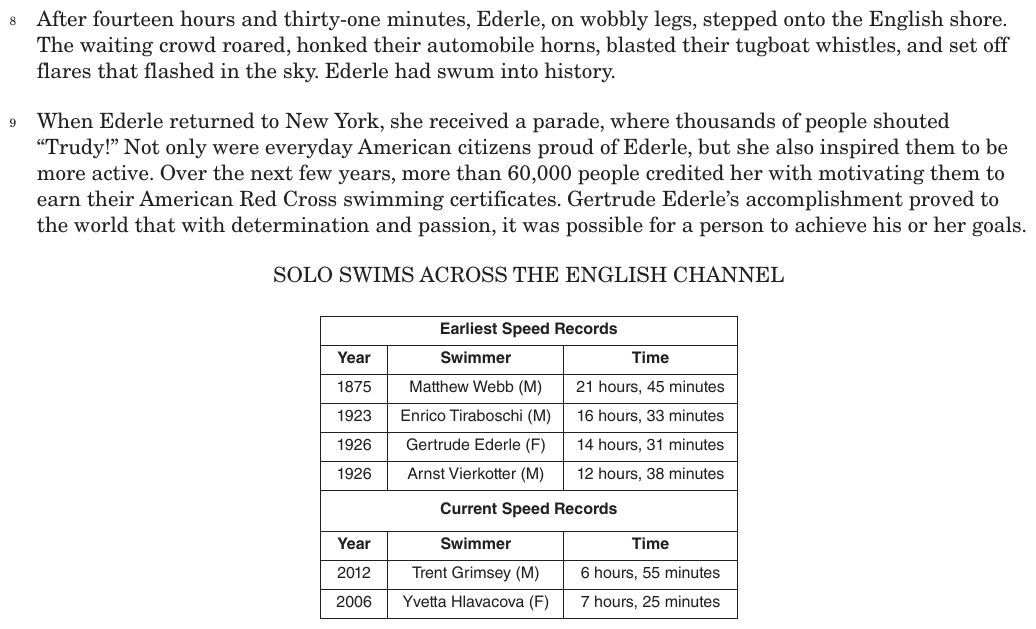
SOLO SWIMS ACROSS THE ENGLISH CHANNEL
|
Earliest Speed Records |
||
| Year | Swimmer | Time |
| 1875 | Matthew Webb (M) | 21 hours, 45 minutes |
| 1923 | Enrico Tiraboschi (M) | 16 hours, 33 minutes |
| 1926 | Gertrude Ederle (F) | 14 hours, 31 minutes |
| 1926 | Arnst Vierkotter (M) | 12 hours, 38 minutes |
| Current Speed Records | ||
| Year | Swimmer | Time |
| 2012 | Trent Grimsey (M) | 6 hours, 55 minutes |
| 2006 | Yvetta Hlavacova (F) | 7 hours, 25 minutes |
Question
Paragraph 7 contributes to the development of the central idea of the passage by
- Aillustrating that Ederle’s physical strength and mental fortitude allowed her to stay focused on her goal.
- Bconveying that Ederle pushed herself to the edge of her physical capabilities in order to complete the swim.
- Chighlighting the impact the severe weather had on Ederle’s emotions during her swim.
- Demphasizing the surge of emotions Ederle felt as she came closer to achieving a personal goal.
Show the answer
Correct answer: D
The answer is (D)
The question asks for an explanation of how paragraph 7 contributes to the development of a central idea of the passage. Paragraph 7 is mainly about Ederle’s physical and emotional state as she pushed through a difficult portion of her swim and realized her goal was in sight. A central idea of the passage is that Ederle’s passion and determination allowed her to accomplish her goal of being the first woman to cross the English Channel.
Option D is correct because it emphasizes her passion by referring to the overwhelming emotions Ederle felt as she progressed during her swim, despite the unfavorable conditions (paragraph 7: “For hours Ederle swam, dodging debris with an amused smile” and “Yet Ederle felt indescribably happy as she churned through the sea.”).
Option A is incorrect because, although Ederle needed physical strength and mental fortitude to complete the swim, the paragraph contributes to a central idea because it highlights her emotion as she swam, not her physical strength or mental fortitude.
Option B is incorrect because the paragraph focuses on Ederle’s emotional response to the challenging circumstances and not the idea that Ederle was at the “edge of her physical capabilities.”
Option C is incorrect because Ederle’s feelings of happiness and amusement were caused by her anticipation and excitement as she approached achieving her goal, not by the severe weather.
Question analysis
This reading question asks how the paragraph about the storm near the end of Gertrude Ederle's English Channel swim contributes to the passage's central idea. Students must decide what the paragraph mainly does and connect it to the larger point, while every choice sounds like a fair description of a hard swim.
- Grade level
- Grade 8 reading and task
- Compared with grade 7
- Above grade 7 Explaining how one paragraph develops a central idea is a grade 7 standard, but here several choices sound true of a hard swim through a storm, and the student must see what the paragraph is mainly about, beyond typical grade 7 work.
- Estimated difficulty
- Hard: combines ideas, needs a plan, and has more than one tempting wrong answer.
- Thinking it demands
- Depth of knowledge 3, strategic thinking · mainly analyze
- What makes it hard
- A very close wrong answer major
- Evidence in several places moderate
- How, not what moderate
- Evidence
- Answered from several paragraphs or stanzas
- Reading level
- Passage: about grade 9, 790 words; question and choices: about grade 11, 76 words.
- Students, last 30 days
- Not enough answers yet to show (it takes 10).
Why it is hard, traps and wrong answers (shows the answer)
Why it is hard
Paragraph 7 is crowded with hardship, a storm, a swollen tongue and inflamed ears, so the obvious reading is that it shows toughness. The author's pointed “Yet Ederle felt indescribably happy” turns it toward emotion, which ties it to the passion named in the thesis. Several choices are fair about the swim in general, and this is one of the closer calls on the test, since strength is also on display.
A very close wrong answer major Choosing the answer
The right choice and the strength-and-fortitude one both describe Ederle's inner state as she nears her goal, and only whether paragraph 7 stresses her feelings or her toughness separates them, since she does fight “the stubborn swells for several hours”. (Embretson & Wetzel, 1987; Gorin & Embretson, 2006; Ascalon et al., 2007)
Evidence in several places moderate Working it out
The central idea, her “determination, innovative spirit, and passion for swimming”, is stated in paragraph 1, six paragraphs before the storm it must be connected to. (Kirsch & Mosenthal, 1990; Gorin & Embretson, 2006)
How, not what moderate Working it out
The question asks how paragraph 7 develops the central idea, so the student must weigh what its details stress, the “amused smile” and “indescribably happy”, not just what happens. (Anderson & Krathwohl, 2001)
Strategy: Mark the words in paragraph 7 that describe how Ederle felt and what she endured, decide which the author stresses, then connect that to the passage's stated central idea.
Traps
- True but not the answer: A choice says something accurate about the text that does not answer this question.
- Too broad or too strong: A choice overstates, generalizes, or uses absolute words the text does not support.
The wrong answers, classified
A True but not the answer (King et al., 2004; Embretson & Wetzel, 1987)
Credits strength and mental fortitude, which the hours against the swells partly show, but the paragraph's turn on “Yet” stresses her joy, not her toughness.
B Too broad or too strong (King et al., 2004)
Inflates the swollen tongue and inflamed ears into reaching “the edge of her physical capabilities”, an extreme the paragraph never claims.
C Twists what the text says (King et al., 2004)
Sees both the storm and her feelings but makes the weather the cause of her emotions, when she felt happy in spite of it.
Working it out, step by step
Figure out what the question asks
You need to explain how paragraph 7 helps build the central idea, the main point of the passage. So first find the central idea. Then see what paragraph 7 stresses.
Find the central idea
The last sentence of paragraph 1 says: “Gertrude Ederle’s triumphant swim across the English Channel was a testimony to her determination, innovative spirit, and passion for swimming.” A testimony here means proof. Passion means a strong love for something.
See what happens in paragraph 7
A fierce storm pushes Ederle backward. She fights “the stubborn swells for several hours.” Swells are big, rolling waves. Salt water makes her tongue swell and her ears sore. Then the storm ends, and the sea pushes her “toward the shore and victory.”
Notice what the author stresses
Look at the feeling words. She swims “dodging debris with an amused smile.” In the middle of the pain, the author writes: “Yet Ederle felt indescribably happy as she churned through the sea.” Indescribably means too much to put into words. The word “Yet” shows a surprise. She felt joy in spite of the pain. That shows her passion for swimming.
Check each choice
- D: a “surge of emotions” as she came closer to her goal. A surge is a sudden rush. This matches the smile and the happiness.
- A: strength and “mental fortitude,” or toughness. She was tough, but the paragraph stresses her joy.
- B: the paragraph never says she reached “the edge of her physical capabilities.”
- C says the storm caused her feelings. She was happy in spite of the storm, not because of it.
Watch out: A is tempting because she fought for hours. But the “Yet” sentence turns to how she felt.
Pick the answer
Paragraph 7 builds the passage’s idea of her passion by showing her feelings. So the answer is D.
Why this answer and not the closest wrong one
A is the closest wrong answer, because she does fight “the stubborn swells for several hours.” But the paragraph’s key words are about feeling: “amused smile” and “indescribably happy.” Those link to her “passion for swimming” in paragraph 1. D names those emotions.
More questions like this
The original DOE question
The passage “Champion of the Channel” as printed (pages 56–57)
Question 4 of 6
2026 Practice Test B Math, question 31Question
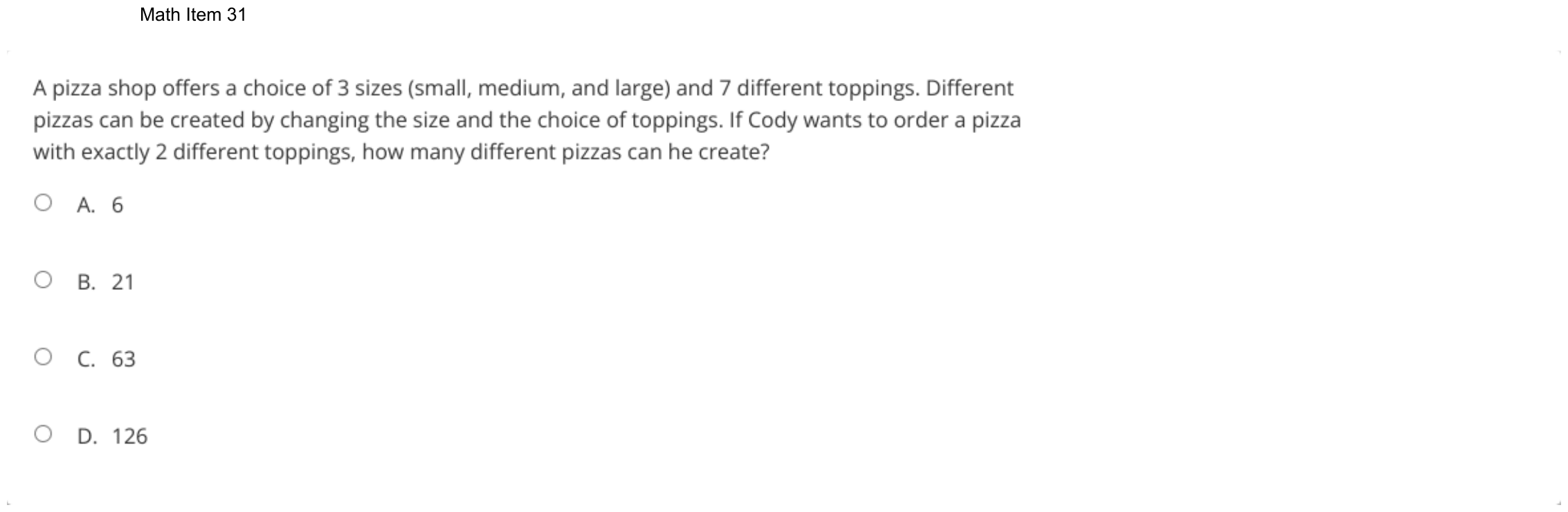
A pizza shop offers a choice of 3 sizes (small, medium, and large) and 7 different toppings. Different pizzas can be created by changing the size and the choice of toppings. If Cody wants to order a pizza with exactly 2 different toppings, how many different pizzas can he create?
- A6
- B21
- C63
- D126
Show the answer
Correct answer: C
Figure out how many different topping pairs are possible. Use 1, 2, 3, 4, 5, 6, 7 to represent the toppings, and create a list of possible pairs:
1,2; 1,3; 1,4; 1,5; 1,6; 1,7
2,3; 2,4; 2,5; 2,6; 2,7
3,4; 3,5; 3,6; 3,7
4,5; 4,6; 4,7
5,6; 5,7
6,7
So there are 21 different topping combinations for one pizza.
Since there are 3 pizza sizes, multiply the total number of combinations by 3 to get the total number of different pizzas Cody can create: .
Question analysis
Cody orders a pizza with exactly 2 of 7 toppings in one of 3 sizes, and students count how many different pizzas he could create. It tests counting combinations, where the order of the toppings does not matter, combined with a second choice. The challenge is to count every possible pizza exactly once.
- NYS standards
- 7.SP.8b sample spaces for compound events
- Grade level
- Grade 7 content, by NYS standard
- Compared with grade 7
- Above grade 7 In grade 7, compound events are usually ordered pairs, such as a coin with a number cube. Here an unordered pair of toppings is chosen from seven and then matched with three sizes, a combination count beyond typical grade 7 work.
- Estimated difficulty
- Hard: combines ideas, needs a plan, and has more than one tempting wrong answer.
- Thinking it demands
- Depth of knowledge 2, skills and concepts · mainly apply
- What makes it hard
- Combines ideas moderate
- Something you must already know minor
- Solution
- 3 steps
- Reading level
- Question and choices: about grade 8, 47 words.
- Students, last 30 days
- Not enough answers yet to show (it takes 10).
Why it is hard, traps and wrong answers (shows the answer)
Why it is hard
The question packs two counts into one sentence, each with its own trap. Order does not matter among the toppings, while the size multiplies every pair, and students tend to remember one of these and forget the other. Listing pairs systematically, each topping matched only with later ones, keeps the first count honest, and the stem’s “changing the size and the choice of toppings” is the reminder that size counts too.
Combines ideas moderate Working it out
Two counts are joined: the unordered pairs of toppings from 7, then the 3 sizes each pair can come in, and a mistake in either count changes the total. (Embretson, 1998; Daniel & Embretson, 2010)
Something you must already know minor Working it out
Students must know that a pizza with mushroom and onion is the same as one with onion and mushroom, so the ordered count 7 × 6 has to be halved. (Anderson & Krathwohl, 2001)
Strategy: Number the toppings 1 to 7, list each pair once by matching every topping only with higher-numbered ones, count the list, then bring in the choice of size.
Traps
- Stops one step early: A choice is a number from partway through the solution.
- Overlapping groups: Things in two groups at once are counted twice, or not subtracted.
The wrong answers, classified
A Numbers taken from the question (Hegarty, Mayer & Monk, 1995)
Multiplies the 3 sizes by the 2 toppings Cody wants, using the number of toppings on the pizza instead of the number of possible pairs.
B Stops one step early (King et al., 2004; Gierl et al., 2017)
Lists or counts the 21 pairs of toppings correctly, then stops without giving each pair its 3 possible sizes.
D Overlapping groups (King et al., 2004)
Counts ordered pairs, 7 × 6 = 42, so each pair of toppings appears twice, and then multiplies by the 3 sizes to reach 126.
Worked solution, step by step
Formulas used
- The counting principle
- m is the number of ways to make one choice, and n is the number of ways to make a second choice. Every first choice can go with every second choice, so you multiply. Here, every pair of toppings can come in every size.
- Pairs when order does not matter
- n is the number of items to choose from. There are n ways to pick a first item and n − 1 ways to pick a different second one. That counts each pair twice, once in each order. Dividing by 2 counts each pair once.
Sort out the question
Each of Cody’s pizzas has one size and exactly 2 different toppings. There are 3 sizes and 7 toppings. Pizzas differ by “changing the size and the choice of toppings.” So a small and a large with the same toppings are two different pizzas. You need to count every pizza once.
List the topping pairs
Order does not matter: onion with peppers is the same pizza as peppers with onion. So number the toppings 1 to 7, and pair each one only with bigger numbers. Then no pair shows up twice.
Topping Pairs with Pairs 1 2, 3, 4, 5, 6, 7 6 2 3, 4, 5, 6, 7 5 3 4, 5, 6, 7 4 4 5, 6, 7 3 5 6, 7 2 6 7 1 There are 21 different pairs of toppings.
Check the pairs with the formula
Use the pairs formula with 7 toppings:
Watch out: 7 × 6 = 42 counts every pair twice, once as 1 then 2 and once as 2 then 1. Keeping 42 leads to , choice D.
Bring in the sizes
Each of the 21 topping pairs can come in any of the 3 sizes. Use the counting principle:
Watch out: stopping at 21 leaves out the sizes, which gives choice B. Choice A, 6, multiplies the 3 sizes by the 2 toppings on one pizza. That does not count pizzas.
Give the answer
There are 21 topping pairs, and each one comes in 3 sizes. Cody can create 63 different pizzas. So the answer is C, 63.
Check your answer
Count one size at a time. A small pizza can have any of the 21 pairs, so there are 21 small pizzas. There are also 21 medium and 21 large ones: . That is more than the 21 pairs but fewer than 126, so it is reasonable.
More questions like this
The original DOE question
Question 5 of 6
2018 Test B Math, question 42Question
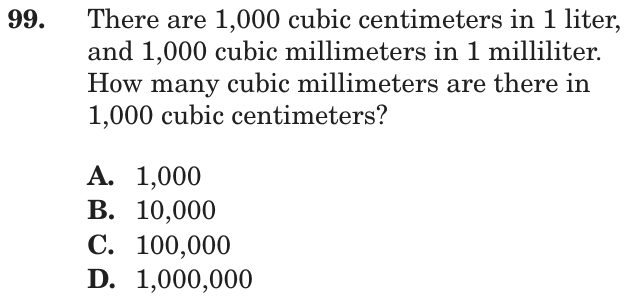
There are 1,000 cubic centimeters in 1 liter, and 1,000 cubic millimeters in 1 milliliter. How many cubic millimeters are there in 1,000 cubic centimeters?
- A1,000
- B10,000
- C100,000
- D1,000,000
Show the answer
Correct answer: D
If 1 L = 1,000 cu cm, then 1 L = 1,000 mL. Set up a proportion, letting = the amount of cubic millimeters in 1,000 cubic centimeters.
Solve for : 1,000,000 cubic millimeters are in 1,000 cubic centimeters.
Question analysis
The question gives two metric facts, cubic centimeters per liter and cubic millimeters per milliliter, and asks how many cubic millimeters are in 1,000 cubic centimeters. It tests chaining unit conversions with volume units. The hard part is that the two facts do not connect without a link the question leaves out.
- NYS standards
- 6.RP.3d converting measurement units
- Grade level
- Grade 6 content, by NYS standard
- Compared with grade 7
- Above grade 7 Grade 6 and 7 students convert units with one given factor. This needs three linked conversions, one using a fact the question does not state, and involves cubic units, which most grade 7 students find unfamiliar.
- Estimated difficulty
- Hard: combines ideas, needs a plan, and has more than one tempting wrong answer.
- Thinking it demands
- Depth of knowledge 2, skills and concepts · mainly apply
- What makes it hard
- Something you must already know moderate
- Many steps moderate
- Solution
- 3 steps
- Reading level
- Question and choices: about grade 13, 20 words.
- Corrected from the DOE handbook
- The units in the explanation’s proportion were corrected.
- Students, last 30 days
- Not enough answers yet to show (it takes 10).
Why it is hard, traps and wrong answers (shows the answer)
Why it is hard
The question gives two conversion facts that do not connect until the student supplies the link between liters and milliliters. Students who instead reach for 1 centimeter = 10 millimeters often scale a volume like a length or an area and land short by a factor of 10 or 100. Writing the unit at every step, so the units cancel, keeps both factors of 1,000 in view.
Something you must already know moderate Working it out
The chain needs 1 liter = 1,000 milliliters, which the stem never states, yet it is the only link between its two conversion facts. (Anderson & Krathwohl, 2001)
Many steps moderate Working it out
Three conversions in a row, cubic centimeters to liters, liters to milliliters and milliliters to cubic millimeters, multiply out to 1,000 × 1,000. (Daniel & Embretson, 2010; Enright, Morley & Sheehan, 2002)
Strategy: Build a chain from cubic centimeters to liters, liters to milliliters, and milliliters to cubic millimeters, writing the units at every step so they cancel.
Traps
- Units or scale: The answer is wanted in other units, or a rate or scale must be converted first.
- Stops one step early: A choice is a number from partway through the solution.
The wrong answers, classified
A Stops one step early (King et al., 2004; Gierl et al., 2017)
Converts 1,000 cubic centimeters to 1 liter, or 1,000 milliliters, and stops before the last step from milliliters to cubic millimeters.
B Units or scale (King et al., 2004)
Uses the length factor 1 cm = 10 mm for cubic units, multiplying 1,000 by 10 instead of by 10 × 10 × 10.
C Units or scale (King et al., 2004)
Squares the length factor, treating 1 cubic centimeter as 100 cubic millimeters, which is right for area but not for volume.
What was corrected from the DOE handbook, and why
- Explanation: The handbook’s proportion is 1,000 cu mm / 1 L = x cu mm / 1,000 cu mm. But 1,000 cubic millimeters make 1 milliliter, not 1 liter, and the second denominator should be the 1,000 mL that equal 1,000 cubic centimeters. The site uses 1,000 cu mm / 1 mL = x cu mm / 1,000 mL, which gives x = 1,000,000 cubic millimeters.
Worked solution, step by step
Formulas used
- Volume of a cube
- V is the volume, the space inside the cube. s is the length of one side. A cube has the same length, width and height, so you multiply the side by itself three times.
Sort out what you know
You are told two facts. 1 liter (L) is 1,000 cubic centimeters (cu cm). 1 milliliter (mL) is 1,000 cubic millimeters (cu mm). You need the number of cu mm in 1,000 cu cm.
One fact is missing. 1 liter is 1,000 milliliters. The word milli means one thousandth.
Change cubic centimeters to liters
The first fact says 1,000 cu cm is exactly 1 liter. So the amount in the question is 1 liter of space.
Change liters to milliliters
One liter is 1,000 milliliters. So 1,000 cu cm is the same as 1,000 mL.
Watch out: you are not done yet. The question asks for cubic millimeters. Stopping at 1,000 gives choice A.
Change milliliters to cubic millimeters
Each milliliter is 1,000 cu mm. There are 1,000 milliliters, so multiply.
So 1,000 cu cm is 1,000,000 cu mm. The answer is D, 1,000,000.
Check your answer
Use the cube formula. A cube 1 cm on each side is 10 mm on each side. Its volume is cu mm. So 1,000 cu cm is cu mm. Using only one 10 gives choice B. Using two 10s gives choice C.
More questions like this
The original DOE question
Question 6 of 6
2026 Practice Test C Math, question 10Question
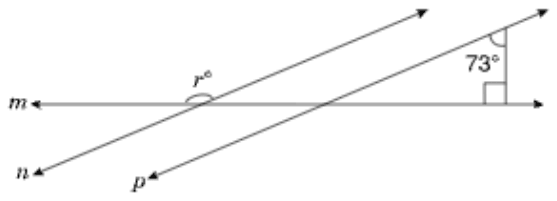
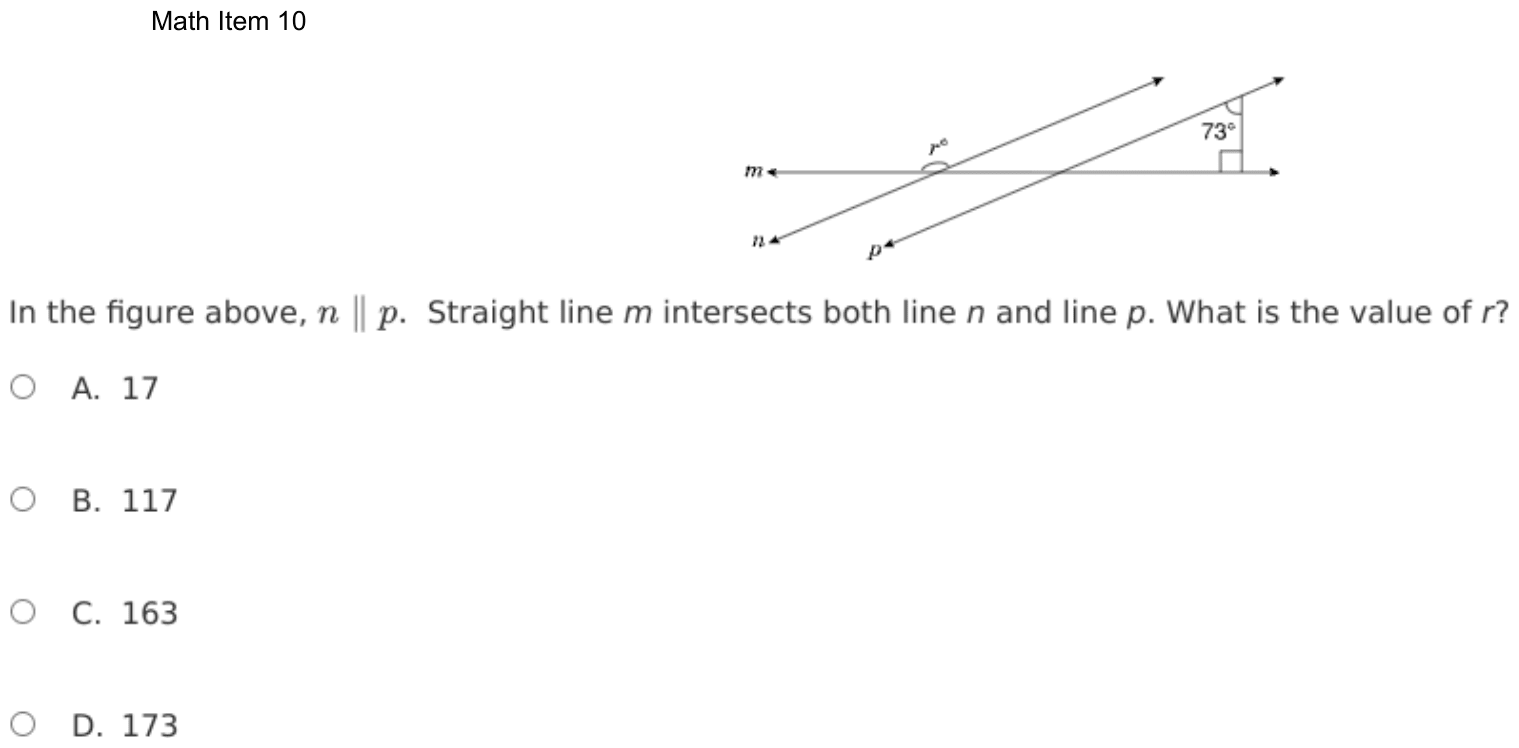
In the figure above, . Straight line m intersects both line n and line p. What is the value of r?
- A17
- B117
- C163
- D173
Show the answer
Correct answer: C
The triangle formed by line p, line m, and the line segment connecting the two contains a 73° angle, a right angle (90°), and a missing angle measuring x°. The sum of the interior angles of a triangle is 180°, so begin by finding the value of x:
Line m is a straight line, so it has a measure of 180°. The 17° angle from the triangle and the adjacent angle outside the triangle are supplementary, so they have a sum of 180°. Let s represent the measure of the adjacent angle outside the triangle. The value of s can be determined by subtracting:
Given that n and p are parallel lines and that they have been cut by a transversal, line m, then corresponding angles are congruent. Angles r and s are corresponding angles, so the value of r is congruent to the value of s, which is 163°.
Question analysis
Two parallel lines, n and p, cross a straight line m, and a segment drawn at a right angle to m forms a small triangle with lines m and p, where a 73° angle is marked. Students find the angle r at line n. It combines a triangle's angle sum, a straight angle and parallel lines, and the angle wanted sits away from the marked ones.
- NYS standards
- Grade level
- Grade 8 content, by NYS standard
- Compared with grade 7
- Above grade 7 Grade 7 angle problems use supplementary, vertical and adjacent angles. This one also needs the angle sum of a triangle and the angles formed by parallel lines and a transversal, grade 8 facts, chained across a busy figure.
- Estimated difficulty
- Hard: combines ideas, needs a plan, and has more than one tempting wrong answer.
- Thinking it demands
- Depth of knowledge 2, skills and concepts · mainly apply
- What makes it hard
- Reading a figure, table or graph moderate
- Combines ideas moderate
- Something you must already know minor
- Solution
- 3 steps
- Reading level
- Question and choices: about grade 3, 21 words.
- Students, last 30 days
- Not enough answers yet to show (it takes 10).
Why it is hard, traps and wrong answers (shows the answer)
Why it is hard
Each fact needs only a subtraction, but the student has to plan a route from the 73° angle at line p over to r at line n. The first number the route gives, the triangle's 17° angle, is listed, and it is the acute partner of r rather than r itself. The figure helps here: r is drawn plainly obtuse, and 163 is also 90 + 73, the triangle's exterior angle, which confirms it.
Reading a figure, table or graph moderate Understanding the question
The 73° sits between line p and the vertical segment, not between p and m, and r is the obtuse angle above m on the left of line n, far from every marked angle. (Lesh, Post & Behr, 1987; Kirsch & Mosenthal, 1990)
Combines ideas moderate Working it out
Three facts chain together: the triangle's angles sum to 180°, the angles along straight line m sum to 180°, and corresponding angles at the parallel lines n and p are equal. (Embretson, 1998; Daniel & Embretson, 2010)
Something you must already know minor Working it out
The angle pairs formed by a line crossing two parallel lines are a grade 8 topic, and the question uses them without naming them. (Anderson & Krathwohl, 2001)
Strategy: Find the third angle of the right triangle, use the straight line m to get the angle beside it, then carry that angle over to line n using the parallel lines.
Traps
- Stops one step early: A choice is a number from partway through the solution.
- An arithmetic slip: The right method with a plausible arithmetic error: a digit, a place value or a times-table fact.
The wrong answers, classified
A Stops one step early (King et al., 2004; Gierl et al., 2017)
Finds the triangle's third angle, 180 − 90 − 73 = 17, and stops, though r is the obtuse angle next to the 17° angle, not that angle itself.
B Little reason to choose it (Haladyna & Downing, 1993; Rodriguez, 2005)
No angle fact in the figure gives 117; even 180 − 73 is 107, so this choice mostly catches guesses at an obtuse angle.
D An arithmetic slip (Junker & Sijtsma, 2001)
Finds the 17° angle and subtracts it from 180 but borrows without reducing the 8, so 180 − 17 comes out as 173.
Worked solution, step by step
Formulas used
- Angles of a triangle
- a, b and c are the three angles inside any triangle. They always add up to 180°. If you know two of them, subtract their sum from 180° to find the third.
- Angles on a straight line
- a and b are two angles side by side on a straight line. Together they make a half turn, which is 180°. Use it to find the angle next to one you already know.
- Corresponding angles
- The symbol ∥ means is parallel to. When line m crosses two parallel lines, it makes the same angles at each crossing. Angles in the same position at the two crossings are called corresponding angles. They are equal.
Sort out the question
Lines n and p are parallel, and line m crosses both. Near line p, a straight-up segment meets line m. The small square shows a right angle, 90°. Line p, line m and that segment make a small triangle. Its top angle is 73°.
You need r, the wide angle where line n crosses line m.
Find the triangle’s third angle
The third angle is where line p crosses line m. Call it x. Use the triangle rule:
So that angle is 17°.
Watch out: this is not r. Stopping here gives choice A, 17.
Use the straight line m
The 17° angle sits above line m, on the right of line p. Beside it, on the left of line p, is a wide angle. Call it s. The two angles fill the straight line m, so they add to 180°:
So s is 163°.
Watch out: borrow carefully. 180 − 17 is 163, not 173, choice D.
Carry the angle to line n
Angle s is above line m and to the left of line p. Angle r is above line m and to the left of line n. They are in the same position, so they are corresponding angles. Since n and p are parallel:
So the answer is C, 163.
Check your answer
Look at the figure. Angle r is wider than a right angle, so it must be more than 90°. That rules out 17. Also, the narrow angle beside r, on the right of line n, matches the 17° angle at line p. And , as it should on a straight line.
More questions like this
The original DOE question