3 English and 3 math
Here are 6 random questions to try. Takers earning below 75% are unlikely to receive an offer. You have 1 minute 48 seconds per question on the real exam.
Question 1 of 6
2026 Practice Test A English, question 18Passage Excerpt from A Voice in the Wilderness
Excerpt from A Voice in the Wilderness
by Grace Livingston Hill
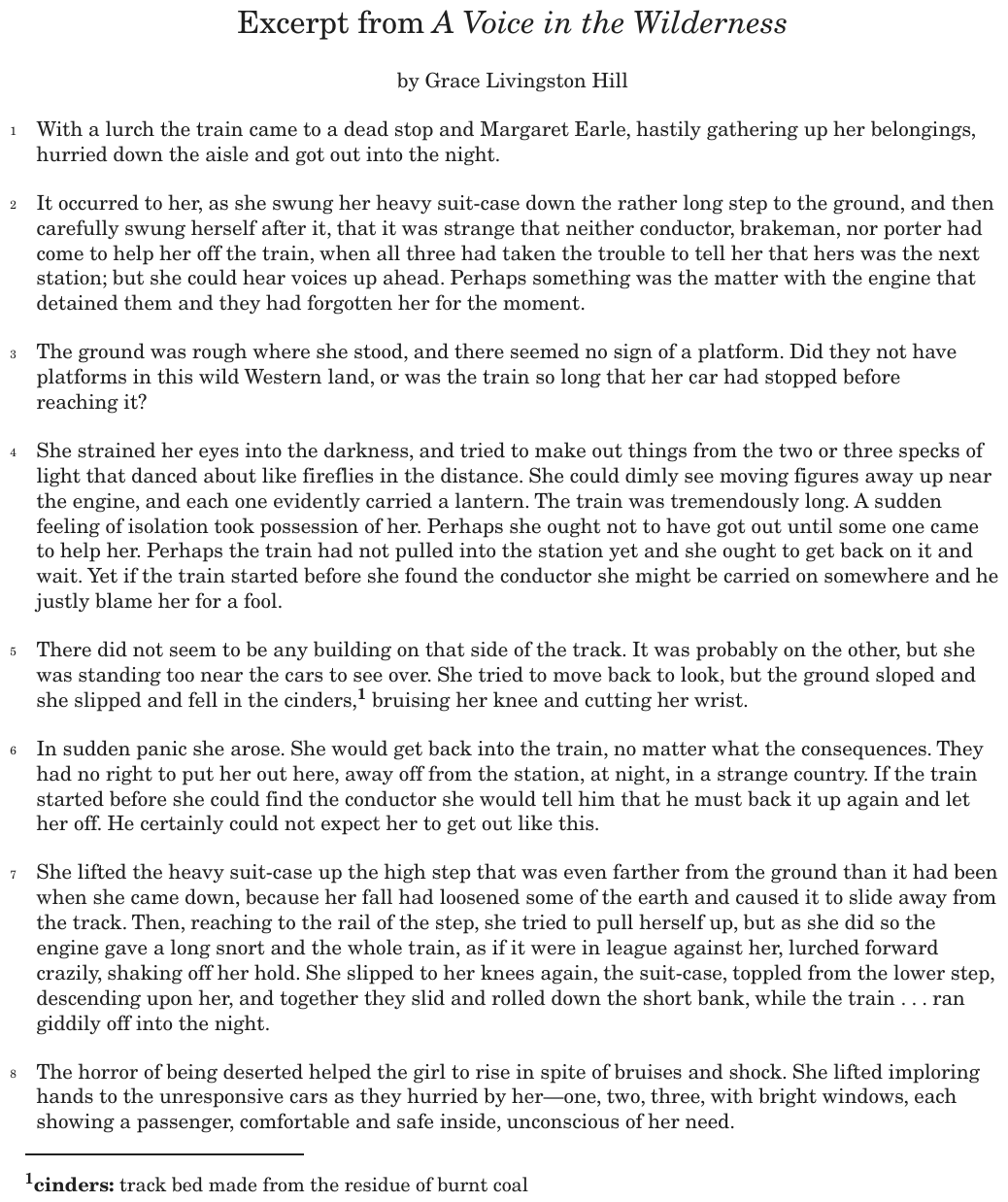
With a lurch the train came to a dead stop and Margaret Earle, hastily gathering up her belongings, hurried down the aisle and got out into the night.
It occurred to her, as she swung her heavy suit-case down the rather long step to the ground, and then carefully swung herself after it, that it was strange that neither conductor, brakeman, nor porter had come to help her off the train, when all three had taken the trouble to tell her that hers was the next station; but she could hear voices up ahead. Perhaps something was the matter with the engine that detained them and they had forgotten her for the moment.
The ground was rough where she stood, and there seemed no sign of a platform. Did they not have platforms in this wild Western land, or was the train so long that her car had stopped before reaching it?
She strained her eyes into the darkness, and tried to make out things from the two or three specks of light that danced about like fireflies in the distance. She could dimly see moving figures away up near the engine, and each one evidently carried a lantern. The train was tremendously long. A sudden feeling of isolation took possession of her. Perhaps she ought not to have got out until some one came to help her. Perhaps the train had not pulled into the station yet and she ought to get back on it and wait. Yet if the train started before she found the conductor she might be carried on somewhere and he justly blame her for a fool.
There did not seem to be any building on that side of the track. It was probably on the other, but she was standing too near the cars to see over. She tried to move back to look, but the ground sloped and she slipped and fell in the cinders, bruising her knee and cutting her wrist.
In sudden panic she arose. She would get back into the train, no matter what the consequences. They had no right to put her out here, away off from the station, at night, in a strange country. If the train started before she could find the conductor she would tell him that he must back it up again and let her off. He certainly could not expect her to get out like this.
She lifted the heavy suit-case up the high step that was even farther from the ground than it had been when she came down, because her fall had loosened some of the earth and caused it to slide away from the track. Then, reaching to the rail of the step, she tried to pull herself up, but as she did so the engine gave a long snort and the whole train, as if it were in league against her, lurched forward crazily, shaking off her hold. She slipped to her knees again, the suit-case, toppled from the lower step, descending upon her, and together they slid and rolled down the short bank, while the train . . . ran giddily off into the night.
The horror of being deserted helped the girl to rise in spite of bruises and shock. She lifted imploring hands to the unresponsive cars as they hurried by her—one, two, three, with bright windows, each showing a passenger, comfortable and safe inside, unconscious of her need.
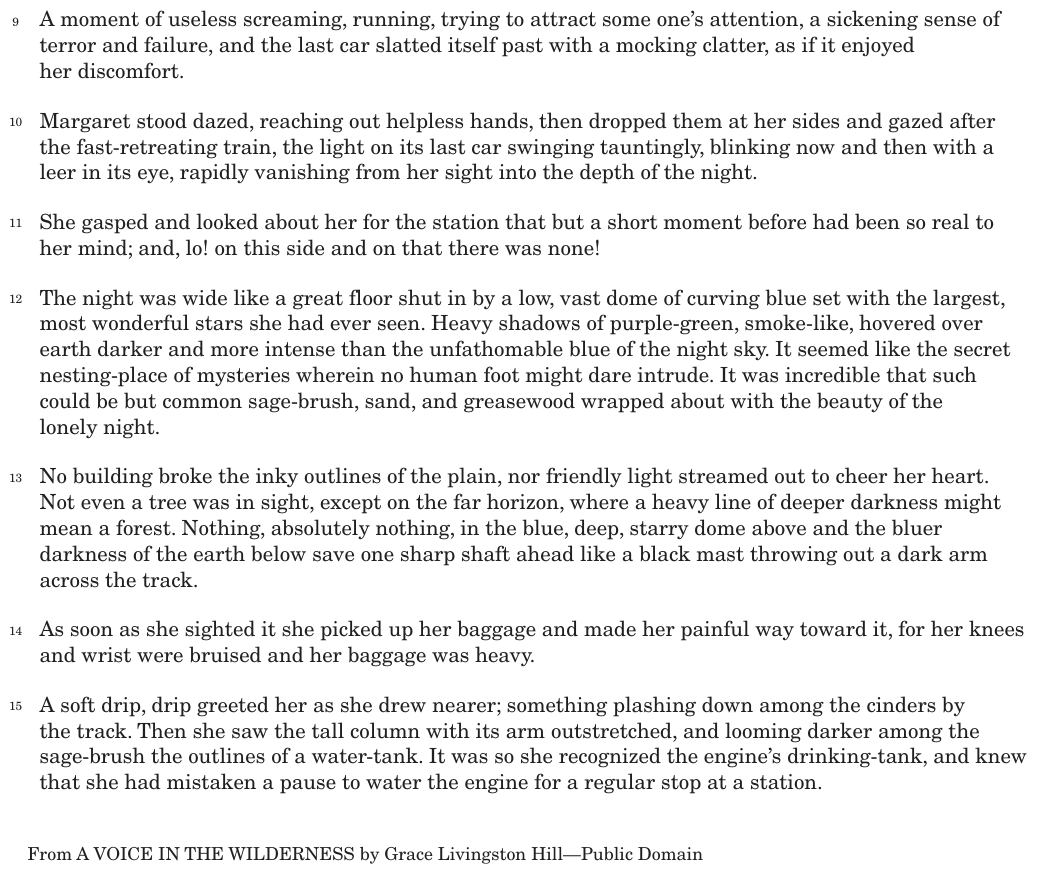
A moment of useless screaming, running, trying to attract some one’s attention, a sickening sense of terror and failure, and the last car slatted itself past with a mocking clatter, as if it enjoyed her discomfort.
Margaret stood dazed, reaching out helpless hands, then dropped them at her sides and gazed after the fast-retreating train, the light on its last car swinging tauntingly, blinking now and then with a leer in its eye, rapidly vanishing from her sight into the depth of the night.
She gasped and looked about her for the station that but a short moment before had been so real to her mind; and, lo! on this side and on that there was none!
The night was wide like a great floor shut in by a low, vast dome of curving blue set with the largest, most wonderful stars she had ever seen. Heavy shadows of purple-green, smoke-like, hovered over earth darker and more intense than the unfathomable blue of the night sky. It seemed like the secret nesting-place of mysteries wherein no human foot might dare intrude. It was incredible that such could be but common sage-brush, sand, and greasewood wrapped about with the beauty of the lonely night.
No building broke the inky outlines of the plain, nor friendly light streamed out to cheer her heart. Not even a tree was in sight, except on the far horizon, where a heavy line of deeper darkness might mean a forest. Nothing, absolutely nothing, in the blue, deep, starry dome above and the bluer darkness of the earth below save one sharp shaft ahead like a black mast throwing out a dark arm across the track.
As soon as she sighted it she picked up her baggage and made her painful way toward it, for her knees and wrist were bruised and her baggage was heavy.
A soft drip, drip greeted her as she drew nearer; something plashing down among the cinders by the track. Then she saw the tall column with its arm outstretched, and looming darker among the sage-brush the outlines of a water-tank. It was so she recognized the engine’s drinking-tank, and knew that she had mistaken a pause to water the engine for a regular stop at a station.
cinders: track bed made from the residue of burnt coal
From A VOICE IN THE WILDERNESS by Grace Livingston Hill—Public Domain
Question
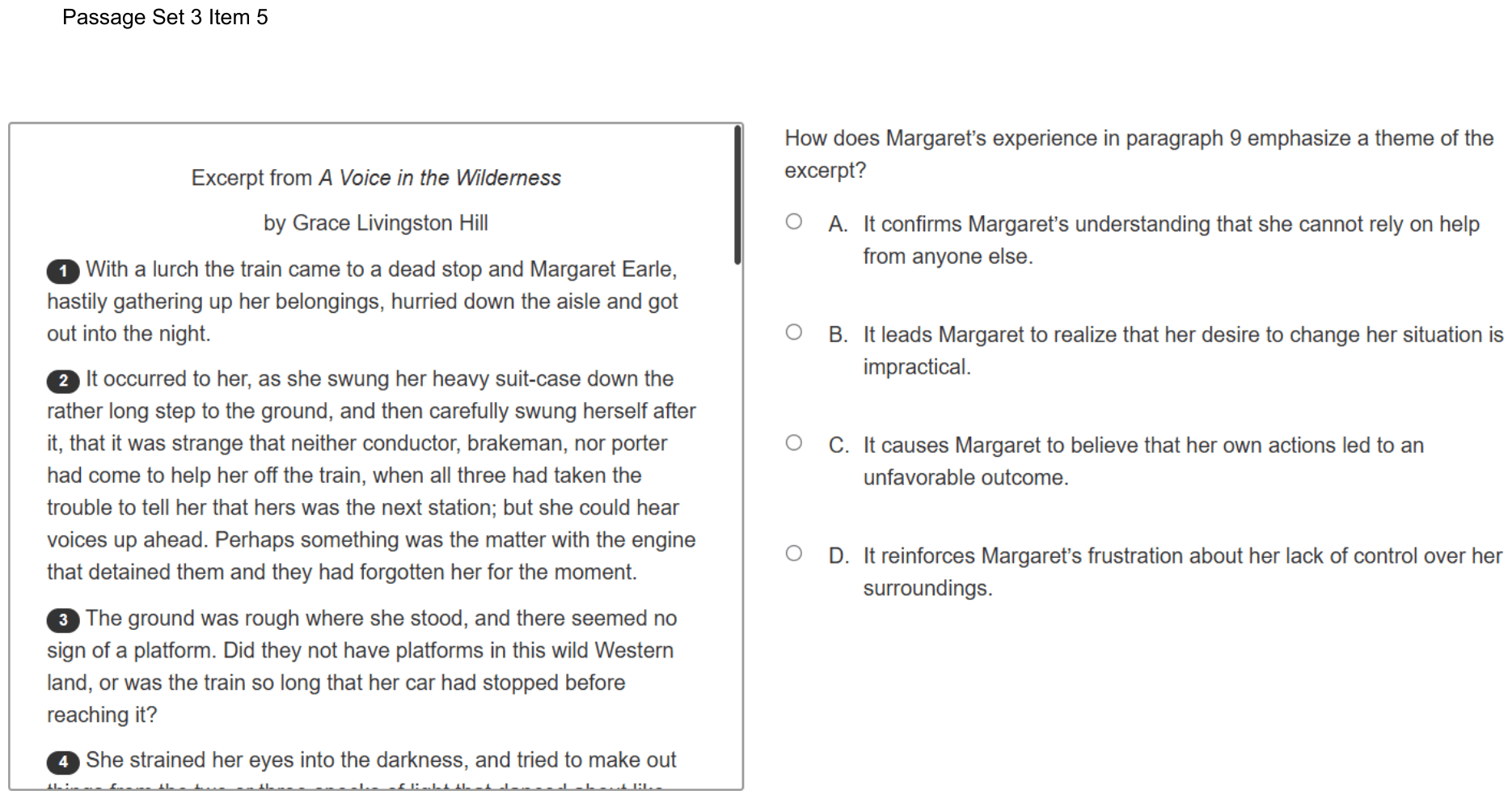
How does Margaret’s experience in paragraph 9 emphasize a theme of the excerpt?
- AIt confirms Margaret’s understanding that she cannot rely on help from anyone else.
- BIt leads Margaret to realize that her desire to change her situation is impractical.
- CIt causes Margaret to believe that her own actions led to an unfavorable outcome.
- DIt reinforces Margaret’s frustration about her lack of control over her surroundings.
Show the answer
Correct answer: A
The question asks about the relationship between the theme and paragraph 9, where Margaret desperately tries to get someone on the train to notice her.
A. CORRECT. One important theme of this excerpt concerns Margaret’s willingness to take action to ensure that she reaches her destination. This determination, described in Option A, is why she gathers her belongings together without help, gets off the train without being assisted by employees, and then attempts to climb back on while the train employees are busy examining the engine.
B. Incorrect. While the narrator describes her screaming as useless, she does not feel that her efforts overall are useless, and she does not give up until paragraph 10.
C. Incorrect. While Margaret is feeling a sense of “failure” in paragraph 9, she does not condemn herself as the train moves away.
D. Incorrect. Margaret expresses “terror” in paragraph 9 over being unable to catch someone’s attention, not frustration about her lack of control over her surroundings.
Question analysis
This theme question asks how Margaret’s experience in paragraph 9 of A Voice in the Wilderness, as she screams and runs while the train pulls away, emphasizes a theme of the excerpt. It is a lightly reworded version of an earlier handbook question. Every choice describes a believable reaction to being left behind, so the answer depends on the excerpt’s larger pattern.
- Grade level
- Grade 8 reading and task
- Compared with grade 7
- Above grade 7 Typical grade 7 theme questions trace a given theme through a text. Here students must decide which theme one frantic paragraph supports, and all four choices describe reactions that fit the scene, so the decision draws on the whole excerpt.
- Estimated difficulty
- Among the hardest on the SHSAT: a non-obvious approach, heavy reading, or a well-hidden trap.
- Thinking it demands
- Depth of knowledge 3, strategic thinking · mainly analyze
- What makes it hard
- Reading between the lines major
- Evidence in several places moderate
- Evidence
- Answered from the whole text
- Reading level
- Passage: about grade 8, 981 words; question and choices: about grade 10, 65 words.
- Students, last 30 days
- Not enough answers yet to show (it takes 10).
Why it is hard, traps and wrong answers (shows the answer)
Why it is hard
Each choice names a feeling a stranded traveler might have, and two lean on the paragraph’s own words, “useless” and “failure,” so the paragraph alone cannot decide it. Paragraph 9 must be read as the last link in a chain of trainmen, passengers and a departing train that all leave her to herself. Students who judge from that one paragraph often decide she has given up, though she soon picks up her bags and walks toward the dark shaft by the track.
Reading between the lines major Working it out
The theme is never stated; it must be drawn from paragraph 9’s cries that no one answers and from the passengers “comfortable and safe inside, unconscious of her need” in paragraph 8. (Graesser, Singer & Trabasso, 1994; Kintsch, 1998)
Evidence in several places moderate Working it out
The pattern begins in paragraph 2, when no trainman helps her off, and runs through the train lurching away “as if it were in league against her” in paragraph 7. (Kirsch & Mosenthal, 1990; Gorin & Embretson, 2006)
Strategy: Sum up in a phrase what keeps happening to Margaret from the start of the excerpt to its end, then check which choice paragraph 9’s own words most clearly add to.
Traps
- Too broad or too strong: A choice overstates, generalizes, or uses absolute words the text does not support.
- Wrong tone or attitude: Misjudges the tone, attitude or point of view, such as reading admiration as criticism, or taking a character's or subject's feelings for the author's.
The wrong answers, classified
B Too broad or too strong (King et al., 2004)
Stretches the “useless screaming” of one moment into a judgment that changing her situation is impractical, though she soon gathers her bags and sets off toward the shaft ahead.
C Reads too much in (Graesser, Singer & Trabasso, 1994)
Turns the “sense of terror and failure” into self-blame, though Margaret never says that her own choice to step off the train caused her trouble.
D Wrong tone or attitude (Graesser, Singer & Trabasso, 1994)
Fits the indifferent train, but names frustration over control where paragraph 9 stresses terror at being ignored by everyone aboard.
Working it out, step by step
Figure out what the question asks
This asks about a theme: a big idea a story keeps coming back to. How does what happens in paragraph 9 point to a theme? The right choice should fit a pattern across the whole excerpt.
Read paragraph 9
Paragraph 9 describes “A moment of useless screaming, running, trying to attract some one’s attention, a sickening sense of terror and failure.” Margaret screams and runs, trying to get someone to notice her. No one does. The last car rolls past “as if it enjoyed her discomfort.”
Find the same thing earlier
This is not the first time. In paragraph 2, none of the workers “had come to help her off the train.” In paragraph 8, the passengers sit “comfortable and safe inside, unconscious of her need.” That means they don’t know she needs help. Paragraph 9 is one more time when nobody comes. She will have to count on herself.
Check each choice
- A fits. Her cries go unanswered, just as before. She cannot rely on anyone else.
- B does not fit. Impractical means not sensible or workable. Her screaming fails, but she never decides that trying to change things is pointless. In paragraph 14 she “picked up her baggage” and set off again.
- C does not fit. She feels “failure,” but she never blames herself.
- D does not fit. The paragraph shows terror at being ignored, not frustration about having no control over her surroundings.
Choose the answer
Paragraph 9 adds one more moment where no one helps Margaret. So the answer is A.
Why this answer and not the closest wrong one
B is the closest wrong choice, because paragraph 9 calls her screaming “useless.” But one failed moment does not mean she gives up. Soon she takes her bags and walks toward the tall dark shape ahead. What stays true from paragraph 2 to paragraph 9 is that no one helps her. That is A.
More questions like this
The original DOE question
The passage “Excerpt from A Voice in the Wilderness” as printed (pages 128–129)
Question 2 of 6
2026 Practice Test B English, question 45Passage The End of an Era
The End of an Era
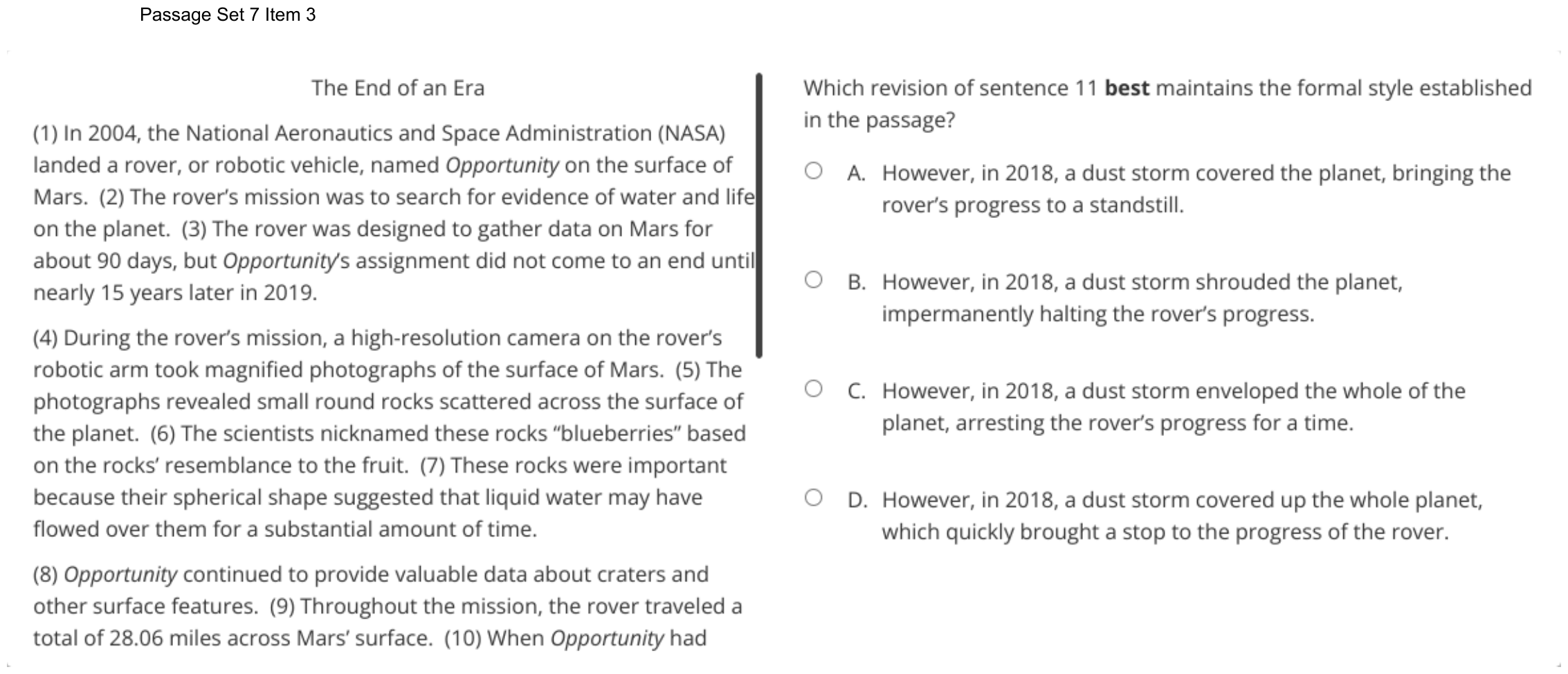
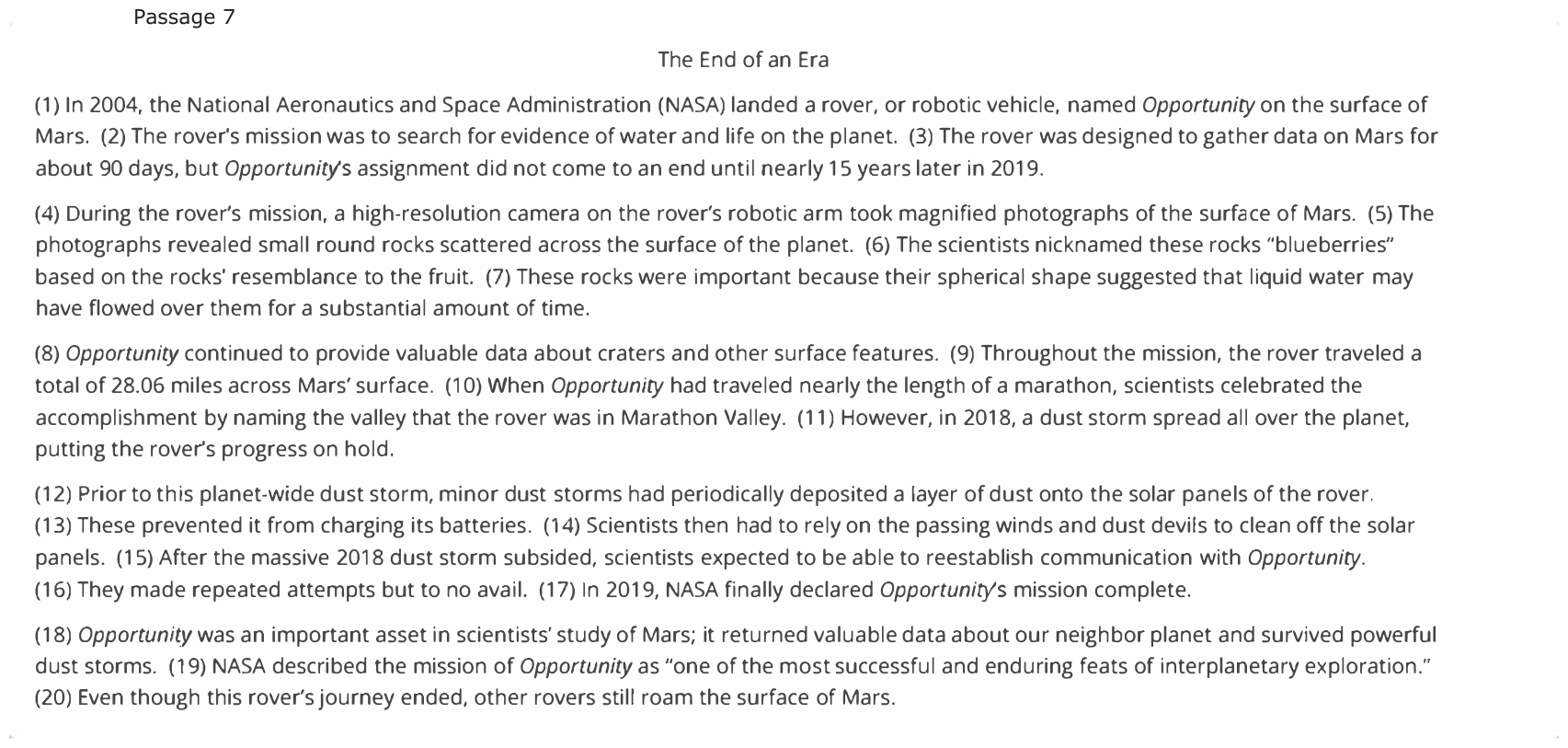
(1) In 2004, the National Aeronautics and Space Administration (NASA) landed a rover, or robotic vehicle, named Opportunity on the surface of Mars. (2) The rover’s mission was to search for evidence of water and life on the planet. (3) The rover was designed to gather data on Mars for about 90 days, but Opportunity’s assignment did not come to an end until nearly 15 years later in 2019.
(4) During the rover’s mission, a high-resolution camera on the rover’s robotic arm took magnified photographs of the surface of Mars. (5) The photographs revealed small round rocks scattered across the surface of the planet. (6) The scientists nicknamed these rocks “blueberries” based on the rocks’ resemblance to the fruit. (7) These rocks were important because their spherical shape suggested that liquid water may have flowed over them for a substantial amount of time.
(8) Opportunity continued to provide valuable data about craters and other surface features. (9) Throughout the mission, the rover traveled a total of 28.06 miles across Mars’ surface. (10) When Opportunity had traveled nearly the length of a marathon, scientists celebrated the accomplishment by naming the valley that the rover was in Marathon Valley. (11) However, in 2018, a dust storm spread all over the planet, putting the rover’s progress on hold.
(12) Prior to this planet-wide dust storm, minor dust storms had periodically deposited a layer of dust onto the solar panels of the rover. (13) These prevented it from charging its batteries. (14) Scientists then had to rely on the passing winds and dust devils to clean off the solar panels. (15) After the massive 2018 dust storm subsided, scientists expected to be able to reestablish communication with Opportunity. (16) They made repeated attempts but to no avail. (17) In 2019, NASA finally declared Opportunity’s mission complete.
(18) Opportunity was an important asset in scientists’ study of Mars; it returned valuable data about our neighbor planet and survived powerful dust storms. (19) NASA described the mission of Opportunity as “one of the most successful and enduring feats of interplanetary exploration.” (20) Even though this rover’s journey ended, other rovers still roam the surface of Mars.
Question
Which revision of sentence 11 best maintains the formal style established in the passage?
- AHowever, in 2018, a dust storm covered the planet, bringing the rover’s progress to a standstill.
- BHowever, in 2018, a dust storm shrouded the planet, impermanently halting the rover’s progress.
- CHowever, in 2018, a dust storm enveloped the whole of the planet, arresting the rover’s progress for a time.
- DHowever, in 2018, a dust storm covered up the whole planet, which quickly brought a stop to the progress of the rover.
Show the answer
Correct answer: A
The question asks for the revision of sentence 11 that best maintains the formal style established in the passage.
A. CORRECT. This sentence uses clear and formal writing throughout. The phrase “covered the planet” is accurate and formal without being overly poetic, and “standstill” is a precise word for putting something “on hold,” as expressed by the original sentence, while maintaining the formal style of the passage.
B. Incorrect. Although the sentence is formal in style, the word “shrouded” is overly poetic, and the phrase “impermanently halting” is too stilted and formal for the style and tone of the passage.
C. Incorrect. Although the sentence is formal in style, the words “enveloped” and “arresting” are overly poetic, especially when used in the same sentence, and the phrases “the whole of the planet” and “for a time” are needlessly wordy and imprecise, compared with the formal scientific language of the passage.
D. Incorrect. The phrases “covered up the whole planet” and “quickly brought a stop to the progress of the rover” are less formal and unnecessarily wordy, compared with the formal style established by the rest of the passage.
Question analysis
This style question asks which revision of sentence 11, about the 2018 dust storm that covered Mars and stopped the Opportunity rover, best maintains the formal style of the passage. All four versions say the same thing, so students must compare word choice and wordiness and decide which one reads like the rest of the passage.
- Grade level
- Grade 8 reading and task
- Compared with grade 7
- Above grade 7 Keeping a formal style is grade 7 writing work, usually tested by spotting slang or casual wording. Here all four revisions keep the meaning and differ in register by degrees, so students must judge the passage's own style closely, more than typical.
- Estimated difficulty
- Hard: combines ideas, needs a plan, and has more than one tempting wrong answer.
- Thinking it demands
- Depth of knowledge 2, skills and concepts · mainly evaluate
- What makes it hard
- Something you must already know moderate
- Every choice must be checked moderate
- Hard words minor
- Evidence
- Answered from one sentence or line
- Reading level
- Passage: about grade 11, 337 words; question and choices: about grade 9, 80 words.
- Students, last 30 days
- Not enough answers yet to show (it takes 10).
Why it is hard, traps and wrong answers (shows the answer)
Why it is hard
The question turns on what “formal” means. Many students equate it with impressive words and choose the revision with “enveloped” and “arresting,” or the one with “shrouded,” missing that both are more poetic than a passage that reports dates and distances. The casual revision is easy to reject, so the real test is preferring the plainest formal sentence to the grandest one.
Something you must already know moderate Working it out
Students must know that a formal informational style is plain and precise, so words such as “shrouded,” “enveloped” and “arresting” are too ornate for a passage that reports miles and dates. (Anderson & Krathwohl, 2001)
Every choice must be checked moderate Choosing the answer
All four revisions keep the meaning of sentence 11 and differ only in register and length, so each must be heard against the passage’s voice rather than checked for errors. (Embretson & Wetzel, 1987)
Hard words minor Understanding the question
“Impermanently,” “shrouded” and “arresting,” in its sense of stopping, are uncommon words, and students must judge how they sound in the passage, not only what they mean. (Perfetti, 2007; Freedle & Kostin, 1993)
Strategy: Reread a few sentences around sentence 11 to hear the passage's voice, then check each revision for casual phrasing, needless words and words that would sound out of place in that voice.
Traps
- Wordy, vague or informal: A revision is grammatical but wordy, imprecise or too casual for the passage.
The wrong answers, classified
B Wordy, vague or informal (Connors & Lunsford, 1988)
Equates formal with elevated, so “shrouded” and “impermanently halting” seem best, though both are stilted and poetic beside the passage’s plain reporting of facts.
C Wordy, vague or informal (Connors & Lunsford, 1988)
Avoids casual words, but “enveloped” and “arresting” are poetic, and “the whole of the planet” and “for a time” add words the plain version does without.
D Wordy, vague or informal (Connors & Lunsford, 1988)
Keeps the meaning, but the casual “covered up” and the roundabout “brought a stop to the progress of the rover” make it wordier and less formal.
Working it out, step by step
Figure out what the question asks
This question asks which version of sentence 11 keeps the passage’s formal style. Formal writing is serious and clear, like a textbook. It avoids slang and casual words. But formal doesn’t mean fancy. Formal writing about science uses plain, exact words. For example, The game got called off is casual. The contest was halted indefinitely is too fancy. The game was canceled is formal and plain.
Hear the passage’s voice
Sentence 9 says “the rover traveled a total of 28.06 miles across Mars’ surface.” Sentence 12 says minor storms “deposited a layer of dust onto the solar panels.” The words are exact and plain. The passage gives dates and numbers. It doesn’t paint poetic pictures.
Check each revision
- A is right. “Covered the planet” is plain and exact. A standstill is a complete stop, a clear way to say “on hold.”
- B is wrong. “Shrouded” is poetic. A shroud is a cloth wrapped around a body. “Impermanently halting” sounds stiff and odd.
- C is wrong. “Enveloped” and “arresting” are fancy words. Here arresting means stopping. “The whole of the planet” and “for a time” add extra words.
- D is wrong. “Covered up” is casual. “Brought a stop to the progress of the rover” is wordy, or longer than it needs to be.
Watch out: Many students think formal means big words, so they choose C. But a passage of dates and miles calls for plain words.
Choose the answer
Only A is both formal and plain, like the rest of the passage. So the answer is A: “However, in 2018, a dust storm covered the planet, bringing the rover’s progress to a standstill.”
Why this answer and not the closest wrong one
C is the closest wrong answer, because it has no slang and sounds serious. But “enveloped” and “arresting” are poetic, and “the whole of the planet” is wordy. The passage reports facts in plain words. A says the same thing in the plainest formal way.
More questions like this
The original DOE question
The passage “The End of an Era” as printed (page 60)
Question 3 of 6
2024 Test B English, question 40Passage Invention of the Telegraph
Samuel Morse, an American inventor, is credited with creating the electronic telegraph, a communication device that allows users to send messages using a system of short and long pulses that represent letters, numbers, and punctuation. In 1843 the United States Congress passed the Telegraph Bill, which provided Morse with the funds to build an electric telegraph system.
Invention of the Telegraph
Earlier Signal Systems
Long before Samuel F. B. Morse electrically transmitted his famous message “What hath God wrought?” from Washington to Baltimore on May 24, 1844, there were signaling systems that enabled people to communicate over distances. Most were visual or “semaphore” systems using flags or lights. In the eighteenth century, such systems used an observer who would decipher a signal from a high tower on a distant hill and then send it on to the next station. The young American republic wanted just such a system along its entire Atlantic coast and offered a prize of $30,000 for a workable proposal. The framers of this legislation had no way of knowing that when they used the word “telegraph” to refer to this visual semaphore system, they would be offered an entirely new and revolutionary means of communication—electricity.
The Growth of an Idea
The idea of using electricity to communicate over distance is said to have occurred to Morse during a conversation aboard ship when he was returning from Europe in 1832. Michael Faraday’s recently invented electromagnet was much discussed by the ship’s passengers, and when Morse came to understand how it worked, he speculated that it might be possible to send a coded message over a wire. While a student at Yale College years before, he had written his parents a letter about how interesting he found the lectures on electricity. Despite what he had learned at Yale, Morse found when he began to develop his idea that he had little real understanding of the nature of electricity, and after sporadic attempts to work with batteries, magnets, and wires, he finally turned for help to a colleague at the University of the City of New York, Leonard D. Gale.
Gale was a professor of chemistry and familiar with the electrical work of Princeton’s Joseph Henry, a true pioneer in the new field. Well before Morse had his shipboard idea about a telegraph, Henry rang a bell at a distance by opening and closing an electric circuit. In 1831, he had published an article, of which Morse was unaware, that contained details suggesting the idea of an electric telegraph. Gale’s help and his knowledge of this article proved crucial to Morse’s telegraph system because Gale not only pointed out flaws in the system but showed Morse how he could regularly boost the strength of a signal and overcome the distance problems he had encountered by using a relay system Henry had invented. Henry’s experiments, Gale’s assistance, and, soon after, hiring the young technician Alfred Vail were keys to Morse’s success.
Obstacles and Opportunities
By December 1837, Morse had enough confidence in his new system to apply for the federal government’s appropriation, and during the next year he conducted demonstrations of his telegraph both in New York and Washington.
However, when the economic disaster known as the Panic of 1837 took hold of the nation and caused a long depression, Morse was forced to wait for better times. It was during this period that Morse visited Europe again and tried not only to secure patent protection overseas but to examine competing telegraph systems in England. . . .
By 1843, the country was beginning to recover economically, and Morse again asked Congress for the $30,000 that would allow him to build a telegraph line from Washington to Baltimore, forty miles away. The House of Representatives eventually passed the bill containing the Morse appropriation, and the Senate approved it in the final hours of that Congress’s last session. With President Tyler’s signature, Morse received the cash he needed and began to carry out plans for an underground telegraph line.
Realizing a Great Invention
Morse had hired the ingenious construction engineer Ezra Cornell to lay the pipe carrying the wire, and although Cornell did his job superbly, one of Morse’s partners, Congressman F. O. J. Smith, had purchased wire with defective insulation. Too much time had been wasted laying bad wire, and with the project on a rigid deadline, something had to be done quickly. Cornell suggested that the fastest and cheapest way of connecting Washington and Baltimore was to string wires overhead on trees and poles. The desperate Morse gave the go-ahead, and the line was completed in time for the dramatic and spectacularly successful link between the Supreme Court chamber of the Capitol building and the railroad station in Baltimore.
Soon, as overhead wires connected cities up and down the Atlantic coast, the dots-and-dashes method that recorded messages on a long moving strip of paper was replaced by the operator’s ability to interpret the code in real time. . . . Telegraph lines soon extended westward, and within Morse’s own lifetime they connected the continents of Europe and America.
“Invention of the Telegraph”—Public Domain/Library of Congress
legislation: Telegraph Bill
dots-and-dashes method: the short and long pulses of Morse code that are sent and received by telegraph operators
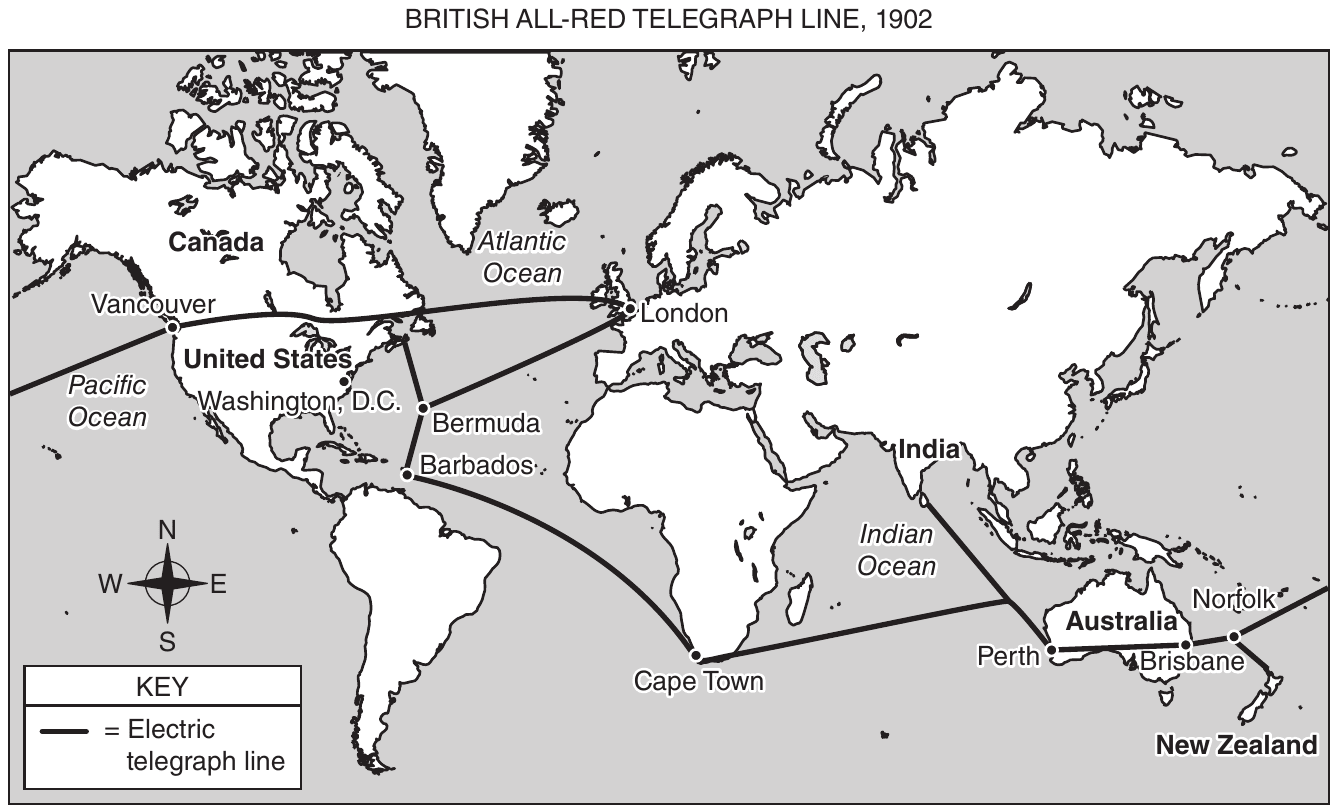
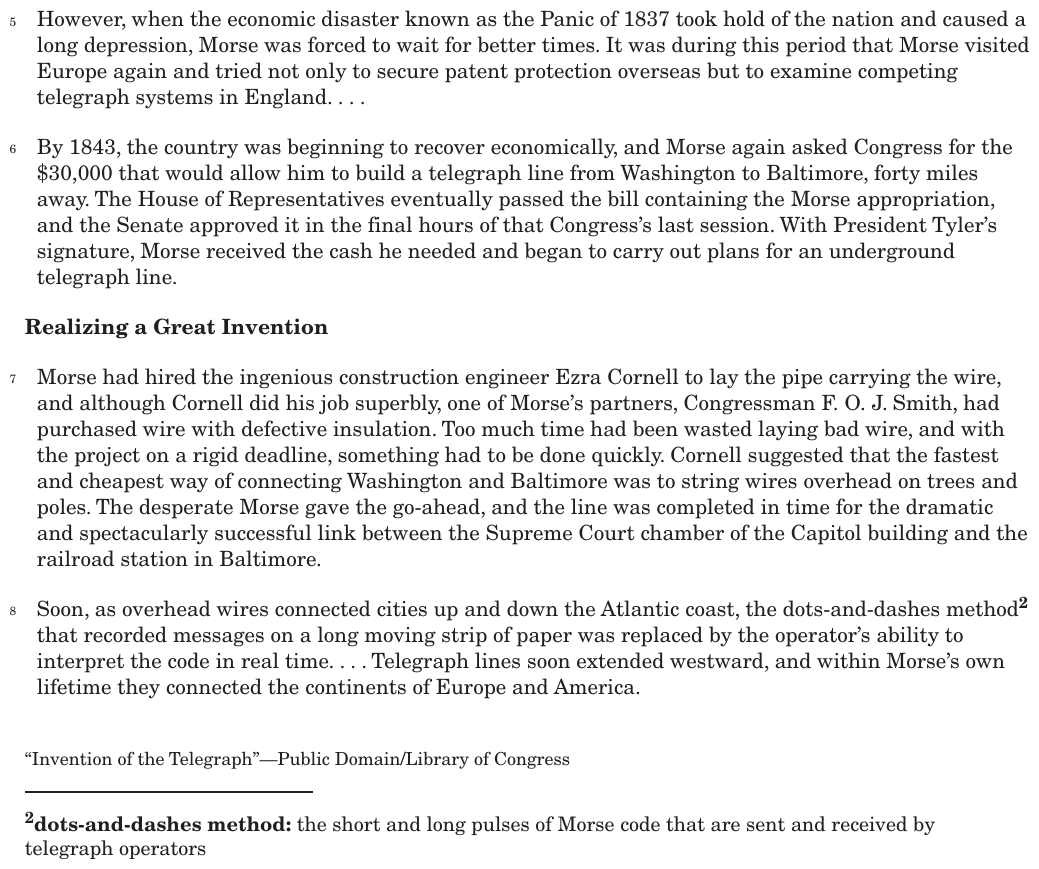
The first transatlantic electric telegraph message was sent in 1858, and by 1902 the British All-Red Line connected most of the world.
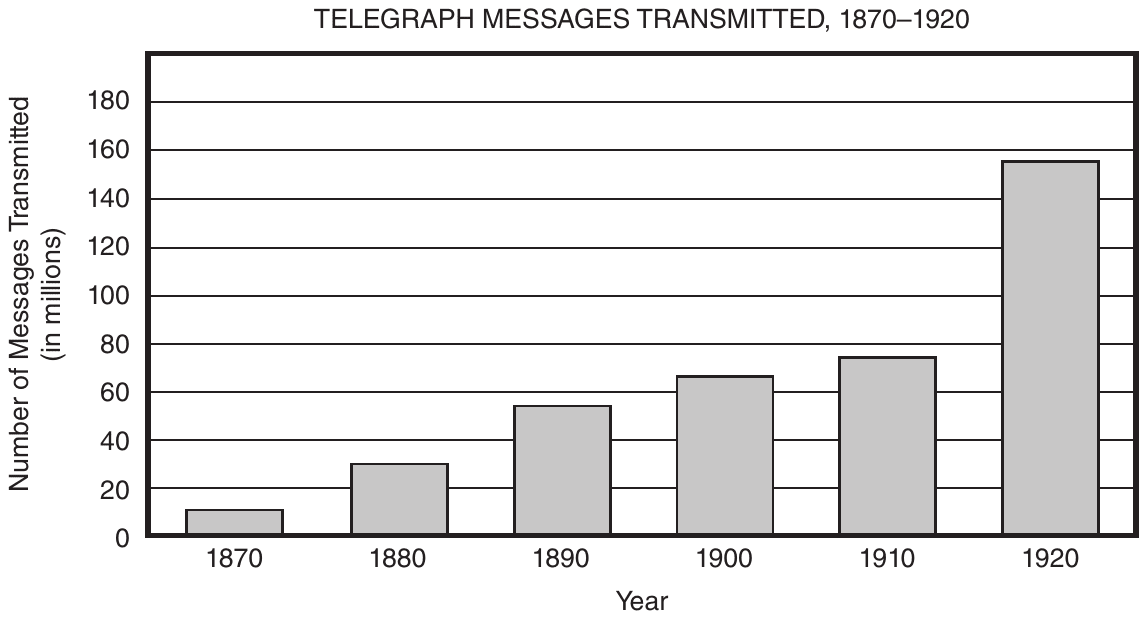
Source: U.S. Bureau of the Census. Historical Statistics of the United States, Colonial Times to 1970, Bicentennial Edition, Part 2. Washington, D.C., 1975.
Question
How does the map provide additional support for a central idea of the passage?
- Aby demonstrating that Morse’s telegraph system greatly exceeded the limitations of previous long-distance communication systems
- Bby indicating that Morse was lacking foresight by seeking a patent only in North America
- Cby proving that Gale’s advice helped Morse extend the telegraph’s range much farther than first thought possible
- Dby showing that the Morse telegraph had a surprisingly immense influence across the world
Show the answer
Correct answer: A
The question asks how the map provides additional support for a central idea of the passage.
A. CORRECT. The map shows the telegraph line crossing continents in 1902, just forty-four years after the first transatlantic message was sent in 1858. This is a much greater distance than the first line Morse built between “the Supreme Court chamber of the Capitol building and the railroad station in Baltimore” (paragraph 7).
B. Incorrect. The map shows the distance the line covers; it does not indicate Morse’s lack of foresight in seeking patents only in North America.
C. Incorrect. While Gale’s advice was crucial to Morse’s success, the map shows the physical line stretching across continents many years later, after their initial work.
D. Incorrect. While it can be inferred that the telegraph had influence across the world, the amount of influence cannot be determined.
Question analysis
This question pairs “Invention of the Telegraph” with a map of the British All-Red Telegraph Line in 1902 and asks how the map adds support for a central idea of the passage. Students must read a world map with a key and a caption, connect what it shows to the story of Samuel Morse’s invention, and sort through four claims about the map that vary in how far they go.
- Grade level
- Grade 8 reading and task
- Compared with grade 7
- Above grade 7 Linking a graphic to a text is familiar grade 7 work. Here students must pin down a central idea of the passage and work out how a 1902 world map, made decades after Morse’s first line, bears on it, a step beyond typical demand.
- Estimated difficulty
- Hard: combines ideas, needs a plan, and has more than one tempting wrong answer.
- Thinking it demands
- Depth of knowledge 3, strategic thinking · mainly analyze
- What makes it hard
- A very close wrong answer major
- Evidence in several places moderate
- Reading a figure, table or graph moderate
- Evidence
- Answered from the whole text
- Reading level
- Passage: about grade 11, 910 words; question and choices: about grade 11, 75 words.
- Corrected from the DOE handbook
- An inaccurate detail in the explanation was corrected.
- Students, last 30 days
- Not enough answers yet to show (it takes 10).
Why it is hard, traps and wrong answers (shows the answer)
Why it is hard
Lines on a map can prove how far the telegraph reached, and the question turns on how much more than that each choice claims. The key depends on a link back to paragraph 1, where a message went only as far as the next hilltop tower, read many minutes before the map. The influence choice skips that link and states the map’s message in bigger terms, so students who do not ask what a map of routes can show are drawn to it.
A very close wrong answer major Choosing the answer
The influence choice, a telegraph with “a surprisingly immense influence across the world,” sounds like a fair reading of lines circling the globe; it differs from the key in claiming impact and surprise rather than reach beyond earlier systems. (Embretson & Wetzel, 1987; Gorin & Embretson, 2006; Ascalon et al., 2007)
Evidence in several places moderate Working it out
The earlier systems the key measures against are in paragraph 1, towers on distant hills passing flag and light signals from station to station, far from the map at the end of the passage. (Kirsch & Mosenthal, 1990; Gorin & Embretson, 2006)
Reading a figure, table or graph moderate Understanding the question
The map shows a 1902 British line from London to Canada and Vancouver, south through Bermuda and Barbados to Cape Town, and on to India, Australia and New Zealand, with Washington left unconnected. (Lesh, Post & Behr, 1987; Kirsch & Mosenthal, 1990)
Strategy: Look at what the map and its caption actually show, sum up a central idea of the passage in your own words, and keep only a choice that both of them back up.
Traps
- Too broad or too strong: A choice overstates, generalizes, or uses absolute words the text does not support.
- Reads too much in: A reasonable-sounding conclusion that goes further than the text allows.
The wrong answers, classified
B Twists what the text says (King et al., 2004)
Reads the unconnected Washington dot as a patenting mistake of Morse’s, though a map of lines shows nothing about patents and paragraph 5 has him seeking protection overseas.
C Reads too much in (Graesser, Singer & Trabasso, 1994)
Remembers that Gale’s relay advice solved Morse’s “distance problems,” but a 1902 map that names no inventors cannot prove what that advice made possible decades earlier.
D Too broad or too strong (King et al., 2004)
Turns the map’s reach into a claim about impact, though routes on a map show where messages could travel, not how much the world changed or that anyone was surprised.
What was corrected from the DOE handbook, and why
- Explanation: The handbook says the 1902 line came “forty-four years after the first message was sent in 1858.” The first telegraph message was Morse’s in 1844 (paragraph 1); 1858 is the year of the first transatlantic message, as the map’s caption says. The site now says “the first transatlantic message.”
Working it out, step by step
Figure out what the question asks
This question asks how a graphic adds to the passage. You need two things. First, what does the map really show? Second, which central idea, a main point the whole passage builds, does it back up?
Read the map and its caption
This map is a picture of one British network of telegraph wires, as it stood in 1902. In its key, a thick black line stands for an electric telegraph line. From London, a line crosses the Atlantic Ocean and Canada to Vancouver. Other lines reach Bermuda, Barbados, Cape Town, India, Australia and New Zealand. According to the caption, by 1902 this network “connected most of the world.”
Recall the older ways of signaling
Next, compare that with paragraph 1. Before electricity, people signaled with flags or lights. An observer would “decipher a signal from a high tower on a distant hill and then send it on to the next station.” So a message could only jump as far as a person could see. Even Morse’s first line, in paragraph 6, reached Baltimore, just “forty miles away.”
Connect the map to that idea
The caption says the first message across the Atlantic was sent in 1858. Only 44 years later, in 1902, lines crossed several oceans and linked much of the globe. Paragraph 8 adds that telegraph lines “connected the continents of Europe and America” before Morse died. So the map supports a central idea: electric telegraph lines went far beyond the reach of older signal systems.
Check each choice
- A fits. Lines that span oceans go far past the limits of hilltop towers.
- B does not fit. A map of lines shows nothing about patents. Also, paragraph 5 says Morse sought patent protection in Europe, too.
- C does not fit. The map names no inventors, so it cannot prove what Gale’s advice did decades before.
- D does not fit. The map shows where lines went, not how much they changed the world, and nothing on it shows surprise.
Choose the answer
The map shows telegraph lines reaching around the globe, far past what flags and towers could do. So the answer is A.
Why this answer and not the closest wrong one
D is the closest trap, because lines around the world seem to prove a huge effect. But a map of routes shows only how far messages could travel. It cannot measure influence, and it cannot show that anyone was surprised. A sticks to what a map of lines can prove: the telegraph reached much farther than earlier systems.
More questions like this
The original DOE question
The passage “Invention of the Telegraph” as printed (pages 146–148)
Question 4 of 6
2026 Practice Test C Math, question 32Question
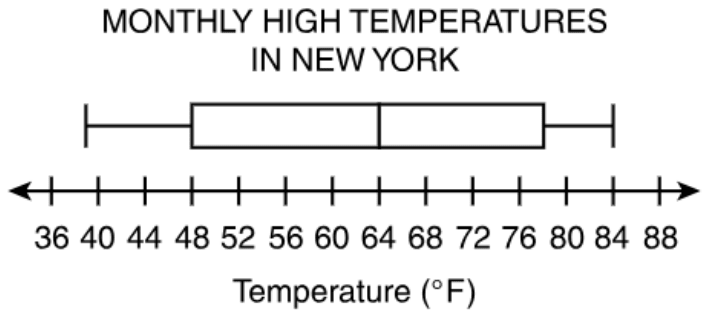
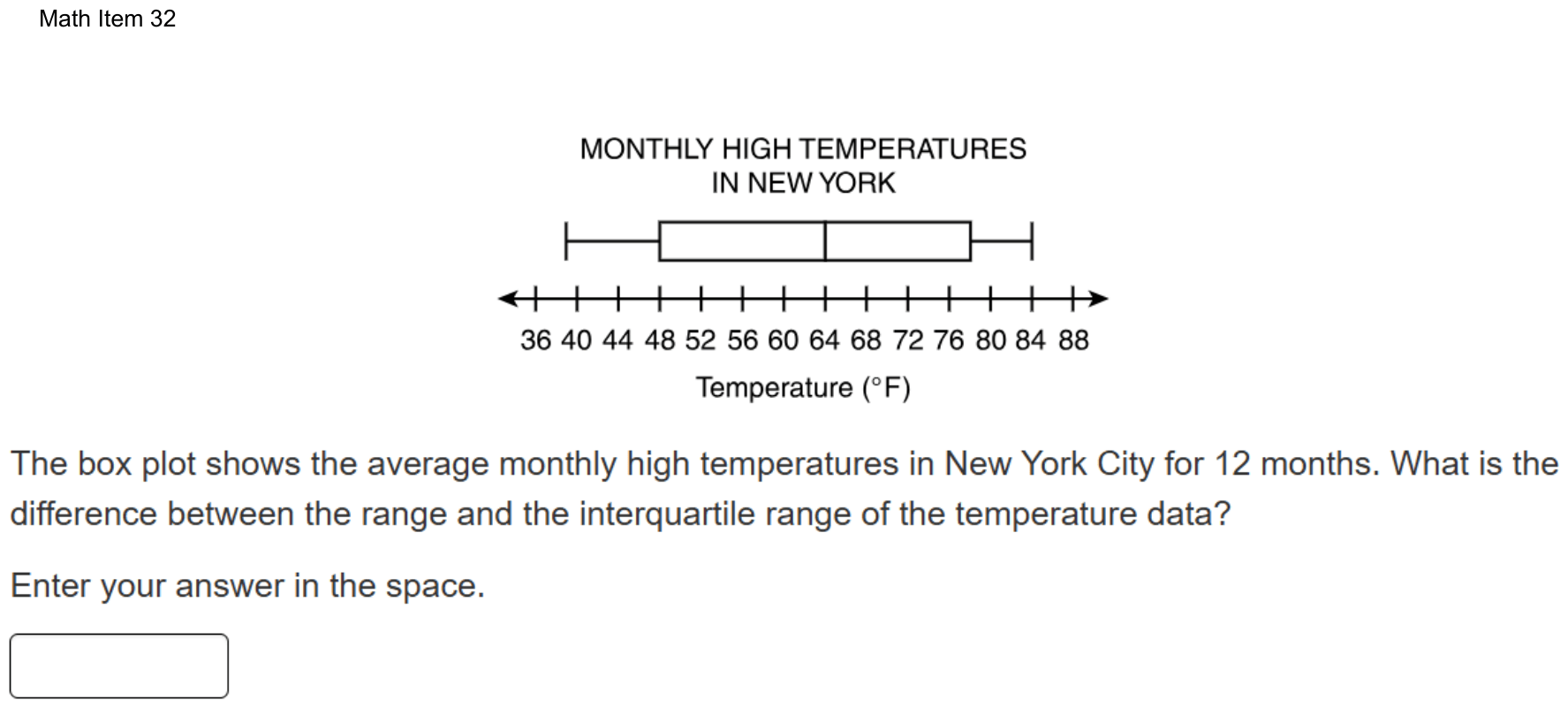
The box plot shows the average monthly high temperatures in New York City for 12 months. What is the difference between the range and the interquartile range of the temperature data?
Enter your answer in the space.
Fill-in question: work out the answer and type it as a number.
Show the answer
Correct answer: 15
Determine the range by subtracting the minimum value on the box plot from the maximum value on the box plot:
Maximum value , Minimum value
Determine the interquartile range by subtracting the lower quartile value on the box plot from the upper quartile value on the box plot:
Upper Quartile Value , Lower Quartile Value
Determine the difference between the range (45° F) and the interquartile range (30° F):
Question analysis
A box plot of New York City's average monthly high temperatures for 12 months sits above a number line labeled every 4 degrees. Students type the difference between the range and the interquartile range of the data. Two of the plot's values fall between labeled ticks, so careful reading of the scale decides the answer.
- Grade level
- Grade 7 content, by NYS standard
- Compared with grade 7
- Above grade 7 Reading a box plot and finding its interquartile range are grade 7 skills. Here two of the five values fall between ticks spaced 4 apart, and the range, the IQR and their difference must all be found and typed with no choices.
- Estimated difficulty
- Hard: combines ideas, needs a plan, and has more than one tempting wrong answer.
- Thinking it demands
- Depth of knowledge 2, skills and concepts · mainly apply
- What makes it hard
- Solution
- 3 steps
- Reading level
- Question and choices: about grade 7, 36 words.
- Students, last 30 days
- Not enough answers yet to show (it takes 10).
Why it is hard, traps and wrong answers (shows the answer)
Why it is hard
The method is standard, but the key rests on reading the scale between its labels. The axis is ticked only every 4 degrees, and the minimum and the upper quartile land off the ticks, so rounding either one to the nearest label moves the result by a degree or two with nothing to flag it. Students who find the range correctly can also stop there, entering 45, the larger of the two spreads, instead of the difference the question asks for.
Reading a figure, table or graph major Understanding the question
Two of the five values fall between ticks spaced 4 degrees apart: the left whisker ends just short of the 40 tick, at 39, and the box’s right edge sits midway between 76 and 80, at 78. (Lesh, Post & Behr, 1987; Kirsch & Mosenthal, 1990)
Many steps minor Working it out
Four values are read and combined in three subtractions, the range, the interquartile range and then their difference, so one misread value changes the final entry. (Daniel & Embretson, 2010; Enright, Morley & Sheehan, 2002)
Something you must already know minor Working it out
Neither measure is defined on the page: the range spans the whiskers, and the interquartile range is the width of the box, the upper quartile minus the lower. (Anderson & Krathwohl, 2001)
An answer in an unexpected form minor Choosing the answer
The result is typed with no choices to compare, so an entry one or two degrees off, from rounding a value to the nearest tick, looks just as finished as the right one. (Enright, Morley & Sheehan, 2002)
Strategy: Read the minimum, both quartiles and the maximum, judging where each mark falls between the ticks, then subtract for the range and for the IQR, and subtract those two results.
Traps
- Misreads the figure: Reads a value, label or tick spacing in a figure, table or graph wrongly.
- Stops one step early: A choice is a number from partway through the solution.
The wrong answers, classified
14 Misreads the figure (Lesh, Post & Behr, 1987; Kirsch & Mosenthal, 1990)
Reads the left whisker’s end as 40, the nearest labeled tick, instead of 39, so the range becomes 84 − 40 = 44 and 44 − 30 = 14.
45 Stops one step early (King et al., 2004; Gierl et al., 2017)
Finds the range, 84 − 39 = 45 degrees, and enters it, stopping before the interquartile range of 30 is subtracted from it.
17 Misreads the figure (Lesh, Post & Behr, 1987; Kirsch & Mosenthal, 1990)
Reads the box’s right edge as 76, the tick just left of it, instead of 78, so the IQR becomes 76 − 48 = 28 and 45 − 28 = 17.
Worked solution, step by step
Formulas used
- Range
- The maximum is the greatest value, at the right end of the right whisker. The minimum is the least value, at the left end of the left whisker. The range tells how far the whole set of data spreads.
- Interquartile range (IQR)
- Q3 is the upper quartile, the right edge of the box. Q1 is the lower quartile, the left edge of the box. The IQR is the width of the box. It tells how far the middle half of the data spreads.
Sort out the question
A box plot shows data with five numbers. The two whiskers are the lines on each side of the box. Their ends are the minimum, the least value, and the maximum, the greatest. The box runs from the lower quartile to the upper quartile. These are the middles of the lower half and the upper half of the data. The line inside the box is the median, the middle value.
You need the range minus the interquartile range (IQR), in degrees.
Read the values between the ticks
The ticks on the number line are 4 degrees apart. So each degree is one quarter of the space between two ticks. Three values sit right on ticks: the box’s left edge at 48, the median at 64, and the right whisker’s end at 84.
- The left whisker starts just left of the 40 tick. It sits about one quarter of the way back toward 36. So the minimum is degrees.
- The box’s right edge is halfway between 76 and 80. Halfway is 78 degrees.
Find the range
Use the range formula:
The data spread over 45 degrees.
Watch out: rounding the minimum to the 40 tick gives a range of 44. Then the final answer comes out 14, which is wrong.
Find the IQR
Use the IQR formula with the two edges of the box:
The middle half of the data spreads over 30 degrees.
Watch out: reading the box’s right edge as 76 gives an IQR of 28. Then the final answer comes out 17.
Subtract the IQR from the range
The question asks for the difference between the two:
Watch out: 45 is only the range. Do not stop there. Type only the number, with no degree sign.
So you would enter 15.
Check your answer
The range covers the whole plot, and the IQR covers only the box. So their difference is the two whiskers added together. The left whisker is degrees long. The right whisker is degrees long. , which matches.
More questions like this
The original DOE question
Question 5 of 6
2018 Test A Math, question 54Question
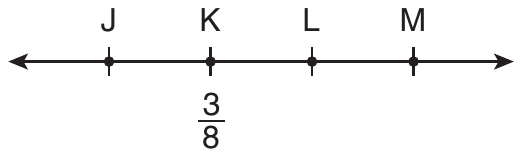
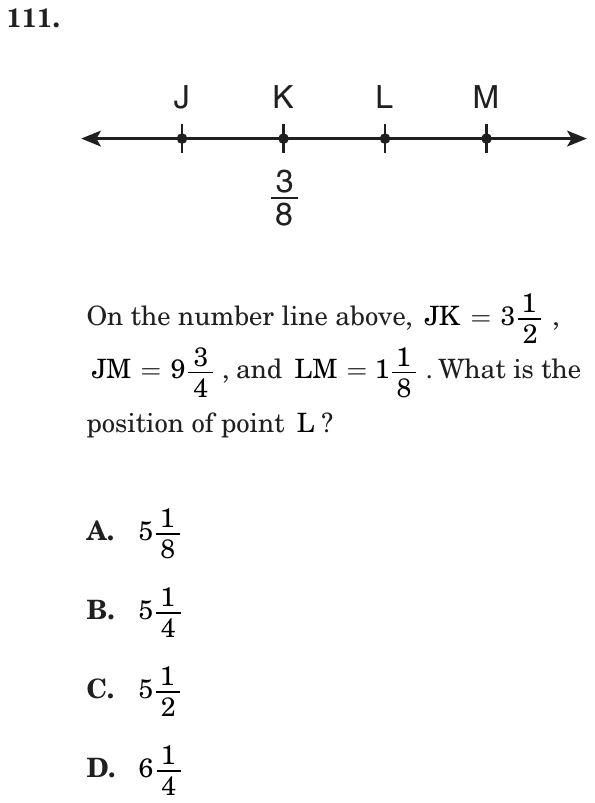
On the number line above, , , and . What is the position of point ?
- A
- B
- C
- D
Show the answer
Correct answer: C
First, use to find the location of :
Now, use to find the location of :
Finally, use to find the location of :
Question analysis
This number line question gives the lengths JK, JM and LM as mixed numbers and asks for the position of point L. Students must chain three distance steps, moving left from K to J, right to M and back to L, with fractions in eighths and a negative position. Losing track of where K sits is the main danger.
- Grade level
- Grade 7 content, by NYS standard
- Compared with grade 7
- Above grade 7 Grade 7 students add and subtract rational numbers and find distances on a number line one at a time. This item chains three such steps with mixed numbers and a negative position, more than typical grade 7 work demands.
- Estimated difficulty
- Among the hardest on the SHSAT: a non-obvious approach, heavy reading, or a well-hidden trap.
- Thinking it demands
- Depth of knowledge 2, skills and concepts · mainly apply
- What makes it hard
- A very close wrong answer major
- Error-prone arithmetic moderate
- Reading a figure, table or graph moderate
- Many steps minor
- Solution
- 4 steps
- Reading level
- Question and choices: about grade 9, 20 words.
- Students, last 30 days
- Not enough answers yet to show (it takes 10).
Why it is hard, traps and wrong answers (shows the answer)
Why it is hard
Every number is a mixed fraction, one position is negative, and the figure's even spacing hides how long KL really is. The distance route, KL = 9 3/4 − 3 1/2 − 1 1/8, avoids the negative entirely but ends one step short of a position unless K's 3/8 is added back. That last step is the one most students skip, which is why the question sits at the top of the scale.
A very close wrong answer major Choosing the answer
The choices 5 1/8, 5 1/4 and 5 1/2 lie within 3/8 of one another, so no estimate separates them; only exact eighths and adding K's 3/8 pick out the right one. (Embretson & Wetzel, 1987; Gorin & Embretson, 2006; Ascalon et al., 2007)
Error-prone arithmetic moderate Working it out
Every step mixes halves, quarters and eighths, and placing J means 3/8 − 3 1/2 = −3 1/8, a subtraction that crosses zero. (Brown & Burton, 1978; Junker & Sijtsma, 2001)
Reading a figure, table or graph moderate Understanding the question
Only K is labeled, and the points are drawn evenly spaced although KL is over four times LM, so the picture gives no help with sizes. (Lesh, Post & Behr, 1987; Kirsch & Mosenthal, 1990)
Many steps minor Working it out
Three linked moves, K to J, J to M and M back to L, each depend on the last, so an early slip carries through. (Daniel & Embretson, 2010; Enright, Morley & Sheehan, 2002)
Strategy: Start from K's labeled position, subtract JK to place J, add JM to place M, then subtract LM, keeping every fraction in eighths.
Traps
- Answers a different question: A choice is right for another quantity: the other unknown, the rest instead of the part, the part instead of the whole.
- Stops one step early: A choice is a number from partway through the solution.
The wrong answers, classified
A Stops one step early (King et al., 2004; Gierl et al., 2017)
Finds KL = 9 3/4 − 3 1/2 − 1 1/8 = 5 1/8 and stops one step short, never adding K's position of 3/8.
B An arithmetic slip (Junker & Sijtsma, 2001)
Rewrites 9 3/4 as 9 4/8 instead of 9 6/8, so M lands at 6 3/8 and L at 6 3/8 − 1 1/8 = 5 1/4.
D Answers a different question (King et al., 2004; Hegarty, Mayer & Monk, 1995)
Finds KM = 9 3/4 − 3 1/2 = 6 1/4, the distance from K to M, and gives it without moving back 1 1/8 to L.
Worked solution, step by step
Formulas used
- Distance on a number line
- d is the distance between two points. b is the point on the right and a is the point on the left. Subtracting left from right always gives a positive distance. It works even when a is negative.
- Equal fractions
- a is the top number (numerator) and b is the bottom number (denominator). Multiplying both by the same number k gives an equal fraction. It is like cutting each piece into k smaller pieces. Use it to give fractions the same bottom before you add or subtract.
Sort out what you know
Only K has a value: . JK means the distance from J to K. You know JK = , JM = and LM = .
You need the position of L, the number where L sits. The points are drawn evenly spaced, but the distances are not equal. So use the numbers, not the picture.
Write the fractions in eighths
The fractions use halves, fourths and eighths. Give them all a bottom of 8:
Watch out: is , not . That slip leads to choice B.
Find the distance from K to M
JM is JK and KM put together. So take JK away from JM:
KM is , or . Watch out: this is a distance, not where L sits. Choice D stops here.
Find the distance from K to L
KM is KL and LM put together. So take LM away:
KL is . Watch out: this is still a distance. Choice A stops here.
Find the position of L
L is to the right of K, and K is at . Add:
So the answer is C, .
Check your answer
Place every point. J is left of K, at . M is right of J, at . L is left of M, at , which is . Same answer.
More questions like this
The original DOE question
Question 6 of 6
2018 Test A Math, question 48Question
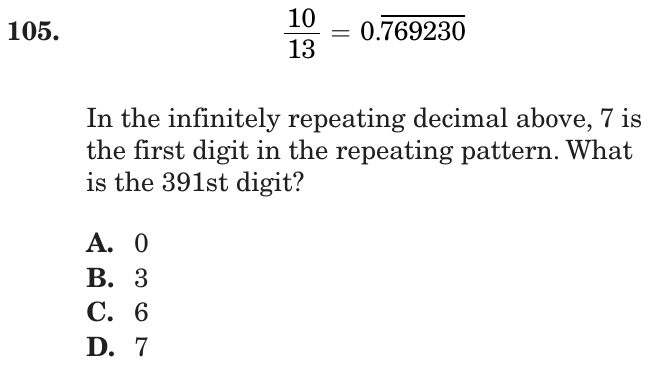
In the infinitely repeating decimal above, 7 is the first digit in the repeating pattern. What is the 391st digit?
- A0
- B3
- C6
- D7
Show the answer
Correct answer: D
There are 6 digits in the repeating decimal (769230), so 7 would be the first, seventh, thirteenth digit and so on.
To find the 391st digit, divide 391 by 6.
391 ÷ 6 = 65 R1
Since the remainder is 1, that means the 391st digit is the same as the 1st digit, which is 7.
Question analysis
This repeating decimal question shows the six-digit repeating pattern of 10/13 and asks for the 391st digit after the decimal point. Students must use the length of the repeating block and division with a remainder to find the position within the cycle. Matching the remainder to the right digit is where students slip.
- Grade level
- Grade 7 content, by NYS standard
- Compared with grade 7
- Above grade 7 Seventh graders learn that fractions have repeating decimals. Using the length of the repeating block and a remainder to find a digit hundreds of places away is a pattern-reasoning step beyond typical seventh-grade classwork.
- Estimated difficulty
- Hard: combines ideas, needs a plan, and has more than one tempting wrong answer.
- Thinking it demands
- Depth of knowledge 2, skills and concepts · mainly apply
- What makes it hard
- No obvious method moderate
- Solution
- 2 steps
- Reading level
- Question and choices: about grade 8, 20 words.
- Students, last 30 days
- Not enough answers yet to show (it takes 10).
Why it is hard, traps and wrong answers (shows the answer)
Why it is hard
Once the cycle length is used, the arithmetic is a single division, 391 ÷ 6 = 65 remainder 1. The difficulty is turning the remainder into a position: remainder 1 is the first digit of a new block, not the last digit of the previous one or the second of the new one. Checking the rule on small positions, the 1st and 7th digits are both 7, removes the doubt.
No obvious method moderate Working it out
Nothing in the stem mentions division; students must see that the six-digit block 769230 repeats, so position 391 depends only on the remainder of 391 divided by 6. (Schoenfeld, 1985)
Strategy: Divide 391 by the length of the repeating block and look only at the remainder; a remainder of r points to the r-th digit of the block.
Traps
- Counting the ends: Inclusive or exclusive ends, fence posts, consecutive numbers: an answer that is one too many or too few, or an endpoint drawn open where it belongs closed (or the reverse).
The wrong answers, classified
A Counting the ends (Brown & Burton, 1978)
Sees that 65 blocks fill 390 places and lands on the 390th digit, the 0 that ends a block, one place short.
B A faulty procedure (Brown & Burton, 1978; Tatsuoka, 1983)
Uses the quotient 65 instead of the remainder, takes its last digit 5, and reads the fifth digit of 769230, which is 3.
C Counting the ends (Brown & Burton, 1978)
Treats the remainder 1 as one step past the block's first digit, moving from 7 to the second digit, 6.
Worked solution, step by step
Formulas used
- Division with a remainder
- n is the number you divide. d is what you divide by. q is the quotient, the number of whole groups. r is the remainder, what is left over. Here it tells how many full blocks of digits fit, and where you land after them.
Sort out what you know
The bar over 769230 means those six digits repeat forever: 769230769230 and so on. The 7 is digit number 1. You need digit number 391.
Spot the pattern
The block 769230 has 6 digits, so the pattern starts over every 6 digits. Digit 1 is 7, and so are digits 7, 13, 19 and so on. Each full block ends with a 0, at digits 6, 12, 18 and so on.
Divide 391 by 6
Find how many full blocks fit into 391 digits, and what is left:
So 65 full blocks use up 6 × 65 = 390 digits. The remainder is 1. That means digit 391 is the 1st digit of the next block.
Read the digit
The 1st digit of the block is 7. Watch out: digit 390 is the last digit of a full block, which is 0. That is choice A. Digit 391 is one step past it, so it starts a new block.
So the answer is D, 7.
Check your answer
Test the idea on a small number. Digit 7: 7 = 6 × 1 + 1, so the remainder is 1 and the digit should be 7. Write it out: 7692307. The 7th digit is indeed 7. The rule works.
More questions like this
The original DOE question