3 English and 3 math
Here are 6 random questions to try. Takers earning below 75% are unlikely to receive an offer. You have 1 minute 48 seconds per question on the real exam.
Question 1 of 6
2024 Test B English, question 47Passage Snowy Mountains
Snowy Mountains
by John Gould Fletcher
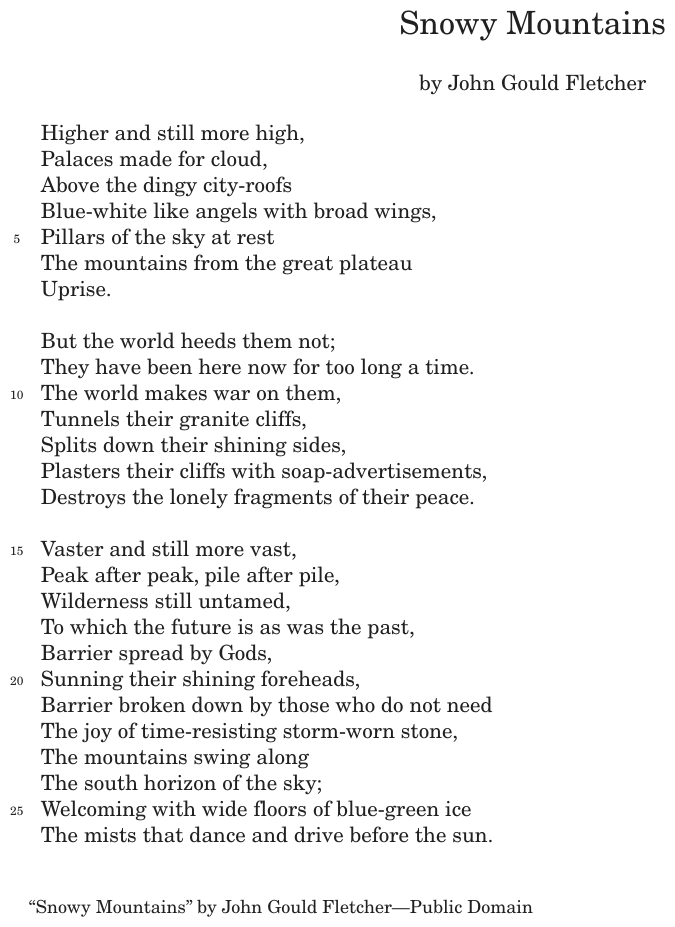
Higher and still more high,
Palaces made for cloud,
Above the dingy city-roofs
Blue-white like angels with broad wings,
Pillars of the sky at rest
The mountains from the great plateau
Uprise.
But the world heeds them not;
They have been here now for too long a time.
The world makes war on them,
Tunnels their granite cliffs,
Splits down their shining sides,
Plasters their cliffs with soap-advertisements,
Destroys the lonely fragments of their peace.
Vaster and still more vast,
Peak after peak, pile after pile,
Wilderness still untamed,
To which the future is as was the past,
Barrier spread by Gods,
Sunning their shining foreheads,
Barrier broken down by those who do not need
The joy of time-resisting storm-worn stone,
The mountains swing along
The south horizon of the sky;
Welcoming with wide floors of blue-green ice
The mists that dance and drive before the sun.
“Snowy Mountains” by John Gould Fletcher—Public Domain
Question
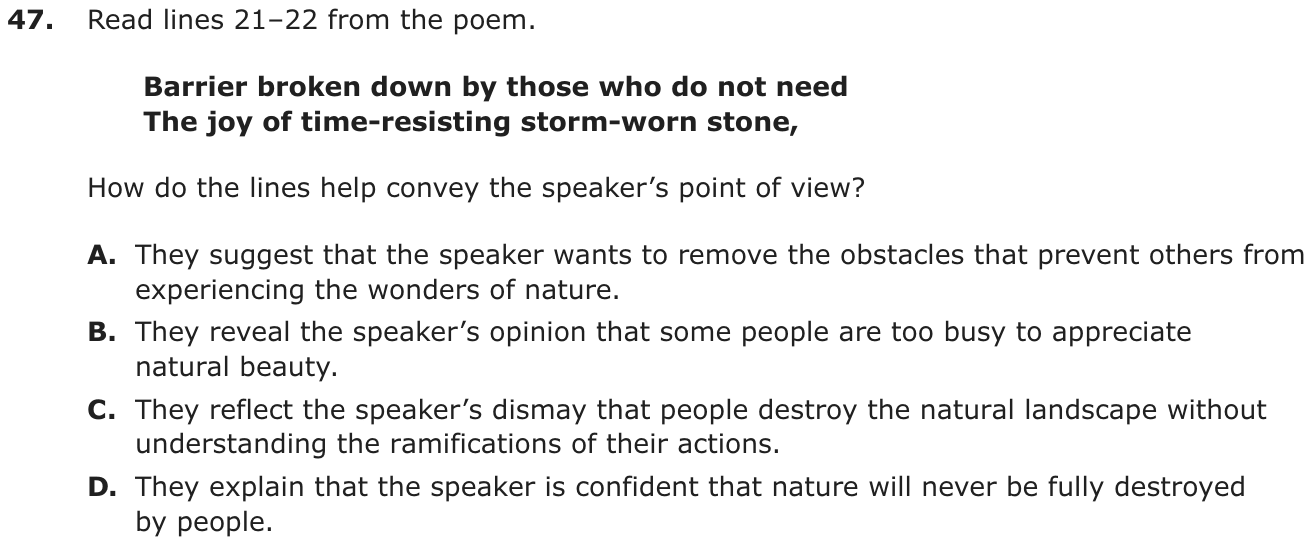
Read lines 21–22 from the poem.
Barrier broken down by those who do not need
The joy of time-resisting storm-worn stone,
How do the lines help convey the speaker’s point of view?
- AThey suggest that the speaker wants to remove the obstacles that prevent others from experiencing the wonders of nature.
- BThey reveal the speaker’s opinion that some people are too busy to appreciate natural beauty.
- CThey reflect the speaker’s dismay that people destroy the natural landscape without understanding the ramifications of their actions.
- DThey explain that the speaker is confident that nature will never be fully destroyed by people.
Show the answer
Correct answer: C
The question asks how lines 21–22 help convey the speaker’s point of view.
A. Incorrect. The word “barrier” (line 21) refers to the speaker’s opinion that the mountains were “spread by Gods” (line 19) and not to an obstacle that the speaker thinks should be removed.
B. Incorrect. While the lines indicate that people have lost the need to connect with nature, they do not reveal that the speaker thinks that the cause of this loss is busyness.
C. CORRECT. The words “those who do not need / The joy” in lines 21–22 reflect the speaker’s sadness that people do not realize that they are destroying something wonderful and irreplaceable.
D. Incorrect. Although the speaker does say that the stone is “time-resisting” (line 22), this belief is only a small detail of the speaker’s point of view.
Question analysis
Two lines from the final stanza of “Snowy Mountains” describe a barrier broken down by people who do not need “The joy of time-resisting storm-worn stone,” and students must explain how these lines convey the speaker’s point of view. The phrasing is compact and old-fashioned, with an unusual use of “need,” so working out the plain meaning comes before choosing among close descriptions of the speaker’s feelings.
- Grade level
- Grade 8 reading and task
- Compared with grade 7
- Above grade 7 Grade 7 students often infer a speaker’s attitude from clear statements. Here the attitude must be drawn from a compressed sentence broken across two lines, and the choices differ in fine shades of feeling and cause.
- Estimated difficulty
- Hard: combines ideas, needs a plan, and has more than one tempting wrong answer.
- Thinking it demands
- Depth of knowledge 2, skills and concepts · mainly analyze
- What makes it hard
- Complex sentences major
- Reading between the lines moderate
- Hard words minor
- Evidence
- Answered from one sentence or line
- Reading level
- Passage: 161 words (a poem; reading level not measured); question and choices: about grade 9, 99 words.
- Students, last 30 days
- Not enough answers yet to show (it takes 10).
Why it is hard, traps and wrong answers (shows the answer)
Why it is hard
Before any choice can be judged, the compressed, inverted verse has to be put into plain English: people with no use for the old stone’s joy have broken the barrier down. Once that paraphrase is in hand, the speaker’s sorrow is clear, yet two wrong choices offer nearby readings. One supplies a cause the lines never give, busyness, and the other turns the stone’s endurance into a promise that the same sentence contradicts.
Complex sentences major Understanding the question
The lines break mid-phrase, “those who do not need / The joy of time-resisting storm-worn stone,” inside a sentence whose subject arrives only in line 23, so who breaks what must be untangled first. (Abedi & Lord, 2001; Freedle & Kostin, 1993; Messick, 1989)
Reading between the lines moderate Working it out
Neither dismay nor ignorance is stated; both must be inferred from describing the people as not needing “The joy” of the stone they break down. (Graesser, Singer & Trabasso, 1994; Kintsch, 1998)
Hard words minor Understanding the question
“Barrier” here means the mountain range as a great wall, not an obstacle, and the key turns on “ramifications,” a word many seventh graders will not know. (Perfetti, 2007; Freedle & Kostin, 1993)
Strategy: Read lines 21–22 with the lines just before them, restate the sentence in your own words, and then decide what the speaker thinks of the people it describes.
Traps
- Dictionary meaning, not meaning here: A common meaning of the word that does not fit its use in this text.
- Outside knowledge: A choice is plausible in the real world but not supported by this text.
- Too broad or too strong: A choice overstates, generalizes, or uses absolute words the text does not support.
The wrong answers, classified
A Dictionary meaning, not meaning here (Perfetti, 2007)
Hears “Barrier” in its everyday sense of something blocking the way, but here it is the mountain range itself, “spread by Gods,” and the speaker regrets its breaking.
B Outside knowledge (King et al., 2004; Recht & Leslie, 1988)
Supplies a familiar modern explanation, people too busy for nature, though the lines say only that some people do not need this joy and never say why.
D Too broad or too strong (King et al., 2004)
Stretches “time-resisting” into certainty that nature can never be destroyed, overlooking that these lines show the barrier already “broken down” by people.
Working it out, step by step
Figure out what the question asks
This asks about point of view: what the speaker thinks and feels. Read lines 21 and 22, and decide what they show about the speaker’s attitude toward the people in them.
Read the lines with the ones before
Two lines earlier, the poem names the mountains a “Barrier spread by Gods” (line 19). A barrier is a wall, and here the wall is the mountain range itself. Line 21 says this barrier is “broken down by those who do not need” something. Line 22 says what that something is: “The joy of time-resisting storm-worn stone.”
Put the lines in plain words
Time-resisting means the stone has held out against ages of time. Storm-worn means storms have rubbed it down. So this stone is very old and very tough. In plain words: the mountains are being torn down by people who have no use for the joy this ancient stone can give. The speaker sounds sad and troubled that something so lasting is wrecked by people who do not value it.
Check each choice
- A does not fit. Here “Barrier” means the mountains, not something blocking the way. The speaker is sorry it was broken, not eager to remove it.
- B does not fit. The lines never give a reason, such as being too busy. That idea comes from outside the poem.
- C fits. Dismay is a mix of sadness and alarm. Ramifications are the effects an action leads to later on. The speaker is dismayed that people wreck the mountains with no thought for what they are losing.
- D does not fit. The stone is “time-resisting,” but the same lines show it broken down. They express sorrow, not confidence.
Choose the answer
The lines show the mountains being broken by people who see no value in them, and the speaker is upset. So the answer is C.
Why this answer and not the closest wrong one
B is the strongest trap, because being too busy for nature sounds like a fair reason. But lines 21 and 22 never explain why these people do not need the stone’s joy. B adds a cause from outside the poem. C stays with what the lines show: damage to the mountains, done by people who do not value them, and the speaker’s distress.
More questions like this
The original DOE question
The passage “Snowy Mountains” as printed (page 142)
Question 2 of 6
2024 Test B English, question 8Passage Find Time to Volunteer
Find Time to Volunteer
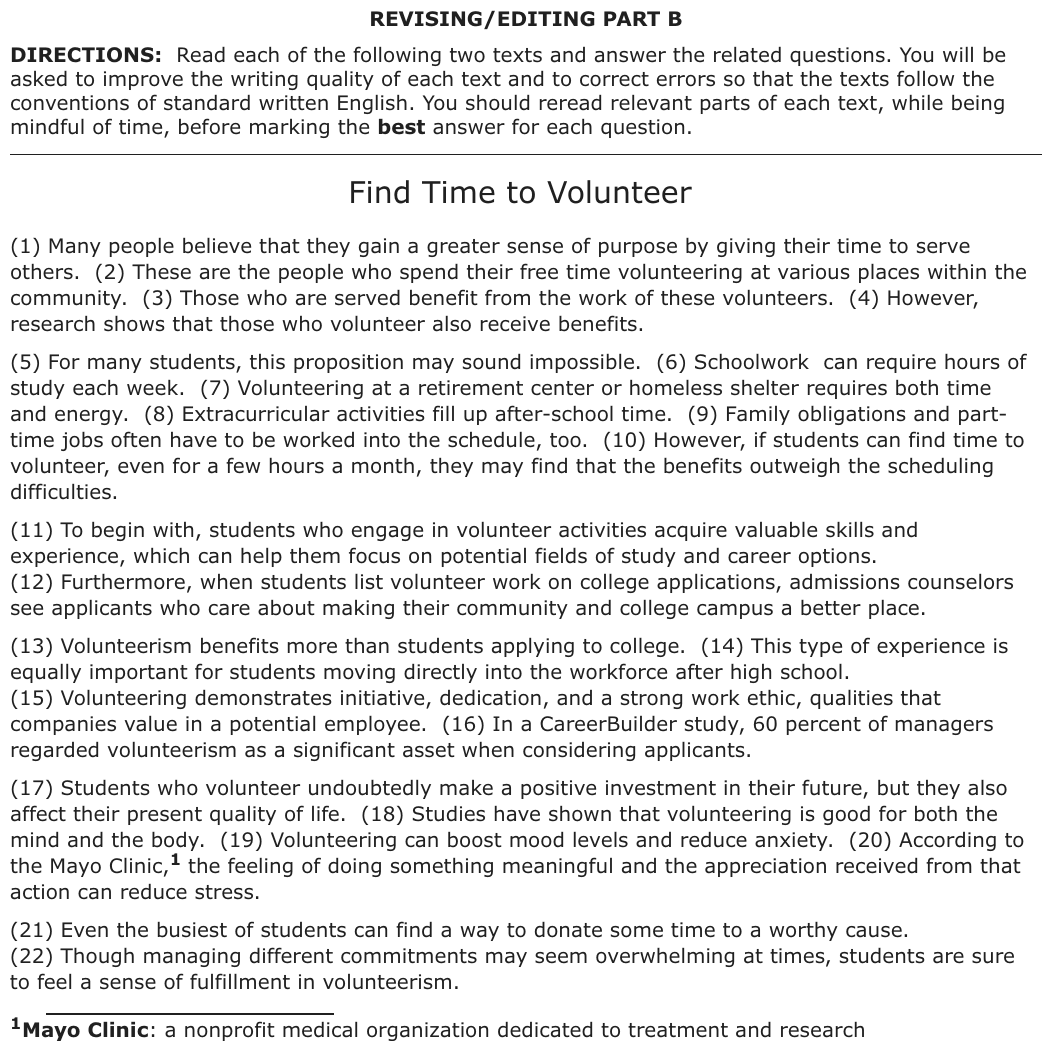
(1) Many people believe that they gain a greater sense of purpose by giving their time to serve others. (2) These are the people who spend their free time volunteering at various places within the community. (3) Those who are served benefit from the work of these volunteers. (4) However, research shows that those who volunteer also receive benefits.
(5) For many students, this proposition may sound impossible. (6) Schoolwork can require hours of study each week. (7) Volunteering at a retirement center or homeless shelter requires both time and energy. (8) Extracurricular activities fill up after-school time. (9) Family obligations and part-time jobs often have to be worked into the schedule, too. (10) However, if students can find time to volunteer, even for a few hours a month, they may find that the benefits outweigh the scheduling difficulties.
(11) To begin with, students who engage in volunteer activities acquire valuable skills and experience, which can help them focus on potential fields of study and career options. (12) Furthermore, when students list volunteer work on college applications, admissions counselors see applicants who care about making their community and college campus a better place.
(13) Volunteerism benefits more than students applying to college. (14) This type of experience is equally important for students moving directly into the workforce after high school. (15) Volunteering demonstrates initiative, dedication, and a strong work ethic, qualities that companies value in a potential employee. (16) In a CareerBuilder study, 60 percent of managers regarded volunteerism as a significant asset when considering applicants.
(17) Students who volunteer undoubtedly make a positive investment in their future, but they also affect their present quality of life. (18) Studies have shown that volunteering is good for both the mind and the body. (19) Volunteering can boost mood levels and reduce anxiety. (20) According to the Mayo Clinic,1 the feeling of doing something meaningful and the appreciation received from that action can reduce stress.
(21) Even the busiest of students can find a way to donate some time to a worthy cause. (22) Though managing different commitments may seem overwhelming at times, students are sure to feel a sense of fulfillment in volunteerism.
1Mayo Clinic: a nonprofit medical organization dedicated to treatment and research
Question
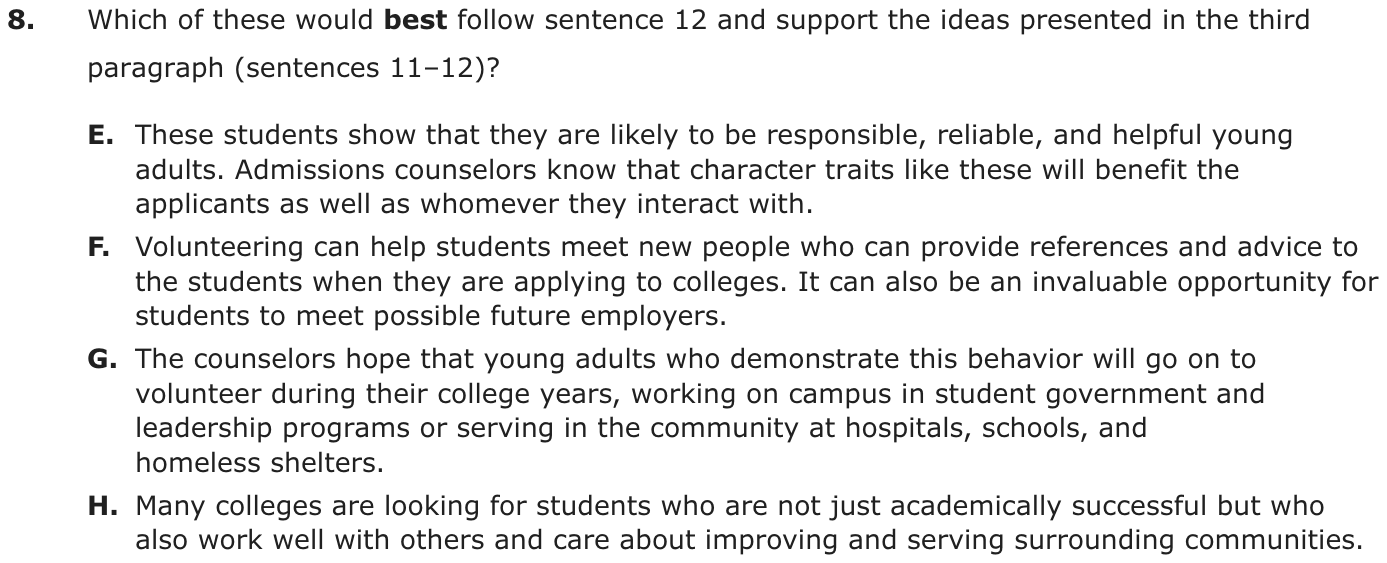
Which of these would best follow sentence 12 and support the ideas presented in the third paragraph (sentences 11–12)?
- AThese students show that they are likely to be responsible, reliable, and helpful young adults. Admissions counselors know that character traits like these will benefit the applicants as well as whomever they interact with.
- BVolunteering can help students meet new people who can provide references and advice to the students when they are applying to colleges. It can also be an invaluable opportunity for students to meet possible future employers.
- CThe counselors hope that young adults who demonstrate this behavior will go on to volunteer during their college years, working on campus in student government and leadership programs or serving in the community at hospitals, schools, and homeless shelters.
- DMany colleges are looking for students who are not just academically successful but who also work well with others and care about improving and serving surrounding communities.
Show the answer
Correct answer: D
The question asks which option would best follow sentence 12 to support the ideas presented in the third paragraph (sentences 11–12).
A. Incorrect. The subject of the main clause in sentence 12 is “admissions counselors.” Although the second sentence in the option mentions “admissions counselors,” it does not support the ideas in the paragraph, because the statement that “admissions counselors know that character traits like these will benefit the applicants” focuses on how students benefit, while sentence 12 focuses on how these traits benefit the community.
B. Incorrect. While sentence 11 discusses the potential academic and professional connections that can be made through volunteering, sentence 12 moves on to the topic of college admissions. Since the sentences in the option revert back to the topic of connections, they do not support and logically follow a sentence about how college admissions counselors view students with volunteering experience.
C. Incorrect. Although the sentence in the option continues on the subject of admissions counselors and follows the idea in sentence 12 that these counselors tend to favor students who “care about making their community and college campus a better place,” the sentence focuses on what students will do while in college rather than on how volunteering helps them get into college. Therefore, the sentence does not best follow sentence 12 and support the ideas presented in the third paragraph.
D. CORRECT. In sentence 12, the author states that college admissions counselors view students who list volunteer work on admissions applications as “applicants who care about making their community and college campus a better place.” The sentence in the option best follows sentence 12 and supports the ideas in the third paragraph because it provides additional details about why admissions counselors look beyond academics when considering students for admissions and the positive qualities assigned to those who have volunteering experience.
Question analysis
This supporting-details question asks which addition would best follow the volunteering essay’s sentence about how college admissions counselors view applicants who list volunteer work. Every option mentions college and sounds reasonable on its own, so students must decide which one develops the paragraph’s point rather than drifting to a related idea.
- NYS standards
- 7W1b supporting claims with evidence
- Grade level
- Grade 8 reading and task
- Compared with grade 7
- Above grade 7 Grade 7 students choose evidence that supports a claim. Here the options are one or two full sentences, all of them about college, and the right fit depends on the precise idea in sentence 12, a finer judgment than usual.
- Estimated difficulty
- Hard: combines ideas, needs a plan, and has more than one tempting wrong answer.
- Thinking it demands
- Depth of knowledge 2, skills and concepts · mainly evaluate
- What makes it hard
- A very close wrong answer major
- How sentences fit together moderate
- A lot to read minor
- Evidence
- Answered from one paragraph or stanza
- Reading level
- Passage: about grade 11, 354 words; question and choices: about grade 13, 153 words.
- Students, last 30 days
- Not enough answers yet to show (it takes 10).
Why it is hard, traps and wrong answers (shows the answer)
Why it is hard
Every option stays on the subject of college, so the work is matching sentence 12’s exact idea: counselors see applicants who care about making their community a better place. The near miss also explains what counselors value, but it swaps caring for the community for a new set of traits and ends on what those traits do for the applicants. Students who restate sentence 12 before reading the options can hear that the right one simply widens it, from community service to what colleges want beyond grades.
A very close wrong answer major Choosing the answer
The right sentence and the two-sentence option about responsible, reliable, helpful students both explain why volunteers impress admissions; only the right one keeps sentence 12’s point, caring about improving communities. (Embretson & Wetzel, 1987; Gorin & Embretson, 2006; Ascalon et al., 2007)
How sentences fit together moderate Working it out
The new sentence must extend sentence 12’s specific idea, what admissions counselors see in volunteers, rather than return to sentence 11’s skills and careers or move on to college life. (Halliday & Hasan, 1976)
A lot to read minor Understanding the question
The options run 27 to 39 words, two of them two sentences long, and all four are about college, so topic alone rules none of them out. (Kintsch, 1998; Gorin & Embretson, 2006; Freedle & Kostin, 1993)
Strategy: Restate sentence 12 in your own words, then ask of each option whether it explains or extends that exact point about what admissions counselors value.
Traps
- Off the point: Adds or keeps something that does not support the paragraph's or the passage's focus, or an introduction or conclusion that misses the main point.
The wrong answers, classified
A Off the point (Halliday & Hasan, 1976)
Follows the admissions counselors from sentence 12 but replaces caring for the community with new traits, responsibility and reliability, and turns to how those traits help the applicants.
B Off the point (Halliday & Hasan, 1976)
Is drawn by “applying to colleges,” but networking for references and future employers is a new benefit that neither sentence 11 nor sentence 12 develops.
C Off the point (Halliday & Hasan, 1976)
Stays with the counselors and picks up “college campus” from sentence 12, but jumps ahead to what students might do in college instead of explaining admission decisions.
Working it out, step by step
Figure out what the question asks
You need the sentence that best follows sentence 12. A good next sentence adds to the same idea. It does not jump to a new point. Example: after Dogs make loyal pets, the sentence They stay by their owners’ side fits. Dogs come in many colors drifts away. So first put sentence 12 in your own words.
Restate sentence 12
Sentence 12 says that “when students list volunteer work on college applications, admissions counselors see applicants who care about making their community and college campus a better place.” Admissions counselors are the people who choose which students get into a college. So the idea is this: colleges like volunteers because volunteers care about their communities.
Check each choice
- D says colleges want students who are “not just academically successful.” That means more than good grades. They also want students who “care about improving and serving surrounding communities.” That explains sentence 12 and builds on it.
- A swaps in new traits: “responsible, reliable, and helpful.” Then it says those traits help the applicants and the people around them. It drops caring for the community.
- B brings in a new benefit: meeting people who can give advice or jobs. Neither sentence 11 nor sentence 12 talks about that.
- C jumps ahead to what students might do in college. It doesn’t explain how volunteering helps them get in.
Pick the answer
Watch out: A is the most tempting. It is about what counselors value, just like the right answer. But it changes the reason they value it. Only D keeps sentence 12’s idea of caring for the community. So the answer is D.
Why this answer and not the closest wrong one
A is the closest wrong answer. Like D, it explains why admissions counselors like volunteers. But A’s reasons are new ones, such as being responsible and reliable. D keeps sentence 12’s exact idea, caring about the community, and adds that colleges want more than good grades. So D supports the paragraph best.
More questions like this
The original DOE question
The passage “Find Time to Volunteer” as printed (page 163)
Question 3 of 6
2026 Practice Test A English, question 39Passage Massachusetts: Lowell National Historical Park
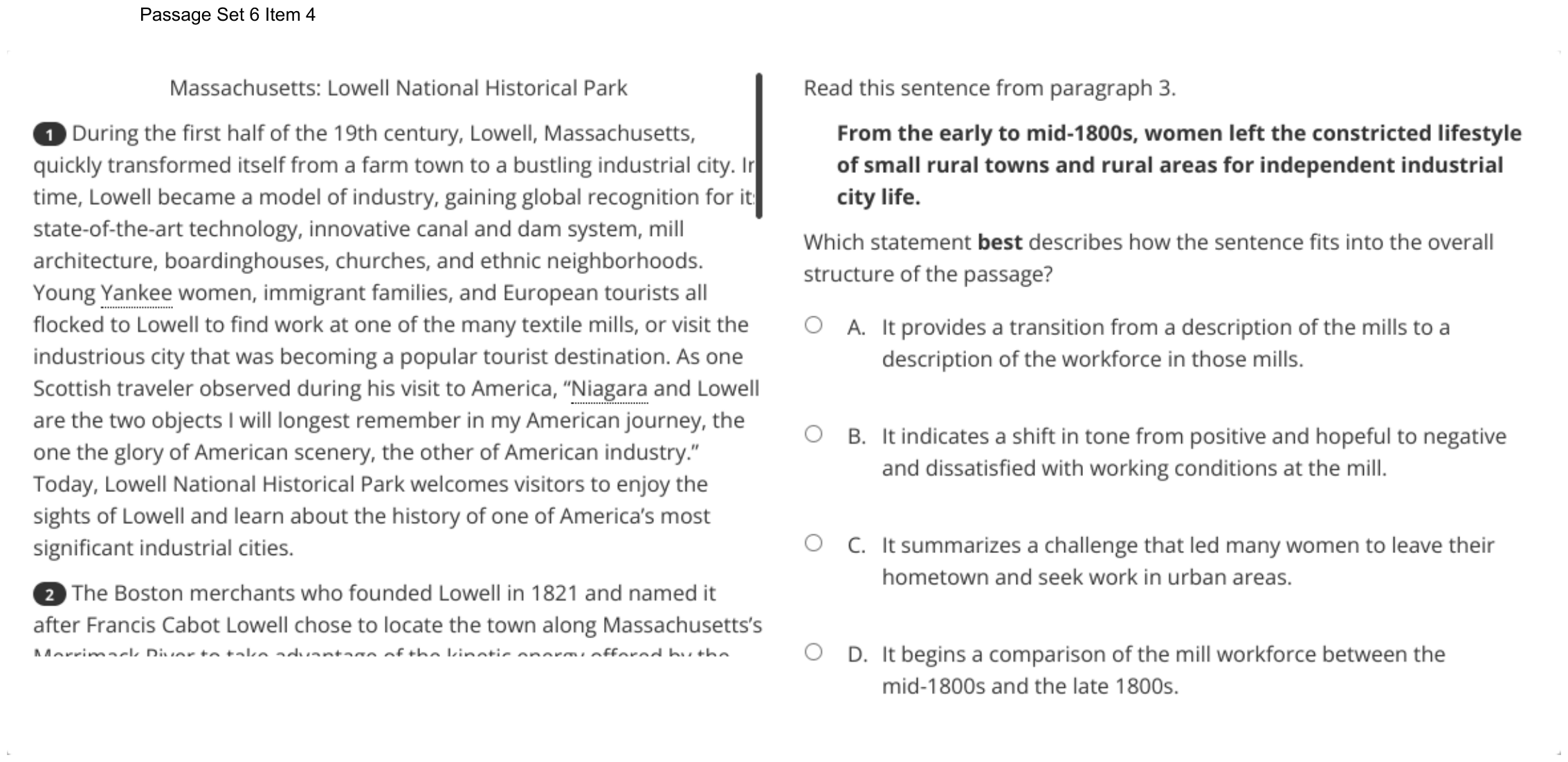
Massachusetts: Lowell National Historical Park
During the first half of the 19th century, Lowell, Massachusetts, quickly transformed itself from a farm town to a bustling industrial city. In time, Lowell became a model of industry, gaining global recognition for its state-of-the-art technology, innovative canal and dam system, mill architecture, boardinghouses, churches, and ethnic neighborhoods. Young Yankee women, immigrant families, and European tourists all flocked to Lowell to find work at one of the many textile mills, or visit the industrious city that was becoming a popular tourist destination. As one Scottish traveler observed during his visit to America, “Niagara and Lowell are the two objects I will longest remember in my American journey, the one the glory of American scenery, the other of American industry.” Today, Lowell National Historical Park welcomes visitors to enjoy the sights of Lowell and learn about the history of one of America’s most significant industrial cities.
The Boston merchants who founded Lowell in 1821 and named it after Francis Cabot Lowell chose to locate the town along Massachusetts’s Merrimack River to take advantage of the kinetic energy offered by the Pawtucket waterfalls. Over six miles of canals powered the waterwheels of Lowell’s mills, whose massive five- and six-story brick buildings dominated the city’s landscape. . . . The most recognized of these buildings are the Lowell Manufacturing Company chartered in 1821, the Suffolk or Wannalancit Mill completed around the 1880s, the Boott Mill Company established in 1835, and the Boott Mill Boardinghouse that opened in 1838. By the 1850s, 40 textile mills employing over 10,000 workers stretched for about a mile along the river. . . .
The city’s female workforce was significant in the history of Lowell. From the early to mid-1800s, women left the constricted lifestyle of small rural towns and rural areas for independent industrial city life. Most were young single Yankee girls, who were tired of the limited opportunities offered by their domestic work. Women found that Lowell’s mills offered monthly wages for their services and provided them room and board. Although these women gained economic independence in Lowell, the mill boardinghouse keepers constantly supervised their social activities, for which they hardly had any time, considering their daily 12- to 14-hour work schedules. At the end of the day, the factory bell signaled the “mill girls” to return to their boardinghouses. They were expected to adhere to the strict code of conduct respecting curfew and attending church.
Yankee “mill girls” continued to dominate the Lowell workforce until the 1840s, when the city began to find it difficult to compete with the growing industrial development in other New England communities. As profits fell, the mill industry cut wages. These wage cuts, deteriorating working conditions, and long workdays led the “mill girls” to protest and organize strikes. When their demands went unheard, the women left Lowell, and immigrant groups replaced them in the workforce. Despite the low wages and unhealthy work conditions, immigrants were eager to find work.
The immigrants replacing the Yankee “mill girls” during the 1840s were predominantly Irish Catholics, who traveled to America during the Great Potato Famine. Although Lowell received an influx of Irish families during this time, the Irish were a part of the city’s history from its birth, and before the “mill girls” arrived, they built Lowell’s historic canals, mills, and boardinghouses. Initially, Lowell’s Protestant community was slow to welcome Irish immigrants, but the hostility between Yankee Protestants and Irish Catholics eventually disappeared. Irish immigrants dominated the industrial scene until the Civil War, when other immigrant groups began to work in the city mills.
Like the Irish, the French-Canadians, Greeks, Poles, Portuguese, Russian Jews, and Armenians who came to work in Lowell’s mills faced long work hours, low wages, and poor living conditions in the city’s crowded tenements. By the time Lowell’s industry declined, the city had become an ethnic melting pot, where each group claimed its own distinct neighborhood, like the Irish immigrants’ “New Dublin” or “Acre,” and the French-Canadians’ “Little Canada.” The city officially began to close down its mills in the 1920s and ’30s after Lowell’s outdated mills could no longer compete against the state-of-the-art cotton mills in other communities and working conditions continued to decline as Lowell’s companies stopped reinvesting in their mills. . . . Despite a brief resurgence during World War II, the city shut down its last surviving mill by the mid-1950s.
From “Massachusetts: Lowell National Historical Park”—Public Domain/National Park Service
Yankee: native to New England
Niagara: a town in northwestern New York State well known as the location of Niagara Falls, a series of waterfalls on the Canadian border
domestic work: household duties like cooking and cleaning
Question
Read this sentence from paragraph 3.
From the early to mid-1800s, women left the constricted lifestyle of small rural towns and rural areas for independent industrial city life.
Which statement best describes how the sentence fits into the overall structure of the passage?
- AIt provides a transition from a description of the mills to a description of the workforce in those mills.
- BIt indicates a shift in tone from positive and hopeful to negative and dissatisfied with working conditions at the mill.
- CIt summarizes a challenge that led many women to leave their hometown and seek work in urban areas.
- DIt begins a comparison of the mill workforce between the mid-1800s and the late 1800s.
Show the answer
Correct answer: A
The question asks which statement best describes how the sentence in paragraph 3 fits into the overall structure of the passage.
A. CORRECT. The sentence in paragraph 3 provides a transition from the overall description of the city and the mills to a description of the women who made up the workforce in the mills. The idea that women left domestic life in favor of working in the mills is important in the passage, and the sentence serves to connect that idea to the previous discussion about the mills.
B. Incorrect. While the mill girls’ dissatisfaction with their working conditions is addressed later in the passage (“These wage cuts, deteriorating working conditions, and long workdays led the ‘mill girls’ to protest and organize strikes” [paragraph 4]), the sentence in paragraph 3 does not indicate a shift in tone from positive to negative. The sentence provides a transition to the discussion of the women who worked in the mills.
C. Incorrect. Although the sentence in paragraph 3 mentions that women became interested in working in the mills because of the “constricted lifestyle of small rural towns,” structurally the sentence does not function as a summary because, instead of expanding on the idea of the difficulties or challenges of life in small rural towns and rural areas, the paragraph goes on to describe the advantages and disadvantages of life in the city for these women.
D. Incorrect. The sentence in paragraph 3 focuses on the choices women made to leave rural towns to work in the city in the early to mid-1800s, not the mid-1800s to the late 1800s. The sentence does not create a comparison between the workforce in the mid-1800s and that in the late 1800s.
Question analysis
A sentence from the start of paragraph 3 of the Lowell article, about women leaving the limited life of rural towns for the city, is the focus of this text-structure question. Students decide how it fits into the structure of the passage as a whole, so they must place it within the order of all six paragraphs instead of judging it by itself.
- NYS standards
- 7R5 structure and genre features
- Grade level
- Grade 8 reading and task
- Compared with grade 7
- Above grade 7 Grade 7 structure questions often ask what a paragraph does. This one asks how a single sentence serves a six-paragraph history and offers four abstract roles, so the student must hold the passage's whole plan in mind, more than typical grade 7 work.
- Estimated difficulty
- Hard: combines ideas, needs a plan, and has more than one tempting wrong answer.
- Thinking it demands
- Depth of knowledge 3, strategic thinking · mainly analyze
- What makes it hard
- How, not what moderate
- Evidence in several places moderate
- Reading between the lines minor
- Evidence
- Answered from the whole text
- Reading level
- Passage: about grade 15, 764 words; question and choices: about grade 9, 116 words.
- Students, last 30 days
- Not enough answers yet to show (it takes 10).
Why it is hard, traps and wrong answers (shows the answer)
Why it is hard
The answer depends on seeing the passage's plan, mills first and then the people who ran them, and placing this sentence at the seam. Its wording invites a content answer instead, since it really does describe a hardship that drove women to the city, and the later strikes tempt students to see a darker tone beginning here. The fit of the key is also imperfect, because the paragraph's opening sentence starts the turn, so students must choose the best description rather than an exact one.
How, not what moderate Working it out
The question asks what the sentence does in the passage, and its content, women escaping a “constricted lifestyle,” is easy to restate, which makes a summary of that content feel like an answer. (Anderson & Krathwohl, 2001)
Evidence in several places moderate Working it out
The sentence's role shows only from its neighbors: paragraph 2 ends with 40 mills and 10,000 workers, and paragraph 3 then follows the women who left rural towns to work in them. (Kirsch & Mosenthal, 1990; Gorin & Embretson, 2006)
Reading between the lines minor Working it out
Paragraph 3's first sentence, “The city's female workforce was significant,” already names the new subject, so students must see this second sentence as part of the turn rather than a fresh point. (Graesser, Singer & Trabasso, 1994; Kintsch, 1998)
Strategy: Sum up each paragraph in a few words, then look at what comes just before and just after this sentence and decide what role it plays at that point in the passage.
Traps
- Wrong purpose or structure: Names a purpose, structure or effect that the part does not serve, or describes what a part says when the question asks what it does.
- Wrong tone or attitude: Misjudges the tone, attitude or point of view, such as reading admiration as criticism, or taking a character's or subject's feelings for the author's.
The wrong answers, classified
B Wrong tone or attitude (Graesser, Singer & Trabasso, 1994)
Expects a turn toward complaint because the mill girls later strike, but this sentence is hopeful about “independent industrial city life,” and the protests wait until paragraph 4.
C Wrong purpose or structure (Anderson & Krathwohl, 2001)
Restates what the sentence says, women escaping a “constricted lifestyle,” instead of what it does, and the paragraph goes on to life in Lowell rather than rural hardship.
D Wrong purpose or structure (Anderson & Krathwohl, 2001)
Sees the dates “early to mid-1800s” and expects a then-and-later contrast, though the sentence opens the mill girls' story and the passage sets up no such comparison.
Working it out, step by step
Figure out what the question asks
This is a structure question. Structure is how a passage is put together. You need to say what job this sentence does in the whole passage. Don’t just restate what it says. Ask what comes before it and what comes after it.
Look at what comes before
Paragraph 2 is all about the mills. It ends with “40 textile mills employing over 10,000 workers.” Then paragraph 3 begins: “The city’s female workforce was significant in the history of Lowell.” Workforce means the people who do the work. The sentence in the question comes right after that: “From the early to mid-1800s, women left the constricted lifestyle of small rural towns and rural areas for independent industrial city life.”
Look at what comes after
Constricted means tight and limited. So women left small, limited farm towns to live on their own in the city. After this, the passage stays with the workers. Paragraphs 3 and 4 tell about the mill girls’ wages, rules, strikes and leaving. Paragraphs 5 and 6 tell about the immigrants who replaced them. So the passage turns here, from the mills to the people who worked in them.
Check each choice
- A is right. The sentence helps carry the reader from the mills to the workforce in those mills.
- B is wrong. The tone isn’t negative here. “Independent industrial city life” sounds hopeful. The protests and strikes don’t come until paragraph 4.
- C is wrong. It tells what the sentence says, not what it does. And the paragraph goes on to life in Lowell, not to more about hard times back home.
- D is wrong. The passage never compares workers of the mid-1800s with workers of the late 1800s.
Watch out: C sounds right because the sentence really does describe a limited life that women wanted to leave. But the question asks about its role, not its content.
Choose the answer
Paragraph 3’s first sentence names the new subject. This sentence carries it forward by telling where the workers came from. Together they move the passage from mills to people. So the answer is A.
Why this answer and not the closest wrong one
C is the closest wrong answer. It is true that women wanted to escape a “constricted lifestyle.” But C describes what the sentence says, not the job it does. The paragraph then moves on to life in Lowell. A names the job: the sentence links the story of the mills to the story of the mill workers.
More questions like this
The original DOE question
The passage “Massachusetts: Lowell National Historical Park” as printed (page 50)
Question 4 of 6
2026 Practice Test D Math, question 19Question
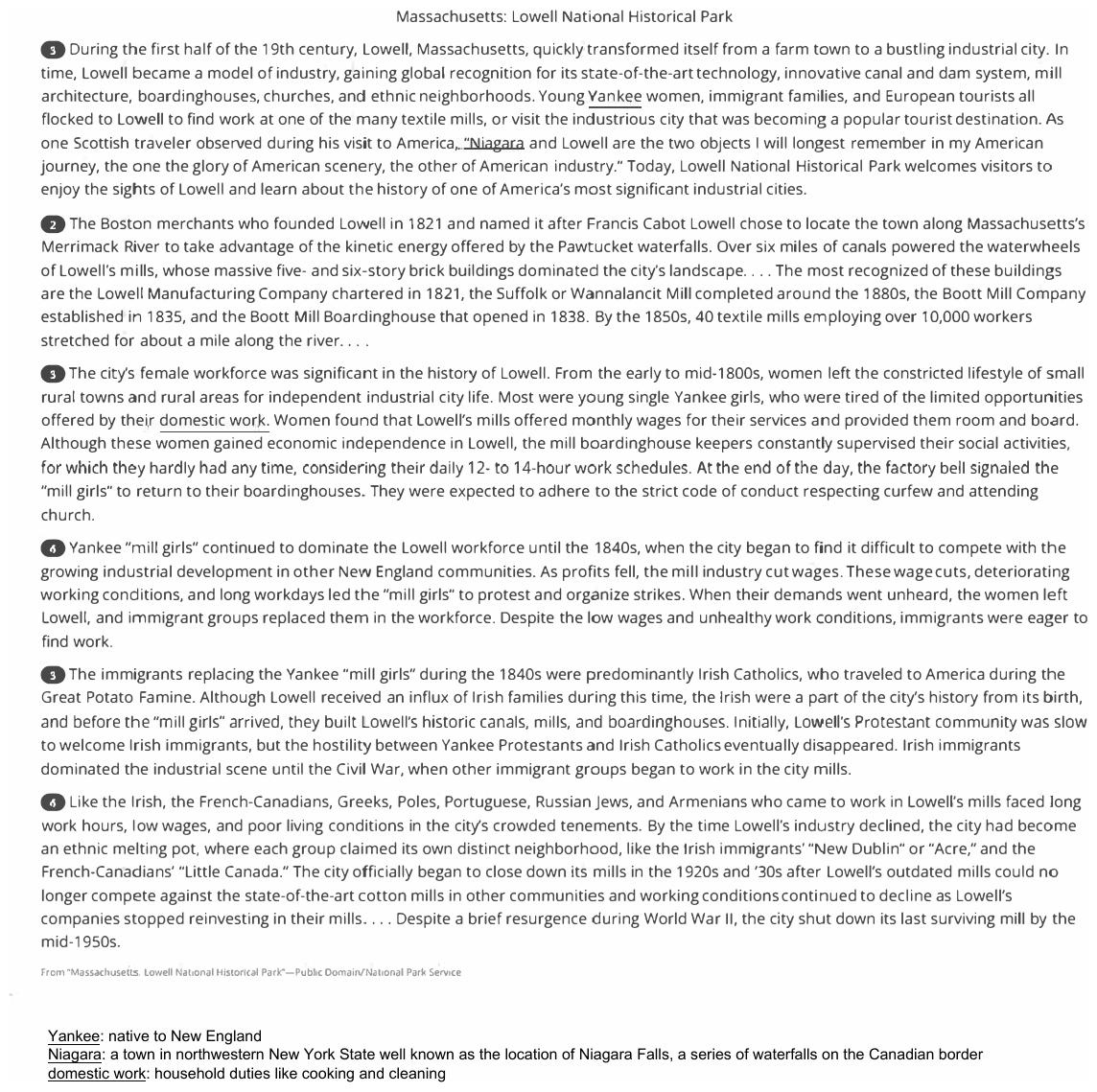
A store manager purchases a piece of furniture for $456.00. To determine the selling price, the manager increases the purchase cost by 125%. A customer buys the furniture and pays an additional 8% sales tax. How much does the customer pay for the furniture?
- A$615.60
- B$627.48
- C$1,108.08
- D$1,846.80
Show the answer
Correct answer: C
Given a purchase price of $456.00, the 125% increase in price is calculated as:
The selling price equals the purchase price plus the increase, or:
The sales tax on the selling price is:
The customer pays the selling price plus the sales tax:
Question analysis
A store manager buys a piece of furniture for $456.00 and raises the price by 125% to set the selling price, and the customer also pays 8% sales tax. Students find the total the customer pays. It tests percent increase and sales tax in sequence, and reading an increase of more than 100% correctly is the main challenge.
- NYS standards
- Grade level
- Grade 7 content, by NYS standard
- Compared with grade 7
- Above grade 7 Grade 7 students find markups and sales tax, usually with increases under 100%. An increase of more than 100% is unusual and easy to misread, and two percent changes must be applied in order, which goes beyond routine grade 7 work.
- Estimated difficulty
- Hard: combines ideas, needs a plan, and has more than one tempting wrong answer.
- Thinking it demands
- Depth of knowledge 2, skills and concepts · mainly apply
- What makes it hard
- Turning words into math moderate
- Many steps moderate
- Error-prone arithmetic minor
- Solution
- 4 steps
- Reading level
- Question and choices: about grade 7, 41 words.
- Students, last 30 days
- Not enough answers yet to show (it takes 10).
Why it is hard, traps and wrong answers (shows the answer)
Why it is hard
A percent above 100 is unusual in grade 7 work, and it is the center of the question: the markup more than doubles the price. Students who treat “by 125%” as “125% of” still find a listed answer after adding tax, and so do students who add $125. A rough check helps: the selling price must be more than twice $456, about $1,000, and the tax adds less than a tenth of that.
Turning words into math moderate Understanding the question
“Increases the purchase cost by 125%” adds 125% of $456 to the $456 itself, a multiplier of 2.25; reading it as 125% of the cost leaves the original price out. (Hegarty, Mayer & Monk, 1995; Koedinger & Nathan, 2004)
Many steps moderate Working it out
Four steps in a row, the increase, the selling price, the tax and the total, each depend on the one before, and two of them are easy to merge or skip. (Daniel & Embretson, 2010; Enright, Morley & Sheehan, 2002)
Error-prone arithmetic minor Working it out
Taking 8% of $1,026 means multiplying by 0.08, and a decimal point one place off, 0.8, makes the tax ten times too large. (Brown & Burton, 1978; Junker & Sijtsma, 2001)
Strategy: Turn each percent change into a multiplier, remembering that an increase by a percent is added to the original amount, apply the markup and then the tax, and estimate to check the size.
Traps
- Stops one step early: A choice is a number from partway through the solution.
- Misunderstands the concept: A wrong belief about a concept: that percents can be added, that area grows like length, that averages can be averaged, that a bigger denominator means a bigger fraction.
- An arithmetic slip: The right method with a plausible arithmetic error: a digit, a place value or a times-table fact.
The wrong answers, classified
A Stops one step early (King et al., 2004; Gierl et al., 2017)
Finds the increase, 125% of $456 = $570, and uses it as the selling price without adding back the $456 cost, then adds 8% tax.
B Misunderstands the concept (Smith, diSessa & Roschelle, 1993; De Bock et al., 1998; Ni & Zhou, 2005)
Reads the 125% increase as $125, a fixed amount, so the selling price is $581, and then adds 8% tax correctly to reach $627.48.
D An arithmetic slip (Junker & Sijtsma, 2001)
Finds the $1,026 selling price correctly but writes 8% as 0.8, adding $820.80 in tax instead of $82.08.
Worked solution, step by step
Formulas used
- Percent of a number
- n is the starting amount, and p is the percent. Percent means out of 100, so 125% is 125/100 = 1.25 and 8% is 8/100 = 0.08. Multiply n by that decimal to find the part.
- Price after an increase
- The old price is what you start with. The increase is the amount added on. To increase by a percent, find that percent of the old price, then add it to the old price. Sales tax is added the same way.
Sort out the question
The manager pays $456.00 for the furniture. The selling price is that cost increased by 125%. The customer then pays 8% sales tax on top. Sales tax is an extra charge, a percent of the price. You need the total the customer pays.
Find the increase
Find 125% of $456. As a decimal, 125% is 1.25, which is 1 and a quarter. A quarter of 456 is 114:
The increase is $570.
Find the selling price
Increases by means the increase is added to the cost:
The selling price is $1,026.
Watch out: $570 is only the increase. Using it as the price gives $615.60, choice A. And 125% is a percent, not $125. Adding $125 leads to $627.48, choice B.
Find the sales tax
As a decimal, 8% is 0.08. Find 8% of the selling price:
The tax is $82.08.
Watch out: 8% is 0.08, not 0.8. Using 0.8 makes the tax ten times too big and gives $1,846.80, choice D.
Add the tax to the price
The customer pays the selling price plus the tax:
So the answer is C, $1,108.08.
Check your answer
Estimate. The price more than doubles: $456 plus $570 is about $1,000. Tax of 8% adds about $80. So the total should be a bit over $1,080, and only $1,108.08 is close. Or multiply in one go: 456 × 2.25 × 1.08 = 1,108.08.
More questions like this
The original DOE question
Question 5 of 6
2024 Test B Math, question 25Question
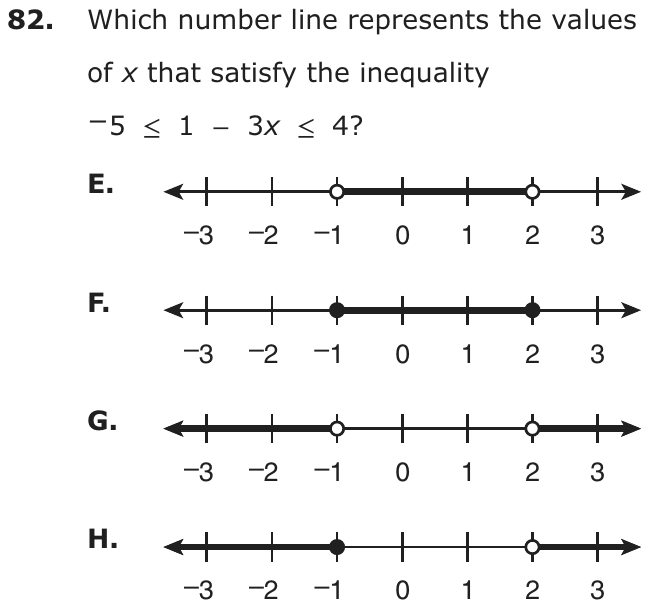
Which number line represents the values of x that satisfy the inequality ?
- A

- B

- C

- D

Show the answer
Correct answer: B
Split the compound inequality into two inequalities.
and
For each inequality, subtract 1 from each side.
and
For each inequality, divide both sides by −3. Note that dividing each side of an inequality by a negative number changes the direction of the inequality.
and
Combining the pieces gives the compound inequality .
The solution is that x is greater than or equal to −1 and less than or equal to 2, so choose the number line with filled circles at −1 and 2, with the filled segment between the circles.
Question analysis
An inequality question: choose the number line that shows the solutions of the compound inequality −5 ≤ 1 − 3x ≤ 4. Students solve an inequality whose x term has a negative coefficient, then match the endpoints, open or closed circles, and shading to one of four graphs.
- Grade level
- Grade 7 content, by NYS standard
- Compared with grade 7
- Above grade 7 Grade 7 students solve and graph two-step inequalities one at a time. This compound inequality needs two solved together and a division by a negative number, which reverses the signs, a step many grade 7 classes only touch on.
- Estimated difficulty
- Hard: combines ideas, needs a plan, and has more than one tempting wrong answer.
- Thinking it demands
- Depth of knowledge 1, recall and reproduction · mainly apply
- What makes it hard
- Error-prone arithmetic moderate
- A very close wrong answer moderate
- Reading a figure, table or graph minor
- Solution
- 4 steps
- Reading level
- Question and choices: about grade 12, 13 words.
- Students, last 30 days
- Not enough answers yet to show (it takes 10).
Why it is hard, traps and wrong answers (shows the answer)
Why it is hard
The question stacks two classic traps: reversing the inequality signs when dividing by −3, and matching filled or open circles to ≤. All four graphs use the endpoints −1 and 2, so finding those numbers proves little; the choice turns on the circles and the direction of the shading. Testing x = 0, x = 3 and the endpoint x = 2 in the original inequality checks both decisions in under a minute.
Error-prone arithmetic moderate Working it out
Dividing all three parts of −6 ≤ −3x ≤ 3 by −3 reverses both signs and the order, giving 2 ≥ x ≥ −1, which must be rewritten as −1 ≤ x ≤ 2. (Brown & Burton, 1978; Junker & Sijtsma, 2001)
A very close wrong answer moderate Choosing the answer
Two graphs share the endpoints −1 and 2 and the shading between them; only the circles, filled for ≤ and open for <, separate them. (Embretson & Wetzel, 1987; Gorin & Embretson, 2006; Ascalon et al., 2007)
Reading a figure, table or graph minor Understanding the question
Each graph must be read for three things at once: the endpoints, the fill of each circle, and whether the shading runs between them or outward. (Lesh, Post & Behr, 1987; Kirsch & Mosenthal, 1990)
Strategy: Subtract 1 from all three parts, divide all three by −3 while reversing both inequality signs, then rewrite the result from smallest to largest before matching circles and shading.
Traps
- Negatives and direction: Arithmetic with negative numbers, the order of a subtraction, or direction on a number line. (Moving a term across the equals sign without changing its sign is a faulty procedure.)
- Counting the ends: Inclusive or exclusive ends, fence posts, consecutive numbers: an answer that is one too many or too few, or an endpoint drawn open where it belongs closed (or the reverse).
The wrong answers, classified
A Counting the ends (Brown & Burton, 1978)
Solves for the right endpoints and shading but draws open circles, as if ≤ excluded −1 and 2 instead of including them.
C Negatives and direction (Brown & Burton, 1978)
Divides by −3 without reversing the signs, so the solutions seem to lie outside −1 and 2; with open circles, this graph shows exactly the values that fail.
D Negatives and direction (Brown & Burton, 1978)
Shades outward as if the signs had not reversed, but mixes the circles, filled at −1 and open at 2, which no single reading of ≤ gives.
Worked solution, step by step
Formulas used
- Subtracting from every part
- a and b are the two sides of an inequality, and c is any number. Subtracting the same number from every part keeps the inequality true. The sign does not change.
- Dividing by a negative number
- a and b are numbers, and c is a positive number, so −c is negative. When you divide both sides by a negative number, the inequality sign flips. For example, 2 is less than 3, but −2 is greater than −3.
Sort out the question
The inequality says that is between −5 and 4. The sign ≤ means less than or equal to. So −5 and 4 themselves are allowed. You need the number line that shows every x that works. To find them, get x alone in the middle.
Subtract 1 from every part
First take away the 1 in the middle. Subtract 1 from all three parts.
Divide by −3 and flip
Now x is multiplied by −3. Divide all three parts by −3. Dividing by a negative number flips each sign.
Watch out: if you forget to flip, x seems to lie outside −1 and 2. That leads to choices C and D, which are shaded outward.Read the result
Turn it around so the smaller number is on the left. It means the same thing.
So x can be any number from −1 to 2. The ends, −1 and 2, are included, because the signs are ≤.
Pick the number line
On a number line, a closed (filled-in) circle means the end number is included. An open circle means it is not. So you need closed circles at −1 and 2, with the part between them shaded. Watch out: choice A has the right shading but open circles, which leave out −1 and 2.
So the answer is B.
Check your answer
Test a few numbers in . For x = 0 you get 1, which is between −5 and 4, and 0 is shaded. For x = 2 you get −5, which is allowed, so the circle at 2 is filled in. For x = 3 you get −8, which is too small, so 3 is not shaded.
More questions like this
The original DOE question
Question 6 of 6
2024 Test B Math, question 17Question
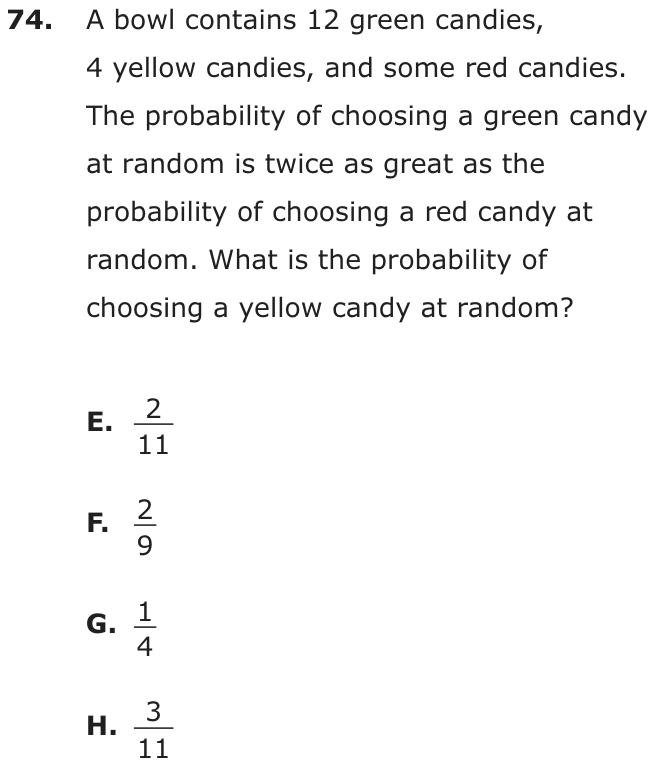
A bowl contains 12 green candies, 4 yellow candies, and some red candies. The probability of choosing a green candy at random is twice as great as the probability of choosing a red candy at random. What is the probability of choosing a yellow candy at random?
- A
- B
- C
- D
Show the answer
Correct answer: A
The probability of choosing a green candy is twice as great as the probability of choosing a red candy. There are 12 green candies. Let r = the number of red candies.
So there are 6 red candies. 12 green candies + 4 yellow candies + 6 red candies = 22 total candies.
There are 4 yellow candies out of a total of 22 candies. So the probability of choosing a yellow candy is
.
Question analysis
A probability question about a bowl of 12 green candies, 4 yellow candies and an unknown number of red ones. A green candy is twice as likely to be picked as a red one, and students find the chance of picking a yellow candy. The missing red count has to be worked out before any probability can be found.
- Grade level
- Grade 6 content, by NYS standard
- Compared with grade 7
- Above grade 7 Simple probability is grade 6 content in New York, and grade 7 problems usually give every count. Working backward from a comparison of two probabilities to a missing count, then forward to a third probability, is more than typical grade 7 work.
- Estimated difficulty
- Hard: combines ideas, needs a plan, and has more than one tempting wrong answer.
- Thinking it demands
- Depth of knowledge 2, skills and concepts · mainly apply
- What makes it hard
- Turning words into math moderate
- Combines ideas moderate
- Solution
- 3 steps
- Reading level
- Question and choices: about grade 7, 49 words.
- Students, last 30 days
- Not enough answers yet to show (it takes 10).
Why it is hard, traps and wrong answers (shows the answer)
Why it is hard
The question withholds the red count, and everything depends on recovering it from the comparison of probabilities. Students who cannot make that step tend to leave red out altogether, while those who find 6 red candies can still slip at the end by using the wrong total or the wrong color. Writing all three counts and the total of 22 before forming any fraction prevents both endings.
Turning words into math moderate Understanding the question
“Twice as great as the probability of choosing a red candy” must become 12 = 2 × the red count, which works only because both probabilities share one total. (Hegarty, Mayer & Monk, 1995; Koedinger & Nathan, 2004)
Combines ideas moderate Working it out
An unknown count has to be found from a ratio before any probability can be written, joining proportional reasoning with probability as a part over the total. (Embretson, 1998; Daniel & Embretson, 2010)
Strategy: Turn twice as likely into a statement about numbers of candies to find the red count, add all three colors for the total, then put the yellow count over that total and simplify.
Traps
- Answers a different question: A choice is right for another quantity: the other unknown, the rest instead of the part, the part instead of the whole.
- Numbers taken from the question: Combines the numbers in the question without a model of the situation, or is simply a number that appears in the question.
The wrong answers, classified
B Misunderstands the concept (Smith, diSessa & Roschelle, 1993; De Bock et al., 1998; Ni & Zhou, 2005)
Finds the 6 red candies but compares the 4 yellow with the 18 green and red ones, 4/18, a part-to-part ratio instead of part to whole.
C Numbers taken from the question (Hegarty, Mayer & Monk, 1995)
Leaves out the red candies, whose number is not given, and divides the 4 yellow by the 16 green and yellow candies.
D Answers a different question (King et al., 2004; Hegarty, Mayer & Monk, 1995)
Finds the 6 red candies and the total of 22 correctly but gives the chance of red, 6/22 = 3/11, instead of yellow.
Worked solution, step by step
Formulas used
- Probability
- P is the probability, the chance that something happens. The top is how many candies are the kind you want. The bottom is how many candies there are in all. Each candy is just as likely to be picked, so this fraction gives the chance.
Sort out what you know
The bowl has 12 green candies, 4 yellow candies and some red candies. You are not told how many are red. Let r be the number of red candies.
The chance of picking green is twice the chance of picking red. You need the probability (the chance) of picking yellow.
Compare green and red
Write each chance with the probability formula.
Green and red have the same bottom number, the total number of candies. So if the chance of green is twice the chance of red, there are twice as many green candies as red ones.
Find the red candies and the total
There are 6 red candies. Now add up all the candies.
There are 22 candies in all. Watch out: do not leave out the red candies just because their number was not given. Using 16 as the total gives 1/4, choice C.
Find the chance of yellow
There are 4 yellow candies out of 22.
Divide the top and the bottom by 2 to simplify. Watch out: the question asks for yellow, not red. 6/22 = 3/11 is the chance of red, choice D. The bottom must be all 22 candies. Using 18 gives 2/9, choice B.
So the answer is A, .
Check your answer
Check the clue. The chance of green is , and the chance of red is . Twelve is twice 6, so green is twice as likely. Also, the three chances add up to 1: .
More questions like this
The original DOE question