Passage The Best Laid Plans of Ravens
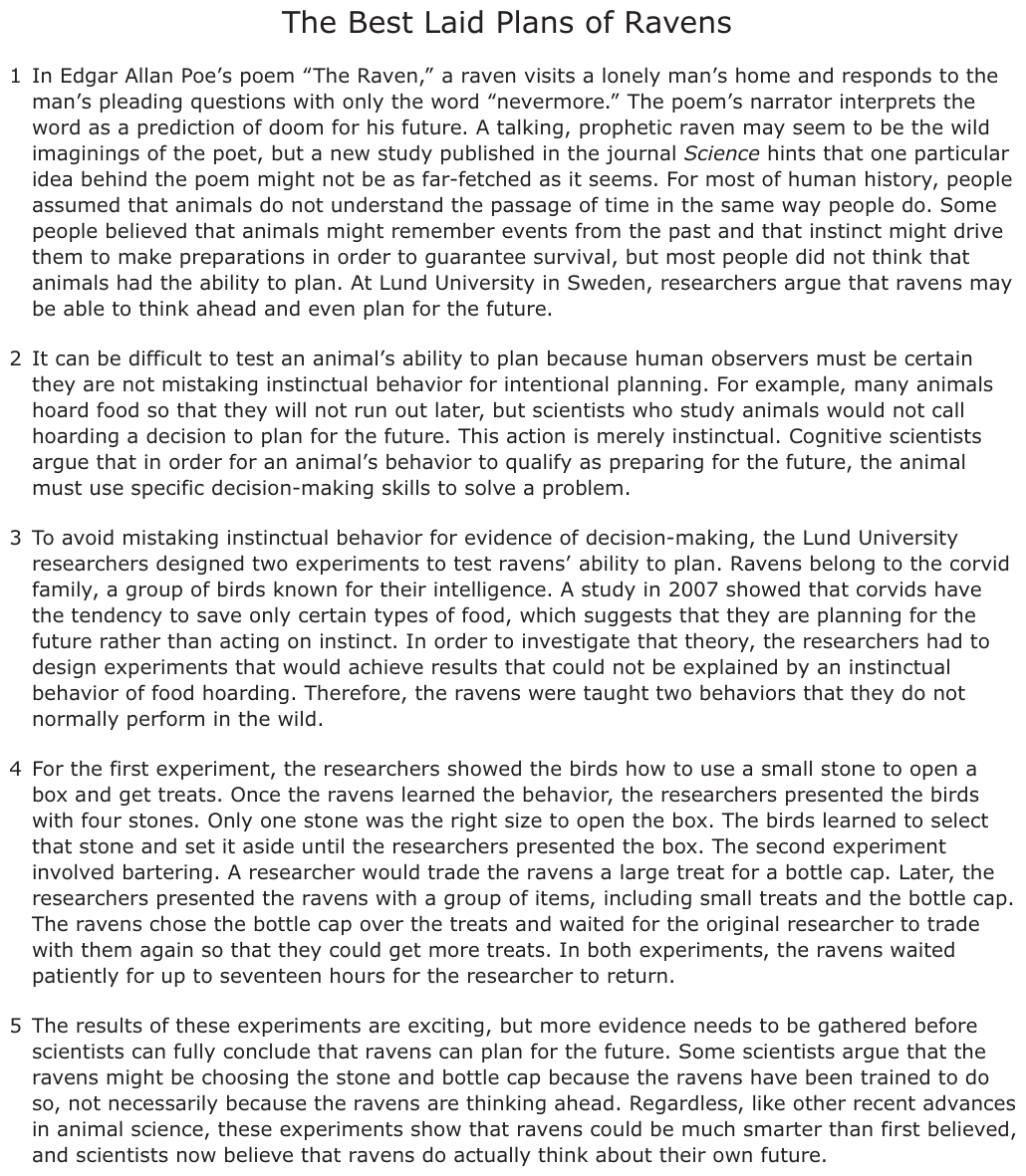
The Best Laid Plans of Ravens
In Edgar Allan Poe’s poem “The Raven,” a raven visits a lonely man’s home and responds to the man’s pleading questions with only the word “nevermore.” The poem’s narrator interprets the word as a prediction of doom for his future. A talking, prophetic raven may seem to be the wild imaginings of the poet, but a new study published in the journal Science hints that one particular idea behind the poem might not be as far-fetched as it seems. For most of human history, people assumed that animals do not understand the passage of time in the same way people do. Some people believed that animals might remember events from the past and that instinct might drive them to make preparations in order to guarantee survival, but most people did not think that animals had the ability to plan. At Lund University in Sweden, researchers argue that ravens may be able to think ahead and even plan for the future.
It can be difficult to test an animal’s ability to plan because human observers must be certain they are not mistaking instinctual behavior for intentional planning. For example, many animals hoard food so that they will not run out later, but scientists who study animals would not call hoarding a decision to plan for the future. This action is merely instinctual. Cognitive scientists argue that in order for an animal’s behavior to qualify as preparing for the future, the animal must use specific decision-making skills to solve a problem.
To avoid mistaking instinctual behavior for evidence of decision-making, the Lund University researchers designed two experiments to test ravens’ ability to plan. Ravens belong to the corvid family, a group of birds known for their intelligence. A study in 2007 showed that corvids have the tendency to save only certain types of food, which suggests that they are planning for the future rather than acting on instinct. In order to investigate that theory, the researchers had to design experiments that would achieve results that could not be explained by an instinctual behavior of food hoarding. Therefore, the ravens were taught two behaviors that they do not normally perform in the wild.
For the first experiment, the researchers showed the birds how to use a small stone to open a box and get treats. Once the ravens learned the behavior, the researchers presented the birds with four stones. Only one stone was the right size to open the box. The birds learned to select that stone and set it aside until the researchers presented the box. The second experiment involved bartering. A researcher would trade the ravens a large treat for a bottle cap. Later, the researchers presented the ravens with a group of items, including small treats and the bottle cap. The ravens chose the bottle cap over the treats and waited for the original researcher to trade with them again so that they could get more treats. In both experiments, the ravens waited patiently for up to seventeen hours for the researcher to return.
The results of these experiments are exciting, but more evidence needs to be gathered before scientists can fully conclude that ravens can plan for the future. Some scientists argue that the ravens might be choosing the stone and bottle cap because the ravens have been trained to do so, not necessarily because the ravens are thinking ahead. Regardless, like other recent advances in animal science, these experiments show that ravens could be much smarter than first believed, and scientists now believe that ravens do actually think about their own future.
Question
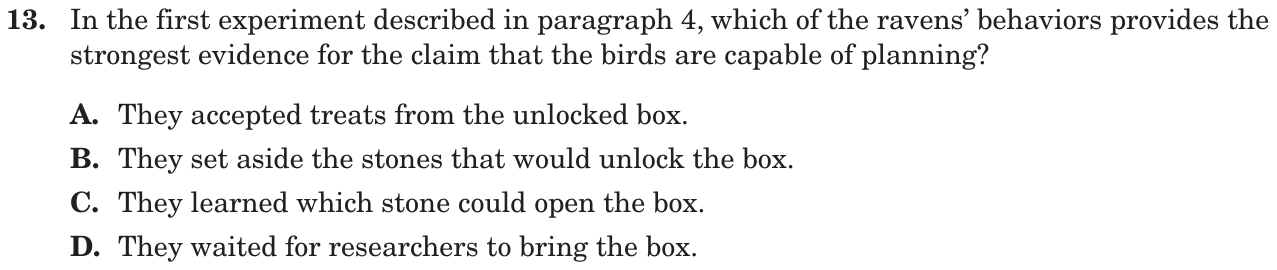
In the first experiment described in paragraph 4, which of the ravens’ behaviors provides the strongest evidence for the claim that the birds are capable of planning?
- AThey accepted treats from the unlocked box.
- BThey set aside the stones that would unlock the box.
- CThey learned which stone could open the box.
- DThey waited for researchers to bring the box.
Show the answer
Correct answer: B
The question asks which of the ravens’ behaviors in the first experiment described in paragraph 4 most strongly supports the claim that the birds are capable of planning.
A. Incorrect. While “the researchers showed the birds how to use a small stone to open a box and get treats” (paragraph 4), the acceptance of the treats does not demonstrate planning.
B. CORRECT. Once the ravens learned which stone would open the box, they consistently selected only that stone.
C. Incorrect. Although the birds learned which stone opened the box, this behavior demonstrates not their ability to plan but rather their intelligence.
D. Incorrect. The birds’ patience shows their anticipation for and understanding of the future gain of a treat but does not provide the strongest evidence of their ability to plan.
Question analysis
The first experiment in “The Best Laid Plans of Ravens,” in which researchers showed ravens how to open a box of treats with a small stone, is the focus of this evidence question. Students decide which of the birds’ actions gives the strongest evidence that ravens can plan, and several of those actions seem to show intelligence.
- Grade level
- Grade 8 reading and task
- Compared with grade 7
- Above grade 7 In grade 7, finding a detail that backs a claim is routine. Here all four behaviors come from the same experiment and more than one looks like forethought, so students must rank them, which goes further than most grade 7 evidence work.
- Estimated difficulty
- Hard: combines ideas, needs a plan, and has more than one tempting wrong answer.
- Thinking it demands
- Depth of knowledge 3, strategic thinking · mainly evaluate
- What makes it hard
- A very close wrong answer major
- Reading between the lines moderate
- Evidence in several places minor
- Evidence
- Answered from several paragraphs or stanzas
- Reading level
- Passage: about grade 11, 599 words; question and choices: about grade 5, 59 words.
- Students, last 30 days
- Not enough answers yet to show (it takes 10).
Why it is hard, traps and wrong answers (shows the answer)
Why it is hard
All four choices describe something the ravens actually did, so the task is ranking rather than finding. The seventeen-hour wait is the experiment’s most dramatic detail and draws attention from the quieter act of keeping the right stone ready. This printing adds a snag: the key speaks of “stones” that would “unlock” the box, though only one stone fit and nothing was locked, so a careful reader may hesitate over the best answer.
A very close wrong answer major Choosing the answer
Keeping the right stone ready and waiting for the box come from one clause, “set it aside until the researchers presented the box”; only the first is an action taken now for a later need. (Embretson & Wetzel, 1987; Gorin & Embretson, 2006; Ascalon et al., 2007)
Reading between the lines moderate Working it out
The passage never says which behavior counts as planning, so each must be measured against paragraph 2’s requirement that the animal “use specific decision-making skills to solve a problem.” (Graesser, Singer & Trabasso, 1994; Kintsch, 1998)
Evidence in several places minor Working it out
The waiting that tempts students is stressed in paragraph 4’s last sentence, “up to seventeen hours,” well after the stone sentence, while the standard for judging both sits back in paragraph 2. (Kirsch & Mosenthal, 1990; Gorin & Embretson, 2006)
Strategy: Take paragraph 2’s description of what planning requires and hold each of the four behaviors up to it, choosing the one that meets it most fully rather than the one that seems cleverest.
Traps
- Supports only part of the claim: In a question about evidence: a line that backs one half of the claim but not the other, or a related point rather than the claim itself.
- True but not the answer: A choice says something accurate about the text that does not answer this question.
The wrong answers, classified
A True but not the answer (King et al., 2004; Embretson & Wetzel, 1987)
Picks the reward at the end of the task, treats taken from the opened box, which any trained animal would accept and which shows no thought about the future.
C Supports only part of the claim (King et al., 2004; Thissen, Steinberg & Fitzpatrick, 1989)
Credits the birds for learning which of the four stones fits, but knowing the right tool shows they can learn, not that they keep it ready for later.
D Supports only part of the claim (King et al., 2004; Thissen, Steinberg & Fitzpatrick, 1989)
Is impressed by the birds waiting “up to seventeen hours,” which shows they expect the box to return, but waiting is passive, while holding the stone ready is the act of planning.
Working it out, step by step
Figure out what the question asks
This asks which thing the ravens did in the first experiment best shows that they can plan. That is the stone-and-box test in paragraph 4. Several choices describe something the birds did. So you must rank the choices and pick the strongest.
Decide what counts as planning
Paragraph 2 gives a test. To count as preparing for the future, “the animal must use specific decision-making skills to solve a problem.” In plain words, planning means choosing to do something now to be ready for later. Use that as your measuring stick.
Find the key sentences
Paragraph 4 says “Only one stone was the right size to open the box.” Then “The birds learned to select that stone and set it aside until the researchers presented the box.” To set something aside is to put it away to use later. When the birds did this, the box was not there yet.
Read choice B with care
Choice B says the birds “set aside the stones that would unlock the box.” Its wording is a little loose. The passage talks about one stone that was the right size to open the box. It never says the box was locked. Still, B names the right action: keeping the working stone ready for later. Don’t let the loose words throw you off.
Check each choice
- A does not fit. Taking the treats is the reward at the end. Any trained animal will do that.
- B fits. Saving the right stone gets the bird ready for a box that is not there yet.
- C does not fit. Learning which stone works shows the birds can learn. Knowing the right tool is not the same as keeping it ready.
- D does not fit as well. Waiting shows the birds expected the box. But waiting is not an action.
Watch out: D is tempting because the passage stresses that the birds waited “up to seventeen hours.” That is impressive. But a bird that waits is doing nothing, so it is weaker proof of a plan.
Choose the answer
Picking the one stone that works and keeping it for later is the clearest sign of planning. So the answer is B.
Why this answer and not the closest wrong one
D is the closest wrong choice. The birds kept the stone “until the researchers presented the box,” so waiting and saving go together. But waiting is passive: the bird just sits. Choosing the right stone and holding on to it is a decision made now for a later need. That makes B stronger, even with its loose wording.
More questions like this
The original DOE question
The passage “The Best Laid Plans of Ravens” as printed (page 12)