Reversed relationship
Question 1 of 11
2026 Practice Test A English, question 34Passage Excerpt from “The Spirit of the Herd”
Excerpt from “The Spirit of the Herd”
by Dallas Lore Sharp
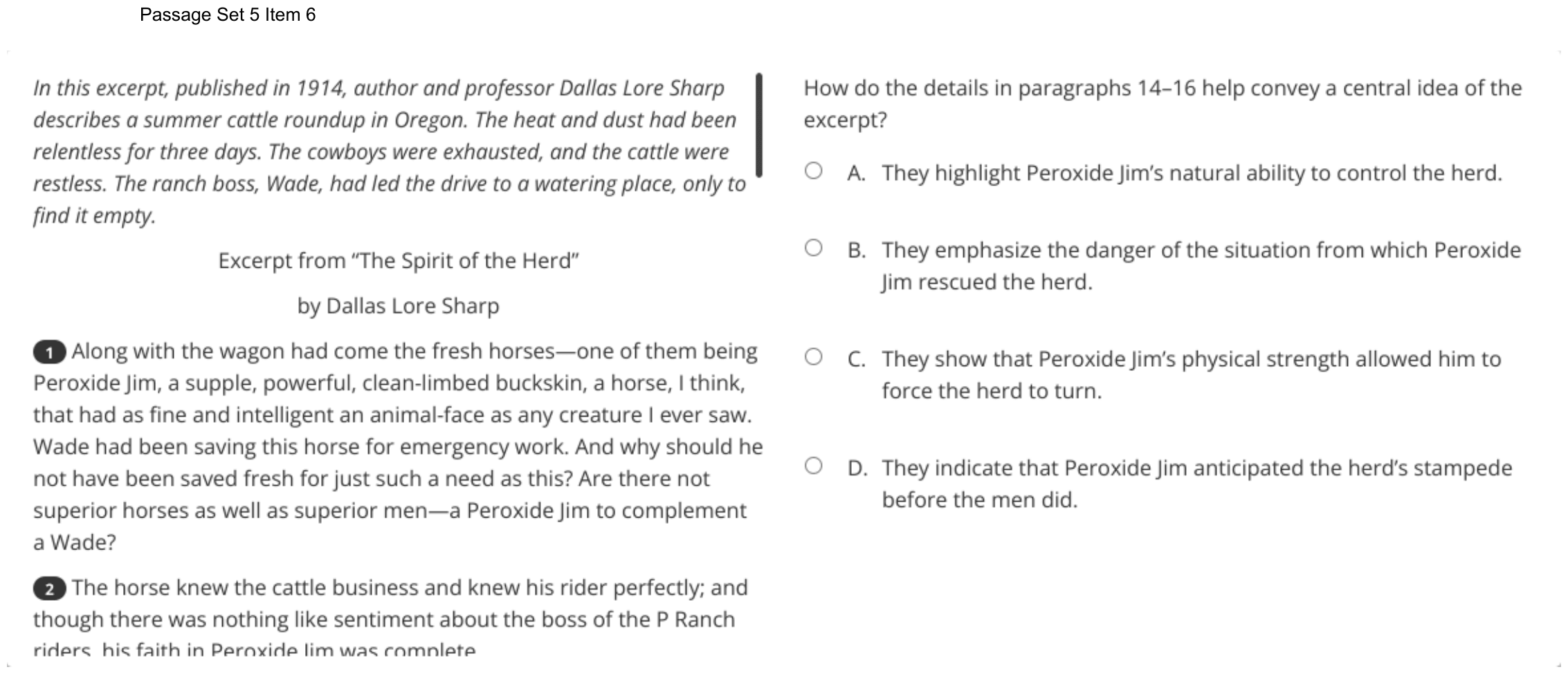
In this excerpt, published in 1914, author and professor Dallas Lore Sharp describes a summer cattle roundup in Oregon. The heat and dust had been relentless for three days. The cowboys were exhausted, and the cattle were restless. The ranch boss, Wade, had led the drive to a watering place, only to find it empty.
Along with the wagon had come the fresh horses—one of them being Peroxide Jim, a supple, powerful, clean-limbed buckskin, a horse, I think, that had as fine and intelligent an animal-face as any creature I ever saw. Wade had been saving this horse for emergency work. And why should he not have been saved fresh for just such a need as this? Are there not superior horses as well as superior men—a Peroxide Jim to complement a Wade?
The horse knew the cattle business and knew his rider perfectly; and though there was nothing like sentiment about the boss of the P Ranch riders, his faith in Peroxide Jim was complete. . . .
The desert, where the herd was camped, was one of the highest of a series of tablelands, or benches; it lay as level as a floor, rimmed by sheer rock, from which there was a drop to the bench of sage below. The herd when overtaken by the dusk had been headed for a pass descending to the next lower bench, but was now halted within a mile of the rim rock on the east, where there was a perpendicular fall of about three hundred feet. . . .
In the taut silence of the stirless desert night, with the tension of the herd at the snapping-point, any quick, unwonted sight or sound would stampede them. The sneezing of a horse, the flare of a match, would be enough to send the whole four thousand headlong—blind, frenzied, trampling—till spent and scattered over the plain.
And so, as he rode, Wade began to sing. The rider ahead of him took up the air and passed it on until, above the stepping stir of the hoofs rose the faint voices of the men, and all the herd was bound about by the slow plaintive measures of some old song. It was not to soothe their savage breasts that the riders sang to the cattle, but rather to preempt the dreaded silence, to relieve the tension, and so to prevent the shock of any sudden startling noise.
So they sang and rode and the night wore on to one o’clock, when Wade, coming up on the rim-rock side, felt a cool breeze fan his face, and caught a breath of fresh, moist wind with the taste of water in it.
He checked his horse instantly, listening as the wind swept past him over the cattle. But they must already have smelled it, for they had ceased their milling, the whole herd standing motionless, the indistinct forms close to him in the dark showing their bald faces lifted to drink the sweet wet breath that came over the rim. Then they started on again, but faster, and with a rumbling now from their hoarse throats that tightened Wade’s grip on the reins.
The sound seemed to come out of the earth, a low, rumbling mumble, as dark as the night and as wide as the plain, a thick, inarticulate bellow that stood every rider stiff in his stirrups. . . .
Then the breeze caught the dust and carried it back from the gray-coated, ghostly shapes, and Wade saw that the animals were still moving in a circle. He must keep them going. He touched his horse to ride on with them, when across the black sky flashed a vivid streak of lightning.
There was a snort from the steers, a quick clap of horns and hoofs from far within the herd, a tremor of the plain, a roar, a surging mass—and Wade was riding the flank of a wild stampede. Before him, behind him, beside him, pressing hard upon his horse, galloped the frenzied steers, and beyond them a multitude borne on, and bearing him on, by the heave of the galloping herd.
Wade was riding for his life. He knew it. His horse knew it. He was riding to turn the herd, too, back from the rim, as the horse also knew. The cattle were after water—water-mad—ready to go over the precipice to get it, carrying horse and rider with them. Wade was the only rider between the herd and the rim. It was black as death. He could see nothing in the sage, could scarcely discern the pounding, panting shadows at his side. He knew that he was being borne toward the rim, how fast he could not tell, but he knew by the swish of the brush against his tapaderos and the plunging of the horse that the ground was growing stonier, that they were nearing the rocks.
To outrun the herd was his only chance for life. If he could come up with the leaders he might not only escape, but even stand a chance of heading them off upon the plain and saving the herd. There were cattle still ahead of him; how many, what part of them all, he could not make out in the dark. But the horse knew. The reins hung on his straight neck, where his rider had dropped them, as, yelling and firing over the wild herd, he had given this horse the race to win, to lose.
They were riding the rim. Close on their left bore down the flank of the herd, and on their right, under their very feet, was a precipice, so close that they felt its blackness—its three hundred feet of fall! . . .
. . . Then Wade found himself racing neck and neck with a big white steer, which the horse, with marvelous instinct, seemed to pick out from a bunch, and to cling to, forcing him gradually ahead, till, cutting him free from the bunch entirely, he bore him off into the swishing sage.
The steers coming on close behind followed their leader, and in, after them, swung others. The tide was turning from the rim. More and more were veering, and within a short time the whole herd, bearing off from the cliffs, was pounding over the open plains.
Whose race was it? It was Peroxide Jim’s, according to Wade, for not by word or by touch of hand or knee had the horse been directed in the run. From the flash of the lightning the horse had taken the bit, had covered an indescribably perilous path at top speed, had outrun the herd and turned it from the edge of the rim rock, without a false step or a tremor of fear.
From “The Spirit of the Herd” by Dallas Lore Sharp—Public Domain
tablelands: plateaus, flat areas of land sharply elevated from the surrounding area
tapaderos: leather covers for stirrups
Question
How do the details in paragraphs 14–16 help convey a central idea of the excerpt?
- AThey highlight Peroxide Jim’s natural ability to control the herd.
- BThey emphasize the danger of the situation from which Peroxide Jim rescued the herd.
- CThey show that Peroxide Jim’s physical strength allowed him to force the herd to turn.
- DThey indicate that Peroxide Jim anticipated the herd’s stampede before the men did.
Show the answer
Correct answer: A
The question asks how the details in paragraphs 14–16 help convey a central idea of the excerpt.
A. CORRECT. Paragraphs 14–16 describe how Peroxide Jim’s “marvelous instinct” headed off the herd and drove it away from the cliff. Wade acknowledged that without his instruction, Peroxide Jim knew to find the leader of the herd, cut him off from the rest of the herd, and then lead him to safety, confident that the remainder of the herd would follow. Paragraph 16 confirms this: “Whose race was it? It was Peroxide Jim’s, according to Wade, for not by word or by touch of hand or knee had the horse been directed in the run.” This reinforces a central idea of the excerpt regarding the horse’s amazing intellect and ability.
B. Incorrect. Although paragraphs 14–16 mention the “rim,” the “cliffs,” and the “indescribably perilous path,” these details are not the focus of the paragraphs. They are descriptions of the setting where Peroxide Jim’s able and effective actions saved the stampeding herd, and it is these actions that are the central idea being conveyed.
C. Incorrect. Although Peroxide Jim is called “powerful” in paragraph 1, his physical strength is neither a central idea of the excerpt nor the focus of paragraphs 14–16. His success at turning the herd was attributed to his intellect and instinct, not his physical strength.
D. Incorrect. The excerpt does not suggest that Peroxide Jim anticipated the herd’s stampede before the men did. In fact, the excerpt indicates that Wade led the men in singing to cover sudden noises that might cause the herd to stampede, indicating that Wade was alert to that possibility. Paragraph 7 also indicates that Wade anticipated the stampede, as he “checked his horse instantly” and “tightened [his] grip on the reins” as soon as he smelled water on the wind and heard the low rumbling of the herd that preceded the lightning strike. The narrator notes Wade’s actions well before the horse’s actions. Paragraphs 14–16 describe how Peroxide Jim acted after the stampede began.
Question analysis
This central-idea question asks how the details in the last three paragraphs of “The Spirit of the Herd,” where the stampede is finally turned away from the cliff, help convey a central idea. Students must decide what those details mainly show about Peroxide Jim. Several choices touch on something real in the story, so the paragraphs’ main emphasis decides it.
- Grade level
- Grade 7 reading and task
- Compared with grade 7
- At grade 7 Linking a passage’s final paragraphs to its central idea is a familiar grade 7 task. Paragraphs 14–16 are short and vivid, but several choices mention something those paragraphs touch on, so students must judge what the details mainly emphasize.
- Estimated difficulty
- Moderate: several steps, or a close reading with one strong distractor.
- Thinking it demands
- Depth of knowledge 2, skills and concepts · mainly analyze
- What makes it hard
- How, not what moderate
- The right answer is reworded minor
- Complex sentences minor
- Evidence
- Answered from several paragraphs or stanzas
- Reading level
- Passage: about grade 8, 1160 words; question and choices: about grade 8, 66 words.
- Corrected from the DOE handbook
- Details in the explanation that are not in the excerpt were corrected.
- Students, last 30 days
- Not enough answers yet to show (it takes 10).
Why it is hard, traps and wrong answers (shows the answer)
Why it is hard
The three paragraphs mix danger with skill, so a choice about danger can quote them and still miss what they emphasize. The detail that carries the central idea is that no word or touch directed the horse: he picked out the lead steer himself and the herd followed. Students who remember that Peroxide Jim was called “powerful” credit his strength, and a few reverse the order of events, putting his reaction before Wade’s.
How, not what moderate Working it out
The question asks what the details in paragraphs 14–16 do, so students must see that the rim and the “perilous path” are background and the horse’s choices are the point. (Anderson & Krathwohl, 2001)
The right answer is reworded minor Choosing the answer
The right choice calls the horse’s skill a “natural ability,” a plain paraphrase of “marvelous instinct,” while a wrong choice repeats the danger words the paragraphs use. (Freedle & Kostin, 1993; Kirsch & Mosenthal, 1990)
Complex sentences minor Understanding the question
Paragraph 14 tells how the horse turns the herd in one 50-word sentence full of commas, “which the horse, with marvelous instinct, seemed to pick out from a bunch, and to cling to.” (Abedi & Lord, 2001; Freedle & Kostin, 1993; Messick, 1989)
Strategy: Note what paragraphs 14–16 mostly focus on, then test each choice by asking whether it names that focus or only a detail mentioned along the way.
Traps
- True but not the answer: A choice says something accurate about the text that does not answer this question.
- Twists what the text says: Uses the text's topic and ideas but changes what it says: who did it, how much, when, or why.
- Reversed relationship: Cause and effect, or the order of events, turned around.
The wrong answers, classified
B True but not the answer (King et al., 2004; Embretson & Wetzel, 1987)
Notices the “rim,” the “cliffs” and the “indescribably perilous path,” but these details set the scene; the paragraphs dwell on how the horse turned the herd.
C Twists what the text says (King et al., 2004)
Gets right that the horse turned the herd, perhaps recalling “powerful” from paragraph 1, but the paragraphs credit his “marvelous instinct,” not his strength.
D Reversed relationship (King et al., 2004)
Puts the horse’s reaction before the men’s, but Wade sensed trouble in paragraph 7 when the wind changed, and the horse took the bit only at the lightning.
What was corrected from the DOE handbook, and why
- Explanation: The handbook’s explanation of Option D says Wade reacted “as soon as he smelled the rain and heard the low rumble of thunder that preceded the lightning strike.” The excerpt has no rain and no thunder. In paragraph 6 Wade catches “a breath of fresh, moist wind with the taste of water in it,” and in paragraph 7 the rumbling comes “from their hoarse throats,” the cattle’s; that rumbling is what “tightened Wade’s grip on the reins.” The site now says “as soon as he smelled water on the wind and heard the low rumbling of the herd that preceded the lightning strike.”
Working it out, step by step
Figure out what the question asks
This asks how the details in paragraphs 14 to 16 help show a central idea, a main idea of the excerpt. What do these last three paragraphs mostly focus on?
Read paragraphs 14 to 16
In paragraph 14, the horse, “with marvelous instinct, seemed to pick out from a bunch” a big white steer. Paragraph 15 says “The steers coming on close behind followed their leader.” Paragraph 16 says the race was the horse’s, “for not by word or by touch of hand or knee had the horse been directed in the run.”
Work out what the details show
An instinct is a natural sense of what to do, without being taught or told. A steer is one of the cattle. The horse picked out one big steer and pushed it off into the sage, away from the cliff. The rest followed it as their leader. No one guided the horse. So the horse controlled the whole herd using his own natural skill.
Check each choice
- A fits. The details show the horse’s natural ability to control the herd.
- B does not fit. The “rim” and the “cliffs” set the scene. The focus is how the horse turned the herd.
- C does not fit. The horse does not overpower the herd. He picks the leader, and the others follow.
- D does not fit. In paragraph 7, Wade sensed trouble first. The cattle’s rumbling “tightened Wade’s grip on the reins.” The horse took charge only “From the flash of the lightning.”
Choose the answer
The last three paragraphs show the horse’s natural skill at turning the herd. So the answer is A.
Why this answer and not the closest wrong one
B is the closest wrong choice, because the paragraphs do mention the rim and a “perilous,” or dangerous, path. But the danger is the background. The paragraphs mostly show what the horse did: he chose the lead steer and turned the herd with no one guiding him. That natural skill is A.
More questions like this
The original DOE question
The passage “Excerpt from “The Spirit of the Herd”” as printed (page 41)
Question 2 of 11
2024 Test B English, question 17Passage Excerpt from “How Exercise Could Help You Learn a New Language”
Excerpt from “How Exercise Could Help You Learn a New Language”
by Gretchen Reynolds
Many scientists suspect that exercise alters the biology of the brain in ways that make it more malleable and receptive to new information, a process that scientists refer to as plasticity.
But many questions have remained unanswered about movement and learning, including whether exercise is most beneficial before, during or after instruction and how much and what types of exercise might be best.
So for a new study, which was published recently in PLOS One, researchers in China and Italy decided to home in on language learning and the adult brain.
Language learning is interesting. As young children, almost all of us picked up our first language easily. We didn’t have to be formally taught; we simply absorbed words and concepts.
But by early adulthood, the brain generally begins to lose some of its innate language capability. It displays less plasticity in areas of the brain related to language. As a result, for most of us, it becomes harder to learn a second language after childhood.
To see what effects exercise might have on this process, the researchers first recruited 40 college-age Chinese men and women who were trying to learn English. The students had some facility with this second language but were far from proficient.
The researchers then divided the students into two groups. Those in one group would continue to learn English as they had before, primarily while seated in rote vocabulary-memorization sessions.
The others would supplement these sessions with exercise.
Specifically, the students would ride exercise bikes at a gentle pace (about 60 percent of their maximum aerobic capacity) beginning 20 minutes before the start of the lessons and continuing throughout the 15 minutes or so of instruction.
Both groups learned their new vocabulary by watching words projected onto large screens, together with comparable pictures, such as “apple” and a Red Delicious. They were shown 40 words per session, with the sequence repeated several times.
Afterward, the students all rested briefly and then completed a vocabulary quiz, using computer keys to note as quickly as possible whether a word was with its correct picture. They also responded to sentences using the new words, marking whether the sentences were accurate or, in the case of “The apple is a dentist,” nonsensical. Most linguists1 feel that understanding sentences shows greater mastery of a new language than does simple vocabulary improvement.
The students completed eight vocabulary sessions over the course of two months.
And at the end of each lesson, the students who had ridden bikes performed better on the subsequent vocabulary tests than did the students who sat still.
They also became more proficient at recognizing proper sentences than the sedentary students, although that difference did not emerge until after several weeks of instruction.
Perhaps most interesting, the gains in vocabulary and comprehension lingered longest for the cyclists. When the researchers asked the students to return to the lab for a final round of testing a month after the lessons—without practicing in the meantime—the cyclists remembered words and understood them in sentences more accurately than did the students who had not moved.
“The results suggest that physical activity during learning improves that learning,” says Simone Sulpizio, a professor of psychology and linguistics at the University Vita-Salute San Raffaele in Milan, Italy, and a study co-author.
These improvements extend beyond simply aiding in memorization, she added. The exercise also deepened language learners’ grasp of how to use their newly acquired words.
This study involved college students performing relatively light exercise, though, and cannot tell us whether other people completing other types of exercise would achieve the same results.
It also offers no clues about what is occurring inside the brain that might be contributing to the benefits of the exercise. But many past studies have shown that exercise prompts the release of multiple neurochemicals in the brain that increase the number of new brain cells and the connections between neurons, Dr. Sulpizio says. These effects improve the brain’s plasticity and augment the ability to learn.
From a real-world standpoint, the study’s implications might seem at first to be impractical. Few classrooms are equipped with stationary bicycles. But specialized equipment is probably unnecessary, Dr. Sulpizio says.
“We are not suggesting that schools or teachers buy lots of bicycles,” she says. “A simpler take-home message may be that instruction should be flanked by physical activity.”
From “How Exercise Could Help You Learn a New Language” by Gretchen Reynolds from THE NEW YORK TIMES, August 16, 2017. Copyright © 2017 The New York Times Company.
1linguists: scientists who study language
Question
Read this sentence from paragraph 6.
To see what effects exercise might have on this process, the researchers first recruited 40 college-age Chinese men and women who were trying to learn English.
Which statement describes the function of the sentence in the overall structure of the excerpt?
- AIt indicates a shift from describing the results of the study to describing the process.
- BIt introduces the aspect of the research that was most critical to determining the results.
- CIt marks the change from explaining why the study was conducted to explaining how the study was conducted.
- DIt shows how questions were raised that could be addressed in further research.
Show the answer
Correct answer: C
The question asks how the first sentence from paragraph 6 functions in the overall structure of the excerpt.
A. Incorrect. While paragraph 6 begins to describe how the study was carried out, the results of the study have not been discussed in previous paragraphs.
B. Incorrect. The population used for the study is an important detail that helps describe who participated in the study, as well as an ideal situation (college-age people trying to learn a new language), but this is not critical information used to determine the results.
C. CORRECT. While paragraphs 4 and 5 address why the study focuses on adult language learning, the first sentence of paragraph 6 begins to give details about how the study was conducted, including describing the population being studied: “40 college-age Chinese men and women who were trying to learn English.”
D. Incorrect. The sentence from paragraph 6 does not include examples or discuss questions for further research; it simply introduces the subjects recruited for the study.
Question analysis
This question quotes the sentence in which researchers recruit 40 college-age Chinese students learning English, and asks what job that sentence does in the structure of the article on exercise and language learning. Students must keep track of what the article has covered by that point and what it turns to next, then judge four descriptions that each name a shift or a purpose.
- NYS standards
- 7R5 structure and genre features
- Grade level
- Grade 7 reading and task
- Compared with grade 7
- At grade 7 Naming the job a sentence does in an article’s structure is standard grade 7 work. The sentence opens with a clear signal phrase, and students need only recall what the paragraphs before and after it cover.
- Estimated difficulty
- Straightforward: two steps or one careful reading.
- Thinking it demands
- Depth of knowledge 2, skills and concepts · mainly analyze
- What makes it hard
- How, not what moderate
- A very close wrong answer minor
- Evidence
- Answered from several paragraphs or stanzas
- Reading level
- Passage: about grade 11, 764 words; question and choices: about grade 8, 106 words.
- Students, last 30 days
- Not enough answers yet to show (it takes 10).
Why it is hard, traps and wrong answers (shows the answer)
Why it is hard
The sentence announces its own job with “To see what effects exercise might have on this process,” which points back to the reasons for the study and forward to its method. The main risk is misplacing the results: paragraphs 4 and 5 report facts about how brains learn language, which can pass for findings, but the study’s results come only in paragraphs 13 to 15. Students who outline the article’s order before reading the choices find this quick.
How, not what moderate Working it out
The question asks what the sentence does in the excerpt’s plan, so students must see that paragraphs 1–5 explain why the study was done and that “To see what effects” opens the account of its method. (Anderson & Krathwohl, 2001)
A very close wrong answer minor Choosing the answer
The right choice and the one about a shift “from describing the results” both say the sentence turns to how the study was run; they differ only in what they say came before it. (Embretson & Wetzel, 1987; Gorin & Embretson, 2006; Ascalon et al., 2007)
Strategy: Note what paragraphs 1 through 5 mainly do and what paragraphs 7 through 12 mainly do. The quoted sentence sits between them, so describe the shift it makes.
Traps
- Reversed relationship: Cause and effect, or the order of events, turned around.
- Wrong part of the text: A choice is true of another paragraph, stanza or speaker than the one asked about.
- Reads too much in: A reasonable-sounding conclusion that goes further than the text allows.
The wrong answers, classified
A Reversed relationship (King et al., 2004)
Rightly sees the turn to the study’s process but puts the results first, perhaps taking paragraph 5’s facts about the adult brain as findings, though results come in paragraphs 13–15.
B Reads too much in (Graesser, Singer & Trabasso, 1994)
Rightly notes that the sentence introduces who took part, then calls the 40 college-age learners the most critical factor in the results, a judgment the excerpt never makes.
D Wrong part of the text (Kirsch & Mosenthal, 1990)
Fits the open questions of paragraph 2 and the limits in paragraphs 18 and 19, not this sentence, which simply names the students recruited.
Working it out, step by step
Figure out what the question asks
This asks what job one sentence does in the article’s plan. The sentence begins paragraph 6: “To see what effects exercise might have on this process.” To answer, look at what comes before it and what comes after it.
See what comes before the sentence
Paragraphs 1 to 5 explain why the study was done. Paragraph 2 says “many questions have remained unanswered about movement and learning.” Paragraph 5 says adult brains lose some of their skill with language. The words “this process” in the sentence point back to that. These paragraphs give reasons. They give no results yet.
See what comes after the sentence
The sentence says the researchers “first recruited” students. To recruit means to sign people up. After that, paragraphs 7 to 12 tell how the study worked. The students were split into two groups. One group rode bikes. Everyone took quizzes. The results come later, in paragraphs 13 to 15. So the sentence is where the article turns from why to how.
Check each choice
- C fits. It marks the change from why the study was done to how it was done.
- A says the article turns away from the results. But no results come before this sentence.
- B says this was the most important part of the study. The article never says that.
- D is about questions for later research. Those come up in paragraphs 18 and 19, not here.
Watch out: A is tempting because it also says the sentence turns to the process. Check its first half too.
Pick the answer
The method is the way the study was carried out. This sentence ends the reasons and starts the method. So the answer is C.
Why this answer and not the closest wrong one
A is the closest wrong answer. Like C, it says the sentence starts describing how the study was done. But A says the article was describing results before this. It wasn’t. The results, such as the cyclists doing better on quizzes, come in paragraphs 13 to 15.
More questions like this
The original DOE question
The passage “Excerpt from “How Exercise Could Help You Learn a New Language”” as printed (pages 171–172)
Question 3 of 11
2024 Test B English, question 24Passage Excerpt from Do Them No Harm!
Excerpt from Do Them No Harm!
by Zoa L. Swayne
This narrative is about the Nez Perce, an American Indian tribe, in what is now northern Idaho. The tribe is preparing for a gathering before the coming winter.
In the moon of Ta-Yum, the hottest days of summer, when salmon spawn in the little streams and huckleberries ripen in the high mountains, people from many villages of the Chopunnish Nation gathered in the Oyaip Prairie for the work and festivities of their annual camas1 harvest.
From far and near The People came. . . .
Should a stranger enter their homeland and ask, “Where are you from?” the reply was always, “We are Nee-mee-poo, The People who live here in this place.”
It was a time of Lawtiwa-mah-ton—a time of being friends together—when The People came for this last chance to enjoy being together before the Cold Moons kept them close to their fires. The visiting and trading, the foot racing and horse racing, and the gambling and stick games would be remembered and talked about long after they had forgotten the drudgery of digging and roasting camas, picking berries, or drying meat and fish. Lawtiwa-mah-ton! It was good to be friends together.
As was their custom since wahk-kee-ma, a time far back beyond the memory of man, they set up their camps in the same locations their parents and grandparents had occupied before them. Red Bear’s people, from Kamiah, made their camp near the trail that came out of the mountains. Their neighbors in Kamiah Valley, The People from Tee-e-lap-a-lo, had their camp close by. Across the wide meadow, by the great roasting pits, the camps of the Te-wap-poo and Ask-kah-poo were located. The tepees and ish-nash, brush shelters, of other groups nestled in their accustomed areas in and among the pines in such numbers that they encircled the entire meadow land.
Red Bear’s people had traveled all summer with neighboring bands, gathering and preparing roots, picking and drying berries, drying and smoking meat and fish for their winter food supply. Now they were at the Oyaip camp. The women worked hard to dig and cure as many bags of roots as they could during the warm, sunny days, for the sharp night air brought warnings that WARM was going and COLD was coming.
Everyone helped in some way. Most of the men fished or hunted for meat. While many of the women dug and roasted camas, other women and older children picked and dried berries.
And the younger children played. They played at hunting. They played with the babies. They played with their horses and puppies. They learned how to live through their play.
This sun, happiness, peace, and quiet blessed the Red Bear camp. All were busy with their daily tasks, until sudden cries came from the children playing by the trail.
“People coming! People coming! People coming on the trail from the high mountains!” they called as they ran to their elders, who looked sharply at the figures of approaching horsemen.
Were they friends or enemies? Did they bring good news or bad?
“Who can it be? What brings them here?” were the questions in every mind.
“Could they be the four hunters who had gone to Buffalo Country two summers past? Would they have news of the families who had gone long ago to Buffalo Country and never returned?”
It was customary for a hunting party to be gone for more than one season.
“Looks like hunters,” the older men agreed. “Looks like they had good hunting. Maybe our four hunters. [They have] been gone many moons.”
“Looks like five people—not four,” others observed.
Excitement grew as the riders came close enough to be recognized.
“A-a-a-a-a, they are our four hunters! But who is the fifth person?” they asked.
“Looks like a woman. Who is she?”
The hunters rode up to the welcoming crowd, proud to show off the loads of meat, hides, and other trophies of their hunt. They paraded around the encampment for all to see how strong their Hunting Power had been—what great hunters they, themselves, were.
Red Bear’s people rejoiced at their hunters’ success. Good hunters brought good to everybody. The meat meant plenty of food and the hides meant soft-tanned robes to give comfort through the Cold Moons. But it was the sight of the frail figure of the woman that aroused their curiosity. Who was she? Where had she come from? . . .
“Belongs to Red Bear people. Gone then come back,” the hunters said, as they dismounted and unloaded their packs. . . .
Now they could see! She was the daughter of the family gone so long ago! The girl-child who had left came back now—a grown woman.
“Wat-ku-ese!” the women cried. “Gone-from-Home-then-Come-Back. Wat-ku-ese!” And Wat-ku-ese was her name from that time on.
Gentle arms lifted Wat-ku-ese from her horse. The women brought her food and made a place for her to rest. For many suns they cared for her until she became stronger.
One evening Wat-ku-ese told her story for all to hear.
From DO THEM NO HARM!: Lewis and Clark Among the Nez Perce by Zoa L. Swayne. Published by Caxton Press. Copyright © 1990 by Zoa L. Swayne. Orofino, Idaho and Legacy House, Inc. Orofino, Idaho. All rights reserved.
1camas: a wild, edible plant
Question
In paragraphs 4 and 6, the beginning of the change in seasons affects the characters mainly by
- Acausing them to collect their bounty and feel eager to celebrate before it becomes cold.
- Bmaking them want to rest and relax before the challenging work of the harvest begins.
- Cforcing them to give up leisure time to prepare their camp for the coming winter.
- Dallowing them to trade the goods they have prepared during the warm months.
Show the answer
Correct answer: A
The question asks how the beginning of the change of seasons mainly affects the characters.
A. CORRECT. Paragraph 4 describes the time as the last chance for The People to be together “before the Cold Moons kept them close to their fires.” Paragraph 6 tells about how the women were working hard to dig and cure roots, because “WARM was going and COLD was coming.” These paragraphs describe both celebration and preparation before the winter comes.
B. Incorrect. Paragraphs 4 and 6 describe the characters working hard, but there is no discussion of them wanting to rest and relax.
C. Incorrect. While both paragraphs describe some of the work involved in the harvest, paragraph 4 also lists a number of leisure activities, such as visiting, foot racing, horse racing, gambling, and stick games. The characters are still taking the time to relax.
D. Incorrect. While paragraph 4 mentions trading in a list of activities that the characters are doing, this is just one of many activities. Allowing the characters to trade goods is not the way the change in seasons mainly affects them.
Question analysis
This question on how setting shapes characters asks how the first signs of winter mainly affect The People in paragraphs 4 and 6 of Do Them No Harm!, a narrative about a Nez Perce harvest gathering. Students must draw on two separate paragraphs and pick the effect both support, among choices that each borrow real activities from the story.
- Grade level
- Grade 7 reading and task
- Compared with grade 7
- At grade 7 Explaining how setting shapes what characters do is typical grade 7 work on story elements. Students combine details from two separate paragraphs, a step beyond reading one, but the language is plain and the details concrete.
- Estimated difficulty
- Moderate: several steps, or a close reading with one strong distractor.
- Thinking it demands
- Depth of knowledge 2, skills and concepts · mainly analyze
- What makes it hard
- A very close wrong answer moderate
- Evidence in several places minor
- Evidence
- Answered from several paragraphs or stanzas
- Reading level
- Passage: about grade 5, 885 words; question and choices: about grade 7, 73 words.
- Students, last 30 days
- Not enough answers yet to show (it takes 10).
Why it is hard, traps and wrong answers (shows the answer)
Why it is hard
Each paragraph shows a different response to the coming winter, play in paragraph 4 and hard work in paragraph 6, and only one choice keeps both. Students who read paragraph 6 alone see work under pressure and decide the cold costs The People their free time, though paragraph 4 lists races and games. The question rewards checking each choice against both paragraphs, not just the one read last.
A very close wrong answer moderate Choosing the answer
The right choice and the one about giving up leisure both have The People preparing before the cold; they differ only in whether the season brings celebration or takes it away. (Embretson & Wetzel, 1987; Gorin & Embretson, 2006; Ascalon et al., 2007)
Evidence in several places minor Working it out
The answer must fit both paragraphs: paragraph 4’s racing, gambling and stick games before “the Cold Moons” and paragraph 6’s women digging roots because “COLD was coming.” (Kirsch & Mosenthal, 1990; Gorin & Embretson, 2006)
Strategy: Find what paragraphs 4 and 6 each say about the approaching cold, then note what The People do because of it, and choose the effect that fits both paragraphs.
Traps
- Half right: One half of a two-part choice is right and the other is not.
- Too narrow: A single detail offered as the central idea or a summary, or a summary that keeps minor details and leaves out an essential part.
- Reversed relationship: Cause and effect, or the order of events, turned around.
The wrong answers, classified
B Reversed relationship (King et al., 2004)
Puts rest before work, though the harvest is already under way at the Oyaip camp, and nothing shows The People wanting to relax before it begins.
C Half right (King et al., 2004; Thissen, Steinberg & Fitzpatrick, 1989)
Sees the hard work of digging and curing roots before winter but misses paragraph 4’s racing, games and visiting, so the loss of leisure is invented.
D Too narrow (King et al., 2004)
Seizes on trading, one item in paragraph 4’s list of activities, and treats that single detail as the main effect of the coming cold.
Working it out, step by step
Figure out what the question asks
Summer is ending and winter is coming. This asks how that change mainly affects the characters in paragraphs 4 and 6. Your answer has to fit both paragraphs, not just one.
Read paragraph 4
Paragraph 4 calls this time “this last chance to enjoy being together before the Cold Moons kept them close to their fires.” The Cold Moons are the winter months. The People enjoy “the foot racing and horse racing, and the gambling and stick games.” So, before winter, they celebrate together.
Read paragraph 6
Paragraph 6 says “The women worked hard to dig and cure as many bags of roots as they could during the warm, sunny days.” To cure food means to dry it so it keeps. Why rush? Because “the sharp night air brought warnings that WARM was going and COLD was coming.” So, before winter, they also gather and store food.
Check each choice
- A fits both: they collect their bounty and celebrate before the cold. Bounty means a large supply of good things, like food.
- B: no one wants to rest before the work. The harvest work is already going on.
- C: they don’t give up leisure, which is free time for fun. Paragraph 4 is full of races and games.
- D: trading is only one item in paragraph 4’s list. It is not the main effect.
Pick the answer
Watch out: C is tempting if you read only paragraph 6, which is all hard work. But paragraph 4 shows play. Only one choice fits both paragraphs. So the answer is A.
Why this answer and not the closest wrong one
C is the closest wrong answer. Like A, it has The People getting ready for winter. But C says they give up their free time. Paragraph 4 says the opposite: races, games and visiting fill this “last chance to enjoy being together.” A keeps both the work and the fun.
More questions like this
The original DOE question

The passage “Excerpt from Do Them No Harm!” as printed (pages 177–178)
Question 4 of 11
2024 Test B English, question 48Passage Snowy Mountains
Snowy Mountains
by John Gould Fletcher
Higher and still more high,
Palaces made for cloud,
Above the dingy city-roofs
Blue-white like angels with broad wings,
Pillars of the sky at rest
The mountains from the great plateau
Uprise.
But the world heeds them not;
They have been here now for too long a time.
The world makes war on them,
Tunnels their granite cliffs,
Splits down their shining sides,
Plasters their cliffs with soap-advertisements,
Destroys the lonely fragments of their peace.
Vaster and still more vast,
Peak after peak, pile after pile,
Wilderness still untamed,
To which the future is as was the past,
Barrier spread by Gods,
Sunning their shining foreheads,
Barrier broken down by those who do not need
The joy of time-resisting storm-worn stone,
The mountains swing along
The south horizon of the sky;
Welcoming with wide floors of blue-green ice
The mists that dance and drive before the sun.
“Snowy Mountains” by John Gould Fletcher—Public Domain
Question
How do the details in the third stanza (lines 15–26) most contribute to the development of a theme of the poem?
- Aby reflecting nature’s capacity to resist change
- Bby showing that nature is capable of influencing human will
- Cby exposing how a lack of awareness leads to nature’s ruin
- Dby explaining why people must respect nature
Show the answer
Correct answer: A
The question asks how the details in the third stanza most contribute to the development of a theme of the poem.
A. CORRECT. In the third stanza, phrases such as “Wilderness still untamed” (line 17), “time-resisting storm-worn stone” (line 22), and “The mountains swing along” (line 23) convey the message that in spite of the destruction described in the second stanza, the mountains manage to maintain their wild magnificence.
B. Incorrect. While the phrase “Barrier broken down” (line 21) conveys the idea that people can have some effect on the natural landscape, it does not convey how nature affects people.
C. Incorrect. The phrase “those who do not need” (line 21) implies a choice to damage nature and not a lack of awareness or understanding.
D. Incorrect. The third stanza is not a call to humanity to respect the mountains but a description of the untamed, welcoming mountains and the joy they provide for those who appreciate them.
Question analysis
Students trace how the details of the third and final stanza of “Snowy Mountains,” lines 15–26, most contribute to developing a theme of the poem. Because the stanza is a single sentence that runs from line 15 to the poem’s last word, students must keep its whole movement in mind before deciding what it adds.
- Grade level
- Grade 8 reading and task
- Compared with grade 7
- Above grade 7 Grade 7 theme questions usually rest on a few clear details. Here students must hold a twelve-line stanza of inverted, piled-up phrases in mind and pick among four reasonable lessons about nature, a heavier load closer to grade 8.
- Estimated difficulty
- Hard: combines ideas, needs a plan, and has more than one tempting wrong answer.
- Thinking it demands
- Depth of knowledge 3, strategic thinking · mainly analyze
- What makes it hard
- Complex sentences moderate
- Figurative or literary language moderate
- Evidence in several places moderate
- Evidence
- Answered from one paragraph or stanza
- Reading level
- Passage: 161 words (a poem; reading level not measured); question and choices: about grade 7, 55 words.
- Students, last 30 days
- Not enough answers yet to show (it takes 10).
Why it is hard, traps and wrong answers (shows the answer)
Why it is hard
The final stanza holds both endurance and damage, and the stem’s “most” asks which of the two its details build. Students who fix on the broken barrier choose ruin, a reading the second stanza seems to confirm, while those who tally the stanza’s details find untamed wilderness, time-resisting stone and mountains swinging at ease. Because the stanza is one long, inverted sentence, that tally is slow, which is what makes the question hard.
Complex sentences moderate Understanding the question
Lines 15–26 are one sentence in which phrase after phrase, from “Vaster and still more vast” to “storm-worn stone,” comes before its subject, “The mountains,” in line 23. (Abedi & Lord, 2001; Freedle & Kostin, 1993; Messick, 1989)
Figurative or literary language moderate Understanding the question
The message of endurance is carried by personification: the peaks have “shining foreheads,” are “spread by Gods,” and “swing along” the horizon welcoming the mists. (Graesser, Singer & Trabasso, 1994; Kintsch, 1998)
Evidence in several places moderate Working it out
The theme has to be assembled from details scattered over twelve lines, “Wilderness still untamed,” “the future is as was the past,” “time-resisting,” and weighed against the single line of damage. (Kirsch & Mosenthal, 1990; Gorin & Embretson, 2006)
Strategy: Read lines 15–26 as one long sentence, find its main subject and verb, and sum up its message in a phrase; then check each choice against the whole stanza, not a single line.
Traps
- Too narrow: A single detail offered as the central idea or a summary, or a summary that keeps minor details and leaves out an essential part.
- Outside knowledge: A choice is plausible in the real world but not supported by this text.
- Reversed relationship: Cause and effect, or the order of events, turned around.
The wrong answers, classified
B Reversed relationship (King et al., 2004)
Turns the influence around: in this stanza people break down the barrier while the peaks endure, and nothing shows the mountains shaping what people want.
C Too narrow (King et al., 2004)
Builds on line 21’s “Barrier broken down,” the stanza’s one line of damage, and lets it stand for twelve lines that mostly celebrate the mountains as wild and lasting.
D Outside knowledge (King et al., 2004; Recht & Leslie, 1988)
States the lesson a nature poem is expected to teach, that people must respect nature, but the stanza describes the mountains and never tells readers what to do.
Working it out, step by step
Figure out what the question asks
This asks about theme, the big message of the poem. You need to see what the details of the third stanza, lines 15 to 26, add to that message. The word “most” matters. Pick the idea that most of the details support, not just one line.
Gather the details in lines 15 to 26
The peaks grow “Vaster and still more vast” (line 15). They are a “Wilderness still untamed” (line 17). For them, the future is “as was the past” (line 18). Their stone is “time-resisting” (line 22). In the last four lines, “The mountains swing along” the sky and welcome the mists. Only line 21 shows damage: the barrier is “broken down.”
Find what the details share
Untamed means still wild, not controlled by people. If the future is the same as the past, the mountains are not changing. Time-resisting means they hold out against the years. And at the end of the stanza, they are still moving along at ease. Nearly every detail shows the same thing. The mountains last and stay wild, which is nature’s power to resist change.
Check each choice
- A fits. Wild, unchanging, time-resisting mountains show nature holding out against change.
- B does not fit. It turns things around. In this stanza, people affect the mountains. Nothing shows the mountains changing what people want.
- C does not fit. Line 21 shows damage, but it is one line out of twelve. The stanza does not end in ruin either: the mountains still swing along and welcome the mists.
- D does not fit. These lines paint a picture of the peaks. They give readers no orders and no reasons to behave a certain way.
Choose the answer
Most of the third stanza shows mountains that stay wild and lasting. So the answer is A.
Why this answer and not the closest wrong one
C is the closest trap, because line 21 does show the barrier “broken down,” and the second stanza is full of harm. But this question is about the third stanza, and it asks what the details most add. Most of the other lines there show mountains that are vast, wild and lasting. That builds A, not ruin.
More questions like this
The original DOE question
The passage “Snowy Mountains” as printed (page 142)
Question 5 of 11
2024 Test B English, question 51Passage Excerpt from “The Past and the Future of the Earth’s Oldest Trees”
Excerpt from “The Past and the Future of the Earth’s Oldest Trees”
by Alex Ross
About forty-five hundred years ago, not long after the completion of the Great Pyramid at Giza, a seed of Pinus longaeva, the Great Basin bristlecone pine, landed on a steep slope in what are now known as the White Mountains, in eastern California. The seed may have travelled there on a gust of wind, its flight aided by a winglike attachment to the nut. Or it could have been planted by a bird known as the Clark’s nutcracker, which likes to hide pine seeds in caches; nutcrackers have phenomenal spatial1 memory and can recall thousands of such caches. This seed, however, lay undisturbed. On a moist day in fall, or in the wake of melting snows in spring, a seedling appeared above ground—a stubby one-inch stem with a tuft of bright-green shoots.
Most seedlings die within a year; the mortality rate is more than ninety-nine percent. The survivors are sometimes seen growing in the shadow of a fallen tree. The landscape of the Ancient Bristlecone Pine Forest, as this area of the White Mountains is called, is littered with fragments of dead trees—trunks, limbs, roots, and smaller chunks. Pinus longaeva grows exclusively in subalpine regions of the Great Basin, which stretches from the eastern slopes of the Sierra Nevada to the Wasatch Range, in Utah. Conditions are generally too arid for the dead wood to rot; instead, it erodes, sanded down like rock. The remnants may harbor nutrients and fungi that help new trees grow. Bristlecones rise from the bones of their ancestors—a city within a cemetery.
Coast redwoods and giant sequoias, California’s gargantuan world-record-holding trees, can grow fifty feet or more in their first twenty years. Bristlecones rise agonizingly slowly. After four or five years, the seedling on the steep slope would have been just a few inches higher, sprouting needles in place of the embryonic shoots. The needles are a deep green, tough, resinous, and closely bunched in groups of five. On a mature tree, they live for fifty years or more. Decades may have passed before the tree was human height, and decades more before it resembled a conventional pine. Bristlecone saplings grow straight up, with relatively sparse foliage, looking like undernourished Christmas trees. After a few hundred years—by which time the Old Kingdom of Egypt had fallen—it was probably forty or fifty feet in height.
Many tree species live for hundreds of years. A smaller but not inconsiderable number, including the sequoias and certain yews, oaks, cypresses, and junipers, survive for thousands. Once a bristlecone has established itself in the unforgiving conditions of the White Mountains, it can last almost indefinitely. The trees tend to grow some distance from one another, so fires almost never destroy an entire stand. Because only a few other plant species can handle the dry, cold climate, the bristlecones face little competition. Unlike most plants, they tolerate dolomite soil, which is composed of a chalky type of limestone that is heavily alkaline and low in nutrients. As for insect threats, bristlecone wood is so dense that mountain-pine beetles and other pests can rarely burrow their way into it.
Empires rose and fell; wars raged; . . . and the tree from 2500 B.C. continued its implacable slow-motion existence, adding about two-hundredths of an inch to the diameter of its trunk each year. Minute changes in the tree-ring record make bristlecones an exceptionally useful source of data about changing conditions on Earth. When rains are heavier than normal, the rings widen. When volcanic eruptions cause global cooling, frost rings make the anomaly2 visible. . . .
As the millennia go by, bristlecones become contorted and wraithlike.3 The main stem, or leader, dies back. Entire branches, even the trunk itself, become fossils. At first glance, the tree may look dead. Such is the case of the forty-five-hundred-year-old tree that clings to life near the tourist path that now runs through the Ancient Bristlecone Pine Forest. Spears of dead wood jut into the air. The trunk is a marbled hulk stripped of bark, like driftwood thrown from a vanished ocean. A ribbon of live bark runs up one side, funneling water and nutrients to clumps of green needles high above. All told, the tree is an unprepossessing specimen; most people march past it without giving it a second glance. . . .
. . . No two super-elderly trees look alike, to the point where they have acquired the characteristics of individuals. Trees are prone to anthropomorphism; we project our dreams and our anxieties onto them. Bristlecones have been called elders, sentinels, sages. The possibility that climate change will cause their extinction has inspired a spate4 of alarmed news stories, although tree scientists tend to discount the idea that the bristlecones are in immediate danger. They have survived any number of catastrophes in the past; they may survive humanity.
From “The Past and the Future of the Earth’s Oldest Trees” by Alex Ross from THE NEW YORKER, January 20, 2020. Copyright © 2020 by Condé Nast. All rights reserved.
1spatial: relating to physical space
2anomaly: oddity
3wraithlike: ghostly
4spate: sudden abundance
Question
In paragraph 4, the idea that the bristlecone pine can withstand difficult conditions is illustrated mainly through
- Aa comparison of the bristlecone pine with similar trees that are known for their long lives.
- Ba description of specific qualities of the bristlecone pine that make it suited to its environment.
- Can explanation of why the White Mountains are the best place for the bristlecone pine to grow.
- Dan examination of why the bristlecone pine has few competitors in the White Mountains.
Show the answer
Correct answer: B
The question asks how paragraph 4 mainly conveys the idea that the bristlecone pine can withstand difficult conditions.
A. Incorrect. While paragraph 4 does mention the bristlecone pine in conjunction with other long-living trees, this does not explain in any way how the bristlecone pine can survive difficult conditions.
B. CORRECT. Paragraph 4 mentions several qualities that help the bristlecone pine survive a difficult environment: it can survive in a “dry, cold climate” as few plants can, it tolerates a soil that is heavily alkaline and low in nutrients, and the density of its wood protects it from insects.
C. Incorrect. Paragraph 4 focuses on the qualities of the bristlecone pine that make it well suited to the White Mountains rather than on why the White Mountains are well suited to bristlecone pines.
D. Incorrect. While paragraph 4 does acknowledge that the bristlecone pine has few competitors because the pine can stand conditions few other plants can stand, it is the examination of the pine’s unique qualities that explains how the pine survives those conditions.
Question analysis
Students examine paragraph 4 of an article about the bristlecone pine and decide how it mainly illustrates the idea that this tree can withstand harsh conditions. The paragraph mixes comparisons with other species, facts about the White Mountains and facts about the tree, so students must recognize the main way the author builds the idea.
- Grade level
- Grade 7 reading and task
- Compared with grade 7
- At grade 7 Grade 7 students often identify how a paragraph supports an idea, and this one is typical in demand: one plainly written paragraph of seven sentences, with a few unfamiliar terms such as “dolomite” and “alkaline.”
- Estimated difficulty
- Moderate: several steps, or a close reading with one strong distractor.
- Thinking it demands
- Depth of knowledge 2, skills and concepts · mainly analyze
- What makes it hard
- How, not what moderate
- The right answer is reworded minor
- Evidence
- Answered from one paragraph or stanza
- Reading level
- Passage: about grade 8, 851 words; question and choices: about grade 9, 79 words.
- Students, last 30 days
- Not enough answers yet to show (it takes 10).
Why it is hard, traps and wrong answers (shows the answer)
Why it is hard
Paragraph 4 opens with other long-lived trees and then lists what lets the bristlecone last: spacing that keeps fires from spreading, tolerance of dry cold and poor soil, and wood too dense for beetles. The strongest lure lifts one item from that list and calls it the paragraph’s method. Students who step back and ask what most of the sentences describe see a set of the tree’s own traits.
How, not what moderate Working it out
The stem asks how paragraph 4 makes its case, so its sentences have to be sorted by kind: a comparison with other long-lived trees, the setting, and the bristlecone’s own traits. (Anderson & Krathwohl, 2001)
The right answer is reworded minor Choosing the answer
The key names no detail, only “specific qualities” that suit the tree to “its environment,” while the wrong choices echo the paragraph’s long-lived trees, the White Mountains and “little competition.” (Freedle & Kostin, 1993; Kirsch & Mosenthal, 1990)
Strategy: Reread paragraph 4 and label each sentence by what it tells you, then ask which kind of detail carries most of the paragraph’s case that the tree is tough.
Traps
- Too narrow: A single detail offered as the central idea or a summary, or a summary that keeps minor details and leaves out an essential part.
- True but not the answer: A choice says something accurate about the text that does not answer this question.
- Reversed relationship: Cause and effect, or the order of events, turned around.
The wrong answers, classified
A True but not the answer (King et al., 2004; Embretson & Wetzel, 1987)
Notices that the paragraph opens by naming sequoias, yews and other trees that live for thousands of years, but that comparison sets the scene and shows nothing about surviving hardship.
C Reversed relationship (King et al., 2004)
Turns the relationship around: the paragraph shows the tree fitted to “unforgiving conditions,” not the White Mountains suiting the tree, let alone being the best place for it.
D Too narrow (King et al., 2004)
Takes one result, little competition because few plants handle the dry, cold climate, for the paragraph’s main method, when it is one item in a list of survival traits.
Working it out, step by step
Figure out what the question asks
This asks how paragraph 4 mainly shows that the bristlecone can survive harsh conditions. Mainly means the method used in most of the paragraph, not in a single sentence. So sort the sentences by what they do.
Sort what paragraph 4 tells you
Here is what the paragraph covers, in order:
- Many trees live hundreds or even thousands of years.
- Once settled, a bristlecone “can last almost indefinitely,” or with no set end.
- The trees grow apart, so a fire rarely burns a whole group.
- Few plants can stand the dry, cold climate, so there is little competition.
- They can live in dolomite soil, which is chalky and low in nutrients.
- Their wood is so dense, or tightly packed, that beetles can rarely bore in.
Find the pattern
After the first two sentences, nearly every sentence describes the tree itself. It grows spread out. It handles cold, dry air and poor soil. Its wood is too hard for insects. Each of these is a quality, or trait, that fits the tree to its tough home. That list of traits is how the paragraph shows the tree’s toughness.
Check each choice
- A does not fit. Other long-lived trees are named only at the start. That sets the scene but shows nothing about surviving hardship.
- B fits. Most of the paragraph lists the tree’s own traits that help it survive.
- C does not fit. It turns things around. The paragraph shows the tree suited to harsh mountains, not the mountains being the best place for it.
- D does not fit. Little competition is one item in the list, not the main method.
Choose the answer
Paragraph 4 mainly works by describing what lets the bristlecone handle its harsh home. So the answer is B.
Why this answer and not the closest wrong one
D is the closest trap, since paragraph 4 does say the trees face little competition. But that is just one result. The paragraph also points to spacing, tolerance of poor soil and dense wood. B covers all of these traits together, so it names the main method.
More questions like this
The original DOE question
The passage “Excerpt from “The Past and the Future of the Earth’s Oldest Trees”” as printed (pages 193–194)
Question 6 of 11
2022 Test B English, question 31Passage Going Solar in China
Going Solar in China
In the Anhui province of China, 166,000 floating solar panels are strung together atop the rippling surface of a lake. It is the largest solar-power farm in the world, an immense blanket of renewable energy strong enough to power 15,000 homes.
The floating solar-power farm, which harvests the sun’s rays for power, was first conceived by the Sungrow Power Supply Company after heavy rains flooded a collapsed coal mine and created a lake. Sang Dajie, a former coal miner from the area, is now an electrician for the farm, which occupies the original mine site where he used to work. Now, instead of working under the dangerous conditions at the mine, he spends his days maintaining the solar panels on the water. “The coal mine,” says Dajie, “was very hot and the air was bad. . . . But here I feel safe. The new energy is safe.” People in China rely primarily on the burning of coal in massive power plants to create electricity. While the burning of fossil fuels, like coal, is a reliable source of energy, the process releases massive amounts of carbon dioxide into the atmosphere, creating air pollution and harming Earth. Solar power, on the other hand, is clean and safe for the environment.
Solar panels are typically placed on rooftops or in open fields, but experts in China determined that the newly formed lake was a great spot for the solar-power farm. Solar-power farms over water are efficient because the water keeps the panels cool. A water-based solar-power farm can potentially generate more power than one based on land. Additionally, with the solar-power farm on the lake, the land in the surrounding area remains available for farming, which is another source of income for Anhui residents.
Originally, China displayed minimal interest in solar energy. The use of solar energy was limited primarily to rural areas that had no access to a power grid. Without access to other means of electricity, people in these areas used solar panels as an alternative to lighting candles and kerosene lamps. China began to manufacture solar panels for other countries in the late 1990s when the German government offered its people financial incentives for installing solar panels. The heightened demand for solar panels was instantaneous, and Chinese businesses were quick to seize the opportunity. Soon the governments of Spain and Italy also offered incentives for using solar technology, and Chinese manufacturers were ready for the increased demand.
Between 2008 and 2013, China improved its manufacturing technology and processes so much that it effectively lowered the worldwide cost of using solar energy by 80 percent, further increasing demand. However, a point came when Chinese manufacturers had become so efficient at producing solar-power equipment that they outpaced the demand. The manufacturers were producing two solar panels for every one solar panel they sold. In order to make manufacturing a profitable industry again, the Chinese government offered its own financial incentives to Chinese citizens for using solar energy. Now, projects like the floating solar-power farm are putting those surplus panels to use, in addition to providing jobs and cleaner energy.
A second solar-power farm has already been constructed near the massive one in Anhui as part of a government initiative to build more low-emission power plants. The goal is to meet 20 percent of the country’s energy needs with renewable, clean energy sources by the year 2030.
As Sang Dajie puts it, “I’m glad we are reusing this area to create a better future.” China’s dedication to increasing its production of renewable energy through solar power demonstrates that patience, time, and flexibility can result in transformation.
Question
The author’s purpose for writing the article is best conveyed by the
- Ainformation about the positive outcomes China has achieved by producing renewable energy.
- Bfacts about how China has influenced other countries to use solar power as a source of renewable energy.
- Cstatements that present solar power as one of several forms of energy used throughout China.
- Ddetails that emphasize how China developed its solar-power industry primarily as a means of financial gain.
Show the answer
Correct answer: A
The question asks how the author’s purpose is conveyed in the article.
A. CORRECT. Throughout the article, the author provides details about the positive outcomes of China’s focus on solar and renewable energy. In paragraph 2, the author discusses the improvements in working conditions and the environmental benefits of renewable energy, and in paragraphs 4 and 5, the author focuses on how Chinese businesses benefited from producing solar panels. In paragraph 6, the author discusses the increase in China’s use of solar and renewable energy before concluding in paragraph 7 that this change will create a better future.
B. Incorrect. Based on paragraph 4, the demand for solar power was initiated by countries such as Germany, Spain, and Italy. China responded to these demands but did not influence the other countries to use solar power.
C. Incorrect. While the author does discuss China’s use of coal power, the author focuses on the developments regarding solar power in China rather than on other forms of energy.
D. Incorrect. The author does explain that Chinese businesses became interested in solar power for financial reasons, but the author does not focus on the economic benefit or impact of solar power on China. Instead, the author focuses on the other benefits of solar and renewable energy.
Question analysis
This author’s purpose question asks which content in “Going Solar in China” best conveys why the article was written. The article covers a floating solar-power farm, a former coal miner, decades of solar-panel manufacturing and the government’s energy goals, so students must step back from the details and judge what the article as a whole sets out to do.
- Grade level
- Grade 7 reading and task
- Compared with grade 7
- At grade 7 Determining an author’s purpose across a whole informational article is standard grade 7 work. The article is plainly written, but students must weigh its paragraphs on business and policy against its opening and closing, a typical grade 7 judgment.
- Estimated difficulty
- Moderate: several steps, or a close reading with one strong distractor.
- Thinking it demands
- Depth of knowledge 3, strategic thinking · mainly analyze
- What makes it hard
- How, not what moderate
- Evidence in several places moderate
- Reading between the lines minor
- Evidence
- Answered from the whole text
- Reading level
- Passage: about grade 13, 598 words; question and choices: about grade 12, 73 words.
- Students, last 30 days
- Not enough answers yet to show (it takes 10).
Why it is hard, traps and wrong answers (shows the answer)
Why it is hard
Two of the seven paragraphs are about business, so a reader who weights them heavily can see the article as a story about money, and that is the main trap. The rest of the article, from safer work and cleaner air to the closing word “transformation,” presents what solar power has done for China. Students who state the purpose in one sentence first, using the opening and the end, test each choice against that sentence instead of against single paragraphs.
How, not what moderate Working it out
The stem asks which content best conveys the purpose, so students must first decide why the article was written, from its opening farm and its closing line about “transformation,” before matching content to it. (Anderson & Krathwohl, 2001)
Evidence in several places moderate Working it out
The purpose runs through all seven paragraphs: safer work and clean air in paragraph 2, free farmland in paragraph 3, surplus panels put to use in paragraph 5 and the 2030 goal in paragraph 6. (Kirsch & Mosenthal, 1990; Gorin & Embretson, 2006)
Reading between the lines minor Working it out
The article never states its purpose; it has to be inferred from the closing claim that “patience, time, and flexibility can result in transformation” and from Dajie’s hope for “a better future.” (Graesser, Singer & Trabasso, 1994; Kintsch, 1998)
Strategy: Say in one sentence what the author wants readers to come away with, using the opening and closing paragraphs as a guide, and pick the content that serves that aim throughout.
Traps
- Too narrow: A single detail offered as the central idea or a summary, or a summary that keeps minor details and leaves out an essential part.
- Reversed relationship: Cause and effect, or the order of events, turned around.
- True but not the answer: A choice says something accurate about the text that does not answer this question.
The wrong answers, classified
B Reversed relationship (King et al., 2004)
Turns the direction of influence around: paragraph 4 says Germany, Spain and Italy created the demand that Chinese manufacturers met, not that China persuaded other countries to use solar power.
C True but not the answer (King et al., 2004; Embretson & Wetzel, 1987)
Notes that the article mentions coal, candles and kerosene lamps beside solar power, which is accurate, but the author tracks solar power’s progress, not China’s mix of energy sources.
D Too narrow (King et al., 2004)
Takes the business details of paragraphs 4–5, an opportunity seized and an industry made “profitable” again, as the article’s purpose, missing the safer work, clean energy and better future around them.
Working it out, step by step
Know what the question asks
This asks about the author’s purpose, the reason the article was written. First decide what the author wants you to take away. Then pick the content that serves that aim across the whole article, not just in one or two paragraphs.
Look at the opening and the ending
The article opens with a huge floating farm that could power 15,000 homes. It ends by saying China’s effort “demonstrates that patience, time, and flexibility can result in transformation.” Transformation means a big change. Flexibility means being willing to change plans. So the author wants to show that China’s turn to solar power has led somewhere good.
Collect the good results
- Paragraph 2: safer work than the coal mine, and clean energy instead of coal’s pollution.
- Paragraph 3: the land nearby stays free for farming, which earns income for local people.
- Paragraph 5: extra panels are put to use, with new jobs and cleaner energy.
- Paragraph 6: a second farm and a goal for more clean energy.
Almost every paragraph adds a positive outcome, meaning a good result.
Weigh each choice
- A fits. Good results show up from the start of the article to its end.
- B does not fit. It turns around who led. Germany, Spain and Italy created the demand, and China answered it.
- C does not fit. Coal, candles and kerosene come up only briefly. The article follows solar power, not every kind of energy in China.
- D does not fit. Money matters in paragraphs 4 and 5. But the rest of the article stresses safety, clean air and a better future.
Choose the answer
Watch out: D is tempting because two paragraphs talk about business and profit. But two paragraphs out of seven are not the article’s purpose. So the answer is A.
Why this answer and not the closest wrong one
D is the trap most likely to catch you. Businesses did jump at a chance to sell panels, and the government wanted a “profitable industry again.” But the article mostly shows other good results: safer jobs, clean energy, free farmland and a better future. A covers all of them, while D fits only paragraphs 4–5.
More questions like this
The original DOE question
The passage “Going Solar in China” as printed (page 174)
Question 7 of 11
2018 Test A English, question 18Passage Champion of the Channel
Champion of the Channel
In 1926 an editor at the London Daily News predicted that Gertrude Ederle, an American swimmer with eighteen world records and three Olympic medals, would fail in her attempt to swim across the English Channel. He claimed that “even the most uncompromising champion of the rights and capacities of women must admit that in contests of physical skill, speed and endurance they must remain forever the weaker sex.” Yet, at only nineteen years old, Ederle not only became the first woman to accomplish this feat, she also broke the men’s record by two hours. Gertrude Ederle’s triumphant swim across the English Channel was a testimony to her determination, innovative spirit, and passion for swimming.
Crossing the English Channel is a daunting task for any swimmer. At its narrowest point, the channel measures twenty-one miles across. Its icy waters hover around sixty degrees Fahrenheit, and its unruly tides and currents toss swimmers about like bobbing corks. Stinging jellyfish, seaweed, and floating debris from shipwrecks and lost cargoes present added hazards.
For decades the channel’s perils have defeated countless swimmers. Ederle, too, failed in her first attempt to cross the channel in 1925. Just six miles short of finishing, she became ill, and her coach had to haul her out of the water. Undeterred, Ederle decided to try again. Ederle knew that if she did not complete the challenge this time, she might never get the opportunity to set this record, because a rival female swimmer was preparing to make her second attempt at the crossing as well.
To prepare for the marathon swim, Ederle found ways to improve her equipment. She and her sister Meg discovered that melted candle wax perfectly sealed goggle edges, effectively waterproofing Ederle’s goggles against hammering waves. The sisters also designed a two-piece silk swimsuit for Ederle. During her first channel-crossing attempt she had worn a standard one-piece swimsuit that, after the lengthy hours of swimming across the channel, had stretched out, filling with water and creating drag, making an already challenging task almost insurmountable. Unlike the cumbersome typical bathing suit, this silk invention weighed little and allowed for easy movement.
On August 6, 1926, Ederle waded into the channel near Cape Gris-Nez, France. At first she shivered in the bone-chilling water even though she had covered her body in eight layers of grease for insulation. Her limbs felt stiff. Her strokes were irregular. Driving forward, she fought to clear her mind and find what she called her “sphere,” a place where the sea became her only companion and the shrieks of gulls and the humming of boat engines faded away. Using a new overhand stroke called the American crawl, Ederle eventually settled into a steady pace, briskly breaking through waves.
Throughout Ederle’s swim, two tugboats accompanied her. One carried newspaper reporters who wired dispatches of her progress to shore. The other, displaying a sign that read “This way, ole kid!” with an arrow pointing forward, transported her coach, family, and friends. Her coach played songs, such as “Yes, We Have No Bananas,” on a phonograph so that Ederle could time her strokes to the rhythm. Using a net, her coach also passed her baby bottles of broth for nourishment.
For hours Ederle swam, dodging debris with an amused smile. However, as she neared the English shore, a sudden fierce storm erupted. The tides and waves forced Ederle backward, and she fought the stubborn swells for several hours. The salty water caused her tongue to swell and inflamed her ears. Yet Ederle felt indescribably happy as she churned through the sea. Finally, as she neared the English shore, the storm abated, and the tide turned. No longer fighting against her, the sea pushed her toward the shore and victory.
After fourteen hours and thirty-one minutes, Ederle, on wobbly legs, stepped onto the English shore. The waiting crowd roared, honked their automobile horns, blasted their tugboat whistles, and set off flares that flashed in the sky. Ederle had swum into history.
When Ederle returned to New York, she received a parade, where thousands of people shouted “Trudy!” Not only were everyday American citizens proud of Ederle, but she also inspired them to be more active. Over the next few years, more than 60,000 people credited her with motivating them to earn their American Red Cross swimming certificates. Gertrude Ederle’s accomplishment proved to the world that with determination and passion, it was possible for a person to achieve his or her goals.
SOLO SWIMS ACROSS THE ENGLISH CHANNEL
|
Earliest Speed Records |
||
| Year | Swimmer | Time |
| 1875 | Matthew Webb (M) | 21 hours, 45 minutes |
| 1923 | Enrico Tiraboschi (M) | 16 hours, 33 minutes |
| 1926 | Gertrude Ederle (F) | 14 hours, 31 minutes |
| 1926 | Arnst Vierkotter (M) | 12 hours, 38 minutes |
| Current Speed Records | ||
| Year | Swimmer | Time |
| 2012 | Trent Grimsey (M) | 6 hours, 55 minutes |
| 2006 | Yvetta Hlavacova (F) | 7 hours, 25 minutes |
Question
Read this sentence from paragraph 3.
Ederle knew that if she did not complete the challenge this time, she might never get the opportunity to set this record, because a rival female swimmer was preparing to make her second attempt at the crossing as well.
How does this sentence fit into the overall structure of the passage?
- AIt emphasizes that Ederle’s attempt to swim across the channel led other female swimmers to attempt the challenge.
- BIt presents the reason why Ederle prepared to cross the channel again immediately after her initial failure.
- CIt shows Ederle’s realization that she had to rethink her methods if she wanted to be the first woman to cross the channel.
- DIt indicates that Ederle had learned from her mistakes and was working to fix them before her next attempt.
Show the answer
Correct answer: B
The answer is (B)
The question asks how the sentence from paragraph 3 fits into the overall structure of the passage.
Option B is correct because it explains that Ederle’s awareness of another female swimmer preparing to make an attempt to swim the channel directly influenced Ederle’s decision to make her second attempt as quickly as possible. Ederle wanted to be the first woman to successfully swim across the channel.
Option A is incorrect because the passage does not provide information about other female swimmers who were inspired by Ederle to swim across the channel.
Option C is incorrect because, although Ederle did rethink her methods between her first and second attempts, the sentence does not show any sort of realization nor does it address her reasoning for rethinking her methods.
Option D is incorrect because the sentence is not related to Ederle’s process for learning from her mistakes.
Question analysis
This reading question quotes a sentence about a rival swimmer from a passage on Gertrude Ederle's English Channel swim and asks how it fits the passage's overall structure. Students must see how the sentence connects her failed first attempt to what came next, and the choices differ in small but important ways.
- Grade level
- Grade 8 reading and task
- Compared with grade 7
- Above grade 7 Explaining how one sentence fits a passage's structure is a grade 7 standard, but the choices differ by shades of meaning and the sentence must be read against the paragraphs on either side, which goes beyond typical grade 7 work.
- Estimated difficulty
- Hard: combines ideas, needs a plan, and has more than one tempting wrong answer.
- Thinking it demands
- Depth of knowledge 3, strategic thinking · mainly analyze
- What makes it hard
- A very close wrong answer major
- How, not what moderate
- Reading between the lines moderate
- Evidence
- Answered from several paragraphs or stanzas
- Reading level
- Passage: about grade 9, 790 words; question and choices: about grade 10, 133 words.
- Corrected from the DOE handbook
- The handbook’s answer key was corrected, because its own explanation supports a different choice.
- Students, last 30 days
- Not enough answers yet to show (it takes 10).
Why it is hard, traps and wrong answers (shows the answer)
Why it is hard
The sentence sits at a hinge, right before a paragraph about new goggles and a new swimsuit, so it is easy to read that paragraph's content back into it. What the sentence itself offers is a motive, the rival's plans, for trying again without delay. Students who paraphrase the sentence before reading the choices avoid the trap; those who match choices to the surrounding story fall into it.
A very close wrong answer major Choosing the answer
The right choice and the rethinking-methods one both tie the sentence to her next attempt and to being first across; only the sentence's silence about methods separates them, and even the DOE handbook keyed the wrong one. (Embretson & Wetzel, 1987; Gorin & Embretson, 2006; Ascalon et al., 2007)
How, not what moderate Working it out
The question asks what the sentence does in the passage, bridging the failed 1925 attempt and the new equipment of paragraph 4, rather than what it says. (Anderson & Krathwohl, 2001)
Reading between the lines moderate Working it out
The “because” clause gives a motive for urgency, a rival preparing her second attempt, which the student must connect to Ederle's decision to try again. (Graesser, Singer & Trabasso, 1994; Kintsch, 1998)
Strategy: Reread the sentence along with the two sentences before it, put what this sentence itself says into your own words, and only then compare the choices with it.
Traps
- Half right: One half of a two-part choice is right and the other is not.
- Wrong part of the text: A choice is true of another paragraph, stanza or speaker than the one asked about.
- Reversed relationship: Cause and effect, or the order of events, turned around.
The wrong answers, classified
A Reversed relationship (King et al., 2004)
Reads the rival's attempt as a result of Ederle's, reversing the sentence, in which the rival's plans come first and spur Ederle on.
C Half right (King et al., 2004; Thissen, Steinberg & Fitzpatrick, 1989)
Gets the aim right, being the first woman to cross, but adds a realization about rethinking her methods that the sentence never mentions and paragraph 4 only implies.
D Wrong part of the text (Kirsch & Mosenthal, 1990)
Brings in the fixes of paragraph 4, the waxed goggles and the silk suit, though this sentence is about a rival's threat and says nothing about past mistakes.
What was corrected from the DOE handbook, and why
- Answer key: The handbook keys this question G (C on this site). But its explanation of the correct answer, that knowing a rival was preparing her own attempt made Ederle decide to make her second attempt as quickly as possible, describes F (B here), and its reason for rejecting F, that the sentence shows no realization about rethinking her methods, describes G (C here). The quoted sentence gives a reason for urgency and says nothing about her methods, which the passage turns to in paragraph 4. The key is now B, and the explanation’s option letters were swapped to match its reasoning.
Working it out, step by step
Figure out what the question asks
This asks what job the sentence does in the passage. It’s not just what the sentence says, but why it is there. So look at what comes right before it and right after it.
Read the sentence in its place
Paragraph 3 says Ederle failed in 1925. Then: “Undeterred, Ederle decided to try again.” Undeterred means not discouraged. Next comes the sentence: “Ederle knew that if she did not complete the challenge this time, she might never get the opportunity to set this record, because a rival female swimmer was preparing to make her second attempt at the crossing as well.”
Put it in your own words
A rival is someone trying to reach the same goal. Another woman was getting ready to try again too. If she made it first, Ederle could never be the first woman across. So Ederle had to try again, and soon. The sentence gives the reason she hurried to try again.
Notice what the sentence leaves out
The sentence says nothing about her goggles, her swimsuit, or her methods. It doesn’t mention any mistakes she made. Those ideas come later, in paragraph 4. So any choice about fixing her methods goes beyond this sentence.
Check each choice
- B: it gives the reason she got ready to cross again so soon. A rival might beat her.
- A has it backward. Here the rival’s plan pushes Ederle, not the other way around. Nothing says Ederle led other women to try.
- C is about rethinking her methods. The sentence never mentions methods.
- D is about learning from mistakes. The sentence never mentions mistakes either.
Watch out: C is the trickiest. It gets her goal right, to be the first woman across. But “rethink her methods” is not in this sentence.
Pick the answer
The sentence explains why Ederle rushed to try again after she failed. So the answer is B.
Why this answer and not the closest wrong one
C is the closest wrong answer. Ederle did improve her gear later, and she did want to be first. But this sentence never says she needed new methods. It gives only her reason to hurry: a rival was about to try again. That is exactly what B says.
More questions like this
The original DOE question
The passage “Champion of the Channel” as printed (pages 56–57)
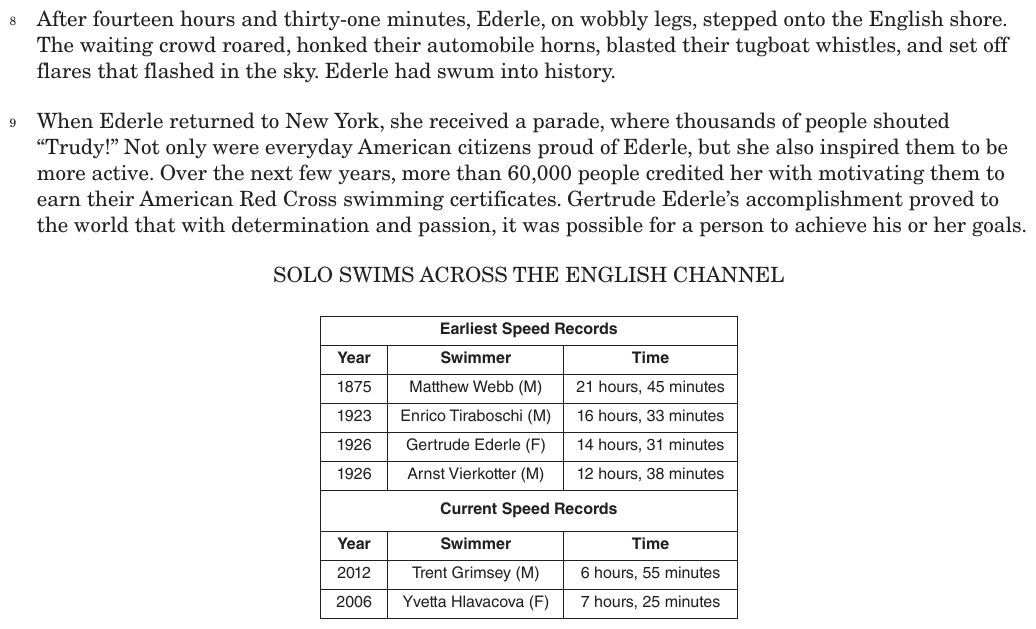
Question 8 of 11
2018 Test A English, question 37Passage Ruins of a Fabled City
Ruins of a Fabled City
The African country of Zimbabwe took its name from the Shona word meaning “stone enclosures” or “venerated houses.” In fact, today dozens of stone ruins are scattered throughout Zimbabwe and other areas in southeastern Africa. One of these ruins, known as Great Zimbabwe, was once a fabled city that inspired tales that circulated throughout Europe. Where was this remarkable city, and who had built it? For centuries the mystery occupied the minds of explorers and treasure seekers.
The first reports to Europeans of Great Zimbabwe were spread a thousand years ago by Arab traders sailing between the Middle East and the east coast of Africa. The traders told of the fabulous wealth of a mysterious stone city in the African interior. In the trader’s tales, that city became associated with the Europeans’ understanding of Middle Eastern history—the Queen of Sheba, King Solomon and his legendary gold mines, long since lost to the world. By the sixteenth century, Portuguese explorers regularly visited East Africa, searching for King Solomon’s gold, but they never found Great Zimbabwe. In 1552, a Portuguese historian, João de Barros, recorded a story told by Arabs about a city with a “square fortress of masonry within and without, built of stones of marvelous size, and there appears to be no mortar joining them.”
In fact, Great Zimbabwe was a marvel. In one area a massive wall more than thirty feet high and twenty feet thick created a great enclosure. Another area contained a fortress-like series of walls, corridors, and steps built into the bluff that overlooks the ruins. Throughout the city, each stone was precisely fitted to the others without the use of mortar.
In the 1870s Karl Mauch, a German geologist, was the first European to see Great Zimbabwe, by then in ruins. Mauch realized that he had “rediscovered” the fabled city from de Barros’s story. He jumped to the conclusion that Great Zimbabwe had been built by the Queen of Sheba. British authorities sent a British journalist, Richard Hall, to Great Zimbabwe to investigate Mauch’s report. Archaeology was still in its infancy, and Hall, convinced that the structures had been built by ancient people from the Middle East, dug up and discarded archaeological deposits that would have revealed much about the true history of Great Zimbabwe. Later European excavations destroyed even more valuable evidence.
In the twentieth century, after excavating areas that had not been disturbed, David Randall-MacIver, a Scottish Egyptologist, and Gertrude Caton-Thompson, an English archaeologist, concluded that the ruins were unmistakably African in origin. Great Zimbabwe was most likely built during the fourteenth or fifteenth century by the ancestors of the present-day Shona people. Recent carbon-14 dating supports their conclusion. Great Zimbabwe was once home to an estimated 20,000 people, the center of a great Shona kingdom. Wealthy Shona kings traded their ivory and gold in coastal towns for other goods, thus accounting for the discovery of beads and other foreign wares in the ruins.
One mystery of Great Zimbabwe had been solved. Another mystery remains: why was the settlement at Great Zimbabwe abandoned, leaving the magnificent stone architecture to fall into ruins?
Question
What was the main way that Karl Mauch’s conclusions about Great Zimbabwe in paragraph 4 affected later archaeological investigations?
- AArchaeologists from all over Europe became interested in excavating the area.
- BArchaeologists made assumptions about the history of the ruins before excavating.
- CArchaeologists started to believe that many of the past accounts recorded about the ruins were true.
- DArchaeologists realized it was unlikely that an ancient culture could build such grand structures.
Show the answer
Correct answer: B
The answer is (B)
The question asks for an explanation of how Mauch’s conclusions influenced later investigations.
Option B is the best option because Mauch’s conclusion that Great Zimbabwe “had been built by the Queen of Sheba” (paragraph 4) affected later investigations of the ruins by causing archaeologists to destroy evidence without examining it, as they assumed that Mauch’s conclusions were accurate (paragraph 4).
Option A is incorrect because, while archaeologists were interested in the area, this was not the main effect of Mauch’s conclusions, as described in the passage.
Option C is incorrect because people searched for Great Zimbabwe because they already believed the stories told by Arab traders and historians like de Barros (paragraph 2), not because of Mauch’s conclusions.
Option D is incorrect because, although the city was considered impressive (paragraph 3), Mauch’s conclusions did not influence whether people believed an ancient culture could have built the city.
Question analysis
This cause-and-effect question asks how Karl Mauch's 1870s conclusions about Great Zimbabwe shaped the investigations that came after him. Students must trace the effect through paragraph 4, where later visitors dug at the site, while keeping the older traders' tales and Portuguese searches in their proper order.
- Grade level
- Grade 7 reading and task
- Compared with grade 7
- At grade 7 Grade 7 informational reading asks how events and ideas influence one another, which is exactly this task. The effect is implied rather than stated, but it sits in one paragraph, keeping the demand typical for grade 7.
- Estimated difficulty
- Moderate: several steps, or a close reading with one strong distractor.
- Thinking it demands
- Depth of knowledge 2, skills and concepts · mainly analyze
- What makes it hard
- Reading between the lines moderate
- A very close wrong answer moderate
- Much to keep track of minor
- Evidence
- Answered from one paragraph or stanza
- Reading level
- Passage: about grade 11, 524 words; question and choices: about grade 11, 70 words.
- Students, last 30 days
- Not enough answers yet to show (it takes 10).
Why it is hard, traps and wrong answers (shows the answer)
Why it is hard
The cause and effect is implied across two sentences of paragraph 4, so students must connect Mauch's leap to the Queen of Sheba with Hall's conviction and the evidence he threw away. The passage's long run of legends makes the older accounts feel like a consequence of Mauch, when they came first. The key rewards reading for what investigators did differently because of him, not what anyone believed at some point.
Reading between the lines moderate Working it out
The passage never says Mauch's conclusion caused anything; the link comes from Hall being sent “to investigate Mauch's report” and arriving “convinced” of Middle Eastern builders. (Graesser, Singer & Trabasso, 1994; Kintsch, 1998)
A very close wrong answer moderate Choosing the answer
B and C both say later investigators took beliefs about the ruins' history for granted; C differs in one detail, since trust in the old accounts began centuries before Mauch rather than because of him. (Embretson & Wetzel, 1987; Gorin & Embretson, 2006; Ascalon et al., 2007)
Much to keep track of minor Working it out
Students must keep the order of believers straight: Arab traders, Portuguese explorers, de Barros in 1552, Mauch in the 1870s, then Hall and later European diggers. (Sweller, 1988; Carpenter, Just & Shell, 1990)
Strategy: Find what Mauch concluded, then read the sentences about the next people to dig at the site and ask how his conclusion shows up in what they did.
Traps
- Reversed relationship: Cause and effect, or the order of events, turned around.
- Too broad or too strong: A choice overstates, generalizes, or uses absolute words the text does not support.
- Outside knowledge: A choice is plausible in the real world but not supported by this text.
The wrong answers, classified
A Too broad or too strong (King et al., 2004)
Inflates the British inquiry and the “later European excavations” into archaeologists from all over Europe, and treats their interest as Mauch's main effect.
C Reversed relationship (King et al., 2004)
Flips the order: trust in the traders' tales and de Barros's account came long before Mauch and shaped his conclusion, not the other way round.
D Outside knowledge (King et al., 2004; Recht & Leslie, 1988)
Echoes the real colonial-era doubt that Africans built the city, but in the passage Hall credits ancient Middle Eastern builders, so investigators did think an ancient culture built it.
Working it out, step by step
Figure out what the question asks
This is a cause-and-effect question. It asks how Karl Mauch’s ideas changed what later people did at the ruins.
Find the evidence in paragraph 4
Mauch “jumped to the conclusion that Great Zimbabwe had been built by the Queen of Sheba.” Then Richard Hall was sent “to investigate Mauch’s report.”
Hall arrived “convinced that the structures had been built by ancient people from the Middle East.” So he “dug up and discarded archaeological deposits.” Later digs “destroyed even more valuable evidence.”
Work out the effect
To jump to a conclusion is to decide something before you have proof. Mauch did that. Hall came to check Mauch’s report, already sure of a story like Mauch’s. He decided the answer before he dug. So he threw away clues. “Deposits” here means layers of old things in the ground. They could have shown the true history.
Check each choice
- A The passage never says people from all over Europe became interested.
- B fits. The diggers made assumptions (beliefs taken as true without proof) before they dug.
- C People trusted the old tales centuries before Mauch, so he did not cause that.
- D Hall still thought an ancient people built the city, just not Africans.
Choose the answer
Mauch’s guess led later diggers to decide the city’s history before they dug. So the answer is B.
Why this answer and not the closest wrong one
C is the closest trap. It also says people trusted ideas about the ruins. But trust in the old tales began with Arab traders, and de Barros wrote his story down in 1552. Mauch came in the 1870s. C gets the order backward. B names what changed after Mauch.
More questions like this
The original DOE question
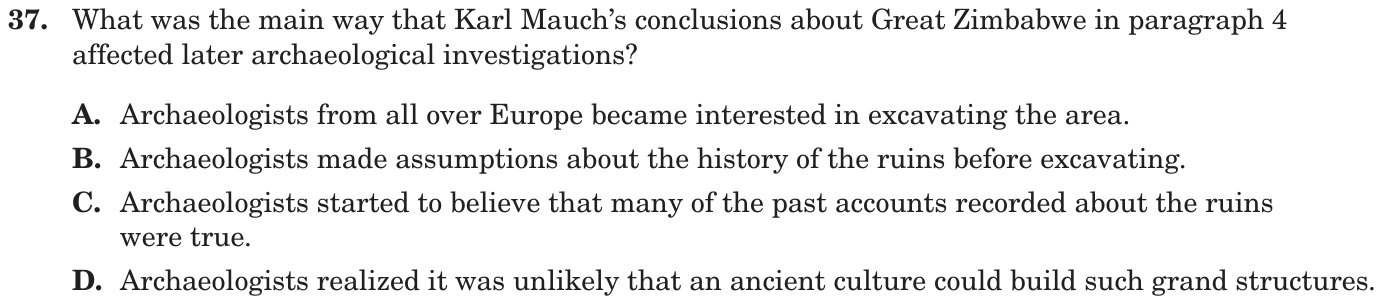
The passage “Ruins of a Fabled City” as printed (page 68)
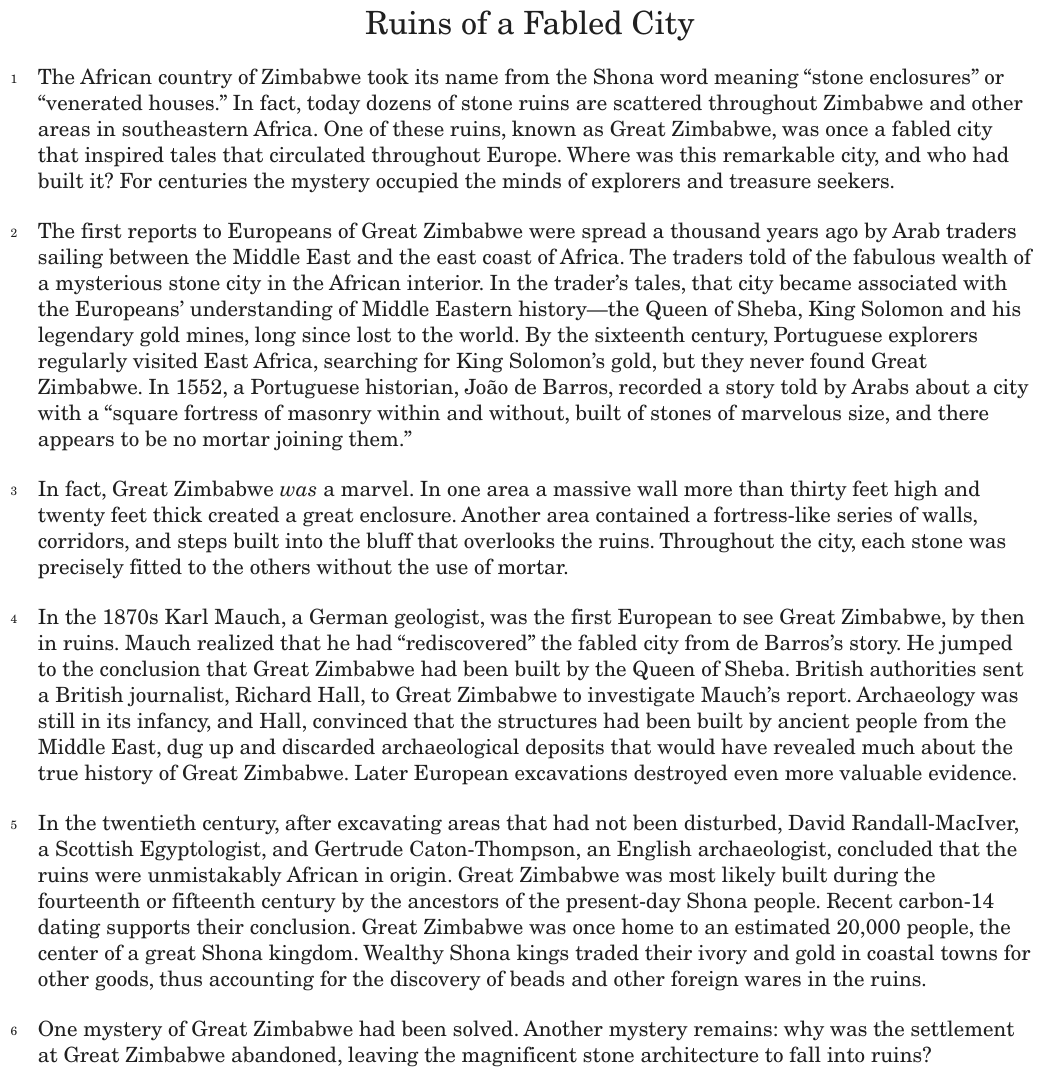
Question 9 of 11
2018 Test A English, question 41Uses the passage above: “Ruins of a Fabled City”.
Question
The conclusions of David Randall-MacIver and Gertrude Caton-Thompson were significant because they
- Aproved that Great Zimbabwe was much older than previously thought.
- Bquestioned why the Shona people left Great Zimbabwe.
- Csupported the idea that the ancient Shona had a robust society at Great Zimbabwe.
- Drevealed that Great Zimbabwe was African in origin.
Show the answer
Correct answer: D
The answer is (D)
The question asks for the impact of Randall-MacIver and Caton-Thompson’s discovery. David Randall-MacIver and Gertrude Caton-Thompson’s conclusions were significant because their excavation of the ruins revealed that Great Zimbabwe was most certainly built by the ancestors of modern-day Africans (paragraph 5), discrediting the long-standing idea that the structure was Middle Eastern in origin. This conclusion is stated in Option D.
Option A is incorrect because paragraph 5 states that Randall-MacIver and Caton-Thompson determined that the city was likely built in the fourteenth or fifteenth century, which was later than earlier explorers had assumed.
Option B is incorrect because the question of why the great city was abandoned was not part of Randall-MacIver and Caton-Thompson’s discovery.
Option C is incorrect because, while paragraph 5 also indicates that the Shona society was strong and healthy, this idea was not the main focus of Randall-MacIver and Caton-Thompson’s discovery.
Question analysis
This question asks why the conclusions of David Randall-MacIver and Gertrude Caton-Thompson about Great Zimbabwe mattered. Students must judge significance, not just recall facts, by weighing several details from paragraph 5 and deciding which one the passage treats as most important.
- Grade level
- Grade 7 reading and task
- Compared with grade 7
- At grade 7 Weighing why a finding matters is typical grade 7 informational reading. The researchers' conclusion is easy to find, but students must use the earlier theories to see why it mattered, which keeps the task at grade 7.
- Estimated difficulty
- Straightforward: two steps or one careful reading.
- Thinking it demands
- Depth of knowledge 2, skills and concepts · mainly analyze
- What makes it hard
- Evidence
- Answered from one paragraph or stanza
- Reading level
- Passage: about grade 11, 524 words; question and choices: about grade 9, 52 words.
- Students, last 30 days
- Not enough answers yet to show (it takes 10).
Why it is hard, traps and wrong answers (shows the answer)
Why it is hard
The finding itself is stated almost word for word, so the work is judging significance. Paragraph 5 piles several facts after the conclusion, a date, a population and trading kings, and one of them invites the reading that the researchers' point was a thriving society. Students who remember what Mauch and Hall believed see that overturning the Middle Eastern theory is what the passage treats as the turning point.
Reading between the lines minor Working it out
“Significant” is never explained; students must set “unmistakably African in origin” against the Queen of Sheba and Middle Eastern theories of paragraph 4 to see why it mattered. (Graesser, Singer & Trabasso, 1994; Kintsch, 1998)
Strategy: Read paragraph 5 alongside paragraph 4, note what earlier investigators believed, and judge each choice by how much it changes or confirms that earlier picture.
Traps
- True but not the answer: A choice says something accurate about the text that does not answer this question.
- Reversed relationship: Cause and effect, or the order of events, turned around.
- Wrong part of the text: A choice is true of another paragraph, stanza or speaker than the one asked about.
The wrong answers, classified
A Reversed relationship (King et al., 2004)
Gets the time relation backward: a fourteenth- or fifteenth-century date makes the city far younger than the King Solomon and Queen of Sheba legends implied.
B Wrong part of the text (Kirsch & Mosenthal, 1990)
Borrows the open question of why the settlement was abandoned, which the author raises in the last paragraph, not something these researchers addressed.
C True but not the answer (King et al., 2004; Embretson & Wetzel, 1987)
Picks the true picture of a large, wealthy Shona kingdom from the same paragraph, but that detail follows the conclusion and is not what made it significant.
Working it out, step by step
Figure out what the question asks
This asks why the two scientists’ conclusion was significant, or important. To see why it mattered, compare it with what people believed before.
Recall the earlier beliefs
Paragraph 4 tells what people believed. Mauch thought the city “had been built by the Queen of Sheba.” Hall was sure it was built “by ancient people from the Middle East.” For centuries, who built the city was a mystery.
Find what they concluded
Paragraph 5 says Randall-MacIver and Caton-Thompson dug in places no one had disturbed. They “concluded that the ruins were unmistakably African in origin.”
Unmistakably means with no doubt. Origin means where something comes from. Their finding proved the old Middle East ideas wrong. That is why it was so important.
Check each choice
- A The passage dates the city to the 1300s or 1400s. That makes it much younger than the King Solomon legends, not older.
- B Why the Shona left is the open question in paragraph 6. These two did not study it.
- C Paragraph 5 does describe a rich kingdom. But that detail is not what made their finding important.
- D fits. They showed the city was African in origin.
Choose the answer
Their work was significant because it revealed that Great Zimbabwe was African in origin. So the answer is D.
Why this answer and not the closest wrong one
C is the closest trap, because paragraph 5 does show a strong Shona kingdom of “an estimated 20,000 people.” But that detail comes after their conclusion. What mattered most was proving the city African, which overturned the Middle East theories. That is D.
More questions like this
The original DOE question
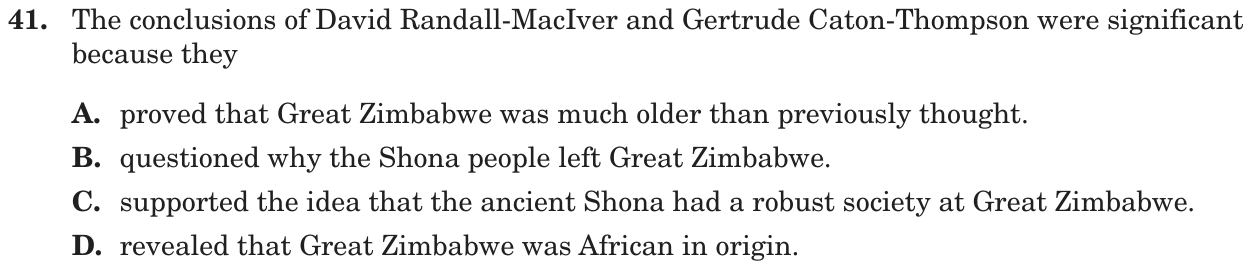
Question 10 of 11
2018 Test B English, question 45Passage Snowy Mountains
Snowy Mountains
by John Gould Fletcher
Higher and still more high,
Palaces made for cloud,
Above the dingy city-roofs
Blue-white like angels with broad wings,
Pillars of the sky at rest
The mountains from the great plateau
Uprise.
But the world heeds them not;
They have been here now for too long a time.
The world makes war on them,
Tunnels their granite cliffs,
Splits down their shining sides,
Plasters their cliffs with soap-advertisements,
Destroys the lonely fragments of their peace.
Vaster and still more vast,
Peak after peak, pile after pile,
Wilderness still untamed,
To which the future is as was the past,
Barrier spread by Gods,
Sunning their shining foreheads,
Barrier broken down by those who do not need
The joy of time-resisting storm-worn stone,
The mountains swing along
The south horizon of the sky;
Welcoming with wide floors of blue-green ice
The mists that dance and drive before the sun.
“Snowy Mountains” by John Gould Fletcher—Public Domain
Question
How do the details in the third stanza (lines 15–26) contribute to the development of the theme of the poem?
- Aby reflecting nature’s capacity to resist change
- Bby showing that nature is capable of influencing human will
- Cby exposing how a lack of awareness leads to nature’s ruin
- Dby explaining why people must respect nature
Show the answer
Correct answer: A
The question asks how the details in the third stanza contribute to the development of the theme of the poem. In the third stanza, phrases such as “Wilderness still untamed” (line 17), “time-resisting storm-worn stone” (line 22), and “The mountains swing along” (line 23) convey the message that in spite of the destruction described in the second stanza, the mountains manage to maintain their wild magnificence. This message is communicated in Option A.
Option B is incorrect because, while the phrase “Barrier broken down” (line 21) conveys the idea that people can have some effect on the natural landscape, it does not convey how nature affects people.
Option C is incorrect because the phrase “those who do not need” (line 21) implies a choice to damage nature and not a lack of awareness or understanding.
Option D is incorrect because the third stanza is not a call to humanity to respect the mountains but a description of the untamed, welcoming mountains and the joy they provide for those who appreciate them.
Question analysis
This theme question asks how the details in the third stanza of “Snowy Mountains” contribute to the poem’s message. The stanza piles up images of peaks, gods, ice and mist alongside a line about a barrier broken down, so students must weigh all of its details and decide which idea about nature and people they add up to.
- Grade level
- Grade 8 reading and task
- Compared with grade 7
- Above grade 7 Grade 7 students trace how a theme develops, but this stanza is one long, layered sentence that mixes praise with loss, and the choices offer different, believable messages about nature, which makes it closer to grade 8 work.
- Estimated difficulty
- Hard: combines ideas, needs a plan, and has more than one tempting wrong answer.
- Thinking it demands
- Depth of knowledge 3, strategic thinking · mainly analyze
- What makes it hard
- Complex sentences moderate
- Figurative or literary language moderate
- Evidence in several places moderate
- Evidence
- Answered from one paragraph or stanza
- Reading level
- Passage: 161 words (a poem; reading level not measured); question and choices: about grade 7, 54 words.
- Corrected from the DOE handbook
- A misquotation of the poem in the explanation was corrected.
- Students, last 30 days
- Not enough answers yet to show (it takes 10).
Why it is hard, traps and wrong answers (shows the answer)
Why it is hard
The third stanza holds both endurance and damage, and the question asks which one its details mostly build. Students who fix on the broken barrier choose ruin, which the poem’s second stanza seems to confirm, while those who count the stanza’s details find untamed wilderness, time-resisting stone and mountains swinging along the horizon. The long, inverted sentence makes that count slow, which is why the question is hard.
Complex sentences moderate Understanding the question
Lines 15–26 form one sentence in which a string of descriptive phrases precedes the subject, “The mountains,” in line 23, so the stanza’s overall point is hard to hold together. (Abedi & Lord, 2001; Freedle & Kostin, 1993; Messick, 1989)
Figurative or literary language moderate Understanding the question
The mountains are given “shining foreheads,” said to be “spread by Gods,” and shown to “swing along” and welcome mists, and these personifications carry the stanza’s message of endurance. (Graesser, Singer & Trabasso, 1994; Kintsch, 1998)
Evidence in several places moderate Working it out
The theme has to be built from details scattered through twelve lines, “Wilderness still untamed,” “the future is as was the past,” “time-resisting storm-worn stone,” and weighed against the one line of damage. (Kirsch & Mosenthal, 1990; Gorin & Embretson, 2006)
Strategy: List what the third stanza says about the mountains and what it says about people, then pick the choice that fits most of those details, not just one line.
Traps
- Too narrow: A single detail offered as the central idea or a summary, or a summary that keeps minor details and leaves out an essential part.
- Outside knowledge: A choice is plausible in the real world but not supported by this text.
- Reversed relationship: Cause and effect, or the order of events, turned around.
The wrong answers, classified
B Reversed relationship (King et al., 2004)
Reverses who acts on whom: the stanza shows people breaking down the barrier and the mountains enduring, with no sign that nature shapes what people want.
C Too narrow (King et al., 2004)
Builds on line 21’s “Barrier broken down,” a single line of damage among many lines of endurance, and so mistakes one detail for the stanza’s contribution.
D Outside knowledge (King et al., 2004; Recht & Leslie, 1988)
States a familiar environmental lesson, that people must respect nature, but the stanza describes the mountains and never argues or explains what people should do.
What was corrected from the DOE handbook, and why
- Explanation: The handbook quotes line 21 as “those who do not heed.” The line reads “Barrier broken down by those who do not need,” so the site now quotes “those who do not need.”
Working it out, step by step
Figure out what the question asks
This asks what the third stanza, lines 15 to 26, adds to the poem’s theme, or big message. You need to look at all the details in those twelve lines and see what most of them say. Don’t build your answer on just one line.
Collect the stanza’s details
The stanza calls the mountains a “Wilderness still untamed” in line 17. Line 18 says “the future is as was the past,” so they do not change. Line 22 speaks of “time-resisting storm-worn stone.” Line 23 says “The mountains swing along.” Only line 21 shows harm: “Barrier broken down.”
Explain what the details add up to
“Untamed” means still wild and not controlled by people. “Time-resisting” means holding out against time. “Storm-worn” means worn by storms but still standing. Even after the harm in stanza 2, the mountains are still wild. They still swing along the edge of the sky. So the stanza shows that nature can resist change. Capacity means ability.
Check each choice
- A fits. Most details show the mountains lasting and staying wild.
- B is wrong. It flips who acts. People act on the mountains. The mountains do not change what people want.
- C is wrong. Line 21 shows some damage, but it is one line. The rest of the stanza shows the mountains enduring, not ruined.
- D is wrong. The stanza describes the mountains. It never tells people what they must do.
Choose the answer
Most of the third stanza shows the mountains staying wild and strong over time. So the answer is A, “by reflecting nature’s capacity to resist change.”
Why this answer and not the closest wrong one
C is the strongest trap, because stanza 2 really is about harm. But this question is about stanza 3. Count its details. Untamed wilderness, an unchanging future, time-resisting stone and mountains swinging along all show endurance. Only one line shows damage, so A fits the stanza as a whole.
More questions like this
The original DOE question
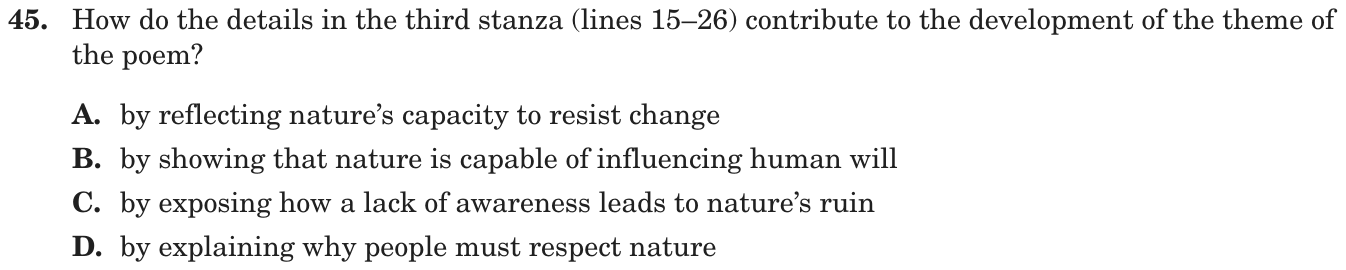
The passage “Snowy Mountains” as printed (page 142)
Question 11 of 11
2018 Test B English, question 48Passage Invention of the Telegraph
Samuel Morse, an American inventor, is credited with creating the electronic telegraph, a communication device that allows users to send messages using a system of short and long pulses that represent letters, numbers, and punctuation. In 1843 the United States Congress passed the Telegraph Bill, which provided Morse with the funds to build an electric telegraph system.
Invention of the Telegraph
Earlier Signal Systems
Long before Samuel F. B. Morse electrically transmitted his famous message “What hath God wrought?” from Washington to Baltimore on May 24, 1844, there were signaling systems that enabled people to communicate over distances. Most were visual or “semaphore” systems using flags or lights. In the eighteenth century, such systems used an observer who would decipher a signal from a high tower on a distant hill and then send it on to the next station. The young American republic wanted just such a system along its entire Atlantic coast and offered a prize of $30,000 for a workable proposal. The framers of this legislation had no way of knowing that when they used the word “telegraph” to refer to this visual semaphore system, they would be offered an entirely new and revolutionary means of communication—electricity.
The Growth of an Idea
The idea of using electricity to communicate over distance is said to have occurred to Morse during a conversation aboard ship when he was returning from Europe in 1832. Michael Faraday’s recently invented electromagnet was much discussed by the ship’s passengers, and when Morse came to understand how it worked, he speculated that it might be possible to send a coded message over a wire. While a student at Yale College years before, he had written his parents a letter about how interesting he found the lectures on electricity. Despite what he had learned at Yale, Morse found when he began to develop his idea that he had little real understanding of the nature of electricity, and after sporadic attempts to work with batteries, magnets, and wires, he finally turned for help to a colleague at the University of the City of New York, Leonard D. Gale.
Gale was a professor of chemistry and familiar with the electrical work of Princeton’s Joseph Henry, a true pioneer in the new field. Well before Morse had his shipboard idea about a telegraph, Henry rang a bell at a distance by opening and closing an electric circuit. In 1831, he had published an article, of which Morse was unaware, that contained details suggesting the idea of an electric telegraph. Gale’s help and his knowledge of this article proved crucial to Morse’s telegraph system because Gale not only pointed out flaws in the system but showed Morse how he could regularly boost the strength of a signal and overcome the distance problems he had encountered by using a relay system Henry had invented. Henry’s experiments, Gale’s assistance, and, soon after, hiring the young technician Alfred Vail were keys to Morse’s success.
Obstacles and Opportunities
By December 1837, Morse had enough confidence in his new system to apply for the federal government’s appropriation, and during the next year he conducted demonstrations of his telegraph both in New York and Washington.
However, when the economic disaster known as the Panic of 1837 took hold of the nation and caused a long depression, Morse was forced to wait for better times. It was during this period that Morse visited Europe again and tried not only to secure patent protection overseas but to examine competing telegraph systems in England. . . .
By 1843, the country was beginning to recover economically, and Morse again asked Congress for the $30,000 that would allow him to build a telegraph line from Washington to Baltimore, forty miles away. The House of Representatives eventually passed the bill containing the Morse appropriation, and the Senate approved it in the final hours of that Congress’s last session. With President Tyler’s signature, Morse received the cash he needed and began to carry out plans for an underground telegraph line.
Realizing a Great Invention
Morse had hired the ingenious construction engineer Ezra Cornell to lay the pipe carrying the wire, and although Cornell did his job superbly, one of Morse’s partners, Congressman F. O. J. Smith, had purchased wire with defective insulation. Too much time had been wasted laying bad wire, and with the project on a rigid deadline, something had to be done quickly. Cornell suggested that the fastest and cheapest way of connecting Washington and Baltimore was to string wires overhead on trees and poles. The desperate Morse gave the go-ahead, and the line was completed in time for the dramatic and spectacularly successful link between the Supreme Court chamber of the Capitol building and the railroad station in Baltimore.
Soon, as overhead wires connected cities up and down the Atlantic coast, the dots-and-dashes method that recorded messages on a long moving strip of paper was replaced by the operator’s ability to interpret the code in real time. . . . Telegraph lines soon extended westward, and within Morse’s own lifetime they connected the continents of Europe and America.
“Invention of the Telegraph”—Public Domain/Library of Congress
legislation: Telegraph Bill
dots-and-dashes method: the short and long pulses of Morse code that are sent and received by telegraph operators
The first transatlantic electric telegraph message was sent in 1858, and by 1902 the British All-Red Line connected most of the world.
Source: U.S. Bureau of the Census. Historical Statistics of the United States, Colonial Times to 1970, Bicentennial Edition, Part 2. Washington, D.C., 1975.
Question
Which statement describes how the author’s use of problem-solution in paragraph 2 contributes to the development of ideas in the passage?
- AMorse’s discussion on a ship about Faraday’s electromagnet reminded him of the Yale College lectures on electricity, which he had enjoyed but had not fully understood, inspiring him to learn more about electricity from his colleague Gale.
- BMorse’s discouragement over his lack of knowledge of electricity prompted him to experiment with batteries, magnets, and wires, which led to the development of a new long-distance communication system.
- CMorse’s difficulty in understanding how Faraday’s electromagnet worked was frustrating, and it pushed him to create a system for sending signals over wires.
- DMorse’s longtime fascination was not enough to make up for his lack of knowledge about electricity, so he eventually sought help from Gale.
Show the answer
Correct answer: D
The question asks for the best explanation of how the use of problem-solution in paragraph 2 helps develop the ideas in the passage. Option D is correct because it explains that Morse realized his problem was that he was not knowledgeable enough to continue his experimentation without help, so the solution was to seek help from a colleague.
Option A is incorrect because, while the discussion on the ship fascinated Morse and reminded him of the lectures he had attended at Yale College, it was his failed attempts with electricity that caused him to reach out to Gale for help.
Option B is incorrect because, while “Morse found when he began to develop his idea that he had little real understanding of the nature of electricity” (paragraph 2), the paragraph does not state that he was discouraged; it was his failed experimentation that resulted in him first realizing that he needed help.
Option C is incorrect because the paragraph states that “Morse came to understand how [Faraday’s electromagnet] worked,” and that understanding is what caused him to think about sending messages over a wire. Also, Morse’s difficulty was in understanding the properties of electricity in general once he began his experimentation.
Question analysis
In this text structure question about “Invention of the Telegraph,” students explain how the problem-and-solution pattern in paragraph 2 develops ideas about Samuel Morse. All four choices are long sentences built from real details about the ship, Yale and Gale, so students must check each one’s account of what led to what.
- Grade level
- Grade 8 reading and task
- Compared with grade 7
- Above grade 7 Identifying problem and solution is familiar from earlier grades, but these choices are long, detail-packed chains in which a single misplaced cause makes an option wrong, which demands closer checking than typical grade 7 items.
- Estimated difficulty
- Hard: combines ideas, needs a plan, and has more than one tempting wrong answer.
- Thinking it demands
- Depth of knowledge 2, skills and concepts · mainly analyze
- What makes it hard
- Every choice must be checked major
- A very close wrong answer moderate
- The right answer is reworded moderate
- A lot to read moderate
- How, not what minor
- Evidence
- Answered from one paragraph or stanza
- Reading level
- Passage: about grade 11, 910 words; question and choices: about grade 16, 132 words.
- Corrected from the DOE handbook
- A wrong paragraph number in the explanation was corrected.
- A misspelled name in the explanation was corrected.
- A punctuation slip in the explanation was corrected.
- Students, last 30 days
- Not enough answers yet to show (it takes 10).
Why it is hard, traps and wrong answers (shows the answer)
Why it is hard
Every choice is assembled from things the paragraph really mentions, so recognition is useless and only the order of causes decides. The most tempting wrong choice ends with Gale, the right solution, but invents a reminder of the Yale lectures to get there; others turn the failed experiments into the solution or reverse what Morse understood. The question rewards reading each long choice clause by clause, which costs time.
Every choice must be checked major Choosing the answer
Each choice is a chain of two or three causes built from real details, the ship, Faraday, Yale, the batteries and wires, Gale, so every link has to be checked against paragraph 2’s order of events. (Embretson & Wetzel, 1987)
A very close wrong answer moderate Choosing the answer
The Yale-reminder choice and the key both join Morse’s enjoyment of electricity, his weak grasp of it and his turn to Gale; they part on one detail, the claim that the shipboard talk “reminded him” of Yale, which the paragraph never makes. (Embretson & Wetzel, 1987; Gorin & Embretson, 2006; Ascalon et al., 2007)
The right answer is reworded moderate Choosing the answer
The key turns the Yale letter and the shipboard speculation into “longtime fascination,” a phrase the passage never uses, while the wrong choices repeat its names and phrases and so look better supported. (Freedle & Kostin, 1993; Kirsch & Mosenthal, 1990)
A lot to read moderate Understanding the question
The four choices run to about 110 words, the longest 37, and paragraph 2 itself packs a voyage, a college letter, failed experiments and a colleague into four sentences. (Kintsch, 1998; Gorin & Embretson, 2006; Freedle & Kostin, 1993)
How, not what minor Working it out
Students must name the paragraph’s problem, too little understanding of electricity, and its solution, Gale, before judging which account of the pattern is accurate. (Anderson & Krathwohl, 2001)
Strategy: Name the problem and the solution in paragraph 2 in a few words each, then choose the option whose sequence of events matches the paragraph exactly.
Traps
- Reversed relationship: Cause and effect, or the order of events, turned around.
- Half right: One half of a two-part choice is right and the other is not.
The wrong answers, classified
A Half right (King et al., 2004; Thissen, Steinberg & Fitzpatrick, 1989)
Ends correctly with Morse learning from Gale, but invents its cause: the paragraph never says the shipboard talk reminded Morse of Yale, and it skips the failed experiments that sent him to Gale.
B Reversed relationship (King et al., 2004)
Reverses cause and effect: the “sporadic attempts” with batteries, magnets and wires exposed Morse’s weak grasp of electricity and sent him to Gale, rather than flowing from discouragement and producing the system.
C Twists what the text says (King et al., 2004)
Says Morse struggled to understand Faraday’s electromagnet, but the paragraph states that he “came to understand how it worked,” and that understanding is what gave him the idea.
What was corrected from the DOE handbook, and why
- Explanation: The handbook places the sentence “Morse found when he began to develop his idea that he had little real understanding of the nature of electricity” in paragraph 3. It is in paragraph 2, the paragraph the question is about, so the site now says “(paragraph 2).”
- Explanation: The handbook spells Leonard Gale’s name “Gail.” The passage spells it “Gale,” and so does the site now.
- Explanation: The handbook capitalizes “Also” after a semicolon (“over a wire; Also, Morse’s difficulty…”). The site starts a new sentence instead: “over a wire. Also, Morse’s difficulty…”
Working it out, step by step
Figure out what the question asks
This asks about problem-solution in paragraph 2. Problem-solution is a way to organize writing. First you learn about a problem, then how someone solved it. Find the problem and the solution. Then pick the choice that tells them in the right order.
Find the problem in paragraph 2
Paragraph 2 starts with “The idea of using electricity to communicate over distance.” It says Morse had enjoyed the electricity lectures at Yale. But then comes the problem: “Morse found when he began to develop his idea that he had little real understanding of the nature of electricity.”
Find the solution
The same sentence goes on: “after sporadic attempts to work with batteries, magnets, and wires, he finally turned for help to a colleague.” “Sporadic” means now and then, not steady. A colleague is a coworker. So Morse was interested in the subject, tried on his own, and did not succeed. His interest was not enough. His solution was to ask Gale for help.
Check each choice
- A is wrong. It ends with Gale, but the paragraph never says the ship talk “reminded him” of Yale. It also skips the failed tries.
- B is wrong. It has the order backward. The experiments showed the problem. They did not build the system.
- C is wrong. The paragraph says Morse “came to understand how it worked,” meaning the electromagnet.
- D fits. Long interest was not enough, so he got help from Gale.
Choose the answer
The problem was Morse’s weak grasp of electricity, and the solution was Gale. So the answer is D, “Morse’s longtime fascination was not enough to make up for his lack of knowledge about electricity, so he eventually sought help from Gale.”
Why this answer and not the closest wrong one
A is the closest trap. Like D, it mentions Yale, Morse’s weak grasp of electricity and Gale. But it adds a link the paragraph never makes, that the ship talk reminded him of Yale. With long choices, check every part. One made-up link makes the whole choice wrong.
More questions like this
The original DOE question
The passage “Invention of the Telegraph” as printed (pages 146–148)