7.NS.2b rational number division
Question 1 of 10
2026 Practice Test A Math, question 32Question
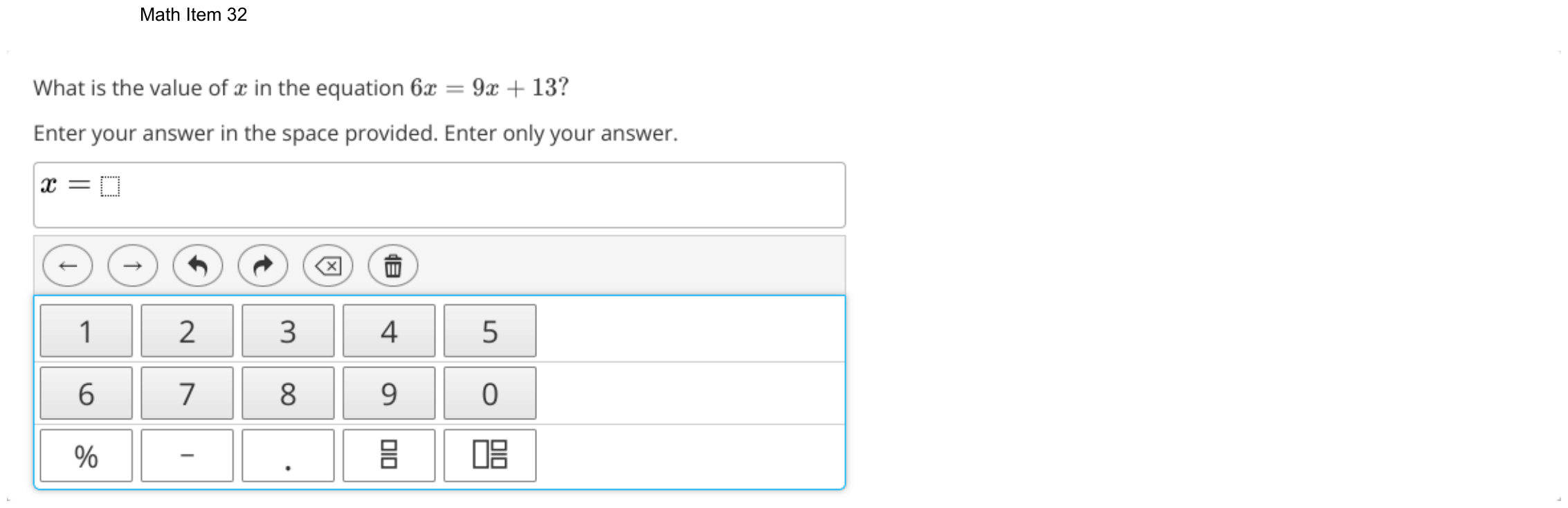
What is the value of x in the equation ?
Enter your answer in the space provided. Enter only your answer.
On the test you build the answer on an on-screen keypad; here, type it. Use ^ for a power, sqrt( ) or √ for a root, pi for π, and <= or >= for ≤ and ≥.
Show the answer
Correct answer: x = -13/3
Solution:
Start with .
Subtract from both sides to move all terms involving x to one side.
Combine like terms.
Divide both sides by −3 to solve for x.
Question analysis
This equation question asks for the value of x when 6x equals 9x plus 13, typed into a box after "x =". Students solve a linear equation with the variable on both sides by gathering the x terms and dividing. With no answer choices to check against, keeping the sign of each moved term is the main challenge.
- Grade level
- Grade 8 content, by NYS standard
- Compared with grade 7
- At grade 7 The variable appears on both sides, a grade 8 topic, yet collecting it takes one subtraction and one division, much like a grade 7 two-step equation. The typed answer, with no choices to compare, adds some risk.
- Estimated difficulty
- Straightforward: two steps or one careful reading.
- Thinking it demands
- Depth of knowledge 1, recall and reproduction · mainly apply
- What makes it hard
- Error-prone arithmetic moderate
- An answer in an unexpected form minor
- Solution
- 2 steps
- Reading level
- Question and choices: about grade 5, 21 words.
- Students, last 30 days
- Not enough answers yet to show (it takes 10).
Why it is hard, traps and wrong answers (shows the answer)
Why it is hard
Two moves solve the equation, so the method is not in doubt; the points are lost in the result. Subtracting 6x instead, which gives 0 = 3x + 13, works as well but moves the sign onto the 13, and either route ends in a division that must keep the negative. The answer is not a whole number, which unsettles students who expect one, and a switch to decimals leads to a rounded entry that is not exact.
Error-prone arithmetic moderate Working it out
Collecting the x terms gives 6x − 9x = −3x, a negative coefficient, and 13 ÷ (−3) is a negative fraction that does not come out whole, so both the sign and the fraction must survive. (Brown & Burton, 1978; Junker & Sijtsma, 2001)
An answer in an unexpected form minor Choosing the answer
The answer is typed after the printed x =, with no choices to compare, and its decimal form, −4.333…, repeats forever, so only a fraction or mixed number is exact. (Enright, Morley & Sheehan, 2002)
Strategy: Subtract 9x from both sides so that x appears once, divide both sides by the coefficient left on x, and check by substituting the result into both sides of the original equation.
Traps
- Negatives and direction: Arithmetic with negative numbers, the order of a subtraction, or direction on a number line. (Moving a term across the equals sign without changing its sign is a faulty procedure.)
- Wrong operation: Adds instead of multiplying, divides the wrong way round, turns a ratio or rate upside down, or undoes a step in the wrong direction (subtracts what should be added back).
- Rounds too early: Rounds a value partway through, or rounds the wrong way, so the final answer drifts from the exact one.
The wrong answers, classified
13/3 Negatives and direction (Brown & Burton, 1978)
Reaches −3x = 13 correctly but drops the negative when dividing 13 by −3, entering a positive 13/3.
-4.33 Rounds too early (King et al., 2004)
Solves correctly but turns −13/3 into a decimal and rounds it to −4.33, which is close to the exact value but not equal to it.
-3/13 Wrong operation (Hegarty, Mayer & Monk, 1995; King et al., 2004)
Gets to −3x = 13 but divides the wrong way round, putting the coefficient −3 over the constant 13 instead of 13 over −3.
Worked solution, step by step
Formulas used
- Doing the same to both sides
- a and b are the two sides of an equation, and c is any number or term (not zero when you divide). Taking the same thing away from both sides, or dividing both by the same number, keeps the sides equal. That is how you get x by itself.
- Dividing by a negative number
- a and b are positive numbers, so −b is negative. A positive number divided by a negative number is negative. You can write the minus sign in front of the whole fraction.
- Changing a fraction to a mixed number
- Use this when the top of a fraction is bigger than the bottom. Divide a by b. q is the number of whole times b fits into a. r is the remainder, what is left over. The remainder goes on top of the leftover fraction.
Sort out the question
You need the value of x that makes true. The letter x appears on both sides, so first gather the x terms on one side. There are no choices to check against, so work carefully.
Move the x terms to one side
Subtract 9x from both sides. This clears the x term off the right side:
Since 6 − 9 = −3, the left side is −3 times x.
Divide both sides by −3
x is multiplied by −3, so divide both sides by −3:
A positive divided by a negative is negative, so x is negative.
Watch out: dropping the minus sign gives 13/3, which is wrong. Also, the number you divide by goes on the bottom. Writing −3/13 turns the fraction upside down.
Write it as a mixed number
A mixed number is a whole number with a fraction, like 4 1/3. Divide 13 by 3. The 3 fits 4 times, with 1 left over.
So .
Watch out: as a decimal, −13/3 is −4.333…, and the 3s never end. Rounding to −4.33 is close, but it is not exact. Keep the fraction.
Enter the answer
The box already shows x =, so you enter only the number. On the test, press the minus key first. Then press the fraction key, a small box over a small box. Type 13 in the top box and 3 in the bottom box. On this site, type −13/3 or −4 1/3.
So the finished answer reads x = −13/3. You type only the −13/3, which is the same as −4 1/3.
Check your answer
Put into both sides. The left side is . The right side is . Both sides equal −26, so the answer is right.
More questions like this
The original DOE question
Question 2 of 10
2026 Practice Test C Math, question 2Question
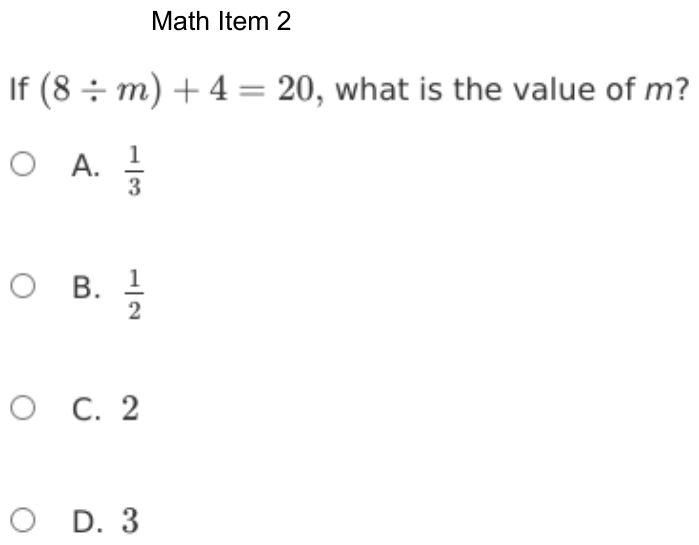
If , what is the value of m?
- A
- B
- C2
- D3
Show the answer
Correct answer: B
The quantity means the same as , so the equation can be rewritten:
Subtract 4 from both sides:
Multiply both sides of the equation by m:
Solve for m:
Simplify:
Question analysis
This equation question asks for the value of m when 8 divided by m, plus 4, equals 20. Students undo the addition, then work out what m must be for 8 divided by it to give the value left. Because m is the divisor rather than the number being divided, the last step needs care.
- Grade level
- Grade 7 content, by NYS standard
- Compared with grade 7
- At grade 7 Undoing an addition and then a division is typical two-step grade 7 equation work. The unknown sitting in a denominator is less common than px + q = r, which makes the last step easier to get backward.
- Estimated difficulty
- Straightforward: two steps or one careful reading.
- Thinking it demands
- Depth of knowledge 1, recall and reproduction · mainly apply
- What makes it hard
- Error-prone arithmetic moderate
- Something you must already know minor
- Solution
- 3 steps
- Reading level
- Question and choices: about grade 6, 10 words.
- Students, last 30 days
- Not enough answers yet to show (it takes 10).
Why it is hard, traps and wrong answers (shows the answer)
Why it is hard
Undoing the + 4 is routine, so nearly all the risk sits in the last step, where m divides 8 rather than being divided by it. Students who read 8 ÷ m = 16 as asking how many 8s make 16 answer 2, and substituting it back, 8 ÷ 2 + 4 = 8, shows at once that it fails. The right value makes 8 ÷ 1/2 = 16, a division that gives a larger number, which feels wrong but is correct.
Error-prone arithmetic moderate Working it out
The unknown is the divisor, so 8 ÷ m = 16 ends in m = 8 ÷ 16, a quotient less than 1; the familiar order, 16 ÷ 8, gives a whole number instead. (Brown & Burton, 1978; Junker & Sijtsma, 2001)
Something you must already know minor Working it out
Students must see that (8 ÷ m) is the fraction 8/m and that freeing m from a denominator means multiplying both sides by it, a move grade 7 equations rarely need. (Anderson & Krathwohl, 2001)
Strategy: Subtract 4 from both sides, multiply both sides by m so the unknown is no longer in a denominator, then divide; check by substituting your value back into the equation.
Traps
- Wrong operation: Adds instead of multiplying, divides the wrong way round, turns a ratio or rate upside down, or undoes a step in the wrong direction (subtracts what should be added back).
The wrong answers, classified
A Wrong operation (Hegarty, Mayer & Monk, 1995; King et al., 2004)
Adds 4 to 20 instead of subtracting it, so 8 ÷ m = 24 and m = 8/24, which simplifies to 1/3.
C Wrong operation (Hegarty, Mayer & Monk, 1995; King et al., 2004)
Gets 8 ÷ m = 16 correctly but then divides 16 by 8, putting the divisor and the dividend the wrong way round, so m comes out as 2.
D Wrong operation (Hegarty, Mayer & Monk, 1995; King et al., 2004)
Makes both mistakes, adding 4 to get 8 ÷ m = 24 and then dividing 24 by 8 instead of 8 by 24.
Worked solution, step by step
Formulas used
- Keeping an equation balanced
- a and b are the two sides of an equation, and c is any number. An equation is like a balanced scale. Subtract the same number from both sides, or multiply both sides by the same number, and it stays balanced. That is how you get the unknown by itself.
Sort out the question
The equation is . You need the value of m. Here m is the number you divide 8 by. In words: 8 divided by some number, plus 4, makes 20.
Undo the plus 4
A fraction bar means divide, so is the same as . Subtract 4 from both sides to undo the plus 4:
Now 8 divided by m equals 16.
Watch out: adding 4 instead gives 24 on the right. That leads to choice A, 1/3, or to D, 3.
Get m out of the bottom
m is on the bottom of the fraction. Multiply both sides by m to free it:
Now divide both sides by 16:
8 goes into both 8 and 16, so 8/16 simplifies to 1/2.
Choose the answer
Watch out: it is tempting to divide 16 by 8 and get 2, choice C. But ask yourself: 8 divided by what number makes 16? To get an answer bigger than 8, you must divide by a number less than 1.
So the answer is B, 1/2.
Check your answer
Put 1/2 back into the equation. How many halves are in 8? There are 16, so . Then . That matches the equation, so m = 1/2 is right.
More questions like this
The original DOE question
Question 3 of 10
2026 Practice Test C Math, question 3Question
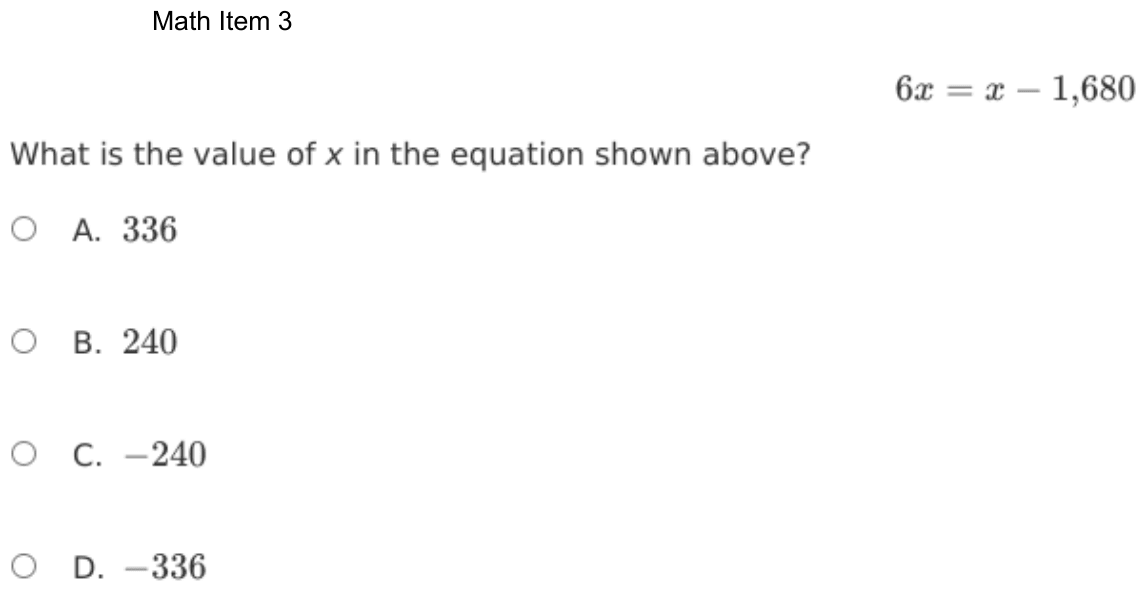
What is the value of x in the equation shown above?
- A336
- B240
- C−240
- D−336
Show the answer
Correct answer: D
Simplify . First, subtract x from both sides of the equation. Then, divide both sides by 5.
Question analysis
This algebra question gives the equation 6x = x − 1,680, with x on both sides, and asks for the value of x. Students collect the x terms on one side and divide by the coefficient that remains. The choices pair two sizes with both signs, so every move across the equals sign has to keep its sign right.
- Grade level
- Grade 8 content, by NYS standard
- Compared with grade 7
- At grade 7 An unknown on both sides of the equals sign is a grade 8 topic, yet gathering the x terms here takes one subtraction and one division, the same work as a two-step grade 7 equation.
- Estimated difficulty
- Straightforward: two steps or one careful reading.
- Thinking it demands
- Depth of knowledge 1, recall and reproduction · mainly apply
- What makes it hard
- Error-prone arithmetic moderate
- A very close wrong answer moderate
- Solution
- 2 steps
- Reading level
- Question and choices: about grade 5, 12 words.
- Corrected from the DOE handbook
- A line of the explanation’s working, printed without its fraction bars and equals sign, was restored.
- Students, last 30 days
- Not enough answers yet to show (it takes 10).
Why it is hard, traps and wrong answers (shows the answer)
Why it is hard
Collecting the x terms takes one subtraction, and the only way the method goes wrong is moving x across the equals sign, which turns the 5 into a 7. The sign is the bigger hazard: 6x equals x minus a large number, so x must be negative, yet the division 1,680 ÷ 5 is done on positive numbers. Substituting −336 back gives −2,016 on each side, which confirms both the size and the sign.
Error-prone arithmetic moderate Working it out
Subtracting x from both sides leaves 5x = −1,680, and 1,680 ÷ 5 = 336 has to be worked out by hand while the negative sign is carried through to the result. (Brown & Burton, 1978; Junker & Sijtsma, 2001)
A very close wrong answer moderate Choosing the answer
The choices are two sizes, 336 and 240, each offered with both signs, so 336 and −336 are written the same except for the minus; only tracking the sign of 1,680 separates them. (Embretson & Wetzel, 1987; Gorin & Embretson, 2006; Ascalon et al., 2007)
Strategy: Subtract x from both sides so the unknown appears once, divide by the coefficient that is left, and substitute the result into both sides to check that they match.
Traps
- Negatives and direction: Arithmetic with negative numbers, the order of a subtraction, or direction on a number line. (Moving a term across the equals sign without changing its sign is a faulty procedure.)
- A faulty procedure: A systematic but wrong procedure: adding fractions straight across, applying an exponent to each term of a sum, dropping a sign when moving a term.
The wrong answers, classified
A Negatives and direction (Brown & Burton, 1978)
Reaches 5x = −1,680 correctly but drops the negative sign when dividing by 5, giving a positive 336 of the right size.
B A faulty procedure (Brown & Burton, 1978; Tatsuoka, 1983)
Moves x to the left without changing its sign, getting 7x, and also loses the minus on 1,680, so 1,680 ÷ 7 = 240.
C A faulty procedure (Brown & Burton, 1978; Tatsuoka, 1983)
Moves x to the left side without changing its sign, writing 6x + x = −1,680, so divides by 7 and gets −240.
What was corrected from the DOE handbook, and why
- Explanation: The DOE’s explanation page for this question is one of the pages replaced in the appendix, and on it the step between 5x = −1,680 and x = −336 shows only 5x over 5 and −1,680 over 5: the two fraction bars and the equals sign between them are missing, so the line is not an equation. The sentence above it says to divide both sides by 5, and the 2022–23 guide, which first printed this explanation, prints the step as 5x/5 = −1,680/5. The site shows 5x/5 = −1,680/5.
Worked solution, step by step
Formulas used
- Keeping an equation balanced
- a and b are the two sides of an equation, and c is any number (not 0 when you divide). An equation is like a balanced scale. Subtract the same thing from both sides, or divide both sides by the same number, and it stays balanced.
- Dividing a negative by a positive
- a and b are positive numbers, so −a is negative. Divide the sizes as usual. Then give the answer a minus sign, because a negative divided by a positive is negative.
Sort out the question
The equation is . You need the value of x. Here 6x means 6 times x. The unknown x is on both sides. So first gather it on one side.
Subtract x from both sides
Take x away from both sides. On the right, x − x is 0, so only −1,680 is left:
Six x’s take away one x leaves five x’s.
Watch out: moving x to the left without changing its sign gives 7x. Dividing by 7 then leads to choice C, −240, or B, 240.
Divide both sides by 5
5x means 5 times x. Divide both sides by 5 to undo it:
Find the size first. Split 1,680 into 1,500 + 180:
A negative divided by a positive is negative:
Choose the answer
Watch out: the minus sign is easy to drop. Positive 336 is choice A. Carry the sign of −1,680 all the way to the end.
So the answer is D, −336.
Check your answer
Put −336 into both sides. The left side is . The right side is . The two sides match, so x = −336 is right.
More questions like this
The original DOE question
Question 4 of 10
2026 Practice Test C Math, question 16Question
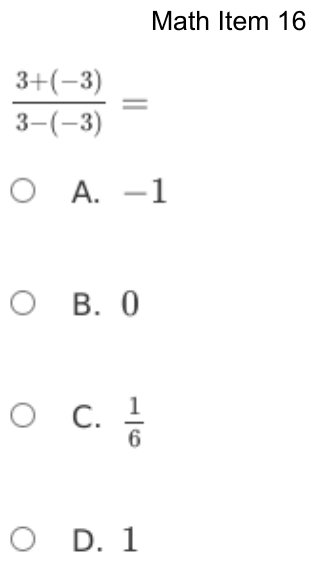
- A−1
- B0
- C
- D1
Show the answer
Correct answer: B
Simplify the expression.
is the equivalent of subtracting 3 from 3, and is the equivalent of adding 3 to 3:
The zero property of division states that zero divided by any nonzero number equals zero, so .
Question analysis
This fraction has 3 plus negative 3 on top and 3 minus negative 3 on the bottom, and students find its value. It tests adding and subtracting negative numbers and dividing integers. The top and the bottom look almost alike, so each sign has to be read carefully before anything is divided.
- Grade level
- Grade 7 content, by NYS standard
- Compared with grade 7
- Below grade 7 Adding and subtracting a negative integer and dividing are grade 7 basics, and here the numbers are small. It is a short routine calculation, easier than typical grade 7 work, though the two signs invite a quick misreading.
- Estimated difficulty
- Routine: one familiar step, little to misread.
- Thinking it demands
- Depth of knowledge 1, recall and reproduction · mainly apply
- What makes it hard
- Error-prone arithmetic minor
- Solution
- 2 steps
- Reading level
- Question and choices: about grade 16+, 2 words.
- Corrected from the DOE handbook
- A grammatical error in the explanation was corrected.
- A rule stated too broadly in the explanation was corrected.
- Students, last 30 days
- Not enough answers yet to show (it takes 10).
Why it is hard, traps and wrong answers (shows the answer)
Why it is hard
The arithmetic is two one-step sign calculations and a division by 6. The danger is reading the top and the bottom as alike: they differ in a single sign, and treating them the same way gives 1 or −1. Students who rewrite 3 − (−3) as 3 + 3 and 3 + (−3) as 3 − 3 see 0 over 6 at once, and zero divided by a nonzero number is zero.
Error-prone arithmetic minor Working it out
The top adds −3 and the bottom subtracts −3, signs that look nearly the same but give 0 and 6, so each has to be rewritten before anything is divided. (Brown & Burton, 1978; Junker & Sijtsma, 2001)
Strategy: Simplify the top and the bottom separately, rewriting the subtraction of a negative as an addition, and only then divide the top by the bottom.
Traps
- Negatives and direction: Arithmetic with negative numbers, the order of a subtraction, or direction on a number line. (Moving a term across the equals sign without changing its sign is a faulty procedure.)
The wrong answers, classified
A Negatives and direction (Brown & Burton, 1978)
Adds the sizes on top and keeps the minus, taking 3 + (−3) as −6, so the fraction becomes −6/6 = −1.
C Little reason to choose it (Haladyna & Downing, 1993; Rodriguez, 2005)
No sign rule gives a top of 1, so 1/6 mostly draws students who find the bottom, 6, and are unsure what a top of 0 means.
D Negatives and direction (Brown & Burton, 1978)
Treats the top like the bottom, adding 3 and 3 in both places, so the fraction becomes 6/6 = 1.
What was corrected from the DOE handbook, and why
- Explanation: The DOE’s explanation says “3 − (−3) is equivalent of adding 3 to 3”, without the article that the same sentence uses in “3 + (−3) is the equivalent of subtracting 3 from 3”. The site now says “is the equivalent of adding 3 to 3”.
- Explanation: The DOE’s explanation says “The zero property of division states that zero divided by any number equals zero.” Zero divided by zero is undefined, not zero, so the rule holds only when the divisor is not zero. The site now says “zero divided by any nonzero number equals zero”. Here the divisor is 6, so 0/6 = 0, as before.
Worked solution, step by step
Formulas used
- Adding a negative
- a and b are numbers. Adding a negative is the same as subtracting. On a number line, adding −3 moves you 3 steps left, just like subtracting 3.
- Subtracting a negative
- a and b are numbers. Subtracting a negative is the same as adding. Taking away a debt of 3 dollars leaves you 3 dollars better off. On a number line, you move right.
- Zero divided by a number
- b is any number except 0. Zero split into b equal parts leaves 0 in each part. The rule needs b not to be 0, because dividing by 0 has no answer.
Sort out the question
The top of the fraction is , and the bottom is . A fraction bar means divide. Work out the top and the bottom separately first. Then divide the top by the bottom.
Work out the top
Adding −3 is the same as subtracting 3:
A number plus its opposite is always 0.
Watch out: do not add the 3s and keep the minus sign. That makes the top −6 and leads to choice A, −1.
Work out the bottom
Subtracting −3 is the same as adding 3:
Watch out: the top and bottom look alike, but they are not. Making both of them 6 gives 6/6 = 1, choice D.
Divide the top by the bottom
Now the fraction is 0 over 6. Zero divided by any number other than zero is zero:
A top of 0 does not make the fraction 1/6, choice C. So the answer is B, 0.
Check your answer
Check by multiplying. A division is right when the answer times the bottom gives the top. Here , which is the top. So 0/6 really is 0.
More questions like this
The original DOE question
Question 5 of 10
2026 Practice Test D Math, question 9Question
Let m be a negative integer and k be a positive integer.
Which of the expressions below must result in a positive value?
Select the three correct answers.
Choose every answer that is correct, then check. The DOE has not published how answers with several parts are scored; this site counts one right only when every part is right.
- A
- B
- C
- D
- E
Show the answer
Correct answer: A, B, and D
Each of the expressions must be considered:
, where m is a negative integer and k is a positive integer: Correct
The “−” in front of m acts like a multiplier that flips the sign of m, so is positive when m is negative and k is positive.
, where m is a negative integer and k is a positive integer: Correct
The “−” in front of m acts like a multiplier that flips the sign of m, so is positive when m is negative and k is positive.
, where m is a negative integer and k is a positive integer:
A negative number minus a positive number gives a negative number.
, where m is a negative integer and k is a positive integer: Correct
A positive times a negative is a negative. Then, taking the opposite of that makes it positive.
, where m is a negative integer and k is a positive integer:
A negative divided by a positive remains negative.
Therefore, , , and must all result in a positive number.
Question analysis
Given that m is a negative integer and k a positive integer, students select the three expressions, out of five, that must have a positive value. It tests the sign rules for adding, subtracting, multiplying and dividing integers. Minus signs in front of letters, and letters in place of numbers, make each sign easy to misjudge, and all three must be found.
- NYS standards
- Grade level
- Grade 7 content, by NYS standard
- Compared with grade 7
- At grade 7 Sign rules for adding, subtracting, multiplying and dividing integers are core grade 7 content. Here they are applied to letters with known signs instead of numbers, across five expressions, and all three right ones must be chosen with no wrong one.
- Estimated difficulty
- Moderate: several steps, or a close reading with one strong distractor.
- Thinking it demands
- Depth of knowledge 2, skills and concepts · mainly analyze
- What makes it hard
- Variables instead of numbers moderate
- Every choice must be checked moderate
- Much to keep track of minor
- Solution
- 3 steps
- Reading level
- Question and choices: about grade 8, 33 words.
- Students, last 30 days
- Not enough answers yet to show (it takes 10).
Why it is hard, traps and wrong answers (shows the answer)
Why it is hard
Each expression needs only one sign rule, but the minus signs are placed to mislead. In −k · m the leading minus seems to make the result negative until the sign of m is counted, and in m − k two negatives seem to cancel, though subtracting makes the result more negative. Substituting one negative and one positive value into all five gives three positive results and two negative ones, the count the item asks for.
Variables instead of numbers moderate Understanding the question
Only the signs of m and k are known, so the sign of each expression must be reasoned from the rules or tested with values such as m = −2 and k = 3. (Koedinger & Nathan, 2004; Enright, Morley & Sheehan, 2002)
Every choice must be checked moderate Choosing the answer
All five expressions mix the same two letters with minus signs, so none can be dismissed at a glance; each is judged on its own and exactly three must be picked. (Embretson & Wetzel, 1987)
Much to keep track of minor Working it out
The item scores only when all three positive expressions are chosen and both negative ones left out, so five separate verdicts must be kept and combined. (Sweller, 1988; Carpenter, Just & Shell, 1990)
Strategy: Substitute sample values, such as m = −2 and k = 3, into all five expressions and note each sign, then confirm with the sign rules that no other values could change it.
Traps
- Negatives and direction: Arithmetic with negative numbers, the order of a subtraction, or direction on a number line. (Moving a term across the equals sign without changing its sign is a faulty procedure.)
- Misunderstands the concept: A wrong belief about a concept: that percents can be added, that area grows like length, that averages can be averaged, that a bigger denominator means a bigger fraction.
The wrong answers, classified
C Misunderstands the concept (Smith, diSessa & Roschelle, 1993; De Bock et al., 1998; Ni & Zhou, 2005)
Sees two negatives, m and the minus before k, and applies “two negatives make a positive” to subtraction, though a negative minus a positive moves further below zero.
D Negatives and direction (Brown & Burton, 1978)
Left out by students who read the leading minus in −k · m as making the product negative, missing that m is negative too, so the product is positive.
E Negatives and direction (Brown & Burton, 1978)
Sees no minus sign in m/k and takes it as positive, forgetting that m itself is negative, so the quotient of a negative and a positive is negative.
Worked solution, step by step
Formulas used
- The opposite of a number
- a is any positive number, so −a is negative. A minus sign in front of a number or letter means its opposite: the same distance from 0, on the other side. The opposite of a negative number is positive. So if m is negative, −m is positive.
- Signs when you multiply or divide
- a and b are positive numbers, so −a and −b are negative. Two negatives multiply to a positive. A negative and a positive multiply or divide to a negative. These rules tell you the sign of an answer without knowing the numbers.
Sort out the question
m is a negative integer, a whole number below 0, such as −2. k is a positive integer, such as 3. You must pick the three expressions that are always positive. Check all five, and test m = −2 and k = 3 as you go.
Understand the minus in front
A minus sign in front of a letter means the opposite of that number. Since m is negative, −m is positive. Since k is positive, −k is negative. With the test values, −m = 2 and −k = −3.
Check choices A and B
A: is a positive plus a positive, so it is always positive. Test: 2 + 3 = 5.
B: is a positive times a positive, so it is always positive. The dot · means times. Test: 2 × 3 = 6.
Check choices C and E
C: starts below 0 and moves further down, so it is always negative. Test: −2 − 3 = −5.
E: is a negative divided by a positive, so it is always negative. Test: −2 ÷ 3 = −2/3.
Watch out: two negatives make a positive only when you multiply or divide them. Choice C subtracts, so it stays negative. Choice E shows no minus sign, but m itself is negative.
Check choice D
D: is a negative times a negative, so it is always positive. Test: −3 × (−2) = 6.
Watch out: the minus sign in front makes D look negative. But m is negative too, and the two negatives make a positive. Skipping D leaves you one answer short.
Choose the three answers
Choices C and E are always negative, so leave them out. The three positive ones are A, B and D. On the test, you check the box next to each one.
So the answers are A, B and D.
Check your answer
Try different values, such as m = −10 and k = 1. A: 10 + 1 = 11. B: 10 × 1 = 10. D: −1 × (−10) = 10. All three are positive again. C gives −11 and E gives −10, both negative.
More questions like this
The original DOE question
Question 6 of 10
2026 Practice Test D Math, question 20Question
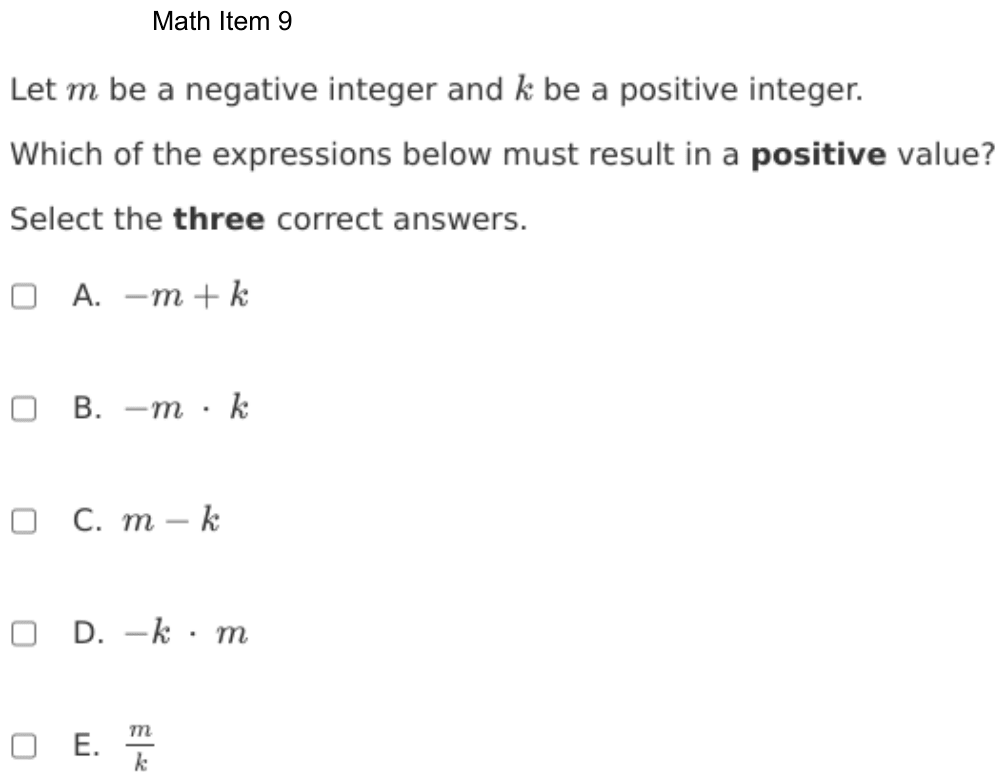
What is the value of ?
- A−76
- B−4
- C4
- D148
Show the answer
Correct answer: B
Use the order of operations to evaluate the expression. It is important to recognize that the fraction bar is a grouping symbol and so the entire numerator should be evaluated first. Exponents are evaluated first.
Then multiplication, recognizing that the product of a negative factor and a positive factor is negative.
Then addition and subtraction in order from left to right, recognizing the rules for adding and subtracting signed numbers.
And finally the fraction can be evaluated by division, recognizing that the quotient of a positive and a negative number is negative.
Question analysis
This arithmetic question asks for the value of a fraction whose numerator, −9(−4)² + 36(−4) + 304, is divided by −4. Students follow the order of operations with negative numbers: a square, two products, a sum and a division. Every step carries a sign, and one dropped negative changes the result completely.
- NYS standards
- Grade level
- Grade 7 content, by NYS standard
- Compared with grade 7
- At grade 7 Order of operations with negative numbers is standard grade 7 practice. This expression stacks a squared negative, two products and a division by a negative into one fraction, so it takes more steps than usual, each with a sign to track.
- Estimated difficulty
- Moderate: several steps, or a close reading with one strong distractor.
- Thinking it demands
- Depth of knowledge 1, recall and reproduction · mainly apply
- What makes it hard
- Error-prone arithmetic moderate
- Many steps minor
- A very close wrong answer minor
- Solution
- 4 steps
- Reading level
- Question and choices: about grade 5, 6 words.
- Students, last 30 days
- Not enough answers yet to show (it takes 10).
Why it is hard, traps and wrong answers (shows the answer)
Why it is hard
Nothing here is conceptually new; the question measures care with signs under the order of operations. The parentheses in (−4)² decide whether −9 multiplies 16 or −16, and the two products of −144 then nearly cancel the 304, leaving a small numerator whose sign is easy to lose. Writing each intermediate value with its sign, line by line, prevents most errors.
Error-prone arithmetic moderate Working it out
Five sign decisions sit in one expression: squaring −4, two products with a negative factor, a sum that climbs from −288 past zero, and a division by −4. (Brown & Burton, 1978; Junker & Sijtsma, 2001)
Many steps minor Working it out
The numerator alone takes an exponent, two multiplications and two additions before the single division, and all of it must be finished before dividing. (Daniel & Embretson, 2010; Enright, Morley & Sheehan, 2002)
A very close wrong answer minor Choosing the answer
The right value and the choice 4 differ only in sign, so a student with the right size must still check the sign of a positive numerator over −4. (Embretson & Wetzel, 1987; Gorin & Embretson, 2006; Ascalon et al., 2007)
Strategy: Treat the fraction bar as grouping: square −4 first, do the two multiplications, combine the numerator from left to right, and only then divide by −4, writing each sign as you go.
Traps
- Negatives and direction: Arithmetic with negative numbers, the order of a subtraction, or direction on a number line. (Moving a term across the equals sign without changing its sign is a faulty procedure.)
- Order of operations: Working left to right, or distributing a minus sign wrongly, gives a choice.
The wrong answers, classified
A Order of operations (Brown & Burton, 1978)
Squares as if the minus sat outside the parentheses, taking (−4)² as −16, so −9 × (−16) = 144, the numerator becomes 304, and 304 ÷ (−4) = −76.
C Negatives and direction (Brown & Burton, 1978)
Works the numerator out correctly as 16 but divides by −4 as if the signs did not matter, giving a positive quotient.
D Negatives and direction (Brown & Burton, 1978)
Drops every negative sign, adding 144 + 144 + 304 = 592 and dividing by 4, so 148 keeps none of the signs in the problem.
Worked solution, step by step
Formulas used
- Order of operations
- This is the order for working out an expression. Grouping means parentheses and the fraction bar. Exponents are small raised numbers, like the 2 in (−4)². Next, multiply and divide from left to right. Last, add and subtract from left to right.
- Squaring a negative number
- a is a positive number, so −a is negative. Squaring means multiplying a number by itself. A negative times a negative is positive, so a negative number squared is positive. For example, (−4)² = 16.
- Signs when you multiply or divide
- When two numbers have different signs, their product or quotient is negative. When they have the same sign, it is positive. A quotient is the answer to a division.
Sort out the question
You need the value of one big fraction. The fraction bar is a grouping symbol, so finish the whole top first. Then divide by −4. Follow the order of operations, and track every minus sign.
Do the exponent first
The only exponent is (−4)². Squaring means multiplying a number by itself:
Watch out: (−4)² is 16, not −16. Using −16 makes the top 304, which gives −76, choice A.
Do the multiplication
Now multiply. A negative times a positive is negative:
So the top becomes:
Add from left to right
Add the two negatives first:
Then add 304. Since 304 is more than 288, the result is positive:
The whole top is 16.
Divide by −4
Now divide the top by the bottom. A positive divided by a negative is negative:
Watch out: positive 4, choice C, ignores the negative bottom. Dropping every minus sign gives 592 ÷ 4 = 148, choice D.
So the answer is B, −4.
Check your answer
Multiply back. If the answer is −4, then −4 times the bottom, −4, should give the top. It does: (−4) × (−4) = 16. Also, the top is positive and the bottom is negative, so the answer must be negative.
More questions like this
The original DOE question
Question 7 of 10
2024 Test B Math, question 24Question
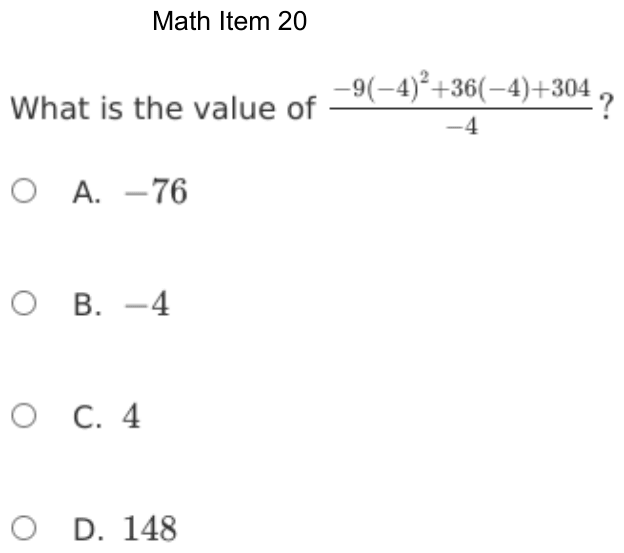
What is the value of ?
- A
- B
- C
- D
Show the answer
Correct answer: D
First, subtract to simplify.
Follow the process for dividing fractions:
Question analysis
A fractions question: find the value of a quotient whose top is 1 5/7 minus 1 6/7 and whose bottom is 3 4/7 minus 3 6/7. Students subtract mixed numbers that share a denominator and then divide one difference by the other. Keeping track of positive and negative signs through both steps is the main hurdle.
- Grade level
- Grade 7 content, by NYS standard
- Compared with grade 7
- At grade 7 Grade 7 students subtract and divide rational numbers, including negatives, and use the sign rules for quotients. This item chains three such operations with easy sevenths, a typical grade 7 exercise.
- Estimated difficulty
- Moderate: several steps, or a close reading with one strong distractor.
- Thinking it demands
- Depth of knowledge 1, recall and reproduction · mainly apply
- What makes it hard
- Error-prone arithmetic moderate
- Many steps minor
- Solution
- 3 steps
- Reading level
- Question and choices: about grade 10, 10 words.
- Students, last 30 days
- Not enough answers yet to show (it takes 10).
Why it is hard, traps and wrong answers (shows the answer)
Why it is hard
The mixed numbers look heavy, but the whole parts cancel and only sevenths remain. What decides the question is sign handling: each difference is negative, and one negative divided by another is positive. Students who stop after the top, subtract instead of divide, or keep a minus sign each find their result among the choices.
Error-prone arithmetic moderate Working it out
Both differences are negative, 1 5/7 − 1 6/7 = −1/7 and 3 4/7 − 3 6/7 = −2/7, and dividing them needs both the sign rule and a reciprocal. (Brown & Burton, 1978; Junker & Sijtsma, 2001)
Many steps minor Working it out
Two subtractions must be finished before the division, and a sign lost in either one carries into the final quotient. (Daniel & Embretson, 2010; Enright, Morley & Sheehan, 2002)
Strategy: Work out the top and the bottom separately, writing each difference as a signed fraction in sevenths, then divide by multiplying the top by the reciprocal of the bottom and apply the sign rule.
Traps
- Negatives and direction: Arithmetic with negative numbers, the order of a subtraction, or direction on a number line. (Moving a term across the equals sign without changing its sign is a faulty procedure.)
- Stops one step early: A choice is a number from partway through the solution.
- Wrong operation: Adds instead of multiplying, divides the wrong way round, turns a ratio or rate upside down, or undoes a step in the wrong direction (subtracts what should be added back).
The wrong answers, classified
A Negatives and direction (Brown & Burton, 1978)
Finds −1/7 and −2/7 correctly but keeps a negative sign when dividing, forgetting that a negative divided by a negative is positive.
B Stops one step early (King et al., 2004; Gierl et al., 2017)
Works out the top, 1 5/7 − 1 6/7 = −1/7, and stops there without dividing it by the bottom difference.
C Wrong operation (Hegarty, Mayer & Monk, 1995; King et al., 2004)
Subtracts the bottom difference from the top one, −1/7 − (−2/7) = 1/7, instead of dividing the two.
Worked solution, step by step
Formulas used
- Dividing fractions
- a over b is the number you divide. c over d is the number you divide by. To divide by a fraction, multiply by its reciprocal, the fraction flipped upside down. Only the second fraction flips.
- Dividing two negative numbers
- a and b are positive numbers, and b is not zero. A negative number divided by a negative number gives a positive answer. The two minus signs cancel. Multiplying two negatives works the same way.
Sort out the problem
The long fraction bar means divide. So you need the top difference divided by the bottom difference. A difference is the answer to a subtraction. Work out the top and the bottom first, then divide.
Work out the top
Both numbers on top have the same whole number, 1. So the wholes cancel, and you only need . You take away more than you have, so the answer is negative.
Work out the bottom
Both numbers on the bottom have the whole number 3, so those cancel too.
Watch out: do not stop after the top. , choice B, is only part of the problem.Divide the top by the bottom
Both results are negative. The two minus signs cancel.
Now flip the second fraction and multiply.
Avoid the traps and answer
Watch out: keeping a minus sign gives , choice A. Subtracting the bottom from the top, instead of dividing, gives , choice C.So the answer is D, .
Check your answer
Think in sevenths. The top is −1 seventh and the bottom is −2 sevenths. That is like . Or multiply back: , which is the top.
More questions like this
The original DOE question
Question 8 of 10
2023 Test B Math, question 48Question
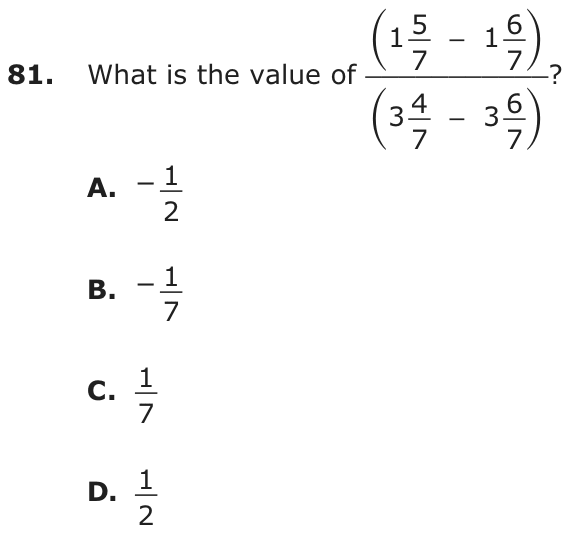
The outdoor temperature was 4.2° F at 10 p.m. After hours, the outdoor temperature was −0.7° F. Which value best represents the average change in temperature per hour?
- A−1.4° F
- B−1.0° F
- C1.0° F
- D1.4° F
Show the answer
Correct answer: A
First, recognize that the temperature decreased. This means that the order of subtraction matters and that the result is a negative number:
The temperature decreased 4.9 degrees. Divide by 3.5 to get the average change per hour:
Question analysis
The temperature was 4.2° F at 10 p.m. and −0.7° F three and a half hours later. Students find the average change in temperature per hour. It tests subtracting and dividing with negative decimals, and the choices pair two sizes of change with both signs, so the sign has to be right as well as the size.
- NYS standards
- Grade level
- Grade 7 content, by NYS standard
- Compared with grade 7
- At grade 7 Signed-number problems about temperature are standard grade 7 work. This one asks for an average rate, so a change that crosses zero must be divided by a mixed-number time, with the sign kept through both steps.
- Estimated difficulty
- Moderate: several steps, or a close reading with one strong distractor.
- Thinking it demands
- Depth of knowledge 2, skills and concepts · mainly apply
- What makes it hard
- Error-prone arithmetic moderate
- Turning words into math minor
- A very close wrong answer minor
- Solution
- 2 steps
- Reading level
- Question and choices: about grade 5, 31 words.
- Students, last 30 days
- Not enough answers yet to show (it takes 10).
Why it is hard, traps and wrong answers (shows the answer)
Why it is hard
The arithmetic is short, but signs decide every choice: two choices come from treating −0.7 as 0.7, and one comes from getting the size right and the direction wrong. Students who think of the drop in two parts, 4.2 degrees down to zero and 0.7 more, find the 4.9-degree fall; dividing by 3.5 hours and remembering the temperature fell finishes it.
Error-prone arithmetic moderate Working it out
The change crosses zero, −0.7 − 4.2 = −4.9, and then a negative decimal is divided by 3.5, from the 3 1/2 hours, with the sign kept through both steps. (Brown & Burton, 1978; Junker & Sijtsma, 2001)
Turning words into math minor Understanding the question
The phrase “average change in temperature per hour” means the change from the 4.2° start to the −0.7° end divided by the time, final minus initial, so a drop is negative. (Hegarty, Mayer & Monk, 1995; Koedinger & Nathan, 2004)
A very close wrong answer minor Choosing the answer
The answer, −1.4° F, and the choice 1.4° F share every digit and differ only in sign, so a correct division followed by a careless sign cannot be caught by estimating. (Embretson & Wetzel, 1987; Gorin & Embretson, 2006; Ascalon et al., 2007)
Strategy: Subtract the starting temperature from the ending one, keeping track of the sign, then divide that change by the 3.5 hours.
Traps
- Negatives and direction: Arithmetic with negative numbers, the order of a subtraction, or direction on a number line. (Moving a term across the equals sign without changing its sign is a faulty procedure.)
The wrong answers, classified
B Negatives and direction (Brown & Burton, 1978)
Subtracts 0.7 from 4.2 as if both temperatures were above zero, a 3.5-degree drop, so 3.5 ÷ 3.5 gives 1, then marks the change negative.
C Negatives and direction (Brown & Burton, 1978)
Treats −0.7 as 0.7, finding a 3.5-degree change, and also loses its direction, reporting a rise of 1 degree an hour for a temperature that fell.
D Negatives and direction (Brown & Burton, 1978)
Finds the 4.9-degree change and divides by 3.5 correctly, or subtracts in the order start minus end, and reports a rise for a temperature that fell.
Worked solution, step by step
Formulas used
- Average change per hour
- Start is the first temperature, and end is the last one. End minus start is the total change. It is negative when the temperature drops. Dividing by the number of hours shares that change equally over each hour.
Sort out the question
At 10 p.m. it was 4.2° F. After hours, it was −0.7° F. That is below zero. The temperature went down, so the change is negative. You need the average change for each hour.
Find the total change
Subtract the start from the end.
Picture a thermometer. Going from 4.2 down to 0 is a drop of 4.2 degrees. Going on to −0.7 is 0.7 more. In all, it fell 4.9 degrees.
Watch out: 4.2 − 0.7 = 3.5 treats −0.7 as if it were above zero. That leads to choice B or C.
Divide by the hours
Write hours as 3.5 hours. Use the formula.
To divide, think 49 ÷ 35 = 1.4, since 35 × 1.4 = 49. The change is negative, so it is −1.4 degrees per hour.
Keep the sign
The temperature fell, so the answer must be negative.
Watch out: 1.4 has the right size, but it says the temperature went up. That is choice D.
So the answer is A, −1.4° F.
Check your answer
Work forward. Dropping 1.4 degrees each hour for 3.5 hours is degrees. Then . That is the temperature in the problem.
More questions like this
The original DOE question
Question 9 of 10
2022 Test A Math, question 7Question
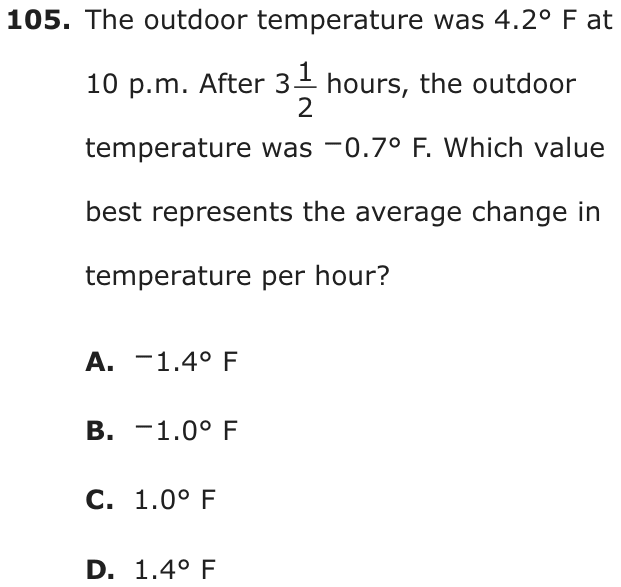
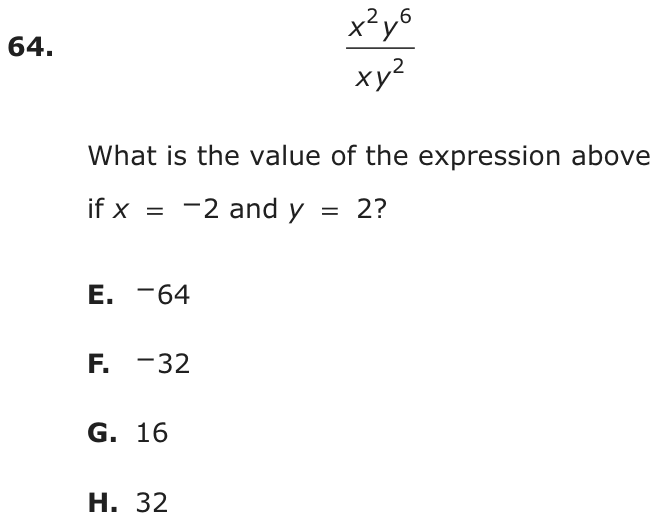
What is the value of the expression above if and ?
- A−64
- B−32
- C16
- D32
Show the answer
Correct answer: B
First, substitute −2 for x and 2 for y.
Then, simplify.
Question analysis
This question asks for the value of a fraction built from powers of x and y when x is −2 and y is 2. Students evaluate an expression with exponents and a negative number, or simplify it first by cancelling common factors. Keeping track of the negative sign through the squaring and the division is the tricky part.
- NYS standards
- Grade level
- Grade 7 content, by NYS standard
- Compared with grade 7
- At grade 7 Grade 7 students evaluate expressions with negative values and whole-number exponents. This one is a single fraction of powers, routine in method, but raising a negative base to powers and then dividing leaves several chances to lose the sign.
- Estimated difficulty
- Straightforward: two steps or one careful reading.
- Thinking it demands
- Depth of knowledge 1, recall and reproduction · mainly apply
- What makes it hard
- Error-prone arithmetic moderate
- Something you must already know minor
- Solution
- 3 steps
- Reading level
- Question and choices: about grade 8, 13 words.
- Students, last 30 days
- Not enough answers yet to show (it takes 10).
Why it is hard, traps and wrong answers (shows the answer)
Why it is hard
Two routes work: substitute and compute 256 ÷ (−8), or simplify to xy⁴ first and evaluate (−2)(16). Simplifying first is safer, because it leaves a single negative factor to track. Substituting first brings in (−2)², where treating the minus sign as outside the parentheses flips the final sign, and each listed wrong value comes from an exponent or a sign handled wrongly.
Error-prone arithmetic moderate Working it out
Substituting first gives (−2)²(2)⁶ over (−2)(2)², so the work runs through a squared negative, 2⁶ = 64 and a negative divisor, and one factor of −2 decides the sign. (Brown & Burton, 1978; Junker & Sijtsma, 2001)
Something you must already know minor Working it out
The quotient rule for powers is not stated; students who know that x²/x = x and y⁶/y² = y⁴ can reduce the expression to xy⁴ before any number goes in. (Anderson & Krathwohl, 2001)
Strategy: Cancel the factors of x and y that the top and bottom share before substituting, so there is less to compute, and track the sign of every factor of −2 through to the end.
Traps
- Order of operations: Working left to right, or distributing a minus sign wrongly, gives a choice.
- A faulty procedure: A systematic but wrong procedure: adding fractions straight across, applying an exponent to each term of a sum, dropping a sign when moving a term.
The wrong answers, classified
A A faulty procedure (Brown & Burton, 1978; Tatsuoka, 1983)
Drops the square on y in the denominator, dividing 4 × 64 = 256 by (−2)(2) = −4 instead of by (−2)(4) = −8, giving −64.
C A faulty procedure (Brown & Burton, 1978; Tatsuoka, 1983)
Cancels x² against x as if x²/x were 1 rather than x, so only y⁶/y² = y⁴ = 16 is left, with no factor of −2.
D Order of operations (Brown & Burton, 1978)
Squares as if the minus sat outside the parentheses, taking (−2)² as −4, so −4 × 64 = −256 and −256 ÷ (−8) = 32.
Worked solution, step by step
Formulas used
- A power
- a is the base, the number being multiplied. The small number is the exponent. It says how many times the base is used as a factor, a number being multiplied. So y⁶ means six y’s multiplied together. It does not mean y times 6.
- Dividing powers with the same base
- a is the base. m and n are exponents. The top has m factors of a and the bottom has n. Each matching pair cancels, because a ÷ a = 1. So m − n factors are left. A letter with no exponent, like x, has exponent 1.
Sort out the question
You need the value of when x = −2 and y = 2. The top means . The bottom means . You could put the numbers in right away. But simplifying first is safer. It leaves only one negative number to track.
Simplify the x part
Use the rule for dividing powers. The x on the bottom has exponent 1.
You can see it by writing it out: leaves one x. Watch out: x² ÷ x is x, not 1. If you cancel every x, you lose the −2 and get 16, choice C.
Simplify the y part
So the whole fraction becomes a simpler expression:
Watch out: the bottom has y², not y. Using y leaves y⁵ and leads to −64, choice A.
Put in the numbers
Now substitute x = −2 and y = 2.
A negative times a positive is negative. So the answer is B, −32.
Check your answer
Substitute first, the long way. Top: . Bottom: . Then . Watch out: (−2)² is +4, since two negatives multiply to a positive. Writing −4 leads to 32, choice D.
More questions like this
The original DOE question
Question 10 of 10
2018 Test A Math, question 3Question
For what value of is ?
Grid-in question: work out the answer and enter it as a number.
Show the answer
Correct answer: -4
Question analysis
A one-line algebra grid-in: find the value of w that makes 4w equal to 2w minus 8. Students solve a linear equation with the variable on both sides by collecting the w terms and dividing. Errors come from handling the subtraction sign or stopping before w stands alone.
- Grade level
- Grade 8 content, by NYS standard
- Compared with grade 7
- At grade 7 Equations with the variable on both sides are formally a grade 8 topic, but this one takes two short steps with whole numbers. It asks about as much as a typical grade 7 two-step equation.
- Estimated difficulty
- Routine: one familiar step, little to misread.
- Thinking it demands
- Depth of knowledge 1, recall and reproduction · mainly apply
- What makes it hard
- Solution
- 2 steps
- Reading level
- Question and choices: about grade 7, 7 words.
- Students, last 30 days
- Not enough answers yet to show (it takes 10).
Why it is hard, traps and wrong answers (shows the answer)
Why it is hard
One of the easiest questions on the test: collect the w terms on one side and divide. Errors come from carelessness rather than method, such as dropping the negative sign or gridding −8 after the first step because it already looks like a finished answer. Substituting the result back into both sides of the equation takes seconds and catches both.
Error-prone arithmetic minor Working it out
The only constant is −8, so the answer is negative; dividing −8 by the coefficient 2 is the step where the sign is most often lost. (Brown & Burton, 1978; Junker & Sijtsma, 2001)
An answer in an unexpected form minor Choosing the answer
The grid-in needs the negative sign filled in its own column, and there are no choices to show that the answer lies below zero. (Enright, Morley & Sheehan, 2002)
Strategy: Subtract 2w from both sides so the variable appears only once, divide by the remaining coefficient, and check by substituting into both sides.
Traps
- Negatives and direction: Arithmetic with negative numbers, the order of a subtraction, or direction on a number line. (Moving a term across the equals sign without changing its sign is a faulty procedure.)
- Stops one step early: A choice is a number from partway through the solution.
The wrong answers, classified
4 Negatives and direction (Brown & Burton, 1978)
Gets 2w = −8 correctly but drops the sign when dividing by 2, gridding 4 instead of a negative value.
-8 Stops one step early (King et al., 2004; Gierl et al., 2017)
Subtracts 2w from both sides to reach 2w = −8 and grids −8 without dividing by the coefficient 2.
Worked solution, step by step
Formulas used
- Keeping an equation balanced
- a and b are the two sides of an equation, and c is any number or term. An equation is like a balanced scale. If you subtract the same thing from both sides, it stays balanced. The same is true if you add the same thing, or divide both sides by the same number that is not zero.
Sort out the equation
An equation says two things are equal. You need the value of w that makes equal to . Here 4w means 4 times w, and 2w means 2 times w. The answer may be a negative number, so keep track of the signs.
Get w on one side
w is on both sides. Subtract 2w from both sides. Then w is only on the left, and the equation stays balanced.
Now 2 times w is −8.
Divide both sides by 2
To undo times 2, divide both sides by 2. A negative number divided by a positive number is negative.
Watch out: keep the minus sign. Dropping it gives 4. Also, don’t stop at and grid −8. So you would grid -4, with the minus sign in its own column.
Check your answer
Put −4 back in for w. Left side: . Right side: . Both sides are −16, so −4 works.
More questions like this
The original DOE question
