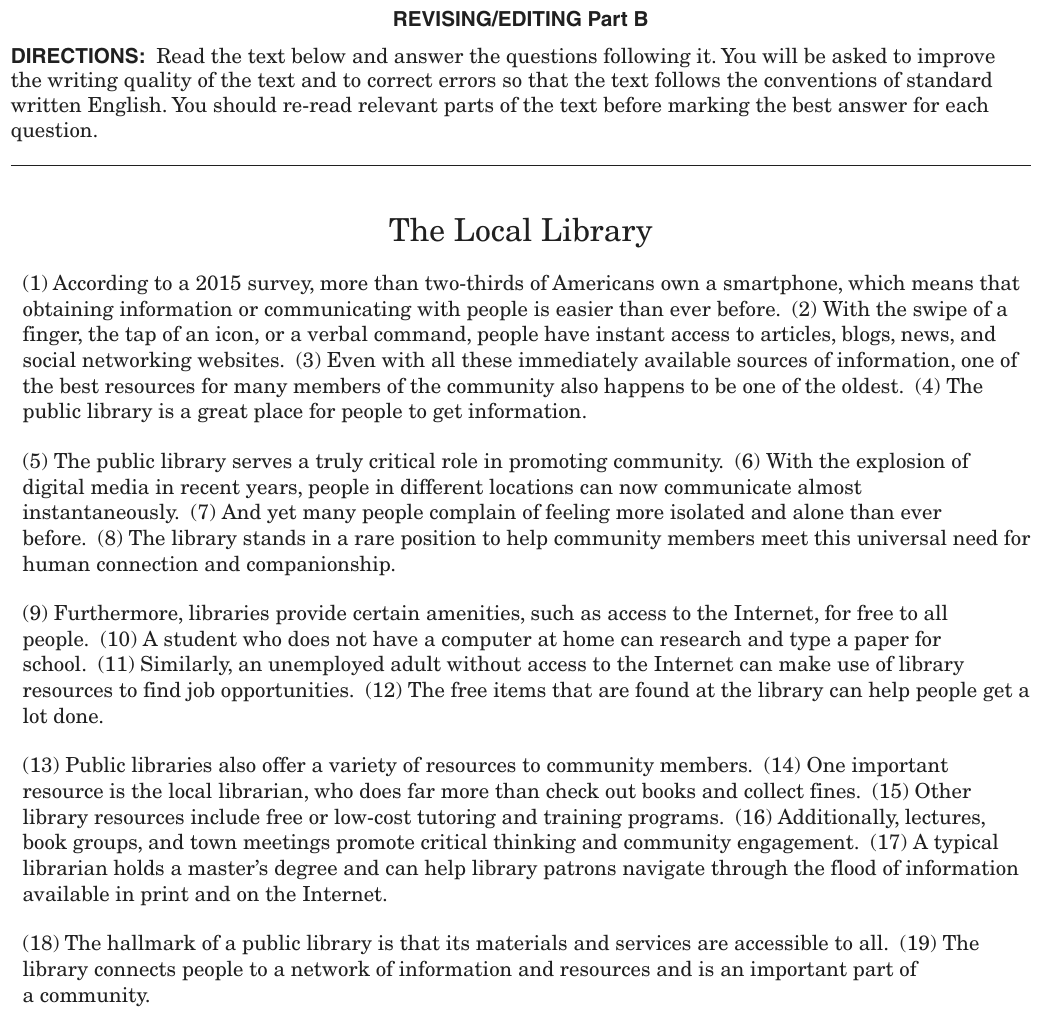
7L3a precise and concise language
Question 1 of 12
2026 Practice Test B English, question 45Passage The End of an Era
The End of an Era
(1) In 2004, the National Aeronautics and Space Administration (NASA) landed a rover, or robotic vehicle, named Opportunity on the surface of Mars. (2) The rover’s mission was to search for evidence of water and life on the planet. (3) The rover was designed to gather data on Mars for about 90 days, but Opportunity’s assignment did not come to an end until nearly 15 years later in 2019.
(4) During the rover’s mission, a high-resolution camera on the rover’s robotic arm took magnified photographs of the surface of Mars. (5) The photographs revealed small round rocks scattered across the surface of the planet. (6) The scientists nicknamed these rocks “blueberries” based on the rocks’ resemblance to the fruit. (7) These rocks were important because their spherical shape suggested that liquid water may have flowed over them for a substantial amount of time.
(8) Opportunity continued to provide valuable data about craters and other surface features. (9) Throughout the mission, the rover traveled a total of 28.06 miles across Mars’ surface. (10) When Opportunity had traveled nearly the length of a marathon, scientists celebrated the accomplishment by naming the valley that the rover was in Marathon Valley. (11) However, in 2018, a dust storm spread all over the planet, putting the rover’s progress on hold.
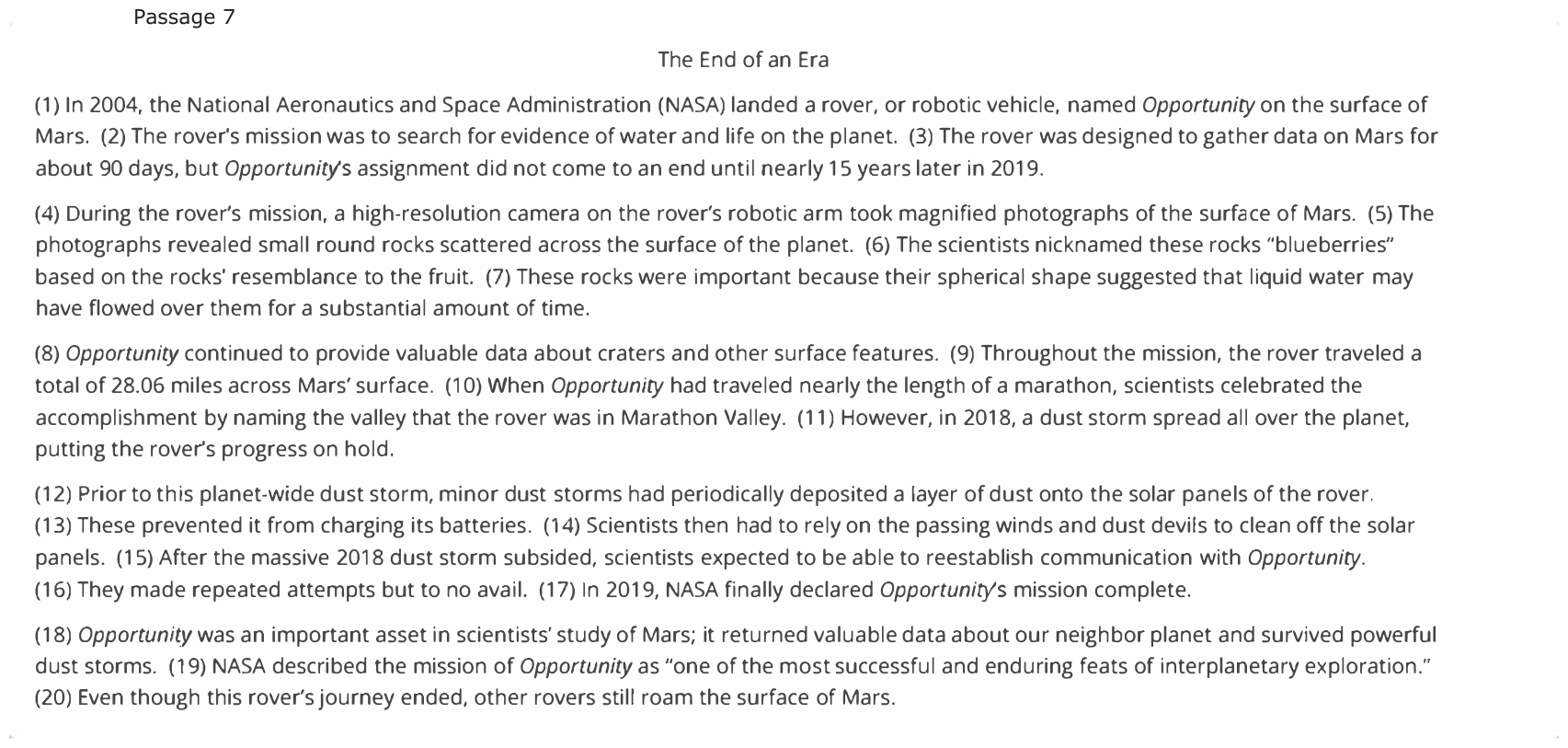
(12) Prior to this planet-wide dust storm, minor dust storms had periodically deposited a layer of dust onto the solar panels of the rover. (13) These prevented it from charging its batteries. (14) Scientists then had to rely on the passing winds and dust devils to clean off the solar panels. (15) After the massive 2018 dust storm subsided, scientists expected to be able to reestablish communication with Opportunity. (16) They made repeated attempts but to no avail. (17) In 2019, NASA finally declared Opportunity’s mission complete.
(18) Opportunity was an important asset in scientists’ study of Mars; it returned valuable data about our neighbor planet and survived powerful dust storms. (19) NASA described the mission of Opportunity as “one of the most successful and enduring feats of interplanetary exploration.” (20) Even though this rover’s journey ended, other rovers still roam the surface of Mars.
Question
Which revision of sentence 11 best maintains the formal style established in the passage?
- AHowever, in 2018, a dust storm covered the planet, bringing the rover’s progress to a standstill.
- BHowever, in 2018, a dust storm shrouded the planet, impermanently halting the rover’s progress.
- CHowever, in 2018, a dust storm enveloped the whole of the planet, arresting the rover’s progress for a time.
- DHowever, in 2018, a dust storm covered up the whole planet, which quickly brought a stop to the progress of the rover.
Show the answer
Correct answer: A
The question asks for the revision of sentence 11 that best maintains the formal style established in the passage.
A. CORRECT. This sentence uses clear and formal writing throughout. The phrase “covered the planet” is accurate and formal without being overly poetic, and “standstill” is a precise word for putting something “on hold,” as expressed by the original sentence, while maintaining the formal style of the passage.
B. Incorrect. Although the sentence is formal in style, the word “shrouded” is overly poetic, and the phrase “impermanently halting” is too stilted and formal for the style and tone of the passage.
C. Incorrect. Although the sentence is formal in style, the words “enveloped” and “arresting” are overly poetic, especially when used in the same sentence, and the phrases “the whole of the planet” and “for a time” are needlessly wordy and imprecise, compared with the formal scientific language of the passage.
D. Incorrect. The phrases “covered up the whole planet” and “quickly brought a stop to the progress of the rover” are less formal and unnecessarily wordy, compared with the formal style established by the rest of the passage.
Question analysis
This style question asks which revision of sentence 11, about the 2018 dust storm that covered Mars and stopped the Opportunity rover, best maintains the formal style of the passage. All four versions say the same thing, so students must compare word choice and wordiness and decide which one reads like the rest of the passage.
- Grade level
- Grade 8 reading and task
- Compared with grade 7
- Above grade 7 Keeping a formal style is grade 7 writing work, usually tested by spotting slang or casual wording. Here all four revisions keep the meaning and differ in register by degrees, so students must judge the passage's own style closely, more than typical.
- Estimated difficulty
- Hard: combines ideas, needs a plan, and has more than one tempting wrong answer.
- Thinking it demands
- Depth of knowledge 2, skills and concepts · mainly evaluate
- What makes it hard
- Something you must already know moderate
- Every choice must be checked moderate
- Hard words minor
- Evidence
- Answered from one sentence or line
- Reading level
- Passage: about grade 11, 337 words; question and choices: about grade 9, 80 words.
- Students, last 30 days
- Not enough answers yet to show (it takes 10).
Why it is hard, traps and wrong answers (shows the answer)
Why it is hard
The question turns on what “formal” means. Many students equate it with impressive words and choose the revision with “enveloped” and “arresting,” or the one with “shrouded,” missing that both are more poetic than a passage that reports dates and distances. The casual revision is easy to reject, so the real test is preferring the plainest formal sentence to the grandest one.
Something you must already know moderate Working it out
Students must know that a formal informational style is plain and precise, so words such as “shrouded,” “enveloped” and “arresting” are too ornate for a passage that reports miles and dates. (Anderson & Krathwohl, 2001)
Every choice must be checked moderate Choosing the answer
All four revisions keep the meaning of sentence 11 and differ only in register and length, so each must be heard against the passage’s voice rather than checked for errors. (Embretson & Wetzel, 1987)
Hard words minor Understanding the question
“Impermanently,” “shrouded” and “arresting,” in its sense of stopping, are uncommon words, and students must judge how they sound in the passage, not only what they mean. (Perfetti, 2007; Freedle & Kostin, 1993)
Strategy: Reread a few sentences around sentence 11 to hear the passage's voice, then check each revision for casual phrasing, needless words and words that would sound out of place in that voice.
Traps
- Wordy, vague or informal: A revision is grammatical but wordy, imprecise or too casual for the passage.
The wrong answers, classified
B Wordy, vague or informal (Connors & Lunsford, 1988)
Equates formal with elevated, so “shrouded” and “impermanently halting” seem best, though both are stilted and poetic beside the passage’s plain reporting of facts.
C Wordy, vague or informal (Connors & Lunsford, 1988)
Avoids casual words, but “enveloped” and “arresting” are poetic, and “the whole of the planet” and “for a time” add words the plain version does without.
D Wordy, vague or informal (Connors & Lunsford, 1988)
Keeps the meaning, but the casual “covered up” and the roundabout “brought a stop to the progress of the rover” make it wordier and less formal.
Working it out, step by step
Figure out what the question asks
This question asks which version of sentence 11 keeps the passage’s formal style. Formal writing is serious and clear, like a textbook. It avoids slang and casual words. But formal doesn’t mean fancy. Formal writing about science uses plain, exact words. For example, The game got called off is casual. The contest was halted indefinitely is too fancy. The game was canceled is formal and plain.
Hear the passage’s voice
Sentence 9 says “the rover traveled a total of 28.06 miles across Mars’ surface.” Sentence 12 says minor storms “deposited a layer of dust onto the solar panels.” The words are exact and plain. The passage gives dates and numbers. It doesn’t paint poetic pictures.
Check each revision
- A is right. “Covered the planet” is plain and exact. A standstill is a complete stop, a clear way to say “on hold.”
- B is wrong. “Shrouded” is poetic. A shroud is a cloth wrapped around a body. “Impermanently halting” sounds stiff and odd.
- C is wrong. “Enveloped” and “arresting” are fancy words. Here arresting means stopping. “The whole of the planet” and “for a time” add extra words.
- D is wrong. “Covered up” is casual. “Brought a stop to the progress of the rover” is wordy, or longer than it needs to be.
Watch out: Many students think formal means big words, so they choose C. But a passage of dates and miles calls for plain words.
Choose the answer
Only A is both formal and plain, like the rest of the passage. So the answer is A: “However, in 2018, a dust storm covered the planet, bringing the rover’s progress to a standstill.”
Why this answer and not the closest wrong one
C is the closest wrong answer, because it has no slang and sounds serious. But “enveloped” and “arresting” are poetic, and “the whole of the planet” is wordy. The passage reports facts in plain words. A says the same thing in the plainest formal way.
More questions like this
The original DOE question
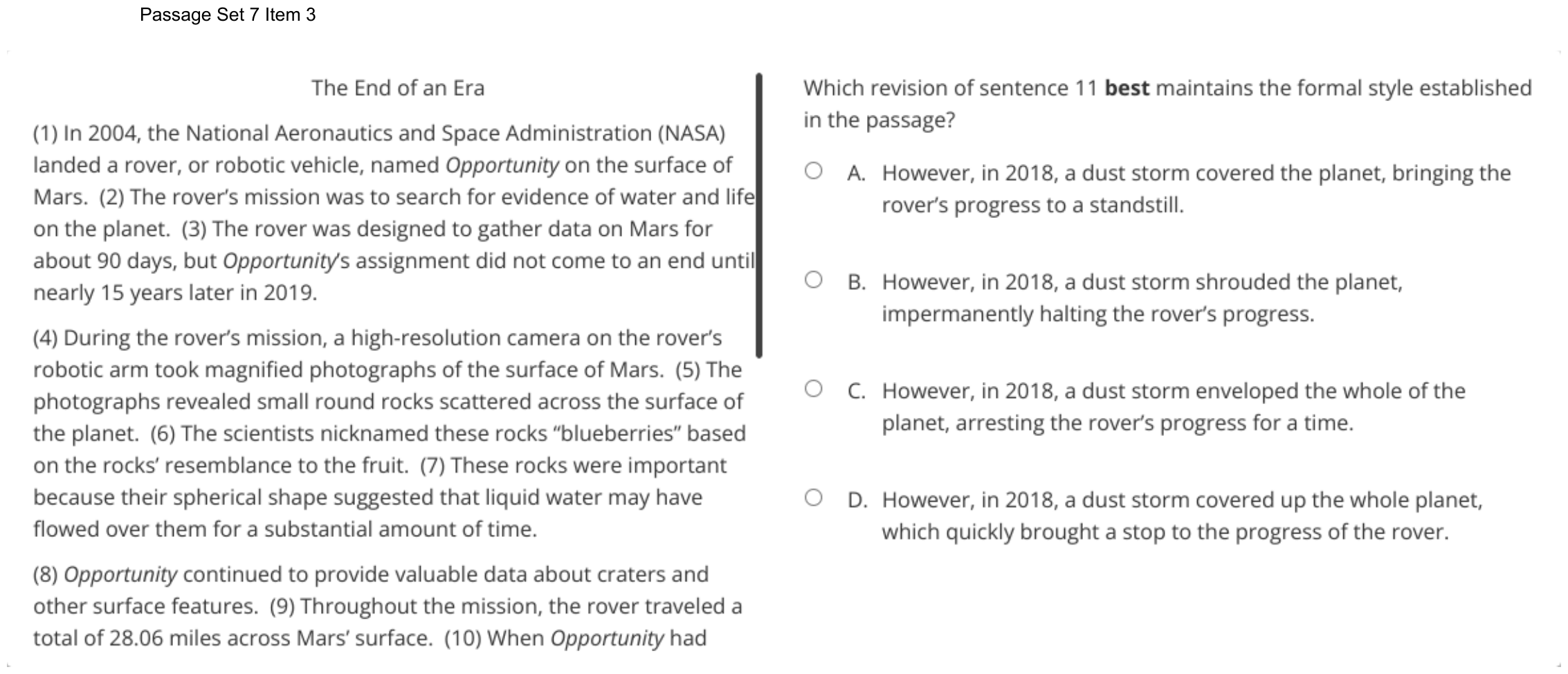
The passage “The End of an Era” as printed (page 60)
Question 2 of 12
2026 Practice Test B English, question 47Uses the passage above: “The End of an Era”.
Question
What is the best way to combine sentences 12 and 13?
- APreventing the rover from charging its batteries, minor dust storms had periodically deposited a layer of dust onto the solar panels of the rover prior to this planet-wide dust storm.
- BPeriodically depositing a layer of dust onto the solar panels of the rover prior to this planet-wide dust storm, minor dust storms had prevented it from charging its batteries.
- CMinor dust storms, prior to this planet-wide dust storm, prevented the rover from charging its batteries because they had periodically deposited a layer of dust onto the solar panels of the rover.
- DPrior to this planet-wide dust storm, minor dust storms had periodically deposited a layer of dust onto the solar panels of the rover, preventing it from charging its batteries.
Show the answer
Correct answer: D
The question asks for the best way to combine sentences 12 and 13.
A. Incorrect. The phrase “this planet-wide dust storm” in the original sentence 12 makes a direct reference to sentence 11 and therefore acts as a transition that should be kept at the beginning. In this sentence, the transition phrase is placed at the end of the sentence, making the phrase confusing. In addition, the sentence is unnecessarily repetitive and wordy.
B. Incorrect. This combination unnecessarily turns sentence 12 into an overly long participial phrase, making the connection between “it” and its antecedent, “the rover,” unclear and distracting from the subject of the sentence, “minor dust storms.”
C. Incorrect. Not only does this combination move the reference to “this planet-wide dust storm” farther from sentence 11, but it is also unnecessarily wordy, adding “because” and repeating “the rover.”
D. CORRECT. This sentence efficiently and accurately adds sentence 13 to sentence 12 as a participial phrase by changing “These prevented” to “preventing,” while also retaining the meanings of the original sentences 12 and 13.
Question analysis
This sentence-combining question asks for the best way to join two sentences from the rover passage: one saying minor dust storms had periodically coated the rover's solar panels, the other saying this kept it from charging its batteries. The four versions keep the same facts in different orders, so students must judge which is clearest and most concise in context.
- Grade level
- Grade 8 reading and task
- Compared with grade 7
- Above grade 7 Combining two sentences is grade 7 work, usually with one version clearly better. These four are long, keep the same facts and differ in order and wording, so students must weigh clarity and concision across nearly identical sentences, more than typical.
- Estimated difficulty
- Hard: combines ideas, needs a plan, and has more than one tempting wrong answer.
- Thinking it demands
- Depth of knowledge 2, skills and concepts · mainly evaluate
- What makes it hard
- How sentences fit together moderate
- Every choice must be checked moderate
- Complex sentences minor
- Evidence
- Answered from one sentence or line
- Reading level
- Passage: about grade 11, 337 words; question and choices: about grade 13, 129 words.
- Corrected from the DOE handbook
- Two grammar terms in the explanation were corrected.
- Students, last 30 days
- Not enough answers yet to show (it takes 10).
Why it is hard, traps and wrong answers (shows the answer)
Why it is hard
None of the versions is plainly ungrammatical, so the ear gives little help, and the version with “because” looks best to students who value a clearly stated cause. Its cost is wordiness and a weaker link: the result comes first and the reference back to sentence 11 is buried mid-sentence. The question rewards keeping the original order, cause then effect, and folding sentence 13 in as a short closing phrase.
How sentences fit together moderate Working it out
“Prior to this planet-wide dust storm” points back to sentence 11, so the best version keeps it first; three versions move it later, which loosens the link between the two sentences. (Halliday & Hasan, 1976)
Every choice must be checked moderate Choosing the answer
All four versions keep every fact of sentences 12 and 13 and run 29 to 32 words, so none can be ruled out by content; order, pronouns and repetition decide. (Embretson & Wetzel, 1987)
Complex sentences minor Understanding the question
Each version is one long sentence built around a participial phrase or a “because” clause, and at that length a stranded “it” or a doubled “the rover” is easy to miss. (Abedi & Lord, 2001; Freedle & Kostin, 1993; Messick, 1989)
Strategy: Read sentence 11 first, then compare the versions on how smoothly each connects to it, how many words it uses, and whether every pronoun has a clear antecedent.
Traps
- Wordy, vague or informal: A revision is grammatical but wordy, imprecise or too casual for the passage.
- Unclear pronoun: A pronoun whose reference is vague or ambiguous, or one in the wrong case.
The wrong answers, classified
A Wordy, vague or informal (Connors & Lunsford, 1988)
Opens with the effect as a participial phrase, which pushes “prior to this planet-wide dust storm,” the link to sentence 11, to the end and names “the rover” twice.
B Unclear pronoun (Connors & Lunsford, 1988)
Packs sentence 12 into a 19-word opening phrase, so “it” follows “this planet-wide dust storm” and no longer points clearly to the rover buried inside the phrase.
C Wordy, vague or informal (Connors & Lunsford, 1988)
Likes the clear cause word “because,” but the result now comes first, “the rover” appears twice, and “prior to this planet-wide dust storm” splits the subject from its verb.
What was corrected from the DOE handbook, and why
- Explanation: The DOE’s explanation of Option B says the combination turns sentence 12 into “an overly long dependent clause,” and its explanation of Option D says Option D adds sentence 13 to sentence 12 “as a dependent clause” by changing “These prevented” to “preventing.” Neither is a clause: “Periodically depositing a layer of dust onto the solar panels of the rover prior to this planet-wide dust storm” (Option B) and “preventing it from charging its batteries” (Option D) have no subject or finite verb of their own. Both are participial phrases, and the site now calls them that. The reasoning and the answer, Option D, are unchanged.
Working it out, step by step
Figure out what the question asks
This question asks for the best way to join sentences 12 and 13 into one sentence. The best version keeps the meaning, uses few words and is clear. It should also connect smoothly to sentence 11, the sentence before.
Read the sentences in order
Sentence 11 tells about the giant 2018 dust storm. Sentence 12 begins “Prior to this planet-wide dust storm.” Prior to means before. That phrase points back to sentence 11, so it works best at the start. Sentence 12 says small storms put dust on the solar panels. Sentence 13 gives the result: “These prevented it from charging its batteries.”
Learn the tool: a participial phrase
A participial phrase is a group of words built on a verb form, often an -ing word. It describes something, but it has no subject and can’t stand alone. Example: The dog ran to the door. It wagged its tail. becomes The dog ran to the door, wagging its tail. Choice D does this. It turns “These prevented” into “preventing.”
Check each choice
- A is wrong. It starts with the result. It moves “prior to this planet-wide dust storm” to the end, far from sentence 11. It also says “the rover” twice.
- B is wrong. Its long opening phrase hides the rover. Then “it” comes after “minor dust storms,” so it is hard to tell what “it” means.
- C is wrong. It adds “because,” puts the result first and says “the rover” twice. It is wordier than D.
- D is right. It keeps the link to sentence 11 first, gives the cause, then adds the result as a short participial phrase.
Watch out: C looks clear because “because” names the cause. But it is longer, and it puts an extra phrase between “Minor dust storms” and its verb.
Choose the answer
So the answer is D: “Prior to this planet-wide dust storm, minor dust storms had periodically deposited a layer of dust onto the solar panels of the rover, preventing it from charging its batteries.”
Why this answer and not the closest wrong one
C is the closest wrong answer, because “because” makes the cause very clear. But C puts the result first and repeats “the rover.” D keeps the original order, cause then result. It also keeps the link to sentence 11 up front, in fewer words.
More questions like this
The original DOE question
Question 3 of 12
2026 Practice Test C English, question 44Passage New York City and the Hudson Valley Brickmaking Industry
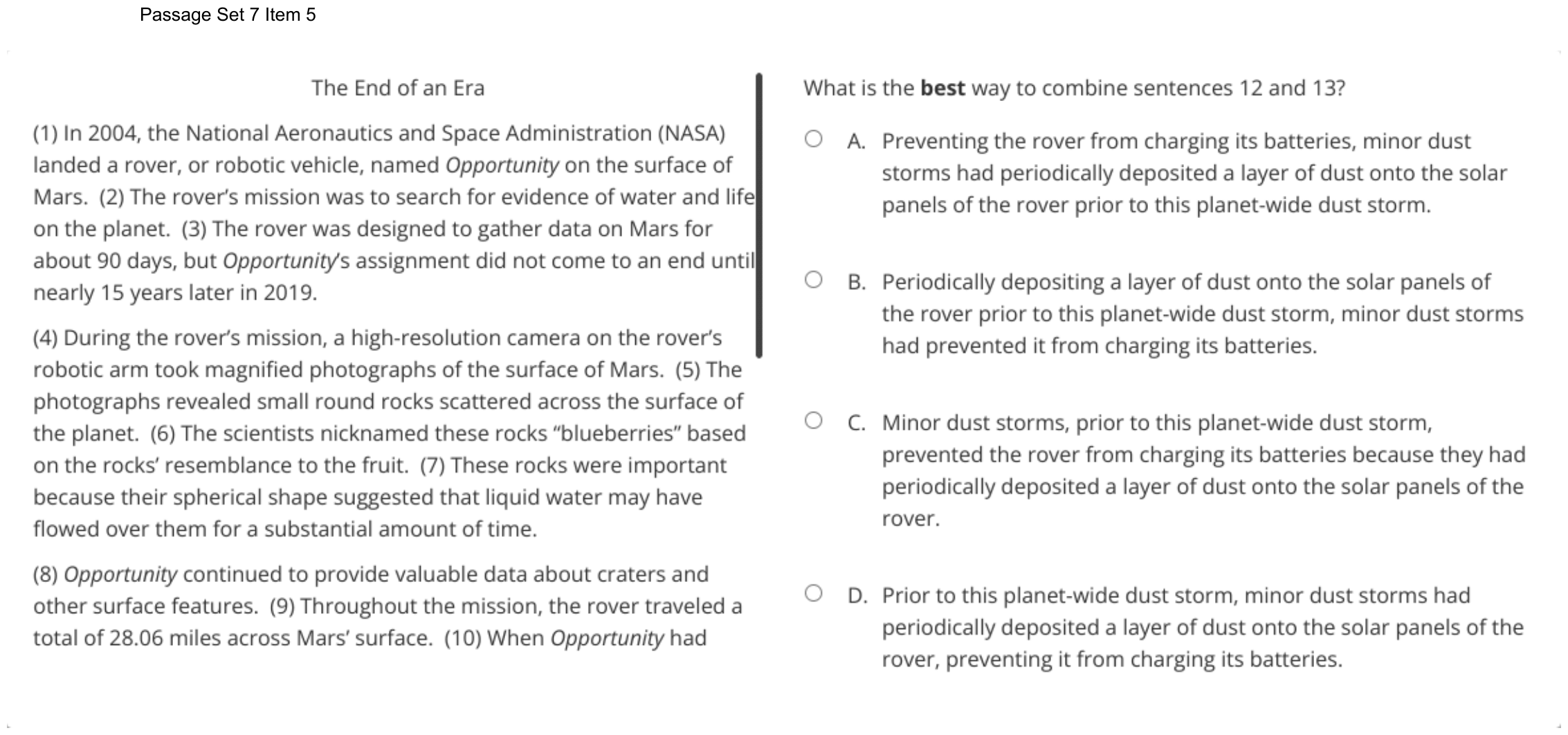
New York City and the Hudson Valley Brickmaking Industry
(1) Residents of New York City cannot help but notice that the buildings they are surrounded by are predominantly made of brick. (2) Indeed, one author described the bricks that make up some of New York City’s most recognizable landmarks, including the Empire State Building and the arches of the Brooklyn Bridge, as “an inescapable presence.” (3) Nearly 65 million people visit New York City every year to see these and other attractions. (4) Why was so much brick used in buildings constructed during the century before World War II? (5) The answer involves an explosion in New York City’s population that caused an increase in demand for bricks starting in the mid-1800s and lasting into the 1940s that affected the area more than 100 miles up the Hudson River Valley toward Albany. (6) When demand later declined, the industry would entirely disappear.
(7) New York City’s appetite for brick was fueled by surging population and demand for safer building materials. (8) The city’s population ballooned from about 313,000 people in 1840 to more than 7 million a century later. (9) Following large, destructive fires in the 1830s, the city had enacted laws requiring the use of fire-resistant materials. (10) Bricks turned out to be an inexpensive way for builders to quickly throw together a lot of structures while keeping building owners and safety inspectors happy.
(11) The brickmaking industry in the Hudson Valley skyrocketed. (12) At the industry’s peak, approximately 130 brick factories crammed themselves into a 120-mile stretch along the Hudson River. (13) These factories employed much of the region’s population. (14) Population growth in the Hudson River Valley after the mid-1800s was substantial, though percentage increases were smaller than those in New York City. (15) Even though the factories operated only during the summers, their production was immense. (16) Hudson Valley factories shipped over a billion bricks on barges down the river to New York City annually. (17) In fact, The New York Times declared, “It’s fairly safe to assume that any brick building constructed between 1800 and 1950 includes some form of sediment from the banks of the Hudson River.”
(18) History has proven, however, that boom times eventually end. (19) Shifting architectural trends halted not only the Hudson Valley’s brickmaking boom, but its entire industry. (20) Starting early in the twentieth century, architects and builders increasingly favored steel, glass, and concrete instead of brick. (21) By 1979, reduced demand for brick had driven every Hudson Valley brick factory out of business.
(22) The Hudson Valley’s brickmaking legacy lives on in the architecture of New York City. (23) Throughout the city, famous and ordinary buildings stand as evidence of the remarkable productivity achieved by the Valley’s brickmakers. (24) The brick buildings surrounding New Yorkers today serve as a reminder that, as one amateur brick historian put it, “The skyline of New York City used to be the landscape of the Hudson River Valley.”
Question
Which revision of sentence 10 would best maintain the style established in the passage?
- ABuilders turned to brick, which was an affordable material that met safety standards while satisfying the city’s large demand for buildings.
- BFiguring out that bricks were inexpensive, builders used tons of them to satisfy inspectors and the city’s desperate construction needs.
- CBuilders favored brick as a pleasingly economical way to meet significant construction demand while following municipal regulations.
- DOnce builders realized that low-cost brick was a law-abiding way to meet the city’s building needs, they hardly ever used any other materials.
Show the answer
Correct answer: A
The question asks for the revision of sentence 10 that would best maintain the style established in the passage.
A. CORRECT. This sentence maintains the style established in the passage because it uses clear, precise, and formal language. The phrases “affordable material” and “met safety standards” are accurate and appropriate to the historical and technical context. The word “satisfying” is a precise replacement for “keeping building owners . . . happy” from the original sentence, preserving both the meaning and the formal tone of the passage.
B. Incorrect. Although the sentence conveys the same basic ideas as the passage, the phrases “Figuring out” and “tons of them” are informal and inconsistent with the passage’s formal style. In addition, the word “desperate” introduces a subjective and emotional tone, whereas the passage maintains an objective, fact-based style.
C. Incorrect. Although this sentence incorporates some formal vocabulary, the phrase “pleasingly economical” introduces an opinion that is inconsistent with formal historical writing. The passage’s style avoids subjective language and focuses on precise, factual descriptions of events and conditions. The phrase “municipal regulations” is also more technical and at the same time less clear and precise than the style established in the passage.
D. Incorrect. This sentence does not maintain the passage’s formal style because the phrase “law-abiding way” is awkward and informal for a historical description, and the expression “hardly ever” is conversational. The passage uses precise, objective language when describing building practices and material choices, avoiding casual or conversational phrasing.
Question analysis
This style question asks which revision of sentence 10 of the passage “New York City and the Hudson Valley Brickmaking Industry” best keeps the passage’s style. The original says bricks let builders “quickly throw together a lot of structures” while keeping owners and inspectors “happy.” Students compare four rewrites for wording that sounds casual, emotional or out of place.
- Grade level
- Grade 7 reading and task
- Compared with grade 7
- At grade 7 Choosing wording that fits a passage’s formal style is regular grade 7 writing work. The four rewrites are single sentences on a familiar subject, but they differ in small word choices that must each be weighed, a typical grade 7 demand.
- Estimated difficulty
- Moderate: several steps, or a close reading with one strong distractor.
- Thinking it demands
- Depth of knowledge 2, skills and concepts · mainly evaluate
- What makes it hard
- A very close wrong answer moderate
- Every choice must be checked minor
- Something you must already know minor
- Evidence
- Answered from one sentence or line
- Reading level
- Passage: about grade 12, 465 words; question and choices: about grade 13, 94 words.
- Corrected from the DOE handbook
- A misquotation of the passage in the explanation was corrected.
- Students, last 30 days
- Not enough answers yet to show (it takes 10).
Why it is hard, traps and wrong answers (shows the answer)
Why it is hard
Sentence 10 is the passage’s most casual sentence, so the task is to raise its register without overshooting. Students who equate formality with long words fall for the rewrite with “pleasingly economical” and “municipal regulations,” which sounds official but adds an opinion. Others overlook the chatty “tons of them,” or miss that “hardly ever used any other materials” claims more than the original does. The plain, accurate key can look too ordinary to be best.
A very close wrong answer moderate Choosing the answer
The “pleasingly economical” rewrite carries the same three ideas as the key, low cost, heavy demand and the rules, in grander words; only its opinion word and the stiffer “municipal regulations” set it apart. (Embretson & Wetzel, 1987; Gorin & Embretson, 2006; Ascalon et al., 2007)
Every choice must be checked minor Choosing the answer
Each rewrite hides its off-key words among neutral ones, “tons of them” and “desperate,” “pleasingly,” “hardly ever,” so every phrase must be checked, not the overall sound. (Embretson & Wetzel, 1987)
Something you must already know minor Working it out
Students must already know what counts as formal written English, and the passage’s own lively verbs, “ballooned,” “skyrocketed” and “crammed themselves,” make its style harder to pin down. (Anderson & Krathwohl, 2001)
Strategy: Spot what makes sentence 10 sound casual, then check every phrase of each rewrite, not just its overall sound, for chatty, emotional or opinionated wording, and make sure the facts stay the same.
Traps
- Wordy, vague or informal: A revision is grammatical but wordy, imprecise or too casual for the passage.
- Changes the meaning: A revision is correct English but no longer says what the writer meant.
The wrong answers, classified
B Wordy, vague or informal (Connors & Lunsford, 1988)
Keeps the meaning but slips into casual talk, “Figuring out” and “tons of them,” and adds the emotional “desperate,” none of which fits the passage’s factual voice.
C Wordy, vague or informal (Connors & Lunsford, 1988)
Mistakes elevated words for good style: “municipal regulations” sounds official, but “pleasingly economical” injects an opinion and the wording is less clear than the passage’s plain statements.
D Changes the meaning (Connors & Lunsford, 1988)
Overlooks the conversational “hardly ever” and claims builders almost never used other materials, far more than sentence 10, which says only that brick was cheap, quick and acceptable to inspectors.
What was corrected from the DOE handbook, and why
- Explanation: The handbook’s explanation of Option A calls “satisfying” a replacement for “keeping owners happy” from the original sentence. Sentence 10 ends “while keeping building owners and safety inspectors happy,” so the site now quotes “keeping building owners . . . happy.”
Working it out, step by step
Figure out what the question asks
This question is about style, the way a passage sounds. You need a new version of sentence 10 that sounds like the rest of the passage. The passage is an informational article. It uses clear, serious, factual language. It has no slang or chatty phrases, and the writer doesn’t share feelings.
Spot the casual words in sentence 10
Sentence 10 says: “Bricks turned out to be an inexpensive way for builders to quickly throw together a lot of structures while keeping building owners and safety inspectors happy.” Three phrases sound like everyday talk: “throw together,” “a lot of,” and “keeping … happy.” Here is the rule with a made-up example. Casual: The kids threw together a ton of posters. Formal: The students quickly made many posters.
See how A keeps the meaning
Choice A says the same things in formal words. “Inexpensive” becomes “affordable material.” Keeping the safety inspectors happy becomes “met safety standards.” The word “satisfying” takes the place of keeping the building owners happy. And the many buildings become the city’s “large demand for buildings.” Nothing is added, and no feelings slip in.
Check each choice
- A is right. It is clear, exact and serious, like the rest of the passage.
- B is wrong. “Figuring out” and “tons of them” are chatty. “Desperate” adds strong feeling.
- C is wrong. “Pleasingly” gives the writer’s opinion. “Municipal regulations” is stiff and less clear than plain words like city rules.
- D is wrong. “Hardly ever” is chatty, and “law-abiding way” is awkward. It also claims builders almost never used other materials. Sentence 10 never says that.
Watch out: C uses long, official-sounding words, so it can seem the most formal. But formal writing still avoids opinions.
Choose the answer
Only one version sounds like the rest of the passage and keeps the meaning. So the answer is A, “Builders turned to brick, which was an affordable material that met safety standards while satisfying the city’s large demand for buildings.”
Why this answer and not the closest wrong one
C is the closest wrong answer. It carries the same three ideas as A: low cost, high demand and the rules. But “pleasingly economical” tells you how the writer feels about brick. The passage reports facts and doesn’t judge. A says the same things plainly and without an opinion.
More questions like this
The original DOE question
The passage “New York City and the Hudson Valley Brickmaking Industry” as printed (page 64)
Question 4 of 12
2026 Practice Test D English, question 37Passage Martial Arts for the Mind and Body
Martial Arts for the Mind and Body
(1) The martial arts blend a series of physical movements with strategic mental discipline so that practitioners can defend themselves, physically defeat an opponent, or both. (2) Historians are unsure of exactly when and where martial arts were first used. (3) Martial arts have been practiced by several different societies for many centuries. (4) Martial arts such as karate, kung fu, tae kwon do, and judo are still taught and practiced as methods of self-defense, but they offer students more than that. (5) The study of martial arts can provide students with a way to enhance their mental discipline as well as their physical fitness.
(6) Discipline, focus, and respect are important qualities for everyone to have. (7) However, for most people these qualities are not innate; they must be learned and practiced. (8) The study of martial arts can provide an opportunity to develop these skills. (9) Students are rewarded for their dedication by passing tests and advancing to higher ranks or levels. (10) For example, in a typical tae kwon do class, students learn discipline by diligently practicing moves, improve focus by listening carefully, and demonstrate respect by bowing to the instructor and following directions.
(11) For teenagers, martial arts classes provide a safe and structured environment for gaining physical skills, building confidence, and enjoying a sense of community. (12) A lot of teens go through hard situations as they try to do well in school and in life. (13) A martial arts class can provide teens with a physical outlet for stress while also challenging them mentally. (14) Participating in a martial arts program also helps children and teens focus on self-improvement rather than on competition. (15) Progressing through levels of achievement involves mastering more physically demanding techniques. (16) It requires students to take responsibility and be accountable for achieving set goals. (17) Students gain confidence and experience companionship with other students who are progressing through the ranks.
(18) Adults who practice martial arts can experience many of the same benefits that younger people do, but perhaps the greatest of these is health and fitness. (19) Adult martial arts students often see changes in their body within weeks of beginning a program.
(20) For people interested in studying a martial art, there are many ways to learn and practice. (21) In addition to private studios, community recreation centers often offer low-cost or free martial arts classes. (22) There are even online videos that introduce students to the basic concepts. (23) People should study martial arts.
Question
Which revision of sentence 12 best maintains the formal style established in the passage?
- AA lot of teens have to put up with difficult things while trying to do well in school and in life.
- BMany teenagers deal with tough situations as they try to stay on top of their studies and do well in life.
- CMany teenagers encounter challenges as they work to succeed both academically and personally.
- DA lot of teens face problems as they work to keep up with their schoolwork and find personal success.
Show the answer
Correct answer: C
The question asks for the revision of sentence 12 that best maintains the formal style established in the passage.
A. Incorrect. The phrases “A lot,” “put up with,” “difficult things,” and “do well in school” are worded informally; therefore, this sentence does not consistently maintain the formal style established in the passage.
B. Incorrect. The phrases “deal with,” “tough situations,” “stay on top of,” and “do well in life” are worded informally; therefore, this sentence does not consistently maintain the formal style established in the passage.
C. CORRECT. This option is correct because it uses clear and scholarly wording throughout the whole sentence. The phrases “many teenagers,” “encounter challenges,” and “succeed both academically and personally” make the sentence’s style more consistently formal than the other options.
D. Incorrect. The phrases “A lot,” “face problems,” and “keep up with” are worded informally; therefore, this sentence does not consistently maintain the formal style established in the passage.
Question analysis
This style question asks which revision of sentence 12, “A lot of teens go through hard situations as they try to do well in school and in life,” best keeps the formal style of the martial arts passage. Students compare four rewrites phrase by phrase, listening for casual expressions in each one.
- Grade level
- Grade 6 reading and task
- Compared with grade 7
- Below grade 7 Keeping a formal style is practiced from grade 6, and here it is tested in one sentence with familiar casual phrases. Typical grade 7 style work asks for subtler choices of precise, content-specific words across a passage.
- Estimated difficulty
- Routine: one familiar step, little to misread.
- Thinking it demands
- Depth of knowledge 1, recall and reproduction · mainly evaluate
- What makes it hard
- Evidence
- Answered from one sentence or line
- Reading level
- Passage: about grade 11, 402 words; question and choices: about grade 8, 87 words.
- Students, last 30 days
- Not enough answers yet to show (it takes 10).
Why it is hard, traps and wrong answers (shows the answer)
Why it is hard
Most students hear the casual phrases at once, and only one version avoids all of them, so this is one of the easier revising questions. The risk is stopping at a formal start: one version opens with “Many teenagers” and then slides into “tough situations,” and another sounds serious with “face problems” but begins with “A lot of teens.” Checking every phrase, not the first few words, is all the question asks.
Every choice must be checked minor Choosing the answer
Each rewrite mixes formal and casual wording, “Many teenagers” beside “deal with” and “stay on top of,” so every phrase of every version has to be checked, not just the opening words. (Embretson & Wetzel, 1987)
Something you must already know minor Working it out
Students must recognize idioms such as “put up with” and “keep up with” as spoken English, a sense of register that the question expects them to bring. (Anderson & Krathwohl, 2001)
Strategy: Underline every casual phrase in each rewrite, such as everyday idioms or vague words, and keep only the version with none; one formal phrase is not enough.
Traps
- Wordy, vague or informal: A revision is grammatical but wordy, imprecise or too casual for the passage.
The wrong answers, classified
A Wordy, vague or informal (Connors & Lunsford, 1988)
Trades “go through hard situations” for “put up with difficult things” and keeps “A lot of teens,” swapping one set of casual phrases for another.
B Wordy, vague or informal (Connors & Lunsford, 1988)
Is reassured by the formal opening “Many teenagers,” but the rest, “deal with,” “tough situations” and “stay on top of,” is everyday speech.
D Wordy, vague or informal (Connors & Lunsford, 1988)
Likes the more serious “face problems” and “personal success,” but keeps the casual “A lot of teens” and “keep up with their schoolwork.”
Working it out, step by step
Figure out what the question asks
This asks which rewrite of sentence 12 matches the passage’s formal style. Formal style is the careful, serious way of writing you use in a school report. It skips the casual words you might use with friends.
Spot the casual words
Sentence 12 says, “A lot of teens go through hard situations as they try to do well in school and in life.” “A lot of,” “teens” and “go through” sound like talking with a friend. Compare sentence 11, which speaks of “a safe and structured environment.” The rest of the passage uses careful words like those.
Name the rule
Formal writing uses exact, serious words and skips everyday sayings. For example, Kids have a ton of homework is casual. Students have a large amount of homework is formal. Check every phrase in each choice, not just the first few words.
Check each choice
- A is wrong. “A lot of teens,” “put up with” and “difficult things” are casual.
- B is wrong. It starts well with “Many teenagers.” But “deal with,” “tough situations” and “stay on top of” are casual.
- C is right. Every phrase is formal. To encounter challenges is to meet hard problems. Academically means in school. Personally means in your own life.
- D is wrong. “Face problems” sounds serious. But “A lot of teens” and “keep up with” are casual.
Watch out: B and D each have a formal phrase or two. One formal phrase is not enough.
Choose the answer
Only C is formal from start to finish. So the answer is C, “Many teenagers encounter challenges as they work to succeed both academically and personally.”
Why this answer and not the closest wrong one
B is the closest wrong answer, because it opens with the formal “Many teenagers.” But it then slides into everyday phrases like “deal with” and “stay on top of.” C keeps the same meaning and stays formal from start to end. Words like “encounter challenges” and “academically” match the careful style of the passage.
More questions like this
The original DOE question
The passage “Martial Arts for the Mind and Body” as printed (page 52)
Question 5 of 12
2026 Practice Test D English, question 48Question
Read this sentence.
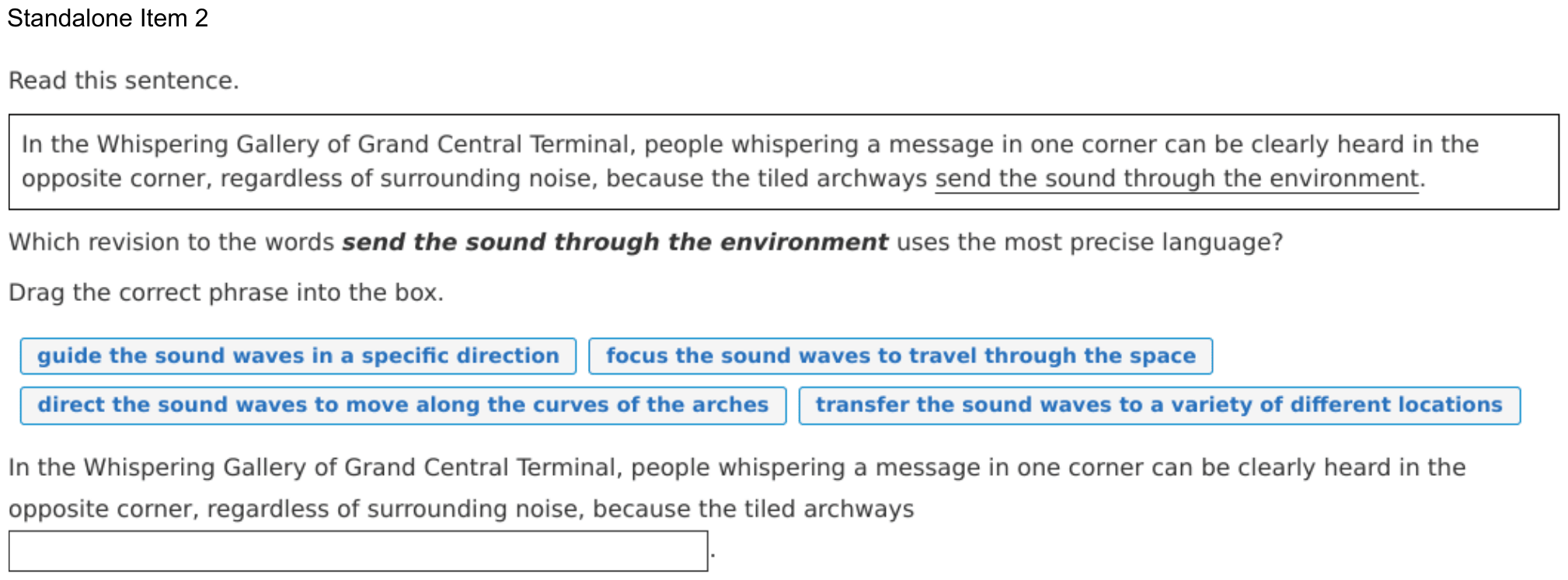
In the Whispering Gallery of Grand Central Terminal, people whispering a message in one corner can be clearly heard in the opposite corner, regardless of surrounding noise, because the tiled archways send the sound through the environment.
Which revision to the words send the sound through the environment uses the most precise language?
Drag the correct phrase into the box.
In the Whispering Gallery of Grand Central Terminal, people whispering a message in one corner can be clearly heard in the opposite corner, regardless of surrounding noise, because the tiled archways ____.
On the test you drag one of the tiles into the box; here, choose it.
- Aguide the sound waves in a specific direction
- Bfocus the sound waves to travel through the space
- Cdirect the sound waves to move along the curves of the arches
- Dtransfer the sound waves to a variety of different locations
Show the answer
Correct answer: C
The question asks for the revision to the words send the sound through the environment that uses the most precise language.
Incorrect. The phrase “guide the sound waves in a specific direction” is not the most precise revision. “A specific direction” does not explain precisely where the sound waves travel.
Incorrect. The phrase “focus the sound waves to travel through the space” is not the most precise revision, because it does not precisely describe where the waves move. The phrase “through the space” does not provide the reader with more specific information as to where in the space the sound waves travel.
CORRECT. The phrase “direct the sound waves to move along the curves of the arches” uses precise language to explain how the waves travel. The wording “direct the sound waves” is more specific than “send the sound” as in the original sentence, and the action “move along the curves” conveys more detail than the phrase “through the environment.”
Incorrect. The phrase “transfer the sound waves to a variety of different locations” is not the most precise revision, because it does not precisely convey where the waves move to. The phrase “variety of different locations” is vague and does not add clarity.
Question analysis
This precise-language question gives a sentence about the Whispering Gallery in Grand Central Terminal, where a whisper in one corner is heard in the opposite corner, and asks which revision of “send the sound through the environment” is most precise. On the test students drag one of four phrase tiles into the box, and every tile sounds more technical than the original.
- NYS standards
- 7L3a precise and concise language
- Grade level
- Grade 6 reading and task
- Compared with grade 7
- Below grade 7 Replacing vague wording with exact wording is taught by grade 6. Here it is one sentence about a familiar place and four phrase tiles, a single judgment, which is lighter than typical grade 7 revision of a whole paragraph.
- Estimated difficulty
- Straightforward: two steps or one careful reading.
- Thinking it demands
- Depth of knowledge 1, recall and reproduction · mainly evaluate
- What makes it hard
- A very close wrong answer moderate
- Every choice must be checked minor
- Evidence
- Answered from one sentence or line
- Reading level
- Question and choices: about grade 8, 133 words.
- Corrected from the DOE handbook
- A misquotation of the sentence in the explanation was corrected.
- Students, last 30 days
- Not enough answers yet to show (it takes 10).
Why it is hard, traps and wrong answers (shows the answer)
Why it is hard
All four tiles upgrade “send the sound” to “the sound waves” with a sharper verb, so the original’s vagueness survives only in the endings. The tile that promises “a specific direction” sounds precise because of that word, yet it never names the direction; the key is the only tile that says where the sound travels. Dragging a tile into the box adds nothing to the task beyond picking one choice.
A very close wrong answer moderate Choosing the answer
The “specific direction” tile is built like the key, a precise verb and “the sound waves”; the two differ only in the ending, a direction never named versus “along the curves of the arches.” (Embretson & Wetzel, 1987; Gorin & Embretson, 2006; Ascalon et al., 2007)
Every choice must be checked minor Choosing the answer
Every tile sounds more exact than the original, so students must ask of each one whether a reader could tell how the sound gets from one corner to the opposite one. (Embretson & Wetzel, 1987)
Strategy: Reread the whole sentence, then ask of each tile whether a reader could picture exactly how the sound gets from one corner of the gallery to the other.
Traps
- Wordy, vague or informal: A revision is grammatical but wordy, imprecise or too casual for the passage.
- Changes the meaning: A revision is correct English but no longer says what the writer meant.
The wrong answers, classified
A Wordy, vague or informal (Connors & Lunsford, 1988)
Trusts the word “specific,” which sounds exact, but “a specific direction” never says which direction, so the phrase stays as vague as the original.
B Wordy, vague or informal (Connors & Lunsford, 1988)
Is drawn by the technical “focus the sound waves,” but “through the space” just restates “through the environment” and says nothing about the archways.
D Changes the meaning (Connors & Lunsford, 1988)
Picks the scientific-sounding “transfer,” but sending sound to “a variety of different locations” contradicts a whisper heard in the one opposite corner, and the phrase repeats itself.
What was corrected from the DOE handbook, and why
- Explanation: The DOE’s explanation of the correct phrase says that “move along the curves” conveys more detail than “the phrase ‘moving through the environment.’” The sentence in the question says the archways “send the sound through the environment”; the word “moving” is not in it. The site now quotes the sentence’s own words: “the phrase ‘through the environment.’”
Working it out, step by step
Figure out what the question asks
This asks which phrase is most precise. Precise language is exact. It tells the reader just what happens, so they can picture it. The phrase you pick replaces the underlined words.
See what the sentence needs
The sentence says a whisper in one corner “can be clearly heard in the opposite corner.” Why? “because the tiled archways send the sound through the environment.” That ending is vague, or unclear. “Through the environment” could mean anywhere. A better phrase would say how the sound gets from one corner to the other.
Name the rule
Precise writing swaps general words for exact ones. For example, The dog went over there is vague. The dog ran under the porch is precise. Now you know just where the dog went.
Check each choice
- A is wrong. “A specific direction” sounds exact. But it never says which direction.
- B is wrong. “Through the space” is just another way to say “through the environment.”
- C is right. “Along the curves of the arches” tells exactly where the sound travels. It follows the curved arches to the far corner.
- D is wrong. “A variety of different locations” is vague. It also clashes with a whisper heard in one corner. And “variety” and “different” say the same thing twice.
Watch out: The word “specific” makes A sound precise. Ask whether you can picture the path. With A, you can’t.
Choose the answer
With the tile in place, the sentence ends because the tiled archways direct the sound waves to move along the curves of the arches. So the answer is C. On the test, you drag the tile “direct the sound waves to move along the curves of the arches” into the box.
Why this answer and not the closest wrong one
A is the closest wrong answer. It has a strong verb, “guide,” and the word “specific.” But it never names the direction, so the reader still can’t picture the path. C says exactly where the sound goes: along the curves of the arches. That explains how a whisper reaches the opposite corner.
More questions like this
The original DOE question
Question 6 of 12
2026 Practice Test D English, question 50Question
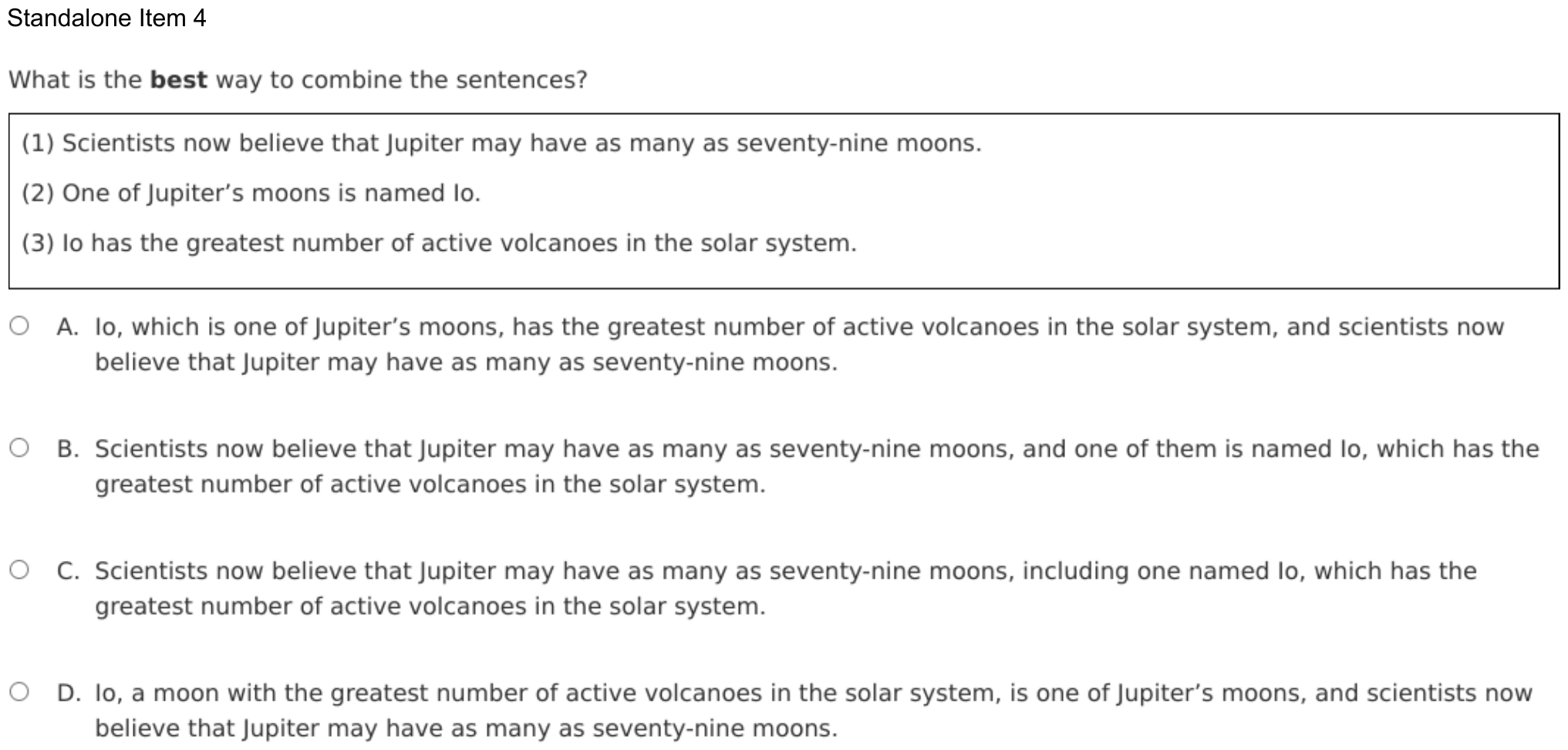
What is the best way to combine the sentences?
(1) Scientists now believe that Jupiter may have as many as seventy-nine moons.
(2) One of Jupiter’s moons is named Io.
(3) Io has the greatest number of active volcanoes in the solar system.
- AIo, which is one of Jupiter’s moons, has the greatest number of active volcanoes in the solar system, and scientists now believe that Jupiter may have as many as seventy-nine moons.
- BScientists now believe that Jupiter may have as many as seventy-nine moons, and one of them is named Io, which has the greatest number of active volcanoes in the solar system.
- CScientists now believe that Jupiter may have as many as seventy-nine moons, including one named Io, which has the greatest number of active volcanoes in the solar system.
- DIo, a moon with the greatest number of active volcanoes in the solar system, is one of Jupiter’s moons, and scientists now believe that Jupiter may have as many as seventy-nine moons.
Show the answer
Correct answer: C
The question asks for the best way to combine the sentences.
A. Incorrect. Although the sentence incorporates the ideas presented in the three original sentences, it is incorrect because the combination suggests an incorrect relationship between the ideas. By beginning with “Io,” the sentence places emphasis on the moon and the detail about the number of active volcanoes rather than the key idea that “scientists now believe that Jupiter may have as many as seventy-nine moons.” Since Io is an example of one of Jupiter’s moons, the details about Io should follow and be subordinate to the main clause, which provides new information about the number of Jupiter’s moons in general.
B. Incorrect. Although the sentence incorporates all three ideas from the original sentences and correctly places the detail about the number of active volcanoes on Io in a dependent clause, this option is incorrect because it presents an imprecise relationship between the ideas. By using the conjunction (connecting word) “and,” the sentence construction suggests that scientists “now believe” that “Jupiter may have as many as seventy-nine moons” and that “one of them is named Io,” instead of presenting Io as an example of one of Jupiter’s moons.
C. CORRECT. This sentence is the best way to combine the original sentences because it uses a complex sentence to present ideas clearly and precisely, and it shows the relationship between the ideas in the original sentences. The sentence starts by stating the number of moons scientists now believe Jupiter may have and then specifies that one of those moons is named Io. The dependent clause “which has the greatest number of active volcanoes in the solar system” immediately follows the word “Io” to provide additional information about the moon. A dependent clause contains a subject (“which,” referring to Io) and a verb (“has”) but is not a complete sentence on its own.
D. Incorrect. The sentence incorporates the key ideas from the original sentences, but its structure does not accurately present the relationship between these ideas. The beginning of the sentence includes the detail about Io having “the greatest number of active volcanoes in the solar system” before specifying that Io is one of the seventy-nine moons of Jupiter. The presentation of the details about Io at the beginning lessens the emphasis of the key idea that “scientists now believe that Jupiter may have as many as seventy-nine moons.”
Question analysis
This sentence-combining question gives three short sentences: scientists believe Jupiter may have as many as seventy-nine moons, one moon is named Io, and Io has the most active volcanoes in the solar system. Students must choose the single sentence that joins all three facts while showing how they relate, and the four versions differ only in order and connecting structure.
- Grade level
- Grade 7 reading and task
- Compared with grade 7
- At grade 7 Combining sentences so the ideas relate clearly is grade 7 language work. The three sentences are short, but every version keeps all the facts, so the choice rests on which idea leads and which is tucked into a clause, a typical grade 7 demand.
- Estimated difficulty
- Moderate: several steps, or a close reading with one strong distractor.
- Thinking it demands
- Depth of knowledge 2, skills and concepts · mainly evaluate
- What makes it hard
- A very close wrong answer moderate
- How sentences fit together moderate
- Every choice must be checked minor
- Evidence
- Answered from one sentence or line
- Reading level
- Question and choices: about grade 10, 162 words.
- Students, last 30 days
- Not enough answers yet to show (it takes 10).
Why it is hard, traps and wrong answers (shows the answer)
Why it is hard
Because every version keeps all three facts and is grammatical, the question is about emphasis and connection, which students rarely check for. Two versions open with Io and its volcanoes and leave the seventy-nine moons trailing after “and,” and one of them also calls Io a moon twice. The strongest pull is the version with the right order that still joins Io with “and,” so Io’s name reads as a second piece of news rather than an example of the moons just counted.
A very close wrong answer moderate Choosing the answer
The “and one of them is named Io” version matches the key in its order and in its which-clause about volcanoes; only its connector differs from the key’s “including one named Io.” (Embretson & Wetzel, 1987; Gorin & Embretson, 2006; Ascalon et al., 2007)
How sentences fit together moderate Working it out
Students must see that sentence 1 is the main news and that sentences 2 and 3 narrow to one example, so Io belongs inside the sentence about Jupiter’s seventy-nine moons. (Halliday & Hasan, 1976)
Every choice must be checked minor Choosing the answer
Every version is grammatical and keeps all three facts, so none can be ruled out by an error; each is judged on which idea leads and how the others attach. (Embretson & Wetzel, 1987)
Strategy: Decide which of the three sentences states the main idea and which ones add detail, then check whether each version’s order and structure show that relationship.
Traps
- Wrong transition: A connecting word or phrase that signals the wrong relationship, such as contrast where the idea continues.
- Changes the meaning: A revision is correct English but no longer says what the writer meant.
The wrong answers, classified
A Changes the meaning (Connors & Lunsford, 1988)
Opens with Io and its volcanoes and adds the moon count with “and,” so the main news about Jupiter trails behind its own example as an afterthought.
B Wrong transition (Halliday & Hasan, 1976)
Keeps the right order and the which-clause, but “and one of them is named Io” adds Io as a second piece of news instead of an example of those moons.
D Changes the meaning (Connors & Lunsford, 1988)
Leads with Io’s volcanoes, then says Io “is one of Jupiter’s moons” right after calling it “a moon,” and leaves the main news about Jupiter for the end.
Working it out, step by step
Figure out what the question asks
This asks for the best way to join three sentences into one. All four choices keep every fact. So the best one shows how the facts relate. Decide which fact is the main idea and which ones add detail.
Find the main idea
Sentence 1 is the big news: “Scientists now believe that Jupiter may have as many as seventy-nine moons.” Sentences 2 and 3 zoom in on one of those moons, Io. Io is an example of the moons, and its volcanoes are a detail about Io. So the main idea should come first, and Io should fit inside it.
Name the rule
Put the main idea in the main part of the sentence. Tuck the details in with words like including and which. For example: My school has thirty clubs. One is chess. The chess club meets on Fridays. Joined: My school has thirty clubs, including a chess club, which meets on Fridays.
Check each choice
- A is wrong. It starts with Io and its volcanoes. The main news about Jupiter trails at the end after “and.”
- B is wrong. The order is right. But “and one of them is named Io” adds Io as a second piece of news, not as an example.
- C is right. “Including one named Io” shows Io is one of the moons. Then “which” adds the fact about its volcanoes.
- D is wrong. It calls Io “a moon,” then says again that it “is one of Jupiter’s moons.” The main news comes last.
Watch out: B is very close to C. The only change is “and one of them is named Io” in place of “including one named Io.” The word “including” shows that Io belongs to the group.
Choose the answer
C leads with the main news and tucks in Io as an example. So the answer is C, “Scientists now believe that Jupiter may have as many as seventy-nine moons, including one named Io, which has the greatest number of active volcanoes in the solar system.”
Why this answer and not the closest wrong one
B is the closest wrong answer. It has the right order and the same “which” clause. But “and” tacks Io’s name on as a separate fact, as if it were more news. “Including” shows that Io is one of the seventy-nine moons. That ties the three facts together most clearly.
More questions like this
The original DOE question
Question 7 of 12
2024 Test A English, question 1Question
Read this sentence.
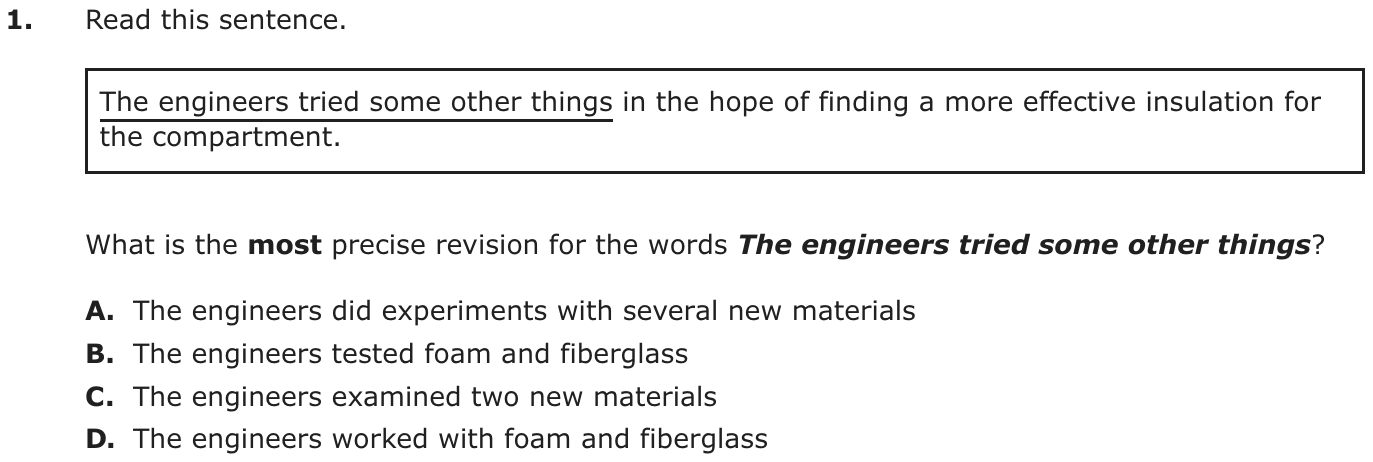
The engineers tried some other things in the hope of finding a more effective insulation for the compartment.
What is the most precise revision for the words The engineers tried some other things?
- AThe engineers did experiments with several new materials
- BThe engineers tested foam and fiberglass
- CThe engineers examined two new materials
- DThe engineers worked with foam and fiberglass
Show the answer
Correct answer: B
The question asks for the most precise revision for the words “The engineers tried some other things.”
A. Incorrect. This revision uses the word “materials” rather than precisely identifying what the engineers used.
B. CORRECT. This option revises the words to be more precise by using the specific words “tested” for the verb and “foam and fiberglass” for the materials.
C. Incorrect. This revision uses the word “examined” rather than a word indicating a process of experimental trial and error. The sentence also uses the word “materials” rather than precisely identifying what the engineers used.
D. Incorrect. This revision identifies the materials, but the imprecise verb “worked with” does not specify what the engineers were doing.
Question analysis
This revising question gives one sentence about engineers looking for better insulation for a compartment and asks which rewrite of its vague opening words is the most precise. The tricky part is that some choices sharpen one half of the phrase while leaving the other half as loose as the original.
- NYS standards
- 7L3a precise and concise language
- Grade level
- Grade 7 reading and task
- Compared with grade 7
- Below grade 7 Choosing precise wording is a grade 7 language standard, but this item is a single sentence about an engineering test with everyday words. Typical grade 7 revision asks for the same judgment across a paragraph or a full draft.
- Estimated difficulty
- Straightforward: two steps or one careful reading.
- Thinking it demands
- Depth of knowledge 1, recall and reproduction · mainly evaluate
- What makes it hard
- A very close wrong answer moderate
- Every choice must be checked minor
- Evidence
- Answered from one sentence or line
- Reading level
- Question and choices: about grade 7, 63 words.
- Students, last 30 days
- Not enough answers yet to show (it takes 10).
Why it is hard, traps and wrong answers (shows the answer)
Why it is hard
Precision here has two halves: a verb that names the actual activity and an object that names the actual materials. Most students who miss it stop at the first concrete detail they see, the named materials or the count of two, and never test the verb. Only one rewrite names both an exact action and the exact materials; each of the others leaves one half, or both, nearly as loose as the original.
A very close wrong answer moderate Choosing the answer
The rewrite with “worked with foam and fiberglass” matches the right one word for word except the verb, so only asking whether “worked with” says what the engineers did separates them. (Embretson & Wetzel, 1987; Gorin & Embretson, 2006; Ascalon et al., 2007)
Every choice must be checked minor Choosing the answer
The vague words have two parts, the action “tried” and the object “some other things,” and each rewrite sharpens a different part, so every one must be tested for both. (Embretson & Wetzel, 1987)
Strategy: Split the underlined words into the action and the things acted on, then ask of each revision whether a reader would know exactly what the engineers did and with what.
Traps
- Half right: One half of a two-part choice is right and the other is not.
- Wordy, vague or informal: A revision is grammatical but wordy, imprecise or too casual for the passage.
The wrong answers, classified
A Wordy, vague or informal (Connors & Lunsford, 1988)
Takes “did experiments with” as an exact verb, but the wordier phrase still ends in “several new materials,” which leaves the reader guessing what was tried.
C Wordy, vague or informal (Connors & Lunsford, 1988)
Treats the count “two” as precise detail, though the materials stay unnamed and “examined” suggests looking them over rather than trying them as insulation.
D Half right (King et al., 2004; Thissen, Steinberg & Fitzpatrick, 1989)
Sees that naming foam and fiberglass makes the object exact and stops there, missing that “worked with” is as vague as the original “tried.”
Working it out, step by step
Figure out what the question asks
This question is about precise language. Precise means exact and clear. The words “The engineers tried some other things” are vague. You can’t tell what the engineers did. You also can’t tell what they used. You need the rewrite that tells both.
Learn what makes words precise
Precise writing names the exact action and the exact thing. Vague: She did stuff with food. Precise: She baked bread.
The underlined words have two vague parts. The verb (the action word) is “tried.” The things are “some other things.” A good rewrite must fix both parts.
Think about what the sentence needs
The engineers want “a more effective insulation.” Insulation is material that keeps heat or cold from getting through. To find the best one, they would try out real materials and see how well each works. So the best verb says they tested. The best object names the materials.
Check each choice
- A is wrong. “Did experiments with” is wordy, and “several new materials” still doesn’t say which ones.
- B is right. “Tested” names the exact action. “Foam and fiberglass” names the exact materials.
- C is wrong. “Two new materials” gives a number but no names. “Examined” means looked over, not tried out.
- D is wrong. It names foam and fiberglass. But “worked with” is as vague as “tried.”
Watch out: D is tempting because it names the materials. Always check the verb too.
Choose the answer
Only B fixes both vague parts. The reader learns what the engineers did and what they used. So the answer is B: The engineers tested foam and fiberglass.
Why this answer and not the closest wrong one
D is the closest wrong answer. It matches B word for word except for the verb. “Worked with” could mean cut, built or studied. “Tested” tells you the engineers tried each material to see how well it insulates. That is what the sentence is about, so B is more precise.
More questions like this
The original DOE question
Question 8 of 12
2024 Test B English, question 1Question
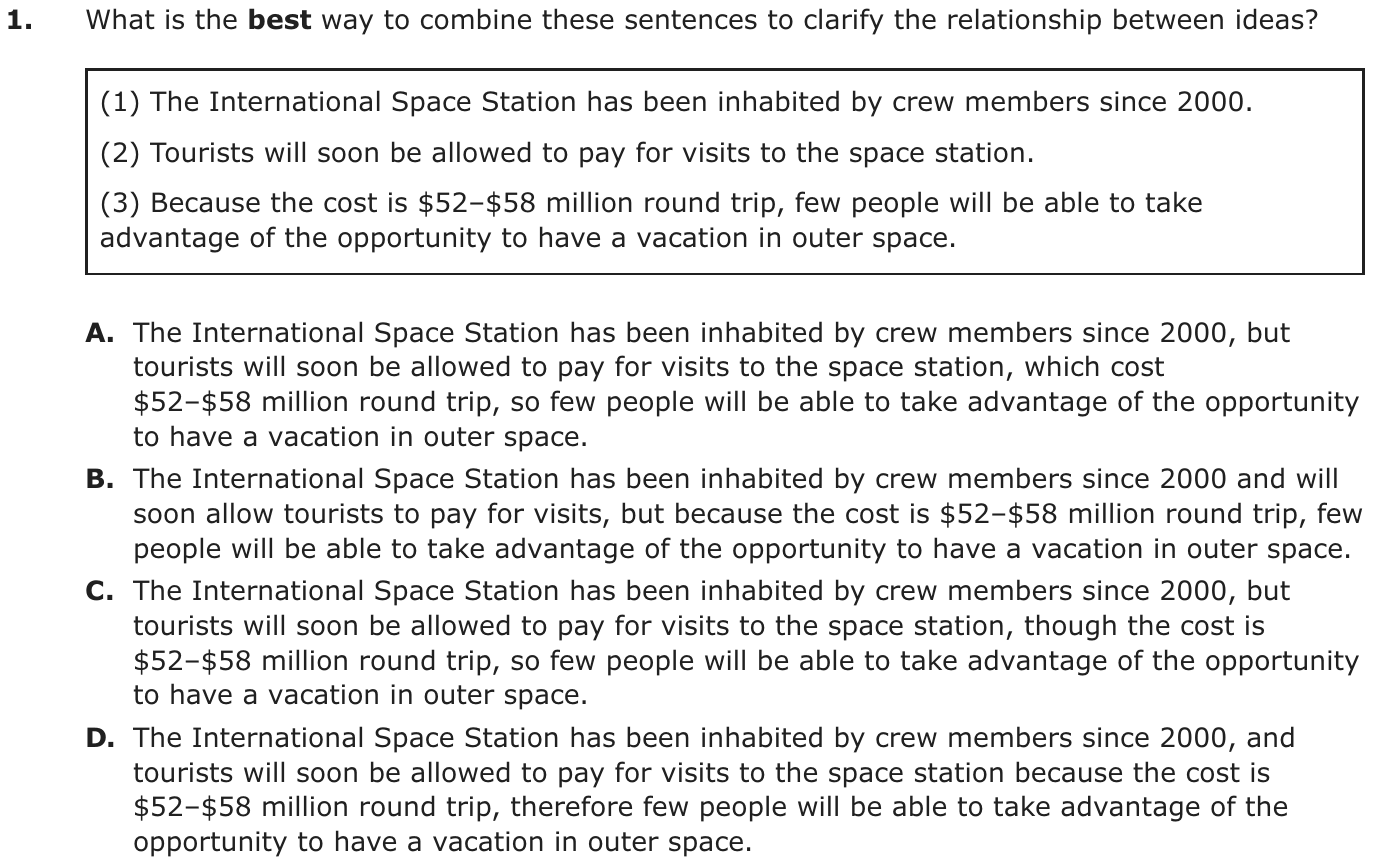
What is the best way to combine these sentences to clarify the relationship between ideas?
(1) The International Space Station has been inhabited by crew members since 2000.
(2) Tourists will soon be allowed to pay for visits to the space station.
(3) Because the cost is $52–$58 million round trip, few people will be able to take advantage of the opportunity to have a vacation in outer space.
- AThe International Space Station has been inhabited by crew members since 2000, but tourists will soon be allowed to pay for visits to the space station, which cost $52–$58 million round trip, so few people will be able to take advantage of the opportunity to have a vacation in outer space.
- BThe International Space Station has been inhabited by crew members since 2000 and will soon allow tourists to pay for visits, but because the cost is $52–$58 million round trip, few people will be able to take advantage of the opportunity to have a vacation in outer space.
- CThe International Space Station has been inhabited by crew members since 2000, but tourists will soon be allowed to pay for visits to the space station, though the cost is $52–$58 million round trip, so few people will be able to take advantage of the opportunity to have a vacation in outer space.
- DThe International Space Station has been inhabited by crew members since 2000, and tourists will soon be allowed to pay for visits to the space station because the cost is $52–$58 million round trip, therefore few people will be able to take advantage of the opportunity to have a vacation in outer space.
Show the answer
Correct answer: B
The question asks for the best way to combine the sentences.
A. Incorrect. Although the option combines the sentences in a way that accurately reflects the meaning of each individual sentence, the combined sentence is a string of clauses that do not effectively cohere. Because it is poorly structured, the combined sentence does not clarify the relationship of ideas as effectively as the correct response does. The sentence incorrectly uses “but tourists,” and “which cost” modifies “the space station” but does not modify the trip. Compared with the correct response, the combined sentence in this option is also imprecise and unnecessarily wordy.
B. CORRECT. The option uses a complex sentence to present ideas clearly and precisely, and it shows the relationship between the ideas in the original sentences. In the first part of the sentence, the conjunction “and” correctly joins the first and second sentences by indicating a relationship, rather than a contrast, between the two. In the second part of the sentence, the conjunction “but” adds additional emphasis to the fact that while tourists will be allowed to visit the space station, the cost of the trip will likely prohibit most people from visiting.
C. Incorrect. Although the option combines the sentences in a way that accurately reflects the meaning of each individual sentence, the combined sentence is a string of clauses that do not effectively cohere. Because it is so poorly structured, the combined sentence does not clarify the relationship of ideas as effectively as the correct response does. Compared with the correct response, the combined sentence in this option is also imprecise and unnecessarily wordy.
D. Incorrect. The combination of the sentences contains an illogical relationship between ideas with the statement that tourists will be allowed to pay for visits to the space station because the cost is $52–$58 million round trip. The connection between the idea that “tourists will soon be allowed to pay for visits” and the subsequent “therefore few people will be able to take advantage of the opportunity” is also illogical.
Question analysis
This sentence-combining question gives three sentences about the International Space Station, its crew and the high price of a tourist trip, and asks for the best way to join them into one. Every version keeps the same facts, so students must judge which connecting words show how the ideas relate while the sentences stay long and nearly identical.
- Grade level
- Grade 8 reading and task
- Compared with grade 7
- Above grade 7 Grade 7 students practice joining two short sentences with a fitting conjunction. Here three sentences become one long sentence in four nearly identical versions, so students must weigh every connecting word and clause rather than spot one error.
- Estimated difficulty
- Hard: combines ideas, needs a plan, and has more than one tempting wrong answer.
- Thinking it demands
- Depth of knowledge 2, skills and concepts · mainly evaluate
- What makes it hard
- How sentences fit together major
- Complex sentences moderate
- Every choice must be checked moderate
- Evidence
- Answered from one sentence or line
- Reading level
- Question and choices: about grade 15, 261 words.
- Students, last 30 days
- Not enough answers yet to show (it takes 10).
Why it is hard, traps and wrong answers (shows the answer)
Why it is hard
None of the wrong versions drops a fact, and two of them are loose rather than plainly ungrammatical, so the ear is little help. Students lose the point by accepting the smoothest chain of clauses without asking what each connector claims: whether the crew and the tourists really contrast, what the price belongs to, and what the price explains. The question rewards deciding the three links before reading the versions, then checking them one connector at a time.
How sentences fit together major Working it out
Sentence 2 simply adds to sentence 1, while sentence 3’s price works against the tourist plan and explains why few will go, so every “but,” “though,” “because” or “so” in a version must fit one of those links. (Halliday & Hasan, 1976)
Complex sentences moderate Understanding the question
Each version is one sentence of 48 to 53 words with four clauses, and at that length a “which cost” hanging on the wrong noun or a comma before “therefore” is easy to read past. (Abedi & Lord, 2001; Freedle & Kostin, 1993; Messick, 1989)
Every choice must be checked moderate Choosing the answer
All four versions keep the same facts in the same order and share most of their words, so none can be ruled out by content; each connecting word has to be tested in turn. (Embretson & Wetzel, 1987)
Strategy: Before reading the choices, decide how each sentence relates to the next: added fact, contrast, or cause and result. Then check every connecting word in each version against those links.
Traps
- Misplaced modifier: A describing word or phrase that attaches to the wrong word, or to nothing in the sentence.
- Wordy, vague or informal: A revision is grammatical but wordy, imprecise or too casual for the passage.
- Wrong transition: A connecting word or phrase that signals the wrong relationship, such as contrast where the idea continues.
The wrong answers, classified
A Misplaced modifier (Connors & Lunsford, 1988)
Keeps the price as the reason few can go, marked by “so,” but misses that “which cost” hangs on “the space station” and that “but” sets crew against tourists.
C Wordy, vague or informal (Connors & Lunsford, 1988)
Keeps every fact in order, but stacking “but,” “though” and “so” in one sentence turns the price into an aside instead of plainly the reason few people will go.
D Wrong transition (Halliday & Hasan, 1976)
Keeps sentence 3’s “because the cost is” word for word, but here it explains why tourists are allowed, and “therefore” after a comma splices on the result.
Working it out, step by step
Figure out what the question asks
You need to join three sentences into one. The best version shows clearly how the ideas connect. Joining words do that job. A conjunction is a joining word, like and, but, so or because. Each one tells the reader something. And adds a fact. But shows a contrast (two ideas that pull against each other). Because and so show a cause and its result.
Decide how the three sentences connect
Sentence 1 says crews have lived on the station since 2000. Sentence 2 adds a new fact: tourists will soon be able to visit. That is not a contrast, so it needs and. Sentence 3 works against sentence 2. The trip costs “$52–$58 million round trip.” That price is also the reason few people will go. So you need a contrast and a reason. Example: The pool is open to all, but because it costs $90, few kids swim there.
Test each choice
- B uses “and will soon allow tourists” to add the new fact. Then “but because the cost is” shows the contrast and the reason. Every link is right.
- A joins sentence 2 with “but tourists,” as if crews and tourists were opposites. Also, “which cost” comes right after “the space station.” So it sounds like the station costs that much, not the trip.
- C stacks “but,” “though” and “so” in one long chain. The price turns into a side note instead of the clear reason.
- D says tourists may visit “because the cost is” so high. That makes no sense. And “therefore” after a comma joins two sentences the wrong way.
Pick the answer
Watch out: A is the most tempting. It keeps the price as the reason, with “so.” But its “but” and its “which” send the reader the wrong way. Only one choice links every idea correctly. So the answer is B.
Why this answer and not the closest wrong one
A is the closest wrong answer. Like B, it says the price keeps most people away. But A sets crews against tourists with “but tourists.” Its “which cost” also seems to give the price of the station. B uses and for the added fact and but because for the price, so each link is clear.
More questions like this
The original DOE question
Question 9 of 12
2024 Test B English, question 3Question
Read this sentence.
The Appalachian Trail is a really long trail that a lot of people do each year.
Which revision of the sentence uses the most precise language?
- AThe Appalachian Trail is an extremely long trail that millions of people do each year.
- BThe Appalachian Trail is a 2,200-mile trail that more than a million people hike each year.
- CThe Appalachian Trail is a 2,200-mile trail that two million people hike each year.
- DThe Appalachian Trail is a lengthy trail that a couple million people do each year.
Show the answer
Correct answer: C
The question asks for the revision of the sentence that uses the most precise language.
A. Incorrect. The word “extremely” does not specify the precise length of the trail (2,200 miles); “millions” is less precise than the specific number of people who hike the trail each year (two million); and the verb “do” imprecisely describes the purpose of visiting the trail (hiking).
B. Incorrect. While the revision specifies the precise length of the trail and the verb “hike” precisely describes the purpose of visiting the trail, “more than a million” is less precise than the specific number of people who hike the trail each year (two million).
C. CORRECT. The length of the trail (2,200 miles), the specific number of people who hike the trail each year (two million), and the action of the visitors (hiking) are clear and precise in this revision of the sentence.
D. Incorrect. The word “lengthy” is less precise than specifying the actual length of the trail (2,200 miles); “a couple million” is less precise than the specific number of people who hike the trail each year (two million); and the verb “do” imprecisely describes the purpose of visiting the trail (hiking).
Question analysis
This precise-language question gives a casual sentence saying the Appalachian Trail is “a really long trail that a lot of people do each year” and asks which revision is most precise. Several revisions swap in more specific words or numbers, so students must check every part of each sentence, not just the first improvement they notice.
- NYS standards
- 7L3a precise and concise language
- Grade level
- Grade 6 reading and task
- Compared with grade 7
- Below grade 7 Choosing precise wording is grade 7 language work, but this item is one short sentence in everyday words. Typical grade 7 revision sets the same choice inside a paragraph, with more wording to weigh.
- Estimated difficulty
- Straightforward: two steps or one careful reading.
- Thinking it demands
- Depth of knowledge 1, recall and reproduction · mainly evaluate
- What makes it hard
- A very close wrong answer moderate
- Every choice must be checked minor
- Evidence
- Answered from one sentence or line
- Reading level
- Question and choices: about grade 6, 89 words.
- Students, last 30 days
- Not enough answers yet to show (it takes 10).
Why it is hard, traps and wrong answers (shows the answer)
Why it is hard
The question is quick once each revision is tested on three points: how long the trail is, how many people hike it, and what they do there. The near miss catches students who stop checking once they see the mileage and the verb “hike,” though its count of hikers is still a range. Words such as “extremely” and “lengthy” are the other snare, since they sound sharper without saying any more.
A very close wrong answer moderate Choosing the answer
The right revision and the one with “more than a million” share the 2,200-mile length and the verb “hike,” and differ only in the hiker count: an exact two million or an open-ended floor. (Embretson & Wetzel, 1987; Gorin & Embretson, 2006; Ascalon et al., 2007)
Every choice must be checked minor Choosing the answer
Each revision repairs a different part of “a really long trail that a lot of people do,” so all four have to be checked for the length, the count and the verb. (Embretson & Wetzel, 1987)
Strategy: Check each revision on three points: how long the trail is, how many people visit, and what they do there. Keep only a version that is exact on all three.
Traps
- Wordy, vague or informal: A revision is grammatical but wordy, imprecise or too casual for the passage.
The wrong answers, classified
A Wordy, vague or informal (Connors & Lunsford, 1988)
Treats “extremely long” and “millions” as upgrades, though neither gives a length or a count, and the vague verb “do” is still there.
B Wordy, vague or informal (Connors & Lunsford, 1988)
Sees the exact length and the verb “hike” and stops checking, missing that “more than a million” is looser than a specific number of hikers.
D Wordy, vague or informal (Connors & Lunsford, 1988)
Takes the fancier “lengthy” and the casual “a couple million” for sharper wording, though neither is exact and “do” still does not say what visitors do.
Working it out, step by step
Figure out what the question asks
You need the revision with the most precise language. Precise means exact. A precise word tells the reader exactly what or how much. For example, a lot of homework is vague, but three pages of math homework is precise. The sentence has three vague parts: “a really long trail,” “a lot of people,” and the verb “do.”
Make a three-part test
The most precise revision must fix all three parts.
- How long is the trail? Look for an exact length.
- How many people go? Look for an exact number.
- What do they do there? Do is vague. People hike a trail.
A choice that fixes only one or two parts is not the most precise.
Check each choice
- C gives “a 2,200-mile trail,” “two million people,” and “hike.” It passes all three tests.
- B gives the length and “hike.” But “more than a million” is not exact. It could mean 1.1 million or 5 million.
- A says “extremely long” and “millions.” Neither is exact, and it keeps “do.”
- D says “lengthy” and “a couple million.” These sound fancier but say no more. It also keeps “do.”
Pick the answer
Watch out: B is very close. It has the length and the right verb, so many students stop there. But its count of people is still loose. Only C is exact on all three parts. So the answer is C.
Why this answer and not the closest wrong one
B is the closest wrong answer. It matches C on the length, 2,200 miles, and on the verb “hike.” The only difference is the number of hikers. “More than a million” sets a low limit but gives no exact count. “Two million” tells the reader exactly how many, so C is more precise.
More questions like this
The original DOE question
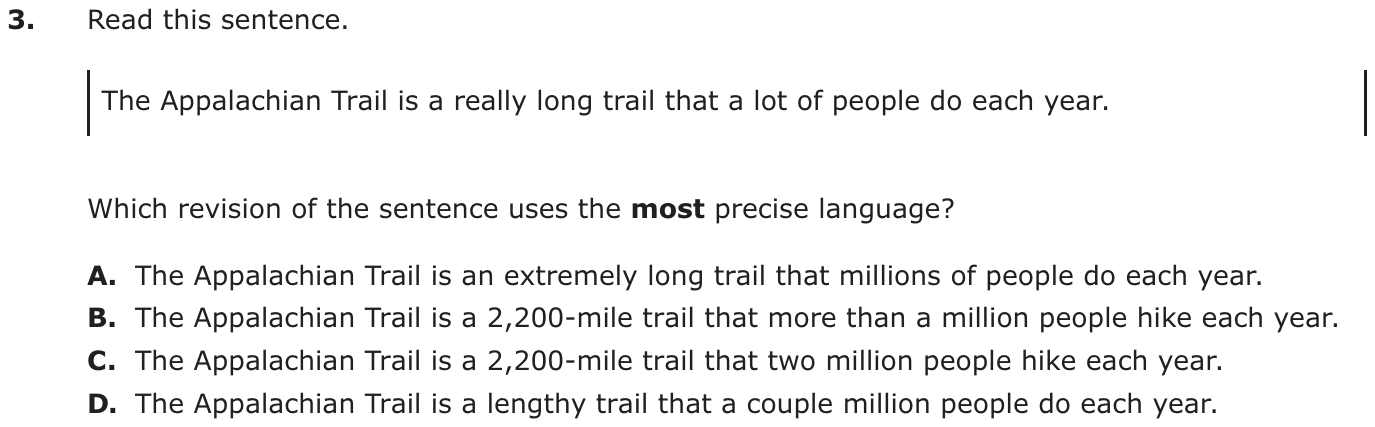
Question 10 of 12
2024 Test B English, question 5Passage Find Time to Volunteer
Find Time to Volunteer
(1) Many people believe that they gain a greater sense of purpose by giving their time to serve others. (2) These are the people who spend their free time volunteering at various places within the community. (3) Those who are served benefit from the work of these volunteers. (4) However, research shows that those who volunteer also receive benefits.
(5) For many students, this proposition may sound impossible. (6) Schoolwork can require hours of study each week. (7) Volunteering at a retirement center or homeless shelter requires both time and energy. (8) Extracurricular activities fill up after-school time. (9) Family obligations and part-time jobs often have to be worked into the schedule, too. (10) However, if students can find time to volunteer, even for a few hours a month, they may find that the benefits outweigh the scheduling difficulties.
(11) To begin with, students who engage in volunteer activities acquire valuable skills and experience, which can help them focus on potential fields of study and career options. (12) Furthermore, when students list volunteer work on college applications, admissions counselors see applicants who care about making their community and college campus a better place.
(13) Volunteerism benefits more than students applying to college. (14) This type of experience is equally important for students moving directly into the workforce after high school. (15) Volunteering demonstrates initiative, dedication, and a strong work ethic, qualities that companies value in a potential employee. (16) In a CareerBuilder study, 60 percent of managers regarded volunteerism as a significant asset when considering applicants.
(17) Students who volunteer undoubtedly make a positive investment in their future, but they also affect their present quality of life. (18) Studies have shown that volunteering is good for both the mind and the body. (19) Volunteering can boost mood levels and reduce anxiety. (20) According to the Mayo Clinic,1 the feeling of doing something meaningful and the appreciation received from that action can reduce stress.
(21) Even the busiest of students can find a way to donate some time to a worthy cause. (22) Though managing different commitments may seem overwhelming at times, students are sure to feel a sense of fulfillment in volunteerism.
1Mayo Clinic: a nonprofit medical organization dedicated to treatment and research
Question
Which revision of sentence 2 uses the most precise language?
- AThese are the people who spend their free time volunteering at animal shelters, helping with activities in community centers, or cleaning up parks.
- BThese are the people who spend their free time helping others in numerous ways at a variety of places, events, or organizations that need support.
- CThese are the people who spend their free time working at local establishments that help people, animals, or other groups in need of assistance.
- DThese are the people who spend a lot of time volunteering at places where they can help people in many ways.
Show the answer
Correct answer: A
The question asks which revision of sentence 2 uses the most precise language.
A. CORRECT. In sentence 2, the author states that people who volunteer in their free time do so “at various places.” The revision to sentence 2 provides the most precise language because it references three specific places (animal shelters, community centers, and parks) where people often volunteer.
B. Incorrect. Although this sentence mentions “a variety of places, events, or organizations” at which people volunteer, the revision does not use the most precise language, because it does not list specific places, events, or organizations.
C. Incorrect. Although this sentence mentions “local establishments that help people, animals, or other groups,” the revision does not use the most precise language, because it does not name the specific types of establishments at which people can volunteer.
D. Incorrect. Although this sentence mentions “places where [volunteers] can help people in many ways,” the revision does not use the most precise language, because it does not provide specific examples of where people can volunteer.
Question analysis
This revising question uses a persuasive essay urging high school students to find time to volunteer. It asks which rewrite of the second sentence, about the people who spend free time volunteering at various places, uses the most precise language. The trap is that longer, list-like wording can look more specific than it really is.
- Grade level
- Grade 6 reading and task
- Compared with grade 7
- Below grade 7 Grade 7 writers learn to replace vague wording with precise language. Here that skill is applied to one sentence of a plain persuasive essay, with no grammar to fix, which makes it lighter than typical grade 7 revision work.
- Estimated difficulty
- Routine: one familiar step, little to misread.
- Thinking it demands
- Depth of knowledge 1, recall and reproduction · mainly evaluate
- What makes it hard
- Evidence
- Answered from one sentence or line
- Reading level
- Passage: about grade 11, 354 words; question and choices: about grade 10, 102 words.
- Students, last 30 days
- Not enough answers yet to show (it takes 10).
Why it is hard, traps and wrong answers (shows the answer)
Why it is hard
Sentence 2’s vague phrase is “various places,” and only one revision replaces it with places a reader can picture: animal shelters, community centers and parks. The wrong revisions grow longer or list the kinds of people helped, which can pass for precision on a quick read. Asking whether a revision names a real place settles it.
Every choice must be checked minor Choosing the answer
Every revision is longer than sentence 2 and sounds more detailed, so each has to be checked for whether it names actual places or only adds general words such as “organizations” and “establishments.” (Embretson & Wetzel, 1987)
Strategy: Find the vague phrase in sentence 2, then ask of each revision whether it tells the reader something more definite or simply uses more words to say the same thing.
Traps
- Wordy, vague or informal: A revision is grammatical but wordy, imprecise or too casual for the passage.
The wrong answers, classified
B Wordy, vague or informal (Connors & Lunsford, 1988)
Mistakes a longer string of general categories, “places, events, or organizations,” for precision, though none is named and the sentence only grows wordier.
C Wordy, vague or informal (Connors & Lunsford, 1988)
Is drawn by the three-part list of people, animals and other groups, but “local establishments” still leaves the actual places unnamed.
D Wordy, vague or informal (Connors & Lunsford, 1988)
Accepts “a lot of time” and “many ways,” which keep the original’s vagueness and even drop the point that volunteers give their free time.
Working it out, step by step
Figure out what the question asks
You need to rewrite sentence 2 with more precise language. Precise means exact. Precise words help the reader picture something real. Sentence 2 says: “These are the people who spend their free time volunteering at various places within the community.” Look for the part that is vague.
Find the vague phrase
The vague phrase is “at various places.” Various means different kinds. But the sentence never says which places. You can’t picture them. A better sentence would name real places. Example: I help out at different spots is vague. I help out at the library and the food bank is precise.
Check each choice
- A names three real places: “animal shelters,” “community centers,” and “parks.” You can picture each one.
- B says “a variety of places, events, or organizations.” That is a longer list of general words. It still names nothing real.
- C says “local establishments.” An establishment is a business or group. It still doesn’t say which ones.
- D says “a lot of time” and “many ways.” Those words are vague too. D even drops the idea of free time.
Pick the answer
Watch out: C has a list, “people, animals, or other groups,” so it looks detailed. But that list tells who gets help, not where volunteers go. Only one choice names the places. So the answer is A.
Why this answer and not the closest wrong one
C is the closest wrong answer. Its list of people, animals and other groups sounds specific. But “local establishments” could be any place at all. A replaces “various places” with three places a reader can picture: animal shelters, community centers and parks. That makes A the most precise.
More questions like this
The original DOE question
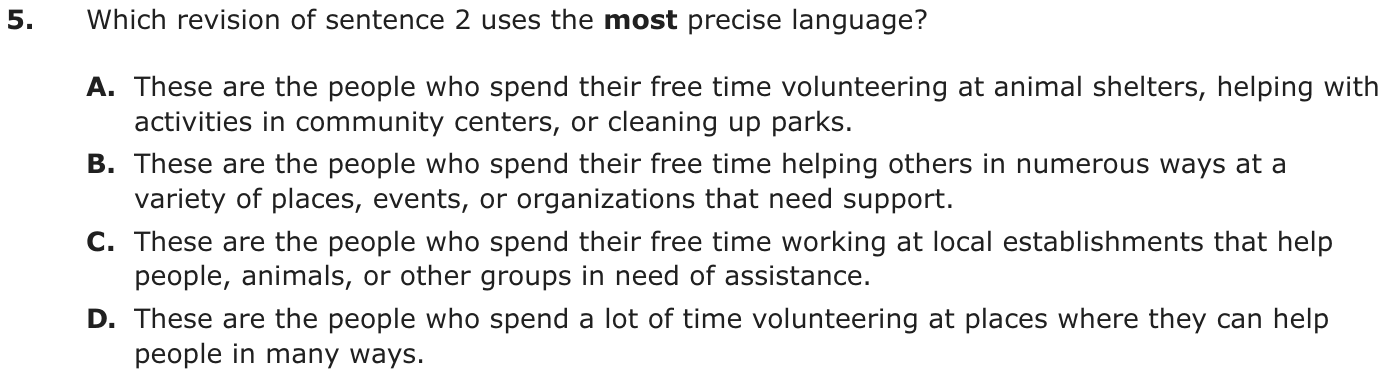
The passage “Find Time to Volunteer” as printed (page 163)
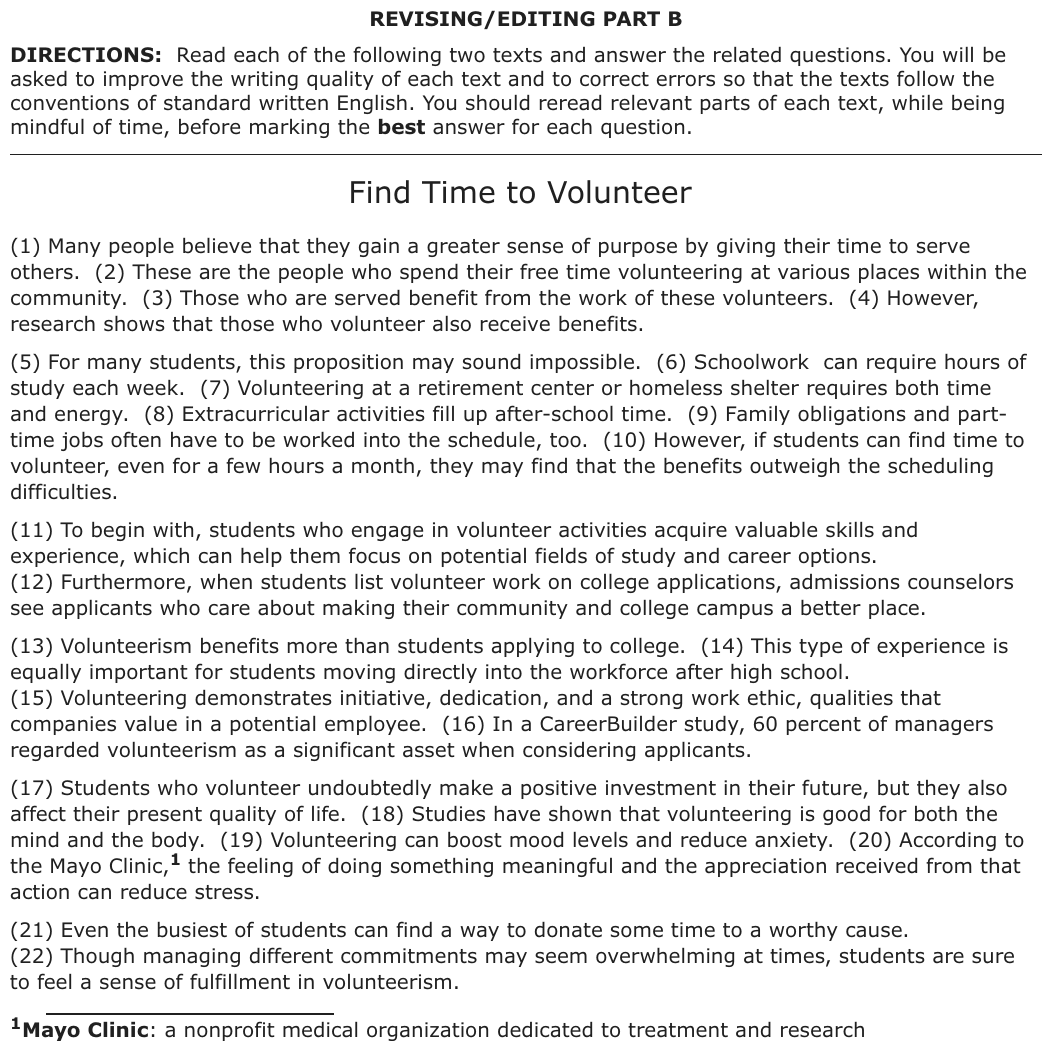
Question 11 of 12
2018 Test A English, question 1Question
Read this sentence.
During a nightly news segment about a cooking contest, a reporter talked to some people who did the best in the contest.
Which revision uses the most precise language for the words talked to some people who did the best in the contest?
- Aconversed with some of the people who won the contest
- Bspoke to the three contestants who did well
- Cdiscussed the contest with some of the winners
- Dinterviewed the top three contestants
Show the answer
Correct answer: D
This is the answer.(D)
The question asks for the most precise revision for the words “talked to some people who did the best in the contest.”
Option D is the correct response because the revision precisely states both the reporter’s action (“interviewed”) and whom the reporter interviewed (“the top three contestants”).
Option A is an incorrect response because the revision does not provide precise information about the number of people interviewed.
Option B is an incorrect response because the revision uses the imprecise phrase “who did well.”
Option C is an incorrect response because the revision does not provide precise information about the number of people interviewed.
Question analysis
This revising question gives one sentence about a news report on a cooking contest and asks which rewrite of a vague phrase uses the most precise language. The tricky part is that several choices sound more formal or add one specific detail while staying vague about something else.
- NYS standards
- 7L3a precise and concise language
- Grade level
- Grade 7 reading and task
- Compared with grade 7
- Below grade 7 Choosing precise wording is a grade 7 language skill, but this item is one short sentence with everyday words and a single comparison to make. Typical grade 7 revision work asks for the same judgment inside a longer paragraph.
- Estimated difficulty
- Routine: one familiar step, little to misread.
- Thinking it demands
- Depth of knowledge 1, recall and reproduction · mainly evaluate
- What makes it hard
- Evidence
- Answered from one sentence or line
- Reading level
- Question and choices: about grade 5, 77 words.
- Students, last 30 days
- Not enough answers yet to show (it takes 10).
Why it is hard, traps and wrong answers (shows the answer)
Why it is hard
This is a quick item once a student tests two things in every rewrite: what the reporter did and exactly who was involved. Points are lost by stopping at the first concrete detail, such as the number three, or by mistaking a formal verb like “conversed” for a precise one. It rewards checking each rewrite all the way through.
Every choice must be checked minor Choosing the answer
Each rewrite repairs a different piece of “talked to some people who did the best”, so all four have to be checked for both the action and the people. (Embretson & Wetzel, 1987)
Strategy: Ask two things of each revision: does it say exactly what the reporter did, and exactly whom the reporter spoke with? Keep a revision only if it is specific on both counts.
Traps
- Wordy, vague or informal: A revision is grammatical but wordy, imprecise or too casual for the passage.
- Half right: One half of a two-part choice is right and the other is not.
The wrong answers, classified
A Wordy, vague or informal (Connors & Lunsford, 1988)
Treats the formal verb “conversed” as more precise than “talked”, but it is only a fancier synonym, and “some of the people” leaves the number as vague as before.
B Half right (King et al., 2004; Thissen, Steinberg & Fitzpatrick, 1989)
Spots the exact number in “the three contestants” and stops checking, though “spoke to” and “who did well” are as loose as the original wording.
C Wordy, vague or informal (Connors & Lunsford, 1988)
Takes “winners” as sharper than “people who did the best”, missing that “some of the winners” still gives no count and “discussed the contest with” is wordier.
Working it out, step by step
Figure out what the question asks
This question asks you to make a phrase more precise. Precise language is exact. It tells the reader exactly what happened and exactly who was there. For example, a big dog is vague, but a 90-pound sheepdog is precise. You need to fix the words “talked to some people who did the best in the contest.”
Find what is vague now
The words are vague in two ways. First, “talked to” is a plain verb. On the news, a reporter who asks people questions is doing an interview. Second, “some people who did the best” does not say who or how many. So a good fix must sharpen both parts: the action and the people.
Test each choice on both parts
- A uses “conversed with,” which is just a fancy word for “talked.” And “some of the people” is still vague.
- B gives a number, “the three contestants.” But “spoke to” and “who did well” are still loose.
- C says “some of the winners,” which still gives no number. “Discussed the contest with” is wordier, not clearer.
- D says “interviewed,” the exact action. “The top three contestants” says exactly who.
Watch out: Choice B is tempting because it has a number. Many students stop there. But it fixes only one part.
Pick the answer
Only one choice is exact about both the action and the people. The new sentence reads: During a nightly news segment about a cooking contest, a reporter interviewed the top three contestants. So the answer is D, “interviewed the top three contestants.”
Why this answer and not the closest wrong one
Choice B is the closest wrong answer. Like D, it names three contestants. But “spoke to” is as plain as “talked to,” and “who did well” is vaguer than “top.” D is exact about what the reporter did and about whom, so it is the most precise.
More questions like this
The original DOE question
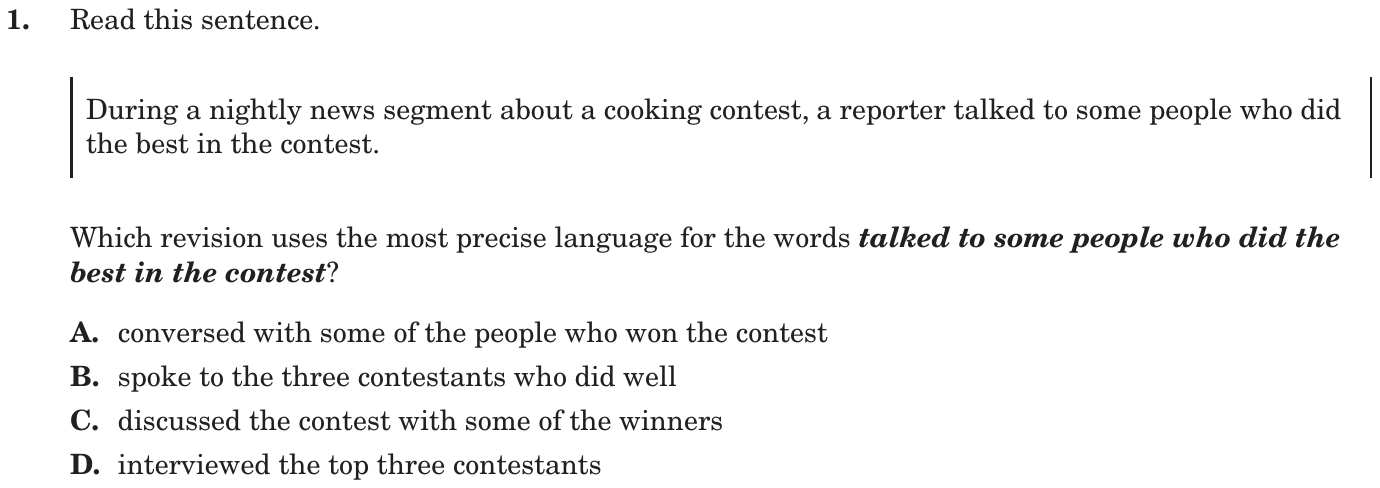
Question 12 of 12
2018 Test B English, question 7Passage The Local Library
The Local Library
(1) According to a 2015 survey, more than two-thirds of Americans own a smartphone, which means that obtaining information or communicating with people is easier than ever before. (2) With the swipe of a finger, the tap of an icon, or a verbal command, people have instant access to articles, blogs, news, and social networking websites. (3) Even with all these immediately available sources of information, one of the best resources for many members of the community also happens to be one of the oldest. (4) The public library is a great place for people to get information.
(5) The public library serves a truly critical role in promoting community. (6) With the explosion of digital media in recent years, people in different locations can now communicate almost instantaneously. (7) And yet many people complain of feeling more isolated and alone than ever before. (8) The library stands in a rare position to help community members meet this universal need for human connection and companionship.
(9) Furthermore, libraries provide certain amenities, such as access to the Internet, for free to all people. (10) A student who does not have a computer at home can research and type a paper for school. (11) Similarly, an unemployed adult without access to the Internet can make use of library resources to find job opportunities. (12) The free items that are found at the library can help people get a lot done.
(13) Public libraries also offer a variety of resources to community members. (14) One important resource is the local librarian, who does far more than check out books and collect fines. (15) Other library resources include free or low-cost tutoring and training programs. (16) Additionally, lectures, book groups, and town meetings promote critical thinking and community engagement. (17) A typical librarian holds a master’s degree and can help library patrons navigate through the flood of information available in print and on the Internet.
(18) The hallmark of a public library is that its materials and services are accessible to all. (19) The library connects people to a network of information and resources and is an important part of a community.
Question
Which revision of sentence 12 best maintains the formal style established in the passage?
- AThe free resources available at the library can help people accomplish many tasks.
- BAll the free materials you can get at the library can help you do many different tasks.
- CEverything that is free at the library can help people work on a lot of different things.
- DThe free resources you can find at the library can help you do whatever you need to do.
Show the answer
Correct answer: A
The question asks for the revision of sentence 12 that best maintains the formal style established in the passage.
Option A correctly maintains the formal style by using “people” instead of “you” and the more formal language “resources available” and “accomplish many tasks.”
Option B is incorrect because it uses second person, directly addressing the reader, which is informal.
Option C is incorrect because, even though it does not use second person, it uses informal language like “work on” and “things.”
Option D is incorrect because it uses the informal phrase “whatever you need to do” in addition to informally addressing the reader through the use of second person.
Question analysis
This style question asks students to revise a casual sentence about the free items at a public library so it fits the essay’s formal tone. Students compare four rewrites for word choice and for the way each one speaks to the reader. It tests whether students can hear the difference between conversational and academic writing.
- Grade level
- Grade 6 reading and task
- Compared with grade 7
- Below grade 7 Keeping a formal style is introduced in grade 6 writing, and this item tests it in one sentence with clear signals of casual language. Typical grade 7 style work asks for subtler choices of precise, content-specific words.
- Estimated difficulty
- Routine: one familiar step, little to misread.
- Thinking it demands
- Depth of knowledge 1, recall and reproduction · mainly evaluate
- What makes it hard
- Evidence
- Answered from one sentence or line
- Reading level
- Passage: about grade 11, 341 words; question and choices: about grade 8, 78 words.
- Students, last 30 days
- Not enough answers yet to show (it takes 10).
Why it is hard, traps and wrong answers (shows the answer)
Why it is hard
Sentence 12, with “free items” and “get a lot done,” sounds casual next to the essay’s survey figures and phrases like “certain amenities,” and two of the rewrites slip into addressing the reader as “you.” Most students hear that at once. The one rewrite that avoids “you” but stays vague is where careful readers can still be caught, since they stop checking once the pronoun test is passed.
A very close wrong answer minor Choosing the answer
The rewrite saying free things “can help people work on a lot of different things” matches the right one’s “can help people accomplish many tasks” in structure and pronoun; only the casual wording separates them. (Embretson & Wetzel, 1987; Gorin & Embretson, 2006; Ascalon et al., 2007)
Something you must already know minor Working it out
Students must already know the conventions of formal writing: no second-person “you,” and precise wording such as “accomplish many tasks” instead of “get a lot done.” (Anderson & Krathwohl, 2001)
Strategy: Reread a sentence or two around sentence 12 to hear the essay’s voice, then check each rewrite for whom it addresses and for casual or vague wording.
Traps
- Wordy, vague or informal: A revision is grammatical but wordy, imprecise or too casual for the passage.
The wrong answers, classified
B Wordy, vague or informal (Connors & Lunsford, 1988)
Sounds tidy and keeps the idea, but speaks to the reader directly with “you can get” and “help you,” second person that the essay’s formal voice never uses.
C Wordy, vague or informal (Connors & Lunsford, 1988)
Passes the pronoun test by using “people,” but keeps the vague, casual wording “everything that is free” and “a lot of different things.”
D Wordy, vague or informal (Connors & Lunsford, 1988)
Is drawn by the formal-sounding “resources” it shares with the right rewrite, overlooking the second person and the chatty “whatever you need to do.”
Working it out, step by step
Figure out what the question asks
You need to rewrite sentence 12 so it sounds formal, like the rest of the essay. Formal style is the careful way you would write a school report.
Learn the signs of formal style
Formal writing follows two simple rules.
- It does not talk to the reader as “you.” Talking to “you” is called second person.
- It uses exact words, not casual ones like a lot, stuff or things.
Casual: You can get tons of stuff there.
Formal: Visitors can find many useful materials there.Find the problem in sentence 12
Sentence 12 says: “The free items that are found at the library can help people get a lot done.” The phrase “get a lot done” is casual. The rest of the essay uses careful words like “amenities” and “resources.” It never says “you.”
Check each choice
- A is right. It uses “people,” not “you.” It uses exact words: “resources available” and “accomplish many tasks.”
- B is wrong. It says “you can get” and “help you.” That talks to the reader.
- C is wrong. It uses “people,” but it keeps casual words: “everything” and “a lot of different things.”
- D is wrong. It uses “you” and the chatty “whatever you need to do.”
Watch out: C passes the “you” test, so it looks safe. But its words are still casual.
Choose the answer
To accomplish a task means to get it done. A says the same thing as sentence 12, but in formal words. So the answer is A.
Why this answer and not the closest wrong one
C is the closest wrong answer. Like A, it uses “people” and says the free things “can help.” The difference is the last few words. “Work on a lot of different things” is vague and casual. “Accomplish many tasks” is exact and formal, so A matches the essay’s style.
More questions like this
The original DOE question

The passage “The Local Library” as printed (page 120)