3 English and 3 math
Here are 6 random questions to try. Takers earning below 75% are unlikely to receive an offer. You have 1 minute 48 seconds per question on the real exam.
Question 1 of 6
2025 Practice Test A English, question 17Passage Excerpt from Winter Wheat
Excerpt from Winter Wheat
by Mildred Walker
Ellen, the narrator, is preparing to leave her parents and the family farm for college the next day.
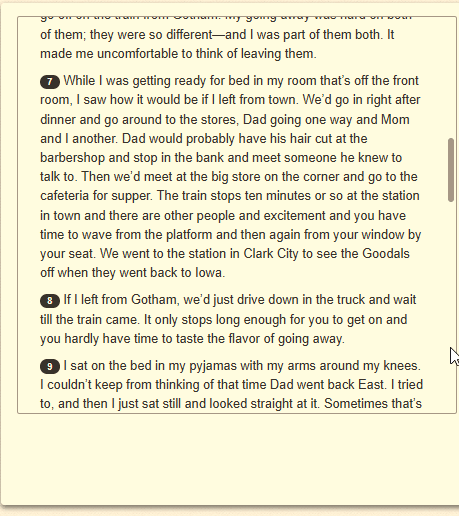
I love Dad’s way of talking that makes him seem different from other ranchers. He’s lived here twenty-three years, but he still says “back East where I come from.” He’s the one who gets excited when I do about spring coming or a serial running in the magazine we’re both reading, but it’s what Mom says that I depend on. When Mom used to say “Don’t worry” about my pet chicken or dog or new calf, it always got well. Dad is always talking of going some place, not now, but next year, maybe. Mom seems to think of nothing farther away than today or perhaps yesterday or tomorrow morning.
Mom folded the ironing board and put it inside their bedroom that was just off the kitchen. She carried in the freshly ironed clothes. Dad went back to his paper. When Mom came back she took beans from the cupboard to soak for tomorrow. Dad always said Mom could make all the dishes he’d had back in Vermont as well as though she were a New Englander herself, instead of a Russian. All of a sudden, I realized that tomorrow when those beans would be ready to eat I’d be going away. It gave me a funny feeling.
“I’ll be taking the train tomorrow night,” I said aloud, more to hear it myself.
“We can drive you into town in the afternoon,” Dad said, dropping his paper on the floor.
“There’s no need to go to town; she can catch the train at Gotham just as well. We haven’t nothing to take us into town for,” Mom said.
“Well, we don’t have to decide tonight,” Dad said, but I knew he wanted to go into Clark City. It wouldn’t be so flat as just seeing me go off on the train from Gotham. My going away was hard on both of them; they were so different—and I was part of them both. It made me uncomfortable to think of leaving them.
While I was getting ready for bed in my room that’s off the front room, I saw how it would be if I left from town. We’d go in right after dinner and go around to the stores, Dad going one way and Mom and I another. Dad would probably have his hair cut at the barbershop and stop in the bank and meet someone he knew to talk to. Then we’d meet at the big store on the corner and go to the cafeteria for supper. The train stops ten minutes or so at the station in town and there are other people and excitement and you have time to wave from the platform and then again from your window by your seat. We went to the station in Clark City to see the Goodals off when they went back to Iowa.
If I left from Gotham, we’d just drive down in the truck and wait till the train came. It only stops long enough for you to get on and you hardly have time to taste the flavor of going away.
I sat on the bed in my pyjamas with my arms around my knees. I couldn’t keep from thinking of that time Dad went back East. I tried to, and then I just sat still and looked straight at it. Sometimes that’s better than working so hard to keep from looking at what’s in your mind.
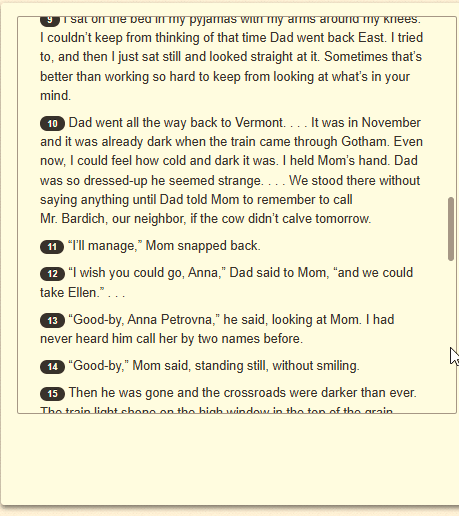
Dad went all the way back to Vermont. . . . It was in November and it was already dark when the train came through Gotham. Even now, I could feel how cold and dark it was. I held Mom’s hand. Dad was so dressed-up he seemed strange. . . . We stood there without saying anything until Dad told Mom to remember to call Mr. Bardich, our neighbor, if the cow didn’t calve tomorrow.
“I’ll manage,” Mom snapped back.
“I wish you could go, Anna,” Dad said to Mom, “and we could take Ellen.” . . .
“Good-by, Anna Petrovna,” he said, looking at Mom. I had never heard him call her by two names before.
“Good-by,” Mom said, standing still, without smiling.
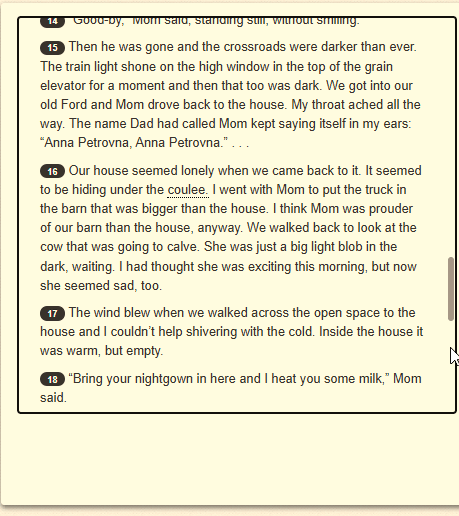
Then he was gone and the crossroads were darker than ever. The train light shone on the high window in the top of the grain elevator for a moment and then that too was dark. We got into our old Ford and Mom drove back to the house. My throat ached all the way. The name Dad had called Mom kept saying itself in my ears: “Anna Petrovna, Anna Petrovna.” . . .
Our house seemed lonely when we came back to it. It seemed to be hiding under the coulee. I went with Mom to put the truck in the barn that was bigger than the house. I think Mom was prouder of our barn than the house, anyway. We walked back to look at the cow that was going to calve. She was just a big light blob in the dark, waiting. I had thought she was exciting this morning, but now she seemed sad, too.
The wind blew when we walked across the open space to the house and I couldn’t help shivering with the cold. Inside the house it was warm, but empty.
“Bring your nightgown in here and I heat you some milk,” Mom said.
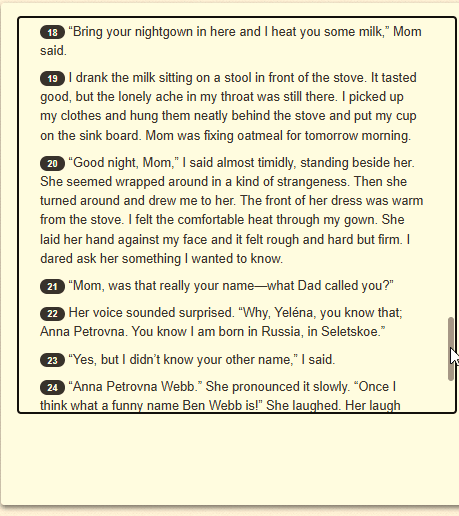
I drank the milk sitting on a stool in front of the stove. It tasted good, but the lonely ache in my throat was still there. I picked up my clothes and hung them neatly behind the stove and put my cup on the sink board. Mom was fixing oatmeal for tomorrow morning.
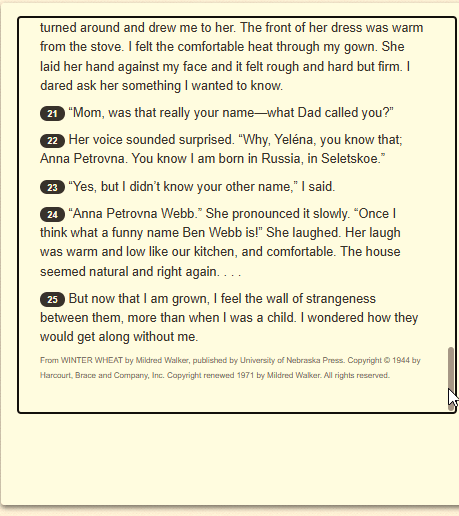
“Good night, Mom,” I said almost timidly, standing beside her. She seemed wrapped around in a kind of strangeness. Then she turned around and drew me to her. The front of her dress was warm from the stove. I felt the comfortable heat through my gown. She laid her hand against my face and it felt rough and hard but firm. I dared ask her something I wanted to know.
“Mom, was that really your name—what Dad called you?”
Her voice sounded surprised. “Why, Yeléna, you know that; Anna Petrovna. You know I am born in Russia, in Seletskoe.”
“Yes, but I didn’t know your other name,” I said.
“Anna Petrovna Webb.” She pronounced it slowly. “Once I think what a funny name Ben Webb is!” She laughed. Her laugh was warm and low like our kitchen, and comfortable. The house seemed natural and right again. . . .
But now that I am grown, I feel the wall of strangeness between them, more than when I was a child. I wondered how they would get along without me.
From WINTER WHEAT by Mildred Walker, published by University of Nebraska Press. Copyright © 1944 by Harcourt, Brace and Company, Inc. Copyright renewed 1971 by Mildred Walker. All rights reserved.
serial: story published in short segments at regular intervals
coulee: small gulch or ravine
Question
Read these sentences from paragraph 2.
Dad always said Mom could make all the dishes he’d had back in Vermont as well as though she were a New Englander herself, instead of a Russian. All of a sudden, I realized that tomorrow when those beans would be ready to eat I’d be going away. It gave me a funny feeling.
The sentences help develop a theme of the excerpt by
- Asuggesting that life presents people with many challenges.
- Bimplying that the stress of major life events can cause confusion.
- Cdemonstrating that moving on from the familiar is a common human experience.
- Demphasizing the idea that people can easily learn the routines of being part of a new culture.
Show the answer
Correct answer: C
The question asks how the sentences in paragraph 2 help develop a theme of the excerpt.
A. Incorrect. Although the sentences from paragraph 2 describe Ellen’s “funny feeling” upon realizing that she will no longer be home when the beans that her mother is making are ready to eat, the details do not show that life presents many challenges. Additionally, the theme that life presents people with many challenges is not a theme found in the excerpt.
B. Incorrect. The sentences from paragraph 2 state that Ellen has “a funny feeling” while awaiting a major life event, but they do not indicate that she is confused or stressed. The details in the sentences convey a sense of wistfulness, but the theme that the stress of major life events causes confusion is not found in the excerpt.
C. CORRECT. The sentences from paragraph 2 show that Ellen’s mother has moved on from the familiar and left her childhood home behind, just as Ellen is about to do. This information links the experiences of parent and child and helps develop the theme that moving beyond the familiar is a common human experience.
D. Incorrect. Although the sentences from paragraph 2 show that Ellen’s mother has learned to cook New England food very well (“as though she were a New Englander herself”), they do not provide information about how easy or difficult it was for Ellen’s mother to learn a new way of cooking. The theme that people can easily learn the routines of a new culture is not a theme found in the excerpt.
Question analysis
This theme question quotes three sentences from paragraph 2 of the Winter Wheat excerpt, about Mom’s cooking and Ellen’s sudden realization that she is leaving, and asks how they help develop a theme. Students must connect a small kitchen moment to an idea that runs through the whole excerpt, choosing among theme statements that range from narrow to very general.
- Grade level
- Grade 8 reading and task
- Compared with grade 7
- Above grade 7 Explaining how details develop a theme is a grade 7 standard. These sentences never state the idea, so students must infer it from a remark about Mom’s cooking and Ellen’s passing feeling, then link it to the whole excerpt, more than typical grade 7 work.
- Estimated difficulty
- Hard: combines ideas, needs a plan, and has more than one tempting wrong answer.
- Thinking it demands
- Depth of knowledge 3, strategic thinking · mainly analyze
- What makes it hard
- Reading between the lines major
- Evidence in several places moderate
- How, not what minor
- Evidence
- Answered from the whole text
- Reading level
- Passage: about grade 4, 1179 words; question and choices: about grade 7, 117 words.
- Students, last 30 days
- Not enough answers yet to show (it takes 10).
Why it is hard, traps and wrong answers (shows the answer)
Why it is hard
The quoted sentences seem to be about cooking and a passing mood, and the link to a theme hides in where the parents come from. Students who miss that Dad and Mom both left homes far away read the passage as being about Mom’s skill or Ellen’s nerves, and pick a theme built on one of those. The vague choice about life’s challenges catches students who sense that leaving is hard but cannot pin the theme to these details.
Reading between the lines major Working it out
The theme is never stated: students must notice that “back in Vermont” and “instead of a Russian” mean both parents left their first homes, just as Ellen realizes she will be “going away.” (Graesser, Singer & Trabasso, 1994; Kintsch, 1998)
Evidence in several places moderate Working it out
A theme of the excerpt must hold beyond paragraph 2, so the choice has to be checked against Dad’s trip back East in the flashback and Mom’s Russian name in paragraph 22. (Kirsch & Mosenthal, 1990; Gorin & Embretson, 2006)
How, not what minor Working it out
The stem asks how the sentences develop a theme, so a remark about cooking has to be read for what it reveals about the parents’ pasts, not for its subject. (Anderson & Krathwohl, 2001)
Strategy: Note what each quoted sentence tells you about the person in it, then pick the theme that these details and the rest of the excerpt both support.
Traps
- Reads too much in: A reasonable-sounding conclusion that goes further than the text allows.
- Too broad or too strong: A choice overstates, generalizes, or uses absolute words the text does not support.
- Wrong tone or attitude: Misjudges the tone, attitude or point of view, such as reading admiration as criticism, or taking a character's or subject's feelings for the author's.
The wrong answers, classified
A Too broad or too strong (King et al., 2004)
Chooses a theme loose enough to fit almost any story; the sentences show the parents’ pasts and a sudden realization, not a series of challenges.
B Wrong tone or attitude (Graesser, Singer & Trabasso, 1994)
Hears stress and confusion in Ellen’s “funny feeling,” though the sentences suggest a quiet, wistful realization, and nothing in the excerpt shows her confused about leaving.
D Reads too much in (Graesser, Singer & Trabasso, 1994)
Seizes on Mom cooking “as though she were a New Englander herself” and adds that adapting was easy, which the sentence never says; it praises her skill, not the ease of learning.
Working it out, step by step
Figure out what the question asks
This asks how three sentences from paragraph 2 help build a theme. A theme is a big idea about life that a story keeps showing. Look at what each sentence tells you about the people in it, not just at its subject, cooking.
Read the sentence about Mom and Dad
The first sentence says “Dad always said Mom could make all the dishes he’d had back in Vermont as well as though she were a New Englander herself, instead of a Russian.” Vermont is a state far to the east, in New England. Dad grew up there. Mom came from Russia. So both parents left the places where they grew up.
Read the sentences about Ellen
The next sentences say “All of a sudden, I realized that tomorrow when those beans would be ready to eat I’d be going away. It gave me a funny feeling.” The beans are soaking for tomorrow’s meal. Ellen sees that she won’t be home to eat them. She is about to leave her own home, just as her parents once left theirs.
Find the theme
Put the two parts together. Dad left Vermont, Mom left Russia, and now Ellen is leaving the farm. Each of them moves on from a familiar place. So the sentences show that leaving what you know is something many people go through. Ellen’s “funny feeling” is wistful, a quiet sadness, like missing home before you go.
Check each choice
- A does not fit. It is so broad it could fit almost any story. These sentences show leaving home, not many challenges.
- B does not fit. Ellen’s feeling is quiet and wistful. Nothing shows her stressed or confused.
- C fits. Parents and daughter all move on from a familiar home.
- D does not fit. Dad praises Mom’s cooking, but the sentence never says learning it was easy.
Choose the answer
The sentences link Ellen’s leaving to her parents’ own leaving long ago. So the answer is C.
Why this answer and not the closest wrong one
B is the closest wrong choice, because a “funny feeling” before a big change could sound like stress. But Ellen is not mixed up or panicked. She simply realizes she will be gone tomorrow. The sentences tie that moment to her parents’ moves from Vermont and Russia. That shared experience of leaving is C.
More questions like this
The original DOE question
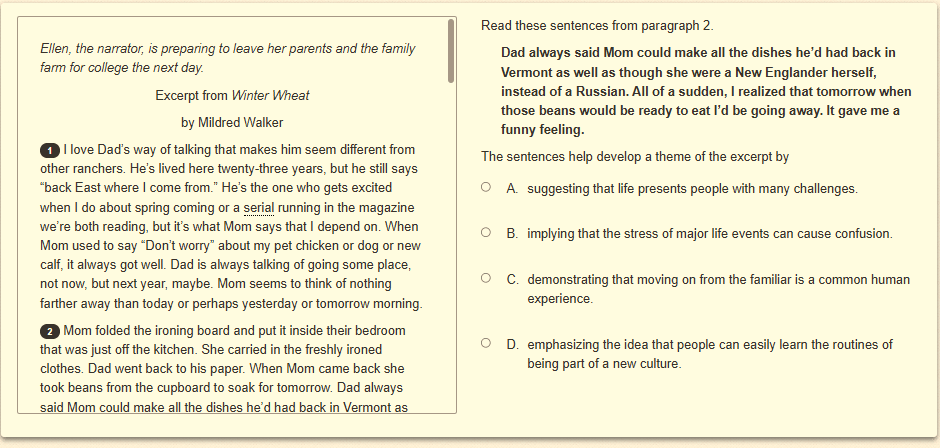
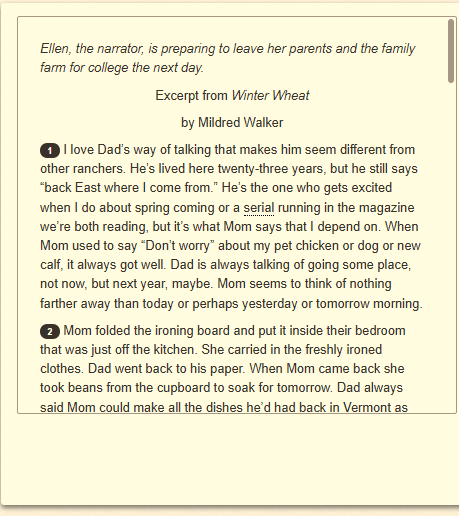
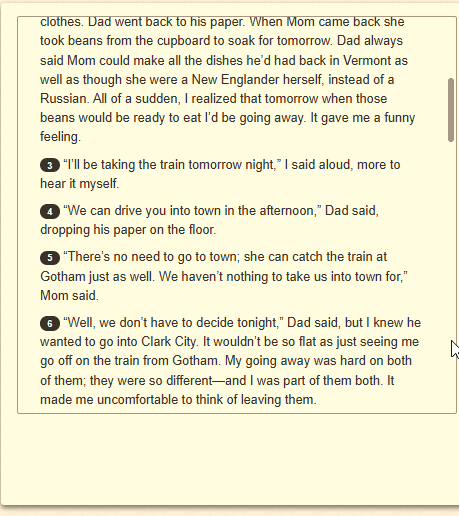
The passage “Excerpt from Winter Wheat” as shown on the test
Question 2 of 6
2024 Test B English, question 55Passage Excerpt from “The Past and the Future of the Earth’s Oldest Trees”
Excerpt from “The Past and the Future of the Earth’s Oldest Trees”
by Alex Ross
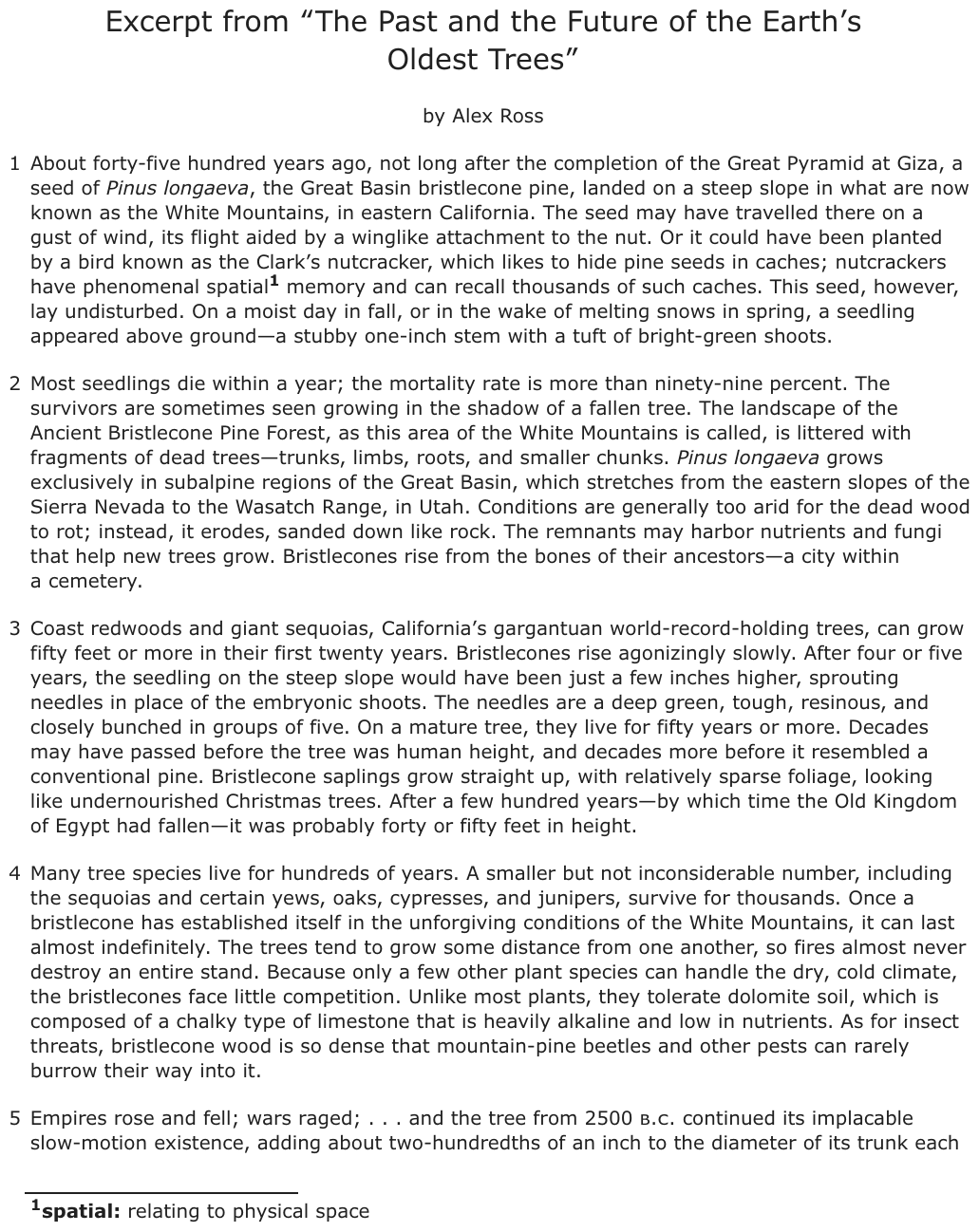
About forty-five hundred years ago, not long after the completion of the Great Pyramid at Giza, a seed of Pinus longaeva, the Great Basin bristlecone pine, landed on a steep slope in what are now known as the White Mountains, in eastern California. The seed may have travelled there on a gust of wind, its flight aided by a winglike attachment to the nut. Or it could have been planted by a bird known as the Clark’s nutcracker, which likes to hide pine seeds in caches; nutcrackers have phenomenal spatial1 memory and can recall thousands of such caches. This seed, however, lay undisturbed. On a moist day in fall, or in the wake of melting snows in spring, a seedling appeared above ground—a stubby one-inch stem with a tuft of bright-green shoots.
Most seedlings die within a year; the mortality rate is more than ninety-nine percent. The survivors are sometimes seen growing in the shadow of a fallen tree. The landscape of the Ancient Bristlecone Pine Forest, as this area of the White Mountains is called, is littered with fragments of dead trees—trunks, limbs, roots, and smaller chunks. Pinus longaeva grows exclusively in subalpine regions of the Great Basin, which stretches from the eastern slopes of the Sierra Nevada to the Wasatch Range, in Utah. Conditions are generally too arid for the dead wood to rot; instead, it erodes, sanded down like rock. The remnants may harbor nutrients and fungi that help new trees grow. Bristlecones rise from the bones of their ancestors—a city within a cemetery.
Coast redwoods and giant sequoias, California’s gargantuan world-record-holding trees, can grow fifty feet or more in their first twenty years. Bristlecones rise agonizingly slowly. After four or five years, the seedling on the steep slope would have been just a few inches higher, sprouting needles in place of the embryonic shoots. The needles are a deep green, tough, resinous, and closely bunched in groups of five. On a mature tree, they live for fifty years or more. Decades may have passed before the tree was human height, and decades more before it resembled a conventional pine. Bristlecone saplings grow straight up, with relatively sparse foliage, looking like undernourished Christmas trees. After a few hundred years—by which time the Old Kingdom of Egypt had fallen—it was probably forty or fifty feet in height.
Many tree species live for hundreds of years. A smaller but not inconsiderable number, including the sequoias and certain yews, oaks, cypresses, and junipers, survive for thousands. Once a bristlecone has established itself in the unforgiving conditions of the White Mountains, it can last almost indefinitely. The trees tend to grow some distance from one another, so fires almost never destroy an entire stand. Because only a few other plant species can handle the dry, cold climate, the bristlecones face little competition. Unlike most plants, they tolerate dolomite soil, which is composed of a chalky type of limestone that is heavily alkaline and low in nutrients. As for insect threats, bristlecone wood is so dense that mountain-pine beetles and other pests can rarely burrow their way into it.
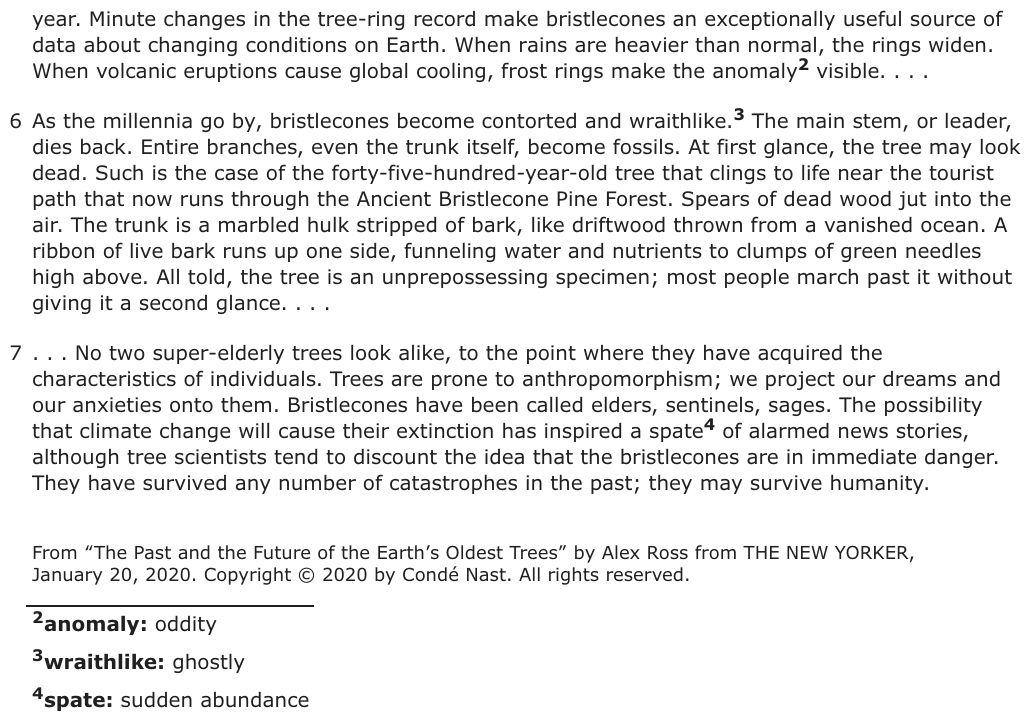
Empires rose and fell; wars raged; . . . and the tree from 2500 B.C. continued its implacable slow-motion existence, adding about two-hundredths of an inch to the diameter of its trunk each year. Minute changes in the tree-ring record make bristlecones an exceptionally useful source of data about changing conditions on Earth. When rains are heavier than normal, the rings widen. When volcanic eruptions cause global cooling, frost rings make the anomaly2 visible. . . .
As the millennia go by, bristlecones become contorted and wraithlike.3 The main stem, or leader, dies back. Entire branches, even the trunk itself, become fossils. At first glance, the tree may look dead. Such is the case of the forty-five-hundred-year-old tree that clings to life near the tourist path that now runs through the Ancient Bristlecone Pine Forest. Spears of dead wood jut into the air. The trunk is a marbled hulk stripped of bark, like driftwood thrown from a vanished ocean. A ribbon of live bark runs up one side, funneling water and nutrients to clumps of green needles high above. All told, the tree is an unprepossessing specimen; most people march past it without giving it a second glance. . . .
. . . No two super-elderly trees look alike, to the point where they have acquired the characteristics of individuals. Trees are prone to anthropomorphism; we project our dreams and our anxieties onto them. Bristlecones have been called elders, sentinels, sages. The possibility that climate change will cause their extinction has inspired a spate4 of alarmed news stories, although tree scientists tend to discount the idea that the bristlecones are in immediate danger. They have survived any number of catastrophes in the past; they may survive humanity.
From “The Past and the Future of the Earth’s Oldest Trees” by Alex Ross from THE NEW YORKER, January 20, 2020. Copyright © 2020 by Condé Nast. All rights reserved.
1spatial: relating to physical space
2anomaly: oddity
3wraithlike: ghostly
4spate: sudden abundance
Question
The details in paragraph 7 convey a central idea of the excerpt by suggesting that
- Athe success of the bristlecone pine lies in its ability to resist climate change.
- Bthe uncommon appearance of the bristlecone pine is related to its ability to survive.
- Cthe attachment that humans have to the bristlecone pine is understandable.
- Dthe longevity of the bristlecone pine continues to encourage experts.
Show the answer
Correct answer: D
The question asks which central idea of the excerpt is supported by the details in paragraph 7.
A. Incorrect. While paragraph 7 mentions the pines’ ability to survive climate change, the central idea is about the trees’ longevity. Surviving climate change is a part of the pines’ longevity, but just surviving climate change does not fully encompass the central idea of the excerpt.
B. Incorrect. Although the paragraph mentions that the “super-elderly trees” are each unique in appearance, their appearance does not directly connect to their ability to survive. The details in paragraph 7 emphasize the durability and longevity of the trees.
C. Incorrect. While the beginning of paragraph 7 expresses the idea that each bristlecone pine appears to be a unique individual and supports the idea that humans relate to the pines, the paragraph expresses a stronger central idea in the last two sentences about the pines’ survival.
D. CORRECT. The longevity of bristlecone pines is a central idea of the excerpt. Experts are encouraged that bristlecone pines have survived many catastrophes, and the details in the second half of paragraph 7 draw direct attention to the trees’ longevity.
Question analysis
Students explain how the details in paragraph 7, the closing paragraph of Alex Ross’s excerpt on bristlecone pines, convey a central idea of the whole piece. The paragraph moves from people seeing old trees as individuals to alarmed news stories and the views of tree scientists, so students must decide which thread ties to the excerpt’s main idea.
- Grade level
- Grade 8 reading and task
- Compared with grade 7
- Above grade 7 Grade 7 central idea questions often ask what a passage is mostly about. Here students must connect one closing paragraph that touches several topics to an idea of the whole excerpt, reading its details for what they imply as well as what they say.
- Estimated difficulty
- Hard: combines ideas, needs a plan, and has more than one tempting wrong answer.
- Thinking it demands
- Depth of knowledge 3, strategic thinking · mainly understand
- What makes it hard
- Reading between the lines major
- The right answer is reworded moderate
- Evidence in several places minor
- Evidence
- Answered from the whole text
- Reading level
- Passage: about grade 8, 851 words; question and choices: about grade 10, 63 words.
- Students, last 30 days
- Not enough answers yet to show (it takes 10).
Why it is hard, traps and wrong answers (shows the answer)
Why it is hard
Paragraph 7 moves through several topics, trees that look like individuals, people projecting feelings onto them, alarmed news and calm scientists, and only its last two sentences connect to the excerpt’s main idea. The strongest lure states a true point about human attachment that the paragraph does make, while the key has to be inferred from the scientists’ calm and the trees’ record of survival. Naming the central idea first, the trees’ extraordinary age, shows which thread of the paragraph serves it.
Reading between the lines major Working it out
Nothing in paragraph 7 says experts are encouraged; it has to be read from “tree scientists tend to discount the idea that the bristlecones are in immediate danger,” set against the “alarmed news stories.” (Graesser, Singer & Trabasso, 1994; Kintsch, 1998)
The right answer is reworded moderate Choosing the answer
The key speaks of “longevity” and of experts being encouraged, words the paragraph never uses, while two wrong choices repeat its “climate change” and “survive” and so look better anchored. (Freedle & Kostin, 1993; Kirsch & Mosenthal, 1990)
Evidence in several places minor Working it out
Recognizing longevity as a central idea draws on the whole excerpt: the tree from the time of the Great Pyramid in paragraph 1, its endurance in paragraph 4 and its ring record in paragraph 5. (Kirsch & Mosenthal, 1990; Gorin & Embretson, 2006)
Strategy: Name the central idea of the whole excerpt first, then reread paragraph 7 and find the sentences that connect to it.
Traps
- True but not the answer: A choice says something accurate about the text that does not answer this question.
- Twists what the text says: Uses the text's topic and ideas but changes what it says: who did it, how much, when, or why.
- Reads too much in: A reasonable-sounding conclusion that goes further than the text allows.
The wrong answers, classified
A Twists what the text says (King et al., 2004)
Joins the paragraph’s mention of climate change to the trees’ survival and makes resisting it the secret of their success, but the paragraph only reports fears and gives no such cause.
B Reads too much in (Graesser, Singer & Trabasso, 1994)
Links the remark that no two old trees look alike to their survival, a connection paragraph 7 never draws; the detail shows only that they seem like individuals.
C True but not the answer (King et al., 2004; Embretson & Wetzel, 1987)
Relies on the paragraph’s real remarks about people calling the trees elders, sentinels and sages, but that human attachment is a side point, not a central idea of the excerpt.
Working it out, step by step
Figure out what the question asks
This asks how paragraph 7 connects to a central idea, a main point of the whole excerpt. So first name that idea. Then find which details in paragraph 7 point to it.
Name the excerpt’s central idea
The excerpt follows a tree that has lived about 4,500 years. Paragraph 1 starts its story near the time of the Great Pyramid. A settled bristlecone “can last almost indefinitely” (paragraph 4). Paragraph 5 shows a tree living on while empires “rose and fell.” So a central idea is the bristlecone’s amazing longevity, or long life.
Find the matching details in paragraph 7
Paragraph 7 first says people treat the old trees almost like persons. Then it turns to climate change. News stories sound alarmed, “although tree scientists tend to discount the idea that the bristlecones are in immediate danger.” To discount an idea is to doubt it. The last sentence gives the reason: “They have survived any number of catastrophes in the past; they may survive humanity.”
Explain what the details suggest
A catastrophe is a terrible disaster. The trees have lived through so many disasters that scientists are not very worried. In other words, the trees’ long record of survival gives the experts hope. That ties paragraph 7 to the central idea of longevity.
Check each choice
- A does not fit. Climate change comes up only as a fear in the news. The paragraph never says the trees succeed by resisting it.
- B does not fit. Paragraph 7 says no two old trees look alike, but it never links their looks to their survival.
- C does not fit. People do call the trees “elders, sentinels, sages,” but that feeling is a side point, not a central idea.
- D fits. Experts take comfort from how long the trees have survived.
Choose the answer
Paragraph 7 ends on the trees’ long survival and the experts’ calm about their future. So the answer is D.
Why this answer and not the closest wrong one
C is the strongest trap, because paragraph 7 really does say people feel close to the trees. But the question asks for a central idea of the whole excerpt. Long life runs through every paragraph, and the last two sentences of paragraph 7 tie into it. That is why D fits better.
More questions like this
The original DOE question

The passage “Excerpt from “The Past and the Future of the Earth’s Oldest Trees”” as printed (pages 193–194)
Question 3 of 6
2026 Practice Test D English, question 17Passage Wolves of the Sea
Wolves of the Sea
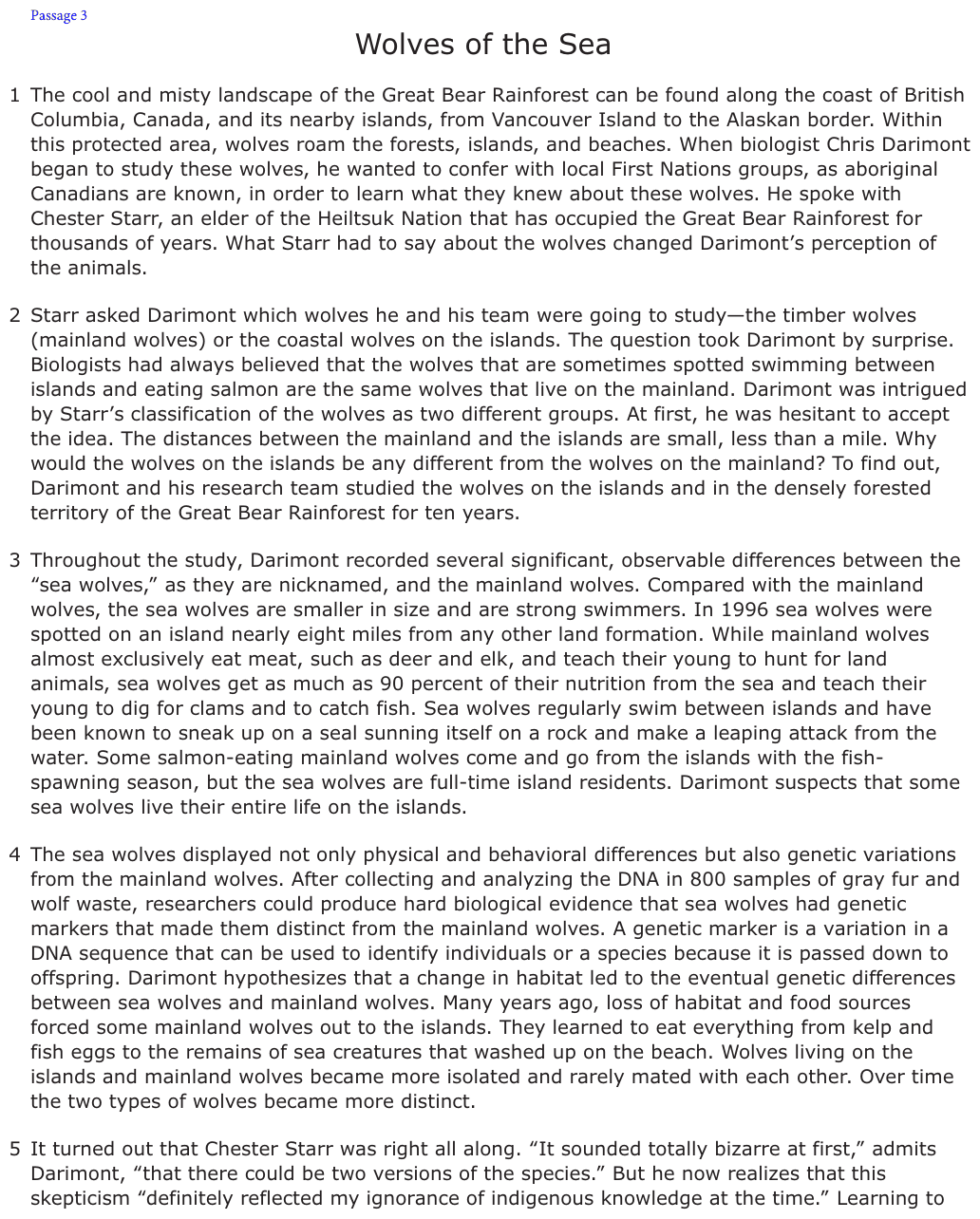
The cool and misty landscape of the Great Bear Rainforest can be found along the coast of British Columbia, Canada, and its nearby islands, from Vancouver Island to the Alaskan border. Within this protected area, wolves roam the forests, islands, and beaches. When biologist Chris Darimont began to study these wolves, he wanted to confer with local First Nations groups, as aboriginal Canadians are known, in order to learn what they knew about these wolves. He spoke with Chester Starr, an elder of the Heiltsuk Nation that has occupied the Great Bear Rainforest for thousands of years. What Starr had to say about the wolves changed Darimont’s perception of the animals.
Starr asked Darimont which wolves he and his team were going to study—the timber wolves (mainland wolves) or the coastal wolves on the islands. The question took Darimont by surprise. Biologists had always believed that the wolves that are sometimes spotted swimming between islands and eating salmon are the same wolves that live on the mainland. Darimont was intrigued by Starr’s classification of the wolves as two different groups. At first, he was hesitant to accept the idea. The distances between the mainland and the islands are small, less than a mile. Why would the wolves on the islands be any different from the wolves on the mainland? To find out, Darimont and his research team studied the wolves on the islands and in the densely forested territory of the Great Bear Rainforest for ten years.
Throughout the study, Darimont recorded several significant, observable differences between the “sea wolves,” as they are nicknamed, and the mainland wolves. Compared with the mainland wolves, the sea wolves are smaller in size and are strong swimmers. In 1996 sea wolves were spotted on an island nearly eight miles from any other land formation. While mainland wolves almost exclusively eat meat, such as deer and elk, and teach their young to hunt for land animals, sea wolves get as much as 90 percent of their nutrition from the sea and teach their young to dig for clams and to catch fish. Sea wolves regularly swim between islands and have been known to sneak up on a seal sunning itself on a rock and make a leaping attack from the water. Some salmon-eating mainland wolves come and go from the islands with the fish-spawning season, but the sea wolves are full-time island residents. Darimont suspects that some sea wolves live their entire life on the islands.
The sea wolves displayed not only physical and behavioral differences but also genetic variations from the mainland wolves. After collecting and analyzing the DNA in 800 samples of gray fur and wolf waste, researchers could produce hard biological evidence that sea wolves had genetic markers that made them distinct from the mainland wolves. A genetic marker is a variation in a DNA sequence that can be used to identify individuals or a species because it is passed down to offspring. Darimont hypothesizes that a change in habitat led to the eventual genetic differences between sea wolves and mainland wolves. Many years ago, loss of habitat and food sources forced some mainland wolves out to the islands. They learned to eat everything from kelp and fish eggs to the remains of sea creatures that washed up on the beach. Wolves living on the islands and mainland wolves became more isolated and rarely mated with each other. Over time the two types of wolves became more distinct.
It turned out that Chester Starr was right all along. “It sounded totally bizarre at first,” admits Darimont, “that there could be two versions of the species.” But he now realizes that this skepticism “definitely reflected my ignorance of indigenous knowledge at the time.” Learning to trust the wisdom of the Heiltsuk people opened Darimont up to knowledge accumulated over millennia and positioned him so that he could gather new scientific evidence about one of British Columbia’s most elusive species, the sea wolf.
Question
Read this sentence from paragraph 4.
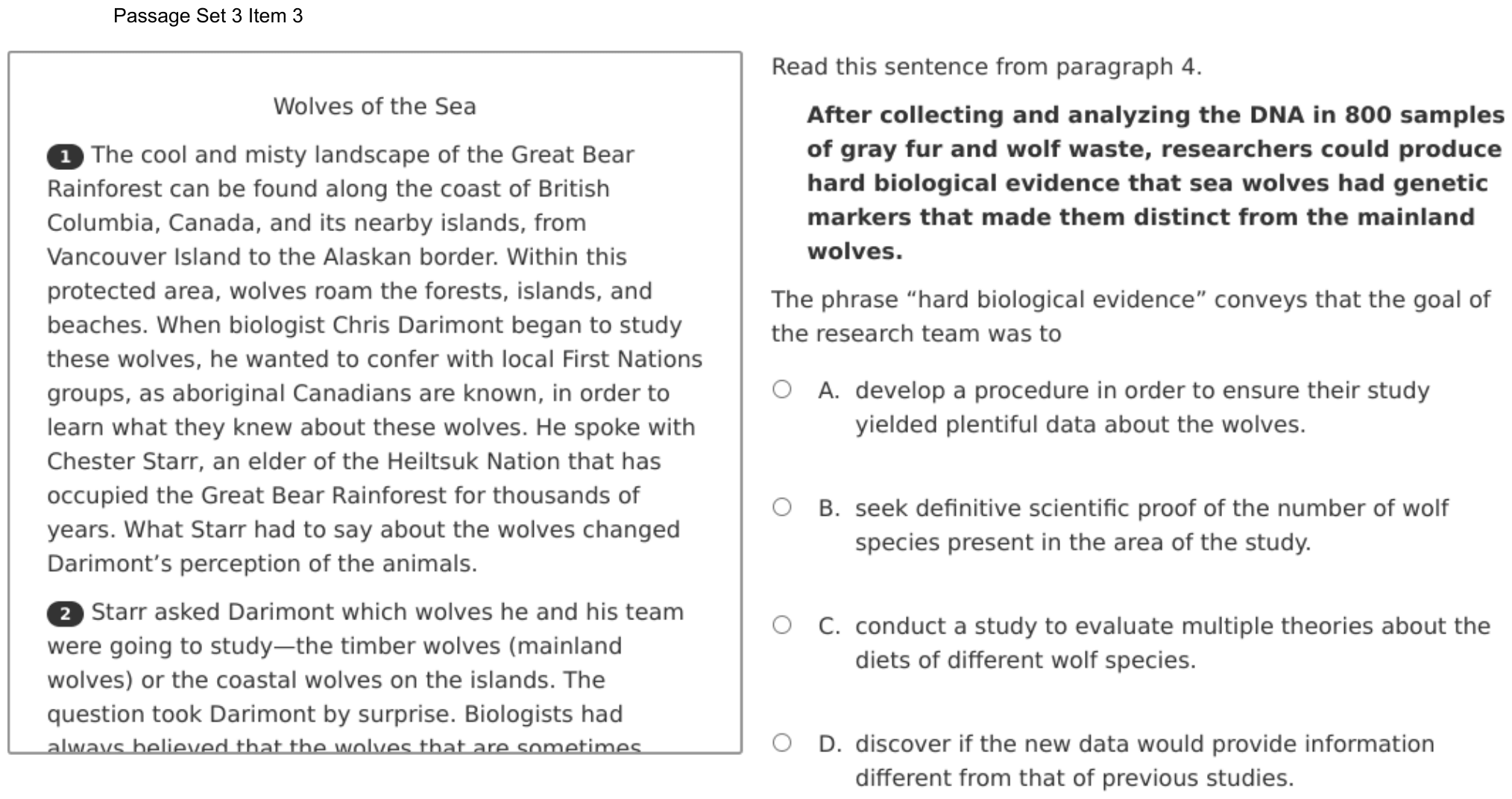
After collecting and analyzing the DNA in 800 samples of gray fur and wolf waste, researchers could produce hard biological evidence that sea wolves had genetic markers that made them distinct from the mainland wolves.
The phrase “hard biological evidence” conveys that the goal of the research team was to
- Adevelop a procedure in order to ensure their study yielded plentiful data about the wolves.
- Bseek definitive scientific proof of the number of wolf species present in the area of the study.
- Cconduct a study to evaluate multiple theories about the diets of different wolf species.
- Ddiscover if the new data would provide information different from that of previous studies.
Show the answer
Correct answer: B
The question asks what the phrase “hard biological evidence” in the sentence from paragraph 4 conveys about the goal of the research team.
A. Incorrect. Although the research team followed a labor-intensive procedure, the phrase “hard biological evidence” refers to the product of their scientific research (the genetic markers revealed within the DNA samples), not the process by which they collected it. Their goal was not to develop a procedure for data collection but to determine precisely how many species of wolf were present in the area.
B. CORRECT. The research team wanted to prove or disprove the theory that two separate groups of wolves were present in the area, an idea that was already supported by the observations of scientists and local indigenous people. The phrase “hard biological evidence” conveys that the scientists wanted to bolster their observations of the wolves with concrete scientific data about the wolves’ biological makeup. The goal of the researchers was to use the data to prove how many species of wolf were present in the area of the study.
C. Incorrect. The research team gathered extensive data during their study (“After collecting and analyzing the DNA in 800 samples of gray fur and wolf waste” [paragraph 4]), and their goal in doing so was to evaluate a single theory about the wolves: that the wolves had evolved into two separate and genetically distinct species. The research team did not conduct the study in order to evaluate multiple theories about the diets of the wolves.
D. Incorrect. The phrase “hard biological evidence” does not suggest that the research team was hoping to discover if the new data would provide information that was different from previous studies. In fact, the goal of the research team was to use the genetic data to supplement their initial sources of information about the wolves and their own observations from the field.
Question analysis
This word-in-context question quotes a sentence from paragraph 4 of “Wolves of the Sea” about DNA taken from 800 samples of gray fur and wolf waste, and asks what the phrase “hard biological evidence” shows about the research team’s goal. Students must work out what the phrase says about the evidence and then turn that into a statement of purpose, choosing among four plausible aims for a study.
- Grade level
- Grade 8 reading and task
- Compared with grade 7
- Above grade 7 Grade 7 students regularly interpret a phrase in context. Here the phrase must be turned into a claim about the team’s purpose, which the passage never states outright, and the four choices are abstract research goals that each sound reasonable.
- Estimated difficulty
- Hard: combines ideas, needs a plan, and has more than one tempting wrong answer.
- Thinking it demands
- Depth of knowledge 2, skills and concepts · mainly understand
- What makes it hard
- Reading between the lines moderate
- Hard words moderate
- Evidence in several places minor
- Evidence
- Answered from several paragraphs or stanzas
- Reading level
- Passage: about grade 10, 662 words; question and choices: about grade 10, 114 words.
- Students, last 30 days
- Not enough answers yet to show (it takes 10).
Why it is hard, traps and wrong answers (shows the answer)
Why it is hard
The question asks for a purpose, but the phrase it quotes describes a result, so students have to reason from the kind of evidence produced to what the team wanted it for. Readers who take “hard” as difficult drift toward a goal about procedure, and those who remember that biologists had long thought the wolves were one group are drawn to a goal of overturning earlier studies. The key’s “number of wolf species” is looser than the passage’s “two versions of the species,” which can make careful readers hesitate.
Reading between the lines moderate Working it out
The passage never states the team’s goal, so students must work back from “hard biological evidence” to the question paragraph 2 set up: whether island and mainland wolves are really two groups. (Graesser, Singer & Trabasso, 1994; Kintsch, 1998)
Hard words moderate Understanding the question
“Hard” here means solid and conclusive, as in hard evidence, not difficult; students who know only the everyday sense connect it to the labor of analyzing 800 samples of fur and waste. (Perfetti, 2007; Freedle & Kostin, 1993)
Evidence in several places minor Working it out
The goal the phrase points to lies two paragraphs back, in Starr’s two-group question and Darimont’s ten-year study “to find out,” not in the sentence the stem quotes. (Kirsch & Mosenthal, 1990; Gorin & Embretson, 2006)
Strategy: Replace “hard” with a word that fits evidence produced by DNA analysis, then ask what the team wanted that kind of evidence for, recalling the question Darimont set out to answer.
Traps
- Dictionary meaning, not meaning here: A common meaning of the word that does not fit its use in this text.
- Reads too much in: A reasonable-sounding conclusion that goes further than the text allows.
- Wrong part of the text: A choice is true of another paragraph, stanza or speaker than the one asked about.
The wrong answers, classified
A Dictionary meaning, not meaning here (Perfetti, 2007)
Reads “hard” as difficult and ties it to the labor of analyzing 800 samples, so takes the goal to be a thorough procedure rather than conclusive proof.
C Wrong part of the text (Kirsch & Mosenthal, 1990)
Brings in the diet differences of paragraph 3, clams, fish and seals, as theories under test, though the DNA work in paragraph 4 asked whether two groups exist.
D Reads too much in (Graesser, Singer & Trabasso, 1994)
Knows that biologists “had always believed” the wolves were one group and assumes the team set out to contradict earlier studies, which the phrase about solid proof does not suggest.
Working it out, step by step
Figure out what the question asks
This asks what a phrase shows about the team’s goal. A goal is what you are trying to get. The phrase names the kind of evidence the team got. Work back from that to what they wanted it for.
Read the sentence with the phrase
In paragraph 4, the team studied “800 samples of gray fur and wolf waste.” Then they “could produce hard biological evidence that sea wolves had genetic markers that made them distinct from the mainland wolves.” A genetic marker is a small difference in the DNA that parents pass to their young. Distinct means clearly different.
Work out what “hard” means
Here “hard” does not mean difficult. Hard evidence is solid proof that is tough to argue with. Biological means it comes from living things and their bodies. So the team wanted firm proof from the wolves’ own bodies.
Connect the proof to the question
What did they want to prove? Go back to paragraph 2. Starr said there were two groups of wolves. Darimont was unsure. “To find out,” his team studied the wolves. The DNA gave a firm answer: the sea wolves really are a separate group. So the goal was solid proof of how many groups of wolves live there.
Check each choice
- A is wrong. It reads “hard” as hard work. The phrase is about how firm the proof is, not about a procedure.
- B is right. Definitive means final and settled. The team wanted settled proof of how many groups of wolves live there. B says “species,” which goes further than the passage. Darimont speaks only of “two versions of the species.”
- C is wrong. Diets come up in paragraph 3. The DNA work tested whether there were two groups.
- D is wrong. The phrase says nothing about earlier studies.
Watch out: D is tempting because biologists “had always believed” the wolves were one group. But “hard” evidence is about firm proof, not about beating old studies.
Choose the answer
“Hard biological evidence” shows the team wanted firm, scientific proof. So the answer is B, “seek definitive scientific proof of the number of wolf species present in the area of the study.”
Why this answer and not the closest wrong one
D is the closest wrong answer. Biologists had thought the wolves were one group, so D can seem to fit. But the phrase “hard biological evidence” is about how firm the proof is. It says nothing about earlier studies. B matches that: the team wanted settled proof of how many groups there were.
More questions like this
The original DOE question
The passage “Wolves of the Sea” as printed (pages 23–24)

Question 4 of 6
2024 Test A Math, question 5Question
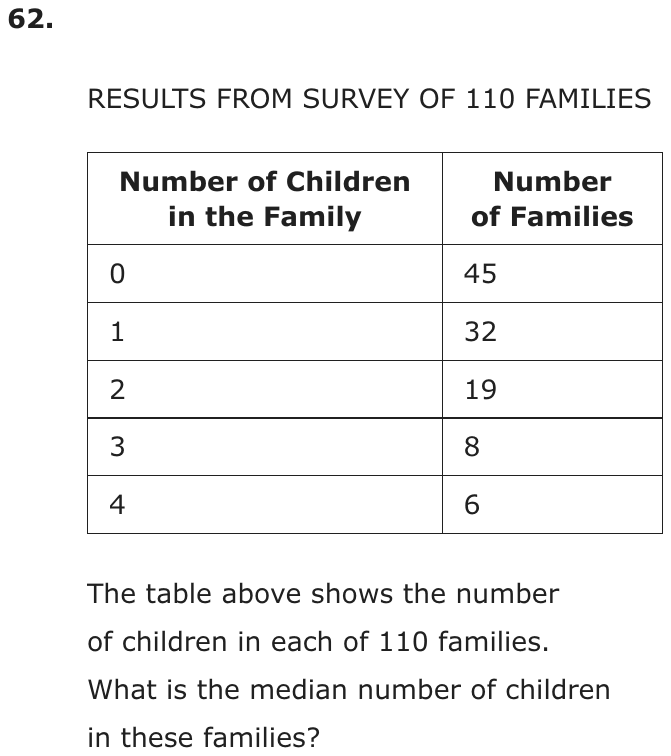
RESULTS FROM SURVEY OF 110 FAMILIES
| Number of Children in the Family | Number of Families |
|---|---|
| 0 | 45 |
| 1 | 32 |
| 2 | 19 |
| 3 | 8 |
| 4 | 6 |
The table above shows the number of children in each of 110 families. What is the median number of children in these families?
Grid-in question: work out the answer and enter it as a number.
Show the answer
Correct answer: 1
Since 110 families were surveyed, the median will have 55 values less than or equal to it, and 55 values greater than or equal to it.
If the values in the table were listed in order, they would look like this:
The first row of the table indicates that 45 families had 0 children.
The second row of the table indicates that 32 families had 1 child.
So 77 families had either 0 children or 1 child, and 45 families had 0 children.
Since 55 is between 45 and 77, the median must be a value in the second row of the table.
So the median is 1.
Question analysis
This statistics grid-in gives a frequency table from a survey of 110 families, showing how many families have each number of children from none to four. Students find the median number of children per family. The table lists counts rather than the 110 data values themselves, so locating the middle value takes a running total of the families.
- Grade level
- Grade 6 content, by NYS standard
- Compared with grade 7
- Above grade 7 Grade 7 median problems usually list a dozen or so values. Here 110 values are hidden in a frequency table, so students must reason about positions with a running count, a less familiar and more error-prone task.
- Estimated difficulty
- Hard: combines ideas, needs a plan, and has more than one tempting wrong answer.
- Thinking it demands
- Depth of knowledge 2, skills and concepts · mainly apply
- What makes it hard
- Reading a figure, table or graph major
- No obvious method moderate
- An answer in an unexpected form minor
- Solution
- 3 steps
- Reading level
- Question and choices: about grade 7, 35 words.
- Students, last 30 days
- Not enough answers yet to show (it takes 10).
Why it is hard, traps and wrong answers (shows the answer)
Why it is hard
Students know a median as the middle of a list, but here the list is never written out. Treating the table's columns as the data gives quick, confident answers, 2 from the middle of the children column or 19 from the middle of the family counts, and neither can be checked against choices. The question rewards counting positions: 45 families have no children, so the 55th and 56th families both fall among the 32 with one child.
Reading a figure, table or graph major Understanding the question
The table hides 110 data values in five rows: the 0 to 4 column lists the possible values, and 45, 32, 19, 8 and 6 say how many families have each. (Lesh, Post & Behr, 1987; Kirsch & Mosenthal, 1990)
No obvious method moderate Working it out
The median of 110 values lies between the 55th and 56th; finding them takes a running count of families, 45 and then 77, a method seldom practiced with tables. (Schoenfeld, 1985)
An answer in an unexpected form minor Choosing the answer
As a grid-in there are no choices to compare, so a student who takes the middle row's 2 has nothing on the page to suggest it is wrong. (Enright, Morley & Sheehan, 2002)
Strategy: With 110 values the median sits between the 55th and 56th; add the family counts row by row until the running total passes 55, and read that row's number of children.
Traps
- Misunderstands the concept: A wrong belief about a concept: that percents can be added, that area grows like length, that averages can be averaged, that a bigger denominator means a bigger fraction.
- Answers a different question: A choice is right for another quantity: the other unknown, the rest instead of the part, the part instead of the whole.
The wrong answers, classified
2 Misunderstands the concept (Smith, diSessa & Roschelle, 1993; De Bock et al., 1998; Ni & Zhou, 2005)
Takes the middle entry of the children column, 0 to 4, ignoring that each number of children belongs to a different number of families.
19 Answers a different question (King et al., 2004; Hegarty, Mayer & Monk, 1995)
Finds the median of the Number of Families column, 6, 8, 19, 32 and 45, a middle family count rather than a number of children.
1.07 Answers a different question (King et al., 2004; Hegarty, Mayer & Monk, 1995)
Computes the mean instead, 118 children among 110 families, about 1.07, a different measure of center from the median asked for.
Worked solution, step by step
Formulas used
- Spot of the median
- The median is the middle value when all the values are put in order. n is how many values there are. This gives the spot of the middle value, with the same number of values before and after it. If it ends in a half, the median is halfway between the two values on either side.
Sort out the table
The table covers 110 families. The left column is a number of children. The right column says how many families have that many children. For example, 45 families have 0 children. You need the median number of children. The median is the middle value when all the values are in order.
Picture the values in order
Think of a list with one number for each family: how many children it has. The list has 45 zeros, then 32 ones, then 19 twos, then 8 threes, then 6 fours. It is already in order, from least to most.
There are 110 values. Watch out: the median is not the middle row, 2. Each row stands for a different number of families.
Find the middle spot
Use the median rule with n = 110.
The middle is halfway between the 55th and 56th values. So you need those two values in the list.
Count down the list
Keep a running total of families, row by row. The zeros fill spots 1 to 45. Now add the 32 families with 1 child.
So the ones fill spots 46 to 77. Spot 55 and spot 56 are both in that range. So both values are 1.
Give the median
The 55th and 56th values are both 1. Halfway between 1 and 1 is 1. So the median is 1 child. Watch out: the median is a number of children, not of families. Gridding 19, from the families column, is wrong. So is the mean, or average, which is about 1.07. So you would grid 1.
Check your answer
Half of 110 is 55. Families with 0 children: 45, which is less than half. So the median is not 0. Families with 0 or 1 child: 77, which is more than half. So the median is not more than 1. It must be 1.
More questions like this
The original DOE question
Question 5 of 6
2018 Test B Math, question 46Question
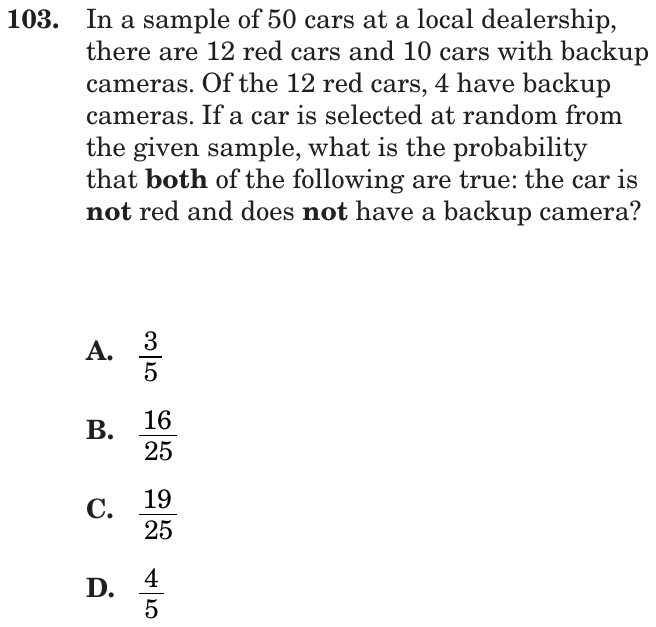
In a sample of 50 cars at a local dealership, there are 12 red cars and 10 cars with backup cameras. Of the 12 red cars, 4 have backup cameras. If a car is selected at random from the given sample, what is the probability that both of the following are true: the car is not red and does not have a backup camera?
- A
- B
- C
- D
Show the answer
Correct answer: B
Create a chart using the given information and use subtraction to figure out how many cars are not red and do not have a back-up camera:
| Red | Not Red | TOTAL | |
| Back-up Camera | 4 | 6 (10-4) |
10 |
| No back-up Camera | 32 (38-6) |
||
| TOTAL | 12 | 38 (50-12) |
50 |
The probability of selecting a car that meets both conditions from the total of 50 cars at the dealership is .
Question analysis
In a sample of 50 cars, 12 are red, 10 have backup cameras, and 4 of the red cars have cameras. Students find the probability that a randomly chosen car is neither red nor equipped with a camera. It tests compound probability with overlapping groups, and the overlap between red cars and camera cars is what makes it tricky.
- NYS standards
- Grade level
- Grade 7 content, by NYS standard
- Compared with grade 7
- Above grade 7 Grade 7 compound probability usually uses a ready-made table or tree. Here students must build the two-way table from words, handle an overlap, and use a "not this and not that" condition, several steps beyond typical work.
- Estimated difficulty
- Hard: combines ideas, needs a plan, and has more than one tempting wrong answer.
- Thinking it demands
- Depth of knowledge 2, skills and concepts · mainly apply
- What makes it hard
- Much to keep track of major
- Many steps moderate
- A very close wrong answer moderate
- Complex sentences minor
- Solution
- 4 steps
- Reading level
- Question and choices: about grade 6, 63 words.
- Corrected from the DOE handbook
- A grammar slip in the explanation was corrected.
- Students, last 30 days
- Not enough answers yet to show (it takes 10).
Why it is hard, traps and wrong answers (shows the answer)
Why it is hard
This is an overlap problem dressed as probability: the hard part is counting the cars that avoid both features, not the division by 50. A two-way table makes it routine, but students working in their heads often keep only one of the two conditions. The question rewards placing the 4 red cars with cameras in the table before doing any subtraction.
Much to keep track of major Working it out
Three overlapping counts, 12 red, 10 with cameras and 4 that are both, must be sorted into four groups before the wanted one, neither red nor with a camera, can be found. (Sweller, 1988; Carpenter, Just & Shell, 1990)
Many steps moderate Working it out
Find the non-red cars with cameras, 10 − 4 = 6, and the non-red cars, 50 − 12 = 38, subtract to get 32, then simplify 32/50. (Daniel & Embretson, 2010; Enright, Morley & Sheehan, 2002)
A very close wrong answer moderate Choosing the answer
19/25, or 38/50, has the same denominator as the right 16/25 and sits just above it; only removing the 6 non-red cars that have cameras from the 38 separates them. (Embretson & Wetzel, 1987; Gorin & Embretson, 2006; Ascalon et al., 2007)
Complex sentences minor Understanding the question
The last sentence stacks "both of the following are true", a colon and two negatives, "not red" and "does not have"; untangling it is reading work, not extra math. (Abedi & Lord, 2001; Freedle & Kostin, 1993; Messick, 1989)
Strategy: Draw a two-way table with red and not red across, camera and no camera down, fill in the given counts, and complete the missing cells by subtraction.
Traps
- Misreads the question: Misses or misreads a condition or a word in the question: "at least", "each", "remaining", "not".
- Answers a different question: A choice is right for another quantity: the other unknown, the rest instead of the part, the part instead of the whole.
The wrong answers, classified
A Answers a different question (King et al., 2004; Hegarty, Mayer & Monk, 1995)
Finds the 6 non-red cars with cameras and divides by the 10 camera cars, 6/10 = 3/5, a different probability from the one asked.
C Misreads the question (Hegarty, Mayer & Monk, 1995)
Uses only the 38 cars that are not red, 38/50, and ignores the second condition that the car also lacks a backup camera.
D Misreads the question (Hegarty, Mayer & Monk, 1995)
Counts only the 40 cars without backup cameras, 40/50, dropping the requirement that the car must not be red as well.
What was corrected from the DOE handbook, and why
- Explanation: The handbook says “a car that meet both conditions”; the site says “a car that meets both conditions.”
Worked solution, step by step
Formulas used
- Probability
- P is the probability, the chance that something happens. The top counts the results you want. The bottom counts every possible result. Use it when each result is equally likely, like picking one at random.
Sort out what you know
There are 50 cars. Of these, 12 are red and 10 have backup cameras. Of the red cars, 4 have cameras. You pick one car at random. You need the chance that “both of the following are true”: the car is not red, and it has no camera.
Set up a two-way table
A two-way table sorts each car by two things at once: its color and its camera. Put in the numbers you know.
Red Not red Total Camera 4 ? 10 No camera ? Total 12 ? 50 Fill in the missing numbers
Not red with a camera: cars.
All cars that are not red: cars.
Not red with no camera: cars.
Watch out: the 38 cars that are not red include 6 with cameras. Using 38 gives , choice C. Using all 40 cars with no camera gives , choice D.
Write the probability
Use the probability formula. There are 32 cars you want out of 50 cars in all.
Divide the top and bottom by 2.
So the answer is B, .
Check your answer
Finish the table. Red cars with no camera: . Now add the four inside boxes: . That is every car, so the numbers fit. Also, the cars with no camera are , and too.
More questions like this
The original DOE question
Question 6 of 6
2018 Test A Math, question 48Question
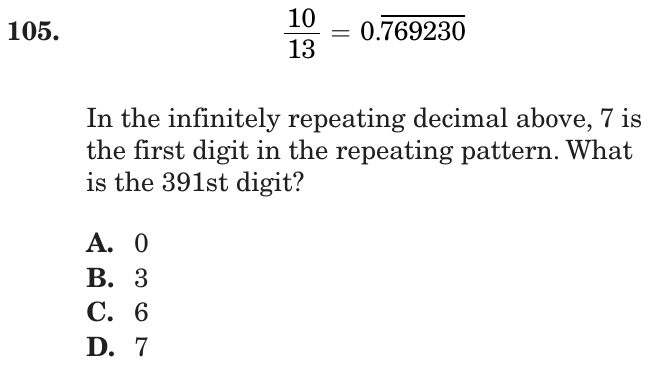
In the infinitely repeating decimal above, 7 is the first digit in the repeating pattern. What is the 391st digit?
- A0
- B3
- C6
- D7
Show the answer
Correct answer: D
There are 6 digits in the repeating decimal (769230), so 7 would be the first, seventh, thirteenth digit and so on.
To find the 391st digit, divide 391 by 6.
391 ÷ 6 = 65 R1
Since the remainder is 1, that means the 391st digit is the same as the 1st digit, which is 7.
Question analysis
This repeating decimal question shows the six-digit repeating pattern of 10/13 and asks for the 391st digit after the decimal point. Students must use the length of the repeating block and division with a remainder to find the position within the cycle. Matching the remainder to the right digit is where students slip.
- Grade level
- Grade 7 content, by NYS standard
- Compared with grade 7
- Above grade 7 Seventh graders learn that fractions have repeating decimals. Using the length of the repeating block and a remainder to find a digit hundreds of places away is a pattern-reasoning step beyond typical seventh-grade classwork.
- Estimated difficulty
- Hard: combines ideas, needs a plan, and has more than one tempting wrong answer.
- Thinking it demands
- Depth of knowledge 2, skills and concepts · mainly apply
- What makes it hard
- No obvious method moderate
- Solution
- 2 steps
- Reading level
- Question and choices: about grade 8, 20 words.
- Students, last 30 days
- Not enough answers yet to show (it takes 10).
Why it is hard, traps and wrong answers (shows the answer)
Why it is hard
Once the cycle length is used, the arithmetic is a single division, 391 ÷ 6 = 65 remainder 1. The difficulty is turning the remainder into a position: remainder 1 is the first digit of a new block, not the last digit of the previous one or the second of the new one. Checking the rule on small positions, the 1st and 7th digits are both 7, removes the doubt.
No obvious method moderate Working it out
Nothing in the stem mentions division; students must see that the six-digit block 769230 repeats, so position 391 depends only on the remainder of 391 divided by 6. (Schoenfeld, 1985)
Strategy: Divide 391 by the length of the repeating block and look only at the remainder; a remainder of r points to the r-th digit of the block.
Traps
- Counting the ends: Inclusive or exclusive ends, fence posts, consecutive numbers: an answer that is one too many or too few, or an endpoint drawn open where it belongs closed (or the reverse).
The wrong answers, classified
A Counting the ends (Brown & Burton, 1978)
Sees that 65 blocks fill 390 places and lands on the 390th digit, the 0 that ends a block, one place short.
B A faulty procedure (Brown & Burton, 1978; Tatsuoka, 1983)
Uses the quotient 65 instead of the remainder, takes its last digit 5, and reads the fifth digit of 769230, which is 3.
C Counting the ends (Brown & Burton, 1978)
Treats the remainder 1 as one step past the block's first digit, moving from 7 to the second digit, 6.
Worked solution, step by step
Formulas used
- Division with a remainder
- n is the number you divide. d is what you divide by. q is the quotient, the number of whole groups. r is the remainder, what is left over. Here it tells how many full blocks of digits fit, and where you land after them.
Sort out what you know
The bar over 769230 means those six digits repeat forever: 769230769230 and so on. The 7 is digit number 1. You need digit number 391.
Spot the pattern
The block 769230 has 6 digits, so the pattern starts over every 6 digits. Digit 1 is 7, and so are digits 7, 13, 19 and so on. Each full block ends with a 0, at digits 6, 12, 18 and so on.
Divide 391 by 6
Find how many full blocks fit into 391 digits, and what is left:
So 65 full blocks use up 6 × 65 = 390 digits. The remainder is 1. That means digit 391 is the 1st digit of the next block.
Read the digit
The 1st digit of the block is 7. Watch out: digit 390 is the last digit of a full block, which is 0. That is choice A. Digit 391 is one step past it, so it starts a new block.
So the answer is D, 7.
Check your answer
Test the idea on a small number. Digit 7: 7 = 6 × 1 + 1, so the remainder is 1 and the digit should be 7. Write it out: 7692307. The 7th digit is indeed 7. The rule works.
More questions like this
The original DOE question