3 English and 3 math
Here are 6 random questions to try. Takers earning below 75% are unlikely to receive an offer. You have 1 minute 48 seconds per question on the real exam.
Question 1 of 6
2026 Practice Test B English, question 41Passage Letter from Brooklyn
Letter from Brooklyn
by Jacob Scheier
I can already see how this will end.
How I will grow tired of the bridge’s
steep incline, and the absent-minded tourists
wandering into the bicycle path.
The weather will turn cold.
But that all happens later.
For now it is the early edge of fall,
leaves green still while the air narrows,
is slightly crisp, almost grazing
the hair of my arm like a passing stranger,
as though the air has been forced into intimacy
by the brevity of daylight.
But when it starts darkening at 4,
this closeness, I know, will be a felt distance,
like someone drawing your attention
to their lack of intimacy.
These days I am still walking at a cathedral pace
beneath the branches bending across avenues,
brownstones like rows of lived-in chapels,
like a pop-up picture book I could have had as a child,
but didn’t. How Brooklyn makes me nostalgic
for the moment I am walking inside of.
These late afternoons filled
with a loneliness that makes me feel
distinctly myself, and an awareness
of how rare that is.
“Letter from Brooklyn” from LETTER FROM BROOKLYN: POEMS by Jacob Scheier, published by ECW Press. Copyright © 2013 by Jacob Scheier All rights reserved.
brevity: briefness
cathedral: meditative
chapels: private places of prayer or worship
nostalgic: yearning for the past
Question
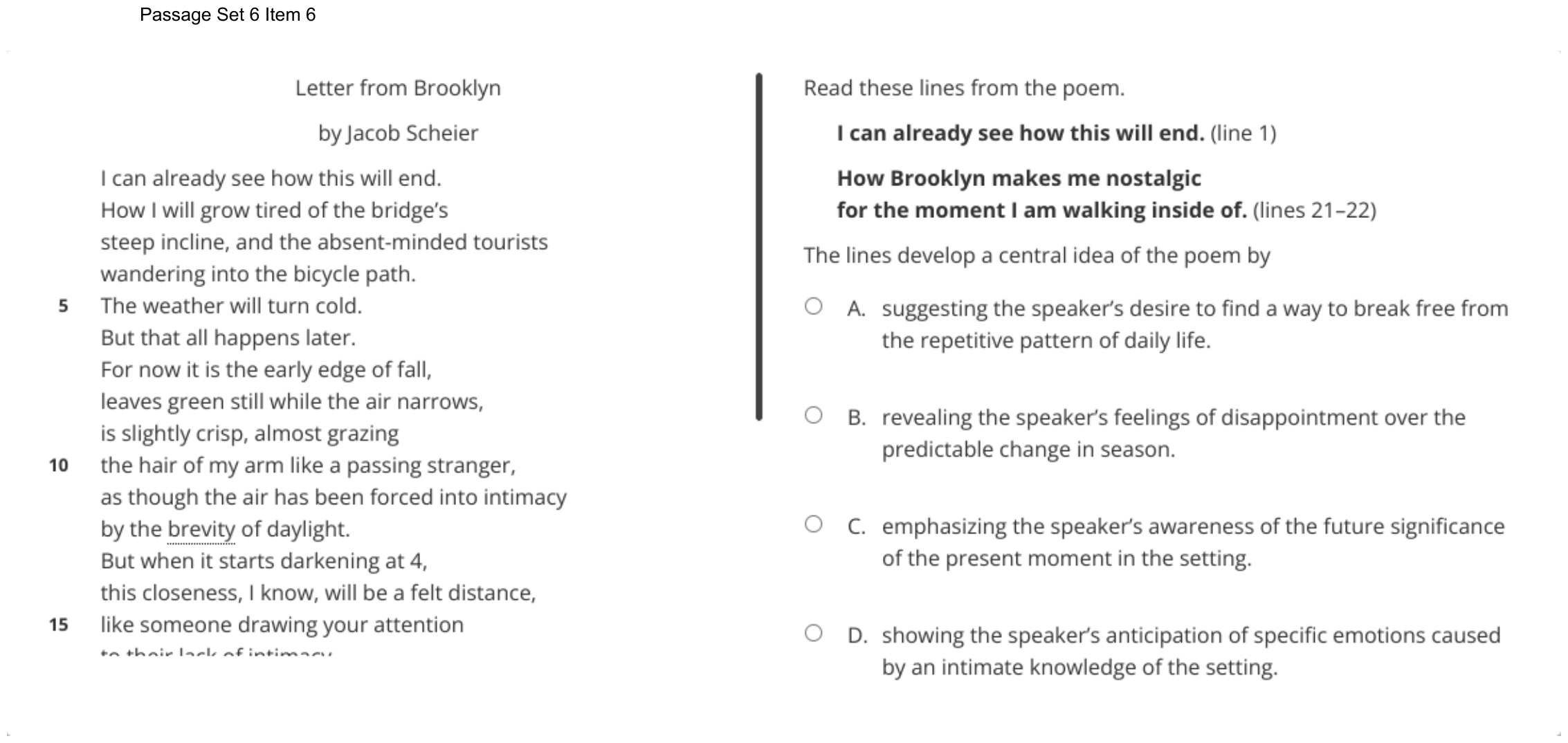
Read these lines from the poem.
I can already see how this will end. (line 1)
How Brooklyn makes me nostalgic
for the moment I am walking inside of. (lines 21–22)
The lines develop a central idea of the poem by
- Asuggesting the speaker’s desire to find a way to break free from the repetitive pattern of daily life.
- Brevealing the speaker’s feelings of disappointment over the predictable change in season.
- Cemphasizing the speaker’s awareness of the future significance of the present moment in the setting.
- Dshowing the speaker’s anticipation of specific emotions caused by an intimate knowledge of the setting.
Show the answer
Correct answer: C
The question asks how line 1 and lines 21–22 develop a central idea of the poem.
A. Incorrect. Although these lines suggest that life is governed by repetitive patterns, such as the change of seasons, they do not suggest that the speaker wishes to break free from these natural cycles of change, and a desire for freedom is not a central idea of the poem.
B. Incorrect. Although the speaker acknowledges that colder weather will inevitably bring disappointment, the speaker does not suggest in these lines that the predictability of changing weather is itself disappointing. Rather, the speaker recognizes the value of enjoying the present moment.
C. CORRECT. These lines connect the present warmer weather with the future colder weather and develop the central idea that the present “moment I am walking inside of” must be embraced because the speaker will be “nostalgic” for it in the future.
D. Incorrect. In these lines, the speaker is aware that specific emotions will occur in the future, during cold weather, but this awareness is only part of the more complex central idea of the poem, which is that current emotions and feelings must be recognized, experienced, and appreciated.
Question analysis
This central-idea question pairs the first line of “Letter from Brooklyn” with lines 21–22, where Brooklyn makes the speaker nostalgic “for the moment I am walking inside of,” and asks how they develop a central idea of the poem. Students must link excerpts from opposite ends of the poem, untangle a paradoxical image and choose among four abstract statements.
- Grade level
- Grade 8 reading and task
- Compared with grade 7
- Above grade 7 Grade 7 students analyze how lines develop a central idea. Here two excerpts twenty lines apart must be read together, one of them built on a paradox, and the four choices are long and abstract, well beyond typical grade 7 work.
- Estimated difficulty
- Among the hardest on the SHSAT: a non-obvious approach, heavy reading, or a well-hidden trap.
- Thinking it demands
- Depth of knowledge 3, strategic thinking · mainly analyze
- What makes it hard
- Figurative or literary language major
- A very close wrong answer moderate
- Evidence in several places moderate
- Evidence
- Answered from several paragraphs or stanzas
- Reading level
- Passage: 217 words (a poem; reading level not measured); question and choices: about grade 7, 99 words.
- Students, last 30 days
- Not enough answers yet to show (it takes 10).
Why it is hard, traps and wrong answers (shows the answer)
Why it is hard
This is among the hardest questions in the set because the two excerpts must be joined through a paradox and then matched to four long, abstract statements. Line 1 foresees an ending; lines 21–22 miss a moment while it is still happening, so both look at now from the future. Students who see only the foresight pick the choice about anticipated emotions, while those who hear gloom in “how this will end” settle on disappointment or a wish to escape.
Figurative or literary language major Understanding the question
Lines 21–22 are a paradox: “nostalgic,” glossed as yearning for the past, is aimed at “the moment I am walking inside of,” so the speaker already feels the present as a future memory. (Graesser, Singer & Trabasso, 1994; Kintsch, 1998)
A very close wrong answer moderate Choosing the answer
The choice about anticipating “specific emotions” shares the key’s link between future and present; it differs by tracing those feelings to knowing the setting well, which neither excerpt says. (Embretson & Wetzel, 1987; Gorin & Embretson, 2006; Ascalon et al., 2007)
Evidence in several places moderate Working it out
The excerpts are the poem’s first line and lines 21–22, twenty lines apart, and what joins them, the speaker looking ahead at the present, shows only when they are read side by side. (Kirsch & Mosenthal, 1990; Gorin & Embretson, 2006)
Strategy: Paraphrase each excerpt on its own, using the glossary's meaning of “nostalgic,” then decide what the first line and the last two share and match that to a choice.
Traps
- Half right: One half of a two-part choice is right and the other is not.
- Wrong tone or attitude: Misjudges the tone, attitude or point of view, such as reading admiration as criticism, or taking a character's or subject's feelings for the author's.
- Reads too much in: A reasonable-sounding conclusion that goes further than the text allows.
The wrong answers, classified
A Reads too much in (Graesser, Singer & Trabasso, 1994)
Links “how this will end” and growing tired of the bridge to a dull routine and imagines a wish to escape it, which the poem never expresses.
B Wrong tone or attitude (Graesser, Singer & Trabasso, 1994)
Hears resignation in “I can already see how this will end” and reads it as disappointment with the seasons, missing that the speaker treasures the present walk.
D Half right (King et al., 2004; Thissen, Steinberg & Fitzpatrick, 1989)
Rightly sees the speaker foreseeing feelings in line 1, but traces them to an “intimate knowledge of the setting,” while lines 21–22 long for the present moment itself.
Working it out, step by step
Figure out what the question asks
This question gives two pieces of the poem: line 1 and lines 21–22. You need the central idea they build together. A central idea is the main point the poem keeps working toward. Read each piece alone first, then join them.
Read line 1
Line 1 says “I can already see how this will end.” The speaker looks ahead. Lines 2–5 then list what will come: growing tired of the bridge, and the cold. So the speaker already pictures the future while living in the present.
Read lines 21–22
The lines say “How Brooklyn makes me nostalgic / for the moment I am walking inside of.” The glossary says nostalgic means “yearning for the past.” Yearning means longing. But the speaker longs for now, a moment still happening. That is a paradox, an idea that seems impossible but makes sense. The speaker knows this walk will be a precious memory.
Join the two pieces
Both pieces look at the present from the future. In line 1, the speaker sees the end coming. In lines 21–22, the speaker already misses the walk. So the speaker knows this present moment will matter later. Significance means importance.
Check each choice
- A is wrong. The speaker never wants to break free from daily routine.
- B is wrong. Line 1 can sound gloomy. But the speaker isn’t upset with the seasons. The speaker treasures the walk.
- C is right. The speaker sees that this moment in Brooklyn will be precious later.
- D is wrong. The speaker does foresee feelings. But neither piece says they come from knowing the place well.
Watch out: D gets the looking-ahead part of line 1 right. But lines 21–22 long for the moment itself, not for feelings caused by knowing the city.
Choose the answer
So the answer is C: “emphasizing the speaker’s awareness of the future significance of the present moment in the setting.”
Why this answer and not the closest wrong one
D is the closest wrong answer, because line 1 does show the speaker foreseeing feelings. But D says they come from an “intimate knowledge of the setting.” Neither piece says that. Lines 21–22 miss the moment while it is still happening. C captures that: the present will matter in the future.
More questions like this
The original DOE question
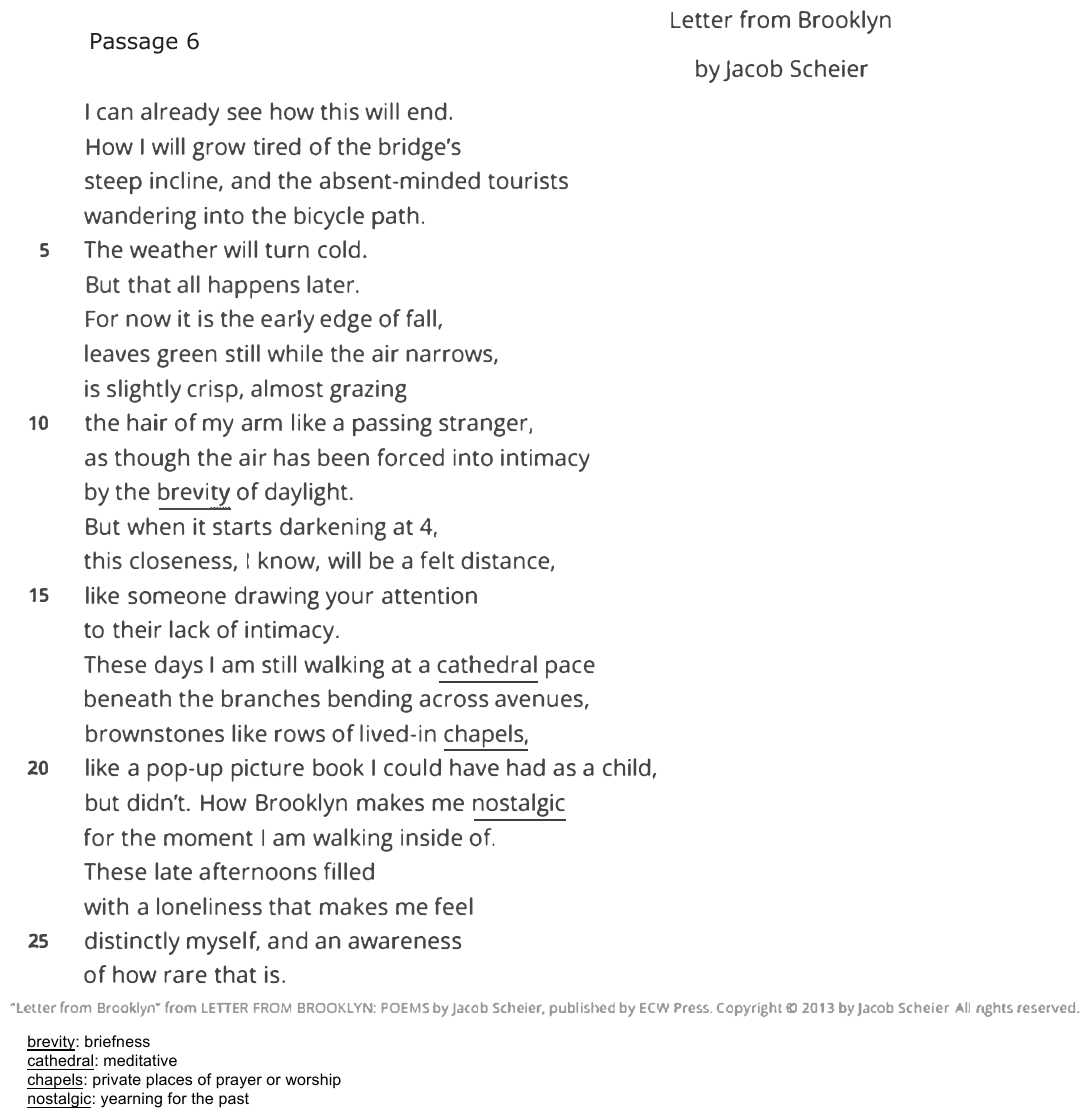
The passage “Letter from Brooklyn” as printed (page 50)
Question 2 of 6
2018 Test B English, question 48Passage Invention of the Telegraph
Samuel Morse, an American inventor, is credited with creating the electronic telegraph, a communication device that allows users to send messages using a system of short and long pulses that represent letters, numbers, and punctuation. In 1843 the United States Congress passed the Telegraph Bill, which provided Morse with the funds to build an electric telegraph system.
Invention of the Telegraph
Earlier Signal Systems
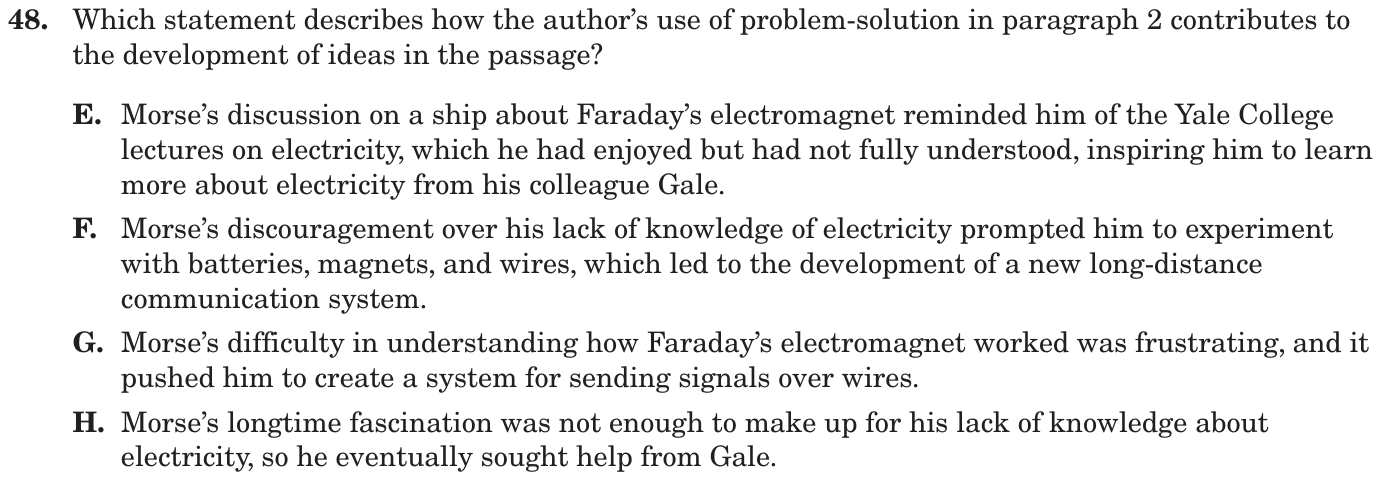
Long before Samuel F. B. Morse electrically transmitted his famous message “What hath God wrought?” from Washington to Baltimore on May 24, 1844, there were signaling systems that enabled people to communicate over distances. Most were visual or “semaphore” systems using flags or lights. In the eighteenth century, such systems used an observer who would decipher a signal from a high tower on a distant hill and then send it on to the next station. The young American republic wanted just such a system along its entire Atlantic coast and offered a prize of $30,000 for a workable proposal. The framers of this legislation had no way of knowing that when they used the word “telegraph” to refer to this visual semaphore system, they would be offered an entirely new and revolutionary means of communication—electricity.
The Growth of an Idea
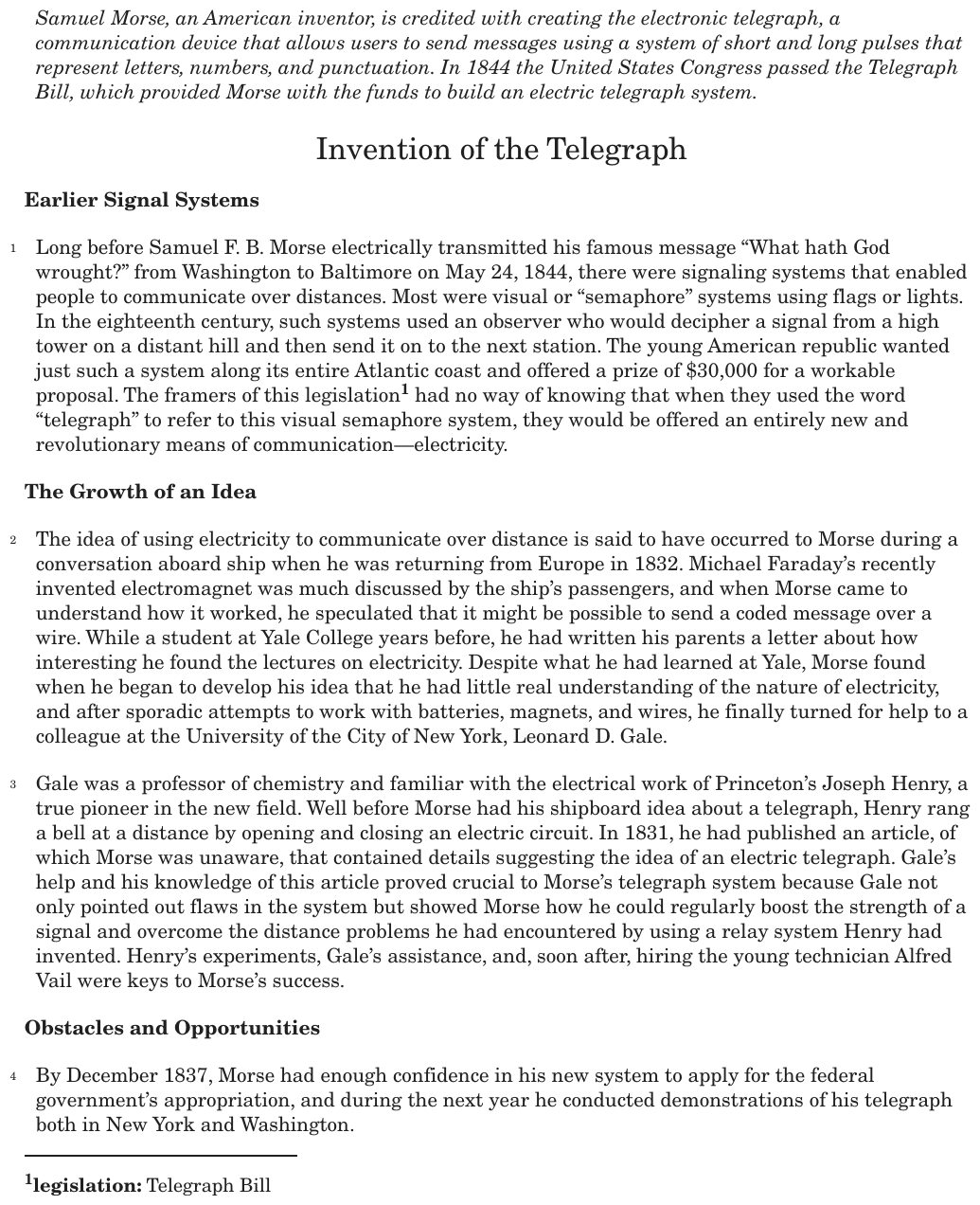
The idea of using electricity to communicate over distance is said to have occurred to Morse during a conversation aboard ship when he was returning from Europe in 1832. Michael Faraday’s recently invented electromagnet was much discussed by the ship’s passengers, and when Morse came to understand how it worked, he speculated that it might be possible to send a coded message over a wire. While a student at Yale College years before, he had written his parents a letter about how interesting he found the lectures on electricity. Despite what he had learned at Yale, Morse found when he began to develop his idea that he had little real understanding of the nature of electricity, and after sporadic attempts to work with batteries, magnets, and wires, he finally turned for help to a colleague at the University of the City of New York, Leonard D. Gale.
Gale was a professor of chemistry and familiar with the electrical work of Princeton’s Joseph Henry, a true pioneer in the new field. Well before Morse had his shipboard idea about a telegraph, Henry rang a bell at a distance by opening and closing an electric circuit. In 1831, he had published an article, of which Morse was unaware, that contained details suggesting the idea of an electric telegraph. Gale’s help and his knowledge of this article proved crucial to Morse’s telegraph system because Gale not only pointed out flaws in the system but showed Morse how he could regularly boost the strength of a signal and overcome the distance problems he had encountered by using a relay system Henry had invented. Henry’s experiments, Gale’s assistance, and, soon after, hiring the young technician Alfred Vail were keys to Morse’s success.
Obstacles and Opportunities
By December 1837, Morse had enough confidence in his new system to apply for the federal government’s appropriation, and during the next year he conducted demonstrations of his telegraph both in New York and Washington.
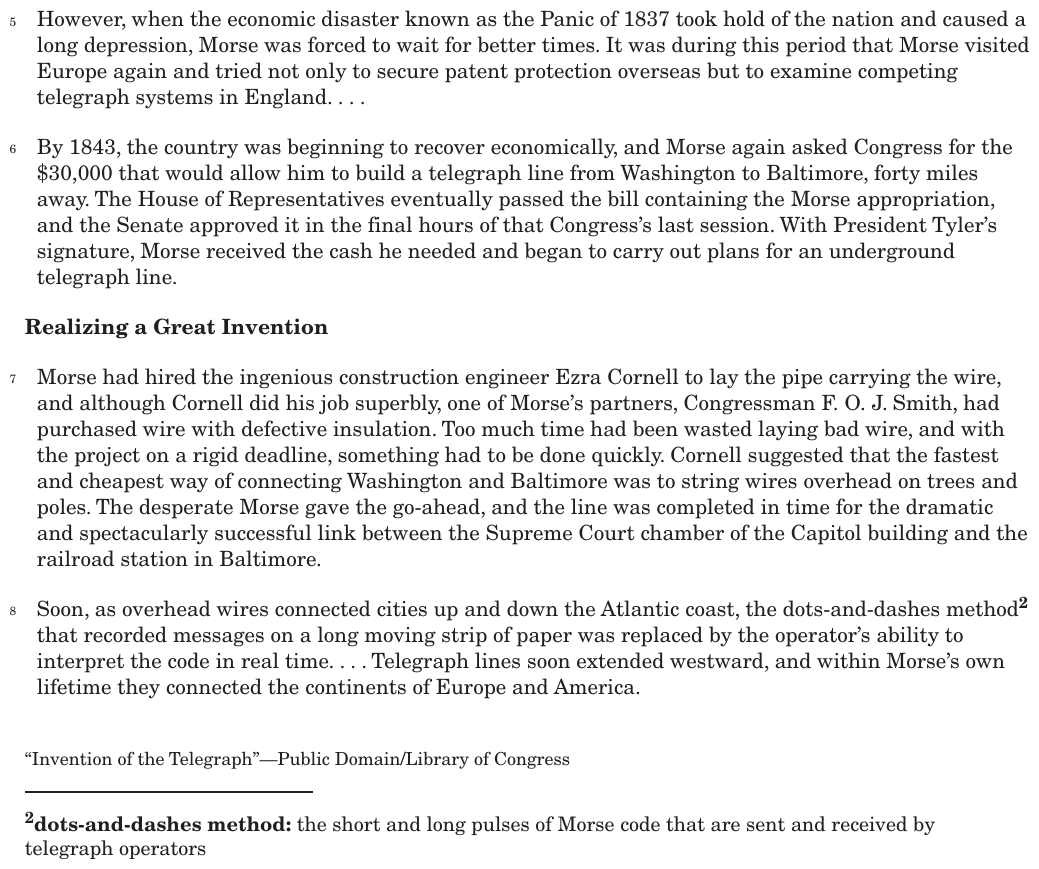
However, when the economic disaster known as the Panic of 1837 took hold of the nation and caused a long depression, Morse was forced to wait for better times. It was during this period that Morse visited Europe again and tried not only to secure patent protection overseas but to examine competing telegraph systems in England. . . .
By 1843, the country was beginning to recover economically, and Morse again asked Congress for the $30,000 that would allow him to build a telegraph line from Washington to Baltimore, forty miles away. The House of Representatives eventually passed the bill containing the Morse appropriation, and the Senate approved it in the final hours of that Congress’s last session. With President Tyler’s signature, Morse received the cash he needed and began to carry out plans for an underground telegraph line.
Realizing a Great Invention
Morse had hired the ingenious construction engineer Ezra Cornell to lay the pipe carrying the wire, and although Cornell did his job superbly, one of Morse’s partners, Congressman F. O. J. Smith, had purchased wire with defective insulation. Too much time had been wasted laying bad wire, and with the project on a rigid deadline, something had to be done quickly. Cornell suggested that the fastest and cheapest way of connecting Washington and Baltimore was to string wires overhead on trees and poles. The desperate Morse gave the go-ahead, and the line was completed in time for the dramatic and spectacularly successful link between the Supreme Court chamber of the Capitol building and the railroad station in Baltimore.
Soon, as overhead wires connected cities up and down the Atlantic coast, the dots-and-dashes method that recorded messages on a long moving strip of paper was replaced by the operator’s ability to interpret the code in real time. . . . Telegraph lines soon extended westward, and within Morse’s own lifetime they connected the continents of Europe and America.
“Invention of the Telegraph”—Public Domain/Library of Congress
legislation: Telegraph Bill
dots-and-dashes method: the short and long pulses of Morse code that are sent and received by telegraph operators
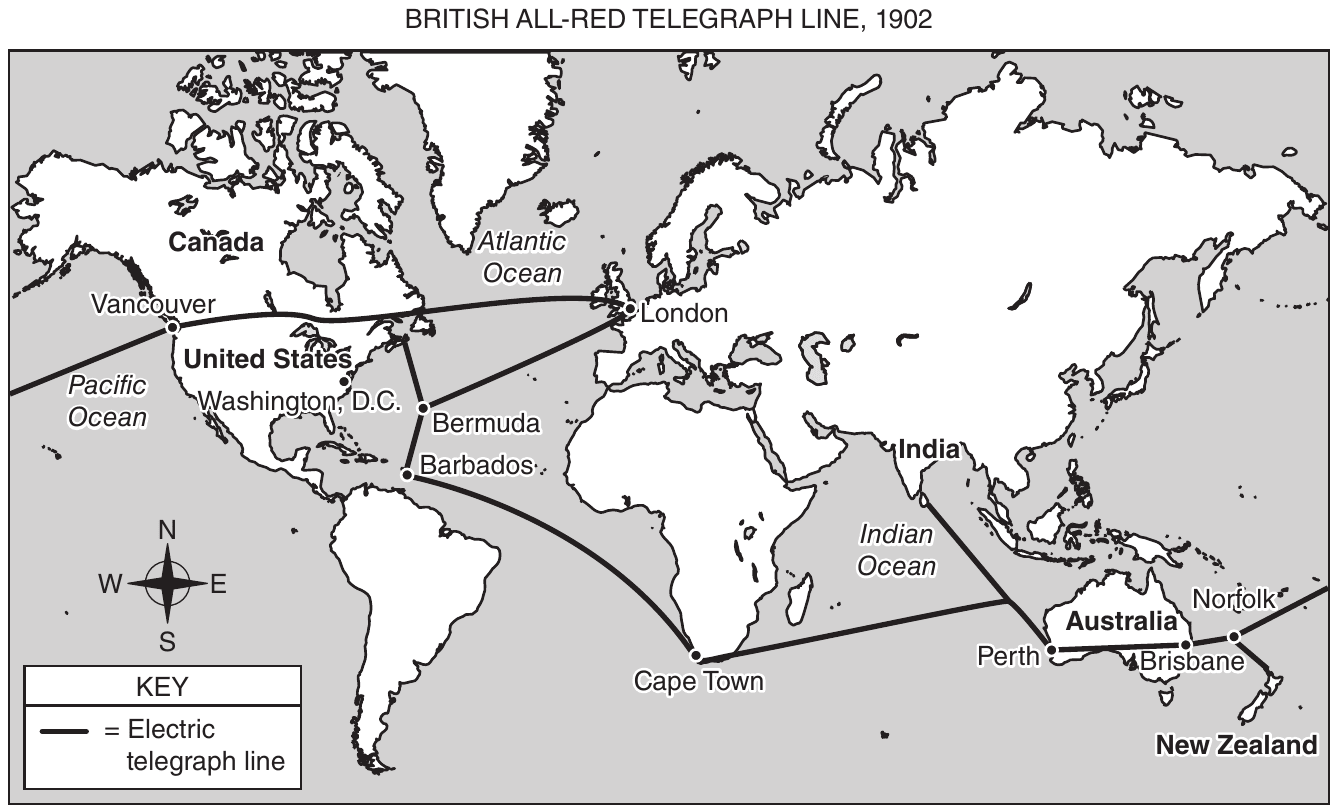
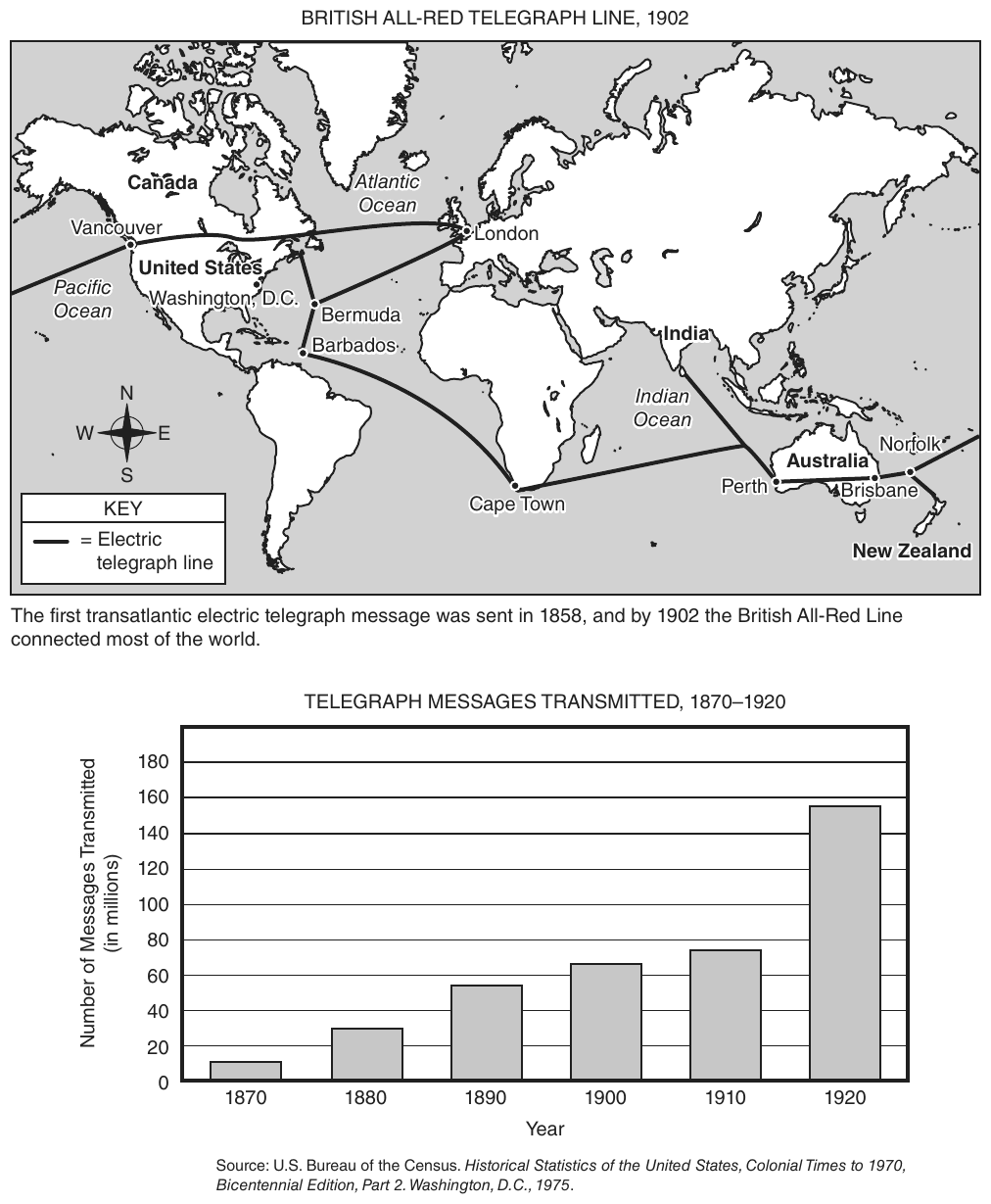
The first transatlantic electric telegraph message was sent in 1858, and by 1902 the British All-Red Line connected most of the world.
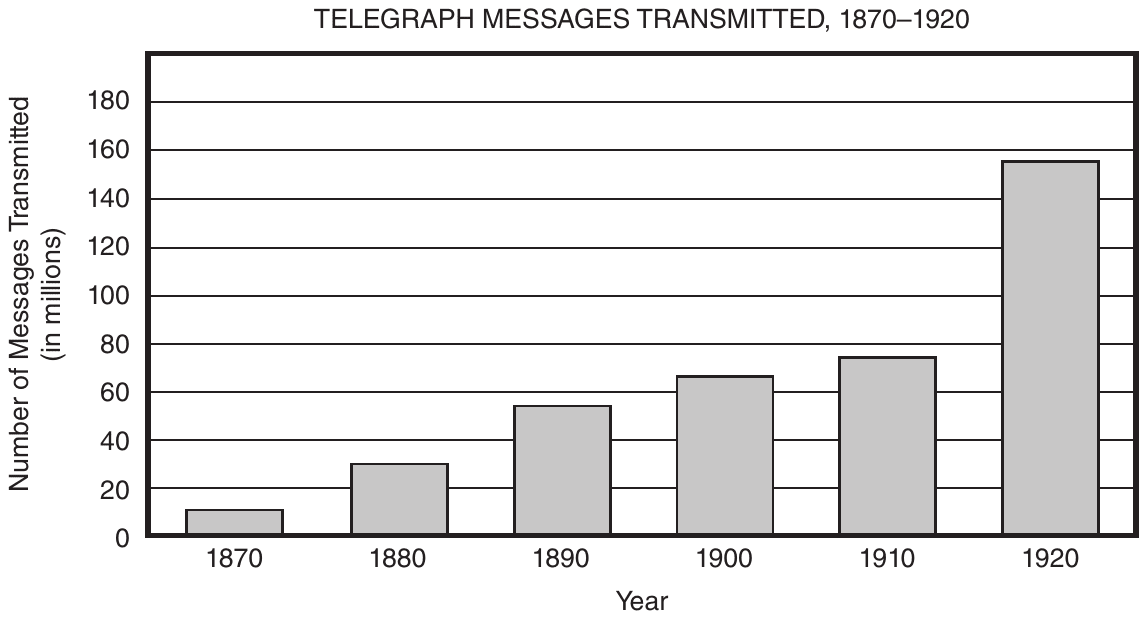
Source: U.S. Bureau of the Census. Historical Statistics of the United States, Colonial Times to 1970, Bicentennial Edition, Part 2. Washington, D.C., 1975.
Question
Which statement describes how the author’s use of problem-solution in paragraph 2 contributes to the development of ideas in the passage?
- AMorse’s discussion on a ship about Faraday’s electromagnet reminded him of the Yale College lectures on electricity, which he had enjoyed but had not fully understood, inspiring him to learn more about electricity from his colleague Gale.
- BMorse’s discouragement over his lack of knowledge of electricity prompted him to experiment with batteries, magnets, and wires, which led to the development of a new long-distance communication system.
- CMorse’s difficulty in understanding how Faraday’s electromagnet worked was frustrating, and it pushed him to create a system for sending signals over wires.
- DMorse’s longtime fascination was not enough to make up for his lack of knowledge about electricity, so he eventually sought help from Gale.
Show the answer
Correct answer: D
The question asks for the best explanation of how the use of problem-solution in paragraph 2 helps develop the ideas in the passage. Option D is correct because it explains that Morse realized his problem was that he was not knowledgeable enough to continue his experimentation without help, so the solution was to seek help from a colleague.
Option A is incorrect because, while the discussion on the ship fascinated Morse and reminded him of the lectures he had attended at Yale College, it was his failed attempts with electricity that caused him to reach out to Gale for help.
Option B is incorrect because, while “Morse found when he began to develop his idea that he had little real understanding of the nature of electricity” (paragraph 2), the paragraph does not state that he was discouraged; it was his failed experimentation that resulted in him first realizing that he needed help.
Option C is incorrect because the paragraph states that “Morse came to understand how [Faraday’s electromagnet] worked,” and that understanding is what caused him to think about sending messages over a wire. Also, Morse’s difficulty was in understanding the properties of electricity in general once he began his experimentation.
Question analysis
In this text structure question about “Invention of the Telegraph,” students explain how the problem-and-solution pattern in paragraph 2 develops ideas about Samuel Morse. All four choices are long sentences built from real details about the ship, Yale and Gale, so students must check each one’s account of what led to what.
- Grade level
- Grade 8 reading and task
- Compared with grade 7
- Above grade 7 Identifying problem and solution is familiar from earlier grades, but these choices are long, detail-packed chains in which a single misplaced cause makes an option wrong, which demands closer checking than typical grade 7 items.
- Estimated difficulty
- Hard: combines ideas, needs a plan, and has more than one tempting wrong answer.
- Thinking it demands
- Depth of knowledge 2, skills and concepts · mainly analyze
- What makes it hard
- Every choice must be checked major
- A very close wrong answer moderate
- The right answer is reworded moderate
- A lot to read moderate
- How, not what minor
- Evidence
- Answered from one paragraph or stanza
- Reading level
- Passage: about grade 11, 910 words; question and choices: about grade 16, 132 words.
- Corrected from the DOE handbook
- A wrong paragraph number in the explanation was corrected.
- A misspelled name in the explanation was corrected.
- A punctuation slip in the explanation was corrected.
- Students, last 30 days
- Not enough answers yet to show (it takes 10).
Why it is hard, traps and wrong answers (shows the answer)
Why it is hard
Every choice is assembled from things the paragraph really mentions, so recognition is useless and only the order of causes decides. The most tempting wrong choice ends with Gale, the right solution, but invents a reminder of the Yale lectures to get there; others turn the failed experiments into the solution or reverse what Morse understood. The question rewards reading each long choice clause by clause, which costs time.
Every choice must be checked major Choosing the answer
Each choice is a chain of two or three causes built from real details, the ship, Faraday, Yale, the batteries and wires, Gale, so every link has to be checked against paragraph 2’s order of events. (Embretson & Wetzel, 1987)
A very close wrong answer moderate Choosing the answer
The Yale-reminder choice and the key both join Morse’s enjoyment of electricity, his weak grasp of it and his turn to Gale; they part on one detail, the claim that the shipboard talk “reminded him” of Yale, which the paragraph never makes. (Embretson & Wetzel, 1987; Gorin & Embretson, 2006; Ascalon et al., 2007)
The right answer is reworded moderate Choosing the answer
The key turns the Yale letter and the shipboard speculation into “longtime fascination,” a phrase the passage never uses, while the wrong choices repeat its names and phrases and so look better supported. (Freedle & Kostin, 1993; Kirsch & Mosenthal, 1990)
A lot to read moderate Understanding the question
The four choices run to about 110 words, the longest 37, and paragraph 2 itself packs a voyage, a college letter, failed experiments and a colleague into four sentences. (Kintsch, 1998; Gorin & Embretson, 2006; Freedle & Kostin, 1993)
How, not what minor Working it out
Students must name the paragraph’s problem, too little understanding of electricity, and its solution, Gale, before judging which account of the pattern is accurate. (Anderson & Krathwohl, 2001)
Strategy: Name the problem and the solution in paragraph 2 in a few words each, then choose the option whose sequence of events matches the paragraph exactly.
Traps
- Reversed relationship: Cause and effect, or the order of events, turned around.
- Half right: One half of a two-part choice is right and the other is not.
The wrong answers, classified
A Half right (King et al., 2004; Thissen, Steinberg & Fitzpatrick, 1989)
Ends correctly with Morse learning from Gale, but invents its cause: the paragraph never says the shipboard talk reminded Morse of Yale, and it skips the failed experiments that sent him to Gale.
B Reversed relationship (King et al., 2004)
Reverses cause and effect: the “sporadic attempts” with batteries, magnets and wires exposed Morse’s weak grasp of electricity and sent him to Gale, rather than flowing from discouragement and producing the system.
C Twists what the text says (King et al., 2004)
Says Morse struggled to understand Faraday’s electromagnet, but the paragraph states that he “came to understand how it worked,” and that understanding is what gave him the idea.
What was corrected from the DOE handbook, and why
- Explanation: The handbook places the sentence “Morse found when he began to develop his idea that he had little real understanding of the nature of electricity” in paragraph 3. It is in paragraph 2, the paragraph the question is about, so the site now says “(paragraph 2).”
- Explanation: The handbook spells Leonard Gale’s name “Gail.” The passage spells it “Gale,” and so does the site now.
- Explanation: The handbook capitalizes “Also” after a semicolon (“over a wire; Also, Morse’s difficulty…”). The site starts a new sentence instead: “over a wire. Also, Morse’s difficulty…”
Working it out, step by step
Figure out what the question asks
This asks about problem-solution in paragraph 2. Problem-solution is a way to organize writing. First you learn about a problem, then how someone solved it. Find the problem and the solution. Then pick the choice that tells them in the right order.
Find the problem in paragraph 2
Paragraph 2 starts with “The idea of using electricity to communicate over distance.” It says Morse had enjoyed the electricity lectures at Yale. But then comes the problem: “Morse found when he began to develop his idea that he had little real understanding of the nature of electricity.”
Find the solution
The same sentence goes on: “after sporadic attempts to work with batteries, magnets, and wires, he finally turned for help to a colleague.” “Sporadic” means now and then, not steady. A colleague is a coworker. So Morse was interested in the subject, tried on his own, and did not succeed. His interest was not enough. His solution was to ask Gale for help.
Check each choice
- A is wrong. It ends with Gale, but the paragraph never says the ship talk “reminded him” of Yale. It also skips the failed tries.
- B is wrong. It has the order backward. The experiments showed the problem. They did not build the system.
- C is wrong. The paragraph says Morse “came to understand how it worked,” meaning the electromagnet.
- D fits. Long interest was not enough, so he got help from Gale.
Choose the answer
The problem was Morse’s weak grasp of electricity, and the solution was Gale. So the answer is D, “Morse’s longtime fascination was not enough to make up for his lack of knowledge about electricity, so he eventually sought help from Gale.”
Why this answer and not the closest wrong one
A is the closest trap. Like D, it mentions Yale, Morse’s weak grasp of electricity and Gale. But it adds a link the paragraph never makes, that the ship talk reminded him of Yale. With long choices, check every part. One made-up link makes the whole choice wrong.
More questions like this
The original DOE question
The passage “Invention of the Telegraph” as printed (pages 146–148)
Question 3 of 6
2024 Test A English, question 8Passage The Free College Debate
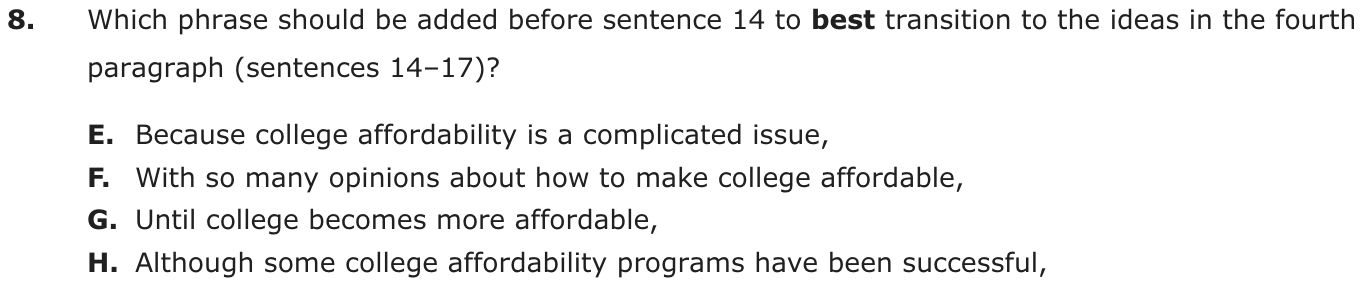
The Free College Debate
(1) A college degree has become an essential tool in an increasingly competitive job market. (2) Yet the price of higher education, at both private and public universities, continues to rise. (3) Helping students cover the cost of attending college is an important issue.
(4) Many people agree that a college education should be a financially realistic option for those who aspire to obtain a degree. (5) For example, in 2017, the New York State legislature passed a bill creating a program to cover the tuition costs for nearly one million students. (6) The state of Tennessee also has a program that offers all students scholarships and mentoring services if they attend one of the state’s community colleges. (7) Proponents generally believe that these programs are a step in the right direction for making college affordable for students who would have had to take out loans or who would have decided not to pursue higher education at all.
(8) On the other hand, some people oppose bills like the ones in New York and Tennessee because they believe “free” college programs are unsustainable. (9) In order to implement these types of programs, a state pays the college on behalf of the students using funds from the state’s budget, which primarily comes from state taxes. (10) As more students choose to attend college, more funds will be needed to cover the costs. (11) Additionally, many students do not finish college within four years because they switch majors or because they have to work. (12) Critics believe that these circumstances will inevitably lead to an increase in taxes, a decline in the quality of the education offered by the schools, or both. (13) They think narrower college-affordability efforts that target the students who need the most support, such as first-generation college students, may be more effective and viable solutions.
(14) Faculty and students at higher-education institutions can work to keep costs down. (15) In light of increased access to computers, mobile devices, and the Internet, there are more opportunities for students to take courses online, thus reducing the need for and cost of maintaining physical classrooms. (16) Additionally, colleges should account for experience by allowing students to demonstrate their knowledge in order to avoid having to pay to sit through classes on subjects they have already mastered. (17) Similarly, college-bound high school students need to be prepared for college-level work so that they do not have to spend money on remedial classes.
(18) The solutions to the problems associated with rising college costs are not simple. (19) Passing legislation that boosts college affordability will take time, input from experts with different ideas, and careful planning.
Question
Which phrase should be added before sentence 14 to best transition to the ideas in the fourth paragraph (sentences 14–17)?
- ABecause college affordability is a complicated issue,
- BWith so many opinions about how to make college affordable,
- CUntil college becomes more affordable,
- DAlthough some college affordability programs have been successful,
Show the answer
Correct answer: C
The question asks which phrase should be added before sentence 14 to best transition to the ideas in the fourth paragraph (sentences 14–17).
A. Incorrect. Sentence 13 summarizes the viewpoint of opponents, who believe that targeted approaches to funding education “may be more effective and viable solutions,” and sentence 14 serves to introduce how “faculty and students at higher-education institutions can work to keep costs down.” Affordability is “a complicated issue,” but the use of the word “Because” suggests that the ideas that follow in sentences 14–17 will explain a cause-and-effect relationship. However, sentences 14–17 discuss ways faculty and students should work together to keep the cost of college down while waiting for a long-term solution to the problem, not a causal relationship.
B. Incorrect. Sentences 4–13 provide information about the viewpoint of proponents, who believe that “a college education should be a financially realistic option for those who aspire to obtain a degree” (sentence 4), and opponents, who believe free college programs are “unsustainable” (sentence 8). Although the phrase in this option mentions “opinions,” it indicates that the fourth paragraph will discuss why the number of opinions makes affordability a debatable issue. Instead, the fourth paragraph discusses ways faculty and students can help keep costs down until a solution is reached.
C. CORRECT. Sentence 13 summarizes the viewpoint of opponents, who believe that targeted approaches to funding education “may be more effective and viable solutions,” while proponents “generally believe that these [government] programs are a step in the right direction for making college affordable” (sentence 7). However, sentences 14–17 offer three possible solutions that could alleviate the problem in the meantime. Therefore, the phrase in this option should be added before sentence 14 to best transition to the ideas in the fourth paragraph because it suggests that until the issue of affordability is resolved, alternatives are available to help make a college education more affordable.
D. Incorrect. This phrase mentions “college affordability,” a topic discussed in the fourth paragraph. However, the ideas introduced in the phrase do not logically lead into the ideas discussed in sentences 14–17, because the phrase mentions “programs [that] have been successful,” whereas the paragraph states that “faculty and students at higher-education institutions can work to keep costs down” (sentence 14) and that colleges “should account for experience by allowing students to demonstrate their knowledge in order to avoid having to pay to sit through classes on subjects they have already mastered” (sentence 16). Use of the words “can” and “should” in these sentences indicates that the actions or programs mentioned in the paragraph have not been completed.
Question analysis
This revising question asks which introductory phrase should begin the fourth paragraph of a passage on college affordability, linking the debate over state tuition programs to the cost-saving ideas that follow. All four phrases sound natural, so students must work out the relationship between the paragraphs and choose the phrase that signals it accurately.
- NYS standards
- 7W2d transitions in informative writing
- Grade level
- Grade 8 reading and task
- Compared with grade 7
- Above grade 7 Grade 7 transition work usually links two sentences with a word such as however. Here the choices are whole phrases that set up an entire paragraph, and judging them needs a grasp of the full argument, which asks more than typical grade 7 work.
- Estimated difficulty
- Hard: combines ideas, needs a plan, and has more than one tempting wrong answer.
- Thinking it demands
- Depth of knowledge 3, strategic thinking · mainly evaluate
- What makes it hard
- How sentences fit together major
- Reading between the lines moderate
- Every choice must be checked minor
- Evidence
- Answered from several paragraphs or stanzas
- Reading level
- Passage: about grade 12, 427 words; question and choices: about grade 10, 48 words.
- Students, last 30 days
- Not enough answers yet to show (it takes 10).
Why it is hard, traps and wrong answers (shows the answer)
Why it is hard
Every phrase sounds like a reasonable bridge, and the right one can even seem odd at first, since cutting costs is itself a way to make college affordable. The key is seeing paragraph 4 as what campuses can do while the debate over state programs goes on, a reading the passage confirms only at its end. Students who link back to the many opinions, or accept a causal “Because,” have found real ideas from the passage but not the relationship between these two paragraphs.
How sentences fit together major Working it out
The phrase must link paragraph 3's case against state programs to paragraph 4's steps that “can work to keep costs down,” steps that make sense only as help in the meantime. (Halliday & Hasan, 1976)
Reading between the lines moderate Working it out
Nothing says paragraph 4's ideas are stopgaps; that has to be inferred from sentences 18 and 19, which say the solutions “are not simple” and “will take time.” (Graesser, Singer & Trabasso, 1994; Kintsch, 1998)
Every choice must be checked minor Choosing the answer
All four phrases are grammatical and about affordability, so each must be read into sentence 14 and judged by the relationship its first word signals. (Embretson & Wetzel, 1987)
Strategy: Sum up paragraphs 3 and 4 in a few words each, decide how the second relates to the first, then test the relationship each phrase's opening word signals.
Traps
- Wrong transition: A connecting word or phrase that signals the wrong relationship, such as contrast where the idea continues.
The wrong answers, classified
A Wrong transition (Halliday & Hasan, 1976)
Agrees that affordability is complicated, as sentence 18 says, but “Because” makes the complexity the reason faculty and students can cut costs, a cause the paragraph never gives.
B Wrong transition (Halliday & Hasan, 1976)
Rightly looks back to the clashing views of paragraphs 2 and 3, but offers the disagreement as the ground for the steps instead of marking them as help until a solution arrives.
D Wrong transition (Halliday & Hasan, 1976)
Hears “Although” as a natural turn to a new idea, but the passage never says any program has succeeded, and paragraph 4 does not set its steps against such programs.
Working it out, step by step
Figure out what the question asks
You need a phrase to start sentence 14. It should work as a transition: a word or phrase that shows how two ideas connect. Words like “because,” “although” and “until” each show a different link. So first work out how paragraph 4 connects to what came before.
Compare paragraphs 3 and 4
Paragraph 3 ends with the critics’ view of state programs. People still disagree, so there is no fix everyone accepts yet. Paragraph 4 then says “Faculty and students at higher-education institutions can work to keep costs down.” Faculty means teachers. The paragraph lists ways to do it: online classes, skipping classes you’ve mastered, and getting ready in high school.
Use the ending as a clue
Sentences 18 and 19 say the solutions “are not simple” and “will take time.” So a big fix is still far off. That makes paragraph 4’s ideas things to do in the meantime, while people wait. The phrase “Until college becomes more affordable” says exactly that.
Check each choice
- A is wrong. “Because” shows a cause. The issue being complicated is not the reason teachers can cut costs.
- B is wrong. It makes the many opinions the reason for the steps. The passage never links them that way.
- C is right. “Until” shows these are steps to take while waiting for a bigger fix.
- D is wrong. The passage never says any program has been successful.
Watch out: B looks back at the many opinions, which really are in the passage. But it doesn’t show how paragraph 4 relates to paragraph 3.
Choose the answer
Sentence 14 would read: Until college becomes more affordable, faculty and students at higher-education institutions can work to keep costs down. So the answer is C.
Why this answer and not the closest wrong one
B is the closest wrong answer, because the passage does share many opinions. But “With so many opinions” makes the opinions sound like the reason for the cost-cutting steps. They are not. C shows the steps are help for now, while the bigger problem waits to be solved.
More questions like this
The original DOE question
The passage “The Free College Debate” as printed (page 38)
Question 4 of 6
2018 Test B Math, question 8Question
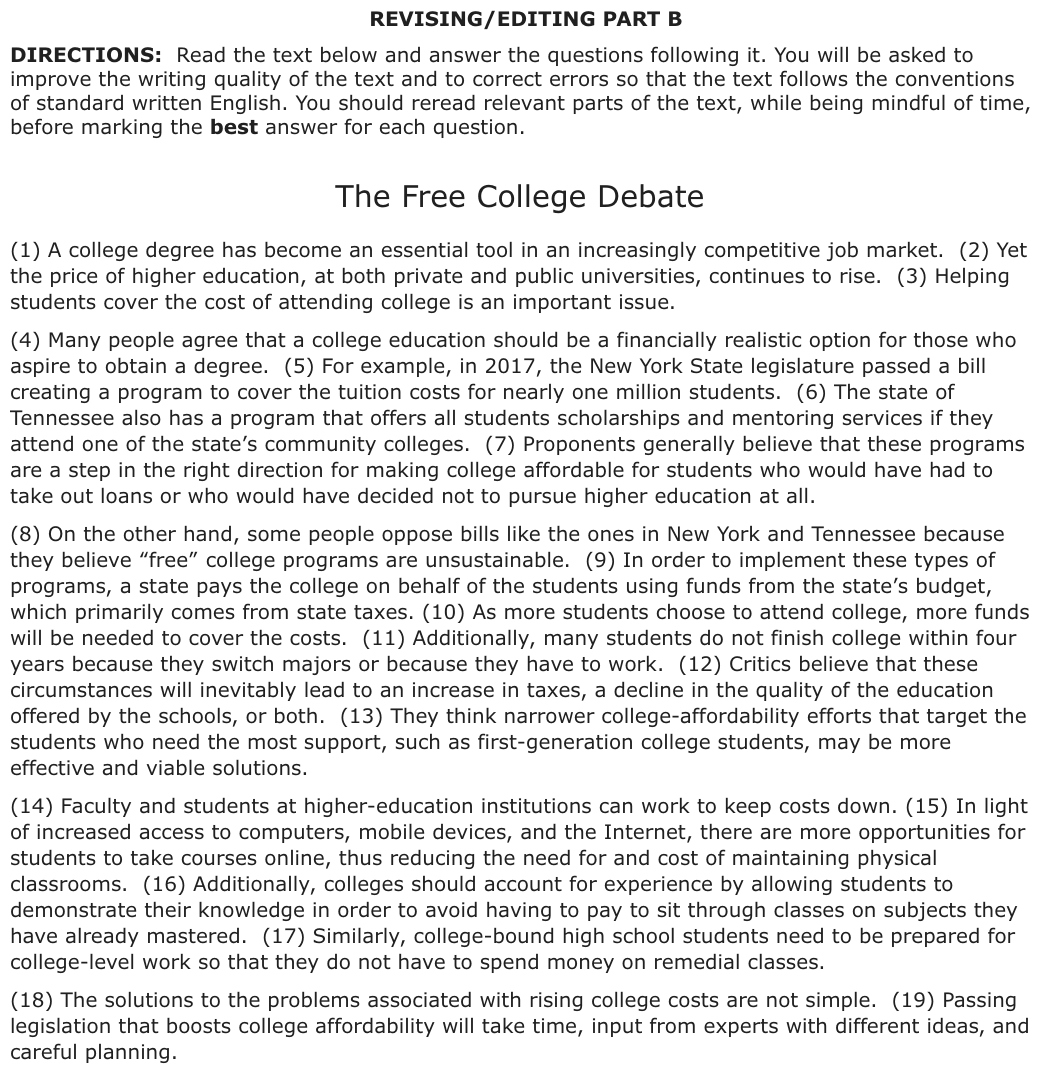
Based on the statement above, which variable has the greatest value?
- A
- B
- C
- D
Show the answer
Correct answer: D
Break the equations apart to each equal :
Pick a number to substitute into the equations, and solve the equations to find the values of , , , , and .
Let . Since all the equations are equal to 2, substitute 2 to find each variable.
Variable has the greatest value.
Question analysis
This algebra question sets five expressions equal to one another and to a positive number, then asks which variable has the greatest value. It tests whether students can rewrite each variable in terms of one shared value and compare them. What makes it tricky is that there are no numbers to compute, so each variable's size has to be reasoned out.
- Grade level
- Grade 7 content, by NYS standard
- Compared with grade 7
- Above grade 7 Grade 7 students rewrite expressions to see how quantities relate, usually one equation at a time. This chain of five linked expressions, with no numbers to compute and a positivity condition to use, is a reasoning task beyond routine grade 7 work.
- Estimated difficulty
- Hard: combines ideas, needs a plan, and has more than one tempting wrong answer.
- Thinking it demands
- Depth of knowledge 3, strategic thinking · mainly analyze
- What makes it hard
- Variables instead of numbers major
- No obvious method moderate
- Much to keep track of minor
- Solution
- 3 steps
- Reading level
- Question and choices: about grade 10, 16 words.
- Students, last 30 days
- Not enough answers yet to show (it takes 10).
Why it is hard, traps and wrong answers (shows the answer)
Why it is hard
The question rewards a strategy, not a calculation: once the shared value is named, each variable follows in one line and R is clearly largest. Without that step, students judge by how the expressions look, and the look is backwards, since the 3 in 3N makes N small and the 7 under R makes R large. The positivity condition at the end is easy to skip but is what fixes the order.
Variables instead of numbers major Understanding the question
There are no numbers to compute: five variables are tied together in the one chain M = 3N = P/4 = Q + 5 = R/7, and each must be compared through the shared value. (Koedinger & Nathan, 2004; Enright, Morley & Sheehan, 2002)
No obvious method moderate Working it out
Nothing says how to compare; the efficient move is to name the common value, or pick one such as 12, and rewrite each variable, which students must think of themselves. (Schoenfeld, 1985)
Much to keep track of minor Working it out
Five relations and the condition > 0 must be held at once; the condition matters, since with a negative common value the order of M, N, P and R would reverse. (Sweller, 1988; Carpenter, Just & Shell, 1990)
Strategy: Call the shared value k, a positive number, and rewrite each variable as an expression in k; or substitute a convenient positive value such as 12 and compare the results.
Traps
- Equation written backwards: Writes a comparison the wrong way round, word for word: "six times as many students as professors" as 6S = P. The bigger quantity gets the bigger number.
The wrong answers, classified
A Equation written backwards (Clement, Lochhead & Monk, 1981)
Reads P/4 and R/7 as a quarter and a seventh of M, the reverse of the truth, so M looks largest of all.
B Equation written backwards (Clement, Lochhead & Monk, 1981)
Reads the 3 in 3N as making N three times as large, when 3N = M actually makes N one third of M.
C Stops one step early (King et al., 2004; Gierl et al., 2017)
Correctly sees that P is four times M but stops there without checking R, which at seven times M is larger.
Worked solution, step by step
Formulas used
- Undoing division
- a is the top of the fraction, b is the bottom, and c is the result. Multiplying undoes dividing. So if a divided by b is c, then a is b times c.
- Undoing multiplication
- b is the number multiplied by a, and c is the result. Dividing undoes multiplying. So to get a alone, divide c by b.
Understand the chain
The statement is a chain of equal signs. It says five expressions all have the same value. The last part says that value is greater than 0, so it is positive.
You need to find which letter has the largest value.
Pick a value to test
All five expressions are equal, so give them one shared value. Pick a positive number that 3 divides evenly. That way N will be a whole number.
Let the shared value be 12. Then , and each of the other four expressions also equals 12.
Solve for each letter
Undo each operation to find each letter. Divide to undo times. Multiply to undo divide. Subtract to undo plus.
Compare the values
The values are M = 12, N = 4, P = 48, Q = 7 and R = 84. R is the largest.
Watch out: 3N does not make N big. It means 3 times N equals M, so N is only one third of M. That trap points to choice B. Also, P is big, but R is bigger. Check every letter before you pick choice C.
So the answer is D, R.
Check your answer
Think without numbers. R divided by 7 is M, so R is 7 times M. P is only 4 times M. N is a third of M, and Q is 5 less than M. Since M is positive, 7 times M is the biggest.
More questions like this
The original DOE question
Question 5 of 6
2024 Test A Math, question 39Question
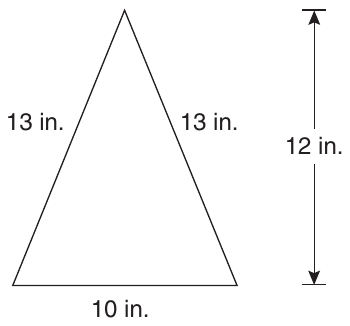
Raquel is cutting out pieces of cardboard to make a pyramid. She will use a square piece for the base and identical triangular pieces for the sides. The figure above shows the dimensions of the triangle for each side. What will be the total surface area, in square inches, of the pyramid, including the square base?
- A280
- B295
- C340
- D360
Show the answer
Correct answer: C
Surface area is found by calculating the area of each side, including the base, and adding them all together.
The base of the pyramid measures 10 inches on each side, so the area of the base is
Each triangular face has a base of 10 inches and a height of 12 inches, so the area of each face is
There are 4 triangular faces (because the square base has 4 edges, each of which will have a triangular face). So the total surface area of the pyramid is the sum of the areas of 4 triangles and 1 square.
So the total surface area is 340 square inches.
Question analysis
This surface area word problem shows one triangular face, with sides of 13 inches, a base of 10 inches and a height of 12 inches, that Raquel will use to build a cardboard pyramid with a square base. Students find the total area of the base and all the triangular sides. Picturing the solid and choosing the right measurements from the figure are the tricky parts.
- Grade level
- Grade 7 content, by NYS standard
- Compared with grade 7
- Above grade 7 Grade 7 students find the surface area of a pyramid from a drawn net or solid. Here only one triangular face is shown, so students must picture the whole pyramid, count its faces, and choose which labeled length belongs in the area formula.
- Estimated difficulty
- Hard: combines ideas, needs a plan, and has more than one tempting wrong answer.
- Thinking it demands
- Depth of knowledge 2, skills and concepts · mainly apply
- What makes it hard
- Reading a figure, table or graph moderate
- Combines ideas moderate
- Something you must already know minor
- Solution
- 4 steps
- Reading level
- Question and choices: about grade 6, 56 words.
- Corrected from the DOE handbook
- A wrong unit in the explanation was corrected.
- Students, last 30 days
- Not enough answers yet to show (it takes 10).
Why it is hard, traps and wrong answers (shows the answer)
Why it is hard
Students have to build the pyramid in their heads from one flat triangle, then choose the right measurement from three labels. The 13-inch sides look like the natural height, and using them gives a listed total; picturing a pyramid with three sloping faces gives another. Sketching the square base with a triangle on each edge, and marking 12 as the height, settles both the face count and the formula.
Reading a figure, table or graph moderate Understanding the question
The figure gives one triangle with three length labels, 13, 13 and 10, and puts its height, 12, on a separate arrow beside it, where it is easy to overlook. (Lesh, Post & Behr, 1987; Kirsch & Mosenthal, 1990)
Combines ideas moderate Working it out
The solid is never drawn: students must see that the square's side equals the triangle's 10-inch base, count four triangles, and add triangle and square areas. (Embretson, 1998; Daniel & Embretson, 2010)
Something you must already know minor Working it out
A triangle's area uses its perpendicular height, not a slanted side, and a pyramid on a square base has four triangular faces; neither fact is given. (Anderson & Krathwohl, 2001)
Strategy: Sketch the pyramid: a square base whose side is the triangle's base, and one triangular face on each side of the square. Find each area with the matching formula, then add them all.
Traps
- Misreads the figure: Reads a value, label or tick spacing in a figure, table or graph wrongly.
- Information you don't need: The question gives numbers or facts that play no part in the answer.
- Misunderstands the concept: A wrong belief about a concept: that percents can be added, that area grows like length, that averages can be averaged, that a bigger denominator means a bigger fraction.
The wrong answers, classified
A Misunderstands the concept (Smith, diSessa & Roschelle, 1993; De Bock et al., 1998; Ni & Zhou, 2005)
Counts only three triangular faces, as if the pyramid had a triangular base, so 3 × 60 + 100 = 280.
B Misunderstands the concept (Smith, diSessa & Roschelle, 1993; De Bock et al., 1998; Ni & Zhou, 2005)
Counts three faces and also uses the 13-inch side as each triangle's height: 3 × 65 + 100 = 295.
D Misreads the figure (Lesh, Post & Behr, 1987; Kirsch & Mosenthal, 1990)
Takes the 13-inch slanted side as each triangle's height instead of the 12-inch arrow beside it, so 4 × 65 + 100 = 360.
What was corrected from the DOE handbook, and why
- Explanation: The handbook ends “So the total surface area is 340 square feet.” The triangle’s dimensions are in inches and the question asks for square inches, so the site now reads “340 square inches.”
Worked solution, step by step
Formulas used
- Area of a triangle
- A is the area. b is the base, the side the triangle sits on. h is the height: the straight-up distance from the base to the top corner, at a right angle to the base. You take half because a triangle is half of a rectangle with the same base and height.
- Area of a square
- A is the area and s is the length of one side. All four sides of a square are equal, so the area is side times side.
- Surface area
- A face is one flat side of a solid shape. The surface area is the total area of the outside. Picture unfolding the solid into flat pieces. Then add up the area of every piece.
Sort out the question
Raquel’s pyramid has a square base. Each side is a triangle like the one in the figure. The triangle’s base is 10 in. Its two slanted sides are 13 in. Its height, the arrow beside it, is 12 in. You need the total surface area, including the square base, in square inches.
Picture the pyramid
Surface area is the total area of all the flat sides, called faces. Each triangle stands on one edge of the square. So each edge of the square is 10 inches, the same as the triangle’s base. A square has 4 edges, so the pyramid has 4 triangles.
Here that is 4 triangles plus 1 square. Watch out: counting only 3 triangles gives 280, choice A.
Find the area of one triangle
Each triangle is 60 square inches. Watch out: the height is 12 in., the straight-up arrow. It is not 13 in., the slanted side. Using 13 gives 65 for each triangle and 360 in all, choice D.
Find the area of the base
The base is a square with sides of 10 inches, the same as each triangle’s base.
The square base is 100 square inches.
Add all five faces
The four triangles and the square together cover 340 square inches.
So the answer is C, 340 square inches.
Check your answer
Each triangle is half of a 10 by 12 rectangle, which has an area of 120. So two triangles make 120, and four make 240. Add the base: . The units fit too: inches times inches gives square inches.
More questions like this
The original DOE question
Question 6 of 6
2024 Test B Math, question 28Question
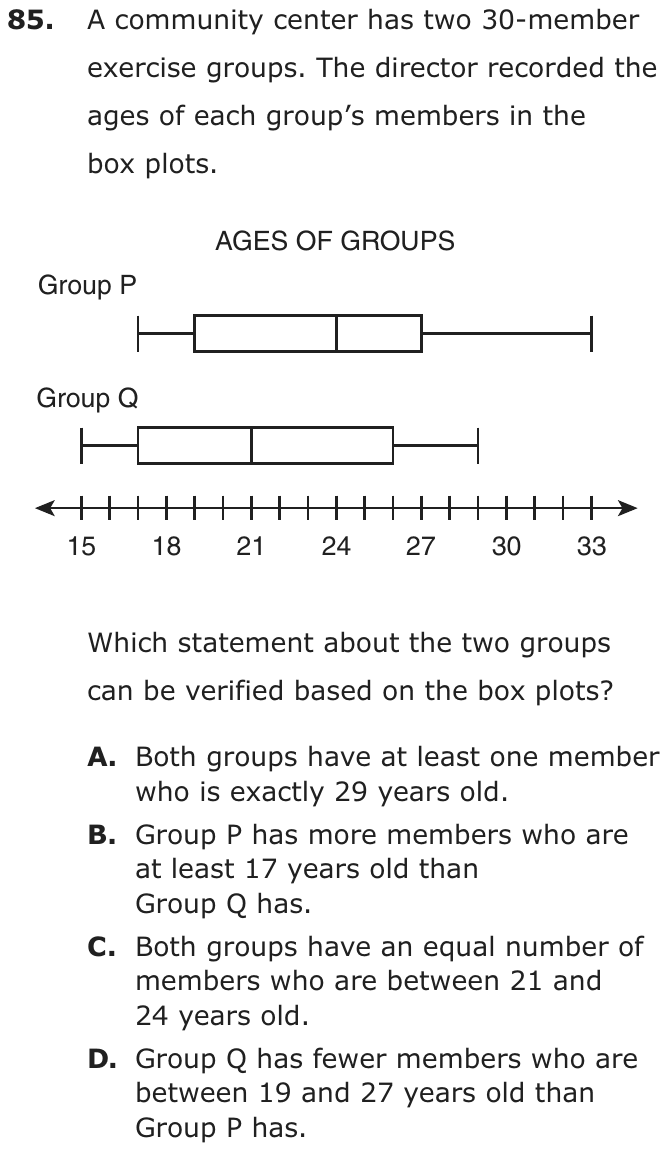
A community center has two 30-member exercise groups. The director recorded the ages of each group’s members in the box plots.
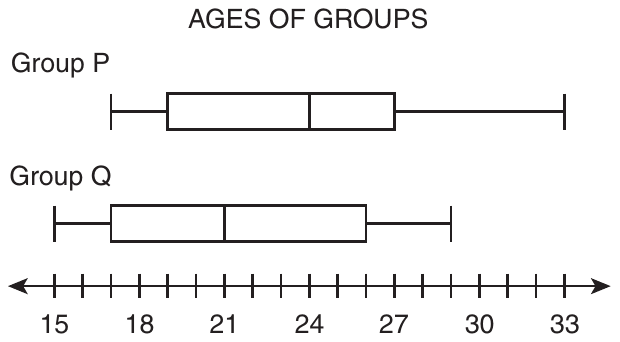
Which statement about the two groups can be verified based on the box plots?
- ABoth groups have at least one member who is exactly 29 years old.
- BGroup P has more members who are at least 17 years old than Group Q has.
- CBoth groups have an equal number of members who are between 21 and 24 years old.
- DGroup Q has fewer members who are between 19 and 27 years old than Group P has.
Show the answer
Correct answer: B
Groups P and Q have an equal number of members. All the members of Group P are 17 or older, but only about of the members of Group Q are 17 or older.
Question analysis
Box plots show the ages of the members of two 30-member exercise groups at a community center, Group P and Group Q. Students decide which statement comparing the groups can be verified from the plots alone. The challenge is knowing what a box plot guarantees about individual ages and counts, and what it leaves unknown.
- NYS standards
- Grade level
- Grade 7 content, by NYS standard
- Compared with grade 7
- Above grade 7 Grade 7 students read box plots and compare medians and spreads. Deciding which claims two box plots can prove, from what the five key values guarantee about counts, is a harder reasoning task than typical grade 7 work.
- Estimated difficulty
- Hard: combines ideas, needs a plan, and has more than one tempting wrong answer.
- Thinking it demands
- Depth of knowledge 3, strategic thinking · mainly evaluate
- What makes it hard
- Every choice must be checked major
- Something you must already know moderate
- Reading a figure, table or graph moderate
- Solution
- 3 steps
- Reading level
- Question and choices: about grade 5, 91 words.
- Students, last 30 days
- Not enough answers yet to show (it takes 10).
Why it is hard, traps and wrong answers (shows the answer)
Why it is hard
This is a question about evidence: the right statement is the only one the box plots guarantee, while the others may or may not be true. Students who treat the plots as pictures of every member, assuming ages fill each whisker or spread evenly through each box, find support for claims that cannot be checked. Asking what must hold for any 30 ages with these summaries separates the verifiable claim from the merely plausible ones.
Every choice must be checked major Choosing the answer
Three of the statements are not false but unverifiable, so each must be tested against what the five-number summaries guarantee, and none can be dismissed at a glance. (Embretson & Wetzel, 1987)
Something you must already know moderate Working it out
Students must know that the minimum and maximum are actual ages, that each quarter of a plot holds about a quarter of the 30 members, and that a whisker shows nothing in between. (Anderson & Krathwohl, 2001)
Reading a figure, table or graph moderate Understanding the question
The scale is labeled only every 3 years, so values such as 17, 19, 26 and 29 have to be read from unlabeled ticks on two separate plots. (Lesh, Post & Behr, 1987; Kirsch & Mosenthal, 1990)
Strategy: List each group's minimum, first quartile, median, third quartile and maximum, then test every statement against only what those five values guarantee about the 30 ages.
Traps
- Misunderstands the concept: A wrong belief about a concept: that percents can be added, that area grows like length, that averages can be averaged, that a bigger denominator means a bigger fraction.
- Numbers taken from the question: Combines the numbers in the question without a model of the situation, or is simply a number that appears in the question.
The wrong answers, classified
A Misunderstands the concept (Smith, diSessa & Roschelle, 1993; De Bock et al., 1998; Ni & Zhou, 2005)
Sees that Group Q's maximum is exactly 29 and that 29 also lies in Group P's upper whisker, assuming someone in Group P is that age.
C Numbers taken from the question (Hegarty, Mayer & Monk, 1995)
Matches the two medians, 21 and 24, and assumes the stretch between them holds the same number of members in both groups.
D Misunderstands the concept (Smith, diSessa & Roschelle, 1993; De Bock et al., 1998; Ni & Zhou, 2005)
Knows Group P's box from 19 to 27 holds half its members, then assumes ages spread evenly so Group Q has fewer there, which its plot cannot show.
Worked solution, step by step
Formulas used
- Members in each part of a box plot
- n is the number of members in a group, here 30. A box plot splits the data into four parts at the minimum, Q1, the median, Q3 and the maximum. Each part holds about one fourth of the data. It does not show how the ages spread out inside a part.
Read the two box plots
A box plot shows five numbers. The minimum is the youngest age, and the maximum is the oldest. Q1 is the left edge of the box, and Q3 is the right edge. The median is the line inside the box.
Group Min Q1 Median Q3 Max P 17 19 24 27 33 Q 15 17 21 26 29 Each group has 30 members.
Know what can be verified
To verify a statement means to know for sure that it is true. A box plot shows only five numbers, not every age. The minimum and maximum are real ages of real members. The other ages are hidden inside the box and whiskers.
Check choice B
In Group P, the youngest member is 17. So all 30 members are at least 17. In Group Q, the youngest member is 15, and 15 is under 17. So at most 29 members of Group Q are at least 17.
Group P has 30 such members, and Group Q has 29 or fewer. So choice B is true for sure.
Rule out choices A and C
A: Group Q’s oldest member is 29, so Group Q has a 29-year-old. But in Group P, 29 is inside the right whisker. A whisker does not show single ages. Watch out: 29 is in Group P’s range, but maybe no one in Group P is exactly 29.
C: The plots do not show how many members are between 21 and 24 in either group.
Rule out choice D and answer
Group P’s box, from 19 to 27, is two of its four parts.
So about 15 members of Group P are between 19 and 27. But 19 and 27 fall in the middle of Group Q’s parts, and ages inside a part can bunch up in any way. Group Q could have more or fewer. Watch out: D assumes the ages are spread out evenly, and a box plot never tells you that.
So the answer is B.
Check your answer
Choice B uses only the two minimums, which are real ages. Group P’s youngest member is 17, and Group Q’s is 15. That alone proves it. Each other choice needs ages inside a box or whisker, which a box plot does not show.
More questions like this
The original DOE question