3 English and 3 math
Here are 6 random questions to try. Takers earning below 75% are unlikely to receive an offer. You have 1 minute 48 seconds per question on the real exam.
Question 1 of 6
2024 Test B English, question 48Passage Snowy Mountains
Snowy Mountains
by John Gould Fletcher
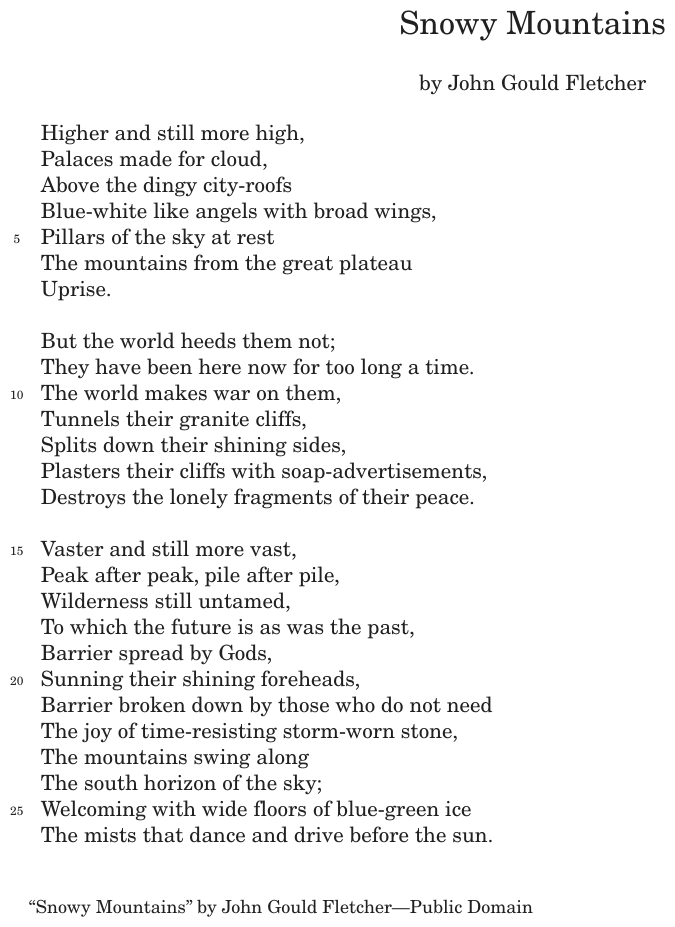
Higher and still more high,
Palaces made for cloud,
Above the dingy city-roofs
Blue-white like angels with broad wings,
Pillars of the sky at rest
The mountains from the great plateau
Uprise.
But the world heeds them not;
They have been here now for too long a time.
The world makes war on them,
Tunnels their granite cliffs,
Splits down their shining sides,
Plasters their cliffs with soap-advertisements,
Destroys the lonely fragments of their peace.
Vaster and still more vast,
Peak after peak, pile after pile,
Wilderness still untamed,
To which the future is as was the past,
Barrier spread by Gods,
Sunning their shining foreheads,
Barrier broken down by those who do not need
The joy of time-resisting storm-worn stone,
The mountains swing along
The south horizon of the sky;
Welcoming with wide floors of blue-green ice
The mists that dance and drive before the sun.
“Snowy Mountains” by John Gould Fletcher—Public Domain
Question
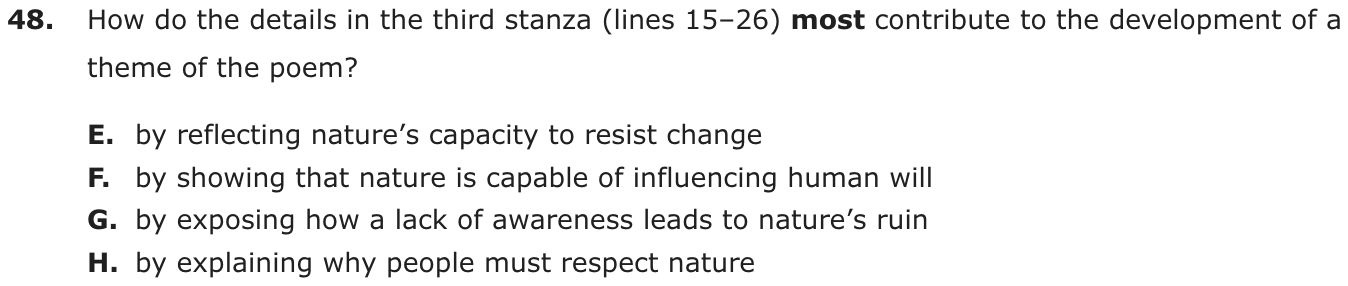
How do the details in the third stanza (lines 15–26) most contribute to the development of a theme of the poem?
- Aby reflecting nature’s capacity to resist change
- Bby showing that nature is capable of influencing human will
- Cby exposing how a lack of awareness leads to nature’s ruin
- Dby explaining why people must respect nature
Show the answer
Correct answer: A
The question asks how the details in the third stanza most contribute to the development of a theme of the poem.
A. CORRECT. In the third stanza, phrases such as “Wilderness still untamed” (line 17), “time-resisting storm-worn stone” (line 22), and “The mountains swing along” (line 23) convey the message that in spite of the destruction described in the second stanza, the mountains manage to maintain their wild magnificence.
B. Incorrect. While the phrase “Barrier broken down” (line 21) conveys the idea that people can have some effect on the natural landscape, it does not convey how nature affects people.
C. Incorrect. The phrase “those who do not need” (line 21) implies a choice to damage nature and not a lack of awareness or understanding.
D. Incorrect. The third stanza is not a call to humanity to respect the mountains but a description of the untamed, welcoming mountains and the joy they provide for those who appreciate them.
Question analysis
Students trace how the details of the third and final stanza of “Snowy Mountains,” lines 15–26, most contribute to developing a theme of the poem. Because the stanza is a single sentence that runs from line 15 to the poem’s last word, students must keep its whole movement in mind before deciding what it adds.
- Grade level
- Grade 8 reading and task
- Compared with grade 7
- Above grade 7 Grade 7 theme questions usually rest on a few clear details. Here students must hold a twelve-line stanza of inverted, piled-up phrases in mind and pick among four reasonable lessons about nature, a heavier load closer to grade 8.
- Estimated difficulty
- Hard: combines ideas, needs a plan, and has more than one tempting wrong answer.
- Thinking it demands
- Depth of knowledge 3, strategic thinking · mainly analyze
- What makes it hard
- Complex sentences moderate
- Figurative or literary language moderate
- Evidence in several places moderate
- Evidence
- Answered from one paragraph or stanza
- Reading level
- Passage: 161 words (a poem; reading level not measured); question and choices: about grade 7, 55 words.
- Students, last 30 days
- Not enough answers yet to show (it takes 10).
Why it is hard, traps and wrong answers (shows the answer)
Why it is hard
The final stanza holds both endurance and damage, and the stem’s “most” asks which of the two its details build. Students who fix on the broken barrier choose ruin, a reading the second stanza seems to confirm, while those who tally the stanza’s details find untamed wilderness, time-resisting stone and mountains swinging at ease. Because the stanza is one long, inverted sentence, that tally is slow, which is what makes the question hard.
Complex sentences moderate Understanding the question
Lines 15–26 are one sentence in which phrase after phrase, from “Vaster and still more vast” to “storm-worn stone,” comes before its subject, “The mountains,” in line 23. (Abedi & Lord, 2001; Freedle & Kostin, 1993; Messick, 1989)
Figurative or literary language moderate Understanding the question
The message of endurance is carried by personification: the peaks have “shining foreheads,” are “spread by Gods,” and “swing along” the horizon welcoming the mists. (Graesser, Singer & Trabasso, 1994; Kintsch, 1998)
Evidence in several places moderate Working it out
The theme has to be assembled from details scattered over twelve lines, “Wilderness still untamed,” “the future is as was the past,” “time-resisting,” and weighed against the single line of damage. (Kirsch & Mosenthal, 1990; Gorin & Embretson, 2006)
Strategy: Read lines 15–26 as one long sentence, find its main subject and verb, and sum up its message in a phrase; then check each choice against the whole stanza, not a single line.
Traps
- Too narrow: A single detail offered as the central idea or a summary, or a summary that keeps minor details and leaves out an essential part.
- Outside knowledge: A choice is plausible in the real world but not supported by this text.
- Reversed relationship: Cause and effect, or the order of events, turned around.
The wrong answers, classified
B Reversed relationship (King et al., 2004)
Turns the influence around: in this stanza people break down the barrier while the peaks endure, and nothing shows the mountains shaping what people want.
C Too narrow (King et al., 2004)
Builds on line 21’s “Barrier broken down,” the stanza’s one line of damage, and lets it stand for twelve lines that mostly celebrate the mountains as wild and lasting.
D Outside knowledge (King et al., 2004; Recht & Leslie, 1988)
States the lesson a nature poem is expected to teach, that people must respect nature, but the stanza describes the mountains and never tells readers what to do.
Working it out, step by step
Figure out what the question asks
This asks about theme, the big message of the poem. You need to see what the details of the third stanza, lines 15 to 26, add to that message. The word “most” matters. Pick the idea that most of the details support, not just one line.
Gather the details in lines 15 to 26
The peaks grow “Vaster and still more vast” (line 15). They are a “Wilderness still untamed” (line 17). For them, the future is “as was the past” (line 18). Their stone is “time-resisting” (line 22). In the last four lines, “The mountains swing along” the sky and welcome the mists. Only line 21 shows damage: the barrier is “broken down.”
Find what the details share
Untamed means still wild, not controlled by people. If the future is the same as the past, the mountains are not changing. Time-resisting means they hold out against the years. And at the end of the stanza, they are still moving along at ease. Nearly every detail shows the same thing. The mountains last and stay wild, which is nature’s power to resist change.
Check each choice
- A fits. Wild, unchanging, time-resisting mountains show nature holding out against change.
- B does not fit. It turns things around. In this stanza, people affect the mountains. Nothing shows the mountains changing what people want.
- C does not fit. Line 21 shows damage, but it is one line out of twelve. The stanza does not end in ruin either: the mountains still swing along and welcome the mists.
- D does not fit. These lines paint a picture of the peaks. They give readers no orders and no reasons to behave a certain way.
Choose the answer
Most of the third stanza shows mountains that stay wild and lasting. So the answer is A.
Why this answer and not the closest wrong one
C is the closest trap, because line 21 does show the barrier “broken down,” and the second stanza is full of harm. But this question is about the third stanza, and it asks what the details most add. Most of the other lines there show mountains that are vast, wild and lasting. That builds A, not ruin.
More questions like this
The original DOE question
The passage “Snowy Mountains” as printed (page 142)
Question 2 of 6
2025 Practice Test B English, question 48Passage Letter from Brooklyn
Letter from Brooklyn
by Jacob Scheier
I can already see how this will end.
How I will grow tired of the bridge’s
steep incline, and the absent-minded tourists
wandering into the bicycle path.
The weather will turn cold.
But that all happens later.
For now it is the early edge of fall,
leaves green still while the air narrows,
is slightly crisp, almost grazing
the hair of my arm like a passing stranger,
as though the air has been forced into intimacy
by the brevity of daylight.
But when it starts darkening at 4,
this closeness, I know, will be a felt distance,
like someone drawing your attention
to their lack of intimacy.
These days I am still walking at a cathedral pace
beneath the branches bending across avenues,
brownstones like rows of lived-in chapels,
like a pop-up picture book I could have had as a child,
but didn’t. How Brooklyn makes me nostalgic
for the moment I am walking inside of.
These late afternoons filled
with a loneliness that makes me feel
distinctly myself, and an awareness
of how rare that is.
“Letter from Brooklyn” from LETTER FROM BROOKLYN: POEMS by Jacob Scheier, published by ECW Press. Copyright © 2013 by Jacob Scheier All rights reserved.
brevity: briefness
cathedral: meditative
chapels: private places of prayer or worship
nostalgic: yearning for the past
Question
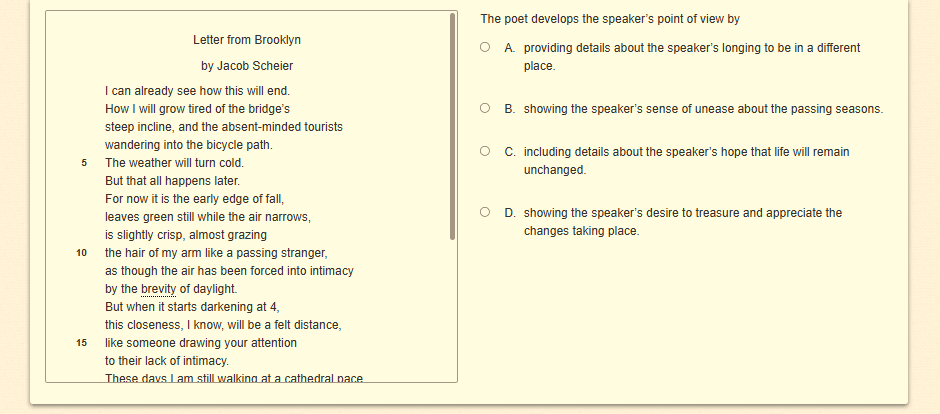
The poet develops the speaker’s point of view by
- Aproviding details about the speaker’s longing to be in a different place.
- Bshowing the speaker’s sense of unease about the passing seasons.
- Cincluding details about the speaker’s hope that life will remain unchanged.
- Dshowing the speaker’s desire to treasure and appreciate the changes taking place.
Show the answer
Correct answer: D
The question asks how the poet develops the speaker’s point of view.
A. Incorrect. The speaker concedes that at some point, Brooklyn will become tiresome (lines 2–4). However, the bulk of the poem reveals the speaker’s appreciation for experiencing Brooklyn, not a desire to be in some other place.
B. Incorrect. Cold weather is inevitable, and the speaker is well aware of this future shift as well as the change in attitude it will bring. Nevertheless, the speaker does not focus on this future but rather embraces the current season, describing it in vivid detail.
C. Incorrect. The speaker is not hopeful that life will remain unchanged. Rather, the speaker accepts and appreciates the seasonal changes that occur.
D. CORRECT. The speaker’s point of view is largely positive and appreciative of the shift in seasons. This point of view is developed by language that shows a close connection between the speaker and the setting. For example, the speaker uses words such as “intimacy” (line 11) and “closeness” (line 14) and the description of the “pop-up picture book” (line 20). Finally, the conclusion emphasizes the point of view: “These late afternoons filled / with a loneliness that makes me feel / distinctly myself, and an awareness / of how rare that is” (lines 23–26).
Question analysis
This point-of-view question asks how the poet develops the speaker’s point of view in “Letter from Brooklyn,” in which the speaker walks through the city at the start of fall knowing that colder, darker days lie ahead. The speaker’s thoughts move between the present and the future, so students must weigh the whole poem, and each choice names a different attitude.
- Grade level
- Grade 8 reading and task
- Compared with grade 7
- Above grade 7 Typical grade 7 point-of-view questions focus on one passage or stanza. This one asks for the speaker’s attitude across a whole poem of shifting moods, and several choices rest on real lines, so judging the overall view takes more than typical grade 7 work.
- Estimated difficulty
- Hard: combines ideas, needs a plan, and has more than one tempting wrong answer.
- Thinking it demands
- Depth of knowledge 3, strategic thinking · mainly analyze
- What makes it hard
- Evidence in several places moderate
- Reading between the lines moderate
- Every choice must be checked minor
- Evidence
- Answered from the whole text
- Reading level
- Passage: 217 words (a poem; reading level not measured); question and choices: about grade 7, 54 words.
- Students, last 30 days
- Not enough answers yet to show (it takes 10).
Why it is hard, traps and wrong answers (shows the answer)
Why it is hard
The poem opens by predicting its own end and returns to the coming dark in lines 13–16, so a reader who weighs those lines heavily finds unease, and the speaker does feel some. But the speaker turns back to the present each time, with “But that all happens later” and “These days I am still walking,” and the closing lines call the moment rare. The point of view is a wish to savor what is passing, and only a choice that fits the whole poem, not its most anxious lines, matches it.
Evidence in several places moderate Working it out
The point of view has to hold from line 1 to line 26 while the poem swings between the future, tiring of the bridge and darkening at 4, and the present walk under the branches. (Kirsch & Mosenthal, 1990; Gorin & Embretson, 2006)
Reading between the lines moderate Working it out
No line names the speaker’s attitude; it has to be drawn from “For now,” the walk “at a cathedral pace,” the nostalgia “for the moment I am walking inside of” and “how rare that is.” (Graesser, Singer & Trabasso, 1994; Kintsch, 1998)
Every choice must be checked minor Choosing the answer
Three wrong choices rest on real lines, tiring of the bridge’s “steep incline,” the “felt distance” of line 14 and the nostalgia of lines 21–22, so each must be weighed against the whole poem. (Embretson & Wetzel, 1987)
Strategy: Sum up in one sentence how the speaker feels about the present walk and about the season ahead, then pick the choice that holds true from the first line to the last.
Traps
- Wrong tone or attitude: Misjudges the tone, attitude or point of view, such as reading admiration as criticism, or taking a character's or subject's feelings for the author's.
- Reads too much in: A reasonable-sounding conclusion that goes further than the text allows.
- Twists what the text says: Uses the text's topic and ideas but changes what it says: who did it, how much, when, or why.
The wrong answers, classified
A Twists what the text says (King et al., 2004)
Turns the forecast that the speaker “will grow tired” of the bridge and the tourists into a present longing to be elsewhere, though the rest of the poem savors Brooklyn’s streets.
B Wrong tone or attitude (Graesser, Singer & Trabasso, 1994)
Fixes on the coming cold and the “felt distance” of lines 13–16, real notes of unease, and takes them for the whole view, though “But that all happens later” sets the future aside.
C Reads too much in (Graesser, Singer & Trabasso, 1994)
Reads nostalgia “for the moment I am walking inside of” as a wish that nothing change, though the speaker opens by accepting “how this will end” and treasures the moment because it passes.
Working it out, step by step
Figure out what the question asks
This asks about point of view: how the speaker, the voice talking in the poem, feels about what is happening. The question is about the whole poem, not a few lines. So follow the speaker’s feelings from line 1 to line 26. The right choice must fit all of it.
Follow the speaker’s thoughts
The poem moves back and forth in time. Lines 1–5 look ahead: “I can already see how this will end.” The speaker will tire of the bridge, and “The weather will turn cold.” Line 6 turns back: “But that all happens later.” Lines 7–12 describe the cool air of early fall. Lines 13–16 look ahead again, to days that get dark at 4 o’clock. Line 17 returns to now: “These days I am still walking at a cathedral pace.”
See how the speaker treats now
The glossary says cathedral means “meditative,” or calm and thoughtful. The speaker walks slowly to take everything in. Brownstones look “like a pop-up picture book.” Lines 21–22 say “How Brooklyn makes me nostalgic / for the moment I am walking inside of.” Nostalgic means “yearning for the past.” Yet the speaker longs for right now. In the last lines, even the loneliness of late afternoon is welcome. It makes the speaker feel “distinctly myself,” and aware “of how rare that is.”
Put the point of view in words
The speaker knows this season will end. That is why each moment matters. The speaker notices the first signs of fall, like the crisp air, and savors them. To treasure something is to value it highly. So the speaker wants to treasure and appreciate the changes happening now.
Check each choice
- A does not fit. Lines 2–4 say the speaker will tire of the bridge someday. But the speaker enjoys Brooklyn now and never wishes to be elsewhere.
- B does not fit. Lines 13–16 show some unease about the dark days ahead. But each time, the speaker turns back to the present.
- C does not fit. The speaker knows from line 1 that this will end, and treasures the moment because it will pass.
- D fits. The speaker savors the early-fall walk while it lasts.
Watch out: B rests on real lines: the closeness the speaker feels now “will be a felt distance” (line 14). But that is one part of the poem, not the whole view.
Choose the answer
The speaker knows the season will change and holds on to each moment of it. So the answer is D, “showing the speaker’s desire to treasure and appreciate the changes taking place.”
Why this answer and not the closest wrong one
B is the closest wrong choice, because lines 13–16 do show unease. But each time the poem looks ahead, the speaker turns back to now: “But that all happens later” and “These days I am still walking.” The poem ends by calling the moment rare. The main feeling is a wish to treasure the present, which is D.
More questions like this
The original DOE question
The passage “Letter from Brooklyn” as printed (page 50)
Question 3 of 6
2024 Test A English, question 40Passage 5 Reasons Physical Books Might Be Better Than E-Books
5 Reasons Physical Books Might Be Better Than E-Books
by Shaunacy Ferro
Though e-book1 readers have become a more common sight around town, traditional books still have their evangelists.2 According to The New York Times, e-book sales have been falling in 2015. Print definitely isn’t dead. In fact, according to some research, it may actually be a better choice for some readers. While scientists are still trying to tease out exactly how digital reading affects us differently, here are five ways e-books might be inferior to their dead-tree cousins.
E-books can reduce reading comprehension.
In a study of middle schoolers, West Chester University researchers found that students who read on iPads3 had lower reading comprehension than when they read traditional printed books. They discovered that the kids sometimes skipped text in favor of interactive features in the e-books, suggesting that certain multimedia in children’s e-books can be detrimental to the practice of reading itself. However, the researchers noted that some interactive features in e-books are designed to enhance comprehension, and that those might be more helpful than game-type interactive graphics.
Young kids can get distracted by e-books.
Similar results were found by a small study by the Joan Ganz Cooney Center that consisted of 32 kids reading e-books and print books with their parents. It found that “enhanced” e-books might be distracting. Kids who read enhanced e-books—ones with interactive, multimedia experiences—were more engaged with them physically, but in the end they remembered fewer narrative details than those who read print books or basic e-books.
You remember less about a book’s timeline.
Another study of adults also found that e-books can be hard to absorb. The researchers asked 25 people to read a 28-page story on a Kindle4 and 25 to read the story in paperback, then asked the readers to put 14 events from the story in chronological order. Those who read the story on a Kindle performed worse on the chronology test than the book readers, though they performed about the same as print readers in other tests. Earlier research by the same scholars, from Stavanger University in Norway, found that Norwegian 10th graders also remembered more about texts if they read them in print rather than on a computer screen.
They’re not great as textbooks.
While e-book textbooks are often cheaper (and easier to carry) than traditional door-stop5 textbooks, college students often don’t prefer them. In some surveys of college kids, the majority of students have reported preferring print books. However, a 2012 study from the UK’s National Literacy Trust of kids ages 8 to 16 found that more than 50 percent of children reported preferring screen reading.
They’re tiring.
Staring at a lit screen can be tiring for the eyes and the brain. A 2005 study from Sweden found that reading digitally required a higher cognitive workload than reading on paper. Furthermore, staring at LED6 screens at night can disrupt sleep patterns. A 2014 Harvard study found that people who used e-readers with LED screens at night slept worse and were more tired the next day. So, if you’re going to go for an e-book, go for one without the backlight.
The take-away message? If you’re really trying to absorb material, you might want to go for a physical book. And if you’re going to be up all night studying, turn off the backlight.
However, all this may not mean that reading on a Kindle is really going to melt your brain. For instance, reading an e-book on a computer is a much different experience than reading on a Kindle, which is specifically designed for consuming books. So, too, is playing with an interactive e-book on an iPad, compared to using a simpler e-book device that only presents the text, with no opportunities to click away into digital distractions.
And some studies have found that part of the difference between the way people absorb information from e-books versus paper might be due to approaching e-books differently—in one test, participants didn’t regulate their study time with digital books like they did with paper texts, leading to worse performances. It’s possible that our expectations of e-book reading—as well as the different designs of the digital reading experience on a computer or iPad or Kindle—might affect how we approach the text and how much effort we put into studying them. As generations of e-book readers evolve, and people become more accustomed to the idea of sitting down with a digital textbook, these factors could change—for better or for worse.
“5 Reasons Physical Books Might Be Better Than E-Books” by Shaunacy Ferro from MENTAL FLOSS, October 2, 2015. Copyright © 2015 Mental Floss, Inc.
1e-book: an electronic book, a publication made available digitally for reading on a computer or other device
2evangelists: advocates or supporters
3iPads: tablet computers
4Kindle: device for reading e-books
5door-stop: a reference to the idea that some textbooks are large and heavy enough to hold a door open
6LED: Light-emitting diode; LEDs are often used as a backlight for electronic devices such as smart phones and tablets.
Question
The studies described in paragraph 6 are important to the author’s observations in paragraphs 7 and 8 because the findings
- Ashow that the author has personal opinions to share beyond the ideas included in the studies.
- Bgive the author the opportunity to reach practical conclusions about reading that are based on scientific evidence.
- Chighlight the author’s statement that digital reading experiences vary based on the individual and the device.
- Dsupport the author’s inference that more studies on more types of devices are needed.
Show the answer
Correct answer: B
The question asks how the findings from the studies described in paragraph 6 are important to the author’s observations in paragraphs 7 and 8.
A. Incorrect. The evidence from the studies mentioned in paragraph 6 is not substantially supported by the personal opinions the author shares in paragraph 7 (“And if you’re going to be up all night studying, turn off the backlight”) or in paragraph 8 (“melt your brain” and “digital distractions”).
B. CORRECT. In paragraph 6, the author cites studies from 2005 and 2014 that found that LED screens can “disrupt sleep patterns” and that “people who used e-readers with LED screens at night slept worse and were more tired the next day.” Then, in paragraph 7, the author suggests that “if you’re going to be up all night studying, turn off the backlight,” and in paragraph 8, the author explains some differences between reading e-books on various devices. This information is not based on a personal opinion; instead, it is based on practical conclusions drawn from scientific evidence.
C. Incorrect. In paragraph 6, the author cites a 2005 study in which researchers found that “reading digitally required a higher cognitive workload than reading on paper.” Then, in paragraph 8, the author concludes that “reading an e-book on a computer is a much different experience than reading on a Kindle, which is specifically designed for consuming books.” Although the findings in paragraph 6 are important, they do not highlight the information presented by the author that digital reading experiences vary based on the reader and the device.
D. Incorrect. The author states in paragraph 8 that “reading an e-book on a computer is a much different experience than reading on a Kindle” and mentions how the same thing is true for “an interactive e-book on an iPad” compared with an e-book on “a simpler e-book device.” Readers may conclude that this statement is meant to indicate the author’s belief that more studies on more types of devices are needed. However, the author does not state or imply this belief in the passage.
Question analysis
This question asks why the studies on screen fatigue and sleep in paragraph 6 of an article about e-books matter to the observations the author makes in the next two paragraphs. Students must trace the connection between the research and the later paragraphs, and each choice describes that link in abstract terms that are easy to confuse.
- Grade level
- Grade 8 reading and task
- Compared with grade 7
- Above grade 7 Tracing how evidence leads to an author's conclusions is grade 7 argument work, but this item spans three paragraphs, and the four explanations of the link are abstract and close in wording, more demanding than typical grade 7 work.
- Estimated difficulty
- Hard: combines ideas, needs a plan, and has more than one tempting wrong answer.
- Thinking it demands
- Depth of knowledge 3, strategic thinking · mainly analyze
- What makes it hard
- How, not what major
- Evidence in several places moderate
- The right answer is reworded minor
- Evidence
- Answered from several paragraphs or stanzas
- Reading level
- Passage: about grade 10, 829 words; question and choices: about grade 11, 80 words.
- Students, last 30 days
- Not enough answers yet to show (it takes 10).
Why it is hard, traps and wrong answers (shows the answer)
Why it is hard
Every choice describes a link between evidence and commentary, so the student has to know both what paragraph 6 found and what paragraphs 7 and 8 do with it. The tempting wrong answer borrows paragraph 8's real point that devices differ and wrongly credits the sleep and workload studies with it. Seeing that the backlight advice comes straight from the Harvard study is what makes the general wording of the right choice convincing.
How, not what major Working it out
The question asks how paragraph 6's findings function for the paragraphs after them, a relationship between evidence and conclusion, so knowing what the sleep and workload studies found is only the first step. (Anderson & Krathwohl, 2001)
Evidence in several places moderate Working it out
The links run across three paragraphs: the Harvard backlight finding becomes “turn off the backlight” in paragraph 7, and the tired brain returns as “melt your brain” in paragraph 8. (Kirsch & Mosenthal, 1990; Gorin & Embretson, 2006)
The right answer is reworded minor Choosing the answer
The right choice names no study, screen or device, speaking only of “practical conclusions” and “scientific evidence”, while two wrong choices echo paragraph 8's talk of devices. (Freedle & Kostin, 1993; Kirsch & Mosenthal, 1990)
Strategy: Note what the paragraph 6 studies found, then find the sentences in paragraphs 7 and 8 that draw on those findings and describe what the author does with them.
Traps
- Half right: One half of a two-part choice is right and the other is not.
- Reads too much in: A reasonable-sounding conclusion that goes further than the text allows.
- Wrong purpose or structure: Names a purpose, structure or effect that the part does not serve, or describes what a part says when the question asks what it does.
The wrong answers, classified
A Wrong purpose or structure (Anderson & Krathwohl, 2001)
Treats the casual phrases of paragraphs 7 and 8, such as “melt your brain”, as opinions beyond the research, when the advice there grows directly out of the studies.
C Half right (King et al., 2004; Thissen, Steinberg & Fitzpatrick, 1989)
Gets paragraph 8's point about devices right but adds variation by individual, which paragraphs 7 and 8 never mention, and the studies in paragraph 6 compare screens with paper, not readers.
D Reads too much in (Graesser, Singer & Trabasso, 1994)
Infers from paragraph 8's device comparisons that the author wants more research on more devices, a sensible thought that the passage never states.
Working it out, step by step
Understand the link asked about
This asks how evidence connects to the author’s comments. First see what the studies in paragraph 6 found. Then see what the author does with those findings in paragraphs 7 and 8.
Read the studies in paragraph 6
A 2005 study found that “reading digitally required a higher cognitive workload.” Cognitive workload means how hard your brain has to work. A 2014 study found that people who read on lit screens at night “slept worse and were more tired the next day.”
See how the author uses them
In paragraph 7 the author advises, “if you’re going to be up all night studying, turn off the backlight.” That tip comes straight from the sleep study. Paragraph 8 then warns you not to take the findings too far. It says they “may not mean that reading on a Kindle is really going to melt your brain.” Both are practical, real-life conclusions drawn from science.
Check each choice
- B fits: the studies let the author reach “practical conclusions” based on “scientific evidence.”
- A is wrong because the advice in paragraphs 7 and 8 grows out of the studies, not out of opinions beyond them.
- C is wrong because nothing says reading changes from person to person, and the studies compare screens with paper.
- D is wrong because the author never says more studies are needed.
Watch out: C is half right. Paragraph 8 does say devices differ, but the part about each person is never stated.
Choose the answer
The findings in paragraph 6 lead straight to the author’s practical advice. So the answer is B.
Why this answer and not the closest wrong one
C comes closest, because paragraph 8 does say a computer and a Kindle feel different. But the studies in paragraph 6 compare screens with paper, and no one says reading changes from person to person. B fits the clear link: a sleep study turned into the advice to turn off the backlight.
More questions like this
The original DOE question
The passage “5 Reasons Physical Books Might Be Better Than E-Books” as printed (pages 58–59)
Question 4 of 6
2024 Test A Math, question 39Question
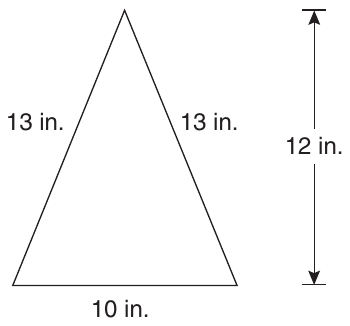
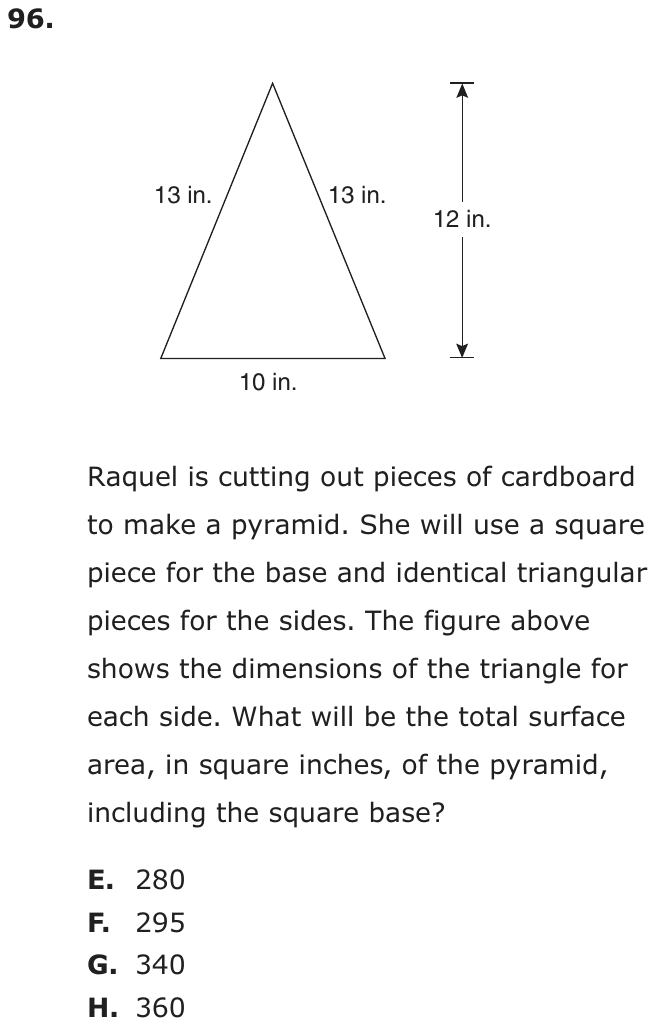
Raquel is cutting out pieces of cardboard to make a pyramid. She will use a square piece for the base and identical triangular pieces for the sides. The figure above shows the dimensions of the triangle for each side. What will be the total surface area, in square inches, of the pyramid, including the square base?
- A280
- B295
- C340
- D360
Show the answer
Correct answer: C
Surface area is found by calculating the area of each side, including the base, and adding them all together.
The base of the pyramid measures 10 inches on each side, so the area of the base is
Each triangular face has a base of 10 inches and a height of 12 inches, so the area of each face is
There are 4 triangular faces (because the square base has 4 edges, each of which will have a triangular face). So the total surface area of the pyramid is the sum of the areas of 4 triangles and 1 square.
So the total surface area is 340 square inches.
Question analysis
This surface area word problem shows one triangular face, with sides of 13 inches, a base of 10 inches and a height of 12 inches, that Raquel will use to build a cardboard pyramid with a square base. Students find the total area of the base and all the triangular sides. Picturing the solid and choosing the right measurements from the figure are the tricky parts.
- Grade level
- Grade 7 content, by NYS standard
- Compared with grade 7
- Above grade 7 Grade 7 students find the surface area of a pyramid from a drawn net or solid. Here only one triangular face is shown, so students must picture the whole pyramid, count its faces, and choose which labeled length belongs in the area formula.
- Estimated difficulty
- Hard: combines ideas, needs a plan, and has more than one tempting wrong answer.
- Thinking it demands
- Depth of knowledge 2, skills and concepts · mainly apply
- What makes it hard
- Reading a figure, table or graph moderate
- Combines ideas moderate
- Something you must already know minor
- Solution
- 4 steps
- Reading level
- Question and choices: about grade 6, 56 words.
- Corrected from the DOE handbook
- A wrong unit in the explanation was corrected.
- Students, last 30 days
- Not enough answers yet to show (it takes 10).
Why it is hard, traps and wrong answers (shows the answer)
Why it is hard
Students have to build the pyramid in their heads from one flat triangle, then choose the right measurement from three labels. The 13-inch sides look like the natural height, and using them gives a listed total; picturing a pyramid with three sloping faces gives another. Sketching the square base with a triangle on each edge, and marking 12 as the height, settles both the face count and the formula.
Reading a figure, table or graph moderate Understanding the question
The figure gives one triangle with three length labels, 13, 13 and 10, and puts its height, 12, on a separate arrow beside it, where it is easy to overlook. (Lesh, Post & Behr, 1987; Kirsch & Mosenthal, 1990)
Combines ideas moderate Working it out
The solid is never drawn: students must see that the square's side equals the triangle's 10-inch base, count four triangles, and add triangle and square areas. (Embretson, 1998; Daniel & Embretson, 2010)
Something you must already know minor Working it out
A triangle's area uses its perpendicular height, not a slanted side, and a pyramid on a square base has four triangular faces; neither fact is given. (Anderson & Krathwohl, 2001)
Strategy: Sketch the pyramid: a square base whose side is the triangle's base, and one triangular face on each side of the square. Find each area with the matching formula, then add them all.
Traps
- Misreads the figure: Reads a value, label or tick spacing in a figure, table or graph wrongly.
- Information you don't need: The question gives numbers or facts that play no part in the answer.
- Misunderstands the concept: A wrong belief about a concept: that percents can be added, that area grows like length, that averages can be averaged, that a bigger denominator means a bigger fraction.
The wrong answers, classified
A Misunderstands the concept (Smith, diSessa & Roschelle, 1993; De Bock et al., 1998; Ni & Zhou, 2005)
Counts only three triangular faces, as if the pyramid had a triangular base, so 3 × 60 + 100 = 280.
B Misunderstands the concept (Smith, diSessa & Roschelle, 1993; De Bock et al., 1998; Ni & Zhou, 2005)
Counts three faces and also uses the 13-inch side as each triangle's height: 3 × 65 + 100 = 295.
D Misreads the figure (Lesh, Post & Behr, 1987; Kirsch & Mosenthal, 1990)
Takes the 13-inch slanted side as each triangle's height instead of the 12-inch arrow beside it, so 4 × 65 + 100 = 360.
What was corrected from the DOE handbook, and why
- Explanation: The handbook ends “So the total surface area is 340 square feet.” The triangle’s dimensions are in inches and the question asks for square inches, so the site now reads “340 square inches.”
Worked solution, step by step
Formulas used
- Area of a triangle
- A is the area. b is the base, the side the triangle sits on. h is the height: the straight-up distance from the base to the top corner, at a right angle to the base. You take half because a triangle is half of a rectangle with the same base and height.
- Area of a square
- A is the area and s is the length of one side. All four sides of a square are equal, so the area is side times side.
- Surface area
- A face is one flat side of a solid shape. The surface area is the total area of the outside. Picture unfolding the solid into flat pieces. Then add up the area of every piece.
Sort out the question
Raquel’s pyramid has a square base. Each side is a triangle like the one in the figure. The triangle’s base is 10 in. Its two slanted sides are 13 in. Its height, the arrow beside it, is 12 in. You need the total surface area, including the square base, in square inches.
Picture the pyramid
Surface area is the total area of all the flat sides, called faces. Each triangle stands on one edge of the square. So each edge of the square is 10 inches, the same as the triangle’s base. A square has 4 edges, so the pyramid has 4 triangles.
Here that is 4 triangles plus 1 square. Watch out: counting only 3 triangles gives 280, choice A.
Find the area of one triangle
Each triangle is 60 square inches. Watch out: the height is 12 in., the straight-up arrow. It is not 13 in., the slanted side. Using 13 gives 65 for each triangle and 360 in all, choice D.
Find the area of the base
The base is a square with sides of 10 inches, the same as each triangle’s base.
The square base is 100 square inches.
Add all five faces
The four triangles and the square together cover 340 square inches.
So the answer is C, 340 square inches.
Check your answer
Each triangle is half of a 10 by 12 rectangle, which has an area of 120. So two triangles make 120, and four make 240. Add the base: . The units fit too: inches times inches gives square inches.
More questions like this
The original DOE question
Question 5 of 6
2026 Practice Test D Math, question 36Question
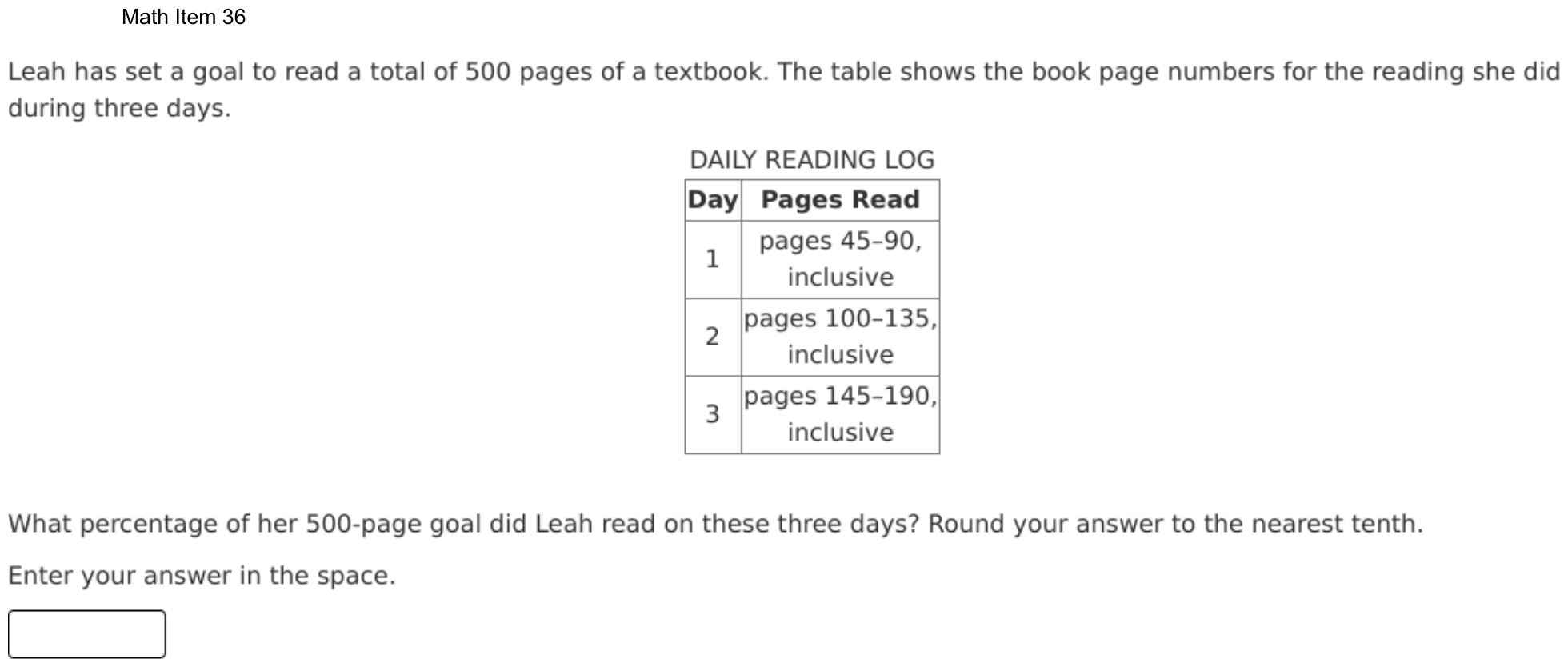
Leah has set a goal to read a total of 500 pages of a textbook. The table shows the book page numbers for the reading she did during three days.
DAILY READING LOG
| Day | Pages Read |
|---|---|
| 1 | pages 45–90, inclusive |
| 2 | pages 100–135, inclusive |
| 3 | pages 145–190, inclusive |
What percentage of her 500-page goal did Leah read on these three days? Round your answer to the nearest tenth.
Enter your answer in the space.
Fill-in question: work out the answer and type it as a number.
Show the answer
Correct answer: 25.6%
First, determine the number of pages read each day. Since the pages per assignment are inclusive, subtract the first page from the last page assigned and then add 1 to determine the pages read for each day.
Day 1: pages
Day 2: pages
Day 3: pages
Leah read a total of 128 pages, since .
To determine the percent, express 128 pages out of 500 pages as a fraction.
Question analysis
Leah's daily reading log lists three ranges of textbook pages, each marked inclusive, and her goal is 500 pages. This percent question asks what percentage of the goal she read over the three days, rounded to the nearest tenth and typed in. Counting the pages in each inclusive range correctly is the tricky step before the percent.
- Grade level
- Grade 7 content, by NYS standard
- Compared with grade 7
- Above grade 7 Finding what percent one number is of another is grade 6 and 7 work. This adds three inclusive page ranges to count, which takes more care than subtracting, then a rounding step, all typed with no choices to check against.
- Estimated difficulty
- Hard: combines ideas, needs a plan, and has more than one tempting wrong answer.
- Thinking it demands
- Depth of knowledge 2, skills and concepts · mainly apply
- What makes it hard
- Something you must already know moderate
- Many steps moderate
- An answer in an unexpected form minor
- Solution
- 4 steps
- Reading level
- Question and choices: about grade 3, 66 words.
- Students, last 30 days
- Not enough answers yet to show (it takes 10).
Why it is hard, traps and wrong answers (shows the answer)
Why it is hard
Counting pages in a range is the whole difficulty; the percent at the end is routine once the total is right. Subtracting first from last feels natural, and here it even rewards the student with a round 25%, so nothing looks wrong. Checking the rule on a tiny range, pages 1 to 3, which is 3 pages and not 2, fixes the count, and the instruction to round to the nearest tenth hints that the answer is not a whole number.
Something you must already know moderate Working it out
Every row says inclusive, but nothing says that pages 45 to 90 hold 90 − 45 + 1 = 46 pages; subtracting alone loses one page on each of the three days. (Anderson & Krathwohl, 2001)
Many steps moderate Working it out
Three page counts, a sum, a division by 500 and a change to a percent come in sequence, and a one-page error in each count carries through to the end. (Daniel & Embretson, 2010; Enright, Morley & Sheehan, 2002)
An answer in an unexpected form minor Choosing the answer
The answer is typed with no choices, and the miscounted total, 125 pages, gives a tidy 25% that looks more finished than the right value with its tenth. (Enright, Morley & Sheehan, 2002)
Strategy: Count each day's pages carefully, testing your method on a short range such as pages 1–3, add the three days, divide by 500, and write the result as a percent to the nearest tenth.
Traps
- Counting the ends: Inclusive or exclusive ends, fence posts, consecutive numbers: an answer that is one too many or too few, or an endpoint drawn open where it belongs closed (or the reverse).
- Stops one step early: A choice is a number from partway through the solution.
- Misreads the question: Misses or misreads a condition or a word in the question: "at least", "each", "remaining", "not".
The wrong answers, classified
25 Counting the ends (Brown & Burton, 1978)
Subtracts the first page from the last for each day, 45 + 35 + 45 = 125 pages, forgetting that an inclusive range counts both end pages, so 125 ÷ 500 = 25%.
0.256 Stops one step early (King et al., 2004; Gierl et al., 2017)
Counts the 128 pages and divides by 500 correctly, then enters the decimal 0.256, one step short of multiplying by 100 to make a percent.
26 Misreads the question (Hegarty, Mayer & Monk, 1995)
Finds 25.6% correctly but rounds it to the nearest whole percent, overlooking the instruction to round to the nearest tenth.
Worked solution, step by step
Formulas used
- Counting pages in an inclusive range
- Inclusive means the first and last pages are both read. Subtracting counts the steps from the first page to the last. That misses one page, so add 1. Test it: pages 1 to 3 are 3 pages, and 3 − 1 + 1 = 3.
- Percent of a total
- The part is the amount you have, here the pages read. The whole is the amount you compare with, here the 500-page goal. Dividing gives a decimal. Multiplying by 100 turns it into a percent, a number out of 100.
Sort out the question
Leah’s goal is 500 pages. The log shows three days:
- Day 1: pages 45 to 90
- Day 2: pages 100 to 135
- Day 3: pages 145 to 190
Each range is inclusive. You need the percent of 500 pages she read, rounded to the nearest tenth.
Count the pages each day
Use the rule for an inclusive range: last page minus first page, plus 1.
Watch out: subtracting alone gives 45, 35 and 45 pages. That is 125 pages, which is exactly 25%. A round answer like that can hide the mistake.
Add the three days
Add the pages from all three days to get her total:
Leah read 128 pages in all. This is the part you compare with the goal.
Change to a percent
Divide the pages read by the goal, then multiply by 100:
Leah read 25.6% of her goal. That already ends in tenths, so no rounding is needed.
Watch out: 0.256 is a decimal, not a percent. And 26 rounds to a whole number, not to the nearest tenth.
Enter the answer
The box has no % sign, but the question asks for a percentage, so the number in the box is the percent. Type it with its decimal point. Typing 25.6% also counts on this site. So you would enter 25.6.
Check your answer
Estimate. 10% of 500 pages is 50 pages. 128 pages is a bit more than 2 × 50 = 100, so the answer is between 20% and 30%. Then check exactly: pages. It matches.
More questions like this
The original DOE question
Question 6 of 6
2026 Practice Test C Math, question 32Question
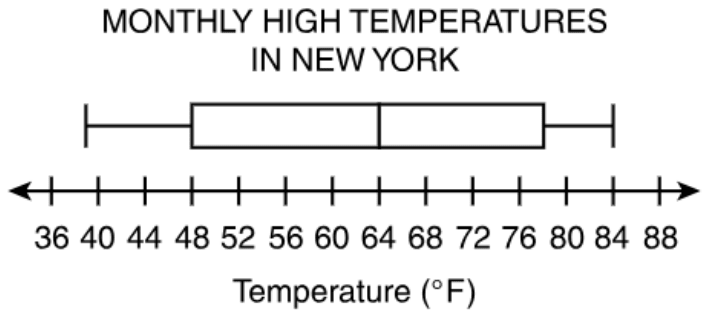
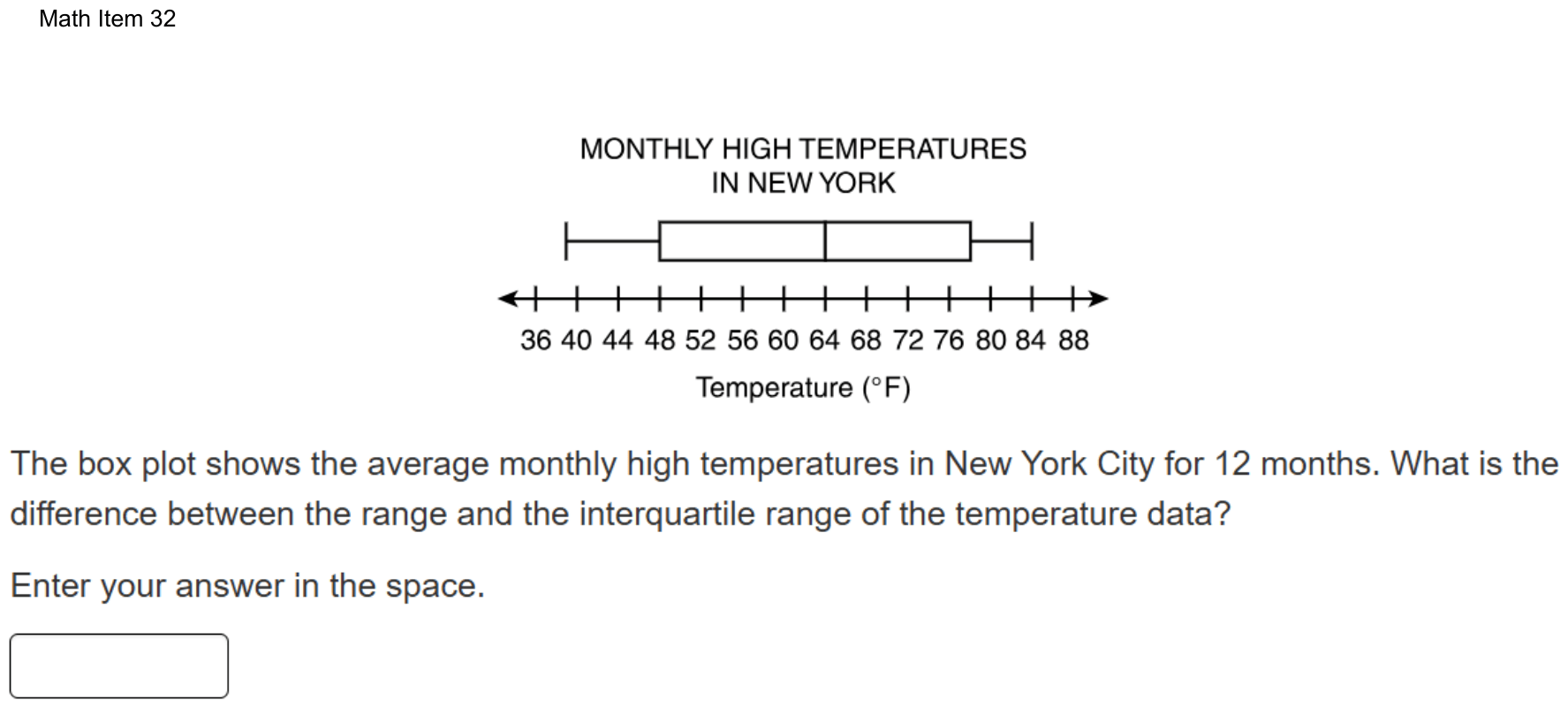
The box plot shows the average monthly high temperatures in New York City for 12 months. What is the difference between the range and the interquartile range of the temperature data?
Enter your answer in the space.
Fill-in question: work out the answer and type it as a number.
Show the answer
Correct answer: 15
Determine the range by subtracting the minimum value on the box plot from the maximum value on the box plot:
Maximum value , Minimum value
Determine the interquartile range by subtracting the lower quartile value on the box plot from the upper quartile value on the box plot:
Upper Quartile Value , Lower Quartile Value
Determine the difference between the range (45° F) and the interquartile range (30° F):
Question analysis
A box plot of New York City's average monthly high temperatures for 12 months sits above a number line labeled every 4 degrees. Students type the difference between the range and the interquartile range of the data. Two of the plot's values fall between labeled ticks, so careful reading of the scale decides the answer.
- Grade level
- Grade 7 content, by NYS standard
- Compared with grade 7
- Above grade 7 Reading a box plot and finding its interquartile range are grade 7 skills. Here two of the five values fall between ticks spaced 4 apart, and the range, the IQR and their difference must all be found and typed with no choices.
- Estimated difficulty
- Hard: combines ideas, needs a plan, and has more than one tempting wrong answer.
- Thinking it demands
- Depth of knowledge 2, skills and concepts · mainly apply
- What makes it hard
- Solution
- 3 steps
- Reading level
- Question and choices: about grade 7, 36 words.
- Students, last 30 days
- Not enough answers yet to show (it takes 10).
Why it is hard, traps and wrong answers (shows the answer)
Why it is hard
The method is standard, but the key rests on reading the scale between its labels. The axis is ticked only every 4 degrees, and the minimum and the upper quartile land off the ticks, so rounding either one to the nearest label moves the result by a degree or two with nothing to flag it. Students who find the range correctly can also stop there, entering 45, the larger of the two spreads, instead of the difference the question asks for.
Reading a figure, table or graph major Understanding the question
Two of the five values fall between ticks spaced 4 degrees apart: the left whisker ends just short of the 40 tick, at 39, and the box’s right edge sits midway between 76 and 80, at 78. (Lesh, Post & Behr, 1987; Kirsch & Mosenthal, 1990)
Many steps minor Working it out
Four values are read and combined in three subtractions, the range, the interquartile range and then their difference, so one misread value changes the final entry. (Daniel & Embretson, 2010; Enright, Morley & Sheehan, 2002)
Something you must already know minor Working it out
Neither measure is defined on the page: the range spans the whiskers, and the interquartile range is the width of the box, the upper quartile minus the lower. (Anderson & Krathwohl, 2001)
An answer in an unexpected form minor Choosing the answer
The result is typed with no choices to compare, so an entry one or two degrees off, from rounding a value to the nearest tick, looks just as finished as the right one. (Enright, Morley & Sheehan, 2002)
Strategy: Read the minimum, both quartiles and the maximum, judging where each mark falls between the ticks, then subtract for the range and for the IQR, and subtract those two results.
Traps
- Misreads the figure: Reads a value, label or tick spacing in a figure, table or graph wrongly.
- Stops one step early: A choice is a number from partway through the solution.
The wrong answers, classified
14 Misreads the figure (Lesh, Post & Behr, 1987; Kirsch & Mosenthal, 1990)
Reads the left whisker’s end as 40, the nearest labeled tick, instead of 39, so the range becomes 84 − 40 = 44 and 44 − 30 = 14.
45 Stops one step early (King et al., 2004; Gierl et al., 2017)
Finds the range, 84 − 39 = 45 degrees, and enters it, stopping before the interquartile range of 30 is subtracted from it.
17 Misreads the figure (Lesh, Post & Behr, 1987; Kirsch & Mosenthal, 1990)
Reads the box’s right edge as 76, the tick just left of it, instead of 78, so the IQR becomes 76 − 48 = 28 and 45 − 28 = 17.
Worked solution, step by step
Formulas used
- Range
- The maximum is the greatest value, at the right end of the right whisker. The minimum is the least value, at the left end of the left whisker. The range tells how far the whole set of data spreads.
- Interquartile range (IQR)
- Q3 is the upper quartile, the right edge of the box. Q1 is the lower quartile, the left edge of the box. The IQR is the width of the box. It tells how far the middle half of the data spreads.
Sort out the question
A box plot shows data with five numbers. The two whiskers are the lines on each side of the box. Their ends are the minimum, the least value, and the maximum, the greatest. The box runs from the lower quartile to the upper quartile. These are the middles of the lower half and the upper half of the data. The line inside the box is the median, the middle value.
You need the range minus the interquartile range (IQR), in degrees.
Read the values between the ticks
The ticks on the number line are 4 degrees apart. So each degree is one quarter of the space between two ticks. Three values sit right on ticks: the box’s left edge at 48, the median at 64, and the right whisker’s end at 84.
- The left whisker starts just left of the 40 tick. It sits about one quarter of the way back toward 36. So the minimum is degrees.
- The box’s right edge is halfway between 76 and 80. Halfway is 78 degrees.
Find the range
Use the range formula:
The data spread over 45 degrees.
Watch out: rounding the minimum to the 40 tick gives a range of 44. Then the final answer comes out 14, which is wrong.
Find the IQR
Use the IQR formula with the two edges of the box:
The middle half of the data spreads over 30 degrees.
Watch out: reading the box’s right edge as 76 gives an IQR of 28. Then the final answer comes out 17.
Subtract the IQR from the range
The question asks for the difference between the two:
Watch out: 45 is only the range. Do not stop there. Type only the number, with no degree sign.
So you would enter 15.
Check your answer
The range covers the whole plot, and the IQR covers only the box. So their difference is the two whiskers added together. The left whisker is degrees long. The right whisker is degrees long. , which matches.
More questions like this
The original DOE question