3 English and 3 math
Here are 6 random questions to try. Takers earning below 75% are unlikely to receive an offer. You have 1 minute 48 seconds per question on the real exam.
Question 1 of 6
2025 Practice Test A English, question 12Passage Excerpt from “Scribe Like an Egyptian”
Excerpt from “Scribe Like an Egyptian”
by Hilary Wilson
In ancient Egypt, literacy was the key to success. However, contrary to popular belief, not all Egyptian scribes understood hieroglyphs. Many relied instead on the simpler hieratic script for the multitude of everyday documents generated by the Egyptian bureaucracy.
Hieroglyphs—“the Words of God”—compose a writing system with more than 1,000 distinct characters, the meanings of which were lost for 1,500 years before they were deciphered by Jean-François Champollion in 1822. Including both ideograms (which convey a whole word or idea, either concrete or abstract, in a single sign) and phonograms (representing either an alphabetic sound or a group of consonants), [the writing system] was used in formal inscriptions on tomb and temple walls as well as on elaborate funerary papyri. For everyday purposes, however, scribes used a shorthand version of the hieroglyphic script known as hieratic, which was quicker to write and more economical of space. The two writings existed side by side for at least 2,500 years.
Scraps of ancient hieratic writing, mostly penned by student scribes on limestone flakes called ostraca, suggest that no matter how humble his origins, an educated Egyptian could achieve almost anything. Horemheb (d.1292 B.C.) is a good example. Born of middle-ranking parents, his scribal training led to an army career. From Scribe of Recruits, during the reign of Akhenaten (1353–1336 B.C.), Horemheb rose through the military ranks and, by the rule of Tutankhamun (1332–1323 B.C.), he was commander in chief of the Egyptian forces. As a close adviser of the young Pharaoh, Horemheb was appointed “Deputy of the King throughout the Two Lands,” and might have expected to succeed to the throne should the king die childless. He had to wait a few years, but eventually Horemheb achieved the pinnacle of his career by becoming the last king of the 18th Dynasty, making his mark by instituting dramatic reforms to the organisation of the army, the judiciary and administration in general. The lasting success of these changes owed much to his scribal background. . . .
But education was not available to all. Government departments and major temples supported schools, where boys commenced their training at six or seven, sometimes earlier. To these boarding establishments . . . family or household servants delivered the students’ food and drink rations daily for several years, during which time the student was not contributing to the family’s income. Boys from poorer families could only hope to be educated with support from a wealthier relative or patron, or through apprenticeship to an older scribe, perhaps the local clerk or land agent, who would teach them the basics of the scribe’s craft. This limited the scope for employment but such “on the job” training allowed apprentices to help out at home while learning. . . .
Scribal education began with the elementary principles of the hieratic script. The lowliest scribes, who trained for just five or six years, probably learned only the rudiments of the hieroglyphic script. Students were set exemplar documents and extracts from popular texts to copy, to practice their hieratic handwriting on basic-format letters, reports and contracts, while absorbing the good advice contained in the texts. Surviving examples of copy-work sometimes include tutors’ corrections added in red. Some significant Egyptian literary works survive almost exclusively from student copies.
A schoolboy “dictionary” of hieroglyphs with their hieratic equivalents shows that a knowledge of more than 450 signs was required for everyday writing purposes. Lessons in record-keeping and filing and labelling enabled any half-competent scribe to perform that most essential of all scribal functions: the making and updating of lists. For professions such as those of government official, priest or lawyer, a scribe would train for several more years, increasing his vocabulary to perhaps a thousand or more signs. Those with the best handwriting or drawing skills might follow the craft of creating beautifully illustrated copies of funerary texts, commonly called Books of the Dead. Others could become draughtsmen, artists or architects. Doctors compiled their own collections of medication recipes, treatments and associated incantations, many copied from texts found in the House of Life, the temple library. Lawyers had to be familiar with the corpus of civil and religious laws and precedents found in the official records, which were administered by archivists. Egypt’s bureaucratic society depended on the skills of an army of scribes of all ranks from filing clerk to tax assessor. For young Egyptians, “be a scribe” was the best of career advice.
From “Scribe Like an Egyptian” by Hilary Wilson from HISTORY TODAY, August 8, 2019. Copyright © 2019 by History Today Ltd. Company.
bureaucracy: an administrative staff of government officials
funerary papyri: a sheet or scroll of papyrus containing religious images and hieroglyphs meant to help the deceased be reborn in the afterlife
rudiments: basics
schoolboy: slang that refers to materials used during the course of receiving an education
draughtsmen: people who draw plans of machinery or structures
corpus: a collection of writings
Question
Which claim is best supported by the information presented in paragraphs 3 and 4?
- AEducation was difficult for the common citizens of Egypt to obtain.
- BOnce students began studying to become scribes, their future held more possibilities.
- CIf someone wanted to become a scribe, support from outside sources such as the government or a temple was necessary.
- DBecoming a successful scribe required a student’s family to sacrifice time and money in order to ensure the best education.
Show the answer
Correct answer: B
The question asks for the claim that is best supported by the details in paragraphs 3 and 4.
A. Incorrect. While paragraph 4 does explain that boys from poorer families had more challenges in receiving an education, the paragraph also provides examples of obtaining a patron or getting an apprenticeship as ways that these aspiring scribes could attain an education. Furthermore, the details in paragraph 3 do not provide any support for the claim that “common citizens” had difficulty getting an education because that paragraph focuses on the example of one person who was able to become a king as a result of his background as a scribe.
B. CORRECT. In paragraph 3, the author provides an example of a person who used his skills as a scribe to rise through the ranks of society by describing the achievements of Horemheb to support the idea that “no matter how humble his origins, an educated Egyptian could achieve almost anything.” The author continues in paragraph 4 to explain that with the proper support, some young Egyptians could become educated, thereby opening more opportunities for themselves.
C. Incorrect. Paragraph 4 explains that schools were supported by the government and religious institutions, but it also explains that apprenticeships were a method of learning the craft of the scribe. As the paragraph indicates, boys could also be helped in their education by support from “a wealthier relative or patron.”
D. Incorrect. In paragraph 4, the author details the sacrifices that families made to keep their sons at the schools, while boys from poorer families could only hope for a patron or an apprenticeship. Paragraph 4 also explains that apprentices could help out at home while learning, so the sacrifice of time and money was not required of every family.
Question analysis
This inference question asks which claim is best supported by paragraphs 3 and 4 of “Scribe Like an Egyptian,” which tell the story of the scribe Horemheb and describe who could get a scribal education in ancient Egypt. Students must weigh each claim against both paragraphs together, and several claims echo a single sentence closely enough to look supported.
- Grade level
- Grade 8 reading and task
- Compared with grade 7
- Above grade 7 Choosing the claim a passage best supports is core grade 7 work. Here the claim must fit two paragraphs that do different jobs, one telling a single man’s story and one explaining access to schooling, and some choices fit only part of that.
- Estimated difficulty
- Hard: combines ideas, needs a plan, and has more than one tempting wrong answer.
- Thinking it demands
- Depth of knowledge 3, strategic thinking · mainly evaluate
- What makes it hard
- Evidence in several places moderate
- The right answer is reworded moderate
- Reading between the lines minor
- Evidence
- Answered from several paragraphs or stanzas
- Reading level
- Passage: about grade 12, 810 words; question and choices: about grade 10, 75 words.
- Corrected from the DOE handbook
- A misdescription of the passage in the explanation of one wrong answer was corrected.
- Students, last 30 days
- Not enough answers yet to show (it takes 10).
Why it is hard, traps and wrong answers (shows the answer)
Why it is hard
The trap is a claim that paragraph 4 seems to state almost word for word, which makes it feel safer than the right one. But the question asks for support from both paragraphs, and Horemheb’s story points the other way, toward what schooling made possible. The two other wrong claims harden paragraph 4’s details into rules, a necessary sponsor or a required family sacrifice, so words like “necessary” and “required” are the ones to test.
Evidence in several places moderate Working it out
The claim must fit two paragraphs that do different work: paragraph 3 follows Horemheb from army scribe to king, and paragraph 4 explains who could pay for schooling and what the alternatives were. (Kirsch & Mosenthal, 1990; Gorin & Embretson, 2006)
The right answer is reworded moderate Choosing the answer
The right claim restates paragraph 3’s “an educated Egyptian could achieve almost anything” in new words, while the most tempting wrong one nearly copies paragraph 4’s opening, “education was not available to all.” (Freedle & Kostin, 1993; Kirsch & Mosenthal, 1990)
Reading between the lines minor Working it out
Students must connect Horemheb’s rise with paragraph 4’s account of who got schooling to see that both paragraphs are about education opening doors, a link the author leaves implicit. (Graesser, Singer & Trabasso, 1994; Kintsch, 1998)
Strategy: Sum up paragraph 3 and paragraph 4 in a sentence each, then test every claim against both summaries, watching for words that make a claim stronger than the text.
Traps
- Too narrow: A single detail offered as the central idea or a summary, or a summary that keeps minor details and leaves out an essential part.
- Too broad or too strong: A choice overstates, generalizes, or uses absolute words the text does not support.
- Reads too much in: A reasonable-sounding conclusion that goes further than the text allows.
The wrong answers, classified
A Too narrow (King et al., 2004)
Rests on paragraph 4’s opening, “education was not available to all,” and ignores paragraph 3, whose Horemheb shows an educated man rising from modest origins to the throne.
C Too broad or too strong (King et al., 2004)
Makes the government and temple schools of paragraph 4 “necessary,” overlooking its other routes: help from “a wealthier relative or patron,” or apprenticeship to a working scribe.
D Reads too much in (Graesser, Singer & Trabasso, 1994)
Turns the rations and lost income that some families bore in paragraph 4 into a requirement for every successful scribe, and adds “the best education,” which the paragraph never mentions.
What was corrected from the DOE handbook, and why
- Explanation: The DOE’s explanation of D said paragraph 4 details sacrifices “necessary for some poorer families,” and that paragraph 3’s Horemheb, born of middle-ranking parents, shows the sacrifice was not required of all families. In paragraph 4 the rations and lost income are those of families whose sons were at the schools; poorer boys could only hope for a patron or an apprenticeship; and paragraph 3 says nothing about what Horemheb’s family gave up. The explanation now says so: D is wrong because apprentices could help out at home while learning, so not every family made the sacrifice.
Working it out, step by step
Figure out what the question asks
This asks which claim is best supported by paragraphs 3 and 4 together. A claim is a statement that someone says is true. The right claim must fit both paragraphs. Watch for strong words, like “necessary,” that go further than the text.
Sum up paragraph 3
Paragraph 3 tells about Horemheb. His parents were middle-ranking, not rich or powerful. His training as a scribe led to a job in the army. He rose to lead the army, then to serve the young king, and in the end he became king himself. The author uses him to show that “no matter how humble his origins, an educated Egyptian could achieve almost anything.” Humble origins means an ordinary family background.
Sum up paragraph 4
Paragraph 4 opens by saying that not everyone could get an education. Government offices and big temples ran schools. Families sent food and drink for years, while the boy earned nothing for them. Poorer boys could hope for help from “a wealthier relative or patron.” A patron is someone who pays for another person’s training. Or they could learn on the job from a working scribe. That path led to fewer jobs.
Put the two paragraphs together
Both paragraphs are about what schooling could do for a boy. Paragraph 3 shows a man rising all the way to king because he trained as a scribe. Paragraph 4 shows that, with the right support, boys could get that schooling. It even notes that the on-the-job path led to fewer jobs. So education opened doors. That is what choice B says.
Check each choice
- A does not fit. It matches only the start of paragraph 4. Paragraph 4 also gives ways in for poorer boys, and paragraph 3 shows a man from an ordinary family rising to the top.
- B fits. Both paragraphs show schooling leading to more possibilities.
- C does not fit. A government or temple school was not “necessary.” A relative, a patron or an apprenticeship could also work.
- D does not fit. Apprentices could help out at home while they learned, so not every family gave up time and money. And the paragraphs never mention “the best education.”
Choose the answer
The claim that fits both paragraphs is that schooling gave a boy more possibilities. So the answer is B.
Why this answer and not the closest wrong one
A is the closest wrong choice, because paragraph 4 begins by saying not everyone could get an education. But the question asks about paragraphs 3 and 4. Paragraph 3 tells of a scribe from an ordinary family who became king. Paragraph 4 shows ways around the cost. Both point to what education made possible, which is B.
More questions like this
The original DOE question
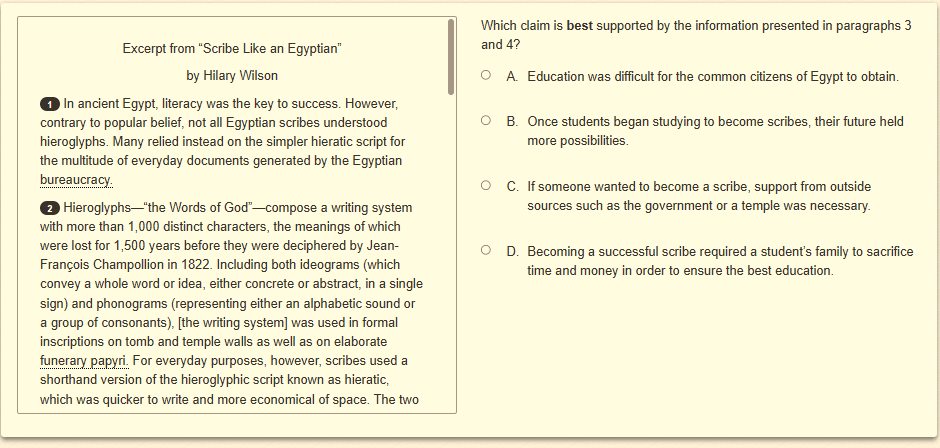
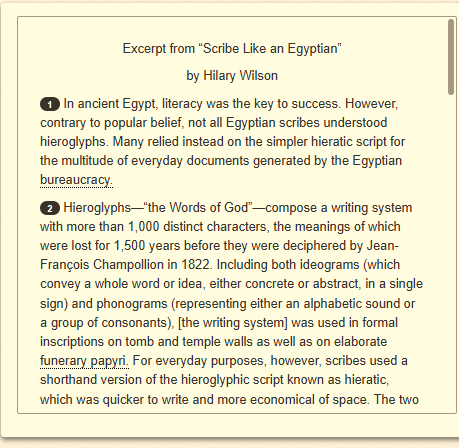
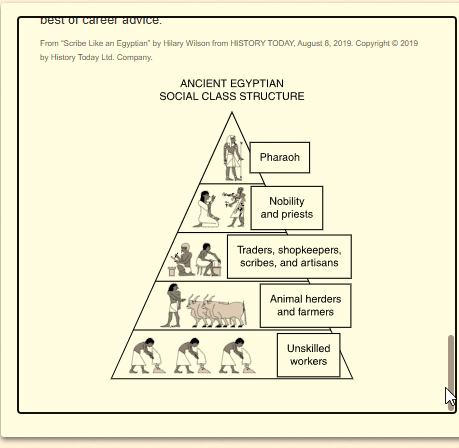
The passage “Excerpt from “Scribe Like an Egyptian”” as shown on the test
Question 2 of 6
2024 Test B English, question 27Passage Excerpt from Do Them No Harm!
Excerpt from Do Them No Harm!
by Zoa L. Swayne
This narrative is about the Nez Perce, an American Indian tribe, in what is now northern Idaho. The tribe is preparing for a gathering before the coming winter.
In the moon of Ta-Yum, the hottest days of summer, when salmon spawn in the little streams and huckleberries ripen in the high mountains, people from many villages of the Chopunnish Nation gathered in the Oyaip Prairie for the work and festivities of their annual camas1 harvest.
From far and near The People came. . . .
Should a stranger enter their homeland and ask, “Where are you from?” the reply was always, “We are Nee-mee-poo, The People who live here in this place.”
It was a time of Lawtiwa-mah-ton—a time of being friends together—when The People came for this last chance to enjoy being together before the Cold Moons kept them close to their fires. The visiting and trading, the foot racing and horse racing, and the gambling and stick games would be remembered and talked about long after they had forgotten the drudgery of digging and roasting camas, picking berries, or drying meat and fish. Lawtiwa-mah-ton! It was good to be friends together.
As was their custom since wahk-kee-ma, a time far back beyond the memory of man, they set up their camps in the same locations their parents and grandparents had occupied before them. Red Bear’s people, from Kamiah, made their camp near the trail that came out of the mountains. Their neighbors in Kamiah Valley, The People from Tee-e-lap-a-lo, had their camp close by. Across the wide meadow, by the great roasting pits, the camps of the Te-wap-poo and Ask-kah-poo were located. The tepees and ish-nash, brush shelters, of other groups nestled in their accustomed areas in and among the pines in such numbers that they encircled the entire meadow land.
Red Bear’s people had traveled all summer with neighboring bands, gathering and preparing roots, picking and drying berries, drying and smoking meat and fish for their winter food supply. Now they were at the Oyaip camp. The women worked hard to dig and cure as many bags of roots as they could during the warm, sunny days, for the sharp night air brought warnings that WARM was going and COLD was coming.
Everyone helped in some way. Most of the men fished or hunted for meat. While many of the women dug and roasted camas, other women and older children picked and dried berries.
And the younger children played. They played at hunting. They played with the babies. They played with their horses and puppies. They learned how to live through their play.
This sun, happiness, peace, and quiet blessed the Red Bear camp. All were busy with their daily tasks, until sudden cries came from the children playing by the trail.
“People coming! People coming! People coming on the trail from the high mountains!” they called as they ran to their elders, who looked sharply at the figures of approaching horsemen.
Were they friends or enemies? Did they bring good news or bad?
“Who can it be? What brings them here?” were the questions in every mind.
“Could they be the four hunters who had gone to Buffalo Country two summers past? Would they have news of the families who had gone long ago to Buffalo Country and never returned?”
It was customary for a hunting party to be gone for more than one season.
“Looks like hunters,” the older men agreed. “Looks like they had good hunting. Maybe our four hunters. [They have] been gone many moons.”
“Looks like five people—not four,” others observed.
Excitement grew as the riders came close enough to be recognized.
“A-a-a-a-a, they are our four hunters! But who is the fifth person?” they asked.
“Looks like a woman. Who is she?”
The hunters rode up to the welcoming crowd, proud to show off the loads of meat, hides, and other trophies of their hunt. They paraded around the encampment for all to see how strong their Hunting Power had been—what great hunters they, themselves, were.
Red Bear’s people rejoiced at their hunters’ success. Good hunters brought good to everybody. The meat meant plenty of food and the hides meant soft-tanned robes to give comfort through the Cold Moons. But it was the sight of the frail figure of the woman that aroused their curiosity. Who was she? Where had she come from? . . .
“Belongs to Red Bear people. Gone then come back,” the hunters said, as they dismounted and unloaded their packs. . . .
Now they could see! She was the daughter of the family gone so long ago! The girl-child who had left came back now—a grown woman.
“Wat-ku-ese!” the women cried. “Gone-from-Home-then-Come-Back. Wat-ku-ese!” And Wat-ku-ese was her name from that time on.
Gentle arms lifted Wat-ku-ese from her horse. The women brought her food and made a place for her to rest. For many suns they cared for her until she became stronger.
One evening Wat-ku-ese told her story for all to hear.
From DO THEM NO HARM!: Lewis and Clark Among the Nez Perce by Zoa L. Swayne. Published by Caxton Press. Copyright © 1990 by Zoa L. Swayne. Orofino, Idaho and Legacy House, Inc. Orofino, Idaho. All rights reserved.
1camas: a wild, edible plant
Question
How do paragraphs 11–13 affect the plot of the excerpt?
- AThey establish a feeling of mystery by presenting different points of view about the arriving people.
- BThey contribute to the rising action by developing the idea that the arriving people could present a problem.
- CThey lead to a turning point by describing the moment that the crowd realizes why the strangers have come.
- DThey explain the cause of the main conflict by providing background information about the strangers.
Show the answer
Correct answer: B
The question asks how paragraphs 11–13 affect the plot of the excerpt.
A. Incorrect. The paragraphs contain questions about the arriving people. They do not present differing points of view.
B. CORRECT. The paragraphs ask questions in which the characters wonder whether the arriving people are friends or enemies, or whether they might be bringing good news or bad news. By suggesting that the arriving people could present problems such as these, the paragraphs contribute to the rising action.
C. Incorrect. The paragraphs do not lead to a turning point. Instead, they lead to the climax—the moment the characters discover who the visitors are. This means the paragraphs contribute to the rising action.
D. Incorrect. Paragraphs 11–13 ask questions. They do not provide background information about the strangers; instead, they ask for it.
Question analysis
This plot question asks how paragraphs 11–13, a series of questions the villagers ask as riders approach their camp, affect the plot of the Nez Perce narrative. Students must know terms such as rising action and turning point and apply them precisely, since several choices describe these paragraphs in ways that sound right but place them wrongly in the story.
- Grade level
- Grade 8 reading and task
- Compared with grade 7
- Above grade 7 Grade 7 plot questions usually ask what one event causes. Here students apply terms such as rising action and turning point to three short paragraphs of questions, which matches the grade 8 focus on how parts of a story propel the action.
- Estimated difficulty
- Hard: combines ideas, needs a plan, and has more than one tempting wrong answer.
- Thinking it demands
- Depth of knowledge 3, strategic thinking · mainly analyze
- What makes it hard
- A very close wrong answer major
- How, not what moderate
- Something you must already know minor
- Evidence
- Answered from several paragraphs or stanzas
- Reading level
- Passage: about grade 5, 885 words; question and choices: about grade 9, 77 words.
- Students, last 30 days
- Not enough answers yet to show (it takes 10).
Why it is hard, traps and wrong answers (shows the answer)
Why it is hard
Paragraphs 11–13 contain nothing but questions, so the answer depends on what questions do in a plot. Friends or enemies, good news or bad, they raise the chance of trouble and build toward the arrival. The trap is that they also create mystery, and the choice that says so fails only on one phrase about differing viewpoints. A second risk is jumping ahead: at this point no one even knows who the riders are, let alone why they came.
A very close wrong answer major Choosing the answer
The right choice and the one about mystery both see the questions building uncertainty about the riders; only the claim of “different points of view,” when the questions are “in every mind,” separates them. (Embretson & Wetzel, 1987; Gorin & Embretson, 2006; Ascalon et al., 2007)
How, not what moderate Working it out
The stem asks what paragraphs 11–13 do for the plot, so students must place a run of unanswered questions in the story’s shape rather than retell them. (Anderson & Krathwohl, 2001)
Something you must already know minor Working it out
The choices rely on plot terms the excerpt never explains, rising action, turning point and main conflict, and judging them means knowing what each one names. (Anderson & Krathwohl, 2001)
Strategy: Note what the villagers know and do not yet know in paragraphs 11–13, then compare that with what happens later in the excerpt to place these paragraphs in the plot.
Traps
- Half right: One half of a two-part choice is right and the other is not.
- Wrong part of the text: A choice is true of another paragraph, stanza or speaker than the one asked about.
- Wrong purpose or structure: Names a purpose, structure or effect that the part does not serve, or describes what a part says when the question asks what it does.
The wrong answers, classified
A Half right (King et al., 2004; Thissen, Steinberg & Fitzpatrick, 1989)
Rightly feels the mystery in the villagers’ questions but adds “different points of view,” though the whole camp shares the same questions.
C Wrong part of the text (Kirsch & Mosenthal, 1990)
Jumps ahead to the recognition in paragraphs 17–23; in paragraphs 11–13 the crowd does not yet know who the riders are, let alone why they came.
D Wrong purpose or structure (Anderson & Krathwohl, 2001)
Notices the hunters gone two summers and the families who never returned, but those details arrive as questions, and the excerpt has no conflict they explain.
Working it out, step by step
Figure out what the question asks
This asks how paragraphs 11–13 move the story along. You need some plot words. The plot is the order of events in a story. The rising action is the part where tension builds. Tension is the feeling that something big may happen. A turning point is the moment when things change.
Read paragraphs 11 to 13
These paragraphs are all questions. Paragraph 11 asks: “Were they friends or enemies? Did they bring good news or bad?” In paragraph 12, “Who can it be?” is one of “the questions in every mind.” Paragraph 13 asks if the riders are the hunters who left “two summers past.”
Decide what the questions do
The words “enemies” and “bad” news show the camp is worried. The riders might bring trouble. No one knows yet. So the questions build tension as the riders get closer. That is rising action. The answers come later. The crowd knows the hunters in paragraph 18. They learn who the woman is in paragraphs 22 and 23.
Check each choice
- B fits. The questions raise the chance of a problem and build tension.
- A: there is mystery, but not “different points of view.” Everyone asks the same questions.
- C: in these paragraphs, no one knows who the riders are yet, let alone why they came. So nothing here is the moment the crowd realizes anything.
- D: the paragraphs ask about the strangers. They give no background facts about them.
Pick the answer
Watch out: A is very close. The questions do create mystery. But one wrong phrase, “different points of view,” rules it out. So the answer is B.
Why this answer and not the closest wrong one
A is the closest wrong answer, because the questions do make the scene mysterious. But the questions are “in every mind,” so there are no different points of view. B names what the questions do for the plot: they hint that the riders could bring trouble, and they build tension.
More questions like this
The original DOE question
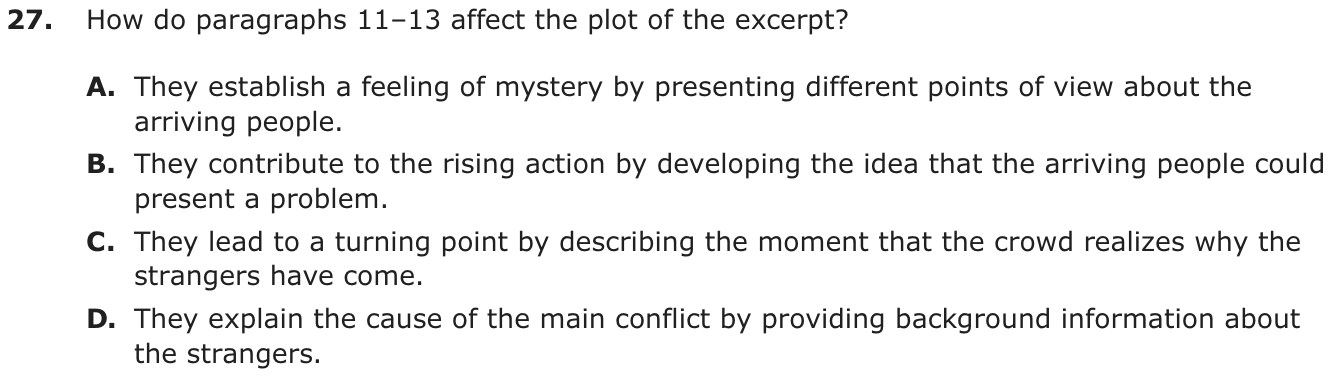
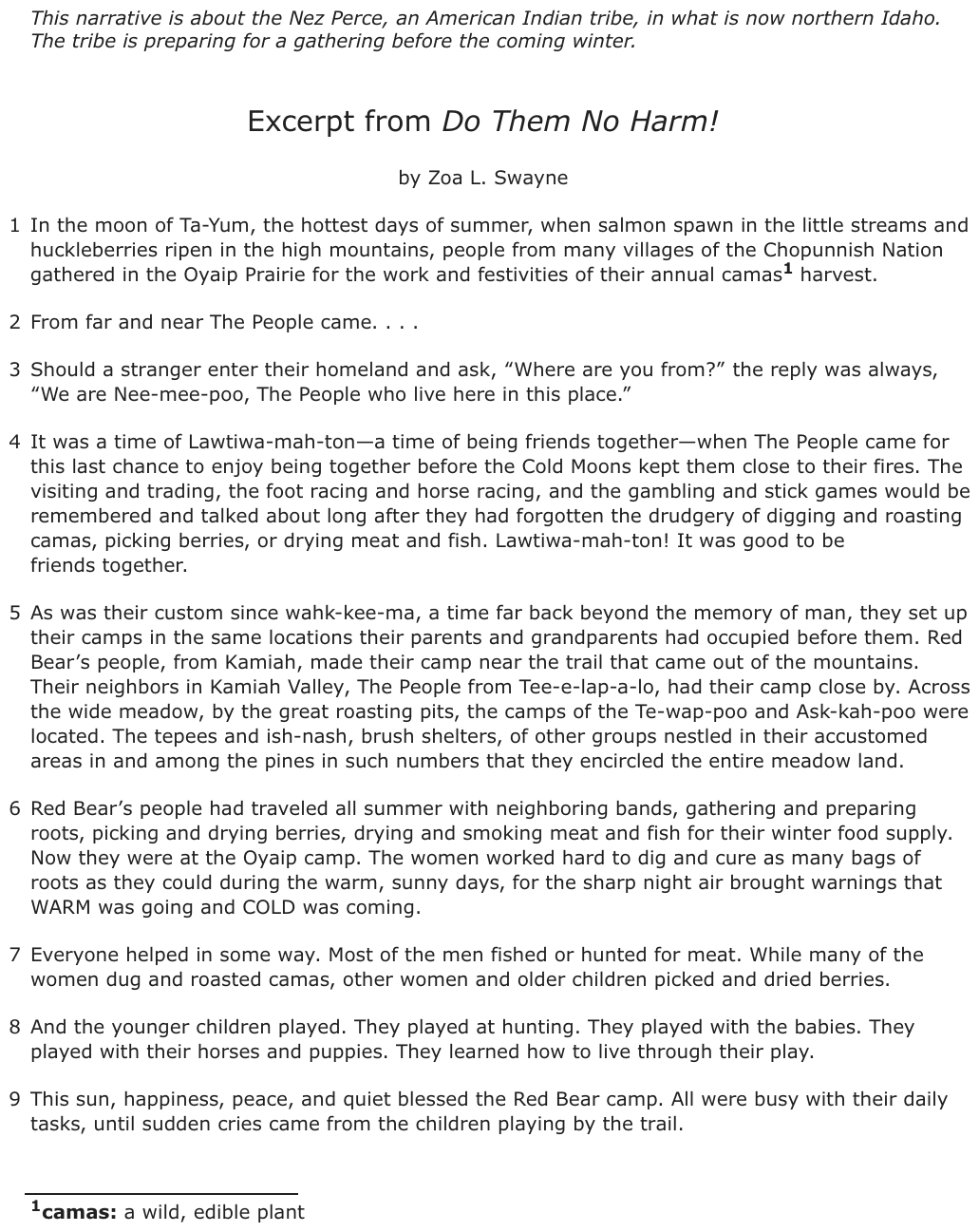
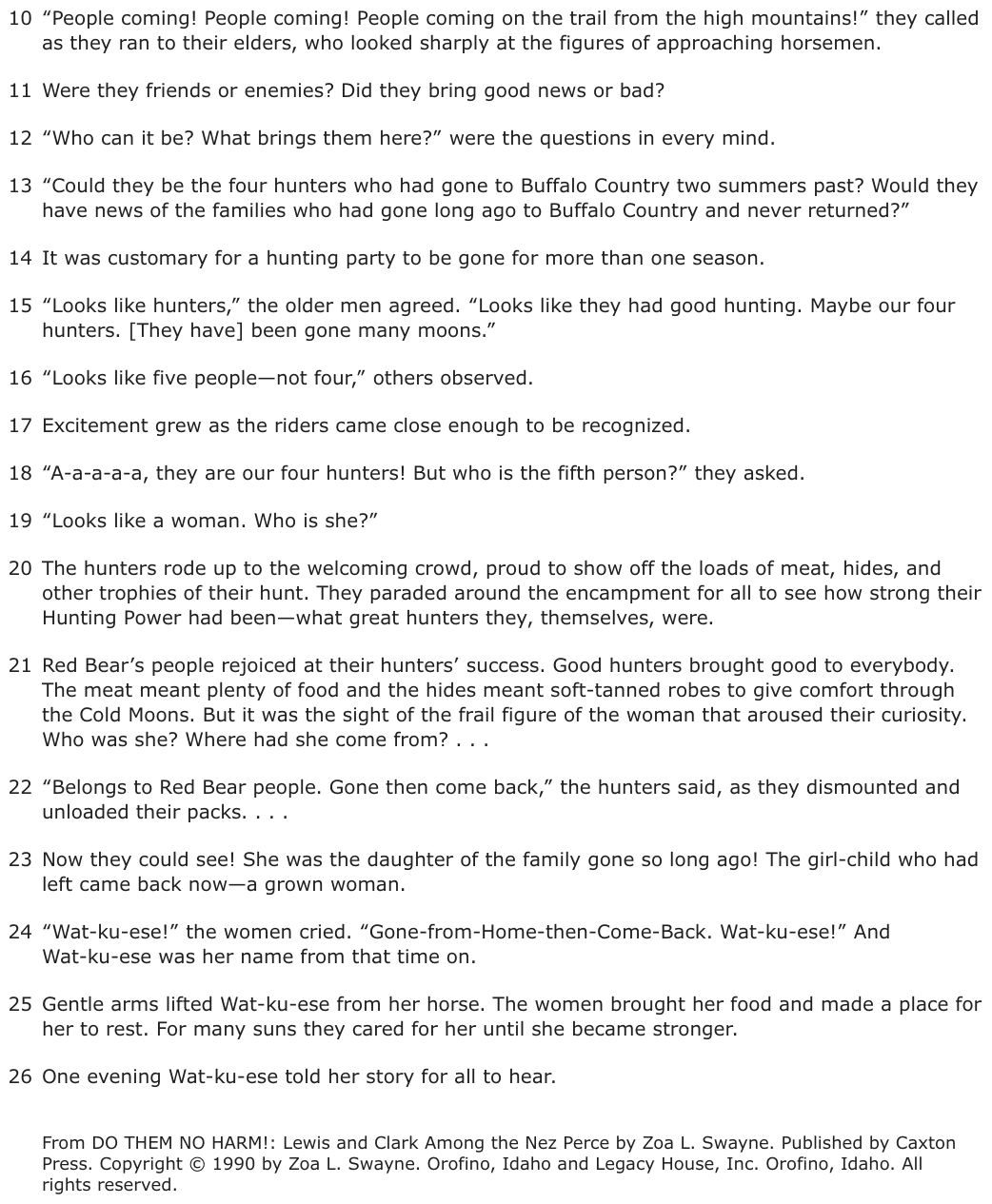
The passage “Excerpt from Do Them No Harm!” as printed (pages 177–178)
Question 3 of 6
2026 Practice Test B English, question 32Passage Using Fire to Keep a Prairie Healthy
Using Fire to Keep a Prairie Healthy
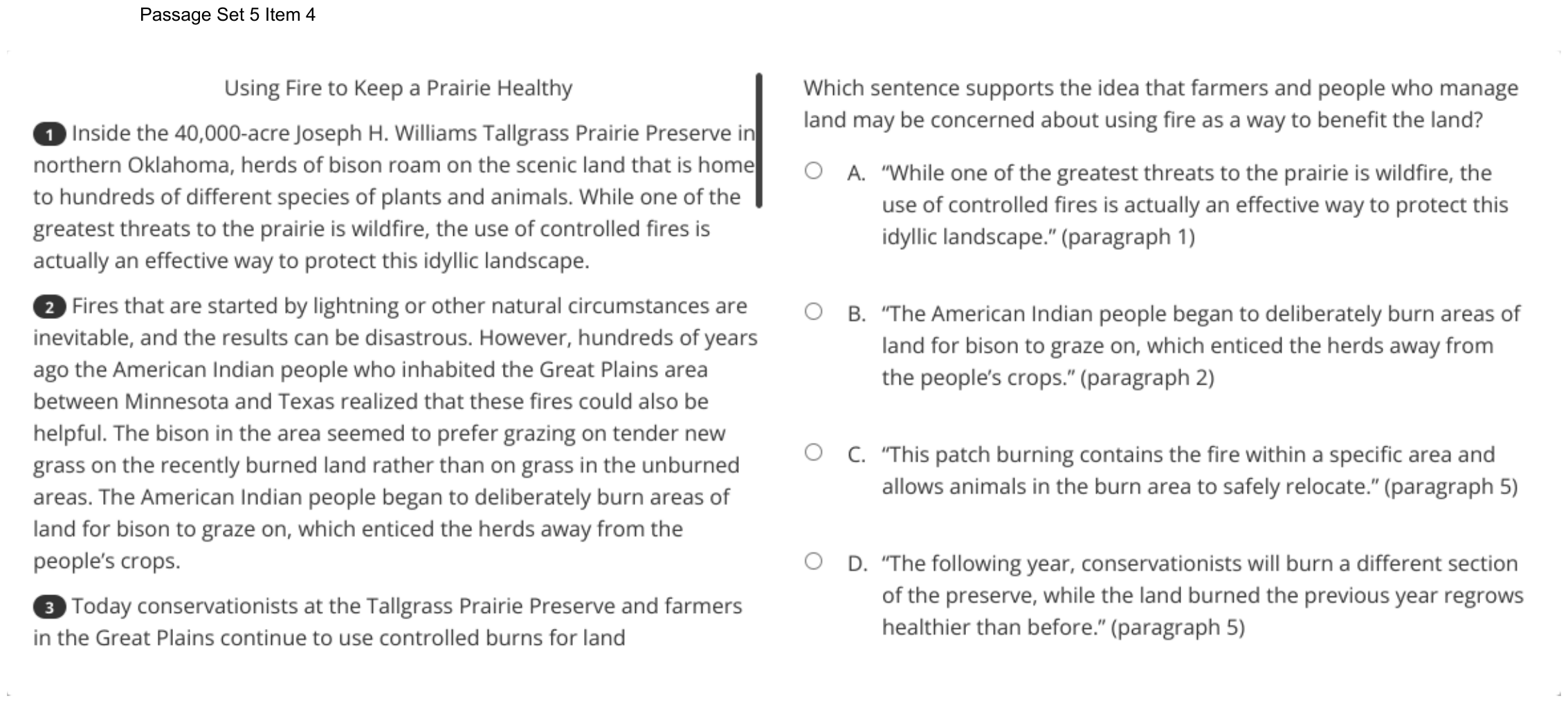
Inside the 40,000-acre Joseph H. Williams Tallgrass Prairie Preserve in northern Oklahoma, herds of bison roam on the scenic land that is home to hundreds of different species of plants and animals. While one of the greatest threats to the prairie is wildfire, the use of controlled fires is actually an effective way to protect this idyllic landscape.
Fires that are started by lightning or other natural circumstances are inevitable, and the results can be disastrous. However, hundreds of years ago the American Indian people who inhabited the Great Plains area between Minnesota and Texas realized that these fires could also be helpful. The bison in the area seemed to prefer grazing on tender new grass on the recently burned land rather than on grass in the unburned areas. The American Indian people began to deliberately burn areas of land for bison to graze on, which enticed the herds away from the people’s crops.
Today conservationists at the Tallgrass Prairie Preserve and farmers in the Great Plains continue to use controlled burns for land management. Intentionally burning a portion of land can dramatically improve the quality of the vegetation that regrows there. The fires burn away weedy undergrowth and help limit the overcrowding of shrubs and trees in the burn area, creating less competition for water and nutrients. Additionally, the process of burning excess plant matter adds nitrogen, an essential element for plant growth, to the soil.
One common target of controlled burns at the preserve and the surrounding area is the invasive red cedar tree. A single red cedar tree can consume up to 40 gallons of water per day, taking this vital resource away from other plant life. These tall trees also cast shade that prevents sunlight from reaching the plants beneath them. The fast-growing red cedar trees tend to crowd out prairie grasses, the primary food source for wild and domestic animals that make the prairie their home. An imbalance in one component of the prairie’s ecosystem affects the entire web of life. Controlled burns help maintain this ecosystem’s delicate balance.
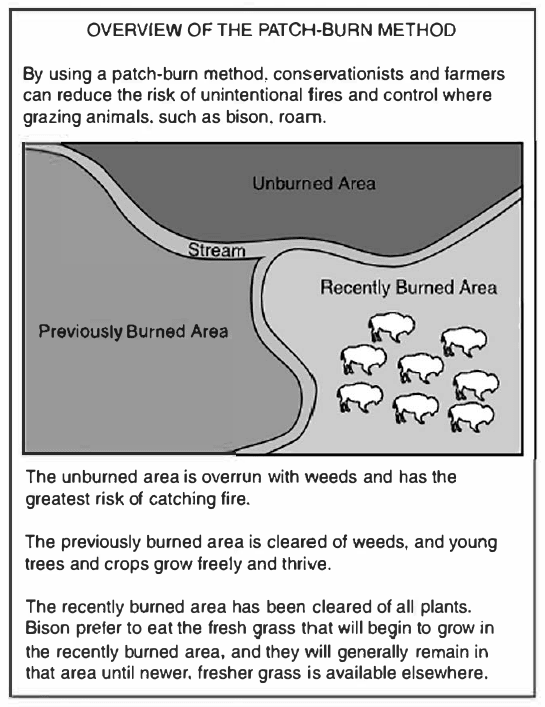
Of course, these controlled fires are intended to burn only a portion of an area. A total burn, which is a risk with an uncontrolled wildfire, would destroy all wildlife as well as the crops farmers plant for income. The key to using controlled fires is knowing which areas of land to burn and when. Conservation experts at the preserve employ the “patch-burn” approach, meaning they rotate which portion of land is burned each year. They study the land to find out which areas would most benefit from being burned, and then they arrange about a dozen burns over one-third of the land. This patch burning contains the fire within a specific area and allows animals in the burn area to safely relocate. The following year, conservationists will burn a different section of the preserve, while the land burned the previous year regrows healthier than before.
Researchers have tracked and studied the variety of plant species and animals that live on the preserve, and their studies show that the patch-burn approach has restored biodiversity to the area by promoting the growth of species that were at risk of being crowded out. The patch-burn system is so successful that the conservationists at the preserve provide training to prairie farmers about conducting controlled burns on their own land. Burning land to make it healthy may seem counterintuitive, but strategic controlled fires have helped the prairie sustain life for hundreds of years and, with careful management, will continue to do so.
Question
Which sentence supports the idea that farmers and people who manage land may be concerned about using fire as a way to benefit the land?
- A“While one of the greatest threats to the prairie is wildfire, the use of controlled fires is actually an effective way to protect this idyllic landscape.” (paragraph 1)
- B“The American Indian people began to deliberately burn areas of land for bison to graze on, which enticed the herds away from the people’s crops.” (paragraph 2)
- C“This patch burning contains the fire within a specific area and allows animals in the burn area to safely relocate.” (paragraph 5)
- D“The following year, conservationists will burn a different section of the preserve, while the land burned the previous year regrows healthier than before.” (paragraph 5)
Show the answer
Correct answer: A
The question asks which sentence supports the idea that farmers and people who manage land may be concerned about using fire as a way to benefit the land.
A. CORRECT. The sentence from paragraph 1 supports the idea that farmers and people who manage land may be concerned about using fire as a way to benefit the land because it acknowledges that “one of the greatest threats to the prairie is wildfire.”
B. Incorrect. Although the sentence from paragraph 2 relates how American Indians “began to deliberately burn areas of land for bison to graze on” and to protect people’s crops, the sentence does not support the idea that farmers and people who manage land may be concerned about using fire as a way to benefit the land. Instead, it focuses on the cause-and-effect relationship between bison and newly burned areas.
C. Incorrect. The sentence from paragraph 5 provides details about how “patch burning contains the fire” and “allows animals in the burn area to safely relocate,” but it does not adequately support the idea that farmers and people who manage land may be concerned about using fire as a way to benefit the land, because it does not mention that wildfires can be a threat to the prairie.
D. Incorrect. While the sentence from paragraph 5 does explain how “conservationists will burn a different section of the preserve” in order to rotate the process year after year so that the burned land has time to regrow, the sentence does not support the idea that farmers and people who manage land may be concerned about using fire as a way to benefit the land because it does not mention the potential for total burns.
Question analysis
This evidence question asks which sentence from the article on controlled prairie burns supports the idea that farmers and others who manage land may be concerned about using fire to benefit it. The passage never states that concern directly, so students must infer it, and all four quoted sentences, taken from across the article, talk about burning land in some way.
- Grade level
- Grade 8 reading and task
- Compared with grade 7
- Above grade 7 Grade 7 evidence questions usually ask for support of an idea the text states. This idea, that people who manage land may worry about using fire, is never stated outright, so students must infer which sentence implies it, more than typical.
- Estimated difficulty
- Hard: combines ideas, needs a plan, and has more than one tempting wrong answer.
- Thinking it demands
- Depth of knowledge 3, strategic thinking · mainly evaluate
- What makes it hard
- Reading between the lines major
- A very close wrong answer moderate
- Every choice must be checked minor
- Evidence
- Answered from one sentence or line
- Reading level
- Passage: about grade 11, 598 words; question and choices: about grade 13, 123 words.
- Students, last 30 days
- Not enough answers yet to show (it takes 10).
Why it is hard, traps and wrong answers (shows the answer)
Why it is hard
The idea to support is about people’s feelings, yet none of the four sentences mentions farmers worrying, so students have to decide what would justify such worry. The opening sentence does it by naming wildfire as a great threat before praising controlled fire, a concession many students read past as background. The strongest pull is the sentence on containing the fire, which implies caution but presents patch burning as the answer, not the concern.
Reading between the lines major Working it out
No sentence mentions worry; students must see that calling wildfire “one of the greatest threats to the prairie” gives landowners a reason to fear fire, and that “actually” answers that fear. (Graesser, Singer & Trabasso, 1994; Kintsch, 1998)
A very close wrong answer moderate Choosing the answer
The patch-burn sentence about containing the fire “within a specific area” also hints at fire’s danger; it differs from the right one by describing the safeguard without ever naming a threat. (Embretson & Wetzel, 1987; Gorin & Embretson, 2006; Ascalon et al., 2007)
Every choice must be checked minor Choosing the answer
The four sentences come from paragraphs 1, 2 and 5, and each is about burning land, so each must be tested for a hint of risk rather than for its topic. (Embretson & Wetzel, 1987)
Strategy: Before rereading the choices, decide what a sentence would need to say to show that landowners have reason to be wary of fire, then test each quoted sentence for exactly that.
Traps
- Supports only part of the claim: In a question about evidence: a line that backs one half of the claim but not the other, or a related point rather than the claim itself.
- True but not the answer: A choice says something accurate about the text that does not answer this question.
The wrong answers, classified
B True but not the answer (King et al., 2004; Embretson & Wetzel, 1987)
Links “the people’s crops” to farmers, but the sentence tells how early burns drew bison away from the crops and shows no worry about fire itself.
C Supports only part of the claim (King et al., 2004; Thissen, Steinberg & Fitzpatrick, 1989)
Sees caution in containing the fire “within a specific area,” but the sentence explains how patch burning keeps animals safe and never says fire threatens the land.
D Supports only part of the claim (King et al., 2004; Thissen, Steinberg & Fitzpatrick, 1989)
Takes the yearly rotation as a careful precaution, but the sentence describes the schedule and land that “regrows healthier than before,” which backs the benefit, not the worry.
Working it out, step by step
Figure out what the question asks
This is an evidence question. Evidence is the words in a text that back up an idea. The idea here is that farmers might worry about using fire to help land. No sentence says farmers are worried. So look for a sentence that gives them a reason to fear fire.
Decide what the evidence needs
A sentence that supports this idea must show that fire can be dangerous. If fire can harm land, people have a reason to be careful with it. So test each sentence with one question: does it say fire is a threat?
Look closely at paragraph 1
Choice A quotes paragraph 1. Its first half says “one of the greatest threats to the prairie is wildfire.” That is a reason to fear fire. Its second half says controlled fires are “actually” helpful. The word “actually” pushes back against that fear. It means: you might expect fire to hurt the land, but here it helps.
Check each choice
- A is right. It names wildfire as a great threat. That gives farmers a reason to worry about fire.
- B is wrong. It tells how early burns drew bison away from crops. It shows no danger from fire.
- C is wrong. It tells how patch burning keeps the fire in one area. It describes a safety step but never names a threat.
- D is wrong. It describes burning a new section each year. It shows a benefit: land that “regrows healthier than before.”
Watch out: C hints that fire must be contained, or kept in, so it sounds careful. But it describes the solution, not the danger.
Choose the answer
Only one sentence names fire as a danger. So the answer is A, the sentence from paragraph 1: “While one of the greatest threats to the prairie is wildfire, the use of controlled fires is actually an effective way to protect this idyllic landscape.” Idyllic means peaceful and lovely.
Why this answer and not the closest wrong one
C is the closest wrong answer, because keeping fire “within a specific area” suggests caution. But C only explains how patch burning works. It never says fire can harm the prairie. A does, by calling wildfire one of the greatest threats.
More questions like this
The original DOE question
The passage “Using Fire to Keep a Prairie Healthy” as printed (page 41)
Question 4 of 6
2026 Practice Test D Math, question 19Question
A store manager purchases a piece of furniture for $456.00. To determine the selling price, the manager increases the purchase cost by 125%. A customer buys the furniture and pays an additional 8% sales tax. How much does the customer pay for the furniture?
- A$615.60
- B$627.48
- C$1,108.08
- D$1,846.80
Show the answer
Correct answer: C
Given a purchase price of $456.00, the 125% increase in price is calculated as:
The selling price equals the purchase price plus the increase, or:
The sales tax on the selling price is:
The customer pays the selling price plus the sales tax:
Question analysis
A store manager buys a piece of furniture for $456.00 and raises the price by 125% to set the selling price, and the customer also pays 8% sales tax. Students find the total the customer pays. It tests percent increase and sales tax in sequence, and reading an increase of more than 100% correctly is the main challenge.
- NYS standards
- Grade level
- Grade 7 content, by NYS standard
- Compared with grade 7
- Above grade 7 Grade 7 students find markups and sales tax, usually with increases under 100%. An increase of more than 100% is unusual and easy to misread, and two percent changes must be applied in order, which goes beyond routine grade 7 work.
- Estimated difficulty
- Hard: combines ideas, needs a plan, and has more than one tempting wrong answer.
- Thinking it demands
- Depth of knowledge 2, skills and concepts · mainly apply
- What makes it hard
- Turning words into math moderate
- Many steps moderate
- Error-prone arithmetic minor
- Solution
- 4 steps
- Reading level
- Question and choices: about grade 7, 41 words.
- Students, last 30 days
- Not enough answers yet to show (it takes 10).
Why it is hard, traps and wrong answers (shows the answer)
Why it is hard
A percent above 100 is unusual in grade 7 work, and it is the center of the question: the markup more than doubles the price. Students who treat “by 125%” as “125% of” still find a listed answer after adding tax, and so do students who add $125. A rough check helps: the selling price must be more than twice $456, about $1,000, and the tax adds less than a tenth of that.
Turning words into math moderate Understanding the question
“Increases the purchase cost by 125%” adds 125% of $456 to the $456 itself, a multiplier of 2.25; reading it as 125% of the cost leaves the original price out. (Hegarty, Mayer & Monk, 1995; Koedinger & Nathan, 2004)
Many steps moderate Working it out
Four steps in a row, the increase, the selling price, the tax and the total, each depend on the one before, and two of them are easy to merge or skip. (Daniel & Embretson, 2010; Enright, Morley & Sheehan, 2002)
Error-prone arithmetic minor Working it out
Taking 8% of $1,026 means multiplying by 0.08, and a decimal point one place off, 0.8, makes the tax ten times too large. (Brown & Burton, 1978; Junker & Sijtsma, 2001)
Strategy: Turn each percent change into a multiplier, remembering that an increase by a percent is added to the original amount, apply the markup and then the tax, and estimate to check the size.
Traps
- Stops one step early: A choice is a number from partway through the solution.
- Misunderstands the concept: A wrong belief about a concept: that percents can be added, that area grows like length, that averages can be averaged, that a bigger denominator means a bigger fraction.
- An arithmetic slip: The right method with a plausible arithmetic error: a digit, a place value or a times-table fact.
The wrong answers, classified
A Stops one step early (King et al., 2004; Gierl et al., 2017)
Finds the increase, 125% of $456 = $570, and uses it as the selling price without adding back the $456 cost, then adds 8% tax.
B Misunderstands the concept (Smith, diSessa & Roschelle, 1993; De Bock et al., 1998; Ni & Zhou, 2005)
Reads the 125% increase as $125, a fixed amount, so the selling price is $581, and then adds 8% tax correctly to reach $627.48.
D An arithmetic slip (Junker & Sijtsma, 2001)
Finds the $1,026 selling price correctly but writes 8% as 0.8, adding $820.80 in tax instead of $82.08.
Worked solution, step by step
Formulas used
- Percent of a number
- n is the starting amount, and p is the percent. Percent means out of 100, so 125% is 125/100 = 1.25 and 8% is 8/100 = 0.08. Multiply n by that decimal to find the part.
- Price after an increase
- The old price is what you start with. The increase is the amount added on. To increase by a percent, find that percent of the old price, then add it to the old price. Sales tax is added the same way.
Sort out the question
The manager pays $456.00 for the furniture. The selling price is that cost increased by 125%. The customer then pays 8% sales tax on top. Sales tax is an extra charge, a percent of the price. You need the total the customer pays.
Find the increase
Find 125% of $456. As a decimal, 125% is 1.25, which is 1 and a quarter. A quarter of 456 is 114:
The increase is $570.
Find the selling price
Increases by means the increase is added to the cost:
The selling price is $1,026.
Watch out: $570 is only the increase. Using it as the price gives $615.60, choice A. And 125% is a percent, not $125. Adding $125 leads to $627.48, choice B.
Find the sales tax
As a decimal, 8% is 0.08. Find 8% of the selling price:
The tax is $82.08.
Watch out: 8% is 0.08, not 0.8. Using 0.8 makes the tax ten times too big and gives $1,846.80, choice D.
Add the tax to the price
The customer pays the selling price plus the tax:
So the answer is C, $1,108.08.
Check your answer
Estimate. The price more than doubles: $456 plus $570 is about $1,000. Tax of 8% adds about $80. So the total should be a bit over $1,080, and only $1,108.08 is close. Or multiply in one go: 456 × 2.25 × 1.08 = 1,108.08.
More questions like this
The original DOE question
Question 5 of 6
2018 Test B Math, question 42Question
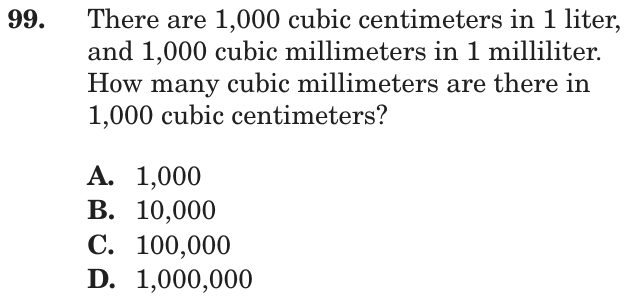
There are 1,000 cubic centimeters in 1 liter, and 1,000 cubic millimeters in 1 milliliter. How many cubic millimeters are there in 1,000 cubic centimeters?
- A1,000
- B10,000
- C100,000
- D1,000,000
Show the answer
Correct answer: D
If 1 L = 1,000 cu cm, then 1 L = 1,000 mL. Set up a proportion, letting = the amount of cubic millimeters in 1,000 cubic centimeters.
Solve for : 1,000,000 cubic millimeters are in 1,000 cubic centimeters.
Question analysis
The question gives two metric facts, cubic centimeters per liter and cubic millimeters per milliliter, and asks how many cubic millimeters are in 1,000 cubic centimeters. It tests chaining unit conversions with volume units. The hard part is that the two facts do not connect without a link the question leaves out.
- NYS standards
- 6.RP.3d converting measurement units
- Grade level
- Grade 6 content, by NYS standard
- Compared with grade 7
- Above grade 7 Grade 6 and 7 students convert units with one given factor. This needs three linked conversions, one using a fact the question does not state, and involves cubic units, which most grade 7 students find unfamiliar.
- Estimated difficulty
- Hard: combines ideas, needs a plan, and has more than one tempting wrong answer.
- Thinking it demands
- Depth of knowledge 2, skills and concepts · mainly apply
- What makes it hard
- Something you must already know moderate
- Many steps moderate
- Solution
- 3 steps
- Reading level
- Question and choices: about grade 13, 20 words.
- Corrected from the DOE handbook
- The units in the explanation’s proportion were corrected.
- Students, last 30 days
- Not enough answers yet to show (it takes 10).
Why it is hard, traps and wrong answers (shows the answer)
Why it is hard
The question gives two conversion facts that do not connect until the student supplies the link between liters and milliliters. Students who instead reach for 1 centimeter = 10 millimeters often scale a volume like a length or an area and land short by a factor of 10 or 100. Writing the unit at every step, so the units cancel, keeps both factors of 1,000 in view.
Something you must already know moderate Working it out
The chain needs 1 liter = 1,000 milliliters, which the stem never states, yet it is the only link between its two conversion facts. (Anderson & Krathwohl, 2001)
Many steps moderate Working it out
Three conversions in a row, cubic centimeters to liters, liters to milliliters and milliliters to cubic millimeters, multiply out to 1,000 × 1,000. (Daniel & Embretson, 2010; Enright, Morley & Sheehan, 2002)
Strategy: Build a chain from cubic centimeters to liters, liters to milliliters, and milliliters to cubic millimeters, writing the units at every step so they cancel.
Traps
- Units or scale: The answer is wanted in other units, or a rate or scale must be converted first.
- Stops one step early: A choice is a number from partway through the solution.
The wrong answers, classified
A Stops one step early (King et al., 2004; Gierl et al., 2017)
Converts 1,000 cubic centimeters to 1 liter, or 1,000 milliliters, and stops before the last step from milliliters to cubic millimeters.
B Units or scale (King et al., 2004)
Uses the length factor 1 cm = 10 mm for cubic units, multiplying 1,000 by 10 instead of by 10 × 10 × 10.
C Units or scale (King et al., 2004)
Squares the length factor, treating 1 cubic centimeter as 100 cubic millimeters, which is right for area but not for volume.
What was corrected from the DOE handbook, and why
- Explanation: The handbook’s proportion is 1,000 cu mm / 1 L = x cu mm / 1,000 cu mm. But 1,000 cubic millimeters make 1 milliliter, not 1 liter, and the second denominator should be the 1,000 mL that equal 1,000 cubic centimeters. The site uses 1,000 cu mm / 1 mL = x cu mm / 1,000 mL, which gives x = 1,000,000 cubic millimeters.
Worked solution, step by step
Formulas used
- Volume of a cube
- V is the volume, the space inside the cube. s is the length of one side. A cube has the same length, width and height, so you multiply the side by itself three times.
Sort out what you know
You are told two facts. 1 liter (L) is 1,000 cubic centimeters (cu cm). 1 milliliter (mL) is 1,000 cubic millimeters (cu mm). You need the number of cu mm in 1,000 cu cm.
One fact is missing. 1 liter is 1,000 milliliters. The word milli means one thousandth.
Change cubic centimeters to liters
The first fact says 1,000 cu cm is exactly 1 liter. So the amount in the question is 1 liter of space.
Change liters to milliliters
One liter is 1,000 milliliters. So 1,000 cu cm is the same as 1,000 mL.
Watch out: you are not done yet. The question asks for cubic millimeters. Stopping at 1,000 gives choice A.
Change milliliters to cubic millimeters
Each milliliter is 1,000 cu mm. There are 1,000 milliliters, so multiply.
So 1,000 cu cm is 1,000,000 cu mm. The answer is D, 1,000,000.
Check your answer
Use the cube formula. A cube 1 cm on each side is 10 mm on each side. Its volume is cu mm. So 1,000 cu cm is cu mm. Using only one 10 gives choice B. Using two 10s gives choice C.
More questions like this
The original DOE question
Question 6 of 6
2024 Test B Math, question 17Question
A bowl contains 12 green candies, 4 yellow candies, and some red candies. The probability of choosing a green candy at random is twice as great as the probability of choosing a red candy at random. What is the probability of choosing a yellow candy at random?
- A
- B
- C
- D
Show the answer
Correct answer: A
The probability of choosing a green candy is twice as great as the probability of choosing a red candy. There are 12 green candies. Let r = the number of red candies.
So there are 6 red candies. 12 green candies + 4 yellow candies + 6 red candies = 22 total candies.
There are 4 yellow candies out of a total of 22 candies. So the probability of choosing a yellow candy is
.
Question analysis
A probability question about a bowl of 12 green candies, 4 yellow candies and an unknown number of red ones. A green candy is twice as likely to be picked as a red one, and students find the chance of picking a yellow candy. The missing red count has to be worked out before any probability can be found.
- Grade level
- Grade 6 content, by NYS standard
- Compared with grade 7
- Above grade 7 Simple probability is grade 6 content in New York, and grade 7 problems usually give every count. Working backward from a comparison of two probabilities to a missing count, then forward to a third probability, is more than typical grade 7 work.
- Estimated difficulty
- Hard: combines ideas, needs a plan, and has more than one tempting wrong answer.
- Thinking it demands
- Depth of knowledge 2, skills and concepts · mainly apply
- What makes it hard
- Turning words into math moderate
- Combines ideas moderate
- Solution
- 3 steps
- Reading level
- Question and choices: about grade 7, 49 words.
- Students, last 30 days
- Not enough answers yet to show (it takes 10).
Why it is hard, traps and wrong answers (shows the answer)
Why it is hard
The question withholds the red count, and everything depends on recovering it from the comparison of probabilities. Students who cannot make that step tend to leave red out altogether, while those who find 6 red candies can still slip at the end by using the wrong total or the wrong color. Writing all three counts and the total of 22 before forming any fraction prevents both endings.
Turning words into math moderate Understanding the question
“Twice as great as the probability of choosing a red candy” must become 12 = 2 × the red count, which works only because both probabilities share one total. (Hegarty, Mayer & Monk, 1995; Koedinger & Nathan, 2004)
Combines ideas moderate Working it out
An unknown count has to be found from a ratio before any probability can be written, joining proportional reasoning with probability as a part over the total. (Embretson, 1998; Daniel & Embretson, 2010)
Strategy: Turn twice as likely into a statement about numbers of candies to find the red count, add all three colors for the total, then put the yellow count over that total and simplify.
Traps
- Answers a different question: A choice is right for another quantity: the other unknown, the rest instead of the part, the part instead of the whole.
- Numbers taken from the question: Combines the numbers in the question without a model of the situation, or is simply a number that appears in the question.
The wrong answers, classified
B Misunderstands the concept (Smith, diSessa & Roschelle, 1993; De Bock et al., 1998; Ni & Zhou, 2005)
Finds the 6 red candies but compares the 4 yellow with the 18 green and red ones, 4/18, a part-to-part ratio instead of part to whole.
C Numbers taken from the question (Hegarty, Mayer & Monk, 1995)
Leaves out the red candies, whose number is not given, and divides the 4 yellow by the 16 green and yellow candies.
D Answers a different question (King et al., 2004; Hegarty, Mayer & Monk, 1995)
Finds the 6 red candies and the total of 22 correctly but gives the chance of red, 6/22 = 3/11, instead of yellow.
Worked solution, step by step
Formulas used
- Probability
- P is the probability, the chance that something happens. The top is how many candies are the kind you want. The bottom is how many candies there are in all. Each candy is just as likely to be picked, so this fraction gives the chance.
Sort out what you know
The bowl has 12 green candies, 4 yellow candies and some red candies. You are not told how many are red. Let r be the number of red candies.
The chance of picking green is twice the chance of picking red. You need the probability (the chance) of picking yellow.
Compare green and red
Write each chance with the probability formula.
Green and red have the same bottom number, the total number of candies. So if the chance of green is twice the chance of red, there are twice as many green candies as red ones.
Find the red candies and the total
There are 6 red candies. Now add up all the candies.
There are 22 candies in all. Watch out: do not leave out the red candies just because their number was not given. Using 16 as the total gives 1/4, choice C.
Find the chance of yellow
There are 4 yellow candies out of 22.
Divide the top and the bottom by 2 to simplify. Watch out: the question asks for yellow, not red. 6/22 = 3/11 is the chance of red, choice D. The bottom must be all 22 candies. Using 18 gives 2/9, choice B.
So the answer is A, .
Check your answer
Check the clue. The chance of green is , and the chance of red is . Twelve is twice 6, so green is twice as likely. Also, the three chances add up to 1: .
More questions like this
The original DOE question