3 English and 3 math
Here are 6 random questions to try. Takers earning below 75% are unlikely to receive an offer. You have 1 minute 48 seconds per question on the real exam.
Question 1 of 6
2026 Practice Test B English, question 47Passage The End of an Era
The End of an Era
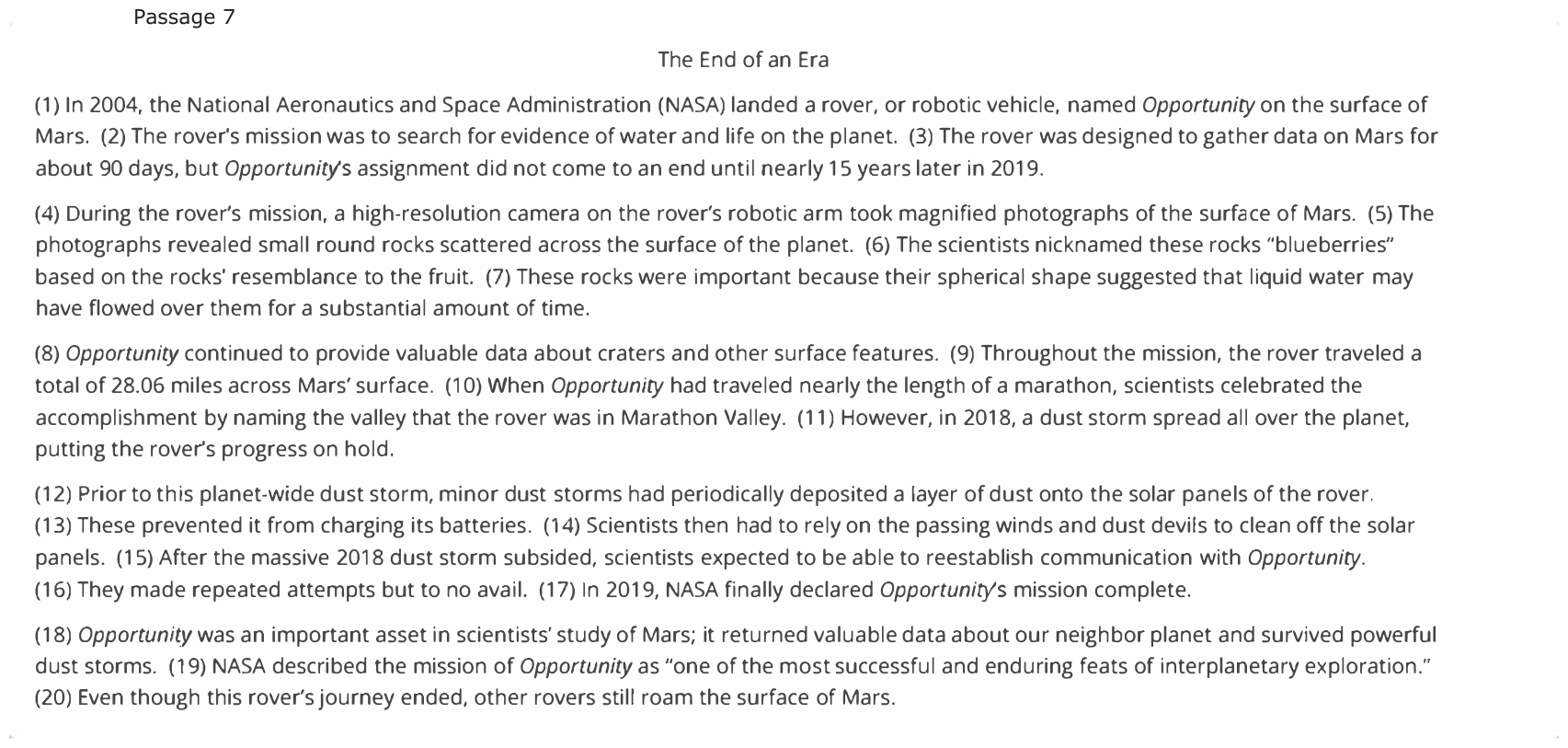
(1) In 2004, the National Aeronautics and Space Administration (NASA) landed a rover, or robotic vehicle, named Opportunity on the surface of Mars. (2) The rover’s mission was to search for evidence of water and life on the planet. (3) The rover was designed to gather data on Mars for about 90 days, but Opportunity’s assignment did not come to an end until nearly 15 years later in 2019.
(4) During the rover’s mission, a high-resolution camera on the rover’s robotic arm took magnified photographs of the surface of Mars. (5) The photographs revealed small round rocks scattered across the surface of the planet. (6) The scientists nicknamed these rocks “blueberries” based on the rocks’ resemblance to the fruit. (7) These rocks were important because their spherical shape suggested that liquid water may have flowed over them for a substantial amount of time.
(8) Opportunity continued to provide valuable data about craters and other surface features. (9) Throughout the mission, the rover traveled a total of 28.06 miles across Mars’ surface. (10) When Opportunity had traveled nearly the length of a marathon, scientists celebrated the accomplishment by naming the valley that the rover was in Marathon Valley. (11) However, in 2018, a dust storm spread all over the planet, putting the rover’s progress on hold.
(12) Prior to this planet-wide dust storm, minor dust storms had periodically deposited a layer of dust onto the solar panels of the rover. (13) These prevented it from charging its batteries. (14) Scientists then had to rely on the passing winds and dust devils to clean off the solar panels. (15) After the massive 2018 dust storm subsided, scientists expected to be able to reestablish communication with Opportunity. (16) They made repeated attempts but to no avail. (17) In 2019, NASA finally declared Opportunity’s mission complete.
(18) Opportunity was an important asset in scientists’ study of Mars; it returned valuable data about our neighbor planet and survived powerful dust storms. (19) NASA described the mission of Opportunity as “one of the most successful and enduring feats of interplanetary exploration.” (20) Even though this rover’s journey ended, other rovers still roam the surface of Mars.
Question
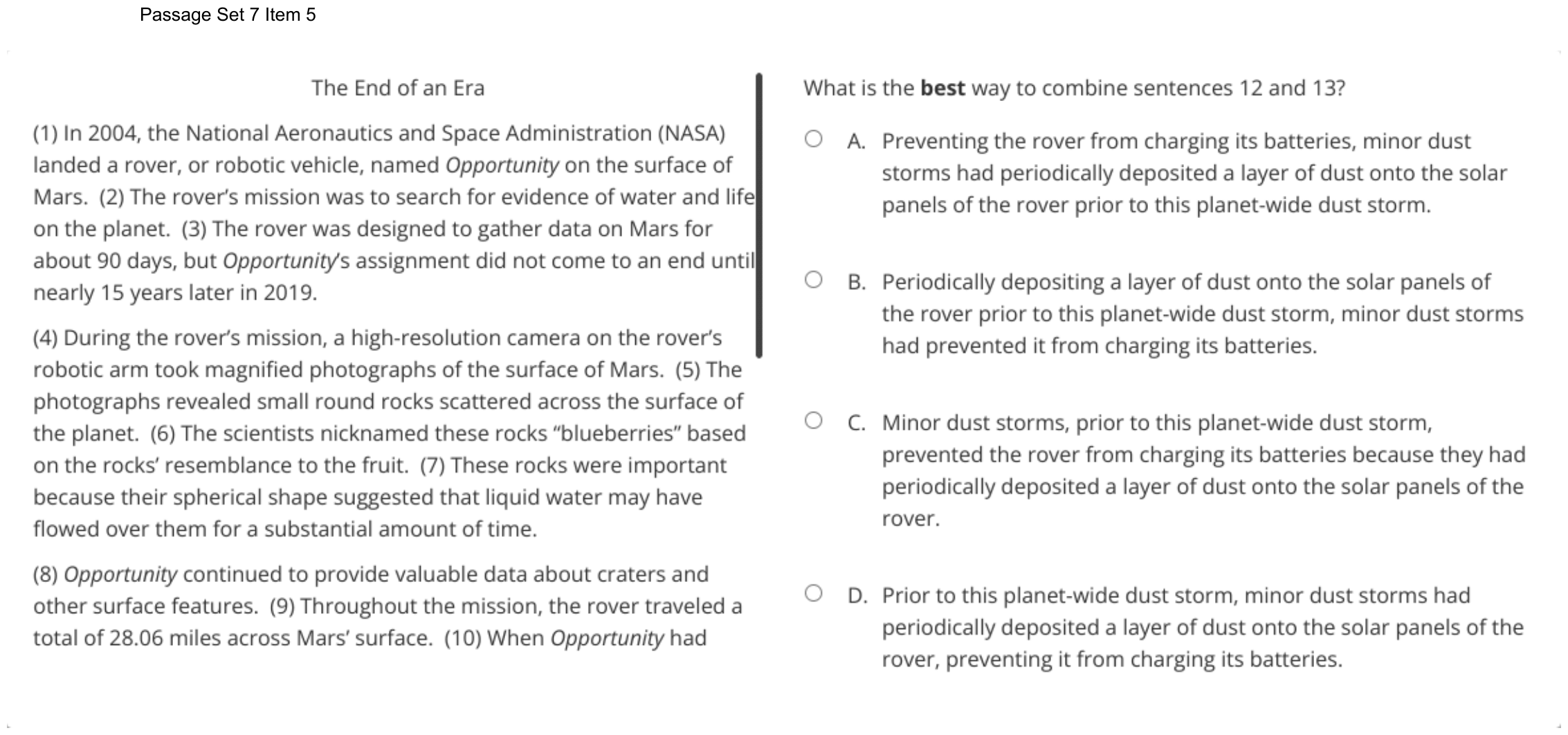
What is the best way to combine sentences 12 and 13?
- APreventing the rover from charging its batteries, minor dust storms had periodically deposited a layer of dust onto the solar panels of the rover prior to this planet-wide dust storm.
- BPeriodically depositing a layer of dust onto the solar panels of the rover prior to this planet-wide dust storm, minor dust storms had prevented it from charging its batteries.
- CMinor dust storms, prior to this planet-wide dust storm, prevented the rover from charging its batteries because they had periodically deposited a layer of dust onto the solar panels of the rover.
- DPrior to this planet-wide dust storm, minor dust storms had periodically deposited a layer of dust onto the solar panels of the rover, preventing it from charging its batteries.
Show the answer
Correct answer: D
The question asks for the best way to combine sentences 12 and 13.
A. Incorrect. The phrase “this planet-wide dust storm” in the original sentence 12 makes a direct reference to sentence 11 and therefore acts as a transition that should be kept at the beginning. In this sentence, the transition phrase is placed at the end of the sentence, making the phrase confusing. In addition, the sentence is unnecessarily repetitive and wordy.
B. Incorrect. This combination unnecessarily turns sentence 12 into an overly long participial phrase, making the connection between “it” and its antecedent, “the rover,” unclear and distracting from the subject of the sentence, “minor dust storms.”
C. Incorrect. Not only does this combination move the reference to “this planet-wide dust storm” farther from sentence 11, but it is also unnecessarily wordy, adding “because” and repeating “the rover.”
D. CORRECT. This sentence efficiently and accurately adds sentence 13 to sentence 12 as a participial phrase by changing “These prevented” to “preventing,” while also retaining the meanings of the original sentences 12 and 13.
Question analysis
This sentence-combining question asks for the best way to join two sentences from the rover passage: one saying minor dust storms had periodically coated the rover's solar panels, the other saying this kept it from charging its batteries. The four versions keep the same facts in different orders, so students must judge which is clearest and most concise in context.
- Grade level
- Grade 8 reading and task
- Compared with grade 7
- Above grade 7 Combining two sentences is grade 7 work, usually with one version clearly better. These four are long, keep the same facts and differ in order and wording, so students must weigh clarity and concision across nearly identical sentences, more than typical.
- Estimated difficulty
- Hard: combines ideas, needs a plan, and has more than one tempting wrong answer.
- Thinking it demands
- Depth of knowledge 2, skills and concepts · mainly evaluate
- What makes it hard
- How sentences fit together moderate
- Every choice must be checked moderate
- Complex sentences minor
- Evidence
- Answered from one sentence or line
- Reading level
- Passage: about grade 11, 337 words; question and choices: about grade 13, 129 words.
- Corrected from the DOE handbook
- Two grammar terms in the explanation were corrected.
- Students, last 30 days
- Not enough answers yet to show (it takes 10).
Why it is hard, traps and wrong answers (shows the answer)
Why it is hard
None of the versions is plainly ungrammatical, so the ear gives little help, and the version with “because” looks best to students who value a clearly stated cause. Its cost is wordiness and a weaker link: the result comes first and the reference back to sentence 11 is buried mid-sentence. The question rewards keeping the original order, cause then effect, and folding sentence 13 in as a short closing phrase.
How sentences fit together moderate Working it out
“Prior to this planet-wide dust storm” points back to sentence 11, so the best version keeps it first; three versions move it later, which loosens the link between the two sentences. (Halliday & Hasan, 1976)
Every choice must be checked moderate Choosing the answer
All four versions keep every fact of sentences 12 and 13 and run 29 to 32 words, so none can be ruled out by content; order, pronouns and repetition decide. (Embretson & Wetzel, 1987)
Complex sentences minor Understanding the question
Each version is one long sentence built around a participial phrase or a “because” clause, and at that length a stranded “it” or a doubled “the rover” is easy to miss. (Abedi & Lord, 2001; Freedle & Kostin, 1993; Messick, 1989)
Strategy: Read sentence 11 first, then compare the versions on how smoothly each connects to it, how many words it uses, and whether every pronoun has a clear antecedent.
Traps
- Wordy, vague or informal: A revision is grammatical but wordy, imprecise or too casual for the passage.
- Unclear pronoun: A pronoun whose reference is vague or ambiguous, or one in the wrong case.
The wrong answers, classified
A Wordy, vague or informal (Connors & Lunsford, 1988)
Opens with the effect as a participial phrase, which pushes “prior to this planet-wide dust storm,” the link to sentence 11, to the end and names “the rover” twice.
B Unclear pronoun (Connors & Lunsford, 1988)
Packs sentence 12 into a 19-word opening phrase, so “it” follows “this planet-wide dust storm” and no longer points clearly to the rover buried inside the phrase.
C Wordy, vague or informal (Connors & Lunsford, 1988)
Likes the clear cause word “because,” but the result now comes first, “the rover” appears twice, and “prior to this planet-wide dust storm” splits the subject from its verb.
What was corrected from the DOE handbook, and why
- Explanation: The DOE’s explanation of Option B says the combination turns sentence 12 into “an overly long dependent clause,” and its explanation of Option D says Option D adds sentence 13 to sentence 12 “as a dependent clause” by changing “These prevented” to “preventing.” Neither is a clause: “Periodically depositing a layer of dust onto the solar panels of the rover prior to this planet-wide dust storm” (Option B) and “preventing it from charging its batteries” (Option D) have no subject or finite verb of their own. Both are participial phrases, and the site now calls them that. The reasoning and the answer, Option D, are unchanged.
Working it out, step by step
Figure out what the question asks
This question asks for the best way to join sentences 12 and 13 into one sentence. The best version keeps the meaning, uses few words and is clear. It should also connect smoothly to sentence 11, the sentence before.
Read the sentences in order
Sentence 11 tells about the giant 2018 dust storm. Sentence 12 begins “Prior to this planet-wide dust storm.” Prior to means before. That phrase points back to sentence 11, so it works best at the start. Sentence 12 says small storms put dust on the solar panels. Sentence 13 gives the result: “These prevented it from charging its batteries.”
Learn the tool: a participial phrase
A participial phrase is a group of words built on a verb form, often an -ing word. It describes something, but it has no subject and can’t stand alone. Example: The dog ran to the door. It wagged its tail. becomes The dog ran to the door, wagging its tail. Choice D does this. It turns “These prevented” into “preventing.”
Check each choice
- A is wrong. It starts with the result. It moves “prior to this planet-wide dust storm” to the end, far from sentence 11. It also says “the rover” twice.
- B is wrong. Its long opening phrase hides the rover. Then “it” comes after “minor dust storms,” so it is hard to tell what “it” means.
- C is wrong. It adds “because,” puts the result first and says “the rover” twice. It is wordier than D.
- D is right. It keeps the link to sentence 11 first, gives the cause, then adds the result as a short participial phrase.
Watch out: C looks clear because “because” names the cause. But it is longer, and it puts an extra phrase between “Minor dust storms” and its verb.
Choose the answer
So the answer is D: “Prior to this planet-wide dust storm, minor dust storms had periodically deposited a layer of dust onto the solar panels of the rover, preventing it from charging its batteries.”
Why this answer and not the closest wrong one
C is the closest wrong answer, because “because” makes the cause very clear. But C puts the result first and repeats “the rover.” D keeps the original order, cause then result. It also keeps the link to sentence 11 up front, in fewer words.
More questions like this
The original DOE question
The passage “The End of an Era” as printed (page 60)
Question 2 of 6
2026 Practice Test D English, question 19Passage Wolves of the Sea
Wolves of the Sea
The cool and misty landscape of the Great Bear Rainforest can be found along the coast of British Columbia, Canada, and its nearby islands, from Vancouver Island to the Alaskan border. Within this protected area, wolves roam the forests, islands, and beaches. When biologist Chris Darimont began to study these wolves, he wanted to confer with local First Nations groups, as aboriginal Canadians are known, in order to learn what they knew about these wolves. He spoke with Chester Starr, an elder of the Heiltsuk Nation that has occupied the Great Bear Rainforest for thousands of years. What Starr had to say about the wolves changed Darimont’s perception of the animals.
Starr asked Darimont which wolves he and his team were going to study—the timber wolves (mainland wolves) or the coastal wolves on the islands. The question took Darimont by surprise. Biologists had always believed that the wolves that are sometimes spotted swimming between islands and eating salmon are the same wolves that live on the mainland. Darimont was intrigued by Starr’s classification of the wolves as two different groups. At first, he was hesitant to accept the idea. The distances between the mainland and the islands are small, less than a mile. Why would the wolves on the islands be any different from the wolves on the mainland? To find out, Darimont and his research team studied the wolves on the islands and in the densely forested territory of the Great Bear Rainforest for ten years.
Throughout the study, Darimont recorded several significant, observable differences between the “sea wolves,” as they are nicknamed, and the mainland wolves. Compared with the mainland wolves, the sea wolves are smaller in size and are strong swimmers. In 1996 sea wolves were spotted on an island nearly eight miles from any other land formation. While mainland wolves almost exclusively eat meat, such as deer and elk, and teach their young to hunt for land animals, sea wolves get as much as 90 percent of their nutrition from the sea and teach their young to dig for clams and to catch fish. Sea wolves regularly swim between islands and have been known to sneak up on a seal sunning itself on a rock and make a leaping attack from the water. Some salmon-eating mainland wolves come and go from the islands with the fish-spawning season, but the sea wolves are full-time island residents. Darimont suspects that some sea wolves live their entire life on the islands.
The sea wolves displayed not only physical and behavioral differences but also genetic variations from the mainland wolves. After collecting and analyzing the DNA in 800 samples of gray fur and wolf waste, researchers could produce hard biological evidence that sea wolves had genetic markers that made them distinct from the mainland wolves. A genetic marker is a variation in a DNA sequence that can be used to identify individuals or a species because it is passed down to offspring. Darimont hypothesizes that a change in habitat led to the eventual genetic differences between sea wolves and mainland wolves. Many years ago, loss of habitat and food sources forced some mainland wolves out to the islands. They learned to eat everything from kelp and fish eggs to the remains of sea creatures that washed up on the beach. Wolves living on the islands and mainland wolves became more isolated and rarely mated with each other. Over time the two types of wolves became more distinct.
It turned out that Chester Starr was right all along. “It sounded totally bizarre at first,” admits Darimont, “that there could be two versions of the species.” But he now realizes that this skepticism “definitely reflected my ignorance of indigenous knowledge at the time.” Learning to trust the wisdom of the Heiltsuk people opened Darimont up to knowledge accumulated over millennia and positioned him so that he could gather new scientific evidence about one of British Columbia’s most elusive species, the sea wolf.
Question
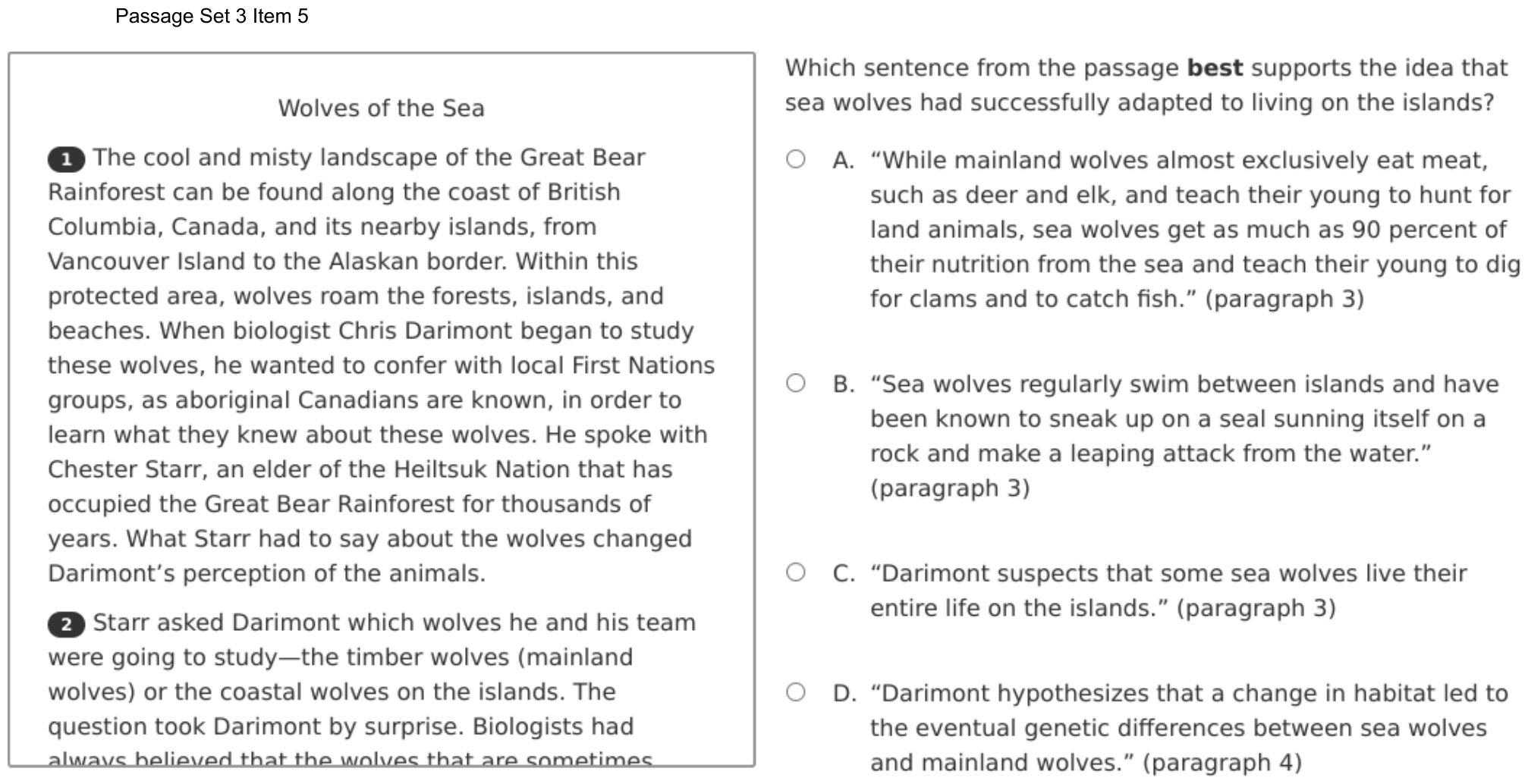
Which sentence from the passage best supports the idea that sea wolves had successfully adapted to living on the islands?
- A“While mainland wolves almost exclusively eat meat, such as deer and elk, and teach their young to hunt for land animals, sea wolves get as much as 90 percent of their nutrition from the sea and teach their young to dig for clams and to catch fish.” (paragraph 3)
- B“Sea wolves regularly swim between islands and have been known to sneak up on a seal sunning itself on a rock and make a leaping attack from the water.” (paragraph 3)
- C“Darimont suspects that some sea wolves live their entire life on the islands.” (paragraph 3)
- D“Darimont hypothesizes that a change in habitat led to the eventual genetic differences between sea wolves and mainland wolves.” (paragraph 4)
Show the answer
Correct answer: A
The question asks for the sentence from the passage that best supports the idea that sea wolves had successfully adapted to living on the islands.
A. CORRECT. This sentence from paragraph 3 describes a significant difference in the diets of the mainland and sea wolves: the mainland wolves “almost exclusively eat meat, such as deer and elk, and teach their young to hunt for land animals,” whereas the sea wolves had adapted to the point where they derive “as much as 90 percent of their nutrition from the sea and teach their young to dig for clams and to catch fish.” This sentence emphasizes the dietary difference between the two groups of wolves and best supports the idea that sea wolves had successfully adapted to living on the islands.
B. Incorrect. Although this sentence from paragraph 3 describes one technique that the sea wolves used to hunt, it does not offer evidence as strong as that provided by the preceding sentence, which explains that sea wolves were able to derive “as much as 90 percent” (paragraph 3) of their sustenance from the sea alone (versus the mainland wolves, which “almost exclusively eat meat” from land animals [paragraph 3]).
C. Incorrect. Although this sentence from paragraph 3 states that “some sea wolves live their entire life on the islands,” it does not provide strong evidence of the necessary adaptations—namely, how these wolves were able to successfully live their whole lives on the islands. Living on the islands was not necessarily an adaptation in and of itself; the adaptation was the sea-based diet that enabled the sea wolves to live on the islands without access to land animals.
D. Incorrect. Although this sentence from paragraph 4 presents Darimont’s hypothesis that “a change in habitat led to the eventual genetic differences” between the wolves, the sentence does not describe any of the sea wolves’ adaptations nor best support the idea that the sea wolves successfully adapted to living on the islands.
Question analysis
This evidence question on “Wolves of the Sea” asks which sentence best supports the idea that sea wolves had successfully adapted to living on the islands. Three choices come from paragraph 3’s list of differences between sea wolves and mainland wolves and one from paragraph 4, so students must rank closely related sentences by how directly each shows the wolves thriving there.
- NYS standards
- 7R1 textual evidence and inferences
- Grade level
- Grade 8 reading and task
- Compared with grade 7
- Above grade 7 Grade 7 evidence questions often have one clearly relevant sentence. Here three neighboring sentences all describe the sea wolves’ island life, so students must decide what counts as successful adaptation and rank strong evidence against nearly as strong.
- Estimated difficulty
- Hard: combines ideas, needs a plan, and has more than one tempting wrong answer.
- Thinking it demands
- Depth of knowledge 3, strategic thinking · mainly evaluate
- What makes it hard
- A very close wrong answer moderate
- Reading between the lines moderate
- Every choice must be checked minor
- Evidence
- Answered from several paragraphs or stanzas
- Reading level
- Passage: about grade 10, 662 words; question and choices: about grade 12, 131 words.
- Students, last 30 days
- Not enough answers yet to show (it takes 10).
Why it is hard, traps and wrong answers (shows the answer)
Why it is hard
All four sentences are about sea wolves, and three describe their island lives, so the question turns on ranking evidence rather than spotting it. The seal attack is one of the passage’s most vivid images and shows a real island skill, which makes it hard to give up for a sentence about diet. The key wins because it shows a whole way of life changing, most food from the sea and the young taught to fish, while the other sentences offer one habit, a hedged guess or a cause.
A very close wrong answer moderate Choosing the answer
The seal-hunting sentence sits right after the key in paragraph 3 and also shows sea wolves living off the sea; it differs in showing one hunting trick instead of up to 90 percent of their food. (Embretson & Wetzel, 1987; Gorin & Embretson, 2006; Ascalon et al., 2007)
Reading between the lines moderate Working it out
No sentence uses the word “adapted,” so students must first decide what would prove an animal thrives in a new place, such as getting its food there and teaching that skill to its young. (Graesser, Singer & Trabasso, 1994; Kintsch, 1998)
Every choice must be checked minor Choosing the answer
Three of the four sentences come from paragraph 3’s list of island habits, and all four mention sea wolves or their habitat, so none can be dismissed at a glance. (Embretson & Wetzel, 1987)
Strategy: Before reading the choices, decide what would prove that an animal has adapted well to a new place, then rank the four sentences by how fully each one shows that, not merely whether it fits.
Traps
- Supports only part of the claim: In a question about evidence: a line that backs one half of the claim but not the other, or a related point rather than the claim itself.
- True but not the answer: A choice says something accurate about the text that does not answer this question.
The wrong answers, classified
B Supports only part of the claim (King et al., 2004; Thissen, Steinberg & Fitzpatrick, 1989)
Is impressed by the leaping attack on a seal, a real island skill, but one hunting technique shows less than wolves getting up to 90 percent of their food from the sea.
C Supports only part of the claim (King et al., 2004; Thissen, Steinberg & Fitzpatrick, 1989)
Matches “live their entire life on the islands” to the claim’s “living on the islands,” but it is Darimont’s guess about where the wolves stay, not how they manage there.
D True but not the answer (King et al., 2004; Embretson & Wetzel, 1987)
Sees “change in habitat” and thinks of adaptation, but the sentence gives Darimont’s theory of what caused the genetic differences, not evidence that the wolves thrive.
Working it out, step by step
Figure out what the question asks
This asks for evidence: the sentence that best supports a claim. The claim is that sea wolves “had successfully adapted to living on the islands.” To adapt is to change so you can live well in a new place.
Decide what strong proof looks like
Before you read the choices, ask what would prove an animal is doing well somewhere new. It can find its food there. It can also teach its young to live there. One clever trick is weaker proof. A guess is weaker still. So look for a sentence that shows a whole way of life built around the new home.
Test the diet sentence
Choice A comes from paragraph 3. It says “sea wolves get as much as 90 percent of their nutrition from the sea and teach their young to dig for clams and to catch fish.” Nutrition is the food a body needs. So almost all their food comes from the sea. They also pass those skills on to their pups. Mainland wolves, by contrast, “almost exclusively eat meat, such as deer and elk.” Exclusively means only.
Check the other choices
- B shows one hunting trick, a leap at a seal. It is a real island skill. But it shows less than a diet that is up to 90 percent from the sea.
- C uses the word “suspects,” so it is only Darimont’s guess. It also tells where some wolves live, not how they manage there.
- D gives Darimont’s idea about what caused the genetic differences. It does not show the wolves doing well.
Watch out: The seal attack in B is the most exciting picture. But one exciting hunt is weaker proof than a whole new diet.
Choose the answer
Sentence A shows sea wolves getting most of their food from the sea and training their young to do the same. So the answer is A, the sentence “While mainland wolves almost exclusively eat meat, such as deer and elk, and teach their young to hunt for land animals, sea wolves get as much as 90 percent of their nutrition from the sea and teach their young to dig for clams and to catch fish.”
Why this answer and not the closest wrong one
B is the closest wrong answer. It comes right after A in paragraph 3 and also shows sea wolves living off the sea. But B shows one way of hunting. A shows where nearly all their food comes from, and that they teach it to their young. That is stronger proof that they adapted well.
More questions like this
The original DOE question
The passage “Wolves of the Sea” as printed (pages 23–24)

Question 3 of 6
2026 Practice Test B English, question 42Passage Letter from Brooklyn
Letter from Brooklyn
by Jacob Scheier
I can already see how this will end.
How I will grow tired of the bridge’s
steep incline, and the absent-minded tourists
wandering into the bicycle path.
The weather will turn cold.
But that all happens later.
For now it is the early edge of fall,
leaves green still while the air narrows,
is slightly crisp, almost grazing
the hair of my arm like a passing stranger,
as though the air has been forced into intimacy
by the brevity of daylight.
But when it starts darkening at 4,
this closeness, I know, will be a felt distance,
like someone drawing your attention
to their lack of intimacy.
These days I am still walking at a cathedral pace
beneath the branches bending across avenues,
brownstones like rows of lived-in chapels,
like a pop-up picture book I could have had as a child,
but didn’t. How Brooklyn makes me nostalgic
for the moment I am walking inside of.
These late afternoons filled
with a loneliness that makes me feel
distinctly myself, and an awareness
of how rare that is.
“Letter from Brooklyn” from LETTER FROM BROOKLYN: POEMS by Jacob Scheier, published by ECW Press. Copyright © 2013 by Jacob Scheier All rights reserved.
brevity: briefness
cathedral: meditative
chapels: private places of prayer or worship
nostalgic: yearning for the past
Question
The speaker’s thoughts throughout the poem develop a theme by showing that
- Aalthough people may hold expectations for the future, some people long for present experiences while they are still happening.
- Bthough people come from different places, most people feel drawn to the special charm a city holds.
- Calthough people can make decisions about their life, there will always be some things beyond their control.
- Dthough general expectations exist, people have no way of knowing what a given day will actually bring.
Show the answer
Correct answer: A
The question asks how the speaker’s thoughts throughout the poem develop a theme.
A. CORRECT. The speaker’s thoughts develop some tension because seasonal change will inevitably come: “The weather will turn cold” (line 5). However, the speaker is still able to enjoy the present experience because “that all happens later” (line 6). In lines 21–22, the speaker begins to describe experiences that create a longing for the present, even while it is still happening (“How Brooklyn makes me nostalgic / for the moment I am walking inside of”), developing a theme of the poem.
B. Incorrect. The speaker’s thoughts reveal an appreciation for the city, but this appreciation is highly personal and individual. These thoughts do not indicate that most people will feel drawn to cities.
C. Incorrect. Some things, such as seasons, are beyond human control, as the speaker concedes: “I can already see how this will end” (line 1). However, the theme of the poem is not that certain things are inevitable, but that one can live in the present moment and enjoy that experience before change occurs.
D. Incorrect. The speaker’s thoughts are not showing that people are surprised by what the days bring; the thoughts of the speaker suggest that people experience many seasons in Brooklyn and have reasonable expectations about what these days will bring.
Question analysis
This theme question asks what theme the speaker's thoughts develop across all of “Letter from Brooklyn,” from the opening line about how things will end to the closing lines about loneliness on late afternoons. Each choice is a broad statement about people in two parts, so students must check both halves against the speaker's reflections.
- NYS standards
- 7R2 theme or central idea
- Grade level
- Grade 8 reading and task
- Compared with grade 7
- Above grade 7 Stating a theme is a grade 7 standard, often tested with one clearly fitting choice. Here every choice is a two-part general statement about people, and students must test both halves of each against a whole poem of abstract reflection, more than typical.
- Estimated difficulty
- Hard: combines ideas, needs a plan, and has more than one tempting wrong answer.
- Thinking it demands
- Depth of knowledge 3, strategic thinking · mainly analyze
- What makes it hard
- Reading between the lines moderate
- Every choice must be checked moderate
- Evidence in several places minor
- Evidence
- Answered from the whole text
- Reading level
- Passage: 217 words (a poem; reading level not measured); question and choices: about grade 9, 82 words.
- Students, last 30 days
- Not enough answers yet to show (it takes 10).
Why it is hard, traps and wrong answers (shows the answer)
Why it is hard
The four themes are broad statements about people, each in two halves, and every one can borrow something from the poem: the seasons are beyond control, the city has charm, the future brings surprises. The right one matches the speaker’s double vision, knowing what is coming and longing for the present while it lasts. The strongest pull is the theme about things beyond control, whose second half fits the turning seasons and whose first half the poem never raises.
Reading between the lines moderate Working it out
The poem never states its theme; it must be built from the speaker’s forecasts in lines 1–6 and the paradox of being “nostalgic / for the moment I am walking inside of.” (Graesser, Singer & Trabasso, 1994; Kintsch, 1998)
Every choice must be checked moderate Choosing the answer
Every choice is a two-part “although” or “though” statement about people, and three have one plausible half, so each half must be checked against the poem on its own. (Embretson & Wetzel, 1987)
Evidence in several places minor Working it out
The theme draws on the whole poem, from the opening “I can already see how this will end” to the lonely late afternoons of lines 23–26. (Kirsch & Mosenthal, 1990; Gorin & Embretson, 2006)
Strategy: Sum up in a sentence what the speaker keeps thinking about from the first line to the last, then test both halves of each choice against the poem and reject any half it does not support.
Traps
- Half right: One half of a two-part choice is right and the other is not.
- Too broad or too strong: A choice overstates, generalizes, or uses absolute words the text does not support.
- Twists what the text says: Uses the text's topic and ideas but changes what it says: who did it, how much, when, or why.
The wrong answers, classified
B Too broad or too strong (King et al., 2004)
Turns one speaker’s love of Brooklyn into a claim that “most people” feel drawn to a city’s charm, though no other person’s view appears in the poem.
C Half right (King et al., 2004; Thissen, Steinberg & Fitzpatrick, 1989)
Accepts the half about things beyond control, since the weather will turn cold regardless, but the poem says nothing about people making decisions about their lives.
D Twists what the text says (King et al., 2004)
Turns the coming season into an unknown, though the speaker opens with “I can already see how this will end” and knows exactly what the weather will bring.
Working it out, step by step
Figure out what the question asks
This question asks for the theme of the whole poem. A theme is a big message about life. Each choice has two halves, joined by although or though. Both halves must fit the poem. If one half doesn’t, the choice is wrong.
Trace the speaker’s thoughts
The poem opens by looking ahead: “I can already see how this will end.” The speaker expects to tire of the bridge, and “The weather will turn cold.” Then the speaker turns to now: “But that all happens later.” Most of the poem enjoys the fall walk. Lines 21–22 sum it up: “How Brooklyn makes me nostalgic / for the moment I am walking inside of.”
Put it in your own words
Nostalgic means longing for the past. Yet the speaker longs for the present, while it is still going on. So the speaker does two things at once. The speaker expects what the future will bring. And the speaker treasures, or deeply values, the present. That is the theme.
Check each choice
- A is right. First half: the speaker expects cold weather and boredom. Second half: the speaker longs for the walk while it is still going on.
- B is wrong. Only one person speaks in the poem. Nothing says most people feel drawn to cities.
- C is wrong. The weather is beyond anyone’s control, so its second half fits. But the poem never talks about people making decisions about their lives.
- D is wrong. The speaker knows what is coming. The future isn’t a mystery here.
Watch out: C is tempting because the speaker can’t stop the cold. But test both halves. Its first half, about making decisions, isn’t in the poem.
Choose the answer
So the answer is A: “although people may hold expectations for the future, some people long for present experiences while they are still happening.”
Why this answer and not the closest wrong one
C is the closest wrong answer, because the seasons are beyond the speaker’s control. But the poem never mentions people making decisions about their lives. A matches both halves: the speaker expects what is coming, and longs for the present while it lasts.
More questions like this
The original DOE question
The passage “Letter from Brooklyn” as printed (page 50)
Question 4 of 6
2024 Test B Math, question 28Question
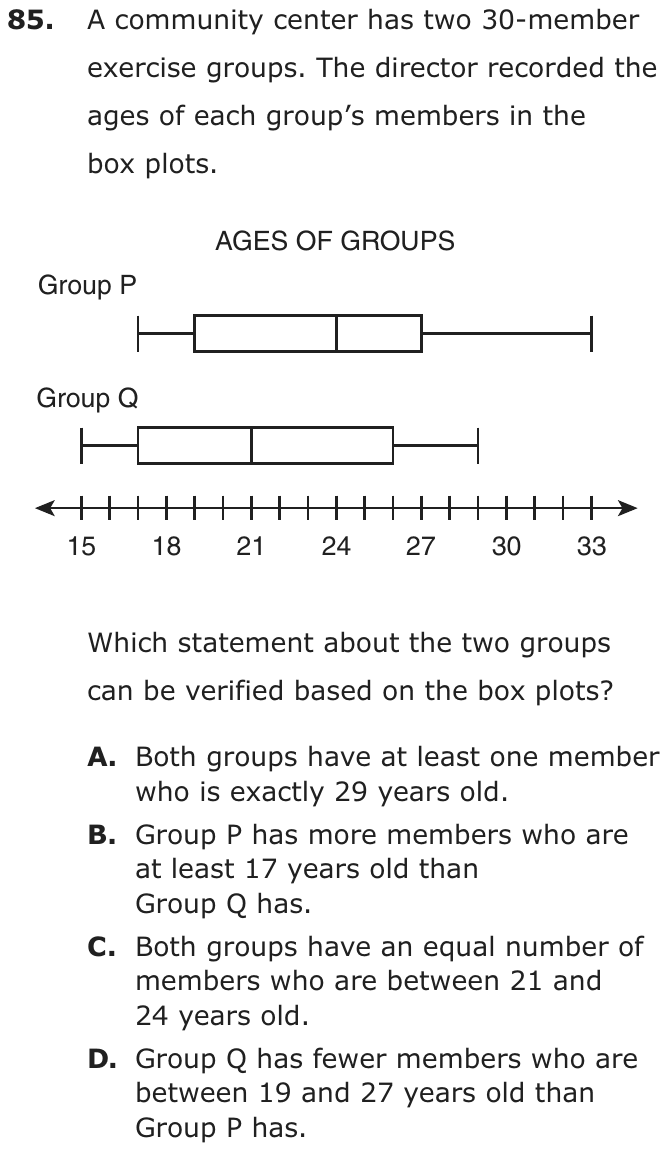
A community center has two 30-member exercise groups. The director recorded the ages of each group’s members in the box plots.
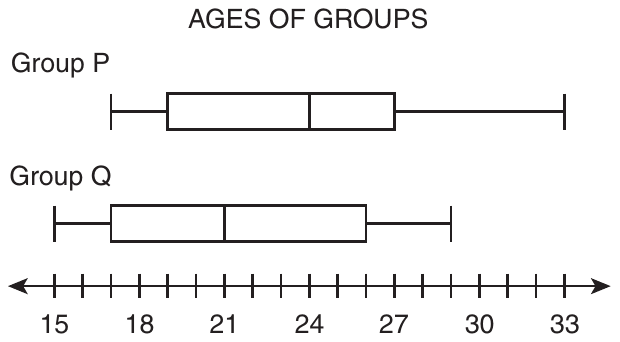
Which statement about the two groups can be verified based on the box plots?
- ABoth groups have at least one member who is exactly 29 years old.
- BGroup P has more members who are at least 17 years old than Group Q has.
- CBoth groups have an equal number of members who are between 21 and 24 years old.
- DGroup Q has fewer members who are between 19 and 27 years old than Group P has.
Show the answer
Correct answer: B
Groups P and Q have an equal number of members. All the members of Group P are 17 or older, but only about of the members of Group Q are 17 or older.
Question analysis
Box plots show the ages of the members of two 30-member exercise groups at a community center, Group P and Group Q. Students decide which statement comparing the groups can be verified from the plots alone. The challenge is knowing what a box plot guarantees about individual ages and counts, and what it leaves unknown.
- NYS standards
- Grade level
- Grade 7 content, by NYS standard
- Compared with grade 7
- Above grade 7 Grade 7 students read box plots and compare medians and spreads. Deciding which claims two box plots can prove, from what the five key values guarantee about counts, is a harder reasoning task than typical grade 7 work.
- Estimated difficulty
- Hard: combines ideas, needs a plan, and has more than one tempting wrong answer.
- Thinking it demands
- Depth of knowledge 3, strategic thinking · mainly evaluate
- What makes it hard
- Every choice must be checked major
- Something you must already know moderate
- Reading a figure, table or graph moderate
- Solution
- 3 steps
- Reading level
- Question and choices: about grade 5, 91 words.
- Students, last 30 days
- Not enough answers yet to show (it takes 10).
Why it is hard, traps and wrong answers (shows the answer)
Why it is hard
This is a question about evidence: the right statement is the only one the box plots guarantee, while the others may or may not be true. Students who treat the plots as pictures of every member, assuming ages fill each whisker or spread evenly through each box, find support for claims that cannot be checked. Asking what must hold for any 30 ages with these summaries separates the verifiable claim from the merely plausible ones.
Every choice must be checked major Choosing the answer
Three of the statements are not false but unverifiable, so each must be tested against what the five-number summaries guarantee, and none can be dismissed at a glance. (Embretson & Wetzel, 1987)
Something you must already know moderate Working it out
Students must know that the minimum and maximum are actual ages, that each quarter of a plot holds about a quarter of the 30 members, and that a whisker shows nothing in between. (Anderson & Krathwohl, 2001)
Reading a figure, table or graph moderate Understanding the question
The scale is labeled only every 3 years, so values such as 17, 19, 26 and 29 have to be read from unlabeled ticks on two separate plots. (Lesh, Post & Behr, 1987; Kirsch & Mosenthal, 1990)
Strategy: List each group's minimum, first quartile, median, third quartile and maximum, then test every statement against only what those five values guarantee about the 30 ages.
Traps
- Misunderstands the concept: A wrong belief about a concept: that percents can be added, that area grows like length, that averages can be averaged, that a bigger denominator means a bigger fraction.
- Numbers taken from the question: Combines the numbers in the question without a model of the situation, or is simply a number that appears in the question.
The wrong answers, classified
A Misunderstands the concept (Smith, diSessa & Roschelle, 1993; De Bock et al., 1998; Ni & Zhou, 2005)
Sees that Group Q's maximum is exactly 29 and that 29 also lies in Group P's upper whisker, assuming someone in Group P is that age.
C Numbers taken from the question (Hegarty, Mayer & Monk, 1995)
Matches the two medians, 21 and 24, and assumes the stretch between them holds the same number of members in both groups.
D Misunderstands the concept (Smith, diSessa & Roschelle, 1993; De Bock et al., 1998; Ni & Zhou, 2005)
Knows Group P's box from 19 to 27 holds half its members, then assumes ages spread evenly so Group Q has fewer there, which its plot cannot show.
Worked solution, step by step
Formulas used
- Members in each part of a box plot
- n is the number of members in a group, here 30. A box plot splits the data into four parts at the minimum, Q1, the median, Q3 and the maximum. Each part holds about one fourth of the data. It does not show how the ages spread out inside a part.
Read the two box plots
A box plot shows five numbers. The minimum is the youngest age, and the maximum is the oldest. Q1 is the left edge of the box, and Q3 is the right edge. The median is the line inside the box.
Group Min Q1 Median Q3 Max P 17 19 24 27 33 Q 15 17 21 26 29 Each group has 30 members.
Know what can be verified
To verify a statement means to know for sure that it is true. A box plot shows only five numbers, not every age. The minimum and maximum are real ages of real members. The other ages are hidden inside the box and whiskers.
Check choice B
In Group P, the youngest member is 17. So all 30 members are at least 17. In Group Q, the youngest member is 15, and 15 is under 17. So at most 29 members of Group Q are at least 17.
Group P has 30 such members, and Group Q has 29 or fewer. So choice B is true for sure.
Rule out choices A and C
A: Group Q’s oldest member is 29, so Group Q has a 29-year-old. But in Group P, 29 is inside the right whisker. A whisker does not show single ages. Watch out: 29 is in Group P’s range, but maybe no one in Group P is exactly 29.
C: The plots do not show how many members are between 21 and 24 in either group.
Rule out choice D and answer
Group P’s box, from 19 to 27, is two of its four parts.
So about 15 members of Group P are between 19 and 27. But 19 and 27 fall in the middle of Group Q’s parts, and ages inside a part can bunch up in any way. Group Q could have more or fewer. Watch out: D assumes the ages are spread out evenly, and a box plot never tells you that.
So the answer is B.
Check your answer
Choice B uses only the two minimums, which are real ages. Group P’s youngest member is 17, and Group Q’s is 15. That alone proves it. Each other choice needs ages inside a box or whisker, which a box plot does not show.
More questions like this
The original DOE question
Question 5 of 6
2026 Practice Test D Math, question 48Question
The perimeter of square W is twice the perimeter of equilateral triangle X. What is the ratio of the length of one side of square W to the length of one side of equilateral triangle X?
- A3:8
- B2:3
- C3:2
- D2:1
Show the answer
Correct answer: C
First, set up the ratio of the perimeter of the square to the triangle as 2:1 because the question states that the perimeter of the square is twice the perimeter of the triangle.
Recognizing that the square has 4 equal sides and that an equilateral triangle has 3 sides, use division to find the ratio of the sides.
Perimeter:
Sides:
Question analysis
The perimeter of square W is twice the perimeter of equilateral triangle X, and students find the ratio of a side of the square to a side of the triangle. This ratio question uses perimeters of regular shapes with no lengths given. Turning a comparison of perimeters into one of sides, and keeping the ratio in the order asked, are the tricky parts.
- NYS standards
- Grade level
- Grade 7 content, by NYS standard
- Compared with grade 7
- Above grade 7 Grade 7 ratio problems usually supply numbers to work with. This one gives only a relationship between two perimeters, so students must bring in the number of sides of each shape themselves and keep the ratio in the order asked.
- Estimated difficulty
- Hard: combines ideas, needs a plan, and has more than one tempting wrong answer.
- Thinking it demands
- Depth of knowledge 2, skills and concepts · mainly apply
- What makes it hard
- Turning words into math moderate
- Variables instead of numbers moderate
- A very close wrong answer minor
- Solution
- 3 steps
- Reading level
- Question and choices: about grade 9, 36 words.
- Students, last 30 days
- Not enough answers yet to show (it takes 10).
Why it is hard, traps and wrong answers (shows the answer)
Why it is hard
The question turns a statement about perimeters into a ratio of sides, and the natural guess, that the sides keep the perimeters’ 2 to 1, ignores that the square shares its perimeter among 4 sides and the triangle among 3. Choosing a triangle perimeter such as 12 makes the comparison concrete. The order of the ratio still has to be checked at the end, because its reverse is listed too.
Turning words into math moderate Understanding the question
“The perimeter of square W is twice the perimeter of equilateral triangle X” must become 4s = 2 × 3t, with the 2 on the triangle’s side; written backward, it gives the triangle the larger perimeter. (Hegarty, Mayer & Monk, 1995; Koedinger & Nathan, 2004)
Variables instead of numbers moderate Understanding the question
No side length is given, so students must either work with letters for the two sides or choose a convenient perimeter themselves, such as 12 for the triangle. (Koedinger & Nathan, 2004; Enright, Morley & Sheehan, 2002)
A very close wrong answer minor Choosing the answer
The ratios 3:2 and 2:3 use the same two numbers, so only keeping the square’s side first, as the question orders it, separates the answer from its reverse. (Embretson & Wetzel, 1987; Gorin & Embretson, 2006; Ascalon et al., 2007)
Strategy: Pick an easy side length for the triangle, find its perimeter, double that for the square, divide by the square's number of sides, and write square to triangle.
Traps
- Misunderstands the concept: A wrong belief about a concept: that percents can be added, that area grows like length, that averages can be averaged, that a bigger denominator means a bigger fraction.
- Wrong operation: Adds instead of multiplying, divides the wrong way round, turns a ratio or rate upside down, or undoes a step in the wrong direction (subtracts what should be added back).
- Equation written backwards: Writes a comparison the wrong way round, word for word: "six times as many students as professors" as 6S = P. The bigger quantity gets the bigger number.
The wrong answers, classified
A Equation written backwards (Clement, Lochhead & Monk, 1981)
Writes the comparison backward, 2 × 4s = 3t, giving the triangle the larger perimeter, so the ratio of the sides comes out 3:8.
B Wrong operation (Hegarty, Mayer & Monk, 1995; King et al., 2004)
Finds the right relationship but turns the ratio upside down, giving the triangle’s side to the square’s instead of the square’s side first.
D Misunderstands the concept (Smith, diSessa & Roschelle, 1993; De Bock et al., 1998; Ni & Zhou, 2005)
Assumes the sides are in the same ratio as the perimeters, 2:1, ignoring that the square has 4 sides and the triangle only 3.
Worked solution, step by step
Formulas used
- Perimeter of a square
- P is the perimeter, the distance around the shape. s is the length of one side. A square has 4 equal sides, so its perimeter is 4 times one side.
- Perimeter of an equilateral triangle
- An equilateral triangle has 3 equal sides. t is the length of one side. So its perimeter is 3 times one side.
- Ratio
- A ratio compares two amounts in order. a : b means a compared with b. The order matters, so write the amounts in the order the question names them.
Sort out the question
Square W has a perimeter twice as long as the perimeter of triangle X. Equilateral means all 3 sides of X are equal.
You need the ratio of one side of the square to one side of the triangle, in that order. No lengths are given, so you can pick a size to try.
Pick a size for the triangle
Choose an easy side length for the triangle, such as 2 units. All 3 sides are 2, so its perimeter is:
Find the square’s side
The square’s perimeter is twice the triangle’s:
The square has 4 equal sides, so divide by 4:
Each side of the square is 3 units.
Write the ratio in order
The square comes first, then the triangle. Their sides are 3 and 2, so the ratio is 3 : 2.
Watch out: 2 : 1, choice D, compares the perimeters, not the sides. The square splits its perimeter into 4 sides, the triangle into only 3. Choice B, 2 : 3, puts the triangle first. Choice A, 3 : 8, comes from giving the triangle the bigger perimeter.
So the answer is C, 3:2.
Check your answer
Try a different size. Give the triangle sides of 4. Its perimeter is 12, so the square’s is 24. Each side of the square is . The ratio 6 : 4 simplifies to 3 : 2. The size does not change the ratio.
More questions like this
The original DOE question
Question 6 of 6
2024 Test A Math, question 39Question
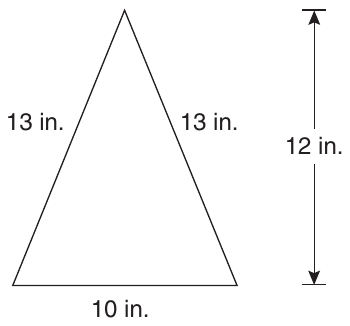
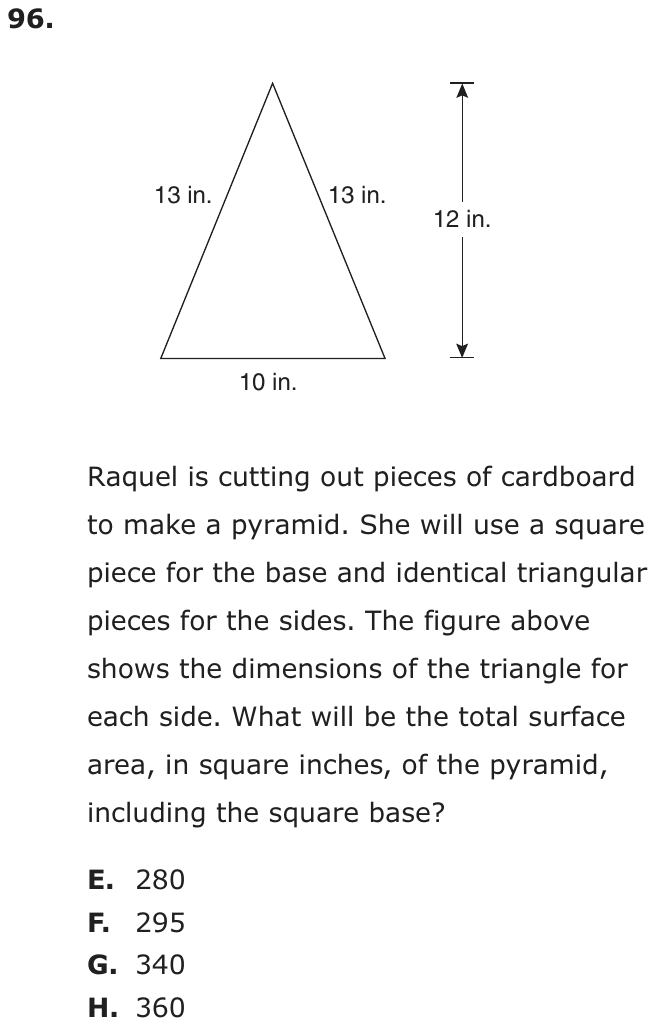
Raquel is cutting out pieces of cardboard to make a pyramid. She will use a square piece for the base and identical triangular pieces for the sides. The figure above shows the dimensions of the triangle for each side. What will be the total surface area, in square inches, of the pyramid, including the square base?
- A280
- B295
- C340
- D360
Show the answer
Correct answer: C
Surface area is found by calculating the area of each side, including the base, and adding them all together.
The base of the pyramid measures 10 inches on each side, so the area of the base is
Each triangular face has a base of 10 inches and a height of 12 inches, so the area of each face is
There are 4 triangular faces (because the square base has 4 edges, each of which will have a triangular face). So the total surface area of the pyramid is the sum of the areas of 4 triangles and 1 square.
So the total surface area is 340 square inches.
Question analysis
This surface area word problem shows one triangular face, with sides of 13 inches, a base of 10 inches and a height of 12 inches, that Raquel will use to build a cardboard pyramid with a square base. Students find the total area of the base and all the triangular sides. Picturing the solid and choosing the right measurements from the figure are the tricky parts.
- Grade level
- Grade 7 content, by NYS standard
- Compared with grade 7
- Above grade 7 Grade 7 students find the surface area of a pyramid from a drawn net or solid. Here only one triangular face is shown, so students must picture the whole pyramid, count its faces, and choose which labeled length belongs in the area formula.
- Estimated difficulty
- Hard: combines ideas, needs a plan, and has more than one tempting wrong answer.
- Thinking it demands
- Depth of knowledge 2, skills and concepts · mainly apply
- What makes it hard
- Reading a figure, table or graph moderate
- Combines ideas moderate
- Something you must already know minor
- Solution
- 4 steps
- Reading level
- Question and choices: about grade 6, 56 words.
- Corrected from the DOE handbook
- A wrong unit in the explanation was corrected.
- Students, last 30 days
- Not enough answers yet to show (it takes 10).
Why it is hard, traps and wrong answers (shows the answer)
Why it is hard
Students have to build the pyramid in their heads from one flat triangle, then choose the right measurement from three labels. The 13-inch sides look like the natural height, and using them gives a listed total; picturing a pyramid with three sloping faces gives another. Sketching the square base with a triangle on each edge, and marking 12 as the height, settles both the face count and the formula.
Reading a figure, table or graph moderate Understanding the question
The figure gives one triangle with three length labels, 13, 13 and 10, and puts its height, 12, on a separate arrow beside it, where it is easy to overlook. (Lesh, Post & Behr, 1987; Kirsch & Mosenthal, 1990)
Combines ideas moderate Working it out
The solid is never drawn: students must see that the square's side equals the triangle's 10-inch base, count four triangles, and add triangle and square areas. (Embretson, 1998; Daniel & Embretson, 2010)
Something you must already know minor Working it out
A triangle's area uses its perpendicular height, not a slanted side, and a pyramid on a square base has four triangular faces; neither fact is given. (Anderson & Krathwohl, 2001)
Strategy: Sketch the pyramid: a square base whose side is the triangle's base, and one triangular face on each side of the square. Find each area with the matching formula, then add them all.
Traps
- Misreads the figure: Reads a value, label or tick spacing in a figure, table or graph wrongly.
- Information you don't need: The question gives numbers or facts that play no part in the answer.
- Misunderstands the concept: A wrong belief about a concept: that percents can be added, that area grows like length, that averages can be averaged, that a bigger denominator means a bigger fraction.
The wrong answers, classified
A Misunderstands the concept (Smith, diSessa & Roschelle, 1993; De Bock et al., 1998; Ni & Zhou, 2005)
Counts only three triangular faces, as if the pyramid had a triangular base, so 3 × 60 + 100 = 280.
B Misunderstands the concept (Smith, diSessa & Roschelle, 1993; De Bock et al., 1998; Ni & Zhou, 2005)
Counts three faces and also uses the 13-inch side as each triangle's height: 3 × 65 + 100 = 295.
D Misreads the figure (Lesh, Post & Behr, 1987; Kirsch & Mosenthal, 1990)
Takes the 13-inch slanted side as each triangle's height instead of the 12-inch arrow beside it, so 4 × 65 + 100 = 360.
What was corrected from the DOE handbook, and why
- Explanation: The handbook ends “So the total surface area is 340 square feet.” The triangle’s dimensions are in inches and the question asks for square inches, so the site now reads “340 square inches.”
Worked solution, step by step
Formulas used
- Area of a triangle
- A is the area. b is the base, the side the triangle sits on. h is the height: the straight-up distance from the base to the top corner, at a right angle to the base. You take half because a triangle is half of a rectangle with the same base and height.
- Area of a square
- A is the area and s is the length of one side. All four sides of a square are equal, so the area is side times side.
- Surface area
- A face is one flat side of a solid shape. The surface area is the total area of the outside. Picture unfolding the solid into flat pieces. Then add up the area of every piece.
Sort out the question
Raquel’s pyramid has a square base. Each side is a triangle like the one in the figure. The triangle’s base is 10 in. Its two slanted sides are 13 in. Its height, the arrow beside it, is 12 in. You need the total surface area, including the square base, in square inches.
Picture the pyramid
Surface area is the total area of all the flat sides, called faces. Each triangle stands on one edge of the square. So each edge of the square is 10 inches, the same as the triangle’s base. A square has 4 edges, so the pyramid has 4 triangles.
Here that is 4 triangles plus 1 square. Watch out: counting only 3 triangles gives 280, choice A.
Find the area of one triangle
Each triangle is 60 square inches. Watch out: the height is 12 in., the straight-up arrow. It is not 13 in., the slanted side. Using 13 gives 65 for each triangle and 360 in all, choice D.
Find the area of the base
The base is a square with sides of 10 inches, the same as each triangle’s base.
The square base is 100 square inches.
Add all five faces
The four triangles and the square together cover 340 square inches.
So the answer is C, 340 square inches.
Check your answer
Each triangle is half of a 10 by 12 rectangle, which has an area of 120. So two triangles make 120, and four make 240. Add the base: . The units fit too: inches times inches gives square inches.
More questions like this
The original DOE question