3 English and 3 math
Here are 6 random questions to try. Takers earning below 75% are unlikely to receive an offer. You have 1 minute 48 seconds per question on the real exam.
Question 1 of 6
2024 Test A English, question 38Passage 5 Reasons Physical Books Might Be Better Than E-Books
5 Reasons Physical Books Might Be Better Than E-Books
by Shaunacy Ferro
Though e-book1 readers have become a more common sight around town, traditional books still have their evangelists.2 According to The New York Times, e-book sales have been falling in 2015. Print definitely isn’t dead. In fact, according to some research, it may actually be a better choice for some readers. While scientists are still trying to tease out exactly how digital reading affects us differently, here are five ways e-books might be inferior to their dead-tree cousins.
E-books can reduce reading comprehension.
In a study of middle schoolers, West Chester University researchers found that students who read on iPads3 had lower reading comprehension than when they read traditional printed books. They discovered that the kids sometimes skipped text in favor of interactive features in the e-books, suggesting that certain multimedia in children’s e-books can be detrimental to the practice of reading itself. However, the researchers noted that some interactive features in e-books are designed to enhance comprehension, and that those might be more helpful than game-type interactive graphics.
Young kids can get distracted by e-books.
Similar results were found by a small study by the Joan Ganz Cooney Center that consisted of 32 kids reading e-books and print books with their parents. It found that “enhanced” e-books might be distracting. Kids who read enhanced e-books—ones with interactive, multimedia experiences—were more engaged with them physically, but in the end they remembered fewer narrative details than those who read print books or basic e-books.
You remember less about a book’s timeline.
Another study of adults also found that e-books can be hard to absorb. The researchers asked 25 people to read a 28-page story on a Kindle4 and 25 to read the story in paperback, then asked the readers to put 14 events from the story in chronological order. Those who read the story on a Kindle performed worse on the chronology test than the book readers, though they performed about the same as print readers in other tests. Earlier research by the same scholars, from Stavanger University in Norway, found that Norwegian 10th graders also remembered more about texts if they read them in print rather than on a computer screen.
They’re not great as textbooks.
While e-book textbooks are often cheaper (and easier to carry) than traditional door-stop5 textbooks, college students often don’t prefer them. In some surveys of college kids, the majority of students have reported preferring print books. However, a 2012 study from the UK’s National Literacy Trust of kids ages 8 to 16 found that more than 50 percent of children reported preferring screen reading.
They’re tiring.
Staring at a lit screen can be tiring for the eyes and the brain. A 2005 study from Sweden found that reading digitally required a higher cognitive workload than reading on paper. Furthermore, staring at LED6 screens at night can disrupt sleep patterns. A 2014 Harvard study found that people who used e-readers with LED screens at night slept worse and were more tired the next day. So, if you’re going to go for an e-book, go for one without the backlight.
The take-away message? If you’re really trying to absorb material, you might want to go for a physical book. And if you’re going to be up all night studying, turn off the backlight.
However, all this may not mean that reading on a Kindle is really going to melt your brain. For instance, reading an e-book on a computer is a much different experience than reading on a Kindle, which is specifically designed for consuming books. So, too, is playing with an interactive e-book on an iPad, compared to using a simpler e-book device that only presents the text, with no opportunities to click away into digital distractions.
And some studies have found that part of the difference between the way people absorb information from e-books versus paper might be due to approaching e-books differently—in one test, participants didn’t regulate their study time with digital books like they did with paper texts, leading to worse performances. It’s possible that our expectations of e-book reading—as well as the different designs of the digital reading experience on a computer or iPad or Kindle—might affect how we approach the text and how much effort we put into studying them. As generations of e-book readers evolve, and people become more accustomed to the idea of sitting down with a digital textbook, these factors could change—for better or for worse.
“5 Reasons Physical Books Might Be Better Than E-Books” by Shaunacy Ferro from MENTAL FLOSS, October 2, 2015. Copyright © 2015 Mental Floss, Inc.
1e-book: an electronic book, a publication made available digitally for reading on a computer or other device
2evangelists: advocates or supporters
3iPads: tablet computers
4Kindle: device for reading e-books
5door-stop: a reference to the idea that some textbooks are large and heavy enough to hold a door open
6LED: Light-emitting diode; LEDs are often used as a backlight for electronic devices such as smart phones and tablets.
Question
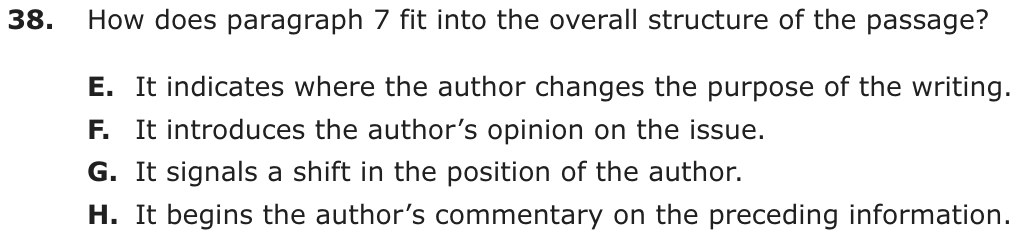
How does paragraph 7 fit into the overall structure of the passage?
- AIt indicates where the author changes the purpose of the writing.
- BIt introduces the author’s opinion on the issue.
- CIt signals a shift in the position of the author.
- DIt begins the author’s commentary on the preceding information.
Show the answer
Correct answer: D
The question asks for an explanation of the role of paragraph 7 in the overall structure of the passage.
A. Incorrect. The purpose of paragraphs 2–6 is to present reasons physical books might be better than e-books, and paragraph 7 offers summarizing “take-away” advice based on those reasons. As a result, it may seem as though the author’s purpose for writing the entire passage has shifted. However, the author’s advice in paragraph 7, that readers who want to learn from reading “might want to go for a physical book,” makes it clear that paragraph 7, like paragraphs 2–6, continues to serve the same purpose for the passage that the writer expresses in paragraph 1: to inform readers that printed books “may actually be a better choice for some readers” than e-books.
B. Incorrect. In paragraph 7, the author does offer the advice that readers who want to absorb material “might want to go for a physical book” rather than an e-book. Even though the author makes the statement favoring physical books for those who want to learn from their reading, the author is not sharing a personal opinion. Instead, the author offers the advice as a summary of the information presented in paragraphs 2–6, which explore various studies about the advantages of physical books over e-books. Furthermore, the idea that physical books are sometimes a better option is not introduced for the first time in paragraph 7. Instead, it is introduced early in the passage, when the author states in paragraph 1 that physical books “may actually be a better choice for some readers.”
C. Incorrect. Paragraph 7 presents a clear shift in style and content from paragraphs 2–6. Paragraphs 2–6 are each preceded by a heading stating a reason physical books might be a better choice than e-books, and each paragraph provides research evidence. Paragraph 7 shifts to stating a “take-away message”—the author’s advice—which is based on the reasons in paragraphs 2–6. Paragraph 7’s different style and content do not, however, signal a change in the author’s position. Instead, the author’s advice in paragraph 7 (“if you’re really trying to absorb material, you might want to go for a physical book”) actually reinforces the position first introduced in paragraph 1 that physical books “may actually be a better choice for some readers.”
D. CORRECT. The author uses paragraphs 2–6 to present “five ways e-books might be inferior” (paragraph 1) to physical books. Each of paragraphs 2–6 presents one reason for the inferiority of e-books, based on a scientific study. Paragraph 7 indicates a shift because it describes neither a reason e-books might be inferior nor a scientific study. Instead, it presents personal commentary: the “take-away,” or conclusion, the author draws from the studies and evidence presented in paragraphs 2–6. That commentary consists of the author’s own practical advice to readers who want to retain information that they read (“you might want to go for a physical book”) and to those who are “going to be up all night studying” (“turn off the backlight”).
Question analysis
This text-structure question asks how paragraph 7, a two-sentence paragraph that follows the five research sections, fits into the overall structure of an article arguing that printed books might be better than e-books. Students must compare it with the opening claim and the paragraphs around it, and the four choices use similar abstract wording about the author's purpose, opinion and position.
- Grade level
- Grade 8 reading and task
- Compared with grade 7
- Above grade 7 Grade 7 students analyze how sections contribute to a text, but here all four choices are abstract statements about the author's purpose and position, and telling them apart means tracking the argument from the first paragraph to the last.
- Estimated difficulty
- Hard: combines ideas, needs a plan, and has more than one tempting wrong answer.
- Thinking it demands
- Depth of knowledge 3, strategic thinking · mainly analyze
- What makes it hard
- A very close wrong answer major
- How, not what moderate
- Evidence in several places minor
- Evidence
- Answered from the whole text
- Reading level
- Passage: about grade 10, 829 words; question and choices: about grade 8, 49 words.
- Students, last 30 days
- Not enough answers yet to show (it takes 10).
Why it is hard, traps and wrong answers (shows the answer)
Why it is hard
All four choices are abstract claims about the author's purpose and position, so none can be checked against a single sentence. Paragraph 7 does feel like a turn, from studies to advice, which makes the choices about a changed purpose or position tempting, but the advice repeats the view the first paragraph set out. The real hedge comes one paragraph later, and the closest call is whether paragraph 7 introduces a view or comments on evidence already given.
A very close wrong answer major Choosing the answer
The right choice and the one saying paragraph 7 introduces the author's opinion both find the author's own voice there; they part on whether that view is new, and paragraph 1 already said print “may actually be a better choice”. (Embretson & Wetzel, 1987; Gorin & Embretson, 2006; Ascalon et al., 2007)
How, not what moderate Working it out
The question asks what paragraph 7 does in the article, a short take-away after five research sections, so its advice about physical books and backlights matters only for its role. (Anderson & Krathwohl, 2001)
Evidence in several places minor Working it out
Judging the claims of a shift or a change needs both ends of the article, the stance of paragraph 1 and the “However” that opens paragraph 8. (Kirsch & Mosenthal, 1990; Gorin & Embretson, 2006)
Strategy: Compare what paragraph 7 does with what paragraphs 1–6 do: where was the author's view first stated, and what is new in paragraph 7? Then match that role to a choice.
Traps
- Wrong part of the text: A choice is true of another paragraph, stanza or speaker than the one asked about.
- Wrong purpose or structure: Names a purpose, structure or effect that the part does not serve, or describes what a part says when the question asks what it does.
The wrong answers, classified
A Wrong purpose or structure (Anderson & Krathwohl, 2001)
Notices the move from research findings to practical advice and calls it a new purpose, but the advice serves the aim stated in paragraph 1, showing print may be better.
B Wrong part of the text (Kirsch & Mosenthal, 1990)
Rightly hears the author's own voice in the take-away, but introducing that view is what paragraph 1 does; paragraph 7 restates it as advice drawn from the studies.
C Wrong part of the text (Kirsch & Mosenthal, 1990)
Places the article's hedge too early: the author softens the stance only in paragraph 8, “all this may not mean”, while paragraph 7's advice keeps the same position.
Working it out, step by step
Know what the question asks
This asks about the structure of the passage, which means how its parts fit together. You need to name the job paragraph 7 does compared with the paragraphs around it.
Map the passage first
Paragraph 1 states the author’s view: print “may actually be a better choice for some readers.” Paragraphs 2 through 6 each sit under a bold heading. Each one reports research on one way e-books might be worse than print.
Read paragraph 7
It begins, “The take-away message?” A take-away is the lesson you carry away. Then the author advises, “If you’re really trying to absorb material, you might want to go for a physical book.” The author also says to “turn off the backlight” when studying late. Both tips come from the studies just before. So paragraph 7 is the author commenting on that evidence.
Check each choice
- D fits: it “begins the author’s commentary on the preceding information,” and preceding means coming before.
- A is wrong because the purpose doesn’t change, since the advice still shows print may be better.
- B is wrong because the author’s opinion first appears in paragraph 1, not paragraph 7.
- C is wrong because the author softens the view only later, in paragraph 8, with “all this may not mean.”
Watch out: B is tempting because paragraph 7 really is the author’s own voice. But it is not the first time you hear it.
Choose the answer
Paragraph 7 turns the research in the five sections into advice, which is commentary on what came before. So the answer is D.
Why this answer and not the closest wrong one
B comes closest, since paragraph 7 really is the author speaking. But the author’s view already appeared in paragraph 1. Paragraph 7 doesn’t introduce it. It sums up the research before it and turns that research into advice. That is commentary on the preceding information, as D says.
More questions like this
The original DOE question
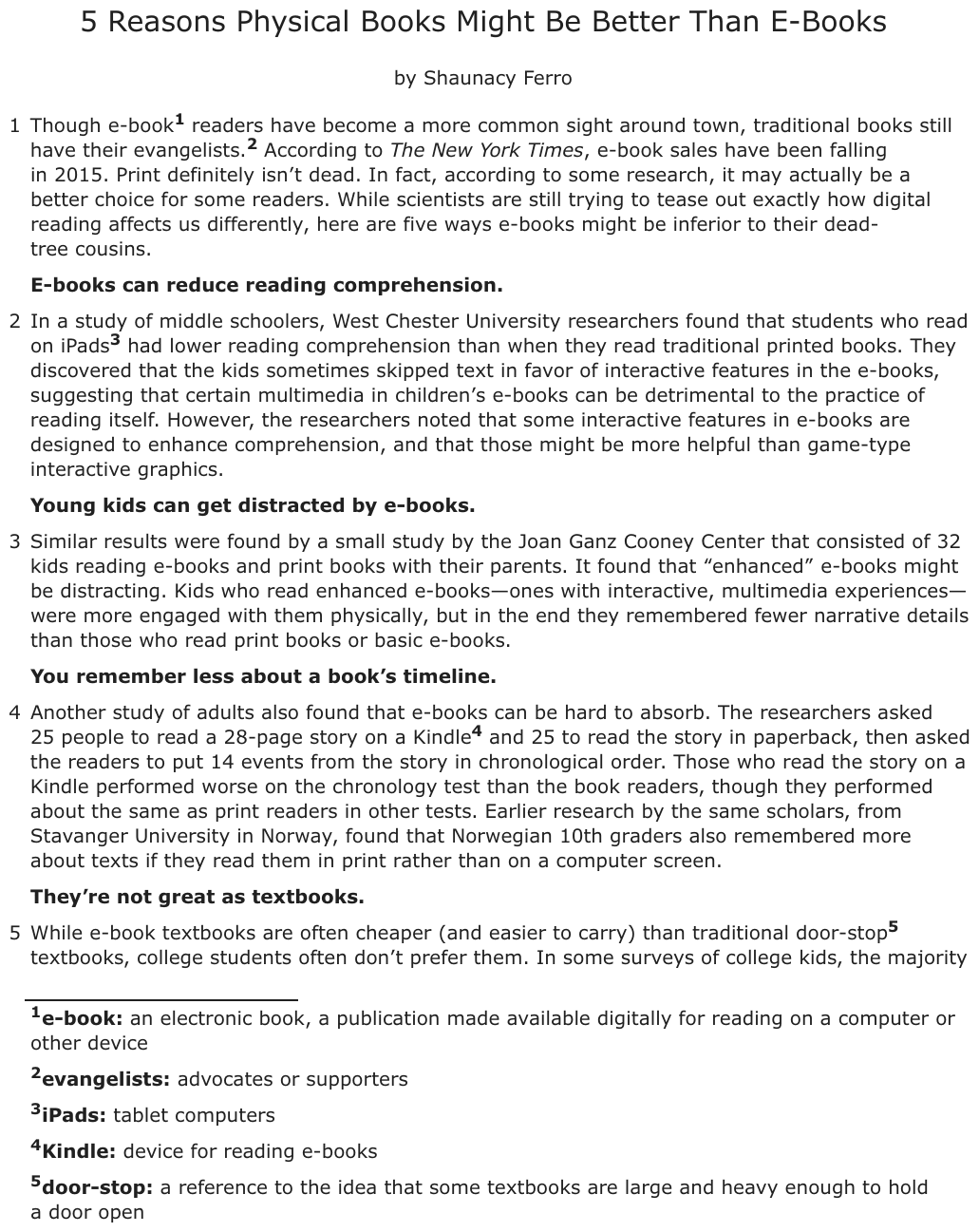
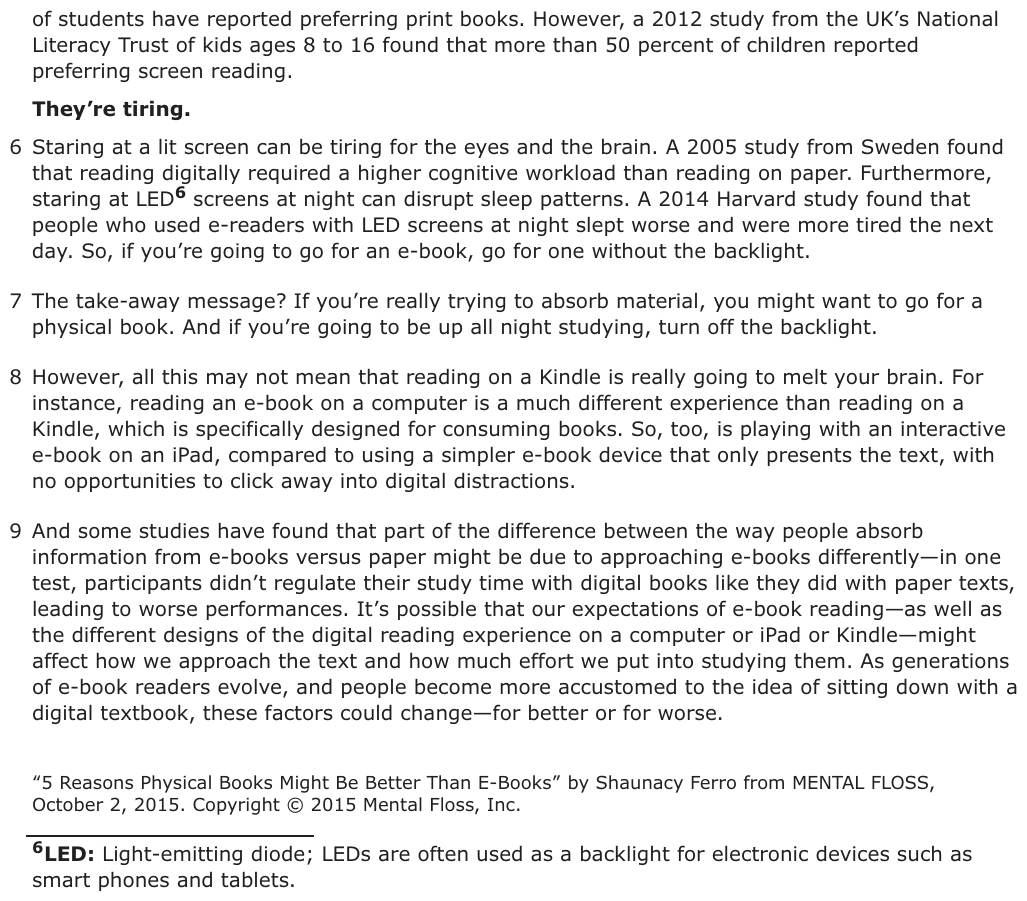
The passage “5 Reasons Physical Books Might Be Better Than E-Books” as printed (pages 58–59)
Question 2 of 6
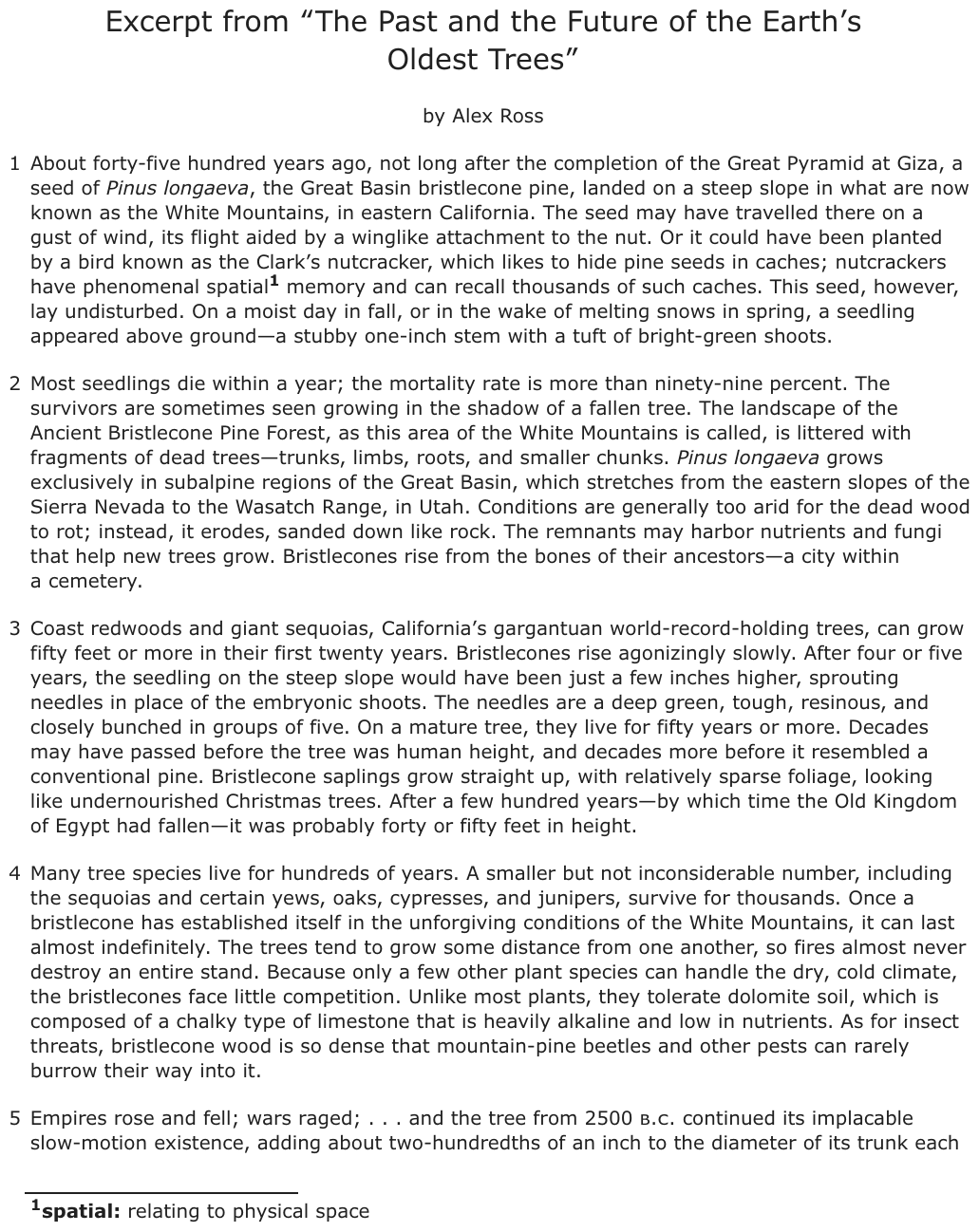
2024 Test B English, question 55Passage Excerpt from “The Past and the Future of the Earth’s Oldest Trees”
Excerpt from “The Past and the Future of the Earth’s Oldest Trees”
by Alex Ross
About forty-five hundred years ago, not long after the completion of the Great Pyramid at Giza, a seed of Pinus longaeva, the Great Basin bristlecone pine, landed on a steep slope in what are now known as the White Mountains, in eastern California. The seed may have travelled there on a gust of wind, its flight aided by a winglike attachment to the nut. Or it could have been planted by a bird known as the Clark’s nutcracker, which likes to hide pine seeds in caches; nutcrackers have phenomenal spatial1 memory and can recall thousands of such caches. This seed, however, lay undisturbed. On a moist day in fall, or in the wake of melting snows in spring, a seedling appeared above ground—a stubby one-inch stem with a tuft of bright-green shoots.
Most seedlings die within a year; the mortality rate is more than ninety-nine percent. The survivors are sometimes seen growing in the shadow of a fallen tree. The landscape of the Ancient Bristlecone Pine Forest, as this area of the White Mountains is called, is littered with fragments of dead trees—trunks, limbs, roots, and smaller chunks. Pinus longaeva grows exclusively in subalpine regions of the Great Basin, which stretches from the eastern slopes of the Sierra Nevada to the Wasatch Range, in Utah. Conditions are generally too arid for the dead wood to rot; instead, it erodes, sanded down like rock. The remnants may harbor nutrients and fungi that help new trees grow. Bristlecones rise from the bones of their ancestors—a city within a cemetery.
Coast redwoods and giant sequoias, California’s gargantuan world-record-holding trees, can grow fifty feet or more in their first twenty years. Bristlecones rise agonizingly slowly. After four or five years, the seedling on the steep slope would have been just a few inches higher, sprouting needles in place of the embryonic shoots. The needles are a deep green, tough, resinous, and closely bunched in groups of five. On a mature tree, they live for fifty years or more. Decades may have passed before the tree was human height, and decades more before it resembled a conventional pine. Bristlecone saplings grow straight up, with relatively sparse foliage, looking like undernourished Christmas trees. After a few hundred years—by which time the Old Kingdom of Egypt had fallen—it was probably forty or fifty feet in height.
Many tree species live for hundreds of years. A smaller but not inconsiderable number, including the sequoias and certain yews, oaks, cypresses, and junipers, survive for thousands. Once a bristlecone has established itself in the unforgiving conditions of the White Mountains, it can last almost indefinitely. The trees tend to grow some distance from one another, so fires almost never destroy an entire stand. Because only a few other plant species can handle the dry, cold climate, the bristlecones face little competition. Unlike most plants, they tolerate dolomite soil, which is composed of a chalky type of limestone that is heavily alkaline and low in nutrients. As for insect threats, bristlecone wood is so dense that mountain-pine beetles and other pests can rarely burrow their way into it.
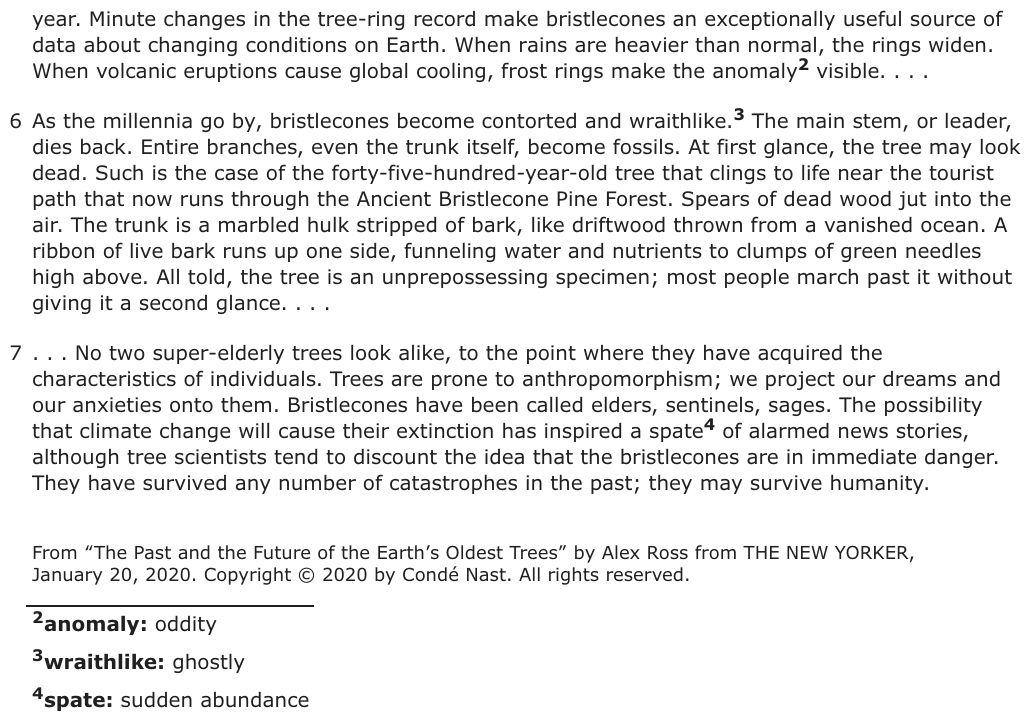
Empires rose and fell; wars raged; . . . and the tree from 2500 B.C. continued its implacable slow-motion existence, adding about two-hundredths of an inch to the diameter of its trunk each year. Minute changes in the tree-ring record make bristlecones an exceptionally useful source of data about changing conditions on Earth. When rains are heavier than normal, the rings widen. When volcanic eruptions cause global cooling, frost rings make the anomaly2 visible. . . .
As the millennia go by, bristlecones become contorted and wraithlike.3 The main stem, or leader, dies back. Entire branches, even the trunk itself, become fossils. At first glance, the tree may look dead. Such is the case of the forty-five-hundred-year-old tree that clings to life near the tourist path that now runs through the Ancient Bristlecone Pine Forest. Spears of dead wood jut into the air. The trunk is a marbled hulk stripped of bark, like driftwood thrown from a vanished ocean. A ribbon of live bark runs up one side, funneling water and nutrients to clumps of green needles high above. All told, the tree is an unprepossessing specimen; most people march past it without giving it a second glance. . . .
. . . No two super-elderly trees look alike, to the point where they have acquired the characteristics of individuals. Trees are prone to anthropomorphism; we project our dreams and our anxieties onto them. Bristlecones have been called elders, sentinels, sages. The possibility that climate change will cause their extinction has inspired a spate4 of alarmed news stories, although tree scientists tend to discount the idea that the bristlecones are in immediate danger. They have survived any number of catastrophes in the past; they may survive humanity.
From “The Past and the Future of the Earth’s Oldest Trees” by Alex Ross from THE NEW YORKER, January 20, 2020. Copyright © 2020 by Condé Nast. All rights reserved.
1spatial: relating to physical space
2anomaly: oddity
3wraithlike: ghostly
4spate: sudden abundance
Question
The details in paragraph 7 convey a central idea of the excerpt by suggesting that
- Athe success of the bristlecone pine lies in its ability to resist climate change.
- Bthe uncommon appearance of the bristlecone pine is related to its ability to survive.
- Cthe attachment that humans have to the bristlecone pine is understandable.
- Dthe longevity of the bristlecone pine continues to encourage experts.
Show the answer
Correct answer: D
The question asks which central idea of the excerpt is supported by the details in paragraph 7.
A. Incorrect. While paragraph 7 mentions the pines’ ability to survive climate change, the central idea is about the trees’ longevity. Surviving climate change is a part of the pines’ longevity, but just surviving climate change does not fully encompass the central idea of the excerpt.
B. Incorrect. Although the paragraph mentions that the “super-elderly trees” are each unique in appearance, their appearance does not directly connect to their ability to survive. The details in paragraph 7 emphasize the durability and longevity of the trees.
C. Incorrect. While the beginning of paragraph 7 expresses the idea that each bristlecone pine appears to be a unique individual and supports the idea that humans relate to the pines, the paragraph expresses a stronger central idea in the last two sentences about the pines’ survival.
D. CORRECT. The longevity of bristlecone pines is a central idea of the excerpt. Experts are encouraged that bristlecone pines have survived many catastrophes, and the details in the second half of paragraph 7 draw direct attention to the trees’ longevity.
Question analysis
Students explain how the details in paragraph 7, the closing paragraph of Alex Ross’s excerpt on bristlecone pines, convey a central idea of the whole piece. The paragraph moves from people seeing old trees as individuals to alarmed news stories and the views of tree scientists, so students must decide which thread ties to the excerpt’s main idea.
- Grade level
- Grade 8 reading and task
- Compared with grade 7
- Above grade 7 Grade 7 central idea questions often ask what a passage is mostly about. Here students must connect one closing paragraph that touches several topics to an idea of the whole excerpt, reading its details for what they imply as well as what they say.
- Estimated difficulty
- Hard: combines ideas, needs a plan, and has more than one tempting wrong answer.
- Thinking it demands
- Depth of knowledge 3, strategic thinking · mainly understand
- What makes it hard
- Reading between the lines major
- The right answer is reworded moderate
- Evidence in several places minor
- Evidence
- Answered from the whole text
- Reading level
- Passage: about grade 8, 851 words; question and choices: about grade 10, 63 words.
- Students, last 30 days
- Not enough answers yet to show (it takes 10).
Why it is hard, traps and wrong answers (shows the answer)
Why it is hard
Paragraph 7 moves through several topics, trees that look like individuals, people projecting feelings onto them, alarmed news and calm scientists, and only its last two sentences connect to the excerpt’s main idea. The strongest lure states a true point about human attachment that the paragraph does make, while the key has to be inferred from the scientists’ calm and the trees’ record of survival. Naming the central idea first, the trees’ extraordinary age, shows which thread of the paragraph serves it.
Reading between the lines major Working it out
Nothing in paragraph 7 says experts are encouraged; it has to be read from “tree scientists tend to discount the idea that the bristlecones are in immediate danger,” set against the “alarmed news stories.” (Graesser, Singer & Trabasso, 1994; Kintsch, 1998)
The right answer is reworded moderate Choosing the answer
The key speaks of “longevity” and of experts being encouraged, words the paragraph never uses, while two wrong choices repeat its “climate change” and “survive” and so look better anchored. (Freedle & Kostin, 1993; Kirsch & Mosenthal, 1990)
Evidence in several places minor Working it out
Recognizing longevity as a central idea draws on the whole excerpt: the tree from the time of the Great Pyramid in paragraph 1, its endurance in paragraph 4 and its ring record in paragraph 5. (Kirsch & Mosenthal, 1990; Gorin & Embretson, 2006)
Strategy: Name the central idea of the whole excerpt first, then reread paragraph 7 and find the sentences that connect to it.
Traps
- True but not the answer: A choice says something accurate about the text that does not answer this question.
- Twists what the text says: Uses the text's topic and ideas but changes what it says: who did it, how much, when, or why.
- Reads too much in: A reasonable-sounding conclusion that goes further than the text allows.
The wrong answers, classified
A Twists what the text says (King et al., 2004)
Joins the paragraph’s mention of climate change to the trees’ survival and makes resisting it the secret of their success, but the paragraph only reports fears and gives no such cause.
B Reads too much in (Graesser, Singer & Trabasso, 1994)
Links the remark that no two old trees look alike to their survival, a connection paragraph 7 never draws; the detail shows only that they seem like individuals.
C True but not the answer (King et al., 2004; Embretson & Wetzel, 1987)
Relies on the paragraph’s real remarks about people calling the trees elders, sentinels and sages, but that human attachment is a side point, not a central idea of the excerpt.
Working it out, step by step
Figure out what the question asks
This asks how paragraph 7 connects to a central idea, a main point of the whole excerpt. So first name that idea. Then find which details in paragraph 7 point to it.
Name the excerpt’s central idea
The excerpt follows a tree that has lived about 4,500 years. Paragraph 1 starts its story near the time of the Great Pyramid. A settled bristlecone “can last almost indefinitely” (paragraph 4). Paragraph 5 shows a tree living on while empires “rose and fell.” So a central idea is the bristlecone’s amazing longevity, or long life.
Find the matching details in paragraph 7
Paragraph 7 first says people treat the old trees almost like persons. Then it turns to climate change. News stories sound alarmed, “although tree scientists tend to discount the idea that the bristlecones are in immediate danger.” To discount an idea is to doubt it. The last sentence gives the reason: “They have survived any number of catastrophes in the past; they may survive humanity.”
Explain what the details suggest
A catastrophe is a terrible disaster. The trees have lived through so many disasters that scientists are not very worried. In other words, the trees’ long record of survival gives the experts hope. That ties paragraph 7 to the central idea of longevity.
Check each choice
- A does not fit. Climate change comes up only as a fear in the news. The paragraph never says the trees succeed by resisting it.
- B does not fit. Paragraph 7 says no two old trees look alike, but it never links their looks to their survival.
- C does not fit. People do call the trees “elders, sentinels, sages,” but that feeling is a side point, not a central idea.
- D fits. Experts take comfort from how long the trees have survived.
Choose the answer
Paragraph 7 ends on the trees’ long survival and the experts’ calm about their future. So the answer is D.
Why this answer and not the closest wrong one
C is the strongest trap, because paragraph 7 really does say people feel close to the trees. But the question asks for a central idea of the whole excerpt. Long life runs through every paragraph, and the last two sentences of paragraph 7 tie into it. That is why D fits better.
More questions like this
The original DOE question

The passage “Excerpt from “The Past and the Future of the Earth’s Oldest Trees”” as printed (pages 193–194)
Question 3 of 6
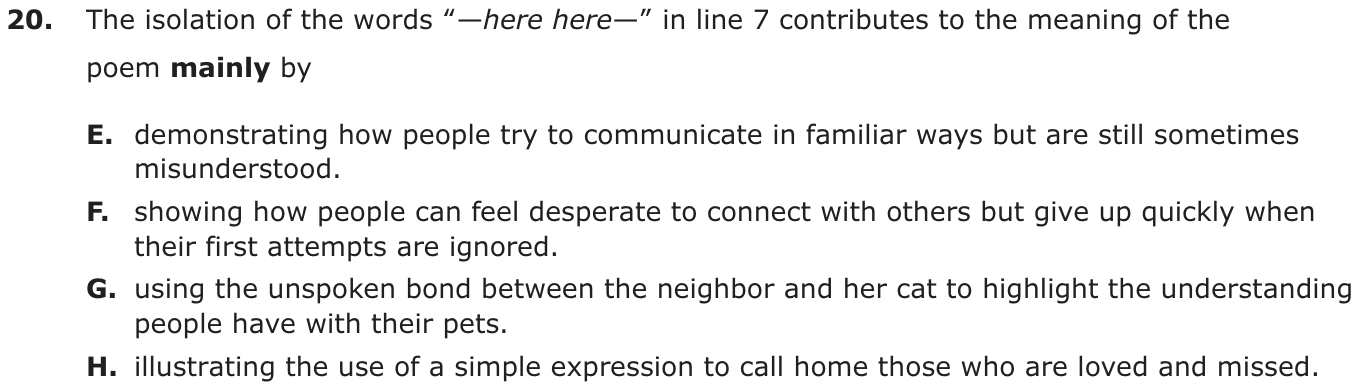
2024 Test A English, question 20Passage At Dusk
At Dusk
by Natasha Trethewey
At first I think she is calling a child,
my neighbor, leaning through her doorway
at dusk, street lamps just starting to hum
the backdrop of evening. Then I hear
the high-pitched wheedling1 we send out
to animals who know only sound, not
the meanings of our words—here here—
nor how they sometimes fall short.
In another yard, beyond my neighbor’s
sight, the cat lifts her ears, turns first
toward the voice, then back
to the constellation of fireflies flickering
near her head. It’s as if she can’t decide
whether to leap over the low hedge,
the neat row of flowers, and bound
onto the porch, into the steady circle
of light, or stay where she is: luminous
possibility—all that would keep her
away from home—flitting before her.
I listen as my neighbor’s voice trails off.
She’s given up calling for now, left me
to imagine her inside the house waiting,
perhaps in a chair in front of the TV,
or walking around, doing small tasks;
left me to wonder that I too might lift
my voice, sure of someone out there,
send it over the lines stitching here
to there, certain the sounds I make
are enough to call someone home.
“At Dusk” from NATIVE GUARD by Natasha Trethewey, published by Houghton Mifflin Company. Copyright © 2006 by Natasha Trethewey. All rights reserved.
1wheedling: speaking in a flattering manner
Question
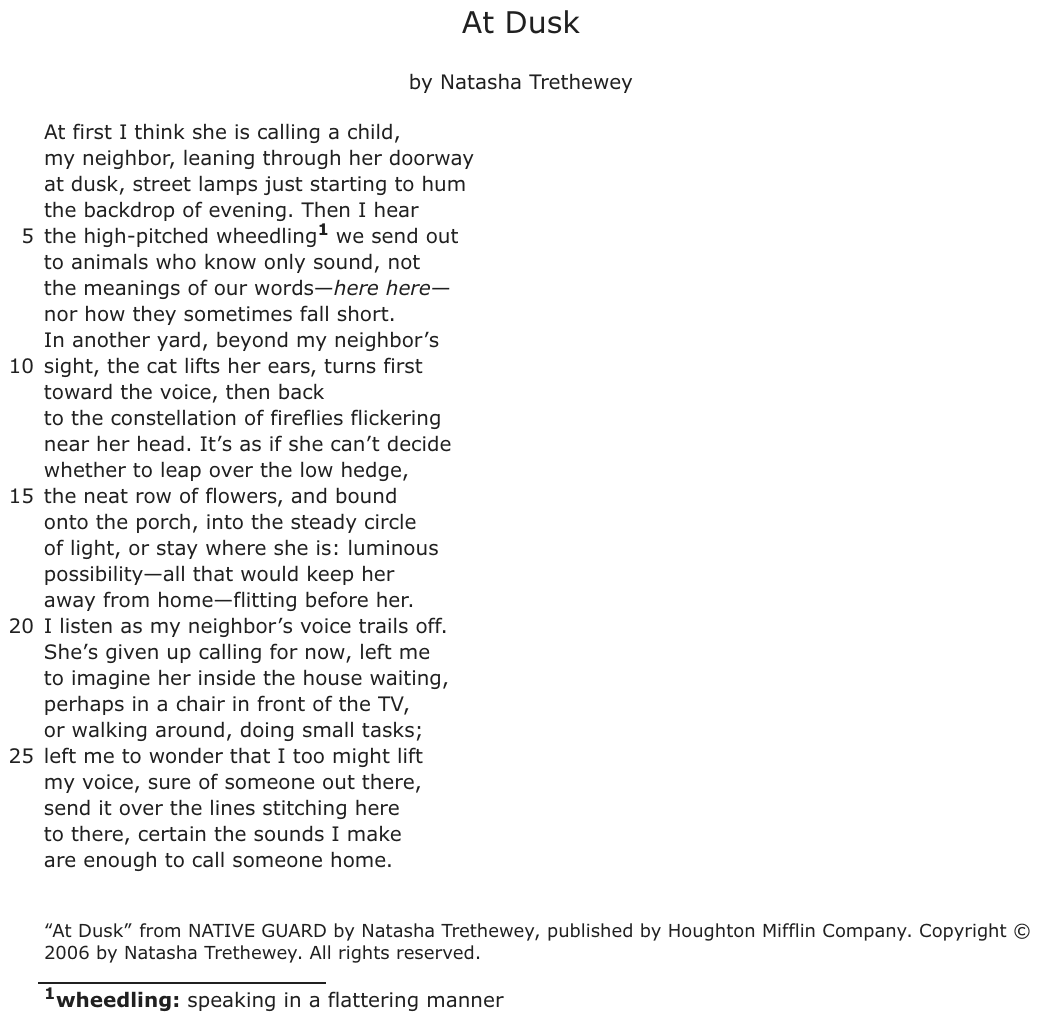
The isolation of the words “—here here—” in line 7 contributes to the meaning of the poem mainly by
- Ademonstrating how people try to communicate in familiar ways but are still sometimes misunderstood.
- Bshowing how people can feel desperate to connect with others but give up quickly when their first attempts are ignored.
- Cusing the unspoken bond between the neighbor and her cat to highlight the understanding people have with their pets.
- Dillustrating the use of a simple expression to call home those who are loved and missed.
Show the answer
Correct answer: D
The question asks how the isolation of the words “—here here—” in line 7 mainly contributes to the meaning of the poem.
A. Incorrect. The words “—here here—” do interrupt the speaker’s observation in lines 7–8 that “our words . . . / . . . sometimes fall short.” However, in lines 5–7, the speaker observes that the neighbor accompanies her words with a “high-pitched wheedling” that people “send out” because they are aware that animals “know only sound, not / the meanings of our words,” indicating that the neighbor does not actually expect her words to be understood. The description of the cat’s response in lines 10–11 (“the cat lifts her ears, turns first / toward the voice, then back”) does not suggest that the neighbor’s message is misunderstood but rather suggests that the cat prefers not to respond to it.
B. Incorrect. In lines 20–21, the “neighbor’s voice trails off,” and she does give up calling the cat. However, rather than any desperation to connect, the neighbor’s use of a “high-pitched wheedling” (line 5) simply indicates her understanding that the cat, like other animals, understands “only sound, not / the meanings of our words” (lines 6–7) such as “here here.” Furthermore, the neighbor does not give up quickly. In lines 21–22, the speaker says the neighbor has “given up calling for now” but is still “waiting” for the cat.
C. Incorrect. In lines 4–7, the speaker describes the neighbor calling to the cat with a “high-pitched wheedling.” The sound may indicate a bond between the neighbor and the cat because the neighbor does understand that animals “know only sound, not / the meanings of our words” (lines 6–7). However, the use of the words “here here” in line 7 does not indicate that bond, because they are used as an example of the type of words that animals do not understand.
D. CORRECT. The speaker’s initial thought in line 1 that the neighbor is calling a child, rather than a cat, suggests that the neighbor loves and misses the cat. Lines 4–7 then present the speaker’s observation that the neighbor uses a “high-pitched wheedling,” to emphasize the simple words of her call, “—here here—.” The idea that the words are an example of a simple expression used to call home a missed loved one is reinforced in lines 25–29, when the speaker is “left . . . to wonder” whether the speaker, too, “might lift / [his or her] voice” and be able “to call someone home.”
Question analysis
This reading question asks how setting off the words here here with dashes in line 7 adds to the meaning of At Dusk, Natasha Trethewey's poem about a neighbor calling her cat at nightfall. Students must work out what two plain, isolated words contribute to the whole poem, choosing among four readings about how people and animals communicate and connect.
- Grade level
- Grade 8 reading and task
- Compared with grade 7
- Above grade 7 Grade 7 students explain how a line adds to a poem, but here the feature is a tiny typographic choice, and its meaning has to be built from the whole poem rather than nearby lines, which goes beyond typical grade 7 work.
- Estimated difficulty
- Among the hardest on the SHSAT: a non-obvious approach, heavy reading, or a well-hidden trap.
- Thinking it demands
- Depth of knowledge 3, strategic thinking · mainly analyze
- What makes it hard
- A very close wrong answer major
- Evidence in several places moderate
- How, not what moderate
- Evidence
- Answered from the whole text
- Reading level
- Passage: 236 words (a poem; reading level not measured); question and choices: about grade 9, 87 words.
- Corrected from the DOE handbook
- A grammar slip in the explanation was corrected.
- Students, last 30 days
- Not enough answers yet to show (it takes 10).
Why it is hard, traps and wrong answers (shows the answer)
Why it is hard
The words sit inside a sentence about animals not knowing the meanings of our words and about words that “sometimes fall short,” so the nearest lines point toward miscommunication. The poem's frame points elsewhere: it opens with a call that sounds like a parent's, ends with the speaker hoping a voice can “call someone home,” and even repeats “here” in line 27. Students who read only around line 7 choose the misunderstanding; those who connect the isolated call to the first and last lines see what it is for.
A very close wrong answer major Choosing the answer
The misunderstanding choice and the right one agree that “here here” is a familiar way of calling; they part only on what it shows, failed communication or a call home to someone missed. (Embretson & Wetzel, 1987; Gorin & Embretson, 2006; Ascalon et al., 2007)
Evidence in several places moderate Working it out
The right reading rests on lines far from line 7: the speaker's first guess that a child is being called, and the last line's wish “to call someone home.” (Kirsch & Mosenthal, 1990; Gorin & Embretson, 2006)
How, not what moderate Working it out
The question asks what setting two words apart with dashes and italics does for the poem, a typographic choice whose purpose the poem never explains. (Anderson & Krathwohl, 2001)
Strategy: Ask what the two words are meant to do and whom they are aimed at, then keep the choice that the poem's other lines confirm.
Traps
- Wrong purpose or structure: Names a purpose, structure or effect that the part does not serve, or describes what a part says when the question asks what it does.
- Twists what the text says: Uses the text's topic and ideas but changes what it says: who did it, how much, when, or why.
- Reads too much in: A reasonable-sounding conclusion that goes further than the text allows.
The wrong answers, classified
A Wrong purpose or structure (Anderson & Krathwohl, 2001)
Reads the words through line 8's “sometimes fall short” as failed communication, but the cat does hear and turn toward the call, and the ending hopes such sounds can bring someone home.
B Twists what the text says (King et al., 2004)
Sees the neighbor stop calling and calls her desperate and quick to quit, though she has given up only “for now” and is still waiting inside.
C Reads too much in (Graesser, Singer & Trabasso, 1994)
Assumes an owner and a pet share a silent understanding, but “here here” is spoken aloud, and the poem offers it as words animals cannot follow.
What was corrected from the DOE handbook, and why
- Explanation: In rejecting choice C, the handbook reads “the use of the words “here here” in line 7 do not indicate that bond.” It now reads “does not,” to agree with “use.”
Working it out, step by step
Figure out what the question asks
In line 7 the words here here are set apart by dashes and slanted letters (italics). The question asks what this does for the poem’s meaning. Think about what the words are for and who they are aimed at.
Look at line 7
Line 7 reads “the meanings of our words—here here—.” These are the words the neighbor calls to her cat. Setting them apart lets you hear them, as if spoken aloud. They are simple words that mean “come here.” Lines 6–7 say animals know “only sound, not / the meanings of our words.”
Connect to the start and end
In line 1 the speaker first thinks the neighbor “is calling a child.” So the call sounds like a parent calling someone they love. The poem ends with the hope that a voice can be “enough to call someone home” (line 29). So here here is a simple call to bring a loved one home.
Check each choice
- A is wrong. The cat isn’t confused. She “lifts her ears” and turns “toward the voice.” She just doesn’t come yet.
- B is wrong. The neighbor isn’t shown as desperate. She stops only “for now,” and the speaker pictures her waiting inside.
- C is wrong. Here here is spoken out loud. The poem treats it as words animals don’t understand, not a silent bond.
- D is right. It is a simple call to someone loved and missed.
Watch out: Line 8 says words “sometimes fall short,” which points toward A. But read the first and last lines too.
Choose the answer
The two words stand for the simple call people use to bring loved ones home. So the answer is D.
Why this answer and not the closest wrong one
A is the closest wrong answer, because line 8 says our words “sometimes fall short.” But the cat does hear the call and turn toward it. And the poem ends by hoping the sounds “are enough to call someone home.” D links the two words to that wish, and to the first guess that a child is being called.
More questions like this
The original DOE question
The passage “At Dusk” as printed (page 48)
Question 4 of 6
2018 Test B Math, question 44Question
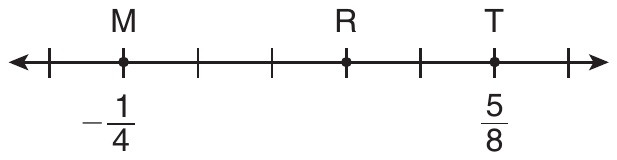
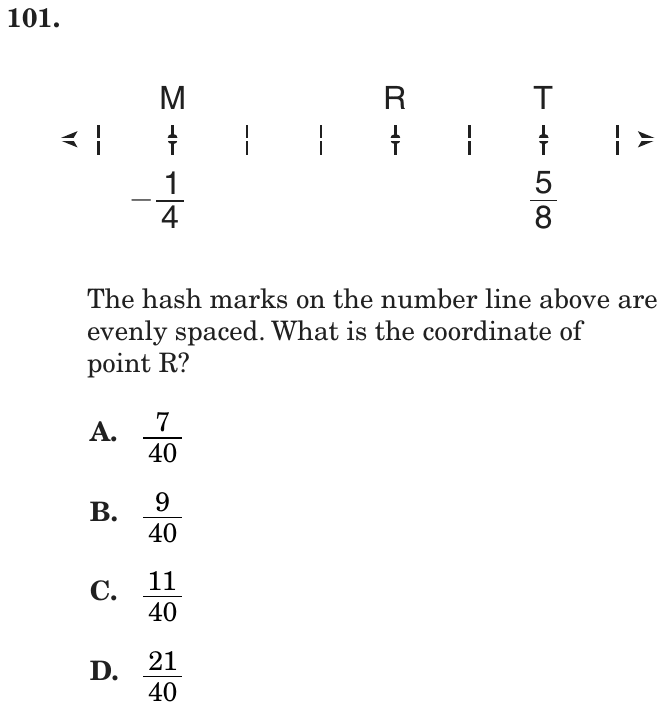
The hash marks on the number line above are evenly spaced. What is the coordinate of point ?
- A
- B
- C
- D
Show the answer
Correct answer: C
There are 5 sections between M and T. To find the length of one of these sections, find the distance between M and T and divide by 5:
R is 3 sections away from M, so add:
R is located at .
Question analysis
Students find the fraction at point R on a number line with evenly spaced hash marks, where M is at −1/4 and T is at 5/8. It tests fraction arithmetic with negative numbers. Working out the size of one gap and counting gaps from M to R takes several careful steps.
- NYS standards
- Grade level
- Grade 7 content, by NYS standard
- Compared with grade 7
- Above grade 7 Grade 7 students place fractions and negatives on number lines, but here they must subtract a negative fraction, divide by five, and then add back. Four fraction steps with unlike denominators make it harder than typical classwork.
- Estimated difficulty
- Hard: combines ideas, needs a plan, and has more than one tempting wrong answer.
- Thinking it demands
- Depth of knowledge 2, skills and concepts · mainly apply
- What makes it hard
- Error-prone arithmetic major
- Reading a figure, table or graph moderate
- Solution
- 4 steps
- Reading level
- Question and choices: about grade 6, 22 words.
- Students, last 30 days
- Not enough answers yet to show (it takes 10).
Why it is hard, traps and wrong answers (shows the answer)
Why it is hard
Fractions, a negative starting point and a count of spaces all have to come out right together. Students lose points by counting tick marks instead of spaces, by subtracting −1/4 as if it were positive, or by measuring R from 0 instead of from M. Converting both labels to fortieths first, −10/40 and 25/40, makes each gap a whole number of fortieths.
Error-prone arithmetic major Working it out
The gap length needs 5/8 − (−1/4) = 7/8, then 7/8 ÷ 5 = 7/40, then −10/40 + 21/40: negatives and three different denominators meet in one problem. (Brown & Burton, 1978; Junker & Sijtsma, 2001)
Reading a figure, table or graph moderate Understanding the question
The hash marks have to be counted as spaces: five from M to T, with R three spaces past M, while the unlabeled marks outside M and T play no part. (Lesh, Post & Behr, 1987; Kirsch & Mosenthal, 1990)
Strategy: Find the distance from M to T by subtracting their coordinates, divide it by the number of equal gaps, then step from M toward T by the right number of gaps.
Traps
- Stops one step early: A choice is a number from partway through the solution.
- Negatives and direction: Arithmetic with negative numbers, the order of a subtraction, or direction on a number line. (Moving a term across the equals sign without changing its sign is a faulty procedure.)
The wrong answers, classified
A Stops one step early (King et al., 2004; Gierl et al., 2017)
Finds the length of one gap, 7/8 ÷ 5 = 7/40, and gives it as R's coordinate without stepping from M.
B Negatives and direction (Brown & Burton, 1978)
Subtracts as 5/8 − 1/4 = 3/8 instead of adding, gets gaps of 3/40, and counts three gaps from 0.
D Stops one step early (King et al., 2004; Gierl et al., 2017)
Multiplies the 7/40 gap by 3 to get the distance from M to R, then forgets to add it to M's −1/4.
Worked solution, step by step
Formulas used
- Distance on a number line
- The right number is the point farther to the right on the number line. The left number is the other point. Subtracting tells how many units apart they are. Taking the left from the right keeps the answer positive.
- Dividing a fraction by a whole number
- a over b is the fraction, and c is the whole number you divide by. Splitting a fraction into c equal parts makes each part c times smaller. So you multiply the bottom number, b, by c.
Read the number line
M is at and T is at . The hash marks are evenly spaced, so every space is the same length. Count the spaces. From M to T there are 5 spaces. From M to R there are 3 spaces. You need the number at point R.
Find the distance from M to T
Use the distance formula. First write in eighths, as .
Taking away a negative is the same as adding. M and T are apart.
Find the length of one space
The 5 spaces are equal, so divide by 5.
Each space is long.
Watch out: this is the length of one space, not where R is. Stopping here gives choice A.
Step from M to R
R is 3 spaces to the right of M.
Now add that to M. Write as .
Watch out: is how far R is from M, not where R is. Choosing it gives choice D.
Give the answer
Point R is at , a little to the right of 0. So the answer is C, .
Check your answer
Go backward from T instead. T is 2 spaces past R, and . So R is at . Both ways give the same point.
More questions like this
The original DOE question
Question 5 of 6
2026 Practice Test D Math, question 36Question
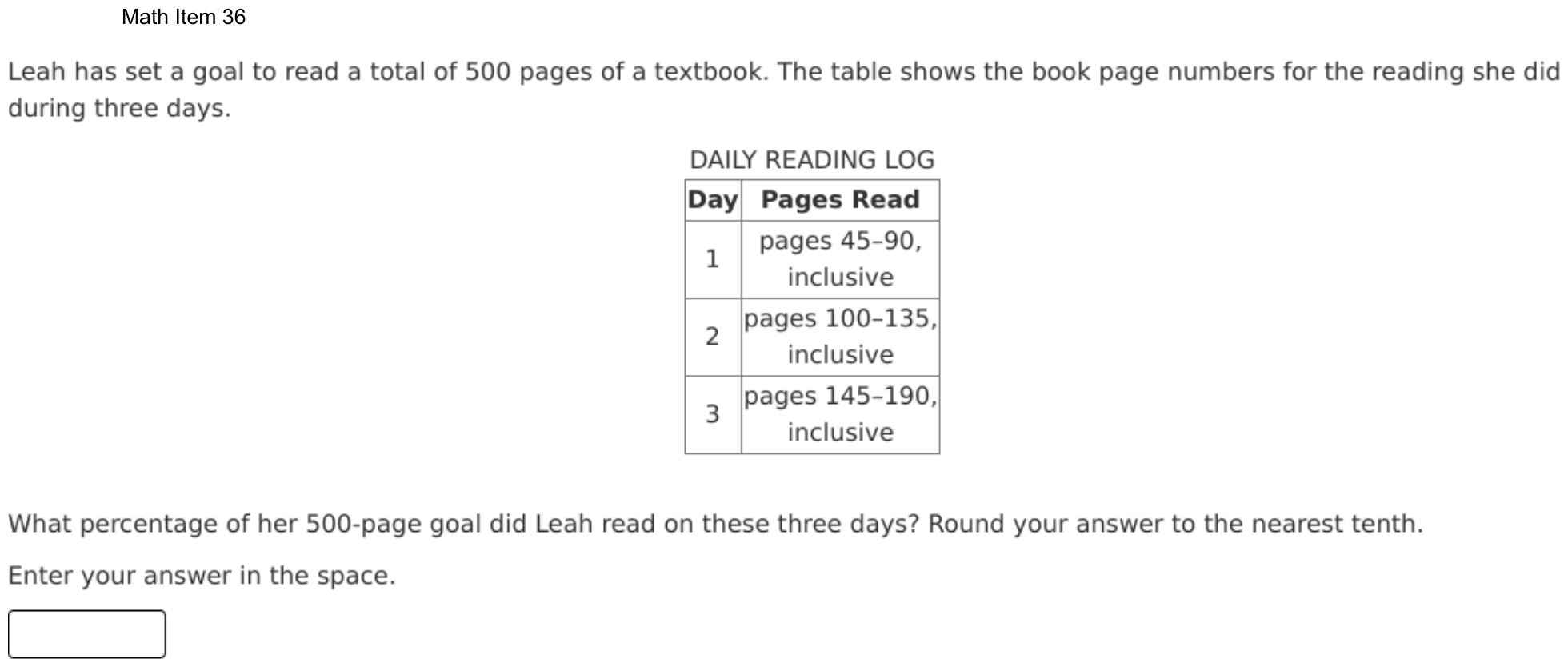
Leah has set a goal to read a total of 500 pages of a textbook. The table shows the book page numbers for the reading she did during three days.
DAILY READING LOG
| Day | Pages Read |
|---|---|
| 1 | pages 45–90, inclusive |
| 2 | pages 100–135, inclusive |
| 3 | pages 145–190, inclusive |
What percentage of her 500-page goal did Leah read on these three days? Round your answer to the nearest tenth.
Enter your answer in the space.
Fill-in question: work out the answer and type it as a number.
Show the answer
Correct answer: 25.6%
First, determine the number of pages read each day. Since the pages per assignment are inclusive, subtract the first page from the last page assigned and then add 1 to determine the pages read for each day.
Day 1: pages
Day 2: pages
Day 3: pages
Leah read a total of 128 pages, since .
To determine the percent, express 128 pages out of 500 pages as a fraction.
Question analysis
Leah's daily reading log lists three ranges of textbook pages, each marked inclusive, and her goal is 500 pages. This percent question asks what percentage of the goal she read over the three days, rounded to the nearest tenth and typed in. Counting the pages in each inclusive range correctly is the tricky step before the percent.
- Grade level
- Grade 7 content, by NYS standard
- Compared with grade 7
- Above grade 7 Finding what percent one number is of another is grade 6 and 7 work. This adds three inclusive page ranges to count, which takes more care than subtracting, then a rounding step, all typed with no choices to check against.
- Estimated difficulty
- Hard: combines ideas, needs a plan, and has more than one tempting wrong answer.
- Thinking it demands
- Depth of knowledge 2, skills and concepts · mainly apply
- What makes it hard
- Something you must already know moderate
- Many steps moderate
- An answer in an unexpected form minor
- Solution
- 4 steps
- Reading level
- Question and choices: about grade 3, 66 words.
- Students, last 30 days
- Not enough answers yet to show (it takes 10).
Why it is hard, traps and wrong answers (shows the answer)
Why it is hard
Counting pages in a range is the whole difficulty; the percent at the end is routine once the total is right. Subtracting first from last feels natural, and here it even rewards the student with a round 25%, so nothing looks wrong. Checking the rule on a tiny range, pages 1 to 3, which is 3 pages and not 2, fixes the count, and the instruction to round to the nearest tenth hints that the answer is not a whole number.
Something you must already know moderate Working it out
Every row says inclusive, but nothing says that pages 45 to 90 hold 90 − 45 + 1 = 46 pages; subtracting alone loses one page on each of the three days. (Anderson & Krathwohl, 2001)
Many steps moderate Working it out
Three page counts, a sum, a division by 500 and a change to a percent come in sequence, and a one-page error in each count carries through to the end. (Daniel & Embretson, 2010; Enright, Morley & Sheehan, 2002)
An answer in an unexpected form minor Choosing the answer
The answer is typed with no choices, and the miscounted total, 125 pages, gives a tidy 25% that looks more finished than the right value with its tenth. (Enright, Morley & Sheehan, 2002)
Strategy: Count each day's pages carefully, testing your method on a short range such as pages 1–3, add the three days, divide by 500, and write the result as a percent to the nearest tenth.
Traps
- Counting the ends: Inclusive or exclusive ends, fence posts, consecutive numbers: an answer that is one too many or too few, or an endpoint drawn open where it belongs closed (or the reverse).
- Stops one step early: A choice is a number from partway through the solution.
- Misreads the question: Misses or misreads a condition or a word in the question: "at least", "each", "remaining", "not".
The wrong answers, classified
25 Counting the ends (Brown & Burton, 1978)
Subtracts the first page from the last for each day, 45 + 35 + 45 = 125 pages, forgetting that an inclusive range counts both end pages, so 125 ÷ 500 = 25%.
0.256 Stops one step early (King et al., 2004; Gierl et al., 2017)
Counts the 128 pages and divides by 500 correctly, then enters the decimal 0.256, one step short of multiplying by 100 to make a percent.
26 Misreads the question (Hegarty, Mayer & Monk, 1995)
Finds 25.6% correctly but rounds it to the nearest whole percent, overlooking the instruction to round to the nearest tenth.
Worked solution, step by step
Formulas used
- Counting pages in an inclusive range
- Inclusive means the first and last pages are both read. Subtracting counts the steps from the first page to the last. That misses one page, so add 1. Test it: pages 1 to 3 are 3 pages, and 3 − 1 + 1 = 3.
- Percent of a total
- The part is the amount you have, here the pages read. The whole is the amount you compare with, here the 500-page goal. Dividing gives a decimal. Multiplying by 100 turns it into a percent, a number out of 100.
Sort out the question
Leah’s goal is 500 pages. The log shows three days:
- Day 1: pages 45 to 90
- Day 2: pages 100 to 135
- Day 3: pages 145 to 190
Each range is inclusive. You need the percent of 500 pages she read, rounded to the nearest tenth.
Count the pages each day
Use the rule for an inclusive range: last page minus first page, plus 1.
Watch out: subtracting alone gives 45, 35 and 45 pages. That is 125 pages, which is exactly 25%. A round answer like that can hide the mistake.
Add the three days
Add the pages from all three days to get her total:
Leah read 128 pages in all. This is the part you compare with the goal.
Change to a percent
Divide the pages read by the goal, then multiply by 100:
Leah read 25.6% of her goal. That already ends in tenths, so no rounding is needed.
Watch out: 0.256 is a decimal, not a percent. And 26 rounds to a whole number, not to the nearest tenth.
Enter the answer
The box has no % sign, but the question asks for a percentage, so the number in the box is the percent. Type it with its decimal point. Typing 25.6% also counts on this site. So you would enter 25.6.
Check your answer
Estimate. 10% of 500 pages is 50 pages. 128 pages is a bit more than 2 × 50 = 100, so the answer is between 20% and 30%. Then check exactly: pages. It matches.
More questions like this
The original DOE question
Question 6 of 6
2024 Test B Math, question 25Question
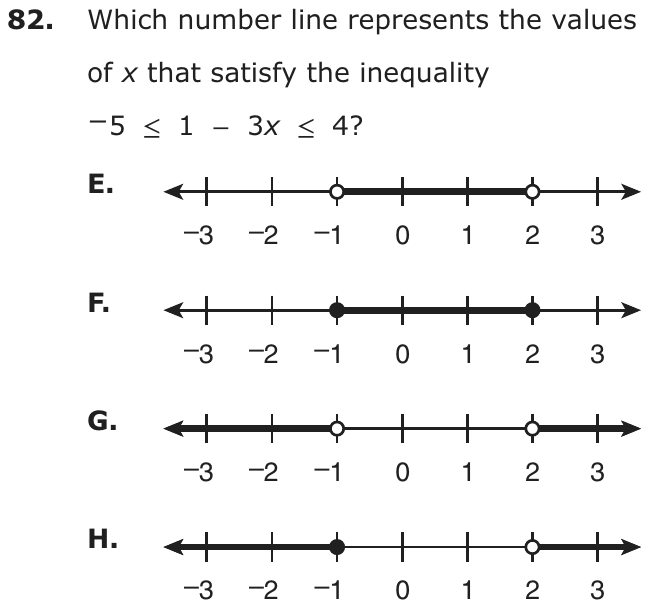
Which number line represents the values of x that satisfy the inequality ?
- A

- B

- C

- D

Show the answer
Correct answer: B
Split the compound inequality into two inequalities.
and
For each inequality, subtract 1 from each side.
and
For each inequality, divide both sides by −3. Note that dividing each side of an inequality by a negative number changes the direction of the inequality.
and
Combining the pieces gives the compound inequality .
The solution is that x is greater than or equal to −1 and less than or equal to 2, so choose the number line with filled circles at −1 and 2, with the filled segment between the circles.
Question analysis
An inequality question: choose the number line that shows the solutions of the compound inequality −5 ≤ 1 − 3x ≤ 4. Students solve an inequality whose x term has a negative coefficient, then match the endpoints, open or closed circles, and shading to one of four graphs.
- Grade level
- Grade 7 content, by NYS standard
- Compared with grade 7
- Above grade 7 Grade 7 students solve and graph two-step inequalities one at a time. This compound inequality needs two solved together and a division by a negative number, which reverses the signs, a step many grade 7 classes only touch on.
- Estimated difficulty
- Hard: combines ideas, needs a plan, and has more than one tempting wrong answer.
- Thinking it demands
- Depth of knowledge 1, recall and reproduction · mainly apply
- What makes it hard
- Error-prone arithmetic moderate
- A very close wrong answer moderate
- Reading a figure, table or graph minor
- Solution
- 4 steps
- Reading level
- Question and choices: about grade 12, 13 words.
- Students, last 30 days
- Not enough answers yet to show (it takes 10).
Why it is hard, traps and wrong answers (shows the answer)
Why it is hard
The question stacks two classic traps: reversing the inequality signs when dividing by −3, and matching filled or open circles to ≤. All four graphs use the endpoints −1 and 2, so finding those numbers proves little; the choice turns on the circles and the direction of the shading. Testing x = 0, x = 3 and the endpoint x = 2 in the original inequality checks both decisions in under a minute.
Error-prone arithmetic moderate Working it out
Dividing all three parts of −6 ≤ −3x ≤ 3 by −3 reverses both signs and the order, giving 2 ≥ x ≥ −1, which must be rewritten as −1 ≤ x ≤ 2. (Brown & Burton, 1978; Junker & Sijtsma, 2001)
A very close wrong answer moderate Choosing the answer
Two graphs share the endpoints −1 and 2 and the shading between them; only the circles, filled for ≤ and open for <, separate them. (Embretson & Wetzel, 1987; Gorin & Embretson, 2006; Ascalon et al., 2007)
Reading a figure, table or graph minor Understanding the question
Each graph must be read for three things at once: the endpoints, the fill of each circle, and whether the shading runs between them or outward. (Lesh, Post & Behr, 1987; Kirsch & Mosenthal, 1990)
Strategy: Subtract 1 from all three parts, divide all three by −3 while reversing both inequality signs, then rewrite the result from smallest to largest before matching circles and shading.
Traps
- Negatives and direction: Arithmetic with negative numbers, the order of a subtraction, or direction on a number line. (Moving a term across the equals sign without changing its sign is a faulty procedure.)
- Counting the ends: Inclusive or exclusive ends, fence posts, consecutive numbers: an answer that is one too many or too few, or an endpoint drawn open where it belongs closed (or the reverse).
The wrong answers, classified
A Counting the ends (Brown & Burton, 1978)
Solves for the right endpoints and shading but draws open circles, as if ≤ excluded −1 and 2 instead of including them.
C Negatives and direction (Brown & Burton, 1978)
Divides by −3 without reversing the signs, so the solutions seem to lie outside −1 and 2; with open circles, this graph shows exactly the values that fail.
D Negatives and direction (Brown & Burton, 1978)
Shades outward as if the signs had not reversed, but mixes the circles, filled at −1 and open at 2, which no single reading of ≤ gives.
Worked solution, step by step
Formulas used
- Subtracting from every part
- a and b are the two sides of an inequality, and c is any number. Subtracting the same number from every part keeps the inequality true. The sign does not change.
- Dividing by a negative number
- a and b are numbers, and c is a positive number, so −c is negative. When you divide both sides by a negative number, the inequality sign flips. For example, 2 is less than 3, but −2 is greater than −3.
Sort out the question
The inequality says that is between −5 and 4. The sign ≤ means less than or equal to. So −5 and 4 themselves are allowed. You need the number line that shows every x that works. To find them, get x alone in the middle.
Subtract 1 from every part
First take away the 1 in the middle. Subtract 1 from all three parts.
Divide by −3 and flip
Now x is multiplied by −3. Divide all three parts by −3. Dividing by a negative number flips each sign.
Watch out: if you forget to flip, x seems to lie outside −1 and 2. That leads to choices C and D, which are shaded outward.Read the result
Turn it around so the smaller number is on the left. It means the same thing.
So x can be any number from −1 to 2. The ends, −1 and 2, are included, because the signs are ≤.
Pick the number line
On a number line, a closed (filled-in) circle means the end number is included. An open circle means it is not. So you need closed circles at −1 and 2, with the part between them shaded. Watch out: choice A has the right shading but open circles, which leave out −1 and 2.
So the answer is B.
Check your answer
Test a few numbers in . For x = 0 you get 1, which is between −5 and 4, and 0 is shaded. For x = 2 you get −5, which is allowed, so the circle at 2 is filled in. For x = 3 you get −8, which is too small, so 3 is not shaded.
More questions like this
The original DOE question