3 English and 3 math
Here are 6 random questions to try. Takers earning below 75% are unlikely to receive an offer. You have 1 minute 48 seconds per question on the real exam.
Question 1 of 6
2026 Practice Test B English, question 44Passage The End of an Era
The End of an Era
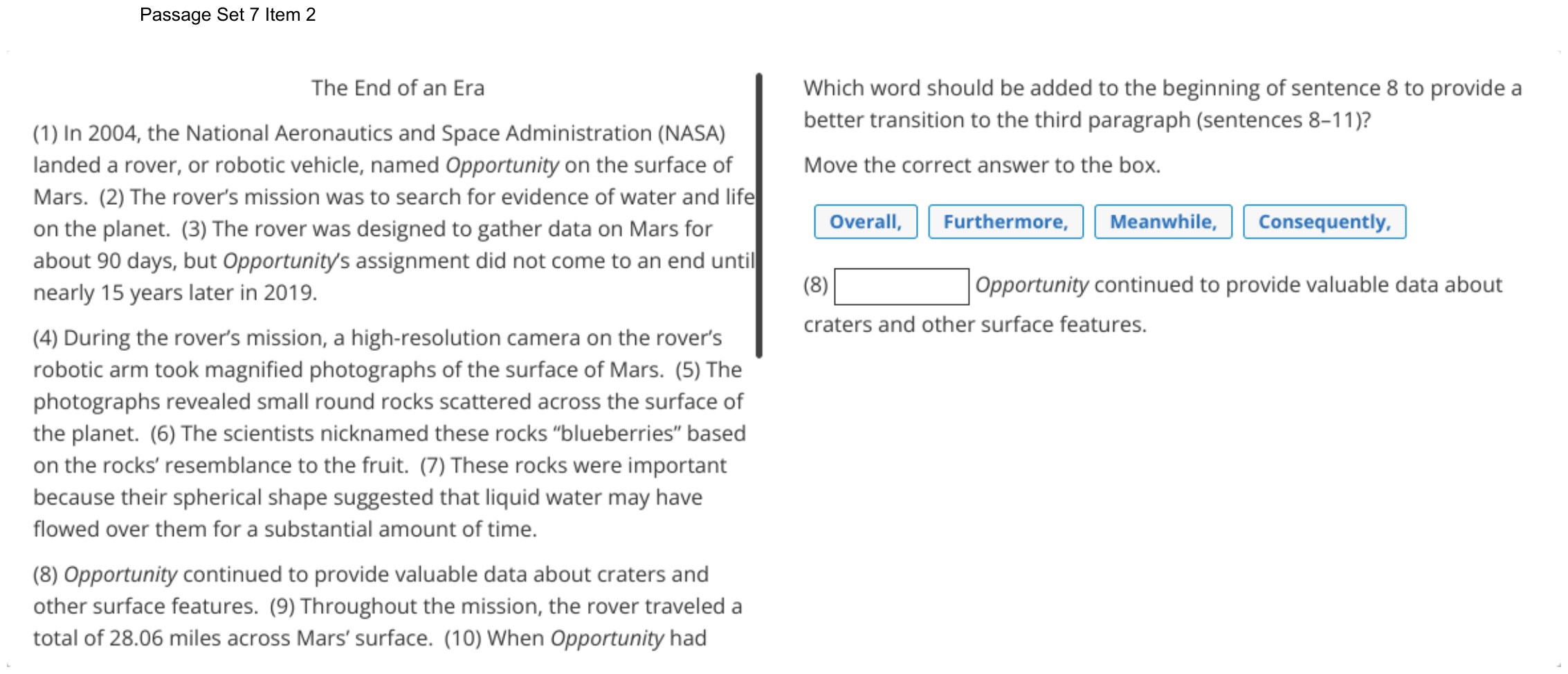
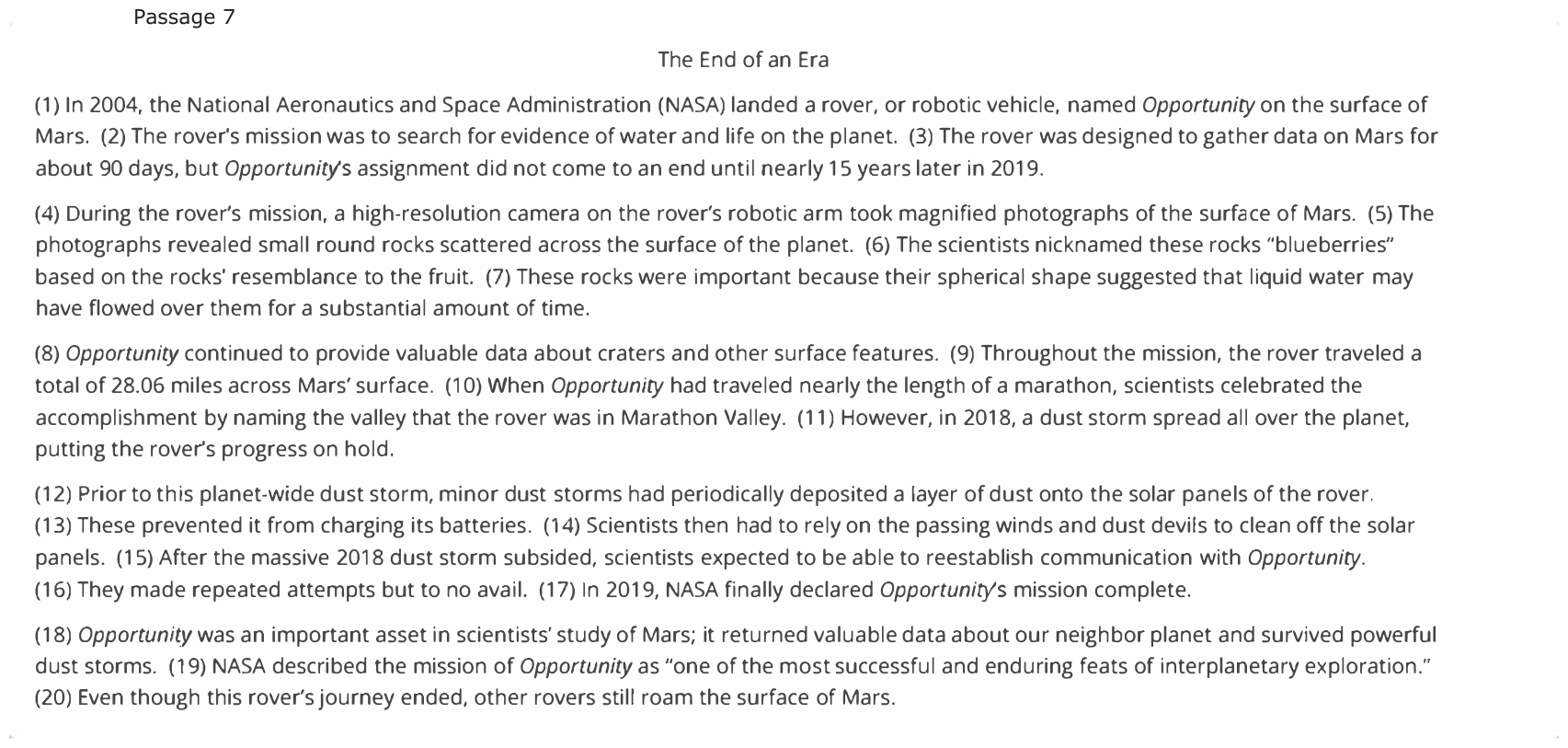
(1) In 2004, the National Aeronautics and Space Administration (NASA) landed a rover, or robotic vehicle, named Opportunity on the surface of Mars. (2) The rover’s mission was to search for evidence of water and life on the planet. (3) The rover was designed to gather data on Mars for about 90 days, but Opportunity’s assignment did not come to an end until nearly 15 years later in 2019.
(4) During the rover’s mission, a high-resolution camera on the rover’s robotic arm took magnified photographs of the surface of Mars. (5) The photographs revealed small round rocks scattered across the surface of the planet. (6) The scientists nicknamed these rocks “blueberries” based on the rocks’ resemblance to the fruit. (7) These rocks were important because their spherical shape suggested that liquid water may have flowed over them for a substantial amount of time.
(8) Opportunity continued to provide valuable data about craters and other surface features. (9) Throughout the mission, the rover traveled a total of 28.06 miles across Mars’ surface. (10) When Opportunity had traveled nearly the length of a marathon, scientists celebrated the accomplishment by naming the valley that the rover was in Marathon Valley. (11) However, in 2018, a dust storm spread all over the planet, putting the rover’s progress on hold.
(12) Prior to this planet-wide dust storm, minor dust storms had periodically deposited a layer of dust onto the solar panels of the rover. (13) These prevented it from charging its batteries. (14) Scientists then had to rely on the passing winds and dust devils to clean off the solar panels. (15) After the massive 2018 dust storm subsided, scientists expected to be able to reestablish communication with Opportunity. (16) They made repeated attempts but to no avail. (17) In 2019, NASA finally declared Opportunity’s mission complete.
(18) Opportunity was an important asset in scientists’ study of Mars; it returned valuable data about our neighbor planet and survived powerful dust storms. (19) NASA described the mission of Opportunity as “one of the most successful and enduring feats of interplanetary exploration.” (20) Even though this rover’s journey ended, other rovers still roam the surface of Mars.
Question
Which word should be added to the beginning of sentence 8 to provide a better transition to the third paragraph (sentences 8–11)?
Move the correct answer to the box.
(8) ____ Opportunity continued to provide valuable data about craters and other surface features.
On the test you drag one of the tiles into the box; here, choose it.
- AOverall,
- BFurthermore,
- CMeanwhile,
- DConsequently,
Show the answer
Correct answer: C
The question asks for the word that should be added to the beginning of sentence 8 to provide a better transition to the third paragraph (sentences 8–11).
“Overall,” is incorrect and should not be added. While sentence 8 is a more general statement than sentence 7, the word “Overall” would imply that all of the third paragraph features general information about the Opportunity rover. Instead, paragraphs 2 and 3 both describe specific accomplishments of the Opportunity rover (the discovery of possible water on Mars and the distance the rover traveled), so these paragraphs require a word between them that does not transition from the specific to the general.
“Furthermore,” is incorrect and should not be added. The word “Furthermore” would suggest that the author is making an argument in paragraph 2 that is further developed by the statement in sentence 8 and the rest of paragraph 3. Because this is not the case, the word “Furthermore” is not a suitable transition from one paragraph to the next.
“Meanwhile,” is correct and should be added. The word “Meanwhile” is an appropriate transition to add to the beginning of sentence 8, since the actions of the Opportunity rover in paragraph 2 (taking photographs) and in paragraph 3 (traveling long distances) happened at the same time and both served critical functions to the overall mission.
“Consequently,” is incorrect and should not be added. The word “Consequently” would create a cause-and-effect relationship that does not exist between the paragraphs. The passage gives no indication that the rover’s actions in the third paragraph (traveling a far distance) resulted from the actions in the second paragraph (taking photographs).
Question analysis
In this transition question, sentence 8 opens the third paragraph of the Opportunity rover passage with a blank, and on the test students move one of four word tiles into the box. The paragraph before ends with the “blueberries,” small round rocks that hinted at water, so students must decide how the rover's further work relates to that discovery.
- NYS standards
- 7W2d transitions in informative writing
- Grade level
- Grade 7 reading and task
- Compared with grade 7
- Above grade 7 Choosing a transition is regular grade 7 writing work, but this one links two paragraphs, and two of the four words fit the sentence's grammar and sound natural, so the choice turns on exactly how the paragraphs relate.
- Estimated difficulty
- Hard: combines ideas, needs a plan, and has more than one tempting wrong answer.
- Thinking it demands
- Depth of knowledge 2, skills and concepts · mainly evaluate
- What makes it hard
- A very close wrong answer moderate
- How sentences fit together moderate
- Reading between the lines minor
- Evidence
- Answered from several paragraphs or stanzas
- Reading level
- Passage: about grade 11, 337 words; question and choices: about grade 9, 43 words.
- Students, last 30 days
- Not enough answers yet to show (it takes 10).
Why it is hard, traps and wrong answers (shows the answer)
Why it is hard
Two tiles sound natural in the blank, and the one most students reach for first is an all-purpose adding word. The key goes a step further: it marks the rover’s work in paragraph 3 as happening alongside the photographs of paragraph 2, a relationship the word “continued” supports. Students who test each tile against how the paragraphs relate, rather than against the sound of the sentence, also rule out a summing-up word and a cause word.
A very close wrong answer moderate Choosing the answer
“Furthermore” and “Meanwhile” both let paragraph 3 add to paragraph 2; only “Meanwhile” also says the rover’s further work went on during the same mission, as “continued” implies. (Embretson & Wetzel, 1987; Gorin & Embretson, 2006; Ascalon et al., 2007)
How sentences fit together moderate Working it out
The tile must link the “blueberries” of paragraph 2 to the craters and miles of paragraph 3, so students must decide how two paragraphs relate, not just two sentences. (Halliday & Hasan, 1976)
Reading between the lines minor Working it out
The timing is never stated; it comes from “During the rover’s mission” in sentence 4 and “continued” in sentence 8, which place both kinds of work in the same years. (Graesser, Singer & Trabasso, 1994; Kintsch, 1998)
Strategy: State in your own words how what the rover did in paragraph 2 relates to what it did in paragraph 3, then test the relationship each tile signals against that.
Traps
- Wrong transition: A connecting word or phrase that signals the wrong relationship, such as contrast where the idea continues.
The wrong answers, classified
A Wrong transition (Halliday & Hasan, 1976)
Treats sentence 8 as a summing up because it is broader than sentence 7, though paragraph 3 goes on to give new specifics such as the 28.06 miles.
B Wrong transition (Halliday & Hasan, 1976)
Adds paragraph 3 as one more achievement, which sounds natural, but “Furthermore” signals a point being built up, not two kinds of work carried on during one mission.
D Wrong transition (Halliday & Hasan, 1976)
Hears “continued” as a result of the blueberry discovery and adds a cause-and-effect link, though nothing says the rover’s later work followed from its photographs.
Working it out, step by step
Figure out what the question asks
On the test, you move one word tile into the box at the start of sentence 8. The word is a transition, a word that shows how two ideas connect. Some transitions add an idea, some show a result, some sum up, and some show time. You need the one that links paragraph 2 to paragraph 3.
Compare the two paragraphs
Paragraph 2 begins “During the rover’s mission.” It tells how the camera found the round rocks called “blueberries.” Paragraph 3 begins “Opportunity continued to provide valuable data about craters and other surface features.” Craters are bowl-shaped holes in the ground. So paragraph 3 tells about other work the rover kept doing in those same years.
Test each transition
- Overall sums things up. But paragraph 3 gives new facts, like the 28.06 miles.
- Furthermore adds one more reason to an argument, as in Dogs are loyal. Furthermore, they are fun. But paragraph 2 isn’t arguing a point. It tells what the rover did.
- Meanwhile means during that same time. It links things that go on together.
- Consequently means as a result. But the photos didn’t cause the rover’s later work.
See why “Meanwhile” fits
While the camera was finding blueberries, the rover was also studying craters and driving many miles. The word “continued” in sentence 8 shows that the work kept going. “Meanwhile” tells the reader these jobs happened during the same mission.
Watch out: “Furthermore” sounds natural in the blank, so many students choose B. But it only says here is one more point. It doesn’t show two kinds of work going on at the same time.
Choose the answer
With the tile in place, sentence 8 reads: Meanwhile, Opportunity continued to provide valuable data about craters and other surface features. So the answer is C: move the tile “Meanwhile,” into the box.
Why this answer and not the closest wrong one
B, “Furthermore,” is the closest wrong answer, because it also adds information. But it treats paragraph 2 as one point in an argument. The passage just tells what the rover did. “Meanwhile” links the two paragraphs in time, and it matches the word “continued.”
More questions like this
The original DOE question
The passage “The End of an Era” as printed (page 60)
Question 2 of 6
2018 Test B English, question 52Passage Invention of the Telegraph
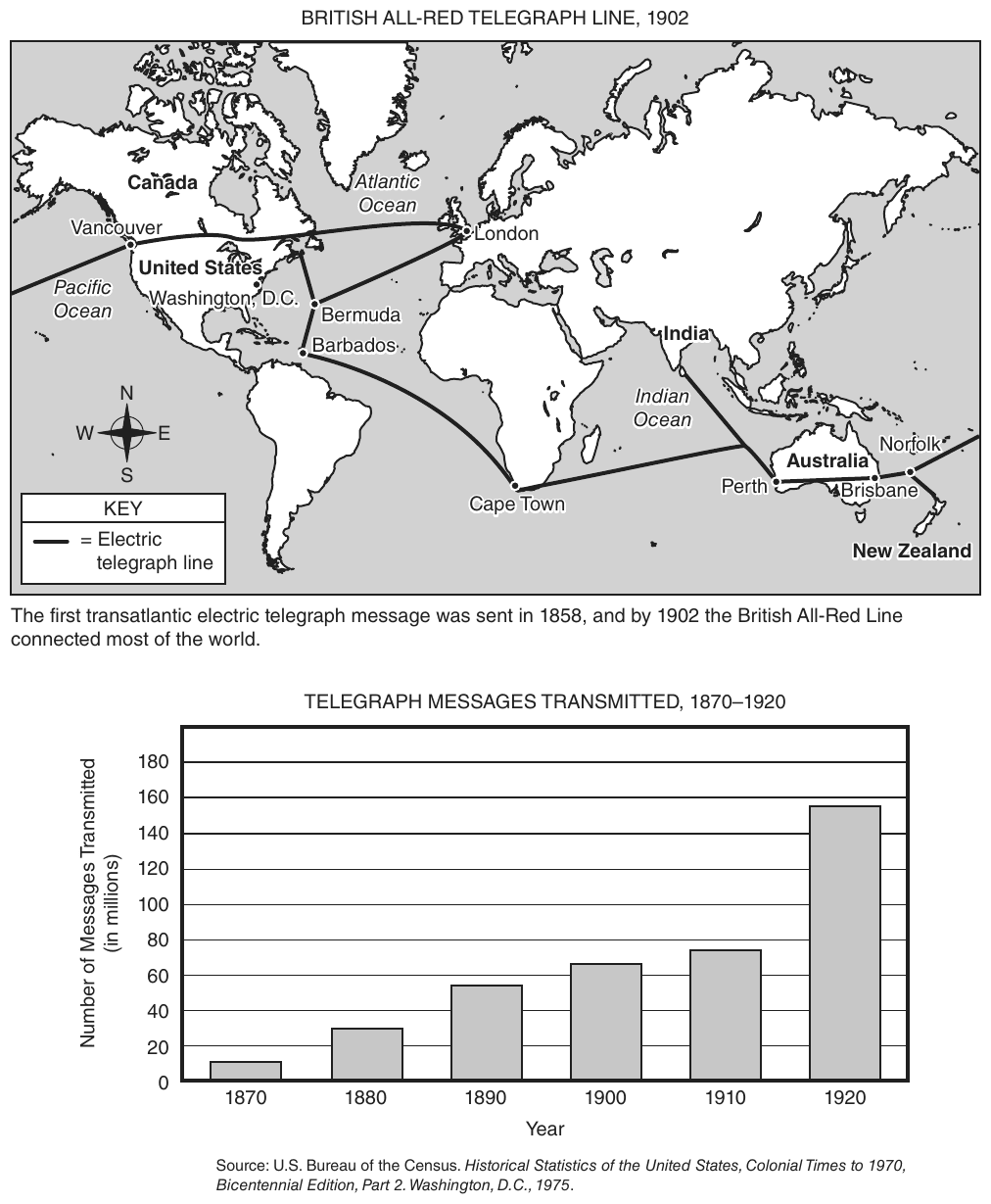
Samuel Morse, an American inventor, is credited with creating the electronic telegraph, a communication device that allows users to send messages using a system of short and long pulses that represent letters, numbers, and punctuation. In 1843 the United States Congress passed the Telegraph Bill, which provided Morse with the funds to build an electric telegraph system.
Invention of the Telegraph
Earlier Signal Systems
Long before Samuel F. B. Morse electrically transmitted his famous message “What hath God wrought?” from Washington to Baltimore on May 24, 1844, there were signaling systems that enabled people to communicate over distances. Most were visual or “semaphore” systems using flags or lights. In the eighteenth century, such systems used an observer who would decipher a signal from a high tower on a distant hill and then send it on to the next station. The young American republic wanted just such a system along its entire Atlantic coast and offered a prize of $30,000 for a workable proposal. The framers of this legislation had no way of knowing that when they used the word “telegraph” to refer to this visual semaphore system, they would be offered an entirely new and revolutionary means of communication—electricity.
The Growth of an Idea
The idea of using electricity to communicate over distance is said to have occurred to Morse during a conversation aboard ship when he was returning from Europe in 1832. Michael Faraday’s recently invented electromagnet was much discussed by the ship’s passengers, and when Morse came to understand how it worked, he speculated that it might be possible to send a coded message over a wire. While a student at Yale College years before, he had written his parents a letter about how interesting he found the lectures on electricity. Despite what he had learned at Yale, Morse found when he began to develop his idea that he had little real understanding of the nature of electricity, and after sporadic attempts to work with batteries, magnets, and wires, he finally turned for help to a colleague at the University of the City of New York, Leonard D. Gale.
Gale was a professor of chemistry and familiar with the electrical work of Princeton’s Joseph Henry, a true pioneer in the new field. Well before Morse had his shipboard idea about a telegraph, Henry rang a bell at a distance by opening and closing an electric circuit. In 1831, he had published an article, of which Morse was unaware, that contained details suggesting the idea of an electric telegraph. Gale’s help and his knowledge of this article proved crucial to Morse’s telegraph system because Gale not only pointed out flaws in the system but showed Morse how he could regularly boost the strength of a signal and overcome the distance problems he had encountered by using a relay system Henry had invented. Henry’s experiments, Gale’s assistance, and, soon after, hiring the young technician Alfred Vail were keys to Morse’s success.
Obstacles and Opportunities
By December 1837, Morse had enough confidence in his new system to apply for the federal government’s appropriation, and during the next year he conducted demonstrations of his telegraph both in New York and Washington.
However, when the economic disaster known as the Panic of 1837 took hold of the nation and caused a long depression, Morse was forced to wait for better times. It was during this period that Morse visited Europe again and tried not only to secure patent protection overseas but to examine competing telegraph systems in England. . . .
By 1843, the country was beginning to recover economically, and Morse again asked Congress for the $30,000 that would allow him to build a telegraph line from Washington to Baltimore, forty miles away. The House of Representatives eventually passed the bill containing the Morse appropriation, and the Senate approved it in the final hours of that Congress’s last session. With President Tyler’s signature, Morse received the cash he needed and began to carry out plans for an underground telegraph line.
Realizing a Great Invention
Morse had hired the ingenious construction engineer Ezra Cornell to lay the pipe carrying the wire, and although Cornell did his job superbly, one of Morse’s partners, Congressman F. O. J. Smith, had purchased wire with defective insulation. Too much time had been wasted laying bad wire, and with the project on a rigid deadline, something had to be done quickly. Cornell suggested that the fastest and cheapest way of connecting Washington and Baltimore was to string wires overhead on trees and poles. The desperate Morse gave the go-ahead, and the line was completed in time for the dramatic and spectacularly successful link between the Supreme Court chamber of the Capitol building and the railroad station in Baltimore.
Soon, as overhead wires connected cities up and down the Atlantic coast, the dots-and-dashes method that recorded messages on a long moving strip of paper was replaced by the operator’s ability to interpret the code in real time. . . . Telegraph lines soon extended westward, and within Morse’s own lifetime they connected the continents of Europe and America.
“Invention of the Telegraph”—Public Domain/Library of Congress
legislation: Telegraph Bill
dots-and-dashes method: the short and long pulses of Morse code that are sent and received by telegraph operators
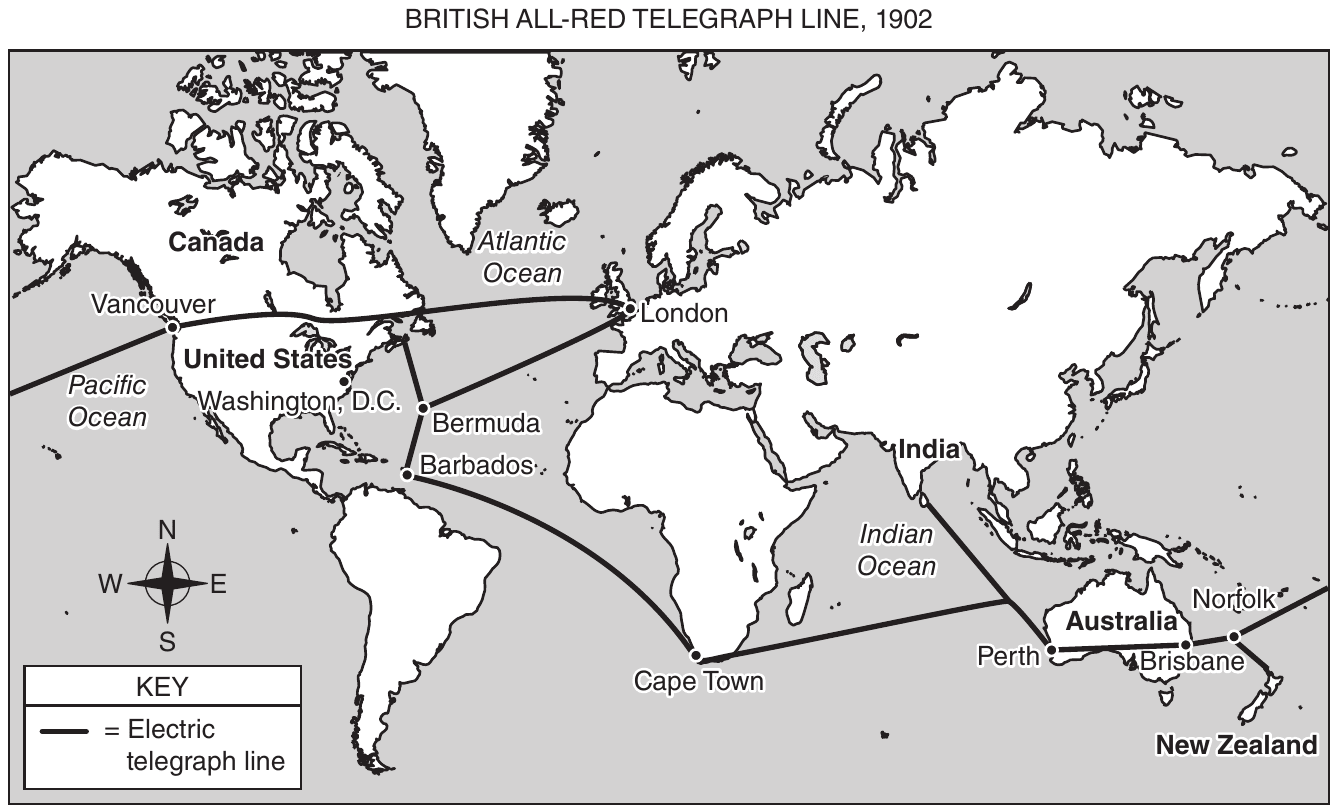
The first transatlantic electric telegraph message was sent in 1858, and by 1902 the British All-Red Line connected most of the world.
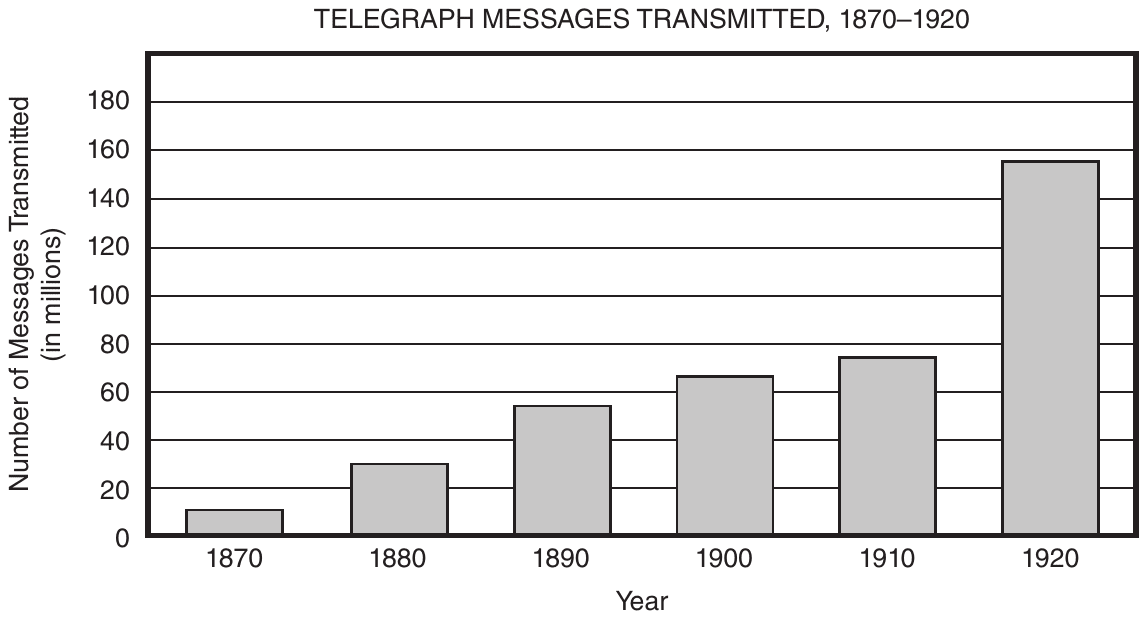
Source: U.S. Bureau of the Census. Historical Statistics of the United States, Colonial Times to 1970, Bicentennial Edition, Part 2. Washington, D.C., 1975.
Question
The details of the section “The Growth of an Idea” convey a central idea of the passage by suggesting that
- Athe collaborative efforts of colleagues resulted in successful communication over a wire.
- Ba great deal of interest and work was devoted to understanding how to use electricity to send signals.
- CFaraday’s invention of the electromagnet inspired the invention of the telegraph.
- Dcolleges like Yale played a great role in making new discoveries about electricity and its applications.
Show the answer
Correct answer: B
The question asks how a passage section helps convey a central idea of the passage. Paragraph 3 states that “Henry’s experiments, Gale’s assistance, and, soon after, hiring the young technician Alfred Vail were keys to Morse’s success.” The level of interest inspired Morse and others to work together to find a way to use electricity to send long-distance messages.
Option B is correct; the section helps convey a central idea because, overall, the section focuses on what fascinated Morse enough to begin his work and how others were just as interested and willing to work to achieve this goal.
Option A is incorrect because, although the word collaborative suggests that multiple people contributed to the telegraph’s success, the option does not clarify the research and effort needed in order to understand how to use electricity to send signals.
Option C is incorrect because when Morse came to understand how Faraday’s electromagnet worked, Morse wondered if it might be possible to send a coded message over a wire, but that thought later evolved into the telegraph only after more research and experimentation.
Option D is incorrect because the influence of what Morse learned at Yale was only a minor factor in his development of the telegraph.
Question analysis
This central idea question asks what the details in the section “The Growth of an Idea” suggest about the passage “Invention of the Telegraph.” The section covers Faraday’s electromagnet, Morse’s Yale lectures, and help from Gale, Henry and Vail, so students must judge which statement those details support as a group, and more than one choice sounds right.
- Grade level
- Grade 8 reading and task
- Compared with grade 7
- Above grade 7 Grade 7 central-idea questions usually have one clearly best summary. Here two paragraphs of names and events must be weighed, and several choices restate true details, so judging which fits the whole section is unusually demanding.
- Estimated difficulty
- Among the hardest on the SHSAT: a non-obvious approach, heavy reading, or a well-hidden trap.
- Thinking it demands
- Depth of knowledge 3, strategic thinking · mainly understand
- What makes it hard
- A very close wrong answer major
- Evidence in several places moderate
- The right answer is reworded moderate
- Evidence
- Answered from several paragraphs or stanzas
- Reading level
- Passage: about grade 11, 910 words; question and choices: about grade 12, 77 words.
- Students, last 30 days
- Not enough answers yet to show (it takes 10).
Why it is hard, traps and wrong answers (shows the answer)
Why it is hard
This is among the hardest questions in the set because the most tempting wrong choice reads like a paraphrase of the section’s final sentence. Rejecting it means noticing that the section never shows a message getting through and never shows Henry working with Morse, who had not even read his article. The right choice is vague by design, and only a summary of both paragraphs together shows that it fits better.
A very close wrong answer major Choosing the answer
The colleagues choice and the interest-and-work choice both describe effort spent on sending signals by wire; they part on one claim, that the effort “resulted in successful communication,” which the section never shows, the working line arriving in paragraph 7. (Embretson & Wetzel, 1987; Gorin & Embretson, 2006; Ascalon et al., 2007)
Evidence in several places moderate Working it out
The idea emerges only from details across two paragraphs, passengers discussing the electromagnet, Morse’s Yale letter, his failed attempts, Henry’s bell and article, Gale’s relay advice, taken together. (Kirsch & Mosenthal, 1990; Gorin & Embretson, 2006)
The right answer is reworded moderate Choosing the answer
The key names none of the section’s people, while the wrong choices echo its “colleague,” “over a wire,” Faraday’s electromagnet and Yale, and so look more firmly rooted in the text. (Freedle & Kostin, 1993; Kirsch & Mosenthal, 1990)
Strategy: Summarize paragraphs 2 and 3 together in one sentence of your own before reading the choices, then choose the statement closest to your summary, checking that every part of it is true of this section.
Traps
- Half right: One half of a two-part choice is right and the other is not.
- Too narrow: A single detail offered as the central idea or a summary, or a summary that keeps minor details and leaves out an essential part.
- Too broad or too strong: A choice overstates, generalizes, or uses absolute words the text does not support.
The wrong answers, classified
A Half right (King et al., 2004; Thissen, Steinberg & Fitzpatrick, 1989)
Rightly sees teamwork in the section’s close, but successful communication over Morse’s wire comes later, under “Realizing a Great Invention,” and the passage never shows Henry working with Morse.
C Too narrow (King et al., 2004)
Treats the spark as the whole story: Faraday’s electromagnet gave Morse the idea, but the section goes on to years of failed attempts and help from others.
D Too broad or too strong (King et al., 2004)
Inflates a passing mention: Morse’s Yale lectures appear once, and the section notes that despite them he had “little real understanding of the nature of electricity.”
Working it out, step by step
Figure out what the question asks
This asks what the section “The Growth of an Idea” says about a central idea, or main message. The section is paragraphs 2 and 3. Sum up both paragraphs together before you look at the choices.
List the section’s details
On the ship, Faraday’s electromagnet “was much discussed by the ship’s passengers.” Morse had found the electricity lectures at Yale interesting. He made “sporadic attempts” on his own. In paragraph 3, Henry “rang a bell at a distance by opening and closing an electric circuit.” Gale showed Morse how to use Henry’s relay system.
Find what the details share
Look at what links these details. Passengers talked about electricity. Morse was curious and kept trying. Henry ran tests and wrote an article. Gale gave advice. All of it is people taking an interest in electricity and working to send signals with it. That is the section’s main point. A working telegraph line does not appear until paragraph 7.
Check each choice
- A is close but wrong. Morse’s telegraph does not send a message until paragraph 7. Also, Henry never worked with Morse. At first, Morse did not even know about Henry’s article.
- B fits. It covers the interest and the work in both paragraphs.
- C is wrong. The electromagnet gave Morse the idea, but that is only the start of the section.
- D is wrong. Yale is only a small part of paragraph 2. And “Despite what he had learned at Yale,” Morse still knew little.
Choose the answer
The section shows lots of interest and effort aimed at sending signals with electricity. So the answer is B, “a great deal of interest and work was devoted to understanding how to use electricity to send signals.”
Why this answer and not the closest wrong one
A sounds like a summary of the section’s last sentence, which is why it tempts. But it claims the teamwork “resulted in successful communication,” and that only happens in a later section. B claims less, so every detail in paragraphs 2 and 3 fits it.
More questions like this
The original DOE question
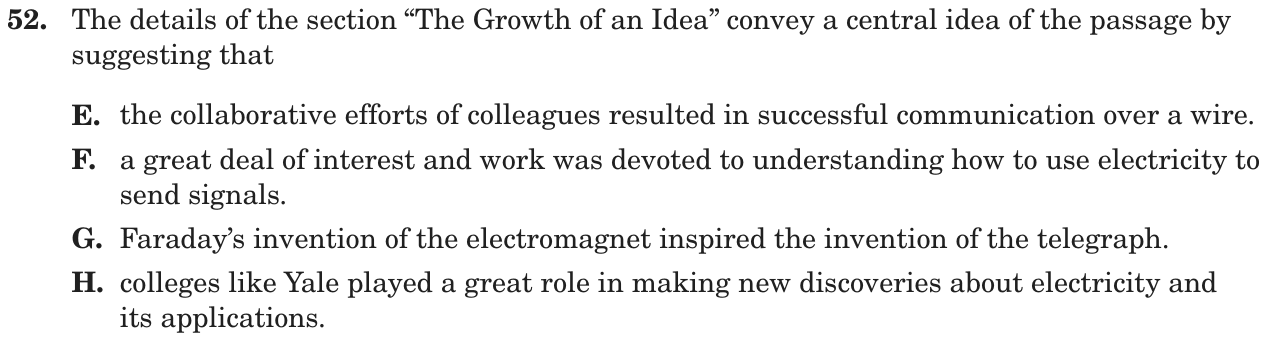
The passage “Invention of the Telegraph” as printed (pages 146–148)
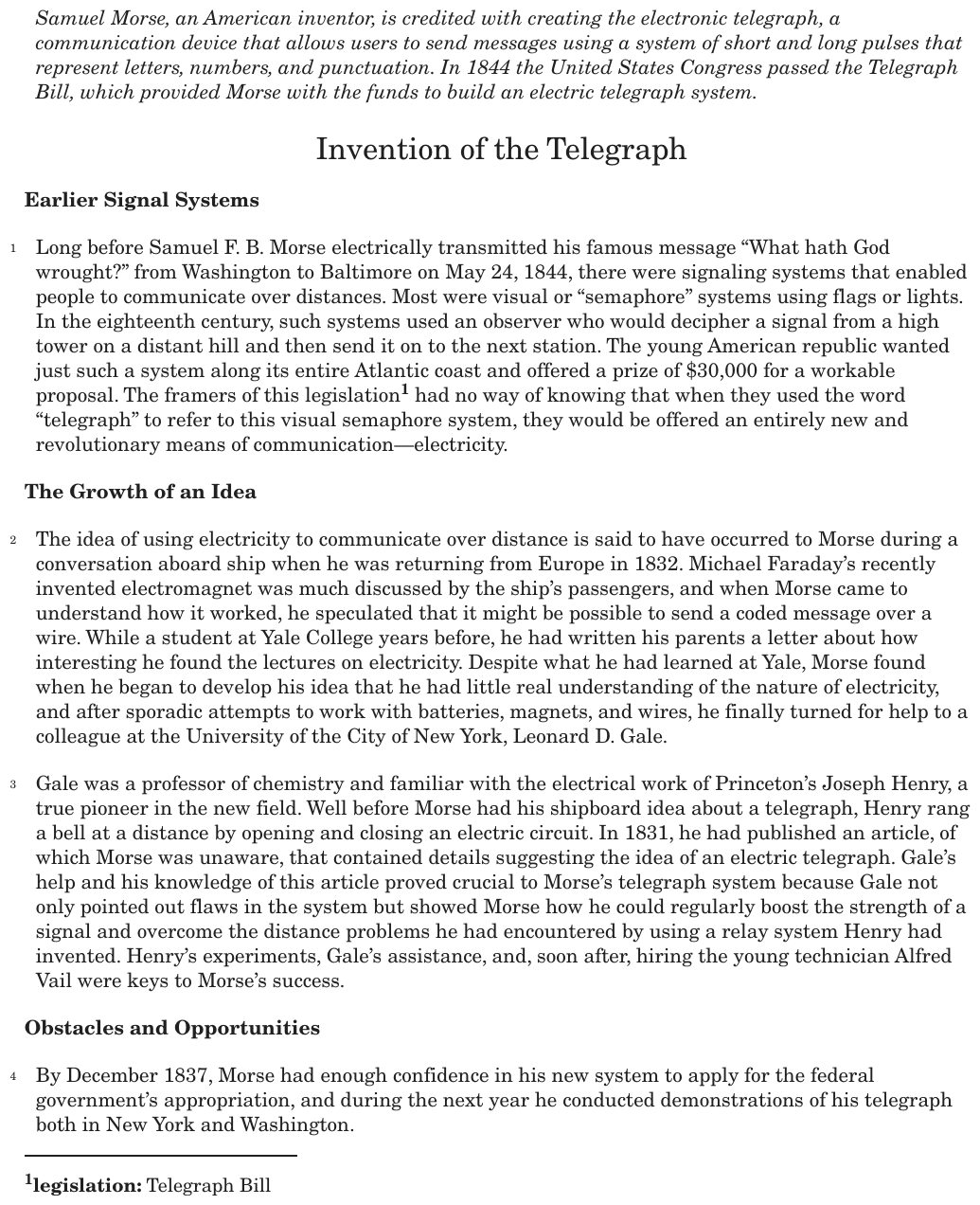
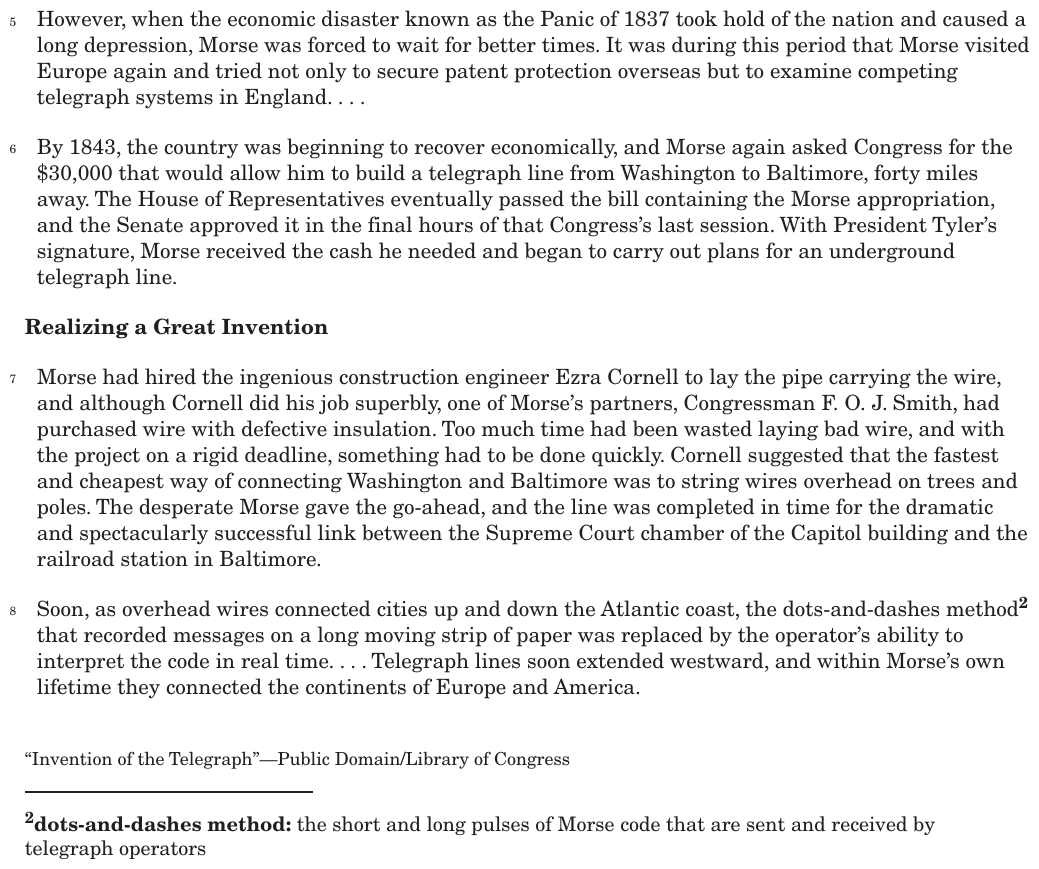
Question 3 of 6
2024 Test A English, question 49Passage Excerpt from The Highest Tide
Excerpt from The Highest Tide
by Jim Lynch
The narrator’s summer job is collecting marine specimens in Puget Sound, Washington. In this excerpt, he is looking for specimens in the mudflats before daybreak. Mudflats, or flats, are coastal landforms created when sediment and silt from tides are deposited as the tides recede.
I rounded the oyster beds, to the far side. . . . It was low tide by then, and I saw the water hesitating at its apex, neither leaving nor returning, patiently waiting for the gravitational gears to shift. Dozens of anxious clams started squirting in unison like they did whenever vibrating grains of sand warned them predators were approaching. I stopped and waited with them, to actually see the moment when the tide started returning with its invisible buffet of plankton for the clams, oysters, mussels and other filter feeders. It was right then, ankle deep in the Sound, feet numbing, eyes relaxed, that I saw the nudibranch.1
In all my time on the flats I’d never seen one before. I’d read about them, sure. I’d handled them at aquariums but never in the wild, and I’d never even seen a photo of one this stunning. It was just three inches long but with dozens of fluorescent, orange-tipped hornlike plumes jutting from the back of its see-through body that appeared to be lit from within.
Nudibranchs are often called the butterflies of the sea, but even that understates their dazzle. Almost everything else in the northern Pacific is dressed to blend with pale surroundings. Nudibranchs don’t bother, in part because they taste so lousy they don’t need camouflage to survive. But also, I decided right then, because their beauty is so startling it earns them a free pass, the same way everyday life brakes for peacocks, parade floats. . . .
The dark mudflats loomed like wet, flattened dunes stretching deep into Skookumchuck Bay in front of our house. From a distance, they looked too barren to support sea life. Up close, they still did, unless you knew where to find the hearty clams, worms and tiny creatures that flourish in mud. . . . I’m not sure why I decided to take a look. It was still an hour before sunrise, and I knew exactly what the bars2 looked like in the moonlight, but for some reason, I couldn’t resist.
I heard it long before I saw it. It was an exhale, a release of sorts, and I instantly wondered if a whale was stranded again. We had a young minke3 stuck out there two summers prior, and it made similar noises until the tide rose high enough for rescuers to help free it. . . . I looked for a hulking silhouette but couldn’t find one. I waited, but there were no more sounds. Still, I went toward what I thought I’d heard, avoiding stepping into the mud until I had to. I knew the flats well enough to know I could get stuck just about anywhere. The general rule was you didn’t venture out past the shells and gravel with an incoming tide. I sank up to my knees twice, and numbing water filled my boots.
. . . I kept stepping toward the one sound I’d heard, a growing part of me hoping I’d find nothing at all. When I stopped to rest and yank up my socks, my headlamp crossed it. My first thought? A giant octopus.
Puget Sound has some of the biggest octopi in the world. They often balloon to a hundred pounds. Even the great Jacques Cousteau4 himself came to study them. But when I saw the long tubular shape of its upper body and the tangle of tentacles below it, I knew it was more than an octopus. I came closer, within fifty feet, close enough to see its large cylindrical siphon5 quiver. I couldn’t tell if it was making any sounds at that point, because it was impossible to hear anything over the blood in my ears. . . .
The creature’s body came to a triangular point above narrow fins that lay flat on the mud like wings, but it was hard to be sure exactly where it all began or ended, or how long its tentacles truly were, because I was afraid to pry my eyes off its jumble of arms for more than half a second. I didn’t know whether I was within reach, and its arms were as big around as my ankle and lined with suckers the size of half-dollars. If they even twitched I would have run. So, I was looking at it and not looking at it while my heart spangled my vision. I saw fragments, pieces, and tried to fuse them in my mind but couldn’t be certain of the whole. I knew what it had to be, but I wouldn’t allow myself to even think the two words. Then I gradually realized the dark shiny disc in the middle of the rubbery mass was too perfectly round to be mud or a reflection.
It was too late to smother my scream. Its eye was the size of a hubcap.6
From THE HIGHEST TIDE by Jim Lynch. Copyright © 2005 by Jim Lynch. Used by permission of Bloomsbury USA. All rights reserved.
1nudibranch: type of sea slug
2bars: sandbars
3minke: species of small whale
4Jacques Cousteau: renowned French oceanographer
5siphon: tube-like organ that is used for drawing in or removing fluids
6hubcap: removable cap over the end of a wheel axle
Question
Read these sentences from paragraph 8.
So, I was looking at it and not looking at it while my heart spangled my vision. I saw fragments, pieces, and tried to fuse them in my mind but couldn’t be certain of the whole.
The sensory language “spangled my vision,” “I saw fragments, pieces,” and “tried to fuse them in my mind” conveys the narrator’s
- Aextreme excitement about making a great discovery.
- Breluctant acceptance that he needs to leave the mudflats.
- Cterrified confusion about the creature in the mudflats.
- Dsudden concern about his personal safety.
Show the answer
Correct answer: C
The question asks what the sensory language in the sentences from paragraph 8 conveys about the narrator.
A. Incorrect. While the narrator does not leave the mudflats and is curious about what has been found, the main emotions described in paragraph 8 are fear and confusion as the narrator tries to comprehend the size of the animal.
B. Incorrect. The language focuses on the narrator’s inability to organize what he sees into useful thoughts and conclusions, and while the narrator feels fear in paragraph 8—“I was afraid” and “I would have run”—the narrator refuses to leave the mudflats out of curiosity.
C. CORRECT. The phrase “spangled my vision” illustrates that the narrator cannot fully recognize what has appeared on the mudflats. The sight is so amazing, the narrator is trying to “fuse” together “fragments” and “pieces” because seeing the creature has created so much emotion in the narrator that he feels confused.
D. Incorrect. While the narrator is feeling some fear, as expressed in paragraph 8, the phrases actually indicate that the narrator’s amazement causes him to struggle to take in the view of the creature before him.
Question analysis
This question about sensory language asks what three phrases, including “spangled my vision,” convey about the narrator as he stares at a huge creature in the mud in an excerpt from The Highest Tide. Students must interpret unusual imagery and choose among emotions that all seem possible at such a startling moment.
- Grade level
- Grade 8 reading and task
- Compared with grade 7
- Above grade 7 Interpreting sensory language for a character's state of mind is grade 7 work, but spangled is an unusual verb, and the paragraph partly supports several of the emotions offered, so the choice must be matched precisely to the quoted phrases.
- Estimated difficulty
- Hard: combines ideas, needs a plan, and has more than one tempting wrong answer.
- Thinking it demands
- Depth of knowledge 2, skills and concepts · mainly analyze
- What makes it hard
- Figurative or literary language major
- A very close wrong answer moderate
- Hard words minor
- Evidence
- Answered from one paragraph or stanza
- Reading level
- Passage: about grade 6, 902 words; question and choices: about grade 7, 92 words.
- Students, last 30 days
- Not enough answers yet to show (it takes 10).
Why it is hard, traps and wrong answers (shows the answer)
Why it is hard
The quoted phrases are about perception, not feeling: the narrator sees fragments and cannot assemble them, while his heart pounds hard enough to blur his sight. The fear is clear from the surrounding sentences, where he is afraid to look away and ready to run, and that context makes the choice about personal safety very tempting. The answer must cover both the terror and the confusion, and the word “spangled” can mislead readers into hearing excitement.
Figurative or literary language major Understanding the question
The phrases describe seeing in pieces, “looking at it and not looking at it”, a heart that “spangled” his vision, “fragments” he cannot “fuse”, and the emotion has to be read from that broken sight. (Graesser, Singer & Trabasso, 1994; Kintsch, 1998)
A very close wrong answer moderate Choosing the answer
The right choice and the one about concern for his safety both name fear; they part on what the quoted phrases show, a mind unable to piece the creature together or a worry about its reach. (Embretson & Wetzel, 1987; Gorin & Embretson, 2006; Ascalon et al., 2007)
Hard words minor Understanding the question
“Spangled”, to scatter with glittering spots, is a rare word, and its sparkle can suggest delight, which opens a reading of excitement to students who miss the fear around it. (Perfetti, 2007; Freedle & Kostin, 1993)
Strategy: Ask what the three quoted phrases together say about how the narrator is seeing and thinking at this moment, then choose the emotion that accounts for all three, not just one.
Traps
- True but not the answer: A choice says something accurate about the text that does not answer this question.
- Wrong tone or attitude: Misjudges the tone, attitude or point of view, such as reading admiration as criticism, or taking a character's or subject's feelings for the author's.
The wrong answers, classified
A Wrong tone or attitude (Graesser, Singer & Trabasso, 1994)
Reads the pounding heart and glittering vision as the thrill of a great find, missing that he is afraid to take his eyes off the creature and cannot make sense of it.
B Twists what the text says (King et al., 2004)
Turns “If they even twitched I would have run”, a possibility, into an accepted need to leave, though the narrator stays and the phrases describe how he sees.
D True but not the answer (King et al., 2004; Embretson & Wetzel, 1987)
Matches the fear in paragraph 8, where he wonders whether he is within reach, but the quoted phrases describe broken seeing and puzzling, and his fear has been building, not sudden.
Working it out, step by step
Know what the question asks
Sensory language describes what a character sees, hears or feels. This asks what feeling the three quoted phrases show. Your answer must explain all three phrases, not just one.
Explain the hard words
To spangle means to cover with glittering spots. His heart pounds so hard that his sight seems to sparkle and blur. Fragments are small broken pieces. To fuse means to join together.
Put the phrases together
He sees only “fragments, pieces.” He tries “to fuse them in my mind” but “couldn’t be certain of the whole.” So he is confused, unable to tell what the creature really is. The sentences around them show he is also terrified. He is “afraid to pry my eyes off” its arms, and his heart is racing.
Check each choice
- C fits: “terrified confusion” covers both his fear and his broken, puzzled seeing.
- A is wrong because “spangled” may sound happy, but he is frightened, not thrilled.
- B is wrong because he never decides to leave, and he would run only if the arms moved.
- D is wrong because the phrases show confused seeing, and his fear has been growing since paragraph 6.
Watch out: D is close, since he is afraid. But it leaves out the confusion the phrases show.
Choose the answer
The phrases show a frightened narrator who cannot piece together what he sees. So the answer is C.
Why this answer and not the closest wrong one
D comes closest, because the narrator truly fears for his safety. But the quoted phrases are about how he sees: in pieces he can’t join. That is confusion. C names both the fear and the confusion, so it fits all three phrases.
More questions like this
The original DOE question
The passage “Excerpt from The Highest Tide” as printed (pages 64–65)
Question 4 of 6
2018 Test A Math, question 40Question
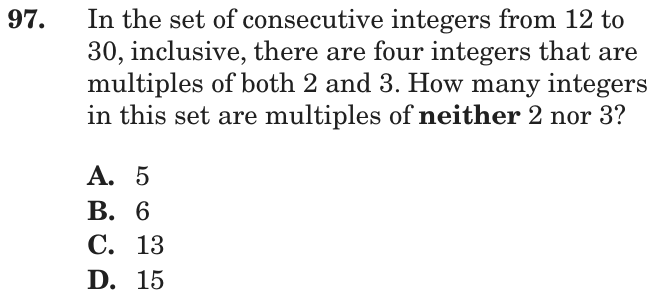
In the set of consecutive integers from 12 to 30, inclusive, there are four integers that are multiples of both 2 and 3. How many integers in this set are multiples of neither 2 nor 3?
- A5
- B6
- C13
- D15
Show the answer
Correct answer: B
The question asks for integers from 12 to 30 that are not divisible by 2 or 3. The set of consecutive integers is
{12, 13, 14, 15, 16, 17, 18, 19, 20, 21, 22, 23, 24, 25, 26, 27, 28, 29, 30}
Since all even numbers are divisible by 2, eliminate all even numbers, leaving the odd numbers in the set:
{13, 15, 17, 19, 21, 23, 25, 27, 29}
Eliminate those integers that are multiples of 3 (15, 21, and 27). The remaining integers are:
{13, 17, 19, 23, 25, 29}
Therefore, there are 6 numbers in the set that are multiples of neither 2 nor 3.
Question analysis
This number properties question takes the integers from 12 to 30, inclusive, and asks how many are multiples of neither 2 nor 3. Students must count the whole set, remove multiples of 2 and of 3 without removing any number twice, and count what remains. Inclusive endpoints and the overlap make it easy to miscount.
- NYS standards
- 6.NS.4 common factors and multiples
- Grade level
- Grade 6 content, by NYS standard
- Compared with grade 7
- Above grade 7 Multiples are sixth-grade content, but grade 7 problems rarely ask students to count a set under two overlapping conditions. The inclusive range and the numbers that are multiples of both make this longer and trickier than usual.
- Estimated difficulty
- Hard: combines ideas, needs a plan, and has more than one tempting wrong answer.
- Thinking it demands
- Depth of knowledge 2, skills and concepts · mainly apply
- What makes it hard
- Much to keep track of moderate
- A very close wrong answer moderate
- Solution
- 3 steps
- Reading level
- Question and choices: about grade 9, 30 words.
- Students, last 30 days
- Not enough answers yet to show (it takes 10).
Why it is hard, traps and wrong answers (shows the answer)
Why it is hard
The question gives the overlap, four multiples of both 2 and 3, which invites a subtraction method with three places to go wrong: the count of the set, the overlap, and the final complement. Each of those errors has its own choice. Listing the 19 numbers and crossing out evens and then odd multiples of 3 is slower to describe but faster and safer to do.
Much to keep track of moderate Working it out
Each of the 19 integers must be checked against two conditions, and the four multiples of 6 meet both, so they must be removed once, not twice. (Sweller, 1988; Carpenter, Just & Shell, 1990)
A very close wrong answer moderate Choosing the answer
The choices 5 and 6 differ by one, the result of counting 30 − 12 = 18 integers instead of 19, so only counting the inclusive set exactly separates them. (Embretson & Wetzel, 1987; Gorin & Embretson, 2006; Ascalon et al., 2007)
Strategy: Cross out every even number first, then cross out the odd multiples of 3 that remain, and count the survivors; listing all nineteen numbers is quick enough.
Traps
- Answers a different question: A choice is right for another quantity: the other unknown, the rest instead of the part, the part instead of the whole.
- Counting the ends: Inclusive or exclusive ends, fence posts, consecutive numbers: an answer that is one too many or too few, or an endpoint drawn open where it belongs closed (or the reverse).
The wrong answers, classified
A Counting the ends (Brown & Burton, 1978)
Counts 30 − 12 = 18 integers instead of 19, then subtracts the 13 multiples of 2 or 3 and gets 5.
C Answers a different question (King et al., 2004; Hegarty, Mayer & Monk, 1995)
Counts the integers that are multiples of 2 or 3, the 13 to be crossed out, and gives that count instead of the 6 left over.
D Misreads the question (Hegarty, Mayer & Monk, 1995)
Subtracts only the four multiples of both 2 and 3 from the 19 integers, reading "neither 2 nor 3" as "not both 2 and 3".
Worked solution, step by step
Formulas used
- Counting whole numbers in a list
- a is the first number and b is the last. n is how many whole numbers there are, counting both ends. You add 1 because subtracting counts the gaps, and there is one more number than gaps.
Sort out the question
The set is every integer (whole number) from 12 to 30. “Inclusive” means 12 and 30 are both in.
A multiple of 2 is an even number. A multiple of 3 is a number in the 3 times table. You need the numbers that are neither: not even, and not in the 3 times table.
Count the numbers in the set
There are 19 integers. Watch out: 30 − 12 = 18 forgets one end. That slip leads to choice A, 5.
Cross out the even numbers
Every even number is a multiple of 2, so remove them all. The odd numbers are left:
13, 15, 17, 19, 21, 23, 25, 27, 29
That is 9 numbers.
Cross out the multiples of 3
Check each odd number for 3. A quick test: add its digits. If the sum is in the 3 times table, so is the number. That removes 15, 21 and 27. These are left:
13, 17, 19, 23, 25, 29
Watch out: only 12, 18, 24 and 30 are multiples of both. Removing just those gives 19 − 4 = 15, choice D. “Neither” means you remove every multiple of 2 and every multiple of 3.
Count what is left
Six numbers are left. Watch out: 13 is how many you crossed out, choice C. The question asks for the ones left. So the answer is B, 6.
Check your answer
Count another way. Of the 19 numbers, 10 are even. Of the 9 odd ones, 3 are multiples of 3. So 10 + 3 = 13 are crossed out, and 19 − 13 = 6 are left. Same answer.
More questions like this
The original DOE question
Question 5 of 6
2018 Test A Math, question 21Question
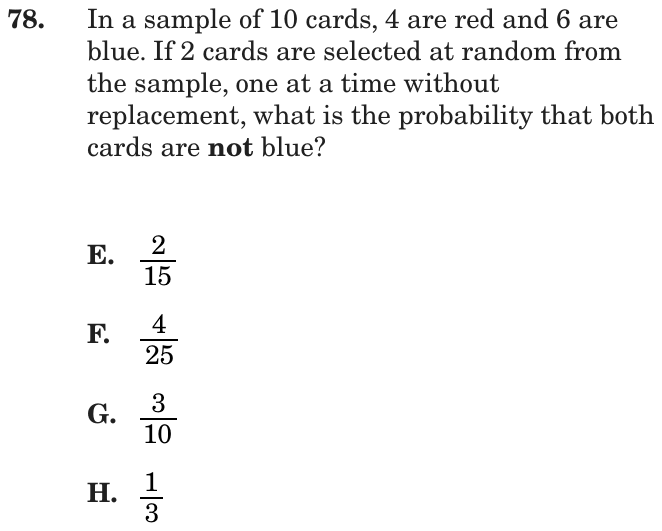
In a sample of 10 cards, 4 are red and 6 are blue. If 2 cards are selected at random from the sample, one at a time without replacement, what is the probability that both cards are not blue?
- A
- B
- C
- D
Show the answer
Correct answer: A
The probability that both cards are not blue is the same as the probability that both cards are red. There are 4 red cards out of the 10, so the probability of the first card being red is
Now there are 9 cards left, and 3 of those are red, so the probability of the second card being red is
Multiply the two probabilities to find the probability that both cards are red (not blue):
Question analysis
This probability question draws 2 cards, one at a time and without replacement, from 10 cards: 4 red and 6 blue. Students find the chance that neither card drawn is blue. The second draw has one fewer card, and the word not changes which color to count.
- NYS standards
- Grade level
- Grade 7 content, by NYS standard
- Compared with grade 7
- Above grade 7 Grade 7 compound probability is usually found with a list or tree of equally likely outcomes. Dependent draws without replacement, plus a negative phrasing to translate, go beyond that typical work.
- Estimated difficulty
- Hard: combines ideas, needs a plan, and has more than one tempting wrong answer.
- Thinking it demands
- Depth of knowledge 2, skills and concepts · mainly apply
- What makes it hard
- Something you must already know moderate
- A very close wrong answer moderate
- Turning words into math minor
- An answer in an unexpected form minor
- Solution
- 3 steps
- Reading level
- Question and choices: about grade 5, 39 words.
- Students, last 30 days
- Not enough answers yet to show (it takes 10).
Why it is hard, traps and wrong answers (shows the answer)
Why it is hard
Two ideas stack here: restating not blue as red, and changing the second draw's numbers after a card is removed. Students who know to multiply but forget the removal reach a listed choice, and so do students who compute both blue. Writing the second fraction explicitly as 3 red out of 9 cards, before multiplying, is what separates right from nearly right.
Something you must already know moderate Working it out
Multiplying the first draw's chance by the second draw's, with the second adjusted for the card already taken, is a rule the test assumes and does not give. (Anderson & Krathwohl, 2001)
A very close wrong answer moderate Choosing the answer
2/15 and 4/25 are about 0.13 and 0.16, too close to tell apart by estimate; only the second draw's fraction, 3 red of 9 cards rather than 4 of 10, separates them. (Embretson & Wetzel, 1987; Gorin & Embretson, 2006; Ascalon et al., 2007)
Turning words into math minor Understanding the question
"Both cards are not blue" has to be restated as both cards red, and the bold not also invites computing the chance that both are blue. (Hegarty, Mayer & Monk, 1995; Koedinger & Nathan, 2004)
An answer in an unexpected form minor Choosing the answer
The product comes out as 12/90, and it has to be reduced to lowest terms before it matches any of the listed fractions. (Enright, Morley & Sheehan, 2002)
Strategy: Restate not blue as red, then multiply the chance of red on the first draw by the chance of red on the second, with one card fewer.
Traps
- Without replacement: In a second pick there is one fewer item, which changes the probability.
- Misreads the question: Misses or misreads a condition or a word in the question: "at least", "each", "remaining", "not".
The wrong answers, classified
B Without replacement (Fischbein & Schnarch, 1997)
Multiplies 4/10 × 4/10 = 16/100 = 4/25, as if the first red card were put back before the second draw.
C Little reason to choose it (Haladyna & Downing, 1993; Rodriguez, 2005)
No standard working gives 3/10: it is not the chance of red or of blue on one draw or on two, so it mostly catches guesses.
D Misreads the question (Hegarty, Mayer & Monk, 1995)
Computes the chance that both cards are blue, 6/10 × 5/9 = 30/90 = 1/3, missing the bold word not.
Worked solution, step by step
Formulas used
- Probability
- P is the probability, the chance that something happens. Favorable is the number of ways to get what you want, here a red card. Total is the number of all possible picks, here all the cards you can pick from. It works when every pick is equally likely.
- Two events in a row
- A is the first event and B is the second. P( ) means the probability of what is inside. The chance that both happen is the first chance times the second. For the second chance, count only what is left after the first event.
Sort out the question
There are 10 cards: 4 red and 6 blue. You pick 2 cards “one at a time without replacement”. That means the first card is not put back. “Both cards are not blue” means both are red, since red is the only other color. You need the probability, or chance, of that.
Find the chance the first card is red
4 of the 10 cards are red. Each card is equally likely to be picked. Use the probability formula.
Find the chance the second card is red
One red card is gone now, and it is not put back. So 9 cards are left, and 3 of them are red.
Watch out: using 4/10 again acts as if the card went back. That gives 4/25, choice B.
Multiply the two chances
Both cards must be red. So multiply the first chance by the second. To multiply fractions, multiply the tops, then multiply the bottoms.
Simplify the fraction
None of the choices is 12/90, so simplify it. Divide the top and the bottom by 6, the biggest number that goes into both.
Watch out: the chance that both are blue is , choice D. The question says not blue. So the answer is A, .
Check your answer
Count the ways. There are ways to pick two cards in order. Red then red has ways. That gives 12/90, or 2/15. The answer is small, which makes sense, because there are fewer red cards than blue ones.
More questions like this
The original DOE question
Question 6 of 6
2024 Test A Math, question 6Question
Mr. Jones has 550 goats, which is 10% more than Mr. King has. How many more goats does Mr. Jones have than Mr. King?
- A50
- B55
- C495
- D500
Show the answer
Correct answer: A
First, set up a proportion to determine x, the number of goats Mr. King has.
Then solve the proportion for x.
Finally, determine the difference between the number of goats Mr. Jones has, 550, and the number of goats Mr. King has, 500.
Mr. Jones has 50 more goats than Mr. King.
Question analysis
A percent word problem: Mr. Jones has 550 goats, which is 10% more than Mr. King has, and students find how many more goats Mr. Jones has. It asks students to work with a percent increase when only the larger amount is known. The tricky part is deciding which amount the 10% is taken of.
- Grade level
- Grade 7 content, by NYS standard
- Compared with grade 7
- Above grade 7 Grade 7 students usually find a percent increase from a known original amount. This runs the task backward: the increased amount is given, and the original must be recovered before the difference can be found, a step many do not expect.
- Estimated difficulty
- Hard: combines ideas, needs a plan, and has more than one tempting wrong answer.
- Thinking it demands
- Depth of knowledge 2, skills and concepts · mainly apply
- What makes it hard
- Turning words into math major
- A very close wrong answer moderate
- Solution
- 2 steps
- Reading level
- Question and choices: about grade 1, 22 words.
- Students, last 30 days
- Not enough answers yet to show (it takes 10).
Why it is hard, traps and wrong answers (shows the answer)
Why it is hard
The arithmetic is one division and one subtraction, so the question is really about the base of a percent. The sentence gives the bigger number and calls it 10% more, and the reflex is to take 10% of the number on the page. That shortcut lands on a listed choice five goats from the answer. Students who find King's herd first, 550 ÷ 1.1, still have to remember that the question wants the difference, not the herd.
Turning words into math major Understanding the question
The clause "which is 10% more than" makes King's unknown herd the base of the 10%, so 550 is 110% of his number rather than the amount the 10% is taken of. (Hegarty, Mayer & Monk, 1995; Koedinger & Nathan, 2004)
A very close wrong answer moderate Choosing the answer
The choices 50 and 55 are only 5 goats apart, and both are 10% of a herd; only taking the percent of King's 500 rather than of 550 separates them. (Embretson & Wetzel, 1987; Gorin & Embretson, 2006; Ascalon et al., 2007)
Strategy: Mr. Jones's 550 is 110% of Mr. King's number, so divide 550 by 1.10 to find Mr. King's goats, then subtract that from 550.
Traps
- Percent of the wrong amount: Finding the whole from a part, or a percent change measured from the wrong starting amount.
- Stops one step early: A choice is a number from partway through the solution.
The wrong answers, classified
B Percent of the wrong amount (Parker & Leinhardt, 1995)
Takes 10% of 550, measuring the increase from Jones's herd instead of from King's smaller herd, which is the amount the 10% is based on.
C Percent of the wrong amount (Parker & Leinhardt, 1995)
Takes 10% off 550 to get King's herd, 550 − 55 = 495, using the wrong base, then gives that herd instead of the difference.
D Stops one step early (King et al., 2004; Gierl et al., 2017)
Finds King's herd correctly, 550 ÷ 1.1 = 500, then stops there instead of subtracting it from 550 to get how many more.
Worked solution, step by step
Formulas used
- Percent increase
- The original is the amount you start from, the one the percent is taken of. p is the percent of increase. The new amount is all of the original, which is 100%, plus p% more. For 10% more, you multiply by 1.10.
Sort out the question
Mr. Jones has 550 goats. That is “10% more than Mr. King has”. You need how many more goats Mr. Jones has than Mr. King. That is the difference between the two herds, not the size of a herd.
Decide what the 10% is of
The words “10% more than Mr. King” mean the 10% is a part of Mr. King’s herd. So Mr. King’s herd is the original. Mr. Jones has all of Mr. King’s goats, 100%, plus 10% more. That is 110% of Mr. King’s herd. Watch out: do not take 10% of 550. That gives 55, choice B. It uses the wrong herd. Taking those 55 away from 550 gives 495, choice C, which is also wrong.
Find Mr. King’s herd
Call Mr. King’s number of goats K. Use the percent increase formula with p = 10. The new amount is 550.
Mr. King has 500 goats. Watch out: 500 is Mr. King’s herd, choice D. It is not the difference.
Find the difference
Mr. Jones has 50 more goats than Mr. King. So the answer is A, 50.
Check your answer
Check the 10%. 10% of 500 is , and , Mr. Jones’s herd. So 550 really is 10% more than 500. If King had 495, then 10% more would be about 545, not 550.
More questions like this
The original DOE question