3 English and 3 math
Here are 6 random questions to try. Takers earning below 75% are unlikely to receive an offer. You have 1 minute 48 seconds per question on the real exam.
Question 1 of 6
2024 Test B English, question 1Question
What is the best way to combine these sentences to clarify the relationship between ideas?
(1) The International Space Station has been inhabited by crew members since 2000.
(2) Tourists will soon be allowed to pay for visits to the space station.
(3) Because the cost is $52–$58 million round trip, few people will be able to take advantage of the opportunity to have a vacation in outer space.
- AThe International Space Station has been inhabited by crew members since 2000, but tourists will soon be allowed to pay for visits to the space station, which cost $52–$58 million round trip, so few people will be able to take advantage of the opportunity to have a vacation in outer space.
- BThe International Space Station has been inhabited by crew members since 2000 and will soon allow tourists to pay for visits, but because the cost is $52–$58 million round trip, few people will be able to take advantage of the opportunity to have a vacation in outer space.
- CThe International Space Station has been inhabited by crew members since 2000, but tourists will soon be allowed to pay for visits to the space station, though the cost is $52–$58 million round trip, so few people will be able to take advantage of the opportunity to have a vacation in outer space.
- DThe International Space Station has been inhabited by crew members since 2000, and tourists will soon be allowed to pay for visits to the space station because the cost is $52–$58 million round trip, therefore few people will be able to take advantage of the opportunity to have a vacation in outer space.
Show the answer
Correct answer: B
The question asks for the best way to combine the sentences.
A. Incorrect. Although the option combines the sentences in a way that accurately reflects the meaning of each individual sentence, the combined sentence is a string of clauses that do not effectively cohere. Because it is poorly structured, the combined sentence does not clarify the relationship of ideas as effectively as the correct response does. The sentence incorrectly uses “but tourists,” and “which cost” modifies “the space station” but does not modify the trip. Compared with the correct response, the combined sentence in this option is also imprecise and unnecessarily wordy.
B. CORRECT. The option uses a complex sentence to present ideas clearly and precisely, and it shows the relationship between the ideas in the original sentences. In the first part of the sentence, the conjunction “and” correctly joins the first and second sentences by indicating a relationship, rather than a contrast, between the two. In the second part of the sentence, the conjunction “but” adds additional emphasis to the fact that while tourists will be allowed to visit the space station, the cost of the trip will likely prohibit most people from visiting.
C. Incorrect. Although the option combines the sentences in a way that accurately reflects the meaning of each individual sentence, the combined sentence is a string of clauses that do not effectively cohere. Because it is so poorly structured, the combined sentence does not clarify the relationship of ideas as effectively as the correct response does. Compared with the correct response, the combined sentence in this option is also imprecise and unnecessarily wordy.
D. Incorrect. The combination of the sentences contains an illogical relationship between ideas with the statement that tourists will be allowed to pay for visits to the space station because the cost is $52–$58 million round trip. The connection between the idea that “tourists will soon be allowed to pay for visits” and the subsequent “therefore few people will be able to take advantage of the opportunity” is also illogical.
Question analysis
This sentence-combining question gives three sentences about the International Space Station, its crew and the high price of a tourist trip, and asks for the best way to join them into one. Every version keeps the same facts, so students must judge which connecting words show how the ideas relate while the sentences stay long and nearly identical.
- Grade level
- Grade 8 reading and task
- Compared with grade 7
- Above grade 7 Grade 7 students practice joining two short sentences with a fitting conjunction. Here three sentences become one long sentence in four nearly identical versions, so students must weigh every connecting word and clause rather than spot one error.
- Estimated difficulty
- Hard: combines ideas, needs a plan, and has more than one tempting wrong answer.
- Thinking it demands
- Depth of knowledge 2, skills and concepts · mainly evaluate
- What makes it hard
- How sentences fit together major
- Complex sentences moderate
- Every choice must be checked moderate
- Evidence
- Answered from one sentence or line
- Reading level
- Question and choices: about grade 15, 261 words.
- Students, last 30 days
- Not enough answers yet to show (it takes 10).
Why it is hard, traps and wrong answers (shows the answer)
Why it is hard
None of the wrong versions drops a fact, and two of them are loose rather than plainly ungrammatical, so the ear is little help. Students lose the point by accepting the smoothest chain of clauses without asking what each connector claims: whether the crew and the tourists really contrast, what the price belongs to, and what the price explains. The question rewards deciding the three links before reading the versions, then checking them one connector at a time.
How sentences fit together major Working it out
Sentence 2 simply adds to sentence 1, while sentence 3’s price works against the tourist plan and explains why few will go, so every “but,” “though,” “because” or “so” in a version must fit one of those links. (Halliday & Hasan, 1976)
Complex sentences moderate Understanding the question
Each version is one sentence of 48 to 53 words with four clauses, and at that length a “which cost” hanging on the wrong noun or a comma before “therefore” is easy to read past. (Abedi & Lord, 2001; Freedle & Kostin, 1993; Messick, 1989)
Every choice must be checked moderate Choosing the answer
All four versions keep the same facts in the same order and share most of their words, so none can be ruled out by content; each connecting word has to be tested in turn. (Embretson & Wetzel, 1987)
Strategy: Before reading the choices, decide how each sentence relates to the next: added fact, contrast, or cause and result. Then check every connecting word in each version against those links.
Traps
- Misplaced modifier: A describing word or phrase that attaches to the wrong word, or to nothing in the sentence.
- Wordy, vague or informal: A revision is grammatical but wordy, imprecise or too casual for the passage.
- Wrong transition: A connecting word or phrase that signals the wrong relationship, such as contrast where the idea continues.
The wrong answers, classified
A Misplaced modifier (Connors & Lunsford, 1988)
Keeps the price as the reason few can go, marked by “so,” but misses that “which cost” hangs on “the space station” and that “but” sets crew against tourists.
C Wordy, vague or informal (Connors & Lunsford, 1988)
Keeps every fact in order, but stacking “but,” “though” and “so” in one sentence turns the price into an aside instead of plainly the reason few people will go.
D Wrong transition (Halliday & Hasan, 1976)
Keeps sentence 3’s “because the cost is” word for word, but here it explains why tourists are allowed, and “therefore” after a comma splices on the result.
Working it out, step by step
Figure out what the question asks
You need to join three sentences into one. The best version shows clearly how the ideas connect. Joining words do that job. A conjunction is a joining word, like and, but, so or because. Each one tells the reader something. And adds a fact. But shows a contrast (two ideas that pull against each other). Because and so show a cause and its result.
Decide how the three sentences connect
Sentence 1 says crews have lived on the station since 2000. Sentence 2 adds a new fact: tourists will soon be able to visit. That is not a contrast, so it needs and. Sentence 3 works against sentence 2. The trip costs “$52–$58 million round trip.” That price is also the reason few people will go. So you need a contrast and a reason. Example: The pool is open to all, but because it costs $90, few kids swim there.
Test each choice
- B uses “and will soon allow tourists” to add the new fact. Then “but because the cost is” shows the contrast and the reason. Every link is right.
- A joins sentence 2 with “but tourists,” as if crews and tourists were opposites. Also, “which cost” comes right after “the space station.” So it sounds like the station costs that much, not the trip.
- C stacks “but,” “though” and “so” in one long chain. The price turns into a side note instead of the clear reason.
- D says tourists may visit “because the cost is” so high. That makes no sense. And “therefore” after a comma joins two sentences the wrong way.
Pick the answer
Watch out: A is the most tempting. It keeps the price as the reason, with “so.” But its “but” and its “which” send the reader the wrong way. Only one choice links every idea correctly. So the answer is B.
Why this answer and not the closest wrong one
A is the closest wrong answer. Like B, it says the price keeps most people away. But A sets crews against tourists with “but tourists.” Its “which cost” also seems to give the price of the station. B uses and for the added fact and but because for the price, so each link is clear.
More questions like this
The original DOE question
Question 2 of 6
2018 Test A English, question 22Passage Champion of the Channel
Champion of the Channel
In 1926 an editor at the London Daily News predicted that Gertrude Ederle, an American swimmer with eighteen world records and three Olympic medals, would fail in her attempt to swim across the English Channel. He claimed that “even the most uncompromising champion of the rights and capacities of women must admit that in contests of physical skill, speed and endurance they must remain forever the weaker sex.” Yet, at only nineteen years old, Ederle not only became the first woman to accomplish this feat, she also broke the men’s record by two hours. Gertrude Ederle’s triumphant swim across the English Channel was a testimony to her determination, innovative spirit, and passion for swimming.
Crossing the English Channel is a daunting task for any swimmer. At its narrowest point, the channel measures twenty-one miles across. Its icy waters hover around sixty degrees Fahrenheit, and its unruly tides and currents toss swimmers about like bobbing corks. Stinging jellyfish, seaweed, and floating debris from shipwrecks and lost cargoes present added hazards.
For decades the channel’s perils have defeated countless swimmers. Ederle, too, failed in her first attempt to cross the channel in 1925. Just six miles short of finishing, she became ill, and her coach had to haul her out of the water. Undeterred, Ederle decided to try again. Ederle knew that if she did not complete the challenge this time, she might never get the opportunity to set this record, because a rival female swimmer was preparing to make her second attempt at the crossing as well.
To prepare for the marathon swim, Ederle found ways to improve her equipment. She and her sister Meg discovered that melted candle wax perfectly sealed goggle edges, effectively waterproofing Ederle’s goggles against hammering waves. The sisters also designed a two-piece silk swimsuit for Ederle. During her first channel-crossing attempt she had worn a standard one-piece swimsuit that, after the lengthy hours of swimming across the channel, had stretched out, filling with water and creating drag, making an already challenging task almost insurmountable. Unlike the cumbersome typical bathing suit, this silk invention weighed little and allowed for easy movement.
On August 6, 1926, Ederle waded into the channel near Cape Gris-Nez, France. At first she shivered in the bone-chilling water even though she had covered her body in eight layers of grease for insulation. Her limbs felt stiff. Her strokes were irregular. Driving forward, she fought to clear her mind and find what she called her “sphere,” a place where the sea became her only companion and the shrieks of gulls and the humming of boat engines faded away. Using a new overhand stroke called the American crawl, Ederle eventually settled into a steady pace, briskly breaking through waves.
Throughout Ederle’s swim, two tugboats accompanied her. One carried newspaper reporters who wired dispatches of her progress to shore. The other, displaying a sign that read “This way, ole kid!” with an arrow pointing forward, transported her coach, family, and friends. Her coach played songs, such as “Yes, We Have No Bananas,” on a phonograph so that Ederle could time her strokes to the rhythm. Using a net, her coach also passed her baby bottles of broth for nourishment.
For hours Ederle swam, dodging debris with an amused smile. However, as she neared the English shore, a sudden fierce storm erupted. The tides and waves forced Ederle backward, and she fought the stubborn swells for several hours. The salty water caused her tongue to swell and inflamed her ears. Yet Ederle felt indescribably happy as she churned through the sea. Finally, as she neared the English shore, the storm abated, and the tide turned. No longer fighting against her, the sea pushed her toward the shore and victory.
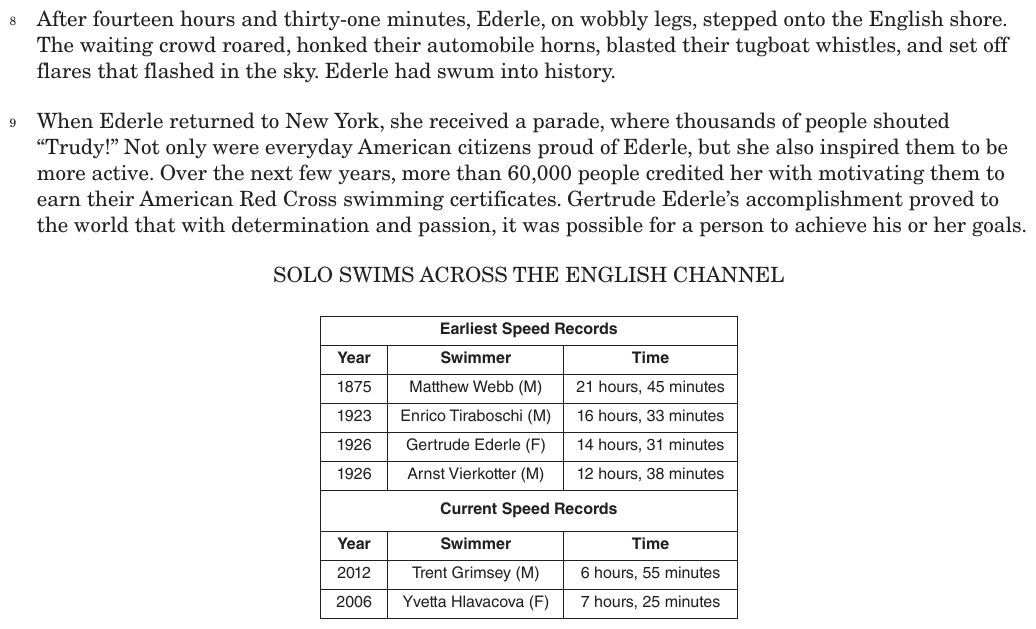
After fourteen hours and thirty-one minutes, Ederle, on wobbly legs, stepped onto the English shore. The waiting crowd roared, honked their automobile horns, blasted their tugboat whistles, and set off flares that flashed in the sky. Ederle had swum into history.
When Ederle returned to New York, she received a parade, where thousands of people shouted “Trudy!” Not only were everyday American citizens proud of Ederle, but she also inspired them to be more active. Over the next few years, more than 60,000 people credited her with motivating them to earn their American Red Cross swimming certificates. Gertrude Ederle’s accomplishment proved to the world that with determination and passion, it was possible for a person to achieve his or her goals.
SOLO SWIMS ACROSS THE ENGLISH CHANNEL
|
Earliest Speed Records |
||
| Year | Swimmer | Time |
| 1875 | Matthew Webb (M) | 21 hours, 45 minutes |
| 1923 | Enrico Tiraboschi (M) | 16 hours, 33 minutes |
| 1926 | Gertrude Ederle (F) | 14 hours, 31 minutes |
| 1926 | Arnst Vierkotter (M) | 12 hours, 38 minutes |
| Current Speed Records | ||
| Year | Swimmer | Time |
| 2012 | Trent Grimsey (M) | 6 hours, 55 minutes |
| 2006 | Yvetta Hlavacova (F) | 7 hours, 25 minutes |
Question
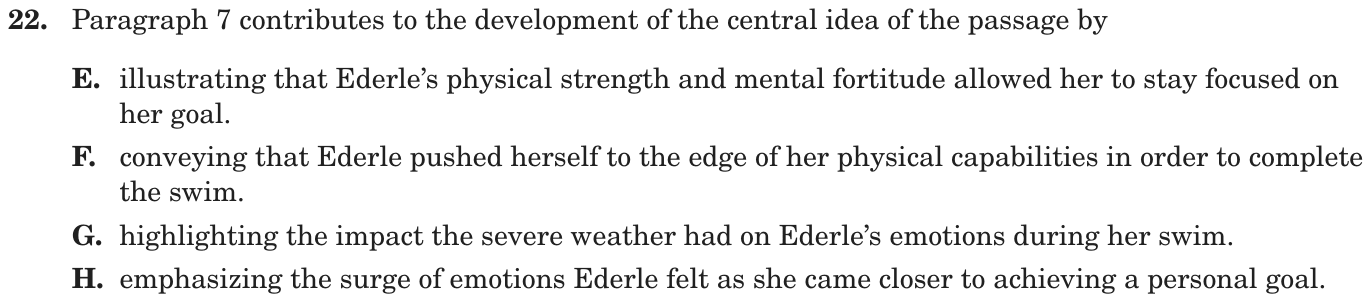
Paragraph 7 contributes to the development of the central idea of the passage by
- Aillustrating that Ederle’s physical strength and mental fortitude allowed her to stay focused on her goal.
- Bconveying that Ederle pushed herself to the edge of her physical capabilities in order to complete the swim.
- Chighlighting the impact the severe weather had on Ederle’s emotions during her swim.
- Demphasizing the surge of emotions Ederle felt as she came closer to achieving a personal goal.
Show the answer
Correct answer: D
The answer is (D)
The question asks for an explanation of how paragraph 7 contributes to the development of a central idea of the passage. Paragraph 7 is mainly about Ederle’s physical and emotional state as she pushed through a difficult portion of her swim and realized her goal was in sight. A central idea of the passage is that Ederle’s passion and determination allowed her to accomplish her goal of being the first woman to cross the English Channel.
Option D is correct because it emphasizes her passion by referring to the overwhelming emotions Ederle felt as she progressed during her swim, despite the unfavorable conditions (paragraph 7: “For hours Ederle swam, dodging debris with an amused smile” and “Yet Ederle felt indescribably happy as she churned through the sea.”).
Option A is incorrect because, although Ederle needed physical strength and mental fortitude to complete the swim, the paragraph contributes to a central idea because it highlights her emotion as she swam, not her physical strength or mental fortitude.
Option B is incorrect because the paragraph focuses on Ederle’s emotional response to the challenging circumstances and not the idea that Ederle was at the “edge of her physical capabilities.”
Option C is incorrect because Ederle’s feelings of happiness and amusement were caused by her anticipation and excitement as she approached achieving her goal, not by the severe weather.
Question analysis
This reading question asks how the paragraph about the storm near the end of Gertrude Ederle's English Channel swim contributes to the passage's central idea. Students must decide what the paragraph mainly does and connect it to the larger point, while every choice sounds like a fair description of a hard swim.
- Grade level
- Grade 8 reading and task
- Compared with grade 7
- Above grade 7 Explaining how one paragraph develops a central idea is a grade 7 standard, but here several choices sound true of a hard swim through a storm, and the student must see what the paragraph is mainly about, beyond typical grade 7 work.
- Estimated difficulty
- Hard: combines ideas, needs a plan, and has more than one tempting wrong answer.
- Thinking it demands
- Depth of knowledge 3, strategic thinking · mainly analyze
- What makes it hard
- A very close wrong answer major
- Evidence in several places moderate
- How, not what moderate
- Evidence
- Answered from several paragraphs or stanzas
- Reading level
- Passage: about grade 9, 790 words; question and choices: about grade 11, 76 words.
- Students, last 30 days
- Not enough answers yet to show (it takes 10).
Why it is hard, traps and wrong answers (shows the answer)
Why it is hard
Paragraph 7 is crowded with hardship, a storm, a swollen tongue and inflamed ears, so the obvious reading is that it shows toughness. The author's pointed “Yet Ederle felt indescribably happy” turns it toward emotion, which ties it to the passion named in the thesis. Several choices are fair about the swim in general, and this is one of the closer calls on the test, since strength is also on display.
A very close wrong answer major Choosing the answer
The right choice and the strength-and-fortitude one both describe Ederle's inner state as she nears her goal, and only whether paragraph 7 stresses her feelings or her toughness separates them, since she does fight “the stubborn swells for several hours”. (Embretson & Wetzel, 1987; Gorin & Embretson, 2006; Ascalon et al., 2007)
Evidence in several places moderate Working it out
The central idea, her “determination, innovative spirit, and passion for swimming”, is stated in paragraph 1, six paragraphs before the storm it must be connected to. (Kirsch & Mosenthal, 1990; Gorin & Embretson, 2006)
How, not what moderate Working it out
The question asks how paragraph 7 develops the central idea, so the student must weigh what its details stress, the “amused smile” and “indescribably happy”, not just what happens. (Anderson & Krathwohl, 2001)
Strategy: Mark the words in paragraph 7 that describe how Ederle felt and what she endured, decide which the author stresses, then connect that to the passage's stated central idea.
Traps
- True but not the answer: A choice says something accurate about the text that does not answer this question.
- Too broad or too strong: A choice overstates, generalizes, or uses absolute words the text does not support.
The wrong answers, classified
A True but not the answer (King et al., 2004; Embretson & Wetzel, 1987)
Credits strength and mental fortitude, which the hours against the swells partly show, but the paragraph's turn on “Yet” stresses her joy, not her toughness.
B Too broad or too strong (King et al., 2004)
Inflates the swollen tongue and inflamed ears into reaching “the edge of her physical capabilities”, an extreme the paragraph never claims.
C Twists what the text says (King et al., 2004)
Sees both the storm and her feelings but makes the weather the cause of her emotions, when she felt happy in spite of it.
Working it out, step by step
Figure out what the question asks
You need to explain how paragraph 7 helps build the central idea, the main point of the passage. So first find the central idea. Then see what paragraph 7 stresses.
Find the central idea
The last sentence of paragraph 1 says: “Gertrude Ederle’s triumphant swim across the English Channel was a testimony to her determination, innovative spirit, and passion for swimming.” A testimony here means proof. Passion means a strong love for something.
See what happens in paragraph 7
A fierce storm pushes Ederle backward. She fights “the stubborn swells for several hours.” Swells are big, rolling waves. Salt water makes her tongue swell and her ears sore. Then the storm ends, and the sea pushes her “toward the shore and victory.”
Notice what the author stresses
Look at the feeling words. She swims “dodging debris with an amused smile.” In the middle of the pain, the author writes: “Yet Ederle felt indescribably happy as she churned through the sea.” Indescribably means too much to put into words. The word “Yet” shows a surprise. She felt joy in spite of the pain. That shows her passion for swimming.
Check each choice
- D: a “surge of emotions” as she came closer to her goal. A surge is a sudden rush. This matches the smile and the happiness.
- A: strength and “mental fortitude,” or toughness. She was tough, but the paragraph stresses her joy.
- B: the paragraph never says she reached “the edge of her physical capabilities.”
- C says the storm caused her feelings. She was happy in spite of the storm, not because of it.
Watch out: A is tempting because she fought for hours. But the “Yet” sentence turns to how she felt.
Pick the answer
Paragraph 7 builds the passage’s idea of her passion by showing her feelings. So the answer is D.
Why this answer and not the closest wrong one
A is the closest wrong answer, because she does fight “the stubborn swells for several hours.” But the paragraph’s key words are about feeling: “amused smile” and “indescribably happy.” Those link to her “passion for swimming” in paragraph 1. D names those emotions.
More questions like this
The original DOE question
The passage “Champion of the Channel” as printed (pages 56–57)
Question 3 of 6
2026 Practice Test A English, question 41Passage Massachusetts: Lowell National Historical Park
Massachusetts: Lowell National Historical Park
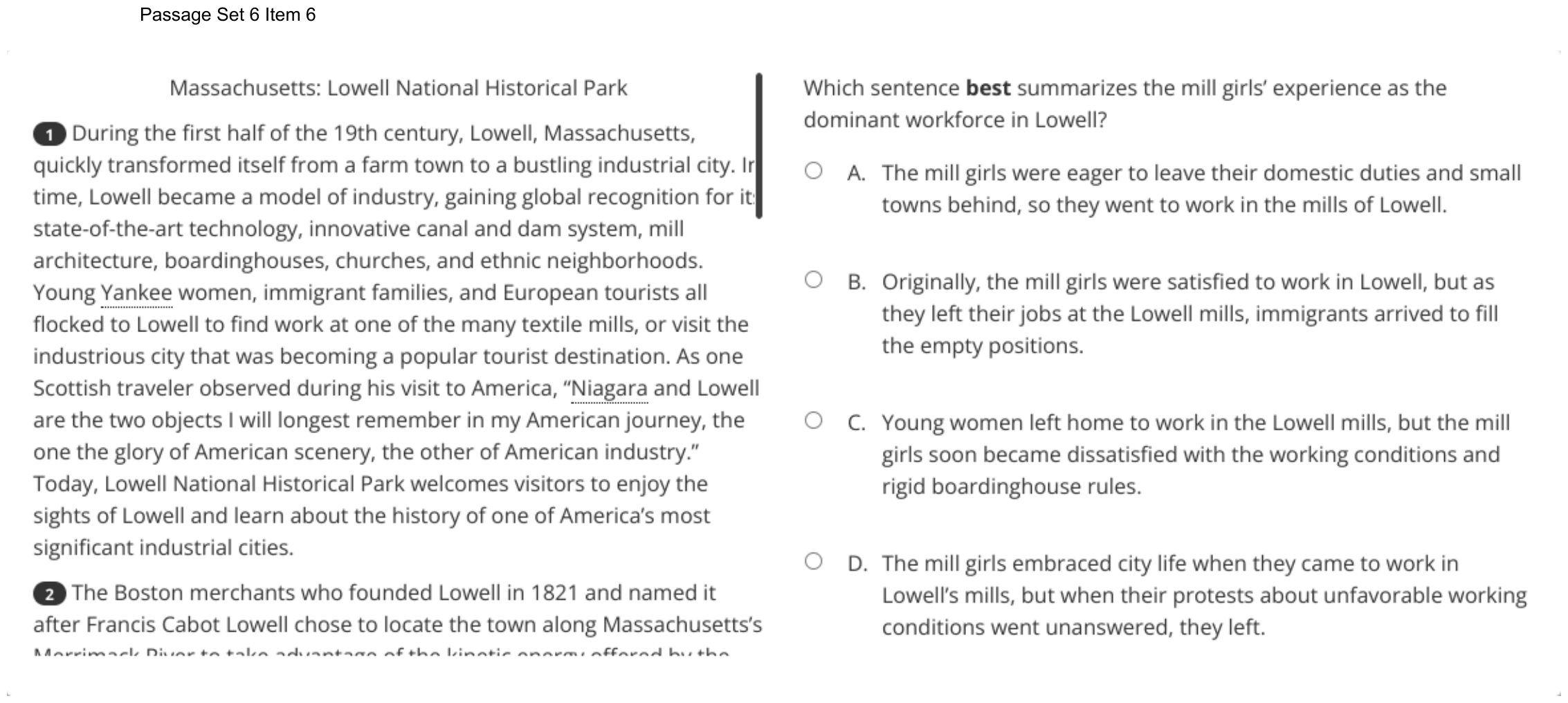
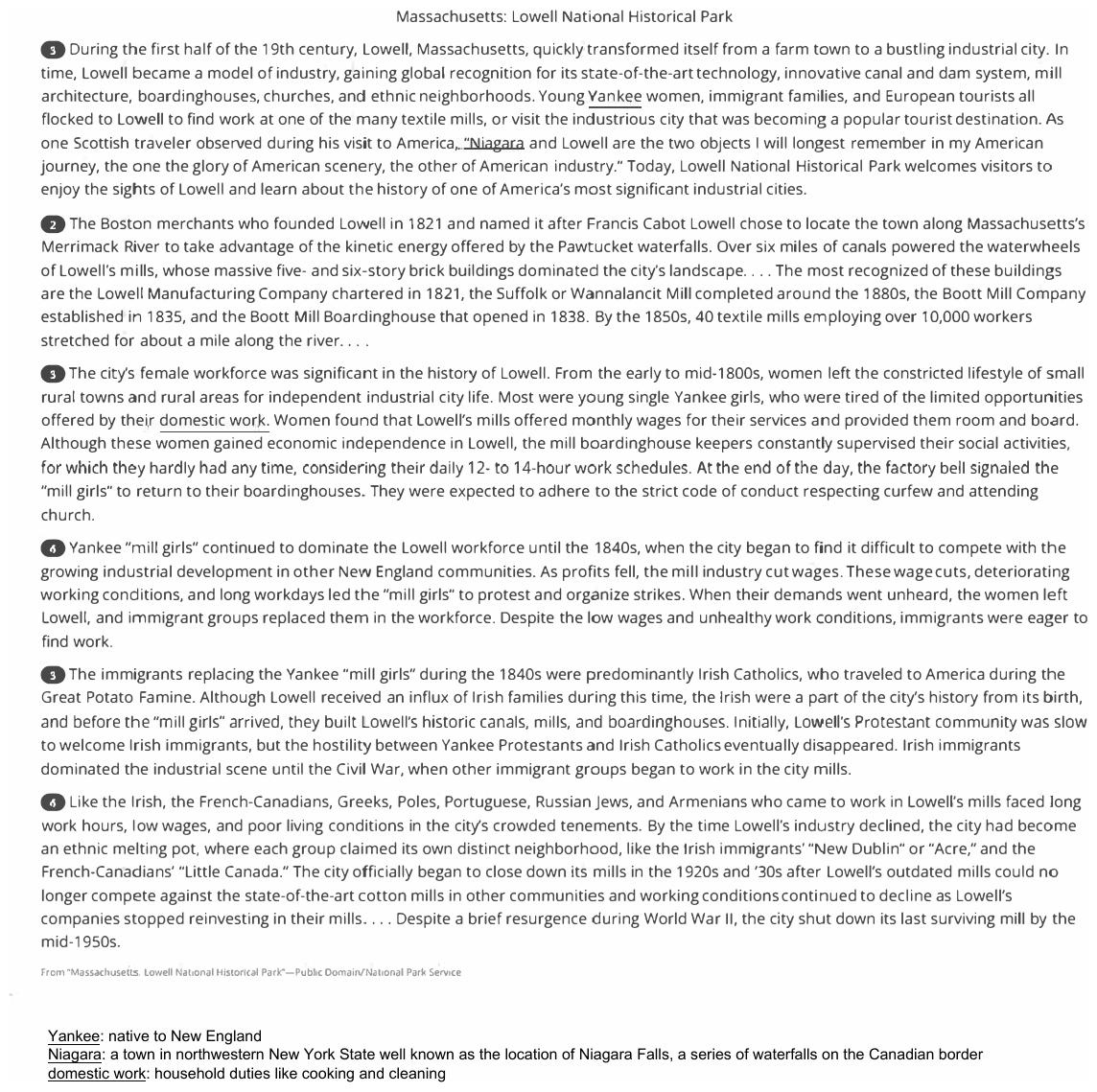
During the first half of the 19th century, Lowell, Massachusetts, quickly transformed itself from a farm town to a bustling industrial city. In time, Lowell became a model of industry, gaining global recognition for its state-of-the-art technology, innovative canal and dam system, mill architecture, boardinghouses, churches, and ethnic neighborhoods. Young Yankee women, immigrant families, and European tourists all flocked to Lowell to find work at one of the many textile mills, or visit the industrious city that was becoming a popular tourist destination. As one Scottish traveler observed during his visit to America, “Niagara and Lowell are the two objects I will longest remember in my American journey, the one the glory of American scenery, the other of American industry.” Today, Lowell National Historical Park welcomes visitors to enjoy the sights of Lowell and learn about the history of one of America’s most significant industrial cities.
The Boston merchants who founded Lowell in 1821 and named it after Francis Cabot Lowell chose to locate the town along Massachusetts’s Merrimack River to take advantage of the kinetic energy offered by the Pawtucket waterfalls. Over six miles of canals powered the waterwheels of Lowell’s mills, whose massive five- and six-story brick buildings dominated the city’s landscape. . . . The most recognized of these buildings are the Lowell Manufacturing Company chartered in 1821, the Suffolk or Wannalancit Mill completed around the 1880s, the Boott Mill Company established in 1835, and the Boott Mill Boardinghouse that opened in 1838. By the 1850s, 40 textile mills employing over 10,000 workers stretched for about a mile along the river. . . .
The city’s female workforce was significant in the history of Lowell. From the early to mid-1800s, women left the constricted lifestyle of small rural towns and rural areas for independent industrial city life. Most were young single Yankee girls, who were tired of the limited opportunities offered by their domestic work. Women found that Lowell’s mills offered monthly wages for their services and provided them room and board. Although these women gained economic independence in Lowell, the mill boardinghouse keepers constantly supervised their social activities, for which they hardly had any time, considering their daily 12- to 14-hour work schedules. At the end of the day, the factory bell signaled the “mill girls” to return to their boardinghouses. They were expected to adhere to the strict code of conduct respecting curfew and attending church.
Yankee “mill girls” continued to dominate the Lowell workforce until the 1840s, when the city began to find it difficult to compete with the growing industrial development in other New England communities. As profits fell, the mill industry cut wages. These wage cuts, deteriorating working conditions, and long workdays led the “mill girls” to protest and organize strikes. When their demands went unheard, the women left Lowell, and immigrant groups replaced them in the workforce. Despite the low wages and unhealthy work conditions, immigrants were eager to find work.
The immigrants replacing the Yankee “mill girls” during the 1840s were predominantly Irish Catholics, who traveled to America during the Great Potato Famine. Although Lowell received an influx of Irish families during this time, the Irish were a part of the city’s history from its birth, and before the “mill girls” arrived, they built Lowell’s historic canals, mills, and boardinghouses. Initially, Lowell’s Protestant community was slow to welcome Irish immigrants, but the hostility between Yankee Protestants and Irish Catholics eventually disappeared. Irish immigrants dominated the industrial scene until the Civil War, when other immigrant groups began to work in the city mills.
Like the Irish, the French-Canadians, Greeks, Poles, Portuguese, Russian Jews, and Armenians who came to work in Lowell’s mills faced long work hours, low wages, and poor living conditions in the city’s crowded tenements. By the time Lowell’s industry declined, the city had become an ethnic melting pot, where each group claimed its own distinct neighborhood, like the Irish immigrants’ “New Dublin” or “Acre,” and the French-Canadians’ “Little Canada.” The city officially began to close down its mills in the 1920s and ’30s after Lowell’s outdated mills could no longer compete against the state-of-the-art cotton mills in other communities and working conditions continued to decline as Lowell’s companies stopped reinvesting in their mills. . . . Despite a brief resurgence during World War II, the city shut down its last surviving mill by the mid-1950s.
From “Massachusetts: Lowell National Historical Park”—Public Domain/National Park Service
Yankee: native to New England
Niagara: a town in northwestern New York State well known as the location of Niagara Falls, a series of waterfalls on the Canadian border
domestic work: household duties like cooking and cleaning
Question
Which sentence best summarizes the mill girls’ experience as the dominant workforce in Lowell?
- AThe mill girls were eager to leave their domestic duties and small towns behind, so they went to work in the mills of Lowell.
- BOriginally, the mill girls were satisfied to work in Lowell, but as they left their jobs at the Lowell mills, immigrants arrived to fill the empty positions.
- CYoung women left home to work in the Lowell mills, but the mill girls soon became dissatisfied with the working conditions and rigid boardinghouse rules.
- DThe mill girls embraced city life when they came to work in Lowell’s mills, but when their protests about unfavorable working conditions went unanswered, they left.
Show the answer
Correct answer: D
The question asks for the sentence that best summarizes the mill girls’ time as the dominant workforce in Lowell.
A. Incorrect. While the passage explains that mill girls were initially eager to leave the domestic duties of life in rural areas, the summary sentence does not address the details about the mill girls’ time working in the mills or the changes that led the mill girls to leave the industry.
B. Incorrect. Mill girls initially found satisfaction in the mill work and lifestyle, and when they did leave, immigrants filled the empty jobs. This summary sentence, however, does not address the details about the mill girls’ time as the primary workforce in Lowell or the circumstances that led them to leave their jobs in the mid-1800s.
C. Incorrect. Mill girls did leave home to work in the Lowell mills, and they did grow dissatisfied over time, but this summary sentence does not include details about the mill girls’ actions to improve the working conditions.
D. CORRECT. This sentence summary best captures the mill girls’ experience as outlined in paragraphs 3 and 4. The sentence concisely summarizes both the women’s initial excitement about the opportunity to live independently (“Women found that Lowell’s mills offered monthly wages for their services and provided them room and board” [paragraph 3]) and their eventual inability to secure better working conditions (“When their demands went unheard, the women left Lowell, and immigrant groups replaced them in the workforce” [paragraph 4]).
Question analysis
This summary question asks which sentence best sums up the experience of the Yankee mill girls during the years they were Lowell's main workforce. Students must pull together the account spread over paragraphs 3 and 4, and every choice is a two-part sentence that sounds accurate, so each must be checked for what it includes, what it leaves out and what it gets slightly wrong.
- Grade level
- Grade 8 reading and task
- Compared with grade 7
- Above grade 7 Summarizing part of a text is a grade 7 standard, usually tested with one clearly complete choice. Here all four summaries are long, two-part and largely accurate, so ranking them by completeness and precision asks more than typical grade 7 work.
- Estimated difficulty
- Hard: combines ideas, needs a plan, and has more than one tempting wrong answer.
- Thinking it demands
- Depth of knowledge 2, skills and concepts · mainly understand
- What makes it hard
- Every choice must be checked moderate
- A very close wrong answer moderate
- Evidence in several places minor
- Evidence
- Answered from several paragraphs or stanzas
- Reading level
- Passage: about grade 15, 764 words; question and choices: about grade 11, 116 words.
- Students, last 30 days
- Not enough answers yet to show (it takes 10).
Why it is hard, traps and wrong answers (shows the answer)
Why it is hard
This is a completeness question: every summary is built from true pieces of paragraphs 3 and 4, and the right one is the only one that runs from arrival to departure with the cause in between. Students who stop at dissatisfaction feel they have the whole arc, because the turn against working conditions is the story's middle. Writing a one-line summary first, with a beginning, a turning point and an end, makes the gaps in the others easy to see.
Every choice must be checked moderate Choosing the answer
All four summaries are two-part sentences of 24 to 27 words that sound accurate, so each has to be checked for what it leaves out: the arrival, the wage cuts and protests, or the departure. (Embretson & Wetzel, 1987)
A very close wrong answer moderate Choosing the answer
The dissatisfaction summary shares the key's shape, women coming to the mills and then turning against their working conditions; it differs only in the ending, where the key has unanswered protests and the women leaving. (Embretson & Wetzel, 1987; Gorin & Embretson, 2006; Ascalon et al., 2007)
Evidence in several places minor Working it out
The mill girls' story runs from paragraph 3, on why they came and how they lived, to paragraph 4, on wage cuts, strikes and their departure in the 1840s. (Kirsch & Mosenthal, 1990; Gorin & Embretson, 2006)
Strategy: Write your own one-sentence summary of paragraphs 3 and 4 before reading the choices, then compare each choice with it claim by claim, including its words about timing and cause.
Traps
- Too narrow: A single detail offered as the central idea or a summary, or a summary that keeps minor details and leaves out an essential part.
The wrong answers, classified
A Too narrow (King et al., 2004)
Covers only why the women came, leaving domestic work and small towns behind, and stops before their years as the workforce, the wage cuts and their leaving.
B Too narrow (King et al., 2004)
Gets the start and the replacement by immigrants right but drops the wage cuts, protests and strikes that paragraph 4 gives as the reason the women left.
C Too narrow (King et al., 2004)
Keeps the arrival and the growing discontent, adding the minor boardinghouse rules, but leaves out the protests and the women leaving, and “soon” skips the years before the 1840s wage cuts.
Working it out, step by step
Figure out what the question asks
This question asks for the best summary. A summary retells the main events in a few words. It covers the beginning, the middle and the end. Here you sum up the mill girls’ time as Lowell’s main workforce. Their story is in paragraphs 3 and 4.
Find the beginning of their story
Paragraph 3 says the women came for “independent industrial city life.” They found that the mills “offered monthly wages for their services and provided them room and board.” Room and board means a place to live and meals. So at first, they were glad to come. Their days were long, though, and the rules were strict.
Find the middle and the end
Paragraph 4 gives the turning point. In the 1840s, profits fell and the mills cut wages. “These wage cuts, deteriorating working conditions, and long workdays” led the women to protest and strike. Deteriorating means getting worse. Then comes the end: “When their demands went unheard, the women left Lowell.”
Check each choice
- A is wrong. It tells only why they came. It stops before their years at work and their leaving.
- B is wrong. It has the start and the end. But it skips the middle: the wage cuts and protests that made them leave.
- C is wrong. It has the start and the unhappy middle, but no protests and no leaving. Also, “soon” is off, since the trouble came years later, in the 1840s.
- D is right. It covers all three parts: they embraced city life, protested bad conditions, and left when no one listened. Embraced means happily welcomed.
Watch out: C feels complete because it ends with the women unhappy. But their story doesn’t end there. They protested, and then they left.
Choose the answer
Only one summary runs from the mill girls’ arrival to their leaving, with the cause in between. So the answer is D.
Why this answer and not the closest wrong one
C is the closest wrong answer. Like D, it starts with the women coming to the mills and then growing unhappy. But it stops there. It leaves out the protests and the women leaving Lowell, which is how their time as the main workforce ended. D tells the whole story.
More questions like this
The original DOE question
The passage “Massachusetts: Lowell National Historical Park” as printed (page 50)
Question 4 of 6
2024 Test A Math, question 39Question
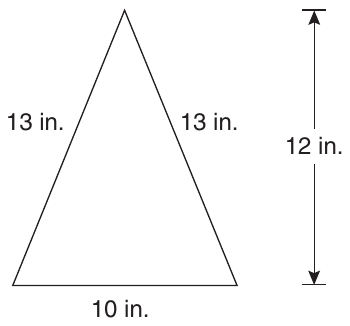
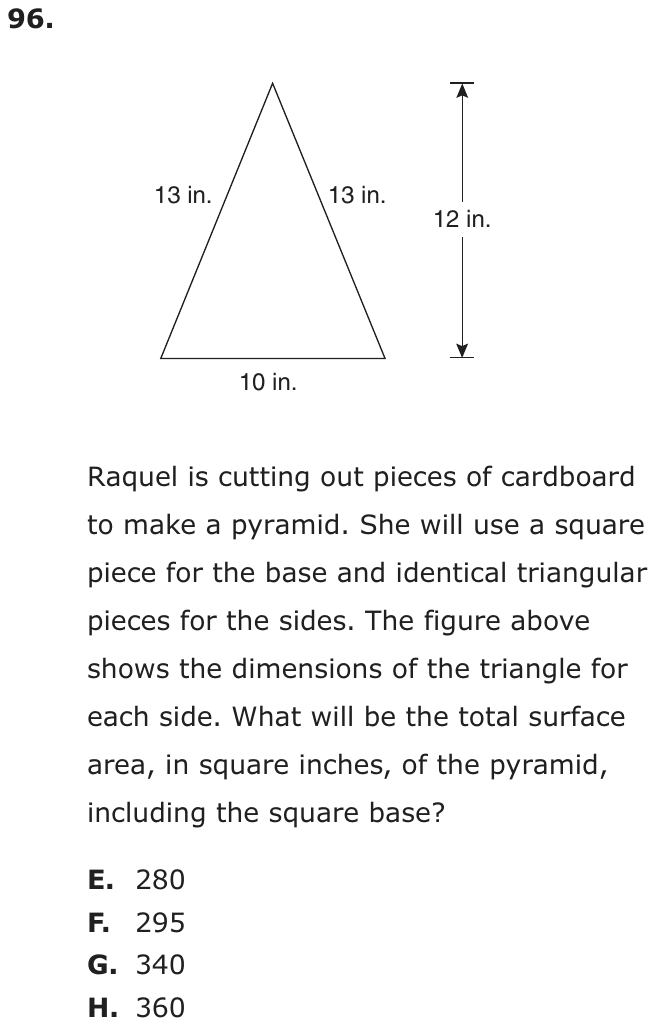
Raquel is cutting out pieces of cardboard to make a pyramid. She will use a square piece for the base and identical triangular pieces for the sides. The figure above shows the dimensions of the triangle for each side. What will be the total surface area, in square inches, of the pyramid, including the square base?
- A280
- B295
- C340
- D360
Show the answer
Correct answer: C
Surface area is found by calculating the area of each side, including the base, and adding them all together.
The base of the pyramid measures 10 inches on each side, so the area of the base is
Each triangular face has a base of 10 inches and a height of 12 inches, so the area of each face is
There are 4 triangular faces (because the square base has 4 edges, each of which will have a triangular face). So the total surface area of the pyramid is the sum of the areas of 4 triangles and 1 square.
So the total surface area is 340 square inches.
Question analysis
This surface area word problem shows one triangular face, with sides of 13 inches, a base of 10 inches and a height of 12 inches, that Raquel will use to build a cardboard pyramid with a square base. Students find the total area of the base and all the triangular sides. Picturing the solid and choosing the right measurements from the figure are the tricky parts.
- Grade level
- Grade 7 content, by NYS standard
- Compared with grade 7
- Above grade 7 Grade 7 students find the surface area of a pyramid from a drawn net or solid. Here only one triangular face is shown, so students must picture the whole pyramid, count its faces, and choose which labeled length belongs in the area formula.
- Estimated difficulty
- Hard: combines ideas, needs a plan, and has more than one tempting wrong answer.
- Thinking it demands
- Depth of knowledge 2, skills and concepts · mainly apply
- What makes it hard
- Reading a figure, table or graph moderate
- Combines ideas moderate
- Something you must already know minor
- Solution
- 4 steps
- Reading level
- Question and choices: about grade 6, 56 words.
- Corrected from the DOE handbook
- A wrong unit in the explanation was corrected.
- Students, last 30 days
- Not enough answers yet to show (it takes 10).
Why it is hard, traps and wrong answers (shows the answer)
Why it is hard
Students have to build the pyramid in their heads from one flat triangle, then choose the right measurement from three labels. The 13-inch sides look like the natural height, and using them gives a listed total; picturing a pyramid with three sloping faces gives another. Sketching the square base with a triangle on each edge, and marking 12 as the height, settles both the face count and the formula.
Reading a figure, table or graph moderate Understanding the question
The figure gives one triangle with three length labels, 13, 13 and 10, and puts its height, 12, on a separate arrow beside it, where it is easy to overlook. (Lesh, Post & Behr, 1987; Kirsch & Mosenthal, 1990)
Combines ideas moderate Working it out
The solid is never drawn: students must see that the square's side equals the triangle's 10-inch base, count four triangles, and add triangle and square areas. (Embretson, 1998; Daniel & Embretson, 2010)
Something you must already know minor Working it out
A triangle's area uses its perpendicular height, not a slanted side, and a pyramid on a square base has four triangular faces; neither fact is given. (Anderson & Krathwohl, 2001)
Strategy: Sketch the pyramid: a square base whose side is the triangle's base, and one triangular face on each side of the square. Find each area with the matching formula, then add them all.
Traps
- Misreads the figure: Reads a value, label or tick spacing in a figure, table or graph wrongly.
- Information you don't need: The question gives numbers or facts that play no part in the answer.
- Misunderstands the concept: A wrong belief about a concept: that percents can be added, that area grows like length, that averages can be averaged, that a bigger denominator means a bigger fraction.
The wrong answers, classified
A Misunderstands the concept (Smith, diSessa & Roschelle, 1993; De Bock et al., 1998; Ni & Zhou, 2005)
Counts only three triangular faces, as if the pyramid had a triangular base, so 3 × 60 + 100 = 280.
B Misunderstands the concept (Smith, diSessa & Roschelle, 1993; De Bock et al., 1998; Ni & Zhou, 2005)
Counts three faces and also uses the 13-inch side as each triangle's height: 3 × 65 + 100 = 295.
D Misreads the figure (Lesh, Post & Behr, 1987; Kirsch & Mosenthal, 1990)
Takes the 13-inch slanted side as each triangle's height instead of the 12-inch arrow beside it, so 4 × 65 + 100 = 360.
What was corrected from the DOE handbook, and why
- Explanation: The handbook ends “So the total surface area is 340 square feet.” The triangle’s dimensions are in inches and the question asks for square inches, so the site now reads “340 square inches.”
Worked solution, step by step
Formulas used
- Area of a triangle
- A is the area. b is the base, the side the triangle sits on. h is the height: the straight-up distance from the base to the top corner, at a right angle to the base. You take half because a triangle is half of a rectangle with the same base and height.
- Area of a square
- A is the area and s is the length of one side. All four sides of a square are equal, so the area is side times side.
- Surface area
- A face is one flat side of a solid shape. The surface area is the total area of the outside. Picture unfolding the solid into flat pieces. Then add up the area of every piece.
Sort out the question
Raquel’s pyramid has a square base. Each side is a triangle like the one in the figure. The triangle’s base is 10 in. Its two slanted sides are 13 in. Its height, the arrow beside it, is 12 in. You need the total surface area, including the square base, in square inches.
Picture the pyramid
Surface area is the total area of all the flat sides, called faces. Each triangle stands on one edge of the square. So each edge of the square is 10 inches, the same as the triangle’s base. A square has 4 edges, so the pyramid has 4 triangles.
Here that is 4 triangles plus 1 square. Watch out: counting only 3 triangles gives 280, choice A.
Find the area of one triangle
Each triangle is 60 square inches. Watch out: the height is 12 in., the straight-up arrow. It is not 13 in., the slanted side. Using 13 gives 65 for each triangle and 360 in all, choice D.
Find the area of the base
The base is a square with sides of 10 inches, the same as each triangle’s base.
The square base is 100 square inches.
Add all five faces
The four triangles and the square together cover 340 square inches.
So the answer is C, 340 square inches.
Check your answer
Each triangle is half of a 10 by 12 rectangle, which has an area of 120. So two triangles make 120, and four make 240. Add the base: . The units fit too: inches times inches gives square inches.
More questions like this
The original DOE question
Question 5 of 6
2024 Test B Math, question 57Question
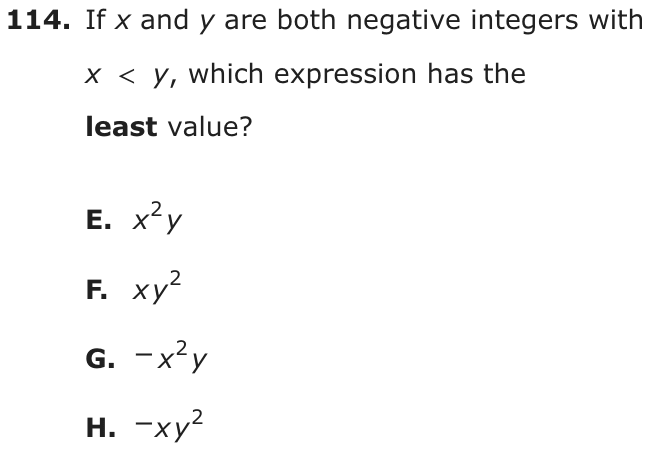
If x and y are both negative integers with , which expression has the least value?
- A
- B
- C
- D
Show the answer
Correct answer: A
Since x and y are both negative integers, both and are positive.
Therefore, both and are negative, and both and are positive.
Because and both x and y are negative, and . So .
Since and x and y are integers, .
So .
Therefore, .
Question analysis
Two negative integers x and y, with x less than y, appear in four expressions built from squares and minus signs. Students find the expression with the least value. It tests multiplying negative numbers and comparing their sizes, and the difficulty is tracking how each minus sign and each square changes both the sign and the size of the result.
- Grade level
- Grade 7 content, by NYS standard
- Compared with grade 7
- Above grade 7 Grade 7 students multiply negative numbers, but this asks them to compare four variable expressions for any pair of negative integers. Deciding how the squares compare when x is less than y goes beyond typical grade 7 sign practice.
- Estimated difficulty
- Hard: combines ideas, needs a plan, and has more than one tempting wrong answer.
- Thinking it demands
- Depth of knowledge 2, skills and concepts · mainly analyze
- What makes it hard
- Variables instead of numbers moderate
- A very close wrong answer moderate
- Every choice must be checked minor
- Solution
- 3 steps
- Reading level
- Question and choices: about grade 8, 20 words.
- Students, last 30 days
- Not enough answers yet to show (it takes 10).
Why it is hard, traps and wrong answers (shows the answer)
Why it is hard
Two facts settle the question: squares of negatives are positive, and the more negative number has the larger square. Students who track the minus signs carelessly think a leading minus makes an expression negative, and students who assume the larger y has the larger square choose the wrong negative expression. Substituting x = −3 and y = −2 gives −18, −12, 18 and 12, which orders all four at once.
Variables instead of numbers moderate Understanding the question
No values are given, only that x and y are negative integers with x < y, so students must reason about signs or invent a pair such as −3 and −2. (Koedinger & Nathan, 2004; Enright, Morley & Sheehan, 2002)
A very close wrong answer moderate Choosing the answer
x²y and xy² use the same letters with the exponent moved; both are negative, and only comparing x² with y² separates them. (Embretson & Wetzel, 1987; Gorin & Embretson, 2006; Ascalon et al., 2007)
Every choice must be checked minor Choosing the answer
All four expressions have to be placed in order, because the minus signs in front of the last two turn those expressions positive. (Embretson & Wetzel, 1987)
Strategy: Pick two negative integers with x less than y, such as −3 and −2, evaluate all four expressions, and confirm the order with a second pair.
Traps
- Negatives and direction: Arithmetic with negative numbers, the order of a subtraction, or direction on a number line. (Moving a term across the equals sign without changing its sign is a faulty procedure.)
- Misunderstands the concept: A wrong belief about a concept: that percents can be added, that area grows like length, that averages can be averaged, that a bigger denominator means a bigger fraction.
The wrong answers, classified
B Misunderstands the concept (Smith, diSessa & Roschelle, 1993; De Bock et al., 1998; Ni & Zhou, 2005)
Knows x²y and xy² are both negative but takes y² as the larger square because y > x, though the more negative x has the bigger square.
C Negatives and direction (Brown & Burton, 1978)
Reads the leading minus as making −x²y negative, missing that y is negative, so −x²y is in fact positive.
D Negatives and direction (Brown & Burton, 1978)
Assumes the leading minus makes −xy² negative, missing that x is negative, so −xy² is in fact positive.
Worked solution, step by step
Formulas used
- Signs in multiplication
- a and b are positive numbers, so −a and −b are negative. A negative times a negative is positive. A negative times a positive is negative. So a product is positive when it has an even number of negative factors.
- Squaring a number
- x is any number. x² (x squared) means x times itself. The square of a number other than 0 is always positive, because two negatives or two positives multiply to a positive.
Sort out the question
x and y are negative integers, such as −3 and −2. Since x < y, x is to the left of y on the number line. So x is more negative, farther from 0.
You need the expression with the least value. That is the most negative one.
Find the sign of each expression
Squares are positive, so and are positive.
- is a positive times a negative, so it is negative.
- is a negative times a positive, so it is negative.
- and are the opposites of these, so they are positive.
So the least value must be A or B. Watch out: The minus sign in front of C and D does not make them negative. It turns a negative into a positive.
Compare A and B with numbers
Try x = −3 and y = −2, since −3 < −2.
Since −18 < −12, A is smaller.
See why it always works
Both expressions contain x × y, which is positive. and . Multiplying the same positive number by the more negative x gives the more negative result.
Watch out: y is bigger than x, but is smaller than : 4 is less than 9. Thinking y² is bigger leads to choice B.
So the answer is A, .
Check your answer
Try another pair, x = −5 and y = −1. Then A is , B is , C is 25 and D is 5. A is still the least.
More questions like this
The original DOE question
Question 6 of 6
2026 Practice Test C Math, question 32Question
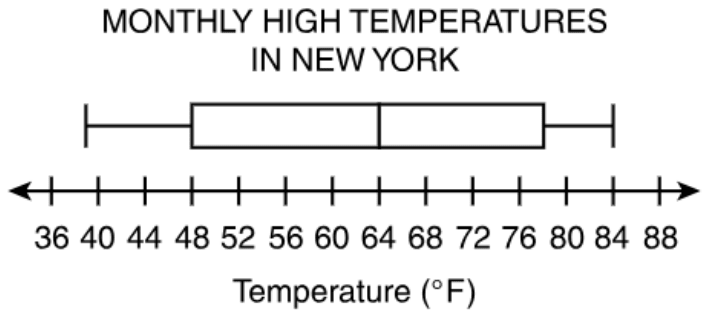
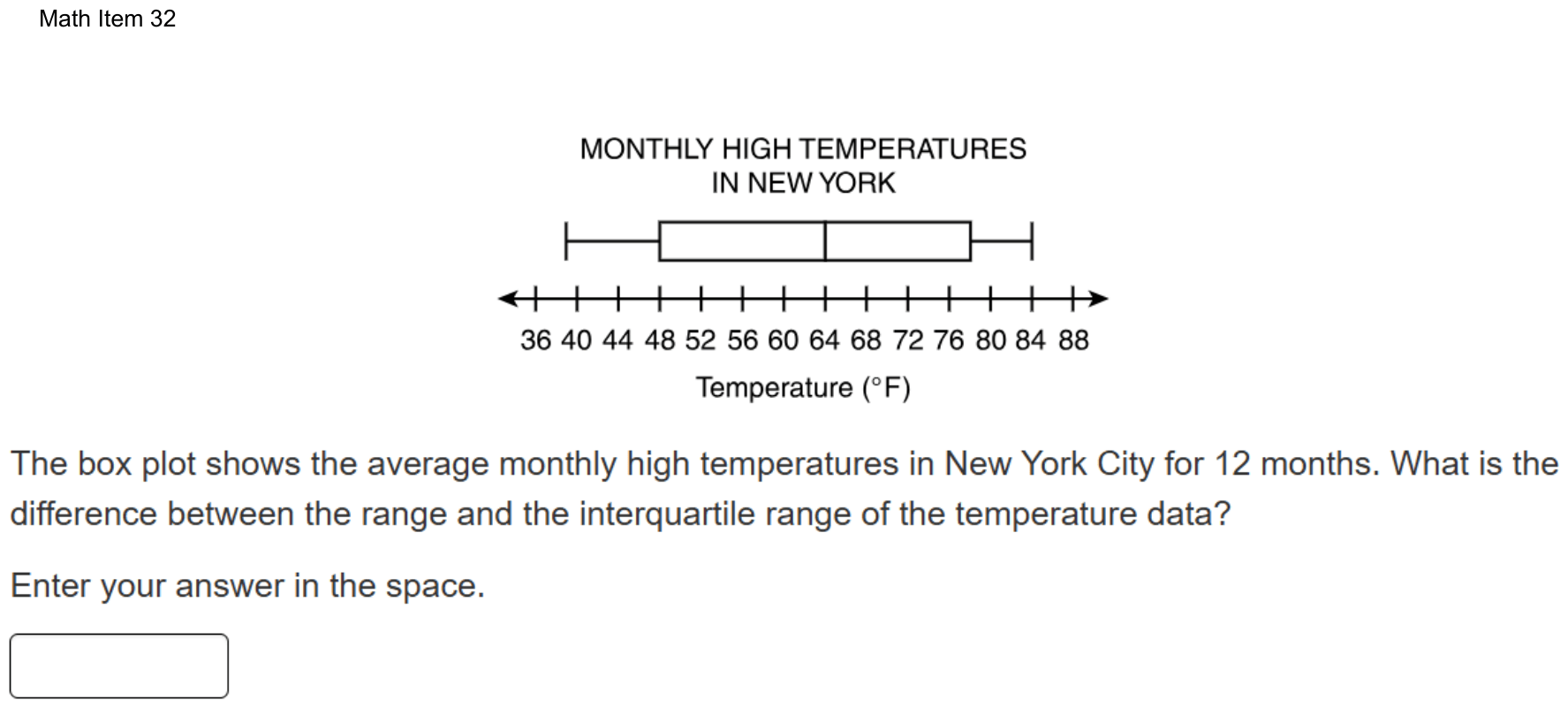
The box plot shows the average monthly high temperatures in New York City for 12 months. What is the difference between the range and the interquartile range of the temperature data?
Enter your answer in the space.
Fill-in question: work out the answer and type it as a number.
Show the answer
Correct answer: 15
Determine the range by subtracting the minimum value on the box plot from the maximum value on the box plot:
Maximum value , Minimum value
Determine the interquartile range by subtracting the lower quartile value on the box plot from the upper quartile value on the box plot:
Upper Quartile Value , Lower Quartile Value
Determine the difference between the range (45° F) and the interquartile range (30° F):
Question analysis
A box plot of New York City's average monthly high temperatures for 12 months sits above a number line labeled every 4 degrees. Students type the difference between the range and the interquartile range of the data. Two of the plot's values fall between labeled ticks, so careful reading of the scale decides the answer.
- Grade level
- Grade 7 content, by NYS standard
- Compared with grade 7
- Above grade 7 Reading a box plot and finding its interquartile range are grade 7 skills. Here two of the five values fall between ticks spaced 4 apart, and the range, the IQR and their difference must all be found and typed with no choices.
- Estimated difficulty
- Hard: combines ideas, needs a plan, and has more than one tempting wrong answer.
- Thinking it demands
- Depth of knowledge 2, skills and concepts · mainly apply
- What makes it hard
- Solution
- 3 steps
- Reading level
- Question and choices: about grade 7, 36 words.
- Students, last 30 days
- Not enough answers yet to show (it takes 10).
Why it is hard, traps and wrong answers (shows the answer)
Why it is hard
The method is standard, but the key rests on reading the scale between its labels. The axis is ticked only every 4 degrees, and the minimum and the upper quartile land off the ticks, so rounding either one to the nearest label moves the result by a degree or two with nothing to flag it. Students who find the range correctly can also stop there, entering 45, the larger of the two spreads, instead of the difference the question asks for.
Reading a figure, table or graph major Understanding the question
Two of the five values fall between ticks spaced 4 degrees apart: the left whisker ends just short of the 40 tick, at 39, and the box’s right edge sits midway between 76 and 80, at 78. (Lesh, Post & Behr, 1987; Kirsch & Mosenthal, 1990)
Many steps minor Working it out
Four values are read and combined in three subtractions, the range, the interquartile range and then their difference, so one misread value changes the final entry. (Daniel & Embretson, 2010; Enright, Morley & Sheehan, 2002)
Something you must already know minor Working it out
Neither measure is defined on the page: the range spans the whiskers, and the interquartile range is the width of the box, the upper quartile minus the lower. (Anderson & Krathwohl, 2001)
An answer in an unexpected form minor Choosing the answer
The result is typed with no choices to compare, so an entry one or two degrees off, from rounding a value to the nearest tick, looks just as finished as the right one. (Enright, Morley & Sheehan, 2002)
Strategy: Read the minimum, both quartiles and the maximum, judging where each mark falls between the ticks, then subtract for the range and for the IQR, and subtract those two results.
Traps
- Misreads the figure: Reads a value, label or tick spacing in a figure, table or graph wrongly.
- Stops one step early: A choice is a number from partway through the solution.
The wrong answers, classified
14 Misreads the figure (Lesh, Post & Behr, 1987; Kirsch & Mosenthal, 1990)
Reads the left whisker’s end as 40, the nearest labeled tick, instead of 39, so the range becomes 84 − 40 = 44 and 44 − 30 = 14.
45 Stops one step early (King et al., 2004; Gierl et al., 2017)
Finds the range, 84 − 39 = 45 degrees, and enters it, stopping before the interquartile range of 30 is subtracted from it.
17 Misreads the figure (Lesh, Post & Behr, 1987; Kirsch & Mosenthal, 1990)
Reads the box’s right edge as 76, the tick just left of it, instead of 78, so the IQR becomes 76 − 48 = 28 and 45 − 28 = 17.
Worked solution, step by step
Formulas used
- Range
- The maximum is the greatest value, at the right end of the right whisker. The minimum is the least value, at the left end of the left whisker. The range tells how far the whole set of data spreads.
- Interquartile range (IQR)
- Q3 is the upper quartile, the right edge of the box. Q1 is the lower quartile, the left edge of the box. The IQR is the width of the box. It tells how far the middle half of the data spreads.
Sort out the question
A box plot shows data with five numbers. The two whiskers are the lines on each side of the box. Their ends are the minimum, the least value, and the maximum, the greatest. The box runs from the lower quartile to the upper quartile. These are the middles of the lower half and the upper half of the data. The line inside the box is the median, the middle value.
You need the range minus the interquartile range (IQR), in degrees.
Read the values between the ticks
The ticks on the number line are 4 degrees apart. So each degree is one quarter of the space between two ticks. Three values sit right on ticks: the box’s left edge at 48, the median at 64, and the right whisker’s end at 84.
- The left whisker starts just left of the 40 tick. It sits about one quarter of the way back toward 36. So the minimum is degrees.
- The box’s right edge is halfway between 76 and 80. Halfway is 78 degrees.
Find the range
Use the range formula:
The data spread over 45 degrees.
Watch out: rounding the minimum to the 40 tick gives a range of 44. Then the final answer comes out 14, which is wrong.
Find the IQR
Use the IQR formula with the two edges of the box:
The middle half of the data spreads over 30 degrees.
Watch out: reading the box’s right edge as 76 gives an IQR of 28. Then the final answer comes out 17.
Subtract the IQR from the range
The question asks for the difference between the two:
Watch out: 45 is only the range. Do not stop there. Type only the number, with no degree sign.
So you would enter 15.
Check your answer
The range covers the whole plot, and the IQR covers only the box. So their difference is the two whiskers added together. The left whisker is degrees long. The right whisker is degrees long. , which matches.
More questions like this
The original DOE question