3 English and 3 math
Here are 6 random questions to try. Takers earning below 75% are unlikely to receive an offer. You have 1 minute 48 seconds per question on the real exam.
Question 1 of 6
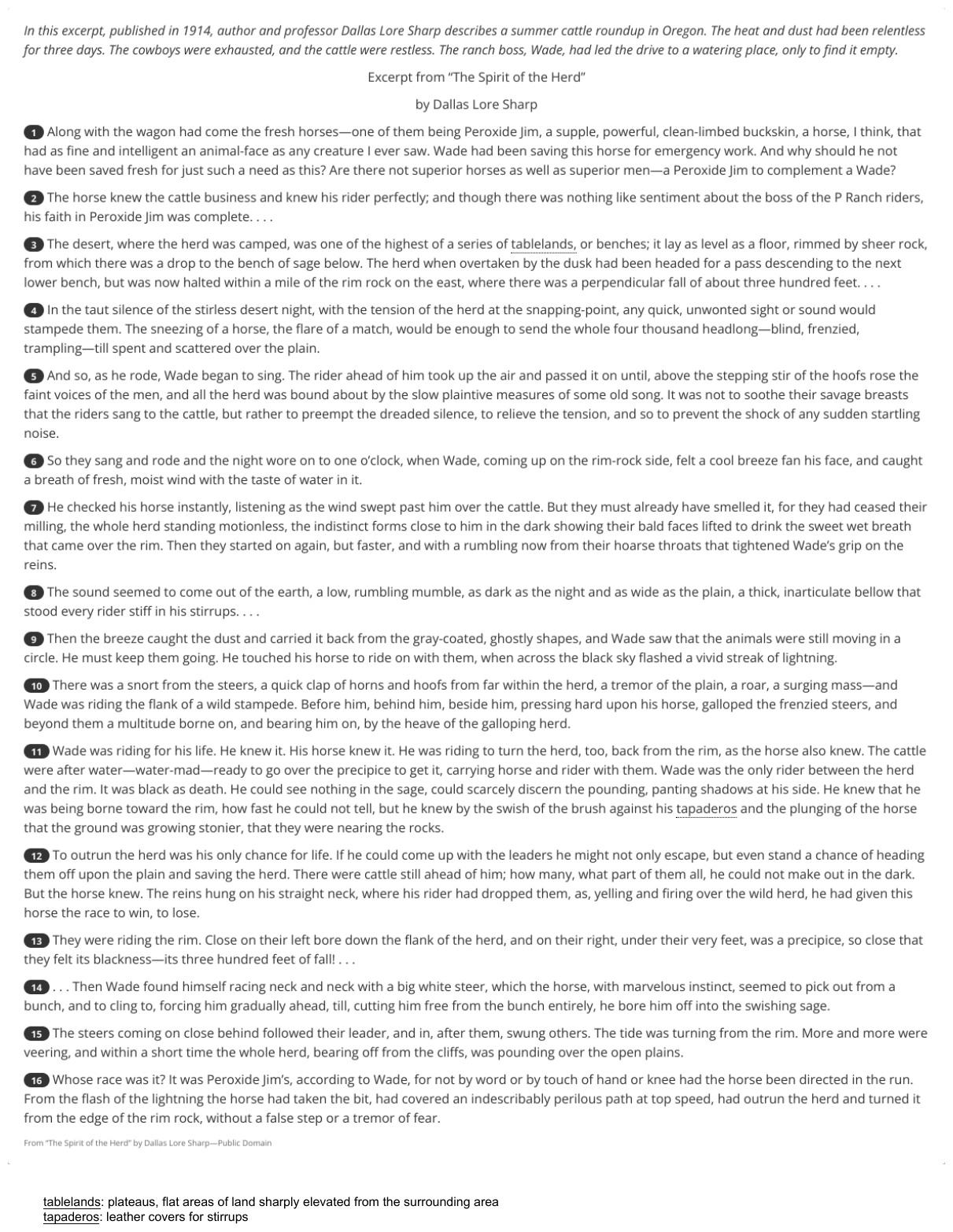
2026 Practice Test A English, question 33Passage Excerpt from “The Spirit of the Herd”
Excerpt from “The Spirit of the Herd”
by Dallas Lore Sharp
In this excerpt, published in 1914, author and professor Dallas Lore Sharp describes a summer cattle roundup in Oregon. The heat and dust had been relentless for three days. The cowboys were exhausted, and the cattle were restless. The ranch boss, Wade, had led the drive to a watering place, only to find it empty.
Along with the wagon had come the fresh horses—one of them being Peroxide Jim, a supple, powerful, clean-limbed buckskin, a horse, I think, that had as fine and intelligent an animal-face as any creature I ever saw. Wade had been saving this horse for emergency work. And why should he not have been saved fresh for just such a need as this? Are there not superior horses as well as superior men—a Peroxide Jim to complement a Wade?
The horse knew the cattle business and knew his rider perfectly; and though there was nothing like sentiment about the boss of the P Ranch riders, his faith in Peroxide Jim was complete. . . .
The desert, where the herd was camped, was one of the highest of a series of tablelands, or benches; it lay as level as a floor, rimmed by sheer rock, from which there was a drop to the bench of sage below. The herd when overtaken by the dusk had been headed for a pass descending to the next lower bench, but was now halted within a mile of the rim rock on the east, where there was a perpendicular fall of about three hundred feet. . . .
In the taut silence of the stirless desert night, with the tension of the herd at the snapping-point, any quick, unwonted sight or sound would stampede them. The sneezing of a horse, the flare of a match, would be enough to send the whole four thousand headlong—blind, frenzied, trampling—till spent and scattered over the plain.
And so, as he rode, Wade began to sing. The rider ahead of him took up the air and passed it on until, above the stepping stir of the hoofs rose the faint voices of the men, and all the herd was bound about by the slow plaintive measures of some old song. It was not to soothe their savage breasts that the riders sang to the cattle, but rather to preempt the dreaded silence, to relieve the tension, and so to prevent the shock of any sudden startling noise.
So they sang and rode and the night wore on to one o’clock, when Wade, coming up on the rim-rock side, felt a cool breeze fan his face, and caught a breath of fresh, moist wind with the taste of water in it.
He checked his horse instantly, listening as the wind swept past him over the cattle. But they must already have smelled it, for they had ceased their milling, the whole herd standing motionless, the indistinct forms close to him in the dark showing their bald faces lifted to drink the sweet wet breath that came over the rim. Then they started on again, but faster, and with a rumbling now from their hoarse throats that tightened Wade’s grip on the reins.
The sound seemed to come out of the earth, a low, rumbling mumble, as dark as the night and as wide as the plain, a thick, inarticulate bellow that stood every rider stiff in his stirrups. . . .
Then the breeze caught the dust and carried it back from the gray-coated, ghostly shapes, and Wade saw that the animals were still moving in a circle. He must keep them going. He touched his horse to ride on with them, when across the black sky flashed a vivid streak of lightning.
There was a snort from the steers, a quick clap of horns and hoofs from far within the herd, a tremor of the plain, a roar, a surging mass—and Wade was riding the flank of a wild stampede. Before him, behind him, beside him, pressing hard upon his horse, galloped the frenzied steers, and beyond them a multitude borne on, and bearing him on, by the heave of the galloping herd.
Wade was riding for his life. He knew it. His horse knew it. He was riding to turn the herd, too, back from the rim, as the horse also knew. The cattle were after water—water-mad—ready to go over the precipice to get it, carrying horse and rider with them. Wade was the only rider between the herd and the rim. It was black as death. He could see nothing in the sage, could scarcely discern the pounding, panting shadows at his side. He knew that he was being borne toward the rim, how fast he could not tell, but he knew by the swish of the brush against his tapaderos and the plunging of the horse that the ground was growing stonier, that they were nearing the rocks.
To outrun the herd was his only chance for life. If he could come up with the leaders he might not only escape, but even stand a chance of heading them off upon the plain and saving the herd. There were cattle still ahead of him; how many, what part of them all, he could not make out in the dark. But the horse knew. The reins hung on his straight neck, where his rider had dropped them, as, yelling and firing over the wild herd, he had given this horse the race to win, to lose.
They were riding the rim. Close on their left bore down the flank of the herd, and on their right, under their very feet, was a precipice, so close that they felt its blackness—its three hundred feet of fall! . . .
. . . Then Wade found himself racing neck and neck with a big white steer, which the horse, with marvelous instinct, seemed to pick out from a bunch, and to cling to, forcing him gradually ahead, till, cutting him free from the bunch entirely, he bore him off into the swishing sage.
The steers coming on close behind followed their leader, and in, after them, swung others. The tide was turning from the rim. More and more were veering, and within a short time the whole herd, bearing off from the cliffs, was pounding over the open plains.
Whose race was it? It was Peroxide Jim’s, according to Wade, for not by word or by touch of hand or knee had the horse been directed in the run. From the flash of the lightning the horse had taken the bit, had covered an indescribably perilous path at top speed, had outrun the herd and turned it from the edge of the rim rock, without a false step or a tremor of fear.
From “The Spirit of the Herd” by Dallas Lore Sharp—Public Domain
tablelands: plateaus, flat areas of land sharply elevated from the surrounding area
tapaderos: leather covers for stirrups
Question
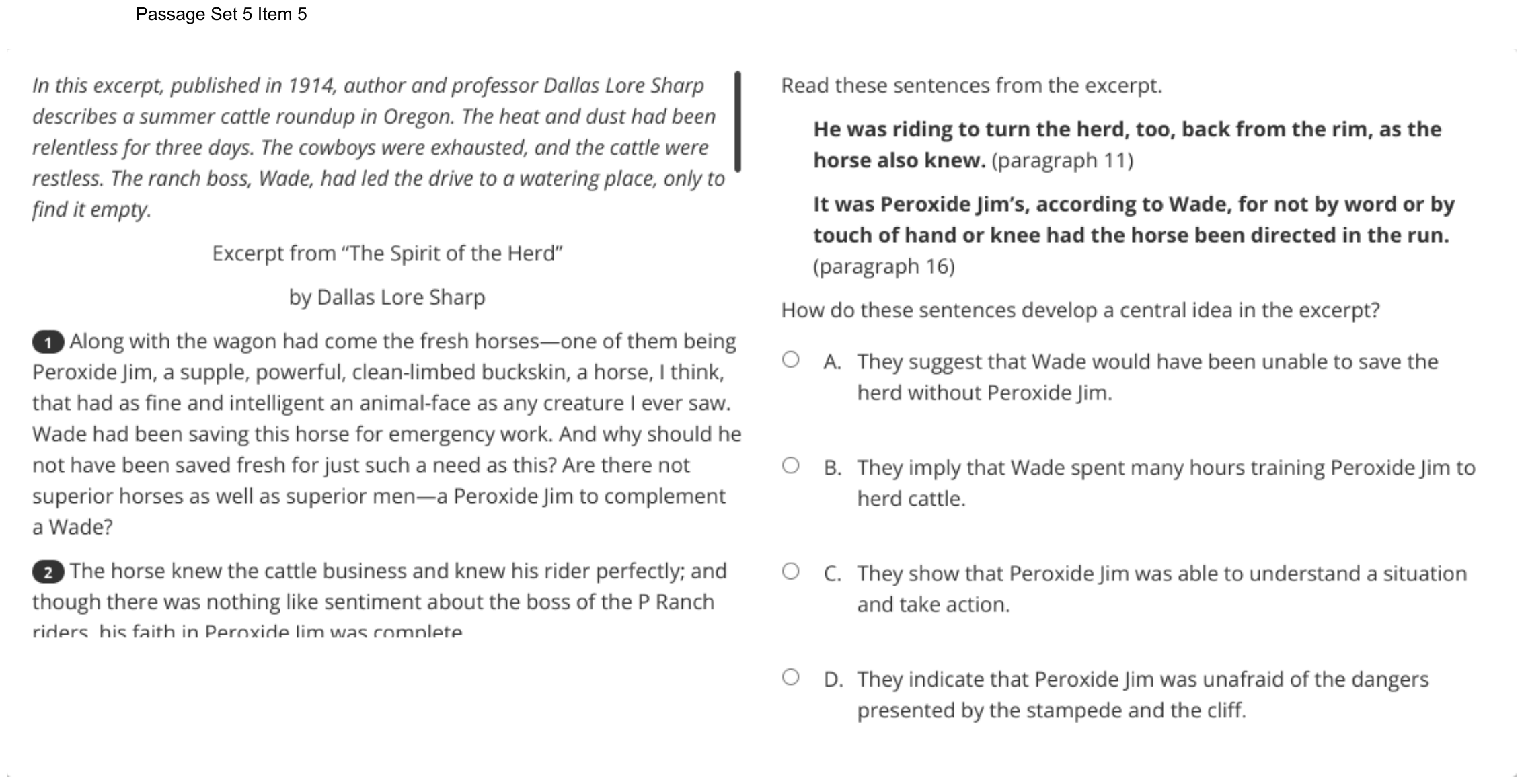
Read these sentences from the excerpt.
He was riding to turn the herd, too, back from the rim, as the horse also knew. (paragraph 11)
It was Peroxide Jim’s, according to Wade, for not by word or by touch of hand or knee had the horse been directed in the run. (paragraph 16)
How do these sentences develop a central idea in the excerpt?
- AThey suggest that Wade would have been unable to save the herd without Peroxide Jim.
- BThey imply that Wade spent many hours training Peroxide Jim to herd cattle.
- CThey show that Peroxide Jim was able to understand a situation and take action.
- DThey indicate that Peroxide Jim was unafraid of the dangers presented by the stampede and the cliff.
Show the answer
Correct answer: C
The question asks how the sentences from paragraph 11 and paragraph 16 develop a central idea in the excerpt.
A. Incorrect. While Peroxide Jim’s presence was critical to saving the herd, the details in paragraph 11 and paragraph 16 do not focus on this idea. The primary idea is that the horse was so intelligent and aware that he acted on his own.
B. Incorrect. The excerpt does not tell who trained Peroxide Jim. It can be inferred that Peroxide Jim had been well trained and was knowledgeable of working cattle; however, there is no indication that Wade was the person who trained Peroxide Jim, only that Wade knew of Peroxide Jim’s abilities, respected the skilled horse, and was “saving this horse for emergency work” (paragraph 1). Because the reader cannot infer from the excerpt that Wade was the trainer, this idea cannot be considered central to the excerpt.
C. CORRECT. Wade recognized that Peroxide Jim knew to turn the herd without any instruction from him. Throughout the excerpt, Wade exhibited confidence in his horse, Peroxide Jim. For example, the narrator says that Wade’s “faith in Peroxide Jim was complete” in paragraph 2. After Wade let go of the reins (paragraph 12), the horse took over, doing exactly what needed to be done to save Wade, the herd, and himself: “a big white steer, which the horse, with marvelous instinct, seemed to pick out from a bunch, and to cling to, forcing him gradually ahead, till, cutting him free from the bunch entirely, he bore him off into the swishing sage” (paragraph 14).
D. Incorrect. The sentence from paragraph 11 and the sentence from paragraph 16 show that Peroxide Jim acted skillfully and with the knowledge that the ride was dangerous (“Wade was riding for his life. He knew it. His horse knew it” [paragraph 11]). Neither sentence indicates whether Peroxide Jim was afraid. The excerpt does say, later in paragraph 16, that the horse turned the herd “without a false step or a tremor of fear,” but these two sentences focus on his awareness of the danger and his ability to act on his own, not on his lack of fear.
Question analysis
This question quotes two sentences from “The Spirit of the Herd,” one from the middle of the stampede and one from its end, and asks how together they develop a central idea of the excerpt. Students must see what the two sentences share and connect it to the story as a whole. Each choice sounds reasonable for this story, which makes the exact wording of the two sentences decisive.
- Grade level
- Grade 8 reading and task
- Compared with grade 7
- Above grade 7 Grade 7 central-idea questions usually ask about one paragraph or the whole text. Here students must find what two sentences five paragraphs apart have in common and link it to the excerpt’s central idea, among choices that all sound believable.
- Estimated difficulty
- Hard: combines ideas, needs a plan, and has more than one tempting wrong answer.
- Thinking it demands
- Depth of knowledge 3, strategic thinking · mainly analyze
- What makes it hard
- Reading between the lines moderate
- Complex sentences moderate
- Evidence in several places moderate
- Evidence
- Answered from several paragraphs or stanzas
- Reading level
- Passage: about grade 8, 1160 words; question and choices: about grade 6, 121 words.
- Corrected from the DOE handbook
- An inaccurate statement in the explanation was corrected.
- Students, last 30 days
- Not enough answers yet to show (it takes 10).
Why it is hard, traps and wrong answers (shows the answer)
Why it is hard
Each choice says something a reader could believe about this story, so the exact content of the two quoted sentences decides it. What they share is knowledge and independence: the horse knew the goal and ran the race undirected. Fearlessness is stated in the very next sentence of paragraph 16, which makes it easy to credit to these two, and the claim that Wade could not have managed alone sounds like a fair summary of the ending.
Reading between the lines moderate Working it out
Neither sentence says the horse understood; that has to be read from “as the horse also knew” and from the race being his because he was not directed “by word or by touch.” (Graesser, Singer & Trabasso, 1994; Kintsch, 1998)
Complex sentences moderate Understanding the question
The second sentence is an inverted negative passive, “not by word or by touch of hand or knee had the horse been directed,” and the first tucks its point into a trailing clause. (Abedi & Lord, 2001; Freedle & Kostin, 1993; Messick, 1989)
Evidence in several places moderate Working it out
The two sentences sit five paragraphs apart, and the detail that tempts students most, “without a false step or a tremor of fear,” follows the second one in paragraph 16. (Kirsch & Mosenthal, 1990; Gorin & Embretson, 2006)
Strategy: Note what the two quoted sentences have in common, then pick the option that states that shared point, making sure it comes from these sentences and not from elsewhere in the excerpt.
Traps
- Wrong part of the text: A choice is true of another paragraph, stanza or speaker than the one asked about.
- Reads too much in: A reasonable-sounding conclusion that goes further than the text allows.
- Outside knowledge: A choice is plausible in the real world but not supported by this text.
The wrong answers, classified
A Reads too much in (Graesser, Singer & Trabasso, 1994)
Goes a step past the sentences: the horse clearly mattered, but they stress what he knew and did on his own, not that Wade would have failed without him.
B Outside knowledge (King et al., 2004; Recht & Leslie, 1988)
Assumes a rider trains his own horse, a common idea, but the excerpt never says who trained Peroxide Jim, and these sentences stress what he did undirected.
D Wrong part of the text (Kirsch & Mosenthal, 1990)
Draws on “without a false step or a tremor of fear,” which comes after the quoted sentence in paragraph 16; the two sentences show his understanding, not his courage.
What was corrected from the DOE handbook, and why
- Explanation: The handbook’s explanation of Option D says “There is no indication that Peroxide Jim was not afraid; in fact, it is likely the awareness of the danger and the fear associated with that knowledge contributed to the horse’s motivation to turn the herd.” Paragraph 16 says the opposite: the horse turned the herd “without a false step or a tremor of fear” (the handbook’s explanation of question 29 cites these words as his mental toughness). The site now says that neither of the two quoted sentences indicates whether Peroxide Jim was afraid, which is still why Option D is wrong: they focus on his awareness of the danger and his ability to act on his own.
Working it out, step by step
Figure out what the question asks
This asks what two quoted sentences have in common and how they build a central idea, the main idea of the excerpt. Focus on what these two sentences say, not on other parts of the story.
Read the first sentence
Paragraph 11 says “He was riding to turn the herd, too, back from the rim, as the horse also knew.” To turn the herd is to make it change direction. The words “as the horse also knew” mean the horse understood the goal too.
Read the second sentence
Paragraph 16 says the race was the horse’s, “for not by word or by touch of hand or knee had the horse been directed in the run.” Directed means told where to go. Riders guide a horse with their voice, their hands on the reins and their knees. Wade did none of that. The horse ran the race on his own.
Put the two together
Both sentences show the same thing. The horse understood what was happening. Then he acted on his own, with no one telling him what to do. This builds the central idea that Peroxide Jim is a smart horse who saves the herd by himself.
Check each choice
- A does not fit. The sentences do not say whether Wade could have done it alone. They focus on what the horse knew and did.
- B does not fit. The excerpt never says who trained the horse.
- C fits. The horse understood the situation and took action.
- D does not fit. The horse was fearless, but neither quoted sentence says so.
Choose the answer
The two sentences show a horse that understood the danger and acted on his own. So the answer is C.
Why this answer and not the closest wrong one
D is the closest wrong choice, because the horse really was fearless. But that comes from a later sentence in paragraph 16: “without a false step or a tremor of fear.” The two quoted sentences say nothing about fear. They show that the horse knew the goal and acted with no one guiding him. That is C.
More questions like this
The original DOE question
The passage “Excerpt from “The Spirit of the Herd”” as printed (page 41)
Question 2 of 6
2026 Practice Test C English, question 31Passage Serpent Mound
Serpent Mound
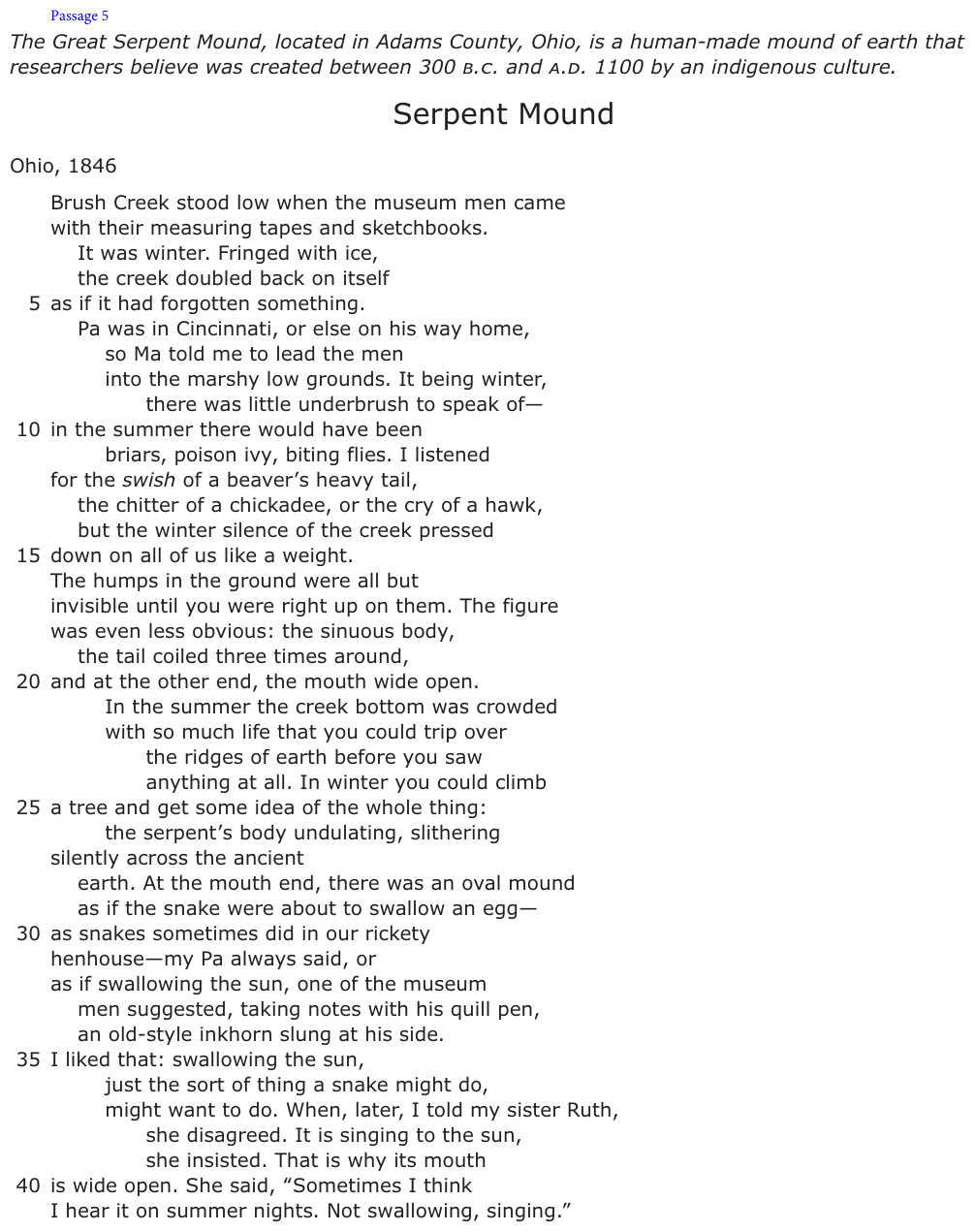
The Great Serpent Mound, located in Adams County, Ohio, is a human-made mound of earth that researchers believe was created between 300 B.C. and A.D. 1100 by an indigenous culture.
Ohio, 1846
Brush Creek stood low when the museum men came
with their measuring tapes and sketchbooks.
It was winter. Fringed with ice,
the creek doubled back on itself
as if it had forgotten something.
Pa was in Cincinnati, or else on his way home,
so Ma told me to lead the men
into the marshy low grounds. It being winter,
there was little underbrush to speak of—
in the summer there would have been
briars, poison ivy, biting flies. I listened
for the swish of a beaver’s heavy tail,
the chitter of a chickadee, or the cry of a hawk,
but the winter silence of the creek pressed
down on all of us like a weight.
The humps in the ground were all but
invisible until you were right up on them. The figure
was even less obvious: the sinuous body,
the tail coiled three times around,
and at the other end, the mouth wide open.
In the summer the creek bottom was crowded
with so much life that you could trip over
the ridges of earth before you saw
anything at all. In winter you could climb
a tree and get some idea of the whole thing:
the serpent’s body undulating, slithering
silently across the ancient
earth. At the mouth end, there was an oval mound
as if the snake were about to swallow an egg—
as snakes sometimes did in our rickety
henhouse—my Pa always said, or
as if swallowing the sun, one of the museum
men suggested, taking notes with his quill pen,
an old-style inkhorn slung at his side.
I liked that: swallowing the sun,
just the sort of thing a snake might do,
might want to do. When, later, I told my sister Ruth,
she disagreed. It is singing to the sun,
she insisted. That is why its mouth
is wide open. She said, “Sometimes I think
I hear it on summer nights. Not swallowing, singing.”
Question
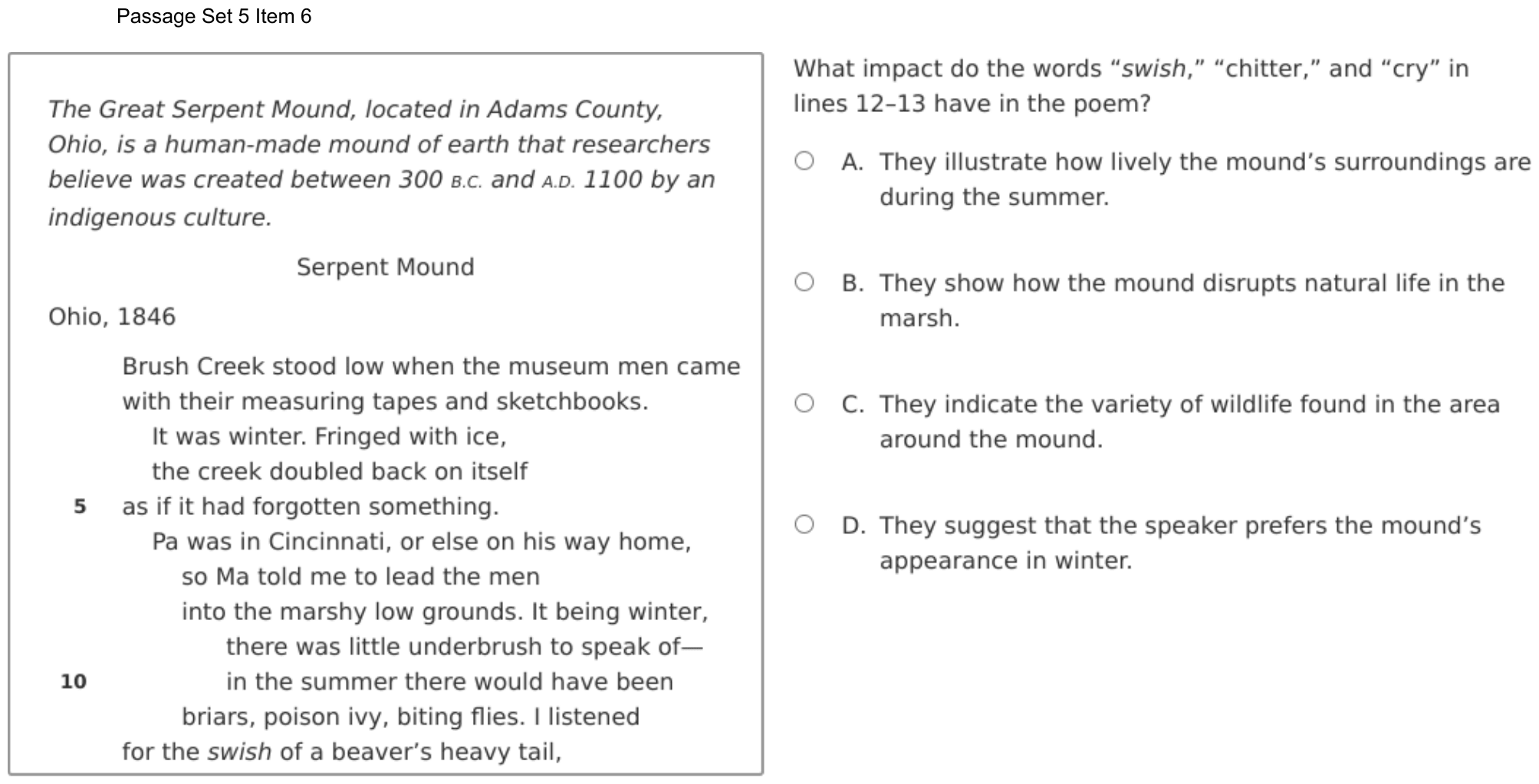
What impact do the words “swish,” “chitter,” and “cry” in lines 12–13 have in the poem?
- AThey illustrate how lively the mound’s surroundings are during the summer.
- BThey show how the mound disrupts natural life in the marsh.
- CThey indicate the variety of wildlife found in the area around the mound.
- DThey suggest that the speaker prefers the mound’s appearance in winter.
Show the answer
Correct answer: A
The question asks what impact the words “swish,” “chitter,” and “cry” in lines 12–13 have in the poem.
A. CORRECT. The words highlight the sounds of the animals that visit the mound in the summer: the “swish of a beaver’s heavy tail” (line 12), the “chitter of a chickadee” (line 13), and the “cry of a hawk” (line 13). These words help contrast the quiet stillness of the setting around the mound in the winter.
B. Incorrect. While the words in lines 12–13 convey the sounds certain animals make in the summer, the sounds of the animals that live near the mound are a natural part of life in the area, not a disruption.
C. Incorrect. The speaker is contrasting the sounds of the animals around the mound during the rest of the year with the silence of the winter months, not merely indicating the variety of wildlife.
D. Incorrect. The speaker expresses the idea that the mound is more visible in the winter because of the lack of brush (“It being winter, / there was little underbrush to speak of” [lines 8–9]). Then lines 12–13 describe sounds, not the appearance of the mound in winter.
Question analysis
This question about word choice asks what impact the sound words “swish,” “chitter” and “cry” in lines 12–13 of “Serpent Mound” have in the poem. They belong to a beaver, a chickadee and a hawk near the creek, and more than one choice sounds like a fair account of them, so students must read the surrounding lines closely.
- Grade level
- Grade 8 reading and task
- Compared with grade 7
- Above grade 7 Grade 7 students often explain what sensory words add to a description. These three words sit inside a long sentence that runs across several lines, so their effect has to be worked out from the lines around them, beyond typical grade 7 work.
- Estimated difficulty
- Hard: combines ideas, needs a plan, and has more than one tempting wrong answer.
- Thinking it demands
- Depth of knowledge 2, skills and concepts · mainly analyze
- What makes it hard
- A very close wrong answer major
- Reading between the lines moderate
- Complex sentences minor
- Evidence
- Answered from one paragraph or stanza
- Reading level
- Passage: 354 words (a poem; reading level not measured); question and choices: about grade 6, 61 words.
- Students, last 30 days
- Not enough answers yet to show (it takes 10).
Why it is hard, traps and wrong answers (shows the answer)
Why it is hard
Three vivid animal sounds invite the easy reading that the poem is showing off the creek’s wildlife, and that choice is true as far as it goes. The words matter because they are missing: the speaker listens for them, and “the winter silence” answers. Students must also accept that the key’s “during the summer” comes from the poem’s later picture of a crowded summer creek, not from lines 12–13 themselves.
A very close wrong answer major Choosing the answer
The variety choice is literally true, since a beaver, a chickadee and a hawk are three kinds of animal; it differs from the key in missing why the sounds are named, as a contrast with winter. (Embretson & Wetzel, 1987; Gorin & Embretson, 2006; Ascalon et al., 2007)
Reading between the lines moderate Working it out
The speaker listens for these sounds and does not hear them, so students must infer that they stand for the creek’s life in warmer months, which lines 21–22 call “crowded / with so much life.” (Graesser, Singer & Trabasso, 1994; Kintsch, 1998)
Complex sentences minor Understanding the question
The three words sit in one sentence that runs from “I listened” in line 11 to “like a weight” in line 15 and turns on “but,” so their point arrives only at its end. (Abedi & Lord, 2001; Freedle & Kostin, 1993; Messick, 1989)
Strategy: Read the full sentence that holds these words, from “I listened” in line 11 to the end of line 15, then decide what the three sound words add to the scene.
Traps
- True but not the answer: A choice says something accurate about the text that does not answer this question.
- Wrong part of the text: A choice is true of another paragraph, stanza or speaker than the one asked about.
The wrong answers, classified
B Twists what the text says (King et al., 2004)
Notices that the beaver, chickadee and hawk go unheard but blames the mound for the hush, though line 14 calls it “the winter silence of the creek.”
C True but not the answer (King et al., 2004; Embretson & Wetzel, 1987)
Rightly counts three different animals in lines 12–13, but the speaker listens for them in vain, so the point is their absence in winter, not the range of species.
D Wrong part of the text (Kirsch & Mosenthal, 1990)
Remembers from lines 8–9 and 24–25 that winter makes the mound easier to see, but lines 12–13 are about sounds and state no preference for either season.
Working it out, step by step
Figure out what the question asks
This asks what three sound words do in the poem. They are “swish,” “chitter” and “cry,” in lines 12–13. Read the whole sentence they sit in. It starts at “I listened” in line 11 and ends with “like a weight” in line 15.
Read the full sentence
Lines 11–15 say “I listened / for the swish of a beaver’s heavy tail, / the chitter of a chickadee, or the cry of a hawk, / but the winter silence of the creek pressed / down on all of us like a weight.” A chickadee is a small bird, and a chitter is its quick, chirping sound. The speaker listens for these sounds. But the word “but” tells you they never come. Only silence answers.
Work out why the sounds are named
A beaver, a chickadee and a hawk are signs of a creek full of life. The speaker hears none of them in winter. Later lines tell you when the creek is lively. Lines 21–22 say “In the summer the creek bottom was crowded / with so much life.” So the missing sounds remind you how lively the place is in summer. They also make the winter silence feel even emptier.
Check each choice
- A fits. The sounds stand for the busy life around the mound in the warm months.
- B does not fit. The quiet comes from the season: “the winter silence of the creek.” The mound does not cause it.
- C does not fit. There are three kinds of animals, but the point is that their sounds are missing.
- D does not fit. These lines are about sounds. The speaker says nothing about liking how the mound looks in winter.
Watch out: C is true as far as it goes. But it misses why the speaker names the sounds at all: to set them against the silence.
Choose the answer
The sounds the speaker listens for, and doesn’t hear, show how lively the creek is in summer. So the answer is A, “They illustrate how lively the mound’s surroundings are during the summer.”
Why this answer and not the closest wrong one
C is the closest wrong choice, because a beaver, a chickadee and a hawk really are three kinds of wildlife. But the speaker listens for them and hears nothing. The word “but” turns the sentence to “the winter silence.” The sounds matter because they are missing. They show the creek in its lively season, which line 21 names as summer.
More questions like this
The original DOE question
The passage “Serpent Mound” as printed (page 40)
Question 3 of 6
2018 Test B English, question 40Passage Snowy Mountains
Snowy Mountains
by John Gould Fletcher
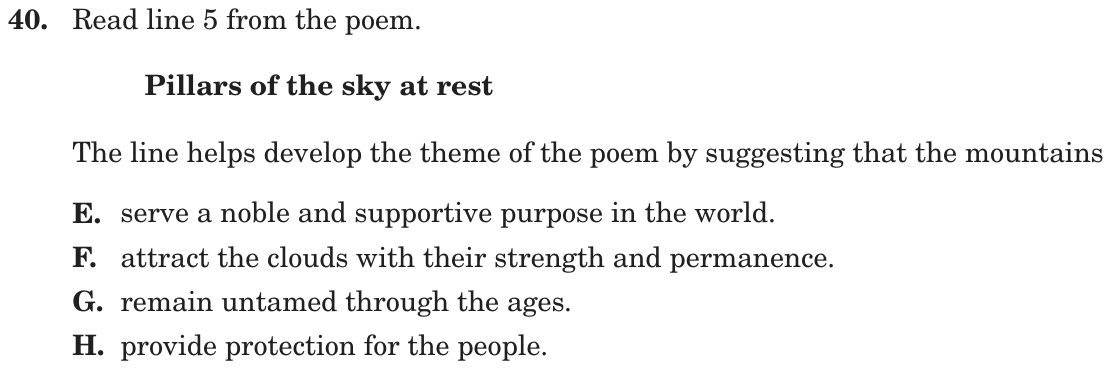
Higher and still more high,
Palaces made for cloud,
Above the dingy city-roofs
Blue-white like angels with broad wings,
Pillars of the sky at rest
The mountains from the great plateau
Uprise.
But the world heeds them not;
They have been here now for too long a time.
The world makes war on them,
Tunnels their granite cliffs,
Splits down their shining sides,
Plasters their cliffs with soap-advertisements,
Destroys the lonely fragments of their peace.
Vaster and still more vast,
Peak after peak, pile after pile,
Wilderness still untamed,
To which the future is as was the past,
Barrier spread by Gods,
Sunning their shining foreheads,
Barrier broken down by those who do not need
The joy of time-resisting storm-worn stone,
The mountains swing along
The south horizon of the sky;
Welcoming with wide floors of blue-green ice
The mists that dance and drive before the sun.
“Snowy Mountains” by John Gould Fletcher—Public Domain
Question
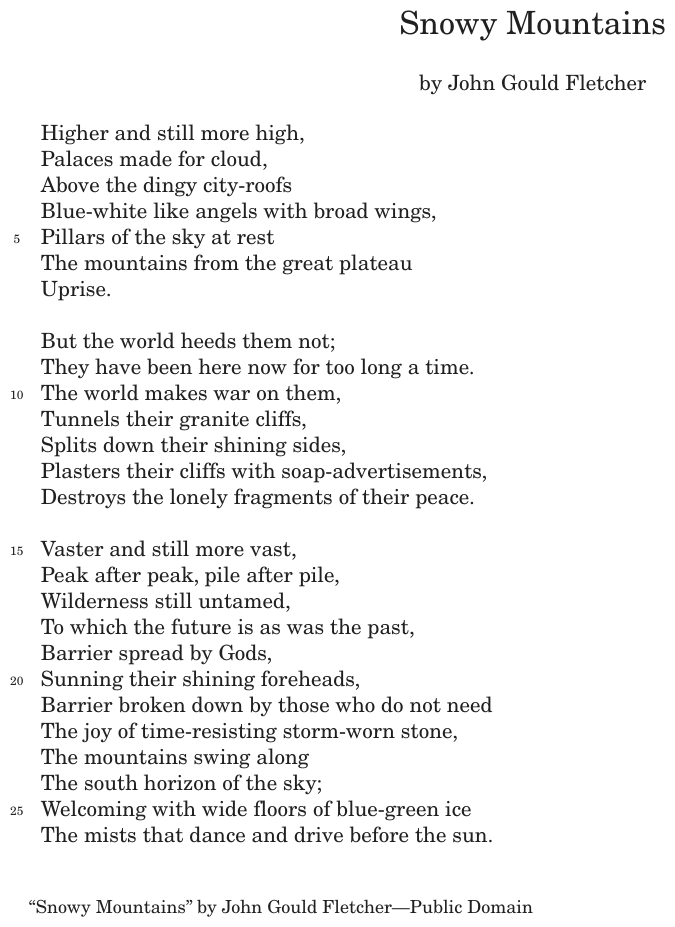
Read line 5 from the poem.
Pillars of the sky at rest
The line helps develop the theme of the poem by suggesting that the mountains
- Aserve a noble and supportive purpose in the world.
- Battract the clouds with their strength and permanence.
- Cremain untamed through the ages.
- Dprovide protection for the people.
Show the answer
Correct answer: A
The question asks how the line from the poem helps develop the theme of the poem. Line 5 helps develop the theme that the mountains are more important than people realize by suggesting that the mountains serve a noble, foundational purpose in the world, as explained in Option A.
Option B is incorrect because, while the poem does describe the strength and permanence of the mountains, the line does not suggest that these traits attract the clouds.
Option C is incorrect because, while the line states that the highest peaks are “at rest,” that phrase describes stillness, not wildness; the poem calls the mountains “still untamed” only later (line 17), and line 5 does not suggest it.
Option D is incorrect because, while pillars are strong and may indicate shelter, there is no suggestion in the line that the mountains are protecting the people. Additionally, this concept is not a theme of the poem.
Question analysis
This figurative language question asks how the metaphor “Pillars of the sky at rest” in “Snowy Mountains” helps develop the poem’s theme. Students must work out what calling mountains pillars of the sky suggests about them, and it is tricky because every choice sounds like something this poem could say.
- Grade level
- Grade 8 reading and task
- Compared with grade 7
- Above grade 7 Grade 7 students interpret metaphors, but here they must also connect a short image to the poem’s theme and choose among abstract options, a step closer to grade 8 work on figurative meaning and theme.
- Estimated difficulty
- Hard: combines ideas, needs a plan, and has more than one tempting wrong answer.
- Thinking it demands
- Depth of knowledge 3, strategic thinking · mainly analyze
- What makes it hard
- Figurative or literary language major
- The right answer is reworded moderate
- Combines ideas minor
- Evidence
- Answered from one sentence or line
- Reading level
- Passage: 161 words (a poem; reading level not measured); question and choices: about grade 3, 52 words.
- Corrected from the DOE handbook
- A claim in the explanation that the poem contradicts was corrected.
- Students, last 30 days
- Not enough answers yet to show (it takes 10).
Why it is hard, traps and wrong answers (shows the answer)
Why it is hard
This is hard because every choice says something the poem could plausibly mean, and two of them borrow real phrases from other lines. Students who test choices against the poem as a whole find support for the wrong ones; the question rewards testing them against the single image of pillars holding up the sky. Seeing that pillars both support and ennoble a structure leads directly to the key.
Figurative or literary language major Understanding the question
The answer depends on unpacking one metaphor: pillars hold up a roof, so “Pillars of the sky” casts the mountains as supports of the heavens, and “at rest” adds a calm, dignified strength. (Graesser, Singer & Trabasso, 1994; Kintsch, 1998)
The right answer is reworded moderate Choosing the answer
The key uses words the poem never does, “noble” and “supportive,” while wrong choices echo “cloud” from line 2 and “untamed” from line 17 and so look anchored in the text. (Freedle & Kostin, 1993; Kirsch & Mosenthal, 1990)
Combines ideas minor Working it out
Students must interpret the image and then link it to the poem’s theme, that the mountains matter more than the world below recognizes. (Embretson, 1998; Daniel & Embretson, 2010)
Strategy: Ask what a pillar is and why a poet might call mountains “pillars of the sky,” then test each choice against line 5 alone before thinking about the rest of the poem.
Traps
- Wrong part of the text: A choice is true of another paragraph, stanza or speaker than the one asked about.
- Half right: One half of a two-part choice is right and the other is not.
- Reads too much in: A reasonable-sounding conclusion that goes further than the text allows.
The wrong answers, classified
B Half right (King et al., 2004; Thissen, Steinberg & Fitzpatrick, 1989)
Strength and permanence fit both pillars and the poem, but attracting clouds comes from line 2’s “Palaces made for cloud,” and line 5 says nothing about drawing clouds in.
C Wrong part of the text (Kirsch & Mosenthal, 1990)
Takes “Wilderness still untamed” from line 17, a genuine idea of the third stanza, and attaches it to line 5, whose pillars “at rest” suggest calm support, not wildness.
D Reads too much in (Graesser, Singer & Trabasso, 1994)
Follows the pillar image one step too far, from pillars to a roof to shelter for people, though neither the line nor the poem shows the mountains protecting anyone.
What was corrected from the DOE handbook, and why
- Explanation: The handbook rejects Option C by saying the mountains “do not remain untamed or untouched,” but line 17 calls them “Wilderness still untamed,” and the handbook’s own explanation of the third-stanza question relies on that line. The site now says that “at rest” describes stillness, not wildness, and that the poem calls the mountains “still untamed” only later, in line 17, so line 5 does not suggest it.
Working it out, step by step
Figure out what the question asks
This asks what one image, line 5, adds to the poem’s theme. A theme is the big message of a poem. Here the theme is that the mountains are great and important, even though people ignore them. You need to decide what “Pillars of the sky” says about the mountains.
Look closely at line 5
Line 5 reads “Pillars of the sky at rest.” It is part of the first stanza’s list of grand pictures. The list also has “Palaces made for cloud” in line 2. Line 5 is a metaphor. A metaphor calls one thing by the name of another to compare them, without using “like” or “as.”
Explain what pillars do
A pillar is a tall, strong column that holds up a roof. Big, important buildings, like temples and courthouses, have pillars. So calling the mountains “Pillars of the sky” makes them seem to hold up the sky. That is a supporting job. It is also a grand, noble one. “At rest” adds calm. The pillars stand still and steady.
Check each choice
- A fits. Holding up the sky is a noble, supportive job.
- B is wrong. Clouds come from line 2. Line 5 says nothing about pulling clouds in.
- C is wrong. “Wilderness still untamed” is line 17, not line 5. Pillars “at rest” suggest calm, not wildness.
- D is wrong. Pillars hold up roofs, and roofs can shelter people. But the line never shows the mountains protecting anyone.
Choose the answer
Pillars hold things up and make a building grand. So the answer is A, “serve a noble and supportive purpose in the world.”
Why this answer and not the closest wrong one
C is the strongest trap, because the poem really does call the mountains untamed. But that is line 17. Test each choice against line 5 alone. A pillar is a support, and a pillar of the sky is a grand one. Only A comes straight from that picture.
More questions like this
The original DOE question
The passage “Snowy Mountains” as printed (page 142)
Question 4 of 6
2024 Test B Math, question 52Question
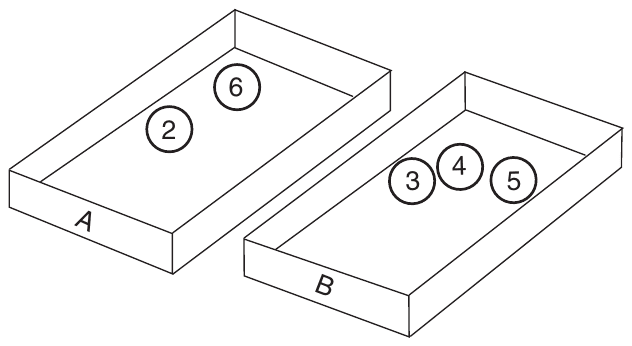
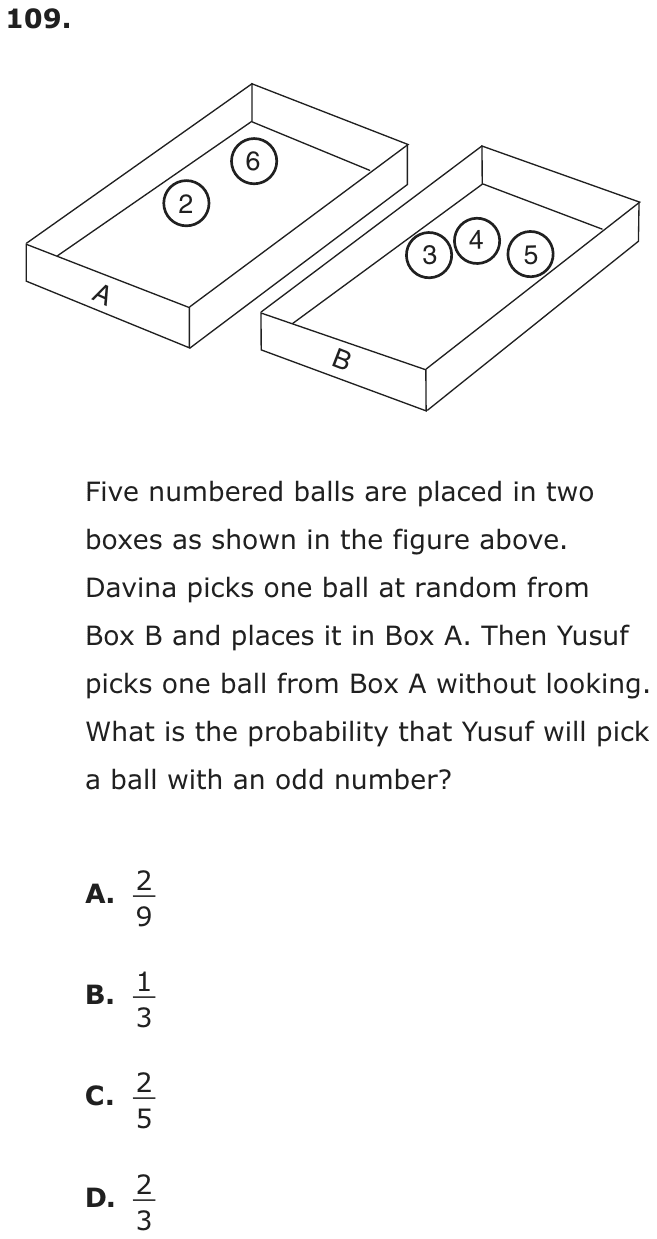
Five numbered balls are placed in two boxes as shown in the figure above. Davina picks one ball at random from Box B and places it in Box A. Then Yusuf picks one ball from Box A without looking. What is the probability that Yusuf will pick a ball with an odd number?
- A
- B
- C
- D
Show the answer
Correct answer: A
The probability of Davina picking an odd-numbered ball from Box B is . If Davina places an odd-numbered ball in Box A, then the probability of Yusuf picking an odd-numbered ball from Box A is . The probability of both of these events happening is the product of the two probabilities.
Question analysis
Two boxes hold five numbered balls, and Davina moves one ball at random from Box B into Box A before Yusuf draws one from Box A. Students find the probability that Yusuf's ball shows an odd number. It tests two-stage probability, and the tricky part is that the second draw depends on which ball was moved.
- NYS standards
- Grade level
- Grade 7 content, by NYS standard
- Compared with grade 7
- Above grade 7 Grade 7 compound probability lists outcomes for independent stages such as coins or spinners. Here the first random move changes what is in the second box, so students must follow two linked stages, a dependence typical grade 7 work does not include.
- Estimated difficulty
- Among the hardest on the SHSAT: a non-obvious approach, heavy reading, or a well-hidden trap.
- Thinking it demands
- Depth of knowledge 3, strategic thinking · mainly analyze
- What makes it hard
- Solution
- 3 steps
- Reading level
- Question and choices: about grade 4, 57 words.
- Students, last 30 days
- Not enough answers yet to show (it takes 10).
Why it is hard, traps and wrong answers (shows the answer)
Why it is hard
Two chance events are hidden in what reads like a question about a single draw. Every listed wrong answer is a reasonable single-stage answer, either one of the two factors on its own or a count of odd balls across both boxes. Listing the nine equally likely pairs, Davina's ball and then Yusuf's, shows that only two of them end with an odd ball and makes the structure visible without any formula.
No obvious method major Working it out
The stem asks one question about Yusuf's draw, but the answer depends on Davina's earlier random pick; the key is that Box A starts with only even balls, so Yusuf can draw odd only by drawing the ball she moved. (Schoenfeld, 1985)
Something you must already know minor Working it out
Multiplying the chances of the two stages, 2/3 for an odd ball moving and 1/3 for Yusuf then drawing it, is a rule students must bring themselves. (Anderson & Krathwohl, 2001)
Reading a figure, table or graph minor Understanding the question
The numbers appear only in the figure, Box A holding 2 and 6 and Box B holding 3, 4 and 5, so the odd balls have to be spotted there. (Lesh, Post & Behr, 1987; Kirsch & Mosenthal, 1990)
Strategy: List every equally likely pair of a ball moved by Davina and a ball picked by Yusuf, and count the pairs that end with an odd ball.
Traps
- Stops one step early: A choice is a number from partway through the solution.
- Numbers taken from the question: Combines the numbers in the question without a model of the situation, or is simply a number that appears in the question.
The wrong answers, classified
B Stops one step early (King et al., 2004; Gierl et al., 2017)
Finds Yusuf's chance of drawing the odd ball once one is in Box A, 1 out of 3, leaving out the chance that Davina moves an odd ball at all.
C Numbers taken from the question (Hegarty, Mayer & Monk, 1995)
Counts the odd balls in the figure, 3 and 5, over all five balls, 2/5, ignoring that Yusuf draws only from Box A.
D Stops one step early (King et al., 2004; Gierl et al., 2017)
Gives the chance that Davina moves an odd ball, 2 out of 3, the first stage only, without multiplying by Yusuf's 1/3 chance of drawing it.
Worked solution, step by step
Formulas used
- Probability
- P is the probability, the chance that something happens. It is a number from 0 to 1. The top counts the results you want. The bottom counts all the results that can happen. It works when every result is equally likely.
- Chance of events in a row
- A and B are two events that happen one after the other. P(A) is the chance of the first. P(B after A) is the chance of the second, counting only what is left after the first. You multiply because the second must also happen inside the share of times the first did.
Read the figure
Box A holds balls numbered 2 and 6. Box B holds balls numbered 3, 4 and 5.
An odd number does not divide evenly by 2. So the only odd balls are 3 and 5, and both start in Box B. Box A starts with no odd balls at all.
Spot the two chance events
Two things happen by chance, one after the other:
- Davina picks one of the 3 balls in Box B and moves it to Box A.
- Then Yusuf picks one of the 3 balls now in Box A.
Yusuf gets an odd ball only if both go right. Davina must move an odd ball. Then Yusuf must pick that very ball.
The question asks only about Yusuf. But his chance depends on Davina’s pick, which comes first.
Find the chance for Davina’s pick
Box B has 3 balls, and 2 of them, the 3 and the 5, are odd.
If she moves the 4 instead, Box A holds only even balls. Then Yusuf can’t get an odd ball at all.
Find the chance for Yusuf’s pick
Say Davina moved an odd ball. Box A now holds 3 balls: the 2, the 6 and that one odd ball.
Watch out: alone is choice B. It forgets that Davina might move the 4.
Multiply the two chances
Both events must happen, so use the rule for events in a row.
Watch out: alone, choice D, stops after Davina’s pick. , choice C, counts 2 odd balls out of all 5. But Yusuf picks only from Box A.
So the answer is A, .
Check your answer
List all 9 equally likely outcomes. Davina can move 3, 4 or 5. Then Yusuf picks one of 3 balls.
| Ball moved | Box A then | Odd picks |
|---|---|---|
| 3 | 2, 6, 3 | 1 |
| 4 | 2, 6, 4 | 0 |
| 5 | 2, 6, 5 | 1 |
That is 2 odd picks out of 9, or .
More questions like this
The original DOE question
Question 5 of 6
2018 Test A Math, question 30Question
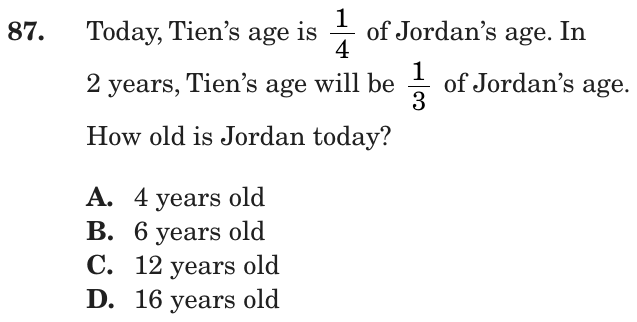
Today, Tien’s age is of Jordan’s age. In 2 years, Tien’s age will be of Jordan’s age. How old is Jordan today?
- A4 years old
- B6 years old
- C12 years old
- D16 years old
Show the answer
Correct answer: D
First, set up an equation to express Tien’s age () and Jordan’s age () today:
Two years from now, Tien’s age will be , and Jordan’s age will be .
Set up an equation about the relationship between Tien’s age and Jordan’s age in two years:
Solve the above equation for :
Now set the two equations equal to each other and solve for :
Question analysis
This age word problem says Tien is one fourth of Jordan's age today and will be one third of Jordan's age in two years, then asks for Jordan's current age. Students must turn two fractional relationships into equations and solve them together. Both people age by the same two years, and it is easy to solve for the wrong person.
- NYS standards
- Grade level
- Grade 8 content, by NYS standard
- Compared with grade 7
- Above grade 7 Grade 7 equations have one unknown on one side, like 3x + 5 = 20. This one links two unknown ages with fractional coefficients and leads to a variable on both sides, which is grade 8 algebra.
- Estimated difficulty
- Hard: combines ideas, needs a plan, and has more than one tempting wrong answer.
- Thinking it demands
- Depth of knowledge 2, skills and concepts · mainly apply
- What makes it hard
- Turning words into math major
- Error-prone arithmetic moderate
- Solution
- 4 steps
- Reading level
- Question and choices: about grade 1, 31 words.
- Students, last 30 days
- Not enough answers yet to show (it takes 10).
Why it is hard, traps and wrong answers (shows the answer)
Why it is hard
The difficulty is in the setup: two fractional relationships at two different times, with both people aging. Once the equations are right, the algebra is short, but it ends with two ages and only one is asked for. Testing the choices against both conditions is a reliable alternative that avoids the algebra entirely.
Turning words into math major Understanding the question
The second sentence must become T + 2 = (J + 2)/3; writing J/3, or forgetting that Jordan also ages two years, breaks the equation. (Hegarty, Mayer & Monk, 1995; Koedinger & Nathan, 2004)
Error-prone arithmetic moderate Working it out
Substituting J/4 for T leaves J/4 + 2 = (J + 2)/3, an equation with fractions on both sides that must be cleared, usually by multiplying by 12. (Brown & Burton, 1978; Junker & Sijtsma, 2001)
Strategy: Let Jordan's age be J, write Tien's age as J/4, and set J/4 + 2 equal to one third of (J + 2); or test each choice against both conditions.
Traps
- Answers a different question: A choice is right for another quantity: the other unknown, the rest instead of the part, the part instead of the whole.
The wrong answers, classified
A Answers a different question (King et al., 2004; Hegarty, Mayer & Monk, 1995)
Solves the equations correctly but reports Tien's age today, 4, which is one fourth of Jordan's 16, instead of Jordan's age.
B Answers a different question (King et al., 2004; Hegarty, Mayer & Monk, 1995)
Gives Tien's age two years from now, 4 + 2 = 6, answering for the wrong person and the wrong time.
C Numbers taken from the question (Hegarty, Mayer & Monk, 1995)
Picks 12 because it is a multiple of both 4 and 3, but then Tien would be 3 and later 5, not a third of 14.
Worked solution, step by step
Formulas used
- Distributive property
- a, b and c are any numbers. To multiply a sum by a number, multiply each part of the sum, then add. It works because a groups of (b + c) is the same as a groups of b plus a groups of c.
Sort out what you know
Today, Tien’s age is of Jordan’s age. That means Jordan is 4 times as old as Tien.
In 2 years, both of them will be 2 years older. Then Tien’s age will be of Jordan’s. So Jordan will be 3 times as old as Tien. You need Jordan’s age today.
Name the ages with a letter
Let t stand for Tien’s age today. Jordan is 4 times as old, so his age is 4t, which means 4 times t. Add 2 years to each age:
Person Today In 2 years Tien Jordan Watch out: Jordan gets 2 years older too. Do not forget to add 2 to his age.
Write an equation for later
In 2 years, Jordan’s age will be 3 times Tien’s age. Write that as an equation:
Use the distributive property on the right side. Multiply both t and 2 by 3:
Solve for Tien’s age
Take 3t away from both sides. Doing the same thing to both sides keeps them equal:
Now take 2 away from both sides:
So Tien is 4 years old today. Watch out: 4 is Tien’s age, not Jordan’s. Choice A, 4 years old, is a trap.
Find Jordan’s age
Jordan is 4 times as old as Tien:
So the answer is D, 16 years old.
Check your answer
Put 16 back into the story. Today, Tien is 16 ÷ 4 = 4. In 2 years, Tien is 6 and Jordan is 18. Is 6 one third of 18? Yes, because 18 ÷ 3 = 6. Choice C fails: Tien would be 3, then 5, and 5 is not a third of 14.
More questions like this
The original DOE question
Question 6 of 6
2026 Practice Test C Math, question 32Question
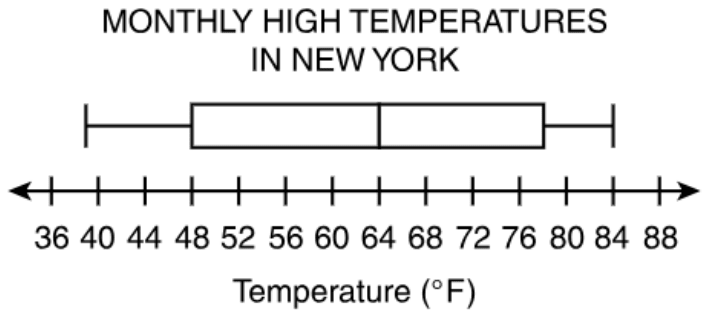
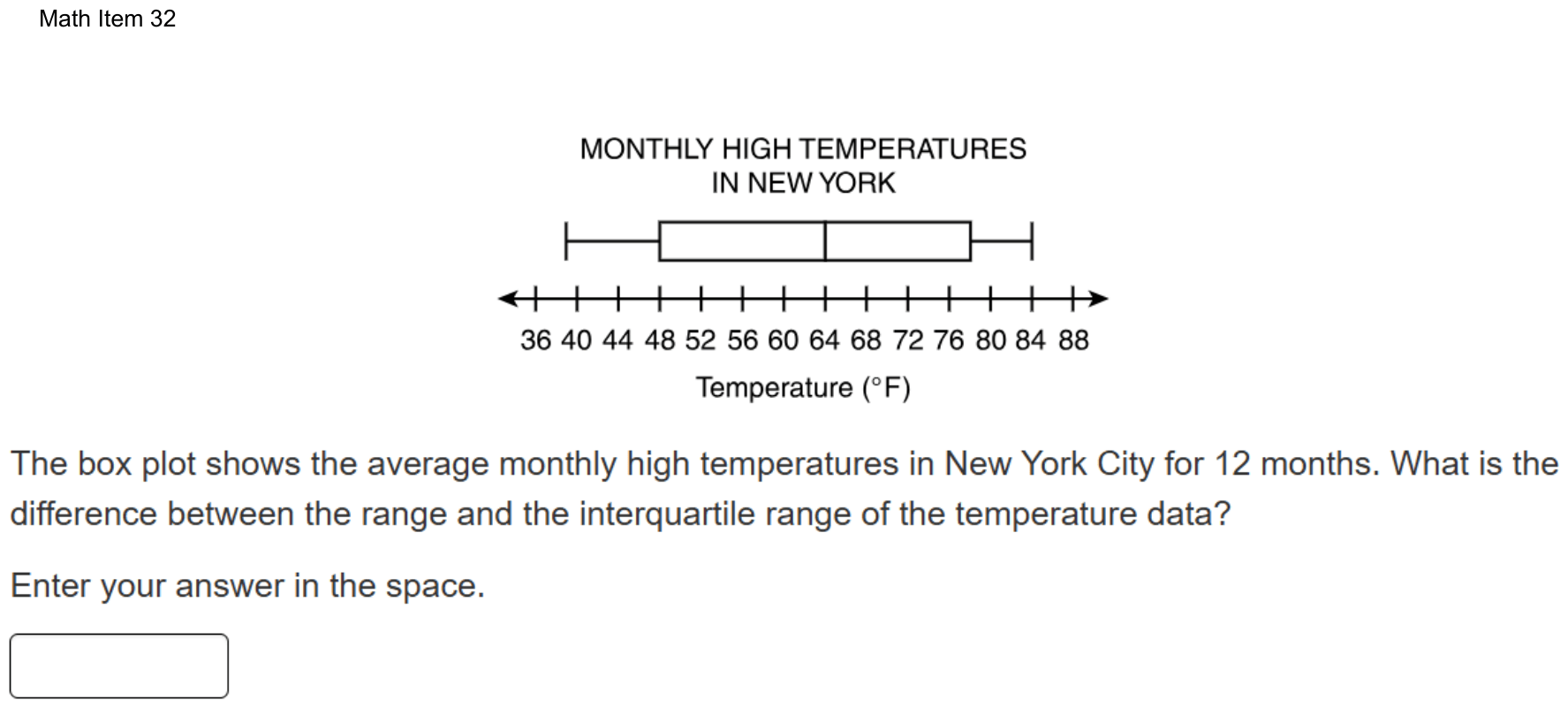
The box plot shows the average monthly high temperatures in New York City for 12 months. What is the difference between the range and the interquartile range of the temperature data?
Enter your answer in the space.
Fill-in question: work out the answer and type it as a number.
Show the answer
Correct answer: 15
Determine the range by subtracting the minimum value on the box plot from the maximum value on the box plot:
Maximum value , Minimum value
Determine the interquartile range by subtracting the lower quartile value on the box plot from the upper quartile value on the box plot:
Upper Quartile Value , Lower Quartile Value
Determine the difference between the range (45° F) and the interquartile range (30° F):
Question analysis
A box plot of New York City's average monthly high temperatures for 12 months sits above a number line labeled every 4 degrees. Students type the difference between the range and the interquartile range of the data. Two of the plot's values fall between labeled ticks, so careful reading of the scale decides the answer.
- Grade level
- Grade 7 content, by NYS standard
- Compared with grade 7
- Above grade 7 Reading a box plot and finding its interquartile range are grade 7 skills. Here two of the five values fall between ticks spaced 4 apart, and the range, the IQR and their difference must all be found and typed with no choices.
- Estimated difficulty
- Hard: combines ideas, needs a plan, and has more than one tempting wrong answer.
- Thinking it demands
- Depth of knowledge 2, skills and concepts · mainly apply
- What makes it hard
- Solution
- 3 steps
- Reading level
- Question and choices: about grade 7, 36 words.
- Students, last 30 days
- Not enough answers yet to show (it takes 10).
Why it is hard, traps and wrong answers (shows the answer)
Why it is hard
The method is standard, but the key rests on reading the scale between its labels. The axis is ticked only every 4 degrees, and the minimum and the upper quartile land off the ticks, so rounding either one to the nearest label moves the result by a degree or two with nothing to flag it. Students who find the range correctly can also stop there, entering 45, the larger of the two spreads, instead of the difference the question asks for.
Reading a figure, table or graph major Understanding the question
Two of the five values fall between ticks spaced 4 degrees apart: the left whisker ends just short of the 40 tick, at 39, and the box’s right edge sits midway between 76 and 80, at 78. (Lesh, Post & Behr, 1987; Kirsch & Mosenthal, 1990)
Many steps minor Working it out
Four values are read and combined in three subtractions, the range, the interquartile range and then their difference, so one misread value changes the final entry. (Daniel & Embretson, 2010; Enright, Morley & Sheehan, 2002)
Something you must already know minor Working it out
Neither measure is defined on the page: the range spans the whiskers, and the interquartile range is the width of the box, the upper quartile minus the lower. (Anderson & Krathwohl, 2001)
An answer in an unexpected form minor Choosing the answer
The result is typed with no choices to compare, so an entry one or two degrees off, from rounding a value to the nearest tick, looks just as finished as the right one. (Enright, Morley & Sheehan, 2002)
Strategy: Read the minimum, both quartiles and the maximum, judging where each mark falls between the ticks, then subtract for the range and for the IQR, and subtract those two results.
Traps
- Misreads the figure: Reads a value, label or tick spacing in a figure, table or graph wrongly.
- Stops one step early: A choice is a number from partway through the solution.
The wrong answers, classified
14 Misreads the figure (Lesh, Post & Behr, 1987; Kirsch & Mosenthal, 1990)
Reads the left whisker’s end as 40, the nearest labeled tick, instead of 39, so the range becomes 84 − 40 = 44 and 44 − 30 = 14.
45 Stops one step early (King et al., 2004; Gierl et al., 2017)
Finds the range, 84 − 39 = 45 degrees, and enters it, stopping before the interquartile range of 30 is subtracted from it.
17 Misreads the figure (Lesh, Post & Behr, 1987; Kirsch & Mosenthal, 1990)
Reads the box’s right edge as 76, the tick just left of it, instead of 78, so the IQR becomes 76 − 48 = 28 and 45 − 28 = 17.
Worked solution, step by step
Formulas used
- Range
- The maximum is the greatest value, at the right end of the right whisker. The minimum is the least value, at the left end of the left whisker. The range tells how far the whole set of data spreads.
- Interquartile range (IQR)
- Q3 is the upper quartile, the right edge of the box. Q1 is the lower quartile, the left edge of the box. The IQR is the width of the box. It tells how far the middle half of the data spreads.
Sort out the question
A box plot shows data with five numbers. The two whiskers are the lines on each side of the box. Their ends are the minimum, the least value, and the maximum, the greatest. The box runs from the lower quartile to the upper quartile. These are the middles of the lower half and the upper half of the data. The line inside the box is the median, the middle value.
You need the range minus the interquartile range (IQR), in degrees.
Read the values between the ticks
The ticks on the number line are 4 degrees apart. So each degree is one quarter of the space between two ticks. Three values sit right on ticks: the box’s left edge at 48, the median at 64, and the right whisker’s end at 84.
- The left whisker starts just left of the 40 tick. It sits about one quarter of the way back toward 36. So the minimum is degrees.
- The box’s right edge is halfway between 76 and 80. Halfway is 78 degrees.
Find the range
Use the range formula:
The data spread over 45 degrees.
Watch out: rounding the minimum to the 40 tick gives a range of 44. Then the final answer comes out 14, which is wrong.
Find the IQR
Use the IQR formula with the two edges of the box:
The middle half of the data spreads over 30 degrees.
Watch out: reading the box’s right edge as 76 gives an IQR of 28. Then the final answer comes out 17.
Subtract the IQR from the range
The question asks for the difference between the two:
Watch out: 45 is only the range. Do not stop there. Type only the number, with no degree sign.
So you would enter 15.
Check your answer
The range covers the whole plot, and the IQR covers only the box. So their difference is the two whiskers added together. The left whisker is degrees long. The right whisker is degrees long. , which matches.
More questions like this
The original DOE question