3 English and 3 math
Here are 6 random questions to try. Takers earning below 75% are unlikely to receive an offer. You have 1 minute 48 seconds per question on the real exam.
Question 1 of 6
2024 Test A English, question 24Passage At Dusk
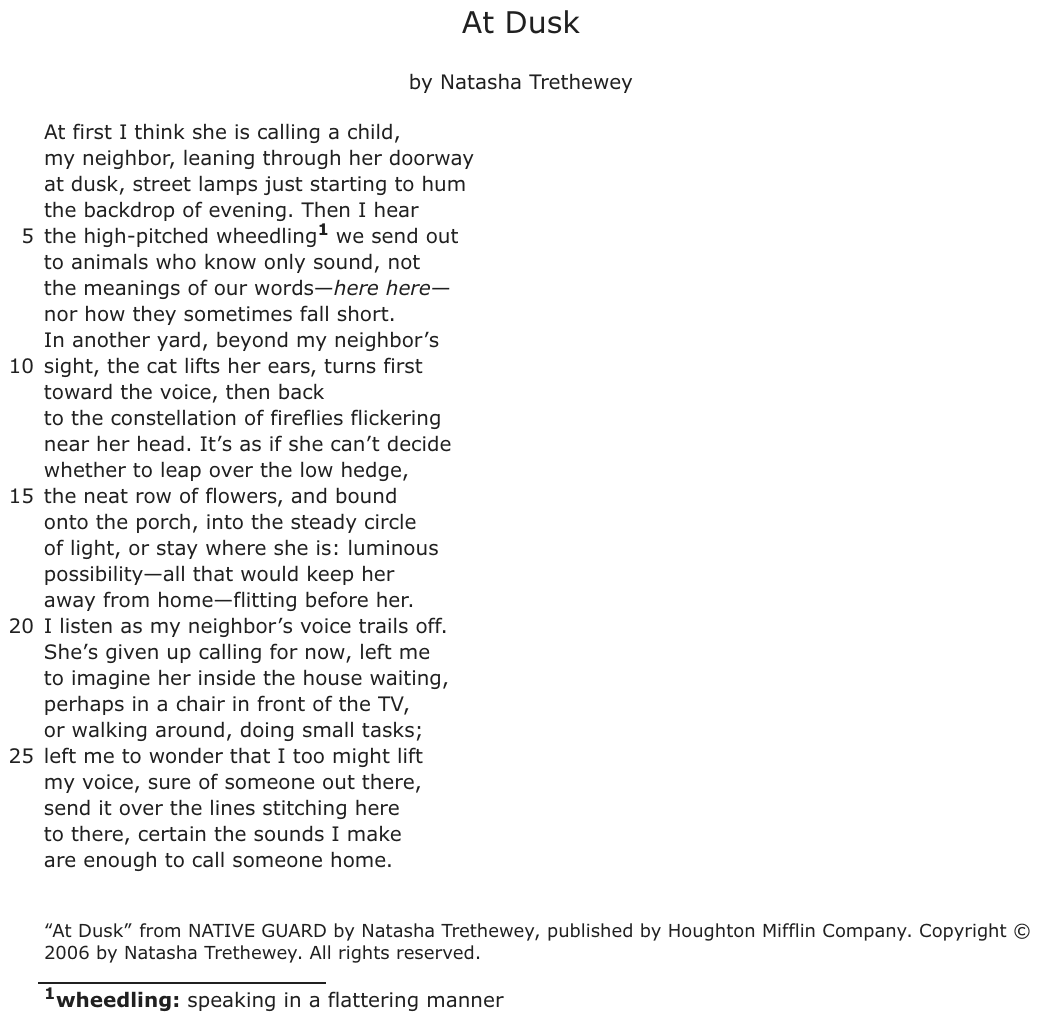
At Dusk
by Natasha Trethewey
At first I think she is calling a child,
my neighbor, leaning through her doorway
at dusk, street lamps just starting to hum
the backdrop of evening. Then I hear
the high-pitched wheedling1 we send out
to animals who know only sound, not
the meanings of our words—here here—
nor how they sometimes fall short.
In another yard, beyond my neighbor’s
sight, the cat lifts her ears, turns first
toward the voice, then back
to the constellation of fireflies flickering
near her head. It’s as if she can’t decide
whether to leap over the low hedge,
the neat row of flowers, and bound
onto the porch, into the steady circle
of light, or stay where she is: luminous
possibility—all that would keep her
away from home—flitting before her.
I listen as my neighbor’s voice trails off.
She’s given up calling for now, left me
to imagine her inside the house waiting,
perhaps in a chair in front of the TV,
or walking around, doing small tasks;
left me to wonder that I too might lift
my voice, sure of someone out there,
send it over the lines stitching here
to there, certain the sounds I make
are enough to call someone home.
“At Dusk” from NATIVE GUARD by Natasha Trethewey, published by Houghton Mifflin Company. Copyright © 2006 by Natasha Trethewey. All rights reserved.
1wheedling: speaking in a flattering manner
Question
How does the setting affect the events of the poem?
- AIt enables the speaker to regularly overhear the neighbor calling for her cat at dusk.
- BIt allows the speaker to observe the neighbor quietly without interacting with her.
- CIt shows how living in close proximity helps the speaker feel connected to the neighbor.
- DIt shows how feeling isolated causes the speaker to imagine interactions with the neighbor.
Show the answer
Correct answer: B
The question asks how the setting affects the events discussed in the poem.
A. Incorrect. In line 2, the speaker refers to the woman calling for her cat as “my neighbor,” which clearly suggests that the speaker lives next door to the woman. However, although the two live next door to each other, line 1 suggests that perhaps the speaker does not regularly overhear the neighbor because the speaker initially thinks that the neighbor is “calling a child” and only later realizes the neighbor is calling to a cat. Although the setting places the speaker and the neighbor in close proximity, the poem does not indicate the frequency or regularity with which the speaker overhears the neighbor.
B. CORRECT. In the first four lines, the speaker observes the actions of the neighbor as the neighbor leans out to call for the cat at dusk. Despite the speaker’s observation of the neighbor, there is no indication that the neighbor notices the speaker. The reader can conclude that because of the time of day and the speaker being in the house next door, the speaker can observe the neighbor without being observed by her or having to interact with her.
C. Incorrect. The setting of the poem is a neighborhood at nightfall, as indicated by “at dusk” in line 3, the reference to “another yard” in line 9, and the flickering fireflies in line 12. However, while the speaker is close enough to the neighbor to overhear her calling to the cat, there is no indication that the speaker feels connected to the neighbor. Instead, the speaker expresses curiosity about the neighbor after the neighbor goes inside, and the speaker is “left . . . / to imagine her inside the house waiting” (lines 21–22). The fact the speaker initially thought that the neighbor was calling a child indicates that the speaker is not familiar with the neighbor and her habits, and there is no indication that the speaker feels connected to the neighbor.
D. Incorrect. In lines 22–24, the speaker imagines what the neighbor may be doing while the neighbor is waiting inside for the cat to return, but the speaker is imagining the neighbor’s solitary experience after the neighbor has momentarily “given up” on calling to the cat (line 21). The speaker does not imagine personally interacting with the neighbor but rather briefly imagines what the neighbor is doing at home while the cat is away.
Question analysis
This reading question asks how the setting of At Dusk, a neighborhood at nightfall where a woman leans from her doorway to call her cat, affects the events of the poem. Because so little happens, students must infer the setting's role from small details, and several choices sound reasonable without being supported by the poem.
- Grade level
- Grade 8 reading and task
- Compared with grade 7
- Above grade 7 Grade 7 students analyze how setting shapes events, usually in a story with a clear plot. This poem has almost no action, so the student must reason from a handful of details about place and time, which is harder than typical grade 7 work.
- Estimated difficulty
- Hard: combines ideas, needs a plan, and has more than one tempting wrong answer.
- Thinking it demands
- Depth of knowledge 3, strategic thinking · mainly analyze
- What makes it hard
- A very close wrong answer major
- Reading between the lines moderate
- Evidence
- Answered from the whole text
- Reading level
- Passage: 236 words (a poem; reading level not measured); question and choices: about grade 8, 67 words.
- Students, last 30 days
- Not enough answers yet to show (it takes 10).
Why it is hard, traps and wrong answers (shows the answer)
Why it is hard
Little happens in this poem, so the setting's role must be built from small details: a neighbor at her doorway at dusk, a cat in another yard, a speaker who hears and watches but never speaks. The strongest wrong answer is right about overhearing and wrong only in claiming it happens regularly, which the speaker's first mistaken guess argues against. The other choices supply a feeling of closeness or of isolation that the poem never states.
A very close wrong answer major Choosing the answer
The overhearing choice describes what the setting allows almost as well as the right one and fails on a single word, “regularly,” since the poem records one evening and the speaker first mistakes the call. (Embretson & Wetzel, 1987; Gorin & Embretson, 2006; Ascalon et al., 2007)
Reading between the lines moderate Working it out
The setting's effect is never stated; it has to be inferred from the speaker hearing and watching from nearby while the neighbor, “leaning through her doorway,” never seems to notice anyone. (Graesser, Singer & Trabasso, 1994; Kintsch, 1998)
Strategy: Picture the scene from the speaker's position, then check each choice word by word against the poem and reject any that claims something the poem never states.
Traps
- Too broad or too strong: A choice overstates, generalizes, or uses absolute words the text does not support.
- Reads too much in: A reasonable-sounding conclusion that goes further than the text allows.
- Twists what the text says: Uses the text's topic and ideas but changes what it says: who did it, how much, when, or why.
The wrong answers, classified
A Too broad or too strong (King et al., 2004)
Rightly sees that living next door lets the speaker overhear the call, but “regularly” is unsupported, and the first guess about a child suggests the call is unfamiliar.
C Reads too much in (Graesser, Singer & Trabasso, 1994)
Connects living close by with the poem's interest in connection and the speaker's “I too,” but the speaker never claims to feel close to the neighbor.
D Twists what the text says (King et al., 2004)
Notices the speaker picturing the neighbor indoors and calls it imagined interaction, but the speaker pictures her alone, waiting or doing small tasks, and never mentions feeling isolated.
Working it out, step by step
Figure out what the question asks
The setting is where and when a story or poem takes place. You need to see how the setting shapes what happens in the poem.
Picture the setting
It is “dusk” (line 3), the dim time just after sunset. The neighbor is “leaning through her doorway” (line 2). The cat is “In another yard” (line 9). The speaker is close enough to hear and watch it all. But the speaker never speaks to the neighbor. Nothing shows the neighbor notices the speaker.
Work out the effect
Living next door puts the speaker close by. In the fading light, the speaker can watch quietly. So the speaker sees the neighbor and the cat without joining in. The whole poem is what the speaker sees, hears and imagines from there.
Check each choice
- A is wrong. The word “regularly” is the problem. The poem shows one evening.
- B is right. The speaker watches from nearby and never talks with the neighbor.
- C is wrong. The speaker never says they feel close to the neighbor.
- D is wrong. The poem never says the speaker feels lonely. The speaker pictures the neighbor alone inside, not the two of them talking.
Watch out: A is almost right, since living nearby does let the speaker overhear. One word makes it wrong.
Choose the answer
The setting lets the speaker watch quietly from close by. So the answer is B.
Why this answer and not the closest wrong one
A is the closest wrong answer. Living next door does let the speaker hear the call. But nothing says it happens often. The poem tells about one evening. At first the speaker even thinks a child is being called. B fits what the poem shows: the speaker watches without ever talking to the neighbor.
More questions like this
The original DOE question

The passage “At Dusk” as printed (page 48)
Question 2 of 6
2026 Practice Test B English, question 47Passage The End of an Era
The End of an Era
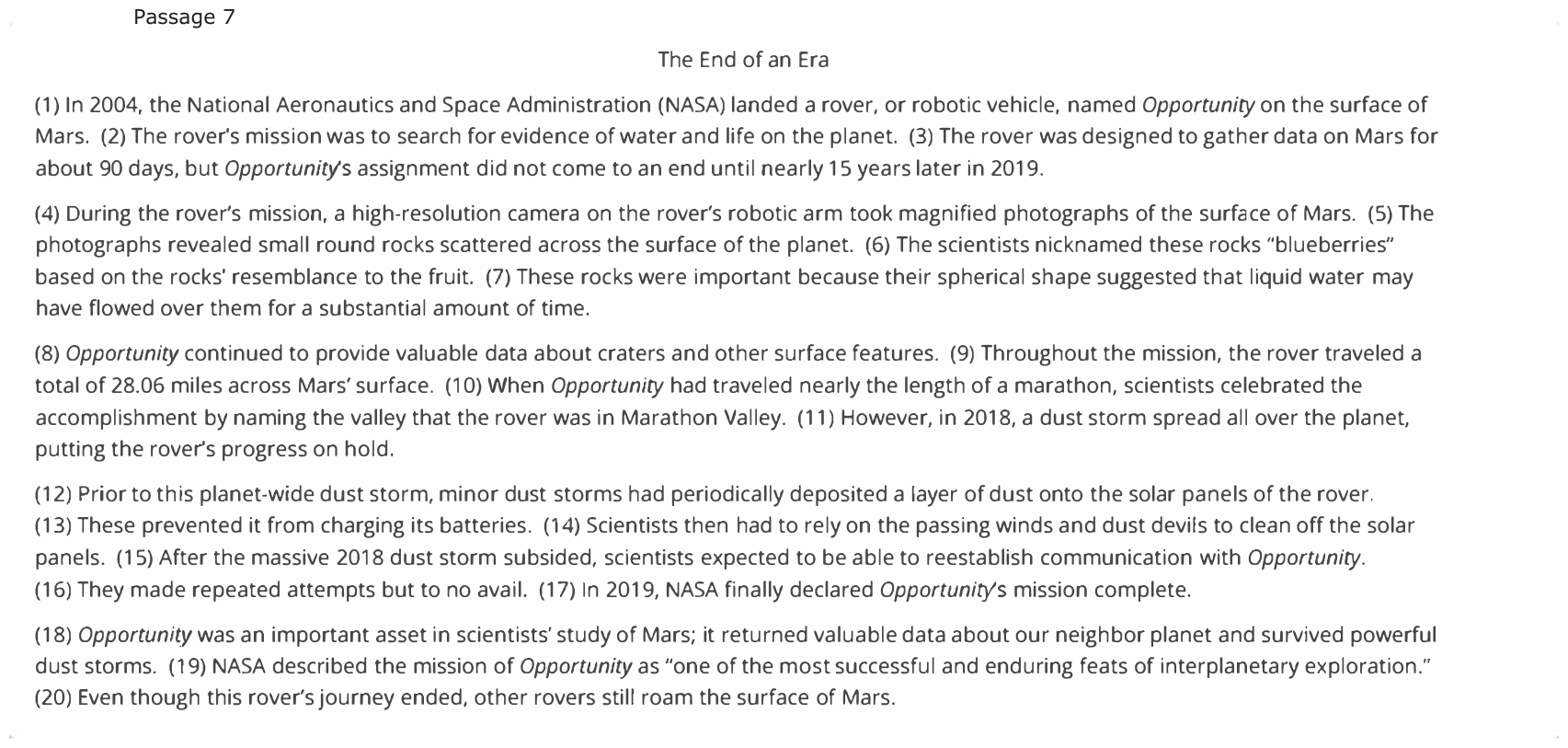
(1) In 2004, the National Aeronautics and Space Administration (NASA) landed a rover, or robotic vehicle, named Opportunity on the surface of Mars. (2) The rover’s mission was to search for evidence of water and life on the planet. (3) The rover was designed to gather data on Mars for about 90 days, but Opportunity’s assignment did not come to an end until nearly 15 years later in 2019.
(4) During the rover’s mission, a high-resolution camera on the rover’s robotic arm took magnified photographs of the surface of Mars. (5) The photographs revealed small round rocks scattered across the surface of the planet. (6) The scientists nicknamed these rocks “blueberries” based on the rocks’ resemblance to the fruit. (7) These rocks were important because their spherical shape suggested that liquid water may have flowed over them for a substantial amount of time.
(8) Opportunity continued to provide valuable data about craters and other surface features. (9) Throughout the mission, the rover traveled a total of 28.06 miles across Mars’ surface. (10) When Opportunity had traveled nearly the length of a marathon, scientists celebrated the accomplishment by naming the valley that the rover was in Marathon Valley. (11) However, in 2018, a dust storm spread all over the planet, putting the rover’s progress on hold.
(12) Prior to this planet-wide dust storm, minor dust storms had periodically deposited a layer of dust onto the solar panels of the rover. (13) These prevented it from charging its batteries. (14) Scientists then had to rely on the passing winds and dust devils to clean off the solar panels. (15) After the massive 2018 dust storm subsided, scientists expected to be able to reestablish communication with Opportunity. (16) They made repeated attempts but to no avail. (17) In 2019, NASA finally declared Opportunity’s mission complete.
(18) Opportunity was an important asset in scientists’ study of Mars; it returned valuable data about our neighbor planet and survived powerful dust storms. (19) NASA described the mission of Opportunity as “one of the most successful and enduring feats of interplanetary exploration.” (20) Even though this rover’s journey ended, other rovers still roam the surface of Mars.
Question
What is the best way to combine sentences 12 and 13?
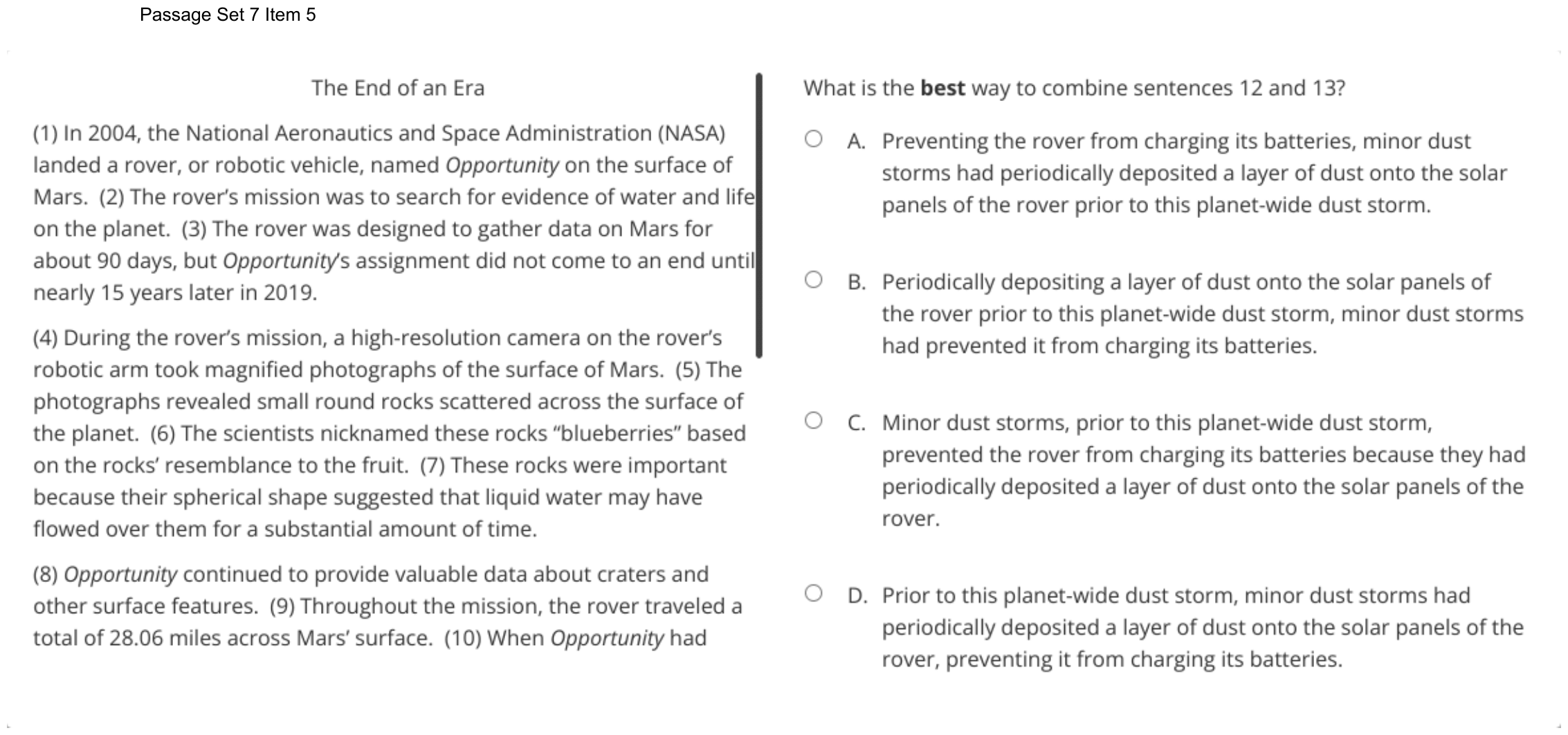
- APreventing the rover from charging its batteries, minor dust storms had periodically deposited a layer of dust onto the solar panels of the rover prior to this planet-wide dust storm.
- BPeriodically depositing a layer of dust onto the solar panels of the rover prior to this planet-wide dust storm, minor dust storms had prevented it from charging its batteries.
- CMinor dust storms, prior to this planet-wide dust storm, prevented the rover from charging its batteries because they had periodically deposited a layer of dust onto the solar panels of the rover.
- DPrior to this planet-wide dust storm, minor dust storms had periodically deposited a layer of dust onto the solar panels of the rover, preventing it from charging its batteries.
Show the answer
Correct answer: D
The question asks for the best way to combine sentences 12 and 13.
A. Incorrect. The phrase “this planet-wide dust storm” in the original sentence 12 makes a direct reference to sentence 11 and therefore acts as a transition that should be kept at the beginning. In this sentence, the transition phrase is placed at the end of the sentence, making the phrase confusing. In addition, the sentence is unnecessarily repetitive and wordy.
B. Incorrect. This combination unnecessarily turns sentence 12 into an overly long participial phrase, making the connection between “it” and its antecedent, “the rover,” unclear and distracting from the subject of the sentence, “minor dust storms.”
C. Incorrect. Not only does this combination move the reference to “this planet-wide dust storm” farther from sentence 11, but it is also unnecessarily wordy, adding “because” and repeating “the rover.”
D. CORRECT. This sentence efficiently and accurately adds sentence 13 to sentence 12 as a participial phrase by changing “These prevented” to “preventing,” while also retaining the meanings of the original sentences 12 and 13.
Question analysis
This sentence-combining question asks for the best way to join two sentences from the rover passage: one saying minor dust storms had periodically coated the rover's solar panels, the other saying this kept it from charging its batteries. The four versions keep the same facts in different orders, so students must judge which is clearest and most concise in context.
- Grade level
- Grade 8 reading and task
- Compared with grade 7
- Above grade 7 Combining two sentences is grade 7 work, usually with one version clearly better. These four are long, keep the same facts and differ in order and wording, so students must weigh clarity and concision across nearly identical sentences, more than typical.
- Estimated difficulty
- Hard: combines ideas, needs a plan, and has more than one tempting wrong answer.
- Thinking it demands
- Depth of knowledge 2, skills and concepts · mainly evaluate
- What makes it hard
- How sentences fit together moderate
- Every choice must be checked moderate
- Complex sentences minor
- Evidence
- Answered from one sentence or line
- Reading level
- Passage: about grade 11, 337 words; question and choices: about grade 13, 129 words.
- Corrected from the DOE handbook
- Two grammar terms in the explanation were corrected.
- Students, last 30 days
- Not enough answers yet to show (it takes 10).
Why it is hard, traps and wrong answers (shows the answer)
Why it is hard
None of the versions is plainly ungrammatical, so the ear gives little help, and the version with “because” looks best to students who value a clearly stated cause. Its cost is wordiness and a weaker link: the result comes first and the reference back to sentence 11 is buried mid-sentence. The question rewards keeping the original order, cause then effect, and folding sentence 13 in as a short closing phrase.
How sentences fit together moderate Working it out
“Prior to this planet-wide dust storm” points back to sentence 11, so the best version keeps it first; three versions move it later, which loosens the link between the two sentences. (Halliday & Hasan, 1976)
Every choice must be checked moderate Choosing the answer
All four versions keep every fact of sentences 12 and 13 and run 29 to 32 words, so none can be ruled out by content; order, pronouns and repetition decide. (Embretson & Wetzel, 1987)
Complex sentences minor Understanding the question
Each version is one long sentence built around a participial phrase or a “because” clause, and at that length a stranded “it” or a doubled “the rover” is easy to miss. (Abedi & Lord, 2001; Freedle & Kostin, 1993; Messick, 1989)
Strategy: Read sentence 11 first, then compare the versions on how smoothly each connects to it, how many words it uses, and whether every pronoun has a clear antecedent.
Traps
- Wordy, vague or informal: A revision is grammatical but wordy, imprecise or too casual for the passage.
- Unclear pronoun: A pronoun whose reference is vague or ambiguous, or one in the wrong case.
The wrong answers, classified
A Wordy, vague or informal (Connors & Lunsford, 1988)
Opens with the effect as a participial phrase, which pushes “prior to this planet-wide dust storm,” the link to sentence 11, to the end and names “the rover” twice.
B Unclear pronoun (Connors & Lunsford, 1988)
Packs sentence 12 into a 19-word opening phrase, so “it” follows “this planet-wide dust storm” and no longer points clearly to the rover buried inside the phrase.
C Wordy, vague or informal (Connors & Lunsford, 1988)
Likes the clear cause word “because,” but the result now comes first, “the rover” appears twice, and “prior to this planet-wide dust storm” splits the subject from its verb.
What was corrected from the DOE handbook, and why
- Explanation: The DOE’s explanation of Option B says the combination turns sentence 12 into “an overly long dependent clause,” and its explanation of Option D says Option D adds sentence 13 to sentence 12 “as a dependent clause” by changing “These prevented” to “preventing.” Neither is a clause: “Periodically depositing a layer of dust onto the solar panels of the rover prior to this planet-wide dust storm” (Option B) and “preventing it from charging its batteries” (Option D) have no subject or finite verb of their own. Both are participial phrases, and the site now calls them that. The reasoning and the answer, Option D, are unchanged.
Working it out, step by step
Figure out what the question asks
This question asks for the best way to join sentences 12 and 13 into one sentence. The best version keeps the meaning, uses few words and is clear. It should also connect smoothly to sentence 11, the sentence before.
Read the sentences in order
Sentence 11 tells about the giant 2018 dust storm. Sentence 12 begins “Prior to this planet-wide dust storm.” Prior to means before. That phrase points back to sentence 11, so it works best at the start. Sentence 12 says small storms put dust on the solar panels. Sentence 13 gives the result: “These prevented it from charging its batteries.”
Learn the tool: a participial phrase
A participial phrase is a group of words built on a verb form, often an -ing word. It describes something, but it has no subject and can’t stand alone. Example: The dog ran to the door. It wagged its tail. becomes The dog ran to the door, wagging its tail. Choice D does this. It turns “These prevented” into “preventing.”
Check each choice
- A is wrong. It starts with the result. It moves “prior to this planet-wide dust storm” to the end, far from sentence 11. It also says “the rover” twice.
- B is wrong. Its long opening phrase hides the rover. Then “it” comes after “minor dust storms,” so it is hard to tell what “it” means.
- C is wrong. It adds “because,” puts the result first and says “the rover” twice. It is wordier than D.
- D is right. It keeps the link to sentence 11 first, gives the cause, then adds the result as a short participial phrase.
Watch out: C looks clear because “because” names the cause. But it is longer, and it puts an extra phrase between “Minor dust storms” and its verb.
Choose the answer
So the answer is D: “Prior to this planet-wide dust storm, minor dust storms had periodically deposited a layer of dust onto the solar panels of the rover, preventing it from charging its batteries.”
Why this answer and not the closest wrong one
C is the closest wrong answer, because “because” makes the cause very clear. But C puts the result first and repeats “the rover.” D keeps the original order, cause then result. It also keeps the link to sentence 11 up front, in fewer words.
More questions like this
The original DOE question
The passage “The End of an Era” as printed (page 60)
Question 3 of 6
2024 Test A English, question 46Passage Excerpt from The Highest Tide
Excerpt from The Highest Tide
by Jim Lynch
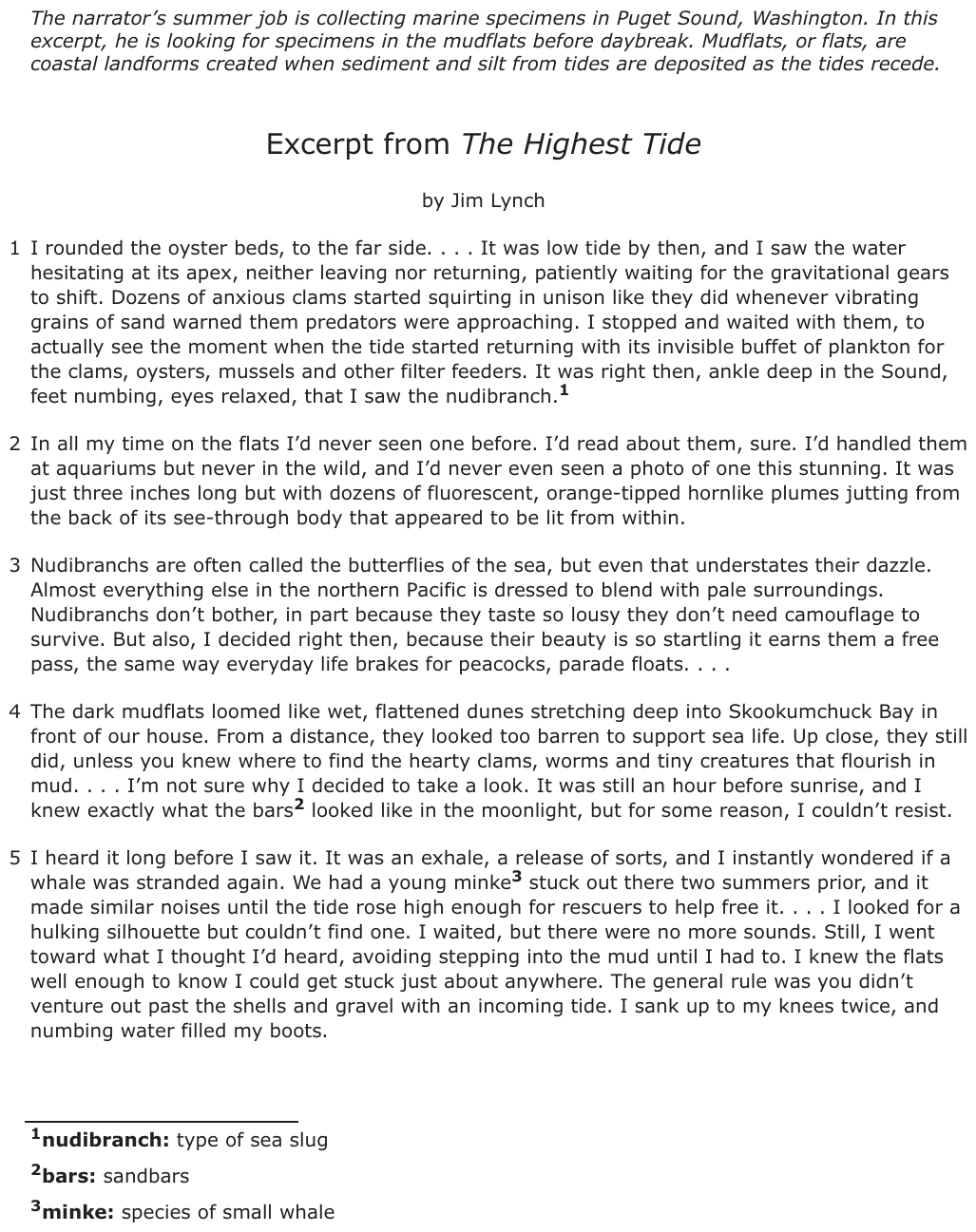
The narrator’s summer job is collecting marine specimens in Puget Sound, Washington. In this excerpt, he is looking for specimens in the mudflats before daybreak. Mudflats, or flats, are coastal landforms created when sediment and silt from tides are deposited as the tides recede.
I rounded the oyster beds, to the far side. . . . It was low tide by then, and I saw the water hesitating at its apex, neither leaving nor returning, patiently waiting for the gravitational gears to shift. Dozens of anxious clams started squirting in unison like they did whenever vibrating grains of sand warned them predators were approaching. I stopped and waited with them, to actually see the moment when the tide started returning with its invisible buffet of plankton for the clams, oysters, mussels and other filter feeders. It was right then, ankle deep in the Sound, feet numbing, eyes relaxed, that I saw the nudibranch.1
In all my time on the flats I’d never seen one before. I’d read about them, sure. I’d handled them at aquariums but never in the wild, and I’d never even seen a photo of one this stunning. It was just three inches long but with dozens of fluorescent, orange-tipped hornlike plumes jutting from the back of its see-through body that appeared to be lit from within.
Nudibranchs are often called the butterflies of the sea, but even that understates their dazzle. Almost everything else in the northern Pacific is dressed to blend with pale surroundings. Nudibranchs don’t bother, in part because they taste so lousy they don’t need camouflage to survive. But also, I decided right then, because their beauty is so startling it earns them a free pass, the same way everyday life brakes for peacocks, parade floats. . . .
The dark mudflats loomed like wet, flattened dunes stretching deep into Skookumchuck Bay in front of our house. From a distance, they looked too barren to support sea life. Up close, they still did, unless you knew where to find the hearty clams, worms and tiny creatures that flourish in mud. . . . I’m not sure why I decided to take a look. It was still an hour before sunrise, and I knew exactly what the bars2 looked like in the moonlight, but for some reason, I couldn’t resist.
I heard it long before I saw it. It was an exhale, a release of sorts, and I instantly wondered if a whale was stranded again. We had a young minke3 stuck out there two summers prior, and it made similar noises until the tide rose high enough for rescuers to help free it. . . . I looked for a hulking silhouette but couldn’t find one. I waited, but there were no more sounds. Still, I went toward what I thought I’d heard, avoiding stepping into the mud until I had to. I knew the flats well enough to know I could get stuck just about anywhere. The general rule was you didn’t venture out past the shells and gravel with an incoming tide. I sank up to my knees twice, and numbing water filled my boots.
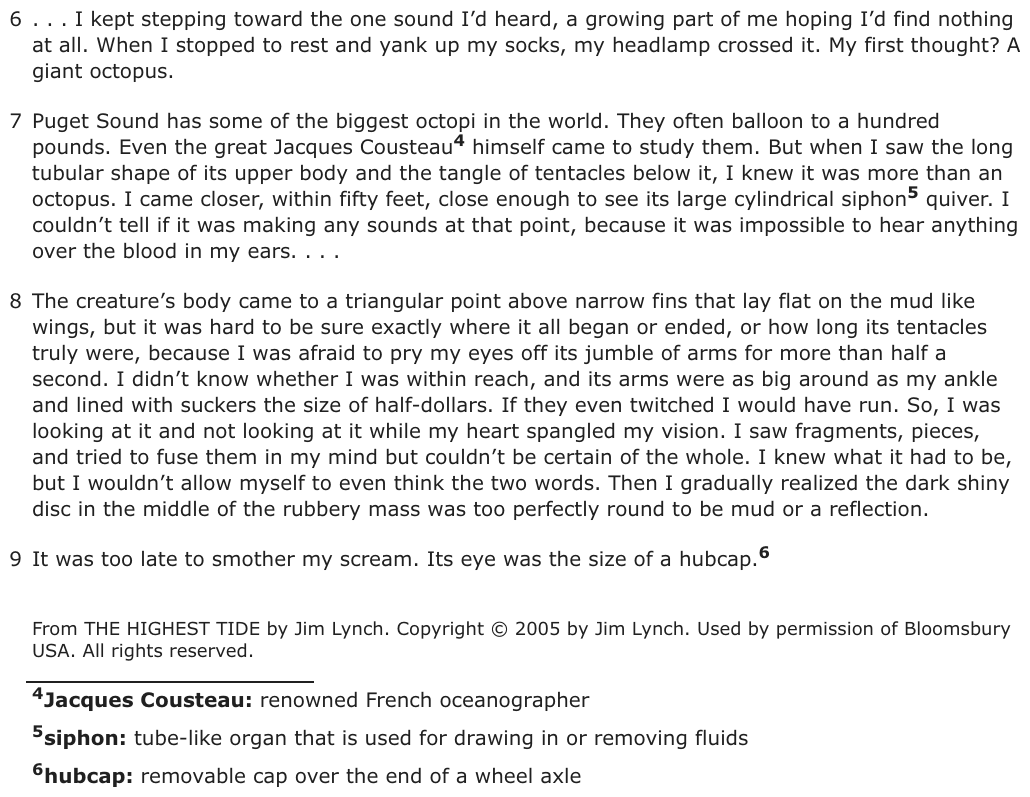
. . . I kept stepping toward the one sound I’d heard, a growing part of me hoping I’d find nothing at all. When I stopped to rest and yank up my socks, my headlamp crossed it. My first thought? A giant octopus.
Puget Sound has some of the biggest octopi in the world. They often balloon to a hundred pounds. Even the great Jacques Cousteau4 himself came to study them. But when I saw the long tubular shape of its upper body and the tangle of tentacles below it, I knew it was more than an octopus. I came closer, within fifty feet, close enough to see its large cylindrical siphon5 quiver. I couldn’t tell if it was making any sounds at that point, because it was impossible to hear anything over the blood in my ears. . . .
The creature’s body came to a triangular point above narrow fins that lay flat on the mud like wings, but it was hard to be sure exactly where it all began or ended, or how long its tentacles truly were, because I was afraid to pry my eyes off its jumble of arms for more than half a second. I didn’t know whether I was within reach, and its arms were as big around as my ankle and lined with suckers the size of half-dollars. If they even twitched I would have run. So, I was looking at it and not looking at it while my heart spangled my vision. I saw fragments, pieces, and tried to fuse them in my mind but couldn’t be certain of the whole. I knew what it had to be, but I wouldn’t allow myself to even think the two words. Then I gradually realized the dark shiny disc in the middle of the rubbery mass was too perfectly round to be mud or a reflection.
It was too late to smother my scream. Its eye was the size of a hubcap.6
From THE HIGHEST TIDE by Jim Lynch. Copyright © 2005 by Jim Lynch. Used by permission of Bloomsbury USA. All rights reserved.
1nudibranch: type of sea slug
2bars: sandbars
3minke: species of small whale
4Jacques Cousteau: renowned French oceanographer
5siphon: tube-like organ that is used for drawing in or removing fluids
6hubcap: removable cap over the end of a wheel axle
Question
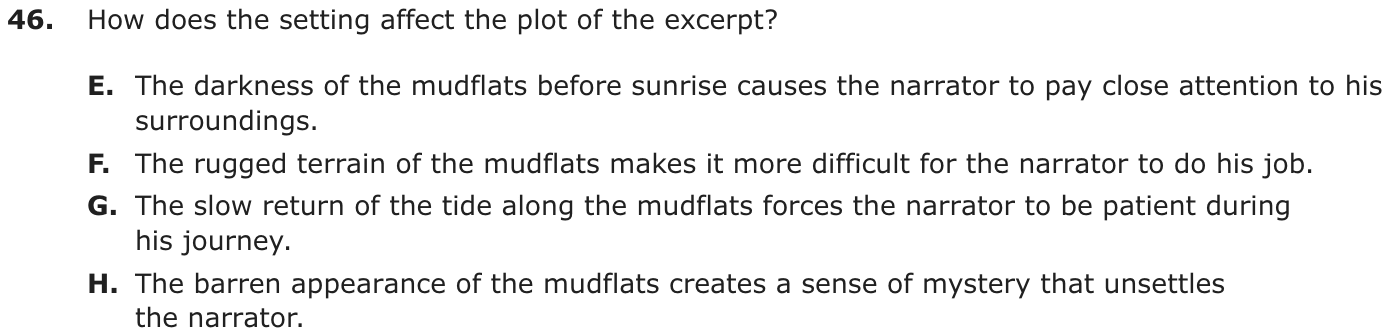
How does the setting affect the plot of the excerpt?
- AThe darkness of the mudflats before sunrise causes the narrator to pay close attention to his surroundings.
- BThe rugged terrain of the mudflats makes it more difficult for the narrator to do his job.
- CThe slow return of the tide along the mudflats forces the narrator to be patient during his journey.
- DThe barren appearance of the mudflats creates a sense of mystery that unsettles the narrator.
Show the answer
Correct answer: A
The question asks how the setting affects the plot of the excerpt.
A. CORRECT. In paragraph 4, the narrator says that it is an hour before sunrise. It is difficult to see because the mudflats are dark, so the narrator, while familiar with the terrain of the mudflats, is cautious.
B. Incorrect. While the terrain of the mudflats is challenging because of the “wet, flattened dunes” (paragraph 4), the narrator is familiar with the terrain and moves carefully. In addition, the excerpt focuses on the narrator’s curiosity and enjoyment as he explores the mudflats, not on his work collecting specimens.
C. Incorrect. In paragraph 1, the narrator watches the water “hesitating at its apex” and “patiently waiting for the gravitational gears to shift.” This illustrates that the narrator is already familiar with the changes in his surroundings, that the tide is slow to move in, and that he can move carefully through the mudflats without the threat of rising water.
D. Incorrect. While the narrator is on the mudflats for the entire excerpt, the phrase “eyes relaxed” in paragraph 1 indicates that the narrator feels comfortable there. The narrator does not show fear until paragraph 6, when a growing fear about the unknown creature arises.
Question analysis
Set on the mudflats of Puget Sound before daybreak, this excerpt from the novel The Highest Tide is the basis for a question about how setting affects plot. Students must link features of the place and time to what the narrator does across the whole excerpt, and each choice pairs a real feature of the setting with an effect that may or may not be in the text.
- Grade level
- Grade 8 reading and task
- Compared with grade 7
- Above grade 7 Analyzing how setting shapes plot is a grade 7 literary standard, but the excerpt never states the link: the effect must be inferred from scattered details, and every choice names a genuine feature of the flats, which is beyond typical work.
- Estimated difficulty
- Hard: combines ideas, needs a plan, and has more than one tempting wrong answer.
- Thinking it demands
- Depth of knowledge 3, strategic thinking · mainly analyze
- What makes it hard
- Reading between the lines major
- The right answer is reworded moderate
- Evidence in several places moderate
- Evidence
- Answered from the whole text
- Reading level
- Passage: about grade 6, 902 words; question and choices: about grade 8, 77 words.
- Corrected from the DOE handbook
- A statement in the explanation that contradicted the excerpt’s introduction was corrected.
- Students, last 30 days
- Not enough answers yet to show (it takes 10).
Why it is hard, traps and wrong answers (shows the answer)
Why it is hard
Every choice names a real feature of the mudflats, so the question turns on which feature the excerpt actually shows shaping events. The darkness never gets a sentence of its own; it is felt in a sound heard before anything is seen, a silhouette that cannot be found and a headlamp beam. The barren look of the flats is the strongest pull, because the scene is eerie, but the narrator knows life hides in the mud and his unease comes from the creature.
Reading between the lines major Working it out
The excerpt never says the darkness changes anything; the effect must be assembled from the hour before sunrise, the sound heard “long before I saw it”, the missing silhouette and the headlamp that finally finds the creature. (Graesser, Singer & Trabasso, 1994; Kintsch, 1998)
The right answer is reworded moderate Choosing the answer
The right choice uses no words from the text, while the wrong ones echo it: the “barren” look of the flats, the water “patiently waiting”, the narrator's summer job. (Freedle & Kostin, 1993; Kirsch & Mosenthal, 1990)
Evidence in several places moderate Working it out
The darkness is established in paragraph 4 and felt in paragraphs 5, 6 and 8, so no single passage shows the setting at work. (Kirsch & Mosenthal, 1990; Gorin & Embretson, 2006)
Strategy: Collect the details of time, place and conditions across the excerpt, then for each choice ask whether the text shows that feature of the setting actually changing what the narrator does.
Traps
- Twists what the text says: Uses the text's topic and ideas but changes what it says: who did it, how much, when, or why.
- Reads too much in: A reasonable-sounding conclusion that goes further than the text allows.
The wrong answers, classified
B Reads too much in (Graesser, Singer & Trabasso, 1994)
Combines the introduction's specimen job with his sinking to his knees to infer a harder workday, though the excerpt follows a strange sound and never shows his work suffering.
C Twists what the text says (King et al., 2004)
Borrows paragraph 1's water “patiently waiting” at low tide and has the tide force the narrator to wait, when he chose to stop and watch it turn.
D Twists what the text says (King et al., 2004)
Joins the flats' barren look from a distance to his later fear, but he knows life hides in the mud, and what unsettles him is the creature, not the landscape.
What was corrected from the DOE handbook, and why
- Explanation: In rejecting choice B, the handbook says “the excerpt shows that the narrator explores the mudflats for curiosity and enjoyment, not work.” But the introduction says the narrator’s summer job is collecting marine specimens and that “in this excerpt, he is looking for specimens in the mudflats before daybreak.” The explanation now says the excerpt focuses on his curiosity and enjoyment as he explores the mudflats, not on his work collecting specimens. That keeps the handbook’s point (the excerpt is not about the terrain making his job harder) without contradicting the introduction.
Working it out, step by step
Know what setting and plot mean
The setting is where and when a story happens. The plot is the chain of events. This asks which part of the setting changes what happens or what the narrator does.
Find the time of day
Paragraph 4 says, “It was still an hour before sunrise.” The narrator is out on the mudflats in the dark. The only light comes from the moon and his headlamp.
See how the dark shapes events
Because it is dark, he must rely on sounds and small clues. He says, “I heard it long before I saw it.” He looks for “a hulking silhouette,” a dark outline, but can’t find one. He spots the creature only when “my headlamp crossed it.” Then he stares hard, trying to make out its shape. The darkness keeps him alert and watching closely.
Check each choice
- A fits: the dark makes him pay close attention to everything around him.
- B is wrong because the excerpt follows a strange sound and never shows the ground making his job harder.
- C is wrong because in paragraph 1 he chooses to stop and watch the tide, and nothing forces him.
- D is wrong because he knows life hides in the mud, and what scares him is the creature.
Watch out: D feels right because the scene is eerie. But the flats’ empty look never troubles him.
Choose the answer
The darkness before sunrise is what keeps the narrator listening and looking so carefully. So the answer is A.
Why this answer and not the closest wrong one
D comes closest, because the dark flats do feel spooky. But the narrator says they only look “too barren to support sea life” from far away, and he knows better. His fear comes from the creature. The darkness, though, shapes every step: he hears before he sees and must watch closely.
More questions like this
The original DOE question
The passage “Excerpt from The Highest Tide” as printed (pages 64–65)
Question 4 of 6
2018 Test B Math, question 46Question
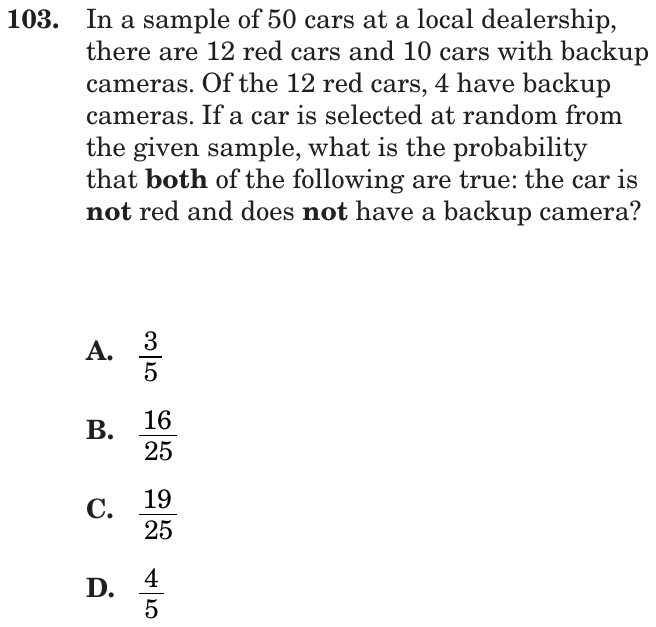
In a sample of 50 cars at a local dealership, there are 12 red cars and 10 cars with backup cameras. Of the 12 red cars, 4 have backup cameras. If a car is selected at random from the given sample, what is the probability that both of the following are true: the car is not red and does not have a backup camera?
- A
- B
- C
- D
Show the answer
Correct answer: B
Create a chart using the given information and use subtraction to figure out how many cars are not red and do not have a back-up camera:
| Red | Not Red | TOTAL | |
| Back-up Camera | 4 | 6 (10-4) |
10 |
| No back-up Camera | 32 (38-6) |
||
| TOTAL | 12 | 38 (50-12) |
50 |
The probability of selecting a car that meets both conditions from the total of 50 cars at the dealership is .
Question analysis
In a sample of 50 cars, 12 are red, 10 have backup cameras, and 4 of the red cars have cameras. Students find the probability that a randomly chosen car is neither red nor equipped with a camera. It tests compound probability with overlapping groups, and the overlap between red cars and camera cars is what makes it tricky.
- NYS standards
- Grade level
- Grade 7 content, by NYS standard
- Compared with grade 7
- Above grade 7 Grade 7 compound probability usually uses a ready-made table or tree. Here students must build the two-way table from words, handle an overlap, and use a "not this and not that" condition, several steps beyond typical work.
- Estimated difficulty
- Hard: combines ideas, needs a plan, and has more than one tempting wrong answer.
- Thinking it demands
- Depth of knowledge 2, skills and concepts · mainly apply
- What makes it hard
- Much to keep track of major
- Many steps moderate
- A very close wrong answer moderate
- Complex sentences minor
- Solution
- 4 steps
- Reading level
- Question and choices: about grade 6, 63 words.
- Corrected from the DOE handbook
- A grammar slip in the explanation was corrected.
- Students, last 30 days
- Not enough answers yet to show (it takes 10).
Why it is hard, traps and wrong answers (shows the answer)
Why it is hard
This is an overlap problem dressed as probability: the hard part is counting the cars that avoid both features, not the division by 50. A two-way table makes it routine, but students working in their heads often keep only one of the two conditions. The question rewards placing the 4 red cars with cameras in the table before doing any subtraction.
Much to keep track of major Working it out
Three overlapping counts, 12 red, 10 with cameras and 4 that are both, must be sorted into four groups before the wanted one, neither red nor with a camera, can be found. (Sweller, 1988; Carpenter, Just & Shell, 1990)
Many steps moderate Working it out
Find the non-red cars with cameras, 10 − 4 = 6, and the non-red cars, 50 − 12 = 38, subtract to get 32, then simplify 32/50. (Daniel & Embretson, 2010; Enright, Morley & Sheehan, 2002)
A very close wrong answer moderate Choosing the answer
19/25, or 38/50, has the same denominator as the right 16/25 and sits just above it; only removing the 6 non-red cars that have cameras from the 38 separates them. (Embretson & Wetzel, 1987; Gorin & Embretson, 2006; Ascalon et al., 2007)
Complex sentences minor Understanding the question
The last sentence stacks "both of the following are true", a colon and two negatives, "not red" and "does not have"; untangling it is reading work, not extra math. (Abedi & Lord, 2001; Freedle & Kostin, 1993; Messick, 1989)
Strategy: Draw a two-way table with red and not red across, camera and no camera down, fill in the given counts, and complete the missing cells by subtraction.
Traps
- Misreads the question: Misses or misreads a condition or a word in the question: "at least", "each", "remaining", "not".
- Answers a different question: A choice is right for another quantity: the other unknown, the rest instead of the part, the part instead of the whole.
The wrong answers, classified
A Answers a different question (King et al., 2004; Hegarty, Mayer & Monk, 1995)
Finds the 6 non-red cars with cameras and divides by the 10 camera cars, 6/10 = 3/5, a different probability from the one asked.
C Misreads the question (Hegarty, Mayer & Monk, 1995)
Uses only the 38 cars that are not red, 38/50, and ignores the second condition that the car also lacks a backup camera.
D Misreads the question (Hegarty, Mayer & Monk, 1995)
Counts only the 40 cars without backup cameras, 40/50, dropping the requirement that the car must not be red as well.
What was corrected from the DOE handbook, and why
- Explanation: The handbook says “a car that meet both conditions”; the site says “a car that meets both conditions.”
Worked solution, step by step
Formulas used
- Probability
- P is the probability, the chance that something happens. The top counts the results you want. The bottom counts every possible result. Use it when each result is equally likely, like picking one at random.
Sort out what you know
There are 50 cars. Of these, 12 are red and 10 have backup cameras. Of the red cars, 4 have cameras. You pick one car at random. You need the chance that “both of the following are true”: the car is not red, and it has no camera.
Set up a two-way table
A two-way table sorts each car by two things at once: its color and its camera. Put in the numbers you know.
Red Not red Total Camera 4 ? 10 No camera ? Total 12 ? 50 Fill in the missing numbers
Not red with a camera: cars.
All cars that are not red: cars.
Not red with no camera: cars.
Watch out: the 38 cars that are not red include 6 with cameras. Using 38 gives , choice C. Using all 40 cars with no camera gives , choice D.
Write the probability
Use the probability formula. There are 32 cars you want out of 50 cars in all.
Divide the top and bottom by 2.
So the answer is B, .
Check your answer
Finish the table. Red cars with no camera: . Now add the four inside boxes: . That is every car, so the numbers fit. Also, the cars with no camera are , and too.
More questions like this
The original DOE question
Question 5 of 6
2026 Practice Test D Math, question 36Question
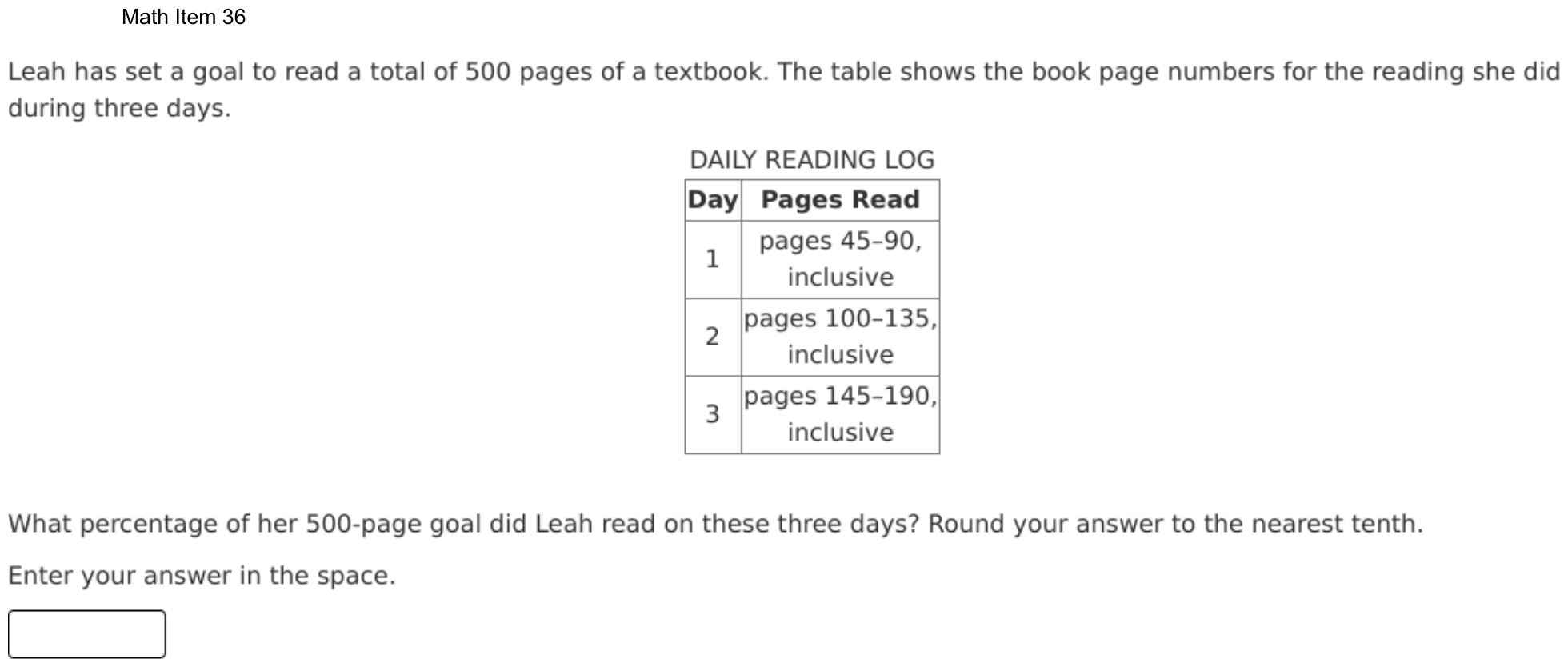
Leah has set a goal to read a total of 500 pages of a textbook. The table shows the book page numbers for the reading she did during three days.
DAILY READING LOG
| Day | Pages Read |
|---|---|
| 1 | pages 45–90, inclusive |
| 2 | pages 100–135, inclusive |
| 3 | pages 145–190, inclusive |
What percentage of her 500-page goal did Leah read on these three days? Round your answer to the nearest tenth.
Enter your answer in the space.
Fill-in question: work out the answer and type it as a number.
Show the answer
Correct answer: 25.6%
First, determine the number of pages read each day. Since the pages per assignment are inclusive, subtract the first page from the last page assigned and then add 1 to determine the pages read for each day.
Day 1: pages
Day 2: pages
Day 3: pages
Leah read a total of 128 pages, since .
To determine the percent, express 128 pages out of 500 pages as a fraction.
Question analysis
Leah's daily reading log lists three ranges of textbook pages, each marked inclusive, and her goal is 500 pages. This percent question asks what percentage of the goal she read over the three days, rounded to the nearest tenth and typed in. Counting the pages in each inclusive range correctly is the tricky step before the percent.
- Grade level
- Grade 7 content, by NYS standard
- Compared with grade 7
- Above grade 7 Finding what percent one number is of another is grade 6 and 7 work. This adds three inclusive page ranges to count, which takes more care than subtracting, then a rounding step, all typed with no choices to check against.
- Estimated difficulty
- Hard: combines ideas, needs a plan, and has more than one tempting wrong answer.
- Thinking it demands
- Depth of knowledge 2, skills and concepts · mainly apply
- What makes it hard
- Something you must already know moderate
- Many steps moderate
- An answer in an unexpected form minor
- Solution
- 4 steps
- Reading level
- Question and choices: about grade 3, 66 words.
- Students, last 30 days
- Not enough answers yet to show (it takes 10).
Why it is hard, traps and wrong answers (shows the answer)
Why it is hard
Counting pages in a range is the whole difficulty; the percent at the end is routine once the total is right. Subtracting first from last feels natural, and here it even rewards the student with a round 25%, so nothing looks wrong. Checking the rule on a tiny range, pages 1 to 3, which is 3 pages and not 2, fixes the count, and the instruction to round to the nearest tenth hints that the answer is not a whole number.
Something you must already know moderate Working it out
Every row says inclusive, but nothing says that pages 45 to 90 hold 90 − 45 + 1 = 46 pages; subtracting alone loses one page on each of the three days. (Anderson & Krathwohl, 2001)
Many steps moderate Working it out
Three page counts, a sum, a division by 500 and a change to a percent come in sequence, and a one-page error in each count carries through to the end. (Daniel & Embretson, 2010; Enright, Morley & Sheehan, 2002)
An answer in an unexpected form minor Choosing the answer
The answer is typed with no choices, and the miscounted total, 125 pages, gives a tidy 25% that looks more finished than the right value with its tenth. (Enright, Morley & Sheehan, 2002)
Strategy: Count each day's pages carefully, testing your method on a short range such as pages 1–3, add the three days, divide by 500, and write the result as a percent to the nearest tenth.
Traps
- Counting the ends: Inclusive or exclusive ends, fence posts, consecutive numbers: an answer that is one too many or too few, or an endpoint drawn open where it belongs closed (or the reverse).
- Stops one step early: A choice is a number from partway through the solution.
- Misreads the question: Misses or misreads a condition or a word in the question: "at least", "each", "remaining", "not".
The wrong answers, classified
25 Counting the ends (Brown & Burton, 1978)
Subtracts the first page from the last for each day, 45 + 35 + 45 = 125 pages, forgetting that an inclusive range counts both end pages, so 125 ÷ 500 = 25%.
0.256 Stops one step early (King et al., 2004; Gierl et al., 2017)
Counts the 128 pages and divides by 500 correctly, then enters the decimal 0.256, one step short of multiplying by 100 to make a percent.
26 Misreads the question (Hegarty, Mayer & Monk, 1995)
Finds 25.6% correctly but rounds it to the nearest whole percent, overlooking the instruction to round to the nearest tenth.
Worked solution, step by step
Formulas used
- Counting pages in an inclusive range
- Inclusive means the first and last pages are both read. Subtracting counts the steps from the first page to the last. That misses one page, so add 1. Test it: pages 1 to 3 are 3 pages, and 3 − 1 + 1 = 3.
- Percent of a total
- The part is the amount you have, here the pages read. The whole is the amount you compare with, here the 500-page goal. Dividing gives a decimal. Multiplying by 100 turns it into a percent, a number out of 100.
Sort out the question
Leah’s goal is 500 pages. The log shows three days:
- Day 1: pages 45 to 90
- Day 2: pages 100 to 135
- Day 3: pages 145 to 190
Each range is inclusive. You need the percent of 500 pages she read, rounded to the nearest tenth.
Count the pages each day
Use the rule for an inclusive range: last page minus first page, plus 1.
Watch out: subtracting alone gives 45, 35 and 45 pages. That is 125 pages, which is exactly 25%. A round answer like that can hide the mistake.
Add the three days
Add the pages from all three days to get her total:
Leah read 128 pages in all. This is the part you compare with the goal.
Change to a percent
Divide the pages read by the goal, then multiply by 100:
Leah read 25.6% of her goal. That already ends in tenths, so no rounding is needed.
Watch out: 0.256 is a decimal, not a percent. And 26 rounds to a whole number, not to the nearest tenth.
Enter the answer
The box has no % sign, but the question asks for a percentage, so the number in the box is the percent. Type it with its decimal point. Typing 25.6% also counts on this site. So you would enter 25.6.
Check your answer
Estimate. 10% of 500 pages is 50 pages. 128 pages is a bit more than 2 × 50 = 100, so the answer is between 20% and 30%. Then check exactly: pages. It matches.
More questions like this
The original DOE question
Question 6 of 6
2018 Test A Math, question 44Question

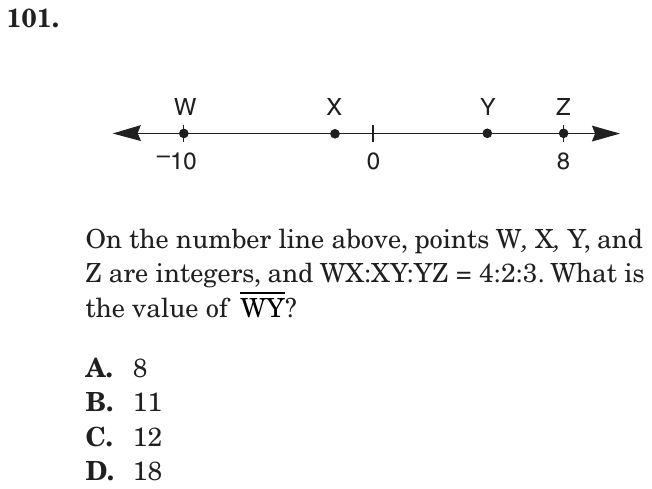
On the number line above, points , , , and are integers, and . What is the value of ?
- A8
- B11
- C12
- D18
Show the answer
Correct answer: C
Convert the ratios into fractions of . Use the sum of the ratios for the denominator.
The part of that is is the sum of those fractions:
Find the length of :
The value of is .
Question analysis
This number line question places integer points W, X, Y and Z on a line and gives the ratio of the segments WX, XY and YZ as 4 to 2 to 3. Students find the whole length from W to Z, split it by the ratio, and add the parts that make up WY. Mixing up a part with the whole is the main risk.
- Grade level
- Grade 7 content, by NYS standard
- Compared with grade 7
- Above grade 7 Grade 7 students find distances on a number line and use part-to-whole ratios, usually separately. This item joins them: a negative endpoint, a three-term ratio and a choice of which segments to combine.
- Estimated difficulty
- Hard: combines ideas, needs a plan, and has more than one tempting wrong answer.
- Thinking it demands
- Depth of knowledge 2, skills and concepts · mainly apply
- What makes it hard
- Combines ideas moderate
- Reading a figure, table or graph moderate
- Many steps minor
- Solution
- 3 steps
- Reading level
- Question and choices: about grade 10, 21 words.
- Corrected from the DOE handbook
- Equations in the explanation that mixed up a fraction of a length with the length itself were corrected.
- Students, last 30 days
- Not enough answers yet to show (it takes 10).
Why it is hard, traps and wrong answers (shows the answer)
Why it is hard
Each step is routine, but the question keeps asking for a different piece of the line: the whole WZ, the part WX, and finally WY, which is two parts added together. Two of the wrong choices are exactly those other pieces. Students who mark the actual positions, X at −2 and Y at 2, can check the ratio before answering.
Combines ideas moderate Working it out
A three-part ratio, 4:2:3, must be applied to a length found from a negative endpoint, 8 − (−10) = 18, joining ratio and number-line distance. (Embretson, 1998; Daniel & Embretson, 2010)
Reading a figure, table or graph moderate Understanding the question
Only W at −10 and Z at 8 are labeled, and the drawing is not to scale: Y is drawn nearer 5 than 2, so reading WY from the picture fails. (Lesh, Post & Behr, 1987; Kirsch & Mosenthal, 1990)
Many steps minor Working it out
Find WZ, split it into 9 equal parts of 2, then add the 4 parts of WX and the 2 parts of XY. (Daniel & Embretson, 2010; Enright, Morley & Sheehan, 2002)
Strategy: Find the length WZ from the endpoints on the number line, divide it by the total number of ratio parts, and multiply by the parts from W to Y.
Traps
- Stops one step early: A choice is a number from partway through the solution.
- Answers a different question: A choice is right for another quantity: the other unknown, the rest instead of the part, the part instead of the whole.
- Counting the ends: Inclusive or exclusive ends, fence posts, consecutive numbers: an answer that is one too many or too few, or an endpoint drawn open where it belongs closed (or the reverse).
The wrong answers, classified
A Stops one step early (King et al., 2004; Gierl et al., 2017)
Finds WX, 4/9 of 18 = 8, and stops without adding XY's 4 to reach Y; 8 also matches Z's label.
B Counting the ends (Brown & Burton, 1978)
Places Y at 2 but counts the integers strictly between −10 and 2, which are −9 through 1, getting 11 instead of the distance 12.
D Answers a different question (King et al., 2004; Hegarty, Mayer & Monk, 1995)
Gives the whole length WZ, 8 − (−10) = 18, instead of the part from W to Y.
What was corrected from the DOE handbook, and why
- Explanation: The handbook writes WX = 4/9, XY = 2/9 and WY = 2/3, and then says “The value of WY is 2/3(18) = 12”. Those fractions are parts of WZ, not the lengths themselves (WX is 8 and WY is 12), so WY cannot be both 2/3 and 12. The lines now read WX = 4/9 WZ, XY = 2/9 WZ and WY = 2/3 WZ. The method and the answer are unchanged.
Worked solution, step by step
Formulas used
- Distance on a number line
- d is the distance between two points. b is the point on the right and a is the point on the left. Subtracting left from right always gives a positive distance. It works even when a is negative.
- Size of one part of a ratio
- u is the size of one part. L is the whole length being shared. p is the total number of parts, found by adding the numbers in the ratio. Every part is the same size, so you share the length equally.
Sort out what you know
W is at −10 and Z is at 8. X and Y are between them. The ratio 4:2:3 means WX is 4 parts, XY is 2 parts and YZ is 3 parts. All the parts are the same size.
You need the length WY, from W to Y. The drawing is not exact, so use the numbers, not the picture.
Find the whole length WZ
WZ is 18 units long. Subtracting a negative number is the same as adding.
Find the size of one part
Add the ratio numbers to get the number of parts:
Share the 18 units equally among 9 parts:
Each part is 2 units long.
Find WY
WY is WX and XY together, so it has 4 + 2 = 6 parts:
Watch out: WX alone is 4 × 2 = 8, which is choice A. And 18 is the whole line, choice D. So the answer is C, 12.
Check your answer
Place the points. W is at −10. X is 8 units to the right, at −2. Y is 4 more, at 2. Z is 6 more, at 8, which matches its label. And the distance from −10 to 2 is 2 − (−10) = 12.
More questions like this
The original DOE question