3 English and 3 math
Here are 6 random questions to try. Takers earning below 75% are unlikely to receive an offer. You have 1 minute 48 seconds per question on the real exam.
Question 1 of 6
2024 Test B English, question 22Passage Excerpt from “How Exercise Could Help You Learn a New Language”
Excerpt from “How Exercise Could Help You Learn a New Language”
by Gretchen Reynolds
Many scientists suspect that exercise alters the biology of the brain in ways that make it more malleable and receptive to new information, a process that scientists refer to as plasticity.
But many questions have remained unanswered about movement and learning, including whether exercise is most beneficial before, during or after instruction and how much and what types of exercise might be best.
So for a new study, which was published recently in PLOS One, researchers in China and Italy decided to home in on language learning and the adult brain.
Language learning is interesting. As young children, almost all of us picked up our first language easily. We didn’t have to be formally taught; we simply absorbed words and concepts.
But by early adulthood, the brain generally begins to lose some of its innate language capability. It displays less plasticity in areas of the brain related to language. As a result, for most of us, it becomes harder to learn a second language after childhood.
To see what effects exercise might have on this process, the researchers first recruited 40 college-age Chinese men and women who were trying to learn English. The students had some facility with this second language but were far from proficient.
The researchers then divided the students into two groups. Those in one group would continue to learn English as they had before, primarily while seated in rote vocabulary-memorization sessions.
The others would supplement these sessions with exercise.
Specifically, the students would ride exercise bikes at a gentle pace (about 60 percent of their maximum aerobic capacity) beginning 20 minutes before the start of the lessons and continuing throughout the 15 minutes or so of instruction.
Both groups learned their new vocabulary by watching words projected onto large screens, together with comparable pictures, such as “apple” and a Red Delicious. They were shown 40 words per session, with the sequence repeated several times.
Afterward, the students all rested briefly and then completed a vocabulary quiz, using computer keys to note as quickly as possible whether a word was with its correct picture. They also responded to sentences using the new words, marking whether the sentences were accurate or, in the case of “The apple is a dentist,” nonsensical. Most linguists1 feel that understanding sentences shows greater mastery of a new language than does simple vocabulary improvement.
The students completed eight vocabulary sessions over the course of two months.
And at the end of each lesson, the students who had ridden bikes performed better on the subsequent vocabulary tests than did the students who sat still.
They also became more proficient at recognizing proper sentences than the sedentary students, although that difference did not emerge until after several weeks of instruction.
Perhaps most interesting, the gains in vocabulary and comprehension lingered longest for the cyclists. When the researchers asked the students to return to the lab for a final round of testing a month after the lessons—without practicing in the meantime—the cyclists remembered words and understood them in sentences more accurately than did the students who had not moved.
“The results suggest that physical activity during learning improves that learning,” says Simone Sulpizio, a professor of psychology and linguistics at the University Vita-Salute San Raffaele in Milan, Italy, and a study co-author.
These improvements extend beyond simply aiding in memorization, she added. The exercise also deepened language learners’ grasp of how to use their newly acquired words.
This study involved college students performing relatively light exercise, though, and cannot tell us whether other people completing other types of exercise would achieve the same results.
It also offers no clues about what is occurring inside the brain that might be contributing to the benefits of the exercise. But many past studies have shown that exercise prompts the release of multiple neurochemicals in the brain that increase the number of new brain cells and the connections between neurons, Dr. Sulpizio says. These effects improve the brain’s plasticity and augment the ability to learn.
From a real-world standpoint, the study’s implications might seem at first to be impractical. Few classrooms are equipped with stationary bicycles. But specialized equipment is probably unnecessary, Dr. Sulpizio says.
“We are not suggesting that schools or teachers buy lots of bicycles,” she says. “A simpler take-home message may be that instruction should be flanked by physical activity.”
From “How Exercise Could Help You Learn a New Language” by Gretchen Reynolds from THE NEW YORK TIMES, August 16, 2017. Copyright © 2017 The New York Times Company.
1linguists: scientists who study language
Question
Which evidence from the excerpt is most relevant to the author’s claim that there are many unanswered questions about the relationship between movement and learning?
- Athe method of the study using one type of exercise and people from one age group
- Bthe statement from Sulpizio explaining past studies on neurochemicals in the brain
- Cthe finding of the study that exercise helps people recall information over a long period of time
- Dthe statement from Sulpizio describing how the results of the study can be applied
Show the answer
Correct answer: A
The question asks which evidence from the excerpt is most relevant to the author’s claim that there are many unanswered questions about the relationship between movement and learning.
A. CORRECT. While the study revealed that the college students who used exercise bikes did better in their language learning, paragraph 18 indicates that we cannot know “whether other people completing other types of exercise would achieve the same results,” suggesting that there are many unknowns about the relationship between movement and learning.
B. Incorrect. Rather than supporting the claim that there are many unanswered questions about the relationship between movement and learning, this statement offers a possible explanation as to why exercise might improve learning.
C. Incorrect. The finding that exercise helps people retain their language learning longer (paragraph 15) adds to our understanding of the relationship between movement and learning rather than supporting the claim that there are still many unanswered questions.
D. Incorrect. Sulpizio’s statement that the study suggests that “ ‘instruction should be flanked by physical activity’ ” (paragraph 21) does not in any way address the issue of unanswered questions about movement and learning.
Question analysis
This evidence question asks which part of the exercise and language-learning article is most relevant to the author’s early claim that many questions about movement and learning remain unanswered. The choices describe parts of the article in general terms rather than quoting them, so students must locate each one and judge how it bears on that claim.
- Grade level
- Grade 8 reading and task
- Compared with grade 7
- Above grade 7 Grade 7 students trace claims and judge whether evidence is relevant. Here the claim appears early, the evidence is described in summary rather than quoted, and students must see an indirect link across the article, which demands more than usual.
- Estimated difficulty
- Hard: combines ideas, needs a plan, and has more than one tempting wrong answer.
- Thinking it demands
- Depth of knowledge 3, strategic thinking · mainly evaluate
- What makes it hard
- Reading between the lines moderate
- Evidence in several places moderate
- Evidence
- Answered from several paragraphs or stanzas
- Reading level
- Passage: about grade 11, 764 words; question and choices: about grade 11, 84 words.
- Students, last 30 days
- Not enough answers yet to show (it takes 10).
Why it is hard, traps and wrong answers (shows the answer)
Why it is hard
The choices describe evidence instead of quoting it, so each must first be located and then weighed against a claim made near the start of the article. The trap is the neurochemical statement: its paragraph begins by admitting what the study cannot show, but the statement itself offers an answer from past research. The key is easy to undervalue because it sounds like a plain description of the method, until it is linked to paragraph 18’s account of what the study cannot tell us.
Reading between the lines moderate Working it out
The right choice names a method, not a question; students must see that one light exercise tried on college students leaves open paragraph 2’s “what types of exercise might be best,” as paragraph 18 says. (Graesser, Singer & Trabasso, 1994; Kintsch, 1998)
Evidence in several places moderate Working it out
The claim sits in paragraph 2, and the choices are short labels that must be traced to paragraphs 15, 18, 19 and 21 before any of them can be judged. (Kirsch & Mosenthal, 1990; Gorin & Embretson, 2006)
Strategy: Reread the claim in paragraph 2, then find where each choice’s material appears in the article and ask how directly it bears on that claim.
Traps
- True but not the answer: A choice says something accurate about the text that does not answer this question.
- Supports only part of the claim: In a question about evidence: a line that backs one half of the claim but not the other, or a related point rather than the claim itself.
The wrong answers, classified
B Supports only part of the claim (King et al., 2004; Thissen, Steinberg & Fitzpatrick, 1989)
Comes from paragraph 19, which opens with something the study cannot explain, but Sulpizio’s point about neurochemicals offers an answer from past research, not an open question.
C True but not the answer (King et al., 2004; Embretson & Wetzel, 1987)
Reads the claim as being about how movement and learning are related and picks a key finding, but lasting recall answers a question rather than showing one remains open.
D True but not the answer (King et al., 2004; Embretson & Wetzel, 1987)
Remembers Sulpizio’s practical advice to flank lessons with activity, a real statement that applies the findings and says nothing about what is still unknown.
Working it out, step by step
Figure out what the question asks
The author claims there are many unanswered questions about movement and learning. You need the evidence that best supports that claim. Evidence is the facts that back up a point. So look for something that shows a question is still open, not something that answers one.
Find the claim
Paragraph 2 says “many questions have remained unanswered about movement and learning.” It names some. One is whether exercise helps most “before, during or after instruction.” Another is “how much and what types of exercise might be best.” Instruction means teaching.
Find what the study left open
The study used one kind of exercise, light biking. It also used one age group, college students. Paragraph 18 says the study “cannot tell us whether other people completing other types of exercise would achieve the same results.” So the question of “what types of exercise” work best is still open. That is what choice A describes.
Check the other choices
- B: in paragraph 19, Sulpizio says past studies show exercise releases “neurochemicals,” or brain chemicals, that help learning. That offers an answer, not an open question.
- C: the finding in paragraph 15, that cyclists remembered words longer, answers a question.
- D: Sulpizio’s advice in paragraph 21 says how to use the results. It says nothing about what is still unknown.
Watch out: Paragraph 19 begins with something the study can’t explain, so B is tempting. But Sulpizio’s statement itself gives an explanation.
Pick the answer
Only the study’s narrow method shows that big questions remain. So the answer is A.
Why this answer and not the closest wrong one
B is the closest wrong answer, because its paragraph starts by admitting the study “offers no clues” about the brain. But Sulpizio then fills that gap with what past studies found. A points to what is truly still unknown: whether other people and other kinds of exercise would get the same results.
More questions like this
The original DOE question
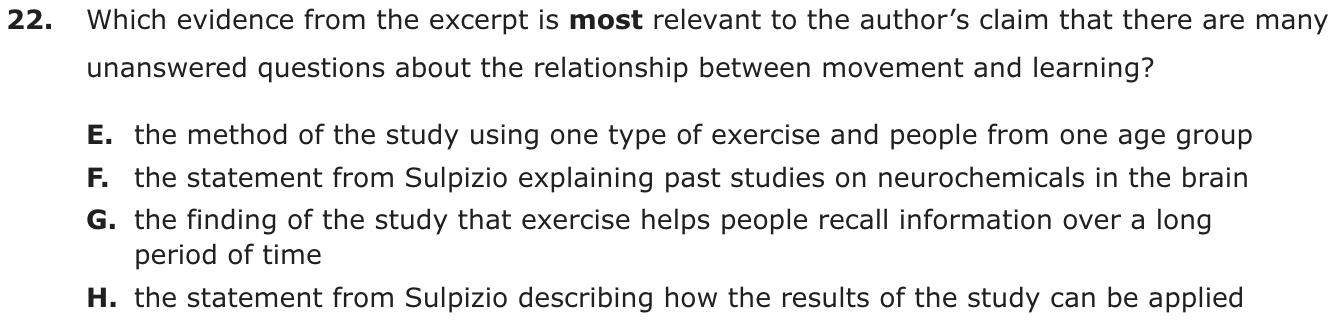
The passage “Excerpt from “How Exercise Could Help You Learn a New Language”” as printed (pages 171–172)
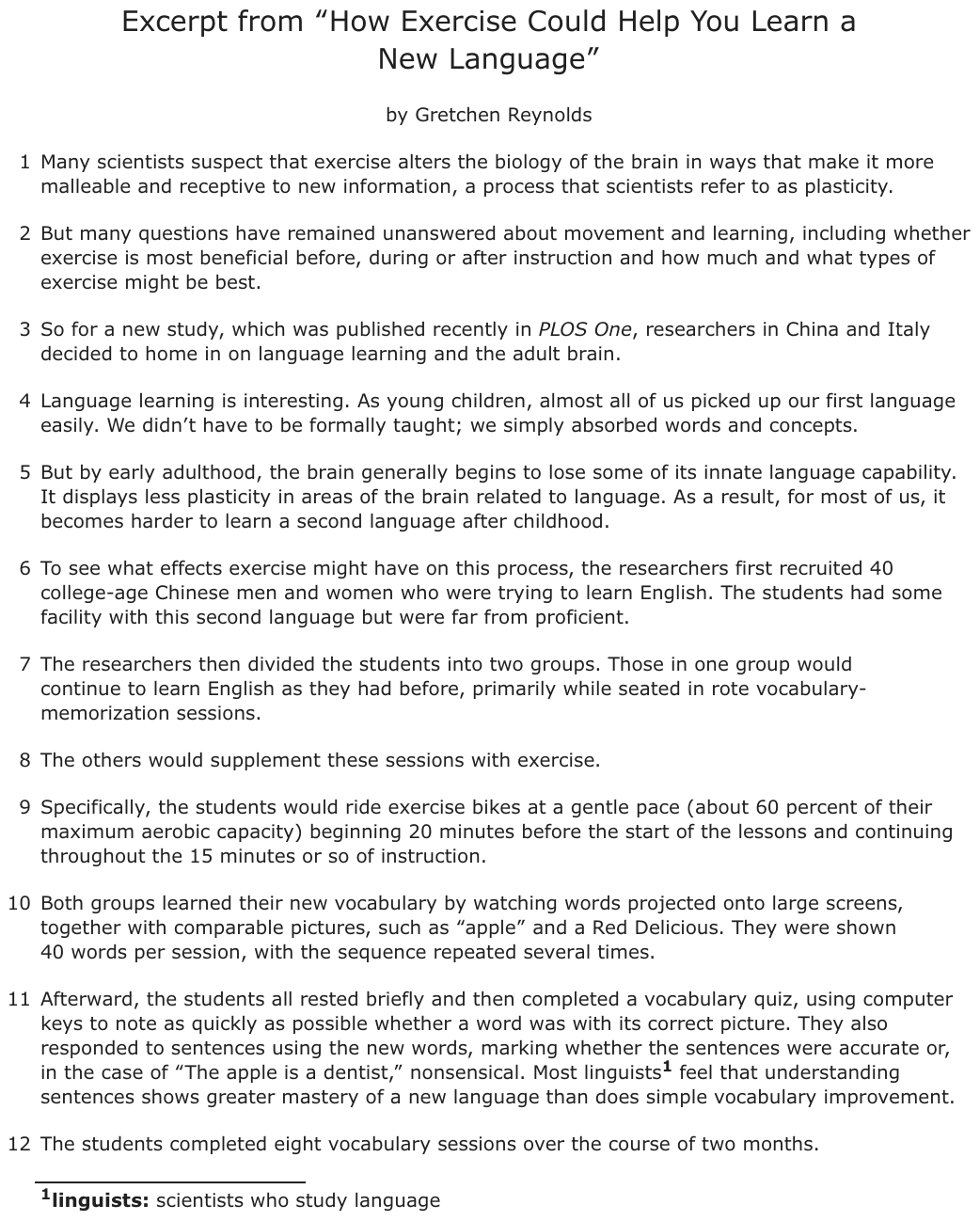
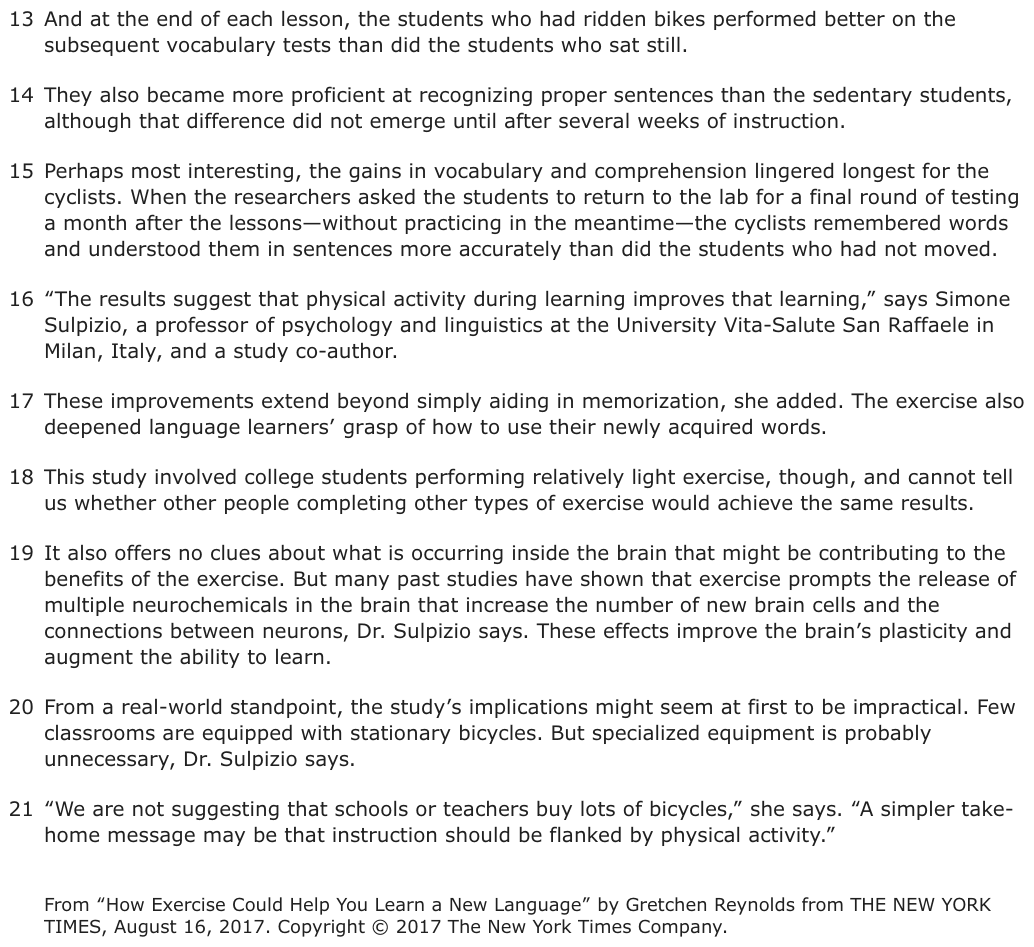
Question 2 of 6
2024 Test B English, question 27Passage Excerpt from Do Them No Harm!
Excerpt from Do Them No Harm!
by Zoa L. Swayne
This narrative is about the Nez Perce, an American Indian tribe, in what is now northern Idaho. The tribe is preparing for a gathering before the coming winter.
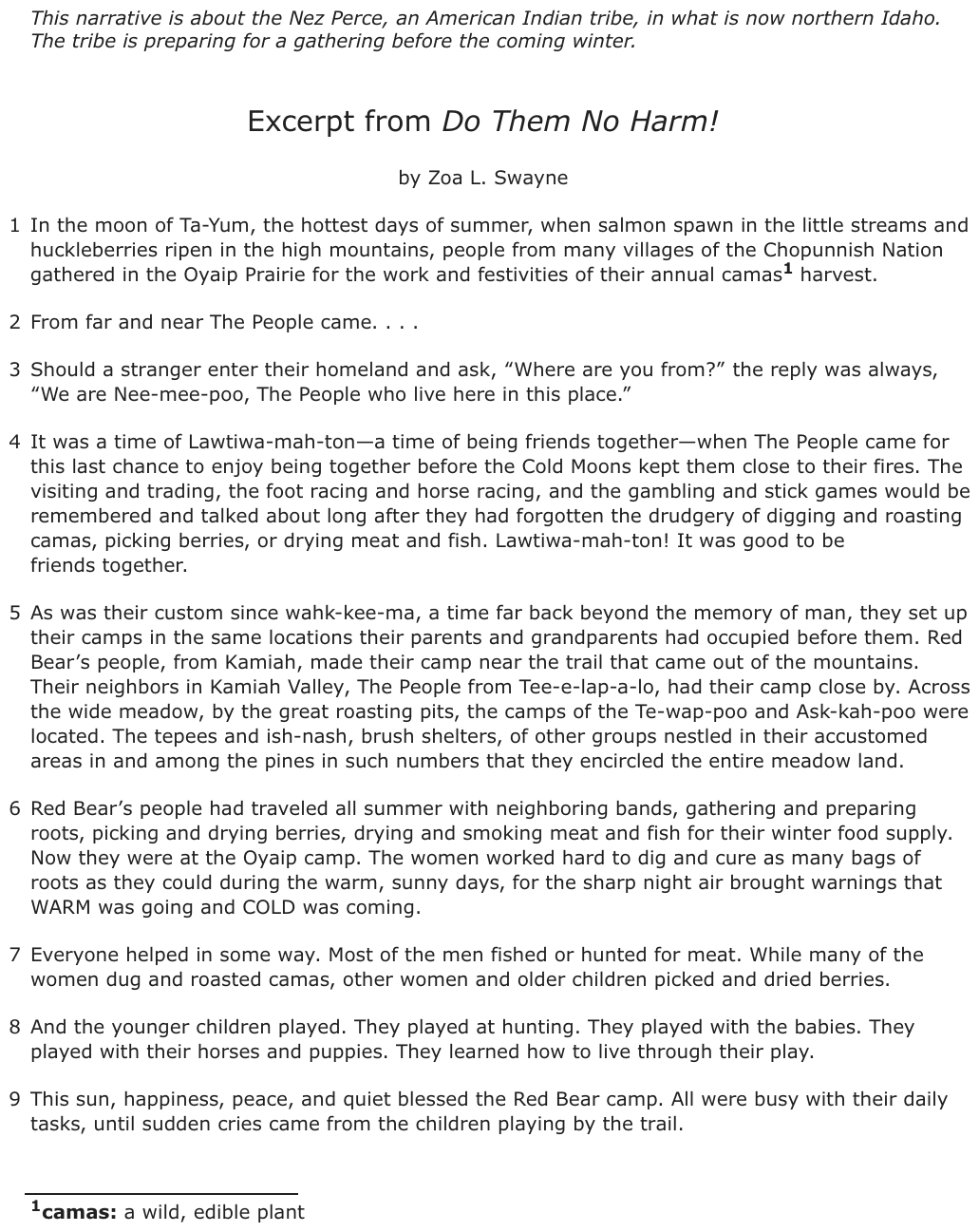
In the moon of Ta-Yum, the hottest days of summer, when salmon spawn in the little streams and huckleberries ripen in the high mountains, people from many villages of the Chopunnish Nation gathered in the Oyaip Prairie for the work and festivities of their annual camas1 harvest.
From far and near The People came. . . .
Should a stranger enter their homeland and ask, “Where are you from?” the reply was always, “We are Nee-mee-poo, The People who live here in this place.”
It was a time of Lawtiwa-mah-ton—a time of being friends together—when The People came for this last chance to enjoy being together before the Cold Moons kept them close to their fires. The visiting and trading, the foot racing and horse racing, and the gambling and stick games would be remembered and talked about long after they had forgotten the drudgery of digging and roasting camas, picking berries, or drying meat and fish. Lawtiwa-mah-ton! It was good to be friends together.
As was their custom since wahk-kee-ma, a time far back beyond the memory of man, they set up their camps in the same locations their parents and grandparents had occupied before them. Red Bear’s people, from Kamiah, made their camp near the trail that came out of the mountains. Their neighbors in Kamiah Valley, The People from Tee-e-lap-a-lo, had their camp close by. Across the wide meadow, by the great roasting pits, the camps of the Te-wap-poo and Ask-kah-poo were located. The tepees and ish-nash, brush shelters, of other groups nestled in their accustomed areas in and among the pines in such numbers that they encircled the entire meadow land.
Red Bear’s people had traveled all summer with neighboring bands, gathering and preparing roots, picking and drying berries, drying and smoking meat and fish for their winter food supply. Now they were at the Oyaip camp. The women worked hard to dig and cure as many bags of roots as they could during the warm, sunny days, for the sharp night air brought warnings that WARM was going and COLD was coming.
Everyone helped in some way. Most of the men fished or hunted for meat. While many of the women dug and roasted camas, other women and older children picked and dried berries.
And the younger children played. They played at hunting. They played with the babies. They played with their horses and puppies. They learned how to live through their play.
This sun, happiness, peace, and quiet blessed the Red Bear camp. All were busy with their daily tasks, until sudden cries came from the children playing by the trail.
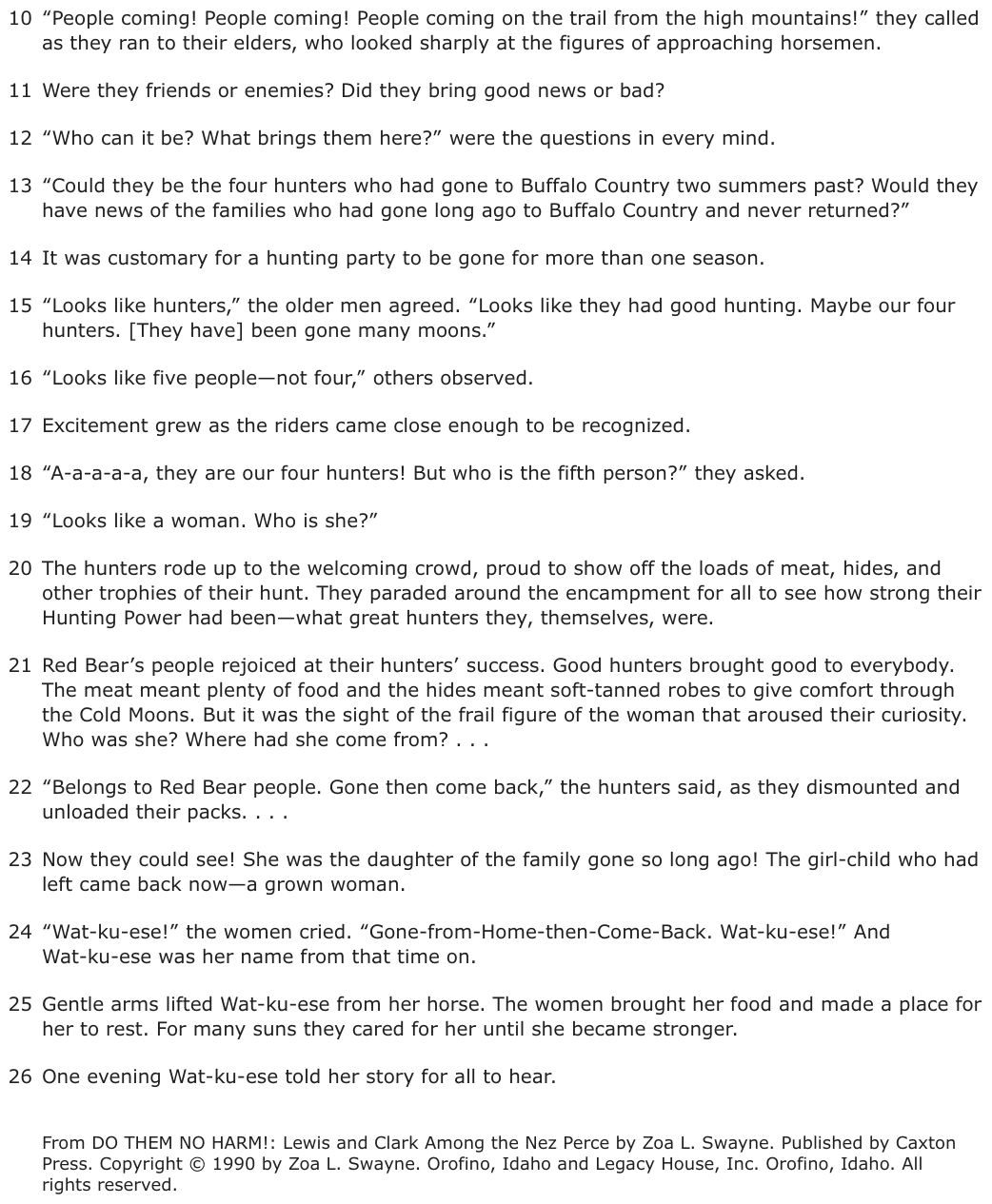
“People coming! People coming! People coming on the trail from the high mountains!” they called as they ran to their elders, who looked sharply at the figures of approaching horsemen.
Were they friends or enemies? Did they bring good news or bad?
“Who can it be? What brings them here?” were the questions in every mind.
“Could they be the four hunters who had gone to Buffalo Country two summers past? Would they have news of the families who had gone long ago to Buffalo Country and never returned?”
It was customary for a hunting party to be gone for more than one season.
“Looks like hunters,” the older men agreed. “Looks like they had good hunting. Maybe our four hunters. [They have] been gone many moons.”
“Looks like five people—not four,” others observed.
Excitement grew as the riders came close enough to be recognized.
“A-a-a-a-a, they are our four hunters! But who is the fifth person?” they asked.
“Looks like a woman. Who is she?”
The hunters rode up to the welcoming crowd, proud to show off the loads of meat, hides, and other trophies of their hunt. They paraded around the encampment for all to see how strong their Hunting Power had been—what great hunters they, themselves, were.
Red Bear’s people rejoiced at their hunters’ success. Good hunters brought good to everybody. The meat meant plenty of food and the hides meant soft-tanned robes to give comfort through the Cold Moons. But it was the sight of the frail figure of the woman that aroused their curiosity. Who was she? Where had she come from? . . .
“Belongs to Red Bear people. Gone then come back,” the hunters said, as they dismounted and unloaded their packs. . . .
Now they could see! She was the daughter of the family gone so long ago! The girl-child who had left came back now—a grown woman.
“Wat-ku-ese!” the women cried. “Gone-from-Home-then-Come-Back. Wat-ku-ese!” And Wat-ku-ese was her name from that time on.
Gentle arms lifted Wat-ku-ese from her horse. The women brought her food and made a place for her to rest. For many suns they cared for her until she became stronger.
One evening Wat-ku-ese told her story for all to hear.
From DO THEM NO HARM!: Lewis and Clark Among the Nez Perce by Zoa L. Swayne. Published by Caxton Press. Copyright © 1990 by Zoa L. Swayne. Orofino, Idaho and Legacy House, Inc. Orofino, Idaho. All rights reserved.
1camas: a wild, edible plant
Question
How do paragraphs 11–13 affect the plot of the excerpt?
- AThey establish a feeling of mystery by presenting different points of view about the arriving people.
- BThey contribute to the rising action by developing the idea that the arriving people could present a problem.
- CThey lead to a turning point by describing the moment that the crowd realizes why the strangers have come.
- DThey explain the cause of the main conflict by providing background information about the strangers.
Show the answer
Correct answer: B
The question asks how paragraphs 11–13 affect the plot of the excerpt.
A. Incorrect. The paragraphs contain questions about the arriving people. They do not present differing points of view.
B. CORRECT. The paragraphs ask questions in which the characters wonder whether the arriving people are friends or enemies, or whether they might be bringing good news or bad news. By suggesting that the arriving people could present problems such as these, the paragraphs contribute to the rising action.
C. Incorrect. The paragraphs do not lead to a turning point. Instead, they lead to the climax—the moment the characters discover who the visitors are. This means the paragraphs contribute to the rising action.
D. Incorrect. Paragraphs 11–13 ask questions. They do not provide background information about the strangers; instead, they ask for it.
Question analysis
This plot question asks how paragraphs 11–13, a series of questions the villagers ask as riders approach their camp, affect the plot of the Nez Perce narrative. Students must know terms such as rising action and turning point and apply them precisely, since several choices describe these paragraphs in ways that sound right but place them wrongly in the story.
- Grade level
- Grade 8 reading and task
- Compared with grade 7
- Above grade 7 Grade 7 plot questions usually ask what one event causes. Here students apply terms such as rising action and turning point to three short paragraphs of questions, which matches the grade 8 focus on how parts of a story propel the action.
- Estimated difficulty
- Hard: combines ideas, needs a plan, and has more than one tempting wrong answer.
- Thinking it demands
- Depth of knowledge 3, strategic thinking · mainly analyze
- What makes it hard
- A very close wrong answer major
- How, not what moderate
- Something you must already know minor
- Evidence
- Answered from several paragraphs or stanzas
- Reading level
- Passage: about grade 5, 885 words; question and choices: about grade 9, 77 words.
- Students, last 30 days
- Not enough answers yet to show (it takes 10).
Why it is hard, traps and wrong answers (shows the answer)
Why it is hard
Paragraphs 11–13 contain nothing but questions, so the answer depends on what questions do in a plot. Friends or enemies, good news or bad, they raise the chance of trouble and build toward the arrival. The trap is that they also create mystery, and the choice that says so fails only on one phrase about differing viewpoints. A second risk is jumping ahead: at this point no one even knows who the riders are, let alone why they came.
A very close wrong answer major Choosing the answer
The right choice and the one about mystery both see the questions building uncertainty about the riders; only the claim of “different points of view,” when the questions are “in every mind,” separates them. (Embretson & Wetzel, 1987; Gorin & Embretson, 2006; Ascalon et al., 2007)
How, not what moderate Working it out
The stem asks what paragraphs 11–13 do for the plot, so students must place a run of unanswered questions in the story’s shape rather than retell them. (Anderson & Krathwohl, 2001)
Something you must already know minor Working it out
The choices rely on plot terms the excerpt never explains, rising action, turning point and main conflict, and judging them means knowing what each one names. (Anderson & Krathwohl, 2001)
Strategy: Note what the villagers know and do not yet know in paragraphs 11–13, then compare that with what happens later in the excerpt to place these paragraphs in the plot.
Traps
- Half right: One half of a two-part choice is right and the other is not.
- Wrong part of the text: A choice is true of another paragraph, stanza or speaker than the one asked about.
- Wrong purpose or structure: Names a purpose, structure or effect that the part does not serve, or describes what a part says when the question asks what it does.
The wrong answers, classified
A Half right (King et al., 2004; Thissen, Steinberg & Fitzpatrick, 1989)
Rightly feels the mystery in the villagers’ questions but adds “different points of view,” though the whole camp shares the same questions.
C Wrong part of the text (Kirsch & Mosenthal, 1990)
Jumps ahead to the recognition in paragraphs 17–23; in paragraphs 11–13 the crowd does not yet know who the riders are, let alone why they came.
D Wrong purpose or structure (Anderson & Krathwohl, 2001)
Notices the hunters gone two summers and the families who never returned, but those details arrive as questions, and the excerpt has no conflict they explain.
Working it out, step by step
Figure out what the question asks
This asks how paragraphs 11–13 move the story along. You need some plot words. The plot is the order of events in a story. The rising action is the part where tension builds. Tension is the feeling that something big may happen. A turning point is the moment when things change.
Read paragraphs 11 to 13
These paragraphs are all questions. Paragraph 11 asks: “Were they friends or enemies? Did they bring good news or bad?” In paragraph 12, “Who can it be?” is one of “the questions in every mind.” Paragraph 13 asks if the riders are the hunters who left “two summers past.”
Decide what the questions do
The words “enemies” and “bad” news show the camp is worried. The riders might bring trouble. No one knows yet. So the questions build tension as the riders get closer. That is rising action. The answers come later. The crowd knows the hunters in paragraph 18. They learn who the woman is in paragraphs 22 and 23.
Check each choice
- B fits. The questions raise the chance of a problem and build tension.
- A: there is mystery, but not “different points of view.” Everyone asks the same questions.
- C: in these paragraphs, no one knows who the riders are yet, let alone why they came. So nothing here is the moment the crowd realizes anything.
- D: the paragraphs ask about the strangers. They give no background facts about them.
Pick the answer
Watch out: A is very close. The questions do create mystery. But one wrong phrase, “different points of view,” rules it out. So the answer is B.
Why this answer and not the closest wrong one
A is the closest wrong answer, because the questions do make the scene mysterious. But the questions are “in every mind,” so there are no different points of view. B names what the questions do for the plot: they hint that the riders could bring trouble, and they build tension.
More questions like this
The original DOE question
The passage “Excerpt from Do Them No Harm!” as printed (pages 177–178)
Question 3 of 6
2026 Practice Test D English, question 40Passage Martial Arts for the Mind and Body
Martial Arts for the Mind and Body
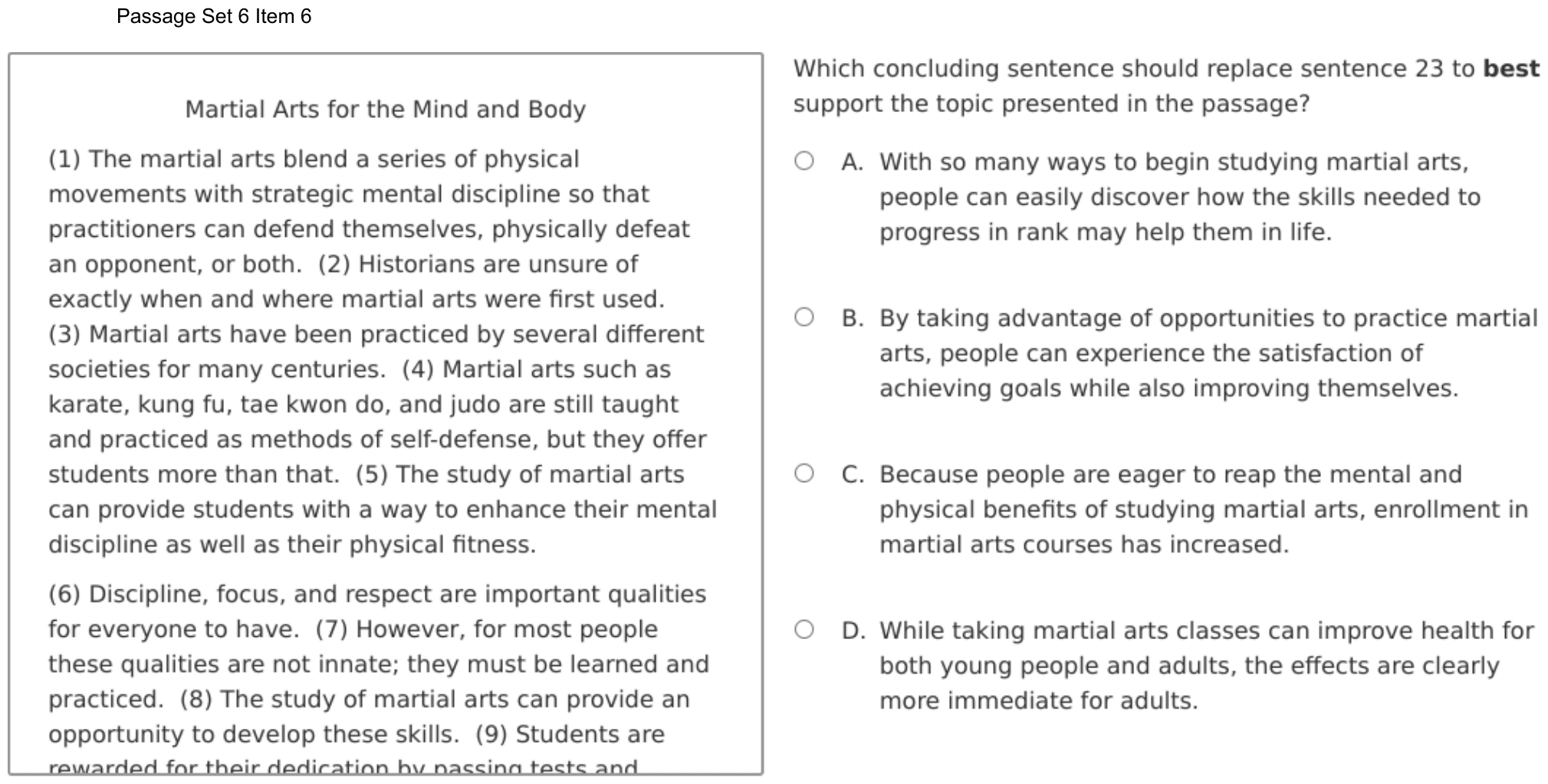
(1) The martial arts blend a series of physical movements with strategic mental discipline so that practitioners can defend themselves, physically defeat an opponent, or both. (2) Historians are unsure of exactly when and where martial arts were first used. (3) Martial arts have been practiced by several different societies for many centuries. (4) Martial arts such as karate, kung fu, tae kwon do, and judo are still taught and practiced as methods of self-defense, but they offer students more than that. (5) The study of martial arts can provide students with a way to enhance their mental discipline as well as their physical fitness.
(6) Discipline, focus, and respect are important qualities for everyone to have. (7) However, for most people these qualities are not innate; they must be learned and practiced. (8) The study of martial arts can provide an opportunity to develop these skills. (9) Students are rewarded for their dedication by passing tests and advancing to higher ranks or levels. (10) For example, in a typical tae kwon do class, students learn discipline by diligently practicing moves, improve focus by listening carefully, and demonstrate respect by bowing to the instructor and following directions.
(11) For teenagers, martial arts classes provide a safe and structured environment for gaining physical skills, building confidence, and enjoying a sense of community. (12) A lot of teens go through hard situations as they try to do well in school and in life. (13) A martial arts class can provide teens with a physical outlet for stress while also challenging them mentally. (14) Participating in a martial arts program also helps children and teens focus on self-improvement rather than on competition. (15) Progressing through levels of achievement involves mastering more physically demanding techniques. (16) It requires students to take responsibility and be accountable for achieving set goals. (17) Students gain confidence and experience companionship with other students who are progressing through the ranks.
(18) Adults who practice martial arts can experience many of the same benefits that younger people do, but perhaps the greatest of these is health and fitness. (19) Adult martial arts students often see changes in their body within weeks of beginning a program.
(20) For people interested in studying a martial art, there are many ways to learn and practice. (21) In addition to private studios, community recreation centers often offer low-cost or free martial arts classes. (22) There are even online videos that introduce students to the basic concepts. (23) People should study martial arts.
Question
Which concluding sentence should replace sentence 23 to best support the topic presented in the passage?
- AWith so many ways to begin studying martial arts, people can easily discover how the skills needed to progress in rank may help them in life.
- BBy taking advantage of opportunities to practice martial arts, people can experience the satisfaction of achieving goals while also improving themselves.
- CBecause people are eager to reap the mental and physical benefits of studying martial arts, enrollment in martial arts courses has increased.
- DWhile taking martial arts classes can improve health for both young people and adults, the effects are clearly more immediate for adults.
Show the answer
Correct answer: B
The question asks for the concluding sentence that best replaces sentence 23 and supports the topic presented in the passage.
A. Incorrect. The phrase “the skills needed to progress in rank” is vague, and progressing in rank is not related to the overall topic of the passage, which is the benefits of studying martial arts. The topic of the passage is not the “many ways to begin studying martial arts” or how “people can easily discover” the benefits of martial arts.
B. CORRECT. This option is correct because it best supports the topic of the passage—the benefits of studying martial arts—by stating two reasons why people should study martial arts: to “experience the satisfaction of achieving goals while also improving themselves.”
C. Incorrect. Some readers may choose this option because it refers to the benefits of martial arts, but the word “because” and the detail that “enrollment in martial arts courses has increased” make this sentence unrelated to the overall topic of the passage, which is about the benefits of studying martial arts, not the number of people who participate.
D. Incorrect. Although the benefits of studying martial arts are described for both teens (in the third paragraph) and adults (in the fourth paragraph), the topic of the passage is the overall benefits of studying martial arts, which include mental discipline (discussed in the first, second, and third paragraphs) in addition to health benefits. Furthermore, the passage does not compare the health effects of studying martial arts across age groups.
Question analysis
This conclusion question asks which sentence should replace sentence 23, the bare closing line “People should study martial arts,” to best support the topic of the passage. Students must keep all five paragraphs in view, from mental discipline to fitness to ways of getting started, because every choice sounds like a reasonable final line when read on its own.
- NYS standards
- 7W2e concluding informative writing
- Grade level
- Grade 8 reading and task
- Compared with grade 7
- Above grade 7 Grade 7 writers choose conclusions that follow from a passage’s topic. This passage covers mental and physical benefits for different ages, and each long choice picks up a real thread, so judging the best fit takes more than typical grade 7 work.
- Estimated difficulty
- Hard: combines ideas, needs a plan, and has more than one tempting wrong answer.
- Thinking it demands
- Depth of knowledge 2, skills and concepts · mainly evaluate
- What makes it hard
- A very close wrong answer moderate
- Evidence in several places moderate
- A lot to read minor
- Evidence
- Answered from the whole text
- Reading level
- Passage: about grade 11, 402 words; question and choices: about grade 12, 106 words.
- Corrected from the DOE handbook
- The DOE printed this question’s explanation after a different question; the site matches the question with its own explanation.
- Students, last 30 days
- Not enough answers yet to show (it takes 10).
Why it is hard, traps and wrong answers (shows the answer)
Why it is hard
Every ending borrows something real from the passage: ways to begin, ranks, mental and physical benefits, or adults’ quick results. The work is deciding what the whole passage is about, the benefits of martial arts for mind and body, and then noticing which ending adds a new claim or shrinks the topic. The rank-based ending is hardest to reject because it is shaped like the key and promises help “in life,” but its focus is how easily people discover rank skills.
A very close wrong answer moderate Choosing the answer
The rank choice is built like the key, a phrase about ways or chances to train followed by what people gain; it differs in resting on the vague “skills needed to progress in rank.” (Embretson & Wetzel, 1987; Gorin & Embretson, 2006; Ascalon et al., 2007)
Evidence in several places moderate Working it out
The topic is pieced together from all five paragraphs, from the opening’s mind-and-body claim through teens, adults’ fitness and ways to learn, so a fitting ending must cover both kinds of benefit. (Kirsch & Mosenthal, 1990; Gorin & Embretson, 2006)
A lot to read minor Understanding the question
Each choice is a two-part sentence of 21 to 26 words, and each picks up a real thread of the passage, so all four must be held against the topic. (Kintsch, 1998; Gorin & Embretson, 2006; Freedle & Kostin, 1993)
Strategy: State the passage’s topic in a few words using all five paragraphs, then test each ending: does it sum up that topic, or does it narrow it or add a new claim?
Traps
- Off the point: Adds or keeps something that does not support the paragraph's or the passage's focus, or an introduction or conclusion that misses the main point.
- Too narrow: A single detail offered as the central idea or a summary, or a summary that keeps minor details and leaves out an essential part.
The wrong answers, classified
A Too narrow (King et al., 2004)
Follows on from the last paragraph’s many ways to start, but rests the ending on vague “skills needed to progress in rank,” one thread of paragraphs 2 and 3, not the benefits overall.
C Off the point (Halliday & Hasan, 1976)
Names the passage’s “mental and physical benefits,” which fits, but ends on rising enrollment, a claim about numbers of students that the passage never discusses.
D Half right (King et al., 2004; Thissen, Steinberg & Fitzpatrick, 1989)
Rightly says training can improve health for young people and adults, but adds that adults clearly benefit sooner, a comparison the passage never makes, and drops the mental benefits.
What was corrected from the DOE handbook, and why
- Explanation: In the DOE’s explanations appendix, the explanation printed after this question belongs to question 39 (“the sentence that would best follow and support sentence 18”) and marks C correct, and this question’s explanation (“the concluding sentence that best replaces sentence 23 and supports the topic presented in the passage”) is printed after question 39, marking B correct. Read page by page, the appendix gives this question the answer C. The site gives the question the explanation that restates it, and the answer follows that explanation: B, because it sums up the passage’s topic, the benefits of studying martial arts.
Working it out, step by step
Figure out what the question asks
This asks for a better last sentence. A good concluding sentence sums up the topic of the whole passage. Sentence 23, “People should study martial arts,” is short and plain. It doesn’t remind the reader why.
Find the passage’s topic
Sentence 5 states the topic. Martial arts can help students “enhance their mental discipline as well as their physical fitness.” Enhance means improve. Paragraph 2 covers discipline, focus and respect. Paragraph 3 covers teens and goals. Paragraph 4 covers adults and fitness. Paragraph 5 lists ways to start. So the topic is how martial arts help both mind and body.
Name the rule
A conclusion should sum up the main point. It should not shrink the point or add a brand-new claim. For example, after a report on why sleep matters, a good ending is Getting enough sleep helps both your body and your mind. A poor one is More people buy pillows now.
Check each choice
- A is wrong. It rests on vague “skills needed to progress in rank,” one small part of the passage.
- B is right. “Opportunities to practice” follows paragraph 5. “Achieving goals” and “improving themselves” sum up the benefits.
- C is wrong. Enrollment is the number of people who sign up. The passage never says it has gone up.
- D is wrong. The passage never says adults see results sooner than young people. D also leaves out the benefits to the mind.
Watch out: A is built like B and promises help “in life.” But it shrinks the topic to rank skills.
Choose the answer
B sums up what the whole passage says martial arts offer. So the answer is B, “By taking advantage of opportunities to practice martial arts, people can experience the satisfaction of achieving goals while also improving themselves.”
Why this answer and not the closest wrong one
A is the closest wrong answer. Like B, it starts with ways to begin and ends with what people gain. But its gain is vague “skills needed to progress in rank.” That is only one thread of the passage. B sums up the whole topic: reaching goals and improving yourself.
More questions like this
The original DOE question
The passage “Martial Arts for the Mind and Body” as printed (page 52)
Question 4 of 6
2026 Practice Test D Math, question 35Question
XYZ Corporation hired 6 people as summer workers. Of these 6 people, 3 will be hired as permanent employees in the fall. If 2 of the 6 people are male, how many of the possible groups of 3 people hired in the fall will include only 1 male?
- A4
- B6
- C12
- D24
Show the answer
Correct answer: C
An organized list can be used to determine the number of groups of 3 people that include only 1 male.
Let the letters A, B, C, and D represent the females, and let the numbers 1 and 2 represent the males.
Then, create a list of all possible combinations of 3 people with only 1 male.
AB1, AB2, AC1, AC2, AD1, AD2
BC1, BC2, BD1, BD2
CD1, CD2
There are 12 possible groups with only 1 male.
Question analysis
A company hired 6 summer workers, 2 of them male, and will keep 3 as permanent employees in the fall. This counting question asks how many possible groups of 3 include only 1 male. Students count combinations where order does not matter, and the bold word only, with two kinds of workers to combine, makes careful listing essential.
- NYS standards
- 7.SP.8b sample spaces for compound events
- Grade level
- Grade 7 content, by NYS standard
- Compared with grade 7
- Above grade 7 Grade 7 students list outcomes with organized lists and tree diagrams, usually ordered ones. Counting unordered groups of three under an "only one" condition, built from two kinds of people, goes beyond that typical work.
- Estimated difficulty
- Hard: combines ideas, needs a plan, and has more than one tempting wrong answer.
- Thinking it demands
- Depth of knowledge 2, skills and concepts · mainly apply
- What makes it hard
- Combines ideas moderate
- Something you must already know minor
- Turning words into math minor
- Solution
- 3 steps
- Reading level
- Question and choices: about grade 7, 41 words.
- Students, last 30 days
- Not enough answers yet to show (it takes 10).
Why it is hard, traps and wrong answers (shows the answer)
Why it is hard
The question hides a two-stage count in a hiring story. Students tend to get one stage right and forget the other: they count the pairs of women and stop, or they count ordered picks and so find every group twice. Naming the women A to D and the men 1 and 2, then listing the pairs of women alphabetically with each man attached, makes every group visible and checkable.
Combines ideas moderate Working it out
Two counts are joined: the 6 ways to pick 2 of the 4 women, then the 2 ways to pick the man, and the total is their product. (Embretson, 1998; Daniel & Embretson, 2010)
Something you must already know minor Working it out
Students must already know that a group is the same whichever order its members are named, so picking one woman and then another repeats the reverse pick. (Anderson & Krathwohl, 2001)
Turning words into math minor Understanding the question
The bold word only means exactly one man, so the other two places in each group of 3 must go to two of the 4 women, a step the stem leaves unsaid. (Hegarty, Mayer & Monk, 1995; Koedinger & Nathan, 2004)
Strategy: Name the women A to D and the men 1 and 2, list every pair of women without repeats, then attach each man to each pair and count the groups.
Traps
- Stops one step early: A choice is a number from partway through the solution.
- Overlapping groups: Things in two groups at once are counted twice, or not subtracted.
The wrong answers, classified
A Numbers taken from the question (Hegarty, Mayer & Monk, 1995)
Multiplies the 2 men by the 2 places left for women, 2 × 2 = 4, using numbers from the question without listing a single group.
B Stops one step early (King et al., 2004; Gierl et al., 2017)
Counts the 6 pairs of women correctly but stops before pairing each one with either of the 2 men, which doubles the count.
D Overlapping groups (King et al., 2004)
Counts ordered picks of the two women, 4 × 3 = 12 instead of 6, so each group appears twice, then doubles for the men to reach 24.
Worked solution, step by step
Formulas used
- Counting with two choices
- Each way of picking the man can go with each way of picking the two women. So you multiply the two counts. It is like outfits: 2 shirts with 6 pairs of pants make 12 outfits.
Sort out the question
Six people work for the summer. Two are male, so the other 4 are female. Three will be hired in the fall.
You need the number of groups of 3 with only 1 male. That means exactly 1 man and 2 women. In a group, order does not matter. Ann, Bea and Carl is the same group as Carl, Ann and Bea.
Give each person a name
Call the women A, B, C and D. Call the men 1 and 2. Every group you want has 2 letters and 1 number, like AB1.
List the pairs of women
List each pair once. Start with A, then pair B only with letters after it, and so on:
- AB, AC, AD
- BC, BD
- CD
That is 6 pairs. BA is not new, since it is the same pair as AB.
Watch out: counting the order gives pairs, each one twice. Then doubling for the men gives 24, choice D.
Add a man to each pair
Each pair of women can go with man 1 or man 2. Use the counting rule:
Watch out: stopping at the 6 pairs of women leaves out the men. That gives 6, choice B.
So the answer is C, 12.
Check your answer
Write out every group. With man 1: AB1, AC1, AD1, BC1, BD1, CD1. With man 2: AB2, AC2, AD2, BC2, BD2, CD2. Each list has 6 groups, and . No group repeats, and each has just one man.
More questions like this
The original DOE question
Question 5 of 6
2026 Practice Test B Math, question 31Question
A pizza shop offers a choice of 3 sizes (small, medium, and large) and 7 different toppings. Different pizzas can be created by changing the size and the choice of toppings. If Cody wants to order a pizza with exactly 2 different toppings, how many different pizzas can he create?
- A6
- B21
- C63
- D126
Show the answer
Correct answer: C
Figure out how many different topping pairs are possible. Use 1, 2, 3, 4, 5, 6, 7 to represent the toppings, and create a list of possible pairs:
1,2; 1,3; 1,4; 1,5; 1,6; 1,7
2,3; 2,4; 2,5; 2,6; 2,7
3,4; 3,5; 3,6; 3,7
4,5; 4,6; 4,7
5,6; 5,7
6,7
So there are 21 different topping combinations for one pizza.
Since there are 3 pizza sizes, multiply the total number of combinations by 3 to get the total number of different pizzas Cody can create: .
Question analysis
Cody orders a pizza with exactly 2 of 7 toppings in one of 3 sizes, and students count how many different pizzas he could create. It tests counting combinations, where the order of the toppings does not matter, combined with a second choice. The challenge is to count every possible pizza exactly once.
- NYS standards
- 7.SP.8b sample spaces for compound events
- Grade level
- Grade 7 content, by NYS standard
- Compared with grade 7
- Above grade 7 In grade 7, compound events are usually ordered pairs, such as a coin with a number cube. Here an unordered pair of toppings is chosen from seven and then matched with three sizes, a combination count beyond typical grade 7 work.
- Estimated difficulty
- Hard: combines ideas, needs a plan, and has more than one tempting wrong answer.
- Thinking it demands
- Depth of knowledge 2, skills and concepts · mainly apply
- What makes it hard
- Combines ideas moderate
- Something you must already know minor
- Solution
- 3 steps
- Reading level
- Question and choices: about grade 8, 47 words.
- Students, last 30 days
- Not enough answers yet to show (it takes 10).
Why it is hard, traps and wrong answers (shows the answer)
Why it is hard
The question packs two counts into one sentence, each with its own trap. Order does not matter among the toppings, while the size multiplies every pair, and students tend to remember one of these and forget the other. Listing pairs systematically, each topping matched only with later ones, keeps the first count honest, and the stem’s “changing the size and the choice of toppings” is the reminder that size counts too.
Combines ideas moderate Working it out
Two counts are joined: the unordered pairs of toppings from 7, then the 3 sizes each pair can come in, and a mistake in either count changes the total. (Embretson, 1998; Daniel & Embretson, 2010)
Something you must already know minor Working it out
Students must know that a pizza with mushroom and onion is the same as one with onion and mushroom, so the ordered count 7 × 6 has to be halved. (Anderson & Krathwohl, 2001)
Strategy: Number the toppings 1 to 7, list each pair once by matching every topping only with higher-numbered ones, count the list, then bring in the choice of size.
Traps
- Stops one step early: A choice is a number from partway through the solution.
- Overlapping groups: Things in two groups at once are counted twice, or not subtracted.
The wrong answers, classified
A Numbers taken from the question (Hegarty, Mayer & Monk, 1995)
Multiplies the 3 sizes by the 2 toppings Cody wants, using the number of toppings on the pizza instead of the number of possible pairs.
B Stops one step early (King et al., 2004; Gierl et al., 2017)
Lists or counts the 21 pairs of toppings correctly, then stops without giving each pair its 3 possible sizes.
D Overlapping groups (King et al., 2004)
Counts ordered pairs, 7 × 6 = 42, so each pair of toppings appears twice, and then multiplies by the 3 sizes to reach 126.
Worked solution, step by step
Formulas used
- The counting principle
- m is the number of ways to make one choice, and n is the number of ways to make a second choice. Every first choice can go with every second choice, so you multiply. Here, every pair of toppings can come in every size.
- Pairs when order does not matter
- n is the number of items to choose from. There are n ways to pick a first item and n − 1 ways to pick a different second one. That counts each pair twice, once in each order. Dividing by 2 counts each pair once.
Sort out the question
Each of Cody’s pizzas has one size and exactly 2 different toppings. There are 3 sizes and 7 toppings. Pizzas differ by “changing the size and the choice of toppings.” So a small and a large with the same toppings are two different pizzas. You need to count every pizza once.
List the topping pairs
Order does not matter: onion with peppers is the same pizza as peppers with onion. So number the toppings 1 to 7, and pair each one only with bigger numbers. Then no pair shows up twice.
Topping Pairs with Pairs 1 2, 3, 4, 5, 6, 7 6 2 3, 4, 5, 6, 7 5 3 4, 5, 6, 7 4 4 5, 6, 7 3 5 6, 7 2 6 7 1 There are 21 different pairs of toppings.
Check the pairs with the formula
Use the pairs formula with 7 toppings:
Watch out: 7 × 6 = 42 counts every pair twice, once as 1 then 2 and once as 2 then 1. Keeping 42 leads to , choice D.
Bring in the sizes
Each of the 21 topping pairs can come in any of the 3 sizes. Use the counting principle:
Watch out: stopping at 21 leaves out the sizes, which gives choice B. Choice A, 6, multiplies the 3 sizes by the 2 toppings on one pizza. That does not count pizzas.
Give the answer
There are 21 topping pairs, and each one comes in 3 sizes. Cody can create 63 different pizzas. So the answer is C, 63.
Check your answer
Count one size at a time. A small pizza can have any of the 21 pairs, so there are 21 small pizzas. There are also 21 medium and 21 large ones: . That is more than the 21 pairs but fewer than 126, so it is reasonable.
More questions like this
The original DOE question
Question 6 of 6
2024 Test A Math, question 6Question
Mr. Jones has 550 goats, which is 10% more than Mr. King has. How many more goats does Mr. Jones have than Mr. King?
- A50
- B55
- C495
- D500
Show the answer
Correct answer: A
First, set up a proportion to determine x, the number of goats Mr. King has.
Then solve the proportion for x.
Finally, determine the difference between the number of goats Mr. Jones has, 550, and the number of goats Mr. King has, 500.
Mr. Jones has 50 more goats than Mr. King.
Question analysis
A percent word problem: Mr. Jones has 550 goats, which is 10% more than Mr. King has, and students find how many more goats Mr. Jones has. It asks students to work with a percent increase when only the larger amount is known. The tricky part is deciding which amount the 10% is taken of.
- Grade level
- Grade 7 content, by NYS standard
- Compared with grade 7
- Above grade 7 Grade 7 students usually find a percent increase from a known original amount. This runs the task backward: the increased amount is given, and the original must be recovered before the difference can be found, a step many do not expect.
- Estimated difficulty
- Hard: combines ideas, needs a plan, and has more than one tempting wrong answer.
- Thinking it demands
- Depth of knowledge 2, skills and concepts · mainly apply
- What makes it hard
- Turning words into math major
- A very close wrong answer moderate
- Solution
- 2 steps
- Reading level
- Question and choices: about grade 1, 22 words.
- Students, last 30 days
- Not enough answers yet to show (it takes 10).
Why it is hard, traps and wrong answers (shows the answer)
Why it is hard
The arithmetic is one division and one subtraction, so the question is really about the base of a percent. The sentence gives the bigger number and calls it 10% more, and the reflex is to take 10% of the number on the page. That shortcut lands on a listed choice five goats from the answer. Students who find King's herd first, 550 ÷ 1.1, still have to remember that the question wants the difference, not the herd.
Turning words into math major Understanding the question
The clause "which is 10% more than" makes King's unknown herd the base of the 10%, so 550 is 110% of his number rather than the amount the 10% is taken of. (Hegarty, Mayer & Monk, 1995; Koedinger & Nathan, 2004)
A very close wrong answer moderate Choosing the answer
The choices 50 and 55 are only 5 goats apart, and both are 10% of a herd; only taking the percent of King's 500 rather than of 550 separates them. (Embretson & Wetzel, 1987; Gorin & Embretson, 2006; Ascalon et al., 2007)
Strategy: Mr. Jones's 550 is 110% of Mr. King's number, so divide 550 by 1.10 to find Mr. King's goats, then subtract that from 550.
Traps
- Percent of the wrong amount: Finding the whole from a part, or a percent change measured from the wrong starting amount.
- Stops one step early: A choice is a number from partway through the solution.
The wrong answers, classified
B Percent of the wrong amount (Parker & Leinhardt, 1995)
Takes 10% of 550, measuring the increase from Jones's herd instead of from King's smaller herd, which is the amount the 10% is based on.
C Percent of the wrong amount (Parker & Leinhardt, 1995)
Takes 10% off 550 to get King's herd, 550 − 55 = 495, using the wrong base, then gives that herd instead of the difference.
D Stops one step early (King et al., 2004; Gierl et al., 2017)
Finds King's herd correctly, 550 ÷ 1.1 = 500, then stops there instead of subtracting it from 550 to get how many more.
Worked solution, step by step
Formulas used
- Percent increase
- The original is the amount you start from, the one the percent is taken of. p is the percent of increase. The new amount is all of the original, which is 100%, plus p% more. For 10% more, you multiply by 1.10.
Sort out the question
Mr. Jones has 550 goats. That is “10% more than Mr. King has”. You need how many more goats Mr. Jones has than Mr. King. That is the difference between the two herds, not the size of a herd.
Decide what the 10% is of
The words “10% more than Mr. King” mean the 10% is a part of Mr. King’s herd. So Mr. King’s herd is the original. Mr. Jones has all of Mr. King’s goats, 100%, plus 10% more. That is 110% of Mr. King’s herd. Watch out: do not take 10% of 550. That gives 55, choice B. It uses the wrong herd. Taking those 55 away from 550 gives 495, choice C, which is also wrong.
Find Mr. King’s herd
Call Mr. King’s number of goats K. Use the percent increase formula with p = 10. The new amount is 550.
Mr. King has 500 goats. Watch out: 500 is Mr. King’s herd, choice D. It is not the difference.
Find the difference
Mr. Jones has 50 more goats than Mr. King. So the answer is A, 50.
Check your answer
Check the 10%. 10% of 500 is , and , Mr. Jones’s herd. So 550 really is 10% more than 500. If King had 495, then 10% more would be about 545, not 550.
More questions like this
The original DOE question