3 English and 3 math
Here are 6 random questions to try. Takers earning below 75% are unlikely to receive an offer. You have 1 minute 48 seconds per question on the real exam.
Question 1 of 6
2024 Test A English, question 24Passage At Dusk
At Dusk
by Natasha Trethewey
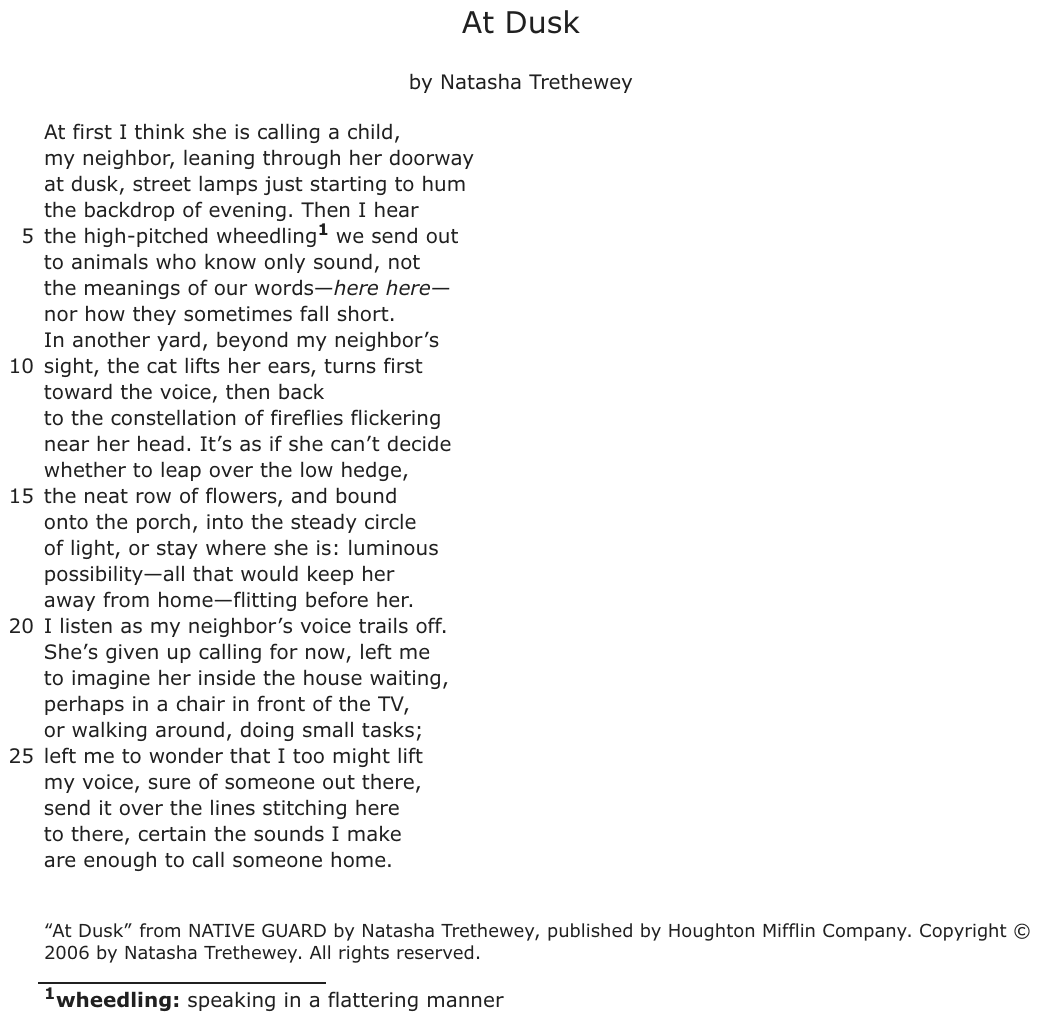
At first I think she is calling a child,
my neighbor, leaning through her doorway
at dusk, street lamps just starting to hum
the backdrop of evening. Then I hear
the high-pitched wheedling1 we send out
to animals who know only sound, not
the meanings of our words—here here—
nor how they sometimes fall short.
In another yard, beyond my neighbor’s
sight, the cat lifts her ears, turns first
toward the voice, then back
to the constellation of fireflies flickering
near her head. It’s as if she can’t decide
whether to leap over the low hedge,
the neat row of flowers, and bound
onto the porch, into the steady circle
of light, or stay where she is: luminous
possibility—all that would keep her
away from home—flitting before her.
I listen as my neighbor’s voice trails off.
She’s given up calling for now, left me
to imagine her inside the house waiting,
perhaps in a chair in front of the TV,
or walking around, doing small tasks;
left me to wonder that I too might lift
my voice, sure of someone out there,
send it over the lines stitching here
to there, certain the sounds I make
are enough to call someone home.
“At Dusk” from NATIVE GUARD by Natasha Trethewey, published by Houghton Mifflin Company. Copyright © 2006 by Natasha Trethewey. All rights reserved.
1wheedling: speaking in a flattering manner
Question
How does the setting affect the events of the poem?
- AIt enables the speaker to regularly overhear the neighbor calling for her cat at dusk.
- BIt allows the speaker to observe the neighbor quietly without interacting with her.
- CIt shows how living in close proximity helps the speaker feel connected to the neighbor.
- DIt shows how feeling isolated causes the speaker to imagine interactions with the neighbor.
Show the answer
Correct answer: B
The question asks how the setting affects the events discussed in the poem.
A. Incorrect. In line 2, the speaker refers to the woman calling for her cat as “my neighbor,” which clearly suggests that the speaker lives next door to the woman. However, although the two live next door to each other, line 1 suggests that perhaps the speaker does not regularly overhear the neighbor because the speaker initially thinks that the neighbor is “calling a child” and only later realizes the neighbor is calling to a cat. Although the setting places the speaker and the neighbor in close proximity, the poem does not indicate the frequency or regularity with which the speaker overhears the neighbor.
B. CORRECT. In the first four lines, the speaker observes the actions of the neighbor as the neighbor leans out to call for the cat at dusk. Despite the speaker’s observation of the neighbor, there is no indication that the neighbor notices the speaker. The reader can conclude that because of the time of day and the speaker being in the house next door, the speaker can observe the neighbor without being observed by her or having to interact with her.
C. Incorrect. The setting of the poem is a neighborhood at nightfall, as indicated by “at dusk” in line 3, the reference to “another yard” in line 9, and the flickering fireflies in line 12. However, while the speaker is close enough to the neighbor to overhear her calling to the cat, there is no indication that the speaker feels connected to the neighbor. Instead, the speaker expresses curiosity about the neighbor after the neighbor goes inside, and the speaker is “left . . . / to imagine her inside the house waiting” (lines 21–22). The fact the speaker initially thought that the neighbor was calling a child indicates that the speaker is not familiar with the neighbor and her habits, and there is no indication that the speaker feels connected to the neighbor.
D. Incorrect. In lines 22–24, the speaker imagines what the neighbor may be doing while the neighbor is waiting inside for the cat to return, but the speaker is imagining the neighbor’s solitary experience after the neighbor has momentarily “given up” on calling to the cat (line 21). The speaker does not imagine personally interacting with the neighbor but rather briefly imagines what the neighbor is doing at home while the cat is away.
Question analysis
This reading question asks how the setting of At Dusk, a neighborhood at nightfall where a woman leans from her doorway to call her cat, affects the events of the poem. Because so little happens, students must infer the setting's role from small details, and several choices sound reasonable without being supported by the poem.
- Grade level
- Grade 8 reading and task
- Compared with grade 7
- Above grade 7 Grade 7 students analyze how setting shapes events, usually in a story with a clear plot. This poem has almost no action, so the student must reason from a handful of details about place and time, which is harder than typical grade 7 work.
- Estimated difficulty
- Hard: combines ideas, needs a plan, and has more than one tempting wrong answer.
- Thinking it demands
- Depth of knowledge 3, strategic thinking · mainly analyze
- What makes it hard
- A very close wrong answer major
- Reading between the lines moderate
- Evidence
- Answered from the whole text
- Reading level
- Passage: 236 words (a poem; reading level not measured); question and choices: about grade 8, 67 words.
- Students, last 30 days
- Not enough answers yet to show (it takes 10).
Why it is hard, traps and wrong answers (shows the answer)
Why it is hard
Little happens in this poem, so the setting's role must be built from small details: a neighbor at her doorway at dusk, a cat in another yard, a speaker who hears and watches but never speaks. The strongest wrong answer is right about overhearing and wrong only in claiming it happens regularly, which the speaker's first mistaken guess argues against. The other choices supply a feeling of closeness or of isolation that the poem never states.
A very close wrong answer major Choosing the answer
The overhearing choice describes what the setting allows almost as well as the right one and fails on a single word, “regularly,” since the poem records one evening and the speaker first mistakes the call. (Embretson & Wetzel, 1987; Gorin & Embretson, 2006; Ascalon et al., 2007)
Reading between the lines moderate Working it out
The setting's effect is never stated; it has to be inferred from the speaker hearing and watching from nearby while the neighbor, “leaning through her doorway,” never seems to notice anyone. (Graesser, Singer & Trabasso, 1994; Kintsch, 1998)
Strategy: Picture the scene from the speaker's position, then check each choice word by word against the poem and reject any that claims something the poem never states.
Traps
- Too broad or too strong: A choice overstates, generalizes, or uses absolute words the text does not support.
- Reads too much in: A reasonable-sounding conclusion that goes further than the text allows.
- Twists what the text says: Uses the text's topic and ideas but changes what it says: who did it, how much, when, or why.
The wrong answers, classified
A Too broad or too strong (King et al., 2004)
Rightly sees that living next door lets the speaker overhear the call, but “regularly” is unsupported, and the first guess about a child suggests the call is unfamiliar.
C Reads too much in (Graesser, Singer & Trabasso, 1994)
Connects living close by with the poem's interest in connection and the speaker's “I too,” but the speaker never claims to feel close to the neighbor.
D Twists what the text says (King et al., 2004)
Notices the speaker picturing the neighbor indoors and calls it imagined interaction, but the speaker pictures her alone, waiting or doing small tasks, and never mentions feeling isolated.
Working it out, step by step
Figure out what the question asks
The setting is where and when a story or poem takes place. You need to see how the setting shapes what happens in the poem.
Picture the setting
It is “dusk” (line 3), the dim time just after sunset. The neighbor is “leaning through her doorway” (line 2). The cat is “In another yard” (line 9). The speaker is close enough to hear and watch it all. But the speaker never speaks to the neighbor. Nothing shows the neighbor notices the speaker.
Work out the effect
Living next door puts the speaker close by. In the fading light, the speaker can watch quietly. So the speaker sees the neighbor and the cat without joining in. The whole poem is what the speaker sees, hears and imagines from there.
Check each choice
- A is wrong. The word “regularly” is the problem. The poem shows one evening.
- B is right. The speaker watches from nearby and never talks with the neighbor.
- C is wrong. The speaker never says they feel close to the neighbor.
- D is wrong. The poem never says the speaker feels lonely. The speaker pictures the neighbor alone inside, not the two of them talking.
Watch out: A is almost right, since living nearby does let the speaker overhear. One word makes it wrong.
Choose the answer
The setting lets the speaker watch quietly from close by. So the answer is B.
Why this answer and not the closest wrong one
A is the closest wrong answer. Living next door does let the speaker hear the call. But nothing says it happens often. The poem tells about one evening. At first the speaker even thinks a child is being called. B fits what the poem shows: the speaker watches without ever talking to the neighbor.
More questions like this
The original DOE question

The passage “At Dusk” as printed (page 48)
Question 2 of 6
2024 Test A English, question 53Passage Excerpt from “It’s Time to Stop Thinking That All Non-Native Species Are Evil”
Excerpt from “It’s Time to Stop Thinking That All Non-Native Species Are Evil”
by Emma Marris
The author of this opinion article attended a symposium, or conference, in Missoula, Montana, at which biologists and other scientists discussed species of plants and animals that are not native to the areas in which they live.
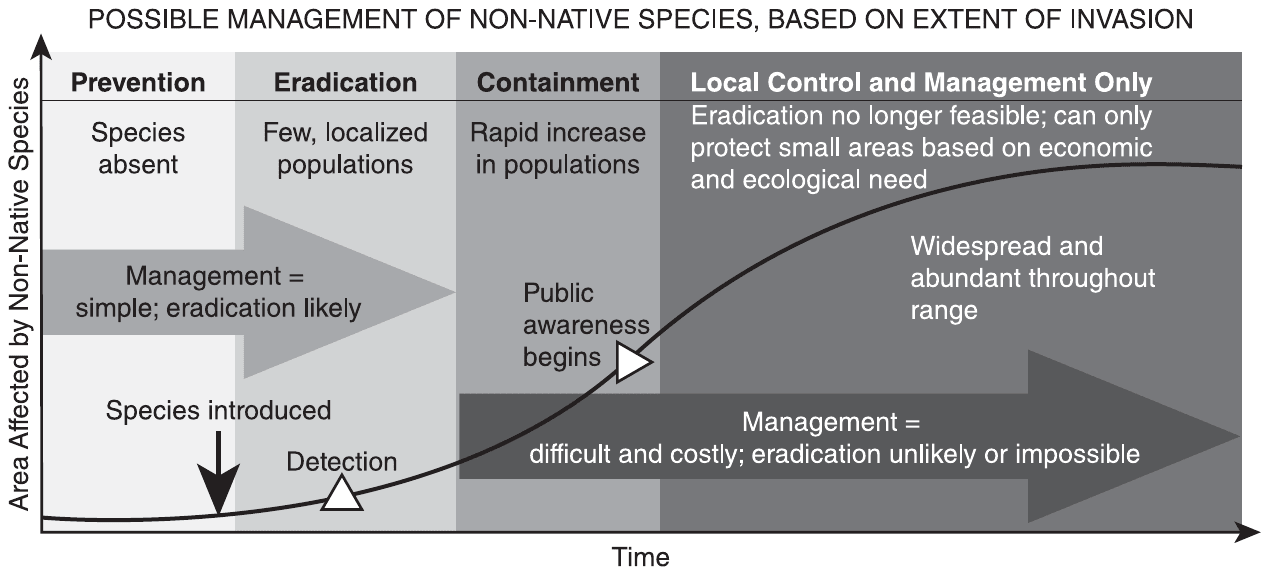
Invasive species are scary. It was ecologist Charles Elton, back in the 1950s, who introduced the militaristic “invasion” metaphor to describe exotic plants and animals—but there’s no question some can be extremely destructive.
The brown tree snake has eaten a dozen kinds of forest birds in Guam to extinction; zebra mussels clog pipes around the Great Lakes; the common house cat turns out to be, in Australia, a mercilessly effective killer of cute, fluffy marsupials like the bilby and the numbat.
As scientists have sounded the alarm about these pests, the public has gotten the message. Citizen groups rip out non-native plants. Native gardens have become increasingly popular, both as ways to celebrate the unique flora of each region and as tiny hot spots of diversity. Native trees provide food for native bugs, which feed native birds. Food chains developed over thousands of years of co-evolution unfold in our backyards. . . .
So we’ve learned, scientists and laypeople alike, that native species are good and non-natives are bad.
Julian Olden, a biologist at the University of Washington, Seattle, who co-organized the symposium, recently polled nearly 2,000 ecologists. Among his findings: a substantial number of them said they would immediately eradicate a hypothetical non-native forest plant, even if it were shown to have no effect on the forest. Olden calls this the “guilty even when proven innocent” approach.
That kind of approach is not very useful on a rapidly changing planet.
Exotics Are Everywhere
Climate change is making it harder even to decide who the invaders are.
How, scientists at the symposium wondered, do you define “native” on a warming planet, when plants and animals are already moving toward the poles or up mountainsides in search of climate conditions they can tolerate? Should we consider them “invasive” in their new homes? Regardless of what we label them, conservationists will be reluctant to remove them from their new environs—to do so would stymie1 their chances of adapting to the warmer future we’re creating.
And then there are the non-natives that we actually like. Most domestic crops are exotic in most of the places they’re grown, but there are even wild exotics that “do good,” forming useful relationships with native species.
Edwin Grosholz of the University of California, Davis, told the recent symposium about one such relationship. On beaches in his state, non-native spartina grass has become important habitat for the endangered California clapper rail, a plump shorebird with a downward curving bill more at home on land than in the air. A project to rip out and poison the spartina—which grows in dense swaths that exclude many other shorebirds—saw clapper rail numbers go tumbling downward.
There are other examples like that. The endangered southwestern willow flycatcher nests in “invasive” tamarisk shrubs. Many native (and beautiful) Hawaiian flowers are now pollinated by the Japanese white-eye bird—because the native pollinators have been driven extinct by other non-native species.
Should we impose further risk on already endangered natives by severing these relationships? Or should we admire the resilience of nature and let such “well-behaved” exotics stay? . . .
Leave them alone, more and more conservationists are arguing, and stop focusing obsessively on categorizing species as native or non-native. Mark Davis, an ecologist at Macalester College in St. Paul, Minnesota, once considered himself an “invasion biologist”—but not anymore. “I am actively trying to get the field to retire the invader narrative,” he said in Missoula.
A Good Thing, Not the Only Thing
After all, nativeness is just one environmental value, and arguably not as important as preventing extinctions and preserving biodiversity. In some cases we can best serve biodiversity by leaving the non-natives alone or even—brace yourself, now—introducing them on purpose.
This is the thinking behind, for example, installing the Aldabra tortoise on the islands of Mauritius. The islands lost their own large tortoises, and the fruiting plants that formerly had their seeds moved around by these fruit-loving reptiles have been on the decline. A tortoise that’s related to the island’s large tortoises—a non-native from the Seychelles in the Indian Ocean that was intentionally introduced in 2004—is now handling some of that work.
Most of the time, for the time being, conserving species still means focusing on supporting them in their historical habitats, planting natives and removing non-natives. We can and should do that in places where it is feasible and important to us.
From “It’s Time to Stop Thinking That All Non-Native Species Are Evil” by Emma Marris from NATIONAL GEOGRAPHIC MAGAZINE, July 24, 2014. Copyright © 2014 by National Geographic Society.
1stymie: hinder or interfere with
Question
The author’s use of cause and effect in paragraphs 10–11 mainly emphasizes the idea that
- Asome non-native species have helped their environments while others have had harmful impacts.
- Battempts to remove non-native species have seldom produced desired results.
- Csome endangered native species have flourished because of the presence of non-native species.
- Dinteractions between endangered native species and non-native species must be carefully monitored.
Show the answer
Correct answer: C
The question asks what the author’s use of cause and effect in paragraphs 10–11 mainly emphasizes.
A. Incorrect. The examples of cause and effect discussed in paragraphs 10–11, such as the spartina grass helping the clapper rail and the Japanese white-eye bird pollinating Hawaiian flowers, are all instances in which non-native species have helped their new environments.
B. Incorrect. While paragraph 10 does mention that efforts to eradicate the non-native spartina grass hurt the native clapper rail shorebird, the main emphasis in both paragraphs 10–11 is on the fact that certain non-native species have helped native species.
C. CORRECT. Paragraphs 10–11 focus on several examples of non-native species that have helped endangered native species flourish: non-native spartina grass providing “important habitat for the endangered California clapper rail” (paragraph 10), non-native tamarisk shrubs providing nesting places for the endangered southwestern willow flycatcher (paragraph 11), and the non-native Japanese white-eye bird pollinating Hawaiian flowers (paragraph 11).
D. Incorrect. While paragraphs 10–11 describe several interactions between non-native and native species, they never discuss monitoring these interactions.
Question analysis
This text-structure question asks what the cause-and-effect examples in two paragraphs of an article about non-native species mainly emphasize. The paragraphs describe a shorebird, a flycatcher and Hawaiian flowers, and students must decide what the examples have in common rather than fixing on any one of them.
- Grade level
- Grade 8 reading and task
- Compared with grade 7
- Above grade 7 Analyzing what a cause-and-effect structure emphasizes is grade 7 work, but these examples involve unfamiliar species and endangered status, and more than one choice is partly supported by the paragraphs, which raises the demand above typical.
- Estimated difficulty
- Hard: combines ideas, needs a plan, and has more than one tempting wrong answer.
- Thinking it demands
- Depth of knowledge 3, strategic thinking · mainly analyze
- What makes it hard
- A very close wrong answer major
- Reading between the lines moderate
- An unfamiliar subject minor
- Evidence
- Answered from several paragraphs or stanzas
- Reading level
- Passage: about grade 11, 815 words; question and choices: about grade 11, 62 words.
- Students, last 30 days
- Not enough answers yet to show (it takes 10).
Why it is hard, traps and wrong answers (shows the answer)
Why it is hard
The paragraphs mention harm as well as help, so a balanced statement about both looks accurate and even fair-minded. What the cause-and-effect pairs stress, though, is endangered natives depending on non-natives, and the right answer captures that while overstating it, since a bird whose numbers held up only with spartina's help can hardly be said to have flourished. Students must prefer the statement of the main emphasis to one that is partly supported but off the point.
A very close wrong answer major Choosing the answer
The right choice and the help-and-harm choice both say non-natives have aided their surroundings; they part on harm, which the paragraphs do mention, spartina crowding out shorebirds and other non-natives killing Hawaii's pollinators, but only in passing. (Embretson & Wetzel, 1987; Gorin & Embretson, 2006; Ascalon et al., 2007)
Reading between the lines moderate Working it out
Paragraph 10 states its cause and effect backwards, removing spartina sent clapper rail numbers “tumbling downward”, and the student must turn that around into the grass's presence helping the bird. (Graesser, Singer & Trabasso, 1994; Kintsch, 1998)
An unfamiliar subject minor Understanding the question
Five unfamiliar species crowd two paragraphs, spartina grass, the California clapper rail, tamarisk shrubs, the southwestern willow flycatcher and the Japanese white-eye, and each one's role must be kept straight. (Recht & Leslie, 1988; Kintsch, 1998)
Strategy: List each cause-and-effect pair in paragraphs 10 and 11, the species involved and what happened to them, then pick the statement that holds for the examples taken together.
Traps
- Too narrow: A single detail offered as the central idea or a summary, or a summary that keeps minor details and leaves out an essential part.
- Too broad or too strong: A choice overstates, generalizes, or uses absolute words the text does not support.
- Outside knowledge: A choice is plausible in the real world but not supported by this text.
The wrong answers, classified
A Too narrow (King et al., 2004)
Accurately notes helpful and harmful non-natives, but the harm is mentioned only in passing, and it leaves out what every example stresses, endangered natives depending on non-natives.
B Too broad or too strong (King et al., 2004)
Generalizes from the single spartina project in paragraph 10 to removal attempts in general, a “seldom” claim that neither paragraph makes.
D Outside knowledge (King et al., 2004; Recht & Leslie, 1988)
Adds a sensible-sounding call for careful monitoring, the kind of advice scientists often give, but neither paragraph says anything about watching over these relationships.
Working it out, step by step
Know what the question asks
In a cause-and-effect pattern, one thing makes another happen. You need the main idea that the causes and effects in paragraphs 10 and 11 stress. Start by listing each pair.
List each cause and effect
- Paragraph 10: non-native spartina grass gives the endangered clapper rail a home, so when people ripped out the grass, clapper rail numbers went “tumbling downward.”
- Paragraph 11: the endangered willow flycatcher nests in non-native tamarisk shrubs.
- Paragraph 11: native Hawaiian flowers are now pollinated by a non-native bird, the Japanese white-eye.
Find the common thread
Endangered means at risk of dying out. Pollinated means a bird or bug carries pollen between flowers so they can make seeds. In every pair, a native species depends on a non-native one. The newcomer gives it a home, a place to nest or a pollinator. Two of the natives, the clapper rail and the flycatcher, are endangered. So the paragraphs stress that some endangered natives do better because non-natives are there.
Check each choice
- C fits: some endangered natives have “flourished,” or done well, because non-natives are present.
- A is wrong because harm comes up only in passing, while every example stresses a native getting help.
- B is wrong because one removal project is not enough to say removal “seldom” works.
- D is wrong because the paragraphs never mention monitoring, or watching over, these relationships.
Watch out: The paragraphs do mention harm. Spartina crowds out some other shorebirds, and other non-natives wiped out Hawaii’s native pollinators. So A sounds balanced, but it misses the main point.
Choose the answer
The causes and effects show struggling natives, two of them endangered, helped by non-natives. So the answer is C.
Why this answer and not the closest wrong one
A comes closest, because the paragraphs mention harm as well as help. But the harm is only a side note. Every cause and effect shows a native relying on a non-native, and two of those natives are endangered birds. C names that main point, even though “flourished” is a strong word for birds that are still endangered.
More questions like this
The original DOE question
The passage “Excerpt from “It’s Time to Stop Thinking That All Non-Native Species Are Evil”” as printed (pages 68–70)
Question 3 of 6
2026 Practice Test D English, question 12Passage Excerpt from “How We Made the First Flight”
Excerpt from “How We Made the First Flight”
by Orville Wright
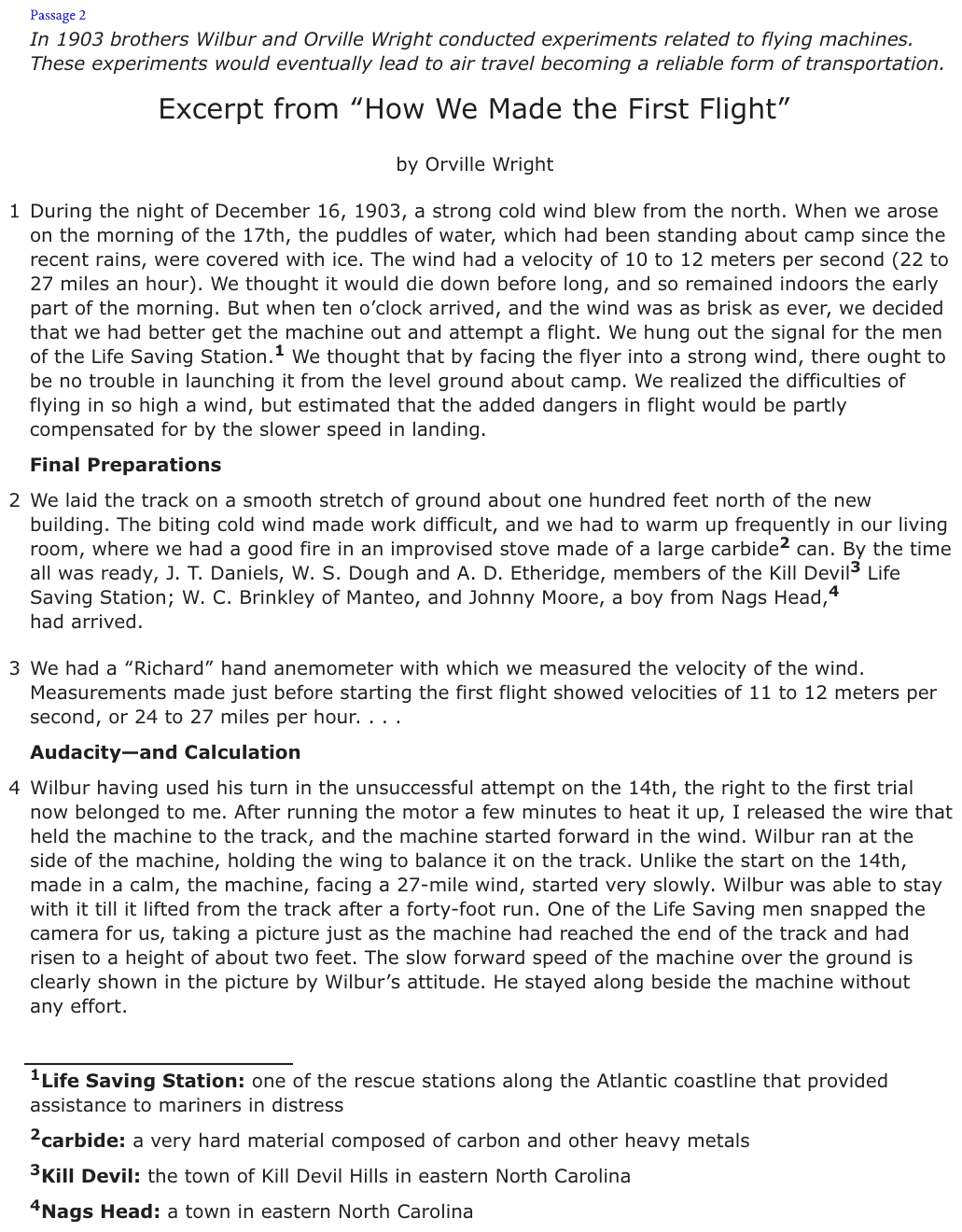
In 1903 brothers Wilbur and Orville Wright conducted experiments related to flying machines. These experiments would eventually lead to air travel becoming a reliable form of transportation.
During the night of December 16, 1903, a strong cold wind blew from the north. When we arose on the morning of the 17th, the puddles of water, which had been standing about camp since the recent rains, were covered with ice. The wind had a velocity of 10 to 12 meters per second (22 to 27 miles an hour). We thought it would die down before long, and so remained indoors the early part of the morning. But when ten o’clock arrived, and the wind was as brisk as ever, we decided that we had better get the machine out and attempt a flight. We hung out the signal for the men of the Life Saving Station.1 We thought that by facing the flyer into a strong wind, there ought to be no trouble in launching it from the level ground about camp. We realized the difficulties of flying in so high a wind, but estimated that the added dangers in flight would be partly compensated for by the slower speed in landing.
Final Preparations
We laid the track on a smooth stretch of ground about one hundred feet north of the new building. The biting cold wind made work difficult, and we had to warm up frequently in our living room, where we had a good fire in an improvised stove made of a large carbide2 can. By the time all was ready, J. T. Daniels, W. S. Dough and A. D. Etheridge, members of the Kill Devil3 Life Saving Station; W. C. Brinkley of Manteo, and Johnny Moore, a boy from Nags Head,4 had arrived.
We had a “Richard” hand anemometer with which we measured the velocity of the wind. Measurements made just before starting the first flight showed velocities of 11 to 12 meters per second, or 24 to 27 miles per hour. . . .
Audacity—and Calculation
Wilbur having used his turn in the unsuccessful attempt on the 14th, the right to the first trial now belonged to me. After running the motor a few minutes to heat it up, I released the wire that held the machine to the track, and the machine started forward in the wind. Wilbur ran at the side of the machine, holding the wing to balance it on the track. Unlike the start on the 14th, made in a calm, the machine, facing a 27-mile wind, started very slowly. Wilbur was able to stay with it till it lifted from the track after a forty-foot run. One of the Life Saving men snapped the camera for us, taking a picture just as the machine had reached the end of the track and had risen to a height of about two feet. The slow forward speed of the machine over the ground is clearly shown in the picture by Wilbur’s attitude. He stayed along beside the machine without any effort.
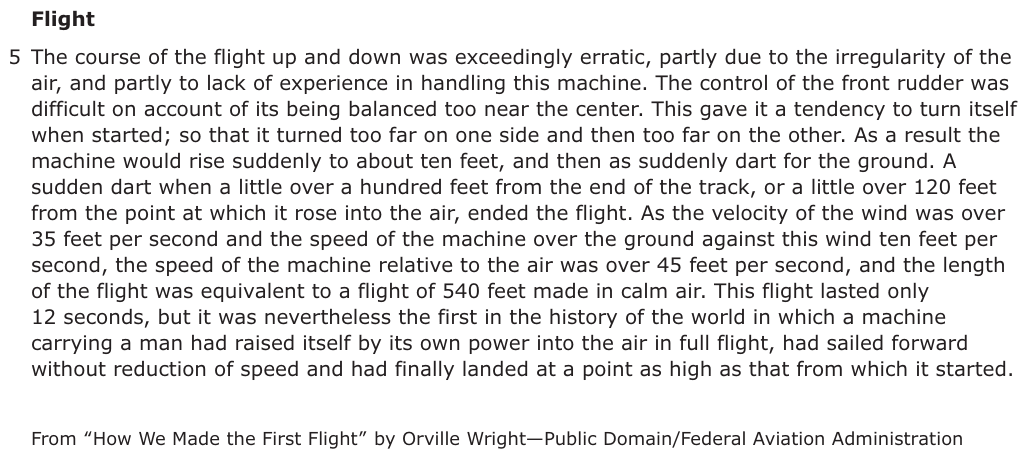
Flight
The course of the flight up and down was exceedingly erratic, partly due to the irregularity of the air, and partly to lack of experience in handling this machine. The control of the front rudder was difficult on account of its being balanced too near the center. This gave it a tendency to turn itself when started; so that it turned too far on one side and then too far on the other. As a result the machine would rise suddenly to about ten feet, and then as suddenly dart for the ground. A sudden dart when a little over a hundred feet from the end of the track, or a little over 120 feet from the point at which it rose into the air, ended the flight. As the velocity of the wind was over 35 feet per second and the speed of the machine over the ground against this wind ten feet per second, the speed of the machine relative to the air was over 45 feet per second, and the length of the flight was equivalent to a flight of 540 feet made in calm air. This flight lasted only 12 seconds, but it was nevertheless the first in the history of the world in which a machine carrying a man had raised itself by its own power into the air in full flight, had sailed forward without reduction of speed and had finally landed at a point as high as that from which it started.
From “How We Made the First Flight” by Orville Wright—Public Domain/Federal Aviation Administration
1Life Saving Station: one of the rescue stations along the Atlantic coastline that provided assistance to mariners in distress
2carbide: a very hard material composed of carbon and other heavy metals
3Kill Devil: the town of Kill Devil Hills in eastern North Carolina
4Nags Head: a town in eastern North Carolina
Question
Read this sentence from paragraph 5.
As the velocity of the wind was over 35 feet per second and the speed of the machine over the ground against this wind ten feet per second, the speed of the machine relative to the air was over 45 feet per second, and the length of the flight was equivalent to a flight of 540 feet made in calm air.
How does the sentence help convey Orville Wright’s perspective about this first flight?
- AIt suggests that he was frustrated by the poor flying conditions on the day of the flight.
- BIt emphasizes that he believed the flight was successful despite its short distance.
- CIt provides a comparison between flight distances under calm and high wind conditions.
- DIt highlights the importance of such calculations in the success of future flights.
Show the answer
Correct answer: B
The question asks how the sentence from paragraph 5 helps convey Orville Wright’s perspective about the first flight.
A. Incorrect. Although the sentence from paragraph 5 refers to the velocity of the wind during the flight, there is no indication that Orville felt a sense of frustration with the windy conditions. Instead, the sentence emphasizes the “speed of the machine relative to the air” and presents the equivalent flight length if the machine had flown through calm air (“the length of the flight was equivalent to a flight of 540 feet made in calm air”), details that emphasize the importance of the Wrights’ accomplishment.
B. CORRECT. In the sentence from paragraph 5, Orville uses the wind velocity and the machine speed to highlight the distance that the plane covered while in the air and to determine the distance that it would have flown on a day with calm winds, which emphasizes the magnitude of the accomplishment.
C. Incorrect. Since Orville does not suggest in the sentence from paragraph 5 how far the plane traveled under the actual conditions of high winds, the comparison is incomplete. Additionally, this statement does not address the reason that he would make such a comparison, which allowed him to describe the flight in more impressive terms (540 feet versus 120 feet).
D. Incorrect. Unlike the wind velocity calculations made in preparation for the flight, which might help in determining the success of future flights, the comparative calculations that Orville provides in the sentence from paragraph 5 help interpret the results of the first flight (by describing how fast and far the machine flew relative to the flying conditions) and thereby communicate its success. The calculations of the first flight’s relative speed and equivalent distance would not affect the success of future flights, but the information does provide context for understanding the Wright brothers’ accomplishment.
Question analysis
This point-of-view question quotes the long sentence from paragraph 5 in which Orville Wright works out the machine’s speed through the air and the length of an equivalent flight in calm air. Students must decide how this sentence helps convey his perspective on the first flight. The sentence is mostly numbers, from 35 feet per second to 540 feet, which makes its purpose easy to miss.
- Grade level
- Grade 8 reading and task
- Compared with grade 7
- Above grade 7 Grade 7 point-of-view questions usually rest on words that show feeling. This sentence is a chain of speeds and distances with no feeling words, so students must work out why Orville bothers with the arithmetic, a step beyond typical grade 7 work.
- Estimated difficulty
- Hard: combines ideas, needs a plan, and has more than one tempting wrong answer.
- Thinking it demands
- Depth of knowledge 3, strategic thinking · mainly analyze
- What makes it hard
- How, not what moderate
- Reading between the lines moderate
- Complex sentences minor
- Evidence
- Answered from one paragraph or stanza
- Reading level
- Passage: about grade 7, 816 words; question and choices: about grade 9, 132 words.
- Students, last 30 days
- Not enough answers yet to show (it takes 10).
Why it is hard, traps and wrong answers (shows the answer)
Why it is hard
Point-of-view questions usually turn on feeling words, and this sentence has none, only speeds and a distance. Students must ask why Orville bothers with the arithmetic, and the answer is that 540 feet in calm air makes a 12-second hop look like the achievement he believed it was. The strongest pull describes the sentence’s content accurately, a comparison of calm and windy flight, without saying what it reveals, so students who answer what instead of why lose the point.
How, not what moderate Working it out
The question asks why Orville includes this calculation, so students must see that converting a short hop into “a flight of 540 feet made in calm air” is his way of showing that it counted. (Anderson & Krathwohl, 2001)
Reading between the lines moderate Working it out
The sentence holds no word of feeling or judgment; his view that the flight succeeded must be read from his choice to restate about 120 feet over the ground as 540 feet through the air. (Graesser, Singer & Trabasso, 1994; Kintsch, 1998)
Complex sentences minor Understanding the question
The 61-word sentence chains four measurements, a wind over 35 feet per second, a ground speed of ten, an airspeed over 45 and the 540-foot equivalent, joined by “As,” “and” and commas. (Abedi & Lord, 2001; Freedle & Kostin, 1993; Messick, 1989)
Strategy: Work out what the speeds and distances in the sentence describe, then ask why Orville includes them at this point and what that choice tells you about his view of the flight.
Traps
- Wrong purpose or structure: Names a purpose, structure or effect that the part does not serve, or describes what a part says when the question asks what it does.
- Wrong tone or attitude: Misjudges the tone, attitude or point of view, such as reading admiration as criticism, or taking a character's or subject's feelings for the author's.
- Outside knowledge: A choice is plausible in the real world but not supported by this text.
The wrong answers, classified
A Wrong tone or attitude (Graesser, Singer & Trabasso, 1994)
Links the high wind to the cold, hard morning of paragraphs 1 and 2 and assumes Orville resented it, though here he uses the wind’s speed to make the flight count for more.
C Wrong purpose or structure (Anderson & Krathwohl, 2001)
Describes what the sentence contains, a flight measured against one in calm air, without saying what that comparison shows about Orville’s view of the flight, which is what the question asks.
D Outside knowledge (King et al., 2004; Recht & Leslie, 1988)
Assumes careful calculations must be meant to guide later flights, a reasonable idea about early aviation, but this sentence measures the flight just made and looks no further ahead.
Working it out, step by step
Figure out what the question asks
This asks about Orville Wright’s perspective, or point of view. How did he feel about the first flight? The quoted sentence is full of numbers, not feelings. So ask why Orville bothered to do this math.
Sort out the numbers
The wind blew against the machine at over 35 feet per second. The machine moved over the ground at 10 feet per second. It was flying into the wind, so the air rushed past it even faster. Add them: it moved through the air at over 45 feet per second. The flight lasted 12 seconds. Over the ground, that is 10 × 12 = 120 feet. Through the air, it is 45 × 12 = 540 feet. That is how Orville gets “a flight of 540 feet made in calm air.”
Ask why Orville does this math
Paragraph 5 says the flight ended “a little over 120 feet from the point at which it rose into the air.” That sounds short. But Orville shows it was really much more. In calm air, the same flight would have gone 540 feet. He wants you to see that the short hop was a real flight. So his view is that the flight was a success.
Check each choice
- A does not fit. There is no sign of frustration. Orville uses the wind to make the flight count for more.
- B fits. The math turns a short flight into an impressive one.
- C does not fit. The sentence does compare calm and windy air. But that only says what the sentence contains, not what Orville thinks.
- D does not fit. The math measures the flight that just happened. It does not look ahead to future flights.
Watch out: C is tempting because it describes the sentence correctly. But the question asks about his perspective. C never says how he felt about the flight.
Choose the answer
Orville does the math to show that his short flight was a real success. So the answer is B, “It emphasizes that he believed the flight was successful despite its short distance.”
Why this answer and not the closest wrong one
C is the closest wrong choice. It is true that the sentence compares a windy flight with one “made in calm air.” But C only tells what the sentence says. The question asks why Orville says it. He turns about 120 feet into 540 feet to show the flight was a real achievement. B gives that reason.
More questions like this
The original DOE question
The passage “Excerpt from “How We Made the First Flight”” as printed (pages 13–14)
Question 4 of 6
2024 Test A Math, question 18Question
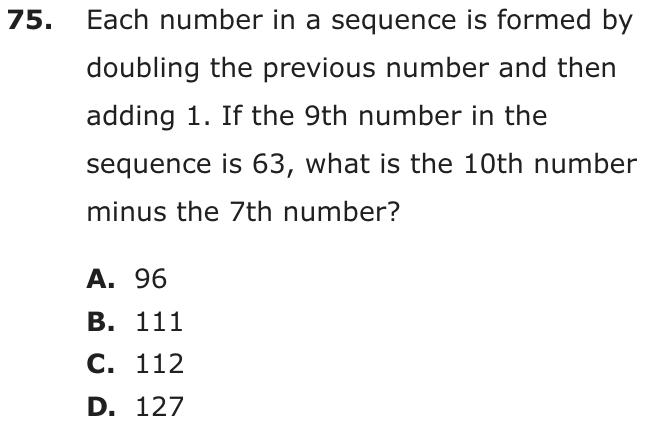
Each number in a sequence is formed by doubling the previous number and then adding 1. If the 9th number in the sequence is 63, what is the 10th number minus the 7th number?
- A96
- B111
- C112
- D127
Show the answer
Correct answer: C
First, write an equation based on the rule described in the item. Let x be the previous number in the sequence and y be the number in the sequence. The ninth number in the sequence is 63.
Determine the 10th number in the sequence, y, by making and solving:
Determine the 8th number in the sequence, x, by making and solving:
Subtract one from both sides of the equation.
Determine the 7th number in the sequence, x, by making and solving:
Subtract the 7th number in the sequence from the 10th number:
The difference is 112.
Question analysis
A sequence question: each number is found by doubling the one before it and adding 1, and the 9th number is 63. Students find the 10th number minus the 7th. That means running the rule forward once and backward twice, while keeping track of which position each number holds.
- Grade level
- Grade 7 content, by NYS standard
- Compared with grade 7
- Above grade 7 Grade 7 students solve two-step equations but rarely have to run a rule backward through a sequence. This mixes forward and backward steps with position counting, so it asks for more planning than a typical grade 7 task.
- Estimated difficulty
- Hard: combines ideas, needs a plan, and has more than one tempting wrong answer.
- Thinking it demands
- Depth of knowledge 2, skills and concepts · mainly apply
- What makes it hard
- No obvious method moderate
- Many steps moderate
- Much to keep track of minor
- Solution
- 4 steps
- Reading level
- Question and choices: about grade 7, 32 words.
- Corrected from the DOE handbook
- A misplaced parenthesis in the explanation’s working was corrected.
- Students, last 30 days
- Not enough answers yet to show (it takes 10).
Why it is hard, traps and wrong answers (shows the answer)
Why it is hard
Applying the rule forward is routine; running it backward is not, and the question needs both. Students must also count positions carefully, since the 9th number is given and the 7th is two steps back, not one. Each listed wrong answer stops or slips at a different stage, so writing the four numbers in a row, 15, 31, 63 and 127, before subtracting is the reliable way.
No obvious method moderate Working it out
The rule is stated only forward, double and add 1, but the 7th and 8th numbers come before the given 9th, so the rule must be undone: subtract 1, then halve. (Schoenfeld, 1985)
Many steps moderate Working it out
One forward step reaches the 10th number, 127, two backward steps reach the 8th and 7th, 31 and 15, and a final subtraction finishes. (Daniel & Embretson, 2010; Enright, Morley & Sheehan, 2002)
Much to keep track of minor Working it out
Four positions and their values, 7th to 10th, have to be kept straight, and the 8th number is easy to mistake for the 7th. (Sweller, 1988; Carpenter, Just & Shell, 1990)
Strategy: Apply the rule to 63 to get the 10th number; to go back a position, subtract 1 and halve, doing it twice to reach the 7th; then subtract.
Traps
- Counting the ends: Inclusive or exclusive ends, fence posts, consecutive numbers: an answer that is one too many or too few, or an endpoint drawn open where it belongs closed (or the reverse).
- Stops one step early: A choice is a number from partway through the solution.
The wrong answers, classified
A Counting the ends (Brown & Burton, 1978)
Steps back only once from the 9th number and subtracts the 8th, 127 − 31 = 96, one position short of the 7th.
B Misreads the question (Hegarty, Mayer & Monk, 1995)
Doubles 63 to 126 but forgets to add 1 on that step, then subtracts the correct 7th number: 126 − 15 = 111.
D Stops one step early (King et al., 2004; Gierl et al., 2017)
Finds the 10th number, 2 × 63 + 1 = 127, and stops without subtracting the 7th number from it.
What was corrected from the DOE handbook, and why
- Explanation: Finding the 7th number, the handbook writes “2x + (1 − 1 = 31 − 1)”, with the closing parenthesis after the whole equation, so the line reads as an equation inside an expression (and 1 − 1 = 31 − 1 is false). The site now reads 2x + (1 − 1) = 31 − 1, the same step the handbook writes correctly for the 8th number (2x + (1 − 1) = 63 − 1). It leads to 2x = 30 and x = 15 as before.
Worked solution, step by step
Formulas used
- The sequence rule
- A sequence is a list of numbers that follows a rule. x is a number in the list, and y is the next number. To get the next number, double x and then add 1.
- Going back one number
- y is a number in the list, and x is the one just before it. To go back, undo the rule in reverse order. The rule doubles and then adds 1. So first subtract 1, then divide by 2.
Sort out the question
Each number is “formed by doubling the previous number and then adding 1”. Previous means the one just before. The 9th number is 63. You need the 10th number minus the 7th number. So you go forward one number and back two numbers.
Find the 10th number
Use the rule with x = 63.
The 10th number is 127. Watch out: remember to add 1. Doubling only gives 126 and leads to 111, choice B.
Plan how to go back
The 7th number comes before the 9th, so you must undo the rule. The rule doubled, then added 1. Undo the last step first: subtract 1. Then undo the doubling: divide by 2.
Find the 8th number
The 8th number is 31. Watch out: 31 is the 8th number, not the 7th. Using it gives , choice A.
Find the 7th number
Step back once more, from the 8th number. Use the same rule with y = 31.
The 7th number is 15.
Subtract the 7th from the 10th
Watch out: 127 alone is choice D. You still have to subtract the 7th number. So the answer is C, 112.
Check your answer
Go forward from 15 using the rule. , then , then . You land on 63 as the 9th number, so the list is right. And .
More questions like this
The original DOE question
Question 5 of 6
2018 Test B Math, question 44Question
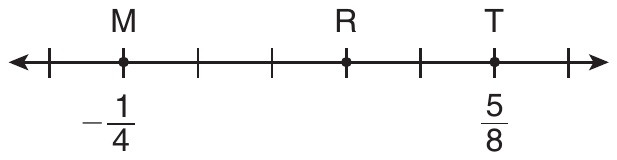
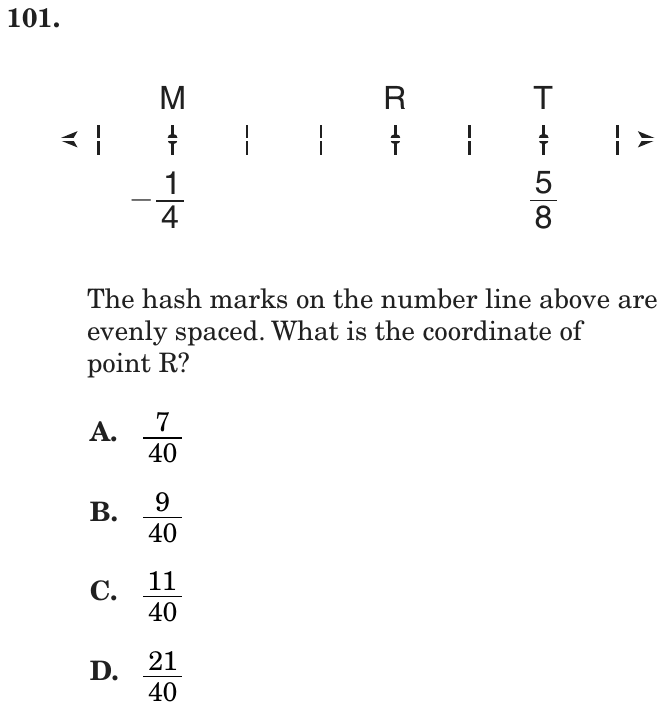
The hash marks on the number line above are evenly spaced. What is the coordinate of point ?
- A
- B
- C
- D
Show the answer
Correct answer: C
There are 5 sections between M and T. To find the length of one of these sections, find the distance between M and T and divide by 5:
R is 3 sections away from M, so add:
R is located at .
Question analysis
Students find the fraction at point R on a number line with evenly spaced hash marks, where M is at −1/4 and T is at 5/8. It tests fraction arithmetic with negative numbers. Working out the size of one gap and counting gaps from M to R takes several careful steps.
- NYS standards
- Grade level
- Grade 7 content, by NYS standard
- Compared with grade 7
- Above grade 7 Grade 7 students place fractions and negatives on number lines, but here they must subtract a negative fraction, divide by five, and then add back. Four fraction steps with unlike denominators make it harder than typical classwork.
- Estimated difficulty
- Hard: combines ideas, needs a plan, and has more than one tempting wrong answer.
- Thinking it demands
- Depth of knowledge 2, skills and concepts · mainly apply
- What makes it hard
- Error-prone arithmetic major
- Reading a figure, table or graph moderate
- Solution
- 4 steps
- Reading level
- Question and choices: about grade 6, 22 words.
- Students, last 30 days
- Not enough answers yet to show (it takes 10).
Why it is hard, traps and wrong answers (shows the answer)
Why it is hard
Fractions, a negative starting point and a count of spaces all have to come out right together. Students lose points by counting tick marks instead of spaces, by subtracting −1/4 as if it were positive, or by measuring R from 0 instead of from M. Converting both labels to fortieths first, −10/40 and 25/40, makes each gap a whole number of fortieths.
Error-prone arithmetic major Working it out
The gap length needs 5/8 − (−1/4) = 7/8, then 7/8 ÷ 5 = 7/40, then −10/40 + 21/40: negatives and three different denominators meet in one problem. (Brown & Burton, 1978; Junker & Sijtsma, 2001)
Reading a figure, table or graph moderate Understanding the question
The hash marks have to be counted as spaces: five from M to T, with R three spaces past M, while the unlabeled marks outside M and T play no part. (Lesh, Post & Behr, 1987; Kirsch & Mosenthal, 1990)
Strategy: Find the distance from M to T by subtracting their coordinates, divide it by the number of equal gaps, then step from M toward T by the right number of gaps.
Traps
- Stops one step early: A choice is a number from partway through the solution.
- Negatives and direction: Arithmetic with negative numbers, the order of a subtraction, or direction on a number line. (Moving a term across the equals sign without changing its sign is a faulty procedure.)
The wrong answers, classified
A Stops one step early (King et al., 2004; Gierl et al., 2017)
Finds the length of one gap, 7/8 ÷ 5 = 7/40, and gives it as R's coordinate without stepping from M.
B Negatives and direction (Brown & Burton, 1978)
Subtracts as 5/8 − 1/4 = 3/8 instead of adding, gets gaps of 3/40, and counts three gaps from 0.
D Stops one step early (King et al., 2004; Gierl et al., 2017)
Multiplies the 7/40 gap by 3 to get the distance from M to R, then forgets to add it to M's −1/4.
Worked solution, step by step
Formulas used
- Distance on a number line
- The right number is the point farther to the right on the number line. The left number is the other point. Subtracting tells how many units apart they are. Taking the left from the right keeps the answer positive.
- Dividing a fraction by a whole number
- a over b is the fraction, and c is the whole number you divide by. Splitting a fraction into c equal parts makes each part c times smaller. So you multiply the bottom number, b, by c.
Read the number line
M is at and T is at . The hash marks are evenly spaced, so every space is the same length. Count the spaces. From M to T there are 5 spaces. From M to R there are 3 spaces. You need the number at point R.
Find the distance from M to T
Use the distance formula. First write in eighths, as .
Taking away a negative is the same as adding. M and T are apart.
Find the length of one space
The 5 spaces are equal, so divide by 5.
Each space is long.
Watch out: this is the length of one space, not where R is. Stopping here gives choice A.
Step from M to R
R is 3 spaces to the right of M.
Now add that to M. Write as .
Watch out: is how far R is from M, not where R is. Choosing it gives choice D.
Give the answer
Point R is at , a little to the right of 0. So the answer is C, .
Check your answer
Go backward from T instead. T is 2 spaces past R, and . So R is at . Both ways give the same point.
More questions like this
The original DOE question
Question 6 of 6
2024 Test B Math, question 28Question
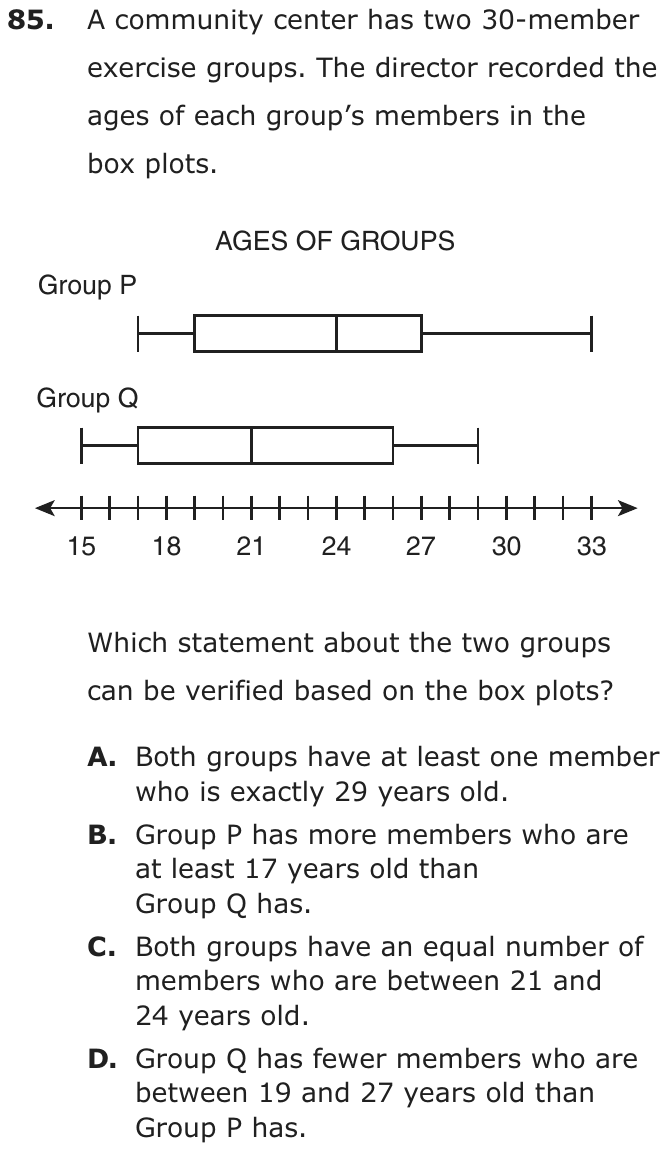
A community center has two 30-member exercise groups. The director recorded the ages of each group’s members in the box plots.
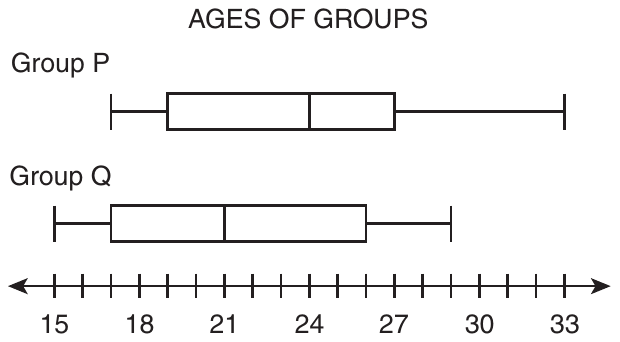
Which statement about the two groups can be verified based on the box plots?
- ABoth groups have at least one member who is exactly 29 years old.
- BGroup P has more members who are at least 17 years old than Group Q has.
- CBoth groups have an equal number of members who are between 21 and 24 years old.
- DGroup Q has fewer members who are between 19 and 27 years old than Group P has.
Show the answer
Correct answer: B
Groups P and Q have an equal number of members. All the members of Group P are 17 or older, but only about of the members of Group Q are 17 or older.
Question analysis
Box plots show the ages of the members of two 30-member exercise groups at a community center, Group P and Group Q. Students decide which statement comparing the groups can be verified from the plots alone. The challenge is knowing what a box plot guarantees about individual ages and counts, and what it leaves unknown.
- NYS standards
- Grade level
- Grade 7 content, by NYS standard
- Compared with grade 7
- Above grade 7 Grade 7 students read box plots and compare medians and spreads. Deciding which claims two box plots can prove, from what the five key values guarantee about counts, is a harder reasoning task than typical grade 7 work.
- Estimated difficulty
- Hard: combines ideas, needs a plan, and has more than one tempting wrong answer.
- Thinking it demands
- Depth of knowledge 3, strategic thinking · mainly evaluate
- What makes it hard
- Every choice must be checked major
- Something you must already know moderate
- Reading a figure, table or graph moderate
- Solution
- 3 steps
- Reading level
- Question and choices: about grade 5, 91 words.
- Students, last 30 days
- Not enough answers yet to show (it takes 10).
Why it is hard, traps and wrong answers (shows the answer)
Why it is hard
This is a question about evidence: the right statement is the only one the box plots guarantee, while the others may or may not be true. Students who treat the plots as pictures of every member, assuming ages fill each whisker or spread evenly through each box, find support for claims that cannot be checked. Asking what must hold for any 30 ages with these summaries separates the verifiable claim from the merely plausible ones.
Every choice must be checked major Choosing the answer
Three of the statements are not false but unverifiable, so each must be tested against what the five-number summaries guarantee, and none can be dismissed at a glance. (Embretson & Wetzel, 1987)
Something you must already know moderate Working it out
Students must know that the minimum and maximum are actual ages, that each quarter of a plot holds about a quarter of the 30 members, and that a whisker shows nothing in between. (Anderson & Krathwohl, 2001)
Reading a figure, table or graph moderate Understanding the question
The scale is labeled only every 3 years, so values such as 17, 19, 26 and 29 have to be read from unlabeled ticks on two separate plots. (Lesh, Post & Behr, 1987; Kirsch & Mosenthal, 1990)
Strategy: List each group's minimum, first quartile, median, third quartile and maximum, then test every statement against only what those five values guarantee about the 30 ages.
Traps
- Misunderstands the concept: A wrong belief about a concept: that percents can be added, that area grows like length, that averages can be averaged, that a bigger denominator means a bigger fraction.
- Numbers taken from the question: Combines the numbers in the question without a model of the situation, or is simply a number that appears in the question.
The wrong answers, classified
A Misunderstands the concept (Smith, diSessa & Roschelle, 1993; De Bock et al., 1998; Ni & Zhou, 2005)
Sees that Group Q's maximum is exactly 29 and that 29 also lies in Group P's upper whisker, assuming someone in Group P is that age.
C Numbers taken from the question (Hegarty, Mayer & Monk, 1995)
Matches the two medians, 21 and 24, and assumes the stretch between them holds the same number of members in both groups.
D Misunderstands the concept (Smith, diSessa & Roschelle, 1993; De Bock et al., 1998; Ni & Zhou, 2005)
Knows Group P's box from 19 to 27 holds half its members, then assumes ages spread evenly so Group Q has fewer there, which its plot cannot show.
Worked solution, step by step
Formulas used
- Members in each part of a box plot
- n is the number of members in a group, here 30. A box plot splits the data into four parts at the minimum, Q1, the median, Q3 and the maximum. Each part holds about one fourth of the data. It does not show how the ages spread out inside a part.
Read the two box plots
A box plot shows five numbers. The minimum is the youngest age, and the maximum is the oldest. Q1 is the left edge of the box, and Q3 is the right edge. The median is the line inside the box.
Group Min Q1 Median Q3 Max P 17 19 24 27 33 Q 15 17 21 26 29 Each group has 30 members.
Know what can be verified
To verify a statement means to know for sure that it is true. A box plot shows only five numbers, not every age. The minimum and maximum are real ages of real members. The other ages are hidden inside the box and whiskers.
Check choice B
In Group P, the youngest member is 17. So all 30 members are at least 17. In Group Q, the youngest member is 15, and 15 is under 17. So at most 29 members of Group Q are at least 17.
Group P has 30 such members, and Group Q has 29 or fewer. So choice B is true for sure.
Rule out choices A and C
A: Group Q’s oldest member is 29, so Group Q has a 29-year-old. But in Group P, 29 is inside the right whisker. A whisker does not show single ages. Watch out: 29 is in Group P’s range, but maybe no one in Group P is exactly 29.
C: The plots do not show how many members are between 21 and 24 in either group.
Rule out choice D and answer
Group P’s box, from 19 to 27, is two of its four parts.
So about 15 members of Group P are between 19 and 27. But 19 and 27 fall in the middle of Group Q’s parts, and ages inside a part can bunch up in any way. Group Q could have more or fewer. Watch out: D assumes the ages are spread out evenly, and a box plot never tells you that.
So the answer is B.
Check your answer
Choice B uses only the two minimums, which are real ages. Group P’s youngest member is 17, and Group Q’s is 15. That alone proves it. Each other choice needs ages inside a box or whisker, which a box plot does not show.
More questions like this
The original DOE question