3 English and 3 math
Here are 6 random questions to try. Takers earning below 75% are unlikely to receive an offer. You have 1 minute 48 seconds per question on the real exam.
Question 1 of 6
2026 Practice Test C English, question 8Passage Excerpt from “Niagara Falls”
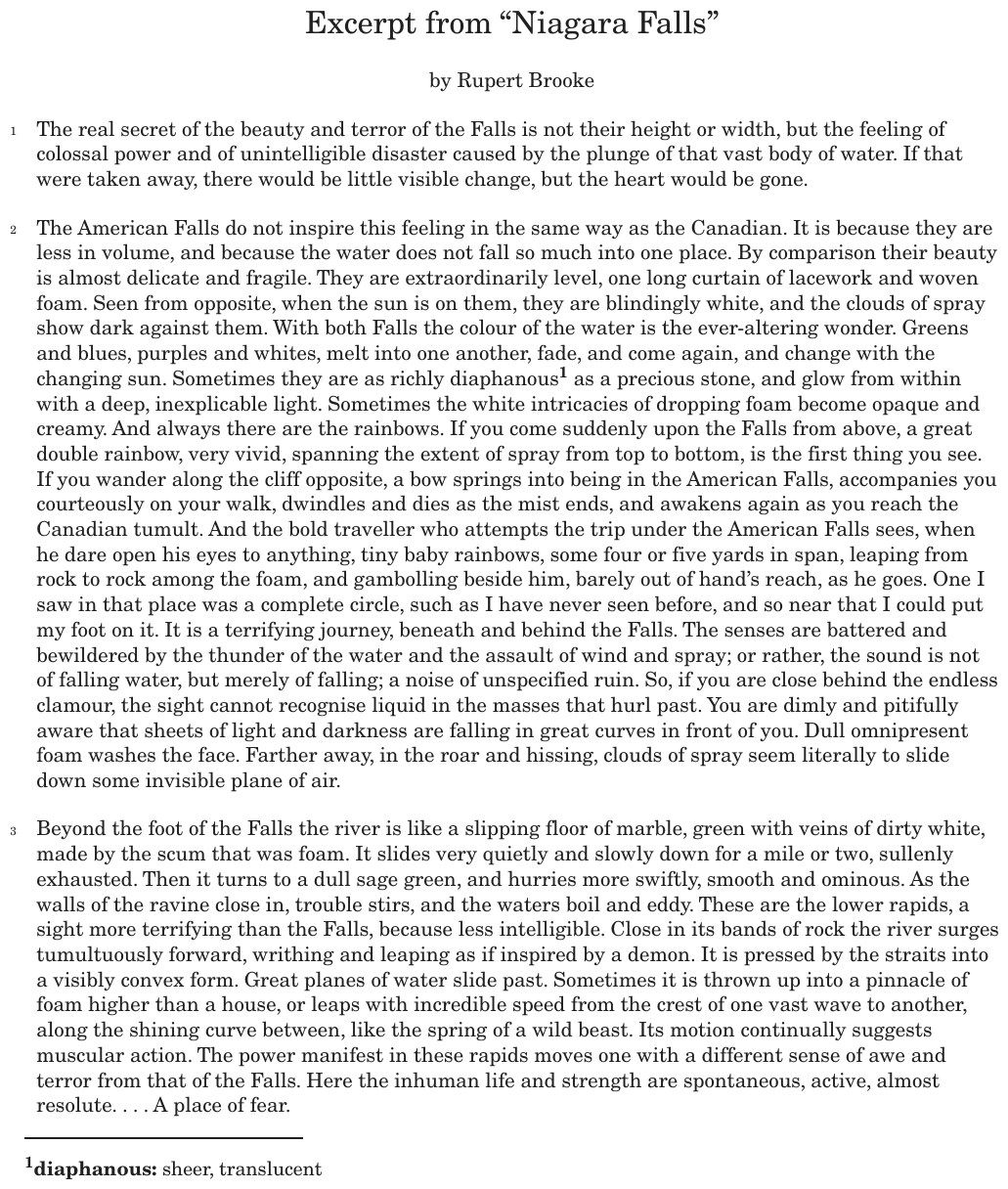
Excerpt from “Niagara Falls”
by Rupert Brooke
The real secret of the beauty and terror of the Falls is not their height or width, but the feeling of colossal power and of unintelligible disaster caused by the plunge of that vast body of water. If that were taken away, there would be little visible change, but the heart would be gone.
The American Falls do not inspire this feeling in the same way as the Canadian. It is because they are less in volume, and because the water does not fall so much into one place. By comparison their beauty is almost delicate and fragile. They are extraordinarily level, one long curtain of lacework and woven foam. Seen from opposite, when the sun is on them, they are blindingly white, and the clouds of spray show dark against them. With both Falls the colour of the water is the ever-altering wonder. Greens and blues, purples and whites, melt into one another, fade, and come again, and change with the changing sun. Sometimes they are as richly diaphanous as a precious stone, and glow from within with a deep, inexplicable light. Sometimes the white intricacies of dropping foam become opaque and creamy. And always there are the rainbows. If you come suddenly upon the Falls from above, a great double rainbow, very vivid, spanning the extent of spray from top to bottom, is the first thing you see. If you wander along the cliff opposite, a bow springs into being in the American Falls, accompanies you courteously on your walk, dwindles and dies as the mist ends, and awakens again as you reach the Canadian tumult. And the bold traveller who attempts the trip under the American Falls sees, when he dare open his eyes to anything, tiny baby rainbows, some four or five yards in span, leaping from rock to rock among the foam, and gambolling beside him, barely out of hand’s reach, as he goes. One I saw in that place was a complete circle, such as I have never seen before, and so near that I could put my foot on it. It is a terrifying journey, beneath and behind the Falls. The senses are battered and bewildered by the thunder of the water and the assault of wind and spray; or rather, the sound is not of falling water, but merely of falling; a noise of unspecified ruin. So, if you are close behind the endless clamour, the sight cannot recognise liquid in the masses that hurl past. You are dimly and pitifully aware that sheets of light and darkness are falling in great curves in front of you. Dull omnipresent foam washes the face. Farther away, in the roar and hissing, clouds of spray seem literally to slide down some invisible plane of air.
Beyond the foot of the Falls the river is like a slipping floor of marble, green with veins of dirty white, made by the scum that was foam. It slides very quietly and slowly down for a mile or two, sullenly exhausted. Then it turns to a dull sage green, and hurries more swiftly, smooth and ominous. As the walls of the ravine close in, trouble stirs, and the waters boil and eddy. These are the lower rapids, a sight more terrifying than the Falls, because less intelligible. Close in its bands of rock the river surges tumultuously forward, writhing and leaping as if inspired by a demon. It is pressed by the straits into a visibly convex form. Great planes of water slide past. Sometimes it is thrown up into a pinnacle of foam higher than a house, or leaps with incredible speed from the crest of one vast wave to another, along the shining curve between, like the spring of a wild beast. Its motion continually suggests muscular action. The power manifest in these rapids moves one with a different sense of awe and terror from that of the Falls. Here the inhuman life and strength are spontaneous, active, almost resolute. . . . A place of fear.
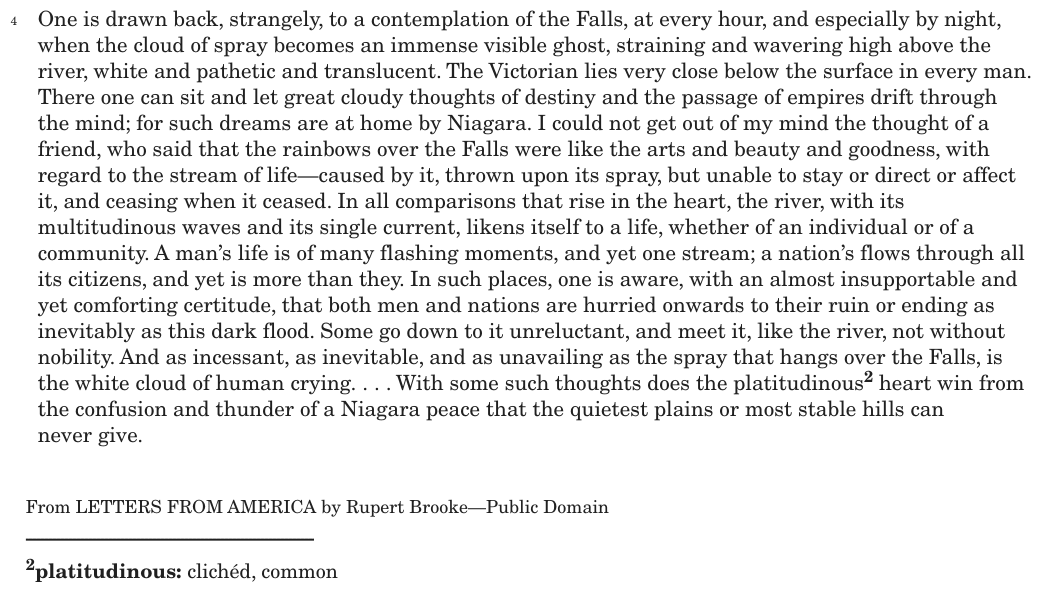
One is drawn back, strangely, to a contemplation of the Falls, at every hour, and especially by night, when the cloud of spray becomes an immense visible ghost, straining and wavering high above the river, white and pathetic and translucent. The Victorian lies very close below the surface in every man. There one can sit and let great cloudy thoughts of destiny and the passage of empires drift through the mind; for such dreams are at home by Niagara. I could not get out of my mind the thought of a friend, who said that the rainbows over the Falls were like the arts and beauty and goodness, with regard to the stream of life—caused by it, thrown upon its spray, but unable to stay or direct or affect it, and ceasing when it ceased. In all comparisons that rise in the heart, the river, with its multitudinous waves and its single current, likens itself to a life, whether of an individual or of a community. A man’s life is of many flashing moments, and yet one stream; a nation’s flows through all its citizens, and yet is more than they. In such places, one is aware, with an almost insupportable and yet comforting certitude, that both men and nations are hurried onwards to their ruin or ending as inevitably as this dark flood. Some go down to it unreluctant, and meet it, like the river, not without nobility. And as incessant, as inevitable, and as unavailing as the spray that hangs over the Falls, is the white cloud of human crying. . . . With some such thoughts does the platitudinous heart win from the confusion and thunder of a Niagara peace that the quietest plains or most stable hills can never give.
From LETTERS FROM AMERICA by Rupert Brooke—Public Domain
diaphanous: sheer, translucent
platitudinous: clichéd, common
Question
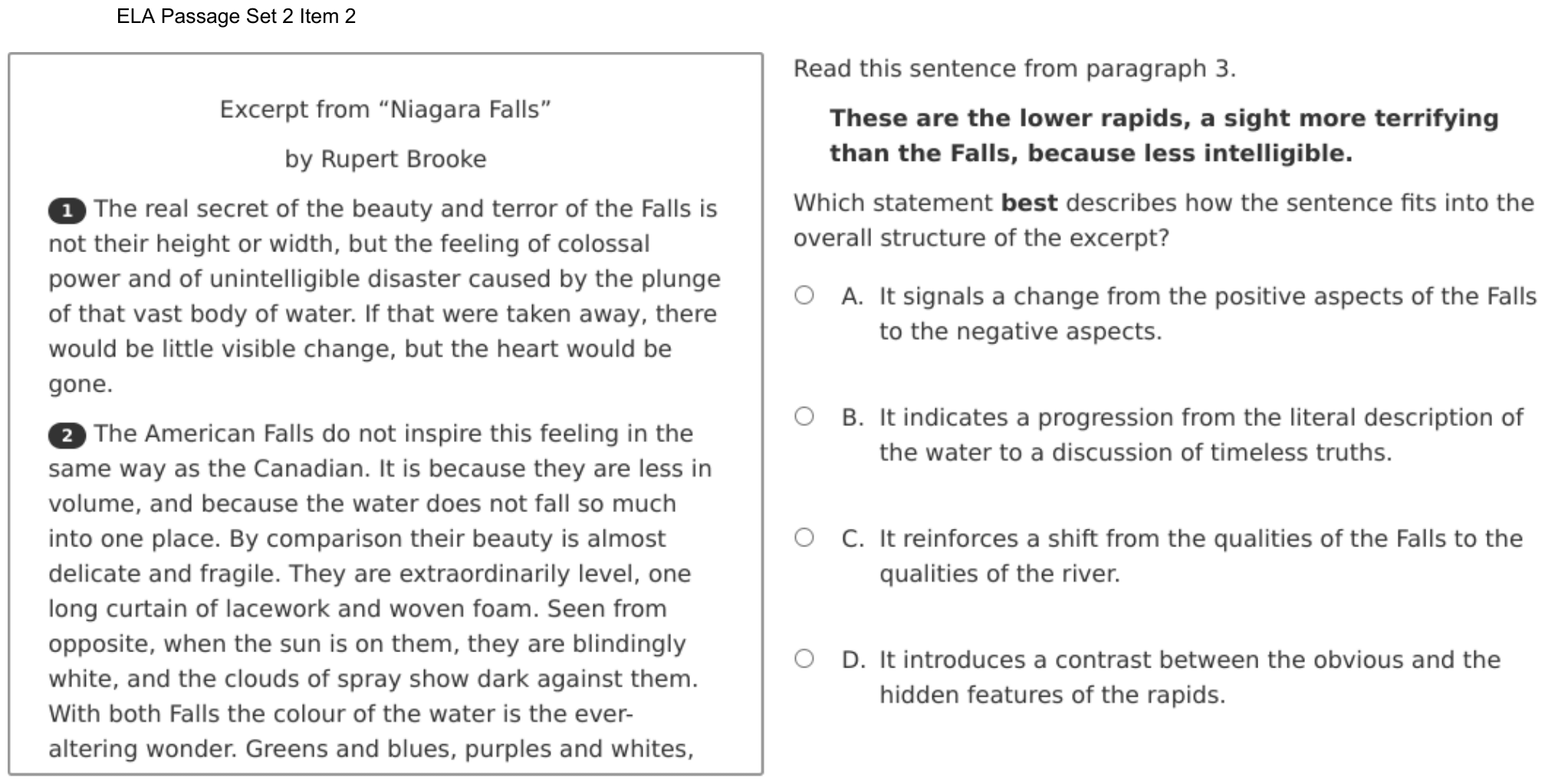
Read this sentence from paragraph 3.
These are the lower rapids, a sight more terrifying than the Falls, because less intelligible.
Which statement best describes how the sentence fits into the overall structure of the excerpt?
- AIt signals a change from the positive aspects of the Falls to the negative aspects.
- BIt indicates a progression from the literal description of the water to a discussion of timeless truths.
- CIt reinforces a shift from the qualities of the Falls to the qualities of the river.
- DIt introduces a contrast between the obvious and the hidden features of the rapids.
Show the answer
Correct answer: C
The question asks for the statement that best describes how the sentence from paragraph 3 fits into the overall structure of the excerpt.
A. Incorrect. Although in paragraph 2 the author describes the beauty of the Falls as both an “ever-altering wonder” and an “assault of wind and spray,” in paragraph 3 the author does not signal a change from the positive aspects of the Falls to the negative aspects. Instead, the author provides a description of the river and the rapids below the Falls.
B. Incorrect. While the author compares the water of the river to “a slipping floor of marble, green with veins of dirty white, made by the scum that was foam” in paragraph 3, the statement that the lower rapids are “more terrifying than the Falls, because less intelligible” does not indicate a progression from the literal description of the water to a discussion of timeless truths. Instead, the author is merely describing all aspects of the rapids, both literally and figuratively.
C. CORRECT. The first sentence of paragraph 3 moves the description “beyond the foot of the Falls” to “the river” and then the paragraph begins to describe this location in further detail (“a dull sage green,” “hurries more swiftly,” “smooth and ominous,” “waters boil and eddy”) before reinforcing this shift by confirming it again with the words “These are the lower rapids, a sight more terrifying than the Falls.”
D. Incorrect. Although the author states that the waters of the rapids “boil and eddy” and suggests that the rapids are “less intelligible,” these statements do not introduce a contrast between the obvious and the hidden features of the rapids. They merely describe a feature and the sight of the lower rapids.
Question analysis
This text structure question quotes a sentence from paragraph 3 of Rupert Brooke’s “Niagara Falls,” in which the lower rapids are called “more terrifying than the Falls,” and asks how it fits the excerpt’s overall organization. It rewords a question from the 2018 handbook’s Test B. Every choice describes a turn the essay could plausibly take, so students need a clear picture of what each paragraph covers.
- NYS standards
- 7R5 structure and genre features
- Grade level
- Grade 8 reading and task
- Compared with grade 7
- Above grade 7 A typical grade 7 structure question asks what one paragraph adds. This one asks where a sentence from the middle of paragraph 3 fits in the whole essay, which means summing up four long paragraphs of century-old prose.
- Estimated difficulty
- Hard: combines ideas, needs a plan, and has more than one tempting wrong answer.
- Thinking it demands
- Depth of knowledge 3, strategic thinking · mainly analyze
- What makes it hard
- How, not what major
- Much to keep track of moderate
- Hard words moderate
- Evidence
- Answered from several paragraphs or stanzas
- Reading level
- Passage: about grade 9, 987 words; question and choices: about grade 8, 97 words.
- Students, last 30 days
- Not enough answers yet to show (it takes 10).
Why it is hard, traps and wrong answers (shows the answer)
Why it is hard
A sentence that compares the rapids with the Falls is easy to misplace, because both of its subjects appear elsewhere in the excerpt. The strongest pull is a real turn in the essay, from describing water to musing on destiny, that comes a paragraph later, while “more terrifying” draws students who forget that terror runs through the excerpt from its first sentence. The 2026 verb “reinforces” rewards those who saw that paragraph 3 had already left the Falls with “Beyond the foot of the Falls the river.”
How, not what major Working it out
The task is to place one sentence in the essay’s plan, and the sentence pulls the wrong way: it mentions “the Falls” and “more terrifying,” though its job is to confirm that paragraph 3 has already moved downstream to the rapids. (Anderson & Krathwohl, 2001)
Much to keep track of moderate Working it out
Placing the sentence takes a summary of all four long paragraphs at once: the Falls’ power, the two Falls’ beauty and the trip behind them, the river below, and the night thoughts on destiny. (Sweller, 1988; Carpenter, Just & Shell, 1990)
Hard words moderate Understanding the question
“Less intelligible” means harder to make sense of; a student who takes it as harder to see is led toward a contrast between obvious and hidden features of the rapids. (Perfetti, 2007; Freedle & Kostin, 1993)
Strategy: Sum up each of the four paragraphs in a few words, find where this sentence sits in that outline, and choose the description of the essay’s movement at exactly that point.
Traps
- Wrong part of the text: A choice is true of another paragraph, stanza or speaker than the one asked about.
The wrong answers, classified
A Twists what the text says (King et al., 2004)
Takes “more terrifying” as the essay’s first turn from the Falls’ beauty to their dangers, but this sentence is about the rapids, and paragraph 1 already speaks of “unintelligible disaster.”
B Wrong part of the text (Kirsch & Mosenthal, 1990)
Names a turn the excerpt really makes, from describing the water to “thoughts of destiny and the passage of empires,” but that turn comes in paragraph 4, not at the rapids.
D Wrong purpose or structure (Anderson & Krathwohl, 2001)
Reads “less intelligible” as less visible and finds a contrast between obvious and hidden features, though rapids that “boil and eddy” and leap like “a wild beast” are in plain view.
Working it out, step by step
Figure out what the question asks
This is a text structure question. Structure is the plan of a piece of writing: what each part does and how the parts connect. You get one sentence from paragraph 3. You must decide what job it does in the plan of the whole excerpt. So first sum up what each of the four paragraphs is about.
Sum up the four paragraphs
- Paragraph 1: the real secret of the Falls is “the feeling of colossal power.” Colossal means huge.
- Paragraph 2: the two Falls, their colors, the rainbows, and the scary trip behind the water.
- Paragraph 3: the river below the Falls and its wild rapids.
- Paragraph 4: the author goes back to the Falls at night and thinks about life and destiny, or what happens in the end.
See where paragraph 3 begins
Paragraph 3 opens with “Beyond the foot of the Falls the river is like a slipping floor of marble.” Beyond the foot means past the bottom. So the author has already left the Falls. He follows the river as it “hurries more swiftly” and the waters “boil and eddy,” or swirl. Then comes the sentence: “These are the lower rapids, a sight more terrifying than the Falls, because less intelligible.” Rapids are a stretch of fast, rough water. Less intelligible means harder to make sense of.
Decide what the sentence does
The sentence names the new place: the lower rapids. It also sets the rapids against the Falls. That tells you again that the essay has moved from the Falls to the river below them. To reinforce something is to make it stronger. The sentence reinforces a shift, or change of subject, that the paragraph’s first sentence began.
Check each choice
- A does not fit. Terror is not new here. Paragraph 1 already speaks of “unintelligible disaster,” and paragraph 2 calls the trip behind the Falls “a terrifying journey.”
- B does not fit. The essay does turn to big, timeless ideas, but in paragraph 4, not here.
- C fits. The sentence confirms the move from the Falls to the river.
- D does not fit. The rapids are in plain sight. “Less intelligible” means harder to understand, not hidden.
Watch out: B names a real turn in the essay. But it comes one paragraph later, with “thoughts of destiny and the passage of empires.”
Choose the answer
The sentence names the rapids and compares them with the Falls. That confirms the essay has moved downstream. So the answer is C, “It reinforces a shift from the qualities of the Falls to the qualities of the river.”
Why this answer and not the closest wrong one
B is the closest wrong choice, because the essay really does move from describing water to big ideas about life. But that move comes in paragraph 4, at night. The sentence in paragraph 3 is still describing water. Its job is to name the rapids and confirm that the essay has left the Falls for the river.
More questions like this
The original DOE question
The passage “Excerpt from “Niagara Falls”” as printed (pages 134–135)
Question 2 of 6
2026 Practice Test C English, question 39Passage Excerpt from “Growing Peppers on the ISS Is Just the Start of Space Farming”
Excerpt from “Growing Peppers on the ISS Is Just the Start of Space Farming”
by Melanie Canales
The author, Melanie Canales, is a first-generation Peruvian American farmer and beekeeper based in Virginia’s Shenandoah Valley, on lands of the indigenous Monacan and Manahoac tribes. Her work focuses on creating healthy relationships between people and their surrounding ecosystems.
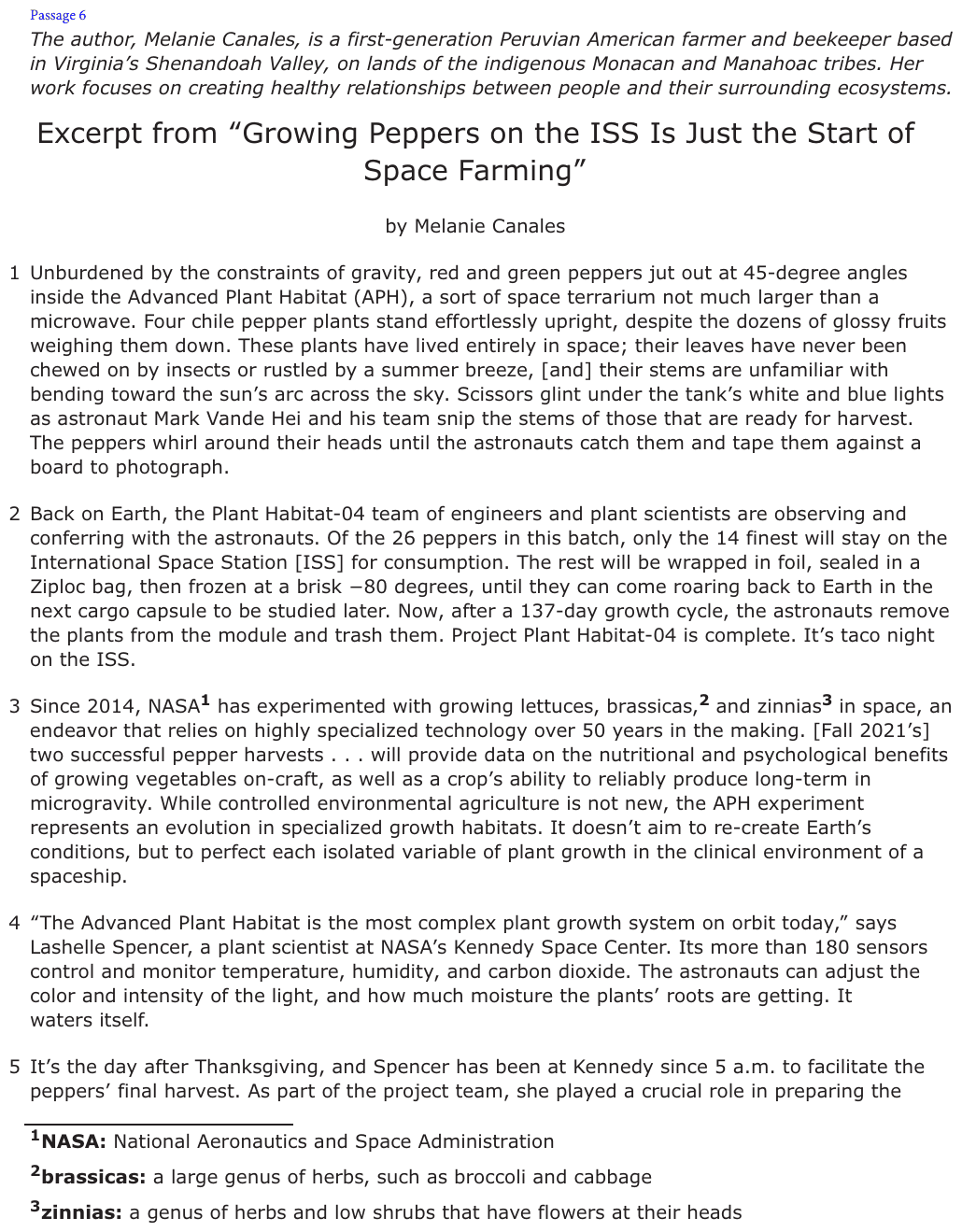
Unburdened by the constraints of gravity, red and green peppers jut out at 45-degree angles inside the Advanced Plant Habitat (APH), a sort of space terrarium not much larger than a microwave. Four chile pepper plants stand effortlessly upright, despite the dozens of glossy fruits weighing them down. These plants have lived entirely in space; their leaves have never been chewed on by insects or rustled by a summer breeze, [and] their stems are unfamiliar with bending toward the sun’s arc across the sky. Scissors glint under the tank’s white and blue lights as astronaut Mark Vande Hei and his team snip the stems of those that are ready for harvest. The peppers whirl around their heads until the astronauts catch them and tape them against a board to photograph.
Back on Earth, the Plant Habitat-04 team of engineers and plant scientists are observing and conferring with the astronauts. Of the 26 peppers in this batch, only the 14 finest will stay on the International Space Station [ISS] for consumption. The rest will be wrapped in foil, sealed in a Ziploc bag, then frozen at a brisk −80 degrees, until they can come roaring back to Earth in the next cargo capsule to be studied later. Now, after a 137-day growth cycle, the astronauts remove the plants from the module and trash them. Project Plant Habitat-04 is complete. It’s taco night on the ISS.
Since 2014, NASA1 has experimented with growing lettuces, brassicas,2 and zinnias3 in space, an endeavor that relies on highly specialized technology over 50 years in the making. [Fall 2021’s] two successful pepper harvests . . . will provide data on the nutritional and psychological benefits of growing vegetables on-craft, as well as a crop’s ability to reliably produce long-term in microgravity. While controlled environmental agriculture is not new, the APH experiment represents an evolution in specialized growth habitats. It doesn’t aim to re-create Earth’s conditions, but to perfect each isolated variable of plant growth in the clinical environment of a spaceship.
“The Advanced Plant Habitat is the most complex plant growth system on orbit today,” says Lashelle Spencer, a plant scientist at NASA’s Kennedy Space Center. Its more than 180 sensors control and monitor temperature, humidity, and carbon dioxide. The astronauts can adjust the color and intensity of the light, and how much moisture the plants’ roots are getting. It waters itself.
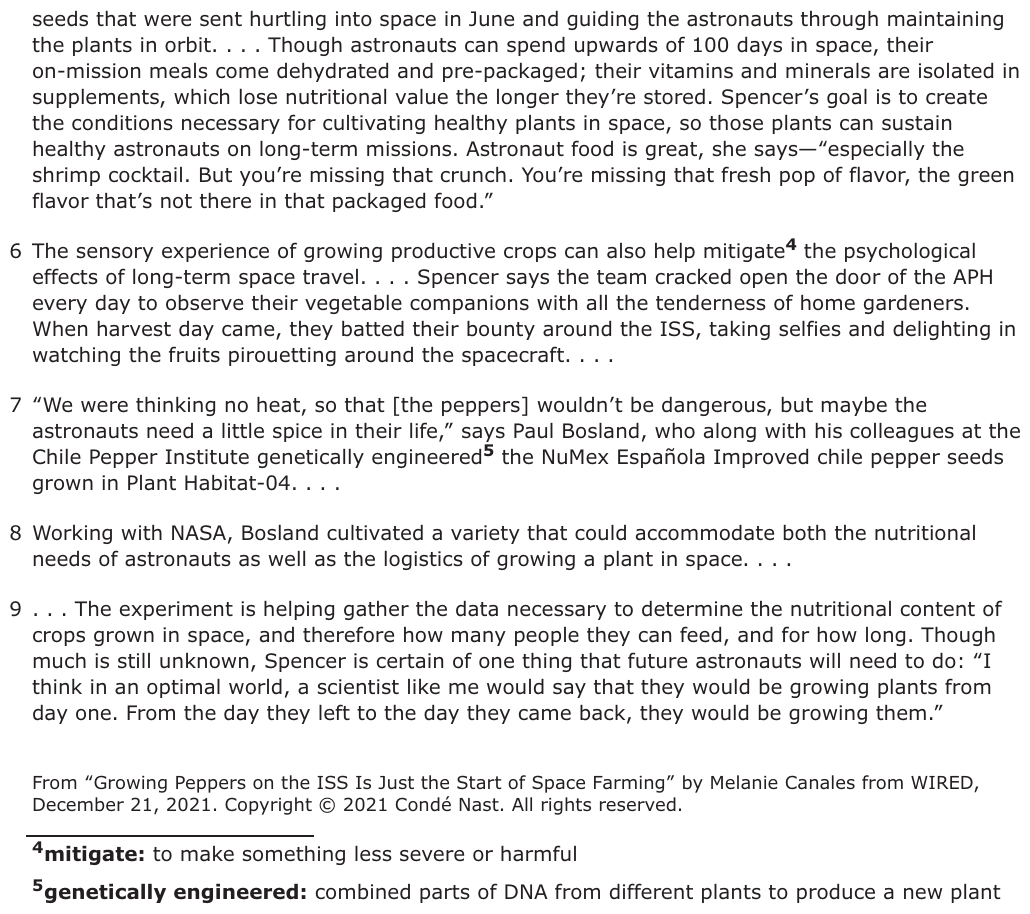
It’s the day after Thanksgiving, and Spencer has been at Kennedy since 5 a.m. to facilitate the peppers’ final harvest. As part of the project team, she played a crucial role in preparing the seeds that were sent hurtling into space in June and guiding the astronauts through maintaining the plants in orbit. . . . Though astronauts can spend upwards of 100 days in space, their on-mission meals come dehydrated and pre-packaged; their vitamins and minerals are isolated in supplements, which lose nutritional value the longer they’re stored. Spencer’s goal is to create the conditions necessary for cultivating healthy plants in space, so those plants can sustain healthy astronauts on long-term missions. Astronaut food is great, she says—“especially the shrimp cocktail. But you’re missing that crunch. You’re missing that fresh pop of flavor, the green flavor that’s not there in that packaged food.”
The sensory experience of growing productive crops can also help mitigate4 the psychological effects of long-term space travel. . . . Spencer says the team cracked open the door of the APH every day to observe their vegetable companions with all the tenderness of home gardeners. When harvest day came, they batted their bounty around the ISS, taking selfies and delighting in watching the fruits pirouetting around the spacecraft. . . .
“We were thinking no heat, so that [the peppers] wouldn’t be dangerous, but maybe the astronauts need a little spice in their life,” says Paul Bosland, who along with his colleagues at the Chile Pepper Institute genetically engineered5 the NuMex Española Improved chile pepper seeds grown in Plant Habitat-04. . . .
Working with NASA, Bosland cultivated a variety that could accommodate both the nutritional needs of astronauts as well as the logistics of growing a plant in space. . . .
. . . The experiment is helping gather the data necessary to determine the nutritional content of crops grown in space, and therefore how many people they can feed, and for how long. Though much is still unknown, Spencer is certain of one thing that future astronauts will need to do: “I think in an optimal world, a scientist like me would say that they would be growing plants from day one. From the day they left to the day they came back, they would be growing them.”
From “Growing Peppers on the ISS Is Just the Start of Space Farming” by Melanie Canales from WIRED, December 21, 2021. Copyright © 2021 Condé Nast. All rights reserved.
1NASA: National Aeronautics and Space Administration
2brassicas: a large genus of herbs, such as broccoli and cabbage
3zinnias: a genus of herbs and low shrubs that have flowers at their heads
4mitigate: to make something less severe or harmful
5genetically engineered: combined parts of DNA from different plants to produce a new plant
Question
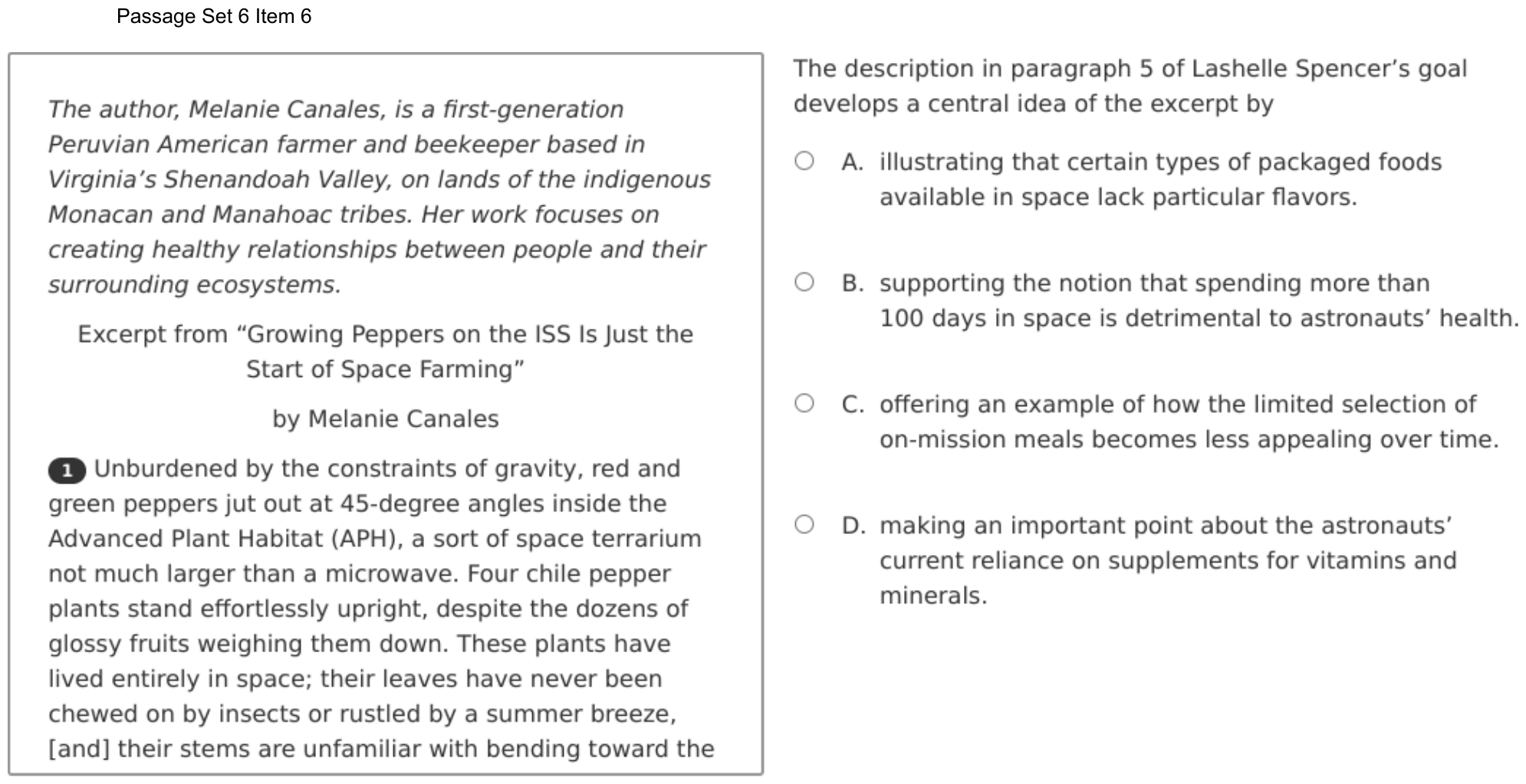
The description in paragraph 5 of Lashelle Spencer’s goal develops a central idea of the excerpt by
- Aillustrating that certain types of packaged foods available in space lack particular flavors.
- Bsupporting the notion that spending more than 100 days in space is detrimental to astronauts’ health.
- Coffering an example of how the limited selection of on-mission meals becomes less appealing over time.
- Dmaking an important point about the astronauts’ current reliance on supplements for vitamins and minerals.
Show the answer
Correct answer: D
The question asks how the description of Lashelle Spencer’s goal in paragraph 5 develops a central idea of the excerpt.
A. Incorrect. Although Spencer mentions how astronauts miss certain eating experiences like the “fresh pop” and “green flavor” not found in packaged and dehydrated food, a central idea of the excerpt is that there is a need to provide fresh, healthy foods for long missions, not that food flavor should be improved.
B. Incorrect. While the excerpt focuses on how spending more than 100 days in space affects nutrition, it does not discuss specific ways in which spending long periods of time in space is detrimental to the health of astronauts.
C. Incorrect. Although paragraph 5 states that astronauts “can spend upwards of 100 days in space,” the excerpt does not develop a central idea that existing meals in space become less appealing over time.
D. CORRECT. The paragraph explains that astronauts currently rely on supplements for vitamins and minerals, which lose their nutritional value over time. Spencer’s goal for growing plants in space is to “sustain healthy astronauts,” supporting a central idea that astronauts need more nutritionally valuable food to sustain them while in space for long periods of time.
Question analysis
Lashelle Spencer’s goal for growing plants in space is described in paragraph 5 of the WIRED excerpt, and this central-idea question asks how that description develops a central idea of the whole excerpt. Students must connect a single sentence about a scientist’s aim to the article’s larger point, and every choice draws on details from that same paragraph.
- Grade level
- Grade 8 reading and task
- Compared with grade 7
- Above grade 7 Grade 7 students trace how a central idea develops, usually through a plainly stated example. Here the goal’s connection to the central idea runs through the sentences around it, and the choices are abstract restatements, which asks more than typical grade 7 work.
- Estimated difficulty
- Hard: combines ideas, needs a plan, and has more than one tempting wrong answer.
- Thinking it demands
- Depth of knowledge 3, strategic thinking · mainly analyze
- What makes it hard
- Reading between the lines moderate
- Every choice must be checked moderate
- How, not what minor
- Evidence in several places minor
- Evidence
- Answered from several paragraphs or stanzas
- Reading level
- Passage: about grade 10, 890 words; question and choices: about grade 12, 75 words.
- Students, last 30 days
- Not enough answers yet to show (it takes 10).
Why it is hard, traps and wrong answers (shows the answer)
Why it is hard
Every choice draws on paragraph 5, and none mentions growing plants, which leaves students looking for the goal without finding it. The flavor quotation that follows the goal is the most memorable detail and the easiest wrong pick. The key works only through context: the goal answers the problem the previous sentence sets out, crews depending on supplements that weaken in storage, which is why it serves the article’s case for fresh food on long missions.
Reading between the lines moderate Working it out
Spencer’s goal names healthy plants and healthy astronauts but no supplements; its link to the key runs through the sentence before it, where vitamins sit in supplements that “lose nutritional value the longer they’re stored.” (Graesser, Singer & Trabasso, 1994; Kintsch, 1998)
Every choice must be checked moderate Choosing the answer
No choice restates the goal of growing plants itself, so none can be matched at a glance; each must be tested for whether it ties the goal to the excerpt’s concern with nutrition on long missions. (Embretson & Wetzel, 1987)
How, not what minor Working it out
The question asks how the description develops a central idea, its role in the article, so knowing what Spencer wants is only the first step toward the answer. (Anderson & Krathwohl, 2001)
Evidence in several places minor Working it out
The central idea must come from the whole excerpt: paragraph 3’s “nutritional and psychological benefits,” paragraph 8’s “nutritional needs of astronauts” and paragraph 9’s “nutritional content of crops.” (Kirsch & Mosenthal, 1990; Gorin & Embretson, 2006)
Strategy: State a central idea of the whole excerpt in your own words, reread Spencer’s goal with the sentences around it in paragraph 5, and pick the option that connects the goal to that central idea.
Traps
- Too narrow: A single detail offered as the central idea or a summary, or a summary that keeps minor details and leaves out an essential part.
- Twists what the text says: Uses the text's topic and ideas but changes what it says: who did it, how much, when, or why.
- Reads too much in: A reasonable-sounding conclusion that goes further than the text allows.
The wrong answers, classified
A Too narrow (King et al., 2004)
Settles on the most quotable detail nearby, the “fresh pop of flavor” missing from packaged food, a side remark about taste rather than the nutritional need behind her goal.
B Reads too much in (Graesser, Singer & Trabasso, 1994)
Stretches “upwards of 100 days in space” and “healthy astronauts” into a claim that long missions damage health, though the excerpt describes only food and supplements that lose value.
C Twists what the text says (King et al., 2004)
Blends supplements that lose value “the longer they’re stored” with the missing crunch into meals that grow less appealing over time, an idea paragraph 5 never states.
Working it out, step by step
Figure out what the question asks
A central idea is a main point the whole article keeps coming back to. This question asks how Spencer’s goal, in paragraph 5, helps build one of those main points. So first, find the goal. Then connect it to the big idea.
Find the goal and the sentence before
Paragraph 5 says: “Spencer’s goal is to create the conditions necessary for cultivating healthy plants in space, so those plants can sustain healthy astronauts on long-term missions.” Cultivating means growing. The sentence just before it shows why she has this goal. Astronauts’ “vitamins and minerals are isolated in supplements, which lose nutritional value the longer they’re stored.”
Connect the goal to the big idea
Today astronauts get vitamins from pills, called supplements. Those pills lose their health value as they sit. Spencer wants fresh plants grown in space to keep astronauts healthy instead. So her goal points to a problem: relying on weak pills. The article returns to food and health again and again. Paragraph 8 mentions “the nutritional needs of astronauts.” Nutritional means having to do with healthy food.
Check each choice
- A is wrong. The “fresh pop of flavor” line comes after the goal. It is about taste, a side point.
- B is wrong. The article never says long trips in space harm astronauts’ health.
- C is wrong. It is the stored supplements that lose value over time, not meals that get less tasty.
- D is right. The goal answers a problem: astronauts depend on supplements that weaken in storage. That ties to the article’s idea that astronauts need healthy fresh food on long trips.
Watch out: Spencer’s flavor quote is the most memorable line nearby, so A pulls hard. But her goal is about health, not taste.
Choose the answer
Spencer wants healthy plants because pills are not enough. So the answer is D, “making an important point about the astronauts’ current reliance on supplements for vitamins and minerals.” Reliance means depending on something.
Why this answer and not the closest wrong one
A is the closest wrong answer. Spencer really does miss the crunch and flavor of fresh food. But her goal is to “sustain healthy astronauts,” which is about health. Health is the big idea the article keeps returning to. D connects the goal to that idea through the supplements that lose value.
More questions like this
The original DOE question
The passage “Excerpt from “Growing Peppers on the ISS Is Just the Start of Space Farming”” as printed (pages 50–51)
Question 3 of 6
2026 Practice Test B English, question 17Passage Excerpt from In Search of the Unknown
Excerpt from In Search of the Unknown
by Robert W. Chambers
It was at that time the policy of the trustees and officers of the Zoological Gardens neither to employ collectors nor to send out expeditions in search of specimens. The society decided to depend upon voluntary contributions, and I was always busy, part of the day, in dictating answers to correspondents who wrote offering their services as hunters of big game, collectors of all sorts of fauna, trappers, snarers, and also to those who offered specimens for sale, usually at exorbitant rates.
To the proprietors of . . . mangy lynxes, moth-eaten coyotes, and dancing bears I returned courteous but uncompromising refusals—of course, first submitting all such letters, together with my replies, to Professor Farrago.
One day towards the end of May, however, just as I was leaving Bronx Park to return to town, Professor Lesard, of the reptilian department, called out to me that Professor Farrago wanted to see me a moment; so I . . . retraced my steps to the temporary, wooden building occupied by Professor Farrago, general superintendent of the Zoological Gardens. The professor, who was sitting at his desk before a pile of letters and replies submitted for approval by me, pushed his glasses down and looked over them at me with a whimsical smile that suggested amusement, impatience, annoyance, and perhaps a faint trace of apology.
“Now, here’s a letter,” he said, with a deliberate gesture towards a sheet of paper impaled on a file—“a letter that I suppose you remember.” He disengaged the sheet of paper and handed it to me.
“Oh yes,” I replied, with a shrug; “of course the man is mistaken—or—”
“Or what?” demanded Professor Farrago, tranquilly, wiping his glasses.
“—Or a liar,” I replied.
After a silence he leaned back in his chair and bade me read the letter to him again, and I did so with a contemptuous tolerance for the writer, who must have been either a very innocent victim or a very stupid swindler. I said as much to Professor Farrago, but, to my surprise, he appeared to waver.
“I suppose,” he said, with his near-sighted, embarrassed smile, “that nine hundred and ninety-nine men in a thousand would throw that letter aside and condemn the writer as a liar or a fool?”
“In my opinion,” said I, “he’s one or the other.”
“He isn’t—in mine,” said the professor, placidly.
“What!” I exclaimed. “Here is a man living all alone on a strip of rock and sand between the wilderness and the sea, who wants you to send somebody to take charge of a bird that doesn’t exist!”
“How do you know,” asked Professor Farrago, “that the bird in question does not exist?”
“It is generally accepted,” I replied, sarcastically, “that the great auk has been extinct for years. Therefore I may be pardoned for doubting that our correspondent possesses a pair of them alive.”
“Oh, you young fellows,” said the professor, smiling wearily, “you embark on a theory for destinations that don’t exist.”
He leaned back in his chair, his amused eyes searching space for the imagery that made him smile.
“Like swimming squirrels, you navigate with the help of Heaven and a stiff breeze, but you never land where you hope to—do you?”
Rather red in the face, I said: “Don’t you believe the great auk to be extinct?”
“Audubon saw the great auk.”
“Who has seen a single specimen since?”
“Nobody—except our correspondent here,” he replied, laughing.
I laughed, too, considering the interview at an end, but the professor went on, coolly:
“Whatever it is that our correspondent has—and I am daring to believe that it is the great auk itself—I want you to secure it for the society.”
When my astonishment subsided my first conscious sentiment was one of pity. Clearly, Professor Farrago was on the verge of dotage—ah, what a loss to the world!
I believe now that Professor Farrago perfectly interpreted my thoughts, but he betrayed neither resentment nor impatience. I drew a chair up beside his desk—there was nothing to do but to obey, and this fool’s errand was none of my conceiving.
Together we made out a list of articles necessary for me and itemized the expenses I might incur, and I set a date for my return, allowing no margin for a successful termination to the expedition.
“Never mind that,” said the professor. “What I want you to do is to get those birds here safely. Now, how many men will you take?”
“None,” I replied, bluntly; “it’s a useless expense, unless there is something to bring back. If there is I’ll wire you, you may be sure.”
“Very well,” said Professor Farrago, good-humoredly, “you shall have all the assistance you may require. Can you leave to-night?”
The old gentleman was certainly prompt. I nodded, half-sulkily, aware of his amusement.
“So,” I said, picking up my hat, “I am to start north to find a place called Black Harbor, where there is a man named Halyard who possesses, among other household utensils, two extinct great auks—”
We were both laughing by this time. I asked him why on earth he credited the assertion of a man he had never before heard of.
“I suppose,” he replied, with the same half-apologetic, half-humorous smile, “it is instinct. I feel, somehow, that this man Halyard has got an auk—perhaps two. I can’t get away from the idea that we are on the eve of acquiring the rarest of living creatures. It’s odd for a scientist to talk as I do; doubtless you’re shocked—admit it, now!”
But I was not shocked; on the contrary, I was conscious that the same strange hope that Professor Farrago cherished was beginning, in spite of me, to stir my pulses, too.
“If he has—” I began, then stopped.
The professor and I looked hard at each other in silence.
“Go on,” he said, encouragingly.
But I had nothing more to say, for the prospect of beholding with my own eyes a living specimen of the great auk produced a series of conflicting emotions within me which rendered speech profanely superfluous.
From IN SEARCH OF THE UNKNOWN by Robert W. Chambers—Public Domain
Audubon: John James Audubon, an ornithologist and artist who created scientific illustrations of birds
dotage: a loss of reasoning brought about by old age
Question
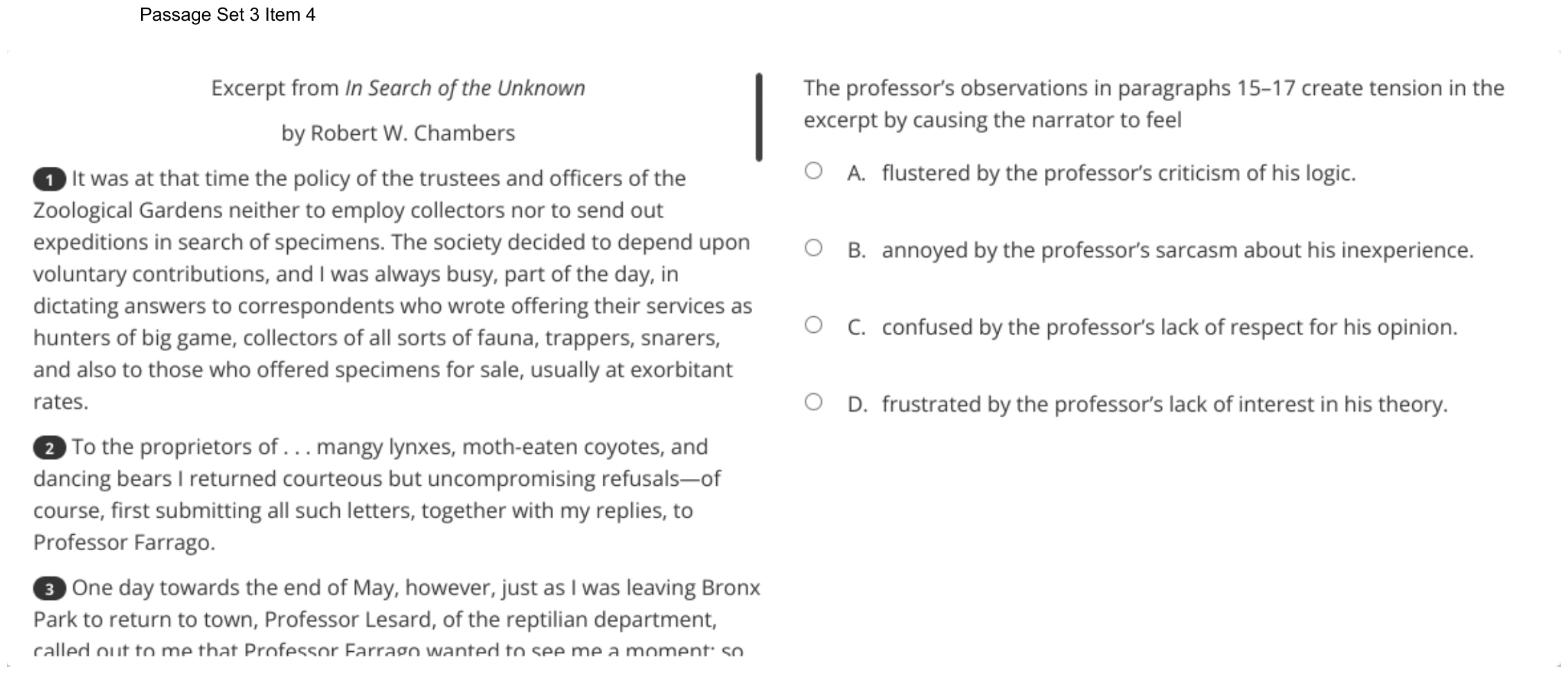
The professor’s observations in paragraphs 15–17 create tension in the excerpt by causing the narrator to feel
- Aflustered by the professor’s criticism of his logic.
- Bannoyed by the professor’s sarcasm about his inexperience.
- Cconfused by the professor’s lack of respect for his opinion.
- Dfrustrated by the professor’s lack of interest in his theory.
Show the answer
Correct answer: A
The question asks how the professor’s observations in paragraphs 15–17 create tension in the excerpt.
A. CORRECT. The professor criticizes “ ‘you young fellows’ ” (paragraph 15), suggesting that the ideas of young scientists like the narrator are unsupported (“ ‘like swimming squirrels’ ” [paragraph 17]) and inaccurate (“ ‘but you never land where you hope to—do you?’ ” [paragraph 17] and “ ‘you embark on a theory for destinations that don’t exist’ ” [paragraph 15]). The narrator then becomes “red in the face” (paragraph 18), indicating that the narrator is upset by the professor’s criticism, and asks the professor about the great auk in an attempt to defend himself.
B. Incorrect. While the narrator does experience a negative reaction to the professor’s words, the professor is being genuine, not sarcastic. In fact, the sarcasm comes from the narrator in paragraph 14 (“ ‘It is generally accepted,’ I replied, sarcastically, ‘that the great auk has been extinct for years. Therefore I may be pardoned for doubting that our correspondent possesses a pair of them alive’ ”), not from the professor.
C. Incorrect. The professor’s observations cause the narrator to blush with embarrassment (“rather red in the face” [paragraph 18]), but the narrator understands the point that the professor is making about the narrator’s acceptance of the idea that great auks do not exist. The narrator recognizes that the professor is criticizing his youthful ideas, not his opinion.
D. Incorrect. The professor shows amusement with the narrator’s perspective. The narrator is embarrassed and upset by the professor’s words, but the narrator does not display frustration with the professor’s lack of interest in a commonly held view of the existence of a certain species of bird.
Question analysis
In this question on In Search of the Unknown, Professor Farrago makes remarks about “you young fellows,” comparing them to swimming squirrels that never land where they hope. Students must decide how these remarks in paragraphs 15–17 make the narrator feel and so create tension. The comparison is odd and old-fashioned, and the four choices name similar negative feelings with different causes.
- Grade level
- Grade 8 reading and task
- Compared with grade 7
- Above grade 7 Grade 7 students infer feelings from a character’s reactions, usually from plainly stated emotions. Here the cause is a puzzling figurative jab about “swimming squirrels,” the reaction is shown only through a physical sign, and the choices offer four close negative feelings.
- Estimated difficulty
- Hard: combines ideas, needs a plan, and has more than one tempting wrong answer.
- Thinking it demands
- Depth of knowledge 2, skills and concepts · mainly analyze
- What makes it hard
- Figurative or literary language major
- A very close wrong answer moderate
- Reading between the lines moderate
- Evidence
- Answered from several paragraphs or stanzas
- Reading level
- Passage: about grade 9, 1066 words; question and choices: about grade 9, 52 words.
- Students, last 30 days
- Not enough answers yet to show (it takes 10).
Why it is hard, traps and wrong answers (shows the answer)
Why it is hard
The professor’s two images are odd, and students must decode them as a comment on how the narrator reasons before they can say why he blushes. Every choice names an unpleasant feeling, so the decision rests on its cause. “You young fellows” makes sarcasm about inexperience the natural guess, but the sarcasm in this scene is the narrator’s own, and the professor smiles “wearily” and speaks in earnest. The narrator’s pointed reply shows he followed the criticism, not that it confused him.
Figurative or literary language major Understanding the question
The criticism comes in images: young men who “embark on a theory for destinations that don’t exist” and who, like swimming squirrels, “never land where you hope to,” a picture of reasoning that goes astray. (Graesser, Singer & Trabasso, 1994; Kintsch, 1998)
A very close wrong answer moderate Choosing the answer
The choice about annoyance at sarcasm and the right one both name a bad reaction to the professor’s remarks; they part on the cause, sincere criticism of his logic or mockery of his youth. (Embretson & Wetzel, 1987; Gorin & Embretson, 2006; Ascalon et al., 2007)
Reading between the lines moderate Working it out
The narrator never names his feeling; it shows only in “Rather red in the face” and in the defensive question that follows about whether the great auk is extinct. (Graesser, Singer & Trabasso, 1994; Kintsch, 1998)
Strategy: Paraphrase what the professor says about “you young fellows” in paragraphs 15–17, find how the narrator reacts in paragraph 18, and choose the feeling and the cause that both fit.
Traps
- Wrong tone or attitude: Misjudges the tone, attitude or point of view, such as reading admiration as criticism, or taking a character's or subject's feelings for the author's.
- Twists what the text says: Uses the text's topic and ideas but changes what it says: who did it, how much, when, or why.
- Word match: Repeats striking words or phrases from the text, so it looks supported, but its meaning does not fit the question.
The wrong answers, classified
B Wrong tone or attitude (Graesser, Singer & Trabasso, 1994)
Hears mockery in “Oh, you young fellows,” but the professor is sincere; the sarcasm belongs to the narrator, who “sarcastically” insists in paragraph 14 that the great auk is extinct.
C Twists what the text says (King et al., 2004)
Takes the blush in paragraph 18 as confusion, though the narrator answers at once with a pointed question, which shows he understood the professor’s point well enough to push back.
D Word match (Freedle & Kostin, 1993)
Is drawn by “theory” in paragraph 15 and calls the professor uninterested, though he engages the narrator’s view closely enough to answer it with two vivid images.
Working it out, step by step
Figure out what the question asks
This asks how the professor’s words in paragraphs 15–17 make the narrator feel. Tension is a feeling of strain between characters. Each choice names a feeling and a cause. Both parts must be right.
Read what the professor says
In paragraph 15 he says, “Oh, you young fellows,” and “you embark on a theory for destinations that don’t exist.” To embark means to set out on a trip. He means young men set out with an idea toward places that are not there. Their reasoning leads them to wrong answers. In paragraph 17 he adds, “Like swimming squirrels, you navigate with the help of Heaven and a stiff breeze, but you never land where you hope to—do you?”
Understand the picture
A swimming squirrel can’t really steer. It drifts with luck and the wind. The professor is saying the narrator’s thinking drifts the same way and misses the truth. That is a criticism of his logic, or reasoning. In paragraph 18, the narrator is “Rather red in the face.” He is flustered, which means embarrassed and upset.
Check each choice
- A fits. He turns red after the professor criticizes his reasoning.
- B does not fit. Sarcasm is saying the opposite of what you mean in order to mock. The professor means what he says. The sarcastic one is the narrator, in paragraph 14.
- C does not fit. He is not confused. He fires back a sharp question right away.
- D does not fit. The professor answers the narrator’s idea closely, so he is interested in it.
Watch out: B is tempting because “you young fellows” points to the narrator’s youth. But the professor is sincere, not sarcastic.
Choose the answer
The professor says the narrator’s reasoning goes astray, and the narrator turns red. So the answer is A, “flustered by the professor’s criticism of his logic.”
Why this answer and not the closest wrong one
B is the closest wrong choice. Both A and B say the narrator feels bad. But B blames sarcasm. Paragraph 14 says the narrator “replied, sarcastically,” so the sarcasm is his own. The professor means his words seriously. A names the real cause: criticism of the narrator’s thinking.
More questions like this
The original DOE question
The passage “Excerpt from In Search of the Unknown” as printed (page 21)
Question 4 of 6
2018 Test A Math, question 30Question
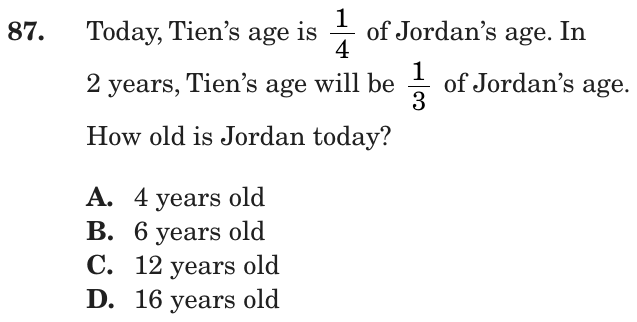
Today, Tien’s age is of Jordan’s age. In 2 years, Tien’s age will be of Jordan’s age. How old is Jordan today?
- A4 years old
- B6 years old
- C12 years old
- D16 years old
Show the answer
Correct answer: D
First, set up an equation to express Tien’s age () and Jordan’s age () today:
Two years from now, Tien’s age will be , and Jordan’s age will be .
Set up an equation about the relationship between Tien’s age and Jordan’s age in two years:
Solve the above equation for :
Now set the two equations equal to each other and solve for :
Question analysis
This age word problem says Tien is one fourth of Jordan's age today and will be one third of Jordan's age in two years, then asks for Jordan's current age. Students must turn two fractional relationships into equations and solve them together. Both people age by the same two years, and it is easy to solve for the wrong person.
- NYS standards
- Grade level
- Grade 8 content, by NYS standard
- Compared with grade 7
- Above grade 7 Grade 7 equations have one unknown on one side, like 3x + 5 = 20. This one links two unknown ages with fractional coefficients and leads to a variable on both sides, which is grade 8 algebra.
- Estimated difficulty
- Hard: combines ideas, needs a plan, and has more than one tempting wrong answer.
- Thinking it demands
- Depth of knowledge 2, skills and concepts · mainly apply
- What makes it hard
- Turning words into math major
- Error-prone arithmetic moderate
- Solution
- 4 steps
- Reading level
- Question and choices: about grade 1, 31 words.
- Students, last 30 days
- Not enough answers yet to show (it takes 10).
Why it is hard, traps and wrong answers (shows the answer)
Why it is hard
The difficulty is in the setup: two fractional relationships at two different times, with both people aging. Once the equations are right, the algebra is short, but it ends with two ages and only one is asked for. Testing the choices against both conditions is a reliable alternative that avoids the algebra entirely.
Turning words into math major Understanding the question
The second sentence must become T + 2 = (J + 2)/3; writing J/3, or forgetting that Jordan also ages two years, breaks the equation. (Hegarty, Mayer & Monk, 1995; Koedinger & Nathan, 2004)
Error-prone arithmetic moderate Working it out
Substituting J/4 for T leaves J/4 + 2 = (J + 2)/3, an equation with fractions on both sides that must be cleared, usually by multiplying by 12. (Brown & Burton, 1978; Junker & Sijtsma, 2001)
Strategy: Let Jordan's age be J, write Tien's age as J/4, and set J/4 + 2 equal to one third of (J + 2); or test each choice against both conditions.
Traps
- Answers a different question: A choice is right for another quantity: the other unknown, the rest instead of the part, the part instead of the whole.
The wrong answers, classified
A Answers a different question (King et al., 2004; Hegarty, Mayer & Monk, 1995)
Solves the equations correctly but reports Tien's age today, 4, which is one fourth of Jordan's 16, instead of Jordan's age.
B Answers a different question (King et al., 2004; Hegarty, Mayer & Monk, 1995)
Gives Tien's age two years from now, 4 + 2 = 6, answering for the wrong person and the wrong time.
C Numbers taken from the question (Hegarty, Mayer & Monk, 1995)
Picks 12 because it is a multiple of both 4 and 3, but then Tien would be 3 and later 5, not a third of 14.
Worked solution, step by step
Formulas used
- Distributive property
- a, b and c are any numbers. To multiply a sum by a number, multiply each part of the sum, then add. It works because a groups of (b + c) is the same as a groups of b plus a groups of c.
Sort out what you know
Today, Tien’s age is of Jordan’s age. That means Jordan is 4 times as old as Tien.
In 2 years, both of them will be 2 years older. Then Tien’s age will be of Jordan’s. So Jordan will be 3 times as old as Tien. You need Jordan’s age today.
Name the ages with a letter
Let t stand for Tien’s age today. Jordan is 4 times as old, so his age is 4t, which means 4 times t. Add 2 years to each age:
Person Today In 2 years Tien Jordan Watch out: Jordan gets 2 years older too. Do not forget to add 2 to his age.
Write an equation for later
In 2 years, Jordan’s age will be 3 times Tien’s age. Write that as an equation:
Use the distributive property on the right side. Multiply both t and 2 by 3:
Solve for Tien’s age
Take 3t away from both sides. Doing the same thing to both sides keeps them equal:
Now take 2 away from both sides:
So Tien is 4 years old today. Watch out: 4 is Tien’s age, not Jordan’s. Choice A, 4 years old, is a trap.
Find Jordan’s age
Jordan is 4 times as old as Tien:
So the answer is D, 16 years old.
Check your answer
Put 16 back into the story. Today, Tien is 16 ÷ 4 = 4. In 2 years, Tien is 6 and Jordan is 18. Is 6 one third of 18? Yes, because 18 ÷ 3 = 6. Choice C fails: Tien would be 3, then 5, and 5 is not a third of 14.
More questions like this
The original DOE question
Question 5 of 6
2018 Test B Math, question 50Question
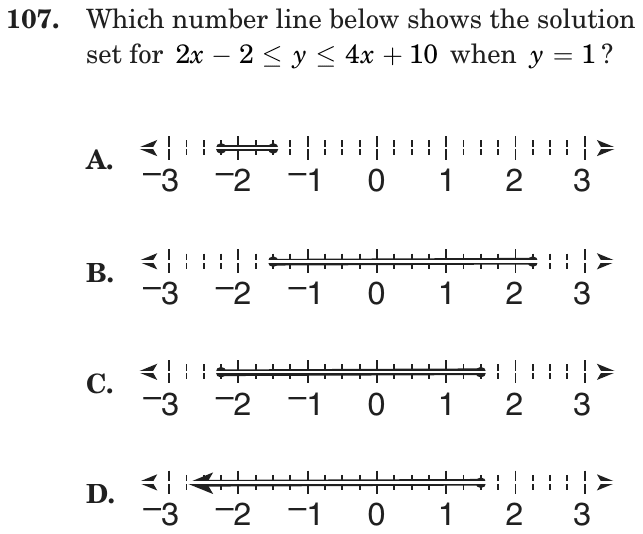
Which number line below shows the solution set for when ?
- A

- B

- C

- D

Show the answer
Correct answer: C
Separate the compound inequality into two pieces:
and
Substitute into each inequality and solve for :
The solution is the number line that shows that is greater than or equal to and less than or equal to .
Question analysis
Students substitute y = 1 into the compound inequality 2x − 2 ≤ y ≤ 4x + 10 and pick the number line that shows the values of x that work. It tests solving two-step inequalities and graphing the solution. The four graphs differ in their endpoints and in whether the shading is closed off on both sides, so each endpoint has to be found exactly.
- Grade level
- Grade 7 content, by NYS standard
- Compared with grade 7
- Above grade 7 Grade 7 students solve and graph one two-step inequality. This compound inequality in two variables requires substituting, solving two inequalities and combining them into one interval, a step toward algebra 1.
- Estimated difficulty
- Hard: combines ideas, needs a plan, and has more than one tempting wrong answer.
- Thinking it demands
- Depth of knowledge 2, skills and concepts · mainly apply
- What makes it hard
- Many steps moderate
- Error-prone arithmetic moderate
- Reading a figure, table or graph moderate
- A very close wrong answer minor
- Solution
- 4 steps
- Reading level
- Question and choices: about grade 9, 12 words.
- Students, last 30 days
- Not enough answers yet to show (it takes 10).
Why it is hard, traps and wrong answers (shows the answer)
Why it is hard
Substituting y = 1 is easy; the work is solving two inequalities and matching a fractional interval to a graph. Students who solve only the left inequality find a matching ray, and sign slips on either endpoint produce intervals that shift or flip across zero. The graphs differ by quarter-unit ticks, so reading them carefully matters as much as the algebra.
Many steps moderate Working it out
The compound inequality must be split into 2x − 2 ≤ 1 and 1 ≤ 4x + 10, each solved for x, and the two results joined into one interval. (Daniel & Embretson, 2010; Enright, Morley & Sheehan, 2002)
Error-prone arithmetic moderate Working it out
Both endpoints are fractions, 3/2 and −9/4, and the second comes from dividing −9 by 4, where a lost sign moves the endpoint across zero. (Brown & Burton, 1978; Junker & Sijtsma, 2001)
Reading a figure, table or graph moderate Understanding the question
The graphs are marked in quarter units, so −2 1/4 and 1 1/2 have to be found by counting small ticks between the labeled integers. (Lesh, Post & Behr, 1987; Kirsch & Mosenthal, 1990)
A very close wrong answer minor Choosing the answer
The ray ending at 1 1/2 looks almost like the right segment, sharing its right end; only the left end, an arrow instead of a closed dot at −2 1/4, separates them. (Embretson & Wetzel, 1987; Gorin & Embretson, 2006; Ascalon et al., 2007)
Strategy: Split the compound inequality into two separate inequalities, solve each for x after putting 1 in for y, then combine the two results into a single interval and match it to a graph.
Traps
- Negatives and direction: Arithmetic with negative numbers, the order of a subtraction, or direction on a number line. (Moving a term across the equals sign without changing its sign is a faulty procedure.)
- Stops one step early: A choice is a number from partway through the solution.
The wrong answers, classified
A Negatives and direction (Brown & Burton, 1978)
Gets the left endpoint −2 1/4 right but gives the right endpoint the wrong sign, ending the segment at −1 1/2 instead of 1 1/2.
B Negatives and direction (Brown & Burton, 1978)
Gives both endpoints the opposite sign, so the segment runs from −1 1/2 to 2 1/4, the true interval reflected across 0.
D Stops one step early (King et al., 2004; Gierl et al., 2017)
Solves only 2x − 2 ≤ 1 and graphs every x up to 1 1/2, leaving out the lower bound that 1 ≤ 4x + 10 sets.
Worked solution, step by step
Formulas used
- Solving an inequality
- a, b and c are numbers. The sign ≤ means is less than or equal to. Adding or subtracting the same number c on both sides keeps it true. Dividing both sides by the same positive number also keeps it true.
Sort out the question
The sign means is less than or equal to. An inequality compares two amounts that may not be equal. The statement is two inequalities joined together. You put 1 in place of . Then you need every that makes both parts true.
Split it into two parts
With , the statement becomes two inequalities.
The answer must make both of them true at the same time.
Solve the first part
Add 2 to both sides. Then divide both sides by 2.
So is at most . This is the right end of the answer.
Watch out: the right end is a positive number. Choice A ends its bar at instead.
Solve the second part
Subtract 10 from both sides. Then divide both sides by 4.
So is at least . This is the left end.
Watch out: keep the minus sign. Choice B uses the opposite signs and ends at .
Put the two parts together
The answer is every number from to , with both ends included. On the graph, that is a solid bar with a dot at each end. The small ticks are quarters. So count 1 tick left of −2 and 2 ticks right of 1.
Watch out: choice D uses only the first part. Its arrow goes left forever.
Give the answer
Choice C shows a bar from to , with dots at both ends. So the answer is C.
Check your answer
Test a number on the bar, like . Then and , and 1 is between them. Now test , which is off the bar. Then , and 1 is not less than −2. So the bar must stop on the left, which rules out D.
More questions like this
The original DOE question
Question 6 of 6
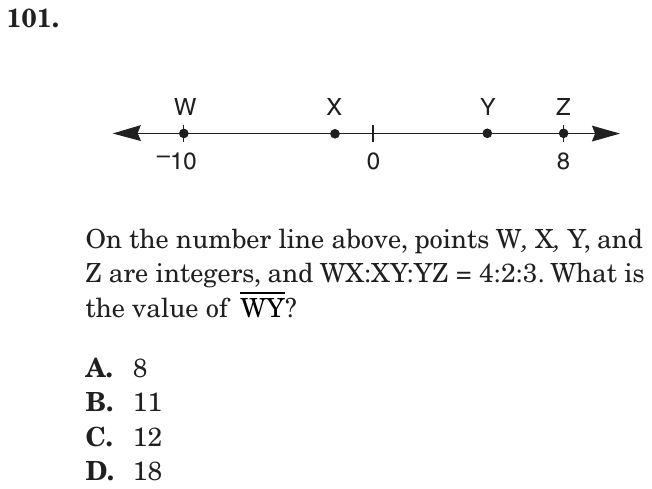
2018 Test A Math, question 44Question

On the number line above, points , , , and are integers, and . What is the value of ?
- A8
- B11
- C12
- D18
Show the answer
Correct answer: C
Convert the ratios into fractions of . Use the sum of the ratios for the denominator.
The part of that is is the sum of those fractions:
Find the length of :
The value of is .
Question analysis
This number line question places integer points W, X, Y and Z on a line and gives the ratio of the segments WX, XY and YZ as 4 to 2 to 3. Students find the whole length from W to Z, split it by the ratio, and add the parts that make up WY. Mixing up a part with the whole is the main risk.
- Grade level
- Grade 7 content, by NYS standard
- Compared with grade 7
- Above grade 7 Grade 7 students find distances on a number line and use part-to-whole ratios, usually separately. This item joins them: a negative endpoint, a three-term ratio and a choice of which segments to combine.
- Estimated difficulty
- Hard: combines ideas, needs a plan, and has more than one tempting wrong answer.
- Thinking it demands
- Depth of knowledge 2, skills and concepts · mainly apply
- What makes it hard
- Combines ideas moderate
- Reading a figure, table or graph moderate
- Many steps minor
- Solution
- 3 steps
- Reading level
- Question and choices: about grade 10, 21 words.
- Corrected from the DOE handbook
- Equations in the explanation that mixed up a fraction of a length with the length itself were corrected.
- Students, last 30 days
- Not enough answers yet to show (it takes 10).
Why it is hard, traps and wrong answers (shows the answer)
Why it is hard
Each step is routine, but the question keeps asking for a different piece of the line: the whole WZ, the part WX, and finally WY, which is two parts added together. Two of the wrong choices are exactly those other pieces. Students who mark the actual positions, X at −2 and Y at 2, can check the ratio before answering.
Combines ideas moderate Working it out
A three-part ratio, 4:2:3, must be applied to a length found from a negative endpoint, 8 − (−10) = 18, joining ratio and number-line distance. (Embretson, 1998; Daniel & Embretson, 2010)
Reading a figure, table or graph moderate Understanding the question
Only W at −10 and Z at 8 are labeled, and the drawing is not to scale: Y is drawn nearer 5 than 2, so reading WY from the picture fails. (Lesh, Post & Behr, 1987; Kirsch & Mosenthal, 1990)
Many steps minor Working it out
Find WZ, split it into 9 equal parts of 2, then add the 4 parts of WX and the 2 parts of XY. (Daniel & Embretson, 2010; Enright, Morley & Sheehan, 2002)
Strategy: Find the length WZ from the endpoints on the number line, divide it by the total number of ratio parts, and multiply by the parts from W to Y.
Traps
- Stops one step early: A choice is a number from partway through the solution.
- Answers a different question: A choice is right for another quantity: the other unknown, the rest instead of the part, the part instead of the whole.
- Counting the ends: Inclusive or exclusive ends, fence posts, consecutive numbers: an answer that is one too many or too few, or an endpoint drawn open where it belongs closed (or the reverse).
The wrong answers, classified
A Stops one step early (King et al., 2004; Gierl et al., 2017)
Finds WX, 4/9 of 18 = 8, and stops without adding XY's 4 to reach Y; 8 also matches Z's label.
B Counting the ends (Brown & Burton, 1978)
Places Y at 2 but counts the integers strictly between −10 and 2, which are −9 through 1, getting 11 instead of the distance 12.
D Answers a different question (King et al., 2004; Hegarty, Mayer & Monk, 1995)
Gives the whole length WZ, 8 − (−10) = 18, instead of the part from W to Y.
What was corrected from the DOE handbook, and why
- Explanation: The handbook writes WX = 4/9, XY = 2/9 and WY = 2/3, and then says “The value of WY is 2/3(18) = 12”. Those fractions are parts of WZ, not the lengths themselves (WX is 8 and WY is 12), so WY cannot be both 2/3 and 12. The lines now read WX = 4/9 WZ, XY = 2/9 WZ and WY = 2/3 WZ. The method and the answer are unchanged.
Worked solution, step by step
Formulas used
- Distance on a number line
- d is the distance between two points. b is the point on the right and a is the point on the left. Subtracting left from right always gives a positive distance. It works even when a is negative.
- Size of one part of a ratio
- u is the size of one part. L is the whole length being shared. p is the total number of parts, found by adding the numbers in the ratio. Every part is the same size, so you share the length equally.
Sort out what you know
W is at −10 and Z is at 8. X and Y are between them. The ratio 4:2:3 means WX is 4 parts, XY is 2 parts and YZ is 3 parts. All the parts are the same size.
You need the length WY, from W to Y. The drawing is not exact, so use the numbers, not the picture.
Find the whole length WZ
WZ is 18 units long. Subtracting a negative number is the same as adding.
Find the size of one part
Add the ratio numbers to get the number of parts:
Share the 18 units equally among 9 parts:
Each part is 2 units long.
Find WY
WY is WX and XY together, so it has 4 + 2 = 6 parts:
Watch out: WX alone is 4 × 2 = 8, which is choice A. And 18 is the whole line, choice D. So the answer is C, 12.
Check your answer
Place the points. W is at −10. X is 8 units to the right, at −2. Y is 4 more, at 2. Z is 6 more, at 8, which matches its label. And the distance from −10 to 2 is 2 − (−10) = 12.
More questions like this
The original DOE question