3 English and 3 math
Here are 6 random questions to try. Takers earning below 75% are unlikely to receive an offer. You have 1 minute 48 seconds per question on the real exam.
Question 1 of 6
2026 Practice Test A English, question 18Passage Excerpt from A Voice in the Wilderness
Excerpt from A Voice in the Wilderness
by Grace Livingston Hill
With a lurch the train came to a dead stop and Margaret Earle, hastily gathering up her belongings, hurried down the aisle and got out into the night.
It occurred to her, as she swung her heavy suit-case down the rather long step to the ground, and then carefully swung herself after it, that it was strange that neither conductor, brakeman, nor porter had come to help her off the train, when all three had taken the trouble to tell her that hers was the next station; but she could hear voices up ahead. Perhaps something was the matter with the engine that detained them and they had forgotten her for the moment.
The ground was rough where she stood, and there seemed no sign of a platform. Did they not have platforms in this wild Western land, or was the train so long that her car had stopped before reaching it?
She strained her eyes into the darkness, and tried to make out things from the two or three specks of light that danced about like fireflies in the distance. She could dimly see moving figures away up near the engine, and each one evidently carried a lantern. The train was tremendously long. A sudden feeling of isolation took possession of her. Perhaps she ought not to have got out until some one came to help her. Perhaps the train had not pulled into the station yet and she ought to get back on it and wait. Yet if the train started before she found the conductor she might be carried on somewhere and he justly blame her for a fool.
There did not seem to be any building on that side of the track. It was probably on the other, but she was standing too near the cars to see over. She tried to move back to look, but the ground sloped and she slipped and fell in the cinders, bruising her knee and cutting her wrist.
In sudden panic she arose. She would get back into the train, no matter what the consequences. They had no right to put her out here, away off from the station, at night, in a strange country. If the train started before she could find the conductor she would tell him that he must back it up again and let her off. He certainly could not expect her to get out like this.
She lifted the heavy suit-case up the high step that was even farther from the ground than it had been when she came down, because her fall had loosened some of the earth and caused it to slide away from the track. Then, reaching to the rail of the step, she tried to pull herself up, but as she did so the engine gave a long snort and the whole train, as if it were in league against her, lurched forward crazily, shaking off her hold. She slipped to her knees again, the suit-case, toppled from the lower step, descending upon her, and together they slid and rolled down the short bank, while the train . . . ran giddily off into the night.
The horror of being deserted helped the girl to rise in spite of bruises and shock. She lifted imploring hands to the unresponsive cars as they hurried by her—one, two, three, with bright windows, each showing a passenger, comfortable and safe inside, unconscious of her need.
A moment of useless screaming, running, trying to attract some one’s attention, a sickening sense of terror and failure, and the last car slatted itself past with a mocking clatter, as if it enjoyed her discomfort.
Margaret stood dazed, reaching out helpless hands, then dropped them at her sides and gazed after the fast-retreating train, the light on its last car swinging tauntingly, blinking now and then with a leer in its eye, rapidly vanishing from her sight into the depth of the night.
She gasped and looked about her for the station that but a short moment before had been so real to her mind; and, lo! on this side and on that there was none!
The night was wide like a great floor shut in by a low, vast dome of curving blue set with the largest, most wonderful stars she had ever seen. Heavy shadows of purple-green, smoke-like, hovered over earth darker and more intense than the unfathomable blue of the night sky. It seemed like the secret nesting-place of mysteries wherein no human foot might dare intrude. It was incredible that such could be but common sage-brush, sand, and greasewood wrapped about with the beauty of the lonely night.
No building broke the inky outlines of the plain, nor friendly light streamed out to cheer her heart. Not even a tree was in sight, except on the far horizon, where a heavy line of deeper darkness might mean a forest. Nothing, absolutely nothing, in the blue, deep, starry dome above and the bluer darkness of the earth below save one sharp shaft ahead like a black mast throwing out a dark arm across the track.
As soon as she sighted it she picked up her baggage and made her painful way toward it, for her knees and wrist were bruised and her baggage was heavy.
A soft drip, drip greeted her as she drew nearer; something plashing down among the cinders by the track. Then she saw the tall column with its arm outstretched, and looming darker among the sage-brush the outlines of a water-tank. It was so she recognized the engine’s drinking-tank, and knew that she had mistaken a pause to water the engine for a regular stop at a station.
cinders: track bed made from the residue of burnt coal
From A VOICE IN THE WILDERNESS by Grace Livingston Hill—Public Domain
Question
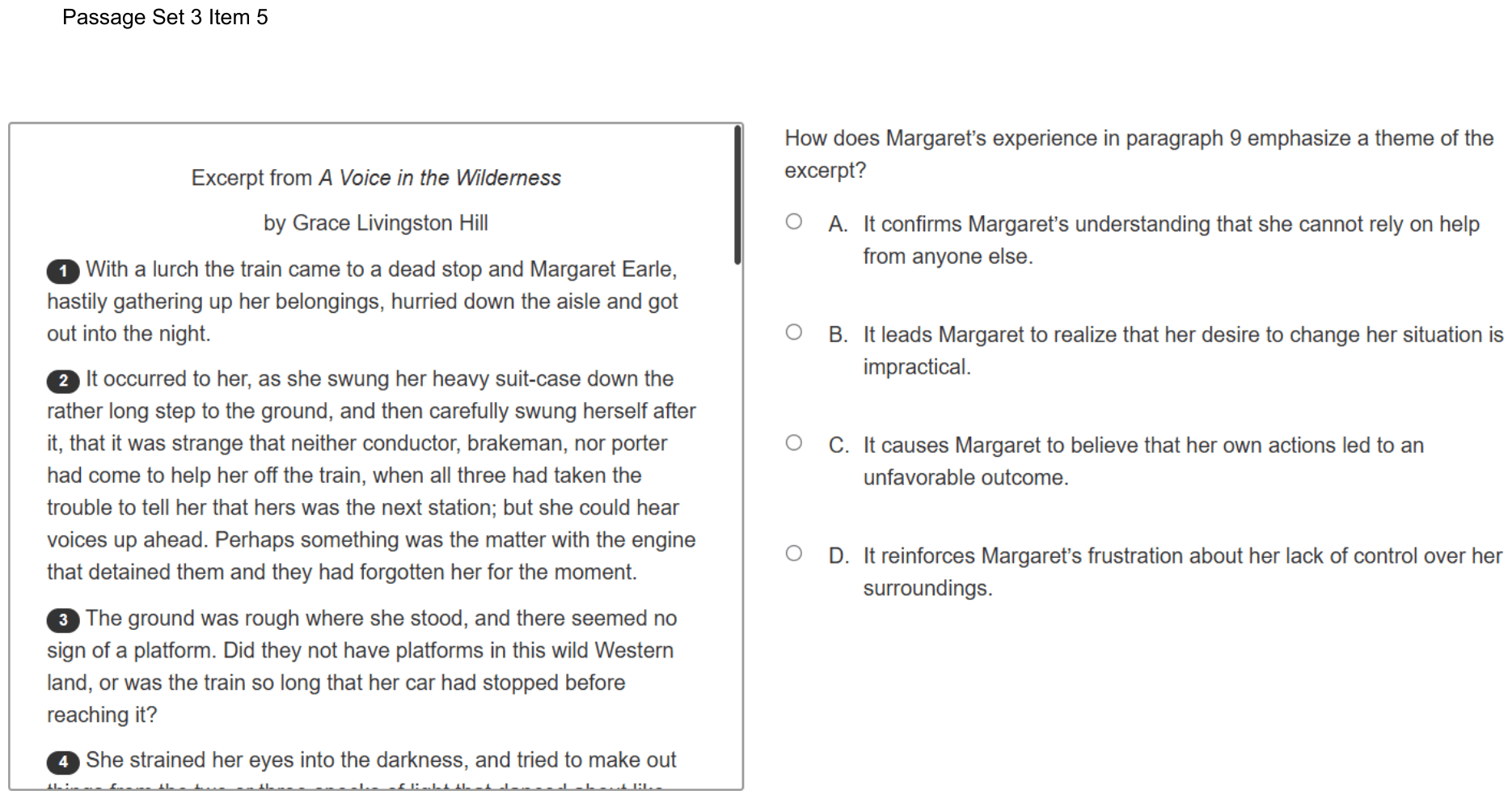
How does Margaret’s experience in paragraph 9 emphasize a theme of the excerpt?
- AIt confirms Margaret’s understanding that she cannot rely on help from anyone else.
- BIt leads Margaret to realize that her desire to change her situation is impractical.
- CIt causes Margaret to believe that her own actions led to an unfavorable outcome.
- DIt reinforces Margaret’s frustration about her lack of control over her surroundings.
Show the answer
Correct answer: A
The question asks about the relationship between the theme and paragraph 9, where Margaret desperately tries to get someone on the train to notice her.
A. CORRECT. One important theme of this excerpt concerns Margaret’s willingness to take action to ensure that she reaches her destination. This determination, described in Option A, is why she gathers her belongings together without help, gets off the train without being assisted by employees, and then attempts to climb back on while the train employees are busy examining the engine.
B. Incorrect. While the narrator describes her screaming as useless, she does not feel that her efforts overall are useless, and she does not give up until paragraph 10.
C. Incorrect. While Margaret is feeling a sense of “failure” in paragraph 9, she does not condemn herself as the train moves away.
D. Incorrect. Margaret expresses “terror” in paragraph 9 over being unable to catch someone’s attention, not frustration about her lack of control over her surroundings.
Question analysis
This theme question asks how Margaret’s experience in paragraph 9 of A Voice in the Wilderness, as she screams and runs while the train pulls away, emphasizes a theme of the excerpt. It is a lightly reworded version of an earlier handbook question. Every choice describes a believable reaction to being left behind, so the answer depends on the excerpt’s larger pattern.
- Grade level
- Grade 8 reading and task
- Compared with grade 7
- Above grade 7 Typical grade 7 theme questions trace a given theme through a text. Here students must decide which theme one frantic paragraph supports, and all four choices describe reactions that fit the scene, so the decision draws on the whole excerpt.
- Estimated difficulty
- Among the hardest on the SHSAT: a non-obvious approach, heavy reading, or a well-hidden trap.
- Thinking it demands
- Depth of knowledge 3, strategic thinking · mainly analyze
- What makes it hard
- Reading between the lines major
- Evidence in several places moderate
- Evidence
- Answered from the whole text
- Reading level
- Passage: about grade 8, 981 words; question and choices: about grade 10, 65 words.
- Students, last 30 days
- 40% right, of 10 answers
Why it is hard, traps and wrong answers (shows the answer)
Why it is hard
Each choice names a feeling a stranded traveler might have, and two lean on the paragraph’s own words, “useless” and “failure,” so the paragraph alone cannot decide it. Paragraph 9 must be read as the last link in a chain of trainmen, passengers and a departing train that all leave her to herself. Students who judge from that one paragraph often decide she has given up, though she soon picks up her bags and walks toward the dark shaft by the track.
Reading between the lines major Working it out
The theme is never stated; it must be drawn from paragraph 9’s cries that no one answers and from the passengers “comfortable and safe inside, unconscious of her need” in paragraph 8. (Graesser, Singer & Trabasso, 1994; Kintsch, 1998)
Evidence in several places moderate Working it out
The pattern begins in paragraph 2, when no trainman helps her off, and runs through the train lurching away “as if it were in league against her” in paragraph 7. (Kirsch & Mosenthal, 1990; Gorin & Embretson, 2006)
Strategy: Sum up in a phrase what keeps happening to Margaret from the start of the excerpt to its end, then check which choice paragraph 9’s own words most clearly add to.
Traps
- Too broad or too strong: A choice overstates, generalizes, or uses absolute words the text does not support.
- Wrong tone or attitude: Misjudges the tone, attitude or point of view, such as reading admiration as criticism, or taking a character's or subject's feelings for the author's.
The wrong answers, classified
B Too broad or too strong (King et al., 2004)
Stretches the “useless screaming” of one moment into a judgment that changing her situation is impractical, though she soon gathers her bags and sets off toward the shaft ahead.
C Reads too much in (Graesser, Singer & Trabasso, 1994)
Turns the “sense of terror and failure” into self-blame, though Margaret never says that her own choice to step off the train caused her trouble.
D Wrong tone or attitude (Graesser, Singer & Trabasso, 1994)
Fits the indifferent train, but names frustration over control where paragraph 9 stresses terror at being ignored by everyone aboard.
How 10 answers split, last 30 days
- A40%
- B0%
- C50%
- D10%
Working it out, step by step
Figure out what the question asks
This asks about a theme: a big idea a story keeps coming back to. How does what happens in paragraph 9 point to a theme? The right choice should fit a pattern across the whole excerpt.
Read paragraph 9
Paragraph 9 describes “A moment of useless screaming, running, trying to attract some one’s attention, a sickening sense of terror and failure.” Margaret screams and runs, trying to get someone to notice her. No one does. The last car rolls past “as if it enjoyed her discomfort.”
Find the same thing earlier
This is not the first time. In paragraph 2, none of the workers “had come to help her off the train.” In paragraph 8, the passengers sit “comfortable and safe inside, unconscious of her need.” That means they don’t know she needs help. Paragraph 9 is one more time when nobody comes. She will have to count on herself.
Check each choice
- A fits. Her cries go unanswered, just as before. She cannot rely on anyone else.
- B does not fit. Impractical means not sensible or workable. Her screaming fails, but she never decides that trying to change things is pointless. In paragraph 14 she “picked up her baggage” and set off again.
- C does not fit. She feels “failure,” but she never blames herself.
- D does not fit. The paragraph shows terror at being ignored, not frustration about having no control over her surroundings.
Choose the answer
Paragraph 9 adds one more moment where no one helps Margaret. So the answer is A.
Why this answer and not the closest wrong one
B is the closest wrong choice, because paragraph 9 calls her screaming “useless.” But one failed moment does not mean she gives up. Soon she takes her bags and walks toward the tall dark shape ahead. What stays true from paragraph 2 to paragraph 9 is that no one helps her. That is A.
More questions like this
The original DOE question
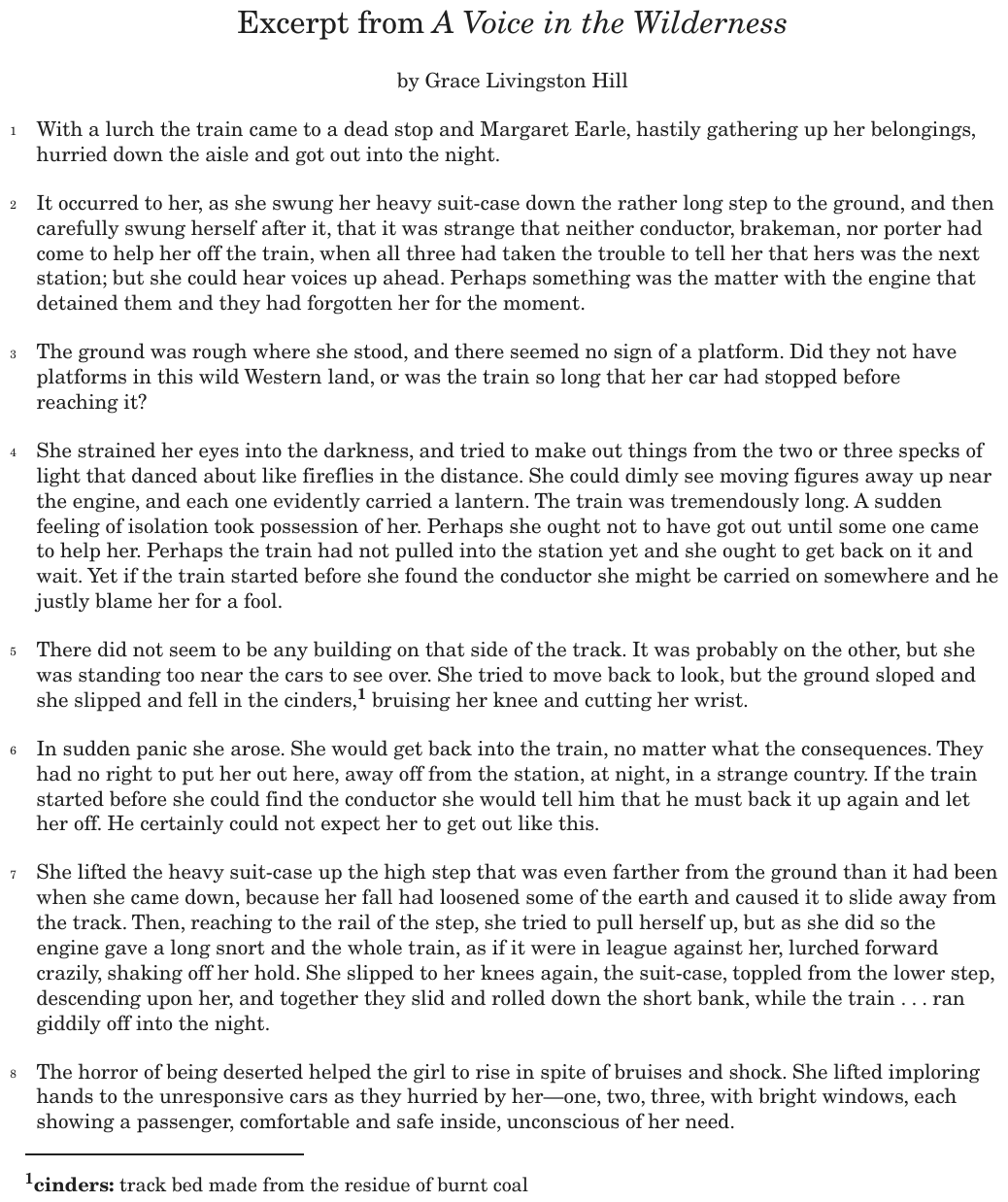
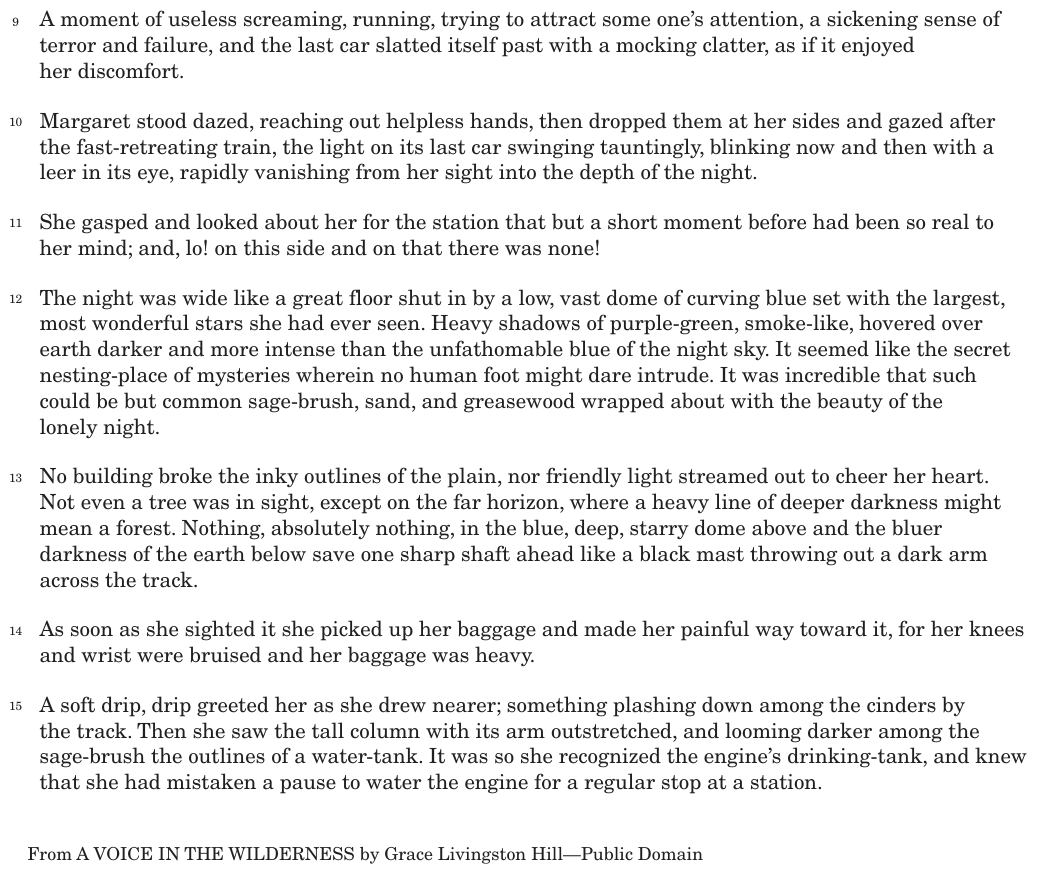
The passage “Excerpt from A Voice in the Wilderness” as printed (pages 128–129)
Question 2 of 6
2026 Practice Test C English, question 20Passage Bird Talk
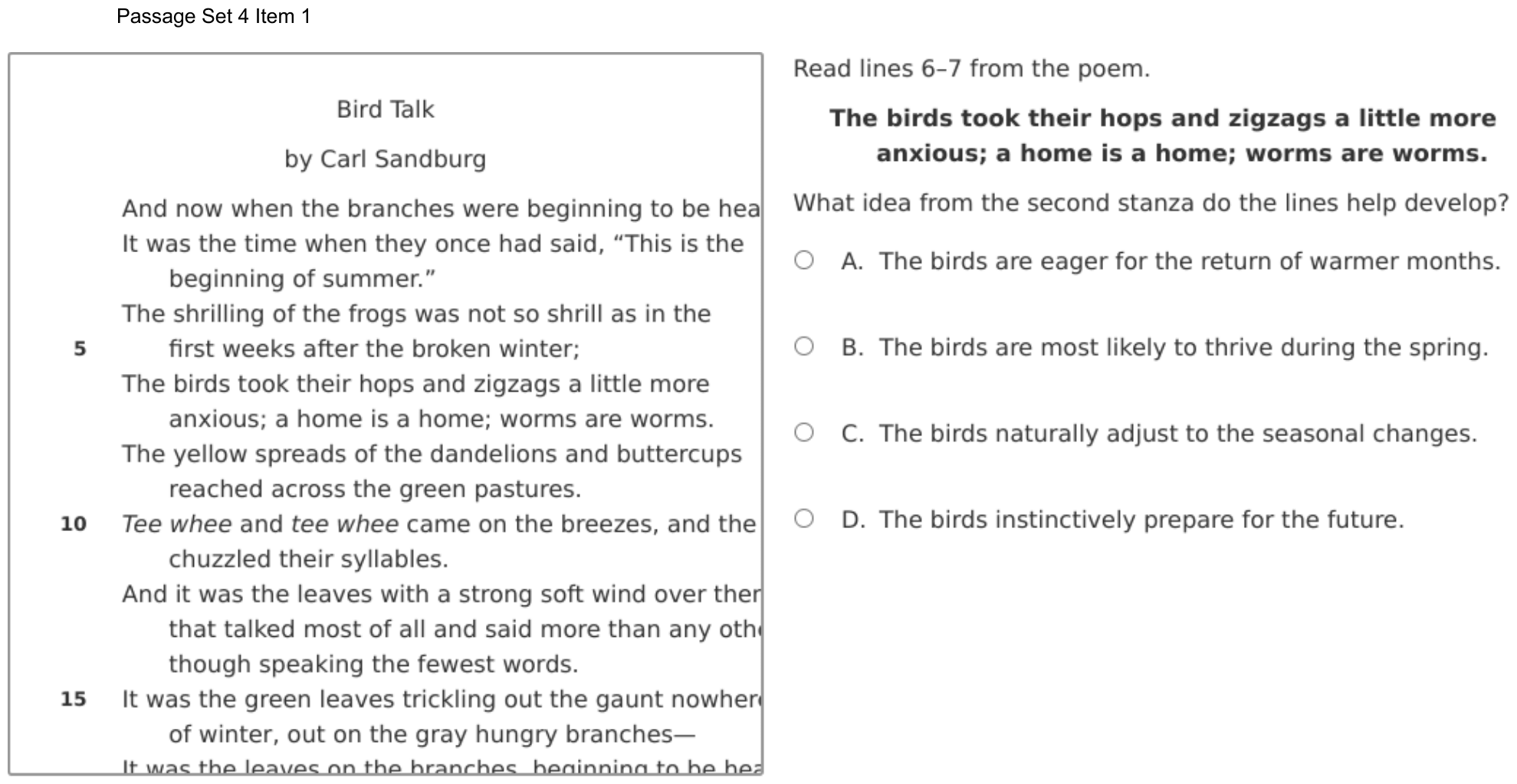
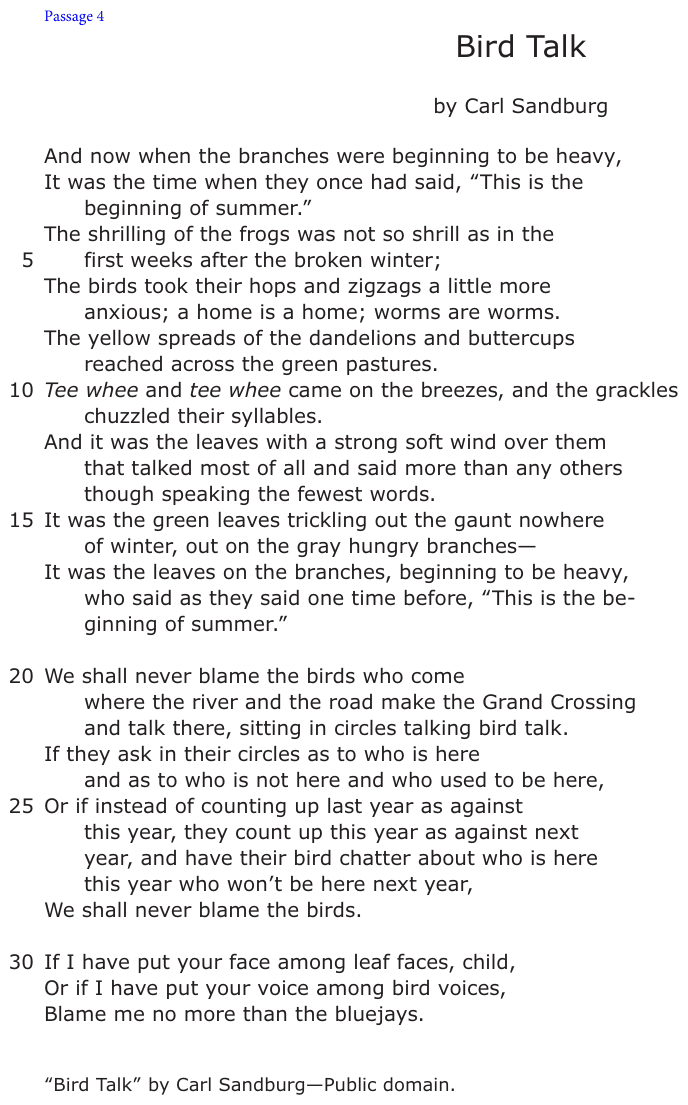
Bird Talk
by Carl Sandburg
And now when the branches were beginning to be heavy,
It was the time when they once had said, “This is the
beginning of summer.”
The shrilling of the frogs was not so shrill as in the
first weeks after the broken winter;
The birds took their hops and zigzags a little more
anxious; a home is a home; worms are worms.
The yellow spreads of the dandelions and buttercups
reached across the green pastures.
Tee whee and tee whee came on the breezes, and the grackles
chuzzled their syllables.
And it was the leaves with a strong soft wind over them
that talked most of all and said more than any others
though speaking the fewest words.
It was the green leaves trickling out the gaunt nowhere
of winter, out on the gray hungry branches—
It was the leaves on the branches, beginning to be heavy,
who said as they said one time before, “This is the be-
ginning of summer.”
We shall never blame the birds who come
where the river and the road make the Grand Crossing
and talk there, sitting in circles talking bird talk.
If they ask in their circles as to who is here
and as to who is not here and who used to be here,
Or if instead of counting up last year as against
this year, they count up this year as against next
year, and have their bird chatter about who is here
this year who won’t be here next year,
We shall never blame the birds.
If I have put your face among leaf faces, child,
Or if I have put your voice among bird voices,
Blame me no more than the bluejays.
“Bird Talk” by Carl Sandburg—Public domain.
Question
Read lines 6–7 from the poem.
The birds took their hops and zigzags a little more
anxious; a home is a home; worms are worms.
What idea from the second stanza do the lines help develop?
- AThe birds are eager for the return of warmer months.
- BThe birds are most likely to thrive during the spring.
- CThe birds naturally adjust to the seasonal changes.
- DThe birds instinctively prepare for the future.
Show the answer
Correct answer: C
The question asks how lines 6–7 from the poem develop an idea from the second stanza.
A. Incorrect. In lines 2–3, the tree branches exclaim that “ ‘This is the / beginning of summer,’ ” and the birds respond by taking “their hops and zigzags a little more / anxious” (lines 6–7); however, the birds’ eager reaction to the return of warmer weather is not referenced in the second stanza of the poem, which is more about the nature of birds generally than the changing of the seasons.
B. Incorrect. Birds are more likely to thrive in warmer weather as evidenced by some birds’ migration to a warmer climate during winter, and the creatures in the first stanza are responding to the “ ‘beginning of summer’ ” (line 3) in their own way, such as the birds who are taking “their hops and zigzags a little more / anxious” (lines 6–7). However, the thriving of birds during a particular season is not the focus of the second stanza; rather, it is focused on the general nature of birds.
C. CORRECT. The birds are taking “their hops and zigzags a little more / anxious” (lines 6–7) in light of warmer weather, but they are not making a big to-do of the change because “a home is a home; worms are worms” (line 7) any time of the year. Such a natural adjustment to seasonal changes is reflected in the second stanza, where the birds “count up this year as against next / year” (lines 26–27) because they are well accustomed to the cyclical nature of things.
D. Incorrect. Although the birds’ actions of “hops and zigzags” (line 6) may indicate some sort of preparation, these actions are not preparation but rather the internalized cognizance of the change that has occurred with little conscious thought. As revealed in the second stanza, birds do not ponder much about past or future but rather adapt naturally as things change.
Question analysis
This question on Carl Sandburg’s poem “Bird Talk” quotes lines 6–7, where the birds hop and zigzag “a little more anxious,” and asks which idea from the second stanza they help develop. Students must link two compressed lines in the first stanza to a later stanza about birds gathered at the Grand Crossing, and every choice sounds like a fair claim about birds.
- Grade level
- Grade 8 reading and task
- Compared with grade 7
- Above grade 7 Typical grade 7 poetry questions ask what one line or stanza shows on its own. Here two compressed lines from the first stanza must be tied to an idea the second stanza never states, in Sandburg’s loose, unusual phrasing.
- Estimated difficulty
- Among the hardest on the SHSAT: a non-obvious approach, heavy reading, or a well-hidden trap.
- Thinking it demands
- Depth of knowledge 3, strategic thinking · mainly analyze
- What makes it hard
- Reading between the lines major
- A very close wrong answer moderate
- Evidence in several places moderate
- Figurative or literary language moderate
- Evidence
- Answered from several paragraphs or stanzas
- Reading level
- Passage: 296 words (a poem; reading level not measured); question and choices: about grade 5, 70 words.
- Students, last 30 days
- 38% right, of 13 answers
Why it is hard, traps and wrong answers (shows the answer)
Why it is hard
The stem runs in an unusual direction: two lines from the first stanza must help develop an idea that only the second stanza holds, and the poem never states it. Students who read “next year” as planning are drawn to preparation, a choice built on the key’s own frame, while others answer from the first stanza’s summer or from what they know about birds. The question rewards hearing the birds’ roll call of who is gone as the same matter-of-fact acceptance as “worms are worms.”
Reading between the lines major Working it out
Neither stanza states the shared idea: students must hear calm acceptance in “a home is a home; worms are worms” and in birds tallying “who won’t be here next year,” then call it adjusting to change. (Graesser, Singer & Trabasso, 1994; Kintsch, 1998)
A very close wrong answer moderate Choosing the answer
The choice about instinctive preparation shares the key’s shape, birds acting by nature as time passes; it differs only in what the birds do, prepare for the future rather than adjust to the seasons. (Embretson & Wetzel, 1987; Gorin & Embretson, 2006; Ascalon et al., 2007)
Evidence in several places moderate Working it out
Lines 6–7 sit in the first stanza and the idea lives in the second, lines 20–29, so students must carry two lines across the poem and match them to the gathering at the Grand Crossing. (Kirsch & Mosenthal, 1990; Gorin & Embretson, 2006)
Figurative or literary language moderate Understanding the question
“A home is a home; worms are worms” says nothing on its surface; its meaning, a shrug that life goes on as it always has, has to be read from the repetition. (Graesser, Singer & Trabasso, 1994; Kintsch, 1998)
Strategy: Paraphrase the second stanza first: what are the birds doing and saying at the Grand Crossing? Then reread lines 6–7 and ask which idea about birds both passages share.
Traps
- Reads too much in: A reasonable-sounding conclusion that goes further than the text allows.
- Wrong part of the text: A choice is true of another paragraph, stanza or speaker than the one asked about.
- Outside knowledge: A choice is plausible in the real world but not supported by this text.
The wrong answers, classified
A Wrong part of the text (Kirsch & Mosenthal, 1990)
Hears “a little more anxious” as eagerness for the summer announced in lines 2–3, an idea of the first stanza, while the second stanza never mentions weather or warmth.
B Outside knowledge (King et al., 2004; Recht & Leslie, 1988)
Brings in the real fact that birds do well in warm weather, which neither lines 6–7 nor the birds’ talk of who is gone says, and the poem’s season is summer, not spring.
D Reads too much in (Graesser, Singer & Trabasso, 1994)
Sees nest-building in “a home is a home” and planning in counting “this year as against next / year,” but the birds only note who will be missing and make no preparations.
How 13 answers split, last 30 days
- A31%
- B15%
- C38%
- D15%
Working it out, step by step
Figure out what the question asks
This question points in an unusual direction. Lines 6–7 are in the first stanza. A stanza is a group of lines set apart by a blank line. But the idea you need is in the second stanza, lines 20–29. The question asks which idea in stanza 2 these earlier lines also help build. So find the idea in stanza 2 first. Then see how lines 6–7 support it.
Find the idea in stanza 2
In stanza 2, birds sit “in circles talking bird talk.” They ask “who is here / and as to who is not here and who used to be here.” They also talk about “who is here / this year who won’t be here next year.” The birds simply count the changes. They are not upset by them. The speaker says, “We shall never blame the birds.” The idea: birds take the changes that time brings as a normal part of life.
Read lines 6–7 closely
Lines 6–7 say “The birds took their hops and zigzags a little more / anxious; a home is a home; worms are worms.” As summer comes, the birds hop about a little more nervously and busily. That is a small change. Then the speaker shrugs: “a home is a home; worms are worms.” Life goes on as it always does. The birds change a little and carry on, with no fuss.
See what the two parts share
Both parts show birds meeting change calmly. In lines 6–7, the season turns, and the birds adjust a little. To adjust is to change a little to fit something new. In stanza 2, the birds note who has come and gone, and life goes on. So lines 6–7 help build stanza 2’s idea: birds naturally adjust to the changing seasons.
Check each choice
- A does not fit. Stanza 2 never mentions warm weather or being eager for it.
- B does not fit. Nothing in the poem says birds do best in spring. The poem’s season is the start of summer.
- C fits. Both parts show birds taking seasonal change calmly, as a matter of course.
- D does not fit. The birds talk about next year, but they make no plans for it.
Watch out: D is tempting because “a home is a home” can sound like nest building. But the birds only count who will be missing. They do not get ready for anything.
Choose the answer
Lines 6–7 and stanza 2 both show birds accepting change as natural. So the answer is C, “The birds naturally adjust to the seasonal changes.”
Why this answer and not the closest wrong one
D is the closest wrong choice. Like C, it says birds act by nature as time passes. But D says they prepare, or get ready. In stanza 2, the birds talk about next year only to count who “won’t be here next year.” In lines 6–7, they hop about and carry on. They adjust to change. They do not plan for it.
More questions like this
The original DOE question
The passage “Bird Talk” as printed (page 32)
Question 3 of 6
2026 Practice Test A English, question 12Passage The Best Laid Plans of Ravens
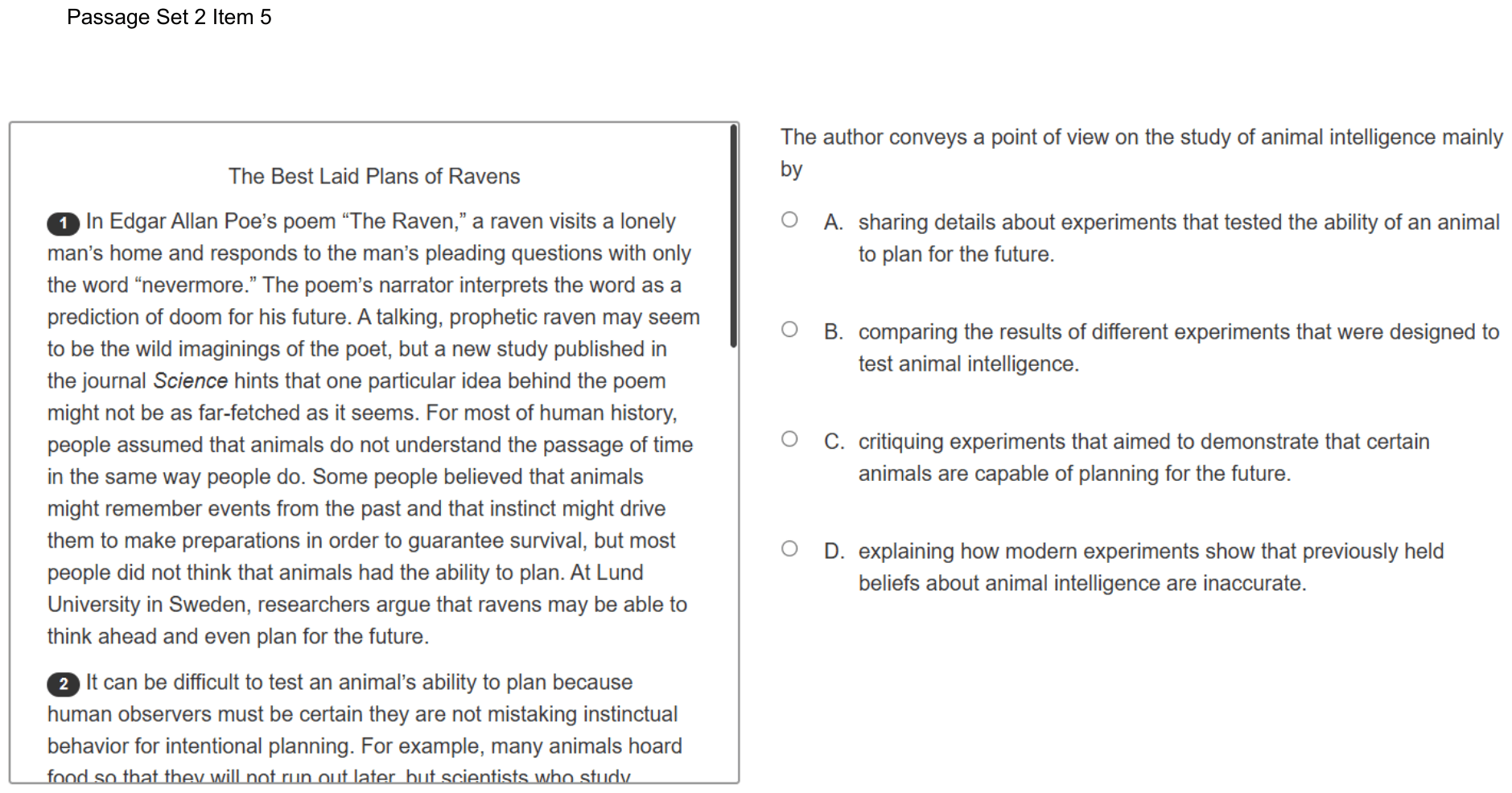
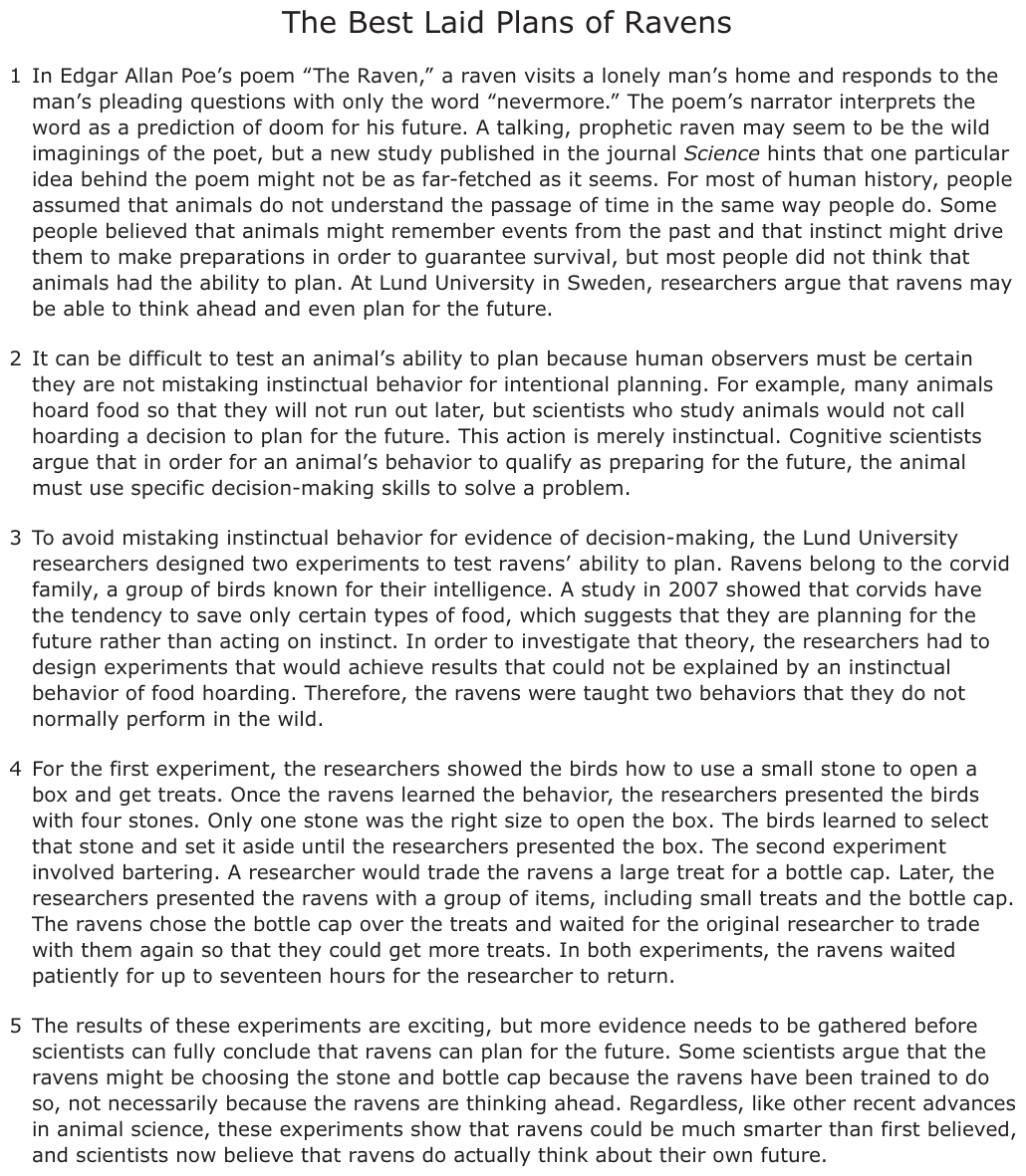
The Best Laid Plans of Ravens
In Edgar Allan Poe’s poem “The Raven,” a raven visits a lonely man’s home and responds to the man’s pleading questions with only the word “nevermore.” The poem’s narrator interprets the word as a prediction of doom for his future. A talking, prophetic raven may seem to be the wild imaginings of the poet, but a new study published in the journal Science hints that one particular idea behind the poem might not be as far-fetched as it seems. For most of human history, people assumed that animals do not understand the passage of time in the same way people do. Some people believed that animals might remember events from the past and that instinct might drive them to make preparations in order to guarantee survival, but most people did not think that animals had the ability to plan. At Lund University in Sweden, researchers argue that ravens may be able to think ahead and even plan for the future.
It can be difficult to test an animal’s ability to plan because human observers must be certain they are not mistaking instinctual behavior for intentional planning. For example, many animals hoard food so that they will not run out later, but scientists who study animals would not call hoarding a decision to plan for the future. This action is merely instinctual. Cognitive scientists argue that in order for an animal’s behavior to qualify as preparing for the future, the animal must use specific decision-making skills to solve a problem.
To avoid mistaking instinctual behavior for evidence of decision-making, the Lund University researchers designed two experiments to test ravens’ ability to plan. Ravens belong to the corvid family, a group of birds known for their intelligence. A study in 2007 showed that corvids have the tendency to save only certain types of food, which suggests that they are planning for the future rather than acting on instinct. In order to investigate that theory, the researchers had to design experiments that would achieve results that could not be explained by an instinctual behavior of food hoarding. Therefore, the ravens were taught two behaviors that they do not normally perform in the wild.
For the first experiment, the researchers showed the birds how to use a small stone to open a box and get treats. Once the ravens learned the behavior, the researchers presented the birds with four stones. Only one stone was the right size to open the box. The birds learned to select that stone and set it aside until the researchers presented the box. The second experiment involved bartering. A researcher would trade the ravens a large treat for a bottle cap. Later, the researchers presented the ravens with a group of items, including small treats and the bottle cap. The ravens chose the bottle cap over the treats and waited for the original researcher to trade with them again so that they could get more treats. In both experiments, the ravens waited patiently for up to seventeen hours for the researcher to return.
The results of these experiments are exciting, but more evidence needs to be gathered before scientists can fully conclude that ravens can plan for the future. Some scientists argue that the ravens might be choosing the stone and bottle cap because the ravens have been trained to do so, not necessarily because the ravens are thinking ahead. Regardless, like other recent advances in animal science, these experiments show that ravens could be much smarter than first believed, and scientists now believe that ravens do actually think about their own future.
Question
The author conveys a point of view on the study of animal intelligence mainly by
- Asharing details about experiments that tested the ability of an animal to plan for the future.
- Bcomparing the results of different experiments that were designed to test animal intelligence.
- Ccritiquing experiments that aimed to demonstrate that certain animals are capable of planning for the future.
- Dexplaining how modern experiments show that previously held beliefs about animal intelligence are inaccurate.
Show the answer
Correct answer: A
The question asks how the author conveys a point of view on the study of animal intelligence.
A. CORRECT. Paragraphs 3 and 4 focus on the process and details of the experiments that scientists conducted. This detailed information from the author provides a sense of how the ravens demonstrated planning abilities beyond natural instinct. The author supports the claims from the experiments, calling the findings “exciting” and stating in the conclusion that “these experiments show that ravens could be much smarter than first believed” (paragraph 5).
B. Incorrect. Although two experiments are described in the passage, the description presents the experiments as building on each other and does not compare their results. The passage states that “these experiments show that ravens could be much smarter than first believed, and scientists now believe that ravens do actually think about their own future” (paragraph 5).
C. Incorrect. The author presents information from the experiments and the results that were gathered from them; while there is an admission that “more evidence needs to be gathered before scientists can fully conclude that ravens can plan for the future” (paragraph 5), the author does not criticize the experiments that are presented.
D. Incorrect. While the author does discuss some previously held beliefs about animal intelligence in paragraph 1, the focus of the passage is that experiments indicate that there is reason to question these beliefs, since “these experiments show that ravens could be much smarter than first believed” (paragraph 5). The previously held beliefs are not considered inaccurate by the discussion in the passage because only one example—the raven—is provided. The passage does not state that beliefs about animal intelligence as a whole are inaccurate.
Question analysis
This author’s point-of-view question asks how the writer of “The Best Laid Plans of Ravens” mainly conveys a view of research into animal intelligence. Students must look at the article as a whole and decide how it presents that view. The choices describe ways of writing in abstract terms, which makes them easy to blur together.
- Grade level
- Grade 8 reading and task
- Compared with grade 7
- Above grade 7 Grade 7 point-of-view questions usually ask what an author thinks. This one asks how the author mainly conveys a view across the whole article, and the choices name methods that sound alike, closer to grade 8 work on how authors handle differing views.
- Estimated difficulty
- Hard: combines ideas, needs a plan, and has more than one tempting wrong answer.
- Thinking it demands
- Depth of knowledge 3, strategic thinking · mainly analyze
- What makes it hard
- How, not what major
- Reading between the lines moderate
- Every choice must be checked minor
- Evidence
- Answered from the whole text
- Reading level
- Passage: about grade 11, 599 words; question and choices: about grade 13, 74 words.
- Students, last 30 days
- 40% right, of 10 answers
Why it is hard, traps and wrong answers (shows the answer)
Why it is hard
The right choice sounds too plain to carry a point of view, which is exactly what makes this question hard. Students expect a view to be argued, so they reach for the choice that says the experiments prove old beliefs wrong, an overstatement of the author’s hedged “could be,” or for criticism, which belongs to other scientists. The article persuades by reporting the experiments in detail and calling them exciting.
How, not what major Working it out
The question asks how the view comes across, not what it is, and the answer is a method: the author lets the detailed account of the experiments in paragraphs 3–4 carry a favorable view. (Anderson & Krathwohl, 2001)
Reading between the lines moderate Working it out
The author never states an opinion outright; the view must be pieced together from words such as “exciting” and “could be much smarter than first believed” in paragraph 5. (Graesser, Singer & Trabasso, 1994; Kintsch, 1998)
Every choice must be checked minor Choosing the answer
The choices name ways of writing in abstract terms, sharing, comparing, critiquing and explaining, so each must be held against what the whole article actually does. (Embretson & Wetzel, 1987)
Strategy: Settle first on how the author regards the raven research, then check each choice against what the article actually does from beginning to end, not against a single paragraph.
Traps
- Too broad or too strong: A choice overstates, generalizes, or uses absolute words the text does not support.
- Wrong tone or attitude: Misjudges the tone, attitude or point of view, such as reading admiration as criticism, or taking a character's or subject's feelings for the author's.
- Twists what the text says: Uses the text's topic and ideas but changes what it says: who did it, how much, when, or why.
The wrong answers, classified
B Twists what the text says (King et al., 2004)
Notices that two experiments are described and assumes they are set side by side, but the article reports the stone test and the bartering test in turn without comparing results.
C Wrong tone or attitude (Graesser, Singer & Trabasso, 1994)
Takes the doubt that “some scientists” raise about training for the author’s own criticism, though the author calls the results “exciting” and moves past the objection.
D Too broad or too strong (King et al., 2004)
Builds on the point that ravens may be smarter than believed but overstates it: the author hedges with “could be,” discusses only ravens, and never calls older beliefs wrong.
How 10 answers split, last 30 days
- A40%
- B20%
- C20%
- D20%
Working it out, step by step
Figure out what the question asks
This asks about the author’s point of view, what the author thinks about studying animal intelligence. It also asks how the author mainly shows that view. Think about the whole article, not one paragraph.
Find the author’s view
In paragraph 5, the author says the results “are exciting.” The author also says the experiments “show that ravens could be much smarter than first believed.” So the author is interested in this research and hopeful about it.
See how the article is built
Most of the article explains the experiments. Paragraph 3 tells why the researchers planned two of them. Paragraph 4 gives the details step by step: the stone, the box, the bottle cap, the trades and the long wait. The author lets these details show why the research matters. Then the author calls the results exciting.
Check each choice
- A fits. The author shares details of experiments that tested whether an animal can plan.
- B does not fit. The two experiments are told one after the other. Their results are never compared.
- C does not fit. The doubt comes from “some scientists,” not the author. The author answers it with “Regardless.”
- D does not fit. It goes too far. The author says ravens “could be” smarter, which means maybe. The article never calls old beliefs wrong.
Watch out: D is tempting because paragraph 1 describes old beliefs. But “could be” is not the same as “are.”
Choose the answer
The author shows a view mostly through details of the experiments. So the answer is A.
Why this answer and not the closest wrong one
D is the closest wrong choice. The author does think ravens may be smarter than people believed. But the author is careful and says they “could be.” D says experiments prove old beliefs wrong, which is too strong. What the author mostly does is share the experiments’ details. That is A.
More questions like this
The original DOE question
The passage “The Best Laid Plans of Ravens” as printed (page 12)
Question 4 of 6
2024 Test A Math, question 6Question
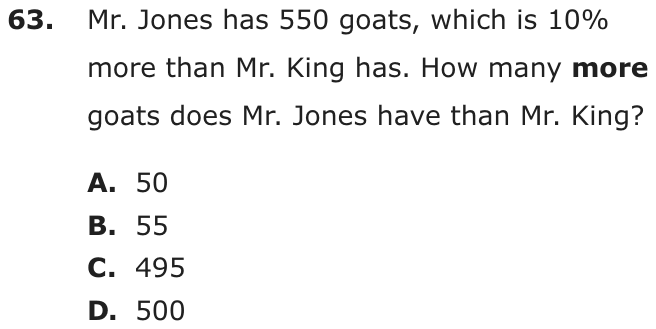
Mr. Jones has 550 goats, which is 10% more than Mr. King has. How many more goats does Mr. Jones have than Mr. King?
- A50
- B55
- C495
- D500
Show the answer
Correct answer: A
First, set up a proportion to determine x, the number of goats Mr. King has.
Then solve the proportion for x.
Finally, determine the difference between the number of goats Mr. Jones has, 550, and the number of goats Mr. King has, 500.
Mr. Jones has 50 more goats than Mr. King.
Question analysis
A percent word problem: Mr. Jones has 550 goats, which is 10% more than Mr. King has, and students find how many more goats Mr. Jones has. It asks students to work with a percent increase when only the larger amount is known. The tricky part is deciding which amount the 10% is taken of.
- Grade level
- Grade 7 content, by NYS standard
- Compared with grade 7
- Above grade 7 Grade 7 students usually find a percent increase from a known original amount. This runs the task backward: the increased amount is given, and the original must be recovered before the difference can be found, a step many do not expect.
- Estimated difficulty
- Hard: combines ideas, needs a plan, and has more than one tempting wrong answer.
- Thinking it demands
- Depth of knowledge 2, skills and concepts · mainly apply
- What makes it hard
- Turning words into math major
- A very close wrong answer moderate
- Solution
- 2 steps
- Reading level
- Question and choices: about grade 1, 22 words.
- Students, last 30 days
- Not enough answers yet to show (it takes 10).
Why it is hard, traps and wrong answers (shows the answer)
Why it is hard
The arithmetic is one division and one subtraction, so the question is really about the base of a percent. The sentence gives the bigger number and calls it 10% more, and the reflex is to take 10% of the number on the page. That shortcut lands on a listed choice five goats from the answer. Students who find King's herd first, 550 ÷ 1.1, still have to remember that the question wants the difference, not the herd.
Turning words into math major Understanding the question
The clause "which is 10% more than" makes King's unknown herd the base of the 10%, so 550 is 110% of his number rather than the amount the 10% is taken of. (Hegarty, Mayer & Monk, 1995; Koedinger & Nathan, 2004)
A very close wrong answer moderate Choosing the answer
The choices 50 and 55 are only 5 goats apart, and both are 10% of a herd; only taking the percent of King's 500 rather than of 550 separates them. (Embretson & Wetzel, 1987; Gorin & Embretson, 2006; Ascalon et al., 2007)
Strategy: Mr. Jones's 550 is 110% of Mr. King's number, so divide 550 by 1.10 to find Mr. King's goats, then subtract that from 550.
Traps
- Percent of the wrong amount: Finding the whole from a part, or a percent change measured from the wrong starting amount.
- Stops one step early: A choice is a number from partway through the solution.
The wrong answers, classified
B Percent of the wrong amount (Parker & Leinhardt, 1995)
Takes 10% of 550, measuring the increase from Jones's herd instead of from King's smaller herd, which is the amount the 10% is based on.
C Percent of the wrong amount (Parker & Leinhardt, 1995)
Takes 10% off 550 to get King's herd, 550 − 55 = 495, using the wrong base, then gives that herd instead of the difference.
D Stops one step early (King et al., 2004; Gierl et al., 2017)
Finds King's herd correctly, 550 ÷ 1.1 = 500, then stops there instead of subtracting it from 550 to get how many more.
Worked solution, step by step
Formulas used
- Percent increase
- The original is the amount you start from, the one the percent is taken of. p is the percent of increase. The new amount is all of the original, which is 100%, plus p% more. For 10% more, you multiply by 1.10.
Sort out the question
Mr. Jones has 550 goats. That is “10% more than Mr. King has”. You need how many more goats Mr. Jones has than Mr. King. That is the difference between the two herds, not the size of a herd.
Decide what the 10% is of
The words “10% more than Mr. King” mean the 10% is a part of Mr. King’s herd. So Mr. King’s herd is the original. Mr. Jones has all of Mr. King’s goats, 100%, plus 10% more. That is 110% of Mr. King’s herd. Watch out: do not take 10% of 550. That gives 55, choice B. It uses the wrong herd. Taking those 55 away from 550 gives 495, choice C, which is also wrong.
Find Mr. King’s herd
Call Mr. King’s number of goats K. Use the percent increase formula with p = 10. The new amount is 550.
Mr. King has 500 goats. Watch out: 500 is Mr. King’s herd, choice D. It is not the difference.
Find the difference
Mr. Jones has 50 more goats than Mr. King. So the answer is A, 50.
Check your answer
Check the 10%. 10% of 500 is , and , Mr. Jones’s herd. So 550 really is 10% more than 500. If King had 495, then 10% more would be about 545, not 550.
More questions like this
The original DOE question
Question 5 of 6
2018 Test B Math, question 50Question
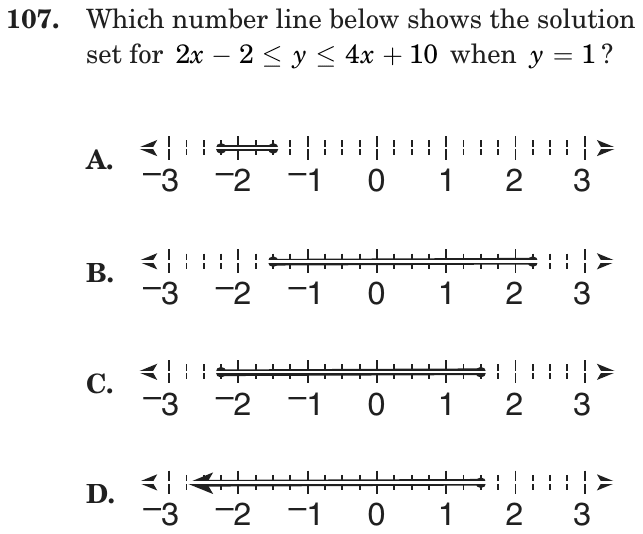
Which number line below shows the solution set for when ?
- A

- B

- C

- D

Show the answer
Correct answer: C
Separate the compound inequality into two pieces:
and
Substitute into each inequality and solve for :
The solution is the number line that shows that is greater than or equal to and less than or equal to .
Question analysis
Students substitute y = 1 into the compound inequality 2x − 2 ≤ y ≤ 4x + 10 and pick the number line that shows the values of x that work. It tests solving two-step inequalities and graphing the solution. The four graphs differ in their endpoints and in whether the shading is closed off on both sides, so each endpoint has to be found exactly.
- Grade level
- Grade 7 content, by NYS standard
- Compared with grade 7
- Above grade 7 Grade 7 students solve and graph one two-step inequality. This compound inequality in two variables requires substituting, solving two inequalities and combining them into one interval, a step toward algebra 1.
- Estimated difficulty
- Hard: combines ideas, needs a plan, and has more than one tempting wrong answer.
- Thinking it demands
- Depth of knowledge 2, skills and concepts · mainly apply
- What makes it hard
- Many steps moderate
- Error-prone arithmetic moderate
- Reading a figure, table or graph moderate
- A very close wrong answer minor
- Solution
- 4 steps
- Reading level
- Question and choices: about grade 9, 12 words.
- Students, last 30 days
- Not enough answers yet to show (it takes 10).
Why it is hard, traps and wrong answers (shows the answer)
Why it is hard
Substituting y = 1 is easy; the work is solving two inequalities and matching a fractional interval to a graph. Students who solve only the left inequality find a matching ray, and sign slips on either endpoint produce intervals that shift or flip across zero. The graphs differ by quarter-unit ticks, so reading them carefully matters as much as the algebra.
Many steps moderate Working it out
The compound inequality must be split into 2x − 2 ≤ 1 and 1 ≤ 4x + 10, each solved for x, and the two results joined into one interval. (Daniel & Embretson, 2010; Enright, Morley & Sheehan, 2002)
Error-prone arithmetic moderate Working it out
Both endpoints are fractions, 3/2 and −9/4, and the second comes from dividing −9 by 4, where a lost sign moves the endpoint across zero. (Brown & Burton, 1978; Junker & Sijtsma, 2001)
Reading a figure, table or graph moderate Understanding the question
The graphs are marked in quarter units, so −2 1/4 and 1 1/2 have to be found by counting small ticks between the labeled integers. (Lesh, Post & Behr, 1987; Kirsch & Mosenthal, 1990)
A very close wrong answer minor Choosing the answer
The ray ending at 1 1/2 looks almost like the right segment, sharing its right end; only the left end, an arrow instead of a closed dot at −2 1/4, separates them. (Embretson & Wetzel, 1987; Gorin & Embretson, 2006; Ascalon et al., 2007)
Strategy: Split the compound inequality into two separate inequalities, solve each for x after putting 1 in for y, then combine the two results into a single interval and match it to a graph.
Traps
- Negatives and direction: Arithmetic with negative numbers, the order of a subtraction, or direction on a number line. (Moving a term across the equals sign without changing its sign is a faulty procedure.)
- Stops one step early: A choice is a number from partway through the solution.
The wrong answers, classified
A Negatives and direction (Brown & Burton, 1978)
Gets the left endpoint −2 1/4 right but gives the right endpoint the wrong sign, ending the segment at −1 1/2 instead of 1 1/2.
B Negatives and direction (Brown & Burton, 1978)
Gives both endpoints the opposite sign, so the segment runs from −1 1/2 to 2 1/4, the true interval reflected across 0.
D Stops one step early (King et al., 2004; Gierl et al., 2017)
Solves only 2x − 2 ≤ 1 and graphs every x up to 1 1/2, leaving out the lower bound that 1 ≤ 4x + 10 sets.
Worked solution, step by step
Formulas used
- Solving an inequality
- a, b and c are numbers. The sign ≤ means is less than or equal to. Adding or subtracting the same number c on both sides keeps it true. Dividing both sides by the same positive number also keeps it true.
Sort out the question
The sign means is less than or equal to. An inequality compares two amounts that may not be equal. The statement is two inequalities joined together. You put 1 in place of . Then you need every that makes both parts true.
Split it into two parts
With , the statement becomes two inequalities.
The answer must make both of them true at the same time.
Solve the first part
Add 2 to both sides. Then divide both sides by 2.
So is at most . This is the right end of the answer.
Watch out: the right end is a positive number. Choice A ends its bar at instead.
Solve the second part
Subtract 10 from both sides. Then divide both sides by 4.
So is at least . This is the left end.
Watch out: keep the minus sign. Choice B uses the opposite signs and ends at .
Put the two parts together
The answer is every number from to , with both ends included. On the graph, that is a solid bar with a dot at each end. The small ticks are quarters. So count 1 tick left of −2 and 2 ticks right of 1.
Watch out: choice D uses only the first part. Its arrow goes left forever.
Give the answer
Choice C shows a bar from to , with dots at both ends. So the answer is C.
Check your answer
Test a number on the bar, like . Then and , and 1 is between them. Now test , which is off the bar. Then , and 1 is not less than −2. So the bar must stop on the left, which rules out D.
More questions like this
The original DOE question
Question 6 of 6
2026 Practice Test B Math, question 31Question
A pizza shop offers a choice of 3 sizes (small, medium, and large) and 7 different toppings. Different pizzas can be created by changing the size and the choice of toppings. If Cody wants to order a pizza with exactly 2 different toppings, how many different pizzas can he create?
- A6
- B21
- C63
- D126
Show the answer
Correct answer: C
Figure out how many different topping pairs are possible. Use 1, 2, 3, 4, 5, 6, 7 to represent the toppings, and create a list of possible pairs:
1,2; 1,3; 1,4; 1,5; 1,6; 1,7
2,3; 2,4; 2,5; 2,6; 2,7
3,4; 3,5; 3,6; 3,7
4,5; 4,6; 4,7
5,6; 5,7
6,7
So there are 21 different topping combinations for one pizza.
Since there are 3 pizza sizes, multiply the total number of combinations by 3 to get the total number of different pizzas Cody can create: .
Question analysis
Cody orders a pizza with exactly 2 of 7 toppings in one of 3 sizes, and students count how many different pizzas he could create. It tests counting combinations, where the order of the toppings does not matter, combined with a second choice. The challenge is to count every possible pizza exactly once.
- NYS standards
- 7.SP.8b sample spaces for compound events
- Grade level
- Grade 7 content, by NYS standard
- Compared with grade 7
- Above grade 7 In grade 7, compound events are usually ordered pairs, such as a coin with a number cube. Here an unordered pair of toppings is chosen from seven and then matched with three sizes, a combination count beyond typical grade 7 work.
- Estimated difficulty
- Hard: combines ideas, needs a plan, and has more than one tempting wrong answer.
- Thinking it demands
- Depth of knowledge 2, skills and concepts · mainly apply
- What makes it hard
- Combines ideas moderate
- Something you must already know minor
- Solution
- 3 steps
- Reading level
- Question and choices: about grade 8, 47 words.
- Students, last 30 days
- Not enough answers yet to show (it takes 10).
Why it is hard, traps and wrong answers (shows the answer)
Why it is hard
The question packs two counts into one sentence, each with its own trap. Order does not matter among the toppings, while the size multiplies every pair, and students tend to remember one of these and forget the other. Listing pairs systematically, each topping matched only with later ones, keeps the first count honest, and the stem’s “changing the size and the choice of toppings” is the reminder that size counts too.
Combines ideas moderate Working it out
Two counts are joined: the unordered pairs of toppings from 7, then the 3 sizes each pair can come in, and a mistake in either count changes the total. (Embretson, 1998; Daniel & Embretson, 2010)
Something you must already know minor Working it out
Students must know that a pizza with mushroom and onion is the same as one with onion and mushroom, so the ordered count 7 × 6 has to be halved. (Anderson & Krathwohl, 2001)
Strategy: Number the toppings 1 to 7, list each pair once by matching every topping only with higher-numbered ones, count the list, then bring in the choice of size.
Traps
- Stops one step early: A choice is a number from partway through the solution.
- Overlapping groups: Things in two groups at once are counted twice, or not subtracted.
The wrong answers, classified
A Numbers taken from the question (Hegarty, Mayer & Monk, 1995)
Multiplies the 3 sizes by the 2 toppings Cody wants, using the number of toppings on the pizza instead of the number of possible pairs.
B Stops one step early (King et al., 2004; Gierl et al., 2017)
Lists or counts the 21 pairs of toppings correctly, then stops without giving each pair its 3 possible sizes.
D Overlapping groups (King et al., 2004)
Counts ordered pairs, 7 × 6 = 42, so each pair of toppings appears twice, and then multiplies by the 3 sizes to reach 126.
Worked solution, step by step
Formulas used
- The counting principle
- m is the number of ways to make one choice, and n is the number of ways to make a second choice. Every first choice can go with every second choice, so you multiply. Here, every pair of toppings can come in every size.
- Pairs when order does not matter
- n is the number of items to choose from. There are n ways to pick a first item and n − 1 ways to pick a different second one. That counts each pair twice, once in each order. Dividing by 2 counts each pair once.
Sort out the question
Each of Cody’s pizzas has one size and exactly 2 different toppings. There are 3 sizes and 7 toppings. Pizzas differ by “changing the size and the choice of toppings.” So a small and a large with the same toppings are two different pizzas. You need to count every pizza once.
List the topping pairs
Order does not matter: onion with peppers is the same pizza as peppers with onion. So number the toppings 1 to 7, and pair each one only with bigger numbers. Then no pair shows up twice.
Topping Pairs with Pairs 1 2, 3, 4, 5, 6, 7 6 2 3, 4, 5, 6, 7 5 3 4, 5, 6, 7 4 4 5, 6, 7 3 5 6, 7 2 6 7 1 There are 21 different pairs of toppings.
Check the pairs with the formula
Use the pairs formula with 7 toppings:
Watch out: 7 × 6 = 42 counts every pair twice, once as 1 then 2 and once as 2 then 1. Keeping 42 leads to , choice D.
Bring in the sizes
Each of the 21 topping pairs can come in any of the 3 sizes. Use the counting principle:
Watch out: stopping at 21 leaves out the sizes, which gives choice B. Choice A, 6, multiplies the 3 sizes by the 2 toppings on one pizza. That does not count pizzas.
Give the answer
There are 21 topping pairs, and each one comes in 3 sizes. Cody can create 63 different pizzas. So the answer is C, 63.
Check your answer
Count one size at a time. A small pizza can have any of the 21 pairs, so there are 21 small pizzas. There are also 21 medium and 21 large ones: . That is more than the 21 pairs but fewer than 126, so it is reasonable.
More questions like this
The original DOE question