Follows a key word
Question 1 of 9
2026 Practice Test A Math, question 8Question
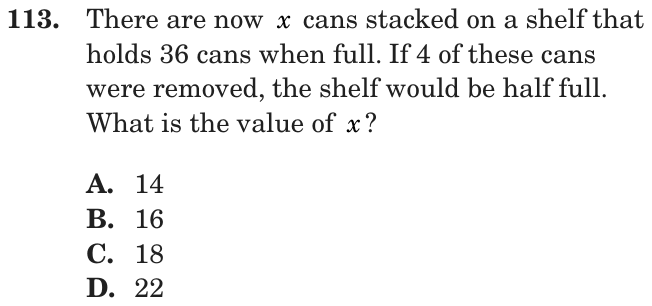
Liam and Kevin each collect stamps. Liam has twice as many stamps as Kevin. Liam gives 8 of his stamps to Kevin. Liam now has 12 more stamps than Kevin.
How many stamps did Liam start with?
Select the correct answer from each drop-down to complete the sentences.
An equation that relates the number of stamps originally in Liam’s and Kevin’s collections is .
After Liam gives 8 stamps to Kevin, the equation becomes .
By solving the equation, it can be determined that Liam started with stamps.
Choose an answer from each menu, then check. The DOE has not published how answers with several parts are scored; this site counts one right only when every part is right.
Show the answer
Correct answer: blank 1: 2; blank 2: K + 20; blank 3: 56
Liam originally has twice as many stamps as Kevin, so the equation is .
After Liam gives 8 stamps to Kevin, the equation becomes , which simplifies to .
Substitute into the equation: .
Solve for K:
Substitute to find L: .
So, Liam started with 56 stamps.
Question analysis
This word problem about two stamp collections is answered with three drop-down menus: an equation for the starting counts, an equation for after Liam gives Kevin 8 stamps, and the number Liam started with. Students turn "twice as many" and "12 more" into algebra and solve. Tracking both boys' counts before and after the gift is the tricky part, and every menu must be right.
- Grade level
- Grade 8 content, by NYS standard
- Compared with grade 7
- Above grade 7 Grade 7 students solve one equation in one unknown. The menus lay out the equations, but the problem still ties two unknowns together before and after a gift, a grade 8 system, and all three menus must be right.
- Estimated difficulty
- Moderate: several steps, or a close reading with one strong distractor.
- Thinking it demands
- Depth of knowledge 2, skills and concepts · mainly apply
- What makes it hard
- Turning words into math moderate
- Much to keep track of moderate
- Solution
- 4 steps
- Reading level
- Question and choices: about grade 5, 86 words.
- Students, last 30 days
- Not enough answers yet to show (it takes 10).
Why it is hard, traps and wrong answers (shows the answer)
Why it is hard
The menus do much of the setting up, since each sentence already shows the shape of its equation. The second menu is the hard one: the 8 stamps leave Liam and join Kevin before the gap of 12 is measured. Solving gives Kevin's 28 first, and K + 20 then equals 48, Liam's count after the gift, which waits on the last menu beside his starting 56. Testing each starting count against the story is a quick check on the last menu.
Turning words into math moderate Understanding the question
The gift changes both counts, so "Liam now has 12 more stamps than Kevin" compares Liam's L − 8 with Kevin's K + 8, and the second menu's K + 20 holds a 20 that appears nowhere in the stem. (Hegarty, Mayer & Monk, 1995; Koedinger & Nathan, 2004)
Much to keep track of moderate Working it out
Each boy has a count before and after the gift, four numbers in all, and all three menus must be right; the last asks for Liam's start, not the 48 he has after giving 8 away. (Sweller, 1988; Carpenter, Just & Shell, 1990)
Strategy: Let K be Kevin's starting count, write each boy's count after the gift in terms of K, and set Liam's 12 above Kevin's; testing each number in the last menu is a fast check.
Traps
- Answers a different question: A choice is right for another quantity: the other unknown, the rest instead of the part, the part instead of the whole.
- Follows a key word: Picks the operation from a single word rather than the situation: "removed" so subtract, "of" so multiply, "more" so add, when the situation needs something else.
- Equation written backwards: Writes a comparison the wrong way round, word for word: "six times as many students as professors" as 6S = P. The bigger quantity gets the bigger number.
The wrong answers, classified
BCB Answers a different question (King et al., 2004; Hegarty, Mayer & Monk, 1995)
Sets up both equations and solves for Kevin's 28, then takes the value of K + 20, 48, which is Liam's count after the gift, not at the start.
BBC Follows a key word (Hegarty, Mayer & Monk, 1995)
Follows the words "12 more" to L + 12, adding 12 to Liam's own count instead of Kevin's, then finds 56 by testing the three counts against the story.
ACC Equation written backwards (Clement, Lochhead & Monk, 1981)
Writes "twice as many stamps as Kevin" backwards, as 2L = K, and picks 0.5, giving Liam half of Kevin's stamps, while the other two menus are right.
Worked solution, step by step
Formulas used
- Twice as many as
- L is the number of stamps Liam starts with, and K is the number Kevin starts with. Twice as many means 2 times as many, so Liam’s count is 2 times Kevin’s. Because L and 2K are equal, you can put 2K in place of L in any equation.
- Doing the same to both sides
- a and b are the two sides of an equation, and c is any number or term. An equation is like a balanced scale. Add the same thing to both sides, or take the same thing away from both, and the scale stays level. This is how you move a term to the other side.
Sort out the question
Let L be Liam’s stamps at the start and K be Kevin’s. You know three facts:
- Liam has twice as many stamps as Kevin.
- Liam gives 8 of his stamps to Kevin.
- After that, Liam has 12 more stamps than Kevin.
The first menu finishes the starting equation. The second finishes the equation after the gift. The third is Liam’s count at the start.
Fill in the first menu
Twice as many means 2 times as many. Liam has twice as many as Kevin, so:
Pick 2 in the first menu.
Watch out: the 0.5 in the menu turns the fact around. would give Liam half as many as Kevin. Liam has more, so his count must be the bigger one.
Write both counts after the gift
The gift changes both counts. Liam loses 8 stamps, and Kevin gains those same 8.
- Liam now has stamps.
- Kevin now has stamps.
Liam has 12 more than Kevin. So Liam’s count equals Kevin’s count plus 12:
Pick K + 20 in the second menu.
Watch out: the 12 goes on Kevin’s count, not Liam’s. Picking L + 12 adds it to the wrong boy.
Solve for K
Now use the first equation. Since , put 2K in place of L:
Subtract K from both sides. Then add 8 to both sides. Each move keeps the scale level.
Kevin started with 28 stamps.
Find Liam’s starting count
Liam started with twice as many as Kevin:
Liam started with 56 stamps.
Watch out: is Liam’s count after the gift. The menu offers 48, but the question asks about the start.
So the menus read 2, K + 20 and 56.
Check your answer
At the start, Liam has 56 stamps and Kevin has 28, and 56 is twice 28. After the gift, Liam has 48 and Kevin has 36. , so Liam has 12 more. Every fact fits.
More questions like this
The original DOE question
Question 2 of 9
2026 Practice Test C Math, question 5Question
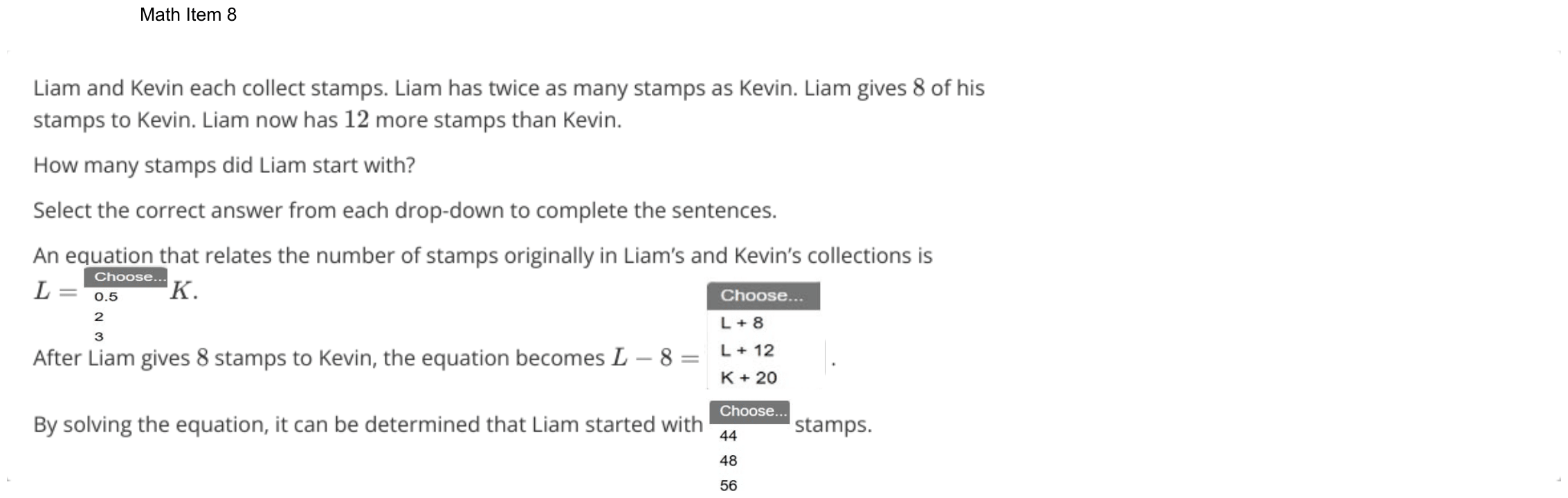
Maya read n pages for her English homework. Trevor read three times as many pages as Maya. Together, Maya and Trevor read 12 more pages than Ali read. Write an expression that shows how many pages Ali read, in terms of n.
Enter your answer in the space provided. Enter only your answer.
On the test you build the answer on an on-screen keypad; here, type it. Use ^ for a power, sqrt( ) or √ for a root, pi for π, and <= or >= for ≤ and ≥.
Show the answer
Correct answer: 4n – 12
Let n represent the number of pages that Maya read.
Trevor read three times as many pages as Maya: Trevor’s pages
To find how many pages they read together, add Maya’s and Trevor’s pages:
This means that together, they read pages.
Ali read 12 fewer pages than Maya and Trevor read together. So 12 should be subtracted from the total:
Ali’s pages
Question analysis
Maya reads n pages, Trevor reads three times as many, and together they read 12 more pages than Ali. Students type an expression in n for the number of pages Ali read. It tests writing and simplifying expressions from words, and the comparison with Ali has to be translated with care.
- NYS standards
- Grade level
- Grade 6 content, by NYS standard
- Compared with grade 7
- At grade 7 Writing an expression from words is grade 6 content, but this chains three relationships, and the last compares the pair with Ali rather than describing Ali directly. Typing the answer with no choices to compare adds risk.
- Estimated difficulty
- Moderate: several steps, or a close reading with one strong distractor.
- Thinking it demands
- Depth of knowledge 2, skills and concepts · mainly apply
- What makes it hard
- Turning words into math moderate
- Variables instead of numbers minor
- An answer in an unexpected form minor
- Solution
- 3 steps
- Reading level
- Question and choices: about grade 3, 52 words.
- Students, last 30 days
- Not enough answers yet to show (it takes 10).
Why it is hard, traps and wrong answers (shows the answer)
Why it is hard
Building the pair's total, n + 3n = 4n, is quick; the question turns on the direction of the last comparison. The pair read more than Ali, so Ali's count is the smaller one, yet the word more pulls toward adding 12. Testing n = 10 settles it: Maya and Trevor read 40 pages together, so Ali must have read 28, not 52.
Turning words into math moderate Understanding the question
“Together, Maya and Trevor read 12 more pages than Ali read” compares the pair with Ali, so Ali read 12 fewer than 4n, though the word more invites adding 12. (Hegarty, Mayer & Monk, 1995; Koedinger & Nathan, 2004)
Variables instead of numbers minor Understanding the question
Every count is written in terms of n, so there is no page total to check an expression against unless the student picks a value for n and tests it. (Koedinger & Nathan, 2004; Enright, Morley & Sheehan, 2002)
An answer in an unexpected form minor Choosing the answer
The expression is typed into a box with no choices to compare, so an entry such as 4n + 12 gets no warning that the comparison was read backward. (Enright, Morley & Sheehan, 2002)
Strategy: Write Trevor's pages and the pair's total in terms of n, then test your expression with a value such as n = 10 to check that the pair really read 12 more than Ali.
Traps
- Follows a key word: Picks the operation from a single word rather than the situation: "removed" so subtract, "of" so multiply, "more" so add, when the situation needs something else.
- Answers a different question: A choice is right for another quantity: the other unknown, the rest instead of the part, the part instead of the whole.
- Negatives and direction: Arithmetic with negative numbers, the order of a subtraction, or direction on a number line. (Moving a term across the equals sign without changing its sign is a faulty procedure.)
The wrong answers, classified
4n + 12 Follows a key word (Hegarty, Mayer & Monk, 1995)
Follows the word more and adds 12 to the pair's 4n, though the sentence says the pair read 12 more than Ali, so Ali read fewer.
3n – 12 Answers a different question (King et al., 2004; Hegarty, Mayer & Monk, 1995)
Takes Trevor's 3n as the pair's total, leaving out Maya's own n pages, then subtracts the 12 correctly.
12 – 4n Negatives and direction (Brown & Burton, 1978)
Sees that 12 and 4n must be subtracted but writes the subtraction in the wrong order, 12 − 4n, which is negative for most values of n.
Worked solution, step by step
Formulas used
- Adding like terms
- n is the number of pages Maya read. Terms with the same letter are called like terms. Add them by adding the numbers in front: 1 n plus 3 n is 4 n. It works because 1 group of n pages and 3 more groups make 4 groups.
- Turning a more-than fact around
- T is the pages Maya and Trevor read together. A is the pages Ali read. The pair read 12 more than Ali, so Ali read 12 fewer than the pair. Subtracting 12 undoes adding 12.
Sort out the question
Maya read n pages. n is a variable, a letter that stands for a number you don’t know. Trevor read 3 times as many pages as Maya. Together they read 12 more pages than Ali. You need Ali’s pages, written with n.
Write Trevor’s pages
Three times as many as n is 3 times n:
A number written next to a letter means multiply. So 3n means 3 × n pages.
Add Maya’s and Trevor’s pages
Together means add. Maya read 1 group of n, and Trevor read 3 groups:
Together they read 4n pages.
Watch out: do not leave Maya out. Using only Trevor’s 3n gives 3n − 12, which is wrong.
Decide who read more
The pair read 12 more than Ali. So Ali read 12 fewer than the pair. Take 12 away from their total:
Watch out: the word more tempts you to add 12. But 4n + 12 would mean Ali read more than the pair. And 12 − 4n subtracts in the wrong order.
Enter the expression
On the test, the keypad has an n key. Press 4, then n. Then press the minus key beside the plus key, then 1 and 2. You don’t need a times sign. On this site, type 4n-12.
So you would enter 4n − 12. Any expression equal to it, such as −12 + 4n, is also right.
Check your answer
Pick a number for n, such as 10. Maya read 10 pages and Trevor read 30, so together they read 40. Your expression gives Ali pages. Is 40 twelve more than 28? Yes, . So the expression works.
More questions like this
The original DOE question
Question 3 of 9
2026 Practice Test D Math, question 5Question
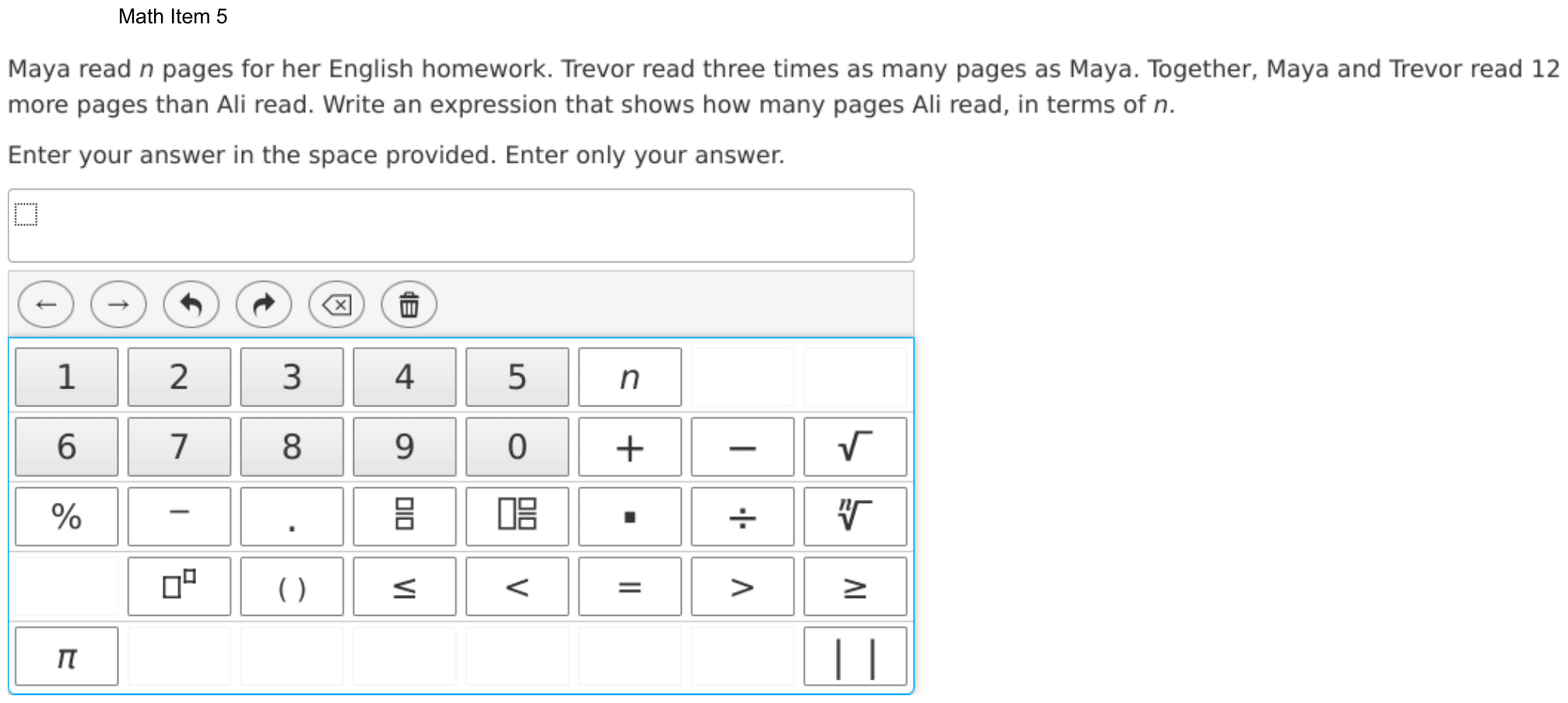
In a school raffle, 1 out of every 25 students wins a prize. Each prize includes a randomly selected trading card from a set of 100 different cards, labeled C1 through C100, with each card equally likely to be chosen. If one student is selected at random, what is the probability that the student both wins a prize and receives Card C17?
Write an expression that represents the probability that a student wins the prize and receives Card C17.
Enter your answer in the space provided. Enter only your answer.
On the test you build the answer on an on-screen keypad; here, type it. Use ^ for a power, sqrt( ) or √ for a root, pi for π, and <= or >= for ≤ and ≥.
Show the answer
Correct answer: 1/25 · 1/100
To calculate the joint probability, first determine the probability of each independent event.
The probability that a randomly selected student wins the prize is .
The probability that the card in a prize is Card C17 is , because Card C17 is 1 card out of 100 labeled cards.
The probability that a student wins the prize and receives Card C17 is the product of those two probabilities, .
Question analysis
In a school raffle, 1 out of every 25 students wins a prize, and each prize includes one of 100 equally likely trading cards. Students type an expression for the probability that a randomly chosen student both wins and gets one particular card. It tests the probability of two independent events, and combining the two chances correctly is the main hurdle.
- Grade level
- Grade 7 content, by NYS standard
- Compared with grade 7
- At grade 7 Grade 7 students find compound probabilities, usually by listing outcomes for coins or number cubes. These two stages have 25 and 100 outcomes, far too many pairs to list, so a rule must be used, and the answer is typed as an expression.
- Estimated difficulty
- Straightforward: two steps or one careful reading.
- Thinking it demands
- Depth of knowledge 2, skills and concepts · mainly apply
- What makes it hard
- Solution
- 2 steps
- Reading level
- Question and choices: about grade 8, 87 words.
- Corrected from the DOE handbook
- The explanation gave the wrong event the chance 1/100; one sentence was corrected.
- Students, last 30 days
- Not enough answers yet to show (it takes 10).
Why it is hard, traps and wrong answers (shows the answer)
Why it is hard
Each chance is stated almost directly, 1 out of 25 and 1 out of 100, so the question tests one rule: both events must happen, and the chances multiply. The word “and” pulls students toward adding, which gives a result larger than either chance, a sign that something is wrong. Others write only the card's chance and forget that the student must first win a prize.
Something you must already know moderate Working it out
The question never says that the chance of two independent events both happening is the product of their chances, so students must bring that rule to the 1/25 and the 1/100 themselves. (Anderson & Krathwohl, 2001)
An answer in an unexpected form minor Choosing the answer
The answer is typed as an expression with no choices to compare, so a sum of the two chances, which looks just as finished, gets no warning on screen. (Enright, Morley & Sheehan, 2002)
Strategy: Write each event's chance as a fraction, then apply the rule for two independent events that must both happen, and check that the result is smaller than either chance alone.
Traps
- Follows a key word: Picks the operation from a single word rather than the situation: "removed" so subtract, "of" so multiply, "more" so add, when the situation needs something else.
- Stops one step early: A choice is a number from partway through the solution.
- A faulty procedure: A systematic but wrong procedure: adding fractions straight across, applying an exponent to each term of a sum, dropping a sign when moving a term.
The wrong answers, classified
1/25 + 1/100 Follows a key word (Hegarty, Mayer & Monk, 1995)
Reads “both wins a prize and receives Card C17” as a cue to add, so sums the chances, though needing both events must be less likely than either.
1/100 Stops one step early (King et al., 2004; Gierl et al., 2017)
Writes only the chance of receiving Card C17 and leaves out that the student must first be one of the 1 in 25 who win a prize.
1/125 A faulty procedure (Brown & Burton, 1978; Tatsuoka, 1983)
Combines “1 out of 25” and “1 out of 100” by adding the totals, 25 + 100, a faulty rule that gives neither the sum nor the product.
What was corrected from the DOE handbook, and why
- Explanation: The DOE’s explanation says “The probability that a randomly selected student will receive Card C17 is 1/100.” Only students who win a prize receive a card, so a randomly selected student’s chance of receiving Card C17 is the question’s own answer, 1/25 × 1/100. The 1/100 is the chance that the card in a prize is Card C17, and the site now says so. The answer is unchanged.
Worked solution, step by step
Formulas used
- Probability of one outcome
- P is the probability, the chance that something happens, from 0 to 1. The top counts the outcomes you want. The bottom counts all the outcomes that could happen. Use it when every outcome is equally likely, like one card picked from 100.
- Probability that two independent events both happen
- A and B are two events. Independent means one does not change the chance of the other. P(A) is the chance of A, and P(B) is the chance of B. Multiply them to get the chance that both happen. The result is smaller than either chance, since both things must happen.
Sort out the question
Two things must both happen. First, the student wins a prize. Second, the card in that prize is Card C17. You need an expression for that chance. An expression is a math phrase made of numbers and signs, with no equal sign. You do not have to work it out to one number.
Find the chance of winning
The question says “1 out of every 25 students wins a prize.” One student is the part that wins, and 25 is the whole group. So:
Find the chance of Card C17
Each prize has one card, picked at random from 100 cards. Every card is equally likely. Card C17 is 1 of those 100 cards:
Multiply the two chances
Winning a prize does not change which card is inside it. So the two events are independent. To find the chance that both happen, multiply:
The dot · means times. Worked out, this is 1/2500.
Watch out: the word and does not mean add here. 1/25 + 1/100 is bigger than either chance, but needing both things must be less likely. Writing only 1/100 forgets that the student must win a prize first.
Enter the expression
On the test, press the fraction key, a small box over a small box. Type 1 on top and 25 on the bottom. Move the cursor out of the fraction with the → key. Press the dot key for times. Then use the fraction key again for 1 over 100. On this site, type 1/25 * 1/100 or 1/25 · 1/100. The value 1/2500 also counts.
So you would enter 1/25 · 1/100.
Check your answer
Picture 2,500 students. 1 in 25 wins, so about 100 students win a prize. Of those 100, about 1 gets Card C17. That is 1 student out of 2,500, which matches 1/25 · 1/100 = 1/2500. It is smaller than 1/25 and 1/100, as it should be.
More questions like this
The original DOE question
Question 4 of 9
2026 Practice Test D Math, question 6Question
The cost of shipping a package is $12, plus $2 for each additional pound over 3 pounds. Which expression represents the total cost, in dollars, of shipping a package that weighs p pounds? Assume that .
- A
- B
- C
- D
Show the answer
Correct answer: B
Since the additional cost per pound is not added until the package weighs more than 3 pounds, the total cost for 1, 2, or 3 pounds is $12.
- 1 pound is $12
- 2 pounds is $12
- 3 pounds is $12
Since p is greater than or equal to 3 pounds, the total cost for:
- 4 pounds is
- 5 pounds is
- p pounds is
You may try to write the expression without generating the pattern by recognizing that subtracting 3 from the number of pounds for the package before multiplying by $2 and then adding $12 results in the total cost.
Question analysis
Shipping a package costs $12, plus $2 for each additional pound over 3 pounds, and students choose the expression for the total cost of a package that weighs p pounds. It tests writing an algebraic expression from a word problem. The per-pound charge starts only after the first 3 pounds, and turning that phrase into algebra is the tricky part.
- Grade level
- Grade 6 content, by NYS standard
- Compared with grade 7
- At grade 7 Writing an expression from a cost description is grade 6 algebra. Because the per-pound charge starts only after the first 3 pounds, it is less routine than a fee plus a simple rate, in line with typical grade 7 demand.
- Estimated difficulty
- Moderate: several steps, or a close reading with one strong distractor.
- Thinking it demands
- Depth of knowledge 2, skills and concepts · mainly apply
- What makes it hard
- Turning words into math moderate
- A very close wrong answer moderate
- Variables instead of numbers minor
- Solution
- 2 steps
- Reading level
- Question and choices: about grade 6, 37 words.
- Students, last 30 days
- Not enough answers yet to show (it takes 10).
Why it is hard, traps and wrong answers (shows the answer)
Why it is hard
The question rewards modeling the fee in two parts: a flat $12 that covers the first 3 pounds, and $2 for each pound beyond them. The two choices that start with 12 look equally reasonable until a weight is tried, and the two that begin with 14p come from merging the fee with the per-pound charge. Testing p = 3, which must cost exactly $12, rules out three choices in one step.
Turning words into math moderate Understanding the question
“$2 for each additional pound over 3 pounds” must become 2(p − 3), a charge on the pounds beyond the first 3, and the word “over” invites writing p + 3 instead. (Hegarty, Mayer & Monk, 1995; Koedinger & Nathan, 2004)
A very close wrong answer moderate Choosing the answer
12 + 2(p + 3) and 12 + 2(p − 3) differ only in the sign inside the parentheses, so their shape cannot separate them; only a test weight or a careful reading can. (Embretson & Wetzel, 1987; Gorin & Embretson, 2006; Ascalon et al., 2007)
Variables instead of numbers minor Understanding the question
The weight is the letter p, so there is no cost to work out and compare; choosing a weight such as 5 pounds, which costs $16, turns every choice into a number. (Koedinger & Nathan, 2004; Enright, Morley & Sheehan, 2002)
Strategy: Test a weight such as 5 pounds: work out its cost from the description, then substitute 5 for p in each choice and keep the one that gives the same cost.
Traps
- Follows a key word: Picks the operation from a single word rather than the situation: "removed" so subtract, "of" so multiply, "more" so add, when the situation needs something else.
- Numbers taken from the question: Combines the numbers in the question without a model of the situation, or is simply a number that appears in the question.
The wrong answers, classified
A Follows a key word (Hegarty, Mayer & Monk, 1995)
Reads “over 3 pounds” as adding 3, so the $2 charge applies to p + 3 pounds instead of only the pounds above the first 3.
C Numbers taken from the question (Hegarty, Mayer & Monk, 1995)
Merges the $12 and the $2 into $14 for every pound and tacks on the 3 from the stem, building an expression from its numbers without a model.
D Numbers taken from the question (Hegarty, Mayer & Monk, 1995)
Charges $14 for every pound by merging the fee with the $2 rate, then subtracts 3 for the first 3 pounds, mixing dollars with pounds.
Worked solution, step by step
Formulas used
- Cost with a base fee and a rate
- The base fee is the set price, $12, which covers the first 3 pounds. The rate is the price for each pound after that, $2. The extra pounds are the pounds over 3, which is p − 3. Use it when a price has a fixed part plus a part per unit.
Sort out the question
Shipping costs $12 to start. Each pound over 3 pounds adds $2. The package weighs p pounds, and p is at least 3. You need an expression for the total cost in dollars.
Count the extra pounds
Only the pounds above 3 cost extra. To find them, take 3 away from the weight:
For example, a 5-pound package has 5 − 3 = 2 extra pounds.
Watch out: over 3 pounds means more than 3. It does not tell you to add 3. Writing p + 3 leads to choice A.
Build the expression
Each extra pound costs $2, so the extra pounds cost 2(p − 3) dollars. Add the $12 base fee:
Watch out: the $12 is paid once, not for every pound. Choices C and D charge $14 for every pound, which mixes up the fee and the rate.
Test each choice with 5 pounds
A 5-pound package costs $12 plus two $2 charges, which is $16. Put p = 5 into each choice:
Choice Value when p = 5 A 12 + 2(8) = 28 B 12 + 2(2) = 16 C 14(5) + 3 = 73 D 14(5) − 3 = 67 Only B gives $16. So the answer is B, .
Check your answer
Try p = 3, the smallest weight allowed. There are no extra pounds, so it should cost just $12. Choice B gives 12 + 2(0) = 12. Try p = 4: 12 + 2(1) = 14, which is $12 plus one $2 charge.
More questions like this
The original DOE question
Question 5 of 9
2024 Test B Math, question 38Question
Michael received a check for $213 for working 20 hours at his part-time job. The amount on the check was his total pay after $32 in taxes was deducted. What was Michael’s hourly pay rate before taxes were deducted?
- A$9.05
- B$10.65
- C$12.25
- D$21.35
Show the answer
Correct answer: C
Add the taxes to the amount of the check to find Michael’s total pay before taxes were deducted:
Divide the total pay by the number of hours to find the hourly pay rate:
Question analysis
Michael's paycheck shows what he earned for 20 hours after taxes were taken out, and the tax amount is given. Students find his hourly pay rate before taxes. It tests unit rates in a money word problem, where students must decide what to do with the tax that was deducted.
- Grade level
- Grade 6 content, by NYS standard
- Compared with grade 7
- Below grade 7 Unit rate problems are grade 6 content, and this one needs one addition and one division with a decimal result. It is easier than typical grade 7 work, apart from deciding which amount is the pay before taxes.
- Estimated difficulty
- Straightforward: two steps or one careful reading.
- Thinking it demands
- Depth of knowledge 2, skills and concepts · mainly apply
- What makes it hard
- Turning words into math minor
- Solution
- 2 steps
- Reading level
- Question and choices: about grade 5, 36 words.
- Students, last 30 days
- Not enough answers yet to show (it takes 10).
Why it is hard, traps and wrong answers (shows the answer)
Why it is hard
Two operations in the right order, adding the tax back and dividing by the hours, are all this takes. The danger is the word deducted, which pulls students toward subtracting the $32 a second time, and the phrase before taxes, which rules out the take-home rate from dividing the check alone. Checking that $12.25 × 20 − $32 gives back $213 confirms the answer.
Turning words into math minor Understanding the question
"The amount on the check was his total pay after $32 in taxes was deducted" makes $213 what remained, so the $32 is added back, not taken away. (Hegarty, Mayer & Monk, 1995; Koedinger & Nathan, 2004)
Strategy: Rebuild Michael's pay before taxes from the check and the tax that was taken out, then divide that total by the 20 hours worked.
Traps
- Follows a key word: Picks the operation from a single word rather than the situation: "removed" so subtract, "of" so multiply, "more" so add, when the situation needs something else.
- Answers a different question: A choice is right for another quantity: the other unknown, the rest instead of the part, the part instead of the whole.
The wrong answers, classified
A Follows a key word (Hegarty, Mayer & Monk, 1995)
Follows the word deducted and subtracts the $32 from the $213 check again, (213 − 32) ÷ 20 = 9.05, instead of adding it back.
B Answers a different question (King et al., 2004; Hegarty, Mayer & Monk, 1995)
Divides the $213 check by 20 hours, which gives Michael's hourly pay after taxes rather than before.
D Little reason to choose it (Haladyna & Downing, 1993; Rodriguez, 2005)
No standard working gives $21.35, which equals 32 − 10.65; dividing $213 by 10 hours instead of 20, $21.30, comes closest, so it mostly draws guesses.
Worked solution, step by step
Formulas used
- Hourly pay rate
- rate is the pay for one hour. total pay is the money earned for all the hours. hours is the time worked. Dividing shares the total pay equally among the hours. Use it when the pay for each hour is the same.
Sort out the question
Michael’s check was for $213. That is what was left after $32 in taxes was deducted, which means taken away. He worked 20 hours.
You need his hourly pay before taxes. So first find his full pay before the $32 was taken out.
Add the taxes back
The $32 was taken away from his full pay to leave $213. To undo taking away, add it back.
His pay before taxes was $245. Watch out: The word “deducted” tempts you to subtract again. That gives , choice A.
Divide by the hours
He earned $12.25 for each hour before taxes. Watch out: Dividing the $213 check by 20 gives $10.65, choice B. That is his pay for each hour after taxes.
So the answer is C, $12.25.
Check your answer
Work forward. , so 20 hours pay $245. Take away $32 in taxes: . That is the amount on the check.
More questions like this
The original DOE question
Question 6 of 9
2023 Test A Math, question 8Question
Jamel works at a computer store. He is paid an hourly rate plus a 15% commission on all computer products he sells. Last week, Jamel was paid $802.50 for working 30 hours and selling $1,250.00 worth of computer products. What is Jamel’s hourly rate?
- A$20.50/hr
- B$26.75/hr
- C$33.00/hr
- D$37.65/hr
Show the answer
Correct answer: A
First, determine the amount of Jamel’s weekly pay that is from commission:
Next, subtract Jamel’s commission amount from his weekly pay:
Last, divide the result by 30 hours to find Jamel’s hourly rate:
Question analysis
Jamel earns an hourly wage plus a 15% commission on his sales, and one week he is paid $802.50 for 30 hours of work and $1,250 in sales. Students find his hourly rate. The question mixes a percent with a rate, and the commission has to be taken out of the total pay before dividing by the hours.
- Grade level
- Grade 7 content, by NYS standard
- Compared with grade 7
- At grade 7 Commission is one of the percent applications named in the grade 7 standards, and the remaining work is a two-step equation with decimals. That matches a typical grade 7 multistep problem, with the order of the steps as the main demand.
- Estimated difficulty
- Moderate: several steps, or a close reading with one strong distractor.
- Thinking it demands
- Depth of knowledge 2, skills and concepts · mainly apply
- What makes it hard
- Turning words into math moderate
- Many steps moderate
- Error-prone arithmetic minor
- Solution
- 3 steps
- Reading level
- Question and choices: about grade 3, 44 words.
- Students, last 30 days
- Not enough answers yet to show (it takes 10).
Why it is hard, traps and wrong answers (shows the answer)
Why it is hard
Jamel's pay has two parts, and the question asks for only one of them, so the commission has to be removed before dividing by the hours. Students who divide the whole $802.50 by 30 get a believable hourly figure that still contains the commission. Checking the answer against the story, 30 × $20.50 + $187.50 = $802.50, confirms both parts.
Turning words into math moderate Understanding the question
The phrase "paid an hourly rate plus a 15% commission on all computer products he sells" makes $802.50 the sum of two parts, 30 hours of pay and 15% of $1,250. (Hegarty, Mayer & Monk, 1995; Koedinger & Nathan, 2004)
Many steps moderate Working it out
Three operations in order: 15% of $1,250 is $187.50, $802.50 − $187.50 = $615.00, and $615.00 ÷ 30 = $20.50; dividing before subtracting gives a listed choice. (Daniel & Embretson, 2010; Enright, Morley & Sheehan, 2002)
Error-prone arithmetic minor Working it out
Every amount carries cents, and 15% of $1,250 and $615 ÷ 30 are worked by hand, so a misplaced decimal point shifts the hourly rate. (Brown & Burton, 1978; Junker & Sijtsma, 2001)
Strategy: Take 15% of the $1,250 in sales to find the commission, remove that from the week's pay, and divide what is left by the 30 hours worked.
Traps
- Answers a different question: A choice is right for another quantity: the other unknown, the rest instead of the part, the part instead of the whole.
- Follows a key word: Picks the operation from a single word rather than the situation: "removed" so subtract, "of" so multiply, "more" so add, when the situation needs something else.
- Misreads the question: Misses or misreads a condition or a word in the question: "at least", "each", "remaining", "not".
The wrong answers, classified
B Answers a different question (King et al., 2004; Hegarty, Mayer & Monk, 1995)
Divides the whole $802.50 by 30 hours, which gives Jamel's average pay per hour with the commission included, not his hourly rate.
C Follows a key word (Hegarty, Mayer & Monk, 1995)
Follows the word plus and adds the $187.50 commission to the $802.50 instead of removing it, so (802.50 + 187.50) ÷ 30 = $33.00.
D Misreads the question (Hegarty, Mayer & Monk, 1995)
Swaps the two dollar amounts, taking 15% of the $802.50 pay and subtracting it from the $1,250 of sales: (1,250 − 120.38) ÷ 30 ≈ $37.65.
Worked solution, step by step
Formulas used
- Percent of a number
- p is the percent. The whole is the amount you take the percent of. The part is the result. Percent means out of 100. So 15% is 15 out of every 100, or 0.15.
- Pay with commission
- The rate is the money Jamel earns for each hour. Hours is how long he worked. The commission is extra money that is a percent of what he sells. His pay is these two amounts added together.
Sort out the question
Jamel’s pay has two parts. One part is an hourly rate, the money he earns for each hour. The other part is a commission. A commission is extra pay that is a percent of what he sells. He worked 30 hours and sold $1,250.00 of products. In all he got $802.50. You need his hourly rate.
Find the commission
His commission is 15% of what he sold. 15% means 15 out of 100, or 0.15.
His commission was $187.50. Watch out: take 15% of the $1,250 he sold, not of his $802.50 pay. Mixing them up leads to $37.65, choice D.
Take the commission out of his pay
The rest of his pay came from his hours.
He earned $615.00 for 30 hours of work. Watch out: the word plus does not mean add here. Adding the $187.50 to $802.50 counts the commission twice. That leads to $33.00, choice C.
Divide by the hours he worked
Share the $615.00 equally over the 30 hours.
Watch out: don’t divide all $802.50 by 30. That gives $26.75, choice B. That amount still includes the commission. So the answer is A, $20.50 per hour.
Check your answer
Work forward from the answer. 30 hours at $20.50 is dollars. Add the commission: . That is exactly Jamel’s pay for the week.
More questions like this
The original DOE question
Question 7 of 9
2022 Test A Math, question 13Question
Jay sold n tickets. Pilar sold three times as many tickets as Jay did. Together, Jay and Pilar sold ten more tickets than Amie sold. Which expression shows how many tickets Amie sold?
- A
- B
- C
- D
Show the answer
Correct answer: D
Since Jay sold n tickets and Pilar sold 3 times the number of tickets Jay sold, Pilar sold tickets.
Then, since together Jay and Pilar sold 10 more tickets than Amie, subtract 10 from to get the expression that shows how many tickets Amie sold.
Then combine like terms.
Question analysis
Jay sells n tickets, Pilar sells three times as many, and together they sell ten more tickets than Amie. Students choose the expression in n for the number of tickets Amie sold. It tests writing and combining algebraic expressions from words, and the last sentence needs a careful reading, because it describes Amie only through the other two.
- NYS standards
- Grade level
- Grade 6 content, by NYS standard
- Compared with grade 7
- At grade 7 Writing an expression from words is grade 6 content, but this one links three people in a chain, and the last sentence compares the pair's total with Amie instead of describing Amie directly, which grade 7 students often misread.
- Estimated difficulty
- Moderate: several steps, or a close reading with one strong distractor.
- Thinking it demands
- Depth of knowledge 2, skills and concepts · mainly apply
- What makes it hard
- Turning words into math moderate
- Variables instead of numbers minor
- Solution
- 3 steps
- Reading level
- Question and choices: about grade 5, 37 words.
- Students, last 30 days
- Not enough answers yet to show (it takes 10).
Why it is hard, traps and wrong answers (shows the answer)
Why it is hard
Building the pair's total, n + 3n = 4n, is routine; the question is decided by which way the last comparison runs. Because the pair sold more than Amie, her expression must come out smaller than 4n, yet the most tempting choice adds the 10. Trying n = 5 settles it: the pair sold 20 tickets, so Amie sold 10, and only one expression gives 10.
Turning words into math moderate Understanding the question
“Together, Jay and Pilar sold ten more tickets than Amie sold” compares the pair's 4n with Amie, so her count is 10 less, though the word more suggests adding. (Hegarty, Mayer & Monk, 1995; Koedinger & Nathan, 2004)
Variables instead of numbers minor Understanding the question
Every count is written in terms of n, so no ticket total can be checked unless the student substitutes a value such as n = 5 into each expression. (Koedinger & Nathan, 2004; Enright, Morley & Sheehan, 2002)
Strategy: Write Pilar's tickets and the pair's total in terms of n, then test each choice with a small value such as n = 5 against the sentence comparing the pair with Amie.
Traps
- Follows a key word: Picks the operation from a single word rather than the situation: "removed" so subtract, "of" so multiply, "more" so add, when the situation needs something else.
- Negatives and direction: Arithmetic with negative numbers, the order of a subtraction, or direction on a number line. (Moving a term across the equals sign without changing its sign is a faulty procedure.)
- Wrong operation: Adds instead of multiplying, divides the wrong way round, turns a ratio or rate upside down, or undoes a step in the wrong direction (subtracts what should be added back).
The wrong answers, classified
A Negatives and direction (Brown & Burton, 1978)
Sees that 10 and the pair's 4n must be subtracted but writes them in the wrong order, 10 − 4n, which is negative once n is 3 or more.
B Wrong operation (Hegarty, Mayer & Monk, 1995; King et al., 2004)
Multiplies Jay's n by Pilar's 3n instead of adding them, getting 3n², and then adds the 10 as the word more suggests.
C Follows a key word (Hegarty, Mayer & Monk, 1995)
Follows the word more and adds 10 to the pair's 4n, though the pair sold 10 more than Amie, so Amie sold fewer.
Worked solution, step by step
Formulas used
- Combining like terms
- n is the unknown number. a and b are the numbers that multiply it. Like terms are terms with the same letter. Add the numbers in front: one n plus three n’s is four n’s, just as 1 apple plus 3 apples is 4 apples.
- Ten more than
- A and B are two amounts. If A is 10 more than B, A is the bigger one. To get the smaller amount, B, take 10 away from A. The words more than tell you which amount is bigger. They don’t always mean add.
Sort out the question
Jay sold n tickets. The letter n stands for a number you don’t know. Pilar sold three times as many as Jay. Jay and Pilar together sold ten more than Amie. You need an expression for Amie’s tickets. An expression is a math phrase with numbers and letters, like 2n + 1.
Write Pilar’s and the pair’s tickets
Three times as many as n is 3n. So Pilar sold 3n tickets. Together, Jay and Pilar sold n + 3n. Combine like terms:
So the pair sold 4n tickets.
Turn the last sentence into math
The pair sold ten more than Amie. So the pair has the bigger number. Amie’s tickets plus 10 make the pair’s 4n.
To find Amie’s tickets, take 10 away from 4n.
Watch out: the word more tempts you to add 10. That gives , choice C. But Amie sold fewer tickets than the pair, not more.
Rule out the other choices
Choice A, , subtracts in the wrong order. It is negative once n is 3 or more. Choice B, , multiplies n by 3n instead of adding them. So the answer is D, .
Check your answer
Try n = 5. Jay sold 5 and Pilar sold 15, so together they sold 20. Amie sold 10 fewer, which is 10. Choice D gives . That matches. Choice C gives 30, more than the pair sold.
More questions like this
The original DOE question
Question 8 of 9
2020 Test B Math, question 4Question
At one location, the temperature increased from −7° F to 4° F between 5:00 a.m. and 9:00 a.m. By 11:00 a.m., the temperature was 3.5 times greater than the 9:00 a.m. temperature. What was the total increase in temperature between 5:00 a.m. and 11:00 a.m., in degrees Fahrenheit?
Grid-in question: work out the answer and enter it as a number.
Show the answer
Correct answer: 21
The 11:00 a.m. temperature is 3.5 times greater than the 9:00 a.m. temperature. The 9:00 a.m. temperature was 4° F.
The temperature increased from −7° F at 5:00 a.m. to 14° F at 11:00 a.m., which is an increase of 21° F.
Question analysis
A signed-number word problem about a morning's temperature: −7° F at 5:00 a.m., 4° F at 9:00 a.m., and at 11:00 a.m. a reading “3.5 times greater than” the 9:00 one. Students find the total increase over the six hours. Starting below zero, and the phrase “times greater than,” both call for care.
- Grade level
- Grade 7 content, by NYS standard
- Compared with grade 7
- At grade 7 Temperature change across zero is standard grade 7 signed-number work, done here in two short steps with a decimal multiplier. The unusual phrase “times greater than” asks for care in reading but adds no new math.
- Estimated difficulty
- Moderate: several steps, or a close reading with one strong distractor.
- Thinking it demands
- Depth of knowledge 2, skills and concepts · mainly apply
- What makes it hard
- Error-prone arithmetic moderate
- Turning words into math moderate
- Much to keep track of minor
- Solution
- 2 steps
- Reading level
- Question and choices: about grade 5, 45 words.
- Students, last 30 days
- Not enough answers yet to show (it takes 10).
Why it is hard, traps and wrong answers (shows the answer)
Why it is hard
Points are lost in two places. The phrase “3.5 times greater than” is usually taken as 3.5 times as great, as the key takes it, but its “greater than” invites adding the product onto the original reading, so the meaning has to be settled before multiplying. Then the rise from −7° to 14° must include the climb up to zero, which students who drop the minus sign leave out; with no choices to check against, neither slip announces itself.
Error-prone arithmetic moderate Working it out
The last step is 14 − (−7): subtracting a negative starting temperature means adding 7, and the seven degrees climbed below zero are the part most often lost. (Brown & Burton, 1978; Junker & Sijtsma, 2001)
Turning words into math moderate Understanding the question
The phrase “3.5 times greater than,” with “greater” in bold, has to become 3.5 × 4° as the key reads it, although “greater than” can suggest adding 3.5 × 4° onto the 4° reading. (Hegarty, Mayer & Monk, 1995; Koedinger & Nathan, 2004)
Much to keep track of minor Working it out
Three times of day carry three temperatures, −7°, 4° and 14°, and “total increase” compares the first with the last, not either of them with the middle one. (Sweller, 1988; Carpenter, Just & Shell, 1990)
Strategy: Take “3.5 times greater than” as the answer key does, meaning the 9:00 a.m. reading multiplied by 3.5; use that product for 11:00 a.m., then subtract the 5:00 a.m. reading, minding its negative sign.
Traps
- Negatives and direction: Arithmetic with negative numbers, the order of a subtraction, or direction on a number line. (Moving a term across the equals sign without changing its sign is a faulty procedure.)
- Follows a key word: Picks the operation from a single word rather than the situation: "removed" so subtract, "of" so multiply, "more" so add, when the situation needs something else.
- Stops one step early: A choice is a number from partway through the solution.
The wrong answers, classified
7 Negatives and direction (Brown & Burton, 1978)
Finds 14° at 11:00 a.m. but subtracts 7 instead of −7, so 14 − 7 = 7, leaving out the 7 degrees the temperature rose just to reach zero.
25 Follows a key word (Hegarty, Mayer & Monk, 1995)
Reads “greater than” as adding on, so 4 + 3.5 × 4 = 18° at 11:00 a.m. and the rise is 25; the wording allows it, but the key means 3.5 times as great.
14 Stops one step early (King et al., 2004; Gierl et al., 2017)
Multiplies 3.5 × 4 = 14 and grids that 11:00 a.m. temperature itself, never subtracting the 5:00 a.m. reading of −7° to get the increase.
Worked solution, step by step
Formulas used
- Change in temperature
- End is the last temperature and start is the first one. Subtracting start from end tells how far the temperature moved. A positive change means it went up. This works even when start is below zero.
- Subtracting a negative number
- a is any number, and −b is a negative number. Taking away a negative is the same as adding its size. On a thermometer, climbing from −7 up to 0 takes 7 degrees, so those 7 degrees get added on.
Sort out what you know
There are three times and three temperatures, in degrees Fahrenheit (°F).
- 5:00 a.m.: −7°F, which is 7 degrees below zero
- 9:00 a.m.: 4°F
- 11:00 a.m.: 3.5 times greater than the 9:00 a.m. temperature
You need the total increase from 5:00 a.m. to 11:00 a.m. That is how much warmer it got from the first time to the last.
Find the 11:00 temperature
Take 3.5 times the 9:00 a.m. temperature, 4°F.
At 11:00 a.m. it was 14°F. This test reads “times greater than” as times as much as, though some people read it as 4.5 times, which leads to 25.
Watch out: 14 is a temperature, not the increase. Gridding 14 stops too early.
Subtract the start from the end
The total increase runs from 5:00 a.m. to 11:00 a.m. So it starts at −7°F and ends at 14°F.
Watch out: start at 5:00 a.m., not at 9:00 a.m. Starting from 4°F gives only 10.
Subtract the negative number
Taking away a negative number is the same as adding its size.
The temperature rose 21°F. Watch out: writing 14 − 7 = 7 drops the minus sign. It leaves out the 7 degrees the air warmed just to reach zero.
So you would grid 21.
Check your answer
Count up on a thermometer. From −7°F up to 0°F is 7 degrees. From 0°F up to 14°F is 14 more. And . Or add the two parts of the morning. It rose 11 degrees by 9:00 and 10 more by 11:00, and .
More questions like this
The original DOE question
Question 9 of 9
2018 Test B Math, question 56Question
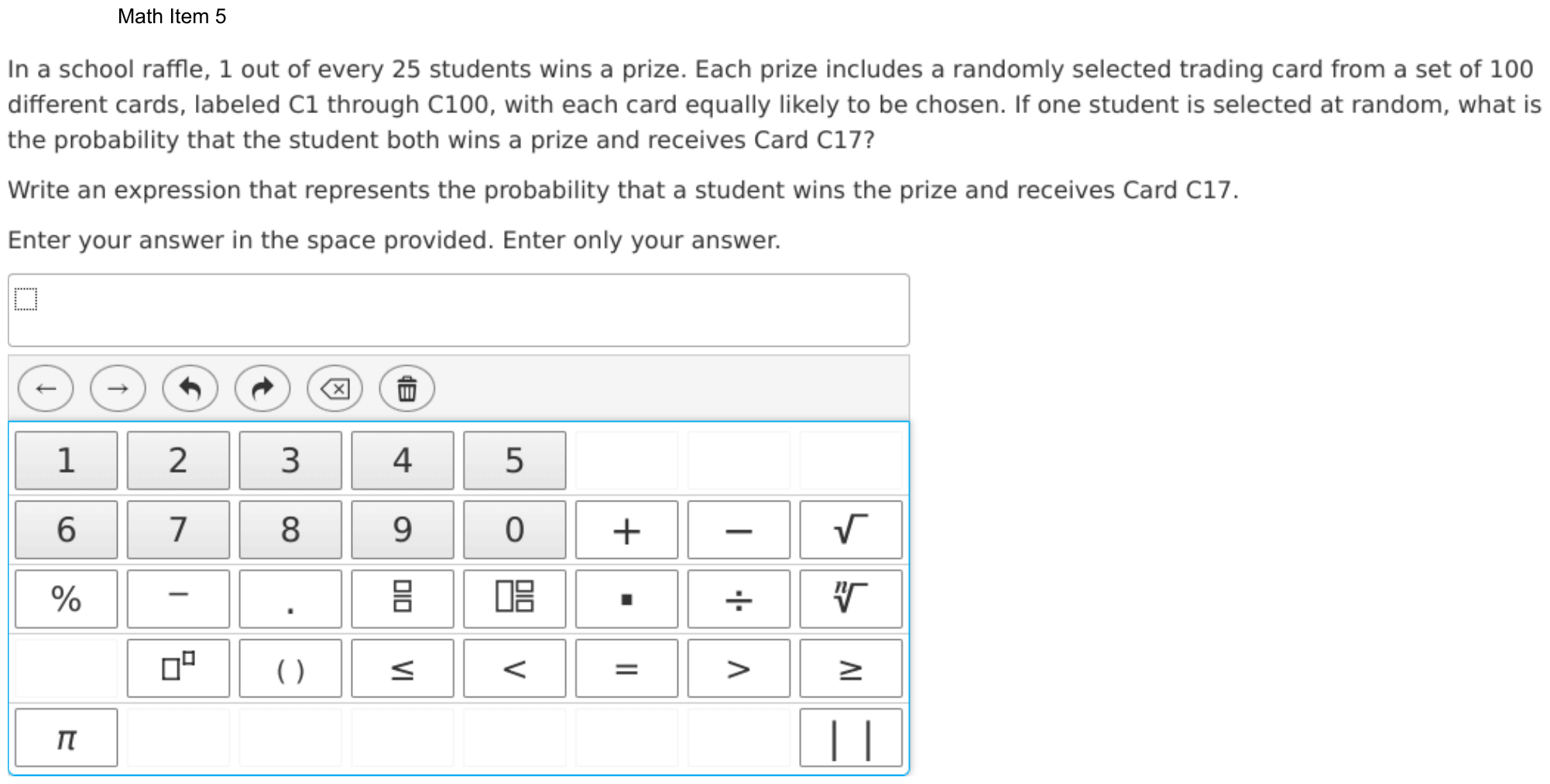
There are now cans stacked on a shelf that holds 36 cans when full. If 4 of these cans were removed, the shelf would be half full. What is the value of ?
- A14
- B16
- C18
- D22
Show the answer
Correct answer: D
The shelf, when full, holds 36 cans. When the shelf is half full, it holds 18 cans.
x − 4 = 18
x = 22
Question analysis
A shelf holds 36 cans when full, and removing 4 of the cans now on it would leave it half full. Students find how many cans are on the shelf now. It tests writing and solving a one-step equation from words, and the risk is undoing the removal in the wrong direction.
- NYS standards
- 6.EE.7 one-step equations
- Grade level
- Grade 6 content, by NYS standard
- Compared with grade 7
- Below grade 7 Grade 6 students solve equations like x − p = q, and this one needs only that and halving 36. It is a quick, routine word problem, easier than the two-step equations typical of grade 7.
- Estimated difficulty
- Routine: one familiar step, little to misread.
- Thinking it demands
- Depth of knowledge 2, skills and concepts · mainly apply
- What makes it hard
- Turning words into math minor
- A very close wrong answer minor
- Solution
- 2 steps
- Reading level
- Question and choices: about grade 3, 32 words.
- Students, last 30 days
- Not enough answers yet to show (it takes 10).
Why it is hard, traps and wrong answers (shows the answer)
Why it is hard
Short and routine, this question still punishes a quick reading. Students must keep three amounts apart, the 36-can capacity, the 18 cans on a half-full shelf and the x cans there now, and then undo the removal by adding. Writing x − 4 = 18 before computing prevents every wrong choice.
Turning words into math minor Understanding the question
The 36 cans are the shelf's capacity, not its contents, and "if 4 of these cans were removed" describes a hypothetical, so the equation is x − 4 = 18. (Hegarty, Mayer & Monk, 1995; Koedinger & Nathan, 2004)
A very close wrong answer minor Choosing the answer
18 sits just below the right 22, and both are near half of 36; only remembering that x counts the cans before the 4 were removed separates them. (Embretson & Wetzel, 1987; Gorin & Embretson, 2006; Ascalon et al., 2007)
Strategy: Work out how many cans make a half-full shelf, then undo the removal of the 4 cans; write it as an equation in x if that helps.
Traps
- Stops one step early: A choice is a number from partway through the solution.
- Follows a key word: Picks the operation from a single word rather than the situation: "removed" so subtract, "of" so multiply, "more" so add, when the situation needs something else.
The wrong answers, classified
A Follows a key word (Hegarty, Mayer & Monk, 1995)
Halves 36 to get 18 and then subtracts the 4 removed cans, following the word removed, instead of adding them back to undo it.
B Misreads the question (Hegarty, Mayer & Monk, 1995)
Reads the 36 cans as what is on the shelf now, removes 4 to get 32, and halves that to 16.
C Stops one step early (King et al., 2004; Gierl et al., 2017)
Finds the 18 cans on a half-full shelf and stops, forgetting that x counts the cans before the 4 were removed.
Worked solution, step by step
Formulas used
- Undoing subtraction
- x is the number you want. a is the amount taken away, and b is what is left. To undo taking away a, add a back. Adding the same number to both sides keeps the equation balanced.
Sort out what you know
The shelf holds 36 cans when it is full. That is its size, not how many cans are on it now. Right now it has cans. If 4 cans were taken off, the shelf would be half full. You need .
Find half of a full shelf
A full shelf holds 36 cans, so half full is half of that.
A half-full shelf has 18 cans.
Write an equation
Taking 4 cans away from leaves 18 cans.
Watch out: 18 is the number after the cans are taken off. Picking 18 gives choice C.
Add the 4 cans back
Undo the subtraction by adding 4 to both sides.
Watch out: subtracting the 4 again gives , choice A. The cans were taken from , so is more than 18.
Give the answer
There are 22 cans on the shelf now, before any are taken off. So the answer is D, 22.
Check your answer
Start with 22 cans and take off 4. That leaves cans. Half of 36 is 18, so the shelf is half full. The answer works.
More questions like this
The original DOE question