Question
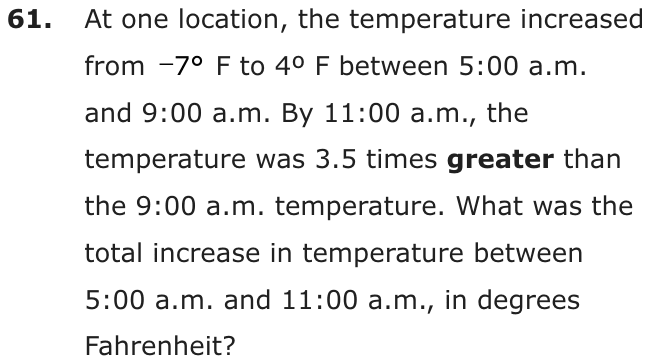
At one location, the temperature increased from −7° F to 4° F between 5:00 a.m. and 9:00 a.m. By 11:00 a.m., the temperature was 3.5 times greater than the 9:00 a.m. temperature. What was the total increase in temperature between 5:00 a.m. and 11:00 a.m., in degrees Fahrenheit?
Grid-in question: work out the answer and enter it as a number.
Show the answer
Correct answer: 21
The 11:00 a.m. temperature is 3.5 times greater than the 9:00 a.m. temperature. The 9:00 a.m. temperature was 4° F.
The temperature increased from −7° F at 5:00 a.m. to 14° F at 11:00 a.m., which is an increase of 21° F.
Question analysis
A signed-number word problem about a morning's temperature: −7° F at 5:00 a.m., 4° F at 9:00 a.m., and at 11:00 a.m. a reading “3.5 times greater than” the 9:00 one. Students find the total increase over the six hours. Starting below zero, and the phrase “times greater than,” both call for care.
- Grade level
- Grade 7 content, by NYS standard
- Compared with grade 7
- At grade 7 Temperature change across zero is standard grade 7 signed-number work, done here in two short steps with a decimal multiplier. The unusual phrase “times greater than” asks for care in reading but adds no new math.
- Estimated difficulty
- Moderate: several steps, or a close reading with one strong distractor.
- Thinking it demands
- Depth of knowledge 2, skills and concepts · mainly apply
- What makes it hard
- Error-prone arithmetic moderate
- Turning words into math moderate
- Much to keep track of minor
- Solution
- 2 steps
- Reading level
- Question and choices: about grade 5, 45 words.
- Students, last 30 days
- Not enough answers yet to show (it takes 10).
Why it is hard, traps and wrong answers (shows the answer)
Why it is hard
Points are lost in two places. The phrase “3.5 times greater than” is usually taken as 3.5 times as great, as the key takes it, but its “greater than” invites adding the product onto the original reading, so the meaning has to be settled before multiplying. Then the rise from −7° to 14° must include the climb up to zero, which students who drop the minus sign leave out; with no choices to check against, neither slip announces itself.
Error-prone arithmetic moderate Working it out
The last step is 14 − (−7): subtracting a negative starting temperature means adding 7, and the seven degrees climbed below zero are the part most often lost. (Brown & Burton, 1978; Junker & Sijtsma, 2001)
Turning words into math moderate Understanding the question
The phrase “3.5 times greater than,” with “greater” in bold, has to become 3.5 × 4° as the key reads it, although “greater than” can suggest adding 3.5 × 4° onto the 4° reading. (Hegarty, Mayer & Monk, 1995; Koedinger & Nathan, 2004)
Much to keep track of minor Working it out
Three times of day carry three temperatures, −7°, 4° and 14°, and “total increase” compares the first with the last, not either of them with the middle one. (Sweller, 1988; Carpenter, Just & Shell, 1990)
Strategy: Take “3.5 times greater than” as the answer key does, meaning the 9:00 a.m. reading multiplied by 3.5; use that product for 11:00 a.m., then subtract the 5:00 a.m. reading, minding its negative sign.
Traps
- Negatives and direction: Arithmetic with negative numbers, the order of a subtraction, or direction on a number line. (Moving a term across the equals sign without changing its sign is a faulty procedure.)
- Follows a key word: Picks the operation from a single word rather than the situation: "removed" so subtract, "of" so multiply, "more" so add, when the situation needs something else.
- Stops one step early: A choice is a number from partway through the solution.
The wrong answers, classified
7 Negatives and direction (Brown & Burton, 1978)
Finds 14° at 11:00 a.m. but subtracts 7 instead of −7, so 14 − 7 = 7, leaving out the 7 degrees the temperature rose just to reach zero.
25 Follows a key word (Hegarty, Mayer & Monk, 1995)
Reads “greater than” as adding on, so 4 + 3.5 × 4 = 18° at 11:00 a.m. and the rise is 25; the wording allows it, but the key means 3.5 times as great.
14 Stops one step early (King et al., 2004; Gierl et al., 2017)
Multiplies 3.5 × 4 = 14 and grids that 11:00 a.m. temperature itself, never subtracting the 5:00 a.m. reading of −7° to get the increase.
Worked solution, step by step
Formulas used
- Change in temperature
- End is the last temperature and start is the first one. Subtracting start from end tells how far the temperature moved. A positive change means it went up. This works even when start is below zero.
- Subtracting a negative number
- a is any number, and −b is a negative number. Taking away a negative is the same as adding its size. On a thermometer, climbing from −7 up to 0 takes 7 degrees, so those 7 degrees get added on.
Sort out what you know
There are three times and three temperatures, in degrees Fahrenheit (°F).
- 5:00 a.m.: −7°F, which is 7 degrees below zero
- 9:00 a.m.: 4°F
- 11:00 a.m.: 3.5 times greater than the 9:00 a.m. temperature
You need the total increase from 5:00 a.m. to 11:00 a.m. That is how much warmer it got from the first time to the last.
Find the 11:00 temperature
Take 3.5 times the 9:00 a.m. temperature, 4°F.
At 11:00 a.m. it was 14°F. This test reads “times greater than” as times as much as, though some people read it as 4.5 times, which leads to 25.
Watch out: 14 is a temperature, not the increase. Gridding 14 stops too early.
Subtract the start from the end
The total increase runs from 5:00 a.m. to 11:00 a.m. So it starts at −7°F and ends at 14°F.
Watch out: start at 5:00 a.m., not at 9:00 a.m. Starting from 4°F gives only 10.
Subtract the negative number
Taking away a negative number is the same as adding its size.
The temperature rose 21°F. Watch out: writing 14 − 7 = 7 drops the minus sign. It leaves out the 7 degrees the air warmed just to reach zero.
So you would grid 21.
Check your answer
Count up on a thermometer. From −7°F up to 0°F is 7 degrees. From 0°F up to 14°F is 14 more. And . Or add the two parts of the morning. It rose 11 degrees by 9:00 and 10 more by 11:00, and .
More questions like this
The original DOE question