7.G.5 angle relationships and equations
Question 1 of 13
2026 Practice Test C Math, question 6Question
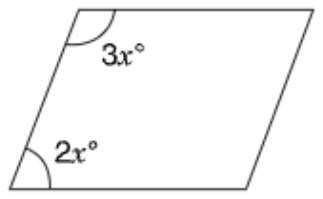
In the parallelogram above, what is the value of x?
- A36
- B18
- C6
- D5
Show the answer
Correct answer: A
In a parallelogram, any two adjacent angles are supplementary, so the sum of the two given angles is equal to 180°.
Write an equation showing that the sum of and is equal to 180°:
Solve for x:
Question analysis
A parallelogram is drawn with the two angles at the ends of its left side labeled 3x° and 2x°, and students find the value of x. It tests the angle facts of a parallelogram and solving a simple equation. Knowing what the two angles must add up to is the key fact, since the figure gives no other number.
- NYS standards
- Grade level
- Grade 8 content, by NYS standard
- Compared with grade 7
- At grade 7 The angle fact needed, about consecutive angles of a parallelogram, rests on grade 8 parallel-line reasoning. Once it is known, the work is one short equation, like a typical grade 7 problem about angle sums.
- Estimated difficulty
- Straightforward: two steps or one careful reading.
- Thinking it demands
- Depth of knowledge 2, skills and concepts · mainly apply
- What makes it hard
- Solution
- 2 steps
- Reading level
- Question and choices: about grade 7, 10 words.
- Students, last 30 days
- Not enough answers yet to show (it takes 10).
Why it is hard, traps and wrong answers (shows the answer)
Why it is hard
Once the angle fact is in place, 5x = 180 is a one-line equation, so the question tests recall more than computation. Students who use 90° for the pair land on half the right value, and the two smallest choices come only from combining the labels' 3 and 2. A sense check helps: x = 36 makes the angles 108° and 72°, one obtuse and one acute, just as the drawing shows.
Something you must already know moderate Working it out
The figure gives no number of degrees, only 3x° and 2x°, so everything rests on recalling that the two angles at the ends of one side of a parallelogram add to 180°. (Anderson & Krathwohl, 2001)
Reading a figure, table or graph minor Understanding the question
The marked angles sit at the upper and lower ends of the left side, consecutive rather than opposite, which is what makes them supplementary instead of equal. (Lesh, Post & Behr, 1987; Kirsch & Mosenthal, 1990)
Strategy: Decide what two angles that share a side of a parallelogram add up to, set 3x + 2x equal to that total, solve for x, and check that the two angles fit the figure.
Traps
- Wrong formula: Uses a related but wrong formula: perimeter for area, diameter for radius, area for volume, or a misremembered one.
- Stops one step early: A choice is a number from partway through the solution.
- Numbers taken from the question: Combines the numbers in the question without a model of the situation, or is simply a number that appears in the question.
The wrong answers, classified
B Wrong formula (King et al., 2004)
Uses 90° as the total of the two angles, the complementary total, so 5x = 90 gives 18, though consecutive angles of a parallelogram add to 180°.
C Numbers taken from the question (Hegarty, Mayer & Monk, 1995)
Multiplies the two coefficients from the labels, 3 × 2 = 6, without using any angle fact or writing an equation.
D Stops one step early (King et al., 2004; Gierl et al., 2017)
Combines 3x + 2x into 5x and gives the coefficient 5, stopping before dividing the 180° total by it.
Worked solution, step by step
Formulas used
- Neighboring angles of a parallelogram
- a and b are two angles of a parallelogram that share a side, like the top left and bottom left angles. They always add to 180°. Here is why. The four angles add to 360°, and opposite angles are equal. So each pair of neighbors is half of 360°.
Sort out the question
The figure is a parallelogram. That is a four-sided shape whose opposite sides are parallel, so they never meet. Two angles are marked: 3x° at the upper left and 2x° at the lower left. You need the value of x.
Write an equation for the angles
The two marked angles are at the two ends of the left side. So they are neighbors, not opposite angles. Use the rule that neighbors add to 180°:
Watch out: the total is 180°, not 90°. Using 90 gives 5x = 90 and x = 18, choice B.
Solve for x
Three x’s plus two x’s make five x’s:
Divide both sides by 5 to get x alone:
Watch out: stopping at 5, the number in front of x, gives choice D. Multiplying 3 × 2 = 6 gives choice C, but that uses no angle fact.
Choose the answer
The value of x is 36. It is a number, not the size of an angle. The angles themselves are 3 × 36 and 2 × 36 degrees.
So the answer is A, 36.
Check your answer
Find the two angles. The top one is degrees. The bottom one is degrees. They add to 180°. In the figure, the top angle is wide, more than 90°. The bottom one is narrow, less than 90°. That matches.
More questions like this
The original DOE question
Question 2 of 13
2026 Practice Test C Math, question 10Question
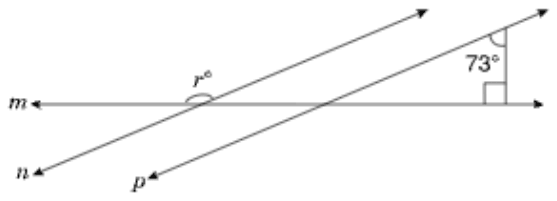
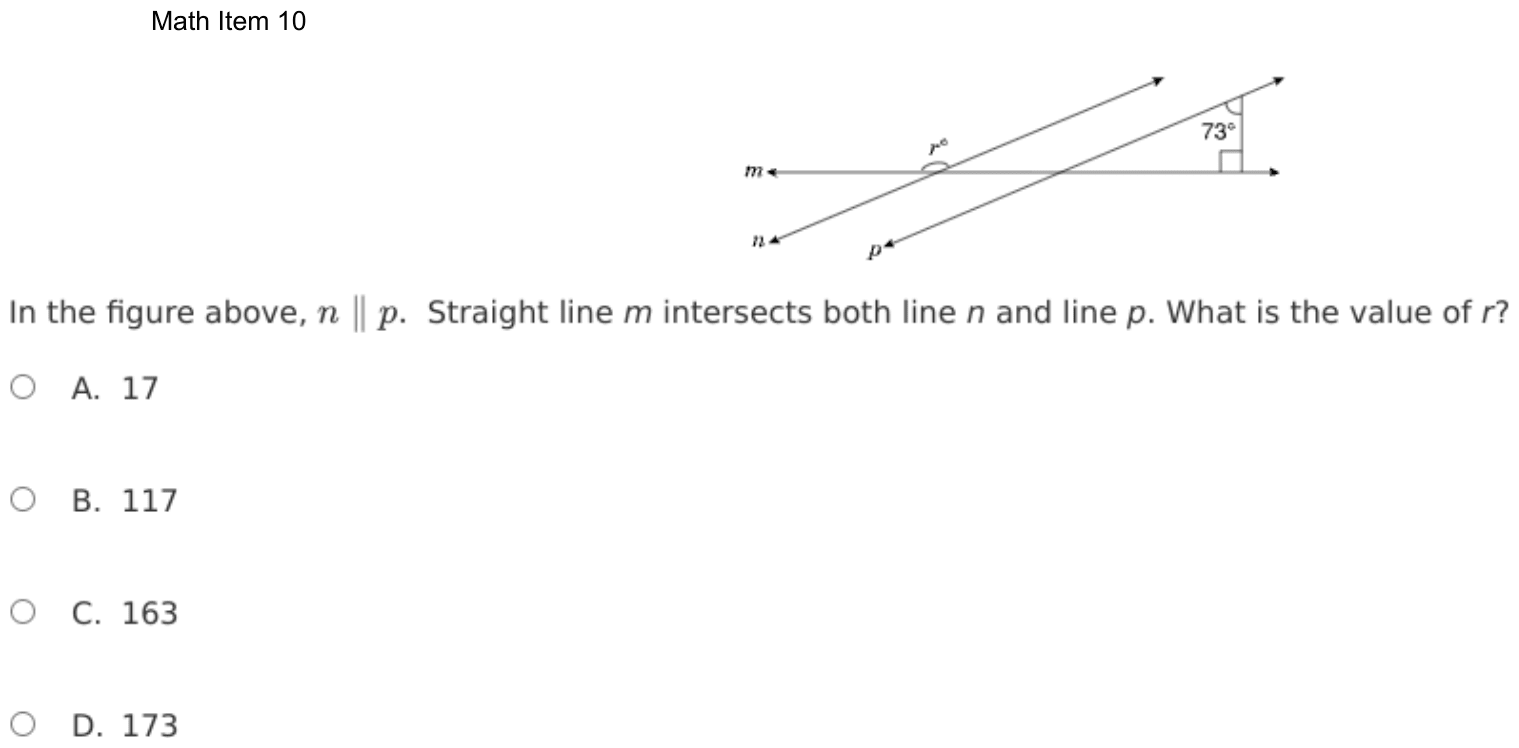
In the figure above, . Straight line m intersects both line n and line p. What is the value of r?
- A17
- B117
- C163
- D173
Show the answer
Correct answer: C
The triangle formed by line p, line m, and the line segment connecting the two contains a 73° angle, a right angle (90°), and a missing angle measuring x°. The sum of the interior angles of a triangle is 180°, so begin by finding the value of x:
Line m is a straight line, so it has a measure of 180°. The 17° angle from the triangle and the adjacent angle outside the triangle are supplementary, so they have a sum of 180°. Let s represent the measure of the adjacent angle outside the triangle. The value of s can be determined by subtracting:
Given that n and p are parallel lines and that they have been cut by a transversal, line m, then corresponding angles are congruent. Angles r and s are corresponding angles, so the value of r is congruent to the value of s, which is 163°.
Question analysis
Two parallel lines, n and p, cross a straight line m, and a segment drawn at a right angle to m forms a small triangle with lines m and p, where a 73° angle is marked. Students find the angle r at line n. It combines a triangle's angle sum, a straight angle and parallel lines, and the angle wanted sits away from the marked ones.
- NYS standards
- Grade level
- Grade 8 content, by NYS standard
- Compared with grade 7
- Above grade 7 Grade 7 angle problems use supplementary, vertical and adjacent angles. This one also needs the angle sum of a triangle and the angles formed by parallel lines and a transversal, grade 8 facts, chained across a busy figure.
- Estimated difficulty
- Hard: combines ideas, needs a plan, and has more than one tempting wrong answer.
- Thinking it demands
- Depth of knowledge 2, skills and concepts · mainly apply
- What makes it hard
- Reading a figure, table or graph moderate
- Combines ideas moderate
- Something you must already know minor
- Solution
- 3 steps
- Reading level
- Question and choices: about grade 3, 21 words.
- Students, last 30 days
- Not enough answers yet to show (it takes 10).
Why it is hard, traps and wrong answers (shows the answer)
Why it is hard
Each fact needs only a subtraction, but the student has to plan a route from the 73° angle at line p over to r at line n. The first number the route gives, the triangle's 17° angle, is listed, and it is the acute partner of r rather than r itself. The figure helps here: r is drawn plainly obtuse, and 163 is also 90 + 73, the triangle's exterior angle, which confirms it.
Reading a figure, table or graph moderate Understanding the question
The 73° sits between line p and the vertical segment, not between p and m, and r is the obtuse angle above m on the left of line n, far from every marked angle. (Lesh, Post & Behr, 1987; Kirsch & Mosenthal, 1990)
Combines ideas moderate Working it out
Three facts chain together: the triangle's angles sum to 180°, the angles along straight line m sum to 180°, and corresponding angles at the parallel lines n and p are equal. (Embretson, 1998; Daniel & Embretson, 2010)
Something you must already know minor Working it out
The angle pairs formed by a line crossing two parallel lines are a grade 8 topic, and the question uses them without naming them. (Anderson & Krathwohl, 2001)
Strategy: Find the third angle of the right triangle, use the straight line m to get the angle beside it, then carry that angle over to line n using the parallel lines.
Traps
- Stops one step early: A choice is a number from partway through the solution.
- An arithmetic slip: The right method with a plausible arithmetic error: a digit, a place value or a times-table fact.
The wrong answers, classified
A Stops one step early (King et al., 2004; Gierl et al., 2017)
Finds the triangle's third angle, 180 − 90 − 73 = 17, and stops, though r is the obtuse angle next to the 17° angle, not that angle itself.
B Little reason to choose it (Haladyna & Downing, 1993; Rodriguez, 2005)
No angle fact in the figure gives 117; even 180 − 73 is 107, so this choice mostly catches guesses at an obtuse angle.
D An arithmetic slip (Junker & Sijtsma, 2001)
Finds the 17° angle and subtracts it from 180 but borrows without reducing the 8, so 180 − 17 comes out as 173.
Worked solution, step by step
Formulas used
- Angles of a triangle
- a, b and c are the three angles inside any triangle. They always add up to 180°. If you know two of them, subtract their sum from 180° to find the third.
- Angles on a straight line
- a and b are two angles side by side on a straight line. Together they make a half turn, which is 180°. Use it to find the angle next to one you already know.
- Corresponding angles
- The symbol ∥ means is parallel to. When line m crosses two parallel lines, it makes the same angles at each crossing. Angles in the same position at the two crossings are called corresponding angles. They are equal.
Sort out the question
Lines n and p are parallel, and line m crosses both. Near line p, a straight-up segment meets line m. The small square shows a right angle, 90°. Line p, line m and that segment make a small triangle. Its top angle is 73°.
You need r, the wide angle where line n crosses line m.
Find the triangle’s third angle
The third angle is where line p crosses line m. Call it x. Use the triangle rule:
So that angle is 17°.
Watch out: this is not r. Stopping here gives choice A, 17.
Use the straight line m
The 17° angle sits above line m, on the right of line p. Beside it, on the left of line p, is a wide angle. Call it s. The two angles fill the straight line m, so they add to 180°:
So s is 163°.
Watch out: borrow carefully. 180 − 17 is 163, not 173, choice D.
Carry the angle to line n
Angle s is above line m and to the left of line p. Angle r is above line m and to the left of line n. They are in the same position, so they are corresponding angles. Since n and p are parallel:
So the answer is C, 163.
Check your answer
Look at the figure. Angle r is wider than a right angle, so it must be more than 90°. That rules out 17. Also, the narrow angle beside r, on the right of line n, matches the 17° angle at line p. And , as it should on a straight line.
More questions like this
The original DOE question
Question 3 of 13
2026 Practice Test D Math, question 13Question
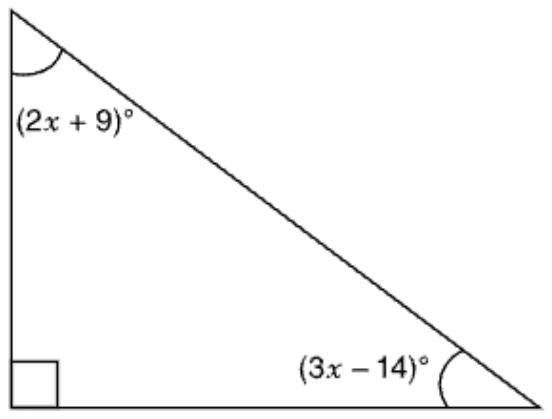
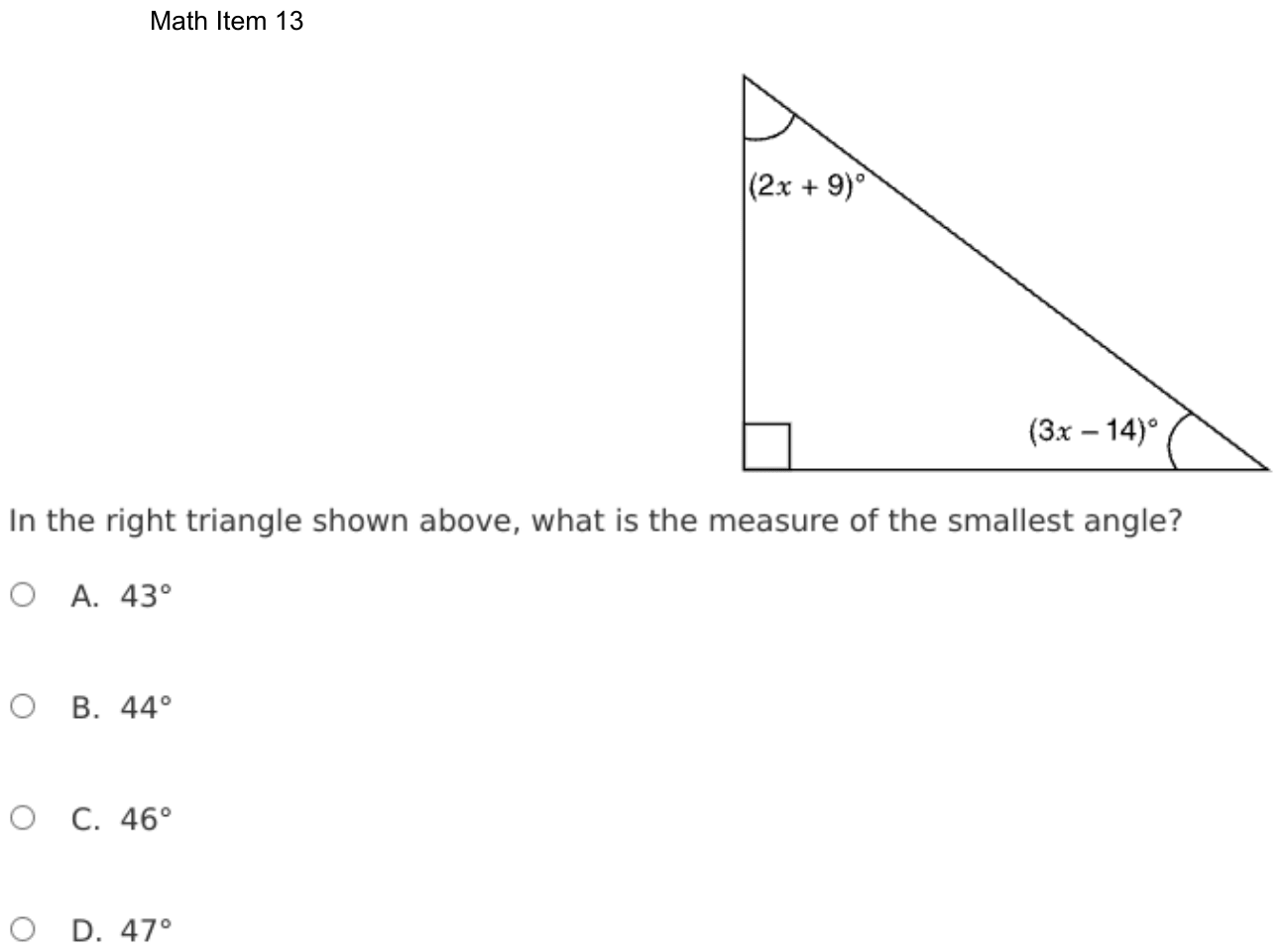
In the right triangle shown above, what is the measure of the smallest angle?
- A43°
- B44°
- C46°
- D47°
Show the answer
Correct answer: A
Since the three angles of a triangle have a sum of 180°, and since one angle is a right angle, the other two angles have a sum of 90°. By writing an equation and using inverse operations, the value of x can be found.
Now, use substitution to find the measure of the two angles to determine the smallest angle of the triangle.
The smallest angle is 43°.
Question analysis
A right triangle has its two other angles labeled (2x + 9)° and (3x − 14)°, and students find the measure of the smallest angle. It tests the angle sum of a triangle and solving a linear equation. Finding x is not the end: both angles must be worked out and compared to see which one is smallest.
- NYS standards
- Grade level
- Grade 8 content, by NYS standard
- Compared with grade 7
- Above grade 7 Grade 7 students write equations for unknown angles using complementary and supplementary angles. This also needs the angle sum of a triangle, which New York places in grade 8, plus substituting back and comparing, though each step is short.
- Estimated difficulty
- Moderate: several steps, or a close reading with one strong distractor.
- Thinking it demands
- Depth of knowledge 2, skills and concepts · mainly apply
- What makes it hard
- Combines ideas moderate
- Many steps minor
- Something you must already know minor
- Solution
- 4 steps
- Reading level
- Question and choices: about grade 6, 14 words.
- Students, last 30 days
- Not enough answers yet to show (it takes 10).
Why it is hard, traps and wrong answers (shows the answer)
Why it is hard
Setting the sum of the two labeled angles to 90° is the decision; the algebra after it is routine. The trap waits at the end: x = 19 is not an angle, and the expression at the top vertex, 2x + 9, gives the larger acute angle, 47°. Evaluating both expressions and checking that they add to 90° takes seconds and shows which one is smaller.
Combines ideas moderate Working it out
The angle facts and the algebra meet in one equation: the right angle means the two labeled angles add to 90°, and only that sum makes (2x + 9) + (3x − 14) solvable. (Embretson, 1998; Daniel & Embretson, 2010)
Many steps minor Working it out
After solving 5x − 5 = 90, both angle expressions must be evaluated and compared, because the question wants an angle, not x, and not the first angle found. (Daniel & Embretson, 2010; Enright, Morley & Sheehan, 2002)
Something you must already know minor Working it out
The 180° angle sum of a triangle is not printed, and only the small square at the bottom left shows that one angle is 90°. (Anderson & Krathwohl, 2001)
Strategy: Use the right angle to see that the other two angles add to 90°, solve that equation for x, then substitute into both expressions and compare them.
Traps
- Answers a different question: A choice is right for another quantity: the other unknown, the rest instead of the part, the part instead of the whole.
- A formula you must know: Needs a formula the test does not give: area, circumference, volume, probability rules.
The wrong answers, classified
B Little reason to choose it (Haladyna & Downing, 1993; Rodriguez, 2005)
No common working gives 44°; it sits one degree from the right measure and fits no consistent value of x, so it mostly draws estimates and guesses.
C Little reason to choose it (Haladyna & Downing, 1993; Rodriguez, 2005)
No common working gives 46°, which would need x = 20 and two angles adding to 95°, so it mostly catches guesses near 45°.
D Answers a different question (King et al., 2004; Hegarty, Mayer & Monk, 1995)
Solves x = 19 correctly but answers with 2x + 9 = 47°, the larger acute angle, instead of evaluating both expressions to find the smaller.
Worked solution, step by step
Formulas used
- Angles in a triangle
- a, b and c are the three angles of any triangle, in degrees. They always add up to 180 degrees. If you tear off the three corners and set them side by side, they make a straight line.
- The two other angles of a right triangle
- a and b are the two angles that are not the right angle. A right angle is 90 degrees, so the other two share what is left of the 180: 180 − 90 = 90.
Sort out the question
The small square at the bottom left corner marks a right angle, which is 90°. The top angle is (2x + 9)°, and the bottom right angle is (3x − 14)°. You need the smallest of the three angles. First find x, then find each angle.
Write an equation
The three angles add to 180°. The right angle uses 90° of that, so the other two angles add to 90°:
Solve for x
Combine the x terms, 2x + 3x = 5x. Combine the numbers, 9 − 14 = −5:
Add 5 to both sides, then divide both sides by 5:
Find both angles
Put x = 19 into each expression:
The three angles are 47°, 43° and 90°.
Watch out: x = 19 is not an angle. And the first angle you find, 47°, is not the smallest one. Stopping there gives choice D.
Pick the smallest angle
Compare 47°, 43° and 90°. The smallest is 43°. The figure is not drawn to scale, so do not judge the angles by how they look. Use the numbers.
So the answer is A, 43°.
Check your answer
Add the three angles: 47 + 43 + 90 = 180. That is the right total for a triangle. Also, 47 + 43 = 90, so the two smaller angles fill exactly what the right angle leaves.
More questions like this
The original DOE question
Question 4 of 13
2024 Test A Math, question 2Question
Angle M and angle R are supplementary. The measure of angle R is 5 times the measure of angle M. What is the measure of angle R, in degrees?
Grid-in question: work out the answer and enter it as a number.
Show the answer
Correct answer: 150
Angle M and angle R are supplementary, so the sum of the angles is 180°.
Let m equal the measure of angle M, and let r equal the measure of angle R.
The measure of angle R is 5 times the measure of angle M.
Therefore, the measure of angle R is 150°.
Question analysis
A geometry grid-in about two supplementary angles, where one angle is five times the size of the other. Students must recall what supplementary means, write an equation linking the two angles, and solve it. The question asks for the larger angle, so stopping at the smaller one is the usual slip.
- Grade level
- Grade 7 content, by NYS standard
- Compared with grade 7
- At grade 7 Grade 7 students regularly write and solve simple equations for unknown angles using supplementary and complementary facts. This is a two-step version of exactly that task, with whole numbers and no figure to read.
- Estimated difficulty
- Straightforward: two steps or one careful reading.
- Thinking it demands
- Depth of knowledge 2, skills and concepts · mainly apply
- What makes it hard
- Solution
- 3 steps
- Reading level
- Question and choices: about grade 5, 28 words.
- Students, last 30 days
- Not enough answers yet to show (it takes 10).
Why it is hard, traps and wrong answers (shows the answer)
Why it is hard
Once supplementary is read as a 180° total, the problem is a one-variable equation with whole numbers. Students lose the point in two ways: by stopping at the smaller angle, which the equation produces first, or by using 90° for the total. Checking that the gridded angle is the larger of the pair, and that the two angles add to 180°, catches both.
Something you must already know moderate Working it out
The stem never says what supplementary means; the 180° total has to be recalled, and a student who confuses it with complementary's 90° halves every angle. (Anderson & Krathwohl, 2001)
Turning words into math minor Understanding the question
The sentence "The measure of angle R is 5 times the measure of angle M" has to become R = 5M, so the 180° splits into six equal parts, not five. (Hegarty, Mayer & Monk, 1995; Koedinger & Nathan, 2004)
An answer in an unexpected form minor Choosing the answer
As a grid-in there is nothing to compare against, so gridding angle M's 30°, the first value the equation gives, looks just as finished as angle R. (Enright, Morley & Sheehan, 2002)
Strategy: Call angle M one part and angle R five parts; together the six parts make the supplementary total, so find one part and then multiply for angle R.
Traps
- Answers a different question: A choice is right for another quantity: the other unknown, the rest instead of the part, the part instead of the whole.
- Wrong formula: Uses a related but wrong formula: perimeter for area, diameter for radius, area for volume, or a misremembered one.
The wrong answers, classified
30 Answers a different question (King et al., 2004; Hegarty, Mayer & Monk, 1995)
Solves 6m = 180 correctly for angle M, 30°, and grids it instead of multiplying by 5 to get angle R, the angle the question asks for.
75 Wrong formula (King et al., 2004)
Uses 90° for supplementary, the complementary total, so 6m = 90 gives m = 15 and angle R = 75, half its real size.
36 Numbers taken from the question (Hegarty, Mayer & Monk, 1995)
Divides 180 by the 5 in the stem, combining the two numbers without an equation that gives angle M its own share of the 180°.
Worked solution, step by step
Formulas used
- Supplementary angles
- M and R are the sizes of two angles, in degrees. Supplementary means the two angles add up to 180 degrees. Put side by side, they make a straight line. Do not mix this up with complementary, which means a total of 90 degrees.
Sort out the question
Two angles, M and R, are supplementary. Angle R is 5 times as big as angle M. You need the measure of angle R, in degrees. Measure means its size. Notice that the question asks for R, not M.
Write the facts as equations
Supplementary angles add up to 180°.
The sentence “The measure of angle R is 5 times the measure of angle M” becomes this:
Watch out: supplementary means 180°, not 90°. Using 90° gives R = 75, which is wrong.
Find angle M
Put in place of R. Then the equation has only one unknown, M.
Think of 6 equal parts. M is 1 part and R is 5 parts. So angle M is 30°.
Find angle R
Angle R is 5 times angle M.
Angle R is 150°. Watch out: do not stop at M. Gridding 30 gives the wrong angle. So you would grid 150.
Check your answer
Add the two angles: . So they are supplementary. Also, , so R really is 5 times M. Both facts in the question check out.
More questions like this
The original DOE question
Question 5 of 13
2023 Test A Math, question 4Question
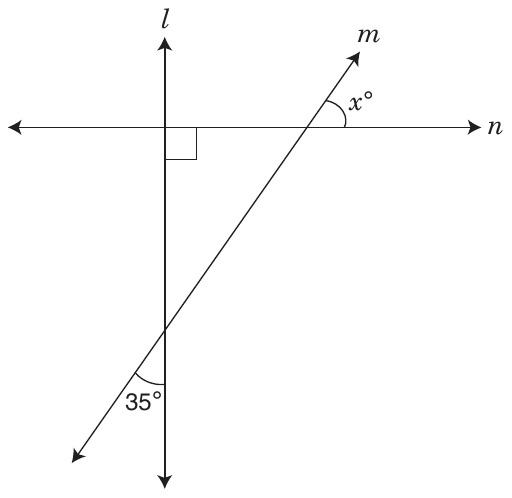
In the figure above, line l is perpendicular to line n. What is the value of x?
Grid-in question: work out the answer and enter it as a number.
Show the answer
Correct answer: 55
Since vertical angles are congruent, the right triangle in the figure has acute angles with measures of 35° and x°. The interior angles of a triangle sum to 180°, so set up an equation to solve for x:
Question analysis
Three lines cross in a figure: line l is perpendicular to line n, and a slanted line m meets them at a marked 35° angle and an unknown angle x. This geometry grid-in asks for the value of x. Students must see the right triangle the lines form and carry the marked angles into it using vertical angles.
- NYS standards
- Grade level
- Grade 8 content, by NYS standard
- Compared with grade 7
- Above grade 7 Grade 7 angle problems use vertical, supplementary and complementary angles. This one also needs the angle sum of a triangle, which New York places in grade 8, and the triangle is not drawn as a separate shape, so students must spot it.
- Estimated difficulty
- Moderate: several steps, or a close reading with one strong distractor.
- Thinking it demands
- Depth of knowledge 2, skills and concepts · mainly apply
- What makes it hard
- Reading a figure, table or graph moderate
- Something you must already know moderate
- An answer in an unexpected form minor
- Solution
- 3 steps
- Reading level
- Question and choices: about grade 4, 17 words.
- Students, last 30 days
- Not enough answers yet to show (it takes 10).
Why it is hard, traps and wrong answers (shows the answer)
Why it is hard
The figure hides a small right triangle between the three lines, and the question is easy once students see it. Its angles are the right angle, the vertical partner of the 35° angle and the vertical partner of x, so x is what the right angle and 35° leave of 180°. Students who never spot the triangle tend to guess a direct relationship between the two marked angles, which no angle fact supports.
Reading a figure, table or graph moderate Understanding the question
Neither marked angle is inside the right triangle that lines l, m and n form: the 35° opens below the point where m crosses l, and x opens above line n, so each must be carried in as a vertical angle. (Lesh, Post & Behr, 1987; Kirsch & Mosenthal, 1990)
Something you must already know moderate Working it out
The stem states only that l is perpendicular to n; students must supply that vertical angles are equal and that the three angles of a triangle add to 180°. (Anderson & Krathwohl, 2001)
An answer in an unexpected form minor Choosing the answer
As a grid-in it offers no choices, so 125, the right angle plus the 35° angle, can be gridded with nothing to signal the missing subtraction. (Enright, Morley & Sheehan, 2002)
Strategy: Find the triangle formed by the three lines, use vertical angles to move the 35° and x° angles inside it, and apply the triangle's angle sum with the right angle.
Traps
- Stops one step early: A choice is a number from partway through the solution.
- A formula you must know: Needs a formula the test does not give: area, circumference, volume, probability rules.
The wrong answers, classified
125 Stops one step early (King et al., 2004; Gierl et al., 2017)
Adds the right angle and the 35° angle, 90 + 35 = 125, and grids that sum without subtracting it from the triangle's 180°.
35 Misunderstands the concept (Smith, diSessa & Roschelle, 1993; De Bock et al., 1998; Ni & Zhou, 2005)
Assumes line m crosses l and n at equal angles, as it would cross two parallel lines, though l and n are perpendicular.
Worked solution, step by step
Formulas used
- Vertical angles
- When two lines cross, they make an X. The angles straight across from each other in the X are called vertical angles. a and b are one such pair. They are always equal, because each one plus the angle between them makes a straight line.
- Angles of a triangle
- A, B and C are the three angles inside any triangle, in degrees. They always add up to 180°. Use it when you know two of the angles and need the third.
Sort out the figure
Line l is perpendicular to line n. Perpendicular means they meet at a right angle, 90°. The small square in the figure marks it. Line m crosses both lines. The three lines make a triangle with a right angle. You need x, the angle marked x° where m crosses n.
Move the 35° angle into the triangle
The 35° angle is below the point where m crosses l. So it is outside the triangle. Lines l and m make an X there. The triangle’s angle is straight across from the 35° angle. They are vertical angles, so they are equal. The triangle’s angle at that corner is 35°.
Move the x° angle into the triangle
The x° angle is above line n, so it is outside the triangle too. Lines m and n make another X. The triangle’s angle at that crossing is straight across from x°. So the third angle of the triangle is also x°. Watch out: line m does not cross l and n at the same angle. Lines l and n are not parallel, so x is not 35.
Use the triangle’s angle sum
The triangle’s three angles are 90°, 35° and x°.
Watch out: 125 is only the two known angles added together. You still subtract it from 180. Gridding 125 is wrong. So you would grid 55.
Check your answer
In a right triangle, the two smaller angles add up to 90°. That is because the right angle uses 90° of the 180°. Check: . Also, in the figure the x° angle looks a bit bigger than the 35° angle, and 55 is.
More questions like this
The original DOE question
Question 6 of 13
2023 Test A Math, question 25Question
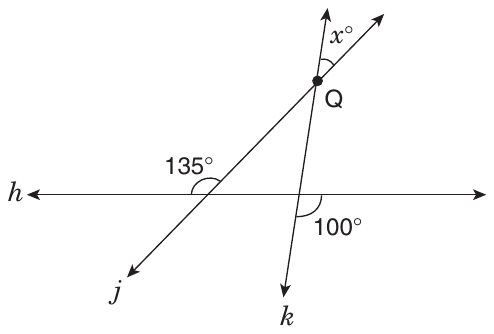
Lines j and k intersect at point Q, and h is a straight line. What is the value of x?
- A55
- B45
- C35
- D30
Show the answer
Correct answer: C
First, find the measures of the three angles inside the triangle. The lower left angle is supplementary to the one marked 135°, so the measure of that angle is . The angle on top is a vertical angle with the one marked x°, so the measure of that angle is also x°. The angle on the lower right is a vertical angle with the one marked 100°, so the measure of that angle is also 100°. Since the measures of the three interior angles of a triangle sum to 180°, set up an equation and solve for x:
Question analysis
Lines j and k cross at point Q above a straight line h, forming a triangle, with a 135° angle marked where j meets h and a 100° angle where k meets h. Students find the angle x at Q. Each marked angle lies outside the triangle, so it has to be turned into an inside angle before the triangle's angle sum can be used.
- NYS standards
- Grade level
- Grade 8 content, by NYS standard
- Compared with grade 7
- Above grade 7 Grade 7 students use supplementary and vertical angles to find unknown angles. This figure needs both, applied at three different vertices, plus the angle sum of a triangle, which New York teaches in grade 8.
- Estimated difficulty
- Hard: combines ideas, needs a plan, and has more than one tempting wrong answer.
- Thinking it demands
- Depth of knowledge 2, skills and concepts · mainly apply
- What makes it hard
- Reading a figure, table or graph major
- Combines ideas moderate
- Something you must already know minor
- Solution
- 4 steps
- Reading level
- Question and choices: about grade 2, 20 words.
- Students, last 30 days
- Not enough answers yet to show (it takes 10).
Why it is hard, traps and wrong answers (shows the answer)
Why it is hard
Every angle the solution needs has to be carried into the triangle from outside, and the two marked angles need different treatment. The 135° is supplementary to the triangle's angle, but the 100° is vertical to it, so subtracting both from 180° out of habit builds the wrong triangle. Checking which side of each line a marked angle sits on, not just how near the triangle it is, separates the two cases.
Reading a figure, table or graph major Understanding the question
None of the three marked angles is inside the triangle formed by h, j and k: the 135° is outside on the left, the 100° is below line h, and x is above Q. (Lesh, Post & Behr, 1987; Kirsch & Mosenthal, 1990)
Combines ideas moderate Working it out
Two different angle facts are needed: the 135° gives a supplementary interior angle of 45°, while the 100° and x carry into the triangle unchanged as vertical angles. (Embretson, 1998; Daniel & Embretson, 2010)
Something you must already know minor Working it out
Supplementary angles, vertical angles and the triangle's 180° sum are all assumed, and the question names none of them. (Anderson & Krathwohl, 2001)
Strategy: Mark the three angles of the triangle formed by lines h, j and k: one is supplementary to 135°, one is vertical to 100°, and the one at Q is vertical to x°.
Traps
- Misreads the figure: Reads a value, label or tick spacing in a figure, table or graph wrongly.
- Stops one step early: A choice is a number from partway through the solution.
The wrong answers, classified
A Misreads the figure (Lesh, Post & Behr, 1987; Kirsch & Mosenthal, 1990)
Takes the triangle's angle at line k as 180 − 100 = 80, the supplement of the marked angle instead of its vertical angle, so x = 180 − 45 − 80 = 55.
B Stops one step early (King et al., 2004; Gierl et al., 2017)
Finds the triangle's angle where line j meets h, 180 − 135 = 45, and gives it instead of going on to the angle at Q.
D Little reason to choose it (Haladyna & Downing, 1993; Rodriguez, 2005)
No angle fact in the figure gives 30, and the angle at Q is drawn close to its true size, so this choice mostly catches guesses.
Worked solution, step by step
Formulas used
- Angles on a straight line
- a and b are two angles side by side on a straight line. Together they make a half turn, a straight angle. So they add up to 180°. Angles like this are called supplementary.
- Vertical angles
- When two lines cross, they make an X. The angles straight across from each other in the X are called vertical angles. a and b are one such pair. They are always equal, because each one plus the angle between them makes a straight line.
- Angles of a triangle
- A, B and C are the three angles inside any triangle, in degrees. They always add up to 180°. Use it when you know two of the angles and need the third.
Sort out the figure
Lines h, j and k make a triangle. Its corners are where j crosses h, where k crosses h, and point Q. The figure marks two angles outside the triangle, 135° and 100°. You need x, the angle marked above Q.
Find the angle where j crosses h
The 135° angle is above h and to the left of j. The triangle’s angle is right next to it, on the other side of j. Together they make the straight line h. Call the triangle’s angle a.
So that corner of the triangle is 45°. Watch out: this is only one corner, not x. Stopping here gives 45, choice B.
Find the angle where k crosses h
The 100° angle is below h and to the right of k. The triangle’s angle is above h and to the left of k. Lines h and k make an X there, and these two angles are straight across from each other. They are vertical angles, so the triangle’s angle is 100°. Watch out: it is not 180 − 100 = 80. That angle is beside the 100°, not across from it. Using 80 gives 55, choice A.
Find the angle at Q
The x° angle is above Q, between the top parts of lines j and k. The triangle’s angle at Q is between the parts of j and k below Q. These two angles are straight across from each other. So they are vertical angles, and the triangle’s angle at Q is also x°.
Use the triangle’s angle sum
The three angles of the triangle must add up to 180°. Only x is unknown. So the answer is C, 35.
Check your answer
Add the triangle’s three angles: . Also, the angle at Q looks narrow in the figure, much less than a right angle of 90°. 35° fits that.
More questions like this
The original DOE question
Question 7 of 13
2023 Test A Math, question 34Question
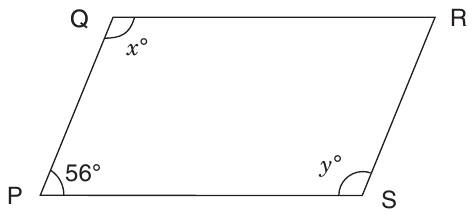
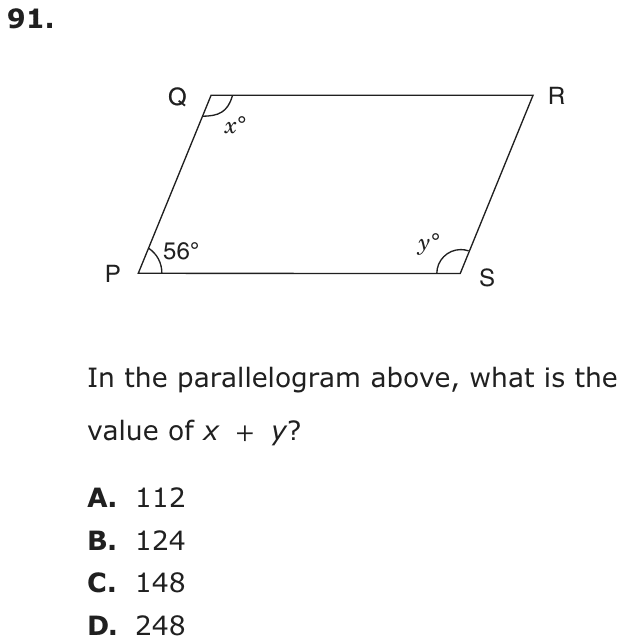
In the parallelogram above, what is the value of ?
- A112
- B124
- C148
- D248
Show the answer
Correct answer: D
In a parallelogram, opposite angles are congruent, so the measure of the unmarked angle is 56°. The sum of the interior angles of a parallelogram is equal to 360°. Use that information to solve the problem:
Question analysis
This geometry question shows parallelogram PQRS with a 56° angle at P and unknown angles x and y at Q and S, and asks for the sum x + y. Students need angle facts about parallelograms: opposite angles match, and the four angles total 360°. Stopping after finding only one angle, or adding the wrong pair, are the common mistakes.
- NYS standards
- Grade level
- Grade 8 content, by NYS standard
- Compared with grade 7
- At grade 7 The parallelogram facts needed, equal opposite angles and a 360° angle sum, rest on grade 8 reasoning about parallel lines and triangles. Once they are known, the arithmetic is short, about the size of a typical grade 7 angle problem.
- Estimated difficulty
- Straightforward: two steps or one careful reading.
- Thinking it demands
- Depth of knowledge 2, skills and concepts · mainly apply
- What makes it hard
- Solution
- 2 steps
- Reading level
- Question and choices: about grade 10, 10 words.
- Students, last 30 days
- Not enough answers yet to show (it takes 10).
Why it is hard, traps and wrong answers (shows the answer)
Why it is hard
Two short angle facts finish the question, but the figure marks three of the four corners, and the unmarked one at R is easy to forget. Students who find one obtuse angle stop with half the total, and those who add the two 56° angles give the part already known. Checking that the four angles, 56, 124, 56 and 124, add to 360 confirms the sum.
Something you must already know moderate Working it out
The figure gives one angle and no rules: students must bring both that opposite angles of a parallelogram are equal and that a quadrilateral's angles total 360°, or that neighboring angles add to 180°. (Anderson & Krathwohl, 2001)
Reading a figure, table or graph minor Understanding the question
The labels x and y sit at Q and S, opposite corners, while the corner R across from the 56° angle at P carries no label at all. (Lesh, Post & Behr, 1987; Kirsch & Mosenthal, 1990)
Strategy: Mark the angle at R equal to the angle at P, since opposite angles of a parallelogram are equal, then take both away from the total of a quadrilateral's four angles.
Traps
- Stops one step early: A choice is a number from partway through the solution.
- Answers a different question: A choice is right for another quantity: the other unknown, the rest instead of the part, the part instead of the whole.
The wrong answers, classified
A Answers a different question (King et al., 2004; Hegarty, Mayer & Monk, 1995)
Adds the two 56° angles at P and R, 56 + 56 = 112, giving the part of the 360° already known instead of the two angles that remain.
B Stops one step early (King et al., 2004; Gierl et al., 2017)
Finds one unmarked angle, 180 − 56 = 124, and stops before adding the equal angle at the opposite corner.
C Little reason to choose it (Haladyna & Downing, 1993; Rodriguez, 2005)
No angle fact in the parallelogram gives 148, which is exactly 100 less than the right total, so it mostly catches guesses or a stray subtraction slip.
Worked solution, step by step
Formulas used
- Opposite angles of a parallelogram
- A parallelogram is a four-sided shape whose opposite sides are parallel. P and R are opposite corners: they don’t share a side. Opposite angles of a parallelogram are always equal.
- Angles of a four-sided shape
- P, Q, R and S are the four corners. Their angles always add up to 360 degrees. A line from one corner to the opposite corner cuts the shape into two triangles, and each triangle’s angles add up to 180 degrees.
- Neighboring angles of a parallelogram
- P and Q are corners next to each other, joined by one side. In a parallelogram, their angles add up to 180 degrees. The same is true of any two neighboring corners.
Sort out the figure
PQRS is a parallelogram. The angle at corner P is 56°. The angle at Q is x°, and the angle at S is y°. The angle at R has no label. You need x + y, the angles at Q and S added together.
Find the angle at R
R is across from P, so they are opposite corners.
So the angle at R is 56°, the same as at P.
Use the 360° total
Watch out: 112 is the two angles you already know, not x + y. Answering 112 is choice A.
Find x and y one at a time
Q is next to P, so use the neighbor rule.
S is also next to P, so y = 124 too. Then , the same total. Watch out: stopping at one angle, 124, gives choice B. The question asks for both added together.
So the answer is D, 248.
Check your answer
Add all four angles: . That is the right total for a four-sided shape. Also, the angles at Q and S look wider than a right angle in the figure, and 124° is wider than 90°.
More questions like this
The original DOE question
Question 8 of 13
2023 Test A Math, question 45Question
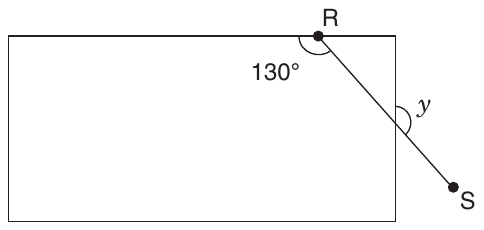
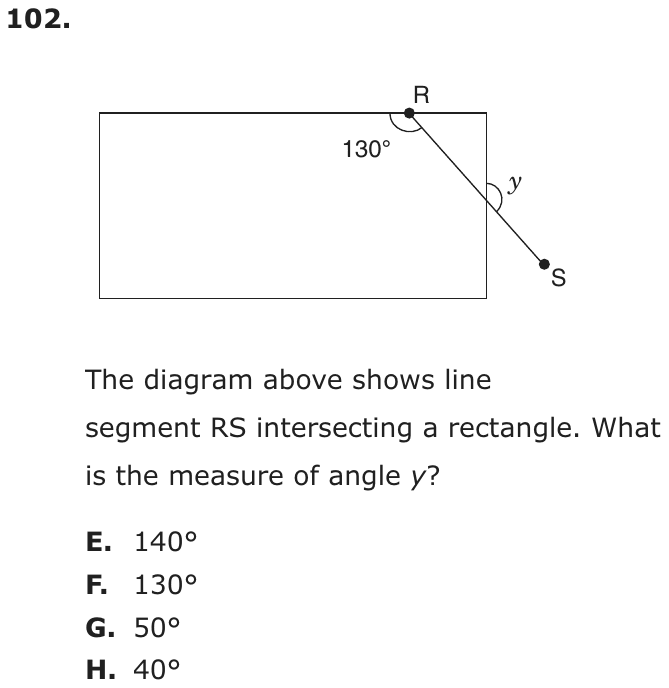
The diagram above shows line segment RS intersecting a rectangle. What is the measure of angle y?
- A140°
- B130°
- C50°
- D40°
Show the answer
Correct answer: A
First, find the measures of the interior angles of the triangle formed by the line segment and the rectangle. The top angle on the right is a vertex of the rectangle, so the measure of that angle is 90°. The top angle on the left is supplementary to the given angle of 130°. So, the measure of that angle is . The measure of the lower angle is 40°, since . Angle y is supplementary to the lower angle of 40°, so the measure of angle y is .
Question analysis
This geometry question shows line segment RS cutting across a corner of a rectangle, with a 130° angle marked where RS meets the top side, and asks for angle y where it crosses the right side. Students combine supplementary angles, the right angle of a rectangle and the angle sum of a triangle. Stopping at an angle inside the triangle is the main trap.
- NYS standards
- Grade level
- Grade 8 content, by NYS standard
- Compared with grade 7
- Above grade 7 Grade 7 angle problems use supplementary, vertical and adjacent angles. This one adds the angle sum of a triangle, which New York places in grade 8, and chains three facts around a small triangle that students must first spot in the figure.
- Estimated difficulty
- Moderate: several steps, or a close reading with one strong distractor.
- Thinking it demands
- Depth of knowledge 2, skills and concepts · mainly apply
- What makes it hard
- Reading a figure, table or graph moderate
- Many steps minor
- Something you must already know minor
- Solution
- 3 steps
- Reading level
- Question and choices: about grade 7, 17 words.
- Students, last 30 days
- Not enough answers yet to show (it takes 10).
Why it is hard, traps and wrong answers (shows the answer)
Why it is hard
The angle facts are basic, but the route runs through a triangle the figure does not point out, and the answer lies outside it. Students who stop inside the triangle give its 40° angle or its 50° angle, and those who assume y matches the marked 130° skip the work entirely. Checking that y and the triangle's angle beside it form a straight line, 140 + 40 = 180, confirms the result.
Reading a figure, table or graph moderate Understanding the question
The small triangle cut off at the rectangle's top right corner is never outlined or labeled, its 90° corner is unmarked, and y sits outside it, between RS and the rectangle's right side. (Lesh, Post & Behr, 1987; Kirsch & Mosenthal, 1990)
Many steps minor Working it out
Three steps follow in order, a straight angle at R, the triangle's angle sum, and a straight angle at the right side, and the first two results are both listed choices. (Daniel & Embretson, 2010; Enright, Morley & Sheehan, 2002)
Something you must already know minor Working it out
The rectangle's corner must be taken as 90° although no right-angle mark is drawn, and the 180° totals for a straight line and a triangle are assumed. (Anderson & Krathwohl, 2001)
Strategy: Look at the small triangle cut off at the rectangle's corner: get its angle at R from the straight top side, use the 90° corner and the triangle's angle sum, then use the straight right side.
Traps
- Stops one step early: A choice is a number from partway through the solution.
- Misunderstands the concept: A wrong belief about a concept: that percents can be added, that area grows like length, that averages can be averaged, that a bigger denominator means a bigger fraction.
The wrong answers, classified
B Misunderstands the concept (Smith, diSessa & Roschelle, 1993; De Bock et al., 1998; Ni & Zhou, 2005)
Takes y to equal the marked 130° angle, as if RS crossed two parallel sides, though the rectangle's top and right sides meet at a right angle.
C Stops one step early (King et al., 2004; Gierl et al., 2017)
Finds the triangle's angle at R, 180 − 130 = 50, and stops after the first of the three steps.
D Stops one step early (King et al., 2004; Gierl et al., 2017)
Finds the triangle's third angle, 180 − 90 − 50 = 40, but y lies outside the triangle, beside that angle on the straight right side.
Worked solution, step by step
Formulas used
- Angles on a straight line
- a and b are two angles side by side that together make a straight line. A straight line makes an angle of 180 degrees. So if you know one of them, subtract it from 180 to get the other.
- Angles in a triangle
- a, b and c are the three angles inside any triangle. They always add up to 180 degrees. If you know two of them, subtract both from 180 to find the third.
- Outside angle of a triangle
- An outside angle sits next to a triangle’s angle, along a straight line. a and b are the two inside angles at the other corners. The outside angle equals their sum.
Sort out the figure
Segment RS starts at R on the top side of the rectangle. It goes down to the right, crosses the right side, and ends at S. Call the rectangle’s top right corner P. Call the point where RS crosses the right side Q. Then R, P and Q make a small triangle. Angle y is at Q, outside the rectangle.
Find the triangle’s angle at R
The 130° angle and the triangle’s angle at R sit side by side along the top side, a straight line.
Watch out: 50° is only the first step. Stopping here gives choice C.
Find the triangle’s angle at Q
P is a corner of the rectangle, so its angle is 90°.
Watch out: y is outside the triangle, so this 40° angle, choice D, is not y.
Find angle y
Angle y and the triangle’s 40° angle at Q sit side by side along RS, a straight line.
So the answer is A, 140°.
Check your answer
Use the outside angle rule. Angle y is outside the triangle at Q. The two inside angles at the other corners are 50° and 90°, so . Also, y looks wider than a right angle in the figure, so it must be more than 90°.
More questions like this
The original DOE question
Question 9 of 13
2023 Test B Math, question 16Question
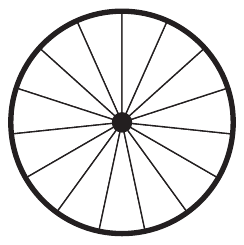
This wheel has 15 spokes, equally spaced. What is the measure of the angle between adjacent spokes?
- A30°
- B24°
- C15°
- D12°
Show the answer
Correct answer: B
The total number of degrees in a circle is 360. The measure of the angle between adjacent spokes is .
Question analysis
A wheel has 15 spokes, equally spaced around its hub, as the figure shows. Students find the measure of the angle between two neighboring spokes. The question tests knowing how many degrees make a full turn around a point and sharing them equally among the spokes.
- NYS standards
- 7.G.5 angle relationships and equations
- Grade level
- Grade 7 content, by NYS standard
- Compared with grade 7
- Below grade 7 Finding an angle by dividing a full turn into equal parts is early angle measurement. It takes one division, and the only fact needed is the number of degrees in a circle, so it sits below grade 7.
- Estimated difficulty
- Routine: one familiar step, little to misread.
- Thinking it demands
- Depth of knowledge 1, recall and reproduction · mainly apply
- What makes it hard
- Solution
- 1 step
- Reading level
- Question and choices: about grade 5, 16 words.
- Students, last 30 days
- Not enough answers yet to show (it takes 10).
Why it is hard, traps and wrong answers (shows the answer)
Why it is hard
One fact and one division answer this question, so it is among the easiest on the test. The wrong choices catch students who use a straight angle’s 180° for the full turn, who take the number of spokes as the angle, or who guess a familiar angle. Multiplying the answer by 15 to get back to 360° is a quick check.
Something you must already know minor Working it out
The question never says that a full turn is 360°; knowing it, and that the 15 spokes split it into 15 equal angles, is the whole method. (Anderson & Krathwohl, 2001)
Strategy: The spokes split the full turn around the hub into 15 equal angles, so divide the number of degrees in a circle by 15.
Traps
- Wrong formula: Uses a related but wrong formula: perimeter for area, diameter for radius, area for volume, or a misremembered one.
- Numbers taken from the question: Combines the numbers in the question without a model of the situation, or is simply a number that appears in the question.
The wrong answers, classified
A Little reason to choose it (Haladyna & Downing, 1993; Rodriguez, 2005)
No working with 15 spokes gives 30°, which is 360 ÷ 12, the angle between hours on a clock, so it mostly draws guesses at a familiar angle.
C Numbers taken from the question (Hegarty, Mayer & Monk, 1995)
Takes the number of spokes, 15, as the angle in degrees, matching a number in the question without any calculation.
D Wrong formula (King et al., 2004)
Divides 180 by 15, using a straight angle’s 180° as the full turn around the hub instead of 360°.
Worked solution, step by step
Formulas used
- Equal angles around a point
- One full turn around a point is 360 degrees. If lines from the point split that turn into equal angles, each angle gets the same share. So divide 360 by how many angles there are.
Sort out the question
The wheel has 15 spokes. They all start at the hub, the center of the wheel, and they are equally spaced. Adjacent spokes are spokes right next to each other. You need the angle between two adjacent spokes.
Count the angles around the hub
Go once around the hub. Between each spoke and the next is one angle. So 15 spokes make 15 angles, all the same size. Together they make one full turn, which is 360 degrees.
Watch out: a full turn is 360 degrees, not 180. Using 180 gives 12 degrees, choice D.
Share the full turn
Use the formula for equal angles.
Each angle is 24 degrees. Watch out: 15 is the number of spokes, not the size of the angle, so choice C is wrong. So the answer is B, 24°.
Check your answer
Multiply back: 15 angles of 24 degrees make degrees, a full turn. Also, a clock’s 12 hour marks are 30 degrees apart. This wheel has more spokes than that, so each angle must be smaller than 30 degrees.
More questions like this
The original DOE question
Question 10 of 13
2023 Test B Math, question 40Question
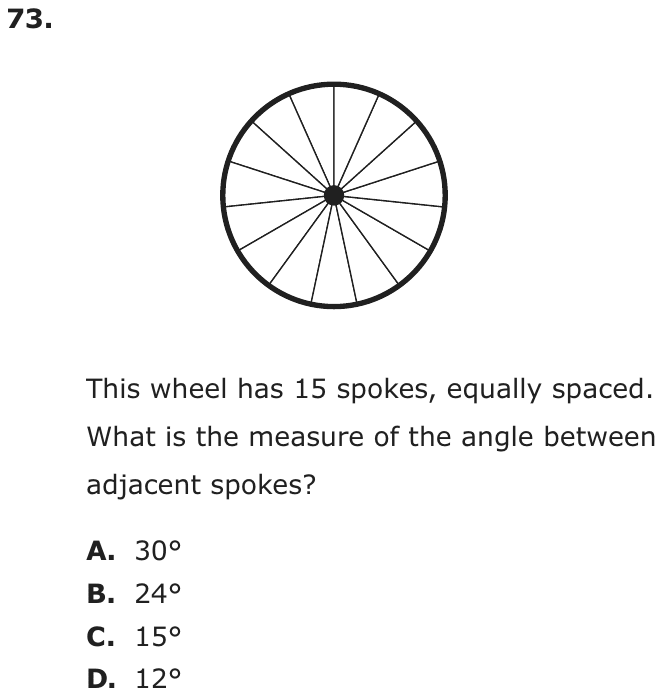
Angle A and angle B are complementary. If the measure of angle B is three times as great as the measure of angle A, what is the measure of angle B?
- A45°
- B67.5°
- C75°
- D135°
Show the answer
Correct answer: B
Let A represent the measure of angle A, and let B represent the measure of angle B, in degrees. Since the angles are complementary, . The question states that , or . Substitute that expression for A in the first equation and solve for B:
Question analysis
A geometry question about two complementary angles, where angle B is three times as large as angle A. Students find the measure of angle B. They must recall what complementary means, since the question does not say, and set up an equation that splits the total in the right proportion.
- Grade level
- Grade 7 content, by NYS standard
- Compared with grade 7
- At grade 7 Writing and solving an equation from complementary angles is a grade 7 standard. This is the familiar version without a figure: one equation from the definition, then a division and a multiplication, typical of grade 7 classwork.
- Estimated difficulty
- Straightforward: two steps or one careful reading.
- Thinking it demands
- Depth of knowledge 2, skills and concepts · mainly apply
- What makes it hard
- Something you must already know moderate
- Turning words into math minor
- Solution
- 3 steps
- Reading level
- Question and choices: about grade 7, 31 words.
- Students, last 30 days
- Not enough answers yet to show (it takes 10).
Why it is hard, traps and wrong answers (shows the answer)
Why it is hard
Once complementary is read as a 90° total, the problem is one equation with a decimal answer, 4A = 90. The 22.5° for angle A is not listed, so stopping at the smaller angle is not rewarded here, but using 180° is: it gives 45° and 135°, and both appear among the choices. Checking that the chosen angle and one third of it add to 90° settles it.
Something you must already know moderate Working it out
The stem never says what complementary means; the 90° total has to be recalled, and a student who confuses it with the supplementary 180° doubles both angles. (Anderson & Krathwohl, 2001)
Turning words into math minor Understanding the question
The clause “the measure of angle B is three times as great as the measure of angle A” has to become B = 3A, so the 90° splits into four equal parts, not three. (Hegarty, Mayer & Monk, 1995; Koedinger & Nathan, 2004)
Strategy: Recall the total that complementary angles share, think of angle A as one part and angle B as three parts, find one part, then multiply for angle B.
Traps
- Wrong formula: Uses a related but wrong formula: perimeter for area, diameter for radius, area for volume, or a misremembered one.
- Misreads the question: Misses or misreads a condition or a word in the question: "at least", "each", "remaining", "not".
The wrong answers, classified
A Misreads the question (Hegarty, Mayer & Monk, 1995)
Splits the 90° evenly, 90 ÷ 2 = 45, using the complementary total but ignoring that angle B is three times angle A.
C Little reason to choose it (Haladyna & Downing, 1993; Rodriguez, 2005)
No common working gives 75°, which would need angle A to be 25° and the pair to add to 100°; it mostly draws guesses.
D Wrong formula (King et al., 2004)
Uses 180°, the supplementary total, so 4A = 180 gives angle A = 45° and angle B = 135°, a pair that is not complementary.
Worked solution, step by step
Formulas used
- Complementary angles
- A and B are the measures of the two angles, in degrees. Complementary angles are two angles that add up to 90 degrees, the size of a square corner. Use this whenever a problem says two angles are complementary.
Sort out the question
Complementary angles are two angles that add up to 90 degrees. Angle B is three times as big as angle A. You need the measure of angle B, in degrees.
Write the facts as equations
Let A and B stand for the two measures. The angles are complementary, so use the formula.
Angle B is three times angle A, so:
Put 3A in place of B
Replace B in the sum with 3A. Then there is only one letter to find.
Think of it as 4 equal parts. Angle A is 1 part, and angle B is 3 parts.
Find angle A
Divide both sides by 4.
Angle A measures 22.5 degrees. That is not the answer yet, because the question asks for angle B.
Find angle B
Angle B is three times angle A.
Angle B measures 67.5 degrees.
Watch out: Angles that add to 180 degrees are called supplementary. Using 180 by mistake gives 45 and 135, choice D. Splitting 90 in half gives 45, choice A. That ignores the fact that B is three times A.
So the answer is B, 67.5°.
Check your answer
Add the two angles: 22.5 + 67.5 = 90. So they are complementary. Now divide: 67.5 ÷ 22.5 = 3. So angle B is three times angle A. Both facts check out.
More questions like this
The original DOE question
Question 11 of 13
2018 Test A Math, question 1Question
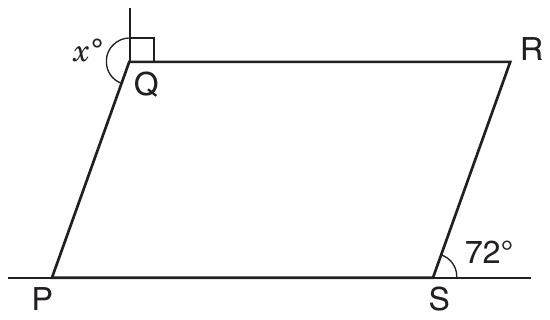
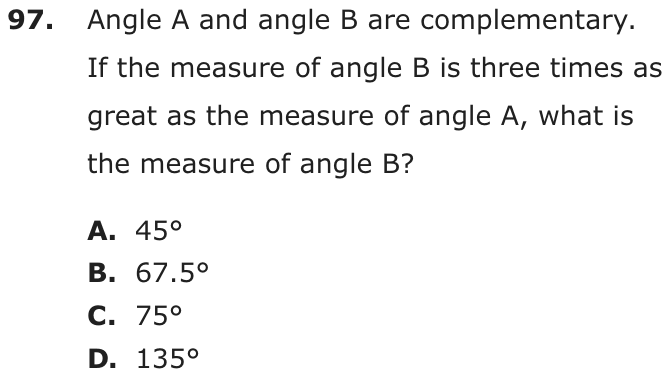
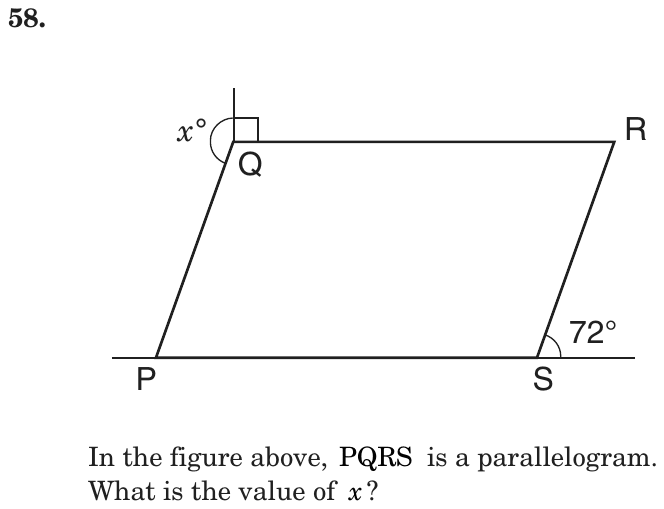
In the figure above, PQRS is a parallelogram. What is the value of ?
Grid-in question: work out the answer and enter it as a number.
Show the answer
Correct answer: 162
First, find the measure of angle PQR. The measure of angle PQR is equal to the measure of angle PSR.
m∠PSR = 180 − 72 = 108.
So, the measure of angle PQR is also 108.
108 + 90 + x = 360
198 + x = 360
x = 162
Question analysis
A grid-in geometry question about angles around a parallelogram PQRS. A 72° angle sits outside corner S on the extended base, and at corner Q a right angle and the unknown angle x complete the turn around the point. Students chain three angle facts, and the angle asked for lies outside the shape, not inside it.
- NYS standards
- Grade level
- Grade 8 content, by NYS standard
- Compared with grade 7
- Above grade 7 Grade 7 angle work usually applies one or two facts, such as supplementary or vertical angles, to find an angle. This chains three, and needs the equal opposite angles of a parallelogram, which rest on grade 8 parallel-line facts.
- Estimated difficulty
- Hard: combines ideas, needs a plan, and has more than one tempting wrong answer.
- Thinking it demands
- Depth of knowledge 2, skills and concepts · mainly apply
- What makes it hard
- Reading a figure, table or graph major
- Combines ideas moderate
- An answer in an unexpected form minor
- Solution
- 3 steps
- Reading level
- Question and choices: about grade 7, 14 words.
- Students, last 30 days
- Not enough answers yet to show (it takes 10).
Why it is hard, traps and wrong answers (shows the answer)
Why it is hard
The arithmetic is two subtractions; the difficulty is seeing which angles the marks refer to. Students lose points by treating the 72° as the parallelogram's own angle at S, or by stopping at angle PQR, the most natural number to grid. The question rewards tracing a route from S to Q before computing anything, and checking at the end that x is the angle outside the shape that the arc marks.
Reading a figure, table or graph major Understanding the question
The 72° is marked outside the parallelogram, between side SR and the base extended past S, and x sits outside corner Q, between QP and a vertical ray that meets QR at a right-angle mark. (Lesh, Post & Behr, 1987; Kirsch & Mosenthal, 1990)
Combines ideas moderate Working it out
Three angle facts have to be chained: a straight line gives the angle inside S, opposite angles of a parallelogram carry it to Q, and the angles around Q make a full 360° turn. (Embretson, 1998; Daniel & Embretson, 2010)
An answer in an unexpected form minor Choosing the answer
As a grid-in there are no choices to check against, so a student who stops at angle PQR, inside the parallelogram, gets no signal that the job is unfinished. (Enright, Morley & Sheehan, 2002)
Strategy: Use the straight line at S to find the parallelogram's angle there, carry it to the opposite corner Q, then take that angle and the right angle away from 360.
Traps
- Stops one step early: A choice is a number from partway through the solution.
The wrong answers, classified
108 Stops one step early (King et al., 2004; Gierl et al., 2017)
Finds angle PSR = 180 − 72 = 108 and carries it to angle PQR, then grids that interior angle instead of the angle x outside it.
198 Misreads the figure (Lesh, Post & Behr, 1987; Kirsch & Mosenthal, 1990)
Reads the 72° as the parallelogram's interior angle at S, so takes angle PQR as 72 and grids 360 − 90 − 72 = 198.
252 Misreads the figure (Lesh, Post & Behr, 1987; Kirsch & Mosenthal, 1990)
Overlooks the right-angle mark at Q and subtracts only the 108° angle PQR from 360, giving 252.
Worked solution, step by step
Formulas used
- Angles on a straight line
- a and b are two angles side by side on a straight line. Together they make a half turn, so they always add up to 180 degrees. Use it when an angle you need shares a straight line with an angle you know.
- Opposite angles of a parallelogram
- The symbol ∠ means angle. ∠PQR is the angle at corner Q, between sides QP and QR. ∠PSR is the angle at the opposite corner, S. In a parallelogram, opposite corners always have equal angles, because the shape leans the same way at both.
- Angles around a point
- a, b and c are angles that fit around one point with no gaps and no overlaps. Going all the way around is a full turn, which is 360 degrees. So the angles add up to 360.
Sort out what the figure shows
PQRS is a parallelogram. That is a four-sided shape whose opposite sides are parallel, which means they never meet. You need the value of x, in degrees.
Look closely at the marks. The 72° angle is outside the shape, at S. It sits between side SR and the base line, which keeps going past S. At Q, a vertical line meets side QR. The small square means a right angle, 90°. The angle x is outside the shape too. It runs from that vertical line around to side QP.
Find the angle inside corner S
Angle PSR is the shape’s own angle at S. It sits right next to the 72° angle, on the same straight base line. So the two angles add up to 180°.
So angle PSR is 108°. Watch out: 72° is not the inside angle at S. Using 72 as the inside angle leads to the wrong answer 198.
Carry the angle over to Q
Corners Q and S are opposite each other. In a parallelogram, opposite angles are equal. So angle PQR matches angle PSR.
So angle PQR is 108°. Watch out: this is not x. Angle PQR is inside the shape, and x is outside it. Stopping here and gridding 108 is the most common mistake.
Add the angles around Q
Three angles fill the space all the way around point Q. They are the right angle (90°), angle PQR (108°) and x. Together they make a full turn.
Watch out: don’t skip the right angle at Q. Leaving out the 90 gives 252.
Solve for x
Subtract 198 from 360 to find what is left for x.
So x is 162°. So you would grid 162.
Check your answer
Add the three angles at Q: . That is a full turn. Also, the arc for x is wider than a right angle but not as wide as a straight line. So x should be between 90° and 180°, and 162° is.
More questions like this
The original DOE question
Question 12 of 13
2018 Test B Math, question 5Question
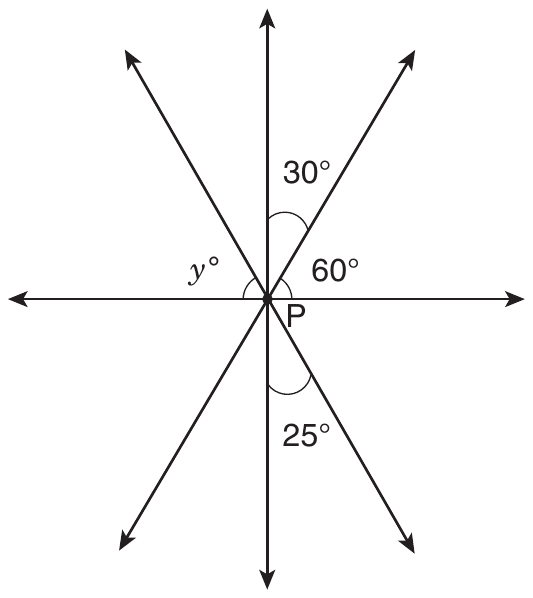
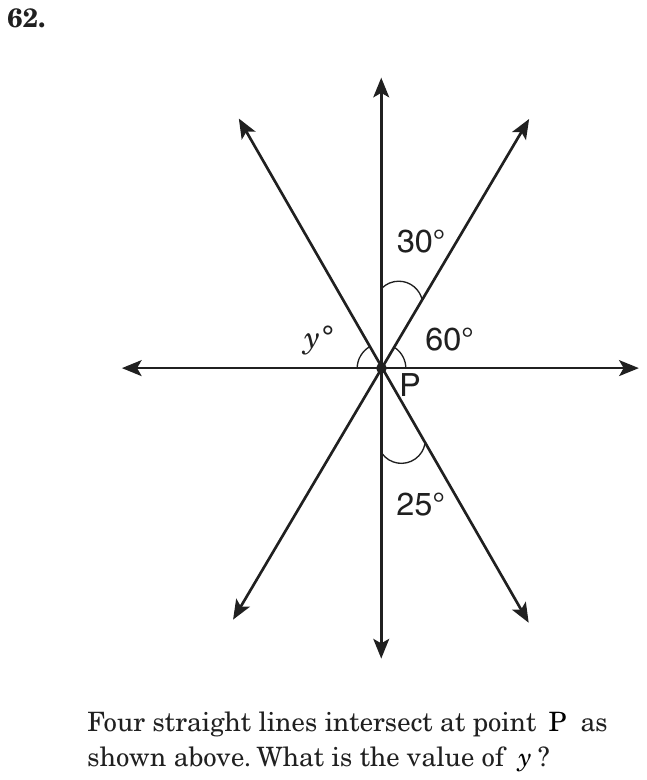
Four straight lines intersect at point P as shown above. What is the value of ?
Grid-in question: work out the answer and enter it as a number.
Show the answer
Correct answer: 65
Call the missing angle in the top half of the figure .
The sum of the four angles on the top of the figure is equal to 180°.
Since is a vertical angle with the 25° angle, then is also 25°. Use that to solve for .
Question analysis
This grid-in angle question shows four straight lines crossing at a single point P and asks for the size of an unknown angle y. Students combine vertical angles with the fact that angles along a straight line add to 180 degrees. One angle they need is unlabeled and must be found from its vertical partner.
- NYS standards
- 7.G.5 angle relationships and equations
- Grade level
- Grade 7 content, by NYS standard
- Compared with grade 7
- At grade 7 Using vertical angles and straight angles to write an equation for an unknown angle is a core grade 7 geometry task. Four lines create more angles than usual, but the reasoning stays at grade 7.
- Estimated difficulty
- Moderate: several steps, or a close reading with one strong distractor.
- Thinking it demands
- Depth of knowledge 2, skills and concepts · mainly apply
- What makes it hard
- Reading a figure, table or graph major
- Combines ideas moderate
- An answer in an unexpected form minor
- Solution
- 3 steps
- Reading level
- Question and choices: about grade 4, 16 words.
- Students, last 30 days
- Not enough answers yet to show (it takes 10).
Why it is hard, traps and wrong answers (shows the answer)
Why it is hard
The arithmetic is one subtraction; the work is in seeing the figure correctly. Students have to notice that a fourth angle sits between the 30° angle and y, recognize it as the vertical partner of the 25° angle, and then use the straight line. The drawing is not to scale: y is drawn close to the 60° angle across the vertical line, which rewards anyone who computes rather than eyeballs.
Reading a figure, table or graph major Understanding the question
Four lines make eight angles around P but only three are labeled; above the horizontal line sit 60°, 30°, an unlabeled angle and y°, and that unlabeled angle is easy to overlook. (Lesh, Post & Behr, 1987; Kirsch & Mosenthal, 1990)
Combines ideas moderate Working it out
The solution joins two facts: the unlabeled angle is vertical to the 25° angle below P, and the four angles above the horizontal line make a straight angle of 180°. (Embretson, 1998; Daniel & Embretson, 2010)
An answer in an unexpected form minor Choosing the answer
As a grid-in, nothing confirms the result, and the drawing shows y at about 60°, so a reading of the picture produces a number that looks right. (Enright, Morley & Sheehan, 2002)
Strategy: Pick a straight line through P and list the angles on one side of it; replace the unlabeled one with the labeled angle vertical to it, then subtract from 180.
Traps
- Misreads the figure: Reads a value, label or tick spacing in a figure, table or graph wrongly.
- Stops one step early: A choice is a number from partway through the solution.
- Trusting the picture: The figure suggests something it does not state; work from the given facts.
The wrong answers, classified
90 Misreads the figure (Lesh, Post & Behr, 1987; Kirsch & Mosenthal, 1990)
Misses the unlabeled angle between the 30° angle and y, so subtracts only 30 and 60 from 180.
115 Stops one step early (King et al., 2004; Gierl et al., 2017)
Adds the three known angles beside y, 25 + 30 + 60, and grids that sum without subtracting it from 180.
60 Trusting the picture (Lesh, Post & Behr, 1987)
Judges from the drawing, where y looks like a mirror image of the 60° angle across the vertical line, instead of computing it.
Worked solution, step by step
Formulas used
- Angles on a straight line
- a, b, c and d are angles that sit side by side along one side of a straight line, all meeting at one point. Together they make a half turn, which is 180 degrees. This works for any number of angles, not just four.
- Vertical angles
- When two lines cross, they make an X. Angle 1 and angle 2 are opposite each other across the crossing point. Angles like these are called vertical angles. They are always equal.
Look closely at the figure
Four lines cross at point P. Look above the flat, or horizontal, line. From right to left there are four angles: 60°, 30°, an angle with no label, and y°.
Below the horizontal line there is a 25° angle. You need to find y.
Find the unlabeled angle
The unlabeled angle sits between the up-and-down, or vertical, line and the slanted line rising to the left.
That slanted line keeps going through P and down to the right. The 25° angle sits between that same line and the vertical line, below P.
So the two angles are opposite each other across P. They are vertical angles, so they are equal. The unlabeled angle is 25°.
Add the angles above the line
The four angles above the horizontal line fill one side of a straight line. So they add up to 180°.
Solve for y
Take 115 away from 180 to get y alone.
Watch out: Do not skip the unlabeled angle. Using only 30 and 60 gives 90. Do not stop at the sum, 115, either. And do not guess from the picture. Angle y looks like 60°, but the drawing is not exact.
So you would grid 65.
Check your answer
Add all four angles above the horizontal line: . They fill a straight line exactly, so 65 fits.
More questions like this
The original DOE question
Question 13 of 13
2018 Test B Math, question 7Question
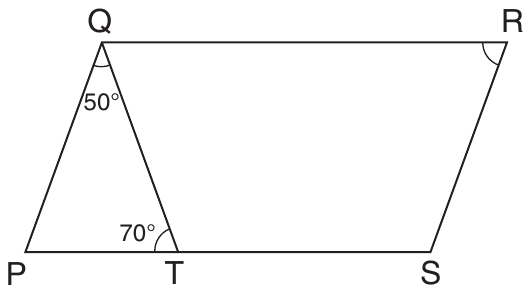
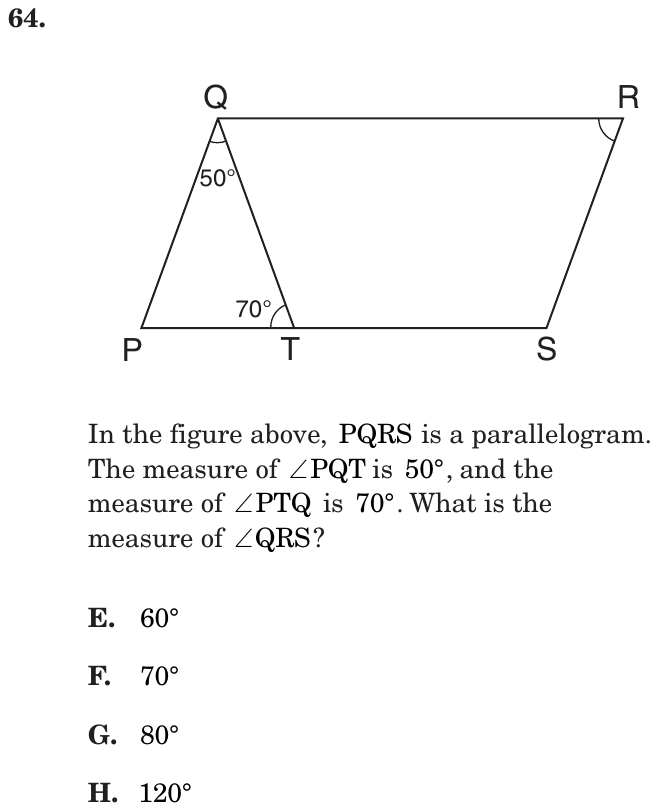
In the figure above, PQRS is a parallelogram. The measure of ∠PQT is 50°, and the measure of ∠PTQ is 70°. What is the measure of ∠QRS?
- A60°
- B70°
- C80°
- D120°
Show the answer
Correct answer: A
Find the missing angle, angle QPT, of triangle PQT:
180° − 70° − 50° = 60°
In parallelogram PQRS, angle QPT is congruent to angle QRS, so the measure of angle QRS is also 60°.
Question analysis
This geometry question uses parallelogram PQRS and a triangle PQT inside it, giving two of the triangle's angles and asking for angle QRS. Students need the triangle angle sum and the fact that opposite angles of a parallelogram are equal. The challenge is connecting the angles found in the triangle to the angles of the parallelogram.
- NYS standards
- Grade level
- Grade 8 content, by NYS standard
- Compared with grade 7
- Above grade 7 Grade 7 angle work uses vertical, adjacent and supplementary angles. This also needs the triangle angle sum and the opposite angles of a parallelogram, ideas New York places in grade 8, though the arithmetic is short.
- Estimated difficulty
- Moderate: several steps, or a close reading with one strong distractor.
- Thinking it demands
- Depth of knowledge 2, skills and concepts · mainly apply
- What makes it hard
- Reading a figure, table or graph major
- Combines ideas moderate
- A very close wrong answer moderate
- Something you must already know minor
- Solution
- 2 steps
- Reading level
- Question and choices: about grade 4, 25 words.
- Students, last 30 days
- Not enough answers yet to show (it takes 10).
Why it is hard, traps and wrong answers (shows the answer)
Why it is hard
Few steps are needed, but the figure misleads. It draws triangle PQT as isosceles, so the angle at P looks the same as the marked 70°, and the angle at R looks the same again; a student who trusts the drawing never computes. Those who do compute the angle at P must still choose the opposite angle of the parallelogram, not the angle next to it, which is where 120° comes from.
Reading a figure, table or graph major Understanding the question
The figure carries facts the stem leaves out: T lies on side PS, the 50° is only part of the angle at Q, and the 70° is at T, not at a corner of the parallelogram. (Lesh, Post & Behr, 1987; Kirsch & Mosenthal, 1990)
Combines ideas moderate Working it out
Two separate facts link up: the angles of triangle PQT sum to 180°, and the angle at P, once known, equals the opposite angle at R of parallelogram PQRS. (Embretson, 1998; Daniel & Embretson, 2010)
A very close wrong answer moderate Choosing the answer
60° and 70° are close enough that judging the angle at R by eye cannot separate them, and the drawing even favors 70°; only computing the triangle's third angle does. (Embretson & Wetzel, 1987; Gorin & Embretson, 2006; Ascalon et al., 2007)
Something you must already know minor Working it out
Neither the triangle angle sum nor the rule that opposite angles of a parallelogram are equal is given; students must bring both to the figure. (Anderson & Krathwohl, 2001)
Strategy: Find the third angle of triangle PQT from the angle sum, work out which angle of the parallelogram it matches, then use the parallelogram's angle facts to reach angle QRS.
Traps
- Trusting the picture: The figure suggests something it does not state; work from the given facts.
- Answers a different question: A choice is right for another quantity: the other unknown, the rest instead of the part, the part instead of the whole.
The wrong answers, classified
B Trusting the picture (Lesh, Post & Behr, 1987)
Trusts the drawing, where triangle PQT looks isosceles, so takes the angle at P, and its opposite angle at R, to be 70° like the angle at T.
C Little reason to choose it (Haladyna & Downing, 1993; Rodriguez, 2005)
No standard step gives 80°; at most a student treats the triangle as having two 50° angles and computes 180 − 100, which nothing in the figure supports.
D Answers a different question (King et al., 2004; Hegarty, Mayer & Monk, 1995)
Finds the 60° angle at P but answers with the angle at Q, 180 − 60 or 50 + 70 = 120, the consecutive angle instead of the opposite one.
Worked solution, step by step
Formulas used
- Angles in a triangle
- a, b and c are the three angles inside any triangle. They always add up to 180 degrees. If you know two of the angles, subtract them from 180 to find the third.
- Opposite angles of a parallelogram
- A parallelogram is a four-sided shape whose opposite sides are parallel, meaning they never meet. In parallelogram PQRS, the corners at P and R are opposite each other. Opposite angles of a parallelogram are always equal.
Sort out the figure
PQRS is a parallelogram. That is a four-sided shape whose opposite sides are parallel, meaning they never meet.
Point T is on the bottom side PS. Segment QT cuts off triangle PQT on the left. In that triangle, angle PQT is 50° and angle PTQ is 70°.
You need angle QRS, the corner at R.
Find the third angle of the triangle
Triangle PQT has angles at Q, T and P. You know two of them. The angle at P is angle QPT. All three must add to 180°.
So angle QPT is 60°.
Match angle P to angle R
T lies on side PS. So angle QPT is also the corner of the parallelogram at P. Angle P and angle R are opposite corners. Opposite angles are equal, so angle QRS is also 60°.
Watch out: Angle Q is next to angle P, not opposite it. Angle Q is 120°, choice D, but the question asks about angle R. Also, do not trust the drawing. Angle R may look like 70°, choice B.
So the answer is A, 60°.
Check your answer
The four corners of the parallelogram are 60°, 120°, 60° and 120°. They add to 360°, as the angles of any four-sided shape must. Also, the 50° angle at Q fits inside the 120° corner at Q.
More questions like this
The original DOE question