7.EE.3 multi-step rational number problems
Question 1 of 10
2026 Practice Test C Math, question 11Question
Allison has 5 stamp albums with 576 stamps in each album. If she transfers her stamp collection to 6 albums, each holding 378 stamps, how many stamps will be left over?
- A198
- B612
- C620
- D632
Show the answer
Correct answer: B
Determine the total number of stamps in 5 albums holding 576 stamps:
Determine the total number of stamps in 6 albums holding 378 stamps:
Subtract 2,268 from 2,880 to find the number of stamps that will be left over:
Question analysis
Allison moves a stamp collection from 5 albums of 576 stamps into 6 albums that hold 378 each, and students find how many stamps are left over. It tests multiplying and subtracting large whole numbers in a word problem. The question gives no total, so the collection has to be counted before the new albums' capacity is taken away.
- Grade level
- Grade 7 content, by NYS standard
- Compared with grade 7
- Below grade 7 Whole-number multiplication and subtraction in a three-step word problem is easier than grade 7 work with fractions, decimals or negatives. Because the products are large, a slip or a rounded estimate easily gives another choice.
- Estimated difficulty
- Straightforward: two steps or one careful reading.
- Thinking it demands
- Depth of knowledge 2, skills and concepts · mainly apply
- What makes it hard
- A very close wrong answer moderate
- Error-prone arithmetic minor
- Solution
- 3 steps
- Reading level
- Question and choices: about grade 6, 27 words.
- Students, last 30 days
- Not enough answers yet to show (it takes 10).
Why it is hard, traps and wrong answers (shows the answer)
Why it is hard
The plan is clear from the stem: count the stamps, then take away what the six new albums hold, so the question tests careful arithmetic. Its choices punish the estimating that saves time elsewhere, since rounding either factor shifts the result by only a few tens, onto another listed number. Students who skip the album counts altogether and compare one album with one album find 198 waiting.
A very close wrong answer moderate Choosing the answer
612, 620 and 632 lie within 20 of one another, so rounding 576 and 378 to friendly numbers before multiplying lands on a wrong choice; only exact products separate them. (Embretson & Wetzel, 1987; Gorin & Embretson, 2006; Ascalon et al., 2007)
Error-prone arithmetic minor Working it out
Two products of three-digit numbers, 5 × 576 = 2,880 and 6 × 378 = 2,268, must be done by hand and then subtracted with regrouping. (Brown & Burton, 1978; Junker & Sijtsma, 2001)
Strategy: Multiply to find the total number of stamps, multiply again to find how many the six new albums hold, subtract, and check the last digit of each product.
Traps
- Rounds too early: Rounds a value partway through, or rounds the wrong way, so the final answer drifts from the exact one.
- Numbers taken from the question: Combines the numbers in the question without a model of the situation, or is simply a number that appears in the question.
The wrong answers, classified
A Numbers taken from the question (Hegarty, Mayer & Monk, 1995)
Subtracts 378 from 576, comparing one old album with one new album, and ignores that there are 5 old albums and 6 new ones.
C Rounds too early (King et al., 2004)
Rounds 576 to 580 and 378 to 380 before multiplying, so 2,900 − 2,280 = 620, an estimate rather than the exact number left over.
D Rounds too early (King et al., 2004)
Rounds only 576 up to 580, getting 2,900 stamps, then subtracts the exact 2,268, so the count comes out 20 too high.
Worked solution, step by step
Formulas used
- Total in equal groups
- Here the groups are albums. The amount in each group is how many stamps one album holds. When every group is the same size, multiplying is a fast way to add them all up.
Sort out the question
Allison has 5 albums with 576 stamps in each. She moves all her stamps into 6 new albums. Each new album holds 378 stamps. Some stamps will not fit. You need the number left over.
Count all her stamps
Use the equal-groups formula. Split 576 into 500 + 76 to make it easy:
Allison has 2,880 stamps.
Count what the new albums hold
Do the same for the 6 new albums. Split 378 into 300 + 78:
The new albums hold 2,268 stamps in all.
Subtract to find the leftovers
The stamps left over are the ones she has minus the ones that fit:
Watch out: , choice A, compares just one old album with one new one. Rounding to 580 and 380 first gives 620, choice C. Rounding only 576 gives 632, choice D. Use the exact numbers.
So the answer is B, 612.
Check your answer
Add the leftovers to the stamps that fit: . That is exactly the number Allison started with. So no stamps were lost or counted twice.
More questions like this
The original DOE question
Question 2 of 10
2026 Practice Test D Math, question 14Question
James must read 84 pages of a book for a class assignment. If he reads of the pages in the morning and of the remaining pages in the afternoon, how many pages will he still need to read?
- A35
- B42
- C45
- D56
Show the answer
Correct answer: B
Pages read in the morning:
Pages remaining after the morning:
Pages read in the afternoon:
Pages he still needs to read:
Question analysis
James must read 84 pages for a class assignment: 1/4 of them in the morning, then 1/3 of the remaining pages in the afternoon. Students find how many pages he still has left to read. It tests finding a fraction of a quantity in stages, and the bold word remaining decides which amount the second fraction is taken of.
- Grade level
- Grade 7 content, by NYS standard
- Compared with grade 7
- At grade 7 Taking fractions of a quantity in stages is typical grade 7 work. The numbers divide evenly and the bold word flags the trap, so the four short steps match routine grade 7 demand.
- Estimated difficulty
- Straightforward: two steps or one careful reading.
- Thinking it demands
- Depth of knowledge 2, skills and concepts · mainly apply
- What makes it hard
- Many steps moderate
- Turning words into math minor
- Solution
- 4 steps
- Reading level
- Question and choices: about grade 7, 39 words.
- Students, last 30 days
- Not enough answers yet to show (it takes 10).
Why it is hard, traps and wrong answers (shows the answer)
Why it is hard
Each step is simple, but the second fraction has a different whole from the first. Students who take 1/3 of the full 84 pages get a tidy 28 and a listed answer, despite the bold word that warns against it. Here the pages read and the pages left both come to 42, so confusing those two quantities costs nothing, and checking that 21 + 21 + 42 = 84 confirms the work.
Many steps moderate Working it out
Four operations in order, a quarter of 84, a subtraction, a third of the 63 left, and a second subtraction, each feed the next, so a slip early carries through. (Daniel & Embretson, 2010; Enright, Morley & Sheehan, 2002)
Turning words into math minor Understanding the question
The bold “remaining” moves the base of the second fraction from all 84 pages to the 63 left after the morning, and “still need to read” asks for what is left, not what was read. (Hegarty, Mayer & Monk, 1995; Koedinger & Nathan, 2004)
Strategy: Work in order: find the morning's pages, subtract to get what remains, take 1/3 of that remainder, and subtract again; a quick bar sketch of the 84 pages helps.
Traps
- Misreads the question: Misses or misreads a condition or a word in the question: "at least", "each", "remaining", "not".
The wrong answers, classified
A Misreads the question (Hegarty, Mayer & Monk, 1995)
Takes 1/3 of all 84 pages for the afternoon, 28, instead of 1/3 of the 63 remaining, so 84 − 21 − 28 = 35.
C Little reason to choose it (Haladyna & Downing, 1993; Rodriguez, 2005)
No common working gives 45; it is not a fraction or a difference of any page count in the problem, so it mostly draws guesses near 42.
D Misreads the question (Hegarty, Mayer & Monk, 1995)
Takes the afternoon's third from all 84 pages and subtracts only that, 84 − 28 = 56, overlooking the 21 pages already read in the morning.
Worked solution, step by step
Formulas used
- A fraction of a number
- n is the whole amount, and a/b is the fraction you take. The word of means multiply. When the top, a, is 1, this is just n divided by b. For example, 1/4 of 84 is 84 ÷ 4.
Sort out the question
James has 84 pages to read. In the morning he reads 1/4 of all the pages. In the afternoon he reads 1/3 of the remaining pages, the ones still left after the morning. You need the number of pages he still has to read after that.
Find the morning pages
Take 1/4 of 84:
He reads 21 pages in the morning. That leaves:
63 pages are left after the morning.
Find the afternoon pages
The afternoon fraction is 1/3 of the 63 pages left, not of all 84:
He reads 21 pages in the afternoon.
Watch out: taking 1/3 of all 84 pages gives 28. Then 84 − 21 − 28 = 35, choice A. The bold word remaining tells you to use 63.
Find the pages still to read
Take the afternoon pages away from the 63 pages left after the morning:
He still needs to read 42 pages.
Watch out: subtract both readings, morning and afternoon. Taking only 28 from 84 gives 56, choice D.
So the answer is B, 42.
Check your answer
Add up all the parts: 21 pages in the morning, 21 in the afternoon and 42 still to read. 21 + 21 + 42 = 84, the whole assignment. Another way: after he reads 1/3 of the 63 pages, 2/3 of them are left, and 2/3 of 63 is 42.
More questions like this
The original DOE question
Question 3 of 10
2026 Practice Test D Math, question 22Question
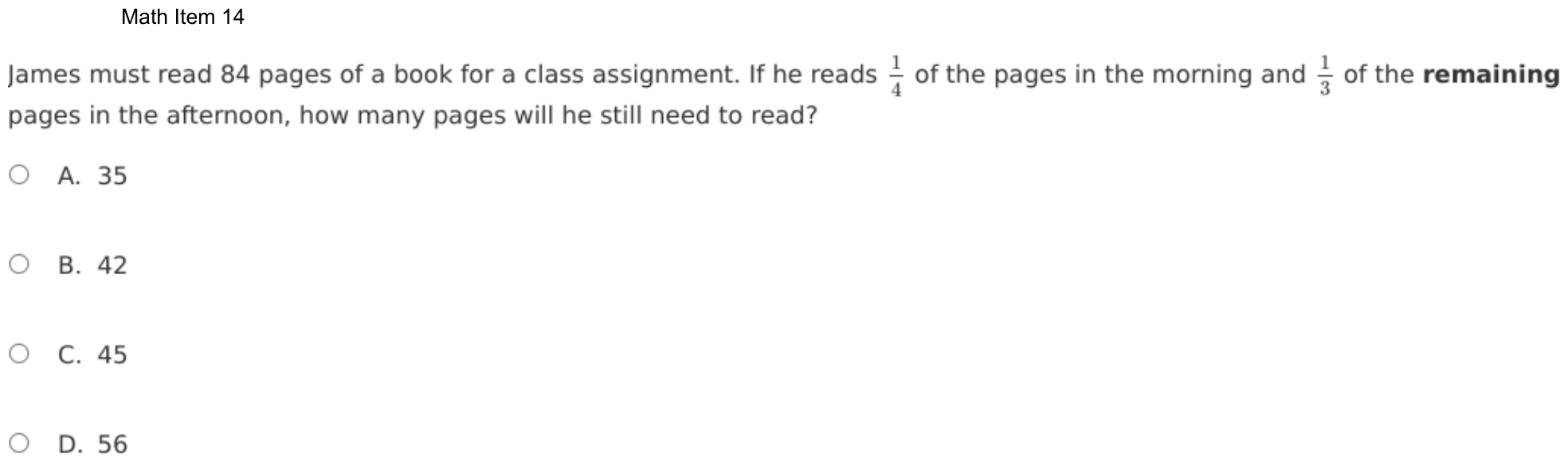
Seth grows strawberries in his garden.
- He picked cups of strawberries on Monday.
- He picked 4 cups of strawberries on Tuesday.
- He ate cup of strawberries for breakfast each day on Wednesday, Thursday, and Friday.
How many cups of strawberries did Seth have left?
- A
- B
- C6
- D9
Show the answer
Correct answer: B
When Seth picks strawberries, the value represents a positive number, and when he eats the strawberries, the value represents a negative number. Write an expression and then evaluate the expression, where the negative value is multiplied by 3 because he ate the same amount on 3 different days.
If the multiplication is confusing, evaluate the expression below which represents the sum for the 5 days with each day listed separately.
Question analysis
Seth picked strawberries on Monday and Tuesday, in amounts given as a mixed number and a whole number, then ate the same fraction of a cup at breakfast on three days. Students find how many cups he has left. It tests adding, multiplying and subtracting fractions in a short word problem, and the eaten amount repeats each day.
- Grade level
- Grade 7 content, by NYS standard
- Compared with grade 7
- Below grade 7 Adding mixed numbers and multiplying a fraction by a whole number are skills from before grade 7. The three steps are short and the numbers friendly, so the demand is below typical grade 7 work with signed rational numbers.
- Estimated difficulty
- Straightforward: two steps or one careful reading.
- Thinking it demands
- Depth of knowledge 2, skills and concepts · mainly apply
- What makes it hard
- Error-prone arithmetic moderate
- Turning words into math minor
- Solution
- 3 steps
- Reading level
- Question and choices: about grade 6, 47 words.
- Students, last 30 days
- Not enough answers yet to show (it takes 10).
Why it is hard, traps and wrong answers (shows the answer)
Why it is hard
The bulleted list lays out the story day by day, so setting up the problem is easy; the points are lost in the fractions. The number of breakfast days, 3, sits right beside the 3/4 cup, and subtracting 3 cups instead of three quarters of a cup each day is the tempting shortcut. Writing every amount in fourths, 26/4 picked and 9/4 eaten, makes the last step a whole-number subtraction.
Error-prone arithmetic moderate Working it out
Three breakfasts of 3/4 cup make 9/4 = 2 1/4 cups, and taking that from 6 1/2 means renaming the half as 2/4, two fraction steps where a slip is easy. (Brown & Burton, 1978; Junker & Sijtsma, 2001)
Turning words into math minor Understanding the question
Picking adds and eating subtracts, and “each day on Wednesday, Thursday, and Friday” means the 3/4 cup counts three times, not once. (Hegarty, Mayer & Monk, 1995; Koedinger & Nathan, 2004)
Strategy: Add the two amounts picked, multiply the breakfast amount by the number of days, and subtract that from the total; writing every amount in fourths keeps the arithmetic simple.
Traps
- Numbers taken from the question: Combines the numbers in the question without a model of the situation, or is simply a number that appears in the question.
- Wrong operation: Adds instead of multiplying, divides the wrong way round, turns a ratio or rate upside down, or undoes a step in the wrong direction (subtracts what should be added back).
The wrong answers, classified
A Numbers taken from the question (Hegarty, Mayer & Monk, 1995)
Subtracts 3 cups, the number of breakfast days, instead of 3 × 3/4 = 2 1/4 cups, so 6 1/2 − 3 = 3 1/2.
C Little reason to choose it (Haladyna & Downing, 1993; Rodriguez, 2005)
No common working gives exactly 6; it is near the 6 1/2 cups picked and mostly catches students who drop the fractions or guess.
D Wrong operation (Hegarty, Mayer & Monk, 1995; King et al., 2004)
Adds the 2 1/4 cups eaten to the 6 1/2 cups picked instead of subtracting, 8 3/4 cups, and takes the nearest choice, 9.
Worked solution, step by step
Formulas used
- Total of a repeated amount
- Use it when the same amount happens again and again. Here Seth eats 3/4 cup on each of 3 days, so the number of times is 3 and the amount each time is 3/4 cup.
- A whole number times a fraction
- n is a whole number, and a/b is a fraction. Multiply the whole number by the top only, and keep the bottom. It works because n groups of a pieces make n × a pieces, and each piece is still size 1/b.
Sort out the question
Seth picked 2 1/2 cups on Monday and 4 cups on Tuesday. Then he ate 3/4 cup each day on Wednesday, Thursday and Friday. That is 3 days of eating. Picking adds strawberries, and eating takes them away. You need the number of cups he has left.
Add what he picked
Add the two days of picking:
He picked 6 1/2 cups in all, before he ate any.
Find how much he ate
He ate 3/4 cup on each of 3 days. Multiply:
To change 9/4 to a mixed number, note that 4 fits into 9 twice, with 1 left over. He ate 2 1/4 cups.
Watch out: he ate 3/4 cup three times, not 3 cups. Subtracting 3 gives 3 1/2, choice A.
Take away what he ate
Write the half as fourths, so both fractions have the same bottom: 1/2 = 2/4. Then subtract the wholes and the fourths:
Watch out: eating takes away. Adding the 2 1/4 cups gives 8 3/4, and the nearest choice is 9, choice D.
So the answer is B, cups.
Check your answer
Use decimals. 2.5 + 4 = 6.5 cups picked. 3 × 0.75 = 2.25 cups eaten. Then 6.5 − 2.25 = 4.25 cups, which is 4 1/4.
More questions like this
The original DOE question
Question 4 of 10
2024 Test A Math, question 4Question
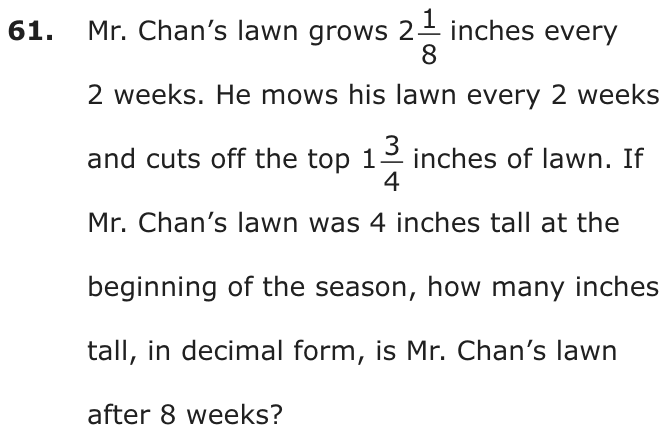
Mr. Chan’s lawn grows inches every 2 weeks. He mows his lawn every 2 weeks and cuts off the top inches of lawn. If Mr. Chan’s lawn was 4 inches tall at the beginning of the season, how many inches tall, in decimal form, is Mr. Chan’s lawn after 8 weeks?
Grid-in question: work out the answer and enter it as a number.
Show the answer
Correct answer: 5.5
The lawn grows inches every 2 weeks. Find the total number of inches it grows in 8 weeks.
The lawn was 4 inches tall at the beginning of the season.
Mr. Chan mows his lawn every 2 weeks and cuts off the top inches. Find the total number of inches that are cut off in 8 weeks.
The height after 8 weeks is the total number of inches grown minus the total number of inches cut off.
Question analysis
This multistep word problem follows Mr. Chan's lawn over 8 weeks: it grows a mixed number of inches every 2 weeks, and he mows a mixed number of inches off on the same schedule. Students combine the growth, the cuts and the starting height and give the final height as a decimal. Leaving out one of those three pieces is the usual error.
- Grade level
- Grade 7 content, by NYS standard
- Compared with grade 7
- At grade 7 Grade 7 students solve multi-step problems with mixed numbers and convert between fractions and decimals. This one strings four such steps together, including counting the 2-week periods, which is typical grade 7 work done carefully.
- Estimated difficulty
- Moderate: several steps, or a close reading with one strong distractor.
- Thinking it demands
- Depth of knowledge 2, skills and concepts · mainly apply
- What makes it hard
- Many steps moderate
- Error-prone arithmetic moderate
- Turning words into math minor
- An answer in an unexpected form minor
- Solution
- 4 steps
- Reading level
- Question and choices: about grade 3, 49 words.
- Corrected from the DOE handbook
- A misspelled name in the explanation was corrected.
- Students, last 30 days
- Not enough answers yet to show (it takes 10).
Why it is hard, traps and wrong answers (shows the answer)
Why it is hard
No single step is hard, but three parts must all reach the final height: the starting 4 inches, four rounds of growth and four rounds of mowing. Leaving out any one of them gives a clean decimal that can be gridded without a second thought. Working one 2-week period at a time, in which the lawn gains 3/8 inch net, keeps the bookkeeping short.
Many steps moderate Working it out
Four pieces have to be combined: count the four 2-week periods in 8 weeks, total the growth, total the mowing, and start from the lawn's first 4 inches. (Daniel & Embretson, 2010; Enright, Morley & Sheehan, 2002)
Error-prone arithmetic moderate Working it out
The amounts are mixed numbers with unlike denominators, 2 1/8 and 1 3/4, which must be multiplied by 4 or subtracted and then gridded as a decimal. (Brown & Burton, 1978; Junker & Sijtsma, 2001)
Turning words into math minor Understanding the question
The phrase "every 2 weeks" governs both the growing and the mowing, so 8 weeks means four rounds of each, not eight. (Hegarty, Mayer & Monk, 1995; Koedinger & Nathan, 2004)
An answer in an unexpected form minor Choosing the answer
As a grid-in it gives no choices, so a height that leaves out the starting 4 inches, or leaves out the mowing, looks as finished as the right one. (Enright, Morley & Sheehan, 2002)
Strategy: Find the net change for one 2-week period by subtracting the cut from the growth, multiply by the number of such periods in 8 weeks, and add the starting height.
Traps
- Stops one step early: A choice is a number from partway through the solution.
- Misreads the question: Misses or misreads a condition or a word in the question: "at least", "each", "remaining", "not".
The wrong answers, classified
1.5 Stops one step early (King et al., 2004; Gierl et al., 2017)
Finds the net gain of 3/8 inch per period and multiplies by the 4 periods, 1.5 inches, but stops before adding the lawn's starting height of 4 inches.
12.5 Stops one step early (King et al., 2004; Gierl et al., 2017)
Adds four periods of growth, 8.5 inches, to the starting 4 inches and stops there, never subtracting the 1 3/4 inches cut at each of the four mowings.
7 Misreads the question (Hegarty, Mayer & Monk, 1995)
Applies the net gain of 3/8 inch to each of the 8 weeks instead of each 2-week period, 8 × 3/8 = 3, then adds the starting 4.
What was corrected from the DOE handbook, and why
- Explanation: The handbook’s explanation says “Mr. Chen mows his lawn every 2 weeks.” The question calls him Mr. Chan throughout, so the site now reads “Mr. Chan.”
Worked solution, step by step
Formulas used
- Mixed number to decimal
- A mixed number has a whole part, a, and a fraction part, b over c. To write it as a decimal, divide b by c to get the fraction part as a decimal. Then add the whole part. For example, one and a half is 1 + 0.5 = 1.5.
- Repeated amount
- n is how many times something happens. a is the amount each time. Adding the same amount n times is the same as multiplying it by n.
Sort out the question
The lawn starts at 4 inches tall. Every 2 weeks it grows inches. Every 2 weeks Mr. Chan also cuts off inches. You need the height after 8 weeks, as a decimal. Three things matter: the start, the growing and the cutting.
Count the 2-week periods
Both the growing and the cutting happen every 2 weeks. So count how many 2-week periods fit in 8 weeks.
There are 4 periods. The lawn grows 4 times and is cut 4 times. Watch out: do not count 8 rounds, one for each week. That leads to the wrong answer 7.
Change the mixed numbers to decimals
The answer must be a decimal, so change both amounts now.
Each period, the lawn grows 2.125 inches and loses 1.75 inches.
Add up the growing
The lawn grows 2.125 inches, 4 times.
It grows 8.5 inches in all. Add the starting height of 4 inches.
Without mowing, the lawn would be 12.5 inches tall. Watch out: do not forget the starting 4 inches. Leaving them out leads to 1.5.
Add up the cutting
Mr. Chan cuts off 1.75 inches, 4 times.
He cuts off 7 inches in all.
Subtract the cutting
The lawn is 5.5 inches tall after 8 weeks. Watch out: 12.5 is not the answer. It leaves out the mowing. So you would grid 5.5.
Check your answer
Work one period at a time. Each period the lawn gains inch. In 4 periods that is inches. Add the starting 4 inches: . Same answer.
More questions like this
The original DOE question
Question 5 of 10
2024 Test A Math, question 49Question
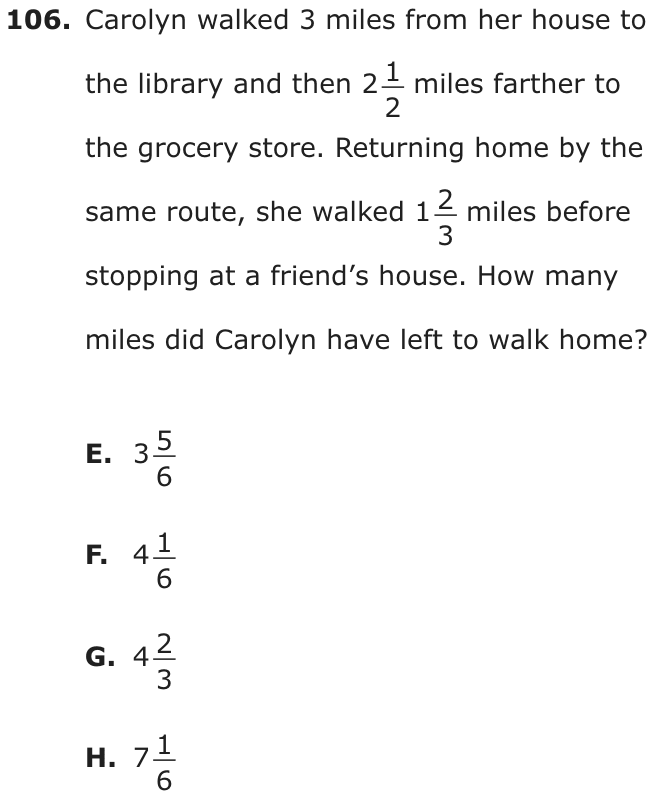
Carolyn walked 3 miles from her house to the library and then miles farther to the grocery store. Returning home by the same route, she walked miles before stopping at a friend’s house. How many miles did Carolyn have left to walk home?
- A
- B
- C
- D
Show the answer
Correct answer: A
The distance from Carolyn’s house to the grocery store is miles.
Carolyn walked miles back, so she still had miles left to walk home.
So Carolyn had miles left to walk home.
Question analysis
Carolyn walks 3 miles from home to the library and 2 1/2 miles more to the grocery store, then heads back the same way and stops at a friend's house after 1 2/3 miles. This fractions word problem asks how far she still has to walk home. Students add and subtract mixed numbers, and the subtraction needs regrouping across unlike denominators.
- Grade level
- Grade 7 content, by NYS standard
- Compared with grade 7
- At grade 7 Grade 7 students solve multi-step word problems with mixed numbers. This one has only positive numbers, but it needs a clear picture of the route and a subtraction that requires regrouping across unlike denominators.
- Estimated difficulty
- Moderate: several steps, or a close reading with one strong distractor.
- Thinking it demands
- Depth of knowledge 2, skills and concepts · mainly apply
- What makes it hard
- Error-prone arithmetic moderate
- A very close wrong answer moderate
- Turning words into math minor
- Solution
- 3 steps
- Reading level
- Question and choices: about grade 6, 48 words.
- Students, last 30 days
- Not enough answers yet to show (it takes 10).
Why it is hard, traps and wrong answers (shows the answer)
Why it is hard
The story needs a quick sketch, but the real test is one mixed-number subtraction in which the second fraction is larger than the first. Many students subtract the fractions the easy way round, which gives a choice close to the right one. Converting both numbers to sixths, 33/6 − 10/6, sidesteps the regrouping, and adding the result to 1 2/3 to get back 5 1/2 is a quick check.
Error-prone arithmetic moderate Working it out
The subtraction 5 1/2 − 1 2/3 needs sixths, 5 3/6 − 1 4/6, and the fraction on top is the smaller one, so a whole must be regrouped. (Brown & Burton, 1978; Junker & Sijtsma, 2001)
A very close wrong answer moderate Choosing the answer
Subtracting the fraction parts the wrong way round gives 4 1/6, only 1/3 away from the answer, so a rough estimate cannot tell the two apart. (Embretson & Wetzel, 1987; Gorin & Embretson, 2006; Ascalon et al., 2007)
Turning words into math minor Understanding the question
The route has to be pictured: the walk back starts at the grocery store, 5 1/2 miles from home, not at the library. (Hegarty, Mayer & Monk, 1995; Koedinger & Nathan, 2004)
Strategy: Sketch the route as a line from home to the library to the store, find the total distance out, then subtract the distance already walked back, using sixths.
Traps
- A faulty procedure: A systematic but wrong procedure: adding fractions straight across, applying an exponent to each term of a sum, dropping a sign when moving a term.
- Answers a different question: A choice is right for another quantity: the other unknown, the rest instead of the part, the part instead of the whole.
The wrong answers, classified
B A faulty procedure (Brown & Burton, 1978; Tatsuoka, 1983)
Subtracts the whole numbers, 5 − 1 = 4, then the fractions the easy way round, 2/3 − 1/2 = 1/6, giving 4 1/6.
C Answers a different question (King et al., 2004; Hegarty, Mayer & Monk, 1995)
On the store-to-library stretch, uses the 1 2/3 miles already walked instead of the 5/6 mile left, then adds the 3 miles home.
D Answers a different question (King et al., 2004; Hegarty, Mayer & Monk, 1995)
Adds all three distances, 3 + 2 1/2 + 1 2/3 = 7 1/6, which is how far she has walked so far, not how far is left.
Worked solution, step by step
Formulas used
- Mixed number to fraction
- a is the whole number part, b is the top of the fraction, and c is the bottom. Each whole holds c pieces, so a wholes hold a times c pieces. Then add the b extra pieces.
- Equivalent fractions
- a is the top of a fraction and b is the bottom. n is any number except 0. Multiplying the top and bottom by the same number gives an equal fraction, cut into smaller pieces. Use it to give two fractions the same bottom before you add or subtract.
- Subtracting fractions with the same bottom
- c is the shared bottom number. a and b are the tops. When the pieces are the same size, you just take away how many pieces you have. The size of the pieces, c, stays the same.
Picture the route
Draw a line: home, then the library, then the store. Home to the library is 3 miles. The library to the store is miles more. Carolyn walks back the same way. After miles she stops at a friend’s house. You need the miles still left to get home.
Find the distance from home to the store
The store is miles from home. She starts back from the store, so this is the full trip home. Watch out: adding all three distances gives , choice D. That is how far she has walked, not how far is left.
Change to improper fractions
The miles left are . An improper fraction has a top bigger than its bottom. Change each mixed number to one.
Use sixths for both
To subtract, the fractions need the same bottom. 2 and 3 both go into 6, so change both to sixths.
Subtract and simplify
23 sixths is 3 wholes (18 sixths) and 5 sixths more. So . Watch out: is less than . Subtracting the fraction parts the wrong way round gives , choice B.
So the answer is A, miles.
Check your answer
Add back: . That is the full distance from the store to home. Also estimate: 5.5 minus about 1.7 is about 3.8, and is about 3.83.
More questions like this
The original DOE question
Question 6 of 10
2023 Test A Math, question 41Question
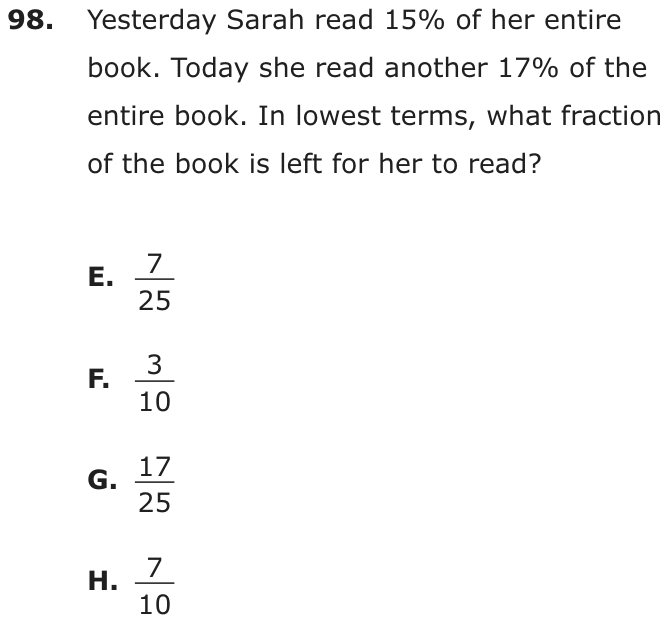
Yesterday Sarah read 15% of her entire book. Today she read another 17% of the entire book. In lowest terms, what fraction of the book is left for her to read?
- A
- B
- C
- D
Show the answer
Correct answer: C
So far, Sarah has read of the entire book. That means she has left to read.
Question analysis
This percent word problem says Sarah read 15% of her book yesterday and 17% today, and asks what fraction of the book she still has to read, in lowest terms. Students combine percents of the same whole, find the part remaining, and convert a percent to a simplified fraction. Rounding, or giving the part already read, leads to wrong choices.
- Grade level
- Grade 7 content, by NYS standard
- Compared with grade 7
- Below grade 7 Grade 7 percent work often takes a percent of a percent or finds a percent change. Here both percents are of the same whole book, so they combine directly; the rest is a subtraction and simplifying a fraction, lighter than typical.
- Estimated difficulty
- Straightforward: two steps or one careful reading.
- Thinking it demands
- Depth of knowledge 2, skills and concepts · mainly apply
- What makes it hard
- Solution
- 3 steps
- Reading level
- Question and choices: about grade 5, 33 words.
- Corrected from the DOE handbook
- Missing percent signs in the explanation were restored.
- Students, last 30 days
- Not enough answers yet to show (it takes 10).
Why it is hard, traps and wrong answers (shows the answer)
Why it is hard
The percent work is a sum and a subtraction from 100, so the question mostly tests the last step, writing 68% as a fraction in lowest terms. Students who round to 30% read and 70% left to get a friendlier fraction land on a listed choice, as do those who give the part read. Dividing 68 and 100 by their common factor 4 keeps the answer exact.
Turning words into math minor Understanding the question
Both percents are “of the entire book,” so they simply add to 32%, and “left for her to read” asks for the rest, 100% − 32%, not the part already read. (Hegarty, Mayer & Monk, 1995; Koedinger & Nathan, 2004)
An answer in an unexpected form minor Choosing the answer
The result has to be written as a fraction in lowest terms, so 68/100 must be divided by 4 to reach a form that appears among the choices. (Enright, Morley & Sheehan, 2002)
Strategy: Add the two percents, since both are of the whole book, subtract the total from 100%, then write the result over 100 and simplify it fully.
Traps
- Rounds too early: Rounds a value partway through, or rounds the wrong way, so the final answer drifts from the exact one.
- Answers a different question: A choice is right for another quantity: the other unknown, the rest instead of the part, the part instead of the whole.
The wrong answers, classified
A Little reason to choose it (Haladyna & Downing, 1993; Rodriguez, 2005)
No sum or difference of 15% and 17% gives 28%, so 7/25 mostly draws students who match the right fraction's 25 without checking the numerator.
B Answers a different question (King et al., 2004; Hegarty, Mayer & Monk, 1995)
Gives the part already read rather than the part left, and rounds that 32% to 30% to write it as 3/10.
D Rounds too early (King et al., 2004)
Finds that 68% is left but rounds it to 70% to make an easier fraction, giving 7/10 instead of simplifying 68/100 exactly.
What was corrected from the DOE handbook, and why
- Explanation: The handbook writes “So far, Sarah has read 15 + 17 = 32 of the entire book. That means she has 100 − 32 = 68 left to read.” (p. 143, question 98), with no percent signs, so 32 and 68 read as amounts of the book (pages, say) that the question never gives. The question gives 15% and 17%, and the handbook’s next line begins “68% =”, so the site now reads 15% + 17% = 32% and 100% − 32% = 68%. The answer, 17/25, is unchanged.
Worked solution, step by step
Formulas used
- Percent as a fraction
- p is the percent. Percent means “out of 100,” so p percent is p hundredths. For example, 50% is 50 out of 100, which is one half.
- Simplifying a fraction
- a is the top number, b is the bottom, and n is a number that divides both evenly. Dividing the top and bottom by the same number keeps the value the same. A fraction is in lowest terms when no number bigger than 1 divides both.
Sort out the question
Sarah read 15% of her book yesterday and 17% today. Both are percents of the whole book. You need the part still left to read, as a fraction in lowest terms. That means a fraction that can’t be simplified any more.
Find how much she has read
Both percents are of the same whole book, so you can add them. She has read 32% of it.
Find how much is left
The whole book is 100%.
Watch out: 32% is the part she has read, not the part left. Rounding 32% to 30% gives , choice B.
Write 68% as a fraction
This fraction is not in lowest terms yet, because 68 and 100 are both even.
Write it in lowest terms
The number 4 divides both 68 and 100 evenly.
Watch out: don’t round 68% to 70%. That gives , choice D. So the answer is C, .
Check your answer
Turn the answer back into a percent: , which is 68%. Then 68% + 32% = 100%, the whole book. Also, 17 and 25 share no factor except 1, so the fraction is in lowest terms.
More questions like this
The original DOE question
Question 7 of 10
2023 Test B Math, question 5Question
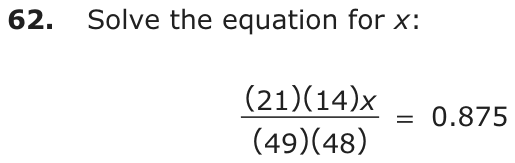
Solve the equation for x:
Grid-in question: work out the answer and enter it as a number.
Show the answer
Correct answer: 7
Question analysis
This equation puts x in a fraction with (21)(14) on top and (49)(48) below, set equal to the decimal 0.875. The grid-in asks for the value of x. Students do best to cancel common factors before multiplying anything out, and it helps to know the fraction that 0.875 equals.
- NYS standards
- Grade level
- Grade 7 content, by NYS standard
- Compared with grade 7
- At grade 7 Seventh graders solve equations like ax = b, usually with a simple coefficient. Here the coefficient is a product of four numbers that is best cancelled first, and a decimal has to be matched with a fraction.
- Estimated difficulty
- Moderate: several steps, or a close reading with one strong distractor.
- Thinking it demands
- Depth of knowledge 1, recall and reproduction · mainly apply
- What makes it hard
- Error-prone arithmetic moderate
- No obvious method minor
- An answer in an unexpected form minor
- Solution
- 3 steps
- Reading level
- Question and choices: about grade 5, 6 words.
- Students, last 30 days
- Not enough answers yet to show (it takes 10).
Why it is hard, traps and wrong answers (shows the answer)
Why it is hard
This is a one-unknown equation dressed in large numbers, and the work is in reducing them without slipping. Students who cancel early find that the whole coefficient is one eighth and that 0.875 is seven eighths, which makes the last step mental. Those who multiply out face a four-digit product and a decimal division, and with nothing to check against, an early slip goes unnoticed.
Error-prone arithmetic moderate Working it out
Multiplied out, the coefficient is 294 over 2,352 and the right side is the decimal 0.875; both invite slips unless 21/49 and 14/48 are cancelled first. (Brown & Burton, 1978; Junker & Sijtsma, 2001)
No obvious method minor Working it out
The quick route pairs 21 with 49 and 14 with 48 before multiplying, so that 3/7 × 7/24 collapses to 1/8; the layout of the fraction does not suggest that pairing. (Schoenfeld, 1985)
An answer in an unexpected form minor Choosing the answer
The result is entered with no choices, so a coefficient’s denominator or a quotient taken the wrong way looks as complete as the right value. (Enright, Morley & Sheehan, 2002)
Strategy: Cancel before multiplying: reduce 21 over 49 and 14 over 48, multiply the simplified fractions, then undo that coefficient, writing 0.875 as a fraction if it helps.
Traps
- Stops one step early: A choice is a number from partway through the solution.
- Wrong operation: Adds instead of multiplying, divides the wrong way round, turns a ratio or rate upside down, or undoes a step in the wrong direction (subtracts what should be added back).
- An arithmetic slip: The right method with a plausible arithmetic error: a digit, a place value or a times-table fact.
The wrong answers, classified
8 Stops one step early (King et al., 2004; Gierl et al., 2017)
Simplifies the coefficient correctly to 1/8 but enters the 8 from its denominator, never multiplying it by 0.875.
0.109375 Wrong operation (Hegarty, Mayer & Monk, 1995; King et al., 2004)
Divides 0.875 by 8 instead of multiplying, undoing the coefficient 1/8 the wrong way, so x comes out as 0.109375.
3.5 An arithmetic slip (Junker & Sijtsma, 2001)
Slips in reducing 14/48, taking it as 7/12 instead of 7/24, so the coefficient becomes 1/4 and x = 0.875 × 4 = 3.5.
Worked solution, step by step
Formulas used
- Multiplying fractions
- a and c are the tops, or numerators. b and d are the bottoms, or denominators. Multiply the tops together and the bottoms together. It also works backward: you can split one fraction into two smaller ones. That lets you simplify before the numbers get big.
Sort out the question
You need the value of x. On top, 21, 14 and x are multiplied. The bottom is 49 times 48. The right side is 0.875.
Multiplying 49 by 48 makes a big number. It is easier to simplify first.
Split the fraction into two
Use the rule for multiplying fractions backward. Pair 21 with 49, and 14 with 48.
Now the equation says these two fractions times x equal 0.875.
Simplify each fraction
To simplify, divide the top and bottom by the same number. Both 21 and 49 divide by 7. Both 14 and 48 divide by 2.
Watch out: 48 ÷ 2 is 24, not 12. Writing leads to 3.5.
Multiply the simple fractions
The 7 on top and the 7 on the bottom cancel, since 7 ÷ 7 = 1. Then divide 3 and 24 by 3 to get . So the equation becomes:
Solve for x
One eighth of x is 0.875. To undo dividing by 8, multiply both sides by 8.
Watch out: 8 is not the answer, and don’t divide 0.875 by 8. So you would grid 7.
Check your answer
0.875 is the same as . One eighth of 7 is , so x = 7 works. You can also multiply it all out: and . Then .
More questions like this
The original DOE question
Question 8 of 10
2022 Test A Math, question 28Question
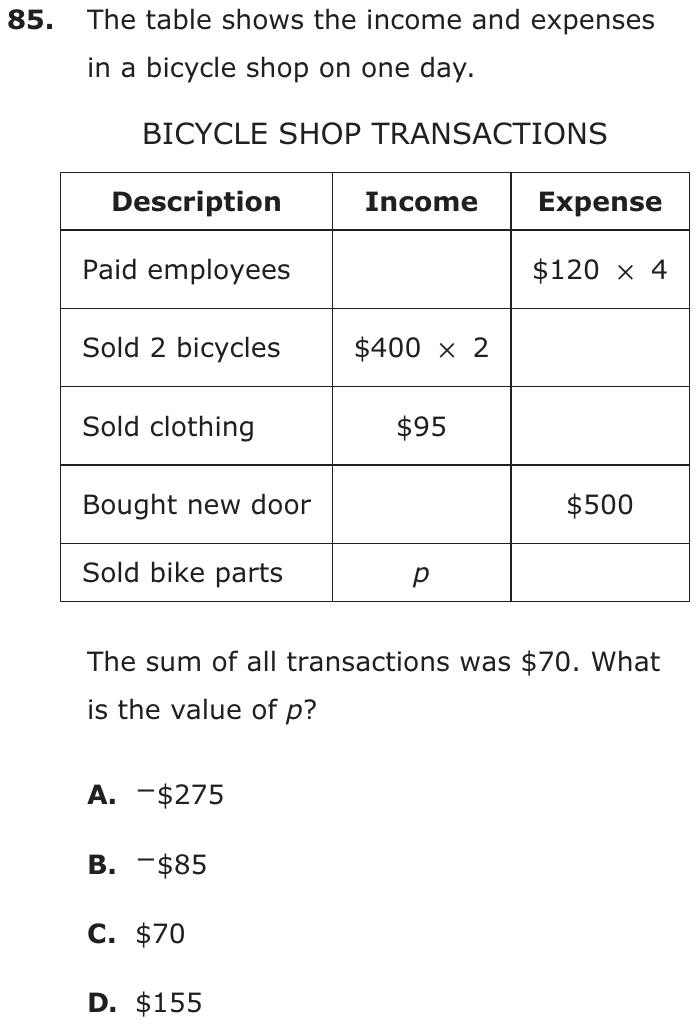
The table shows the income and expenses in a bicycle shop on one day.
BICYCLE SHOP TRANSACTIONS
| Description | Income | Expense |
|---|---|---|
| Paid employees | ||
| Sold 2 bicycles | ||
| Sold clothing | $95 | |
| Bought new door | $500 | |
| Sold bike parts | p |
The sum of all transactions was $70. What is the value of p?
- A−$275
- B−$85
- C$70
- D$155
Show the answer
Correct answer: D
The sum of all transactions ($70) includes the income data (positive values) and the expense data (negative values). Write an equation to determine the value of p by adding all the income data and subtracting all the expense data:
Simplify the expression to determine the value of p:
Question analysis
A table lists one day of income and expenses at a bicycle shop, including two products to work out and an unknown amount, p, from selling bike parts. Given that all the transactions add up to $70, students find p. They must treat income as positive and expenses as negative, then solve an equation.
- Grade level
- Grade 7 content, by NYS standard
- Compared with grade 7
- At grade 7 Grade 7 students solve multi-step money problems with positive and negative amounts. This table adds an unknown income entry, so students treat income as positive and expenses as negative before solving a one-step equation.
- Estimated difficulty
- Moderate: several steps, or a close reading with one strong distractor.
- Thinking it demands
- Depth of knowledge 2, skills and concepts · mainly apply
- What makes it hard
- Turning words into math moderate
- Reading a figure, table or graph minor
- Error-prone arithmetic minor
- Solution
- 4 steps
- Reading level
- Question and choices: about grade 5, 44 words.
- Students, last 30 days
- Not enough answers yet to show (it takes 10).
Why it is hard, traps and wrong answers (shows the answer)
Why it is hard
The table turns a one-variable equation into bookkeeping: each entry must be multiplied out and given a sign by its column before anything is added. The known entries come to a loss of $85, so the bike parts must cover that loss and still leave $70, which is why p is larger than the day's total. Students who stop at the running total, or who copy the $70, never use the equation at all.
Turning words into math moderate Understanding the question
“The sum of all transactions was $70” has to be read with income positive and expenses negative, giving 800 + 95 + p − 480 − 500 = 70. (Hegarty, Mayer & Monk, 1995; Koedinger & Nathan, 2004)
Reading a figure, table or graph minor Understanding the question
Two cells hold products, $120 × 4 and $400 × 2, that must be worked out, and p sits in the Income column beside the sales, so it is added. (Lesh, Post & Behr, 1987; Kirsch & Mosenthal, 1990)
Error-prone arithmetic minor Working it out
The known entries total 895 − 980 = −85, a negative running sum, so p must exceed 70 by 85 rather than fall short of it. (Brown & Burton, 1978; Junker & Sijtsma, 2001)
Strategy: Work out the two products in the table, add the income entries and subtract the expenses, set that total plus p equal to 70, and solve for p.
Traps
- Stops one step early: A choice is a number from partway through the solution.
- Numbers taken from the question: Combines the numbers in the question without a model of the situation, or is simply a number that appears in the question.
The wrong answers, classified
A Little reason to choose it (Haladyna & Downing, 1993; Rodriguez, 2005)
No single mistake gives −275; it takes counting the $95 clothing sale as an expense and then stopping at the known total, 800 − 95 − 480 − 500.
B Stops one step early (King et al., 2004; Gierl et al., 2017)
Totals the known entries correctly, 895 − 980 = −85, and gives that, stopping before solving for the p that brings the sum to $70.
C Numbers taken from the question (Hegarty, Mayer & Monk, 1995)
Picks $70, the stated sum of all the transactions, as the value of the bike parts, without setting up an equation.
Worked solution, step by step
Formulas used
- Sum of all transactions
- A transaction is money coming in or going out. Income is money that comes in, so it counts as plus. Expenses are money that goes out, so they count as minus. The sum is what is left, like money added to and taken from a wallet.
- Keeping an equation balanced
- a and b are the two equal sides. c is any number, but not 0 when you divide. Doing the same thing to both sides keeps them equal, like a balanced scale. Use it to get the unknown by itself.
Sort out the question
The table lists money that came into the shop, called income. It also lists money that went out, called expenses. The bike parts brought in p dollars, an amount you don’t know. All the income minus all the expenses is $70. You need p.
Work out the products in the table
Two cells in the table show multiplication.
So paying the employees cost $480. The 2 bicycles brought in $800.
Write the equation
The income is $800, $95 and p. The expenses are $480 and $500. p sits in the Income column, so it is added.
Combine the known numbers
The known entries come to −85 dollars. That is a loss of $85. Now the equation is shorter:
Watch out: −85 is choice B, but it is not p. You still have to solve for p.
Solve for p
Add 85 to both sides. This keeps the equation balanced.
The bike parts brought in $155. Watch out: $70 is the total for the day, not the bike parts. Don’t just copy it, choice C. So the answer is D, $155.
Check your answer
Put 155 back in. Income: dollars. Expenses: dollars. . That matches. And p should be more than 70, because the bike parts had to cover the $85 loss first.
More questions like this
The original DOE question
Question 9 of 10
2018 Test A Math, question 28Question
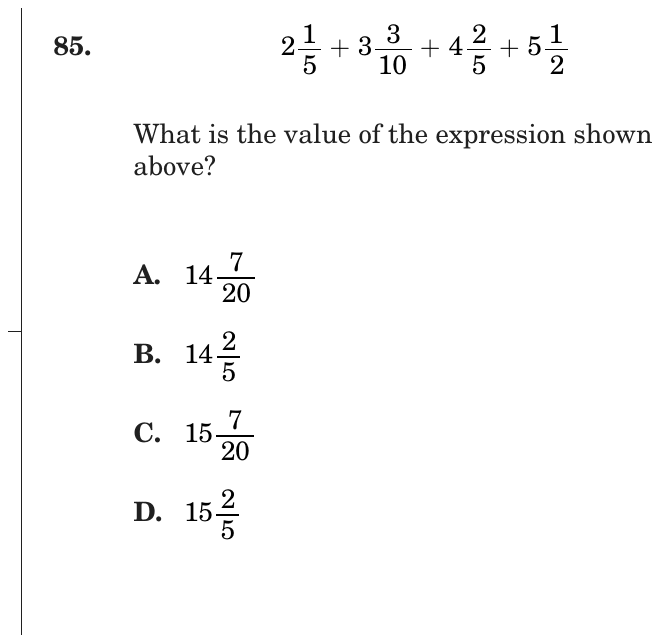
What is the value of the expression shown above?
- A
- B
- C
- D
Show the answer
Correct answer: D
Convert all the fractions to a common denominator (10):
Question analysis
A fractions question: add four mixed numbers whose fractions have denominators of 5, 10, 5 and 2. Students rewrite the fractions over a common denominator, add the whole numbers and the fractions, regroup any extra whole, and simplify. Regrouping and lowest terms both matter, since the choices differ in exactly those places.
- NYS standards
- Grade level
- Grade 7 content, by NYS standard
- Compared with grade 7
- Below grade 7 Adding mixed numbers with unlike denominators is grade 5 content. With four terms and a regrouping step it takes care, but it asks less than typical grade 7 work with negative rational numbers.
- Estimated difficulty
- Straightforward: two steps or one careful reading.
- Thinking it demands
- Depth of knowledge 1, recall and reproduction · mainly apply
- What makes it hard
- Error-prone arithmetic moderate
- A very close wrong answer moderate
- An answer in an unexpected form minor
- Solution
- 3 steps
- Reading level
- Question and choices: about grade 9, 14 words.
- Students, last 30 days
- Not enough answers yet to show (it takes 10).
Why it is hard, traps and wrong answers (shows the answer)
Why it is hard
The numbers are friendly: every fraction converts to tenths, and the whole parts add to 14. The risk is in the bookkeeping, either forgetting to carry the extra whole from the fractions or adding numerators over a made-up denominator. Converting to decimals, 2.2 + 3.3 + 4.4 + 5.5, is a fast check that avoids both.
Error-prone arithmetic moderate Working it out
Four mixed numbers with denominators 5, 10, 5 and 2 must be rewritten as tenths, 2 + 3 + 4 + 5 tenths, and the 14/10 regrouped into a whole and a fraction. (Brown & Burton, 1978; Junker & Sijtsma, 2001)
A very close wrong answer moderate Choosing the answer
15 2/5 and 14 2/5 are written alike and share the fraction 2/5; only the whole carried from 14/10 separates them, so a missed carry is invisible at a glance. (Embretson & Wetzel, 1987; Gorin & Embretson, 2006; Ascalon et al., 2007)
An answer in an unexpected form minor Choosing the answer
The fractions total 1 4/10, but every choice is in lowest terms, so the 4/10 has to be reduced to 2/5 before it matches. (Enright, Morley & Sheehan, 2002)
Strategy: Convert each mixed number to a decimal, since these fractions all convert exactly, add them, and turn the decimal part back into a fraction in lowest terms.
Traps
- Answer in another form: The right answer is written differently from the way you worked it out.
The wrong answers, classified
A A faulty procedure (Brown & Burton, 1978; Tatsuoka, 1983)
Adds the numerators straight across, 1 + 3 + 2 + 1 = 7, and puts them over 20, a common denominator (10 × 2), without rescaling them, so nothing carries.
B An arithmetic slip (Junker & Sijtsma, 2001)
Adds the fractions to 14/10 but keeps only the 4/10 = 2/5 left over, forgetting to carry the whole 1 into 14.
C Little reason to choose it (Haladyna & Downing, 1993; Rodriguez, 2005)
Pairs a correct carry into 15 with the 7/20 from adding numerators, two steps no single line of working combines; it mostly catches guesses.
Worked solution, step by step
Formulas used
- Equal fractions
- a is the top number, called the numerator. b is the bottom number, called the denominator. n is any whole number except zero. Multiplying the top and bottom by the same n gives an equal fraction. Use it to give fractions the same denominator so you can add them.
Sort out the question
You need to add four mixed numbers. A mixed number is a whole number plus a fraction, like . The fractions have different denominators, or bottom numbers: 5, 10, 5 and 2. To add fractions, they need the same denominator.
Add the whole numbers
Add the whole numbers first. You will add the fractions on their own after that.
The whole numbers make 14.
Rewrite each fraction in tenths
Use 10 as the denominator, since 5 and 2 both go into 10.
is already in tenths. Watch out: when you change a bottom number, change the top too. Adding the old tops, 1 + 3 + 2 + 1 = 7, and putting them over 20 gives 7/20. That is in choices A and C.
Add the fractions
14 tenths is more than 1 whole. Ten tenths make 1, so 14 tenths is 1 whole and 4 tenths.
To simplify 4/10, divide the top and bottom by 2.
Put it all together
Add the 14 wholes to the sum of the fractions.
Watch out: carry the extra whole into the 14. Missing it gives , choice B. So the answer is D, .
Check your answer
Change each mixed number to a decimal: . The 0.4 is 4 tenths, which is 2/5. So the sum is .
More questions like this
The original DOE question
Question 10 of 10
2018 Test A Math, question 52Question
Each week, Leon has fixed expenses of $1,250 at his furniture shop. It costs him $150 to make a chair in his shop, and he sells each chair for $275. What is Leon’s profit if he makes and sells 25 chairs in 1 week?
- A$1,875
- B$2,500
- C$3,125
- D$4,375
Show the answer
Correct answer: A
Each chair costs Leon $150 to make, and he sells the chair for $275.
His profit is found by subtracting the cost from the price:
$275 − $150 = $125 per chair
If Leon makes and sells 25 chairs in a week, his initial profit is
25 × $125 = $3,125
However, Leon has additional fixed expenses of $1,250 per week, so this cost must also be subtracted to arrive at the profit. His final profit is
$3,125 − $1,250 = $1,875
Question analysis
This profit word problem gives Leon's weekly fixed expenses at his furniture shop, the cost to make each chair and its selling price, then asks his profit for 25 chairs in one week. Students must find the profit on each chair, multiply, and account for the fixed expenses. Forgetting the fixed expenses, or adding them, are the main slips.
- NYS standards
- Grade level
- Grade 7 content, by NYS standard
- Compared with grade 7
- At grade 7 Multi-step money problems are standard grade 7 work. This one has three whole-number steps and a familiar profit idea, so it matches typical grade 7 demand, with the fixed cost as the detail to remember.
- Estimated difficulty
- Moderate: several steps, or a close reading with one strong distractor.
- Thinking it demands
- Depth of knowledge 2, skills and concepts · mainly apply
- What makes it hard
- Much to keep track of moderate
- Something you must already know minor
- Solution
- 3 steps
- Reading level
- Question and choices: about grade 3, 39 words.
- Students, last 30 days
- Not enough answers yet to show (it takes 10).
Why it is hard, traps and wrong answers (shows the answer)
Why it is hard
The arithmetic is whole-number and friendly, so the question is about bookkeeping: which amounts are income, which are costs, and which happen once a week. The fixed expenses are named first in the stem and are easy to forget by the time the per-chair profit is multiplied. A final check that revenue minus all costs, 6,875 − 3,750 − 1,250, gives the same result confirms it.
Much to keep track of moderate Working it out
Three dollar amounts play different roles, a weekly fixed expense, a cost per chair and a price per chair, and each must enter the profit with the right sign. (Sweller, 1988; Carpenter, Just & Shell, 1990)
Something you must already know minor Working it out
The bold "profit" is not defined; students must know it means money taken in minus every cost, including costs that do not depend on the number of chairs. (Anderson & Krathwohl, 2001)
Strategy: Subtract the cost from the price to get the profit per chair, multiply by the number of chairs, then subtract the week's fixed expenses.
Traps
- Stops one step early: A choice is a number from partway through the solution.
- Wrong operation: Adds instead of multiplying, divides the wrong way round, turns a ratio or rate upside down, or undoes a step in the wrong direction (subtracts what should be added back).
The wrong answers, classified
B Numbers taken from the question (Hegarty, Mayer & Monk, 1995)
Multiplies the $150 cost by 25 chairs and subtracts the $1,250, treating the cost of making a chair as money earned.
C Stops one step early (King et al., 2004; Gierl et al., 2017)
Finds the profit on 25 chairs at $125 each, $3,125, and stops before subtracting the $1,250 fixed expenses.
D Wrong operation (Hegarty, Mayer & Monk, 1995; King et al., 2004)
Adds the $1,250 fixed expenses to the $3,125 chair profit instead of subtracting them, treating an expense as income.
Worked solution, step by step
Formulas used
- Profit
- P is the profit, the money Leon keeps. I is the income, the money he takes in from sales. C is the total cost: every dollar he spends, including fixed expenses. Profit is what is left after all costs are paid.
Sort out what you know
Leon pays $1,250 each week no matter what. These are fixed expenses, like rent. Each chair costs $150 to make, and he sells each one for $275.
He makes and sells 25 chairs. Profit is the money left after paying all the costs.
Find the profit on one chair
Each chair sells for $275 but costs $150 to make. Subtract to see what he keeps:
He keeps $125 on each chair he sells.
Find the profit on 25 chairs
The chairs bring in $3,125 more than they cost to make. Watch out: $3,125 is choice C, but it is not the final profit. The fixed expenses still have to be paid.
Subtract the fixed expenses
Watch out: the $1,250 is money spent, so subtract it. Adding it gives $4,375, choice D. So the answer is A, $1,875.
Check your answer
Work it the long way. Sales: 25 × $275 = $6,875. Costs: 25 × $150 = $3,750, plus $1,250, which makes $5,000. Profit: $6,875 − $5,000 = $1,875. Same answer.
More questions like this
The original DOE question