7.EE.2 rewriting expressions to show relationships
Question 1 of 13
2026 Practice Test D Math, question 2Question
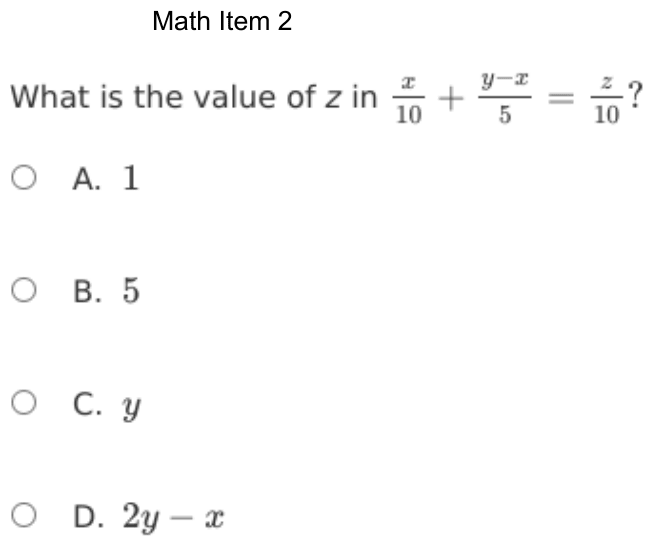
What is the value of z in ?
- A1
- B5
- C
- D
Show the answer
Correct answer: D
First, multiply both sides of the equation by 10 to eliminate the fractions. In other words, multiply each term by 10.
Then, distribute and combine like terms to find the value for z.
Question analysis
This algebra question gives an equation with three letters and fractions, x over 10 plus (y − x) over 5 equals z over 10, and asks for the value of z. Students clear the denominators, distribute and combine like terms. The two fractions on the left have different denominators, which is where the usual slip happens.
- NYS standards
- Grade level
- Grade 7 content, by NYS standard
- Compared with grade 7
- At grade 7 Grade 7 students add and expand linear expressions with fraction coefficients, usually in one letter. Here three letters appear, one numerator is a difference, and the result is an expression rather than a number, which adds abstraction but no new skill.
- Estimated difficulty
- Moderate: several steps, or a close reading with one strong distractor.
- Thinking it demands
- Depth of knowledge 1, recall and reproduction · mainly apply
- What makes it hard
- Variables instead of numbers moderate
- Error-prone arithmetic moderate
- Solution
- 3 steps
- Reading level
- Question and choices: about grade 6, 10 words.
- Students, last 30 days
- Not enough answers yet to show (it takes 10).
Why it is hard, traps and wrong answers (shows the answer)
Why it is hard
The equation has three fractions and three letters, and the work is three routine moves: multiply through by 10, distribute, collect the x terms. Most errors come from the middle term, whose denominator 5 differs from the other two; treating it as tenths makes z simply y. Students who test values should avoid x = y, since that pair makes y and 2y − x agree, and x = y = 1 even makes the number 1 fit.
Variables instead of numbers moderate Understanding the question
The answer is z in terms of x and y, not a number, yet two choices are plain numbers, 1 and 5, which tempt students who expect the equation to give z a single value. (Koedinger & Nathan, 2004; Enright, Morley & Sheehan, 2002)
Error-prone arithmetic moderate Working it out
Clearing the denominators turns (y − x)/5 into 2(y − x), and the −2x from distributing must then combine with the lone x to leave −x, two places where a factor or a sign slips. (Brown & Burton, 1978; Junker & Sijtsma, 2001)
Strategy: Multiply every term on both sides by 10 so no fractions remain, distribute across the parentheses, and combine the x terms; substituting small numbers for x and y checks the result.
Traps
- A faulty procedure: A systematic but wrong procedure: adding fractions straight across, applying an exponent to each term of a sum, dropping a sign when moving a term.
- Numbers taken from the question: Combines the numbers in the question without a model of the situation, or is simply a number that appears in the question.
The wrong answers, classified
A Checks only one number (Schoenfeld, 1985)
Tests x = 1 and y = 1, gets 1/10 + 0 = z/10, so z = 1, and takes the choice that reads 1; any pair with x ≠ y rules it out.
B Numbers taken from the question (Hegarty, Mayer & Monk, 1995)
Expects z to be a number and takes the 5 from the middle denominator, a number copied from the equation rather than the result of any step.
C A faulty procedure (Brown & Burton, 1978; Tatsuoka, 1983)
Adds the numerators x and y − x over 10 as if (y − x)/5 were already in tenths, so the left side becomes y/10 and z = y.
Worked solution, step by step
Formulas used
- Doing the same to both sides
- a and b are the two sides of an equation. Multiplying both sides by the same number keeps them equal, like adding the same weight to both pans of a balance. Here 10 is a good choice, because it clears away every fraction.
- The distributive property
- a is the number outside the parentheses, and b and c are the terms inside. Multiply a by each term inside, and keep the minus sign between them. It works because a groups of (b − c) is a groups of b minus a groups of c.
Sort out the question
The equation has three letters, x, y and z. You need z written using x and y. The answer will not be one number, because x and y can be anything. The fractions make the work messy, so clear them first.
Multiply every term by 10
The bottoms are 10, 5 and 10, and each one divides into 10. So multiply every term by 10:
10 times x/10 is x. Since 10 ÷ 5 = 2, 10 times (y − x)/5 is 2(y − x). And 10 times z/10 is z.
Distribute the 2
Use the distributive property. Multiply the 2 by both y and x:
So the equation becomes:
Combine like terms
Like terms have the same letter. Here x and −2x are like terms. Since 1 − 2 = −1, they combine to −x:
That leaves:
Watch out: do not add the tops of x/10 and (y − x)/5 straight away. Their bottoms are different. Doing it anyway gives z = y, choice C. Choices A and B are plain numbers, but z changes when x and y do.
So the answer is D, .
Check your answer
Pick numbers. Let x = 2 and y = 7. The left side is 2/10 + 5/5 = 0.2 + 1 = 1.2. Choice D gives z = 2 × 7 − 2 = 12, and 12/10 = 1.2. Both sides match.
More questions like this
The original DOE question
Question 2 of 13
2024 Test A Math, question 7Question
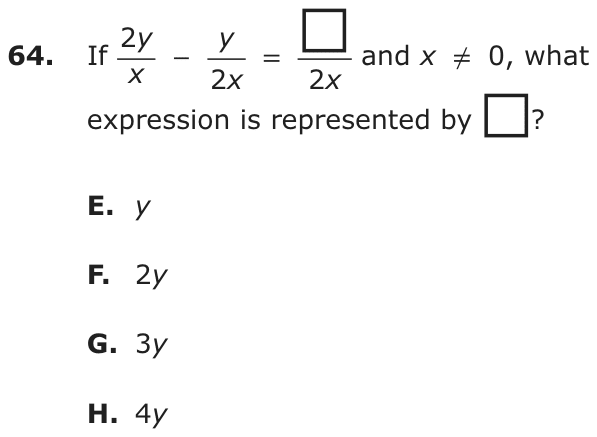
If and , what expression is represented by ?
- A
- B
- C
- D
Show the answer
Correct answer: C
Use properties of equations to determine the missing expression:
The missing expression is .
Question analysis
An algebra question with fractions: two fractions with x and 2x in their denominators are subtracted, and students find the numerator that makes the difference equal a fraction over 2x. It tests rewriting a fraction over a common denominator when the denominators contain a variable. Adjusting only part of a fraction is the common mistake.
- NYS standards
- Grade level
- Grade 7 content, by NYS standard
- Compared with grade 7
- At grade 7 Grade 7 students subtract fractions with unlike denominators and combine like terms, but rarely see a variable in a denominator. The steps are the same two as with numbers, so the demand is typical once the form is familiar.
- Estimated difficulty
- Straightforward: two steps or one careful reading.
- Thinking it demands
- Depth of knowledge 1, recall and reproduction · mainly apply
- What makes it hard
- Variables instead of numbers moderate
- Error-prone arithmetic minor
- Solution
- 2 steps
- Reading level
- Question and choices: about grade 13, 14 words.
- Students, last 30 days
- Not enough answers yet to show (it takes 10).
Why it is hard, traps and wrong answers (shows the answer)
Why it is hard
This is subtraction of fractions with unlike denominators, written with letters. The box over 2x shows the target denominator, which helps, but each wrong choice matches a familiar fraction error: subtracting the tops before matching the bottoms, or rewriting the first fraction and stopping. Students who rewrite 2y/x as 4y/2x and then subtract y from the new numerator finish in seconds.
Variables instead of numbers moderate Understanding the question
The denominators are x and 2x, so the common denominator is built with a letter, and there is no number to check unless students substitute values such as x = 1 and y = 2. (Koedinger & Nathan, 2004; Enright, Morley & Sheehan, 2002)
Error-prone arithmetic minor Working it out
Only the first fraction changes: 2y/x becomes 4y/2x with top and bottom both doubled, while y/2x already has the denominator the box sits over. (Brown & Burton, 1978; Junker & Sijtsma, 2001)
Strategy: Rewrite the first fraction over 2x by multiplying its top and bottom by 2, then subtract the numerators, which now share a denominator.
Traps
- A faulty procedure: A systematic but wrong procedure: adding fractions straight across, applying an exponent to each term of a sum, dropping a sign when moving a term.
- Stops one step early: A choice is a number from partway through the solution.
The wrong answers, classified
A A faulty procedure (Brown & Burton, 1978; Tatsuoka, 1983)
Subtracts the numerators straight away, 2y − y = y, and puts the result over 2x as if the two fractions already shared a denominator.
B A faulty procedure (Brown & Burton, 1978; Tatsuoka, 1983)
Subtracts the numerators over x, (2y − y)/x = y/x, then doubles top and bottom to reach the denominator 2x, giving 2y/2x.
D Stops one step early (King et al., 2004; Gierl et al., 2017)
Rewrites 2y/x as 4y/2x correctly to match the box's denominator, then stops before subtracting the y of the second fraction.
Worked solution, step by step
Formulas used
- Equivalent fractions
- a is the top of the fraction, b is the bottom, and k is any number except zero. Multiplying the top and bottom by the same number does not change the value. It is like multiplying by k over k, which is 1.
- Subtracting fractions with the same bottom
- a and b are the tops, and d is the shared bottom, called the denominator. When two fractions have the same bottom, their pieces are the same size. So subtract the tops and keep the bottom.
Sort out the question
The box, , stands for a missing expression. An expression is a math phrase made of numbers and letters, like 5y. You need what goes in the box to make the two sides equal. means x is not zero, so no fraction divides by zero.
Pick a shared bottom
You can only subtract fractions when their bottoms match. The bottoms here are x and 2x. The box sits over 2x, so use 2x for both. The second fraction, , already has it.
Rewrite the first fraction over 2x
To turn x into 2x, multiply by 2. Multiply the top by 2 as well, so the value stays the same.
Watch out: this is only the first fraction. Stopping here and choosing 4y gives choice D.
Subtract the tops
4y take away y is like 4 apples take away 1 apple. That leaves 3y. Watch out: do not subtract the tops, 2y − y, before the bottoms match. That gives y, choice A.
Match the box
The left side equals . The right side is . The bottoms are the same, so the tops must be equal. The box is 3y. So the answer is C, .
Check your answer
Try numbers. Let x = 1 and y = 2. The left side is . With 3y in the box, the right side is . Both sides are 3, so 3y works.
More questions like this
The original DOE question
Question 3 of 13
2024 Test A Math, question 25Question
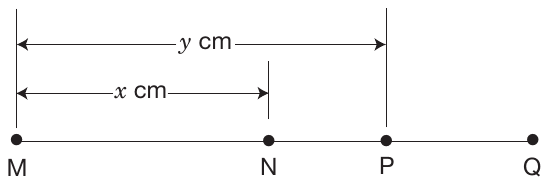
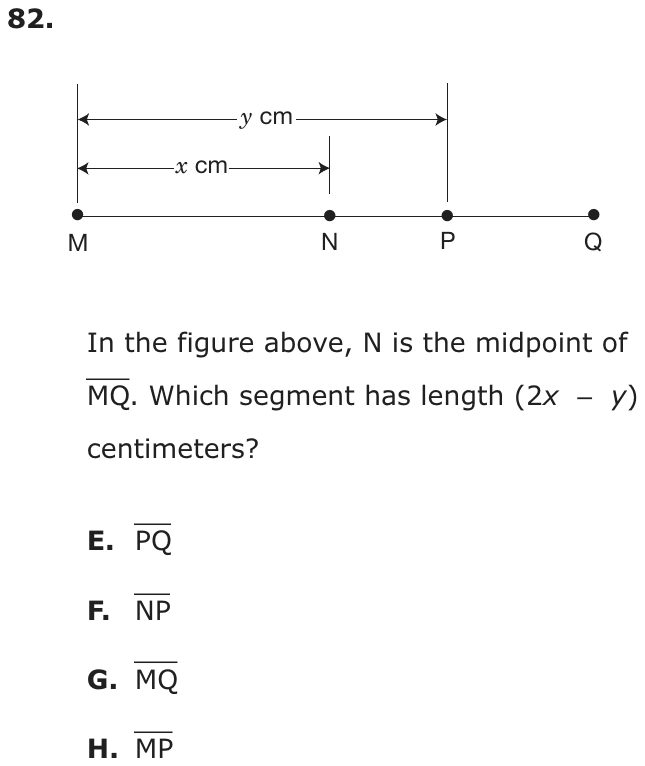
In the figure above, N is the midpoint of . Which segment has length centimeters?
- A
- B
- C
- D
Show the answer
Correct answer: A
These facts are given:
- N is the midpoint of .
- has a length of x centimeters.
- has a length of y centimeters.
Use the first two facts to determine that has a length of centimeters. So can be represented by , which is .
Question analysis
A geometry and algebra question with a labeled figure: points M, N, P and Q lie on a line, MN is x cm, MP is y cm, and N is the midpoint of MQ. Students find which segment has length 2x − y. They must turn the midpoint fact into an expression and read a difference of lengths on the figure.
- NYS standards
- Grade level
- Grade 7 content, by NYS standard
- Compared with grade 7
- Above grade 7 Grade 7 students evaluate and rewrite expressions but rarely read one as a length on a figure. Combining the midpoint idea from geometry with a difference of expressions, and no numbers, makes this more abstract than typical grade 7 work.
- Estimated difficulty
- Moderate: several steps, or a close reading with one strong distractor.
- Thinking it demands
- Depth of knowledge 2, skills and concepts · mainly analyze
- What makes it hard
- Variables instead of numbers moderate
- Reading a figure, table or graph moderate
- Solution
- 2 steps
- Reading level
- Question and choices: about grade 9, 20 words.
- Students, last 30 days
- Not enough answers yet to show (it takes 10).
Why it is hard, traps and wrong answers (shows the answer)
Why it is hard
The question reverses the usual task: instead of finding a length, students match an expression to a segment. The midpoint fact turns into MQ = 2x, and taking away the y of MP leaves the piece from P to Q. The wrong choices reward stopping at 2x, reading only the labeled arrows, or matching the letter y; picking x = 5 and y = 7 lets students check with numbers.
Variables instead of numbers moderate Understanding the question
Every length is a letter: MN is x, MP is y, and the target is the expression 2x − y, so the matching segment cannot be found by measuring. (Koedinger & Nathan, 2004; Enright, Morley & Sheehan, 2002)
Reading a figure, table or graph moderate Understanding the question
The figure marks only MN and MP with arrows; the length of MQ comes from the stem's midpoint fact, not from the drawing, and has to be written as 2x. (Lesh, Post & Behr, 1987; Kirsch & Mosenthal, 1990)
Strategy: Use the midpoint to write the length of the whole segment in terms of x, or pick sample values for x and y, then see which segment's length matches 2x − y.
Traps
- Stops one step early: A choice is a number from partway through the solution.
- Misreads the question: Misses or misreads a condition or a word in the question: "at least", "each", "remaining", "not".
The wrong answers, classified
B Misreads the question (Hegarty, Mayer & Monk, 1995)
Leaves out the midpoint fact, so the only difference it can read from the arrows is NP = y − x, which it takes for 2x − y.
C Stops one step early (King et al., 2004; Gierl et al., 2017)
Uses the midpoint to find that MQ is 2x centimeters and picks that segment, stopping before subtracting the y of MP.
D Numbers taken from the question (Hegarty, Mayer & Monk, 1995)
Sees y in the expression and picks MP, the segment labeled y, without working out the rest of 2x − y.
Worked solution, step by step
Formulas used
- Midpoint
- N is the midpoint of segment MQ, the point exactly in the middle. MN is the half from M to N, and MQ is the whole segment. The whole is two equal halves, so it is 2 times MN.
- Adding segments
- When points lie in order on a line, the short segments add up to the long one. MP runs from M to P, and PQ runs from P to Q. Put end to end, they make MQ.
Sort out the figure
Points M, N, P and Q lie in that order on a line. Segment MN is x cm long, and segment MP is y cm long. N is the midpoint of , the point exactly halfway from M to Q. You need the segment that is cm long.
Find the length of MQ
MN is half of MQ, so MQ is twice as long.
MQ is 2x cm long. Watch out: 2x is only part of the expression. Stopping here gives MQ, choice C.
Take MP away from MQ
Subtracting y from 2x means taking MP away from MQ. MP covers the part from M to P. What is left of MQ is the piece from P to Q.
So PQ is cm long. Watch out: do not pick MP just because y appears. MP is y, choice D. NP is , choice B. So the answer is A, .
Check your answer
Try numbers. Say x = 5, so MN = 5 and MQ = 10. Say y = 7, so MP = 7. Then PQ is . And . They match. NP would be , which does not.
More questions like this
The original DOE question
Question 4 of 13
2023 Test A Math, question 12Question
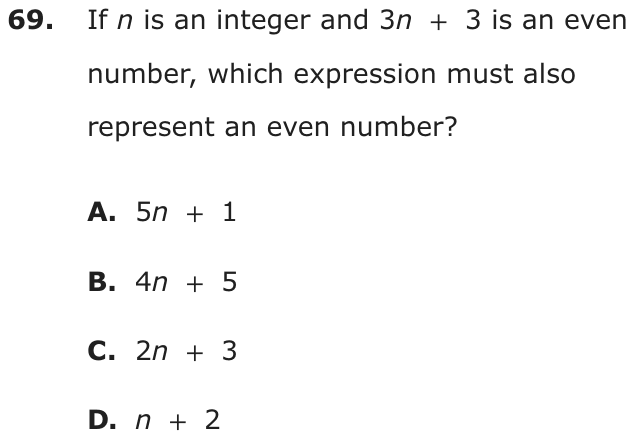
If n is an integer and is an even number, which expression must also represent an even number?
- A
- B
- C
- D
Show the answer
Correct answer: A
The expression is equal to , and it is given that this is an even number. The expression must also represent an even number, because 3 is an odd number: if were odd, would be the product of two odd numbers, which is an odd number. If is an even number, then n must be an odd number. Choose an odd number to substitute for n in the answer options to find which expression represents an even number:
Let .
Option A:
Option B:
Option C:
Option D:
Since 16 is the only even number, the correct answer is option A.
Question analysis
This number properties question says that 3n + 3 is even for an integer n and asks which of four expressions must also be even. Students reason about odd and even numbers written with a variable. The hidden step is deciding what the given fact says about n itself before testing the expressions.
- Grade level
- Grade 7 content, by NYS standard
- Compared with grade 7
- Above grade 7 Grade 7 students rewrite and evaluate expressions, but rarely reason about whether an expression is odd or even for every value of a variable. Here that reasoning comes in two layers: first about n, then about each choice.
- Estimated difficulty
- Moderate: several steps, or a close reading with one strong distractor.
- Thinking it demands
- Depth of knowledge 2, skills and concepts · mainly analyze
- What makes it hard
- Solution
- 3 steps
- Reading level
- Question and choices: about grade 9, 23 words.
- Corrected from the DOE handbook
- The explanation gave the wrong reason why n + 1 must be even; the reason was corrected.
- Students, last 30 days
- Not enough answers yet to show (it takes 10).
Why it is hard, traps and wrong answers (shows the answer)
Why it is hard
The question hides its key step: 3n + 3 = 3(n + 1), and since 3 is odd, n + 1 must be even, so n is odd. A student who skips that step and tests a convenient even value never checks the condition and lands on a wrong expression. Once n is known to be odd, any odd test value, such as 1, picks out 5n + 1 at once.
Variables instead of numbers moderate Understanding the question
No value of n is given; the only fact is that 3n + 3 is even, and it has to be turned into a fact about n itself, that n is odd, before any choice is judged. (Koedinger & Nathan, 2004; Enright, Morley & Sheehan, 2002)
Something you must already know minor Working it out
The parity rules are assumed, not stated: an odd number times an odd number is odd, and an even number plus an odd number is odd. (Anderson & Krathwohl, 2001)
Every choice must be checked minor Choosing the answer
Each expression has to be tested with an odd n or by parity rules; three of the four come out odd whenever n is odd, so none can be dismissed on sight. (Embretson & Wetzel, 1987)
Strategy: First work out what 3n + 3 being even says about n, by factoring out 3 or testing small integers, then check each expression with a value of n that fits.
Traps
- Misreads the question: Misses or misreads a condition or a word in the question: "at least", "each", "remaining", "not".
- Misunderstands the concept: A wrong belief about a concept: that percents can be added, that area grows like length, that averages can be averaged, that a bigger denominator means a bigger fraction.
The wrong answers, classified
B Misunderstands the concept (Smith, diSessa & Roschelle, 1993; De Bock et al., 1998; Ni & Zhou, 2005)
Sees the even term 4n and treats the whole expression as even, overlooking that adding the odd 5 makes 4n + 5 odd for every integer n.
C Misunderstands the concept (Smith, diSessa & Roschelle, 1993; De Bock et al., 1998; Ni & Zhou, 2005)
Assumes an expression that starts with 2n must be even, though 2n + 3 is an even number plus 3 and so is always odd.
D Misreads the question (Hegarty, Mayer & Monk, 1995)
Tests n = 2 without checking the condition, though 3(2) + 3 = 9 is odd; with n = 2, only n + 2 = 4 comes out even.
What was corrected from the DOE handbook, and why
- Explanation: The DOE’s explanation said that n + 1 must be even “because 3 is an odd number and the product of an odd number and an even number is an even number.” That fact does not show that n + 1 is even; the reason is that if n + 1 were odd, 3(n + 1) would be the product of two odd numbers, which is odd, and it is given as even. The site now gives that reason. The answer, A, is unchanged.
Worked solution, step by step
Formulas used
- Pulling out a common factor
- a is a factor, a number being multiplied, that both terms share. b and c are what is left. This is the distributive property run backward. It turns a sum into a product, which is easier to reason about.
- Multiplying odd numbers
- An even number splits into pairs, like 2, 4 or 6. An odd number has one left over, like 1, 3 or 5. An odd number of odd groups always leaves one extra. So the product is odd.
- Adding odd and even numbers
- Two odd numbers each have one left over. Together the two extras make a pair, so the sum is even. An even number plus an odd number still has one left over, so the sum is odd.
Sort out the question
n is an integer, a whole number that can be positive, negative or 0. You are told that is even. You need the expression that must be even too. Must means it is even every time. First find out what the fact tells you about n.
Pull out the 3
Both terms in have a factor of 3. Pull it out.
So 3 times is an even number.
Decide whether n is odd or even
3 is odd. If were odd, would be odd times odd. That is always odd. But we are told it is even. So must be even. One less than an even number is odd. So n is odd. Watch out: don’t test n = 2. Then , which is odd. With n = 2, only comes out even, choice D.
Test each choice with an odd n
Pick an odd number, n = 3. It fits, since is even.
- A: , even
- B: , odd
- C: , odd
- D: , odd
Only A is even.
Make sure A always works
Must means every odd n, not just 3. If n is odd, 5n is odd times odd, so it is odd. Odd plus 1 is even. So is always even. Watch out: 4n is even, but adding the odd 5 makes odd, choice B. In the same way, is always odd, choice C. So the answer is A, .
Check your answer
Try another odd number, n = 1. Then , which is even, so n = 1 fits. And is even too. The other three choices give 9, 5 and 3, all odd. Choice A wins again.
More questions like this
The original DOE question
Question 5 of 13
2023 Test A Math, question 29Question
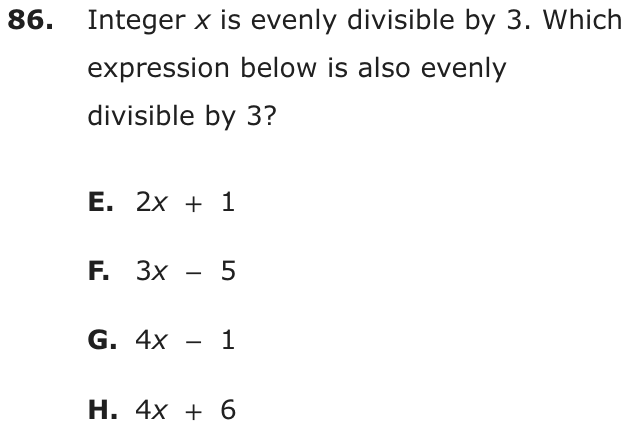
Integer x is evenly divisible by 3. Which expression below is also evenly divisible by 3?
- A
- B
- C
- D
Show the answer
Correct answer: D
Since integer x is evenly divisible by 3, substitute 3 for x in the answer options to determine which expression is also divisible by 3:
Let .
Option A:
Option B:
Option C:
Option D:
Option D is the only value that is divisible by 3.
Question analysis
This number properties question says an integer x is divisible by 3 and asks which of four linear expressions in x is also divisible by 3, whatever multiple of 3 the integer is. Students can test a multiple of 3 in each expression or think about remainders. Testing a value that is not a multiple of 3 can make a wrong expression look right.
- Grade level
- Grade 7 content, by NYS standard
- Compared with grade 7
- At grade 7 Grade 7 students rewrite and evaluate linear expressions, but they seldom ask whether one is divisible by 3 for every allowed value. One well-chosen substitution settles it, so the demand is about typical for grade 7.
- Estimated difficulty
- Straightforward: two steps or one careful reading.
- Thinking it demands
- Depth of knowledge 2, skills and concepts · mainly analyze
- What makes it hard
- Variables instead of numbers moderate
- Every choice must be checked minor
- Solution
- 2 steps
- Reading level
- Question and choices: about grade 13, 18 words.
- Students, last 30 days
- Not enough answers yet to show (it takes 10).
Why it is hard, traps and wrong answers (shows the answer)
Why it is hard
The algebra is light; the question turns on choosing a test value that obeys the condition. The habit of trying x = 1 backfires here, because 1 is not a multiple of 3 and it makes two wrong expressions come out divisible. Students who substitute 3, or who see that 4x and 6 are both multiples of 3 whenever x is, settle it quickly, and a second multiple such as 6 confirms it.
Variables instead of numbers moderate Understanding the question
Nothing pins x down except that it is a multiple of 3, so each expression must be judged for every such x, and any test value has to be a multiple of 3 itself, such as 3 or 6. (Koedinger & Nathan, 2004; Enright, Morley & Sheehan, 2002)
Every choice must be checked minor Choosing the answer
The four expressions differ only in their coefficients and constants, from 2x + 1 to 4x + 6, so none can be dismissed at a glance; each needs a test or a look at its terms. (Embretson & Wetzel, 1987)
Strategy: Substitute a multiple of 3, such as 3 or 6, for x in every expression and keep the one whose value divides evenly by 3; a second multiple confirms it.
Traps
- Misreads the question: Misses or misreads a condition or a word in the question: "at least", "each", "remaining", "not".
- Numbers taken from the question: Combines the numbers in the question without a model of the situation, or is simply a number that appears in the question.
The wrong answers, classified
A Misreads the question (Hegarty, Mayer & Monk, 1995)
Tests x = 1, which is not a multiple of 3, finds that 2(1) + 1 = 3 divides evenly, and stops at the first choice; with x = 3 it gives 7.
B Numbers taken from the question (Hegarty, Mayer & Monk, 1995)
Sees the 3 in 3x and takes the whole expression to be a multiple of 3, overlooking that subtracting 5 spoils it: with x = 3 it gives 4.
C Misreads the question (Hegarty, Mayer & Monk, 1995)
Tries a value that is not a multiple of 3, such as x = 4, where 4x − 1 = 15 divides evenly, though x = 3 gives 11.
Worked solution, step by step
Formulas used
- Adding multiples of 3
- a and b are whole numbers, so 3a and 3b are multiples of 3. A multiple of 3 is a number that 3 divides evenly, with nothing left over. Adding two multiples of 3 always gives another multiple of 3, because you can pull the 3 out of both parts.
Sort out the question
“Evenly divisible by 3” means 3 goes into the number with nothing left over. Such a number is called a multiple of 3, like 3, 6, 9 or 12.
You know that x is a multiple of 3. You need the expression that is a multiple of 3 every time, whatever multiple of 3 x is.
Test x = 3 in every choice
Pick a number for x that follows the rule. The easiest one is 3. Put it into each expression.
Choice Work Divisible by 3? A No B No C No D Yes Watch out: your test number must be a multiple of 3. With x = 1, choice A gives 3 and looks right. That leads to the wrong choice, A.
See why D always works
One test could be lucky, so see why D works for every x. Since x is a multiple of 3, 4x is one too. For example, 4 × 3 = 12 and 4 × 6 = 24. The number 6 is also a multiple of 3, since 6 = 3 × 2.
So 4x + 6 is a multiple of 3 plus a multiple of 3. That is always a multiple of 3.
Rule out the other choices
Watch out: choice B starts with 3x, but then it subtracts 5. The 5 is not a multiple of 3, so it spoils the result, and 3(3) − 5 = 4. Choices A and C also add or take away a number that is not a multiple of 3.
So the answer is D, .
Check your answer
Try two more multiples of 3. With x = 6, choice D gives , and 30 ÷ 3 = 10. With x = 9, it gives , and 42 ÷ 3 = 14. Both divide evenly, so D keeps working.
More questions like this
The original DOE question
Question 6 of 13
2023 Test B Math, question 29Question
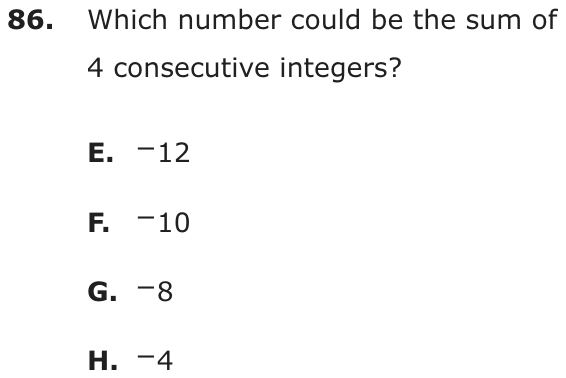
Which number could be the sum of 4 consecutive integers?
- A−12
- B−10
- C−8
- D−4
Show the answer
Correct answer: B
The sum of 4 consecutive integers can be expressed as:
Set that expression equal to each of the options and solve for n:
Option A:
is not an integer.
Option B:
is an integer.
Option C:
is not an integer.
Option D:
is not an integer.
The only option for which n is an integer is −10.
Question analysis
A number properties question about consecutive integers: which of four negative numbers could be the sum of 4 consecutive integers? Students write the sum with a variable, or add runs of negative integers, and test each choice. Keeping signs straight with negative numbers, and remembering that the integers must be whole numbers, is the tricky part.
- Grade level
- Grade 7 content, by NYS standard
- Compared with grade 7
- At grade 7 Grade 7 consecutive-integer problems usually give the sum and ask for the integers. This one reverses the task: students test which negative total is possible at all, using the structure of the sum rather than one equation.
- Estimated difficulty
- Moderate: several steps, or a close reading with one strong distractor.
- Thinking it demands
- Depth of knowledge 2, skills and concepts · mainly apply
- What makes it hard
- Every choice must be checked moderate
- No obvious method minor
- Error-prone arithmetic minor
- Solution
- 3 steps
- Reading level
- Question and choices: about grade 8, 9 words.
- Corrected from the DOE handbook
- A stray word in the explanation’s last sentence was removed.
- Students, last 30 days
- Not enough answers yet to show (it takes 10).
Why it is hard, traps and wrong answers (shows the answer)
Why it is hard
Three of the four choices are multiples of 4, and that is the whole trap: a student who pictures the sum as four times some integer finds three choices that seem to work. The sum of four consecutive integers is 4n + 6, so it is always even but never a multiple of 4. Trying the most natural run, −4, −3, −2 and −1, lands on −10 at once and is the fastest check.
Every choice must be checked moderate Choosing the answer
The stem asks which number “could be” the sum, so no single equation gives the answer; each of −12, −10, −8 and −4 has to be tested against the form a four-integer sum must take. (Embretson & Wetzel, 1987)
No obvious method minor Working it out
Nothing points to the shortcut that n + (n + 1) + (n + 2) + (n + 3) = 4n + 6 is always 2 more than a multiple of 4, or to simply adding a run such as −1, −2, −3 and −4. (Schoenfeld, 1985)
Error-prone arithmetic minor Working it out
Every choice is negative, so solving 4n + 6 = −12 or adding a run of integers means subtracting 6 from a negative number and dividing a negative by 4. (Brown & Burton, 1978; Junker & Sijtsma, 2001)
Strategy: Write the integers as n, n + 1, n + 2 and n + 3, add them, and set the sum equal to each choice to see which one gives a whole-number n.
Traps
- Misunderstands the concept: A wrong belief about a concept: that percents can be added, that area grows like length, that averages can be averaged, that a bigger denominator means a bigger fraction.
- A faulty procedure: A systematic but wrong procedure: adding fractions straight across, applying an exponent to each term of a sum, dropping a sign when moving a term.
- Misreads the question: Misses or misreads a condition or a word in the question: "at least", "each", "remaining", "not".
The wrong answers, classified
A Misunderstands the concept (Smith, diSessa & Roschelle, 1993; De Bock et al., 1998; Ni & Zhou, 2005)
Assumes four consecutive integers add to a multiple of 4, as if they had a whole-number middle, and takes −12 = 4 × (−3), the first such choice.
C A faulty procedure (Brown & Burton, 1978; Tatsuoka, 1983)
Writes n + (n + 1) + (n + 2) + (n + 3) as 4n, dropping the 1 + 2 + 3, so −8 = 4 × (−2) seems to give a whole-number n.
D Misreads the question (Hegarty, Mayer & Monk, 1995)
Solves 4n + 6 = −4 to get n = −2.5 and accepts it, since −2.5, −1.5, −0.5 and 0.5 add to −4, though they are not integers.
What was corrected from the DOE handbook, and why
- Explanation: The handbook ends with “The only option for which n is an integer answer is −10.” The word “answer” does not belong in that sentence; the site reads “The only option for which n is an integer is −10.” The working above it is unchanged: only 4n + 6 = −10 gives an integer, n = −4, and −4 + (−3) + (−2) + (−1) = −10.
Worked solution, step by step
Formulas used
- Sum of 4 consecutive integers
- n is the smallest of the four integers. Each next integer is 1 more than the one before, so they are n, n + 1, n + 2 and n + 3. Adding them gives four n’s, plus 1 + 2 + 3, which is 6. Use it to add any four integers in a row.
Sort out the question
Integers are whole numbers and their negatives, like −2, 0 and 5. They have no fractions or decimals. Consecutive integers come one right after another, like 7, 8, 9, 10 or −3, −2, −1, 0.
You need the choice that can be the sum of four consecutive integers. The sum is what you get when you add them.
Write the sum with a letter
You don’t know the integers yet. So call the smallest one n. Each next one is 1 more: n + 1, n + 2 and n + 3. Use the formula. Collect the four n’s, then add the numbers.
Any four consecutive integers add up to 4n + 6.
Test each choice
Set 4n + 6 equal to each choice and solve for n. First subtract 6 from both sides. Then divide both sides by 4.
Choice 4n + 6 4n n A −12 −18 −4.5 B −10 −16 −4 C −8 −14 −3.5 D −4 −10 −2.5 n must be an integer. Only choice B gives one: n = −4.
Name the four integers
Start at n = −4 and count up by 1. The integers are −4, −3, −2 and −1.
Watch out: Choices A, C and D are multiples of 4. A multiple of 4 is 4 times an integer, like 4 × (−3) = −12. It is tempting to think four integers must add to one of those. But the sum is 4n + 6, and the extra 6 gets in the way. Choice D works only with n = −2.5, and that is not an integer.
So the answer is B, −10.
Check your answer
Add the integers: . That is choice B. Also, 4n + 6 is always 2 more than a multiple of 4. And −10 is 2 more than −12, which is 4 × (−3).
More questions like this
The original DOE question
Question 7 of 13
2023 Test B Math, question 31Question
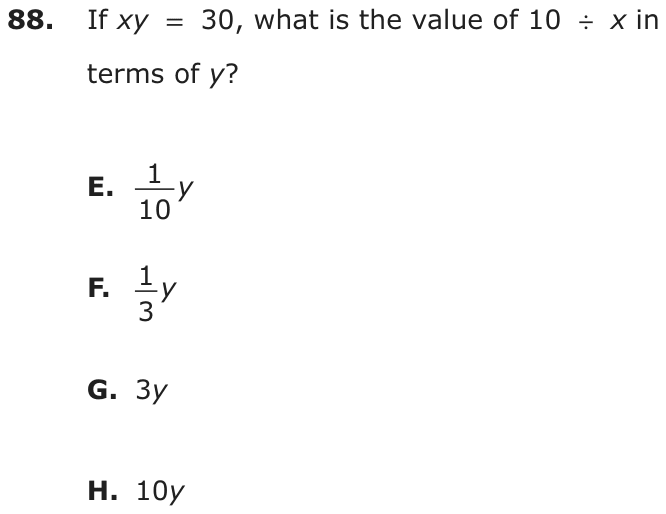
If , what is the value of in terms of y?
- A
- B
- C
- D
Show the answer
Correct answer: B
Solve , the given equation, for x:
Then:
Question analysis
An algebra question: given that x times y equals 30, students express 10 divided by x using only y. It tests solving for one variable and dividing by an algebraic fraction. Working with letters instead of numbers, and dividing in the right order, are what trip students up.
- NYS standards
- Grade level
- Grade 7 content, by NYS standard
- Compared with grade 7
- At grade 7 Grade 7 students rewrite expressions that have numbers and one variable. This one links two variables through their product and asks for a quotient, with no numbers given to check an answer against.
- Estimated difficulty
- Moderate: several steps, or a close reading with one strong distractor.
- Thinking it demands
- Depth of knowledge 1, recall and reproduction · mainly apply
- What makes it hard
- Variables instead of numbers moderate
- Error-prone arithmetic minor
- A very close wrong answer minor
- Solution
- 3 steps
- Reading level
- Question and choices: about grade 7, 16 words.
- Students, last 30 days
- Not enough answers yet to show (it takes 10).
Why it is hard, traps and wrong answers (shows the answer)
Why it is hard
The algebra is three short moves, but each is a place to turn a fraction upside down: solving xy = 30 for x, dividing 10 by that fraction, and reducing 10/30. Students who reach for the bigger-over-smaller division they know from whole numbers land on 3y. Choosing two numbers with a product of 30, such as 3 and 10, and testing every choice settles the question in seconds.
Variables instead of numbers moderate Understanding the question
x and y are tied only by their product, 30, and the answer must be an expression in y, so there is no number to check unless students pick a pair such as x = 3 and y = 10. (Koedinger & Nathan, 2004; Enright, Morley & Sheehan, 2002)
Error-prone arithmetic minor Working it out
Substituting x = 30/y turns 10 ÷ x into 10 divided by a fraction, which must be flipped to 10 × y/30 and then reduced. (Brown & Burton, 1978; Junker & Sijtsma, 2001)
A very close wrong answer minor Choosing the answer
The answer, (1/3)y, and the choice 3y use the same 3, one dividing y and one multiplying it, so a student unsure whether 10 ÷ 30 or 30 ÷ 10 applies sees both. (Embretson & Wetzel, 1987; Gorin & Embretson, 2006; Ascalon et al., 2007)
Strategy: Solve xy = 30 for x, substitute that fraction into 10 ÷ x, and divide by multiplying by its reciprocal; or choose values of x and y with a product of 30 and test each choice.
Traps
- Wrong operation: Adds instead of multiplying, divides the wrong way round, turns a ratio or rate upside down, or undoes a step in the wrong direction (subtracts what should be added back).
- Misunderstands the concept: A wrong belief about a concept: that percents can be added, that area grows like length, that averages can be averaged, that a bigger denominator means a bigger fraction.
- Numbers taken from the question: Combines the numbers in the question without a model of the situation, or is simply a number that appears in the question.
The wrong answers, classified
A Numbers taken from the question (Hegarty, Mayer & Monk, 1995)
Writes the 10 from 10 ÷ x under y as one tenth of y, never using the product xy = 30 to link the two letters.
C Wrong operation (Hegarty, Mayer & Monk, 1995; King et al., 2004)
Replaces x with 30/y correctly but divides 30 by 10 instead of 10 by 30, taking the larger number over the smaller, and gets 3y.
D Misunderstands the concept (Smith, diSessa & Roschelle, 1993; De Bock et al., 1998; Ni & Zhou, 2005)
Treats dividing by x as multiplying by y, as if x and y were reciprocals, though their product is 30, not 1, which gives 10y.
Worked solution, step by step
Formulas used
- Dividing by a fraction
- a is the number you divide. b over c is the fraction you divide by: b is its top and c is its bottom. To divide by a fraction, multiply by its reciprocal, the fraction flipped upside down. For example, 6 ÷ 1/2 = 6 × 2 = 12, because 12 halves fit in 6.
Sort out the question
means x times y. So x times y is 30. You need “in terms of y.” That means your answer can use y and numbers, but no x.
Solve for x
To swap x out, first get x by itself. Divide both sides of by y.
This says x is 30 divided by y.
Put the fraction in place of x
Replace x in with this fraction.
Now use the rule for dividing by a fraction. Flip the fraction and multiply.
Simplify the fraction
Both 10 and 30 can be divided by 10.
Watch out: 10 ÷ 30 is not 3. Dividing the bigger number by the smaller one gives 3y, choice C. Also, dividing by x is not the same as multiplying by y. That only works when xy is 1, not 30. It leads to choice D.
So the answer is B, .
Check your answer
Pick numbers that multiply to 30, like x = 3 and y = 10. Then . Choice B gives . They match. Choice C would give 30, and choice D would give 100.
More questions like this
The original DOE question
Question 8 of 13
2023 Test B Math, question 38Question
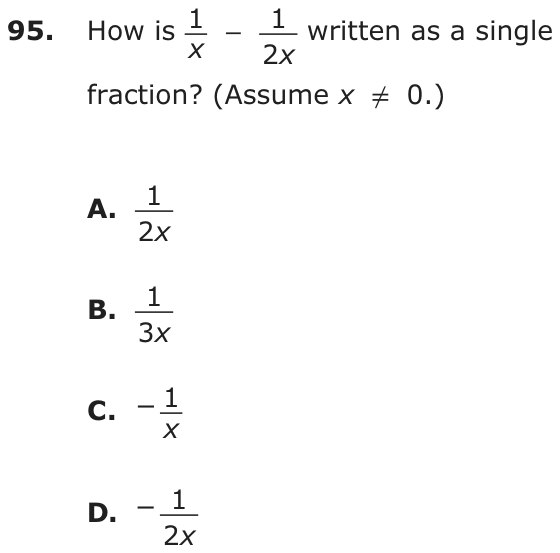
How is written as a single fraction? (Assume .)
- A
- B
- C
- D
Show the answer
Correct answer: A
Question analysis
This algebra question asks students to write 1/x minus 1/(2x) as a single fraction, assuming x is not zero. It tests finding a common denominator when the denominators contain a variable. Getting both fractions over the same denominator before subtracting, and keeping track of the sign, are what matter.
- NYS standards
- Grade level
- Grade 7 content, by NYS standard
- Compared with grade 7
- At grade 7 Grade 7 students subtract fractions with unlike denominators and work with linear expressions, but seldom see a variable in a denominator. The steps match those for numerical fractions, so it is a short task once the common denominator is found.
- Estimated difficulty
- Straightforward: two steps or one careful reading.
- Thinking it demands
- Depth of knowledge 1, recall and reproduction · mainly apply
- What makes it hard
- Variables instead of numbers moderate
- Error-prone arithmetic minor
- Solution
- 2 steps
- Reading level
- Question and choices: about grade 11, 14 words.
- Students, last 30 days
- Not enough answers yet to show (it takes 10).
Why it is hard, traps and wrong answers (shows the answer)
Why it is hard
This is subtraction of unlike fractions with a letter in the bottom, and every wrong choice is a familiar fraction error: combining the denominators straight across by adding or subtracting, or subtracting the numerators the wrong way round. Substituting x = 1 makes it 1 − 1/2 = 1/2, which rules out the negative choices and 1/3 at once.
Variables instead of numbers moderate Understanding the question
The denominators are x and 2x, so the common denominator is built with a letter, and no number checks the result unless students substitute a value such as x = 1. (Koedinger & Nathan, 2004; Enright, Morley & Sheehan, 2002)
Error-prone arithmetic minor Working it out
Only the first fraction changes: 1/x becomes 2/2x, and then the subtraction 2 − 1 must be done in the order written, first numerator minus second. (Brown & Burton, 1978; Junker & Sijtsma, 2001)
Strategy: Rewrite 1/x with the denominator 2x by multiplying its top and bottom by 2, then subtract the numerators and keep the common denominator.
Traps
- A faulty procedure: A systematic but wrong procedure: adding fractions straight across, applying an exponent to each term of a sum, dropping a sign when moving a term.
- Negatives and direction: Arithmetic with negative numbers, the order of a subtraction, or direction on a number line. (Moving a term across the equals sign without changing its sign is a faulty procedure.)
The wrong answers, classified
B A faulty procedure (Brown & Burton, 1978; Tatsuoka, 1983)
Adds the denominators, x + 2x = 3x, and keeps a numerator of 1, as if two unit fractions combined by adding their bottoms.
C A faulty procedure (Brown & Burton, 1978; Tatsuoka, 1983)
Subtracts the denominators straight across, x − 2x = −x, and keeps 1 on top, so the result 1/(−x) is written −1/x.
D Negatives and direction (Brown & Burton, 1978)
Rewrites 1/x as 2/2x correctly but subtracts the numerators in reverse order, 1 − 2 = −1, giving a negative result.
Worked solution, step by step
Formulas used
- Equivalent fractions
- a is the top, or numerator. b is the bottom, or denominator. k is any number except 0. Multiplying the top and bottom by the same number gives an equal fraction, because k over k is 1.
- Subtracting fractions with the same bottom
- a and b are the tops. c is the shared bottom. When the bottoms match, the pieces are the same size. So subtract the tops and keep the bottom.
Sort out the question
You need to write as one fraction. The problem says x is not 0. That matters because you can’t divide by 0.
Find a common bottom
To subtract fractions, their bottoms must match. 2x is 2 times x. So multiply the top and bottom of by 2.
Now both fractions have the bottom 2x.
Subtract the tops
Subtract the tops in order. Keep the bottom.
Watch out: Never add or subtract the bottoms. Adding them gives , choice B. Subtracting them gives , choice C. And keep the order: 2 − 1, not 1 − 2. The wrong order gives choice D.
So the answer is A, .
Check your answer
Try x = 1. The problem becomes . Choice A gives . It matches. Choices B, C and D give , −1 and .
More questions like this
The original DOE question
Question 9 of 13
2022 Test B Math, question 4Question
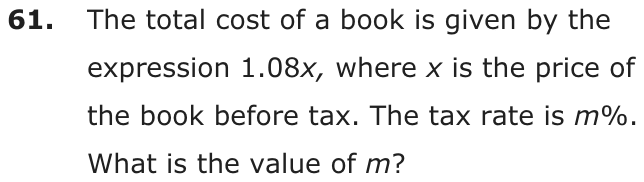
The total cost of a book is given by the expression , where x is the price of the book before tax. The tax rate is m%. What is the value of m?
Grid-in question: work out the answer and enter it as a number.
Show the answer
Correct answer: 8
The price of a book before tax is x and after tax is . Subtract to determine the tax rate.
, so the tax rate is 0.08.
The tax rate m% can be written as .
Solve for m:
Question analysis
The total cost of a book, tax included, is given by the expression 1.08x, where x is the price before tax, and the tax rate is m%. Students find the value of m and type it in. It tests reading a percent increase from an algebraic expression, and the rate has to be entered as a number of percent, not as a decimal.
- NYS standards
- Grade level
- Grade 7 content, by NYS standard
- Compared with grade 7
- At grade 7 Reading a percent increase from an expression such as 1.08x is a named grade 7 idea. It takes one short step, but students must turn a decimal into a percent and type the value with no choices to check.
- Estimated difficulty
- Straightforward: two steps or one careful reading.
- Thinking it demands
- Depth of knowledge 2, skills and concepts · mainly understand
- What makes it hard
- Solution
- 2 steps
- Reading level
- Question and choices: about grade 3, 33 words.
- Students, last 30 days
- Not enough answers yet to show (it takes 10).
Why it is hard, traps and wrong answers (shows the answer)
Why it is hard
The expression already holds the answer, since 1.08x is the price, 1x, plus a tax of 0.08x. The work lies in pulling the tax apart from the price and then writing it in the form the stem asks for, the number in front of a percent sign. Students who stop at the decimal, or who read the whole 1.08 as 108 percent, grid a value that looks reasonable. Trying a price of $100, which costs $108 with tax, makes the 8 visible.
An answer in an unexpected form moderate Choosing the answer
The rate is asked for as the m in m%, so the 0.08 found from the expression must become 8, and the grid takes 0.08 or 108 just as readily. (Enright, Morley & Sheehan, 2002)
Something you must already know minor Working it out
Nothing in the stem says that multiplying a price by 1.08 adds 8% of it; students must split 1.08x into 1x for the price and 0.08x for the tax. (Anderson & Krathwohl, 2001)
Variables instead of numbers minor Understanding the question
The price is the letter x, never a dollar amount, so the tax has to be read from the coefficient 1.08 rather than worked out from a number. (Koedinger & Nathan, 2004; Enright, Morley & Sheehan, 2002)
Strategy: Split 1.08x into the price before tax plus the tax added to it, then write the tax part's coefficient as a percent.
Traps
- Stops one step early: A choice is a number from partway through the solution.
- Answers a different question: A choice is right for another quantity: the other unknown, the rest instead of the part, the part instead of the whole.
- Numbers taken from the question: Combines the numbers in the question without a model of the situation, or is simply a number that appears in the question.
The wrong answers, classified
0.08 Stops one step early (King et al., 2004; Gierl et al., 2017)
Finds the tax as 0.08x and enters the decimal rate 0.08, one step short of multiplying by 100 to give m as a number of percent.
108 Answers a different question (King et al., 2004; Hegarty, Mayer & Monk, 1995)
Reads 1.08 as 108% and enters it, giving the whole cost as a percent of the price instead of only the tax added to it.
1.08 Numbers taken from the question (Hegarty, Mayer & Monk, 1995)
Copies the coefficient 1.08 from the expression as the rate, without separating the original price, 1x, from the tax added on top.
Worked solution, step by step
Formulas used
- Percent as a fraction
- Percent means out of 100. So m% is m hundredths, the fraction m over 100. To change a decimal to a percent, multiply it by 100. To change a percent to a decimal, divide it by 100.
Sort out the question
x is the price of the book before tax. The total cost with tax is 1.08x, which means 1.08 times x. The tax rate is m%. You need the number m.
The tax rate is the percent of the price that is added on as tax.
Split the total into price and tax
The total is the price plus the tax. Split 1.08 into 1 and 0.08.
The x part is the price you started with. So the extra 0.08x is the tax. The tax is 0.08 times the price.
Change the decimal to a percent
The rate is 0.08 as a decimal. Use the formula and set it equal to 0.08.
To get m alone, multiply both sides by 100.
So the tax rate is 8%.
Give the answer
The question asks for m, the number in front of the % sign. That is 8.
Watch out: 0.08 is the rate as a decimal, one step short. And 1.08, or 108%, counts the price as well as the tax. So you would grid 8.
Check your answer
Try a price of $100. The total is dollars. The tax is 108 − 100 = 8 dollars. And $8 out of $100 is 8%. So m = 8.
More questions like this
The original DOE question
Question 10 of 13
2022 Test B Math, question 51Question
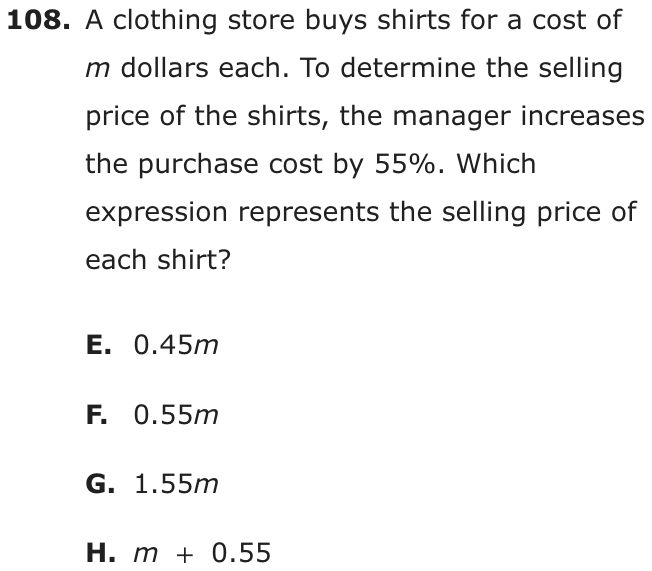
A clothing store buys shirts for a cost of m dollars each. To determine the selling price of the shirts, the manager increases the purchase cost by 55%. Which expression represents the selling price of each shirt?
- A
- B
- C
- D
Show the answer
Correct answer: C
It is given that m represents the purchase cost.
represents 100%. The amount the purchase cost was increased is represented by 55%.
Therefore, the selling price will be .
The selling price can be represented by the expression .
Question analysis
A clothing store buys shirts for m dollars each, and the manager sets the selling price by increasing that purchase cost by 55%. Students choose the expression for the selling price of each shirt. It tests writing a percent increase as an algebraic expression, where a percent of an unknown cost has to be handled in letters.
- NYS standards
- Grade level
- Grade 7 content, by NYS standard
- Compared with grade 7
- At grade 7 Writing a percent markup as an expression is a named grade 7 idea and a common classroom task. This is a direct case with one percent and a letter for the cost, with no further steps such as tax.
- Estimated difficulty
- Straightforward: two steps or one careful reading.
- Thinking it demands
- Depth of knowledge 2, skills and concepts · mainly apply
- What makes it hard
- Turning words into math moderate
- Variables instead of numbers minor
- Solution
- 2 steps
- Reading level
- Question and choices: about grade 5, 40 words.
- Students, last 30 days
- Not enough answers yet to show (it takes 10).
Why it is hard, traps and wrong answers (shows the answer)
Why it is hard
The markup is an increase by 55%, so the selling price is the whole cost plus 55% of it. The commonest mistake writes only the 55% part, which is the markup and not the price. Others subtract the percent as a discount would, or add 55 cents. Choosing a cost of $100 and finding a $155 price picks out the right expression at once.
Turning words into math moderate Understanding the question
“Increases the purchase cost by 55%” means the cost plus 55% of it, 100% + 55% = 155% of m, not 55% of m on its own. (Hegarty, Mayer & Monk, 1995; Koedinger & Nathan, 2004)
Variables instead of numbers minor Understanding the question
The cost is the letter m, so the markup has to be written as 0.55m and added to m, with no dollar amount to test the expression against. (Koedinger & Nathan, 2004; Enright, Morley & Sheehan, 2002)
Strategy: Pick an easy cost such as m = 100 dollars, work out the selling price after a 55% increase, and see which expression gives that price.
Traps
- Stops one step early: A choice is a number from partway through the solution.
- Misunderstands the concept: A wrong belief about a concept: that percents can be added, that area grows like length, that averages can be averaged, that a bigger denominator means a bigger fraction.
- Wrong operation: Adds instead of multiplying, divides the wrong way round, turns a ratio or rate upside down, or undoes a step in the wrong direction (subtracts what should be added back).
The wrong answers, classified
A Wrong operation (Hegarty, Mayer & Monk, 1995; King et al., 2004)
Subtracts the 55% from 100% instead of adding it, writing 0.45m, which is the price after a 55% discount rather than a 55% increase.
B Stops one step early (King et al., 2004; Gierl et al., 2017)
Writes only the amount of the markup, 55% of m, and stops before adding it to the cost the store paid for the shirt.
D Misunderstands the concept (Smith, diSessa & Roschelle, 1993; De Bock et al., 1998; Ni & Zhou, 2005)
Adds 0.55 to m as if the 55% markup were 55 cents, a fixed amount, instead of 55% of whatever the shirt cost.
Worked solution, step by step
Formulas used
- Percent increase
- The old amount is what you start with, here the cost m. The 1 keeps the whole old amount. The percent over 100 adds the increase on top. Use it whenever an amount goes up by a percent.
Sort out the question
Each shirt costs the store m dollars. The manager raises that cost by 55% to get the selling price. You need an expression for the selling price. An expression is a math phrase with numbers, letters and signs, but no equal sign.
Find the amount of the increase
The increase is 55% of m. Write 55% as a decimal by dividing by 100.
So the increase is 0.55m dollars, which means 0.55 times m.
Watch out: 0.55m is only the increase. Stopping here gives choice B.
Add the increase to the cost
The selling price is the cost plus the increase. Since m is the same as 1m, add the numbers in front.
The percent increase formula gives the same thing:
Give the answer
Watch out: 0.45m is a 55% decrease, choice A. And m + 0.55 adds only 55 cents, choice D. The increase must grow when the cost grows. So the answer is C, .
Check your answer
Pick a cost of $100, so m = 100. A 55% increase adds $55, for a price of $155. Now try choice C: . It matches. Choice B gives only 55, and choice D gives 100.55.
More questions like this
The original DOE question
Question 11 of 13
2018 Test A Math, question 32Question
The least of 5 consecutive integers is , and the greatest is . What is the value of in terms of ?
- A
- B
- C
- D
Show the answer
Correct answer: C
The first integer is , so the second is , the third is , then , and finally .
Since is the fifth and greatest of the integers,
Substitute for and simplify:
Question analysis
This algebra question about five consecutive integers calls the least one l and the greatest g, then asks for (l + g)/2 written in terms of l. Students must express g using l and simplify a fraction that contains a variable. Counting how far the fifth integer is from the first is where many students slip.
- NYS standards
- Grade level
- Grade 7 content, by NYS standard
- Compared with grade 7
- At grade 7 Grade 7 students combine like terms in expressions such as 3(x + 4) − x. This item first asks them to build the expression from a description of consecutive integers, then simplify it, with only letters to work with.
- Estimated difficulty
- Moderate: several steps, or a close reading with one strong distractor.
- Thinking it demands
- Depth of knowledge 2, skills and concepts · mainly apply
- What makes it hard
- Variables instead of numbers moderate
- Turning words into math minor
- Every choice must be checked minor
- Solution
- 3 steps
- Reading level
- Question and choices: about grade 8, 26 words.
- Students, last 30 days
- Not enough answers yet to show (it takes 10).
Why it is hard, traps and wrong answers (shows the answer)
Why it is hard
The algebra is short once g is written as l + 4, so most errors come from the fence-post count or from testing numbers carelessly. The wrong choices in front of the answer are exactly the ones a single test value cannot rule out, which punishes students who stop at the first match. Using two test values, or simplifying (2l + 4)/2 directly, avoids both traps.
Variables instead of numbers moderate Understanding the question
Every expression is in l, so the simplification of (l + l + 4)/2 has to be done with letters and cannot be checked against a single number. (Koedinger & Nathan, 2004; Enright, Morley & Sheehan, 2002)
Turning words into math minor Understanding the question
The description "the least of 5 consecutive integers is l, and the greatest is g" must become g = l + 4, four steps up, not five. (Hegarty, Mayer & Monk, 1995; Koedinger & Nathan, 2004)
Every choice must be checked minor Choosing the answer
A single test value fits two choices: l = 1 makes 3l and l + 2 both 3, and l = 2 makes 2l and l + 2 both 4. (Embretson & Wetzel, 1987)
Strategy: Write the integers as l, l + 1, and so on up to the fifth, substitute for g and simplify; then test two different starting values, since one value can match a wrong choice by coincidence.
Traps
- Counting the ends: Inclusive or exclusive ends, fence posts, consecutive numbers: an answer that is one too many or too few, or an endpoint drawn open where it belongs closed (or the reverse).
The wrong answers, classified
A Checks only one number (Schoenfeld, 1985)
Tests only l = 2, where 2 through 6 give (2 + 6)/2 = 4, and takes 2l, the first choice that also equals 4.
B Checks only one number (Schoenfeld, 1985)
Tests only l = 1, where 1 through 5 give (1 + 5)/2 = 3, and stops at 3l, which matches before l + 2 is checked.
D Counting the ends (Brown & Burton, 1978)
Writes the greatest integer as l + 5, counting five steps for five integers, then halves only the 2l in (2l + 5)/2, leaving l + 5.
Worked solution, step by step
Formulas used
- Greatest of 5 consecutive integers
- l is the least (smallest) integer and g is the greatest. Consecutive integers go up by 1 each time. Five integers have only 4 jumps from the first to the last, so you add 4, not 5.
- Dividing a sum
- a and b are the two parts of the top, and c is the number you divide by. To divide a sum, divide each part. You must divide every part of the top, not just one.
Sort out the words
Integers are whole numbers, like −2, 0 and 7. Consecutive integers come one right after another, like 8, 9, 10. There are 5 of them here.
The smallest is called l and the biggest is called g. You must write using only the letter l.
Write all five integers
Each integer is 1 more than the one before:
The fifth one is the greatest, so g = l + 4. Watch out: five integers have only four jumps between them. Writing g = l + 5 leads to choice D.
Put l + 4 in place of g
Swap g for l + 4 in the fraction:
Here l + l is 2l, which means 2 times l.
Split the fraction
Divide each part of the top by 2:
So the answer is C, .
Check your answer
Test two starting numbers. If l = 1, the integers are 1 to 5, and (1 + 5) ÷ 2 = 3, which is 1 + 2. If l = 10, they are 10 to 14, and (10 + 14) ÷ 2 = 12, which is 10 + 2. Use two tests, because l = 1 also makes 3l equal 3, choice B.
More questions like this
The original DOE question
Question 12 of 13
2018 Test B Math, question 8Question
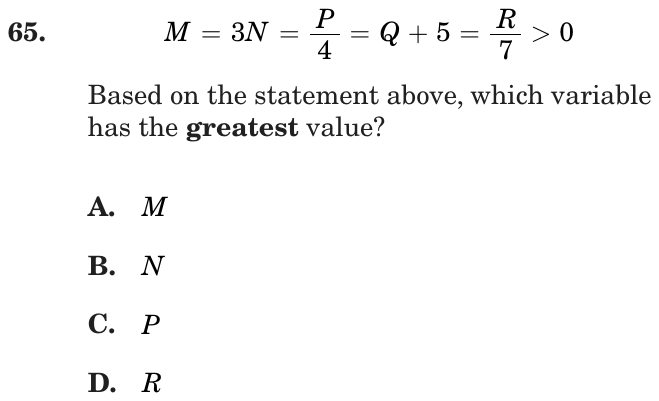
Based on the statement above, which variable has the greatest value?
- A
- B
- C
- D
Show the answer
Correct answer: D
Break the equations apart to each equal :
Pick a number to substitute into the equations, and solve the equations to find the values of , , , , and .
Let . Since all the equations are equal to 2, substitute 2 to find each variable.
Variable has the greatest value.
Question analysis
This algebra question sets five expressions equal to one another and to a positive number, then asks which variable has the greatest value. It tests whether students can rewrite each variable in terms of one shared value and compare them. What makes it tricky is that there are no numbers to compute, so each variable's size has to be reasoned out.
- Grade level
- Grade 7 content, by NYS standard
- Compared with grade 7
- Above grade 7 Grade 7 students rewrite expressions to see how quantities relate, usually one equation at a time. This chain of five linked expressions, with no numbers to compute and a positivity condition to use, is a reasoning task beyond routine grade 7 work.
- Estimated difficulty
- Hard: combines ideas, needs a plan, and has more than one tempting wrong answer.
- Thinking it demands
- Depth of knowledge 3, strategic thinking · mainly analyze
- What makes it hard
- Variables instead of numbers major
- No obvious method moderate
- Much to keep track of minor
- Solution
- 3 steps
- Reading level
- Question and choices: about grade 10, 16 words.
- Students, last 30 days
- Not enough answers yet to show (it takes 10).
Why it is hard, traps and wrong answers (shows the answer)
Why it is hard
The question rewards a strategy, not a calculation: once the shared value is named, each variable follows in one line and R is clearly largest. Without that step, students judge by how the expressions look, and the look is backwards, since the 3 in 3N makes N small and the 7 under R makes R large. The positivity condition at the end is easy to skip but is what fixes the order.
Variables instead of numbers major Understanding the question
There are no numbers to compute: five variables are tied together in the one chain M = 3N = P/4 = Q + 5 = R/7, and each must be compared through the shared value. (Koedinger & Nathan, 2004; Enright, Morley & Sheehan, 2002)
No obvious method moderate Working it out
Nothing says how to compare; the efficient move is to name the common value, or pick one such as 12, and rewrite each variable, which students must think of themselves. (Schoenfeld, 1985)
Much to keep track of minor Working it out
Five relations and the condition > 0 must be held at once; the condition matters, since with a negative common value the order of M, N, P and R would reverse. (Sweller, 1988; Carpenter, Just & Shell, 1990)
Strategy: Call the shared value k, a positive number, and rewrite each variable as an expression in k; or substitute a convenient positive value such as 12 and compare the results.
Traps
- Equation written backwards: Writes a comparison the wrong way round, word for word: "six times as many students as professors" as 6S = P. The bigger quantity gets the bigger number.
The wrong answers, classified
A Equation written backwards (Clement, Lochhead & Monk, 1981)
Reads P/4 and R/7 as a quarter and a seventh of M, the reverse of the truth, so M looks largest of all.
B Equation written backwards (Clement, Lochhead & Monk, 1981)
Reads the 3 in 3N as making N three times as large, when 3N = M actually makes N one third of M.
C Stops one step early (King et al., 2004; Gierl et al., 2017)
Correctly sees that P is four times M but stops there without checking R, which at seven times M is larger.
Worked solution, step by step
Formulas used
- Undoing division
- a is the top of the fraction, b is the bottom, and c is the result. Multiplying undoes dividing. So if a divided by b is c, then a is b times c.
- Undoing multiplication
- b is the number multiplied by a, and c is the result. Dividing undoes multiplying. So to get a alone, divide c by b.
Understand the chain
The statement is a chain of equal signs. It says five expressions all have the same value. The last part says that value is greater than 0, so it is positive.
You need to find which letter has the largest value.
Pick a value to test
All five expressions are equal, so give them one shared value. Pick a positive number that 3 divides evenly. That way N will be a whole number.
Let the shared value be 12. Then , and each of the other four expressions also equals 12.
Solve for each letter
Undo each operation to find each letter. Divide to undo times. Multiply to undo divide. Subtract to undo plus.
Compare the values
The values are M = 12, N = 4, P = 48, Q = 7 and R = 84. R is the largest.
Watch out: 3N does not make N big. It means 3 times N equals M, so N is only one third of M. That trap points to choice B. Also, P is big, but R is bigger. Check every letter before you pick choice C.
So the answer is D, R.
Check your answer
Think without numbers. R divided by 7 is M, so R is 7 times M. P is only 4 times M. N is a third of M, and Q is 5 less than M. Since M is positive, 7 times M is the biggest.
More questions like this
The original DOE question
Question 13 of 13
2018 Test B Math, question 29Question
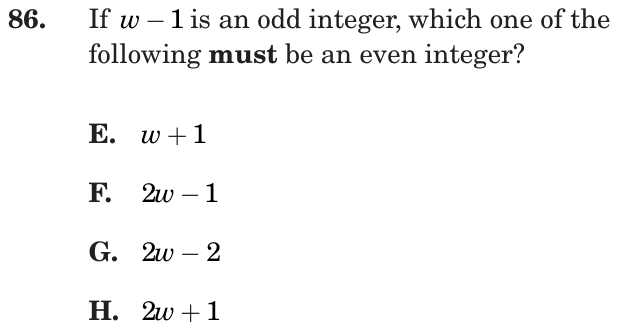
If is an odd integer, which one of the following must be an even integer?
- A
- B
- C
- D
Show the answer
Correct answer: C
One more than an odd integer must be even. One more than is , therefore must be even.
Two times an even integer must be even, therefore is even. An even integer decreased by 2 must be even.
Therefore, must be even.
Question analysis
This algebra question says that w − 1 is an odd integer and asks which of four expressions must be even. It tests reasoning about odd and even numbers written with a variable. The difficulty is that "must be" means even for every allowed value of w, so one example that happens to work is not enough.
- Grade level
- Grade 7 content, by NYS standard
- Compared with grade 7
- At grade 7 Grade 7 work evaluates and rewrites expressions but rarely asks whether one is odd or even for every value. The algebra here is light; the demand is reasoning about parity and reading "must be" carefully.
- Estimated difficulty
- Moderate: several steps, or a close reading with one strong distractor.
- Thinking it demands
- Depth of knowledge 2, skills and concepts · mainly analyze
- What makes it hard
- Variables instead of numbers moderate
- Every choice must be checked moderate
- Something you must already know minor
- Solution
- 2 steps
- Reading level
- Question and choices: about grade 8, 20 words.
- Students, last 30 days
- Not enough answers yet to show (it takes 10).
Why it is hard, traps and wrong answers (shows the answer)
Why it is hard
The question turns on one early inference: since w − 1 is odd, w itself is even. Students who skip that step, or quietly treat w as the odd number, carry the wrong parity into every choice. After that the work is mechanical, because each expression adds an even or an odd amount to an even number. Trying one value, such as w = 4, confirms the choice in seconds.
Variables instead of numbers moderate Understanding the question
The stem gives no number at all: w − 1 is only known to be odd, so the parity of w itself has to be worked out before any choice can be judged. (Koedinger & Nathan, 2004; Enright, Morley & Sheehan, 2002)
Every choice must be checked moderate Choosing the answer
All four choices are built from w or 2w plus or minus 1 or 2, so each one has to be tested for evenness; three of them come out odd for every allowed w. (Embretson & Wetzel, 1987)
Something you must already know minor Working it out
The parity rules are assumed, not stated: one more than an odd number is even, any multiple of 2 is even, and an even number plus or minus 1 is odd. (Anderson & Krathwohl, 2001)
Strategy: Choose a value of w that makes w − 1 odd, evaluate all four expressions, and keep the one that comes out even; then confirm it with a second value.
Traps
- Misreads the question: Misses or misreads a condition or a word in the question: "at least", "each", "remaining", "not".
The wrong answers, classified
A Misreads the question (Hegarty, Mayer & Monk, 1995)
Treats w itself as the odd number, so w + 1 looks even; in fact w − 1 being odd makes w even and w + 1 odd.
B A faulty procedure (Brown & Burton, 1978; Tatsuoka, 1983)
Doubles the odd number w − 1 to make it even but distributes the 2 to w only, writing 2(w − 1) as 2w − 1, which is odd.
D Misunderstands the concept (Smith, diSessa & Roschelle, 1993; De Bock et al., 1998; Ni & Zhou, 2005)
Assumes any expression that starts with 2w is even, overlooking that 2w + 1 is one more than an even number and so always odd.
Worked solution, step by step
Formulas used
- Adding 1 to an odd number
- Odd and even numbers take turns on the number line: 1, 2, 3, 4 and so on. Adding 1 moves you to the next whole number. So the number right after an odd number is always even, and the one after an even number is always odd.
- Doubling makes an even number
- n is any whole number. An even number is one you can split into two equal whole groups. Two times n is always two equal groups of n, so it is always even.
Sort out what you know
You know that is an odd integer. An integer is a whole number, like 3, 0 or −5. An even number can be split into two equal groups, like 4 or 10. An odd number is 1 more than an even number, like 3 or 11.
You need the choice that must be even. Must means it is even for every possible value of , not just one.
Decide whether w is odd or even
The number is 1 more than . One more than an odd number is always even. For example, if is 3, then is 4. So is even.
Watch out: do not treat itself as the odd number. That mistake makes look even and leads to choice A.
Show that 2w − 2 is even
Two times any whole number is even, so is even. Taking 2 away from an even number moves you back two spots. You land on another even number. So is even.
Here is another way to see it. is the same as . That is 2 times a whole number, so it must be even.
Check the other three choices
Each one adds or takes away 1 from an even number. That always gives an odd number.
- A: is even plus 1, so it is odd.
- B: is even minus 1, so it is odd.
- D: is even plus 1, so it is odd.
Watch out: starting with does not make a number even. The +1 in choice D makes it odd.
Give the answer
Only one choice is even for every possible . So the answer is C, .
Check your answer
Pick a number. Let , so , which is odd. Then A is 5, B is 7, C is 6 and D is 9. Only C is even. Try too. You get 11, 19, 18 and 21. C is even again.
More questions like this
The original DOE question