6.RP.1 ratio concepts and language
Question 1 of 12
2026 Practice Test C Math, question 21Question
In a fruit basket, the ratio of apples to oranges is the same as the ratio of cherries to walnuts. If there are 6 oranges, 16 cherries, and 48 walnuts, how many apples are there?
- A2
- B3
- C18
- D38
Show the answer
Correct answer: A
The ratios of the items are equal, so they can be expressed using a proportion.
Let a represent the number of apples, o the number of oranges, c the number of cherries, and w the number of walnuts. Write a proportion showing apples:oranges is equal to cherries:walnuts:
Substitute the given values for oranges (6), cherries (16), and walnuts (48):
Cross multiply to form an equation to solve for the number of apples (a):
Solve for the value of a:
Question analysis
In a fruit basket, the ratio of apples to oranges equals the ratio of cherries to walnuts, and students find the number of apples from the counts of oranges, cherries and walnuts. It tests setting up and solving a proportion. Matching each quantity to its place in the ratio matters, since the wrong order gives a very different count.
- Grade level
- Grade 6 content, by NYS standard
- Compared with grade 7
- Below grade 7 Equal ratios with whole numbers are grade 6 work, and the numbers divide evenly. Grade 7 proportion problems are usually longer; here the only care is keeping apples with oranges in the same order as cherries with walnuts.
- Estimated difficulty
- Straightforward: two steps or one careful reading.
- Thinking it demands
- Depth of knowledge 2, skills and concepts · mainly apply
- What makes it hard
- Turning words into math minor
- Much to keep track of minor
- Solution
- 2 steps
- Reading level
- Question and choices: about grade 7, 32 words.
- Students, last 30 days
- Not enough answers yet to show (it takes 10).
Why it is hard, traps and wrong answers (shows the answer)
Why it is hard
The numbers divide evenly, since 16/48 is 1/3, so the work is in the setup. Writing the two ratios in the order the sentence gives them makes the apples a third of the oranges; writing either one upside down makes them three times the oranges. A quick sense check helps: cherries are fewer than walnuts, so apples must be fewer than oranges.
Turning words into math minor Understanding the question
The sentence pairs apples with oranges and cherries with walnuts in the same order, so a/6 = 16/48; reading either pair the other way turns one ratio upside down. (Hegarty, Mayer & Monk, 1995; Koedinger & Nathan, 2004)
Much to keep track of minor Working it out
Four kinds of fruit are named and three counts given, and the unknown apples must be matched with the smaller count, the cherries, not the larger, the walnuts. (Sweller, 1988; Carpenter, Just & Shell, 1990)
Strategy: Write apples over oranges equal to cherries over walnuts, simplify the known ratio, and scale it to match the 6 oranges.
Traps
- Wrong operation: Adds instead of multiplying, divides the wrong way round, turns a ratio or rate upside down, or undoes a step in the wrong direction (subtracts what should be added back).
- Stops one step early: A choice is a number from partway through the solution.
- Misunderstands the concept: A wrong belief about a concept: that percents can be added, that area grows like length, that averages can be averaged, that a bigger denominator means a bigger fraction.
The wrong answers, classified
B Stops one step early (King et al., 2004; Gierl et al., 2017)
Divides the 48 walnuts by the 16 cherries to get the factor 3 and stops before using it to divide the 6 oranges.
C Wrong operation (Hegarty, Mayer & Monk, 1995; King et al., 2004)
Turns one ratio upside down, setting apples over oranges equal to 48 over 16, so the apples come out as 3 × 6 = 18.
D Misunderstands the concept (Smith, diSessa & Roschelle, 1993; De Bock et al., 1998; Ni & Zhou, 2005)
Reasons with differences instead of ratios, taking the gap of 32 between walnuts and cherries and adding it to the 6 oranges.
Worked solution, step by step
Formulas used
- Equal ratios
- A ratio compares two amounts. Writing it as a fraction puts the first thing named on top. The question says the two ratios are the same, so the two fractions are equal. Keep the same order in both.
Sort out the question
A ratio compares two amounts. The ratio of apples to oranges equals the ratio of cherries to walnuts. You know there are 6 oranges, 16 cherries and 48 walnuts. You need the number of apples.
Write the proportion
Put the first thing of each pair on top. Apples go with oranges, and cherries go with walnuts. Let a be the number of apples:
Watch out: keep the order the same. Writing 48 over 16 flips the second ratio. That gives 18, choice C.
Simplify the known ratio
16 goes into both 16 and 48. Divide the top and the bottom by 16:
So there is 1 cherry for every 3 walnuts. There must also be 1 apple for every 3 oranges.
Find the apples
Now the proportion is:
The bottom 6 is 3 × 2, so the top is 1 × 2. That makes .
Watch out: is choice B, but that is not the number of apples. And 38 comes from using differences instead of ratios.
So the answer is A, 2.
Check your answer
Compare the ratios. Apples to oranges is 2 to 6. Cherries to walnuts is 16 to 48. In both, the second number is 3 times the first: and . So the ratios are equal.
More questions like this
The original DOE question
Question 2 of 12
2026 Practice Test C Math, question 24Question
In a showing of an artist’s works, the ratio of the number of paintings, drawings, and photographs shown is 3:5:4, respectively. If the number of drawings shown was 45, what is the total number of photographs and paintings that were shown?
- A36
- B63
- C84
- D108
Show the answer
Correct answer: B
The ratio of paintings to drawings to photographs is .
First, determine the number of actual paintings and photographs.
Since the number of actual drawings is 45, each ratio is multiplied by 9, since .
| Type | Ratio | Actual Number |
|---|---|---|
| Paintings | 3 | 27 |
| Drawings | 5 | 45 |
| Photographs | 4 | 36 |
Then, add the actual number of paintings and photographs.
Question analysis
An art showing has paintings, drawings and photographs in the ratio 3:5:4, and 45 drawings were shown. Students find the total number of photographs and paintings. It tests using a three-part ratio to find actual amounts, and the question asks for two of the three groups together, not any single group or the whole show.
- Grade level
- Grade 7 content, by NYS standard
- Compared with grade 7
- At grade 7 Scaling a ratio from one known part is grade 6 and 7 work. A three-part ratio, and a question about two of the three groups combined, make it a three-step task typical of grade 7 ratio problems.
- Estimated difficulty
- Moderate: several steps, or a close reading with one strong distractor.
- Thinking it demands
- Depth of knowledge 2, skills and concepts · mainly apply
- What makes it hard
- Much to keep track of moderate
- Turning words into math minor
- Solution
- 3 steps
- Reading level
- Question and choices: about grade 10, 39 words.
- Students, last 30 days
- Not enough answers yet to show (it takes 10).
Why it is hard, traps and wrong answers (shows the answer)
Why it is hard
The scale factor comes from one division, 45 ÷ 5 = 9, so the risk lies in what to do with it. Two tempting results are listed: the photographs alone, and the whole show with the drawings added in. Multiplying the 3 + 4 = 7 parts for paintings and photographs by 9 gives the total in one step and avoids both.
Much to keep track of moderate Working it out
The ratio has three parts, the known count belongs to the middle part, drawings, and the question wants the first and third parts combined, so three roles must be tracked. (Sweller, 1988; Carpenter, Just & Shell, 1990)
Turning words into math minor Understanding the question
The word respectively assigns 3, 5 and 4 to paintings, drawings and photographs in that order, and the question then names two of them in the other order. (Hegarty, Mayer & Monk, 1995; Koedinger & Nathan, 2004)
Strategy: Find how many works each ratio part stands for from the drawings, multiply it by the parts for paintings and for photographs, and add only those two.
Traps
- Stops one step early: A choice is a number from partway through the solution.
- Answers a different question: A choice is right for another quantity: the other unknown, the rest instead of the part, the part instead of the whole.
The wrong answers, classified
A Stops one step early (King et al., 2004; Gierl et al., 2017)
Finds the photographs, 4 × 9 = 36, and stops before adding the 27 paintings that the question also asks about.
C Numbers taken from the question (Hegarty, Mayer & Monk, 1995)
Multiplies the 7 parts for paintings and photographs by 12, the total of the ratio's parts, instead of by 9.
D Answers a different question (King et al., 2004; Hegarty, Mayer & Monk, 1995)
Finds every group correctly but adds the 45 drawings too, giving the whole show, 108, rather than the paintings and photographs.
Worked solution, step by step
Formulas used
- Using the parts of a ratio
- The ratio 3:5:4 splits the show into equal parts. Parts is how many parts a group has. Each part stands for the same number of works. Find that number from the group you know, then multiply each group’s parts by it.
Sort out the question
The ratio of paintings to drawings to photographs is 3:5:4. Respectively means in that order: 3 for paintings, 5 for drawings and 4 for photographs. There were 45 drawings. You need the number of photographs and paintings together.
Find the value of one part
Drawings are 5 parts, and there were 45 drawings:
So each part of the ratio stands for 9 works.
Find each group
Multiply each group’s parts by 9:
Type Parts Actual number Paintings 3 Drawings 5 Photographs 4 The drawings row gives 45, which matches the question.
Add only the two groups asked for
Add the paintings and the photographs:
Watch out: 36 alone, choice A, leaves out the paintings. Adding the 45 drawings too gives 108, choice D, the whole show.
So the answer is B, 63.
Check your answer
Paintings and photographs are parts. Each part is 9 works, so . That matches. Also, 63 to 45 is the same as 7 to 5, just as the ratio says.
More questions like this
The original DOE question
Question 3 of 12
2026 Practice Test D Math, question 17Question
At Midville High School, 64 students are members of either the orchestra or the choir, or both. Of these students, 38 are members of the orchestra, and 46 are members of the choir. What fraction of the total is the number of students who are members of both the orchestra and the choir?
- A
- B
- C
- D
Show the answer
Correct answer: D
First, add the number of students that are members of the orchestra and the number of students that are members of the choir.
Then, subtract to find the number of students that are members of both orchestra and choir.
Then, find the fraction of the 64 students that are members of both orchestra and choir.
Question analysis
At Midville High School, 64 students belong to the orchestra, the choir or both; 38 are in the orchestra and 46 in the choir. Students find what fraction of the 64 belong to both groups. It is a Venn diagram counting question with a fraction, and the students in both groups are included in each membership number.
- Grade level
- Grade 7 content, by NYS standard
- Compared with grade 7
- At grade 7 Overlapping groups are seldom taught directly in grade 7, though the arithmetic is whole-number addition and subtraction. Students must first find the overlap and then choose the right whole for the fraction, two decisions where errors are common.
- Estimated difficulty
- Moderate: several steps, or a close reading with one strong distractor.
- Thinking it demands
- Depth of knowledge 2, skills and concepts · mainly apply
- What makes it hard
- Turning words into math moderate
- No obvious method minor
- An answer in an unexpected form minor
- Solution
- 3 steps
- Reading level
- Question and choices: about grade 5, 54 words.
- Corrected from the DOE handbook
- A misstatement in the explanation’s first step was corrected.
- Students, last 30 days
- Not enough answers yet to show (it takes 10).
Why it is hard, traps and wrong answers (shows the answer)
Why it is hard
The question hides its key number: the students in both groups appear only as the amount by which 38 + 46 overshoots 64. A sketch of two overlapping circles, with 20 in the middle, 18 in orchestra only and 26 in choir only, shows the whole group at once. After that, the remaining risk is the denominator, since the question asks for a fraction of all 64 students, not of one group.
Turning words into math moderate Understanding the question
“Either the orchestra or the choir, or both” means the 64 counts each student once, while 38 + 46 counts the students in both groups twice; the overlap itself is never stated. (Hegarty, Mayer & Monk, 1995; Koedinger & Nathan, 2004)
No obvious method minor Working it out
Nothing names the step that finds the overlap: the excess of 38 + 46 = 84 over 64 is the number in both groups, an idea students must bring themselves. (Schoenfeld, 1985)
An answer in an unexpected form minor Choosing the answer
The fraction 20/64 appears only in lowest terms, so it must be simplified by 4 before it can be matched with a choice. (Enright, Morley & Sheehan, 2002)
Strategy: Add the orchestra and choir counts, subtract the 64 students to find how many were counted twice, then put that number over the total and simplify.
Traps
- Answers a different question: A choice is right for another quantity: the other unknown, the rest instead of the part, the part instead of the whole.
- Overlapping groups: Things in two groups at once are counted twice, or not subtracted.
The wrong answers, classified
A Overlapping groups (King et al., 2004)
Takes 38 + 46 = 84 as the number of students, counting those in both groups twice, and puts the stated 64 over it to get 16/21.
B Answers a different question (King et al., 2004; Hegarty, Mayer & Monk, 1995)
Finds the 20 students in both groups but compares them with the 38 orchestra members instead of all 64 students, so 20/38 = 10/19.
C Answers a different question (King et al., 2004; Hegarty, Mayer & Monk, 1995)
Finds the 20 students in both groups but divides by the 46 choir members, using one group as the whole instead of all 64, so 20/46 = 10/23.
What was corrected from the DOE handbook, and why
- Explanation: The DOE’s explanation begins “First, add the number of students that are members of both orchestra and choir. 38 + 46 = 84.” But 38 is the number of orchestra members and 46 the number of choir members; the number of students in both is what the next step finds (84 − 64 = 20). The site now says “First, add the number of students that are members of the orchestra and the number of students that are members of the choir.”
Worked solution, step by step
Formulas used
- Counting two groups that overlap
- O is the number in the orchestra, and C is the number in the choir. Students in both groups are counted in O and again in C. Subtracting them once makes each student count one time. Here every student is in at least one group, so this gives everyone.
- Fraction of a total
- The part is the group you are asked about. The whole is the full group it comes from. Here the part is the students in both groups, and the whole is all 64 students. Simplify by dividing the top and bottom by the same number.
Sort out the question
There are 64 students in all. Each one is in the orchestra, the choir or both. 38 are in the orchestra, and 46 are in the choir. Some students are in both, but the question does not say how many. You need that number as a fraction of all 64 students.
Add the two groups
Add the number in the orchestra and the number in the choir:
That is more than the 64 students there are. Why? A student in both groups is counted once with the orchestra and once more with the choir.
Find the students in both
The extra amount over 64 is the students who were counted twice:
So 20 students are in both groups. This is the overlap rule turned around: both = O + C − total.
Watch out: 84 is not the number of students. Putting 64 over 84 gives 16/21, choice A.
Write the fraction and simplify
The part is 20 students, and the whole is all 64 students. Both numbers divide by 4:
Watch out: the whole is all 64 students, not one group. Using 38 gives 10/19, choice B. Using 46 gives 10/23, choice C.
So the answer is D, .
Check your answer
Split the 64 students into three groups that do not overlap. Only orchestra: 38 − 20 = 18. Only choir: 46 − 20 = 26. Both: 20. Add them: 18 + 26 + 20 = 64. That matches the total, so 20 is right.
More questions like this
The original DOE question
Question 4 of 12
2024 Test B Math, question 11Question
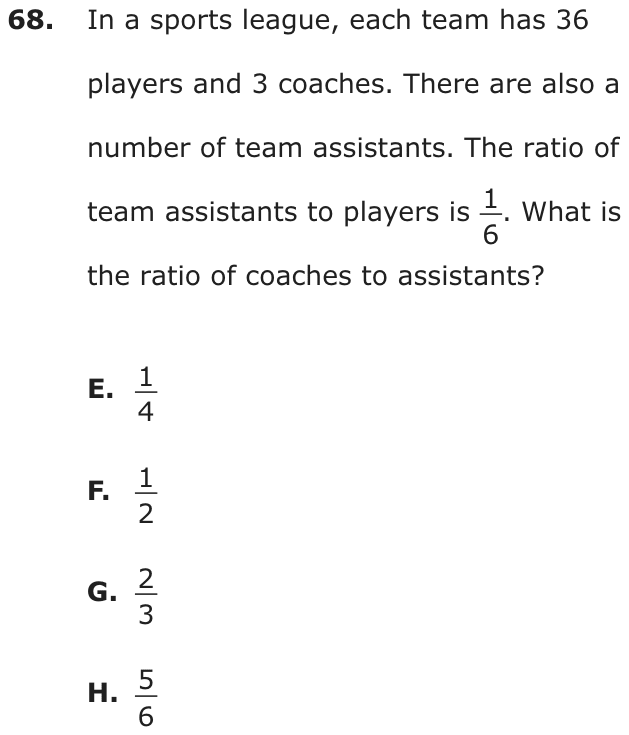
In a sports league, each team has 36 players and 3 coaches. There are also a number of team assistants. The ratio of team assistants to players is . What is the ratio of coaches to assistants?
- A
- B
- C
- D
Show the answer
Correct answer: B
Let x be the number of assistants.
Since the ratio of assistants to players is , then:
There are a total of 6 assistants.
So the ratio of coaches to assistants is .
Question analysis
A ratio word problem about a sports team with 36 players, 3 coaches and an unknown number of assistants, where the ratio of assistants to players is 1 to 6. Students find how many assistants there are, then form a new ratio of coaches to assistants. Keeping the order of each ratio straight matters.
- Grade level
- Grade 6 content, by NYS standard
- Compared with grade 7
- Below grade 7 Finding a missing amount from a ratio and then writing a second ratio is grade 6 ratio reasoning with whole numbers. Typical grade 7 work adds fractions, rates or percents, which this two-step problem does not.
- Estimated difficulty
- Straightforward: two steps or one careful reading.
- Thinking it demands
- Depth of knowledge 2, skills and concepts · mainly apply
- What makes it hard
- Turning words into math minor
- Much to keep track of minor
- Solution
- 2 steps
- Reading level
- Question and choices: about grade 5, 39 words.
- Students, last 30 days
- Not enough answers yet to show (it takes 10).
Why it is hard, traps and wrong answers (shows the answer)
Why it is hard
Two short steps, finding 6 assistants and then writing 3 to 6, make this one of the easier ratio questions. The care needed is in keeping each ratio's order and its two groups straight, since the given ratio compares assistants with players and the asked one compares coaches with assistants. None of the wrong choices matches a common slip closely, so students who find the 6 assistants seldom go wrong.
Turning words into math minor Understanding the question
“The ratio of team assistants to players is 1/6” must become 6 assistants for 36 players, and the question then asks for a ratio in a new order, coaches first. (Hegarty, Mayer & Monk, 1995; Koedinger & Nathan, 2004)
Much to keep track of minor Working it out
Three groups are named, 36 players, 3 coaches and an unknown number of assistants, and each ratio pairs a different two of them. (Sweller, 1988; Carpenter, Just & Shell, 1990)
Strategy: Use the 1 to 6 ratio to find the number of assistants from the 36 players, then write coaches over assistants, in that order, and simplify.
Traps
- Answers a different question: A choice is right for another quantity: the other unknown, the rest instead of the part, the part instead of the whole.
- Misunderstands the concept: A wrong belief about a concept: that percents can be added, that area grows like length, that averages can be averaged, that a bigger denominator means a bigger fraction.
The wrong answers, classified
A Answers a different question (King et al., 2004; Hegarty, Mayer & Monk, 1995)
Compares the 9 coaches and assistants together with the 36 players, 9/36 = 1/4, a ratio of all the staff to players that the question never asks for.
C Little reason to choose it (Haladyna & Downing, 1993; Rodriguez, 2005)
No common working gives 2/3; it equals the 6 assistants over all 9 staff, which puts the wrong group on top and a total underneath.
D Misunderstands the concept (Smith, diSessa & Roschelle, 1993; De Bock et al., 1998; Ni & Zhou, 2005)
Reads the ratio 1/6 as the assistants' share of everyone and gives the other 5/6, as if that remaining share described the coaches.
Worked solution, step by step
Formulas used
- Ratio as a fraction
- A ratio compares two amounts. The group named first goes on top, and the group named second goes on the bottom. Order matters. Assistants to players is not the same as players to assistants.
- Equal ratios
- a and b are the two numbers in a ratio, written as a fraction. n is any number except zero. Multiplying both numbers by the same n gives an equal ratio. This is how you scale a small ratio up to real counts.
Sort out what you know
Each team has 36 players and 3 coaches. It also has some assistants, but you are not told how many. The ratio of assistants to players is 1/6. That means 1 assistant for every 6 players. You need the ratio of coaches to assistants.
Find the number of assistants
Write the ratio as a fraction, assistants on top and players on the bottom. To get from 6 players to 36, multiply by 6. Do the same to the top.
So there are 6 assistants for the 36 players.
Write the new ratio
Now the order changes. Coaches come first, so coaches go on top.
Divide the top and the bottom by 3 to simplify.
Avoid the traps and answer
Watch out: use only coaches and assistants. Putting all 9 staff over the 36 players gives 1/4, choice A. Putting the 6 assistants over all 9 staff gives 2/3, choice C. And 1/6 is not a share of everyone, so 5/6, choice D, has no meaning here.So the answer is B, .
Check your answer
A ratio of 1/2 means 1 coach for every 2 assistants. With 3 coaches, that makes 6 assistants. Then 6 assistants to 36 players is , the ratio the question gave.
More questions like this
The original DOE question
Question 5 of 12
2023 Test A Math, question 39Question
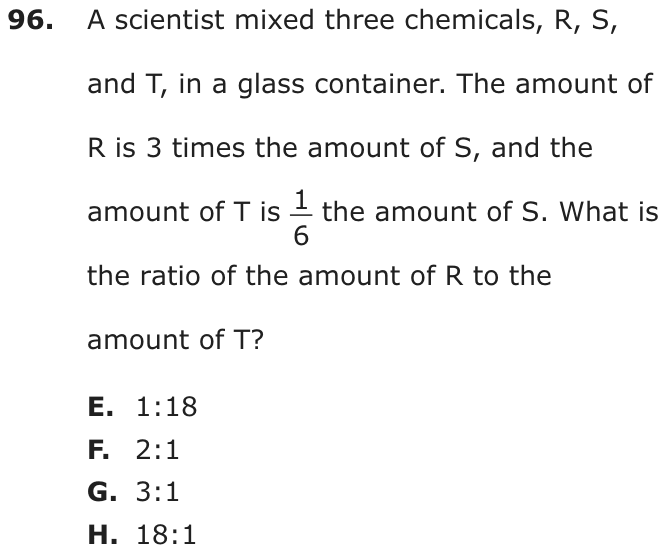
A scientist mixed three chemicals, R, S, and T, in a glass container. The amount of R is 3 times the amount of S, and the amount of T is the amount of S. What is the ratio of the amount of R to the amount of T?
- A1:18
- B2:1
- C3:1
- D18:1
Show the answer
Correct answer: D
First, set up the equations based on the information in the question.
So, the ratio of R:T is
Divide both sides by S to eliminate the variable. Then, multiply both sides by 6 to eliminate the fraction. The resulting ratio is 18:1.
Question analysis
This ratio question describes three chemicals mixed in a container: R is 3 times the amount of S, and T is one sixth of S. Students must combine the two relationships through S to find the ratio of R to T. Writing the ratio in the wrong order, or using only one of the relationships, produces the tempting wrong choices.
- Grade level
- Grade 7 content, by NYS standard
- Compared with grade 7
- At grade 7 Grade 7 ratio problems often link two quantities through a third. Here R and T are each described relative to S, one as a multiple and one as a fraction, and combining them into one ratio is typical grade 7 work with an order trap.
- Estimated difficulty
- Moderate: several steps, or a close reading with one strong distractor.
- Thinking it demands
- Depth of knowledge 2, skills and concepts · mainly apply
- What makes it hard
- Turning words into math moderate
- A very close wrong answer moderate
- Variables instead of numbers minor
- Solution
- 3 steps
- Reading level
- Question and choices: about grade 6, 48 words.
- Students, last 30 days
- Not enough answers yet to show (it takes 10).
Why it is hard, traps and wrong answers (shows the answer)
Why it is hard
The question chains two comparisons through S, and the 1/6 makes the chain awkward to do with letters. Choosing S = 6 turns it into whole numbers at once. The listed wrong ratios come from writing the right numbers in the wrong order, combining 3 and 6 by division, or stopping at the first comparison. Rereading which amount the question names first settles the order.
Turning words into math moderate Understanding the question
Both sentences compare a chemical with S, R as 3 times S and T as 1/6 of S, so S must serve as the link before R can be compared with T. (Hegarty, Mayer & Monk, 1995; Koedinger & Nathan, 2004)
A very close wrong answer moderate Choosing the answer
The ratios 1:18 and 18:1 use the same two numbers in opposite order, so only checking that R, the larger amount, comes first separates the right ratio from its reverse. (Embretson & Wetzel, 1987; Gorin & Embretson, 2006; Ascalon et al., 2007)
Variables instead of numbers minor Understanding the question
No amounts are given, only relationships, so students either reason with S as a letter or choose a number for it, such as 6, which makes R 18 and T 1. (Koedinger & Nathan, 2004; Enright, Morley & Sheehan, 2002)
Strategy: Pick a convenient amount for S, such as 6, so that both R and T come out as whole numbers, then write R to T in that order and simplify.
Traps
- Wrong operation: Adds instead of multiplying, divides the wrong way round, turns a ratio or rate upside down, or undoes a step in the wrong direction (subtracts what should be added back).
- Answers a different question: A choice is right for another quantity: the other unknown, the rest instead of the part, the part instead of the whole.
The wrong answers, classified
A Wrong operation (Hegarty, Mayer & Monk, 1995; King et al., 2004)
Works out the amounts correctly but writes the ratio upside down, T to R, putting the smaller amount first.
B Wrong operation (Hegarty, Mayer & Monk, 1995; King et al., 2004)
Divides the 6 by the 3 instead of multiplying them, combining the two comparisons with S the wrong way to get 2:1.
C Answers a different question (King et al., 2004; Hegarty, Mayer & Monk, 1995)
Uses only the first sentence, R is 3 times S, and gives the ratio of R to S instead of R to T.
Worked solution, step by step
Formulas used
- Equal ratios
- a and b are two amounts being compared, and n is any number except 0. Multiplying or dividing both parts of a ratio by the same number gives an equal ratio. For example, 2 : 1 is the same as 4 : 2.
Sort out the question
There are three chemicals, R, S and T. R is 3 times S. T is of S. You need the ratio of R to T, written R : T. Both facts compare a chemical with S, so S links R and T.
Pick an easy amount for S
No amounts are given, so you may choose one. Pick 6 units for S, because 6 divides evenly by 6.
So R is 18 units and T is 1 unit.
Write the ratio of R to T
R comes first because the question asks for R to T. Watch out: writing it the other way round gives 1:18, choice A. Using only the first fact gives R : S = 3 : 1, choice C.
Check with letters instead
Without picking a number, R = 3S and T is . Divide both parts by S, then multiply both parts by 6.
So the answer is D, 18:1.
Check your answer
R should be much bigger than T. R is 3 times S, while T is only a small piece of S. Try another amount, S = 12. Then R = 36 and T = 2, and 36 : 2 is also 18 : 1.
More questions like this
The original DOE question
Question 6 of 12
2023 Test B Math, question 35Question
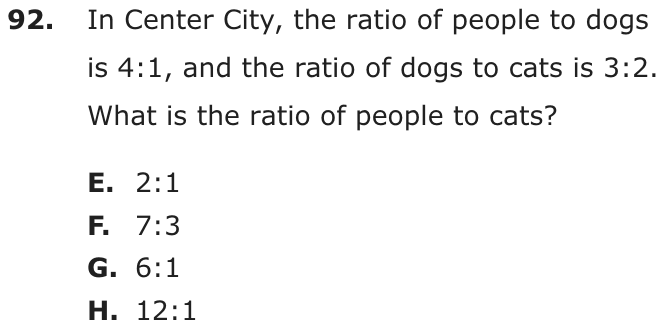
In Center City, the ratio of people to dogs is , and the ratio of dogs to cats is . What is the ratio of people to cats?
- A
- B
- C
- D
Show the answer
Correct answer: C
Take each ratio and solve for dogs:
And
Set the two expressions for d equal to each other and solve for :
So, the ratio of people to cats is .
Question analysis
A ratio question about Center City, where the ratio of people to dogs and the ratio of dogs to cats are both given. Students link the two ratios through the dogs to find the ratio of people to cats. It tests combining ratios, a step that goes wrong when the given numbers are paired up as written.
- Grade level
- Grade 7 content, by NYS standard
- Compared with grade 7
- At grade 7 Grade 7 ratio problems usually work with a single ratio. Here two ratios share the dogs but give them different numbers of parts, so one ratio must be rescaled before people and cats can be compared.
- Estimated difficulty
- Moderate: several steps, or a close reading with one strong distractor.
- Thinking it demands
- Depth of knowledge 2, skills and concepts · mainly apply
- What makes it hard
- No obvious method moderate
- Much to keep track of minor
- Solution
- 3 steps
- Reading level
- Question and choices: about grade 5, 32 words.
- Students, last 30 days
- Not enough answers yet to show (it takes 10).
Why it is hard, traps and wrong answers (shows the answer)
Why it is hard
The question rewards seeing that the dogs link the two ratios but are counted differently in each. Reading the people’s 4 and the cats’ 2 straight off the page gives a tidy 2 : 1, and it is the trap most students fall into. Rewriting people to dogs as 12 : 3 makes one chain, 12 : 3 : 2, from which people to cats is 12 : 2.
No obvious method moderate Working it out
Dogs are 1 part in the first ratio and 3 parts in the second, so the ratios cannot be joined until 4 : 1 is rescaled to 12 : 3; nothing in the stem says to do this. (Schoenfeld, 1985)
Much to keep track of minor Working it out
Three groups, people, dogs and cats, run through two ratios, and students must keep track of which number belongs to which group while scaling. (Sweller, 1988; Carpenter, Just & Shell, 1990)
Strategy: Rewrite both ratios with the same number for dogs, so that people to dogs to cats becomes one three-part ratio, then read off people to cats and simplify.
Traps
- Numbers taken from the question: Combines the numbers in the question without a model of the situation, or is simply a number that appears in the question.
- Stops one step early: A choice is a number from partway through the solution.
The wrong answers, classified
A Numbers taken from the question (Hegarty, Mayer & Monk, 1995)
Pairs the people’s 4 from the first ratio with the cats’ 2 from the second, 4 : 2 = 2 : 1, without first matching the dogs’ parts.
B Numbers taken from the question (Hegarty, Mayer & Monk, 1995)
Adds the two ratios term by term, (4 + 3) : (1 + 2) = 7 : 3, treating ratio terms as amounts that can be combined.
D Stops one step early (King et al., 2004; Gierl et al., 2017)
Multiplies people per dog by the dogs’ 3, 4 × 3 = 12, and stops before dividing by the cats’ 2, giving 12 : 1.
Worked solution, step by step
Formulas used
- Equivalent ratios
- a and b are the two amounts in a ratio, in order. k is any number you choose, except 0. Multiplying both amounts by the same number keeps the comparison the same. For example, 4 : 1 and 12 : 3 both mean 4 people for every dog.
Sort out the question
A ratio compares two amounts. People to dogs is 4 : 1. That means 4 people for every 1 dog. Dogs to cats is 3 : 2. That means 3 dogs for every 2 cats.
You need people to cats. Dogs show up in both ratios, so they are the link.
Make the dog numbers match
The dogs are 1 in the first ratio and 3 in the second. To join the ratios, the dog numbers must be the same. So multiply both parts of the first ratio by 3.
Now there are 12 people for every 3 dogs.
Join the two ratios
Both ratios now have 3 dogs. So you can write all three groups in one ratio.
For every 12 people, there are 3 dogs and 2 cats.
Read off and simplify
People to cats is 12 : 2. Divide both parts by 2.
Watch out: Taking the 4 people and the 2 cats straight from the problem gives 4 : 2 = 2 : 1, choice A. That skips matching the dogs. Stopping at 12 : 1, without using the 2 cats, gives choice D.
So the answer is C, 6 : 1.
Check your answer
Build a small town. Start with 2 cats. The second ratio gives 3 dogs. The first ratio gives 4 people for each dog, so 4 × 3 = 12 people. That is 12 people for 2 cats, or 6 people for each cat.
More questions like this
The original DOE question
Question 7 of 12
2023 Test B Math, question 43Question
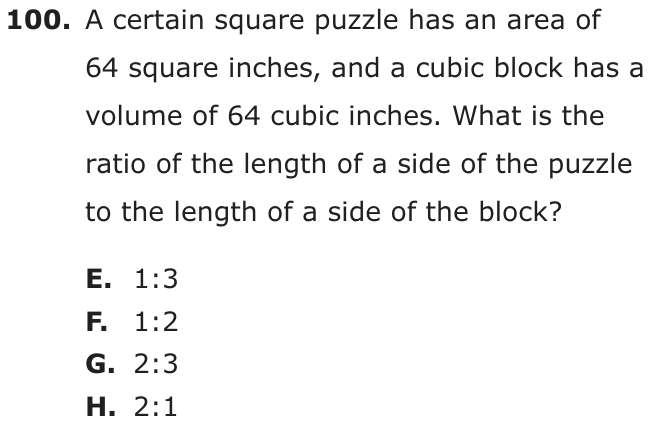
A certain square puzzle has an area of 64 square inches, and a cubic block has a volume of 64 cubic inches. What is the ratio of the length of a side of the puzzle to the length of a side of the block?
- A
- B
- C
- D
Show the answer
Correct answer: D
The length of one side of the puzzle is inches. The length of one side of the block is inches.
The ratio of the side of the puzzle to the side of the block is , which reduces to .
Question analysis
A square puzzle has an area of 64 square inches, and a cube-shaped block has a volume of 64 cubic inches. Students find the ratio of a side of the puzzle to a side of the block. Both figures are described by the number 64, but turning an area and a volume back into lengths takes different steps, and the order of the ratio matters.
- NYS standards
- Grade level
- Grade 8 content, by NYS standard
- Compared with grade 7
- Above grade 7 Grade 7 area and volume problems go from side lengths to an area or a volume. Going backward needs a square root and a cube root, and cube roots are grade 8 content, although 64 is both a perfect square and a perfect cube.
- Estimated difficulty
- Moderate: several steps, or a close reading with one strong distractor.
- Thinking it demands
- Depth of knowledge 2, skills and concepts · mainly apply
- What makes it hard
- Something you must already know moderate
- Combines ideas minor
- Solution
- 3 steps
- Reading level
- Question and choices: about grade 3, 46 words.
- Students, last 30 days
- Not enough answers yet to show (it takes 10).
Why it is hard, traps and wrong answers (shows the answer)
Why it is hard
Because 64 is both a perfect square and a perfect cube, the computation is easy once students know to undo squaring and cubing. The risk is at the end: with sides of 8 and 4 inches in hand, writing the block first turns the ratio upside down. Students who never find the side lengths are left with ideas such as two dimensions against three.
Something you must already know moderate Working it out
Neither formula is given: the puzzle’s side is the number whose square is 64 and the block’s edge the number whose cube is 64, and cube roots are grade 8 work. (Anderson & Krathwohl, 2001)
Combines ideas minor Working it out
A square and a cube share the number 64 in different units, so two different inverse operations feed one ratio, which must list the puzzle’s side first. (Embretson, 1998; Daniel & Embretson, 2010)
Strategy: Find the side of the square from its area and the edge of the cube from its volume by testing small whole numbers, then write the puzzle's side first and simplify.
Traps
- Wrong operation: Adds instead of multiplying, divides the wrong way round, turns a ratio or rate upside down, or undoes a step in the wrong direction (subtracts what should be added back).
- Numbers taken from the question: Combines the numbers in the question without a model of the situation, or is simply a number that appears in the question.
The wrong answers, classified
A Little reason to choose it (Haladyna & Downing, 1993; Rodriguez, 2005)
No common working gives 1 : 3; it makes the puzzle’s side the shorter one, the reverse of 8 and 4 inches, so it mostly draws guesses.
B Wrong operation (Hegarty, Mayer & Monk, 1995; King et al., 2004)
Finds both lengths correctly, 8 and 4 inches, but writes the block’s side first, turning the ratio upside down to 1 : 2.
C Numbers taken from the question (Hegarty, Mayer & Monk, 1995)
Matches the square to 2 and the cube to 3, the powers behind square inches and cubic inches, and writes 2 : 3 without finding any length.
Worked solution, step by step
Formulas used
- Area of a square
- A is the area, in square units. s is the length of one side. All sides of a square are equal, so the area is the side times itself. To find the side from the area, ask which number times itself gives the area.
- Volume of a cube
- V is the volume, the space inside, in cubic units. s is the length of one edge. A cube’s length, width and height are all equal, so the volume is the edge used three times. To go backward, ask which number used three times gives the volume.
Sort out the shapes
The puzzle is a square with an area of 64 square inches. The block is a cube with a volume of 64 cubic inches. A cube is a box with every edge the same length. You need the ratio of the puzzle’s side to the block’s side, with the puzzle first.
Find the puzzle’s side
Use the area formula backward. Which number times itself makes 64?
The puzzle’s side is 8 inches. This number is the square root of 64.
Find the block’s side
Use the volume formula backward. Which number used three times makes 64? Try small numbers. 3 × 3 × 3 = 27 is too small.
The block’s side is 4 inches. This number is the cube root of 64.
Write and simplify the ratio
Put the puzzle first, as the question asks. Then divide both parts by 4.
Watch out: Writing the block’s side first gives 1 : 2, choice B. The order in a ratio matters.
So the answer is D, 2 : 1.
Check your answer
Check both sides. 8 × 8 = 64 square inches, and 4 × 4 × 4 = 64 cubic inches. The puzzle’s side is longer, so its number in the ratio must be bigger. Only choice D puts the bigger number first.
More questions like this
The original DOE question
Question 8 of 12
2018 Test A Math, question 2Question
The owner of a tree farm plants pine trees and oak trees in a ratio of . How many oak trees are planted if 264 pine trees are planted?
Grid-in question: work out the answer and enter it as a number.
Show the answer
Correct answer: 99
Let be the number of oak trees when 264 pine trees are planted. Set up a proportion and solve for :
Question analysis
A ratio word problem about a tree farm that plants pine and oak trees in a fixed ratio of 8 to 3. Given how many pine trees are planted, students find the matching number of oak trees and grid it in. The main risk is pairing each number with the wrong kind of tree.
- Grade level
- Grade 6 content, by NYS standard
- Compared with grade 7
- Below grade 7 This is a one-ratio proportion with whole numbers, the kind of problem grade 6 students solve with equivalent ratios. A typical grade 7 task adds rates with fractions or a multistep percent; this has neither.
- Estimated difficulty
- Routine: one familiar step, little to misread.
- Thinking it demands
- Depth of knowledge 2, skills and concepts · mainly apply
- What makes it hard
- Solution
- 2 steps
- Reading level
- Question and choices: about grade 4, 28 words.
- Corrected from the DOE handbook
- An arithmetic slip in the explanation was corrected.
- Students, last 30 days
- Not enough answers yet to show (it takes 10).
Why it is hard, traps and wrong answers (shows the answer)
Why it is hard
This is a one-ratio scaling problem with friendly numbers: 264 splits into 8 equal parts of 33. The only real risk is matching 264 to the wrong term of 8:3, and a quick sense check catches it, since oak trees are the smaller group and must number fewer than 264. Students who grid the one-part value or the total of both kinds of tree have answered a question that was not asked.
Turning words into math minor Understanding the question
The ratio 8:3 lists pine first, so the 264 pine trees match the 8 and the oak count matches the 3; reading the terms in the other order flips the setup. (Hegarty, Mayer & Monk, 1995; Koedinger & Nathan, 2004)
An answer in an unexpected form minor Choosing the answer
As a grid-in it offers no choices, so an upside-down proportion that gives 704 oak trees, far more than the 264 pines, has to be caught by the student's own check. (Enright, Morley & Sheehan, 2002)
Strategy: Divide the number of pine trees by the pine part of the ratio to get the size of one part, then multiply by the oak part.
Traps
- Answers a different question: A choice is right for another quantity: the other unknown, the rest instead of the part, the part instead of the whole.
- Stops one step early: A choice is a number from partway through the solution.
The wrong answers, classified
704 Wrong operation (Hegarty, Mayer & Monk, 1995; King et al., 2004)
Turns the ratio upside down, treating the 264 pines as 3 parts: 264 ÷ 3 = 88, then 88 × 8 = 704.
33 Stops one step early (King et al., 2004; Gierl et al., 2017)
Divides 264 by 8 to get the size of one part, 33 trees, and stops before multiplying by the 3 parts that are oak.
363 Answers a different question (King et al., 2004; Hegarty, Mayer & Monk, 1995)
Finds the 99 oak trees correctly and then adds the 264 pines, gridding the total number of trees planted.
What was corrected from the DOE handbook, and why
- Explanation: The handbook goes from x/264 = 3/8 to “8x = 762”. Cross-multiplying gives 8x = 3 × 264 = 792, so that line now reads 8x = 792. The handbook’s final answer, x = 99, was already right (792 ÷ 8 = 99).
Worked solution, step by step
Formulas used
- Equal ratios
- a and b are the two numbers in a ratio, written as a fraction. n is any number you choose, except zero. Multiplying both numbers by the same n gives an equal ratio. This is how you scale a small ratio up to real counts.
Sort out the ratio
A ratio compares two amounts. Here the ratio of pine trees to oak trees is 8:3. Pine comes first, so pine goes with the 8. Oak goes with the 3. So for every 8 pine trees, there are 3 oak trees.
The farm planted 264 pine trees. You need the number of oak trees.
Find the size of one part
Think of the trees in equal groups, called parts. Pine trees fill 8 parts, and oak trees fill 3 parts. The 264 pine trees are the 8 parts, so divide by 8.
Each part is 33 trees. Watch out: 33 is one part, not the number of oak trees. Don’t stop here.
Find the number of oak trees
Oak trees fill 3 parts. Multiply the part size by 3.
You can see the same thing with equal ratios. Multiply both numbers of 8:3 by 33.
So 264 pine trees go with 99 oak trees.
Avoid the traps and answer
Watch out: if you match 264 to the 3 instead of the 8, you flip the ratio. That gives 704 oak trees. Watch out: the question asks only for oak trees. Adding the 264 pines gives 363. So you would grid 99.
Check your answer
The ratio 8:3 says there are fewer oak trees than pine trees. 99 is less than 264, so that fits. Also, divide both counts by 33: and . That gives back 8:3.
More questions like this
The original DOE question

Question 9 of 12
2018 Test A Math, question 22Question
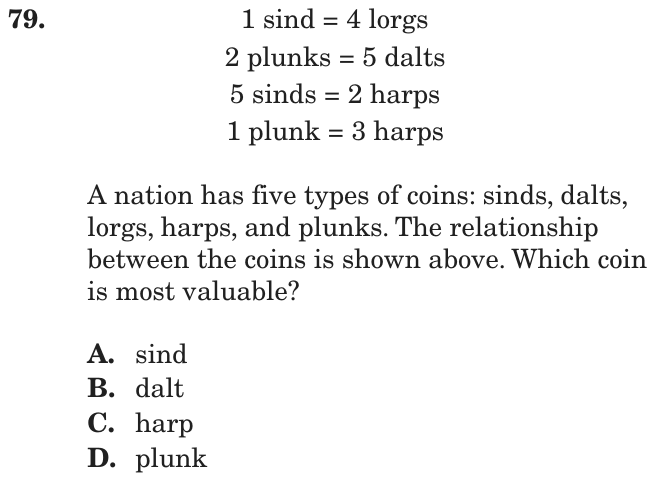
1 sind = 4 lorgs
2 plunks = 5 dalts
5 sinds = 2 harps
1 plunk = 3 harps
A nation has five types of coins: sinds, dalts, lorgs, harps, and plunks. The relationship between the coins is shown above. Which coin is most valuable?
- Asind
- Bdalt
- Charp
- Dplunk
Show the answer
Correct answer: D
1 sind = 4 lorgs,
so 1 sind > 1 lorg.
2 harps = 5 sinds,
so 1 harp > 1 sind.
1 plunk = 3 harps,
so 1 plunk > 1 harp,
meaning that 1 plunk > 1 sind and 1 lorg.
2 plunks = 5 dalts,
so 1 plunk > 1 dalt.
Therefore, the plunk is the most valuable.
Question analysis
This reasoning question invents a money system: four exchange rates link five made-up coins. Students compare the coins step by step to find which one is worth the most. The rates run in different directions, so it is easy to misjudge which side of an equation holds the more valuable coin.
- Grade level
- Grade 6 content, by NYS standard
- Compared with grade 7
- At grade 7 Grade 6 and 7 ratio work converts between two units at a time. Chaining four invented rates and comparing values with no common unit given is less familiar, though the arithmetic stays simple.
- Estimated difficulty
- Moderate: several steps, or a close reading with one strong distractor.
- Thinking it demands
- Depth of knowledge 2, skills and concepts · mainly analyze
- What makes it hard
- Turning words into math moderate
- Much to keep track of moderate
- No obvious method minor
- Solution
- 3 steps
- Reading level
- Question and choices: about grade 1, 38 words.
- Students, last 30 days
- Not enough answers yet to show (it takes 10).
Why it is hard, traps and wrong answers (shows the answer)
Why it is hard
There is little arithmetic, but the relationships have to be read the right way round and chained. Students who think a larger count means a more valuable coin rank the coins backward, and students who stop after one or two links pick a coin that beats only its neighbor. Writing each coin's worth in lorgs, 4 for a sind, 10 for a harp, 12 for a dalt and 30 for a plunk, makes the ranking plain.
Turning words into math moderate Understanding the question
In "2 plunks = 5 dalts" the coin with the larger count is worth less, the reverse of what the bigger number suggests, and the same holds in all four equations. (Hegarty, Mayer & Monk, 1995; Koedinger & Nathan, 2004)
Much to keep track of moderate Working it out
Five coins and four exchange rates have to be linked into one ranking; dalts connect only through plunks, and lorgs only through sinds. (Sweller, 1988; Carpenter, Just & Shell, 1990)
No obvious method minor Working it out
Nothing says how to compare coins that never appear in the same equation; converting every coin to lorgs, or chaining inequalities, has to be chosen. (Schoenfeld, 1985)
Strategy: Rewrite every coin in terms of lorgs, which only ever appear as the smaller unit, following the rates one link at a time, then compare.
Traps
- Equation written backwards: Writes a comparison the wrong way round, word for word: "six times as many students as professors" as 6S = P. The bigger quantity gets the bigger number.
- Stops one step early: A choice is a number from partway through the solution.
The wrong answers, classified
A Equation written backwards (Clement, Lochhead & Monk, 1981)
Reads every equation backward, giving more value to the coin with the larger count, so 5 sinds = 2 harps puts sinds above harps and 1 plunk = 3 harps puts harps above plunks.
B Equation written backwards (Clement, Lochhead & Monk, 1981)
Reads 2 plunks = 5 dalts backward, giving the bigger value to the coin with the bigger count, so the dalt seems to outrank the plunk.
C Stops one step early (King et al., 2004; Gierl et al., 2017)
Sees from 5 sinds = 2 harps that a harp beats a sind and stops, missing the last line, 1 plunk = 3 harps.
Worked solution, step by step
Formulas used
- Value of a group of coins
- V is what a group of coins is worth. n is the number of coins, and v is what one coin is worth. Here every value is counted in lorgs, the smallest coin. Using one unit for all the coins lets you compare them.
Sort out the question
There are five coins and four trading rules. You need the coin that is worth the most. Read each rule carefully. In 2 plunks = 5 dalts, it takes more dalts to match. So each dalt is worth less than a plunk. More coins on one side means each of those coins is worth less.
Pick one coin to measure with
Measure every coin in lorgs, the way you might measure every length in inches. The first rule says 1 sind = 4 lorgs. So one sind is worth 4 lorgs.
Find a harp’s value in lorgs
The rule 5 sinds = 2 harps links harps to sinds. First find what 5 sinds are worth.
So 2 harps are worth 20 lorgs, and 1 harp is worth half of that.
One harp is worth 10 lorgs.
Find a plunk’s value in lorgs
The rule 1 plunk = 3 harps says a plunk is worth 3 harps.
One plunk is worth 30 lorgs.
Find a dalt’s value in lorgs
The rule 2 plunks = 5 dalts links dalts to plunks. Two plunks are worth lorgs. So 5 dalts are worth 60 lorgs too.
One dalt is worth 12 lorgs.
Compare all five coins
Coin Value in lorgs lorg 1 sind 4 harp 10 dalt 12 plunk 30 Watch out: 5 dalts trade for only 2 plunks, so a dalt is worth less. Reading that rule backward leads to choice B. Watch out: the harp beats the sind, but the plunk beats the harp. Stopping early gives choice C. So the answer is D, plunk.
Check your answer
Test each rule with the lorg values. 2 plunks = 60 lorgs, and 5 dalts = 60 lorgs. 5 sinds = 20 lorgs, and 2 harps = 20 lorgs. 1 plunk = 30 lorgs, and 3 harps = 30 lorgs. Every rule balances.
More questions like this
The original DOE question
Question 10 of 12
2018 Test A Math, question 27Question
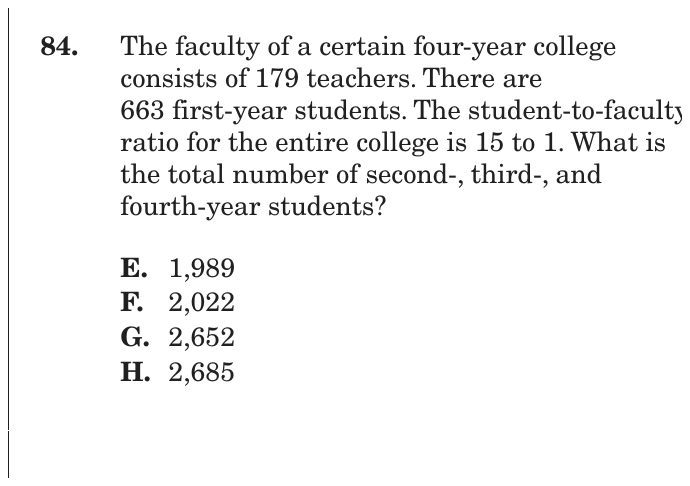
The faculty of a certain four-year college consists of 179 teachers. There are 663 first-year students. The student-to-faculty ratio for the entire college is 15 to 1. What is the total number of second-, third-, and fourth-year students?
- A1,989
- B2,022
- C2,652
- D2,685
Show the answer
Correct answer: B
Let be the number of second-, third-, and fourth-year students.
Then the total number of students in the college is
Set up a proportion and solve for :
Question analysis
A ratio word problem about a four-year college with 179 teachers, 663 first-year students and a student-to-faculty ratio of 15 to 1. Students use the ratio to find the total number of students, then remove the first-year class. The phrase four-year invites the wrong assumption that every year is the same size.
- Grade level
- Grade 7 content, by NYS standard
- Compared with grade 7
- At grade 7 Using a ratio to find a total and then subtracting a part is a standard two-step grade 7 ratio problem. The three-digit multiplication and the four-year detail add little beyond typical classwork.
- Estimated difficulty
- Moderate: several steps, or a close reading with one strong distractor.
- Thinking it demands
- Depth of knowledge 2, skills and concepts · mainly apply
- What makes it hard
- Turning words into math moderate
- Error-prone arithmetic minor
- Solution
- 2 steps
- Reading level
- Question and choices: about grade 7, 34 words.
- Students, last 30 days
- Not enough answers yet to show (it takes 10).
Why it is hard, traps and wrong answers (shows the answer)
Why it is hard
The question hinges on what the ratio describes: the whole college, not one class of students. Students who see that multiply, subtract and are done; those who stop at the total, or assume each year matches the 663 first-years, find their number listed. Because the choices come in close pairs, a careless multiplication can also land on a wrong one.
Turning words into math moderate Understanding the question
"The student-to-faculty ratio for the entire college is 15 to 1" covers students in all four years, so 15 × 179 is every student, and the 663 first-years must come out. (Hegarty, Mayer & Monk, 1995; Koedinger & Nathan, 2004)
Error-prone arithmetic minor Working it out
179 × 15 and the subtraction of 663 are multi-digit computations by hand, and the choices come in pairs only 33 apart. (Brown & Burton, 1978; Junker & Sijtsma, 2001)
Strategy: Multiply the 179 faculty by 15 to get the number of all students, then subtract the 663 first-year students to leave the other three years.
Traps
- Stops one step early: A choice is a number from partway through the solution.
The wrong answers, classified
A Numbers taken from the question (Hegarty, Mayer & Monk, 1995)
Ignores the ratio and assumes each of the other three years also has 663 students, 663 × 3 = 1,989.
C Numbers taken from the question (Hegarty, Mayer & Monk, 1995)
Assumes all four years have 663 students and multiplies 663 × 4 = 2,652, which also counts the first-year class the question leaves out.
D Stops one step early (King et al., 2004; Gierl et al., 2017)
Multiplies 179 × 15 = 2,685 to get every student in the college and stops before subtracting the 663 first-year students.
Worked solution, step by step
Formulas used
- Using a ratio to find an amount
- s is the number of students, and f is the number of faculty, the teachers. A ratio of 15 to 1 means 15 students for every 1 teacher. So each teacher goes with 15 students, and you multiply the teachers by 15.
Sort out the question
The faculty means the teachers. The college has 179 of them. The ratio of students to faculty is 15 to 1 “for the entire college”. So there are 15 students for every teacher, counting all four years. 663 students are first-years. You need the second-, third- and fourth-year students together.
Find every student in the college
Multiply the teachers by 15.
Break it into easy pieces: and .
There are 2,685 students in all four years.
Take away the first-years
That leaves 2,022 second-, third- and fourth-year students. Watch out: 2,685 still includes the first-years. Stopping there gives choice D. Watch out: don’t assume each year has 663 students. That leads to 1,989, choice A. So the answer is B, 2,022.
Check your answer
Add back: students. Then . That is 15 students for each teacher, the ratio in the question.
More questions like this
The original DOE question
Question 11 of 12
2018 Test A Math, question 57Question
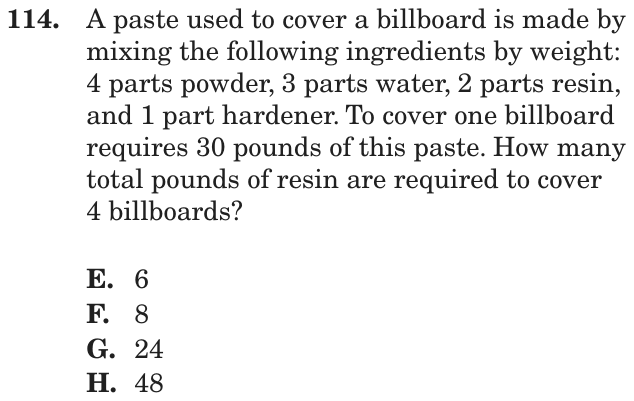
A paste used to cover a billboard is made by mixing the following ingredients by weight: 4 parts powder, 3 parts water, 2 parts resin, and 1 part hardener. To cover one billboard requires 30 pounds of this paste. How many total pounds of resin are required to cover 4 billboards?
- A6
- B8
- C24
- D48
Show the answer
Correct answer: C
The ratio is , so the total parts is 10.
Since there are two parts resin, the fraction of resin is
So the amount of resin in 30 lb of paste (for 1 billboard) is
lb.
For 4 billboards, that would be 6 × 4 = 24 lb.
Question analysis
This ratio word problem gives a billboard paste recipe of 4 parts powder, 3 parts water, 2 parts resin and 1 part hardener by weight, with 30 pounds of paste per billboard. It asks how many pounds of resin four billboards need. Students must find resin's share of the total parts and scale up to four billboards.
- Grade level
- Grade 7 content, by NYS standard
- Compared with grade 7
- At grade 7 Part-to-whole ratio problems with several ingredients are typical grade 7 work. This one adds a final scaling step for four billboards, which keeps it a routine multistep ratio problem at grade 7 level.
- Estimated difficulty
- Straightforward: two steps or one careful reading.
- Thinking it demands
- Depth of knowledge 2, skills and concepts · mainly apply
- What makes it hard
- Many steps minor
- Solution
- 3 steps
- Reading level
- Question and choices: about grade 8, 45 words.
- Students, last 30 days
- Not enough answers yet to show (it takes 10).
Why it is hard, traps and wrong answers (shows the answer)
Why it is hard
The recipe lists four ingredients but only resin's share matters, so the work is part over whole and then scaling. The question asks for four billboards only in the last sentence, after the per-billboard amount has been set up, which is why stopping early is the main risk. Finding the total paste first, 120 pounds, and taking a fifth of it reaches the answer in one step.
Many steps minor Working it out
Add the parts to 10, take resin's 2/10 of 30 pounds, then multiply by 4 billboards: three short steps. (Daniel & Embretson, 2010; Enright, Morley & Sheehan, 2002)
Strategy: Add the ratio parts to get the total, find resin's fraction of one batch of paste, take that fraction of 30 pounds, and multiply by the number of billboards.
Traps
- Stops one step early: A choice is a number from partway through the solution.
- Answers a different question: A choice is right for another quantity: the other unknown, the rest instead of the part, the part instead of the whole.
The wrong answers, classified
A Stops one step early (King et al., 2004; Gierl et al., 2017)
Finds the resin for one billboard, 2/10 of 30 = 6 pounds, and stops without multiplying by four billboards.
B Numbers taken from the question (Hegarty, Mayer & Monk, 1995)
Treats resin's 2 parts as 2 pounds and multiplies by 4 billboards, ignoring the 30 pounds of paste each one needs.
D Answers a different question (King et al., 2004; Hegarty, Mayer & Monk, 1995)
Uses powder's 4 parts instead of resin's 2, finding 4/10 of 120 pounds, which is the powder needed for four billboards.
Worked solution, step by step
Formulas used
- Fraction from a ratio
- f is the fraction of the mix that is one ingredient. p is that ingredient’s number of parts. T is the total number of parts, found by adding all the ratio numbers. Use it to turn a ratio into a fraction of the whole.
Sort out what you know
The paste is 4 parts powder, 3 parts water, 2 parts resin and 1 part hardener, by weight. A part is just an equal share of the mix.
One billboard needs 30 pounds of paste. You need the pounds of resin for 4 billboards.
Find resin’s fraction of the paste
The mix has 10 parts in all, and resin is 2 of them:
So resin is one fifth of the paste. Watch out: 2 parts is not 2 pounds. Treating it that way gives 2 × 4 = 8, choice B.
Find the resin for one billboard
One billboard needs 6 pounds of resin. Watch out: 6 is choice A, but that covers only one billboard.
Multiply by four billboards
Each billboard needs the same 6 pounds of resin, so multiply by 4:
Four billboards need 24 pounds of resin. So the answer is C, 24.
Check your answer
Work it another way. Four billboards need 4 × 30 = 120 pounds of paste. One fifth of 120 is 24. Choice D, 48, is the powder, which has 4 parts out of 10.
More questions like this
The original DOE question
Question 12 of 12
2018 Test B Math, question 36Question
The Chens spend $5 of every $8 they earn on planned expenses. If the family earns $29,600 in one year, how much will they spend on planned expenses that year?
- A$1,850
- B$3,700
- C$5,920
- D$18,500
Show the answer
Correct answer: D
Let be the amount spent on planned expense in one year:
Question analysis
The Chens spend $5 out of every $8 they earn on planned expenses, and students apply that ratio to a yearly income of $29,600. It tests using a part-to-whole ratio with large numbers. The trap is using only part of the ratio, or using its two numbers the wrong way round.
- Grade level
- Grade 6 content, by NYS standard
- Compared with grade 7
- Below grade 7 Applying a ratio to a total is grade 6 ratio reasoning. This is a two-step calculation with friendly numbers, easier than the multistep ratio and percent problems typical of grade 7.
- Estimated difficulty
- Routine: one familiar step, little to misread.
- Thinking it demands
- Depth of knowledge 1, recall and reproduction · mainly apply
- What makes it hard
- Turning words into math minor
- Error-prone arithmetic minor
- Solution
- 2 steps
- Reading level
- Question and choices: about grade 4, 27 words.
- Students, last 30 days
- Not enough answers yet to show (it takes 10).
Why it is hard, traps and wrong answers (shows the answer)
Why it is hard
This is a direct fraction-of-a-quantity problem, and most students who read the ratio as five-eighths will finish it. The common loss is stopping after the division by 8, since that one-eighth share is also offered. Checking that the result is a little more than half the income catches both that error and a misplaced zero.
Turning words into math minor Understanding the question
"$5 of every $8" has to be read as the fraction 5/8 of the income, not as an instruction to divide by 5 or by 8 alone. (Hegarty, Mayer & Monk, 1995; Koedinger & Nathan, 2004)
Error-prone arithmetic minor Working it out
Dividing $29,600 by 8 and multiplying by 5 works with five-digit numbers, where a dropped zero gives an answer ten times too small. (Brown & Burton, 1978; Junker & Sijtsma, 2001)
Strategy: Treat 5 of every 8 dollars as the fraction five-eighths of the income: divide the yearly earnings by 8, then multiply by 5.
Traps
- Stops one step early: A choice is a number from partway through the solution.
The wrong answers, classified
A An arithmetic slip (Junker & Sijtsma, 2001)
Divides by 8 and multiplies by 5 with the right digits but drops a zero, ending with one tenth of the planned expenses.
B Stops one step early (King et al., 2004; Gierl et al., 2017)
Divides $29,600 by 8 to get one-eighth of the income and stops before multiplying by 5.
C Wrong operation (Hegarty, Mayer & Monk, 1995; King et al., 2004)
Divides $29,600 by 5, using only the 5 from the ratio, as if the family spent one-fifth of its income.
Worked solution, step by step
Formulas used
- Fraction of a number
- The whole is the full amount, here the money earned. The fraction a over b tells what share you want: a dollars out of every b dollars. Dividing the whole by b gives one share. Multiplying by a gives a of those shares.
Sort out what you know
The Chens earn $29,600 in one year. They spend “$5 of every $8” on planned expenses. That means 5 out of every 8 dollars. As a fraction, that is of what they earn. You need to find how much they spend.
Find one eighth of the money
Split the money into 8 equal parts.
One eighth is $3,700.
Watch out: this is not the answer yet. Stopping here gives choice B.
Take five of those parts
They spend 5 of the 8 parts. Use the fraction formula.
They spend $18,500.
Watch out: dividing only by 5 gives $5,920, choice C. Dropping a zero gives $1,850, choice A.
Give the answer
The planned expenses are 5 of the 8 equal parts, or $18,500. So the answer is D, $18,500.
Check your answer
is a little more than half. Half of $29,600 is $14,800. So the answer should be a bit more than $14,800. Only $18,500 fits. The other three choices are all less than half.
More questions like this
The original DOE question