6.NS.6c positioning rational numbers and points
Question 1 of 12
2026 Practice Test C Math, question 17Question

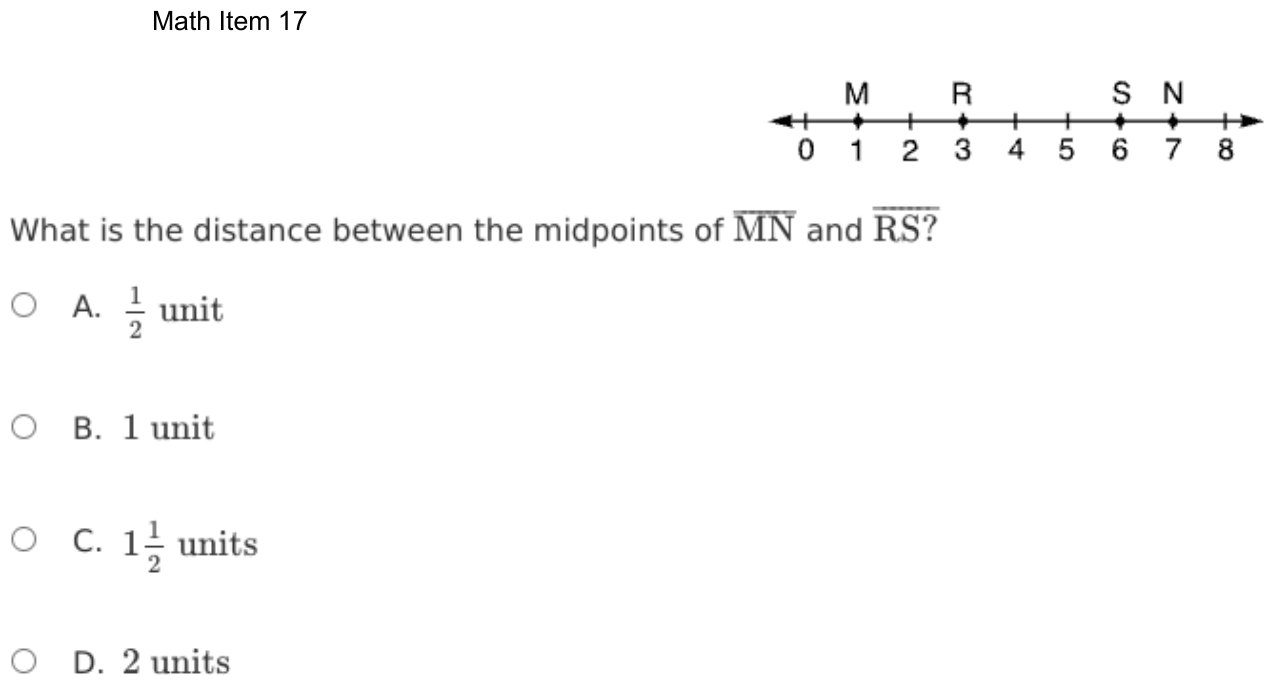
What is the distance between the midpoints of and ?
- A unit
- B1 unit
- C units
- D2 units
Show the answer
Correct answer: A
begins at 1 and ends at 7. Determine the length of :
The midpoint of a line segment is located exactly halfway between the two endpoints. Since is 6 units in length, the two endpoints are 6 units apart. Determine the location of the midpoint, in relation to each endpoint, by dividing 6 by 2:
The location of the midpoint of is 3 units from either endpoint. Find the midpoint by either adding 3 to the location of M (1) or subtracting 3 from the location of N (7):
The midpoint of is located at 4.
begins at 3 and ends at 6. Determine the length of :
Since is 3 units in length, the two endpoints are 3 units apart. Determine the location of the midpoint, in relation to each endpoint, by dividing 3 by 2:
The location of the midpoint of is 1.5 units from either endpoint. Find the midpoint by either adding 1.5 to the location of R (3) or subtracting 1.5 from the location of S (6):
The midpoint of is located at 4.5.
Determine the distance between the two midpoints by subtracting:
0.5 is equivalent to , making the distance between the two midpoints unit.
Question analysis
A number line from 0 to 8 shows points M, R, S and N, and students find the distance between the midpoint of segment MN and the midpoint of segment RS. It tests locating points and finding distances on a number line. One segment sits inside the other, and several lengths in the figure can be mistaken for the distance wanted.
- Grade level
- Grade 7 content, by NYS standard
- Compared with grade 7
- At grade 7 Finding distances between points on a number line is grade 7 work, here with whole-number positions. Two midpoints must be located before their distance can be found, so the task takes three short steps rather than one.
- Estimated difficulty
- Straightforward: two steps or one careful reading.
- Thinking it demands
- Depth of knowledge 2, skills and concepts · mainly apply
- What makes it hard
- Reading a figure, table or graph minor
- Many steps minor
- Solution
- 3 steps
- Reading level
- Question and choices: about grade 8, 17 words.
- Students, last 30 days
- Not enough answers yet to show (it takes 10).
Why it is hard, traps and wrong answers (shows the answer)
Why it is hard
The positions are whole numbers, so the midpoints come from simple averages, (1 + 7) ÷ 2 and (3 + 6) ÷ 2. The difficulty is keeping several lengths apart: the half-lengths of the two segments, the gaps at their ends, and the distance actually asked for, half a unit. Marking both midpoints on the number line before subtracting makes the small gap visible.
Reading a figure, table or graph minor Understanding the question
Segment RS lies inside MN, from 3 to 6, and its midpoint, 4 1/2, falls between two ticks of the number line rather than on a labeled point. (Lesh, Post & Behr, 1987; Kirsch & Mosenthal, 1990)
Many steps minor Working it out
Two midpoints have to be found, at 4 and 4 1/2, before their distance is taken, and the half-length of RS met on the way, 1 1/2, is among the choices. (Daniel & Embretson, 2010; Enright, Morley & Sheehan, 2002)
Strategy: Find each midpoint as the average of its segment's two endpoints, then subtract the smaller midpoint from the larger one.
Traps
- Stops one step early: A choice is a number from partway through the solution.
- Answers a different question: A choice is right for another quantity: the other unknown, the rest instead of the part, the part instead of the whole.
The wrong answers, classified
B Stops one step early (King et al., 2004; Gierl et al., 2017)
Sees that RS starts 2 units in from M and ends 1 unit in from N, and takes the difference of those gaps, 1, without halving it.
C Answers a different question (King et al., 2004; Hegarty, Mayer & Monk, 1995)
Halves each segment, 3 units for MN and 1 1/2 for RS, and subtracts the half-lengths instead of comparing the midpoints' positions.
D Answers a different question (King et al., 2004; Hegarty, Mayer & Monk, 1995)
Gives the distance from M to R, 2 units, the gap between the left ends of the two segments, without locating any midpoint.
Worked solution, step by step
Formulas used
- Midpoint on a number line
- a and b are the numbers at the two ends of a segment. The midpoint is the point exactly halfway between them. Adding the ends and dividing by 2 finds their average, which is the middle.
- Distance on a number line
- The distance between two points on a number line is how many units apart they are. Subtract the smaller number from the larger one, so the distance is never negative.
Sort out the question
The number line shows M at 1, R at 3, S at 6 and N at 7. Segment MN goes from 1 to 7. Segment RS goes from 3 to 6. A midpoint is the point exactly halfway along a segment. You need the distance between the two midpoints.
Find the midpoint of MN
Use the midpoint formula with the ends 1 and 7:
The midpoint of MN is at 4, which is 3 units from each end.
Find the midpoint of RS
Use the same formula with the ends 3 and 6:
The midpoint of RS is at 4.5. That is halfway between the marks for 4 and 5, where no point is labeled.
Subtract the two midpoints
Use the distance formula:
0.5 is one half, so the midpoints are 1/2 unit apart.
Watch out: half of MN is 3, and half of RS is 1 1/2. Subtracting those gives 1 1/2, choice C. But they are half-lengths, not positions. And 2, choice D, is only the distance from M to R.
Choose the answer
The midpoints, 4 and 4.5, are close together because RS sits near the middle of MN. So the answer is A, 1/2 unit.
Check your answer
Find each midpoint another way: walk half the length from the left end. MN is units long, and . RS is units long, and . Same midpoints, 1/2 unit apart.
More questions like this
The original DOE question
Question 2 of 12
2024 Test A Math, question 37Question
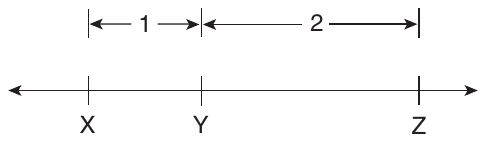
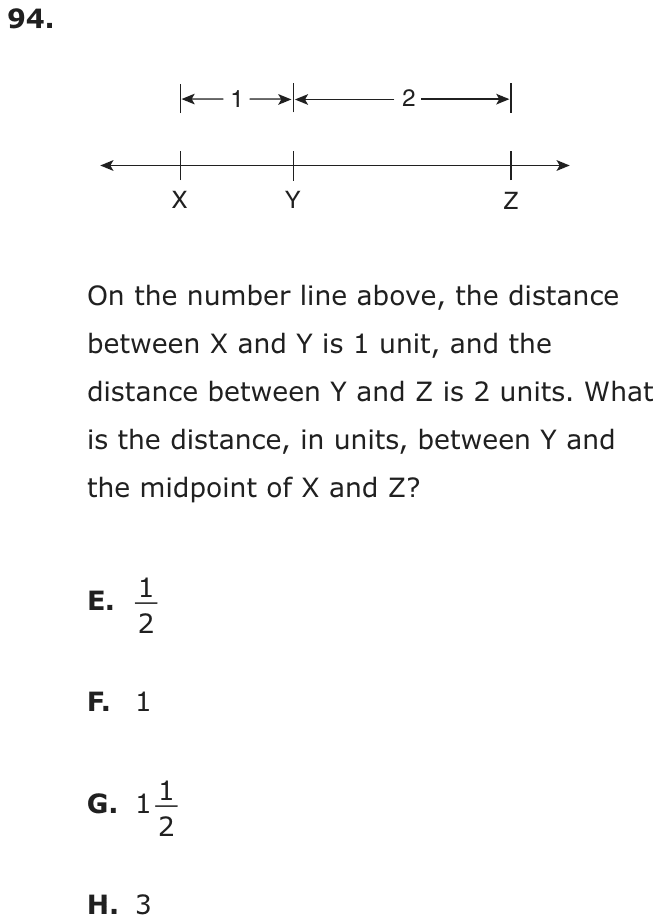
On the number line above, the distance between X and Y is 1 unit, and the distance between Y and Z is 2 units. What is the distance, in units, between Y and the midpoint of X and Z?
- A
- B1
- C
- D3
Show the answer
Correct answer: A
First, find the distance between X and Z by adding the distance between X and Y to the distance between Y and Z.
Since the distance between X and Z is 3, the midpoint between X and Z is units from X.
The midpoint between X and Z is units from X, and the distance between X and Y is 1. The distance between Y and the midpoint of X and Z is .
Question analysis
This number line question shows points X, Y and Z, with 1 unit from X to Y and 2 units from Y to Z, and asks how far Y is from the midpoint of X and Z. Students find the length of XZ, locate its midpoint, and compare it with Y. Each step produces a tempting number, so stopping early is the usual mistake.
- Grade level
- Grade 7 content, by NYS standard
- Compared with grade 7
- Below grade 7 Grade 7 number line problems usually involve negative numbers and fractions as coordinates. This one has no coordinates, only two whole-number distances, and needs three short steps: a total length, a midpoint and a difference.
- Estimated difficulty
- Straightforward: two steps or one careful reading.
- Thinking it demands
- Depth of knowledge 2, skills and concepts · mainly apply
- What makes it hard
- Reading a figure, table or graph minor
- Many steps minor
- Solution
- 3 steps
- Reading level
- Question and choices: about grade 5, 39 words.
- Corrected from the DOE handbook
- An imprecise statement about the midpoint in the explanation was corrected.
- Students, last 30 days
- Not enough answers yet to show (it takes 10).
Why it is hard, traps and wrong answers (shows the answer)
Why it is hard
The arithmetic is light, but every intermediate result is waiting among the choices, so the risk is stopping before the last subtraction. Students also have to keep two midpoints apart: the one asked about lies between X and Z, not halfway along the 2-unit stretch from Y. Marking X at 0 and the midpoint at 1.5 on the drawing makes the half-unit gap visible.
Reading a figure, table or graph minor Understanding the question
The number line has no coordinates, only dimension arrows labeled 1 and 2, so students must assign positions themselves, such as X at 0, Y at 1 and Z at 3. (Lesh, Post & Behr, 1987; Kirsch & Mosenthal, 1990)
Many steps minor Working it out
Three short results come in sequence, the length XZ, the midpoint's distance from X, then its distance from Y, and each is also a listed choice. (Daniel & Embretson, 2010; Enright, Morley & Sheehan, 2002)
Strategy: Place X at 0 so that Y and Z get positions from the given distances, find the midpoint of X and Z as half their distance, then compare it with Y's position.
Traps
- Stops one step early: A choice is a number from partway through the solution.
- Answers a different question: A choice is right for another quantity: the other unknown, the rest instead of the part, the part instead of the whole.
The wrong answers, classified
B Answers a different question (King et al., 2004; Hegarty, Mayer & Monk, 1995)
Halves the 2-unit segment from Y to Z, the midpoint of the wrong pair of points, which is 1 unit from Y; it also matches the labeled XY.
C Stops one step early (King et al., 2004; Gierl et al., 2017)
Finds that the midpoint is 1 1/2 units from X and stops before subtracting the 1 unit between X and Y.
D Answers a different question (King et al., 2004; Hegarty, Mayer & Monk, 1995)
Adds the two labeled distances, 1 + 2 = 3, and gives the whole length XZ rather than any distance to the midpoint.
What was corrected from the DOE handbook, and why
- Explanation: The handbook says “the midpoint between X and Z is 1½” (twice). A midpoint is a point, and this number line has no numbers on it, so the 1½ is the midpoint’s distance from X (half of XZ = 3). Both sentences now say the midpoint is “1½ units from X.” The rest is unchanged: Y is 1 unit from X, so the distance between Y and the midpoint is 1½ − 1 = ½.
Worked solution, step by step
Formulas used
- Adding lengths on a line
- X, Y and Z are points on one line, with Y between X and Z. XY and YZ are the lengths of the two short pieces. XZ is the length of the whole. The two pieces join end to end to make the whole.
- Midpoint of a segment
- A segment is the straight piece of a line between two points, its ends. The midpoint is the point exactly halfway between the ends. It splits the segment into two equal halves. So it is half the length away from each end.
Sort out the picture
The points go X, then Y, then Z, from left to right. X to Y is 1 unit, and Y to Z is 2 units. You need the midpoint of X and Z, the point halfway between them. Then you need how far Y is from that midpoint. The line has no numbers, so measure everything from X.
Find the length from X to Z
X to Z is 3 units. Watch out: 3 is the whole length, choice D. It is not a distance to the midpoint.
Place the midpoint
The midpoint of X and Z is half of 3 units from X.
So the midpoint is units to the right of X. Watch out: this is its distance from X, not from Y. Stopping here gives choice C.
Measure from Y to the midpoint
Y is 1 unit to the right of X. The midpoint is units to the right of X. Subtract to find the gap between them.
Watch out: use the midpoint of X and Z, not of Y and Z. Halving the 2 units from Y to Z gives 1, choice B.So the answer is A, unit.
Check your answer
Give each point a number, with X at 0. Then Y is at 1 and Z is at 3. Halfway between 0 and 3 is . From Y at 1 to is . This fits the picture too: Y sits a little left of the middle of XZ.
More questions like this
The original DOE question
Question 3 of 12
2024 Test A Math, question 56Question

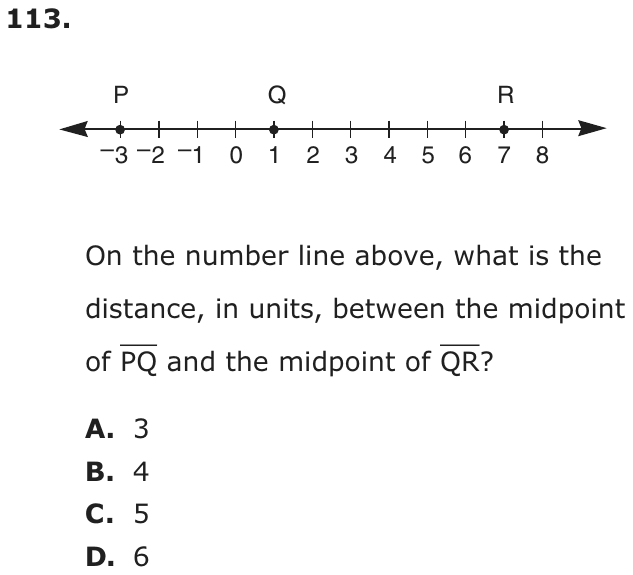
On the number line above, what is the distance, in units, between the midpoint of and the midpoint of ?
- A3
- B4
- C5
- D6
Show the answer
Correct answer: C
To find the midpoint of a segment, subtract the value on the left from the value on the right and then divide by 2. Then add the result to the value on the left of the segment.
Find the midpoint of :
Find the midpoint of :
The distance between −1 and 4 on the number line is 5 units.
Question analysis
A number line marks points P, Q and R at labeled integer positions, with P to the left of zero. This midpoint and distance question asks how far apart the midpoints of segments PQ and QR are. Students locate both midpoints and then measure the distance between them, which takes care with negative positions.
- Grade level
- Grade 7 content, by NYS standard
- Compared with grade 7
- At grade 7 Grade 7 students measure distances on a number line as the difference of two positions, including across zero. Here two midpoints must be located first, but all three points sit on labeled integers, which keeps it at grade 7 level.
- Estimated difficulty
- Straightforward: two steps or one careful reading.
- Thinking it demands
- Depth of knowledge 2, skills and concepts · mainly apply
- What makes it hard
- Error-prone arithmetic minor
- Many steps minor
- Solution
- 3 steps
- Reading level
- Question and choices: about grade 11, 21 words.
- Corrected from the DOE handbook
- A reversed instruction in the explanation was corrected.
- Students, last 30 days
- Not enough answers yet to show (it takes 10).
Why it is hard, traps and wrong answers (shows the answer)
Why it is hard
The points sit on labeled integers, so the midpoints can be found by counting, and the question is mostly about finishing carefully. Dropping the negative in 4 − (−1), stopping at the second midpoint, and counting tick marks instead of spaces each give a listed choice. Marking −1 and 4 on the figure and counting the unit spaces between them confirms the distance.
Error-prone arithmetic minor Working it out
P sits at −3, so the midpoint of PQ is (−3 + 1) ÷ 2 = −1, and the final distance, 4 − (−1), subtracts a negative number. (Brown & Burton, 1978; Junker & Sijtsma, 2001)
Many steps minor Working it out
Three results come in sequence, the midpoint of PQ, the midpoint of QR, then the gap between them, and the second of them, 4, is itself a listed choice. (Daniel & Embretson, 2010; Enright, Morley & Sheehan, 2002)
Strategy: Read the positions of P, Q and R, average each pair of endpoints to place the two midpoints, then subtract the left midpoint from the right one.
Traps
- Negatives and direction: Arithmetic with negative numbers, the order of a subtraction, or direction on a number line. (Moving a term across the equals sign without changing its sign is a faulty procedure.)
- Stops one step early: A choice is a number from partway through the solution.
- Counting the ends: Inclusive or exclusive ends, fence posts, consecutive numbers: an answer that is one too many or too few, or an endpoint drawn open where it belongs closed (or the reverse).
The wrong answers, classified
A Negatives and direction (Brown & Burton, 1978)
Finds the midpoints −1 and 4 but computes the gap as 4 − 1 = 3, dropping the negative sign instead of finding 4 − (−1).
B Stops one step early (King et al., 2004; Gierl et al., 2017)
Finds the midpoint of QR at 4 and gives its position as the answer, stopping before measuring from the other midpoint at −1.
D Counting the ends (Brown & Burton, 1978)
Counts the six tick marks from −1 to 4 inclusive rather than the five unit spaces between them.
What was corrected from the DOE handbook, and why
- Explanation: The handbook’s rule says to “subtract the value on the right from the value on the left and then divide by 2,” but its own working does the opposite: 1 − (−3) = 4 for PQ and 7 − 1 = 6 for QR, the right value minus the left. Following the rule as printed gives (−3 − 1) ÷ 2 = −2 and (1 − 7) ÷ 2 = −3, which would put the midpoints at −5 and −2, outside the segments, and lead to a distance of 3, a wrong choice. The site now says “subtract the value on the left from the value on the right.” The midpoints, −1 and 4, and the distance between them, 5 units, are unchanged.
Worked solution, step by step
Formulas used
- Midpoint on a number line
- The left end and right end are the numbers at the two ends of a segment. Right end minus left end is the segment’s length. The midpoint is halfway, so it is half the length to the right of the left end.
- Distance on a number line
- On a number line, numbers grow as you move right. The distance between two points is the larger number minus the smaller one. That is the right point minus the left point, so a distance is never negative.
Read the number line
P is at −3, Q is at 1 and R is at 7. A bar over two letters, such as , means the segment between them. A segment is the straight piece of line between two points. You need the midpoint of each segment, the point exactly halfway between its ends. Then you need the distance between those two midpoints.
Find the midpoint of PQ
The left end is −3 and the right end is 1.
So the midpoint of PQ is at −1. Note that is , which is 4.
Find the midpoint of QR
The left end is 1 and the right end is 7.
So the midpoint of QR is at 4. Watch out: 4 is where a midpoint is, not the answer. Stopping here gives choice B.
Measure between the midpoints
Watch out: keep the minus sign on −1. Using gives choice A. Also count the spaces, not the tick marks. From −1 to 4 there are 5 spaces but 6 marks, and 6 is choice D.So the answer is C, 5 units.
Check your answer
Each midpoint should sit in the middle of its segment. −1 is 2 units from both −3 and 1. 4 is 3 units from both 1 and 7. There is also a shortcut. The gap between the midpoints is half of PR: .
More questions like this
The original DOE question
Question 4 of 12
2024 Test B Math, question 7Question
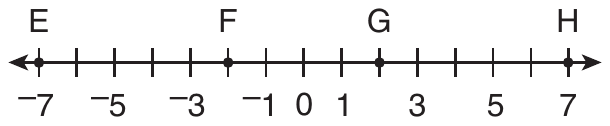
The number line shows points E, F, G, and H.
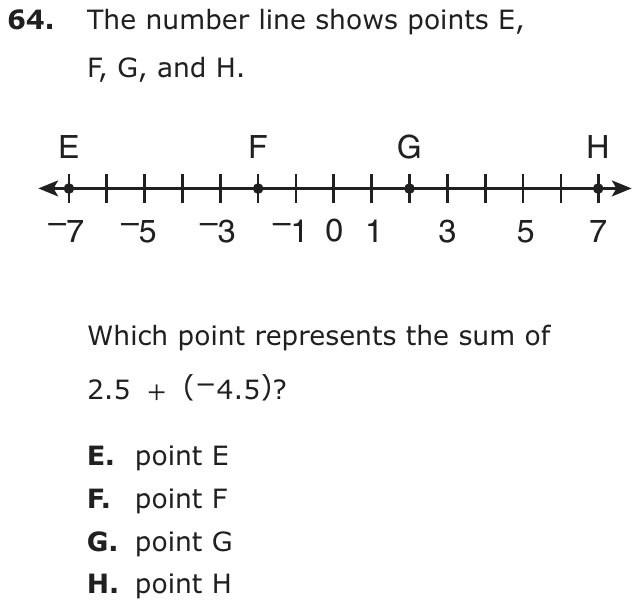
Which point represents the sum of ?
- Apoint E
- Bpoint F
- Cpoint G
- Dpoint H
Show the answer
Correct answer: B
Find the sum of :
Point F is located at −2.
Question analysis
A number line question with points E, F, G and H marked on a line labeled from −7 to 7. Students add 2.5 and negative 4.5 and find which point shows the sum. It tests adding a positive and a negative decimal, then reading positions on a line whose labels skip some integers.
- Grade level
- Grade 7 content, by NYS standard
- Compared with grade 7
- At grade 7 Adding rational numbers with different signs and showing the sum on a number line is exactly the grade 7 standard. This is one routine sum with simple decimals, a typical classroom exercise.
- Estimated difficulty
- Routine: one familiar step, little to misread.
- Thinking it demands
- Depth of knowledge 1, recall and reproduction · mainly apply
- What makes it hard
- Solution
- 2 steps
- Reading level
- Question and choices: about grade 1, 25 words.
- Students, last 30 days
- Not enough answers yet to show (it takes 10).
Why it is hard, traps and wrong answers (shows the answer)
Why it is hard
This is a one-line sum followed by a lookup, and most students finish quickly. The four points are placed so that each common sign mistake lands on one of them: −7, 2 and 7 all come from mishandling the negative. Picturing the sum as a move of 4.5 units to the left from 2.5 shows both the size and the direction at once.
Error-prone arithmetic minor Working it out
Adding −4.5 to 2.5 means taking 4.5 away from 2.5, and the larger size of −4.5 makes the sum negative, a sign rule that is easy to apply backwards. (Brown & Burton, 1978; Junker & Sijtsma, 2001)
Reading a figure, table or graph minor Understanding the question
Only 0 and the odd numbers are labeled, so point F sits at an unlabeled tick between −3 and −1 and must be found by counting. (Lesh, Post & Behr, 1987; Kirsch & Mosenthal, 1990)
Strategy: Rewrite adding −4.5 as subtracting 4.5, work out the sum, then find it on the line by counting tick marks from a labeled number, one tick per integer.
Traps
- Negatives and direction: Arithmetic with negative numbers, the order of a subtraction, or direction on a number line. (Moving a term across the equals sign without changing its sign is a faulty procedure.)
The wrong answers, classified
A Negatives and direction (Brown & Burton, 1978)
Adds the sizes 2.5 and 4.5 and makes the total negative, treating both numbers as negative, which lands on −7 at point E.
C Negatives and direction (Brown & Burton, 1978)
Subtracts 2.5 from 4.5 to get the right size, 2, but keeps it positive, missing that the negative number has the larger size.
D Negatives and direction (Brown & Burton, 1978)
Ignores the negative sign on 4.5 and adds the two numbers, 2.5 + 4.5 = 7, landing on point H at the far right.
Worked solution, step by step
Formulas used
- Adding a negative number
- a is any number, and −b is a negative number. Adding a negative number is the same as subtracting its size. On a number line, it means moving b steps to the left.
Sort out the question
You need to find . Then find that sum (the answer to the addition) on the number line.
The number line has a tick at every whole number from −7 to 7. Only 0 and the odd numbers have labels.
Turn the addition into subtraction
You are taking 4.5 away from 2.5. You take away more than you have, so the answer will be negative.
Do the subtraction
The two sizes differ by 2, because . The larger size, 4.5, belongs to the negative number. So the sum is negative.
Watch out: the answer is −2, not 2. Point G is at 2.Find −2 on the line
−2 has no label. It is the tick between −3 and −1. Point F sits on that tick.
Watch out: adding 2.5 + 4.5 = 7 lands on point H. Making both numbers negative gives −7, point E.So the answer is B, point F.
Check your answer
Start at 2.5 on the number line and move 4.5 steps to the left. The first 2.5 steps take you to 0. You still have 2 steps to go. Two more steps left of 0 lands on −2, which is point F.
More questions like this
The original DOE question
Question 5 of 12
2023 Test A Math, question 10Question

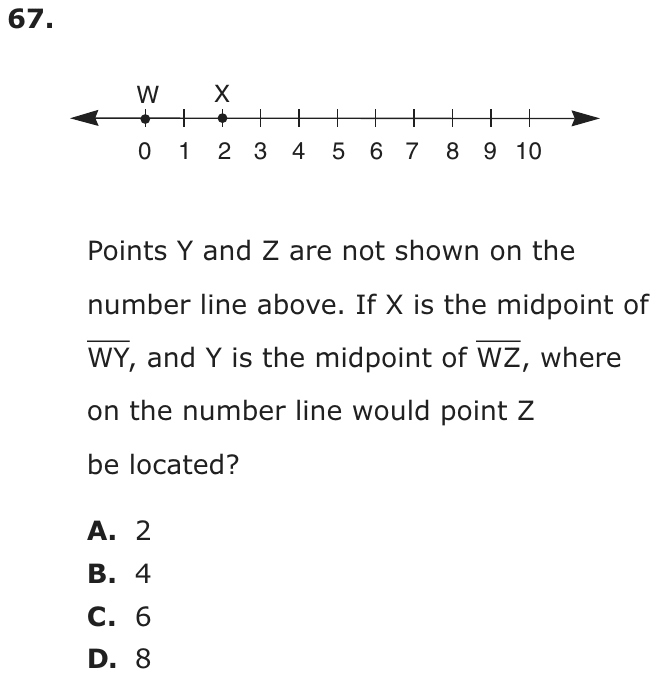
Points Y and Z are not shown on the number line above. If X is the midpoint of , and Y is the midpoint of , where on the number line would point Z be located?
- A2
- B4
- C6
- D8
Show the answer
Correct answer: D
First, find where Y is located on the number line. Point X is the midpoint of . Since there are 2 units between W and X, there must also be 2 units between X and Y. Thus, Y is located at 4 on the number line.
Point Y is the midpoint of . Use the same reasoning as above. Since there are 4 units between W and Y, there must be 4 units between Y and Z. So, Z is located at 8 on the number line.
Question analysis
A number line shows point W at 0 and point X at 2, and two more points, Y and Z, are described but not drawn. Students use two midpoint facts, one after the other, to find where Z lies. Each midpoint fact is about a different segment, so keeping track of which point is the middle one matters.
- Grade level
- Grade 7 content, by NYS standard
- Compared with grade 7
- Below grade 7 Midpoints on a number line rest on distance, which grade 7 students find as a difference. Here every point lies at a whole number of zero or more, so the work is two short steps with no negative numbers.
- Estimated difficulty
- Straightforward: two steps or one careful reading.
- Thinking it demands
- Depth of knowledge 2, skills and concepts · mainly apply
- What makes it hard
- Many steps minor
- Reading a figure, table or graph minor
- Solution
- 2 steps
- Reading level
- Question and choices: about grade 7, 36 words.
- Students, last 30 days
- Not enough answers yet to show (it takes 10).
Why it is hard, traps and wrong answers (shows the answer)
Why it is hard
Each midpoint statement doubles a distance from W, so the problem is two short doublings, 2 to 4 and then 4 to 8. The risk is stopping halfway, since Y's position is found first and appears among the choices, or reusing X as an endpoint in the second statement. Rereading which point the question asks about, and checking that Y is halfway between W and Z, catches both.
Many steps minor Working it out
The two midpoint statements must be used in order: the first places Y at 4, and only then can the second, about segment WZ, place Z. (Daniel & Embretson, 2010; Enright, Morley & Sheehan, 2002)
Reading a figure, table or graph minor Understanding the question
Only W at 0 and X at 2 are marked on the 0-to-10 line, and the overbars name WY and WZ as segments, so Y and Z have to be placed from the statements alone. (Lesh, Post & Behr, 1987; Kirsch & Mosenthal, 1990)
Strategy: Use the first midpoint to place Y as far beyond X as X is from W, then use the second midpoint the same way to place Z beyond Y.
Traps
- Answers a different question: A choice is right for another quantity: the other unknown, the rest instead of the part, the part instead of the whole.
- Misreads the question: Misses or misreads a condition or a word in the question: "at least", "each", "remaining", "not".
The wrong answers, classified
A Numbers taken from the question (Hegarty, Mayer & Monk, 1995)
Gives 2, the position of point X, the only labeled point besides W, without using either midpoint statement.
B Answers a different question (King et al., 2004; Hegarty, Mayer & Monk, 1995)
Uses the first statement to place Y at 4 and answers with Y's position instead of going on to locate Z, the point the question asks about.
C Misreads the question (Hegarty, Mayer & Monk, 1995)
Treats Y as the midpoint of XZ instead of WZ, so Z lands 2 units past Y, at 6, continuing the even steps from W to X to Y.
Worked solution, step by step
Formulas used
- Midpoint of a segment
- A and B are the ends of a segment, a straight piece of a line. M is its midpoint, the point exactly halfway. AM is the distance from A to M, and MB is the distance from M to B. A midpoint splits a segment into two equal parts, so these are equal.
Sort out the question
The number line shows W at 0 and X at 2. Points Y and Z are not shown. X is the midpoint of segment WY. Y is the midpoint of segment WZ. A midpoint is the point exactly halfway along a segment. You need the number where Z sits.
Place point Y
X is halfway from W to Y. So X to Y is as long as W to X.
So Y is 2 units past X.
Point Y is at 4. Watch out: this is Y, not Z. Stopping here gives 4, choice B.
Place point Z
Now Y is halfway from W to Z. W to Y is 4 units, so Y to Z is also 4 units.
Watch out: the second midpoint is for segment WZ, not XZ. Taking just 2 more units from Y puts Z at 6, choice C. So the answer is D, 8.
Check your answer
Check both midpoints. Halfway from 0 to 4 is , which is X. Halfway from 0 to 8 is , which is Y. Both facts in the question are true.
More questions like this
The original DOE question
Question 6 of 12
2023 Test A Math, question 14Question
If n is an odd integer that is less than −3.25, what is the greatest possible value of n?
- A−1
- B−2
- C−3
- D−5
Show the answer
Correct answer: D
The two greatest integers less than −3.25 are −4 and −5. Since −4 is even, the answer is −5.
Question analysis
This question asks for the greatest odd integer that is less than −3.25. Students compare negative numbers on a number line and apply two conditions at once, odd and less than. With negatives, the greater number is the one closer to zero, which makes the two conditions easy to misapply.
- Grade level
- Grade 6 content, by NYS standard
- Compared with grade 7
- Below grade 7 Ordering negative numbers is grade 6 content, and the question adds only the condition that the integer be odd. It is lighter than typical grade 7 work, though the order of negatives still trips up students who compare their sizes.
- Estimated difficulty
- Straightforward: two steps or one careful reading.
- Thinking it demands
- Depth of knowledge 1, recall and reproduction · mainly apply
- What makes it hard
- Error-prone arithmetic minor
- Much to keep track of minor
- Solution
- 2 steps
- Reading level
- Question and choices: about grade 7, 18 words.
- Students, last 30 days
- Not enough answers yet to show (it takes 10).
Why it is hard, traps and wrong answers (shows the answer)
Why it is hard
The question is short, but it asks students to reason on the negative side of 0, where greater means closer to 0 and the size of the digits misleads. The integers just below −3.25 are −4 and then −5, and the first of those is even. Sketching a number line, or reading less than as to the left of, keeps the direction straight.
Error-prone arithmetic minor Working it out
On the negative side, less means farther from 0, so the integers below −3.25 run −4, −5, −6; −3, though its digit is closer to 3.25, lies to the right. (Brown & Burton, 1978; Junker & Sijtsma, 2001)
Much to keep track of minor Working it out
Three conditions apply at once, odd, less than −3.25 and the greatest such value, and checking only two of them leads to a listed choice. (Sweller, 1988; Carpenter, Just & Shell, 1990)
Strategy: Picture −3.25 on a number line, list the integers to its left starting with the closest, and take the first one that is odd.
Traps
- Negatives and direction: Arithmetic with negative numbers, the order of a subtraction, or direction on a number line. (Moving a term across the equals sign without changing its sign is a faulty procedure.)
- Misreads the question: Misses or misreads a condition or a word in the question: "at least", "each", "remaining", "not".
The wrong answers, classified
A Misreads the question (Hegarty, Mayer & Monk, 1995)
Picks the greatest odd number offered, −1, without checking the condition that n be less than −3.25; −1 lies to its right on the number line.
B Little reason to choose it (Haladyna & Downing, 1993; Rodriguez, 2005)
The choice −2 is even, so it breaks the condition that n be odd, and it is also greater than −3.25; it mostly catches guesses.
C Negatives and direction (Brown & Burton, 1978)
Looks for the odd integer just past −3.25 but steps toward 0, taking −3, though −3 is greater than −3.25, not less.
Worked solution, step by step
Formulas used
- Comparing negative numbers
- a and b are positive numbers, and a is bigger. On a number line, numbers get smaller as you move left. A negative number farther from 0 is farther left. So it is smaller, even though its digits look bigger.
Sort out the question
n has to pass three tests. It is an integer, a whole number with no decimal part. It is odd, so it is not a multiple of 2. And it is less than −3.25. Of all the numbers that pass, you need the greatest one. That is the one farthest to the right on a number line.
Picture −3.25 on a number line
−3.25 sits between −4 and −3. Less than −3.25 means to the left of it.
So −4 is less than −3.25, but −3 is greater. Watch out: −3 is not less than −3.25. It is to the right, closer to 0. For negative numbers, the one closer to 0 is greater. Picking −3 is choice C.
Find the odd integers to the left
The integers less than −3.25, starting with the closest, are −4, −5, −6 and so on. The greatest one is −4. But −4 is even, since 4 = 2 × 2. So skip it. The next one, −5, is odd. Watch out: −1 is odd, but it is greater than −3.25, so choice A breaks the rule. So the answer is D, −5.
Check your answer
Check all three tests for −5. It is an integer. It is odd. It is to the left of −3.25, so it is less. The only integer between −5 and −3.25 is −4, and it is even. So no greater number works.
More questions like this
The original DOE question
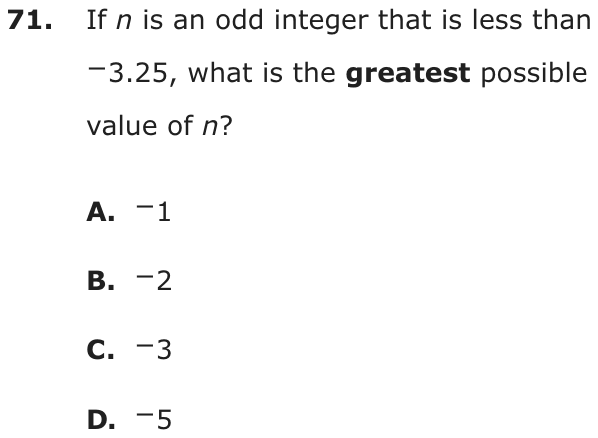
Question 7 of 12
2023 Test A Math, question 16Question
Between which two consecutive integers is the fraction ?
- A2 and 3
- B3 and 4
- C4 and 5
- D5 and 6
Show the answer
Correct answer: C
First, convert to a mixed number: . The two consecutive integers on either side of are 4 and 5.
Question analysis
This question asks between which two consecutive whole numbers the fraction 29/7 lies. Students divide to turn the improper fraction into a mixed number, or compare it with nearby multiples of 7. It is a quick check of number sense with fractions, where a remainder must be read correctly.
- Grade level
- Grade 6 content, by NYS standard
- Compared with grade 7
- Below grade 7 Changing an improper fraction to a mixed number and placing it between whole numbers is review well before grade 7. This takes one division with a small divisor and nothing more.
- Estimated difficulty
- Routine: one familiar step, little to misread.
- Thinking it demands
- Depth of knowledge 1, recall and reproduction · mainly apply
- What makes it hard
- Solution
- 2 steps
- Reading level
- Question and choices: about grade 5, 13 words.
- Students, last 30 days
- Not enough answers yet to show (it takes 10).
Why it is hard, traps and wrong answers (shows the answer)
Why it is hard
Dividing 29 by 7 gives 4 with a remainder of 1, so the fraction is 4 1/7 and lies just past 4. The one decision is which side of 4 the remainder puts it on, and a positive remainder always moves the value up. Writing the mixed number before looking at the choices makes the pair obvious.
A very close wrong answer minor Choosing the answer
The pairs 3 and 4 and 4 and 5 both contain 4, so knowing that 29/7 is about 4 is not enough; only the remainder, 29 − 28 = 1, puts it above 4. (Embretson & Wetzel, 1987; Gorin & Embretson, 2006; Ascalon et al., 2007)
Strategy: Find the largest multiple of 7 that is not more than 29, write the fraction as a mixed number, and read off the whole numbers on each side.
Traps
- Counting the ends: Inclusive or exclusive ends, fence posts, consecutive numbers: an answer that is one too many or too few, or an endpoint drawn open where it belongs closed (or the reverse).
The wrong answers, classified
A Little reason to choose it (Haladyna & Downing, 1993; Rodriguez, 2005)
No division of 29 by 7 lands below 3, since 7 × 3 = 21 is far short of 29; only misreading 29/7 as 2.9 gets there, so it mostly catches guesses.
B Counting the ends (Brown & Burton, 1978)
Finds the whole-number part, 4, but takes it as the upper end of the pair, as if 29/7 fell just short of 4 instead of just past it.
D Little reason to choose it (Haladyna & Downing, 1993; Rodriguez, 2005)
Nothing puts 29/7 above 5, since 7 × 5 = 35 is more than 29; even rounding 4 1/7 up gives 5 as the upper end, so it mostly catches guesses.
Worked solution, step by step
Formulas used
- Fraction to mixed number
- a over b is a fraction whose top is bigger than its bottom. q is the quotient, how many whole times b fits into a. r is the remainder, what is left over. The leftover stays over the same bottom number.
Sort out the question
Consecutive integers are whole numbers that come one right after the other, like 4 and 5. You need the two that falls between. So find the whole number just below it and the one just above it.
Divide 29 by 7
A fraction bar means divide. How many 7s fit in 29?
28 is the biggest multiple of 7 that is not more than 29. A multiple of 7 is 7 times a whole number. Then . So 29 ÷ 7 is 4 with 1 left over.
Write it as a mixed number
is a little more than 4 and less than 5. Watch out: it is just past 4, not just short of it. So 4 is the lower number of the pair. Picking 3 and 4 is choice B. So the answer is C, 4 and 5.
Check your answer
Multiply each end by 7. and . The top of the fraction, 29, is between 28 and 35. So is between 4 and 5. As a decimal it is about 4.14.
More questions like this
The original DOE question
Question 8 of 12
2023 Test A Math, question 56Question

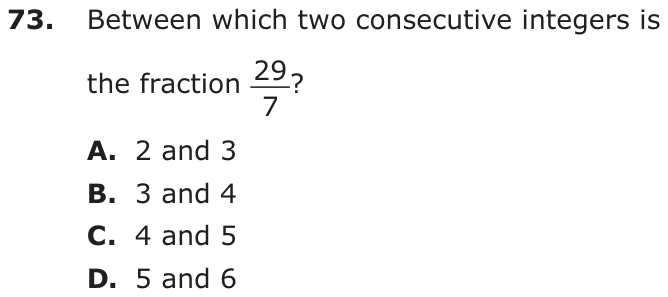
If all possible values of x are indicated by the shaded part of the number line above, which number line best shows all possible values of ?
- A

- B

- C

- D

Show the answer
Correct answer: D
The shaded region goes from to . So, the possible values of would be between the reciprocal of and the reciprocal of , which are 2 and , respectively. Find the number line in the answer options that has a shaded region that ranges from to 2, which is option D.
Question analysis
This number line question shades all possible values of x from one half to three halves and asks which number line shows all possible values of 1/x. Students find reciprocals of fractions and work out how a whole range of values changes. Keeping track of what happens to each end of the range, and placing fractions accurately on the line, makes it tricky.
- NYS standards
- Grade level
- Grade 6 content, by NYS standard
- Compared with grade 7
- Above grade 7 Reciprocals of single fractions are grade 6 work. Applying them to every value in a shaded range at once, and working out where the new range begins and ends, is reasoning about a whole set of numbers that grade 7 classes rarely practice.
- Estimated difficulty
- Hard: combines ideas, needs a plan, and has more than one tempting wrong answer.
- Thinking it demands
- Depth of knowledge 2, skills and concepts · mainly apply
- What makes it hard
- Reading a figure, table or graph moderate
- A very close wrong answer moderate
- Variables instead of numbers minor
- Solution
- 3 steps
- Reading level
- Question and choices: about grade 12, 27 words.
- Students, last 30 days
- Not enough answers yet to show (it takes 10).
Why it is hard, traps and wrong answers (shows the answer)
Why it is hard
Few students have flipped an interval before, so the question rewards testing its two ends and noticing that the order reverses. The harder part comes at the end: 2/3 falls between the tick marks, and a graph ending at the nearby 1/2 tick looks right at a glance. Students who believe a reciprocal is always at least 1, or who shift the interval instead of flipping it, reach the other graphs.
Reading a figure, table or graph moderate Understanding the question
The shaded segment's ends sit on unlabeled half-unit ticks, 1/2 and 3/2, and each choice must be read the same way, with 2/3 falling between ticks rather than on one. (Lesh, Post & Behr, 1987; Kirsch & Mosenthal, 1990)
A very close wrong answer moderate Choosing the answer
The graph from 1/2 to 2 matches the right graph's right end and differs at the left end by only a sixth of a unit, 1/2 against 2/3. (Embretson & Wetzel, 1987; Gorin & Embretson, 2006; Ascalon et al., 2007)
Variables instead of numbers minor Understanding the question
The question asks about 1/x for every x in a range, so a whole interval must be transformed, and its ends swap: the smallest x gives the largest 1/x. (Koedinger & Nathan, 2004; Enright, Morley & Sheehan, 2002)
Strategy: Take the reciprocal of each end of the shaded part, ask whether a bigger x gives a bigger or a smaller 1/x, and look for the graph whose endpoints are exactly those values.
Traps
- Misreads the figure: Reads a value, label or tick spacing in a figure, table or graph wrongly.
- Misunderstands the concept: A wrong belief about a concept: that percents can be added, that area grows like length, that averages can be averaged, that a bigger denominator means a bigger fraction.
- Wrong operation: Adds instead of multiplying, divides the wrong way round, turns a ratio or rate upside down, or undoes a step in the wrong direction (subtracts what should be added back).
The wrong answers, classified
A Wrong operation (Hegarty, Mayer & Monk, 1995; King et al., 2004)
Adds 1 to each endpoint instead of taking reciprocals, sliding the shaded part from 1/2–3/2 one unit right, to 3/2–5/2.
B Misunderstands the concept (Smith, diSessa & Roschelle, 1993; De Bock et al., 1998; Ni & Zhou, 2005)
Gets 2 from 1/2 but assumes a reciprocal cannot be less than 1, as flipping a proper fraction suggests, so it starts the shading at 1 instead of 2/3.
C Misreads the figure (Lesh, Post & Behr, 1987; Kirsch & Mosenthal, 1990)
Finds the reciprocals 2/3 and 2 but places 2/3 at the half-unit tick, 1/2, though 2/3 lies a third of the way from that tick toward 1.
Worked solution, step by step
Formulas used
- Reciprocal
- a and b are the top and bottom of a fraction. The reciprocal flips the fraction upside down. The number 1 over x is the reciprocal of x. A number times its reciprocal always makes 1.
Sort out the question
x can be any number in the shaded part of the first number line. You need the number line that shows every possible value of , the reciprocal of x. The reciprocal is the number flipped upside down, like for 2.
Read the shaded part
The ticks come every half unit. The shading starts at the tick halfway between 0 and 1, which is . It ends halfway between 1 and 2, which is , or . Both dots are filled in, so both ends count.
Find the reciprocals of the ends
Flip each end of the shaded part.
So the ends of the new shading are 2 and .
Notice that the ends swap
When x gets bigger, gets smaller. So the smallest x, , gives the biggest value, 2. The biggest x, , gives the smallest, . So runs from to 2, ends included.
Find the matching number line
lies between the half tick and 1, a third of the way from to 1. Line D starts there and ends at 2. Watch out: line C starts at the half tick, , not at . Line B starts at 1.
So the answer is D, the line shaded from to 2.
Check your answer
Test a value in the middle. x = 1 is shaded, and . On line D, 1 is shaded too. Test an end: , so really is the reciprocal of .
More questions like this
The original DOE question
Question 9 of 12
2023 Test B Math, question 32Question

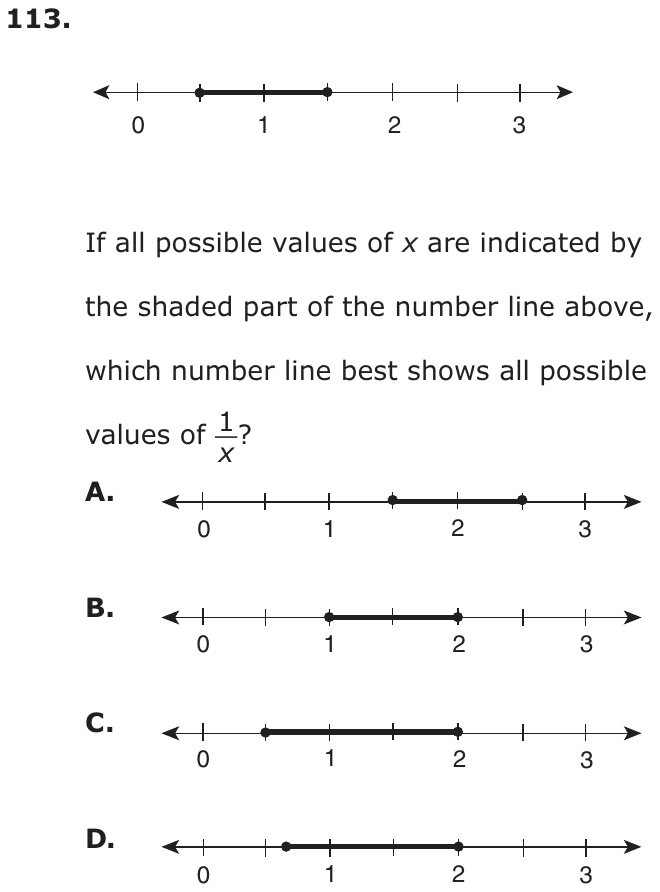
On the number line above, how many units longer is than ?
- A
- B
- C
- D3
Show the answer
Correct answer: B
First, find the lengths of the given segments:
Then, find the difference:
Question analysis
A number line shows three points labeled with mixed numbers and a whole number, and students find how many units longer one segment is than another. It tests subtracting mixed numbers with unlike denominators to find distances. Regrouping when the fraction being subtracted is the larger one is where most errors happen.
- Grade level
- Grade 7 content, by NYS standard
- Compared with grade 7
- At grade 7 Finding distances between points on a number line is grade 7 work. Here the points are mixed numbers with different denominators, so finding two distances and their difference makes it a typical but careful grade 7 task.
- Estimated difficulty
- Straightforward: two steps or one careful reading.
- Thinking it demands
- Depth of knowledge 2, skills and concepts · mainly apply
- What makes it hard
- Error-prone arithmetic moderate
- Reading a figure, table or graph minor
- Solution
- 3 steps
- Reading level
- Question and choices: about grade 9, 16 words.
- Students, last 30 days
- Not enough answers yet to show (it takes 10).
Why it is hard, traps and wrong answers (shows the answer)
Why it is hard
This is three subtractions, so most errors are in the fractions rather than the plan. Taking 1 1/3 from a whole number such as 3 tempts students to subtract only the whole parts and keep the 1/3, which reverses which segment looks longer. Rewriting every coordinate in sixths, 8/6, 18/6 and 31/6, turns the work into whole-number subtraction of numerators.
Error-prone arithmetic moderate Working it out
Both lengths subtract mixed numbers with different denominators, 5 1/6 − 3 and 3 − 1 1/3, and the second needs regrouping before the two results are compared in sixths. (Brown & Burton, 1978; Junker & Sijtsma, 2001)
Reading a figure, table or graph minor Understanding the question
The three coordinates come from the labels under P, Q and R, and the segments QR and PQ must each be measured from Q at 3, the point they share. (Lesh, Post & Behr, 1987; Kirsch & Mosenthal, 1990)
Strategy: Find each length by subtracting the left endpoint from the right one, writing the mixed numbers in sixths, then subtract the shorter length from the longer.
Traps
- A faulty procedure: A systematic but wrong procedure: adding fractions straight across, applying an exponent to each term of a sum, dropping a sign when moving a term.
- Numbers taken from the question: Combines the numbers in the question without a model of the situation, or is simply a number that appears in the question.
The wrong answers, classified
A A faulty procedure (Brown & Burton, 1978; Tatsuoka, 1983)
Subtracts only the whole numbers in 3 − 1 1/3 and keeps the 1/3, giving PQ as 2 1/3, then compares it with 2 1/6 and gets 1/6.
C Little reason to choose it (Haladyna & Downing, 1993; Rodriguez, 2005)
No common working gives 2/3; it is only the fraction part of PQ’s length, 1 2/3, so it mostly draws guesses.
D Numbers taken from the question (Hegarty, Mayer & Monk, 1995)
Picks 3, the coordinate of point Q, a number read off the line rather than a difference between two lengths.
Worked solution, step by step
Formulas used
- Length on a number line
- The length of a segment is the distance between its two end points. Subtract the number on the left from the number on the right. Subtracting tells how many units you move to get from one point to the other.
- Mixed number to improper fraction
- a is the whole number part. b over c is the fraction part, with b on top and c on the bottom. Each whole holds c parts, so a wholes hold a × c parts. Then add the b extra parts. An improper fraction has a top bigger than its bottom.
Read the number line
Point P is at . Point Q is at 3. Point R is at .
The bar over QR means segment QR, the piece of the line from Q to R. You need how much longer QR is than PQ. So find both lengths, then subtract.
Find the length of QR
R is on the right, and Q is on the left. Use the length rule.
QR is units long.
Find the length of PQ
Q is on the right, and P is on the left.
Take it in two parts. First, 3 − 1 = 2. Then take away the extra . That gives . So PQ is units long.
Watch out: Don’t just do 3 − 1 and keep the . That gives , which is too long. It leads to choice A.
Write both lengths in sixths
The fractions have different bottoms, 6 and 3. Change both lengths to sixths so you can subtract. Use the mixed number rule.
Subtract the lengths
Take the shorter length away from the longer one.
QR is unit longer than PQ.
So the answer is B, .
Check your answer
Write every point in sixths. P is , Q is and R is . QR is 31 − 18 = 13 sixths. PQ is 18 − 8 = 10 sixths. The difference is 3 sixths, which is one half.
More questions like this
The original DOE question
Question 10 of 12
2018 Test B Math, question 23Question
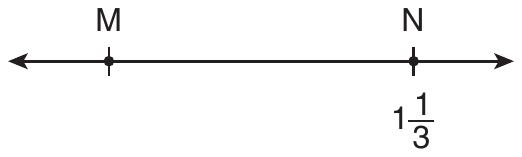
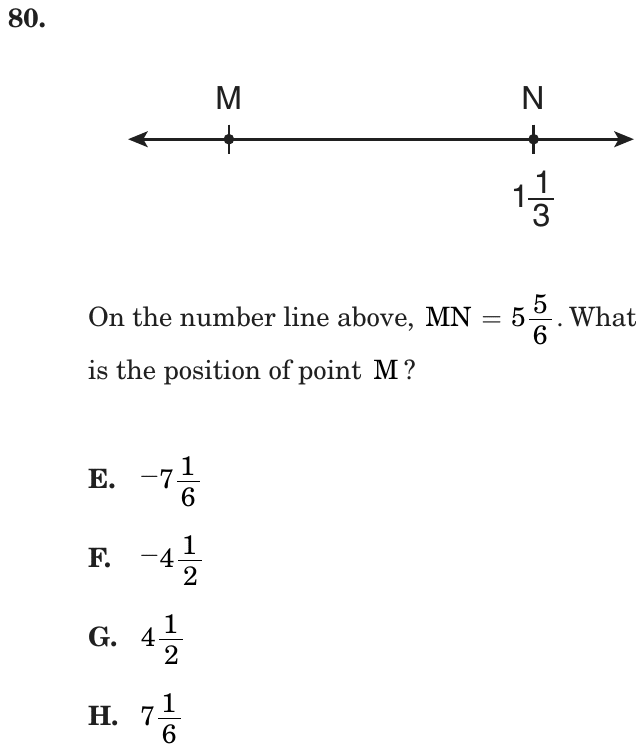
On the number line above, . What is the position of point ?
- A
- B
- C
- D
Show the answer
Correct answer: B
To find , subtract and set it equal to the length:
Question analysis
This number line question gives the distance between points M and N as a mixed number and asks for the position of M. Students subtract fractions with unlike denominators, moving past zero into negative numbers. Direction along the line and the sign of the result are where it gets tricky.
- Grade level
- Grade 7 content, by NYS standard
- Compared with grade 7
- At grade 7 Grade 7 students find distances on a number line as the absolute value of a difference. Doing it with mixed numbers that have unlike denominators, and crossing zero, is a typical and slightly demanding grade 7 task.
- Estimated difficulty
- Moderate: several steps, or a close reading with one strong distractor.
- Thinking it demands
- Depth of knowledge 2, skills and concepts · mainly apply
- What makes it hard
- Reading a figure, table or graph moderate
- Error-prone arithmetic moderate
- A very close wrong answer moderate
- Solution
- 3 steps
- Reading level
- Question and choices: about grade 8, 17 words.
- Students, last 30 days
- Not enough answers yet to show (it takes 10).
Why it is hard, traps and wrong answers (shows the answer)
Why it is hard
The distance is given and one endpoint is known, so the question is really about direction and sign. Because the drawing shows no zero, students must reason that moving 5 5/6 to the left from 1 1/3 carries M past zero. The choices pair each size with each sign, so getting the size right is only half the work; the sign decides between two choices.
Reading a figure, table or graph moderate Understanding the question
The number line labels only N, at 1 1/3, and shows no zero, so students must see from the picture that M lies left of N and work out whether it passes zero. (Lesh, Post & Behr, 1987; Kirsch & Mosenthal, 1990)
Error-prone arithmetic moderate Working it out
The subtraction 1 1/3 − 5 5/6 mixes unlike denominators and crosses zero: in sixths it is 8/6 − 35/6 = −27/6, which then reduces to a mixed number. (Brown & Burton, 1978; Junker & Sijtsma, 2001)
A very close wrong answer moderate Choosing the answer
4 1/2 and −4 1/2 are written the same except for the sign; only noticing that M lies left of N, so below 1 1/3, separates them. (Embretson & Wetzel, 1987; Gorin & Embretson, 2006; Ascalon et al., 2007)
Strategy: Read N's coordinate from the number line, convert everything to sixths, and move the given distance from N toward M's side of the line.
Traps
- Negatives and direction: Arithmetic with negative numbers, the order of a subtraction, or direction on a number line. (Moving a term across the equals sign without changing its sign is a faulty procedure.)
The wrong answers, classified
A Negatives and direction (Brown & Burton, 1978)
Adds the length to N's coordinate, 1 1/3 + 5 5/6 = 7 1/6, and makes it negative because M is on the left.
C Negatives and direction (Brown & Burton, 1978)
Computes 5 5/6 − 1 1/3, the right size, but keeps it positive, which would put M to the right of N.
D Numbers taken from the question (Hegarty, Mayer & Monk, 1995)
Adds the two numbers in the question, 1 1/3 + 5 5/6, placing M to the right of N against the figure.
Worked solution, step by step
Formulas used
- Distance on a number line
- On a number line, numbers grow as you move right. The distance between two points is the larger number minus the smaller one. That is the right point minus the left point, so a distance is never negative.
- Mixed number to fraction
- a is the whole number part, b is the top of the fraction, and c is the bottom. Each whole holds c pieces, so a wholes hold a times c pieces. Then add the b extra pieces.
Read the number line
Point N is at . Point M is to the left of N. MN means the distance from M to N, and it is .
You need the number at point M.
Decide which way to move
On a number line, numbers get smaller as you move left. M is left of N, so N is the right point.
So M is what you get when you take the distance away from N.
The distance is bigger than , so you will pass 0. M will be negative.
Change both numbers to sixths
To subtract, the fractions need the same bottom number. Use sixths, since 3 goes into 6. Change each mixed number to an improper fraction, a fraction whose top is bigger than its bottom.
Subtract and simplify
27 sixths is 4 wholes (24 sixths) and 3 sixths more. And . So M is .
Watch out: without the minus sign is choice C. That point would be to the right of N, not the left.
So the answer is B, .
Check your answer
Find the distance from your M to N. From to 0 is , or . From 0 to N is . Together, . That matches MN.
More questions like this
The original DOE question
Question 11 of 12
2018 Test B Math, question 41Question
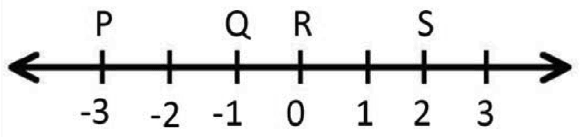
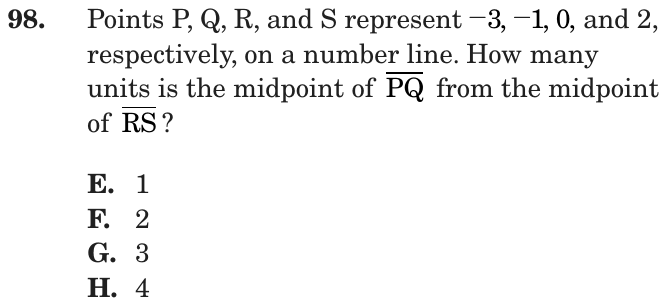
Points , , , and represent −3, −1, 0, and 2, respectively, on a number line. How many units is the midpoint of from the midpoint of ?
- A1
- B2
- C3
- D4
Show the answer
Correct answer: C
Find the midpoint of and :
Half the length of is unit.
The midpoint of is located 1 unit from each endpoint, so the midpoint is at −2.
Half the length of is unit.
The midpoint of RS is located 1 unit from each endpoint, so the midpoint is at 1. The distance between the two midpoints is 1 −(−2) = 3 units.
Question analysis
Four points on a number line are given by their coordinates, some of them negative, and students find the distance between the midpoints of two segments. It tests locating midpoints and measuring distance with negative numbers. The care needed is in placing each midpoint correctly and in measuring a distance that crosses zero.
- Grade level
- Grade 7 content, by NYS standard
- Compared with grade 7
- At grade 7 Distance on a number line with negative numbers is grade 7 content. Finding two midpoints first adds a step, but the numbers are small integers, so the demand matches typical grade 7 practice.
- Estimated difficulty
- Straightforward: two steps or one careful reading.
- Thinking it demands
- Depth of knowledge 2, skills and concepts · mainly apply
- What makes it hard
- Error-prone arithmetic moderate
- Much to keep track of minor
- Solution
- 3 steps
- Reading level
- Question and choices: about grade 12, 26 words.
- Corrected from the DOE handbook
- Two mislabeled steps in the explanation were corrected.
- Students, last 30 days
- Not enough answers yet to show (it takes 10).
Why it is hard, traps and wrong answers (shows the answer)
Why it is hard
Each step is simple, but the negative coordinates make the last subtraction easy to get wrong, and there is no picture to check against. Students who sketch the line and mark −2 and 1 can count the three units directly. The wrong choices come from confusing a segment's length with the gap between midpoints, or from counting tick marks instead of spaces.
Error-prone arithmetic moderate Working it out
The midpoint of PQ is at −2, so the final distance is 1 − (−2); dropping the negative sign at that step turns 3 into 1. (Brown & Burton, 1978; Junker & Sijtsma, 2001)
Much to keep track of minor Working it out
Four labeled points and two midpoints have to be held at once, and the question draws no number line, so sketching one is the safe move. (Sweller, 1988; Carpenter, Just & Shell, 1990)
Strategy: Average the coordinates of each segment's endpoints to place its midpoint, then find the distance between the two midpoints as the absolute value of their difference.
Traps
- Negatives and direction: Arithmetic with negative numbers, the order of a subtraction, or direction on a number line. (Moving a term across the equals sign without changing its sign is a faulty procedure.)
- Answers a different question: A choice is right for another quantity: the other unknown, the rest instead of the part, the part instead of the whole.
The wrong answers, classified
A Negatives and direction (Brown & Burton, 1978)
Computes the distance between the midpoints −2 and 1 as 2 − 1 = 1, dropping the negative sign instead of finding 1 − (−2).
B Answers a different question (King et al., 2004; Hegarty, Mayer & Monk, 1995)
Gives the length of PQ or of RS, 2 units each, rather than the distance between the two segments' midpoints.
D Counting the ends (Brown & Burton, 1978)
Counts the tick marks from −2 to 1, which are four, instead of the three unit spaces between them.
What was corrected from the DOE handbook, and why
- Explanation: The handbook labels (−1 − (−3))/2 = 1 unit as the “Midpoint of PQ” and (2 − 0)/2 = 1 unit as the “Midpoint of RS.” Those are half the lengths of the segments, not their midpoints: as the next sentences say, the midpoint of PQ is at −2 and the midpoint of RS is at 1. The site labels them “Half the length of PQ” and “Half the length of RS.” The distance between the midpoints is still 3 units.
Worked solution, step by step
Formulas used
- Midpoint on a number line
- a and b are the numbers at the two ends of a segment. The midpoint is the point exactly halfway between them. Adding the ends and dividing by 2 finds their average, which is the middle.
- Distance on a number line
- The right number is the point farther to the right on the number line. The left number is the other point. Subtracting tells how many units apart they are. Taking the left from the right keeps the answer positive.
Sort out what you know
P is at −3, Q is at −1, R is at 0 and S is at 2. A segment is the piece of a line between two points. So runs from −3 to −1. You need the distance between the midpoint of PQ and the midpoint of RS. A quick sketch of a number line helps.
Find the midpoint of PQ
Use the midpoint formula with −3 and −1.
The midpoint of PQ is at −2.
Find the midpoint of RS
Use the midpoint formula with 0 and 2.
The midpoint of RS is at 1.
Find the distance between them
The midpoint at 1 is to the right of the one at −2. Use the distance formula.
Subtracting a negative number is the same as adding.
Watch out: dropping the minus sign gives , choice A. Counting the tick marks −2, −1, 0 and 1 gives 4, choice D. Count the spaces between marks instead.
Give the answer
The midpoints are at −2 and 1, which are 3 units apart. So the answer is C, 3.
Check your answer
Count the jumps on a number line. Going from −2 to −1 is one jump. Going from −1 to 0 is two, and going from 0 to 1 is three. So the midpoints are 3 units apart.
More questions like this
The original DOE question
Question 12 of 12
2018 Test B Math, question 44Question
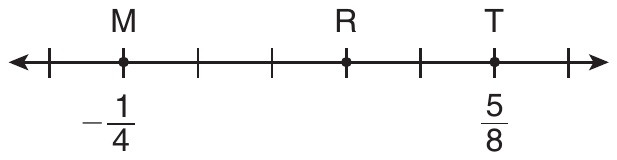
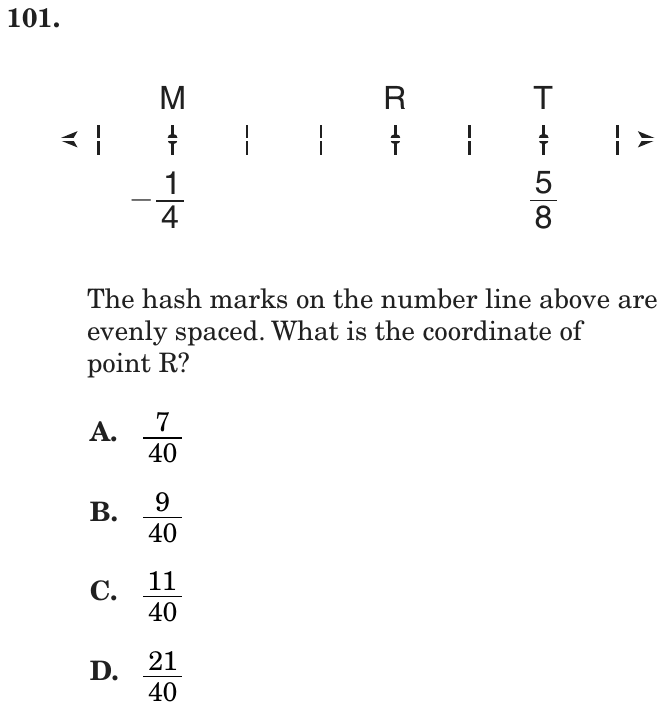
The hash marks on the number line above are evenly spaced. What is the coordinate of point ?
- A
- B
- C
- D
Show the answer
Correct answer: C
There are 5 sections between M and T. To find the length of one of these sections, find the distance between M and T and divide by 5:
R is 3 sections away from M, so add:
R is located at .
Question analysis
Students find the fraction at point R on a number line with evenly spaced hash marks, where M is at −1/4 and T is at 5/8. It tests fraction arithmetic with negative numbers. Working out the size of one gap and counting gaps from M to R takes several careful steps.
- NYS standards
- Grade level
- Grade 7 content, by NYS standard
- Compared with grade 7
- Above grade 7 Grade 7 students place fractions and negatives on number lines, but here they must subtract a negative fraction, divide by five, and then add back. Four fraction steps with unlike denominators make it harder than typical classwork.
- Estimated difficulty
- Hard: combines ideas, needs a plan, and has more than one tempting wrong answer.
- Thinking it demands
- Depth of knowledge 2, skills and concepts · mainly apply
- What makes it hard
- Error-prone arithmetic major
- Reading a figure, table or graph moderate
- Solution
- 4 steps
- Reading level
- Question and choices: about grade 6, 22 words.
- Students, last 30 days
- Not enough answers yet to show (it takes 10).
Why it is hard, traps and wrong answers (shows the answer)
Why it is hard
Fractions, a negative starting point and a count of spaces all have to come out right together. Students lose points by counting tick marks instead of spaces, by subtracting −1/4 as if it were positive, or by measuring R from 0 instead of from M. Converting both labels to fortieths first, −10/40 and 25/40, makes each gap a whole number of fortieths.
Error-prone arithmetic major Working it out
The gap length needs 5/8 − (−1/4) = 7/8, then 7/8 ÷ 5 = 7/40, then −10/40 + 21/40: negatives and three different denominators meet in one problem. (Brown & Burton, 1978; Junker & Sijtsma, 2001)
Reading a figure, table or graph moderate Understanding the question
The hash marks have to be counted as spaces: five from M to T, with R three spaces past M, while the unlabeled marks outside M and T play no part. (Lesh, Post & Behr, 1987; Kirsch & Mosenthal, 1990)
Strategy: Find the distance from M to T by subtracting their coordinates, divide it by the number of equal gaps, then step from M toward T by the right number of gaps.
Traps
- Stops one step early: A choice is a number from partway through the solution.
- Negatives and direction: Arithmetic with negative numbers, the order of a subtraction, or direction on a number line. (Moving a term across the equals sign without changing its sign is a faulty procedure.)
The wrong answers, classified
A Stops one step early (King et al., 2004; Gierl et al., 2017)
Finds the length of one gap, 7/8 ÷ 5 = 7/40, and gives it as R's coordinate without stepping from M.
B Negatives and direction (Brown & Burton, 1978)
Subtracts as 5/8 − 1/4 = 3/8 instead of adding, gets gaps of 3/40, and counts three gaps from 0.
D Stops one step early (King et al., 2004; Gierl et al., 2017)
Multiplies the 7/40 gap by 3 to get the distance from M to R, then forgets to add it to M's −1/4.
Worked solution, step by step
Formulas used
- Distance on a number line
- The right number is the point farther to the right on the number line. The left number is the other point. Subtracting tells how many units apart they are. Taking the left from the right keeps the answer positive.
- Dividing a fraction by a whole number
- a over b is the fraction, and c is the whole number you divide by. Splitting a fraction into c equal parts makes each part c times smaller. So you multiply the bottom number, b, by c.
Read the number line
M is at and T is at . The hash marks are evenly spaced, so every space is the same length. Count the spaces. From M to T there are 5 spaces. From M to R there are 3 spaces. You need the number at point R.
Find the distance from M to T
Use the distance formula. First write in eighths, as .
Taking away a negative is the same as adding. M and T are apart.
Find the length of one space
The 5 spaces are equal, so divide by 5.
Each space is long.
Watch out: this is the length of one space, not where R is. Stopping here gives choice A.
Step from M to R
R is 3 spaces to the right of M.
Now add that to M. Write as .
Watch out: is how far R is from M, not where R is. Choosing it gives choice D.
Give the answer
Point R is at , a little to the right of 0. So the answer is C, .
Check your answer
Go backward from T instead. T is 2 spaces past R, and . So R is at . Both ways give the same point.
More questions like this
The original DOE question