6.EE.5 solutions and substitution
Question 1 of 7
2026 Practice Test B Math, question 17Question
How many positive integers satisfy the inequality ?
Enter your answer in the space.
Fill-in question: work out the answer and type it as a number.
Show the answer
Correct answer: 15
Solve the inequality for x.
There are 15 positive integers that are less than 16.
Question analysis
This inequality question asks how many positive integers make x + 7 < 23 true, and the count is typed into a box. Students solve a one-step inequality, then count its whole-number solutions. The strict less-than sign and the word positive decide where the count starts and stops, so both ends need checking.
- Grade level
- Grade 7 content, by NYS standard
- Compared with grade 7
- Below grade 7 Grade 7 inequality problems usually take two steps, such as 2x − 5 > 9. This one needs a single subtraction; the care goes into counting the whole-number solutions and deciding whether the boundary itself counts.
- Estimated difficulty
- Straightforward: two steps or one careful reading.
- Thinking it demands
- Depth of knowledge 1, recall and reproduction · mainly apply
- What makes it hard
- Solution
- 2 steps
- Reading level
- Question and choices: about grade 12, 14 words.
- Students, last 30 days
- Not enough answers yet to show (it takes 10).
Why it is hard, traps and wrong answers (shows the answer)
Why it is hard
One subtraction solves the inequality, so the points are lost in the count that follows. The boundary 16 is the last number the solving produces and is easy to type in, or to count up to; checking that 16 + 7 is 23, which is not less than 23, rules it out. Listing 1 through 15, the positive integers below the boundary, settles the count.
An answer in an unexpected form minor Choosing the answer
Solving gives x < 16, but the box asks how many positive integers make the inequality true, a count that still has to be made after the solving is done. (Enright, Morley & Sheehan, 2002)
Much to keep track of minor Working it out
Two conditions set the ends of the count at once: the word positive starts it at 1 rather than 0, and the strict < stops it below 16. (Sweller, 1988; Carpenter, Just & Shell, 1990)
Strategy: Undo the addition to find the boundary for x, then count the positive whole numbers below it, checking the largest one and the boundary in the original inequality.
Traps
- Counting the ends: Inclusive or exclusive ends, fence posts, consecutive numbers: an answer that is one too many or too few, or an endpoint drawn open where it belongs closed (or the reverse).
- A faulty procedure: A systematic but wrong procedure: adding fractions straight across, applying an exponent to each term of a sum, dropping a sign when moving a term.
The wrong answers, classified
16 Counting the ends (Brown & Burton, 1978)
Solves to x < 16 and then enters 16, either the boundary itself or a count of 1 through 16, though x = 16 makes x + 7 equal 23, not less than it.
29 A faulty procedure (Brown & Burton, 1978; Tatsuoka, 1983)
Moves the 7 to the right side without changing its sign, 23 + 7 = 30, and counts the 29 positive integers below 30.
Worked solution, step by step
Formulas used
- Doing the same to both sides
- a and b are the two sides of an inequality, and c is any number. Taking the same number away from both sides keeps the inequality true. Think of two people who each walk down the same number of stairs: the lower one stays lower. Use it to get x by itself.
Sort out the question
An inequality compares two amounts. The sign < means is less than. A positive integer is a whole number bigger than 0: 1, 2, 3, and so on. You need to count how many of them make true. The answer is a count, not a value of x.
Get x by itself
The 7 is added to x. Subtracting 7 undoes adding 7, so subtract 7 from both sides:
So x must be less than 16.
Watch out: adding 7 to 23 instead gives x < 30, and a count of 29.
Check the boundary number
The number 16 is the boundary, where the solutions stop. Does 16 itself work? Try it:
But 23 is not less than 23. It is equal. So 16 does not count. The largest number that works is 15, since , and 22 is less than 23.
Watch out: entering 16 counts the boundary, which fails.
Count the positive integers
The numbers that work start at 1, the smallest positive integer. Zero is not positive. They stop at 15:
Counting from 1 up to 15 gives 15 numbers.
Enter the count
There are 15 positive integers that make the inequality true. Type the count in the box as a plain whole number. So you would enter 15.
Check your answer
Test both ends. For 1: , and 8 is less than 23, so 1 works. For 15: 22 is less than 23, so 15 works. For 16: 23 is not less than 23, so 16 fails. That leaves exactly the numbers 1 through 15.
More questions like this
The original DOE question

Question 2 of 7
2024 Test A Math, question 12Question
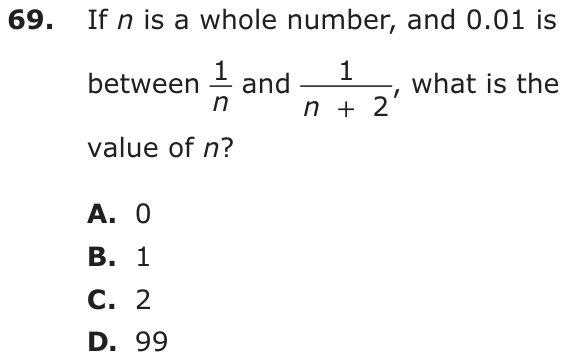
If n is a whole number, and 0.01 is between and , what is the value of n?
- A0
- B1
- C2
- D99
Show the answer
Correct answer: D
, which is between and .
Therefore, and .
Question analysis
A number sense question: 0.01 lies between 1 over n and 1 over n + 2, where n is a whole number, and students find n. It tests comparing a decimal with unit fractions and knowing how a fraction changes as its denominator grows. The unusual form, with n in two denominators, is what slows students down.
- Grade level
- Grade 6 content, by NYS standard
- Compared with grade 7
- At grade 7 Grade 7 students compare fractions and decimals routinely, but not with an unknown in the denominators. The comparison is simple once 0.01 is written as a fraction; the unfamiliar setup is the main demand.
- Estimated difficulty
- Straightforward: two steps or one careful reading.
- Thinking it demands
- Depth of knowledge 2, skills and concepts · mainly apply
- What makes it hard
- Variables instead of numbers moderate
- Something you must already know minor
- Solution
- 2 steps
- Reading level
- Question and choices: about grade 9, 18 words.
- Students, last 30 days
- Not enough answers yet to show (it takes 10).
Why it is hard, traps and wrong answers (shows the answer)
Why it is hard
The setup looks unfamiliar, with n in two denominators, but one rewrite makes it routine: 0.01 is 1/100, so the two denominators must sit on either side of 100. The three small choices fail a quick check, since every fraction from 1/1 to 1/4 is far above 0.01, and 0 cannot be a denominator at all. Students who test the choices instead of rewriting the decimal spend a little longer but reach the same place.
Variables instead of numbers moderate Understanding the question
The unknown sits in two denominators, n and n + 2, so students must reason about which unit fractions lie on either side of 0.01 rather than solve an equation. (Koedinger & Nathan, 2004; Enright, Morley & Sheehan, 2002)
Something you must already know minor Working it out
Two facts are assumed: 0.01 equals 1/100, and a unit fraction shrinks as its denominator grows, so 1/99 is just above 0.01 and 1/101 just below. (Anderson & Krathwohl, 2001)
Strategy: Rewrite 0.01 as a unit fraction, recall that a larger denominator gives a smaller fraction, and test each choice in both 1/n and 1/(n + 2).
Traps
- Misunderstands the concept: A wrong belief about a concept: that percents can be added, that area grows like length, that averages can be averaged, that a bigger denominator means a bigger fraction.
- Numbers taken from the question: Combines the numbers in the question without a model of the situation, or is simply a number that appears in the question.
The wrong answers, classified
A Misunderstands the concept (Smith, diSessa & Roschelle, 1993; De Bock et al., 1998; Ni & Zhou, 2005)
Treats 1/0 as 0, so 0.01 seems to lie between 0 and 1/2; but division by zero is undefined, so n cannot be 0.
B Numbers taken from the question (Hegarty, Mayer & Monk, 1995)
Takes the 1 from 0.01 or from 1/n as the value of n, without checking that 0.01 is far below both 1 and 1/3.
C Numbers taken from the question (Hegarty, Mayer & Monk, 1995)
Takes the 2 from n + 2, or the two decimal places of 0.01, without testing 1/2 and 1/4, which are both far above 0.01.
Worked solution, step by step
Formulas used
- Comparing unit fractions
- A unit fraction has 1 on top, like one fifth. a and b are positive whole numbers on the bottom. A bigger bottom cuts the whole into more pieces, so each piece is smaller. So the fraction with the bigger bottom is the smaller number.
Sort out the question
n is a whole number: 0, 1, 2, 3 and so on. The number 0.01 is between and . Between means one fraction is bigger than 0.01 and the other is smaller. You need the value of n.
Write 0.01 as a fraction
0.01 means one hundredth.
Now all three numbers are fractions with 1 on top. That makes them easy to compare.
Find fractions on each side
With 1 on top, a bigger bottom makes a smaller fraction.
So is a little more than , and is a little less.
The bottoms 99 and 101 are 2 apart, just like n and n + 2.
Match the fractions to n
The smaller bottom is n, and the larger bottom is n + 2.
Both fit. Watch out: small choices do not work. For n = 1, the fractions are 1 and . Both are far bigger than 0.01. For n = 0, is not a number, because you can’t divide by zero. So the answer is D, 99.
Check your answer
Write the fractions as decimals. , a bit more than 0.01. , a bit less. The sign ≈ means about. So 0.01 sits right between them.
More questions like this
The original DOE question
Question 3 of 7
2023 Test A Math, question 22Question
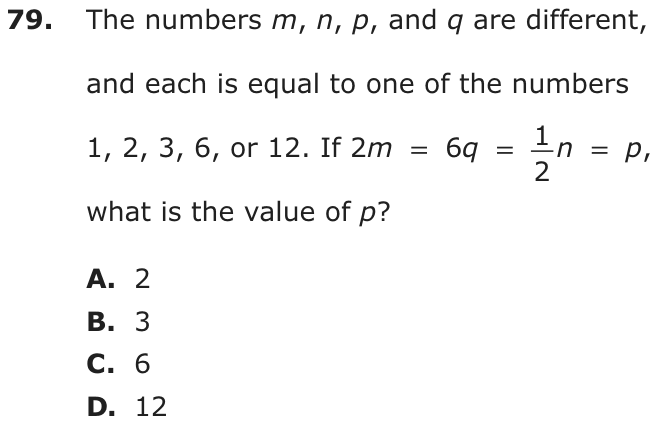
The numbers m, n, p, and q are different, and each is equal to one of the numbers 1, 2, 3, 6, or 12. If , what is the value of p?
- A2
- B3
- C6
- D12
Show the answer
Correct answer: C
Substitute each answer option for p to see which value will work:
Option A:
If , then , so . This cannot be the answer, because n cannot equal 4.
Option B:
If , then , so . This cannot be the answer, because q cannot equal 0.5.
Option C:
If , then , so ; , so ; and , so . This is the correct answer.
Option D:
If , then , so . This cannot be the answer, because n cannot equal 24.
Question analysis
Four letters, m, n, p and q, stand for different numbers from the list 1, 2, 3, 6 and 12, and the expressions 2m, 6q, half of n, and p are all equal. Students find the value of p. The puzzle-like setup has no single equation to solve, so testing values against every condition is the reliable route.
- Grade level
- Grade 6 content, by NYS standard
- Compared with grade 7
- Above grade 7 The equations involve only doubling, halving and multiplying by 6, all grade 6 skills. What goes beyond grade 7 practice is the chain of four equal expressions, with every letter limited to a short list of different numbers.
- Estimated difficulty
- Moderate: several steps, or a close reading with one strong distractor.
- Thinking it demands
- Depth of knowledge 2, skills and concepts · mainly analyze
- What makes it hard
- Variables instead of numbers moderate
- Every choice must be checked moderate
- Solution
- 3 steps
- Reading level
- Question and choices: about grade 5, 27 words.
- Students, last 30 days
- Not enough answers yet to show (it takes 10).
Why it is hard, traps and wrong answers (shows the answer)
Why it is hard
The chain looks forbidding, but it gives each letter as a simple multiple of p: m is half of p, q a sixth of it, and n twice it. Seen that way, q = p/6 forces p to be 6 or 12, and n = 2p rules out 12, so only one value fits. Students who check one or two of the letters, but not all three, can accept 2 or 12.
Variables instead of numbers moderate Understanding the question
Four letters are tied by one chain of equalities, 2m = 6q = ½n = p, and the only numbers are the five allowed values, so each letter has to be written in terms of p. (Koedinger & Nathan, 2004; Enright, Morley & Sheehan, 2002)
Every choice must be checked moderate Choosing the answer
Each choice for p must be tested against three letters, m = p/2, q = p/6 and n = 2p, and all of them must land on different numbers from 1, 2, 3, 6 and 12. (Embretson & Wetzel, 1987)
Strategy: Test each choice as p: find m, q and n from it, and keep the value for which all three are different numbers from the list 1, 2, 3, 6 and 12.
Traps
- Answers a different question: A choice is right for another quantity: the other unknown, the rest instead of the part, the part instead of the whole.
- Misreads the question: Misses or misreads a condition or a word in the question: "at least", "each", "remaining", "not".
The wrong answers, classified
A Misreads the question (Hegarty, Mayer & Monk, 1995)
Checks only m, finding that p = 2 gives m = 1 on the list, and misses that q would be 1/3 and n would be 4.
B Answers a different question (King et al., 2004; Hegarty, Mayer & Monk, 1995)
Finds the solution, m = 3, q = 1, n = 12 and p = 6, then answers with m's value, 3, instead of the value of p.
D Misreads the question (Hegarty, Mayer & Monk, 1995)
Tests p = 12 against 2m and 6q, getting m = 6 and q = 2, both on the list, and stops before seeing that ½n = 12 needs n = 24.
Worked solution, step by step
Formulas used
- Undoing a multiplication
- a is a number that multiplies m, and p is the result. Dividing by a undoes multiplying by a. Use it to write each letter using p.
Sort out the question
m, n, p and q are four different numbers. Each one is 1, 2, 3, 6 or 12. The chain says that four amounts are all equal to p. You need the value of p.
Write each letter using p
Each part of the chain equals p. Undo each multiplication.
Half of n is p, so n is twice p.
Test each choice for p
p m q n All on the list? 2 1 4 No 3 1.5 0.5 6 No 6 3 1 12 Yes 12 6 2 24 No Only p = 6 puts every letter on the list.
Check that the letters are different
With p = 6, you get m = 3, q = 1 and n = 12. All four numbers are on the list, and no two are the same. Watch out: p = 12 makes m = 6 and q = 2, which look fine. But n = 24 is not on the list, so choice D fails. Also, the question asks for p, not m. Picking 3 is choice B. So the answer is C, 6.
Check your answer
Put the values into the chain: , , , and p = 6. All four parts equal 6. The numbers 3, 1, 12 and 6 are all different and all on the list.
More questions like this
The original DOE question
Question 4 of 7
2023 Test A Math, question 26Question
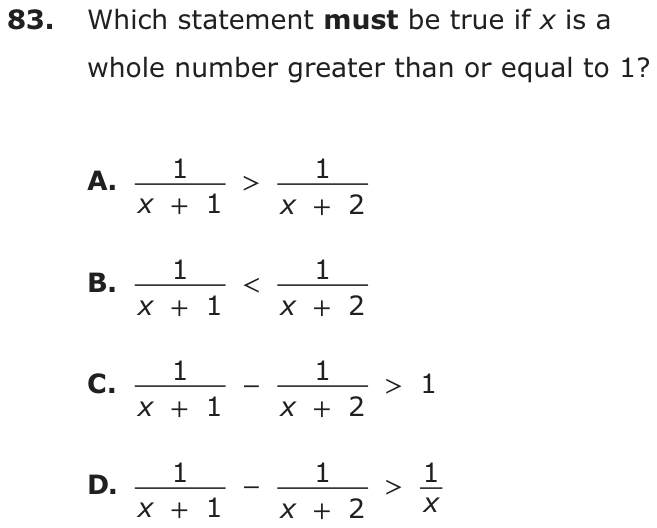
Which statement must be true if x is a whole number greater than or equal to 1?
- A
- B
- C
- D
Show the answer
Correct answer: A
Let , and substitute that value for x in each inequality to determine which one is correct:
Option A:
. This is true.
Option B:
. This is false.
Option C:
, or . This is false.
Option D:
, or . This is false.
Option A is the only true inequality.
Question analysis
This question asks which of four inequalities must be true when x is a whole number of at least 1. The inequalities compare fractions with denominators x + 1 and x + 2, or their difference. Students reason about how the size of a fraction changes as its denominator grows, and must be sure a statement holds for every allowed value.
- Grade level
- Grade 6 content, by NYS standard
- Compared with grade 7
- At grade 7 Comparing fractions is familiar, but these fractions have variable denominators and the question asks what must be true for every whole number from 1 up. That abstraction makes it as demanding as typical grade 7 work, though the arithmetic is light.
- Estimated difficulty
- Moderate: several steps, or a close reading with one strong distractor.
- Thinking it demands
- Depth of knowledge 2, skills and concepts · mainly analyze
- What makes it hard
- Variables instead of numbers moderate
- Every choice must be checked moderate
- Error-prone arithmetic minor
- Solution
- 2 steps
- Reading level
- Question and choices: about grade 6, 20 words.
- Students, last 30 days
- Not enough answers yet to show (it takes 10).
Why it is hard, traps and wrong answers (shows the answer)
Why it is hard
Choosing a small value, such as x = 1 or 2, and testing every statement settles this quickly, because three of the four fail for any value tried. The trap is the belief that a bigger denominator makes a bigger fraction, which turns the true comparison around. Students unsure of fraction subtraction lose time on the two difference statements, though both differences are tiny, never more than 1/6.
Variables instead of numbers moderate Understanding the question
All four statements are about the unknown x, and the bold must means each has to hold for every whole number from 1 up, not just for a single test value. (Koedinger & Nathan, 2004; Enright, Morley & Sheehan, 2002)
Every choice must be checked moderate Choosing the answer
The statements are four separate inequalities, two comparisons and two differences, so each has to be tested; one counterexample is enough to rule a statement out. (Embretson & Wetzel, 1987)
Error-prone arithmetic minor Working it out
Testing the differences means subtracting unlike fractions, such as 1/3 − 1/4 = 1/12 when x = 2, and comparing the result with 1 and with 1/x. (Brown & Burton, 1978; Junker & Sijtsma, 2001)
Strategy: Substitute a small whole number such as 1 or 2 for x in all four statements, rule out any that fail, and confirm the survivor by thinking about larger denominators.
Traps
- Misunderstands the concept: A wrong belief about a concept: that percents can be added, that area grows like length, that averages can be averaged, that a bigger denominator means a bigger fraction.
- A faulty procedure: A systematic but wrong procedure: adding fractions straight across, applying an exponent to each term of a sum, dropping a sign when moving a term.
The wrong answers, classified
B Misunderstands the concept (Smith, diSessa & Roschelle, 1993; De Bock et al., 1998; Ni & Zhou, 2005)
Believes a bigger denominator makes a bigger fraction, so 1/(x + 2) seems larger than 1/(x + 1), the comparison turned around.
C Little reason to choose it (Haladyna & Downing, 1993; Rodriguez, 2005)
Both fractions are at most 1/2, so their difference can never exceed 1, and no common working makes it do so; this choice mostly draws guesses.
D A faulty procedure (Brown & Burton, 1978; Tatsuoka, 1983)
Subtracts over a common denominator but keeps only the numerator, (x + 2) − (x + 1) = 1, so the difference looks like 1, larger than 1/x once x is 2.
Worked solution, step by step
Formulas used
- Comparing unit fractions
- a and b are positive numbers, and b is bigger. One over a means one whole cut into a equal pieces. Cutting the same whole into more pieces makes each piece smaller. So the fraction with the bigger bottom is smaller.
- Subtracting fractions
- a and b are the bottoms of the two fractions. Rewrite both fractions over the common bottom a × b. Then subtract the tops. The bottom stays a × b.
Sort out the question
x is a whole number that is 1 or more, so x can be 1, 2, 3 and so on. You need the statement that must be true. That means it is true for every such x. One x that makes a statement false rules it out.
Test x = 1 in each statement
With x = 1, x + 1 is 2 and x + 2 is 3.
- A: . True.
- B: . False.
- C: , which is not more than 1. False.
- D: is not more than . False.
Only A is true when x = 1. So B, C and D are out.
Make sure A is always true
Must means A has to work for every x, not just 1. In and , both tops are 1. The bottom x + 2 is always 1 more than x + 1. Cutting a whole into more pieces makes each piece smaller. So A is always true. Watch out: a bigger bottom makes a smaller fraction, not a bigger one. Thinking the other way gives choice B.
See why C and D always fail
Use the subtracting rule with a = x + 1 and b = x + 2.
The bottom is at least 2 × 3 = 6, so the difference is at most . That is less than 1. Its bottom is also bigger than x, so it is less than . Watch out: keep the bottom when you subtract. Keeping only the top, 1, leads to choice D. So the answer is A.
Check your answer
Try a bigger number, x = 9. A tenth of a pizza is more than an eleventh, so . The difference, , is tiny. It is less than 1 and less than . A still holds, and C and D still fail.
More questions like this
The original DOE question
Question 5 of 7
2018 Test A Math, question 6Question
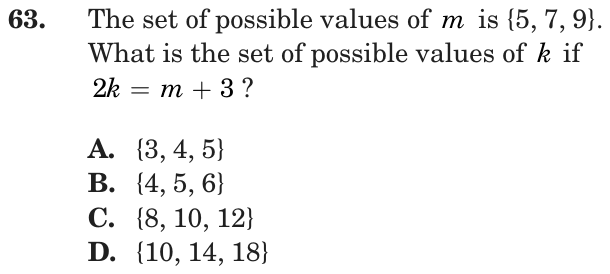
The set of possible values of is . What is the set of possible values of if ?
- A
- B
- C
- D
Show the answer
Correct answer: B
so
Substitute each value of m to find the values of k:
The set k is { 4, 5, 6}.
Question analysis
An algebra question about substitution: m can be 5, 7 or 9, and an equation links k to m. Students find every possible value of k by substituting each value of m and solving. The curly-brace set notation can look unfamiliar, and each value has to be carried all the way through the solve.
- Grade level
- Grade 6 content, by NYS standard
- Compared with grade 7
- At grade 7 Each substitution leads to a one-step grade 6 equation, easier than a typical grade 7 two-step problem. What adds demand is doing it three times and reading the answer as a set of values, which grade 7 rarely uses.
- Estimated difficulty
- Straightforward: two steps or one careful reading.
- Thinking it demands
- Depth of knowledge 1, recall and reproduction · mainly apply
- What makes it hard
- Solution
- 2 steps
- Reading level
- Question and choices: about grade 9, 24 words.
- Students, last 30 days
- Not enough answers yet to show (it takes 10).
Why it is hard, traps and wrong answers (shows the answer)
Why it is hard
The equation is simple, and the main hazard is stopping one step short: m + 3 gives 8, 10 and 12, a listed choice even though those are values of 2k. Checking a single value of m is the other risk, since k = 4 and k = 5 both appear in the first two sets. Students who substitute all three values and halve each result finish quickly.
Variables instead of numbers minor Understanding the question
There is no single unknown: m stands for the set {5, 7, 9}, and the answer is the matching set for k, so the equation has to be applied to three values. (Koedinger & Nathan, 2004; Enright, Morley & Sheehan, 2002)
Strategy: Rewrite the equation so k equals m plus 3, all divided by 2, then evaluate it for each of the three values of m.
Traps
- Stops one step early: A choice is a number from partway through the solution.
The wrong answers, classified
A Checks only one number (Schoenfeld, 1985)
Checks only m = 5, gets k = 4, and takes the first set containing 4; m = 9, giving k = 6, would rule it out.
C Stops one step early (King et al., 2004; Gierl et al., 2017)
Adds 3 to each value of m to get 8, 10 and 12, which are the values of 2k, and forgets to divide by 2.
D Wrong operation (Hegarty, Mayer & Monk, 1995; King et al., 2004)
Doubles each value of m to get 10, 14 and 18, moving the 2 onto m instead of dividing by it, and drops the + 3.
Worked solution, step by step
Formulas used
- Getting k by itself
- k and m are the letters from the equation 2k = m + 3. The fraction bar means divide. If 2 times k equals m + 3, then k is half of m + 3. You get this by dividing both sides of the equation by 2.
Sort out the question
The letter m can be 5, 7 or 9. The curly braces { } show a set, which is a list of numbers. The equation links k to m. You need every value k can have, one for each value of m.
Get k by itself
2k means 2 times k. To undo times 2, divide both sides by 2. Doing the same thing to both sides keeps the equation true.
Try each value of m
Put each value of m into the formula. Add 3 first, then divide by 2.
Watch out: 8, 10 and 12 are the values of m + 3, which equal 2k, not k. Stopping before you divide by 2 gives choice C.
Pick the matching set
The values of k are 4, 5 and 6. Watch out: try all three values of m. If you only try m = 5, you get k = 4, and choice A has a 4 too. So the answer is B, {4, 5, 6}.
Check your answer
Put each k back into the equation. . . . All three work, so the set is right.
More questions like this
The original DOE question
Question 6 of 7
2018 Test B Math, question 19Question
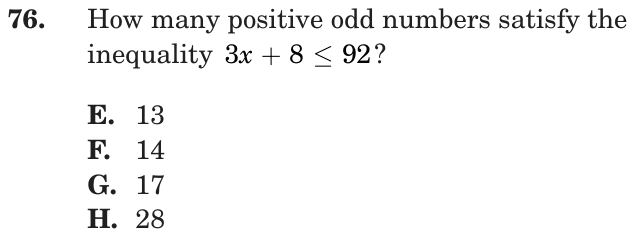
How many positive odd numbers satisfy the inequality ?
- A13
- B14
- C17
- D28
Show the answer
Correct answer: B
Solve the inequality for x.
3x + 8 ≤ 92
3x ≤ 84
x ≤ 28
The positive odd numbers less than or equal to 28 are 1, 3, 5, …, 25, and 27. There are 14 of them.
Question analysis
This question asks how many positive odd numbers satisfy the two-step inequality 3x + 8 ≤ 92. Students solve the inequality and then count the odd whole numbers in the solution. The counting after the algebra is where errors creep in, especially at the end of the list.
- Grade level
- Grade 7 content, by NYS standard
- Compared with grade 7
- At grade 7 Solving a two-step inequality is grade 7 work. Asking for a count of the odd solutions adds a number-property step and an endpoint check, but the total demand stays close to a typical grade 7 problem.
- Estimated difficulty
- Moderate: several steps, or a close reading with one strong distractor.
- Thinking it demands
- Depth of knowledge 2, skills and concepts · mainly apply
- What makes it hard
- A very close wrong answer moderate
- Combines ideas minor
- Solution
- 3 steps
- Reading level
- Question and choices: about grade 16, 9 words.
- Corrected from the DOE handbook
- The explanation’s description of the solutions was corrected.
- Students, last 30 days
- Not enough answers yet to show (it takes 10).
Why it is hard, traps and wrong answers (shows the answer)
Why it is hard
Solving the inequality is routine, and that is the trap: x ≤ 28 looks like an answer and 28 is among the choices. The real task is counting odd numbers from 1 to 27, where the usual shortcut, (27 − 1) ÷ 2, misses the first term. Pairing each odd number with the even number after it, up to 28, gives the count directly and avoids the fencepost slip.
A very close wrong answer moderate Choosing the answer
13 and 14 differ by one, and a rough count of the odd numbers up to 27 cannot separate them; only counting both ends, 1 and 27, gives the exact 14. (Embretson & Wetzel, 1987; Gorin & Embretson, 2006; Ascalon et al., 2007)
Combines ideas minor Working it out
Solving 3x + 8 ≤ 92 is only half the work; counting the positive odd whole numbers up to 28 is a separate number-sense task. (Embretson, 1998; Daniel & Embretson, 2010)
Strategy: Solve the inequality as you would an equation, keeping the direction of the sign, then count odd numbers from 1 up to the boundary by pairing or halving.
Traps
- Counting the ends: Inclusive or exclusive ends, fence posts, consecutive numbers: an answer that is one too many or too few, or an endpoint drawn open where it belongs closed (or the reverse).
- Stops one step early: A choice is a number from partway through the solution.
The wrong answers, classified
A Counting the ends (Brown & Burton, 1978)
Counts the odd numbers from 1 to 27 as (27 − 1) ÷ 2 = 13, forgetting to add one for the first term.
C A faulty procedure (Brown & Burton, 1978; Tatsuoka, 1983)
Moves the 8 across without changing its sign, solving 3x ≤ 100, and counts the odd numbers up to 33.
D Stops one step early (King et al., 2004; Gierl et al., 2017)
Solves the inequality to x ≤ 28 and gives the boundary 28 instead of counting the positive odd numbers up to it.
What was corrected from the DOE handbook, and why
- Explanation: The handbook solves the inequality to x ≤ 28 and then lists “the positive odd numbers less than 28.” The solutions include 28 itself, so the site says “less than or equal to 28.” The count does not change, because 28 is even: the odd numbers are still 1, 3, 5, …, 27, which is 14 numbers.
Worked solution, step by step
Formulas used
- Solving an inequality
- a, b and c are numbers. The sign ≤ means less than or equal to. You may subtract the same number from both sides. You may also divide both sides by the same positive number. The sign stays the same either way.
- Counting odd numbers
- n is an even number. Split the numbers from 1 to n into pairs: 1 and 2, 3 and 4, and so on. There are n ÷ 2 pairs, and each pair holds exactly one odd number.
Sort out the question
You need to count the positive odd numbers that make true.
The sign ≤ means is less than or equal to. Positive means greater than 0. Odd numbers are 1, 3, 5, 7, and so on.
Solve the inequality
Solve it like an equation. Subtract 8 from both sides. Then divide both sides by 3. Dividing by a positive number keeps the sign the same.
Watch out: 28 is the largest x allowed, not the count. That trap is choice D.
List the odd numbers
The positive odd numbers up to 28 are 1, 3, 5, and so on, up to 25 and 27. The number 28 is even, so it does not count.
Count them by pairing
Split 1 to 28 into pairs: 1 and 2, 3 and 4, and so on, up to 27 and 28. Each pair has one odd number.
Watch out: Working out counts the jumps of 2 from 1 to 27, not the numbers. You must add 1 for the first number. That mistake gives choice A.
So the answer is B, 14.
Check your answer
Test the edges. For x = 27: , which is at most 92, so it works. For x = 29: , which is too big. So 27 is the last odd number that works.
More questions like this
The original DOE question
Question 7 of 7
2018 Test B Math, question 50Question
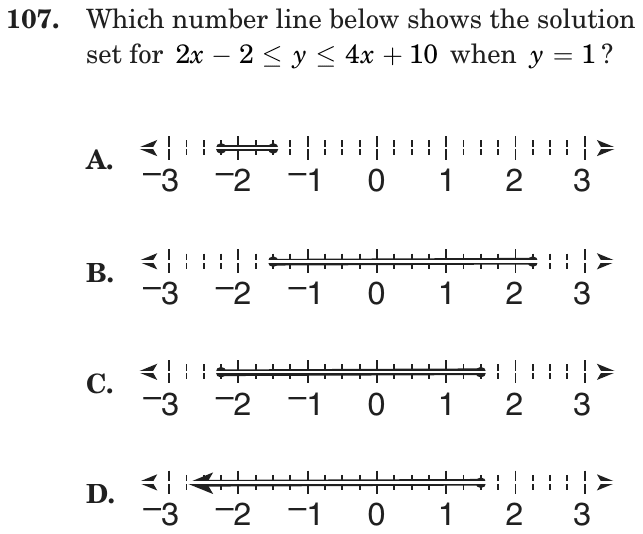
Which number line below shows the solution set for when ?
- A

- B

- C

- D

Show the answer
Correct answer: C
Separate the compound inequality into two pieces:
and
Substitute into each inequality and solve for :
The solution is the number line that shows that is greater than or equal to and less than or equal to .
Question analysis
Students substitute y = 1 into the compound inequality 2x − 2 ≤ y ≤ 4x + 10 and pick the number line that shows the values of x that work. It tests solving two-step inequalities and graphing the solution. The four graphs differ in their endpoints and in whether the shading is closed off on both sides, so each endpoint has to be found exactly.
- Grade level
- Grade 7 content, by NYS standard
- Compared with grade 7
- Above grade 7 Grade 7 students solve and graph one two-step inequality. This compound inequality in two variables requires substituting, solving two inequalities and combining them into one interval, a step toward algebra 1.
- Estimated difficulty
- Hard: combines ideas, needs a plan, and has more than one tempting wrong answer.
- Thinking it demands
- Depth of knowledge 2, skills and concepts · mainly apply
- What makes it hard
- Many steps moderate
- Error-prone arithmetic moderate
- Reading a figure, table or graph moderate
- A very close wrong answer minor
- Solution
- 4 steps
- Reading level
- Question and choices: about grade 9, 12 words.
- Students, last 30 days
- Not enough answers yet to show (it takes 10).
Why it is hard, traps and wrong answers (shows the answer)
Why it is hard
Substituting y = 1 is easy; the work is solving two inequalities and matching a fractional interval to a graph. Students who solve only the left inequality find a matching ray, and sign slips on either endpoint produce intervals that shift or flip across zero. The graphs differ by quarter-unit ticks, so reading them carefully matters as much as the algebra.
Many steps moderate Working it out
The compound inequality must be split into 2x − 2 ≤ 1 and 1 ≤ 4x + 10, each solved for x, and the two results joined into one interval. (Daniel & Embretson, 2010; Enright, Morley & Sheehan, 2002)
Error-prone arithmetic moderate Working it out
Both endpoints are fractions, 3/2 and −9/4, and the second comes from dividing −9 by 4, where a lost sign moves the endpoint across zero. (Brown & Burton, 1978; Junker & Sijtsma, 2001)
Reading a figure, table or graph moderate Understanding the question
The graphs are marked in quarter units, so −2 1/4 and 1 1/2 have to be found by counting small ticks between the labeled integers. (Lesh, Post & Behr, 1987; Kirsch & Mosenthal, 1990)
A very close wrong answer minor Choosing the answer
The ray ending at 1 1/2 looks almost like the right segment, sharing its right end; only the left end, an arrow instead of a closed dot at −2 1/4, separates them. (Embretson & Wetzel, 1987; Gorin & Embretson, 2006; Ascalon et al., 2007)
Strategy: Split the compound inequality into two separate inequalities, solve each for x after putting 1 in for y, then combine the two results into a single interval and match it to a graph.
Traps
- Negatives and direction: Arithmetic with negative numbers, the order of a subtraction, or direction on a number line. (Moving a term across the equals sign without changing its sign is a faulty procedure.)
- Stops one step early: A choice is a number from partway through the solution.
The wrong answers, classified
A Negatives and direction (Brown & Burton, 1978)
Gets the left endpoint −2 1/4 right but gives the right endpoint the wrong sign, ending the segment at −1 1/2 instead of 1 1/2.
B Negatives and direction (Brown & Burton, 1978)
Gives both endpoints the opposite sign, so the segment runs from −1 1/2 to 2 1/4, the true interval reflected across 0.
D Stops one step early (King et al., 2004; Gierl et al., 2017)
Solves only 2x − 2 ≤ 1 and graphs every x up to 1 1/2, leaving out the lower bound that 1 ≤ 4x + 10 sets.
Worked solution, step by step
Formulas used
- Solving an inequality
- a, b and c are numbers. The sign ≤ means is less than or equal to. Adding or subtracting the same number c on both sides keeps it true. Dividing both sides by the same positive number also keeps it true.
Sort out the question
The sign means is less than or equal to. An inequality compares two amounts that may not be equal. The statement is two inequalities joined together. You put 1 in place of . Then you need every that makes both parts true.
Split it into two parts
With , the statement becomes two inequalities.
The answer must make both of them true at the same time.
Solve the first part
Add 2 to both sides. Then divide both sides by 2.
So is at most . This is the right end of the answer.
Watch out: the right end is a positive number. Choice A ends its bar at instead.
Solve the second part
Subtract 10 from both sides. Then divide both sides by 4.
So is at least . This is the left end.
Watch out: keep the minus sign. Choice B uses the opposite signs and ends at .
Put the two parts together
The answer is every number from to , with both ends included. On the graph, that is a solid bar with a dot at each end. The small ticks are quarters. So count 1 tick left of −2 and 2 ticks right of 1.
Watch out: choice D uses only the first part. Its arrow goes left forever.
Give the answer
Choice C shows a bar from to , with dots at both ends. So the answer is C.
Check your answer
Test a number on the bar, like . Then and , and 1 is between them. Now test , which is off the bar. Then , and 1 is not less than −2. So the bar must stop on the left, which rules out D.
More questions like this
The original DOE question