3 English and 3 math
Here are 6 random questions to try. Takers earning below 75% are unlikely to receive an offer. You have 1 minute 48 seconds per question on the real exam.
Question 1 of 6
2026 Practice Test B English, question 22Passage Excerpt from In Search of the Unknown
Excerpt from In Search of the Unknown
by Robert W. Chambers
It was at that time the policy of the trustees and officers of the Zoological Gardens neither to employ collectors nor to send out expeditions in search of specimens. The society decided to depend upon voluntary contributions, and I was always busy, part of the day, in dictating answers to correspondents who wrote offering their services as hunters of big game, collectors of all sorts of fauna, trappers, snarers, and also to those who offered specimens for sale, usually at exorbitant rates.
To the proprietors of . . . mangy lynxes, moth-eaten coyotes, and dancing bears I returned courteous but uncompromising refusals—of course, first submitting all such letters, together with my replies, to Professor Farrago.
One day towards the end of May, however, just as I was leaving Bronx Park to return to town, Professor Lesard, of the reptilian department, called out to me that Professor Farrago wanted to see me a moment; so I . . . retraced my steps to the temporary, wooden building occupied by Professor Farrago, general superintendent of the Zoological Gardens. The professor, who was sitting at his desk before a pile of letters and replies submitted for approval by me, pushed his glasses down and looked over them at me with a whimsical smile that suggested amusement, impatience, annoyance, and perhaps a faint trace of apology.
“Now, here’s a letter,” he said, with a deliberate gesture towards a sheet of paper impaled on a file—“a letter that I suppose you remember.” He disengaged the sheet of paper and handed it to me.
“Oh yes,” I replied, with a shrug; “of course the man is mistaken—or—”
“Or what?” demanded Professor Farrago, tranquilly, wiping his glasses.
“—Or a liar,” I replied.
After a silence he leaned back in his chair and bade me read the letter to him again, and I did so with a contemptuous tolerance for the writer, who must have been either a very innocent victim or a very stupid swindler. I said as much to Professor Farrago, but, to my surprise, he appeared to waver.
“I suppose,” he said, with his near-sighted, embarrassed smile, “that nine hundred and ninety-nine men in a thousand would throw that letter aside and condemn the writer as a liar or a fool?”
“In my opinion,” said I, “he’s one or the other.”
“He isn’t—in mine,” said the professor, placidly.
“What!” I exclaimed. “Here is a man living all alone on a strip of rock and sand between the wilderness and the sea, who wants you to send somebody to take charge of a bird that doesn’t exist!”
“How do you know,” asked Professor Farrago, “that the bird in question does not exist?”
“It is generally accepted,” I replied, sarcastically, “that the great auk has been extinct for years. Therefore I may be pardoned for doubting that our correspondent possesses a pair of them alive.”
“Oh, you young fellows,” said the professor, smiling wearily, “you embark on a theory for destinations that don’t exist.”
He leaned back in his chair, his amused eyes searching space for the imagery that made him smile.
“Like swimming squirrels, you navigate with the help of Heaven and a stiff breeze, but you never land where you hope to—do you?”
Rather red in the face, I said: “Don’t you believe the great auk to be extinct?”
“Audubon saw the great auk.”
“Who has seen a single specimen since?”
“Nobody—except our correspondent here,” he replied, laughing.
I laughed, too, considering the interview at an end, but the professor went on, coolly:
“Whatever it is that our correspondent has—and I am daring to believe that it is the great auk itself—I want you to secure it for the society.”
When my astonishment subsided my first conscious sentiment was one of pity. Clearly, Professor Farrago was on the verge of dotage—ah, what a loss to the world!
I believe now that Professor Farrago perfectly interpreted my thoughts, but he betrayed neither resentment nor impatience. I drew a chair up beside his desk—there was nothing to do but to obey, and this fool’s errand was none of my conceiving.
Together we made out a list of articles necessary for me and itemized the expenses I might incur, and I set a date for my return, allowing no margin for a successful termination to the expedition.
“Never mind that,” said the professor. “What I want you to do is to get those birds here safely. Now, how many men will you take?”
“None,” I replied, bluntly; “it’s a useless expense, unless there is something to bring back. If there is I’ll wire you, you may be sure.”
“Very well,” said Professor Farrago, good-humoredly, “you shall have all the assistance you may require. Can you leave to-night?”
The old gentleman was certainly prompt. I nodded, half-sulkily, aware of his amusement.
“So,” I said, picking up my hat, “I am to start north to find a place called Black Harbor, where there is a man named Halyard who possesses, among other household utensils, two extinct great auks—”
We were both laughing by this time. I asked him why on earth he credited the assertion of a man he had never before heard of.
“I suppose,” he replied, with the same half-apologetic, half-humorous smile, “it is instinct. I feel, somehow, that this man Halyard has got an auk—perhaps two. I can’t get away from the idea that we are on the eve of acquiring the rarest of living creatures. It’s odd for a scientist to talk as I do; doubtless you’re shocked—admit it, now!”
But I was not shocked; on the contrary, I was conscious that the same strange hope that Professor Farrago cherished was beginning, in spite of me, to stir my pulses, too.
“If he has—” I began, then stopped.
The professor and I looked hard at each other in silence.
“Go on,” he said, encouragingly.
But I had nothing more to say, for the prospect of beholding with my own eyes a living specimen of the great auk produced a series of conflicting emotions within me which rendered speech profanely superfluous.
From IN SEARCH OF THE UNKNOWN by Robert W. Chambers—Public Domain
Audubon: John James Audubon, an ornithologist and artist who created scientific illustrations of birds
dotage: a loss of reasoning brought about by old age
Question
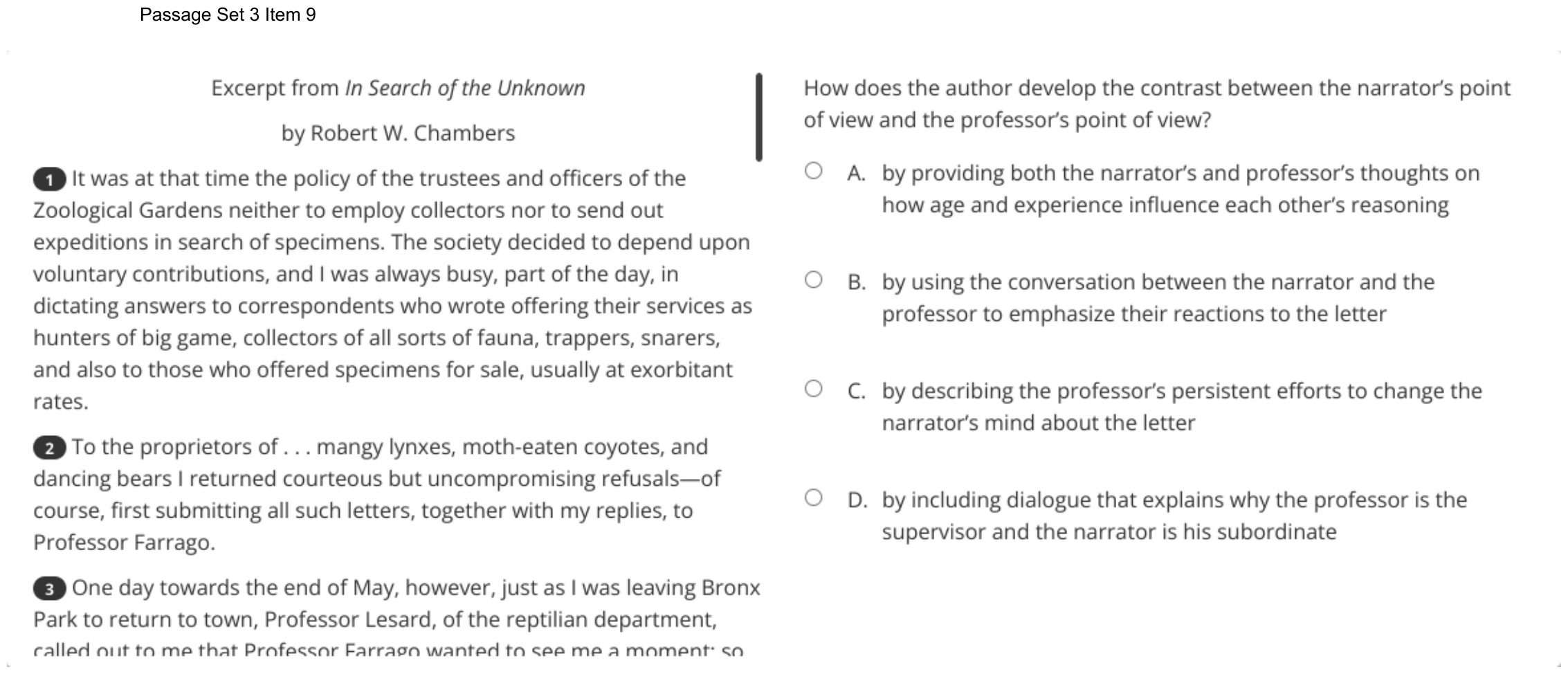
How does the author develop the contrast between the narrator’s point of view and the professor’s point of view?
- Aby providing both the narrator’s and professor’s thoughts on how age and experience influence each other’s reasoning
- Bby using the conversation between the narrator and the professor to emphasize their reactions to the letter
- Cby describing the professor’s persistent efforts to change the narrator’s mind about the letter
- Dby including dialogue that explains why the professor is the supervisor and the narrator is his subordinate
Show the answer
Correct answer: B
The question asks how the author develops the contrast between the narrator’s point of view and the professor’s point of view.
A. Incorrect. The excerpt does not describe the narrator’s thoughts about how age and experience influence the professor’s reasoning in enough detail to fully contrast them against the thoughts about the narrator that the professor expresses in paragraphs 15–17. The narrator’s idea that the professor might be “on the verge of dotage” (paragraph 24) is meant in a humorous way.
B. CORRECT. The primary conflict of the excerpt revolves around the narrator’s disagreement with the professor about whether the letter about the great auks could be true. As the two men converse, their contrasting attitudes toward the letter become clear: the narrator dismisses the possibility of great auks out of hand (“ ‘of course the man is mistaken’ ” [paragraph 5]; “ ‘here is a man . . . who wants you to send somebody to take charge of a bird that doesn’t exist!’ ” [paragraph 12]), while the professor calmly admits that although “ ‘nine hundred and ninety-nine men in a thousand would throw that letter aside and condemn the writer’ ” (paragraph 9), he himself believes that the writer could be telling the truth (“ ‘How do you know,’ asked Professor Farrago, ‘that the bird in question does not exist?’ ” [paragraph 13]).
C. Incorrect. The professor explains why he disagrees with the narrator (paragraphs 19–21), but he does not make persistent efforts to convince the narrator to change his mind about the letter. Instead he states that the narrator will go on an expedition to retrieve “ ‘whatever it is that our correspondent has’ ” (paragraph 23), thereby requiring the narrator to go collect the great auks whether the narrator believes in them or not.
D. Incorrect. The point of the dialogue is not to explain the subordinate-supervisor relationship between the narrator and the professor but rather to contrast what each character believes about the contents of the letter.
Question analysis
This point-of-view question asks how Robert W. Chambers develops the contrast between the narrator’s outlook and Professor Farrago’s in the excerpt from In Search of the Unknown. Students must step back from single lines and judge the author’s method across the whole excerpt. The choices describe techniques in general terms, and several connect to real moments in the story.
- Grade level
- Grade 8 reading and task
- Compared with grade 7
- Above grade 7 Analyzing how an author contrasts two characters’ points of view is the grade 7 standard itself, but here students must judge the main method across the whole excerpt, and each choice names an abstract method that touches something in the text.
- Estimated difficulty
- Hard: combines ideas, needs a plan, and has more than one tempting wrong answer.
- Thinking it demands
- Depth of knowledge 3, strategic thinking · mainly analyze
- What makes it hard
- How, not what major
- A very close wrong answer moderate
- Evidence in several places moderate
- Evidence
- Answered from the whole text
- Reading level
- Passage: about grade 9, 1066 words; question and choices: about grade 11, 84 words.
- Students, last 30 days
- Not enough answers yet to show (it takes 10).
Why it is hard, traps and wrong answers (shows the answer)
Why it is hard
The right choice is plain enough to seem too obvious, so students look for something more specific. The excerpt offers a candidate: the professor teases “you young fellows,” and the narrator decides the old man is near “dotage,” which makes age look like the method. Those remarks are passing jokes, while the men’s opposite reactions to Halyard’s letter run through the whole conversation. The question rewards judging what carries the contrast from start to end rather than what is most striking.
How, not what major Working it out
The question asks for the author’s method across the whole excerpt, and every choice names an abstract technique, so students must step back from single lines to see that the dialogue carries the contrast. (Anderson & Krathwohl, 2001)
A very close wrong answer moderate Choosing the answer
The choice about age and experience and the right one both describe the two men’s opposed views as they come out in the excerpt; they part on the subject, their ages or the letter. (Embretson & Wetzel, 1987; Gorin & Embretson, 2006; Ascalon et al., 2007)
Evidence in several places moderate Working it out
The contrast builds from the narrator’s “of course the man is mistaken” in paragraph 5 to the professor’s appeal to “instinct” in paragraph 33, so no single passage shows the method. (Kirsch & Mosenthal, 1990; Gorin & Embretson, 2006)
Strategy: For each choice, find where the excerpt does what the choice describes, and ask whether that method carries the contrast through the whole excerpt or appears only once or twice.
Traps
- Too narrow: A single detail offered as the central idea or a summary, or a summary that keeps minor details and leaves out an essential part.
- Twists what the text says: Uses the text's topic and ideas but changes what it says: who did it, how much, when, or why.
- Wrong purpose or structure: Names a purpose, structure or effect that the part does not serve, or describes what a part says when the question asks what it does.
The wrong answers, classified
A Too narrow (King et al., 2004)
Notices the jab at “you young fellows” and the narrator’s thought of “dotage,” but two passing remarks about age are not how the author builds the contrast across the excerpt.
C Twists what the text says (King et al., 2004)
Overstates the professor’s role, since he asks a few calm questions and then simply assigns the trip, never working to win the narrator over.
D Wrong purpose or structure (Anderson & Krathwohl, 2001)
Knows that the professor is the superior, but no line of dialogue explains how either man got his position; the talk is about the letter, not their ranks.
Working it out, step by step
Figure out what the question asks
This asks about the author’s method. How does the author show that the two men see things differently? Look at how the whole excerpt is built, not just one line.
Notice how the excerpt is told
Most of the excerpt is a conversation. The two men talk back and forth about the letter. Each answer shows how one man reacts to it. So their reactions to the letter are where the contrast shows up. A contrast is a clear difference between two things.
Find the two reactions
The narrator says “of course the man is mistaken” (paragraph 5). He laughs at the idea of “a bird that doesn’t exist!” (paragraph 12). The professor stays open. In paragraph 13 he asks how the narrator can be sure “that the bird in question does not exist.” In paragraph 23, he is “daring to believe” it is the great auk.
Check each choice
- A does not fit. Age comes up only twice: “you young fellows” and the narrator’s thought about “dotage.” Two short remarks do not build the contrast.
- B fits. The talk about the letter shows their opposite reactions.
- C does not fit. The professor asks a few calm questions and then simply sends the narrator. He does not keep trying to change his mind.
- D does not fit. No line explains how either man got his job.
Watch out: A is tempting because those remarks about age are real. But they are passing moments, not the author’s main method.
Choose the answer
The author builds the contrast through the two men’s talk about the letter. So the answer is B, “by using the conversation between the narrator and the professor to emphasize their reactions to the letter.”
Why this answer and not the closest wrong one
A is the closest wrong choice. The professor does tease “you young fellows,” and the narrator does think of “dotage.” But those are two quick remarks. From paragraph 5 to paragraph 33, the two men keep reacting to the letter in opposite ways. That steady back-and-forth builds the contrast, so B fits.
More questions like this
The original DOE question
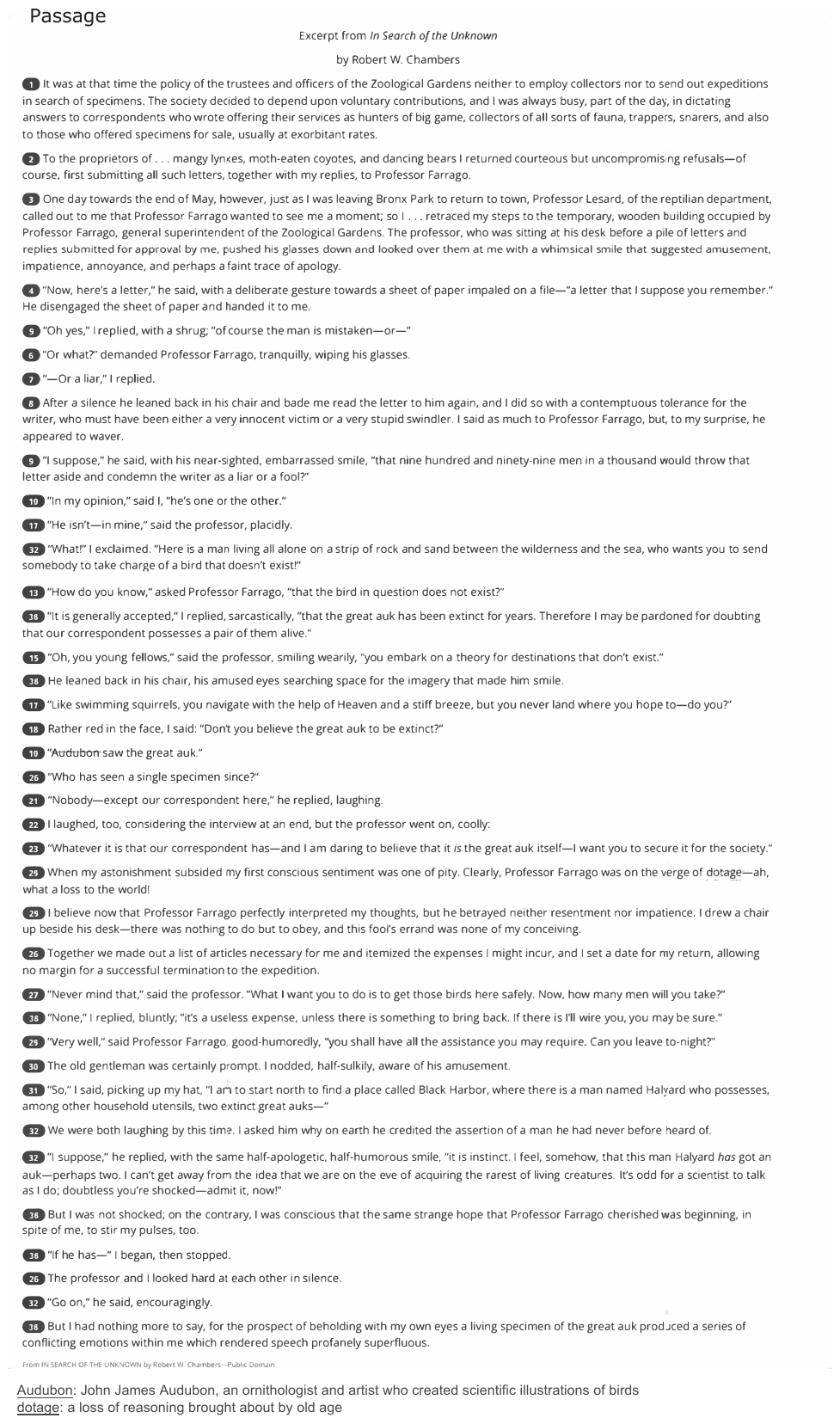
The passage “Excerpt from In Search of the Unknown” as printed (page 21)
Question 2 of 6
2024 Test A English, question 11Passage Excerpt from “Impressions of an Indian Childhood”
Excerpt from “Impressions of an Indian Childhood”
by Zitkala-Sa
Zitkala-Sa (Gertrude Simmons Bonnin) was a Native American writer, musician, teacher, and political activist who was raised on the Yankton Sioux Reservation in South Dakota. In 1900 she published “Impressions of an Indian Childhood” (the term Indian was commonly used at the time to refer to Native American people) to expose readers to what life is like on a reservation.
Soon after breakfast Mother sometimes began her beadwork. On a bright, clear day, she pulled out the wooden pegs that pinned the skirt of our wigwam1 to the ground, and rolled the canvas part way up on its frame of slender poles. Then the cool morning breezes swept freely through our dwelling, now and then wafting the perfume of sweet grasses from newly burnt prairie.
Untying the long tasseled strings that bound a small brown buckskin2 bag, my mother spread upon a mat beside her bunches of colored beads, just as an artist arranges the paints upon his palette. On a lapboard she smoothed out a double sheet of soft white buckskin; and drawing from a beaded case that hung on the left of her wide belt a long, narrow blade, she trimmed the buckskin into shape. Often she worked upon small moccasins for her small daughter. Then I became intensely interested in her designing. With a proud, beaming face, I watched her work. In [my] imagination, I saw myself walking in a new pair of snugly fitting moccasins. I felt the envious eyes of my playmates upon the pretty red beads decorating my feet.
Close beside my mother I sat on a rug, with a scrap of buckskin in one hand and an awl in the other. This was the beginning of my practical observation lessons in the art of beadwork. From a skein3 of finely twisted threads of silvery sinews my mother pulled out a single one. With an awl she pierced the buckskin, and skillfully threaded it with the white sinew. Picking up the tiny beads one by one, she strung them with the point of her thread, always twisting it carefully after every stitch.
It took many trials before I learned how to knot my sinew thread on the point of my finger, as I saw her do. Then the next difficulty was in keeping my thread stiffly twisted, so that I could easily string my beads upon it. My mother required of me original designs for my lessons in beading. At first I frequently ensnared many a sunny hour into working a long design. Soon I learned from self-inflicted punishment to refrain from drawing complex patterns, for I had to finish whatever I began.
After some experience I usually drew easy and simple crosses and squares. These were some of the set forms. My original designs were not always symmetrical nor sufficiently characteristic, two faults with which my mother had little patience. The quietness of her oversight made me feel strongly responsible and dependent upon my own judgment. She treated me as a dignified little individual as long as I was on my good behavior; and how humiliated I was when some boldness of mine drew forth a rebuke from her!
In the choice of colors she left me to my own taste. I was pleased with an outline of yellow upon a background of dark blue, or a combination of red and myrtle-green. There was another of red with a bluish-gray that was more conventionally used. When I became a little familiar with designing and the various pleasing combinations of color, a harder lesson was given me. It was the sewing on, instead of beads, some tinted porcupine quills, moistened and flattened between the nails of the thumb and forefinger. My mother cut off the prickly ends and burned them at once in the centre fire. These sharp points were poisonous, and worked into the flesh wherever they lodged. For this reason, my mother said, I should not do much alone in quills until I was as tall as my cousin Warca-Ziwin.
Always after these confining lessons I was wild with surplus spirits, and found joyous relief in running loose in the open again. Many a summer afternoon a party of four or five of my playmates roamed over the hills with me. We each carried a light sharpened rod about four feet long, with which we pried up certain sweet roots. When we had eaten all the choice roots we chanced upon, we shouldered our rods and strayed off into patches of a stalky plant under whose yellow blossoms we found little crystal drops of gum. Drop by drop we gathered this nature’s rock-candy, until each of us could boast of a lump the size of a small bird’s egg. Soon satiated with its woody flavor, we tossed away our gum, to return again to the sweet roots.
From “Impressions of an Indian Childhood” by Zitkala-Sa—Public Domain
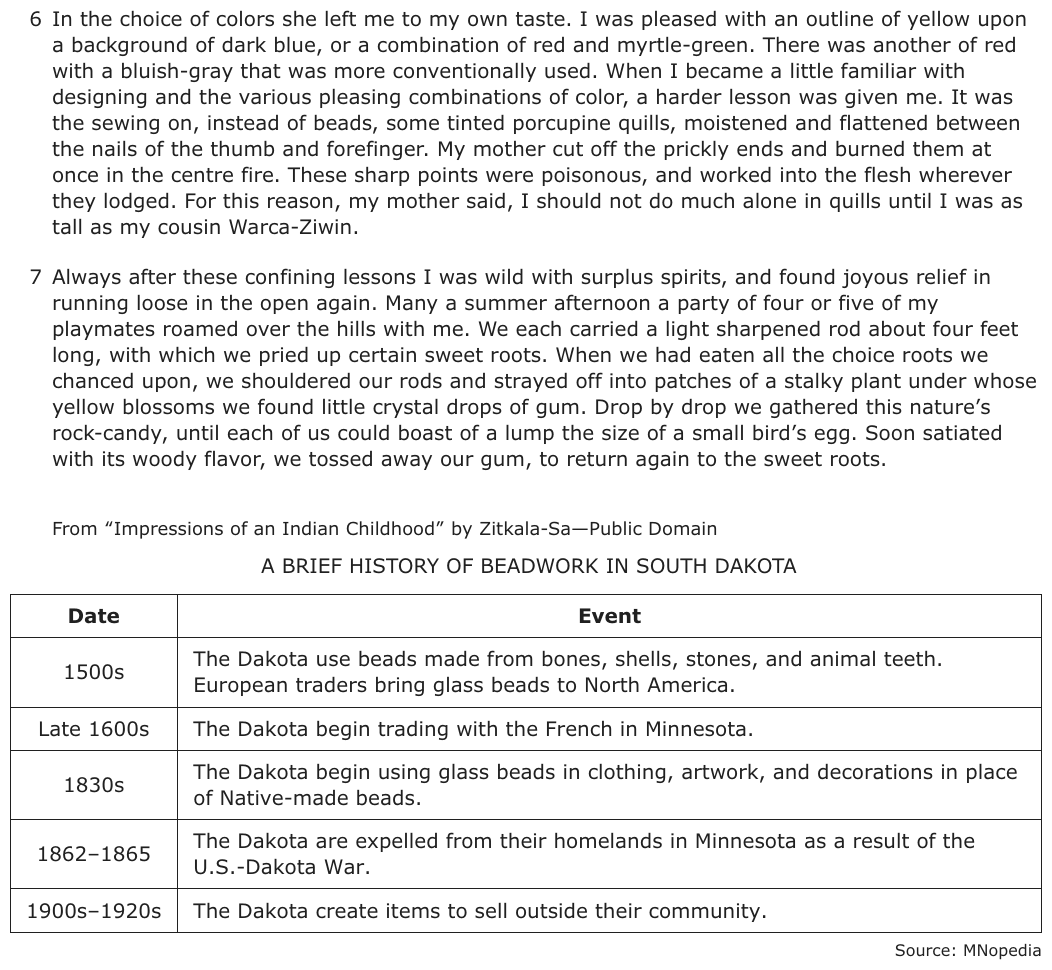
A BRIEF HISTORY OF BEADWORK IN SOUTH DAKOTA
| Date | Event |
|---|---|
| 1500s | The Dakota use beads made from bones, shells, stones, and animal teeth. European traders bring glass beads to North America. |
| Late 1600s | The Dakota begin trading with the French in Minnesota. |
| 1830s | The Dakota begin using glass beads in clothing, artwork, and decorations in place of Native-made beads. |
| 1862–1865 | The Dakota are expelled from their homelands in Minnesota as a result of the U.S.-Dakota War. |
| 1900s–1920s | The Dakota create items to sell outside their community. |
Source: MNopedia
1wigwam: hut with an arched framework of poles covered with bark, mats, or animal hides
2buckskin: leather made from the skin of a male deer
3skein: coiled length of yarn or other thread loosely wound on a reel
Question
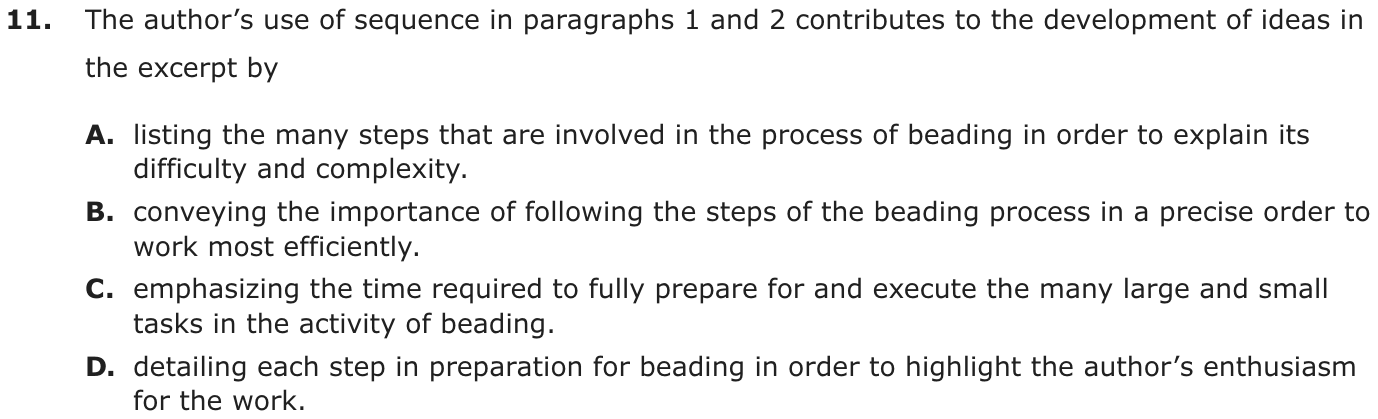
The author’s use of sequence in paragraphs 1 and 2 contributes to the development of ideas in the excerpt by
- Alisting the many steps that are involved in the process of beading in order to explain its difficulty and complexity.
- Bconveying the importance of following the steps of the beading process in a precise order to work most efficiently.
- Cemphasizing the time required to fully prepare for and execute the many large and small tasks in the activity of beading.
- Ddetailing each step in preparation for beading in order to highlight the author’s enthusiasm for the work.
Show the answer
Correct answer: D
The question asks how the author’s use of sequence in paragraphs 1 and 2 contributes to the development of ideas in the excerpt.
A. Incorrect. In paragraph 2, the author does list the steps her mother takes in preparation to do beadwork, such as “untying the long tasseled strings” of the bag of beads, spreading the beads beside her on a mat, and using “a long, narrow blade” to trim the buckskin into shape. However, the language used to describe this sequence does not indicate that preparing to work with beads is difficult or complex.
B. Incorrect. Although the author’s description of untying the bag of beads, spreading the beads upon a mat, smoothing out a sheet of buckskin, and trimming the buckskin into shape in paragraph 2 indicates that the mother follows a certain routine, it does not place any emphasis on working most efficiently by following the steps of the beading process in a precise order.
C. Incorrect. In paragraph 2, the author describes her mother “untying the long tasseled strings that bound a small brown buckskin bag,” “spread[ing] upon a mat beside her bunches of colored beads,” “smooth[ing] out a double sheet of soft white buckskin; and drawing from a beaded case that hung on the left of her wide belt a long, narrow blade” to trim the buckskin. Although these descriptions do outline the steps in her process for creating beadwork, they do not emphasize the time required to do so, since the author does not mention in the excerpt how long it took her mother to fully prepare for and complete the large and small tasks in the activity of beading.
D. CORRECT. In paragraph 1, the author describes how the morning begins with her mother rolling up the canvas of the wigwam and allowing the breeze to come in. In paragraph 2, the author uses sensory language and precise sequencing to describe the way her mother prepares the beading materials by untying “the long tasseled strings that bound a small brown buckskin bag,” spreading the “bunches of colored beads” beside her, and smoothing out “a double sheet of soft white buckskin.” This combination of sequence and sensory language highlights the author’s enthusiasm for beadwork by emphasizing that the author pays close attention to her mother’s preparations.
Question analysis
This reading question asks how the step-by-step description of a mother preparing her beadwork, in the opening paragraphs of Zitkala-Sa's memoir, contributes to the excerpt's ideas. Every choice agrees that steps are listed, so students must judge which purpose the text actually supports and resist reasons that only sound likely for a craft.
- Grade level
- Grade 8 reading and task
- Compared with grade 7
- Above grade 7 Grade 7 structure questions usually ask what a paragraph adds to a topic. This one asks what an ordered description achieves, in dense 1900 prose where the purpose is never stated outright, which goes beyond typical grade 7 work.
- Estimated difficulty
- Hard: combines ideas, needs a plan, and has more than one tempting wrong answer.
- Thinking it demands
- Depth of knowledge 3, strategic thinking · mainly analyze
- What makes it hard
- How, not what major
- A very close wrong answer moderate
- Reading between the lines moderate
- Complex sentences minor
- Evidence
- Answered from several paragraphs or stanzas
- Reading level
- Passage: about grade 8, 946 words; question and choices: about grade 11, 95 words.
- Corrected from the DOE handbook
- A misquotation of the excerpt in the explanation was corrected.
- Students, last 30 days
- Not enough answers yet to show (it takes 10).
Why it is hard, traps and wrong answers (shows the answer)
Why it is hard
All four choices agree that the paragraphs lay out steps, so the question turns entirely on purpose, and three of the purposes sound like natural reasons to describe a craft. Nothing in paragraphs 1 and 2 calls the work hard, slow or a matter of efficiency; what they do show is a child following every move and becoming intensely interested. Students who look for the narrator's own reaction find the purpose, while those who reason from the steps alone drift to difficulty or time.
How, not what major Working it out
The stem asks what the ordered account of untying the bag, spreading the beads, and smoothing and trimming the buckskin does for the excerpt, a purpose the author never states. (Anderson & Krathwohl, 2001)
A very close wrong answer moderate Choosing the answer
The difficulty choice shares the right one's frame, steps laid out in order to show something, and differs only in what they show: how hard beading is, or how eagerly the girl watched. (Embretson & Wetzel, 1987; Gorin & Embretson, 2006; Ascalon et al., 2007)
Reading between the lines moderate Working it out
The enthusiasm has to be pieced together from the close attention to each step and from “intensely interested” and “a proud, beaming face” in paragraph 2. (Graesser, Singer & Trabasso, 1994; Kintsch, 1998)
Complex sentences minor Understanding the question
Paragraph 2 uses literary word order, as in “my mother spread upon a mat beside her bunches of colored beads,” which slows the reading of the very steps in question. (Abedi & Lord, 2001; Freedle & Kostin, 1993; Messick, 1989)
Strategy: For each choice, look in paragraphs 1 and 2 for words that would prove its purpose; a purpose that no sentence states or shows can be ruled out.
Traps
- Half right: One half of a two-part choice is right and the other is not.
- Wrong purpose or structure: Names a purpose, structure or effect that the part does not serve, or describes what a part says when the question asks what it does.
- Reads too much in: A reasonable-sounding conclusion that goes further than the text allows.
The wrong answers, classified
A Half right (King et al., 2004; Thissen, Steinberg & Fitzpatrick, 1989)
Rightly sees that paragraph 2 lists many preparation steps, then decides the list must show that beading is difficult and complex, which nothing in these paragraphs says.
B Wrong purpose or structure (Anderson & Krathwohl, 2001)
Reads the sequence as instructions about doing the steps in a precise order for efficiency, a purpose a watching child's memories never suggest.
C Reads too much in (Graesser, Singer & Trabasso, 1994)
Reasons that so many steps must take a long time, perhaps recalling the “many a sunny hour” of paragraph 4, but paragraphs 1 and 2 never mention time.
What was corrected from the DOE handbook, and why
- Explanation: In rejecting choice C, the handbook quotes paragraph 2 as “spread[ing them] upon a mat beside her bunches of colored beads.” In the excerpt, the bunches of colored beads are what the mother spreads (“my mother spread upon a mat beside her bunches of colored beads”). The inserted “them” refers to nothing and turns the beads into a place. The quotation now reads “spread[ing] upon a mat beside her bunches of colored beads,” which is how the handbook itself reads the sentence in its reason for rejecting choice A (“spreading the beads beside her on a mat”).
Working it out, step by step
Figure out what the question asks
Sequence means the order in which things happen. Paragraphs 1 and 2 tell the steps of a morning in order. The question asks why the author tells them step by step. What does that careful order help show?
List the steps
In paragraphs 1 and 2, the mother:
- rolls up the side of the wigwam to let in the breeze,
- unties a bag made of buckskin (soft deer leather),
- spreads her beads on a mat,
- smooths out a sheet of buckskin, and
- trims it into shape with a blade.
Find the author’s reaction
Right after the steps, the author tells how she felt. “Then I became intensely interested in her designing. With a proud, beaming face, I watched her work.” Intensely means very strongly. A beaming face has a big, happy smile. She noticed every little step because she was so excited. The details show her enthusiasm, or eager interest.
Check each choice
- A is wrong. The steps are listed, but nothing says beading is hard or complex.
- B is wrong. Nothing says the steps must go in a set order to save effort.
- C is wrong. Paragraphs 1 and 2 never say how long anything takes.
- D is right. The careful details show how closely the girl watched, with eager interest.
Watch out: A is tempting because there are many steps. But many steps don’t prove a task is hard. The author never calls it difficult.
Choose the answer
The step-by-step order shows a child following every move her mother makes. So the answer is D.
Why this answer and not the closest wrong one
A is the closest wrong answer. Like D, it says the steps are listed to show something. But no word in paragraphs 1 and 2 calls beading hard. The author does say she was “intensely interested” and had “a proud, beaming face.” That shows enthusiasm, so D fits better.
More questions like this
The original DOE question
The passage “Excerpt from “Impressions of an Indian Childhood”” as printed (pages 42–43)
Question 3 of 6
2026 Practice Test C English, question 39Passage Excerpt from “Growing Peppers on the ISS Is Just the Start of Space Farming”
Excerpt from “Growing Peppers on the ISS Is Just the Start of Space Farming”
by Melanie Canales
The author, Melanie Canales, is a first-generation Peruvian American farmer and beekeeper based in Virginia’s Shenandoah Valley, on lands of the indigenous Monacan and Manahoac tribes. Her work focuses on creating healthy relationships between people and their surrounding ecosystems.
Unburdened by the constraints of gravity, red and green peppers jut out at 45-degree angles inside the Advanced Plant Habitat (APH), a sort of space terrarium not much larger than a microwave. Four chile pepper plants stand effortlessly upright, despite the dozens of glossy fruits weighing them down. These plants have lived entirely in space; their leaves have never been chewed on by insects or rustled by a summer breeze, [and] their stems are unfamiliar with bending toward the sun’s arc across the sky. Scissors glint under the tank’s white and blue lights as astronaut Mark Vande Hei and his team snip the stems of those that are ready for harvest. The peppers whirl around their heads until the astronauts catch them and tape them against a board to photograph.
Back on Earth, the Plant Habitat-04 team of engineers and plant scientists are observing and conferring with the astronauts. Of the 26 peppers in this batch, only the 14 finest will stay on the International Space Station [ISS] for consumption. The rest will be wrapped in foil, sealed in a Ziploc bag, then frozen at a brisk −80 degrees, until they can come roaring back to Earth in the next cargo capsule to be studied later. Now, after a 137-day growth cycle, the astronauts remove the plants from the module and trash them. Project Plant Habitat-04 is complete. It’s taco night on the ISS.
Since 2014, NASA1 has experimented with growing lettuces, brassicas,2 and zinnias3 in space, an endeavor that relies on highly specialized technology over 50 years in the making. [Fall 2021’s] two successful pepper harvests . . . will provide data on the nutritional and psychological benefits of growing vegetables on-craft, as well as a crop’s ability to reliably produce long-term in microgravity. While controlled environmental agriculture is not new, the APH experiment represents an evolution in specialized growth habitats. It doesn’t aim to re-create Earth’s conditions, but to perfect each isolated variable of plant growth in the clinical environment of a spaceship.
“The Advanced Plant Habitat is the most complex plant growth system on orbit today,” says Lashelle Spencer, a plant scientist at NASA’s Kennedy Space Center. Its more than 180 sensors control and monitor temperature, humidity, and carbon dioxide. The astronauts can adjust the color and intensity of the light, and how much moisture the plants’ roots are getting. It waters itself.
It’s the day after Thanksgiving, and Spencer has been at Kennedy since 5 a.m. to facilitate the peppers’ final harvest. As part of the project team, she played a crucial role in preparing the seeds that were sent hurtling into space in June and guiding the astronauts through maintaining the plants in orbit. . . . Though astronauts can spend upwards of 100 days in space, their on-mission meals come dehydrated and pre-packaged; their vitamins and minerals are isolated in supplements, which lose nutritional value the longer they’re stored. Spencer’s goal is to create the conditions necessary for cultivating healthy plants in space, so those plants can sustain healthy astronauts on long-term missions. Astronaut food is great, she says—“especially the shrimp cocktail. But you’re missing that crunch. You’re missing that fresh pop of flavor, the green flavor that’s not there in that packaged food.”
The sensory experience of growing productive crops can also help mitigate4 the psychological effects of long-term space travel. . . . Spencer says the team cracked open the door of the APH every day to observe their vegetable companions with all the tenderness of home gardeners. When harvest day came, they batted their bounty around the ISS, taking selfies and delighting in watching the fruits pirouetting around the spacecraft. . . .
“We were thinking no heat, so that [the peppers] wouldn’t be dangerous, but maybe the astronauts need a little spice in their life,” says Paul Bosland, who along with his colleagues at the Chile Pepper Institute genetically engineered5 the NuMex Española Improved chile pepper seeds grown in Plant Habitat-04. . . .
Working with NASA, Bosland cultivated a variety that could accommodate both the nutritional needs of astronauts as well as the logistics of growing a plant in space. . . .
. . . The experiment is helping gather the data necessary to determine the nutritional content of crops grown in space, and therefore how many people they can feed, and for how long. Though much is still unknown, Spencer is certain of one thing that future astronauts will need to do: “I think in an optimal world, a scientist like me would say that they would be growing plants from day one. From the day they left to the day they came back, they would be growing them.”
From “Growing Peppers on the ISS Is Just the Start of Space Farming” by Melanie Canales from WIRED, December 21, 2021. Copyright © 2021 Condé Nast. All rights reserved.
1NASA: National Aeronautics and Space Administration
2brassicas: a large genus of herbs, such as broccoli and cabbage
3zinnias: a genus of herbs and low shrubs that have flowers at their heads
4mitigate: to make something less severe or harmful
5genetically engineered: combined parts of DNA from different plants to produce a new plant
Question
The description in paragraph 5 of Lashelle Spencer’s goal develops a central idea of the excerpt by
- Aillustrating that certain types of packaged foods available in space lack particular flavors.
- Bsupporting the notion that spending more than 100 days in space is detrimental to astronauts’ health.
- Coffering an example of how the limited selection of on-mission meals becomes less appealing over time.
- Dmaking an important point about the astronauts’ current reliance on supplements for vitamins and minerals.
Show the answer
Correct answer: D
The question asks how the description of Lashelle Spencer’s goal in paragraph 5 develops a central idea of the excerpt.
A. Incorrect. Although Spencer mentions how astronauts miss certain eating experiences like the “fresh pop” and “green flavor” not found in packaged and dehydrated food, a central idea of the excerpt is that there is a need to provide fresh, healthy foods for long missions, not that food flavor should be improved.
B. Incorrect. While the excerpt focuses on how spending more than 100 days in space affects nutrition, it does not discuss specific ways in which spending long periods of time in space is detrimental to the health of astronauts.
C. Incorrect. Although paragraph 5 states that astronauts “can spend upwards of 100 days in space,” the excerpt does not develop a central idea that existing meals in space become less appealing over time.
D. CORRECT. The paragraph explains that astronauts currently rely on supplements for vitamins and minerals, which lose their nutritional value over time. Spencer’s goal for growing plants in space is to “sustain healthy astronauts,” supporting a central idea that astronauts need more nutritionally valuable food to sustain them while in space for long periods of time.
Question analysis
Lashelle Spencer’s goal for growing plants in space is described in paragraph 5 of the WIRED excerpt, and this central-idea question asks how that description develops a central idea of the whole excerpt. Students must connect a single sentence about a scientist’s aim to the article’s larger point, and every choice draws on details from that same paragraph.
- Grade level
- Grade 8 reading and task
- Compared with grade 7
- Above grade 7 Grade 7 students trace how a central idea develops, usually through a plainly stated example. Here the goal’s connection to the central idea runs through the sentences around it, and the choices are abstract restatements, which asks more than typical grade 7 work.
- Estimated difficulty
- Hard: combines ideas, needs a plan, and has more than one tempting wrong answer.
- Thinking it demands
- Depth of knowledge 3, strategic thinking · mainly analyze
- What makes it hard
- Reading between the lines moderate
- Every choice must be checked moderate
- How, not what minor
- Evidence in several places minor
- Evidence
- Answered from several paragraphs or stanzas
- Reading level
- Passage: about grade 10, 890 words; question and choices: about grade 12, 75 words.
- Students, last 30 days
- Not enough answers yet to show (it takes 10).
Why it is hard, traps and wrong answers (shows the answer)
Why it is hard
Every choice draws on paragraph 5, and none mentions growing plants, which leaves students looking for the goal without finding it. The flavor quotation that follows the goal is the most memorable detail and the easiest wrong pick. The key works only through context: the goal answers the problem the previous sentence sets out, crews depending on supplements that weaken in storage, which is why it serves the article’s case for fresh food on long missions.
Reading between the lines moderate Working it out
Spencer’s goal names healthy plants and healthy astronauts but no supplements; its link to the key runs through the sentence before it, where vitamins sit in supplements that “lose nutritional value the longer they’re stored.” (Graesser, Singer & Trabasso, 1994; Kintsch, 1998)
Every choice must be checked moderate Choosing the answer
No choice restates the goal of growing plants itself, so none can be matched at a glance; each must be tested for whether it ties the goal to the excerpt’s concern with nutrition on long missions. (Embretson & Wetzel, 1987)
How, not what minor Working it out
The question asks how the description develops a central idea, its role in the article, so knowing what Spencer wants is only the first step toward the answer. (Anderson & Krathwohl, 2001)
Evidence in several places minor Working it out
The central idea must come from the whole excerpt: paragraph 3’s “nutritional and psychological benefits,” paragraph 8’s “nutritional needs of astronauts” and paragraph 9’s “nutritional content of crops.” (Kirsch & Mosenthal, 1990; Gorin & Embretson, 2006)
Strategy: State a central idea of the whole excerpt in your own words, reread Spencer’s goal with the sentences around it in paragraph 5, and pick the option that connects the goal to that central idea.
Traps
- Too narrow: A single detail offered as the central idea or a summary, or a summary that keeps minor details and leaves out an essential part.
- Twists what the text says: Uses the text's topic and ideas but changes what it says: who did it, how much, when, or why.
- Reads too much in: A reasonable-sounding conclusion that goes further than the text allows.
The wrong answers, classified
A Too narrow (King et al., 2004)
Settles on the most quotable detail nearby, the “fresh pop of flavor” missing from packaged food, a side remark about taste rather than the nutritional need behind her goal.
B Reads too much in (Graesser, Singer & Trabasso, 1994)
Stretches “upwards of 100 days in space” and “healthy astronauts” into a claim that long missions damage health, though the excerpt describes only food and supplements that lose value.
C Twists what the text says (King et al., 2004)
Blends supplements that lose value “the longer they’re stored” with the missing crunch into meals that grow less appealing over time, an idea paragraph 5 never states.
Working it out, step by step
Figure out what the question asks
A central idea is a main point the whole article keeps coming back to. This question asks how Spencer’s goal, in paragraph 5, helps build one of those main points. So first, find the goal. Then connect it to the big idea.
Find the goal and the sentence before
Paragraph 5 says: “Spencer’s goal is to create the conditions necessary for cultivating healthy plants in space, so those plants can sustain healthy astronauts on long-term missions.” Cultivating means growing. The sentence just before it shows why she has this goal. Astronauts’ “vitamins and minerals are isolated in supplements, which lose nutritional value the longer they’re stored.”
Connect the goal to the big idea
Today astronauts get vitamins from pills, called supplements. Those pills lose their health value as they sit. Spencer wants fresh plants grown in space to keep astronauts healthy instead. So her goal points to a problem: relying on weak pills. The article returns to food and health again and again. Paragraph 8 mentions “the nutritional needs of astronauts.” Nutritional means having to do with healthy food.
Check each choice
- A is wrong. The “fresh pop of flavor” line comes after the goal. It is about taste, a side point.
- B is wrong. The article never says long trips in space harm astronauts’ health.
- C is wrong. It is the stored supplements that lose value over time, not meals that get less tasty.
- D is right. The goal answers a problem: astronauts depend on supplements that weaken in storage. That ties to the article’s idea that astronauts need healthy fresh food on long trips.
Watch out: Spencer’s flavor quote is the most memorable line nearby, so A pulls hard. But her goal is about health, not taste.
Choose the answer
Spencer wants healthy plants because pills are not enough. So the answer is D, “making an important point about the astronauts’ current reliance on supplements for vitamins and minerals.” Reliance means depending on something.
Why this answer and not the closest wrong one
A is the closest wrong answer. Spencer really does miss the crunch and flavor of fresh food. But her goal is to “sustain healthy astronauts,” which is about health. Health is the big idea the article keeps returning to. D connects the goal to that idea through the supplements that lose value.
More questions like this
The original DOE question
The passage “Excerpt from “Growing Peppers on the ISS Is Just the Start of Space Farming”” as printed (pages 50–51)
Question 4 of 6
2026 Practice Test C Math, question 32Question
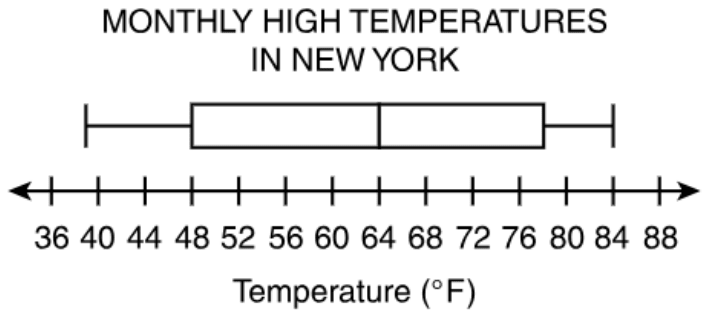
The box plot shows the average monthly high temperatures in New York City for 12 months. What is the difference between the range and the interquartile range of the temperature data?
Enter your answer in the space.
Fill-in question: work out the answer and type it as a number.
Show the answer
Correct answer: 15
Determine the range by subtracting the minimum value on the box plot from the maximum value on the box plot:
Maximum value , Minimum value
Determine the interquartile range by subtracting the lower quartile value on the box plot from the upper quartile value on the box plot:
Upper Quartile Value , Lower Quartile Value
Determine the difference between the range (45° F) and the interquartile range (30° F):
Question analysis
A box plot of New York City's average monthly high temperatures for 12 months sits above a number line labeled every 4 degrees. Students type the difference between the range and the interquartile range of the data. Two of the plot's values fall between labeled ticks, so careful reading of the scale decides the answer.
- Grade level
- Grade 7 content, by NYS standard
- Compared with grade 7
- Above grade 7 Reading a box plot and finding its interquartile range are grade 7 skills. Here two of the five values fall between ticks spaced 4 apart, and the range, the IQR and their difference must all be found and typed with no choices.
- Estimated difficulty
- Hard: combines ideas, needs a plan, and has more than one tempting wrong answer.
- Thinking it demands
- Depth of knowledge 2, skills and concepts · mainly apply
- What makes it hard
- Solution
- 3 steps
- Reading level
- Question and choices: about grade 7, 36 words.
- Students, last 30 days
- Not enough answers yet to show (it takes 10).
Why it is hard, traps and wrong answers (shows the answer)
Why it is hard
The method is standard, but the key rests on reading the scale between its labels. The axis is ticked only every 4 degrees, and the minimum and the upper quartile land off the ticks, so rounding either one to the nearest label moves the result by a degree or two with nothing to flag it. Students who find the range correctly can also stop there, entering 45, the larger of the two spreads, instead of the difference the question asks for.
Reading a figure, table or graph major Understanding the question
Two of the five values fall between ticks spaced 4 degrees apart: the left whisker ends just short of the 40 tick, at 39, and the box’s right edge sits midway between 76 and 80, at 78. (Lesh, Post & Behr, 1987; Kirsch & Mosenthal, 1990)
Many steps minor Working it out
Four values are read and combined in three subtractions, the range, the interquartile range and then their difference, so one misread value changes the final entry. (Daniel & Embretson, 2010; Enright, Morley & Sheehan, 2002)
Something you must already know minor Working it out
Neither measure is defined on the page: the range spans the whiskers, and the interquartile range is the width of the box, the upper quartile minus the lower. (Anderson & Krathwohl, 2001)
An answer in an unexpected form minor Choosing the answer
The result is typed with no choices to compare, so an entry one or two degrees off, from rounding a value to the nearest tick, looks just as finished as the right one. (Enright, Morley & Sheehan, 2002)
Strategy: Read the minimum, both quartiles and the maximum, judging where each mark falls between the ticks, then subtract for the range and for the IQR, and subtract those two results.
Traps
- Misreads the figure: Reads a value, label or tick spacing in a figure, table or graph wrongly.
- Stops one step early: A choice is a number from partway through the solution.
The wrong answers, classified
14 Misreads the figure (Lesh, Post & Behr, 1987; Kirsch & Mosenthal, 1990)
Reads the left whisker’s end as 40, the nearest labeled tick, instead of 39, so the range becomes 84 − 40 = 44 and 44 − 30 = 14.
45 Stops one step early (King et al., 2004; Gierl et al., 2017)
Finds the range, 84 − 39 = 45 degrees, and enters it, stopping before the interquartile range of 30 is subtracted from it.
17 Misreads the figure (Lesh, Post & Behr, 1987; Kirsch & Mosenthal, 1990)
Reads the box’s right edge as 76, the tick just left of it, instead of 78, so the IQR becomes 76 − 48 = 28 and 45 − 28 = 17.
Worked solution, step by step
Formulas used
- Range
- The maximum is the greatest value, at the right end of the right whisker. The minimum is the least value, at the left end of the left whisker. The range tells how far the whole set of data spreads.
- Interquartile range (IQR)
- Q3 is the upper quartile, the right edge of the box. Q1 is the lower quartile, the left edge of the box. The IQR is the width of the box. It tells how far the middle half of the data spreads.
Sort out the question
A box plot shows data with five numbers. The two whiskers are the lines on each side of the box. Their ends are the minimum, the least value, and the maximum, the greatest. The box runs from the lower quartile to the upper quartile. These are the middles of the lower half and the upper half of the data. The line inside the box is the median, the middle value.
You need the range minus the interquartile range (IQR), in degrees.
Read the values between the ticks
The ticks on the number line are 4 degrees apart. So each degree is one quarter of the space between two ticks. Three values sit right on ticks: the box’s left edge at 48, the median at 64, and the right whisker’s end at 84.
- The left whisker starts just left of the 40 tick. It sits about one quarter of the way back toward 36. So the minimum is degrees.
- The box’s right edge is halfway between 76 and 80. Halfway is 78 degrees.
Find the range
Use the range formula:
The data spread over 45 degrees.
Watch out: rounding the minimum to the 40 tick gives a range of 44. Then the final answer comes out 14, which is wrong.
Find the IQR
Use the IQR formula with the two edges of the box:
The middle half of the data spreads over 30 degrees.
Watch out: reading the box’s right edge as 76 gives an IQR of 28. Then the final answer comes out 17.
Subtract the IQR from the range
The question asks for the difference between the two:
Watch out: 45 is only the range. Do not stop there. Type only the number, with no degree sign.
So you would enter 15.
Check your answer
The range covers the whole plot, and the IQR covers only the box. So their difference is the two whiskers added together. The left whisker is degrees long. The right whisker is degrees long. , which matches.
More questions like this
The original DOE question
Question 5 of 6
2024 Test B Math, question 56Question
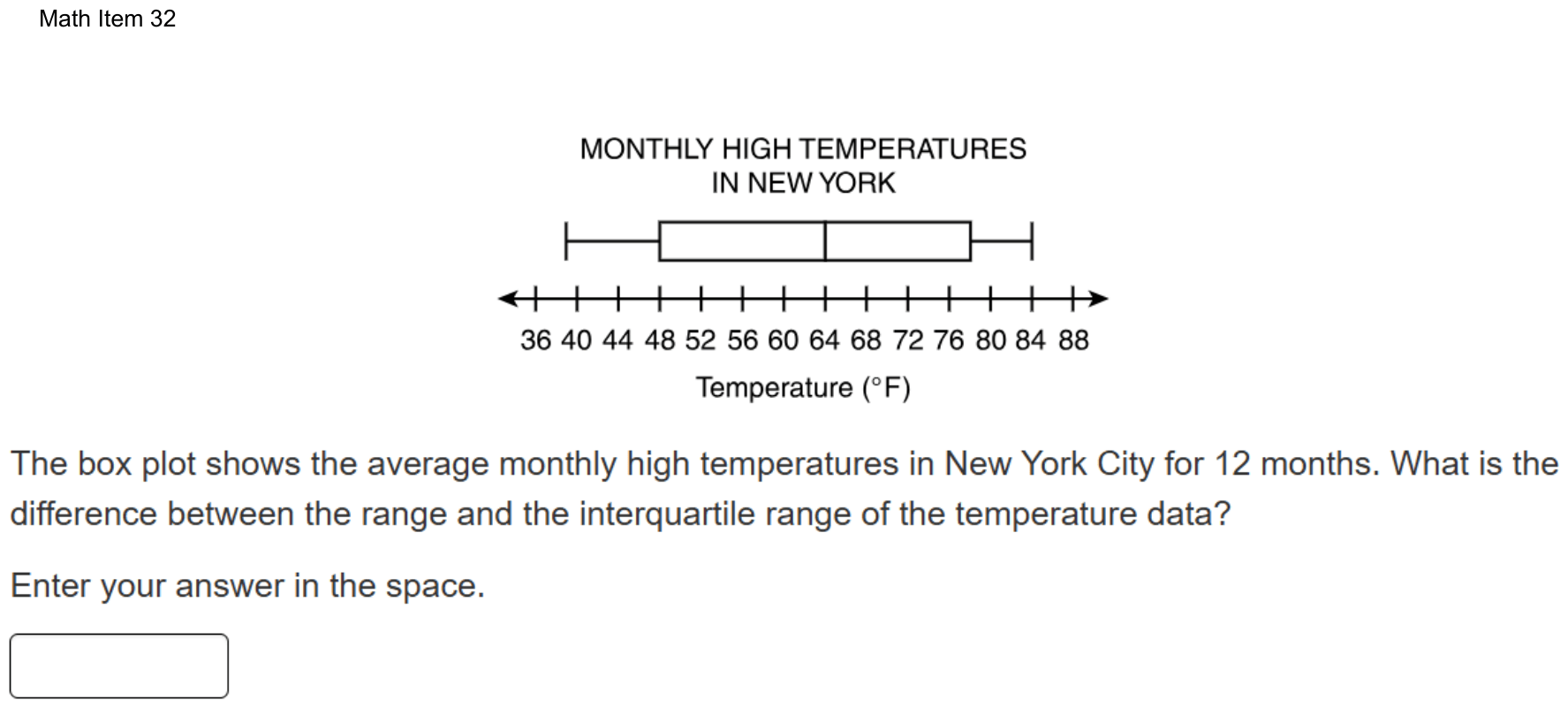
A rectangular field had a length of 80 meters and a width of 50 meters. The field was recently enlarged, with the length increased by 15% and the width increased by 10 meters. By what percentage was the area of the field increased?
- A26.5%
- B35%
- C38%
- D42.5%
Show the answer
Correct answer: C
The original area of the field was 4,000 square meters.
When the field was enlarged, the length increased by 15%, so the new length is 92 meters.
The width increased by 10 meters, so the new width is 60 meters.
The new area of the field is 5,520 square meters.
The percent increase is found by finding the difference between the two areas and dividing the increase by the original area.
Question analysis
A rectangular field 80 meters long and 50 meters wide has its length increased by 15 percent and its width by 10 meters. Students find the percent by which the field's area grew. It tests percent increase with rectangle area, and the tricky part is that one side changes by a percent and the other by a fixed length.
- Grade level
- Grade 7 content, by NYS standard
- Compared with grade 7
- Above grade 7 Grade 7 percent problems usually apply one percent change to one quantity. This changes a length by a percent and a width by a fixed amount, then asks for the percent change in area, a five-step chain with two kinds of change.
- Estimated difficulty
- Hard: combines ideas, needs a plan, and has more than one tempting wrong answer.
- Thinking it demands
- Depth of knowledge 2, skills and concepts · mainly apply
- What makes it hard
- Combines ideas moderate
- Many steps moderate
- A very close wrong answer minor
- Solution
- 5 steps
- Reading level
- Question and choices: about grade 6, 39 words.
- Students, last 30 days
- Not enough answers yet to show (it takes 10).
Why it is hard, traps and wrong answers (shows the answer)
Why it is hard
Each step is ordinary, but the two changes are stated in different units, one a percent and one in meters, which tempts students to force them into the same form. Adding the two percents is the most natural shortcut and lands close to the right value, because it misses only the small extra area where both changes overlap. Computing the old and new areas directly is slower but leaves nothing to chance.
Combines ideas moderate Working it out
Percent change has to be combined with area: the length grows by a percent and the width by meters, and the question asks for the percent change of their product. (Embretson, 1998; Daniel & Embretson, 2010)
Many steps moderate Working it out
Five computations are chained: the new length 92, the new width 60, the areas 4,000 and 5,520, and the increase 1,520 as a share of 4,000. (Daniel & Embretson, 2010; Enright, Morley & Sheehan, 2002)
A very close wrong answer minor Choosing the answer
The 35% from adding 15% and 20% sits only 3 points below 38%, so a rough estimate of the new area cannot rule it out. (Embretson & Wetzel, 1987; Gorin & Embretson, 2006; Ascalon et al., 2007)
Strategy: Compute the new length and the new width, find the old and new areas, and divide the increase in area by the original area.
Traps
- Misunderstands the concept: A wrong belief about a concept: that percents can be added, that area grows like length, that averages can be averaged, that a bigger denominator means a bigger fraction.
- Units or scale: The answer is wanted in other units, or a rate or scale must be converted first.
The wrong answers, classified
A Units or scale (King et al., 2004)
Treats the 10-meter widening as a 10% increase, so multiplies 1.15 × 1.10 = 1.265 and reports a 26.5% rise.
B Misunderstands the concept (Smith, diSessa & Roschelle, 1993; De Bock et al., 1998; Ni & Zhou, 2005)
Adds the length's 15% to the width's 20% increase, as if percent increases in two dimensions simply add, missing the 3% where they overlap.
D Units or scale (King et al., 2004)
Treats the 15% as 15 meters, making the field 95 by 60 meters, an area of 5,700 square meters and a 42.5% increase.
Worked solution, step by step
Formulas used
- Area of a rectangle
- A is the area, the flat space inside. l is the length and w is the width. Multiplying counts how many unit squares fit, row by row.
- Percent increase
- old is the starting amount, and new is the amount after. new − old is how much it grew. Dividing by old compares the growth with the start. Multiplying by 100 turns that into a percent.
Sort out the question
The field was 80 meters long and 50 meters wide. The length grew by 15%, a percent. The width grew by 10 meters, a number of meters. These are two different kinds of increase.
You need the percent by which the area grew.
Find the old area
You need the old area to compare with the new one.
The old field covered 4,000 square meters.
Find the new length and width
15% of 80 is . So the new length is meters.
The new width is meters.
Watch out: 10 meters is not 10%. Treating it as 10% leads to 26.5%, choice A. Treating 15% as 15 meters leads to 42.5%, choice D.
Find the new area
Multiply the new length by the new width.
The new field covers 5,520 square meters. That is square meters more.
Find the percent increase
The area grew by 38%. Watch out: The width grew by 20%, since 10 is 20% of 50. Adding 15% + 20% = 35% gives choice B. That misses the extra corner piece where both new strips meet.
So the answer is C, 38%.
Check your answer
Use growth factors. The length is multiplied by 1.15. The width goes from 50 to 60, so it is multiplied by 1.2. The area is multiplied by , which is 38% more.
More questions like this
The original DOE question
Question 6 of 6
2026 Practice Test B Math, question 31Question
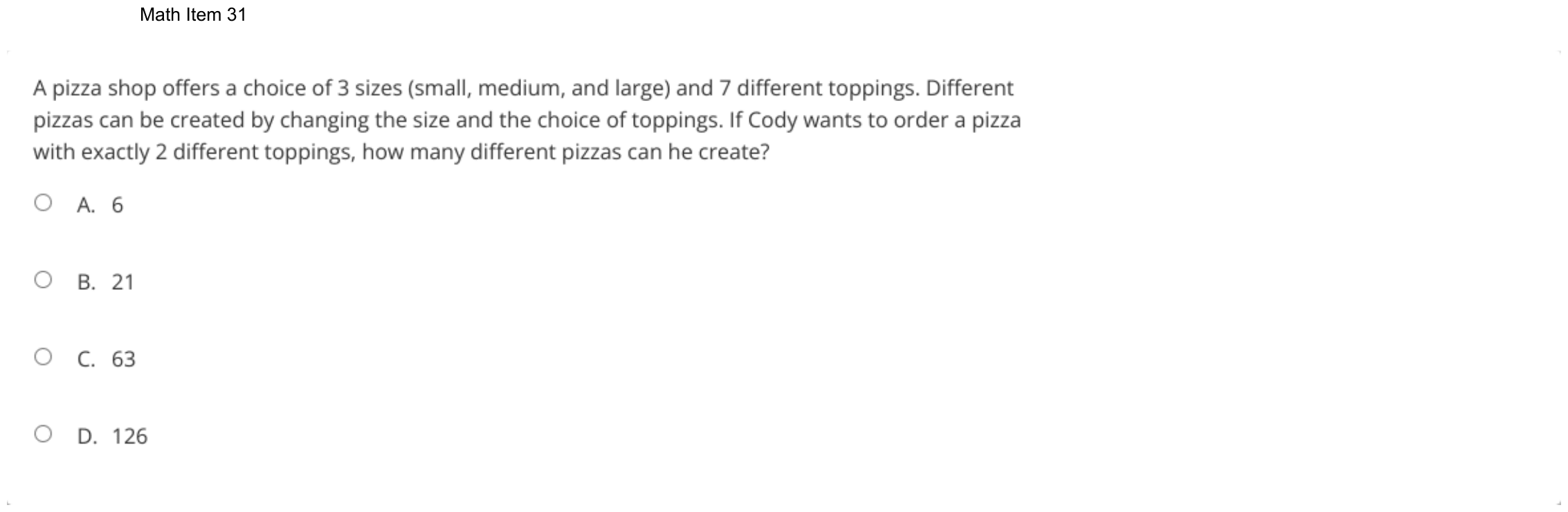
A pizza shop offers a choice of 3 sizes (small, medium, and large) and 7 different toppings. Different pizzas can be created by changing the size and the choice of toppings. If Cody wants to order a pizza with exactly 2 different toppings, how many different pizzas can he create?
- A6
- B21
- C63
- D126
Show the answer
Correct answer: C
Figure out how many different topping pairs are possible. Use 1, 2, 3, 4, 5, 6, 7 to represent the toppings, and create a list of possible pairs:
1,2; 1,3; 1,4; 1,5; 1,6; 1,7
2,3; 2,4; 2,5; 2,6; 2,7
3,4; 3,5; 3,6; 3,7
4,5; 4,6; 4,7
5,6; 5,7
6,7
So there are 21 different topping combinations for one pizza.
Since there are 3 pizza sizes, multiply the total number of combinations by 3 to get the total number of different pizzas Cody can create: .
Question analysis
Cody orders a pizza with exactly 2 of 7 toppings in one of 3 sizes, and students count how many different pizzas he could create. It tests counting combinations, where the order of the toppings does not matter, combined with a second choice. The challenge is to count every possible pizza exactly once.
- NYS standards
- 7.SP.8b sample spaces for compound events
- Grade level
- Grade 7 content, by NYS standard
- Compared with grade 7
- Above grade 7 In grade 7, compound events are usually ordered pairs, such as a coin with a number cube. Here an unordered pair of toppings is chosen from seven and then matched with three sizes, a combination count beyond typical grade 7 work.
- Estimated difficulty
- Hard: combines ideas, needs a plan, and has more than one tempting wrong answer.
- Thinking it demands
- Depth of knowledge 2, skills and concepts · mainly apply
- What makes it hard
- Combines ideas moderate
- Something you must already know minor
- Solution
- 3 steps
- Reading level
- Question and choices: about grade 8, 47 words.
- Students, last 30 days
- Not enough answers yet to show (it takes 10).
Why it is hard, traps and wrong answers (shows the answer)
Why it is hard
The question packs two counts into one sentence, each with its own trap. Order does not matter among the toppings, while the size multiplies every pair, and students tend to remember one of these and forget the other. Listing pairs systematically, each topping matched only with later ones, keeps the first count honest, and the stem’s “changing the size and the choice of toppings” is the reminder that size counts too.
Combines ideas moderate Working it out
Two counts are joined: the unordered pairs of toppings from 7, then the 3 sizes each pair can come in, and a mistake in either count changes the total. (Embretson, 1998; Daniel & Embretson, 2010)
Something you must already know minor Working it out
Students must know that a pizza with mushroom and onion is the same as one with onion and mushroom, so the ordered count 7 × 6 has to be halved. (Anderson & Krathwohl, 2001)
Strategy: Number the toppings 1 to 7, list each pair once by matching every topping only with higher-numbered ones, count the list, then bring in the choice of size.
Traps
- Stops one step early: A choice is a number from partway through the solution.
- Overlapping groups: Things in two groups at once are counted twice, or not subtracted.
The wrong answers, classified
A Numbers taken from the question (Hegarty, Mayer & Monk, 1995)
Multiplies the 3 sizes by the 2 toppings Cody wants, using the number of toppings on the pizza instead of the number of possible pairs.
B Stops one step early (King et al., 2004; Gierl et al., 2017)
Lists or counts the 21 pairs of toppings correctly, then stops without giving each pair its 3 possible sizes.
D Overlapping groups (King et al., 2004)
Counts ordered pairs, 7 × 6 = 42, so each pair of toppings appears twice, and then multiplies by the 3 sizes to reach 126.
Worked solution, step by step
Formulas used
- The counting principle
- m is the number of ways to make one choice, and n is the number of ways to make a second choice. Every first choice can go with every second choice, so you multiply. Here, every pair of toppings can come in every size.
- Pairs when order does not matter
- n is the number of items to choose from. There are n ways to pick a first item and n − 1 ways to pick a different second one. That counts each pair twice, once in each order. Dividing by 2 counts each pair once.
Sort out the question
Each of Cody’s pizzas has one size and exactly 2 different toppings. There are 3 sizes and 7 toppings. Pizzas differ by “changing the size and the choice of toppings.” So a small and a large with the same toppings are two different pizzas. You need to count every pizza once.
List the topping pairs
Order does not matter: onion with peppers is the same pizza as peppers with onion. So number the toppings 1 to 7, and pair each one only with bigger numbers. Then no pair shows up twice.
Topping Pairs with Pairs 1 2, 3, 4, 5, 6, 7 6 2 3, 4, 5, 6, 7 5 3 4, 5, 6, 7 4 4 5, 6, 7 3 5 6, 7 2 6 7 1 There are 21 different pairs of toppings.
Check the pairs with the formula
Use the pairs formula with 7 toppings:
Watch out: 7 × 6 = 42 counts every pair twice, once as 1 then 2 and once as 2 then 1. Keeping 42 leads to , choice D.
Bring in the sizes
Each of the 21 topping pairs can come in any of the 3 sizes. Use the counting principle:
Watch out: stopping at 21 leaves out the sizes, which gives choice B. Choice A, 6, multiplies the 3 sizes by the 2 toppings on one pizza. That does not count pizzas.
Give the answer
There are 21 topping pairs, and each one comes in 3 sizes. Cody can create 63 different pizzas. So the answer is C, 63.
Check your answer
Count one size at a time. A small pizza can have any of the 21 pairs, so there are 21 small pizzas. There are also 21 medium and 21 large ones: . That is more than the 21 pairs but fewer than 126, so it is reasonable.
More questions like this
The original DOE question