3 English and 3 math
Here are 6 random questions to try. Takers earning below 75% are unlikely to receive an offer. You have 1 minute 48 seconds per question on the real exam.
Question 1 of 6
2026 Practice Test B English, question 28Passage Looking for the Smallest Spark of Everything
Looking for the Smallest Spark of Everything
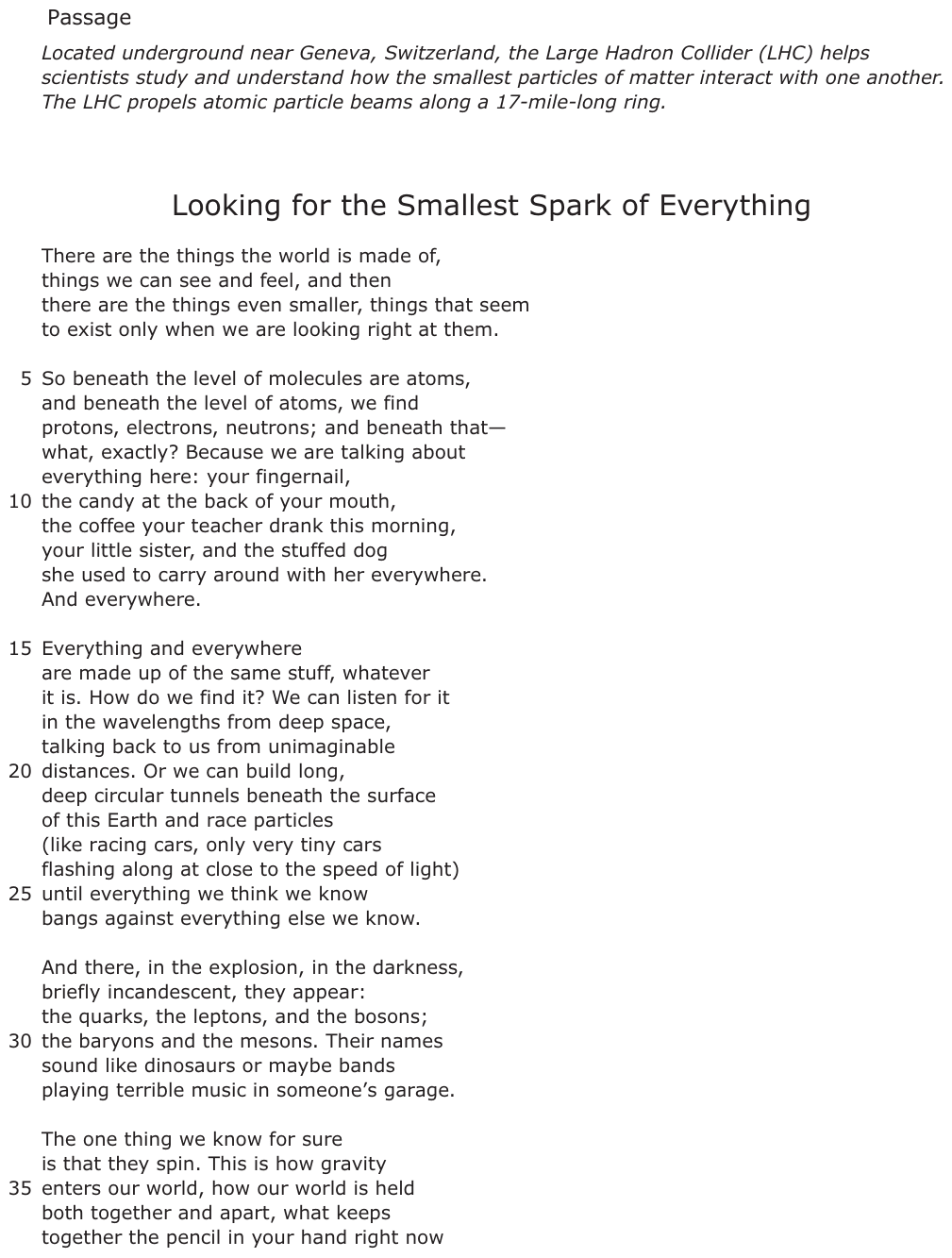
Located underground near Geneva, Switzerland, the Large Hadron Collider (LHC) helps scientists study and understand how the smallest particles of matter interact with one another. The LHC propels atomic particle beams along a 17-mile-long ring.
There are the things the world is made of,
things we can see and feel, and then
there are the things even smaller, things that seem
to exist only when we are looking right at them.
So beneath the level of molecules are atoms,
and beneath the level of atoms, we find
protons, electrons, neutrons; and beneath that—
what, exactly? Because we are talking about
everything here: your fingernail,
the candy at the back of your mouth,
the coffee your teacher drank this morning,
your little sister, and the stuffed dog
she used to carry around with her everywhere.
And everywhere.
Everything and everywhere
are made up of the same stuff, whatever
it is. How do we find it? We can listen for it
in the wavelengths from deep space,
talking back to us from unimaginable
distances. Or we can build long,
deep circular tunnels beneath the surface
of this Earth and race particles
(like racing cars, only very tiny cars
flashing along at close to the speed of light)
until everything we think we know
bangs against everything else we know.
And there, in the explosion, in the darkness,
briefly incandescent, they appear:
the quarks, the leptons, and the bosons;
the baryons and the mesons. Their names
sound like dinosaurs or maybe bands
playing terrible music in someone’s garage.
The one thing we know for sure
is that they spin. This is how gravity
enters our world, how our world is held
both together and apart, what keeps
together the pencil in your hand right now
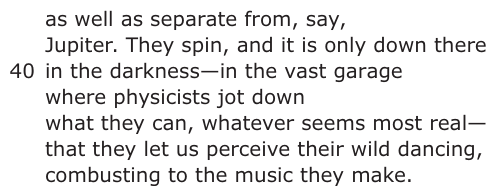
as well as separate from, say,
Jupiter. They spin, and it is only down there
in the darkness—in the vast garage
where physicists jot down
what they can, whatever seems most real—
that they let us perceive their wild dancing,
combusting to the music they make.
Question
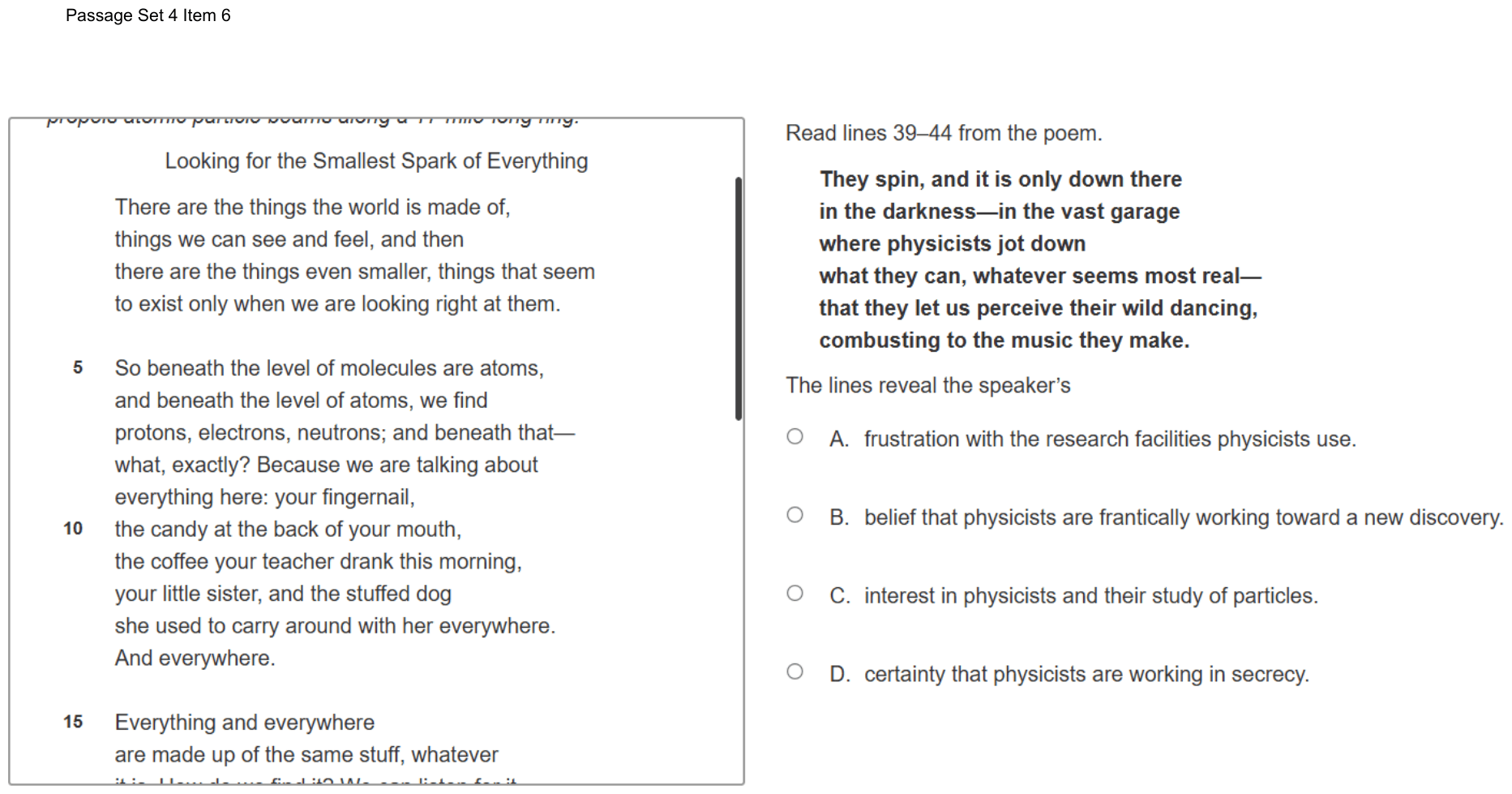
Read lines 39–44 from the poem.
They spin, and it is only down there
in the darkness—in the vast garage
where physicists jot down
what they can, whatever seems most real—
that they let us perceive their wild dancing,
combusting to the music they make.
The lines reveal the speaker’s
- Afrustration with the research facilities physicists use.
- Bbelief that physicists are frantically working toward a new discovery.
- Cinterest in physicists and their study of particles.
- Dcertainty that physicists are working in secrecy.
Show the answer
Correct answer: C
The question asks what lines 39–44 reveal about the speaker.
A. Incorrect. While the discoveries are made “in the darkness” (line 40), the imagery conveys the speaker’s positive tone through descriptions like “perceive their wild dancing” (line 43) and “combusting to the music they make” (line 44), not frustration.
B. Incorrect. In lines 39–44, the imagery of energetic movement (“They spin,” “their wild dancing,” and “combusting to the music they make”) is used to describe the particles, not the physicists.
C. CORRECT. The speaker uses the phrases “only down there” (line 39), “physicists jot down … whatever seems most real” (lines 41–42), and “they let us perceive” (line 43) to convey that the physicists have a rare role in studying the mysteries of the universe and that the speaker appreciates and is interested in their work.
D. Incorrect. While the description of the experiments occurring “in the darkness” (line 40) may create a sense of secrecy, the secrets that the darkness refers to are the mysteries of subatomic particles, not the work processes that the physicists use.
Question analysis
The final six lines of “Looking for the Smallest Spark of Everything” describe particles spinning in the darkness of a “vast garage” where physicists work. This question asks what those lines reveal about the speaker. The long sentence is broken by dashes and mixes images of the particles with images of the scientists, so students must sort out which words describe which.
- Grade level
- Grade 8 reading and task
- Compared with grade 7
- Above grade 7 Grade 7 students infer a speaker’s attitude, usually from a clear statement. These six lines form one sentence broken by dashes, students must keep track of who does what, and the attitude is never stated, so the task is above typical grade 7 work.
- Estimated difficulty
- Hard: combines ideas, needs a plan, and has more than one tempting wrong answer.
- Thinking it demands
- Depth of knowledge 2, skills and concepts · mainly analyze
- What makes it hard
- Complex sentences major
- Figurative or literary language moderate
- Reading between the lines moderate
- Evidence
- Answered from one paragraph or stanza
- Reading level
- Passage: 346 words (a poem; reading level not measured); question and choices: about grade 8, 82 words.
- Students, last 30 days
- Not enough answers yet to show (it takes 10).
Why it is hard, traps and wrong answers (shows the answer)
Why it is hard
The sentence is the hardest part: the physicists appear in a clause set off by dashes, and the two uses of “they” around them refer to different subjects. Students who attach “wild dancing” to the physicists see frantic work, and those who stop at “in the darkness” see secrecy. The right choice is mild and general, so it is easy to pass over, yet it fits because the speaker lingers on the scene with evident fascination and nothing in the lines expresses frustration or certainty.
Complex sentences major Understanding the question
Lines 39–44 are one sentence broken by a dash clause, and its two uses of “they” point different ways: “what they can” means the physicists, “they let us perceive” the spinning particles. (Abedi & Lord, 2001; Freedle & Kostin, 1993; Messick, 1989)
Figurative or literary language moderate Understanding the question
The particles’ “wild dancing,” “combusting to the music they make,” and the lab as “the vast garage” are images whose tone, delight rather than complaint, students must judge. (Graesser, Singer & Trabasso, 1994; Kintsch, 1998)
Reading between the lines moderate Working it out
No line states the speaker’s attitude; interest has to be read from how closely the speaker follows the work of physicists who “jot down / what they can, whatever seems most real.” (Graesser, Singer & Trabasso, 1994; Kintsch, 1998)
Strategy: Untangle the sentence in lines 39–44 by finding who spins, who jots things down and who lets us perceive, then decide what the description reveals about how the speaker regards the scene.
Traps
- Twists what the text says: Uses the text's topic and ideas but changes what it says: who did it, how much, when, or why.
- Wrong tone or attitude: Misjudges the tone, attitude or point of view, such as reading admiration as criticism, or taking a character's or subject's feelings for the author's.
- Reads too much in: A reasonable-sounding conclusion that goes further than the text allows.
The wrong answers, classified
A Wrong tone or attitude (Graesser, Singer & Trabasso, 1994)
Links “the vast garage” to the garage bands’ “terrible music” of line 32 and hears a complaint, though the lines end on the delighted image of “wild dancing.”
B Twists what the text says (King et al., 2004)
Gives the particles’ “wild dancing” and “combusting” to the physicists, misled by the pronouns around them, though the physicists only “jot down / what they can.”
D Reads too much in (Graesser, Singer & Trabasso, 1994)
Reads “only down there / in the darkness” as a sign of hidden work, though the darkness belongs to the underground tunnel, and nothing in the lines suggests secrecy.
Working it out, step by step
Figure out what the question asks
This asks what lines 39–44 show about the speaker. The lines are one long sentence. It uses the word “they” for two different groups. So first sort out who is doing what.
Sort out who does what
- “They spin” means the particles spin.
- “physicists jot down / what they can” means the physicists write down what they can. Here “they” is the physicists.
- “they let us perceive their wild dancing” means the particles let us see their dance. Perceive means notice or see. Here “they” is the particles again.
Put the sentence in plain words
The part between the dashes describes the place. It is the huge tunnel, “the vast garage,” where physicists take notes. Without that part, the sentence says this: only down there do the particles let us see their wild dance. Combusting means bursting into flame. It is a lively, joyful picture.
Decide what it shows about the speaker
The speaker brings the physicists into the scene and shows their careful work. They write down “whatever seems most real.” The speaker also shows that all of us see the particles only through this research. The speaker cares about the physicists and what they study. That is interest.
Check each choice
- A does not fit. “The vast garage” is playful, and the lines end in delight. There is no complaint.
- B does not fit. The wild motion belongs to the particles. The physicists only “jot down / what they can.”
- C fits. The speaker follows the physicists’ work and the particles they study.
- D does not fit. It is dark because the tunnel is underground. Nothing suggests the work is secret.
Watch out: B is tempting because the lines sound frantic, or wild and rushed. But “they let us perceive” means the particles, so the dancing is theirs, not the physicists’.
Choose the answer
The lines show the speaker paying close attention to physicists and the particles they study. So the answer is C, “interest in physicists and their study of particles.”
Why this answer and not the closest wrong one
B is the closest wrong choice. The words “wild dancing” and “combusting” do sound frantic. But they describe the particles. In “they let us perceive,” “they” means the particles. The physicists just “jot down / what they can.” So the lines do not show physicists rushing. They show the speaker’s interest, which is C.
More questions like this
The original DOE question
The passage “Looking for the Smallest Spark of Everything” as printed (pages 32–33)
Question 2 of 6
2024 Test A English, question 11Passage Excerpt from “Impressions of an Indian Childhood”
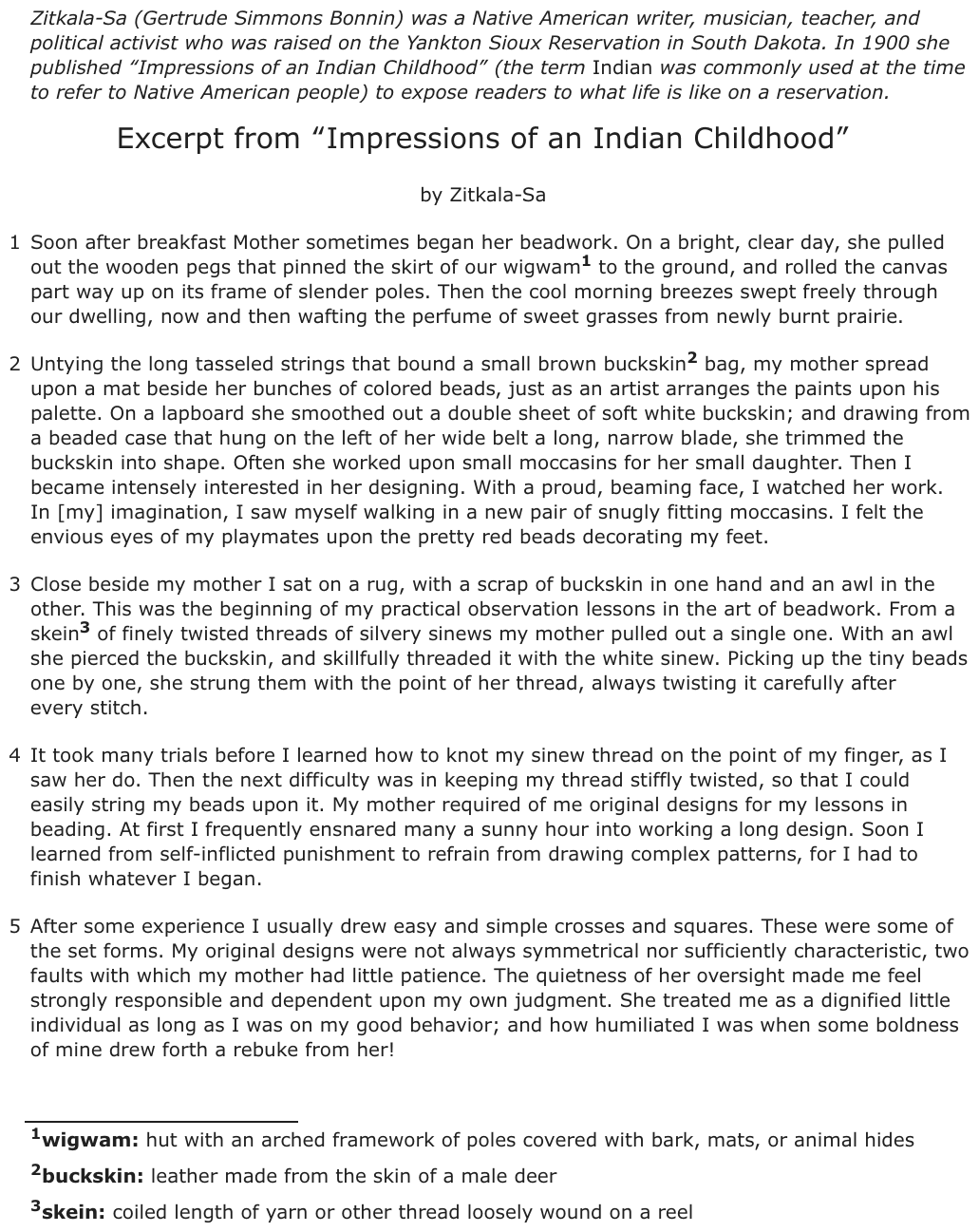
Excerpt from “Impressions of an Indian Childhood”
by Zitkala-Sa
Zitkala-Sa (Gertrude Simmons Bonnin) was a Native American writer, musician, teacher, and political activist who was raised on the Yankton Sioux Reservation in South Dakota. In 1900 she published “Impressions of an Indian Childhood” (the term Indian was commonly used at the time to refer to Native American people) to expose readers to what life is like on a reservation.
Soon after breakfast Mother sometimes began her beadwork. On a bright, clear day, she pulled out the wooden pegs that pinned the skirt of our wigwam1 to the ground, and rolled the canvas part way up on its frame of slender poles. Then the cool morning breezes swept freely through our dwelling, now and then wafting the perfume of sweet grasses from newly burnt prairie.
Untying the long tasseled strings that bound a small brown buckskin2 bag, my mother spread upon a mat beside her bunches of colored beads, just as an artist arranges the paints upon his palette. On a lapboard she smoothed out a double sheet of soft white buckskin; and drawing from a beaded case that hung on the left of her wide belt a long, narrow blade, she trimmed the buckskin into shape. Often she worked upon small moccasins for her small daughter. Then I became intensely interested in her designing. With a proud, beaming face, I watched her work. In [my] imagination, I saw myself walking in a new pair of snugly fitting moccasins. I felt the envious eyes of my playmates upon the pretty red beads decorating my feet.
Close beside my mother I sat on a rug, with a scrap of buckskin in one hand and an awl in the other. This was the beginning of my practical observation lessons in the art of beadwork. From a skein3 of finely twisted threads of silvery sinews my mother pulled out a single one. With an awl she pierced the buckskin, and skillfully threaded it with the white sinew. Picking up the tiny beads one by one, she strung them with the point of her thread, always twisting it carefully after every stitch.
It took many trials before I learned how to knot my sinew thread on the point of my finger, as I saw her do. Then the next difficulty was in keeping my thread stiffly twisted, so that I could easily string my beads upon it. My mother required of me original designs for my lessons in beading. At first I frequently ensnared many a sunny hour into working a long design. Soon I learned from self-inflicted punishment to refrain from drawing complex patterns, for I had to finish whatever I began.
After some experience I usually drew easy and simple crosses and squares. These were some of the set forms. My original designs were not always symmetrical nor sufficiently characteristic, two faults with which my mother had little patience. The quietness of her oversight made me feel strongly responsible and dependent upon my own judgment. She treated me as a dignified little individual as long as I was on my good behavior; and how humiliated I was when some boldness of mine drew forth a rebuke from her!
In the choice of colors she left me to my own taste. I was pleased with an outline of yellow upon a background of dark blue, or a combination of red and myrtle-green. There was another of red with a bluish-gray that was more conventionally used. When I became a little familiar with designing and the various pleasing combinations of color, a harder lesson was given me. It was the sewing on, instead of beads, some tinted porcupine quills, moistened and flattened between the nails of the thumb and forefinger. My mother cut off the prickly ends and burned them at once in the centre fire. These sharp points were poisonous, and worked into the flesh wherever they lodged. For this reason, my mother said, I should not do much alone in quills until I was as tall as my cousin Warca-Ziwin.
Always after these confining lessons I was wild with surplus spirits, and found joyous relief in running loose in the open again. Many a summer afternoon a party of four or five of my playmates roamed over the hills with me. We each carried a light sharpened rod about four feet long, with which we pried up certain sweet roots. When we had eaten all the choice roots we chanced upon, we shouldered our rods and strayed off into patches of a stalky plant under whose yellow blossoms we found little crystal drops of gum. Drop by drop we gathered this nature’s rock-candy, until each of us could boast of a lump the size of a small bird’s egg. Soon satiated with its woody flavor, we tossed away our gum, to return again to the sweet roots.
From “Impressions of an Indian Childhood” by Zitkala-Sa—Public Domain
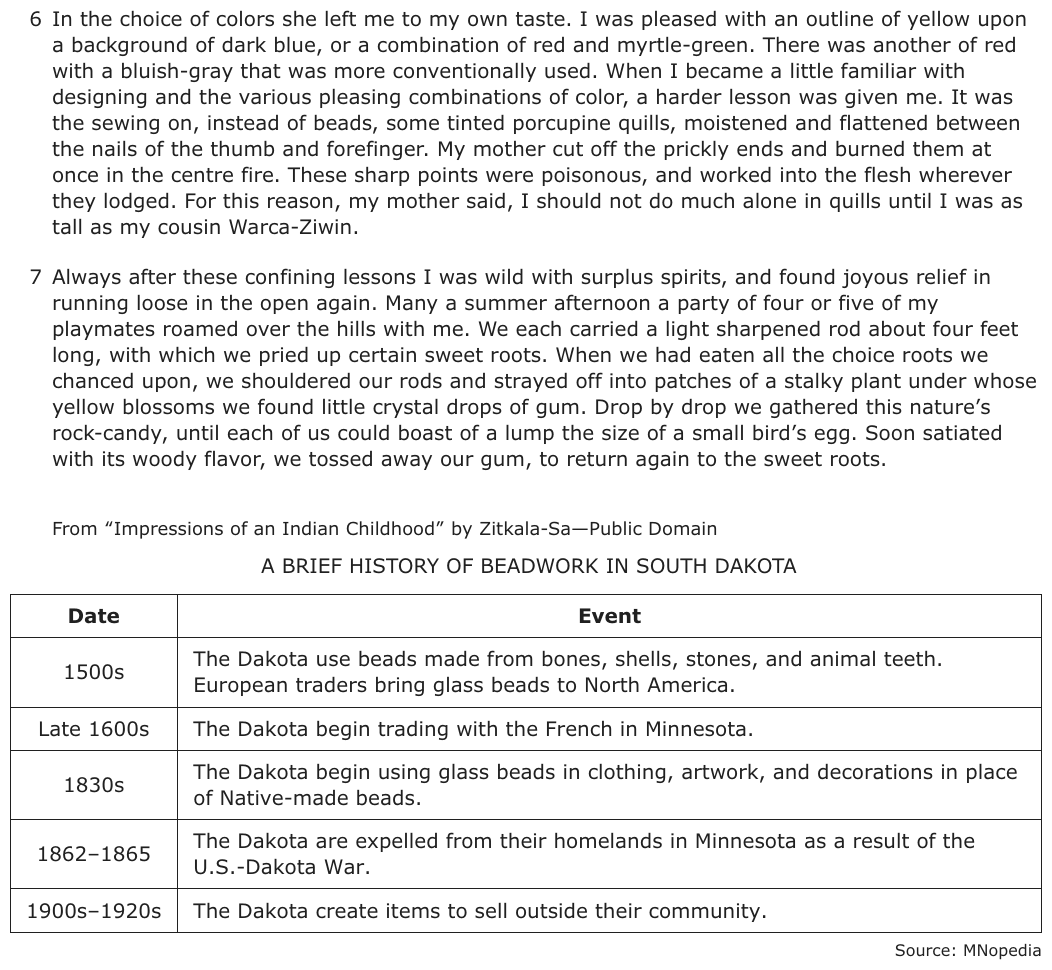
A BRIEF HISTORY OF BEADWORK IN SOUTH DAKOTA
| Date | Event |
|---|---|
| 1500s | The Dakota use beads made from bones, shells, stones, and animal teeth. European traders bring glass beads to North America. |
| Late 1600s | The Dakota begin trading with the French in Minnesota. |
| 1830s | The Dakota begin using glass beads in clothing, artwork, and decorations in place of Native-made beads. |
| 1862–1865 | The Dakota are expelled from their homelands in Minnesota as a result of the U.S.-Dakota War. |
| 1900s–1920s | The Dakota create items to sell outside their community. |
Source: MNopedia
1wigwam: hut with an arched framework of poles covered with bark, mats, or animal hides
2buckskin: leather made from the skin of a male deer
3skein: coiled length of yarn or other thread loosely wound on a reel
Question
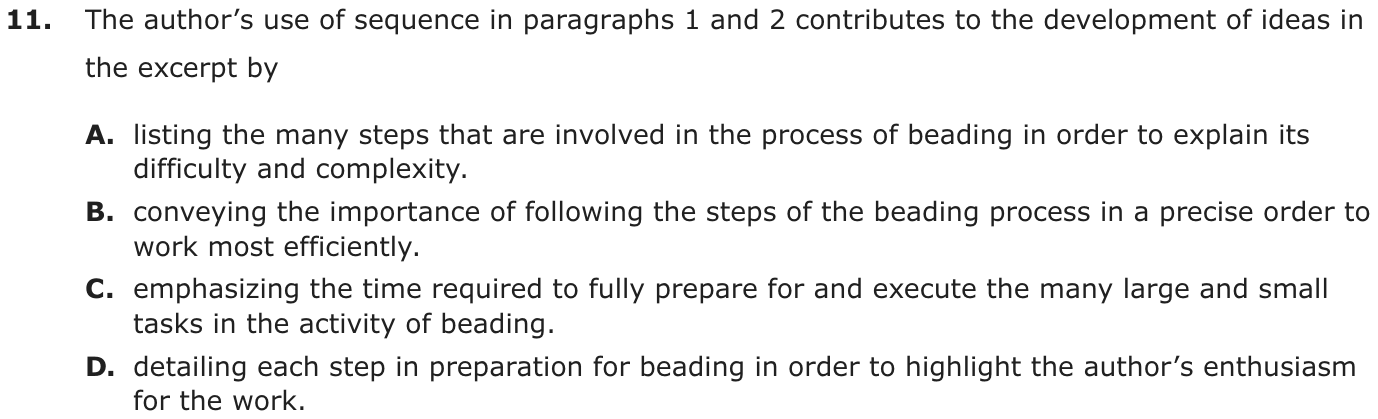
The author’s use of sequence in paragraphs 1 and 2 contributes to the development of ideas in the excerpt by
- Alisting the many steps that are involved in the process of beading in order to explain its difficulty and complexity.
- Bconveying the importance of following the steps of the beading process in a precise order to work most efficiently.
- Cemphasizing the time required to fully prepare for and execute the many large and small tasks in the activity of beading.
- Ddetailing each step in preparation for beading in order to highlight the author’s enthusiasm for the work.
Show the answer
Correct answer: D
The question asks how the author’s use of sequence in paragraphs 1 and 2 contributes to the development of ideas in the excerpt.
A. Incorrect. In paragraph 2, the author does list the steps her mother takes in preparation to do beadwork, such as “untying the long tasseled strings” of the bag of beads, spreading the beads beside her on a mat, and using “a long, narrow blade” to trim the buckskin into shape. However, the language used to describe this sequence does not indicate that preparing to work with beads is difficult or complex.
B. Incorrect. Although the author’s description of untying the bag of beads, spreading the beads upon a mat, smoothing out a sheet of buckskin, and trimming the buckskin into shape in paragraph 2 indicates that the mother follows a certain routine, it does not place any emphasis on working most efficiently by following the steps of the beading process in a precise order.
C. Incorrect. In paragraph 2, the author describes her mother “untying the long tasseled strings that bound a small brown buckskin bag,” “spread[ing] upon a mat beside her bunches of colored beads,” “smooth[ing] out a double sheet of soft white buckskin; and drawing from a beaded case that hung on the left of her wide belt a long, narrow blade” to trim the buckskin. Although these descriptions do outline the steps in her process for creating beadwork, they do not emphasize the time required to do so, since the author does not mention in the excerpt how long it took her mother to fully prepare for and complete the large and small tasks in the activity of beading.
D. CORRECT. In paragraph 1, the author describes how the morning begins with her mother rolling up the canvas of the wigwam and allowing the breeze to come in. In paragraph 2, the author uses sensory language and precise sequencing to describe the way her mother prepares the beading materials by untying “the long tasseled strings that bound a small brown buckskin bag,” spreading the “bunches of colored beads” beside her, and smoothing out “a double sheet of soft white buckskin.” This combination of sequence and sensory language highlights the author’s enthusiasm for beadwork by emphasizing that the author pays close attention to her mother’s preparations.
Question analysis
This reading question asks how the step-by-step description of a mother preparing her beadwork, in the opening paragraphs of Zitkala-Sa's memoir, contributes to the excerpt's ideas. Every choice agrees that steps are listed, so students must judge which purpose the text actually supports and resist reasons that only sound likely for a craft.
- Grade level
- Grade 8 reading and task
- Compared with grade 7
- Above grade 7 Grade 7 structure questions usually ask what a paragraph adds to a topic. This one asks what an ordered description achieves, in dense 1900 prose where the purpose is never stated outright, which goes beyond typical grade 7 work.
- Estimated difficulty
- Hard: combines ideas, needs a plan, and has more than one tempting wrong answer.
- Thinking it demands
- Depth of knowledge 3, strategic thinking · mainly analyze
- What makes it hard
- How, not what major
- A very close wrong answer moderate
- Reading between the lines moderate
- Complex sentences minor
- Evidence
- Answered from several paragraphs or stanzas
- Reading level
- Passage: about grade 8, 946 words; question and choices: about grade 11, 95 words.
- Corrected from the DOE handbook
- A misquotation of the excerpt in the explanation was corrected.
- Students, last 30 days
- Not enough answers yet to show (it takes 10).
Why it is hard, traps and wrong answers (shows the answer)
Why it is hard
All four choices agree that the paragraphs lay out steps, so the question turns entirely on purpose, and three of the purposes sound like natural reasons to describe a craft. Nothing in paragraphs 1 and 2 calls the work hard, slow or a matter of efficiency; what they do show is a child following every move and becoming intensely interested. Students who look for the narrator's own reaction find the purpose, while those who reason from the steps alone drift to difficulty or time.
How, not what major Working it out
The stem asks what the ordered account of untying the bag, spreading the beads, and smoothing and trimming the buckskin does for the excerpt, a purpose the author never states. (Anderson & Krathwohl, 2001)
A very close wrong answer moderate Choosing the answer
The difficulty choice shares the right one's frame, steps laid out in order to show something, and differs only in what they show: how hard beading is, or how eagerly the girl watched. (Embretson & Wetzel, 1987; Gorin & Embretson, 2006; Ascalon et al., 2007)
Reading between the lines moderate Working it out
The enthusiasm has to be pieced together from the close attention to each step and from “intensely interested” and “a proud, beaming face” in paragraph 2. (Graesser, Singer & Trabasso, 1994; Kintsch, 1998)
Complex sentences minor Understanding the question
Paragraph 2 uses literary word order, as in “my mother spread upon a mat beside her bunches of colored beads,” which slows the reading of the very steps in question. (Abedi & Lord, 2001; Freedle & Kostin, 1993; Messick, 1989)
Strategy: For each choice, look in paragraphs 1 and 2 for words that would prove its purpose; a purpose that no sentence states or shows can be ruled out.
Traps
- Half right: One half of a two-part choice is right and the other is not.
- Wrong purpose or structure: Names a purpose, structure or effect that the part does not serve, or describes what a part says when the question asks what it does.
- Reads too much in: A reasonable-sounding conclusion that goes further than the text allows.
The wrong answers, classified
A Half right (King et al., 2004; Thissen, Steinberg & Fitzpatrick, 1989)
Rightly sees that paragraph 2 lists many preparation steps, then decides the list must show that beading is difficult and complex, which nothing in these paragraphs says.
B Wrong purpose or structure (Anderson & Krathwohl, 2001)
Reads the sequence as instructions about doing the steps in a precise order for efficiency, a purpose a watching child's memories never suggest.
C Reads too much in (Graesser, Singer & Trabasso, 1994)
Reasons that so many steps must take a long time, perhaps recalling the “many a sunny hour” of paragraph 4, but paragraphs 1 and 2 never mention time.
What was corrected from the DOE handbook, and why
- Explanation: In rejecting choice C, the handbook quotes paragraph 2 as “spread[ing them] upon a mat beside her bunches of colored beads.” In the excerpt, the bunches of colored beads are what the mother spreads (“my mother spread upon a mat beside her bunches of colored beads”). The inserted “them” refers to nothing and turns the beads into a place. The quotation now reads “spread[ing] upon a mat beside her bunches of colored beads,” which is how the handbook itself reads the sentence in its reason for rejecting choice A (“spreading the beads beside her on a mat”).
Working it out, step by step
Figure out what the question asks
Sequence means the order in which things happen. Paragraphs 1 and 2 tell the steps of a morning in order. The question asks why the author tells them step by step. What does that careful order help show?
List the steps
In paragraphs 1 and 2, the mother:
- rolls up the side of the wigwam to let in the breeze,
- unties a bag made of buckskin (soft deer leather),
- spreads her beads on a mat,
- smooths out a sheet of buckskin, and
- trims it into shape with a blade.
Find the author’s reaction
Right after the steps, the author tells how she felt. “Then I became intensely interested in her designing. With a proud, beaming face, I watched her work.” Intensely means very strongly. A beaming face has a big, happy smile. She noticed every little step because she was so excited. The details show her enthusiasm, or eager interest.
Check each choice
- A is wrong. The steps are listed, but nothing says beading is hard or complex.
- B is wrong. Nothing says the steps must go in a set order to save effort.
- C is wrong. Paragraphs 1 and 2 never say how long anything takes.
- D is right. The careful details show how closely the girl watched, with eager interest.
Watch out: A is tempting because there are many steps. But many steps don’t prove a task is hard. The author never calls it difficult.
Choose the answer
The step-by-step order shows a child following every move her mother makes. So the answer is D.
Why this answer and not the closest wrong one
A is the closest wrong answer. Like D, it says the steps are listed to show something. But no word in paragraphs 1 and 2 calls beading hard. The author does say she was “intensely interested” and had “a proud, beaming face.” That shows enthusiasm, so D fits better.
More questions like this
The original DOE question
The passage “Excerpt from “Impressions of an Indian Childhood”” as printed (pages 42–43)
Question 3 of 6
2024 Test A English, question 28Passage Champion of the Channel
Champion of the Channel
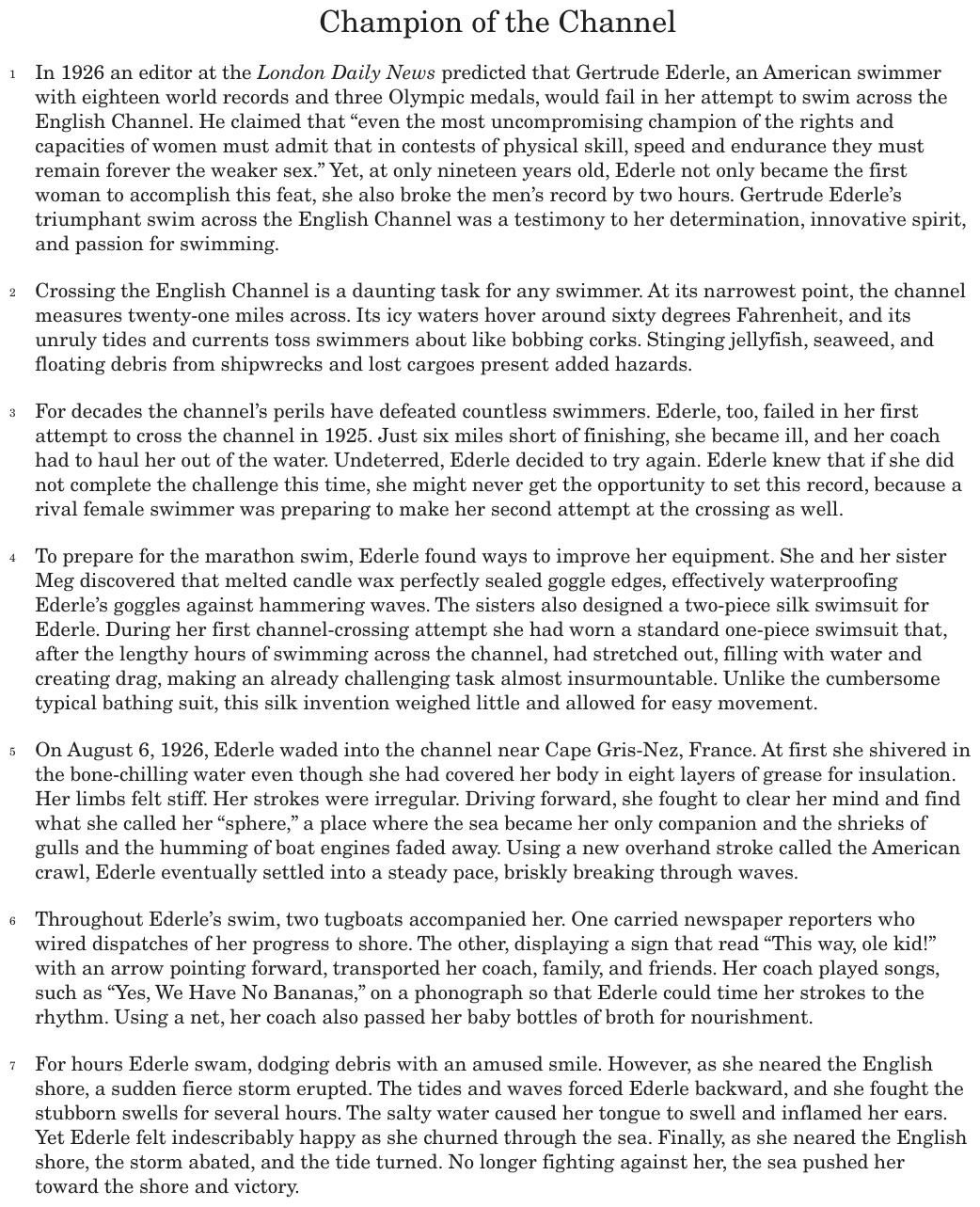
In 1926 an editor at the London Daily News predicted that Gertrude Ederle, an American swimmer with eighteen world records and three Olympic medals, would fail in her attempt to swim across the English Channel. He claimed that “even the most uncompromising champion of the rights and capacities of women must admit that in contests of physical skill, speed and endurance they must remain forever the weaker sex.” Yet, at only nineteen years old, Ederle not only became the first woman to accomplish this feat, she also broke the men’s record by two hours. Gertrude Ederle’s triumphant swim across the English Channel was a testimony to her determination, innovative spirit, and passion for swimming.
Crossing the English Channel is a daunting task for any swimmer. At its narrowest point, the channel measures twenty-one miles across. Its icy waters hover around sixty degrees Fahrenheit, and its unruly tides and currents toss swimmers about like bobbing corks. Stinging jellyfish, seaweed, and floating debris from shipwrecks and lost cargoes present added hazards.
For decades the channel’s perils have defeated countless swimmers. Ederle, too, failed in her first attempt to cross the channel in 1925. Just six miles short of finishing, she became ill, and her coach had to haul her out of the water. Undeterred, Ederle decided to try again. Ederle knew that if she did not complete the challenge this time, she might never get the opportunity to set this record, because a rival female swimmer was preparing to make her second attempt at the crossing as well.
To prepare for the marathon swim, Ederle found ways to improve her equipment. She and her sister Meg discovered that melted candle wax perfectly sealed goggle edges, effectively waterproofing Ederle’s goggles against hammering waves. The sisters also designed a two-piece silk swimsuit for Ederle. During her first channel-crossing attempt she had worn a standard one-piece swimsuit that, after the lengthy hours of swimming across the channel, had stretched out, filling with water and creating drag, making an already challenging task almost insurmountable. Unlike the cumbersome typical bathing suit, this silk invention weighed little and allowed for easy movement.
On August 6, 1926, Ederle waded into the channel near Cape Gris-Nez, France. At first she shivered in the bone-chilling water even though she had covered her body in eight layers of grease for insulation. Her limbs felt stiff. Her strokes were irregular. Driving forward, she fought to clear her mind and find what she called her “sphere,” a place where the sea became her only companion and the shrieks of gulls and the humming of boat engines faded away. Using a new overhand stroke called the American crawl, Ederle eventually settled into a steady pace, briskly breaking through waves.
Throughout Ederle’s swim, two tugboats accompanied her. One carried newspaper reporters who wired dispatches of her progress to shore. The other, displaying a sign that read “This way, ole kid!” with an arrow pointing forward, transported her coach, family, and friends. Her coach played songs, such as “Yes, We Have No Bananas,” on a phonograph so that Ederle could time her strokes to the rhythm. Using a net, her coach also passed her baby bottles of broth for nourishment.
For hours Ederle swam, dodging debris with an amused smile. However, as she neared the English shore, a sudden fierce storm erupted. The tides and waves forced Ederle backward, and she fought the stubborn swells for several hours. The salty water caused her tongue to swell and inflamed her ears. Yet Ederle felt indescribably happy as she churned through the sea. Finally, as she neared the English shore, the storm abated, and the tide turned. No longer fighting against her, the sea pushed her toward the shore and victory.
After fourteen hours and thirty-one minutes, Ederle, on wobbly legs, stepped onto the English shore. The waiting crowd roared, honked their automobile horns, blasted their tugboat whistles, and set off flares that flashed in the sky. Ederle had swum into history.
When Ederle returned to New York, she received a parade, where thousands of people shouted “Trudy!” Not only were everyday American citizens proud of Ederle, but she also inspired them to be more active. Over the next few years, more than 60,000 people credited her with motivating them to earn their American Red Cross swimming certificates. Gertrude Ederle’s accomplishment proved to the world that with determination and passion, it was possible for a person to achieve his or her goals.
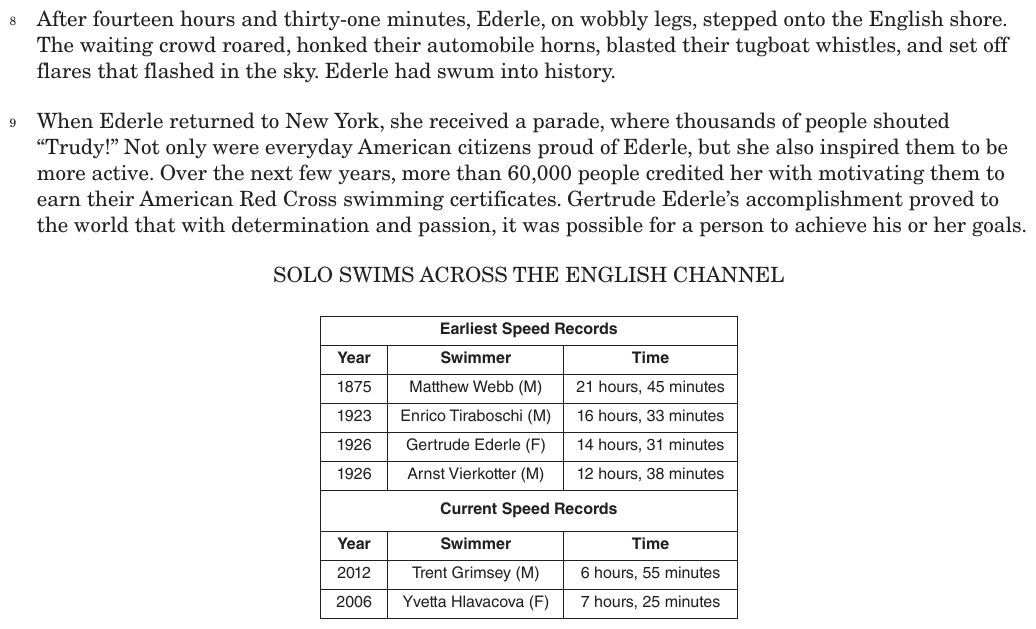
SOLO SWIMS ACROSS THE ENGLISH CHANNEL
|
Earliest Speed Records |
||
| Year | Swimmer | Time |
| 1875 | Matthew Webb (M) | 21 hours, 45 minutes |
| 1923 | Enrico Tiraboschi (M) | 16 hours, 33 minutes |
| 1926 | Gertrude Ederle (F) | 14 hours, 31 minutes |
| 1926 | Arnst Vierkotter (M) | 12 hours, 38 minutes |
| Current Speed Records | ||
| Year | Swimmer | Time |
| 2012 | Trent Grimsey (M) | 6 hours, 55 minutes |
| 2006 | Yvetta Hlavacova (F) | 7 hours, 25 minutes |
Question
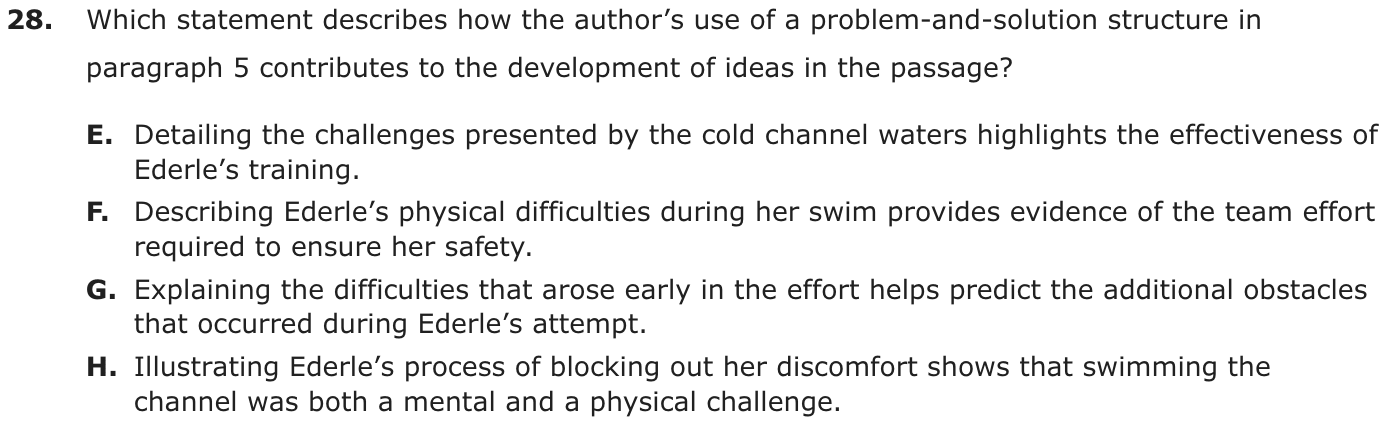
Which statement describes how the author’s use of a problem-and-solution structure in paragraph 5 contributes to the development of ideas in the passage?
- ADetailing the challenges presented by the cold channel waters highlights the effectiveness of Ederle’s training.
- BDescribing Ederle’s physical difficulties during her swim provides evidence of the team effort required to ensure her safety.
- CExplaining the difficulties that arose early in the effort helps predict the additional obstacles that occurred during Ederle’s attempt.
- DIllustrating Ederle’s process of blocking out her discomfort shows that swimming the channel was both a mental and a physical challenge.
Show the answer
Correct answer: D
The question asks how a problem-and-solution structure in paragraph 5 contributes to the ideas presented in the passage.
A. Incorrect. The details in paragraph 5 do not provide a connection between the cold temperature of the water and the effectiveness of Ederle’s training.
B. Incorrect. The difficulties Ederle encountered were only partially relieved by her team, and her team’s efforts to ensure Ederle’s safety are not explained in the passage.
C. Incorrect. The paragraph does not focus on the relationship between the problems Ederle encountered at the start of her swim and the problems she encountered during or near the end of her swim.
D. CORRECT. The paragraph describes how the water’s temperature made Ederle uncomfortable and made it difficult for her to regulate her stroke. The paragraph continues with the explanation of how she overcame these issues by focusing her mind on the sea and tuning out the distractions in her surroundings (“the sea became her only companion and the shrieks of gulls and the humming of boat engines faded away” [paragraph 5]).
Question analysis
Gertrude Ederle's cold, stiff first hours in the English Channel are told as problem and solution, and this text-structure question asks what that pattern adds to the passage's ideas. Students must spot the troubles she met in the cold water and how she handled them, then pick the abstract statement that accounts for both halves of the pattern.
- Grade level
- Grade 8 reading and task
- Compared with grade 7
- Above grade 7 A problem-and-solution question about one paragraph is familiar grade 7 fare, yet these four answers are general claims about the swim, each tied to a real hardship, so students need a clear map of the paragraph before judging them.
- Estimated difficulty
- Hard: combines ideas, needs a plan, and has more than one tempting wrong answer.
- Thinking it demands
- Depth of knowledge 3, strategic thinking · mainly analyze
- What makes it hard
- How, not what major
- Every choice must be checked moderate
- Figurative or literary language minor
- Evidence
- Answered from one paragraph or stanza
- Reading level
- Passage: about grade 9, 790 words; question and choices: about grade 14, 95 words.
- Students, last 30 days
- Not enough answers yet to show (it takes 10).
Why it is hard, traps and wrong answers (shows the answer)
Why it is hard
The opening halves of the choices are all accurate, which moves the whole decision onto their second halves. Readers who notice only the physical side of the paragraph, the cold and the stiffness, reach for training, teamwork or foreshadowing to explain it. The paragraph's turning point is a mental one, clearing her mind until the noise faded, and only the statement that names both a mental and a physical challenge accounts for the problem and the solution together.
How, not what major Working it out
The question asks what paragraph 5's pairing of problems (bone-chilling water, stiff limbs, irregular strokes) with solutions (finding her “sphere”, the American crawl) does for the passage, so retelling the hardships earns nothing. (Anderson & Krathwohl, 2001)
Every choice must be checked moderate Choosing the answer
Each choice opens with a fair description of paragraph 5, the cold water, her physical difficulties, the early struggle, so only what each claims that description shows can be tested. (Embretson & Wetzel, 1987)
Figurative or literary language minor Understanding the question
The mental half of the solution is told in images, a place where “the sea became her only companion” and gulls and engines “faded away”, which must be read as blocking out discomfort. (Graesser, Singer & Trabasso, 1994; Kintsch, 1998)
Strategy: Sort paragraph 5 into two lists, what went wrong for Ederle early in the swim and what she did about it, then ask what that pairing shows about the swim as a whole.
Traps
- Wrong purpose or structure: Names a purpose, structure or effect that the part does not serve, or describes what a part says when the question asks what it does.
- Outside knowledge: A choice is plausible in the real world but not supported by this text.
- Wrong part of the text: A choice is true of another paragraph, stanza or speaker than the one asked about.
The wrong answers, classified
A Outside knowledge (King et al., 2004; Recht & Leslie, 1988)
Assumes that coping with icy water proves good training, a natural idea from sports, but paragraph 5 never mentions training and credits her focus and her stroke.
B Wrong part of the text (Kirsch & Mosenthal, 1990)
Brings in the tugboat crew of paragraph 6, the coach passing broth and playing songs, though paragraph 5 shows Ederle coping alone and never raises her safety.
C Wrong purpose or structure (Anderson & Krathwohl, 2001)
Treats the early shivering and stiffness as a setup for the storm of paragraph 7, a link the paragraph never makes, since it resolves its own problems with a steady pace.
Working it out, step by step
Learn what the question asks
A problem-and-solution structure tells about a difficulty and then how someone deals with it. The question asks what this pattern in paragraph 5 adds to the ideas of the passage. So first sort the paragraph into problems and solutions.
List the problems in paragraph 5
When Ederle waded in, “she shivered in the bone-chilling water.” Next, “Her limbs felt stiff. Her strokes were irregular.” Limbs are arms and legs. Irregular means uneven, not steady. All of these are troubles with her body.
List her solutions
Ederle “fought to clear her mind.” She looked for what she called her “sphere.” There, “the sea became her only companion and the shrieks of gulls and the humming of boat engines faded away.” In other words, she shut out the noise and her discomfort. Then, using the American crawl, she “settled into a steady pace.”
Connect problems and solutions
The problems were physical, which means of the body. A big part of the fix was mental, which means of the mind. She calmed her thoughts so her body could keep working. So the paragraph shows that the swim tested her mind as well as her body.
Check each choice
- D fits: blocking out her discomfort shows the swim was “both a mental and a physical challenge.”
- A is wrong because paragraph 5 never mentions her training.
- B is wrong because her team on the tugboats appears in paragraph 6, and her safety is never discussed.
- C is wrong because the early troubles are solved inside this paragraph instead of setting up later ones.
Watch out: A storm does hit in paragraph 7, so C may look right. But paragraph 5 does not point ahead to it.
Choose the answer
Only D explains both the problem and the way Ederle solved it. So the answer is D.
Why this answer and not the closest wrong one
C is tempting, since a storm really does strike in paragraph 7. But paragraph 5 never hints at it. The paragraph ends with its problem solved, as Ederle is “briskly breaking through waves.” D explains both halves of the pattern: troubles of the body, eased by the mind.
More questions like this
The original DOE question
The passage “Champion of the Channel” as printed (pages 56–57)
Question 4 of 6
2026 Practice Test D Math, question 48Question
The perimeter of square W is twice the perimeter of equilateral triangle X. What is the ratio of the length of one side of square W to the length of one side of equilateral triangle X?
- A3:8
- B2:3
- C3:2
- D2:1
Show the answer
Correct answer: C
First, set up the ratio of the perimeter of the square to the triangle as 2:1 because the question states that the perimeter of the square is twice the perimeter of the triangle.
Recognizing that the square has 4 equal sides and that an equilateral triangle has 3 sides, use division to find the ratio of the sides.
Perimeter:
Sides:
Question analysis
The perimeter of square W is twice the perimeter of equilateral triangle X, and students find the ratio of a side of the square to a side of the triangle. This ratio question uses perimeters of regular shapes with no lengths given. Turning a comparison of perimeters into one of sides, and keeping the ratio in the order asked, are the tricky parts.
- NYS standards
- Grade level
- Grade 7 content, by NYS standard
- Compared with grade 7
- Above grade 7 Grade 7 ratio problems usually supply numbers to work with. This one gives only a relationship between two perimeters, so students must bring in the number of sides of each shape themselves and keep the ratio in the order asked.
- Estimated difficulty
- Hard: combines ideas, needs a plan, and has more than one tempting wrong answer.
- Thinking it demands
- Depth of knowledge 2, skills and concepts · mainly apply
- What makes it hard
- Turning words into math moderate
- Variables instead of numbers moderate
- A very close wrong answer minor
- Solution
- 3 steps
- Reading level
- Question and choices: about grade 9, 36 words.
- Students, last 30 days
- Not enough answers yet to show (it takes 10).
Why it is hard, traps and wrong answers (shows the answer)
Why it is hard
The question turns a statement about perimeters into a ratio of sides, and the natural guess, that the sides keep the perimeters’ 2 to 1, ignores that the square shares its perimeter among 4 sides and the triangle among 3. Choosing a triangle perimeter such as 12 makes the comparison concrete. The order of the ratio still has to be checked at the end, because its reverse is listed too.
Turning words into math moderate Understanding the question
“The perimeter of square W is twice the perimeter of equilateral triangle X” must become 4s = 2 × 3t, with the 2 on the triangle’s side; written backward, it gives the triangle the larger perimeter. (Hegarty, Mayer & Monk, 1995; Koedinger & Nathan, 2004)
Variables instead of numbers moderate Understanding the question
No side length is given, so students must either work with letters for the two sides or choose a convenient perimeter themselves, such as 12 for the triangle. (Koedinger & Nathan, 2004; Enright, Morley & Sheehan, 2002)
A very close wrong answer minor Choosing the answer
The ratios 3:2 and 2:3 use the same two numbers, so only keeping the square’s side first, as the question orders it, separates the answer from its reverse. (Embretson & Wetzel, 1987; Gorin & Embretson, 2006; Ascalon et al., 2007)
Strategy: Pick an easy side length for the triangle, find its perimeter, double that for the square, divide by the square's number of sides, and write square to triangle.
Traps
- Misunderstands the concept: A wrong belief about a concept: that percents can be added, that area grows like length, that averages can be averaged, that a bigger denominator means a bigger fraction.
- Wrong operation: Adds instead of multiplying, divides the wrong way round, turns a ratio or rate upside down, or undoes a step in the wrong direction (subtracts what should be added back).
- Equation written backwards: Writes a comparison the wrong way round, word for word: "six times as many students as professors" as 6S = P. The bigger quantity gets the bigger number.
The wrong answers, classified
A Equation written backwards (Clement, Lochhead & Monk, 1981)
Writes the comparison backward, 2 × 4s = 3t, giving the triangle the larger perimeter, so the ratio of the sides comes out 3:8.
B Wrong operation (Hegarty, Mayer & Monk, 1995; King et al., 2004)
Finds the right relationship but turns the ratio upside down, giving the triangle’s side to the square’s instead of the square’s side first.
D Misunderstands the concept (Smith, diSessa & Roschelle, 1993; De Bock et al., 1998; Ni & Zhou, 2005)
Assumes the sides are in the same ratio as the perimeters, 2:1, ignoring that the square has 4 sides and the triangle only 3.
Worked solution, step by step
Formulas used
- Perimeter of a square
- P is the perimeter, the distance around the shape. s is the length of one side. A square has 4 equal sides, so its perimeter is 4 times one side.
- Perimeter of an equilateral triangle
- An equilateral triangle has 3 equal sides. t is the length of one side. So its perimeter is 3 times one side.
- Ratio
- A ratio compares two amounts in order. a : b means a compared with b. The order matters, so write the amounts in the order the question names them.
Sort out the question
Square W has a perimeter twice as long as the perimeter of triangle X. Equilateral means all 3 sides of X are equal.
You need the ratio of one side of the square to one side of the triangle, in that order. No lengths are given, so you can pick a size to try.
Pick a size for the triangle
Choose an easy side length for the triangle, such as 2 units. All 3 sides are 2, so its perimeter is:
Find the square’s side
The square’s perimeter is twice the triangle’s:
The square has 4 equal sides, so divide by 4:
Each side of the square is 3 units.
Write the ratio in order
The square comes first, then the triangle. Their sides are 3 and 2, so the ratio is 3 : 2.
Watch out: 2 : 1, choice D, compares the perimeters, not the sides. The square splits its perimeter into 4 sides, the triangle into only 3. Choice B, 2 : 3, puts the triangle first. Choice A, 3 : 8, comes from giving the triangle the bigger perimeter.
So the answer is C, 3:2.
Check your answer
Try a different size. Give the triangle sides of 4. Its perimeter is 12, so the square’s is 24. Each side of the square is . The ratio 6 : 4 simplifies to 3 : 2. The size does not change the ratio.
More questions like this
The original DOE question
Question 5 of 6
2018 Test A Math, question 44Question

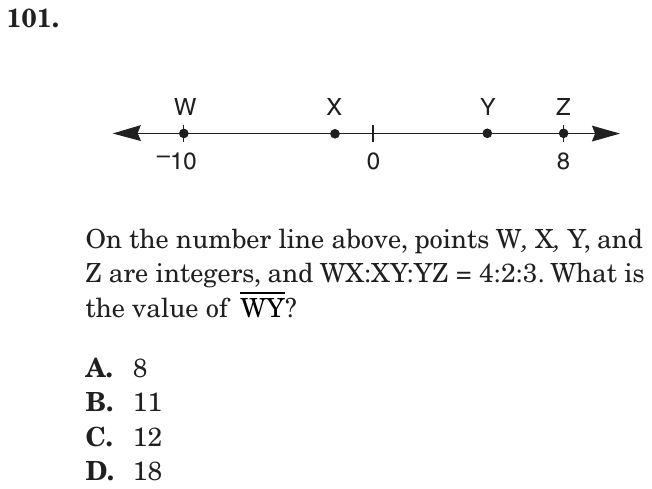
On the number line above, points , , , and are integers, and . What is the value of ?
- A8
- B11
- C12
- D18
Show the answer
Correct answer: C
Convert the ratios into fractions of . Use the sum of the ratios for the denominator.
The part of that is is the sum of those fractions:
Find the length of :
The value of is .
Question analysis
This number line question places integer points W, X, Y and Z on a line and gives the ratio of the segments WX, XY and YZ as 4 to 2 to 3. Students find the whole length from W to Z, split it by the ratio, and add the parts that make up WY. Mixing up a part with the whole is the main risk.
- Grade level
- Grade 7 content, by NYS standard
- Compared with grade 7
- Above grade 7 Grade 7 students find distances on a number line and use part-to-whole ratios, usually separately. This item joins them: a negative endpoint, a three-term ratio and a choice of which segments to combine.
- Estimated difficulty
- Hard: combines ideas, needs a plan, and has more than one tempting wrong answer.
- Thinking it demands
- Depth of knowledge 2, skills and concepts · mainly apply
- What makes it hard
- Combines ideas moderate
- Reading a figure, table or graph moderate
- Many steps minor
- Solution
- 3 steps
- Reading level
- Question and choices: about grade 10, 21 words.
- Corrected from the DOE handbook
- Equations in the explanation that mixed up a fraction of a length with the length itself were corrected.
- Students, last 30 days
- Not enough answers yet to show (it takes 10).
Why it is hard, traps and wrong answers (shows the answer)
Why it is hard
Each step is routine, but the question keeps asking for a different piece of the line: the whole WZ, the part WX, and finally WY, which is two parts added together. Two of the wrong choices are exactly those other pieces. Students who mark the actual positions, X at −2 and Y at 2, can check the ratio before answering.
Combines ideas moderate Working it out
A three-part ratio, 4:2:3, must be applied to a length found from a negative endpoint, 8 − (−10) = 18, joining ratio and number-line distance. (Embretson, 1998; Daniel & Embretson, 2010)
Reading a figure, table or graph moderate Understanding the question
Only W at −10 and Z at 8 are labeled, and the drawing is not to scale: Y is drawn nearer 5 than 2, so reading WY from the picture fails. (Lesh, Post & Behr, 1987; Kirsch & Mosenthal, 1990)
Many steps minor Working it out
Find WZ, split it into 9 equal parts of 2, then add the 4 parts of WX and the 2 parts of XY. (Daniel & Embretson, 2010; Enright, Morley & Sheehan, 2002)
Strategy: Find the length WZ from the endpoints on the number line, divide it by the total number of ratio parts, and multiply by the parts from W to Y.
Traps
- Stops one step early: A choice is a number from partway through the solution.
- Answers a different question: A choice is right for another quantity: the other unknown, the rest instead of the part, the part instead of the whole.
- Counting the ends: Inclusive or exclusive ends, fence posts, consecutive numbers: an answer that is one too many or too few, or an endpoint drawn open where it belongs closed (or the reverse).
The wrong answers, classified
A Stops one step early (King et al., 2004; Gierl et al., 2017)
Finds WX, 4/9 of 18 = 8, and stops without adding XY's 4 to reach Y; 8 also matches Z's label.
B Counting the ends (Brown & Burton, 1978)
Places Y at 2 but counts the integers strictly between −10 and 2, which are −9 through 1, getting 11 instead of the distance 12.
D Answers a different question (King et al., 2004; Hegarty, Mayer & Monk, 1995)
Gives the whole length WZ, 8 − (−10) = 18, instead of the part from W to Y.
What was corrected from the DOE handbook, and why
- Explanation: The handbook writes WX = 4/9, XY = 2/9 and WY = 2/3, and then says “The value of WY is 2/3(18) = 12”. Those fractions are parts of WZ, not the lengths themselves (WX is 8 and WY is 12), so WY cannot be both 2/3 and 12. The lines now read WX = 4/9 WZ, XY = 2/9 WZ and WY = 2/3 WZ. The method and the answer are unchanged.
Worked solution, step by step
Formulas used
- Distance on a number line
- d is the distance between two points. b is the point on the right and a is the point on the left. Subtracting left from right always gives a positive distance. It works even when a is negative.
- Size of one part of a ratio
- u is the size of one part. L is the whole length being shared. p is the total number of parts, found by adding the numbers in the ratio. Every part is the same size, so you share the length equally.
Sort out what you know
W is at −10 and Z is at 8. X and Y are between them. The ratio 4:2:3 means WX is 4 parts, XY is 2 parts and YZ is 3 parts. All the parts are the same size.
You need the length WY, from W to Y. The drawing is not exact, so use the numbers, not the picture.
Find the whole length WZ
WZ is 18 units long. Subtracting a negative number is the same as adding.
Find the size of one part
Add the ratio numbers to get the number of parts:
Share the 18 units equally among 9 parts:
Each part is 2 units long.
Find WY
WY is WX and XY together, so it has 4 + 2 = 6 parts:
Watch out: WX alone is 4 × 2 = 8, which is choice A. And 18 is the whole line, choice D. So the answer is C, 12.
Check your answer
Place the points. W is at −10. X is 8 units to the right, at −2. Y is 4 more, at 2. Z is 6 more, at 8, which matches its label. And the distance from −10 to 2 is 2 − (−10) = 12.
More questions like this
The original DOE question
Question 6 of 6
2024 Test A Math, question 6Question
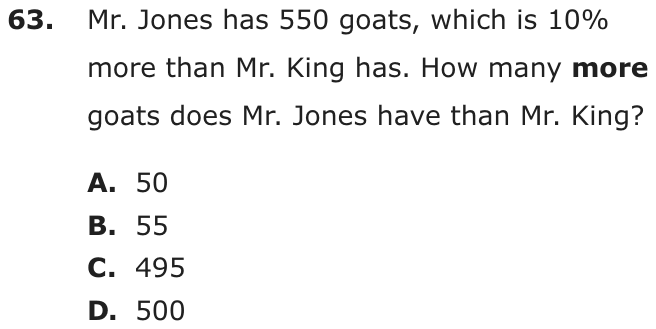
Mr. Jones has 550 goats, which is 10% more than Mr. King has. How many more goats does Mr. Jones have than Mr. King?
- A50
- B55
- C495
- D500
Show the answer
Correct answer: A
First, set up a proportion to determine x, the number of goats Mr. King has.
Then solve the proportion for x.
Finally, determine the difference between the number of goats Mr. Jones has, 550, and the number of goats Mr. King has, 500.
Mr. Jones has 50 more goats than Mr. King.
Question analysis
A percent word problem: Mr. Jones has 550 goats, which is 10% more than Mr. King has, and students find how many more goats Mr. Jones has. It asks students to work with a percent increase when only the larger amount is known. The tricky part is deciding which amount the 10% is taken of.
- Grade level
- Grade 7 content, by NYS standard
- Compared with grade 7
- Above grade 7 Grade 7 students usually find a percent increase from a known original amount. This runs the task backward: the increased amount is given, and the original must be recovered before the difference can be found, a step many do not expect.
- Estimated difficulty
- Hard: combines ideas, needs a plan, and has more than one tempting wrong answer.
- Thinking it demands
- Depth of knowledge 2, skills and concepts · mainly apply
- What makes it hard
- Turning words into math major
- A very close wrong answer moderate
- Solution
- 2 steps
- Reading level
- Question and choices: about grade 1, 22 words.
- Students, last 30 days
- Not enough answers yet to show (it takes 10).
Why it is hard, traps and wrong answers (shows the answer)
Why it is hard
The arithmetic is one division and one subtraction, so the question is really about the base of a percent. The sentence gives the bigger number and calls it 10% more, and the reflex is to take 10% of the number on the page. That shortcut lands on a listed choice five goats from the answer. Students who find King's herd first, 550 ÷ 1.1, still have to remember that the question wants the difference, not the herd.
Turning words into math major Understanding the question
The clause "which is 10% more than" makes King's unknown herd the base of the 10%, so 550 is 110% of his number rather than the amount the 10% is taken of. (Hegarty, Mayer & Monk, 1995; Koedinger & Nathan, 2004)
A very close wrong answer moderate Choosing the answer
The choices 50 and 55 are only 5 goats apart, and both are 10% of a herd; only taking the percent of King's 500 rather than of 550 separates them. (Embretson & Wetzel, 1987; Gorin & Embretson, 2006; Ascalon et al., 2007)
Strategy: Mr. Jones's 550 is 110% of Mr. King's number, so divide 550 by 1.10 to find Mr. King's goats, then subtract that from 550.
Traps
- Percent of the wrong amount: Finding the whole from a part, or a percent change measured from the wrong starting amount.
- Stops one step early: A choice is a number from partway through the solution.
The wrong answers, classified
B Percent of the wrong amount (Parker & Leinhardt, 1995)
Takes 10% of 550, measuring the increase from Jones's herd instead of from King's smaller herd, which is the amount the 10% is based on.
C Percent of the wrong amount (Parker & Leinhardt, 1995)
Takes 10% off 550 to get King's herd, 550 − 55 = 495, using the wrong base, then gives that herd instead of the difference.
D Stops one step early (King et al., 2004; Gierl et al., 2017)
Finds King's herd correctly, 550 ÷ 1.1 = 500, then stops there instead of subtracting it from 550 to get how many more.
Worked solution, step by step
Formulas used
- Percent increase
- The original is the amount you start from, the one the percent is taken of. p is the percent of increase. The new amount is all of the original, which is 100%, plus p% more. For 10% more, you multiply by 1.10.
Sort out the question
Mr. Jones has 550 goats. That is “10% more than Mr. King has”. You need how many more goats Mr. Jones has than Mr. King. That is the difference between the two herds, not the size of a herd.
Decide what the 10% is of
The words “10% more than Mr. King” mean the 10% is a part of Mr. King’s herd. So Mr. King’s herd is the original. Mr. Jones has all of Mr. King’s goats, 100%, plus 10% more. That is 110% of Mr. King’s herd. Watch out: do not take 10% of 550. That gives 55, choice B. It uses the wrong herd. Taking those 55 away from 550 gives 495, choice C, which is also wrong.
Find Mr. King’s herd
Call Mr. King’s number of goats K. Use the percent increase formula with p = 10. The new amount is 550.
Mr. King has 500 goats. Watch out: 500 is Mr. King’s herd, choice D. It is not the difference.
Find the difference
Mr. Jones has 50 more goats than Mr. King. So the answer is A, 50.
Check your answer
Check the 10%. 10% of 500 is , and , Mr. Jones’s herd. So 550 really is 10% more than 500. If King had 495, then 10% more would be about 545, not 550.
More questions like this
The original DOE question