3 English and 3 math
Here are 6 random questions to try. Takers earning below 75% are unlikely to receive an offer. You have 1 minute 48 seconds per question on the real exam.
Question 1 of 6
2024 Test A English, question 11Passage Excerpt from “Impressions of an Indian Childhood”
Excerpt from “Impressions of an Indian Childhood”
by Zitkala-Sa
Zitkala-Sa (Gertrude Simmons Bonnin) was a Native American writer, musician, teacher, and political activist who was raised on the Yankton Sioux Reservation in South Dakota. In 1900 she published “Impressions of an Indian Childhood” (the term Indian was commonly used at the time to refer to Native American people) to expose readers to what life is like on a reservation.
Soon after breakfast Mother sometimes began her beadwork. On a bright, clear day, she pulled out the wooden pegs that pinned the skirt of our wigwam1 to the ground, and rolled the canvas part way up on its frame of slender poles. Then the cool morning breezes swept freely through our dwelling, now and then wafting the perfume of sweet grasses from newly burnt prairie.
Untying the long tasseled strings that bound a small brown buckskin2 bag, my mother spread upon a mat beside her bunches of colored beads, just as an artist arranges the paints upon his palette. On a lapboard she smoothed out a double sheet of soft white buckskin; and drawing from a beaded case that hung on the left of her wide belt a long, narrow blade, she trimmed the buckskin into shape. Often she worked upon small moccasins for her small daughter. Then I became intensely interested in her designing. With a proud, beaming face, I watched her work. In [my] imagination, I saw myself walking in a new pair of snugly fitting moccasins. I felt the envious eyes of my playmates upon the pretty red beads decorating my feet.
Close beside my mother I sat on a rug, with a scrap of buckskin in one hand and an awl in the other. This was the beginning of my practical observation lessons in the art of beadwork. From a skein3 of finely twisted threads of silvery sinews my mother pulled out a single one. With an awl she pierced the buckskin, and skillfully threaded it with the white sinew. Picking up the tiny beads one by one, she strung them with the point of her thread, always twisting it carefully after every stitch.
It took many trials before I learned how to knot my sinew thread on the point of my finger, as I saw her do. Then the next difficulty was in keeping my thread stiffly twisted, so that I could easily string my beads upon it. My mother required of me original designs for my lessons in beading. At first I frequently ensnared many a sunny hour into working a long design. Soon I learned from self-inflicted punishment to refrain from drawing complex patterns, for I had to finish whatever I began.
After some experience I usually drew easy and simple crosses and squares. These were some of the set forms. My original designs were not always symmetrical nor sufficiently characteristic, two faults with which my mother had little patience. The quietness of her oversight made me feel strongly responsible and dependent upon my own judgment. She treated me as a dignified little individual as long as I was on my good behavior; and how humiliated I was when some boldness of mine drew forth a rebuke from her!
In the choice of colors she left me to my own taste. I was pleased with an outline of yellow upon a background of dark blue, or a combination of red and myrtle-green. There was another of red with a bluish-gray that was more conventionally used. When I became a little familiar with designing and the various pleasing combinations of color, a harder lesson was given me. It was the sewing on, instead of beads, some tinted porcupine quills, moistened and flattened between the nails of the thumb and forefinger. My mother cut off the prickly ends and burned them at once in the centre fire. These sharp points were poisonous, and worked into the flesh wherever they lodged. For this reason, my mother said, I should not do much alone in quills until I was as tall as my cousin Warca-Ziwin.
Always after these confining lessons I was wild with surplus spirits, and found joyous relief in running loose in the open again. Many a summer afternoon a party of four or five of my playmates roamed over the hills with me. We each carried a light sharpened rod about four feet long, with which we pried up certain sweet roots. When we had eaten all the choice roots we chanced upon, we shouldered our rods and strayed off into patches of a stalky plant under whose yellow blossoms we found little crystal drops of gum. Drop by drop we gathered this nature’s rock-candy, until each of us could boast of a lump the size of a small bird’s egg. Soon satiated with its woody flavor, we tossed away our gum, to return again to the sweet roots.
From “Impressions of an Indian Childhood” by Zitkala-Sa—Public Domain
A BRIEF HISTORY OF BEADWORK IN SOUTH DAKOTA
| Date | Event |
|---|---|
| 1500s | The Dakota use beads made from bones, shells, stones, and animal teeth. European traders bring glass beads to North America. |
| Late 1600s | The Dakota begin trading with the French in Minnesota. |
| 1830s | The Dakota begin using glass beads in clothing, artwork, and decorations in place of Native-made beads. |
| 1862–1865 | The Dakota are expelled from their homelands in Minnesota as a result of the U.S.-Dakota War. |
| 1900s–1920s | The Dakota create items to sell outside their community. |
Source: MNopedia
1wigwam: hut with an arched framework of poles covered with bark, mats, or animal hides
2buckskin: leather made from the skin of a male deer
3skein: coiled length of yarn or other thread loosely wound on a reel
Question
The author’s use of sequence in paragraphs 1 and 2 contributes to the development of ideas in the excerpt by
- Alisting the many steps that are involved in the process of beading in order to explain its difficulty and complexity.
- Bconveying the importance of following the steps of the beading process in a precise order to work most efficiently.
- Cemphasizing the time required to fully prepare for and execute the many large and small tasks in the activity of beading.
- Ddetailing each step in preparation for beading in order to highlight the author’s enthusiasm for the work.
Show the answer
Correct answer: D
The question asks how the author’s use of sequence in paragraphs 1 and 2 contributes to the development of ideas in the excerpt.
A. Incorrect. In paragraph 2, the author does list the steps her mother takes in preparation to do beadwork, such as “untying the long tasseled strings” of the bag of beads, spreading the beads beside her on a mat, and using “a long, narrow blade” to trim the buckskin into shape. However, the language used to describe this sequence does not indicate that preparing to work with beads is difficult or complex.
B. Incorrect. Although the author’s description of untying the bag of beads, spreading the beads upon a mat, smoothing out a sheet of buckskin, and trimming the buckskin into shape in paragraph 2 indicates that the mother follows a certain routine, it does not place any emphasis on working most efficiently by following the steps of the beading process in a precise order.
C. Incorrect. In paragraph 2, the author describes her mother “untying the long tasseled strings that bound a small brown buckskin bag,” “spread[ing] upon a mat beside her bunches of colored beads,” “smooth[ing] out a double sheet of soft white buckskin; and drawing from a beaded case that hung on the left of her wide belt a long, narrow blade” to trim the buckskin. Although these descriptions do outline the steps in her process for creating beadwork, they do not emphasize the time required to do so, since the author does not mention in the excerpt how long it took her mother to fully prepare for and complete the large and small tasks in the activity of beading.
D. CORRECT. In paragraph 1, the author describes how the morning begins with her mother rolling up the canvas of the wigwam and allowing the breeze to come in. In paragraph 2, the author uses sensory language and precise sequencing to describe the way her mother prepares the beading materials by untying “the long tasseled strings that bound a small brown buckskin bag,” spreading the “bunches of colored beads” beside her, and smoothing out “a double sheet of soft white buckskin.” This combination of sequence and sensory language highlights the author’s enthusiasm for beadwork by emphasizing that the author pays close attention to her mother’s preparations.
Question analysis
This reading question asks how the step-by-step description of a mother preparing her beadwork, in the opening paragraphs of Zitkala-Sa's memoir, contributes to the excerpt's ideas. Every choice agrees that steps are listed, so students must judge which purpose the text actually supports and resist reasons that only sound likely for a craft.
- Grade level
- Grade 8 reading and task
- Compared with grade 7
- Above grade 7 Grade 7 structure questions usually ask what a paragraph adds to a topic. This one asks what an ordered description achieves, in dense 1900 prose where the purpose is never stated outright, which goes beyond typical grade 7 work.
- Estimated difficulty
- Hard: combines ideas, needs a plan, and has more than one tempting wrong answer.
- Thinking it demands
- Depth of knowledge 3, strategic thinking · mainly analyze
- What makes it hard
- How, not what major
- A very close wrong answer moderate
- Reading between the lines moderate
- Complex sentences minor
- Evidence
- Answered from several paragraphs or stanzas
- Reading level
- Passage: about grade 8, 946 words; question and choices: about grade 11, 95 words.
- Corrected from the DOE handbook
- A misquotation of the excerpt in the explanation was corrected.
- Students, last 30 days
- Not enough answers yet to show (it takes 10).
Why it is hard, traps and wrong answers (shows the answer)
Why it is hard
All four choices agree that the paragraphs lay out steps, so the question turns entirely on purpose, and three of the purposes sound like natural reasons to describe a craft. Nothing in paragraphs 1 and 2 calls the work hard, slow or a matter of efficiency; what they do show is a child following every move and becoming intensely interested. Students who look for the narrator's own reaction find the purpose, while those who reason from the steps alone drift to difficulty or time.
How, not what major Working it out
The stem asks what the ordered account of untying the bag, spreading the beads, and smoothing and trimming the buckskin does for the excerpt, a purpose the author never states. (Anderson & Krathwohl, 2001)
A very close wrong answer moderate Choosing the answer
The difficulty choice shares the right one's frame, steps laid out in order to show something, and differs only in what they show: how hard beading is, or how eagerly the girl watched. (Embretson & Wetzel, 1987; Gorin & Embretson, 2006; Ascalon et al., 2007)
Reading between the lines moderate Working it out
The enthusiasm has to be pieced together from the close attention to each step and from “intensely interested” and “a proud, beaming face” in paragraph 2. (Graesser, Singer & Trabasso, 1994; Kintsch, 1998)
Complex sentences minor Understanding the question
Paragraph 2 uses literary word order, as in “my mother spread upon a mat beside her bunches of colored beads,” which slows the reading of the very steps in question. (Abedi & Lord, 2001; Freedle & Kostin, 1993; Messick, 1989)
Strategy: For each choice, look in paragraphs 1 and 2 for words that would prove its purpose; a purpose that no sentence states or shows can be ruled out.
Traps
- Half right: One half of a two-part choice is right and the other is not.
- Wrong purpose or structure: Names a purpose, structure or effect that the part does not serve, or describes what a part says when the question asks what it does.
- Reads too much in: A reasonable-sounding conclusion that goes further than the text allows.
The wrong answers, classified
A Half right (King et al., 2004; Thissen, Steinberg & Fitzpatrick, 1989)
Rightly sees that paragraph 2 lists many preparation steps, then decides the list must show that beading is difficult and complex, which nothing in these paragraphs says.
B Wrong purpose or structure (Anderson & Krathwohl, 2001)
Reads the sequence as instructions about doing the steps in a precise order for efficiency, a purpose a watching child's memories never suggest.
C Reads too much in (Graesser, Singer & Trabasso, 1994)
Reasons that so many steps must take a long time, perhaps recalling the “many a sunny hour” of paragraph 4, but paragraphs 1 and 2 never mention time.
What was corrected from the DOE handbook, and why
- Explanation: In rejecting choice C, the handbook quotes paragraph 2 as “spread[ing them] upon a mat beside her bunches of colored beads.” In the excerpt, the bunches of colored beads are what the mother spreads (“my mother spread upon a mat beside her bunches of colored beads”). The inserted “them” refers to nothing and turns the beads into a place. The quotation now reads “spread[ing] upon a mat beside her bunches of colored beads,” which is how the handbook itself reads the sentence in its reason for rejecting choice A (“spreading the beads beside her on a mat”).
Working it out, step by step
Figure out what the question asks
Sequence means the order in which things happen. Paragraphs 1 and 2 tell the steps of a morning in order. The question asks why the author tells them step by step. What does that careful order help show?
List the steps
In paragraphs 1 and 2, the mother:
- rolls up the side of the wigwam to let in the breeze,
- unties a bag made of buckskin (soft deer leather),
- spreads her beads on a mat,
- smooths out a sheet of buckskin, and
- trims it into shape with a blade.
Find the author’s reaction
Right after the steps, the author tells how she felt. “Then I became intensely interested in her designing. With a proud, beaming face, I watched her work.” Intensely means very strongly. A beaming face has a big, happy smile. She noticed every little step because she was so excited. The details show her enthusiasm, or eager interest.
Check each choice
- A is wrong. The steps are listed, but nothing says beading is hard or complex.
- B is wrong. Nothing says the steps must go in a set order to save effort.
- C is wrong. Paragraphs 1 and 2 never say how long anything takes.
- D is right. The careful details show how closely the girl watched, with eager interest.
Watch out: A is tempting because there are many steps. But many steps don’t prove a task is hard. The author never calls it difficult.
Choose the answer
The step-by-step order shows a child following every move her mother makes. So the answer is D.
Why this answer and not the closest wrong one
A is the closest wrong answer. Like D, it says the steps are listed to show something. But no word in paragraphs 1 and 2 calls beading hard. The author does say she was “intensely interested” and had “a proud, beaming face.” That shows enthusiasm, so D fits better.
More questions like this
The original DOE question
The passage “Excerpt from “Impressions of an Indian Childhood”” as printed (pages 42–43)
Question 2 of 6
2024 Test A English, question 53Passage Excerpt from “It’s Time to Stop Thinking That All Non-Native Species Are Evil”
Excerpt from “It’s Time to Stop Thinking That All Non-Native Species Are Evil”
by Emma Marris
The author of this opinion article attended a symposium, or conference, in Missoula, Montana, at which biologists and other scientists discussed species of plants and animals that are not native to the areas in which they live.
Invasive species are scary. It was ecologist Charles Elton, back in the 1950s, who introduced the militaristic “invasion” metaphor to describe exotic plants and animals—but there’s no question some can be extremely destructive.
The brown tree snake has eaten a dozen kinds of forest birds in Guam to extinction; zebra mussels clog pipes around the Great Lakes; the common house cat turns out to be, in Australia, a mercilessly effective killer of cute, fluffy marsupials like the bilby and the numbat.
As scientists have sounded the alarm about these pests, the public has gotten the message. Citizen groups rip out non-native plants. Native gardens have become increasingly popular, both as ways to celebrate the unique flora of each region and as tiny hot spots of diversity. Native trees provide food for native bugs, which feed native birds. Food chains developed over thousands of years of co-evolution unfold in our backyards. . . .
So we’ve learned, scientists and laypeople alike, that native species are good and non-natives are bad.
Julian Olden, a biologist at the University of Washington, Seattle, who co-organized the symposium, recently polled nearly 2,000 ecologists. Among his findings: a substantial number of them said they would immediately eradicate a hypothetical non-native forest plant, even if it were shown to have no effect on the forest. Olden calls this the “guilty even when proven innocent” approach.
That kind of approach is not very useful on a rapidly changing planet.
Exotics Are Everywhere
Climate change is making it harder even to decide who the invaders are.
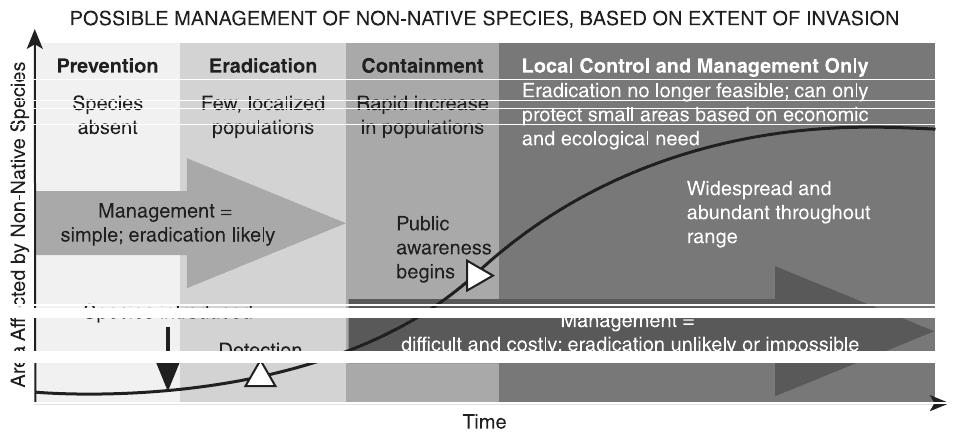
How, scientists at the symposium wondered, do you define “native” on a warming planet, when plants and animals are already moving toward the poles or up mountainsides in search of climate conditions they can tolerate? Should we consider them “invasive” in their new homes? Regardless of what we label them, conservationists will be reluctant to remove them from their new environs—to do so would stymie1 their chances of adapting to the warmer future we’re creating.
And then there are the non-natives that we actually like. Most domestic crops are exotic in most of the places they’re grown, but there are even wild exotics that “do good,” forming useful relationships with native species.
Edwin Grosholz of the University of California, Davis, told the recent symposium about one such relationship. On beaches in his state, non-native spartina grass has become important habitat for the endangered California clapper rail, a plump shorebird with a downward curving bill more at home on land than in the air. A project to rip out and poison the spartina—which grows in dense swaths that exclude many other shorebirds—saw clapper rail numbers go tumbling downward.
There are other examples like that. The endangered southwestern willow flycatcher nests in “invasive” tamarisk shrubs. Many native (and beautiful) Hawaiian flowers are now pollinated by the Japanese white-eye bird—because the native pollinators have been driven extinct by other non-native species.
Should we impose further risk on already endangered natives by severing these relationships? Or should we admire the resilience of nature and let such “well-behaved” exotics stay? . . .
Leave them alone, more and more conservationists are arguing, and stop focusing obsessively on categorizing species as native or non-native. Mark Davis, an ecologist at Macalester College in St. Paul, Minnesota, once considered himself an “invasion biologist”—but not anymore. “I am actively trying to get the field to retire the invader narrative,” he said in Missoula.
A Good Thing, Not the Only Thing
After all, nativeness is just one environmental value, and arguably not as important as preventing extinctions and preserving biodiversity. In some cases we can best serve biodiversity by leaving the non-natives alone or even—brace yourself, now—introducing them on purpose.
This is the thinking behind, for example, installing the Aldabra tortoise on the islands of Mauritius. The islands lost their own large tortoises, and the fruiting plants that formerly had their seeds moved around by these fruit-loving reptiles have been on the decline. A tortoise that’s related to the island’s large tortoises—a non-native from the Seychelles in the Indian Ocean that was intentionally introduced in 2004—is now handling some of that work.
Most of the time, for the time being, conserving species still means focusing on supporting them in their historical habitats, planting natives and removing non-natives. We can and should do that in places where it is feasible and important to us.
From “It’s Time to Stop Thinking That All Non-Native Species Are Evil” by Emma Marris from NATIONAL GEOGRAPHIC MAGAZINE, July 24, 2014. Copyright © 2014 by National Geographic Society.
1stymie: hinder or interfere with
Question
The author’s use of cause and effect in paragraphs 10–11 mainly emphasizes the idea that
- Asome non-native species have helped their environments while others have had harmful impacts.
- Battempts to remove non-native species have seldom produced desired results.
- Csome endangered native species have flourished because of the presence of non-native species.
- Dinteractions between endangered native species and non-native species must be carefully monitored.
Show the answer
Correct answer: C
The question asks what the author’s use of cause and effect in paragraphs 10–11 mainly emphasizes.
A. Incorrect. The examples of cause and effect discussed in paragraphs 10–11, such as the spartina grass helping the clapper rail and the Japanese white-eye bird pollinating Hawaiian flowers, are all instances in which non-native species have helped their new environments.
B. Incorrect. While paragraph 10 does mention that efforts to eradicate the non-native spartina grass hurt the native clapper rail shorebird, the main emphasis in both paragraphs 10–11 is on the fact that certain non-native species have helped native species.
C. CORRECT. Paragraphs 10–11 focus on several examples of non-native species that have helped endangered native species flourish: non-native spartina grass providing “important habitat for the endangered California clapper rail” (paragraph 10), non-native tamarisk shrubs providing nesting places for the endangered southwestern willow flycatcher (paragraph 11), and the non-native Japanese white-eye bird pollinating Hawaiian flowers (paragraph 11).
D. Incorrect. While paragraphs 10–11 describe several interactions between non-native and native species, they never discuss monitoring these interactions.
Question analysis
This text-structure question asks what the cause-and-effect examples in two paragraphs of an article about non-native species mainly emphasize. The paragraphs describe a shorebird, a flycatcher and Hawaiian flowers, and students must decide what the examples have in common rather than fixing on any one of them.
- Grade level
- Grade 8 reading and task
- Compared with grade 7
- Above grade 7 Analyzing what a cause-and-effect structure emphasizes is grade 7 work, but these examples involve unfamiliar species and endangered status, and more than one choice is partly supported by the paragraphs, which raises the demand above typical.
- Estimated difficulty
- Hard: combines ideas, needs a plan, and has more than one tempting wrong answer.
- Thinking it demands
- Depth of knowledge 3, strategic thinking · mainly analyze
- What makes it hard
- A very close wrong answer major
- Reading between the lines moderate
- An unfamiliar subject minor
- Evidence
- Answered from several paragraphs or stanzas
- Reading level
- Passage: about grade 11, 815 words; question and choices: about grade 11, 62 words.
- Students, last 30 days
- Not enough answers yet to show (it takes 10).
Why it is hard, traps and wrong answers (shows the answer)
Why it is hard
The paragraphs mention harm as well as help, so a balanced statement about both looks accurate and even fair-minded. What the cause-and-effect pairs stress, though, is endangered natives depending on non-natives, and the right answer captures that while overstating it, since a bird whose numbers held up only with spartina's help can hardly be said to have flourished. Students must prefer the statement of the main emphasis to one that is partly supported but off the point.
A very close wrong answer major Choosing the answer
The right choice and the help-and-harm choice both say non-natives have aided their surroundings; they part on harm, which the paragraphs do mention, spartina crowding out shorebirds and other non-natives killing Hawaii's pollinators, but only in passing. (Embretson & Wetzel, 1987; Gorin & Embretson, 2006; Ascalon et al., 2007)
Reading between the lines moderate Working it out
Paragraph 10 states its cause and effect backwards, removing spartina sent clapper rail numbers “tumbling downward”, and the student must turn that around into the grass's presence helping the bird. (Graesser, Singer & Trabasso, 1994; Kintsch, 1998)
An unfamiliar subject minor Understanding the question
Five unfamiliar species crowd two paragraphs, spartina grass, the California clapper rail, tamarisk shrubs, the southwestern willow flycatcher and the Japanese white-eye, and each one's role must be kept straight. (Recht & Leslie, 1988; Kintsch, 1998)
Strategy: List each cause-and-effect pair in paragraphs 10 and 11, the species involved and what happened to them, then pick the statement that holds for the examples taken together.
Traps
- Too narrow: A single detail offered as the central idea or a summary, or a summary that keeps minor details and leaves out an essential part.
- Too broad or too strong: A choice overstates, generalizes, or uses absolute words the text does not support.
- Outside knowledge: A choice is plausible in the real world but not supported by this text.
The wrong answers, classified
A Too narrow (King et al., 2004)
Accurately notes helpful and harmful non-natives, but the harm is mentioned only in passing, and it leaves out what every example stresses, endangered natives depending on non-natives.
B Too broad or too strong (King et al., 2004)
Generalizes from the single spartina project in paragraph 10 to removal attempts in general, a “seldom” claim that neither paragraph makes.
D Outside knowledge (King et al., 2004; Recht & Leslie, 1988)
Adds a sensible-sounding call for careful monitoring, the kind of advice scientists often give, but neither paragraph says anything about watching over these relationships.
Working it out, step by step
Know what the question asks
In a cause-and-effect pattern, one thing makes another happen. You need the main idea that the causes and effects in paragraphs 10 and 11 stress. Start by listing each pair.
List each cause and effect
- Paragraph 10: non-native spartina grass gives the endangered clapper rail a home, so when people ripped out the grass, clapper rail numbers went “tumbling downward.”
- Paragraph 11: the endangered willow flycatcher nests in non-native tamarisk shrubs.
- Paragraph 11: native Hawaiian flowers are now pollinated by a non-native bird, the Japanese white-eye.
Find the common thread
Endangered means at risk of dying out. Pollinated means a bird or bug carries pollen between flowers so they can make seeds. In every pair, a native species depends on a non-native one. The newcomer gives it a home, a place to nest or a pollinator. Two of the natives, the clapper rail and the flycatcher, are endangered. So the paragraphs stress that some endangered natives do better because non-natives are there.
Check each choice
- C fits: some endangered natives have “flourished,” or done well, because non-natives are present.
- A is wrong because harm comes up only in passing, while every example stresses a native getting help.
- B is wrong because one removal project is not enough to say removal “seldom” works.
- D is wrong because the paragraphs never mention monitoring, or watching over, these relationships.
Watch out: The paragraphs do mention harm. Spartina crowds out some other shorebirds, and other non-natives wiped out Hawaii’s native pollinators. So A sounds balanced, but it misses the main point.
Choose the answer
The causes and effects show struggling natives, two of them endangered, helped by non-natives. So the answer is C.
Why this answer and not the closest wrong one
A comes closest, because the paragraphs mention harm as well as help. But the harm is only a side note. Every cause and effect shows a native relying on a non-native, and two of those natives are endangered birds. C names that main point, even though “flourished” is a strong word for birds that are still endangered.
More questions like this
The original DOE question
The passage “Excerpt from “It’s Time to Stop Thinking That All Non-Native Species Are Evil”” as printed (pages 68–70)
Question 3 of 6
2018 Test A English, question 22Passage Champion of the Channel
Champion of the Channel
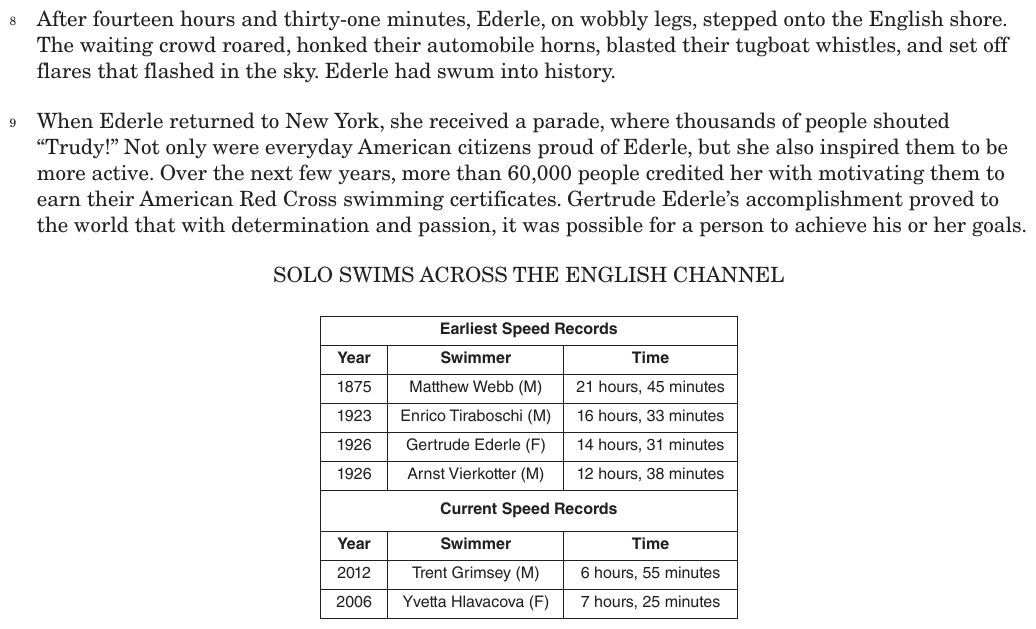
In 1926 an editor at the London Daily News predicted that Gertrude Ederle, an American swimmer with eighteen world records and three Olympic medals, would fail in her attempt to swim across the English Channel. He claimed that “even the most uncompromising champion of the rights and capacities of women must admit that in contests of physical skill, speed and endurance they must remain forever the weaker sex.” Yet, at only nineteen years old, Ederle not only became the first woman to accomplish this feat, she also broke the men’s record by two hours. Gertrude Ederle’s triumphant swim across the English Channel was a testimony to her determination, innovative spirit, and passion for swimming.
Crossing the English Channel is a daunting task for any swimmer. At its narrowest point, the channel measures twenty-one miles across. Its icy waters hover around sixty degrees Fahrenheit, and its unruly tides and currents toss swimmers about like bobbing corks. Stinging jellyfish, seaweed, and floating debris from shipwrecks and lost cargoes present added hazards.
For decades the channel’s perils have defeated countless swimmers. Ederle, too, failed in her first attempt to cross the channel in 1925. Just six miles short of finishing, she became ill, and her coach had to haul her out of the water. Undeterred, Ederle decided to try again. Ederle knew that if she did not complete the challenge this time, she might never get the opportunity to set this record, because a rival female swimmer was preparing to make her second attempt at the crossing as well.
To prepare for the marathon swim, Ederle found ways to improve her equipment. She and her sister Meg discovered that melted candle wax perfectly sealed goggle edges, effectively waterproofing Ederle’s goggles against hammering waves. The sisters also designed a two-piece silk swimsuit for Ederle. During her first channel-crossing attempt she had worn a standard one-piece swimsuit that, after the lengthy hours of swimming across the channel, had stretched out, filling with water and creating drag, making an already challenging task almost insurmountable. Unlike the cumbersome typical bathing suit, this silk invention weighed little and allowed for easy movement.
On August 6, 1926, Ederle waded into the channel near Cape Gris-Nez, France. At first she shivered in the bone-chilling water even though she had covered her body in eight layers of grease for insulation. Her limbs felt stiff. Her strokes were irregular. Driving forward, she fought to clear her mind and find what she called her “sphere,” a place where the sea became her only companion and the shrieks of gulls and the humming of boat engines faded away. Using a new overhand stroke called the American crawl, Ederle eventually settled into a steady pace, briskly breaking through waves.
Throughout Ederle’s swim, two tugboats accompanied her. One carried newspaper reporters who wired dispatches of her progress to shore. The other, displaying a sign that read “This way, ole kid!” with an arrow pointing forward, transported her coach, family, and friends. Her coach played songs, such as “Yes, We Have No Bananas,” on a phonograph so that Ederle could time her strokes to the rhythm. Using a net, her coach also passed her baby bottles of broth for nourishment.
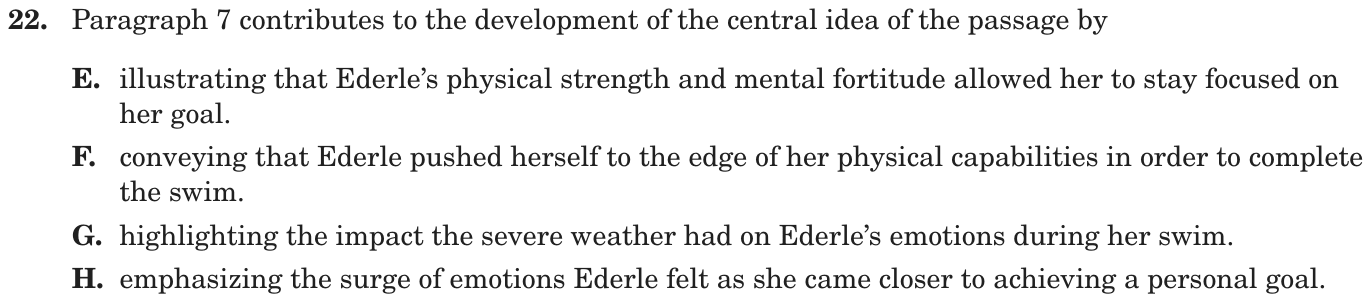
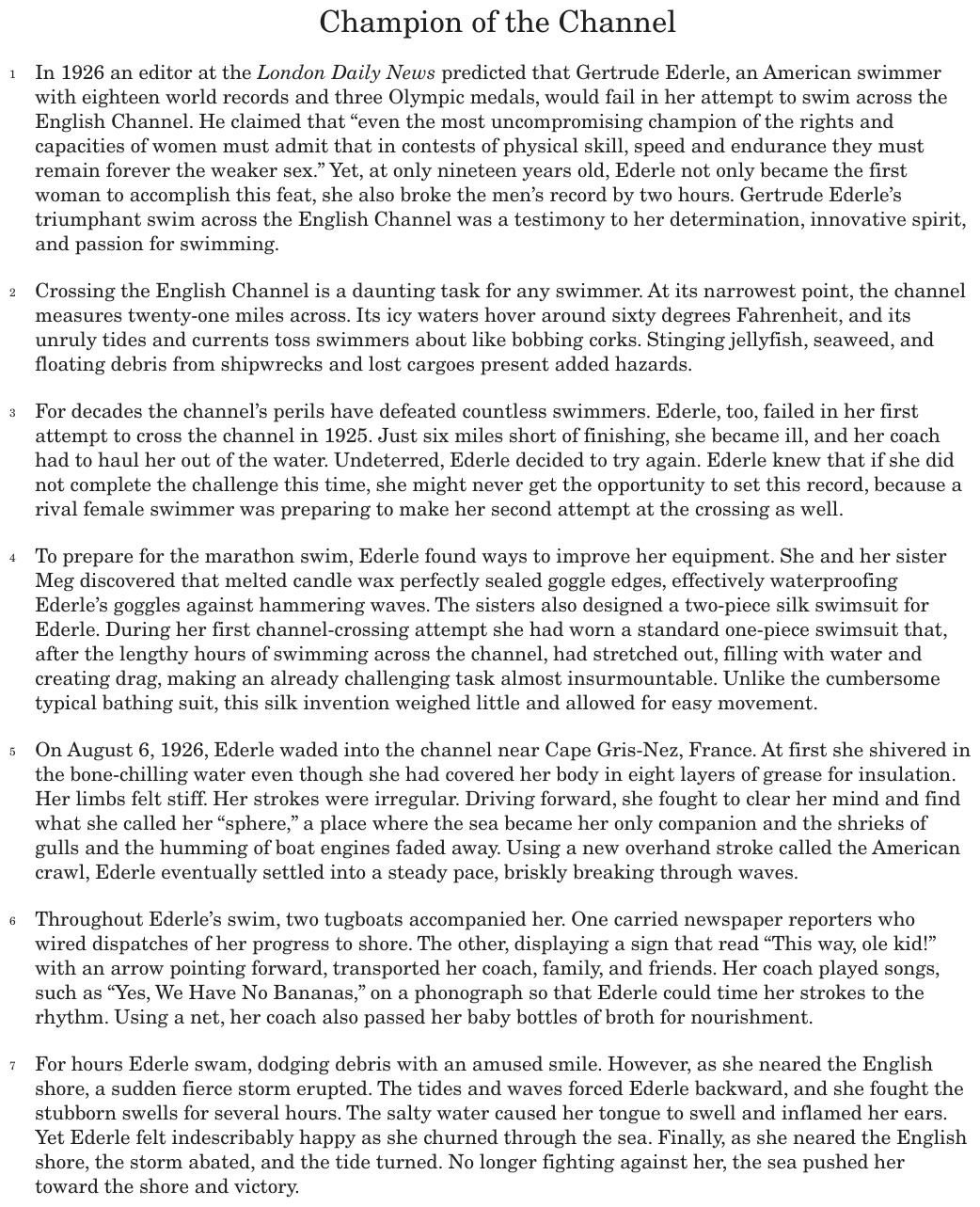
For hours Ederle swam, dodging debris with an amused smile. However, as she neared the English shore, a sudden fierce storm erupted. The tides and waves forced Ederle backward, and she fought the stubborn swells for several hours. The salty water caused her tongue to swell and inflamed her ears. Yet Ederle felt indescribably happy as she churned through the sea. Finally, as she neared the English shore, the storm abated, and the tide turned. No longer fighting against her, the sea pushed her toward the shore and victory.
After fourteen hours and thirty-one minutes, Ederle, on wobbly legs, stepped onto the English shore. The waiting crowd roared, honked their automobile horns, blasted their tugboat whistles, and set off flares that flashed in the sky. Ederle had swum into history.
When Ederle returned to New York, she received a parade, where thousands of people shouted “Trudy!” Not only were everyday American citizens proud of Ederle, but she also inspired them to be more active. Over the next few years, more than 60,000 people credited her with motivating them to earn their American Red Cross swimming certificates. Gertrude Ederle’s accomplishment proved to the world that with determination and passion, it was possible for a person to achieve his or her goals.
SOLO SWIMS ACROSS THE ENGLISH CHANNEL
|
Earliest Speed Records |
||
| Year | Swimmer | Time |
| 1875 | Matthew Webb (M) | 21 hours, 45 minutes |
| 1923 | Enrico Tiraboschi (M) | 16 hours, 33 minutes |
| 1926 | Gertrude Ederle (F) | 14 hours, 31 minutes |
| 1926 | Arnst Vierkotter (M) | 12 hours, 38 minutes |
| Current Speed Records | ||
| Year | Swimmer | Time |
| 2012 | Trent Grimsey (M) | 6 hours, 55 minutes |
| 2006 | Yvetta Hlavacova (F) | 7 hours, 25 minutes |
Question
Paragraph 7 contributes to the development of the central idea of the passage by
- Aillustrating that Ederle’s physical strength and mental fortitude allowed her to stay focused on her goal.
- Bconveying that Ederle pushed herself to the edge of her physical capabilities in order to complete the swim.
- Chighlighting the impact the severe weather had on Ederle’s emotions during her swim.
- Demphasizing the surge of emotions Ederle felt as she came closer to achieving a personal goal.
Show the answer
Correct answer: D
The answer is (D)
The question asks for an explanation of how paragraph 7 contributes to the development of a central idea of the passage. Paragraph 7 is mainly about Ederle’s physical and emotional state as she pushed through a difficult portion of her swim and realized her goal was in sight. A central idea of the passage is that Ederle’s passion and determination allowed her to accomplish her goal of being the first woman to cross the English Channel.
Option D is correct because it emphasizes her passion by referring to the overwhelming emotions Ederle felt as she progressed during her swim, despite the unfavorable conditions (paragraph 7: “For hours Ederle swam, dodging debris with an amused smile” and “Yet Ederle felt indescribably happy as she churned through the sea.”).
Option A is incorrect because, although Ederle needed physical strength and mental fortitude to complete the swim, the paragraph contributes to a central idea because it highlights her emotion as she swam, not her physical strength or mental fortitude.
Option B is incorrect because the paragraph focuses on Ederle’s emotional response to the challenging circumstances and not the idea that Ederle was at the “edge of her physical capabilities.”
Option C is incorrect because Ederle’s feelings of happiness and amusement were caused by her anticipation and excitement as she approached achieving her goal, not by the severe weather.
Question analysis
This reading question asks how the paragraph about the storm near the end of Gertrude Ederle's English Channel swim contributes to the passage's central idea. Students must decide what the paragraph mainly does and connect it to the larger point, while every choice sounds like a fair description of a hard swim.
- Grade level
- Grade 8 reading and task
- Compared with grade 7
- Above grade 7 Explaining how one paragraph develops a central idea is a grade 7 standard, but here several choices sound true of a hard swim through a storm, and the student must see what the paragraph is mainly about, beyond typical grade 7 work.
- Estimated difficulty
- Hard: combines ideas, needs a plan, and has more than one tempting wrong answer.
- Thinking it demands
- Depth of knowledge 3, strategic thinking · mainly analyze
- What makes it hard
- A very close wrong answer major
- Evidence in several places moderate
- How, not what moderate
- Evidence
- Answered from several paragraphs or stanzas
- Reading level
- Passage: about grade 9, 790 words; question and choices: about grade 11, 76 words.
- Students, last 30 days
- Not enough answers yet to show (it takes 10).
Why it is hard, traps and wrong answers (shows the answer)
Why it is hard
Paragraph 7 is crowded with hardship, a storm, a swollen tongue and inflamed ears, so the obvious reading is that it shows toughness. The author's pointed “Yet Ederle felt indescribably happy” turns it toward emotion, which ties it to the passion named in the thesis. Several choices are fair about the swim in general, and this is one of the closer calls on the test, since strength is also on display.
A very close wrong answer major Choosing the answer
The right choice and the strength-and-fortitude one both describe Ederle's inner state as she nears her goal, and only whether paragraph 7 stresses her feelings or her toughness separates them, since she does fight “the stubborn swells for several hours”. (Embretson & Wetzel, 1987; Gorin & Embretson, 2006; Ascalon et al., 2007)
Evidence in several places moderate Working it out
The central idea, her “determination, innovative spirit, and passion for swimming”, is stated in paragraph 1, six paragraphs before the storm it must be connected to. (Kirsch & Mosenthal, 1990; Gorin & Embretson, 2006)
How, not what moderate Working it out
The question asks how paragraph 7 develops the central idea, so the student must weigh what its details stress, the “amused smile” and “indescribably happy”, not just what happens. (Anderson & Krathwohl, 2001)
Strategy: Mark the words in paragraph 7 that describe how Ederle felt and what she endured, decide which the author stresses, then connect that to the passage's stated central idea.
Traps
- True but not the answer: A choice says something accurate about the text that does not answer this question.
- Too broad or too strong: A choice overstates, generalizes, or uses absolute words the text does not support.
The wrong answers, classified
A True but not the answer (King et al., 2004; Embretson & Wetzel, 1987)
Credits strength and mental fortitude, which the hours against the swells partly show, but the paragraph's turn on “Yet” stresses her joy, not her toughness.
B Too broad or too strong (King et al., 2004)
Inflates the swollen tongue and inflamed ears into reaching “the edge of her physical capabilities”, an extreme the paragraph never claims.
C Twists what the text says (King et al., 2004)
Sees both the storm and her feelings but makes the weather the cause of her emotions, when she felt happy in spite of it.
Working it out, step by step
Figure out what the question asks
You need to explain how paragraph 7 helps build the central idea, the main point of the passage. So first find the central idea. Then see what paragraph 7 stresses.
Find the central idea
The last sentence of paragraph 1 says: “Gertrude Ederle’s triumphant swim across the English Channel was a testimony to her determination, innovative spirit, and passion for swimming.” A testimony here means proof. Passion means a strong love for something.
See what happens in paragraph 7
A fierce storm pushes Ederle backward. She fights “the stubborn swells for several hours.” Swells are big, rolling waves. Salt water makes her tongue swell and her ears sore. Then the storm ends, and the sea pushes her “toward the shore and victory.”
Notice what the author stresses
Look at the feeling words. She swims “dodging debris with an amused smile.” In the middle of the pain, the author writes: “Yet Ederle felt indescribably happy as she churned through the sea.” Indescribably means too much to put into words. The word “Yet” shows a surprise. She felt joy in spite of the pain. That shows her passion for swimming.
Check each choice
- D: a “surge of emotions” as she came closer to her goal. A surge is a sudden rush. This matches the smile and the happiness.
- A: strength and “mental fortitude,” or toughness. She was tough, but the paragraph stresses her joy.
- B: the paragraph never says she reached “the edge of her physical capabilities.”
- C says the storm caused her feelings. She was happy in spite of the storm, not because of it.
Watch out: A is tempting because she fought for hours. But the “Yet” sentence turns to how she felt.
Pick the answer
Paragraph 7 builds the passage’s idea of her passion by showing her feelings. So the answer is D.
Why this answer and not the closest wrong one
A is the closest wrong answer, because she does fight “the stubborn swells for several hours.” But the paragraph’s key words are about feeling: “amused smile” and “indescribably happy.” Those link to her “passion for swimming” in paragraph 1. D names those emotions.
More questions like this
The original DOE question
The passage “Champion of the Channel” as printed (pages 56–57)
Question 4 of 6
2024 Test A Math, question 5Question
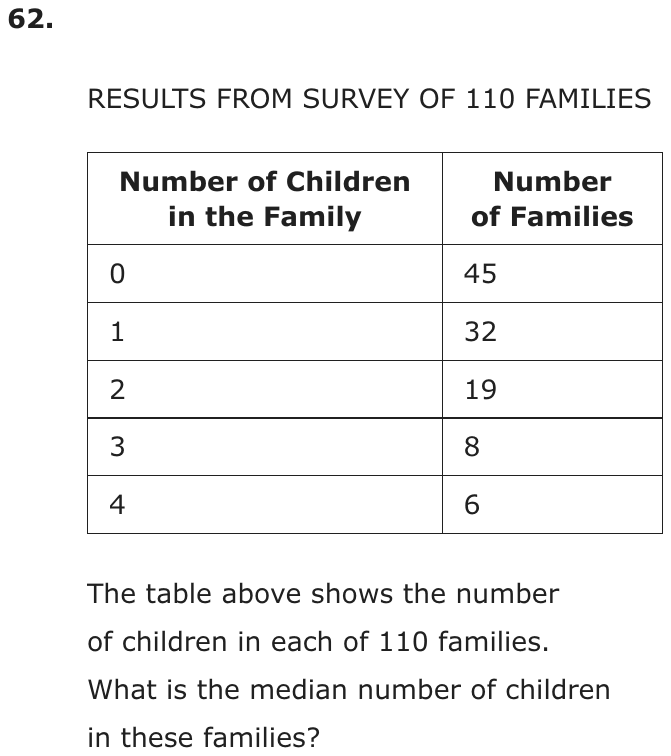
RESULTS FROM SURVEY OF 110 FAMILIES
| Number of Children in the Family | Number of Families |
|---|---|
| 0 | 45 |
| 1 | 32 |
| 2 | 19 |
| 3 | 8 |
| 4 | 6 |
The table above shows the number of children in each of 110 families. What is the median number of children in these families?
Grid-in question: work out the answer and enter it as a number.
Show the answer
Correct answer: 1
Since 110 families were surveyed, the median will have 55 values less than or equal to it, and 55 values greater than or equal to it.
If the values in the table were listed in order, they would look like this:
The first row of the table indicates that 45 families had 0 children.
The second row of the table indicates that 32 families had 1 child.
So 77 families had either 0 children or 1 child, and 45 families had 0 children.
Since 55 is between 45 and 77, the median must be a value in the second row of the table.
So the median is 1.
Question analysis
This statistics grid-in gives a frequency table from a survey of 110 families, showing how many families have each number of children from none to four. Students find the median number of children per family. The table lists counts rather than the 110 data values themselves, so locating the middle value takes a running total of the families.
- Grade level
- Grade 6 content, by NYS standard
- Compared with grade 7
- Above grade 7 Grade 7 median problems usually list a dozen or so values. Here 110 values are hidden in a frequency table, so students must reason about positions with a running count, a less familiar and more error-prone task.
- Estimated difficulty
- Hard: combines ideas, needs a plan, and has more than one tempting wrong answer.
- Thinking it demands
- Depth of knowledge 2, skills and concepts · mainly apply
- What makes it hard
- Reading a figure, table or graph major
- No obvious method moderate
- An answer in an unexpected form minor
- Solution
- 3 steps
- Reading level
- Question and choices: about grade 7, 35 words.
- Students, last 30 days
- Not enough answers yet to show (it takes 10).
Why it is hard, traps and wrong answers (shows the answer)
Why it is hard
Students know a median as the middle of a list, but here the list is never written out. Treating the table's columns as the data gives quick, confident answers, 2 from the middle of the children column or 19 from the middle of the family counts, and neither can be checked against choices. The question rewards counting positions: 45 families have no children, so the 55th and 56th families both fall among the 32 with one child.
Reading a figure, table or graph major Understanding the question
The table hides 110 data values in five rows: the 0 to 4 column lists the possible values, and 45, 32, 19, 8 and 6 say how many families have each. (Lesh, Post & Behr, 1987; Kirsch & Mosenthal, 1990)
No obvious method moderate Working it out
The median of 110 values lies between the 55th and 56th; finding them takes a running count of families, 45 and then 77, a method seldom practiced with tables. (Schoenfeld, 1985)
An answer in an unexpected form minor Choosing the answer
As a grid-in there are no choices to compare, so a student who takes the middle row's 2 has nothing on the page to suggest it is wrong. (Enright, Morley & Sheehan, 2002)
Strategy: With 110 values the median sits between the 55th and 56th; add the family counts row by row until the running total passes 55, and read that row's number of children.
Traps
- Misunderstands the concept: A wrong belief about a concept: that percents can be added, that area grows like length, that averages can be averaged, that a bigger denominator means a bigger fraction.
- Answers a different question: A choice is right for another quantity: the other unknown, the rest instead of the part, the part instead of the whole.
The wrong answers, classified
2 Misunderstands the concept (Smith, diSessa & Roschelle, 1993; De Bock et al., 1998; Ni & Zhou, 2005)
Takes the middle entry of the children column, 0 to 4, ignoring that each number of children belongs to a different number of families.
19 Answers a different question (King et al., 2004; Hegarty, Mayer & Monk, 1995)
Finds the median of the Number of Families column, 6, 8, 19, 32 and 45, a middle family count rather than a number of children.
1.07 Answers a different question (King et al., 2004; Hegarty, Mayer & Monk, 1995)
Computes the mean instead, 118 children among 110 families, about 1.07, a different measure of center from the median asked for.
Worked solution, step by step
Formulas used
- Spot of the median
- The median is the middle value when all the values are put in order. n is how many values there are. This gives the spot of the middle value, with the same number of values before and after it. If it ends in a half, the median is halfway between the two values on either side.
Sort out the table
The table covers 110 families. The left column is a number of children. The right column says how many families have that many children. For example, 45 families have 0 children. You need the median number of children. The median is the middle value when all the values are in order.
Picture the values in order
Think of a list with one number for each family: how many children it has. The list has 45 zeros, then 32 ones, then 19 twos, then 8 threes, then 6 fours. It is already in order, from least to most.
There are 110 values. Watch out: the median is not the middle row, 2. Each row stands for a different number of families.
Find the middle spot
Use the median rule with n = 110.
The middle is halfway between the 55th and 56th values. So you need those two values in the list.
Count down the list
Keep a running total of families, row by row. The zeros fill spots 1 to 45. Now add the 32 families with 1 child.
So the ones fill spots 46 to 77. Spot 55 and spot 56 are both in that range. So both values are 1.
Give the median
The 55th and 56th values are both 1. Halfway between 1 and 1 is 1. So the median is 1 child. Watch out: the median is a number of children, not of families. Gridding 19, from the families column, is wrong. So is the mean, or average, which is about 1.07. So you would grid 1.
Check your answer
Half of 110 is 55. Families with 0 children: 45, which is less than half. So the median is not 0. Families with 0 or 1 child: 77, which is more than half. So the median is not more than 1. It must be 1.
More questions like this
The original DOE question
Question 5 of 6
2018 Test B Math, question 50Question
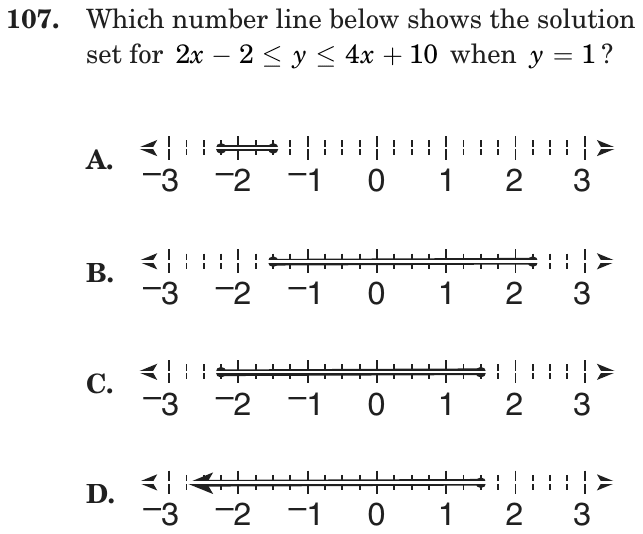
Which number line below shows the solution set for when ?
- A

- B

- C

- D

Show the answer
Correct answer: C
Separate the compound inequality into two pieces:
and
Substitute into each inequality and solve for :
The solution is the number line that shows that is greater than or equal to and less than or equal to .
Question analysis
Students substitute y = 1 into the compound inequality 2x − 2 ≤ y ≤ 4x + 10 and pick the number line that shows the values of x that work. It tests solving two-step inequalities and graphing the solution. The four graphs differ in their endpoints and in whether the shading is closed off on both sides, so each endpoint has to be found exactly.
- Grade level
- Grade 7 content, by NYS standard
- Compared with grade 7
- Above grade 7 Grade 7 students solve and graph one two-step inequality. This compound inequality in two variables requires substituting, solving two inequalities and combining them into one interval, a step toward algebra 1.
- Estimated difficulty
- Hard: combines ideas, needs a plan, and has more than one tempting wrong answer.
- Thinking it demands
- Depth of knowledge 2, skills and concepts · mainly apply
- What makes it hard
- Many steps moderate
- Error-prone arithmetic moderate
- Reading a figure, table or graph moderate
- A very close wrong answer minor
- Solution
- 4 steps
- Reading level
- Question and choices: about grade 9, 12 words.
- Students, last 30 days
- Not enough answers yet to show (it takes 10).
Why it is hard, traps and wrong answers (shows the answer)
Why it is hard
Substituting y = 1 is easy; the work is solving two inequalities and matching a fractional interval to a graph. Students who solve only the left inequality find a matching ray, and sign slips on either endpoint produce intervals that shift or flip across zero. The graphs differ by quarter-unit ticks, so reading them carefully matters as much as the algebra.
Many steps moderate Working it out
The compound inequality must be split into 2x − 2 ≤ 1 and 1 ≤ 4x + 10, each solved for x, and the two results joined into one interval. (Daniel & Embretson, 2010; Enright, Morley & Sheehan, 2002)
Error-prone arithmetic moderate Working it out
Both endpoints are fractions, 3/2 and −9/4, and the second comes from dividing −9 by 4, where a lost sign moves the endpoint across zero. (Brown & Burton, 1978; Junker & Sijtsma, 2001)
Reading a figure, table or graph moderate Understanding the question
The graphs are marked in quarter units, so −2 1/4 and 1 1/2 have to be found by counting small ticks between the labeled integers. (Lesh, Post & Behr, 1987; Kirsch & Mosenthal, 1990)
A very close wrong answer minor Choosing the answer
The ray ending at 1 1/2 looks almost like the right segment, sharing its right end; only the left end, an arrow instead of a closed dot at −2 1/4, separates them. (Embretson & Wetzel, 1987; Gorin & Embretson, 2006; Ascalon et al., 2007)
Strategy: Split the compound inequality into two separate inequalities, solve each for x after putting 1 in for y, then combine the two results into a single interval and match it to a graph.
Traps
- Negatives and direction: Arithmetic with negative numbers, the order of a subtraction, or direction on a number line. (Moving a term across the equals sign without changing its sign is a faulty procedure.)
- Stops one step early: A choice is a number from partway through the solution.
The wrong answers, classified
A Negatives and direction (Brown & Burton, 1978)
Gets the left endpoint −2 1/4 right but gives the right endpoint the wrong sign, ending the segment at −1 1/2 instead of 1 1/2.
B Negatives and direction (Brown & Burton, 1978)
Gives both endpoints the opposite sign, so the segment runs from −1 1/2 to 2 1/4, the true interval reflected across 0.
D Stops one step early (King et al., 2004; Gierl et al., 2017)
Solves only 2x − 2 ≤ 1 and graphs every x up to 1 1/2, leaving out the lower bound that 1 ≤ 4x + 10 sets.
Worked solution, step by step
Formulas used
- Solving an inequality
- a, b and c are numbers. The sign ≤ means is less than or equal to. Adding or subtracting the same number c on both sides keeps it true. Dividing both sides by the same positive number also keeps it true.
Sort out the question
The sign means is less than or equal to. An inequality compares two amounts that may not be equal. The statement is two inequalities joined together. You put 1 in place of . Then you need every that makes both parts true.
Split it into two parts
With , the statement becomes two inequalities.
The answer must make both of them true at the same time.
Solve the first part
Add 2 to both sides. Then divide both sides by 2.
So is at most . This is the right end of the answer.
Watch out: the right end is a positive number. Choice A ends its bar at instead.
Solve the second part
Subtract 10 from both sides. Then divide both sides by 4.
So is at least . This is the left end.
Watch out: keep the minus sign. Choice B uses the opposite signs and ends at .
Put the two parts together
The answer is every number from to , with both ends included. On the graph, that is a solid bar with a dot at each end. The small ticks are quarters. So count 1 tick left of −2 and 2 ticks right of 1.
Watch out: choice D uses only the first part. Its arrow goes left forever.
Give the answer
Choice C shows a bar from to , with dots at both ends. So the answer is C.
Check your answer
Test a number on the bar, like . Then and , and 1 is between them. Now test , which is off the bar. Then , and 1 is not less than −2. So the bar must stop on the left, which rules out D.
More questions like this
The original DOE question
Question 6 of 6
2018 Test A Math, question 21Question
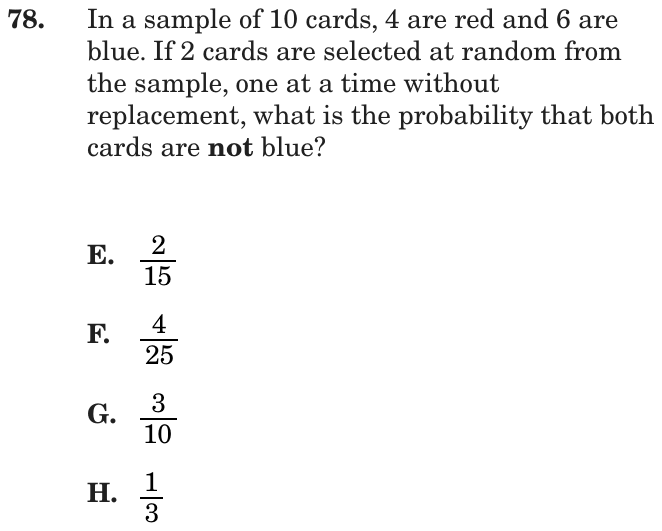
In a sample of 10 cards, 4 are red and 6 are blue. If 2 cards are selected at random from the sample, one at a time without replacement, what is the probability that both cards are not blue?
- A
- B
- C
- D
Show the answer
Correct answer: A
The probability that both cards are not blue is the same as the probability that both cards are red. There are 4 red cards out of the 10, so the probability of the first card being red is
Now there are 9 cards left, and 3 of those are red, so the probability of the second card being red is
Multiply the two probabilities to find the probability that both cards are red (not blue):
Question analysis
This probability question draws 2 cards, one at a time and without replacement, from 10 cards: 4 red and 6 blue. Students find the chance that neither card drawn is blue. The second draw has one fewer card, and the word not changes which color to count.
- NYS standards
- Grade level
- Grade 7 content, by NYS standard
- Compared with grade 7
- Above grade 7 Grade 7 compound probability is usually found with a list or tree of equally likely outcomes. Dependent draws without replacement, plus a negative phrasing to translate, go beyond that typical work.
- Estimated difficulty
- Hard: combines ideas, needs a plan, and has more than one tempting wrong answer.
- Thinking it demands
- Depth of knowledge 2, skills and concepts · mainly apply
- What makes it hard
- Something you must already know moderate
- A very close wrong answer moderate
- Turning words into math minor
- An answer in an unexpected form minor
- Solution
- 3 steps
- Reading level
- Question and choices: about grade 5, 39 words.
- Students, last 30 days
- Not enough answers yet to show (it takes 10).
Why it is hard, traps and wrong answers (shows the answer)
Why it is hard
Two ideas stack here: restating not blue as red, and changing the second draw's numbers after a card is removed. Students who know to multiply but forget the removal reach a listed choice, and so do students who compute both blue. Writing the second fraction explicitly as 3 red out of 9 cards, before multiplying, is what separates right from nearly right.
Something you must already know moderate Working it out
Multiplying the first draw's chance by the second draw's, with the second adjusted for the card already taken, is a rule the test assumes and does not give. (Anderson & Krathwohl, 2001)
A very close wrong answer moderate Choosing the answer
2/15 and 4/25 are about 0.13 and 0.16, too close to tell apart by estimate; only the second draw's fraction, 3 red of 9 cards rather than 4 of 10, separates them. (Embretson & Wetzel, 1987; Gorin & Embretson, 2006; Ascalon et al., 2007)
Turning words into math minor Understanding the question
"Both cards are not blue" has to be restated as both cards red, and the bold not also invites computing the chance that both are blue. (Hegarty, Mayer & Monk, 1995; Koedinger & Nathan, 2004)
An answer in an unexpected form minor Choosing the answer
The product comes out as 12/90, and it has to be reduced to lowest terms before it matches any of the listed fractions. (Enright, Morley & Sheehan, 2002)
Strategy: Restate not blue as red, then multiply the chance of red on the first draw by the chance of red on the second, with one card fewer.
Traps
- Without replacement: In a second pick there is one fewer item, which changes the probability.
- Misreads the question: Misses or misreads a condition or a word in the question: "at least", "each", "remaining", "not".
The wrong answers, classified
B Without replacement (Fischbein & Schnarch, 1997)
Multiplies 4/10 × 4/10 = 16/100 = 4/25, as if the first red card were put back before the second draw.
C Little reason to choose it (Haladyna & Downing, 1993; Rodriguez, 2005)
No standard working gives 3/10: it is not the chance of red or of blue on one draw or on two, so it mostly catches guesses.
D Misreads the question (Hegarty, Mayer & Monk, 1995)
Computes the chance that both cards are blue, 6/10 × 5/9 = 30/90 = 1/3, missing the bold word not.
Worked solution, step by step
Formulas used
- Probability
- P is the probability, the chance that something happens. Favorable is the number of ways to get what you want, here a red card. Total is the number of all possible picks, here all the cards you can pick from. It works when every pick is equally likely.
- Two events in a row
- A is the first event and B is the second. P( ) means the probability of what is inside. The chance that both happen is the first chance times the second. For the second chance, count only what is left after the first event.
Sort out the question
There are 10 cards: 4 red and 6 blue. You pick 2 cards “one at a time without replacement”. That means the first card is not put back. “Both cards are not blue” means both are red, since red is the only other color. You need the probability, or chance, of that.
Find the chance the first card is red
4 of the 10 cards are red. Each card is equally likely to be picked. Use the probability formula.
Find the chance the second card is red
One red card is gone now, and it is not put back. So 9 cards are left, and 3 of them are red.
Watch out: using 4/10 again acts as if the card went back. That gives 4/25, choice B.
Multiply the two chances
Both cards must be red. So multiply the first chance by the second. To multiply fractions, multiply the tops, then multiply the bottoms.
Simplify the fraction
None of the choices is 12/90, so simplify it. Divide the top and the bottom by 6, the biggest number that goes into both.
Watch out: the chance that both are blue is , choice D. The question says not blue. So the answer is A, .
Check your answer
Count the ways. There are ways to pick two cards in order. Red then red has ways. That gives 12/90, or 2/15. The answer is small, which makes sense, because there are fewer red cards than blue ones.
More questions like this
The original DOE question