3 English and 3 math
Here are 6 random questions to try. Takers earning below 75% are unlikely to receive an offer. You have 1 minute 48 seconds per question on the real exam.
Question 1 of 6
2018 Test B English, question 48Passage Invention of the Telegraph
Samuel Morse, an American inventor, is credited with creating the electronic telegraph, a communication device that allows users to send messages using a system of short and long pulses that represent letters, numbers, and punctuation. In 1843 the United States Congress passed the Telegraph Bill, which provided Morse with the funds to build an electric telegraph system.
Invention of the Telegraph
Earlier Signal Systems
Long before Samuel F. B. Morse electrically transmitted his famous message “What hath God wrought?” from Washington to Baltimore on May 24, 1844, there were signaling systems that enabled people to communicate over distances. Most were visual or “semaphore” systems using flags or lights. In the eighteenth century, such systems used an observer who would decipher a signal from a high tower on a distant hill and then send it on to the next station. The young American republic wanted just such a system along its entire Atlantic coast and offered a prize of $30,000 for a workable proposal. The framers of this legislation had no way of knowing that when they used the word “telegraph” to refer to this visual semaphore system, they would be offered an entirely new and revolutionary means of communication—electricity.
The Growth of an Idea
The idea of using electricity to communicate over distance is said to have occurred to Morse during a conversation aboard ship when he was returning from Europe in 1832. Michael Faraday’s recently invented electromagnet was much discussed by the ship’s passengers, and when Morse came to understand how it worked, he speculated that it might be possible to send a coded message over a wire. While a student at Yale College years before, he had written his parents a letter about how interesting he found the lectures on electricity. Despite what he had learned at Yale, Morse found when he began to develop his idea that he had little real understanding of the nature of electricity, and after sporadic attempts to work with batteries, magnets, and wires, he finally turned for help to a colleague at the University of the City of New York, Leonard D. Gale.
Gale was a professor of chemistry and familiar with the electrical work of Princeton’s Joseph Henry, a true pioneer in the new field. Well before Morse had his shipboard idea about a telegraph, Henry rang a bell at a distance by opening and closing an electric circuit. In 1831, he had published an article, of which Morse was unaware, that contained details suggesting the idea of an electric telegraph. Gale’s help and his knowledge of this article proved crucial to Morse’s telegraph system because Gale not only pointed out flaws in the system but showed Morse how he could regularly boost the strength of a signal and overcome the distance problems he had encountered by using a relay system Henry had invented. Henry’s experiments, Gale’s assistance, and, soon after, hiring the young technician Alfred Vail were keys to Morse’s success.
Obstacles and Opportunities
By December 1837, Morse had enough confidence in his new system to apply for the federal government’s appropriation, and during the next year he conducted demonstrations of his telegraph both in New York and Washington.
However, when the economic disaster known as the Panic of 1837 took hold of the nation and caused a long depression, Morse was forced to wait for better times. It was during this period that Morse visited Europe again and tried not only to secure patent protection overseas but to examine competing telegraph systems in England. . . .
By 1843, the country was beginning to recover economically, and Morse again asked Congress for the $30,000 that would allow him to build a telegraph line from Washington to Baltimore, forty miles away. The House of Representatives eventually passed the bill containing the Morse appropriation, and the Senate approved it in the final hours of that Congress’s last session. With President Tyler’s signature, Morse received the cash he needed and began to carry out plans for an underground telegraph line.
Realizing a Great Invention
Morse had hired the ingenious construction engineer Ezra Cornell to lay the pipe carrying the wire, and although Cornell did his job superbly, one of Morse’s partners, Congressman F. O. J. Smith, had purchased wire with defective insulation. Too much time had been wasted laying bad wire, and with the project on a rigid deadline, something had to be done quickly. Cornell suggested that the fastest and cheapest way of connecting Washington and Baltimore was to string wires overhead on trees and poles. The desperate Morse gave the go-ahead, and the line was completed in time for the dramatic and spectacularly successful link between the Supreme Court chamber of the Capitol building and the railroad station in Baltimore.
Soon, as overhead wires connected cities up and down the Atlantic coast, the dots-and-dashes method that recorded messages on a long moving strip of paper was replaced by the operator’s ability to interpret the code in real time. . . . Telegraph lines soon extended westward, and within Morse’s own lifetime they connected the continents of Europe and America.
“Invention of the Telegraph”—Public Domain/Library of Congress
legislation: Telegraph Bill
dots-and-dashes method: the short and long pulses of Morse code that are sent and received by telegraph operators
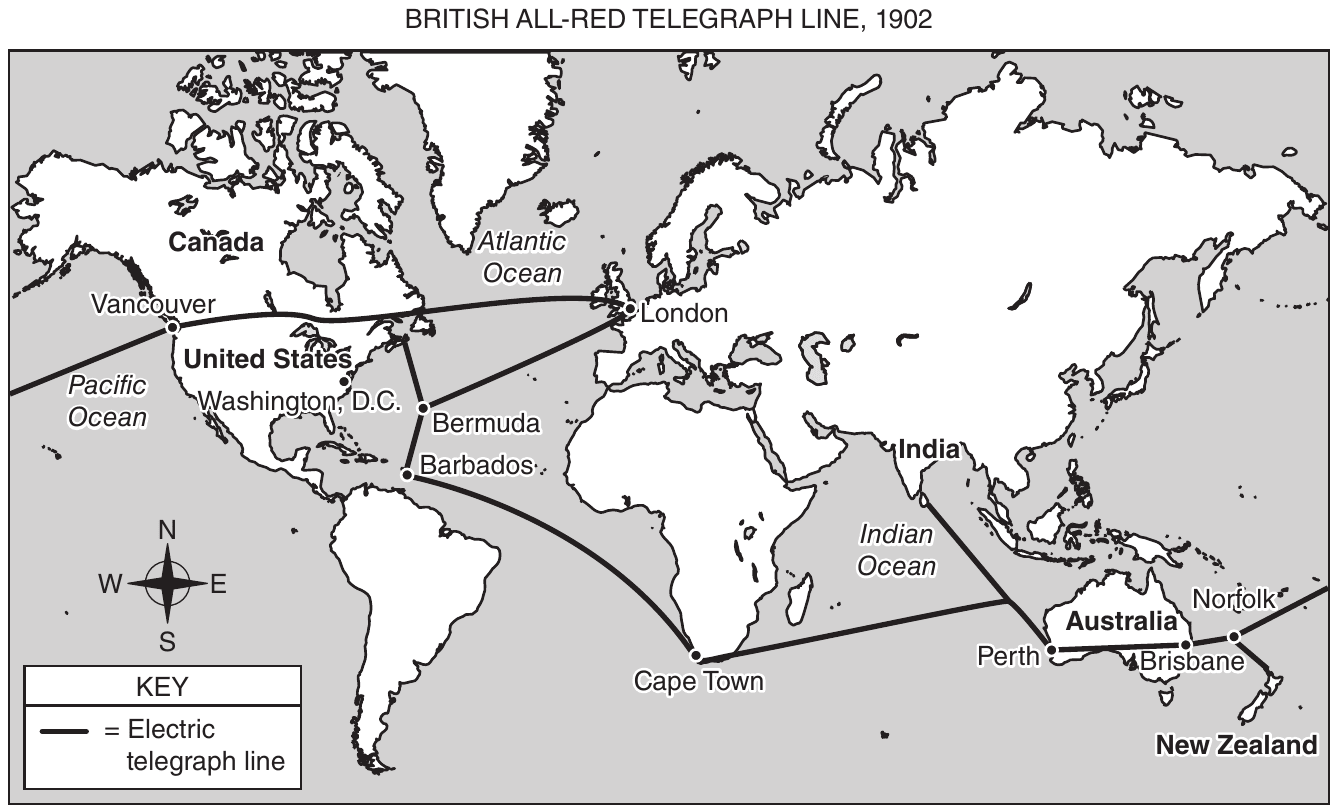
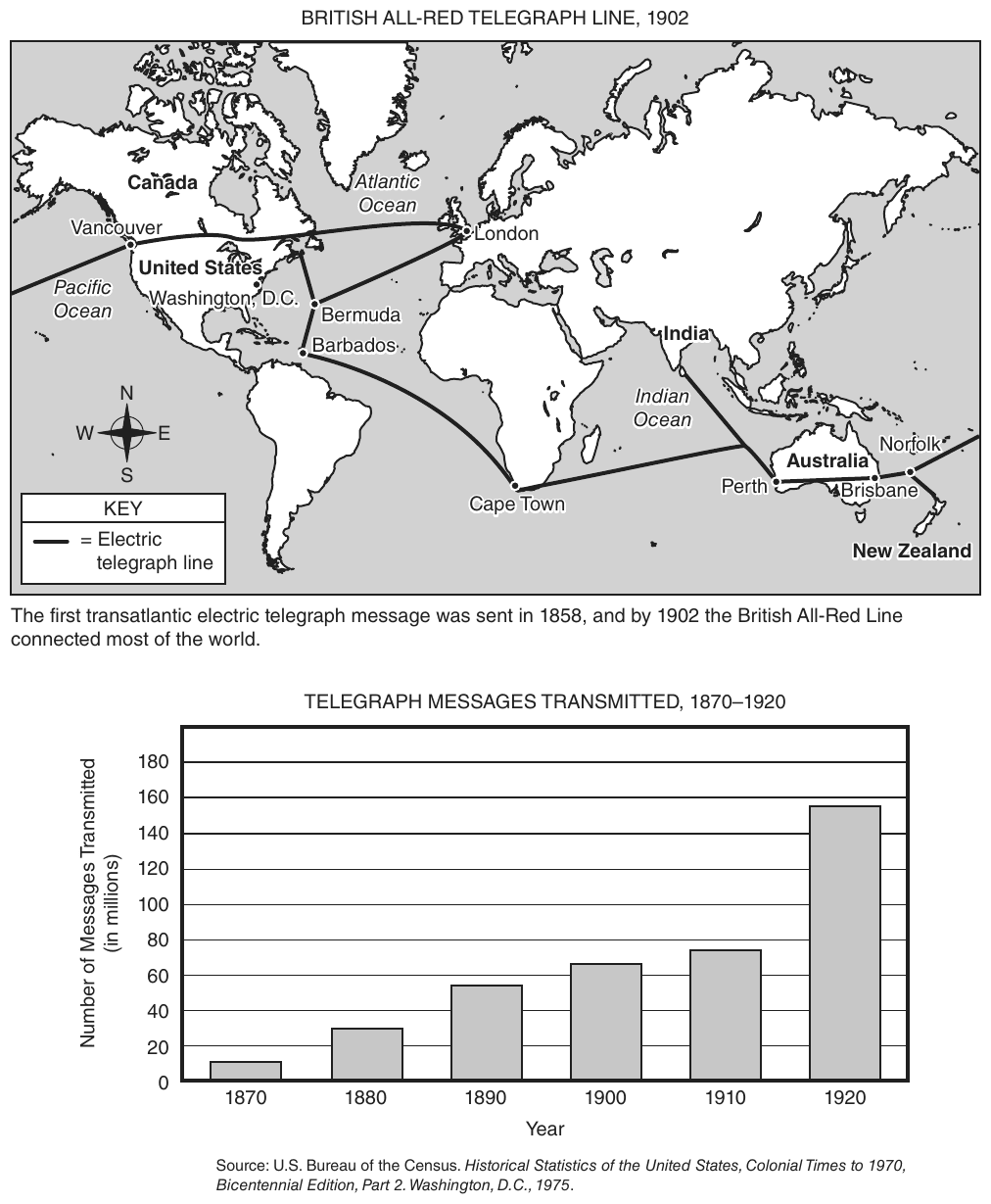
The first transatlantic electric telegraph message was sent in 1858, and by 1902 the British All-Red Line connected most of the world.
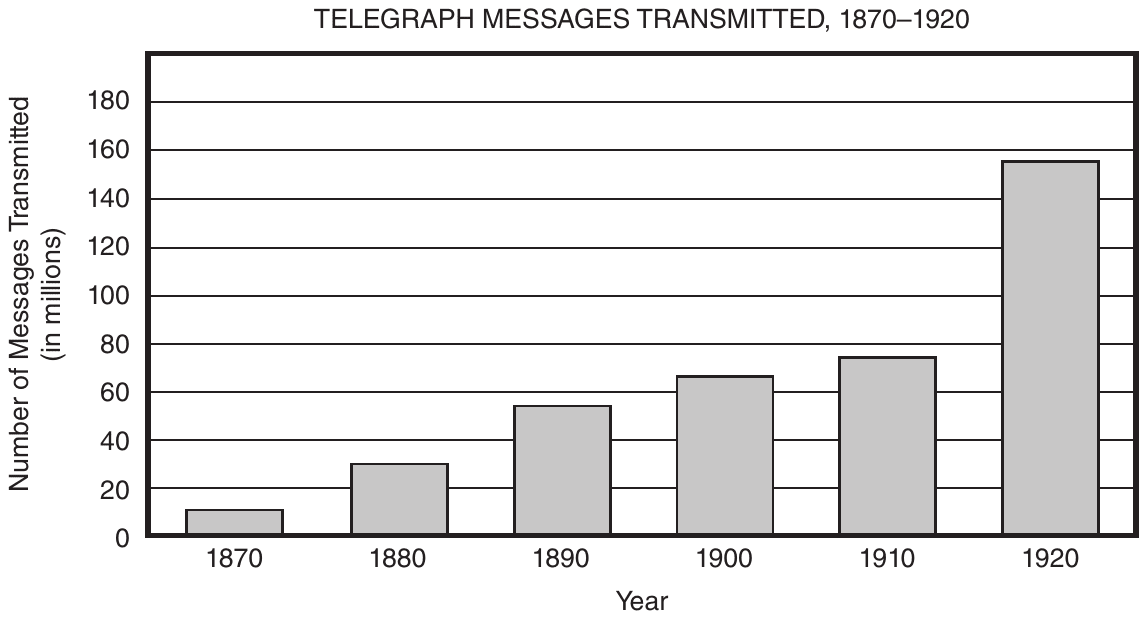
Source: U.S. Bureau of the Census. Historical Statistics of the United States, Colonial Times to 1970, Bicentennial Edition, Part 2. Washington, D.C., 1975.
Question
Which statement describes how the author’s use of problem-solution in paragraph 2 contributes to the development of ideas in the passage?
- AMorse’s discussion on a ship about Faraday’s electromagnet reminded him of the Yale College lectures on electricity, which he had enjoyed but had not fully understood, inspiring him to learn more about electricity from his colleague Gale.
- BMorse’s discouragement over his lack of knowledge of electricity prompted him to experiment with batteries, magnets, and wires, which led to the development of a new long-distance communication system.
- CMorse’s difficulty in understanding how Faraday’s electromagnet worked was frustrating, and it pushed him to create a system for sending signals over wires.
- DMorse’s longtime fascination was not enough to make up for his lack of knowledge about electricity, so he eventually sought help from Gale.
Show the answer
Correct answer: D
The question asks for the best explanation of how the use of problem-solution in paragraph 2 helps develop the ideas in the passage. Option D is correct because it explains that Morse realized his problem was that he was not knowledgeable enough to continue his experimentation without help, so the solution was to seek help from a colleague.
Option A is incorrect because, while the discussion on the ship fascinated Morse and reminded him of the lectures he had attended at Yale College, it was his failed attempts with electricity that caused him to reach out to Gale for help.
Option B is incorrect because, while “Morse found when he began to develop his idea that he had little real understanding of the nature of electricity” (paragraph 2), the paragraph does not state that he was discouraged; it was his failed experimentation that resulted in him first realizing that he needed help.
Option C is incorrect because the paragraph states that “Morse came to understand how [Faraday’s electromagnet] worked,” and that understanding is what caused him to think about sending messages over a wire. Also, Morse’s difficulty was in understanding the properties of electricity in general once he began his experimentation.
Question analysis
In this text structure question about “Invention of the Telegraph,” students explain how the problem-and-solution pattern in paragraph 2 develops ideas about Samuel Morse. All four choices are long sentences built from real details about the ship, Yale and Gale, so students must check each one’s account of what led to what.
- Grade level
- Grade 8 reading and task
- Compared with grade 7
- Above grade 7 Identifying problem and solution is familiar from earlier grades, but these choices are long, detail-packed chains in which a single misplaced cause makes an option wrong, which demands closer checking than typical grade 7 items.
- Estimated difficulty
- Hard: combines ideas, needs a plan, and has more than one tempting wrong answer.
- Thinking it demands
- Depth of knowledge 2, skills and concepts · mainly analyze
- What makes it hard
- Every choice must be checked major
- A very close wrong answer moderate
- The right answer is reworded moderate
- A lot to read moderate
- How, not what minor
- Evidence
- Answered from one paragraph or stanza
- Reading level
- Passage: about grade 11, 910 words; question and choices: about grade 16, 132 words.
- Corrected from the DOE handbook
- A wrong paragraph number in the explanation was corrected.
- A misspelled name in the explanation was corrected.
- A punctuation slip in the explanation was corrected.
- Students, last 30 days
- Not enough answers yet to show (it takes 10).
Why it is hard, traps and wrong answers (shows the answer)
Why it is hard
Every choice is assembled from things the paragraph really mentions, so recognition is useless and only the order of causes decides. The most tempting wrong choice ends with Gale, the right solution, but invents a reminder of the Yale lectures to get there; others turn the failed experiments into the solution or reverse what Morse understood. The question rewards reading each long choice clause by clause, which costs time.
Every choice must be checked major Choosing the answer
Each choice is a chain of two or three causes built from real details, the ship, Faraday, Yale, the batteries and wires, Gale, so every link has to be checked against paragraph 2’s order of events. (Embretson & Wetzel, 1987)
A very close wrong answer moderate Choosing the answer
The Yale-reminder choice and the key both join Morse’s enjoyment of electricity, his weak grasp of it and his turn to Gale; they part on one detail, the claim that the shipboard talk “reminded him” of Yale, which the paragraph never makes. (Embretson & Wetzel, 1987; Gorin & Embretson, 2006; Ascalon et al., 2007)
The right answer is reworded moderate Choosing the answer
The key turns the Yale letter and the shipboard speculation into “longtime fascination,” a phrase the passage never uses, while the wrong choices repeat its names and phrases and so look better supported. (Freedle & Kostin, 1993; Kirsch & Mosenthal, 1990)
A lot to read moderate Understanding the question
The four choices run to about 110 words, the longest 37, and paragraph 2 itself packs a voyage, a college letter, failed experiments and a colleague into four sentences. (Kintsch, 1998; Gorin & Embretson, 2006; Freedle & Kostin, 1993)
How, not what minor Working it out
Students must name the paragraph’s problem, too little understanding of electricity, and its solution, Gale, before judging which account of the pattern is accurate. (Anderson & Krathwohl, 2001)
Strategy: Name the problem and the solution in paragraph 2 in a few words each, then choose the option whose sequence of events matches the paragraph exactly.
Traps
- Reversed relationship: Cause and effect, or the order of events, turned around.
- Half right: One half of a two-part choice is right and the other is not.
The wrong answers, classified
A Half right (King et al., 2004; Thissen, Steinberg & Fitzpatrick, 1989)
Ends correctly with Morse learning from Gale, but invents its cause: the paragraph never says the shipboard talk reminded Morse of Yale, and it skips the failed experiments that sent him to Gale.
B Reversed relationship (King et al., 2004)
Reverses cause and effect: the “sporadic attempts” with batteries, magnets and wires exposed Morse’s weak grasp of electricity and sent him to Gale, rather than flowing from discouragement and producing the system.
C Twists what the text says (King et al., 2004)
Says Morse struggled to understand Faraday’s electromagnet, but the paragraph states that he “came to understand how it worked,” and that understanding is what gave him the idea.
What was corrected from the DOE handbook, and why
- Explanation: The handbook places the sentence “Morse found when he began to develop his idea that he had little real understanding of the nature of electricity” in paragraph 3. It is in paragraph 2, the paragraph the question is about, so the site now says “(paragraph 2).”
- Explanation: The handbook spells Leonard Gale’s name “Gail.” The passage spells it “Gale,” and so does the site now.
- Explanation: The handbook capitalizes “Also” after a semicolon (“over a wire; Also, Morse’s difficulty…”). The site starts a new sentence instead: “over a wire. Also, Morse’s difficulty…”
Working it out, step by step
Figure out what the question asks
This asks about problem-solution in paragraph 2. Problem-solution is a way to organize writing. First you learn about a problem, then how someone solved it. Find the problem and the solution. Then pick the choice that tells them in the right order.
Find the problem in paragraph 2
Paragraph 2 starts with “The idea of using electricity to communicate over distance.” It says Morse had enjoyed the electricity lectures at Yale. But then comes the problem: “Morse found when he began to develop his idea that he had little real understanding of the nature of electricity.”
Find the solution
The same sentence goes on: “after sporadic attempts to work with batteries, magnets, and wires, he finally turned for help to a colleague.” “Sporadic” means now and then, not steady. A colleague is a coworker. So Morse was interested in the subject, tried on his own, and did not succeed. His interest was not enough. His solution was to ask Gale for help.
Check each choice
- A is wrong. It ends with Gale, but the paragraph never says the ship talk “reminded him” of Yale. It also skips the failed tries.
- B is wrong. It has the order backward. The experiments showed the problem. They did not build the system.
- C is wrong. The paragraph says Morse “came to understand how it worked,” meaning the electromagnet.
- D fits. Long interest was not enough, so he got help from Gale.
Choose the answer
The problem was Morse’s weak grasp of electricity, and the solution was Gale. So the answer is D, “Morse’s longtime fascination was not enough to make up for his lack of knowledge about electricity, so he eventually sought help from Gale.”
Why this answer and not the closest wrong one
A is the closest trap. Like D, it mentions Yale, Morse’s weak grasp of electricity and Gale. But it adds a link the paragraph never makes, that the ship talk reminded him of Yale. With long choices, check every part. One made-up link makes the whole choice wrong.
More questions like this
The original DOE question
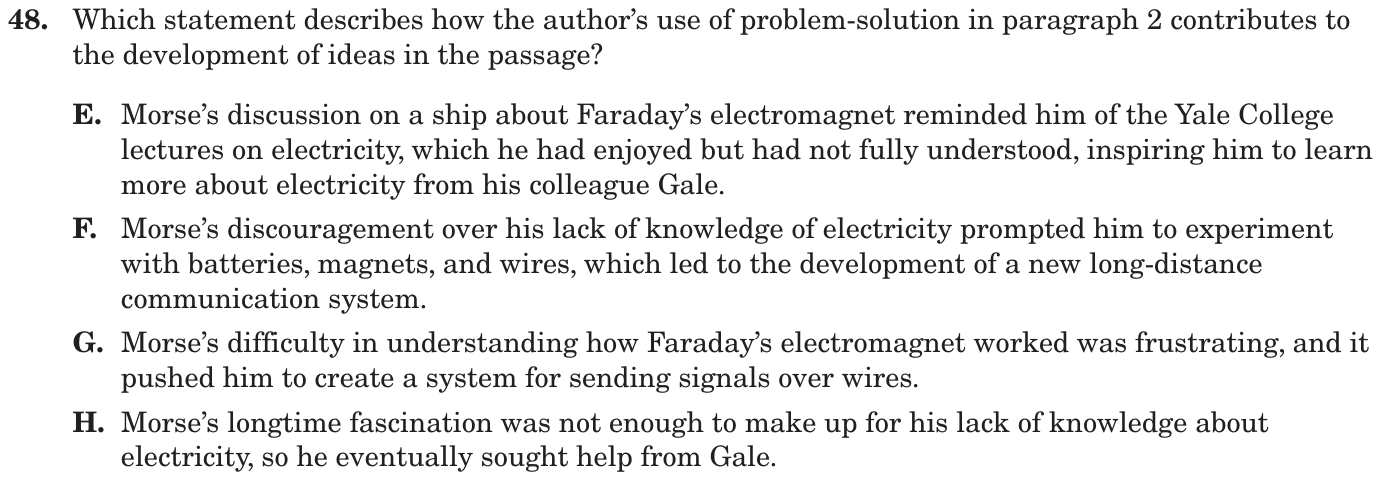
The passage “Invention of the Telegraph” as printed (pages 146–148)
Question 2 of 6
2024 Test A English, question 53Passage Excerpt from “It’s Time to Stop Thinking That All Non-Native Species Are Evil”
Excerpt from “It’s Time to Stop Thinking That All Non-Native Species Are Evil”
by Emma Marris
The author of this opinion article attended a symposium, or conference, in Missoula, Montana, at which biologists and other scientists discussed species of plants and animals that are not native to the areas in which they live.
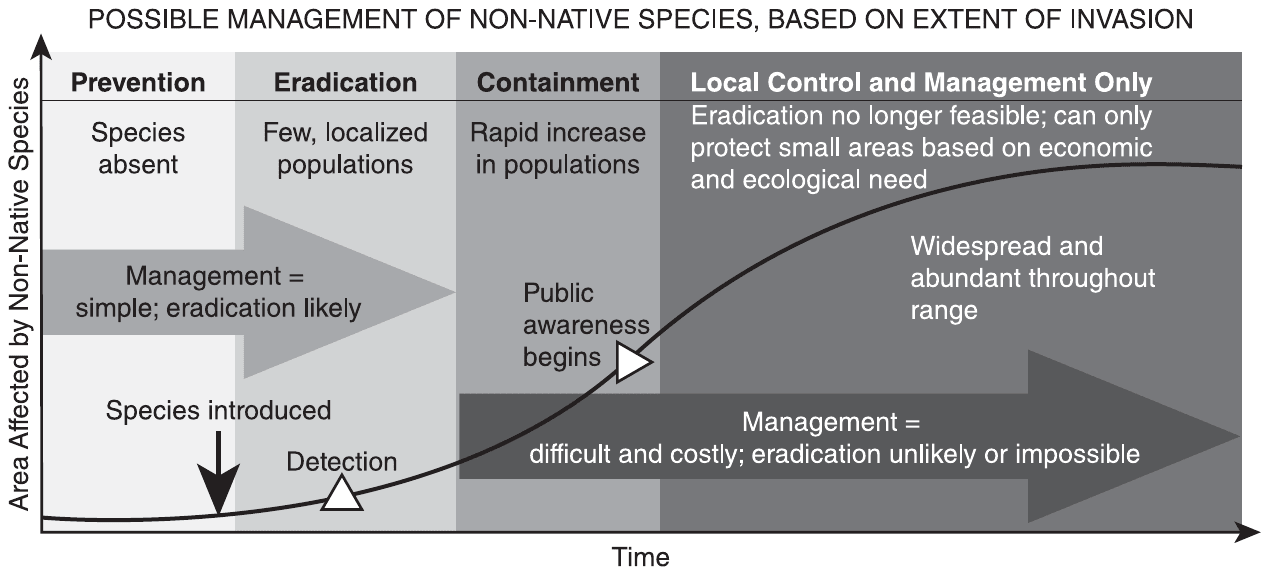
Invasive species are scary. It was ecologist Charles Elton, back in the 1950s, who introduced the militaristic “invasion” metaphor to describe exotic plants and animals—but there’s no question some can be extremely destructive.
The brown tree snake has eaten a dozen kinds of forest birds in Guam to extinction; zebra mussels clog pipes around the Great Lakes; the common house cat turns out to be, in Australia, a mercilessly effective killer of cute, fluffy marsupials like the bilby and the numbat.
As scientists have sounded the alarm about these pests, the public has gotten the message. Citizen groups rip out non-native plants. Native gardens have become increasingly popular, both as ways to celebrate the unique flora of each region and as tiny hot spots of diversity. Native trees provide food for native bugs, which feed native birds. Food chains developed over thousands of years of co-evolution unfold in our backyards. . . .
So we’ve learned, scientists and laypeople alike, that native species are good and non-natives are bad.
Julian Olden, a biologist at the University of Washington, Seattle, who co-organized the symposium, recently polled nearly 2,000 ecologists. Among his findings: a substantial number of them said they would immediately eradicate a hypothetical non-native forest plant, even if it were shown to have no effect on the forest. Olden calls this the “guilty even when proven innocent” approach.
That kind of approach is not very useful on a rapidly changing planet.
Exotics Are Everywhere
Climate change is making it harder even to decide who the invaders are.
How, scientists at the symposium wondered, do you define “native” on a warming planet, when plants and animals are already moving toward the poles or up mountainsides in search of climate conditions they can tolerate? Should we consider them “invasive” in their new homes? Regardless of what we label them, conservationists will be reluctant to remove them from their new environs—to do so would stymie1 their chances of adapting to the warmer future we’re creating.
And then there are the non-natives that we actually like. Most domestic crops are exotic in most of the places they’re grown, but there are even wild exotics that “do good,” forming useful relationships with native species.
Edwin Grosholz of the University of California, Davis, told the recent symposium about one such relationship. On beaches in his state, non-native spartina grass has become important habitat for the endangered California clapper rail, a plump shorebird with a downward curving bill more at home on land than in the air. A project to rip out and poison the spartina—which grows in dense swaths that exclude many other shorebirds—saw clapper rail numbers go tumbling downward.
There are other examples like that. The endangered southwestern willow flycatcher nests in “invasive” tamarisk shrubs. Many native (and beautiful) Hawaiian flowers are now pollinated by the Japanese white-eye bird—because the native pollinators have been driven extinct by other non-native species.
Should we impose further risk on already endangered natives by severing these relationships? Or should we admire the resilience of nature and let such “well-behaved” exotics stay? . . .
Leave them alone, more and more conservationists are arguing, and stop focusing obsessively on categorizing species as native or non-native. Mark Davis, an ecologist at Macalester College in St. Paul, Minnesota, once considered himself an “invasion biologist”—but not anymore. “I am actively trying to get the field to retire the invader narrative,” he said in Missoula.
A Good Thing, Not the Only Thing
After all, nativeness is just one environmental value, and arguably not as important as preventing extinctions and preserving biodiversity. In some cases we can best serve biodiversity by leaving the non-natives alone or even—brace yourself, now—introducing them on purpose.
This is the thinking behind, for example, installing the Aldabra tortoise on the islands of Mauritius. The islands lost their own large tortoises, and the fruiting plants that formerly had their seeds moved around by these fruit-loving reptiles have been on the decline. A tortoise that’s related to the island’s large tortoises—a non-native from the Seychelles in the Indian Ocean that was intentionally introduced in 2004—is now handling some of that work.
Most of the time, for the time being, conserving species still means focusing on supporting them in their historical habitats, planting natives and removing non-natives. We can and should do that in places where it is feasible and important to us.
From “It’s Time to Stop Thinking That All Non-Native Species Are Evil” by Emma Marris from NATIONAL GEOGRAPHIC MAGAZINE, July 24, 2014. Copyright © 2014 by National Geographic Society.
1stymie: hinder or interfere with
Question
The author’s use of cause and effect in paragraphs 10–11 mainly emphasizes the idea that
- Asome non-native species have helped their environments while others have had harmful impacts.
- Battempts to remove non-native species have seldom produced desired results.
- Csome endangered native species have flourished because of the presence of non-native species.
- Dinteractions between endangered native species and non-native species must be carefully monitored.
Show the answer
Correct answer: C
The question asks what the author’s use of cause and effect in paragraphs 10–11 mainly emphasizes.
A. Incorrect. The examples of cause and effect discussed in paragraphs 10–11, such as the spartina grass helping the clapper rail and the Japanese white-eye bird pollinating Hawaiian flowers, are all instances in which non-native species have helped their new environments.
B. Incorrect. While paragraph 10 does mention that efforts to eradicate the non-native spartina grass hurt the native clapper rail shorebird, the main emphasis in both paragraphs 10–11 is on the fact that certain non-native species have helped native species.
C. CORRECT. Paragraphs 10–11 focus on several examples of non-native species that have helped endangered native species flourish: non-native spartina grass providing “important habitat for the endangered California clapper rail” (paragraph 10), non-native tamarisk shrubs providing nesting places for the endangered southwestern willow flycatcher (paragraph 11), and the non-native Japanese white-eye bird pollinating Hawaiian flowers (paragraph 11).
D. Incorrect. While paragraphs 10–11 describe several interactions between non-native and native species, they never discuss monitoring these interactions.
Question analysis
This text-structure question asks what the cause-and-effect examples in two paragraphs of an article about non-native species mainly emphasize. The paragraphs describe a shorebird, a flycatcher and Hawaiian flowers, and students must decide what the examples have in common rather than fixing on any one of them.
- Grade level
- Grade 8 reading and task
- Compared with grade 7
- Above grade 7 Analyzing what a cause-and-effect structure emphasizes is grade 7 work, but these examples involve unfamiliar species and endangered status, and more than one choice is partly supported by the paragraphs, which raises the demand above typical.
- Estimated difficulty
- Hard: combines ideas, needs a plan, and has more than one tempting wrong answer.
- Thinking it demands
- Depth of knowledge 3, strategic thinking · mainly analyze
- What makes it hard
- A very close wrong answer major
- Reading between the lines moderate
- An unfamiliar subject minor
- Evidence
- Answered from several paragraphs or stanzas
- Reading level
- Passage: about grade 11, 815 words; question and choices: about grade 11, 62 words.
- Students, last 30 days
- Not enough answers yet to show (it takes 10).
Why it is hard, traps and wrong answers (shows the answer)
Why it is hard
The paragraphs mention harm as well as help, so a balanced statement about both looks accurate and even fair-minded. What the cause-and-effect pairs stress, though, is endangered natives depending on non-natives, and the right answer captures that while overstating it, since a bird whose numbers held up only with spartina's help can hardly be said to have flourished. Students must prefer the statement of the main emphasis to one that is partly supported but off the point.
A very close wrong answer major Choosing the answer
The right choice and the help-and-harm choice both say non-natives have aided their surroundings; they part on harm, which the paragraphs do mention, spartina crowding out shorebirds and other non-natives killing Hawaii's pollinators, but only in passing. (Embretson & Wetzel, 1987; Gorin & Embretson, 2006; Ascalon et al., 2007)
Reading between the lines moderate Working it out
Paragraph 10 states its cause and effect backwards, removing spartina sent clapper rail numbers “tumbling downward”, and the student must turn that around into the grass's presence helping the bird. (Graesser, Singer & Trabasso, 1994; Kintsch, 1998)
An unfamiliar subject minor Understanding the question
Five unfamiliar species crowd two paragraphs, spartina grass, the California clapper rail, tamarisk shrubs, the southwestern willow flycatcher and the Japanese white-eye, and each one's role must be kept straight. (Recht & Leslie, 1988; Kintsch, 1998)
Strategy: List each cause-and-effect pair in paragraphs 10 and 11, the species involved and what happened to them, then pick the statement that holds for the examples taken together.
Traps
- Too narrow: A single detail offered as the central idea or a summary, or a summary that keeps minor details and leaves out an essential part.
- Too broad or too strong: A choice overstates, generalizes, or uses absolute words the text does not support.
- Outside knowledge: A choice is plausible in the real world but not supported by this text.
The wrong answers, classified
A Too narrow (King et al., 2004)
Accurately notes helpful and harmful non-natives, but the harm is mentioned only in passing, and it leaves out what every example stresses, endangered natives depending on non-natives.
B Too broad or too strong (King et al., 2004)
Generalizes from the single spartina project in paragraph 10 to removal attempts in general, a “seldom” claim that neither paragraph makes.
D Outside knowledge (King et al., 2004; Recht & Leslie, 1988)
Adds a sensible-sounding call for careful monitoring, the kind of advice scientists often give, but neither paragraph says anything about watching over these relationships.
Working it out, step by step
Know what the question asks
In a cause-and-effect pattern, one thing makes another happen. You need the main idea that the causes and effects in paragraphs 10 and 11 stress. Start by listing each pair.
List each cause and effect
- Paragraph 10: non-native spartina grass gives the endangered clapper rail a home, so when people ripped out the grass, clapper rail numbers went “tumbling downward.”
- Paragraph 11: the endangered willow flycatcher nests in non-native tamarisk shrubs.
- Paragraph 11: native Hawaiian flowers are now pollinated by a non-native bird, the Japanese white-eye.
Find the common thread
Endangered means at risk of dying out. Pollinated means a bird or bug carries pollen between flowers so they can make seeds. In every pair, a native species depends on a non-native one. The newcomer gives it a home, a place to nest or a pollinator. Two of the natives, the clapper rail and the flycatcher, are endangered. So the paragraphs stress that some endangered natives do better because non-natives are there.
Check each choice
- C fits: some endangered natives have “flourished,” or done well, because non-natives are present.
- A is wrong because harm comes up only in passing, while every example stresses a native getting help.
- B is wrong because one removal project is not enough to say removal “seldom” works.
- D is wrong because the paragraphs never mention monitoring, or watching over, these relationships.
Watch out: The paragraphs do mention harm. Spartina crowds out some other shorebirds, and other non-natives wiped out Hawaii’s native pollinators. So A sounds balanced, but it misses the main point.
Choose the answer
The causes and effects show struggling natives, two of them endangered, helped by non-natives. So the answer is C.
Why this answer and not the closest wrong one
A comes closest, because the paragraphs mention harm as well as help. But the harm is only a side note. Every cause and effect shows a native relying on a non-native, and two of those natives are endangered birds. C names that main point, even though “flourished” is a strong word for birds that are still endangered.
More questions like this
The original DOE question
The passage “Excerpt from “It’s Time to Stop Thinking That All Non-Native Species Are Evil”” as printed (pages 68–70)
Question 3 of 6
2024 Test B English, question 48Passage Snowy Mountains
Snowy Mountains
by John Gould Fletcher
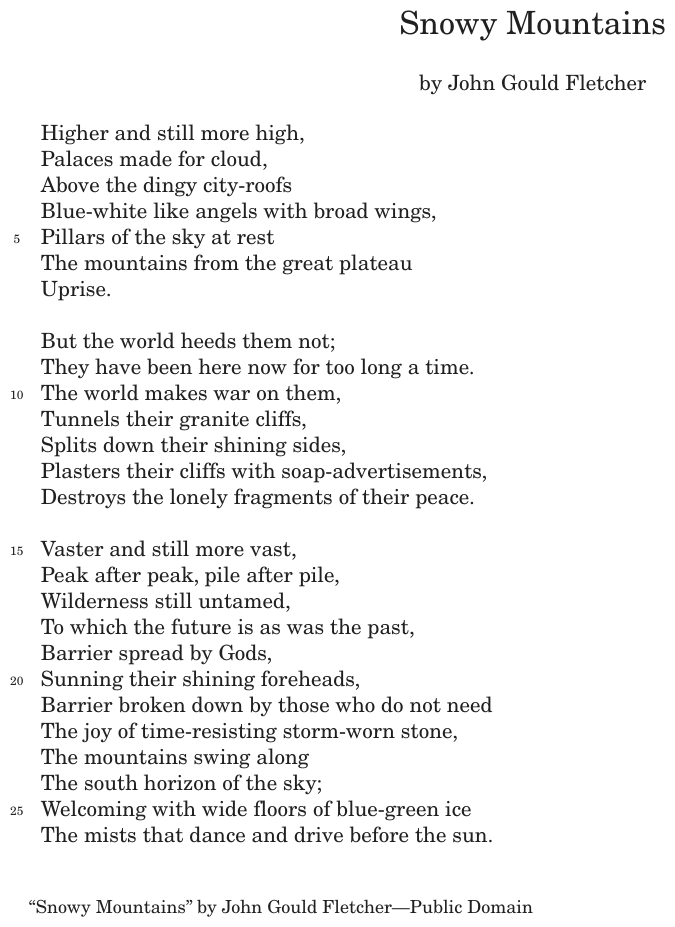
Higher and still more high,
Palaces made for cloud,
Above the dingy city-roofs
Blue-white like angels with broad wings,
Pillars of the sky at rest
The mountains from the great plateau
Uprise.
But the world heeds them not;
They have been here now for too long a time.
The world makes war on them,
Tunnels their granite cliffs,
Splits down their shining sides,
Plasters their cliffs with soap-advertisements,
Destroys the lonely fragments of their peace.
Vaster and still more vast,
Peak after peak, pile after pile,
Wilderness still untamed,
To which the future is as was the past,
Barrier spread by Gods,
Sunning their shining foreheads,
Barrier broken down by those who do not need
The joy of time-resisting storm-worn stone,
The mountains swing along
The south horizon of the sky;
Welcoming with wide floors of blue-green ice
The mists that dance and drive before the sun.
“Snowy Mountains” by John Gould Fletcher—Public Domain
Question
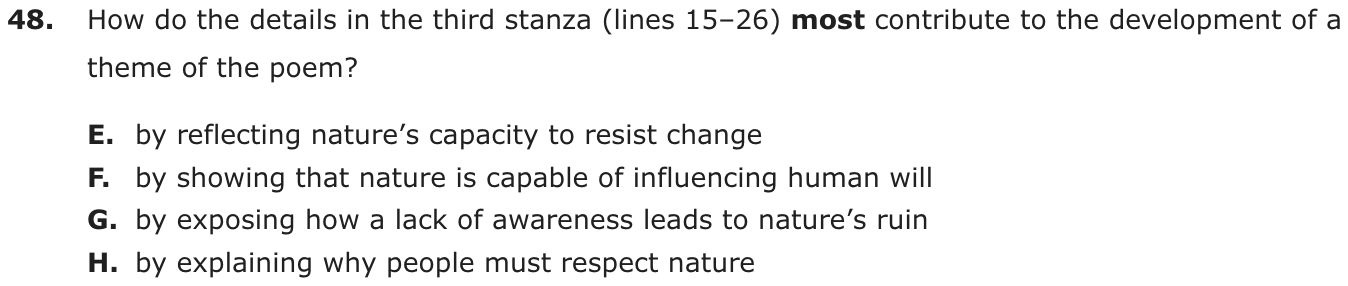
How do the details in the third stanza (lines 15–26) most contribute to the development of a theme of the poem?
- Aby reflecting nature’s capacity to resist change
- Bby showing that nature is capable of influencing human will
- Cby exposing how a lack of awareness leads to nature’s ruin
- Dby explaining why people must respect nature
Show the answer
Correct answer: A
The question asks how the details in the third stanza most contribute to the development of a theme of the poem.
A. CORRECT. In the third stanza, phrases such as “Wilderness still untamed” (line 17), “time-resisting storm-worn stone” (line 22), and “The mountains swing along” (line 23) convey the message that in spite of the destruction described in the second stanza, the mountains manage to maintain their wild magnificence.
B. Incorrect. While the phrase “Barrier broken down” (line 21) conveys the idea that people can have some effect on the natural landscape, it does not convey how nature affects people.
C. Incorrect. The phrase “those who do not need” (line 21) implies a choice to damage nature and not a lack of awareness or understanding.
D. Incorrect. The third stanza is not a call to humanity to respect the mountains but a description of the untamed, welcoming mountains and the joy they provide for those who appreciate them.
Question analysis
Students trace how the details of the third and final stanza of “Snowy Mountains,” lines 15–26, most contribute to developing a theme of the poem. Because the stanza is a single sentence that runs from line 15 to the poem’s last word, students must keep its whole movement in mind before deciding what it adds.
- Grade level
- Grade 8 reading and task
- Compared with grade 7
- Above grade 7 Grade 7 theme questions usually rest on a few clear details. Here students must hold a twelve-line stanza of inverted, piled-up phrases in mind and pick among four reasonable lessons about nature, a heavier load closer to grade 8.
- Estimated difficulty
- Hard: combines ideas, needs a plan, and has more than one tempting wrong answer.
- Thinking it demands
- Depth of knowledge 3, strategic thinking · mainly analyze
- What makes it hard
- Complex sentences moderate
- Figurative or literary language moderate
- Evidence in several places moderate
- Evidence
- Answered from one paragraph or stanza
- Reading level
- Passage: 161 words (a poem; reading level not measured); question and choices: about grade 7, 55 words.
- Students, last 30 days
- Not enough answers yet to show (it takes 10).
Why it is hard, traps and wrong answers (shows the answer)
Why it is hard
The final stanza holds both endurance and damage, and the stem’s “most” asks which of the two its details build. Students who fix on the broken barrier choose ruin, a reading the second stanza seems to confirm, while those who tally the stanza’s details find untamed wilderness, time-resisting stone and mountains swinging at ease. Because the stanza is one long, inverted sentence, that tally is slow, which is what makes the question hard.
Complex sentences moderate Understanding the question
Lines 15–26 are one sentence in which phrase after phrase, from “Vaster and still more vast” to “storm-worn stone,” comes before its subject, “The mountains,” in line 23. (Abedi & Lord, 2001; Freedle & Kostin, 1993; Messick, 1989)
Figurative or literary language moderate Understanding the question
The message of endurance is carried by personification: the peaks have “shining foreheads,” are “spread by Gods,” and “swing along” the horizon welcoming the mists. (Graesser, Singer & Trabasso, 1994; Kintsch, 1998)
Evidence in several places moderate Working it out
The theme has to be assembled from details scattered over twelve lines, “Wilderness still untamed,” “the future is as was the past,” “time-resisting,” and weighed against the single line of damage. (Kirsch & Mosenthal, 1990; Gorin & Embretson, 2006)
Strategy: Read lines 15–26 as one long sentence, find its main subject and verb, and sum up its message in a phrase; then check each choice against the whole stanza, not a single line.
Traps
- Too narrow: A single detail offered as the central idea or a summary, or a summary that keeps minor details and leaves out an essential part.
- Outside knowledge: A choice is plausible in the real world but not supported by this text.
- Reversed relationship: Cause and effect, or the order of events, turned around.
The wrong answers, classified
B Reversed relationship (King et al., 2004)
Turns the influence around: in this stanza people break down the barrier while the peaks endure, and nothing shows the mountains shaping what people want.
C Too narrow (King et al., 2004)
Builds on line 21’s “Barrier broken down,” the stanza’s one line of damage, and lets it stand for twelve lines that mostly celebrate the mountains as wild and lasting.
D Outside knowledge (King et al., 2004; Recht & Leslie, 1988)
States the lesson a nature poem is expected to teach, that people must respect nature, but the stanza describes the mountains and never tells readers what to do.
Working it out, step by step
Figure out what the question asks
This asks about theme, the big message of the poem. You need to see what the details of the third stanza, lines 15 to 26, add to that message. The word “most” matters. Pick the idea that most of the details support, not just one line.
Gather the details in lines 15 to 26
The peaks grow “Vaster and still more vast” (line 15). They are a “Wilderness still untamed” (line 17). For them, the future is “as was the past” (line 18). Their stone is “time-resisting” (line 22). In the last four lines, “The mountains swing along” the sky and welcome the mists. Only line 21 shows damage: the barrier is “broken down.”
Find what the details share
Untamed means still wild, not controlled by people. If the future is the same as the past, the mountains are not changing. Time-resisting means they hold out against the years. And at the end of the stanza, they are still moving along at ease. Nearly every detail shows the same thing. The mountains last and stay wild, which is nature’s power to resist change.
Check each choice
- A fits. Wild, unchanging, time-resisting mountains show nature holding out against change.
- B does not fit. It turns things around. In this stanza, people affect the mountains. Nothing shows the mountains changing what people want.
- C does not fit. Line 21 shows damage, but it is one line out of twelve. The stanza does not end in ruin either: the mountains still swing along and welcome the mists.
- D does not fit. These lines paint a picture of the peaks. They give readers no orders and no reasons to behave a certain way.
Choose the answer
Most of the third stanza shows mountains that stay wild and lasting. So the answer is A.
Why this answer and not the closest wrong one
C is the closest trap, because line 21 does show the barrier “broken down,” and the second stanza is full of harm. But this question is about the third stanza, and it asks what the details most add. Most of the other lines there show mountains that are vast, wild and lasting. That builds A, not ruin.
More questions like this
The original DOE question
The passage “Snowy Mountains” as printed (page 142)
Question 4 of 6
2026 Practice Test D Math, question 35Question
XYZ Corporation hired 6 people as summer workers. Of these 6 people, 3 will be hired as permanent employees in the fall. If 2 of the 6 people are male, how many of the possible groups of 3 people hired in the fall will include only 1 male?
- A4
- B6
- C12
- D24
Show the answer
Correct answer: C
An organized list can be used to determine the number of groups of 3 people that include only 1 male.
Let the letters A, B, C, and D represent the females, and let the numbers 1 and 2 represent the males.
Then, create a list of all possible combinations of 3 people with only 1 male.
AB1, AB2, AC1, AC2, AD1, AD2
BC1, BC2, BD1, BD2
CD1, CD2
There are 12 possible groups with only 1 male.
Question analysis
A company hired 6 summer workers, 2 of them male, and will keep 3 as permanent employees in the fall. This counting question asks how many possible groups of 3 include only 1 male. Students count combinations where order does not matter, and the bold word only, with two kinds of workers to combine, makes careful listing essential.
- NYS standards
- 7.SP.8b sample spaces for compound events
- Grade level
- Grade 7 content, by NYS standard
- Compared with grade 7
- Above grade 7 Grade 7 students list outcomes with organized lists and tree diagrams, usually ordered ones. Counting unordered groups of three under an "only one" condition, built from two kinds of people, goes beyond that typical work.
- Estimated difficulty
- Hard: combines ideas, needs a plan, and has more than one tempting wrong answer.
- Thinking it demands
- Depth of knowledge 2, skills and concepts · mainly apply
- What makes it hard
- Combines ideas moderate
- Something you must already know minor
- Turning words into math minor
- Solution
- 3 steps
- Reading level
- Question and choices: about grade 7, 41 words.
- Students, last 30 days
- Not enough answers yet to show (it takes 10).
Why it is hard, traps and wrong answers (shows the answer)
Why it is hard
The question hides a two-stage count in a hiring story. Students tend to get one stage right and forget the other: they count the pairs of women and stop, or they count ordered picks and so find every group twice. Naming the women A to D and the men 1 and 2, then listing the pairs of women alphabetically with each man attached, makes every group visible and checkable.
Combines ideas moderate Working it out
Two counts are joined: the 6 ways to pick 2 of the 4 women, then the 2 ways to pick the man, and the total is their product. (Embretson, 1998; Daniel & Embretson, 2010)
Something you must already know minor Working it out
Students must already know that a group is the same whichever order its members are named, so picking one woman and then another repeats the reverse pick. (Anderson & Krathwohl, 2001)
Turning words into math minor Understanding the question
The bold word only means exactly one man, so the other two places in each group of 3 must go to two of the 4 women, a step the stem leaves unsaid. (Hegarty, Mayer & Monk, 1995; Koedinger & Nathan, 2004)
Strategy: Name the women A to D and the men 1 and 2, list every pair of women without repeats, then attach each man to each pair and count the groups.
Traps
- Stops one step early: A choice is a number from partway through the solution.
- Overlapping groups: Things in two groups at once are counted twice, or not subtracted.
The wrong answers, classified
A Numbers taken from the question (Hegarty, Mayer & Monk, 1995)
Multiplies the 2 men by the 2 places left for women, 2 × 2 = 4, using numbers from the question without listing a single group.
B Stops one step early (King et al., 2004; Gierl et al., 2017)
Counts the 6 pairs of women correctly but stops before pairing each one with either of the 2 men, which doubles the count.
D Overlapping groups (King et al., 2004)
Counts ordered picks of the two women, 4 × 3 = 12 instead of 6, so each group appears twice, then doubles for the men to reach 24.
Worked solution, step by step
Formulas used
- Counting with two choices
- Each way of picking the man can go with each way of picking the two women. So you multiply the two counts. It is like outfits: 2 shirts with 6 pairs of pants make 12 outfits.
Sort out the question
Six people work for the summer. Two are male, so the other 4 are female. Three will be hired in the fall.
You need the number of groups of 3 with only 1 male. That means exactly 1 man and 2 women. In a group, order does not matter. Ann, Bea and Carl is the same group as Carl, Ann and Bea.
Give each person a name
Call the women A, B, C and D. Call the men 1 and 2. Every group you want has 2 letters and 1 number, like AB1.
List the pairs of women
List each pair once. Start with A, then pair B only with letters after it, and so on:
- AB, AC, AD
- BC, BD
- CD
That is 6 pairs. BA is not new, since it is the same pair as AB.
Watch out: counting the order gives pairs, each one twice. Then doubling for the men gives 24, choice D.
Add a man to each pair
Each pair of women can go with man 1 or man 2. Use the counting rule:
Watch out: stopping at the 6 pairs of women leaves out the men. That gives 6, choice B.
So the answer is C, 12.
Check your answer
Write out every group. With man 1: AB1, AC1, AD1, BC1, BD1, CD1. With man 2: AB2, AC2, AD2, BC2, BD2, CD2. Each list has 6 groups, and . No group repeats, and each has just one man.
More questions like this
The original DOE question
Question 5 of 6
2024 Test A Math, question 18Question
Each number in a sequence is formed by doubling the previous number and then adding 1. If the 9th number in the sequence is 63, what is the 10th number minus the 7th number?
- A96
- B111
- C112
- D127
Show the answer
Correct answer: C
First, write an equation based on the rule described in the item. Let x be the previous number in the sequence and y be the number in the sequence. The ninth number in the sequence is 63.
Determine the 10th number in the sequence, y, by making and solving:
Determine the 8th number in the sequence, x, by making and solving:
Subtract one from both sides of the equation.
Determine the 7th number in the sequence, x, by making and solving:
Subtract the 7th number in the sequence from the 10th number:
The difference is 112.
Question analysis
A sequence question: each number is found by doubling the one before it and adding 1, and the 9th number is 63. Students find the 10th number minus the 7th. That means running the rule forward once and backward twice, while keeping track of which position each number holds.
- Grade level
- Grade 7 content, by NYS standard
- Compared with grade 7
- Above grade 7 Grade 7 students solve two-step equations but rarely have to run a rule backward through a sequence. This mixes forward and backward steps with position counting, so it asks for more planning than a typical grade 7 task.
- Estimated difficulty
- Hard: combines ideas, needs a plan, and has more than one tempting wrong answer.
- Thinking it demands
- Depth of knowledge 2, skills and concepts · mainly apply
- What makes it hard
- No obvious method moderate
- Many steps moderate
- Much to keep track of minor
- Solution
- 4 steps
- Reading level
- Question and choices: about grade 7, 32 words.
- Corrected from the DOE handbook
- A misplaced parenthesis in the explanation’s working was corrected.
- Students, last 30 days
- Not enough answers yet to show (it takes 10).
Why it is hard, traps and wrong answers (shows the answer)
Why it is hard
Applying the rule forward is routine; running it backward is not, and the question needs both. Students must also count positions carefully, since the 9th number is given and the 7th is two steps back, not one. Each listed wrong answer stops or slips at a different stage, so writing the four numbers in a row, 15, 31, 63 and 127, before subtracting is the reliable way.
No obvious method moderate Working it out
The rule is stated only forward, double and add 1, but the 7th and 8th numbers come before the given 9th, so the rule must be undone: subtract 1, then halve. (Schoenfeld, 1985)
Many steps moderate Working it out
One forward step reaches the 10th number, 127, two backward steps reach the 8th and 7th, 31 and 15, and a final subtraction finishes. (Daniel & Embretson, 2010; Enright, Morley & Sheehan, 2002)
Much to keep track of minor Working it out
Four positions and their values, 7th to 10th, have to be kept straight, and the 8th number is easy to mistake for the 7th. (Sweller, 1988; Carpenter, Just & Shell, 1990)
Strategy: Apply the rule to 63 to get the 10th number; to go back a position, subtract 1 and halve, doing it twice to reach the 7th; then subtract.
Traps
- Counting the ends: Inclusive or exclusive ends, fence posts, consecutive numbers: an answer that is one too many or too few, or an endpoint drawn open where it belongs closed (or the reverse).
- Stops one step early: A choice is a number from partway through the solution.
The wrong answers, classified
A Counting the ends (Brown & Burton, 1978)
Steps back only once from the 9th number and subtracts the 8th, 127 − 31 = 96, one position short of the 7th.
B Misreads the question (Hegarty, Mayer & Monk, 1995)
Doubles 63 to 126 but forgets to add 1 on that step, then subtracts the correct 7th number: 126 − 15 = 111.
D Stops one step early (King et al., 2004; Gierl et al., 2017)
Finds the 10th number, 2 × 63 + 1 = 127, and stops without subtracting the 7th number from it.
What was corrected from the DOE handbook, and why
- Explanation: Finding the 7th number, the handbook writes “2x + (1 − 1 = 31 − 1)”, with the closing parenthesis after the whole equation, so the line reads as an equation inside an expression (and 1 − 1 = 31 − 1 is false). The site now reads 2x + (1 − 1) = 31 − 1, the same step the handbook writes correctly for the 8th number (2x + (1 − 1) = 63 − 1). It leads to 2x = 30 and x = 15 as before.
Worked solution, step by step
Formulas used
- The sequence rule
- A sequence is a list of numbers that follows a rule. x is a number in the list, and y is the next number. To get the next number, double x and then add 1.
- Going back one number
- y is a number in the list, and x is the one just before it. To go back, undo the rule in reverse order. The rule doubles and then adds 1. So first subtract 1, then divide by 2.
Sort out the question
Each number is “formed by doubling the previous number and then adding 1”. Previous means the one just before. The 9th number is 63. You need the 10th number minus the 7th number. So you go forward one number and back two numbers.
Find the 10th number
Use the rule with x = 63.
The 10th number is 127. Watch out: remember to add 1. Doubling only gives 126 and leads to 111, choice B.
Plan how to go back
The 7th number comes before the 9th, so you must undo the rule. The rule doubled, then added 1. Undo the last step first: subtract 1. Then undo the doubling: divide by 2.
Find the 8th number
The 8th number is 31. Watch out: 31 is the 8th number, not the 7th. Using it gives , choice A.
Find the 7th number
Step back once more, from the 8th number. Use the same rule with y = 31.
The 7th number is 15.
Subtract the 7th from the 10th
Watch out: 127 alone is choice D. You still have to subtract the 7th number. So the answer is C, 112.
Check your answer
Go forward from 15 using the rule. , then , then . You land on 63 as the 9th number, so the list is right. And .
More questions like this
The original DOE question
Question 6 of 6
2018 Test A Math, question 1Question
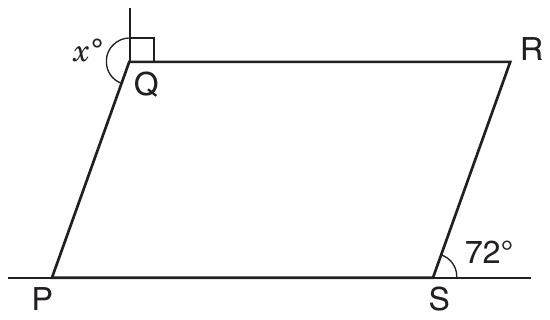
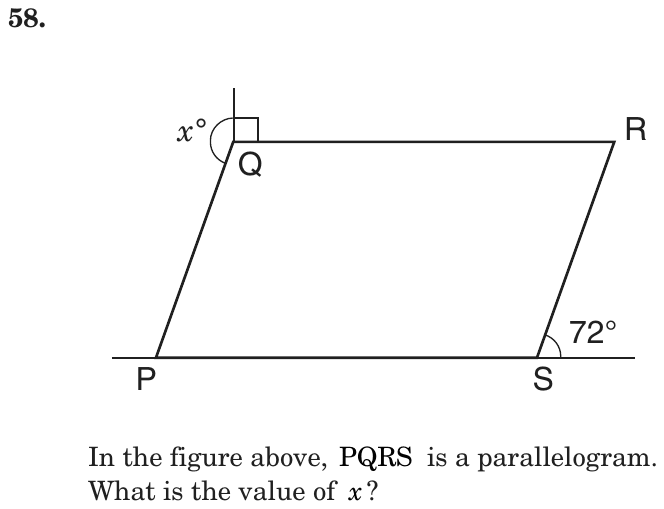
In the figure above, PQRS is a parallelogram. What is the value of ?
Grid-in question: work out the answer and enter it as a number.
Show the answer
Correct answer: 162
First, find the measure of angle PQR. The measure of angle PQR is equal to the measure of angle PSR.
m∠PSR = 180 − 72 = 108.
So, the measure of angle PQR is also 108.
108 + 90 + x = 360
198 + x = 360
x = 162
Question analysis
A grid-in geometry question about angles around a parallelogram PQRS. A 72° angle sits outside corner S on the extended base, and at corner Q a right angle and the unknown angle x complete the turn around the point. Students chain three angle facts, and the angle asked for lies outside the shape, not inside it.
- NYS standards
- Grade level
- Grade 8 content, by NYS standard
- Compared with grade 7
- Above grade 7 Grade 7 angle work usually applies one or two facts, such as supplementary or vertical angles, to find an angle. This chains three, and needs the equal opposite angles of a parallelogram, which rest on grade 8 parallel-line facts.
- Estimated difficulty
- Hard: combines ideas, needs a plan, and has more than one tempting wrong answer.
- Thinking it demands
- Depth of knowledge 2, skills and concepts · mainly apply
- What makes it hard
- Reading a figure, table or graph major
- Combines ideas moderate
- An answer in an unexpected form minor
- Solution
- 3 steps
- Reading level
- Question and choices: about grade 7, 14 words.
- Students, last 30 days
- Not enough answers yet to show (it takes 10).
Why it is hard, traps and wrong answers (shows the answer)
Why it is hard
The arithmetic is two subtractions; the difficulty is seeing which angles the marks refer to. Students lose points by treating the 72° as the parallelogram's own angle at S, or by stopping at angle PQR, the most natural number to grid. The question rewards tracing a route from S to Q before computing anything, and checking at the end that x is the angle outside the shape that the arc marks.
Reading a figure, table or graph major Understanding the question
The 72° is marked outside the parallelogram, between side SR and the base extended past S, and x sits outside corner Q, between QP and a vertical ray that meets QR at a right-angle mark. (Lesh, Post & Behr, 1987; Kirsch & Mosenthal, 1990)
Combines ideas moderate Working it out
Three angle facts have to be chained: a straight line gives the angle inside S, opposite angles of a parallelogram carry it to Q, and the angles around Q make a full 360° turn. (Embretson, 1998; Daniel & Embretson, 2010)
An answer in an unexpected form minor Choosing the answer
As a grid-in there are no choices to check against, so a student who stops at angle PQR, inside the parallelogram, gets no signal that the job is unfinished. (Enright, Morley & Sheehan, 2002)
Strategy: Use the straight line at S to find the parallelogram's angle there, carry it to the opposite corner Q, then take that angle and the right angle away from 360.
Traps
- Stops one step early: A choice is a number from partway through the solution.
The wrong answers, classified
108 Stops one step early (King et al., 2004; Gierl et al., 2017)
Finds angle PSR = 180 − 72 = 108 and carries it to angle PQR, then grids that interior angle instead of the angle x outside it.
198 Misreads the figure (Lesh, Post & Behr, 1987; Kirsch & Mosenthal, 1990)
Reads the 72° as the parallelogram's interior angle at S, so takes angle PQR as 72 and grids 360 − 90 − 72 = 198.
252 Misreads the figure (Lesh, Post & Behr, 1987; Kirsch & Mosenthal, 1990)
Overlooks the right-angle mark at Q and subtracts only the 108° angle PQR from 360, giving 252.
Worked solution, step by step
Formulas used
- Angles on a straight line
- a and b are two angles side by side on a straight line. Together they make a half turn, so they always add up to 180 degrees. Use it when an angle you need shares a straight line with an angle you know.
- Opposite angles of a parallelogram
- The symbol ∠ means angle. ∠PQR is the angle at corner Q, between sides QP and QR. ∠PSR is the angle at the opposite corner, S. In a parallelogram, opposite corners always have equal angles, because the shape leans the same way at both.
- Angles around a point
- a, b and c are angles that fit around one point with no gaps and no overlaps. Going all the way around is a full turn, which is 360 degrees. So the angles add up to 360.
Sort out what the figure shows
PQRS is a parallelogram. That is a four-sided shape whose opposite sides are parallel, which means they never meet. You need the value of x, in degrees.
Look closely at the marks. The 72° angle is outside the shape, at S. It sits between side SR and the base line, which keeps going past S. At Q, a vertical line meets side QR. The small square means a right angle, 90°. The angle x is outside the shape too. It runs from that vertical line around to side QP.
Find the angle inside corner S
Angle PSR is the shape’s own angle at S. It sits right next to the 72° angle, on the same straight base line. So the two angles add up to 180°.
So angle PSR is 108°. Watch out: 72° is not the inside angle at S. Using 72 as the inside angle leads to the wrong answer 198.
Carry the angle over to Q
Corners Q and S are opposite each other. In a parallelogram, opposite angles are equal. So angle PQR matches angle PSR.
So angle PQR is 108°. Watch out: this is not x. Angle PQR is inside the shape, and x is outside it. Stopping here and gridding 108 is the most common mistake.
Add the angles around Q
Three angles fill the space all the way around point Q. They are the right angle (90°), angle PQR (108°) and x. Together they make a full turn.
Watch out: don’t skip the right angle at Q. Leaving out the 90 gives 252.
Solve for x
Subtract 198 from 360 to find what is left for x.
So x is 162°. So you would grid 162.
Check your answer
Add the three angles at Q: . That is a full turn. Also, the arc for x is wider than a right angle but not as wide as a straight line. So x should be between 90° and 180°, and 162° is.
More questions like this
The original DOE question