3 English and 3 math
Here are 6 random questions to try. Takers earning below 75% are unlikely to receive an offer. You have 1 minute 48 seconds per question on the real exam.
Question 1 of 6
2024 Test A English, question 49Passage Excerpt from The Highest Tide
Excerpt from The Highest Tide
by Jim Lynch
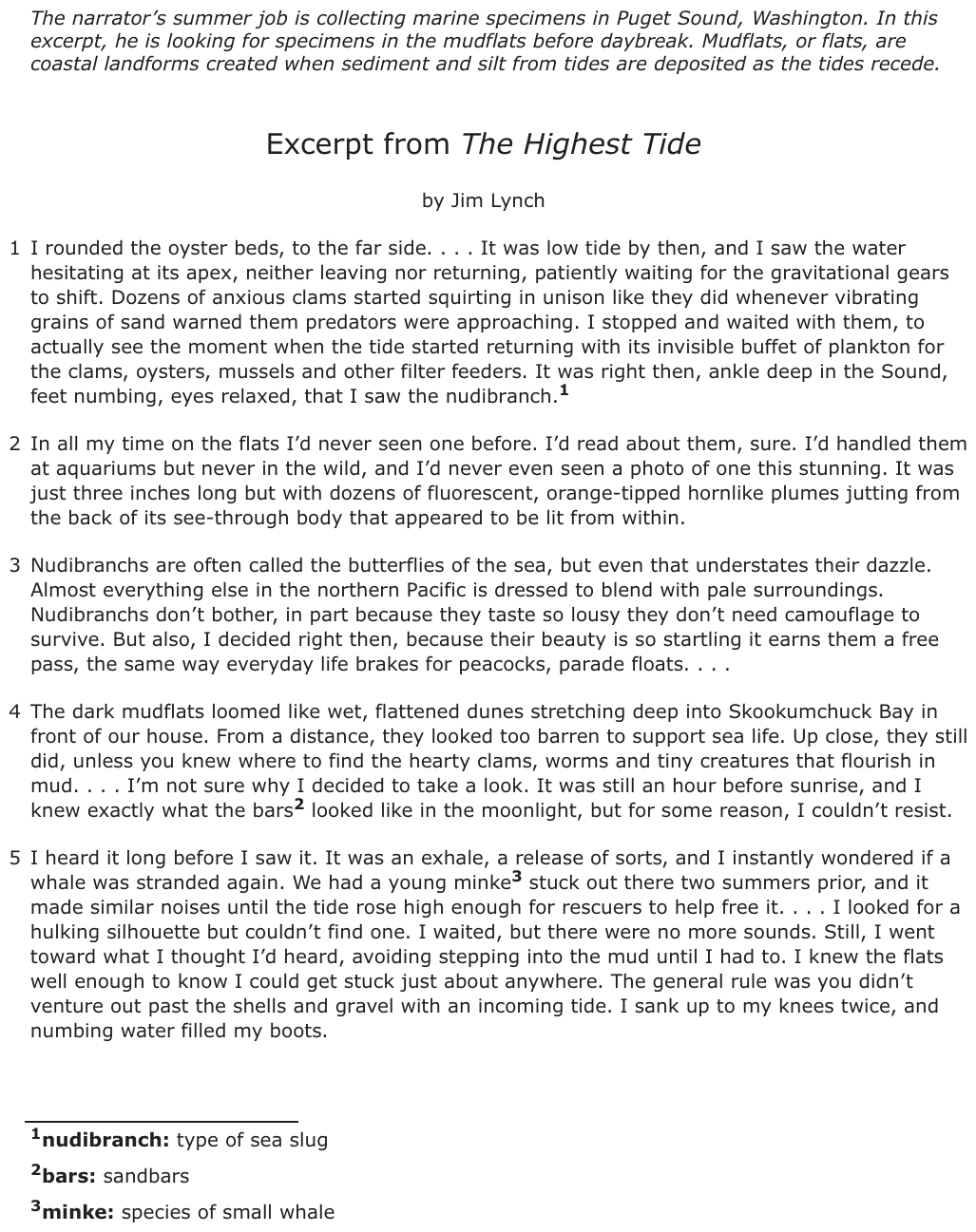
The narrator’s summer job is collecting marine specimens in Puget Sound, Washington. In this excerpt, he is looking for specimens in the mudflats before daybreak. Mudflats, or flats, are coastal landforms created when sediment and silt from tides are deposited as the tides recede.
I rounded the oyster beds, to the far side. . . . It was low tide by then, and I saw the water hesitating at its apex, neither leaving nor returning, patiently waiting for the gravitational gears to shift. Dozens of anxious clams started squirting in unison like they did whenever vibrating grains of sand warned them predators were approaching. I stopped and waited with them, to actually see the moment when the tide started returning with its invisible buffet of plankton for the clams, oysters, mussels and other filter feeders. It was right then, ankle deep in the Sound, feet numbing, eyes relaxed, that I saw the nudibranch.1
In all my time on the flats I’d never seen one before. I’d read about them, sure. I’d handled them at aquariums but never in the wild, and I’d never even seen a photo of one this stunning. It was just three inches long but with dozens of fluorescent, orange-tipped hornlike plumes jutting from the back of its see-through body that appeared to be lit from within.
Nudibranchs are often called the butterflies of the sea, but even that understates their dazzle. Almost everything else in the northern Pacific is dressed to blend with pale surroundings. Nudibranchs don’t bother, in part because they taste so lousy they don’t need camouflage to survive. But also, I decided right then, because their beauty is so startling it earns them a free pass, the same way everyday life brakes for peacocks, parade floats. . . .
The dark mudflats loomed like wet, flattened dunes stretching deep into Skookumchuck Bay in front of our house. From a distance, they looked too barren to support sea life. Up close, they still did, unless you knew where to find the hearty clams, worms and tiny creatures that flourish in mud. . . . I’m not sure why I decided to take a look. It was still an hour before sunrise, and I knew exactly what the bars2 looked like in the moonlight, but for some reason, I couldn’t resist.
I heard it long before I saw it. It was an exhale, a release of sorts, and I instantly wondered if a whale was stranded again. We had a young minke3 stuck out there two summers prior, and it made similar noises until the tide rose high enough for rescuers to help free it. . . . I looked for a hulking silhouette but couldn’t find one. I waited, but there were no more sounds. Still, I went toward what I thought I’d heard, avoiding stepping into the mud until I had to. I knew the flats well enough to know I could get stuck just about anywhere. The general rule was you didn’t venture out past the shells and gravel with an incoming tide. I sank up to my knees twice, and numbing water filled my boots.
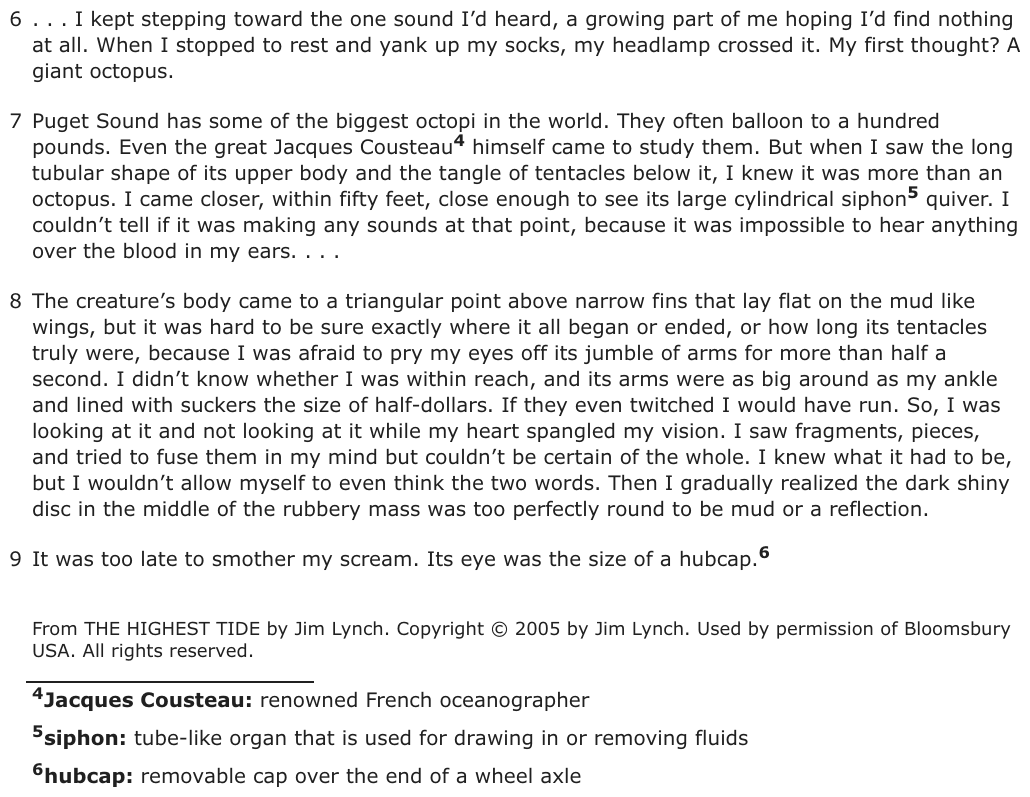
. . . I kept stepping toward the one sound I’d heard, a growing part of me hoping I’d find nothing at all. When I stopped to rest and yank up my socks, my headlamp crossed it. My first thought? A giant octopus.
Puget Sound has some of the biggest octopi in the world. They often balloon to a hundred pounds. Even the great Jacques Cousteau4 himself came to study them. But when I saw the long tubular shape of its upper body and the tangle of tentacles below it, I knew it was more than an octopus. I came closer, within fifty feet, close enough to see its large cylindrical siphon5 quiver. I couldn’t tell if it was making any sounds at that point, because it was impossible to hear anything over the blood in my ears. . . .
The creature’s body came to a triangular point above narrow fins that lay flat on the mud like wings, but it was hard to be sure exactly where it all began or ended, or how long its tentacles truly were, because I was afraid to pry my eyes off its jumble of arms for more than half a second. I didn’t know whether I was within reach, and its arms were as big around as my ankle and lined with suckers the size of half-dollars. If they even twitched I would have run. So, I was looking at it and not looking at it while my heart spangled my vision. I saw fragments, pieces, and tried to fuse them in my mind but couldn’t be certain of the whole. I knew what it had to be, but I wouldn’t allow myself to even think the two words. Then I gradually realized the dark shiny disc in the middle of the rubbery mass was too perfectly round to be mud or a reflection.
It was too late to smother my scream. Its eye was the size of a hubcap.6
From THE HIGHEST TIDE by Jim Lynch. Copyright © 2005 by Jim Lynch. Used by permission of Bloomsbury USA. All rights reserved.
1nudibranch: type of sea slug
2bars: sandbars
3minke: species of small whale
4Jacques Cousteau: renowned French oceanographer
5siphon: tube-like organ that is used for drawing in or removing fluids
6hubcap: removable cap over the end of a wheel axle
Question
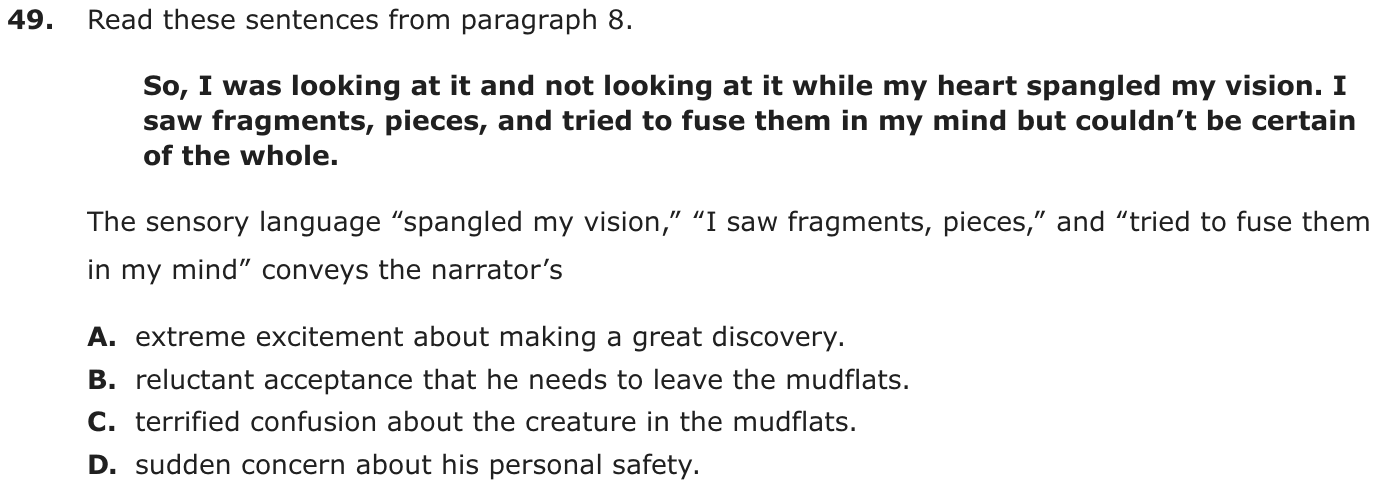
Read these sentences from paragraph 8.
So, I was looking at it and not looking at it while my heart spangled my vision. I saw fragments, pieces, and tried to fuse them in my mind but couldn’t be certain of the whole.
The sensory language “spangled my vision,” “I saw fragments, pieces,” and “tried to fuse them in my mind” conveys the narrator’s
- Aextreme excitement about making a great discovery.
- Breluctant acceptance that he needs to leave the mudflats.
- Cterrified confusion about the creature in the mudflats.
- Dsudden concern about his personal safety.
Show the answer
Correct answer: C
The question asks what the sensory language in the sentences from paragraph 8 conveys about the narrator.
A. Incorrect. While the narrator does not leave the mudflats and is curious about what has been found, the main emotions described in paragraph 8 are fear and confusion as the narrator tries to comprehend the size of the animal.
B. Incorrect. The language focuses on the narrator’s inability to organize what he sees into useful thoughts and conclusions, and while the narrator feels fear in paragraph 8—“I was afraid” and “I would have run”—the narrator refuses to leave the mudflats out of curiosity.
C. CORRECT. The phrase “spangled my vision” illustrates that the narrator cannot fully recognize what has appeared on the mudflats. The sight is so amazing, the narrator is trying to “fuse” together “fragments” and “pieces” because seeing the creature has created so much emotion in the narrator that he feels confused.
D. Incorrect. While the narrator is feeling some fear, as expressed in paragraph 8, the phrases actually indicate that the narrator’s amazement causes him to struggle to take in the view of the creature before him.
Question analysis
This question about sensory language asks what three phrases, including “spangled my vision,” convey about the narrator as he stares at a huge creature in the mud in an excerpt from The Highest Tide. Students must interpret unusual imagery and choose among emotions that all seem possible at such a startling moment.
- Grade level
- Grade 8 reading and task
- Compared with grade 7
- Above grade 7 Interpreting sensory language for a character's state of mind is grade 7 work, but spangled is an unusual verb, and the paragraph partly supports several of the emotions offered, so the choice must be matched precisely to the quoted phrases.
- Estimated difficulty
- Hard: combines ideas, needs a plan, and has more than one tempting wrong answer.
- Thinking it demands
- Depth of knowledge 2, skills and concepts · mainly analyze
- What makes it hard
- Figurative or literary language major
- A very close wrong answer moderate
- Hard words minor
- Evidence
- Answered from one paragraph or stanza
- Reading level
- Passage: about grade 6, 902 words; question and choices: about grade 7, 92 words.
- Students, last 30 days
- Not enough answers yet to show (it takes 10).
Why it is hard, traps and wrong answers (shows the answer)
Why it is hard
The quoted phrases are about perception, not feeling: the narrator sees fragments and cannot assemble them, while his heart pounds hard enough to blur his sight. The fear is clear from the surrounding sentences, where he is afraid to look away and ready to run, and that context makes the choice about personal safety very tempting. The answer must cover both the terror and the confusion, and the word “spangled” can mislead readers into hearing excitement.
Figurative or literary language major Understanding the question
The phrases describe seeing in pieces, “looking at it and not looking at it”, a heart that “spangled” his vision, “fragments” he cannot “fuse”, and the emotion has to be read from that broken sight. (Graesser, Singer & Trabasso, 1994; Kintsch, 1998)
A very close wrong answer moderate Choosing the answer
The right choice and the one about concern for his safety both name fear; they part on what the quoted phrases show, a mind unable to piece the creature together or a worry about its reach. (Embretson & Wetzel, 1987; Gorin & Embretson, 2006; Ascalon et al., 2007)
Hard words minor Understanding the question
“Spangled”, to scatter with glittering spots, is a rare word, and its sparkle can suggest delight, which opens a reading of excitement to students who miss the fear around it. (Perfetti, 2007; Freedle & Kostin, 1993)
Strategy: Ask what the three quoted phrases together say about how the narrator is seeing and thinking at this moment, then choose the emotion that accounts for all three, not just one.
Traps
- True but not the answer: A choice says something accurate about the text that does not answer this question.
- Wrong tone or attitude: Misjudges the tone, attitude or point of view, such as reading admiration as criticism, or taking a character's or subject's feelings for the author's.
The wrong answers, classified
A Wrong tone or attitude (Graesser, Singer & Trabasso, 1994)
Reads the pounding heart and glittering vision as the thrill of a great find, missing that he is afraid to take his eyes off the creature and cannot make sense of it.
B Twists what the text says (King et al., 2004)
Turns “If they even twitched I would have run”, a possibility, into an accepted need to leave, though the narrator stays and the phrases describe how he sees.
D True but not the answer (King et al., 2004; Embretson & Wetzel, 1987)
Matches the fear in paragraph 8, where he wonders whether he is within reach, but the quoted phrases describe broken seeing and puzzling, and his fear has been building, not sudden.
Working it out, step by step
Know what the question asks
Sensory language describes what a character sees, hears or feels. This asks what feeling the three quoted phrases show. Your answer must explain all three phrases, not just one.
Explain the hard words
To spangle means to cover with glittering spots. His heart pounds so hard that his sight seems to sparkle and blur. Fragments are small broken pieces. To fuse means to join together.
Put the phrases together
He sees only “fragments, pieces.” He tries “to fuse them in my mind” but “couldn’t be certain of the whole.” So he is confused, unable to tell what the creature really is. The sentences around them show he is also terrified. He is “afraid to pry my eyes off” its arms, and his heart is racing.
Check each choice
- C fits: “terrified confusion” covers both his fear and his broken, puzzled seeing.
- A is wrong because “spangled” may sound happy, but he is frightened, not thrilled.
- B is wrong because he never decides to leave, and he would run only if the arms moved.
- D is wrong because the phrases show confused seeing, and his fear has been growing since paragraph 6.
Watch out: D is close, since he is afraid. But it leaves out the confusion the phrases show.
Choose the answer
The phrases show a frightened narrator who cannot piece together what he sees. So the answer is C.
Why this answer and not the closest wrong one
D comes closest, because the narrator truly fears for his safety. But the quoted phrases are about how he sees: in pieces he can’t join. That is confusion. C names both the fear and the confusion, so it fits all three phrases.
More questions like this
The original DOE question
The passage “Excerpt from The Highest Tide” as printed (pages 64–65)
Question 2 of 6
2026 Practice Test C English, question 20Passage Bird Talk
Bird Talk
by Carl Sandburg
And now when the branches were beginning to be heavy,
It was the time when they once had said, “This is the
beginning of summer.”
The shrilling of the frogs was not so shrill as in the
first weeks after the broken winter;
The birds took their hops and zigzags a little more
anxious; a home is a home; worms are worms.
The yellow spreads of the dandelions and buttercups
reached across the green pastures.
Tee whee and tee whee came on the breezes, and the grackles
chuzzled their syllables.
And it was the leaves with a strong soft wind over them
that talked most of all and said more than any others
though speaking the fewest words.
It was the green leaves trickling out the gaunt nowhere
of winter, out on the gray hungry branches—
It was the leaves on the branches, beginning to be heavy,
who said as they said one time before, “This is the be-
ginning of summer.”
We shall never blame the birds who come
where the river and the road make the Grand Crossing
and talk there, sitting in circles talking bird talk.
If they ask in their circles as to who is here
and as to who is not here and who used to be here,
Or if instead of counting up last year as against
this year, they count up this year as against next
year, and have their bird chatter about who is here
this year who won’t be here next year,
We shall never blame the birds.
If I have put your face among leaf faces, child,
Or if I have put your voice among bird voices,
Blame me no more than the bluejays.
“Bird Talk” by Carl Sandburg—Public domain.
Question
Read lines 6–7 from the poem.
The birds took their hops and zigzags a little more
anxious; a home is a home; worms are worms.
What idea from the second stanza do the lines help develop?
- AThe birds are eager for the return of warmer months.
- BThe birds are most likely to thrive during the spring.
- CThe birds naturally adjust to the seasonal changes.
- DThe birds instinctively prepare for the future.
Show the answer
Correct answer: C
The question asks how lines 6–7 from the poem develop an idea from the second stanza.
A. Incorrect. In lines 2–3, the tree branches exclaim that “ ‘This is the / beginning of summer,’ ” and the birds respond by taking “their hops and zigzags a little more / anxious” (lines 6–7); however, the birds’ eager reaction to the return of warmer weather is not referenced in the second stanza of the poem, which is more about the nature of birds generally than the changing of the seasons.
B. Incorrect. Birds are more likely to thrive in warmer weather as evidenced by some birds’ migration to a warmer climate during winter, and the creatures in the first stanza are responding to the “ ‘beginning of summer’ ” (line 3) in their own way, such as the birds who are taking “their hops and zigzags a little more / anxious” (lines 6–7). However, the thriving of birds during a particular season is not the focus of the second stanza; rather, it is focused on the general nature of birds.
C. CORRECT. The birds are taking “their hops and zigzags a little more / anxious” (lines 6–7) in light of warmer weather, but they are not making a big to-do of the change because “a home is a home; worms are worms” (line 7) any time of the year. Such a natural adjustment to seasonal changes is reflected in the second stanza, where the birds “count up this year as against next / year” (lines 26–27) because they are well accustomed to the cyclical nature of things.
D. Incorrect. Although the birds’ actions of “hops and zigzags” (line 6) may indicate some sort of preparation, these actions are not preparation but rather the internalized cognizance of the change that has occurred with little conscious thought. As revealed in the second stanza, birds do not ponder much about past or future but rather adapt naturally as things change.
Question analysis
This question on Carl Sandburg’s poem “Bird Talk” quotes lines 6–7, where the birds hop and zigzag “a little more anxious,” and asks which idea from the second stanza they help develop. Students must link two compressed lines in the first stanza to a later stanza about birds gathered at the Grand Crossing, and every choice sounds like a fair claim about birds.
- Grade level
- Grade 8 reading and task
- Compared with grade 7
- Above grade 7 Typical grade 7 poetry questions ask what one line or stanza shows on its own. Here two compressed lines from the first stanza must be tied to an idea the second stanza never states, in Sandburg’s loose, unusual phrasing.
- Estimated difficulty
- Among the hardest on the SHSAT: a non-obvious approach, heavy reading, or a well-hidden trap.
- Thinking it demands
- Depth of knowledge 3, strategic thinking · mainly analyze
- What makes it hard
- Reading between the lines major
- A very close wrong answer moderate
- Evidence in several places moderate
- Figurative or literary language moderate
- Evidence
- Answered from several paragraphs or stanzas
- Reading level
- Passage: 296 words (a poem; reading level not measured); question and choices: about grade 5, 70 words.
- Students, last 30 days
- Not enough answers yet to show (it takes 10).
Why it is hard, traps and wrong answers (shows the answer)
Why it is hard
The stem runs in an unusual direction: two lines from the first stanza must help develop an idea that only the second stanza holds, and the poem never states it. Students who read “next year” as planning are drawn to preparation, a choice built on the key’s own frame, while others answer from the first stanza’s summer or from what they know about birds. The question rewards hearing the birds’ roll call of who is gone as the same matter-of-fact acceptance as “worms are worms.”
Reading between the lines major Working it out
Neither stanza states the shared idea: students must hear calm acceptance in “a home is a home; worms are worms” and in birds tallying “who won’t be here next year,” then call it adjusting to change. (Graesser, Singer & Trabasso, 1994; Kintsch, 1998)
A very close wrong answer moderate Choosing the answer
The choice about instinctive preparation shares the key’s shape, birds acting by nature as time passes; it differs only in what the birds do, prepare for the future rather than adjust to the seasons. (Embretson & Wetzel, 1987; Gorin & Embretson, 2006; Ascalon et al., 2007)
Evidence in several places moderate Working it out
Lines 6–7 sit in the first stanza and the idea lives in the second, lines 20–29, so students must carry two lines across the poem and match them to the gathering at the Grand Crossing. (Kirsch & Mosenthal, 1990; Gorin & Embretson, 2006)
Figurative or literary language moderate Understanding the question
“A home is a home; worms are worms” says nothing on its surface; its meaning, a shrug that life goes on as it always has, has to be read from the repetition. (Graesser, Singer & Trabasso, 1994; Kintsch, 1998)
Strategy: Paraphrase the second stanza first: what are the birds doing and saying at the Grand Crossing? Then reread lines 6–7 and ask which idea about birds both passages share.
Traps
- Reads too much in: A reasonable-sounding conclusion that goes further than the text allows.
- Wrong part of the text: A choice is true of another paragraph, stanza or speaker than the one asked about.
- Outside knowledge: A choice is plausible in the real world but not supported by this text.
The wrong answers, classified
A Wrong part of the text (Kirsch & Mosenthal, 1990)
Hears “a little more anxious” as eagerness for the summer announced in lines 2–3, an idea of the first stanza, while the second stanza never mentions weather or warmth.
B Outside knowledge (King et al., 2004; Recht & Leslie, 1988)
Brings in the real fact that birds do well in warm weather, which neither lines 6–7 nor the birds’ talk of who is gone says, and the poem’s season is summer, not spring.
D Reads too much in (Graesser, Singer & Trabasso, 1994)
Sees nest-building in “a home is a home” and planning in counting “this year as against next / year,” but the birds only note who will be missing and make no preparations.
Working it out, step by step
Figure out what the question asks
This question points in an unusual direction. Lines 6–7 are in the first stanza. A stanza is a group of lines set apart by a blank line. But the idea you need is in the second stanza, lines 20–29. The question asks which idea in stanza 2 these earlier lines also help build. So find the idea in stanza 2 first. Then see how lines 6–7 support it.
Find the idea in stanza 2
In stanza 2, birds sit “in circles talking bird talk.” They ask “who is here / and as to who is not here and who used to be here.” They also talk about “who is here / this year who won’t be here next year.” The birds simply count the changes. They are not upset by them. The speaker says, “We shall never blame the birds.” The idea: birds take the changes that time brings as a normal part of life.
Read lines 6–7 closely
Lines 6–7 say “The birds took their hops and zigzags a little more / anxious; a home is a home; worms are worms.” As summer comes, the birds hop about a little more nervously and busily. That is a small change. Then the speaker shrugs: “a home is a home; worms are worms.” Life goes on as it always does. The birds change a little and carry on, with no fuss.
See what the two parts share
Both parts show birds meeting change calmly. In lines 6–7, the season turns, and the birds adjust a little. To adjust is to change a little to fit something new. In stanza 2, the birds note who has come and gone, and life goes on. So lines 6–7 help build stanza 2’s idea: birds naturally adjust to the changing seasons.
Check each choice
- A does not fit. Stanza 2 never mentions warm weather or being eager for it.
- B does not fit. Nothing in the poem says birds do best in spring. The poem’s season is the start of summer.
- C fits. Both parts show birds taking seasonal change calmly, as a matter of course.
- D does not fit. The birds talk about next year, but they make no plans for it.
Watch out: D is tempting because “a home is a home” can sound like nest building. But the birds only count who will be missing. They do not get ready for anything.
Choose the answer
Lines 6–7 and stanza 2 both show birds accepting change as natural. So the answer is C, “The birds naturally adjust to the seasonal changes.”
Why this answer and not the closest wrong one
D is the closest wrong choice. Like C, it says birds act by nature as time passes. But D says they prepare, or get ready. In stanza 2, the birds talk about next year only to count who “won’t be here next year.” In lines 6–7, they hop about and carry on. They adjust to change. They do not plan for it.
More questions like this
The original DOE question
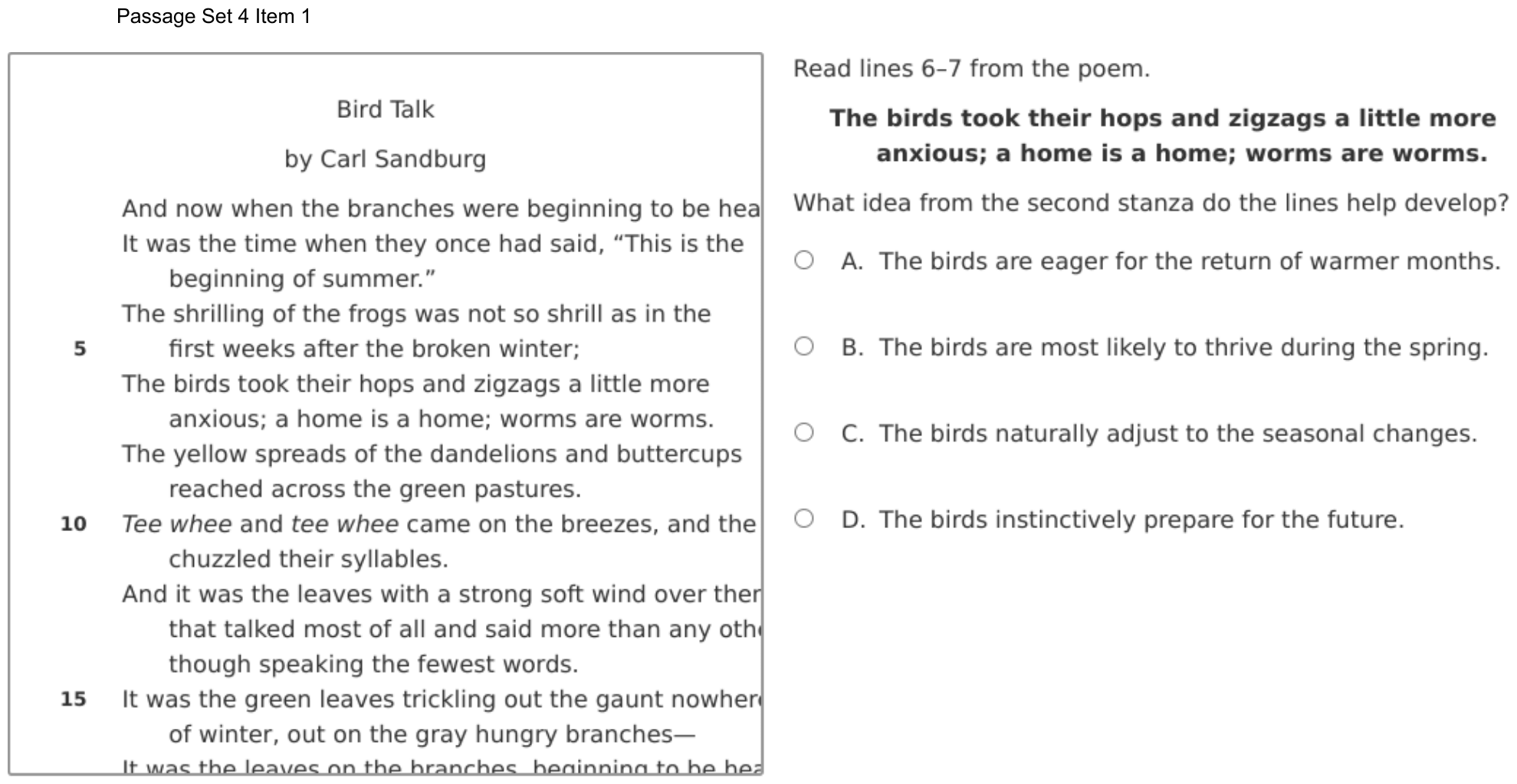
The passage “Bird Talk” as printed (page 32)
Question 3 of 6
2025 Practice Test B English, question 48Passage Letter from Brooklyn
Letter from Brooklyn
by Jacob Scheier
I can already see how this will end.
How I will grow tired of the bridge’s
steep incline, and the absent-minded tourists
wandering into the bicycle path.
The weather will turn cold.
But that all happens later.
For now it is the early edge of fall,
leaves green still while the air narrows,
is slightly crisp, almost grazing
the hair of my arm like a passing stranger,
as though the air has been forced into intimacy
by the brevity of daylight.
But when it starts darkening at 4,
this closeness, I know, will be a felt distance,
like someone drawing your attention
to their lack of intimacy.
These days I am still walking at a cathedral pace
beneath the branches bending across avenues,
brownstones like rows of lived-in chapels,
like a pop-up picture book I could have had as a child,
but didn’t. How Brooklyn makes me nostalgic
for the moment I am walking inside of.
These late afternoons filled
with a loneliness that makes me feel
distinctly myself, and an awareness
of how rare that is.
“Letter from Brooklyn” from LETTER FROM BROOKLYN: POEMS by Jacob Scheier, published by ECW Press. Copyright © 2013 by Jacob Scheier All rights reserved.
brevity: briefness
cathedral: meditative
chapels: private places of prayer or worship
nostalgic: yearning for the past
Question
The poet develops the speaker’s point of view by
- Aproviding details about the speaker’s longing to be in a different place.
- Bshowing the speaker’s sense of unease about the passing seasons.
- Cincluding details about the speaker’s hope that life will remain unchanged.
- Dshowing the speaker’s desire to treasure and appreciate the changes taking place.
Show the answer
Correct answer: D
The question asks how the poet develops the speaker’s point of view.
A. Incorrect. The speaker concedes that at some point, Brooklyn will become tiresome (lines 2–4). However, the bulk of the poem reveals the speaker’s appreciation for experiencing Brooklyn, not a desire to be in some other place.
B. Incorrect. Cold weather is inevitable, and the speaker is well aware of this future shift as well as the change in attitude it will bring. Nevertheless, the speaker does not focus on this future but rather embraces the current season, describing it in vivid detail.
C. Incorrect. The speaker is not hopeful that life will remain unchanged. Rather, the speaker accepts and appreciates the seasonal changes that occur.
D. CORRECT. The speaker’s point of view is largely positive and appreciative of the shift in seasons. This point of view is developed by language that shows a close connection between the speaker and the setting. For example, the speaker uses words such as “intimacy” (line 11) and “closeness” (line 14) and the description of the “pop-up picture book” (line 20). Finally, the conclusion emphasizes the point of view: “These late afternoons filled / with a loneliness that makes me feel / distinctly myself, and an awareness / of how rare that is” (lines 23–26).
Question analysis
This point-of-view question asks how the poet develops the speaker’s point of view in “Letter from Brooklyn,” in which the speaker walks through the city at the start of fall knowing that colder, darker days lie ahead. The speaker’s thoughts move between the present and the future, so students must weigh the whole poem, and each choice names a different attitude.
- Grade level
- Grade 8 reading and task
- Compared with grade 7
- Above grade 7 Typical grade 7 point-of-view questions focus on one passage or stanza. This one asks for the speaker’s attitude across a whole poem of shifting moods, and several choices rest on real lines, so judging the overall view takes more than typical grade 7 work.
- Estimated difficulty
- Hard: combines ideas, needs a plan, and has more than one tempting wrong answer.
- Thinking it demands
- Depth of knowledge 3, strategic thinking · mainly analyze
- What makes it hard
- Evidence in several places moderate
- Reading between the lines moderate
- Every choice must be checked minor
- Evidence
- Answered from the whole text
- Reading level
- Passage: 217 words (a poem; reading level not measured); question and choices: about grade 7, 54 words.
- Students, last 30 days
- Not enough answers yet to show (it takes 10).
Why it is hard, traps and wrong answers (shows the answer)
Why it is hard
The poem opens by predicting its own end and returns to the coming dark in lines 13–16, so a reader who weighs those lines heavily finds unease, and the speaker does feel some. But the speaker turns back to the present each time, with “But that all happens later” and “These days I am still walking,” and the closing lines call the moment rare. The point of view is a wish to savor what is passing, and only a choice that fits the whole poem, not its most anxious lines, matches it.
Evidence in several places moderate Working it out
The point of view has to hold from line 1 to line 26 while the poem swings between the future, tiring of the bridge and darkening at 4, and the present walk under the branches. (Kirsch & Mosenthal, 1990; Gorin & Embretson, 2006)
Reading between the lines moderate Working it out
No line names the speaker’s attitude; it has to be drawn from “For now,” the walk “at a cathedral pace,” the nostalgia “for the moment I am walking inside of” and “how rare that is.” (Graesser, Singer & Trabasso, 1994; Kintsch, 1998)
Every choice must be checked minor Choosing the answer
Three wrong choices rest on real lines, tiring of the bridge’s “steep incline,” the “felt distance” of line 14 and the nostalgia of lines 21–22, so each must be weighed against the whole poem. (Embretson & Wetzel, 1987)
Strategy: Sum up in one sentence how the speaker feels about the present walk and about the season ahead, then pick the choice that holds true from the first line to the last.
Traps
- Wrong tone or attitude: Misjudges the tone, attitude or point of view, such as reading admiration as criticism, or taking a character's or subject's feelings for the author's.
- Reads too much in: A reasonable-sounding conclusion that goes further than the text allows.
- Twists what the text says: Uses the text's topic and ideas but changes what it says: who did it, how much, when, or why.
The wrong answers, classified
A Twists what the text says (King et al., 2004)
Turns the forecast that the speaker “will grow tired” of the bridge and the tourists into a present longing to be elsewhere, though the rest of the poem savors Brooklyn’s streets.
B Wrong tone or attitude (Graesser, Singer & Trabasso, 1994)
Fixes on the coming cold and the “felt distance” of lines 13–16, real notes of unease, and takes them for the whole view, though “But that all happens later” sets the future aside.
C Reads too much in (Graesser, Singer & Trabasso, 1994)
Reads nostalgia “for the moment I am walking inside of” as a wish that nothing change, though the speaker opens by accepting “how this will end” and treasures the moment because it passes.
Working it out, step by step
Figure out what the question asks
This asks about point of view: how the speaker, the voice talking in the poem, feels about what is happening. The question is about the whole poem, not a few lines. So follow the speaker’s feelings from line 1 to line 26. The right choice must fit all of it.
Follow the speaker’s thoughts
The poem moves back and forth in time. Lines 1–5 look ahead: “I can already see how this will end.” The speaker will tire of the bridge, and “The weather will turn cold.” Line 6 turns back: “But that all happens later.” Lines 7–12 describe the cool air of early fall. Lines 13–16 look ahead again, to days that get dark at 4 o’clock. Line 17 returns to now: “These days I am still walking at a cathedral pace.”
See how the speaker treats now
The glossary says cathedral means “meditative,” or calm and thoughtful. The speaker walks slowly to take everything in. Brownstones look “like a pop-up picture book.” Lines 21–22 say “How Brooklyn makes me nostalgic / for the moment I am walking inside of.” Nostalgic means “yearning for the past.” Yet the speaker longs for right now. In the last lines, even the loneliness of late afternoon is welcome. It makes the speaker feel “distinctly myself,” and aware “of how rare that is.”
Put the point of view in words
The speaker knows this season will end. That is why each moment matters. The speaker notices the first signs of fall, like the crisp air, and savors them. To treasure something is to value it highly. So the speaker wants to treasure and appreciate the changes happening now.
Check each choice
- A does not fit. Lines 2–4 say the speaker will tire of the bridge someday. But the speaker enjoys Brooklyn now and never wishes to be elsewhere.
- B does not fit. Lines 13–16 show some unease about the dark days ahead. But each time, the speaker turns back to the present.
- C does not fit. The speaker knows from line 1 that this will end, and treasures the moment because it will pass.
- D fits. The speaker savors the early-fall walk while it lasts.
Watch out: B rests on real lines: the closeness the speaker feels now “will be a felt distance” (line 14). But that is one part of the poem, not the whole view.
Choose the answer
The speaker knows the season will change and holds on to each moment of it. So the answer is D, “showing the speaker’s desire to treasure and appreciate the changes taking place.”
Why this answer and not the closest wrong one
B is the closest wrong choice, because lines 13–16 do show unease. But each time the poem looks ahead, the speaker turns back to now: “But that all happens later” and “These days I am still walking.” The poem ends by calling the moment rare. The main feeling is a wish to treasure the present, which is D.
More questions like this
The original DOE question
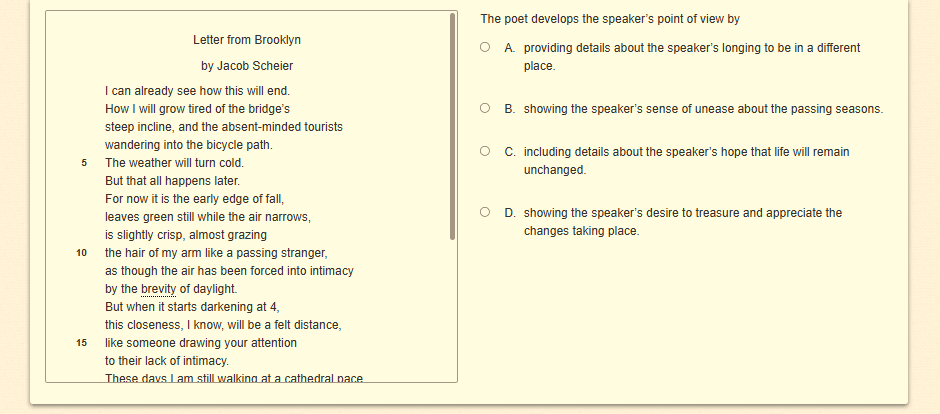
The passage “Letter from Brooklyn” as printed (page 50)
Question 4 of 6
2018 Test A Math, question 54Question
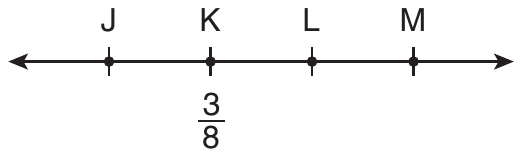
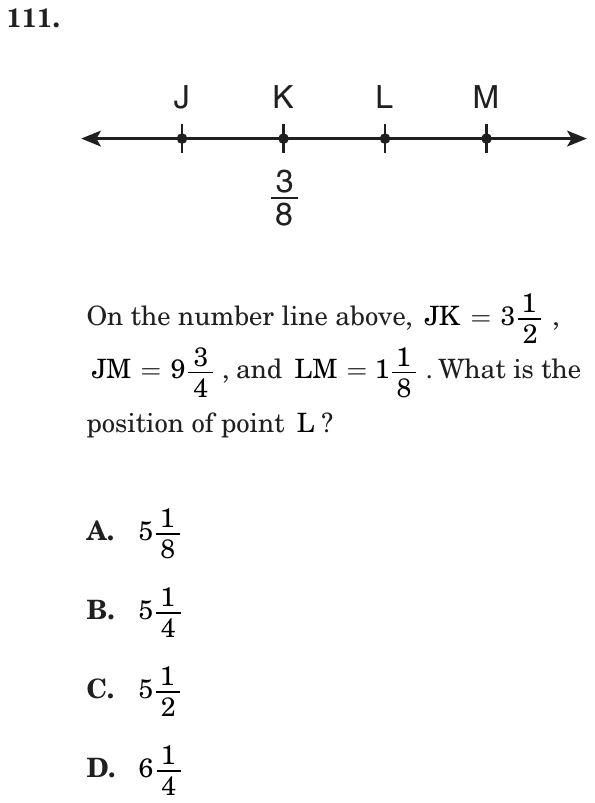
On the number line above, , , and . What is the position of point ?
- A
- B
- C
- D
Show the answer
Correct answer: C
First, use to find the location of :
Now, use to find the location of :
Finally, use to find the location of :
Question analysis
This number line question gives the lengths JK, JM and LM as mixed numbers and asks for the position of point L. Students must chain three distance steps, moving left from K to J, right to M and back to L, with fractions in eighths and a negative position. Losing track of where K sits is the main danger.
- Grade level
- Grade 7 content, by NYS standard
- Compared with grade 7
- Above grade 7 Grade 7 students add and subtract rational numbers and find distances on a number line one at a time. This item chains three such steps with mixed numbers and a negative position, more than typical grade 7 work demands.
- Estimated difficulty
- Among the hardest on the SHSAT: a non-obvious approach, heavy reading, or a well-hidden trap.
- Thinking it demands
- Depth of knowledge 2, skills and concepts · mainly apply
- What makes it hard
- A very close wrong answer major
- Error-prone arithmetic moderate
- Reading a figure, table or graph moderate
- Many steps minor
- Solution
- 4 steps
- Reading level
- Question and choices: about grade 9, 20 words.
- Students, last 30 days
- Not enough answers yet to show (it takes 10).
Why it is hard, traps and wrong answers (shows the answer)
Why it is hard
Every number is a mixed fraction, one position is negative, and the figure's even spacing hides how long KL really is. The distance route, KL = 9 3/4 − 3 1/2 − 1 1/8, avoids the negative entirely but ends one step short of a position unless K's 3/8 is added back. That last step is the one most students skip, which is why the question sits at the top of the scale.
A very close wrong answer major Choosing the answer
The choices 5 1/8, 5 1/4 and 5 1/2 lie within 3/8 of one another, so no estimate separates them; only exact eighths and adding K's 3/8 pick out the right one. (Embretson & Wetzel, 1987; Gorin & Embretson, 2006; Ascalon et al., 2007)
Error-prone arithmetic moderate Working it out
Every step mixes halves, quarters and eighths, and placing J means 3/8 − 3 1/2 = −3 1/8, a subtraction that crosses zero. (Brown & Burton, 1978; Junker & Sijtsma, 2001)
Reading a figure, table or graph moderate Understanding the question
Only K is labeled, and the points are drawn evenly spaced although KL is over four times LM, so the picture gives no help with sizes. (Lesh, Post & Behr, 1987; Kirsch & Mosenthal, 1990)
Many steps minor Working it out
Three linked moves, K to J, J to M and M back to L, each depend on the last, so an early slip carries through. (Daniel & Embretson, 2010; Enright, Morley & Sheehan, 2002)
Strategy: Start from K's labeled position, subtract JK to place J, add JM to place M, then subtract LM, keeping every fraction in eighths.
Traps
- Answers a different question: A choice is right for another quantity: the other unknown, the rest instead of the part, the part instead of the whole.
- Stops one step early: A choice is a number from partway through the solution.
The wrong answers, classified
A Stops one step early (King et al., 2004; Gierl et al., 2017)
Finds KL = 9 3/4 − 3 1/2 − 1 1/8 = 5 1/8 and stops one step short, never adding K's position of 3/8.
B An arithmetic slip (Junker & Sijtsma, 2001)
Rewrites 9 3/4 as 9 4/8 instead of 9 6/8, so M lands at 6 3/8 and L at 6 3/8 − 1 1/8 = 5 1/4.
D Answers a different question (King et al., 2004; Hegarty, Mayer & Monk, 1995)
Finds KM = 9 3/4 − 3 1/2 = 6 1/4, the distance from K to M, and gives it without moving back 1 1/8 to L.
Worked solution, step by step
Formulas used
- Distance on a number line
- d is the distance between two points. b is the point on the right and a is the point on the left. Subtracting left from right always gives a positive distance. It works even when a is negative.
- Equal fractions
- a is the top number (numerator) and b is the bottom number (denominator). Multiplying both by the same number k gives an equal fraction. It is like cutting each piece into k smaller pieces. Use it to give fractions the same bottom before you add or subtract.
Sort out what you know
Only K has a value: . JK means the distance from J to K. You know JK = , JM = and LM = .
You need the position of L, the number where L sits. The points are drawn evenly spaced, but the distances are not equal. So use the numbers, not the picture.
Write the fractions in eighths
The fractions use halves, fourths and eighths. Give them all a bottom of 8:
Watch out: is , not . That slip leads to choice B.
Find the distance from K to M
JM is JK and KM put together. So take JK away from JM:
KM is , or . Watch out: this is a distance, not where L sits. Choice D stops here.
Find the distance from K to L
KM is KL and LM put together. So take LM away:
KL is . Watch out: this is still a distance. Choice A stops here.
Find the position of L
L is to the right of K, and K is at . Add:
So the answer is C, .
Check your answer
Place every point. J is left of K, at . M is right of J, at . L is left of M, at , which is . Same answer.
More questions like this
The original DOE question
Question 5 of 6
2026 Practice Test D Math, question 19Question
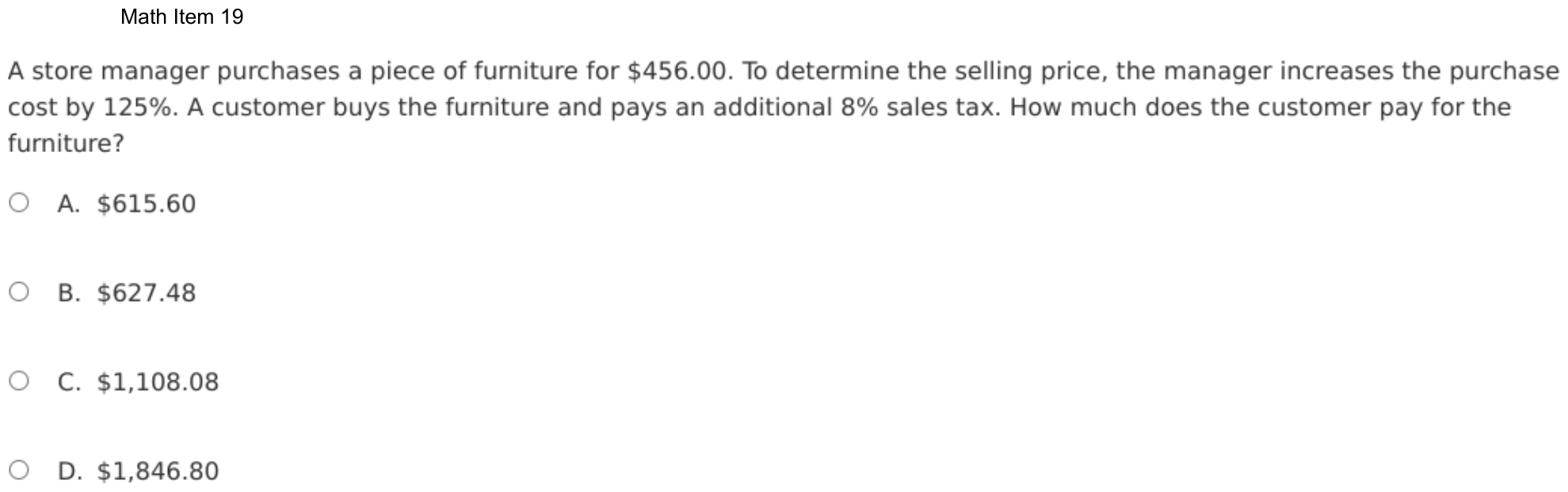
A store manager purchases a piece of furniture for $456.00. To determine the selling price, the manager increases the purchase cost by 125%. A customer buys the furniture and pays an additional 8% sales tax. How much does the customer pay for the furniture?
- A$615.60
- B$627.48
- C$1,108.08
- D$1,846.80
Show the answer
Correct answer: C
Given a purchase price of $456.00, the 125% increase in price is calculated as:
The selling price equals the purchase price plus the increase, or:
The sales tax on the selling price is:
The customer pays the selling price plus the sales tax:
Question analysis
A store manager buys a piece of furniture for $456.00 and raises the price by 125% to set the selling price, and the customer also pays 8% sales tax. Students find the total the customer pays. It tests percent increase and sales tax in sequence, and reading an increase of more than 100% correctly is the main challenge.
- NYS standards
- Grade level
- Grade 7 content, by NYS standard
- Compared with grade 7
- Above grade 7 Grade 7 students find markups and sales tax, usually with increases under 100%. An increase of more than 100% is unusual and easy to misread, and two percent changes must be applied in order, which goes beyond routine grade 7 work.
- Estimated difficulty
- Hard: combines ideas, needs a plan, and has more than one tempting wrong answer.
- Thinking it demands
- Depth of knowledge 2, skills and concepts · mainly apply
- What makes it hard
- Turning words into math moderate
- Many steps moderate
- Error-prone arithmetic minor
- Solution
- 4 steps
- Reading level
- Question and choices: about grade 7, 41 words.
- Students, last 30 days
- Not enough answers yet to show (it takes 10).
Why it is hard, traps and wrong answers (shows the answer)
Why it is hard
A percent above 100 is unusual in grade 7 work, and it is the center of the question: the markup more than doubles the price. Students who treat “by 125%” as “125% of” still find a listed answer after adding tax, and so do students who add $125. A rough check helps: the selling price must be more than twice $456, about $1,000, and the tax adds less than a tenth of that.
Turning words into math moderate Understanding the question
“Increases the purchase cost by 125%” adds 125% of $456 to the $456 itself, a multiplier of 2.25; reading it as 125% of the cost leaves the original price out. (Hegarty, Mayer & Monk, 1995; Koedinger & Nathan, 2004)
Many steps moderate Working it out
Four steps in a row, the increase, the selling price, the tax and the total, each depend on the one before, and two of them are easy to merge or skip. (Daniel & Embretson, 2010; Enright, Morley & Sheehan, 2002)
Error-prone arithmetic minor Working it out
Taking 8% of $1,026 means multiplying by 0.08, and a decimal point one place off, 0.8, makes the tax ten times too large. (Brown & Burton, 1978; Junker & Sijtsma, 2001)
Strategy: Turn each percent change into a multiplier, remembering that an increase by a percent is added to the original amount, apply the markup and then the tax, and estimate to check the size.
Traps
- Stops one step early: A choice is a number from partway through the solution.
- Misunderstands the concept: A wrong belief about a concept: that percents can be added, that area grows like length, that averages can be averaged, that a bigger denominator means a bigger fraction.
- An arithmetic slip: The right method with a plausible arithmetic error: a digit, a place value or a times-table fact.
The wrong answers, classified
A Stops one step early (King et al., 2004; Gierl et al., 2017)
Finds the increase, 125% of $456 = $570, and uses it as the selling price without adding back the $456 cost, then adds 8% tax.
B Misunderstands the concept (Smith, diSessa & Roschelle, 1993; De Bock et al., 1998; Ni & Zhou, 2005)
Reads the 125% increase as $125, a fixed amount, so the selling price is $581, and then adds 8% tax correctly to reach $627.48.
D An arithmetic slip (Junker & Sijtsma, 2001)
Finds the $1,026 selling price correctly but writes 8% as 0.8, adding $820.80 in tax instead of $82.08.
Worked solution, step by step
Formulas used
- Percent of a number
- n is the starting amount, and p is the percent. Percent means out of 100, so 125% is 125/100 = 1.25 and 8% is 8/100 = 0.08. Multiply n by that decimal to find the part.
- Price after an increase
- The old price is what you start with. The increase is the amount added on. To increase by a percent, find that percent of the old price, then add it to the old price. Sales tax is added the same way.
Sort out the question
The manager pays $456.00 for the furniture. The selling price is that cost increased by 125%. The customer then pays 8% sales tax on top. Sales tax is an extra charge, a percent of the price. You need the total the customer pays.
Find the increase
Find 125% of $456. As a decimal, 125% is 1.25, which is 1 and a quarter. A quarter of 456 is 114:
The increase is $570.
Find the selling price
Increases by means the increase is added to the cost:
The selling price is $1,026.
Watch out: $570 is only the increase. Using it as the price gives $615.60, choice A. And 125% is a percent, not $125. Adding $125 leads to $627.48, choice B.
Find the sales tax
As a decimal, 8% is 0.08. Find 8% of the selling price:
The tax is $82.08.
Watch out: 8% is 0.08, not 0.8. Using 0.8 makes the tax ten times too big and gives $1,846.80, choice D.
Add the tax to the price
The customer pays the selling price plus the tax:
So the answer is C, $1,108.08.
Check your answer
Estimate. The price more than doubles: $456 plus $570 is about $1,000. Tax of 8% adds about $80. So the total should be a bit over $1,080, and only $1,108.08 is close. Or multiply in one go: 456 × 2.25 × 1.08 = 1,108.08.
More questions like this
The original DOE question
Question 6 of 6
2024 Test B Math, question 57Question
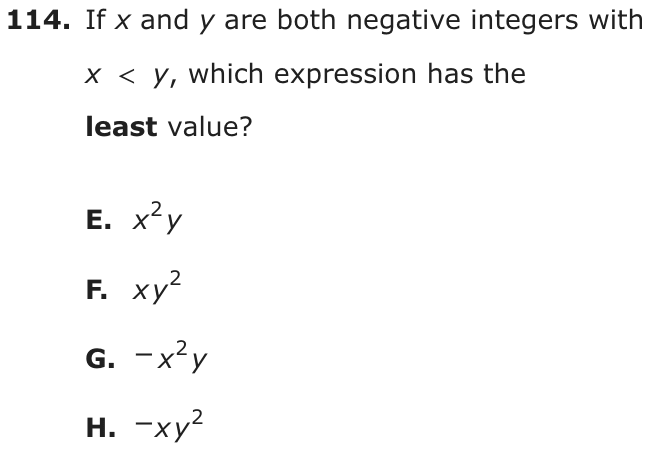
If x and y are both negative integers with , which expression has the least value?
- A
- B
- C
- D
Show the answer
Correct answer: A
Since x and y are both negative integers, both and are positive.
Therefore, both and are negative, and both and are positive.
Because and both x and y are negative, and . So .
Since and x and y are integers, .
So .
Therefore, .
Question analysis
Two negative integers x and y, with x less than y, appear in four expressions built from squares and minus signs. Students find the expression with the least value. It tests multiplying negative numbers and comparing their sizes, and the difficulty is tracking how each minus sign and each square changes both the sign and the size of the result.
- Grade level
- Grade 7 content, by NYS standard
- Compared with grade 7
- Above grade 7 Grade 7 students multiply negative numbers, but this asks them to compare four variable expressions for any pair of negative integers. Deciding how the squares compare when x is less than y goes beyond typical grade 7 sign practice.
- Estimated difficulty
- Hard: combines ideas, needs a plan, and has more than one tempting wrong answer.
- Thinking it demands
- Depth of knowledge 2, skills and concepts · mainly analyze
- What makes it hard
- Variables instead of numbers moderate
- A very close wrong answer moderate
- Every choice must be checked minor
- Solution
- 3 steps
- Reading level
- Question and choices: about grade 8, 20 words.
- Students, last 30 days
- Not enough answers yet to show (it takes 10).
Why it is hard, traps and wrong answers (shows the answer)
Why it is hard
Two facts settle the question: squares of negatives are positive, and the more negative number has the larger square. Students who track the minus signs carelessly think a leading minus makes an expression negative, and students who assume the larger y has the larger square choose the wrong negative expression. Substituting x = −3 and y = −2 gives −18, −12, 18 and 12, which orders all four at once.
Variables instead of numbers moderate Understanding the question
No values are given, only that x and y are negative integers with x < y, so students must reason about signs or invent a pair such as −3 and −2. (Koedinger & Nathan, 2004; Enright, Morley & Sheehan, 2002)
A very close wrong answer moderate Choosing the answer
x²y and xy² use the same letters with the exponent moved; both are negative, and only comparing x² with y² separates them. (Embretson & Wetzel, 1987; Gorin & Embretson, 2006; Ascalon et al., 2007)
Every choice must be checked minor Choosing the answer
All four expressions have to be placed in order, because the minus signs in front of the last two turn those expressions positive. (Embretson & Wetzel, 1987)
Strategy: Pick two negative integers with x less than y, such as −3 and −2, evaluate all four expressions, and confirm the order with a second pair.
Traps
- Negatives and direction: Arithmetic with negative numbers, the order of a subtraction, or direction on a number line. (Moving a term across the equals sign without changing its sign is a faulty procedure.)
- Misunderstands the concept: A wrong belief about a concept: that percents can be added, that area grows like length, that averages can be averaged, that a bigger denominator means a bigger fraction.
The wrong answers, classified
B Misunderstands the concept (Smith, diSessa & Roschelle, 1993; De Bock et al., 1998; Ni & Zhou, 2005)
Knows x²y and xy² are both negative but takes y² as the larger square because y > x, though the more negative x has the bigger square.
C Negatives and direction (Brown & Burton, 1978)
Reads the leading minus as making −x²y negative, missing that y is negative, so −x²y is in fact positive.
D Negatives and direction (Brown & Burton, 1978)
Assumes the leading minus makes −xy² negative, missing that x is negative, so −xy² is in fact positive.
Worked solution, step by step
Formulas used
- Signs in multiplication
- a and b are positive numbers, so −a and −b are negative. A negative times a negative is positive. A negative times a positive is negative. So a product is positive when it has an even number of negative factors.
- Squaring a number
- x is any number. x² (x squared) means x times itself. The square of a number other than 0 is always positive, because two negatives or two positives multiply to a positive.
Sort out the question
x and y are negative integers, such as −3 and −2. Since x < y, x is to the left of y on the number line. So x is more negative, farther from 0.
You need the expression with the least value. That is the most negative one.
Find the sign of each expression
Squares are positive, so and are positive.
- is a positive times a negative, so it is negative.
- is a negative times a positive, so it is negative.
- and are the opposites of these, so they are positive.
So the least value must be A or B. Watch out: The minus sign in front of C and D does not make them negative. It turns a negative into a positive.
Compare A and B with numbers
Try x = −3 and y = −2, since −3 < −2.
Since −18 < −12, A is smaller.
See why it always works
Both expressions contain x × y, which is positive. and . Multiplying the same positive number by the more negative x gives the more negative result.
Watch out: y is bigger than x, but is smaller than : 4 is less than 9. Thinking y² is bigger leads to choice B.
So the answer is A, .
Check your answer
Try another pair, x = −5 and y = −1. Then A is , B is , C is 25 and D is 5. A is still the least.
More questions like this
The original DOE question