3 English and 3 math
Here are 6 random questions to try. Takers earning below 75% are unlikely to receive an offer. You have 1 minute 48 seconds per question on the real exam.
Question 1 of 6
2026 Practice Test A English, question 31Passage Excerpt from “The Spirit of the Herd”
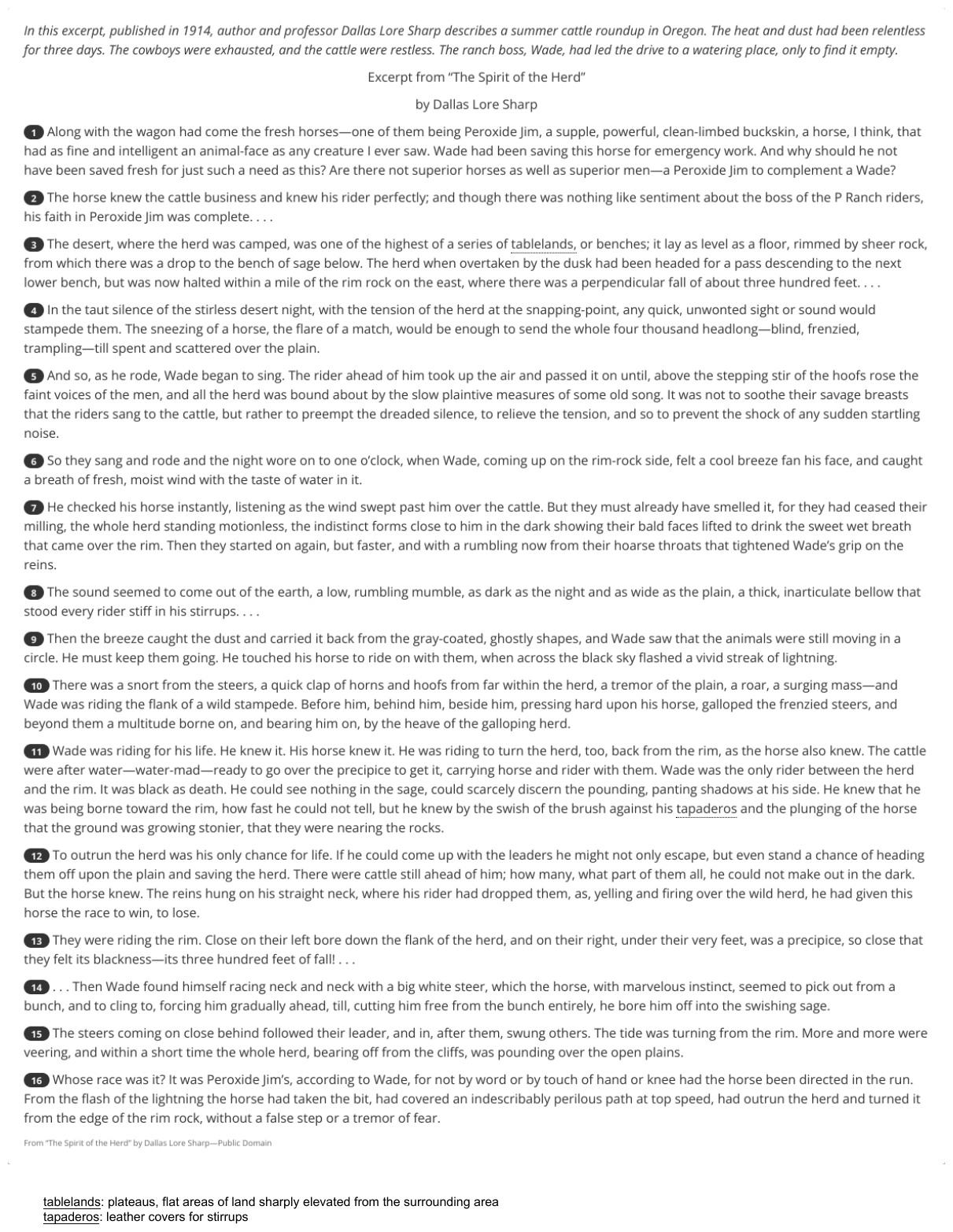
Excerpt from “The Spirit of the Herd”
by Dallas Lore Sharp
In this excerpt, published in 1914, author and professor Dallas Lore Sharp describes a summer cattle roundup in Oregon. The heat and dust had been relentless for three days. The cowboys were exhausted, and the cattle were restless. The ranch boss, Wade, had led the drive to a watering place, only to find it empty.
Along with the wagon had come the fresh horses—one of them being Peroxide Jim, a supple, powerful, clean-limbed buckskin, a horse, I think, that had as fine and intelligent an animal-face as any creature I ever saw. Wade had been saving this horse for emergency work. And why should he not have been saved fresh for just such a need as this? Are there not superior horses as well as superior men—a Peroxide Jim to complement a Wade?
The horse knew the cattle business and knew his rider perfectly; and though there was nothing like sentiment about the boss of the P Ranch riders, his faith in Peroxide Jim was complete. . . .
The desert, where the herd was camped, was one of the highest of a series of tablelands, or benches; it lay as level as a floor, rimmed by sheer rock, from which there was a drop to the bench of sage below. The herd when overtaken by the dusk had been headed for a pass descending to the next lower bench, but was now halted within a mile of the rim rock on the east, where there was a perpendicular fall of about three hundred feet. . . .
In the taut silence of the stirless desert night, with the tension of the herd at the snapping-point, any quick, unwonted sight or sound would stampede them. The sneezing of a horse, the flare of a match, would be enough to send the whole four thousand headlong—blind, frenzied, trampling—till spent and scattered over the plain.
And so, as he rode, Wade began to sing. The rider ahead of him took up the air and passed it on until, above the stepping stir of the hoofs rose the faint voices of the men, and all the herd was bound about by the slow plaintive measures of some old song. It was not to soothe their savage breasts that the riders sang to the cattle, but rather to preempt the dreaded silence, to relieve the tension, and so to prevent the shock of any sudden startling noise.
So they sang and rode and the night wore on to one o’clock, when Wade, coming up on the rim-rock side, felt a cool breeze fan his face, and caught a breath of fresh, moist wind with the taste of water in it.
He checked his horse instantly, listening as the wind swept past him over the cattle. But they must already have smelled it, for they had ceased their milling, the whole herd standing motionless, the indistinct forms close to him in the dark showing their bald faces lifted to drink the sweet wet breath that came over the rim. Then they started on again, but faster, and with a rumbling now from their hoarse throats that tightened Wade’s grip on the reins.
The sound seemed to come out of the earth, a low, rumbling mumble, as dark as the night and as wide as the plain, a thick, inarticulate bellow that stood every rider stiff in his stirrups. . . .
Then the breeze caught the dust and carried it back from the gray-coated, ghostly shapes, and Wade saw that the animals were still moving in a circle. He must keep them going. He touched his horse to ride on with them, when across the black sky flashed a vivid streak of lightning.
There was a snort from the steers, a quick clap of horns and hoofs from far within the herd, a tremor of the plain, a roar, a surging mass—and Wade was riding the flank of a wild stampede. Before him, behind him, beside him, pressing hard upon his horse, galloped the frenzied steers, and beyond them a multitude borne on, and bearing him on, by the heave of the galloping herd.
Wade was riding for his life. He knew it. His horse knew it. He was riding to turn the herd, too, back from the rim, as the horse also knew. The cattle were after water—water-mad—ready to go over the precipice to get it, carrying horse and rider with them. Wade was the only rider between the herd and the rim. It was black as death. He could see nothing in the sage, could scarcely discern the pounding, panting shadows at his side. He knew that he was being borne toward the rim, how fast he could not tell, but he knew by the swish of the brush against his tapaderos and the plunging of the horse that the ground was growing stonier, that they were nearing the rocks.
To outrun the herd was his only chance for life. If he could come up with the leaders he might not only escape, but even stand a chance of heading them off upon the plain and saving the herd. There were cattle still ahead of him; how many, what part of them all, he could not make out in the dark. But the horse knew. The reins hung on his straight neck, where his rider had dropped them, as, yelling and firing over the wild herd, he had given this horse the race to win, to lose.
They were riding the rim. Close on their left bore down the flank of the herd, and on their right, under their very feet, was a precipice, so close that they felt its blackness—its three hundred feet of fall! . . .
. . . Then Wade found himself racing neck and neck with a big white steer, which the horse, with marvelous instinct, seemed to pick out from a bunch, and to cling to, forcing him gradually ahead, till, cutting him free from the bunch entirely, he bore him off into the swishing sage.
The steers coming on close behind followed their leader, and in, after them, swung others. The tide was turning from the rim. More and more were veering, and within a short time the whole herd, bearing off from the cliffs, was pounding over the open plains.
Whose race was it? It was Peroxide Jim’s, according to Wade, for not by word or by touch of hand or knee had the horse been directed in the run. From the flash of the lightning the horse had taken the bit, had covered an indescribably perilous path at top speed, had outrun the herd and turned it from the edge of the rim rock, without a false step or a tremor of fear.
From “The Spirit of the Herd” by Dallas Lore Sharp—Public Domain
tablelands: plateaus, flat areas of land sharply elevated from the surrounding area
tapaderos: leather covers for stirrups
Question
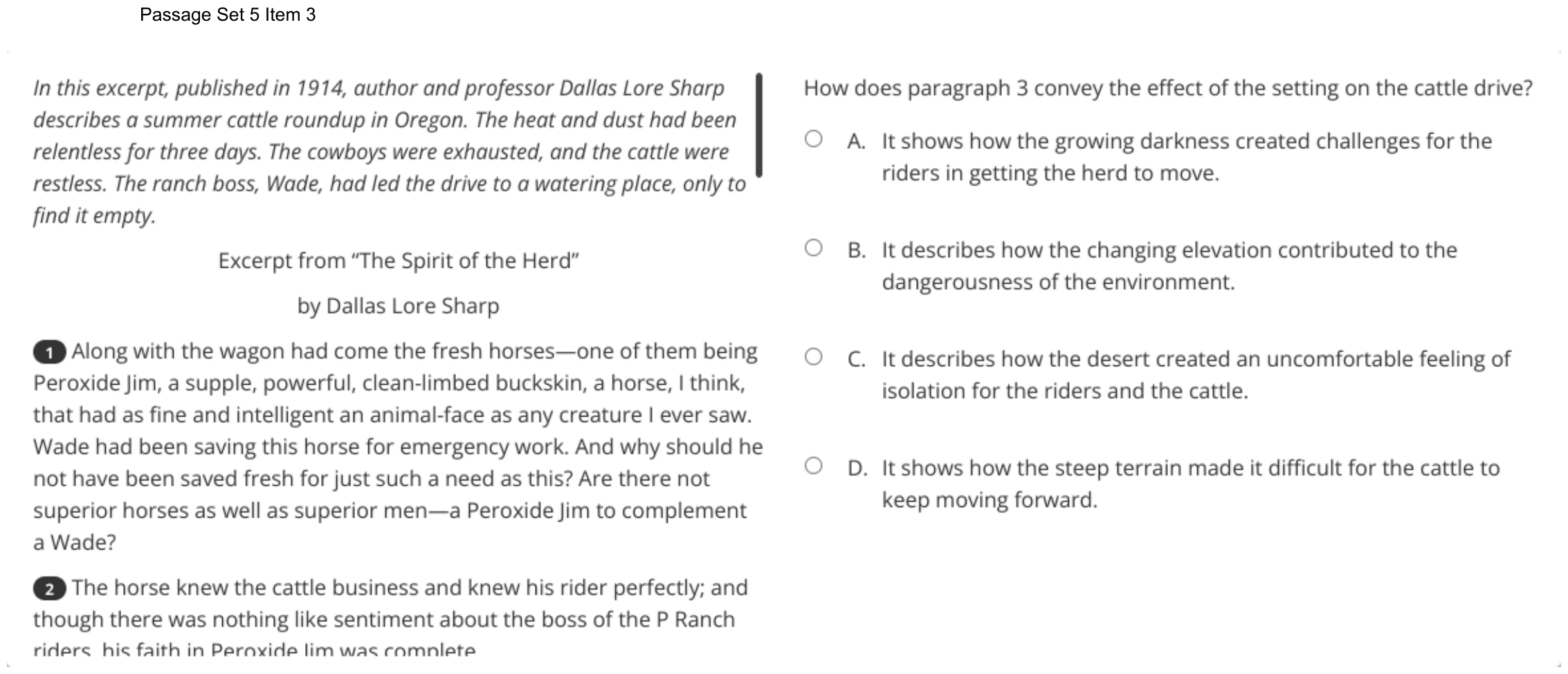
How does paragraph 3 convey the effect of the setting on the cattle drive?
- AIt shows how the growing darkness created challenges for the riders in getting the herd to move.
- BIt describes how the changing elevation contributed to the dangerousness of the environment.
- CIt describes how the desert created an uncomfortable feeling of isolation for the riders and the cattle.
- DIt shows how the steep terrain made it difficult for the cattle to keep moving forward.
Show the answer
Correct answer: B
The question asks how paragraph 3 conveys the effect of the setting on the cattle drive.
A. Incorrect. The riders were not trying to move the herd through the darkness. Instead, the reference to the growing darkness (“overtaken by the dusk”) indicates that the riders had halted the animals for the night because moving the herd across the desert in the darkness would have been much too dangerous because of the sheer drop-off at the edge of the tableland. The riders needed the daylight to navigate the herd safely through the “pass descending to the next lower bench.”
B. CORRECT. Paragraph 3 describes the land where the herd was as being “as level as a floor” but “rimmed by sheer rock, from which there was a drop to the bench of sage below.” The drop was “a perpendicular fall of about three hundred feet”—any animal or person could fall over that edge. It was the change in height, from flat tableland to sheer drop-off, that made the terrain so dangerous.
C. Incorrect. The use of the word “desert” in the first sentence of the paragraph does not highlight the isolation of the setting or indicate that the riders and the herd were uncomfortable being alone. Instead, the word merely establishes the setting where the action occurred: “it lay as level as a floor, rimmed by sheer rock, from which there was a drop to the bench of sage below.”
D. Incorrect. The excerpt does not indicate that the steep terrain made it difficult for the herd to move forward. The herd was not expected to navigate the steep terrain. Instead, the steep terrain presented a danger to the herd that must be avoided. The riders intended to move the herd safely through passes that descended gradually to lower elevations.
Question analysis
This setting question on “The Spirit of the Herd” asks how paragraph 3, which describes the high desert where the herd has stopped for the night, conveys the setting’s effect on the cattle drive. Students must understand unusual landform words, one explained in a footnote, and work out what the land means for the herd. Several choices name a real feature of the scene.
- Grade level
- Grade 8 reading and task
- Compared with grade 7
- Above grade 7 Grade 7 students analyze how setting affects a story, usually from plainly worded description. This paragraph relies on terms such as tablelands, benches and rim rock, and never names the effect, so students must work it out from the description.
- Estimated difficulty
- Hard: combines ideas, needs a plan, and has more than one tempting wrong answer.
- Thinking it demands
- Depth of knowledge 2, skills and concepts · mainly analyze
- What makes it hard
- A very close wrong answer moderate
- Hard words moderate
- Reading between the lines minor
- Evidence
- Answered from one paragraph or stanza
- Reading level
- Passage: about grade 8, 1160 words; question and choices: about grade 9, 76 words.
- Students, last 30 days
- Not enough answers yet to show (it takes 10).
Why it is hard, traps and wrong answers (shows the answer)
Why it is hard
Paragraph 3 reads like a surveyor’s report, flat land ending in a sheer drop, with no word of fear. Students must turn its landforms into a picture and see that a herd camped a mile from a three-hundred-foot fall is in danger. The strongest wrong answer gets the cliff right but makes it a barrier to the drive, and others seize on the dusk or on the loneliness a desert suggests.
A very close wrong answer moderate Choosing the answer
The choice about steep terrain blocking the herd and the right one both rest on the drop at the rim; they differ only in its effect, a hazard to avoid or an obstacle to movement. (Embretson & Wetzel, 1987; Gorin & Embretson, 2006; Ascalon et al., 2007)
Hard words moderate Understanding the question
The paragraph’s landforms, “tablelands, or benches,” “rim rock,” a “pass descending to the next lower bench” and a “perpendicular fall,” must be pictured before the danger is clear. (Perfetti, 2007; Freedle & Kostin, 1993)
Reading between the lines minor Working it out
The paragraph never calls the drop dangerous; students must infer it from “sheer rock” and “about three hundred feet,” a danger that becomes real only when the herd stampedes toward the rim. (Graesser, Singer & Trabasso, 1994; Kintsch, 1998)
Strategy: Make a quick sketch of the land paragraph 3 describes and mark where the herd is halted, then ask what that setting means for the drive and test each choice against it.
Traps
- Twists what the text says: Uses the text's topic and ideas but changes what it says: who did it, how much, when, or why.
- Outside knowledge: A choice is plausible in the real world but not supported by this text.
The wrong answers, classified
A Twists what the text says (King et al., 2004)
Turns “overtaken by the dusk” into a struggle to get the herd moving, though the herd was halted for the night and the paragraph stresses the drop, not darkness.
C Outside knowledge (King et al., 2004; Recht & Leslie, 1988)
Assumes a desert must feel lonely, a common association, though the paragraph uses “desert” only to place the herd on a level plain and says nothing of isolation.
D Twists what the text says (King et al., 2004)
Rightly notices the sheer drop but makes it an obstacle to forward movement, when the herd was headed for a pass and the cliff was a hazard to avoid.
Working it out, step by step
Figure out what the question asks
This asks about setting, the place and time of a story. How does the land in paragraph 3 affect the cattle drive? A cattle drive is a trip where riders move a large herd of cattle across the land.
Read paragraph 3
The herd is camped on high, flat land “rimmed by sheer rock, from which there was a drop to the bench of sage below.” The herd “was now halted within a mile of the rim rock on the east, where there was a perpendicular fall of about three hundred feet.”
Picture the land
The note says tablelands are “flat areas of land sharply elevated from the surrounding area.” A bench is another name for one. Picture giant steps. The herd is on a high step. Its edge is sheer rock, a straight drop. Perpendicular means straight up and down. So the herd has stopped within a mile of a cliff about 300 feet high.
Work out the effect
Elevation is how high the land is. Here the elevation changes suddenly, from flat ground to a steep cliff. A scared herd could run right over the edge. That makes the place dangerous. Later, this danger comes true when the stampede races toward the rim.
Check each choice
- A does not fit. The herd was halted for the night. The riders were not trying to move it.
- B fits. The sudden drop makes the place dangerous.
- C does not fit. The paragraph says nothing about feeling lonely.
- D does not fit. The herd was headed for a pass, an easier way down. The cliff was a danger to avoid.
Choose the answer
The change in height, from flat land to a sheer drop, makes the setting dangerous. So the answer is B.
Why this answer and not the closest wrong one
D is the closest wrong choice, because it also points to the steep drop. But the herd was not trying to climb down the cliff. It was headed for a pass and had stopped for the night. The drop matters because the herd could fall over it. That danger is what B describes.
More questions like this
The original DOE question
The passage “Excerpt from “The Spirit of the Herd”” as printed (page 41)
Question 2 of 6
2026 Practice Test B English, question 42Passage Letter from Brooklyn
Letter from Brooklyn
by Jacob Scheier
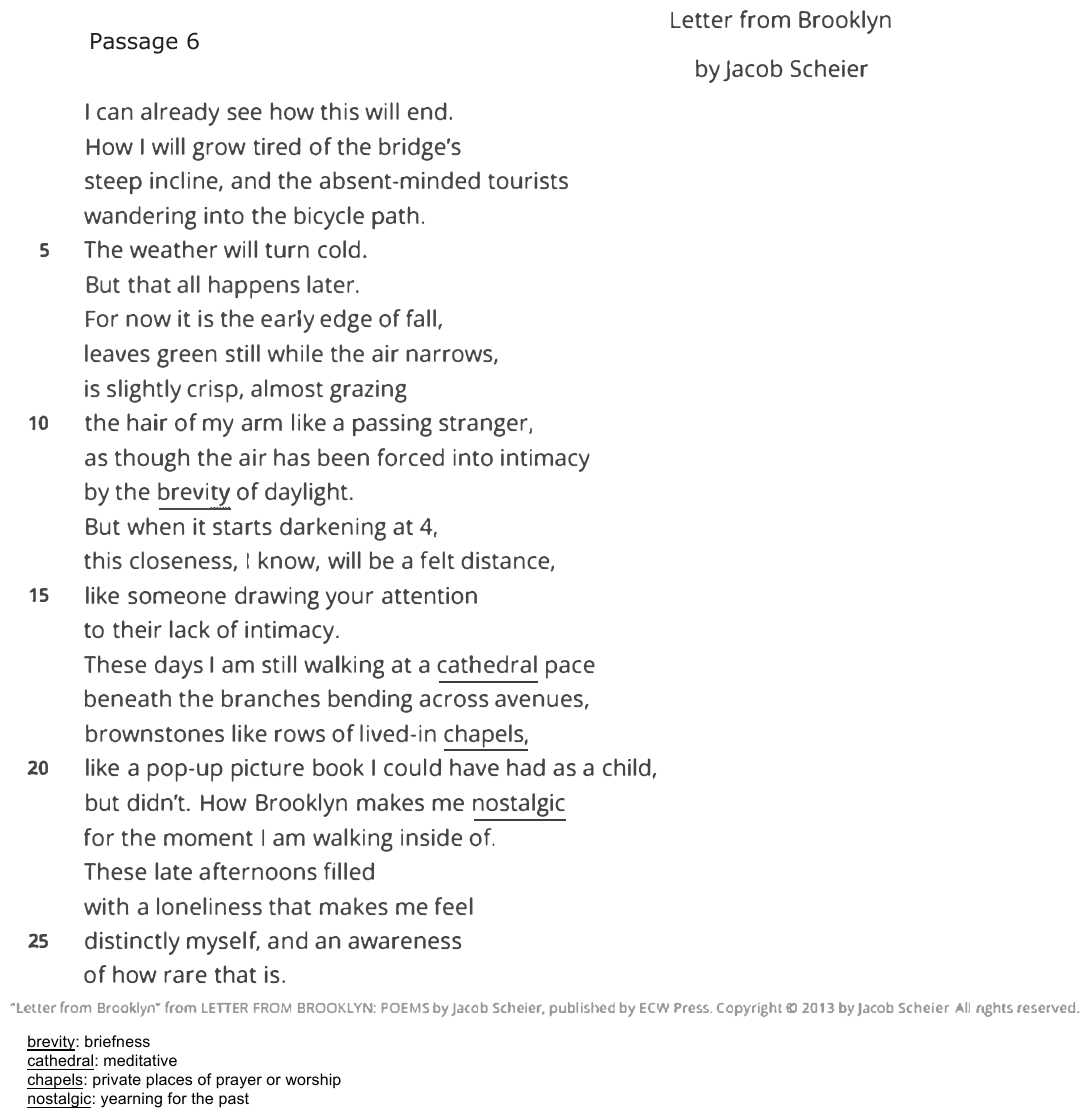
I can already see how this will end.
How I will grow tired of the bridge’s
steep incline, and the absent-minded tourists
wandering into the bicycle path.
The weather will turn cold.
But that all happens later.
For now it is the early edge of fall,
leaves green still while the air narrows,
is slightly crisp, almost grazing
the hair of my arm like a passing stranger,
as though the air has been forced into intimacy
by the brevity of daylight.
But when it starts darkening at 4,
this closeness, I know, will be a felt distance,
like someone drawing your attention
to their lack of intimacy.
These days I am still walking at a cathedral pace
beneath the branches bending across avenues,
brownstones like rows of lived-in chapels,
like a pop-up picture book I could have had as a child,
but didn’t. How Brooklyn makes me nostalgic
for the moment I am walking inside of.
These late afternoons filled
with a loneliness that makes me feel
distinctly myself, and an awareness
of how rare that is.
“Letter from Brooklyn” from LETTER FROM BROOKLYN: POEMS by Jacob Scheier, published by ECW Press. Copyright © 2013 by Jacob Scheier All rights reserved.
brevity: briefness
cathedral: meditative
chapels: private places of prayer or worship
nostalgic: yearning for the past
Question
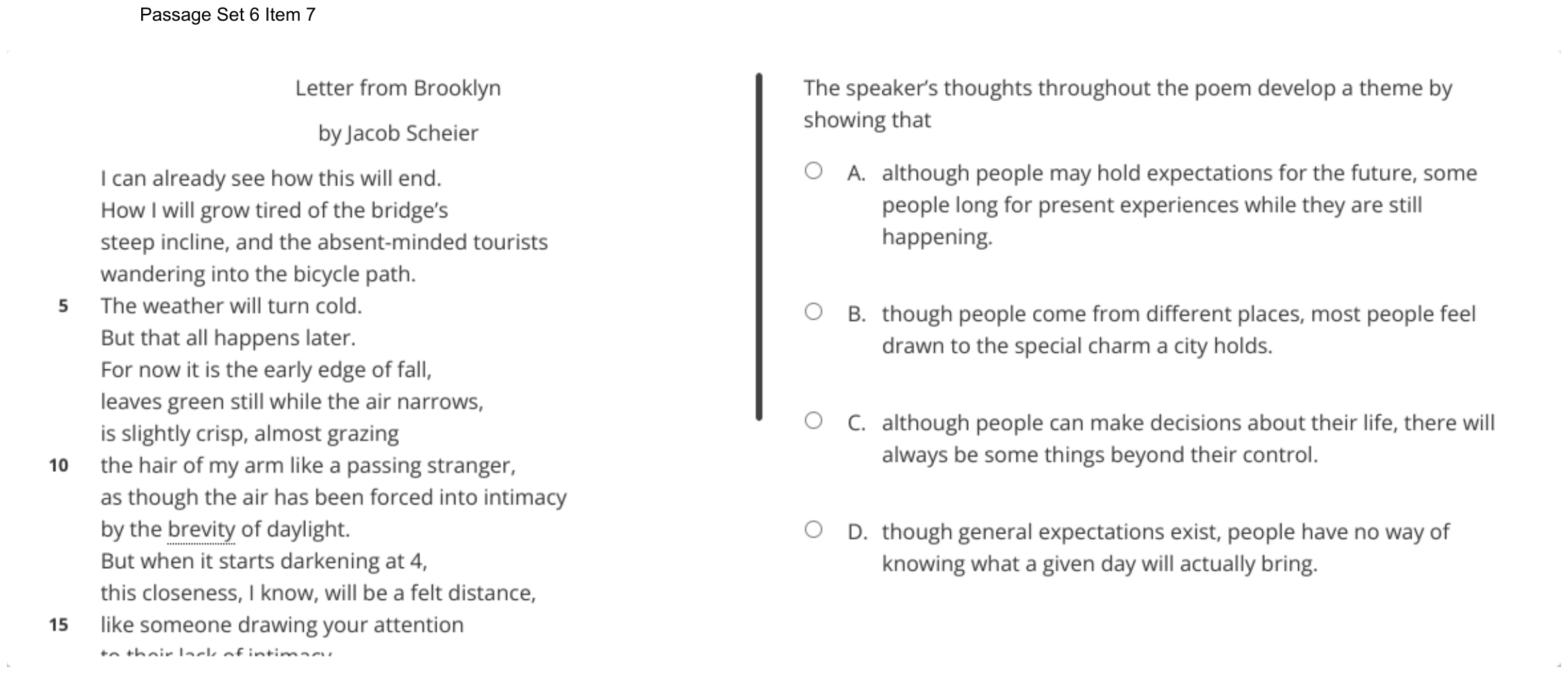
The speaker’s thoughts throughout the poem develop a theme by showing that
- Aalthough people may hold expectations for the future, some people long for present experiences while they are still happening.
- Bthough people come from different places, most people feel drawn to the special charm a city holds.
- Calthough people can make decisions about their life, there will always be some things beyond their control.
- Dthough general expectations exist, people have no way of knowing what a given day will actually bring.
Show the answer
Correct answer: A
The question asks how the speaker’s thoughts throughout the poem develop a theme.
A. CORRECT. The speaker’s thoughts develop some tension because seasonal change will inevitably come: “The weather will turn cold” (line 5). However, the speaker is still able to enjoy the present experience because “that all happens later” (line 6). In lines 21–22, the speaker begins to describe experiences that create a longing for the present, even while it is still happening (“How Brooklyn makes me nostalgic / for the moment I am walking inside of”), developing a theme of the poem.
B. Incorrect. The speaker’s thoughts reveal an appreciation for the city, but this appreciation is highly personal and individual. These thoughts do not indicate that most people will feel drawn to cities.
C. Incorrect. Some things, such as seasons, are beyond human control, as the speaker concedes: “I can already see how this will end” (line 1). However, the theme of the poem is not that certain things are inevitable, but that one can live in the present moment and enjoy that experience before change occurs.
D. Incorrect. The speaker’s thoughts are not showing that people are surprised by what the days bring; the thoughts of the speaker suggest that people experience many seasons in Brooklyn and have reasonable expectations about what these days will bring.
Question analysis
This theme question asks what theme the speaker's thoughts develop across all of “Letter from Brooklyn,” from the opening line about how things will end to the closing lines about loneliness on late afternoons. Each choice is a broad statement about people in two parts, so students must check both halves against the speaker's reflections.
- NYS standards
- 7R2 theme or central idea
- Grade level
- Grade 8 reading and task
- Compared with grade 7
- Above grade 7 Stating a theme is a grade 7 standard, often tested with one clearly fitting choice. Here every choice is a two-part general statement about people, and students must test both halves of each against a whole poem of abstract reflection, more than typical.
- Estimated difficulty
- Hard: combines ideas, needs a plan, and has more than one tempting wrong answer.
- Thinking it demands
- Depth of knowledge 3, strategic thinking · mainly analyze
- What makes it hard
- Reading between the lines moderate
- Every choice must be checked moderate
- Evidence in several places minor
- Evidence
- Answered from the whole text
- Reading level
- Passage: 217 words (a poem; reading level not measured); question and choices: about grade 9, 82 words.
- Students, last 30 days
- Not enough answers yet to show (it takes 10).
Why it is hard, traps and wrong answers (shows the answer)
Why it is hard
The four themes are broad statements about people, each in two halves, and every one can borrow something from the poem: the seasons are beyond control, the city has charm, the future brings surprises. The right one matches the speaker’s double vision, knowing what is coming and longing for the present while it lasts. The strongest pull is the theme about things beyond control, whose second half fits the turning seasons and whose first half the poem never raises.
Reading between the lines moderate Working it out
The poem never states its theme; it must be built from the speaker’s forecasts in lines 1–6 and the paradox of being “nostalgic / for the moment I am walking inside of.” (Graesser, Singer & Trabasso, 1994; Kintsch, 1998)
Every choice must be checked moderate Choosing the answer
Every choice is a two-part “although” or “though” statement about people, and three have one plausible half, so each half must be checked against the poem on its own. (Embretson & Wetzel, 1987)
Evidence in several places minor Working it out
The theme draws on the whole poem, from the opening “I can already see how this will end” to the lonely late afternoons of lines 23–26. (Kirsch & Mosenthal, 1990; Gorin & Embretson, 2006)
Strategy: Sum up in a sentence what the speaker keeps thinking about from the first line to the last, then test both halves of each choice against the poem and reject any half it does not support.
Traps
- Half right: One half of a two-part choice is right and the other is not.
- Too broad or too strong: A choice overstates, generalizes, or uses absolute words the text does not support.
- Twists what the text says: Uses the text's topic and ideas but changes what it says: who did it, how much, when, or why.
The wrong answers, classified
B Too broad or too strong (King et al., 2004)
Turns one speaker’s love of Brooklyn into a claim that “most people” feel drawn to a city’s charm, though no other person’s view appears in the poem.
C Half right (King et al., 2004; Thissen, Steinberg & Fitzpatrick, 1989)
Accepts the half about things beyond control, since the weather will turn cold regardless, but the poem says nothing about people making decisions about their lives.
D Twists what the text says (King et al., 2004)
Turns the coming season into an unknown, though the speaker opens with “I can already see how this will end” and knows exactly what the weather will bring.
Working it out, step by step
Figure out what the question asks
This question asks for the theme of the whole poem. A theme is a big message about life. Each choice has two halves, joined by although or though. Both halves must fit the poem. If one half doesn’t, the choice is wrong.
Trace the speaker’s thoughts
The poem opens by looking ahead: “I can already see how this will end.” The speaker expects to tire of the bridge, and “The weather will turn cold.” Then the speaker turns to now: “But that all happens later.” Most of the poem enjoys the fall walk. Lines 21–22 sum it up: “How Brooklyn makes me nostalgic / for the moment I am walking inside of.”
Put it in your own words
Nostalgic means longing for the past. Yet the speaker longs for the present, while it is still going on. So the speaker does two things at once. The speaker expects what the future will bring. And the speaker treasures, or deeply values, the present. That is the theme.
Check each choice
- A is right. First half: the speaker expects cold weather and boredom. Second half: the speaker longs for the walk while it is still going on.
- B is wrong. Only one person speaks in the poem. Nothing says most people feel drawn to cities.
- C is wrong. The weather is beyond anyone’s control, so its second half fits. But the poem never talks about people making decisions about their lives.
- D is wrong. The speaker knows what is coming. The future isn’t a mystery here.
Watch out: C is tempting because the speaker can’t stop the cold. But test both halves. Its first half, about making decisions, isn’t in the poem.
Choose the answer
So the answer is A: “although people may hold expectations for the future, some people long for present experiences while they are still happening.”
Why this answer and not the closest wrong one
C is the closest wrong answer, because the seasons are beyond the speaker’s control. But the poem never mentions people making decisions about their lives. A matches both halves: the speaker expects what is coming, and longs for the present while it lasts.
More questions like this
The original DOE question
The passage “Letter from Brooklyn” as printed (page 50)
Question 3 of 6
2024 Test B English, question 18Passage Excerpt from “How Exercise Could Help You Learn a New Language”
Excerpt from “How Exercise Could Help You Learn a New Language”
by Gretchen Reynolds
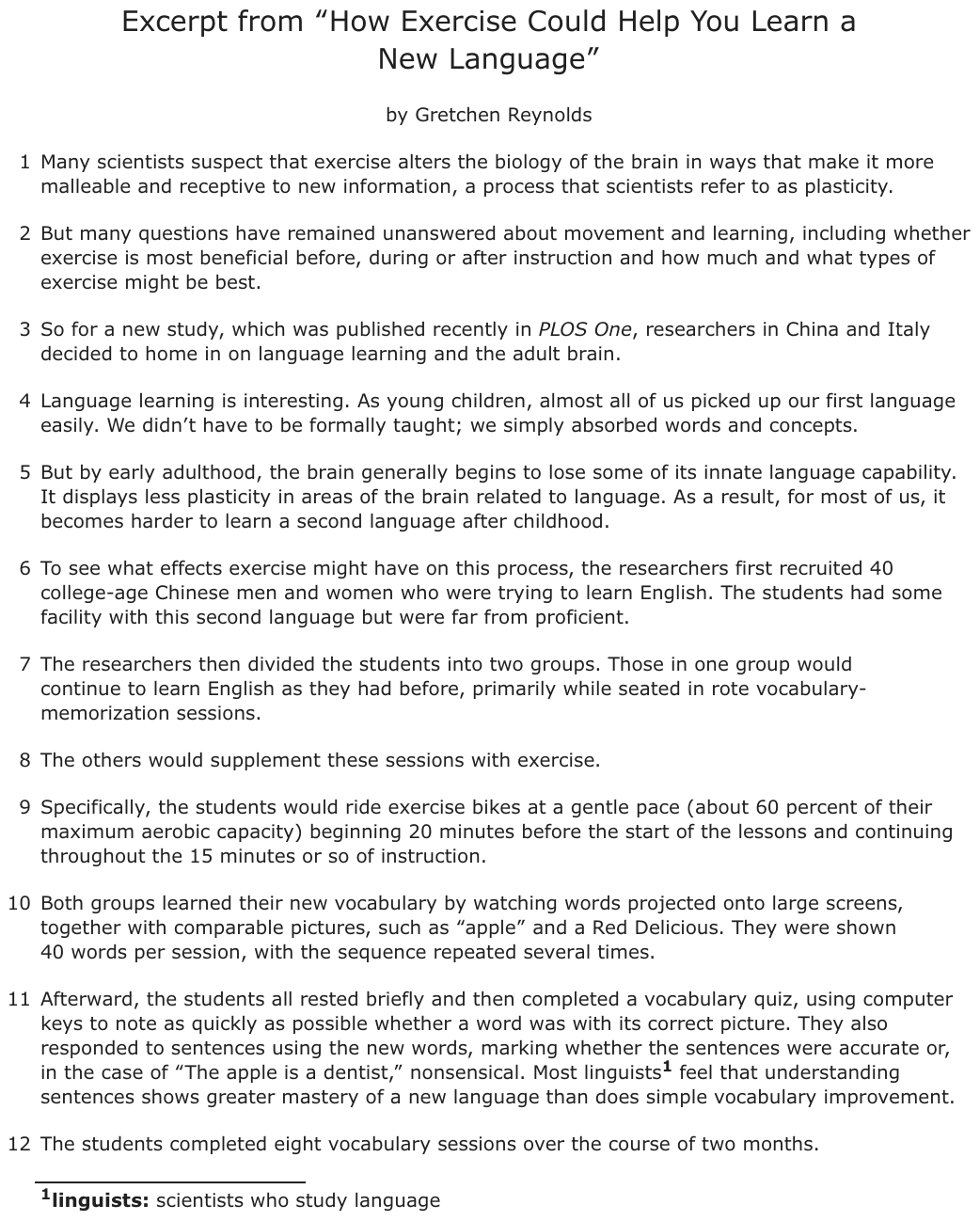
Many scientists suspect that exercise alters the biology of the brain in ways that make it more malleable and receptive to new information, a process that scientists refer to as plasticity.
But many questions have remained unanswered about movement and learning, including whether exercise is most beneficial before, during or after instruction and how much and what types of exercise might be best.
So for a new study, which was published recently in PLOS One, researchers in China and Italy decided to home in on language learning and the adult brain.
Language learning is interesting. As young children, almost all of us picked up our first language easily. We didn’t have to be formally taught; we simply absorbed words and concepts.
But by early adulthood, the brain generally begins to lose some of its innate language capability. It displays less plasticity in areas of the brain related to language. As a result, for most of us, it becomes harder to learn a second language after childhood.
To see what effects exercise might have on this process, the researchers first recruited 40 college-age Chinese men and women who were trying to learn English. The students had some facility with this second language but were far from proficient.
The researchers then divided the students into two groups. Those in one group would continue to learn English as they had before, primarily while seated in rote vocabulary-memorization sessions.
The others would supplement these sessions with exercise.
Specifically, the students would ride exercise bikes at a gentle pace (about 60 percent of their maximum aerobic capacity) beginning 20 minutes before the start of the lessons and continuing throughout the 15 minutes or so of instruction.
Both groups learned their new vocabulary by watching words projected onto large screens, together with comparable pictures, such as “apple” and a Red Delicious. They were shown 40 words per session, with the sequence repeated several times.
Afterward, the students all rested briefly and then completed a vocabulary quiz, using computer keys to note as quickly as possible whether a word was with its correct picture. They also responded to sentences using the new words, marking whether the sentences were accurate or, in the case of “The apple is a dentist,” nonsensical. Most linguists1 feel that understanding sentences shows greater mastery of a new language than does simple vocabulary improvement.
The students completed eight vocabulary sessions over the course of two months.
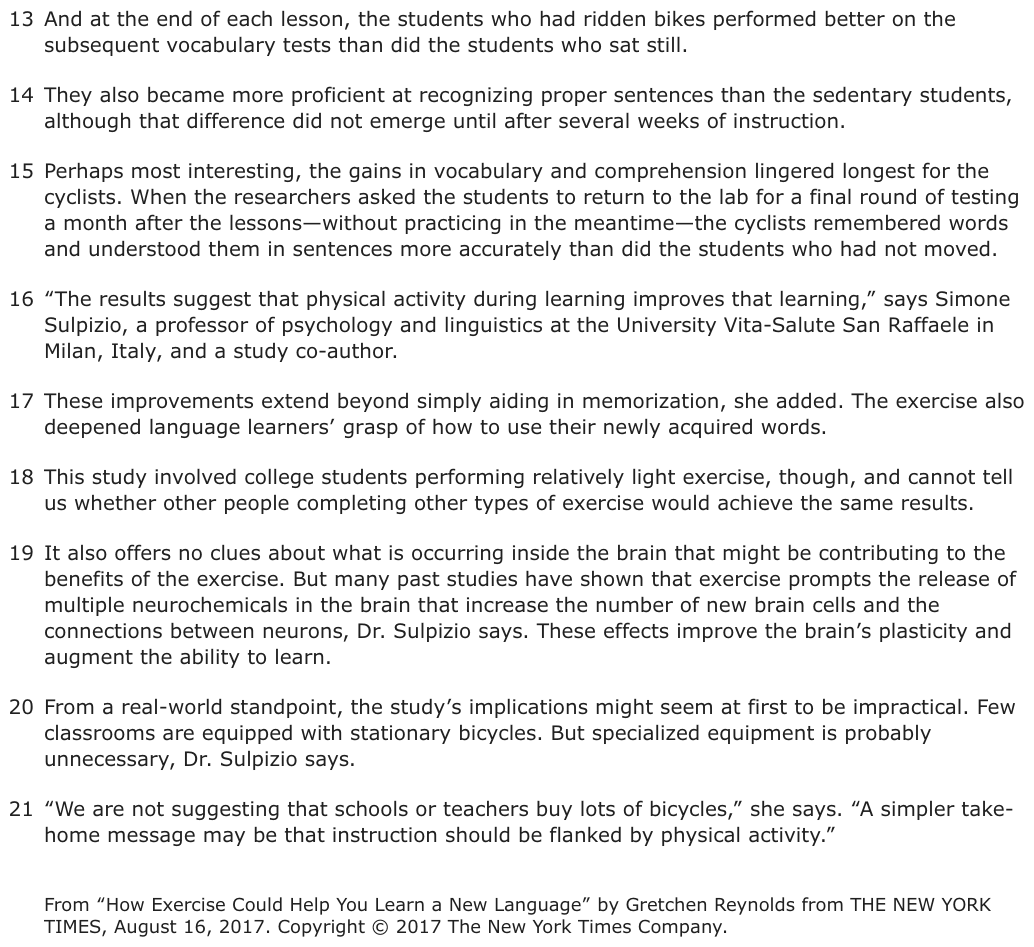
And at the end of each lesson, the students who had ridden bikes performed better on the subsequent vocabulary tests than did the students who sat still.
They also became more proficient at recognizing proper sentences than the sedentary students, although that difference did not emerge until after several weeks of instruction.
Perhaps most interesting, the gains in vocabulary and comprehension lingered longest for the cyclists. When the researchers asked the students to return to the lab for a final round of testing a month after the lessons—without practicing in the meantime—the cyclists remembered words and understood them in sentences more accurately than did the students who had not moved.
“The results suggest that physical activity during learning improves that learning,” says Simone Sulpizio, a professor of psychology and linguistics at the University Vita-Salute San Raffaele in Milan, Italy, and a study co-author.
These improvements extend beyond simply aiding in memorization, she added. The exercise also deepened language learners’ grasp of how to use their newly acquired words.
This study involved college students performing relatively light exercise, though, and cannot tell us whether other people completing other types of exercise would achieve the same results.
It also offers no clues about what is occurring inside the brain that might be contributing to the benefits of the exercise. But many past studies have shown that exercise prompts the release of multiple neurochemicals in the brain that increase the number of new brain cells and the connections between neurons, Dr. Sulpizio says. These effects improve the brain’s plasticity and augment the ability to learn.
From a real-world standpoint, the study’s implications might seem at first to be impractical. Few classrooms are equipped with stationary bicycles. But specialized equipment is probably unnecessary, Dr. Sulpizio says.
“We are not suggesting that schools or teachers buy lots of bicycles,” she says. “A simpler take-home message may be that instruction should be flanked by physical activity.”
From “How Exercise Could Help You Learn a New Language” by Gretchen Reynolds from THE NEW YORK TIMES, August 16, 2017. Copyright © 2017 The New York Times Company.
1linguists: scientists who study language
Question
Which sentence is the best summary of the research procedure used in the study in the excerpt?
- AResearchers had a group of non-English-speaking students learn new English vocabulary by matching words and images on a computer screen, and also by analyzing words in context; some students exercised and some students sat still while learning.
- BResearchers first divided non-English-speaking students into two groups, with one group exercising before and while studying English and the other group studying English without exercising; then, after instruction, student learning was assessed.
- CResearchers first had non-English-speaking students sit on stationary bikes and pedal for 20 minutes before instruction and 15 minutes during instruction; then, after a rest period, students indicated whether English sentences made sense.
- DResearchers asked non-English-speaking students to study English while sitting or biking; then the students’ vocabulary skills were assessed after a short break period and also after a break of a full month without their having studied any of the materials.
Show the answer
Correct answer: B
The question asks for the best summary of the research procedure used in the study in the excerpt.
A. Incorrect. This summary says that students learned new words by matching words and images and “also by analyzing words in context,” but this last method was how the researchers assessed students, not how the students learned words; the summary is therefore inaccurate.
B. CORRECT. The summary includes the most important information, which is that one group of non-English-speaking students exercised before and during the English lessons, while the other group did not, and that the students’ learning was assessed afterward.
C. Incorrect. This summary is incomplete because it never mentions the control group—that is, the students who studied English without exercising—which was essential to the study so that results could be compared.
D. Incorrect. This summary includes unnecessary details, such as that students were assessed after a short break and also assessed after a month of no studying; it also neglects to mention important points: that one group exercised both before and during learning, while the other group did not exercise at all.
Question analysis
This summary question asks which of four long sentences best sums up how the researchers ran the study of exercise and English vocabulary learning. Each choice packs in real details about bikes, screens, quizzes and timing, so students must check both whether every detail is accurate and whether anything essential to the study’s design has been left out.
- Grade level
- Grade 8 reading and task
- Compared with grade 7
- Above grade 7 Grade 7 students summarize texts, usually choosing among short summaries. Here each choice runs about forty words packed with accurate details from several paragraphs, and students must judge which keeps the study’s essential design, not merely which details are true.
- Estimated difficulty
- Hard: combines ideas, needs a plan, and has more than one tempting wrong answer.
- Thinking it demands
- Depth of knowledge 2, skills and concepts · mainly understand
- What makes it hard
- A very close wrong answer major
- Evidence in several places moderate
- A lot to read moderate
- Evidence
- Answered from several paragraphs or stanzas
- Reading level
- Passage: about grade 11, 764 words; question and choices: about grade 16+, 157 words.
- Students, last 30 days
- Not enough answers yet to show (it takes 10).
Why it is hard, traps and wrong answers (shows the answer)
Why it is hard
Most of what the wrong summaries say is true, which makes this a test of completeness and weight rather than of accuracy. One summary describes only the cyclists, another slips the sentence quiz into how words were taught, and the most tempting one is accurate but leaves out that the cyclists pedaled before the lesson as well as during it. The right summary is plainer than its rivals: two groups, one exercising, then a test.
A very close wrong answer major Choosing the answer
The sitting-or-biking summary is accurate and names both conditions, as the right one does, but it spends its words on the short rest and the month-later test instead of when the cyclists rode. (Embretson & Wetzel, 1987; Gorin & Embretson, 2006; Ascalon et al., 2007)
Evidence in several places moderate Working it out
The procedure runs from the recruiting in paragraph 6 through the groups, bikes, lessons and quiz in paragraphs 7–12 to the final test in paragraph 15, so it must be gathered before any summary is judged. (Kirsch & Mosenthal, 1990; Gorin & Embretson, 2006)
A lot to read moderate Understanding the question
Each summary is a 32- to 40-word sentence packed with real details, the 20 minutes of pedaling, the rest period, the month without study, so the four together form a dense passage of their own. (Kintsch, 1998; Gorin & Embretson, 2006; Freedle & Kostin, 1993)
Strategy: Before reading the choices, note in a few words how the study was set up and how learning was checked. Then test each summary for accuracy and for anything essential it leaves out.
Traps
- Too narrow: A single detail offered as the central idea or a summary, or a summary that keeps minor details and leaves out an essential part.
- Twists what the text says: Uses the text's topic and ideas but changes what it says: who did it, how much, when, or why.
The wrong answers, classified
A Twists what the text says (King et al., 2004)
Adds that students learned “by analyzing words in context,” but judging sentences was part of the quiz after each lesson, while the words were taught with pictures on large screens.
C Too narrow (King et al., 2004)
Follows the cyclists’ routine accurately, 20 minutes before and during the lesson, but leaves out the group that studied without exercise, so the comparison at the heart of the study disappears.
D Too narrow (King et al., 2004)
Is drawn by accurate details about the short rest and the month-later test, but it builds the summary around them and leaves out that the cyclists rode before the lessons too.
Working it out, step by step
Figure out what the question asks
You need the best summary of how the study was done. A summary gives the main parts in a few words. It must be accurate, and it can’t leave out anything important. Small details can be skipped.
Find the main parts of the study
- Paragraph 7: “The researchers then divided the students into two groups.”
- Paragraphs 8 and 9: one group rode bikes “beginning 20 minutes before the start of the lessons and continuing throughout the 15 minutes or so of instruction.” The other group sat still.
- Paragraph 11: then all the students took a quiz.
So the key parts are two groups, one that exercised, and a test afterward. The group that sat still matters. It lets the researchers compare.
Check each choice
- B has it all: two groups, one exercising “before and while studying,” then a test.
- A says students learned by “analyzing words in context.” But judging sentences was part of the quiz, not the lessons.
- C describes only the bike riders. It leaves out the group that sat still, so nothing gets compared.
- D spends its words on small details: the short break and the test a month later. It leaves out that the bike riders started 20 minutes before the lesson.
Pick the answer
Watch out: D is tempting because everything in it is true. But a summary should give the main parts, not the side details. So the answer is B.
Why this answer and not the closest wrong one
D is the closest wrong answer. Its facts are accurate, and it names both groups. But it builds the summary around the break and the month-later test. It never says the cyclists rode before the lessons too. B gives the main plan plainly: two groups, one exercising, then a test of learning.
More questions like this
The original DOE question
The passage “Excerpt from “How Exercise Could Help You Learn a New Language”” as printed (pages 171–172)
Question 4 of 6
2018 Test A Math, question 1Question
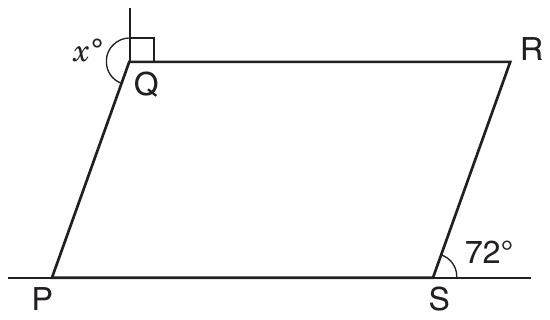
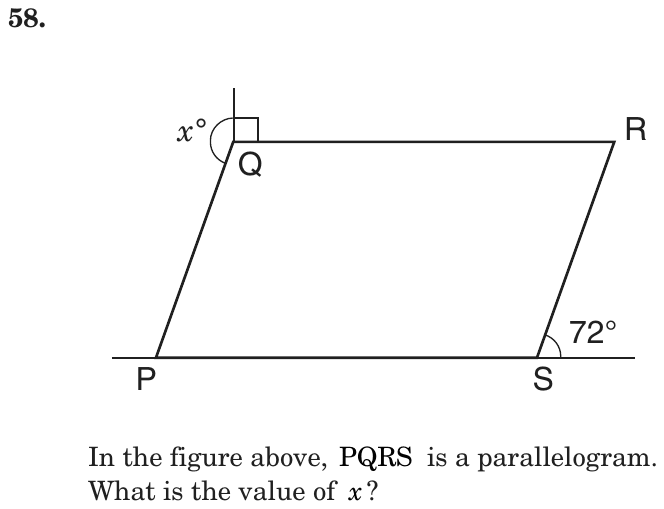
In the figure above, PQRS is a parallelogram. What is the value of ?
Grid-in question: work out the answer and enter it as a number.
Show the answer
Correct answer: 162
First, find the measure of angle PQR. The measure of angle PQR is equal to the measure of angle PSR.
m∠PSR = 180 − 72 = 108.
So, the measure of angle PQR is also 108.
108 + 90 + x = 360
198 + x = 360
x = 162
Question analysis
A grid-in geometry question about angles around a parallelogram PQRS. A 72° angle sits outside corner S on the extended base, and at corner Q a right angle and the unknown angle x complete the turn around the point. Students chain three angle facts, and the angle asked for lies outside the shape, not inside it.
- NYS standards
- Grade level
- Grade 8 content, by NYS standard
- Compared with grade 7
- Above grade 7 Grade 7 angle work usually applies one or two facts, such as supplementary or vertical angles, to find an angle. This chains three, and needs the equal opposite angles of a parallelogram, which rest on grade 8 parallel-line facts.
- Estimated difficulty
- Hard: combines ideas, needs a plan, and has more than one tempting wrong answer.
- Thinking it demands
- Depth of knowledge 2, skills and concepts · mainly apply
- What makes it hard
- Reading a figure, table or graph major
- Combines ideas moderate
- An answer in an unexpected form minor
- Solution
- 3 steps
- Reading level
- Question and choices: about grade 7, 14 words.
- Students, last 30 days
- Not enough answers yet to show (it takes 10).
Why it is hard, traps and wrong answers (shows the answer)
Why it is hard
The arithmetic is two subtractions; the difficulty is seeing which angles the marks refer to. Students lose points by treating the 72° as the parallelogram's own angle at S, or by stopping at angle PQR, the most natural number to grid. The question rewards tracing a route from S to Q before computing anything, and checking at the end that x is the angle outside the shape that the arc marks.
Reading a figure, table or graph major Understanding the question
The 72° is marked outside the parallelogram, between side SR and the base extended past S, and x sits outside corner Q, between QP and a vertical ray that meets QR at a right-angle mark. (Lesh, Post & Behr, 1987; Kirsch & Mosenthal, 1990)
Combines ideas moderate Working it out
Three angle facts have to be chained: a straight line gives the angle inside S, opposite angles of a parallelogram carry it to Q, and the angles around Q make a full 360° turn. (Embretson, 1998; Daniel & Embretson, 2010)
An answer in an unexpected form minor Choosing the answer
As a grid-in there are no choices to check against, so a student who stops at angle PQR, inside the parallelogram, gets no signal that the job is unfinished. (Enright, Morley & Sheehan, 2002)
Strategy: Use the straight line at S to find the parallelogram's angle there, carry it to the opposite corner Q, then take that angle and the right angle away from 360.
Traps
- Stops one step early: A choice is a number from partway through the solution.
The wrong answers, classified
108 Stops one step early (King et al., 2004; Gierl et al., 2017)
Finds angle PSR = 180 − 72 = 108 and carries it to angle PQR, then grids that interior angle instead of the angle x outside it.
198 Misreads the figure (Lesh, Post & Behr, 1987; Kirsch & Mosenthal, 1990)
Reads the 72° as the parallelogram's interior angle at S, so takes angle PQR as 72 and grids 360 − 90 − 72 = 198.
252 Misreads the figure (Lesh, Post & Behr, 1987; Kirsch & Mosenthal, 1990)
Overlooks the right-angle mark at Q and subtracts only the 108° angle PQR from 360, giving 252.
Worked solution, step by step
Formulas used
- Angles on a straight line
- a and b are two angles side by side on a straight line. Together they make a half turn, so they always add up to 180 degrees. Use it when an angle you need shares a straight line with an angle you know.
- Opposite angles of a parallelogram
- The symbol ∠ means angle. ∠PQR is the angle at corner Q, between sides QP and QR. ∠PSR is the angle at the opposite corner, S. In a parallelogram, opposite corners always have equal angles, because the shape leans the same way at both.
- Angles around a point
- a, b and c are angles that fit around one point with no gaps and no overlaps. Going all the way around is a full turn, which is 360 degrees. So the angles add up to 360.
Sort out what the figure shows
PQRS is a parallelogram. That is a four-sided shape whose opposite sides are parallel, which means they never meet. You need the value of x, in degrees.
Look closely at the marks. The 72° angle is outside the shape, at S. It sits between side SR and the base line, which keeps going past S. At Q, a vertical line meets side QR. The small square means a right angle, 90°. The angle x is outside the shape too. It runs from that vertical line around to side QP.
Find the angle inside corner S
Angle PSR is the shape’s own angle at S. It sits right next to the 72° angle, on the same straight base line. So the two angles add up to 180°.
So angle PSR is 108°. Watch out: 72° is not the inside angle at S. Using 72 as the inside angle leads to the wrong answer 198.
Carry the angle over to Q
Corners Q and S are opposite each other. In a parallelogram, opposite angles are equal. So angle PQR matches angle PSR.
So angle PQR is 108°. Watch out: this is not x. Angle PQR is inside the shape, and x is outside it. Stopping here and gridding 108 is the most common mistake.
Add the angles around Q
Three angles fill the space all the way around point Q. They are the right angle (90°), angle PQR (108°) and x. Together they make a full turn.
Watch out: don’t skip the right angle at Q. Leaving out the 90 gives 252.
Solve for x
Subtract 198 from 360 to find what is left for x.
So x is 162°. So you would grid 162.
Check your answer
Add the three angles at Q: . That is a full turn. Also, the arc for x is wider than a right angle but not as wide as a straight line. So x should be between 90° and 180°, and 162° is.
More questions like this
The original DOE question
Question 5 of 6
2024 Test B Math, question 52Question
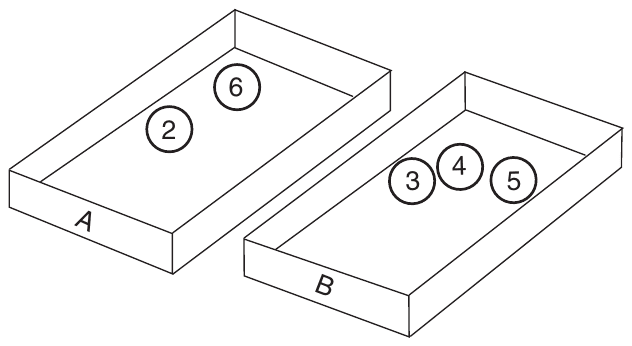
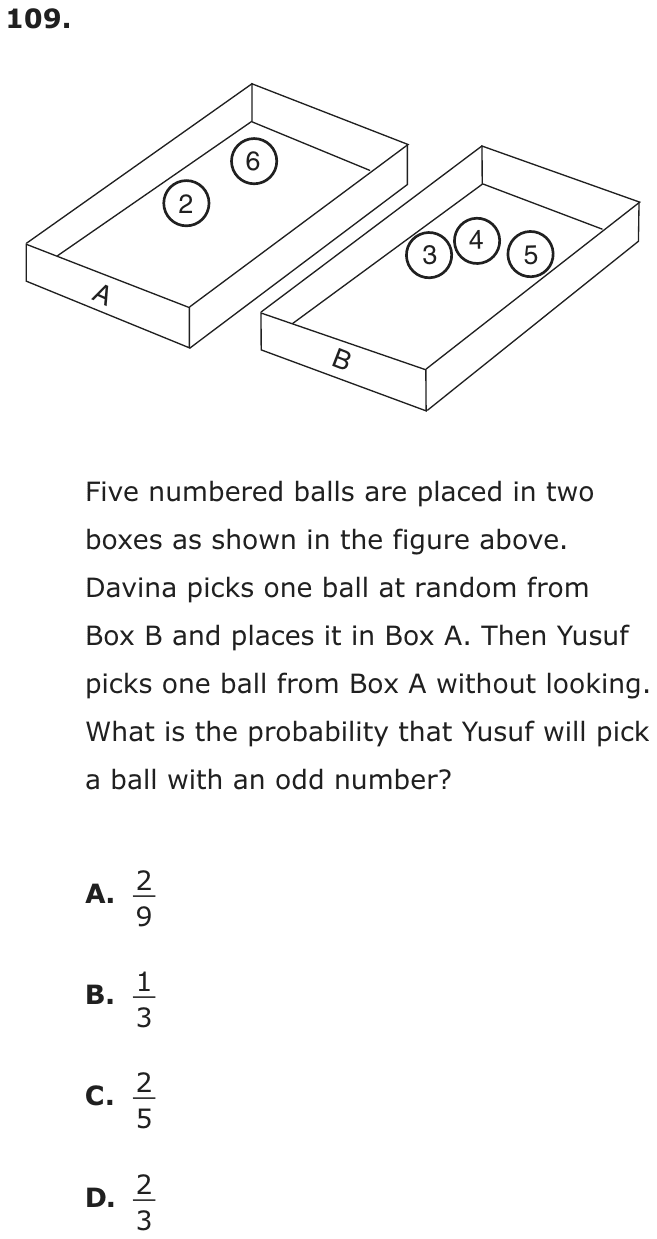
Five numbered balls are placed in two boxes as shown in the figure above. Davina picks one ball at random from Box B and places it in Box A. Then Yusuf picks one ball from Box A without looking. What is the probability that Yusuf will pick a ball with an odd number?
- A
- B
- C
- D
Show the answer
Correct answer: A
The probability of Davina picking an odd-numbered ball from Box B is . If Davina places an odd-numbered ball in Box A, then the probability of Yusuf picking an odd-numbered ball from Box A is . The probability of both of these events happening is the product of the two probabilities.
Question analysis
Two boxes hold five numbered balls, and Davina moves one ball at random from Box B into Box A before Yusuf draws one from Box A. Students find the probability that Yusuf's ball shows an odd number. It tests two-stage probability, and the tricky part is that the second draw depends on which ball was moved.
- NYS standards
- Grade level
- Grade 7 content, by NYS standard
- Compared with grade 7
- Above grade 7 Grade 7 compound probability lists outcomes for independent stages such as coins or spinners. Here the first random move changes what is in the second box, so students must follow two linked stages, a dependence typical grade 7 work does not include.
- Estimated difficulty
- Among the hardest on the SHSAT: a non-obvious approach, heavy reading, or a well-hidden trap.
- Thinking it demands
- Depth of knowledge 3, strategic thinking · mainly analyze
- What makes it hard
- Solution
- 3 steps
- Reading level
- Question and choices: about grade 4, 57 words.
- Students, last 30 days
- Not enough answers yet to show (it takes 10).
Why it is hard, traps and wrong answers (shows the answer)
Why it is hard
Two chance events are hidden in what reads like a question about a single draw. Every listed wrong answer is a reasonable single-stage answer, either one of the two factors on its own or a count of odd balls across both boxes. Listing the nine equally likely pairs, Davina's ball and then Yusuf's, shows that only two of them end with an odd ball and makes the structure visible without any formula.
No obvious method major Working it out
The stem asks one question about Yusuf's draw, but the answer depends on Davina's earlier random pick; the key is that Box A starts with only even balls, so Yusuf can draw odd only by drawing the ball she moved. (Schoenfeld, 1985)
Something you must already know minor Working it out
Multiplying the chances of the two stages, 2/3 for an odd ball moving and 1/3 for Yusuf then drawing it, is a rule students must bring themselves. (Anderson & Krathwohl, 2001)
Reading a figure, table or graph minor Understanding the question
The numbers appear only in the figure, Box A holding 2 and 6 and Box B holding 3, 4 and 5, so the odd balls have to be spotted there. (Lesh, Post & Behr, 1987; Kirsch & Mosenthal, 1990)
Strategy: List every equally likely pair of a ball moved by Davina and a ball picked by Yusuf, and count the pairs that end with an odd ball.
Traps
- Stops one step early: A choice is a number from partway through the solution.
- Numbers taken from the question: Combines the numbers in the question without a model of the situation, or is simply a number that appears in the question.
The wrong answers, classified
B Stops one step early (King et al., 2004; Gierl et al., 2017)
Finds Yusuf's chance of drawing the odd ball once one is in Box A, 1 out of 3, leaving out the chance that Davina moves an odd ball at all.
C Numbers taken from the question (Hegarty, Mayer & Monk, 1995)
Counts the odd balls in the figure, 3 and 5, over all five balls, 2/5, ignoring that Yusuf draws only from Box A.
D Stops one step early (King et al., 2004; Gierl et al., 2017)
Gives the chance that Davina moves an odd ball, 2 out of 3, the first stage only, without multiplying by Yusuf's 1/3 chance of drawing it.
Worked solution, step by step
Formulas used
- Probability
- P is the probability, the chance that something happens. It is a number from 0 to 1. The top counts the results you want. The bottom counts all the results that can happen. It works when every result is equally likely.
- Chance of events in a row
- A and B are two events that happen one after the other. P(A) is the chance of the first. P(B after A) is the chance of the second, counting only what is left after the first. You multiply because the second must also happen inside the share of times the first did.
Read the figure
Box A holds balls numbered 2 and 6. Box B holds balls numbered 3, 4 and 5.
An odd number does not divide evenly by 2. So the only odd balls are 3 and 5, and both start in Box B. Box A starts with no odd balls at all.
Spot the two chance events
Two things happen by chance, one after the other:
- Davina picks one of the 3 balls in Box B and moves it to Box A.
- Then Yusuf picks one of the 3 balls now in Box A.
Yusuf gets an odd ball only if both go right. Davina must move an odd ball. Then Yusuf must pick that very ball.
The question asks only about Yusuf. But his chance depends on Davina’s pick, which comes first.
Find the chance for Davina’s pick
Box B has 3 balls, and 2 of them, the 3 and the 5, are odd.
If she moves the 4 instead, Box A holds only even balls. Then Yusuf can’t get an odd ball at all.
Find the chance for Yusuf’s pick
Say Davina moved an odd ball. Box A now holds 3 balls: the 2, the 6 and that one odd ball.
Watch out: alone is choice B. It forgets that Davina might move the 4.
Multiply the two chances
Both events must happen, so use the rule for events in a row.
Watch out: alone, choice D, stops after Davina’s pick. , choice C, counts 2 odd balls out of all 5. But Yusuf picks only from Box A.
So the answer is A, .
Check your answer
List all 9 equally likely outcomes. Davina can move 3, 4 or 5. Then Yusuf picks one of 3 balls.
| Ball moved | Box A then | Odd picks |
|---|---|---|
| 3 | 2, 6, 3 | 1 |
| 4 | 2, 6, 4 | 0 |
| 5 | 2, 6, 5 | 1 |
That is 2 odd picks out of 9, or .
More questions like this
The original DOE question
Question 6 of 6
2026 Practice Test D Math, question 35Question
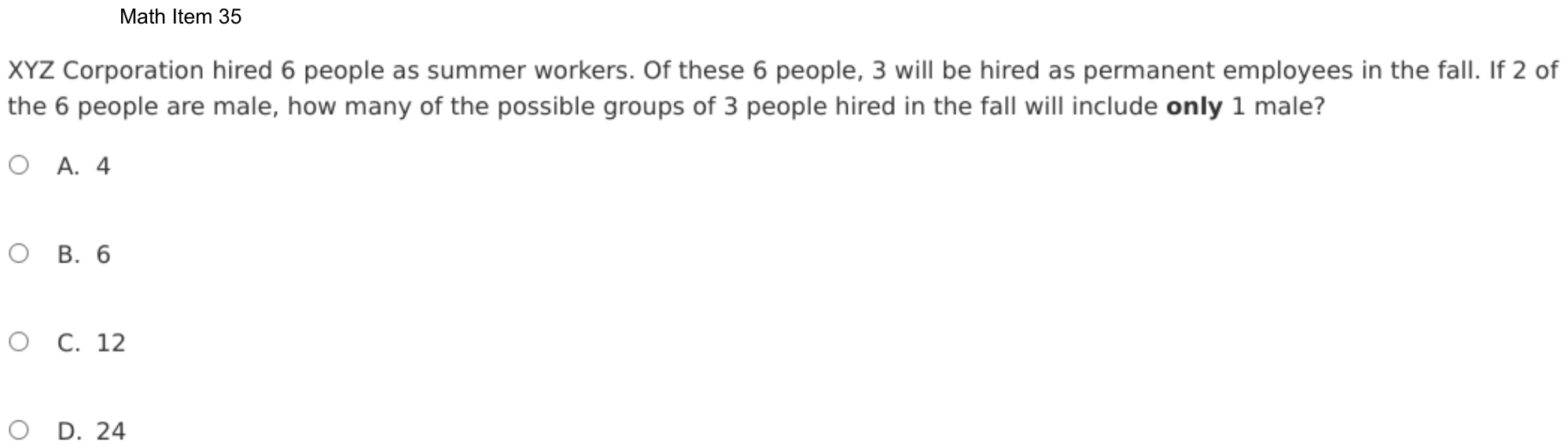
XYZ Corporation hired 6 people as summer workers. Of these 6 people, 3 will be hired as permanent employees in the fall. If 2 of the 6 people are male, how many of the possible groups of 3 people hired in the fall will include only 1 male?
- A4
- B6
- C12
- D24
Show the answer
Correct answer: C
An organized list can be used to determine the number of groups of 3 people that include only 1 male.
Let the letters A, B, C, and D represent the females, and let the numbers 1 and 2 represent the males.
Then, create a list of all possible combinations of 3 people with only 1 male.
AB1, AB2, AC1, AC2, AD1, AD2
BC1, BC2, BD1, BD2
CD1, CD2
There are 12 possible groups with only 1 male.
Question analysis
A company hired 6 summer workers, 2 of them male, and will keep 3 as permanent employees in the fall. This counting question asks how many possible groups of 3 include only 1 male. Students count combinations where order does not matter, and the bold word only, with two kinds of workers to combine, makes careful listing essential.
- NYS standards
- 7.SP.8b sample spaces for compound events
- Grade level
- Grade 7 content, by NYS standard
- Compared with grade 7
- Above grade 7 Grade 7 students list outcomes with organized lists and tree diagrams, usually ordered ones. Counting unordered groups of three under an "only one" condition, built from two kinds of people, goes beyond that typical work.
- Estimated difficulty
- Hard: combines ideas, needs a plan, and has more than one tempting wrong answer.
- Thinking it demands
- Depth of knowledge 2, skills and concepts · mainly apply
- What makes it hard
- Combines ideas moderate
- Something you must already know minor
- Turning words into math minor
- Solution
- 3 steps
- Reading level
- Question and choices: about grade 7, 41 words.
- Students, last 30 days
- Not enough answers yet to show (it takes 10).
Why it is hard, traps and wrong answers (shows the answer)
Why it is hard
The question hides a two-stage count in a hiring story. Students tend to get one stage right and forget the other: they count the pairs of women and stop, or they count ordered picks and so find every group twice. Naming the women A to D and the men 1 and 2, then listing the pairs of women alphabetically with each man attached, makes every group visible and checkable.
Combines ideas moderate Working it out
Two counts are joined: the 6 ways to pick 2 of the 4 women, then the 2 ways to pick the man, and the total is their product. (Embretson, 1998; Daniel & Embretson, 2010)
Something you must already know minor Working it out
Students must already know that a group is the same whichever order its members are named, so picking one woman and then another repeats the reverse pick. (Anderson & Krathwohl, 2001)
Turning words into math minor Understanding the question
The bold word only means exactly one man, so the other two places in each group of 3 must go to two of the 4 women, a step the stem leaves unsaid. (Hegarty, Mayer & Monk, 1995; Koedinger & Nathan, 2004)
Strategy: Name the women A to D and the men 1 and 2, list every pair of women without repeats, then attach each man to each pair and count the groups.
Traps
- Stops one step early: A choice is a number from partway through the solution.
- Overlapping groups: Things in two groups at once are counted twice, or not subtracted.
The wrong answers, classified
A Numbers taken from the question (Hegarty, Mayer & Monk, 1995)
Multiplies the 2 men by the 2 places left for women, 2 × 2 = 4, using numbers from the question without listing a single group.
B Stops one step early (King et al., 2004; Gierl et al., 2017)
Counts the 6 pairs of women correctly but stops before pairing each one with either of the 2 men, which doubles the count.
D Overlapping groups (King et al., 2004)
Counts ordered picks of the two women, 4 × 3 = 12 instead of 6, so each group appears twice, then doubles for the men to reach 24.
Worked solution, step by step
Formulas used
- Counting with two choices
- Each way of picking the man can go with each way of picking the two women. So you multiply the two counts. It is like outfits: 2 shirts with 6 pairs of pants make 12 outfits.
Sort out the question
Six people work for the summer. Two are male, so the other 4 are female. Three will be hired in the fall.
You need the number of groups of 3 with only 1 male. That means exactly 1 man and 2 women. In a group, order does not matter. Ann, Bea and Carl is the same group as Carl, Ann and Bea.
Give each person a name
Call the women A, B, C and D. Call the men 1 and 2. Every group you want has 2 letters and 1 number, like AB1.
List the pairs of women
List each pair once. Start with A, then pair B only with letters after it, and so on:
- AB, AC, AD
- BC, BD
- CD
That is 6 pairs. BA is not new, since it is the same pair as AB.
Watch out: counting the order gives pairs, each one twice. Then doubling for the men gives 24, choice D.
Add a man to each pair
Each pair of women can go with man 1 or man 2. Use the counting rule:
Watch out: stopping at the 6 pairs of women leaves out the men. That gives 6, choice B.
So the answer is C, 12.
Check your answer
Write out every group. With man 1: AB1, AC1, AD1, BC1, BD1, CD1. With man 2: AB2, AC2, AD2, BC2, BD2, CD2. Each list has 6 groups, and . No group repeats, and each has just one man.
More questions like this
The original DOE question