3 English and 3 math
Here are 6 random questions to try. Takers earning below 75% are unlikely to receive an offer. You have 1 minute 48 seconds per question on the real exam.
Question 1 of 6
2026 Practice Test D English, question 40Passage Martial Arts for the Mind and Body
Martial Arts for the Mind and Body
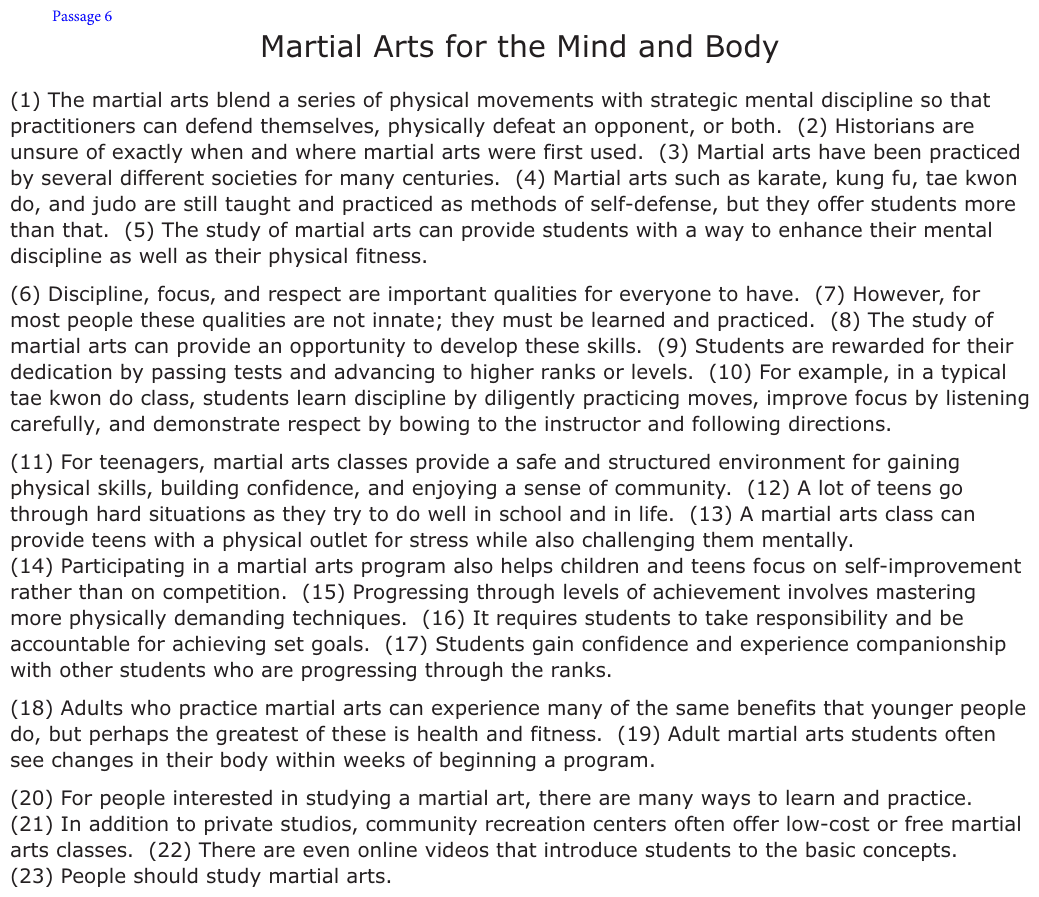
(1) The martial arts blend a series of physical movements with strategic mental discipline so that practitioners can defend themselves, physically defeat an opponent, or both. (2) Historians are unsure of exactly when and where martial arts were first used. (3) Martial arts have been practiced by several different societies for many centuries. (4) Martial arts such as karate, kung fu, tae kwon do, and judo are still taught and practiced as methods of self-defense, but they offer students more than that. (5) The study of martial arts can provide students with a way to enhance their mental discipline as well as their physical fitness.
(6) Discipline, focus, and respect are important qualities for everyone to have. (7) However, for most people these qualities are not innate; they must be learned and practiced. (8) The study of martial arts can provide an opportunity to develop these skills. (9) Students are rewarded for their dedication by passing tests and advancing to higher ranks or levels. (10) For example, in a typical tae kwon do class, students learn discipline by diligently practicing moves, improve focus by listening carefully, and demonstrate respect by bowing to the instructor and following directions.
(11) For teenagers, martial arts classes provide a safe and structured environment for gaining physical skills, building confidence, and enjoying a sense of community. (12) A lot of teens go through hard situations as they try to do well in school and in life. (13) A martial arts class can provide teens with a physical outlet for stress while also challenging them mentally. (14) Participating in a martial arts program also helps children and teens focus on self-improvement rather than on competition. (15) Progressing through levels of achievement involves mastering more physically demanding techniques. (16) It requires students to take responsibility and be accountable for achieving set goals. (17) Students gain confidence and experience companionship with other students who are progressing through the ranks.
(18) Adults who practice martial arts can experience many of the same benefits that younger people do, but perhaps the greatest of these is health and fitness. (19) Adult martial arts students often see changes in their body within weeks of beginning a program.
(20) For people interested in studying a martial art, there are many ways to learn and practice. (21) In addition to private studios, community recreation centers often offer low-cost or free martial arts classes. (22) There are even online videos that introduce students to the basic concepts. (23) People should study martial arts.
Question
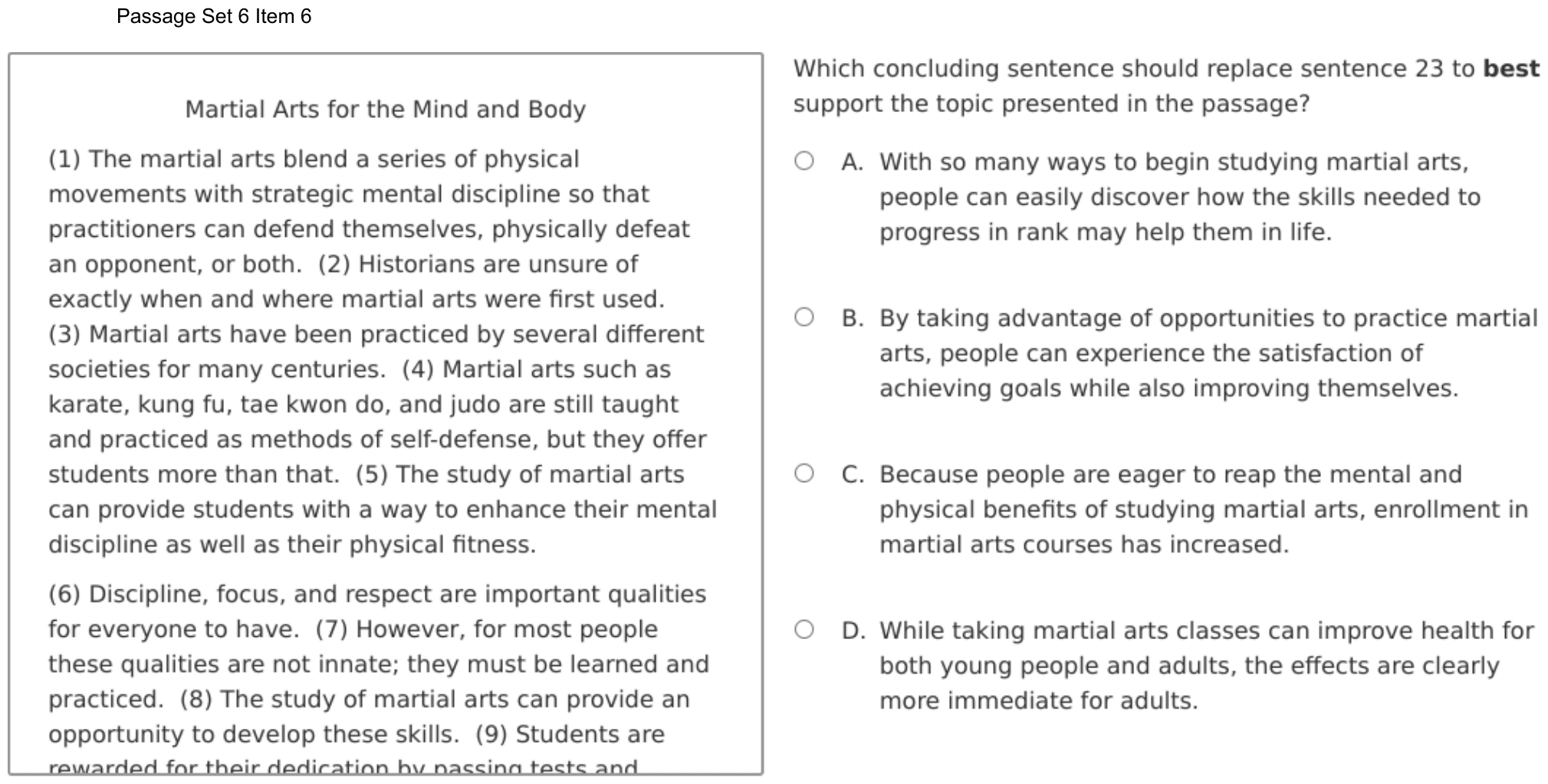
Which concluding sentence should replace sentence 23 to best support the topic presented in the passage?
- AWith so many ways to begin studying martial arts, people can easily discover how the skills needed to progress in rank may help them in life.
- BBy taking advantage of opportunities to practice martial arts, people can experience the satisfaction of achieving goals while also improving themselves.
- CBecause people are eager to reap the mental and physical benefits of studying martial arts, enrollment in martial arts courses has increased.
- DWhile taking martial arts classes can improve health for both young people and adults, the effects are clearly more immediate for adults.
Show the answer
Correct answer: B
The question asks for the concluding sentence that best replaces sentence 23 and supports the topic presented in the passage.
A. Incorrect. The phrase “the skills needed to progress in rank” is vague, and progressing in rank is not related to the overall topic of the passage, which is the benefits of studying martial arts. The topic of the passage is not the “many ways to begin studying martial arts” or how “people can easily discover” the benefits of martial arts.
B. CORRECT. This option is correct because it best supports the topic of the passage—the benefits of studying martial arts—by stating two reasons why people should study martial arts: to “experience the satisfaction of achieving goals while also improving themselves.”
C. Incorrect. Some readers may choose this option because it refers to the benefits of martial arts, but the word “because” and the detail that “enrollment in martial arts courses has increased” make this sentence unrelated to the overall topic of the passage, which is about the benefits of studying martial arts, not the number of people who participate.
D. Incorrect. Although the benefits of studying martial arts are described for both teens (in the third paragraph) and adults (in the fourth paragraph), the topic of the passage is the overall benefits of studying martial arts, which include mental discipline (discussed in the first, second, and third paragraphs) in addition to health benefits. Furthermore, the passage does not compare the health effects of studying martial arts across age groups.
Question analysis
This conclusion question asks which sentence should replace sentence 23, the bare closing line “People should study martial arts,” to best support the topic of the passage. Students must keep all five paragraphs in view, from mental discipline to fitness to ways of getting started, because every choice sounds like a reasonable final line when read on its own.
- NYS standards
- 7W2e concluding informative writing
- Grade level
- Grade 8 reading and task
- Compared with grade 7
- Above grade 7 Grade 7 writers choose conclusions that follow from a passage’s topic. This passage covers mental and physical benefits for different ages, and each long choice picks up a real thread, so judging the best fit takes more than typical grade 7 work.
- Estimated difficulty
- Hard: combines ideas, needs a plan, and has more than one tempting wrong answer.
- Thinking it demands
- Depth of knowledge 2, skills and concepts · mainly evaluate
- What makes it hard
- A very close wrong answer moderate
- Evidence in several places moderate
- A lot to read minor
- Evidence
- Answered from the whole text
- Reading level
- Passage: about grade 11, 402 words; question and choices: about grade 12, 106 words.
- Corrected from the DOE handbook
- The DOE printed this question’s explanation after a different question; the site matches the question with its own explanation.
- Students, last 30 days
- Not enough answers yet to show (it takes 10).
Why it is hard, traps and wrong answers (shows the answer)
Why it is hard
Every ending borrows something real from the passage: ways to begin, ranks, mental and physical benefits, or adults’ quick results. The work is deciding what the whole passage is about, the benefits of martial arts for mind and body, and then noticing which ending adds a new claim or shrinks the topic. The rank-based ending is hardest to reject because it is shaped like the key and promises help “in life,” but its focus is how easily people discover rank skills.
A very close wrong answer moderate Choosing the answer
The rank choice is built like the key, a phrase about ways or chances to train followed by what people gain; it differs in resting on the vague “skills needed to progress in rank.” (Embretson & Wetzel, 1987; Gorin & Embretson, 2006; Ascalon et al., 2007)
Evidence in several places moderate Working it out
The topic is pieced together from all five paragraphs, from the opening’s mind-and-body claim through teens, adults’ fitness and ways to learn, so a fitting ending must cover both kinds of benefit. (Kirsch & Mosenthal, 1990; Gorin & Embretson, 2006)
A lot to read minor Understanding the question
Each choice is a two-part sentence of 21 to 26 words, and each picks up a real thread of the passage, so all four must be held against the topic. (Kintsch, 1998; Gorin & Embretson, 2006; Freedle & Kostin, 1993)
Strategy: State the passage’s topic in a few words using all five paragraphs, then test each ending: does it sum up that topic, or does it narrow it or add a new claim?
Traps
- Off the point: Adds or keeps something that does not support the paragraph's or the passage's focus, or an introduction or conclusion that misses the main point.
- Too narrow: A single detail offered as the central idea or a summary, or a summary that keeps minor details and leaves out an essential part.
The wrong answers, classified
A Too narrow (King et al., 2004)
Follows on from the last paragraph’s many ways to start, but rests the ending on vague “skills needed to progress in rank,” one thread of paragraphs 2 and 3, not the benefits overall.
C Off the point (Halliday & Hasan, 1976)
Names the passage’s “mental and physical benefits,” which fits, but ends on rising enrollment, a claim about numbers of students that the passage never discusses.
D Half right (King et al., 2004; Thissen, Steinberg & Fitzpatrick, 1989)
Rightly says training can improve health for young people and adults, but adds that adults clearly benefit sooner, a comparison the passage never makes, and drops the mental benefits.
What was corrected from the DOE handbook, and why
- Explanation: In the DOE’s explanations appendix, the explanation printed after this question belongs to question 39 (“the sentence that would best follow and support sentence 18”) and marks C correct, and this question’s explanation (“the concluding sentence that best replaces sentence 23 and supports the topic presented in the passage”) is printed after question 39, marking B correct. Read page by page, the appendix gives this question the answer C. The site gives the question the explanation that restates it, and the answer follows that explanation: B, because it sums up the passage’s topic, the benefits of studying martial arts.
Working it out, step by step
Figure out what the question asks
This asks for a better last sentence. A good concluding sentence sums up the topic of the whole passage. Sentence 23, “People should study martial arts,” is short and plain. It doesn’t remind the reader why.
Find the passage’s topic
Sentence 5 states the topic. Martial arts can help students “enhance their mental discipline as well as their physical fitness.” Enhance means improve. Paragraph 2 covers discipline, focus and respect. Paragraph 3 covers teens and goals. Paragraph 4 covers adults and fitness. Paragraph 5 lists ways to start. So the topic is how martial arts help both mind and body.
Name the rule
A conclusion should sum up the main point. It should not shrink the point or add a brand-new claim. For example, after a report on why sleep matters, a good ending is Getting enough sleep helps both your body and your mind. A poor one is More people buy pillows now.
Check each choice
- A is wrong. It rests on vague “skills needed to progress in rank,” one small part of the passage.
- B is right. “Opportunities to practice” follows paragraph 5. “Achieving goals” and “improving themselves” sum up the benefits.
- C is wrong. Enrollment is the number of people who sign up. The passage never says it has gone up.
- D is wrong. The passage never says adults see results sooner than young people. D also leaves out the benefits to the mind.
Watch out: A is built like B and promises help “in life.” But it shrinks the topic to rank skills.
Choose the answer
B sums up what the whole passage says martial arts offer. So the answer is B, “By taking advantage of opportunities to practice martial arts, people can experience the satisfaction of achieving goals while also improving themselves.”
Why this answer and not the closest wrong one
A is the closest wrong answer. Like B, it starts with ways to begin and ends with what people gain. But its gain is vague “skills needed to progress in rank.” That is only one thread of the passage. B sums up the whole topic: reaching goals and improving yourself.
More questions like this
The original DOE question
The passage “Martial Arts for the Mind and Body” as printed (page 52)
Question 2 of 6
2026 Practice Test A English, question 12Passage The Best Laid Plans of Ravens
The Best Laid Plans of Ravens
In Edgar Allan Poe’s poem “The Raven,” a raven visits a lonely man’s home and responds to the man’s pleading questions with only the word “nevermore.” The poem’s narrator interprets the word as a prediction of doom for his future. A talking, prophetic raven may seem to be the wild imaginings of the poet, but a new study published in the journal Science hints that one particular idea behind the poem might not be as far-fetched as it seems. For most of human history, people assumed that animals do not understand the passage of time in the same way people do. Some people believed that animals might remember events from the past and that instinct might drive them to make preparations in order to guarantee survival, but most people did not think that animals had the ability to plan. At Lund University in Sweden, researchers argue that ravens may be able to think ahead and even plan for the future.
It can be difficult to test an animal’s ability to plan because human observers must be certain they are not mistaking instinctual behavior for intentional planning. For example, many animals hoard food so that they will not run out later, but scientists who study animals would not call hoarding a decision to plan for the future. This action is merely instinctual. Cognitive scientists argue that in order for an animal’s behavior to qualify as preparing for the future, the animal must use specific decision-making skills to solve a problem.
To avoid mistaking instinctual behavior for evidence of decision-making, the Lund University researchers designed two experiments to test ravens’ ability to plan. Ravens belong to the corvid family, a group of birds known for their intelligence. A study in 2007 showed that corvids have the tendency to save only certain types of food, which suggests that they are planning for the future rather than acting on instinct. In order to investigate that theory, the researchers had to design experiments that would achieve results that could not be explained by an instinctual behavior of food hoarding. Therefore, the ravens were taught two behaviors that they do not normally perform in the wild.
For the first experiment, the researchers showed the birds how to use a small stone to open a box and get treats. Once the ravens learned the behavior, the researchers presented the birds with four stones. Only one stone was the right size to open the box. The birds learned to select that stone and set it aside until the researchers presented the box. The second experiment involved bartering. A researcher would trade the ravens a large treat for a bottle cap. Later, the researchers presented the ravens with a group of items, including small treats and the bottle cap. The ravens chose the bottle cap over the treats and waited for the original researcher to trade with them again so that they could get more treats. In both experiments, the ravens waited patiently for up to seventeen hours for the researcher to return.
The results of these experiments are exciting, but more evidence needs to be gathered before scientists can fully conclude that ravens can plan for the future. Some scientists argue that the ravens might be choosing the stone and bottle cap because the ravens have been trained to do so, not necessarily because the ravens are thinking ahead. Regardless, like other recent advances in animal science, these experiments show that ravens could be much smarter than first believed, and scientists now believe that ravens do actually think about their own future.
Question
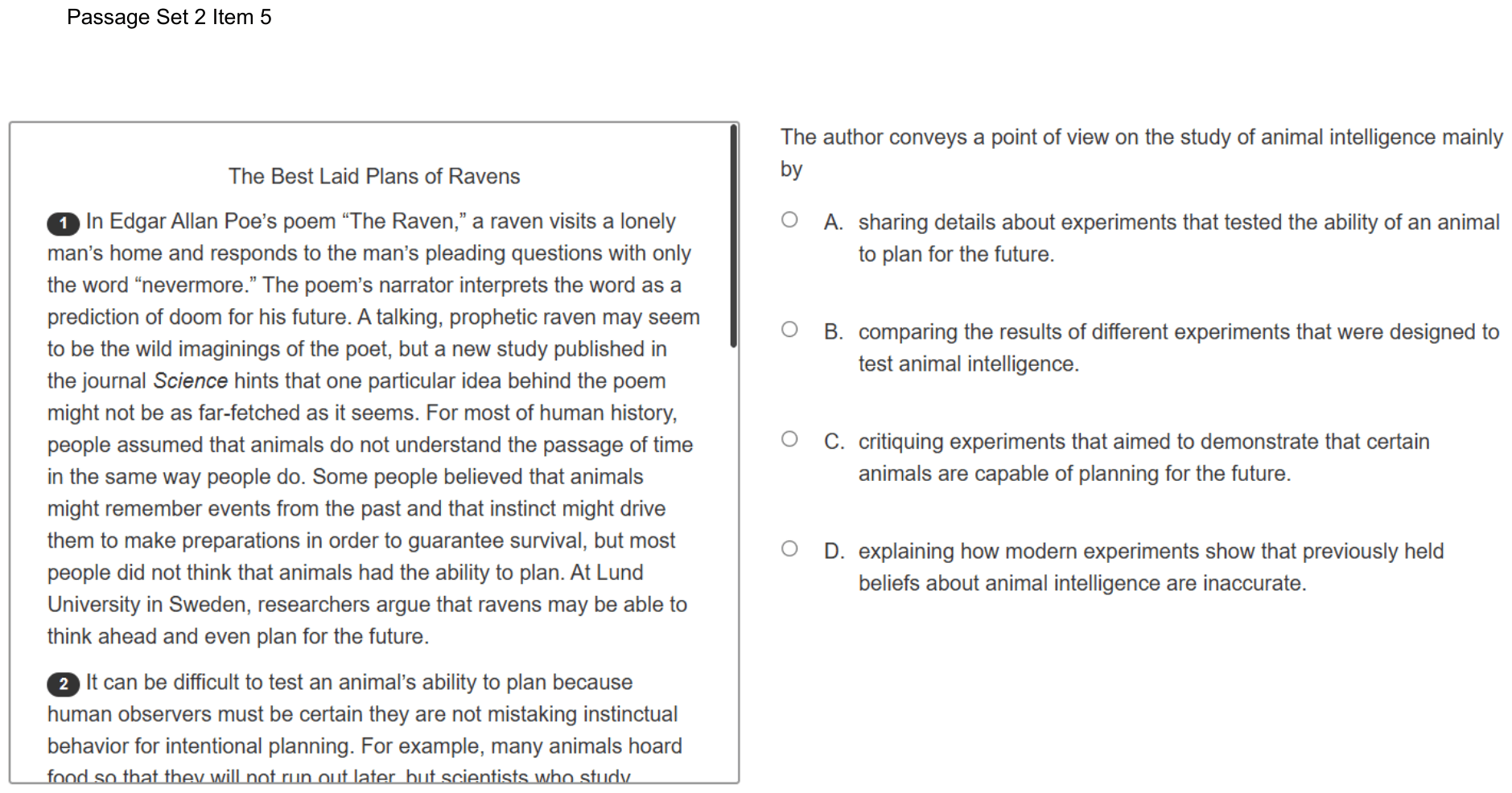
The author conveys a point of view on the study of animal intelligence mainly by
- Asharing details about experiments that tested the ability of an animal to plan for the future.
- Bcomparing the results of different experiments that were designed to test animal intelligence.
- Ccritiquing experiments that aimed to demonstrate that certain animals are capable of planning for the future.
- Dexplaining how modern experiments show that previously held beliefs about animal intelligence are inaccurate.
Show the answer
Correct answer: A
The question asks how the author conveys a point of view on the study of animal intelligence.
A. CORRECT. Paragraphs 3 and 4 focus on the process and details of the experiments that scientists conducted. This detailed information from the author provides a sense of how the ravens demonstrated planning abilities beyond natural instinct. The author supports the claims from the experiments, calling the findings “exciting” and stating in the conclusion that “these experiments show that ravens could be much smarter than first believed” (paragraph 5).
B. Incorrect. Although two experiments are described in the passage, the description presents the experiments as building on each other and does not compare their results. The passage states that “these experiments show that ravens could be much smarter than first believed, and scientists now believe that ravens do actually think about their own future” (paragraph 5).
C. Incorrect. The author presents information from the experiments and the results that were gathered from them; while there is an admission that “more evidence needs to be gathered before scientists can fully conclude that ravens can plan for the future” (paragraph 5), the author does not criticize the experiments that are presented.
D. Incorrect. While the author does discuss some previously held beliefs about animal intelligence in paragraph 1, the focus of the passage is that experiments indicate that there is reason to question these beliefs, since “these experiments show that ravens could be much smarter than first believed” (paragraph 5). The previously held beliefs are not considered inaccurate by the discussion in the passage because only one example—the raven—is provided. The passage does not state that beliefs about animal intelligence as a whole are inaccurate.
Question analysis
This author’s point-of-view question asks how the writer of “The Best Laid Plans of Ravens” mainly conveys a view of research into animal intelligence. Students must look at the article as a whole and decide how it presents that view. The choices describe ways of writing in abstract terms, which makes them easy to blur together.
- Grade level
- Grade 8 reading and task
- Compared with grade 7
- Above grade 7 Grade 7 point-of-view questions usually ask what an author thinks. This one asks how the author mainly conveys a view across the whole article, and the choices name methods that sound alike, closer to grade 8 work on how authors handle differing views.
- Estimated difficulty
- Hard: combines ideas, needs a plan, and has more than one tempting wrong answer.
- Thinking it demands
- Depth of knowledge 3, strategic thinking · mainly analyze
- What makes it hard
- How, not what major
- Reading between the lines moderate
- Every choice must be checked minor
- Evidence
- Answered from the whole text
- Reading level
- Passage: about grade 11, 599 words; question and choices: about grade 13, 74 words.
- Students, last 30 days
- Not enough answers yet to show (it takes 10).
Why it is hard, traps and wrong answers (shows the answer)
Why it is hard
The right choice sounds too plain to carry a point of view, which is exactly what makes this question hard. Students expect a view to be argued, so they reach for the choice that says the experiments prove old beliefs wrong, an overstatement of the author’s hedged “could be,” or for criticism, which belongs to other scientists. The article persuades by reporting the experiments in detail and calling them exciting.
How, not what major Working it out
The question asks how the view comes across, not what it is, and the answer is a method: the author lets the detailed account of the experiments in paragraphs 3–4 carry a favorable view. (Anderson & Krathwohl, 2001)
Reading between the lines moderate Working it out
The author never states an opinion outright; the view must be pieced together from words such as “exciting” and “could be much smarter than first believed” in paragraph 5. (Graesser, Singer & Trabasso, 1994; Kintsch, 1998)
Every choice must be checked minor Choosing the answer
The choices name ways of writing in abstract terms, sharing, comparing, critiquing and explaining, so each must be held against what the whole article actually does. (Embretson & Wetzel, 1987)
Strategy: Settle first on how the author regards the raven research, then check each choice against what the article actually does from beginning to end, not against a single paragraph.
Traps
- Too broad or too strong: A choice overstates, generalizes, or uses absolute words the text does not support.
- Wrong tone or attitude: Misjudges the tone, attitude or point of view, such as reading admiration as criticism, or taking a character's or subject's feelings for the author's.
- Twists what the text says: Uses the text's topic and ideas but changes what it says: who did it, how much, when, or why.
The wrong answers, classified
B Twists what the text says (King et al., 2004)
Notices that two experiments are described and assumes they are set side by side, but the article reports the stone test and the bartering test in turn without comparing results.
C Wrong tone or attitude (Graesser, Singer & Trabasso, 1994)
Takes the doubt that “some scientists” raise about training for the author’s own criticism, though the author calls the results “exciting” and moves past the objection.
D Too broad or too strong (King et al., 2004)
Builds on the point that ravens may be smarter than believed but overstates it: the author hedges with “could be,” discusses only ravens, and never calls older beliefs wrong.
Working it out, step by step
Figure out what the question asks
This asks about the author’s point of view, what the author thinks about studying animal intelligence. It also asks how the author mainly shows that view. Think about the whole article, not one paragraph.
Find the author’s view
In paragraph 5, the author says the results “are exciting.” The author also says the experiments “show that ravens could be much smarter than first believed.” So the author is interested in this research and hopeful about it.
See how the article is built
Most of the article explains the experiments. Paragraph 3 tells why the researchers planned two of them. Paragraph 4 gives the details step by step: the stone, the box, the bottle cap, the trades and the long wait. The author lets these details show why the research matters. Then the author calls the results exciting.
Check each choice
- A fits. The author shares details of experiments that tested whether an animal can plan.
- B does not fit. The two experiments are told one after the other. Their results are never compared.
- C does not fit. The doubt comes from “some scientists,” not the author. The author answers it with “Regardless.”
- D does not fit. It goes too far. The author says ravens “could be” smarter, which means maybe. The article never calls old beliefs wrong.
Watch out: D is tempting because paragraph 1 describes old beliefs. But “could be” is not the same as “are.”
Choose the answer
The author shows a view mostly through details of the experiments. So the answer is A.
Why this answer and not the closest wrong one
D is the closest wrong choice. The author does think ravens may be smarter than people believed. But the author is careful and says they “could be.” D says experiments prove old beliefs wrong, which is too strong. What the author mostly does is share the experiments’ details. That is A.
More questions like this
The original DOE question
The passage “The Best Laid Plans of Ravens” as printed (page 12)
Question 3 of 6
2024 Test B English, question 8Passage Find Time to Volunteer
Find Time to Volunteer
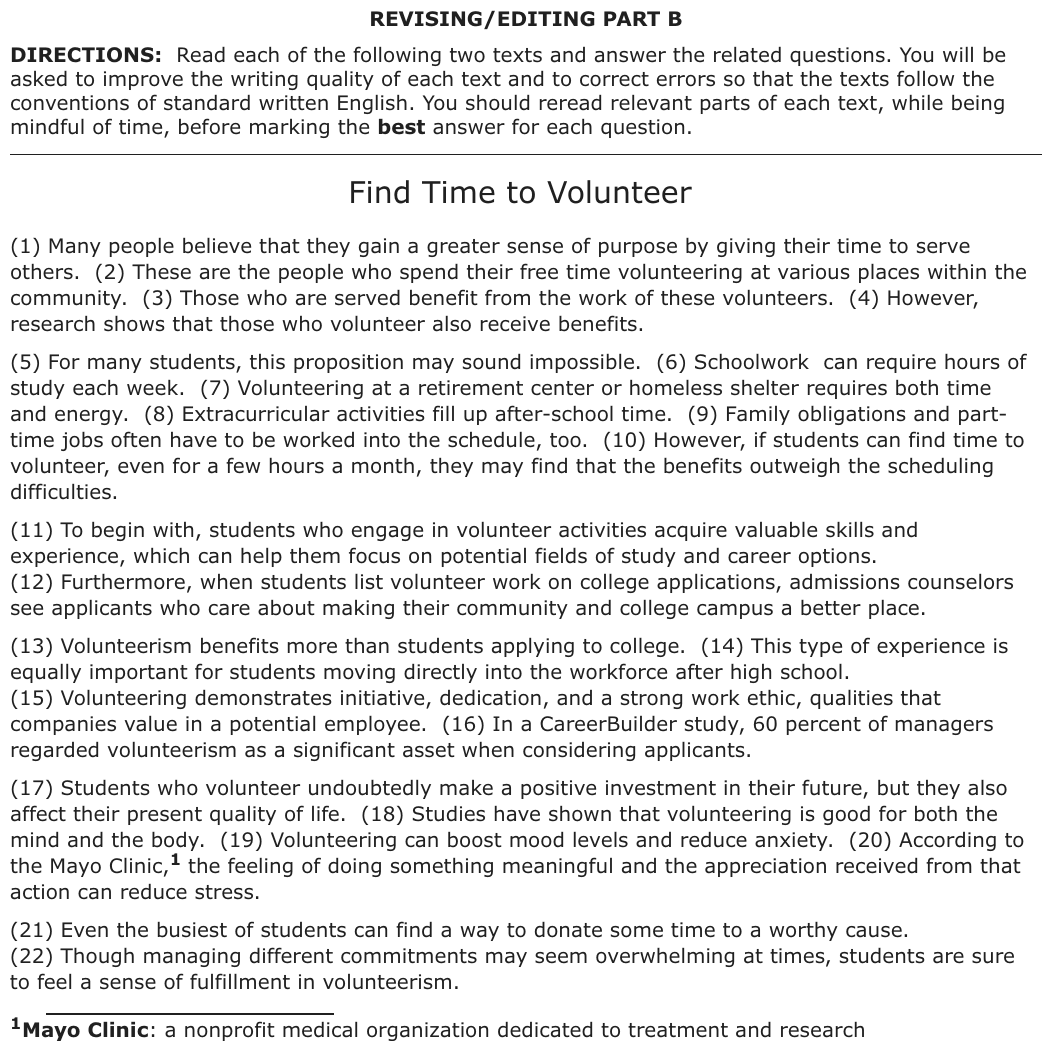
(1) Many people believe that they gain a greater sense of purpose by giving their time to serve others. (2) These are the people who spend their free time volunteering at various places within the community. (3) Those who are served benefit from the work of these volunteers. (4) However, research shows that those who volunteer also receive benefits.
(5) For many students, this proposition may sound impossible. (6) Schoolwork can require hours of study each week. (7) Volunteering at a retirement center or homeless shelter requires both time and energy. (8) Extracurricular activities fill up after-school time. (9) Family obligations and part-time jobs often have to be worked into the schedule, too. (10) However, if students can find time to volunteer, even for a few hours a month, they may find that the benefits outweigh the scheduling difficulties.
(11) To begin with, students who engage in volunteer activities acquire valuable skills and experience, which can help them focus on potential fields of study and career options. (12) Furthermore, when students list volunteer work on college applications, admissions counselors see applicants who care about making their community and college campus a better place.
(13) Volunteerism benefits more than students applying to college. (14) This type of experience is equally important for students moving directly into the workforce after high school. (15) Volunteering demonstrates initiative, dedication, and a strong work ethic, qualities that companies value in a potential employee. (16) In a CareerBuilder study, 60 percent of managers regarded volunteerism as a significant asset when considering applicants.
(17) Students who volunteer undoubtedly make a positive investment in their future, but they also affect their present quality of life. (18) Studies have shown that volunteering is good for both the mind and the body. (19) Volunteering can boost mood levels and reduce anxiety. (20) According to the Mayo Clinic,1 the feeling of doing something meaningful and the appreciation received from that action can reduce stress.
(21) Even the busiest of students can find a way to donate some time to a worthy cause. (22) Though managing different commitments may seem overwhelming at times, students are sure to feel a sense of fulfillment in volunteerism.
1Mayo Clinic: a nonprofit medical organization dedicated to treatment and research
Question
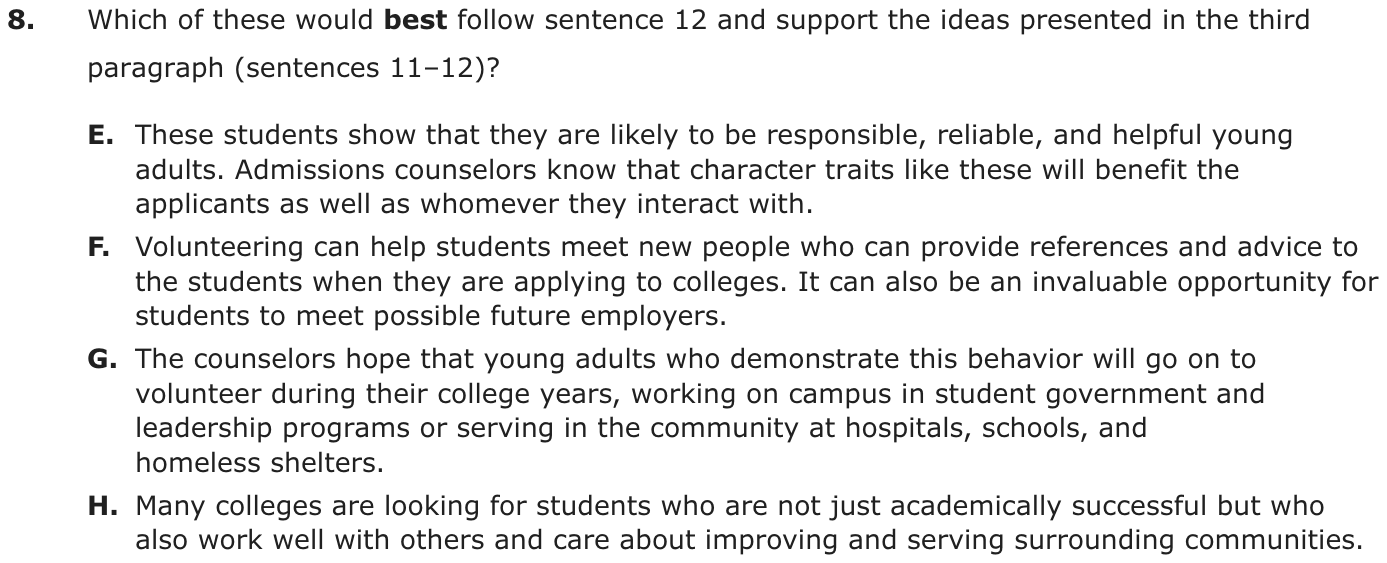
Which of these would best follow sentence 12 and support the ideas presented in the third paragraph (sentences 11–12)?
- AThese students show that they are likely to be responsible, reliable, and helpful young adults. Admissions counselors know that character traits like these will benefit the applicants as well as whomever they interact with.
- BVolunteering can help students meet new people who can provide references and advice to the students when they are applying to colleges. It can also be an invaluable opportunity for students to meet possible future employers.
- CThe counselors hope that young adults who demonstrate this behavior will go on to volunteer during their college years, working on campus in student government and leadership programs or serving in the community at hospitals, schools, and homeless shelters.
- DMany colleges are looking for students who are not just academically successful but who also work well with others and care about improving and serving surrounding communities.
Show the answer
Correct answer: D
The question asks which option would best follow sentence 12 to support the ideas presented in the third paragraph (sentences 11–12).
A. Incorrect. The subject of the main clause in sentence 12 is “admissions counselors.” Although the second sentence in the option mentions “admissions counselors,” it does not support the ideas in the paragraph, because the statement that “admissions counselors know that character traits like these will benefit the applicants” focuses on how students benefit, while sentence 12 focuses on how these traits benefit the community.
B. Incorrect. While sentence 11 discusses the potential academic and professional connections that can be made through volunteering, sentence 12 moves on to the topic of college admissions. Since the sentences in the option revert back to the topic of connections, they do not support and logically follow a sentence about how college admissions counselors view students with volunteering experience.
C. Incorrect. Although the sentence in the option continues on the subject of admissions counselors and follows the idea in sentence 12 that these counselors tend to favor students who “care about making their community and college campus a better place,” the sentence focuses on what students will do while in college rather than on how volunteering helps them get into college. Therefore, the sentence does not best follow sentence 12 and support the ideas presented in the third paragraph.
D. CORRECT. In sentence 12, the author states that college admissions counselors view students who list volunteer work on admissions applications as “applicants who care about making their community and college campus a better place.” The sentence in the option best follows sentence 12 and supports the ideas in the third paragraph because it provides additional details about why admissions counselors look beyond academics when considering students for admissions and the positive qualities assigned to those who have volunteering experience.
Question analysis
This supporting-details question asks which addition would best follow the volunteering essay’s sentence about how college admissions counselors view applicants who list volunteer work. Every option mentions college and sounds reasonable on its own, so students must decide which one develops the paragraph’s point rather than drifting to a related idea.
- NYS standards
- 7W1b supporting claims with evidence
- Grade level
- Grade 8 reading and task
- Compared with grade 7
- Above grade 7 Grade 7 students choose evidence that supports a claim. Here the options are one or two full sentences, all of them about college, and the right fit depends on the precise idea in sentence 12, a finer judgment than usual.
- Estimated difficulty
- Hard: combines ideas, needs a plan, and has more than one tempting wrong answer.
- Thinking it demands
- Depth of knowledge 2, skills and concepts · mainly evaluate
- What makes it hard
- A very close wrong answer major
- How sentences fit together moderate
- A lot to read minor
- Evidence
- Answered from one paragraph or stanza
- Reading level
- Passage: about grade 11, 354 words; question and choices: about grade 13, 153 words.
- Students, last 30 days
- Not enough answers yet to show (it takes 10).
Why it is hard, traps and wrong answers (shows the answer)
Why it is hard
Every option stays on the subject of college, so the work is matching sentence 12’s exact idea: counselors see applicants who care about making their community a better place. The near miss also explains what counselors value, but it swaps caring for the community for a new set of traits and ends on what those traits do for the applicants. Students who restate sentence 12 before reading the options can hear that the right one simply widens it, from community service to what colleges want beyond grades.
A very close wrong answer major Choosing the answer
The right sentence and the two-sentence option about responsible, reliable, helpful students both explain why volunteers impress admissions; only the right one keeps sentence 12’s point, caring about improving communities. (Embretson & Wetzel, 1987; Gorin & Embretson, 2006; Ascalon et al., 2007)
How sentences fit together moderate Working it out
The new sentence must extend sentence 12’s specific idea, what admissions counselors see in volunteers, rather than return to sentence 11’s skills and careers or move on to college life. (Halliday & Hasan, 1976)
A lot to read minor Understanding the question
The options run 27 to 39 words, two of them two sentences long, and all four are about college, so topic alone rules none of them out. (Kintsch, 1998; Gorin & Embretson, 2006; Freedle & Kostin, 1993)
Strategy: Restate sentence 12 in your own words, then ask of each option whether it explains or extends that exact point about what admissions counselors value.
Traps
- Off the point: Adds or keeps something that does not support the paragraph's or the passage's focus, or an introduction or conclusion that misses the main point.
The wrong answers, classified
A Off the point (Halliday & Hasan, 1976)
Follows the admissions counselors from sentence 12 but replaces caring for the community with new traits, responsibility and reliability, and turns to how those traits help the applicants.
B Off the point (Halliday & Hasan, 1976)
Is drawn by “applying to colleges,” but networking for references and future employers is a new benefit that neither sentence 11 nor sentence 12 develops.
C Off the point (Halliday & Hasan, 1976)
Stays with the counselors and picks up “college campus” from sentence 12, but jumps ahead to what students might do in college instead of explaining admission decisions.
Working it out, step by step
Figure out what the question asks
You need the sentence that best follows sentence 12. A good next sentence adds to the same idea. It does not jump to a new point. Example: after Dogs make loyal pets, the sentence They stay by their owners’ side fits. Dogs come in many colors drifts away. So first put sentence 12 in your own words.
Restate sentence 12
Sentence 12 says that “when students list volunteer work on college applications, admissions counselors see applicants who care about making their community and college campus a better place.” Admissions counselors are the people who choose which students get into a college. So the idea is this: colleges like volunteers because volunteers care about their communities.
Check each choice
- D says colleges want students who are “not just academically successful.” That means more than good grades. They also want students who “care about improving and serving surrounding communities.” That explains sentence 12 and builds on it.
- A swaps in new traits: “responsible, reliable, and helpful.” Then it says those traits help the applicants and the people around them. It drops caring for the community.
- B brings in a new benefit: meeting people who can give advice or jobs. Neither sentence 11 nor sentence 12 talks about that.
- C jumps ahead to what students might do in college. It doesn’t explain how volunteering helps them get in.
Pick the answer
Watch out: A is the most tempting. It is about what counselors value, just like the right answer. But it changes the reason they value it. Only D keeps sentence 12’s idea of caring for the community. So the answer is D.
Why this answer and not the closest wrong one
A is the closest wrong answer. Like D, it explains why admissions counselors like volunteers. But A’s reasons are new ones, such as being responsible and reliable. D keeps sentence 12’s exact idea, caring about the community, and adds that colleges want more than good grades. So D supports the paragraph best.
More questions like this
The original DOE question
The passage “Find Time to Volunteer” as printed (page 163)
Question 4 of 6
2024 Test B Math, question 56Question
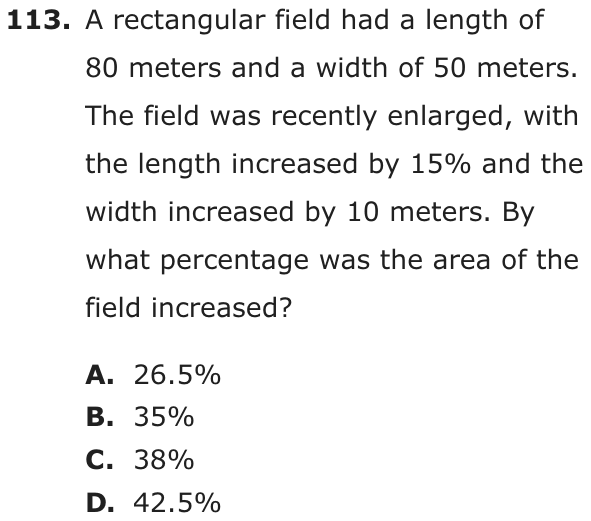
A rectangular field had a length of 80 meters and a width of 50 meters. The field was recently enlarged, with the length increased by 15% and the width increased by 10 meters. By what percentage was the area of the field increased?
- A26.5%
- B35%
- C38%
- D42.5%
Show the answer
Correct answer: C
The original area of the field was 4,000 square meters.
When the field was enlarged, the length increased by 15%, so the new length is 92 meters.
The width increased by 10 meters, so the new width is 60 meters.
The new area of the field is 5,520 square meters.
The percent increase is found by finding the difference between the two areas and dividing the increase by the original area.
Question analysis
A rectangular field 80 meters long and 50 meters wide has its length increased by 15 percent and its width by 10 meters. Students find the percent by which the field's area grew. It tests percent increase with rectangle area, and the tricky part is that one side changes by a percent and the other by a fixed length.
- Grade level
- Grade 7 content, by NYS standard
- Compared with grade 7
- Above grade 7 Grade 7 percent problems usually apply one percent change to one quantity. This changes a length by a percent and a width by a fixed amount, then asks for the percent change in area, a five-step chain with two kinds of change.
- Estimated difficulty
- Hard: combines ideas, needs a plan, and has more than one tempting wrong answer.
- Thinking it demands
- Depth of knowledge 2, skills and concepts · mainly apply
- What makes it hard
- Combines ideas moderate
- Many steps moderate
- A very close wrong answer minor
- Solution
- 5 steps
- Reading level
- Question and choices: about grade 6, 39 words.
- Students, last 30 days
- Not enough answers yet to show (it takes 10).
Why it is hard, traps and wrong answers (shows the answer)
Why it is hard
Each step is ordinary, but the two changes are stated in different units, one a percent and one in meters, which tempts students to force them into the same form. Adding the two percents is the most natural shortcut and lands close to the right value, because it misses only the small extra area where both changes overlap. Computing the old and new areas directly is slower but leaves nothing to chance.
Combines ideas moderate Working it out
Percent change has to be combined with area: the length grows by a percent and the width by meters, and the question asks for the percent change of their product. (Embretson, 1998; Daniel & Embretson, 2010)
Many steps moderate Working it out
Five computations are chained: the new length 92, the new width 60, the areas 4,000 and 5,520, and the increase 1,520 as a share of 4,000. (Daniel & Embretson, 2010; Enright, Morley & Sheehan, 2002)
A very close wrong answer minor Choosing the answer
The 35% from adding 15% and 20% sits only 3 points below 38%, so a rough estimate of the new area cannot rule it out. (Embretson & Wetzel, 1987; Gorin & Embretson, 2006; Ascalon et al., 2007)
Strategy: Compute the new length and the new width, find the old and new areas, and divide the increase in area by the original area.
Traps
- Misunderstands the concept: A wrong belief about a concept: that percents can be added, that area grows like length, that averages can be averaged, that a bigger denominator means a bigger fraction.
- Units or scale: The answer is wanted in other units, or a rate or scale must be converted first.
The wrong answers, classified
A Units or scale (King et al., 2004)
Treats the 10-meter widening as a 10% increase, so multiplies 1.15 × 1.10 = 1.265 and reports a 26.5% rise.
B Misunderstands the concept (Smith, diSessa & Roschelle, 1993; De Bock et al., 1998; Ni & Zhou, 2005)
Adds the length's 15% to the width's 20% increase, as if percent increases in two dimensions simply add, missing the 3% where they overlap.
D Units or scale (King et al., 2004)
Treats the 15% as 15 meters, making the field 95 by 60 meters, an area of 5,700 square meters and a 42.5% increase.
Worked solution, step by step
Formulas used
- Area of a rectangle
- A is the area, the flat space inside. l is the length and w is the width. Multiplying counts how many unit squares fit, row by row.
- Percent increase
- old is the starting amount, and new is the amount after. new − old is how much it grew. Dividing by old compares the growth with the start. Multiplying by 100 turns that into a percent.
Sort out the question
The field was 80 meters long and 50 meters wide. The length grew by 15%, a percent. The width grew by 10 meters, a number of meters. These are two different kinds of increase.
You need the percent by which the area grew.
Find the old area
You need the old area to compare with the new one.
The old field covered 4,000 square meters.
Find the new length and width
15% of 80 is . So the new length is meters.
The new width is meters.
Watch out: 10 meters is not 10%. Treating it as 10% leads to 26.5%, choice A. Treating 15% as 15 meters leads to 42.5%, choice D.
Find the new area
Multiply the new length by the new width.
The new field covers 5,520 square meters. That is square meters more.
Find the percent increase
The area grew by 38%. Watch out: The width grew by 20%, since 10 is 20% of 50. Adding 15% + 20% = 35% gives choice B. That misses the extra corner piece where both new strips meet.
So the answer is C, 38%.
Check your answer
Use growth factors. The length is multiplied by 1.15. The width goes from 50 to 60, so it is multiplied by 1.2. The area is multiplied by , which is 38% more.
More questions like this
The original DOE question
Question 5 of 6
2024 Test B Math, question 17Question
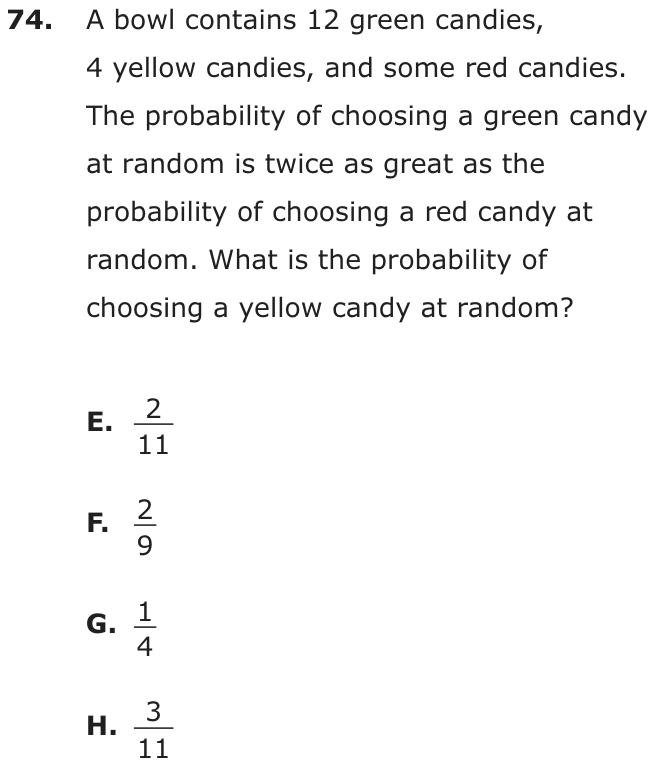
A bowl contains 12 green candies, 4 yellow candies, and some red candies. The probability of choosing a green candy at random is twice as great as the probability of choosing a red candy at random. What is the probability of choosing a yellow candy at random?
- A
- B
- C
- D
Show the answer
Correct answer: A
The probability of choosing a green candy is twice as great as the probability of choosing a red candy. There are 12 green candies. Let r = the number of red candies.
So there are 6 red candies. 12 green candies + 4 yellow candies + 6 red candies = 22 total candies.
There are 4 yellow candies out of a total of 22 candies. So the probability of choosing a yellow candy is
.
Question analysis
A probability question about a bowl of 12 green candies, 4 yellow candies and an unknown number of red ones. A green candy is twice as likely to be picked as a red one, and students find the chance of picking a yellow candy. The missing red count has to be worked out before any probability can be found.
- Grade level
- Grade 6 content, by NYS standard
- Compared with grade 7
- Above grade 7 Simple probability is grade 6 content in New York, and grade 7 problems usually give every count. Working backward from a comparison of two probabilities to a missing count, then forward to a third probability, is more than typical grade 7 work.
- Estimated difficulty
- Hard: combines ideas, needs a plan, and has more than one tempting wrong answer.
- Thinking it demands
- Depth of knowledge 2, skills and concepts · mainly apply
- What makes it hard
- Turning words into math moderate
- Combines ideas moderate
- Solution
- 3 steps
- Reading level
- Question and choices: about grade 7, 49 words.
- Students, last 30 days
- Not enough answers yet to show (it takes 10).
Why it is hard, traps and wrong answers (shows the answer)
Why it is hard
The question withholds the red count, and everything depends on recovering it from the comparison of probabilities. Students who cannot make that step tend to leave red out altogether, while those who find 6 red candies can still slip at the end by using the wrong total or the wrong color. Writing all three counts and the total of 22 before forming any fraction prevents both endings.
Turning words into math moderate Understanding the question
“Twice as great as the probability of choosing a red candy” must become 12 = 2 × the red count, which works only because both probabilities share one total. (Hegarty, Mayer & Monk, 1995; Koedinger & Nathan, 2004)
Combines ideas moderate Working it out
An unknown count has to be found from a ratio before any probability can be written, joining proportional reasoning with probability as a part over the total. (Embretson, 1998; Daniel & Embretson, 2010)
Strategy: Turn twice as likely into a statement about numbers of candies to find the red count, add all three colors for the total, then put the yellow count over that total and simplify.
Traps
- Answers a different question: A choice is right for another quantity: the other unknown, the rest instead of the part, the part instead of the whole.
- Numbers taken from the question: Combines the numbers in the question without a model of the situation, or is simply a number that appears in the question.
The wrong answers, classified
B Misunderstands the concept (Smith, diSessa & Roschelle, 1993; De Bock et al., 1998; Ni & Zhou, 2005)
Finds the 6 red candies but compares the 4 yellow with the 18 green and red ones, 4/18, a part-to-part ratio instead of part to whole.
C Numbers taken from the question (Hegarty, Mayer & Monk, 1995)
Leaves out the red candies, whose number is not given, and divides the 4 yellow by the 16 green and yellow candies.
D Answers a different question (King et al., 2004; Hegarty, Mayer & Monk, 1995)
Finds the 6 red candies and the total of 22 correctly but gives the chance of red, 6/22 = 3/11, instead of yellow.
Worked solution, step by step
Formulas used
- Probability
- P is the probability, the chance that something happens. The top is how many candies are the kind you want. The bottom is how many candies there are in all. Each candy is just as likely to be picked, so this fraction gives the chance.
Sort out what you know
The bowl has 12 green candies, 4 yellow candies and some red candies. You are not told how many are red. Let r be the number of red candies.
The chance of picking green is twice the chance of picking red. You need the probability (the chance) of picking yellow.
Compare green and red
Write each chance with the probability formula.
Green and red have the same bottom number, the total number of candies. So if the chance of green is twice the chance of red, there are twice as many green candies as red ones.
Find the red candies and the total
There are 6 red candies. Now add up all the candies.
There are 22 candies in all. Watch out: do not leave out the red candies just because their number was not given. Using 16 as the total gives 1/4, choice C.
Find the chance of yellow
There are 4 yellow candies out of 22.
Divide the top and the bottom by 2 to simplify. Watch out: the question asks for yellow, not red. 6/22 = 3/11 is the chance of red, choice D. The bottom must be all 22 candies. Using 18 gives 2/9, choice B.
So the answer is A, .
Check your answer
Check the clue. The chance of green is , and the chance of red is . Twelve is twice 6, so green is twice as likely. Also, the three chances add up to 1: .
More questions like this
The original DOE question
Question 6 of 6
2018 Test B Math, question 53Question
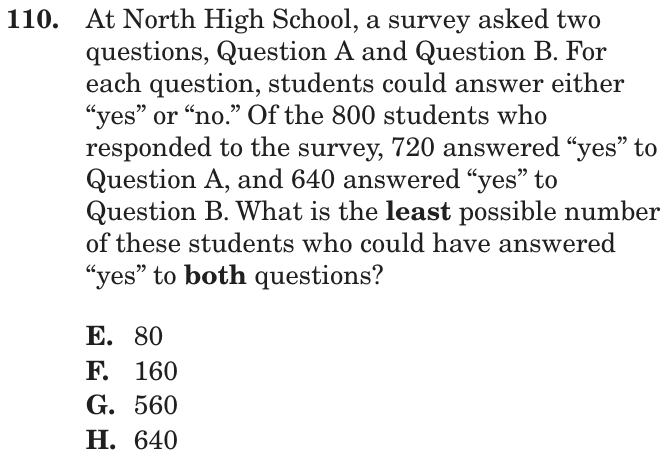
At North High School, a survey asked two questions, Question A and Question B. For each question, students could answer either “yes” or “no.” Of the 800 students who responded to the survey, 720 answered “yes” to Question A, and 640 answered “yes” to Question B. What is the least possible number of these students who could have answered “yes” to both questions?
- A80
- B160
- C560
- D640
Show the answer
Correct answer: C
None of the 80 students (800 − 720) who answered “no” to Question A could have answered “yes” to both questions.
Therefore, the least possible number of students who could have answered “yes” to both questions can be found by subtracting the 80 who answered “no” to Question A from the 640 who answered “yes” to Question B or 640 − 80 = 560.
Question analysis
In a survey of 800 students at North High School, 720 said yes to the first question and 640 said yes to the second. Students must find the smallest possible number who said yes to both. It tests reasoning about overlapping groups, and asking for the least possible overlap rather than an exact count makes it unusual.
- NYS standards
- Grade level
- Grade 7 content, by NYS standard
- Compared with grade 7
- Above grade 7 Grade 7 students work with Venn diagrams and two-way tables when all counts are given. Finding the smallest possible overlap requires reasoning about extremes rather than computing, which is rare in grade 7 and new to most students.
- Estimated difficulty
- Among the hardest on the SHSAT: a non-obvious approach, heavy reading, or a well-hidden trap.
- Thinking it demands
- Depth of knowledge 3, strategic thinking · mainly analyze
- What makes it hard
- No obvious method major
- Turning words into math moderate
- A very close wrong answer minor
- Solution
- 2 steps
- Reading level
- Question and choices: about grade 8, 60 words.
- Corrected from the DOE handbook
- A repeated phrase and a stray comma in the explanation were removed.
- Students, last 30 days
- Not enough answers yet to show (it takes 10).
Why it is hard, traps and wrong answers (shows the answer)
Why it is hard
Most students have never been asked for a smallest overlap, so they fall back on a picture of nested groups and give the largest one. The key move is to push the two yes groups apart as far as possible: only the 80 students who said no to Question A can absorb some of Question B's yes answers. Once that is seen, the arithmetic is one subtraction, so the question rewards reasoning far more than computation.
No obvious method major Working it out
Nothing in the wording points to the method: the smallest overlap appears only when all 80 students who said no to Question A are imagined saying yes to Question B. (Schoenfeld, 1985)
Turning words into math moderate Understanding the question
"The least possible number of these students who could have answered “yes” to both questions" asks for an extreme case, which has to be turned into an arrangement of the 800 students. (Hegarty, Mayer & Monk, 1995; Koedinger & Nathan, 2004)
A very close wrong answer minor Choosing the answer
640 is only 80 above the right 560, so a rough sense of size cannot choose between them; only asking whether the overlap is the least or the greatest separates them. (Embretson & Wetzel, 1987; Gorin & Embretson, 2006; Ascalon et al., 2007)
Strategy: Add the two yes counts and compare the sum with the number of students; any amount above the total must come from students counted in both groups.
Traps
- NOT, LEAST or EXCEPT: The question asks for the exception, the least, or what is not true.
- Stops one step early: A choice is a number from partway through the solution.
- Answers a different question: A choice is right for another quantity: the other unknown, the rest instead of the part, the part instead of the whole.
The wrong answers, classified
A Stops one step early (King et al., 2004; Gierl et al., 2017)
Finds the 80 students who said no to Question A, 800 − 720, and stops before subtracting them from the 640 who said yes to Question B.
B Answers a different question (King et al., 2004; Hegarty, Mayer & Monk, 1995)
Finds the 160 students who said no to Question B, 800 − 640, which bears on the count but is not the overlap asked about.
D Answers a different question (King et al., 2004; Hegarty, Mayer & Monk, 1995)
Assumes everyone who said yes to Question B also said yes to Question A, giving the greatest possible overlap instead of the least.
What was corrected from the DOE handbook, and why
- Explanation: The handbook prints “(800 − 720)” twice in its first sentence, after “80 students” and again after “Question A,” and puts a comma between subject and verb in “the least possible number of students who could have answered “yes” to both questions, can be found.” The site keeps the first “(800 − 720)” and drops the comma.
Worked solution, step by step
Formulas used
- Least overlap of two groups
- a is the size of the first group and b is the size of the second. t is the total number of people. If a + b is more than t, some people must be in both groups. The extra amount is the smallest number that can be in both.
Sort out what you know
There were 800 students. Of them, 720 said yes to Question A and 640 said yes to Question B. You need the least number who could have said yes to both. The overlap is the group in both yes groups. You want the smallest overlap.
Find who said no to A
Students who said no to Question A cannot be in the overlap.
So 80 students said no to Question A.
Watch out: 80 is not the answer. It is only a step, and it is choice A.
Keep the overlap small
To make the overlap as small as you can, put as many B yes answers outside it as possible. The only students outside it are the 80 who said no to A. So pretend all 80 of them said yes to B.
Count the rest of the yes group
The other yes answers to B must come from students who also said yes to A.
So at least 560 students said yes to both.
Watch out: 640 is the most that could say yes to both, not the least. That is choice D.
Give the answer
The fewest students who could say yes to both questions is 560. So the answer is C, 560.
Check your answer
Use the overlap formula: . There are 1,360 yes answers but only 800 students, so 560 students must be counted twice. You can also check the groups. 560 said yes to both, 160 to A only and 80 to B only. That makes .
More questions like this
The original DOE question