3 English and 3 math
Here are 6 random questions to try. Takers earning below 75% are unlikely to receive an offer. You have 1 minute 48 seconds per question on the real exam.
Question 1 of 6
2024 Test A English, question 36Passage 5 Reasons Physical Books Might Be Better Than E-Books
5 Reasons Physical Books Might Be Better Than E-Books
by Shaunacy Ferro
Though e-book1 readers have become a more common sight around town, traditional books still have their evangelists.2 According to The New York Times, e-book sales have been falling in 2015. Print definitely isn’t dead. In fact, according to some research, it may actually be a better choice for some readers. While scientists are still trying to tease out exactly how digital reading affects us differently, here are five ways e-books might be inferior to their dead-tree cousins.
E-books can reduce reading comprehension.
In a study of middle schoolers, West Chester University researchers found that students who read on iPads3 had lower reading comprehension than when they read traditional printed books. They discovered that the kids sometimes skipped text in favor of interactive features in the e-books, suggesting that certain multimedia in children’s e-books can be detrimental to the practice of reading itself. However, the researchers noted that some interactive features in e-books are designed to enhance comprehension, and that those might be more helpful than game-type interactive graphics.
Young kids can get distracted by e-books.
Similar results were found by a small study by the Joan Ganz Cooney Center that consisted of 32 kids reading e-books and print books with their parents. It found that “enhanced” e-books might be distracting. Kids who read enhanced e-books—ones with interactive, multimedia experiences—were more engaged with them physically, but in the end they remembered fewer narrative details than those who read print books or basic e-books.
You remember less about a book’s timeline.
Another study of adults also found that e-books can be hard to absorb. The researchers asked 25 people to read a 28-page story on a Kindle4 and 25 to read the story in paperback, then asked the readers to put 14 events from the story in chronological order. Those who read the story on a Kindle performed worse on the chronology test than the book readers, though they performed about the same as print readers in other tests. Earlier research by the same scholars, from Stavanger University in Norway, found that Norwegian 10th graders also remembered more about texts if they read them in print rather than on a computer screen.
They’re not great as textbooks.
While e-book textbooks are often cheaper (and easier to carry) than traditional door-stop5 textbooks, college students often don’t prefer them. In some surveys of college kids, the majority of students have reported preferring print books. However, a 2012 study from the UK’s National Literacy Trust of kids ages 8 to 16 found that more than 50 percent of children reported preferring screen reading.
They’re tiring.
Staring at a lit screen can be tiring for the eyes and the brain. A 2005 study from Sweden found that reading digitally required a higher cognitive workload than reading on paper. Furthermore, staring at LED6 screens at night can disrupt sleep patterns. A 2014 Harvard study found that people who used e-readers with LED screens at night slept worse and were more tired the next day. So, if you’re going to go for an e-book, go for one without the backlight.
The take-away message? If you’re really trying to absorb material, you might want to go for a physical book. And if you’re going to be up all night studying, turn off the backlight.
However, all this may not mean that reading on a Kindle is really going to melt your brain. For instance, reading an e-book on a computer is a much different experience than reading on a Kindle, which is specifically designed for consuming books. So, too, is playing with an interactive e-book on an iPad, compared to using a simpler e-book device that only presents the text, with no opportunities to click away into digital distractions.
And some studies have found that part of the difference between the way people absorb information from e-books versus paper might be due to approaching e-books differently—in one test, participants didn’t regulate their study time with digital books like they did with paper texts, leading to worse performances. It’s possible that our expectations of e-book reading—as well as the different designs of the digital reading experience on a computer or iPad or Kindle—might affect how we approach the text and how much effort we put into studying them. As generations of e-book readers evolve, and people become more accustomed to the idea of sitting down with a digital textbook, these factors could change—for better or for worse.
“5 Reasons Physical Books Might Be Better Than E-Books” by Shaunacy Ferro from MENTAL FLOSS, October 2, 2015. Copyright © 2015 Mental Floss, Inc.
1e-book: an electronic book, a publication made available digitally for reading on a computer or other device
2evangelists: advocates or supporters
3iPads: tablet computers
4Kindle: device for reading e-books
5door-stop: a reference to the idea that some textbooks are large and heavy enough to hold a door open
6LED: Light-emitting diode; LEDs are often used as a backlight for electronic devices such as smart phones and tablets.
Question
Which evidence from the passage best supports the claim that “print definitely isn’t dead” (paragraph 1)?
- AMost college students prefer using paper books to using e-books.
- BScientists are still studying the effects of reading on a screen.
- CPaper books are less disruptive to sleep patterns than e-books are.
- DReading on a screen can affect both the eyes and the brain.
Show the answer
Correct answer: A
The question asks which evidence from the passage best supports the claim in paragraph 1 that “print definitely isn’t dead.”
A. CORRECT. In paragraph 5, the author points out that “while e-book textbooks are often cheaper (and easier to carry) than traditional door-stop textbooks, college students often don’t prefer them.” The author adds that “in some surveys of college kids, the majority of students have reported preferring print books.” As a result, this evidence from the passage supports the claim in paragraph 1 that “print definitely isn’t dead.”
B. Incorrect. In paragraph 1, the author notes that “scientists are still trying to tease out exactly how digital reading affects us differently.” This detail shows that research on reading on a screen is still going on, but it says nothing about whether people still choose print, so it does not support the claim in paragraph 1 that “print definitely isn’t dead.”
C. Incorrect. Although the main idea of paragraph 6 is supported by the 2014 study that showed that “people who used e-readers with LED screens at night slept worse and were more tired the next day,” this detail does not support the claim in paragraph 1 that “print definitely isn’t dead.”
D. Incorrect. The author states in paragraph 6 that “staring at a lit screen can be tiring for the eyes and the brain” and that “reading digitally required a higher cognitive workload.” Although these details illustrate how using e-readers can have negative physical and mental effects, they do not support the claim in paragraph 1 that “print definitely isn’t dead.”
Question analysis
This evidence question takes the claim “print definitely isn't dead” from the opening of an article comparing printed books and e-books and asks which evidence from the passage best supports it. Students must pin down exactly what the claim says before judging the evidence, since all four choices come from the article and sound related.
- Grade level
- Grade 7 reading and task
- Compared with grade 7
- Above grade 7 Grade 7 students judge whether evidence is relevant to a claim, but this claim is a short idiom whose precise meaning must be settled first, and every choice paraphrases a real finding, which makes the comparison finer than typical.
- Estimated difficulty
- Hard: combines ideas, needs a plan, and has more than one tempting wrong answer.
- Thinking it demands
- Depth of knowledge 3, strategic thinking · mainly evaluate
- What makes it hard
- Reading between the lines major
- Figurative or literary language moderate
- The right answer is reworded minor
- Evidence
- Answered from several paragraphs or stanzas
- Reading level
- Passage: about grade 10, 829 words; question and choices: about grade 6, 59 words.
- Corrected from the DOE handbook
- The explanation of one wrong choice discussed a different detail; it now explains that choice.
- Students, last 30 days
- Not enough answers yet to show (it takes 10).
Why it is hard, traps and wrong answers (shows the answer)
Why it is hard
The sentence right after the claim says print “may actually be a better choice”, and the two wrong choices about sleep and tired eyes support exactly that, which makes them feel like the answer. The claim itself is narrower: print is still alive, still chosen by readers. Only one choice reports people choosing print, and its wording overstates the surveys, so students must accept an imperfect paraphrase over accurate findings that prove a different point.
Reading between the lines major Working it out
The article never ties any evidence to “Print definitely isn't dead”; the student must read it as print still being chosen and find that in paragraph 5's surveys, four paragraphs away. (Graesser, Singer & Trabasso, 1994; Kintsch, 1998)
Figurative or literary language moderate Understanding the question
“Isn't dead” is an idiom, and its exact sense, still bought and read rather than still worthwhile, decides between the survey of college students and the findings about sleep and tired eyes. (Graesser, Singer & Trabasso, 1994; Kintsch, 1998)
The right answer is reworded minor Choosing the answer
The right choice turns “in some surveys of college kids, the majority” into “Most college students prefer”, a looser paraphrase careful readers may distrust, while another choice echoes “the eyes and the brain”. (Freedle & Kostin, 1993; Kirsch & Mosenthal, 1990)
Strategy: Put the claim “print definitely isn't dead” into your own words first, then ask whether each choice proves that exact point or a different one made nearby in paragraph 1.
Traps
- Supports only part of the claim: In a question about evidence: a line that backs one half of the claim but not the other, or a related point rather than the claim itself.
- True but not the answer: A choice says something accurate about the text that does not answer this question.
The wrong answers, classified
B True but not the answer (King et al., 2004; Embretson & Wetzel, 1987)
Picks the sentence nearest the claim, that scientists are still working out how digital reading differs, a true remark about unfinished research that says nothing about print surviving.
C Supports only part of the claim (King et al., 2004; Thissen, Steinberg & Fitzpatrick, 1989)
Uses the 2014 Harvard sleep finding, a real advantage of paper that backs the next sentence's “better choice” but not the claim that people still buy and read print.
D Supports only part of the claim (King et al., 2004; Thissen, Steinberg & Fitzpatrick, 1989)
Chooses the finding that a lit screen tires “the eyes and the brain”, a drawback of e-books that argues print is better, not that print remains in use.
What was corrected from the DOE handbook, and why
- Explanation: Choice B is “Scientists are still studying the effects of reading on a screen,” from paragraph 1 (“scientists are still trying to tease out exactly how digital reading affects us differently”). The handbook's explanation of B instead discusses the iPad reading-comprehension study of paragraph 2, apparently left over from an earlier version of the choice. The explanation now addresses B: ongoing research says nothing about whether people still choose print. The answer, A, is unchanged.
Working it out, step by step
Pin down the claim
This asks you to find evidence for a claim. “Print definitely isn’t dead” is an idiom, a saying that doesn’t mean exactly what its words say. Books can’t really die. The claim means printed books are still being bought and read. People still choose them.
Watch for the nearby claim
The very next sentence makes a different claim. It says print “may actually be a better choice for some readers.” Being better is not the same as being alive. So you need evidence that people still choose print, not evidence that print is good for you.
Find people choosing print
Paragraph 5 says that “in some surveys of college kids, the majority of students have reported preferring print books.” A majority means more than half. They pick paper even though e-books are “often cheaper (and easier to carry).” So many readers still choose print, which shows it is still alive.
Check each choice
- A fits: most college students in those surveys prefer paper books.
- B is wrong because research still going on says nothing about whether people still choose print.
- C is wrong because better sleep is a reason print may be better, not proof that people still use it.
- D is wrong because tired eyes and brains are also a reason print may be better.
Watch out: C and D support the “better choice” sentence, not “isn’t dead.”
Choose the answer
Only A shows that many readers still choose paper books today. So the answer is A.
Why this answer and not the closest wrong one
C is the most tempting wrong answer. The finding that lit screens hurt sleep is real, and it favors paper. But it shows print may be better, not that it is still alive. A shows readers still choosing print. It says “Most college students” when the passage reports only “some surveys,” but it is still the best fit.
More questions like this
The original DOE question
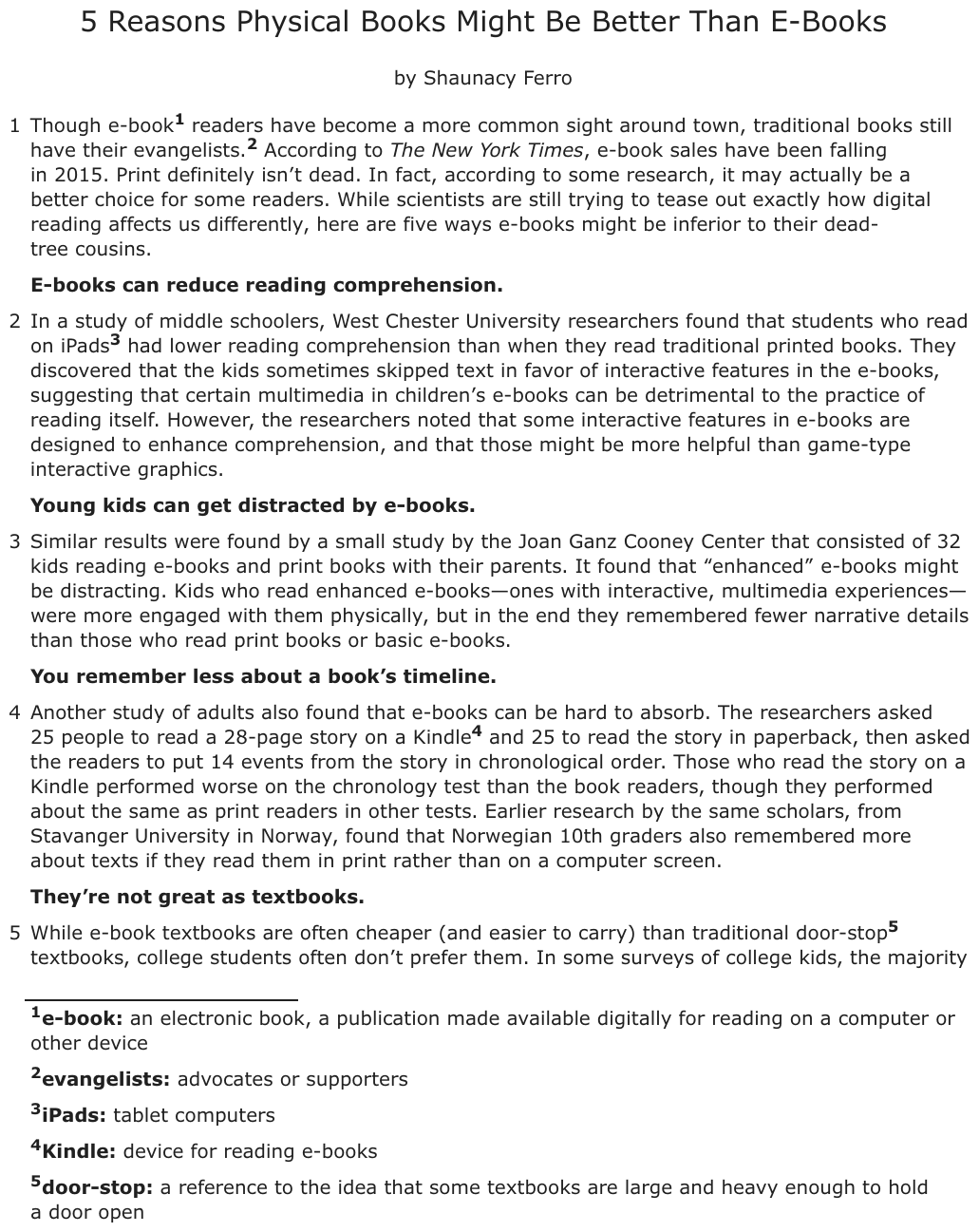
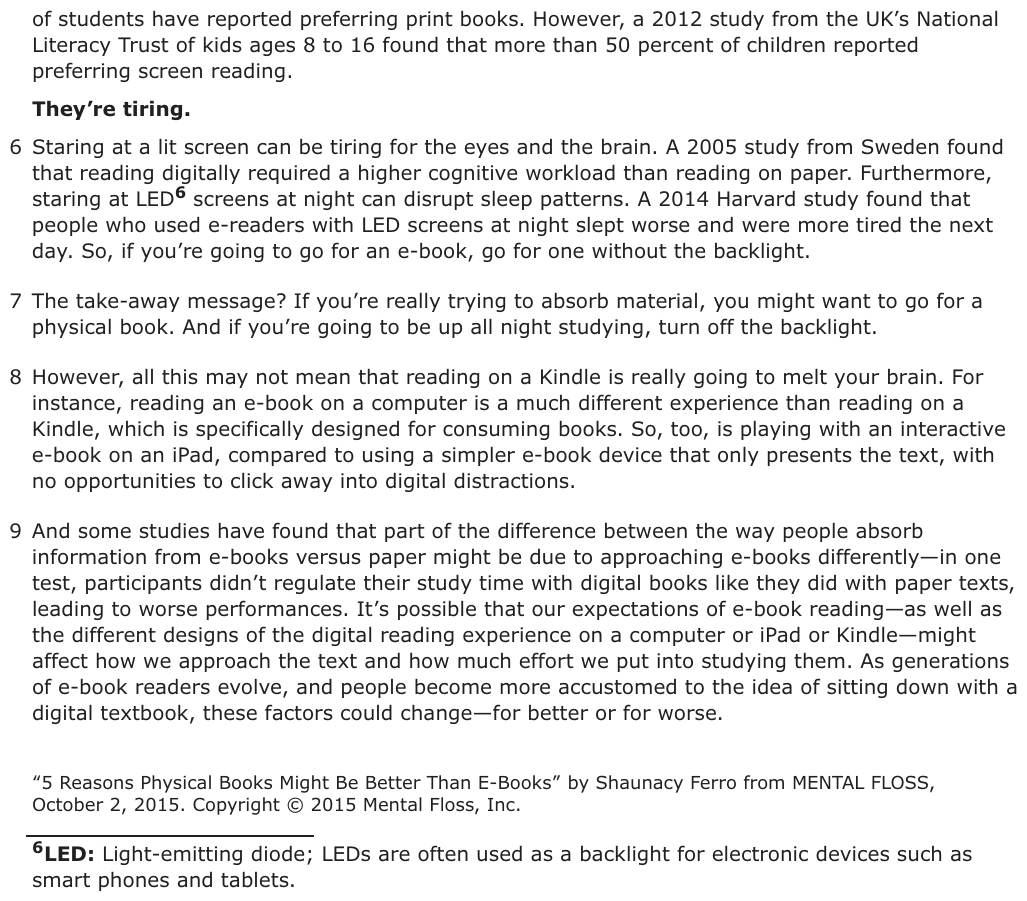
The passage “5 Reasons Physical Books Might Be Better Than E-Books” as printed (pages 58–59)
Question 2 of 6
2024 Test B English, question 56Passage Excerpt from “The Past and the Future of the Earth’s Oldest Trees”
Excerpt from “The Past and the Future of the Earth’s Oldest Trees”
by Alex Ross
About forty-five hundred years ago, not long after the completion of the Great Pyramid at Giza, a seed of Pinus longaeva, the Great Basin bristlecone pine, landed on a steep slope in what are now known as the White Mountains, in eastern California. The seed may have travelled there on a gust of wind, its flight aided by a winglike attachment to the nut. Or it could have been planted by a bird known as the Clark’s nutcracker, which likes to hide pine seeds in caches; nutcrackers have phenomenal spatial1 memory and can recall thousands of such caches. This seed, however, lay undisturbed. On a moist day in fall, or in the wake of melting snows in spring, a seedling appeared above ground—a stubby one-inch stem with a tuft of bright-green shoots.
Most seedlings die within a year; the mortality rate is more than ninety-nine percent. The survivors are sometimes seen growing in the shadow of a fallen tree. The landscape of the Ancient Bristlecone Pine Forest, as this area of the White Mountains is called, is littered with fragments of dead trees—trunks, limbs, roots, and smaller chunks. Pinus longaeva grows exclusively in subalpine regions of the Great Basin, which stretches from the eastern slopes of the Sierra Nevada to the Wasatch Range, in Utah. Conditions are generally too arid for the dead wood to rot; instead, it erodes, sanded down like rock. The remnants may harbor nutrients and fungi that help new trees grow. Bristlecones rise from the bones of their ancestors—a city within a cemetery.
Coast redwoods and giant sequoias, California’s gargantuan world-record-holding trees, can grow fifty feet or more in their first twenty years. Bristlecones rise agonizingly slowly. After four or five years, the seedling on the steep slope would have been just a few inches higher, sprouting needles in place of the embryonic shoots. The needles are a deep green, tough, resinous, and closely bunched in groups of five. On a mature tree, they live for fifty years or more. Decades may have passed before the tree was human height, and decades more before it resembled a conventional pine. Bristlecone saplings grow straight up, with relatively sparse foliage, looking like undernourished Christmas trees. After a few hundred years—by which time the Old Kingdom of Egypt had fallen—it was probably forty or fifty feet in height.
Many tree species live for hundreds of years. A smaller but not inconsiderable number, including the sequoias and certain yews, oaks, cypresses, and junipers, survive for thousands. Once a bristlecone has established itself in the unforgiving conditions of the White Mountains, it can last almost indefinitely. The trees tend to grow some distance from one another, so fires almost never destroy an entire stand. Because only a few other plant species can handle the dry, cold climate, the bristlecones face little competition. Unlike most plants, they tolerate dolomite soil, which is composed of a chalky type of limestone that is heavily alkaline and low in nutrients. As for insect threats, bristlecone wood is so dense that mountain-pine beetles and other pests can rarely burrow their way into it.
Empires rose and fell; wars raged; . . . and the tree from 2500 B.C. continued its implacable slow-motion existence, adding about two-hundredths of an inch to the diameter of its trunk each year. Minute changes in the tree-ring record make bristlecones an exceptionally useful source of data about changing conditions on Earth. When rains are heavier than normal, the rings widen. When volcanic eruptions cause global cooling, frost rings make the anomaly2 visible. . . .
As the millennia go by, bristlecones become contorted and wraithlike.3 The main stem, or leader, dies back. Entire branches, even the trunk itself, become fossils. At first glance, the tree may look dead. Such is the case of the forty-five-hundred-year-old tree that clings to life near the tourist path that now runs through the Ancient Bristlecone Pine Forest. Spears of dead wood jut into the air. The trunk is a marbled hulk stripped of bark, like driftwood thrown from a vanished ocean. A ribbon of live bark runs up one side, funneling water and nutrients to clumps of green needles high above. All told, the tree is an unprepossessing specimen; most people march past it without giving it a second glance. . . .
. . . No two super-elderly trees look alike, to the point where they have acquired the characteristics of individuals. Trees are prone to anthropomorphism; we project our dreams and our anxieties onto them. Bristlecones have been called elders, sentinels, sages. The possibility that climate change will cause their extinction has inspired a spate4 of alarmed news stories, although tree scientists tend to discount the idea that the bristlecones are in immediate danger. They have survived any number of catastrophes in the past; they may survive humanity.
From “The Past and the Future of the Earth’s Oldest Trees” by Alex Ross from THE NEW YORKER, January 20, 2020. Copyright © 2020 by Condé Nast. All rights reserved.
1spatial: relating to physical space
2anomaly: oddity
3wraithlike: ghostly
4spate: sudden abundance
Question
What is the best summary of the bristlecone pine’s life cycle?
- AThe bristlecone pine takes root as a stubby seedling in the mountains. Over time, it grows slowly in a hostile environment with alkaline soil that ensures little competition from other trees.
- BThe bristlecone pine grows up slowly from the fragments of its dead ancestors. Over time, it begins to become contorted in appearance but continues to funnel water and nutrients to its stem.
- CThe bristlecone pine grows slowly in an environment hostile to other trees. Over time, its trunk and some branches fossilize, but it funnels water and nutrients to other parts that are still alive.
- DThe bristlecone pine grows only in one location in the mountains. Over time, it develops sparse foliage that fossilizes slowly, but the trunk and branches stay alive, as revealed by ribbons of live bark.
Show the answer
Correct answer: C
The question asks for the best summary of the bristlecone pine’s life cycle.
A. Incorrect. Though the summary in this option covers key points in the life cycle, it focuses on minor details (“stubby seedling” and “alkaline soil”) while leaving out major details of the life cycle (for example, the fact that parts of the trees become fossilized over time).
B. Incorrect. This option addresses the unique quality of the pine growing from “fragments of its dead ancestors”; however, it does not address the fossilization phase, which is a major part of the life cycle. In addition, this option incorrectly states that the tree continues to funnel nutrients to its stem.
C. CORRECT. The option describes the key phases of the pine’s life cycle without focusing on minor details. The organization of the summary is chronological, and the information presented is accurate.
D. Incorrect. The option focuses more on the location and the appearance of the pine than on the phases of the pine’s life cycle. The option also describes the pine’s appearance inaccurately: it says that the foliage fossilizes and the trunk and branches stay alive, but paragraph 6 says that “entire branches, even the trunk itself, become fossils.” It provides little information about the main phases of the pine’s life cycle.
Question analysis
This summary question asks students to choose the best summary of the life cycle of the Great Basin bristlecone pine, as described across Alex Ross’s excerpt about the Earth’s oldest trees. Each choice is two sentences long and sounds accurate, and the differences lie in which stages of the tree’s long life each one includes and how faithfully it reports them.
- Grade level
- Grade 8 reading and task
- Compared with grade 7
- Above grade 7 Summarizing a process is regular grade 7 work, but this life cycle unfolds across six paragraphs of dense description, and each choice is a two-sentence summary with accurate-sounding details, so spotting small omissions and errors takes more than typical care.
- Estimated difficulty
- Hard: combines ideas, needs a plan, and has more than one tempting wrong answer.
- Thinking it demands
- Depth of knowledge 3, strategic thinking · mainly understand
- What makes it hard
- Every choice must be checked major
- Evidence in several places moderate
- A very close wrong answer moderate
- Evidence
- Answered from the whole text
- Reading level
- Passage: about grade 8, 851 words; question and choices: about grade 9, 141 words.
- Corrected from the DOE handbook
- An inaccurate statement in the explanation was corrected.
- Students, last 30 days
- Not enough answers yet to show (it takes 10).
Why it is hard, traps and wrong answers (shows the answer)
Why it is hard
A good summary of this life cycle has to reach old age, when the trunk and branches turn to fossil while a strip of bark keeps the tree alive, and it has to get that stage right. One wrong choice never gets past youth, another reaches old age but keeps the wrong part alive, and a third mixes up which parts fossilize. Recalling paragraph 6 exactly, with every choice two sentences long, is what makes the question slow.
Every choice must be checked major Choosing the answer
Each two-sentence summary sounds accurate, and its flaw is an omission or a wrong detail, such as nutrients sent to a stem that dies back or foliage that fossilizes, so every clause must be checked. (Embretson & Wetzel, 1987)
Evidence in several places moderate Working it out
The life cycle runs across six paragraphs: the seedling in paragraph 1, the dead ancestors in 2, slow growth in 3, harsh conditions in 4, and fossilized wood with a live ribbon of bark in 6. (Kirsch & Mosenthal, 1990; Gorin & Embretson, 2006)
A very close wrong answer moderate Choosing the answer
The ancestors-and-stem summary has the key’s shape, slow growth, then decline, then water and nutrients still funneled; it differs in where they go, the stem, which paragraph 6 says “dies back.” (Embretson & Wetzel, 1987; Gorin & Embretson, 2006; Ascalon et al., 2007)
Strategy: Before reading the choices, list the stages of the tree’s life from seed to old age with one detail each, then check every sentence of each summary against the passage.
Traps
- Too narrow: A single detail offered as the central idea or a summary, or a summary that keeps minor details and leaves out an essential part.
- Twists what the text says: Uses the text's topic and ideas but changes what it says: who did it, how much, when, or why.
- Half right: One half of a two-part choice is right and the other is not.
The wrong answers, classified
A Too narrow (King et al., 2004)
Covers only the tree’s youth, the stubby seedling and slow growth in poor alkaline soil, and stops before the fossilizing and the live strip of bark that mark its old age.
B Half right (King et al., 2004; Thissen, Steinberg & Fitzpatrick, 1989)
Starts accurately with growth among dead ancestors and a contorted old age, but sends water and nutrients to the stem, which dies back, and leaves out fossilization.
D Twists what the text says (King et al., 2004)
Assembles real words from the excerpt, sparse foliage, fossils and live bark, but swaps which parts fossilize and shrinks a range across the Great Basin to one location.
What was corrected from the DOE handbook, and why
- Explanation: The handbook says Option D “contains an accurate description of the pine’s appearance.” It does not: Option D says the foliage fossilizes and the trunk and branches stay alive, but paragraph 6 says that “entire branches, even the trunk itself, become fossils,” as the correct answer, Option C, also says. The site now says that the option describes the pine’s appearance inaccurately.
Working it out, step by step
Figure out what the question asks
This asks for the best summary of the bristlecone’s life cycle. A life cycle is the stages of a living thing’s life, from its start to old age. A good summary covers the main stages in order and gets each one right.
List the stages from the excerpt
- Young: the seedling grows “agonizingly slowly” (paragraph 3).
- Settled: it lives where few plants “can handle the dry, cold climate” (paragraph 4).
- Old: “The main stem, or leader, dies back,” and “Entire branches, even the trunk itself, become fossils” (paragraph 6).
- Still alive: “A ribbon of live bark runs up one side, funneling water and nutrients to clumps of green needles high above” (paragraph 6).
Explain the hard words
Hostile means unfriendly or harsh. To fossilize here means to turn into hard, dead wood, almost like stone. To funnel is to carry something along a narrow path. Contorted means twisted out of shape. Nutrients are the things a plant needs to grow. Foliage means leaves, which for a pine are its needles.
Check each choice
- A does not fit. It stops while the tree is young. It never reaches old age, when parts of the tree turn to fossil.
- B does not fit. The main stem “dies back,” so water is not sent to the stem. B also leaves out the fossil stage.
- C fits. It gives slow growth in a harsh place, then a fossilized trunk and branches, with water still carried to the living parts.
- D does not fit. Paragraph 2 says bristlecones grow in high areas across the Great Basin, a region that stretches into Utah. That is not one location. D also mixes up the parts: the trunk and branches turn to fossil, not the foliage.
Choose the answer
Only one summary reaches old age and gets every stage right. So the answer is C.
Why this answer and not the closest wrong one
B looks the most like the right answer. Like C, it moves from young growth to old age and has water and nutrients still flowing. But it sends them to the stem, and paragraph 6 says the stem “dies back.” C sends them to the parts still alive, which matches the ribbon of live bark.
More questions like this
The original DOE question
The passage “Excerpt from “The Past and the Future of the Earth’s Oldest Trees”” as printed (pages 193–194)
Question 3 of 6
2026 Practice Test D English, question 49Question
Read this sentence.
Robert Cornelius is credited with taking the first, official selfie as a daguerreotype, an image recorded on a copper plate coated in silver, using a process that was more complicated than photos of today which are digitized or printed from film and do not require subjects to sit for nearly fifteen minutes to avoid blurring the image.
Which two edits should be made to correct the sentence?
Select the two correct answers.
Choose every answer that is correct, then check. The DOE has not published how answers with several parts are scored; this site counts one right only when every part is right.
- ADelete the comma after first.
- BDelete the comma after daguerreotype.
- CDelete the comma after silver.
- DAdd a comma after today.
- EAdd a comma after film.
Show the answer
Correct answer: A and D
The question asks which two edits should be made to correct the sentence.
A. CORRECT. The comma after “first” must be deleted to correct the sentence. The adjectives “first” and “official” are not coordinate adjectives that independently modify the noun “selfie.” Cornelius did not take the “first selfie” and also the “official selfie.” Rather, he took the first selfie that was considered official. Placing a comma between the words “first” and “official” incorrectly separates two adjectives that work together to describe the selfie.
B. Incorrect. The comma after “daguerreotype” must not be deleted, because it is used correctly to introduce an explanation. The phrase “an image recorded on a copper plate coated in silver” is an appositive—a noun phrase that defines “daguerreotype.”
C. Incorrect. The comma after “silver” is placed correctly, marking the end of the phrase “an image recorded on a copper plate coated in silver” that defines “daguerreotype.” Because the sentence continues to explain the process Robert Cornelius used, the comma after “silver” is needed to end the appositive and separate it from the phrase that follows.
D. CORRECT. A comma is needed after “today” because the following phrase, “which are digitized or printed from film,” is a nonrestrictive clause that gives nonessential information about the “photos of today” preceding it.
E. Incorrect. No comma is needed after “film,” because the words “and do not require subjects to sit” are part of the same relative clause that begins with “which are digitized…”. The conjunction “and” joins two predicates within the same clause. Both actions belong to the same clause and the same subject (which); they are not separate independent clauses that need to be punctuated with a comma.
Question analysis
This punctuation question gives one long sentence about Robert Cornelius, credited with one of the earliest selfies, and the daguerreotype, an image made on a silver-coated copper plate, and asks which two of five comma edits correct it. Five words are underlined, and each needs its own decision about a comma, with credit only when both chosen edits are right.
- NYS standards
- 7L2 capitalization, punctuation, and spelling
- Grade level
- Grade 8 reading and task
- Compared with grade 7
- Above grade 7 The comma rules tested appear in the grade 6 and 7 standards, but the sentence runs 57 words, two of the rules are subtle ones, and both selections must be right, which makes this harder than typical grade 7 editing.
- Estimated difficulty
- Hard: combines ideas, needs a plan, and has more than one tempting wrong answer.
- Thinking it demands
- Depth of knowledge 2, skills and concepts · mainly apply
- What makes it hard
- A rule that doesn't sound wrong major
- Much to keep track of moderate
- Complex sentences moderate
- Evidence
- Answered from one sentence or line
- Reading level
- Question and choices: about grade 7, 100 words.
- Corrected from the DOE handbook
- A grammar term in the explanation was corrected.
- Students, last 30 days
- Not enough answers yet to show (it takes 10).
Why it is hard, traps and wrong answers (shows the answer)
Why it is hard
The sentence is long, two of its five decisions turn on subtle comma rules, and the site counts the answer right only when both edits are right. The comma before “and do not require” is the strongest trap, because a comma before “and” is a habit many students apply without checking whether a new clause begins. The paired commas around “an image recorded on a copper plate coated in silver” are already correct, and deleting either one breaks the pair.
A rule that doesn't sound wrong major Working it out
Both needed edits rest on rules students rarely hear: “first, official” are not coordinate adjectives, so no comma, and “which are digitized” adds nonessential detail about photos of today, so it needs one. (Connors & Lunsford, 1988)
Much to keep track of moderate Working it out
There are five comma decisions in one sentence and both selections must be right to score, so each edit is judged on its own while the rest of the sentence is held in mind. (Sweller, 1988; Carpenter, Just & Shell, 1990)
Complex sentences moderate Understanding the question
The sentence runs 57 words and stacks an appositive, a participial phrase beginning “using a process,” and a relative clause with two verbs, so finding where each phrase starts and ends is itself the task. (Abedi & Lord, 2001; Freedle & Kostin, 1993; Messick, 1989)
Strategy: Take the five underlined words one at a time: name what the phrase after each one does in the sentence, decide whether a comma belongs there, and choose only the two edits you are sure of.
Traps
- Punctuation: A comma, semicolon, colon, dash or apostrophe used where it does not belong, or missing where it does.
The wrong answers, classified
B Punctuation (Connors & Lunsford, 1988)
Deletes the comma that opens the appositive “an image recorded on a copper plate coated in silver,” which defines daguerreotype and must be set off from it.
C Punctuation (Connors & Lunsford, 1988)
Deletes the comma that closes the same appositive, perhaps feeling the sentence has too many commas, though a phrase set off mid-sentence needs a comma on each side.
E Punctuation (Connors & Lunsford, 1988)
Applies the habit of a comma before “and,” though here “and” joins two verbs that share one subject, “which,” inside one clause, not two complete clauses.
A Punctuation (Connors & Lunsford, 1988)
Left out by students who think a comma always separates two adjectives, though “first” describes “official selfie” as a unit, so the adjectives are not coordinate.
D Punctuation (Connors & Lunsford, 1988)
Left out by students who read “photos of today which are digitized” as one essential phrase, missing that the which-clause adds nonessential detail and needs a comma.
What was corrected from the DOE handbook, and why
- Explanation: The DOE’s explanation of Option C says the comma after “silver” “is needed to separate the clauses.” Neither side of that comma is a clause. Before it is the appositive “an image recorded on a copper plate coated in silver,” as the explanations of Options B and C say; after it is the phrase “using a process that was more complicated…,” a participial phrase with no subject of its own. The comma ends the appositive. The site now says the comma “is needed to end the appositive and separate it from the phrase that follows.”
Working it out, step by step
Figure out what the question asks
This asks which two comma edits fix the sentence. Five words are underlined. Decide about each comma one at a time. You must pick both right edits.
Check the comma after first
A comma goes between two describing words only if each one describes the noun on its own. Test it: can you put “and” between them? A long and hard test works, so you write a long, hard test. But the first and official selfie sounds wrong. “First” describes “official selfie” as a unit. So delete the comma after first. That is A.
Check the commas around silver
“An image recorded on a copper plate coated in silver” tells what a daguerreotype is. A phrase that renames the noun just before it is called an appositive. An appositive in the middle of a sentence needs a comma on each side. Example: My dog, a small beagle, loves walks. So keep the commas after daguerreotype and silver. B and C are wrong.
Check the comma after today
A clause is a group of words with its own verb. “Which are digitized or printed from film” is a clause that adds extra facts about photos of today. A “which” clause that adds extra facts gets a comma before it. Example: I read that book, which is very long. So add a comma after today. That is D.
Check the comma after film
The words “and do not require subjects to sit” are part of the same “which” clause. “Which” is the subject of both verbs, “are digitized or printed” and “do not require.” When “and” joins two verbs that share one subject, no comma goes before it. Example: She sings and dances. So E is wrong.
Watch out: Many students put a comma before every “and.” That leads to E. A comma goes before “and” when it joins two full sentences, not two verbs.
Choose the answers
Delete the comma after first, and add a comma after today. So the answers are A and D. Be sure to select both of them.
Why this answer and not the closest wrong one
E is the closest wrong answer, because a comma before “and” is a common habit. But after film, “and” joins two verbs that share one subject, “which.” No new sentence starts there, so no comma belongs. A and D fix the two real errors.
More questions like this
The original DOE question
Question 4 of 6
2018 Test A Math, question 30Question
Today, Tien’s age is of Jordan’s age. In 2 years, Tien’s age will be of Jordan’s age. How old is Jordan today?
- A4 years old
- B6 years old
- C12 years old
- D16 years old
Show the answer
Correct answer: D
First, set up an equation to express Tien’s age () and Jordan’s age () today:
Two years from now, Tien’s age will be , and Jordan’s age will be .
Set up an equation about the relationship between Tien’s age and Jordan’s age in two years:
Solve the above equation for :
Now set the two equations equal to each other and solve for :
Question analysis
This age word problem says Tien is one fourth of Jordan's age today and will be one third of Jordan's age in two years, then asks for Jordan's current age. Students must turn two fractional relationships into equations and solve them together. Both people age by the same two years, and it is easy to solve for the wrong person.
- NYS standards
- Grade level
- Grade 8 content, by NYS standard
- Compared with grade 7
- Above grade 7 Grade 7 equations have one unknown on one side, like 3x + 5 = 20. This one links two unknown ages with fractional coefficients and leads to a variable on both sides, which is grade 8 algebra.
- Estimated difficulty
- Hard: combines ideas, needs a plan, and has more than one tempting wrong answer.
- Thinking it demands
- Depth of knowledge 2, skills and concepts · mainly apply
- What makes it hard
- Turning words into math major
- Error-prone arithmetic moderate
- Solution
- 4 steps
- Reading level
- Question and choices: about grade 1, 31 words.
- Students, last 30 days
- Not enough answers yet to show (it takes 10).
Why it is hard, traps and wrong answers (shows the answer)
Why it is hard
The difficulty is in the setup: two fractional relationships at two different times, with both people aging. Once the equations are right, the algebra is short, but it ends with two ages and only one is asked for. Testing the choices against both conditions is a reliable alternative that avoids the algebra entirely.
Turning words into math major Understanding the question
The second sentence must become T + 2 = (J + 2)/3; writing J/3, or forgetting that Jordan also ages two years, breaks the equation. (Hegarty, Mayer & Monk, 1995; Koedinger & Nathan, 2004)
Error-prone arithmetic moderate Working it out
Substituting J/4 for T leaves J/4 + 2 = (J + 2)/3, an equation with fractions on both sides that must be cleared, usually by multiplying by 12. (Brown & Burton, 1978; Junker & Sijtsma, 2001)
Strategy: Let Jordan's age be J, write Tien's age as J/4, and set J/4 + 2 equal to one third of (J + 2); or test each choice against both conditions.
Traps
- Answers a different question: A choice is right for another quantity: the other unknown, the rest instead of the part, the part instead of the whole.
The wrong answers, classified
A Answers a different question (King et al., 2004; Hegarty, Mayer & Monk, 1995)
Solves the equations correctly but reports Tien's age today, 4, which is one fourth of Jordan's 16, instead of Jordan's age.
B Answers a different question (King et al., 2004; Hegarty, Mayer & Monk, 1995)
Gives Tien's age two years from now, 4 + 2 = 6, answering for the wrong person and the wrong time.
C Numbers taken from the question (Hegarty, Mayer & Monk, 1995)
Picks 12 because it is a multiple of both 4 and 3, but then Tien would be 3 and later 5, not a third of 14.
Worked solution, step by step
Formulas used
- Distributive property
- a, b and c are any numbers. To multiply a sum by a number, multiply each part of the sum, then add. It works because a groups of (b + c) is the same as a groups of b plus a groups of c.
Sort out what you know
Today, Tien’s age is of Jordan’s age. That means Jordan is 4 times as old as Tien.
In 2 years, both of them will be 2 years older. Then Tien’s age will be of Jordan’s. So Jordan will be 3 times as old as Tien. You need Jordan’s age today.
Name the ages with a letter
Let t stand for Tien’s age today. Jordan is 4 times as old, so his age is 4t, which means 4 times t. Add 2 years to each age:
Person Today In 2 years Tien Jordan Watch out: Jordan gets 2 years older too. Do not forget to add 2 to his age.
Write an equation for later
In 2 years, Jordan’s age will be 3 times Tien’s age. Write that as an equation:
Use the distributive property on the right side. Multiply both t and 2 by 3:
Solve for Tien’s age
Take 3t away from both sides. Doing the same thing to both sides keeps them equal:
Now take 2 away from both sides:
So Tien is 4 years old today. Watch out: 4 is Tien’s age, not Jordan’s. Choice A, 4 years old, is a trap.
Find Jordan’s age
Jordan is 4 times as old as Tien:
So the answer is D, 16 years old.
Check your answer
Put 16 back into the story. Today, Tien is 16 ÷ 4 = 4. In 2 years, Tien is 6 and Jordan is 18. Is 6 one third of 18? Yes, because 18 ÷ 3 = 6. Choice C fails: Tien would be 3, then 5, and 5 is not a third of 14.
More questions like this
The original DOE question
Question 5 of 6
2024 Test B Math, question 56Question
A rectangular field had a length of 80 meters and a width of 50 meters. The field was recently enlarged, with the length increased by 15% and the width increased by 10 meters. By what percentage was the area of the field increased?
- A26.5%
- B35%
- C38%
- D42.5%
Show the answer
Correct answer: C
The original area of the field was 4,000 square meters.
When the field was enlarged, the length increased by 15%, so the new length is 92 meters.
The width increased by 10 meters, so the new width is 60 meters.
The new area of the field is 5,520 square meters.
The percent increase is found by finding the difference between the two areas and dividing the increase by the original area.
Question analysis
A rectangular field 80 meters long and 50 meters wide has its length increased by 15 percent and its width by 10 meters. Students find the percent by which the field's area grew. It tests percent increase with rectangle area, and the tricky part is that one side changes by a percent and the other by a fixed length.
- Grade level
- Grade 7 content, by NYS standard
- Compared with grade 7
- Above grade 7 Grade 7 percent problems usually apply one percent change to one quantity. This changes a length by a percent and a width by a fixed amount, then asks for the percent change in area, a five-step chain with two kinds of change.
- Estimated difficulty
- Hard: combines ideas, needs a plan, and has more than one tempting wrong answer.
- Thinking it demands
- Depth of knowledge 2, skills and concepts · mainly apply
- What makes it hard
- Combines ideas moderate
- Many steps moderate
- A very close wrong answer minor
- Solution
- 5 steps
- Reading level
- Question and choices: about grade 6, 39 words.
- Students, last 30 days
- Not enough answers yet to show (it takes 10).
Why it is hard, traps and wrong answers (shows the answer)
Why it is hard
Each step is ordinary, but the two changes are stated in different units, one a percent and one in meters, which tempts students to force them into the same form. Adding the two percents is the most natural shortcut and lands close to the right value, because it misses only the small extra area where both changes overlap. Computing the old and new areas directly is slower but leaves nothing to chance.
Combines ideas moderate Working it out
Percent change has to be combined with area: the length grows by a percent and the width by meters, and the question asks for the percent change of their product. (Embretson, 1998; Daniel & Embretson, 2010)
Many steps moderate Working it out
Five computations are chained: the new length 92, the new width 60, the areas 4,000 and 5,520, and the increase 1,520 as a share of 4,000. (Daniel & Embretson, 2010; Enright, Morley & Sheehan, 2002)
A very close wrong answer minor Choosing the answer
The 35% from adding 15% and 20% sits only 3 points below 38%, so a rough estimate of the new area cannot rule it out. (Embretson & Wetzel, 1987; Gorin & Embretson, 2006; Ascalon et al., 2007)
Strategy: Compute the new length and the new width, find the old and new areas, and divide the increase in area by the original area.
Traps
- Misunderstands the concept: A wrong belief about a concept: that percents can be added, that area grows like length, that averages can be averaged, that a bigger denominator means a bigger fraction.
- Units or scale: The answer is wanted in other units, or a rate or scale must be converted first.
The wrong answers, classified
A Units or scale (King et al., 2004)
Treats the 10-meter widening as a 10% increase, so multiplies 1.15 × 1.10 = 1.265 and reports a 26.5% rise.
B Misunderstands the concept (Smith, diSessa & Roschelle, 1993; De Bock et al., 1998; Ni & Zhou, 2005)
Adds the length's 15% to the width's 20% increase, as if percent increases in two dimensions simply add, missing the 3% where they overlap.
D Units or scale (King et al., 2004)
Treats the 15% as 15 meters, making the field 95 by 60 meters, an area of 5,700 square meters and a 42.5% increase.
Worked solution, step by step
Formulas used
- Area of a rectangle
- A is the area, the flat space inside. l is the length and w is the width. Multiplying counts how many unit squares fit, row by row.
- Percent increase
- old is the starting amount, and new is the amount after. new − old is how much it grew. Dividing by old compares the growth with the start. Multiplying by 100 turns that into a percent.
Sort out the question
The field was 80 meters long and 50 meters wide. The length grew by 15%, a percent. The width grew by 10 meters, a number of meters. These are two different kinds of increase.
You need the percent by which the area grew.
Find the old area
You need the old area to compare with the new one.
The old field covered 4,000 square meters.
Find the new length and width
15% of 80 is . So the new length is meters.
The new width is meters.
Watch out: 10 meters is not 10%. Treating it as 10% leads to 26.5%, choice A. Treating 15% as 15 meters leads to 42.5%, choice D.
Find the new area
Multiply the new length by the new width.
The new field covers 5,520 square meters. That is square meters more.
Find the percent increase
The area grew by 38%. Watch out: The width grew by 20%, since 10 is 20% of 50. Adding 15% + 20% = 35% gives choice B. That misses the extra corner piece where both new strips meet.
So the answer is C, 38%.
Check your answer
Use growth factors. The length is multiplied by 1.15. The width goes from 50 to 60, so it is multiplied by 1.2. The area is multiplied by , which is 38% more.
More questions like this
The original DOE question
Question 6 of 6
2018 Test A Math, question 1Question
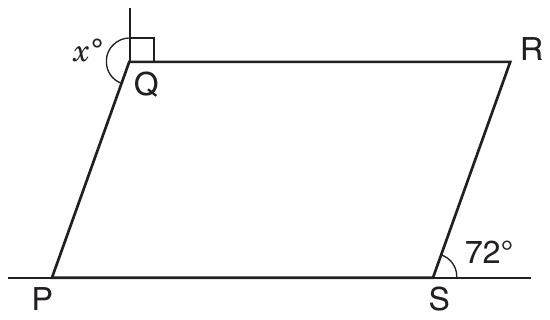
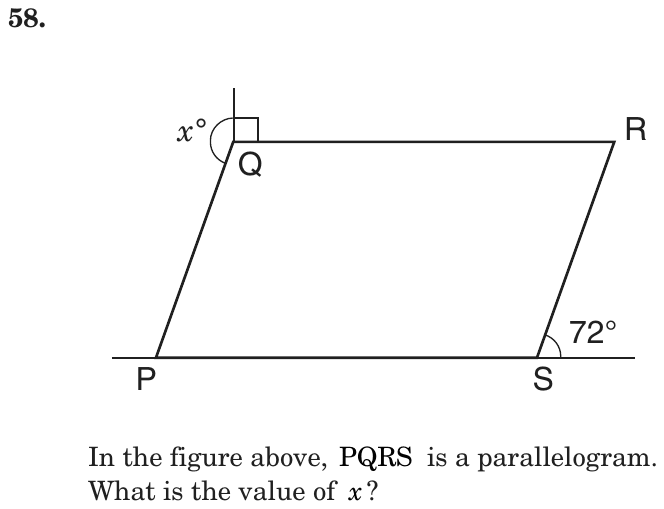
In the figure above, PQRS is a parallelogram. What is the value of ?
Grid-in question: work out the answer and enter it as a number.
Show the answer
Correct answer: 162
First, find the measure of angle PQR. The measure of angle PQR is equal to the measure of angle PSR.
m∠PSR = 180 − 72 = 108.
So, the measure of angle PQR is also 108.
108 + 90 + x = 360
198 + x = 360
x = 162
Question analysis
A grid-in geometry question about angles around a parallelogram PQRS. A 72° angle sits outside corner S on the extended base, and at corner Q a right angle and the unknown angle x complete the turn around the point. Students chain three angle facts, and the angle asked for lies outside the shape, not inside it.
- NYS standards
- Grade level
- Grade 8 content, by NYS standard
- Compared with grade 7
- Above grade 7 Grade 7 angle work usually applies one or two facts, such as supplementary or vertical angles, to find an angle. This chains three, and needs the equal opposite angles of a parallelogram, which rest on grade 8 parallel-line facts.
- Estimated difficulty
- Hard: combines ideas, needs a plan, and has more than one tempting wrong answer.
- Thinking it demands
- Depth of knowledge 2, skills and concepts · mainly apply
- What makes it hard
- Reading a figure, table or graph major
- Combines ideas moderate
- An answer in an unexpected form minor
- Solution
- 3 steps
- Reading level
- Question and choices: about grade 7, 14 words.
- Students, last 30 days
- Not enough answers yet to show (it takes 10).
Why it is hard, traps and wrong answers (shows the answer)
Why it is hard
The arithmetic is two subtractions; the difficulty is seeing which angles the marks refer to. Students lose points by treating the 72° as the parallelogram's own angle at S, or by stopping at angle PQR, the most natural number to grid. The question rewards tracing a route from S to Q before computing anything, and checking at the end that x is the angle outside the shape that the arc marks.
Reading a figure, table or graph major Understanding the question
The 72° is marked outside the parallelogram, between side SR and the base extended past S, and x sits outside corner Q, between QP and a vertical ray that meets QR at a right-angle mark. (Lesh, Post & Behr, 1987; Kirsch & Mosenthal, 1990)
Combines ideas moderate Working it out
Three angle facts have to be chained: a straight line gives the angle inside S, opposite angles of a parallelogram carry it to Q, and the angles around Q make a full 360° turn. (Embretson, 1998; Daniel & Embretson, 2010)
An answer in an unexpected form minor Choosing the answer
As a grid-in there are no choices to check against, so a student who stops at angle PQR, inside the parallelogram, gets no signal that the job is unfinished. (Enright, Morley & Sheehan, 2002)
Strategy: Use the straight line at S to find the parallelogram's angle there, carry it to the opposite corner Q, then take that angle and the right angle away from 360.
Traps
- Stops one step early: A choice is a number from partway through the solution.
The wrong answers, classified
108 Stops one step early (King et al., 2004; Gierl et al., 2017)
Finds angle PSR = 180 − 72 = 108 and carries it to angle PQR, then grids that interior angle instead of the angle x outside it.
198 Misreads the figure (Lesh, Post & Behr, 1987; Kirsch & Mosenthal, 1990)
Reads the 72° as the parallelogram's interior angle at S, so takes angle PQR as 72 and grids 360 − 90 − 72 = 198.
252 Misreads the figure (Lesh, Post & Behr, 1987; Kirsch & Mosenthal, 1990)
Overlooks the right-angle mark at Q and subtracts only the 108° angle PQR from 360, giving 252.
Worked solution, step by step
Formulas used
- Angles on a straight line
- a and b are two angles side by side on a straight line. Together they make a half turn, so they always add up to 180 degrees. Use it when an angle you need shares a straight line with an angle you know.
- Opposite angles of a parallelogram
- The symbol ∠ means angle. ∠PQR is the angle at corner Q, between sides QP and QR. ∠PSR is the angle at the opposite corner, S. In a parallelogram, opposite corners always have equal angles, because the shape leans the same way at both.
- Angles around a point
- a, b and c are angles that fit around one point with no gaps and no overlaps. Going all the way around is a full turn, which is 360 degrees. So the angles add up to 360.
Sort out what the figure shows
PQRS is a parallelogram. That is a four-sided shape whose opposite sides are parallel, which means they never meet. You need the value of x, in degrees.
Look closely at the marks. The 72° angle is outside the shape, at S. It sits between side SR and the base line, which keeps going past S. At Q, a vertical line meets side QR. The small square means a right angle, 90°. The angle x is outside the shape too. It runs from that vertical line around to side QP.
Find the angle inside corner S
Angle PSR is the shape’s own angle at S. It sits right next to the 72° angle, on the same straight base line. So the two angles add up to 180°.
So angle PSR is 108°. Watch out: 72° is not the inside angle at S. Using 72 as the inside angle leads to the wrong answer 198.
Carry the angle over to Q
Corners Q and S are opposite each other. In a parallelogram, opposite angles are equal. So angle PQR matches angle PSR.
So angle PQR is 108°. Watch out: this is not x. Angle PQR is inside the shape, and x is outside it. Stopping here and gridding 108 is the most common mistake.
Add the angles around Q
Three angles fill the space all the way around point Q. They are the right angle (90°), angle PQR (108°) and x. Together they make a full turn.
Watch out: don’t skip the right angle at Q. Leaving out the 90 gives 252.
Solve for x
Subtract 198 from 360 to find what is left for x.
So x is 162°. So you would grid 162.
Check your answer
Add the three angles at Q: . That is a full turn. Also, the arc for x is wider than a right angle but not as wide as a straight line. So x should be between 90° and 180°, and 162° is.
More questions like this
The original DOE question