Patterns and sequences
Question 1 of 5
2024 Test A Math, question 18Question
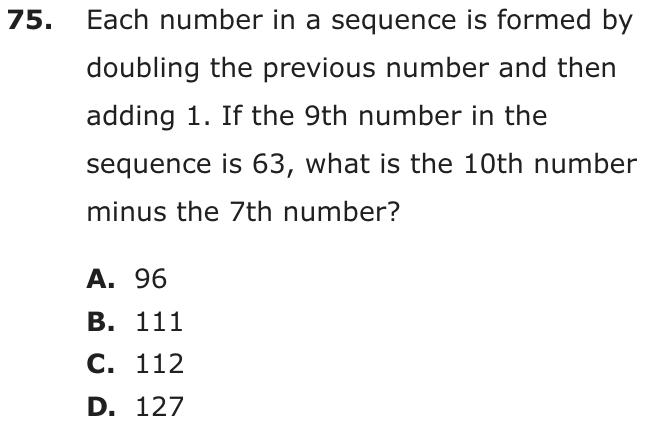
Each number in a sequence is formed by doubling the previous number and then adding 1. If the 9th number in the sequence is 63, what is the 10th number minus the 7th number?
- A96
- B111
- C112
- D127
Show the answer
Correct answer: C
First, write an equation based on the rule described in the item. Let x be the previous number in the sequence and y be the number in the sequence. The ninth number in the sequence is 63.
Determine the 10th number in the sequence, y, by making and solving:
Determine the 8th number in the sequence, x, by making and solving:
Subtract one from both sides of the equation.
Determine the 7th number in the sequence, x, by making and solving:
Subtract the 7th number in the sequence from the 10th number:
The difference is 112.
Question analysis
A sequence question: each number is found by doubling the one before it and adding 1, and the 9th number is 63. Students find the 10th number minus the 7th. That means running the rule forward once and backward twice, while keeping track of which position each number holds.
- Grade level
- Grade 7 content, by NYS standard
- Compared with grade 7
- Above grade 7 Grade 7 students solve two-step equations but rarely have to run a rule backward through a sequence. This mixes forward and backward steps with position counting, so it asks for more planning than a typical grade 7 task.
- Estimated difficulty
- Hard: combines ideas, needs a plan, and has more than one tempting wrong answer.
- Thinking it demands
- Depth of knowledge 2, skills and concepts · mainly apply
- What makes it hard
- No obvious method moderate
- Many steps moderate
- Much to keep track of minor
- Solution
- 4 steps
- Reading level
- Question and choices: about grade 7, 32 words.
- Corrected from the DOE handbook
- A misplaced parenthesis in the explanation’s working was corrected.
- Students, last 30 days
- Not enough answers yet to show (it takes 10).
Why it is hard, traps and wrong answers (shows the answer)
Why it is hard
Applying the rule forward is routine; running it backward is not, and the question needs both. Students must also count positions carefully, since the 9th number is given and the 7th is two steps back, not one. Each listed wrong answer stops or slips at a different stage, so writing the four numbers in a row, 15, 31, 63 and 127, before subtracting is the reliable way.
No obvious method moderate Working it out
The rule is stated only forward, double and add 1, but the 7th and 8th numbers come before the given 9th, so the rule must be undone: subtract 1, then halve. (Schoenfeld, 1985)
Many steps moderate Working it out
One forward step reaches the 10th number, 127, two backward steps reach the 8th and 7th, 31 and 15, and a final subtraction finishes. (Daniel & Embretson, 2010; Enright, Morley & Sheehan, 2002)
Much to keep track of minor Working it out
Four positions and their values, 7th to 10th, have to be kept straight, and the 8th number is easy to mistake for the 7th. (Sweller, 1988; Carpenter, Just & Shell, 1990)
Strategy: Apply the rule to 63 to get the 10th number; to go back a position, subtract 1 and halve, doing it twice to reach the 7th; then subtract.
Traps
- Counting the ends: Inclusive or exclusive ends, fence posts, consecutive numbers: an answer that is one too many or too few, or an endpoint drawn open where it belongs closed (or the reverse).
- Stops one step early: A choice is a number from partway through the solution.
The wrong answers, classified
A Counting the ends (Brown & Burton, 1978)
Steps back only once from the 9th number and subtracts the 8th, 127 − 31 = 96, one position short of the 7th.
B Misreads the question (Hegarty, Mayer & Monk, 1995)
Doubles 63 to 126 but forgets to add 1 on that step, then subtracts the correct 7th number: 126 − 15 = 111.
D Stops one step early (King et al., 2004; Gierl et al., 2017)
Finds the 10th number, 2 × 63 + 1 = 127, and stops without subtracting the 7th number from it.
What was corrected from the DOE handbook, and why
- Explanation: Finding the 7th number, the handbook writes “2x + (1 − 1 = 31 − 1)”, with the closing parenthesis after the whole equation, so the line reads as an equation inside an expression (and 1 − 1 = 31 − 1 is false). The site now reads 2x + (1 − 1) = 31 − 1, the same step the handbook writes correctly for the 8th number (2x + (1 − 1) = 63 − 1). It leads to 2x = 30 and x = 15 as before.
Worked solution, step by step
Formulas used
- The sequence rule
- A sequence is a list of numbers that follows a rule. x is a number in the list, and y is the next number. To get the next number, double x and then add 1.
- Going back one number
- y is a number in the list, and x is the one just before it. To go back, undo the rule in reverse order. The rule doubles and then adds 1. So first subtract 1, then divide by 2.
Sort out the question
Each number is “formed by doubling the previous number and then adding 1”. Previous means the one just before. The 9th number is 63. You need the 10th number minus the 7th number. So you go forward one number and back two numbers.
Find the 10th number
Use the rule with x = 63.
The 10th number is 127. Watch out: remember to add 1. Doubling only gives 126 and leads to 111, choice B.
Plan how to go back
The 7th number comes before the 9th, so you must undo the rule. The rule doubled, then added 1. Undo the last step first: subtract 1. Then undo the doubling: divide by 2.
Find the 8th number
The 8th number is 31. Watch out: 31 is the 8th number, not the 7th. Using it gives , choice A.
Find the 7th number
Step back once more, from the 8th number. Use the same rule with y = 31.
The 7th number is 15.
Subtract the 7th from the 10th
Watch out: 127 alone is choice D. You still have to subtract the 7th number. So the answer is C, 112.
Check your answer
Go forward from 15 using the rule. , then , then . You land on 63 as the 9th number, so the list is right. And .
More questions like this
The original DOE question
Question 2 of 5
2024 Test B Math, question 37Question
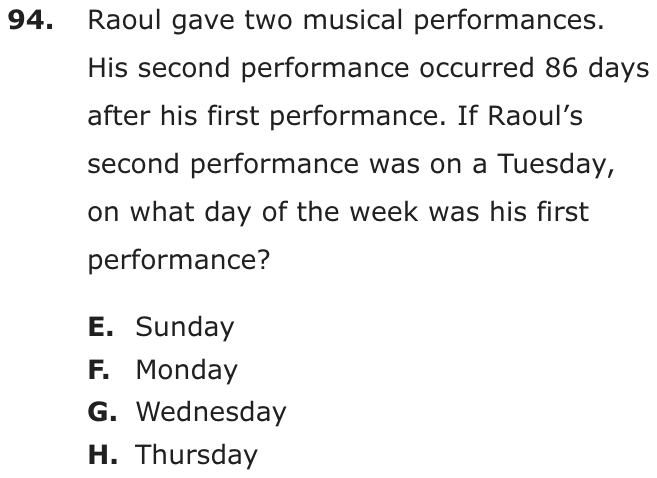
Raoul gave two musical performances. His second performance occurred 86 days after his first performance. If Raoul’s second performance was on a Tuesday, on what day of the week was his first performance?
- ASunday
- BMonday
- CWednesday
- DThursday
Show the answer
Correct answer: A
The total number of days (86) is divided by the number of days in a week (7).
The 2 days are counted back from Tuesday, so the first performance was on a Sunday.
Question analysis
Raoul's second musical performance came 86 days after his first and fell on a Tuesday. Students work out the day of the week of the first performance. It tests division with remainders in a repeating weekly cycle, and the traps are counting in the wrong direction or miscounting the leftover days.
- NYS standards
- 6.NS.2 multi-digit division
- Grade level
- Grade 6 content, by NYS standard
- Compared with grade 7
- At grade 7 Dividing with a remainder is grade 6 arithmetic, but using the remainder to step through a seven-day cycle, and counting backward, is less routine than grade 7 classwork. It needs care with direction rather than new content.
- Estimated difficulty
- Moderate: several steps, or a close reading with one strong distractor.
- Thinking it demands
- Depth of knowledge 2, skills and concepts · mainly apply
- What makes it hard
- No obvious method moderate
- Turning words into math minor
- Solution
- 2 steps
- Reading level
- Question and choices: about grade 5, 36 words.
- Students, last 30 days
- Not enough answers yet to show (it takes 10).
Why it is hard, traps and wrong answers (shows the answer)
Why it is hard
Counting 86 days one at a time is hopeless in the time allowed, so the question rewards seeing that whole weeks return to the same weekday. Two decisions remain after that, and each has a listed wrong answer: which way to count, and whether Tuesday itself is one of the 2 days. Saying the days aloud, Monday is 1 back and Sunday is 2 back, avoids both.
No obvious method moderate Working it out
Nothing in the stem says to divide by 7; the key is that 84 of the 86 days are exactly 12 weeks, which leaves only 2 days to count. (Schoenfeld, 1985)
Turning words into math minor Understanding the question
"His second performance occurred 86 days after his first" puts the unknown day before the Tuesday, so the leftover days are counted backward. (Hegarty, Mayer & Monk, 1995; Koedinger & Nathan, 2004)
Strategy: Remove whole weeks from the 86 days, since each full week lands on the same weekday, then count the leftover days backward from Tuesday.
Traps
- Negatives and direction: Arithmetic with negative numbers, the order of a subtraction, or direction on a number line. (Moving a term across the equals sign without changing its sign is a faulty procedure.)
- Counting the ends: Inclusive or exclusive ends, fence posts, consecutive numbers: an answer that is one too many or too few, or an endpoint drawn open where it belongs closed (or the reverse).
The wrong answers, classified
B Counting the ends (Brown & Burton, 1978)
Counts Tuesday itself as the first of the 2 leftover days, so moves back only one day, to Monday.
C Negatives and direction (Brown & Burton, 1978)
Counts forward from Tuesday instead of back and also counts Tuesday as one of the 2 days, landing on Wednesday.
D Negatives and direction (Brown & Burton, 1978)
Counts the 2 leftover days forward from Tuesday, finding the day 86 days after the second performance instead of before it.
Worked solution, step by step
Formulas used
- Weeks and leftover days
- days is the total number of days. weeks is the number of full weeks inside it. leftover is the days that remain, from 0 to 6. The day of the week repeats every 7 days, so only the leftover days change it.
Sort out the question
The second show was on a Tuesday. It came 86 days after the first show. So the first show was 86 days before that Tuesday.
You need the day of the week of the first show. So you count back 86 days from Tuesday.
Take out the full weeks
Counting back 86 days one at a time is slow. Here is a shortcut. Every 7 days, the same weekday comes back. So divide 86 by 7.
That is 12 full weeks and 2 extra days. Going back 12 weeks from a Tuesday lands on a Tuesday again.
Count back the 2 extra days
Start on Tuesday and go back one day at a time. One day back is Monday. Two days back is Sunday.
Watch out: Do not count Tuesday itself as one of the 2 days. That lands on Monday, choice B. And count backward, not forward. Counting forward 2 days gives Thursday, choice D.
So the answer is A, Sunday.
Check your answer
Count forward to be sure. Start on a Sunday. After 84 days, which is 12 weeks, it is Sunday again. Two more days are Monday and Tuesday. That is day 86, a Tuesday. It matches.
More questions like this
The original DOE question
Question 3 of 5
2023 Test A Math, question 31Question
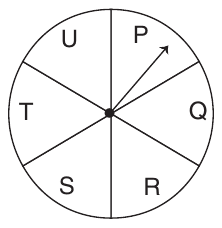
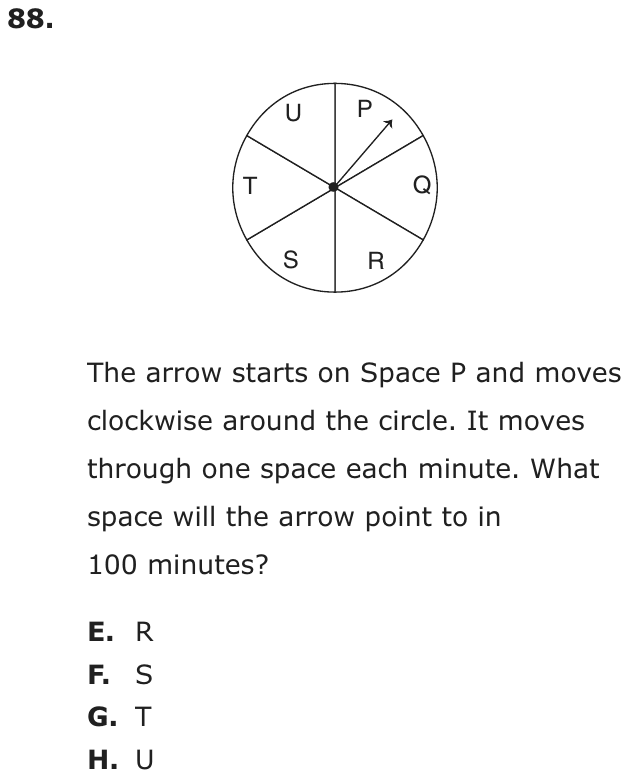
The arrow starts on Space P and moves clockwise around the circle. It moves through one space each minute. What space will the arrow point to in 100 minutes?
- AR
- BS
- CT
- DU
Show the answer
Correct answer: C
There are 6 spaces, so first divide 100 by 6: , remainder 4. So, the arrow goes around 16 full times and then 4 more spaces. Four spaces from Space P is Space T.
Question analysis
This patterns question shows a circle split into six lettered spaces, with an arrow that starts on P and moves one space clockwise each minute, and asks where it points after 100 minutes. Students use division with a remainder to skip the full trips around. Counting the leftover moves without including the starting space, and in the right direction, is the tricky part.
- NYS standards
- 6.NS.2 multi-digit division
- Grade level
- Grade 6 content, by NYS standard
- Compared with grade 7
- At grade 7 Division with a remainder is grade 6 arithmetic, but using that remainder to step around a six-part circle is a pattern task that grade 7 classes seldom practice. It needs careful counting rather than new content.
- Estimated difficulty
- Straightforward: two steps or one careful reading.
- Thinking it demands
- Depth of knowledge 2, skills and concepts · mainly apply
- What makes it hard
- Solution
- 2 steps
- Reading level
- Question and choices: about grade 1, 32 words.
- Students, last 30 days
- Not enough answers yet to show (it takes 10).
Why it is hard, traps and wrong answers (shows the answer)
Why it is hard
The division is short; the points are lost in turning the remainder into a space. The arrow starts on P, so the 4 leftover moves land on Q, R, S and T, and counting P itself as a move stops one space short. Going around the wrong way, or one move too far, gives the other two choices. Checking a small case first, such as 7 minutes landing on Q, fixes the rule before it is used.
No obvious method minor Working it out
The stem never mentions division; the step that unlocks it is seeing that every 6 minutes brings the arrow back to P, so only the remainder of 100 ÷ 6 matters. (Schoenfeld, 1985)
Reading a figure, table or graph minor Understanding the question
The six spaces and their clockwise order, P, Q, R, S, T, U, appear only in the circle diagram, so the cycle length and the direction of counting both come from the figure. (Lesh, Post & Behr, 1987; Kirsch & Mosenthal, 1990)
Strategy: Divide 100 by 6: every full trip around the circle brings the arrow back to P, so only the remainder matters; count that many moves clockwise, starting with the space after P.
Traps
- Counting the ends: Inclusive or exclusive ends, fence posts, consecutive numbers: an answer that is one too many or too few, or an endpoint drawn open where it belongs closed (or the reverse).
- Negatives and direction: Arithmetic with negative numbers, the order of a subtraction, or direction on a number line. (Moving a term across the equals sign without changing its sign is a faulty procedure.)
The wrong answers, classified
A Negatives and direction (Brown & Burton, 1978)
Counts the 4 leftover moves counterclockwise from P, through U, T and S to R, instead of clockwise as the stem says the arrow moves.
B Counting the ends (Brown & Burton, 1978)
Counts Space P itself as the first of the 4 leftover moves, P, Q, R, S, so the arrow stops one space short of where it really points.
D Counting the ends (Brown & Burton, 1978)
Makes 5 moves past P instead of the 4 left after 16 full turns, overshooting by one space, the fence-post slip in the other direction.
Worked solution, step by step
Formulas used
- Division with a remainder
- a is the number you divide, here the minutes. b is the number you divide by, here the spaces in one trip around. q is how many whole groups of b fit into a. r is the remainder, the amount left over. The remainder is always less than b.
Sort out the question
The circle has 6 spaces. Going clockwise, the way a clock’s hands turn, they are P, Q, R, S, T and U. The arrow starts on P and moves one space each minute. You need the space it points to after 100 minutes.
Notice that the pattern repeats
After 6 minutes, the arrow has gone all the way around and points to P again. After 12 minutes it is back on P again, and so on. So full trips of 6 minutes don’t change where it points. Only the leftover minutes matter.
Divide 100 by 6
The arrow makes 16 full trips. That takes minutes, and it is back on P. There are 4 minutes left over.
Count the last 4 moves
From P, move one space each minute: Q (minute 97), R (minute 98), S (minute 99), T (minute 100).
Watch out: don’t count P itself as the first move. That stops on S, choice B. Also count clockwise. Counting the other way lands on R, choice A.
So the answer is C, T.
Check your answer
Use a smaller number with the same remainder. 100 − 96 = 4, and 96 minutes is a whole number of trips. So after 100 minutes the arrow points where it does after 4 minutes. Four moves from P are Q, R, S, T. That is T again.
More questions like this
The original DOE question
Question 4 of 5
2023 Test B Math, question 14Question
Each number in a sequence is 3 more than twice the number that comes just before it. If 93 is a number in the sequence, what number comes just before it?
- A92
- B90
- C48
- D45
Show the answer
Correct answer: D
Let n represent a number in the sequence, and let x represent the number that comes just before n:
Question analysis
In a sequence, each number is 3 more than twice the number just before it, and 93 is one of the numbers. Students find the number that comes just before 93. That means running the rule backward, undoing the adding and the doubling in reverse order.
- Grade level
- Grade 7 content, by NYS standard
- Compared with grade 7
- At grade 7 Grade 7 students routinely solve two-step equations. The demand here is translating the wordy sequence rule into one, or running the rule backward in the right order, rather than any harder content.
- Estimated difficulty
- Moderate: several steps, or a close reading with one strong distractor.
- Thinking it demands
- Depth of knowledge 2, skills and concepts · mainly apply
- What makes it hard
- Turning words into math moderate
- No obvious method minor
- Solution
- 2 steps
- Reading level
- Question and choices: about grade 5, 29 words.
- Students, last 30 days
- Not enough answers yet to show (it takes 10).
Why it is hard, traps and wrong answers (shows the answer)
Why it is hard
The arithmetic is two short steps, so the question rests on reading a wordy rule correctly and running it in reverse. Each wrong choice marks a different place to go wrong: ignoring the rule, stopping after the subtraction, or undoing the adding with more adding. Checking the answer forward, twice the number plus 3, confirms it reaches 93.
Turning words into math moderate Understanding the question
“Each number … is 3 more than twice the number that comes just before it” must become 2x + 3 = 93, with x the earlier number, not the later one. (Hegarty, Mayer & Monk, 1995; Koedinger & Nathan, 2004)
No obvious method minor Working it out
The rule is stated forward, from a number to the next, but the question runs backward, so each operation has to be undone in reverse order: subtract 3, then halve. (Schoenfeld, 1985)
Strategy: Call the earlier number x, write the rule as an expression in x set equal to 93, and solve it by undoing each operation in reverse order.
Traps
- Wrong operation: Adds instead of multiplying, divides the wrong way round, turns a ratio or rate upside down, or undoes a step in the wrong direction (subtracts what should be added back).
- Stops one step early: A choice is a number from partway through the solution.
- Misreads the question: Misses or misreads a condition or a word in the question: "at least", "each", "remaining", "not".
The wrong answers, classified
A Misreads the question (Hegarty, Mayer & Monk, 1995)
Reads “the number that comes just before it” as the whole number one less than 93, ignoring the sequence’s rule.
B Stops one step early (King et al., 2004; Gierl et al., 2017)
Undoes the adding of 3, 93 − 3 = 90, and stops before undoing the doubling.
C Wrong operation (Hegarty, Mayer & Monk, 1995; King et al., 2004)
Adds 3 instead of subtracting it before halving, (93 + 3) ÷ 2 = 48, undoing the rule in the wrong direction.
Worked solution, step by step
Formulas used
- The sequence rule
- x is any number in the sequence, a list that follows a rule. n is the number right after it. Twice means times 2, so twice x is 2x. Then 3 more means add 3. The same rule links every number to the one after it.
Sort out the question
A sequence is a list of numbers that follows a rule. Here, each number is “3 more than twice the number that comes just before it.” 93 is in the list. You need the number right before 93. Call it x.
Write the rule as an equation
Twice x is 2x. Three more than that is 2x + 3. The rule says this equals the next number, which is 93.
Undo the adding of 3
The rule doubles x first, then adds 3. To go backward, undo the steps in reverse order. First, subtract 3 from both sides.
Watch out: 90 is twice the number, not the number itself. Stopping here gives choice B. And don’t add 3, which leads to 48, choice C.
Undo the doubling
Now divide both sides by 2.
Watch out: “just before” means just before in this list. It does not mean one less than 93, so 92 is wrong. So the answer is D, 45.
Check your answer
Run the rule forward from 45. Twice 45 is 90, and 3 more is 93: . So 45 really does come just before 93.
More questions like this
The original DOE question
Question 5 of 5
2018 Test A Math, question 48Question
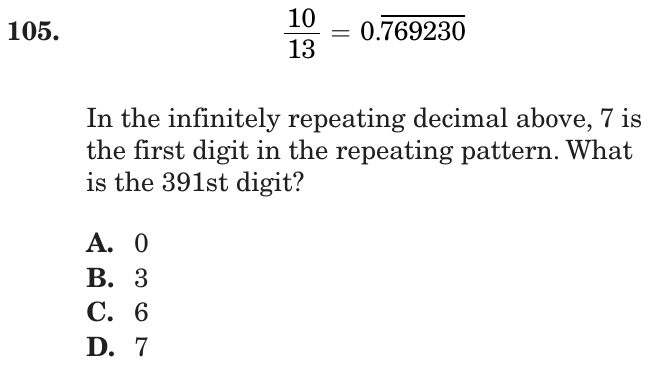
In the infinitely repeating decimal above, 7 is the first digit in the repeating pattern. What is the 391st digit?
- A0
- B3
- C6
- D7
Show the answer
Correct answer: D
There are 6 digits in the repeating decimal (769230), so 7 would be the first, seventh, thirteenth digit and so on.
To find the 391st digit, divide 391 by 6.
391 ÷ 6 = 65 R1
Since the remainder is 1, that means the 391st digit is the same as the 1st digit, which is 7.
Question analysis
This repeating decimal question shows the six-digit repeating pattern of 10/13 and asks for the 391st digit after the decimal point. Students must use the length of the repeating block and division with a remainder to find the position within the cycle. Matching the remainder to the right digit is where students slip.
- Grade level
- Grade 7 content, by NYS standard
- Compared with grade 7
- Above grade 7 Seventh graders learn that fractions have repeating decimals. Using the length of the repeating block and a remainder to find a digit hundreds of places away is a pattern-reasoning step beyond typical seventh-grade classwork.
- Estimated difficulty
- Hard: combines ideas, needs a plan, and has more than one tempting wrong answer.
- Thinking it demands
- Depth of knowledge 2, skills and concepts · mainly apply
- What makes it hard
- No obvious method moderate
- Solution
- 2 steps
- Reading level
- Question and choices: about grade 8, 20 words.
- Students, last 30 days
- Not enough answers yet to show (it takes 10).
Why it is hard, traps and wrong answers (shows the answer)
Why it is hard
Once the cycle length is used, the arithmetic is a single division, 391 ÷ 6 = 65 remainder 1. The difficulty is turning the remainder into a position: remainder 1 is the first digit of a new block, not the last digit of the previous one or the second of the new one. Checking the rule on small positions, the 1st and 7th digits are both 7, removes the doubt.
No obvious method moderate Working it out
Nothing in the stem mentions division; students must see that the six-digit block 769230 repeats, so position 391 depends only on the remainder of 391 divided by 6. (Schoenfeld, 1985)
Strategy: Divide 391 by the length of the repeating block and look only at the remainder; a remainder of r points to the r-th digit of the block.
Traps
- Counting the ends: Inclusive or exclusive ends, fence posts, consecutive numbers: an answer that is one too many or too few, or an endpoint drawn open where it belongs closed (or the reverse).
The wrong answers, classified
A Counting the ends (Brown & Burton, 1978)
Sees that 65 blocks fill 390 places and lands on the 390th digit, the 0 that ends a block, one place short.
B A faulty procedure (Brown & Burton, 1978; Tatsuoka, 1983)
Uses the quotient 65 instead of the remainder, takes its last digit 5, and reads the fifth digit of 769230, which is 3.
C Counting the ends (Brown & Burton, 1978)
Treats the remainder 1 as one step past the block's first digit, moving from 7 to the second digit, 6.
Worked solution, step by step
Formulas used
- Division with a remainder
- n is the number you divide. d is what you divide by. q is the quotient, the number of whole groups. r is the remainder, what is left over. Here it tells how many full blocks of digits fit, and where you land after them.
Sort out what you know
The bar over 769230 means those six digits repeat forever: 769230769230 and so on. The 7 is digit number 1. You need digit number 391.
Spot the pattern
The block 769230 has 6 digits, so the pattern starts over every 6 digits. Digit 1 is 7, and so are digits 7, 13, 19 and so on. Each full block ends with a 0, at digits 6, 12, 18 and so on.
Divide 391 by 6
Find how many full blocks fit into 391 digits, and what is left:
So 65 full blocks use up 6 × 65 = 390 digits. The remainder is 1. That means digit 391 is the 1st digit of the next block.
Read the digit
The 1st digit of the block is 7. Watch out: digit 390 is the last digit of a full block, which is 0. That is choice A. Digit 391 is one step past it, so it starts a new block.
So the answer is D, 7.
Check your answer
Test the idea on a small number. Digit 7: 7 = 6 × 1 + 1, so the remainder is 1 and the digit should be 7. Write it out: 7692307. The 7th digit is indeed 7. The rule works.
More questions like this
The original DOE question